THE HIGHLANDER
UNIVERSITY OF CALIFORNIA, RIVERSIDE
est. 1954
FOR THE WEEK OF TUESDAY, MAY 14, 2019
VOL. 67, ISSUE 28
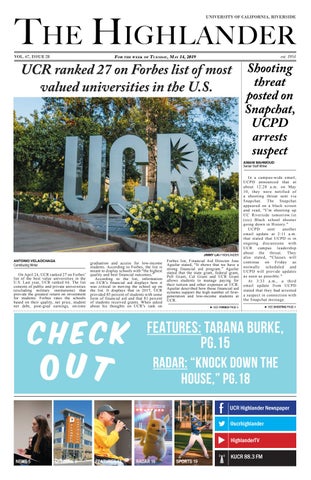
UCR ranked 27 on Forbes list of most valued universities in the U.S.
Shooting threat posted on Snapchat, UCPD arrests suspect
AMANI MAHMOUD Senior Staff Writer
Forbes list, Financial Aid Director Jose Aguilar stated, “It shows that we have a strong financial aid program.” Aguilar stated that the state grant, federal grant, Pell Grant, Cal Grant and UCR Grant allows students to manage paying for their tuition and other expenses at UCR. Aguilar described how those financial aid systems support the high number of firstgeneration and low-income students at UCR.
In a campus-wide email, UCPD announced that at about 12:28 a.m. on May 10, they were notified of a shooting threat sent via Snapchat. The Snapchat appeared on a black screen and read, “I’m shooting up UC Riverside tomorrow.1st (sic) Black school shooter going down in History.” UCPD sent another email update at 2:11 a.m. that stated that UCPD is in ongoing discussions with UCR campus leadership about the threat. They also stated, “Classes will continue on Friday as normally scheduled and UCPD will provide updates as soon as possible.” At 3:33 a.m., a third email update from UCPD stated that they had arrested a suspect in connection with the Snapchat message.
► SEE FORBES PAGE 5
► SEE SHOOTING PAGE 4
JIMMY LAI / HIGHLANDER
ANTONIO VELAOCHAGA Contributing Writer
On April 24, UCR ranked 27 on Forbes’ list of the best value universities in the U.S. Last year, UCR ranked 64. The list consists of public and private universities (excluding military institutions) that provide the greatest return on investment for students. Forbes rates the schools based on their quality, net price, student net debt, post-grad earnings, on-time
graduation and access for low-income students. According to Forbes, the list is meant to display schools with “the highest quality and best financial outcomes.” According to the list, information on UCR’s financial aid displays how it was critical in moving the school up on the list. It displays that in 2017, UCR provided 85 percent of students with some form of financial aid and that 81 percent of students received grants. When asked about his thoughts on UCR’s rank on
check
out
FEATURES: TARANA BURKE, PG.15 RADAR: “knock down the house,” PG.18 f
UCR Highlander Newspaper @ucrhighlander HighlanderTV
NEWS 5
OPINIONS 9
FEATURES 13
RADAR 16
SPORTS 19
KUCR 88.3 FM
2
TUESDAY, MAY 14, 2019
HIGHLANDER // highlandernews.org
HUMANS OF UCR
UPCOMING EVENTS: WEEK 7
STEPHANIE SOTELO | MATHEMATHICS | SECOND-YEAR
14
Coffee Chat Featuring Nissan 10:00am to 11:00am Career Center, Library
Blank Canvas - Open Mic 5:00pm to 7:00pm HUB 355
15
Panana Night Market Information Table 10:00am to 2:00pm UCR Bell Tower
WRITERS RESIST: Louder Together for Free Expression 5:00-7:00 P.M. CHASS Interdisciplinary South, Round Lab, INTS 1111
16
API-tizers with APISAC 2:00pm to 1:00pm Costo Hall, 244
Dive-In-Movie 7:30pm to 9:00pm Student Recreation Center (SRC), Pool
17
Peace Corps Reception & Lecture 11:45am to 1:00pm UCR Career Center Patio
Active Minds: Stress Relief Campfire 6:00pm to 8:00pm UCR Bell Tower
BioHack 2019! 8:30am to 11:00pm Bourns Hall (Engineering), Winston Chung Hall 138
Film: Birds of Passage 7:00pm to 10:00pm UCR ARTS, Culver Center of the Arts
Sunday
UCR Tennis Club Tournament 8:00am to 6:00pm Student Recreation Center (SRC), Tennis Courts
Primavera in the Gardens 2:00pm to 5:00pm UCR Botanic Gardens
20
Deep Breaths. Stress Less 6:30pm to 9:00pm HUB (Highlander Union Building), 260
UCR Voice Studio of Dr. Ralph Cato in Concert 8:00pm to 9:30pm Arts Building
Tuesday
COMPILED BY JOSHUA VILLARIN
Wednesday
Thursday
“I am a first generation college student from Pomona. Now I am
Friday
guiding my little sister through college applications and picking schools since she is a senior in high school, I didn’t have anyone to help me when I was applying to schools. My biggest motivation is to help my sister because I did not have the experience when I was in her place.”
18
Saturday
19 CONTACT US
HIGHLANDER STAFF EDITOR-IN-CHIEF
MANAGING EDITOR
Evan Ismail
Andreas Rauch
managingeditor @highlandernews.org
editorinchief @highlandernews.org NEWS EDITOR
ASST. NEWS EDITOR
Aidan Rutten
Amani Mahmoud Mark Bertumen
news@highlandernews.org
ASST. OPINIONS EDITOR
Aidan Rutten
opinions@highlandernews.org FEATURES EDITOR
Martha Delgado
features@ highlandernews.org
Marcelo Garcia
radar@highlandernews.org
Business Office: (951) 827-3457
Classifieds & Billing: (951) 827-5039
SPORTS EDITOR
Jonathan Fermandez
sports@highlandernews.org
Fax: (951) 827-7049
LETTERS TO THE EDITOR
PRODUCTION MANAGER
Kerry Mulia
productionmanager @highlandernews.org PRODUCTION ASSISTANTS
Kathy Garcia Amanda Joy Teano Judy Tu
Jeffrey Yoo Brinly Den Celine Hoang Asst. Photo Editor
PHOTOGRAPHY EDITOR
Jimmy Lai
Martin Lopez mlope072@ucr.edu
photo@highlandernews.org STAFF PHOTOGRAPHERS
Thomas Holguin, Lydia Tsou, Ryan Poon VIDEO EDITOR
Catherine Yong
video.highlander@gmail.com BUSINESS MANAGER
Karla Montes
highlanderads@gmail.com DISTRIBUTION MANAGER
TECH DIRECTOR
Kevin Ciampaglia
techdirector@highlandernews.org
MARKETING COORDINATOR
Jessica Schneider
TIP LINE: (951) 827-2105 Help the Highlander stay on top of what is happening on campus and in the general UCR community. Call this number and leave a message for the Editorial Board with your tip. Be sure to include your full name, relation to UCR, and a number or email address where you can be reached for more details. Editorial Office: (951) 827-3617
A&E EDITOR
Chiraag Dave
Highlander 101 Highlander Union Building Riverside, CA 92521 www.highlandernews.org editorinchief@highlandernews.org
marketing.highlander@gmail.com
The Highlander accepts letters from the campus community. They must be 600-800 words at length and include the author’s name and contact information. Topics should be UCR-centric and/or pertain to our generation of students. Contact Opinions Editor Michael Beeli at opinions@highlandernews.org by Wednesday if interested in writing a letter and submit the completed letter by Saturday at noon. Letters can and will be rejected if it does not meet requirements. LEGAL The Highlander is published and copyrighted by the Highlander for the students, faculty and staff of UCR. All rights are reserved. Reprinting of any material in this publication without the written permission of the Highlander is strictly prohibited. Readers are allowed one free copy of the newspaper. For additional copies or for subscription information, please contact the Highlander. The Highlander fully supports the University of California’s policy on non-discrimination. The student media reserve the right to reject or modify advertising whose content discriminates on the basis of ancestry, color, national origin, race, religion, disability, age, sex or sexual orientation. The Highlander has a media grievance procedure for resolving complaints against it. All inserts that are printed in the Highlander are independently paid publications and do not reflect the views of the Editorial Board, the staff or The University of California or the Associated Students of UCR.
Monday
MULTIMEDIA
CLASSIFIED ADVERTISEMENTS ADVERTISING INFORMATION Please submit Classifed ads by calling 951-827-3457 or by emailing Highlanderads@ucr.edu PAYMENT Visa and Mastercard Make checks payable to The Highlander Newspaper No refunds RATES Classified: $2 per line; 17 characters (spaces, dashes, etc.)
UCRHIGHLANDER
f
UCR HIGHLANDER NEWSPAPER @UCRHIGHLANDER HighlanderTV
MISCELLANEOUS Pregnant? Free counseling and services. We come to you. Holy Family Services, adoption & foster care. 1-800-464-2367.
KUCR 88.3 FM
News 4
TUESDAY, MAY 14, 2019
HIGHLANDER // highlandernews.org/news
Shooting threat posted on Snapchat, UCPD arrests suspect ► FROM SHOOTING
JIMMY LAI / HIGHLANDER
They reiterated that classes will continue normally as scheduled. According to a fourth email update at approximately 12:05 p.m., the suspect was identified as 24-year-old Matthew Woolridge of Riverside, California. They stated that, based on the findings of the officer’s investigation, Woolridge was arrested and booked into Riverside County Jail for Criminal Threats (422 of California Penal Code). Woolridge is not affiliated with UCR, according to UCPD. In response to the threat, Chancellor Kim Wilcox sent out a mass email which stated that “Once it was clear that there was no active threat to the campus, I made the decision to continue our operations as planned for the day.” Wilcox thanked the UCR faculty and staff who supported the members of the campus community who needed “specific accommodations” following this incident. “Even though an arrest has been made, I realize that this incident can be upsetting for a variety of reasons – especially in light of recent shootings occurring across the country,” stated Wilcox. Wilcox encouraged students to make full use of the campus resources available to students and employees if they have experienced any trauma or other effects related to this threat. Wilcox went on to state, “I want to assure you that the safety of the campus and our students, faculty, and staff is a top priority. We welcome your feedback on opportunities to make our campus the safest community possible.” When questioned for further information by the Highlander, UCPD stated that there is no additional information to be released that is not currently included in their email updates. Their investigation into the matter continues. ■H
Reports show lower disparity between white and black graduation rates at UCR
SILVIA FERRER Contributing Writer
According to a report by The Education Trust, a national nonprofit that advocates for students of color and low-income students, UCR has made significant gains at addressing the gaps in college completion rates of minority and low-income students in comparison to white and high-income students. At four percent, UCR has the secondhighest enrollment rate of black students in the UC system, falling less than one percentage point behind UC Merced. While other UC campuses graduate a higher percentage of black students, the study reports that UCR has achieved the smallest disparity between the graduation rates of white and black students. The study, “Rising Tide II: Do Black Students Benefit as Grad Rates Increase?” compared graduation rates of the two groups from 2003 to 2013. UCLA boasted the highest rate of graduating black students at 80.7 percent but saw a near 10 percentage point difference from graduating white students, who graduated at a 90.6 percent rate. In comparison, UCR’s black student graduation rate was 65.7 percent to a white student graduation rate of 65.5 percent. Mariam Lam, associate vice chancellor and chief diversity officer in the Office of Diversity, Equity and Inclusion recognized the efforts of Student Affairs and the Undergraduate Education division of UCR to ensure the completion and success of the black student population. According to Lam, the combined service of the divisions and “multicultural center approach and additional identity specific categories” is what sets UCR apart from other universities who may not have the same cohesive system. Interim Director of African Student Programs (ASP), Greedley F. Harris III, added that ASP was “a home away from home” for the black student community but emphasized that the work does not stop there. ASP collaborates with the Black Faculty and Staff Association (BFSA) and Residential Life’s PanAfrican Theme Hall (PATH) to create a “pyramid of support” for students. Harris
III said that by connecting students to professional and leadership development programs, mentorship opportunities from black staff and faculty, cultural educational programming and other resources, students would not just succeed in college, but would also have the “tools for success once they left the campus.” While Dr. Alisa Bierra, an assistant professor in ethnic studies at UCR, is aware that UCR has room for growth in the enrollment of black students, she also acknowledged the positive influence that the centers and other resources have on the diverse student population. “We have wonderful opportunities for black students sustained by a network of generative spaces,” wrote Bierra. She listed ASP, Blackness Unbound, black community spaces in Riverside and several other support spaces as contributors to the “academic
achievements” of black students. The Career Center has also worked to contribute to the retention and career insight of the African American student population. Derrin Ford, career counselor at the Career Center, wrote that “The Career Center is always trying to contribute to increasing representation that matches the diversity of our school. Initiatives such as the ‘CHASS Dean’s Speaker Series’ and ‘Job Discovery Series’ host speakers that represent successful African American UCR Alumni.” “It’s just not that one office’s (the Office of Diversity, Equity and Inclusion) role to make the campus a hospitable, safe environment for all students. It’s everyone’s responsibility — all the faculty, no matter what race or gender or sexuality,” said Lam. “I think our students are also very good at selfadvocacy and aggravating when they
JIMMY LAI / HIGHLANDER
need to. They’re not afraid to push and do better. They know we can always do better.” Victoria Mills, a fifth-year anthropology major and student worker at ASP, reiterated Lam’s point. After Mills listed several resources and support that ASP provides, including a peer-mentor program and scholarship opportunities, she said: “I think the student center and other resources are doing a lot of the work, but UCR needs to do their part by providing more funding.” “Rising Tide II” and “A Look at Black Student Success: Identifying Topand Bottom-Performing Institutions,” another study by Education Trust, both highlight UCR’s gains in rectifying the disparity in graduation rates between black students and their white counterparts in comparison to California universities and universities across the ■H country.
HIGHLANDER // highlandernews.org/news
NEWS
TUESDAY, MAY 14, 2019
5
ASUCR
ASUCR Judicial branch rules that no candidates will be disqualified due to campaign violations
AMANI MAHMOUD Senior Staff Writer
On May 8, the sixth ASUCR meeting of spring quarter occurred in HUB 221. The meeting was called to order at 6:34 p.m. During ex-officio reports, Peter Haddad, an associate justice from the ASUCR Judicial Council, announced multiple decisions made by the Judicial Council. On May 3, a Judicial Council meeting was held to hear appeals from then-candidates who had multiple campaign violations. Another hearing was held on May 7 to hear from other candidates who also had multiple campaign violations. Violations appeals came from candidates Julian Gonzalez, Lennin Kuri, Isaiah Kim, Luis Huerta and Tiffany Menendez. Haddad first announced that President-Elect Julian Gonzalez violated the elections code, item six, section b, subsection two, which states that candidates are permitted to post up to three, 3-by-5 foot posters on exterior brick surfaces of campus buildings and must be adhered with blue masking or painters tape. The code states that “these posters must be one hundred feet (100’) apart for an individual/referenda, and one foot (1’) apart from other candidates/ referenda.” The judicial branch voted in a 4-0-0 decision to rescind all of Gonzalez’s strikes. Gonzalez no longer faces disqualification and will remain the president-elect. Vice President of External Affairs-Elect Luis Huerta also faced disqualification over violations of the election code, item six, section b, subsection two and item six, section a, subsection one. Huerta’s posters were allegedly not stamped by the ASUCR front office. The judicial branch’s vote over Huerta’s disqualification tied 2-20. According to Haddad, a tied vote results in a not guilty verdict. Huerta’s strikes were rescinded and he will no longer face disqualification. He will serve as vice president of external affairs in the 2019-2020 academic
year. Then CHASS-senator candidate Isaiah Kim also violated item six, section b, subsection two. The judicial branch ruled in a 4-0-0 decision to rescind his strikes due to discrepancies in the election code. Kim lost as CHASS senator with 620 votes. Nelson Huerta, who also lost the CHASS senator race with 592 votes, also violated item six, section a, subsection one. His strike was upheld in a 4-0-0 decision. CHASS senators-elect Ky Nguyen and Tiffany Menendez both faced campaign violations. The judicial branch tied in their decision in regards to Nguyen and his strikes were rescinded. Haddad announced that the evidence against Menendez, who was accused of posting fliers or posters on the Rivera Library arches, not sufficient enough; the judicial branch ruled that she will not be disqualified. Haddad then addressed the Senate and stated, “The elections code is super vague and poorly written. I encourage you all to take a deeper look into the elections code and revise as needed.” Haddad also announced the Judicial Council’s decision regarding S19-JR-2, Domecillo v. Cuevas which investigated the proper firing
procedure of a parliamentarian. This case arose in response to Executive Vice President (EVP) Andrea Cuevas’ firing of Jose Rodriguez, the former parliamentarian. The Judicial Council ruled that the EVP holds the authority to determine the length of the term of a parliamentarian and that the EVP does not have to notify or receive approval from the Senate when firing a parliamentarian. Haddad stated that the Judicial Council does recommend that in the future, the EVP does give a written notice to employees who they will be firing. They voted unanimously in favor of Cuevas, upholding Rodriguez’s termination. Rodriguez had stated in a Feb. 25 senate meeting that ASUCR members had not been following protocol when submitting legislation (such as resolutions). Gonzalez stated that senators are supposed to provide 48 hours notice for their proposals, however, according to Gonzalez they had not been following that protocol. Haddad stated that the Judicial Council ruled that Cuevas could not fulfill this protocol and her duties, “on account of some of her fellow cabinet members. We ruled unanimously in favor of
LEO YUE / HIGHLANDER
Cuevas.” Haddad further explained this decision by stating that while Cuevas is responsible as EVP to provide 48 hours notice for their proposals, “this does not excuse the obligations of her fellow senators and members of the legislative and executive branch.” After ex-officio reports, the meeting moved on to public forum. Samir AlAlami, a third-year political science major and a member of the elections committee addressed president-elect Gonzalez. Al-Alami stated that in his appeal last week, Gonzalez stated that the elections committee failed to abide by the elections code which resulted in his inability to remedy the violations when he had the chance. In reference to these comments, Al-Alami stated, “I am willing to acknowledge that me and my committee could have failed in some regards, but you have no sense of self-accountability.” Al-Alami then went on to state, “You denigrate the work of my committee and all the work that we have done. This degradation and derision proves to me that you cannot be my president and claim to represent me.” The meeting was adjourned at 7:40 p.m. ■H
UCR ranked 27 on Forbes list of most valued universities in the U.S. ► FROM FORBES
JIMMY LAI / HIGHLANDER
On the Forbes list, UCR’s rank also increased as a result of the number of students with Pell Grants since it shows the concentration the school has on creating more opportunities for low-income students. Forbes’ website displays that 53 percent of UCR students received Pell Grants in 2017. In an interview with the Highlander, CHASS Marketing and Communications Director Jeff Girod said, “Cost is a big obstacle, what we’re trying to do is provide access for everyone.” Timely graduation was another factor that Forbes took into account when rating institutions, as they accounted for the added expenses that a student would have if they were enrolled longer. “You’re actually saving by graduating earlier than taking that extra year,” emphasized Aguilar. “A lot of students don’t see that. They think if I stay an extra quarter or an extra year then I’ll get
more financial aid,” Aguilar continued. He said that the net value a student is receiving is not going to compare to the loss of income for not working that year. Aguilar stated that he believes the campus leadership does a good job aiming to try to graduate students faster. Aguilar also commented on how UCR resources such as the ARC, The Well and the Undergraduate Academic Advisory Programs, such as CHASS, CNAS and BCOE, help students navigate UCR in order to graduate on time. He stated, “I think it’s really critical and helpful to have those support programs for first-generation students to have that guidance.” Girod said that the Forbes list shows how UCR is one of the fastest rising universities in the country and also stated, “It’s a source of pride from the students, faculty and staff for what we already know.” Aguilar concluded by saying, “I think our students should be proud.” ■H
6
TUESDAY, MAY 14, 2019
HIGHLANDER // highlandernews.org/news
Fall 2019 classes move ten minutes earlier
CAMERON SADEGHI Contributing Writer
Provost and Executive Vice Chancellor Cynthia K. Larive notified UCR students that Fall 2019 classes will begin and end ten minutes earlier in a May 7 email. In the campus-wide email, Larive stated that classes will begin on the hour and half hour. Larive claims that the new class schedule changes can be beneficial for on-campus and off-campus activities. In response to a recommendation by the Course Scheduling Committee, the Fall 2019 class schedule change was made. According to the “Course Scheduling Policy Workgroup Final Report,” the Course Scheduling Committee (CSC) collaborates with the Registrar to implement class scheduling policies and recommends class scheduling changes to the Provost. The class schedule change is one part of a larger report published on March 26, 2018. In the “Course Scheduling Policy Workgroup Final Report,” nine recommendations are made. The Workgroup recommended the creation of the Course Scheduling Committee, classes beginning on the hour and half hour and other changes such as annual scheduling. This report was formulated by 15 individuals and showcased the scheduling practices of other universities, such as Ohio State University and Stanford University.
JIMMY LAI / HIGHLANDER
Associate Provost Ken Baerenklau highlighted the main reason for the schedule change: “The whole world kind of falls into this natural pattern of things starting on the hour and half hour. When you have classes that end on the hour and the half hour, you end up with students and faculty getting out of one obligation at the same time of the next obligation starting.” Baerenklau was the chair member for the “Course Scheduling Policy Workgroup Final Report.” Similar to UC Riverside, the University of Michigan used to begin class ten minutes after the hour. “The University of Michigan was in a very similar situation up until a year ago,” said Baerenklau. “They used to call it Michigan time. Everything started 10 minutes after the hour or half hour.” Currently, the University of Michigan starts class on the hour and half hour. Two students expressed concern over the class scheduling changes. Second-year political science major Adolfo Gonzalez does not agree with the class time change, “I feel like it’s crazy and unreasonable. A lot of students are already used to the system that we currently have.” Ynday Vallejo, a first-year chemistry student, said this policy could impact her as a commuter: “I usually use that ten minutes to get to class on time,” Vallejo added that her friends disagree with the policy as well:
“They all agree with me because they are commuters as well. My friends said that at the beginning of the year students are going to be late because they are not used to this schedule.” ASUCR President Semi Cole stated that students who are critical of the policy should voice their concerns to the student government, “If there is merit to the opinion, we would like to discuss in detail and
bring it up to the administrators.” Cole added, “Though this is coming straight from the administration, I am eager to see how it turns out. I really recommend students be very vocal and transparent about their feelings towards this.” The full “Course Scheduling Policy Workgroup Final Report,” can be found on the Course Scheduling Committee website. ■H
JIMMY LAI / HIGHLANDER
Opinions
HIGHLANDER // highlandernews.org/opinions
OPINIONS
TUESDAY, MAY 14, 2019
7
HIGHLANDER EDITORIAL
Automation: we should be cautiously optimistic
S
ociety seems to be on the eve of an exciting new era of development. Automation is advancing at unprecedented rates, bringing with it many fears and grievances. Experts say that around 7 million jobs will be lost to the automation process by the year 2020, with only 2 million jobs being created in their stead, leaving many people justifiably worried. It makes sense. It is the nature of technology to change society irrevocably, but that isn’t necessarily a bad thing. Automation could very well act as a positive force assuming a few key issues are addressed during the process. For a transition to a fully automated society to be successful, one must first consider options for mediating the unavoidable issue of job loss. This is by far the largest hurdle when it comes to automation, which is reasonable — the first jobs to go once automation begins to break into mainstream society will be the blue-collar ones. Fast food employees, factory workers and heavy machine operators would likely find themselves unemployed as their jobs are given to efficient, precise machine laborers. Those who face unemployment can take heart knowing that, while their original career paths
COURTESY OF WIKIMEDIA COMMONS
may be non-existent now, new jobs will be created to fill the newly-formed gap in the workforce. New jobs in the field of computer programming will surely begin to arise out of necessity. Those uninterested in working tech jobs will be able to explore passions they had previously thought financially impossible to pursue. Society may even see another renaissance in the art world. During this transitional period, the government could provide a stipend for the recently unemployed, allowing society to continue surviving as it gets back on its feet. This would, indeed, be a new form of social welfare, but with the increased profits brought in by the machines, a safety net could be established. Once everyone acclimates to this new system, automation could prove to be a good thing. Industries that subsist through backbreaking human labor could now turn to machinery to get the job done. Sweatshops with grueling working conditions would be artifacts of the past. Another hurdle in the way of further automation is the lack of trust society has for its robot companions. Machinery will be taking the jobs everyday citizens need to survive, but looking past that, the eventual automation of vehicles like cars, buses and airplanes
is equally disconcerting. This past March saw the first fatality caused by a self-driving car, and many citizens find flying with their local airline stressful enough when a pilot they trust is at the controls. Automatic piloting is an entirely different beast. The slightest malfunction in an automated system could lead to incredible devastation. Compounding that, transportation and bluecollar work would not be the only fields to see automation. Professions that carry high risk and require extreme precision — any job in the medical field, for instance — would quickly be taken over by machinery that will theoretically leave no room for error. This sounds like a fantastic idea on paper, but the fear here resides in the fact that a machine lacks the compassionate human element that only a real doctor could provide, and it would be difficult to code for every single thing that could go wrong on the operating table, which could leave people feeling reasonably distrustful. Then there is the issue of intentional malfunctions. A completely autonomous society would be highly susceptible to cyber-attacks. Today’s engineers already suffer through a plethora of security issues on a dayto-day basis. In a fully automated society, a hacker breaching security could result in the loss of countless
lives. The cybersecurity of self-driving vehicles would need to be absolutely airtight, or people would be taking a huge risk every time they choose to travel. Perhaps, as more people turn to computer programming jobs in the wake of this radical transition, society will have stronger security systems. The government would need to play a role in managing the aforementioned issues. It is the government’s job to ensure society’s survival in an ever-evolving world. A system of checks and balances must be established. Big corporations will be the ones ushering in this mechanical age, and big corporations aren’t historically known for looking out for the good of the public. The government is the only entity capable of holding these corporations accountable for any errors in the system. All this being said, society must, as always, keep a watchful eye on their government, lest high-ranking officials be influenced by the very corporations they are meant to keep in check. As scary as this change seems to the current generation, it is entirely likely that society a century from now won’t bat an eyelash at these changes. Historically, people fear change and technology is one of the greatest agents of that change. Everyone has a father, or a mother or a grandfather who is
frustratingly resistant to new forms of technology. It could be quite possible that society’s reservations about making the leap to further automation are a manifestation of those very same growing pains. The children of today don’t see technology as a bad thing. They thrive amongst it. It is inextricable from their daily lives. The reality is that few kids these days go without their smartphones and tablets, which is a reality that the current working class generation finds difficult to relate to. It is highly likely that the children who will soon inherit this society will thrive amongst in this automated age. While automation may seem like a terrifying inevitability for workers of today, it may ultimately be a very positive change. It is within societies best interest to move forward with a healthy dose of caution. The risk is great, there is no doubt about that, but the benefits it will afford society are endless. The evolution of technology could allow humans to accomplish things previously thought impossible. ■H Highlander editorials reflect the majority view of the Highlander Editorial Board. They do not necessarily reflect the opinions of the Associated Students of UCR or the University of California system.
8
TUESDAY, MAY 14, 2019
HIGHLANDER // highlandernews.org/opinions
OPINION POLL Compiled by Lydia Tsou Staff Photographer
“Is automation good or bad for the country?”
Sabina de Castro Biochemistry First-year
Rahul Shah Biology Second-year
Emily Shao Psychology First-year
Luis Vidal Biology Second-year
Akatzin Torres Linguistics Second-year
Matthew Sample Bioengineering Second-year
“I think it’s both good and bad. In the natural course of human history, technology has been evolving. It’s not good in that it takes away jobs, but at the same time, it creates jobs for others too.”
“Depending on what it’s being used for - if it takes jobsfromsmallbusinesses, then it’s not good. If it’s for major corporations and cuts down prices for consumers, then, yes it’s good.”
“I think it’s good and bad in different ways. Good that we advanced, but that comes at an environmental cost.”
“I think it’s good there’s no problem it creates that can’t be easily addressed.”
“I think it’s good because it helps facilitate many things, but I think the negative environmental impact would need to be improved.”
“Good, because the jobs that will be automated will increase production and efficiency of our country in almost all facets.”
Kim Kardashian West’s contributions to justice ultimately rest on her celebrity
VICTORY DAVY Contributing Writer
Kim Kardashian West wears many different hats. She is a mother, a reality TV star, an entrepreneur and now she is taking on the title of lawyer. In Vogue’s April issue, Kardashian West announced that she was entering a four-year apprenticeship and would be taking the bar in 2022. Her inspiration for the career addition is because of the role she played in helping release Alice Marie Johnson last summer. Alice Marie Johnson was a 63-year-old woman who was serving a life sentence without the possibility of parole on a first time, nonviolent drug offense. Kardashian West also wanted to help change the world that her children would grow up in. While this new career choice is a wonderful and daunting task, it does raise some concerns. Kardashian West is not going to law school. She will be taking the First-Year Law Students’ Exam also known as the baby bar and interning at a law office in San Francisco. The requirement to become a lawyer in California without a law school degree is to register with the California Law Office or Judge’s Chamber program, fill out additional paperwork, pay all the fees that occur every six months, take the baby bar, the California Bar and become a “law reader” by taking part in an apprenticeship for 18 hours a week for
four years. Kardashian West skipping out on law school is a disservice to herself as well as any future clients she has. The client is being judged but so is the lawyer. The lawyer’s basic knowledge and skills are being put to the test. What and how much a lawyer knows can positively or negatively affect a client. Most colleges and universities are accredited which means that their curriculum is analyzed to ensure that all students are getting a quality education. Apprenticeships are not accredited so there is no quality control. With just an apprenticeship, there is no way of regulating what is important to know before entering a courtroom, or a business meeting. This lack of knowledge can lead to simple mistakes. It is important to make mistakes, but basic mistakes can be caught and corrected early in a low-pressure environment by going to law school. An apprenticeship should be used as a way to apply and refine the techniques that are cultivated in law school. The apprenticeship could be a valuable learning tool, as some people learn better by doing rather than just listening. There are studies that show that lectures and homework can only reinforce a limited amount. So by Kardashian West taking on this apprenticeship, she could gain hands-on experience with the intricacies of being a lawyer.
COURTESY OF WIKIMEDIA COMMONS
There is also the concern that, had Kardashian West entered law, school her celebrity status could give her an unfair advantage. The recent college admissions scandal has left a sour taste in the public’s mouth. It may be the best if Kardashian West goes an unorthodox route to get to where she wants to go. School does not teach everything there is to know. Lectures do not answer every question and tests do not mean that a person knows the
answer to everything. Law school, as well as the apprenticeship, should be done together in order for Kardashian West to get the full experience. Law school could fill in the gaps the apprenticeship lacks and vice versa. The visibility that Kardashian West has because of her celebrity status could be used to bring awareness to important cases as it did with Alice Johnson’s case. All in all, it can’t hurt to have another person fighting to change the system. ■H
COURTESY OF LUKE AIR FORCE BASE
HIGHLANDER // highlandernews.org/opinions
OPINIONS
TUESDAY, MAY 14, 2019
Do UC R’Guides App?
9
COURTESY OF FLICKR
TAYLOR GONZALES Contributing Writer
It is hard to know what’s going on around campus when in order to do so you have to be constantly following a social media account or searching through emails to keep up. There are lots of opportunities available for students to attend workshops, events, get free UCR merchandise or even free food. The catch is that you won’t know about these events unless you follow a UCR Instagram handle. There are 20 UC Riverside schoolaffiliated Instagram accounts that host events or offer resources for students, and all accounts notify students on this one platform by posting on their page or sharing a story. Using Instagram may seem
like an efficient marketing strategy, but it lacks the ability to reach all students. Believe it or not, there are many students who don’t have an Instagram or prefer not to use it during school hours when they are trying to focus. Moreover, it simply does not make sense to have to follow 20 accounts to be in the loop of what’s going on around campus. If you follow eight Instagram accounts and are cognizant of their posts you can manage to obtain free t-shirts, free stickers, multiple free meals and the chance to attend truly awesome on-campus fairs the school puts on. However, because few students actively follow these accounts, awareness of these activities is generally low. There are too many Instagram handles to follow, emails are too lengthy for some students
to sit through and read and the school app also has its share of problems. While the UCR Guides App has strived to make improvements in its look and availability of resources, not many students have it because it lacks practicality. One flaw with the app is that it is not linked to your school ID. Instead, you have to make a new one which is a substantial missed opportunity for developers. If the app was linked to our school account it could have the potential to display the organizations we are already affiliated with and send us reminders of meetings or events. Unfortunately, most options you can click, whether it be “Student Organizations,” “What’s Happening On Campus?” or “R’Side Events,” all take you to alternate links that are not affiliated with the app,
and then, the user has to sign in with their student ID to take an action. I will note that there is an option to “Interact” where some events or workshops have been posted, but there is a lack of consistency. Most of the 20 UCR handles post daily, but they could just as easily post to the Guides app if it had the option. Students can’t be expected to use the app if it isn’t updated or contributed to on a consistent basis. The app simply does not have what students need, which is a constant, current, up-to-date feed of what’s happening on campus; one place to find everything that’s accessible to everyone. The students deserve a “one-stop-shop” app for all on-campus activities and events to allow us to become more connected as a student body and take advantage of the opportunities we pay for. ■H
Mind your own business: Georgia’s new restrictions on abortion
VICTORIA DAVY Contributing Writer
Actress Busy Philipps shared a deeply personal experience on her show Busy Tonight. After hearing that Georgia passed a new law putting new restrictions on abortions, Busy shared that she, at age 15, had an abortion. She continued to talk about how the women who are in this difficult position should be the ones to choose what’s best for them. Many prominent women have spoken out in protest of Georgia’s new abortion law. According to the bill signed by Governor Brian Kemp, as of next January a woman will not be allowed to have an abortion after a fetal heartbeat is detected, which usually happens at six weeks. This is very restrictive because many women don’t know they’re pregnant until or after the six-week mark. Women who are desperate to have an abortion but don’t have access to safe options may turn to any number of dangerous alternatives. Before the Roe v. Wade ruling, which entitled women to a safe and legal abortion under the Fourteenth Amendment, many women died from infections. The infections were caused by the use of unsanitary objects during illegal abortions like coat hangers, chicken bones and ballpoint pens. A law like the one Georgia has introduced can lead to a spike in these types of deaths among women. What one woman’s body can handle is different from another woman. Not every pregnancy is healthy and complication-free. There has been a spike in pregnancy mortality rates since 1987. Only the woman, in consultation with her doctor, can decide what is best for her health. There is also the question of the quality of life that the child would have. There are many reasons why women
choose to have an abortion outside of health-related causes, the most prevalent reason being socioeconomic status. The cost of raising a child to age 17 is about $233,610 not including the cost of college. Not every woman can afford to financially support their child which makes having an abortion a necessity. There is also shame and disgust that many Americans feel towards people who use public assistance to help raise their families. Even if a woman chooses an alternative route such as putting the child up for adoption, there is no
guarantee that the child would live a happy life. The child could go into foster care where there is a shortage of homes for the children. There are also many instances where children in foster care homes are physically, emotionally and sexually abused by the foster parents. Having said this, there are many reasons why people believe women should go through with their pregnancies. Many people are against abortions because it conflicts with their religious beliefs. People who object to abortion on religious grounds often believe that
it is tantamount to murdering a human. There are also non-religious people that believe abortion is murder. Some people object to abortions because they feel it is being used as a form of contraception, which is seen as leading to promiscuity that violates social norms. Although these reasons that people give to abhor abortion are very valid to them, the ultimate choice should lie with the woman. It is her body and life that is most affected by bearing and raising a child. Therefore, she should be able to H choose what they think is best for her. ■
COURTESY OF WIKIMEDIA COMMONS
10
TUESDAY, MAY 14, 2019
HIGHLANDER // highlandernews.org/opinions
American military aggression against Iran is endangering our national security and world peace
ANDY LI Contributing Writer
On May 6, National Security Advisor John Bolton announced that the United States military was sending an aircraft carrier along with several other offensive destroyers into the Persian Gulf to “warn” Iran about its behavior and ambitions in the Middle East. The decision comes immediately after the Trump administration escalated additional sanctions on Iran’s manufacturing exports and Secretary of State Mike Pompeo’s repeated threats that “military action is not off the table” if Iran does not immediately comply with all of Trump’s demands. The Trump administration’s brazen and wanton bullying of Iran has severely endangered the lives of countless civilians in the Middle East, and it puts American citizens at risk of Iranian retaliation to American threats. This latest show of force is just another attempt by Trump and his underlings to distract the country and the media from his embarrassingly low approval ratings amidst the Mueller investigation revelations. Ever since the Islamic Revolution of 1979, relations between the United States and Iran have been significantly cold and harsh. The United States has a long history of practicing military interventionism and aggression in dozens of nations in the Middle East. Iran, in particular, has been the victim of American aggression as early as 1953, when a CIA-assisted coup deposed democratically elected Prime Minister Mohammad Mossadegh. Mossadegh had promised to nationalize Iran’s valuable oil industries and to prevent American and British oil companies from continuing to profit off of the nation’s resources, which
immediately invited hostilities from the U.S. government. What makes Trump’s recent moves in the Persian Gulf so infuriating, even from an American perspective, is the administration’s blatant disregard for their own commitments and treaties with Iran in the past. In 2016, the United States, along with the other U.N. Security Council nations and Germany, successfully signed on to the Joint Comprehensive Plan of Action, also known as the Iran nuclear deal. The agreement aimed to ensure that Iran’s nuclear technology was used entirely for scientific purposes, not offensive ones. As recently as January 2019, CIA Director Gina Haspel has begrudgingly certified Iran’s continued compliance with the deal. However, the United States officially withdrew from the agreement in May 2018, a decision heavily motivated by Trump’s desire to build closer relations with Israel, one of America’s strongest allies in the region and a sworn enemy of Iran. To add insult to injury, the Trump administration recently proposed selling nuclear technology to Saudi Arabia, arguably the world’s most potent state sponsor of terrorism and one of the most barbaric autocracies on Earth. Israel has received zero criticism from the Trump administration despite having nuclear weapons and refusing to sign the non-proliferation treaty, which almost every other nuclear power state has signed. The Trump administration has made no secret of its obsession for regime change against Iran’s current leadership because it is one of the few nations in the Middle East that has successfully and actively resisted American influence. Iran is a massive counterweight against Israel and Saudi Arabia in the Middle East, and also
COURTESY OF WIKIMEDIA COMMONS
boasts strong alliances with Russia, Syria, Lebanon, Iraq, Qatar, Palestine and the rebel Houthis of Yemen. All of these nations are aligned in regional proxy conflicts against the Saudis and the Israelis. Due to the Trump administration’s extremely pro-Israel stance, the U.S. has taken an even greater role in the region to forcefully push for Israeli and Saudi interests by supporting and arming proxy rebels against pro-Iran governments. From the standpoint of the American taxpayer, continuous involvement in these endless wars in the Middle East is pointless and does not keep Americans safe at home. Ironically, the September 11 attacks were heavily sponsored by Saudi Arabia, an American ally, whom to this day has skillfully avoided prosecution. The Pentagon has instead targeted most of its anger at Iran.
At the end of the day, it is time for the United States to get its priorities straight and to put taxpayers and American soldiers first again. Bullying Iran with naval incursions does not protect Americans — it goads and provokes a hostile nation that will become even more antagonistic against the United States as time passes by. If the situation was flipped around, it is all but certain that Trump’s reaction to a hypothetical incident in which the Iranians start sending ships into the Gulf of Mexico would be explosive. It is time for the Trump administration to rethink its foreign policy strategy in the Middle East and to end its behavior as the playground bully of the region — the occupying force that feels as if it can do anything it wants courtesy of a large and powerful military. Might does not make right. ■H
Be aware.
The Highlander Newspaper is a great way to keep up with current events and news around campus. If you are interested in the newspaper’s articles or pictures, we offer opportunities in writing, photography and design. Join us every Monday at 5:15 p.m. in HUB 101 to learn more.
HIGHLANDER
LLOYD KAO / HIGHLANDER
Features 12
TUESDAY, MAY 14, 2019
FEATURES
HIGHLANDER // highlandernews.org/features
UCR STUDENTS ENJOY A WILD NIGHT WITH
LEO YUE / HIGHLANDER
cast
LEO YUE / HIGHLANDER
CHRISTINE TRAN, CONTRIBUTING WRITER On Tuesday, May 7, from 7 to 10 p.m., ASPB brought back its annual comedy show, “Laugh Out Loud.” Students filled up the HUB Plaza in excitement, even going so far as to grab chairs from inside the HUB because of the lack of seating outside. The entire stage was surrounded from all sides by students, all waiting for the comedians from the popular MTV show “Wild ‘n Out.” “Wild ‘n Out” is a TV show where a group of comedians participate in comedy challenges and games. This year, comedians Karlous Miller, Darren Brand and Justina Valentine performed for UCR students. The comedian Conceited was scheduled to come but dropped out of the show last minute for personal reasons. The show kicked off with Justina Valentine performing three of her original singles, “Ain’t Fancy,” “Damn” and “Voicemail.” Valentine kept the crowd captivated with her fiery stage presence, even going as far as climbing up the sides of the stage so she could reach more students. Valentine continued her solo set with a freestyle rap. She had students in the crowd shout out different words to her that she would then include in a rap that she made off the top of her head. The words were “derivative,” “college,” “Scooby-Doo,” “cop,”
“fallopian tube,” “tattoo” and “lace front.” This combination of words made for an overall strange but entertaining rap. Valentine ended her freestyle by inviting up a student to come dance with her on stage. Up next was Darren Brand, who opted to perform a standup show that related to student life in college and personal relationships. He cracked a couple of jokes about cheating, drinking and romance that had the crowd laughing to the point of tears. After the crowd settled down, Brand began to take on a more serious tone and spoke about his personal journey. His journey into the entertainment industry began when Brand drove from North Carolina to New York for a 15-minute audition. “What I did, that is called investing in yourself and taking a chance on you. So if you got something you want to do, don’t worry about the numbers or the followers. Just be consistent, be current and don’t quit,” expressed Brand. Brand was then joined on stage by Valentine and Miller; the three invited 14 students up to play games from the show. After splitting into two teams, the first game of the night was, “Let Me Holla,” a game where the participant has to walk up to a girl and try an original pickup line on her. The pickup line was
determined as a success or not depending on the laughs from the audience. “It was fantastic (being up on stage), I loved every single minute of it. I felt very hyped up and they made sure that I was comfortable up there,” said Amanda Escalera, a second-year psychology major. The night came to a close with another game from the show called, “Family Reunion.” Students invited an audience member up on the stage and had to introduce them through rap.
From there it escalated into a full-blown roast rap battle, with the two teams pitted against each other to see who could come up with a better burn. The microphone was open for anyone on stage to grab and anyone could be targeted. Some people fell flat with their jokes, but others were able to have the audience yelling at the top of their lungs. “It was getting pretty intense up there and I’ve actually worked with ‘Wild ‘n Out’ before as a photographer behind the scenes.
LEO YUE / HIGHLANDER
So getting up there was out of my element but it was pretty exciting at the same time,” commented AJ Wilson, a fourthyear photography major. Next Wednesday, May 22, at the Pentland Bear Cave, Residential Life and ASPB are collaborating in presenting: #UCRHIPTIP with Karamo Brown. Brown is a reality television personality, author and activist. He is currently the culture expert of the Netflix’s original series “Queer Eye.” ■H
LEO YUE / HIGHLANDER
FEATURES
HIGHLANDER // highlandernews.org/features
LYDIA T SOU
13
TUESDAY, MAY 14, 2019
/ HIGHLA
NDER
Timothy D eLaGhetto LYDIA T SOU
YouTuber
/ HIGHLA
NDER
LYDIA T SOU
/ HIGHLA
NDER
discusses com
On Tuesday, May 8, “On Stage with Timothy DeLaGhetto” was held in the HUB 302 and by Asian Pacific Student Program (APSP) staff’s count, more than 200 students attended the event. DeLaGhetto is a rapper, comedian, actor and was one of the first major content creators when YouTube first started. He has been a recurring member on the MTV show “Wild N’ Out,” appearing in multiple seasons. At 7 p.m., the room was packed and all eyes were on DeLaGhetto. DeLaGhetto’s jokes created a light and cheerful
edy, Asian r epresentat ion and the following y v o by: Ashley P a u lue of r d r e a m erez, Contr s ibu Format’, I was trying to be Asian Will Smith,” DeLaGhetto shared as he spoke about his early days as an entertainer and YouTube creator. He remembered growing up and thinking that the representation of Asians that he saw in media was, “people doing karate or the nerds” which wasn’t him and he wanted to change that. DeLaGhetto emphasized that the Asian community has accomplished much in the entertainment industry. “It’s
ting Writer
that the atmosphere was never dull. DeLaGhetto also touched on reaching life goals, not giving up, and realizing that college isn’t for everyone. “It’s easy to give up, but you shouldn’t look at it as a dream, you should look at it as a destination! As long as you keep going, you’re going to get there,” DeLaGhetto said. After finishing his talk, DeLaGhetto
within or outside their community. Megan Lau, a thirdyear sociology major and APSP Student Coordinator explained, “He really gets us (the Asian community) and shows us that you can do what you want. You’re able to do what you want to go do. And we were
“It’s easy to give up, but you shouldn’t look at it as a dream, you should look at it as a destination! As long as you keep going, you’re going to get there.” atmosphere before the talk even started. The event started when DeLaGhetto began to ask where the different ethnic Asian groups were before moving onto other ethnicities, engaging with the audience and getting them to show pride in their culture. “Where are my Filipinos at? Where my Thai people at? Where my Latinos at? My brown people at?” questioned DeLaGhetto. “I was doing the ‘Fresh Prince
a big year for Asian people in general!” he exclaimed as he talked about the film “Crazy Rich Asians” and seeing more Asian actors being cast in bigger roles. He also touched on some hardships and obstacles he faced as an Asian entertainer, such as roles in movies that would humiliate his character or play into stereotypes. In between topics, he would stop and interact with the audience, making sure
announced that he would be in the back of the room, selling his merchandise and doing a meet-and-greet with UCR students. As soon as he finished his announcement, students rushed in line and began to anxiously wait as DeLaGhetto walked towards the back of the room. DeLaGhetto said that the Asian community can be just as successful in “uncommon” jobs and shouldn’t stop because of any pressure from people
fortunate enough to be able to do a meetand-greet!” Future APSP events include “RoundTable Presents: Why Are You Copying Us?’” held May 14 at Costo Hall 244 from 1 p.m. to 2 p.m. “Blank Canvas - Open Mic” will be held May 14 from 5 p.m. to 7 p.m. in HUB 355. “APSP Womxn’s Program Presents: API Beautify” will be on May 29 from 12 p.m. to 1 p.m. in Costo Hall 244. ■H
LYDIA TSOU / HIGHLANDER
14
FEATURES
TUESDAY, MAY 14, 2019
HIGHLANDER // highlandernews.org/features
Event promoting freedom of speech steps “out of the echo chamber” By: Evan Ismail, Senior Staff Writer
About 60 people crammed into Sproul 2240 on Thursday, May 9 to hear a panel of rightleaning social media influencers speak on the diffusion of ideas and freedom of speech on American college campuses. Desks held various posters for attendees, proclaiming “Redistribution of wealth is theft” and “Opportunity for all,” as well as buttons and stickers. Held by the UC Riverside chapter of Turning Point USA (TPUSA), a national conservative student organization, the event was titled “Out of the Echo Chamber” and served to diversify ideas on college campuses, which organizers of the event consider a place where students are “indoctrinated with leftist ideology,” according to an email to the Highlander. The panel began around 6:30 p.m. and consisted of Mike Ayetiwa, also known as “The Black Mic,” Elijah Shaffer or “Slightly Offens*ve,” and Austen Fletcher, known by his channel “Fleccas Talks” and was moderated by TPUSA Riverside Campus Coordinator and President Navneel Sekhon. The panel’s responses to questions posed by Sekhon was followed by a 30-minute Q&A. Primarily, the speakers called for open dialogue on college campuses to promote diverse opinions. The first question posited when and why universities have become an echo chamber for liberal and left-leaning ideology. Ayetiwa explained that it began with professors who teach that white people are evil. He used an example
from when Will Witt, another conservative social media commentator, and himself were chased off of campus by a professor after she spotted them dressed as a pilgrim and Native American. “There were some other indigenous girls that were also upset,” Ayetiwa explained, stating they were having a respectful conversation when the situation escalated because “the teacher came into the scene.” Ayetiwa faulted professors for the echo chamber stating, “students aren’t walking in raging liberals, they’re walking out raging liberals.” Separately, Ayetiwa explained that leftists have “infiltrated” school curriculums and that left-leaning ideologies are so prevalent in university settings because there has “been decades of unchallenged ideologies.” Ayetiwa thanked Donald Trump’s election for making the “silent majority not so silent anymore,” using a term popularized by Richard Nixon in a 1969 speech. He encouraged students to challenge professors, open a dialogue and have debates. “If we’re not having dialogue and having debates, which is the whole point of university … then more likely than not you just come out of the university as a raging liberal,” stated Ayetiwa. In a second question concerning whether universities have an inherent bias toward left-leaning ideology, Schaffer drew on the political climate in Canada to illustrate how modern culture has frightened him, stating “this is where
we (the United States) might be headed in the next 10 years.” Schaffer took issue with Canadian Prime Minister Justin Trudeaux’s remarks calling mankind “peoplekind” instead. Schaffer stressed the importance of words. “There are people who realize that language controls the direction of a population,” stated Shaffer, “those who control the words control the country.” Schaffer explained that “radical progressives” realized “the best way to socially reengineer a country … or an entire Western culture in general is to hit the kids in the classroom.” Schaffer went on to assure the crowd during an answer for a separate question that conservatives are much more numerous in the United States than many think. He said that a “loud minority,” referring to those on the radical left, receive more airtime than politically moderate people. “We aren’t as outnumbered as we’re made to be,” he said. Schaffer explained that right-leaning people care more about diversity of opinions rather than physical appearance, stating “the left is going out there and preaching a message, ‘everyone’s a little different, come join us and become the exact same.’” Sekhon asked Fletcher how students can start the conversation on college campuses. “I created my channel basically so people realize they shouldn’t fear the mob,” Fletcher said, “We’ve been forfeiting the narrative for all these years.” Fletcher encouraged students to meet in the middle and be sympathetic, stressing the interpersonal
connections that matter the most. He explained that the echo chamber in academia has prevented conservative ideas from being heard on an equal playing field. He encouraged students to engage their politically apathetic friends and address “the lies that have been spoken about Trump, Republicans and yourselves.” Fletcher went on to draw on his own personal experience; he previously identified as a Democrat, attributing this to being “unaware of what was going on.” Once he realized what he perceived as lies in the mainstream media and watched documentaries by Dinesh D’Souza, his perspective deeply changed. “That red pill feeling, that rabbithole that you go down, it’s hard to get out of that,” he said. Fletcher encouraged the audience to share clips from their favorite commentators that emphasize free speech to grow the base. Responding to a question that asked when left-leaning ideology became so prominent in universities, Fletcher identified a binary dynamic in left-leaning orthodoxy explaining “the left’s hierarchy isn’t based on confidence or intelligence, it’s actually based on victimhood … with that, it’s created two sides where you’re either a victim or an oppressor.” Fletcher elaborated stating, “At the end of the day, we’re based in truth … they can’t beat the truth.” He then proceeded to identify several resources such as Turning Point and PragerU, stating that students can now report professors for, in his view, retaliating against students with right-leaning
opinions. Afterward, the Highlander spoke with Sekhon, a secondyear mathematics major, about the event, where she expressed her desire to open up a discussion on campus. “We love for people to come … we love diverse ideas,” Sekhon said, “we don’t want people to perceive us as a threat, we’re just very civil and want to have a discussion.” Sekhon did praise her professors for being more open-minded regarding her views in class essays. She explained that the best way to break up the echo chamber is to pose new ideas and bring people who may have different opinions to their events. She stressed the importance of “having a more open mind … and not being so focused on what you heard from your professor.” One attendee, Farzaneh Talebi Liasi, a first-year biology major, who identifies as a political moderate, said that coming to panels like this event is important to “encourage dialogue otherwise you can’t see the other side,” Talebi Liasi said. She continued saying “in order to think introspectively, we as people have to understand the nuances of our own arguments and once we don’t see that we become hypocritical if we can’t see things in a holistic manner.” Talebi Liasi called for more panels that represent “both sides of the aisle” and promote respectful dialogue. This event is TPUSA’s first event at UCR. Sekhon informed the Highlander that they will be having more events starting in H the 2019-20 academic year. ■
COURTESY OF TURNING POINT USA
15
‘ME TOO’
HIGHLANDER // highlandernews.org/features
FEATURES
TUESDAY, MAY 14, 2019
founder Tarana Burke discusses inspiration, criticism and the next steps to end sexual violence
MARTHA DELGADO Senior Staff Writer
On Friday, May 10, UNLH 1000 was packed with students, faculty, staff and community members. “‘me too.’ A Conversation with Tarana Burke” was a collaboration between CARE, Women’s Resource Center, LGBT Resource Center, Middle Eastern Student Center, African Student Programs, Native American Student Programs, Center for Ideas and Society, ASPB, the Referendum Student Advisory Committee (RSAC) and the Chancellor’s office. The event began at 7:30 p.m. and was moderated by CARE director Karla Aguilar. Burke, a civil rights activist, founded the #MeToo movement in 2006. Burke became involved with activism at the age of 14 through an organization that taught grassroots community organizing to young people. UCR marked Burke’s 100th speaking engagement at a university within a year and a half. Burke cited Maya Angelou as her inspiration and discussed the fascination she felt when she read “I Know Why the Caged Birds Sing” at 11 years old. “It was the first time I read or heard or experienced anybody else who experienced sexual abuse,” Burke said. The fascination continued when Burke in 11th grade saw a recording of Angelou reciting “Phenomenal Woman.” Angelou became Burke’s inspiration for
how to combine one’s public life with their work. Burke recalled the origin of the phrase “me too” and the situation that led to it. When Burke was 22 years old, a young girl disclosed her status as a survivor to Burke. “I didn’t know how to respond, how to support,” Burke began. “I wanted to say something deep and profound ... I wanted to tell her this happened to me too.” Almost two years later, the conversation on sexual violence is still relevant and has garnered international dialogue. Burke remembered when she used to speak about the topic at churches and had to beg to have it included in social justice discussions. “People ask me all the time if I was surprised when #MeToo went viral, and I’m not at all. I’m surprised that we still talk about it,” Burke commented. Burke also discussed some of the misconceptions about the movement that were mostly caused by Hollywood’s portrayal of it. Burke stated how even Alyssa Milano’s tweet, which popularized the movement in 2017, called anyone who experienced sexual violence to say “me too” instead of naming their accuser. “This movement is not (about) naming people,” Burke agreed. According to Burke, the discussion surrounding the topic should be about unchecked accumulation of power and about dismantling the systems that perpetuate sexual violence. Burke then went on to state how the
ISURU KARUNATILLAKA / HIGHLANDER
movement is not just for women. According to the National Sexual Violence Resource Center, “one in four girls and one in six boys will be sexually abused before they turn 18 years old.” Burke explained, “There (are) so many male survivors. There (are) so many survivors who don’t identify
“To call it a women’s movement, it leaves a lot of people out.””
as either. To call it a women’s movement, it leaves a lot of people out.” Before the Q&A component, the event closed by discussing the steps young people can take to end sexual violence. Burke discussed how young people need to be ambassadors for the movement and organize. Burke encouraged people to discuss the movement openly and differently from how it had been discussed in the past in order to expand on its vision. According to Burke, colleges are spaces where young
people can learn and fail safely. With organizing, Burke does not mean to join an organization but for people to come together on an issue, plan a strategy to address the issue and delegate people to work within that strategy, “Organizing doesn’t have to be a protest. It doesn’t have to be a march,” Burke explained. “It can be something very different. Be different.” Upcoming ASPB events include the May 16 advanced screening of the film “Good Boys” and the recurring Spring Nooners concerts series on Wednesdays. ■H
LLOYD KAO / HIGHLANDER
16
RADAR “Pokemon Detective Pikachu”
HIGHLANDER // highlandernews.org/arts
TUESDAY, MAY 14, 2019
is a faithful adaptation that brings the beloved franchise to life Adam Alvernaz, Contributing Writer
“Pokemon Detective Pikachu” is finally in theaters and delivers Pokemon’s longawaited entry into live-action film. Featuring a mix of wellcrafted graphics and live actors, Warner Bros. delivers a realistic and refreshing take on the Pokemon universe. Drawing on established, fanfavorite material, “Detective Pikachu” is, quite simply, the best nostalgic experience in recent film history. The film’s overall plot is nothing special as the focus is clearly on the spectacle of a real-life Pokemon. We follow Tim Goodman (Justice Smith) on his journey to uncover the secrets surrounding his father’s death. Joining him is a talking Pikachu (Ryan Reynolds), whom Tim begrudgingly agrees to take along. On their journey they uncover many secrets by exploring different places of the Pokemon world. Much of the plot has our protagonists meeting people that have important implications for the plot, but then leaves them drifting through the plot with
little direction. This was, unfortunately, quite jarring as Tim and Pikachu seemingly travel to and from places with little emotional connection to each other. The live-action cast worked well together in their interactions with the loveable Pokemon cast. Pikachu himself stands out, with a convincing voice performance by Reynolds. The charm of his character is due to the quippy humor that he brings along to it. It adds some good flair to an overall messy plot. Unfortunately, however, the humor was too much at certain points, often killing the serious mood that the movie tries to convey overall. Justice Smith’s Tim worked well enough as he played off of Reynolds in order to carry a cohesive buddy cop nature through out. I felt that other performances were otherwise overshadowed or forgettable. Most brought little to the table in comparison to the main duo as the focus was clearly on them. However, this pales in comparison to the
inclusion of realistic Pokemon, which was the main allure of the film. Detective Pikachu boasts some of the best CGI in recent history, with fully animated and lively Pokemon that run amongst the human world. Despite fears that the animated Pokemon would seem to be out of place among their human costars, the implementation was done very tastefully and looks beautiful. When characters interact with Pokemon, it looks extremely natural and very aesthetically pleasing as they are masterfully integrated into the film and accentuate its atmosphere. Many of the Pokemon designs truly benefit from the CGI’s touch. The haunting and intimidating Pokemon Gengar looks stellar in his CGI form. This all comes together with the cinematography as some scenes are simply extraordinary. Some scenes in the film are shot just like famous scenes in the video game or anime source material. While the cinematography is all CGI at
some points, it still plays into the epic atmosphere that some scenes carry by allowing the Pokemon to be shown at their best. Each sequence with a Pokemon flows very smoothly, with the cinematography matching that. It does well to portray the vivid imaginations of Pokemon kids dream about. However, a slight downside to these scenes is the lessthan-stellar soundtrack that accompanies them. As most of the film takes place in a city, the techno and synth feeling paired nicely with the rest of the film. Yet, the soundtrack failed to fully sell me on some scenes leaving much to be desired. Rita Ora’s original theme “Carry On” was the only real theme that I felt was memorable as all the others never felt that they could carry the same weight. The film does try to remix famous themes from the franchise such as the classic opening to the anime, but even that remix is an offhand inclusion that doesn’t stick or make an impact on the film overall. The sound
design is not much better as most sound effects don't have the same feeling as they would in other Pokemon media. Which is quite off as most Pokemon media feature good soundtracks and catchy theme songs. Most Pokemon sound as they should, with their familiar cries announcing their arrival on screen. While these areas weren’t very impressive, they still were appropriate with the theme that the film was trying to hit. Warner Bros.’ adaptation is an interesting experiment in what realistic style can do for Pokemon. While much of the nostalgic effect is thanks to modern CGI, it definitely pays respect to the franchise’s 23year history by successfully transitioning the anime to the big screen. Although the film allows the eponymous character to shine as the main focus, however, every other aspect falls short and feels less important. Still, the franchise’s first live-action film is a welcome addition to the franchise and a H must-see for any Pokemon fan. ■
VERDICT:
COURTESY OF WARNER BROS PICTURES
“Pokemon Detective Pikachu” tries and succeeds on giving fans a fun, light-hearted experience. Despite some shortcomings in the overall plot and soundtrack, the film delivers a fun-filled experience that is a visual spectacle.
TUESDAY, MAY 14, 2019
HIGHLANDER // highlandernews.org/arts
17
The prequels strike back:
how the “The Clone Wars” redeemed the trilogy’s negative reputation COLIN CARNEY Staff Writer
May 19 marks the 20th anniversary of “Star Wars: Episode I-The Phantom Menace” which introduced fans to a new era of Star Wars, set before the Galactic Empire’s rise to power. Upon announcement, fans of the films were thrilled to return to a galaxy far, far away and see for the first time the events that had led to the fall of the Jedi and the destruction of Anakin Skywalker. Fan anticipation was so great that when the first trailer was announced to be premiered before the film “Meet Joe Black,” fans purchased tickets to the film only to leave after the trailer had been shown. Star Wars mania hit the world by storm, but, to many, the film sadly failed to live up to the hype. “The Phantom Menace” received poor reviews that criticized its acting and dialogue, as well as a drawn-out and tedious plot about trade negotiations. To the fans, the film had failed to make good on the promises made in its marketing. Fans were initially blown away when they got their first look at the terrifying and undoubtedly cool-looking Darth Maul and his iconic double-bladed red lightsaber, but were let down when his role in the film was relegated to two lines of dialogue and an admittedly decent fight scene at the end. Even more disappointing was that the potential of the character was snuffed out when he was killed off at the end. Furthermore, instead of fleshing out a fascinating villain, George Lucas instead focused on politics and, for some reason, Jar Jar Binks. Darth Vader was introduced as an annoying child, the nature of the force was unnecessarily explained and Jar Jar distracted in every scene he was in. Despite its critical failure, the film still made money and kickstarted the original trilogy. Unfortunately, the issues that plagued Phantom Menace continued in “Star Wars: Episode IIAttack of the Clones,” which to some is worse than “The Phantom Menace.” Even “Star Wars: Episode III-Revenge of the
Sith,” undoubtedly the best in the prequel trilogy, is riddled with poor dialogue and questionable acting. For years after its release, the prequel trilogy was universally panned by fans and critics alike and mocked by practically everyone. Jar Jar Binks became the irritating face of the films as he epitomized what was wrong with the prequels. With that being said, however, the era that the prequel films introduced is now beloved by fans, and to some even rivals the era of the originals. The lore that Episodes I-III introduced was later expanded in the fan-favorite Cartoon Network series “Star Wars: The Clone Wars,” which lasted six seasons before it was cancelled following Disney’s purchase of Lucasfilm. During those six seasons, the show fleshed out several side characters and fan-favorites while also diving into the Clone Wars, a period in Star Wars lore which fans had wanted to see ever since “Star Wars: Episode IV - A New Hope.” “The Clone Wars” took what was introduced in the prequel films and elaborated upon the extensive lore. With George Lucas’ supervision, Dave Filoni crafted a show that explored all aspects of the Star Wars universe during that era. The series successfully managed to touch upon several unexplored aspects of the universe while still maintaining a focus on the titular conflict. Several episodes were dedicated to the criminal underworld of Star Wars, and focused on fleshing out existing bounty hunter characters, such as Boba Fett and Bossk, while also introducing new fan-favorites like Cade Bane and Embo. Furthermore, the underworld was further populated with more diverse gangsters and organizations than just Jabba the Hutt. Additionally, the series made the politics interesting as the show offered intriguing storylines that featured backstabbing politicians as they conspire against one another. Most importantly, the show fleshed out the titular conflict as both sides had their motives explored and had fascinating characters capture our attention and even though the jedi played a major role, the
COURTESY OF 2OTH CENTURY FOX
true stars of the show were the clones themselves. Fans of the show each have their personal favorite clone whether its Rex, Cody, Wolffe, Fives or any one of the countless others. It’s a testament to the storytelling capabilities of the show that the showrunners can make the death of a clone resonate with audiences. Despite debuting on Cartoon Network, the show matured with its audiences and the narration took risks and pushed the boundaries while staying accessible to all audiences. Not enough praise can be placed on “Star Wars: The Clone Wars,” as its expert storytelling that matured with its audience was coupled with superb voice acting. The show’s most impressive feat, however, is that it reintroduced new fans to the prequels, the entire saga at large and even motivated existing fans to give the prequel films a second chance. As a result, the prequels are now looked back at with some fondness despite their obvious flaws. By no means has the quality of the dialogue or acting improved, but the story that those films established is now beloved by fans. Ewan McGregor is now this generation’s Obi-Wan and Darth Maul has remained
a fan-favorite, largely due to his return in “The Clone Wars.” Furthermore, the prequel films have endured and solidified themselves inside today’s culture as scenes from the films have been immortalized in meme form, which are perhaps the best thing to come out of the unfortunately poor dialogue. The love that has formed around the prequel era is something that was once inconceivable back when this trilogy was first released. Thanks to “The Clone Wars”, fans are clamoring for more from this rich period of Star Wars lore. Video games set in the Star Wars universe are responding to fan demand and providing more content set in the prequel era than any other. Books and comics also continue to dive deep into that time and explore the characters introduced in it. When “The Phantom Menace” held its 20th anniversary panel at Star Wars Celebration Chicago this past April, the cast was met with warm embraces from the fans. Although the era of the prequel was once considered lacking, its legacy has now become one of the most beloved aspects of the saga and continues to entertain fans new and old. ■H
COURTESY OF DISNEY DOMESTIC TELEVISION
18
TUESDAY, MAY 14, 2019
HIGHLANDER // highlandernews.org/arts
KNOCK DOWN
THE HOUSE i s a n i n t i m at e p e r s p e c t i v e o n 2 0 1 8 ’ s s u r g e i n f e m a l e p o l i t i c a l c a n d i d at e s
SILVIA FERRER Staff Writer
“Knock Down the House” is a documentary following the political campaigns of four underdog female political candidates. The era of Trump and the increasingly polarized political climate is fairly black and white; people and media are quick to pick sides. But “Knock Down the House” is different, choosing a more nonpartisan portrayal of the women running for Congress in 2018. Centering on the campaigns of Alexandria OcasioCortez (AOC), Amy Vilela, Cori Bush and Paula Jean Swearengin, “Knock Down the House” is a depiction of women from different backgrounds, with one common goal: assuring that the concerns of their communities are finally acknowledged. The film is largely centered on AOC, a 27-year-old bartender turned political
phenomenon. AOC ran a grueling but successful campaign against Joseph Crowley, a Democratic representative who had been in power for 14 years. The film doesn’t provide too much context for the campaigns other than one screen of text informing the viewer of the unprecedented amount of women and people of color who ran for Congress in 2018. The minimal set up works well for the film; it wasn’t concerned with providing insight as to why so many new candidates had emerged or the political ramifications, choosing instead to let the candidates’ background and character tell their story. AOC in particular (as the unofficial, but obvious star of the documentary) is humanized by showing her at her most vulnerable, whether it is barefaced in front of a mirror or dragging along a huge bucket of ice at her minimum-wage job. Despite focusing on Ocasio-Cortez,
the film fluidly moves from candidate to candidate, introducing Swearengin, who ran against incumbent Joe Manchin in West Virginia, as she makes an impassioned speech before delving into her background. Swearengin is the opposite of AOC, softspoken in contrast to AOC’s energy and volume. However this difference belies similarities between the candidates, and the film does an admirable job of conveying the message of representation and activism that marks these campaigns. Director Rachel Lears’ showcases the candidates’ hard work and determination to beat their incumbent opponents by allowing each person to speak on their motivations to run. Vilela, especially, delivers an emotional account against a backdrop of family pictures and videos as she recounts the delays in care and eventual death of her 22-year-old daughter due to her lack of health insurance. The
editing is again minimal, but it allows the narrative to stand out and have a greater impact than ostentatious music and overthe-top tears would. The filmmakers do an excellent job of ensuring that the film is palatable enough for audiences who are not super invested in politics, deciding instead to highlight the work, team and woman behind each campaign. “Knock Down the House” embodies a comprehensive background story for AOC, who has proven to be a powerful presence. It manages to structure her narrative in a way that looks beyond her assertive tweets and into her personal motivations. Her story works in conjunction with the other narratives to create an empowering and emotional film that is based on one thing: hope for a better future. Even politically uninterested viewers might find themselves inspired by the resolve of the cast. ■H
COURTESY OF NETFLIX
VERDICT: R e g a r d l e s s o f yo u r p o l i t i c a l a f f i l i at i o n o r w h e t h e r yo u a r e a d i e h a r d s u p p o r t e r o r o p p o n e n t o f t h e n o w - fa m o u s O c a s i o - C o r t e z , “ K n o c k D o w n t h e H o u s e ” o f f e r s a u n i q u e i n s i g h t i n t o t h e d i f f i c u lt, e x h a u s t i n g w o r k o f p o l i t i c a l c a m pa i g n s . T h e d o c u m e n ta r y p r e s e n t s a h e a r t f e lt ta k e o n t h e w i n n e r s a n d l o s e r s o f t h e 2 0 1 8 C o n g r e s s i o n a l e l e c t i o n s , i n a n i n s p i r i n g way t h at i s r e f r e s h i n g ly n o n pa r t i s a n .
HIGHLANDER // highlandernews.org/sports
SPORTS
TUESDAY, MAY 14, 2019
19
Baseball’s pitching falters versus Cal State Fullerton RICARDO GARCIA Contributing Writer
The Highlander baseball (16-30, 5-11) team’s offense had been on fire in recent games, which kept the team competitive in many of their games despite their pitching staff’s shortcomings. Their hard-hitting bats were slowed down in their recent series sweep at the hands of the Long Beach State Dirtbags, scoring just one run in two of their three losses. UCR aimed to get back on track in the start of a home series against the Cal State Fullerton Titans (21-24, 7-9). The Highlander’s bats got going, but their pitching staff underwhelmed again in an 11-8 loss in game one of their doubleheader on Saturday, May 11. The Titans put up four first inning runs against junior starting pitcher Kevin West, who was quickly relieved after hitting sophomore shortstop Brett Borgogno with the bases loaded to cap off the early rally. UCR quickly answered in the bottom of the first with two runs, taking advantage of an error by Borgogno that brought in senior first baseman Yeager Taylor to make the score 4-1. The error also put junior center fielder Travis Bohall at third, who scored on a sacrifice fly by sophomore left fielder Dylan Orick to cut the lead to 4-2. The Highlanders also cut their deficit in the third inning, once again taking advantage of a passed ball that set up an RBI groundout by Orick to bring UCR to within 4-3. After Fullerton pushed their lead to 5-3 in the top of the fourth inning, the Highlanders took the lead in the bottom half of the inning. Taylor hit the Highlander’s third double in the inning to bring in senior right fielder Dean Miller for a 6-5 lead. After sophomore reliever Jeremiah Priddy pitched a shutout top of the fifth, the Highlanders added an extra run in the bottom half courtesy of freshman third baseman Alec Arnone’s RBI single to bring the lead to 7-5. The lead was short-lived, as it has been for UCR for most of the season. The Titans regained the lead in the top of the sixth, as senior right fielder Jairus Richards
singled home freshman catcher Kameron Guangorena for the 8-7 lead. UCR responded in the bottom half of the sixth as Orick hit another sacrifice fly to tie the game at 8-8. Fullerton’s bullpen kept the Highlander bats quiet long enough to retake the lead in the top of the eighth inning. After junior reliever Riley Ohl put two runners on base, freshman Andre Granillo allowed redshirt senior third baseman Jacob Pavletich’s goahead double, then walked Borgogno with the bases loaded, and finally surrendered senior designated hitter Hank LoForte’s sacrifice fly, which gave the Titans an 11-8 lead. The Highlanders put a runner on in the ninth, but freshman reliever Michael Weisberg slammed the door to end the first game of the doubleheader, 11-8. For UCR, Bohall finished the game four-for-five with two runs scored. Starting pitcher West took a no-decision after
pitching 0.2 innings, allowing four runs, two earned, on two hits, and four walks. Ohl took the loss in relief, allowing two earned runs in 1.1 innings pitched. For Fullerton, sophomore reliever Timothy Josten earned the win with four innings, allowing one earned run on four hits. Guangorena finished the game threefor-five with three RBI and two runs scored. The Highlanders had little time to dwell on a tough loss, as just a few hours later, they played the second game of their doubleheader. Like in their previous game, the Highlanders played from behind early as starting pitcher Trevor Bateson allowed five earned runs in the first inning. UCR got a run back in the bottom of the second as Matt Hardy singled to drive in Taylor to cut the lead to 5-1, but the Titan offense continued to score as they got the run back in the top of third and an
RYAN POON/ HIGHLANDER
additional run in the fifth. With the game at 8-4 in the top of the eighth inning, Fullerton pulled away with three runs off sophomore reliever Ari Gerber to increase their lead to 11-4. They scored two more on Pavletich’s two-run triple en route to a blowout 13-5 win. For UCR, Bateson lasted an inning, allowing five earned runs on three hits and three walks. Taylor finished the game fourfor-five with two RBI and a run scored. For Fullerton, freshman Kyle Luckham earned the win in relief, pitching six innings, allowing eight hits and struck out seven Highlanders. Junior first baseman AJ Curtis went five-for-six with an RBI and a run scored. Up next for the Highlanders, they host the GCU Antelopes (30-20, 16-7 WAC) in their second meeting of the season Tuesday, May 20. They also begin their final road series of the regular season at the Cal Poly H Mustangs (23-25, 12-5) Friday, May 17. ■
RYAN POON/ HIGHLANDER
Sports 20
TUESDAY, MAY 14, 2019
HIGHLANDER // highlandernews.org/sports
Highlander Men’s golf finishes the season with a Take: positive outlook despite disappointing finish Hot Luka Doncic
JORDAN HOM Staff Writer
UC Riverside didn’t end the season on a high note in Hawaii. At the Big West Tournament in Hawaii on April 29-30, UCR placed eighth among the nine participating teams. Senior Andrew Spilman finished with a total score of 224 and tied for 17th place overall. Junior Tyler Moore placed right behind Spilman with a score of 226, for 20th place. It wasn’t the ending the Highlanders were hoping for after coming into the tournament with momentum from a successful USCB Intercollegiate tournament. UCR only finished sixth place or higher twice during the season; during the Bill Cullum tournament at Cal State Northridge on October 15-16 when they placed sixth out of 17 teams, and on April 15-16 at UC Santa Barbara, where they placed second out of eight teams. “I think overall we underachieved. We struggled starting out but we had a few freshmen playing most of the year,” Head Coach Rick Todd said. Those players include freshmen Matthew Huo and Edward (Eddy) Yi. Huo’s highlight of the season was when he placed 36th at the UCSB Intercollegiate tournament. Huo scored a 74, 75 and 79 at the tournament and finished the event with a total score of 228. Yi’s
will be an AllStar next season
JORDAN HOM Staff Writer
COURTESY OF UCR ATHLETICS
best moment of the season was at the Bill Cullum tournament in Northridge where he placed 45th at the tournament with a total score of 222. In the three rounds, he hit a 77, 71 and 74. Spilman had arguably the best performance of the season. At the UCSB Intercollegiate tournament, Spilman took home first place as an individual and led the Highlanders to second place overall out of eight teams. Spilman scored an impressive 213 and won by two strokes. During the three rounds, he scored a 70, 71 and 72. “He (Spilman) isn’t the most
talented player on the team and he doesn’t hit it the furthest, but there is something inside him that makes him tick that you can’t teach. He doesn’t care where his ball goes. He just goes and finds it,” Todd stated. “I was glad to seem him win (in Santa Barbara) because of all the hard work he puts in.” Winning the tournament in Santa Barbara places Andrew Spilman among some of the best golfers in UCR history, including female golfer Jakeishya Le, who has quite a few accomplishments herself. Next season, however, the
Highlanders will be without Andrew Spilman and senior Michael Wong, as they will leave the program due to graduation. The freshmen will need to take another step forward in their growth and returning players will need to be even better. “I think we are going to be pretty good next season. We have a couple of kids coming in to the program. The freshmen will become sophomores and will see some improvement. They will be more prepared and know what to expect. But we are going to bring our A-game, not our B-game,” Todd said. ■H
Softball wraps up regular season with final conference series against Cal State Fullerton JONATHAN FERNANDEZ Senior Staff Writer
UCR softball (26-25, 8-13) started their final series of the regular season at home on Friday, May 10 against Cal State Fullerton (38-16, 18-3). The Highlanders faced off against the Titans twice on Friday before finishing the series on Saturday, May 11. In the first game of the Friday doubleheader, Riverside was unable to stop Fullerton’s offense and went down 5-3. The first run for both teams came in the second inning. The Titans got on the board first when junior catcher Julia Valenzuela hit a double that brought sophomore infielder Sam Kennedy across the plate. For UCR, the run came off of a solo home run from senior first baseman Amanda Lynch. Valenzuela struck again later in the game as she hit an RBI single in the fourth inning and a tworun homerun in the sixth to give Fullerton a 4-1 lead. The Titans scored again in the seventh inning off of a wild pitch to extend their lead to four runs. The Highlanders made a comeback effort by scoring two runs in the seventh, but it wasn’t quite enough to change the outcome. Junior pitcher Melanie Olmos suffered her 11th loss of the season after pitching 5.2 innings
and allowing seven hits and four earned runs. Lynch and senior shortstop Hannah Rodriguez each finished with a team-high two hits. In the second game of the doubleheader, the Highlanders were able to keep it close until the top of the sixth inning, when Fullerton scored seven runs to seal their 14-6 victory. The Titans started right where they left off in the earlier game, scoring five runs in the first two innings while simultaneously holding UCR scoreless. Riverside was able to have their best offensive showing in the third inning when they responded with four runs and cut the deficit to one. Olmos’ three-run homerun was the highlight of the offensive surge. Fullerton scored one run in both the fifth and sixth innings while also holding the Highlanders scoreless. Titan sophomore Janelle Rodriguez stepped up for her only at-bat of the game in the sixth inning and hit a grand slam to put the game out of reach. Junior third baseman Emma Ramelot led UCR with a teamhigh two hits while Olmos led the team in RBI with three. Titan senior center fielder Ari Williams led her squad with three hits, three RBI and three runs scored. Junior pitcher Jacy Boles started on the mound for Riverside but only pitched 1.1 innings. Boles allowed seven
ISURU KARUNATILLAKA/ HIGHLANDER
earned runs on her way to her ninth loss of the season. UCR’s final game of the season took place on Saturday, May 11 and was the series finale against Cal State Fullerton. This game also marked UCR Softball’s senior day matchup as it was the last regular season game the program’s seniors participate in. The Titan’s continued their domination over Riverside, winning easily 7-2. The game was scoreless through two innings before Fullerton strung together four runs in the third,
and three runs in the fifth inning. Fullerton freshman first baseman Daisy Munoz hit a three-run shot to left field to give the Titans a 7-0 lead. The Highlanders were able to score two runs in the seventh inning, but ultimately came up short. Riverside finished the regular season in sixth place in the Big West Conference with an 8-13 conference record, and a 26-25 overall record. UCR softball will be losing Hannah Rodriguez, Brittney Garcia, Amanda Lynch, Bayleigh Heineman and Rebecca Faulkner to graduation. ■H
After a spectacular rookie season, Dallas Mavericks star Luka Doncic should carry that momentum into the 2019-20 campaign. The Slovenian prodigy completely exceeded expectations after being drafted third by the Atlanta Hawks and immediately traded to Dallas for Trae Young. During the season, Doncic averaged 21.2 points per game, 7.8 rebounds per game and 6.0 assists per game. Those numbers place Doncic in an elite category of rookies to achieve the 20-5-5 benchmark. Doncic became the fifth player to achieve those numbers, placing him with the likes of Oscar Robertson, Magic Johnson, LeBron James and Tyreke Evans. Next season, Doncic should be even better because he will have an offseason to work on his game and develop chemistry with his teammates. Kristaps Porzingis, the Latvian big man acquired from the New York Knicks, will finally be healthy to begin the season which gives Doncic an All-Star caliber player to play with. Porzingis is both an elite shooter and shot blocker. In the 2017-18 season, Kristaps averaged 22.7 points per game and 2.4 blocks per game. The pair is capable of forming an elite pick-and-roll tandem with Doncic’s spectacular court vision and Porzingis’s ability to knock down the jumper or drive to the basket. Although team record isn’t always the main factor when considering players for the All-Star team, Doncic will have a better team around him just with the healthy Porzingis alone. Besides Porzingis, the Mavericks will have enough cap space to add another star or solid role player during the offseason. One potential option could be fellow European Nikola Vucevic, who made the AllStar team this season and led the Orlando Magic to the playoffs. If the Mavericks can provide Doncic with a solid supporting cast, he will see his numbers and field goal percentage increase due to a decreased workload and better teammates to pass to. He won’t be as fatigued during the season and can contribute more to the win column. Since the fans contribute to 50 percent of the All-Star voting process, Luka Doncic will have no problem garnering the fan vote. Doncic received over 4.2 million fan votes largely due to his popularity in his native Slovenia and his experience playing for Real Madrid in Spain. His 4.2 million votes placed him third in total voting ahead of players like Kevin Durant, Steph Curry, Kawhi Leonard and Anthony Davis. With a full Mavericks squad and a full offseason to prepare, Doncic should have no problem securing the fan vote portion once again. It usually takes at least three or four seasons for players to achieve their first All-Star nod but Doncic should be receiving the honor in his sophomore year. His Mavericks should be improved from last season and may even make the playoffs. His new teammate will help him carry the burden which will lead to an increase in statistical numbers and efficiency. It is only a matter of time before Luka Doncic is among the elite of the NBA and achieving his first All-Star appearance will be the next step to greatness. ■H