THE HIGHLANDER
UNIVERSITY OF CALIFORNIA, RIVERSIDE
est. 1954
FOR THE WEEK OF TUESDAY, MARCH 05, 2019
VOL. 67, ISSUE 20
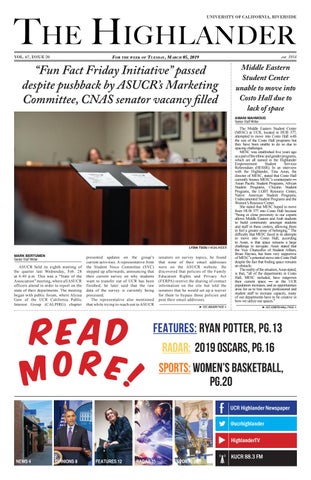
“Fun Fact Friday Initiative” passed despite pushback by ASUCR’s Marketing Committee, CNAS senator vacancy filled
Middle Eastern Student Center unable to move into Costo Hall due to lack of space
AMANI MAHMOUD Senior Staff Writer
senators on survey topics, he found that none of their email addresses were on the ASUCR website. He discovered that policies of the Family Education Rights and Privacy Act (FERPA) restrict the sharing of contact information on the site but told the senators that he would set up a waiver for them to bypass those policies and post their email addresses.
The Middle Eastern Student Center (MESC) at UCR, located in HUB 377, attempted to move into Costo Hall with the rest of the Costo Hall programs but they have been unable to do so due to spacing challenges. MESC was established five years ago as a part of the ethnic and gender programs, which are all named in the Highlander Empowerment Student Services Referendum (HESSR). In an interview with the Highlander, Tina Aoun, the director of MESC, stated that Costo Hall currently houses MESC’s counterparts — Asian Pacific Student Programs, African Student Programs, Chicano Student Programs, the LGBT Resource Center, Native American Student Programs, Undocumented Student Programs and the Women’s Resource Center. She stated that MESC hoped to move from HUB 377 into Costo Hall because “being in close proximity to our coparts allows Middle Eastern and Arab students to build community amongst students and staff in these centers, allowing them to feel a greater sense of belonging.” The difficulty that MESC faced in its attempts to move into Costo Hall, according to Aoun, is that space remains a large challenge to navigate. Aoun stated that the Vice Chancellor of Student Affairs, Brian Haynes, has been very supportive of MESC’s potential move into Costo Hall despite the fact that finding space remains an obstacle. The reality of the situation, Aoun stated, is that, “all of the departments in Costo Hall, MESC included, have outgrown their current space — as the UCR population increases, and as opportunities arise for us to hire more professional and student staff to increase capacity, many of our departments have to be creative in how we utilize our spaces.”
► SEE ASUCR PAGE 4
► SEE COSTO HALL PAGE 4
LYDIA TSOU / HIGHLANDER
MARK BERTUMEN Senior Staff Writer
ASUCR held its eighth meeting of the quarter last Wednesday, Feb. 28 at 6:40 p.m. This was a “State of the Association” meeting, where all ASUCR officers attend in order to report on the state of their departments. The meeting began with public forum, where Alyssa Gaw of the UCR California Public Interest Group (CALPIRG) chapter
presented updates on the group’s current activities. A representative from the Student Voice Committee (SVC) stepped up afterwards, announcing that their current survey on why students want to transfer out of UCR has been finished; he later said that the raw data of the survey is currently being processed. The representative also mentioned that while trying to reach out to ASUCR
READ
R O E ! M
FEATURES: Ryan Potter, PG.13 RADAR: 2019 Oscars, PG.16 SPORTS: WOMEN’S BASKETBALL, PG.20 f
UCR Highlander Newspaper @ucrhighlander HighlanderTV
NEWS 4
OPINIONS 8
FEATURES 12
RADAR 15
SPORTS 20
KUCR 88.3 FM
2
TUESDAY, MARCH 05, 2019
HIGHLANDER // highlandernews.org
HUMANS OF UCR
UPCOMING EVENTS: WEEK 9
JOSE GARCIA | BIOENGINEERING | FIRST-YEAR COMPILED BY RYAN POON
05
Tuesday
APSP’s 369 Series: Celebrating API Womxn 12:00pm to 1:00pm Apsp Office , 244 Costo Hall
Everything You Need to Know Credit 2:30pm to 3:30pm HUB 265
06
Unity Hour at the NASP Office 12:00pm to 1:00pm Costo Hall, 229
ASPB Presents: Freedom Writers 7:00pm UNLH, 1000
Thursday
The Different Ways Gender Differentiates: Sites of Boundary Contestation in Muslim and Christian Schools 12:30pm to 2:00pm HMNSS 1500
Women’s Basketball vs Hawaii 7:00pm SRC Arena
08
Film: Generation Wealth 7:00pm to 9:00pm UCR ARTS, Culver Center of the Arts
UCR is Dancing 2019 8:00 P.M. University Theatre, HUMN 400
Men’s Rugby 11:00am to 7:00pm Student Recreation Center (SRC), lower courts
Women’s Leadership Conference 9:00am to 3:30pm HUB (Highlander Union Building), 302
Wednesday
07
“It felt normal to me. I grew up there so I believed it was normal.
Friday
Every now and then someone would get shot and that’s just how I thought life was like. I would see people who would have looked sketchy to outsiders everyday, but everything felt normal. To me, Compton was my home, because my family and friends lived there. I never thought about what it would be like to live elsewhere.”
09
Saturday
10 CONTACT US
HIGHLANDER STAFF EDITOR-IN-CHIEF
MANAGING EDITOR
Evan Ismail
Andreas Rauch
managingeditor @highlandernews.org
editorinchief @highlandernews.org NEWS EDITOR
ASST. NEWS EDITOR
Aidan Rutten
Amani Mahmoud Mark Bertumen
news@highlandernews.org
ASST. OPINIONS EDITOR
Elaine Chen
opinions@highlandernews.org FEATURES EDITOR
Martha Delgado
features@ highlandernews.org
Marcelo Garcia
radar@highlandernews.org ASST. SPORTS EDITOR
SPORTS EDITOR
Jaryd Bongcaras
Jonathan Fermandez
Business Office: (951) 827-3457
Classifieds & Billing: (951) 827-5039
Fax: (951) 827-7049
jbong006@ucr.edu
sports@highlandernews.org
LETTERS TO THE EDITOR
PRODUCTION MANAGER
Kerry Mulia
productionmanager @highlandernews.org PRODUCTION ASSISTANTS
Hao Le Jeffrey Yoo Brinly Den
Kathy Garcia Amanda Joy Teano Judy Tu Asst. Photo Editor
PHOTOGRAPHY EDITOR
Jimmy Lai
Martin Lopez mlope072@ucr.edu
photo@highlandernews.org STAFF PHOTOGRAPHERS
Thomas Holguin, Lydia Tsou, Ryan Poon VIDEO EDITOR
Catherine Yong
video.highlander@gmail.com BUSINESS MANAGER
Karla Montes
highlanderads@gmail.com DISTRIBUTION MANAGER
TECH DIRECTOR
Kevin Ciampaglia
techdirector@highlandernews.org
MARKETING COORDINATOR
Jessica Schneider
TIP LINE: (951) 827-2105 Help the Highlander stay on top of what is happening on campus and in the general UCR community. Call this number and leave a message for the Editorial Board with your tip. Be sure to include your full name, relation to UCR, and a number or email address where you can be reached for more details. Editorial Office: (951) 827-3617
A&E EDITOR
Chiraag Dave
Highlander 101 Highlander Union Building Riverside, CA 92521 www.highlandernews.org editorinchief@highlandernews.org
marketing.highlander@gmail.com
The Highlander accepts letters from the campus community. They must be 600-800 words at length and include the author’s name and contact information. Topics should be UCR-centric and/or pertain to our generation of students. Contact Opinions Editor Michael Beeli at opinions@highlandernews.org by Wednesday if interested in writing a letter and submit the completed letter by Saturday at noon. Letters can and will be rejected if it does not meet requirements. LEGAL The Highlander is published and copyrighted by the Highlander for the students, faculty and staff of UCR. All rights are reserved. Reprinting of any material in this publication without the written permission of the Highlander is strictly prohibited. Readers are allowed one free copy of the newspaper. For additional copies or for subscription information, please contact the Highlander. The Highlander fully supports the University of California’s policy on non-discrimination. The student media reserve the right to reject or modify advertising whose content discriminates on the basis of ancestry, color, national origin, race, religion, disability, age, sex or sexual orientation. The Highlander has a media grievance procedure for resolving complaints against it. All inserts that are printed in the Highlander are independently paid publications and do not reflect the views of the Editorial Board, the staff or The University of California or the Associated Students of UCR.
Sunday
Women’s Sport Club Volleyball 8:00am to 7:00pm Student Recreation Center (SRC), lower courts
11
Writer’s Workspace 5:30pm to 9:00pm HUB (Highlander Union Building), 269
Monday
MULTIMEDIA
CLASSIFIED ADVERTISEMENTS ADVERTISING INFORMATION Please submit Classifed ads by calling 951-827-3457 or by emailing Highlanderads@ucr.edu PAYMENT Visa and Mastercard Make checks payable to The Highlander Newspaper No refunds RATES Classified: $2 per line; 17 characters (spaces, dashes, etc.)
Dissertation Writers’ Workshop 6:00pm to 7:30pm Watkins, 1108 Watkins Hall
UCRHIGHLANDER
f
UCR HIGHLANDER NEWSPAPER @UCRHIGHLANDER HighlanderTV
MISCELLANEOUS Pregnant? Free counseling and services. We come to you. Holy Family Services, adoption & foster care. 1-800-464-2367.
KUCR 88.3 FM
4
News
HIGHLANDER // highlandernews.org/news
TUESDAY, MARCH 05, 2019
ASUCR
“Fun Fact Friday Initiative” passed despite pushback by ASUCR’s Marketing Committee, CNAS senator vacancy filled
► FROM ASUCR
Afterwards the senators discussed Senate Bill (SB) W19-013, which gives control of the R’Closet, UCR’s professional student clothing lending service, from ASUCR to the Career Center. The bill passed unanimously 11-0-0; the full new name is the R’Professional Career Closet, and is no longer under direct jurisdiction of ASUCR. The next item to be voted on was presented by CHASS Senator Mehvish Ali, titled the “Fun Fact Friday Initiative.” The Initiative is meant to increase student engagement at UCR by posting “fun facts” about UCR on social media, mainly those that highlight the accomplishments of the university and showcase that “UCR is a great place to be,” as Ali said. Marketing Director Connie Wi found that the Initiative was not something that ASUCR had to carry out; she instead believed that Undergraduate Admissions and Student Life are meant to do what the Initiative entails for both current and prospective students. CHASS Senator Julian Gonzalez Perez thought that the Initiative’s goals could be achieved simply by “going around telling UCR it’s a great school.” CHASS Senator David Melgoza agreed with Gonzalez Perez on the sentiments that ASUCR ought to interact with students, but argued that “social media is the most successful (modern method)” of doing so, as compared to actively going out to get the UCR community involved. The senators then began to vote on the initiative, but at the time Perez was not sure of what they were voting on, voicing
his confusion by saying “Do we just get to vote on random initiatives? There’s no forum or policy we’re following; it’s just a statement we’re going to vote on.” Vice President of Campus External Affairs Jose-Cortez Hernandez explained that the Senate was voting to override the ASUCR Marketing Committee’s decision to deny the Initiative from taking place. The vote passed 6-3-2. The meeting then turned its focus to CNAS Senator interviews, in order to fill the vacancy left by former senator Josiah Davis, who was removed in part for not attending ASUCR meetings since the start of the Fall 2018 quarter. The elected will be removed from the position once new senators are elected in the upcoming Spring 2018 elections. Each candidate was given three minutes at the podium to present their qualifications for the position to the Senate, and a portion of time after to be asked questions. Four candidates were present at the meeting, and went up in the order that follows: Christopher Chebat, a second-year mathematics major; Sabrine Hossain, a second-year biochemistry major; Shaiva Patel, a second-year biology major; and Walker Woodard, a second-year biology major. After each candidate presented themselves, the Senate held a closed deliberation on who would earn the CNAS Senator position. After twenty minutes of deliberation, Chebat was given the position and soon after took a seat at the horseshoe. During his time at the podium Chebat said that he aims to improve voter participation and make the activities of ASUCR more transparent to UCR students. “There is no outreach to the student body, and as a result there’s
a disconnect. There’s a sort of ‘we are above you’ mentality going around as a result,” he said. Chebat was unavailable for further comment on his goals as a CNAS senator. Officer reports followed the selection of the new CNAS senator. Transfer and Non-Traditional Student Director Vanessa Salinas mentioned that she is currently studying if transfer students at UCR that want to transfer out are doing so because of the university’s poor treatment of them,
LYDIA TSOU / HIGHLANDER
such as in the realm of offered classes; “Transfers are called in two weeks before the fall quarter starts, and they are given a list of electives to enroll in,” as opposed to classes necessary for their major. She is working with the SVC to compile and process data that may reveal such, but was unavailable for further comment on the matter’s current affairs. The meeting adjourned at 8:15 p.m. ASUCR meets every Wednesday at 6:30 p.m. in HUB 221. ■H
Middle Eastern Student Center unable to move into Costo Hall due to lack of space
► FROM COSTO HALL
“There is no empty space in Costo Hall,” stated Aoun. MESC’s move into Costo Hall would require a department to relocate, which requires resources and time. Aoun added, “It’s a big ask for an existing department who has called Costo
Hall their home to relocate; but it does send a message that our campus partners are true advocates that they would be willing to relocate so that our Ethnic and Gender Program offices can build community together in Costo Hall.” Being the only ethnic and gender program located in the HUB rather
NICHOLAS ROH / HIGHLANDER
than Costo Hall makes many of MESC’s students feel physically marginalized and forgotten, Aoun said. She claimed that many students who are a part of MESC do not easily recognize the staff and many of the students that frequent Costo Hall, explaining that, “because we are not a part of the Costo neighborhood …
other students may feel intimidated or less inclined to visit the space.” MESC attempts to navigate these issues by hosting programs in their space such as their weekly MESCafe which is held every Tuesday at 11 p.m., and is centered around coffee and conversations on identity, politics, social justice and current events. Aoun later noted that the ethnic and gender programs also hosts Unity Hour each Wednesday of the winter quarters. The location rotates each week so that students have the opportunity to visit each of their spaces. Despite the fact that MESC is unable to move into Costo Hall due to the lack of space, Aoun still holds hope that MESC will eventually have the opportunity to move into Costo Hall. She stated, “I do believe that MESC will move into Costo Hall, though our students have been waiting for over five years and many will graduate before the move may happen … I still look forward to inviting alumni back to campus to experience MESC in the Costo neighborhood.” ■H
HIGHLANDER // highlandernews.org/news
NEWS
TUESDAY, MARCH 05, 2019
5
Survey finds trend of students wanting to transfer out of UCR
CAMERON SADEGHI Contibuting Writer
At the beginning of the Winter 2019 quarter, the Student Voice Committee (SVC) conducted a survey regarding UCR student interest in transferring or leaving UCR; 281 student responses highlighted an interest in leaving or transferring out of UCR. According to the Student Voice Committee Chair Denis Turan, the Student Voice Committee sought a total of 392 student responses in order to reflect the entire school population with a 95 percent confidence interval, but they did not reach that number with this study. For a student’s response to be included in the survey, the student had to indicate interest in transferring or leaving UCR. If a student never had interest in transferring or leaving UCR, they were not included in the survey. The survey was broken down by several different factors: 58 percent of the responses came from Asian (non-Hispanic) students and Hispanic or Latino students; in terms of class standing, the majority of the responses came from first year and second year students totaling to 60 percent. Also, CHASS and CNASS students combined for 76.8 percent of the responses; first generation students had less responses compared to non-first generation students at 45.6 percent. In terms of reasons for leaving UCR, students were asked to rate their responses “zero” to “five.” If students were compelled by a certain reason, they would select “four” or “five.” However, if a student did not feel
COURTESY OF FLICKR
strongly about a certain issue or reason, then they would either answer with a “zero,” “one” or “two” response. The reason that generated the most “four” or “five” responses was a disinterest in the city of Riverside, which eighty-two students responded with. Other top reasons included a lack of prestige, internship and job opportunities, cost of living and school major choices. In an interview with the Highlander, firstyear student Chelsea Po stated that she plans on applying to UC San Diego, claiming that,“They have a better pre-med program and I want to go to medical school. That’s the reason I want to transfer.” Another firstyear student, Shray Grover, pointed to a lack of school spirit compared to USC and UCLA, stating that, “UCR does not have as much school spirit as I think other schools such as UCLA or USC would have.”
Former UCR student Steven Silva stated in an interview with the Highlander that he wished to switch his major but faced some challenges that prompted him to transfer. Silva was originally a political science major, but decided to switch to engineering. However, Silva claimed that the engineering counselors informed him that switching his major would make him have to stay at UCR for another five years. Silva added, “Even if I dropped out and came back to UCR, they would have not allowed me to complete an engineering degree.” Silva left to community college and is now currently at California State Polytechnic University, Pomona. Despite students’ past or present interest in leaving UCR, 44.1 percent of students do not intend to leave or transfer out of UCR. On the other hand, 28.8 percent of students responded with “maybe,” while 27 percent
of students plan to leave or transfer out of UCR. ASUCR Transfer Director Vanessa Salinas claimed that the students she has talked to expressed concern over not getting the classes that they need. In the interview, Salinas believes that an “inreach coordinator” could help students with their time at UCR. “I know that there are programs to help students. It’s tough to attend all of these different workshops because students have work, family, different obligations as well as their course work,” stated Salinas. Student Voice Committee Chair Denis Turan underscores the reality of students desiring to transfer or leave UCR, “My mission is to make sure that students are represented at those conversations. Students were saying this to us. We didn’t just make this up. These are real UCR students H thoughts and feelings about the campus.” ■
Constituent Engagement’s 2019 Virtual Career Series bolsters alumni career opportunities
JAKEB TIVEY Senior Staff Writer
On Feb. 14, 2019 the University of California Office of the President (UCOP) hosted their second installation of the 2019 Virtual Career Series as directed by the office’s Constituent Engagement branch. The online seminar, hosted each month by various University of California university alumni, “is designed to provide UC alumni with the insights, information and connections to launch, grow and expand
JAKEB TIVEY / HIGHLANDER
career opportunities across a wide variety of professions and career stages,” according to Pauline Metzgar, the Constituent Engagement acting director. In an interview with the Highlander, Metzgar explained the objectives of Constituent Engagement, resources available to students through their alumni centers and how alumni networking promotes student success. In the February edition of the series, “Flex Jobs, Remote Work + The Gig Economy,”
UC Berkeley alumna Sara Sutton explained that remote work provided a solution which she said “would allow me to stay on my career path while also being professionally challenged and present for my family.” Prior experience in internal telecommunications and recognition of “how dismal the market was” sparked Sutton to start and become the CEO of FlexJobs, Remote.co and 1 Million for Work Flexibility. As a 2001 graduate, Sutton is not the only alumnus to take part in the online series. In January this year, the “Navigating the Job Search” seminar featured UCLA alumnus Brett Fisher, UC Davis graduate Dorian Mastrogany and UCR’s Brigitte Kearney, a recruiting manager at Tesla. Each shared their thoughts on the hiring process and provided advice on seizing opportunities as an applicant. The upcoming lineup of seminar topics is scheduled to last through November, with the next seminar titled “Unique Ways to Use Your Degree in the Humanities” planned for March 5 at 12:00 p.m. Following the March meeting, the “Careers in the UC” section occurs April 9 at 10:00 a.m., with the “Your Culture + Your Career” seminar taking place May 8 at 12:00 p.m. The full schedule and seminar archives can be found on the constituent engagement events page, which also features a list of alumni associations registered within the UC system. The Constituent Engagement office was founded in the 1940s with the creation of the Alumni Associations of the University of California (AAUC) when UCLA was invited to the board of regents by UC Berkeley. “Over the years,” Metzgar said,
“we have expanded to focus beyond the AAUC and alumni to engage a wide variety of constituents in support of the UC.” Each university within the UC system has its own associations, but Metzgar affirmed that “while each campus engages the alumni from its own campus, the Office of Constituent Engagement looks at UC’s two million alumni as a group.” Metzgar encourages students to discover resources directly available to them by observing the events calendar and reaching out to their university’s alumni center. At UCR, some resources available to students include resume review, career guides for fields in which other alumni are employed and networking opportunities between current students and those already in the workforce. Some upcoming events at the UCR Alumni Center include the Fourth Annual Women’s Leadership Conference on March 9, the Highlander Day of Service on April 13, Dinner with Alumni: Psychology on April 16 and Dinner with Alumni: Public Policy on May 2. Metzgar said that “While most of our department’s engagement begins once a student has earned his or her diploma, there are many ways alumni promote student success.” For example, “Alumni associations fundraise for student scholarships and have built mentoring platforms so alumni can mentor students.” Metzgar proposed that fostering alumni engagement promotes the success of rising scholars, stating that “there is no reason not to be involved with or aware of your alumni association while still a student … Students are tomorrow’s alumni!” ■H
6
NEWS
TUESDAY, MARCH 05, 2019
HIGHLANDER // highlandernews.org/news
UCR study indicates romantic partners help alter attitude on negative situations
CHRISTINE TRAN Contributing Writer
According to a recent UCR study, our partners and spouses could be the key to having a more positive outlook on a situation. The study, “Interpersonal positive reframing in the daily lives of couples coping with breast cancer,” was authored by UCR Assistant Professor of Psychology Megan Robbins, psychology graduate student Robert C. Wright, Thomas Jefferson University graduate student Ana Maria Lopez and University of Arizona Karen Weihs. The study had 52 couples dealing with breast cancer wear an Electronically Activated Recorder (EAR) over the course of one weekend. After the weekend, assistants would sift through the sound files and noted words that indicated positive reframing, finding the good in a bad situation or the reduction of stress. Couples were also asked to personally record instances where they used positive reframing as a coping method. Positive reframing refers to finding the silver lining in an overwhelming situation,
according to the study’s online article. At first, the researchers theorized it was more effective to turn to those who are socially similar for support, such as fellow breast cancer patients. The results of the study showed evidence that supported the idea that romantic partners may be able to positively reframe heavier negative experiences like breast cancer and everyday stressors. Robbins proposed this outcome could be because romantic partners in these scenarios have more energy to be optimistic or correlate to the gender of the partner that influences their outlook. But Robbins also stated there needs to be more research done on this topic before it can be confirmed. In an interview with the Highlander, Robbins stated that, “the outcomes of this study are important because we found observable cues (word use) that indicate people are likely engaging in positive reframing.” What this means, according to Robbins, is that “healthcare providers and people in someone’s social network could potentially identify positive reframing in someone who is
LYDIA TSOU / HIGHLANDER
coping with breast cancer and encourage that helpful coping strategy.” She also stated that the results of the study also indicated that, “positive reframing is an effective coping method for people facing a stressful situation. One catch is that partners need to be aware of pushing their significant other into positivity too soon.
They need to gauge where their partner stands with the situation before trying to find the silver lining.” Alex Patino, a first-year mathematics major, gave his thoughts on the research: “I think this study has the right idea. I remember one time my girlfriend was upset about moving so far away for college, but I told her a new place would
mean new opportunities and new people to befriend. It was easy because I wanted to see her happy, when you care about someone you say anything to try and cheer them up.” The full study is published in the Journal of Psychosocial Oncology. Funding support for this study came from the National Cancer Institute and H the American Cancer Society. ■
Senator Roth and UC student activists team up to promote revised Cal Grant program
COURTESY OF SENATOR RICHARD ROTH
ANDY LI Contributing Writer
District 31 State Senator Richard Roth recently introduced Senate Bill 461 which would expand the current Cal Grant program to encompass two additional summer terms of up to nine units of course credits. The bill has been immediately endorsed and championed by the Coalition for a Better UC
(CBUC), a student-led activist organization that focuses on tackling socioeconomic issues facing college students across the entire state. The Highlander reached out to Roth to talk more about the bill and why he is advocating for it. “We must have mechanisms in place to assure our college students are successful. Students will enroll in summer session courses if there is sufficient
aid to allow them to afford the higher tuition and fees; we must offer that flexibility,” said Roth. “If we don’t listen to what our students are telling us they need we not only continue to fail them, but we fail as a state.” Part of the motivation for expanding the Cal Grant program is due to the fact that over 70 percent of current CSU students do not graduate within four years, which takes a substantial
financial toll on disadvantaged communities in California, according to Senator Roth’s office. Edwin Chikukwa of the CBUC stated that “students, administrations, public advocates and even the California Student Aid Commission all did the calculations and came to the same conclusion, SB 461 will alleviate California’s dismal graduation deficits.” According to the Public Policy Institute of California, if current trends persist, California will be short more than 1 million college graduates by 2030. A large impediment to increased graduation rates is the lack of financial aid available for students during summer sessions. “California won’t be able to meet its workforce and economic demands due in part to college students not graduating within a 4-year timeframe,” said Roth. “We must act now to provide relief that will not only improve graduation rates but will guarantee California has a strong, competitive workforce by 2030.” SB 461 will attempt to follow the successful model of the Pell Grant system. The federal government recently extended Pell Grant eligibility to include
summer sessions, due to the need of year-round aid for college students. Having access to the Pell Grant during the summer allows students across the nation to receive up to 150 percent of the regular grant awarded over the academic year, allowing them to afford to enroll in summer classes and achieve their degrees in a faster time-frame, according to Kaitlyn Lewis, spokeswoman for Senator Roth. The bill has already received official sponsorship from the University of California Student Association (UCSA) and the University of California Office of the President (UCOP). Chikukwa, who serves as chair of the CBUC, added that “the kind of consensus and coalition building (on this bill) did not happen by accident, and it means multiple respectable organizations calculated and came to the same conclusion we believe the state will come to, that SB 461 will help alleviate California’s dismal graduation deficits.” California State Student Association President Mia Kagianas agreed, saying that “reforming financial aid is necessary to support California’s low-income students, in which Summer Cal Grant is a pillar of need as well.” ■H
HIGHLANDER // highlandernews.org/news
NEWS
TUESDAY, MARCH 05, 2019
7
UCR researchers help discover evience of moving organisms from 2.1 billion years ago ATENAS ODRIOZOLA Contributing Writer
Published on Feb. 26, in the Proceedings of the National Academy of Sciences of the United States of America, recent research finds evidence indicating that the first organism motility, or an organism with the ability to move, can be traced back 2.1 billion years ago. Conducted by Andrey Bekker, associate professor in Department of Earth Sciences, Timothy Lyons, distinguished professor of biogeochemistry and others, the researchers discovered a condensed fossil from the Paleoproterozoic Era, a period ranging from 2.5 to 1.6 billion years ago, at a basin in Franceville, Gabon. The fossil contains string-shaped imprints. These imprints are 0.23 inches across and can extend up to 6.69 inches across the strata. The tracks do not follow the constant sedimentary structure, or the usual horizontal deposits of minerals or materials over time though wind, glaciers and water, and occasionally makes a vertical trajectory at a slanted or even angle through the sedimentary planes. Thus, this shows the winding had to be caused by a moving organism. The past understanding linked the oldest evidence of organism motility to Ediacaran biota, which lived during the Ediacaran Period, from 635 to 541 million years ago. The Ediacaran fauna, also known as Ediacaran biota, is a term used to encompass the organisms found in sandstone during this period. Their existence holds
COURTESY OF UNIVERSITE DE POITIERS
importance as they come before the Cambrian Period, which saw a proliferation of multicellular life forms. The life forms that sprouted during this period were metazoans, multicellular organisms that require oxygen to mature. However, this current findings can contradict the past timeframe, moving the oldest organism motility back by more than a billion years, challenging the conception that complex
organisms came during the Ediacaran Period. While it is still inconclusive as to what lead to the organisms needing to have motility, in an interview with Abderrazak El Albani, the main author and professor of sedimentology and biogeochemistry at Université de Poitiers, a university located in France, explained via email that “... the research of nutritious elements and oxygen in the immediately surrounding
environment, including within the sediment on which they lived, seems to prove the biological complexity of these organisms.” The findings are able to move the first organism motility back to more than a billion years, but cannot provide more information besides this. “It is still inconclusive and there are still questions to be further explored,” explained Andrey Bekker,
associate professor in the UCR Department of Earth Science and one of the two UCR researchers who worked on the study. There are still more question to be answered such as the time gap and whether this motility was a “experimental source of life,” Bekker explained. Timothy Lyons, UCR distinguished professor of biogeochemistry and other UCR researcher during the study, was unavailable for comment. ■H
8
Opinions TUESDAY, MARCH 05, 2019
HIGHLANDER // highlandernews.org/opinions
HIGHLANDER EDITORIAL
Washington Post lawsuit highlights prominence of unethical reporting
O
n Feb. 20, it was made public that the family of Nicholas Sandmann was suing The Washington Post for a hefty $250 million over the rhetoric the paper used to report an incident involving a viral video from the Jan. 18 March for Life Rally in Washington D.C. The video itself was making its rounds in the media, but the version that went viral was only a clip from a longer video that was later posted, showcasing that there was more to the initial story. In the shortened video, 16-year-old Nicholas Sandmann, a student at Covington Catholic High School in Kentucky, is seen smiling at Nathan Phillips, a Native American activist who was beating a drum and singing while standing in close proximity to Sandmann. Many jumped to conclusions after viewing the video snippet and took to social media to express outrage based on the optics of the clip alone. The Sandmann family alleges that The Post slandered Sandmann in a series of seven stories and incited a narrative in favor of Phillips. Alongside the supposed one-sided reporting, Sandmann’s family also added that Nicholas, as a result of the fabricated narrative, became the target for cyberbullying. On March 1, The Washington Post staff issued a statement conceding that the news story they initially ran depicting the incident did have multiple unconfirmed accounts or contradictory statements. Despite the fact that The Post has gone on the record to admit that they had run a story with unconfirmed statements, when taking a closer look at one of the articles published in relation to the incident at the Lincoln Memorial, the rhetoric used to depict the scene is still clearly editorialized. It isn’t news to claim that most media outlets do have, and have always had, an inherent bias, but the disappointing way The Post navigated this situation shines a light on the growing culture of unethical reporting. A deconstruction of an article published by The Post on Jan. 22, reporting on the scene in the viral video shows that The Post let personal bias hijack the neutrality of an article that was supposed to simply report an admittedly chaotic spectacle. To begin with, the faulty reporting and wording used to describe the boys from Covington Catholic High School imply that they were aggressors. Aside from already giving off the impression of Sandmann as a mischievous boy by detailing the “relentless smirk” he was wearing, the article only included testimony given by Phillips, and failed to collect any stories from the other two major groups
that were present at the location at the time: the students from Covington Catholic High School and the antagonistic Black Hebrew Israelite activists who actually sparked the confrontation. In addition to the fact that Phillips was the only one who was interviewed in the article, many of his statements were published without proper confirmation or were simply unnecessarily added in order to further emphasize a divide between Phillips and the Covington boys. The Post included statements from Phillips saying that he and other indigenous people were being taunted by the boys, despite the fact that no such thing was heard in the video, and an investigation later found that the students had not made any inflammatory statements towards Phillips, the indigenous people or the Black Hebrew Israelites. Immediately after reporting what Phillips said about feeling threatened by the presence of the Covington Catholic students, The Post then connected this incident to President Donald Trump’s mocking of Senator Elizabeth Warren’s Native American heritage, an unrelated incident that had nothing to do with the events at the Lincoln Memorial. It seems rather clear that, intentional or not, there was a narrative played out in the article that sided with Phillips, especially due to the exclusion of testimonies from any other parties that were involved at the Lincoln Memorial. In the article, The Post also failed to mention the third party involved, the Black Hebrew Israelites, who were present at the scene and initially instigated the confrontation by yelling racist and homophobic profanities at the schoolboys. Such skewed reporting denigrates the boys, who, despite exhibiting some rowdy behavior, evidently did not harass Phillips in the way that he claimed. Because of this, Sandmann’s family is well within their rights to ask for compensation due to a mischaracterizing news report, which has led to widespread demonization of the teenager and threats of violence, social exclusion and even calls to deny him entry into universities. Unfortunately, such incidents simply play into the anti-press narrative that has dominated political discourse in the last half decade. Prior to the extreme popularization of the “fake news” phenomenon, it isn’t farfetched to say that President Trump would often utilize this phrase more as a technique to deflect negative attention off of himself and onto the media instead. For example, Trump went to call The New York Times “the enemy of the people” multiple times following the publication of an investigative report that
was based off of confidential White House documents. What was published had basis in fact, but because it reflected negatively on President Trump, he found reason to decry it as false and attempted to degrade the media outlet. However, it’s disappointing to say that given the growing hostility Trump has directed at the media, many news outlets have started to devolve and prove him right, such as in The Post’s case. There seems to be a sense of heightened immediacy nowadays with news sources scrambling to be the first to get a controversial story out, especially if it relates to Trump; in doing so, many news outlets are choosing to sacrifice the time that would usually be allotted for further investigation into the story or fact-checking. For instance, back in 2017, Buzzfeed News caught major backlash for choosing to publish an unconfirmed dossier gathered by a British intelligence agency. The editor-in-chief, Ben Smith, didn’t back down from choosing to publish such an explosive yet unconfirmed document because he stated that doing so could let “Americans … make up their own minds about allegations about the presidentelect that have circulated at the highest levels of the US government.” It’s one thing to publish a factual document and leave it up for interpretation by the American people, but posting an unconfirmed report doesn’t even allow the American people to properly form their own opinion on something since it hasn’t been established as a fact yet. Buzzfeed News also faced scrutiny after Special Counsel Robert Mueller denied a report that was published by the news source, claiming that Trump had instructed Michael Cohen to lie to Congress. It’s nonsensical to say that the sense of urgency to be the first to break a news story wasn’t always present in the media, because it has been, but there was a time when there was more integrity present in the scramble to publish a story. Take the story of the Pentagon Papers, a 7,000 page document detailing the history of U.S. intervention in the Vietnam War and the decision-making process behind it. In 1971, Daniel Ellsberg, a former military analyst who became disillusioned with the war, was the one who gave the tip about these documents to Neil Sheehan, a reporter for The New York Times. Shortly after receiving the tip and the classified papers, Sheehan set up a team to comb through the entire 2.5 million word report in order to ensure that their story accurately lined up with what was said in the papers. There was obviously a sense of urgency to get a story out, but there was still intensive care in properly preparing
and investigating the story. Exploiting stories such as the Lincoln Memorial incident by focusing on “clickbait” topics and narratives is contributing to the devolution of modern-day journalism, and it’s unclear as to what it will take for most media outlets to regain the lost trust. The growth of social media has definitely contributed to this phenomenon given the quick access most people have to this platform in particular. Social media is starting to become a shortcut to getting information – about two-thirds of American adults say that they have turned to social media as a tool to get news despite being unsure about whether what they’re reading is accurate or not. In addition to the growing influence of social media as a news source, newspapers are a declining business; despite some growths in subscriptions to newspapers, revenue has fallen in general for the industry. And perhaps because newspapers are on a decline, outlets have chosen to stoop to creating scandalous headlines and generating controversial stories despite having little basis in fact in order to gain profit, but there then enters an issue pertaining to the morality of this practice, as this will eventually only fuel more distrust within the industry of the media. It’s partly up to the American people to know how to distinguish between reports that may come across as overly editorialized and articles that more closely reflect reality. Despite the antagonistic nature of this costly lawsuit, it still was able to bring much-needed attention to the disparities in media today. There is no particular side to blame, as both right- and left-leaning sources seemed to have shifted more in favor towards their ideological bias. Perhaps it might take a new president to quell the growing prominence of bias in the media, since the incumbent does highlight some of the issues in the media, but goes about it in the wrong way. Reverting media outlets back to a time of only subtle biases might still be a doubtful goal considering the growth of social media and “clickbait culture,” but whatever happens next, it’s important for the American people to remain skeptical and understand that perhaps everything isn’t as one-sided as it seems to be. ■H Highlander editorials reflect the majority view of the Highlander Editorial Board. They do not necessarily reflect the opinions of the Associated Students of UCR or the University of California system.
OPINIONS
HIGHLANDER // highlandernews.org/opinions
TUESDAY, MARCH 05, 2019
9
OPINION POLL Compiled by Lydia Tsou, Staff Photographer
“Do you have trust issues with mainstream media?”
Ahmed Salem Biology Second-year
Anthony Shams Biology Second-year
Jennifer Jossart Biochemistry Second-year
Saheli Ghosh Computer Science Fourth-year
Samriddhi Singla Computer Science Second-year
Mario Reynoso MechanicalEngineering Second-year
“I feel like I do have trust issues because it’s become too biased and too generalized.”
“I think so because they choose what the viewers see, so they can twist or sway it to how they want us to see it.”
“Yes, because everyone has their agenda.”
“Yeah I do, because it’s mostly funded by someone or other. They have an agenda to support whoever is funding them.”
“Yeah, most people have opinions that are so rigid and they continue to believe it without seeing the bigger scope of it.”
“It depends on the source. If it’s a credible source, I’ll trust it. I can’t trust everything that’s put out there though.”
The danger of a no-deal Brexit for Ireland COLIN CARNEY Contributing Writer
In June 2016, the United Kingdom voted to leave the European Union on March 29, 2019. For the past three years, the U.K. has been struggling to formulate an effective leave arrangement with the EU that has the approval of the British Parliament, and every attempt at a meaningful plan has been voted down; this leaves the U.K. with nothing as they approach the deadline. If Parliament is unable to pass a plan by the March 29 deadline, they will leave with what is called a “no-deal,” which would revert the U.K. to World Trade Organization standards, slowing down trade and travel between the U.K. and the EU to the point of a standstill. What many are unaware of, however, is what the main hurdle has been for each plan presented to parliament: the concern over the Irish Border. The U.K.’s handling of the Irish border highlights the shortsideness of the original referendum while threatening a hard-fought peace that has existed in Ireland since 1998. The problem with the Irish border is that it is the only land border the U.K. shares with another European Union country, located between Northern Ireland and the Republic of Ireland. As such, it would be expected that under a no-deal scenario, a barrier will be erected in some capacity along the Irish border so that trade and travel can be monitored. This might sound like a normal thing to exist between two distinct countries but it isn’t when history is considered. Ireland has a long and troubled history of violence and resistance to separating the north and south, which came to a boiling point during the late 1960s and lasted until 1998, during what is now
known as “The Troubles.” “The Troubles” refers to the roughly 30year conflict that occurred primarily in the north of Ireland between the pro-reunification Irish Republican Army (IRA) and the pro-British unionists/loyalists. The conflict is largely considered a guerilla war as these two paramilitary organizations were responsible for several shootouts and bombings throughout Ireland. The chaos eventually prompted the British to send troops over to maintain peace and erect border checkpoints separating the north from the south. Their efforts backfired as their presence only emboldened the IRA and made the border a target for bombings. The violence continued well into the 1990s until all sides met and signed the Good Friday Agreement, which is seen throughout Europe today as a modern political miracle. The agreement outlined the relationship between the Republic, Northern Ireland and the rest of the U.K., and brought with it a tentative peace that lasts to this day. In the agreement, the north remained a part of the U.K. but was given the opportunity to vote for reunification whenever it desired as well as offering Northern Irish people the choice to apply for both U.K. and Irish citizenship. Most importantly, however, the agreement resulted in the removal of border checkpoints and made trade and travel on the island as seamless as crossing state lines is in the U.S. The main issue of Brexit is how to uphold the promises made to those who voted for Brexit while still maintaining the sanctity of the Good Friday Agreement. In order for the UK to leave, they need to determine where their border with the EU will begin. If they place it in Ireland, separating the north from the south, it will violate
the agreement and likely mean a return to the Troubles, as the threat of a barrier has already increased tensions on the island. As the deadline approaches and a no-deal becomes more likely, news of weapons stashes along the border and police warnings of increased violence have already been reported. An alternative to an Irish border would be to place it in the Irish sea, which would separate Northern Ireland from the rest of the U.K. and subject it to EU regulations; however this is out of the question since the north would never accept an arrangement that separates them from the rest of the U.K. A recent compromise presented by Prime Minister Theresa May would have the U.K. remain in a temporary customs union with the EU while a permanent alternative is figured out, a plan referred to commonly as the “backstop.” The backstop would have bought the U.K. time to come up with a viable plan without having to worry about an Irish border or the impending leave date in March. Unfortunately, this plan was shot down with historic opposition, leaving the U.K. with nothing come March. Parliament’s inability to present and pass a meaningful plan that solves the issue of the Irish border highlights the current ineptness of the British government while also pointing out the fundamental problems that plagued the initial referendum. In 2016, the referendum given to the British people was a simple “leave” or “stay” question. It never took into account the complexities that would inevitably exist if they chose to leave and all the problems they would face as a result. The “leave” campaign never spoke about what would happen to Ireland if the U.K. left the EU, nor did they present any other plan
going forward after they had won. Looking forward, the U.K. is again considering another referendum, but that will likely result in more problems for themselves. If they choose another binary question for the electorate it will oversimplify the problem again and divide the population as the first one did. If they choose to offer several options then they face the likely probability that they will get no clear majority for any option. Lastly, even if the U.K. manages to coordinate a referendum they will still have to get approval from the EU to extend article 50, which outlines the process to leave the EU, and postpone the leave date since otherwise they won’t have any time to hold a referendum. The crisis at the Irish border shines a light on the failure of the referendum and the British government. The shortsightedness of the referendum has thrown the island of Ireland into uncertainty as the Irish prepare for the possibility of a return to the violence that dominated the second half of the 20th century. As the March 29 deadline approaches, there is sadly no end in sight for the issues plaguing Brexit, and Ireland may be forced to suffer through their damaging effects. ■H
COURTESY OF WIKIMEDIA COMMONS
Obama’s 2020 endorsement should reflect the moderate policies that marked his presidency
JOSE FLORES Contributing Writer
Like a superhero that has gone into retirement, President Obama has been been absent from politics since his term as presidency ended in 2016. However, this does not mean that he has completely abandoned politics. In fact, the former president has indirectly been involved in attempts to ensure that he leaves a legacy behind to combat the opposition long after he is gone. One of the ways in which
Obama has ensured that his legacy thrives on has been by holding private talks with potential Democratic candidates for the 2020 presidential elections. The former president has shown interest for a rather more moderate candidate. This comes to no surprise as moderatism has been on the rise since Trump’s election. A moderate Democrat would arguably be the party’s best bet to winning the 2020 election by being able to win over key swing states. This is supported by the fact that moderates have won local elections in states such as
COURTESY OF OBAMA WHITE HOUSE
Alabama, Kansas and others that are considered to be deep red states. In what has so far been a crowded Democratic field anxious to defeat Trump, there have not been many centrist candidates like Obama or Bill Clinton, but rather, many who seek to defeat the incumbent by aiming farther left. This could prove to be a difficult strategy since many far-left candidates did not fare so well in the Democratic primaries. Yet, in the 2018 midterm elections, more than half of voters for the Democratic Party identified as moderate or conservative rather than liberal. Not only because of his status as a former president, but also as a relative centrist, Obama’s opinion matters since he has been one of the most successful Democrats in the last ten years. This is not only due to him being the most recent Democratic president, but also due to the lack of a seriously strong candidate on behalf of the Democrats since his departure. Rather than having moved to the center to compromise, both parties have grown to become rather extreme. According to a Pew Research
Center study, the political divide on ideology has grown dramatically. In an era where compromise seems unattainable, Democrats must be the first ones to make the move towards the center if they want to appeal to swing voters and win the elections in 2020. Currently, the GOP has won over these voters; if the Democrats want to win them back, they must be the ones to move to the center and tug these voters back. Furthermore, Obama will probably eventually endorse someone once the primaries approach. However, due to the lack of a strong candidate at this point, it makes sense that he refrains for the time being. In summary, Obama is wise in preferring a moderate candidate, as it increases the chance for Democrats to win the election. Obama’s eventual endorsement will be of significance given that he still has a large following of voters who look up to him, but he will and should refrain until a candidate whose values align with his arises, for the sake of winning over the swing votes. ■H
10
TUESDAY, MARCH 05, 2019
HIGHLANDER // highlandernews.org/opinions
There’s hope for Myanmar, but the road is a long and painful one
COURTESY OF WIKIMEDIA COMMONS
ROBERT GOLD Contributing Writer
Since 1962, Myanmar has been, in one form or another, under autocratic military control, punctuated by disregard for civil rights and democratic institutions. Only recently did the military regime slowly shift towards democracy, holding democratic elections in 2010, the first in nearly half a century. However, in 2016, the military began a state-led persecution against the nation’s Muslim minority. This varying progress on liberalization has led to much frustration on the part of outside observers. Myanmar’s situation looks bleak, and their disregard for human and civil rights has come at the cost of widespread
international condemnation. Despite this, there is hope that after over half a century of military dictatorship, Myanmar can overcome its current crisis and continue to press forth as a new blossoming democracy. Burmese expansionism in the early 1800s threatened British control over India. In a series of wars, Myanmar, previously known as Burma, came under British control in 1885. After British annexation, Myanmar remained part of the British empire until it eventually achieved independence in 1948. Initially a progressive democratic state, this period was short-lived as a military coup d’etat brought Myanmar under military dictatorship in 1962. From 1962 to 2010, a military regime under the Burmese Socialist Programme Party ruled Myanmar.
With increasing global isolationism and economic sanctions, the military regime eventually declined and was pressured by international actors to hold democratic elections in 2010. For the past nine years, Myanmar has been, at least nominally, a representative democracy. It’s important to note that despite Myanmar’s liberalization, the military regime is not completely dissolved. The military still controls a large portion of this new parliamentary body. Additionally, while a civilian government has been erected, Myanmar’s military still remains actively independent of civilian authority. The lack of control and democratic transparency has led to human rights issues that have drawn international condemnation. One of Myanmar’s Muslim populations, the Rohingya, have faced violent persecution by the government since 2016. While a minority in Myanmar, the Rohingya are also found in other parts of the world. In Bangladesh, there are 1.3 million Rohingya; 500,000 in Saudi Arabia, 350,000 in Pakistan and there are even 12,000 Rohingya in the United States. Before the state-led persecution against them, there were over 1 million Rohingya in Myanmar. Since the persecution began, over 600,000 Rohingya have fled to Bangladesh, and less than 400,000 remain in the country. There are a number of explanations behind these persecutions. The Myanmar constitution recognizes 135 indigenous ethnicities. Despite this, the Rohingya are not on that list, as the government views the Rohingya as illegal Bengali immigrants. Additionally, as a Buddhistmajority population, many Burmese fear that the Rohingya will threaten the territorial sovereignty of Myanmar. The War on Terror has only heightened the crisis. Using the United States’ war against Islamist fundamentalists as justification to label all Rohingya as terrorists, extremist elements of the Buddhist establishment have branded Islam as an inherently violent religion and a fifth column which threatens the sovereignty of Myanmar.
In the midst of crises, there are organizations like the United States Institute of Peace (USIP) that are trying to aid Myanmar in solving their current humanitarian crisis. This group has sought to improve interfaith relations between Muslim and Buddhist communities. As much of the violence has been triggered by Buddhists monks spreading fear among their followers and preaching that Islam is an inherently violent religion, these efforts are meant to address the conflict at its source. Through interfaith community integration and activism, these historically segregated ethno-religious communities can tear down divisions and begin to see themselves as a shared people’s united under their national identity. Some critics may say that, despite the efforts of the Burmese to liberalize their government, it remains autocratic because the military still has so much power. Other critics might argue that this tribalism that Myanmar is experiencing is too deeply imbedded within human nature, and that the only society that functions properly is an ethnically and socially homogonous one. Therefore, as long as this Muslim minority remains in Myanmar, there will always be conflict in this region. These criticisms are somewhat valid; undue military influence in society has historically led to instability, and many parts of the world feature deep-seated cleavages founded in tribalism. The hope for outsiders, however, is that through community interfaith integration and democratization, peace, order and respect for human rights can become cornerstones of Myanmar’s society. Myanmar’s recent attempts at a more open and just society and government are a result of outside pressure through economic isolation and diplomatic efforts. The global community must continue to keep these pressures on. These trends towards an open society are a good first step, but much work remains to be done. If Myanmar wants to return into the good graces of the world, they need to keep transforming their society into one that H respects democracy and human rights. ■
Letter to the Editor:
Grassroots progressive politics, not endless compromise, is the only path towards total victory against Trump ANDY LI Contributing Writer
Andy Li is a first-year Pre-Business major. In a recent editorial titled “What we need and don’t need from progressives in the age of Trump,” the Highlander Editorial Board argued that the insurgent, left-wing movement led by freshmen House Democrats such as Alexandria Ocasio-Cortez (popularly known as AOC), Rashida Tlaib and Ilhan Omar is both damaging to the Democratic Party as a whole and a gift to Trump and the GOP. However, there are a plethora of severe flaws with this belief, starting with the indisputable fact that, quite simply, on almost every major political issue, the vast majority of the American people side with the progressive grassroots politicians that were elected in a blue wave in the 2018 midterms, and not the corporatist, centrist, neoliberal DINOs (Democrats in Name Only) that managed to lose an election to the most unpopular candidate in American history after rigging the presidential primaries against Bernie Sanders. The editorial begins with a false equivalency between AOC’s assertive and confident personality with President Trump’s anti-factual, divisive and endless hate-mongering on social media. The insinuation that AOC shouldn’t defend herself against a daily, Orwellian obsession by the far-right to caricature her with degrading and bigoted memes and insults – because a robust defense from a young, empowered Latina millennial is “reminiscent of Donald Trump’s aggressive behavior” – is, in and of itself, patently absurd. AOC
didn’t run a campaign and win election by promoting conspiracy theories, white lies and violating campaign finance laws. AOC doesn’t legislate through division, endless attacks on the free press and juvenile insults at political rivals. Most importantly, unlike Trump, AOC doesn’t go out of her way to viciously slander and destroy the careers of people that disagree with her politics. The biggest difference between AOC’s humorous, insightful and witty comebacks on Twitter and Trump’s immature and infantile vitriol on the same app is the fact that, in every single case, AOC tweets something “controversial,” she’s responding and defending herself against baseless smears whereas Trump attacks people who haven’t even done anything to provoke his ire. The editorial also blames AOC for focusing too much on right-wing hypocrisy and not sticking to “facts,” claiming that her policy positions are too extreme and risk alienating “moderates” from the Democratic Party. This delusional attempt to compromise between the left and right is a sorry excuse as referee for American politics. You don’t compromise with a party that promotes anti-vaccination hysteria, denies the scientific consensus on climate change, advocates for consistently disproven “voodoo economics” and continues to push for regime change in almost every single country in the world that doesn’t blindly support America all the time. On every major issue, Republicans cannot even get a bare majority of support from the public – whether it’s taxes, foreign policy, economic policy or gun control. Therefore, there is absolutely zero equivalence between AOC correctly and courageously devoting her time thoroughly dissecting each and every one of the
GOP’s destructive lies versus Republicans utilizing fake news as a weapon to counter facts and reality. But perhaps the most infuriating aspect of the anti-progressive editorial is the elitist, snobby, judgmental obsession that the editors have with “decorum.” If any of these individuals had actually grown up in a blue collar household, they would know that the least important problem in government today is “niceness.” What real Americans, including even many Trump supporters, actually care about at the end of the day is how to grow and sustain our economy to bring prosperity to all, not just those wealthy and powerful enough to lobby and puppeteer Congress to do personal favors. The fact that the Highlander Newspaper feels that these issues – bread and butter issues that affect the heart and soul of America – are less important than AOC’s attitude is, to put it plainly, totally out of touch with reality. Quite frankly, this attitude is exactly why
COURTESY OF FLICKR
Americans on both the left and right have such a rising distrust and dislike of the mainstream media – because it spends endless hours screaming about Trump’s tweets rather than Trump’s actual policies. Albert Einstein once said that “the definition of insanity is doing the same exact thing over and over again and expecting a different result.” Democrats have been playing the centrist game ever since Bill Clinton – with little actual progress on key issues. Alexandria Ocasio Cortez is the future. Young people are the future. Progressive ideals are the future. If we really want to get rid of Trump, let’s elect the future, not the past, for once. Let’s shift the Overton Window back to where it belongs – significantly left of the pendulum ideology of the average Congressman – where the democratic will, not politicians, decide how to actually run our country after decades of abysmal failure. America will be infinitely better off with them all. ■H
12
FEATURES
FEATURES
TUESDAY, MARCH 05, 2019
HIGHLANDER // highlandernews.org/features
sound
2019
BANDS LIVEN UP A THURSDAY NIGHT C L A S H : WITH MUSIC MARTHA DELGADO, SENIOR STAFF WRITER
The aroma of tacos from Ojo de Agua and the sound of drums filled the air of a Thursday night as five bands competed for a spot on the 2019 Spring Nooners line up and a prize of $200. The competition known as SoundClash was held on Feb. 28. A large canopy that covered the stage was set up on the HUB Plaza where the competition would take place. In front of the stage was a dance floor. After attendees grabbed tacos or shirts, they filled up the tables of the plaza eagerly waiting to hear the bands perform. The panel of judges consisted of CARE Student Program Coordinator Nayaab Kazzmi, the Leadership Programs and Service Coordinator Gerry Medina and Budget Personnel and Program Assistant Donna Dunn. Each band’s performance was rated based on their presentation, balance, originality, organization and crowd interaction. The first band of the night was Delfino^2 whose alternative sound and energetic performance livened up the crowd. The crowd in the dance floor danced along to the music that even made
people outside by the tables dance in their seats. Solo musician G. Bautista followed the band with a music style that was reminiscent of contemporary R&B. “Who wants me to sing to them?” G. Bautista asked the crowd before he began his last song. To end his set, G. Bautista brought one random audience member to the stage and sung to them one of his original songs. The following two bands competing, the solo musician Zalo and guitar and drums duo HoBeeDeeSheBop featured soothing beats. The majority of HoBeeDeeSheBop’s songs were marked by crescendoing vocals. The last band of the night and winner of 2019 SoundClash were alternative Indie band King’s Prophet, who encouraged the crowd to dance to warm up from the cold. For the last song, the lead singer and guitarist, Calvin Anderson, went into the crowd to play which garnered attention from the crowd. King’s Prophet is composed of Anderson, CSU Fullerton student and bassist Anthony Shih, UCI student and guitarist
Delfino^2 livened up the crowd on a Thursday night.
King’s Prophet encouraged people to dance to warm up from the chilly weather.
Josh Brazil, Fullerton student and drummer Collin Campell and UCR fourth-year prebusiness major, guitarist and keyboarder Alejandro Torres. The band members first heard about SoundClash from Torres. Previously, the band had played at House of Blues and other places
in San Diego and Los Angeles. This has been the largest crowd the band performed for yet. Traditionally, SoundClash has been held at the Barn, but due to renovations, the event was moved to the HUB Plaza. SoundClash originated out of wanting to get the student body
THOMAS HOLGUIN / HIGHLANDER
involved with events and to showcase the talent of UCR students. King’s Prophet’s EP “No Strings” can be streamed on Apple Music and Spotify. The band will play during the first Wednesday of Spring Quarter, on April 3. ■H
THOMAS HOLGUIN / HIGHLANDER
FEATURES
HIGHLANDER // highlandernews.org/features
13
TUESDAY, MARCH 05, 2019
NDER
IGHLA
H OU / A TS LYDI NDER
IGHLA
r e t t o P H OU / A TS I D Y L
” ’ s n “ Tita NDER
IGHLA
H OU / A TS LYDI
n a Ry
n o i t a t n e s e r y r p t e s r u c i d f n i i c a n P o i ter n s i i r a i W v s e l ing A t e u b t s i r e nt d s o s n C , a a u d i s c t h e f i l monio Velaochag nt in BY: A
LYDIA TSOU / HIGHLANDER
Last Thursday, UC Riverside’s Asian Pacific Student Program (APSP) hosted a Q&A event at HUB 302 at 7 p.m. featuring Asian American actor Ryan Potter. The young actor is best known for his roles as the voice of Hiro Hamada in “Big Hero 6” and Mike Fukanaga in “Supah Ninjas.” Potter has recently gained more attention after being cast as Gar Logan/Beast Boy in the superhero television series, “Titans.” He was received by an ecstatic audience of over 100 students. The Q&A began with an introduction of Potter’s
Potter was asked a series of questions by the APSP coordinators to move the discussion along. Potter admitted that he never felt a connection to acting until recently. He explained that he has felt a connection with the movement of cultural representation in the film industry and its rapid expansion around the last five years. Potter commented that his favorite role was on a skit for the Wong Fu Productions short film, “Save the Date.” He connected this to the topic of cultural representation, stating that, “(filmmakers) have continued
We don’t have other people from other ethnic communities telling our stories.” He further explained the necessity for authenticity and honest writing, adding, “Sometimes when you hear people of other backgrounds write dialogue for you, it feels weird. Like I would never say this. But I get it. I’m an actor. I’m supposed to act. I’m supposed to read the lines that are on the page. But also, if you want to hire me as the ‘Asian American’ kid, you have to represent me and show me in the right light. You can’t just have me as a token.”
people feel that way.” After the official Q&A concluded, APSP opened the discussion for audience questions. One audience member asked whether Potter sees more actors of South Asian descent coming into the DC Universe-based films, in reference to Potter’s role as a DC superhero on “Titans.” Potter answered the question in a general sense by explaining that the roles for Asian-origin characters are there, depending on what directors want. Potter added that what is important is
“...if you want to hire me as the ‘Asian American’ kid, you have to represent me and show me in the right light. You can’t just have me as a token.” acting credits and his charity work such as Toy Box of Hope, which is a charity that he founded in 2011 to give gifts to youths who are living in homeless shelters and transitional facilities in Los Angeles. Despite being born in Oregon, Potter grew up in Japan for the first seven years of his life until moving back to the United States. He opened the discussion with his experiences being white and Japanese, and how his success with being the first biracial Disney character in “Big Hero 6” was to him, a sign of progress towards Asian culture being more commonly represented.
to show what Asian Americans are. Just normal human beings living in America who just happen to look and maybe talk a little bit different.” Explaining what it feels like to be an Asian American actor in an increasingly diverse industry, Potter replied, “It’s kind of like watching the sun come up ... It’s like you have a new day.” He mentioned the work of Asian American George Takei, who raised expectations for representation, and how it compares to his own career starting at such a high point. Potter asserted, “We need more people from our community to tell our stories.
Potter also spoke about the charity organization he started, Toy Box of Hope, which raises funds for different homeless shelters around LA through toy, blanket and fundraising drives. He stated that homelessness is an epidemic and that it is not discussed by many actors or actresses because it is not an appealing issue. Potter ended his answer saying, “It’s an organization that I started as kind of a catalyst to push forward a message of trying to take care of our neighbors and trying to take care of the people who live in our city and people who deserve second chances. Unfortunately, not that many
the establishment of roles that do not backtrack on accurately representing Asians. When the audience ran out of questions there was a long line set up to take photos with Potter. Potter told the Highlander that he had been turned down roles for being too white or too dark and that there are still problems to overcome in the film industry. He emphasized, however, that there is progress happening. APSP’s next event is Celebrating API Womxn as part of APSP’s 369 series on Tuesday, March 5 at 12 p.m. in the APSP office. ■H
14
TUESDAY, MARCH 05, 2019
UNDER THE
KILT
In the midst of our busy schedules, we often forget to pamper ourselves and to show ourselves a little bit of love. This is where self-care comes in. Self-care is a practice where we dedicate time to ourselves and our own individual needs. There are a variety of self-care practices for everyone. These can range from a do-it-yourself spa day where you can apply face masks and lay back, to working out and sweating out daily stresses and anxieties or even something as simple as having a good night’s sleep. Other forms are painting, reading a good book for pleasure, meditating to calm the nerves or going out for a walk in the fresh air and taking in the sunlight.
HIGHLANDER // highlandernews.org/features
THE IMPORTANCE OF SELF-CARE: “ME” TIME WITHIN “WE” TIME KARLA ZERMENO, CONTRIBUTING WRITER
JIMMY LAI / HIGHLANDER
There is no wrong or right way of practicing selfcare as long as it works for you. Introducing self-care into your personal routine can bring about many benefits to your quality of life. Practicing it can boost self esteem, help clear your head, see priorities more clearly, help de-stress and relax as well as help you stay on track with your goals. Self-care can allow for you to function more easily and make you feel less overwhelmed if you’re the type of person that juggles many things at once. Setting some time aside for yourself can really improve how you handle your day or even the rest of the week. It’s the littlest things that make
the biggest impact sometimes. For me personally, it improves my mood and increases my motivation to continue on with my pending tasks. However, life can get in the way of your self-care routine at times. For those who are in relationships, it can be even trickier to find the time to take care of yourself while trying to find a balance between school, work and spending time with your partner. Self-care shouldn’t be put aside simply because your relationship status has changed. In relationships, especially new ones, there can be this pressure of always having to dedicate your free time to your partner and cancelling time for yourself. It’s completely acceptable to have “me” time within the “we.” Self-care can be beneficial for relationships because it allows for both individuals to focus on themselves, while at the same time, providing the space for each individual to have their own goals to fulfill. For example, maybe a couples’ New Year’s resolution was to have healthier lifestyles. Let’s say one of the partners wanted to lose weight while the other wanted to gain muscle. As one partner dedicates their free time to Zumba, the other might be lifting weights at the gym. This is two people practicing self-care in the form of exercise. Having that “me” time will also allow for one to value their significant other more since less time is being shared with them. Dedicating quality time for yourself will help you stay in tune with your wellbeing and make you emotionally available for your partner. It will offer the opportunity to reflect on your relationship and find ways of improvement for both the relationship and yourself. Again, finding time to implement your self-care routine can be difficult, but a good way to make it work while in a relationship is to plan! Compare both of your schedules for the week and plan out times where you can spend it together and where you can allow some time for yourselves as well. Implementing self-care once a week is a good way to start, but you should put away some time for selfcare whenever you deem it necessary. Compromise is key, so spending time with your partner may not always come as easily, but it is something that should be considered to improve both sides of the relationship. Taking care of yourself shouldn’t stop for anyone or anything. That time, whether it be seconds, minutes or hours, can make the difference between a good day and a bad day. It can also improve the way your relationship functions. Self-care doesn’t have to mean that you’re being selfish or conceited, you’re just being there for yourself. Make yourself a priority and devote some time to becoming the healthiest and happiest person you can be. ■H
R adar ARTS & ENTERTAINMENT
JIMMY LAI / HIGHLANDER
16
Radar
HIGHLANDER // highlandernews.org/arts
TUESDAY, MARCH 05, 2019
?
No Host, No Problem:
2019 Oscars prove that the Awards have a life of their own By: Silvia Ferrer, Staff Writer
COURTESY OF WIKIMEDIA COMMONS
The Academy Awards, also known as the Oscars, are one of the most prestigious ceremonies in the film industry. Since 1929, the Oscars have been an annual event featuring the faces behind Hollywood’s movie magic, from A-list actors and directors to the cast and crew who work behind the scenes. Traditionally, there’s also a host who opens with a monologue and dictates the flow of the broadcast. The host role, chosen by the event’s producers, has been filled in the past by recognizable names such as Neil Patrick Harris, Whoopi Goldberg, Hugh Jackman and Ellen DeGeneres. But the 91st Academy Awards faced a problem when it came to filling the role. Although the comedian Kevin Hart was announced as 2019’s host, he almost immediately stepped down after past homophobic comments (and subsequent public backlash) emerged. People wondered who would replace him (the public even suggested nominating some stars for the role) before the president of ABC announced that the Oscars would go host-less. There was much speculation as to whether this would ruin the show, but after watching, most were surprised at how entertaining the show was without a host to manage it. Gone is the awkwardness of the Anne Hathaway and James Franco duo (2011). There were no magic tricks or spectacular musical numbers by Neil Patrick Harris (2015) or jokes by Jimmy Kimmel (2018). Chris Rock (2016) wasn’t there to quip about #OscarsSoWhite. The only welcome the audience and guests got was a shouted one
from Adam Lambert, who lead a Queen tribute which opened the ceremony. Lambert, who, as a runner-up on “American Idol” stood out next to the likes of Lady Gaga and Academy Award winner Jennifer Hudson, the other performers. The first presenters, Maya Rudolph, Tina Fey and Amy Poehler, were quick to joke about the lack of hosts and the frequent faux-pas committed by the Academy. The comedians lightly poked fun at the Academy, including only small political jokes while mostly focusing on movies puns. Every presenter seemed to have more creative freedom with their bits. Melissa McCarthy and Brian Tyree Henry wore over-the-top costumes to match with their presentation of Costume Design, while John Mulaney and Awkwafina went through a joint freak-out at being among Hollywood’s creme de la crop. Commentary on the political climate came from comedian Trevor Noah and a subtle Diego Luna. But overall, the presenters kept their speeches short and to the point. As always, the show went slightly over its allocated three hours. It seems that after the 74th Academy Awards, which clocked in at more than four hours, the Academy is finally finding a balance. The running time is not the only change the Academy has made in recent years. After being called out in 2016 for their lack of representation, they’ve made significant strides to showcase inclusivity and diversity. Many of the presenters were people of color; although not nominated for any awards, some of the
cast of “Crazy Rich Asians” joined the “Black Panther” crew in presenting. Three out of four winning actors nominated were people of color. Several of the other award recipients were people of color as well; Hannah Beachler, for example, made history as the first African-American women to be nominated (and win) Best Production Design for “Black Panther.” While the public acknowledged the Academy’s effort to recognize more people of color, they were not exempt from criticism: controversy arose after “Green Book” won Best Picture. The film has received significant hate after its win for allegedly perpetuating black stereotypes. Although Kevin Hart’s absence may have come as a disappointment to some, the 91st Academy Awards did a fine job of continuing without a host. Whether it was because of the media spotlight or genuine interest, the Oscars enjoyed a significant increase in viewership this year. The focus was not monopolized by a problematic host, but instead on the award recipients. Presenters were able to put their own spin on their bits while simultaneously keeping to a unifying theme and speaking about the movie industry’s sense of community. Their speeches and the joyous, tearful reactions of the winners put a quite sentimental spin on the entire event. Despite a few mishaps, the format of this year’s ceremony and its changing face emphasize the progression of the iconic awards ceremony to a more enjoyable and streamlined experience. ■H
COURTESY OF UNIVERSAL PICTURES
TUESDAY, MARCH 05, 2019
HIGHLANDER // highlandernews.org/arts
17
‘‘
‘‘
fails to live up to hype as it repeats past mistakes COLIN CARNEY Contributing Writer
Ever since it was first announced at E3 2017, Bioware’s newest title “Anthem” caught people’s attention, and had many of them excited to fly around in the game’s Iron Man-esque mech suits. However after the years of delay and waiting, “Anthem” has finally hit shelves and the responses have been less than ideal. “Anthem” places you in the shoes of a freelancer, a contract soldier equipped with their very own javelin (mech suit), as you stop the evil Dominion from harnessing the power of a mysterious, reality-changing force called the Anthem of Creation. To do so you must fight against scores of enemies that await outside of the walls of giant cities and silence giant machines capable of creating devastating storms and creatures. The opening of the game places you right in the middle of the action as you are tasked with silencing one of these machines, called the Heart of Rage, but it is quickly made apparent that this mission is beyond your capabilities as your crew is killed, forcing you to retreat. Following the short-lived excitement of the opening, the story more or less follows a predictable progression. Go from point A to point B while you dispatch waves of similar enemies and then watch a cutscene that does little to catch your interest. The story never does much to recapture the energy of the opening as the cutscenes do little to raise the stakes and character interactions in the hub world are drawn out and boring. The underwhelming nature of the plot is exemplified by a mediocre ending and a main villain who didn’t quite live up to all his hype. Bugs and crashes that plagued the demos prior to launch are for the most part removed. However, several minor glitches still popped up throughout my gameplay that often required me to shut down the game and start over. These included randomly kicking me out of customizing my javelins, the screen
remaining black long after a cutscene has ended, and the occasional disappearance of a weapon during shootouts. By no means are they as common as they were in the demo, but their continued existence is an annoyance that should’ve been removed prior to launch and should be totally resolved in the near future. Additionally, even though javelin customization was heavily marketed alongside the game, I still found it rather lacking. Loot drops during the campaign and freeplay include dozens of enhancements and weapons, but when examined and used they almost all feel the same save for the minor stat boosts that higher level gear gives you. They never feel rewarding and at times the rarity levels just seem arbitrary rather than being indicative of usefulness. Furthermore, after having completed the game, I’m still left wearing the same armor that I began with; not once did I ever recieve a new helmet or chest piece other than being offered to purchase a single alternate in the game store. The only silver lining to the lack of gear offered at launch is that the game does provide substantial freedom to customize the color and wearstate of your javelin that would momentarily satisfy my craving to customize. Luckily, however, in between lackluster story sections and occasional glitches are truly entertaining and thrilling gameplay sections. Though the missions are nothing innovative, mainly consisting of capturing points, killing hordes of enemies and an occasional boss, the gunplay and traversal is fun. After 10 hours of gameplay and counting, the simple act of flying throughout the beautifully designed wilderness of Bastion is thrilling. This is only heightened by the distinct nature of each of the four javelins you’ll be able to pilot through the game: Ranger, Colossus, Storm and Interceptor. Each suit serves a different function as the Colossus is built for brute strength, the Storm works best when dealing damage from a distance, the Interceptor benefits from its speed
COURTESY OF EA
and the Ranger acts as the best all-around armor type. Luckily the game allows you to play as each and doesn’t punish you if you choose to switch javelins. The player is able to unlock a new javelin at specified levels. However, once you have them there is no need to upgrade the suit for increase damage or armor since each is balanced and only requires you to obtain new gear and weapons through gameplay. Overall, the gameplay element of “Anthem” is where it truly shines. The novelty of playing inside an Iron Manesque suit is certainly enjoyable, and the
action does manage to entertain. The online open world which you’ll be able to explore inside your javelin and alongside friends is beautiful and filled with enemies to fight and areas to explore. Luckily, the open world never felt empty and the joy of piloting your suit never got old. But despite fun and fluid gameplay, “Anthem” doesn’t feel like a finished product. With a lackluster story, limited customization and bare bones missions, this game is yet another title that will only be salvaged by the future DLC and updates H its developer has already announced. ■
COURTESY OF EA
erdict: “Anthem” fails to live up to the excitement that it generated following its announcement. An unimpressive story and mediocre loot system does little to capture the interest of its players and is only redeemed due to its entertaining, albeit repetitive, gameplay.
18
TUESDAY, MARCH 05, 2019
SPORTS
HIGHLANDER // highlandernews.org/sports
Softball hosts UCR Classic
JONATHAN FERNANDEZ Senior Staff Writer
COURTESY OF UCR ATHLETICS
COURTESY OF UCR ATHLETICS
UCR’s softball team (4-12) started the UCR Classic with a doubleheader against the University of Texas El Paso (UTEP) and Sacramento State on Friday, March 1. The Highlanders first game of the doubleheader was against UTEP (4-12) who upset Riverside in a close game, 8-7. UTEP got on the board first, scoring runs in the top of the second and third innings. Riverside responded by scoring three runs in the bottom of the third inning to take a 3-2 lead. UCR added to their lead in the following inning by scoring four runs, making the score 7-2. However UTEP would
score three runs in the fifth and sixth inning to win the game 8-7. Junior right fielder Danielle Ortega led the way offensively for the Highlanders, getting four hits in her four at bats. No one else had more than one hit for UCR. Juniors Emma Ramelot and Melanie Olmos led Riverside in RBI with two each. Junior pitcher Jacy Boles got the start against UTEP and pitched four inning while giving up only two runs and striking out six batters. The Highlanders were unable to bounce back in the second game of their doubleheader, losing
5-0 to Sacramento State. Sacramento was able to score three runs in the top of the first, before adding runs in the third and fourth innings for good measure. Sacramento State totaled nine hits while UCR only had three in the whole game. Olmos started on the mound against Sacramento State. In her three innings on the mound Olmos gave up four earned runs. Sacramento State’s starting pitcher Savanna Corr pitched a complete game shutout. Riverside’s rematch against Sacramento on H Saturday, March 2 was cancelled due to the rain. ■
COURTESY OF UCR ATHLETICS
SPORTS
HIGHLANDER // highlandernews.org/sports
TUESDAY, MARCH 05, 2019
Baseball scores victories against GCU and CBU
JORDAN HOM Contributing Writer
UC Riverside traveled to Phoenix on Feb. 26 for a matchup against Grand Canyon University (GCU). After suffering a walk-off loss to San Jose State, the Highlanders were able to bounce back and get the victory in a 5-3 win. Junior pitcher Connor Cannon got his first start of the season, playing two innings. Sophomore Abbott Haffar played a little less than three innings in which he allowed two runs on four hits. Meanwhile, junior Hayden Petrovick did not allow a single hit in his time on the mound but he only threw for one and a third of an inning. On the offensive end, UC Riverside got off to a quick start in the first inning, scoring two runs. The Highlanders followed up those two runs with another two runs in the second inning after a few errors by GCU. “Given our circumstances so far, playing games without our two best pitchers, you take that out of play and we have begun to play solid baseball so far. I think the season will get better as we go. We just
gotta keep playing hard and executing the game plan,” Head Coach Troy Percival said in an interview with the Highlander. Their next three games are special because they face off against another Riverside rival, California Baptist University (CBU). CBU is currently sitting on a perfect season with a 9-0 record but that doesn’t stop Percival from playing them any differently. “It becomes a little special because some of the Cal Baptist guys have played against UCR. Being only 15 minutes away, it’s always special to go against their guys. But we would play them like any other team though and setting the tone defensively early on is a must,” Percival said. Against Cal Baptist, UC Riverside got the victory with a final score of 8-3. The Highlanders ended the Lancers’ perfect record, giving them their first loss of the season. Connor Cannon led the charge as he scored three runs of his own. Up next, UC Riverside will face University of San Diego on March 5 at the Riverside Sports Complex. ■H
MARTIN LOPEZ / HIGHLANDER
JONATHAN FERNANDEZ Senior Staff Writer
COURTESY OF UCR ATHLETICS
7.24 meters. Sophomore Hana Johnson won the triple jump for the women’s team with her 12.07 meter jump while sophomore Anthony Reyes won it for the men’s side with a 14.64 meter jump. The Highlanders will look to build on this success when they take part of the NCAA Indoor Championships March 8-9. ■H
COURTESY OF UCR ATHLETICS
Highlander Hot Take:
Signature shoes shouldn’t contribute to a player’s legacy
JARYD BONGCARAS Senior Staff Writer
Track and field finishes third at RCC Invitational The Highlander track and field team started their outdoor season by competing in the RCC Invitational on Friday, March 1 and it went well for both teams. Both the men’s and women’s team placed third in the competition, with the men’s team totaling 89.5 points and the women’s team 112 points. The Highlanders won multiple events, including the women’s and men’s long jump and triple jump. Junior Dilini Amarasekara won the women’s long jump with a leap of 5.9 meters and her teammate sophomore Kelechi Ikejiofor finished second with a jump of 5.4 meters. Junior Ondrej Rapp won the men’s long jump with a jump of 7.27 meters. Again, UCR also had the second place finisher which was senior Ricky Wright Jr.. Wright had a leap of
19
COURTESY OF UCR ATHLETICS
Don’t pretend as if you haven’t bought into this belief, we’ve all done it. Now, this isn’t some rant directly about consumer capitalism and how it affects the world around us. This is purely about how a player’s branding, like a signature line of sneakers, overly romanticizes how we remember that particular player. I think it’s safe to say that Michael Jordan is considered the GOAT by the majority of NBA fans — even the NBA official website agrees. And regardless of if you agree or disagree with that claim, there’s no question that the Jordan brand greatly contributed to this standard. Fans adore the Jumpman logo, they want to be “like Mike” and want to collect his shoes in the process. The Jordan brand has paid an insurmountable amount of dividends to the game of basketball and the NBA, popularizing the sport at the international level. That’s obviously great for the league, but it shouldn’t be included in debates about who’s the greatest player of all time. But that’s the thing, it’s never explicitly stated in these talks, it’s more subtle than that. Jordan represented something that was bigger than basketball and it’s affected all of our minds whether we want to admit to it or not. Now, I’m not saying that these corporations are brainwashing us to fall in love with these logos and buy their products. But, can you imagine if Kareem AbdulJabbar had a signature line of shoes? Even without one, the Laker legend is surely considered at least a top-three player of all time. Having a signature line of “Kareems” to lace up, or even being the face of a brand like Nike would skyrocket his popularity and put him in the ranks of Jordan. But regardless of his numerous record-breaking accolades like being a six-time MVP, 19time All-Star and all-time leader in points scored and games won, he still isn’t consistently regarded as the absolute best like Jordan is. Plus, the ring argument wouldn’t do much since both Kareem and Jordan have six. This notion of brands elevating a player’s legacy still applies today, with players like Kyrie Irving having sneakers that are becoming more and more popular. Irving is surely one of the league’s most dynamic and flashy scorers, but he’s way too overhyped and it’s honestly due to his shoes. Because of Jordan, we associate players with sneaker deals to be the cream of the crop and Irving is one of the many players with shoe deals that have tricked a lot of people into thinking he’s better than he actually is. If Irving didn’t have a signature line, let alone be a part of the Nike team, there wouldn’t be as many delusional fans saying that he’s the best point guard in the league. It’s not as if I don’t think Jordan is qualified to be in the GOAT conversation, or that Irving isn’t a good player. My point is that their respective brands have taken their names to further heights. Most times, their influence to the game and market is included with their skillset on the court. But it shouldn’t be like this. A player’s merit on the basketball court should be completely isolated from their marketing scheme off the court. ■H
SPORTS 20
TUESDAY, MARCH 05, 2019
HIGHLANDER // highlandernews.org/sports
Polarizing week for women’s basketball as season winds down JARYD BONGCARAS Senior Staff Writer
In what served as the most critical game of the season so far, the Highlanders (15-12, 9-4) ousted CSUN (14-13, 8-5) to secure second place in the Big West for the time being. Heading into Thursday’s contest, both teams were tied at 1412 overall and 8-4 in conference standings. It took a while for both teams to find a groove, with the score only being 11-6 in UCR’s favor after the first quarter. However, both teams found their rhythm in the second quarter with both teamsshooting at least 60 percent from the field. CSUN’s Channon Fluker tallied 11 points in the period and drained a three just before the halftime buzzer to give the Matadors a 32-29 lead. Although they held CSUN 1-for-11 in the quarter, the visitors took a 40-38 with 2:41 left in the third. This marked the Matador’s first lead of the game since being up 6-5 in the first. But the Highlanders held their composure and were up 44-43 into the final period. UCR thrived when it mattered most, going on a 9-0 run in the middle of the fourth quarter to put the game away. Junior forward Marina Ewodo finally got back into her usual tempo from early on in the year, as she played the entire 40 minutes of basketball against CSUN. Ewodo rounded out the stat sheet with 19 points on 9-of-14 shooting, nine rebounds, four blocks and four assists. This was the most points Ewodo has scored since scoring 25 against Long Beach State on Jan. 24 Redshirt junior guard Jannon Otto put up seven of her 19 points in the fourth quarter alone, and dished out 11 dimes for the night. Her seven fourth quarter points completely contrasted her previous outing against the Matadors, where she only recorded four points during their Jan. 19 matchup. Despite the crucial victory over CSUN, Riverside lost on Sat. March 2, to a UCSB team with an 8-20, 5-10 record. The upset snapped UCR’s three-game winning streak, as well as puts second place in conference a little bit more up for grabs. After both teams shot 47 percent in the first quarter, their respective offenses fell off in the second. Otto and De Kergret combined for 2-for-15 shooting in the first half alone, but the Highlanders were only down 28-27 at halftime. What set the two teams apart in the third quarter was the
five turnovers Riverside committed, leading to 13 Gaucho points off turnovers in the period alone. Santa Barbara would score a total of 20 points off turnovers throughout the game. However, what ultimately decided the game was when Otto landed awkwardly on her right foot while attempting to grab a rebound just a minute into the final frame. The redshirt junior didn’t see the floor again for the rest of the night. From here, UCSB amassed a 12-1 run to end the contest, ousting UCR 61-44. The loss isn’t the end of the world for the Highlanders as they’re still in the playoff picture, but it may sting them if they don’t hold second place by the end of the season. The team will host Hawai’i on Thursday, March 7 at 7 p.m for their final home game of the season. ■H
As the season wraps up for the Highlanders (9-21, 3-11), they hope to find a way to get into the Big West tournament, leading last place Cal Poly by just one game. With just three games left, two against potential high seeds, they looked to get back on track in Northridge against the CSUN Matadors (12-17, 6-7), a rematch of a Jan. 9 contest that saw UCR lose by one point on their home court. In their final meeting of the season, the rematch did not disappoint. The first half was a tightly contested affair, with neither team building much of a significant lead over the other. It was also the start of a potential breakout game for freshman center Callum McRae, who led the Highlanders in scoring with 12 points. With under five minutes to play, the Highlanders went on an 11-3 run to take a 38-33 lead at halftime. Yet, as has been the case for most of the season, the lead dissipated. The Matadors went on an early 9-2 run to retake the lead at 4240 in the early minutes of the second half. From then on, neither team built a lead bigger than five points until the Matadors took their largest lead of the game at 62-55 with under 6:17 to play. UCR battled back to tie the game at 68-68 via a McRae layup with 1:11 to go. The Highlanders had two chances to retake the lead but could not convert. Matador sophomore guard Terrell Gomez capped off his big game with a jumper that gave CSUN the lead with three seconds to play. Freshman guard DJ McDonald’s last chance heave was no good as the Matadors stole yet another game from UCR, 70-68. McRae finished with career-bests in scoring and rebounding, a double-double of 20 points and game-high 14 boards for the Highlanders. Junior guard Dikymbe Martin led all players with six assists. For the Matadors, Gomez led all scorers with 24 points. Redshirt freshman forward Lamine Diane finished with 12 rebounds, and freshman guard Darius Brown II finished with five assists. The Highlanders looked to bounce back against the conference-
4
0
Junior Emma Ramelot 2-for-3 at-bat Freshman Haylee Kela: 2 RBI
BASEBALL VS. CBU
5
4
Junior Connor Cannon: 2 RBI
upcoming matches
MEN’S TENNIS
Friday, March 8 Vs. Villanova @ 10 A.M.
WOMEN’S TENNIS
COURTESY OF UCR ATHLETICS
Men’s basketball left fighting for their Big West Tournament lives after two critical losses RICARDO GARCIA Contributing Writer
SOFTBALL VS. UTEP
leading UC Irvine Anteaters (25-5, 13-1) in a rematch from a Jan. 26 contest that saw the Highlanders lose by 18 on the road. It was also a day of celebration for the seniors, as they prepared to play in their final home game in their UCR careers. What hoped to be a joyous ending to the evening never materialized, however. The Anteaters stifling defense smothered the Highlanders offensively by forcing several turnovers and tough shots. They used that energy to build a 21-8 lead over the first eight minutes. “They’re top 10 in the country defensively, and number one in defending the two-point field goal,” Head coach David Patrick said. UCR received a spark from freshman guard Dragan Elkaz, as he scored or assisted on nine of their next 11 points to bring them back into the game. The Highlanders brought the score to 36-27 at halftime. Right when it seemed they would try to make a run, turnovers began to run rampant. “We turned it over to set the tone in the second half, eight times in the first 10 minutes, and they converted on their field goals,” Patrick said. Those turnovers fueled an 18-5 run that pushed the UCI lead to 54-32 and ended any hope of a Highlander comeback. With 1:18 left in the game, seniors Menno Dijkstra and Ryker Pierce exited their final home game to a standing ovation. The Anteaters limited the Highlanders to 40 percent shooting and 35 percent from three en route to a 68-47 victory to clinch the number one seed in the Big West Tournament. For UCR, Elkaz led the team in scoring with 12 points off the bench. Freshman center Callum McRae grabbed a game-high 12 rebounds, and sophomore guard Jordan Gilliam led the team with 3 assists. For UCI, junior guard Evan Leonard finished with a gamehigh 14 points. Graduate guard Jonathan Galloway finished with a team-high 11 rebounds, and redshirt junior guard Max Hazzard led all players with four assists. Up next for the Highlanders, they close out the regular season fighting for a berth in the Big West Tournament when they take on the Long Beach State 49ers (13-18, 7-8) and UC Davis Aggies (11-17, 7-7) in two critical road games. ■H
Wednesday, March 6 Vs. Villanova @ 1:30 P.M. Thursday, March 7 Vs. Weber State @ 1:30 P.M. Saturday, March 9 Vs. Ball State @ 11 A.M.
Softball hosts Highlander Classic Doubleheader on Friday, March 8 vs. Nebraska-Omaha @ 11:30 A.M. & vs. Houston @ 2 P.M. Saturday, March 9 Vs. Houston @ 2 P.M.
BASEBALL
Tuesday, March 5 vs. University of San Diego @ 6 P.M. Friday, March 8 At Rider University @ 11 A.M