THE HIGHLANDER
UNIVERSITY OF CALIFORNIA, RIVERSIDE
est. 1954
FOR THE WEEK OF TUESDAY, JANUARY 29, 2019
VOL. 67, ISSUE 15
Van Niekirk and Sanchez represent UCR in elite UW invitational
UCR students and faculty send letter to Chancellor Wilcox on preservation of College Building South
KEVIN SANCHEZ Contributing Writer
AMANI MAHMOUD Senior Staff Writer
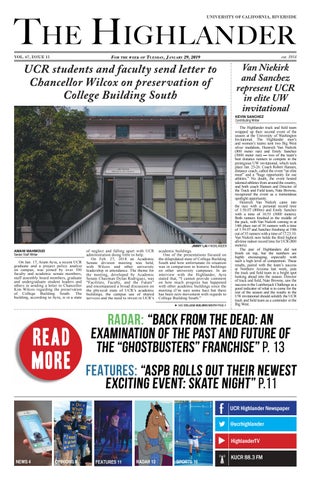
On Jan. 17, Aram Ayra, a recent UCR graduate and a project policy analyst on campus, was joined by over 100 faculty and academic senate members, staff assembly board members, graduate and undergraduate student leaders and others in sending a letter to Chancellor Kim Wilcox regarding the preservation of College Building South. The building, according to Ayra, is in a state
of neglect and falling apart with UCR administration doing little to help. On Feb. 27, 2018 an Academic Senate division meeting was held, with Wilcox and other university leadership in attendance. The theme for the meeting, developed by Academic Senate Chairman Dylan Rodriguez, was “Facilities, Faculty, and the Future” and encompassed a broad discussion on the physical state of UCR’s academic buildings, the campus use of shared services and the need to invest in UCR’s
JIMMY LAI / HIGHLANDER
academic buildings. One of the presentations focused on the dilapidated state of College Building South and how unfortunate its situation was in comparison to historic buildings on other university campuses. In an interview with the Highlander, Ayra stated that, “I cannot provide comment on how much progress has happened with other academic buildings since the meeting (I’m sure some has) but there has been zero movement with regards to College Building South.” ► SEE COLLEGE BUILDING SOUTH PAGE 4
read more
The Highlander track and field team wrapped up their second event of the season at the University of Washington Invitational. The Highlander men’s and women’s teams sent two Big West silver medalists, Heinrich Van Niekirk (800 meter run) and Emily Sanchez (5000 meter run) — two of the team’s best distance runners to compete in the prestigious UW invitational, which took place Jan. 25-26. Coach Robert Hansen, distance coach, called the event “an elite meet” and a “huge opportunity for our athletes.” No doubt, the event hosted talented athletes from around the country, and both coach Hansen and Director of the Track and Field team, Nate Browne, recognized the event as a tremendous spotlight opportunity. Heinrich Van Niekirk came into the race with a personal record time of 1:50.07 (800m) and Emily Sanchez with a time of 16:55 (5000 meters). Both runners finished in the middle of the pack, with Van Niekirk coming in at 14th place out of 34 runners with a time of 1:54.07 and Sanchez finishing at 19th out of 35 runners with a time of 17:23.10. Van Niekirk now holds the third highest all-time indoor record time for UCR (800 meters). The pair of Highlanders did not finish on top, but the numbers are highly encouraging, especially with such a high level of competition. These results, paired with the team’s success at Northern Arizona last week, puts the track and field team in a bright spot looking ahead into the season. Director of track and field, Nate Browne, saw the success in the Lumberjack Challenge as a good indicator of what is to come for the rest of the season and the results in the UW invitational should solidify the UCR track and field team as a contender in the Big West.
RADAR: “Back from the Dead: an examination of the past and future of the “Ghostbusters” franchise” P. 13 FEATURES: “ASPB rolls out their newest exciting event: Skate Night” P.11 f
UCR Highlander Newspaper @ucrhighlander HighlanderTV
NEWS 4
OPINIONS 8
FEATURES 11
RADAR 12
SPORTS 16
KUCR 88.3 FM
2
TUESDAY, JANUARY 29, 2019
HIGHLANDER // highlandernews.org
HUMANS OF UCR
UPCOMING EVENTS: WEEK 4
JOHN CHIKEZIE, ENVIRONMENTAL SCIENCE, THIRD-YEAR
29
Self Defense 6:00pm to 9:00pm Student Recreation Center (SRC), Multipurpose Room B/C
ASPB presents: Happy Death Day 2U 10:00pm to 11:00pm University Village Theater
R’World Forum: UCR’s International Impact 9:00am to 10:00am HUB 367
APSP’s Cultural Education Program: Navigating the Pasifika 1:00pm to 2:00pm APSP office, 244 Costo Hall
Student Focus Groups: Nurture Your UCR Heart 2:00pm to 3:30pm Hinderaker Hall , 2120
Men’s Basketball vs Cal Poly 7:00pm SRC Arena
1
HA JIN “Writing and Violence” 2:10pm to 4:00pm CHASS Interdisciplinary South, 1113
Game Day Favorites 4:00pm to 6:00pm Student Recreation Center (SRC), Classroom Kitchen
2
Inspiring R’ Leaders Conference 10:00am to 5:00pm HUB 302
Men’s Basketball vs UC Davis 6:00 P.M. SRC Arena
Tuesday
COMPILED BY MARTIN LOPEZ
30
Wednesday
31
Thursday
“Open your door in your hall, even if you’re at the very end, talk to
Friday
your hall mates. Go to that party that you decided not to go to. I came into my freshman year in a triple with two friends from high school. I could only imagine the exponential growth I would have had meeting as many people as I can instead of reserving myself to my crew.”
Saturday
3
Sunday
CONTACT US
HIGHLANDER STAFF EDITOR-IN-CHIEF
MANAGING EDITOR
Evan Ismail
Andreas Rauch
managingeditor @highlandernews.org
editorinchief @highlandernews.org NEWS EDITOR
ASST. NEWS EDITOR
Aidan Rutten
Amani Mahmoud Mark Bertumen
news@highlandernews.org
ASST. OPINIONS EDITOR
Elaine Chen
opinions@highlandernews.org FEATURES EDITOR
Martha Delgado
features@ highlandernews.org
Marcelo Garcia
radar@highlandernews.org ASST. SPORTS EDITOR
SPORTS EDITOR
Jaryd Bongcaras
Jonathan Fermandez
Business Office: (951) 827-3457
Classifieds & Billing: (951) 827-5039
Fax: (951) 827-7049
jbong006@ucr.edu
sports@highlandernews.org
LETTERS TO THE EDITOR
PRODUCTION MANAGER
Kerry Mulia
productionmanager @highlandernews.org PRODUCTION ASSISTANTS
Hao Le Jeffrey Yoo Brinly Den
Kathy Garcia Amanda Joy Teano Judy Tu Asst. Photo Editor
PHOTOGRAPHY EDITOR
Jimmy Lai
Martin Lopez mlope072@ucr.edu
photo@highlandernews.org STAFF PHOTOGRAPHERS
Thomas Holguin, Lydia Tsou VIDEO EDITOR
Catherine Yong
video.highlander@gmail.com BUSINESS MANAGER
Karla Montes
highlanderads@gmail.com DISTRIBUTION MANAGER
TECH DIRECTOR
Kevin Ciampaglia
techdirector@highlandernews.org
MARKETING COORDINATOR
Jessica Schneider
TIP LINE: (951) 827-2105 Help the Highlander stay on top of what is happening on campus and in the general UCR community. Call this number and leave a message for the Editorial Board with your tip. Be sure to include your full name, relation to UCR, and a number or email address where you can be reached for more details. Editorial Office: (951) 827-3617
A&E EDITOR
Chiraag Dave
Highlander 101 Highlander Union Building Riverside, CA 92521 www.highlandernews.org editorinchief@highlandernews.org
marketing.highlander@gmail.com
The Highlander accepts letters from the campus community. They must be 600-800 words at length and include the author’s name and contact information. Topics should be UCR-centric and/or pertain to our generation of students. Contact Opinions Editor Michael Beeli at opinions@highlandernews.org by Wednesday if interested in writing a letter and submit the completed letter by Saturday at noon. Letters can and will be rejected if it does not meet requirements. LEGAL The Highlander is published and copyrighted by the Highlander for the students, faculty and staff of UCR. All rights are reserved. Reprinting of any material in this publication without the written permission of the Highlander is strictly prohibited. Readers are allowed one free copy of the newspaper. For additional copies or for subscription information, please contact the Highlander. The Highlander fully supports the University of California’s policy on non-discrimination. The student media reserve the right to reject or modify advertising whose content discriminates on the basis of ancestry, color, national origin, race, religion, disability, age, sex or sexual orientation. The Highlander has a media grievance procedure for resolving complaints against it. All inserts that are printed in the Highlander are independently paid publications and do not reflect the views of the Editorial Board, the staff or The University of California or the Associated Students of UCR.
Hot Springs Hike 8:00am to 6:00pm Student Recreation Center (SRC), Outdoor Excursions Shop
4
APSP’s RoundTable: Appreciation or Imitation? 12:30pm to 1:30pm APSP office, 244 Costo Hall
Monday
MULTIMEDIA
CLASSIFIED ADVERTISEMENTS ADVERTISING INFORMATION Please submit Classifed ads by calling 951-827-3457 or by emailing Highlanderads@ucr.edu PAYMENT Visa and Mastercard Make checks payable to The Highlander Newspaper No refunds RATES Classified: $2 per line; 17 characters (spaces, dashes, etc.)
Smartphone Film Festival 5:30pm to 7:30pm Arts Building, Screening Room, ARTS 335
UCRHIGHLANDER
f
UCR HIGHLANDER NEWSPAPER @UCRHIGHLANDER HighlanderTV
MISCELLANEOUS Pregnant? Free counseling and services. We come to you. Holy Family Services, adoption & foster care. 1-800-464-2367. UCR student needs a Chemistry Tutor, Requirements: Graduate level, chemistry student, Please email information and hourly rate to: Jeff.celecpo@att.net
KUCR 88.3 FM
News 4
TUESDAY, JANUARY 29, 2019
HIGHLANDER // highlandernews.org/news
ASUCR
ASUCR discusses student concerns, community outreach and the 2020 strategic plan
JAKEB TIVEY Staff Writer
ASUCR’s third meeting of the winter quarter took place Wednesday, Jan. 23 beginning at 6:33 p.m. The session was distributed into three sections: routine documentation approval and budget updates from Jan. 15 and Jan. 22 meetings; statements by ASUCR President Semi Cole regarding upcoming events and advice to the legislative branch; and progress reports by the majority of present senators. The reports revolved around food insecurity, legislation and events in support of marginalized groups within the community, textbook prices and the ‘UCR 2020’ strategic plan, the Office of the Chancellor’s strategy for expanding and improving UCR’s framework throughout the next decade. Both CHASS Senator Jackie Chang and CNAS Senator Josiah Davis were not present for the third consecutive week, with CNAS Senator Kenneth Vongdi also missing for the second week in a row. At the podium, Cole discussed three of his current projects: a stargazing community outreach event, the possibility of a “Dinner With the Chancellor” meetand-greet and a new safety initiative aiming to provide free CPR and first aid training to students on campus. The purpose of the meet-and-greet, Cole explained, is to allow “students who are first years, or are transfers, to have an opportunity to get to know [Chancellor Wilcox,] his story and things going on in the university … he’s already expressed his interest.” CHASS Senator Julian Gonzalez opened the new business section with a progress update on the Green Campus Action Plan’s (GCAP) recent grant extension of $4,000 to Husks-to-Home,
a Bourn’s College of Engineering student group previously awarded $75,000 from the EPA to build homes in the Philippines. Senators then announced progress reports on both their responsibilities to their own committees and the Senate. CHASS Senator Mehvish Ali discussed the possibility of Uber discount codes for UCR students and also mentioned that the 2019 Beyond R’Margins conference, an annual conference focused on informing students of the diverse communities on campus, is in the planning stage of development. She also reported that departments in Costo Hall are suffering from restricted space. Gonzalez followed Ali’s statements outlining his current focus into reducing textbook and access code prices, ASUCR legislation in support of marginalized groups and expanding focus groups. Gonzalez told the Senate, “I feel like focus groups can expand more on issues within the community … it’s time for us to not expect people from the outside to come in here to ask for help, I feel, and as President Cole has mentioned, it’s time for us to go outside and get our own visibility.” Focus then turned to CHASS Senator Avi Idea, who discussed how he was looking into improving the lighting of dark areas on campus via repairs or portable solutions, in addition to communicating that TAPS’ shuttle service is proving inefficient for many students, proposing that a meeting with TAPS be organized to address safety and congestion issues. BCOE Senator Sarah Al-Khalili encouraged her peers to attend the Muslim Student Association’s Feb. 10 outreach event, prior to CHASS Senator Chelsea Davenport explaining how she, along with many other senators, are brainstorming ways to support local victims of wildfires. CNAS Senator Andy Veliz reported
MARTIN LOPEZ / HIGHLANDER
that he is attempting to work with IT to address student concerns about WiFi outages, in addition to the dining concern that there are too few microwaves on campus. Finally, CNAS Senator Abigail Cortes shared thoughts on bringing the contents of the aforementioned ‘UCR 2020’ plan to the public eye, specifically in how parking and instruction congestion will be affected and addressed. In the public forum, Ali took the floor to express her intention to research California emergency grants to help combat food insecurity, in addition to proposing that non-student funding be used to initiate a daily R’Pantry like other UC Campuses. Gonzalez responded on his own progress working with OZZI to bring reusable plastic containers to campus. He hopes it will facilitate the idea to take dining hall foods with you when you leave, which he will propose in a Jan. 30 meeting with Assistant Vice Chancellor of
Auxiliary Services Andy Plumley. Shortly after the senate reports concluded, Cole once again took to the podium to convey his advice and explain his frequent interjections and comments during the meeting: “It’s something that I’m going to start doing more often because, at the end of the day, it’s week three and this is our second quarter in office. Students are expecting not just updates but results on our path. It’s not enough for us to present on ideas, we need to present momentum on the ideas we are working on.” Cole went on to state that he “will be checking up on each of you (senators) … we’ve got to keep ourselves accountable and make sure we have victories for students at the end of the day.” The meeting was adjourned at 7:18pm. ASUCR meetings are open to the public, occurring every Wednesday at 6:30 p.m. in HUB 221. ■H
UCR students and faculty send letter to Chancellor Wilcox urging preservation of College Building South
► FROM COLLEGE BUILDING SOUTH
In the letter to Wilcox, Ayra and UCR faculty state that, “We … are writing this letter in support of preserving and investing in College Building South … We have combined our voices to request the University of California, Riverside address the current vulnerabilities of the building in order to preserve it and prevent further deterioration or damage to its architectural and historical significance.” The letter also states that the repairs and investment in preserving the building will ensure continued access for the public to appreciate the historic space and for scholars and staff to pursue their work. According to the letter, College Building South was designed by Lester H. Hibbard and H.B. Cody and the design followed the “Mission Revival” style, reflecting Spanish Colonial influence on Southern California architecture. The building opened for use in 1917 and is identified as both “pre-1945” and “World War II vintage” by the UCR 2005 Long Range Development
Plan, but it is not formally entered into a historical register. According to Ayra and the letter’s authors, College Building South “deserves to be protected as a historically significant site to the UCR Community. In our pursuit of development and University expansion, we should not hurry to erase the very “essence” that brought us to this point as a campus.” Ayra also wrote to the Highlander that there are many other perspectives and different aspects of “history unique to the region that are important to recognize and be mindful of.” However, with regard to campus buildings and landscape, “we have lost the Barn in its original form and the Faculty Club, the Botanic Gardens (founded 1963) have been forced to largely self fund & manage, due to a lack of coordinated support from the campus.” Ayra believes that UCR’s campus itself is a “mishmash of older, architecturally unique buildings and the new UCR brick & glass buildings that stress a polished cookie-cutter look that does nothing
AMANI MAHMOUD / HIGHLANDER
to add the vibrant history and human geography of the campus.” However, Ayra stressed that he is not against new development. “New buildings, research space, and world class amenities are necessary and proper for a campus like ours. But they should not come at the cost of erasure and disinvestment in the
campus aspects that make our University uniquely us,” Ayra said. As of Jan. 23, Ayra has yet to receive a response from Chancellor Wilcox; but Associate Chancellor Christine Victorino has responded and assured Ayra that he, along with other university H leadership would be responding soon. ■
HIGHLANDER // highlandernews.org/news
NEWS
TUESDAY, JANUARY 29, 2019
WeChat, controversial social media app, receives feedback from UCR community
5
MARTIN LOPEZ / HIGHLANDER
ANDY LI Contributing Writer
In recent weeks, the University of California administration published a warning against WeChat, a Chinese social media app popular in the United States, advising students across all nine campuses to exercise caution when using the application. WeChat faces allegations that the Chinese government is using the app to spy on its own citizens who are living abroad. This has sparked confusion and controversy with various students and faculty members at UCR. UCR distinguishes itself by having a large Chinese international student community (55.5 percent of international students). When asked for their opinion on the WeChat app controversy, several of them expressed skepticism of the warnings. “I’ve been using WeChat everyday to communicate with my friends and family, and I’ve never had to worry about the threat of espionage,” said James Wang, a Chinese exchange student from Zhejiang Province, located near Shanghai. Jiayang Pan, Wang’s friend, agreed. “I don’t believe any of the spying allegations made against WeChat,”
he said. “But even if they are true, I believe that the government is simply trying to keep us safe. There’s nothing to worry about.” Pan also added that he believed that the current trade war and geopolitical tensions between the Trump administration and the Chinese government might be contributing to these “overblown fears.” Both Wang and Pan acknowledged that back in China, the government does conduct extensive censorship campaigns to root out any kind of political rhetoric considered anti-Chinese or anarchist. Having lived in the country their entire lives, they believe that the censorship is a positive trade-off for lower crime rates and social stability. “If people are getting arrested, it is due to the fact that they’ve committed crimes that have harmed the country, not simply because of what they said online,” said Pan. Professor Loren Collingwood, who teaches political science specializing in domestic politics, took a sharper tone at the WeChat warnings. “I think it’s extremely important that we do not send the wrong message against international students,” he stated. “Our campus prides itself in being an accepting and tolerating place for immigrants around the world. We
should think carefully about the kind of message these targeted warnings send to the international students coming from China. We want students to feel safe at UCR and not get the wrong impression that they are being unfairly singled out.” On the other hand, WeChat hasn’t escaped criticism amongst the faculty on campus either. Professor Jeremy Busacca, who lectures on international politics and has studied U.S.-China relations extensively, believes that the allegations of spycamming by WeChat should be taken very seriously. “China has been spying on us for decades now,” Busacca argued. “It’s an open secret in Washington, D.C., but under the Trump administration, it is simply getting more coverage due to the hawkish nature of this president. The ongoing trade war is clearly factoring in to these fears, especially with intellectual property theft happening on a daily basis and forced technology transfers making it especially difficult for American firms to compete with Chinese, state-owned enterprises.” Busacca admitted that the U.S. government has had a complicated relationship with social media freedom as well. “I certainly acknowledge the
reality that the NSA has been spying on American citizens without a warrant, and one can easily make a case on how unconstitutional this behavior is,” he said. Professor Toby Gustafson, who teaches computer science, encourages all students using apps such as WeChat to exercise more caution in this day and age. “One of the things I always tell my students is to use a VPN to protect their privacy,” Gustafson explained. “However, a VPN won’t really help with WeChat if another government is spying directly through the app. Therefore, my best advice is to only use the app on devices where you do not store a ton of personal or sensitive data.” Gustafson also believes that the United States is quickly falling behind rivals such as China and Russia in the field of artificial intelligence, space technology and cyber-warfare. “Our government needs to take this threat seriously by investing far more than what they’re currently spending on these areas,” Gustafson warned. “The battlefield for the next world war won’t be fought on land, sea or air — but rather through satellites, electromagnetic grids and robots.” ■H
NEWS IN BRIEF: UC students rally together demanding better workers’ contracts and more protections for minorities ANDY LI Contributing Writer
Last Wednesday, students from UC Riverside and the other eight UC campuses attended the monthly Regents meeting in San Francisco to demand higher worker compensation for all UC employees as well as greater legal protections for marginalized minorities in the UC system. Over the past few months, students across California have become increasingly vocal and critical
regarding perceived inaction and apathy on behalf of the UC leadership partly due to the controversial immigration and diversity policies of the Trump Administration. The ASUCR Highlander Action Coalition was in attendance during the event. According to Citlalli Aparicio, one of the organizers of the protest, the UC administration is “actively trying to drive down working standards and compensation for its employees and failing to protect the most vulnerable
communities that make up its diverse student bodies.” Aparicio cited the fact that certain workers haven’t had a contract for over two years, and accused the administration for “using misinformation and intimidation tactics to turn students against workers.” Activists disagreed with the notion that higher wages would drive up tuition costs, and also accused the administration for “participating in [President] Trump’s deportation regime and the prison industrial complex.”
However, despite these accusations, there has been no evidence supporting the claim that the University of California leadership has ever transferred revenue to any private corporations engaged in the prison industry or invested in deportation or border security. The University of California continues to maintain a policy protecting undocumented immigrants from deportation on campuses and usually provides generous financial aid packages to these students. ■H
6
TUESDAY, JANUARY 29, 2019
HIGHLANDER // highlandernews.org/news
UC Riverside partners with ARL-West to develop technolog y for soldiers
CHRISTINE TRAN Contributing Writer
For the first time ever within the UC system, the Army Research Laboratory West (ARL-West) has partnered with UCR’s Bourns College of Engineering (BCOE), as a part of ARL’s Open Campus Initiative (OCI). The goal of this partnership is to collaborate on long-term and short-term technological needs for soldiers. As part of this collaboration, a Joint-Work-Statements (JWS) under the Cooperative Research and Development Agreement (CRADA) was established to encourage the exchange of research ideas between UCR Faculty and ARL scientists. At the forefront of this partnership are UCR professors Ashok Mulchandani, Alexander Balandin, David Kisailus and Roger Lake, alongside ARL research scientist and UCR graduate Mahesh Neupane. Under their supervision, UCR can provide experimental data to ARL while ARL shares data from their projects. “Graduate students are able to conduct research in my lab and get exposure to real life problems while also receiving feedback from army research lab
representatives,” said Balandin in an interview with the Highlander. UC Riverside was chosen as a partner by the ARL-West due to its diverse faculty and student population as well as UCR’s extensive research in material synthesis and device fabrication. To ARL-West, UCR’s diversity means people who can bring about new approaches of solving a problem. “The long term goal is to have this seamless collaboration between UCR and ARL, and have researchers from both sides to work together closely in order to solve common problems. UCR faculty can travel to the main ARLWest campus in Maryland to work there and bring their results back to the campus,” stated Neupane. This partnership opens up many opportunities for graduate and undergraduate students on campus. Through this collaboration students can see how the fundamental sciences they learn about in classes can be implemented in real life situations. “Having resident ARL-Scientist, Dr. Mahesh R. Neupane, managing this collaborative effort is a win-win
COURTESY OF WIKIMEDIA COMMONS
proposition for not only faculties, but also students because this allows them to have a first-hand experience of working on scientific and technical problems related to national security,” wrote Mulchandani. Since the beginning of this collaboration, many UCR students have already been able to get involved. Last year, several material sciences, electrical engineering and computer science students were able to intern with ARL-West. For example, UCR graduate students Chun-Yu Huang and Sahar Naghibi are currently working with the
lab under this partnership. Huang works on fabricating nanostructure for Defense Advanced Research Project Agency (DARPA) Phonon Engineering project and Naghibi is currently working on the development of non-curing thermal interface materials (TIMs) for advanced electronics. “I am very happy get a chance to work in ARL and know the people who work in ARL are interested in our research and want to work with us. It is very nice and hopefully there will be more opportunities like this for us to H continue our research,” wrote Huang. ■
with much opposition from faculty. Vafai states that “The Master of Science in Engineering Online program is flexible and multidisciplinary and enables the participants to concentrate in depth on specific areas, which are most beneficial to them, or to broaden their knowledge about a variety of engineering fields. He believes the reason behind UCR’s high ranking is “detail, detail, responsibility, and hard work.” There are about 148 students enrolled in the MSOL program. When asked for course feedback, a student stated that the MSOL program as “The program is a good balance of practical and rigorous academia. ….. I really enjoy the research and then applying the knowledge in the workforce.” The MSOL program is completely online and does not require the student to be on campus. Testing happens in the student’s own area, or their home. The program consists of nine courses
totaling 36 units. It is also ranked fourth for the online masters of biomedical engineering, four for the online masters for biomedical engineering and 11 for Environmental Engineering by OnlineMasters. There are some admission requirements to be considered for the MSOL program. A bachelor’s degree in engineering or related field, official transcripts, at least a 3.0 GPA, college coursework, scores of the Graduate Record Examination, professional engineering experience, professional certifications and letters of recommendation. The specializations offered for the online program consist of bioengineering, electrical engineering, environmental engineering, materials at the nanoscale, mechanical engineering, data science and chemical engineering. The program can be completed in about 13 months. ■H
UCR’s online Master of Science in Engineering program rises in rank
EMILY HUANG Contributing Writer
UCR’s online Master of Science in Engineering (MSOL) program has risen from rank 51 to rank 33 in 2019 by the U.S. News and World Report. MSOL is an online program created by the Bourns College of Engineering in
COURTESY OF PEXELS
Fall 2013 designed for fully employed engineers to enhance their knowledge in their specialized field. In an interview with the Highlander, the Director of MSOL in Engineering Kambiz Vafai stated that he has encountered many difficulties in establishing this program. He was met
NEWS IN BRIEF:
UCR updates campus printing and supply services
MARK BERTUMEN Senior Staff Writer
Campus Business Service Director Michael Clemons announced the recent renovations to printing and campus supply services at UCR, and spoke with the Highlander via email on what the renovations entailed. With regard to printing, Digital Print Services (DPS), originally known as Printing and Reprographics, “recently moved (central operations) from the Atlanta Ave. facility to the Corporation Yard here on campus,” Clemons wrote. “These changes will increase operational efficiencies and reduce long standing deficits, without impact
to customer service.” The old campus supply service, Storehouse IBM, was removed last December and “Auxiliary Services, in partnership with Information Technology Solutions (ITS), launched a new ordering system - ScotSupply,” Clemons said. He noted that the service is working on “post launch enhancements” but later stated that ScotSupply “will ultimately offer an updated look and improved functionality, while maintaining the same outstanding service from the dedicated team at ScotSupply.” Clemons will keep the Highlander updated on the improvements both
COURTESY OF PIXABAY
services have received, but for now mentions that ScotSupply was created to “streamline the business model” of staff supplies and that DPS was relocated to
save on costs, adding that “students, campus groups, and clubs can be served by DPS for print & design needs as well as university departments.” ■H
Opinions
HIGHLANDER // highlandernews.org/opinions
OPINIONS
TUESDAY, JANUARY 29, 2019
7
HIGHLANDER EDITORIAL
After gambling with security and federal jobs, Trump has played himself into a corner
O
n Jan. 25, President Donald Trump surprised the nation in an unexpected decision to end the longest U.S. government shutdown in history for a period of three weeks while continuing to debate border security. If an agreement on a border security plan is not reached by Feb. 15, however, Trump promised to either shut down the government again or declare a national emergency in an attempt to force the wall budget through a Democraticmajority Congress. During the following three weeks, aside from the continuing negotiations about the wall, the 800,000 federal workers who had been out of pay will be compensated. The announcement is good news for the federal workers who endured a month of missed paychecks and for the citizens of the U.S. who witnessed a slowdown of productivity in matters that required government workers, such as airport security and food inspections. Despite the fact that the government is now reopened and President Trump did guarantee back pay for the workers, the reason behind this shutdown was still wildly hypocritical given the risks to homeland security that had occurred as a result of laying off hundreds of thousands of government workers for an unnecessarily long amount of time. Furthermore, Trump’s continued insistence to construct a wall is now starting to look like a last resort to save face and deliver on his campaign promise; yet he’s also now cornered with backlash from those who opposed this wall from the start and his disappointed supporters who believe he’s gone soft. It’s commendable that the Democrats have been able to
COURTESY OF WIKIMEDIA COMMONS
stay firm on their stance against giving Trump his wall budget, but the attention needs to be expanded past the scope of the federal workers and the resistance of Trump’s budgetary demands. The driving argument behind those who opposed the longevity of the shutdown cited the blank paychecks and penny-pinching strategies many U.S. federal workers had to endure. #ShutdownStories began trending on Twitter as many workers told of their financial difficulties thanks to the 35-day shutdown. Sen. Kamala Harris of California shared a few of these stories on her Twitter, adding that these financial crises shouldn’t be happening. House Speaker Nancy Pelosi (D-CA) made efforts to lend a hand to impacted government workers in Washington D.C. Pelosi also gave a rebuttal to Trump’s address of the government shutdown, to which she stated that it is generally agreed upon that securing borders can come in ways that don’t include a wall (such as new technology to scan cars and trucks for drugs). Despite well-intended efforts to give the federal workers a platform in order to express their stories to the rest of the country, many politicians seem to have a blind spot in addressing this shutdown. There’s been a lack of media coverage or a general hush when it comes down to shining a spotlight on the blatant hypocrisy President Trump has expressed in his reasoning behind prolonging the government shutdown. Since when did putting the security of the American people first involve forcing them to work without pay? It’s unfortunately essential for several key employees to continue working even without pay, given that if they were to simply not show up, all kinds of crises would occur. Ironically
enough, the Coast Guard, an agency whose workers were called in to work without pay, is responsible for ensuring border security. Their job is not limited to intercepting smuggled drugs, a talking point that Trump uses frequently in his argument for a wall; on the contrary drugs are most commonly smuggled through legal ports of entry. Therefore, hindering the efficacy of the Coast Guard by reducing its funding jeopardizes the security that Trump claims to support. Another essential security branch that was slowed down due to a lack of funding includes the Federal Bureau of Investigation (FBI); some operations that the FBI had been rendered unable to do included issuing grand jury subpoenas and continued investigations into groups such as MS-13, a gang that Trump also has commonly brought up as an imminent problem in our country. Aside from jeopardizing the effectiveness of vital government operations like these by freezing their pay and funding, the average government worker also felt the pressure of being furloughed indefinitely. Stories that made rounds in the media told of those who missed mortgage payments, experienced lowered credit ratings and even risked losing their insurance. Chuck Schumer, the Senate minority leader also brought up the impact small businesses and farmers have felt as a result of being denied the loans they need. It’s absurd that the security and wellbeing Trump claims to want so desperately for this country has at the same time been compromised via nonexistent paychecks; it’s even more ludicrous that he’s willing to put thousands of financial livelihoods at risk again if he doesn’t get what he wants. Despite the many bipartisan proposals for border security that
are agreed upon such as more immigration judges, more funding towards infrastructure at ports of entry and more investment in technologies to detect weapons and drugs, the wall still stands as an nonnegotiable factor. Because of this continued impasse, federal workers are essentially being held hostage by the government. Most border security proposals are generally agreed on; thus, shutting down the government over one contentious policy seems unnecessary and counterproductive. It’s starting to become obvious that this seems to be Trump’s endgame in order to save face in front of his supporters given all the other things he promised but failed to deliver on. Instances of Trump attempting to appease his supporters include his continued claims that Mexico is paying for the wall and his assertion that “we’ve done a lot of wall already.” Both of these statements have proven to be false, given that there is no set agreement on Mexico funding the wall. Since President Trump took office, parts of the barriers on the U.S.-Mexico border have been renovated, but contrary to his announcement that the administration has built a “brand new wall in San Diego,” Customs and Border Protection has stated that there are no plans for extending the barriers that are already there. Aside from that, to this day, there have been zero miles added so far to the existing barriers. Pushing for this project is only appealing to his base that he knows is starting to slip away, especially after this last week where he unexpectedly reopened the government sans wall. That being said, Trump most definitely shot himself in the foot with this move, further driving up disapproval from those who already opposed the wall from the start and now from several
pro-wall conservatives who are now upset at the fact that Trump has caved with no budget in sight for the wall. The newest group to become disillusioned isn’t too large, since only 35 percent of those surveyed in a Reuters poll expressed approval for putting the wall in a congressional spending bill. The idea of fighting tooth and nail for this wall is not only terribly unpopular now, but his own base has started turning against him for believing he softened up to the House. However, there are still those who weren’t phased by the lengthy shutdown. Locals from districts that Trump won in his presidency cheered on the shutdown, stating that they were finally getting the sense of “less government” that their political party identifies with. Needless to say, perhaps there always will be a group of individuals who will give Trump a free pass on anything he does, but what good is there in President Trump continuing to appeal to this particular group rather than serving the majority of the American people? Despite the fact that the government is now reopened and federal workers can sleep a little better at night knowing they are to be paid soon, Trump has still refused to admit defeat, vowing once again that the wall would be built. The future of this specific border security project is unforeseeable, but it’s clear that no matter what the outcome, Trump has boxed himself into a corner, faced with perhaps the biggest challenge to his ■H legitimacy as president. Highlander editorials reflect the majority view of the Highlander Editorial Board. They do not necessarily reflect the opinions of the Associated Students of UCR or the University of California system.
8
TUESDAY, JANUARY 29, 2019
HIGHLANDER // highlandernews.org/opinions
OPINION POLL Compiled by Lydia Tsou Staff Photographer
“Are you/ do you know anyone who is affected by the government shutdown?”
Matine Rubin Statistics First-year
Alexandra Vacaru Applied Math First-year
Duran Patel Undeclared First-year
Hanna Afeworki Sociology Third-year
Simon MacAllister Pre-business First-year
Garrison Tsui Business Economics First-year
“Personally I don’t think I know anyone.”
“Yes, my cousin’s friend. I know she works for the government and she’s not getting paid.”
“No, I feel bad for the TSA people though.”
“Yes, my uncle actually works for TSA. He’s been going even though he’s not getting paid.”
“No, but I can imagine that many people in SF are affected.”
“My uncle is a government worker in Union City, but I’m not sure if he was affected.”
President Trump’s foreign policy offers a fresh rebuke to the failed interventions of the past
ANDY LI Contributing Writer
Recently, mainstream national media outlets have severely criticized President Donald Trump’s foreign policy on multiple fronts, primarily focusing on his sudden withdrawal of American troops from Syria and Afghanistan as well as his perceived weakness when dealing with Russia on the world stage. However, there are several key problems with the disingenuous and opportunistic criticism of Trump’s instinctive desire to protect and prioritize American lives over foreign nations – a mentality that was hailed as virtuous when former President Barack Obama pulled troops from Iraq – but is now attacked as a sign of “treason” when Trump does exactly the same thing. To begin with, the 2001 Authorization for the Use of Military Force (AUMF), passed by Congress in the wake of the Sept. 11 attacks, gave the president broad powers to initiate preemptive strikes on foreign targets as long as the president notifies Congress within 90 days regarding his or her plan of action. However, according to near-unanimous constitutional experts, the AUMF is reserved only for military targets that pose a clear threat to the United States, which currently only includes the terrorist organizations al-Qaeda and the Islamic State group (IS). It is important to note that the AUMF does not give the president unilateral authority to invade or occupy another sovereign state, friend or foe, without an official Congressional Declaration of War – which hasn’t occurred in 17 years. Bringing this into relevance to Syria, National Security Advisor John Bolton stated himself that “The United States will not leave Syria until Assad is deposed and Iran is removed from the country.” Additionally, Secretary of State Mike Pompeo asserted that “We will never allow Russia to gain a foothold in Syria, not now, not ever.” Neither of these objectives have anything to do with those of the AUMF. Regardless of anyone’s opinion on Russia, Syria or Iran, none of those nations have launched direct terrorist attacks in the United States. The AUMF does not apply with regard to the illegal occupation of a sovereign state, such as Syria, a nation that is unanimously recognized by all member states of the United Nations. To add insult to injury, Bolton has additionally stated to Israeli Prime Minister Benjamin Netanyahu that the U.S. would “protect Israel in Syria from Iran.” It is not the job of the United States to fight wars for other nations, and it is appalling that American soldiers are so cheaply used as mercenaries for a nation such as Israel, which has systematically and repeatedly violated the human and civil rights of the Palestinian people in the West Bank and in Gaza, and is responsible for reprehensible war crimes and the permanent detention of foreign journalists. Obviously, claims such as
these are nothing new from an individual like Bolton, who is well known in Washington for being so hawkish that even former Defense Secretary Jim Mattis questioned his mental stability. In addition, Bolton was a famously massive advocate for bombing Iran in 2006, a position that caused his original U.N. ambassadorship to be rejected by the Senate. Secretary Pompeo is no better. He has embarrassed the moral credibility of the United States on the world stage by openly defending Saudi Arabia after the autocratic regime murdered a Washington Post journalist, Jamal Khashoggi, in cold blood at the Turkish embassy last October. Instead of using this as an opportunity to punish the Saudi regime with economic sanctions for its virulent disregard for international law and the rights of journalists, Pompeo continued to defend the Saudi crown prince and advocated for a continued military relationship with the Saudis during Congressional testimony. Pompeo is also a massive supporter of supplying Saudi Arabia with American weaponry, despite the fact that the Saudis have been exposed for committing a religious genocide against Yemen with the same weapons. Now, given the obvious lack of mature leadership in President Trump’s inner circle, it would seem surprising that the president has taken a completely different attitude on war and peace. He has ignored the severely flawed advice of both Pompeo and Bolton and has wisely chosen to end American operations in Syria and to phase out American operations in Afghanistan – a war that now rivals Vietnam in both length and casualties. President Trump ran in 2016 on a non-interventionist foreign policy that put American lives first — both their economic well-being and their blood. Part of the reason why Trump was able to appeal not just to the traditional Republican base but also to many leftwing Bernie Sanders supporters was due to the fact that his foreign policy was far more in line with the American public than the aggressive warmongering of his opponent, Secretary Hillary Clinton, who famously voted in favor of the failed Iraq War and repeatedly expressed a desire to attack Russia during the 2016 campaign. The national news media also claims that Trump is surrendering American interests in Syria and Ukraine to Russia. It also seems that journalists in Washington have bought into the evidence-free conspiracy theories of the president being a Manchurian candidate for Putin – a claim that, despite over two years of taxpayer-funded investigations, has yielded absolutely no substantive proof at all. Most importantly, this mentality is exceptionally naive and flawed for one simple reason – it assumes that the American people are somehow on board with bloated military spending and foreign aid to “contain” a nation as large and powerful as Russia – and that our efforts could even be successful in the first place. To put this naivete into perspective,
COURTESY OF FLICKR
the United States is currently $22 trillion and counting in debt, with China being the largest foreign creditor of our debt (we’re currently engaged in an unsuccessful and pointless trade war with them). 54 percent of discretionary taxpayer spending (not counting Social Security and Medicare, which are government-sponsored savings programs) is spent directly on foreign aid and the military. The United States wastes $38 billion on Israel alone – a nation infamous for its horrendous treatment of Palestinian refugees. Given the fact that President Trump has repeatedly promised to revitalize the American economy and to put the American people first, it isn’t crazy to wonder why our federal government openly betrays the actual interests of the American people and instead chooses to fight wars for foreign nations and engage in brutal killings worldwide. Additionally, there are severe fallacies with the mainstream media narrative that Russia is the big bad wolf in the neighborhood. The most popular attack against Putin is that he “invaded” Crimea, but the reality is, it has historically been a part of Russia for hundreds of years. The Crimean people democratically chose to join Russia in a referendum in 2014, Crimeans are ethnically 97 percent Russian, not Ukrainian and the overwhelming majority of them speak Russian. Another criticism against Russia is their military presence in Syria. However, the legitimate, U.N.-recognized government of Syria requested Russian and Iranian military assistance in 2015 to destroy ISIS and Syrian rebel terrorist cells that were quickly taking over the eastern part of the nation — and unlike the Russians and Iranians, the United States was neither invited nor given permission by the Syrian government to participate in the civil war, and ironically, our insistence to become involved in the region has actually emboldened terrorist groups affiliated with al-Qaeda and has allowed
autocratic regimes such as Saudi Arabia to proceed unchallenged in their bloody genocide of Syrian and Yemeni civilians in the Middle East. Instead of blindly believing that the U.S. is the greatest nation on earth because of the size and might of our military, maybe it’s time to reevaluate how America is perceived across the world stage. Respect for America is at all time lows, with close allies such as Australia, the U.K., and Germany expressing less than 20 percent approval according to the latest Gallup poll. Additionally, the Orwellian fearmongering and baseless slander of nations such as Russia as malevolent forces of evil isn’t just absurd, it’s childish. The world isn’t black and white, and nations, just like people, aren’t purely good or bad. All countries make plenty of mistakes, including the United States, which remains the only nation on earth to have ever used nuclear weapons, yet has an obsession with preventing other nations from ever developing them. To summarize, it isn’t the job of the United States to contain any other nation on earth. It isn’t the job of the United States to be the policeman of the world. Not only is our moral credibility at all time lows ever since the Bush era, we simply don’t have the economic capacity to continue to spend wastefully on the international stage. When children are starving in inner city Detroit, when thousands of veterans remain homeless after serving their nation faithfully (but often for regrettable causes), when tens of millions of Americans lack adequate healthcare and when countless college students are mired in impossible levels of debt, it is beyond breathtaking for the media to be quipping about Russia’s actions in Syria and Ukraine. That isn’t a priority for America right now. What should be a priority is exactly what President Trump ran and won on – putting the American people first again. ■H
OPINIONS
HIGHLANDER // highlandernews.org/opinions
TUESDAY, JANUARY 29, 2019
9
Guns and Brazil: Bolsonaro seeks a simple solution to a complex problem
DAVINA GARCIA Contributing Writer
On Jan. 15, Brazilian President Jair Bolsonaro publicly signed a temporary decree essentially making it easier for civilians to purchase and own firearms. His actions were an attempt to fulfill one of his major campaign promises to reduce the incredibly high amount of violent crimes occurring within the country. In theory, this would serve to provide people a sense of safety as well as allow them their own means of protection. However, this onedimensional approach fails to address the base of Brazil’s ongoing issue with violence by addressing the prominence of organized crime and police brutality. Currently, Brazil has fairly strict gun control laws. Dictum aside, anyone who wants legal access to a gun faces many stipulations and regulatory measures. One is required to be at least 25 years of age with no criminal record, earn a passing mark on a psychological suitability and gun handling exam and have proof of a legitimate reason for possession of a firearm. Additionally, the person in question must pay a fee and renew their registration every five years. Despite all these regulatory measures, the amount of illegal firearms within the country is at least equivalent to those obtained through the legal process. With the implementation of this new decree, however, certain
regulations face some serious alteration. The range of valid reasons for owning a gun has been purposefully expanded with this order, rendering the previous requirement of law enforcement approval obsolete. There was also an extension placed upon the renewal period and the number of guns one may have in their proprietorship. Simply put, this is Bolsonaro taking the first tangible step toward dismantling the tight gun control laws that currently govern Brazil. While an honest effort to make good on his promise to reduce crime, this is a strangely digressive way to go about it, considering the crux of the problem at hand. Brazil is infamous for its violent crime rates; within the year 2017, there were over 60,000 murders committed, about 45,000 of which included firearms, with the national homicide rate sitting at a high of 30.8 murders per 100,000 people. The entire cause of this trouble is somewhat convoluted, but there are a few major reasons to be aware of. First, one of the biggest contributors is the flourishing drug trade, and by extension, organized crime. This country is a major transit area, bordering Colombia, Bolivia and Peru, as well as being the world’s second largest consumer of cocaine, making the drug trade an extremely lucrative business for those involved. Because of this, many of the poorer communities of Brazil suffer
from territorial gang wars. Indeed, Ceara and Acre, two poverty stricken states nestled along Brazil’s border, boast some of the highest homicide rates in the country. Another point to consider is the general failure of Brazil’s law enforcement. Amidst a deep, two-year long recession, barely ending in the middle of 2017, public security funds were cut and law enforcement authorities were left underpaid and lacking the appropriate resources to continue their duties. Subsequently, there was a rise in police corruption; unsurprisingly, officers sought some way to make ends meet, whether by accepting bribes, assaulting certain people with impunity or becoming involved with illegal smuggling operations. As a result, the police are not trusted by civilians. To further complicate matters, due to the consequential fear and lack of opportunity, impoverished young people will often drop out of school and become caught up in the dangerous and illegal happenings in their neighborhoods. At the youthful age of 15, a large amount of young people, namely boys, give up on their education in favor of what they find to be more effective ways of surviving. Understandably, they feel that there is no opportunity for themselves elsewhere, and the lure of “easy” profits made from diving into smuggling is difficult to resist. This amalgamation of violence, crime and poverty is clearly a complex,
multifaceted problem for Brazil. Thus, the fact that Bolsonaro thinks that the gradual eradication of gun control will have any sort of large, positive effect on calming the culture of violence running through the underbelly of this country is laughable. In spite of anything he might claim, a Datafolha poll has shown that a majority of the Brazilian people are against civilian gun ownership, as they are rightfully afraid that introducing even more firearms into the mix will result in more violence. Too many security experts have spoken against similar policies, citing that widespread ownership of guns and firearms have a tendency to increase homicide and suicide rates. While some might feel more secure in their ability to protect their home, what good is it when they are living in an armed, gang-dominated favela? What good is it when the corrupt police forces in their area possess just as many, if not more, firearms? President Bolsonaro has proposed a ludicrously simple solution to a greatly nuanced problem. He ignores the deep roots of the issues embedded within the fabric of this country - organized crime, police brutality and extreme poverty. Instead, he has chosen to fixate on a smaller detail of the much larger picture that constitutes the epidemic of violence in Brazil, brazenly allowing this normative culture of violence to continue on without a comprehensive and well thought-out solution. ■H
An activist’s run-in with Trump supporters exposes a deep problem with media coverage
HUGO ARCOS Contributing Writer
On Friday, Jan. 18, Catholic students from Covington Catholic High School clashed with other groups during the March for Life rally in Washington, D.C. However, the highlight of the event seems to be an incident that occurred between a student (Nick Sandmann) and a Native American activist (Nathan Phillips) at the steps of the Lincoln Memorial. Most media outlets reported the incident as the following: while a huge wave of white Catholic students chanted and protested, Nathan Phillips began to beat his drum, sang hymns and said some prayers. Eventually, the white Catholic students closed in and Sandmann impeded Phillips from advancing forward. Furthermore, it is emphasized that as Sandmann maintained a smirk, Phillips remembered his wife and called for unity amongst the groups. This narrative sparked a huge backlash against Sandmann and Covington High School. Although, it is important to note that media outlets have falsely framed the Catholic students as being the only ones at fault through personal narratives, assumptions, nitpicking, video editing and by feeding incomplete information
to the public. Furthermore, the media has made it quite tedious to criticize Phillips by granting him the moral high ground based on his background and characteristics. As mentioned before, there is a personal narrative that most media outlets have established through a common retelling of the incident. In other words, the students have been framed as the only ones that were violent, rowdy, disrespectful and ignorant. Consider, for example, an article from the Washington Post which compared Sandmann’s “relentless smirk” to Phillips feeling “threatened” and pushing for unity in a hostile environment. It is important to note, however, that the media has decided to leave out vital information. For example, another group present at the time was the “Hebrew Israelites.” The Hebrew Israelites ultimately believe that African Americans (and other minorities such as Hispanics) are the descendants of the Israelites in the Bible, and that white people have tainted or disrupted their rightful heritage. As if their extremist beliefs weren’t outrageous enough, media outlets failed to cover things said by the group during the protest. Apart from already developing tension after an hour of preaching packed with profane and provocative language, the Hebrew Israelites began harassing the
Covington Catholic High School students, calling them “future school shooters.” After one of the students went ahead to call out the comment as being highly offensive and unreasonable, the Hebrew Israelites went on to ask if their water tasted like incest, and they labeled the students as “young Klansmen.” Media outlets have thus ignored this group and its actions to instead propel a narrative that targets the students. However, people have also criticized the high school students for creating a cacophonous ambiance by chanting and refusing to quiet down. Is it not fair to say that most of us would speak up one way or another against such fatuous and flagrant comments? This also fails to mention that the response from students were mostly high school chants or comments looking to alleviate tension; a sharp contrast to attacking someone’s race or background. Apart from leaving out information, the media further propelled a personal narrative through nitpicking and video editing. Besides ignoring the Hebrew Israelites, the media also solely focused on the moment in which Sandmann apparently “approached” Phillips. This is a huge contrast to what one can garner from watching the full two-hour
coverage of the incident; Phillips actually is the one to approach the students. Although it may be true that Sandmann is smirking, there seems to be no indication that he prevents Phillips from moving forward. In other words, Phillips walks up to Sandmann intentionally and puts him in an awkward position by singling him out. Sandmann also stated that he smirked since he saw it as the best option towards dealing with an awkward situation and avoiding escalation. There is still one more aspect in which the media is at fault too. The media victimized Phillips by not only noting that he was an elderly Native American, but also a Vietnam War veteran. Not only did this victimize Phillips, but also granted him the moral high ground through his identity. In other words, regardless of who is at fault, the media has automatically given him the benefit of the doubt. It is important to note that Phillips is not a Vietnam War veteran, but rather an active duty member during the Vietnam War era. Also, this is not to mention his rather shaky criminal record which includes assault charges and alcohol-related crimes. However, ignoring one’s actual actions is not a new trend when it comes to identity politics.
One of the public figures that immediately come to mind is Henry Kissinger. Henry Kissinger is one of the few politicians I can think of that people persistently refer to as “Doctor.” Furthermore, he often champions being Nixon’s secretary of state and a Harvard alumnus. Due to his accolades and background, many people often tend to grant him the moral high ground and the benefit of the doubt. For example, after a group of protesters demanded the arrest of Kissinger for “war crimes,” John McCain referred to the protesters as “low-life scum” and apologized to Henry Kissinger for their immaturity. Thus, his background and accolades do not excuse him from his countless war crimes, association with crooks, and a close relationship with one of America’s most disingenuous presidents — Richard Nixon. Although it may be argued that everyone shares some sort of responsibility for the incident at the Lincoln Memorial, it is unfair for us to allow the media to egregiously push forth a single narrative as the only correct interpretation of the event. Complete and fair information should be given by all media outlets to allow the American public to formulate their own ideas and thoughts. ■H
Letter to the Editor: ARAM AYRA
It is time for UCR leadership to deal with the elephant, or rather, the “Bird” in the room. Students on the UC Riverside campus need access to reliable, affordable transportation that compensates for the campus’ lack of a comprehensive transportation system. Companies like Lime and Bird provide tempting solutions. Bird scooters provide a welcome salvation for many cash-strapped students, charging only an initial dollar for the scooter and then 15 to 20 cents per minute after that. Considering that the most frequented areas on campus are within a half-mile radius of the Bell Tower (including Falkirk, Parking Lot 30, the residence halls and University Village), this translates to students only having to pay between two to four dollars per trip. This is cheaper than purchasing
Let The Birds Out of Their Cages
a temporary parking permit (day passes currently go for nine dollars and night passes go for $6.50) and it’s cheaper even than catching an Uber to class (with average rates usually hovering around $6-7 per trip. Additionally, the scooters can be used in conjunction with transportation options that are already in place like the RTA buses or TAPS Point-to-Point Shuttle system. Other campuses have taken note of the effectiveness and simplicity of the Bird rider system and preempted the “flocks” by reaching out to the companies and establishing mutually beneficial contracts before the scooters officially arrived on their respective campus. UC Riverside has apparently chosen to ignore the efforts of its higher education colleagues and instead resorted to draconian measures including confiscation and citation for students utilizing the scooter service. What they have failed to acknowledge is that Bird,
Lime and similar companies are providing a solution to a problem that UCR as of yet has no real answer to. The “last-mile problem,” as it is referred to among those in urban planning and transportation circles, is a rather simple one at its core. It refers to the idea that public transportation isn’t laser-focused in terms of where it drops people off, parking is not readily available everywhere (especially true at UCR) and vehicle ownership is not a reality for many, meaning that folks are often stuck without a convenient solution to completing the last leg or “last mile” of their journey to work, home or school. The scooters provide students with a quick, easy and affordable ride right to their front door, with the ability to leave the scooter on the sidewalk for the next student to pick up. While many have complained about sidewalks being littered with scooters and riders violating traffic laws, these can be
viewed as growing pains associated with the roll-out of a new technology. As the scooters and other forms of alternative transportation become more commonplace and less taboo, these issues will iron themselves out. UC Riverside needs to commit to a serious effort of expanding alternative transportation usage across campus. The growing tension between campus and the electric scooters will only continue to expand if there is no hard data gathered and utilized with regards to frequency of usage, rider profiles, location “hot spots” with highest usage, etcetera. As student enrollment increases over the next decade and vehicular congestion gets worse on campus, the university should be working with stakeholder groups in order to find a solution, rather than penalizing students for utilizing alternative transportation in the first place. ■H
10
OPINIONS
TUESDAY, JANUARY 29, 2019
HIGHLANDER // highlandernews.org/opinions
Why we should undo the VA Mission Act and try to find a more efficient solution
ESTHER CHOI Contributing Writer
The Department of Veterans Affairs (VA), in an attempt to completely reform today’s veteran medical care system, wants to shift billions of dollars to private healthcare. The VA is one of the cabinet departments of the U.S. government and is in charge of handling the benefits for veterans or anyone related to them. The intention behind this movement is to help ease veterans’ access to healthcare in general by allowing them access to healthcare if they are located too far away from veterans’ hospital and by reducing the wait time, but it can backfire at anytime by being very inefficient as with past failed VA programs. There is certainly an advantage with allocating billions of dollars to private healthcare providers, such as being able to choose your own doctor, but it’s also important for us to consider the negative secondary effects that will come along with privatizing healthcare in general. It’s also important to bring up the outcomes of past programs that were created by the VA but fell short of their promises, as well as the the detrimental effect on the economy it had as a result. It should be more clear what the problem is with veterans’ hospitals after a past VA act known as the Choice Program failed to deliver promises of better quality healthcare. With the Choice Program, veterans were able to seek private health care if they did not live within a certain distance of a hospital or if they were face with a wait time of a month. The outcome of this program was far from what was expected. Research conducted by the Veterans Health Administration (VHA) showed that the average wait time for this program was about 51 calendar days. This report proves how the Choice Program was essentially ineffective because the wait time of the veterans to receive care was much higher than what it otherwise would have been. Aside from inefficiencies in providing quick and proper care to veterans, the Choice Program was also overrun with systematic errors. In one instance, a veteran was referred to a specialist in California despite the fact that California is not his state of residency. Also, in another instance, a veteran was referred to a urologist, but he was set up to meet a doctor with a different speciality. Stories like these, in the context of receiving healthcare, seem extremely absurd because blunders like these should have never happened, especially when dealing with people’s lives and wellbeing. There is also certainly a cost that comes along with expanding private healthcare in general. Privatizing health care comes at a very high expense and as a result, the burden on taxpayers would be tremendous because private health care is basically going to be
COURTESY OF FLICKR
run at taxpayers’ expense. Research conducted by the Congressional Budget Office (CBO) shows that it would cost about $8,600 per person on average to treat them including medications. In addition, the cost would also takes into consideration of the various supplies the hospital needs. The main beneficiaries of this act will be the giant corporate healthcare systems because they are using the money given from the government, which essentially comes out from the taxpayers’ pockets, to run their institution. Wanting to find the means to achieve better medical outcomes should not be confused with wanting to entirely replace the VA healthcare system. There is clearly a difference between supplementing the VA hospitals and supplanting them. A study conducted by Dartmouth College showed that government care fared “significantly better” compared to private care. This goes to show how the quality of government care should not be underestimated and how it is important to give as much support as we can to the VA hospitals despite some shortcomings we’ve seen from them. It would be a waste of time to shift billions of dollars to private healthcare systems if patterns point to the systems yielding inefficient results. We need to direct funding towards making the veterans’ hospital achieve higher quality services instead of solely finding ways to support the private sectors. Through the Mission Act, funds that are supposed to go the veterans’ hospital will instead be spent on private sector care because there isn’t any separate funding source for the private sectors. This
automatically takes funds away from the VA budget and instead allocates them to private hospitals. Since the mission of the Mission Act from the start was to privatize healthcare, it would make sense that the funds that were allocated for the veterans’ hospital would go into private hospitals. As a result, the VA hospitals will be lacking in various resources including staff and medical equipment. Possible steps that we can take to help combat the problems already created by the Choice Program can include bringing in more doctors and staff members to the Veterans’ hospital. A study conducted by a social scientist from Rand Corporation found that the VA healthcare system is short more than 30,000 clinical staff. Additionally, a big part of what the VA hospitals do is working to lower the high rate of veteran suicides. This proves how one of the major ways that we needed to address this problem was not to create the Choice Program nor pass the Missions Act since they weren’t successful in achieving the goals, but rather to make sure that the veterans’ hospital received adequate amount of funds to get all the resources they need. Especially, since a big part of the VA hospitals’ role is to lower veteran suicides, it would have been a great idea to use a great portion of the funds to address mental health. After the Choice Program was launched and we saw the outcome, our politicians and lawmakers should have learned from that. Funding the Mission Act is basically repeating history. It’s highly unlikely for the new Community Care Program to succeed because the Choice Program was proven to be unsuccessful. ■H
Bill Clinton’s scandalous exit means trouble for impeachment today
COURTESY OF FLICKR
SAMIR AL-ALAMI Contributing Writer 20 years ago, starting Jan. 9, 1999, and continuing until the beginning of February, the second ever Senate trial of a president of the United States was held, starring former President Bill Clinton. His trial was the culmination of an investigation led by special prosecutor Kenneth Starr. Clinton was initially investigated over suspicious dealings in the Whitewater Property sale in Arkansas, which led to a domino
effect of other investigations involving TravelGate, FileGate and ending with a civil suit involving a sexual harassment claim by Paula Jones. Two things were made very clear from the conclusion of the investigations. One, the President had lied in his deposition to investigators, thus committing perjury about sexual relations with former White House staffer Monica Lewinsky, and secondly, he had also attempted to obstruct justice by instructing aides to refuse their compliance with a subpoena. Later, Bill Clinton was acquitted of those
charges, due to a very partisan vote in the U.S. Senate: nearly all Republicans voted to convict the president, and nearly all Democrats did the opposite, resulting in only a 55-45 margin for the perjury charge and 50-50 for the obstruction charges. As a result of the failure to convict the president, the consequences are still felt in our present-day politics. The outcome of the trial ultimately had two major impacts: the bar was subsequently raised for an impeachment to ever proceed in the future, and the moral fabric of the country withered, leading us to the present day situation we find ourselves in. To this day, President Donald Trump has been accused of the following: paying off a porn star with campaign money, being accused multiple times by multiple different women for sexual crimes, the investigation for possible ties to Russia as well as possible obstruction charges with his personal attorney, Michael Cohen. In every single one of these cases, the standard has been lowered in terms of the call for impeachment. Rather than entertain the possibility of crimes being committed, the entire mountain of accusations has become something of a pointless charade. Right wing commentators have a tendency to claim that because of Bill Clinton, the political standard for an impeachment has changed. As a result, oversight has become much more prominent in the post-Clinton world, where basic intellectual honesty from the party identifying with the current president would never be done, all dating back to this incident. The other reason why Bill Clinton’s trial proceeding broke the country and polarized us further was because
of the negative impact this trial had on the moral character of the country, specifically in the context of assessing the Monica Lewinsky scandal. Nowadays, when relitigating this case, people might speculate that despite this relationship being consensual, it still was not right because of the prominent power imbalance between the president and his intern. However, at the time, the ones who saw an issue with the relationship and expressed it were firmly in the minority. In fact, as the proceedings dragged on and the the trial progressed, the opposite of what was expected had occurred: his approval rating soared, and the media viciously attacked Lewinsky in contrast to some of the reporting done today on Stormy Daniels and others who accused this president of sexual impropriety. The issue is that now, because of the blatant dishonesty that came from Clinton’s impeachment proceedings and given the fact that few to no Democrats were willing to convict the president over well-documented evidence, the country may never agree on what is right, or wrong, in a moral failure like this. Unwittingly, the Democrats, the media and the American people did wrong and left us with a false double standard by refusing to convict 20 years ago. In summation, the failure to convict Bill Clinton for the crimes he commited has now left the country frayed. If the Mueller report reaches a damning point, or if the Democratic House ever moves to impeach this president, they will meet stiff opposition from a loud and vocal majority. The Clinton case has set a troubling precedent of partisanship that could impede efforts at carrying out justice properly. ■H
FEATURES HIGHLANDER // highlandernews.org/features
FEATURES
TUESDAY, JANUARY 29, 2019
11
ASPB ASPB rolls rolls out out their their newest newest exciting exciting event: event: Skate Skate Night Night MARTIN LOPEZ / HIGHLANDER
MARTHA DELGADO Senior Staff Writer
Walking into the SRC at 6 p.m., the first thing noticeable was the long line of students that started at the basketball courts in the SRC North and went up the hill excited for ASPB’s Skate Night. Over 800 students waited with anticipation Wednesday, Jan. 23 for a night of roller skating, donuts and pizza. The SRC North had been decorated with colorful lights that were flashing all night long. A giant roller skate made of balloons in the corner of the room provided attendees with a great photo opportunity. Set up in the middle of the converted basketball court was a medium-sized roller skating rink surrounded by benches and adjacent to a DJ stage. Eventually, this stage was filled with color and sound, as Top 40 hits blasted from the speakers and moving lights gave the atmosphere a vibrant feel. After initial hesitation and awkwardness, the rink soon became a lively mix of skaters, new and experienced alike, gliding around and enjoying themselves. As the more seasoned skaters made their way around the rink in a large circle, groups of friends would hold on to each other as they pushed their feet forward and found their balance. The enthusiasm and atmosphere were infectious, as more and more attendees found their rhythm and joined the flow of students circling the rink. Skate Night’s strength as a bonding activity was most evident in the support everyone showed each other. As less experienced skaters tried to find their balance, others sitting on the benches would extend their arms to offer a helping hand; everyone silently agreed that roller skating was more difficult than they thought. Attendees not interested in skating could also enjoy the photobooth or shirt making activities outside of the rink. ASPB also offered free donuts or pizza. The donuts were great and made for a delicious post-skating treat, while the pizza was filling and provided students with a chance to take a break from skating and socialize with friends. Despite the light, sound and creative
activities, the medium-sized rink would prove to be a bit of a problem. Many students who wanted to roller skate found themselves waiting in line to borrow from a limited pool of skates. Since there were only certain skate sizes available, roller skates under size 8 would often run out. Once checked out, students only had around 45 minutes with the skates before returning them – a long time, to be sure, but not enough for some. Pretty quickly, the line for roller skates filled up the room until it was moved to stretch outside of the gym. The rink also felt cramped with the amount of people inside. ”It looks more like a high school dance than a college event,” said second-year pre-business major Keng Phi who was disappointed with the size of the rink and having to choose between the food items. In addition, the rink lacked a railing around the sides, something that is standard at many professional skating locations. Newer skaters, despite the help from their peers, often found themselves confined to the surrounding benches due to the fact that there was no railing to hold on to and maintain their balance with. Despite these complications, the Skate Night was an overall success. The time waiting in line to roller skate did not matter anymore after the exhilarating experience. Laughter filled the area as couples and friends tried to keep themselves on their feet. Those with more skating time under their belt zipped around effortlessly to the music, as the colorful lighting illuminated the room. Skate Night was something new and different that brought in people excited to challenge themselves and have a fun night with friends. The planning behind Skate Night originated when ASPB’s Concerts and Special Events divisions noticed that there had not been any type of roller skating event at UCR. ASPB decided to test out the event as a bonding experience with fun activities, food and a memorable atmosphere; the result was a large and enthusiastic turnout. ASPB is planning to improve on this year’s event with revamped music, activities and an improved skating rink. By building on this success, ASPB hopes to continue offering the student body an enjoyable and relaxing experience. ■H
MARTIN LOPEZ / HIGHLANDER
RYAN POON / HIGHLANDER
12
HIGHLANDER // highlandernews.org/arts
TUESDAY, JANUARY 29, 2019
Radar
Dragon Ball Super: Broly is an over-the-top and charming spectacle
COURTESY OF TOEI ANIMATION
MARCELO GARCIA Senior Staff Writer
My relationship with Dragon Ball has always been a rocky one. I enjoyed “Dragon Ball Z” as a child, and kept up with “Super” through word of mouth, only tuning in for the occasional big fight or important plot point, but I’ve never been ecstatic enough about the series to consider myself a huge fan. Dragon Ball has always suffered from the issue of putting action first and plot second. Over time, it has become painfully apparent that little of the characters’ actions or grand sacrifices have made much of an impact in the long run (as fun as they are to watch). First and foremost, Dragon Ball has always been a spectacle, something to admire without putting much thought into the brilliantly animated energy blasts and transformations that raise the stakes of its glorified fist fights. “Dragon Ball Super: Broly” is no different. Its plot is nonexistent and its contribution to inuniverse lore (while interesting) is an extremely small aspect. What makes this film so enjoyable, however, is that it never tries to present itself as something it’s not. The aforementioned plot set-up is rather simple: Frieza wants to gather the Dragon Balls to make a wish and sends the Frieza Force to steal them from Bulma’s lab. She flies Goku and
Vegeta to Antarctica, where Frieza (joined by the newly recruited Broly) meet them. What follows is an over 40 minute-long slugfest that escalates from tearing through icebergs to shattering dimensions, transforming the continent into a molten wasteland (yes, really). It feels strange to continue writing from here, since one can only wonder how to review what is essentially a drawn-out anime fight scene with a viewing fee, but I’ll do my best to break down the film without too many spoilers. The initial banter between Goku and Vegeta is great as always, and yet again, the Dragon Ball franchise delivers on spectacular dubbing. The humor lands and never feels too forced; it’s interesting to note that for the first time in a very long time, the humor is integrated into the plot. The reason why Bulma was gathering the Dragon Balls is because she wanted to ask Shenron to make her five years younger (Frieza’s reason for stealing them is equally ridiculous). This alone makes the film infinitely more enjoyable. Instead of putting the universe or the demise of our heroes at stake, “Broly” lets loose and creates the wackiest plotline possible. It even pokes fun at the tropes Dragon Ball has always suffered from; Frieza’s genuine surprise when Broly doesn’t immediately transform, Vegeta’s tsundere act that he gives up within a
minute and even the method of Broly’s eventual transformation all are genuinely funny, and feel refreshing compared to the likes of “Dragon Ball Super ’”s plotlines (which were just boring tangents in between the great fights). Speaking of the fights, which are a Dragon Ball staple, this film more than delivers. The animation is so fluid and clean, it makes “Battle of Gods” look like a budget episode. The initial fight between Vegeta and Broly is probably the most consistent in quality because admittedly, the later fight with Goku (and the following fight where the duo teams up) suffers from some questionable usage of CGI. This is understandable, as expecting action sequences this long to be completely hand drawn would be asking a bit much. Nonetheless, it still detracts from the sheer energy the fights exude, which is unfortunate because the drop off comes near the fight’s climax. Ultimately, “Dragon Ball Super: Broly” is more Dragon Ball for Dragon Ball fans. The action is amazing, the humor calls back to the older days of the original series and the lore exploration is interesting enough on its own. While this film is far from a revolutionary new direction for the series, it’s definitely the franchise, and its endearing elements, at their peak. ■H
Verdict:
From spectacularly choreographed fights to breathtaking animation, “Dragon Ball Super: Broly” delivers on the Dragon Ball experience. The film won’t change viewers’ opinion about the series or its characters, but for fans seeking another over-the-top exhibition, it’s a must see.
HIGHLANDER // highlandernews.org/arts
ARTS & ENTERTAINMENT
TUESDAY, JANUARY 29, 2019
13
Back from the Dead: an examination of the past and future of the “Ghostbusters” COLIN CARNEY Contributing Writer
Following the divisive release of 2016’s “Ghostbusters” reboot, it came as a shock when a teaser was released for a follow up to 1989’s “Ghostbusters 2.” Accompanying the release of the teaser was news from director/ writer Jason Reitman (son of Ivan Reitman, director of the original entries) about the basic concept of the film. According to Reitman, the film will be a continuation of the 1989 sequel and will follow the passing of the torch from the original team to a younger generation. At the moment, there has been no news regarding the cast for the film, and though it seems essential that the original cast returns for the third installment, there have yet to be any confirmations from them. With this being said, it still waits to be seen how good this movie will be coming off the divisive remake and how well it well it will measure up to the iconic originals. Releasing in the summer of 1984, “Ghostbusters” followed a group of scientists as they investigated a wave of spectral occurrences in New York. The audience witnessed these scientific outcasts go from nobodies to heroes who saved New York, and the world, from total destruction. “Ghostbusters” provided genuine laughs as each of the main cast shone amidst a cast of comedic icons. Each member of the group served their own roles that they each made their own. Ray Stantz (Dan Aykroyd) was the heart of the group, Egon Spengler (Harold Ramis) was the brains, Peter Venkman (Bill Murray) was the mouth and Winston Zeddemore (Ernie Hudson) was the everyman. Even though Bill Murray took center stage, “Ghostbusters” was an ensemble film where each character had their moment to shine and no one was overshadowed by the other leads. Each character was unique and served their purpose without outshining the others. Venkman was the coolest ghostbuster who always had a clever remark for the situation and was more interested in winning the affection of Dana Barrett (Sigourney Weaver) than actually fighting ghosts. Egon was the socially awkward monotone genius that everyone loved because of his quirks, such as his collection of spores, molds and fungus. Ray was the child
in an adult’s body. He genuinely enjoyed every spook and specter they ran into and even when the rest of the team was focused on getting a cheap deal on their new headquarters, he was more interested in riding the fireman’s pole. The final addition to the team that came halfway through the first film was Winston Zeddemore. Most people overlook Zeddemore and his significance to the franchise, often dismissing him as the token black character in what would otherwise be a team of only white members. Zeddemore is much more than that however, because he represents the audience as we tag along with Venkman, Ray and Egon as they fight supernatural threats. Of the team, Winston is the only normal one of the bunch, brilliantly exemplified when he responds to the question of whether he believes in the supernatural with “if there is a steady paycheck in it, I’ll believe anything you say.” Zeddemore may not be the most interesting character or the funniest, but he is crucial because he grounds the team and connects them to the audience. Individually, these characters are great and each stands out, but when they are put together on the screen they truly shine. The team genuinely feels like they love each other and have known each other for years. The chemistry that exists between the ghostbusters is what ensured that this film, and its franchise, remains relevant and why audiences still adore it. With a cast of comedic legends like this and a genuinely funny script, it is no surprise that the film scored positively with audiences, opening to $13.6 million box office ($35 million today). “Ghostbusters” even surpassed Steven Spielberg’s “Indiana Jones and the Temple of Doom” as the highest grossing film of that summer, and came in second for the year behind “Beverly Hills Cop.” However, the true success of the film came through with its remarkable longevity. This can be seen with the release of an animated series in 1986 and a sequel in 1989. Even still, the franchise has continued to endure well into the 2000’s. I can hardly even recall a Halloween that went by without seeing a child wearing a proton pack or without hearing Ray Parker Jr.’s iconic “Ghostbusters” theme playing on the radio or in the background of some store. This, coupled with the fact that
COURTESY OF COLUMBIA PICTURES
the iconic “Ghostbusters” logo is widely recognizable alongside the bat signal shows the impact of this franchise on pop culture. The likability and chemistry that exists between the main cast additionally helped propel the studio to release a sequel in 1989. Following the 1989 sequel, the franchise went on a long hiatus, save for the occasional video game, until the announcement of a reboot in 2016. This time, instead of the original team that we’ve all came to love, fans were given a new timeline, one where New York was never attacked by a towering marshmallow man, and a new crew of female ghostbusters. The initial reaction to the film was loudly negative, as the trailer quickly became the most disliked trailer in YouTube history. The film still managed to perform well with critics, scoring a fresh 74 percent on Rotten Tomatoes, but continuing to divide fans as evidenced by a 51 percent fan score. Many of the film’s problems stemmed from an overreliance on special effects that tried to distract from lackluster humor. However, the major criticism that hit the film was that it tried too much to recreate the original team dynamic with a new, cobbledtogether cast. Each of the four members shared key traits with the original ghostbusters, rather than attempt to create their own
unique characters. As a result, the film looked like it was trying too hard to capitalize on the past film’s success, even including callbacks to the originals with the ghost Slimer, the car Ecto One, and a horrific remake of the “Ghostbusters” theme by Fall Out Boy. Though they weren’t wrong to reference the past, even containing a few entertaining cameos from the original cast, the film never managed to make a name for itself and escape the shadow of the original. The recent announcement of a direct sequel to the original films has brought about renewed excitement for the franchise as fans will hopefully get the long awaited “Ghostbusters” reunion they’ve been asking for. I use the word “hopefully” only because details on the film are sparse and there have been no official confirmations regarding the cast. However, words of support from Dan Aykroyd and the cameos from the original cast in the recent remake should be reason enough to hope. As of now all we know is that the film will be written and directed by Jason Reitman and that it will focus on a passing of the torch from the past generation to a new one (a plot that would only make sense if the original cast returns). Sadly, however, as is the case with all sequels to beloved classics, the
possibility for disappointment looms over the project. No one wants another “Indiana Jones and the Kingdom of the Crystal Skull.” With this in mind, the yet untitled “Ghostbusters 3” needs to fix what the remake did wrong. As a direct sequel, it is allowed, even encouraged, to embrace the past but still needs to distinguish itself from the originals. The new generation of ghostbusters can’t just be young reskins of the original ghostbusters but instead need to be unique. Furthermore, it’s often a boon of these remakes of 1980s classics to over rely on special effects. Obviously a film about the supernatural can benefit from new technology, but as was the case with “Kingdom of the Crystal Skull” and the 2016’s “Ghostbusters,” the films went overboard with special effects to the point that integral scenes were basically created entirely on a computer and green screen. The real success of these originals weren’t their stunning visuals, but their focus on its characters, both in its leads and supporting cast. In order for this film to hit with fans it needs to deliver on the much-anticipated reunion of the original cast, despite the tragic loss of Harold Ramis in 2014, and to usher in a new cast of characters that are relatable and not just a rehashing of the past. ■H
COURTESY OF COLUMBIA PICTURES
14
HIGHLANDER // highlandernews.org/arts
TUESDAY, JANUARY 29, 2019
The Depressing Themes Hiding in Bojack Horseman’s Closet
COURTESY OF NETFLIX
ADAM ALVERNAZ Contributing Writer
The Netflix original “Bojack Horseman” is based on a dramatization of Hollywood, following a washed up actor trying to salvage his career while struggling with substance abuse and depression. Whilst the show features a style of sharp comedy, it also brings to light many mental health issues. “Bojack Horseman’”s tasteful approach to portraying mental health realistically and meaningful defines the show and displays its uniqueness very well. Many characters showcase mental illness in “Bojack Horseman” such as Bojack himself who exemplifies the terrible side to coping with depression. Viewers learn of Bojack's painful past in passing moments during the show’s five season run. We know he comes from a bad home, drinks, smokes, does drugs and puts himself and those who love him in danger. Bojack exemplifies Borderline Personality Disorder (BPD). BPD is defined as a condition for people who have trouble regulating their emotions. Most commonly, the symptoms described with this disorder are unstable self image, bad relationships and self harm. Bojack Horseman checks all of these boxes. He thinks of himself in both the worst and best ways and holds a pretentious notion about himself that is unhealthy. Similarly, Diane Nguyen shows viewers a vindictive side to mental health issues. We see Diane succumb to her underlying anxiety issues repeatedly and lash out at others because of it. She chooses to bottle up her issues and depression until she eventually bursts, choosing to run from her issues rather than face them. Diane’s anxiety, essentially, has a grip on her whole life. Mr. Peanutbutter is another example of losing a grip on
reality. He's always happy and loves to be the center of attention, yet we see glimpses of Mr. Peanutbutter being angry or sad. Most notably, these times happen when he is confronted or fed up with being nice to someone. Mr. Peanutbutter copes with his anger and sadness by putting on a facade for people to see rather than venting his bottled anger. The way the series portrays mental health is in stark contrast to how many other popular TV shows such as “13 Reasons Why” and “Sherlock.” These shows misrepresent and glorify these issues to the point of normalizing them. For instance, “13 Reasons Why” uses the phenomena of suicide and depression to push a positive narrative that ultimately glorifies suicide and depression. The main issue with the series is how the show portrays these issues. The show displays a sense of glory and justification for the suicide of Hannah Baker who cites multiple instances of high school drama for her spiral into depression and eventual suicide. This display of unhealthy behaviour is then supported by main character Clay Jensen, who supports Hannah’s motives and then tries to justify her actions by seeking out those that Hannah claims to have caused her suicide. This portrayal of her depression and eventual suicide distorts the reality of mental illness. The idea of commiting suicide and then receiving justice for your actions in the form of others seeking conviction on your behalf is extremely twisted and wrong. The way the show portrays how people react is not grounded in reality and makes the viewers question the actions of those in the show. Hannah’s actions fail to be a real interpretation of what real people with real issues deal with. Hannah’s choices and the choices made because of her suicide have little basis in what people actually feel when they suffer from a loss or from
depression. The core purpose of “13 Reasons Why” is to spread awareness of the issues surrounding suicide and depression. Yet the execution becomes less impactful and more confusing because of unrealistic plot elements. We can also see these issues in other popular TV shows that feature characters with mental issues, notably “Sherlock.” The main character, Sherlock Holmes, is said to have antisocial personality disorder (ASPD). The way that its portrayed in the show makes Sherlock seem cool and personable; a far cry from the sad realities that people with ASPD face. “Sherlock,” unfortunately, paints a picture that people with this disorder are super smart and endearing. In fact, ASPD is very debilitating to sufferers and it affects their everyday mental state and relationships. With shows like “Sherlock” and “13 Reasons Why,” those who don’t understand these issues and their consequences are likely to become misinformed. In a sea of media that portrays mental health issues to springboard a message of caution and spread help to those in need, “Bojack Horseman” does not feel the need to hide behind a message of help. The show’s exaggerated setting allows them to explore darker themes by establishing an absurdist backdrop. The show pushes creativity and uniqueness in its storytelling when compared to other shows that try to tackle the same issues. “Bojack Horseman” doesn't try to portray any one solution to mental health. Rather, the show utilizes its underlying themes to describe its characters more realistically and grounded in a logistical way. The show is raw and portrays these issues how normal people might encounter them with friends and family. The show’s greatest strength is the connection it fosters with its viewers through this brilliant portrayal of mental health. ■H
COURTESY OF NETFLIX
HIGHLANDER // highlandernews.org/sports
SPORTS
TUESDAY, JANUARY 29, 2019
Men’s basketball split their two road games
JORDAN HOM Contributing Writer
After defeating Hawaii on Saturday, the Highlanders (8-13) followed up the win with another one against the Cal Poly Mustangs (4-13). They defeated the Mustangs with a final score of 74-51. Wanting to experiment with different lineups, Head Coach David Patrick inserted sophomore Ajani Kennedy into the starting lineup, giving the forward his first career start. The move paid dividends as the Highlanders were able to keep up with the Mustangs in the first half and eventually outpaced them for the victory. By the end of the first half, the score was nearly even with the Highlanders up only by three points with a score of 35-32. However, during the second half, the Highlanders ignited their offense into first gear as they started to knock down their three point attempts and drew a couple of fouls on the defense. Overall, Riverside shot 50 percent from three, going 10-of-20 from beyond the arc and 6-of-7 from the charity stripe. No one player stood out from the others as four Highlanders scored in doublefigures. They were led by Ajani Kennedy
who nearly secured a double-double, scoring 15 points and grabbing 9 boards. Freshman guard Dragan Elkaz and freshman center Calum MacRae each contributed 14 points apiece. Junior guard Dikymbe Martin added 11 points along with three assists. “To be really good as a team you need to have three or four guys that can score in double-digits,” Patrick said in a post game press conference via gohighlanders. com. “[Dikymbe Martin] is going to get his points, but some nights when the other teams really lock in on him, we have to be able to rely on other guys to score and we had that tonight. We can really hurt you a lot of different ways.” Against UC Irvine on Jan. 26, the Highlanders lost by a final score of 82-64. Unfortunately, they could not replicate their hot shooting against the Anteaters as they only shot 37.3 percent from the field. Defensively, the Highlanders let UCI get into a groove offensively as they shot over 50 percent from the field, making 31 of their 59 attempts from the field. The Highlanders are set to play in a rematch versus Cal Poly Jan. 31 at the SRC. ■H
Women’s tennis opens conference season with loss against Long Beach
JONATHAN FERNANDEZ Senior Staff Writer
The UCR women’s tennis team opened their season in a conference matchup against Long Beach State University. Although the teams were even on the scoreboard after doubles play, the Highlanders ultimately ended up losing the match, 5-2. Long Beach’s number two and three doubles teams each earned a victory to give Long Beach a 1-0 lead. Riverside’s number one doubles team was able to even the score as sophomore Tia Elpusan and junior Sara Khattab earned a 6-4 victory on court one. With the match score tied at 1-1, the Highlanders needed to come up big on the singles side to open their season with a win. However, Riverside was only able to
win two of the six singles matches on their way to their first loss of the year. Despite the loss, Elpusan was a major bright spot for her team as she won both her doubles and singles match. Elpusan and Khattab also won their first doubles match of the year after coming off a season in which they were named an All-Conference doubles team, which is a good sign for the duo early on. Another bright spot for the team was freshman Mahli Silpachai, who won her first ever collegiate matchup in the singles three match against Long Beach’s Natalia Munoz. Silpachai was able to win the match in straight sets, 6-3, 6-2. The Highlanders next match will be Friday, Feb. 1 against Hope International ■H at the SRC Tennis Courts.
COURTESY OF UCR ATHLETICS
Be informed.
H The Highlander Newspaper is a great way to keep up with current events and news around campus. If you are interested in the newspaper’s articles or pictures, we offers opportunities in writing, photography, and design. Join us every Monday at 5:15 p.m. in HUB 101 to learn more.
COURTESY OF UCR ATHLETICS
15
16
SPORTS TUESDAY, JANUARY 29, 2019
HIGHLANDER // highlandernews.org/sports
Women’s basketball gets revenge win over Long Beach
JONATHAN FERNANDEZ Senior Staff Writer
After an embarrassing 18-point loss against Long Beach State back on Jan. 10, UCR’s women’s basketball team got some revenge at The Pyramid with a 73-59 win over the 49ers on Thursday, Jan. 24. Despite the optics of a 14-point win, the game was close throughout. UCR went into both halftime and the fourth quarter with a three point deficit. However, Riverside was able to find their groove in the fourth and create separation from the opposition. The Highlanders went 7-for-8 from the field and 6-for-7 from the charity stripe in the final quarter of play. UCR also used a 6-0 run almost midway through the fourth to earn their first double-digit lead and never looked back. Riverside once again struggled to take care of the basketball against Long Beach and ended up with 22 turnovers while the 49ers had only 16. However, turnovers were not the deciding factor of this game as they were in their previous matchup. This time,
the Highlander defense came through and held the 49ers to only 30 percent shooting while their offense shot a scorching 54 percent from the field. UCR also stepped up at the free throw line, making 87 percent of their 23 attempts. Margaritis told gohighlanders.com that the team has consistently been able to persevere through slow starts, saying, “The team is starting to develop an identity in that they are not giving up easily. We hung in there today and really battled a team that is playing well.” Juniors Marina Ewodo and Jannon Otto continued their streak of great play in this game. Ewodo finished with 25 points and eight rebounds on 10-of-13 shooting from the field while also playing all 40 minutes. Otto ended the night with 22 points and seven rebounds while making 11-of12 shots from the charity stripe. The pair also contributed defensively, adding four and two blocks respectively. The Highlanders will look to win their second game in a row Wednesday, Jan. 30 at the University of Hawaii. ■H
After nearly getting swept in last season’s matchup, the UC Riverside men’s tennis team (3-2) issued payback against Air Force (3-1) this time around, outlasting the academy with a final score of 4-3 at home. Despite UCR doubles holding multiple match points throughout, the Falcons ran away with the first point of the afternoon by sweeping
NICHOLAS ROH / HIGHLANDER
all three of Riverside’s doubles teams. This meant that if the Highlanders wanted to walk away with a win they’d need to record four singles wins — and they did just that. “It’s pretty big for our program,” coach Mattias Johansson said on Friday evening, “Knowing that we could compete with another pretty good Division I program — it gives a lot of [our] guys confidence.”
Why the NFL must change replay review protocols RICARDO GARCIA Contributing Writer
COURTESY OF UCR ATHLETICS
Men’s Tennis outlasts Air Force in statement win at home
JARYD BONGCARAS Senior Staff Writer
HIGHLANDER HOT TAKE:
And from the looks of it, the team didn’t relinquish any confidence at all. Junior Gilbert Chung took care of business at the number four singles slot, winning in straight sets 6-1, 6-1 over the Falcons’ Tadhg Collins. With the home team trailing 3-1, freshman Andreas Whelan-Merediz outlasted Mack Galvin on court six with a final set score of 6-3, 6-4. The freshman’s second career singles win came at a crucial time, cutting the Air Force lead to 3-2 This left the pressure to rest on the shoulders of the Highlanders’ captains at the number one and two singles position. Court one had senior Kyle McCann face off against Air Force’s Patrick Sklenka, where the two duked it out in the opening set, with McCann winning 7-6 (7-4) in the tiebreaker. A single break of serve decided the difference, as the senior closed out 6-3 in the second. McCann’s win tied the overall score at 3-3, and with the sun going down and the wind picking up, all eyes set in on junior Nabil Abdallah’s court to close out the win. Abdallah broke Luke Sanderson’s serve once in the first set, winning 6-4. Sanderson then came roaring back in the second
to force a tiebreaker, edging the Highlander 7-6 (7-4) to force a third and final set. Another break of serve put Abdallah up 3-0 in the final set, but Sanderson broke back and trailed only 4-3. After splitting the next two games to move the score to 5-4, Abdallah’s passing shots would seal the deal, as the junior won the last set 6-4. The Highlanders stormed the court to celebrate with Abdallah, who picked up the team’s only win in their previous matchup against the Air Force last season, when the Highlanders fell 6-1. This is the team’s last home match for about another month and a half. The Highlanders will now embark on a road trip to Utah and Nevada where they will play five matches in four days. “If we can survive these upcoming away matches, it’ll build a lot of confidence. This trip is big for us — if we can sneak out a pair of wins during this Vegas trip, then it’ll be fantastic considering where we really want to get going for the rest of the season,” coach Johansson said. Men’s tennis faces off at Southern Utah on Thursday, Jan. 31. ■H
To anyone who watched Championship Sunday: What a mess. Tom Brady is going to another Super Bowl, and the New Orleans Saints were completely hosed over a missed pass interference (PI) call. It is just another debacle that the NFL is now trying to clean up, after admitting that the no-call should have been a flag. Their first step: determining whether or not PI should become a reviewable call over the offseason. It’s a little too late for that, isn’t it? If the PI was called, the Saints would have likely drained the clock and score, giving the Los Angeles Rams little chance of tying the game again. The missed call isn’t the only reason the Saints lost. Drew Brees did throw an interception on the opening drive in overtime, and officials did miss a facemask on Rams quarterback Jared Goff. If the NFL were to change instant replay protocol, it would likely be as confusing as determining what a “catch” is or what “roughing the passer is.” Here are a few suggestions to amend the rules: • PI should be challengeable, whether the call is made or not. This would apply to both defensive and offensive PI calls. It would likely slow down the pace of the game and make people angry if a review took too long, but if it was more about getting the call right, people would not be as mad. • Keep the number of challenges allowed per game at two. If PI does become challengeable, coaches may become more tempted to throw the challenge flag anytime they feel a call is missed. To keep the game moving at a reasonable pace, the current system should be fine. • Coaches can challenge a call within two minutes. Under the current rules, a replay review must come from the replay assistant in the booth during the final two minutes of a half, but only if they deem it to be questionable. It doesn’t make sense that a coach can’t be the one to challenge a call in the most crucial time in the game, especially with the low level of trust in officiating these days. Changing the protocol likely increases the chance that a game will not be determined solely because of a missed or bad call. It would also likely decrease the chances of the NFL being sued by hundreds of angry Saints season ticket holders. ■H
COURTESY OFWIKIMEDIA COMMONS