THE HIGHLANDER
UNIVERSITY OF CALIFORNIA, RIVERSIDE
est. 1954
FOR THE WEEK OF TUESDAY, JANUARY 22, 2019
VOL. 67, ISSUE 14
ASUCR discusses textbook accessibility, votes to place referenda on ballot
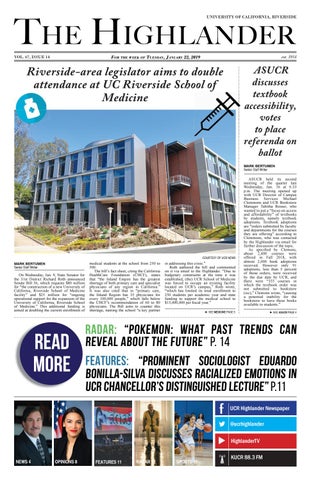
Riverside-area legislator aims to double attendance at UC Riverside School of Medicine
MARK BERTUMEN Senior Staff Writer
COURTESY OF UCR NEWS
MARK BERTUMEN Senior Staff Writer
On Wednesday, Jan. 9, State Senator for the 31st District Richard Roth announced Senate Bill 56, which requests $80 million for “the construction of a new University of California, Riverside School of Medicine facility” and $25 million for “ongoing operational support for the expansion of the University of California, Riverside School of Medicine.” This additional funding is aimed at doubling the current enrollment of
read more
medical students at the school from 250 to 500. The bill’s fact sheet, citing the California HealthCare Foundation (CHCF), states that “the Inland Empire has the greatest shortage of both primary care and specialist physicians of any region in California.” It was also cited that in “primary care, the Inland Region has 35 physicians for every 100,000 people,” which falls below the CHCF’s recommendation of 60 to 80 physicians. The Bill aims to counter this shortage, naming the school “a key partner
in addressing this crisis.” Roth authored the bill and commented on it via email to the Highlander. “Due to budgetary constraints at the time it was established, (the) UCR School of Medicine was forced to occupy an existing facility located on UCR’s campus,” Roth wrote, “which has limited its total enrollment to 250 students per academic year and state funding to support the medical school to $15,000,000 per fiscal year.”
ASUCR held its second meeting of the quarter last Wednesday, Jan. 16 at 6:33 p.m. The meeting opened up with UCR Director of Campus Business Services Michael Clemmons and UCR Bookstore Manager Tabitha Rosser, who wanted to put a “focus on access and affordability” of textbooks by students, namely textbook adoptions. Textbook adoptions are “orders submitted by faculty and departments for the courses they are offering” according to Clemmons, who was contacted by the Highlander via email for further discussion of the topic. As specified by Clemons, about 2,400 courses were offered in Fall 2018, with almost 2,000 book adoptions received. However only 91 adoptions, less than 5 percent of those orders, were received by the due date by UCR, and there were “355 courses in which the textbook order was not submitted to bookstore (sic),” Clemons wrote, “causing a potential inability for the bookstore to have these books available to students.”
► SEE MEDICINE PAGE 5
RADAR: “Pokemon: What Past Trends Can Reveal About the Future” P. 14 FEATURES: “Prominent sociologist Eduardo Bonilla-Silva discusses racialized emotions in UCR Chancellor’s Distinguished Lecture” P.11 f
UCR Highlander Newspaper @ucrhighlander HighlanderTV
NEWS 4
OPINIONS 8
► SEE ASUCR PAGE 4
FEATURES 11
RADAR 12
SPORTS 16
KUCR 88.3 FM
2
TUESDAY, JANUARY 22, 2019
HIGHLANDER // highlandernews.org
HUMANS OF UCR
UPCOMING EVENTS: WEEK 3
BON WON KOO, SECOND YEAR, COMPUTER SCIENCE
22
City Year Information Table 10:00am to 2:00pm UCR Bell Tower
APSP Womxn’s Program: Refresh, Revitalize, & Reset 1:30pm to 2:30pm HUB 265
23
Internship and Nonprofit Job Fair 11:00am to 2:00pm HUB 302
ASPB Presents: Skate Night 6:00pm to 9:00pm SRC North
24
3rd Year Career Plan 1:00pm to 2:00pm Career Center
Women’s Basketball vs Long Beach State 7:00pm SRC Arena
25
Writing Café 12:00pm to 3:00pm College Building South, 114
Film: The Color of Pomegranates 7:00pm to 8:30pm UCR ARTS 3824 Main St, Riverside, CA 92501
Career Exploration Conference: Business 9:00am to 3:00pm HUB 302
UCR Orchestra: Southern Journeys, with music of Mexico, Italy, and the south of Franc 8:00 P.M. University Theatre
Tuesday
COMPILED BY JORDAN HOM
Wednesday
Thursday
“Whenever I get a chance to, I play my guitar. I taught myself
Friday
how to play by watching videos on YouTube because the guitar seemed like an interesting instrument to pick up. Whenever I play my guitar, I feel very relaxed and it helps me destress from school. Someday, I want to learn how to play other instruments too, like the piccolo.”
26
Saturday
27 Sunday
CONTACT US
HIGHLANDER STAFF EDITOR-IN-CHIEF
MANAGING EDITOR
Evan Ismail
Andreas Rauch
managingeditor @highlandernews.org
editorinchief @highlandernews.org NEWS EDITOR
ASST. NEWS EDITOR
Aidan Rutten
Amani Mahmoud Mark Bertumen
news@highlandernews.org
ASST. OPINIONS EDITOR
Elaine Chen
opinions@highlandernews.org FEATURES EDITOR
Martha Delgado
features@ highlandernews.org
Marcelo Garcia
radar@highlandernews.org ASST. SPORTS EDITOR
SPORTS EDITOR
Jaryd Bongcaras
Jonathan Fermandez
Business Office: (951) 827-3457
Classifieds & Billing: (951) 827-5039
Fax: (951) 827-7049
jbong006@ucr.edu
sports@highlandernews.org
LETTERS TO THE EDITOR
PRODUCTION MANAGER
Kerry Mulia
productionmanager @highlandernews.org PRODUCTION ASSISTANTS
Hao Le Jeffrey Yoo Brinly Den
Kathy Garcia Amanda Joy Teano Judy Tu Asst. Photo Editor
PHOTOGRAPHY EDITOR
Jimmy Lai
Martin Lopez mlope072@ucr.edu
photo@highlandernews.org STAFF PHOTOGRAPHERS
Thomas Holguin, Lydia Tsou VIDEO EDITOR
Catherine Yong
video.highlander@gmail.com BUSINESS MANAGER
Karla Montes
highlanderads@gmail.com DISTRIBUTION MANAGER
TECH DIRECTOR
Kevin Ciampaglia
techdirector@highlandernews.org
MARKETING COORDINATOR
Jessica Schneider
TIP LINE: (951) 827-2105 Help the Highlander stay on top of what is happening on campus and in the general UCR community. Call this number and leave a message for the Editorial Board with your tip. Be sure to include your full name, relation to UCR, and a number or email address where you can be reached for more details. Editorial Office: (951) 827-3617
A&E EDITOR
Chiraag Dave
Highlander 101 Highlander Union Building Riverside, CA 92521 www.highlandernews.org editorinchief@highlandernews.org
marketing.highlander@gmail.com
The Highlander accepts letters from the campus community. They must be 600-800 words at length and include the author’s name and contact information. Topics should be UCR-centric and/or pertain to our generation of students. Contact Opinions Editor Michael Beeli at opinions@highlandernews.org by Wednesday if interested in writing a letter and submit the completed letter by Saturday at noon. Letters can and will be rejected if it does not meet requirements. LEGAL The Highlander is published and copyrighted by the Highlander for the students, faculty and staff of UCR. All rights are reserved. Reprinting of any material in this publication without the written permission of the Highlander is strictly prohibited. Readers are allowed one free copy of the newspaper. For additional copies or for subscription information, please contact the Highlander. The Highlander fully supports the University of California’s policy on non-discrimination. The student media reserve the right to reject or modify advertising whose content discriminates on the basis of ancestry, color, national origin, race, religion, disability, age, sex or sexual orientation. The Highlander has a media grievance procedure for resolving complaints against it. All inserts that are printed in the Highlander are independently paid publications and do not reflect the views of the Editorial Board, the staff or The University of California or the Associated Students of UCR.
UCR Orchestra: Southern Journeys, with music of Mexico, Italy, and the south of France 3:00 P.M. University Theatre
28
1st Year Career Plan 2:00pm to 3:00pm Career Center
Monday
MULTIMEDIA
CLASSIFIED ADVERTISEMENTS ADVERTISING INFORMATION Please submit Classifed ads by calling 951-827-3457 or by emailing Highlanderads@ucr.edu PAYMENT Visa and Mastercard Make checks payable to The Highlander Newspaper No refunds RATES Classified: $2 per line; 17 characters (spaces, dashes, etc.)
Lunar New Year Festival 5:00pm to 8:00pm HUB 302
UCRHIGHLANDER
f
UCR HIGHLANDER NEWSPAPER @UCRHIGHLANDER HighlanderTV
MISCELLANEOUS Pregnant? Free counseling and services. We come to you. Holy Family Services, adoption & foster care. 1-800-464-2367.
KUCR 88.3 FM
News 4
TUESDAY, JANUARY 22, 2019
HIGHLANDER // highlandernews.org/news
ASUCR
ASUCR discusses textbook accessibility, vote on referendums for review ► FROM ASUCR
Clemons later emphasized the importance of on-time book adoptions and how they contribute to timely availability of textbooks to students, which would allow students to have all course materials before the first day of class, “resulting in more academic success.” It would also make obtaining materials easier for those “who live on campus or students who may not prefer shopping with online competitors.” The meeting then moved on to Committee Reports. The session focused on the approval of referenda to be placed on the ASUCR Election ballot and voted on in April 2019. The first referendum discussed was the Highlander Empowerment Student Services Referendum (HESSR), presented by Joaquin Malta, psychology major and chairman of the Referendum Student Advisory Committee (RSAC). The HESSR aims to renew student funding for the Costo Hall ethnic and gender programs. It also aims to increase the current student fee of $14 each quarter to $16, which goes towards funding “seven of the ethnic/gender programs in Costo Hall” and seeks to provide capital for the currently underfunded Undocumented Student Programs (USP), according to Malta. 25 percent of the total fee ($4) will be directed towards student financial aid. He later specified that “once those funds are distributed evenly (between the programs) they (Costo Hall) are utilizing those funds to help provide for the students.” Malta also stated that “three quarters of a million is split amongst the offices” each year, and it was later discussed that the Undocumented Student Programs (USP) receives indirect funding from Chicano Student Programs, which Malta believes is not fair and could be fixed through the passing of the HESSR. The referendum passed unanimously 11-0-0. The next referendum to be voted on was the Highlander News Referendum (HNR), presented by Editor-in-Chief Andreas Rauch and Marketing Director Jessica Schneider. The HNR intends to raise the current student fee towards the Highlander from $2 to $4, with 50 cents of the increase directed back
towards student aid. Rauch stated that the increase would “expand our only independent source of news on campus,” as it is an entirely studentrun organization “which champions free speech.” CHASS Senator Mehvish Ali asked exactly what the increase of fees would be directed towards. Rauch answered “everything,” explaining that printing costs have gone up and that the Highlander has recently changed printer companies to save on costs. He also stated that it wouldn’t be directed towards giving its paid staff raises, as it would be unethical, but would be directed towards “giving more opportunities to those who are interested (in a career in journalism).” The motion to add the referendum to the ballot passed unanimously 11-0-0. The third referendum presented was the Green Campus Action Plan Referendum (GCAPR) referendum, presented by GCAP Director Austin Mok. Mok explained that the GCAP currently “runs on $2.50 per student, and was started in 2010.” The GCAPR aims to “rebalance the GCAP budget” according to Mok, with 25 percent of the total funds directed towards student aid. Mok specified that three different budgets would be made by GCAP to utilize the increase, aimed at funding “green grants, solar initiatives and investments in student internship positions.” The GCAPR would also expand on the language of GCAP’s mission statement, because Mok “wants ‘sustainability’ to mean more than trees.” The motion passed unanimously 11-0-0. The fourth referendum to be voted on was the Basic Needs and Aid Referendum (BNAR), presented by Vice President of Campus Internal Affairs Jose Cortez-Hernandez. The BNAR aims to address the current “understaffed and short-houred state” of the R’Pantry at UCR, which “supplies food to food-needy students.” Specifically the BNAR would establish “longer hours, more staff and a permanent location” for the R’Pantry as well as a student fee of $5 directed towards funding the R’Pantry, with “$83,000 directed towards student aid,” according to Cortez-Hernandez.
MARTIN LOPEZ / HIGHLANDER
Cortez-Hernandez also explained that once UCR establishes R’Pantry as a reliable resource for food-needy students, GCAP aims at expanding the idea to other UCs. He also said that his team “changed the language (of documents referring to the referendum) to ‘basic needs’ (as opposed to ‘food insecurity’) because food insecurity won’t last forever.” The motion was passed unanimously 11-0-0. The next referendum was the Tartan Reinstatement Referendum (TRR), submitted by Jolie Parnell and presented by Elections Director Laura Pullen. The TTR asks for a $5 increase in fees to fund a program that would provide students “practical experience in media production and documenting historical events.” However according to ASUCR Executive Director Laurie Sinclair, the language of the document was “incomplete,” missing eight items that submitted referenda required. Ultimately the TTR was “suspended
indefinitely” by an unanimous vote of 11-0-0 and will not be present on the student ballot this April. The last discussed referendum was the Highlander Abroad Referendum (HAR), presented by ASUCR President Semi Cole. The HAR requests that students pay a fee of $2 a quarter, with 50 cents directed back to student aid, that would “supply scholarship support to those abroad.” Cole specified that the money would go to the UC Education Abroad Program (UCEAP) office at UCR and would be managed by a “team of expert directors that determines who receives the money based on holistic review.” Cole also explained that the HAR was made in part because “there’s not a lot of scholarships for students on this campus, by this campus.” The referendum was passed 11-0-0. The meeting was adjourned at 8:12 p.m. The ASUCR Senate meetings are held every Wednesday at 6:30 p.m. in HUB 221. ■H
NEWS IN BRIEF:
UC chancellors unanimously condemn boycott of Israel
AMANI MAHMOUD Senior Staff Writer
On Dec. 13, 2018, the chancellors of all 10 University of California campuses released and signed a statement condemning academic boycotts of Israeli scholars and institutions of higher education. The boycott would hinder students and faculty from taking part in academic events sponsored or funded by Israel, studying abroad in Israel or holding talks with Israeli state officials. In the statement, the chancellors stated that as leaders of the University of California campuses, they wrote the statement to reaffirm their long-standing opposition to an academic
boycott of Israeli academic institutions and individual scholars. “Our commitment to continued engagement and partnership with Israeli, as well as Palestinian colleagues, colleges, and universities is unwavering. We believe a boycott of this sort poses a direct and serious threat to the academic freedom of our students and faculty, as well as the unfettered exchange of ideas and perspectives on our campuses, including debate and discourse regarding conflicts in the Middle East,” the chancellors wrote. The Palestinian Campaign for the Academic and Cultural Boycott of Israel (PACBI) was initiated in 2004. Their website states that PACBI was started to
contribute to the struggle for Palestinian freedom, justice and equality. It proposes a boycott of Israeli academic and cultural institutions for their “deep and persistent complicity in Israel’s denial of Palestinian rights that are stipulated in international law.” Their website outlines events, activities or situations that are in violation of the Palestinian academic boycott, including academic events convened or co-sponsored by Israeli institutions or their support and lobby groups in various countries. In an interview with the Highlander, Chancellor Kim Wilcox reiterated what was said in the statement. He wrote, “We believe a boycott of this sort poses a direct
and serious threat to the academic freedom of our students and faculty, as well as the open exchange of ideas and perspectives on our campuses, including debate and discourse regarding conflicts in the Middle East.” He stated that many leaders in various fields are academics with ties to the Middle East, and many of UCR’s students have interest in or connection to Middle Eastern higher education institutions. “With this in mind we want UCR faculty and students to have the ability to acquire and share knowledge,” stated Wilcox. He did not offer any additional comment. Students for Justice in Palestine and Highlanders for Israel did not provide comment before the time of print. ■H
HIGHLANDER // highlandernews.org/news
NEWS
TUESDAY, JANUARY 22, 2019
5
Riverside delegation aims to double attendance at UC Riverside School of Medicine Senator Richard Roth requests $105 million to address “critical lack” of medical physicians ► FROM MEDICINE
Deborah Deas, dean of the UCR School of Medicine, also commented on SB 56, stating that the school first heard of the bill in December 2018. “The initial $15 million state allocation for the School of Medicine, beginning in 2013, has not been adjusted for inflation,” Deas wrote, and as a result is not enough to address both the current and future needs of education in the medical field. Roth believes that California has been “grappling with (the shortage) for years, which is why,” he continued, that “in 2014 ... the state Legislature appropriated a one-time $4 million infusion into the SongBrown program to help meet the demand for primary care physicians in areas of unmet need, but that funding was not renewed. However, Governor Newsom has proposed ongoing funding in his 2019-2020 proposed state budget.” Roth pointed out that “medical education is a costly endeavor” that tuition alone cannot cover, moreso at a state university “where tuition is generally lower than the prevailing private medical school tuition.” He later said that the UC system does not supply an adequate amount of tuition money to medical education. However, despite the handicap the school has “demonstrated the
capacity and leadership to expand given support do so,” citing its “track record of success” in its enrollment and graduation of a diverse group of medical students. 89 students have graduated since 2017 when the school first opened. Deas also noted that “across the nation and in California, there have been new medical schools created to expand access to medical care in areas,” as part of a “national trend than (sic) began about 15 years ago.” Despite this trend “there are also shortages of nurses, physician assistants and other medical professionals which are being addressed by other higher education institutions in this region (the Inland Empire),” according to Deas. Sabrina Cervantes and Jose Medina, assembly members for District 60 and 61 respectively, are co-authors and supporters for Roth’s bill. Both submitted a statement to the Highlander, with Cervantes stating that “expanding the School of Medicine will allow UCR to continue providing advanced medical care, train more physicians, and keep up with the demands of our growing region.” Medina wrote that “we need to invest in the expansion of the UCR Medical School to ensure that the Inland Empire, which is historically
COURTESY OF PXHERE
underserved, has sufficient access to high-quality health care for years to come.” Alongside Deas, Cervantes and Medina, other parties Roth said he looks forward to working with include “Governor Gavin Newsom,
Senate pro Tem Toni Atkins, and Assembly Speaker Anthony Rendon … to ensure our region receives the attention it needs.” Roth said to “stay tuned” as he and his associates continue working on passing the bill. ■H
UCR’s Robert Rosenthal retires following 50th anniversary of “Pygmalion” research
JAKEB TIVEY Staff Writer
Dr. Robert Rosenthal, a distinguished professor of psychology at UCR, will be completing his final year of formal instruction after the conclusion of an autobiographical course titled “Seminar in Social Psychology.” He held the class just after the semicentennial anniversary of his most popular research, “Pygmalion in the Classroom.” In an interview with the Highlander, Rosenthal expounded upon his research, popular criticism, personal motivations and his experiences teaching a class he refers to as “Wednesdays with Bob.” The “Pygmalion Effect,” also known as the “Rosenthal Effect,” is a psychological phenomenon where the expectations of an arbiter affect the performance of a subject in what is known as a “self-fulfilling prophecy.” The experiment which yielded this result was conducted by studying the increase in the IQ of students under teachers who were falsely informed of their intellectual prowess. Rosenthal and his associates discovered that when teachers believed that roughly 20 percent of students chosen at random were going to be “intellectual bloomers,” those random few actually were more likely to become just that. There was a significant amount of both criticism and support for the findings, which Rosenthal describes in detail: “It was very well received by some. It was very poorly received by others … educational psychologists in general were the mainstream of the resistance.” He also referenced Richard Snow and Janet Elashoff ’s “Pygmalion Reconsidered,” an entire book written in general opposition to his initial claims. Rosenthal looks positively on this experience as an opportunity to allow readers to understand both sides: “the publisher actually sent us the manuscript to comment on … we wrote a little chapter for that book and to the great credit of the publisher, and to our delight, the publisher published
COURTESY OF UCR NEWS
our rebuttal of the book, in the book.” Rosenthal said that such experiences within the field have been rewarding through the years, referencing many of his personal experiences which served as motivation for his research: “I have had so many wonderful, rewarding experiences like, for example, in 1959 organizing this symposium and getting somebody who was as famous as Don Campbell … I was 26, I was pretty young, but I was always in a big hurry.” He also attributes much of his success to the encouragement of family and instructors as a young student: “I married my sweetheart … in the first year of college, and we started having kids so I was in a rush
right from the start.” He says he is thankful for “the reinforcement from [his] professors,” and that his career has been predominantly defined by encouragement. Reflecting upon his career, Rosenthal said, “I have had such luck. My life really has been so much fun.” The same academic spirit also prompted him to abstain from words of motivation to rising scholars at UCR, stating that “if you are an academic you’ve had to work in such a specialized way to get to be an academic now, especially if you’re at a research university.” His autobiographical graduate-level course, PSYC 255, featured other such
ideas that he amassed in his 30 years at Harvard and 20 years at UCR, and he says he will do his best to stick around in seminars in an effort to stay connected to the campus. Rosenthal recalls a “sociology course [he] took on Criminology … on the first day of class [the professor] said ‘everybody please take out a piece of paper. I want you to write down the most recent thing you’ve stolen in your life.’ He was up at the podium and he was looking through these things and he said ‘would the author of this one please stay I would like to talk to them after class.’ And that was me. All I had written was, ‘I haven’t stolen anything H but I am young and eager to learn.’” ■
6
TUESDAY, JANUARY 22, 2019
HIGHLANDER // highlandernews.org/news
Gerry Bomotti named new Vice Chancellor for Business and Administrative Services AIDAN RUTTEN Senior Staff Writer
COURTESY OF UCR NEWS
According to a schoolwide email sent Jan. 7 by Chancellor Kim Wilcox, the search to fill the position of vice chancellor for Business and Administrative Services (BAS) has ended. Set to fill that position is current CFO and Vice Chancellor for Planning and Budget Gerry Bomotti, who had already taken the new responsibilities in the interim. “My goals are to serve the campus to the highest extent possible, meaning our students, faculty and staff,” said Bomotti in an email to the Highlander. “At the same time we will be able to save costs and be able to reinvest those funds into high priority needs for UCR.” According to both Wilcox and Bomotti, this appointment will coalesce Bomotti’s responsibilities into the position of “Vice Chancellor for Planning, Budget and Administration. This merges the previous units of Planning and Budget and Business and Administrative services,” wrote Bomotti. His responsibilities include developing budget plans, facilities services, real estate and building planning, as well as financial research. Although he has only spent one year at UCR, Bomotti’s long experience in the world of academia includes filling comparable roles at public universities throughout the country, such as senior vice president
for Finance and Business at the University of Nevada, Las Vegas. “I have had experience with all the areas I am now responsible for, and it is very useful to know some viable solutions (and areas to stay away from) when similar issues arise here at UCR.” Regarding his future challenges, Bomotti stated, “I hope we can see some continued improvement in the condition of our campus facilities – there has been great progress already and our facilities staff have really stepped up with summer deep cleaning and a host of other activities to better maintain the buildings we all use.” He went on to mention working to improve the UCPath system, which has affected some students and employees in the UC system due to technical errors. Bomotti also wrote of improving the services of all administrative units throughout UCR, “such that each client that we engage with is given high quality and responsive service – even if we can’t fix their issue immediately it is important to earn their respect.” The chancellor’s letter addressed how this merger can help “optimize our financial, planning, and administrative operations in support of our strategic goals.” More efficient use of finances is a priority of Bomotti’s, as he stated: “In a time when many administrative organizations are growing, it is nice to see some are shrinking as well, and taking those resources to invest directly into activities that will benefit our faculty, staff and students.” ■H
Vice Chancellor for Research and Economic Development to retire in April AIDAN RUTTEN Senior Staff Writer
After a long and successful career, Dr. Michael J. Pazzani, professor of computer science, will retire from his role as vice chancellor for research and economic development this April but will continue his research in machine learning here at UCR. Since 2013, Pazzani has been responsible for procuring funding for research projects through external sources like private sector partnerships, as well as overseeing research and teaching. Considering his successes in both the private and public sectors, as well as in academia, Pazzani’s affinity for computers started early, and by chance. “I was just lucky to choose the field that is now just totally exploding,” he said in an interview with the Highlander. “When I was an undergrad in ‘76, computers were an up-and-coming thing, they were not ubiquitous. Getting involved with hot new things sounded exciting.” Born to a fireman and a legal secretary in Connecticut, Pazzani was the first in his family to attend college at the University of Connecticut. There he studied computer science and cognitive psychology, an interest that would influence him throughout his career by applying machine learning to psychological concepts, such as
understanding Alzheimer’s disease or how people learn. “It’s essentially finding patterns in data,” he said, adding, “I’ve done things like analyze data of people who have Alzheimer’s and people who don’t and try to find differences between them so you can diagnose Alzheimer’s.” Starting off on the east coast, Pazzani began working by Massachusetts Route 128 outside of Boston, which he referred to as the “Silicon Valley of the 80s.” After four years he decided to pursue a doctorate at UCLA, which led to a professorship of computer science at UC Irvine. Later he founded a technology company called AdaptiveInfo, which developed software enabling the personalization of content on mobile devices. After this, Pazzani worked for the federal government at places like DARPA and the National Science Foundation where he was the director of the Information and Intelligent Systems Division. These connections to the federal government proved valuable, as they helped poise him for positions in academia, a role he undertook as vice president of research and economic development at Rutgers University in New Jersey. “Someone who knows ... the federal government is a natural person to be the vice chancellor for research,” he said. In his role here at UCR he has helped
AIDAN RUTTEN / HIGHLANDER
get projects both big and small funded, all the while witnessing and aiding in UCR’s growth as a research institution. “One of the things I’m proudest of ... is how I’ve been able to enable some of the citrus research here,” he said “It’s a unique thing of this university how many faculty do research on citrus diseases.” He noted how the citrus industry built a research building for this purpose just off campus.
Aside from continuing research on machine learning, Pazzani plans on spending more time with his family after retirement and even has a trip to the Galapagos planned. When asked about notable moments for him at UCR, Pazzani, a first generation student himself, said, “I love the UCR mission, helping first generation students ... A lot of our faculty really care about students.” ■H
NEWS
HIGHLANDER // highlandernews.org/news
TUESDAY, JANUARY 22, 2019
7
UCR professor presents an optimistic forecast for the future of higher education in America ANDY LI Contributing Writer
In an article titled “Is this the Golden Age for Higher Education?” recently published in the Chronicle for Higher Education, Dr. Stephen Brint, distinguished professor of sociology and public policy at UC Riverside, argues that despite the pessimism in media outlets regarding the usefulness and alleged biases on university campuses, colleges are stronger than ever and will not be going anywhere anytime soon. During an exclusive interview with the Highlander, Brint continued to highlight various examples of how institutions of higher learning across America have successfully overcome various contemporary challenges with impressive levels of resiliency. One issue that has recently garnered attention is the high amount of research that is generated on college campuses every year. In his article, Brint claims that universities consistently outrank private think-tanks and other government-funded research labs in both volume of data and quality of innovation. He attributes this primarily to a strong culture of curiosity and intellectual freedom in various colleges across the country today. Colleges have not escaped criticism, as tuition continues to outpace the rate of inflation and students increasingly rely on both private and public
loan programs to help alleviate rising costs. However, Brint does not believe that this is so much a symptom of university policy itself rather than politics. “When you look at rising tuition, it almost always increases the most during recessionary periods, which is also when the government has far less money to dole out for colleges,” he said. “Most of the disparities in affordability vary the most between Democratic and Republican states, where attitudes about taxation and government spending couldn’t be starker.” Brint acknowledges that tuition will continue to be a problem that universities will struggle to find the perfect solution for. He is skeptical of free college plans for two reasons: “It’s welfare for the rich, and free community colleges tend to have a lower quality of education compared to state universities.” However, Brint believes that more funding in general towards Pell Grants and various other aid programs can only help, not hurt. “It’s important to realize that when you remove tuition completely, student motivation may, in certain cases, decrease,” he stated. “Many European countries have free tuition colleges, but they lack the prestigious names that we have here in America because there’s a serious difference in both effort and quality.” Brint also has a message to young graduates who are
JIMMY LAI / HIGHLANDER
worried about debt — it will pay off, and the difference could not be greater. “All the research shows that students who earn a bachelor’s degree earn at least $1 million more in their lifetimes than students without college experience,” he explained. “If we assume that the average student takes about $50,000 in loans over a four-year period, that’s still an excellent return-on-investment.” He also argues that the vast majority of students struggling to repay debts are those taking on masters or doctorate degrees, or
students who’ve never finished college or attended for-profit schools. Conversely, students who pursue advanced degrees often earn several times the salary of the average bachelor’s graduate. One of the solutions that Brint proposes is a “universal income contingent loan repayment” program, which would essentially only require college debts to be paid off for graduates or families who have earned above a certain threshold. A similar proposal that is often used across Europe is the
“graduate tax,” which basically allows students to attend college for free, but are required to pay a certain percentage of their income back to the university once they’re employed. Despite these challenges, Brint remains optimistic, and believes that our institutions of higher learning are fully equipped to find the right solutions. Brint concluded that this is what universities have been doing since the beginning of their existence — inventing new ideas to solve new problems. ■H
NEWS IN BRIEF:
ASUCR passes resolution to house victims of the California wildfires AMANI MAHMOUD Senior Staff Writer
On Wed. Jan. 9, ASUCR passed the senate resolution “Providing Assistance to Wildfire Victims” which calls on the UCR administration to house victims of the recent California wildfires. In an interview with the Highlander, CHASS Senator Chelsea Davenport, the primary author of this resolution, said that UCR is a well-known leader in community service and she sees this resolution as a way of serving those who are the most in need of assistance. She stated that “In the last few years we’ve seen the government fail to help the survivors of major crises ... and now that the disaster is in our own state and we actually have surplus resources that could be of aid I feel like it would be selfish not to offer said resources.” Davenport proposes that UCR administration house the victims in the Canyon Crest Family Housing as, “no one is currently living in the Canyon Crest Family Housing, it’s sitting vacant, so why not use it for a good use?” She believes that since UCR is a public university and receives funding from the government, it is the university’s responsibility to house these victims. BCOE Senator Sarah Al-Khalili, who also helped write the resolution, echoed Davenport’s sentiments. In an interview with the Highlander, Al-Khalili wrote, “as a public university,
the state owns the property that UCR current;y (sic) sits on. Because these wildfires affected California residents, it is the responsibility of our state government to help these victims ad (sic) provide them with housing. Since UCR is owned by the state, any available housing is technically the state’s property. Which is why we want to open that housing up to these victims.” Davenport proposes that ASUCR discuss a plan with the Federal Emergency Management Agency (FEMA) and the office of the governor to see if it is possible to offer UCR’s surplus resources to aid their efforts to help wildfire victims. In regards to the funding for this project, Al-Khalili and Davenport are unsure of how to receive funding for this project. She believes that the housing will most likely need minor repairs but, without having been on the property herself, she cannot make an educated guess at what that might include. She stated, “We’re looking at seeing if FEMA or the governor’s office could provide assistance for anything that’s costly, but there may be more options we haven’t considered yet.” Davenport also suggested that volunteers, students and community members could help to make the property temporarily livable for wildfire victims. Davenport also stated that, “Our school motto is fiat lux or ‘let there be light’ so I feel like we should offer the brightness of hope to those without it, and I know that if my home had just burned down I’d be painfully hopeless.” ■H
COURTESY OF FLICKR
Highlander Perks dining plan pushed back to fall 2019 due to technical considerations
AMANI MAHMOUD Senior Staff Writer
The Highlander Perks dining plan was intended to be implemented in fall 2018 but, due to technical considerations, has been pushed back to begin in fall 2019. The new project from Housing, Dining and Hospitality Services is intended for students who are not currently offered a traditional dining plan through their on-campus housing contract as well as current UCR faculty and staff. In an interview with the Highlander, Benjamin Eisenstein, the marketing and strategic communications manager for UCR Housing, Dining and Hospitality Services, stated that the Highlander Perks dining plan will feature a traditional block plan, with a specific number of meals per quarter or per week. The cost
of the meals will be discounted from the door rate. Both will be honored at UCR’s two all-you-care-to-eat residential restaurants, located within the AberdeenInverness and Lothian residence halls. The blocks of meals would be loaded onto an R’Card. The Highlander Perks dining plan, according to Eisenstein, is being pushed back due to technical considerations such as their migration to a new pointof-sale system (cash registers) which would need more time to be developed. There is also a pending integration underway with UCR’s campus card system, Blackboard. Eisenstein stated, “We hope to have that complete in spring and fully tested through the summer. It is necessary to have this integration in order to offer Highlander Perks in the fall.” When implemented in fall 2019, Eisenstein hopes that Highlander Perks in UCR’s residential restaurants
will deliver an excellent all-you-care-to-eat dining experience to members of the campus community who may typically enjoy their meals elsewhere. He stated that residential restaurants offer an abundance of healthy, sustainable and delicious meals in a comfortable setting. Eisenstein stated, “We often hear feedback that the restaurants in the center of campus can seem crowded at the peak of lunch and our residential restaurants offer plenty of seating, just minutes away,” and he hopes that the Highlander Perks dining plan will offer students a less crowded alternative. While they were hoping to introduce Highlander Perks in fall 2018, Eisenstein stated that he realized they needed some more time to ensure a successful rollout. He said, “We are confident it will launch by fall 2019.” ■H
8
TUESDAY, JANUARY 22, 2019
HIGHLANDER // highlandernews.org/opinions
Opinions
HIGHLANDER EDITORIAL
W hat we need and don’t need from progressives in the age of Trump
I
n the aftermath of the most recent midterm elections and the swearing in of the 116th Congress, there has been one standout taking the media by storm: Alexandria Ocasio-Cortez. Brought into the spotlight after a shocking upset when she won the Democratic primary for New York’s 14th District back in June 2018, 29-year-old Ocasio-Cortez is now the youngest woman ever elected to Congress. Aside from the unexpected win, OcasioCortez also has garnered attention from all sides of the political spectrum for pushing progressive policies that line up with her beliefs as a self-proclaimed democratic socialist. Several of these policies include tuition-free public college, a marginal tax on the rich at 70 percent and the abolishment of Immigration and Customs Enforcement (ICE). Many conservative pundits have made Ocasio-Cortez the the focus of their attacks, while liberals tend to side with her strong-willed and seemingly authentic personality. In the era of increasing polarization in Washington, D.C., introducing OcasioCortez and her headstrong personality into Congress is ultimately a hazard. Her impulsive tendency to fire back against criticism on social media is reminiscent of President Donald Trump’s behavior; and while expressing her prioritization of morals can be interpreted as commendable, as she’s trying to highlight what she believes the right wing lacks, undermining the importance of facts in policymaking is also not helpful in pushing back against an already dishonest administration. In spite of fierce attacks from the GOP and conservative media, Ocasio-Cortez has still managed to gain a large social media following, especially on Twitter, where she has now surpassed the follower count of House Speaker Nancy Pelosi. This is an evident nod towards the audience of young voters she’s attracting, given the popularity of social media amongst the younger generation. But this also brings up a problem in the way voters are choosing their candidates. This past midterm election showed that young voter turnout, especially among college students,
COURTESY OF WIKIMEDIA COMMONS
is increasing. Accompanying this surge in voter participants, we’re also starting to witness an issue with the growing culture of identity politics. Looking at the 2018 midterm elections reaffirms the idea that America has started to lean towards voting based on physical characteristics and not political ideologies. Alexandria-Ocasio Cortez is one of the many “firsts” we witnessed from the outcome of the midterms. Aside from the victories, we also witnessed a record-breaking amount of female, minority and LGBTQ nominees running for office in general. Despite the historically groundbreaking wins we witnessed from the midterms, such as the election of the first Native American and Muslim women to the House, there are flaws inherent to identity politics; namely, that voting on the basis of identity devalues fact-based voting, which is most vital to a strong democracy. We also live in an age where outwardly expressing opposition to identity politics can be interpreted as not wanting inclusivity and representation, two key concerns which have recently dominated the political and social discourse. Seeing someone who comes from a background familiar to voters might be engaging in terms of being able to relate to a candidate, but it’s also important to keep in mind the necessity of still listening to their stance on public policy. Just because the look of a nominee physically resembles a voter doesn’t mean they may necessarily have their best interests at heart. Going back to her prominence on social media, Ocasio-Cortez has certainly not shied away from remaining true to her outspoken personality on these platforms. However, the aggressive way she uses Twitter is close to mirroring Trump’s behavior on social media, in terms of the way both are quick to respond to their respective critics with a backhanded sense of pettiness. Instances of Ocasio-Cortez’s social media blitzes include the time she responded to Donald Trump Jr.’s joke about socialists eating dogs by encouraging him to “keep it coming,” reminding Trump Jr. that she is now part of a body that has subpoena power. She also quote-tweeted
a video in which she was booed by the GOP in the House, saying “Don’t hate me cause you ain’t me, fellas.” A particularly popular moment on Twitter that totaled over 700,000 likes and 160,000 retweets is a video of her dancing after being criticized for a resurfaced video of Ocasio-Cortez dancing in her undergraduate years at Boston University. Her responses could be part of her attempt to appeal to young voters and trying to appear more relatable to them by actively using social media and having rapid-fire responses to any online trolls. The latter definitely plays to the popularity of today’s “call out” culture amongst teenagers. In some ways, it’s refreshing to see someone young and light-hearted taking up Congress in today’s tense political environment. Although this might be a technique to attract a larger audience, what needs to be left behind is the often immature quips that come from her, as Congress is still ultimately a body of professional decorum, and stooping to the level of ridicule that Trump uses to get his messages across isn’t going to quell the amount of hostility present in the government today. Given the attention she’s received and the ways she has utilized her social platform, key members of the Democratic party have come to endorse her, despite some blunders Ocasio-Cortez has made in terms of discussing policy. Senator Elizabeth Warren has praised some of OcasioCortez’s causes and Senator Kamala Harris has publicly endorsed Ocasio-Cortez on The View, claiming that her ideas are worth giving a listen to. These supportive sentiments have been given even as Ocasio-Cortez confused some voters with accidental falsehoods. It’s very easy for politicians to miscalculate numbers and overstate claims, but that doesn’t mean they should deflect the blame onto another topic and not address the false statements. A notable tweet that got fact-checked by The Washington Post read out the assertion that 66 percent of her proposed “Medicare for All” could have been funded by now by the Pentagon in terms of their defense spending amount. In actuality, the Congressional Budget Office (CBO) found that completely defunding the
military would only pay off one-fifth of the $32 trillion it would take to cover Medicare for All. Given her ambitious agenda, some also have wondered as to how she plans to pay for the expensive policies she wants enacted in the U.S. When asked this question on 60 Minutes, instead of giving a more direct answer, Ocasio-Cortez brought up the point of how Republicans didn’t seem to regard the economic consequences when they passed their $1.5 trillion tax cut, and therefore she found it unfair that she was being asked to explain the payment plans for her policies. Also given the popularity she’s gained among Democrats, this implies the possibility of her pushing the Democratic Party towards the left, which poses multiple risks. We’re already caught in a divisive political environment, and although there are left-leaning policies that sit well with with most Americans (such as the 87 percent of Americans who support DACA and the 66 percent of Americans who support legalization of marijuana), the Democratic Party faces a possibility of losing their base if they continue shifting towards the left and allow themselves to make a democratic socialist the face of the Democratic Party. Fighting fire with fire has long been a suggestion for battling aggressive forces. Perhaps right now, responding to Trump’s governing style with an actor who is just as loud and rambunctious is being weighed as a feasible option. But the reality is what we’re witnessing with the influence of Ocasio-Cortez is simply another factor contributing to the antagonistic partisan climate in our nation’s capital. Further driving cleavages within the branches of government isn’t going to be a long-term solution if we want a productive policymaking environment. It will only lead to more stalemates in which neither side wants to budge, such as the record-breaking government shutdown we’re witnessing right now. ■H Highlander editorials reflect the majority view of the Highlander Editorial Board. They do not necessarily reflect the opinions of the Associated Students of UCR or the University of California system.
TUESDAY, JANUARY 22, 2019
HIGHLANDER // highlandernews.org/opinions
9
OPINION POLL Compiled by Lydia Tsou, Staff Photographer
“Do you think New Year resolutions are overrated?”
Eric van Baarsel Medicine Third-year
Samantha Garcia Psychology First-year
Isabella Espinoza Biochemistry First-year
ChrisSoriano MechanicalEngineering Fourth-year
Huthayfa Kahf Medicine Third-year
Rafael Alejandro Psychology Third-year
“No, I think it’s never a bad thing to try to improve something in your life.”
“I think for the most part, yeah. I feel like if people wanted to create change, they wouldn’t wait for a specific day.”
“I don’t think so, because it gives people an opportunity to look for something in their life they may want to put more effort in. It’s a good way to start thinking about the new year.”
“Yeah, because why wait until the beginning of the year?”
“No, I don’t think it’s ever a bad time to set new goals.”
“Yeah, for the most part I think they are. I feel like you shouldn’t need a specific date to make changes. If you want to make something happen, just do it.”
Lies, Fabrications and Division:
A response to the president’s address on immigration
SAMIR AL-ALAMI Contributing Writer
On Dec. 22, the government shut down for the third time this past year. The shutdown has affected onefourth of the federal government, which represents over 800,000 federal workers. This shutdown was caused entirely by President Donald Trump’s insistence upon more appropriations for a border wall, his marquee campaign promise. Wanting to make his case to the public, the president, for the first time, gave an oval office address to the nation on this very issue last week on Jan. 8. This speech was rife with falsehoods and the speech was nothing less than a gaslighting of Americans on a fabricated crisis on our southern border with Mexico, utilizing racial division, misleading statistics on drug trafficking and an outright lie regarding how the wall would be financed. The very first assertion that he thought was necessary to bring up was this statement; “...all Americans are hurt by uncontrolled, illegal migration. It strains public resources and drives down jobs and wages. Among those hardest hit are African Americans and Hispanic Americans.” How can someone
who refused to condemn any kind of supremacism in his tenure in office, most notably the Charlottesville episode in 2017, be so suddenly concerned for the welfare of those same people? This rhetoric in his speech is directly contradictory to his own troubled racial views at best. This is evidence of that because while he would tout falling unemployment numbers for black Americans, like in his State of the Union address in 2018, he has made comments denigrating migrants in the past, describing there being s***hole countries in an Oval Office meeting early last year, calling migrants “animals” and decrying Mexicans four years ago in his first speech as a candidate talking about “the scourge of drugs and crime coming into our country”. This speech, then, is not different in any way, matter or form from any speech on immigration he gave within the last four years, especially regarding this issue of race. The second assertion Trump made, which is far less charged than his comments involving race and racism, stated, “every week 300 of our citizens are killed by heroin alone, 90 percent of which floods across from our southern border. More Americans will die from drugs
this year than [those who] were killed in the entire Vietnam War.” This rhetoric is also untrue. The assumption behind this commentary is that these drugs are coming across a border that is porous and unguarded. This assertion is untrue in this sense — these drugs are mostly flowing through legal ports of entry, not through territory that has no wall, according to his own government on the National Drug Threat Assessment. And while it may be empirically true that drugs are harming Americans, it is untrue that they are somehow being smuggled in through vast sections of unprotected border. Finally, there was this dubious and eminently untrue assertion that the newly signed United States-Mexico-Canada Agreement (USMCA) will “very quickly pay for [the wall],” which therefore fulfills his campaign promise to make Mexico pay for the border wall. This claim is eminently untrue for this key reason: trade deals do not bring in more tax receipts from a foreign country, and this kind of a deal will only affect private transactions, so therefore, this trade deal will not pay for the border wall, unlike his assertion during his address. Therefore, this
speech represents a breaking of that fundamental promise he made to the voters, which is that Mexico, and not the American taxpayer, will finance the wall. This speech was by all accounts, a complete and total waste of time from a president that seems to always be in rally mode with his partisan base rather than doing the thing he claimed to want to do, which was to unite this country. This speech will be recorded in the annals of history as more of a campaign rally speech for the base, rather than offering new and inventive solutions to break the impasse that
is leaving 25 percent of government unfunded in the longest shutdown in U.S. history. Of all the viewership of this speech, according to recent polling, around only two percent of voters said this speech changed their minds. Another lasting point to make is that the border wall is polling at around the same amount as his own approval rating, at 44 percent. This is clearly yet another divisive play from a divisive president. For a president wanting to be president by delivering such an address of such magnitude, maybe the real presidential thing to do is to do his H job, and reopen the government. ■
our economy into a force fueled by perpetual conflict. In the 20th century, we witnessed America push her values abroad with intervention in Korea, Vietnam, Lebanon, Chile, Haiti, Nicaragua and Kuwait, even going as far as to depose democratically elected governments that didn’t align with U.S. interests including Syria in 1949, Iran in 1953 and Guatemala in 1954. Through these events, America has seemingly appointed herself the moral arbiter of democracy for the nations of the world. But rebellions and liberalization against autocratic rule must come from within, and nations
will democratize when they’re ready. All nations have the right to autonomy and self-governance without the interference of foreign adversaries. Additionally, allowing military spending to take such a large portion of our economy is harmful, given the other useful outlets our federal spending could be allocated towards. All countries must respect the sovereignty of their neighbors. It doesn’t matter whether or not other countries have an agenda that we find to be legally, economically, socially, religiously or culturally distasteful. Every nation has a fundamental right to deal with her own domestic affairs. No country has a monopoly on moral objectivism, and for one party to claim moral superiority over another is harmful and dangerous. In 2003, the U.S. invaded Iraq under the false pretense that the nation was illegally harboring weapons of mass destruction; a right to which Iraq forfeited under UN resolution after its failed 1990 invasion of Kuwait. Not only did the U.S. unnecessarily attempt to intervene in Iraq, but they proceeded to occupy the country for nearly a decade. In 2014, when occupying American forces began to transition out of the country, a newly forming Islamist militant organization,
the Islamic State group (IS), began seizing huge swaths of land. After the toppling of Iraqi President Saddam Hussein, Iraq further became a hotbed for recruitment of Islamist militants as sectarian violence continued to grow across the nation. Therefore, one could argue that the rise of IS was heavily correlated to American foreign intervention tactics. Shortly after IS gained coverage in Iraq, the sectarian violence spurred on by the U.S. invasion of Iraq spread into Syria. The same Islamist militant groups which terrorized the whole of Iraq, taking over entire cities, spread into its neighboring nation. And large swaths of Syria were quickly conquered by the American-fueled terrorist group, IS. In 2015, military spending was projected to account for nearly 54 percent of all federal spending, totaling a whopping sum of $598.5 billion. In 2017, President Donald Trump submitted his military spending budget request which totaled $639 billion, which represents a 10 percent increase in military spending from previous years. Given the amount of money being funneled towards the military, one must be aware that there are many impending dangers which arise from
a military-industrial complex, like the one that exists in the United States. The military-industrial complex is a vast economy dependent upon the expenditures of military affairs. When an economy becomes entrenched in the lucrative natures of military necessities, society itself becomes centered around militarism. And the nation, dependent on the vastness of military to employ the working class, remains in a perpetual state of war in attempts to keep up with the military economy that it has created for itself. Overall, it is not the place of the United States to be the moral policeman of the world. Whether its intentions to spread liberal democracy are inherently altruistic or not, the native people of many of these nations do not see this. Rather, the native people see American military presence as an occupying force, which only leads to easier recruitment for new Islamist militants. American imperialism necessitates a military-industrial complex; and thusly a citizenry whose livelihoods have been involuntarily linked to war. And as long as there is an economy with a populace eating because of the manufacturing jobs generated by war, the world will remain under the H shadow of American imperialism. ■
COURTESY OF WIKIMEDIA COMMONS
What America needs to learn about overseas intervention ROBERT GOLD Contributing Writer
America’s tendency to interfere in affairs overseas has put the world under an unofficial “American Empire.” Although the term ‘empire’ is not used by the United States directly, other countries which express opposition to America’s interventionist agenda have not shied away from using the term “American imperialism” to describe American foreign policy. The ongoing pattern of America’s militaristic interventions abroad in the aftermath of WWII has transformed
COURTESY OF SGT. PAUL SALE, JOINT CHIEFS OF STAFF
10 TUESDAY, JANUARY 22, 2019
OPINIONS
COMICS TALL TAIL #27 BY: JUSTUS ROSS
HIGHLANDER // highlandernews.org/opinions
Features HIGHLANDER // highlandernews.org/features
FEATURES
TUESDAY, JANUARY 22, 2019
11
Prominent sociologist Eduardo BonillaSilva discusses racialized emotions in UCR Chancellor’s Distinguished Lecture
MARTHA DELGADO Senior Staff Writer
Around 479 people filled the University Theater to listen to the Chancellor ’s Distinguished Lecture presented by Eduardo Bonilla-Silva. The lecture, held Friday, Jan. 18, was co-sponsored by various departments of UCR including the Department of Sociology, the Department of Social Medicine, Population, and Public Health, the Department of Psychology, the Department of Ethnic Studies and various ethnic and gender programs. Bonilla-Silva, the James B. Duke Professor of Sociology at Duke University, has gained notoriety in the field for his work in the area of race. His work in the past has discussed racial theory, race and methodology, color-blind racism, Latin American stratification of race in the U.S., racial grammar, race in the university, race and human rights, race and citizenship, whiteness and the Obama phenomenon. He is known for his notable works the 1997 American Sociological Review article “Rethinking Racism: Toward a Structural Interpretation” and his 2003 book “Racism Without Racists.” Since 2017, he has served as president of the Southern Sociological Society and the American Sociological Association. After a welcome by Chancellor Wilcox and an introduction by CHASS Dean Milagros Peña, Bonilla-Silva began the lecture to discuss and theorize on racialized emotions. Compared to universal emotions, racialized emotions are social emotions that emerge in specific racialized societies. “Racialized emotions affected me even before I knew what race (was),” Bonilla-Silva said as he mentioned
that he felt race since his upbringing in Puerto Rico. He provided examples to contemporary issues that showed how racialized emotions are part of the racial structure which included discussing Thomas Jefferson’s writings on slavery and Donald Trump’s tweets addressing undocumented immigrants. Bonilla-Silva also claimed there are variations on how people express and relate to their identity which includes Latino variance in racialized emotions. Bonilla-Silva used the anti-Latino stance of a second-generation Latino who is a border patrol agent as an example of this variance. “We all feel race, but our feelings are not equally validated,” BonillaSilva explained. He referenced the work of scholars like Bell Hooks, Gloria Anzaldua and Audre Lorde who have previously discussed how the emotions of white women command concern. Yet, in contrast the emotions of people of color are generally not given the seriousness they deserve. Bonilla-Silva explained the need for a political space based on legal scholar Janine Young Kim’s idea of “a feeling of equality.” To do this, Bonilla-Silva calls for de-radicalization of subjectivity, engagement with politics of recognition and an attempt to meet the paradigm of racial justice and explore anger, empathy and love. “Without anger, the oppressed cannot mobilize into action,” he explained. “Without empathy, whites cannot develop mutuality and respect towards racial others. Without love infused with justice, we cannot change the world but maintain our humanity.” Bonilla-Silva also took a moment to address the racialized emotions found in historically white colleges
and universities that are starting to see rising Hispanic enrollment. BonillaSilva has heard from other scholars of color and students about the racial issues in institutions; among these are scholars of color not being taken seriously and the emotional effects of campus racism. Bonilla-Silva advised
that attendees listen to scholars of color with an open heart. “Like in therapy, admitting one’s issues is the first step to recovery, and I want everyone to recover from this racial nightmare,” closed Bonilla-Silva. After a Q&A session led by Peña, a reception was held outside. ■H
JIMMY LAI / HIGHLANDER
NICHOLAS ROH / HIGHLANDER
12
HIGHLANDER // highlandernews.org/arts
TUESDAY, JANUARY 22, 2019
Radar
"GLASS" CRACKS UNDER PRESSURE
COURTESY OF WALT DISNEY STUDIOS MOTION PICTURES
COLIN CARNEY Contributing Writer
For the better part of the last decade, when a film opened with the words “directed by M. Night Shyamalan,” groans typically followed. Following smash hits in the early 2000s like “The Sixth Sense” and “Unbreakable,” Shyamalan produced several critical and box office flops that notoriously tarnished his reputation. That all changed however in 2016 with the unanticipated sequel to 2000’s “Unbreakable,” “Split.” The film shocked audiences as it received positive reviews and did surprisingly well at the box office. When it was later announced that Shyamalan would continue the story that began with “Unbreakable” and was continued in “Split” with 2019’s “Glass,” fans responded with enthusiasm. “Glass” picks up three weeks after the events of “Split” with Bruce Willis’ character, David Dunn, pursuing James McAvoy’s The Horde. The confrontation between the two superpowered beings is thrilling to watch. Rather than depict the fight as an expertly choreographed showdown as you would in a big budget Marvel or DC film, Shyamalan instead chooses to let the two characters brawl with each other as if it were any other street fight. However the scene is cut short just before its climax, when the two are whisked away to a psychiatric hospital to be cured of their superhero delusions alongside Mr. Glass, the heavily sedated mastermind played by Samuel L. Jackson. The therapy sessions that follow involve long and drawn out monologues from Sarah Paulson’s Dr. Staple as she tries to convince these three characters that they aren’t superheroes. For most of the film, Dr. Staple primarily acts as a ridiculous attempt by Shyamalan to convince the audience that everything we saw in “Unbreakable” and “Split” possibly wasn’t superhuman or unexplainable. As a result the audience never truly takes her seriously, despite
the film’s character’s acceptance of that fact. The silver lining for these long and tedious therapy sessions are fascinating interactions between these three characters as we learn more about their inner working and desires. Though at times slow and tedious, the middle act provides entertaining bits of character work that justifies its existence. This film’s largest fault, however, lies within its ending. Following the team-up of the villains as teased in the trailers, the ending feels rushed and poorly executed. The duo’s escape from the mental hospital occurs with little resistance as The Horde literally tears through everyone in its way. Furthermore, the staging of the final climactic fight between Dunn and The Horde feels bizarre and extremely convenient. With the entire cast showing up to watch, the fight feels more like a scheduled pay-per-view match rather than a natural progression of the plot. The biggest problem with the ending, though, comes with the anticipated twist Shyamalan is known for. In previous Shyamalan films, the twist feels deserved when the audience pieces together all the clues that were left for them prior to the reveal. “Glass” has none of that. The ending twist is shocking because there are no subtle hints or plot points prior to it that justify its existence. The revelation is confusing and annoying, especially when one considers how neatly things were wrapped up, without any explanation as to how it came to be. “Glass,” however, shines with the performances given by its three lead actors. Even though the film is titled “Glass,” the main star for most of the film is McAvoy’s The Horde. As he did in “Split,” McAvoy again manages to impress as he seamlessly shifts between dozens of alternate identities, each unique in their own way. Though only a few of them are truly given enough screen time to impact the plot. We see much more of this than we ever did in “Split” and McAvoy delivers on each and every one of them. Bruce Willis’ David Dunn is consistent with his portrayal in “Unbreakable.” However,
after the opening he gets overshadowed by the two villains for the remainder of the film. Mr. Glass is the opposite, however. Early on, he doesn’t have that much to do, but towards the end of the film he is given a primary role during which he earns his titular position. In “Glass” we are shown more of his character’s intellect that was only hinted at in “Unbreakable.” The supporting cast, however, is where the performances begin to falter. Sarah Paulson manages to deliver a respectable, albeit not impressive, performance as Dr. Staple. But she never truly leaves an impact since she only really exists to try and convince us that these characters aren’t superhuman, even though we know they are. The fact that someone might be skeptical of these characters’ abilities is an interesting avenue to explore, but the film never takes advantage of that idea. Instead, while Staple gives her long and drawn out monologues that try to convince the core trio that they aren’t comic book characters, Shyamalan continues to portray each of them as superpowered beings capable of everything Staple is trying to disprove. Furthermore, when Staple’s motivations are revealed in the final act, they come as such a surprise that they feel cartoonish and unjustified as they tie into the disappointing twist. The return of Mr. Glass’ mother (Charlayne Woodard), and Joseph Dunn (Spencer Treat Clark) from “Unbreakable” are unimpressive and poorly performed at times. The biggest disappointment in terms of returning characters though is with Anya Taylor-Joy’s Casey Cooke from “Split.” In “Split,” we last see Cooke as she is being sent back to her abusive uncle after having survived being held hostage by The Horde. When we next see her in “Glass,” three weeks later, she has moved on to a loving foster family and appears to have no real lasting trauma. As a result, it feels like Shyamalan lost interest in her and decided to just throw in a quick resolution for what was a great character. ■H
“Glass” delivers on stunning performances from its three main leads, especially James McAvoy, and a great opening, but fumbles the ball as it continues. An unearned end revelation and poor performances from the supporting cast make for a disappointing and upsetting end to this otherwise compelling trilogy.
HIGHLANDER // highlandernews.org/arts
ARTS & ENTERTAINMENT
TUESDAY, JANUARY 22, 2019
“You” Offers a Refreshing Perspective on the Dangers of Obsession
KATHERINE LUNA Contributing Writer
While everyone was busy watching “Bird Box” and playing “Bandersnatch,” I decided to settle down and watch a Netflix Original called “You.” I initially thought it was going to be pretty generic, but I was wrong. Based on a book written by Caroline Kepnes, “You” follows the main character Joe, the manager of a small bookstore, as he stalks Beck, a college student trying to balance school, friends and romance. Both Greg Berlanti and Sera Gamble, the creators of the show, utilized the extremely uncommon second-person narrative; a form of writing that uses the word “you” instead of names, which is also a main component of the novel. This seemingly insignificant choice impacted the series in such a big way. By keeping with the theme of second-person narrative, Berlanti and Gamble leave the viewer feeling slightly unsettled. It makes it seem as if Joe is talking directly to the viewer and not Beck. This allows for a sense of urgency from the viewer, as well as a small bond with Joe. From this unorthodox perspective, one finds themselves forming an attachment and even a sympathetic view toward the
protagonist. As the series progresses, we watch Joe fall further and further into full-on stalker mode. What starts as a simple interaction and a somewhat innocent search on social media, turns into a very real and frightening scenario. Visits to Beck’s house without her knowledge, figuring out her Friday-night location using social media posts and even stealing some of her personal belongings, all reveal just how dangerous Joe is. Even though Joe’s extreme stalking is clearly a red flag for the viewer, it’s offset by his nature toward Paco, the little boy next door who lives with a druggie mother and her abusive boyfriend. The viewer can’t help but notice Joe’s good side through his interactions with Paco. Joe even seems to have the best intentions for Beck, despite some small, internal judgements against her. At first, these seem valid, like when Joe encounters Beck’s friend circle, a group of girls who all love to party and live off of their trust funds, or with Beck’s boyfriend Benji, a guy who starts his own artisanal soda company and loves cocaine. But then the viewer notices that these judgements slowly become more common. Just like Beck, it’s too late for the viewer, having been
sucked into Joe’s personality and manipulation. Adding on to this, Joe’s desire to control every aspect of Beck’s life, which includes stealing her phone one drunken night, reveals the abusive and terrible individual hiding behind Joe’s nice guy demeanor. And once again, just like Beck, we, the viewer, fall for his sweeter side knowing the consequences. The events that unfold later in the story are foreshadowed just enough for the viewer to notice
that it will become important later. At one instance in the first episode, Joe shows Paco a giant, clear compartment in the basement of the bookstore where rare copies of books are held. It is extremely obvious that this compartment will be used later, yet we are still held in the suspense of how. As each episode progresses, we fall further and further into Joe’s irrational behavior and obsession over Beck. While Joe constantly repeats that he holds love for her,
13
COURTESY OF NETFLIX
he never fully elaborates on why he loves her; a shortcoming that robs the story of much-needed authenticity. And yet, even though we see his appalling actions, we find ourselves agreeing with Joe on certain opinions. Paco needs a better home life, Benji is a worldclass jerk and Peach has more to her story than she’s revealing. It is this kind of character development that really puts “You” over the edge. ■H
Verdict:
While some thrillers keep us rooting for the obvious good guy, “You” blurs that line, forcing the viewer to question trust and just how much we really know the people we love.
RBG is more notorious outside “On the Basis of Sex”
COURTESY OF FOCUS FEATURE
SILVIA FERRER Staff Writer
Ruth Bader Ginsburg’s (RBG) legacy as a brilliant, formidable advocate for gender equality precedes her. Unfortunately, her biopic “On the Basis of
Sex,” doesn’t seem to capture Ginsburg’s fierce tenacity. The legal drama follows Ginsburg from her time as one of the only female students at Harvard Law School to her first groundbreaking case. Performances by Felicity Jones and Armie Hammer (RBG and her
unfailingly supportive husband Marty Ginsburg, respectively) are compelling; choices in acting, cinematography, wardrobe and soundtrack are subtle but deliberate and thought out. Regrettably, the film stumbles through a sensationalized rundown of events that water down RBG’s truly dazzling story instead of heightening the dramatic tension. The film opens to a sea of white men in dark suits ambling confidently as Harvard’s fight song, “Ten Thousand Men of Harvard,” plays in the background. Amidst the slickedback hair and polished dress shoes, Ginsburg walks along in a bright blue skirt and heels. It’s an impactful shot with an impeccable choice in soundtrack — the contrast between the genders is impossible to miss. Several scenes, like the opening shot, highlight the obvious inequality between men and women during the late 1950s, but the subtleness of the performances and writing inculcate the point without coming across as overly preachy. For example, during the dean’s welcome speech, Ginsburg looks around the hall, immediately identifying the few women in the room. The small, uncomfortable smile she shares with them speaks volumes: the women
have an instant connection and uneasily realize that despite being at Harvard Law, the road that lies ahead is not without obstacles. Certain lines, such as one uttered by Harvard Dean Erwin Griswold, are meant to be frustrating not only to the characters but also to the audience — he invites the nine female law students to dinner only to ask why they deserve the spot over a male applicant (an infamous and completely true question asked by the real Griswold). The film is very good at arousing emotion, to the point of making the audience groan with disgust at the comments and views that some characters have. Over the course of the film, Ginsburg confronts several other lines and circumstances that are equally frustrating without being repetitive. Despite Jones’ tendency to overdo the Brooklyn accent, her performance and the stellar writing are still admirable. But the true showstopper of the film is Ginsburg’s relationship with her husband, Marty. Ginsburg’s commitment to her partner and determination are certainly emphasized as she assists Marty with his papers, manages her own schoolwork and handles their infant daughter, Jane, but her deeds are not ignored by Marty. As she confronts the steadfast sexism of the world,
Marty remains dependable and supportive. Their marriage is the picture of perfection: Marty includes her in his boys-club conversations when she wishes, helps with dinner and the kids and encourages her professional ambitions. Hammer’s dimpled smile and sweet demeanor fit the role of the loving husband fantastically — his encouragements are sweet rather than condescending, as other male characters come off. Their marriage provides a sanctuary from the unforgiving legal world that RBG enters. Yet despite Ginsburg’s obvious intelligence, accomplishments and tenacity, her personality seems to be toned down. Her toughness is occasionally interrupted by moments of public doubt and panic for the sake of heightened drama. Unfortunately, these scenes detract from the film rather than making it more interesting. Sure, RBG’s gender makes her an underdog, but this sensationalization of true events for the sake of drama and reliance on her rise to triumph means that her history as an astounding, smart-as-a-whip lawyer goes somewhat unnoticed, despite the ending. RBG’s story is truly inspiring, and portraying it as anything less than that is a disservice. ■H
Verdict:
RBG’s biopic remains mostly factual to the true, awe-inspiring events. The script and camera shots add a layer of emotion that is only accentuated by Jones’ excellent performance as the titular character, but the film is rendered somewhat unremarkable as it submits to a portrait of Ginsburg that waters down her greatness.
14
HIGHLANDER // highlandernews.org/arts
TUESDAY, JANUARY 22, 2019
pokemon What Past Trends Can Reveal About the Future ADAM ALVERNAZ Contributing Writer
In the 23 years that the Pokemon franchise has been around, the series has gone through many evolutions (much like the Pokemon themselves). With this month marking the 15-year anniversary of FireRed and LeafGreen, and with a Switch title expected to be released sometime this year, a look back is important to understand where the franchise comes from as a whole, and where the series will go next. In the first generation, Pokemon started with a very basic premise. You caught Pokemon, evolved them and traded them. This unique RPG style of adding party members in a nonlinear format helped the games replayability. Alongside this, the trading and battling between players pushed the connectivity aspect of the game quite well. Pokemon are collectibles and serve to be a measure of completion by collecting all of them. When the games received sequels, there were now new ways to acquire the best Pokemon possible. Taking Pokemon to breed at a daycare could also lead to new ways of obtaining Pokemon. These features would become basics in the franchise over time and constants in all games to come. When it comes to raising Pokemon today, the process has become a lot more complicated with many different things to keep in mind when trying to train the strongest team. Raising Pokemon is no longer a two-bit job of gaining experience and leveling; Game Freak introduced more competitive values to Pokemon that heavily influenced how Pokemon were raised. Pokemon are now born with special stats called Individual Values (IVs). IVs are a specified boost ranging from 0-31, spread across the six statistics all Pokemon have. IVs have made breeding more complicated, as the challenge of breeding the perfect Pokemon with all 31 IVs is a challenge in itself. Alongside IVs there are Effort Values which rise according to the type of Pokemon that is defeated in battle. Some Pokemon offer more defensive stats or offensive stats when defeated. These changes make battles more complex by adding more opportunities and options for Pokemon to utilize and craft into their own playstyles. One of the things that stays constant is the way battles take place. Within battles, older Pokemon used a wide variety of tactics, abilities, and moves to take down their opponents. Some moves could paralyze or sleep, immobilizing targets. Others did damage over time such as inflicting burn or poison. More recently, Pokemon battles have become more involved when it comes to strategy. MegaEvolutions and Z-Moves change the way battles take place. Mega evolutions, for example, allowed some
Pokemon to evolve mid-battle which temporarily improved Pokemon’s stats and abilities to turn the tide or overwhelmingly finish a fight. Z-moves are similar to Mega-Evolutions, but are less extreme as they are a one-use move. These features added to the complexity of battles and added a skill ceiling defined by when and how they are used. In the near future, with the unnamed 2019 Pokemon game to be released, Game Freak is sure to change up Pokemon battling in one way or another. As with every jump in generation or console, Pokemon battles seemingly
In Sun and Moon for the 3DS, Game Freak decided to have less of an emphasis on the protagonist’s journey and more on lore and antagonists. The lore of Sun and Moon extends far beyond just the normal 10-year-old Pokemon journey and gives the Pokemon more character than before. These games offered new side stories and more characters that offer much more than just a basic villain complex, allowing for a new sense of plot with better written characters that display more emotion and motivation, like Lusamine and Giovanni who
COURTESY OF NINTENDO
always change in a way that either improves the basic combat mechanics or adds a completely original concept for players to enjoy. The plots of many games are laid very thin as you travel the multitude of places to battle wild Pokemon, trainers and gym leaders. Defeating a gym leader gives the player a badge and when eight are collected, the Elite Four are unlocked for the player to challenge. The player also defeats different criminal organizations, who use Pokemon for their selfish devices. When the Elite Four are defeated the player faces the champion of the Pokemon League; if won the player becomes champion and the game’s story ends. This basic plot structure is seen as a constant in the Pokemon universe and all the games going forward follow a similar structure compared to this. This basic plot sets the groundwork for the ensuing sequels to follow. For a large amount of time, the sequels used the same basic plot structure, up until the last years of the 3DS era.
“... THE PROCESS HAS BECOME A LOT MORE COMPLICATED WITH MANY DIFFERENT THINGS TO KEEP IN MIND WHEN TRYING TO TRAIN THE STRONGEST TEAM."
actually have motivations that extend beyond using Pokemon for selfish needs. These characters serve a better purpose than other antagonists in the past, well-defined with a backstory and understandable motivations. The plot’s effect on gameplay has also been enhanced. The focus on the journey rather than the destination pushes the player to go further. Fans of the games generally like the change, but in Sun and Moon, the plot takes up a lot of the gameplay. The cutscenes and plot elements seem to be overbearing on the players and they generally do not take kindly to change because of the shift in focus. It will be interesting to see how Game Freak changes up their strategy when it comes to plot due to the mixed fan response. Over the years that Pokemon has existed, the series has evolved quite a lot to become what it is known for today, including deep and complex RPG gameplay, a rich and diverse cast of characters and a compelling and well-integrated plot. Seeing how Pokemon Let’s Go has been a huge success for the franchise, I wouldn’t be surprised if we see a feature integrating a mobile aspect to the 2019 main series Pokemon game. All of these elements add to the major themes of the game and help to enrich the experience of playing with beloved Pokemon. As we progress further into 2019, the next installment promises to build on its solid predecessors and deliver a thoroughly enjoyable and well-crafted experience. ■H
COURTESY OF NINTENDO
SPORTS
HIGHLANDER // highlandernews.org/sports
TUESDAY, JANUARY 22, 2019
15
M e n ’s ten ni s takes f irst step in the right direction to open up their season
JORDAN HOM Contributing Writer
After ending the 2017-2018 tennis season with a record-breaking 16-19 record, the Highlanders look to improve even more, especially since they had no seniors leave due to graduation. With a large underclassmen group intact, the team looked to build momentum going into the new season with their road trip to Arizona. “It’s been raining a lot for the past couple of days,” Head Coach Mattias Johansson said. “We would like to have a few more days of practice, but the guys have played for a long time so a few days off won’t make a big difference. I think the mentality is to have a good trip and get a few wins to start off the season.” According to Johansson the beginning of the season is a time of anticipation and excitement. “There is anticipation how well we will do and where everybody stands and how the lineup will be and how we will match in doubles together,” the fourth-year coach said. The Highlanders got off to a good start on their Arizona road trip as they defeated
Ottawa-Arizona handily by a final score of 7-0. Senior Kyle McCann and Sophomore Filip Engstrom won their doubles sets against the Couto brothers from Brazil with a score of 7-6. McCann also won in his single set against Eduardo Couto. This is only the beginning for Johansson and his squad. The fourth-year head coach told The Highlander he has big goals for himself and for his team, saying, “From the day I was hired, my goal was to make the tournament and to get much deeper in the Big West standings. I’m not gonna be satisfied with only 18 or 19 wins. I want a run at the tournament at the end of the of the year.” The Highlanders will look to continue playing their game and build on the momentum for the duration of the Arizona trip and the remainder of the season. Their ultimate goal is to make the Big West Tournament and winning the first game of the season was a step in the right direction. They next play Friday, Jan. 25 versus the Air Force at the SRC Tennis Courts at 3 p.m. ■H
COURTESY OF UCR ATHLETICS
Men and women’soff Track and Field to an encouraging start KEVIN SANCHEZ Contributing Writer
COURTESY OF UCR ATHLETICS
With the winter quarter underway, the Highlander Track and Field team kicked off their season Friday, Jan. 18 on Northern Arizona University’s turf. Both men and women’s teams logged in impressive, record-breaking numbers, posting up a total of four first places finishes. UCR and NAU were joined by Arizona State, CSU Bakersfield, Southern Utah, UC Irvine and UNLV in the Lumberjack Team Challenge event. Freshman Purnima Gunarathna, junior Dilini Amarasekara, sophomore Anthony Reyes and the 4x400 team all finished atop of their respective events. The women’s team saw plenty of success in The Lumberjack Challenge, with Amarasekara breaking a UCR long jump
record, with a 6.08m jump. Gunarathna’s first-place mark in the women’s high jump came in second all-time in the UCR record books. The winning men’s 4x400 team consisted of freshman Fabian Bodden, sophomore Jose Cruz Slade Cavallaro and freshman Tanner Anderson — the team clocked in the event-winning time of 3:19.48. Anthony Reyes also had a strong showing, finishing first in the triple jump, leaping in at 13.95m. More school records were broken aside from the first place finishers, including junior Aiden Olvera (long jump, 4.62m), who now holds a UCR long jump record. The Lumberjack Team Challenge, hosted by Northern Arizona University, gave UC Riverside’s Track and Field team a tremendous start to their season and should give the star-studded group high hopes as the season progresses. ■H
Highlander Hot Take:
Has analytics changed MLB free agency? ZIYAYE CHONGWE Contributing Writer
Despite having the financial freedom to spend as they can, Major League Baseball (MLB) can’t seem to make offseason free agency exciting. In the past years, big name free agents in the National Basketball Association (NBA) have taken advantage of that and made offseason basketball watchable. Players have made it a game to keep us guessing, having everyone make predictions on what will happen. But that doesn’t seem to happen in the MLB. Maybe it’s because of baseball’s lack of a cap space, making it less of an issue to get the big contract right away. Even with two big name stars in Manny Machado and Bryce Harper, no one seems to really care where they will end up. There have been teams who have shown interest in both players, with teams such as the Philadelphia Phillies who at one point showed interest in signing both players. But since then, the destination of both players has been iffy at best. Teams seem to be pulling back on both Machado and Harper, despite both players only being 26 years old with great success. Last season, Machado hit for 37 home runs, and 107 runs batted in with the Baltimore Orioles and Los Angeles Dodgers, while Harper hit for 34 home runs and 100 runs batted in for the Washington Nationals. Yet both players seem to be in no rush to sign with anyone.
So what could be the reason teams are not going all-in as fast as they can? One reason could be the rise of analytics, the use of probabilities to get the best result in a certain game situation. This has in some way taken away the importance of one’s all around statistics for something less. Yes, we care that you can hit 40 home runs in a season, but can you get on base when defenses use the shift and force you to rethink your plate appearance? With more and more teams moving in this direction, there has been a change in how teams are selecting their players. In the last two years, the Houston Astros and Boston Red Sox have built their teams based on analytics, and both organizations have won a World Series each. It may not be that Machado and Harper are no longer great players, or too expensive, but how they can fit in with what the analytics are saying. Even with the season he had, Harper was still seen as a bad hitter with his .297 batting average, while Machado had a “worse” second half of the season after he joined the Dodgers. Major League Baseball’s offseason free agency may not be as exciting as basketball’s, yet it does show how the sport has changed in the last few years. Analytics has changed how teams look at free agency from previous years. Baseball’s free agency has now become more mathematical, and less about what kind of talent is around. There’s a new format to free agency, and it’s going to be here for a long time. ■H
COURTESY OF WIKIMEDIA COMMONS
16
TUESDAY, JANUARY 22, 2019
HIGHLANDER // highlandernews.org/sports
SPORTS
Women’s basketball records first conference win, falls short against CSUN
JARYD BONGCARAS Senior Staff Writer
After a rough 6-10 overall start to the season, the UC Riverside women’s basketball team (7-10, 1-2) struggled to get into a consistent groove, dropping their first two conference games. However, thanks to phenomenal ball movement, the team flipped a switch and topped UC Irvine (12-3, 2-1) who was the Big West leader on Thursday night. The 88-72 final score doesn’t accurately portray just how big of a blowout this game turned out to be. Never relinquishing their lead, the Highlanders dominated each possession and even led by as many as 29 points throughout the game. A roaring 12-3 run in the opening minutes of play set the tone for the rest of the night, as the Highlanders shot a tremendous 78 percent from field goal range on 11-of-14 shooting. The team collectively looked as if they played with something to prove, with juniors Jannon Otto and Marina Ewodo epitomizing the team’s aggression. Otto seemingly found the free throw line on every other possession, especially in the first quarter, and Ewodo consistently outbodied her defender as she attacked the paint. On top of that, the team played with a lot of poise, despite having to deal with UCI’s full court press for an entire 40
minutes. “We practiced that all week. We knew it was coming,” Head Coach John Margaritis said, “We even did five on eight drills so there’d be more pressure. Last game against Long Beach State woke us up, and we were determined to work on getting the ball up the floor.” Fortunately, the Highlanders were able to apply what they practiced in game against the Anteaters. The team looked completely different from the way they played versus Long Beach, attempting a mere two shots at the free throw line — in sharp contrast to the 27 they attempted against Irvine. On both sides of the ball, Riverside appeared to be in full control, starting the game off 14-3 and never looking back. Redshirt freshman Daphne Gnago flirted with a triple-double, putting up 11 points and 11 rebounds, along with eight assists. Otto finished as the game’s highest scorer, amassing a career-high 31 points and 12 rebounds in the process, marking her fourth double-double of the season. Ewodo ended the night with 21 points and five rebounds, shooting nearly perfect on 8-of-9 shooting from field goal range, along with 4-of-4 at the charity stripe. With one day of rest in between games, UCR proceeded to play at Cal State Northridge (7-11, 1-3) on Saturday, Jan. 19. Again, the score doesn’t quite tell the full story of the
LLOYD KAO / HIGHLANDER
game, as the Highlanders fell 69-56. At one point, UCR trailed by as many as 29 points, but was able to cut the deficit to nine points thanks to a three pointer from sophomore Keilanei Cooper. The comeback came up short, with Northridge running away with the game in the waning minutes. Senior Malou De Kergret led all scorers with 20 points, as Ewodo almost had a double-double and put up 13 points and eight rebounds. Gnago had yet another compelling stat line, scoring only a single point but grabbing 15
rebounds in the process. The Highlanders have the potential to dominate the conference, as seen with their play on Thursday evening. Unfortunately, they also are yet to find a consistent stride, with polarizing play occurring in consecutive games. This, on top of too many “tale of two halves” types of performances, will be taken into account before their next game at Long Beach State on Thursday. UCR seeks revenge and another bounce-back game as they got blown out by LBSU 63-45 Jan. 10. ■H
Men’s basketball loses tough battle at Cal State Fullerton, bounces back with first conference win against Hawaii
COURTESY OF UCR ATHLETICS
RICARDO GARCIA Contributing Writer
Just three games into Big West play, the Highlanders (6-13, 0-3) can’t seem to catch a break. Coming into Thursday’s game against the Cal State Fullerton Titans (5-12, 1-2), they held a lead at halftime in their previous two games only to lose in the end. They looked to end a two-game losing streak on the road and put these losses in the rearview mirror. However, it wasn’t meant to be, as UCR lost again 69-61.
This time around the Highlanders trailed by one at the half, before briefly retaking the lead out of the break, 3332, courtesy of freshman center Callum McRae. From there it went downhill fast. With 13:24 left in the second half, and the score tied at 40-40, the Highlanders allowed the Titans to drive to the basket several times and committed several fouls. Over the next 12 minutes, the Titans unleashed a 26-11 run to push the lead to 66-51. It was only when the game was out of
reach that the Highlanders managed to cut the lead to single digits, before Cal State Fullerton put the game away for good. Redshirt sophomore-guard Dominick Pickett finished with a team-high tying 13 points and five rebounds for UCR. Junior guard Dikymbe Martin finished with 11 points and five assists, while McRae finished with 13 points on a perfect sixfor-six from the field. For the Titans, senior guard Kyle Allman Jr. finished with a game-high 21 points with four made three-point shots and four assists. Senior guard Khalil Ahmad was the only other Titan who scored in double figures, finishing with 14 points, but struggled shooting the ball, as he went 3-11 from the field. Following the loss, the Highlanders returned home to the SRC Arena to host the Hawaii Rainbow Warriors, one of three teams still undefeated in Big West play. Looking to shake off the tough loss, the Highlanders hosted the University of Hawaii (11-6, 2-1) Saturday, Jan, 19. The Rainbow Warriors entered the game undefeated in Big West play. The Highlanders looked for a strong start, but a sloppy start led coach David Patrick to call a timeout just a minute and a half into the game. Struggling to get into rhythm, UCR soon saw themselves down by 11 with about 10 minutes left in
the first half. However, the Highlanders righted the ship, fueled by the play of Martin and freshman guard Dragan Elkaz, as they scored or assisted on 19 of the final 21 points of the half and UCR held a 36-34 lead at halftime. The Highlander surge continued in the second half, as Elkaz and Martin continued to facilitate the offense in the second half. Though the Rainbow Warriors closed to within 72-69 in the final minutes, Martin put UCR ahead for good with a late jumper and the Highlanders earned their first conference win 75-71. Elkaz scored a career-high 25 points on 8-for-11 shooting and Martin added 19 points and five assists while committing zero turnovers. McRae also scored in double figures with 12 points and grabbed five rebounds. Senior forward Jack Purchase scored 24 points on 10-for-15 shooting for the Rainbow Warriors. Sophomore guard Drew Buggs led all players with 9 assists, and senior Sheriff Drammeh was the only other Hawaii player in double-figure scoring, adding 19 points and eight rebounds. Up next for the Highlanders, they have two road games against the struggling Cal Poly Mustangs (4-12, 0-3) Wednesday, Jan. 23, and secondplace UC Irvine Anteaters (15-5, 3-1) ■H Saturday, Jan, 26.