THE HIGHLANDER
UNIVERSITY OF CALIFORNIA, RIVERSIDE
est. 1954
FOR THE WEEK OF TUESDAY, NOVEMBER 13, 2018
VOL. 67, ISSUE 08
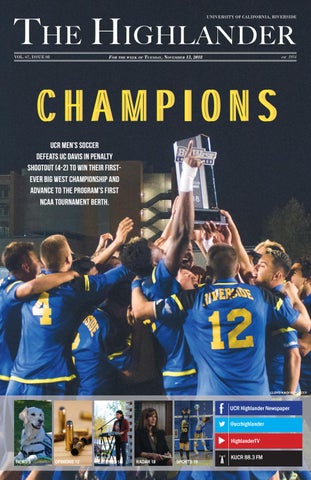
CHAMPIONS UCR men’s soccer defeats UC Davis in penalty shootout (4-2) to win their firstever Big West Championship and advance to the program’s first NCAA Tournament berth.
LLOYD KAO/ HIGHLANDER
f
UCR Highlander Newspaper @ucrhighlander HighlanderTV
NEWS 5
OPINIONS 12
FEATURES 14
RADAR 18
SPORTS 19
KUCR 88.3 FM
2
TUESDAY, NOVEMBER 13, 2018
HIGHLANDER // highlandernews.org
HUMANS OF UCR
UPCOMING EVENTS: WEEK 7
FIONA DANG, BUSINESS, THIRD-YEAR COMPILED BY MARTN LOPEZ
13
Work-Study Orientation 10:00am to 11:00am HUB (Highlander Union Building), 268
Free Chair Massage 4:45pm to 8:00pm Student Recreation Center (SRC), 2nd Floor
14
ASPB Presents: Scotty’s Birthday 11:30am to 1:00pm UCR Bell Tower
NBA 2K19 Xbox One Tournament 3:00pm to 5:00pm Latitude 55
15
Education Abroad Snack & Chat Discussion 12:00pm to 1:00pm Skye Hall (Surge Hall), 381
Physics & Astronomy Colloquium 3:40pm to 5:00pm Winston Chung Hall, 138
Friday
Peanut Butter & Jogging 10:00am to 11:00am HUB (Highlander Union Building), HUB 248
R’Pantry General Distribution 2:00pm to 4:00pm Costo Hall, 110
17
Botanic Gardens Tour 12:00pm to 1:00pm Lot 1
Highlander Scot Fest 1:00pm to 3:30pm UCR Bell Tower
Tuesday
Wednesday
Thursday
16 “I spend way too much time procrastinating on my phone, i just endlessly scroll through the same five posts on Instagram or Facebook.”
Saturday
18 Sunday
CONTACT US
HIGHLANDER STAFF EDITOR-IN-CHIEF
MANAGING EDITOR
Evan Ismail
Andreas Rauch
managingeditor @highlandernews.org
editorinchief @highlandernews.org NEWS EDITOR
ASST. NEWS EDITOR
Aidan Rutten
Amani Mahmoud Mark Bertumen
news@highlandernews.org OPINIONS EDITOR
Michael Beeli
opinions@highlandernews.org ASST. FEATURES EDITOR
Martha Delgado
features@ highlandernews.org A&E EDITOR
Marcelo Garcia
radar@highlandernews.org ASST. SPORTS EDITOR
SPORTS EDITOR
Jaryd Bongcaras
Jonathan Fermandez
Editorial Office: (951) 827-3617
Business Office: (951) 827-3457
Classifieds & Billing: (951) 827-5039
Fax: (951) 827-7049
LETTERS TO THE EDITOR
PRODUCTION MANAGER
Kerry Mulia
productionmanager @highlandernews.org PRODUCTION ASSISTANTS
Hao Le Jeffrey Yoo Brinly Den
Kathy Garcia Amanda Joy Teano Judy Tu Asst. Photo Editor
PHOTOGRAPHY EDITOR
Jimmy Lai
Martin Lopez mlope072@ucr.edu
photo@highlandernews.org STAFF PHOTOGRAPHERS
Thomas Holguin VIDEO EDITOR
Catherine Yong
video.highlander@gmail.com BUSINESS MANAGER
Karla Montes
highlanderads@gmail.com DISTRIBUTION MANAGER
TECH DIRECTOR
Kevin Ciampaglia
techdirector@highlandernews.org
MARKETING COORDINATOR
Jessica Schneider
TIP LINE: (951) 827-2105 Help the Highlander stay on top of what is happening on campus and in the general UCR community. Call this number and leave a message for the Editorial Board with your tip. Be sure to include your full name, relation to UCR, and a number or email address where you can be reached for more details.
jbong006@ucr.edu
sports@highlandernews.org
Chiraag Dave
Highlander 101 Highlander Union Building Riverside, CA 92521 www.highlandernews.org editorinchief@highlandernews.org
marketing.highlander@gmail.com
The Highlander accepts letters from the campus community. They must be 600-800 words at length and include the author’s name and contact information. Topics should be UCR-centric and/or pertain to our generation of students. Contact Opinions Editor Michael Beeli at opinions@highlandernews.org by Wednesday if interested in writing a letter and submit the completed letter by Saturday at noon. Letters can and will be rejected if it does not meet requirements. LEGAL The Highlander is published and copyrighted by the Highlander for the students, faculty and staff of UCR. All rights are reserved. Reprinting of any material in this publication without the written permission of the Highlander is strictly prohibited. Readers are allowed one free copy of the newspaper. For additional copies or for subscription information, please contact the Highlander. The Highlander fully supports the University of California’s policy on non-discrimination. The student media reserve the right to reject or modify advertising whose content discriminates on the basis of ancestry, color, national origin, race, religion, disability, age, sex or sexual orientation. The Highlander has a media grievance procedure for resolving complaints against it. All inserts that are printed in the Highlander are independently paid publications and do not reflect the views of the Editorial Board, the staff or The University of California or the Associated Students of UCR.
19
Monday
API Youth Summit Women’s Basketball vs Coastal Carolina 9:00am to 3:00pm 2:00pm HUB (Highlander Union Building), 260 SRC Arena
Cupcake Decorating Workshop 3:00pm to 5:00pm HUB (Highlander Union Building), HUB 355
MULTIMEDIA
CLASSIFIED ADVERTISEMENTS ADVERTISING INFORMATION Please submit Classifed ads by calling 951-827-3457 or by emailing Highlanderads@ucr.edu PAYMENT Visa and Mastercard Make checks payable to The Highlander Newspaper No refunds RATES Classified: $2 per line; 17 characters (spaces, dashes, etc.)
Top Rope Belay Lesson 5:00pm to 6:00pm Student Recreation Center (SRC), The Rock
UCRHIGHLANDER
f
UCR HIGHLANDER NEWSPAPER @UCRHIGHLANDER HighlanderTV
MISCELLANEOUS Pregnant? Free counseling and services. We come to you. Holy Family Services, adoption & foster care. 1-800-464-2367.
KUCR 88.3 FM
News 4
TUESDAY, NOVEMBER 13, 2018
HIGHLANDER // highlandernews.org/news
“New Voter Project” by CALPIRG culminates into unprecedented student and youth turnout across state
COURTESY OF CALPIRG
MARK BERTUMEN Senior Staff Writer
California voted on midterm elections last Tuesday, Nov. 6, and the California Public Interest Group (CALPIRG) at UC Riverside worked to remind students to vote. At 5 a.m. at the Bell Tower the student interest group set up a booth decorated with signs reminding students to vote at UCR’s polling place over at Glen Mor in Room J135. At the booth, CALPIRG gave donuts to those that already voted and would give them to others voting at Glen Mor when the team marched over at noon. More attention was gathered through the booth with Luna, a “vote goat” provided by a high school friend of Carlee Karhn, a first-year life science major and CALPIRG member. “She’s probably the most patriotic vote goat you’ll ever see; she was actually born on July 4th,” Karhn said. CALPIRG and all other Public Interest Group (PIRG) chapters throughout the United States have coordinated numerous vote-publicizing activities for college students over the past several weeks, all in an effort to raise student voter turnout through their voting awareness campaign, the “New Voters Project (NVP).” According to the CALPIRG Students website, the project aims to “cut through the clutter of voting” for students, such as by registering and educating them on what they are voting for, with the ultimate goal of making every student’s “voice heard on the issues that matter to (them).” As a whole CALPIRG aims to “combine
the energy of students” with advocates and organizers in order to accomplish statewide change. At UCR, CALPIRG has helped over 1,000 students register to vote this year, in collaboration with other campus organizations. The Associated Students of the University of California Riverside (ASUCR) was one of these groups, and its president, Semi Cole, came out to the booth on Tuesday to show his support of CALPIRG’s efforts. He also assisted in CALPIRG’s goals by holding a rally the day before, further reminding students to vote before Election Day. In an email interview, Cole talked further about ASUCR’s own effort in getting students to vote. “With the Office of the President and Office of External Affairs pulling together their combined effort, ASUCR students have worked hard to inspire the student body to recognize the power of the youth vote,” Cole wrote. Performing actions in line with the goals of NVP Cole stated that “ASUCR did succeed its goals in engaging campus to become interested in the midterm election. We had over 15 student orgs register for the vote crew registration competition, and over 500 UCR students registered on Vote Crew,” an online voting site that connects students with the rest of their campus to encourage voting. Isaiah Parks, a third-year biology major, was one of the voters at the precinct that Tuesday and said he recognized the campus’s recent efforts to get students to vote. “Voting was more publicized
this year compared to the last time around,” Parks commented. “You saw lobbiers and posters throughout the campus, the community, the HUB; there was also the ASUCR rally (on Monday).” In a publicity effort CALPIRG at UCR chalked up the campus grounds with arrows leading to the Glen Mor polling place in the early morning that Tuesday. Elisa Chang, a fourth-year double major in psychology and education, is a campaign coordinator for NVP this year. In an interview, Chang reported that UCR’s CALPIRG chapter began carrying out NVP as far back as midSeptember, before the first week of fall quarter. Throughout the quarter her team “had class reps where we had students register to vote before class started,” Chang explained, “with the professors’ permission; we would take as much as 15 minutes doing this, making sure everyone filled their forms out correctly. We also did a lot of tabling around the Bell Tower and lobbying to students at the dorms: a lot of grassroots work,” she noted. Angela Ayala, a third-year liberal studies and education major, has a class with Chang this quarter, and was present during her CALPIRG class rep. In an interview via text message, she wrote that “Both (Elisa and CALPIRG as a whole) definitely helped me get registered to vote, I was just sitting in class … (and then) Elisa had an announcement to give at the beginning of class,” Ayala wrote. She said that Chang talked about the importance of voting, and that voter registration forms were passed out by another CALPIRG member. “In doing so, it made it easily accessible to register in the comfort of my own class,” Ayala concluded. At noon the team marched throughout the campus, all the while holding up signs telling students where to vote and asking passers-by with a megaphone if they had already voted. They passed by the Coffee Bean, marched around Bourns Hall and into Bytes, exited the building and walked up the streets of Campus Drive and Big Springs Road, finishing at Glen Mor. The team then stationed themselves outside of the precinct, giving out donuts to students once they had voted and conversing with those in line. At 8 p.m., the students could only vote one by one because there were no more provisional paper
ballots, which are counted when eligibility of the voter is proven at a later date. Only a single online voting kiosk remained while new ballots were being delivered. “Before 8 p.m. seventeen students were going in to vote on paper, and one on the computer,” Chang explained. “After 8 (p.m.) there was over a hundred people in line. I think I spoke to everybody in it at least three times.” To keep voters encouraged, the CALPIRG team handed out the rest of their donuts and ordered pizza for the hungrier people, all the while commending the students for staying out so long to cast their vote. At 11:30 p.m., more ballots were delivered to Glen Mor and voting finished up past midnight, according to an email sent out to student CALPIRG supporters. “It was so inspiring to see all of those students waiting for over five hours to get their vote in,” Chang remarked. “We were all there for the same reason, and I think I learned something about in-person barriers from it — Glen Mor wasn’t prepared for all of these students, and with the presidential election in two years now I know we have to work to break down barriers like this,” Chang concluded. Cole was also glad to see the large turnout of UCR students at the polls. “(I’m) so proud that students made the time to make it to the polls and participate in the political process. It’s efforts like this that show Washington and Sacramento the power and vitality of the student voice,” Cole commented. Chang finds that the active nature of student voting at UCR this year is something that historically hasn’t been “institutionalized,” referring back to the 2014 midterm elections: “Only eight percent of students at UCR voted that year, but the average turnout across the UC systems was 20 percent, more than twice ours,” she observed. “What we saw this year is something that should be embedded into UCR students; our basic goal with NVP was to create a culture of voting here on campus,” Chang declared. “There’s something Miguel (the chapter chair and another NVP coordinator) on our team says that sums up what we want pretty well: we want students at UCR to say ‘I’m a Highlander, and I’m a voter.’” CALPIRG meets every Tuesday at 7 p.m. in the Pentland Hills Fox Hole. ■H
ASUCR
ASUCR discusses midterm election poll and Lot 19 closure EMILY HUANG Contributing Writer
The sixth ASUCR meeting of the quarter was held Nov. 8 at 6:34 p.m. Several issues were addressed, including UCR students’ involvement with midterm elections, closure of Lot 19 next quarter, establishment and promotion of research fairs and how UCPD and the administration addressed the shooting rumour at the AberdeenInverness (AI) residence halls last Tuesday. The meeting began with public forum, during which fourth-year psychology and education double major Elisa Chang, a campus relations representative from the California Public Interest Research Group (CALPIRG) discussed the midterm election polling station hosted that day from 7 a.m. to 8 p.m. in Glen Mor J315. The UCR CALPIRG chapter was established in 2005 to advocate for public issues that concern students. This year CALPIRG organized The New Voters Project to encourage students to vote by tabling around campus and calling students to remind them when and where they can vote. According to Chang, CALPIRG registered over a thousand students to vote. According to Chang, there were more students than expected
who came to vote, which led CALPIRG to run out of provisional ballots. Chang stated that, “It is just really inspiring to see that a lot of students here at UCR care so much about civic engagement and actually doing their duty for this country and preserving democracy.” Next on the agenda, a new building project which currently has little notoriety was discussed. Lot 19 will no longer be available for parking and will now be used for bus stops instead. CNAS Senator Chelsea Davenport stated that “no one knows that Lot 19 is going to be taken down within the next quarter, that is going to be used to put in nine bus stops and for instruct to bypass.” Davenport wants to prevent Lot 19 from closing with such “little notice.” Moving on from discussion of Lot 19, CHASS Senator Julian Gonzalez said that he wants to promote a research fair for students in the humanities disciplines, stating that “research is usually focused toward STEM majors or CNAS/ BCOE, but I don’t think a lot of students realize that humanities also has tons of research opportunities, so I wanted to get started on creating a research expo for humanities students.” ASUCR also addressed the shooting rumor at Aberdeen Inverness Residence Hall (AI) last
THOMAS HOLGUIN / HIGHLANDER
Tuesday. The rumor described a potential shooter on campus, but it was stated false by UCPD in the afternoon. On Nov. 6 at 2:45 a.m., a campus-wide email from UCR Emergency Communications stated that they were investigating information regarding statements about a threat of a shooting at a UCR campus residence hall. The email stated, “UCPD investigators have determined that the threats/rumors about a shooting at a UCR residence hall are indeed false. The individual responsible for generating the rumor has been identified. UCPD will work with the Office of Student Conduct and Academic Integrity
Programs (SCAIP) to determine the appropriate discipline.” Gonzalez was upset about how the shooting rumor was handled and believed that more efforts should have been taken to assure students that there was no shooting actually occuring on campus. Gonzalez stated, “I want to work on assuring students that UCR is safe … we should be informed about a threat and in detail about what is going on, not just a simple paragraph in one email at 3 a.m. in the morning.” ASUCR meetings are held every Wednesday H at 6:30 p.m. in the Senate chambers, HUB 221. ■
NEWS
HIGHLANDER // highlandernews.org/news
TUESDAY, NOVEMBER 13, 2018
5
Service animals on campus disrupted by students, staff and faculty AMANI MAHMOUD Senior Staff Writer
Recently, concerns raised by students regarding disruptions to service animals on campus were addressed in a campus wide email sent by Joe Virata. According to UCR’s Policies and Procedures, an animal trained to provide a service in support of a mentally, physically or an emotionally disabled individual, may enter UCR-owned, operated or leased buildings as dictated by the needs of the individual who it is serving. In the email, Virata claimed that a number of incidents were reported to the campus where students, staff or faculty have been disruptive to service animals and their companions on-campus. He asked that students, staff and faculty not disrupt service animals and recognize that service animals, “are working and are performing a critical support service for their humans”. According to Laura Riley, director of the Student Disability Resource Center (SDRC), at UCR service animals are considered trained animals (dogs or miniature
horses) that perform functions and tasks that individuals with a disability cannot perform for themselves. The tasks performed must be directly related to the disability of the individual. Emotional support animals must be approved by the Student Disability Resource Center. According to Virata’s email, the disruptions take place in a variety of forms: trying to take photos of the animals, attempting to pet them or hug them, trying to get their attention by calling to them or whistling at them and interrupting the service animal and their companion while they are walking. Pets allowed to run free on campus have also disrupted the service animals through attempts at fighting or playing with service animals. According to Riley, service animals by their function and training do not respond to distractions by other people’s pets. “They have been trained to focus on their job when they are at work with the person with a disability. What will sometimes happen is the “pet” will go after the service dog (aggression, playing or otherwise) and the service dog ends up getting hurt because it
has been trained not to respond to the actions of others toward it,” stated Riley. She noted that through law and policy, pet owners are responsible for the actions of their animals. Given that UCR has public spaces, UCR cannot ensure a pet will not interfere with a service animal. However, through information such as the email Virata sent out and reporting mechanisms, pet owners can be informed and held responsible. To prevent further disruptions, Riley stated that members of the university community are expected to not inquire about details regarding the disability of an individual who uses an assistive animal on campus due to the private nature of disabilities. The university community will also allow a service animal to accompany the individual it is serving at all times and in all places on campus, except where the presence of the service animal presents an unreasonable threat to the health or safety of other individuals on campus. In some situations or settings, such as animal research laboratories and areas housing research or teaching animals,
COURTESY OF PIXABAY
it may be necessary to restrict a service animal. In those situations or settings, Riley stated that UCR will work with the individual with the disability and the faculty member or determine other options for the Individual with the disability to receive the benefits of the university. According to Riley, students, staff and faculty should not touch, feed, deliberately startle, pet or attempt to separate a service animal from their handler. To report an incident or a complaint involving the service animal of a student, contact the
Student Disability Resource Center. To report an incident or complaint involving the service animal of an employee, contact UCR Human Resources. The Student Disability Resource Center and Human Resources will address and refer matters as appropriate. Service animals or any other animals that present an immediate safety risk on campus should be reported by calling 911. UCPD officers will respond to stop an animal in circumstances where the animal reasonably appears to pose an imminent threat to human safety. ■H
UCR lecturer Rachelle Cruz wins 2018 American Book Award CHRISTINE TRAN Contributing Writer
On Oct. 28, the Before Columbus Foundation (BCF), a n o n p r o f i t o rg a n i z a t i o n d e d i c a t e d to promoting contemporary American multicultural literature, hosted their annual American B o o k Aw a r d s ( A B A ) c e r e m o n y a t t h e S a n F r a n c i s c o J a z z C e n t e r. UCR creative writing lecturer and author Rachelle Cruz was awarded a n A m e r i c a n B o o k Aw a r d f o r h e r d e b u t p o e t r y c o l l e c t i o n “ G o d ’s Wi l l f o r M o n s t e r s . ” T h e A m e r i c a n B o o k Aw a r d s provide recognition for outstanding literary achievement for diversity in American l i t e r a t u r e . A c c o r d i n g t o B C F ’s recent press release “There are no categories, nominees, or losers. T h e Aw a r d s a r e a w r i t e r s ’ a w a r d given by other writers.” In an interview with the H i g h l a n d e r, C r u z s t a t e d t h a t “ i t ’s a h u g e h o n o r f o r s u r e ; i t i s a prestigious award and a lot of writers and mentors who I look up to have won this award. I’m hoping that this award creates recognition for more poets who are from underrepresented communities.” As a child of Filipino immigrants who came to the United States in t h e 1 9 7 0 s , h e r p o e t r y i n “ G o d ’s Wi l l f o r M o n s t e r s ” r e f l e c t s o n her parents’ experiences living in an unfamiliar country and connects their life to the broader scope of immigration, labor and colonialism in the Philippines. One poem in her collection, “ M a x i m u m 2 5 Wo r d s , ” i s s t r o n g l y influenced by her experiences as a child helping her mother write and send remittances. Cruz explained that remittances were how migrants would put down money and send it back to their families. Each remittance had a rule known as “maximum 25 words,” where limited personal messages could be sent alongside t h e m o n e y. “I grew up writing these
Rachelle Cruz (right) accepts the American Book Award for her collection of poetry, “God’s Will for Monsters.”
messages and I would pick this poem (for all UCR students to read) so they could get a sense of that history and the current trends which reflect back to the colonial relationship between the Philippines and the United States; also to show how those l a rg e r i s s u e s a ff e c t t h e i n t i m a t e relations between people,” said Cruz. She was also heavily inspired by stories that her grandmother would tell her as a child; one source of inspiration from these stories was the “Aswang,” a recurring figure throughout C r u z ’s b o o k . I n F i l i p i n o f o l k l o r e , the Aswang are shapeshifting women considered to be witches. “Just hearing those stories
helped me shape poems that rewrote those myths, because if you look at the history of the Aswang, they actually started out as leaders and healers,” explained C r u z , “ I t w a s n ’t u n t i l t h e S p a n i s h Catholic Church came to the Philippines where they instituted gender and called these women witches. So I was really interested in reshaping that and reclaiming t h a t s t o r y. ” Growing up, Cruz used poetry as a medium to connect with her emotions. She would share these poems with friends and having an audience further encouraged her passion for writing. Over the years, Cruz struggled with trusting her own voice and questioned whether or not her
COURTESY OF UCR NEWS
story was worth sharing since she had never seen anything similar i n m a i n s t r e a m m e d i a . E v e n t u a l l y, Cruz came to the conclusion that even if her books did not have a l a rg e a u d i e n c e , s h e s t i l l w a n t e d to write stories if it meant one person could connect with them. “ G o d ’s Wi l l f o r M o n s t e r s ” a l s o won the 2016 Hillary Gravendyk Regional Poetry Prize, an open poetry competition sponsored by the Inlandia Institute. She recently published a book on Sept. 10 called “Experiencing Comics: An Introduction to Reading, Discussing, and Creating Comics.” Her previous work includes co-editing a novel titled, “Kuwento: Lost Things, an H a n t h o l o g y o f P h i l i p p i n e M y t h s . ”■
6
TUESDAY, NOVEMBER 13, 2018
HIGHLANDER // highlandernews.org/news
California Election Results
As part of our elections coverage, we have compiled the Midterm results to keep readers informed on the candidates and elections.
Votes are still being counted so results may not be accurate.
US Senate
Party
Votes
Percentage
Dianne Feinstein Kevin De Leon
Democrat Democrat
3,414,530 2,872,510
54.3% 45.7%
District 41 Party
Votes
Percentage
43,929 28,749
60.4% 39.6%
Votes
Percentage
Mark Takano Aja Smith
Democrat Republican
District 42 Party Ken Calvert Julia Peacock
Republican Democrat
61,833 42,245
59.4% 40.6%
Governor
Party
Votes
Percentage
Gavin Newsom John Cox
Democrat Republican
4,236,154 2,902,113
59.3% 40.7%
Lieutenant Governor
Party
Votes
Percentage
Eleni Kounalakis Ed Hernandez
Democrat Democrat
3,292,311 2,615,304
55.7% 44.3%
Attorney General
Party
Votes
Percentage
Xavier Becerra Steven Bailey
Democrat Republican
4,260,411 2,759,877
60.7% 39.3%
State Assembly District 60 Sabrina Cervantes Democrat Bill Essayli Republican
Votes
Percentage
26,731 26,728
50.0% 50.0%
Party
*Votes for State Assembly District 60 are still being counted and are not final.
NEWS
HIGHLANDER // highlandernews.org/news
TUESDAY, NOVEMBER 13, 2018
California Election Results Continued State Assembly District 61 Jose Medina Ali Mazarei
Party
Votes
Percentage
Democrat Republican
31,026 17,850
63.5% 36.5%
Secretary of State Alex Padilla Mark Meuser
Party
Votes
Percentage
Democrat Republican
4,344,719 2,692,976
61.7% 38.3%
Treasurer
Party
Votes
Percentage
Democrat Republican
4,274,588 2,714,549
61.2% 38.8%
Proposition 1- Housing Assistant Bonds
Votes
Percentage
Yes no
3,714,022 3,155,599
54.1% 45.9%
Proposition 6- Repeal Gas Tax
Votes
Percentage
Yes no
3,865,746 3,147,948
44.9% 55.1%
Proposition 8- Regulate Dialysis Charges
Votes
Percentage
Yes no
2,661,302 4,262,101
38.4% 61.6%
Proposition 10- Remove Rent Control Limits
Votes
Percentage
Yes no
2,675,918 4,311,791
38.3% 61.7%
Fiona Ma Greg Conlon
7
Be enlightened.
The Highlander Newspaper is a great way to keep up with current events and news around campus. If you are interested in the newspaper’s articles or pictures, we offer opportunities in writing, photography and design. Join us every Monday at 5:15 p.m. in HUB 101 to learn more.
HIGHLANDER
LYDIA TSOU / HIGHLANDER
Opinions HIGHLANDER // highlandernews.org/opinions
OPINIONS
TUESDAY, NOVEMBER 13, 2018
9
HIGHLANDER EDITORIAL
America is sliding backwards on vaccinations
T
he National Foundation for Infectious Diseases estimates that during the 2017-18 flu season, as many as 80,000 deaths across the United States could be attributed to influenza. With the flu season beginning this October, this year appears to be no different. The season’s first influenzarelated death was an unvaccinated child in Florida on Oct. 15. Since Oct. 15, there have been an additional 34 influenza deaths during the 2018-19 season at the time of this writing as the season starts to truly kick in. Every year there are fluctuations, but the flu hospitalizes hundreds of thousands of people each year and leads to tens of thousands of deaths. Data from the latest available season, the 2015-16 season, estimates that vaccinations averted 71,479 hospital visits and 2,882 deaths. Despite the continued proven effectiveness and benefits that reassert themselves every year, factors such as apathy and mistrust of proven science continue to keep millions of Americans from getting their necessary inoculations each year. In a culture where vaccination is not highly encouraged or mandated, our collective failure to vaccinate properly comes with serious costs that should not continue to be ignored. Anyone you ask appears to give no shortage of different answers to why they haven’t gotten a flu shot, but they all boil down to nothing other than apathy or unsubstantiated skepticism regarding the effects of vaccinations. While the issue of skepticism is more dangerous and difficult to address in our society, public apathy regarding flu vaccines can be more easily remedied. Less than half of all Americans consistently get their flu shots each year, and more than 80,000 people in America died during the last flu season. 90 percent of the fatalities were over the age of 65, but 180 of the deaths were children and teenagers. While thousands of Americans die each year and less than half of them get their flu shots annually, a much more impressive
COURTESY OF WIKIMEDIA COMMONS
91.1 percent of all children aged 19-35 months have been properly vaccinated for measles. The reason being that firstly in early childhood care doctors highly recommend that parents get proper vaccination, and thus provide an accessible outlet to parents that doesn’t require them to take the initiative. Secondly, however, documentation of key vaccinations, including measles, are required to attend school in all 50 states, unless exempted for religious or philosophical reasons in 47 of the 50. The vaccinations that are compulsory to attend school are of course much more important than the seasonal influenza vaccination, however they illustrate an important point – that by compelling residents to get vaccinated, the public health concerns that stem from these diseases can be largely avoided (at least to a degree of 91 percent). This high rate of vaccination for a particular disease is called herd immunity, and while it differs depending on the infectiousness of the disease, it typically lies somewhere between 90 and 95 percent coverage. The advantages of herd immunity, apart from generally high rates of coverage, are that it is generally recognized as necessary to protect individuals that are unable to be properly vaccinated, for medical reasons or otherwise, from becoming infected. Apathy around critically important issues will always exist in our society, as evidenced by low voter turnout rates in this country. But the success in achieving herd immunity for measles by generally requiring it for children to attend school, shows how easily vaccination rates can be increased, and save millions of dollars and thousands of lives each year in the process. Low vaccination rates across the country for less serious but still dangerous viruses like the seasonal flu have no shortage of costly effects. Given these effects, it stands that a nationwide failure to make vaccinations for viruses like the flu compulsory in a similar manner to
diseases like measles is in a large degree to blame this country’s millions of flu cases each year, leading to hundreds of thousands of hospitalizations and tens of thousands of fatalities. Increasing accessibility to the flu vaccine and making it a compulsory shot each year could go a long way towards drastically improving public health outcomes in this country. For more important vaccinations, like measles or smallpox, most people are vaccinated due to stronger societal pressures or obligations to get these vaccinations. Yet a dangerous number of individuals and families still remain exposed and unprotected. While the increased pressure is largely successful in overcoming the apathy barrier for individuals, it still fails to make sure vaccine skeptics get their most important inoculations. The most insidious obstacle that stands in the way of increasing vaccination rates in this country is the shockingly prevalent degree of mistrust and skepticism and proven scientific knowledge that clearly illustrates the benefit and necessity of vaccinations in our society. For more important vaccinations, like measles or smallpox, most people are vaccinated due to stronger societal pressures or obligations to get these vaccinations, yet a dangerous number of individuals and families still remain unprotected. While the increased pressure is largely successful in overcoming the apathy barrier for individuals, it still fails to make sure vaccine skeptics get their most important inoculations. The most pervasive iteration of this vaccine skepticism comes from an infamous paper from 1998 that alleged a link between vaccinations for measles, mumps and rubella and autism in children. The paper has been repeatedly debunked by the medical community and has even been flagged as research fraud, but as with any outrageous falsehood, it has traveled much faster and farther than any corrections that have followed. The physician that published the paper, Andrew Wakefield, has since had his medical license revoked, yet
his nefarious paper has had serious consequences. One survey by the National Consumers League, a consumer advocacy organization, found that as many as 35 percent of American parents believe that “vaccines can cause autism.” Estimates show that as a result of this fear among others, about one third of all North American parents “are hesitant to get their children vaccinated.” Mistrust or fear of vaccines and the science behind them is much more difficult to address than simple apathy. For example, parents that fear the effects of vaccines will attempt to obtain religious or philosophical exemptions from vaccinations that are made compulsory. Evidence suggests that this is already very common among mandatory vaccinations and actually appears to be growing as a trend. One school in Oregon has lower toddler vaccination rates than the national rate of Venezuela. Most of these highly unvaccinated enclaves are also relatively affluent and thus presumably educated neighborhoods, like suburbs around Los Angeles, San Francisco, Chicago and New York. This troubling dynamic clearly points to a failure of our education system to some degree if such a basic understanding of simple science is lacking for some of our even most educated residents. The answers may be difficult to find, but something clearly has to change in our education system that reaffirms the value and certainty of science, particularly the broad knowledge of scientific consensus. After all, the science of vaccines is relatively simple. The body is most effective at fending off foreign microbes by countering them with antibodies, or miniscule immune cells that mark invading cells for destruction by the body. The primary challenges our immune systems face in deterring foreign microbes, or antigens, is producing proper antibodies to properly identify antigens that pose a threat to our bodies. When we have recently fended off a disease or virus, our
body becomes familiar with the antibodies necessary to mark the antigens, and thus our bodies are highly unlikely to become infected for as long as the antibodies remain. What a vaccination does, is inject an inert version of the very virus it protects against. By doing so, it allows our body to prepare and produce the necessary antibodies to protect against the infection without the risk of actually contracting it. The science of vaccines is also fascinating; it’s a shame that so many Americans don’t properly understand or appreciate this simple miracle of human ingenuity that brought an end to the terror of smallpox, which killed more than 300 million in just the 20th century. Stronger government action to make vaccines more accessible and compulsory is a simple and prudent course of action that would bring wide benefits, yet answers to the issue of science skepticism prove more elusive. For starters, institutions like UCR could start by better advertising the availability of flu shots on campus at the Student Health Center, and more states should follow California’s lead by refusing to allow religious or philosophical exemptions from jeopardizing the safety of themselves, their children or the entire population, or herd. As we grow increasingly disconnected from the consequences of poor vaccination from decades past, it is easy to become increasingly apathetic about vaccines. What is shocking, however, is that we are seeing early signs of the decline of herd immunity and increasing cases of unnecessary infections nationwide. All Americans, from individual UCR students to campus administration to the federal government, should seriously commit to increasing vaccination rates as much as possible. The lives of our neighbors and family may depend on it. ■H Highlander editorials reflect the majority view of the Highlander Editorial Board. They do not necessarily reflect the opinions of the Associated Students of UCR or the University of California system.
10
OPINIONS
TUESDAY, NOVEMBER 13, 2018
HIGHLANDER // highlandernews.org/opinions
OPINION POLL Compiled by Lydia Tsou Contributing Photographer
“How often do you go to UCR sports games?”
Lidia Argomaniz English Fourth-year
Sandy Sanchez Sociology Fourth-year
“Never because I’m not into sports and I don’t have time because I work.”
“Whenever there’s free shirts.”
Dana Acoba Psychology Fourth-year “Never, I’m a transfer student so I’ve only been here for a short amount of time. I would go to a volleyball game but I just can’t find the time. I feel like the quarter is just so busy.”
Rishi Kodukula Electrical Engineering Fifth-year
Roman Grace Sociology Third-year
Austin Lee History Sixth-year
“We have sports games? I focus primarily on educational activities such as engineeringbased clubs. I don’t really enjoy sports that much, so I just see no reason to go.”
“It’s my first year so I’ve been to no sports games so far unless you consider IM basketball. I’m trying to get into IM football, so if I get in, I’ll be going to those games. I plan to go to the basketball and soccer games.”
“Once in five years. I just didn’t get around to it. I feel like UCR Sports are not as highlighted as other things that UCR has to offer.”
Why Brazil shouldn’t battle criminals with a broken justice system ELAINE CHEN Contributing Writer
As one of his campaign promises, Brazil’s president-elect Jair Bolsonaro said he would push for a stricter crackdown on criminal activity by retaliating with higher levels of police brutality. Brazil has steadily declined in its safety rates, with gangs gaining control over certain neighborhoods that police don’t often visit. In instances where confrontations with the security forces and criminals did take place, it usually involved bloodshed, contributing to the murders of a record breaking 63,880 people last year. Another active factor that added to the high tally included fighting between rival gangs for territorial control. Bolsonaro expressed his hard stance on taking action against this rampant issue, firmly stating that “a good criminal is a dead criminal.” Bolsonaro’s win in Brazil, despite his extremely controversial character and past, was predictable. His leftist opposition, the Workers’ Party (PT), lost a large portion of their legitimacy after a majority of their politicians, lobbyists and even one of their former presidents were swept up in arguably one of the biggest money laundering scandals in the history of Latin America, Operation Car Wash. Essentially, the scheme uncovered criminals that were laundering money for top executives at Petrobras, Brazil’s widely-used state-owned oil company, and government officials were being bribed in exchange for their influence over Petrobras. The money the government officials took were discovered to be a large source of income for reelection campaigns. After this scandal was uncovered, Petrobras lost half its stock value and 13,000 workers were laid off a project that was funded under Petrobras. In addition to implicating former President Luiz Inácio Lula da Silva, Dilma Rousseff, the current president at the time, was impeached. To this day, this investigation is still ongoing. In such a chaotic environment, Bolsonaro rose up and managed to capitalize on the situation, serving almost as a shining beacon of light in the grave situation has Brazil found itself in. In addition to the massive blows the scandal caused to the economy, Brazil is still recovering from one of the biggest recessions in the country’s history, leaving 13 million people still unemployed. When factoring in the large distrust in government that is now
established, and the fact that Brazil has one of the highest homicide rates in the world, Bolsonaro sets himself apart successfully because he’s already refused to identify with the political party that was found to be soaked in corruption, and has promised to protect Brazil’s citizens from the steadily increasing rates of violence and corruption. Bolsonaro, alongside expressing his extreme aversion for the increasing criminal activity in Brazil, has expressed his favor of granting the police more power to exercise higher levels of violence, saying in an interview back in August that police officers who gun down armed criminals “need to be decorated, not prosecuted.” Though everyone is eager for what finally seems like a figure who will listen to the people and prioritize the safety of its citizens, there are many worries surrounding Bolsonaro’s promise of giving the police greater authority to be more brutal. It’s evident that in a country overrun by crime, something more than the average security protocol seems logical. There are many ways this adoption of power can be abused, however. Violence in Brazil hasn’t singlehandedly stemmed from criminals alone; stories have broken in the past of police, both active and retired, murdering figures who openly renounced their ability to use extra force. Marielle Franco was a Rio de Janeiro councilwoman who was well-known for her stance declaring that heightened police authority was to blame for being in the roots of violence in Brazil. Earlier, this year, she was killed in a drive-by shooting a month after the military were officially given vast powers via a decree signed by the president to “restore order” in Rio de Janeiro. Additionally, prior to her death, she had been added onto a commission dedicated to keep an eye on the ways military would exercise their power. A similar story also broke of a judge, Patricia Acioli, who was shot to death outside her home, where three policemen were indicted in connection to her murder. It was later revealed that the same three policemen had arrest warrants issued for them by Acioli for the murder of an unarmed 18-year-old man in the slums of Niteroi. It’s one thing to worry about whether or not Bolsonaro will uphold his claim of minimizing corruption in his government administration, although that’s already relatively doubtful. But the corruption already present in the Workers’ Party may find its way down to the security forces by granting them further immunity from any violence they cause while declaring
COURTESY OF WIKIMEDIA COMMONS
it as “combating criminals.” The entire justice system may witness a loss in legitimacy if nobody is going to hold the police accountable for committing acts of violence that fall outside the category of protecting civic rights. Also worth mentioning is that Brazil won’t be the first country to employ the tactic of dialing up the amount of violence the police are allowed to inflict on criminals: Honduras and Mexico have also introduced methods of military intervention, but they’ve shown low success rates in disrupting criminal activity and taking down criminal networks, both of which are rampant in Brazil. Additionally, with the current power police operate on, the UN has already called out issues of human rights violations stemming from reliance on the military for keeping civil order. Giving security forces the ability to kill suspects is extremely counterproductive because this would essentially be expanding upon an outlet of violence that already adds onto Brazil’s climbing crime rates. However, because Brazil’s government is already failing in terms of reducing criminal activity, people are willing to listen to anything that proposes strategies of brutality, or even torture on criminals. Expansion of permissible police force to combat drug gangs is an understandable instinct, but there needs to be a better code of conduct that allows these authority figures to regulate each other’s behavior.
Aside from the worrisome promises that involve fighting fire with fire, Bolsonaro also shows troubling authoritarian tendencies and overall presents himself in a way that calls his character into question. He’s threatened to increase the number of judges on the Supreme Court to stack rulings in his favor, and has mentioned that his ideal way of dealing with his critics is to give them the choice of exile or extermination. He has also been previously charged by Brazil’s attorney general for inciting hatred and discrimination against blacks, indigenous communities, women and homosexuals. Most of Brazil isn’t caucasian, yet he managed to get away with such remarks, indicating that the people of Brazil are so desperate for a change that flocking to the other side of the political spectrum seems to be the only answer, even if that “other side” is represented by a former military general with a history of extremely racist and sexist comments. Brazil is relatively new to democracy, but the consolidation of its democracy can be threatened if Bolsonaro holds onto these ideas of how he plans on handling his opposition both in common society and in Brazilian politics. Coupled with his obvious nostalgia for military authoritarianism that Brazil has only recently rid itself of, Brazil may soon witness their oppressive and violent history repeat itself. ■H
OPINIONS
HIGHLANDER // highlandernews.org/opinions
Highlander Write-Off
TUESDAY, NOVEMBER 13, 2018
11
Threats to free speech are real and closer than you might think AMY PERRY Contributing Writer
In response to alleged infringements to free speech on college campuses, the Young Americans for Liberty (YAL) are planning a protest on campus on Wednesday, Nov. 14. The protest highlights concerns over campus policy 700-70, which prohibits students from gathering to protest in certain areas. This policy restricts groups of more than 25 people from gathering in areas other than the Tower Mall and Speaker’s Mound. Additionally, students must give advance notice in order to protest. The YAL’s protest deserves our attention; having speech codes at a public university is in opposition to the First Amendment and can be used arbitrarily to silence voices that are more controversial than others. The First Amendment of the US Constitution is the following: “Congress shall make no law respecting an establishment of religion, or prohibiting the free exercise thereof; or abridging the freedom of speech, or of the press; or the right of the people peaceably to assemble, and to petition the Government for a redress of grievances.” This amendment guarantees that there will be no law barring individuals the ability to speak freely. Unfortunately, the university violates this constitutional right. Although policy 700-70 states that “all persons may exercise the constitutionally protected rights of free expression speech,” it is followed up with that they “must be conducted
in accordance with campus time, place, and manner regulations.” The problem with this policy is that the First Amendment doesn’t allow for restrictions, except for cases of incitement, obscenity, perjury, true threats and the like. The second part of the First Amendment that this policy contradicts is the right to peaceably assemble. The UCR policy regulates where the assembly can happen, restricted to only the Tower Mall and the Speaker’s Mound. Peaceful assemblies must also be approved several days in advance and it is not clear by reading the policy how the approval process works and what discretion is taken. While it’s understandable that the university would be concerned with disruptions on the campus and especially in the classrooms, it is not the role of a public university to say when and where one can assemble. Since universities such as UCR are affiliated with the state and federal governments, they are expected to uphold the Constitution as it is written. With public universities receiving public funding, they should be public spaces where anyone is allowed to speak. The government is not
allowed to infringe on free speech, but with these policies, that is what the university is doing. If we were speaking about a private university or private company, for example, then it wouldn’t be a violation of free speech to have policies that limit what can be said and how. While some groups may slide under the radar from exercising their free speech in a protest or demonstration, other organic protests can be silenced by citing the policy.
cancelled at UC Berkeley during Free Speech Week; Ben Shapiro had his invitation to speak at California State University at Los Angeles revoked, later allowing him after he threatened legal action; and unreasonable security fees are a prevalent method of preventing controversial, often conservative, speakers from making appearances on college campuses. UCR’s speech codes allow for arbitrary interpretations. The Foundation for Individual Rights in Education (FIRE), an organization whose mission is to “defend and sustain the individual rights of students and faculty members at America’s colleges and universities” has rated UCR as a yellow light institution. According to FIRE, “a ‘yellow light’ institution is one whose policies restrict a more limited amount of protected expression or, by virtue of their vague wording, could too easily be used to restrict protected expression.” Policies that can arbitrarily prohibit free speech have the ability to silence the more “inconvenient” voices. With that being said, it is understandable that UCR would want restrictions on volume level in demonstrations. This is likely why assemblies of less than 25 are allowed without prior notice. It’s certainly true that in an academic environment, it is important to not have disruptions that can interfere with students’ ability to learn. Additionally, protests
“Policies such as 70070 demonstrate that free speech can be infringed upon and can be exercised at the university’s personal discretion.” What this policy, otherwise known as a speech code, demonstrates is that free speech can be arbitrarily removed. One doesn’t have to look far to see how voices have been silenced on college campuses. Conservatives being barred from speaking at universities is a ubiquitous phenomenon in our current cultural climate. Speakers such as Milo Yiannopoulos, Ann Coulter and David Horowitz all had their speeches
spurred without proper notice can be antagonistic and dangerous, as has been demonstrated by the mob that caused damage to UC Berkeley in 2017, as well as dozens of similar examples of violence and destruction on college campuses. Violence can be so severe at universities that an individual was non-fatally shot at a Milo event at the University of Washington in 2017. These sorts of protests can account for the need for expensive security fees which frequently prohibit speakers from appearing at universities. Violent protesters may also be part and parcel of the reason policy 700-70 was enacted in 1992. Safety concerns, noise concerns and accountability concerns can all be cited as reasons why this policy is enforced at UCR. Universities are the proverbial battlegrounds of free thought and free expression. Limitations on free speech are an unfortunate thing to be happening in institutions of higher learning, where students should be challenged intellectually. Furthermore, free speech is a constitutional right for all of us. The problem is policies such as 700-70 demonstrate that free speech can be infringed upon and can be exercised at the university’s discretion. Universities that receive public funding should not have such vague and arbitrary policies regarding free speech and free assembly within their campus. With the university enforcing free speech codes, full censorship seems a far more real possibility than ever before. ■H
The myth behind the free speech war ROBERT GOLD Contributing Writer
A Free Speech rally will be taking place on Nov. 14 here on the UCR campus. The rally will be held in conjunction by the Young Americans for Liberty (YAL) and the UCR College Republicans. No matter what any rightwing college campus group might tell you, free speech is not under attack in this country. Public universities aren’t public spaces, they are private property. They are not open to the public to be used freely for this parade or that protest or some rally whenever people feel like it. A university may be funded by your public tax dollars and mine, but if the free speech codes and regulations put in place by universities were to be eliminated, corporations and cultlike companies (like Herbalife) would take advantage of this to recruit young people and use college campuses as their main feeding ground. Free speech regulations are meant to protect our students from being preyed upon by corporate oligarchs who often prey on the masses in the outside world. And college students, most of whom are young people themselves, are incredibly impressionable creatures.
Free speech codes don’t arbitrarily pick on right-wing groups, they affect everybody. The protest of Nov. 14 is prefaced on the idea that right-wing groups like YAL and the College Republicans are often times unfairly targeted. But this is untrue; left-wing groups receive similar treatment, farright speakers have held rallies on university campuses and many rightwing political pundits do speak on college campuses. In addition, online videos show ANTIFA (a well-known leftist political group) getting tear gassed by cops at dozens of different protests. Even when the Ku Klux Klan (KKK) has rallies, the police still protect them (who represent the most extreme far-right people on the planet). National Socialist Party of America v. Village of Skokie (1977) involved a First Amendment issue, in which the American Civil Liberties Union defended the rights of the American Nazi Party to hold a
rally in a small town in Illinois, which was known to be largely populated by Jewish holocaust survivors. Richard Spencer was allowed to speak on campus at the University of Florida, and Richard Spencer is about as far right as it gets.
“No matter how free free speech is, it still comes with consequences.” In addition to Richard Spencer, more mainstream right-wing figures are allowed to speak on college campuses all the time. For example, just a few of the rightleaning figures who have most recently launched college book tours in the past two years include Ben Shapiro, Milo Yiannopoulos, Mike Cernovich, Dave Rubin, Jordan Peterson, Gavin McInnes and many others. Free speech zone laws are
the main thing that the Nov. 14 rally will be dealing with. The policies require groups, organizations and clubs oncampus to file their paperwork several days in advance to inform the school administration of their impending protest, rally or march. But if we didn’t have free speech zones, any group such as the KKK, ANTIFA, Alt-Right, Nation of Islam or Black Panther Party could theoretically stalk the hallways. These groups, within their First Amendment rights, could put the decorum of our classrooms at risk. In recantation, the Milos and Ben Shapiros of today are not the Kent State Vietnam War protesters of the 1960s. Jordan Peterson is not John Lennon. Mike Cernovich is not Martin Luther King. And Gavin McInnes certainly isn’t Robert F. Kennedy. If these are the men who are to spearhead the free speech movement of the 21st century, these men are poor excuses for civil rights leaders. These right-wing, so-called free speech fundamentalists are merchants of chaos, peddlers of controversy, who make raciallymotivated political commentary
and call it free speech. These men go to college campuses and say outlandishly misogynistic and homophobic things and then wonder why students riot. No, no, no sir, these men should not and will not be the faces of the free speech movement of my generation. To allow these men to hijack our institutions of learning and use college campuses as their breeding ground for their alt-right propaganda is to spit on the Founding Fathers, the First Amendment and every decent thing this nation stands for. Free speech isn’t free. Free speech is a fundamental right that must be handled with care; if we allow people to run wild with the First Amendment, we would live in a chaotic society. No matter how free free speech is, it still comes with consequences. We can’t spit on the First Amendment. We have to treat it with respect. The Founding Fathers didn’t create the First Amendment for the Milos, Shapiros and Spencers of the world. Political activism should not be equated with controversial internet trolls like Milo trying to purposefully piss people off for publicity to increase their book sales. ■H
12
TUESDAY, NOVEMBER 13, 2018
OPINIONS
HIGHLANDER // highlandernews.org/opinions
Ammunition control may be the future of Second Amendment Discussions SHYAM RAJAN Contributing Writer
The Second Amendment to the US Constitution clearly states that “a well regulated Militia, being necessary to the security of a free State, the right of the people to keep and bear Arms, shall not be infringed.” However, the Second Amendment does not specifically detail one intricate component of gun ownership: Americans’ right to ammunition. In a majority of states, lax laws allow firearm purchases at local sports-oriented shops, including establishments as ubiquitous as Walmart. Even as gun control laws are resisted, however, a loophole exists that can both preserve Americans’ fundamental constitutional rights while also curbing the externalities caused by them. Stateside, and perhaps soon federally, ammunition itself may be controlled, and even banned, leaving Americans with their guns without the means of being able to use them. Over the past decade, the sheer number of shootings involving innocent people has caused citizens to question the necessity of preserving the Second Amendment in today’s society. In an effort to curb the massacre of innocent people, solutions including legislation to curb legal purchases of assault rifles, as well as stricter background checks for firearm purchasers, have been proposed. Considering the constitutional sensitivity of the issue, few see total gun prohibition as the solution. As evidenced by the externalities resulting from the War on Drugs’ prohibitive efforts, such a decision would likely not end the problem posed by gun ownership and easy availability. Instead, gun control laws have been introduced, but these initiatives have been met with friction by those who wholeheartedly believe in citizens’ unequivocal right to bear arms. It would, in fact, be a slippery slope if comprehensive gun prohibition were enacted, questioning the sustainment not only of the other nine amendments preserved in the Bill of Rights. The 21st Amendment does however provide a guide – repealing the Second Amendment may only be achieved through a federal amendment, preserving the validity of the Constitution as a result. California itself has also been a leader in gun control legislation, holding to progressive ideals even amidst constitutional worries. Even with a prominent
Republican in the national executive office, the sheer number of shootings of innocent people this year has impressed the importance of some gun control legislation upon the federal government. Given the NRA’s important role in Republican politics however, the impact of this pressure has thus far been minimal. No exact statistics detail the number of individuals or households that own guns countrywide; estimates have predicted this number as one-third or less. Of course, gun ownership is skewed by state, and although these states provide limited restrictions for firearm purchases, the issue of gun control has predominantly been a state, rather than federal, issue. However, the Second Amendment says nothing of an American’s right to ammunition. Following the Californian model, ammunition – if not prohibited entirely — can be limited and controlled if standard gun control laws are met with friction. This idea is not new — it was considered as early as the 1960s. While efforts have been made to control wanton weapons like assault rifles, the banning of which does not infringe upon hunting, these efforts have been blocked
COURTESY OF PEXELS
in Washington; beside them, attempted ammunition regulation has been a mainstay. Faced with federal indecision, the states can own the issue themselves. While gun control laws have taken many forms over the course of their history, ammunition control is a simple solution which may snowball into another — an ammunition ban, a blanket law whose only fault is mincing the control of the different types of ammunition available to consumers. Supporters of both the Constitution and gun control have consistently proposed ammunition regulation as the solution. It is not a panacea — any prohibition provides a ripe opportunity for black market sales to emerge and associated decisions may be brought before the Supreme Court. Regardless, stalled progress in Congress leaves states with an important decision — to take matters into their own hands and regulate ammunition. With enough support, an amendment is on the horizon. With a three-fourths vote, change is possible. ■H
Does gender still determine your wage? LUZ SALAZAR Contributing Writer
In Riverside County, two years ago, the United States Census Bureau researched both female and male earnings of full-time year round workers that held a bachelor's degree. They found that men made $61,654 and women made $42,127, a 37.6 percent difference in earnings. They also measured the earnings when both women and men achieved a graduate or professional degree. Here they found that men made $82,291 and women made $64,828. This is a 23.7 percent difference. At both levels of education, men still earned more than women, but even when women had a higher degree, graduate or professional, they made almost the same earnings as men with a bachelor's degree. Many acknowledge that gender inequality has gotten better, yet it is equally important to recognize that it still needs a lot of improvement. Gender inequality has been reduced. In 2013, women earned 78.3 percent of men's earnings, now it is up to 80.5 percent, but over the course of three years this gap only went up about two percent which is equally important to recognize. It is important to notice that progress toward gender equality is slowing down. From the year 2000 to 2007, women’s earnings as a percentage of total men’s earnings increased about five percent. However in the year 2007 to 2014, women's earnings only increased by one percent. In both periods womens’ earnings increased; the only difference is that one increased by five percent and the other only increased by one percent. Equality of pay is increasing, but the rate of increase is getting slower as the years pass by. Time has passed, and by now society should recognize men and women as equal and treat them as such. Equality of pay should not be happening at a slower rate; instead it should be increasing as the years go by. Unfortunately, according to the United States Department of Labour, in 2016 women earned 80.5 percent of men’s earnings. This is hard to
COURTESY OF PXHERE
believe since 56 percent of college students are women, making men the minority at colleges. In fact, 37.1 percent of women hold at least a bachelor's degree compared to only 34.9 percent of men. Such a dynamic suggests that women should actually be paid equal to or even more than men, but this is obviously not the case. In fact, women make up 59 percent of the low-wage workforce. It would follow that since women do go to college more, they have the sufficient credentials for good paying jobs, but even then there is inequality. When examining inequality of pay within the same job, it's assumed that income between a man and woman would be the same. However, this is not the case. It was found that even if women and men are working in the same place and have the same job they still only earn 80 to 90 percent of what a male coworker earns.
There should not be a gap in pay for people who are working the same job and have the same credentials. Today, gender inequality in the workforce has definitely improved, but that does not mean it can’t get better. When data suggests that women with a higher education earn less than men with a lower education it really shows the delay in gender equality. Studies suggest that although we have improved, progress has been steady and getting slower each year. It is a tragic paradox that although women are the majority that go to college, they are also the majority of the low wage workforce. Both women and men who hold the same job should get paid equally, but in today's world that is not the case. One person cannot make a difference, but if society as a whole works towards this goal it can happen. ■H
13
Features Tim Boba: Blending boba and studying in perfect, creamy harmony HIGHLANDER // highlandernews.org/features
FEATURES
TUESDAY, NOVEMBER 13, 2018
JASMINE YAMANAKA Contriubuting Writer
Boba has become the modern college student’s best study companion, rivaling even coffee: a motivationboosting little treat that contains just enough sweetness to raise the morale and energy of any studier. There are nine boba shops in close proximity to UCR, comparable to the number of coffee spots in the area. Although some of these boba joints have proven themselves as staples in the community (particularly Boba Tea House and Ten Ren’s), none of them provide an ideal space for studying. For the past several years, students have found themselves getting their boba fix at these shops, only to leave immediately after. The relatively small tables and cramped seating are less than ideal for school work. That is, until Tim Boba arrived to break the mold this past summer, with a space specifically designed for studying with its large tables, bright lighting and free printing for students. Upon entering, it’s obvious that the copious amounts of laptops, notebooks and focused groups of study buddies indicate the shop’s status as a favorite for studying. Its study-worthy atmosphere aside, Tim Boba stands above most competition in Riverside based on the boba itself — a close competitor with Boba Tea House. The tea is carried by the creaminess of the milk that is delicately complimented by the tea and completed with the right amount of sweetness. In the case of several boba spots in Riverside, notably Boba Cafe, the flavor was mainly carried by water or sweetness, but Tim Boba offers a smooth, well-thought-out balance of milk, tea and sweetness. The proportion of milk and tea at Tim Boba is reminiscent of Boba Tea House’s offerings. Tim Boba beats Ten Ren’s, which is rich in flavor but often too watery. Tim Boba does not offer a regular milk tea item, so comparing the next two most popular flavors — taro and Thai tea — I would slightly recommend Tim Boba over Boba Tea House in terms of their taro milk tea because the taro tasted real at Tim Boba. Tim Boba’s Thai tea comes in close with Boba Tea House’s. Each are delectable for their own reasons, with Tim Boba’s Thai
JASMINE YAMANAKA / HIGHLANDER
tea being creamier and Boba Tea House being richer in that signature black tea flavor. The boba itself at Tim Boba is chewy but not soggy and it is the ideal size (roughly the size of a malted milk ball) for fun chewing. Once again, it competes with Boba Tea House’s chewy-yet-robust boba and beats Ten Ren’s often hard, not-fully-cooked boba. The milk tea menu at Tim Boba is still fairly minimal, with only eight milk tea flavors (taro, chocolate, Jasmine green, mung bean, green, Thai, Hokkaido and brown sugar and milk). One shortcoming of the shop is their selection of fruit smoothie drinks such. It is clear that the flavor does not come from real fruit and tastes a bit diluted. For a fruit smoothie, the F’real smoothie drinks that are sold at oncampus markets are the real deal and are arguably better than fruit smoothies from Juice It Up! or Jamba Juice. Many customers also come to sit down and eat at Tim
“The range of engaging activities makes Tim Boba a place for bonding and breaking the ice, and provides a stress-relieving environment that makes studying enjoyable.”
Boba, as it also offers fried snacks (popcorn chicken, twist slice fries, chicken wings, etc.), spring rolls, rice dishes and noodles. Its selection is slightly more extensive and wholesome (meaning more than just fried snacks) than Boba Tea House’s food menu but does not come close to the wide selection and quality of food at Ten Ren’s that deserves it of being a restaurant even without the boba. Along with being a good spot to study, Tim Boba strives to create a welcoming and relaxing environment for students and families alike. When visiting Tim Boba, there’s rarely a time when no one is playing one of the board games in their collection, which includes Monopoly, Chess and Checkers. The range of engaging activities makes Tim Boba a place for bonding and breaking the ice, and provides a stress-relieving environment that makes studying enjoyable. There is something enlivening about having boba as a study companion; it is a sweet and milky drink that seems gentler than other caffeinated drinks, comes in a variety of flavors that are an adventure to try and is fun to drink with the pleasant little chewy tapioca that keeps your mind running as you analyze, read and write. Tim Boba offers creamy, high-quality boba that masters the balance of tea and milk and puts boba and studying in perfect harmony. ■H
Overall Satisfaction Scale BOBA 7.5/10 Ambience 7.5/10 FOOD 7/10 Affordable Price
14
FEATURES
TUESDAY, NOVEMBER 13, 2018
HIGHLANDER // highlandernews.org/features
Starting off Native American Heritage Month with PREETI JUTURU Contributing Writer
music and soul
On Wednesday, Nov. 7 at 12:00 p.m. at the Bell Tower, the sound of analog keyboards and soulful vocals permeated the air as Sallee Free, the featured musician at the Native American Student Programs’ nooner, performed music inspired by her Native American culture. In honor of November being Native American Heritage Month, the Native American Student Programs (NASP) invited LA-based artist Sallee Free, an indigenous performer who produces music surrounding issues faced by the indigenous community. With her unique “indigenous soul” style, she captivated students with singles like “Black Snake Killaz,” a song addressing the Dakota Access Pipeline and the protests at the Standing Rock Sioux Reservation. Free’s lyrics emphasise the resistance and destruction of native lands in the interest of corporations. Between songs, Sallee Free spoke about how incorporating world issues within music is essential to artistry, saying, “It’s important for music to have substance, and bringing substance into life is a necessity.” Music is a perfect way to convey political and social messages to a larger audience, which made her presence especially crucial to highlighting Native American Heritage Month. The “kick-off” for Native American Heritage Month, NASP’s nooner evoked positive sentiments among affiliated staff and students. “It’s nice to have an indigenous woman performer to represent our culture,” LeeAna Espinoza-Salas, the chairwoman for the Native American Student Association (NASA), said. She added that historically, Native American women have been an extremely marginalized group, so having an indigenous woman starting off the NASP’s events for November was symbolic for both Native American women and all women of color alike. Throughout the nooner, students congregated
NASP Director Joshua Gonzalez spoke at the nooner.
around the Bell Tower, mesmerized by Sallee Free’s smooth vocals and unique instrumental backings. “Sallee Free is a talented and relevant native artist who establishes a sense of community for native peoples throughout the Americas. I’m glad that the nooners are not limited to only one group and are for all students,” reminisces Madison Garcia, the secretary for NASA and a second-year history major minoring in Native American studies. The casual and fun environment set by the nooner enabled the event to reach out to more than just students who identify with indigenous culture. Hosting a nooner to start off Native American Heritage Month, according to Sara Medel, the program coordinator for NASP, was vital to “expose the UCR community to native artists through an inclusive event that is open to all.” The event had
JORDAN HOM / HIGHLANDER
a variety of students immersed in the music, and it served as a platform for Sallee Free to discuss tribal sovereignty and the need to respect nature. She made statements in regards to how society is destroying Earth’s resources and that people need to increase environmental conservation efforts. Upcoming events being held in recognition of Native American Heritage Month are open to the community. On Wednesday, Nov. 14 from 5:009:00 p.m. at the UCR Community Garden, students can join NASP at their “Native Jam Night” event, dedicated to arts and crafts as well as indigenous music performances. On Saturday, Nov. 17, NASP is hosting the “Spirit of the Tribes 5K,” a fundraiser for UCR student scholarships. For more information on upcoming NASP events, go to their website at nasp.ucr.edu. ■H
LEON CHEN / HIGHLANDER
R adar ARTS & ENTERTAINMENT
JIMMY LAI / HIGHLANDER
HIGHLANDER // highlandernews.org/arts
Radar
ARTS & ENTERTAINMENT
TUESDAY, NOVEMBER 13, 2018
17
“FM!” is the future summer anthem that’s getting bumped for the wrong reasons.
IAN CHEW Contributing Writer
Throw on your sunglasses and get your speakers ready because Vince Staples’ crip-walkinducing rap project, “FM!,” is the ideal album for blasting at your local barbecues – that is, if you can wait until next year. “FM!” is your quintessential, West Coast rap album that many will find one of Staples’ most catchy and head-bumping albums to date. But what lies beneath the blaring 808’s and bassy-synth melodies, is a clever criticism of his audience and the distractions that blind them from understanding the gang-violence and injustice that is prevalent in inner cities, like that of Staples’ hometown, Long Beach. On its surface, “FM!” is fairly simple. It’s a summer-themed album with allusions to one of modern music’s oldest and most popular mediums, the radio. With hard-hitting West Coast instrumentals and infectious melodies, it’s hard not to enjoy “FM!.” Songs like “FUN!” and “Outside!” epitomize this sound in every single way, starting with Staples’ laidback cadence and synth-focused instrumentals, as well as some 808 snares. For Staples in particular, these songs are a breath of fresh air, as he is known to focus more on dense, layered lyricism than creating a widely appealing sound. “FM!” proves that he is capable of balancing both, as he displays on the aforementioned tracks which are marked by the cheerful, happy-go-lucky mood you would want on a summer album which work in tandem with Staples’ vocals and melodic choruses, making sure these hooks get stuck in your head. Unlike its predecessors, “FM!” actually provides enjoyment from the first listen, thanks to the variety of sounds provided in each track, preventing the repetitiveness of the boom-bap rap sound we’re used to hearing. Staples, while commended for his braggadocious attitude and crafty lyricism, has always been defined as somebody incapable of making a radio hit or a simple, captivating song. “Norf Norf” affirms just that, as it is his most popular song that will never see the light of day on popular radio because it is too dense of a song, and gives listeners a feeling of
COURTESY OF DEF JAM RECORDINGS
having read a novel rather than having heard a song. However, “FM!” shuts down all preconceived notions of Staples. Vince shows signs of life as somebody who is more than some onetrick pony lyricist with songs like “Relay” where he utilizes this refreshing, yet nasally vocal tone that almost makes him sound like 2 Chainz, accompanied by a melodious, slurred chorus. Next, there’s “Run the Bands,” which would get annoying for its repetitive chorus if it weren’t compensated by Staples’ storytelling about his acclaimed riches and gangster lifestyle. Doing so causes the track overall to balance out, and it would be right to say that this is the way almost every song in “FM!” has been structured. Staples has managed to transcend both lyricism and raw enjoyability with “FM!.” Besides the makeup of each individual song, Staples’ composition of the whole album also seems to play into this fo-
cus on surface-level enjoyability. “FM!” jumps from tracks containing visceral descriptions of Vince’s life to little interludes that contain no real relevance to his prose. With initially head-scratching additions of “New earlsweatshirt Interlude”, “Brand New Tyga - Interlude”, and “(562)-4539382 - Skit” that play on the radio theme, rather than focus on Vince, seemingly forces listeners to snap their attention to Earl Sweatshirt releasing a new song, Tyga being a walking “L,” or more literally entirely overlooking Staples as a person, as seen in “(562)-453-9382- Skit.” With a focus on superficial enjoyment, and having himself overshadowed by the features in his interludes, it’s clear what Staples’ motives are. The intentions of this crowd pleasing album aren’t to forcefully appease the masses, but to expose listeners for their naivete in how they perceive music. Staples acknowledges that it’s
not his raw emotion and graphic imagery that most fans will rave about, but caring more so about how the track sounds at a party. This sort of impressionability is epitomized both by the aesthetic of the individual tracks, as well as the album’s construction which, with its nonlinear focus on Staples, belies that it’s ultimately about his life. “FM!”’s catchy hooks and eye-catching beats are just the tip of the iceberg, with its true meaning lying entirely under the surface. From the fun, yet socially critical songs (“FUN!” and “Outside!”) to a lighthearted, yet confusing addition of radio skits and the almost obsessive emphasis on summer for an album released in November, “FM!” first seems like an one-dimensional album that can only be perceived by its upbeat nature. This could not be further from the truth. Despite every track carrying a peppy, playful tone, the lyrical composition of it ranges
from Staples needing to keep his head on a swivel for the violence that surrounds him, to telling a story on the murder of his peers and the murder he needs to reciprocate in order to stay alive. “FM!” isn’t a critique about Staples’ surroundings, but the lack of seriousness towards violence and hardship. While Vince is forced to endure and experience these strifes, fans are allowed to blast songs like these and bump their heads at their barbecue, not actually caring about the subject matter that he is discussing. “FM!” isn’t the summer album that was released a few months too late. “FM!” is the album that chastises those who can live their lives treating every day like it’s summer, with no recourse, consequence or fear of their environment, playing the radio and having fun listening to someone like Vince pour out their trauma in their own safe spaces. ■H
Verdict: “FM!” is one of Staples’ strongest albums to date. Despite layered meaning and an underlying focus on theme, Staples doesn’t sacrifice sound whatsoever and has shown for the first time he can balance musicality and social commentary in an enjoyable way.
18
HIGHLANDER // highlandernews.org/arts
TUESDAY, NOVEMBER 13, 2018
“ H O M E C O M I N G ” : AMAZON’S NEWEST PROJECT IS A SHOWCASE OF THE TWISTED NATURE OF REALITY
COURTESY OF AMAZON
SUMAYA KHANDOKER Contributing Writer
A m a z o n ’s l a t e s t f o r a y i n t o o r i g i n a l c o n t e n t is a surreal experience. “Homecoming” follows t h e t h e l i f e o f Wa l t e r C r u z , a w a r v e t e r a n w h o attempts to re-enter civilian life by joining the titular “Homecoming” project. The story is told through an ambitious production which boasts grandiose camera angles, elegant shots, d e t a i l e d s e t s a n d A c a d e m y Aw a r d w i n n e r J u l i a R o b e r t s . R e l e a s e d N o v. 2 , “ H o m e c o m i n g ” i s a psychological thriller that will challenge viewers’ preconceptions coming in. Roberts plays the role of Heidi Bergman, a caseworker at the facility who earns the trust and respect of the returning soldiers. Roberts’ kind and welcoming smile is gigantic enough f o r h e r c h a r a c t e r ’s f e e l i n g s t o c o m e a c r o s s and maintain a reassuring demeanor to the soldiers, especially after she discovers the real reason why they’re being medicated at the facility by her manipulative boss, Colin
Belfast (Bobby Cannavale). “Homecoming” shifts between the past and the present, where Heidi has become a waitress and doesn’t seem to remember anything related to her past occupation. Only after an investigation from the Department of Defense does Heidi start to question her perception of r e a l i t y. S h e d i s c o v e r s t h a t s h e i s j u s t a p a w n in a larger game, leading the viewer to ponder the roles that they knowingly or unknowingly play and the adverse consequences attached
to them. Although the show is paced slowly and could arguably be condensed into a two-hour film, patience becomes a minor hurdle when compared to the overwhelmingly positive a t t r i b u t e s t h e s e r i e s h a s t o o f f e r. E a c h episode is carefully constructed and layered, and one can appreciate the amount of thought that went into each detail, from the colors of the wall to the way a flashlight is moved in the dark. The camera encapsulates such s c e n i c v i s u a l s t h a t , s o m e t i m e s , i t ’s n e c e s s a r y to pause, observe and reflect. Even without the dialogue, the storyline could easily be interpreted by following the swift camera movement and enigmatic background music that build anticipation and correlate with the intensity of the situation at hand. If you enjoy puzzles, “Homecoming” is filled with an abundance of symbols that are begging to be analyzed. The fact that everything is so well-woven together comes as no surprise given that the ambitious team responsible is comprised of talented individuals who have collaborated on the sets o f “ K i l l B i l l , ” “ M r. R o b o t ” a n d “ S t r a n g e r T h i n g s , ” t o n a m e a f e w. Although Roberts, Cruz and Cannavale give convincing performances, their acting alone isn’t enough to persuade us that this m a y b e t h e f a l l ’s b e s t d r a m a . R a t h e r, i t ’s the whole combination that thrusts it to the top. If successful during awards season, the s t o r y ’s u n i q u e f o r m u l a t i o n m a y s e r v e a s t h e standard blueprint for future shows. ■H
“Although the show is paced slowly and could arguably be condensed into a two-hour film, patience becomes a minor hurdle when compared to the overwhelmingly positive attributes the series has to offer.”
Verdict:
“Homecoming” is a slow burn that requires some thought and attentive viewing every episode, but if you’re up for the challenge, this Amazon original series will lavishly compensate you with compelling visuals among other delightful attractions.
COURTESY OF AMAZON
HIGHLANDER // highlandernews.org/sports
HIGHLANDER HOT TAKE:
SPORTS
TUESDAY, NOVEMBER 13, 2018
19
Vinicius Jr.: Future Golden Boy?
DARWIN CHAVEZ Contributing Writer
The Golden Boy award is a prestigious award given to a player on a European club team who is under the age of 21 and has shown the greatest amount of skill, determination and has been the most impressive player overall. This award has been awarded to some of the best soccer players of this generation such as Wayne Rooney (2004), Lionel Messi (2005), Sergio Aguero (2007), Paul Pogba (2013) and most recently Kylian Mbappe (2017). There are many nominees for this award already, (Kylian Mbappe, Christian Pulisic and Phil Foden, just to name a few) but the one player that I believe is going to win this year is Real M adrid left winger Vinicius Junior. The Brazilian was signed from Flamengo this June after turning 18, and has since managed to create some buzz for himself. Before signing with Madrid he played with the U-17 Brazilian national team. In 19 appearances he scored 17 goals, after the signing with the club he has scored five
goals in eight appearances. In a match against Melilla on Oct. 3 1 , Vi n i c i u s h a d a m a n - o f - t h e match performance as he had two assists, one for Marco Asensio and another for Alvaro Odriozola, with t h e m a t c h e n d i n g 4 - 0 i n M a d r i d ’s f a v o r. Vi n i c i u s i s a g r e a t p l a y e r b u t h e will be going up against just-asskilled players such as Christian P u l i s i c , Ti m o t h y We a h a n d l a s t y e a r ’s w i n n e r K y l i a n M b a p p e . A l l these players have made a name for themselves. Now they are all finalists in this race to be the G o l d e n B o y, b u t Vi n i c i u s J u n i o r is the one that shows the most promise. It is because of Junior that the U-17 Brazilian National team won t h e 2 0 1 7 F I FA U - 1 7 Wo r l d C u p in India. He scored two goals in their 3-0 win against Ecuador and another two goals in their victory against Colombia. Because of his performance he won awards for b e i n g t h e t o u r n a m e n t ’s b e s t p l a y e r a n d t o p s c o r e r. A l t h o u g h Vi n i c i u s Junior faces heavy opposition, he is proving himself to be a talent worthy enough to win the Golden B o y Aw a r d . ■H
COURTESY OF WIKIMEDIA COMMONS
Volleyball splits week, wins Women’s basketball drops first against CSUN on Senior Night two games to open season JONATHAN FERNANDEZ Senior Staff Writer
JONATHAN FERNANDEZ Senior Staff Writer
The Highlanders (9-17, 4-10) were defeated by Long Beach State (14-13, 6-8) in t h e f i r s t o f U C R ’s f i n a l t w o home games taking place over the weekend. Riverside dropped the first two sets, but were within striking distance throughout both. The Highlanders lost the first set 25-20 and the second set 23-25. UCR was able to win the third set 2521 before Long Beach closed out the game in the fourth set 25-22. Despite the loss, it is enc o u r a g i n g t h a t U C R ’s f r e s h man outside hitters Christina Escamilla and Marissa Holt led the team in kills by a large margin. Escamilla finished the match with 19 kills and two blocks while Holt was close behind her with 17 kills and one block. Senior setter Chelsea Doyle, who already o w n s U C R ’s D i v i s i o n I r e c o r d for assists, finished the match with 42 of the Highlanders’ 53 assists. O n S a t u r d a y, N o v. 1 0 t h e Highlanders won their final home match of the season 3-2 against Cal State Northridge (8-19, 4-11) in what was also
The Highlanders kicked off their season with a tough road game Tuesday, Nov. 6 against the University of Southern California. Although Riverside had stretches in which they played well, the team was ultimately outplayed and fell 73-55. One of those stretches in which UCR played well took place in the second quarter. The Highlanders went on a 13-0 scoring run, while shooting 50 percent in the quarter. Riverside also played well on the defensive end, holding USC to only nine points to tie the game at 30-apiece going into halftime. The momentum would not roll over into the third quarter for the Highlanders as USC came out of halftime shooting a blistering 64 percent from the field and outscored Riverside by a total of 15 points. In the final quarter of play, the Trojans outscored UCR 16-13. The Highlanders were outplayed in just about every statistical category in this game. The team shot only 38 percent from the field, 36 percent from three, and an abysmal 55 percent from the charity stripe. The Trojans on the other hand, shot 44 percent from the field, 50 percent from deep on 20 shots and 61 percent from the line. USC’s stifling defense was also on full display as they came up with 12 steals compared to Riverside’s four. The Highlanders were also outplayed on the glass as the Trojans outrebounded them by a 37-30 margin. Senior forward Malou De Kergret led the way in scoring for UCR, totaling 17 points on 50 percent shooting from the field. Junior forward Marina Ewodo also had a big game, ending the night with 13 points and 13 rebounds, recording her first double-double of the season. The Highlanders showed a clear lack of depth after losing two of their best
LLOYD KAO / HIGHLANDER
their annual Senior Night. Riverside started the first set by falling behind 5-2, but then went on a 12-1 run to take the lead and eventually the set. The Matadors bounced back and were much more competitive in the second set, even holding a 23-20 lead before the Highlanders went on a 5-0 run to steal the set. Northridge mounted a comeback in the third and fourth sets to force a decisive fifth set. UCR started the clinching set with a 6-2 run and then traded points with Northridge the rest of the way until they pulled out the win, 15-11. Holt was once again among the team-leaders in kills, this time with a career-best 25 kills in the match and was set up time and time again by Doyle, who finished with 37 assists. Seniors Kaiulani Ahuna, Kristie Alejo, Chelsea Doyle and Mallory Marcus have now played their final match in the SRC arena and will look to finish their collegiate careers off strong with wins on the road against Cal Poly and UC Santa Bar■H bara this weekend.
COURTESY OF UCR ATHLETICS
players to graduation in guards Lauren Holt and Michelle Curry. Only three players scored in double figures, and only six scored out of the 10 players who saw time on the floor. UCR traveled to Brigham Young University to take on the Cougars Friday, Nov. 9. This game was a tight one throughout and took an overtime period to settle. Sophomore guard Tianna Eaton had a chance to win the game with a three-point shot but failed to convert as time expired with BYU ahead 72-70. The Highlanders and the Cougars were seemingly trading blows all night, with 12 ties and 13 lead changes in this game highlighting the fight both teams were displaying. Riverside only played seven players in this one, four of which had 15 or more points. Ewodo tallied her second doubledouble of the season, totaling 15 points and 10 rebounds in 45 minutes of action. While these players did score 15 or more, it’s worth noting that the majority of the players weren’t scoring efficiently. The only one who did was De Kergret who shot 5-7 from the field for 15 points. The lack of efficiency didn’t hurt the Highlanders too much, mainly because BYU also struggled to shoot well. The Cougars ended the night shooting 38 percent from the floor while Riverside was just a bit lower at 33 percent. The Highlanders will close out their road trip against Oklahoma State before returning home to face Southern Utah. Head Coach John Margaritis told gohighlanders.com that he set up these three tough road games to start the season with a reason in mind. "We start with three really good teams on the road,” Margaritis said. “Hopefully we learn from it and it helps us succeed later on in the season." ■H
SPORTS 20
TUESDAY, NOVEMBER 13, 2018
HIGHLANDER // highlandernews.org/sports
Highlanders rout UC Davis in PK’s to capture school’s first-ever Big West Championship in Division I history JARYD BONGCARAS Senior Staff Writer
November 10, 2018. A date that will forever be etched into the minds of the UC Riverside players who rewrote history with a 4-2 victory over UC Davis in penalty kicks. The stakes for this game seemed to raise higher and higher by the minute, with UCR making its first appearance in the championship round. The team played in front of a sold-out crowd at UCR Soccer Stadium, and absolutely toyed with their hearts as scoreless soccer ensued for 110 minutes, resulting in a shootout to decide the winner. Both the Highlanders and Aggies exchanged goals for the first go-around, as sophomore Daniel Aguirre and Jake Haupt scored for their respective team during PKs. However, with the score tied at 1-1, UC Davis’ Robert Mejia would miss high and wide passed the goal post - granting UCR huge momentum to pounce on. Sophomore forward Roberto Garcia capitalized on this opportunity, belting in his goal to put Riverside up 2-1. The Aggies’ chances weren’t quite over yet, as Matt Baringer went up to the spot in hopes of tying the game, and possibly leading to a stop against the home team. Neither of those two things happened as junior goalkeeper Edwyn Gutierrez came up huge with a block to deny UC Davis from tying the score. Riverside freshman Issa Badawiya and Davis’ Emmanuel Doherty both notched in goals during the fourth PK attempt, putting the score at 3-2 in UCR’s favor. Just when the Highlanders needed someone to put the game away once and for all, freshman Daniel Castaneda did exactly that. After scoring the golden goal against Cal State Fullerton to propel the Highlanders to the championship round, Castaneda found the back of the net to score the team’s fourth penalty kick. But
SOCCER
BIG WEST CHAMPIONSHIP
0
0
UCR wins first-ever Big West Championship via penalty shootout (4-2)
ALEJANDRO MEZA-AGUILAR / HIGHLANDER
this time around, he sent his team to the first round of the NCAA tournament. Though the score didn’t show throughout regulation and the two overtimes, UCR was by far the more aggressive team of the night. The Highlanders finished the game with nine of their 15 shots on target, compared to three of nine shots on target from their conference foes. The soon-to-be conference winners were also more organized on defense, as shown through UC Davis’ number of shots on goals. Though technically the match is marked as a draw, this marks the second straight season where the Aggies were edged in penalties during the championship final, as they fell to Cal State Fullerton 4-3 last year. The team moves to 11-4-5 on the season, as the fate of their postseason lies in the hands of the NCAA Tournament committee. As for the Highlanders, they go to 7-9-3 overall and have earned the Big West’s automatic bid into the NCAA Tournament. The Highlander’s next play
against the University of the Pacific on Nov. 15 at Knoles Field, Stockton, CA. The last time the two teams played was earlier this season on Sep. 6, where the Tigers beat the Highlanders 3-1. Granted, UCR was a much different team earlier in the season, and will look to continue their momentum heading into Thursday’s game. The championship win legitimizes a program that has long struggled with earning results. On top of that, it also brings the university’s first-ever Big West title, something that has eluded the entire athletics program ever since the school transitioned into Division I in 2000. The championship win epitomizes the overall grit the team has kept up since the beginning of the season. Despite the 0-7-1 start to the season, Riverside never had a doubt in their mind that they couldn’t compete with the other elite teams in the Big West Conference. Saturday night’s victory marks the eighth win over the last 10 matches, as they look to extend that streak heading into the NCAA Tournament. ■H
Highlanders men’s basketball finishes winless in first week RICARDO GARCIA Contributing Writer
UC Riverside’s men’s basketball team looked for a fresh start to a new season, after last season’s dismal (9-22, 4-12) record and close loss to UC Davis in the Big West Tournament. This season, the Highlanders brought in new head coach David Patrick to replace Dennis Cutts, who was fired after a 5-9 start to last season. Patrick served as an assistant coach at Texas Christian University the last two seasons, and was an integral part of recruiting his godson Ben Simmons while at LSU in 2015. At TCU, he helped bring in international prospects Lat Mayen and Kouat Noi. He looks to apply his recruiting expertise here at UCR. The Highlanders started the first half slowly and trailed 13-3 early on. Despite shooting 33 percent in the first half, they used a 28-11 run fueled by their threepoint shooting to close the gap to 28-27. Junior guard Dikymbe Martin led all scorers with 13 points at half time, and finished with a game-high 20 points. Martin temporarily gave the Highlanders a 32-31 lead in the opening minutes of the second half, but UCR committed several turnovers that contributed to a 14-0 Beaver run that extended the deficit to 47-35. The
MEN’S
Highlanders were also overwhelmed by the smothering Oregon State defense and allowed the Beavers to consistently score inside the paint, where they were able to score a total of 44 points. Oregon State won 72-59, and finished the game shooting 50 percent from the field, while limiting UCR to 38 percent and forcing 11 turnovers. “We had a six-minute run where we turned it over six times and they got it going,” Patrick said via the Associated Press. Overall, the Highlanders could not slow down junior forward Tes Tinkle, who led the Beavers with 19 points, or brothers Stephen and Ethan Thompson, who each finished with 19 and 18 points respectively. The Highlanders continued their Northwest road trip against the Portland State Vikings (0-1), who were fresh off a loss to 14th-ranked Oregon in their road opener. The first half was tightly contested, and neither team gained a significant advantage over the other. Both teams turned the ball over several times, and UCR missed an opportunity to lead heading back to the locker room as redshirt junior guard Eric Rwahwire coughed up the ball that led to a layup from the opposition to tie the score at 36
going into halftime. The second half was just as close, as both teams continued to trade blows and could not create a sustainable lead over the other. However, with the Highlanders leading 58-56 with eight minutes to go, they suddenly struggled on both ends of the floor. Several fouls, 11 straight missed field goals, and turnovers fueled a Viking 15-6 run over the final minutes, and UCR lost 71-64 and fell to (0-2) on the season. Highlander sophomore guard Jordan Gilliam finished with a team-high 11 points and dished out a game-high eight assists, but also committed seven turnovers. UCR finished with a total of 24 turnovers, compared to the 12 the Vikings committed. Portland State senior guard Derek Brown finished with a game-high 12 points on 4-for-7 shooting, and sophomore forward Brendan Rumel shot 5-for-7 to finish with 11 points. Up next, the Highlanders finish their season-opening three-game road trip at the UNLV Rebels on Tuesday, Nov. 13, before returning for their home opener against UC Merced on Homecoming Night, Saturday, Nov. 17. ■H
WOMEN’S BASKETBALL
51
76
Redshirt junior guard Jannon Otto finished with 20 points, 4 rebounds, 3 assists, 2 steals and 2 blocks Sophomore guard Keilanei Cooper had 17 points, 4 rebounds, 1 steal and 1 block
Cross Country NCAA Regional
Men’s 27th place finish
Top Runners:
96th place Arman Irani: 31:36.9 127th place Jonathan Lee: 32:17.0 Women’s 30th place finish
Top Runners:
133rd place Vanessa Gracian: 22:01.1 181st place Alison Soto: 22:40.4
upcoming matches Men’s Soccer UCR in NCAA Tournament
WOMen’s Basketball Thursday Nov.15 @ home against Southern Utah Sunday, Nov. 18 @ home against Coastal Carolina