UCI-OC Poll
APRIL 8, 2026




Still purple
APRIL 8, 2026
In the run-up to the primary election in June, the UCI-OC Poll recently surveyed Orange County residents about their political affiliations and likely choices in the election The results illustrate a voter base deeply dissatisfied with the direction of both the country and California. Voters express limited support for political leaders in either party and continue to divide closely along partisan lines while maintaining a large and growing independent bloc The 2026 gubernatorial race also remains unsettled, with a substantial share of voters undecided and no clear second-place candidate emerging Together, these findings point to a political environment defined less by realignment than by uncertainty, weak partisan attachment, and voters who have yet to fully engage with the choices ahead.
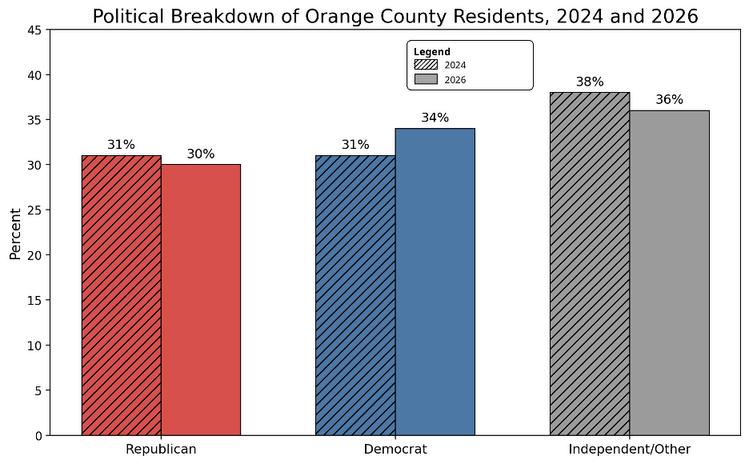
Orange County remains a closely divided electorate. Residents identify as 34% Democrat, 30% Republican, and 36% Independent or something else
Compared to a 2024 survey, these results reflect only modest changes that are within the margin of error for both polls.
This balance helps explain why Orange County remains competitive. Rather than moving decisively toward one party, a significant share of voters remain outside traditional party structures
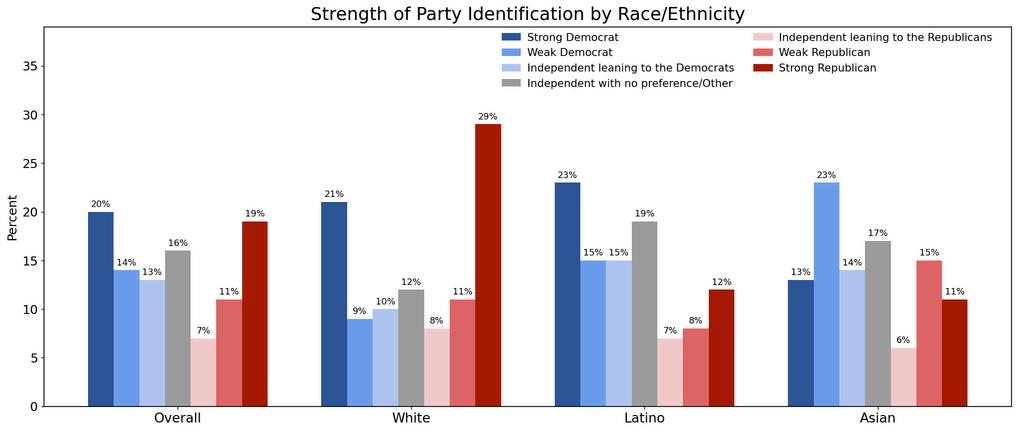
By race and ethnicity, partisan patterns remain broadly consistent with prior surveys. White residents continue to lean Republican, while Latino and Asian residents divide more evenly between Democrats and Independents. These patterns do not point to a clear realignment. Instead, they suggest that many voters remain only loosely attached to either party, reinforcing the broader pattern of weak partisan identification in Orange County
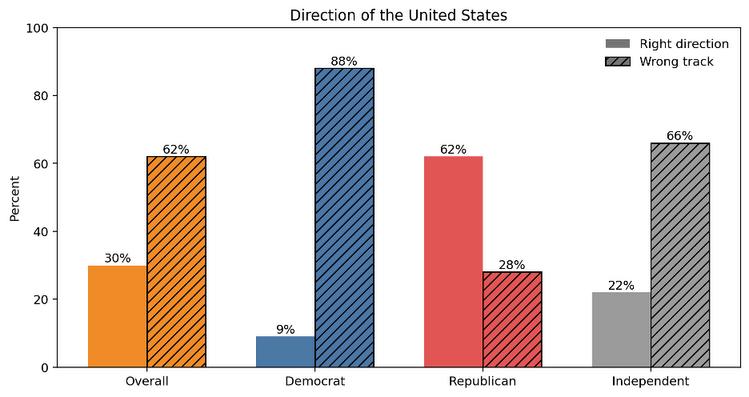
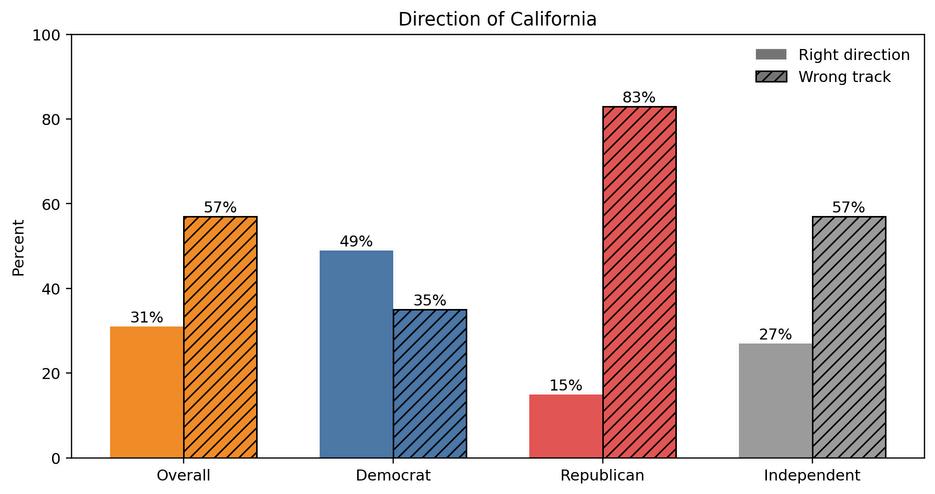
This political landscape is reflected in how residents evaluate the direction of the country and the state. Large majorities of Orange County residents say the country (62% wrong track vs 30% right track) and California (57% wrong track vs 31% right track) are headed in the wrong direction. These results closely mirror the 2024 post-election poll, pointing to sustained dissatisfaction rather than a reaction to recent events.
Frustration continues to be skewed by political identity Democrats and independents view the direction of the country negatively, whereas Republicans and independents believe the state is on the wrong track.
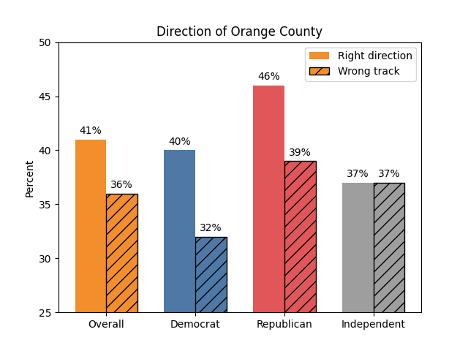
While residents express widespread dissatisfaction with the direction of the country and the state, they take a more positive though less certain view of Orange County. In 2026, 41% say the County is on the right track, 36% say wrong track, and 24% are unsure. In 2024, 50% said right track and 35% said wrong track
This shift reflects a softening of confidence rather than a turn toward pessimism, especially among independents. Orange County remains more positively viewed than broader levels of government, but residents are less settled in that assessment than they were two years ago.
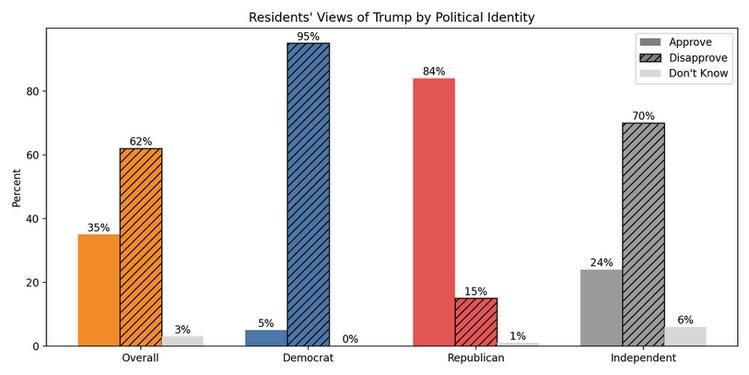
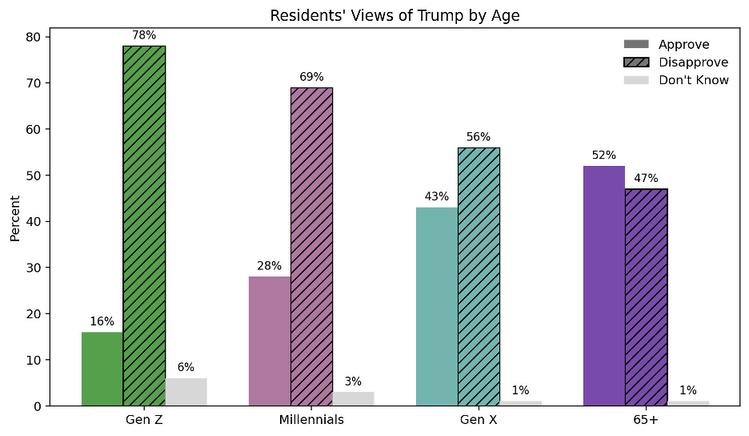
President Trump receives 35% approval and about 65% disapproval among Orange County residents. This level of disapproval is striking in a county that is often closely divided politically, with nearly two out of three residents expressing a negative view of his performance. His support remains concentrated among Republicans, with more than 80% approving, while nearly 9 in 10 Democrats disapprove Independents also lean clearly negative, with about 60% disapproving and 30% approving, preventing Trump from expanding beyond his core base.
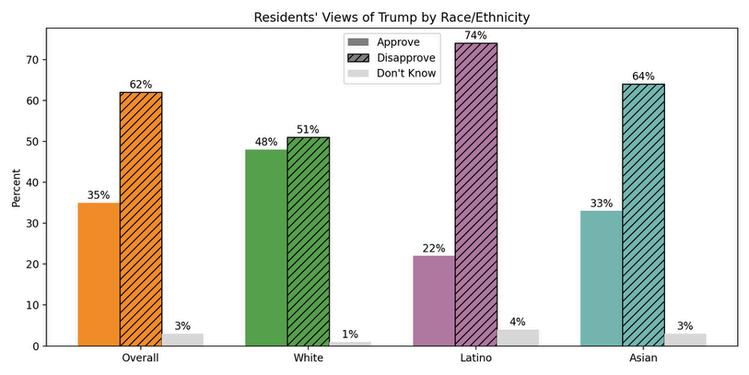
Younger residents are especially negative, with disapproval exceeding 65 to 70%. Older residents are somewhat less negative but still net disapproving, except for seniors, who modestly support Mr Trump By race and ethnicity, White residents are the most supportive at roughly the mid-40% level, but still not a majority, while Latino and Asian residents are closer to 25 to 30% approval, with clear majorities disapproving.
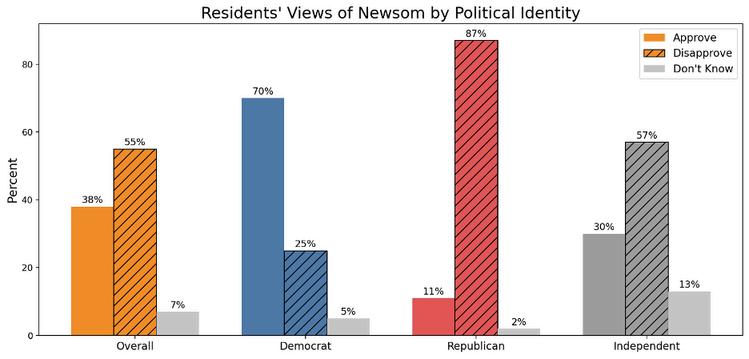
Governor Newsom’s job performance is viewed unfavorably by Orange County residents, with 38% approving and 55% disapproving While Democrats approve of his performance, that support is more limited than Republican support for Trump, with roughly 70% of Democrats approving. Republicans are strongly negative, with almost 9 in 10 disapproving.
Independents also rate Newsom negatively, with disapproval in the mid-50% range and approval at only 30% His overall standing reflects a combination of almost universal Republican opposition, strongly negative views among independents and some defections among Democrats.
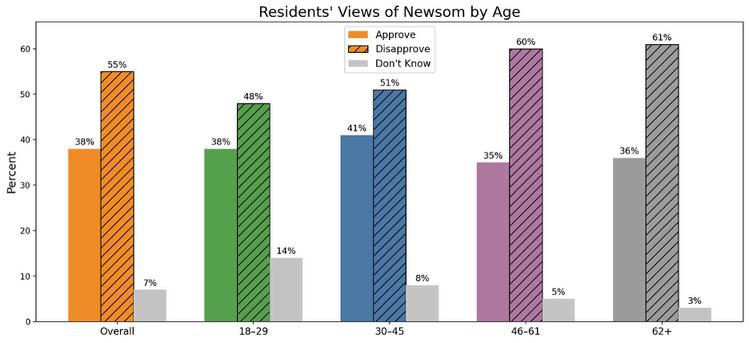
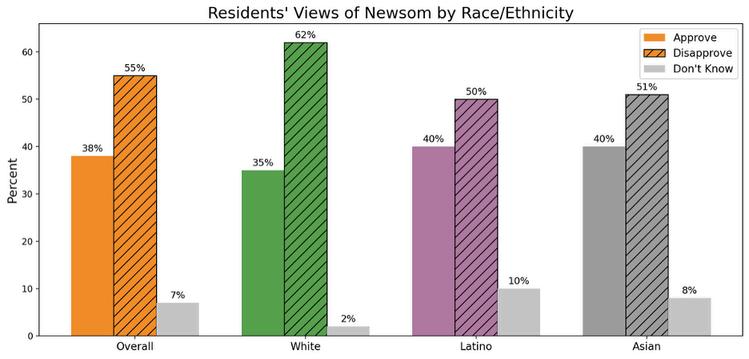
Residents view Newsom negatively regardless of age, although the oldest residents view him more negatively (61%) than those under 30 (48%) By race and ethnicity, White residents are the most negative (62%), while Latino and Asian residents are more mixed.
Independents rate both Trump and Newsom negatively, reinforcing a broader pattern of dissatisfaction with leadership at both the state and national levels.
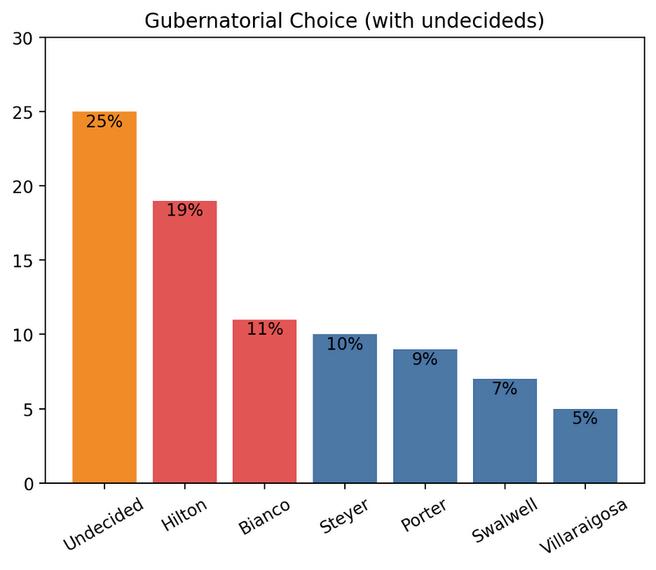
Nearly one in three Orange County voters has yet to settle on a candidate, with 25% undecided and another 6% saying they would not vote At this stage, the race remains unsettled, with no candidate commanding broad support.
When voters are pushed to express a preference, Steve Hilton leads the field at 23%. Behind him, support is tightly clustered, with Chad Bianco, Tom Steyer, and Katie Porter each drawing 14%, leaving no clear second-place candidate
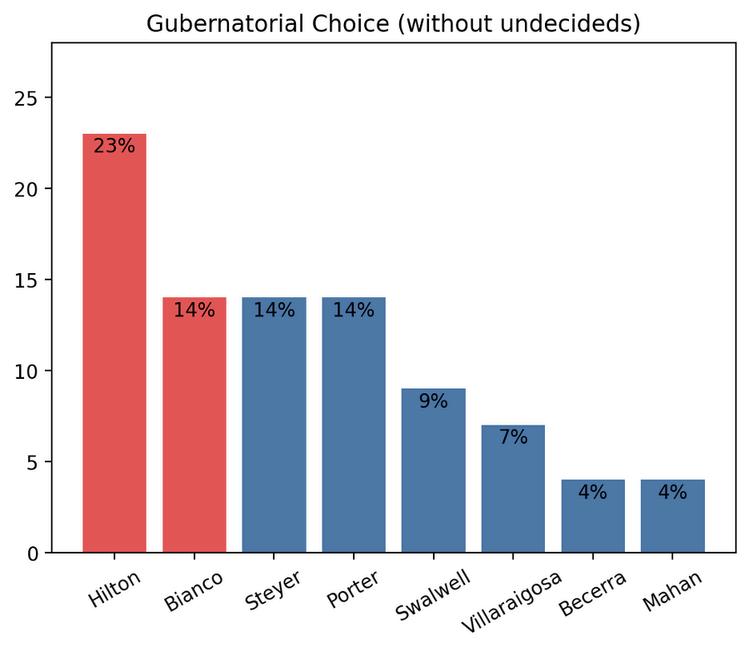
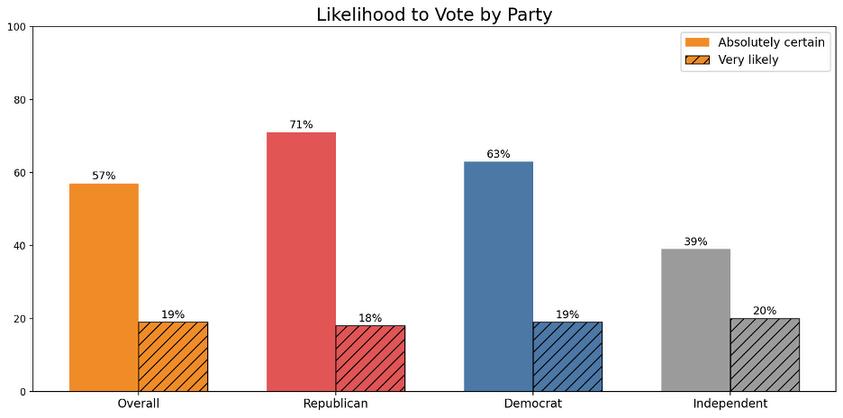
Republican candidates’ early advantage appears to reflect not just the number of candidates in the field, but differences in voter engagement Republican voters are more likely to report a clear preference and a higher likelihood of voting at this stage, while Democrats and Independents remain more undecided.
This dynamic helps explain why Republican candidates currently occupy the top positions, even in a closely divided electorate
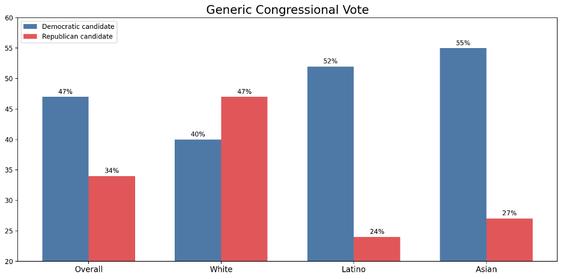
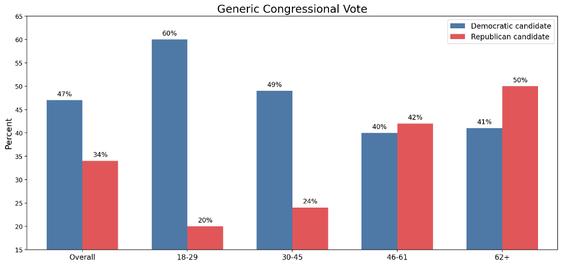
In the generic congressional ballot, Democrats lead Republicans 49% to 36%, a 13-point advantage. This margin exceeds the party identification gap, indicating that Democrats attract support beyond their base.
Democrats perform better among Latino and Asian residents and among younger voters, while Republicans perform best among White residents and older voters Democratic support is spread across multiple groups, while Republican support is more concentrated.
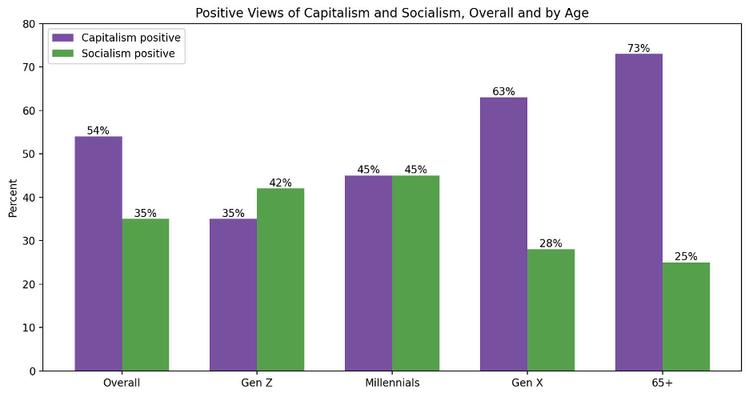
As candidates in California and across the country increasingly engage with ideas associated with democratic socialism, and as recent polling in Los Angeles suggests growing openness to those ideas, we asked Orange County residents for their views on capitalism and socialism.
Capitalism continues to receive majority support overall, particularly among older residents Younger residents, however, are more skeptical Gen Z is the only group with net negative views of capitalism (35% positive, 52% negative), while Millennials are more divided. Socialism topped out at 4245% support among Gen Z and Millennials, with support declining noticeably among older residents.
Together, these results point to a clear generational divide in economic attitudes, even as capitalism remains the more widely accepted system overall.
This poll portrays an electorate that is closely divided, modestly attached to political parties, and broadly dissatisfied with leadership at both the state and national levels. At the same time, voters express more tempered views of their local community and remain open in their electoral preferences, with many still undecided in the gubernatorial race
Rather than signaling a sharp partisan shift, the results point to a political environment defined by uncertainty, fluidity, and voters who have yet to fully settle on their choices.
The Orange County Poll was conducted by the School of Social Ecology at the University of California, Irvine in partnership with TrueDot, which fielded the survey Researchers interviewed 1,202 adults residing in Orange County, California from March 24–31, 2026. The survey was offered in both English and Spanish, with 70 interviews completed in Spanish.
The survey employed a hybrid sampling design. A total of 695 interviews were conducted with registered voters sampled from the Orange County voter file and reached via text message. An additional 507 interviews were completed with adults recruited through online survey panels Responses from both samples were combined for analysis
To ensure the sample reflects the adult population of Orange County, post-stratification weights were applied along key demographic dimensions, including age, race/ethnicity, educational attainment, and gender. Weights were further calibrated to align with results from the 2024 general election.
The modeled error estimate for the full sample is ±3.3 percentage points at the 95% confidence level. The modeled error estimate accounts for the complexity of the sampling design, including weighting and the use of non-probability panel sources, and should be interpreted as an approximation of total survey error rather than a traditional margin of sampling error. Subgroup estimates carry larger modeled errors.