POLICYBRIEF
RESOLVINGTRANS-BOUNDARYWATERCONFLICTSTHROUGH PEACE-BUILDING:THEURGENCYOFCONFIDENCE-BUILDING
Over 260 river basins serve as home to more than 3 billion people and are shared by two or more countries (Figure 1). Each one wants assurance that when they agree to share available water, their neighbors will do likewise. However, in places as varied as the Nile and Mekong River basins, disputes are simmering over whether equitable allocation is even possible. High-intensity conflict remains likely with upstream countries threatening to impede flows to their downstream neighbors. In light of growing water demands and climate change, such conflicts are likely to worsen without agreements based on confidence-building – a process that ensures amicable water sharing through conjoint governance over water allocation and rigorous means for verifying compliance
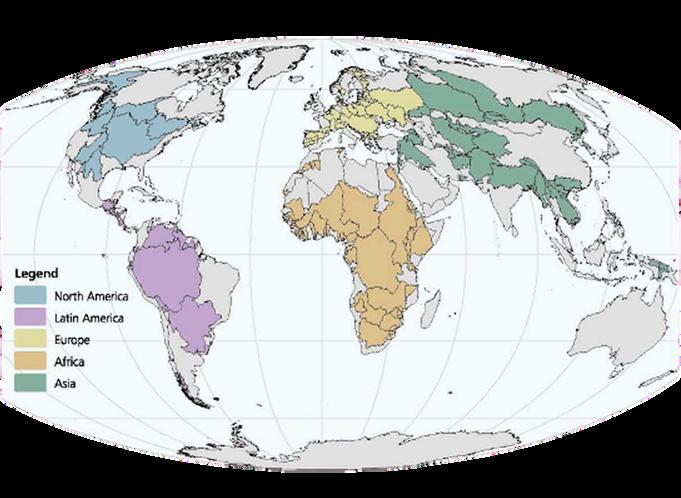
Transboundary Freshwater Dispute Database
Oregon State University
Figure 1: Transnational river basins span the globe

Confidence-building impediments include:
Lack of accurate data on water availability in common basins
Reluctance by countries to share information on water uses
Disagreement on what constitutes equity
Lack of effective governance institutions for managing agreements
DATA CHALLENGES: While sharing water use information between countries may seem logical, ensuring that data being shared is accurate is more likely to occur when nations agree to joint monitoring programs performed by basin-wide commissions and undertaken by independent experts.
AUTHOR: David Feldman, Director of Water UCI
CONSIDERATIONS OF EQUITY
Equity as applied to confidence-building in transboundary water agreements is also complex. While a 1997 UN Convention on Law of the Non-Navigational Uses of International Watercourses, signed by over 40 countries, prescribes that equitable use of a watercourse requires considering: geographic, hydrological, climatic, ecological, and social and economic factors, there is fierce debate over how equity is defined. Questions often arise regarding how water uses, withdrawals, and water pollution disproportionately affect under-represented groups such as women, children, the elderly, the poor, and those with disabilities. For a water sharing agreement to be viewed as equitable, these and other populations must be treated with dignity, respect, and acknowledgment of their particular needs.
POLICY RECOMMENDATIONS
1 2 3
Stronger data-sharing through greater use of remote-sensing by satellites and reliance on AI tools
Greater trans-boundary communication through stronger consultation with civil society groups as well as governments
More inclusive decisionmaking through explicit incorporation of underrepresented groups including women in negotiations
METHODS
There is a need for investment in methods for building confidence, including: river basin and groundwater compacts and joint monitoring systems to assess water withdrawals and their regional impact. Strong agreements are characterized by abiding trust by countries in one another’s faithful adherence to its prescriptions, a belief that water sharing ultimately contributes to overall amicable relations in a region, and an acknowledgement that water stress is most effectively managed by sharing innovations. Important to note, confidence-building techniques can be taught through “role playing” games.

THE BIG PICTURE
The process of deliberation over water management in large, multi-national meetings affords a unique opportunity for a candid exchange of views and an avenue for academic reflection within policy debate. Even if slow and gradual, these reflections can imprint themselves on future decisions through influencing the perspectives of those responsible for making them. The hopes of those residing in shared river and groundwater basins deserve nothing less