
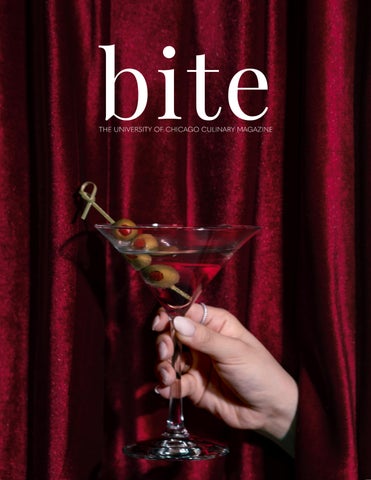
UChicago Bite Issue XXVIII: Fall/Winter 2025-26

Page 1


dear foodies & friends

It is with happy hearts and loudly growling stomachs that we present to you the Fall/Winter 2025-26 edition of Bite Magazine! This year, we challenged our team to consider the culinary spirit of Chicago, from old-school classics like the Chicago-style hot dog (11), to the excitingly novel yet familiar businesses that make our city special, like a Logan Square women’s sports bar (6). We went back in time to explore the influence of the Great Chicago Fire on neighborhood food scenes (13), and looked to the future with a Midwestern gastropub (9).

We examined local influences of global cultures at Pilsen bakeries (21), and even went beyond the city of Chicago, with a writer giving us the scoop on a hyper-local menu from the Andes in Peru (4).

We celebrated our love for the hidden gems on one writer’s search for truly authentic Thai food (8), and our appreciation for our own writers’ backgrounds and the knowledge they bring to our community, through pieces exploring topics like yogurt starters (16) and French gougères pastries (27).

Together, we faced Chicago’s famously punishing winter chill, which came back early, and with a vengeance. With this cold can come isolation, which one of our editors explored in a feature on dining solo (18). Our recipe developers brought an array of cozy options to warm up your home kitchen. For a nourishing meal, try hot, sweet-savory galbijjim (25), intricate lamb saddle (30), or spicy goan fish curry (23). If you seek something sweeter, consider warm, well-spiced arroz con leche (26) or extravagant stuffed brioches (28).

Our writers, photographers, and designers have poured their talent, exploration, passion, and curiosity for good food into this edition that celebrates the city of Chicago. Use their work to inform the beginnings of your own journeys, whether they be in the kitchen, uptown, or across the world. No matter what you decide is in your foodie future, don’t forget to explore our social media (ig/TikTok @uchicagobite) and tag us with all your epicurean adventures!

Signing off for now,

the editors

table of contents

4 A peruvian adventure 6 babe’s 8 opart thai house 9 Giant 10 Hunan Gourmet 11 chicago hot dog 13 Chicago Fire 16 The Culture of Cultures 18 SOLO DINING 21 Pilsen Review 23 Goan Fish Fry and Curry 25 Galbijjim 26 Arroz con Leche 27 Gougères 28 Brioche 30 Lamb Saddle with Mushroom Duxelles & Hot Honey Parsnips 32 meet bite

CO-EDITOR-IN-CHIEF charlotte engrav

CO-EDITOR-IN-CHIEF olivia shanler

MANAGING DIRECTOR sammy alderden

CO-CREATIVE DIRECTOR emily son

CO-CREATIVE DIRECTOR Jacqueline oury

DIRECTOR OF FINANCE chris wong

BLOG EDITOR audrey young

DESIGNERS Cynthia Wang, Emily Son, Jacqueline Oury, Julie Kang, Katie Li, Sophie Menon

WRITERS Adam Zaidi, Alice Cai, Charlotte Engrav, Ciara Balanza, Connor Bloch, Cricket Dur, Emily Son, Emma Stehmann, Jaden Menezes, Maximiliano Mendoza, Olivia Shanler, Polly Wang, Sammy Alderden, Sebastian Diaz, Shaamak Goyal, Simrun Parulekar

PHOTOGRAPHERS Chris Tien, Ella Somaiya, Evelyn Chua, Jonathan Ji, Polly Wang

COVER PHOTOS EVELYN CHUA, JONATHAN JI

A Peruvian Adventure at MIL

After a 10-hour flight from NYC to Cusco, a night in Urubamba, and a 40-minute drive through the Andes, I arrived at MIL Food Lab, a Peruvian restaurant known as the highest-altitude fine dining establishment in the world. Sitting 3,568 meters above sea level, MIL is known for its partnership with Central in Lima, which was ranked 1st by The World’s 50 Best Restaurants in 2023. Located right next to the Moray archaeological site, the entrance was packed with tourists—who, one by one, took off their shoes as a way to connect with Pachamama, the Inka’s earth deity. The area was covered in cornfields and local plants, with sheep grazing and small homes scattered across the mountains. No alpacas are found here, though—they prefer even higher altitudes, where the soil is richer and the grains more flavorful.

Stepping out of the car, I saw a single building—an ordinary house, no different from the other residences I’d passed in the mountains, with a greenery-covered rooftop and grayish walls. Where is the restaurant? I wondered. But the moment I stepped inside, I felt transported to another world.

The interior wasn’t fancy or ostentatious, just a four-sided structure encircling a courtyard where a tree stood, its branches reaching skyward. The entrance hallway was lined with dried plants and herbs. A turn led to a table dis-

playing preserved ingredients, another turn to the kitchen and bar, and finally, to the dining area. The symmetrical design reminded me of a Zen monastery, where energy is centered and contained within the architecture. The warm, earthy tones of the space were calming—exactly what my body, still adjusting to the altitude, needed.

I had booked the immersive experience: a two-hour botanical tour followed by the tasting menu. The tour was led by a local Inka farmer, Mercedes, and a translator, who commutes 45 minutes by foot to work at MIL every day. She still farms the same land we were about to explore. The translator, who also came from the Sacred Valley, asked if I worked in tech— apparently, many of MIL’s guests are American tech workers. I said no, explaining that I study anthropology (intentionally omitting my economics major). He was delighted.

We began with chirika, a kombucha-like fermented drink made from sprouted corn and natural yeast. Before drinking, Mercedes taught me a ritual: we thanked each direction of the world—east, south, west, and north—before pouring half the drink onto the ground as an offering to Pachamama. After the ritual, we took our first sip.

“It’s also called the ‘aha’ tea,” Mercedes said with a smile. “Because it’s so delicious, people always say ‘aha’ after drinking it.” I found

myself doing exactly that.

She explained that chirika is a staple of Inka reciprocity. When people gather to help on a neighbor’s farm, the host offers them chirika before they begin their long day of labor. “Inka people value reciprocity greatly,” she said.

As we walked through the landscape, Mercedes explained the terraced topography that allows this region to cultivate an astonishing variety of plants. She frequently stopped to pick leaves, crushing them between her fingers and explaining their medicinal and ritualistic uses in traditional Inka culture. As a keepsake, Mercedes pressed different types of potatoes into the pages of my notebook, each with distinct hues, shapes, and textures.

To my surprise, the Inka classification of plants bore a striking resemblance to traditional Chinese Medicine. Both systems categorize plants into binary opposites: the Inka classify them as “fresh” or “warm,” while the Chinese use yin and yang. Both systems link these properties to masculine and feminine energies. The key difference? The Inka method is more intuitive—you can recognize a warm plant by its strong scent when crushed. MIL, in its experimentation, has not only preserved these traditions but also incorporated them into culinary innovation.

We continued around the mountain, stepping on the soil that had nurtured the food

written & photographed by Polly Wang designed by Jacqueline Oury

I was about to enjoy. The sun cast a golden warmth over the valley, and for a moment, I felt fully connected to the land.

“Aha.”

Again, that was my reaction when I first sat down at my table. The window in front of me framed a view of the mountains and an open sky. A few cows grazed in the distance. Though I wanted to say it was the best restaurant view I’d ever had, I had to admit—the table to my right had an even better one, catching more of the Andes’ peaks.

The wooden table was decorated with dried herbs, images of local ingredients, and a special kind of freeze-dried potato called chuño, dyed in vibrant colors with natural pigments. Mercedes had mentioned this potato during the tour—it has a decade-long shelf life, crucial for times of drought. The first course honored this ingredient: a tortilla made from its starch.

Later in the trip, I dined at Central, MIL’s renowned partner restaurant in Lima. After experiencing both, I understood why the two tables next to me at MIL had said, “I liked MIL much better.”

Central operates like any other world-class fine dining restaurant. To me, it felt like

Courses

the Noma (Copenhagen, Denmark) of the Southern Hemisphere. Like Noma, Central constructs a national identity through cuisine, using hyper-local ingredients and indigenous cooking techniques. Both have become cultural symbols for their countries. Locally, they foster an ecosystem—former chefs open bakeries and restaurants, artists collaborate with them, and a national pride in their culinary heritage grows. But there’s one problem Central (and highend restaurants in general) has that MIL does not.

At Noma and Central, the open kitchens showcase the chefs in action—but instead of a sense of wonder, it often feels like watching a pressure cooker about to explode. Waiters, too, are often rushed, rattling off descriptions at lightning speed, careful not to “mess up” or delay service.

Is that really what we want from dining? MIL presents a decisive answer to this question through an alternative philosophy. With just eight tables instead of 50, the experience was unhurried. The chefs weren’t rushing, the servers took their time to explain each dish with genuine pride, and I felt welcomed, not scrutinized. Instead of an environment where individuals fight for prestige, MIL radiated collective spirit—perhaps because of their shared belief in the mountains, in Pachamama.

First Moment Second Moment

Preservation: chuño / corn / uchucuta sauce / oxalls

Highland: cabuya / lamb / kañiwa / cushuro/ oxalls

Third Moment

Extreme Altitude: alpaca / black quinoa / multigrains / ayrampo fruit/ oxalls

Fourth Moment

Corn Diversity: piscorunto / chullpi corn / urubamba corn / fresh cheese

Fifth Moment

Central Andes: potatoes / stems / chaco clay / markh’u leaves/ oxalls

Sixth Moment

Andean Forest: terwi / duck / callampa / rocoto pepper

Seventh Moment

Frozen Cordillera: qolle / muña / tuber ashes

Eighth Moment

Sweet Huatia: mullaska / cacao / maiva

Even though I try not to go too much astray, the experience at MIL inevitably made me reconsider the purpose of high-end restaurants. With those recent visits to MIL, Central, and the east-coast Eleven Madison Park, in comparison, our Chicago local pride Alinea seems to lack some essence. Chef Grant Achatz pioneered molecular gastronomy, but now that his techniques have spread worldwide, what remains unique about Alinea? This raises the question of distinction and technique versus the importance of evocative feelings from culinary experiences.

Currently, I’m writing this on a train from Ollantaytambo to Machu Picchu. Mist drifts over the mountains, occasionally parting to reveal their full majesty. The Amazon River rushes below, merging with streams of different colors.

Though I’d love to simply enjoy the view, the high schooler next to me—busy typing on her laptop—reminds me that I should probably start writing. The faint smell of the train’s emissions pulls me back to reality.

Chicago may have one of the best culinary scenes in the country, but it would be a mistake to underestimate the importance of its bars as cultural landmarks. The city’s dive bars are an undeniable part of its heritage, from operating as third-spaces and enriching communities, to devising the iconic Chicago Handshake (Old Style Beer

iconic watering holes. College rugby besties McConnell-Johnson and Spillane opened Babe’s in September 2025, combining retro dive bar vibes with playfully modern cocktails and a new outlook on how sports bars can serve a community. The bar only shows women’s sports, and proudly operates as a space built for and by fans of women’s sports. If that’s to make this North

Side spot a new haunt of yours, its delicious cocktails and unique ambience will.

A future local institution, Babe’s feels like a cross between a plush 70s-style basement, a vintage athletic club house, and a stylish neighborhood spot. Its warm, comfortable exterior on West Armitage beckons guests with a retro ambience. Inside, funky plaid chairs, a luxurious wooden bar, groovy wallpaper, and unique decorative accents set the scene, all pulled together by futuristic pink light fixtures.

Personal touches like a giant working scoreboard and bleachers as alternative seating, a custom photobooth, and colorful patio convey an unmistakably intentional mission by Babe’s to make you feel at home. The owners’ passion for the bar comes through in all of its personal touches, from table decor crafted with personal sports memorabilia, thrift ed coupe glassware, bar plaques honoring those who helped fund Babe’s construction, and old sports trophies (including the UChicago Women’s Rugby 2022 nation al championship). The staff are friendly, the clientele are mostly-laid back and female, and the nextdoor neighbors are eccentric. Even better, the Babe’s staff backs up all of this style with substance - delicious craft cocktails. The menu is small, but mighty, featuring a variety of cocktails as well as draft beers, and even prosecco on tap. We sampled the Dillbreaker, Babe/s #1 (pineapple rum punch), Corner Kick Cold Brew Martini, Midsummer spritz, and Marz rice lager. The Dillbreaker is a playful twist on a dirty martini, with plenty of briny flavor and satisfying tang. The Midsummer spritz features a unique aperitivo, and I detected notes of elderflower and strawberry, complimented by prosecco (from the tap!) to create a sweet and refreshing beverage. The Corner Kick Cold Brew Martini was smooth, dark, and rich, but not overpowering. Its mellow sweetness distinguishes it from a typical espresso martini. Our stand-out drinks were the Babe’s #1, described to us by McConnell-Johnson as a rum punch. We loved the pineapple flavor, and found it was palatable, with a bright, sippable feel. This was the crowd favorite. We also loved the Marz Brewery rice lager, which was a special collaboration hibiscus pale ale created by Babe’s own beverage manager. We enjoyed the honeyed finish, and found it

went down easily. We didn’t expect to like one of the draft beers this much, but were pleasantly surprised.

While Babe’s doesn’t have an operating kitchen yet, they are planning to offer an array of bar snacks in the future. For now, Logan Square has many casual spots that would be great for a quick bite before and after your stop at Babe’s. It is definitely not a classic Chicago dive bar, but Babe’s is a welcome addition to the city’s bar scene, with remarkable beverages, and an even more impressive and enticing role in the community. Hosting events like community anti-ICE trainings, college sports reunions, and everyday gatherings between sports fans and friends, Babe’s is worth a visit (or many!) if you like a classic, unpretentious, Chicago bar feel with a twist. Our party felt welcomed by Babe’s every step of the way, from a warm greeting by the owners, to complimentary shots, to playful and fun photoshoots taken in the photobooth and under the pink scoreboard. The Babe’s mission celebrates more than female athletes and women’s sports supporters, it celebrates bar culture at its best.

NEIGHBORHOOD: LOGAN SQUARE PRICE: $$ DISHES TO TRY: RICE LAGER &

BABE’S LINEUP #1 (THE LEAD OFF)

OPART THAI HOUSE

I spent 3 formative weeks visiting a forest in the middle of the Northern Thai forest cooking and eating Thai food with monks. Upon my return to the United States, I noticed many of the fragrant herbs, sour sauces, sweet sticky glazes, and diversity of flavors I’d enjoyed in Thailand were missing from the menus of American Thai restaurants. I’ve made it my mission to find the most authentic Thai dishes in Chicago, with no 30-hour international flight required.

While it’s not in one of Chicago’s well-known Thai neighborhoods, Opart Thai House stands strong as an institution of Northern Thai cuisine in the city. Opened in 1983, the restaurant was established in an ancient-looking house by husband-wife team Opart and Mookda. It has since moved to a location in West Town.

The warm staff took us to our table where we were presented with the extensive 98-dish long menu. While struggling with the tyranny of choice, I realized how opposite this menu was from the ones in Thailand. Most restaurants there specialize fifteen or fewer dishes, with a couple variations in protein.

We settled on a heaping pile of Pad Kra Praow, minced beef sauteed with basil and peppers with a side of white jasmine rice. The first impression of the dish was disappointment with the level of spice, 4 out of 7 clashing with an overwhelming sweetness. Alternatively, caramelized soy sauce and umami of the fish sauce accompanied each other well. The herbs, particularly basil, were fragrant and well incorporated into the dish. A perfect Thai dish balances spice, sweetness, umami, and herbaceousness. This dish accomplished 3 of the 4 criteria but

fell far short of the Pad Kra Praow in Thailand.

One thing stood out to me, and surprisingly it was something we couldn’t order. Fruits and vegetables in South East Asia are dramatically different from those in the US. Thailand emphasizes seasonality, and it is common for certain foods to be unavailable during certain times of the year. When we asked for mango sticky rice, I was pleasantly surprised that our waiter said they weren’t serving any because mangoes were not in season. Similarly, when I asked for a recommendation at the start of the meal, our waiter recommended the Khao Soi, perfect for the cold Chicago fall. Seasonal ingredients and dishes are not optional at Opart Thai House, they are front and center.

I think this is why Opart Thai House has been a Chicago Thai staple for so long. The team behind the restaurant is knowledgeable not only about Thai cuisine, but Thai culinary philosophy, and consistently delivers affordable and strong dishes. Coming in at around $20 per person, it’s fair to say that Opart Thai House is a strong late night takeout contender. But in my view, this place falls short of Thai cuisine that accentuates balances of flavors. If you are looking for an above average Pad Thai or Pad Kra Praow, this is the place for you. As far as the dynamic limits of Thai cuisine in Chicago stand, the quest for my go-to Thai restaurant continues.

>> NEIGHBORHOOD WEST TOWN

As you walk by W Armitage Ave., you might notice the lively faces of wandering strangers. Some alone, others in a group, and a few with a company that makes you wonder. Yet, no locale reads as bright and bustly from the outside as Giant on a Friday night. With tables lined up against its two walls, the restaurant does not shy away from giving you a peek into its not-so-giant little world. Whether it be this tight setting, the ambient lighting, its story-like name, or the cuisine, Giant hides pockets of warmth in every which place.

As the night progressed, so did the coziness of the experience, particularly due to a variation in texture and flavors. Accompanied by a glass of chão do prado, a white wine with pear undertones, the first of the courses entailed some sort of seafood. With a wait of about 10-15 minutes, the first of the dishes to arrive was the razor clam toast with a bean salad atop its fluffy and browned exterior. Given its generous size and toppings, the toast begged for some effort from my part, namely a cutting of bite-sized pieces that held some of the salad’s tangy flavors. Neither too tough nor dry, the toast grazed the tongue with softness, and each bite gave a pleasantly acidic experience. Among the other bread-based dishes were little jalapeño biscuits with maple butter that arrived shortly after. By themselves, the biscuits bore a resemblance to the chile through their aroma, though the real star of the show was the maple butter. After cutting the biscuit, streams of steam rose, making for the perfect melting spot. While the butter was rather salty in itself, both ingredients complemented each other in unintuitive ways. Where the butter was

previously salty, the biscuit now made it sweet, and where the biscuit’s aromatic flavor was faint, the butter heightened it. What ensued were uniformly flavorful moments in every bite.

Then came the last of the two seafood dishes: the baked clams. Covered in a salty blanket of breadcrumbs, spinach, and bacon, the clam provided a mellow and soft relief from the rigidity of sodiumrich layers. After scooping out some of the bacon crisps, the clam washed over the mouth’s saltiness with stark ease, mellowing out any overwhelming sharp flavors.

As if the body needed any more warmth, the last dish was a buttermilk-poached winter squash complemented with a glass of I Civil Schioppettino. Tangy and nutty, the squash contained tomatillo and idiazabal, which combined Mexican and Spanish flavors. With a sensible touch on culture, the dish made sure not to overcook the tomatillos, which would have been the case had an overwhelming bitterness been present. Such a touch on culture is perhaps what makes Giant a true giant among its other competitors, as the warmth of their dishes extends beyond the kitchen and into the Chicago community. Against the current icy conditions, Giant’s presence and courses provide a warmth like no other, extending far beyond the kitchen and onto the streets.

REVIEW

GIANT

>> NEIGHBORHOOD LOGAN SQUARE

>> PRICES

$$

>> DISHES TO TRY LITTLE JALAPEÑO BISCUITS BAKED CLAM(S)

WINTER SQUASH

HUNAN GOURMET

Coming back from a late night out in downtown Chicago, you might find yourself feeling tipsy and a bit peckish, as I often do. And if you are tired of the same old late night grub, you can make a pitstop in Bridgeport on the way back to campus at Hunan Gourmet. Although it’s tucked away just below the Orange Line, this little culinary has the immediate selling point of being open until 2AM, seven days a week. Upon entering, our large group of slightly inebriated students was greeted by a charming display of the restaurant’s menu items modeled in wax. Immediately as we were seated, we were served water and hot jasmine tea, a staple of Chinese restaurants that brought me back to the beloved hole-in-the-wall restaurants in San Francisco’s Chinatown.

The menu read like an entire ecosystem: enormous, unruly and stacked with offerings for both the cautious and the adventurous. There are plenty of dishes for those accustomed to the familiar warmth and stickiness of ‘American Chinese’ food like General Tso’s and orange chicken. But, don’t miss the rest of the menu’s perhaps less popular offerings, from chicken gizzard and fresh frog to beef aorta and testicles.

After placing our order, we had a cold cucumber salad served after just 5 minutes, and not long after, all of our dishes arrived. We ordered seven dishes totalling to $140, or $20 per person for our party. Perhaps not as cheap as a typical late-night, after-club meal, but not extravagant. The stir fries arrived steaming and hissing beneath the karaoke-lit glow of Chinese music videos projected on the wall. The pickled peppered beef sobered me right up, and left me with a bright, buzzing and tangy flavor rather than the tingly peppercorn heat I expected. The grilled leek had a pleasant char,

and was enhanced by a savory seasoning, reminiscent of five-spice, which one friend likened to the taste of a Frito. The dish everyone kept returning to was the Hunan-style bacon fried rice, which was studded with crispy pork pieces and had a deep, smoky soy flavor. It anchored the meal, balancing the sharper, spicier dishes on the other ends of the lazy Susan bearing our meal. We appreciated the generous gesture of copious complimentary white rice to pair with our dishes and soak the various spicy flavors of different levels we challenged ourselves with.

For college students heading back to the South Side from downtown, Hunan Gourmet has an offer: enough spice to sober you up, decent food, massive portions, and a kitchen willing to stay awake with you. It’s true our service wasn’t perfect or overly welcoming, but if Hopper had painted Nighthawks in Chicago instead of Manhattan, he might have set it at Hunan Gourmet: a near-empty room, a lonely stretch under the highway, and a handful of students eating comforting dishes. In the deep hours of the night, Hunan Gourmet is a sign that Chicago is still awake.

>> NEIGHBORHOOD BRIDGEPORT

>> PRICES $$

>> DISHES TO TRY

PICKED PEPPERED BEEF

GRILLED LEEK

BACON FRIED RICE

The Chicago Hot Dog [Hah-t Dawg]

To me, there are few American foods more iconic than the Chicago hot dog. A link of ultra-processed beef atop the bed of a pillowy poppyseed bun. Three types of pickles, because just one is insufficient. Pickled sport peppers, dill pickles, and my personal favorite: reallllllly neon green sweet pickle relish (the more radioactive it looks, the better). Fresh tomatoes and onions to reconnect you with nature after all that food dye. Celery salt. Yellow mustard, and most importantly, the absence of ketchup. The bias against ketchup is supported by New Yorkers too (despite being our culi nary rival). Even Obama said on the Bourdain show that no one past the age of eight should ever put ketchup on a hot dog (1). I’d even go so far as to say children aren’t exempted from this important rule.

Eating Chicago hot dogs is like reading really good literature. The hot dog can speak for it self, but your appreciation for it doubles when you learn about the meaning to the madness, the reason for the relish, the story behind the sausage. The Chicago hot dog is a work of art that blends cultures, demonstrates Chicagoan resilience through the De pression era, and shows commitment to food quality and tradition.

The story starts, of course, with the hot dog itself. Chicago’s hot dogs are characteristically 100% beef. It was Jewish immigrants who began the transition to eliminate pork from the mix. The Chicago meatpacking indus

try was notorious for lack of health standards and safety violations (the subject of Upton Sinclair’s The Jungle), so even non-Jewish Chicagoans switched to all-beef hot dogs because they were produced separately in kosher factories and were thus deemed to be higher-quality. Vienna Beef (starting 1893) rose to fame as a prominent all-beef company. Even today, 71% of Chicago’s hot dogs come from this company. You know a good hot dog spot when you see the Vienna Beef sign outside their door. Vienna Beef is also the reason for the iconic radioactive relish. This company wanted their relish to appear vibrant in photographic advertisements, but to achieve this despite the

low-quality photography of the time, they added blue dye to enhance the color (2). They continue the tradition to this day, stating on their website that “the blue food coloring has no impact on the overall taste of the relish, but every Chicago Style hot dog-lover knows that it’s all part of the experience!” (3).

The Chicago hot dog was not just a result of influence by the Jewish community, but also by various other immigrant groups. The poppyseed bun was invented by Polish immigrant Sam Rosen. The yellow mustard element has a German background. The “garden” toppings (tomato, onion, peppers, pickles, etc.) were an addition made by Greek and Italian communities. Chicago’s hot dogs are a true reflection of the American “melting pot” of cultures (2).

The Chicago hot dog is also a story of resilience through the Great Depression. Chicago’s hot dogs evolved to have a gazillion toppings partially out of necessity to create an affordable yet substantive meal. Vendors added vegetables and pickles as a cheap way to make the hot dogs more filling (2). The Depression is also the reason many Chicagoans consider ketchup to be borderline sinful. Hot dog vendors of the era would sometimes sell low qual-

ity meats (coming from the aforementioned notorious meat-packing stockyards) but hide it by adding ketchup. The absence of ketchup on a hot dog became a symbol of a good quality hot dog that could speak for itself without being covered up by a certain sugary and sinful sauce (4).

I have quite a few fond memories involving the Chicago dog, ketchup hatred especially. I remember when I gained an appreciation for yellow mustard and started to expand my palate beyond my plain hot dog Portillo’s order. My mom and I would poke fun at my dad for putting ketchup on his hot dog, utterly unacceptable behavior for someone who grew up in the suburbs of Chicago. I recall ordering hot dogs with a friend before a Field Museum visit and laughing when the stand owner told my friend she’d have to do a little dance if she really wanted ketchup. I think back to summer baseball games and supporting the White Sox because even though Guaranteed Rate Field might not see many home team victories, it has fireworks and the Comiskey dog (let’s just say the topping stations at Wrigley are entirely lacking). The Chicago hot dog more than a hot dog, it’s a representation of Chicago’s community, resiliency, and culture.

1. “President Obama vetoes ketchup on hot dogs.” Today, 2016 2. Holland, Rebecca. “Everything You Need To Know About Chicago-Style Hot Dogs”. Forbes, 2021

3. “All About Vienna Beef Neon Green Relish”. Vienna Beef 4. “Only in Chicago: Why do city residents skip ketchup on hot dogs?. NBC Chicago, 2025

ILLUSTRATIONS

FROM WRECKAGE TO RESTAURANTS:

The Chicago Culinary Scene

Transforming from a lone spark...

Culinary history begins with the discovery of fire and its vast amount of uses, whether it be cooking simple sustenance for safe consumption or adding that elusive je ne sais quoi of flavor through the flames. Fire has been an essential aspect of humanity’s culinary and greater life for millennia, transforming both livelihoods and societies. So how did Chicago society change after the Great Chicago Fire? What changed after the flames became a little too large for the stovetop and took over the city? I took a deep dive into how the Windy City’s restaurant scene emerged from the embers and developed into the great landscape of gustatory delights we see today.

On October 8, 1871, the city awoke to find fire filling the streets, immediately inscribing it an infamous day in history. The true cause is still unknown, though seemingly solid to some. As myth has it, Daisy the cow tipped over a lantern in old Mrs. O’Leary’s barn, rapidly spreading the illfortuned blaze throughout the city. Her name never entirely cleared, the story became widely recognized as the catalyst of this catastrophe and Mrs. O’Leary remains forever associated with this day.

I first explored the on-the-ground implications of these flames, as naturally a restaurant must first have a physical establishment before it can begin selling food, or so I falsely assumed. In reality, many of the larger, albeit ruined, enterprises set up roadside stands to sell quick bites for passersby and to keep revenue coming in while they were rebuilding1. Yet, countless smaller businesses were unable to follow such courses of action. Much like the cow that allegedly started the fire eats grass, the flames ate up most insurance policies on their route northeast and left these firms with no land and no claim to their original property. Bigger companies bought out the freshly penniless and puny firms, sweeping away their ashes to make room for their newer, more modern buildings and paving the way for the large business district as is reminiscent of today’s.

Not all was lost when it came to the original standing of the industries of Chicago. The more prominent operations lay southwest of the flames in the Union Stock Yards, leaving the meatpacking facilities, lumberyards, wharfs, mills, and railways to stabilize Chicago’s economy as the “Hog Butcher of the World”2, keeping thousands of people employed. So fate was on the side of our city, as this boom of rebuilding and rejuvenating the rest of the economy coincided with the beginnings of the nationwide Gilded Age, drawing in many immigrants with dreams of the idyllic American kind to the city that was in many ways starting from scratch3, anchored only by the foundational, fireproof industries of Chicago. To accommodate these waves of tradesmen, “workers cottages” began sprouting throughout the suburbs, hotspots for various cultures and the cuisines that so accompany them. Despite the physically crowded nature of these “barracks-style buildings”4, the Chicago culinary scene was vastly expanded to include many more styles and systems of food starting from the South Side and traversing upwards. These would have remained unprecedented had the lantern in the barn on that fateful night not sparked the flames, a wave of immigration, and thus a true revolution of familiar fare.

Or did the lantern in the barn on that fateful night really spark the flames? With such a tale long blamed for the mass destruction, my next whimsy to be answered was if people thus changed their consumption of cow-related products. Did our town hold a vendetta against cows, drinking less milk and eating less beef to boycott their very existence? Or did the coin fall the opposite way, and anger was channeled through a surge in a burger based diet?

The answer, sadly yet unsurprisingly, was not the main focus of the recovery effort statisticians, yet my curiosity did not remain unanswered. Vegetable and dairy operations were transitioned beyond city borders due to the mass loss of property within, and the humble horse remained the only animal permitted to stable inside the hallowed and torched lands of the town5. Thus, the high-powered equine fervently fueled and sustained the rebuilding efforts, carting valuable goods to and fro, and so the main creature of impact in our tale was not in fact the benevolent bovine, and instead the steed which provided such succor to a city in need.

Thus, truly reminiscent of our school’s mascot, Chicago rose like a phoenix from the culinary and capital ashes, developing a dining scene unlike any other and leading to the fine institutions both big and small as we see them today. For instance, a visit to the Near North Side, once nicknamed “The Burnt District”6, can now offer an exciting and indulgent experience that truly blossomed from the cinders of the flames. From the embers of the Great Chicago Fire came about a city renowned not just for its wind and waters, but for the diversity of its gastronomic experiences, redefining culinary history to include this piece of infernal inheritance.

1. “‘Chicago Shall Rise Again’ — Rebuilding a Better City after the Blaze | Chicago Fire | Chicago Stories | WTTW Chicago.” WTTW website

2. Schons, Mary. “The Chicago Fire of 1871 and the ‘Great Rebuilding.’” National Geographic website

3. “A Tale of Today: Up from The Ashes Rebuilding Chicago.” A Tale of Today: Up From the Ashes Rebuilding Chicago | Driehaus Museum website

4. Rodkin, Dennis. “Crain’s Forum on the Chicago Fire | Crain’s Chicago Business.” Chicago Business website

5. Raleigh, Chas P. Agriculture, Encyclopedia of Chicago website

6. “The Ruined City.” The Great Chicago Fire & The Web of Memory, 2011

...into a diverse array of novel cuisines.

The Culture of Cultures

Two tiny species–Lactobacillus bulgaricus and Streptococcus thermophilus–quietly transform milk’s lactose into lactic acid, thickening the liquid into a velvety, tangy substance. This scientific process is the heart of yogurt-making. Despite it being a staple food in many eurasian cultures, yogurt was discovered by accident. Neolithic people in 6000 B.C. stored their milk in animal stomach pouches rich with wild bacteria. After warm days, they would open their pouches to find rich, semi-solid, yogurt. It was a transformative discovery: the acidic environment of yogurt killed off milk’s harmful bacteria, allowing it to be stored for longer. And once the bacteria culture had been made, it could be used to ferment milk again; a self-sustaining solution. Herein began the tradition.

This tradition has followed us to present-day. My family started making yogurt again this summer. It began when we dined at my aunt’s house for dinner. She had made a spicy red potato curry, stir-fried vegetables, and roti. On the side, there was a steel bowl filled to the brim with yogurt. It tasted fresh, natural, clean, and cool. I ate half the bowl. At the end of the night, my aunt sent me home with a small amount in tupperware. It felt like the ending of The Lorax. I was Ted, bringing home the last Truffula tree in a society full of plastic “Oak-amatic”ones. Instead of plastic trees, we live in a world of store-bought yogurt filled with additives. Now, I could quench my yogurt craving while practicing ancient traditions and sustainability, all at a limited cost. Everyone in my extended family grew up in India with fresh homemade yogurt on the dining table. When the women immigrated to America, they wanted to continue the tradition, so they searched for a starter. Some tried using store-bought yogurt. They mixed yogurt into milk, storing it in warm places,

waiting for it to curdle. At first it worked; they had a successful strain. Then it didn’t. These yogurt companies began changing their formulas with sugars, preservatives, and stabilizers, making cultures weak. For a while that worked…until it didn’t. The formulas kept changing, making it harder for bacteria strains to stick. Many reached toward traditional Indian methods, using the lactic acid bacteria in red chilis to ferment milk. That barely worked. Successful starters were rare, so people began sharing homemade starters amongst themselves. That’s how we got ours! Indian restaurants often have the best yogurt. Mayuri, our local favorite, provided my Grandmother’s starter. Their culture worked for a long time until it stopped setting.

Yogurt starters aren’t infinite. One day, due to temperature, pH levels, and more, the yogurt might not set, leaving you with no starter. Regardless, over time, wild microbes would slowly drift the culture away from its pure form. These limitations increase the continuous importance of fermentation experimentation and sharing successful starters with family, friends, and strangers.

Maybe yogurt-starters aren’t immortal, but there is a certain magic to yogurt-making. It lives in the people who experiment and share, in the quiet beauty of science, and in the traditions we keep alive. It lives in the culture.

1 2013, updated 13 Apr. 2023, nourishedkitchen.com/troubleshooting-homemade-yo gurt-questions/.

Key Terms:

• Yogurt starter: The small amount of yogurt (or other bacterial source) used to ferment a fresh batch of milk.

• Yogurt culture: The live bacterial ecosystem turning milk to yogurt.

On Eating Alone: Solitude, Independence,

and the Modern

Let me paint a picture for you. I walk into a loud, buzzy restaurant; think River North, West Loop, TikTok famous, huge table vibes. “For one”, I request at the host stand. I’m seated on the far corner of the bar, or maybe at a table that was originally sat for two, where I sit back in the booth, facing out into the restaurant, unguarded by a body sitting across from me.

I nod yes to the “just the one this evening?”. The waiter removes the setting across the table from me. This utilitarian question lodges itself in my brain, evolving into perceived judgement. I’m confined to one entrée and a dessert by large portion sizes, and to limited drinks by the far shortened wine-bythe-glass list. The restaurant fills, coming alive with conversation. I watch friends hug and reunite, huge families come and go, listening in from my corner, the buzz flattening into ambient noise. At the same time, negative thoughts race loudly by. I’m alone,

Independence,Modern Meal

visibly so. What must be wrong with her? is the thought I’m imagining racing through the heads of my neighbors.

This isn’t a new conversation; Eater and other publications have been dissecting the table-forone for at least a decade. OpenTable data says more people eat out alone each year[1], reported in an attempt to destigmatize the solo meal. Contemporary poets muse on it; oftentimes a symbol of sadness, abandonment, relationships recalled through memories of meals once shared now enjoyed alone:

“shoo-fly pie, schmierkase, sauerkraut, souse, and/all those other foods you/won’t eat with me”.[2]

“The girls at the next table keep/looking and laughing/ After you everything/tastes like a bruise”. [3]

Nobody comes out and says ‘you’re lame if you

dine solo’. The most poignant criticism is that the habit is a sign of greater social isolation, as reported in the 2025 World Happiness Report[4]. If there’s no huge campaign against eating alone, why does the campaign for it feel so reactionary?

A survey of my close friends revealed that even the definition of dining solo is shaky, variable. Some revel in their 8-am dining hall eggs, biscuits, and gravy. Others abhor the entire concept, opting for granola bars and take-out coffee. I personally enjoy the midnight snack, a grilled cheese prepared by only the dim light of the gas stove burner, slightly burnt in the dark, followed by a cup of hot tea and a few spoons of chunky Ben and Jerry’s ice cream eaten out of the tub standing in front of the open freezer door. With this meal comes a sense of anonymity, of secrecy. I’m careful to wash and put away each dish, wipe each crumb from the counter, to leave no trace.

The way that most of us eat in the twenty-first century is far lonelier and far more private than the way we have eaten throughout history. In Eating Anxiety: The Perils of Food Politics, author Chad Levin examines the effects of industrialization, distance between what we eat, how we eat, and our own lives.[5] Where a family meal could once have been shared at a communal table, permitting the people who cultivated and made the meal possible a social experience continuing their collaboration, we now navigate an anonymous food system that severs eating from its social roots. I’m left wondering which came first: the industrial isolation that made eating alone possible, or the stigma that makes it feel impossible? When I creep into the kitchen in the middle of the night, am I protecting my solitude or perpetuating a culture of loneliness?

[1] https://apnews.com/article/restaurants-solodining-trend-e1a4d5259007c5831d1ad0a955875a2f

[2] Yocom, Margaret. “Eating Alone.” In The Folklore Muse: Poetry, Fiction, and Other Reflections by Folklorists, edited by Frank de Caro, 212–212. University Press of Colorado, 2008. https://doi. org/10.2307/j.ctt4cgmxc.75.

[3] MOLBERG, JENNY. “Eating Alone.” Mississippi Review 46, no. 1 & 2 (2018): 28–29. https://www. jstor.org/stable/26540699.

[4] https://www.nytimes.com/2025/03/20/us/ americans-solo-dining-happiness.html

[5] LAVIN, CHAD. Eating Anxiety: The Perils of Food Politics. University of Minnesota Press, 2013. http://www.jstor.org/stable/10.5749/j.ctt32bcnz.

Baked into the Neighborhood

reminiscent of a grandparent’s home, complete with stained wood walls and the smell of fresh bread. Couples piled self-serve aluminum trays high with pastries for distant relatives and families with children took treats to enjoy for breakfast. One happened to be the painter of the verdant murals decorating the store. “I’m going to take them to Tennessee because my family doesn’t have good pan (bread) out there,” they shared. Panaderia has been operating for over fifty two years, garnering a reputation for having the best offerings in the neighborhood.

Dora, who has worked at Panaderia for ten years, generously walked us through the space. She showed us tray after tray lined with their speciality, conchas, snail-like baked breads topped with colored icing sugar. An innovative hybrid, the manteconcha, combines the flaky doughnut with a cake-like treat at the bottom. The pastries were not revolutionary, but somehow, the secret family recipe transferred a sense of comfort and nostalgia to each crum bly bite even as we tasted them for the first time.

“There’s a lot less Hispanic people [in the neighborhood],” Dora remarked, “but they still come from far away.” One cou ple explained that they used to live nearby, but even since moving from a suburb an hour away, they still return when they need to supply treats for a weekend party.

Dora noted the trend of “more anglo-saxons and students visiting.” Alongside the traditional pastries, she pointed to a shelf of vegan options to accommodate these newer customers. ...

We left the shop carrying brown paper bags with our treats. A ten minute walk later, we arrived at Bittersweet Bakery. Through glass garage doors, we glimpsed a large open seating area decorated with a vivid floral mural. Inside, light Mexican pop music played while people worked on their laptops. Bittersweet’s Pilsen location opened in January 2024, after delivering French pastries and wedding cakes from its Lakeview location for over thirty years. Leti, who has worked at the cafe for two months, recommended the ube croissant, an infusion of Asian and Mexican flavors courtesy of Katsuji Tanabe, business partner and TV chef-personality. The croissant was beautifully decorated with a rich purple custard, though the ube flavor didn’t shine through. Although equally priced at six dollars, the monthly special was less flashy. Yet, the corn muffin with poblano chile and cheese was a pleasant surprise, fluffy and richly flavored.

Federico, a head pastry chef who’s a recent hire to Bittersweet, explained that he’s mainly inspired by French concepts, though he hopes to bring his Mexican heritage to more items in the future. To keep up with competition, “we have to innovate with quality and obviously aesthetics too,” Federico mentioned. In Pilsen, this includes serving an exclusive menu to cater to the palate of a neighborhood with diverse cultural demographics.

The contrast between the two bakeries could not be more apparent. Panaderia is an outlier as a still standing older establishment, while Bittersweet illustrates the trend of new businesses with higher prices popping up around the neighborhood. Some long-time residents have not been happy with these changes, with Bittersweet being targeted by anti-gentrification graffiti a few months after its opening. These bakeries represent a larger shift within Pilsen. Over the past few decades, more and more Mexican families with roots in the neighborhood have moved away. Rent and housing prices have increased dramatically. Dr. Tyler Zimmer, a professor of political philosophy at the University of Chicago who researches gentrification, emphasized that the term doesn’t just refer to displacement. Residents are also at risk of marginalization, of “feeling like they don’t matter, that they are no longer home in their own community.” It is common, and not entirely unfounded, for people to attach these frustrations to new arrivals. Some businesses aim to profit off of displacement, purposefully entering a neighborhood when prices are low, expecting demographics to shift. However, the deeper causes, like actions of developers and landlords, are often hidden from the public. Also, Dr. Zimmer mentioned how, “some culturally exterior businesses are able to find their niche and become part of the community.”

The complex business dynamic is evident in both bakeries’ attempts to find their niche in the midst of this changing landscape—Panaderia has expanded its menu to cater to a wider array of clients, while Bittersweet’s new location adds a subtle Mexican hint to its conventional offerings. What we eat reflects our taste just as much as it reflects an entire community’s identity. As Pilsen continues to evolve, how far its palate and character will change remains to be seen.

1 Selvam, Ashok. “A Mexican American-Owned Bakery in Pilsen Gets Hit With Anti-Gentrification Graffiti.” Eater Chicago, 5 Mar. 2024, https://chicago.eater.com/2024/3/5/24091646/bittersweet-bakery-pilsen-gentrifiation-carnitas-uruapan.

Photography by Evelyn Chua
Design by Sophie Menon

prep 20 minutes

cook 40 minutes

makes 4-5 servings

GOAN FISH CURRY AND FRIED FISH

GET

Fish Curry: 4-5 Golden Pompano Steaks, bone in (or King Fish, if needed a white fish like catfish)

salt turmeric

3/4 cup shredded coconut

1/2 small red onion, thinly sliced

6-8 Kashmiri Chilies

5-7 black peppercorns

4 cloves of garlic

1 tsp turmeric

1 1/2 cup water

1/2 small red onion, diced

salt

1/8 cup white vinegar

3/4 cup water

Fried Fish:

2 thilapia fillets

turmeric

chili powder

vinegar

salt

Rava / Sooji or cornmeal

Homecoming is the best way to describe what this dish is to me. Making it brought back memories of those magical Sunday afternoon lunches at the kitchen table, with my mom’s treasured pot of fish curry and plate of fried fish between us as we recapped our week and what's to come. But it also brought me back to my mom’s home of Goa and the quaint fishing village she lived in. She learned this dish there, where her dad would go fishing every week and bring back fish to put in the curry. This dish is a little piece of all of those places, a spicy, hearty bowl to share with your family with all of the fishy flavors, textures, and spices you can expect from a fishing village in India. So if you’d like a taste of Goa without having to go to Bar Goa, give this recipe a try!

Fish Curry

1. Rub salt and turmeric onto each side of the fish fillets and set aside.

2. Warm shredded coconut in the microwave for 20 seconds, until softened. Add coconut to the blender with the first onion portion, cashmiri chilies, coriander seeds, peppercorns, garlic, turmeric, and add water to the blender, 1 ½ cups . Blend on high for 3-5 minutes till you have a deep red/orange smooth liquid.

3. Add 1 ½ tbsp of neutral oil to a pot over medium heat, and add the second onion portion. Sauté for 2-3 minutes until light golden brown.

4. Add curry mixture from blender to the pot. Add ¾ cup water to the blender to gather the rest of the curry mixture and add to the pot. Add more water if needed to bring to desired consistency.

5. Increase heat to high. Add salt and vinegar to taste. Bring to a roiling boil.

6. Once boiling, add the set aside fish and reduce heat to medium. Bring the curry back up to a boil, 3-4 minutes, then cook for 1-2 more minutes then turn off the heat and set aside.

Fried Fish

1. Cut tilapia fillets in half, then if you would like smaller nugget size pieces, cut each half into halves or thirds. Cover each piece of fish with salt on both sides.

2. In a separate bowl, add 2 tsp of turmeric, 1 tsp of chili powder and salt. Add vinegar in ½ tsp portions until a slightly wet paste is formed, 1½ - 2 tsp. Be careful not to add too much vinegar.

3. Rub this paste on fish fillets then cover in rava or cornmeal

4. In a pan, heat oil on high and once hot add fish pieces. Cook on each side for 2-3 minutes until golden.

Serve the curry on rice with pieces of both fish. Enjoy!

GET

To Boil

4 lb chuck/cut short ribs

1 tbsp sugar

1 Korean radish (or daikon)

1 ½ jumbo carrots

5 oz shiitake mushrooms

To Season

½ Asian pear

½ yellow onion

1-inch piece ginger

2 tbsp minced garlic

¾ cup jin soy sauce

¼ cup soup soy sauce

3 tbsp corn syrup

½ tsp fine ground black pepper

DO

Prepare

1. Submerge the rib pieces in room-temperature water for one hour, changing the water two to three times to draw out excess blood. Trim any fascia or fat.

2. Blend the Asian pear, onion, and ginger until smooth. Mix the soy sauces, corn syrup, black pepper, and garlic into the pear mixture.

3. Cut radish and carrots into large, even pieces (optional: round the corners to avoid a cloudy sauce). Remove shiitake stems and score an X into the caps with two V-shaped cuts.

Cook

1. In a large pot, bring water and 1 tbsp sugar to a boil over medium-high heat. Add the ribs one at a time and parboil for 7 minutes, until the meat and bone ends turn pale and no blood is visible. Drain and rinse the ribs under cold water, rubbing the bone ends to remove impurities.

2. Place ribs in the same pot, cleaned with 4 ¼ cups of water and pour all the sauce over the ribs. Boil on high heat for 10 minutes.

3. Lower heat to medium, cover, and simmer for 40 to 70 minutes, stirring occasionally and skimming excess oil. Add hot water if the ribs are no longer submerged.

4. Add carrots and simmer for 20 minutes. Add radish and simmer for 15 minutes. Add mushrooms and simmer for an additional 10 minutes. Check the thickest vegetables with a knife for doneness at the end.

5. Serve warm with white rice and enjoy with friends or family.

GALBIJJIM

prep 1 hour

cook 3 hours

makes 5-6 servings

As the weather cools down, everyone starts craving something warm and restorative, and galbijjim is one of the most comforting Korean dishes. Traditionally served during special occasions and once considered a luxury reserved for the royal court, it is a sweet-savory braise of beef short ribs, now beloved at restaurants and family gatherings. While the longer simmer may test your patience, the process is surprisingly straightforward. Asian pear is the classic tenderizer, but substitutions like kiwi, apple, or even canned pear juice from H Mart work just as well, as demonstrated by the wide variety of recipes online. You can also use an Instant Pot to speed things up, but this version reflects the most traditional stovetop method, simply omitting optional additions like chestnuts, jujubes, and hot pepper. Be warned: restaurant galbijjim may feel a little less exciting after you try this recipe.

prep 35 minutes

cook 40 minutes makes 16 servings

DO

1. Set the water into a medium pot on low heat.

2. Split the cinnamon sticks lengthwise in two, and add to the pot alongside the cloves, lime zest, lime juice, and mandarin peel. If the cinnamon is not yet fragrant, add a pinch of cinnamon powder. Bring to a boil.

3. In the meantime, wash the rice at least 7 times.

4. Add the rice to the pot and slowly stir for a minute.

5. If a significant amount of water boils off, add a bit more to prevent the pudding from being too thick.

6. Continue to stir about every 5 minutes, and check the rice by taking a couple of grains out and tasting them.

7. Once the grains are big and no longer hard in the center, quickly add the evaporated milk followed by the sweet condensed milk, scraping the sides of the can with a spoon. Add the sugar, remaining cinnamon powder, and vanilla extract.

8. Stir continuously for 3 minutes.

9. After 3 minutes turn off the heat and move the pot to a non-hot area of the stove.

10. Let the pudding cool for at least 30 minutes. This lets it thicken up a bit.

Plating

1. You’ll see a layer form on the top of the pot; that’s normal and edible (I usually mix it into the pudding)

2. Plate into a bowl (can substitute with a mug), add cinnamon powder on top of the pudding, and zest if you want to make it a bit more presentable.

3. Enjoy!

4. If you have leftovers, put them into a glass container/Tupperware and refrigerate

5. It’ll last around 3 days in the fridge, and is microwaveable to reheat (only reheat the portion you’re about to eat, don’t heat and cool the whole pudding every time)

ARROZ CON LECHE

This winter, between all the pumpkin spice lattes, the performative males drinking matchas, and the hot chocolates, not many people are sitting down to eat a simple, sweet dessert. My proposed solution is to provide one of my favorite year-round rice pudding recipes. This is one of the first things I get when I go back to Peru, second only to its partner, Mazamorra (Purple Corn Pudding). While every country has its own spin on this dish, I believe that this is the version that tastes the best. This is a pudding best served warm, which fits just in with Chicago’s cold season. The smell of cinnamon is still in the air, but the hints of citrus (something I’ve decided to add as a proud Floridian) remind us that there are better days (and much warmer) days to come. Most of the ingredients are most likely already sitting at home, or just a quick trip to the grocery store away. Sharing is caring, so if you ever need an excuse to invite people over, the handy “oh no! I made too much pudding” excuse will certainly lure anyone in and keep them coming back for more.

GET

5 cups water

2 cinnamon sticks

1 heaping teaspoon cinnamon powder

3 whole cloves (or ¼ teaspoon powdered cloves)

1 heaping cup long grain rice (Mahatma brand preferred)

1 can evaporated milk (Nestlé brand preferred)

1 can sweet condensed milk (Nestlé brand preferred)

Optional: Orange and/or lemon zest

GOUGÈRES 3 WAYS

I first discovered this recipe while living abroad in Paris when I stumbled into a wine bar serving wine exclusively from the North of France. The owner explained this was a dish native to the region and that it pairs perfectly with wine. The gougeres came out piping hot and filled the room with a delicious waft of cheese and butter. After a taste, I knew I would have to figure out how to make these at home. Since then, my family begs me to make them before any gathering or dinner party. Gougères are a cozy and elegant hors-d'oeuvre, and they are super simple to make. The recipe is essentially a base of choux pastry with nutmeg, ground pepper, and, of course, freshly grated Gruyere cheese. I’ll add two twists on the recipe, one with caramelized onion and another with brie and fig jam.

prep 15 minutes

cook 10 minutes

makes 12 gougères

GET

½ cup water

½ cup milk

1 stick of unsalted butter (4 ounces)

1 cup all purpose flour

4 large eggs (room temp)

4 ounces of freshly grated Gruyere cheese

Salt to taste

Pepper to taste

Ground nutmeg to taste

OPTIONAL

Caramelized onions

Thyme

Sliced Brie

Fig jam

1. Line a baking sheet with parchment paper and preheat the oven to 400°F

2. In a medium saucepan, add water, milk, butter, and a pinch of salt and bring to a boil (medium-high heat).

3. Lower the heat, add flour and mix with a wooden spoon until the mixture stops sticking to the sides of the pan.

4. Move the mixture off the heat and into a bowl, and let it rest for two minutes.

5. Beat the eggs in a separate bowl with a pinch of salt

6. Slowly incorporate the eggs into the flour mixture

7. Add ground pepper, ground nutmeg, and ¾ of the shredded gruyere cheese, stir to combine.

8. Move mixture to a piping bag (or large ziplock bag)

9. Cut a small hole at the bottom of bag and pipe one inch mounds onto the baking sheet

10. Sprinkle with the remaining cheese

11. Bake for 10 minutes or until puffed up and golden

FRENCH ONION SOUP GOUGÈRES

1. Before starting the gougeres, make caramelized onions any way you like (I prefer yellow onions sliced thinly, slow-cook for one hour, deglaze with white wine, and season with thyme and bay leaf)

2. Follow the recipe above, but skip the nutmeg

3. Before baking, top with caramelized onions and then more gruyere cheese on top

4. Garnish with thyme

BRIE AND FIG JAM GOUGÈRES

5. After piping, lightly press a small cube of brie into each mound (make sure the cube is surrounded and won’t melt out)

6. Add around ½ tablespoon of fig jam on top

7. Skip the additional gruyere topping

Winter Brioche

Brioche is a versatile dough that can be used in all sorts of sweet and savory contexts. Highly enriched with butter and eggs, wheat proteins are enveloped so gluten develops slowly, creating a tender bread perfect for anything from sandwich buns to french toast. Here, it is used much like the puff pastry of a danish to encase delicious fillings.Warm and cozy winter flavors of spiced pear, orange clove, and hot cocoa are the stars of the show. Make all three for a flight of winter brioches that pair great together to bring to your next ugly sweater party.

Written & photographed by Owen Mahan Design by Jacqueline

get

For the brioche:

3 cups all purpose flour

3 teaspoons (1 packet) instant dry yeast

1/3 cup sugar

1 tsp salt

3 to 4 large eggs

¼ cup whole milk

5 egg yolks

2 tsp vanilla extract

Spiced Pear

3/4 cup cold butter, cut into thin slices

1 egg for egg wash

For the pastry creams:

2 cups whole milk

1/2 cup sugar

¼ cup cornstarch

6 tbsp cold butter, cubed tbsp cinnamon

tsp freshly grated nutmeg

Hot Cocoa

2 tbsp cornstarch

2 tbsp cocoa powder

2 tbsp cold butter, cubed

5 oz bittersweet chocolate, chopped

For the spiced pear compote:

2 ripe bosc or bartlett pears

Ground cinnamon, to taste

Freshly grated nutmeg, to taste

For the orange clove curd: of an orange

21/2 tablespoons orange juice, freshly squeezed

3 tbsp cold butter, cubed

Clove, to taste

For the toppings (optional):

Bosc or bartlett pear, sliced thin

Orange, sliced into thin half moons

Marshmallow fluff

Brioche do Spiced Pear, Orange Clove, Hot Cocoa

For the brioche dough

Prep a stand mixer with the dough hook attachment.

Place the flour, yeast, sugar, and salt in the bowl of the stand mixer. Mix on low for 10 seconds to combine. Then, add the eggs and milk. Mix on low speed to incorporate, then mix on medium for 15 minutes. If it looks dry and is not holding its shape after 5 minutes, add more egg.

The dough should now hold its shape, though will tear when stretched. Turn the mixer down to low, and add the butter pieces at a time, only adding the next piece once the last is almost fully incorporated. Continue mixing for 10 minutes.

Lift and stretch the dough over itself in the bowl 4 times, rotating after each fold. Set the dough aside for 30 minutes to 1 hour. In the meantime, prep a sheet tray with parchment and begin working on the fillings, starting with the pastry cream(s).

After the dough is done resting, stretch and fold it again. Then, place it on a lightly floured work surface. Portion it into 12 even balls and place them on the sheet tray. If making same day, rise at room temperature for 1 hour, or until almost doubled in size. Alternatively, place in the refrigerator overnight. While rising, continue with the fillings.

6. Once risen, make a large divot in the center of the balls and fill. If desired, top with fruit and wash the rims with egg. Bake at 350°F for 25 minutes or until golden brown. Top the hot cocoa brioches with marshmallow fluff and toast with a torch if desired. Serve warm, with extra fillings as dips.

For the pastry cream:

1. Set the milk in a pot over medium heat until simmering. Meanwhile, add the egg yolks, sugar, cornstarch, and cocoa powder, if using, to a large heatproof bowl. Whisk slowly at first, then vigorously. It will start clumpy but will become smooth after whisking.

2. Once the milk is simmering, temper the eggs by adding small ladles of milk to the egg mixture, whisking constantly. Once about half the milk is incorporated, and the egg mixture is very liquid, add it all into the pot. Whisk constantly until the pastry cream begins to bubble, then continue whisking for at least 1 minute until thick (Note: Do not be too afraid to overcook the pastry cream, as it must be very thick to stand up to the brioche when baking). Remove from the heat.

3. Continue whisking constantly and add the butter, one cube at a time. For the chocolate cream, add the chocolate in the same manner. Once fully combined, strain into a heatproof bowl. Add the vanilla and spices, adjusting to taste, and refrigerate. (Note: The pastry cream must be cold and set in order to fill the brioches, so do this during the first rest or in advance)

4. For the hot cocoa, this chocolate pastry cream is the final filling. For the other fillings, continue to the mix-ins.

For the spiced pear filling:

1. Make the compote by peeling and chopping the pear and add it to a saucepan. Cook over medium heat, breaking down with a spoon, until no large chunks are left. Add the cinnamon stick and continue cooking until most of the liquid has evaporated. Remove from the heat, add ground cinnamon and nutmeg to taste, then refrigerate.

2. For the pear brioche filling, mix the pear compote with the spiced pastry cream. 1:1 is a good ratio, but can be adjusted to taste.

For the orange clove filling:

1. To make the curd, put the sugar and zest in a small pot and massage them until they are the consistency of wet sand. Then, add the yolks and orange juice and whisk to combine. Put the pot over medium heat, whisking constantly, until thickened. Remove from the heat and add the butter in pieces at a time. Strain into a bowl, add clove to taste, and refrigerate. (Note: Clove can be very overpowering, so start with a little and add in only small amounts)

2. For the orange brioche filling, mix the orange curd with the spiced or chocolate pastry cream. 1 part curd to 2 parts cream is a good ratio, but can be adjusted to taste.

Adapted from Thomas Keller’s Bouchon Bakery, the Ricardo Cuisine blog, Preppy Kitchen, and Claire Saffitz’s Dessert Person

Lamb Saddle

The Roasted lamb saddle is a statement piece of any dinner party. Gaining popularity in the late 1800s in France, this dish quickly spread to London and across Europe, eventually making its way to the United States. Today, the lamb saddle is recognized for its unique flavor and impeccable craftsmanship needed to create it.

While there are many components to this dish, feel free to adjust components based on personal preferences. This dish is well-liked by many chefs because of its customizability of filling, sauce, and accoutrements. Cooking is all about experimenting and exploring the cuisines and cultures of others around the globe. I hope this recipe can give you a taste of that exploration. Happy cooking and I hope you enjoy!

get:

For lamb

One ½ lb lamb saddle, deboned and edges trimmed (cube trimmed edges, trim off most of the hard fat from saddle (most of this lies on the non-meat side) –ask your butcher to do this for you!)

butchers twine

1 lemon, zested

2 tbsp rosemary

2 tbsp thyme

2 tbsp tarragon

For mushroom duxelle

1 lb shiitake mushrooms, sliced

5 tbsp canola oil

1 shallot, minced

4 cloves garlic, minced

1 cup marsala wine

Salt Pepper

2 tbsp chopped

thyme

3 tbsp butter

Truffle (optional shavings or ¼ cup concentrate juice)

Crème fraiche (optional 2-3 tbsp for more richness)

For sauce

Lamb trimmings from butchering (bones, fat, reserved meat)

2 shallots, roughly chopped

4 cloves garlic, peeled and smashed to release oils

1 cup red wine

3 ½ cups demi glaze (alternatively, you can make your own by heavily reducing lamb or beef stock until very thick)

2 sprigs rosemary

10 sprigs thyme

For parsnips

5 parsnips

3 tbsp canola oil

Salt Pepper

3 tbsp hot honey

3 tbsp butter

2 tbsp water

For simple salad

Butterhead lettuce

Sungold cherry tomatoes

For honey mustard vinaigrette

3 tbsp dijon mustard

2 tbsp honey

¼ cup apple cider

vinegar

½ cup EVOO

Salt and pepper

For the mushroom duxelle

1. Heat small pot over medium heat

2. Add 3-4 tbsp oil over medium heat and sautée mushrooms

3. Once most of the moisture is released and they start to caramelize, add minced shallot

4. Cook shallot for 3-4 mins then add minced garlic, chopped thyme, and 2 tbsp butter

5. Cook the mixture for 1-2 more mins then deglaze with marsala wine

6. Reduce the mixture until the wine glazes the mushrooms

7. Remove the pot from the heat and cool

8. Chop the mixture in a food processor until spreadable, but not a paste

9. (Optional) If you like the mixture very rich, feel free to add 2-3 tbsp creme fraiche to the mixture

To roil the lamb

1. Season the meat-side of the lamb saddle with salt and pepper

2. Add the tenderloin pieces back on top of the meat

7. If it looks like it’s getting too dark, drop the heat to continue searing

8. If it burns, add water and scrape fond off then start new batch

9. After every batch, pour rendered lamb fat into heat-proof container, straining out any small pieces of lamb

10. Once pieces are properly seared and lamb fat is reserved, add 2-3 tbsp of fat back to the pot over medium heat

11. Add shallots, sweating down for a couple minutes until softened

12. Add garlic and cook for another 2 minutes

13. Deglaze the pot with red wine, scraping fond off the bottom

14. Best to use a wooden spoon with a flat edge to get all the font off the bottom of the pot

15. Cook off wine until reduced by about 75%, then add your demi glaze and herbs

3. Season those with salt and pepper, the chopped herbs, and lemon zest

4. Pipe your mushroom filling on the meat side of the lamb saddle

5. Roll up the lamb into a roast and tie with butchers twine, ensuring the roast won’t unravel when being cooked

To sear the lamb

6. Preheat oven to 350 F

7. Insert a meter probe in the thickest part of the side of the lamb roast and place on a wire rack set in a sheet tray

8. Roast until internal temperature hits 130 F

9. Remove from oven and let rest covered with tinfoil at room temperature for at least 30 mins (temperature should rise to around 140)

10. Heat stainless steel pan over medium-low

11. Add butter, once melted add rosemary, thyme and garlic

12. Add lamb roast in and baste on all sides until warmed back up

16. Simmer the sauce for at least an hour covered, to ensure it doesn’t over reduce

13. Don’t keep the roast in the pan for too long or it can overcook, just trying to impart more flavor and ensure it is juicy

For the sauce

1. Preheat oven to 350 F

2. Cut backbone into individual spine pieces

3. Coat bones in oil and roast until browned, about 20-30 mins, flipping halfway through

4. Set a heavy-bottomed stock pot or dutch oven over medium high heat

5. Add cubed lamb trimming, searing on all sides until nicely browned

6. Sear lamb in batches until all pieces are cooked, making sure not to burn the fond on the bottom of the pan

17. Once done simmering and very aromatic, strain sauce and skim off the fat

18. When doing this, you can either use a spoon or cool it down overnight to let the fat harden

19. I use a gravy fat strainer cup with spout which is helpful if you can’t wait overnight

20. Add you sauce back to a smaller saucepan and reduce until desired consistency

21. Taste to adjust for seasonings, the sauce should be rich enough, but if not, you can always mount the sauce by adding a couple tbsp of butter

For the Parsnips

1. Preheat oven to 425 F

2. Peel and slice parsnips diagonally into oval shaped rings

3. Toss in canola oil, salt, and pepper

4. Roast at 425 until soft and lightly browned (20-25 mins spending on thickness of slices)

5. Take out of oven and transfer to a stainless steel pan

6. Over medium-low heat, add 2 tbsp water, 3 tbsp butter

7. Once emulsified, add hot honey and toss until incorporated into sauce and parsnips are glazed

For the salad

1. Remove from head and wash lettuce leaves, making sure they are thoroughly dried after

2. Slice sungold tomatoes in half

3. Combine all vinaigrette ingredients in a mason jar and shake vigorously (you may need to shake again before serving if the vinaigrette splits)

4. Adjust ingredient ratios depending on taste

5. Drizzle vinaigrette on salad

meet bite

CO-EDITOR-IN-CHIEF

charlotte engrav

olivia shanler

MANAGING DIRECTOR

sammy alderden

CO-CREATIVE DIRECTORS

emily son

jacqueline oury

director of finance

chris wong

Blog editor

Audrey young

Turn static files into dynamic content formats.
Create a flipbook