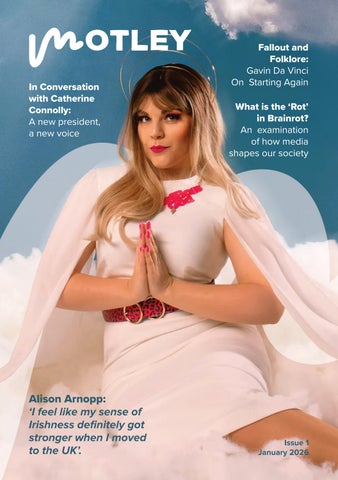
Motley Issue January 2026

Page 1


In Conversation with Catherine Connolly: A new president, a new voice

Alison Arnopp:

‘I feel like my sense of Irishness definitely got stronger when I moved

to the UK’.

Fallout and Folklore: Gavin Da Vinci On Starting Again

What is the ‘Rot’ in Brainrot?

An examination of how media shapes our society

Issue 1

January 2026

INSIDE MOTLEY

CONTENTS

CONTRIBUTORS

Editor: Paula Dennan motleyeditor@ucc.ie

Deputy Editor: Cleo Morrison O’Riordan motleydeputyeditor@ucc.ie

Current Affairs and Investigations

Stepan Krykun

Oisín Bailey motleycurrentaffairs@ucc.ie

Features and Opinions

Nefeli Pyrovolaki

Claire Dineen motleyfeatures@ucc.ie

Arts and Culture

Roisin Connolly

Nermeen Ileiwat motleyartsculture@ucc.ie

Music Editor

Ray Burke motleymusic@ucc.ie

Events Guide Editor

Gemma Sadler motleyentertainment@ucc.ie

Designer: Sara Troisi

Copy Editor: Kate Holohan

Website Manager: David Lesiak

Social Media Manager: Leah Hurley

For advertising or sponsorship queries email: rayburke@ucc.ie

Fallout and Folklore: GavinDaVinci On Starting Again. 03 09 19 25

CURRENT AFFAIRS AND INVESTIGATIONS

In conversation with Catherine Connolly: A new president, a new voice.

FEATURES AND OPINION

Alison Arnopp: ‘I feel like my sense of Irishness definitely got stronger when I moved to the UK’.

ARTS AND CULTURE

Nesting by Roisín O’donnell: A poignant novel that confronts issues that many people would prefer remain hidden.

MUSIC

EDITOR’S LETTER MOTLEY IS CORK

Welcome to the new look Motley, Cork’s student-led arts, culture, music and current affairs magazine for readers in college and beyond. We’ve been hard at work behind the scenes on this refreshed vision for Motley. A vision that reflects the dynamic spirit of the vibrant student life in Cork, delivered by the diverse voices of student writers.

Returning readers and contributors will have noticed a shift; we’ve moved away from themed issues. This isn’t a dismissal of the past, but rather an evolution. It is a recognition that the world, and the student experience, cannot be neatly packaged into a single theme. Motley aims to bring an urgently needed student perspective to the issues that matter to everyone on campus, in Cork and beyond. Motley is about engaging with society on our own terms, asking the uncomfortable questions and giving voice to the often-unheard and underrepresented.

While we have moved away from themed issues, you will still find interconnected threads throughout our November edition. Cleo Morrison O’Riordan, Motley’s deputy editor, interviews Catherine Connolly during the final days of the campaign about Connolly’s hopes for the presidency and her aspirations for young people in Ireland. Harry McGuire reports from the Cork North-Central and Cork

South-Central count centre at Nemo Rangers GAA Club, speaking to politicians, cam paigners and volunteers about whether the election of Presi dent Connolly marks the begin ning of a left-wing alliance be tween the parties that supported her election campaign.

Ben O’Sullivan writes about connection in the digital age, and why being in constant contact with people through messages and social media isn’t necessarily the antidote to loneliness. While Adam Murphy examines how media shapes our society, asking ‘What is the ‘Rot’ in Brainrot?’

I speak with performer and writer Alison Arnopp to gain insight into her career, living with ADHD, living in the UK and her time studying at UCC. Ray Burke, Motley’s music editor, speaks to GavinDaVinci about faith, fallout and finding a way forward. Roisin Connolly, Motley’s arts and culture editor, writes about the enduring allure of a cult-classic in their review of the Halloween screening at The Pav of The Rocky Horror Picture Show with a shadow cast performed by drag family Mockie Ah. In a creative twist, Kitchen Interior by Lucy Olsman is a flash fiction story inspired by the David Teniers II of the same name.

For the music lovers, Ruthi Hennessy reviews ADÉLA’s EP The Provocateur. Ray Burke

Shannon Big Band with Steve Earle gig at Milk Market, Limerick.

Rounding out our arts, culture, and music coverage, Gemma Sadler, Motley’s events guide editor, previews a selection of Cork’s upcoming exhibitions, events, and gigs.

Motley is and always will be a student-led publication informed by the voices of our student contributors. Whether it’s a breaking campus story, a must-listen new album from your favourite artist, or a deep dive into Cork’s thriving literary scene, Motley values hearing from you about the issues most important to you.

Our editorial team is open to pitches from students, so send your article ideas their way: Current Affairs and Investigations motelycurrentaffairs@ucc. ie; Features and Opinion motleyfeatures@ucc.ie; Arts and Culture motleyartsculture@ucc. ie; Music motleymusic@ucc.ie; Event Guide motleyentertainment@ucc.ie.

Editor

IN CONVERSATION WITH CATHERINE CONNOLLY: A NEW PRESIDENT, A NEW VOICE

Summarising such a turbulent election cycle defined by shocking moments like the early withdrawal of Fianna Fáil nominee Jim Gavin, revelations regarding the candidates and claims of smear tactics is no easy task. Yet, the electric atmosphere that Catherine Connolly and her campaign produced speaks for itself, making the only summation necessary a word of commendation to Ireland’s tenth president.

Despite Catherine Connolly appearing at first as an independent underdog, she became the first candidate to gain the nominations of 20 members of the Oireachtas. Connolly’s campaign went from strength to strength and led the opinion polls into the final week of campaigning at 55% to Humphreys 45%. Although the election was ultimately characterised by low voter turnout and over 200,000 spoiled votes, Catherine’s appeal is shown through her obtaining almost 63% of first preference votes.

In an interview with Catherine Connolly, obtained in the final days of the presidential campaign, we gained some insight into Connolly’s hopes for the future and the presidency.

Q: As a fierce advocate for

young people and the struggles that we are facing in Ireland currently, what are your aspirations for the youth in an Ireland with Catherine Connolly as President?

A: Ireland’s young people deserve to live in a society that values fairness, creativity, and the right to build a future here. The Presidency cannot make policy, but it can listen, connect, and keep young people’s realities in view - from housing and education to mental health and climate justice. I would use the office to highlight youth voices, celebrate participation, and encourage leadership grounded in compassion, courage, and curiosity.

Q: Recently in an interview you said that your father had given you the ability to “see [issues] from both sides” early in your life. Do you feel that this ability is something that is currently lacking in a seemingly divided Irish society?

A: My father taught me to look for truth in more than one place. That capacity to listen and understand another’s position, without necessarily agreeing, is something our public life needs. We can disagree without contempt. As President, I would use the independence of the office

“That capacity to listen and understand another’s position, without necessarily agreeing, is something our public life needs.”

to bring a steady tone to our national conversation and to create space for respectful dialogue.

Q: As a powerful Gaeilgeoir and a fierce advocate for the Irish language, what role do you see yourself, as President, playing in the promotion of Gaeilge and securing the language as a cornerstone of Irish culture and society?

A: The Irish language belongs to all of us, wherever we live. It carries our history, our humour, and our way of seeing the world. I am committed to make the Irish language a central pillar of my Presidency. I have launched a Presidential initiative, Teanga na hÉireann – A Nation’s Living Voice, bringing Gaeltacht and Gaeltacht communities, schools, and artists together to celebrate Irish as a living language. The President cannot legislate, but the office can open doors, con-

vene partners, and champion Irish in homes, workplaces, and public life.

Q: You’ve stated you want to act as a voice for those who have been silenced; from the Palestinian people to carers, people living with disabilities, and those currently without homes. How would you want to use your role as President to advocate for meaningful representation and change for those most vulnerable in society?

A: The Presidency should never be remote from people’s lives. It should reflect the voices that are too often unheard - from carers and disabled people to families without secure housing, and from communities in Ireland to those seeking justice interna tionally, including the Palestinian people. I would use the soft pow er of the Presidency to highlight human dignity, fair treatment, and our shared responsibility to care for one another.

Q: As Ireland’s third female President, do you find inspira tion in the presidencies of Mary Robinson and Mary McAleese?

A: I deeply admire both Mary Robinson and Mary McAleese. Each brought courage, intellect, and moral clarity to the Pres idency in her own way. I would hope to continue that tradition while heralding a new chapter in our country, by listening widely, speaking clearly, and grounding leadership in empathy and integ rity.

Q: You’ve trained as both a barrister and a clinical psychol ogist - you’re not a stranger to the classroom; in a few words, what advice would you give to Irish students?

A: Stay curious, stay ques

tioning, and stay kind. Keep learning in every direction, and never let cynicism take the place of courage.

In a world increasingly dominated by populist leaders who seek to undermine global strength and unity, Catherine Connolly serves as a beacon of hope, showcasing how a leader should use their voice for uplifting all of their people. Catherine has served the people of Ireland for the past 26 years, since getting elected to Galway City Council in 1999, Connolly has served as Mayor of Galway, an Independent TD and Leas-Che

“Connolly serves as a beacon of hope, showcasing how a leader should use their voice for uplifting all of their people.”

FROM THE COUNT CENTRE:

HOW THE ELECTION OF PRESIDENT CONNOLLY UNFOLDED IN CORK CITY

The atmosphere of an election is often tense: as the elimination continues, candidates are often described as “fighting for their seats” in a gruellingly drawnout, even by international standards, counting process. Then, on the final count, when your candidate knows they are home and housed; that they now have a noble job as a politician and that they have not become unexpectedly unemployed - it is an out-of-body feeling one only gets a few times in their life. One could compare the feeling to Cork winning the All-Ireland. This time, though, the election count could not have been more boring.

Initial tallying began at 9 o’clock in Nemo Rangers GAA Club, and within 15 minutes of ballot boxes being opened with wire cutters, the election could have been called. Any prayers that Fine Gael would have had of opinion polls being wrong by 19% of middle Ireland having an epiphany in the ballot booth were dashed. Close to every tally in Cork North Central and Cork South Central had Catherine Connolly leading Heather Humphreys, with most by a twoto-three margin for Connolly, but on a few tally sheets it was closer to 60-to-40 in favour of the Galwegian.

“It is an out-ofbody feeling one only gets a few times in their life. One could compare the feeling to Cork winning the All-Ireland.”

The number of spoiled votes was 13%: much higher and more seismic than the 6% figures anticipated in polling. Most spoiled

ballots I saw in the count centre had the conservative barrister Maria Steen written in as a preference, and one even had Bertie Ahern written in over Jim Gavin; others were scribbled on with markers, usually accompanied by slogans. Many mentioned none of the candidates being worthy, some mentioned “she was just ten years old”, seemingly in reference to a ten-yearold who was allegedly sexually assaulted near an IPAS centre in Dublin, as reported by RTÉ in the days leading up to the election. Some contained racially charged sentiments.

Jim O’Mahony, a volunteer for the count centre I interviewed, believed that the spoiled votes did not necessarily make the counting process more difficult, as some had predicted. “There were some comments there that were pretty unsavoury. But people vented out their anger certainly in their votes,” he said. I asked him if he thought any different about people spoiling their vote now. “It’s a difficult one. I have a daughter, and she was saying she knew a number of her friends who were in [their]

late twenties. They were going to spoil their votes ... Whether you want to protest vote or not, we have a democratic right ... My thoughts haven’t changed on that.”

It seemed to me earlier in the day, while interviewing the public, that turnout would be at a record low, and I mistakenly asked my questions presuming it would go down, while it slightly increased to 45.8%. This would have decreased if those who had presumably voted for Jim Gavin in protest, and those who spoiled their ballots, had decided to stay home instead. As pointed out by Hugh Linehan in the Irish Times Politics Podcast, this shows a concentrated anger rather than apathy at the political system. Dr Kevin Cunningham, lecturer in politics at TU Dublin, states in his Substack newsletter that those who spoiled their votes seem engaged in the political system.

With the anger of voters in mind, I asked various politicians if they still thought Catherine Connolly was leading a movement. “There is a certain level of anger out there”, says Cllr Niamh O’Connor from the Social Democrats on those who decided to spoil their vote. On the nomination process, Cllr O’Connor’s colleague, Cork South-Central TD Pádraig Rice stated, “I think the spoiled vote is an expression of people who wanted more political choice. I support greater political choice. We nominated Catherine Connolly, but it was open to others in the Oireachtas and at local authorities’ level to nominate other candidates. They choose not to.”

The questions surrounding

the nomination process seem particularly pertinent following this election. On whether the system should be reformed, Deputy Rice went on to say, “I don’t think so, I’d be conservative on that issue. You can get up to 18 candidates on the current system if all Oireachtas members nominate people.” Fine Gael TD for Cork North-Central Colm Burke was also sceptical about this: “I think we’ve got to trust the people we elect.” I asked Deputy Burke for comment on the fact that Fine Gael councillors had the party whip imposed on them so they could not facilitate the nomination of another candidate, he believes “I think there’s checks and balances there in relation to local authorities. There’s over 900 local authority members, they have a freedom to decide who they can select and that should be allowed to happen.”

Whether this campaign is a breakthrough moment for the left remains to be seen, as pointed out by Labour Senator Laura Harmon: “presidential elections often don’t reflect the results of the next general election. The last time Fine Gael fielded a candidate before this one they got 6% and they’ve been in government ever since. So, we need to bear that in mind.” Harmon is correct in this, there seems to be a clear trend going back to the 1990s where the same voters who elect a right-of-centre government, elect a left-wing president.

I spoke to people in the count centre, and it did feel as though the parties that supported Connolly were united and weren’t just playing this up. Most people inside the count centre, as well

Photo: Harry McGuire

Current Affairs and Investigations

as those doing the tallying, were from the Connolly campaign. Those who came to support Connolly and help tally were more identifiable compared to those who voted otherwise, with most adorned with Catherine Connolly merchandise, such as stickers and shirts. Not a single Heather Humphreys sticker or banner was present. The few Fine Gaelers present left quickly once the extent of the tallies became clear, another notable absence was An Taoiseach Micheál Martin who has featured so prominently here in the past.

Local TD Donnchadh Ó Laoghaire had stated to me that Sinn Féin will run their own candidate in the by-election, while representatives from other parties believed it was too early to decide. Where the future of the movement that Connolly created goes from here remains to be seen, this news and everyone I spoke to seemed to pour cold water over the idea of a unified candidate to fill Catherine Connolly’s seat in Galway West. I asked former UCC student and Catherine Connolly campaign director for Cork, Luke O’Gorman, if the coalition should be closer-knit by selecting their candidates together for the next general election, “in an ideal world, that would be brilliant. There’d be better vote sharing and transfers and things like that. But it remains to be seen if that will actually happen.”

The treatment of this election as a referendum on the government and current state of Irish politics seemed far-fetched before this election, but this is probably the most accurate description, given the scale of the

result. Pat Leahy, political editor of the Irish Times writing just before the result on the likely margin of victory, stated that if “the two government parties and their leaders aren’t worried about this, they’re sticking their heads in the sand”. But the grievances at play in this election were multitudinous. Previously, the Irish left has been able to put together coalitions on narrow non-materialist issues that disintegrate once those issues are resolved. We’ve seen it before on abortion, same-sex marriage,

“If the two government parties and their leaders aren’t worried about this, they’re sticking their heads in the sand.”

and the Dáil speaking rights row. What makes Catherine Connolly’s election any different remains to be seen.

In their analysis of Fine Gael’s poor result, Burke and Minister of State Jerry Buttimer TD both noted that Mairead McGuinness was the party’s first choice, with Fine Gael having little time to replace her. Humphreys didn’t avow her Protestant heritage which seemed like the quality that would have got her elected given support for a united Ireland is increasing based on polling done for the ARINS: Analysing and Researching Ireland

Words: Harry McGuire

North and South Project. When first asked by John Lee for the Mail on Sunday whether her husband Eric was a member of the Orange Order, Humphreys denied it, before having to backtrack stating that he was a member over 50 years ago, as well as trying to downplay his involvement with Orange marches. It is also worth noting the sectarian abuse which Humphreys spoke about to RTÉ from the count centre for the Cavan-Monaghan constituency. Fontaines D.C.’s bassist Conor Deegan stated that she was the “candidate of the mind colonised by Britain”, as reported by Hot Press magazine.

This appears to be one of the first non-referendum elections where official Ireland lost: Catherine Connolly gave no blandishments to Irish-Times-reading, Newstalk-listening, centrist dads. It can be argued that this election foreshadows a worrying future for our media. The revelation of “Yatesgate”, where Ivan Yates participated as a political commentator despite working for Fianna Fáil and Jim Gavin in the past. This scandal has raised the nature of conflicts of interest in Irish media,with Yates to appear before an Oireachtas committee.

This was not a “democratic revolution” to use Enda Kenny’s term to describe the 2011 election, in which voters punished Fianna Fáil for leading a country to financial ruin. Irish politics has existed in a sustained state of uncertainty since that election according to Professor R. Kenneth Carty from the University of British Columbia. No one really knows what the future of poli-

tics is in this country. Every one I talked to at the count centre has yet to state what exactly further co-operation means for the left. Holly Cairns and Ivana Bacik, leader of the Social Democrats and the Labour Party respectively, are still calling for voters to “vote left transfer left”. Which most people who vote for these parties already do, according to an analysis of the 2024 general election conducted by Stefan Müller, an Associate Professor at UCD, for RTÉ. Fianna Fáil and Fine Gael are having internal reviews into their performances and candidate selection processes.

If there is any issue to divide this newfound left-wing alliance, it is immigration. Dr Rory Costello, an Associate Professor in political science at the University of Limerick outlined last year how Sinn Féin alienated their supporters, on both the left and the right of the party, by not changing their policy on immigration. The party has remained strategically ambiguous on what their views are on the issue, given that the results of the 2024 National Election and Democracy Study indicate that this is one of the main reasons they did not win the last general election. The Social Democrats, People Before Profit, and the Labour Party quicker to point out the positives of Ireland’s immigration system and have not changed their policies much over the last two years, when compared to

“I support greater political choice.”
- Pádraig Rice.

Sinn Féin.

The next general election is still likely a few years away and until then it is hard to determine how important Connolly’s victory is in uniting the left. In the interviews I conducted, all the parties wanted to stress how they are all not the same and have differences with each other. It remains to be seen how political Catherine Connolly will be as President and how often she speaks out against issues of importance to her. The people I spoke with definitely agree that she will pick up the activist mantle laid down by

Michael D. Higgins, with Deputy Rice saying he has “no doubts Catherine Connolly will expand the role within the confines of the constitution”. The two government TDs I spoke with did not seem worried about Connolly’s election, both seemed to suggest it was a good day for Ireland whichever way you voted. Wishing her well, Deputy Buttimer said “she deserves and will have our full support, and I hope she will [have] a successful tenure as president.”

Harry McGuire interviewing Social Democrats TD for Cork South-Central, Pádraig Rice.

ALISON ARNOPP:

‘I FEEL LIKE MY SENSE OF IRISHNESS DEFINITELY GOT STRONGER WHEN I MOVED TO THE UK’

Motley’s Editor, Paula Dennan, sat down with performer and writer Alison Arnopp to discuss her acting, singing, and writing career.

Bandon-born performer, writer, and University College Cork alumna Alison Arnopp is currently on tour in the United States as Roly Poly Bird in Roald Dahl’s : The Enormous Crocodile The Musical. Arnopp took time out between shows to speak with Paula Dennan about her career, studying at UCC, living in the UK, and how she balances writing with performing and living with ADHD.

As one of only five performers in The Enormous Crocodile The Musical, a musical adaptation of Roald Dahl’s classic novel, Alison Arnopp describes the hour-long show as “a fast hour,” where the cast are “on and off the stage, swapping out puppets, swapping out costumes pretty much non-stop.”

Arnopp is a seasoned cabaret performer and a voice-over artist for TV shows, adverts, and video games. In 2024, Arnopp hosted Summer Revels, a musical theatre show at the Cork

Opera House. Arnopp’s career includes performing on stage as Dusty Springfield in the musical biography, Dusty, touring with the all-woman musical ensemble group Celtic Woman, and voicing the character of Coral on the Sky Kids TV show, Emerald. She has also performed in Les Liaisons Dangereuses at the National Theatre in London, The Tempest at the Royal Shakespeare Theatre, and the 50th anniversary tour of Hair.

Although she has been in shows that have featured puppets, The Enormous Crocodile The Musical is Arnopp’s first time working with puppets herself. “We had a puppet audition,” she says. The puppets are used in different ways throughout the show, which adds to the physicality, a process Arnopp describes as being “a lot more like learning choreography than I thought it would be.” She explains, “Some of them are like the traditional way where the puppeteer looks at the puppet and their focus is only on the puppet and speaks through the puppet. One is when we are kind of in the puppet. The bigger costumes where both the actor’s face and the puppet’s head are kind of supposed to be the same, so we’re looking outwards. We’re still being very expressive, but so is the puppet. And then there’s a third one, which is we’re not, we’re not really able to say, but it is again a very different way of moving the body and stuff like that.”

“Probably not all puppet shows are like this [...] the sound cues are tied to the movement cues are tied to the puppets. It’s all very kind of structured, which

I quite like,” she says.

While the performance is structured, Arnopp says that it is also really fun and brings in her voice work skills. “I love doing voices like I do a lot of voice work anyway, so it was really fun to just play with that,” she states. “It’s very playful. All of a sudden, you tilt the head in one direction that you’ve not found before, and it makes the line funnier.”

“All of a sudden, you tilt the head in one direction that you’ve not found before, and it makes the line funnier.”

Arnopp completed a BA in Drama and Theatre Studies with Music, now known as Theatre & Performance Practices, at University College Cork, before studying at a postgraduate level in London. Initially, she studied opera at the Royal College of Music before switching to musical theatre at the Royal Academy of Music.

The fact that Drama and Theatre Studies was a theatre studies degree rather than an acting degree provided an opportunity for Arnopp to figure out where her interests lay and “go on and learn about that further.” This foundational drama and theatre studies practice served Arnopp well: “Stuff that I learned in my first year of undergrad was actually stuff that probably people would have learned for their GCSEs or their A-levels,” she

explains. “It was good to have that kind of academic foundation when coming over because we didn’t have that access in school.” Drama, Film and Theatre Studies has been introduced as a Leaving Certificate subject starting in September of this year.

“I loved my time at UCC,” Arnopp says. “I really enjoyed having an academic degree because it meant that I could find myself socially. I got involved in the radio station and Dramat [...] which I wouldn’t have done if I’d always been performing.”

Arnopp felt that the structure of the Drama and Theatre Studies degree provided the time and space for learning which parts of the industry appeal the most; “I’ve changed direction even within the sphere of performing and the arts and stuff, you can still find lots of different ways to go,” she says.

While she lives in England with her husband, Arnopp’s connection to Ireland, particularly Cork, remains strong. “I have a lot of art that my mum or my sisters, or my friends have gifted from Ireland,” she says. “I have one painting that’s like a portrait of an Irish childhood, and it’s like on the beach with Taytos and Barry’s tea.”

Speaking about fostering a sense of community and connection when living abroad, Arnopp says, “I have a lot of friends in London and around the UK that are Irish. And so, you know, there are some things that only they will understand. I remember when I first moved over, my housemate, who was English, was like, ‘Oh, I mean, you’re the same. It’s basically the same

Features and Opinions

like you speak English. We’re the same.’ And I was like, no, like, culturally it feels very, very different [...] It’s very important to me to hold on to that culture because I do feel like it’s such a gift and a strong culture, and it is very distinct to being English or British or living in the United Kingdom. And I feel like my sense of Irishness definitely got stronger when I moved to the UK because growing up, my dad was Protestant, my mum was Catholic,” she continues.

Arnopp grew up Catholic, but had an understanding of “the tension and the differences that meant in Ireland.” She describes her experience of moving to the UK as realising that she was “just an Irish person to these people.” Arnopp says, “It’s very important that I hold on to that even though I didn’t grow up playing Gaelic football or anything like that, but [...] I can speak Irish.”

“It’s very important to me to hold on to that culture because I do feel like it’s such a gift and a strong culture, and it is very distinct to being English or British or living in the United Kingdom.”

Speaking about how she finds time for writing alongside performing and touring, Arnopp says, “Those writing projects I started developing when I wasn’t acting because I was like, right, I’m bored. Let’s do something. And then it gets traction, and then all of a sudden a job comes in, and you’re like, OK, so I have those three things due like the same week.”

Having been diagnosed as an adult with ADHD, Arnopp discusses how this impacts her ability to work on multiple projects simultaneously, “I was late diagnosed with ADHD [...] so this year what I’ve been trying to do is actually have a support worker, which is basically a personal assistant [...] having someone help me manage my time and my diary and actually just learn like that’s a skill that I wish maybe I’d learnt sooner is just organisational processes.

How to manage my time, how to prioritise, how to prevent burnout, because that is a cycle I get trapped in, is like loads of new ideas, loads of projects, do them all. Oh no, the time is like they’ve all conflated at the same time. And then I’m exhausted for a month and a half. And I’m like, I can’t do anything. So the answer is not very well. I don’t manage my time very well, but I am working on it and trying.”

Most recently, her one-woman show Girl Boss God: A WIP (Woman in Progress) appeared at the Camden Fringe, and she has co-written Robin Hood for the Horsham Panto with her creative partner, James Camp.

Girl Boss God, a show where Arnopp uses modern celebrity culture and reality TV to process her religious trauma, was an idea she had for years before she began writing it. “My one-woman show, you know, that was some-

thing I wanted to do for probably a decade. It’s something that I actually started doing, I’m going to say like three or four years ago off the back of a drag and cabaret lab that I did,” she says. However, writing was placed on the back burner while her dad’s illness, which he passed away from last year, and performing work became her focus.

“I kept being like, I’m writing a show. I’m writing a show. I was not writing a show. I was telling people I was writing a show, and I knew that I would, and I wanted to, but it was when I had a date in the diary this year that I was like, OK, people are coming to the show. I have to now write the show. And even the week before, I was like, oh, I really have to write the show now. Yeah, I just put a deadline in. I think that’s my best thing. It’s just you have to put a deadline in that you will be punished for.”

Photos: Danny Kaan

Words: Ben O’Sullivan

CONNECTION IN THE DIGITAL AGE SO CLOSE, YET SO FAR

It’s 1 am, I am scrolling after a full day of chatting and being surrounded by friends and I still feel like something is missing. Like I have not been seen, like I have not been heard. I do not know exactly what I am looking for or hoping to see, but I know I have not found it yet. Maybe a snap here, a comment there and a text sent to the same people I saw only hours previously, but whom I feel as if I have not seen in days. As time passes, as more texts and snaps become unopened, I wander onto videos trying to feel seen by a person that does not even know I exist and heard by people in the comments who will forget about my comment in no time at all.

Social Psychologist, Jonathan Haidt, stated in his book The Anxious Generation, we live in the “most connected era” in human history. Not even 150 years ago, the thing that we hold in our hands every day, the lifeline to the crowd that we seek to entertain and please, had not even been invented and now we run to the phone in our pockets. You all have one and have probably even felt its hum while reading this. An amazing tool we cannot live without, one that many of us cannot imagine our lives without. People who live on the other side of the world, people you never could have known ex-

isted, let alone understand, can now be connected in a few taps. This has allowed us to feel more connected to the entire world and allowed us to feel part of something even our parents would not have had the privilege to experience. However, this has led to an unintended outcome that I am sure you have felt at times, emotional dilution. Robin Dunbar, an Evolutionary Psychologist , once said that we can maintain around 150 meaningful relationships at once. That num-

“Our friendships become mediated performances, acted out through screens.

ber is considered a large amount and almost impossible to reach for the generation before us. On social media, that number becomes the number of a small Instagram or TikTok account. With numbers like these, it is no wonder we are the most connected people in history – but do you truly feel it?

We keep up with everyone superficially, but know no one deeply. We see birthdays through Snapchat reminders,

empathise through emoji reactions and grieve through disappearing stories. Our friendships become mediated performances, acted out through screens.

Think of the last time you were in an uncomfortable situation, whether it was sitting down in a coffee shop waiting for someone or getting onto an elevator with faces you don’t recognise. I am willing to bet the first thing you went to was your phone. Whilst grabbing for it, you probably did not even know what you were going to pull up, messages you have read already or replying to messages you waited, until now, to answer. How can it be that we are so connected to everyone in the world, but the person beside us seems out of reach? Real people, real-life conversations are becoming rarer and rarer, an Ipsos study even found that in-person interaction is down 53 % already in the last ten years. The internet isolates us from those around us. As a 2024 German study published in PLOS One found, when face to face interaction decreases, social media use and loneliness both increase. In real life, you do not know who they are, what they think, what they like. You cannot check a profile for this information and that is scary to us. Not knowing anything about someone has become a barrier, not an

incentive. How can it be that we are the most educated generation, the most curious and most understanding, yet many fear new people not even a town or city away? It is because we are used to talking to people that cannot see our faces, people whom if we do not get along with after one click of the button become a distant memory. However, here the stakes are raised so that no such thing as a block button exists in person. You might see this person again. The stakes are too high, so we retreat to what we do know.

The loneliness we feel nowadays is clear. People cannot be alone anymore. Silence feels heavier than it used to. We try to fill it instantly with noise, the voices from podcasts, the laughter from strangers on TikTok or hearing about the day of vloggers we do not even know but somehow feel connected to. It’s strange, isn’t it? Technology has led to this situation where being alone for even a moment feels like failure. Recent polling by the UK’s Office of National Statistics shows that young adults are particularly affected, 37% of people aged 16-29 say they feel lonely ‘often or always or some of the time’, compared to 26% of all adults.

But no number of messages, likes, or snaps can replace what it feels like to be with someone in person. Real interaction has a texture that can’t be replicated through a screen. The small pauses between words, the smile that comforts you to keep talking, the way laughter fills a space and the comfort of knowing someone is actually there. This is what social media

takes away from us: living in the moment, so you can’t edit your thoughts or filter your expressions, not overthinking a message before you send and not worrying about whether someone is busy or ignoring you. You just exist together, imperfect and human. Social media has led us all to believe that we are something to be fixed, filtered, or hidden, when in reality, that’s what makes us real.

So, the next time you find yourself scrolling, maybe pause. Look up. The world won’t stop without you, but you might notice something worth staying for. Whether it be a stranger’s smile, a quiet street, a thought you’ve never had before, or someone you notice from afar, someone you have not seen in a while. Connection is not about being in contact with someone 24/7, sometimes it is about being fully present in the rare moments you actually are.

“The small pauses between words, the smile that comforts you to keep talking, the way laughter fills a space and the comfort of knowing someone is actually there.”

Features and Opinions

Words: Adam Murphy

WHAT IS THE ‘ROT’ IN BRAINROT? AN EXAMINATION OF HOW MEDIA SHAPES OUR SOCIETY

There was an article written on RTÉ recently about “Italian brainrot”, and whether we should be concerned about kids watching it. They focused mainly on the actual things being said but what I felt they missed is the true root, the rot in the brainrot. Brainrot is loosely defined as the feeling of numbness, the dulling of the mind achieved by watching meaningless content. Although if the content is meaningless, how can it have an effect on us? Surely content without a message is neutral, nothing important is said, so no harm done. If that is the case, what part is the brainrot? There are other absurd forms of media that aren’t considered brainrot. Paintings by Salvador Dali or Waiting for Godot by Samuel Beckett, for example. Neither have any meaning, apart from the one we project onto it, and yet they are considered high art. So, why is the message different? Where does the rot come from? The medium itself has a major part to play in this.

‘The medium is the message’ is a term you may have

heard. Coined by Marshall McLuhan, author of Understanding Media: The Extensions of Man, it posits that the way in which something is communicated is more important than the content itself. For example, writing promotes linearity. There is a start and an end, things are built on what comes before it. Television mixes things up considerably; in TV, every shot is fleeting, an image appears and is then gone. There is no time for slow analytical thought, you get a series of images and are passive to how they come and go on screen. This can be very good at keeping you occupied, entertained even, but the sacrifice is obvious. You are no longer an active participant in the medium. The medium, simply by being used, promotes this form of thinking. It implies that your attention and entertainment are the most important things in communication. TV debates are less about politics and more about the people on the podium, because politics is boring but people can be captivating. It primes us to believe that what is important is what is

“We swallow the pill of tv, tacitly learning that this is how things should be.”

entertaining, simple, and fleeting. That is the message being conveyed no matter what content is on screen. In this way the medium itself is the message, especially because we do not realise it is one. Of course, the content still exists, but in McLuhan’s eyes it is the piece of meat you wrap around the pill so you can get your dog to swallow it, hiding your true intention. We swallow the pill of TV, tacitly learning that this is how things should be.

Once we have learned the language of entertainment, we become perfect commercial assets. We must remember that TV is made for profit. For them what is good is what keeps people watching and so entertainment is paramount, pleasure is king. Boredom, or even neutrality, is

not good for business and must be avoided at all times. It thus follows that they will proliferate entertainment in everything they do. It is not enough to have a news show, you must have a news show that keeps people entertained, keeps them watching. We now expect the news to be entertaining, the next car crash, the next murder, the next war. Scaremongering is a good tactic, it almost guarantees repeat viewers. Even episode cliffhangers and well-timed ad breaks are a tool to keep you watching because if you stop, they can’t profit off you.

Television is a visual medium. This is not a unique feature, a face to face conversation is visual, but importantly you are an active participant in a conversation. The same cannot be said for television and so the visual aspect becomes the importance of appearance. The truth is irrelevant; it is only what appears to be true that is important. Even then, it is what might possibly be true or what we hope to be true.

Consume is a very fitting way of describing our relationship with TV. We do not play a part in the creation of the media. It is not a conversation. We sit back and consume it, internalising it without fully realising. This is how things, like propaganda, can become so effective. When a medium of communication is one sided, naturally a biased form of communication is reached. Only one party has a platform, the one invested in keeping our attention. In this case, the propaganda is that everything should be entertaining, easy to consume, not real.

Many of these aspects carry

over from TV to social media and to short form content. Short form content like TikTok or Reels is especially good at keeping us passive and entertained. We cannot choose our For You page, we are not even given the liberty to pick the content we wish to consume. The algorithm allows us to vote with engagement and attention. We become the product. We scroll and scroll through the never-ending videos, forgetting

“The medium is the message. What message does this form of media tell us? What is good is what keeps you watching, not depth, truth or coherence.”

them as soon as they leave the screen. Just as above, where TV fights to keep us watching, TikTok needs to keep us scrolling. Where it succeeds more than TV is in the fact that there is an infinite amount of content to be consumed. On TV - shows end, on TikTok - there is no end. Each packet of entertainment is unrelated and so you keep scrolling. There is no chance of boredom, it achieves almost perfection in keeping you placid and entertained.

The medium is the message. What message does this form of media tell us? What is good is what keeps you watching, not

depth, truth or coherence. In fact, coherence is almost always something you want to avoid because if you can understand something, you do not need to keep watching. This is the thesis of brainrot. It doesn’t make sense because if it did, it would not exist. Depth is impossible when the content is so short, and the medium conditions the users not to be interested in longer content. Why watch a five-minute video when I can watch thirty ten second ones and not waste any energy actually thinking? Just like coherence, truth is best avoided. Emotional and sensational hooks keep people engaged and, as the saying goes, never let the truth get in the way of a good story. It feels cliché to warn about the dangers of short form content but it is a conclusion unavoidable at this point. When the primary media consumed by young people these days is one that seems to dissuade us from critical thinking it is difficult to be optimistic about our future. Neil Postman, in his book “Amusing Ourselves to Death: Public Discourse in the Age of Showbusiness” warned of a time where the truth becomes secondary to entertainment. Marshall McLuhan wrote about the medium being the message in 1964. Both wrote about these issues before the internet existed, where these problems can build on each other to create a perfect storm of brainrot.

What would they think about the world today? We have had so many warnings, even within the media itself, though usually through forms that promote deeper thinking such as movies or books. Wall-E, Brave New

Features and Opinions

“We consume media to be passive, and are taught to be passive by the media we consume.”

World, and The Truman Show all give us a glimpse of the world we now live in where we consume media to be passive, and are taught to be passive by the media we consume, and yet, here we are.

To return to my opening question, what, exactly, separates brainrot from Dali or absurdist literature? It is the medium. Art and theatre encourage longer attention, depth and critical engagement with the media. For them, meaninglessness is used as a mirror to reflect yourself upon. When reading Waiting for Godot it was impossible not to see the illogical and stupid decisions I make reflected in the actions of the characters. This is impossible in short form content. The medium prohibits it. The medium is the message, and the message is that reflection is not entertaining and therefore not good.

It is difficult to end this optimistically. We seem to have been heading this way for years, with no signs of stopping. But after all, why would we want to? Entertainment is pleasurable. A life of pleasure is a life well lived. Without brainrot we have nothing to quiet our mind, stop us from thinking. After all, boredom is the enemy. A medium is a tool for us to use to stay entertained. The medium itself has no agenda. Right?

PR: radio@ucc.ie, Volunteer: radio.tech@ucc.ie, New Music: newmusic98.3FM@ucc.ie.

Arts and Culture NESTING BY ROISÍN O’DONNELL

Nesting is a complex and compelling story, but it isn’t simply an ‘issues’ novel.

Published in January 2025, Roisín O’Donnell’s debut novel Nesting won the Irish Book Awards: Novel of the Year in November. The novel, which focuses on the aftermath of Ciara Fay’s decision to take her children and leave her abusive husband, examines the intersection between domestic abuse and the Irish housing crisis, writes Motley Editor, Paula Dennan.

Opening with Ciara Fay and her family on a Dublin beach in the Spring of 2018, Roisín O’Donnell’s debut novel Nesting appears initially to be the story of a happy family making the most of an unseasonably warm, albeit windy, day. Within a few pages, however, Ciara decides to take her daughters, four-yearold Sophie and two-year-old Ella, pack up the car, and leave her husband Ryan. Ciara is pregnant with their third child and she refuses to “go through one of those pregnancies again.”

Ciara’s mother and sister live in the UK, so she has nowhere to stay when she leaves. With less than €200 in her bank account and some cash she managed to hide in a nappy bag, she books the cheapest B&B she can find in Dublin. It means spending almost half of what she has, but Ciara will not go back to the house,

despite Ryan’s phone calls and texts. While Ciara knows that leaving was the correct decision, her inner monologue tells her that she is overreacting and that she cannot trust her own mind. She is unable to continue paying for B&Bs, so she contacts Dublin’s homeless service and is given emergency accommodation at Hotel Eden.

This is where the novel’s strength lies; examining the intersection between domestic abuse and Ireland’s housing crisis. As we follow Ciara’s time living at Eden, we see the sheer determination and work it takes for people who are homeless to access the services they so desperately need and are entitled to. We catch glimpses into the lives of the other people who are staying or working at Eden - including Cathy and her children, who were transferred from a family hub to Eden, and Diego, one of the hotel’s cleaners. We see Ciara form friendships, develop a support network, and start teaching English as an additional language.

As the days become weeks, which become months, Ciara must contend with the family legal system alongside trying to find a place to live. Ryan continues to exert as much control over Ciara as he can, demanding that Sophie and Ella be with him since he can provide them a home. Coercive control didn’t

become a crime in Ireland until January 2019, when the Domestic Violence Act 2018 came into effect, so the term does not appear in Nesting. However, Ryan’s emotional abuse is made explicitly clear to the reader, even as Ciara wonders whether she is overreacting. Nesting is tense from the beginning, but O’Donnell expertly portrays the additional danger a woman faces once she leaves an abusive relationship. Readers are faced with a growing sense of dread when, in an attempt to present himself as a loving husband and father, Ryan rescues three nestlings from the garden and tries to nurse them back to health. Only one survives, but the captured crow is a gothic representation of Ciara’s experience.

About a quarter of the way through the novel, against the backdrop of TV coverage of the referendum campaign to repeal Ireland’s constitutional ban on abortion, Ciara realises that she has been cut off from politics. Whenever she expressed views that differed from Ryan’s, he would “explain at great length why she was wrong.” It is a realisation that leads to “the uneasy feeling of having lost track of her own mind.” Reading this, I thought of journalist Kylie Cheung’s 2023 non-fiction book Survivor Injustice: State-Sanctioned Abuse, Domestic Violence, and the Fight for Bodily

Autonomy. While Cheung’s work is US-focused, she documents the impact that domestic abuse has on a survivor’s ability to vote, including having their access to news and political information curtailed by their abuser. While this could be considered a minor detail, meant only to situate us in a specific time and place in the fight for reproductive rights in Ireland, it indicates the level of research O’Donnell conducted about how abusers enact coercive control over their victims. Yet it never feels that O’Donnell is simply sharing her research notes with the reader.

Ciara has been isolated from everyone by Ryan’s controlling behaviour, so she does not have a friend to ask for help. She does not know how to navigate the homeless services, domestic abuse supports and refuges, or the family legal system. On the first night she needed emergency accommodation, Ciara had to Google the phone number for the homeless services helpline. It was a nurse who gave her the name of the local women’s refuge during a post-natal checkup. She learns what to expect in court when Ryan seeks custody of the children from a solicitor at the Free Legal Advice Clinic. Cathy’s friend, Alex, also shares her experience with the courts after leaving an abusive relationship. O’Donnell weaves Ciara’s piecemeal gathering of this knowledge into the story in a way that reflects the situation many women escaping abusive relationships are in. Leaving is the first step; the work of ensuring they are not forced by their housing or financial circumstances to return follows.

O’Donnell punctuates the

heaviness that Nesting’s subject matter necessitates with moments of humour. Sometimes it is dark humour, such as when Cathy replies to Ciara’s insistence that Ryan didn’t hit her by saying, “Your husband didn’t hit you? Well that was very fuckin’ nice of him. Make sure you text and say thanks.” Other times, it’s more lighthearted. There is a scene in the solicitor’s office where Sophie asks whether the woman is going to give them a sticker, and Ciara says, “No, she’s not a doctor, love.” O’Donnell’s skill is evident during these moments. They feel natural and do not detract from the difficult situations Ciara finds herself in while trying to rebuild a life of safety for herself and her children.

While the novel takes place over the course of a year, there are times when the pacing feels rushed. Without giving too much away, there were scenes where I wondered, Wait, what? How did that happen so quickly? That said, the speed with which certain things happen could also be an accurate representation of people needing to be in the right place at the right time.

Nesting is a testament to everyone who has been failed by the systems – legal, housing, social care, and the State – which they assumed would protect them. O’Donnell tells a story of resilience without downplaying the lasting impact male violence has on women and children. Nesting is a poignant and compelling novel that confronts issues that many people would prefer remain hidden.

Nesting by Roisín O’Donnell is published by Scribner UK, an imprint of Simon & Schuster UK.

“This is where the novel’s strength lies; examining the intersection between domestic abuse and ireland’s housing crisis.”

Arts and Culture Words: Roisin Connolly

ROCKY HORROR PERFORMED WITH A SHADOW CAST OF DRAG QUEENS - THE WAY GOD INTENDED

While Rocky Horror Picture Show (1975) was originally met with mixed audience reception, it has since grown into a cult classic. Screenings of the film accompanied by shadow casts have become a phenomenon that has stood the test of time. This year marks the 50th anniversary of the movie’s release, and audiences around the world are still dressing up and going out to enjoy the wild and campy experience that is a live Rocky Horror showing. These evenings are a fun, raunchy activity for any time of year, but there is always a spike in performances around Halloween. This could be due to the Frankenstein-esque behaviour of alien/scientist Frank’n’furter, or simply, because there is some fantastic costume inspiration to be pulled from the movie’s cast of characters. Regardless of the reason, I was thrilled to hear that there was a Halloween Rocky Horror showing happening in Cork with a shadow cast performed by drag family Mockie Ah. Fellow editor, Nermeen, and I were lucky enough to snag tickets for the November 1st showing,

and spent the evening singing, shouting out callbacks, and ogling the costumes donned by the stunning Mockie Ah queens.

Mockie Ah is a drag haus formed in 2017. They have been performing around Ireland in a variety of forms since, from drag brunches to festival appearances to stage performances like this one. The queens were skilful and hilarious, each one a credit to the art of live performance. A struggle of any Rocky Horror showing with a shadow cast is figuring out where to look - your attention being pulled between the movie and the cast in front of the screen - but this was no contest. The drag queens were completely captivating, using their lip-syncing talents and expressive features to pull the audience in. One could almost forget there was a movie playing behind them. I frequently found myself spinning in my seat to follow a queen as she raced through the theatre, singing and interacting with audience members along the way.

Rocky Horror Picture Show is a cult classic film with evident relation to the LGBTQ+ community.

The movie contains cross-dressing and fluid sexual relationships, all wrapped up and presented in the form of a goofy musical. Creator Richard O’Brien, who stars in the movie as Riff-Raff, has spoken publicly about his own journey with gender exploration and his identification with the label of transgender. Having a shadow cast of drag queens was a pointed homage to the roots of the film and its importance within the LGBTQ+ community.

The joy in the performance space was palpable, despite and perhaps in direct retaliation to the assault of local Cork drag queens Krystal Queer and Lucina Schynning the week prior. Both queens were publicly attacked, in what the Irish Independent called an unprovoked attack, on Oliver Plunkett Street during Jazz Weekend. According to Lucina, Krystal and witnesses, the main motivation for the assault seemed to be simply that they were drag queens. Thankfully, both of the queens harmed have said that they will not allow this incident to stop them from being who they are and engaging in their art. In our current politi-

cal landscape that encourages rampant discrimination against queer individuals – particularly those outside of the gender binary – creating safe spaces for the LGBTQ+ community to come together and have fun is vitally important. This Rocky Horror performance was an opportunity for a vibrant celebration of unconventionality, and the Cork community seemed thrilled to welcome it.

The backdrop of the Pavilion theatre was the perfect location for this performance. The vaulted ceilings with golden accents lent an ambiance of elegance and class that juxtaposed beautifully with the lewd content of the show. If you’ve ever been to a drag show before you will know that they never start on time, but we didn’t mind at all. The bar in the theatre allowed attendees to grab a drink and socialise before the main event, enjoying the atmosphere and rowdy energy of antici… pation. When the queens did take to the stage, they warmed up the audience with cabaret performances and a pre-show costume contest. The best-dressed winner wore a frightening take on a Frank’n’furter costume, complete with SFX makeup.

Audience participation is a vital component of any Rocky Horror viewing, and the queens welcomed this tradition. The Usherette, played by Magenta Fox, performed the opening number of the film. Magenta sang live over the film – the only live singing of the evening unless you count the audience –utilising a powerhouse voice and adding her own callbacks into the performance over the mic.

Rocky Horror performances are usually an enjoyable affair, but the drag queens of Mockie Ah elevated this performance to another level. Supporting drag queens and queer artists is an important way to fight against the attempts to silence these marginalised groups. I would highly recommend keeping an eye on future events from Mockie Ah and marking your calendars for next October, to catch them in a reprise performance of this absurd musical. If you want to win the costume contest, you should start planning now.

and Culture FLASH FICTION: KITCHEN INTERIOR BY LUCY OLSMAN

Anna and I met when she was sixteen. I noticed her from across the square where the weekly Antwerp market was held. She was there with her father, a well-respected painter. Her brown, tight curls danced on her shoulders, and her cheeks were flushed by the cold wind of January. I fell in love with her immediately. While her father was inspecting the butcher’s meat, I seized my opportunity to talk to her.

We married one year later. She was the most beautiful girl in the city, and all of my friends were jealous. I showed her off like a precious crown jewel, proud to call her my wife. I promised her I would take good care of her and she believed me. I told her she’d never be short of anything. We lived together in a decent house in Antwerp and had eight children.

My love for her burned bright, but I began to neglect her. My paintings demanded much of my attention. I was gaining success, and more and more people came to me with requests to paint their kitchens or children. I painted with feverish passion and was often away from home.

Then, I was summoned to the court in Brussels. I was to paint for the archduke, which meant we could live comfortably for the

rest of our lives. I took my wife and children with me, and hired three new workers. My wife seemed happy with a change of scenery, but soon grew bored of Brussels. I still wasn’t home much and she struggled to find friends in such a big city. This was when I should have made a change, but I didn’t.

My wife grew ill. She barely spoke, and she always stared out of the window as if she was waiting for a better life to suddenly pass by. I didn’t know what was wrong, so I called for a doctor. He told me that my wife was suffering from melancholia. She had become terribly white, almost porcelain, and I worried about her.

One day, I had invited some friends over for the evening. It was to be a celebration for a big commission I was to do for the archduke. I also hoped it would lift my wife’s spirits. I had bought her a magnificent stuffed swan the day before, which I adorned with white and red roses. I also hung a shield with a burning heart around its neck to show how much I loved her. The shield also showed an image of two clasped hands to indicate that we belonged together.

My wife and our eldest were peeling apples to stuff the chickens with. The stuffed swan was

a welcome hint of life amongst all of the hunted animals on the floor, that were yet to be prepared for the feast. They had begun attracting flies, and they looked horribly out of place around the feet of my beautiful wife.

It was then that the likeness of the swan and my wife struck

me. She was wearing a long, red skirt and a crisp, bleach-white shirt, which matched the roses around the swan’s neck. Her curls, not affected by her misery, still bounced off her shoulders like they used to. A cold hand clasped around my heart. I realized my wife was dying.

The swan was perched in such a manner that its wings were turned upward. It was caught in a pose that suggested life once coursed through its veins. The longer I looked back and forth between my wife and the animal, the more I noticed the dullness of its feathers and the emptiness of its eyes. I was nearly unable to distinguish between my wife and the swan.

Not long after, my wife died of dysentery. I always thought of that afternoon as the one that killed my wife. How wrong I had been to plan a feast for my friends that evening. I should have taken that hideous swan out of my wife’s sight. More than that, I should’ve taken all the dead animals away from her. Of course, what I should have done, most of all, was be a better husband.

Now, years later, when I think of my wife, I remember her absent look. The way her body was surrounded by dead pheasants, hares and fish. I remember the overwhelming smell of decay that occupied the room. I even remember the plump lemons

that laid on the table, mocking my wife with their life.

I am now haunted by the expression of my son, holding the plate of apples up. He looked at me, then and there, as if he knew of my mistake. He knew that it was my fault that his mother was dying.

Until my dying day, I have resolved to never paint a single thing again, for that is what drove me out of my wife’s arms. I hope she will have forgiven me when I step foot through heaven’s gates, and I hope, though I didn’t show it enough, that she knows how much I loved her.

FALLOUT AND FOLKLORE: GAVIN DA VINCI ON STARTING AGAIN

After years derailed by online accusations and the long, messy fallout around them, GavinDaVinci returns with Folklore, a concept record about survival, and a packed out Record Room show that felt like a reset. A few days after that triumph, with news of a family bereavement still fresh, we sat down to talk about faith, fallout and finding a way forward.

The gig was a triumph, the kind of night where Limerick hip hop feels less like a “scene” and more like a country of its own. Hazey was in typical flying form, JaBro celebrating “Wish U Luv(ed)”, Strange Boy and Gavin tearing into “Run2Water”, while bodies crammed against the stage. SameD4ence delivered an electric performance. Now OGs of the scene, they were instrumental in my own deep dive into Limerick hip hop and one of the catalysts for my continued passion for this genre. In a soldout room, the atmosphere was palpable, lots of sweaty dancing and clusters of fans shouting along word for word.

We were meant to talk in the afterglow of the Record Room show. A quick chat before or after, catch him in the thick of it, get the quotes, go home and type it up with the ears still ringing. That would have made sense. Instead, we met a few days lat-

er. Gavin had just found out his grandmother had died. She lived a long, full life, but longevity never cancels grief. He is a total family man, so the mood when we sit down is reflective, a little raw. The high of the gig is still there, but it is threaded through with

“The gig was a triumph, the kind of night where Limerick hip hop feels less like a “scene” and more like a country of its own.”

memories of grandparents who kept things going when there was nothing easy about it.

It turns out that is not a bad place from which to approach Folklore. The EP is a quietly striking Irish rap release that deserves listening ears. Built around the seven Catholic sacraments, Gavin’s grandmother was very religious and believed she was going somewhere else. It pulls an old religious structure into a new context, swapping incense and marble for housing estates, back roads and the long tail of the 2000s and 2010s drug

trade. Yet, it is not a conversion story. If anything, it is about what happens when you have seen too much to believe in simple redemption, but you keep moving anyway.

“I knew I wanted to make a project, not just songs,” he says

“If anything, it is about what happens when you have seen too much to believe in simple redemption, but you keep moving anyway.”

at one point. “I was restarting and redoing it again. I had a lot of negativity around me at the time and I never wanted to be the negative input.” That church framework came later, almost as a way of making sense of a life that never felt orderly, using sacraments as a metaphor for life –baptism becomes an entry into a harsh world rather than a clean

slate. Marriage is less about union than about the ties that keep you in a cycle. The Holy Orders are not a call to priesthood, so much as a binding oath you might regret.

Folklore is heavy on detail. “Let Lying Dogs Sleep” opens with a cool, almost understated delivery over stripped back production, but the lyrics twitch with paranoia and watchfulness. “6 Foot Under” feels like someone talking themselves in circles outside a chapel, trying to work out what forgiveness even looks like when you have witnessed too many funerals. By the time “Run2Water” hits, with Hazey Haze and Strange Boy straining against the same knot of obligation, the record has shifted from autobiography into something closer to ritual. These are songs you step into, not just tracks you throw on.

The route to Folklore was not straightforward. Between that early rise and the EP we hear now, there are two full albums parked on a hard drive. Gavin admits there is more anger on them, understandably, but that is not where he is at anymore. Another project involved a planned collaboration with Soft Boy Records that was quietly shelved when the accusations flared up. In The County Star, Kean Kavanagh has released one of the best albums of the year, and Kean and Kojaque’s profiles keep climbing. It is hard not to

wonder where Gavin might be now if things had played out with Soft Boy differently. That link is just one of several opportunities that slipped away during that time, along with being cut from a documentary on the Limerick scene. Yet, Gavin credits Soft Boy as one of the few who had the courtesy to contact him directly and explain their decision. When you weigh it all up, you see the scale of what trial by public opinion can do to a career that is picking up momentum. The fact that Gavin has steadied himself, regrouped and made something as considered as Folklore feels less like a neat comeback and more like quiet defiance, a refusal to disappear.

That defiance comes after what appeared to be an upward trajectory. GavinDaVinci released two albums, in 2018 and 2019, performed festival sets, playing as part of the south-west all-star ensemble at the National Concert Hall, he opened for Nelly at the Milk Market, he appeared on The Tommy Tiernan Show and his work was written about in VICE and Passion of the Weiss. Then came the online storm, a mess of accusations and a pile-on that spread faster than any clarification could extinguish.

Gavin recounts the events now with a calm that clearly did not come easily. Gavin has been vindicated. He pursued legal recourse and was able to force hastily produced articles to publish rebuttals and take the accusations down. Watching thousands of comments stack up online during Covid, at a time when people had little to do but sit at home on their phones, was

a reminder of how quickly accusations can be made and repeated without any evidence, and of how little journalistic integrity some outlets showed once the dogpile started.

What matters for Folklore is the impact of trial by internet; momentum stalled. Work had to be redone. Some people stepped back. For a Traveller artist who already felt caught between visibility and tokenism, there was a sense of being pushed back to the edges again. “I hated the idea of that being the thing that defined me,” he says. “Whatever about being a light bearer, you do not want to be the negative input.” The EP ends up documenting that tension without allowing it to define your artistry.

What is striking when Gavin describes making Folklore, is how unromantic the process sounds. This is not a tortured genius story. It appears to be rehab. Gavin had already gone through one reinvention, after a brutal leg injury ended his hopes of progressing in football. He learned to walk again and taught himself to make beats on free software, obsessing over Linux programmes and wrecking the family laptop in the process. Over time, rapping took up more space, other producers came into the frame, but the Folklore project brings his story full circle. It started with beats and progressed into words. Now he is back to doing both, making the tracks and writing to fit them. Although the evolution was partly forced on him by circumstance, it makes the end result no less impressive. He talks about long stretches of staying in, read-

ing, practising, going back over verses and concepts until they clicked, keeping it mostly to himself until it felt undeniable.

This all fed into the Record Room show. If Folklore is one kind of sacrament, that night was the congregation. From the doors, the room felt like a snapshot of where Limerick rap is now. Hazey, Harry Kelly and JaBro traded sets, JaBro getting to road-test his own project to an attentive and appreciative crowd, Strange Boy too, all stepping up to support their brother. Gavin’s own performance was controlled yet explosive at the same time. Always a commanding performer, he did far more than run the EP front to back, shifting the mood between tracks and letting that religious framework quietly shape the set without spelling it out. “The Record Room is a top venue, nice venue, a bit of class to it, so it looks good in your pictures,” he says, half joking, half practical. It also felt like a city seeing itself clearly for a night, the way it did when all these artists were first coming up.

He is quick to point out that the community aspect is deliberate, not incidental. He quietly integrated into the Limerick scene at first, in the background until he got more confident. “I always felt like revamping the scene a little bit is what I brought when I first came to Limerick,” he says, recalling the early PX days and the first Mister Mad album. “I am a leader because my mother raised me that way, but I do not need to be in charge. You can lead without being in control.” This is a subtle distinction that runs through the gig. The bill is

‘‘He is making something by hand inside a system that would prefer things prepackaged and forgettable.’’

curated rather than hierarchical. The message is less “look at me” and instead says “this is what we can do if we pull together”.

That sense of responsibility extends beyond the current crop of heads. When we drift onto the topic of under-18s, he is animated. There is frustration at youth projects that do a great job up to a point and then abandon young people once they turn a certain

age. “There is a lot going on, a lot of forgotten communities, in places like Limerick,” he says. “A lot of gang violence is bubbling up again. People are not focused. We need to make this a way for people to make money, an outlet.” The nights he is planning are not just for his own releases. They are for the next crew, practising in sheds, making music in bedrooms, waiting to see someone like them on a stage that feels reachable.

bread every day because there was no shop, then watching the world shift when convenience finally arrived. That image feels close to what he is doing with Folklore. The EP is hard and modern, full of synths and sharp drum programming, but the structure is kind of ancient. He is making something by hand inside a system that would prefer things pre-packaged and forgettable.

He wants to push himself as a writer, to create something lasting that is not just “more of the same” but an actual step up. “There are people coming up we might not even know about yet,” he says. “It is just about giving them that gig, getting visuals down, getting out in front of people again.”

For now, Folklore stands as a marker that he has come through something. Not untouched, not

Throughout the conversation, the topic of family continues to resurface. He recounts stories of his brothers blasting rap CDs late at night in a small rural house, printing out lyrics so they could stage performances in the living room. How his mother quietly steered him towards leadership rather than aimlessness. How his grandmother made

Sitting there, a few days after the gig, with grief and relief still competing for space, the future looks surprisingly clear. Engaged to a partner who has backed him through the worst of it, he is fully focused on a career that might have seemed out of reach a year ago. He wants more Record Room nights. He wants to keep Folklore alive on stage rather than treat it as a closed chapter.

neatly resolved, but upright, focused and still interested in telling the truth as he sees it. The EP ends in water, in motion, in a kind of grim forward momentum. The man talking before me is softer than the character on those tracks, but the through line is there. Survive, make sense of it, hand the story on.

SHARON SHANNON BIG BAND WITH STEVE EARLE -MILK MARKET, LIMERICK

When Steve Earle finally takes the stage, the band bursts into “Steve’s Last Ramble” from Transcendental Blues, a rollicking, 60s-Dylanesque tune that never fails to get the foot going. It is one of two tracks on that record Sharon and several members of her band guested on, long since overshadowed by the behemoth that is “Galway Girl”. For a few minutes, the whole thing snaps into focus: Earle in full voice, Sharon’s box wrapped around his drawl, the band locked in and a Friday night Limerick crowd fully tuned.

This is the middle stop on a short Irish run. Thursday was the Spiegeltent in Wexford, tonight the Milk Market, tomorrow, Sligo. It is billed, as ever, as the Sharon Shannon Big Band, a format she has been hauling around for years. This version comes with Steve Earle as visiting dignitary alongside regulars Mundy, Camille O’Sullivan and Liam Ó Maonlaí. It is not a Shane MacGowan tribute, but less than a year on from her MacGowan night in this venue last Xmas, a cluster of

Pogues songs still sits near the centre of the set.

The band stretch out early with “Neckbelly”, “Blackbird” and “Rathlin Island”. Shannon is on home turf here, rolling from tight tune sets into looser passages where the border between trad and country goes blurry. “Blackbird” hits that comfort zone where the entire tent seems to know every turn, and Shannon spends much of the time grinning at whoever takes the next line or solo.

“It’s truly one of the most beautiful songs ever written.”

Mundy appears early for “Mexico”. Of course he does. The song has been welded to Sharon’s sets for the guts of two decades and it still lifts the room on contact. Later, “July” also appears. Nobody complains, but there is a sense of muscle memory about it. In a line-up this stacked, it is

hard not to wish for at least one curveball from his catalogue.

The Pogues material is threaded through the night rather than flagged up. “Mama Lou” turns up early, a reminder that MacGowan was still writing in later years, but the arrangement never quite sparks in the way Imelda May managed here last December with that rockabilly snap. “Lullaby of London” goes to Liam Ó Maonlaí, who walks on in a long leather coat with his name across the back. It looks like a joke; it might not be. His phrasing throws the band at first and the opening verse drifts out of time before everyone finds the same pulse again. Once it settles, it’s a worthy rendition. It’s truly one of the most beautiful songs ever written, so it would take work to fuck it up. He lands more cleanly later with “An Raibh Tú” folding into “I Can See Clearly Now”, the band right under him from the off. Local hero Denise Chaila joins for harmonies, then returns for the ensemble finale. The sight of her onstage makes instant sense in Limerick and, for

a moment, it feels like we might be about to see something unusual slot into place. Then she is gone again. Given the catalogue Denise is sitting on and the work she and Sharon have already done together, it is hard not to see this as a missed chance for something more substantial.

Camille O’Sullivan drags “A Rainy Night in Soho” into her own world. It is full Brel mode, hands carving shapes in the air, big and expressive. It is one of the few points in the set where a familiar MacGowan staple feels properly rethought rather than respectfully dusted off.

Earle’s short run of songs is where anticipation and reality meet. After “Steve’s Last Ramble”, he drops the volume for “Goodbye”, the band staying low and letting the lyric do the work, then moves into “Dixieland” from The Mountain, a Civil War song told through the eyes of a man from Clare who ends up fighting for the Union. In a city that has always had time for American folk and country, it lands with weight. “Copperhead Road” follows, snare and mandolin out front, a full-on singalong breaking out across the tent.

“Galway Girl” is held until the closing run. When it arrives, Earle tells the old story about Irish musician friends giving out to him for writing it, and how, if people are still singing it in a hundred years, nobody will remember who he was. “They’ll probably think some Irish fucker did,” he says, nodding towards Mundy, “probably this fucker here.” The song gets a bad rap, but I have been a fan long before it became a staple of weddings and 21sts. It is a tune, and I will die on that hill.

What you do not get is much time with him. Five songs for someone who has travelled this far, in the middle of a Fifty Years of Songs and Stories cycle, feels slight. There is an alternate version of the night where we delve a little deeper into Steve’s back catalogue and let this band pull some of the corners off it. Here, the opportunity hovers just out of reach.

The encore runs “Galway Girl”, “Fairytale of New York” and “Fiesta”. “Fairytale” on the weekend before Halloween feels like one for the visitors and could probably be rested until at least December without anyone in Limerick starting a petition. “Fiesta” is, inevitably, a bit of craic, and by that stage the tent is bouncing, and setlist quibbles are drowned out by whoops and whistles.

Taken as a whole, the night lands somewhere between a session and a review show. There are moments where everything lines up – the stumble then recovery of “Lullaby of London”, “Rainy Night in Soho” tilted into Camille-world, “Copperhead Road” ripping across the market – and stretches where names and songs you already know arrive on cue rather than under pressure. What holds it together is Sharon herself, still clearly delighted to be steering this band through tunes she loves. Leaving the Milk Market, it is hard not to be glad she keeps hauling this circus into town, even if you leave wishing she had pushed her talented friends just that little bit further.

Steve Earle returns to Ireland this year for his Fifty Years of Songs and Stories Solo Tour. Dates TBC.

Words: Ruthi Hennessy

ADÉLA’S THE PROVOCATEUR: A RAZOR-SHARP AND FEARLESS DEBUT EP

ADÉLA’s razor-sharp debut EP

The Provocateur is nothing short of fearless. As its title suggests, this seven-track electropop project is provocative and confrontational from start to finish, while remaining inescapably danceable every second of the way.

Appearing on the competition show that gave birth to Grammy-nominated girl group KATSEYE, The Debut: Dream Academy, and later the Netflix series Pop-Star Academy: KATSEYE, Slovakia’s ADÉLA undoubtedly understands what it takes to get your foot in the music industry door. While songs like “Go”, “Homewrecked” and “DeathByDevotion” focus on the self-inflicted sacrifices she has made in the name of pursuing her dream, the tracks ‘Superscar’, “MachineGirl” and “FinallyApologizing” give it to us straight, commentating on the entertainment sector’s exploitation of young hopefuls with admirable candour.

Although the snappy ‘Superscar’ and cathartic “Go” are convincing competitors, the highlight of the EP goes to “SexOnTheBeat”’. This song is an uncomfortable listen, with lyrics like “Make you think the choice is mine” and “Give me stage, I give

sex on the beat” forcing listeners to come face-to-face with the realities of the ever-so-glamorised music industry. The use of reverb, glitchy moans and a deep, robotic voice layered beneath ADÉLA’s vocals enhances this tense, off-putting atmosphere. Despite the unease, the track’s melody is irresistible. This fusion of contradictions will have you questioning whether you are a masochist as you press replay

Overall, this industrial pop EP is simply addictive and truly ‘sticky like a magazine’, just as ADÉLA sings in “DeathByDevotion”.

You heard it here first; this provocateur is one to watch.

“This seven-track electropop project is provocative and confrontational from start to finish, while remaining inescapably danceable every second of the way.”
Photo: ADÉLA

10 QUESTIONS WITH WASPS VS HUMANS

Punk folk gets used as a broad descriptor, but it fits Wasps vs Humans pretty well. The duo of Carl Antony Plover and Linda Plover deal in drums, bodhrán, whistles and spoken-word barbs that land somewhere between protest song and pub debate. This forces the racket built to work alongside the delivery rather than smooth it out.

They played Cork last November, teaming up once again with Dundalk’s patron saint of borderland noise, Jinx Lennon, for a Coughlan’s Live bill that also featured Ronan’s Feats of Strengths. Audiences were treated to new single “Death Chamber Visits” and the band’s growing live reputation built on social commentary that is heavy on detail and light on sermons

Motley’s Music editor, Ray Burke, interviewed Wasps vs Humans drummer and guitarist Carl Antony Plover to get to know the genre and band a bit better.

“It’s about pushing ourselves creatively, improving, inspiring ourselves and having fun with it.”

Q: What the folk is “punk folk”?

A: Without stating the obvious, a mixture of folk vibes and punk angst. Linda brings the folk whistles, vocals and I bang a drum and play electric guitar nice and loud. When blended at the right consistency, perfect.

Q: “Death Chamber Visits” takes on capital punishment. What lit the fuse for that song?

A: We have been following the Richard Glossip case, who has been on death row for 20 something years. He’s had three last meals and nine execution dates, with no DNA evidence and one witness.

Q: How do you split the work? It began as Carl’s solo project; is he still in charge, or who gets the final say now? I’m a massive Mark E fan, where did Carl open for The Fall?

A: It works well. I start a song, Linda adds lines and arranges the track. We both divide up the vocal duty, depending on what is needed. No point in falling out. Music only works when you work together.

The poetry pieces I tend to do and Linda looks after the arrangements and singing. The Fall show took place at The Pav in Cork some years ago. Supports are not ideal; no one is there for you. It was great to tick off the list, but it was not memorable. I’ve had better shows, so has Mark E Smith. He is a strong influence though. His lyrics don’t get the credit they deserve.

Q: Your toolkit spans several instruments. Is it lyrics first and noise second, or the other way round?

A: Yes, always the lyrics first, then fit the music around what is needed. It’s about what the songs are saying.

Q: Social commentary without finger-wagging. Where’s your line between testimony and lecture?

A: I think it is a thin line. We finger pick over the bigger picture, not necessarily political subjects. Could be violence, poverty, celebrity culture, war, consumerism, the planet’s obsession with wealth and popularity.

Q: You’ve shared several bills with Jinx before. What sparks when you’re on the same night?

A: As acts, we go really well together. I think Wasps set the tone. We raise the energy in the room. When we gig together it’s always a good night. There’s a good friendship there, respect both ways. Chris and Muckno have also recently joined Jinx as part of his band, which really adds to his sound.

Q: How would you describe Jinx’s music to someone who has never heard him before? I once brought Erasmus students to a Jinx gig and a French student said, “I have no idea what I’m watching, but I love it!”

A: It’s raw, relentless and uplifting.

Q: What’s the one song you want ringing in people’s heads as they leave your show, and why that one?

A: We have had a great response to our song “20 million Andrew Tates.” He is not the sort of person you want your teenage boy to be a fan of. It’s about calling out this misogynistic prick.

Q: What’s the plan for 2026?

A: To keep going. As well as more shows out of town, we’re looking to play a few festivals

and release another two or three more singles and videos. It’s about pushing ourselves creatively, improving, inspiring ourselves and having fun with it, as well as keeping our sense of humour.

Q: Quickfire round: one venue you still dream of playing, one record you never tire of, and one piece of advice you’d give your younger self starting out.

A: Vicar Street in Dublin.

A: “Never Mind the Bollocks” by Sex Pistols.

A: Work harder. I lost a lot of years partying. Should have been writing more.

“Music only works when you work together.”

Jinx Lennon, sharing the stage with the duo, returned to Cork on the back of his thirteenth album, The Hate Agents Leer At The Last Isle Of Hope; with new single and solid slight “Bouncy Castle Catholics” among the latest dispatches from the borderlands. A Jinx performance is always a treasure, a head-rattling, hip-shaking event that leaves revellers uplifted.

Wasps vs Humans bring “Death Chamber Visits” and “20 million Andrew Tates”, amongst other hits, songs that drag executions and algorithmic misogyny onto the stage and deliver them with a rough, raw energy. Carl brings the punk, while Linda brings the trad. Local boy Ronan’s Feats of Strengths completed a line-up with more cracked-altar antifolk than your average tranquil singer-songwriter night.

Turn static files into dynamic content formats.

Create a flipbook
Issuu converts static files into: digital portfolios, online yearbooks, online catalogs, digital photo albums and more. Sign up and create your flipbook.