Editor’s note:
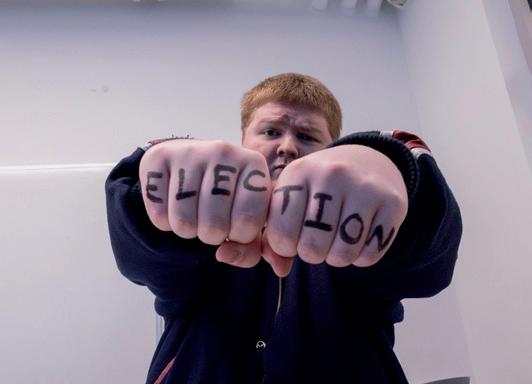
AMS Elections issue
VOTE: March 9-13, ams.simplyvoting.com
It’s important students make an informed decision when voting for the people who represent them — it’s why we do this work.
Our reporters have spoken to candidates, organizers of referenda items, attended debates and ‘chat and chills,’ and have spent the previous years staying up to date about what is actually going on in our governance structures.
The elected executives, senators and governors will sometimes be the only people in a room willing to advocate for student needs in the face of UBC administration or different levels of government. Student politicians have gotten wins in the past — whether it be the U-PASS, fall reading break or funding for a host of initiatives — and have the ability to change that outlasts all of our times at UBC.
Right now, students are facing an affordability crisis, and post-secondary institutions are experiencing financial strain unlike anything we’ve seen since the 1990s. It’s more important than ever for students to have someone working for them who can get the job done.
Our news reporters spoke to candidates to understand their campaigns and whether they understand the role they are running for. You’ll find candidate profiles summarizing each of their platforms and looking at the feasibility of some of their promises.
This year’s ballot also includes important referenda items that could see a $12 AMS fee increase that would go toward supporting student services, clubs and expanding spaces in the Nest. Another item, if passed, would call on the AMS to advocate to UBC to cut ties with Israeli universities. Similarly, we spoke to referenda organizers to see why they’ve put these items on the ballot, and what
would happen if they were to pass or fail.
This year, our election report also includes a pilot project from the Opinion section. Previously, we’ve used the term “Editorial Board” to refer to the group of editors that runs the publication. When we penned our last editorial, which condemned the far-right, anti-Indigenous event on campus on Jan. 22, we did so as a group of editors. However, in keeping with the practices of larger newspapers like the Toronto Star, Globe and Mail, or New York Times, we’re creating a separate group of experienced journalists to write their views on the news in our newspaper’s name. As such, the Editorial Board now refers to that new group, which spent much of the last few weeks interviewing candidates independent of the News section, attending debates and analyzing platforms and public statements. After considering the field, they’re ready to tell you who they think you should vote for. We’re excited to offer readers their endorsements, which you can find on pages 13 through 16.
Student politics is as unimportant as you decide to make it. To some, AMS politics isn’t a luxury they can afford to be disinterested in. Student services like Safewalk, the AMS Food Bank, tutoring and AMS Advocacy are not trivial. The same goes for discussions at the Board of Governors about tuition, or at the Senate about academic policy. Your votes have consequences, and you owe it to your peers to make the time to study up and cast your ballot. It matters. And we hope our newspaper gives you the tools to make the decision that’s right for you and your community.
— Aisha Chaudhry, Editor-in-Chief and Spencer Izen, Deputy Managing Editor and Opinion Editor U
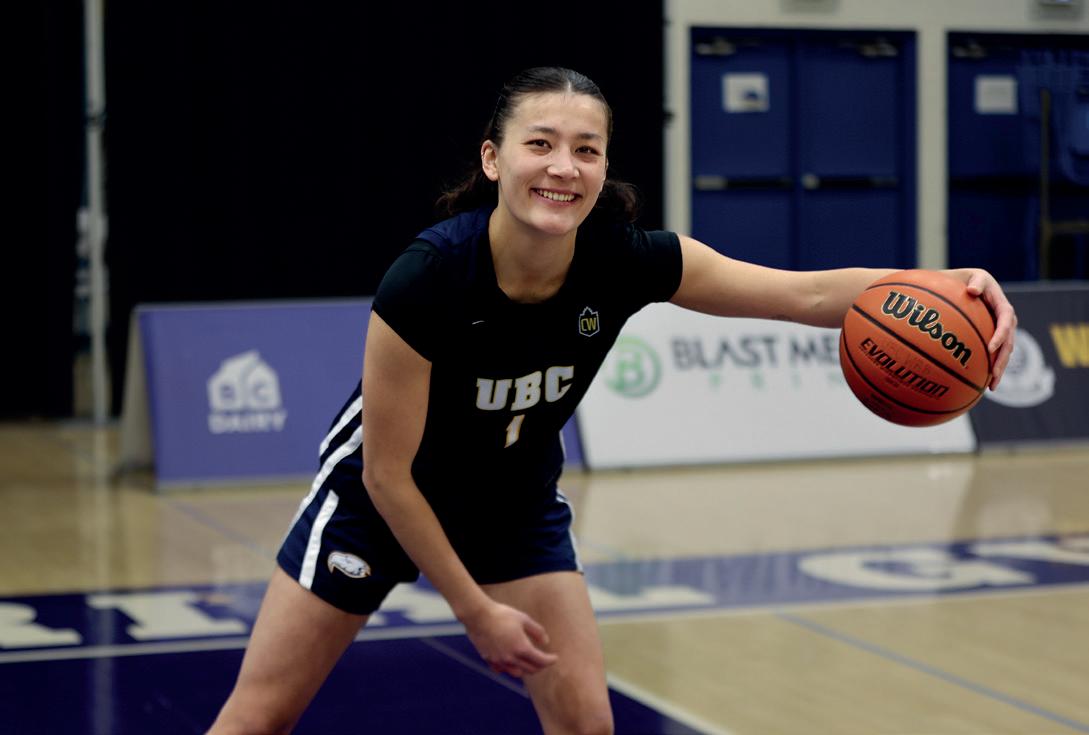
Mona
journey back to the court
Profile by Ian Cooper Sports & Recreation Reporter
At the time of writing, Mona Berlitz is arguably one of the greatest forwards in UBC women’s basketball history. She’s been a Canada West all-star each year since her second season, making firstteam in 2025. Her game — an equal balance of brute force and ambidextrous finesse — instantly stands out every time she takes the court. Unfortunately, War Memorial Gym has yet to see her step on the court this year.
Over 8,000 kilometers away from Vancouver, a summer team trip to her hometown of Schrobenhausen, Germany was supposed to be a homecoming. Instead, in a routine preseason game, Berlitz tore her ACL. Her team returned to Vancouver without her. Berlitz stayed behind.
The season went ahead, and Berlitz had no choice but to learn how to move on.
For a player of her calibre, the injury is only a small part of her story. Mona’s path from a small German town to the centre of the UBC Thunderbirds program reflects more than just on-court excellence — it shows how sport can shape life, and the resilience required to push through when that life takes an unexpected turn.
In the small town of Schrobenhausen, — population less than 20,000 — Berlitz first picked up a basketball at the age of five. By age 14, Berlitz was travelling nearly 90 minutes away to compete against older players, a routine that eventually earned her a spot on a senior women’s club roster before completing high school. Canada wasn’t on her radar yet. Continued on page 19.
Wrestling tells stories from the top rope

DEL ROSARIO / THE UBYSSEY Event Report by Jack Paransky Arts & Culture Reporter
Anticipation runs through the excited crowd like minnows in a stream. The air is thick with the smell of four-dollar beer. All eyes are on the ring, chairs positioned around it like pews around the altar. More than half the audience is standing, crowding the available space in the at-capacity Cambie Street Legion. Max Mitchell enters the ring to devoted cheers. He welcomes each and every person to BOOM! Pro Wrestling. He smiles as the audience joins him in cheering, “THIS! IS! REAL!”
Professional wrestling, inspired by the Greco-Roman style, gained notoriety in the United States, Mexico, and Japan between the ‘40s and the ‘60s. These were the decades of the all-time greats: Gorgeous George, Rikidōzan and the legendary El Santo. The advent of public television helped push wrestling from underground local scenes to a national broadcasting scale. The 1980s saw much of the sport fall under the banner of the World Wrestling Federation, now World Wrestling Entertainment (WWE). Wrestling hit the mainstream and launched an industry
valued at roughly 1.4 billion dollars in revenue in 2024.
Wrestling is one of the most interesting ways we have to tell a story. The match inside the four ropes is both colosseum and stage. The wrestlers establish characters that give each hit and tumble a sense of narrative. If you just want to watch people fight, go to a martial arts tournament. If you want to watch larger-than-life characters resolve weeks, months or even decades-long stories, watch wrestling. Each match is a vignette in a wrestler’s career-spanning narrative which informs and progresses their evolution. BOOM!’s regulars are perfect examples. Take POWERCHEF, whose gimmick is exactly what you think it is. He’s never won a match. A comic character, his signature move sees him rotate his opponent in the air and yell “MICROWAVE!” before slamming them to the ground. But underneath these comedic moves in the ring, his unrequited need to win gives the character a desperate drive. POWERCHEF, like every wrestler in BOOM’s roster, has wants and needs driven by the match, and his story happens both in and outside the ring.
Continued on page 18.

Opinion by Quyen Schroeder AMS Columnist
Who doesn’t want to save a buck or three? Thanks to the 2021–2022 AMS Council, we’ve done just that. By reducing our student fees, they saved us $3 per year — by now that’s $9 saved. With that kind of money, you could forget to renew your U-Pass before getting on the SkyTrain three times! Just one small problem: the $9 we saved has come at the cost of the very services the AMS exists to provide. In 2022, council ran a referendum to decrease the Clubs Benefit Fund by $1.03: from $1.78 to a measly $0.75. Unsurprisingly, students passed this referendum.

(Two other fees were also decreased or eliminated. Between the three, students saved $3.37 per year.)
The ultimate cost of the few bucks wasn’t clear in 2022 — especially not in the referendum question posed to students. In the two years prior, the AMS had started spending more from the Clubs Benefit Fund: in 2020 to provide newly constituted clubs with $500 of seed money; again in 2021 to increase the funding available to clubs from $2,000 per club per year to $10,000 — a 400 per cent increase; and yet once more in 2022 to provide support to clubs returning following COVID. Continued on page 17.
world’s a stage (for scholarship)
The UBC Undergraduate Shakespeare Conference was born last year to increase the few opportunities English students have to present research. This year, the conference grew in submissions, organizers and overall turnout, showing these opportunities are something students want.
RAUL
Boom! Pro
Berlitz’s
NAVYA CHADHA / THE UBYSSEY
SENEESHA EKANAYAKE / THE UBYSSEY
The Ubyssey
MARCH 9, 2026 | VOLUME CVII | ISSUE XIV
LAND ACKNOWLEDGEMENT
The Ubyssey acknowledges we operate on the traditional, ancestral and stolen territories of the Coast Salish peoples including the x ʷ məθk ʷ əyəm (Musqueam), Sḵwx̱wú7mesh Úxwumixw (Squamish) and səlilwətaɬ (Tsleil-Waututh) nations.
EDITORIAL
The Editorial Office creates the content of the newspaper. They do all the research, writing, photography, programming, illustrating and editing — the journalism.
Editor-in-Chief
Aisha Chaudhry eic@ubyssey.ca
Managing Editor Saumya Kamra managing@ubyssey.ca
News Editor Stephen Kosar news@ubyssey.ca
Arts & Culture Editor Julian Coyle Forst culture@ubyssey.ca
Features Editor Elena Massing features@ubyssey.ca
Deputy Managing & Opinion Editor Spencer Izen deputymanaging@ ubyssey.ca opinion@ubyssey.ca
Sports & Recreation Editor Caleb Peterson sports@ubyssey.ca
Research Editor Elita Menezes research@ubyssey.ca
Humour Editor Kyla Flynn humour@ubyssey.ca
Illustrations & Print Editor Ayla Cilliers illustrations@ubyssey.ca
Photo Editor Sidney Shaw photo@ubyssey.ca
Digital Editor Sam Low samuellow@ubyssey.ca
STAFF
Akmal Zulkifli, Aleah Kippan, Alexis Jacobson, Amrit Rai, Amy Sheardown, Annaliese Gumboc, Carol Rocque, Claire Donnan, Ewan Keenan, Fiona Pulchny, Gabby Ranu, Harleen Randhawa, Harper Jasinski, Ian Cooper, Jack Paransky, Jeff Lee, Jenni Nguyen, Juan Pablo Sastoque Vega, Liana Raisanen, Lorainne Chua, Lucas Rucchin, Luiza Teixeira, Maia Cesario, Margo Baltzan, Mason Carter, Maya Tommasi, Morrison Tulloch, Natalie Vakulin, Navya Chadha, Quyen Schroeder, Raul del Rosario, Saba Majd, Selena Sallay, Seneesha Ekanayake, Skye Shen, Sofia Campanholo, Sofia Gonzalez, Sophia Clearwater, Sophia Bertuzzi Samilski, Sophie Cark, Tatjana Huber, Thomas Favelle, Trinity Sala, Vicky Nguyen, Yasmine Armstrong, Zoé Stojanovic
PRINT DESIGN BY: Ayla Cilliers, Lorainne Chua, Skye Shen, Sophia Clearwater, Yasmine Armstrong
BUSINESS OFFICE
The Business Office supports the journalism by managing the Ubyssey Publications Society’s money at the direction of the elected, majority-student board. It has no say in or over our coverage, in keeping with the principle of editorial independence.
Business Manager Scott Atkinson business@ubyssey.ca
Editorial Office: NEST 2208
604.283.2023
Business Office: NEST 2209
604.283.2024
Account Manager Ben Keon advertising@ubyssey.ca
CONTACT
Website: ubyssey.ca Instagram: @ubyssey Facebook: @ubyssey TikTok: @ubyssey Bluesky: @ubyssey LinkedIn: @ubyssey
ARTICLE GUIDE
Every story we publish comes with a label — here are the brief definitions for what they mean.
PROFILE
Profiles are a detailed description of a person and their life experiences. They promise to be descriptive and analytical.
REVIEWS
Reviews are critical analyses of works of the arts. They promise candour, description and fairness from a knowledge voice.
REPORTS Reports are accounts of particular moments — the who, what, when, where, why and how in 800 to 1,200 words. In News and Research, they promise impartiality. In Arts & Culture, they promise critique and/or analysis.
EXTENDED REPORT
Extended reports are accounts of subject, engaging multiple peoples, places, sources and smaller events over long periods of time. They promise impartiality
GAME ANALYSIS
A game nalysis is an analytical account of a sprting event either involving UBC’s varsity teams or taking place on campus. These promise to describe what happened, but also why the game matters.
OPINION ESSAYS
Opinion essays take a position on something newsworthy in the present moment, and are either written by guest contributors from the community or in-house columnists. All essays represent the author’s views alone.
PERSONAL ESSAYS
Personal essays explore an individual’s perspective on an experience that is relevant to a larger group of people.
ARTS & CULTURE
The real best picture is the one you watch with friends
Review by Claire Donnan Arts & Culture Reporter
The lights came up in Vancouver’s Fifth Avenue Cinemas last December, illuminating the tear-stained faces of myself and my friends. We’d just finished watching Hamnet, Chloé Zhao’s fictionalized retelling of William Shakespeare’s life, and that tender final scene, set to Max Richter’s agonizing “On the Nature of Daylight” had successfully gotten every one of us.
As we walked down the street and waited for buses on the way home, we talked endlessly about Hamnet. We talked and talked until there was nothing else we could have possibly said about the film.
I love movies. I enjoy nothing more than escaping into someone else’s story for a couple hours, leaving it feeling a little bit stronger, smarter, better somehow. With the Academy Awards coming up on March 15, I decided, for the first time ever, to watch all 10 of the Best Picture nominees and review them. This was the perfect time to do it — I was visiting my partner, Jack, in Kingston, Ontario for reading week, with no real plans besides hibernating away from the east coast snow and ice.
With the plan set, what followed was a complete Oscars speedrun. Minus Hamnet, which I saw before leaving Vancouver, I watched every Best Picture nominee over the course of one week. That is a whopping 21 hours of movies, almost one whole day of that week. Jack and I watched six out of the 10 together, I watched Hamnet and The Secret Agent in Vancouver theatres with friends, Sentimental Value alone with others in the room and F1 alone on a plane.
Up first is Hamnet, where I started my Best Picture marathon. The story specifically concerns the death of his son, Hamnet, which some argue inspired the writing of Hamlet Visually stunning with captivating sequences like the childbirth scenes and Hamnet’s death, the movie falters a few times but sticks the landing beautifully in its tearjerker final scene. As a classical actor, I love movies that don’t like William Shakespeare, and this movie does not like ‘The Bard’ at all.
But it certainly wasn’t perfect. The way the film portrayed magic and spirituality felt unspecific and weak at times. The system was never explained, the limitations were never clear, and the movie refused to even acknowledge if magic was actually real. Speaking of unspecific and weak, so was Paul Mescal’s performance, especially opposite Jesse Buckley, who gave, in my opinion, one of the strongest performances by an actress of the season. She was incredible, so everybody in her orbit had to be incredible too or it just wouldn’t work. Ultimately, Hamnet had very strong cinematography and a strong directorial vision, courtesy of Zhao. Besides a few stutters, it delivered a strong showing.
On Sunday, Feb. 15th, after a five-hour flight to Kingston, followed by Valentine’s Day plans, I wanted nothing more than to sit on the couch in my partner’s attic apartment, order take-out and watch seven-plus hours worth of movies. That day, we watched One Battle After Another, Sinners and Frankenstein, in that order. And what an order that was. Having already seen Sinners a few weeks prior, I insisted to Jack that it had to be our main event during supper. That meant we decided to start with the longest movie in today’s category (movies about bad father figures) — One Battle After Another, the action-comedy-thriller about freedom fighters being hunted down
in the United States.
I hated this film. Correction, we hated it. All two hours and 41 minutes of it. We groaned, exchanged looks of horror and discussed our prevailing confusion at what we were watching. My first thought in my notebook was just the word “Performative.” I think that conveys the gist of how I felt.
The prologue is bloated and gratuitous. Sexual assault is both a major plot point and treated like a punchline. Much of the beginning of the film relies heavily on the character of Perfidia Beverly Hills, a pregnant activist and self-described freedom fighter. Teyana Taylor does incredibly with what she was given.
Once the prologue is over, a dramatic tonal shift means the movie is somewhat more enjoyable, but the pacing is still off and the runtime is bloated — every minute feels like slogging through mud. On the other hand, Leonardo DiCaprio and Chase Infiniti do great work as father and daughter, Bob and Willa Ferguson — this may be one of DiCaprio’s best roles. A great score and killer lighting aren’t enough to save what is, in my opinion, a fundamentally broken script.
After that, we needed a palate cleanser. What better than Sinners, the vampire movie — set in the Black communities of the 1930s Mississippi Delta — that has the whole world talking?
The film has beautiful colour, style and cinematography and is filled with tight, satisfying dialogue. It’s structured impeccably and uses music in an excitingly unique way. The movie handles spirituality, specifically Hoodoo, beautifully through the depiction of the character Annie. Ryan Coogler even hired a Hoodoo consultant, Dr. Yvonne Chireau, to make sure the representation of the spiritual practice remained faithful and sacred. The movie also stays consistently faithful to its chosen vampire mythos — think wooden stakes, no entering without an invitation and glowing red eyes. In a genre that gets a bad rap for running on idiot plots, the characters of Sinners are all smart, unique and constantly listening to each other.
The movie’s musical sequences are another highlight. “I Lied to You,” “Rocky Road to Dublin” and the fake-out ending are all perfectly done. Of course, no movie is perfect — Sinners is long, and at times fairly gory. However, I’m not great with gore, and even I found I wasn’t too bothered by it. Overall, this was mine and Jack’s decisive, number-one favourite. Next, Frankenstein. Remember when I said I’m not great with gore?
This movie is, at times, absolutely gross. Prohibitively gory. I missed a full five minutes, hiding behind my hands and covering my ears, yelling at Jack to tell me when it was over. He, despite having just finished playing Doom Eternal, found several moments, especially the ‘body building’ sequence, to be too much.
Another gripe we had was with the CGI throughout the film. The Danish fjords, along with the explosion at the castle, are very obviously computer-generated and completely took us out of the film. This didn’t tarnish the film’s absolutely incredible performances. In my notes, I praise “perfectly cast little freak Oscar Isaac.” Mia Goth delivers two strong and very different performances, and Jacob Elordi makes me sorry I had ever doubted him. His physicality, vocal performance and characterization are all perfectly inhuman and quite faithful to the book.
Unfortunately, I just can’t get past the gore. After our film bender, Jack
and I took a day off from reviewing to read whole books and go to a rock museum. On Monday, we popped into the tiniest theatre I’d ever seen to catch a late showing of Marty Supreme. Timothée Chalamet’s Marty Mauser is a 1950’s shoe salesman who dreams of being a table tennis star, and grifts his way to the top, only to fall right back down.
Let me be clear, Marty Supreme is not a phenomenal movie. It’s a fun movie, full of tension, stakes and appropriate consequences for the protagonist’s gross behaviour. It is, however, too long for its plot, with the last third of the film feeling very inconsistent in its pacing. It’s a tough watch at times — Marty is a bad person who does bad things, makes horrible jokes and actively screws over everybody around him. However, Chalamet — and Odessa A’zion playing Rachel — deliver standout performances.
Overall, Marty Supreme wasn’t really my cup of tea, but it was definitely fun. With my flight scheduled for Thursday evening, we had just enough time to schedule another double feature on Tuesday. We watched Train Dreams and Bugonia, again in that order.
Train Dreams, about logger and railroad worker Robert Grainier’s 80 years of life in the Pacific Northwest was perhaps the biggest surprise of all 10 films. Visually, it’s the prettiest movie nominated for Best Picture, with gorgeous landscapes, strong interpersonal dynamics and some of the most realistic dialogue so far. The movie has a strong lead performance in Joel Edgerton and a beautiful ending. Jack and I took turns telling each other not to cry at the heartbreaking love story. At times the film can be a little slow and, dare I say it, kind of boring. But I don’t care. I like it, dammit. Bugonia. Oh Bugonia. Every minute that passes after watching this movie, I get madder and madder.
It starts so promising. Jesse Plemons — playing conspiracy theorist Teddy Gatz — kidnaps Emma Stone, girlboss CEO, and accuses her of being an Andromedan alien. She’s not an alien, however, and the cat-and-mouse dynamic between them is incredible as she desperately tries to convince him and his brother Don that she is just a person, and should be let go.
Except… she’s not. In the final 15 minutes of the film, it’s revealed she’s been an alien the whole time, and she kills every human on earth in a strange montage. We. Were. Furious. Screaming at the screen. The movie had been incredible. It has a great score, crazy violence, some of the best dialogue of any nominee this year and a tiny cast of heavy hitters. It has everything going for it! Why would they end it that way? I understand that this is the same ending as the Korean film that Bugonia is adapted from — Save the Green Planet! — but I think it weakens the point of this adaptation, namely, the radicalizing danger of social media echo chambers.
Two days later, I was sitting sullen, alone on a plane back to Vancouver, missing Jack already, when I decided to watch F1, a Tom Cruise epic about a washedup driver learning how to race again with his new hotshot teammate. This was the only nominee that I would watch fully alone. Big mistake. I didn’t like F1 at all.
Long, meandering and boring, with flat performances and stilted dialogue, the film is a twoplus-hour ad for Formula 1. It gets points, however, for the racing sequences, which have good tension and look suitably intense. The problem is with all the other
stuff that happens in between. I think they should have just recorded two hours of Formula 1 for us to watch. I would have liked it more.
Alone and back in Vancouver in a room full of people working on their own assignments, on reading week’s sleepy Saturday, I watched Sentimental Value. As a person who’s very close with my younger siblings, I just knew this movie would have an emotional impact. It did.
Sentimental Value is beautiful — a blend of Norwegian and English dialogue, sweet visuals and colour and wonderful performances from Elle Fanning and Renate Reinsve. The bold cinematographic choices, like a spinning camera shot of Stellen Skarsgård’s character and his daughters, as well as the raw and honest interactions between the family, are picture-perfect. The pacing, however, is not. The plot moved slowly and had a habit of dropping story threads for long stretches of time. This made the ending feel rushed and less impactful than it could have been. That aside, it was a beautiful story about family and connection.
Last but certainly not least, a few friends and I piled into the Rio Theatre for a Sunday evening showing of The Secret Agent This movie, more than any other film, was the one I had heard the most about. Rave reviews from my roommate Sofie and other friends made me nervous: What if I didn’t like it?
I shouldn’t have worried. The Secret Agent is amazing, visually stunning, warm and grainy with fun screen wipes. It boasts a perfect soundtrack and a compelling story, with an incredible star performance from Wagner Moura. The script has a crystal-clear focus and uses dynamic and creative shot sequences to transport the viewer directly to 1970s Brazil. A Carnival sequence which flowed jarringly into a morgue scene is a particular highlight. I occasionally found the timeline of the story tough to follow, especially when it jumped forwards and introduced new characters with little background throughout the first act. However, the film’s ending, risky as it is, absolutely pays off with powerful impact. Embarrassing as it may be for me, this film has the most impactful jump scare of the entire swath of Best Picture nominees. I almost jumped clean out of my seat, and still haven’t heard the end of it from my friends. Phenomenal film otherwise.
Walking out of this final film and back to the car, I followed as my friends discussed detail after detail about the movie, including things I’d never even considered. I didn’t want to contribute too much or take down any notes on their thoughts, worried that it would impact my review. But then, I realized, that was ridiculous. What’s so wrong with their thoughts colouring my own?
As people, we find ourselves inclined to speak, share and discuss our thoughts and feelings. It’s how we get better and temper our own opinions, and my thoughts and feelings on these films were made infinitely better thanks to those I shared them with. This is my review, but it’s also theirs. It’s built on the thoughts, ideas, creativity and intelligence of Catherine, Abbey, Dhanya, Justine, Kyla, Hayley, Mark and, of course, Jack. I’m so lucky to know incredible people like them.
So, this Oscars season, I have a piece of advice for you: Watch these movies with other people. Laughing over movies I didn’t like with my partner and crying over movies I did like with my friends were moments that we got to share. There’s nothing more special than that. U
YOUR VOICE VOTE FOR




PRESIDENT


ALEX ZHENG
Dylan Evans, a fourth-year forestry student and the current VP administration, is running for president on a platform of moving the student society beyond recovery and into a new era of active, vibrant community building.
As a newcoming student from a small town in Prince Edward Island, Evans experienced firsthand what it was like to arrive at UBC without knowing anyone or having a ready-made community, an experience that inspired him to make “bringing fun back to UBC” a central focus of his campaign.
Evans is currently a student senator representing the faculty of forestry and environmental stewardship. He previously served as president of the Forestry Undergraduate Society (FUS) and was a VP for UBC’s Environmental Policy Association.
If elected, he plans to develop a comprehensive, student-organized event calendar in collaboration with clubs and constituencies. He will work with the university to ensure this calendar is front-and-centre at UBC’s start of year orientation rally, allowing every new student to find their niche immediately. Beyond the first week, Evans wants to revitalize the “Thunderbird spirit” by integrating athletics into student life, promoting active participation and game attendance and organizing student-led events with volunteer opportunities.
“It’s one thing to have a campus wide event. It’s another thing to have 20 events that are impacting numerous communities,” Evans said. “We will take [students who propose events] on as a volunteer to do that event.”
Evans is also proposing a comprehensive academic resourcing centre. He explained this would include an exam database, a syllabus library and a class notes repository – features he said the majority of are Canadian universities already have.
Evans hopes to continue as a student senator for his faculty, a position that allows him to bypass the hiccups past presidents faced by relying on others and gives him direct access to advance initiatives.
“There are ways that I know can be more effective … presidents haven’t been on Senate [in the past]. They’ve had to rely on others. I personally will be doing this.”
His academic platform also includes a textbook exchange program modelled after the lending library system. The lending library, which Evans said he streamlined during his time as VP administration, co-ordinates equipment bookings for clubs and constituencies. He hopes an exchange program inspired by it can mitigate
the rising costs of course materials by purchasing donated or used books at cost and reselling them to students for the same price. Space remains a perennial issue at the Nest, where clubs often find themselves “crammed into a clubroom … with six clubs to a room.” Evans drew on his experience as FUS president, where he successfully negotiated with the forestry dean’s office to retain and expand student spaces after the faculty attempted to reclaim them post-COVID.
His strategy involves moving departmental clubs back into their respective faculty buildings through new space-use agreements, thereby freeing up more room in the Nest for general-interest clubs.
“I got us to a point where not only did we retain our previous spaces, but we then were in a position to even get more space from the faculty,” he said regarding his time in forestry. “I’m confident that I know I’d be able to do [that] and talk to these faculties … on how it not only benefits them, but benefits their departments.”
While Evans praised the current president for maintaining a “strong team” and a “good atmosphere for work,” he was critical of the way governance changes are currently handled.
He expressed concern that the frequent “code changes” appearing on AMS Council’s consent agenda are opaque to the average student.
“I think that’s really hard for [even] a councillor to understand … It puts the average student at a disadvantage … [with] their understanding of how [the AMS] works,” Evans said. He suggested a more transparent, “packet-based” communication style, including a comprehensive document summarizing all proposed governance changes, making it easier for students to review and understand them at once.
When asked how he would unite a group of independently elected executives, he recognized that “every student leader is going to have something they’re passionate about.” He said his approach is not to dictate priorities but to build alignment.
“My goal is not to go in and say, ‘We’re doing this, this and this.’ My goal is to go in and say, ‘I have these goals … You have your goals … and I will support you to the best of my ability in completing those goals,’” Evans said.
He acknowledged differing mandates but sees that diversity as a strength, saying that it is “a crucial part for any sort of student organization” to have different goals and “work together to make them as robust as possible and really put them forward for the benefit of the students.” U
Candidate Profile by Jeff Lee News Reporter
Jasper Lorien is running for AMS president on a platform of “moral clarity,” arguing that Canada’s largest student union has drifted toward a corporate mindset that prioritizes profit maximization and bureaucratic efficiency over the lived realities of students
Lorien, a third-year honours political science student, currently serves on both UBC’s Board of Governors and Senate, and has spent over two years on AMS Council. Lorien is also the president of the Disabilities United Collective and a former executive with Climate Justice UBC. Lorien claims they have seen the AMS fall short in areas that executive leadership can fix.
“I think the AMS needs to remember that it’s a student union,” Lorien said. “We run our own businesses, and I think that has led to certain mindsets in the AMS of seeing the AMS more as a corporate entity than a student union. I think that we’ve … forgotten to be the voice of students.”
Lorien’s platform centres food security and financial aid. On the Board of Governors, Lorien has pushed to increase university food security funding from $800,000 to $1.2 million. Within the AMS, they propose reallocating $20,000 annually from the Sustainable Projects Fund — a program financed through the student climate action fee, providing up to $15,000 for UBC student-led projects advancing environmental, social and economic sustainability — to support student groups running local food initiatives.
Lorien also took aim at the AMS Financial Assistance Fund, which provides needbased financial support to UBC students, alleging that approximately $1 million in unspent bursary money is currently “sitting there” while students struggle. They highlighted a discrepancy where international students are often excluded from these bursaries, despite AMS referendum language suggesting they should be available to all.
“There’s a gap there between what the AMS says the money is needed [or] used for and what the university is actually doing,” Lorien said. They proposed using unspent funds to create endowments, ensuring students can reliably access bursaries to ensure long-term, equitable aid.
While the AMS has an official stance on Palestine — supporting a referendum calling on UBC to cut ties with Israeli universities involved in apartheid — Lorien characterized the society’s actual advocacy as “lukewarm.” They are calling on the AMS to sign the Apartheid Free Community Pledge — a coa-
lition that pledges to oppose Israeli apartheid — and overhaul investment policies to exclude weapons manufacturers.
“UBC publishes a list of their investments, but we don’t for [the AMS]. And the fact that we are less transparent when it comes to where students’ money is going and our investments, I think, is absolutely crazy,” said Lorien.
Lorien also wants to focus on the student experience around bettering Nest operations and campus events. The Nest previously offered 24 hour access during exam periods and Lorien proposed to reinstate this practice — particularly for commuters students who lack reliable latenight study space on campus.
They said that within the Nest, student groups are often “ kicked out of rooms” to accommodate external corporate bookings.
To fix the Nest’s perennial room-booking issues, Lorien proposes hiring an additional staff member dedicated to club support, funded by the Clubs Benefit Fund.
They also plan to introduce a “lower margin, high volume” model for AMS businesses to reduce food costs and fulfill a decade-old promise of an AMS brewery. Furthermore, Lorien wants to move away from the “headliner model” for Block Party, opting for local talent to lower ticket costs and foster community.
Beyond the Nest, Lorien’s advocacy extends to student housing and academic policy. They want to push for a review of the Residential Tenancy Act exemptions that leave student residents without standard protections.
“We see eviction notices go to students that sometimes give them three days to move out, which is absolutely absurd to me,” they said.
Lorien also intends to use their Senate experience to advocate for a centralized testing facility for concessions and to increase graduate student funding packages, which they described as “really, really low” compared to peer institutions. In February, UBC announced an increase to PhD student funding.
Within the AMS’s executive, Lorien would like to see a supportive management style. They believe the president’s role is to coordinate the team without stepping over individual portfolios.
“My goal as president is to make sure that no one leaves the AMS because they weren’t treated well,” Lorien said. “Execs are people, of course, and because they are people, there are things that will come up in their lives … I want to be making sure that I’m there as their manager to support them in every way possible.”
“We are a student union … We are accountable to students, and when they come saying that they have an issue with something the AMS is doing, we have to listen.” U
SAUMYA KAMRA / THE UBYSSEY Candidate Profile by Trinity Sala News Reporter
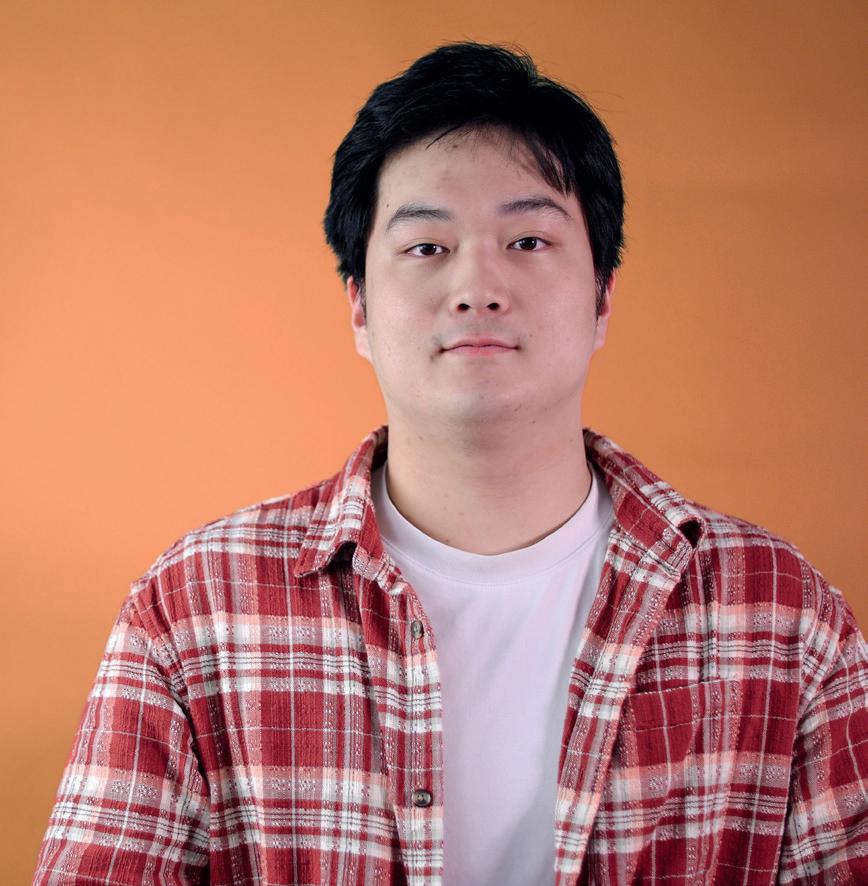
Alex Zheng, a bioeconomy major in the faculty of forestry, says he is running for AMS VP external to be part of “the force that makes something good happen.” Zheng said one of his priorities is to unite student voices ahead of the 2026 Vancouver municipal election and to advocate for issues that affect them, such as providing more affordable housing options. Zheng did not specify what types of affordable housing options he would push for or how he would accomplish this. He also mentioned wanting to reduce rental rates for student residents; however, advocating to UBC about on-campus housing is not part of the VP external’s portfolio; instead, it is the role of the VP academic and university affairs.
“I can’t get too deep into the nitty-gritty, because it’s all wishful thinking. I think if you make a super detailed list right now, it will backfire,” said Zheng.
He also wants to expand job opportunities for students and explained that with rising costs and affordability concerns, financial security is an important part of student well-being.
“We have talents from the entire nation, if not the entire world, and I think many of them are currently in a state where they don’t necessarily see a clear, defined path to possible job outlooks,” said Zheng.
From his time at UBC, Zheng said found student voices were being underutilized. “I want to form additional coalitions in British Columbia, OK, just so we can actually get our voices heard, not just on a municipal level, on a provincial level, or, dare I say, a federal [level]” he explained.
There are already several B.C. coalitions — like the B.C. Federation of Students and the Alliance of B.C. Students — who bring together student unions to advocate for shared goals like making universities more affordable. While the AMS is not a formal member of these two organizations, they have worked alongside the groups to raise awareness on things like the new provincial post-secondary review. The AMS has also been part of the federal lobbying group the Undergraduates of Canadian Research Universities. Zheng did not mention any of these groups and did not explain what his coalition would do differently.
In terms of experience, Zheng is currently the VP finance of the Forestry Undergraduate Society and
worked at the B.C. Ministry of Forests as a bioeconomy analyst. During his time at the ministry, he said he witnessed the effects of B.C.’s strained budget.
Zheng feels that student life and well-being are not an area in which many financial compromises should be made. He is adamant that it is vital to consider the long-term consequences when making decisions about funding for students.
“Because once again, the people who are currently at this institute, if you think about it, they are the future of this country. They are going to be the pillars that’s going to hold this country for the next one or two decades,” he said.
Despite this optimism, he understands that finances and budget cuts will continue to be an ongoing concern during his term. Other than more student jobs, Zheng failed to mention what he’d like to see more funding go toward, and how he plans to persuade any level of government to allocate more for universities.
“It’s sort of a march in the rain, if you will … we do what we can, we get what we can. We’ll do our best,” Zheng said.
He said that he has been impressed by current VP External Solomon-Yi Kieran’s push for media exposure, but that if there is something he intends to do differently if elected it is to try to include the entirety of student voices.
“One of my current plans within the platform is … [to] do a student survey.” The AMS’s VP AUA already oversees the annual academic experience survey and the student union launched a student engagement survey starting in 2022 — Zheng did not make mention of the pre-existing surveys or how his survey would differ.
Having volunteered himself during the campaign for the SkyTrain to UBC led by Yi-Kieran, Zheng said that he will continue to pursue progress on that front. “The most important thing is to hold [the government] accountable [and to] keep the pressure on.” He reiterated that to do this most effectively, students need to be united and organized in their advocacy. Zheng said that he recognizes that if elected, his term will only last a year, but he intends to pursue projects that are sustainable beyond his term.
“I understand in a lot of these fields. I may not be the biggest expert, but I am more than willing to learn,” he said. U
Candidate Profile by Jeff Lee News Reporter
SAUMYA KAMRA / THE UBYSSEY
DYLAN EVANS
JASPER LORIEN
SAUMYA KAMRA / THE UBYSSEY

opportunities.
Audrey Xue is running for VP finance.
As a diploma in accounting student at the Sauder School of Business, Xue wants to become more involved with the university. She previously obtained her PhD at UBC in molecular ecology and she has extensive work experience across project management and academic research in life sciences.
Xue said although she has no prior experience in the AMS, she has a strong interest in student governance.
Her top priorities include streamlining club reimbursements, reviewing the AMS/ GSS Health and Dental Plan and achieving financial sustainability by increasing revenue and cutting costs. “I see myself as someone who really prioritizes efficiency,” she said.
Xue wants to improve clubs’ reimbursement processing, as she said many clubs face delays and don’t receive clear communication regarding timelines. To improve operations, she wants to automate request intakes by creating a form, reducing administrative work.
Xue said that one of the reasons she returned to school to study accounting was to pursue sustainability-related finance and accounting. As a result, improving the AMS’s emission reporting is one of her key goals. Xue said she wants to disclose Scope 3 emissions — indirect greenhouse gases produced in a company’s value chain that are not within the organization’s control, to “help drive campus sustainability.”
The AMS already discloses Scope 3 emissions from the Nest through its greenhouse gas inventory report, most recently released in September.
Xue plans to initiate a review of the current AMS/GSS Health and Dental Plan to avoid redundancy with public coverage, cost efficiency and student needs. Currently, all students are automatically enrolled in the plan at a cost of $388.26 per year, and have the option to opt-out.
Her platform states she will include tiered coverage and have special considerations for international students, while raising opt-out awareness and educating students on existing public benefits.
“The research will prepare AMS for negotiations in the next contract renewal cycle,” her platform states.
While Xue praised Gagan Parmar’s leadership as current VP finance, Xue would like to lower the risk of the investment portfolio — something Parmar recently increased.
“Obviously [the adjustment] has to be compensated by generating more revenue from other sources, like the AMS businesses.”
In terms of increasing revenue in light of AMS business underperformance, Xue aims to increase Nest revenue streams while creating student
“I will work to partner with [entrepreneurship]@UBC (a program with Innovation UBC) to support student-led startups through alumni and faculty mentorship and modest micro-investments using revenue-based financing,” her platform reads.
“Instead of taking equity, AMS would receive a small, capped share of revenue for a limited period. Returns would be directed into student services and future ventures.”
Currently, revenue earned by entrepreneurship@UBC through ventures, licensing and investments are reinvested back into the UBC ecosystem to support further research translation, innovation and startup growth. They are not affiliated with the AMS.
She proposed a collaboration between the AMS and University Blvd Lot — the parking lot under the Nest — to develop parking and EV incentives in order to drive more traffic to the Nest. She said customers could potentially receive parking rebates that could be obtained after purchasing from Nest vendors. The lot is owned and operated by UBC Parking.
Xue also supports increasing the clubs benefit fee as proposed in the upcoming AMS referendum. “Given the economic downturn, we’re not at the stage where we could support students’ clubs without increasing that fee.”
Although Parmar stated the capital projects fee — proposed to increase by $3, from $9.95 — would permit the AMS to support new spaces and seating, Xue felt as though “more reasons or explanation needs to be given,” to justify the fee, and suggested the money could possibly be used elsewhere.
She said that bringing printers to the Nest, for example, could be a more beneficial use of the fee. She did agree that increasing student seating could drive foot traffic in the Nest — something the businesses need.
“Last year, there was a proposal to bring in printers, and that hasn’t been materialized,” she said. A print shop was brought to the Nest in November, which was a key platform promise of current AMS VP Administration Dylan Evans.
When managing the AMS’s budget, which is forecasted to slide into a deficit, Xue was adamant on looking anywhere to cut costs. She said she would consider changing AMS staffing by working with human resources, and said costs could be reduced, considering the potential inefficiency of having multiple part-time students on payroll.
“If you’re always switching between staff doing … [a task], you constantly have to explain [things to them]. And that actually reduces efficiency,” she said.
Xue also wants to digitize the operations of the VP Finance Office, with the hopes of improving communication among the team and saving paper along the way. U
VP FINANCE

IMAN DHALIWAL
Candidate Profile by Shean Lee News Contributor
Iman Dhaliwal is running to be the next VP finance on a platform advocating for expanded subsidies for club membership fees, improvements to the AMS Food Bank and greater transparency surrounding financial reports.
A second-year finance major, Iman cited relevant experience from his first year at the University of Toronto, where he was a part of a student-managed fund and served as an executive in the economics students’ association. In Vancouver, Iman is part of the Compounding for a Cure portfolio at Sauder, which provides students with real experience in managing an investment portfolio while raising awareness and funds for ALS research.
A key part of Dhaliwal’s platform is expanding the subsidy for students’ club membership fees. Currently, the AMS provides students with financial need up to $20 in subsidies for club memberships. Dhaliwal said he hopes to expand this subsidy to include club experiences, such as trips and events.
“Experiences for students [are] the most important thing, whether it’s a club experience [or] an experience with an undergraduate society … I want to make sure that every student is able to have the full university experience, without affordability getting in the way,” Dhaliwal said.
Dhailwal wants to tackle food insecurity by providing more support to the AMS Food Bank. He hopes to “leverage the AMS’s negotiating power” to secure better food rates for students from companies such as HelloFresh and local grocery stores. He also hopes to permanently install the food-for-fines program, a four-day AMS initiative launched in November that reduced UBC parking fines by 50 per cent, with the remaining 50 per cent going to the food bank, and donations being matched by UBC parking.
Dhaliwal said that the AMS currently does not have its 2025-26 quarterly financial reports easily available to the public. He said he would prioritize financial transparency if elected, which includes promptly releasing quarterly financial reports and hosting forums where students can ask questions about AMS finances. Although not uploaded to their financial reports page immediately on their website, AMS quarterly financial reports are available to the public through the Council’s meeting documents.
Many of Dhaliwal’s

NATHAN SHACK
platform policies — such as expanding subsidies for club membership fees — are contingent on the success of fee referendums, which students will vote on during the election period. If passed, these referendums would require students to pay an extra $12 in AMS student fees, which would be distributed between club benefits, student services and capital projects.
When asked what would happen if the fee referendums did not pass, Dhaliwal said he could still pursue many of his policy goals, regardless of the referendums outcome. On the club membership fee subsidy, he said he would still advocate for expanding it to club events rather than just to memberships. He also said he would work towards providing support for clubs in the form of making ticketing platforms more efficient, streamlining and speeding up reimbursement processes.
Dhaliwal stressed that all AMS student services play a vital role in student life on campus. However, if the fee referendums do not pass, he said he would consider reallocating funds and conducting an internal study to determine “where costs maybe don’t need to be.”
Dhaliwal said a failed fee referendum would mean money would have to come from external sources, such as AMS businesses, which could be optimized to generate more revenue through marketing campaigns and restructuring.
Currently, AMS businesses are underperforming, contributing to a $350,000 deficit in the reforecasted budget for the first half of this fiscal year.
One of the measures Dhaliwal proposed to revive AMS businesses is revamping the Pit by repurposing the space when it is not in use, and moving Pit nights from Wednesdays to Fridays to increase traffic. He also said he would look into marketing initiatives for businesses such as Honour Roll to make sure students are aware of the various AMS-run businesses on campus.
Dhaliwal said he agrees with current VP Finance Gagan Parmar’s advocacy for student services and shares the same passion for providing students with unimpeded access to AMS student services. In terms of disagreements, Dhaliwal said that the management of the AMS businesses could have been improved through greater marketing and visibility campaigns.
“At the end of the day, the most important thing is students and students … their money needs to work for them. They’re the ones paying the fees. The money needs to go right back to them,” said Dhaliwal. U
Candidate Profile by Shean Lee
News Contributor
Nathan Shack, a fifth-year economics and data-science student, is running to be VP finance. He is campaigning on improving treasurer training for subsidiaries, increasing mental health benefits in the AMS health and dental plan and ensuring financial sustainability.
Shack currently serves as the associate VP (AVP) finance under Gagan Parmar, where he provides support with financial reports and drafts meeting minutes for the finance committee. Before his term as AVP finance, Shack served as UBC’ Film Society’s treasurer for two years. In an interview with The Ubyssey, Shack said that his prior experience motivated him to run for VP finance, as he has “seen a lot of the issues the AMS has,” including a $350,000 deficit and inefficient communication systems between the AMS and student clubs.
One of Shack’s key priorities is improving treasurer training for AMS subsidiaries such as clubs, constituencies and resource groups.
The AMS currently trains all its treasurers to familiarize them with UBC’s financial systems. However, Shack said that this training was insufficient, with only one hour of specialized treasurer training in addition to the six to eight hours of general executive orientation and a Canvas course.
Under Shack’s plan, treasurer training would take place starting in the summer, with multiple sessions teaching treasurers how to perform reimbursements, invoice payments and internal transfers. This additional training would help prevent ongoing payment delays, Shack said.
Another policy priority for Shack is increasing mental health benefits in the AMS/GSS Health and Dental Plan. Currently, the plan offers full coverage of up to $1,250 in visits to mental health practitioners. Shack would like to see a $250 increase. When asked where the money for the increase in coverage would come from, Shack cited a poll conducted by the AMS during a flu clinic, where 90 per cent of students said that they would be willing to pay more in fees to see an increase in “mental health, vision [and] dental [services].” While Shack said the survey was “not the most perfect” due to selection bias, he still stressed that students expressed a desire to see greater men -
tal health benefits at UBC, even if that meant a slight increase in fees.
Many of Shack’s policy plans — such as increased treasurer training — are contingent on the success of the AMS’s fee referendum, which students will vote on during the election period. If passed, this referendum would require students to pay an extra $12 in AMS student fees, which would be distributed among club benefits, student services and capital projects. When asked what would happen if the fee increase referendum did not pass, Shack said that it would be “difficult” to provide support for clubs, services and capital projects.
Regarding the clubs benefit fee, Shack said that if the fee referendum fails, the AMS would have to find alternative methods of support for clubs, such as faster payments and better training. In the case of treasurers, Shack said that an investment in training would be worthwhile even without an increase in funds.”
Shack said that without an increase in funding, he would consider reallocating resources from various student services. This would involve identifying “the core services and what provides the most value to students right now,” and shifting resources away from underutilized services and into more valuable ones. One service Shack emphasized is the AMS Food Bank, where he said that a full-time, permanent staff position is necessary to alleviate the strain on the service caused by rising food insecurity.
On the capital projects fee, Shack said the AMS would not be able to proceed with planned projects — such as collaborative study spaces — without the fee increase referendum being passed.
Another issue facing the VP finance is the underperformance of AMS businesses. In a reforecasted budget covering the first half of this fiscal year, current VP Finance Parmar said the AMS is in a $350,000 deficit, largely due to underperforming AMS businesses such as Blue Chip, the Pit and Grand Noodle Emporium. Shack stressed the need for a “comprehensive plan of looking at our businesses and … taking student input.” He advocated for the reintroduction of the Nest Experience Survey, which would ask students about various aspects of the AMS and the Nest. These could include which menu items students want to see and what they want from their services and businesses, Shack said. U
Candidate Profile by Sophia Bertuzzi Samilski News Reporter
SAUMYA KAMRA / THE UBYSSEY
AUDREY XUE
SAUMYA KAMRA / THE UBYSSEY
SAUMYA KAMRA / THE UBYSSEY
VP AUA VP ADMINISTRATION

LOKESH SANDHU
Candidate Profile by Oliver Matisz News Contributor
Lokesh Sandhu is running for VP administration.
A third-year computer science student, Sandhu is a residence adviser in Place Vanier. He sees himself uniquely positioned for the role due to his experience and data-driven approaches. His key policy priorities are centred around improving the current club booking system and mitigating the effects of the current club cap while maintaining advocacy for students.
As treasurer of the Multifaith Club and finance coordinator for the Punjab Students’ Association, his own experiences with the club booking process motivated him to run for VP admin. It took Sandhu 30 minutes to book a room in the Great Hall earlier this year, an issue he felt capable of confronting with his computer science background.
Sandhu repeatedly mentioned a need to “streamline the workflow” for bookings, and committed to address club booking concerns. If elected, Sandhu will collect data on club space usage and, if necessary, introduce a minimum “threshold” for club activity in order to gain access to spaces, based on clubs’ engagement and membership. Sandhu believes this threshold could be used to determine whether clubs should be provided individual or shared spaces given demand.
Sandhu said he would prioritize improving Wi-Fi in the Nest, but did not specify how he would do so. Similarly to club bookings, Sandhu has had difficulty in interacting with the AMS Wi-Fi. He acknowledged that it was a broader UBC issue, but wanted to apply himself as much as possible towards it.
Sandhu supports an expansion of sustainability in the Nest and intends to develop specific policies with recyclable container alternatives. As a policy priority, Sandhu committed to working on the AMS Sustainability Action Plan.
He also expressed concern for the AMS’s current financial situation but felt that the club cap’s implementation was rushed. The AMS implemented a club intake limit of 350 clubs last August in response to the AMS’s lack of meeting spaces and funding for clubs. Funding for clubs has been limited in the past few years, as the Club Benefit Fund fees decreased from $1.78 in 2022 to $0.75 the following year. Since then, fees have only risen to $0.85 and the AMS faces an ongoing club expenditure deficit.
Sandhu supports the cap as an interim measure until more fiscal sustainability is achieved, but expressed frustration with its effect on club renewals – and said it could dissuade the formation of new communities in the Nest. Sandhu saw “potential” in improving the current relationship between the AMS and clubs. He supports the AMS’s fee referendum, which if approved, would increase club funding.
Sandhu praised current VP Administration Dylan Evans’ development of a new clubs common space in the nest. Under the plan, introduced in November, the current space will be transformed into a commercial space, while a separate existing commercial unit will be renovated into a larger clubs commons space.
According to Evans, the project is pending, based on available funding, with an expected completion by September. Sandhu will prioritize the club common space’s relocation if it is not completed by the end of the current administration’s terms. Sandhu said there was a need to prioritize clubs over commercial tenants at times.
If elected, Sandhu will walk a “similar path” to the current administration’s policies considering their “consistent” role in student advocacy. U

WILLIAM SPARKS
Candidate Profile by Oliver Matisz News Contributor
William Sparks is running for VP administration, campaigning on advancing sustainability goals, supporting clubs and fiscal responsibility.
A forestry major studying natural resource conservation, Sparks outlined his leadership experience with Drop the Puck for Mental Health — a student-run charity — as a valuable asset towards the VP administration role. He said that Drop the Puck has raised over $215,000 for the Canadian Mental Health Association, describing it as “one of the largest charity organizations on campus.” Drop the Puck is associated with the Beta Theta Pi Fraternity, of which Sparks serves as VP of philanthropy. He said he worked with UBC President Benoit-Antoine Bacon to waive the ice-rink fee for a Drop the Puck charity game as an example of his ability to engage with UBC officials. He said that the AMS’s Sustainable Action Plan (ASAP) 2026 plays an important role in his campaign. The plan outlines the student union’s sustainability goals, with a focus on circular economy initiatives, waste management and sustainable food priorities in the Nest. While he described ASAP 2026’s intention as “fantastic”, Sparks said it lacks achievable, data-driven goals. If elected, he said he will advance the ongoing ASAP 2030 environmental plan to further reduce the AMS’s carbon footprint.
Last August, the AMS implemented a club intake limit of 350 in response to the AMS’s lack of meeting spaces and funding for clubs. Funding for clubs has been limited in the past few years, as the club benefit fund fees decreased from $1.78 in 2022 to $0.75 the following year. Since then, fees have only risen to $0.85, and the AMS faces an ongoing club expenditure deficit.
Sparks said that AMS financial difficulties would be inherited and are not in his control, however he stated a general commitment towards supporting clubs and understanding of the current administration’s club cap policy. He said that financial uncertainty for the AMS, in his view, has been a longstanding concern and that he would “prioritize” clubs and the resources given to them.
Club lockers space is also a topical issue, with limited accommodation and ongoing efforts to expand. In January, current VP Administration Dylan Evans said that ongoing efforts for increased club lockers have involved both repurposing existing commercial spaces and decommissioned units. Sparks committed to similar approaches for relocating and optimizing club spaces, and supported the AMS’s fee referendum increase.
Sparks said he would hire additional staff to streamline the club booking process. He said that all parties, including unions and clubs, need to be consulted on any proposed changes. And on whether hiring new staff would incur additional costs, Sparks deferred, stating that the VP finance would be more suited to respond.
Sparks declined to comment on the AMS’s Friendlier cup sustainability program, which has received mixed feedback from students and councillors over its implementation.
He voiced strong support for Evans’ initiatives addressing room booking issues and his overall approach to the position. While hesitant to make specific commitments on issues including club caps and room bookings, Sparks supports the current administration across multiple policy areas. If elected, he said he will not let current AMS objectives lose momentum, committing to “take what’s being done … and drive it to a whole other level.” U

JAIYA PANCHI
Jaiya Panchi is running uncontested for VP academic and university affairs (VP AUA), promising to enhance student academic experience by improving student resources, advocating for affordability measures on course materials, furthering professional development opportunities on campus for undergraduate students and pushing for “accessibility and EDI with clear and consistent policies.”
A third-year political science and international relations student, Panchi is currently serving as associate VP administration under Dylan Evans. She believes that “students need strong, organized representation in academic and university-facing decisions” and that she can be “the voice” for students “that they deserve.”
Panchi says that she has had “tangible results” with her work in the VP admin’s office — “allocating $100,000 in funding for clubs and coordinating with [over] 360 clubs on campus” — and wants to continue her work with an academic advocacy and university-facing portfolio.
Panchi described her campaign as a “mix of continuity and ambition.” She noted that Zarifa Nawar, the current VP AUA, has left her with “very big shoes to fill” and goals that can’t be completed within a one year term — goals that Panchi wants to continue with while bringing in her own.
“I can say with confidence that the amount of work that I would be able to get done, the amount of results that we’d be able to see, either crosses that [goal] finish line or it gets close enough to it where the next person stepping into the role will be able to push that forward.”
Panchi said that students should hold their executives accountable, and will publicize the accomplishments of the VP AUA office. “I think it’s important to restore some faith, some hope on campus for students, and highlighting those tangible wins is ultimately a way that I’d like to do that and remain accountable in terms of my platform goals.”
To improve academic experience, Panchi plans to push for a mid-term course feedback survey and an exam and syllabi database available to students on Workday. She added that “a term by term calendar view, the ability to download timetables, and [an] overall better user-interface” to Workday’s systems would be beneficial for students given previous frustrations.
Panchi is also advocating for a mandated “clear and consistent AI policy” on syllabi — the Senate recently approved a required mention of AI policies on syllabi, but Panchi wants an “enforcement mechanism” to ensure that professors discuss their AI policies during class.
Panchi is looking to continue the Textbook Broke campaign and set a new record in fundraising, hoping to break Nawar’s record of over $20,000 in textbook reimbursements. “I do not think it’s fair at all that students enroll in a course that they have to take, or they want to take, and later find out that [they] have to pay $200 for a textbook,” she said.
Panchi promises to advocate for student affordability — a goal held by many AMS candidates — by “holding the university accountable to invest in student housing at below market costs,” protecting the two per cent tuition increase cap, and ensuring that “at a minimum, the $800,000 multi-year commitment for food security initiatives is renewed and maintained.”
Professional development is another pillar of Panchi’s campaign. She noted that according to the recent Academic Experience Survey (AES), only 50 per cent of students feel that UBC prepares them for their career. “This is where the need for an increase in undergraduate research opportunity comes into play,” she said. If elected, Panchi is planning to secure greater funding for undergraduate students, following the recent securing of $2 million in research funds.
“Students deserve an education that prepares them for what comes next across all faculties,” Panchi said.
Panchi’s EDI and accessibility goals contribute to her advocacy for improving the academic experience. Panchi said that the AES reports “49 per cent of students believe that some students already have access to old exams” and that this creates an unfair and inaccessible advantage for some — she wants an exam database to level the playing field.
She also wants to work with the Center for Accessibility (CFA) to increase staff capacity and “consulting with students who use the CFA, [asking] how can we better this experience for you?”
“It is up to the students on campus as to the decision they want to make and whether or not they put their trust in me,” said Panchi. U
Tension inside AMS on uncertain future of VP student life
Report by Juan Pablo Sastoque Vega News Reporter
In the midst of the 2026 AMS elections, no one is running for the VP student life (VPSL) position; AMS President Riley Huntley said the absence of candidates is due to the newness of the role and lack of targeted marketing.
“My take on it is that it’s still a position fully being built out,” he said.
The Ubyssey originally requested to speak with current VPSL Kevin Heieis, but the request was redirected to the AMS president. The rationale for this redirection was that the president acts as the official spokesperson for the AMS. Huntley said Elections Administrator Keiko Prasadja did not extend the nomination, despite him bringing forward the option on Feb. 14, seeing the lack of candidates.
“The Elections Committee is currently evaluating the necessary procedures and polling requirements and will announce them in due course,” said Prasadja in a statement to The Ubyssey
“Huntley said there is no plan to eliminate the position; dissolving the office would only be possible via a successful referendum.”
Prasadja said this same situation happened in 2020, when no one ran for VP academic and university affairs (AUA). A few days after the 2020 general election results, nominations for VP AUA candidates opened and the special election was held by March 31 — all in less than a month. While Huntley said a special election could happen before the end of the school year, he explained that time limitations might prevent this from happening. It would be “quite challenging,” he said. Huntley believes engagement would also be higher if the election were held in September.
An AMS executive — who spoke to The Ubyssey on the background because they were not authorized to speak publicly on the matter — claimed the office was set up for failure from a lack of funding. They added that finances would be used as an excuse to eliminate the position.
Huntley said there is no plan to eliminate the position; dissolving the office would only be possible via a successful referendum, or the matter being brought and approved at the 2026 AMS annual general meeting.
If a special election is not carried out before the end of April, an interim VP would be hired, and the election would be postponed for up to 31 days after the beginning of the 2026-27 school year, as established by AMS bylaws.
While the future of the position is uncertain, student leaders outside the AMS have been willing to lend their support to the concept of a VPSL office.
Thunderbird Athlete Council President Lucy Borowski said Heieis has played a key role in promoting student events and improving engagement with varsity athletics this year. The portfolio, she said, is one of the “only executive roles explicitly focused on addressing” a lack of cohesive campus community, which she argues is a common concern of students.
Residence Hall Association President Jason Basnyat said the role is especially important in connecting different student groups with others and with the AMS for campus events, as did Kinesiology Undergraduate Society President Isabella Pohang.
CiTR Station Manager Jasper Sloan Yip said he was “disappointed to hear that the future of the VP student life position is in question.” He said Heieis has had a “tremendously positive impact,” contributing both as a member and as part of the board of directors. “It’s the first time in my memory that we’ve had a member of [AMS] Council contribute on both levels in such a meaningful way.” U
SAUMYA KAMRA / THE UBYSSEY Candidate Profile by Amy Sheardown News Reporter
SAUMYA KAMRA / THE UBYSSEY
SAUMYA KAMRA / THE UBYSSEY

Candidate Profile by Spencer Izen
Deputy Managing Editor
Drédyn Fontana is running for one of five at-large seats on the Senate, UBC’s highest academic governing body.
If re-elected, he said, he plans push through initiatives to make the Senate’s work more efficient, and be a voice for more flexible academic requirement timelines.
Fontana, a sixth-year dual degree international relations and electrical engineering student, isn’t a new face to institutional politics. He was first elected to the Senate in 2024 as the applied science student senator, and also served as the AMS’ VP academic and university affairs. He was fired from the latter role by AMS Council in November of that year — the first executive to be fired in the student union’s history — after it concluded he made misrepresentations to councillors. Fontana has disputed that claim, saying he was fired for going against the grain in a toxic workplace. He has since brought a suit against the AMS for wrongful termination.
Compared to the AMS, he referred to the Senate as a part of the “adult” side of university politics and “is a lot better.” “It’s slower, for sure,” but in seeking a third term, he wants to prioritize implementing recommendations from the Senate’s external review.
The 64-page review, released in 2024, makes 10 recommendations, largely calling for the body to better define its structure and processes and to invest in Senate staff resources. In that spirit, Fontana said he wants to prompt better communication between committees and between the two campuses’ senates. He also wants to bring consent agendas — a governance device that would enable senators to vote on several items at once — to the Senate. Currently, it is only a standard practice on the Board of Governors, where Fontana is also seeking a seat.
Critical of the restrictiveness of UBC’s graduation timelines, Fontana said he wants to see more opportunities to graduate other than just in just November and May. “It really doesn’t make a whole lot of sense that if you finish your last course … in August, you have to wait all the way to November, or if you finish your last course in December, you’ve got to wait all the way till May,” he said. Some students need degrees for visas, he said, and introducing more options would give them the “flexibility that they
need with work.”
Additionally, he wants to call for a January standing deferred period meaning if a student needs to write a final exam at a later date, they can do so at the start of the year and not have to wait until the current May-June period.
Fontana is not a part of the informal Student Senate Caucus voting bloc. He disapproves of what he called the “top-heavy” approach of a few student senators who lead it, which he said does not leaves no room for differences of opinion. (The caucus’s website is outdated, listing people as current senators whose terms elapsed in 2023.)
“I think we should just be encouraging more fulsome engagement from everyone and trying to teach people how to advocate, rather than just saying … vote. I think a lot of people are seen as votes,” he said.
Fontana is currently on the Senate’s Agenda and Nominating committees, and wants to stay there — though he admitted nominating’s record is hampered by the absence of convenings. “I wish Nominating Committee would meet. It is not meeting,” he said.
The Senate website says the committee meets “on an as-needed basis.”
Though “when it does meet, I’m excited to do the work,” he said, which includes considering both the external review and the eventual triennial review’s recommendations.
He said he perceives a changing culture in the Senate, particularly on the Agenda Committee, which he said has changed “even from the time that I started on it.” This was demonstrated, he argued, in the committee’s willingness to propose a different start time for the governance body, from 6 p.m. to 4 p.m.
The proposal was sent back to the committee several times after Fontana’s fellow student senators objected that they would not be able to participate.
Faculty senators argued it was an equity issue, especially for those with dependents. The third time being the charm, Senate voted in February on a compromised 5 p.m. start time, beginning next September.
The recommendation being sent back twice “was frustrating on its own, but the fact that someone on Agenda Committee said, ‘let’s try it. I’m going to motion to change the start time of Senate’” is a “huge shift.”
“And that sounds crazy, that was a huge shift, but it was like, we’re actually doing things,” he said. “I’m excited to keep being a part of that.” U
SENATE

LUCA JENKIN
Candidate Profile by Liana Raisanen Features Reporter
Luca Jenkin is running for one of five spots on UBC’s Vancouver Senate with his top priority being to ensure that the Senate’s approaches to future programs and university connections reflect the wishes of the student body.
The first-year linguistics major pinpointed this problem with what universities UBC has ties to and wanting “the universities we are working with [to] reflect … the position that students want.”
“With the current political climate, education is unfortunately no longer an apolitical place,” said Jenkin said. He specifically mentioned the current movement to cut institutional ties with Israeli universities due to the ongoing genocide in Gaza. “I know in the past, there was a motion to divest and cut back from ties with Israel. I know that failed in the Senate, which I think was very unfortunate,” he said. At a 2024 Senate meeting, a motion to discuss cutting ties with Israeli universities overwhelmingly failed; during the meeting, there was also a vigil being held outside by protesters from the Palestinian solidarity encampment. Recently, students garnered enough signatures to put a referendum item on this year’s ballot that would commit the AMS to call on UBC to cut ties with what they describe as “Israeli universities that Uphold Apartheid.”
Jenkin found discrepancies between UBC’s emphasis towards acknowledging Indigenous land and its continued partnership with Israeli universities, and never having worked with Palestinian universities. He said he intends to progress these motions by lobbying senators to reconsider this issue, but did not specify how we would sway senators. With an upcoming UBC contract with Hebrew University set to end in 2027, Jenkin expressed interest in petitioning for UBC to cut ties with this school.
The 2024 Senate meeting was also done primarily in private, since senators voted to close the public gallery. Jenkin added that he wanted to ensure there is transparency when the Senate is making decisions about these things and that “dealings are done ethically.”
If elected, Jenkin said he is committed to transparency and student outreach and would be grounded in making his position “more openly available” by “talking to students” and “getting to

know them.” Other than speaking to students, Jenkin did not include other ways he would reach out to the student body.
With experience in the Iowa Youth Congress, “I’m really passionate about education, access to education, and how education can control the information and what we learn, and how we perceive society,” said Jenkin. “The Senate is an important thing,” especially as it concerns what students are learning at university, which is “one of the main motivators students have,” he said.
When asked what Senate committee he would like to sit on, Jenkin could not name a specific committee, commenting that he needs “to do more research.”
Regarding instructors’ concerns on harmful, vague and discriminatory comments in student experience of instruction (SEI) surveys, Jenkins said that while he believes SEI’s are the most efficient way of gauging the educational environment, there “needs to be fail-safes.” To do so, Jenkin suggested communicating more with instructors and setting up an anonymous forum for them to create an “open discussion space.”
Additionally, Jenkin raised the ongoing issue of generative AI in education as important to his candidacy. Commenting on AI’s economic and ecological downsides, “I think the way AI is being approached at university [is] much too neutral,” said Jenkin.
Jenkin remarked that he wants to focus on and propose more “hard- set rules” regarding AI use in the academic setting. “Rather than just treating it like this big, scary thing that we can’t comprehend, actually working and trying to come up with a more concrete policy” is one of Jenkin’s goals. UBC currently has principles and guidelines on how to use AI in the classroom; in February, Senate also passed a revision to the university’s syllabuses policy, now requiring a statement on how AI use will be allowed, which will go into effect in September.
Jenkin acknowledged positive uses for AI in terms of efficiency, but suggested that the use of tools like ChatGPT is “counterintuitive” when it comes to doing physical research. “You are paying part of your tuition to access a large library of sources,” Jenkin said. “I think it [AI] should just be helpful as a tool, not something that is used to actually create the work that you’re trying to put out there.” U
Candidate Profile by Amy Sheardown News Reporter
In a crowded Senate-at-large race, third-year honours political science student Jasper Lorien is hoping to win a seat to continue their work on lowering course material costs and expanding accessibility in the classroom, and begin new work on establishing a sense of “moral clarity” within UBC’s administration and student body.
After three years on Senate, Lorien has served on the appeals, academic policy and curriculum committees — to name a few.
“When students have issues that they’re looking to have solved, if they’re looking to choose someone to solve those issues, it should be the person that has the experience and understanding of the relationships to do that. That’s your summarized version of me,” they said.
Although Senate is not directly responsible for UBC’s finances, Lorien has distinguished specific “policy levers” they plan to flip to support student affordability like increased library hours — which would create more student positions — graduate student funding packages and free course materials.
According to Lorien, most jobs in the library are student-held positions that they want to ensure are protected and supported. They also want to push for 24/7 library access, saying “it’s absurd that we don’t have any libraries [with] that.”
The latest librarians report notes that branches rely on student employees, who are supported by UBC Work Learn funding to keep spaces open. Lorien did not mention how they plan to allot more funding when the libraries have been facing precarious finances for years, and in December, University Librarian Susan Parker spoke about the possibility of trimming down hours.
Increasing PhD funding packages to $40,000 and introducing a “minimum funding [package] for research-based masters [programs]” are more affordability measures Lorien said they fought for while on Senate and as this year’s student Board of Governors representative. In February, UBC announced a PhD funding increase to $40,000 from the prior $24,000.
Lorien aims to expand Policy V-131 — a provision to eliminate the cost of digital learning tools by 2028 — to cover non-digital course materials, a goal they also campaigned on last year. Lorien, whose first Senate term was when policy V-131 went into effect, described how “faculties were able to change the pedagogy of their courses, to change the tools and materials they use to be able to have the same learning quality for courses without the cost.”
Lorien is the current cochair of the UBC Disability United Collective and said they want to continue their work on accessibility. They want all required classes and tutorials to have online, hybrid and in-person options. Lorien advocated for this modality adjustment during their last term on Senate and has yet to accomplish the goal. Lorien said that their advocacy work under the Academic Policy Committee has put extending the add-drop deadline “on the priority list for the triennial policy review.” They are also focusing on widening the definition of academic hardship and a plethora of issues relating to LR7 — the disability accommodation policy. Their top priority would be securing “needed level of accommodations for students with disabilities in grad[uate] programs,” who Lorien says are not adequately encompassed in the current policy as nature of these programs “make it much more challenging to get [the] needed level of accommodations for students with disabilities in grad programs.” LR7 reads that it “does not apply to students who experience temporary health issues,” but that students should seek concessions from their professors if needed. Lorien said the barrier for accessing concessions can be difficult depending on the faculty and “having a mechanism that would allow people to just really quickly and easily certify [their need for concession]” could aid students greatly.
On completing all their accessibility plans, Lorien said “I think we’ll get there, hopefully, if I am allowed to continue to my next term, to finish those conversations. I think these are serious amendments that really need to be considered.”
Lorien has also promised “moral clarity,” in the wake of political, social, cultural and economic concerns around the university and its constituents’ beliefs. They are seeking to end “international partnerships with universities complicit in human rights abuses [and] genocide” — which they say is a “moral no-brainer.” At a 2024 Senate meeting they, alongside other student senators, moved a motion to discuss UBC cutting ties with “Israeli government entities, including public universities.” However, the motion overwhelmingly failed.
They also believe that “the university has failed to teach the level [that] I think we need to around reconciliation and implementation of the Indigenous Strategic Plan.” Lorien wants UBC to take a clear position on its academic morals, and says that the Student Senate Caucus has spent “less time thinking about [this] than they should.”
According to Lorien, their advocacy is a multi-year process, but they are currently in “the best place to continue to deliver the things that students are looking for.” U
SAUMYA KAMRA / THE UBYSSEY
DRÉDYN FONTANA
SAUMYA KAMRA / THE UBYSSEY
JASPER LORIEN
SAUMYA KAMRA / THE UBYSSEY

Candidate Profile by Aisha Chaudhry Editor-in-Chief
Zarifa Nawar is seeking her second term on UBC’s Vancouver Senate, hoping to eliminate mandatory exams for first- and second-year courses, launching an exam database and expanding accommodations for temporary health issues.
The third-year political science major has sat on the Senate’s Teaching and Learning, Nominating and Academic Policy committees and hopes to return to all of them. She is particularly fond of the Academic Policy Committee because “when there are challenges in the academic experience of students, we can always fight it from a policy lens.”
She mentioned the recent update to policy V-130, which requires Gen AI guidelines on all course syllabuses beginning in September, as one of her advocacy wins.
UBC’s disability accommodation policy does include temporary health issues, but reads that students should seek concessions from their professors if needed. Nawar argued this puts students in tough positions as they are unaware of where to find support and can cause students to overshare medical details with professors.
“This then results in a lot of inconsistency in the way that students are accommodated for temporary health issues, because the faculty are very confused.” She plans to embed a process on accommodating temporary health issues, but did not expand on what this process could look like.
Elected in January 2025, Nawar is the AMS’s current VP academic and university affairs (AUA) and spoke about her success in securing $2 million in undergraduate research funding and running the largest Textbook Broke campaign — reimbursing students over $20,000 in textbook costs, while promoting affordable learning through open educational resources.
On exam hardship — defined as three exams scheduled within 24 hours — Nawar noted commuter students are disproportionately affected by long journeys and evening exams potentially followed by another one early the next day. “This is categorically wrecking students’ sleep schedules, and is making sure that they perform very badly on those exams,” she said. She also intends to eliminate mandatory exams for first and second-year courses — while students would likely appreciate less exams, Nawar did not elaborate how she would amend the exam policy or how she would justify removing mandatory exams.
Nawar did say she was on the exam policies working group, and a potential interim report may be coming out in the next few months about
some of these proposals.
When it comes to exam databases, Nawar claims to have a “soft commitment” from the provost’s office, adding this would be something the next VP AUA would need to see to completion. But, if re-elected to Senate, she plans to continue securing further commitments for the database from faculty and convocation senators.
“A lot of the work there really depends on building that coalition and recognizing that this is a shared priority, and convincing people … people who wouldn’t keep student priorities at the forefront of their voting,” said Nawar.
Senate’s next triennial review is also coming up, and the Nominating Committee will be responsible for identifying which committees tackle certain problems. Nawar hopes sitting on the Nominating Committee can ensure student priorities are “delegated to the right body with the right stakeholders who are very much for students and allies and will push them forward.”
Student experience of instruction (SEIs) surveys have been a contested issue at Senate. Currently, they aren’t meeting minimum response rates, but are still heavily relied on to determine faculty members’ merit.
As VP AUA, Nawar worked with the Office of the Provost to create educational resources for students on the surveys, and would look to expand the dissemination of this knowledge, like leveraging undergraduate societies. “The ultimate goal here is to ensure that more and more students are filling out SEIs, and they’re doing it in a way that the university can productively use them.”
She also referenced wanting to further implement the Indigenous Strategic Plan, and specifically ensure all academic programs include substantive content in at least one course on Indigenous histories and issues. Nawar mentioned the recent change to the MD program, which echoed this sentiment, as applicants will now need to complete a course focusing on Indigenous history, culture, languages and/or contemporary issues. While passionate about indigenizing curriculum, Nawar was general in her claims, with no concrete goals.
“There is truly no one else that’s going to be on the ballot that has the same level of experience as me,” said Nawar.
Nawar has experience and wins under her belt, but other candidates — notably Jasper Lorien, Drédyn Fontana and Bryan Buraga — have held some of the same positions as her, some for longer periods of time, or have served in equivalent roles at other universities.
Referencing her time on Senate and as VP AUA, Nawar hammered home that she is an “effective” advocate and wants to “continue the work that I’ve been doing for the past two years.” U
SENATE

Candidate Profile by Thea Lee News Contributor
Jaiya Panchi is running for a student senator-at-large seat, hoping to cap textbook costs, make past syllabi available during registration and expand undergraduate research opportunities.
The third-year political science and international relations student currently serves as associate VP administration at the AMS. In that role, she said she has supported over 360 clubs and allocated approximately $100,000 in funding to student groups through the AMS Fund Subcommittee. She described this experience as hands-on advocacy, working directly with students to help fund initiatives, competitions and campus programming. Panchi is also running to be the AMS’s VP academic and university affairs (AUA).
One of her proposals would remove mandatory exams for first- and second-year courses. Panchi argued that harsh assessment structures may not reflect diverse learning styles and can place unnecessary pressure on students adjusting to university expectations.
She also wants to push for past course syllabi to be made available during registration periods, allowing students to review assessment breakdowns and expectations before enrolling. She framed this as a transparency issue — allowing students to make informed decisions before registering.
On affordability, Panchi said she would advocate for a policy to cap textbook costs, citing student financial strain reflected in the AMS’s 2025 Academic Experience Survey results. Panchi said textbook expenses along with annual tuition increases create difficult situations, especially for students living away from home.
“All these costs add up. To have to pay a certain amount for a textbook, for a course that’s mandatory … places a burden on students and that affects learning [and] your academic experience at the university,” she said.
She said the university must expand open educational resources (OERs) to address affordability, but did not elaborate on how she would accomplish this.
“We’re a leading global institute … [But] there’s a gap between that and being affordable for students,” said Panchi.
Panchi said expanding undergraduate research opportunities is increasingly important for upper-year students who are considering graduate studies or competitive career paths. She did not say how she plans to expand these opportunities or mention the recently secured funding in undergraduate research opportunities through UBC’s Undergraduate Research Ex-

pansion Pilot Program.
She also identified generative AI policy in classrooms as inconsistent. Panchi said there’s uncertainty about “what’s allowed and what isn’t,” but believes “clear and consistent” policies would help reduce confusion and ensure fairness.
UBC currently has principles and guidelines on Generative AI. Senate recently amended its syllabi policy to require professors to include a statement on how its use will be allowed for student-submitted work. Panchi did not mention either of these things.
Recent student experience of instruction (SEI) survey results failed to meet minimum response rates and faculty senators raised concerns that they are still relied on to determine faculty members’ merit.
When asked about the role of SEIs, Panchi said she supports maintaining them as a mechanism for student voice. She acknowledged that derogatory or misogynistic feedback is unacceptable and can undermine the legitimacy of student evaluations. However, she cautioned against dismantling SEIs entirely. Students are “stakeholders,” she said. As a reform measure, she proposed encouraging or mandating mid-course feedback. She argued that midterm evaluations would allow students to see changes implemented while still enrolled in the course, rather than after it concludes. However, she did not say how she would ensure students would fill out the mid-course feedback.
In terms of committee work, she identified the Academic Policy Committee and the Teaching and Learning Committee as her priorities. She said these committees oversee decisions that directly shape classroom experiences, including course materials, instructional standards and academic regulations. She also expressed interest in the Budget and Academic Buildings Committee, noting its influence over capital planning and university spending decisions which can affect learning spaces and academic infrastructure.
Panchi also plans to advocate for 24/7 library access during final exam periods. “It’s very important, especially for commuter students, because they don’t have a place to go home on campus,” she said. “There’s nothing worse than being in flow states and having to leave at midnight.”
UBC Libraries have faced precarious finances for years, and in December, University Librarian Susan Parker spoke about the possibility of trimming down hours — Panchi did not mention how she would expand library hours with limited funding.
“I pride myself on being an advocate for students,” said Panchi. “Providing opportunities for students and advocating for opportunities is something that I’ve always been keen on.” U
Candidate Profile by Amy Sheardown News Reporter
Editor’s Note: Razia also serves on The Ubyssey Publication Society’s Board of Directors. The board has no control over The Ubyssey’s coverage.
Sultana Razia is running for a seat on UBC’s Senate on a platform seeking to centre inclusive concession policies, bridge communication with student groups and widen engagement with the student body. The fourth-year economics and cognitive systems student was first elected in 2023. Despite taking a break from student politics, she is back with a passion for “contributing to the UBC community.”
Razia is running for both an at-large and a faculty of arts Senate seat. Students cannot hold both positions, and Razia said that she is running for both because she wants “to work for the greater community.” She said the positions are both collaborative and “we are all part of the same student senate caucus.”
Razia’s goals align with the Academic Policy and Research and Scholarship committees. She said that a seat on those committees would allow her to “contribute to having more accessible academic policies and research opportunities” for students.
In her previous term, Razia sat on both the Library and Awards committees and advocated for extending IKB’s operating hours. Razia had conversations with the librarians who said that an opening hour extension was not feasible due to lack of staff resources and capacity, but agreed to put exploring an extension on a priority list. Razia said that when her term ended, her extension plan was not seen through. “It’s continued work … I don’t know how much work has been done.”
Razia did not acknowledge UBC Library’s worsening financial situation — the Education Library was relocated due to budget strains, and just this December, University Librarian Susan Parker spoke about the possibility of trimming down hours.
Razia wants the university’s accessibility policies to be “more mindful” and plans to advocate for “more inclusive concession policies” and well-being supports. She said that the “academic well-being of students is closely related with mental health … so the Senate [needs to] have more inclusive policies around mental health needs and also have more funding allocated for mental health resources.”
She did not elaborate on how she would secure funds or specify what better concession policies could look like.
Razia also touched on cultural accessibility as a focus for her campaign, saying she wants to push for “concession policies being more flexible around religious and cultural holidays.”
Although UBC’s Board of Governors is responsible for UBC’s finances, Razia would like to use her time on Senate to “collaborate with resource groups” that support student affordability — namely Sprouts and Agora Cafe. While senators can champion affordability by lowering textbook costs, working on food security initiatives or non-academic related matters are not within her responsibilities as a senator.
Razia would also like to give “more references for online course materials” through expanding UBC Library’s subscriptions, resources and content.
Student experience of instruction surveys (SEIs) have recently come under fire after a report to Senate revealed that instructors said they “value SEI feedback as a tool for reflection and improvement but expressed concerns about harmful, vague, or discriminatory comments.”
Razia would like to see the addition of a midterm survey and said that having that opportunity for students to share their opinions would allow professors to identify areas of improvement.
“Students are not as serious about filling [SEIs out], because they are like, ‘Oh, I’m done with the course. Now I can just write whatever absurd thing I want to write,’ hence those distasteful or vague [comments]. If there was also a middle of the term [survey], I think students would take it more seriously. They would be like, ‘Okay, I should fill it up if I want to see this or that aspect of the course improve.’”
Razia said that in her first year, she did not know how to voice concerns and felt a disconnect in communication between students and faculty. “We didn’t know what to do about it. We just kept complaining, whining about it. But who do we reach out to? Who do we talk to? How do we get our voices heard?”
One of Razia’s top priorities is “improving the transparency and communication between student groups with the Senate … in my year [on Senate], we started having these social media pages to get the students more informed.” Razia did not specify which social media pages she was referring to, as the official Student Senate Caucus website has not been updated since 2022, and unlike other student senators, Razia has not used personal social media accounts to inform students about her work.” U
SAUMYA KAMRA / THE UBYSSEY
ZARIFA NAWAR JAIYA PANCHI
SAUMYA KAMRA / THE UBYSSEY
SULTANA RAZIA
SAUMYA KAMRA / THE UBYSSEY
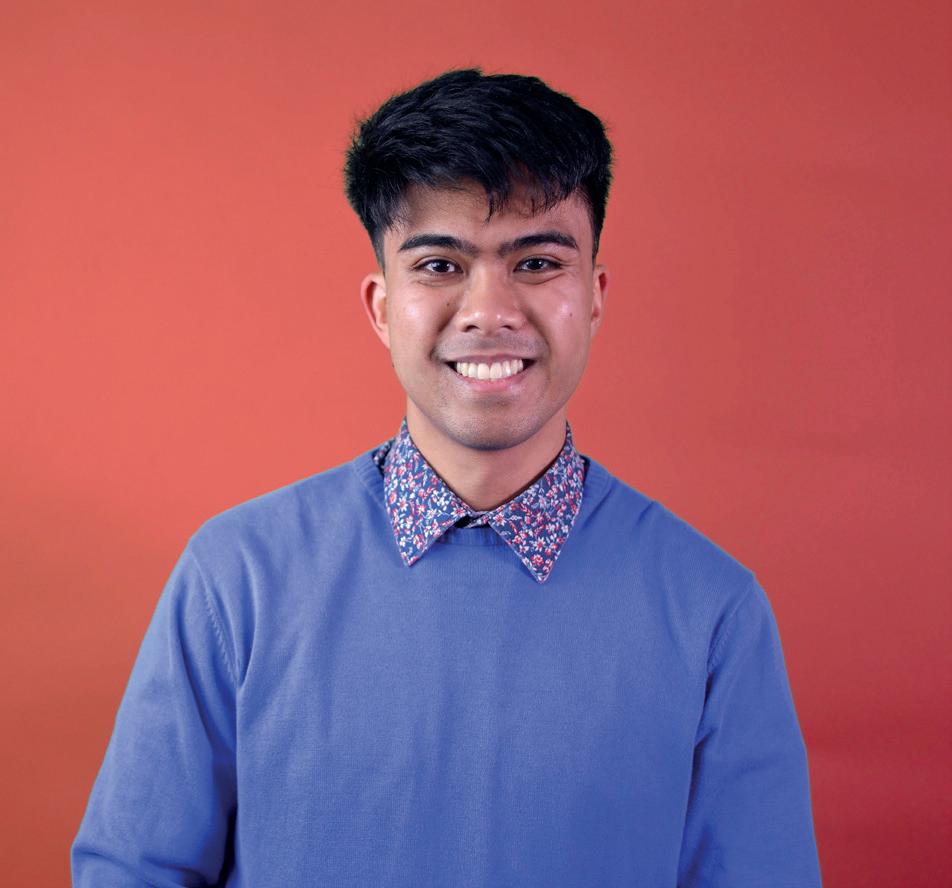
and be evicted without any protections,” they said.
Bryan Buraga is a master’s student in community and regional planning who is bringing his recent experience as counselor for the Graduate Student Society (GSS) on AMS Council to the race for one of five Student Senator-at-large positions.
While Buraga has less than a year of student government experience at UBC, during their undergraduate degree at McGill, they spent two years on the Senate and one year on its Board of Governors. He also served as president of the Student Society of McGill, a role comparable to the AMS president.
“I come from a student movement [and] activism background,” Buraga said.
“It’s important to have student representation and ensure that students’ rights are respected,” Buraga said of the appeals and academic policy committees that he hopes to sit on. They said it’s “unacceptable that students have to wait eight to 10 months” for their case to be heard.
Burgaga said sitting on the academic policy committee would be an important opportunity to bring student’s lived experiences into discussion around the LR7 accessibility policy, among others.
If elected, Buraga wants to pursue changes to LR7 that would allow students to self-certify that they have a diagnosis. He said it comes from a personal place, noting they ran into challenges when registering with the Center for Accessibility themselves because of the three-year cap on recognition of diagnoses.
“I had to go speak with medical professional[s] and pay out of pocket first, which is a very fortunate position to be in, but I know a lot of students struggle and aren’t able to have that financial support to be able to get the diagnoses that they might need,” Buraga said.
They are similarly concerned with the fairness of other university policies, including its rules on exclusion from university residences and the exam hardship policy. He said that in discussion with current student senators, he learned about cases where students were suspended from classes, and if living in residence, were evicted without protections, because the Residential Tenancy Act (RTA) in BC specifically does not apply to student residences.
“If you’re suspended, that also forces you to leave your home, leave your student residence,
Buraga also says that his experience with exam and syllabi databases policies at McGill is an asset he could bring to the Senate. “I can say, ‘hey, at McGill, we did it this way. UBC is just as good of a school. Why can’t we do it here?’”
He said that as an AMS councillor, he saw constituencies were developing their own exam and syllabi databases, but that it would be effective if it became an institutionalized practice.
Buraga said that he wants to continue to carry out the work that the Student Senate Caucus committed to in their Senate 2026, their triennial priority list published two and a half years ago.
He acknowledged that while there has been disunity and conflict within the caucus in the past, he is impressed with its performance this year.
“I think the caucus as a whole has done a really good job of maintaining a united student front and advancing student priorities,” Buraga said. He pointed to the current caucus’s action on ensuring UBC does not partner with universities complicit in human rights abuses.
“Continuing on the work that they’ve been doing, and not trying to reinvent the wheel, I think, is super important to keep that momentum moving forward,” Buraga commented.
Buraga also brought forward an idea for course feedback policies at UBC in response to a report that the Senate released this year, suggesting that professors are concerned with “harmful, vague and discriminatory comments on SEI surveys”.
They suggested UBC would benefit from a midcourse SEI equivalent, so that both students and professors are able to get the feedback and tweak the course.
He said that SEI surveys remain a relevant resource for professors to improve their courses.
“I trust in the student body to share their lived experiences, and to share [it] earnestly and honestly with professors.”
While president of McGill’s student union, he spearheaded the successful campaign for a fall reading break, and said he wants voters to know that he has experience mobilizing students for change.
“While I am a new student to UBC, student government and student advocacy is not new for me,” they said. “I don’t necessarily have the UBC experience, but I do bring a wealth of other experience to the table.” U
SENATE

IAN CHUNG
Candidate Profile by Harper Jasinski Features Reporter
Ian Chung, a third year Commerce student majoring in entrepreneurship, is running for one of five student senator-at-large positions. Currently on exchange at the University of Edinburgh, Chung wants to bring a comparative perspective to UBC’s Senate after seeing how different universities operate.
Chung shared that while he may not be as experienced in undergraduate societies compared to other candidates, his club participation and business background are valuable assets he can bring to the role.
“I have … a more unique perspective in terms that I’ve been on exchange where I’ve seen how other universities work, how it compares to UBC, and where are the strengths of UBC as well as the weaknesses,” he said.
Chung said that unlike UBC, it’s required that all classes at Edinburgh are recorded, and that those recordings are made available after class. He said this would decrease students’ stress in the event they have to miss classes. At UBC, the choice to record classes is currently at the discretion of the instructor.
Chung has been a part of a range of clubs, including consulting clubs and an aviation club. These experiences — especially as they relate to managing people and delivering services to others — give him an edge as a candidate, he argued. “I think that draws a lot on student life and experience that I can apply to my candidacy.”
In his interview, Chung said he wants to do something about how challenging it is for UBC students to find affordable housing. “As an international student, I didn’t have a place to stay in Vancouver. Finding housing for next year was really challenging … the stress that put on me was actually much bigger than even exams.”
The AMS’s most recent Academic Experience Survey found 52 per cent of students reported housing-related financial hardship. In September, Andrew Parr, then associate vice-president of student housing and community services, told The Ubyssey that while the university has spent hundreds of millions building student housing and is attempting to keep rent below market rents to support students, UBC still has an obligation to cover costs such as mortgage.
Chung emphasized that reducing external stressors so students can focus on their academic and social lives, rather than things like housing, was important. “I

ASH DENNIS
think as a student, exams and academics should be the top priority, and there shouldn’t be other aspects that hinder your ability to concentrate.”
Expanding the supply of affordable student housing, he said, was his top priority if elected to the Senate. However, decisions on this fall under the purview of the Board of Governors — the university’s strategic corporate body — rather than the Senate.
Other elements of Chung’s platform include textbook price caps, as well as expanding research and co-op opportunities. While there are cost limits on feebased digital learning tools required for classes at UBC, there is currently no cap on physical textbooks. These costs can act as a significant barrier to students’ learning, with around 62 per cent of students sharing in the AES that they have gone without a textbook or other course material due to costs.
When asked about agreements or disagreements with other student senators, Chung said they might have different ideas about what policies to prioritize, yet emphasized collaborating with other senators. “It’s more like an agreement and working between us to come up with a solution that UBC can benefit from.”
Chung didn’t specify how this may occur.
When asked about the validity of student experience of instruction surveys, or SEIs, in the face of large numbers of “harmful and discriminatory” responses according to a Senate report, Chung said, “it is definitely an issue we have to work on.” He mentioned that while it is difficult for ‘everything to work out perfectly’ given these types of surveys, he thinks that there can be steps to mitigate this issue, whether through different response types or other solutions. “I’ll have to look more into this and see how we can improve this for everyone, both for teachers and students.”
With 14 Senate standing committees, student senators are able to focus on specific areas of academic matters important to them, with topics ranging from academic policy to research and scholarships. Chung didn’t specify which one he wanted to participate in, saying he is open to any and wants to look more into what matches his experience.
He said he might be interested in a committee that does not get as much attention: “I want to contribute to committees that are less focused on, rather than just the main ones. I’ll see where my experience can apply, and go with that one instead of having a specific one in mind.” U
Candidate Profile by Harper Jasinski Features Reporter
A member of the Sexual Orientation and Gender Identity advisory committee at UBC, Ash Dennis, told The Ubyssey she “couldn’t give a straight answer” in recent conversations about whether students feel safe.
Dennis is a fifth-year student in the Bachelor of Education program running for one of five student senator-at-large positions.
Citing OneBC’s Jan. 22 appearance on campus and transphobic and homophobic marches across the country in 2023 and 2024, Dennis says there’s a need to create spaces that “allow students to exist.”
Passionate about supporting students at UBC, she wants to utilize her experience working with the AMS, disability advocacy groups and pride initiatives on UBC’s highest academic governing body.
Throughout her time at the AMS, Dennis says she has worked alongside student senators and the AMS leadership team. She said she has rewritten two constitutions for different student societies, and is currently working on the Education Students’ Association’s policies and constitution — governance experience she also wants to bring to being a student senator.
If elected, Dennis hopes to focus on the inclusivity issues on campus, mentioning mental health specifically. She also thinks the Senate needs to reach community members more, saying, “I think there is a way that transparency and actual communication with the student body can really support” its goals.
Dennis discussed enforcing this transparency through TL;DRs of Senate information — short summaries of longer materials — joking that “nobody wants to read 198 pages of the recent Senate report.” She wants the student body to easily access this information and know what is happening on campus. This transparency extends beyond sharing what the Senate is up to for Dennis — she wants to prioritize students’ needs through interaction, whether it be through surveys, online or in-person. “Tell us what you need, and we’ll try to advocate for it at these tables, at these meetings, at these committees.”
Dennis also said she wants to improve UBC’s accessibility policy by making self-certified extensions more available through the CFA. “This
is something that’s been advocated for from other senators for the past few years, but it hasn’t really been moving. That’s a really big goal of mine: continued discussion of LR7, and continuing to discuss really important topics around disability and support for them.” When asked about her thoughts on other student senators’ policies, Dennis emphasized their interest in collaboration. “I agree with anybody who wants to run for Senate because I think they’re all advocating for students – I’m happy to work with any and all of them.” She underscored how even in the face of differing values or beliefs, she would prioritize working together as students who seek to support other students.
Dennis wants to ensure students can afford to attend UBC by advocating for them through policy — she cited the Board of Governors’ recent 2 per cent domestic tuition hike to argue that UBC doesn’t listen to students.
Dennis said she was previously taking a full course load, and was not able to work because of the eight-hour days. “And there are students doing more than me, who are needing to do eight classes in education and can’t afford to teach, learn and work. They’re going to give up sleep, they’re going to give up food, they’re going to give up actual self-care.”
Making policy that will create “a place for them to actually afford their schooling,” is a priority for her.
As Dennis indicated, tuition is determined by the Board of Governors. The board also receives updates on the Student Affordability Task Force report recommendations, which do not interact much with the Senate’s policy sphere.
If elected, Dennis expressed interest in sitting on either the awards or academic policy committees. “Awards are somewhere where we can access these grants, bursaries or scholarships that can really support students.”
Dennis is interested in the academic policy committee as it not only aligns with her interests and degree, but is somewhere she feels she can affect real change: “This is a place where we can rewrite policy and allow for students to really look forward to education here - if we change policy to support them, instead of just having a barrier up.”
“We want to actually build these systems around our students — that’s what policy is meant for.” U
Candidate Profile by Trinity Sala News Reporter
SAUMYA KAMRA / THE UBYSSEY
BRYAN BURAGA
SAUMYA KAMRA / THE UBYSSEY
SAUMYA KAMRA / THE UBYSSEY
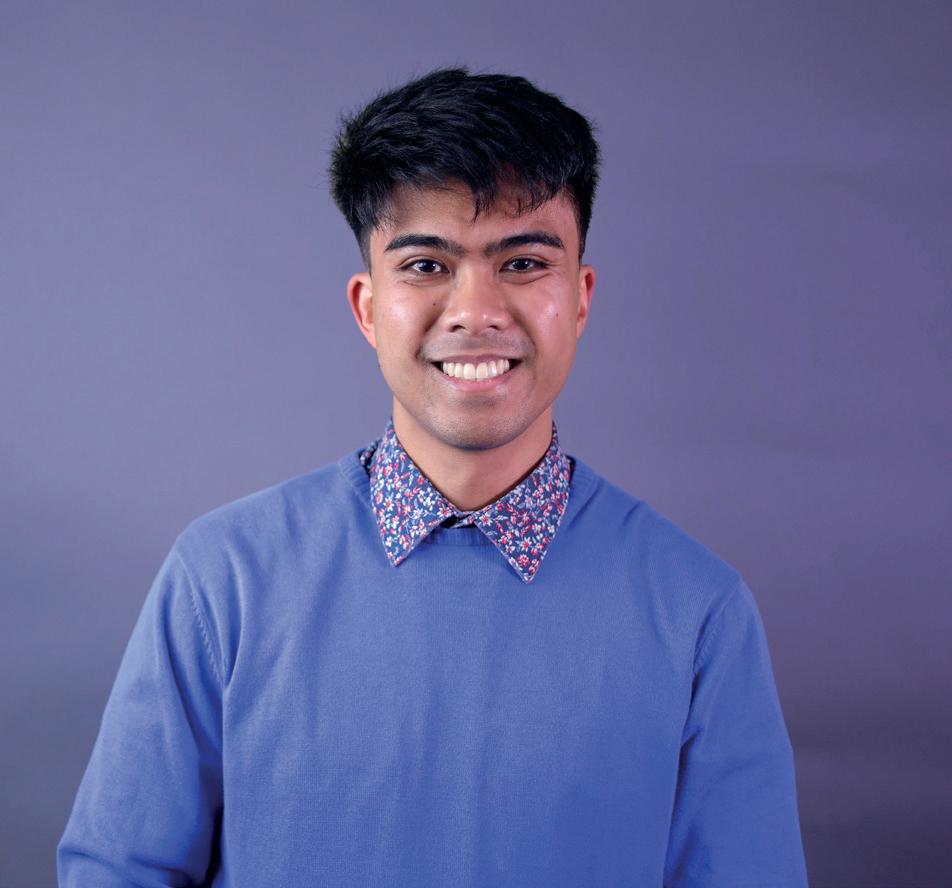
Bryan Buraga is running for one of two positions on UBC’s Board of Governors (BoG), promising tenant protections for students in residence, long-term funding for the Food Security Initiative and advocating for a tuition freeze.
The Board of Governors — comprised of 21 members including the chancellor, president, 11 governors appointed by the province and eight elected by faculty, students and staff — oversees UBC’s annual budget, investments and property management, among other administrative duties.
A first-year Master of Community and Regional Planning student, Buraga is currently the Graduate Student Society councillor on AMS Council. During his undergrad, Buraga served as president of the Student Society of McGill University and held seats on McGill’s Senate and Board of Governors — all experiences that Buraga says put him in a good position “to advocate for students as priorities.”
Buraga’s key campaign promises reflect both his personal passions and the issues they see UBC students facing — specifically around housing policy. He cited B.C.’s Residential Tenancy Act, which has an exemption applying to “accommodation owned or operated by an educational institution.” Buraga claimed this exemption has allowed UBC to “evict any student at any time for whatever reason.” Buraga promises to ensure tenant protections for students living in residence and plans to do so by sitting on the Property Committee — responsible for determining land use, rezoning and building approvals.
Although UBC’s 2025-26 budget predicted a surplus, there have been spending constraints across B.C.’s post-secondary institutions due to the federal caps on international student visas. Many universities, including UBC, have already implemented measures to mitigate the issue like hiring freezes, administrative budget reductions and program restructuring. Buraga says lack of funding is negatively impacting campus life — specifically for graduate students.
If elected, Buraga plans to fight for long-term funding for food security initiatives, instead of the university renewing its allocation. He said, “there are hundreds, thousands of students on campus that rely on these food security initiatives” and that if not increased, the limited food security funding will be detrimental to all members of campus.
Buraga said that he will fight for “increased access
BOARD OF GOVERNORS

DRÉDYN FONTANA
to co-ops, internships and research” and graduate student stipends at a livable rate. “They [graduate students] are being paid starvation wages right now … Graduate students make up a disproportionate amount of [food-bank] users, somewhere in the realm of 50 per cent when they only make up 20 per cent of [the student body].”
Buraga was not wrong.
The 2024-25 AMS Services Report confirmed that 49 per cent of food bank visits were made by graduate students. UBC announced on Feb. 26 that funding for PhD students will be going from $24,000 annually to $40,000, but this does not include any commitments to masters funding. Buraga expressed interest in sitting on the Finance Committee to advocate for student financial needs, saying UBC needs to ensure that “where we’re cutting doesn’t materially impact the basic needs of its community members. We cannot cut.”
Buraga is also against any tuition increases and wants to establish a tuition freeze.”
“The university needs to look at freezing [or] cutting salaries of senior administrators, making an active decision to pull more money from the endowment, and continuing to advocate for greater provincial government funding” to lessen the financial burdens placed on students, explained Buraga. Divestment from companies’ complicit in Palestinian human rights abuses has been a contested topic within UBC administration, despite years of student advocacy. Buraga supports divestment efforts. He said that “the genocide of Gazans is the moral crisis of our time” and a seat on BoG would allow them to bridge the gap between activists and board members. There are “various arguments from a financial, legal, reputational perspective that I think board members would be more amenable to.”
At a recent AMS Council meeting, Buraga pushed for the approval of a referendum that would require the AMS to call on UBC to cut ties with Israeli universities, saying at the meeting that the AMS “should continue to amplify the voices of our students that have been fighting for this year after year, and not stand in their way.”
Buraga’s campaign focuses largely on affordability measures for students, and he thinks that his education in community planning has given them “a really unique perspective, both from the student advocacy point of view, as well as the skills that [he is] learning within the program itself.”
“I really care about my peers, and seeing everybody suffer doesn’t bring me joy, but fighting for them does.” U
Candidate Profile by Spencer Izen Deputy Managing Editor
Drédyn Fontana is running for one of the two student seats on the Board of Governors, the university’s top decision-making body on finances, land use and projects.
If elected, he plans to push for increased faculty-level financial transparency and facilitate the development of a human rights investment framework for the university by the end of his one-year term.
Fontana, a sixth-year dual degree international relations and electrical engineering student, isn’t a new face to institutional politics. He was first elected to the Senate in 2024 as the applied science student senator, and also served as the AMS’s VP academic and university affairs. He was fired from the latter role by AMS Council in November of that year — the first executive to be fired in the student union’s history — after it concluded he made misrepresentations to councillors. Fontana has disputed that claim, saying he was fired for going against the grain in a toxic workplace. He has since brought a suit against the AMS for wrongful termination — and has served as a student senator at large since 2025.
On tuition, Fontana breaks with student governor orthodoxy: “‘I’m running on maintaining sub-inflationary tuition increases.”
“I know a lot of people have run on tuition freezes. I can’t in good conscience run on [a] tuition freeze, because I don’t think that’s going to happen.”
Post-secondary institutions are facing a financial crisis across the province. In November, the Ministry of Post-Secondary Affairs and Future Skills announced it was initiating a review of the post-secondary sector, citing decreasing domestic enrolment, inflation and the federal government’s “unilateral” reduction in the number of international students admitted to Canada annually. UBC’s enrolment report, however, reports increasing domestic enrolment. This year’s provincial budget holds post-secondary funding steady, with funding rising below the rate of inflation.
The province’s review is due on March 15, and the AMS and other student unions have expressed concern that it might justify the government allowing domestic tuition increases beyond the present two per cent limit, which has held since 2005. The limit does not apply to international tuition.
Referring to his own program, Fontana said UBC engineering’s tuition is lower than the University of Toronto’s. He argued that giv-

en inflation was around two per cent last year, “keeping tuition the way it is” is his goal. Asked about the AMS’s Academic Experience Survey that reports widespread financial hardship among the student body, Fontana says both the post-secondary sector and students are in a tough situation. “I myself have been a recipient of emergency bursaries, and it really helped me when I needed it.” But, he says, “how do you square that with the budget?” He noted that tuition essentially decreases based on the value of money if increases are sub-inflationary.
Fontana said the key differences between himself and the current student governors will be his focus on greater faculty-level financial reporting. “I think there’s a lot going on in the faculties that just doesn’t get seen as much,” he said.
He said he’s reviewed 20 years’ worth of UBC budgets in the AMS Archives. Over that period, he noticed that the budget “got a little more unstable” when universities began to rely on international student tuition revenue. “We’ve tied our revenue stream to a market.”
Fontana also has an interest in seeing more centralized financial planning across the university.
“If we can do more and more resourcing at a central level, I think that will help to save a … lot of labour costs,” he said.
Fontana also supports the ongoing work to develop a human rights framework for the university’s wholly-owned investment management firm. He’s confident that work will be done — the challenge, he said, will be aligning “spirit and principles that students have in mind when we’ve been asking for it.”
Since 2023, UBC has faced renewed calls for a human rights framework to govern its investment, precipitated by Israel’s genocide in Gaza and UBC Investment Management’s holdings. The student group UBC Divest has identified a list of 30 companies connected to the genocide that they want UBC to cut ties with.
When he says the investment framework will be “done” by the end of his term, ending April 2027, Fontana said “done” means a framework “which will eliminate certain companies,” from UBC’s holdings. “I think this year it will get done,” he said.
Fontana also wants to expand the Universal Design for Learning Fellows Program, a program of the Provost’s Office that helps faculty redesign courses to reduce accessibility barriers. He said it currently operates drawing on an annual fund, but he wants it to be a permanent fixture. U
Candidate Profile by Shean Lee News Contributor
Zarifa Nawar is running for the Board of Governors opposing tuition increases and pushing for further funding for food security initiatives and UBC’s Work Learn program.
Nawar has served as the AMS vice-president academic and university affairs (VP AUA) since January 2025 and is also a student senator-at-large. She says over the past two years she has secured $2 million for undergraduate research opportunities and pushed for mandatory statements on Gen AI in course syllabi to reduce ambiguity around academic misconduct.
“I have a very thorough understanding of the way the university governance works and the way that university advocacy works, and I’ve always, since my first day in office, delivered for students,” said the third-year standing political science major.
If elected, Nawar said she would focus on affordability, specifically in the areas of food security, housing, tuition and extra support for international and graduate students.
Nawar said she wants UBC to commit to multiyear funding for food security initiatives, instead of the current annual approvals.
On housing, Nawar said she would push the university to prioritize lower-cost, higher-density student housing. She additionally argued UBC should consider more “creative” funding approaches to keep construction feasible, even as costs rise, such as third-party partnerships used at other universities. She also wants to advocate for developing more than the 3,300 student beds committed to UBC’s Campus Vision 2050. Nawar also wants to leverage donor opportunities, but did not explain how she would do so.
Nawar opposes tuition increases. UBC has continued to raise tuition despite student backlash; post-secondary institutions across B.C. are facing significant financial hardship.
“I think this is one of the most fundamental mandates the student body has ever gifted its student leaders, and I very much intend to continue opposition to tuition,” said Nawar. With the federal government’s cap on international student permits, Nawar argued UBC needs to find alternatives to tuition-driven revenue. Nawar said international students are “the [financial] backbone of this university,” and 22 per cent of UBC’s 2025-26 operating
budget came from international tuition. She argued UBC’s reliance on international tuition developed in response to insufficient provincial funding for post-secondary institutions and is now proving unstable.
She said that she will ensure that “student priorities cannot be on the chopping block.” Nawar wants to expand financial aid for international students, and develop a system to assess financial need across different countries. She did not elaborate on what the specific of this financial assessment system would look like. Beyond affordability, Nawar said she would prioritize academic and career support. She argued undergraduate research funding should be sustained beyond short-term programs and more firmly integrated into UBC’s long-term academic planning, positioning research access as a core part of the university’s identity.
Nawar said expanding UBC Work Learn funding could create more student jobs and would push for a $2 million increase in the program. “We know that demand is incredibly high, and we know that the funds and the investment into the program from UBC is not nearly on the same level,” said Nawar.
As a longer-term proposal, Nawar raised the creation of an exam testing centre for deferred, standing deferred and accommodated exams.
On the extensive delays associated with exam accommodations, Nawar said “I don’t think that meets the calibre and rigour of academic standards that we have at this university. A student should not have to wait an entire term to write their final exam.”
For several years, students have also called on the Board of Governors to divest from companies they say are complicit in Palestinian human rights abuses.
When asked about the issue, Nawar said she supports the university being held accountable to its responsible investment commitments.
“There’s been a lot of things that the student body wants, and I want to ensure that UBC is listening to them, and, you know, doing its due diligence when it comes to this work,” she said. However, she said divestment is a long process and would focus on “timely updates” and transparency.
“When it comes to advocating for students, I have dedicated pretty much my entire time at UBC towards doing this … and I very much intend to continue that,” said Nawar. U
SAUMYA KAMRA / THE UBYSSEY
ZARIFA NAWAR
SAUMYA KAMRA / THE UBYSSEY
Candidate Profile by Amy Sheardown News Reporter
BRYAN BURAGA
SAUMYA KAMRA / THE UBYSSEY
BOARD OF GOVERNORS

Candidate Profile by Stephen Kosar News Editor
Editor’s Note: Razia also serves on The Ubyssey Publication Society’s Board of Directors. The board has no control over The Ubyssey’s coverage.
Sultana Razia is running for one of two student positions on the Board of Governors.
A fourth-year student double-majoring in economics and cognitive systems, Razia previously served a term on Senate and is a current Arts Undergraduate Society councillor.
Razia wants to be a governor so she can “speak up for those who don’t have that platform to speak up.” The decisions the board makes, she said, “really impact our lives.”
Razia believes that her experience on Senate gives her the expertise required to effectively work on the board. “I learned how to talk to [UBC administrators], negotiate [and] discuss issues with them … being the student senator and being on the Senate committees,” she said.
She cited her time on the Senate Library Committee, where she pushed for librarians to “make it a priority that students want more extended hours.”
“For anything that we want to accomplish, it’s very important that we start somewhere. It’s gonna be slow. We might not see the results, but then, if we have the conversation started someday, I believe we will see [change].”
Students and other UBC community members have called on the Board of Governors to divest from organizations alleged to be complicit in Palestinian human rights violations since 2022. Razia supports divestment efforts related to Palestine and also major fossil fuel emitters.
“Why is it so hard for them to divest? There’s so many other companies in the world that you could invest your money [in],” she said. “I don’t know why [the board is] so hardbent on investing in companies that have … solid proof of links to human rights violations.”
Razia supports UBC’s responsible investing framework, but said that work has progressed too slowly.
The university has had a responsible investing policy since 2013, but advocates have criticized the policy for years, saying that it does too little, too late. In 2024, UBC set up a working group — including Board of Governors representatives — to oversee the development of a new social risk framework. In February, UBC said that the working group’s work is still ongoing.
Razia also opposes tuition increases, but conceded that student governors are most likely unable to block increases at the board — at the last board meeting where tuition increases were up for debate, governors voted overwhelmingly in favour. Still, Razia said she wants to advocate against increases.
“Our priority is student affordability,” she said. “We want everybody to have access to education. And tuition fees are the biggest barrier to [that].”
At a board meeting last December, UBC Vancouver’s Provost and Vice-President, Academic Gage Averill said that tuition increases are necessary to preserve UBC’s financial situation as the university continues to face funding challenges.
To fix these funding issues, Razia said that the university needs to push the provincial government to increase funding to UBC, even as the province did not commit to substantial post-secondary funding in its most recent budget.
“The board’s job is literally to negotiate with the government,” she said. If the financial situation does not improve, Razia will not support budget cuts.
“I don’t think budget cuts [are] something anyone wants.”
Razia acknowledged that the board moves slowly on its goals. To implement her priority areas, she said that “getting the conversation started” is essential.
“It’s really slow. It takes a long time to get things done … the crucial point is getting something started, getting the work started, and then try your best to finish it as soon as you can.” U

Candidate Profile by Maneli Moghbeli News Contributor
Jacky Xue, a third-year business and computer science student, is running for UBC’s Board of Governors (BoG). With the province not increasing post-secondary funding in this years’ budget, Xue wants to tackle the university’s fiscal challenges while pushing for student services in a “targeted way.”
Xue, who has served on Senate for the past two years, including a stint on the Library Committee, recalled “hearing about just how much [the] library system was looking at making cuts to deal with upcoming fiscal challenges.”
Also serving on the board of directors of the Commerce Undergraduate Society and as director of the Student Legal Fund Society, Xue plans to push for stronger action from UBC to promote crucial issues such as housing and food security.
If elected, one of Xue’s top priorities will be housing. He said he will push the university to voluntarily follow the Residential Tenancy Act, a provincial law that sets rules for both tenants and renters. The act does not apply to “living accommodation owned or operated by an educational institution and provided by that institution to its students or employees,” not requiring UBC to follow the terms of the act. Xue said that this would “allow students to have fairer housing experiences with UBC.” He also wants UBC to commit to “ensuring that UBC housing rents are a certain level below” market rates.
Xue also wants to ensure widespread access to food and that the university “prioritizes food security as a permanent line item that doesn’t have to be individually renewed every three to five years.”
On affordability, Xue intends on raising awareness about bursaries and ensuring easier access “through a simplified application process,” as he said many bursaries currently exist as unexpended funds.
To expand accessibility, Xue said he would advocate for transparent budget sheets from the Board of Governors, allowing students to understand what the budgets contain. Accessibility, to Xue, also “includes increasing funding for accessibility related measures such as online video recording, textbook access [and] online textbook access.”
Xue also supports increased Work Learn funding on campus. He said that UBC may benefit from continued search for external candidates but also “[provide] more experience to UBC students by creating more positions,” specifically in the field of software development and operations “instead of just having students do clerical work.” He said this would aid student job prospects while helping with accessibility.
With student calls for divestment from organizations alleged to be complicit in Palestinian human rights violations since 2022, Xue said the university “should be working towards” that goal. He stated that the university’s investments should follow student needs. “There’s no point in sitting on a large pile of money if [students are] not happy with it,” Xue said. He acknowledged that divestment may be a lengthy process, but that it can be possible if done “over a period of time that doesn’t result in financial loss” in terms of scholarships and funding for student needs.
With the federal government decreasing the number of new international study permits in November, Xue said that he will push for increased applications from international students at the board. He suggested that the Board of Governors can “position UBC as a place where innovation takes place, in order to drive greater donor accounts.” Moreover, Xue said that BoG can “try to attract more budget from the province” for spending on research and innovation, in an attempt to rectify the current financial situation. U
AMS pushes referendum calling for student fee increase
Report by Juan Pablo Sastoque Vega News Reporter
Following last year’s failed referendum for a $4.95 student fee increase, the AMS is once again asking students to vote for increased fees.
This year’s proposal would raise two of the AMS’s 23 student fees and reintroduce another in September. For most students, the new fees would represent a 1.4 per cent — or $12 — increase in overall student fees from 2025-26 rates. To pass the referendum items, each must get a majority of ‘yes’ votes and at least eight per cent of the student body overall must vote ‘yes.’
When the referendums were first brought to council, AMS VP Finance Gagan Parmar said the AMS was at a “crossroads” — and that students will have the opportunity to decide on the future of their union. “With the fee referendum, we’re hoping to do two things, not only meet the demand right now that is growing, but meet the demand tomorrow,” Parmar said in an interview with The Ubyssey.
The AMS has officially endorsed the referendums and, following Council approval, AMS services staff can campaign in favour of it. However, not everyone agrees with this referendum. Lucas Sun, chair of the Student Affordability Coalition (SAC), said that student leadership should not “look at a bunch of poor students” and think solutions come from raising fees. “The SAC also made an aggressive comparison to the AMS: “You can quote me on this. They’re worse than Epstein. At least Epstein doesn’t violate my wallet,” Sun said.
When asked to respond, AMS President Riley Huntley wrote that the comment was “completely unacceptable and has no place in a student campaign. Making comparisons that trivialize the experiences of victims of serious abuse in order to score a political point is deeply inappropriate.”
Clubs benefit fee
The club benefits fee currently stands at $0.85 per year. If the referendum passes, it would increase by $4, landing at $4.85 annually. Despite the rise, the fee would now be entirely “opt-outable.”
Parmar said money from the increase would fill the $80,000 deficit in club funding. According to him, the increase would also allow the AMS to hire a second permanent staff member to speed up room booking requests and slowly provide more grants to clubs for events, which has seen a 50 per cent reduction over the years.
“We need to be doing more,” Parmar said. “That’s what we’re hoping to do with this fee referendum, is [to] not only stabilize right now, but to be able to continue providing those services at a greater scale and … level.”
If the referendum fails, Parmar warned that it could reduce the number of AMS grants and amount given, an extension on the clubs cap and fewer storage spaces.
Parmar said the amount was decided as a result of calculations that focused on addressing the $80,000 deficit. Necessary revenue for other projects — like expanding club grants — future growth, and putting the AMS “back on the path” providing clubs with the resources they need, were also considered, according to Parmar.
Finally, data from the 2025 AMS Academic Experience Survey, which found that only 58 per cent of students indicate a sense of belonging on campus, was also taken into account under the rationale that clubs address lack of sense of belonging.
Sun argued making the fee opt-outable “plunges” clubs into “uncertainty every September.” He said that room booking processing is a “baseline administrative duty” of the AMS, and that students should not “be forced to pay a premium tax” for the AMS to “do its basic job efficiently.”’
Capital Projects Fee
With a successful referendum, the capital projects fee would see an increase of $3, from $9.95 to $12.95 per year.
Parmar said the fee was proposed after a 2024 Nest experience survey and social media interactions led the AMS to realize spaces within the building for studying and social life were over capacity; an even more acute issue during peak academic periods. “This fee specifically is us hoping to address some of the pressure that the Nest is feeling to be able to service the volume and the high traffic as a central spot on campus,” he said.
The capital projects fee would predominantly fund the creation of a new student
study lounge in the lower level of the Nest where the old hair salon used to be — also referred to as the clubs commons project. The fee would also fund replacing and getting more tables, chairs and AV equipment as well as expanding operations of the food bank by adding storage space for food pallets, according to Parmar.
Were the referendum to fail “it would mean status quo,” Parmar said. He claimed the AMS would be unable to replace deteriorating equipment or purchase additional ones, overcrowding at the Nest would continue and big investment projects like the student study lounge would be scrapped.
According to Parmar, the AMS decided to increase the fee based on quotes for the student study lounge and average estimated prices of replacing equipment.
SAC is not opposing the capital projects fee.
“We take [this] as an example of a good fee increase that is needed, that is small and that doesn’t have those structural issues that we were talking about before,” said Mohkam Singh Malik, a member of SAC.
Student services fee
The student services fee was last collected during the 2014 academic year at $7.25, after which it was consolidated with an extinct $4.14 fee for external and university lobbying and advocacy into the present AMS membership fee. If reintroduced, the fee would be $5 per year, indexed to the B.C. Consumer Price Index (CPI).
SAC believes indexing the fee to the B.C. CPI represents a “forever-tax,” and Malik said this takes away prospective students’ “fundamental right to vote” on future increases. CPI indexation guarantees that the fee maintains its purchasing power despite inflation.
Parmar cited a 700 per cent increase in student interactions with AMS services such as Safewalk, peer support, the AMS Food Bank, advocacy and tutoring over the past five years. Growth has “outpaced [AMS] resourcing [and] over extended capacity,” Parmar said. Parmar placed the AMS food bank at the center of this. The fee would fund improvements to food bank wait times through new software and the hiring of full-time permanent staff.
Parmar mentioned the AMS has found that students are often coming to the union with intersecting issues. The services fee would allow the AMS to hire permanent management staff that can connect students to the multiple services they might need at once.
“It would be wrong for me to say that, should the fee not pass, that we would not continue providing the services,” Parmar said. “We absolutely would, because it’s something students expect of us.” He stressed that if there continues to be exponential growth, there may be limited access to these services.
The AMS originally calculated the fee amount above $5, but Parmar said the fee was brought down as “students are going through a difficult time and this is a lot to ask [of the] student body, and during a time when … finances are tight.”
Malik said SAC supports the “values” and “needs” of students, but thinks the AMS should have “reallocated funds” first before asking for the fee increase.
Sun criticized the AMS for not “prioritizing essential services over internal perks.” Some of the expenses they consider “luxury items” include $65,000 for AMS Awards Night Gala, $40,000 for catering and retreats, $61,802 in legal fees and the entirety of the VP Student Life portfolio.
The Ubyssey confirmed with Parmar that $40,000 is expected to come from sponsorship revenue for Awards Night Gala, and the rest will come from the AMS budget. He noted the gala is meant to “recognize the hard and volunteer work” of over 400 student leaders and constituencies. Additionally, Parmar justified the $13,440 for AMS Council catering as necessary considering AMS councillors are volunteers and meetings can span upwards of five hours.
Sun claimed the “luxury items” could have been reallocated “directly to the food bank and student clubs,” instead of proposing a referendum. These adjustments would amount to around $160,000 altogether according to Malik. For reference, the fee increase could raise over $700,000 for the AMS.
Parmar said the AMS will lead its campaign in favour of the referendum with positive messaging, but maintained the student union has a responsibility to transparently communicate any potential consequences if it fails.
“[This referendum] has always been student-led and student-driven, and all of the tangible benefits that we’re hoping to come out of this and come to fruition will again be student-led and student-driven,” he said. U
SULTANA RAZIA
SAUMYA KAMRA / THE UBYSSEY
JACKY XUE
SAUMYA KAMRA / THE UBYSSEY







WHO IS THE UBYSSEY ENDORSING THIS ELECTION SEASON?
Before you read on, understand what you’re reading. The candidate profiles are impartial stories written by the News section, independent of Opinion.
Editorials are written by the Editorial Board — three experienced journalists who collectively research and debate who should earn a Ubyssey endorse-
ment. They are Elena Massing, Features Editor; Maya Tomassi, Politics Columnist; and Quyen Schroeder, AMS Columnist, who acted as the Editorial Board’s chair. They conducted their own interviews with candidates.
Editorials represent The Ubyssey’s view, but not necessarily the views of any of our individual journalists. The term we
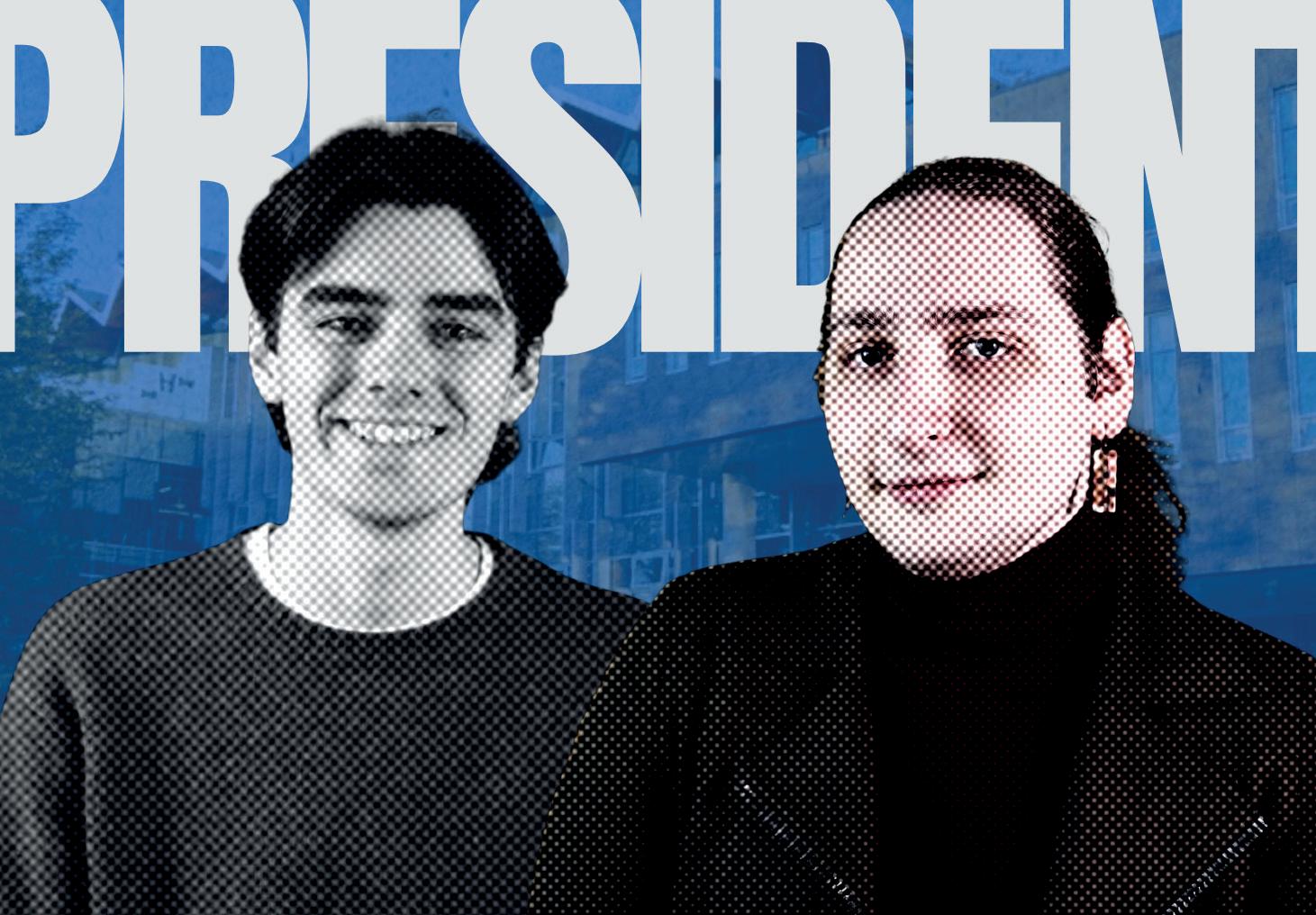
Editorial: Neither Lorien nor Evans earned our endorsement. But we’ll vote for Lorien
By the Editorial Board
The Ubyssey is not particularly impressed with Jasper Lorien and Dylan Evans. One is a candidate who may lead to drama and discord, and the other is wholly lacking in ambition. Honestly, we’re not sure we are voting for the right candidate. Recent years have seen significant tumult within executive teams: the indefinite leave of President Esmé Decker in 2023, the removal of VP AUA Drédyn Fontana in 2024, and the resignations of VP External Ayesha Irfan and VP Finance Gavin Fung-Quon in 2025. We’d like to avoid a repeat in 2026. The president sets the culture of the AMS by directing and supporting the other portfolios. Frequently, overstepping bounds leads to bad blood. Lorien’s platform is undeniably ambitious, but clashes with some proposals of many vice-president candidates. One example is Lorien’s lack of interest in reducing the AMS deficit (and their willingness to increase it), which directly clashes with the promises of VP finance candidates. During the debates, Lorien didn’t promise there will “never be any resignations,” but did commit to ensuring “issues that are caused by the culture of the AMS” don’t happen under their presidency.
Lorien’s vision was ambitious and their platform provides for multiple policy objectives. While none seem uniquely unachievable, the lack of disciplined policy prioritization left unclear what a Lorien presidency would start with and if their ambition will go from being an asset to a liability. They proposed increasing mental health coverage under the AMS/GSS Health and Dental plan from $1,250 to $1,500. A worthwhile move, but one that risks destabilizing the plan’s finances. Evans hasn’t mentioned increas-
ing health coverage, but does want to create a “formal review cycle” to ensure the plan’s stability. This is a microcosm of the difference between their campaigns. Lorien is willing to take big, but potentially destabilizing swings. Evans plays it a little too safe, afraid of inciting any instability. Evans is sorely lacking in political vision. Most memorable was his promise of “bringing fun to campus” and his description of his role as AMS president as being the “megaphone” of the student body. These policies were not memorable for any reason other than their nebulousness; while somewhat flashy, they ultimately mean nothing. Outside political sloganeering, Evans joined in the AMS tradition of promising exam and syllabi databases. His class notes database proposal was a Dylan Evans original, but the others were recycled. While many candidates propose an exam or syllabi database, we don’t think Evans brings much to the proposal. When asked about his unambitious platform, Evans said there is “ambition in supporting students” and maintaining stability within the society. Evans was adamant on “not rocking the ship and shaking things up”. While we appreciate the need for stability, we fear Evans’ presidency will be one of stagnation. He repeatedly criticized this year’s pace of governance changes at AMS Council, claiming councillors struggled to “follow a lot of the changes” because of their frequency. Moving quickly and breaking things is hardly an effective governance strategy, but a couple code changes every two weeks is hardly a breakneck pace. More relevant was Evans’ suggestion to include a “one-page” explainer of each code change — a response to students’ misunderstanding policy
now use to refer to all the editors at our publication is the masthead.
Questions? We welcome them at opinion@ubyssey.ca. This was a pilot project, and we want your feedback as we look to fully develop our Editorial Board in the near future.
— Spencer Izen, Opinion Editor. U

Editorial: Shack has the technical, political knowledge to succeed as VP finance
changes. In 2023, rationale documents were published alongside code and policy changes; Evans’ proposal to bring them back is a good one.
Though broadly unimpressed, we recognize that Evan’s experience has demonstrated some promise. He was FUS president, and as VP admin, he implemented a clubs cap — a bold move given its unpopularity. His textbook exchange program may prove valuable if well-executed. But given the pace of the AMS, it may be multiple years out. Outside this policy and his propensity for awkward messaging, not much else brought smiles to our faces. We were particularly disappointed in Evans’ stances on Palestine. Though he promised to “follow student-petitioned referenda to a ‘T,’” Evans committed to doing no more than the bare minimum. Last year’s referendum on divestment received more yes-votes than any candidate — by at least 2,500. It should be clear that students want their union to advocate for Palestinian human rights. In stark contrast to the absence of Palestine on Evans’ online platform, this is where Lorien shines. Their decidedly jargony call for “moral clarity” seems aligned with students’ demands. They propose the AMS take clear stances on important political issues, like the genocide in Gaza, reconciliation and other topics of equity, diversity and inclusion. A move towards a student union unafraid of echoing its students’ opinions would definitely be a welcome change — especially in contrast to Evans’ belief that the AMS should be “as apolitical as possible.”
Ultimately, we were not thrilled by either candidate, but we believe Lorien is the better choice. We invite the student body to vote as we will: for the best of a bad bunch. U
By the Editorial Board
The Ubyssey is endorsing Nathan Shack for the role of AMS VP finance. Shack, as the current AVP finance, has demonstrated knowledge of the portfolio. He aims to conduct focus-group surveys on AMS businesses, then revamp them based on that feedback. These surveys will likely be the baseline of what Shack calls a “comprehensive business review,” which will be used to formulate a long-term plan — he thinks this is necessary for long-term financial stability at the business level.
Shack works under current VP Finance Gagan Parmar, whose thinking he aligns with. He wants to continue Parmar’s approach to investment, claiming he “did a very good job” with their portfolio. Shack has also shown more willingness than his opponents to maintain a balanced investment portfolio, while his opponents took a more conservative stance, citing a likely negative economic downturn.
Shack’s campaign isn’t just a wishlist: there are plans. He hopes to increase the mental health coverage to $1,500 per year. Acknowledging the need to pay for this coverage, Shack would slightly increase the Health and Dental Plan fee — a decision backed by an AMSrun poll.
All candidates seemed keen on training, though their priorities were different. Having formerly served as the UBC Film Society’s treasurer — in addition to working with club treasurers during his time in the finance office — Shack claims to have seen a lot of treasurer turnover. He hopes to support them by improving training, like providing a multi-session training course during summer. For him, this would be more in-
depth and effective than the one-day session and video walkthroughs that currently happen. Fellow candidate Iman Dhaliwal agreed with the need to improve treasurer training, but he focused on the idea that there should be more transparent communication between the AMS and club treasurers, making sure “treasurers have a very simple understanding of what we want as the AMS.”
That said, there were not many more concrete ideas on treasurer training from Dhaliwal. His priorities seemed to be focused on businesses, and advertising them — Dhaliwal advocated for a youth-oriented approach to marketing, flexing his ability to “Gen Z post” — credentials gained during his time in some of the largest clubs at the University of Toronto before transferring.
Outside his focus on marketing, Dhaliwal also discussed his experience volunteering with the Vancouver Police Department and advocating for affordability as a member of the British Columbia Youth Parliament. Finance-wise, he worked with the Student Managed Fund and Management & Economics Students Association while studying at the University of Toronto. While his experience is valuable, Shack has already worked in the AMS’s finance office and has a better understanding of the main issues it’s currently facing.
Dhaliwal also took on a needlessly confrontational tone during the debate, which left us questioning his ability to work with other executives. Audrey Xue is easily the weakest candidate in the field. She has a vision of radical cost-cutting for the AMS, and while concern for the deficit is important, her proposals risk not only failing to improve the union’s fiscal situation, but also significantly
worsening student quality of life. Her plan to address failing AMS businesses relies heavily on automation — advocating to potentially replace restaurants and food service staff with machines. She was not particularly clear about a lot of her proposals, but given her willingness to cut AMS student jobs, we are concerned that a Xue term could lead to reduced positions to sustain students through their education. Furthermore, Xue was particularly opposed to fees. She proposed having AMS healthcare fees being “opt out by default” which she later admitted was “not feasible.” Nevertheless, she maintained that other opt-out fees should not be assessed by default, a policy which would sap funding from clubs, AMS resource groups and media organizations like CiTR. She also proposed combining fees in the name of “transparency.” Not only would this make the AMS fee structure more obscure by hiding the purpose of each fee, but officially consolidating these fees requires a referendum — so she wouldn’t achieve this goal until late in her term. You shouldn’t vote for Xue: her harmful proposals outnumber and outweigh her meaningful ones. We don’t think she’d lead our union in the right direction. Dhaliwal is a reasonable vote given his reasonably solid platform and finance experience; however, we’ll be voting for Shack. Perhaps Shack’s experience in the AMS Finance Office gives him an unfair advantage. But the role of VP finance is principally operational. You need someone experienced and someone capable of collaboration. Shack is financially competent, familiar with the AMS and willing to keep the AMS on a steady course, so he earns our endorsement for this race. U
SAUMYA KAMRA / THE UBYSSEY
SAUMYA KAMRA / THE UBYSSEY

Sparks is
a
responsible choice for VP admin
By the Editorial Board
The Ubyssey endorses William Sparks for the role of AMS VP administration. Although he does have some catching up to do, we believe he is able to learn and will likely be a safe, stable choice for this position.
Most of Sparks’ goals — at least those outside sustainability, which is his strong suit as a forestry student — are fairly unambitious. However, with last year’s clubs cap coming into effect and plans for unused space in the Nest not fully materializing, the administration office seems to need someone who can make the last push to sort out some longstanding issues.
During our initial conversation with Sparks, he was noncommittal, specifically on the issue of clubs. He didn’t want to make any promises regarding whether he would lift the clubs cap, maintain it or choose to make further cuts, opting instead to “stick with the situation as it arises.” In the debate, however, Sparks was more forthcoming. He proposed adding more “manpower” to his office to balance workload; creating new spaces for club use, like the Osprey Lounge & Terrace that opened last year; and forming a “club and constituency caucus.”
The first two goals are reasonable, but will be difficult, especially if the fee increase referenda on this year’s ballot don’t pass. It’s unclear how Sparks’ idea for a new clubs-focused organizing group differs from the pre-existing Clubs and Societies Committee, which is indicative of some potential gaps in Sparks’ understanding of AMS structure.
But while Sparks is not the most knowledgeable of the history of the VP admin position and its responsibilities, he does have a leg up on his fellow candidate, Lokesh Sandhu. Sandhu seems to have a genuine desire to improve the student experience, but proved he was deeply uninformed on the AMS as a whole and on what exactly the position he’s running for needs. This included him underestimating the scale of the AMS’s deficit by an order of magnitude in our initial conversation — which does not bode well for someone seeking a role working directly with clubs, who are clearly facing significant impacts of the union’s budget shortfalls. On managing the number of clubs, Sandhu said he would work with the VP finance to figure out how many more clubs could be supported. He proposed deciding on a set number of clubs that could be created each year, but didn’t have a concrete plan as to deciding which clubs would be prioritized.
In terms of sustainability goals, Sandhu proposed the AMS explore a partnership with — or create its own version of — Too Good to Go, an app that helps users
access surplus unsold food from restaurants or stores. He also said he would keep working toward the goals set by the AMS Sustainable Action Plan (ASAP), which is up for review in 2026, but did not have any specific ideas on that front, which leads us to question his familiarity with the plan. His absence at the Indigenous Forum caused us further caution — would Indigenous students be included in the conversation if the ASAP were renewed under his administration?
Sparks was very passionate about revisiting ASAP, specifically how he might work with Canada’s official greenhouse gas inventory from last spring, and emphasized how he wants to create a new version of the plan with more “specific and measurable outcomes.” Considering his background in natural resource conservation, he is definitely the more likely candidate to have success in making climate-related progress. The administration office has a larger staff than most other executive portfolios, and Sandhu would not be the leader they need. In the debate, he spoke about not wanting to have a “boss/ employee relationship” with his staff. His experience as a residence advisor is a very different type of leadership from governance, so unfortunately, a hierarchy — and someone who understands how to enforce it in a healthy way — is important. Sparks spoke of his confidence in his leadership skills and commitment to giving his staff the “independence that they need to create real change,” and also expressed his excitement to collaborate closely with the newly-elected VP finance on issues impacting clubs.
We spoke to both candidates following the UBC Conservatives club’s hosting conservative activist and MP Jamil Jivani’s in the Nest. Protestors demanded the AMS cancel the room booking, calling Jivani a “fascist” and “transphobe.” Both candidates said they’d consider canceling the room booking were they currently VP administration, but neither would decide alone. Sandhu proposed consulting council through a vote while Sparks said he’d avoid “unilateral executive action” while protecting students from discriminatory groups. Neither referenced UBC’s Policy on Academic Freedom which would apply to the invited speakers — but that’s an acceptable omission for a VP administration candidate.
Despite having experience heading mental health fundraising initiatives, Sparks is still a complete newcomer to politics, so he may not fully understand what he’s getting himself into. However, if his evolution from our first time speaking with him to his fair debate performance is any indication of his ability to learn on the job, we feel confident he will be a decent VP administration. U
VP ADMIN, VP EXTERNAL, AND VP AUA
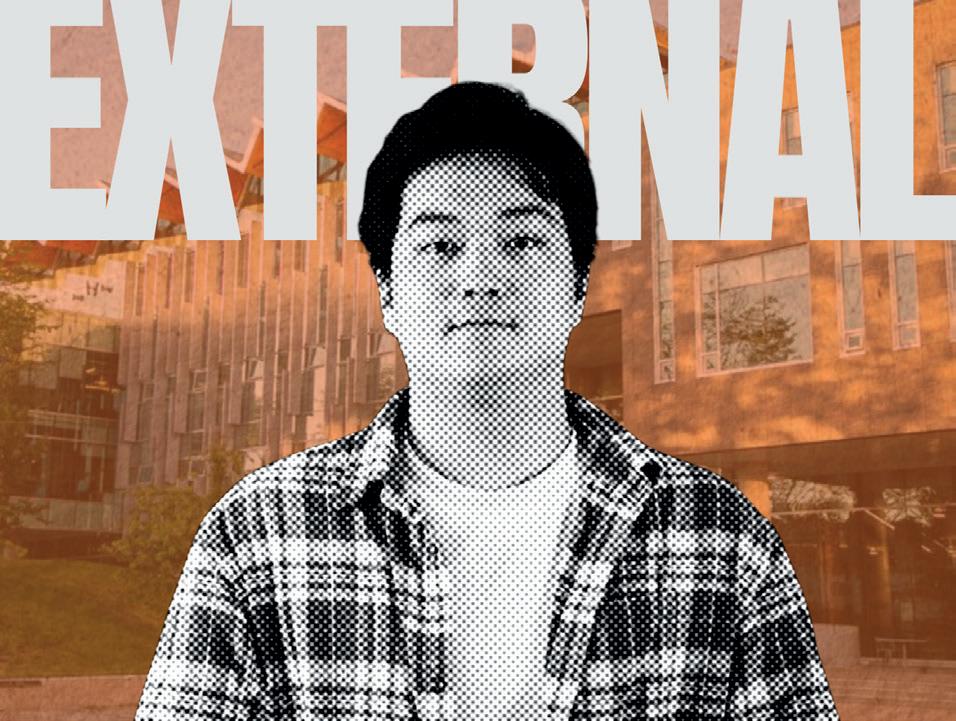
Zheng is unfit for VP
external
By the Editorial Board
The Ubyssey strongly disindorses Alex Zheng and recommends students vote no in the VP external election.
Zheng is unprepared on all fronts — AMS politics, organizing, external politics. As someone who aims to advocate for students, Zheng demonstrated minimal knowledge of municipal politics, which is one of his main advocacy fronts. He said he would lobby municipal governments in Vancouver and Burnaby for a rent cap for UBC campus housing. Zheng seemed unaware that the municipalities of Vancouver or Burnaby have no jurisdiction over UBC’s housing policy and that the university and the province would both be more relevant bodies to lobby.
When asked what municipal political forces he would contact, he said he couldn’t give a “super exact breakdown” because the elections were later in the year. Crucially incumbents are all very public, and at least in Vancouver, the party leadership and many politicians with significant momentum are easily identifiable. Further, there will be half a year between Zheng’s acclamation and the municipal elections: time that could be used to get student priorities on candidates’ platforms.
While he had some connections with provincial and former Burnaby municipal politicians, it wasn’t clear he was prepared to contact other politicians or conduct advocacy at any level of government.
Zheng was clearly pollyannaish when it came to political organizing. Despite proposing to use similar tactics as current VP Eexternal Solomon Yi-Kieran, Zheng seemed completely unfamiliar with the realities of lobbying. He implied that by collecting information about interested students through a survey, he will have a group he might mobilize in order to improve faltering momentum in policy pushes like the SkyTrain to UBC. This is not how political mobilization works. Political energy cannot simply be frozen and set aside to be utilized in a more opportune moment. A competent VP external would be able to harness current political energy and build on current political momentum to organize a more formidable activist movement.
Politically Zheng’s priorities were unclear. He talked about lobbying the

government for the SkyTrain to UBC and rent increase limit, but lacked any coherent policy on securing further education funding for the university. Something which might be needed given immigration restrictions revealed our over reliance on international student tuition fees. Zheng proved completely clueless about how AMS advocacy functions. One of Zheng’s key proposals was running surveys to gauge student engagement on key issues like the Skytrain to UBC. He seemed unaware that the SkyTrain to UBC was set as a core advocacy goal of the AMS at this year’s annual general meeting. This alone should preempt a need to run interest-gauging surveys about SkyTrain advocacy, yet Zheng proposed running multiple rounds of surveys before he’d start advocating. Zheng also seemed unaware of the oversaturation of surveys in the AMS. He said he wouldn’t start unless the surveys indicated there were at least a thousand students in favour. The yearly Academic Experience Survey (AES) only received 2,134 responses after being open from Feb. 2025 to May 2025. When asked by the editorial board, Zheng admitted to not completing the AES or UBC’s Financial Experience Survey. He said he believed he’d completed the Student Engagement Survey — but seemed to confuse it for the end-ofterm Student Evaluation of Instruction surveys. Given his track record, it’s unclear that Zheng would have filled out his own survey. He did, however, ask if we had recommendations on receiving survey responses.
Zheng was also unfamiliar with key parts of the AMS’s governance in relation to the VP external. When asked about his perspective on the External Briefs and Communication Committee, Zheng said that since the committee wasn’t public, he wouldn’t be able to answer questions about it. The committee’s minutes are publicly available on the AMS’s website. We are certain that Zheng will be unable to execute the role of his office. If he is elected, we doubt he will make it through the year. The best result for students would be for Zheng to withdraw from the election, triggering a by-election later this year. In case he doesn’t, you should vote no to Alex Zheng for VP external. U
Panchi’s unremarkable candidacy for AUA
By the Editorial Board
Jaiya Panchi is running uncontested for the role of AMS VP academic and university affairs (AUA). We think you should vote for her, though we were unimpressed by the many repeated promises and notable omissions of her platform.
Panchi repeatedly emphasized two overarching goals of her platform. The first is continuity. Panchi plans to continue the advocacy of current VP AUA Zarifa Nawar, of whom Panchi is a self-described “fangirl.” This continuity campaign will ensure that initiatives like the exam database and sustained food security funding are “pushed across the finish line.”
The second overarching goal is ambition. We certainly agree that her campaign is focused on continuity with her predecessor. Yet, we didn’t find much ambition in her platform. This isn’t necessarily a bad thing: an advocacy role like VP AUA requires consistent pressure across multiple years, not just a couple months of passion.
Her campaign goals are an amalgamation of years of past Senate, Board of Governors, AUA and presidential goals. There are the standard promises about opposing tuition increases, adding 3,300 beds on campus by 2050 and extending the course withdrawal deadline. She plans to continue the Textbook Broke campaign — and hopes to break the record set by Zarifa Nawar.
Also included in her goals is a mainstay of AMS politics since 2024: the oft-promised exam database. Panchi wants to land that plane. While completing the technology for the database would be a significant milestone, that’s only half the battle. We had an exam database before — in 2015. However, uploading exams was optional for professors: many chose not to. An exam database without exams is just a database.
We asked Panchi how she planned to address this problem. Her solutions weren’t policy-related, but cultural, relying on convincing professors to upload their exams — the same technique that failed a decade ago. She also wants to advocate for a syllabi database and re-
search opportunities portal, which may encounter similar issues.
We asked Panchi about the role student food-security groups should play in allocating funding — an ask of the failed Food Security Initiative referendum petition run by campus groups like UBC Sprouts. She was noncommittal about how influential these groups should be in allocating funding, but said she’d ensure an “$800,000 multiyear commitment for food security.”
Panchi’s experience as AVP administration gives her experience working within the AMS, but the Administration Office is separate from the academic and University Affairs Office. While the AUA office focuses on advocacy to the university, the administration office is focused internally: on the operations of the AMS Nest and supporting internal organizations like clubs.
In her interview, Panchi repeatedly spoke highly of current VP AUA Zarifa Nawar. Panchi praised Nawar’s work ethic and claimed it allowed her to prove wrong the people who doubted her ambitious executive goals.
Panchi missed the mark on several issues during the Great Debate. When asked about harm reduction, she said her platform was “not entirely inclusive of harm reduction in particular,” but described advocating for extant resources like drug testing strips. On sexualized violence policies, she said it is important to be “communicating with [the Sexual Assault Support Centre (SASC)] and ensuring that services are provided.” Given SASC is an AMS service, it’s unclear how she’d be advocating to the university on sexualized violence policies — if at all.
At the indigenous forum, Panchi had little to say. Other than her introduction, she was entirely disengaged with the conversation — disappointing for a candidate who would be advocating for Indigenous students.
If you loved Nawar’s tenure as VP AUA, we expect you’ll be rather satisfied with Panchi. If you were hoping for more ambition, however, you’ll be unlikely to find that in Panchi’s continuity platform. The Ubyssey endorses a yes vote for Panchi. U
SAUMYA KAMRA / THE UBYSSEY
SAUMYA KAMRA / THE UBYSSEY
SAUMYA KAMRA / THE UBYSSEY

Buraga and Fontana win the Board experience wars
By the Editorial Board
Editor’s Note: Razia also serves on The Ubyssey Publication Society’s Board of Directors. The board has no control over The Ubyssey’s coverage
The Ubyssey endorses Bryan Buraga and Drédyn Fontana for UBC’s Board of Governors.
Much of this debate — and our conversations with the candidates — revolved around who had the most experience and connections to powerful people at the university. Sure, there’s value in having big names and advocacy wins under one’s belt, but candidates generally have similar governance experience. When student governors bring opinions and issues to the board, rarely do decisions pan out in their favour, as evidenced by countless years of tuition increases or the resistance to a widely supported call to divest from companies complicit in genocide. While Buraga, Fontana and Zarifa Nawar all bear notable experience, the former two bring new or overlooked ideas to the table that might have more to offer students.
Buraga hopes to collaborate with students doing on-theground advocacy work, inspired in part by the student walkout for food security in October 2022 and the $800,000 allocation toward food security initiatives that followed in early 2023. This was a “student-focused movement” in which the governors had to “use their position and privilege to drive home the need for that increased funding.” It was an anomalous year, as there hasn’t been that kind of dialogue between students and governors in the past couple of years, but Buraga is set on mobilizing the “students on the ground” to bring this back. It’s an approach he found quite effective during his time serving on the McGill University Board of Governors.
Similar to Buraga’s emphasis on collaboration, Fontana was adamant on advocacy being a “team sport.” Fontana aims to prioritize working with faculties. He claimed “42 per cent of every international student dollar goes towards faculties,” implying they will suffer particularly badly from international student reductions. He plans to advocate for more transparency in faculty budgets, which he described as “essentially a black box.” This leads us to believe he will, compared to previous governors, have a more constituency and faculty-focused approach.
Over the past couple of years, students have called on the Board of Governors to divest from com-
panies complicit in Palestinian genocide. Divestment is one of Fontana’s main priorities. He believes there could be significant progress within the next 18 months if students keep putting pressure on the board and there’s a governor in the room willing to hear them out.
Buraga holds a similar opinion. He’s optimistic about change being on the horizon if a candidate is willing to make divestment a priority and, like Fontana, emphasized the importance of continued “student momentum.”
To explain her stance on the matter, Nawar referenced UBC’s divestment from fossil fuels in 2019, nearly a decade after the first Climate Action Plan was developed in 2010. She says she’s passionate about moving forward on divestment, but believes that it is unattainable in the near future. We disagree. In the debate, she said progress needs to happen at a “significantly speedier pace,” and we think this is possible — but not from a candidate who resigns themselves to accepting the past as the only answer. It’s also worth reflecting on the context around UBC deciding to divest from fossil fuels. Amid thousands striking at UBC and millions taking to the streets around the world for climate protests, it would have been a bad look for the university not to take action. UBC has been seeing students carry out action after action condemning genocide in Palestine — perhaps we just need the right candidate to push things over the edge.
Unlike other candidates in this year’s race — and many governors past — Fontana is not running on a promise to fight for a tuition freeze, instead proposing a push for maintaining sub-inflationary tuition increases. UBC’s budget, he says, is not in a place where we can afford to freeze tuition without making cuts to affordability measures currently in place for students. By keeping increases sub-inflationary, tuition actually decreases relative to the value of money which he says will lead to “essentially a free tuition” for both domestic and international students. Fontana has had to access emergency aid bursaries himself. He sees these increases as a more “fiscally responsible” way to go about making tuition more affordable without sacrificing any services along the way.
Both Nawar and Buraga will push for tuition freezes. To avoid making cuts, Buraga proposed using money from the endowment as a “rainy day fund.” Nawar’s proposal relied on recruiting more international students, specifically from the US — to her the current political state is an oppor-
Editorial: The Student Legal Fund Society is caught in a whirlpool of incompetence
By the Editorial Board
Editor’s Note: Nathan Harris wrote one article for The Ubyssey in 2024. He has not written for The Ubyssey since he ran for the SLFS board in 2025
tunity, but we’re concerned that continuing to fund our university with international students is short-sighted. Students have yet to advocate successfully for tuition freezes, but perhaps these alternate funding proposals will prove more persuasive. If Buraga and Fontana were to be elected, they would need to compromise on tuition increases.
We found candidates Jacky Xue and Sultana Razia did not rise to the level of the other three. Both candidates were not particularly knowledgeable of the board in its current state. Like other candidates, they proposed limits to annual tuition increases and divestment from companies complicit in genocide, but their proposals for achieving these goals were unconvincing. They had neither the experience and connections nor the inspiring approach required to put them on par with Buraga, Fontana or Nawar.
Xue proposed alleviating upcoming budgetary strains by creating micro-credentials to increase university revenue. While the idea itself isn’t all that bad, he did not express concrete ideas regarding how it might be implemented — and even if this happened, it would be unlikely to make a significant dent in our budgetary difficulties, especially given the additional resources needed to run these programs.
Razia’s approach to budgetary constraints was to “just venture out and get more funding,” not specifying what this would look like. She admitted to having fewer connections than Nawar and Fontana, but claimed she could “do it better than them” if given the chance.
Students are dramatically outnumbered on the board, so we need our two governors to agree with each other. Nawar has gotten wins in the past, but when asked how she would find success on the board, she took a hostile approach to asserting her superiority over candidates. She ended her debate by, yet again, listing her accomplishments and reinforcing that “no one else can say the same.” Among fellow candidates who have previously sat on a university board or held positions as an AMS executive and senator, we see that as simply untrue — and it’s certainly not the attitude we want to see one of our student governors bringing to advocacy work.
While voting for Nawar is reasonable — unlike voting for Razia or Xue — we’ll be casting out ballots for Buraga and Fontana. Their experience on university bodies and willingness to work together will benefit students across our campus. U
The Student Legal Fund Society (SLFS) has been in turmoil for years. Lucia Lu, Jacky Xue, Vihaan Gukta, Nathan Harris, Damarise Carcellar and Elaina Fung all are running unopposed for positions on the SLFS’s board. Without opposition, the six will be acclaimed. You can’t vote on this next SLFS board, but you still deserve to know our opinion on the candidates and the organization as a whole.
The SLFS is a society independent of the AMS. It is funded by a $1 student fee and was founded in 1998 by referendum to “fund cases to improve education and the accessibility to education at UBC.” The SLFS has funded student cases on fewer occasions than they have received criticism. This year, humble AMS Councillor Luke Parolin accused the SLFS of not approving an annual budget and, in 2023, AMS President Eshana Bhangu criticized the SLFS for its poor transparency and governance practices.
Each year, SLFS candidates campaign on fixing the SLFS. Self-evidently, it hasn’t worked. Year after year, the SLFS has failed to discharge its duties, only rarely surfacing throughout the year before election season rolls around again with a new crop of candidates promising to fix everything. This year’s crop is proposing a major restructuring and realignment of the SLFS, including the creation of multiple vice president roles to support increasing the scope of the SLFS, but their plans may be hampered by the SLFS’s limited financial leeway. Their proposal to revitalize the SLFS involves selecting typography, running events and rebuilding transition structures. The Ubyssey ’s editorial board appreciates the ideas brought forward by this SLFS slate, but doubts they’ll be successful in reviving the SLFS.
Xue said that the SLFS supports the work of the Law Students Legal Advice Program (LSLAP) — which is run by students studying at the Peter A. Allard School of Law — through funding and providing office space. In the most recent year, they didn’t fund LSLAP despite typically doing so. The SLFS also collaborated with AMS Advocacy and the Sexual Assault Support Centre in previous years, but no longer does.
Financially, the SLFS is in a bind. The SLFS pays the AMS $39,354 a year in contracts — two-thirds of the society’s annual budget. The 2024-25 Income/Expenses spreadsheet (the only available financial document for the society) indi -
cates that the society spent an additional $487 on their website but only $90 in filing fees. The remaining $15,058 was unallocated. Xue described that year as having “minimal expenditures.”
Xue alleged the SLFS’s financial situation was the fault of a previous board signing an unfavourable contract and rental agreement. Despite repeated questions during our interview and two follow-up emails, no member of the SLFS was willing to name the board members who signed that contract.
We asked about the median cost of cases the SLFS has funded. We were told only about a single case, which was recently funded to the tune of $100,000. Given that a year of minimal expenditures entails only a $15,000 remaining balance, it seems that the SLFS can only fund a case every seven years. This slate plans to add other ways to engage: creating online courses about tenancy law, holding events and restarting their Instagram — with better colours and fonts. Further, they proposed collecting data to aid the AMS and student representatives on the Board of Governors and Senate with their advocacy.
Perhaps the SLFS’s engagement efforts should be focused internally. We asked the incumbent Xue for the minutes of any single meeting in the past year. We did not receive an email response, but in a conversation after an election event, he described being unable to provide any because they were “confidential.” We then asked for the minutes of their annual general meeting, which the SLFS is required to keep under section 20(1)(i) of the Societies Act. Xue said he couldn’t access them because they were in the possession of fellow incumbent Harris. The slate seems aware of these organizational problems. Following our original interview, we received a document bullet-pointing the slate’s goals for the year. One of them was “having a google [sic] folder for all our documents.” This is an exceptional idea. We don’t know why incumbents Xue and Harris are waiting to implement it.
While some of this slate’s plans are interesting, we’re not confident they’ll reach fruition. Notably, Xue responded to most of our questions during the interview and emails afterward. Harris and Fung were unavailable for our group interview. We worry that members of this slate will become demotivated over time, leaving only a few bearing the brunt. And given this slate can’t coordinate to provide records, we are concerned internal conflict may lead to strife among the remaining directors.
We don’t think this slate will be successful in reviving the SLFS — but for the sake of students, we wish them well. U
SAUMYA KAMRA / THE UBYSSEY
Editorial: Vote with empathy. Vote yes on all four referenda
By the Editorial Board
You will have the opportunity to vote on four referenda during this year’s exam period: three are fee increases brought forward by the AMS and the fourth is a student-petitioned referendum which would require the AMS to write a letter demanding UBC cut ties with Israeli universities claimed to uphold apartheid. The Ubyssey endorses a yes-vote for all four referenda.
The largest of the fee increase referenda asks students to add a $5 fee to support student services. Usage of AMS services like the Food Bank, Peer Support and Safewalk have increased dramatically in recent years. These services are facing severe strain — in need of more permanent staff and equipment to continue to provide quality service to thousands of students. Though endorsing a fee increase amid financial pressures seems contradictory, it is exactly now that we should support our most vulnerable classmates with these services. For those who would call on the AMS to reduce overhead rather than asking for more money, the AMS has done exactly that. Since the 2022-23 year, the cost per interaction has dropped by an average of 22 per cent.
If you can vote yes for only one fee increase, it should be the Student Services Fee. We need to support our peers, whether they’re struggling with food insecurity, academics or mental health.
This year brought the controversial 350 club limit. Throughout the campaign period, many candidates have discussed the importance of clubs to finding community and forming campus culture. To help build these bonds, clubs need support from the AMS. Certainly financial support, but also logistical support, such as room bookings. All of this costs money.
As it is, not only will the clubs cap remain in effect, but existing clubs will continue to see degraded support — fewer and smaller grants, slower responses to room booking requests and perhaps a further reduced club cap. This is why the AMS is asking for a $4 increase to the Clubs Benefit Fee, of which you will be able to opt out.
This fee increase provides security to the Clubs Benefit Fund, allowing the AMS to not just maintain current support, but expand it. While the nature of this fund’s usage will be up to future executive teams, increasing club grants and improving the room booking process are near certain. Given clubs are often cited as the first place students find community, we think an additional $4 is a fair price to pay — we’ll be voting yes on this referendum.
We’ve been using the Nest for over a decade. If we want our shared space to be maintained and improved, this $3 increase will be critical. Right now, both the audio-visual upgrades and the Food Bank plumbing renovation have been stalled, awaiting funding that might take years to arrive without this fee increase. We need to take care of our space, lest it fall into disrepair. We endorse a yes-vote for the Capital Projects fee increase.
Finally, the student-petitioned referendum would require the AMS to send an open letter to the university requesting to cut ties with certain Israeli universities organizers say are upholding apartheid in Palestine.
We acknowledge that cutting ties with three universities is a symbolic gesture. It alone is unlikely to materially affect the conditions of Palestinians subject to apartheid and genocide. However, it is an important moral position for the student union to take. We must take a stand in current conflicts, it would also be in keeping with the AMS’s history of taking stances on contentious political issues such as South African apartheid in ‘87, abortion in ‘72 and the Vietnam war in ‘67.
It is worth noting that the AMS could have easily taken a stance on the Israeli genocide without holding a referendum. It is only required because the union historically refused to take a bold stance unprompted; instead they only act when directed to by a referendum, and even then they only follow the results to a ‘T.’
To the current AMS Council’s credit, they narrowly voted to endorse this referendum (though the AMS hasn’t publicly campaigned for it or publicized their endorsement). The Ubyssey’s Editorial Board believes we have a moral imperative to take a stance. Students want this — proven by last year when 2,500 more people voted yes on the student strike referendum than for any elected candidate. A yes stance on this year’s referendum will not only serve as a potential lynchpin for a broader divestment push, it will also strengthen our ethos as a student union.
You should vote yes to all four referendum items. U
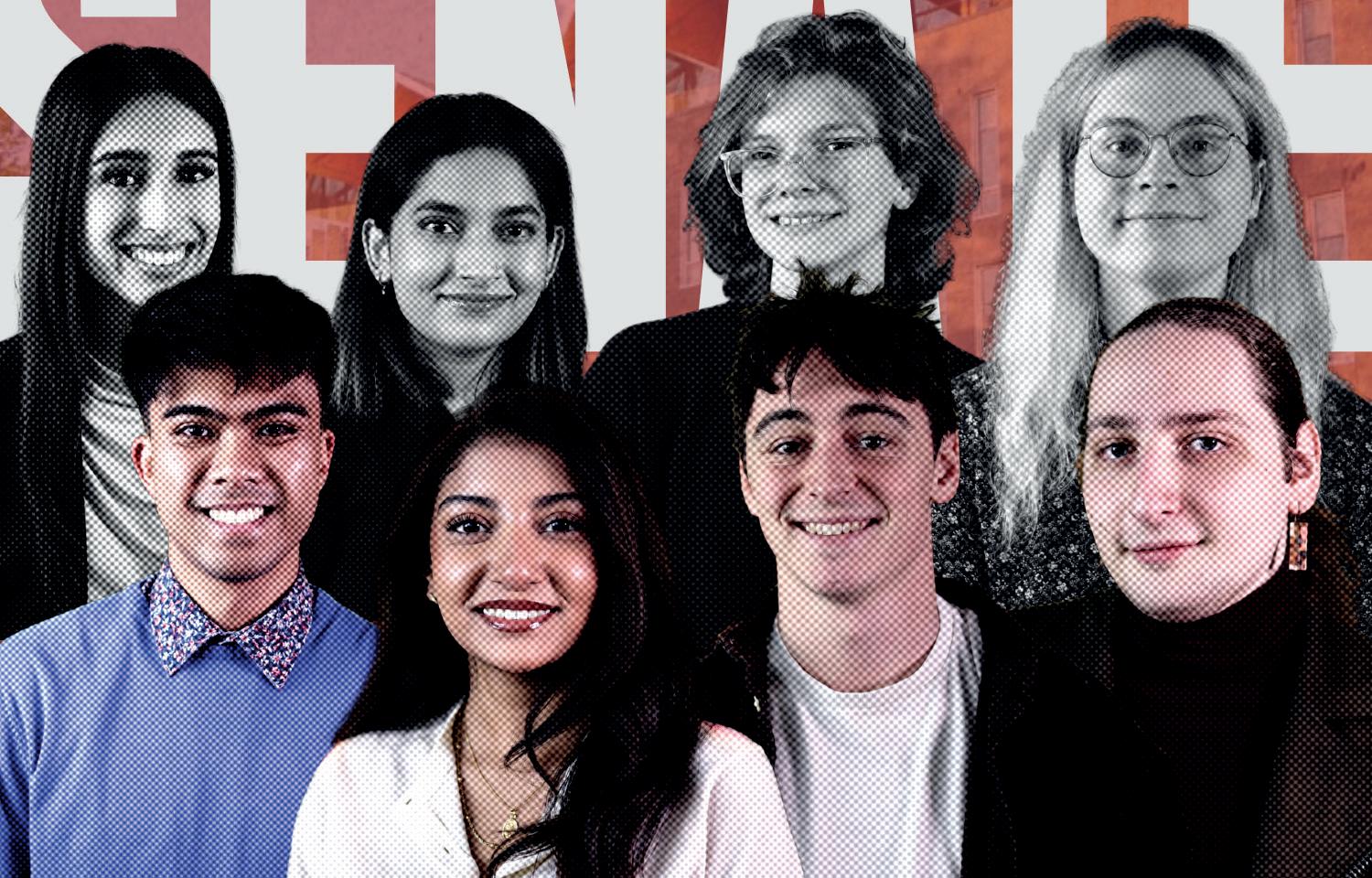
Editorial: You can choose five senators-at-large. Buraga, Fontana, Lorien and Nawar should be the first four
By the Editorial Board
This year, we saw a field of 10 candidates running for the five senator-at-large seats. The UBC Vancouver Senate is responsible for most of the academic-related issues at UBC, like textbook costs, academic misconduct, exam hardship and other forms of accommodation.
The Ubyssey is endorsing candidates Bryan Buraga, Drédyn Fontana, Jasper Lorien and Zarifa Nawar. While not receiving our endorsement, we believe Jaiya Panchi and Ash Dennis were more qualified than the rest of the unendorsed field. Of the four candidates we endorsed, all prioritized policies V-102 & V-103 on Exam Hardship, V-135 on Academic concessions and LR7 on Disability.
Here are our thoughts on each of the candidates.
Bryan Buraga
Given his extensive background in McGill student politics — he was the student union president, a senator and a member of the Board of Governors — we expect Buraga will be a capable senator, if elected. Buraga demonstrated knowledge of our current Senate policies and procedures, and has vowed to continue working on longstanding policy priorities regarding accessibility through policy LR7, exam hardship in policy V-102, and policy V-135 for student supports. Buraga is aligned with the policy priorities of the Student Senate Caucus (SSC) and will likely work harmoniously with other student senators. Buraga believes the university is a place of radical academic and social change, and that institutional stances on neutrality and academic freedom should not be used as a “cudgel to prevent certain types of speech.” We think students are broadly supportive of this. His experience at McGill might allow him to bring fresh perspectives to increase the efficacy of the SSC. Being a new student to UBC, we are less familiar with Buraga’s style, so it’s still somewhat unclear what direction he might take — it was also disappointing to hear he hasn’t yet attended a Senate meeting despite being interested in a position.
Drédyn Fontana
As an incumbent senator, Fontana is knowledgeable of Senate procedure and policy. Though he’s the only student senator not part of the SSC, likely due to historic “bad blood.” Despite this, we believe Fontana has been an effective senator during his term and will continue to help move policy LR7 on accessibility and concessions. He is likely to continue the work he has started this year on the Agenda and Nominating Committees. While we are confident Fontana will be a capable senator despite not being a member of the SSC — and accept his justification for being outside the caucus — we were unimpressed by his interactions with certain fellow candidates in this race. We expect more maturity and less pettiness from our student representatives.
Jasper Lorien
If re-elected, this would be Lorien’s third term as a senator, making them the longest-standing at-large incumbent. They are likely to continue to be an effective student senator, aiming to continue advocating for the policies on accessibility and student accommodations which they have worked on during their previous terms, like LR7 and V-135. Despite having been an effective senator, we are concerned about their willingness to collaborate with other members. They used their time during our interview to criticize other candidates, which did not contribute to the effectiveness of their campaign or advocacy. We hope elected senators are able to get past needless pettiness in the name of effective governance.
Zarifa Nawar
Nawar is a Senate incumbent and current AMS VP academic and university affairs, where she has been effective delivering change. As an incumbent senator, Nawar has worked on policy V-130 with other student senators, and aims to continue working on policies LR7 and V-135. This is in line with other student senator priorities. We were not impressed with her stance on cutting ties with Israeli universities, as it was needlessly convoluted and opaque, making it unclear where she stands. Despite saying she will “rise above [internal disagreements] in every single case,” like some others, she demonstrated unnecessary pettiness towards other candidates during our group interview.
Jaiya Panchi
While The Ubyssey is not endorsing Panchi, she did demonstrate decent knowledge of Senate procedures and policies, focusing primarily on syllabi policy V-130 for AI policy and V-103 on mandatory finals for 100 and 200-level courses. We felt that Panchi did not have as strong a grasp on Senate policy compared to the first four candidates, but that she would still be a competent, if unremarkable, senator. As the future VP AUA, having a role in the Senate would help her best advocate for policy changes regarding the AMS, though that in itself is not enough to earn our endorsement.
Ash Dennis
Like Panchi, Dennis hasn’t quite earned our endorsement. She demonstrated satisfactory knowledge of Senate procedure and policy, primarily discussing policy LR7, which focuses on disability accommodations. She also proposed to advocate for 2SLGBTQIA+ rights, though it was unclear how she would go about it. While definitely knowledgeable, Dennis did not seem as qualified as the candidates we chose to endorse. She, like Panchi, lacked any senatorial experience — she’s a decent fifth choice, but between her and Pan-
chi, we are not recommending one over the other.
Ian Chung Ian Chung was unavailable for either of our interviews with Senate candidates having been on exchange this semester. His platform is lacklustre: recording lectures, limiting textbook prices and creating new research opportunities. Nothing other candidates haven’t said before. Other points, like expanding housing supply, are outside the scope of the Senate and fall under the purview of the Board of Governors. Chung is a candidate with uninspired promises who isn’t on campus to participate in debates or engage with students. Even if you agree with him, there are candidates with the same promises who are more deserving of your vote.
Luca Jenkin
Luca Jenkin is a first-year student seeking to represent students as a freshman senator. He showed up to all interviews and debates, but Jenkin’s platform includes little more than having a “more restrictive AI policy” in coursework and pressuring UBC to cut ties with Israeli universities. While he clearly has thoughts on some Senate policies, his lack of knowledge about governance would limit his effectiveness. We appreciate Jenkin’s participation in campaign events, but he has never attended a Senate meeting and has limited understanding of Senate procedure. We do not believe Jenkin would be an effective senator.
Sultana Razia
Sultana Razia has served as a student senator before, so she should have some knowledge of Senate proceedings. However, she seemed to only know the Senate she left, not the one of today. Razia was unable to answer questions about recently-passed policies that directly related to some of her goals. In particular, she proposed that a generative AI statement be included on syllabi so students explicitly knew what was acceptable use of the technology. Unbeknownst to her, a revision of Policy V-130 was approved earlier this year, requiring syllabi to include a statement on generative AI. Razia also vowed to lobby for policies like extended library hours — a tough ask given the university’s financial struggles and her having no proposal for how to pay for it.
Editor’s Note: Razia also serves on The Ubyssey Publication Society’s Board of Directors. The board has no control over The Ubyssey’s coverage. Elisa Nasimi
Other than their name, little is known about Nasimi. They didn’t submit a candidate bio to the AMS Elections team or respond to any of The Ubyssey’s emails. Unless you’d like to gamble on a mystery senator, you shouldn’t vote for Nasimi.U
SAUMYA KAMRA / THE UBYSSEY
Point
of Inquiry: The AMS saved us $3 in 2022.
Nobody will benefit from every AMS service. Expecting you will got us into this mess. We’re still paying
Opinion by Quyen Schroeder AMS Columnist
Quyen Schroeder (she/they) writes Point of Inquiry covering student politics and the AMS. They are a fourth-year student studying English and Computer Science. Her email is q.schroeder@ubyssey.ca.
As continued from page 1. Then, citing the historically low use of the fund, they dropped the amount students paid into it. Instead of the student body contributing nearly $100,000 into the Clubs Benefit Fund, we contributed just $41,000 per year.

limited to 350 total) and less fi nancial support, including reduced membership subsidies. Necessary improvements to club services have stalled, like the deployment of a new room booking system and the creation of additional club spaces and lockers.
In the years that followed, council continued to increase expenditure from the Clubs Benefit Fund.
Though in the referendum’s year, the fund had $700,000, the money going in went down, and the money going out went up. Last year, we used six times more from the Clubs Benefit Fund than we did in 2021–22. You don’t have to be an economist to know that is the recipe for draining your bank account.
What did we gain from the reduction of this fee? We gained… $3 each. The price? The Clubs Benefit
Last year, in response to this fund’s poor performance, the AMS tried to increase the fee again, but by a single dollar. They literally just wanted to press the undo button on an ill-informed, barely impactful fee-reduction measure.
The referendum — which also included three other fee increases totalling to $4.95 — failed. The reduced Clubs Benefit Fee remained for the 2025-26 school year, exacerbating an already dire situation.
This election season, the AMS is tabling a more ambitious ask: a $12 increase split among three fees. The first is a $5 Student Services fee, returning from 2014;
the second is a $4 increase to the Clubs Benefit fee; and the third is a $3 increase to the Capital Projects fee.
The specificity of these fees works in the AMS’ favour. Last year’s fee increase referendum only vaguely gestured towards what would happen if it failed. All the AMS said was that services would no longer be supported “at current levels.” Students were asked to pay more for the status quo, which is not exactly an inspiring message.
This year, the AMS is going on offence. The referenda questions clearly describe how students would benefit — rather than warning about reductions if it fails.
The Student Services fee would allow the AMS to hire more permanent staff, which has been a bottleneck for services like the
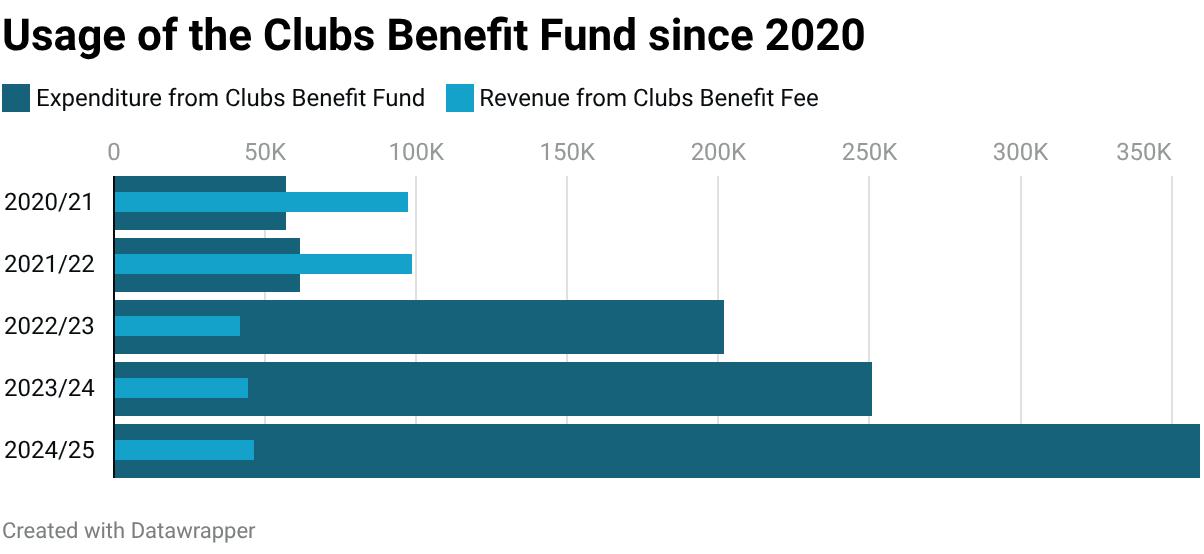
AMS Food Bank, given the order of magnitude usage increase in recent years. The Clubs Benefit fee may reverse the recent cuts to new clubs and funding — justifying hiring enough staff to handle the thousands of room booking requests. The Capital Projects fee would bring planned Nest renovations over the finish line, such as adding a sink to the Food Bank and creating a Student Study Lounge.
Much like the push for this year’s quorate Annual General Meeting, I think clubs will be the crux of these referenda’s success. Clubs are centres of campus community and will materially benefit from these referenda passing. Club executives should speak to their members to inform them of these referenda. AMS organizers should focus on ensuring these executives are aware of the referenda and prepared to advocate for them.
Passing a fee increase referendum is difficult. Success is far from guaranteed. But what won’t move the odds is lying to ourselves about the support for these referenda.
The AMS’s referenda coordinators presented the results of a survey to council on Feb. 11. Their report was the opposite of cleareyed and honest. They grouped respondents into two groups: “potential supporters” and “supporters/neutral”.
A slide presented at AMS Council on Feb. 11. Look at how many students are “potential supporters” of the referendum!
For one referendum, as many as 69 per cent of students were potential supporters! But what distinguishes potential supporters from supporters/neutral? It’s rather simple: potential supporters are students who don’t support
the referendum, dummy. Instead of producing a good graph which faithfully represents the survey data, they forced the data into a fictitiously optimistic binary. Instead of performing a lexical tap dance around the concept of not supporting something, we need to show students both how they will benefit specifically and how our community as a whole will benefit from these fee increases.
To quote the great philosophers of yore, “we live in a society.” Every one of us relies on those around us — in small ways and large ones. Every year, I pay $254 for UBC’s Athletics and Recreation fee. I don’t lift weights in the gym, skate in the rinks or play intramurals. Yet, I happily pay this fee so that others can live out their Heated Rivalry fantasies in UBC’s Todd Ice Hockey League.
Your reading of this article is made possible not by any one person, but by the entire UBC community. We decided that independent, community-centred journalism benefits all of us and is worth chipping in $8 a year. (Author’s Note: $8 is an absolute steal.)
Before you vote on these referenda between March 9 and 13, think about which services on campus you use. Ones you had access to only because everyone pitched in to fund it. No one will benefit from every initiative.
I do not enjoy paying more arbitrarily. However, there are tangible benefits attached to these fee increases — including more functional communal spaces and increased support for food-insecure members of our community.
I hope you’ll consider joining me in voting yes on these fee increase referenda when voting starts on March 9. U
SENEESHA EKANAYAKE / THE UBYSSEY
ARTS & CULTURE
BOOM!
Pro Wrestling hooks fans with stories, action and steel chairs
Event Report by Jack Paransky Arts & Culture Reporter
As continued from page 1.
Wrestling tells its story in a unique way. Fighters can’t give monologues during suplexes. The only dialogue is through pre-match trash talk, interviews, and other extra-ring devices. It’s a unique combination of two narratives: the fighting that takes place in the ring and the story that happens outside of it. The only art form I can compare it to is musical theater. There’s a quote attributed to many directors that says, in musicals, “when the emotion becomes too strong for speech, you sing; when it becomes too strong for song, you dance.” Wrestling is like that except, instead of dancing, you hit a guy with a steel chair.
Because of the speed at which characters must be introduced and start doing their stuff — a typical match runs about 10 minutes — wrestlers are often sorted into two categories. The “face” is the good guy, the champion of the people. The “heel” is the villain of the ring who fights dirty and bullies the fans. These boolean bins are simple but effective and, perhaps more importantly, efficient. There can be different variations of each archetype — a monstrous heel will play very differently from an egotistical one — but the set tropes help the audience figure out who to cheer and jeer for.
Pro wrestling is not about reinventing character archetypes — it’s about telling unique stories with the wrestlers, archetypes and gimmicks you have. You fall in love with it because it’s the marriage of flying momentum and cathartic narrative. That’s certainly how Mitchell, a UBC finance alumnus and the owner and creator of BOOM!, found his love of the craft.
Originally, he wasn’t interested in the big show offered by WWE — he found the whole thing corporate and boring, without enough ring time to show off the players’ talents. But when he got into New Japan Pro-Wrestling (NJPW) and Mexican wrestling in 2015, his interest was piqued — the storytelling was just better, elevated beyond what the WWE had made him think possible. “I remember a guy delivered a flying headbutt, and I was like: this is the greatest thing I have ever seen. And from that moment on, I became evangelical about pro wrestling.”
He wanted to pass on that fanaticism to others with BOOM! A comedy producer by trade who specialized in high-concept shows at the Little Mountain Gallery, he decided in 2022 to host a 64-person wrestling match to determine his first daughter’s middle name. That characteristically absurd origin story led to BOOM! Pro Wrestling as we know it — complete with Time Machines, former president Abraham Lincoln, and in-ring weddings where food complaints prompt the chef to body slam attendees.
BOOM! is a perfect storm of science fiction, devastating romance and human violence. But Mitchell can only control what happens before the bell rings. Inside the ropes, the wrestlers reign.
BOOM!’s talent are a melting pot of theatre kids, athletes and musicians. Take Cherry Blossom, the most face-y face I’ve ever seen. She walked out with such spirit and energy that she barely had to lift a finger to get every soul in the audience on her side. A smaller wrestler, she uses her status as the underdog to get the audience hyped. “During the matches, they can see the fire in me,” she said. “Or they can see the fighting spirit in me. And that [leads to fans] cheering me on.” The character is based on the underdog getting to kick ass.
“‘[She] is just me, but turn it up to 200%. [I’m still] Cherry Blossom.”
Wrestling isn’t all crowd work — it’s an art form where the artists come back even after suffering personal injury. Top Speed Tommy Chan, a tag team wrestler with mathematically precise attacks, suffered a badly broken foot in a match that had him out of the ring for 15 months. But he came back and fought with the type of passion and poise that his background in martial arts gave him. Even though it hurts, for him it’s a part of the business. “You just gotta learn to love being hit. And it’s really, really fun. And [that’s] what makes it addicting. It’s the thrill of it, the adrenaline.”
The medium allows high-flying feats of human skill to be expertly contrasted with capital-A Antics. POWERCHEF stood out to me when I first visited BOOM! His character is inherently comedic, having lost one match when another wrestler jumped on his head and piloted him into ratatouille-style self-directed submission. Wrestling, Mitchell said, is inherently funny. The chef knows how to utilize outlandish setup and slapstick and cook it up with a nice serving on bone-crushing suplexes and dives. He believes what makes wrestling unique is its ability to adapt to absurdity within inherent time constraints “There’s all these glass walls that we’re allowed to break whenever we want.”
And break them they do. The match I went to on Feb. 27 was the perfect example of why wrestling is so compelling as a medium. The night’s theme was “Work of Art”. It was a masterpiece that lived up to its name. Before the match, Mitchell told me that this was his most self-indulgent card — 14 of his best wrestlers performing at the top of their game. Travis “Wild Eyes” Woloshyn, the MC and arbiter of all BOOM!’s set ups and payoffs, introduced the wrestlers for the evening and declaimed to the acolytes of the ring: “These are the new masters. This is BOOM! Pro Wrestling, and this is a work of art!”
The narrative of the evening was the return of two BOOM! wrestlers who recently made the big time: Travis “The Professional” Williams and Judas Icarus. Travis was the head heel of the evening. He played the pompous ass — the big shot who comes back to his hometown and finds it wanting.
On the mic he called the fans posers, the wrestlers cowards and the reigning champion weak.
In contrast, Judas was a demon, a monstrous heel obsessed with only inflicting pain. His tongue flicked out of his mouth like a frog searching for flies. He walked out, flipped a chair, and cried for joy. These heels were a cosmic threat to the kingdom of BOOM!
Not every match of the evening was part of this overarching narrative, but they still had me glued into my chair. One standout fight was a bombastic clash between Ricky “The Example” South and Zaye “PNW Playboy” Perez. Perez was an acrobat who could fly from the top ropes and land brutal throat kicks. South was a juggernaut, managing to send Perez across the ring with a single hit.
The two slammed each other until they couldn’t anymore. It was myth and parable in action — Perez was the songbird soaring through the air and South was the unkillable grizzly batting at him with his paws. The audience cheered for Perez, so far out of his opponent’s weight class it almost felt unfair they were put in the ring together. Perez ducked deadly blows, and pinned South before flying once more across the ring.
Perez nearly had him. But wrestling can’t always be the hero’s journey we hope for: sometimes the bear kills the songbird.
Judas Icarus’ storyline con-
tinued through the night. He bet Wild Eyes if he beat his scheduled opponent Amira, the announcer would get flipped — thrown to the mat and tossed like a pancake. Wild Eyes cried that he was just a normal man, not one of the superheroes fighting that night; to be flipped would mean his death.
This prelude gave the match stakes and weight. The audience shifted forward — we were no longer simply watching two athletes clash — our announcer’s health was hanging in the balance.
Judas, true to his mic talk, fought like an animal. He threw Amira like a sandbag. Amira, to note, was one of the best wrestlers I have ever seen. She was a champion, using the ropes to jump at Judas with arms forward in Superman-style flight and commanding the audience’s attention like a conductor. She would clap once, and the floors would rumble with our collective excitement.
Near the end of the fight, Judas broke a rule and was about to be thrown out by a referee — but Amira wouldn’t let him leave that easily. They continued to clash until the mat was scarred. After a battle fought so hard both fighters were bruised and bleeding, Amira managed to pin Judas. People stood up from their chairs and shouted in relief and joy. I smiled from ear to ear as the tables turned and Wild Eyes gleefully flipped Judas Icarus.
At the end of the night, after miniature stories of epic proportions, the main event’s bell rang. Casey Ferreira, the reigning Vancouver champ, had to defend his title from Travis Williams, the boisterous big-time brat. Williams fought dirty — he bent Ferreira’s leg until I could almost hear the ligaments pop. He went for that leg for the rest of the match. Each time he kicked it, the audience let out a choked gasp. In terms of the narrative, it was a clever set-up for a weak point — a Chekhov’s gun that we hoped wouldn’t be fired.
Judas Icarus, from outside the ring, tried to knock Ferreira down, circling like a rottweiler about to be let loose on unsuspecting prey. The heels fought dirty and Ferreira, the honourable champion of Van City, was taking a beating. He would pin Williams only for him to bolt upright and send Ferreira flying. You could see the yellow preludes of bruises raise painful heads on Ferreira’s chest. Remember: this is real.
The ref, the only sign of order when the starting bell rings, was knocked out by a stray fist from the fray. This was all it took for Judas Icarus to jump in the ring and start wailing on Ferreira alongside Williams. People shouted. My breath caught in my throat. Wild Eyes tried to step in, but he was just a regular man — he was pummelled to the ground, the champion lying nearly bleeding beside him.
You have never heard a crowd pop like when Amira flew into the ring. Each person became a crackle of noise. Wild Eyes and Amira pushed down and flipped Judas Icarus, giving Ferreira enough time to put Williams in a surgically precise chokehold. Williams had to tap out. The walls shook. It was like a church in the rapture.
Wrestling is storytelling. There’s a three act structure, extra-narrative entanglements and enough Chekhov’s guns to fill an armoury. The audience at BOOM! doesn’t come out to see an exhibition of flips and pain, but to see fights with meaning — stories.
Wrestling is exciting because it’s intense, romantic, mythical storytelling that can hold a steel chair. In the age of artificial intelligence where art is becoming a coding problem, wrestling is so entirely human. Like Mitchell said: THIS IS REAL! U




Pro wrestling is not about reinventing character archetypes — it’s about telling unique stories with the archetypes and gimmicks you have. | RAUL DEL ROSARIO / THE UBYSSEY
BOOM!’s talent are a melting pot of theatre kids, athletes and musicians. | RAUL DEL ROSARIO / THE UBYSSEY
The audience at BOOM! doesn’t come out to see an exhibition of flips and pain, but to see fights with meaning — stories. | RAUL DEL ROSARIO / THE UBYSSEY
Amira was a champion, using the ropes to jump at Judas with arms forward in Superman-style flight and commanding the audience’s attention like a conductor. | RAUL DEL ROSARIO / THE UBYSSEY
Mona Berlitz is making an impact — even from
the sidelines
Mona Berlitz, one of UBC’s best players, has had to watch the 2025-26 season from the stands this year, because of an ACL injury suffered in the summer. Despite that, she’s learned how to be there for her team, even if not on the court.
Profile by Ian Cooper Sports & Recreation Reporter
As continued from page 1.
Berlitz first visited Vancouver when she was 16, with her brother, who had an internship in the city. Initially, Vancouver enticed her because she was motivated to improve her English, but she quickly found herself drawn to the city for another reason. Basketball.
In Germany, Berlitz explained, the status quo for elite youth basketball players is different than in North America. Typically, high-level players do not go through the college/professional pipeline we have here. The sport’s infrastructure is based on a club system, rather than being connected to academia. In North America, players can do both — maintain a competitive level of play and simultaneously partake in higher education.
For Berlitz, who was named an Academic All-Canadian last year, the North American model offered her an opportunity that the traditional European route could not.
Berlitz initially took a gap year after completing high school to play professionally, but eventually decided to get in touch with the UBC coaches. From there, her decision was made.
“I looked into different schools, but it was only UBC I applied to. I couldn’t think [of] another school that would fit [me] … and I loved Vancouver when I was here.”
While Berlitz already spoke the language, settling into a new life was not easy in practice. That
changed quickly, however, when she met now-fifth-year forward Sofia Bergman, who had joined the team a year before Berlitz.
“Right off the bat I knew we would be lifelong friends,” said Bergman. “My parents call [Mona] their German daughter and her parents call me their Canadian daughter.”
Bergman — who also had a unique path with basketball, not taking up the sport until grade eight — plays a similar position to Berlitz on the floor. Despite playing similar roles, their skillsets differ, with Bergman playing as a more traditional post, and Berlitz using her quickness and versatility. But because of that, their games are complementary. It’s also clear that, in true sibling fashion, the two love to compete with each other.
“We battle, and we’re the same position so we’re constantly pushing each other to get better,” said Bergman. “But off the court, she’s my best friend.”
When Berlitz first visited Vancouver, she stood at five-foot eight, and due to her size, had been playing at the guard position. A late growth spurt at age 17, however, brought her to where she stands now — six feet tall. This growth spurt naturally brought her into the front court, but Berlitz was able to retain many of her guard skills, something that is evident when you watch her play.
“I played different positions growing up, [so] I learned the skills of all the different positions.”
When asked if she had a professional player comparison for those
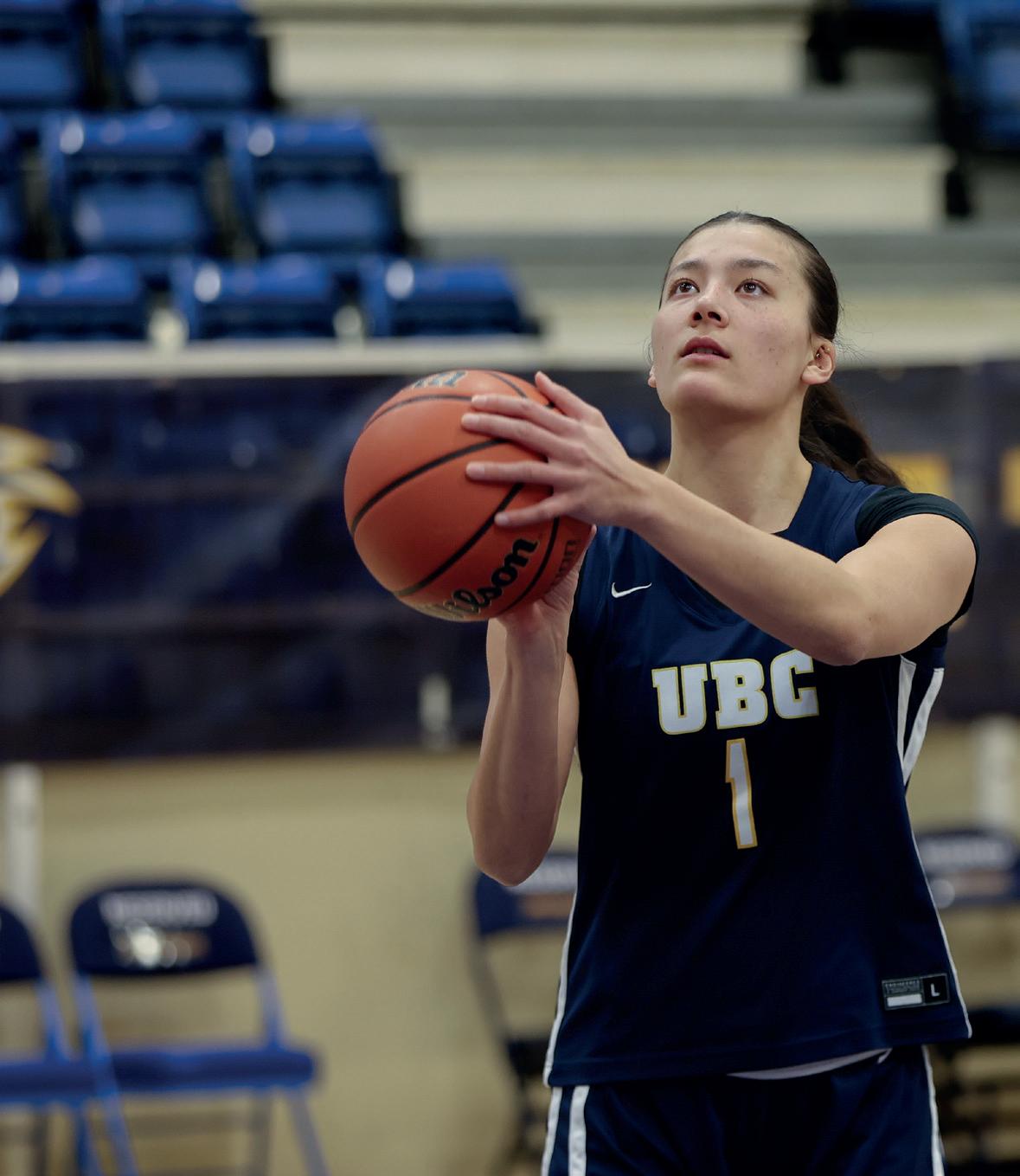
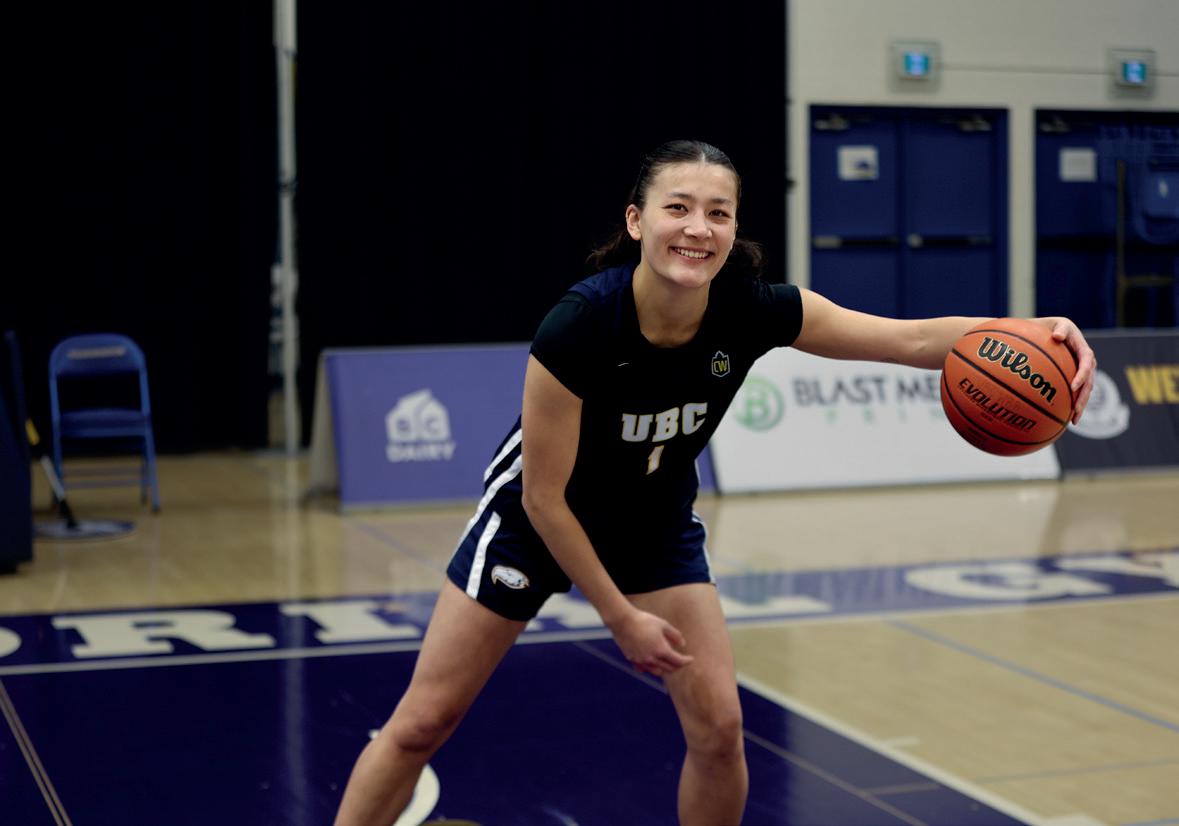

unfamiliar with her game, Satou Sabally was Mona’s first answer. Sabally is a six-foot-four WNBA forward from Germany, whose team, the Phoenix Mercury, just reached the WNBA finals this past season. Sabally also came from Germany to play college basketball in North America, and despite being listed as a power forward, she also possesses a unique set of skills usually associated with guards. As Mona puts it, the similarities between the two of them are uncanny:
“[She’s] a versatile forward who can shoot, and is also German and went to college [in North America], she also has this skillset that combines using your body but also your quickness.”
But perhaps what makes Berlitz stand out most is her relentlessness.
“When she’s competing … she’s the person that I would least like to guard, because she’s just so fierce and so competitive,” said Bergman. “[She] brings her all to every drill, every competition. That’s the type of thing you want as a teammate, not [as] an opponent.”
By her third year at UBC, Berlitz was no longer adjusting. Anchoring both the offence and defence, last season her growth as a player culminated in her being at the centre of the Thunderbirds’ quest for a national championship, made even sweeter with the Final 8 being hosted at UBC. In front of a bustling home crowd at the Doug Mitchell Thunderbird Sports Centre, Mona delivered an impressive 14 point, 10 rebound double-double in the ‘Birds first round win.
For a player who crossed an ocean to be here, it was a moment that validated everything — the commute to practices as a teenager, the decision to leave home, and the choice to take a different path than other elite German prospects.
With the UBC men’s team going out in the first round, much of the attention was rightfully shifted to the women’s side, something that does not occur nearly enough in the regular season.
“People came to support us during that whole tournament, which was really, really nice because in [the] regular season, a lot of the time, people [will maybe] come at halftime for us, and then watch the men’s game,” said Berlitz. “It was nice that people came to see us, watch[ing] us play the full game and having a loud crowd.”
Off the back of their eventual fourth place finish at nationals, in the summer of 2025, the UBC women’s basketball team ventured across the Atlantic to visit Berlitz’s home town and play some preseason games against local club teams. The trip provided more than just early-season bonding and competition. For Berlitz and her team, the trip was meant to be a celebration.
“It was so special, to show the whole team where I’m from, my

culture, my family [...] and where I first played basketball,” she said. “Because they didn’t know anything about the first 19 years of my life.”
The trip ended up being a turning point for Berlitz for all the wrong reasons. With her injury, Berlitz decided to remain in Germany for the first semester of the academic year.
Instead of being in War Memorial on opening night, Berlitz was rehabbing her injury and watching her teammates on video streams from a different time zone.
Now back in Vancouver, Berlitz has yet to make her return to the court. While initially overjoyed to return to her new, adopted city, she found it tough when she attended her first game.
“I knew it was going to be hard watching from the sidelines … [but] seeing people getting introduced in the starting lineup and not being part of it just hit me, which I didn’t expect.”
Still having not stepped on court this season, you can now spot Berlitz eagerly cheering her team on from the sidelines, and leaning into huddles. While she hasn’t been able to find playing time, that doesn’t mean she hasn’t made an impact.
“The more I see the games, the more I can appreciate and grow into my role of being on the bench and trying to bring positivity to the team and support from the sidelines.”
Bergman on the other hand, was not short on superlatives when describing Berlitz’s role as a leader this season.
“I just can’t speak more highly of who she is as a person. She’s just so caring and confident and
one of those players whose actions just speak louder than words,” she said.“[She] shows all the young girls coming in what it means to be part of a team. Leadership, of course, is scoring and doing all those things we need to win. But, it’s also like: what does someone do when people aren’t watching? I think Mona is a prime example of what it takes to be successful.”
Berlitz’s presence on the sideline has made a noticeable difference for this T-Birds team. Since returning in January, her team went undefeated throughout the rest of the regular season after dropping four games in her absence. While they recently endured a heartbreaker in the Canada West final, losing 63–57 after an impressive run through the playoffs — they got another crack at the postseason at nationals. While they lost twice, they put up a fight against Saskatchewan and TMU, two of the best teams in the country. It’s clear that they have found their identity as a group with Berlitz back on the squad, regardless of her not being on court.
Berlitz is now four months postop. War Memorial Gym has yet to see her suit up, and yet she remains present. From early morning practices to halftime pep talks, Berlitz is still one of the cornerstones of her team.
For someone who chose a different path than her peers — prioritizing growth as a person, not just a player — this season has served as another important period of growth and reflection. When Berlitz returns to action next year, it will serve as a reminder that the impact a player can have on a team is not measured just in the minutes they play, but also what they bring to their team when they cannot. U
When Berlitz initially visited Vancouver at age 16, she didn’t have her basketball career in mind. | NAVYA CHADHA / THE UBYSSEY
Part of the reason Berlitz excels is her versatility. | NAVYA CHADHA / THE UBYSSEY
Berlitz has been a leader without the basketball in her hands this year. | NAVYA CHADHA / THE UBYSSEY
After four years, she’s fully adapted to her new team, becoming a key part of this T-Birds squad. | NAVYA CHADHA / THE UBYSSEY

Men’s Hockey’s season comes to a ‘heartbreaking’ end
Caleb Peterson Sports & Recreation Editor
Even coming off a brutal, last-second Game 1 loss against Saskatchewan on Friday — there was a confident calm emanating throughout Doug Mitchell Thunderbird Sports Centre. After all, the season couldn’t end like this, at least not in only two games.
UBC was coming off one of, if not the best regular seasons in their program’s history — winning 23 games, the most the T-Birds have ever had, the most in the country. They had a destiny beyond the Canada West semifinals. Their future was bright — it couldn’t end like this. It couldn’t end like this, not for a core group of graduating seniors — Chris Douglas, Scott Atkinson, Sasha Mutala, Jake Lee, Jonny Lambos — their entire top line and D-pair. This couldn’t be it for the core that brought UBC its first Canada West title in 53 years in 2024. This couldn’t be it for the team that was poised to make noise at nationals, with a chance to win the whole thing for the first time ever. Going into Saturday, it was clear. UBC was not going to lose this game. They just couldn’t. It would be unthinkable. Then, the unthinkable happened.
After a 1–0 lead two minutes into the game seemed to signal the inevitability of a winner-take-all Game 3, the T-Birds collapsed, turning in some of their worst hockey of the year in the most critical moment. The Saskatchewan Huskies ended up on top in Game 2, taking it 4–1, advancing to the Canada West final with a sweep of the first-ranked T-Birds.
21 days before this game, Men’s Hockey would pick up a 5–2 win in Alberta, their last of the regular season, their last before what would surely be a lengthy playoff run. Little did they know at the time, that would be their last win of the year, their last chance to celebrate together as a team before the uncaring claws of eligibility restrictions would tear this group apart, fibre by fibre. A full season of success after success, boundless potential. They wouldn’t even have a single post-season victory to show for it all.
Heading down into the tunnel after the game, all the classic idioms applied. You could hear a pin drop. You could cut the tension with a knife. The air was heavy. But perhaps more striking than anything was the look on head coach Sven Butenschon’s face as he stepped up for his post-game media availability. Eyes glossed over, you could tell that he was thinking the same thing everyone else in that locker room was thinking. That was their chance. And they missed it.
“Yeah, [I’m] definitely in shock right now,” he said. It was a game with everything
on the line for the T-Birds, mostly because of the spot they had put themselves in on Friday night. In their first playoff game, the ‘Birds were caught flat-footed. A tentative, uneven game turned into a 3–0 Saskatchewan lead, which then almost turned into a miraculous UBC comeback, had it not been for a stellar Nolan Maier glove save in the final minute of regulation. The T-Birds would start the series down one, but that’s what the best-of-three is for — they took their mulligan.
Heading into this series, there was a sense that the first one would be the most difficult. Thanks to a strange scheduling quirk and the bye they earned as the No. 1 seed, the T-Birds were given nearly three weeks of rest before their first playoff game, having both the final week of the regular season and the first week of playoffs off. Rest before the playoffs is usually beneficial — a reward given to the best teams for a hard-fought season. But too much rest can be a bad thing. It was on Friday, where UBC took nearly 50 minutes to find their game again after being off the ice for so long. They didn’t find it soon enough.
“It was going to be hard, having three weeks between games,” said Butenschon. “To a man, I don’t think anybody in that room was playing close to their [best], to the way they played before the break.”
The hope was, then, for UBC, that once they got that out of their system, they would shake off the rust and turn into the dominant possession machine that ripped through the CW West this year. Soon after puck drop on Saturday, that looked to be the case.
The T-Birds came out in Game 2 like they were shot out of a cannon. Right off the opening faceoff, they immediately started pressing, with an extended, multi-shift trip into the Saskatchewan offensive zone, peppering Maier with shot after shot. After a Friday game where they didn’t find their footing on offence until late in the third, it was a welcome change of pace, and seemed to indicate what everyone in the building thought would happen. Now that they had a game under their belts, the real T-Birds would show up.
This was exactly how the T-Birds liked to play — and was the formula that Butenschon had outlined for the team after Friday’s game.
“[We have to] wear their defencemen down a little bit more,” he said. “ Try to spend more time in the [offensive] zone. When we’re playing well, we live down there.”
In the opening minutes, the puck rarely, if ever, crossed the Saskatchewan blueline. The Huskies are a disciplined, fundamentally sound team — but even the best teams lose their positioning if they’re hemmed in their zone long enough. After two full minutes of constant pressure, UBC finally broke through. With Lee
travelling deep into the zone, taking the puck behind the net, he found an open passing lane, having drawn four of the five Saskatchewan defenders deep into the zone, close to their own goalline. Lee wired a pass through two defenders to a wideopen Nathan Sullivan in the slot. He left no doubt.
After Sullivan wired a shot over the shoulder of an unsuspecting Maier, the catharsis among the T-Birds on the ice was palpable. Sullivan pumped his arms and slammed into the board as his teammates mobbed him. Their slow start from Friday clearly weighed on them. They had got the monkey off their back.
But that was only step one. With the way this team has played all year, their brand of puck possession hockey works because they put the pressure on their opponents, and when they get a goal or two, they just keep pushing. By the time they start to let up in the third, they’re usually up by multiple goals. UBC knew this, and after Sullivan’s goal, they immediately went back for another.
While the intensity that had defined this team off puck drop had settled down slightly, with Saskatchewan getting a few trips into the UBC zone, the ice was still tilted.
Five minutes into the period, the T-Birds embarked on another lengthy trip into Saskatchewan territory, coming within inches of another marker. Multiple times. The first came off a deflection in front of the net, with a shot from the point rolling just by Maier, and nearly on to the stick of Sullivan, who had an empty net in front of him. Only a heads-up play by Saskatchewan defenceman Landon Kosior prevented the goal, swatting the puck out of harm’s way before Sullivan could get a whack at it. But while Kosior cleared it out of danger, his shot was more to get the puck out of the crease — not necessarily looking to pass to a teammate and break out of the zone.
The poorly-aimed clear went right onto the stick of UBC’s Kayden Sadhra-Kang, who rifled it right back on net from the slot. This shot was stopped, but it left Maier down and out on the ground, with the rebound loose as a goalmouth scramble started to form. With Maier fully horizontal, unable to make any sort of play on the puck, UBC had a chance. The puck hopped towards the stick of Sadhra-Kang again, but before he could jam it in the open cage, it was deflected by the multiple Saskatchewan defenders crashing in on him. Even then, with Maier still out of position, the ‘Birds got one more chance, with the puck hopping into the feet of Reilley Kotai in front of the net. He couldn’t get any contact with it before three Huskies converged on him to knock it loose. By some miracle, the score remained 1–0.
Unfazed, the T-Birds kept press-
ing. Through the opening half or so of the period, they held the Huskies to very few shots. Their chances kept coming. After another rebound that Maier couldn’t control, the puck again went loose in the crease, with T-Bird Ty Thorpe nearby to try and jam it home. But the puck went to his off-hand, leaving Thorpe to try and reposition himself for a backhand — but it was too late, Saskatchewan cleared again. Getting almost immediately back in the zone, however, UBC tried for another chance. This time, Lee was tripped up going into the zone. After an opening seven minutes of dominance, the ‘Birds were going on the power play.
But then, what followed was one of the more uninspiring man advantage outings the group had played all season. They wasted the opening minute of the power play thanks to sloppy zone entries and a couple forced turnovers by the Huskies. When they did finally get set up for the first time, the results were no better. A shot that was blocked in front of the net. A dribbling puck that snuck past both Thunderbirds at the point to clear the zone. Sloppy passing in the neutral zone. Sloppy passing in the offensive zone. Huskies clear, power play over.
This was where the cracks started to show for this T-Birds team. The longer this game went on, the more chances they got without converting, the weight of the moment grew bigger, and the energy that they came out of the tunnel grew dimmer.
“[On] our power play … if you don’t score, you at least want to get some momentum off it. I think it almost had the opposite [effect],” said Butenschon. “Our power play couldn’t put together a couple of passes, [and] I think it affected our confidence, especially the power play guys.”
While UBC still hemmed in the Huskies for the rest of the period, it wasn’t nearly as convincing or dangerous as it had been earlier. The ‘Birds didn’t have much purpose in the offensive zone — holding possession, but not getting any chances. The Huskies, while they didn’t have the puck much, started to sniff for the equalizer. A chance for a tap-in netfront goal came inches from connecting. A puck popped out to the slot for Huskie forward Carter Stebbings, only for Lee to come in at the last second with an incredible sliding block. The T-Birds went to the break up one, but they had to be frustrated. That was their best period of the playoffs, their best period since the break — and they were only up one? It’s hard to know what happened in that locker room, but it wouldn’t be much of a stretch to say the moment was starting to weigh on UBC. They gave it their all, and the Huskies were still a shot away. The foundation was starting to crumble, even at the end of that exceptional period.
Those moments of weakness
— the poor power play, the lack of chances in the back half of the frame, the couple Saskatchewan close calls — those were just warnings. Indicators of what was to come. A total, utter breakdown.
“We came out and we gave it all we had, and we probably should have had more than one,” said Butenschon. “They probably went in after the first period, caught their breath, and really just stuck to their system. They waited for us to make a mistake.”
That mistake came very early. Thirty seconds in, the ‘Birds already looked unstable. An initial rush off the draw saw the Huskies put instant pressure on goalie Brett Mirwald, popping a shot off his shoulder that flew dangerously in the air, only cleared thanks to impressive hand-eye coordination from UBC’s Alex Serraglio, batting it away before it could hit the ice. Then, they took a penalty. With Mutala in the box for tripping, Saskatchewan had their first chance to press in the game, after being passive for most of the first. They took advantage.
It was an embarrassing defensive miscue for the ‘Birds. After killing the first minute and a half of the penalty, with the puck going loose into the corner, the T-Birds overpursued. Three of the four UBC penalty killers dove in the corner after the puck, leaving the middle of the ice wide open. When the Huskies finally got the puck back out to Chase Bertholet at the point, he made no mistake attacking the ‘Birds where they were vulnerable, firing a precise pass to Raphael Pelletier, who was all alone in front of the net. There’s no reason for a player to be that wide open in front of your goaltender, even on the penalty kill. But nobody from UBC was even close. The three killers who went into the corner couldn’t get back into position in time. Sadhra-Kang, the only defender who could have possibly made a play on the puck based on his positioning, wasn’t even on the ice. He had been hit by a shot moments earlier, and was hobbling to the bench. Pelletier deked out a helpless Mirwald, and roofed it over his blocker, popping his water bottle up in the air. The Huskies had tied it. In hindsight, this was the point in which they lost the game. After a dream first period, three minutes into the second, it was all for nought. The wind had been completely taken out of UBC’s sails. The T-Birds started the game gunning to rise to the moment, to keep their season alive. Now, tied in the second, the moment crushed them. The pressure to keep this run alive started to become too much.
In the second, each time it seemed like UBC had hit rock bottom, they just kept digging. Barely a minute after giving up the Pelletier goal, the ‘Birds made another unforced error, playing the puck near
Game Analysis by
The T-Birds line up for a faceoff against the Huskies. UBC had a much better start to their Game 2, but everything else went horribly wrong. | RAUL DEL ROSARIO / THE UBYSSEY
the bench in the middle of a change. While Liam Kindree attempted to hop the boards at the last second, it was for nought. Too many men. Saskatchewan had just gone ahead on a power play, and now they had the man advantage again.
Yet, it wasn’t the Saskatchewan power play that ultimately kneecapped the T-Birds. It was their own power play. Fighting through a couple close calls, UBC managed to keep it even through the two minute infraction, thanks, again, to a clutch block by Lee to end the penalty kill. When Saskatchewan was called for a penalty a couple minutes later, it should have been an opportunity to retake the lead, get back some momentum, and set themselves up to finish strong in the third.
Instead, what followed was an even more pitiful showing on the power play than their first attempt. They had trouble getting the puck through the neutral zone, let alone the offensive zone. Eventually, they resorted to playing the dump-andchase, which, because of how easy it then becomes for Saskatchewan to then send the puck 200 feet in the other direction with icing suspended for the penalty kill, is a bad idea.
But their worst moment came at the end of the power play. After generating no dangerous scoring chances, they turned the puck over in the offensive zone at the least opportune time — right as Saskatchewan’s Cole Jordan was being released from the penalty box. The Huskies’ Dawson Holt took advantage, getting the puck off a breakout pass from deep in his zone and immediately booking it up ice to meet his teammate.
With the T-Birds all deep in the offensive zone, they had left themselves vulnerable to an odd-man rush. It was how Saskatchewan scored two of their goals in Game 1.
SPORTS & RECREATION
It was the one thing UBC couldn’t allow. Yet, here we were, Holt and Jordan racing down the ice, with Mutala — notably, not a defenceman — the only player between them and Mirwald. Scoring was an inevitability. Holt passed to Jordan, who passed back to Holt, who had a completely empty net, with both Mirwald and Mutala way out of position. Less than ten minutes into the period, not only had Saskatchewan erased UBC’s lead, they had taken it for themselves.
“They were going to burn us on the transition. It happened last night,” said Butenschon. “It’s all our video sessions and all our practices. It’s all we talked about, because it’s not like they wear you down.”
Yet, they still let it happen throughout this series, multiple times. Odd-man rushes accounted for three of Saskatchewan’s seven goals in both games combined. It was clearly a focus for the coaching staff. But even as UBC knew what was coming, they still got burned.
Even after the second Saskatchewan goal, the ‘Birds gave up two more odd-man rushes in the next five minutes.
It was emblematic of why this series went poorly for UBC, despite looking like the better team for the majority of the series. Saskatchewan is both defensively sound and opportunistic — a deadly pairing. They don’t make the kind of mistakes UBC did, they don’t leave players alone in front of the net on the power play, they don’t give up odd man rushes or breakaways. Their offensive output may leave something to be desired, with the ice often looking tilted towards their defensive zone, but they lock teams down. Then, whenever they get a chance going the other way, they put it in the net, without fail.

There’s a reason this strategy works in the playoffs. The post-season requires teams to be on their game, within their system, 100 per cent of the time. Even if your system, your talent, is better, if you’re not sound on the fundamentals, if you’re not at 100 per cent, you’ll lose. UBC was at about 98 per cent. That two per cent, those small, momentary mistakes? Saskatchewan took those, and killed them with it.
“If you look at any metric, even against Alberta last weekend, they were on the wrong side of every metric, except the scoreboard,” said Butenschon. “They strike when they can, they’re opportunistic, they capitalize.”
The other side of that is that, when Saskatchewan does have the lead, when they don’t need to worry about scoring, they get even harder to score against. Their strength is in the defensive end. They’re more than happy to play the game in their own end — but their opponents will not be able to score. With that 2–1 lead, the Huskies locked the T-Birds down on defence. The remaining 10 minutes of the period drained out with very little action — a troubling sign for the ‘Birds, who would now have only 20 minutes left to try and pull even.
That task would get even harder immediately, as UBC took two completely unnecessary penalties in the opening ten minutes of the period. By sending a T-Bird to the box at this point in the game, not only would Saskatchewan get a rare chance to extend their lead, they’d also, even in the worst-case scenario for the Huskies, drain four precious minutes off the clock. They did both.
In the first power play, Saskatchewan seemed to be content to just throw pucks at the net from the point, not pressing the issue, even
up a man. Then, on the second, Saskatchewan got the dagger. It wasn’t anything fancy. It was just a good shot. Stepping into space from the point, Kosior simply took his time, lined it up, and beat Mirwald clean from distance. It wasn’t deflected. There wasn’t much traffic. Surgical. Precise. Deadly. As the puck popped out from the back of the net, it fell to the feet of UBC forward Cyle McNabb, one of eight graduating seniors on the roster. In a moment of frustration, McNabb whipped the puck at the boards. With 8:59 left, they all knew. There would be no miracle comeback, like there was in Game 1. Not only was Saskatchewan incredibly tough to beat defensively, but UBC was spent. It was over.
“I had the sense you could have played ten periods tonight [and we still wouldn’t have won],” said Butenschon. “We couldn’t get inside. We couldn’t generate any good scoring chances. We couldn’t even really get a shot on net when we really needed one.”
In that final nine minutes, UBC didn’t get a single quality chance. The Huskies suffocated them, putting the finishing touches on an incredible semifinal upset with an empty-netter in the final minute. As the horn sounded, the T-Birds slowly skated onto the net to partake in the handshake line, going to the crease to silently commiserate with each other.
As the Huskies left the ice, the T-Birds were still out there, standing still, emotionless. Perhaps they didn’t quite know what had just hit them. Perhaps they were processing the enormity of the moment. Perhaps they were just frozen. Or, perhaps, for the eight graduating seniors, they couldn’t bring themselves to leave. Burdened with the knowl-
edge that, as soon as they went down the tunnel, they would never again take the ice as a UBC Thunderbird.
“It was a shame to end it that way, because, if you’re going to lose, you at least want to play your best game and put your best foot forward, and if you lose, so be it,” said Butenschon. “But those six periods this weekend were not us. It’s unfortunate because there’s so many seniors in there that have done such a great job for this program.”
“It’s really heartbreaking for them.”
Even the silver linings that so poorly provide solace after crushing playoff losses couldn’t be applied here. With most teams, no matter how bad the loss, no matter how unexpected, there can be comfort in ‘there’s always next season.’ But here, there isn’t. With all due respect to the many young contributors to this team — with Brett Mirwald, Reilley Kotai, Jace Weir and more all making a difference throughout the season — this team was its seniors.
Every university varsity team has to reckon with graduation year after year, losing key parts of their team piece by piece. But it’s usually a slow death. It’s hard to find a comparison for Men’s Hockey, a team so fundamentally built on the contributions of eight players, all of whom will not be here next year.
Of course, come next October, UBC Men’s Hockey will suit up again. The T-Birds will take the ice against another Canada West foe, they’ll once again have their sights on a Canada West title. But it’ll seem a bit further away. The ice will feel a bit emptier. Maybe they’ll start a little sluggish, skate a little slower, still burdened with the heaviest question of all.
What if? U
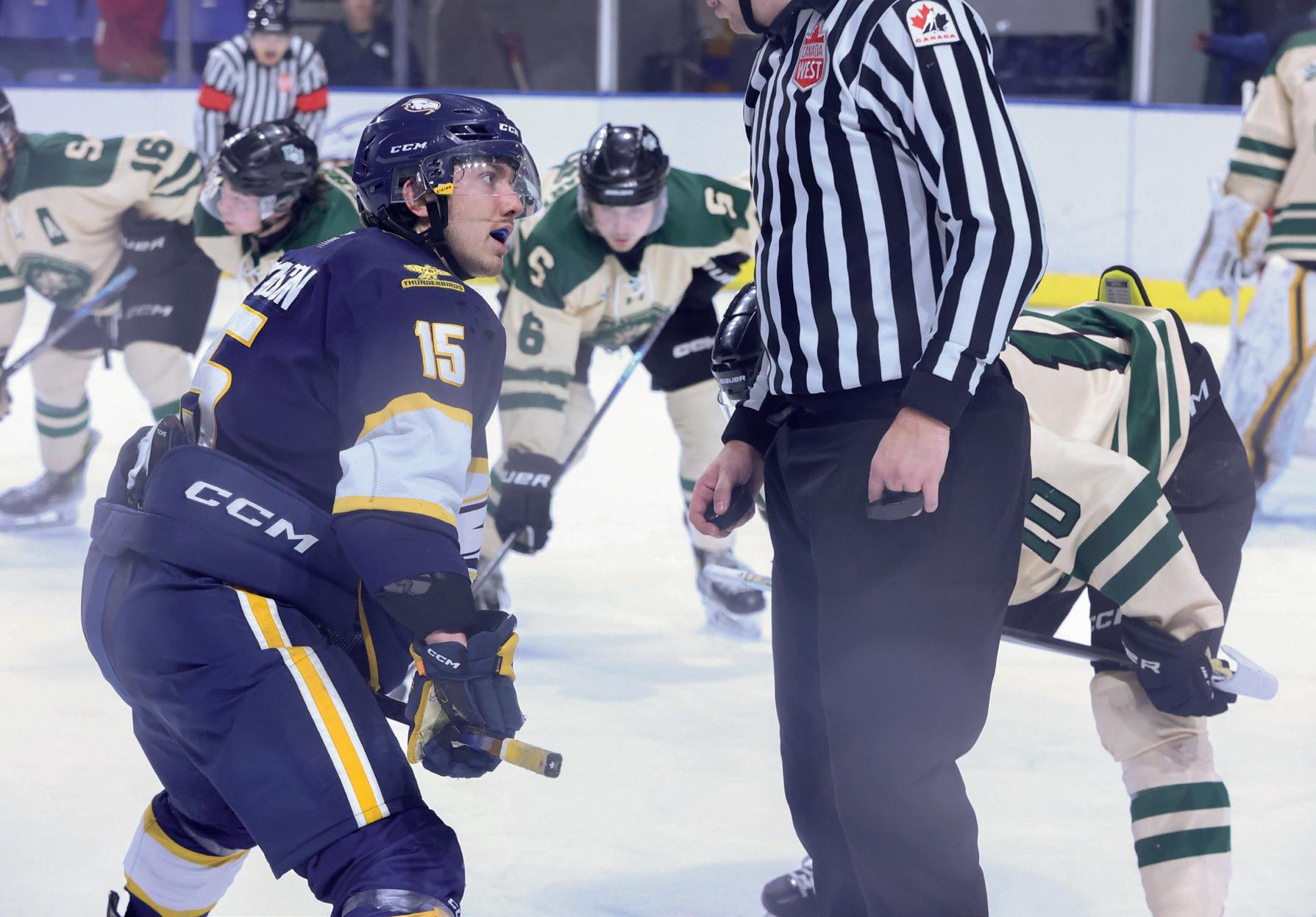
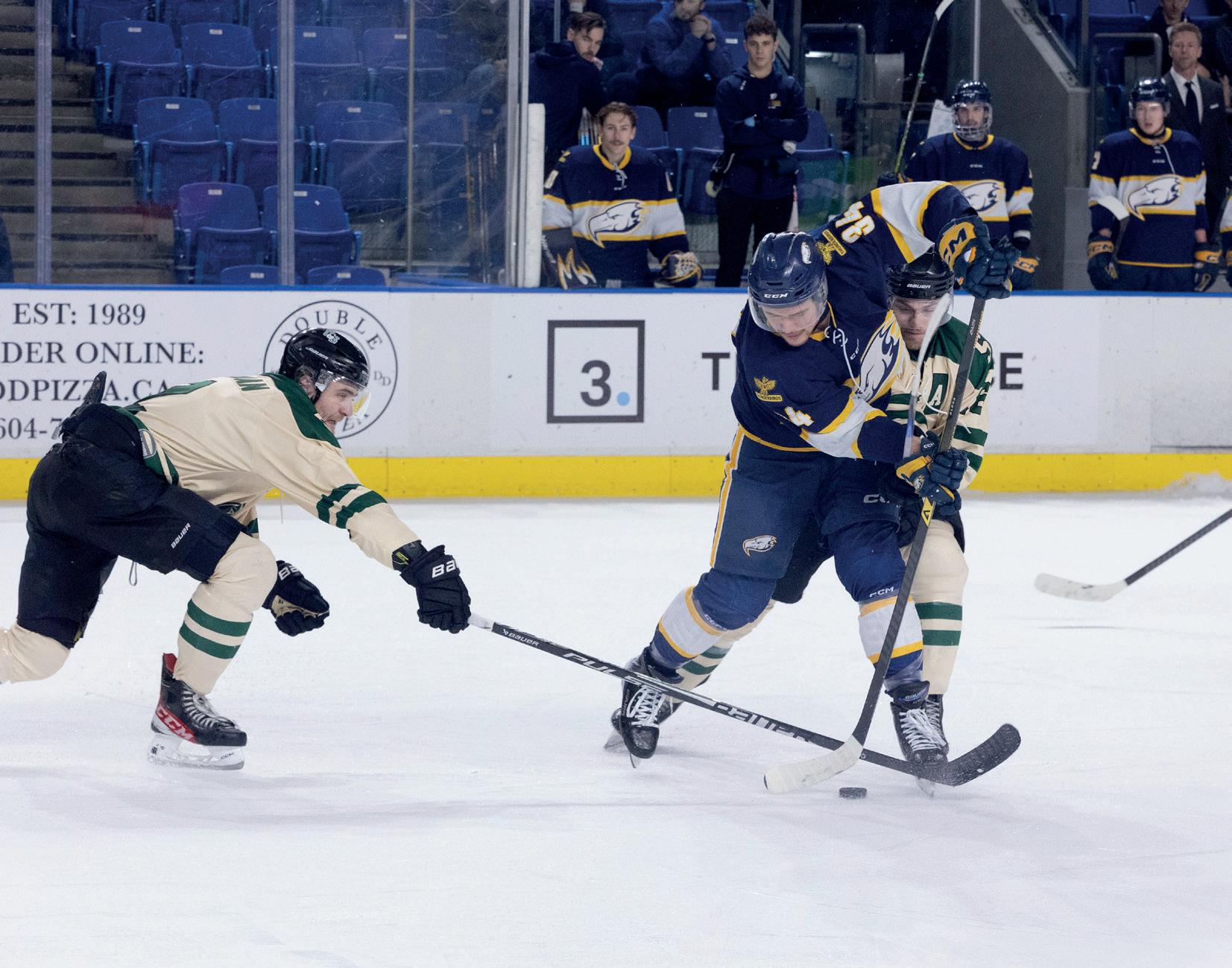
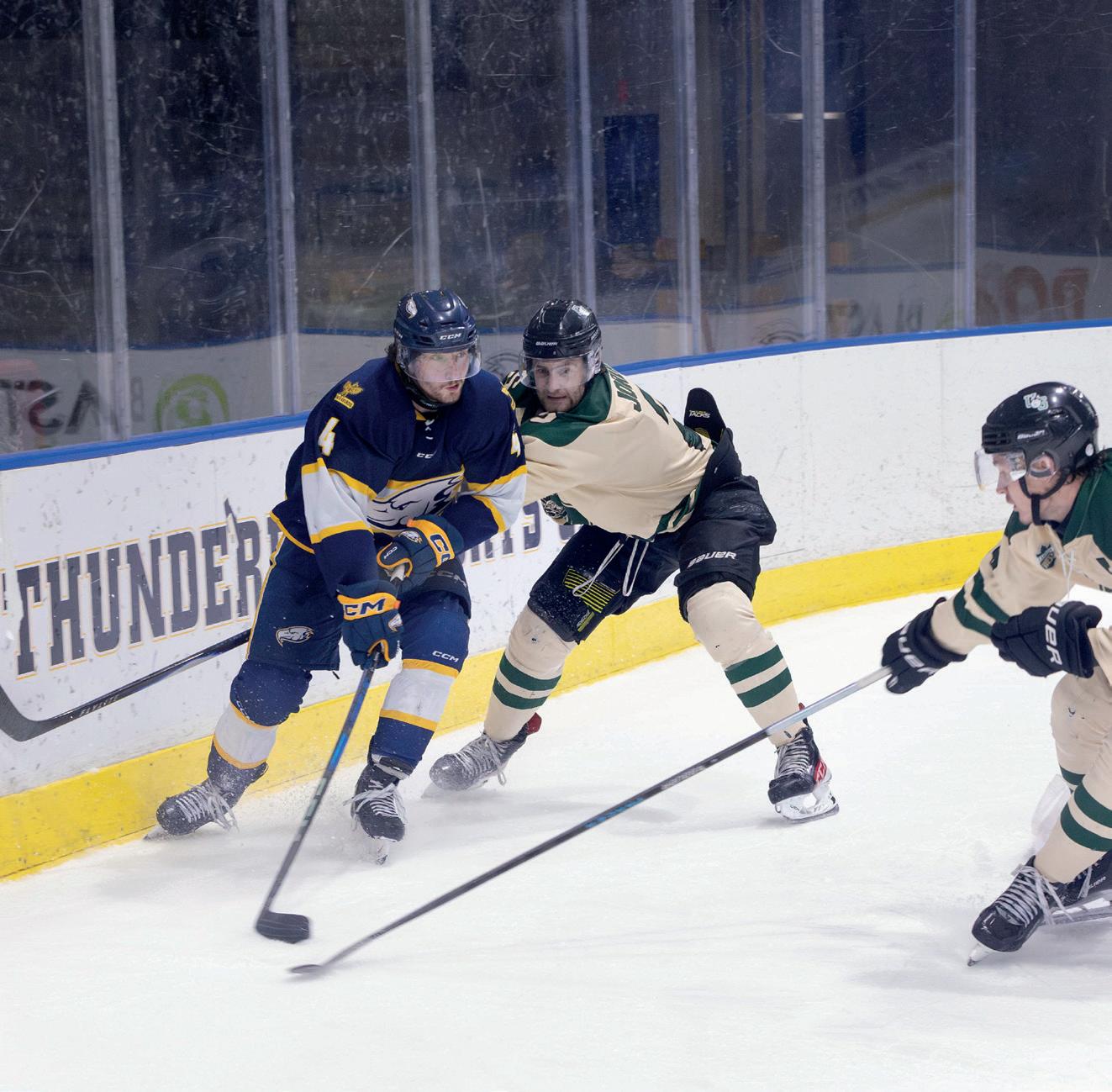
The ‘Birds rush up ice. | RAUL DEL ROSARIO / THE UBYSSEY
For the eight graduating seniors, this loss was a disastrous end to their careers. | RAUL DEL ROSARIO / THE UBYSSEY
UBC’s best offensive weapon, Sasha Mutala, attempts to cut up ice. | RAUL DEL ROSARIO / THE UBYSSEY
T-Birds pressed for a second goal in the opening minutes. | RAUL DEL ROSARIO / THE UBYSSEY
Much ado about the UBC Undergraduate Shakespeare Conference
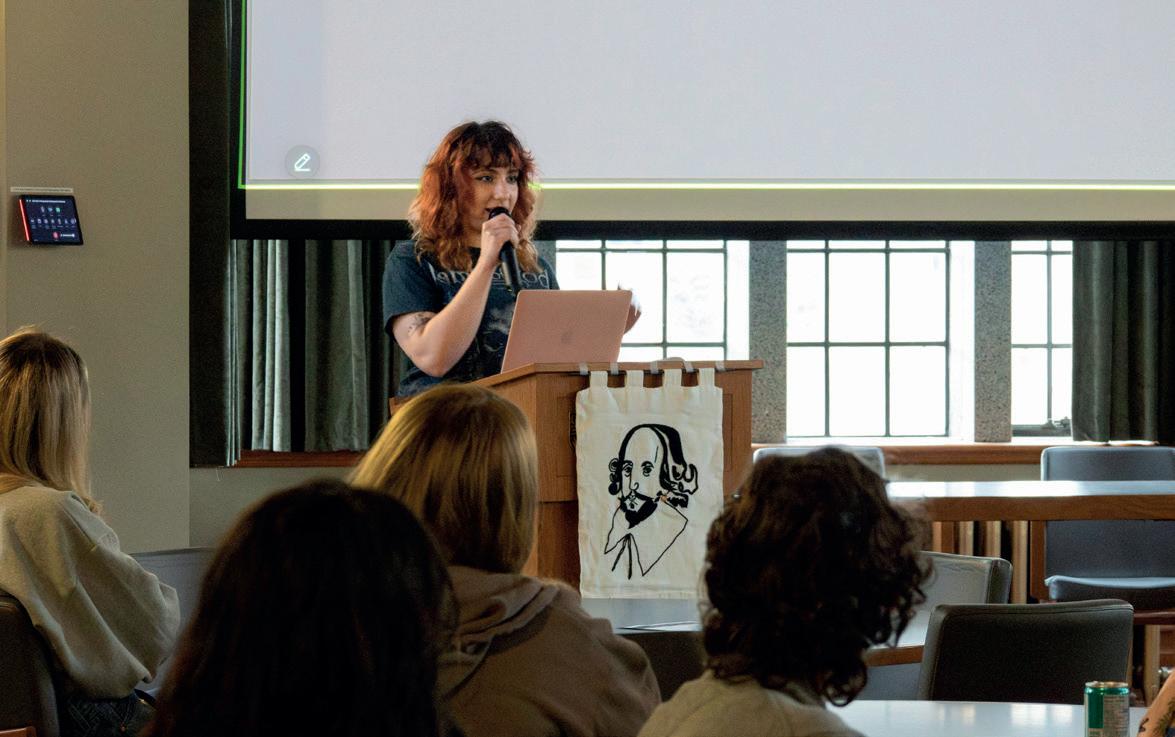
Article form by Saba Majd Research Reporter
The second annual UBC Undergraduate Shakespeare Conference (USC) took place last week in Irving K. Barber’s featuring seven presenters from Canadian universities.
The conference was created last year by CJ McGillivray, a fourth-year honours English literature student with a passion for early modern studies — and, of course, Shakespeare — who felt “a shortage of opportunities for student presenters — specifically in the arts.”
For English students, there seemed to be only two possible outlets to present research, she said in an interview with The Ubyssey: the Multidisciplinary Undergraduate Research Conference (MURC), which is heavily science-dominated, and the English Students’ Association (ESA) colloquium, which typically only has four to five spots per year.
“In [all my] years of undergrad in English, I’d had zero opportunities to be involved in any type of showcase for my work,” said Liliana Yao, a fourth-year honours English literature student. This year, she served as a conference committee member and was a presenter at the inaugural 2025 event. Presenting her research at last year’s conference was deeply validating, she added — it affirmed that she was, in fact, doing good work in her field.
This year’s event spotlighted seven presenters — and not just from UBC. Two students flew in for the conference from the University of Waterloo and the University of Toronto and one more from UofT presented remotely.
The works on display were, as McGillivray put it, “wonderful examples of radical thought” — simultaneously celebrating Shakespeare and critiquing his works. “[Those are] not mutually exclusive.”
One project explored the pos-
sibilities hidden in heavy metal covers of Shakespeare’s plays as an educational tool. “If you look at the statistics, students who participate in punk culture are also the ones who are not doing that well in school,” said Eva Chaudhary in her presentation. She suggested punk could be a way to disseminate “literary knowledge to youth who might benefit from non-traditional learning approaches.”
Another piece by Olivia Richards centred on what the structure and metre of Iago’s lines in Othello reveal about his dishonesty. The presentation was aptly titled “Iamb Not What Iamb”, in reference to iambic pentameter.
Those with less knowledge of metre or iambs could still find footing in the research on modern reimaginings of Othello in Jordan Peele’s film Get Out and Toni Morrison’s play Desdemona. Presenter Lian Lo argued that these works “reimagine Othello into a story of Black and African survivance.” The word, she explained, is a term used by Anishinaabe cultural theorist Gerald Vizenor “as the creation of native presence over absence, nihility and victimry.”
This was by no means a comprehensive list of the projects presented; there were many more, including research on the role of servants in Shakespeare’s tragicomedic murder plots, on using botanical imagery “to explore the implications of political violence” in Titus Andronicus and Richard II, and two more on Othello
The surprisingly high proportion of research on this play was in part due to Dr. Dennis Britton’s honours seminar “Othello and Black Reimaginings,” which many of the UBC presenters had taken.
The conference, as McGilli-
vray said in her opening words, was about “exploring the curious tensions between literary analysis and live performance.” Thus, between presentations, there were three live performers (students from UBC and Langara College) who delivered monologues from Henry V, Romeo and Juliet and King Lear
Attendees could also play a few games during breaks — “Who
“[We’re] contributing to a conversation that’s been going on for 500 freaking years, and I think it’s really cool that new voices can keep chiming in and harmonizing with the things that have already been said — and building on so much history.”
- Olivia Richards, UBC student in honours English literature and USC presenter
said it: Taylor Swift or William Shakespeare?” — along with printed mini-quizzes from the Folger Shakespeare Library and surveys where attendees could vote for their favourite plays (of Shakespeare’s, obviously). Last year’s conference was much smaller in scale. The committee consisted of only McGillivray, and the call for papers was limited to students from UBC Vancouver and Okanagan. But this year, there was a “radical change” in numbers — the orga-
nizing committee grew to six people, they opened up submissions for undergraduates or recent graduates from across Canada and they had a higher turnout. More professors were also in attendance this year, including Britton and Dr. Stephen GuyBray, whose scholarly work and classes are often in conversation with Shakespeare.
This shift in scale, Yao said, came along with a shift in energy. This year, she felt students were “much more eager to jump on opportunities and show more spirit in the English department.” Speaking with presenters, that eagerness was evident.
“I think Shakespeare would love what’s happening [at this conference],” said Richards. “[We’re] contributing to a conversation that’s been going on for 500 freaking years, and I think it’s really cool that new voices can keep chiming in and harmonizing with the things that have already been said — and building on so much history.”
In May, all of the current committee members will be graduating, with some moving abroad. But McGillivray is looking for “someone to take on the reins next year,” and continue the conference. “Students are hungry for opportunities and for community,” she said.
Humanities programs are facing shrinking resources and enrollments along with growing pressures to prove their “practical” value. But “Our doubts are traitors / And make us lose the good we oft might win / By fearing to attempt,” Shakespeare wrote in Measure for Measure, and if there’s one thing the USC made obvious last Wednesday, it’s that humanities students are done doubting the value of their own work. U

Eva Chaudhary, a third-year arts student, presenting “Hamlet Turns Punk: Shakespeare in Heavy Metal Music Scene and its Future Possibility as a Literary Formal Education Tool”. | RAUL DEL ROSARIO / THE UBYSSEY
ADVERTISEMENT

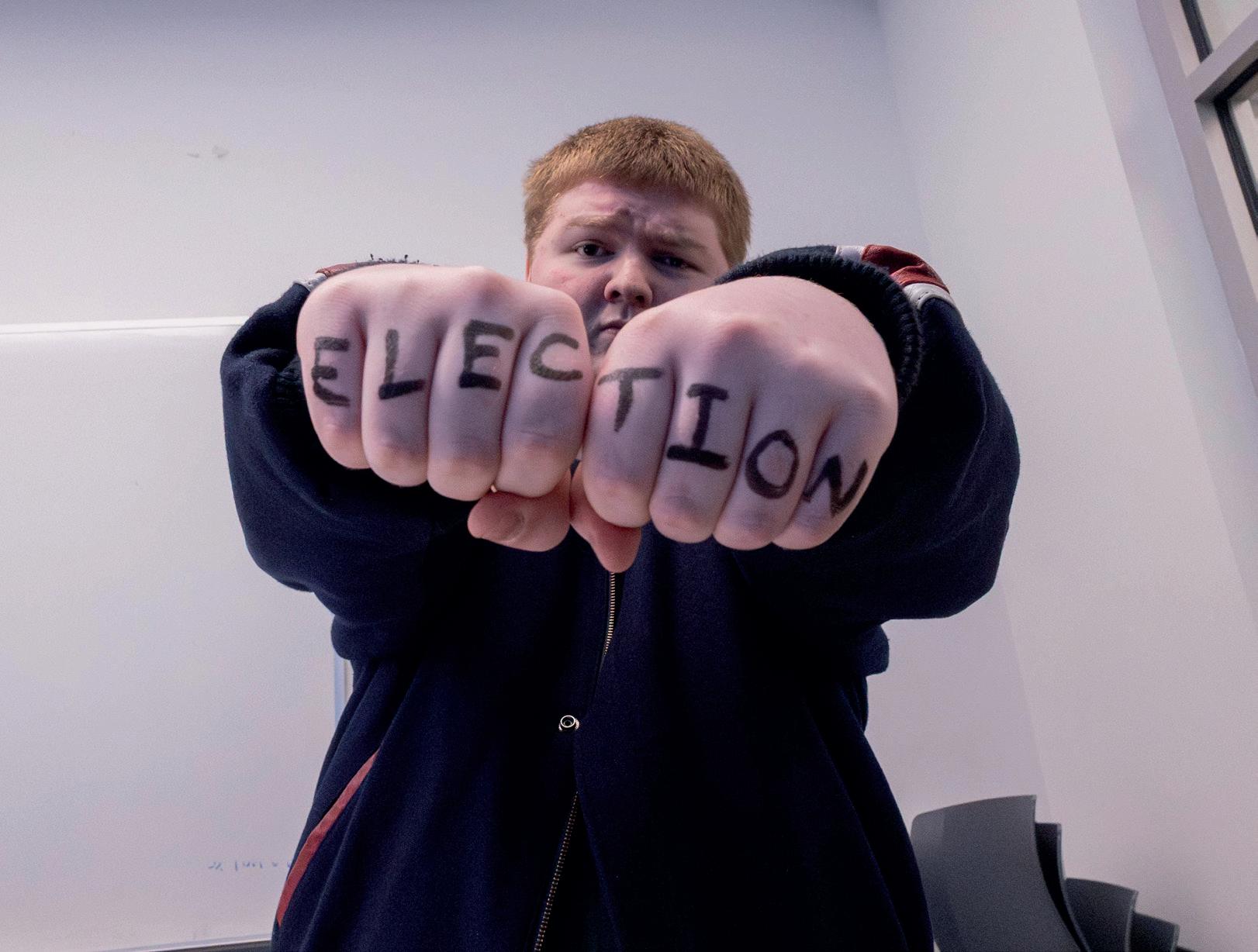
From the Cult: How to rig an election
How can you make an ill-intentioned power-grab without a sizable voter base? By fighting dirty, that’s how.
Report by Oscar McCartan Contributor
Election season looms in the far-near-future, and you’re grievously unpopular. You’ve tried ingratiating yourself into the various clubs around campus, hoping for a following, but it just won’t stick. Nobody can see you for the stand-up guy you tell them you are. That’s bad, especially during election season. How can you make an ill-intentioned power-grab without a sizable voter base? By fighting dirty, that’s how. There’s no sense in trying to make it in this world as an honest politician. No one ever has, and no one ever will, so just take what’s rightfully someone else’s. You can vote early, and you can vote often, but there’s nothing as foolproof as rigging an election!
Election Road
Step 1: Public vandalism
Get your ripping fingers out and start tearing down any posters supporting the other candidates. Pull them all down, and no one will know to vote for anyone but you. As an added bonus, tearing down every poster (election related or not) on every bulletin board across campus leaves you even more room to plaster your election-winning smile all over campus, so remember to floss.
Step 2: Egregious online falsehoods
Those paper mills won’t stop churning out flyers, so launch a two-pronged attack. In the modern era, all you need is a smartphone and a dream. Flood the internet with libellous posts about your opponents and watch their social stocks plummet to new hells. Post the most outrageous, falsified, woefully ignorant things of all time. Claim the election’s front-runner spends their weekends blowing up anthills, destabilizing the foundations of heritage buildings or fly-fishing. Claim the next guy owns special boots just for stepping on the ears of small dogs. Claim one of them blew up the Hindenburg. The possibilities are endless.
Step 3: Screw-ups
The next step is something a little more technical. Locate the electronic voting machines before election day. Pick one and search the base of the machine for an access panel. Take a Phillips head screwdriver, loosen the four screws on the panel, and pop it off. Next, move all the wires to the side and search the back wall of the casing for a small hole ringed in red paint. Then,
take the screwdriver and push it into the hole until you hear a buzz. Now it’s go time. Count ten seconds after the buzz for the internal clock reset. After the reset, use the screwdriver to type out your name in Morse code. If you mess up, just count out the ten-second reset and try again. Once you punch in your name, buzz out six dots to confirm the name. Finally, place the panel cover back over the cavity and screw it back on. You have just successfully performed a universal input override, meaning that every single vote, no matter who it is cast for, will be counted for you. Repeat this process for each machine to guarantee yourself the election. After all, who could argue with electing a candidate that every single person voted for? All that’s left is the reaping of the rewards.
Re-Election Road
Step 1: Old gold
Getting into office is only half the battle. Holding it is the other — an uphill battle, at that. After the national spectacle that will surely ensue from a scandal as big as student-election voter fraud, the company that makes the voting machines will hire someone competent to fix the bypass. Fortunately, with great power comes great disposable resources. Anything goes, so why not try an all-time classic tactic (clactic?). The art of the gerrymander. Gerrymandering is easy if you know the steps. Start by realizing that UBC doesn’t have electoral districts, and scrap the idea immediately.
Step 2: Time out
With gerrymandering off the table, you have to get a little creative. Change the polling times so they are exclusively open between 2 a.m. and 3 a.m. on the morning of the springtime daylight saving time change. Make sure that nobody shows up to vote. By lawyering the election regulations just a little bit, you can confuse the oversight committee enough to snag a win. Clause 129 states that “Candidates who are not ranked shall be considered to have a lower preference than any ranked candidate.” This can be interpreted to mean that no votes cast means all candidates are ranked equally. Then, clause 130 runs through the process of the ranked choice system that whittles the options down to two candidates, until part d) which states that “[i]f there is no clear winner as defined in paragraphs 130(a) to 130(c), the election shall be decided by a coin toss by the Elections Administrator
witnessed by the Elections Committee and the two remaining candidates.” It is reasonable to assume the expansion of this clause to include a number of candidates greater than two. It is also reasonable to assume that the use of a coin toss implies a somewhat lax mentality surrounding the absoluteness of the randomness. Simply convince the oversight committee to use a set of standardized dice, and load them in your favour. The easiest way to load dice is to heat them in the oven at 250°F for about 5 minutes with the target number facing up. This shifts the weight of the dice in a way that makes the target number appear more often. All you have to do is make sure the dice roll happens in a kitchen.
Step 3: Go big or go home
To cement yourself as the last ever what-ever-you’re-runningfor, voting must be abolished entirely. Obviously. It has to be something convoluted though. Announcing the outlawing of all voting is going to cause an immediate riot, because some people “value democracy.” Not us at The Ubyssey, and certainly not you, either, you not-at-all-grubby-fingered, totally-charming student politician, you.
Instead, try Voting by HeartTM
What you have to do is announce to the public that the government is testing out a new technology. The fresh tech is a big machine that scans the entire campus to isolate the individual heartbeats of every student. The machine detects the little flutters a student’s heart makes when they think about the candidate they want elected. Using a complex algorithm, the frequency and magnitude of the flutters of every voter are compiled to determine the most desired candidate among the pool. That person is then elected. The machine has one caveat, however. If a student tells anybody who they want elected, their vote is spoiled. Scientifically, it is completely impossible to build a working version of this machine, but a big metal box covered in blinking lights should fool John Q. Public into thinking it is real. There is plenty of prime real estate within the Nest for the wonder box, but the best spot for it is obvious. Rip The Ubyssey’s office to shreds. Clearing out the nosy newshounds will stop them from publishing an exposé on the wonder box, giving you all the leeway necessary to trick the “voters.” Once you knock out that pesky
the only thing that

Word of the Bird
“Can I make you a leprechaun?”
– UBC student interviewing TWU student, Outside the Nest
Out-of-Context Campus Content
“Being sick looks good on you.”
– Classmate-to-classmate, BUCH A 101


I eat democracy for breakfast. | RAUL DEL ROSARIO / THE UBYSSEY