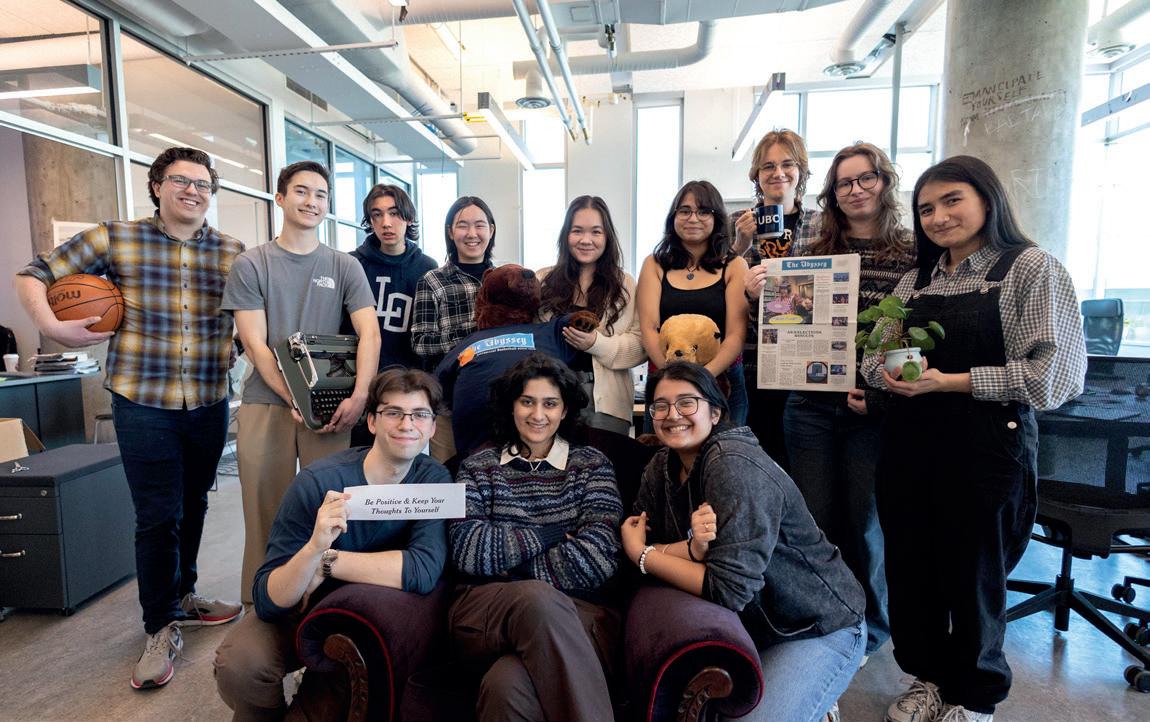
This year at The Ubyssey
The Ubyssey ’s 107th masthead’s time is coming to an end. Last summer we published a strategic plan identifying what we say as problems in our newsroom and how we planned to change it. Over the past months, we’ve made quite a few updates to how we operate. We’ve been more intentional about bettering our report and building trust with the community. As this year comes to an end, we reflected on what progress was made, what each part of our newsroom delivered and what the UBC community can expect from us next year. Continued on page 7.

Expect more defensive dominance from Women’s Soccer
By Maia Cesario Soccer Reporter
For the past two seasons, the UBC women’s soccer team has been historically dominant. They went undefeated in the regular season in both campaigns. They won a national championship in 2024. While they couldn’t repeat that feat in 2025, coming in second nationally, they still stood out for a big reason. In every one of their regular season games, they had no goals against.
Ending every game in a shutout victory — while also scoring 42 goals — was something the Canada West had never seen before. The defensive superiority has been a trademark for UBC women’s soccer. Since the COVID-cancelled 2020 season, the most goals they’ve allowed in a single season is 11. And they’ve improved almost every year. Last season, the T-Birds allowed only four goals, which, at the time, set a conference record for fewest goals allowed. That was, until 2025.
This shutout streak began in the 2024 postseason, where the Thunderbirds had all shutout
MUSA fills Nest with music to protest rehearsal space change
victories to earn their second straight national championship. The defence was a large factor in this strong postseason run.
Nowhere was that more evident than in the gold medal game. Off a Sophia Ferreira goal, UBC took the lead 1–0 in the final moments before halftime against l’Université Laval Rouge et Or. That one goal was all they’d need.
Even with a slim lead, the Thunderbirds were in control. Throughout the second half, the T–Birds’ ability to stop Laval from tying the score by holding possession and working hard to get back the ball if lost was the difference-maker. Ferreira’s goal may have been the game-winner, but it wasn’t what won the game.
“Defence wins championships,” said Ella Sunde, the team’s captain last season. “We need to score too, but the big thing is not letting the other team score.”
This defensive prowess that UBC has boasted from season to season isn’t just about the talent of their players. Instead, it exists as a culture and mindset propelling them to success. Continued on page 12
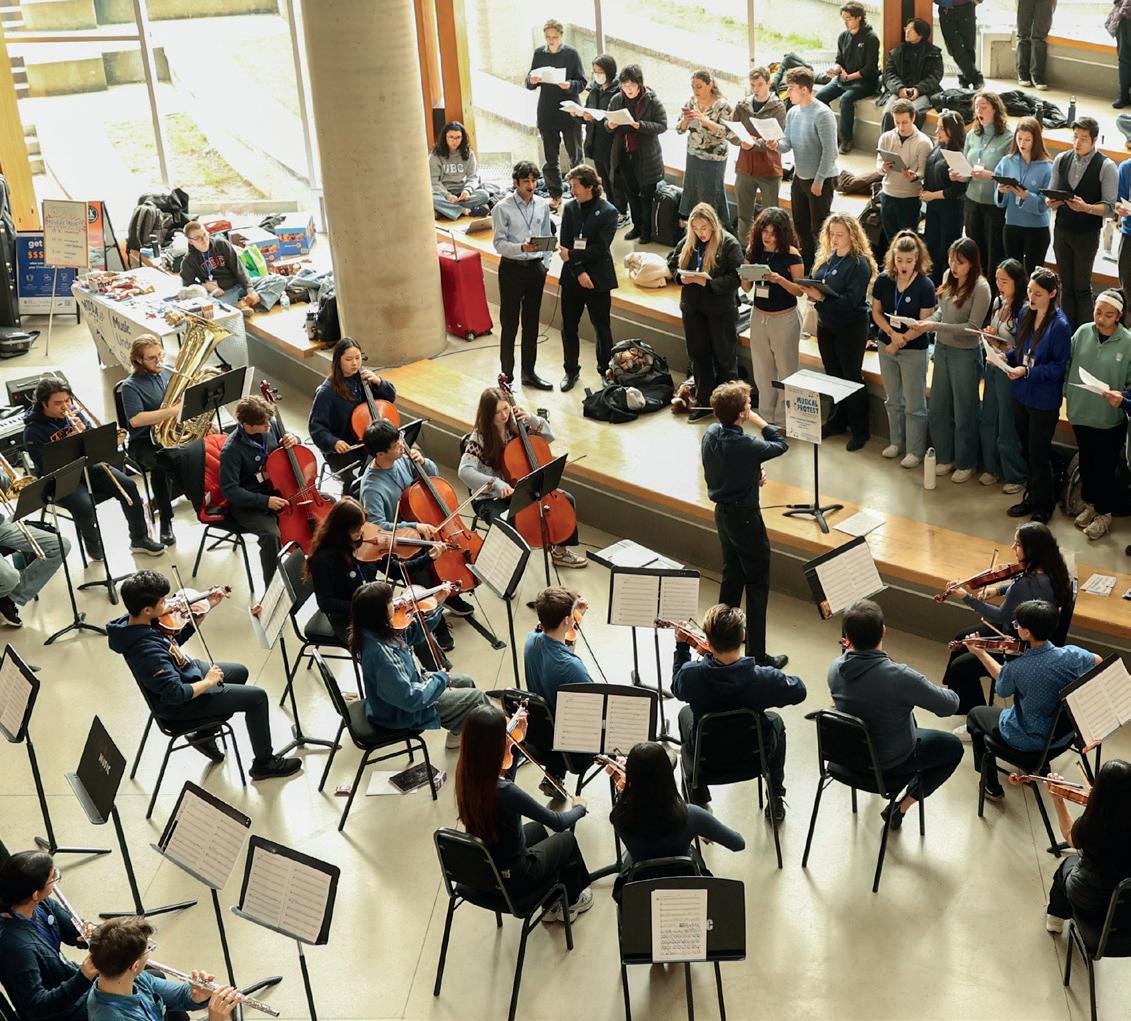
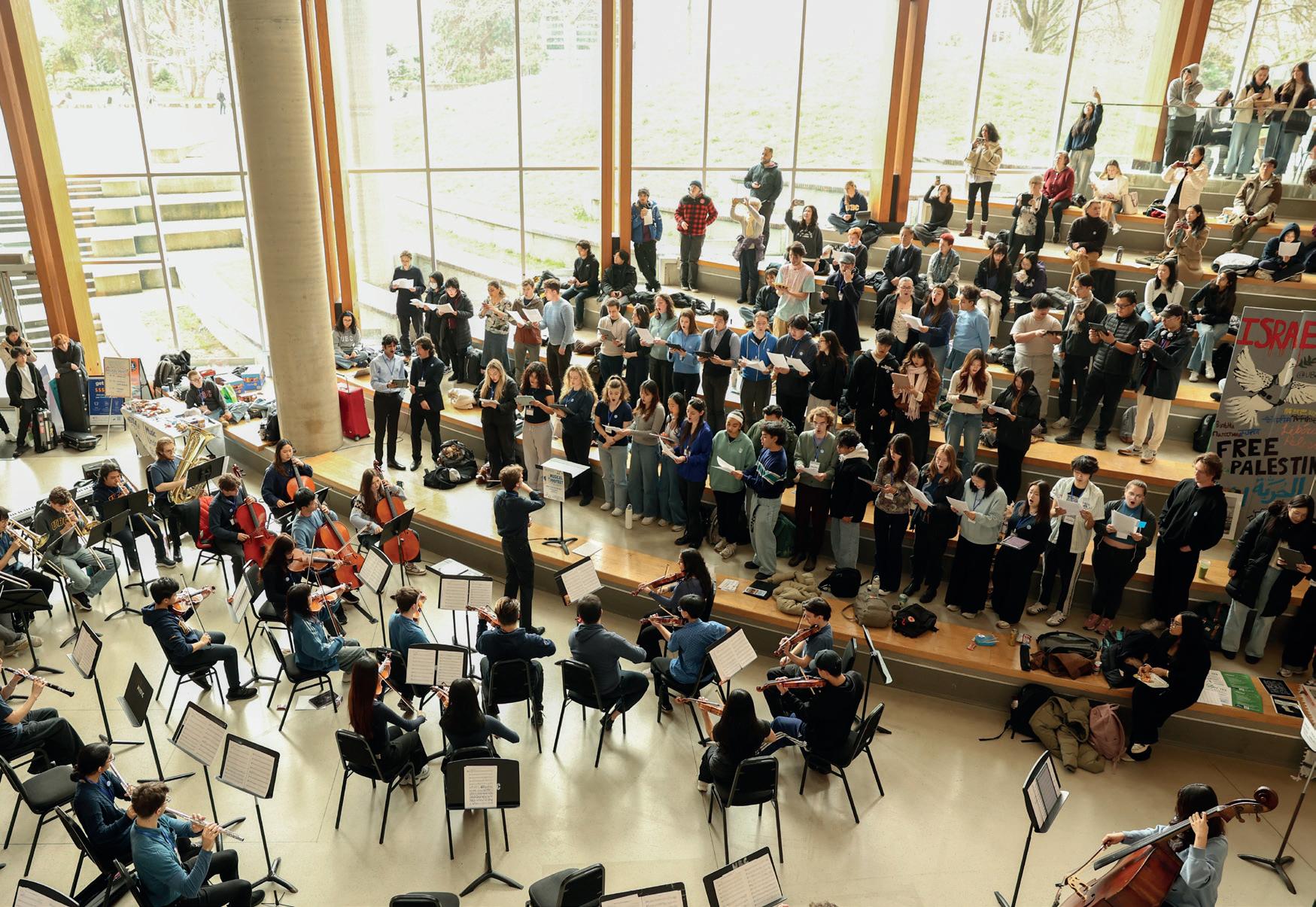
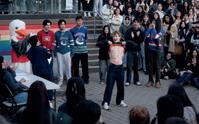
MUSA hosted a protest against their access to the Chan Shun Concert Hall being revoked. It featured performances by musicians from UBC orchestra, choirs, opera, French horn and saxophone quartets, interspersed with speeches from students and alumni.
Report by Luciana Wilson del Valle Arts & Culture Contributo
In early September 2025, students at the UBC School of Music found their access to the Chan Shun Concert Hall — the venue which has served as a regular rehearsal space for large ensembles since 1998 — severely reduced. Instead, their rehearsals were relocated to the smaller, black-box-style Telus Studio Theatre, located elsewhere in the Chan Centre, with only dress rehearsals and major student concerts continuing to take place in the concert hall. UBC Opera also announced that their productions, many of which formerly took place in the concert hall, would be relocated to the Old Auditorium.
According to Music Undergraduate Student Association (MUSA) President Sayako Leznoff, the move came as a shock. Leznoff, a fourth-year studying oboe performance, said the news was broken at a usual woodwind, brass and percussion ensemble meeting during the first week of classes, but since there was no department-wide communication on the matter, members of the
string ensemble were only made aware as they walked into their first rehearsal.
Rehearsing in the concert hall offered students the opportunity to train in a renowned facility known for its unique acoustic design. “You learn a lot listening across the ensemble, listening and watching the conductor with such distance between you, learning how to project your sound and fill the space” — crucial skills that Leznoff said cannot be sufficiently developed while rehearsing in the Telus Theatre. She said students were not given a clear reason for why this was happening, though they suspected external renters were being prioritized.
Frustrations with the perceived lack of administrative transparency and grievances about the move to the Telus Theatre led MUSA to gather questions from the public and launch a petition. “We sent [those questions] to the director of [the school of] music, Dr. Hedy Law, and she answered them and sent out responses to the entire [school of music] student body. This was kind of the only communication we had from the school,” said Leznoff.
Continued on page 4.
“Wuthering Heights” is its own thing
Opinion by Fiona Pulchny Columnist
Do book-to-film adaptations need to remain entirely faithful to their original source? I’m an English literature major and a classical literature fan; I used to answer with a resounding yes. Now, I’m not entirely sure. Back in October, I went to VIFF Centre with a fellow English major to see Guillermo del Toro’s Frankenstein. We’d both read the book multiple times for various classes, and were excited to see Mary Shelley’s story on the big screen. We left the theatre disappointed. Filmmakers removed my favourite thematic
and narrative elements and replaced them with ones I did not find nearly as captivating. The movie could not even compare to the book. It seems the newest adaptation of Emily Brontë’s Wuthering Heights by Emerald Fennell garnered similar reactions. Most notably, the decision to cast Jacob Elordi outraged as the role of Heathcliff outraged loyalists of the book, who is described in the novel as “dark-skinned.” Adding fuel to the fire were complaints regarding the removal of major plot sections and thematics, leaving behind only a vague memory of the original text.
Continued on page 11.

Letter from then editor by Senior Masthead 107
While the protestors’ frustration and disappointment was palpable, the event was equally a celebration. | JULIAN COYLE FORST / THE UBYSSEY
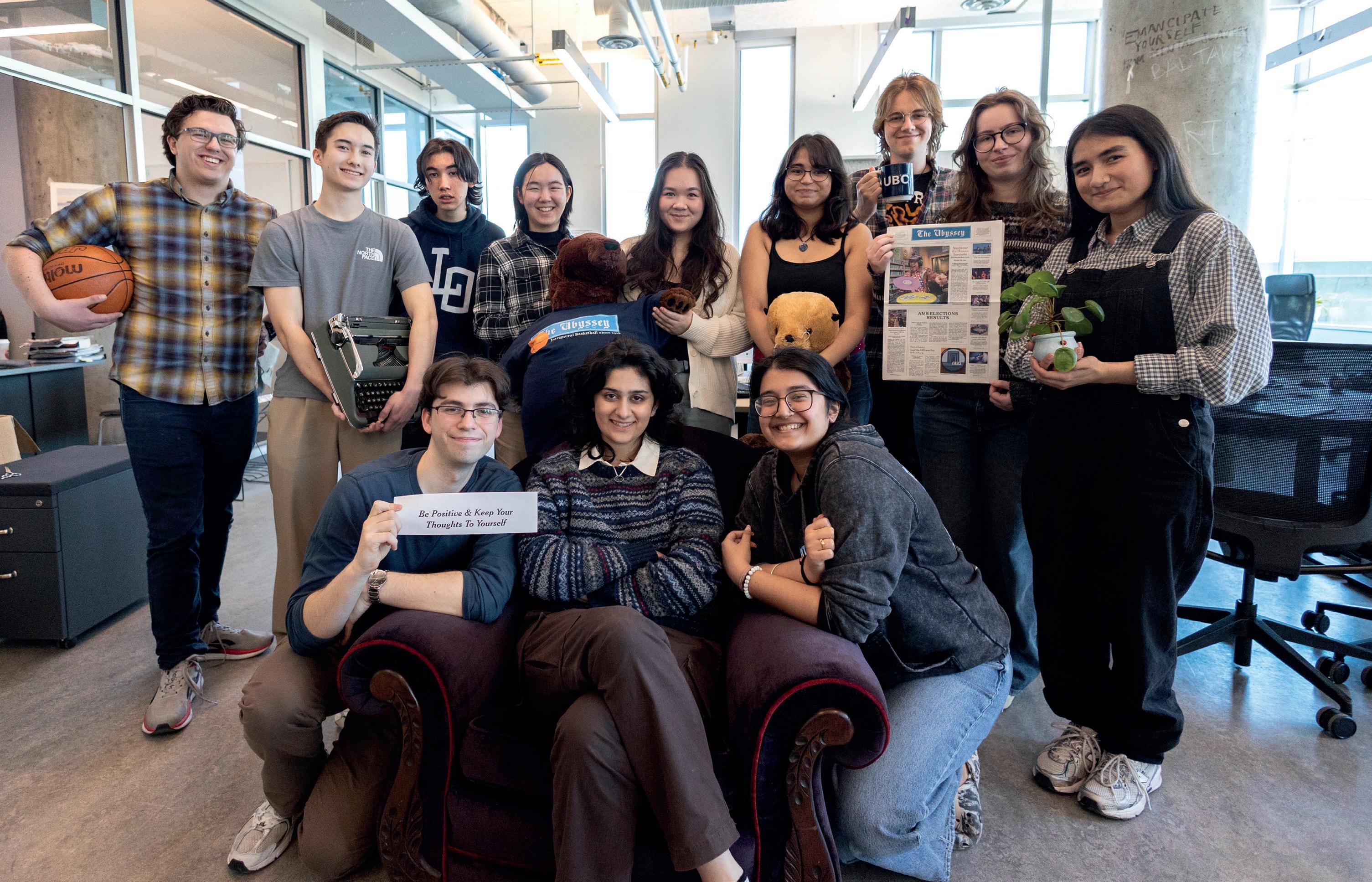
All members of The Ubyssey’s 107 masthead. | JUAN PABLO SASTOQUE VEGA / THE UBYSSEY
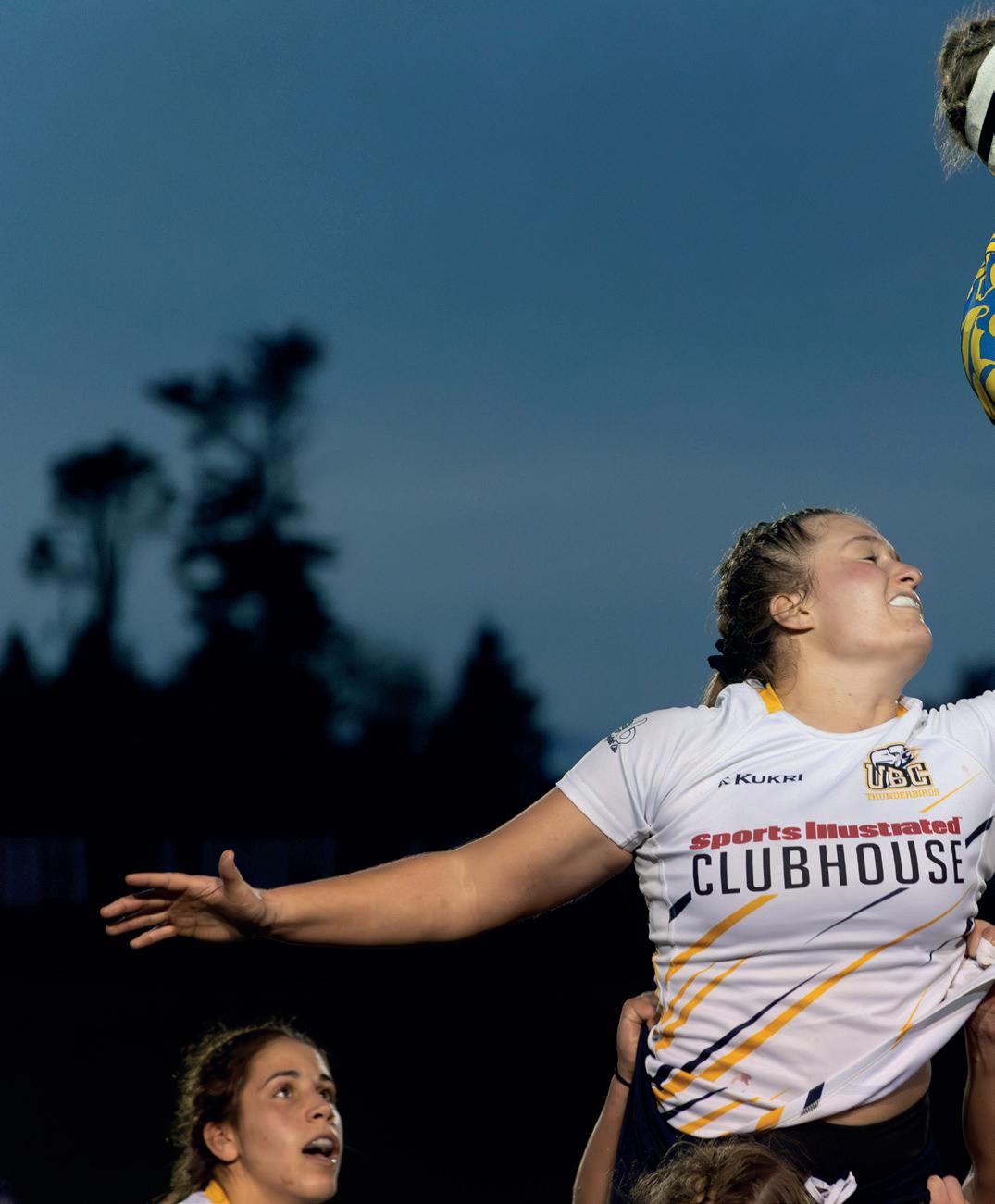
Heading into the 2026 season, Women’s Soccer will have to contend with the losses of key defensive players. | ILLUSTRATION BY AYLA CILLIERS / THE UBYSSEY
The Ubyssey
LAND ACKNOWLEDGEMENT
The Ubyssey acknowledges we operate on the traditional, ancestral and stolen territories of the Coast Salish peoples including the x ʷ məθk ʷ əyəm (Musqueam), Sḵwx̱wú7mesh Úxwumixw (Squamish) and səlilwətaɬ (Tsleil-Waututh) nations.
EDITORIAL
The Editorial Office creates the content of the newspaper. They do all the research, writing, photography, programming, illustrating and editing — the journalism.
Editor-in-Chief
Aisha Chaudhry eic@ubyssey.ca
Managing Editor Saumya Kamra managing@ubyssey.ca
News Editor Stephen Kosar news@ubyssey.ca
Arts & Culture Editor Julian Coyle Forst culture@ubyssey.ca
Features Editor Elena Massing features@ubyssey.ca
Deputy Managing & Opinion Editor Spencer Izen deputymanaging@ ubyssey.ca opinion@ubyssey.ca
Sports & Recreation Editor Caleb Peterson sports@ubyssey.ca
Research Editor Elita Menezes research@ubyssey.ca
Humour Editor Kyla Flynn humour@ubyssey.ca
Illustrations & Print
Editor Ayla Cilliers illustrations@ubyssey.ca
Photo Editor Sidney Shaw photo@ubyssey.ca
Digital Editor Sam Low samuellow@ubyssey.ca
STAFF
Akmal Zulkifli, Aleah Kippan, Alexis Jacobson, Amrit Rai, Amy Sheardown, Annaliese Gumboc, Carol Rocque, Claire Donnan, Ewan Keenan, Fiona Pulchny, Gabby Ranu, Harleen Randhawa, Harper Jasinski, Ian Cooper, Jack Paransky, Jeff Lee, Jenni Nguyen, Juan Pablo Sastoque Vega, Liana Raisanen, Lorainne Chua, Lucas Rucchin, Luiza Teixeira, Maia Cesario, Margo Baltzan, Mason Carter, Maya Tommasi, Morrison Tulloch, Natalie Vakulin, Navya Chadha, Quyen Schroeder, Raul del Rosario, Saba Majd, Selena Sallay, Seneesha Ekanayake, Skye Shen, Sofia Campanholo, Sofia Gonzalez, Sophia Clearwater, Sophia Bertuzzi Samilski, Sophie Cark, Tatjana Huber, Thomas Favelle, Trinity Sala, Vicky Nguyen, Yasmine Armstrong, Zoé Stojanovic
PRINT DESIGN BY: Ayla Cilliers, Lorainne Chua, Skye Shen, Sophia Clearwater, Yasmine Armstrong
BUSINESS OFFICE
The Business Office supports the journalism by managing the Ubyssey Publications Society’s money at the direction of the elected, majority-student board. It has no say in or over our coverage, in keeping with the principle of editorial independence.
Business Manager Scott Atkinson business@ubyssey.ca
Editorial Office: NEST 2208
604.283.2023
Business Office: NEST 2209
604.283.2024

Account Manager Ben Keon advertising@ubyssey.ca
CONTACT
Website: ubyssey.ca Instagram: @ubyssey Facebook: @ubyssey TikTok: @ubyssey Bluesky: @ubyssey LinkedIn: @ubyssey
Every story we publish comes with a label — here are the brief definitions for what they mean.
PROFILE
Profiles are a detailed description of a person and their life experiences. They promise to be descriptive and analytical.
REVIEWS
Reviews are critical analyses of works of the arts. They promise candour, description and fairness from a knowledge voice.
REPORTS
Reports are accounts of particular moments — the who, what, when, where, why and how in 800 to 1,200 words. In News and Research, they promise impartiality. In Arts & Culture, they promise critique and/or analysis.
EXTENDED REPORT
Extended reports are accounts of subject, engaging multiple peoples, places, sources and smaller events over long periods of time. They promise impartiality
GAME ANALYSIS
A game nalysis is an analytical account of a sprting event either involving UBC’s varsity teams or taking place on campus. These promise to describe what happened, but also why the game matters.
OPINION ESSAYS
Opinion essays take a position on something newsworthy in the present moment, and are either written by guest contributors from the community or in-house columnists. All essays represent the author’s views alone.
PERSONAL ESSAYS
Personal essays explore an individual’s perspective on an experience that is relevant to a larger group of people.
Divestment movement continues to push Board as university budget is approved
Report by Amy Sheardown, Oliver Matisz, Spencer Izen News Reporter, News Contributor, Deputy Managing Editor
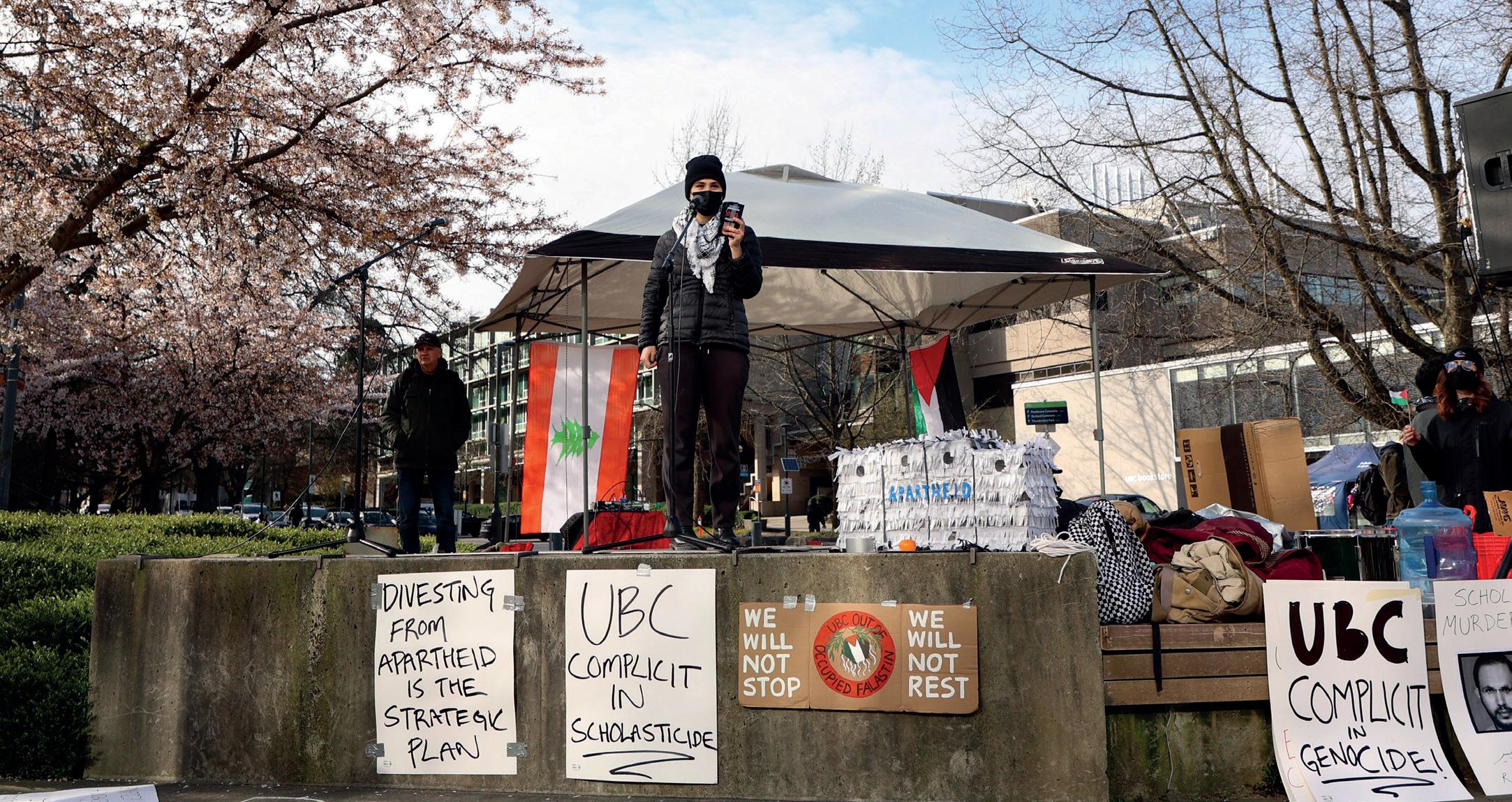
Outside of a locked and guarded Robert H. Lee Alumni Centre, a group of pro-Palestinian UBC community members held a “noise rally” yesterday — aiming to disrupt the concurrent Board of Governors (BoG) meeting and encourage UBC’s highest governing body to divest from corporations complicit in the occupation of Palestine and cut ties with Israeli academic institutions.
Organized by Palestine Solidarity Action, Solidarity for Palestinian Human Rights, Apartheid Free UBC, Grad Students 4 Palestine and the Social Justice Centre, the rally was advertised as a “low-risk action with music, crafts, food, education and chanting — a great introduction to activism.”
A small group of protesters began gathering outside of the Alumni Centre before 9 a.m. Tents, microphones and speakers were set up, and chalk messages were scrawled on the ground. As the morning progressed, approximately 30 protesters gathered, while several police and campus security officers watched from inside the building. Three RCMP vehicles were stationed adjacent to the plaza where the protest was held.
Poster boards with painted messages of “Stop Arming Israel” and “UBC Must Divest” surrounded a makeshift stage and printed photos of governors, including President Ben-
oit-Antoine Bacon, with the words “Complicit in Genocide” splayed across their faces were taped onto the glass walls of the Alumni Centre.
While the board met, nine members of the Thunderbird Marching Band accompanied chants and led a small march around campus’s Main Mall.
In a message to The Ubyssey, Samantha Chan — co-president of the marching band — said the band has recognized “this invitation as an opportunity to support a cause we stand behind utilizing our strengths — our music.” Chen described the marching band as a group that cares “about having our stance on an apartheid-free campus heard.”
Nathan Herrington, a UBC employee and activist with pro-Palestinian groups on campus, said that university administration fails to recognize the impact of Palestinian issues on community members. UBC “should care about our international community and be a global leader,” he said in a speech to the crowd. “Your community has told you loud and clear [to] cut ties with apartheid now.”
Herrington said that the university claims to maintain academic neutrality, but by upholding ties with “universities that uphold apartheid,” UBC is not staying neutral on moral affairs.
UBC’s pro-Palestinian groups have struggled to get attention and recognition from UBC’s governing bodies, with the AMS’s endorsement of a referendum to advocate that UBC cuts ties with Israeli universities as a notable exception — and achievement.
Students passed the referendum in early March, which requires the AMS to send a letter to UBC’s Senate urging the university to end these connections with Israeli universities said to uphold apartheid. Over 8,800 students voted in favour of the referendum — the highest voter count out of the four referendums on the ballot.
“Why does UBC still have links to Israeli apartheid? … If they do not change, if they continue to ignore the will of the students, we will give them no peace and no quiet,” said one speaker. “Today, we are here to make as much noise as we can so the institution cannot look away, cannot cover its ears.”
At the end of the meeting’s open session, Governors devoted a few minutes to responsible investment, and were told by Finance Committee Chair Byron Thom and VP Finance Frank Laezza that the ‘S’ aspect of ESG (environmental, social, and governance) principles continues to be developed into UBC Investment Management’s responsible investment policy.
Laezza also told Governors that the university had retained responsible investment expert Margaret Childe starting in February.
In January, UBCIM promoted a “primer” report it commissioned from the Shareholder Association for Research and Education on the issue of “social risks.” In a press release from the time, UBCIM CEO Dawn Jia said the conversation around those risks is “still nascent” and makes things complicated for institutions like UBC that use external investment managers. “However,” the CEO said,
“given the importance of these issues for all of us — and in particular the university community we serve — we decided to work with SHARE to help move this process forward to not only better educate ourselves, but to assist our peers in Canada as well.”
Thom told the Board that the Responsible Investment Working Group has a meeting “in the next few weeks” and an updated responsible investing policy will eventually come before the UBCIM board — but didn’t commit to a date. Governor Irene Lazinger said responsible investment would be a worthwhile subject for a board member learning session. Thom and Board Chair Miranda Lam both indicated such a session was en route. On the outside, chants of “free, free Palestine,” “BoG, your hands are red, 80,000 people dead” and a pastiche version of “Which Side Are You On?” — a union protest song — could be heard, with AMS VP External Solomon Yi-Kieran accompanying on vocals that echoed both outside and inside the Alumni Centre.
Yi-Kieran said they were not representing the AMS or anyone other than themself. “All I’m going to say is, free, free Palestine.”
As well, protesters split open an “apartheid piñata” — a grey, rectangular piñata meant to resemble a wall that the coalition groups aim to tear down with their protests — spilling oranges, a symbol of Palestinian identity and resilience, onto the chalk-laden ground in front of the Alumni Centre. U
Poster boards with painted messages of “Stop Arming Israel” and “UBC Must Divest” surrounded a makeshift stage. | SIDNEY SHAW / THE UBYSSEY
Protestors — including AMS VP External Solomon Yi-Kieran — outside the Tuesday Board meeting. | SIDNEY SHAW / THE UBYSSEY
UBC and province to invest $20 million in UBCaffiliated companies through new venture fund

Report by Sophia Bertuzzi Samilski News Reporter
UBC is partnering with the provincial government to invest in innovative companies that “extend” the impact of UBC research and discoveries through the creation of UBC Catalyst Venture Fund. The fund will support the province’s goals of boosting economic development and creating more jobs.
The provincial government — through InBC Investment, a Crown corporation — and UBC are each committing $10 million and looking to raise up to $20
million in private capital. Initial investments will focus on businesses in the life sciences and deep tech sectors — a range of technologies that aim to significantly advance science and engineering, such as AI and quantum computing. These sectors have been identified as “growing targeted sectors” by the province in its Look West Strategy. UBC is considered a global leader of research in those fields.
B.C. Minister of Jobs and Economic Growth Ravi Kahlon said in a press statement March 23 that the public-private partnership will work in parallel with Look West in order to support a “stronger, more resilient and di-
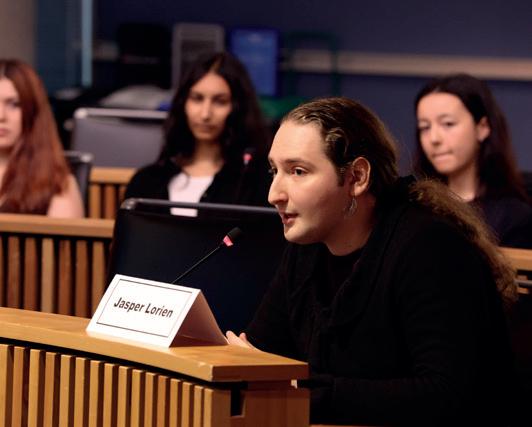
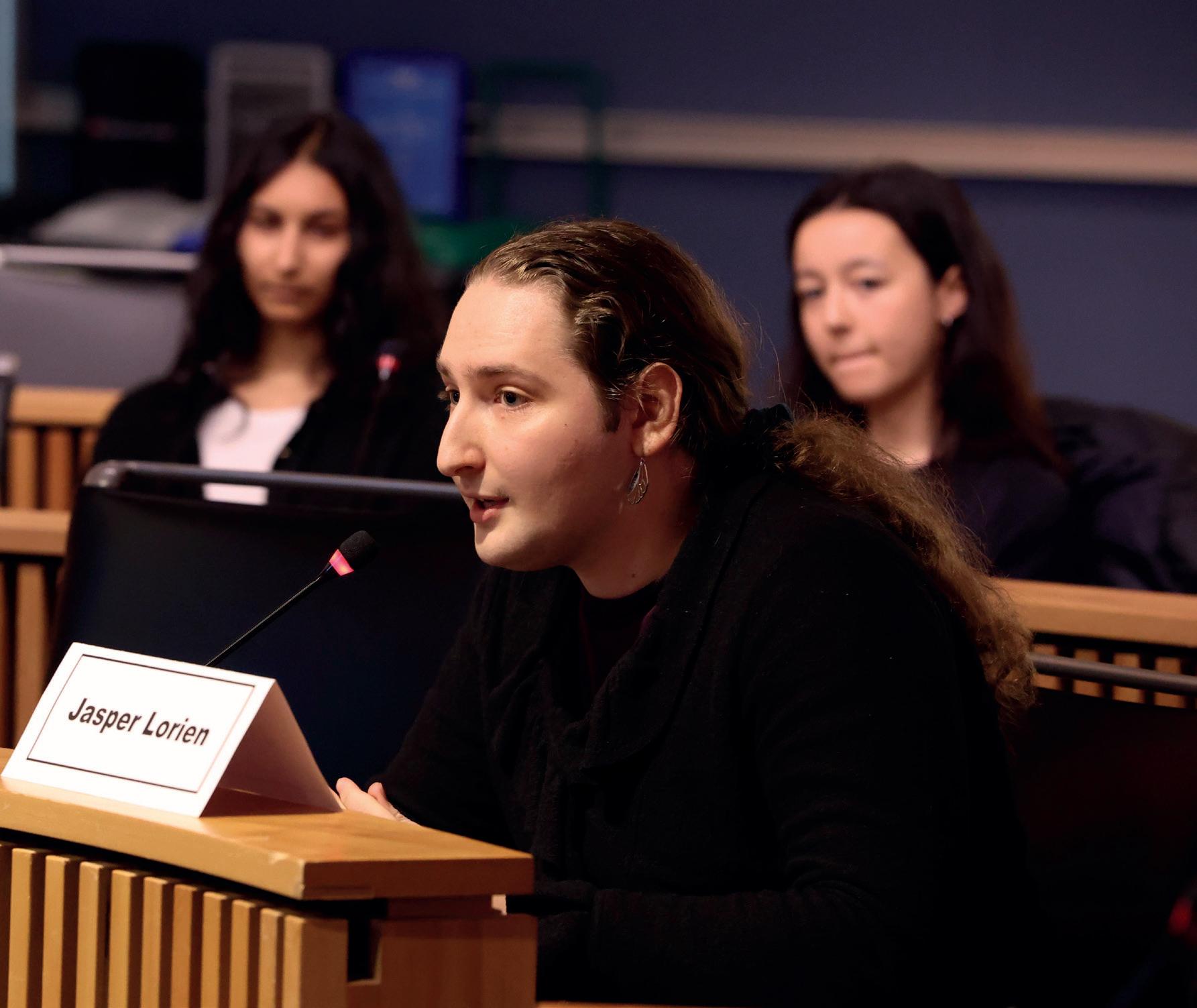
Jasper Lorien resigns from Board of Governors
Report by Stephen Kosar & Spencer Izen News Editor & Deputy Managing Editor
Student Governor Jasper Lorien has resigned from UBC’s Board of Governors, the university’s highest decision-making body.
In an email to The Ubyssey, Lorien wrote that they resigned from the board on March 16, citing personal reasons. They stated that not being able to be present at this month’s board meetings also factored into their decision to resign.
Lorien had served on the board since April 2025, and currently serves as a senator on UBC Vancouver’s Senate, the university’s academic governance body. Earlier this month, they were re-elected for a third term on Senate and unsuccessfully ran for AMS president against Dylan Evans.
During their term as a governor, Lorien pushed the university to increase student food security funding to $1.2 million, from $800,000 — which the board recently approved. When the board voted to increase tuition last December, they were one of four gov-
ernors to vote against any increases.
The board is expected to pass the university’s annual budget on March 31, with the vacancy now leaving Vancouver campus students without one of their two directly elected representatives on the 21-person board.
A senior AMS source familiar with the matter said they expect the circumstances surrounding the resignation may negatively affect the board’s trust in student representatives. The Ubyssey is not identifying the source because they were not authorized to speak publicly.
(Under AMS Code, the elected student governors are also non-voting members of AMS council).
As the newly elected student governors — Zarifa Nawar and Drédyn Fontana — started their terms on April 1, the board did not hold a by-election to fill the vacancy. Thandi Fletcher, a university spokesperson, wrote that when another student governor resigned earlier in the school year, it took “several weeks” to elect a replacement, in a statement to The Ubyssey U
verse economy that everyone in B.C. will benefit from,” and represents one of the largest government investments of its kind in Canada.
Look West is designed to strengthen B.C. and Canada’s economic sovereignty by delivering major projects, creating jobs, diversifying markets and growing targeted sectors.
The fund’s mandate also aligns with InBC’s goal to “attract more capital to B.C. and scale more businesses, anchoring them here to generate economic and jobs growth in the province,” Thomas Park, InBC’s chief investment officer said. The corporation was created by the province in 2020
to invest in the growth of B.C. businesses and operates at arm’s length from the government. The fund will be a separate legal entity and a managing partner is currently being recruited to lead the fund and attract private-sector investors, according to J.P. Heale, managing director of Innovation UBC, in a statement to The Ubyssey. They also said investments will be managed by experienced financial investment professionals, and activity will begin “once the necessary steps in launching the fund have been completed.”
It will invest in businesses “created from licensed UBC research discoveries and other el-
igible companies established by UBC faculty, staff, students and recent alumni,” according to the press statement, with a primary focus on early-stage companies.
According to UBC, discoveries by university researchers have supported the creation of over 280 spinoff companies, and licensed research has translated into over $13 billion in revenue from those goods and services.
“This partnership will enable companies to scale in B.C. and extend the impact of UBC’s research and innovation,” President Benoit-Antoine Bacon said in a UBC press release. “It is a perfect example of what we can do by working together.” U
RAUL DEL ROSARIO / THE UBYSSEY
ARTS & CULTURE
MUSA mounts musical protest against removal from Chan
Report by Luciana Wilson del Valle Arts & Culture Contributor
As continued from page 1. In a written statement to The Ubyssey, Law confirmed an increase in Chan programming for its 28th season is behind the move. The current arrangement with students rehearsing outside the main concert venue, she said, is “consistent with many other universities.”
While these responses may have helped better orient students to why the disruption was happening, they did not put a damper on the effects of the relocation. Leznoff said she and her peers have experienced frequent headaches and dizziness since their large ensembles moved into the Telus Theatre, a space students feel does not accommodate the level of sound produced by a 90-piece orchestra, which often rehearses for three hours at a time. In an interview with CityNews Vancouver last September, Leznoff mentioned being intermittently exposed to dangerous sound levels reaching 120 decibels during these sessions.
In November 2025, Law addressed UBC School of Music students, saying an independent noise assessment was carried out by VOHS Consulting Group, “which confirmed that sound levels are consistent with professional orchestral environments and not considered harmful given the shorter rehearsal durations.” However, “in consultation with UBC Safety and Risk Services and Arts Safety,” Law announced further hearing protection (earplugs, plexiglass and curtains) would be implemented in the Telus Theatre.
In February, Law sent an email to the School of Music student body, updating them on rehearsals
at the Chan — which would remain at the Telus Theatre — and explaining that the university has planned “an external review of the School of Music to help inform long-term solutions for ensemble rehearsal scheduling in the 2027/28 academic year and beyond.”
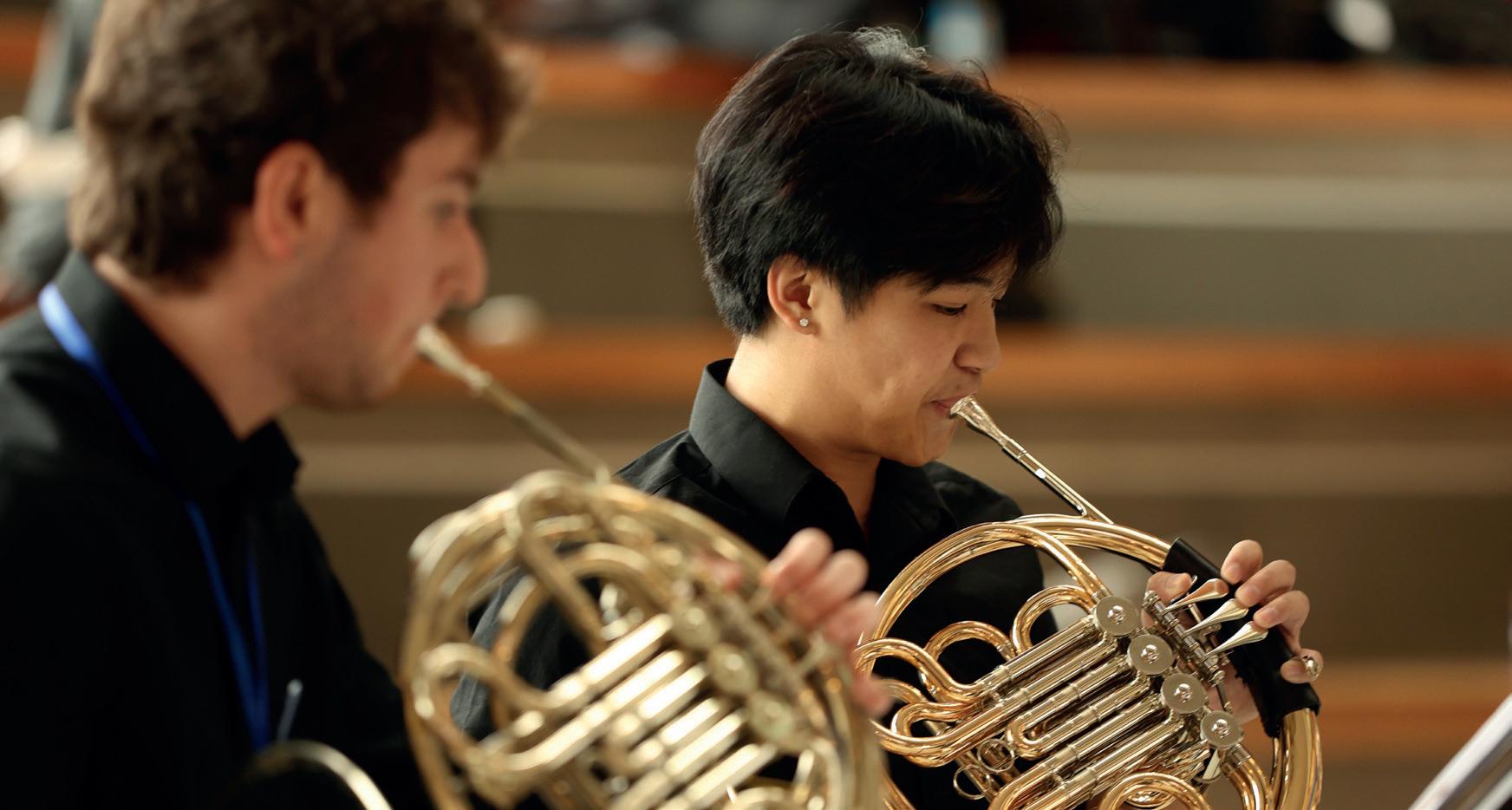
In response to these ongoing challenges, MUSA announced a protest on Instagram featuring performances by musicians from UBC orchestra, choirs, opera, french horn and saxophone quartets, interspersed with speeches from students and alumni. With the protest, MUSA hoped to “show the university how rehearsal space matters, how music education and music performance matter, and they shouldn’t crush it and dissolve it just because it’s expensive to [maintain].”
Leznoff said an ideal solution would be a full return to Chan Shun Concert Hall, but that even increased partial access would be considered a victory. She suggested proposals such as beginning to charge music students for concert attendance as a way to help bridge the gap in lost revenue from allowing the students to return.
The protest was held on March 12 in the AMS Nest Atrium, beginning at 11:30 a.m. The musicians opened with a performance of “Oh Canada,” leading into “Do You Hear the People Sing?” from the musical Les Misérables by the orchestra and members of the UBC Choirs. The orchestra then continued with “Les Toréadors” from Carmen by Georges Bizet, “Hungarian Dance No. 5” by Johannes Brahms and Johann Strauss’s “Radetzky March,” conducted by graduate student and assistant conductor of the UBC Symphonic Orchestra Simón Ramírez Ortiz. They then transitioned into a vibrant rendition of Arturo
Vanwest Anarchist Bookfair platforms people over politics
Report by Julian Coyle Forst Arts & Culture Editor
Cora Thomas has a long history of self-publishing. She started writing novels back in 2012, when she was pursuing an undergraduate degree in educational psychology at the University of Victoria. “Before that,” she said, “I’d been writing fanfiction — terrible, terrible things. They’re awful and no one needs to read them, ever.” But she was proud of her first novel, more or less.
“It’s not incredible, but I have it for sale online, available, and that was the decision I made.” She might not have been sure at first, but after that, she couldn’t stop writing. Now, she’s published four novels and around a dozen zines. She also runs the Vanwest Anarchist Bookfair, where she and other writers sell their work in the Nest’s Atrium every six months. The most recent fair took place on March 19 and 20.
The bookfair (previously titled the Vancouver Anarchist Bookfair) is an indirect offshoot of the long-running Victoria Anarchist Bookfair, which Thomas helped organize when she still lived on the island. At the time, she would spend all the time she could at the bookfair and at Camas Books & Infoshop, an anarchist bookstore in Victoria.
“I was really banging down their doors as much as possible because it was a good place for me — a weirdo — to be a weirdo,” said Thomas. “It got me exposed to a lot of different voices.”
Though the bookfair is still on the smaller side, Thomas said she started to feel the growing pains this year. She booked 30 vendors and maxed out the bookfair’s capacity for the first time. “We’re catching up in size [to the Victoria Anarchist Bookfair] pretty quick,” she said. Thomas is already thinking about expanding the fair for the fall by booking the upper ground floor or the plaza outside the Nest. She doesn’t like having to turn people away — it’s accessibility, more than strict adherence to classical anarchist thought, that really animates her work with the bookfair.
“Politically speaking,” she said, “I’m not an anarchist. It’s not a system of governance that I think is a good solution.” Thomas sees her version of anarchism as “an expression of supreme dissatisfaction with the political system as it currently is.” The Vanwest Anarchist Bookfair, for her, is “a way for us to conceptualize different ways for the world to be.” Her top priority is to offer space for diverse, marginalized people to sell their wares and share their voices.
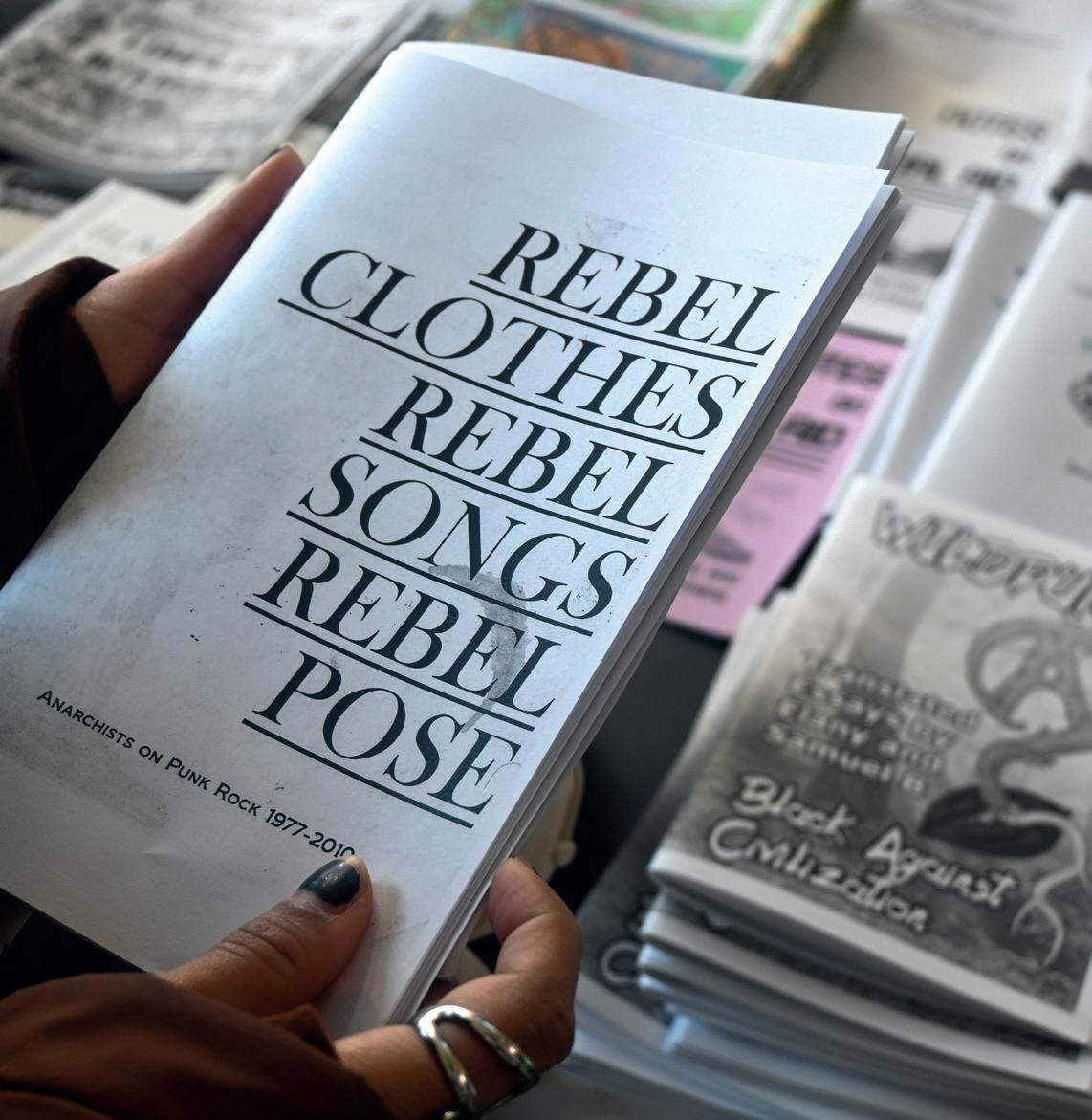
You could see that in the fair’s offerings. They weren’t just books, nor were they explicitly anarchist, for the most part — vendors sold stickers, pottery, stuffed animals and crafts alongside the more traditional fare of self-published pamphlets and zines. Highlights included Tahltan comic artist Cole Pauls, independent zine publisher Worm Mash Magazine and independent printers Dumpster Fire Distro, who boasted an impressive selection of leftist literature.
Márquez’s “Danzón No. 2.”
Leznoff led a series of speeches on the declining quality of music education at UBC and the lack of consultation with faculty and students at the university. “UBC has failed us,” she said. “UBC has failed the broader music community of Vancouver.” Other speakers echoed a sense of feeling cheated — for many incoming students, the chance to rehearse at a venue of the Chan Shun Concert Hall’s calibre was a driving factor in their decision to attend UBC.
First-year graduate composition student Reid Contreras Woelfe said “UBC music students have felt under siege for months,” forced to navigate an “undue bureaucracy” in the wake of financial constraints facing universities province-wide, instead of focusing their energies on honing their artistic capabilities. UBC alumna Kaitlyn Darrach compared the inadequacy of the reduced rehearsal space at UBC, and funding challenges she’s experienced working in music education in B.C. public schools, to “putting a figure skater on grass.”
After a break to allow for shifting seating arrangements, the protest continued as a sight reading session conducted by UBC alum Samuel Ivory, who invited community members and students to bring their instruments and play an arrangement of “Jupiter,” the fourth movement from Gustav Holst’s The Planets. Sight readers then joined UBC Choirs in interpreting Beethoven’s “Ode to Joy.”
The choice was fitting; while the protestors’ frustration and disappointment was palpable in speeches and the ensuing cheers of support, the event was equally a celebration. Not just of music, but of the artists’ talent, resilience and commitment to their craft. U
When she moved to Vancouver in 2021, she missed that space. The city didn’t have a regular anarchist bookfair at the time — Thomas said there used to be one, but “it went the way of all good anarchist events, which is that too many anarchists got involved in running it, and then they fought until it stopped existing.” Despite already balancing a master’s in gender studies, Indigenous studies, and land and food studies with a job as advertising and sponsorship coordinator at the campus radio station (CiTR), Thomas decided to fix that.
Initially, CiTR helped her book the Atrium and get the word out about the fair. That first spring, they had around 12 vendors on the first day and eight on the second. Since then, the fair has been growing steadily with each biannual event. Thomas is proud that a community is already starting to develop around the fair — she does her part to encourage it by prioritizing returning vendors and making sure everyone involved understands it’s their job to take care of their neighbours.
Thomas said her attraction to a utopian vision of the future comes, in part, from her family’s history of displacement. Thomas is Cree, and her family’s ancestral homeland is on the land where Jasper National Park is now located. She and her family can’t go home — imagining a better future must take a different shape. That’s what she does with her books, and it’s the driving force behind the bookfair.
Thomas has high hopes for booking more space this fall — she said the AMS is very supportive of the event. With the help of her girlfriend, she also recently set up an Instagram account for the fair, and she’s working on outreach to places that rent tents and tables, hoping they can make some kind of deal for cheaper or free rentals.
“I’m not afraid to sell out if it means I can get more marginalized voices heard. My ethic has little to do with my own pride and has everything to do with making sure we have as many voices available as possible.” U
While the protestors’ frustration and disappointment was palpable in speeches and the ensuing cheers of support, the event was equally a celebration. | JULIAN COYLE FORST / THE UBYSSEY
The protest was held on March 12 in the AMS Nest Atrium, beginning at 11:30 a.m.| SIDNEY SHAW / THE UBYSSEY
Thomas is proud that a community is already starting to develop around the fair. | NAVYA CHADHA / THE UBYSSEY
ARTS & CULTURE
Brave New Play Rites
brings the audience to the table read
Review by Nivita Dutta Arts & Culture Contributor
The black box theatre of the Dorothy Somerset Studio was blank and dimly lit, with rows of chairs lined up, holding murmuring attendees mulling over the evening’s playbill.
This year was the Bryan Wade Brave New Play Rites Festival’s (BNPR) 40th anniversary. It began in 1986 as an effort from the late Bryan Wade, a professor teaching the creative writing program, to give emerging student playwrights a way to see their work read aloud in front of a live audience.
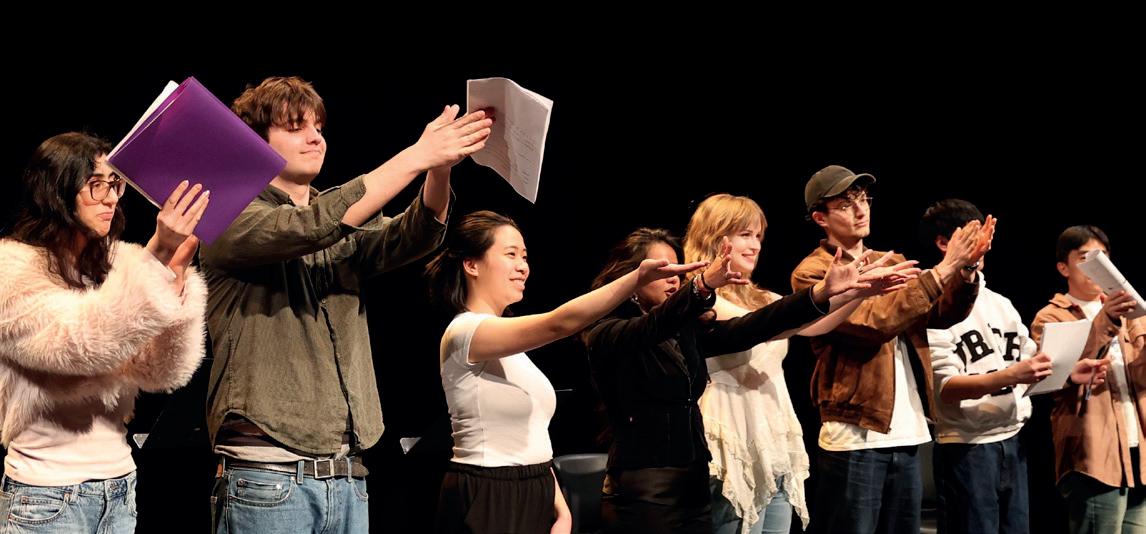
22 ten-minute plays were performed over the course of four days. BNPR is entirely student-led, with creative writing students getting to showcase their work and volunteer as stagehands, producers, directors and actors. Participation in the festival is part of the CRWR playwriting course, available to both graduate and undergraduate students.
The show is distinct for featuring an aspect of the theatrical production process audiences usually don’t get to peek into: the stage reading. After a script is complete but before it goes into production, it’s common for playwrights to hold workshops to see their writing come to life — after all, there’s no better way to improve your play than to hear it read aloud.
Stage readings at BNPR usually went like this — the audience saw actors speak the dialogue with the theatrical emphasis it demanded while a narrator sat separately and read aloud scene designations, setting descriptions and stage directions. This mode of play-viewing is vastly different from the usual experience where the script’s bones are not nearly as visible, and actors fully embody the script on elaborately constructed sets.
As such, the BNPR festival is a unique form of theatre — essentially the bare medium of the playscript brought to life, not its final product. The playwrights participating in the fest were no doubt familiar with what the viewing experience would be like, and as a result, many of the plays dabbled heavily in metatheatre, using the script’s technical details as their own form of dialogue and character.
Many of the scripts were about plays or writing, about scripts being read aloud, about actors rehearsing. Fourth wall breaks and interruptions from the narrator were common, making BNPR an almost Brechtian exercise for both playwrights and the audience.
The 10-minute duration for each play was both a restriction and a spur, with some writers depicting scenes from larger stories and others creating stand-alone short pieces.
Logan Naab, a graduate student in the creative writing program, wrote The Corn Room #1, a play about killing witches and doubting the existence of God. The play, which was painted with queer undertones, began in the aftermath of a gruesome murder — Naab’s way of playing with the 10-minute rule that led playwrights to sacrifice exposition and buildup in favour of fast-paced action.
“[In a] full length play maybe I’d be able to show the lead up to the big event, the big event itself, and then the aftershocks,” Naab said. “But because it’s 10 minutes, I had to choose which one I wanted to do, so I chose the aftermath.”
In a festival put on by and for students, the 10-minutes slot per
play can be exciting — the brevity allows for the audience to get little snippets of theatre that mimic short-form content. Riley Yau, a 4th year undergraduate student in creative writing, appreciated the restriction for this very reason.
“For me 10 minutes is great,”
Yau said. “I had a lot of fun playing with this one because it felt more like improv and I was able to throw crazy ideas in there.”
Yau’s crazy ideas came through in her play, Grandma Marge, which saw two women grappling with having cheated on their spouses with each other. The play quickly delved into an absurdist black comedy of incestuous revelations and internet lingo. If you’d like to see the term ‘AO3’ used in theatre, student plays are the place.
Peihwen J. Tai, who is currently pursuing her MFA in creative writing, was the producer of this year’s BNPR. Every producer leads the festival differently, and for Tai, she found her vision for the festival to be in its potential as a low-stakes entry point for emerging playwrights, actors, and directors.
“I feel like a lot of people want to get a foot into the acting industry, the theatre industry, but they don’t know where to start. [BNPR] is a pretty low-stakes way for them to start doing that,” Tai said.
Tai wants BNPR to continue expanding through potential collaborations with other arts communities on campus. She hopes that performance arts clubs like UBC Face Drama or the Anime Club, as well as UBC programs like acting and creative writing can work together with BNPR to boost arts on campus.
“I can’t speak for the whole institution on its own, but I feel like it’s a matter of folks in the fine arts program[s] getting together and creating something together. I hope that is the future for the festival and our program itself.”
In a cultural climate where even film and TV are having difficulty competing against the instant-gratification generator of short-form content, the future of playwriting as an art form, as well as theatre festivals like BNPR, is contested ground.
Naab thinks some theatre may shift online, onto platforms like Twitch which preserve theatre’s ‘live’ quality, if only in part.
“[Live streaming] takes the kernel of what theatre is, which is a very live human experience where anything could really happen,” he said. “It’s the human error that makes up theatre and the fact that things could go ‘wrong’, but that’s what gives each performance its unique flavour.”
Tai said a festival like BNPR — which is all about the process of creation and writing brought to life in front of the audience — may be exactly what future audiences inundated with AI want to seek out.
“I do think in the age of AI the process of why humans do things will be more important than the results. It’s really hard to find a [film] production where they would invite audiences to come see like their rough production that they haven’t put up. I feel like in theatre there’s lots of opportunities to see the process of theatre-making, such as [this] festival.”
With 40 years under its belt, BNPR will have decades ahead of it as long as students continue to write, see new things, and engage with the work of fellow students and emerging playwrights. U
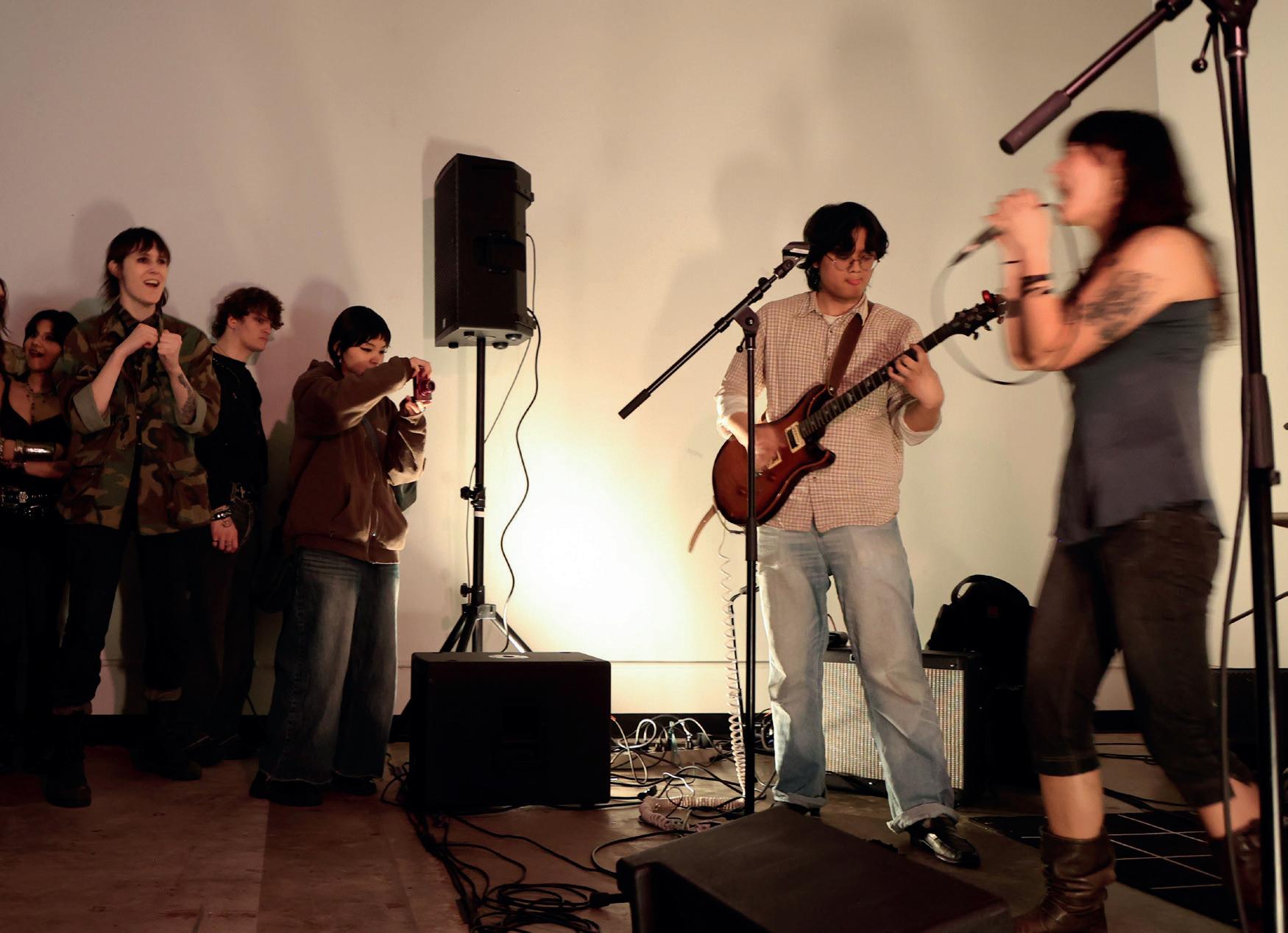

CiTR student executive hosts hardcore emo at the Sun Wah Centre
Review by Jenni Nguyen Arts & Culture Reporter
The Sun Wah Centre in Chinatown is unassuming when you first walk in. Red Chinese paper lanterns line the ceilings, their colour standing out against the shopping mall’s muted, sepia-toned palette. The space seemed empty, filled only with my breathing and the low hum of fluorescent light. But when Julie Shoemaker, the CiTR music executive, led me into the basement of the space, the atmosphere completely shifted. Suddenly, the space was alive, vibrant, full of art, and full of people rushing around to prepare for the set.
On March 20, CiTR’s student executive hosted Catharsis Chinatown at the Sun Wah Centre basement. The night featured a hardcore bill with Mal Criado, Often Wrong and Taking Tiger Mountain. The event was sponsored by Vancouver Black Library and BCA, who helped with organizing the venue. “I had the opportunity to work with execs and staff to produce this show … it’s kind of my baby,” Shoemaker said to me as a flurry of last-minute preparations unfolded around us.
The set was held in a flex space in the basement — a concrete-floored room with insulation and vents scattered across the ceiling in a maze-like grid, rough and stripped down in a way that suited the evening. As the room filled, it began to resemble a typical small-capacity venue, despite cables snaking across the floor to mark the stage and casual velvet couches that reminded me it was a DIY space. What started as an empty room when I first arrived quickly tightened into a crowd, buzzing and ready to break.
Mal Criado, the first band on the bill, formed about a year and
a half ago. The self-described “chingona powerviolence” band roots themselves in the influence of classic west coast powerviolence, an underground music genre that emerged in southern California in the late 1980’s. It’s characterized by sudden tempo changes, seamlessly transitioning between technically talented blast beats and more traditional hardcore principles, with spoken-word samples often embedded throughout the songs. Mal Criado embodied that unpredictably perfectly on stage. Blast beats churned beneath Isabella’s vocals, then dropped out just as quickly, making way for slower, heavier sections that hit with even more force. Every lull felt intentional: a brief inhale before the next surge. The constant shifts kept both me and the crowd locked in, never settling, as the pit lurched and re-formed with each turn in the music.
Taking Tiger Mountain followed. They’re an emoviolence group characterized by screaming duets and methodical tempo breakdowns. Their set had a measured intensity that contrasted with the unpredictability of Mal Criado. It was a solid performance that fit the flow of the night, even if for me it didn’t stand out in the same way as the others. Often Wrong was the last set of the night. I had high expectations, having seen them live previously at last year’s Shindig. They were the most restrained band on the bill, leaning into clean, melodic vocals alongside the intensity that had carried through the earlier sets. The vocalist, Oscar Gaitens-McManus’s voice is reminiscent of The Front Bottoms’s Brian Sella if he had turned to emo instead of folk punk. Drawing from bands like Unwound and Slint, their sound sits in a post-hardcore space —
complex, atmospheric and driven by layered, guitar-forward instrumentals. It’s a style that feels immersive and deliberate and it held my attention just as firmly as the raw energy that came before.
As Often Wrong’s set ended, the room didn’t immediately clear out. People lingered, talking and coming down from the energy, the space almost immediately shifting back into the informal atmosphere of the flex space. It felt like a reminder of how quickly these spaces come together, and how easily they can disappear.
Catharsis Chinatown wasn’t just about the music; it was a snapshot of why DIY spaces matter in Vancouver’s scene. “This is a mall show, which is [the embodiment of the] DIY ethos and also of hardcore music… and Sun Wah is a really special place. I have had happy moments and memories here over the years in the basement,” Shoemaker said. Spaces like this are becoming harder to come by, as Vancouver’s refusal to defend independent venues has forced other DIY spaces like Take Your Time Back to close as directed by the city.
The event also created a space for both longtime fans and first, second, third-time listeners to connect with the power of live hardcore. “The whole goal and hope and desire is that some people who might not have listened to this music from the station, might realize that they’re really into it in a live setting,” Shoemaker said. “Recorded screamo is really enjoyable, but it’s a different kind of experience … You really, really feel it when you’re watching it.”
And yes, you really feel it. Even when I took my earplugs out and started on my walk home on this quiet Friday night in Vancouver, I continued to feel the drums, the screaming, and the cheers of the crowd rattling through me, like the basement hadn’t let go. U
What started as an empty room when I first arrived quickly tightened into a crowd, buzzing and ready to break. | SIDNEY SHAW / THE UBYSSEY
Catharsis Chinatown wasn’t just about the music; it was a snapshot of why DIY spaces matter in Vancouver’s scene. | SIDNEY SHAW / THE UBYSSEY
Many of the scripts were about plays or writing, about scripts being read aloud, about actors rehearsing. | SIDNEY SHAW / THE UBYSSEY
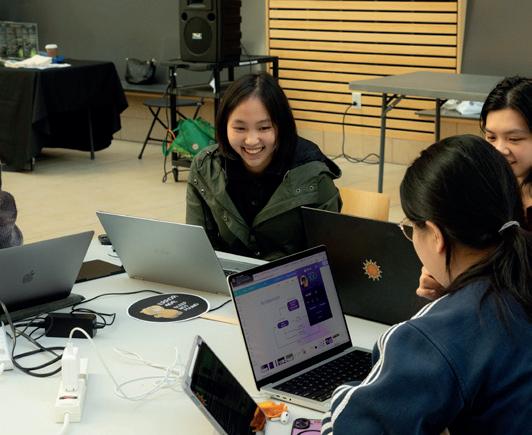
Hackathon coders are the heart of the machine
Report by Jack Paransky Arts & Culture Reporter
You’re sitting in the large glass room at the Life Sciences Institute. Computer science majors sit in the thick sound of typing. The gentle murmurs of “oh shit” and “hell yes” accent the vacuous space. A man wearing a dinosaur costume walks up to you. He silently hands you a bright pink energy drink with enough caffeine to make you worried. He daps you up and moves on to the next person. It’s 3 p.m. — 21 more hours until the end of the cmd-f hackathon.
Hackathons are as computer science as electric apple pie. Each person, in groups of up to four, attempts to write a functioning computer program in 24 hours. 24 straight hours. They try to solve some problem that fits with the judges criteria, and work from noon one day until noon the next.
I had some friends in computer science who participated last year — they each pulled all-nighters to make a program that barely functioned. They said it was difficult, miserable and harrowing. They also said it was one of the most fun weekends they’d ever had.
nwPlus specializes in these hackathons. Based at UBC, but not an AMS club, they run three premier events each year. HackCamp runs in mid-November; it’s beginners-only, a gateway into the hackathon zeal. Early January sees their largest event, nwHacks. Open to the general public and hackers of any skill level, nwHacks is the self-proclaimed largest hackathon in Western Canada, sporting 734 competitors in 2025. Lastly, at the beginning of March, they run cmd-f (pronounced “command f”): a hackathon for underrepresented genders in computer science.
Tracy La, the logistics director of cmd-f, is a third-year microbiology & immunology and computer science (CS) double major. Originally a pre-med student, she took CPSC110 (an introductory programming course in computer science) and fell in love with the art of coding. She’s an alumna of cmd-f and nearly remade the event from the ground up this year, removing many of its rigid categories. “I think [the change] encompasses our Alice in Wonderland theme this year,” she said. “It’s tipsy topsy turvy. Do whatever you want and only let your creativity be your limitation.”
Hackathons are the perfect place to play around with computer skills. You can’t get a bad grade at a hackathon, and none of it will affect your transcript. Tracy said participants “have a safety net so … they know that they’re not ruining their whole experience because they can’t figure this one little thing out.”
But most hackathon participants will still use every fibre of their being to figure those little things out. Some people will sacrifice health, sleep and comfort for the chance to solve a problem they created in their heads that morning. As someone with as much computer knowledge as Fred Flintstone, I never understood how someone could be so devoted to colon syntax and infinite loops. The devotion of computer science students to their craft is comparable to obsessive painters. Artisans more than number crunchers.
Computer science, ironically, is becoming less human as time goes on. The New York Times recently released a harrowing article about top computer programmers wrestling with their use of AI. The article ends with an ominous message — “skills that seemed the most technical and forbidding can turn out to be the ones most easily automated. Social and imaginative ones come to the fore. We will produce fewer first drafts and do more judging, while perhaps feeling uneasy about how well we can still judge. Abstraction may be coming for us all.”
Is AI going to take the soul from coding? Is there a human element inherent to the for loops and problem solving that could be erased by our use of other code? Does that
mean coding is art? I went to cmd-f to ask that question, see the artists try to speed paint and be in the room with possibly some of the last humans to do a job like this.
That Saturday, I met the teams I would keep track of throughout the event. Some of the executives from UBC Women in Computer Science (WiCS) were in attendance. Selin Uz (a sixth-year CS major and WiCS co-president), Katja Radovic-Jonsson (a third-year CS major and WiCS community events director) and Maryum Chaudhry (a third-year business and CS double major and WiCS graphic designer) had all run their own hackathons or gone to previous ones. They had an idea for their project by the time I asked them their names: pulling from psychological research, they wanted an AI to help users frame certain thoughts, texts or talks with significant others.
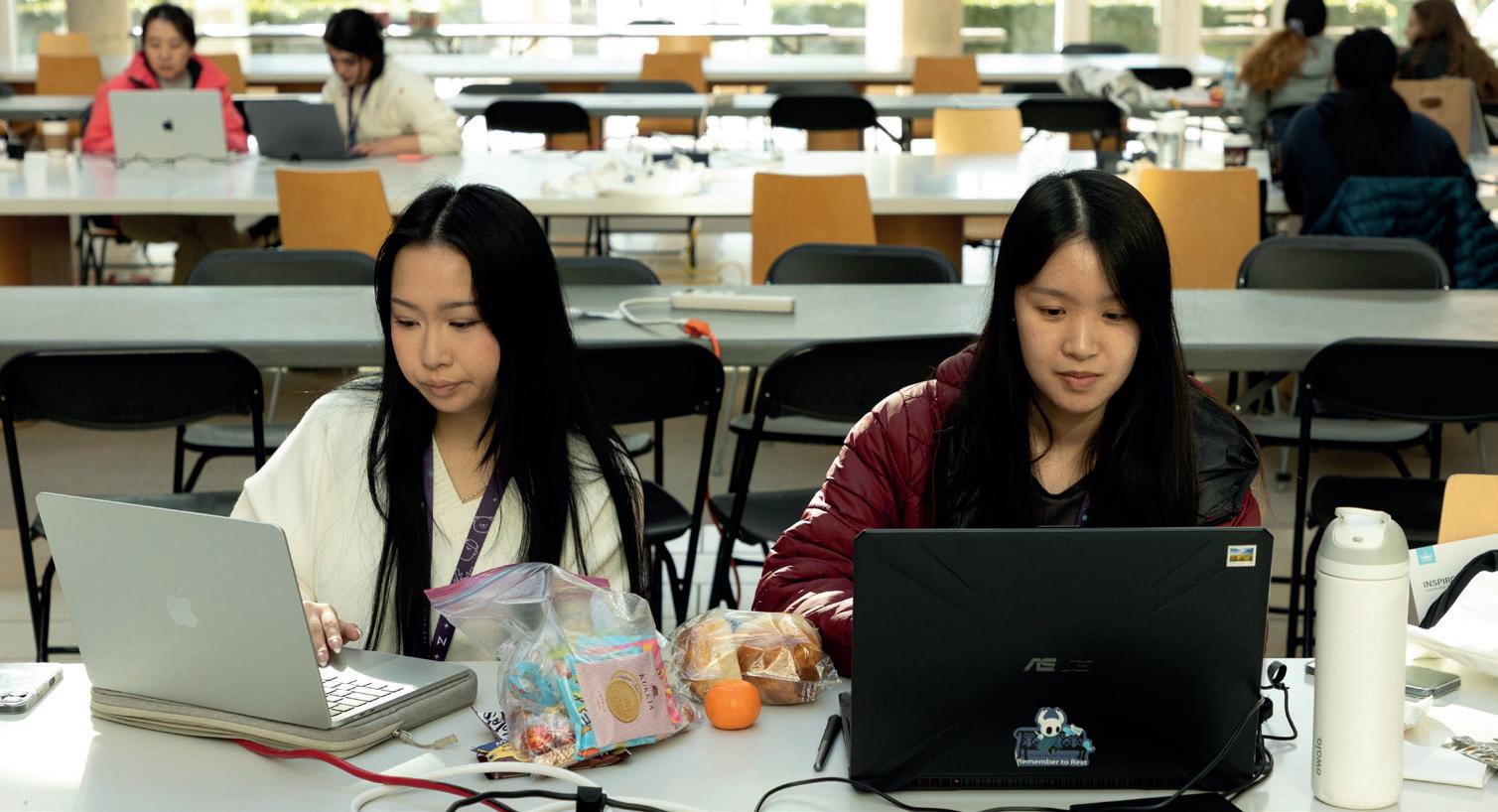

Liza Junaidi, Nicole Schroeder (both third-year CS students) and Mahtab Zehtab (a third-year CS and chemistry combined major) came as a group. I talked with them for a while before Britney (another third-year CS student) joined in. Britney said she didn’t have many female computer science friends, and asked if she could connect herself with the established team. They accepted her with open arms. Computer science events can be communal like that.
Their program was solving a very direct problem: library study room booking is a pain in the processor. You have to go to each individual website to see if something is free at your specified time. They wanted to create a place that would consolidate that.
Evan Sun, Paul Xu and Ryan Liu (all second-year CS students) wanted to work with a very large scope. Computer science students have a presenting problem — they have no idea how to do it in front of crowds or hiring managers. Their program would give an AI presentation coaching session based on a video you submit of yourself. It would pick up on where you talk too fast, use too many ‘ums’ and ‘ahs’ and tell you how you could improve your communication. They said their scale was “ambitious, for sure, but that’s what’s exciting.”
Lastly, Charlotte Jacques (a third-year CS student) and Manya Goel (a fourth-year CS student) had both hopped on the ferry from UVic for this event. The world is an onslaught of bad news, and sometimes people want a respite. Their idea was to have users select what type of good news they want to see — science, art, and so on — and Claude (Anthropic’s AI model) would try to find an article that matches their interests. The scope seemed manageable, and if things went south, they would have time to fix it up. Each team used large language models (LLMs) in some capacity to create and manage their program. Even if they were wrangling the AI like the WiCS members, or using Claude for its ethical considerations like those from UVic, LLMs were ever-present here. There was an organizational push to use it: sponsors awarded prizes to the best use of their LLM. I’m someone who treats AI like a monster under his bed — don’t look at it, don’t touch it and it won’t affect you. cmd-f was my immersion therapy. Here, it wasn’t something driving creative bankruptcy; it was a tool. Tracy called it “a sidekick instead of the hero.”
As the afternoon waned, the scope of the projects became real.
The WiCs team saw basically no issues. They were a well-oiled ma-
chine, sitting in a line, talking frequently and helping each other where they could. AI had helped make their original website design, and now they were humanizing the whole thing. I watched the experts trim the rosebush of their project. As an arts critic, technically, Chaudhry’s work was gorgeous. Simple, elegant, as clean as the code they were working on.
The two from Victoria wanted to show me their newly made UI. It had worked two seconds prior. They turned the screen and it was frost white. This error took them two hours to fix. They did it with a smile.
The three second-years working on the AI coaching program were in hell. Each was locked into their own headset. They would detach once an hour to freak out with each other. They tried to explain the AI to me, but it went way over my head. Obviously, something wasn’t working. They all knew that they were going to stay late. They were thinking in the ballpark of 4 a.m. They desperately tried to hold the reins of a project spiraling out of control.
Dinner hit, and not a soul moved. Each person in that room was in the pilot seat. I stood up, alone, and picked up some of the provided poke. Sponsors covered every meal given out in this event. From the outside, it seemed like they had an infinite amount of free food. Coders hesitantly meandered towards the grub, slinking back to their chairs for silent dinner and YouTube. It was like staying at a sleepover where no one knew each other — quiet eyes and tired typing.
The night started to rear its head. The sky was cloudy, but the stars poked through and bathed the tired souls around me. People began to hunker down. Happy chatter turned to quiet typing.
My UVic group went home around 10 p.m. to try to do more work. For the library people, bugs started to pop up that they couldn’t control. By 11, Zehtab and Britney left to work from home, leaving Schroeder and Junaidi desperately trying to fix a deteriorating front end. The three in hell had managed to train the AI. This was hour 11 or 12 of the hackathon, and they could finally start coding. The WiCS team had a finished product, adding little touches as bugs started to rear their heads. They went home at 11:30.
Nighttime at a hackathon is a surreal experience. A limbo space where anything said is both lost to the aether and cemented in time. People were both locked in and losing their goddamn minds.
The organizers put on karaoke at 10:30 p.m. I would say five or so hackers went to this, standing on
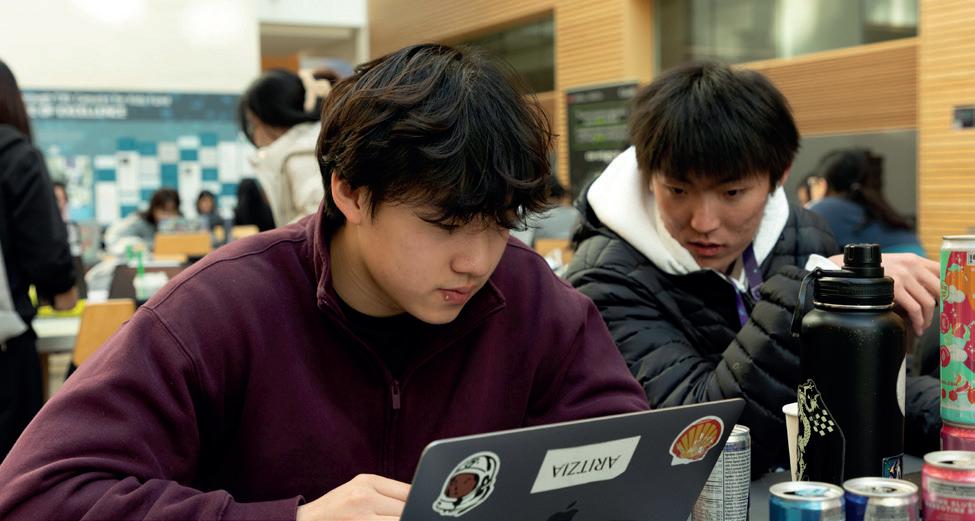
the edges of the crowd while Schroeder and I scream-sang “Call Me Maybe” in a random LSI lecture hall. Surrounded by late-night zeal, I had the first energy drink of my young life. Here’s my review: don’t drink the Alani Nu pink energy drinks unless you truly hate yourself. I could feel my heart in my teeth until I called it a night at 1 a.m. Leaving a 24-hour event and then coming back is a weird thing. Sleep is like time travel — you skip ahead in these stories that you’re missing. The library group stayed until 3 a.m. working on a single bug. Uz dreamt about coding. I came back at 10 a.m. Sun was surrounded by a nest of empty energy drinks, the wrappers of old snacks and congealed Big Way hot pot containers — the contents had solidified like butter. His team apparently coded until 6 a.m, until the other two went for a little bit of sleep. Sun had stayed the entire time — he never left, slept or stopped coding. He proudly showed me the code he had slaved away on, only for the website to crash. He was a shell of a person after that. The deadline approached swiftly. The UVic students were happy with what they could do with limited AI experience. The group working on the library project were upset that they’d had to hardcode some of the features, but were just trying to get something done. The WiCS team had a fully finished, slick application that I think they could’ve turned in the night before. An hour before submission, I heard a “fuck yes!” and cheers erupt from the three second-years. They had a shot at getting a finished product. Typing grew more furious, people solidified plans, all crescendoing in the closing of the submission window. The entire building let out a sigh of relief. The projects were baptized with a name and sent out for judging. The WiCS team made Rabbit Hole. The library team made Study Room Hunt. The three second-years, in the nick of time, handed in Echo, and the UVic team made “The Optimist”.
Echo won a pilot program award — if they want to still make the app that nearly killed them, they now have the funding and support to do so. Rabbit Hole ended up winning the best use of Gemini. With the wrangling of the LLM they did, I couldn’t imagine anyone else winning.
These people put their souls into this code. It was as much of a labour of love as any art piece I’ve seen. AI seems built to replace that. If coding is an art, should we leave it to the machines?
The UVic students talked about how code can be pretty. Pretty code, to them, is well documented, readable and human. “I don’t
think [AI] can write a good code or a pretty code.” Goel said. “[A] lot of code [can] be beautiful because it’s so nice. It’s so well documented. There’s white space, and I don’t feel like throwing up after looking at the file and everything is so well organized.”
To me, she said everything but saying there’s a soul missing in AI code. A human element. Radovic-Jonsson told me “Computer science was literally designed by humans to be as intuitive as possible to other humans, and that’s why I always say, like, oh, the courses are actually not that hard once you kind of get into the groove. So I would argue that computer science is the most human sciences.”
The three second-years gave me a very distinct answer. You never expect someone to start quoting an Instagram reel at you, and dread the day you have to write about it for a newspaper. One of them said that a “person who works with their hands is a labourer; a person who works with their hands and their mind is a craftsman; and a person who works with their hands, their mind and their heart is an artist. So I think for coding to be considered an art, it would just take us coders, as software engineers, to work with our hands, which we are doing, work with our mind, which we are doing, but also be able to work with our heart.” They all clapped at that. People turned and stared for a couple of seconds. Who says computer scientists can’t have nuanced artistic opinions?
The most insightful answer I got was from one of the peer mentors, Harjot Singh, a CS and interactive art and technology major at SFU. We talked deep into the night, during the quiet clacking of code being brought into the world. He said coding has always been an art form. He told me, “I think that art is very personal, and the word ‘art’, especially if you think of it in the visual sense, has to have some kind of meaning, whether that’s meaning to the person who made it or the person that it’s being made for. And I don’t think LLM-generated code is based on feeling or emotion. It is simply based on what is the best way to do this task with this code language.” For all purposes, it lacks a soul. It’s tracing a line through the maze to get to the end faster, not looking at the beauty of understanding the riddle.
To work in computer science is to problem-solve with the soul. That’s the only reason people stay until ungodly hours, hunched over screens for ungodly amounts of time. It’s where the human spirit meets the cold machine.
I’d like to think that in thirty years, computer scientists will still be able to code, because something will be lost if they’re abstracted. Tomorrow, I think I’ll write some code. After I sleep some. U
To work in computer science is to problem-solve with the soul. | RAUL DEL ROSARIO / THE UBYSSEY
You’re sitting in the large glass room at the Life Sciences Institute. Computer science majors sit in the thick sound of typing. | RAUL DEL ROSARIO / THE UBYSSEY
People were both locked in and losing their goddamn minds. | RAUL DEL ROSARIO / THE UBYSSEY
Letter from the editor:
looking back at 107
We published The Ubyssey, Reloaded in September — a strategic plan that outlined what we identified as our biggest problems and how we planned to fix them. At the end of the report, we included an image from our first issue way back in 1918 that said “watch this space.” As this year comes to a close, we hope you did.
To paraphrase Justice Mahmud Jamal’s application to the Supreme Court of Canada: it is for others to judge the degree of success, if any, we have achieved this year. What we can say, though, is what we are most proud of having had the chance to do. This year, we:
• developed our first training program for editors, the Continuing Editorial Professional Development Program, delivering over 30 weekly sessions starting May 2025;
• ended the ‘pitch list’ system in favour of a cohort-based placement program;
• established a daily routine of publishing stories at midnight, six days a week;
• redesigned our copy editing system, transferring that work from of editors to a dedicated three-person Copy Department;
• redesigned our pagination workflow, moving that work off editors to an equally dedicated four-person Print Department;
• conducted the first review and redesign of our print newspaper in over a decade;
• established a newsletter to cut through algorithms and reach readers directly;
• ended our practice of publishing rote recaps of governance meetings in favour of live coverage published directly to our website; moved our sports report into more analytical territory, developing a new class of article we’ve since called a game analysis;
• renovated our office for the first time since moving to the AMS Nest, expanding seating in our main area from 12 to 48;
• integrated multimedia into our reporting with video journalists;
• launched our podcast, The Vilest Rag;
• increased our social media presence through Instagram, Bluesky, YouTube and TikTok;
• rolled out a shared drive to facilitate collaboration and establish control over our documents; and
• published our strategic report, The Ubyssey, Reloaded, which we drafted in the summer and began implementing in September.
This is not to say we do not recognize that a lot of work remains to be done, but we made efforts to change for the better. We have set a precedent of no longer tolerating outdated systems or shying away from making changes that differ from prior practices.
In the past, we failed to adequately communicate how The Ubyssey operates — while not our intention, the consequence was an opaque newsroom. We do not believe change can be made in secret. Our hope is that students have a better understanding of what we do and why we do it.
Our sections covered a breadth of topics. News continued to cover governance meetings, protests, vigils and elections on campus. Sports and Recreation reporters expanded their game analysis and spotlighted outstanding athletes. Arts and Culture reviewed plays, books, films and music, and informed readers about interesting events happening in their community. Features profiled compelling stories from students, staff and faculty. Opinion published several columns ranging from politics to pop culture, as well as op-eds from community members about their thoughts on campus or global affairs. Research synthesized reports from UBC scholars and attended panels to learn more about what the humanities, social and applied sciences fields are up to. Humour satirized it all. Photographers and illustrators supported the aesthetic identity of the paper. Our video, audio, print and digital teams diversified the mediums we used to tell these stories.
Each member of the 107th masthead was critical in helping The Ubyssey accomplish what it did. Our colleagues devoted themselves to this newspaper, and we are all better off because of their contributions to our community.
Next year, plans are already underway to push our report, with the succeeding masthead expanding to have deputy editors which will allow sections to cover more. Reporters will also be assigned specific beats in a topic to allow them to become experts in their field and build rapport with sources. The website and content management system will be redesigned over the summer.
As the 107th masthead’s time comes to an end, we look forward to seeing what the 108th masthead accomplishes and we hope you stick around to see it too.
— Aisha Chaudhry, Saumya Kamra and Spencer Izen Editor-in-Chief, Managing Editor and Deputy Managing Editor














































ALEAH KIPPAN / THE UBYSSEY
SIDNEY SHAW / THE UBYSSEY
NAVYA CHADHA / THE UBYSSEY
RAUL DEL ROSARIO / THE UBYSSEY
ALEAH KIPPAN / THE UBYSSEY
RAUL DEL ROSARIO / THE UBYSSEY
Nathan Shack wins VP finance race -March 2026
Brazilian Student Association
UBC steals the championship




ZOE WAGNER / THE UBYSSEY
ZOE WAGNER / THE UBYSSEY
SIDNEY SHAW / THE UBYSSEY
NAVYA CHADHA / THE UBYSSEY
Association hosts Carnaval at the Pit - March 2026
championship in a thrilling finale. - November 2025 with residential school survivors - January 2026
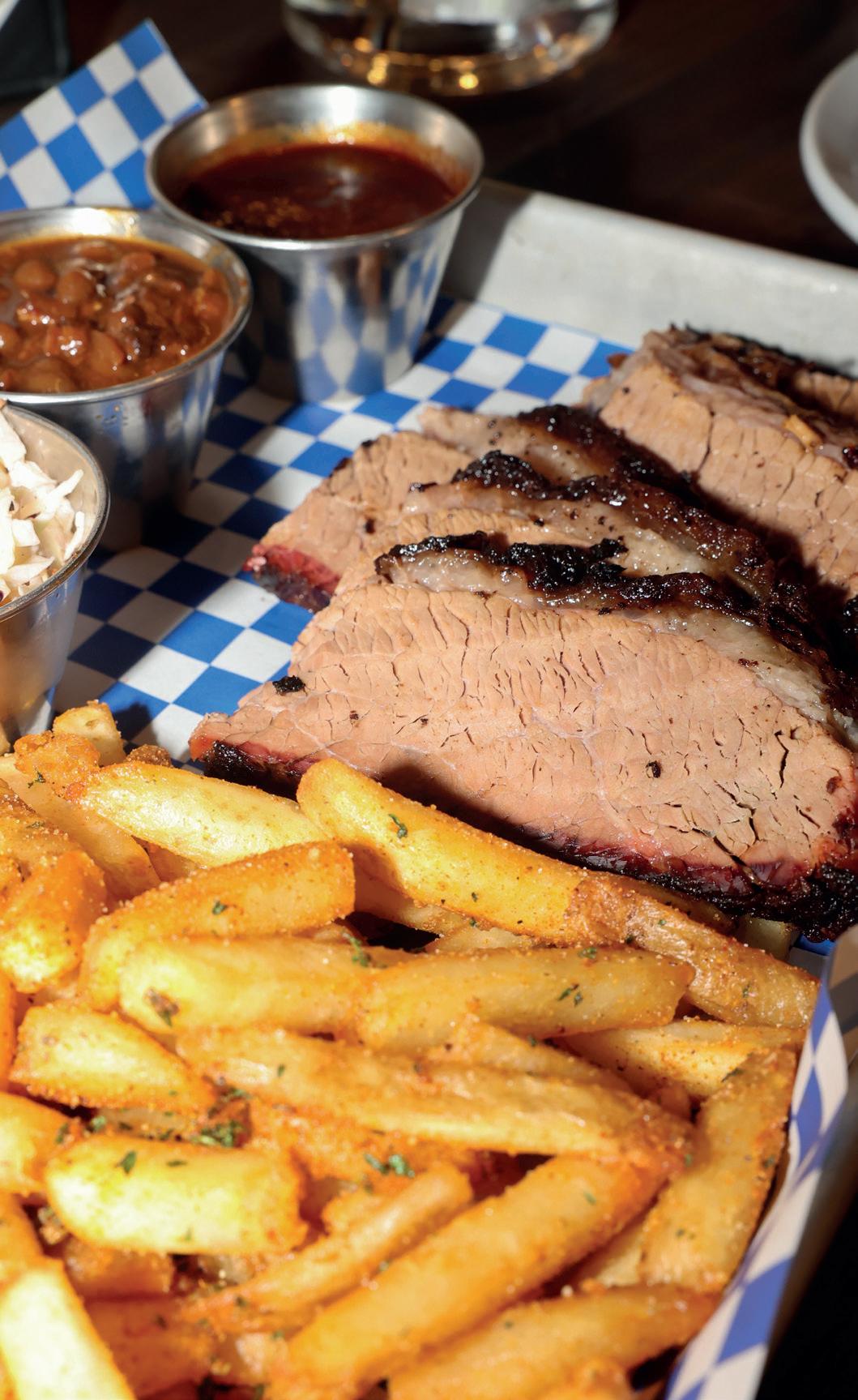
Texan’s search
brisket
2026
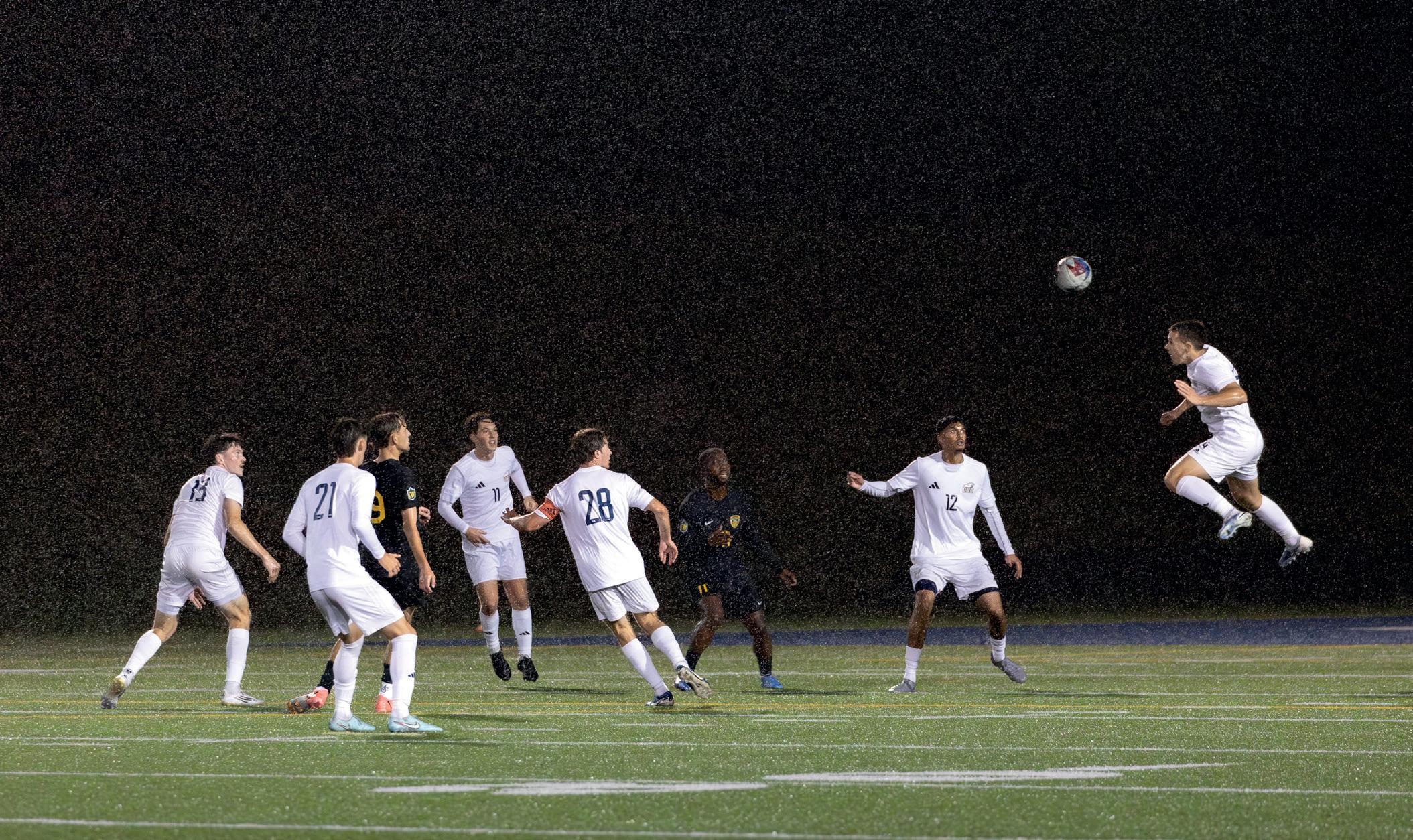
Men’s Soccer scores against Golden Bears, winning rainy quarterfinal match - October 2025
Four years in, Russia’s war on Ukraine reverberates on campus - February 2026

Close Up: The movie doesn’t need to be the book
When adapting a literary classic, a film’s main intrigue lies in the source material it pulled from. But relax if it strays from it.
Fiona Pulchny (she/her) writes Close Up, a column covering the entertainment industry and its impact on the community. She is a fourth-year student studying English Literature and French. Her email is f.pulchny@ubyssey. ca
Opinion by Fiona Pulchny Columnist
I used to believe you could measure the quality of a book-to-film adaptation by judging how faithfully it stuck to the source material. I admit, there’s something extremely gratifying as a fan of a novel to watch scenes on screen that seem practically pulled directly from your imagination. We already know that bookto-film adaptations are extremely popular. Especially in the case of literary classics, these films appeal to audiences who are long invested in the stories. We see this in films like Greta Gerwig’s 2019 adaptation of Little Women: a nostalgic book embedded in many-a-childhood, the film’s main intrigue lies in its source material. For a more recent example, we can look at the newest adaptation of French classic L’Étranger directed by François Ozon. I saw the Camus adaptation during the French Film Festival in Vancouver, Rendez-Vous. Despite both novels already being adapted, these newest editions were no less enticing.
Studios market these films based on their association with the original book. It’s no surprise viewers grow defensive over the primary text and hope the film will recreate the novel word-for-word. When a movie’s end product strayed too far, I used to regard the movie as having failed. But should a movie’s reflection of the book ultimately define its success? We need to make a distinction between movies aiming to pres -
ent a faithful account of a novel, versus one merely inspired by a story: an adaptation versus a reimagining.
There are countless adaptations of Wuthering Heights, but Fennell makes clear that her addition is not meant to be a replica at all, but rather a transformation. She told W magazine the quotation marks surrounding her title are an effort “to communicate as early as possible that [the film] could only ever be an attempt to take a tiny piece of the book and make sense of it.” While her film is informed by Brontë’s novel, Fennell only wanted to depict her personal reaction to it: “I could only take my experience of it and try to translate it.” Fennell felt that it was impossible to adapt such a dense book in full. “I can’t say I’m making Wuthering Heights. It’s not possible. What I can say is I’m making a version of it,” she said in a January interview. Fennell is reimagining the story and decidedly not recreating it. What good is it to judge the film as though it were?
the nuances pertaining to class and culture.
This is not to say that the source material carries no weight in its being the “original.” However, to demand a film be faithful to the book would assume that novels require an objective reading. I counter this notion with reader-response theory, which argues that a work gains meaning from the reader’s analysis rather than from the author. A novel’s significance becomes determined by readers’ unique experiences and perceptions. Fennell’s interpretation of Wuthering Heights is an example of how creators take a story and reimagine it according to a person’s singular vision and influences.
on the novel.
While we can (and should) raise our eyebrows at how Fennell’s film overlooked such a defining aspect of a story as Heathcliff’s identity, we must also accept the movie for what it is: a blockbuster that uses one of the most famous literary romances as its base, but not as its example.
“Creative freedom allows for innovation. Although tempting, it is unproductive to criticize filmmakers who expand beyond the original source.”
To only judge a movie on its closeness to the source material prevents us from truly analyzing films as creative and commercial entities. Yes, “Wuthering Heights” is a bodice-ripping blockbuster with two lead actors whom we’ve all grown tired of seeing. But that doesn’t mean it is void of creative and artistic vision.
“We need to make a distinction between movies aiming to present a faithful account of a novel, versus one merely inspired by a story: an adaptation versus a reimagining.”
The film brings Fennell’s adolescent fantasies to life. She argues that “you can only ever make the movie that you sort of imagined yourself when you read it.” Art is influenced by a multitude of forces. Those include the author’s personal interests and experiences, as well as creations that came before it. Fennell explains that the film reflects her fantasies she had while reading the novel as a young girl. On the casting of Heathcliff, she recounts how she was “struck by how much [Jacob Elordi] looked like Heathcliff on the cover of my … cheap … paperback.” She created a world that didn’t cater to fans but to her younger self. Of course, then, the film felt void of anything except the romance between Cathy and Heathcliff. Clearly, Fennell was captivated by the portrayal of an erotic yet toxic love, and not so much by
Fennell is not the first filmmaker to embed personal anecdotes into her work. Guillermo del Toro took inspiration from his relationship with his father for Frankenstein while choosing to leave behind other themes more prominent in Mary Shelley’s original novel. Learning of this after watching the film gave me some consolation that eased my initial disappointment. He transformed the narrative to be most relevant to himself. Rather than reflecting Shelley’s deep dive into humanity and morality, he focused on themes of reconciliation and parenthood. These elements did not intrigue me nearly as much as those in the novel, but at least I now understand his intention.
Fennell is transforming to even greater extremes, as she removes large chunks of the novel and condenses the narrative to focus solely on romance. However, these classics have remained so prominent because of their mutability; whether an adaptation or reimagining, a film cannot reflect one “correct” interpretation of a novel. As a fellow reader, Fennell has creative freedom to display the meaning she imposed
Similarly to her last film Saltburn, “Wuthering Heights” places heavy emphasis on extravagant and provocative visuals. The film’s tactile elements evoked a “physical feeling” both disturbing and immersive, such as the fireplace made out of hands and the bedroom walls that look like Cathy’s (Margot Robbie’s) skin down to the freckles and veins. I found the Victorian hairwork title sequence particularly creepy and bizarre. In a promotional video, Fennell reveals that it actually incorporates “some of Margot’s and Jacob’s actual hair,” to make the sequence “feel completely human.”
The literal physicality incorporated into the design evokes a visceral disgust toward humanity. That was the intention. Neither Cathy nor Heathcliff is morally good, and their moments of wickedness are only further emphasized by these disgustingly human visuals. The costumes are likewise excessively extravagant. Designer
Jacqueline Durran created pieces over-the-top and not adhering to any specific time period. Fennell told W the film’s “starting point is imagining you’re a young girl who doesn’t really know what the Victorian or Georgian eras look like.” Her personal interpretation focuses on feeling above all. Emotion comes from visual indicators, rather than the story itself; depth of plot becomes secondary to the visual medium. If a film is only critiqued in comparison to the novel, we risk underanalyzing the artistic and narrative elements that make it a unique work. Creative freedom allows for innovation. Although tempting, it is unproductive to criticize filmmakers who expand beyond the original source. I was struck by how much “Wuthering Heights” diverged from Brontë’s novel. But it was clear that it had no intention of being a faithful adaptation. The movie was different from the book, but both are distinct works with different artistic intentions. There are still elements of “Wuthering Heights” and Frankenstein I do not like, but I’m expanding my view to see beyond the page. The films are not replacements for the novels. They only reflect our unique responses to them.
“There are still elements of ‘Wuthering Heights’ and Frankenstein I do not like, but I’m expanding my view to see beyond the page. The films are not replacements for the novels. They only reflect our unique responses to them.”
This doesn’t mean that us literature fanatics are doomed to be left unfulfilled by every classic adaptation that comes out. Instead, we can utilize our critical understanding of literature to analyze how filmmakers reimagine the texts. Engaging in nuanced discourse around classic stories keeps narratives alive. Stories morph and shift with each retelling, just like our interpretations do. Maybe the book is still better than the movie, but the movie doesn’t need to be the book. U
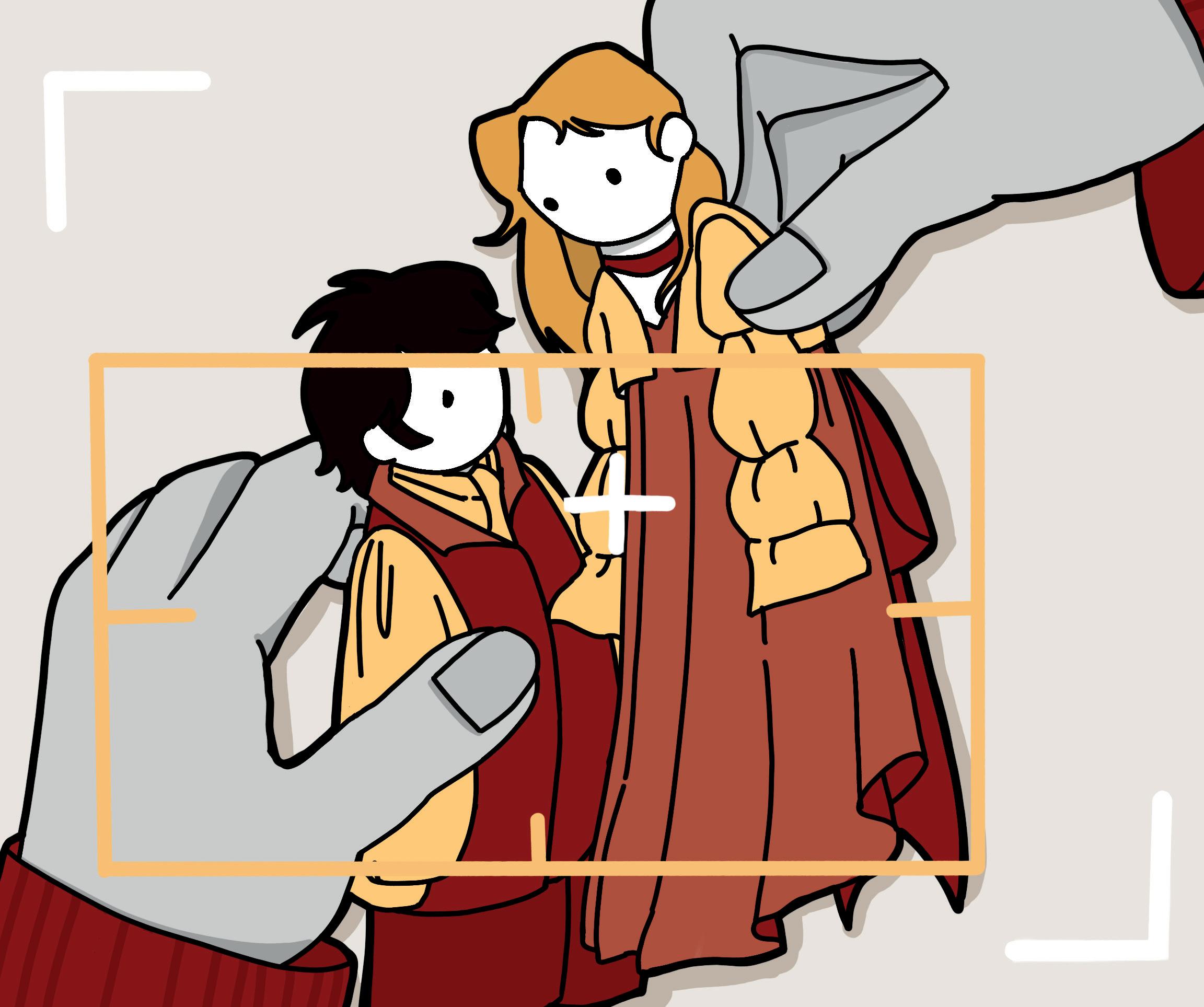
Do book-to-film adaptations need to remain entirely faithful to their original source? | ILLUSTRATION BY HANNAH CHENG / THE UBYSSEY
Why does Women’s Soccer succeed?
It’s about the defence
Editor’s Note: This is a new story form for The Ubyssey’s Sports section. We’re undecided on what to call it. We want it to be analytical, with our writers applying the same critical eye they utilize in Game Analyses to a broader period of time, taking a position on an aspect of the team they’ve been covering.
If you have feedback on this new story form, you can email sports@ ubyssey.ca
By Maia Cesario Senior Sports Reporter
As continued from page 1.
That’s not to say they don’t have talent. Of course, with a program like UBC’s they have skilled players year in and year out. The defence in the 2024 national championship win boasted stars across the back line. They had young phenoms such as the Canada West Rookie of the Year Olivia Gomez and previous Canada West Rookie of the Year Sarah Rollins. They had veteran experience with Canada West Defender of the Year Jacqueline Tyrer and national championship all-tar Sophia Ferreira. But in 2025, the T-Birds had none of them.
Rollins left UBC for the pros, signing to AFC Toronto for the Northern Super League’s (NSL) inaugural season. Tyrer graduated after the season. Ferreira was the most unexpected loss, injuring her knee and being ruled out for the season. That left only two of the six defenders who had been rostered for the 2024 national championship game on the squad for 2025. With essentially their entire defensive core gone or ruled out, it would make sense for UBC to stumble. Instead, their back line picked up right where they left off, extending the shutout streak another 15 games. Because of the defensive culture tied to the program, they are able to keep up their defensive success, even through personnel changes as dramatic as this.
This mindset was first embedded in the team structure by current head coach Jesse Symons. When he first joined the program, UBC had a very different style of play — focused on winning games through their offence, trying to come out on top in high-scoring contests. This stylistic emphasis catered to the strengths of that iteration of the ‘Birds, but was also a reflection of the mindset the team held. Defence wasn’t as crucial.
theT-Birds play in their formation, allowing for individual players’ to adapt and play to their skills.
As a result, regardless of whether the team is playing high-press defence, or if they’re compact near the box — the back line will be playing the whole field.
This defensive structure isn’t just about the back line, however. In Symons’ system, defence is important for every player, no matter their position. Their midfielders become an extension of the defence quickly — even as UBC plays a high press defence — the midfielders are always tracking back, prepared to jump on a defensive play. This means a lot of running for them — but you see the hustle. Fourth-year Taiya Dennehy, the holding mid for UBC, is a great example of this. Dennehy is constantly at the scene of a defensive stop, cutting off opposing players, taking the defensive responsibilities of her role to the next level.
While there is adaptability in how Symons deploys his unit, the core defensive philosophies remain consistent. For one, there’s a focus on the need to hold possession. This goes for all players, but especially when their defence or midfielders have the ball down low, they do not give it away in transition. A mistake like that could easily cost them, as if they turn the ball over, they would be off balance in transition, leaving space open for opponents close to the net to attack.
Yet, even if they do lose the ball, the Thunderbirds are always prepared to react and fight back quickly. The backline consistently closes off incoming attackers quickly and shutting them down, using their positioning to close space. Because of this aggression, UBC’s defence rarely lets opponents bring the ball into the box — or even near it — and this sets the standard for their defence.
“How much we stress on defensive structure and strategies, there’s prob - ably not a lot of

contributes on offence — with six goals in her senior season — because she bought into the UBC culture, it’s no longer her main goal.
Yet, if it was that simple, every team would do it. It’s not just about emphasizing defence — for players, having the devotion to always keep a defensive-oriented mindset is not a guarantee. So how does UBC end up with players who are willing to forego offence — and the visible statistics that go with it — to uphold the team’s defensive superiority?
It’s about looking beyond just skill. It’s finding a player who is talented, but also a player who hustles, can lead, has smarts, and, most crucially, plays for the team.
This comes down to how Symons does recruiting. He looks for players with the right mindset, the kind of player he knows will excel on the team. Then, once the new T-Bird actually joins the team, they can mesh well right away, because their character already matches the culture. From there, it’s just about nurturing and growing that culture, with the coaching and leadership of older players helping the rookies gain confidence.
“This defensive structure isn’t just about the back line, however. In Symons’ system, defence is important for every player, no matter their position.”
Joining the team in 2016, Symons started to switch the team’s style, pushing the importance of defence. The progress was slow initially. They allowed 20 goals in his first year. Then, 18 in year two. In years three and four, it continued to decline, first to 15, then to 13. Yet, it was after COVID where this change became much more evident. In the five seasons since the ‘Birds returned to play, they’ve averaged 6.8 goals against per year. The difference from 2016 is stark.
“The team’s bought into an understanding of defensive structure and organization,” said Symons. “It’s really built us to this super high level of success.”
This defensive culture has seen sustained growth because of how it has been cultivated by the rest of the coaching team and the players. The players buy into the mindset shared by the coaches and fully embody it in their play. The coaching staff, in turn, grants a lot of flexibility in how
other
teams spending as much time on it as we do,” said Sunde.
That level of detail extends to their roster construction as well. UBC puts their best players on the pitch — no matter their level of experience. They trust everyone from rookies to veterans to succeed if they have proven themselves creating depth in their defensive line.
“That’s our secret sauce with our team,” said Symons. “Everyone’s going to play and compete and help the team be successful in the season.”
For the players, this approach to experience means that learning how to play defensively under Symons is a quick study. Sunde learned that first-hand. Before she came to UBC, she was focused more on offence in how she played — but once she became a T-Bird, she embraced the role of a full back. Although she still
“It was something that I bought into when I came,” said rookie defender Sophie Harrison. “As soon as I got here, everyone was determined to keep clean sheets and not let a goal in.” While team culture
season this year. In the national championship, the Thunderbirds fell short after allowing two early goals by their opponents, the University of Montreal Carabins. It was an uncharacteristic defensive breakdown that left them chasing a goal for the rest of the game, and although they netted one with Harrison’s first goal of the season, they came up short in the end.
The Thunderbirds let Montreal into the box early in the game, and these close attacks set the Carabins up well. Although UBC’s defence had deflected initial shots before both goals, the Carabins’ press was tightening around UBC, allowing them to quickly jump on the ball and find the net. While, as they had all season, the T–Birds barely allowed their opponents to hold possession the rest of the game, on the highest stage, where the margins are thinnest, this slight defensive lapse defined the game. There was perhaps no better reminder as to why their defensive identity is so crucial.
“[Defensive mindset] is driven from the coach, but then you have to implement what he’s coaching us when you’re in the game,” said Harrison.
After losing the national title this past season UBC will have to bounce back, as they will again have to deal with some big losses on their back end. The team’s captain, Sunde, is graduating this year and is now playing professionally with Austria Klagenfurt for the rest of this season. They will also lose their all-Canadian goalkeeper Dakota Beckett, finishing her career as a T-Bird this season.
“Yes, they’re losing players. But that hasn’t bothered them yet.”
is central, the success born from it is reflected in the T-Birds’ individual accolades. UBC defenders have won Canada West Rookie of the Year three years in a row, with Harrison keeping the streak alive this year. It isn’t just the rookies. The Thunderbirds had the Canada West Defensive Player of the Year three years in a row with Sunde winning this season.
Unfortunately, that sustained success didn’t translate to the post-
Beckett had an incredible season, being a major part of UBC’s clean sheet streak, not allowing a single goal. But it doesn’t stop there. Beckett also became the all-time Canada West leader in goals-against-average (0.267) and save percentage (0.915), in addition to being the now-winningest goalkeeper in UBC history.
To replace Beckett, they’ll likely turn to rookie keeper Emma Sparrow, who played six games this season, keeping the shutout streak for UBC in all of them. However, at most, she faced three shots in a game.
Symons is not worried, as he believes in both the keepers they have and their new recruit, Marilena Spagnolo, who is coming to UBC as a graduate student off a championship with League 1 in Ontario. While I think UBC has the opportunity to continue succeeding in goal, their regular season defensive success will look somewhat different next season. Another season of only shutout
victories is unlikely. There’s a reason it had never been done before, so expecting to do it back-to-back will be nearly impossible. But that doesn’t mean they can’t expect success. Yes, they’re losing players. But that hasn’t bothered them yet. Similarly to this year, the Thunderbirds should be able to continue their dominant defensive play from the back line, even without Sunde and Beckett. As they showed this season, they can quickly adapt from the loss of some major defensive players and find their ways to succeed. The key, as it has been throughout Symons’ tenure, will be in their defensive culture and mindset.
But their roster won’t be barren, either. Compared to last offseason, UBC faces fewer line changes and even gains a player back, with Ferreira returning from injury to supplant some of the veteran leadership that will be lost in Sunde’s absence. They’ll have some great young talent to help them as well. Since Symons’ philosophy is to play his best players regardless of year, the team’s young players earned minutes this season to develop as players, so the Thunderbirds certainly have depth to choose from. Even in losing their all-time winningest goalkeeper and the Canada West Defensive Player of the Year, there is not a massive gap left to fill, because every player on the roster all grows together.
Second-year Zoelle Apps demonstrated this well. In her first year, she was able to earn minutes and develop her skills in real time in games. This season, she filled into the starting centreback role, having big shoes to fill, replacing Tyrer and Rollins. She didn’t miss a beat. She held down the back line like a veteran player on the field excelling in a tough position. Apps isn’t the only young standout. Harrison will certainly continue to light it up on defence, also starting in almost every game in a breakout first year, alongside fellow rookie defender Heike Clarke. However, even with this young talent showing much promise, there is still some room for improvement if they hope to continue both as the best defensive team in Canada West and one of the best in the country. In the postseason, some unfortunate mistakes cost them. At nationals, they took penalties in the box, gave up set pieces in multiple games, and, of course, they gave up two goals in eventual loss in the championship.
The Thunderbirds defence, as always, will be exciting to watch next season. With a chip on their shoulder from their loss at nationals, I think their defence can propel them back to the championship. There might be more bumps along the road in the regular season — it’s impossible not to when the bar is, quite literally, perfection — but even if they don’t have another
mean
shutout streak, that doesn’t
they’ll be taking a step back. U
Heading into the 2026 season, Women’s Soccer will have to contend with the losses of key defensive players like Dakota Beckett (#1) and Ella Sunde (#18) | ILLUSTRATION BY AYLA CILLIERS / THE UBYSSEY; PHOTO ELEMENTS BY CHRIS PIGGOTT / MACEWAN GRIFFINS, DAKOTA BECKETT / MCMASTER UNIVERSITY ATHLETICS, NAVYA CHADHA / THE UBYSSEY, SIDNEY SHAW / THE UBYSSEY
Julie Smulders’ got next
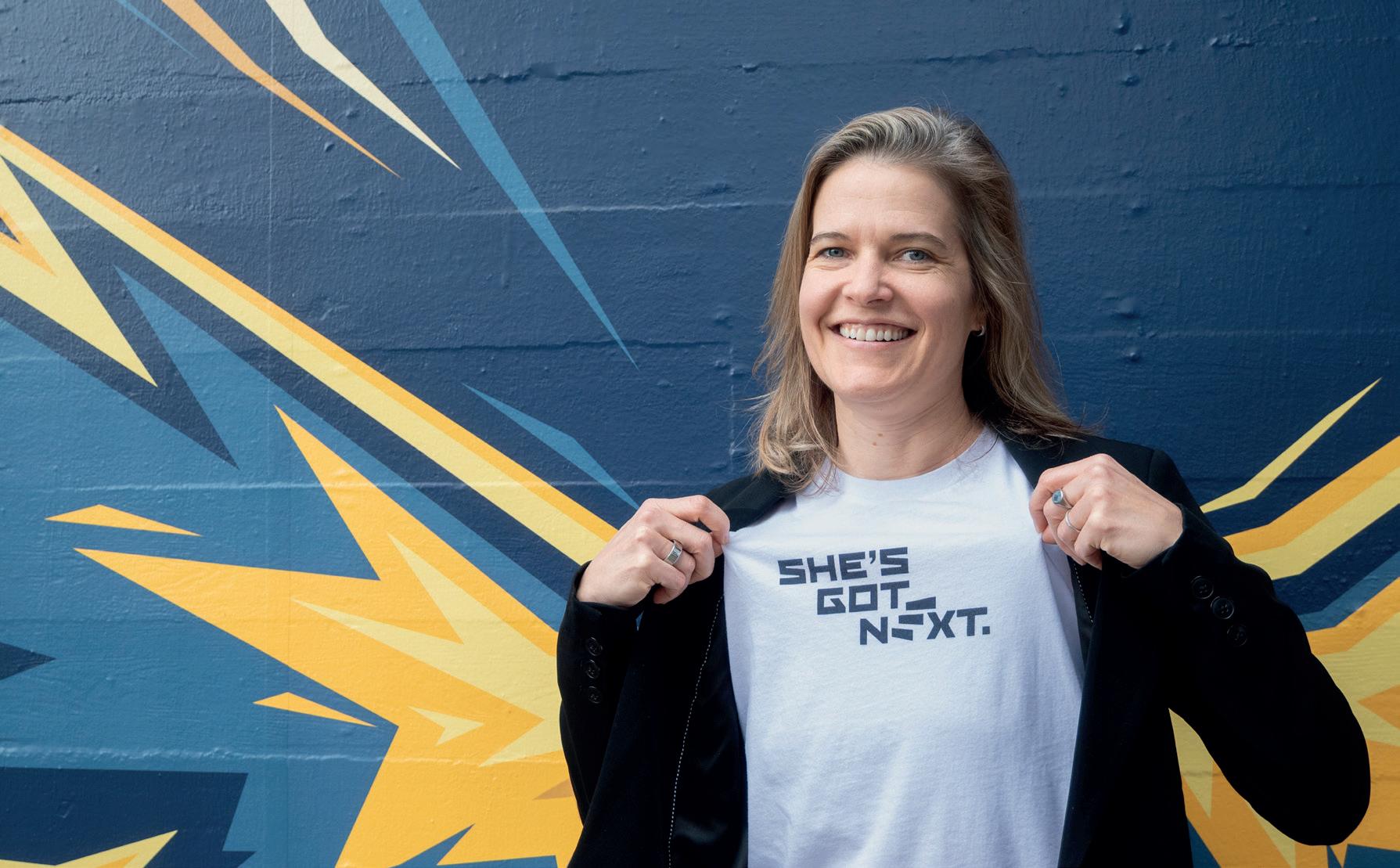
While it’s been more than 20 years since she was a guard for the Thunderbirds women’s basketball team, Julie Smulders is still showing up for women’s sports at UBC. | ALEAH KIPPAN / THE UBYSSEY
Profile by Maia Cesario Senior Sports Reporter
Last April, UBC Athletics held its annual Big Block Awards, their award night recognizing achievement across varsity sports. Plenty of prominent UBC coaches and athletes were honoured, including the national champion women’s soccer team, U Sports women’s hockey Player of the Year Grace Elliott, and quarterback Garrett Rooker. But for one of the awards, the winning player wasn’t a player at all. In fact, they hadn’t stepped on the court for the ‘Birds in over 20 years.
Julie Smulders, a UBC women’s basketball alumni, was awarded the Kay Brearley Award for service to women’s athletics.
Smulders’ path here is unique. She earned this award not just from simply watching UBC women’s games — which she does — but instead, her devotion and passion to uplifting women’s sports and supporting women athletes. It’s that passion that led her to create her non-profit organization — She’s Got Next.
“Anyone that you speak to [would say that], she is one of the most trustworthy, high-integrity people,” said Jill Tracy, a co-founder of She’s Got Next and Smulders’ partner of almost 12 years. “She just is really good.”
In a recent conversation Smulders had with a varsity athlete at the University of Toronto, she heard the same piece of advice many young female athletes have heard before. The athlete was told that, in order to succeed in finance, she would need to solely focus on school and quit sport. As both a former athlete and current businesswoman herself, Smulders couldn’t disagree more.
“If you stay in sport, it’s a differentiator,” said Smulders. “That is a unique skill set … that you bring to the table that others won’t have.”
It’s conversations like those, where the importance of sport is minimized, where sport isn’t viewed as a viable or sensible path for female athletes, that led to the creation of She’s Got Next in 2024.
At its core, She’s Got Next is about building infrastructure for women’s sport in Canada to not just survive, but thrive. With women’s sport not having nearly the same level of financial support as men’s, there is always the danger that opportunities will be lost. By creating She’s Got Next, Smulders and Tracy hope to not just raise money and awareness for women’s sport across the country, but to also build a community of fans and athletes alike who uplift and support one another.
Smulders’ inspiration for starting She’s Got Next started with her experience as a varsity athlete. She was a guard with the UBC women’s basketball team from 1998–2001. As a strong player, she was selected to the Canada West all-rookie team, and the following season, was named a Canada West second-team all-star. For Smulders, UBC was both an opportunity to seek a great education and a valuable stepping-stone on her path to
pursue basketball professionally.
“UBC has been so fabulous for our community,” said Tracy. “I know UBC helped change Julie’s life.”
Although she didn’t fully appreciate it at the time, playing as a Thunderbird was a crucial time in her life. She especially appreciated having the chance to play under the team’s head coach, Deb Huband, one of the best in women’s basketball. Not only was she the UBC women’s coach for 26 seasons, but she also found success internationally. She was a national team player for Team Canada and captained them at the 1984 Olympics, before going on to coach Team Canada to a silver medal in the 1999 Pan Am Games. As a young player, learning under a leader like Huband while attending UBC was an incredibly important part of who Smulders became as an athlete and person today.
“I have a lot of appreciation, which is why I give back now,” said Smulders. “Because I feel very grateful for my time there, I want to make sure other women have the same opportunity.”
After three seasons, Smulders left UBC to continue chasing her basketball dreams as she headed overseas to play professionally. Playing professional basketball had always been the goal for Smulders. Even from a young age, “basketball came first,” so when she got the opportunity to play in the Netherlands, it was an easy decision.
This was more than just a chance to continue playing basketball for her, however. It was also a way to feel closer to her father, who was from Holland — so while she played, she also got to learn more about her family and their culture. To cap off her overseas experience, she earned the honour of representing the Netherlands, playing for the Dutch national team. Overall, she enjoyed her time playing professional basketball — the culmination of everything she had always wanted as an athlete. Eventually, however, it had to come to an end.
At a time where women’s sports were severely underfunded and under-represented, the opportunities for Smulders as a professional athlete were limited and fleeting. The pay just wasn’t there. For Smulders, playing overseas was not sustainable. After a tragic loss in the family, she took the time to evaluate her life and decided she had to return home to Canada. Ending her time in professional sports, she pivoted to start a more traditional career — or, as her dad would say, “a real job.”
Her journey for life after basketball was uncertain. For the first time in her life, she had no clear path or goal. Smulders, having enjoyed math, decided to pursue accounting. She returned to school to earn her way into the field and, like any athlete would, she gave it her all.
However, despite her efforts, Smulders still felt slightly behind others competing for the role. After spending time away as a pro basketball player, she was missing many of the prerequisites needed
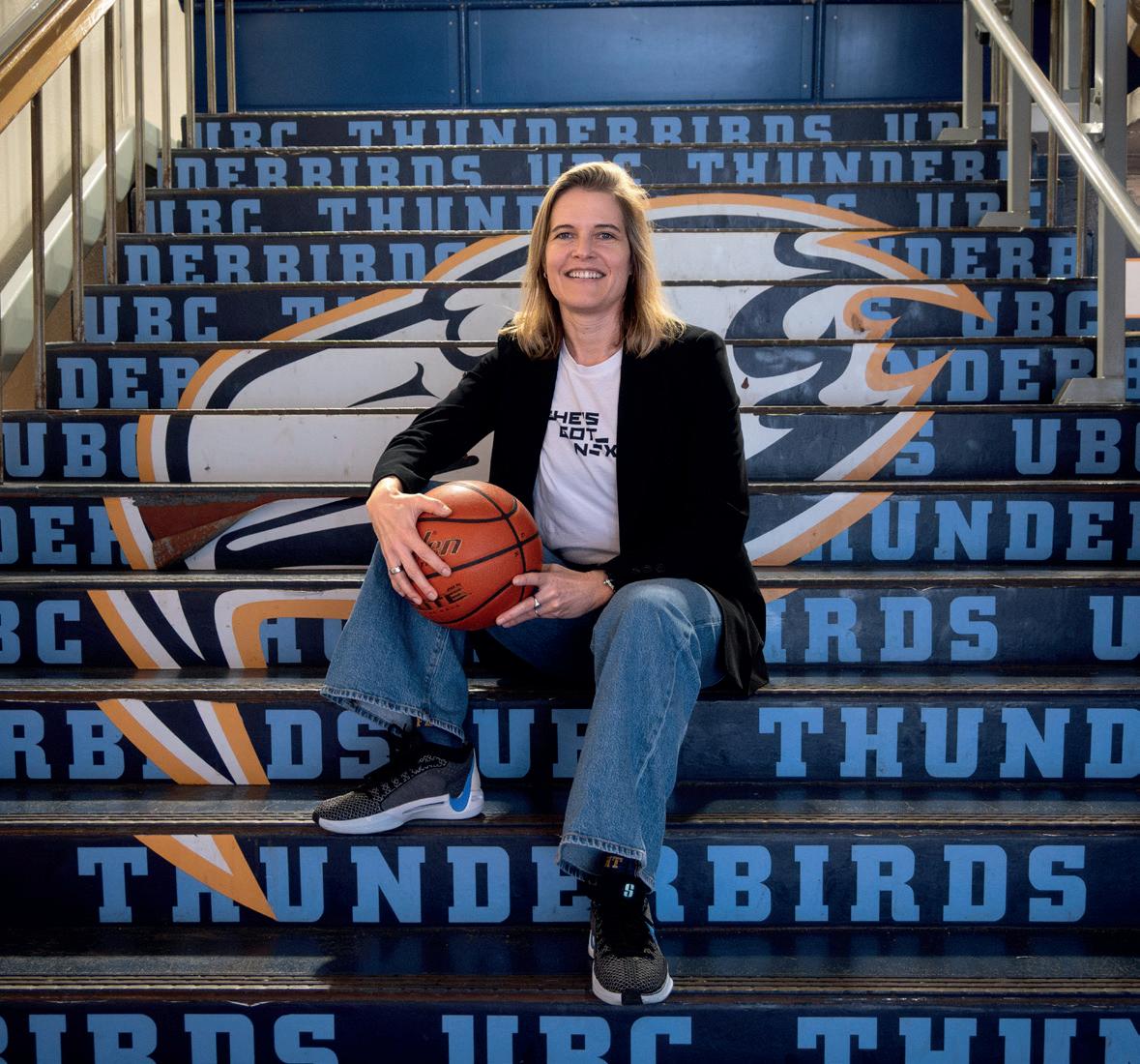
to be competitive in the job market, lacking the internships and job experience that she may have otherwise got if she had stayed in Canada and pursued a more traditional career path. Yet, in the end, her unconventional journey — and specifically her time as an athlete — was the strength she needed to prove herself as a candidate.
“One of the reasons we started She’s Got Next is being able to bridge that gap for other athletes as well,” said Smulders.
Her first opportunity to prove herself and break into the world of accounting came on a recruiting tour with PricewaterhouseCoopers (PwC). From an introductory video, she knew that one of the managing directors had played soccer, and because of that, she struck up a conversation about sports. This established a jumping point for Smulders to pitch how the qualities she gained as an athlete would translate into her work.
Not only did her time as an athlete prove she had strong qualities to be successful in her initial role at PwC — it also helped her stand apart from the crowd. As Smulders continued in her career, she moved up in the world of finance, gradually taking on more leadership roles. Her success in her career is something she ties directly to her time in sports — from that first interview with PwC, all the way to becoming a COO in wealth management.
Yet, as Smulders moved up in her career, she noticed that the more doors she was able to unlock, the fewer women were a part of those rooms or held leadership positions. This was something she wanted to change.
“In order for a company and society to be successful, we need a diverse leadership group,” said Smulders.
With Tracy, Smulders brainstormed ways to give back. As her background in sports helped pave the way for her career, Smulders focused on how female athletes could be set up as future leaders, as well as how to support them in pursuing careers after sports, after her experience trying to navigate that journey alone.
“Being the wonderful person that she is, [she wanted] to figure out how to give back and how to open more doors for more women,” said Tracy.
Eventually, they saw their opportunity. In 2024, demand for women’s sports was at an alltime high. Viewership was higher than ever, with players like Caitlin Clark helping the NCAA women’s basketball final draw more viewers than the men’s final for the first time ever. Opportunities were increasing, with leagues such as the National Super League (women’s soccer) and Professional Women’s Hockey League being founded in Canada. Wanting to capitalize on this momentum, they decided now was as good a time as any to start this project.
Tracy, who has a background in journalism, mass communications and PR with an MFA in graphic design, supported “Julie’s vision and … passion” through the marketing. They started reaching out
to people — professional athletes, women business executives, and more — about the initiative. While there may have been some initial uncertainty, the enthusiasm of the community made bringing this project to life much easier than expected. Everyone they reached out to was immediately on board.
“They were fighting over membership numbers, wanting to be member numbers that were tied to their jersey numbers,” said Smulders. “It was all very positive.”
“She’s an outstanding person,” said Tracy. “That makes it easy for folks to want to be associated with the organization and extend her vision.”
From its original stages, She’s Got Next has continued to grow and help women and girls in sports. Running as a non-profit, their company focuses on three main initiatives: visibility, funding, and maybe most importantly, community.
In terms of providing visibility, She’s Got Next has aimed to create opportunities for people to show up and support women’s sport. They provide an immediate spotlight on female athletes and women’s sport through their social media, website, and newsletter to help provide visibility and create more role models for girls in sports to be able to see. Beyond that, She’s Got Next goes to the source, setting up events around games, attempting to push attendance, local viewership and direct support in women’s sport as they gain more visibility in the community. Through these efforts, She’s Got Next wants to promote how incredible it is as a viewer to watch and join in on the community.
Considering the barriers that Smulders herself ran into as a professional athlete, She’s Got Next has also worked hard to provide more direct financial support to women’s sports and athletes. A third of their fees go back to women’s programs, and they are currently looking into further funding opportunities with direct scholarships for athletes.
And while financial support is critical, fostering interpersonal and community support within women’s sport is just as crucial. After Smulders left professional basketball and before she found her career in finance, she was lost. She’s Got Next wants to prevent that. They connect current female athletes with professionals in different fields — most being past athletes themselves — to help these women network and join a community of people who can support them and guide them in their careers.
One of She’s Got Next’s first major events was run with this goal in mind — a ‘Breakfast of Champions’, hosted at UBC in March 2025. This was a major networking opportunity for current athletes, getting the chance to sit with professional athletes — including some Olympians — and women who were professionals in fields aligned with their potential post-sport career goals. It was a unique opportunity for these women to speak with professionals for
insight and advice. For Smulders, the post-event reactions from the attendees — beaming smiles, contagious enthusiasm — was the only barometer of success she needed.
“To see that and to feel that, so early on, I was like, ‘Okay, we’re on the right track here,’” said Smulders. “It’s why we keep doing this.”
The community for women athletes that She’s Got Next provides is for more than just advice, however. The connections facilitated by these events can directly aid these women in their career. .
“The power of a community that looks after you can’t be understated,” said Tracy. “[Having] someone who could speak on your behalf and advocate for you in rooms that you aren’t even in is just so powerful, and I would like more women to have that.”
Especially at the university level, female athletes — like the University of Toronto athlete Smulders spoke to — are often presented with a false dichotomy. It’s either sports or career. She’s Got Next is working toward a different narrative. Instead of being a hindrance, sports can be an advantage, both in life and in a potential career, making a difference, giving women strength and setting them up as leaders.
But still, the worn-down tale of sport as unviable persists. At lower levels especially, many girls are dropping out of sports — usually because there aren’t enough opportunities beyond youth sport. With their passion and support for women’s sports through She’s Got Next, both Smulders and Tracy are working to change that — to keep girls in sport.
“With everything going on in the world, it’s a light of positivity in a way that we can directly impact the future in a positive direction by keeping girls in sport,” said Smulders.
We need to continue celebrating and encouraging girls to stay in sport and remind them that this is an awesome thing to do,” said Tracy.
This past February was National Girls and Women in Sports Day (NGWSD), a time to celebrate what She’s Got Next stands for in uplifting women and girls in sport. For Smulders and Tracy, a day like this is essential, both to celebrate how much has been done for women in sports, but also how much work there is still to do. Yet, with She’s Got Next they hope to get closer to that goal. To improve opportunities for women in sports. To encourage girls to stay in sport. And, to push everyone to give them the attention they deserve.
“It takes all of us to understand the importance of it, but also just the joy of women’s sports,” said Smulders. “Go to games, buy merch, buy tickets. [Showing] up is the most important thing.”
“Sports brings people together, it brings communities together and it teaches so many life skills that are just critical for our success,” said Tracy. “For girls, if you can get involved in sport it’s an experience that can’t be matched anywhere else.” U
UBC was the home of She Got Next’s first major events, hosting the ‘Breakfast of Champions’ at the Alumni Centre in 2025. | ALEAH KIPPAN / THE UBYSSEY
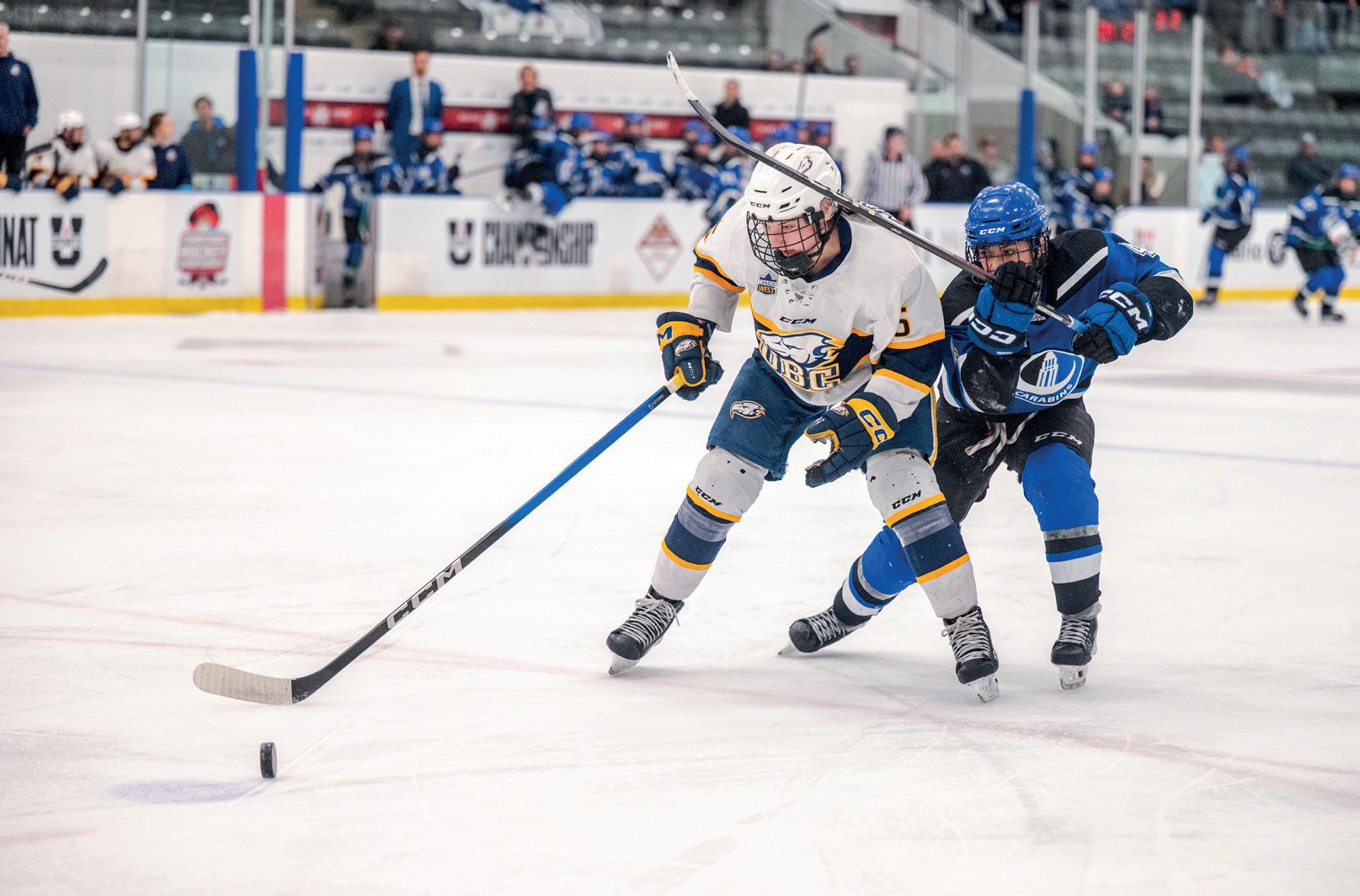
Carabins shock first-ranked T-Birds with upset shootout win
Analysis by Luiza Teixeira Sports Reporter
In order to grow, one must look at their past, see their mistakes and try to learn from them. To fall short, again and again, all in the same way — there has to be change. For Women’s Hockey, over the past half-decade, there hasn’t been.
After making the last four U Sports Women’s Hockey Championships, UBC has been eliminated in the quarterfinals in all but one year, during which they were then dispatched in the semifinals. This is despite their dominance of their conference, winning four Canada West titles in the past five years. This is despite being the higher seed in all but one of their national championship losses. No matter how well they have played throughout the season, they haven’t been able to get it done when the lights are brightest.
This year, that pattern reemerged. While like all their prior playoff exits, it was an evenly played game, decided on the small details, the ‘Birds yet again had to settle for the consolation bracket. After fighting back from an early deficit, the T-Birds fell to the Université de Montréal Carabins in a shootout, ending their shot at their first-ever national title with a 4–3 loss.
But how did the Canada West champion — the national No. 1 seed that boasted the best regular season in conference history — lose to the eighth-seeded team who barely cracked a winning record, let alone win their conference?
Coming into the game, all the odds were on the Thunderbirds’ side. They had an all-around dominant season, with 26 wins and only two losses. To no one’s surprise, they swept both the semifinals and the finals of the Canada West playoffs, while senior goalkeeper Elise Hugens only allowed two goals throughout the entire postseason.
Add to that a talented roster, which includes back-to-back Canada West Player of the Year Grace Elliott, the country’s leader in assists, Annalise Wong, first team all-Canadian defender Jaylyn Morris and Olympic medalist Vanessa Schaefer, spearheaded by the U Sports Coach of the Year Graham Thomas — UBC’s No. 1 seed was well-earned.
Yet, while outmatched on paper, their opponents weren’t coming into the competition at a total disadvantage. Despite having only 13 victories in 24 games, the eighth seed Montréal Carabins have plenty of top-end talent.
Forward Audrey-Anne Veilette — selected in the inaugural PWHL draft — is one of the team’s leaders
and foremost scorers, boasting ten points in 11 games in the regular season.
One of their top defenders, Jade Picard, scored three goals during the RSEQ playoffs, and matched the team’s record for most goals scored in a season by a defender in her first year with the Carabins. Their head coach, Isabelle Leclaire, has been leading the team for 18 years, winning the RSEQ Coach of the Year award on three occasions.
With all those experienced pieces on the board, Montreal kept the number one ‘Birds on their heels. For most of the regulation, the ice wasn’t fully tilted in favor of either team.
Despite suffering two back-toback goals in the second period, the ‘Birds never completely lost control of their game. There were times where the momentum favoured the Carabins, but the ‘Birds were never out of it. At least, not until the very end.
Both teams came out of the gate playing aggressively and fighting for possession of the puck. Neither squad could stay in the offensive zone for long or register a shot on goal until after the two minute mark. There, the T-Birds got the night’s first real chance.
Off a long shot coming from Montréal defender Léa Berger that went wide, forward Ilona Markova quickly captured the rebound, sending it flying to the offensive zone where forward Cassidy Rhodes was rushing on a partial breakaway. The ‘Birds didn’t light up the scoreboard on that chance, with Rhodes running out of room near the crease, but the play showed how UBC is able to swiftly flip the ice, taking advantage of every opportunity they can find to create momentum and get quality chances.
As time went on in the period, the Carabins started becoming more comfortable and upping their physicality. The ‘Birds answered accordingly — but it cost them. Off a hooking call, Wong received the game’s first penalty, five minutes in.
Yet, as it has been all season, UBC’s penalty kill — the best in the country this year — was exceptional. So while Montréal stuck to the offensive zone for most of the power play, getting a few opportunities to test Hugens, she aced it and didn’t let anything get past her.
However, while UBC’s shorthanded play excelled, they still needed to stay disciplined. With the level of competition that nationals brings, both of these groups would have to play close to perfect to get to the next round. Any mistakes could bring serious consequences. After not capitalizing on a power play of their own, Elliott
closer, the tension between teams rose, with battles on the boards and plenty of pushing and shoving. When forward Rosalie Couture was penalized for roughing, the ‘Birds knew that they needed to capitalize on this opportunity if they wanted to keep themselves alive heading into the third.
And so, with five seconds left in the power play, Elliott scored the first goal of the game for the Thunderbirds, making an excellent deflection off a Morris shot from the point. The Canada West Defender of the Year’s long shot found a trailing Elliott in the slot, with the puck bouncing off of her stick and leaving Carabins’ goalie Maude Desroches with not enough time to react and block the biscuit.
After this first goal, UBC was able to take a deep breath and shed some weight off their shoulders. Finally gaining momentum, the ‘Birds started to look like the intense and dominant team fans are used to seeing, cornering the opposing team in the offensive zone and smothering any of Montreal’s chances.
Despite not being able to score the equalizer in the second, the rhythm UBC gained in the last minutes of play would prove important coming into the third period of the match.
Coming onto the ice, the Thunderbirds hit the ground running. Continuing her hot streak from the end of the second, it took Morris no time to notch the tying goal, only four minutes into the frame.
received a double minor penalty for head contact, making UBC’s best player sit in the box for four minutes of play.
After a couple moments of four-on-four, the Carabins got their extended power play opportunity to push for an early, surprising lead. But once again, the Thunderbirds held their opponents back and killed off the penalty, ruining Montréal’s best chance of scoring so far in the game.
Going into intermission, the T-Birds had to feel good about their play thus far, at least on defence. While they hadn’t broken the scoreless tie, they had fended off multiple Carabins power plays. If they could stay out of the box in the second, their red-hot offence was sure to come through for them.
But the Carabins were relentless coming into the second period. Despite the ‘Birds having a hot start in the frame, they were unable to stop an inspired Montreal attack from scoring twice in 30 seconds.
Five minutes into the period, as the T-Birds attempted to break out of their zone, defender Chloe Duchesneau stole the puck from forwards Mia Bierd and Jacquelyn Fleming and dashed for the goal. With a quick move around defender Meadow Carman to create a two-on-one, Duchesneau froze defender Presley Zinger, picking the top corner over Hugens’ glove to light up the scoreboard for the first time in the game.
It was the first time UBC had trailed in the postseason. They weren’t given much time to process it. The ice further tilted towards the Carabins with their second goal of the game less than a minute later. Forward Laurie-Anne Ethier received a breakout pass from across the rink, and before UBC’s defence could get back in position, she offloaded it to rushing forward Janelle Mentor, who had outskated forward Karine Sandilands to get a breakaway, finding a sliver of space between Hugens and the goal post.
The dynamic of the game had flipped. UBC, a titan throughout the season, now faced a multi-goal deficit for only the second time all year. They needed to push back. And, admirably for a team that hasn’t faced much adversity this season, they did.
Even with momentum on their opponents’ side, the Thunderbirds continued to push and pressure Montréal. Their persistence paid off when the Carabins were penalized for having too many players on the ice.
The ensuing power play, while goalless, brought UBC’s momentum back, who slowly accumulated minutes in the offensive zone as the period progressed.
As the end of the frame drew
Thunderbirds. At the midway point in the period, the scoreboard was lit up by Montréal to once again tie the game. After setting up behind the net, Picard found space around the stick of a UBC defender, getting a pass out to forward Juliette Rolland in the slot. With a one-timer through traffic, she left no doubt.
With the scoreboard tied up at three, both teams gave everything they had on the ice. The energy was high. The intensity was palpable. It didn’t seem like these teams were almost an hour deep into a playoff game.
But despite their best efforts, neither side got the other to yield, bringing the quarterfinal into a scrambly overtime. In the extra frame, neither team could pot the game-winner. UBC had a power play in the last moments of the period, but were unable to get past the tenacious Desroches. On the other side of the ice, the Carabins got to test Hugens a few times, but the Canada West playoff MVP did not surrender.
After ten minutes of overtime, the game was pushed to a shootout. Unlike their professional counterparts, the PWHL and NHL, who, in the playoffs, both play sudden-death overtime periods until somebody scores, U Sports does not eliminate the shootout for postseason games. UBC’s season would be decided off the next six shots. Tension draped the arena as the shootout began.
After intercepting a pass in the neutral zone, the third-year defender made a dash with the puck despite facing near-immediate pressure. In an incredible solo effort, she dodged the two defending Montréal players before avoiding the pokecheck of Desroches and slipping the puck between her legs. It was the kind of spectacular offensive play Morris has produced multiple times this year — and it came at the perfect time.
The equalizer was a much needed energy boost for UBC’s players. In the subsequent minutes, the Thunderbirds cornered the Carabins in their offensive zone, sending pucks towards their goalie and not letting them have possession for too long. With the game tied and the clock inching towards zero, Montréal began to crumble under UBC’s sustained pressure.
Right off the faceoff, forward Lea Salem passed the puck to Duchesneau, who in an attempt to keep it away from Markova, accidentally slipped it into her own net and gave the ‘Birds the advantage they’d been seeking for almost 45 minutes of play.
But their good fortune wouldn’t last. Only a minute later, Sandilands — who was credited with the third goal — came inches within another marker. Off a Rhodes cross-crease pass off the faceoff, Sandilands was all alone, with the Carabins’ goalie sprawled in the ice, leaving the net wide open. And yet, the senior forward missed the shot, hitting the crossbar and sending the biscuit flying.
This missed opportunity was the beginning of the end for the
After the opening two rounds, the teams were even. Both Elliott and Montreal’s Kaléann Laforge had missed, with Laforge going wide and Elliott not being quick enough on a cross-crease move. Then, Veillette and Sandilands traded markers to set up the third — and potentially decisive — round.
The Carabins struck first, with Picard tucking the puck past Hugens’ skate. Then, with the season on her stick, Rhodes took her shot. A brief opening five-hole closed quickly. The game was over.
To say this early exit is disappointing is a massive understatement. As not just the number one seed, but one of the more dominant teams in conference play ever, with their level of depth, their star power, their experience — with most players having played at Nationals in the past — it’s a confounding result.
It’s easy to wonder if the issue with UBC bowing out early at nationals doesn’t have anything to do with their technical abilities. Instead, it’s the pressure behind chasing a banner so elusive, against teams the ‘Birds seldom get to meet, that is the likely culprit behind the Thunderbirds’ continuous bad luck.
The team will lose many talented players this offseason, namely Wong, Elliott and Hugens — core parts of this playoff run. While there’s hope to be found in the players that remain, with UBC showing notable depth in their younger players throughout the year, who seem ready to take on more responsibility, it’s a bitter pill to swallow.
Eliminated from medal contention, the Thunderbirds will be sorted into the consolation bracket for the third consecutive year. U
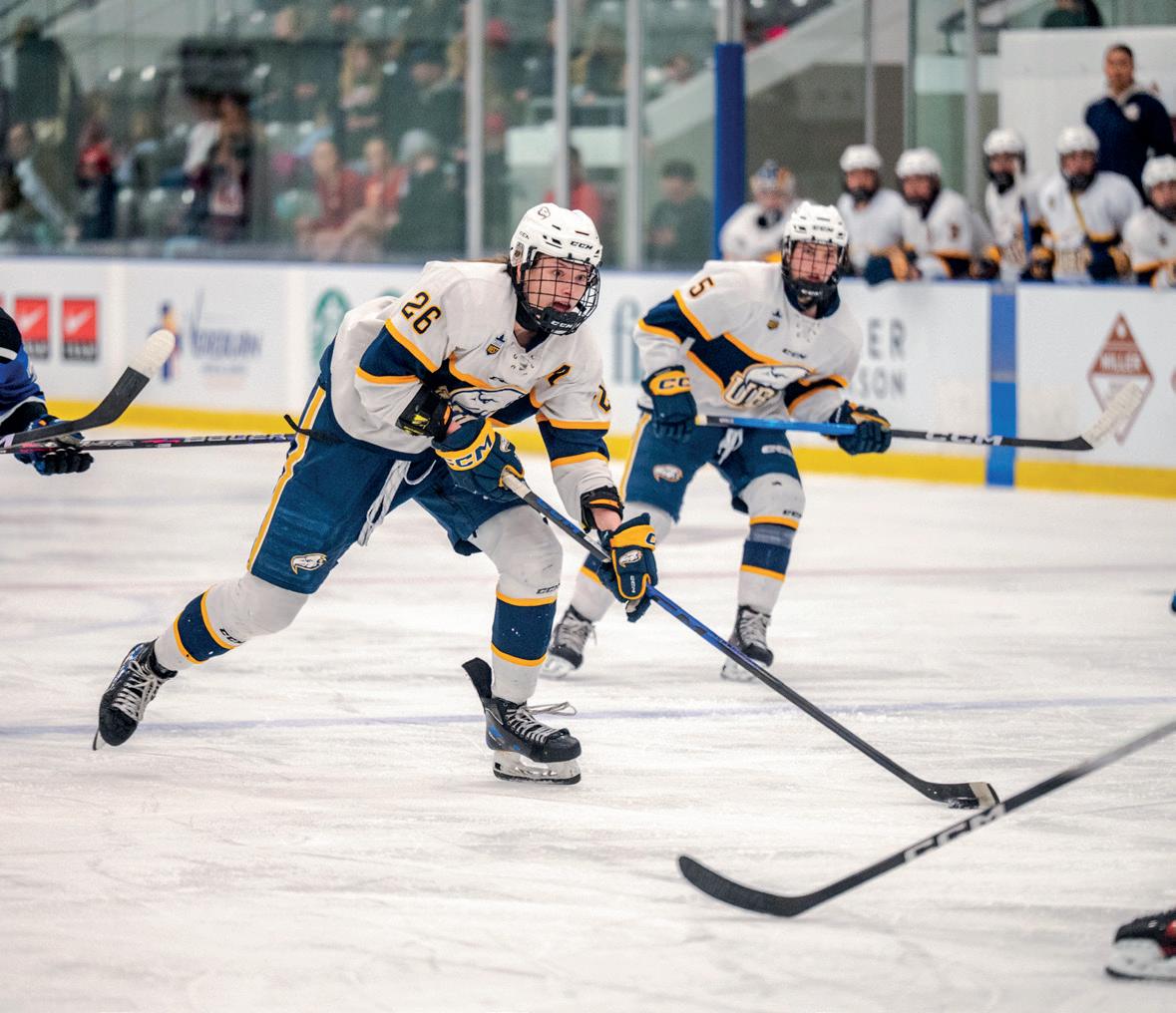
Game
UBC’s Jaylyn Morris (#5) has a special skillset for a defender, with the ability to jump up in the play and create on offence, all by herself — something she demonstrated on the tying goal. Courtesy Waterloo Warriors
With Grace Elliott (#26) being perhaps the most prominent name on the roster, this T-Birds team is stacked with playoff MVPs, award-winners and statistical leaders. But being better on paper means little once the puck is dropped. Courtesy Waterloo Warriors


Sassy Sage: On finding people to match your freak
Sassy Sage is Ubyssey humour’s satirical advice column, written by Selena Sallay. You can seek her misinformation disguised as heartfelt counsel by writing to her at advice@ubyssey.ca. Letters will be edited for brevity, clarity and to make them funnier tbh.
Column by Selena Sallay Humour Writer
Dear Sassy Sage, Girl. Campus life is borrriinngg! Everyone keeps to themselves and never wants to do anything! No one ever talks to anyone! I once tried to start a conversation with a classmate in EOSC 114 and they looked at me like they just found out the planet is dying and/or like I just cursed their entire bloodline. When I want to go out somewhere and post about it on Reddit, everyone complains about assignments and tells me I deserve to be lonely.
I know we’re a Top40 university but come on, it’s not that deep. Hop up out the library and turn your swag on, people. What should I do? Find me friends, Lesa Mingle
Dear Lesa, With the amount of events on campus happening all the time, plus the freakish inhumane UBC student workload and the need to have at least four jobs at once to make it in this world, how are you bored?
Have you tried smiling? Based on your message alone, you seem to have an extremely bitter outlook on life that I’m guessing causes people to clutch their quartz, palm stones and hematite towers a little tighter to repel your energy like it’s the next outbreak of frat flu. Have you considered that people do not want to flunk out of school? You’re clearly not locked in like the rest of us. How dare you ask me to put aside my CPSC 121 problem set for two hours so I can “grab a drink with you” — I mean, if you wanted to go to a “social school,” then go to Queens where your best college memories can consist of puking your guts out on St. Patrick’s Day, or Western where you can make wearing purple your sole personality trait.
As for no one talking to one another, have you seen MacInnes Field when a single ray of sunshine comes out? People are playing games, laying on the grass and emanating good vibes. Maybe that would serve you well — start looking for actual sunlight instead of absorbing the blue light from your computer (stop getting advice off strangers from Reddit and get advice from this stranger by supporting physical media). While you’re at it, throw a quartz at that lame person from EOSC or even hire
an Etsy witch — it’s what I’d do, and I obviously have tons of friends and am certainly not just observing those field-goers from my lonely desk in The Ubyssey’s office.
The way I see it, you have two options. First, you can’t base all of your experiences off of one convo with one person — look at lecture halls as friendship speed dating goldmines! If someone is boring, move on. If they have bad breath, move on. If they watch a little too many crime documentaries, call the police. The “benefit of the doubt” is for chumps. Second, to find people who match your freakwency, try bringing the Queens/Western/east coast party energy to UBC yourself. The best advice I can give to all my beloved readers is to have no shame. If you want to meet people, start a conversation with them. You can compliment their shoes, say you love their eyes and if they say they are wearing contacts, then say that you like plastic too and paper straws suck! If the whole “conversation thing” doesn’t work out, you can always go straight for classic moves like handing out trays of rainbow Jello shots to your peers (if you get caught say you’re résumé-building for your VP student life job application) or sneakily connecting to the AV system of your lecture hall to blast your 365PARTYMIXHOTGIRLSUMMER Spotify playlist. If you still walk away with no friends, then it’s not your playlist.
Finally, if you’re feeling bold, go straight for the whole puking-on-aclassmate’s-shoes move to channel your inner @canadianpartylife to dispel the whole socially dead reputation Vancouver has going on, once and for all. Be the change you wish to see in the world!
Shamelessly always, Sassy Sage. U

Personal Essay? by
Viva Muthanna Humour Contributor
Do you ever reminisce about that certain sparkling September of firstyear brought into your life? You were excited to make friends, go to the frats with them, perhaps even to the clurrrb if your fake IDs were real-looking enough. You could just feel one of those racially diverse college-brochure friend groups on your horizon. You were gonna have “an awesome time, drink awesome shooters, and listen to awesome music and you were all going to soak up each other’s awesomeness.”
thousand-yard stare Fast forward 39 weeks’ worth of courses and over $100 on overpriced Blue Chip matcha lattes later.
You’ve survived group projects.
You’ve survived people asking for your IG just to never speak to you ever again.
You’ve been ghosted by at least three lab partners.
Let’s face it: the Vancouver social scene tantalizes you no more …
You’re sick of it! The small talk, the social climbers, the yappers. At this point, you’re not going into every term all #FriendshipsMagic, you’re lowkey just tryna make it to Sunday. You know it’s bad, especially, when you can’t tell what you encounter at UBC more: men who dilly-dally about their dating lives, or yet another r/UBC Reddit post about someone feeling lonely. Attending lectures for the iClicker attendance is hard enough, so here’s Ubyssey humour’s guide on avoiding making new friends in lecture halls at all costs.
Socially isolating seat selection
Pick either the end of a row for an easy escape post-class, or sit at the very front of the lecture hall. Everyone hates tryhards. Keep raising your hand and asking ridiculously irrelevant questions that the professor will 100 per cent geek out about. Brownie points if your question starts with “According to your premise, wouldn’t it logically follow that…” or something of that sort, and double brownie points if the prof loses track of time and holds the class overtime. Hatred of your peers? Check.
‘Omg same! Can I get your insta?’ Instagram’s lame. I hate Mark Zuckerberg’s haircut just as much as you do.
They ask for your IG? The answer’s simple: say you only use Google Hangouts, or give them your phone number but it’s actually just the AMS’ marketing guy: (604)-8221961.
If they ask for your Snapchat (shudder), say you’re neither 12 nor a predator (trust me, this works — it’s my favourite one-liner to use when a guy on Hinge asks for my Snap).
Plug your ears
Earphones (I am intentionally not saying Airpods because I hate consumerism just as much as I hate lecture hall ‘friends’ — just go with it), earbuds, headphones, 2001 Audi s4 CV axle grease, I do not care. The only thing I do care about is that you have to look like you don’t care. If someone taps on your shoulder and tries to socialize, you must very

Word of the Bird Out-of-Context Campus Content
“That’s some blue water. That’s some crazy blue water. That water’s really blue”
–
nonchalantly and smugly say — *insert Flynn Rider smolder* — ‘Sorry, what?’ Make sure your RBF is all-encompassing, the bitchiness should be drawn from the depths of your soul, then actualized and manifested in every physical sense.
I am become bath and body works (scent sensitivity is for liberal sissies)
You’re gonna want to rock excessive amounts of gourmand perfume — in the pits, in the scalp, in the mouth (like in the cartoons). I recommend buying those huge Bath and Body Works gift boxes (browsing the website for that hyperlink was enough to give me a headache) with matching lotion, soap and body spray. Take your pick of scents, be it “tropical vacay-STUN!” or “apple pie pussy.” If you’re like me and you lowkey don’t want to burn your eyes, simply just, do without deodorant of any kind. Make sure to wear a 100 per cent polyester shirt — it really locks in the scent.
Since you’ve made it this far, dear reader, and I’ve been told I’m very charitable – here’s a bonus tip: If someone asks what your faculty is, say Sauder.
And there you have it! Your foolproof way to avoid making friends in lecture halls. Despite what you hear on Reddit, you might still have people aching to be in your company because of your elite suaveness, duh (get away from me). In any case, without friends, you’ll have way more time to focus on why you’re actually attending class: to scan the lecture hall for any guys with cat-femboy potential. U
“Would you bang an alien if they were hot?”
“Do I need to defend my thesis? If they think it’s wrong, so be it. I agree with them.”
–


help pls by Kyla Flynn Humour Editor
A few weeks ago, The Peak wrote a piece about something that happened a few weeks earlier. Like they kind of correctly reported, it all started at NASH, Canada’s National Student Journalism Conference on Feb. 13 to Feb. 15 which overlapped so wonderfully with Valentine’s Day because there’s nothing more romantic than rubbing elbows with our nation’s buttoned-up young professionals on the day most people dedicate to unbuttoning. However, in a very real sense, this was a long time coming in more ways than one (I forgot to respond to the article so now it’s been like a month).
Let me tell you where this beef really began. I was minding my own business, lurking r/UBC and absorbing their misery to fuel my funny reserves, like how the monsters from Monsters Inc. use the screams of children to stay alive or whatever. Suddenly, I got a LinkedIn — the virgin’s Twitter — notification saying some freak named Peak Humour Guy requested to be my connection. In the world I live in (reality),
requesting someone on LinkedIn is like writing “I’M NOT FUNNY” all over your face with a big Sharpie. Requesting a fellow humour editor on LinkedIn? Now that’s messed up crazy style.
From that moment on, I knew that this guy had to go down. This shmuck, who so flippantly tried to interact with me via serious means instead of like a carrier pigeon or Xbox party chat request violated the sacred funny code that all humour

editors (we are the only humour editors in the whole world and do not fact-check that) have sworn under blood oath (we pinky promised our predecessors) and the bible (my box set of signed FNAF novels) to follow.
I had a mission: to remind The Peak of the importance of being funny and committing to the bit, to bring unity and justice and shit to the Humour Editor Cinematic Kinda Lowkey Enclave (HECKLE), and support the American third amendment. So, imagine my shock when I read The Peak’s Mar. 3 piece saying their primary objective was to rid The Ubyssey of, well, me.
So. Fast forward. The Peak’s humour editor accuses me of sending Shrek memes to their phone (guilty) and not being a real journalist (also guilty). However, what really sent me off the flipping rails all Tony Hawk on the halfpipe style — Editor’s note: she hawk on my half pipe ‘til i tony was the claim that he could possibly ever “establish dominance over the clearly inferior humour section.” Bitch, screw you and your musty
school up on your godforsaken foggy prison hill. And yeah, I know you told me you don’t think jokes about prison architecture are funny, but let me reiterate: go choke on my journalistic integrity.
Next, this guy says some shit about me becoming a sentient spaghetti monster and emerging from the microwave — 1) I wish he would become funny and 2) if anyone’s cooked around here, it’s him. He was, however, right about one thing: I famously do think that “you can’t kill humour” which is how I’ve survived seventeen and a half different assassinations attempts from members of The Ubyssey’s cabinet who don’t believe that I deserve to be paid for encouraging my coworkers to shirk their duties and show up to their weekly meetings wasted or do karaoke to “Man Or Muppet” in our boardroom when we have a sCHeDuLed MeETinG with the “President” of the “University.” Girl, who cares about your meeting; it’s Muppet time.
Finally, The Peak’s jealous hateposting about me (the technical term is fan behaviour) ended in some fake resolution about The Peak’s editor and I becoming allies. I am here to speak out against any sorry misconceptions that The Peak and I will ever be allied in anything other than hating one another.
So, here’s the truth. We at Ubyssey Humour — pictured flipping you off collectively above — are highly-skilled funny guys with a nose for news who can sniff out and hunt down them there funny stories like those TSA snitching puppies who rat me out when I try to smuggle little tiny baby edibles across the border — don’t people smuggle like actually bad stuff? Why are you confiscating my bubblegum pen? Anyways.
Let’s unpack this. If The Peak is the superior place of both humour and journalism, why couldn’t they find a copy of my headshot? It’s literally on the website. I’m tragically Googleable.
The point of this piece? To cook The Peak and to dispel the rumours that I am an anthropomorphic blob of spaghetti because my parents saw the article and were kind of concerned that “student journalist” is code for being on shrooms, and to assert the importance of committing to the hehe haha of it all and uh I don’t know, but let’s keep this rivalry going because those seem to get a lot of clicks especially if they’re hot off the press or heated or something to that effect. Your move, funny guy. U
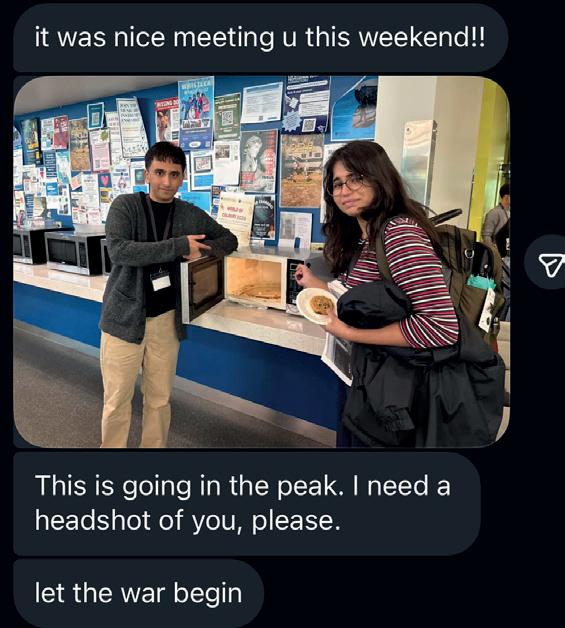
H2O Obsessed Duo, Walking by Fountain
Student, Gateway Building Elevator
Guy in Star Trek shirt, Orchard Commons
Social distancing isn’t dead (get away from me). | SIDNEY SHAW / THE UBYSSEY
The girls are fighting. | SIDNEY SHAW / THE UBYSSEY Peak? More like shit’s bleak
KYLA FLYNN / THE UBYSSEY
KYLA FLYNN / THE UBYSSEY
KYLA FLYNN / THE UBYSSEY
SENEESHA EKANAYAKE/ THE UBYSSEY