The game of Canadian football is changing. With new rules implemented in September, the CFL will alter their game substantially. With an infrastructure built upon the pro league’s foundation, university football — and, by extension, UBC — may have to change with them.
Article form by Author Author position
What makes Canadian football ‘Canadian’?
Perhaps it’s purely about the physical location: Canadian-based organizations in Canadian communities participating in a sport that traces its origins back to 19th-century Montreal. Is it more intangible? Maybe Canadian-ness is the culmination of the unique culture and traditions that have arisen around the sport. Or maybe it’s more about the game and its rules. The rouge — a single point awarded after kicking the ball through the end zone. Three downs. 12 players. 110-yard fields with 20-yard end zones and uprights on the goal line. These are all unequivocally Canadian features, distinct from American variations of gridiron football.
In September, CFL commissioner Stewart
Johnston announced a series of rule changes to be implemented in 2026 and 2027, the league’s most significant transformation in decades.
Hoping to expand their appeal, the CFL’s modifications primarily focus on smoothing out the game and increasing scoring — specifically, touchdowns — an aspect of the sport that many consider more exciting. Johnston said that the modifications aim to “make our fantastic game even more entertaining, and to win in the attention economy.”
Given their concern with audience growth, it’s not surprising that several new rules seemingly mimic the CFL’s immensely popular American cousin, the NFL.
With a record US$23 billion in revenue over the 2025 fiscal year, the NFL is unequivocally the most lucrative sports league in the world, with nearly double the earnings of the
second-place MLB. The 2025 Super Bowl achieved an average viewership of 127.7 million, making it the most-watched TV event in NFL history, according to Nielsen. Comparatively, seven of the CFL’s nine teams failed to return a profit in 2024, while the 2025 CFL championship game, the Grey Cup, was viewed by less than 4 million people.
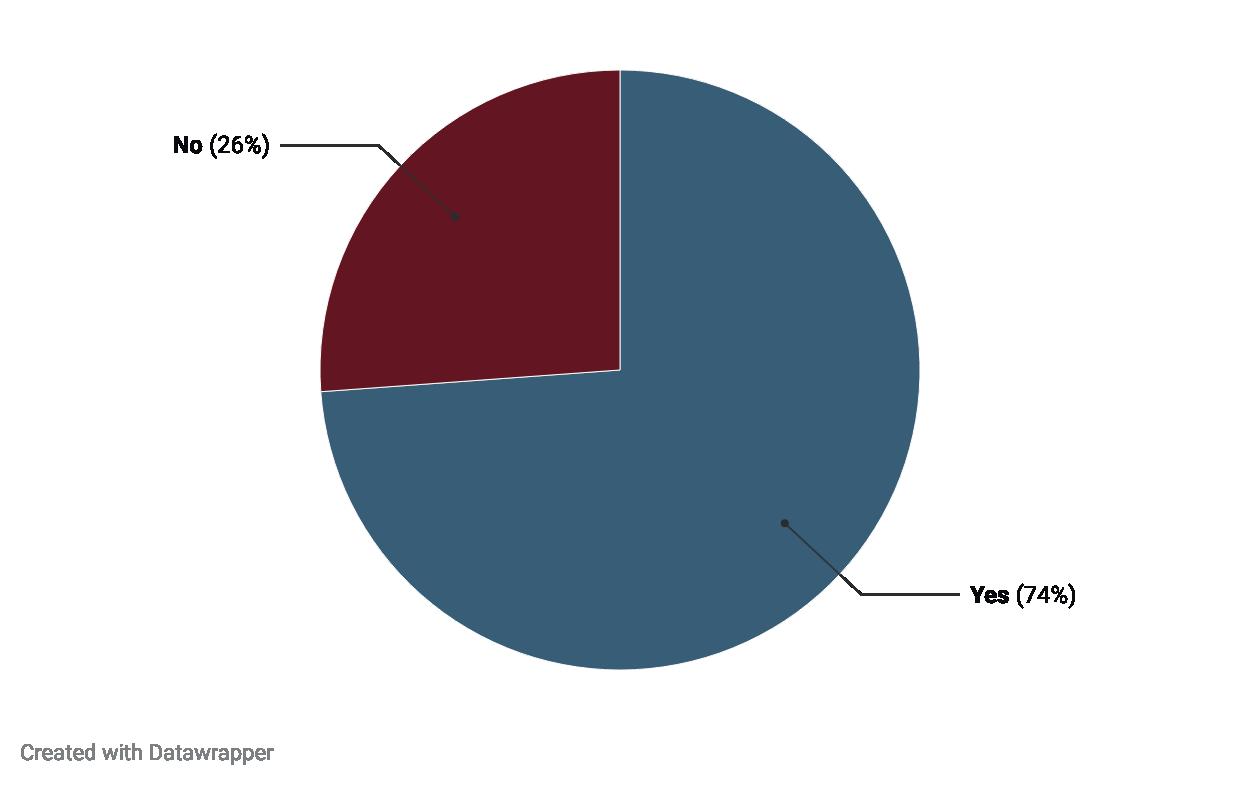
Perhaps most worrisome for the Canadian league, recent studies indicate that even within Canada, the NFL is more popular than the CFL. A 2023 report by the Angus Reid Institute found that around 20 per cent of Canadians said they followed the NFL closely, compared to 16 per cent for the CFL. Even worse, 62 per cent of football fans in Canada said they would choose to watch the NFL’s Super Bowl over the CFL’s Grey Cup.
Continued on pages 8-9.
Ubyssey Publications Society: Run for the Board of Directors!
key dates:
Nominations open until February 20
Campaigning starts March 2
Voting opens March 9 and closes March 13 at 5:00 p.m.
Paper forms are available in baskets outside the business office (Nest 2209) and editorial office (Nest 2208). Forms can be returned to either office, or slipped under the door if nobody is there. Needs 12 nominees. This year, four atlarge Board positions are up for grabs.
More on page 2
PERFORMANCE
// 10-15
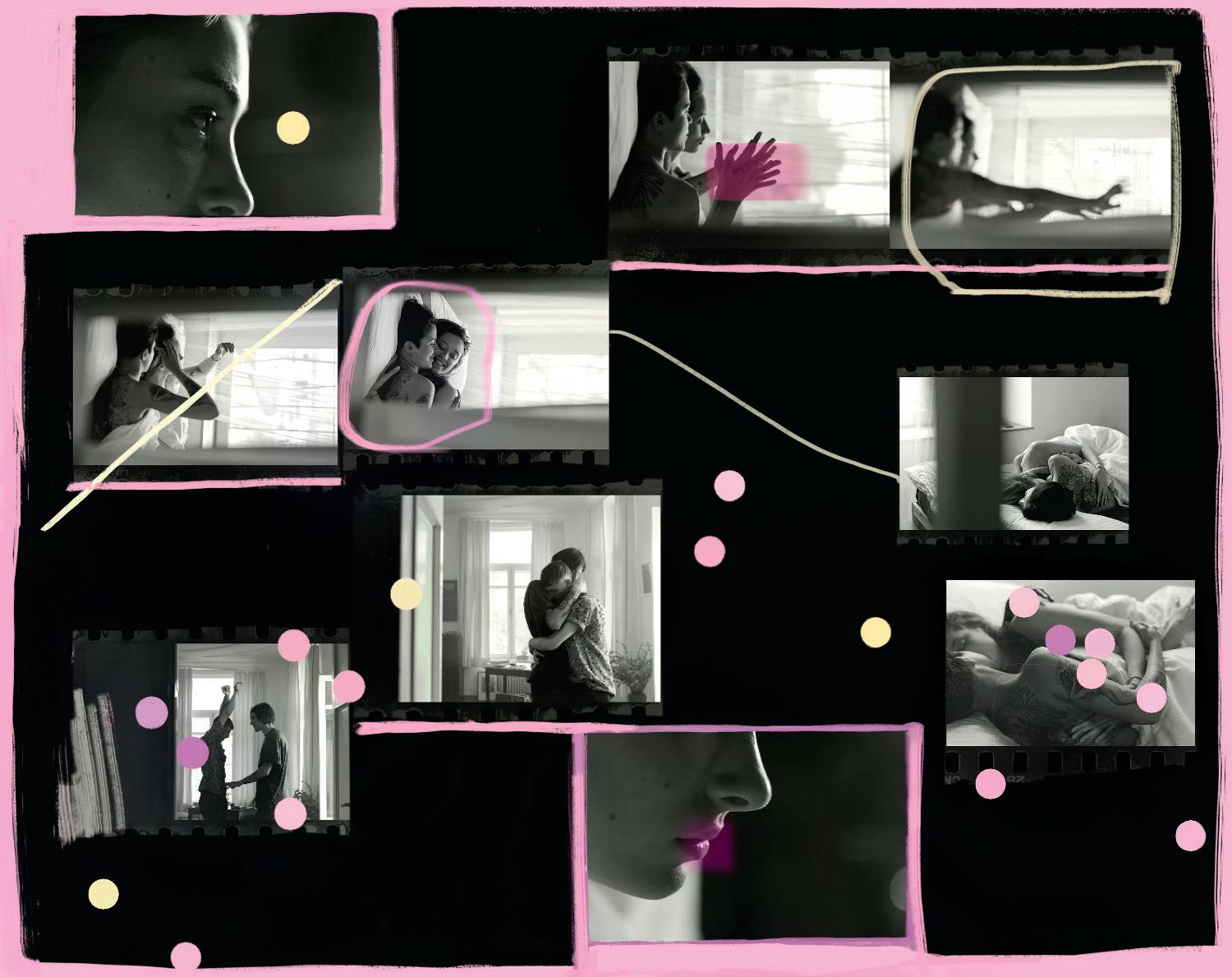
You’ve worried about performing before. Maybe you waited in the auditorium wings with sweaty palms, listening for your cue. You might have shivered on the doorstep of a new lover’s house, white knuckles shaking an inch above the door. Or maybe you just looked in the mirror this morning and figured you were trying too hard with that skirt-sweater combination. You’ve worried about performing — so have we.
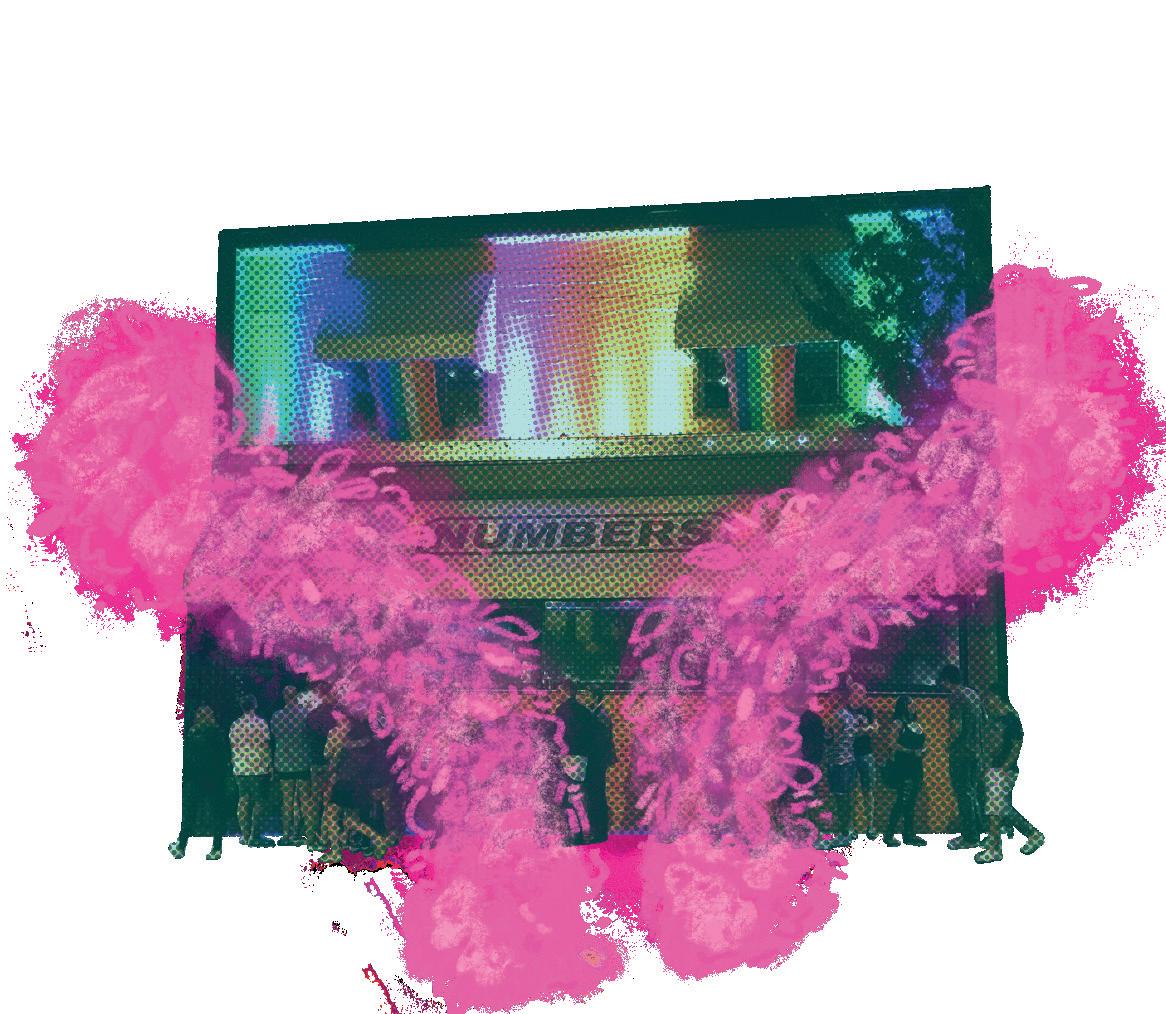
In this year’s sex supplement, writers navigate the blurry lines between friendship and love, weigh being deemed ‘performative’ against the joy of self-determination, and interrogate ingrained biases about what men and women ‘should’ be. Others chart the history of Numbers Cabaret, where performance has long been synonymous with survival, or quiz UBC profs on what ‘queer music’ really means.
Whether you do it onstage or in bed, performance is a fine line to walk. You have to balance between aptitude and effort, show your worth and express your truth but make it all seem natural, like you aren’t really trying at all. Performance is nerve-wracking and mundane. It’s a veil, a lock, a mirror and a key. It’s you.
- Julian Coyle Forst, Elena Massing Arts & Culture Editor, Features Editor
On Netflix’s strange relationship with the cinema experience
Column by Fiona Pulchny Columnist
When Netflix announced that it was buying Warner Bros. last December, I wasn’t necessarily shocked.
Given the track record of Big Tech and streaming companies butting into the industry (see Amazon’s purchase of MGM in 2021), Warner Bros. is just another of the Big Five studios surpassed by the new industry dominators. But in an age of rapid, on-demand media consumption, what purpose — if any — does the cinematic experience have?
A cornerstone of Hollywood since the 1920s, Warner Bros. revolutionized the industry from the first feature-length “talkie,” The Jazz Singer, to classics like Casablanca and the zany Looney Tunes cartoons. Now they — and titles under HBO and HBO Max — will all fall under Netflix’s domain.
The announcement sent a shockwave through film workers and followers, who feared it would mark the ultimate end of theatre-going. An essay in The Globe and Mail declared “Moviegoing might have died” as a result of the move. Com-
executives midterm reviews The Ubyssey spoke to AMS executives about progress on their goals and plans for the rest of the year.
Borowski’s volleyball journey
In her first point, the ball went through her hands. Now, she’s a first-team All-Canadian and national championship MVP.
panies like Netflix and Amazon are not primarily movie-makers — they are product-sellers. The way movies are made and distributed is bound to change.
At the 2025 Time100 Summit, Netflix’s co-CEO Ted Sarandos was asked about his company’s intentions. Sarandos described Netflix as a “very consumer-focused company.” It aims to offer media without letting “a lot of outside forces get in the way.”
Sarandos reasons that the purported inaccessibility of theatres makes them “an outmoded idea.” “If you’re fortunate enough to live in Manhattan, and you can walk to a multiplex and see a movie, that’s fantastic. Most of the country cannot.”
Netflix’s accessibility is debatable, especially with its increasing subscription fees. And why does the existence of streaming render theatres outdated? Theatres and the cinematic experience are vital incentives for creating high-quality films. Their disappearance is likely to degrade movie quality, as theatrical screenings are not prioritized by the industry’s new producers.
Continued on page 16
Students gather for physics conference
UBC hosted the annual Canadian Conference for Undergraduate Women and Gender Minorities
SKYE SHEN / THE UBYSSEY
HANNAH CHENG / THE UBYSSEY
The Ubyssey
FEBRUARY 12, 2026|
LAND ACKNOWLEDGEMENT
The Ubyssey acknowledges we operate on the traditional, ancestral and stolen territories of the Coast Salish peoples including the x ʷ məθk ʷ əyəm (Musqueam), Sḵwx̱wú7mesh Úxwumixw (Squamish) and səlilwətaɬ (Tsleil-Waututh) nations.
EDITORIAL
The Editorial Office creates the content of the newspaper. They do all the research, writing, photography, programming, illustrating and editing — the journalism.
Editor-in-Chief
Aisha Chaudhry eic@ubyssey.ca
Managing Editor Saumya Kamra managing@ubyssey.ca
News Editor Stephen Kosar news@ubyssey.ca
Arts & Culture Editor Julian Coyle Forst culture@ubyssey.ca
Features Editor Elena Massing features@ubyssey.ca
Deputy Managing & Opinion Editor Spencer Izen deputymanaging@ ubyssey.ca opinion@ubyssey.ca
The Business Office supports the journalism by managing the Ubyssey Publications Society’s money at the direction of the elected, majority-student board. It has no say in or over our coverage, in keeping with the principle of editorial independence.
Business Manager Scott Atkinson business@ubyssey.ca
Every story we publish comes with a label — here are the brief definitions for what they mean.
PROFILE
Profiles are a detailed description of a person and their life experiences. They promise to be descriptive and analytical.
REVIEWS
Reviews are critical analyses of works of the arts. They promise candour, description and fairness from a knowledge voice.
REPORTS
Reports are accounts of particular moments — the who, what, when, where, why and how in 800 to 1,200 words. In News and Research, they promise impartiality. In Arts & Culture, they promise critique and/or analysis.
EXTENDED REPORT
Extended reports are accounts of subject, engaging multiple peoples, places, sources and smaller events over long periods of time. They promise impartiality
GAME ANALYSIS
A game nalysis is an analytical account of a sprting event either involving UBC’s varsity teams or taking place on campus. These promise to describe what happened, but also why the game matters.
OPINION ESSAYS
Opinion essays take a position on something newsworthy in the present moment, and are either written by guest contributors from the community or in-house columnists. All essays represent the author’s views alone.
PERSONAL ESSAYS
Personal essays explore an individual’s perspective on an experience that is relevant to a larger group of people.
CAMPUS CULTURE
Wild People Quiet asks if passing can hide the past
Set in a small prairie town in 1940s Saskatchewan, Wild People Quiet follows Florence, a Métis woman who hides her identity and passes as white. She bleaches her hair with peroxide and works for an insurance company while keeping others at a distance — that is until someone from her past wanders back into her life.
Review by Natalie Vakulin Senior Culture Reporter
For racialized groups forced to the margins of society, the opportunity to pass as the privileged majority can seem like a tempting escape. But those who can pass as white choose security and economic opportunity at the cost of truth, history and cultural identity.
Tara Gereaux’s grandfather chose to make that sacrifice.
“He hid his Métis identity and never talked about it,” said Gereaux, who holds an MFA in Creative Writing from UBC. “I was always interested in why he made those decisions.” That curiosity led Gereaux to rediscover her family’s history and became the seed for her third book, Wild People Quiet Set in a small prairie town in 1940s Saskatchewan, the novel follows Florence, a Métis woman who hides her identity and passes as white. She bleaches her hair with peroxide and works for an insurance company while keeping others at a distance — that is until someone from her past wanders back into her life. Suddenly, everything Florence has worked so hard to repress, disguise and forget comes bubbling to the surface.
Gereaux writes this story in beautifully crafted prose, each scene taut with anticipation and emotion. Objects in Florence’s life are frequently symbolic, seamlessly woven into the narrative to represent her struggles with identity and the competing lives she inhabits. Objects like a candy dish and a typewriter become emblematic of Florence’s relationship with her neighbour and the life she has created for
herself, respectively. Research has always been the “most fun part of writing” for Gereaux. But this time “felt different and more meaningful.” Gereaux said that when researching the contributions of Métis soldiers in the Second World War, she came across a photo of her great-grandfather and his brothers. This was a deeply personal project for Gereaux and many parts of her own reconnection with her Métis identity found their way into Florence’s story.
This research grounds Florence’s story in the real histories of the Métis people. Before leaving the community and hiding her past, for instance, Florence grew up on a road allowance — a stretch of Crown land cleared for road construction. After the defeat of the Northwest Resistance in 1885, many Métis communities settled on these lands, though many, like Florence, later chose to leave in the face of extreme poverty. When Gereaux started reconnecting to the Métis identity her grandfather had hidden, she was “fascinated and interested in the stories of women.” She came to realize that what she had originally thought of as two ideas — her grandfather’s story and the role women play in understanding history — were coming together to form a single narrative.
As Florence navigates her own journey of return, she beads again for the first time since she left her family as a young adult, reconnecting with a huge part of herself that she had buried. Gereaux said she had a similar journey — she “fell in love with beadwork” in tandem with learning about her own Métis heritage.
It’s a part of her family’s history and her identity, and she sees it as a medium for Indigenous people to learn about their own histories through art.
Beading becomes a constant thread throughout Wild People Quiet — it’s the first part of Florence’s past she allows herself to return to, blending the traditional techniques her aunt passed down to her with her present anxieties by using Métis beading to create artistic representations of objects in her life that hold meaning. In this non-traditional way, beading is a route for Florence to reflect introspectively and think about all the parts of herself that she has tried to hide or perfect in her outward appearance.
“I always fantasized about having my own piece of beadwork that told my family story,” said Gereaux. The first thing she did with her advance pay for Wild People Quiet was connect with a beadworker to bead her family history. This fascination with beading as a storytelling medium and as a text of its own comes through in the way that Florence expresses herself through beading.
Florence never loses her beadworking skills, despite not having practised them for so long. But after so many years, she has become almost entirely disconnected with Michif, the Métis language that her aunt speaks almost exclusively. In the many instances throughout the book that Michif is used in dialogue, it is never translated. Gereaux said this was a deliberate choice.
She “wanted [the conversations] to be as natural as possible, and that meant not
translating” the Michif lines. This creates the effect of a fluid conversation that blends Michif and English, with multilingual characters like Florence’s brother switching back and forth seamlessly. Language is an important piece of cultural identity for the novel’s characters — the meshing of the two languages as well as Florence’s initial reluctance to return to Michif lean heavily into themes of cultural reconnection.
Gereaux also had Michif speakers in mind when she decided not to translate the language in her book. She recalls reading Michif in one of Michelle Porter’s books. “I remember reading those words and knowing what they meant and just that feeling of, ‘I understand this’ … that is an important moment and an important feeling,” she said, and she “hope[s] others have that feeling as well.” Florence’s story was originally meant to extend beyond the novel’s ending, but Gereaux said she realized that “the moment of her return is enough.” The book ends at a point where it seems Florence’s two lives have merged. But viewing the story as a return journey situates Florence’s Métis identity as the reality, and her life of hiding and lies as just that.
Wild People Quiet is about Florence returning to family, identity and a life that she thought she needed to escape. But it’s also about Gereaux’s return to her family’s history, a process that many go through as they reconnect which pasts that were hidden away in shame or in pursuit of better lives.
Wild People Quiet will be available on March 3. U
A note from the Board: what we do, and why Ubyssey elections matter
Editor’s Note: This is the board of The Ubyssey Publications Society, which publishes our newspaper. It is not the Editorial Board or Masthead; the UPS board largely manages the UPS’ finances and governance. It does not do or oversee the journalism at The Ubyssey.
Ubyssey elections are coming up, and they actually matter.
Most people interact with The Ubyssey through the stories. That’s the newsroom. But behind the newsroom there’s a nonprofit that has to run like any other organization: money coming in, money going out, payroll and reimbursements, ad sales, grants, systems, and policies. If that side isn’t stable, journalism suffers.
That’s where the Board of Directors comes in. Our job isn’t to tell editors what to write. It’s to keep
the organization healthy so the newsroom can do its work without financial or operational chaos.
In practice, the Board oversees the finances and operations, manages key external relationships and sets long term direction. We are the group that keeps an eye on whether the budget is tracking, whether revenue assumptions are realistic, and whether big decisions are being documented and explained. We also manage relationships with external stakeholders like the AMS and work on longer term planning for the Society.
A big part of the Board is the atlarge seats elected by students. This year, four at large Board positions are up for grabs. These directors are meant to represent the student body and bring accountability. If you care about transparency, sustainability and the long term health of your student newspaper, these elections are one of the few direct levers stu -
dents have. Here are the key dates for 2026. Nominations close February 20. Campaigning starts March 2. Voting opens March 9 and closes March 13 at 5:00 p.m.. If you want to run, you’ll need to submit a nomination form with 12 nominees. Paper forms can be picked up outside the business office or editorial office in the Nest, rooms 2209 and 2208. They’ll be in a basket. You can return the form to either office, or slip it under the door if nobody is there. If you’re interested in running for the Board, feel free to reach out to me at president@ubyssey.ca. My door is always open in Room 2209 in the AMS Nest if you have any questions.
Ferdinand Rother President, Board of Directors, Ubyssey Publications Society
When Gereaux started reconnecting to the Métis identity her grandfather had hidden, she was “fascinated and interested in the stories of women.” | RAUL DEL ROSARIO / THE UBYSSEY
Midterm review: President Riley Huntley
Report by Juan Pablo Sastoque Vega News Contributor
AMS President Riley Huntley campaigned on “results-driven advocacy.” When elected, he came into the office with proposals around affordability, equity, improving engagement and belonging, and securing the AMS long-term stability.
Now, several months into his term, he highlighted fast-paced progress, tangible results, some frustration and changing goals in an interview with The Ubyssey.
“Our permanent staff were shocked at the first half of the year of how much was being accomplished,” Huntley said.
Yet, Huntley expressed frustration around some goals, including assessing international students’ needs and securing support on projects addressing student affordability issues such as food insecurity or housing.
Affordability
Affordability was a key focus of Huntley’s campaign, telling The Ubyssey he aimed to lead a textbook audit to identify underutilized course materials and promote open, affordable resources for students. According to his executive goals, the audit was planned for November last year.
However, Huntley said the goal was “scrapped.” He explained some of his campaign’s priorities like the textbook audit and exam database have shifted to the office of VP Academic and University Affairs Zarifa
Nawar. Nonetheless, the audit did not take place under Nawar’s office either. Huntley said that AMS executives decided to focus on the Textbook Broke campaign instead. Huntley also called on the university to assess the financial needs of international students and provide appropriate funding. Huntley said the AMS has received clear messaging from the government that international students’ needs are not a priority, and that they are still seen as “a form of revenue generation.”
One area where that materializes is in bursary funding. He stated that the AMS has identified barriers to international students’ access to financial aid. “We give about $700,000 per year [in bursaries],” he said, “that international students aren’t able to access.” This is despite all fee-paying members of the AMS, including international students, funding the AMS’s student aid bursary. A UBC official noted at a November Council meeting that the university — which administers the AMS’s bursaries — requires that students be citizens, residents or have refugee status at the time of bursary application.
Unless the university works with the AMS to solve the bursary issue, the AMS will “have no choice but to pull all of our bursary funding [from the university], because we’re required to make sure that all UBC students can access it,” Huntley said.
He affirmed that the AMS has pushed UBC to maintain its commitment of $800,000 towards food insecurity programs as outlined in the 2025-26 budget. Calls to go beyond that have not been answered,
Midterm review: VP Finance Gagan Parmar
Report by Simon Jian News Contributor
AMS VP Finance Gagan Parmar campaigned on increased efficiency, better transparency and stronger support for constituencies and clubs.
As Parmar’s term comes to an end, he has delivered on many campaign promises and executive goals — but some remain unfinished beyond target timelines.
Increased investment returns
Parmar’s most significant achievement this term was to “[align the AMS’s] risk tolerance [with its] asset allocation,” as outlined in his executive goals.
In November, AMS Council approved a change to its investment allocation, which Parmar said will increase the student union’s target nominal return to seven per cent, up from the previous five per cent target. The change aims to significantly reduce the AMS’s investments in cash equivalents and fixed-income investments while increasing its exposure to equities.
While this shift allows for the potential of greater returns, it also increases the level of investment risk the AMS is exposed to. However, Parmar said that the new policy is “not a significant change in risk tolerance.”
In explaining the decision, Parmar said that the AMS has “maintained a level of longevity and stability, and there [is] not an immediate foreseeable need for a large withdrawal of
and won’t be until the Board of Governors approves a new budget in March. As a result, Huntley said the AMS is looking for ways to make food insecurity programs less dependent on university funding.
Huntley also mentioned the AMS has been pushing — without success, yet — for the university to consider third-party funding options to go beyond its Campus Vision 2050 commitment of 3,300 new student beds, something Huntley campaigned for. He also expressed that the AMS is looking at other ways the student union can increase the supply of student dwellings.
Equity and advocacy
While Huntley did not make divestment a focus of his campaign, the AMS has faced calls for it to advocate for UBC to divest from businesses with alleged ties to genocide and human rights abuses in Palestine.
Huntley said progress in divestment talks has been slow, calling achievements in the area “a tough one,” saying the process needs to move faster. He stressed that student advocates have been resilient in calling for divestment and complimented the university’s holistic approach, but said UBC’s efforts to address multiple social issues concurrently are slowing the process. While the AMS has heard that progress is being made, “we’re not really going to see it for another year.”
Huntley said that the AMS has expanded the space allocated to the Indigenous Student Society in the Nest, and integrated Indigenous rep-
yet to be implemented. The disclosures would allow students to monitor how funds are spent.
The Clubs Benefit Fund is currently published, but disclosure is still pending for the Competitive Athletics Fund, Sustainability Projects Fund, Constituency Aid Fund and Student Initiative Fund. Parmar said that this is “[in] the works.”
Another goal was also to include “notes and commentary” to the AMS budget, so that students can have a “clearer understanding of the Society’s expenditure.” However, this has not been implemented.
investment capital.”
The AMS is expected to gain up to an additional $200,000 per year in the long run from the change.
Reimbursement procedures, increasing transparency
One of Parmar’s overarching priorities for the 2025-26 year is to achieve “operational excellence.”
In support of that goal, Parmar has worked to enhance the club treasurers’ Canvas course; each module now includes a video walkthrough covering the processes a treasurer may encounter. Upon course completion, treasurers are authorized to complete financial transactions on behalf of their clubs. Enhancements to the AMS’s reimbursement processes also mean treasurers no longer need to come to AMS offices for most routine financial interactions.
Parmar has also worked to reduce reimbursement times for club members and vendors. As part of this effort, the AMS has expanded access to its credit card for pre-approved purchases, allowing some clubs to bypass the reimbursement process altogether. Since the program launched in the summer, pre-approved purchase requests have been made 33 times.
However, some of Parmar’s transparency goals remain in progress. Originally targeted for September completion with monthly updates, the expanded AMS disclosure for student-facing funds has
Since the student fee optout process became digital in 2023, several student groups have faced budget constraints. Former-VP Finance Abhi Mishra ran campaigns to increase student awareness about the new process, emphasizing student affordability as a consideration for students deciding whether to opt-out.
Last year’s VP Finance Gavin Fung-Quon adopted a more “neutral tone” on AMS awareness campaigns after consultation with student groups.
In his candidate interview with The Ubyssey last March, Parmar said that he wanted to take a “collaborative approach” with affected student groups.
This year, Parmar said that fee-receiving groups were able to review all AMS marketing material before publication and were invited to provide feedback directly. In addition, Parmar said student groups were “[invited to] make direct edits” to marketing material.
For the remainder of his term, Parmar said he is focused on completing outstanding executive goals while managing operational demands as the AMS prepares for the next fiscal year. He said some project timelines have shifted due to dayto-day operational needs, but the remaining initiatives are on track for completion by the end of the year.
Parmar added that several major goals have already been accomplished, and that his focus is on ensuring his term “[finishes] strong.” U
resentation into AMS bodies.
Student engagement
Returning to a “culture of engagement” not seen in years was one of Huntley’s main objectives entering office. During his campaign, he was hopeful that introducing the VP student life portfolio would be beneficial for both students and AMS executives in delivering this goal.
“It’s definitely worth the investment,” Huntley said. “Part of why we brought that position in is because you can see at every other student union across the country that they have something like it.”
Huntley had also vouched for his office’s executive goals to strengthen the relationship with the Graduate Student Society (GSS) as well as student organizations at UBCO. He said AMS executives went on a work retreat with GSS executives last year and have focused on bringing a unified message to negotiations with the university.
He also touted having reached quorum for the fourth time in 40 years at last year’s general meeting. He said the initial investment of $5,000 in prizes will help with election engagement down the road, and gives people “extra opportunity” to learn what the AMS is doing.
“If that means we have to give free cookies for the school year to a few students, it’s definitely a good thing.”
Reaching quorum at general meetings, he said, “should be non-negotiable.”
Long-term stability and future challenges
Huntley said there has been progress in improving the AMS’ financial
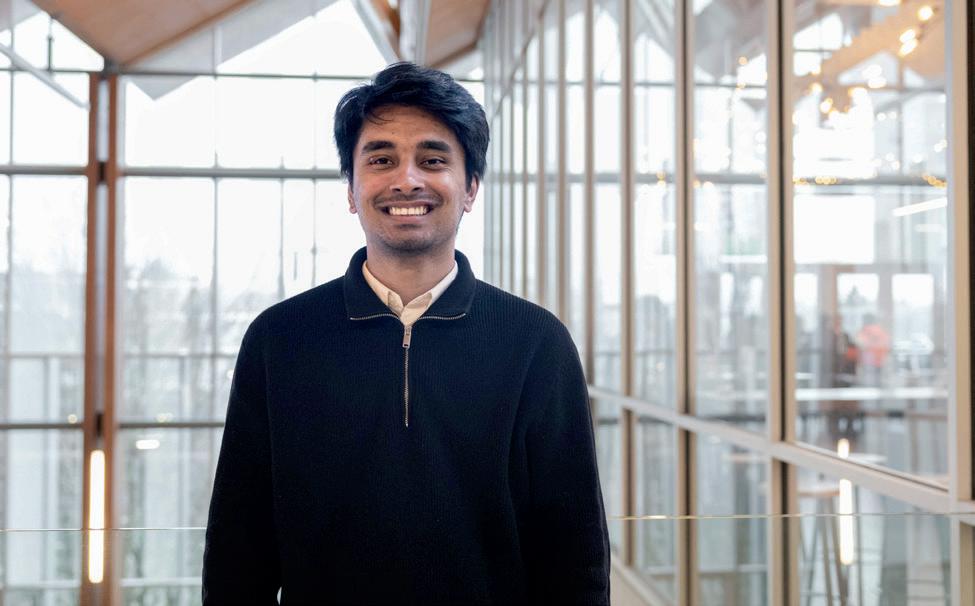
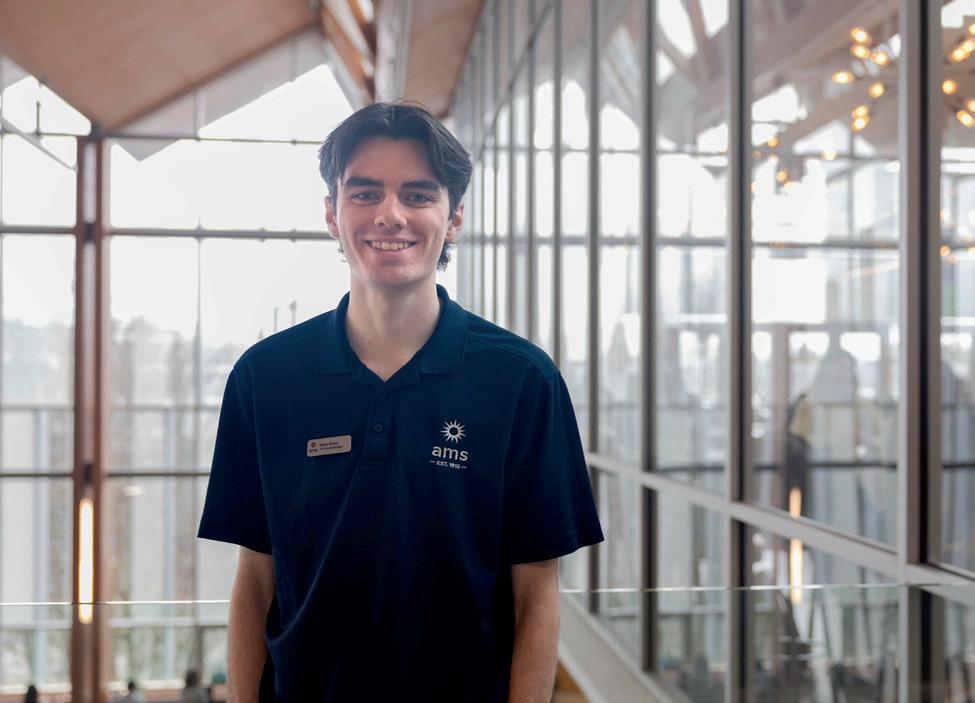
Midterm review: VP Administration
Dylan Evans
Report by Oliver Matisz News Contributor
VP Administration Dylan Evans ran uncontested on a platform emphasizing sustainability, support for clubs and fiscal responsibility.
While he has addressed some long-standing issues with clubs and clubs spaces, it is unclear how many of Evans’s stated goals will be achieved by the end of his term, particularly regarding AMS sustainability.
Club management
Last June, the AMS capped the number of clubs it would support at 350 and suspended intake of new clubs, a policy that Evans championed. The decision was driven largely by financial strain — club funding deficits are projected to hit $80,000 a year — Evans said the cap is necessary to balance fiscal responsibility with effective support for clubs. “Our time is limited, our resources are finite and I would love to support the clubs even more,” he said.
Evans sees the club cap as a successful policy that improves club management. He noted, however, that the number of AMS-affiliated clubs is still above 350 and reducing it has been an ongoing challenge. Evans said whether the cap should continue in the future is best assessed once club numbers stabilize around the AMS’s targets, a decision more appropriately left to future administrations. “At least for the near future, it probably is something that is beneficial,” he said.
Evans has also worked toward his goal of improving efficient Nest space utilization. In November, he proposed relocating the club commons, currently in the lower level of the Nest. The plan calls for leasing the current club commons and retrofitting an existing commercial unit in the Nest into a larger clubs common
transparency, mentioning their intent to announce the publication of public budgets for offices that receive money from students. However, he seemed concerned about the future of the economy posing a challenge in the AMS long-term stability.
Huntley expressed concern about the effects of economic uncertainty on AMS businesses and investments, and how the effects on the student union’s investments could impact its ability “to launch new initiatives.”
Economic uncertainty may hinder the long-term sustainability of the AMS, he said, while adding that steps are being taken to move forward.
“We have to be able to justify every penny that we’re spending and bringing that spending as closely in alignment with what the students are calling for,” Huntley said.
He said it was necessary to increase AMS fees through a referendum in this year’s election to finance projects like a 24/7 Nest during finals season.
“We had one failed [fee increase referendum] during the last election, but [the proposed referendum is] a bit more closely aligned with the current needs of students today and the needs of the AMS to be able to keep pushing forward.”
Now in the final months of his term, Huntley has been proudest about bringing back the AMS Equity & Inclusion Office, rebuilding relationships with resource groups by extending to them the same protection afforded to subsidiary organizations in AMS bylaws.
As well, Huntley is finally settling into his office. Torn between a swivel chair and a standing desk, he decided on both, having bought a standing desk out of his own pocket. U
space. The project has not yet been implemented and Evans said it will depend on available funding. He expects that the new space could open by September, although a summer timeline would be ideal if funds allow. He referred questions about the proposal’s current status to VP Finance Gagan Parmar.
“I’m confident that council definitely sees the value in it, and I think everyone else sees the value in it,” Evans said, “so I’m confident that’ll proceed.”
Space agreements
The VP administration has worked to secure and formalize space-use agreements with AMS-associated groups. Evans said there has been “a lot of ambiguity” in the past over how groups could use their spaces, creating confusion. Developing formal agreements would clarify what clubs are allowed to do, he said. Evans has focused on the unique needs of certain clubs such as the diving club, which requires room storage for its equipment. Finalizing these agreements is an end-ofterm goal.
During his campaign, Evans also promised to streamline club room-bookings. A few months ago, the AMS opened the Osprey Lounge & Terrace in the Nest for bookings, which was formerly used as a childcare centre. According to Evans, the room is the largest bookable space added to the Nest
since the building opened. “That’s been a great resource to help offset a bit of the burden from on there, on the room booking system ... and make sure that all of our club events are being accommodated.”
Sustainability efforts
On the sustainability front, it is unclear how Evans’ sustainability policies — including a review of the AMS Sustainable Action Plan and efforts to reduce carbon emissions — would be implemented before his term ends.
In a report last October, Evans noted that the AMS reached its targeted 30 per cent reduction in greenhouse gas emissions (GHG) from 2019 levels, but did not elaborate on GHG reductions going forward. Without going into policy details, Evans noted that he was passionate about sustainability and “how we as an organization can be as environmentally friendly as possible, and how that ties into our different student groups.”
When asked about specifics, Evans did not elaborate beyond projecting the sustainability plan would roll out within the next few months.
Evans described his time in office as demanding but rewarding.
“I think we’ve accomplished a lot, and there’s still a lot to do, and still a lot we’re excited to do,” he said. U
SIDNEY SHAW / THE UBYSSEY
SIDNEY SHAW / THE UBYSSEY
Report by Amy Shumka News Contributor
AMS VP Academic and University (VP AUA) Affairs Zarifa Nawar ran on a platform to advocate for affordability and funding, promote accessibility and inclusion, and expand academic and professional support.
More than halfway through her term, she has delivered on a significant portion of her platform, securing millions in funding for educational and work opportunities, food security and student reimbursements while advocating for improvements to academic policy and the student experience.
Last November, upon the recommendation of the AMS Executive Performance and Accountability Committee, Nawar revised her executive goals for her term, making them more “feasible and realistic.”
“Effectively, 81.5 per cent of the work that I’m supposed to be doing in this office has been completed this year,” said Nawar.
Increasing affordability
A major focus of Nawar’s term has been securing financial support for students facing rising costs. According to Nawar, her key priorities have been increasing allocations for food security, Work Learn funding and graduate student funding.
Nawar told The Ubyssey her office has secured $800,000 for food security initiatives from the university for the upcoming year, ensuring continued funding for the AMS Food Bank, Sprouts — an affordable food co-op — and other student-run initiatives. This renewal follows the expiration of a previous three-year financial commitment of $800,000 per year, but is less than the $1.2 million that the AMS asked UBC to provide in September.
Nawar also said she launched “the biggest Textbook Broke campaign in AMS history,” reimbursing students more than $20,000 in textbook costs. The campaign has been run annually since 2015. This year, it used funding from various faculties to reduce the financial burden of course materials and raise awareness for Open Educational Resources. She also secured increases for the International Community Achievement award — an award that recognizes continuing international students who contribute to UBC’s campus and community — from $5,000 to $10,000.
In terms of graduate student funding, Nawar said she has been advocating for higher minimum stipends for both PhD and master’s students. Every year, the AMS submits a list of student priorities for the UBC operating budget. In the 2026-27 budget submission, she supported increasing PhD students’ four-year minimum funding to five years at $30,000 per year, eventually rising to $40,000 per year by 2030. She also pushed to introduce a two-year minimum funding package of $20,000 per year for master’s students.
However, Nawar has been unsuccessful in stopping tuition increases. Despite the AMS submitting statements to the VP Student’s Office and presenting recommendations to the Board of Governors, the Board still approved tuition increases by two per cent for domestic students and between two and four per cent for international students
for the 2026-27 school year.
She is not the first VP AUA who could not stop tuition increases, though. For years, the Board of Governors has voted to increase tuition despite protests and opposition from student groups. As a result, Nawar has been committed to raising tuition transparency, initiating the creation of multi-year financial planning tools and revitalizing the tuition engagement survey for students.
“We realize that tuition is a hard thing for the university to say no to,” Nawar said. “What we want is for funds to be redirected towards these affordability initiatives for students: Food security, graduate student funding [and] Work Learn opportunities.”
Improving the academic experience
In the classroom, Nawar has concentrated on modernizing academic integrity policies, improving academic accessibility and overall quality of life. In January, in consultation with Nawar’s office, the Senate Academic Policy Committee passed a motion to make academic integrity and generative AI statements in syllabuses mandatory, lessening the chance of students accidentally committing academic misconduct.
Nawar is also concerned with improving the Centre for Accessibility (CfA). She has published a comprehensive list of available CfA accommodations, and is working on expanding the funding available for the CfA in order to increase the number of available advisors.
“Advisors are seeing upwards of 400 cases, and while we have seen exponential growth in the number of students registered with the CfA ... the advisor number has remained largely the same,” she said. “We’re looking to ensure that in the future, we create a CfA that is sustainable for the growth that is imminently coming.”
Her office is also working on a centralized exam database in collaboration with the Provost’s Office, with a proposal and pilot expected by the end of the year.
Going forward, Nawar has stated some of her key priorities for the rest of her term as VP AUA include creating an off-campus rental housing bursary, extending the course withdrawal deadline, providing staggered tuition refunds and advocating for Indigenous student representation.
Nawar also noted that with her multi-year goals — such as increased minimum PhD and master’s student stipends and advocating for changes to Workday — progress is often invisible to students. However, she said that advocacy has been ongoing in the form of budget submissions, Board of Governors presentations and Academic Experience Survey recommendations.
One of these goals is prioritizing environmental, social and governance principles in UBC’s Responsible Investing Strategy, an initiative she says she is “building from the ground up” and for which her office is undertaking extensive research. She has also been pushing for the creation of a dedicated exam testing centre, which, despite receiving support from UBC, Na war said, is a large capital project that will require years of longterm funding and planning. U
SIDNEY SHAW / THE UBYSSEY
Report by Amy Sheardown News Contributor
Last March, students voted to add a new addition to the AMS executive team: VP student life (VPSL).
Kevin Heieis, the former special projects lead in the AMS Presidents’ Office, was appointed as interim VP student life in May and officially elected after winning an uncontested race in September.
Over halfway through his term, Heieis’s work to improve student life has not gone unnoticed. Out of his 14 identified executive goals, Heieis has reported full completion of seven, with five goals in progress and two that have yet to be addressed.
One of Heieis’s main challenges has been learning “what is actually feasible with this role.” He was hopeful for the return of an inclusive multiday Interfaculty Cup in September 2025, but the event was revised to a three-hour interfaculty tug of war.
Heieis also committed to developing a multi-year student life plan, intended to outline target milestones for long-term VPSL initiatives. However, in September, he reported to AMS Council that the plan was “delayed to ensure comprehensive consultation” and in order to incorporate the results from the Student Engagement Survey (SES). Heieis made a point to update the SES with the intention of
identifying specific challenges across campus.
The results of the SES have not yet been released, and the multi-year student life plan remains incomplete.
When asked specifically about his goal to build a collaborative, semesterly calendar for campus-wide events, which has not been published, Heieis cited uncertainty around athletic tournament schedules as the main reason for this.
“A longer-term project that I’d like to see is a system where student groups can submit their own events,” he said, “but trying to centralize all of this is a larger challenge that will take time to implement.”
Campus spirit and colours
Heieis, an integrated engineering major, said he had taken a lot of cues from the engineering culture on campus.
Heieis believes that the wider UBC community lacks this sense of belonging and wants to unite the campus utilizing the university’s previous official colours of blue and gold. In 2024, he wrote an opinion article for The Ubyssey, arguing that reawakening campus colours would create a stronger sense of campus identity.
Heieis’s executive goals include enhancing coordination for 2025
Report by Shean Lee News Contributor
Ten months into their term, AMS VP External Solomon Yi-Kieran has made considerable strides toward their goals of lobbying for student needs at the municipal and provincial levels, fostering relationships between the AMS and external organizations and renewing interest in issues such as the SkyTrain extension to UBC. However, some tangible outcomes are still pending.
Transit
A significant focus of Yi-Kieran’s term as VP external has been on UBCx — a proposed Millennium Line SkyTrain extension that would connect the future Arbutus Station to UBC’s Vancouver campus. In an interview with The Ubyssey, Yi-Kieran said the project was one that “needed more attention,” pointing out that 18 years have passed since the provincial government had promised a SkyTrain to UBC.
With this delay, Yi-Kieran has lobbied heavily to bring UBCx back to public consciousness. In July, they launched a petition campaign demanding a SkyTrain to UBC, which garnered over 15,000 signatures, surpassing their original goal of 10,000. They also organized a rally for the SkyTrain outside the Nest, which attracted hundreds of students.
Combined with lobbying efforts to the B.C. Legislature, an endorsement
Welcome Back and Orientation events and the establishment of a 2026 Welcome Back group to specifically target first-year students.
As part of his efforts to reinvigorate campus culture, Heieis developed a brightly blue and gold joint Thunderbird and AMS baseball jersey in August last year. In a September AMS meeting, he told councillors that the reception had been positive.
Heieis has also been involved in numerous student organizations and events on campus, from the Ski and Board club, to the CiTR radio station, to a dance battle (which he lost). He said that these experiences taught him interpersonal skills that have become invaluable to his role.
Heieis has not only built relationships with student groups, but the university. Heieis said that since he assumed office, the relationship between the AMS and UBC has unexpectedly developed “in a way that we haven’t seen before.” Heieis did not expand on the nature of this relationship.
Advancing mental health programming was one of Heieis’s key campaign promises. Last year, he organized the AMS’s Mental Health and Wellness Week in November, the first in-person iteration of Thrive Week since 2017, which saw collaborations between AMS Events and five undergraduate constituencies. As a part of the week’s programming, there were events such as a financial wellness workshop and marshmallow roasting outside of the AMS Nest.
“Improving campus spirit can improve general well-being on campus … [that] is one of the big things that this role can support with,” Heieis said.
Beyond Mental Health and Wellness Week, Heieis’s reported that he has consulted with stakeholders on ways to support overlooked student demographics — such as commuters and upper-years — with their mental well-being. However, there have not been any further AMS-run mental health events since November, and Heieis did not comment on any plans for mental health focused events during the remainder of his term.U
Yi-Kieran has passed their original executive goals deadline to do so.
Despite these setbacks, Yi-Kieran said that they are working on a tenancy rights report which would outline how the AMS should be advocating for student tenants.
Strengthening alliances
A specific area of success Yi-Kieran highlighted during their term was strengthening alliances with various student coalitions and external organizations.
One such example is the Youth Climate Corps, which originally started as a pilot program in BC to hire youth to work on climate action projects, but received a $40 million commitment in the most recent federal budget for its establishment on a national level.
from the province’s largest labour union and an AMS-supported motion for UBCx proposed by Vancouver City Councillors Sean Orr and Lucy Maloney, all culminated in a unanimous city council vote calling on the province to accelerate progress on the SkyTrain to UBC.
Ultimately, the construction of the SkyTrain depends on several factors, including securing government funding, managing competing transit priorities and gaining approval from all levels of government. Although early planning for the extension is underway, an exact timeline is unclear and the AMS is currently waiting for the province to release the business case before it can move forward.
Housing
Another aspect of Yi-Kieran’s campaign centred on affordable housing and tenant rights for students, according to their executive goals.
On this issue, Yi-Kieran reported successful meetings with the University Endowment Lands administrative team, presenting them with a lobby brief which advocated for increasing the allocations of non-market rental housing on the University Endowment Lands Area D.
Yi-Kieran said the cabinet shuffle that saw a change in the provincial housing minister four months into their term presented a challenge. The AMS has not yet met with the current minister, Christine Boyle, to bring forward student housing issues and
Yi-Kieran noted efforts for a Youth Climate Corps. They mentioned sending briefs to parties running in the federal election and meeting with Vancouver-Quadra MP Wade Grant, where Yi-Kieran extensively advocated for a national Youth Climate Corps. They stated that these lobbying efforts, combined with an open letter to the federal government co-authored by the UBC, UVic and SFU student unions, were “very substantial in getting the $40 million commitment for the Youth Climate Corps.” Yi-Kieran also stressed the role of climate activists and organizers in this accomplishment.
Yi-Kieran said they were satisfied with the increased cooperation between UBC and various student coalitions, such as the Alliance of BC Students and the BC Federation of Students.
Reflecting on their term so far, Yi-Kieran said they were “really happy” with the progress they and their team have made, especially in terms of engaging students in advocacy through high-visibility public campaigns. Furthermore, beyond their role as VP external, Yi-Kieran expressed optimism for the current AMS administration as a whole.
“Historically, there’s been complaints that the AMS kind of feels distant from students, that it doesn’t feel approachable. I think this year, not only my office, but other offices too, have done a great job of making the AMS something that students … can see themselves in a bit more.” U
SIDNEY SHAW / THE UBYSSEY
SIDNEY SHAW / THE UBYSSEY
Midterm review: VP AUA Zarifa Nawar
Midterm review: VP Student Life Kevin Heieis
Midterm review: VP External Solomon Yi-Kieran
Powers that Be: Reproducing imperialism by merely opposing it
Maduro’s kidnapping last month was imperialism in action. But did you vilify Venezuelans who celebrated? You’re part of the problem.
Maya Tommasi (she/her) writes Powers that Be, a column covering political ideas. She is a third year-political science student and holds a previous degree in psychology. Her email is m.tommasi@ubyssey.ca.
Column by Maya Tommasi Politics Columnist
If your politics are anything like mine, you were left in horror at the atrocious act of imperialism — a clear breach of international law — that was the United States’ capture of Venezuelan President Nicholás Maduro last month. Especially since it happened in a region with a long history of bloody US interventionism, often with dire consequences.
Being Latina, it sent shivers down my spine. It had nothing to do with democracy. It was clearly a political move: Trump secured Venezuelan oil and satisfied his base, delivering a big win to anti-socialist and conservative Latinos who helped deliver his electoral victory. In an equally egregious move, he justified this kidnapping not as a defence of democracy but with sham accusations of “narcoterrorism,” creating a precedent that he could use to attack his enemies regardless of their democratic credentials — like Columbia’s President Gustavo Petro or Mexico’s President Claudia Sheinbaum. And while he hasn’t done so (yet), he could potentially replace deposed governments with American puppet governments who serve not the interests of the people but those of America. It would hardly be the first time.
Most readers likely support this sentiment. Regardless of where you come from, far-right imperialism coming out of the US does not bode well. Even if, selfishly, it is only because of his similar threats to Canadian sovereignty. But we should not lose sight of why we think this way. Otherwise, we risk having our anti-imperialist politics morph into exactly what it seeks to oppose.
In all my years since moving here, I’ve noticed a trend. At first, it was intriguing. I’ve since come to find it concerning. The way that most Westerners, crucially including leftists, talk about my home continent is exclusively framed through the lens of North American politics. Our politics are simplified to an extension of Western foreign politics, never granted any complexity.
I remember being taken aback by how different the conversation about Latin American politics was when I first came to Canada. I had grown up surrounded by people who villainized leftist governments in my home country; here, I was presented with a different
narrative: US imperialism had caused the poverty and the struggles of our continent.
At first, I was confused, then enamoured. But as the years passed, I became more critical. It all started in 2018. Two years after Trump’s election, we elected our own despot, Jair Bolsonaro. Quickly named the “Trump of the Tropics,” the similarities were unmistakable. He was a far-right populist, harking back to an imaginary glorious past, labelling the opposition enemies of the state and demonstrating clear hostility to the media and democratic institutions. While close allies, they were not the same. Compared to Trump’s first term, Bolsonaro was much more authoritarian. (Trump’s second term, I’d argue, has surpassed Bolsonaro’s initial authoritarianism, but I fear so would a second Bolsonaro term.)
Bolsonaro’s imagined past was not a racist American suburban one, but a military dictatorship. Famously, the man came into prominence by glorifying one of the most abhorrent torturers of the Brazilian military regime, Carlos Alberto Brilhante Ulstra, whom he exalted because of his role in torturing former Brazilian President Dilma Rousseff. He celebrated the anniversary of the military coup which extinguished our democracy 60 years ago. And famously, his son, also a politician, threatened Brazil’s supreme court judges.
Trump’s actions any less heinous, but neither does American imperialism erase Maduro’s actions.
My first point has hopefully been made obvious by now. Latin politics is not an extension of Western politics. As is true of all politics that do not pertain to this place. Even incidentally speaking as though this were the case is tacitly supporting an imperialist lens.
“Not only are these clear oversimplifications, they both implicitly degrade and silence the very subjects of Trump’s actions, Venezuelans.”
Bolsonaro’s rise to power in Brazil was clearly facilitated by Trump, from his legitimizing of anti-democratic rhetoric, explicit support from himself and allies (see Bannon), or even just perfecting an authoritarian playbook. His economy minister was clearly recreating 1980s American neoliberalism, which he learned from the infamous Chicago School. But the Bolsonaro phenomenon was an essentially Latin one — his rhetoric worked because of our militaristic history, political turmoil and our specific ilk of social conservatism. The Trump connection, while important, can only be one of the many factors contributing to his rise.
By consistently framing Bolsonaro as a Brazilian version of Trumpism, overplaying its similarities, or simply seeing it as a part of a global far-right movement led by the West, we flattened non-Western complexities and agency. And in doing so, it treats our continent as exactly what we are not — an extension of American politics.
I could continue to describe how the same phenomenon applies to the Partido dos Trabalhadores or PT (Workers’ Party), which I (like many other Brazilians) voted for in the same way as many of you might have voted for a Canadian party you didn’t completely agree with. And in the same way you might roll your eyes at an American singing Trudeau or Carney’s praises despite little familiarity with their governments, I might do the same to Canadians singing Lula’s praises. In the case of Maduro, this goes beyond interpersonal frustration or political disagreement. His government was authoritarian. He persecuted journalists and opponents, and has been accused of rigging an election. Meanwhile, his economic mismanagement –compounded by American sanctions – led a once-booming economy to ruin. This doesn’t make
This is not to say that one cannot be anti-imperialist or critical of American (or any other) acts of imperialism. Obviously not. I started this column by doing that. My intention was not solely to make it clear that I am anti-imperialist and oppose Trump’s actions, but also to show how we can frame opposition to US politics. Imperialism is bad not only because it is authoritarian. Maybe it’s also bad, more importantly, because of its material harm to people affected — people whose material well-being should also matter when they aren’t explicitly linked to Western foreign policy.
The consequences of our positions are not simply political. They’re also interpersonal. Many
“I had grown up surrounded by people who villainized leftist governments in my home country; here, I was presented with a different narrative: US imperialism had caused the poverty and the struggles of our continent.”
Venezuelans oppose, and even hate, Maduro — and not just right-wingers. In a touching article in Folha de São Paulo, a Brazilian newspaper of record, Venezuelan author, screenwriter, leftist and former Chavista María Elena Morán writes that despite her leftist views and horror at Trump’s imperialist violence, she simultaneously felt relief at Maduro’s removal. Her story is not unique. Every Venezuelan I’ve personally met has expressed deep opposition to Maduro, regardless of where they fell on the political spectrum. Many of whom are or were students at this very university — our colleagues and friends. To vilify them feels wrong, especially at a time when there is so much hostility against our Latin American community.
If we look at the comment sections of articles reporting on Venezuelans celebrating Maduro’s kidnapping, you will find people either deriding them or implying they represent Venezuelan people as a whole. Not only are these clear oversimplifications, they both implicitly degrade and silence the very subjects of Trump’s actions, Venezuelans.
Compare this with how we talk about American and European politics, where we are much more likely to understand the circumstances of, say, Mamdani’s election or the rise of the Rally National in France or the AfD in Germany. Many of us are aware of how economic stagnation in eastern Germany or young disillusioned working-class voters in France contributed to the far-right’s rise. Can we honestly claim most of us have comparable knowledge of the factors leading to Bolsonaro’s rise or the situation in Venezuela, bar, of course, that Bolsonaro was Trump-like and Venezuela’s struggles are tied to US imperialism?
If we are to be anti-imperialist, we should be able to set lofty goals. At the very least, we should be capable of a political analysis which escapes the exclusivity of a Western lens. We have to incorporate the complexity of global politics. How do we escape Western imperial domination while so often replicating a Western-centric approach to our global understanding of politics? If we are to overcome imperialism, we should be able to understand the basic priorities, positions and political dynamics outside the West. U
This is an opinion essay, and a part of a regular column. It reflects the columnist’s views and may not reflect the views of The Ubyssey as a whole. Contribute to the conversation by visiting ubyssey.ca/ pages/submit-an-opinion.
AYLA CILLIERS / THE UBYSSEY
How Lucy Borowski finds success in a ‘game of mistakes’
National Girls and Women in Sport Day 2026
Profile by Sofia Campanholo Sports & Recreation Reporter
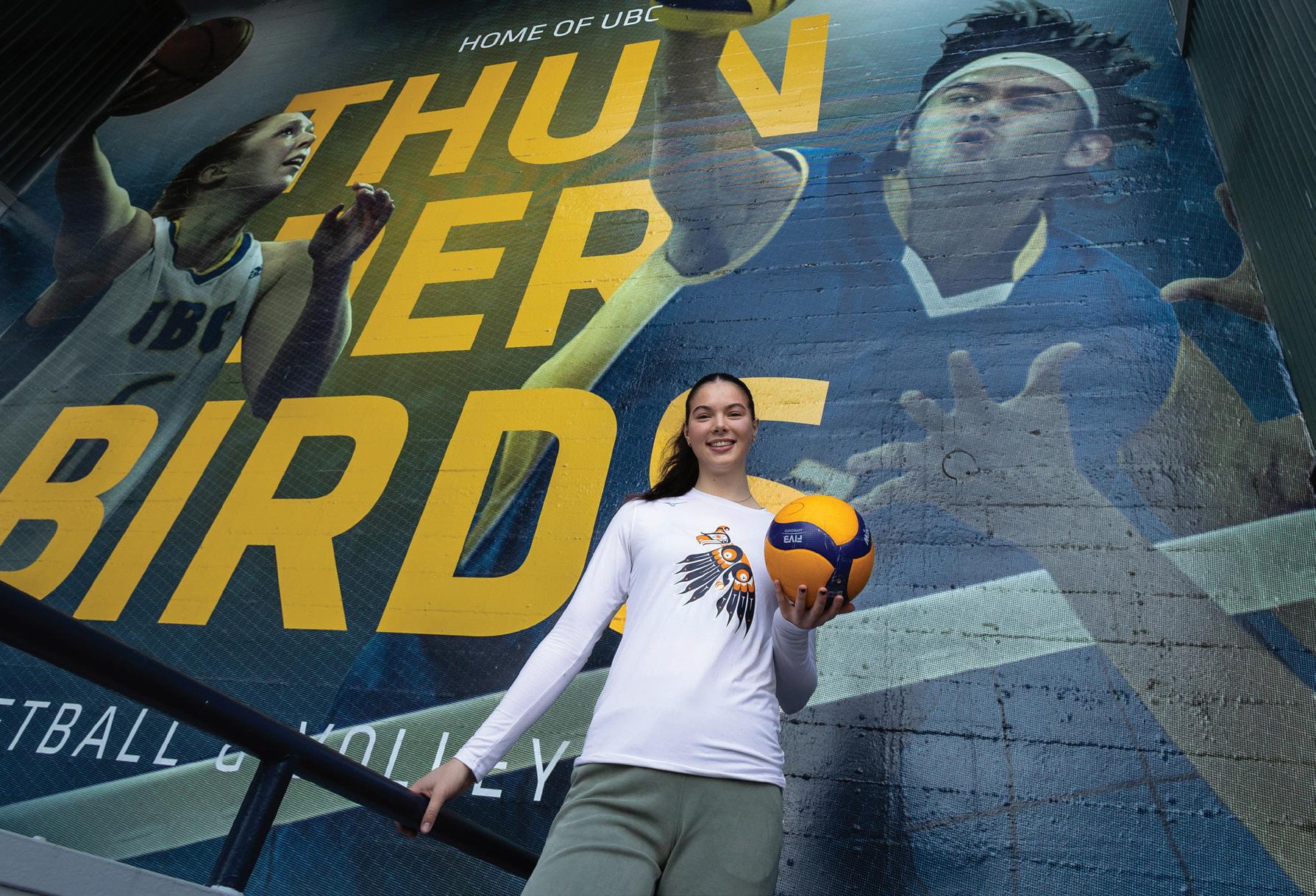
It’s hard to attend a Thunderbirds women’s volleyball match without noticing Lucy Borowski. With 267 kills this regular season so far, she is the definition of a powerhouse on and off the court.
At only 22 years old, the Vancouver native has been named a first-team All-Canadian player, played for the Canadian National Team, won the Most Valuable Player award at the national championship in 2025 and being president of the Thunderbird Athletes Council.
But Borowski’s story didn’t start with a born passion for volleyball. In fact, neither of her parents played. She said her mother “doesn’t know anything about volleyball.” Her journey began in a simpler way.
In elementary school, Borowski’s PE teacher approached her and encouraged her to play volleyball. Borowski played many other sports during her childhood, but none of them caught her attention as much as volleyball did. She loved how the sport allowed
you to be aggressive — and also be at fault. To many people, this would be too much pressure, but to Borowski, it is actually what makes it fun.
“It’s a game of mistakes,” she said. “You’re allowed to swing away at the ball and make a mistake, and that’s part of the game. I really enjoyed that.”
That doesn’t mean she isn’t nervous. She just hides it well. For UBC head coach Doug Reimer, this underlying stress isn’t obvious because the high level of performance she delivers often obscures part of the work — mental and physical — that she had to put in to reach this level. It’s about taking those mistakes and learning from them.
This has been clear through Borowski’s improvement during her five years as a T-Bird. During this time, Borowski has switched positions twice, starting her Thunderbirds’ journey as a setter.
“I think on the first point I ever played, I went to set, and the ball fell through my hands,” said Borowski. Now, as a senior outside hitter, her improvement has been very noticeable — and she
gives a lot of credit to coach Reimer.
The head coach has been with her since the beginning and has been an immense force in her improvement as a player. Early in her career, Reimer pushed her to believe in herself, giving her chances to prove herself in games against strong teams, even as an inexperienced, young player. This early vote of confidence helped her both as a player and as a person.
Of course, he cares about the technicalities — but one of the things that matters the most to him is the player’s mindset. It’s not about being perfect, but instead, the best you can be in each game.
“I still get nervous to play every single time, but I’d say now I can go in and I can still do my job nervous, which is the biggest area of growth I’ve seen in myself,” Borowski said.
That doesn’t mean he doesn’t push his players when needed. As players get older, the higher his standards become. But those high standards are because of his belief in what his players are capable of.
Reimer has watched Borowski develop immensely through his years coaching her, and that’s because of how committed to improvement she is. To him, her presence on the court has a dramatic impact on how the entire team plays.
“When she is playing well, she can be close to unstoppable in the front row,” he said. “[Lucy is] just a good server, good attacker, blocker, passer, defender — key skill areas.”
The team’s lead assistant coach, Jodi Zbyszewski, expressed similar sentiments.
“I just love her determination and commitment to the sport. I love how much she’s grown in the time I’ve been coaching her,” she said. “She’s someone who wants to keep going and get better and challenge herself and challenge those around her.”
But for a player to become as great as Borowski is, an amazing coach is not enough — they also need a strong relationship with their teammates. Luckily, for Borowski, this is not an issue.
Her connection with Akash Grewal – her only teammate also in her fifth year — goes all the way back to when their high school teams would play against each other. That competition only gave Borowski more reasons to look up to her, with Grewal coming to the T-Birds a year before Borowski. For Borowski, Grewal’s leadership resonated on and off the court — an example she’s needed to echo in the last few years, serving as role models to younger players — and not just those on her team.
In 2025, Borowski started
coaching with Zbyszewski’s youth team — and immediately made an impact. Those kids adore her. They go to her matches, make posters reflecting the support that she shows them when coaching. There are echoes of her own head coach in how she has taught them — mindset comes first.
“I think that’s what makes her a really great mentor, especially to the younger kids,” she said. “Take volleyball aside. It’s more that if you work hard and you want to do something, you can do it. And it’s not always going to be easy, but it’s possible. I think she’s taught those girls that.”
To Zbyszewski, she is the definition of leading by example. Borowski doesn’t just tell them the value of persistence when you want to be good at something you love – she demonstrates it in her actions.
For most people, dealing with academics, UBC and volleyball altogether would probably leave no room for other commitments in their lives. But for Borowski, there is something else that she has a huge role in: the Thunderbird Athletes Council (TAC).
Borowski is the president of the council, which requires her to represent and give a voice to the student athletes at UBC. Even though it’s a demanding job, she really enjoys how she can connect with people from other sports –something that, without the TAC presidency, would not be possible. As a university student, she also gets to have fun that goes beyond the bureaucratic part of the role, such as planning parties and events for
the T-Birds. It’s re-
Star outside hitter for UBC’s women’s volleyball team Lucy Borowski shows off her medals, won from back-to-back national championships in 2023 and 2024. | SIDNEY SHAW / THE UBYSSEY
In one of her first games as a ‘Bird, when Borowski went for a set, the ball fell right through her hands. Now, after switching positions, she’s in the top five nationally in kills. | SIDNEY SHAW / THE UBYSSEY
flective of something both Reimer and Zbyszewski praised Borowski for — being not just a student athlete, not just an exceptional student, but someone who actively contributes to the community.
“I’ve definitely improved my time management over my time at UBC,” said Borowski. “I would not say I was great at it in my first year, but I think I’ve learned to adapt and focus on what really matters,” Borowski said.
This determination is something Reimer appreciates as well. For a young team, Borowski’s work ethic has been infectious. Even if they usually do not play much in their first years — as Reimer prefers to play the older, more experienced players more often in matches — Borowski has seen the younger girls keep working hard and improving every day. A large reason why may be because of the example Borowski has set. It’s also why, to Zbyszewski, Borowski’s graduation will leave a mark on the team.
“She’s just been such a constant, an amazing young woman on and off the court,” she said. “It’s definitely a loss to the team on the court, but it’s almost a bigger loss off the court.”
This doesn’t mean that there haven’t been results on the court, however. All of her hard work led Borowski and the Thunderbirds to some huge accomplishments, both as a team and individually. For her, she considers their second straight U Sports title in 2024 the biggest highlight of her five years as a Thunderbird.
“It’s hard to win back-to-back years, but everyone was just so determined,” she said. As a thirdyear back then, for Borowski, the older players at the time were a huge motivation for the rest of the team. “You could see it in their eyes, [we] were going to win.”
And unlike in 2023, when she was not playing as much against the big teams, in 2024, Borowski was essential to the T-Birds’ championship run. Her performance throughout the postseason was so great that she was honoured with the tournament’s Most Valuable Player award.
In 2025, almost a year after she was recognised as MVP, Borowski was honoured again, but this time as a First-Team All-Canadian player. While she was quick to redirect the recognition towards her teammates, these accolades show that she’s not just considered great at UBC, but also among coaches around the country.
“It’s validating to know that other coaches think you’re doing a good job, and to just be recognised with other amazing players,” she said.
Even with many awards, titles and recognition, one of Borowski’s biggest challenges throughout her years as a Thunderbird has been managing her own self-criticism. It’s something she’s had to wrestle with even more since she joined the Canadian national team, given the increased responsibility that comes with it.
This is where Reimer’s emphasis on process is key. It’s an understanding that everyone on the team makes mistakes, that she doesn’t have to take it all on herself. For Reimer, it’s an instinct he believes is very common for great athletes, in every sport.
“90 per cent of the time, it’s a real strength. Because they’re working to get better,” he said. “[But] there’s a balance there between always trying to be better, but also having an understanding, especially when other teams are keying on you, that all athletes make mistakes.”
Borowski has been a part of the national team since the summer of 2023, fresh off her second year at UBC. Now, in 2025, she is playing for the senior team, under a new coach — Giovanni Guidetti — who is considered one of the best in the sport. This promotion surprised her, because not only had she switched positions for the T-Birds, but Guidetti also switched her from the right side of the court to the left.
“It was a long process,” Borowski said. “We had two weeks of tryouts, and then every week after that, he would cut more people. Every week it was kind of like, ‘I hope I’m not going home this week!’ It was a grind to try and
SPORTS & RECREATION
stay on the team, but overall, such an amazing experience.”
Reimer immediately noticed Borowski’s improvement when she returned last summer from the national team practices and games — and not in one specific area, but across the board.
“Her switch in terms of position, [alongside her] ability to move from being a right side player to the left side, and having to pass and hit on the opposite side … [it is] not an easy change to make, especially from fourth year to fifth year,” he said.
For Borowski, not only was her experience on the national team great because they got to practice and travel around the world, to countries like China and Mexico, but also because it motivated her to remain on the team, trying to continue improving with the knowledge of this new coach.
“My sights are set on trying to be there again, because he’s just such an incredible coach, and I would just love to keep learning from him,” she said.
The Canadian national senior team isn’t where her ambition stops, however. Borowski is in search of a contract in Europe for 2027, attempting to continue her career overseas, while also still coming back to campus to watch her brother — who is also a player for the UBC men’s volleyball team.
Whether she starts a career in Europe, continues her development on the national team, or something else entirely, Zbyszewski, who has coached Borowski since high school, has no doubts that Borowski has all the skills — as a player and as a person — that she needs to go far.
“Whatever she wants to do, she’s going to be able to do … she’s grown, she has shown that she can achieve what she wants to set out for,” Zbyszewski said. “She’s a great kid, and I really would just encourage her to keep going on that path.”
Wherever she ends up post-graduation, Borowski is lucky enough to have two special role models in her life to show her the way — the first is her mom. Even if she is not an athlete, she inspires her daughter to keep trying her best on and off the court, especially through her kindness and her thoughtful encouragement.
Her other role model, however, does come from the world of volleyball: Thunderbird alumni and current team Canada player Kacey Jost, who played with Borowski at UBC until 2024.
Jost demonstrates everything that made Borowski fall in love with the sport when she was a kid: she is eager and impassioned on the court, an intensity that may have scared Borowski in her first year. But with time, as Borowski’s skills improved and she and Jost became closer, this trepidation turned into inspiration — she began to see her as powerful. Now, Jost’s presence as a player motivates Borowski both as a female athlete and as a woman.
“I think we can all strive for that. We don’t need to be quiet or make ourselves smaller,” Borowski said. “She’s just such a fierce competitor, and I hope I can start to embody that more when I play.”
For Borowski, being able to learn from and with a player like Jost was invaluable, especially as a young student-athlete. According to Reimer, in her final year as a T-Bird, Borowski already is, to many young players, what Jost was for her.
“When your most experienced player is working really hard, that sets a great tone,” he said. “I think Lucy’s really grown in her ability to support other players while she’s still shouldering a big load on the court.”
Currently standing at 6’2”, for Borowski, she wasn’t always happy with being taller — especially when she was younger — as it made her feel out of place. Now, she sees things in a different way.
“You don’t need to make yourself smaller or try to fit in, or try to be quiet because you’re tall, [or] even if you’re not tall, just as a woman,” she said. “You’re allowed to be loud and fiery, and you’re allowed to get mad during games, be competitive … You can be whoever you want to be on the court.” U
Borowski isn’t just a volleyball player. She’s excelled both in the classroom and in the community, taking on extra responsibilities, coaching youth volleyball and being the president of the Thunderbird Athletes Council. | SIDNEY SHAW / THE UBYSSEY
While her time with the Thunderbirds is coming to an end, with her final home regular season game at War Memorial coming up on Feb. 14, Borowski is hoping to continue her volleyball career, both on the national squad, and potentially in Europe. | SIDNEY SHAW / THE UBYSSEY
Is Canadian football becoming ‘more American’?
How the CFL’s rule changes will impact U Sports football
The game of Canadian football is changing. With new rules implemented in September, the CFL will alter their game substantially. With an infrastructure built upon the pro league’s foundation, university football — and, by extension, UBC — may have to change with them.
Extended Report by Annaliese Gumboc Sports & Recreation Reporter
Continued from page 1. While the CFL has often aimed to distinguish itself from the NFL, with these new rules, it seems that some of those differences are no longer viewed as beneficial.
The reaction from the CFL community has been divided. Nathan Rourke, the Victoria-born quarterback of the B.C. Lions and the Most Outstanding Player in the CFL last season, called the planned modifications “garbage.”
“What we’re moving towards is not Canadian football, the game I grew up loving,” he said.
While the CFL is changing, it’s up in the air whether all of Canadian football will change with it. U Sports, the governing body for Canadian University sports, has yet to decide if they will adopt the CFL’s upcoming rule changes.
In response to the CFL’s initial announcement, U Sports released a statement asserting that
they would “begin engaging with [their] members and stakeholders … to determine the ramifications for U Sports football, and the best course of action”.
The impact of this decision would affect the majority of large universities within Canada, including UBC, all of which fall under the domain of U Sports. While an air of uncertainty abounds, for those actually working in and playing the game, some changes may be more welcome than others — especially those occurring in 2026.
As of this year, the CFL will stop using its 20-second play clock, which is manually initiated by an official, often creating inconsistencies, and replace it with an automatic 35-second countdown that begins when the prior play is whistled dead.
“The way they want to change the [play] clock, I think, is a good decision,”
said the head coach of UBC’s football team, Blake Nill. “I wish U Sports would do that.”
Another 2026 rule change will mandate the locations of team benches.
“I appreciate the fact that they’re trying to change the game but still keep … appreciation for the Canadian game and how it differs from America.”
- Kieran Flannery-Fleck, kicker, UBC Football
Some CFL stadiums currently place opposing team benches on the same sideline, with the teams right next to each other. Starting next season, this will change, as the league will require benches positioned on opposite sides of the field. This arrangement is not just in-line with common procedure for the NFL, but also already used in some Canadian venues, like UBC’s Thunderbird Stadium. Ideally, having benches on opposite sides will smooth out substitutions, preventing situations where a team’s bench is dozens of yards downfield of the line of scrimmage.
Having managed the bench of a CFL team himself as the head coach of the CFL’s Montreal Alouettes from 2019–2022, UBC offensive coordinator Khari Jones has plenty of experience to draw on when judging this change. He approves.
“The one rule change that I love … is both teams on opposite sides,” said Jones. “To have teams on the same side has always been ridiculous to me.”
In the only direct modification to how the game is scored, 2026 will also see adjustments to the rouge. Unique to Canadian football, the rouge is a single point awarded to the kicking team when a punt, kickoff or missed field goal travels into the receiving team’s end zone and is not returned to the field of play.
For instance, according to current CFL rules, a kicking team might earn a rouge if a punt sails through the back of the end zone, or if the returner goes down in the end zone. However, under the modified rules, a rouge will no longer be earned when a field goal misses wide of the goalposts or when a punt or kickoff travels through the end zone. Instead, the point will only be awarded if the kick is received by a returner who either gives himself up or is tackled in his own end zone.
With the CFL making the most significant alterations to Canadian Football in decades, it remains unclear how these changes will affect U Sports teams like UBC — down to
As someone who has kicked plenty of rouges himself, UBC kicker and punter Kieran Flannery-Fleck is in favour of this particular alteration.
“From a kicker’s perspective, I was never really a fan of the rouge,” he said. “I didn’t really love the fact that … you’d be awarded a point for a missed field goal.”
For many in the CFL community, the 2027 rule adjustments are the real source of apprehension. This final wave of modifications will alter the gridiron, shortening the field of play from 110 to 100 yards and the end zones from 20 to 15 yards. Goalposts will also be relocated from the front of the end zones to the back.
Though CFL fields will remain about 10 yards wider than those south of the border, these new dimensions evoke the NFL, where teams play on a 100-yard-long field with 10-yard end zones and the uprights at the back. These changes are core to the sentiment that the CFL is becoming more like the American game.
“That’s what Canada’s known for,” said Flannery-Fleck. “We have the big end zones, which are now going to be smaller. We have [a] wide and long field, which is now going to be smaller. I don’t love it, because I feel like you’re just changing the Canadian game and making it more American.”
“I love the Canadian game,” said Jones, an American and former CFL quarterback. “I’ve been up here now since 1997, playing and coaching, and made my career up here. And I really love the way the game is played. I love the field dimensions … I don’t want to see that change.”
The field alterations could transform the style of football played in the CFL — much more substantively than the 2026 changes. As Commissioner Johnston put it, the CFL is “trading field goals for touchdowns.” In other words, by shortening the field, the league is de-emphasizing special teams — which has historically been more prevalent in the CFL than NFL — in favour of play that is considered more exciting. By decreasing the distance to the
SPORTS & RECREATION
While the rule changes will also impact offensive and defensive play, it is more as a reaction to the lessened importance of special teams. Because kicking has been disincentivized, both units will need to prepare for an increase in third-down attempts around the 40 to 30-yard line.
“[Currently,] once you hit the 40-yard line or so … you’re kind of in field goal range. You’re still playing two downs and kick,” said Jones.
However, pushing the goal posts back means that attempts from this area will no longer be in safe range for most CFL kickers. Rather than punting in enemy territory, most teams will likely opt to go for it. From a scheming perspective, Jones would have to “be more creative” inside the 40, with the knowledge that the region is threedown territory.
The new field dimensions will also impact how teams approach plays near the end zone.
“It’ll be more congested down there when you get down to the three, four or five-yard line,” said Jones. “You’ll probably start seeing things similar to the NFL, where it is a little tougher to score because it’s condensed.”
Fortunately for offences, the goalposts will no longer be an obstacle in the end zone — removing the uprights from the front of the end zone will “open the playbook a little bit more, close to the goal line,” according to Jones.
However, while modifying the field will bring significant changes to the strategy and identity of the game, it may have even greater consequences for the youth and amateur level of Canadian football.
peders are “its biggest client.” The university will likely have to choose between losing the Stampeders or relocating the Dinos, the latter being more beneficial.
At UBC, there has been little discussion between the administration and the football team about potential field changes. For now, it seems like decision-makers are confident that the new CFL rules will not result in significant changes for the school.
“I don’t think it’s going to move the needle one bit,” Nill said. “I would be surprised if it did.”
U Sports may still choose to adopt the CFL’s smaller rule changes, like the modified rouge, without altering the gridiron. If
“Universities are not going to assume the cost of changing fields. I cannot see there being a lot of interest at the administrative levels [in] spending money to change the way the game of football is played.”
-
Blake Nill, head coach, UBC Football
CFL. “I think the biggest thing is it’ll be maybe a little tougher to evaluate [players],” he said. “The way the game is played is still going to be similar.”
Unlike the kicker position, Jones felt that the rule changes would not make the CFL more friendly to quarterbacks from stateside.
“Keeping the width, keeping the 12 guys out there, it’s still going to be an adjustment,” said Jones. “It’s still going to take some time for most of them.”
He’s speaking from experience — Jones played quarterback at an NCAA college in America before winding up in the CFL.
Nill believes that the rule changes aren’t significant enough to affect the overall experience — especially given that most of the CFL’s players already come from American schools — emphasizing that the adjustments are targeted at the audience.
“They’ve taken the opinion that these changes will help fan experience, in an attempt to increase ticket sales,” said Nill. “But it won’t impact the athlete’s ability to play the game or to transition [to the CFL].”
“What we’re moving towards is not Canadian football, the game I grew up loving.”
- Nathan Rourke, BC Lions quarterback
inspired by the American game, are nothing new. In the early 20th Century, Canadian football was influenced by an influx of American players and coaches. For example, American player Frank Shaughnessy, who became a football coach at McGill in 1912, is credited with bringing the concept of the forward pass to Canada.
“I love the Canadian game. I’ve been up here now since 1997, playing and coaching, and made my career up here. And I really love the way the game is played … I don’t want to see that change.”
- Khari Jones, offensive coordinator, UBC Football
U Sports now faces a dilemma. CFL stadiums are used by several university teams, including the University of Calgary Dinos and the University of Regina Rams, who share a conference with UBC. By the time CFL fields are renovated in 2027, either these teams will have to relocate to fields with the original, 110-yard length, or U Sports will have to adopt the CFL’s new field dimensions nationwide.
Nill, Jones and Flannery-Fleck are any indication, these new rules would be welcomed by many and hardly impact the game as a whole.
More pressingly, if U Sports does not adjust its fields, the 2027 season will mark a sudden divergence between Canadian university football and the CFL, the primary destination for U Sports athletes aiming to play professionally. The gravity of this depends on where you stand on the field.
As a kicker, Flannery-Fleck believes that the new rules will initially favour prospects from American schools, where the uprights are already at the back of the end zone.
Yet, in pursuit of audience growth, the CFL has upset much of its current fanbase. A petition imploring the CFL to delay the rule changes has acquired nearly 8,000 signatures. They state, “The CFL is not just a game; it is a cultural institution woven into Canada’s fabric. … Our league should not surrender its identity or abandon the elements that differentiate Canadian football from its southern counterpart.”
Flannery-Fleck, a lifelong CFL fan, offered a more optimistic view. “I appreciate the fact that they’re trying to change the game but still keep … appreciation for the Canadian game and how it differs from America.”
For now, the CFL will be keep-
More recently 2023, the CFL moved its playoff games to Saturday to avoid conflict with the NFL’s Sunday games. For similar reasons, the CFL had previously moved its double-headers to Friday and Saturday. The flow of influence isn’t one-sided. In the 1990s, the CFL briefly expanded to the States, placing teams in a handful of American cities. The Baltimore Stallions — named after the NFL’s former Baltimore Colts — were especially prosperous. In 1995, they set the CFL record for the most wins in a single season and became the only non-Canadian team to win a Grey Cup, all while ranking second in attendance numbers across the league.
goal line while increasing the distance to the goal posts, the CFL hopes to limit situations where teams can settle for a field goal, instead creating more scenarios where teams are scoring touchdowns or attempting third-down conversions. Shortening the field may also lessen the importance of starting field position and, consequently for kickers, special teams play as a whole.
“Kicking is such a massive part of football, and Canadian football more so than American, so it’s too bad that it’s changing,” said Flannery-Fleck. “You have to be optimistic about it in the sense that it’s going to be higher-scoring games — maybe kickers are going to be relied on more.”
U Sports may be exploring some middle-ground solutions — for example, converting individual conferences to the CFL’s dimensions — but it is highly unlikely that such a situation would be feasible long-term. The organization must also consider whether or not to implement the CFL’s other changes, irrespective of the field. Nill and others at UBC believe that the U Sports will maintain its current field dimensions.
“Universities are not going to assume the cost of changing fields,” said Nill. “I cannot see there being a lot of interest at the administrative levels [in] spending money to change the way the game of football is played.”
If U Sports decides to make the switch, the necessary field modifications would cost around $800K to $1 million per university — a tall ask on a tight budget.
Of course, upholding the field dimensions poses its own complications, particularly for the universities sharing venues with CFL teams. For instance, Nill pointed out that McMahon Stadium is owned by the University of Calgary, but the CFL’s Calgary Stam-
“I think Canadian field goal kickers will have more of an adjustment,” he said. “I don’t know if … Americans would have a complete advantage. But … I think it’s going to be a bit of a rough patch for Canadian guys coming out of U Sports, because guys coming out of college in the States, they’re used to this.”
Having experienced the American field at NCAA camps, the difference in the goal post placement was notable for Flannery-Fleck. “Visually, you’re just not used to it,” he said.
Kickers aren’t the only ones who will be affected. The drastic changes to special teams matter more broadly, because that phase of the game has often been a stepping stone for U Sports players getting into the CFL.
“It’s going to be an adjustment for everybody, especially because … in the CFL, they recruit U Sports players mostly to play special teams at first,” said Flannery-Fleck.
Comparatively, Jones, who has spent his extensive career on offence, foresees little change in the pathway from U Sports to the
“They’ve taken the opinion that these changes will help fan experience, in an attempt to increase ticket sales. But it won’t impact the athlete’s ability to play the game or to transition [to the CFL].”
- Blake Nill, head coach, UBC Football
A month after the Stallions’ Grey Cup win, the NFL announced plans to return to Baltimore, likely influenced by the CFL’s success within the city. The Baltimore Ravens debuted a year later, won the Super Bowl in their fifth season, and have remained one of the winningest NFL teams of all time. To avoid competing directly with the NFL, the Stallions moved to Montreal, becoming the present-day Alouettes.
ing some of its more unique features, namely three downs, 12 men and a wider field. Both Flannery-Fleck and Jones expressed hopes that these aspects of the game would remain intact.
The “Americanization” of the game is difficult to deny, but changes to the sport, even those
The Baltimore situation encapsulates the symbiotic, sometimes antagonistic, relationship between the CFL and NFL. For over a century, American and Canadian football have evolved alongside each other, making adjustments according to the other’s influence. The upcoming rule changes are a more extreme extension of that pattern. Still, one has to question rules that are more focused on growing viewership than improving player experience, and risk the league’s current fans for the prospect of new ones.
Only time will tell if the CFL’s rule modifications are for the better or worse. For now, the CFL community will enjoy one more year before the field, and the game they love, is changed. U
Let’s get graphic: 2026 Sex Survey
At what age did you have sex for the first time?
Over the last six months, what type of ‘pornography’ have you engaged with?
How often do you generally orgasm during partnered sex, particularly over the last six months?
Is sex an essential part of romantic intimacy for you?
Is romantic intimacy an essential part of sex for you?
Sex is a tricky topic. Most of us don’t want our friends and colleagues to know our favourite positions or the number of times we’ve done it this month. On the other hand, most of us — especially us nosy reporters — are curious. Last month, The Ubyssey asked you some questions about that kind of performance in an anonymous survey. Here’s what you said.
Quotes have been edited for grammar and punctuation.
What does good sex mean to you?
Communication, comfort and pleasure for all parties involved were the most commonly agreed-upon criteria for having a good time.
“Good sex is when you’re pushed over the edge in some way, whether it’s an orgasm, unearthing the depths of emotional intimacy or morphing into a completely different person — in the good way.”
“Being in sync. Feeling heard and considered and prioritized by a partner.”
“I feel attractive, wanted, loved and I am made to feel desired. It is explicitly stated or made clear by the other person. For me, the best sex is monogamous, and between myself and my romantic partner. I also feel secure in my body and my relationship with my partner. It is exciting, but comforting — like coming home.”
“Creating a ‘green zone’ space and establishing what those greens are with play. I love play.”
“Comfortable, communicative and pain free with a respectful partner, ideally both of you reaching orgasm. Some willingness to explore each other’s needs and kinks while listening to each other.”
Does your cultural identity affect how and with whom you have sex?
For reasons related to both physical appearance and mutual understanding of a culture, some respondents mentioned they tend to find themselves gravitating towards partners who share the same identity. Others mentioned the negative impacts of their culture on sexuality, like perceptions of how women should behave or the restrictions various religions place on sexuality, pleasure and queerness.
“I believe my cultural identity made me repress my sexuality due to notions of shame regarding female sexuality that I grew up with. Being in college has helped me dismantle that. It doesn’t affect who I have sex with.”
“It’s easier for me to feel comfortable and safe with people from the same cultural background as me. Some people have been insensitive or rejected me because of my cultural heritage.”
“I wish it didn’t. I went to a very Dutch fundamentalist evangelical school and carry a lot of shame surrounding sex due to the lacking education and discourse perpetuated by the church. I have a harder time with same-sex relationships for myself and myself only due to internalized homophobia, so I gravitate towards the opposite gender historically.”
Is sex an important part of your gender performance? If so, why?
Most respondents don’t feel their sex life affects the way they present their gender, but a few had things to say. One person said they’ve found sex to be “a measure of worth” in their male friendships, so they feel pressured to act more assertive or dominant. Several tied sex to femininity and the experience of being a woman — sex, for them, is a way of either reinforcing femininine qualities or escaping them.
“Deep questions here about the lack of sex and its impacts on my nonbinary gender identity. I choose not to consider it.”
“I would say so. It’s definitely part of what makes me feel ‘like a girl.’ ”
“It is supplementary, sex is very genderless for me.”
“I hope not. I want to escape the category of ‘woman’ most days, and I like to frequently switch up my role during sex so the act can feel untethered from any essential part of me.”
If you identify as having a sexual orientation other than straight, do you feel like you’re in touch with the 2SLGBTQIA+ community and its culture(s)? If not, do you wish you were?
Most respondents who identified as 2SLGBTQIA+ said they feel connected to queer community and culture, primarily through having queer friends or engaging with media that is significant to many queer people. A lot of people noticed that in the recent past — for some, since coming to UBC — they’ve gone through life changes that made them feel less attached to the queer community. Sometimes this distance was due to currently being in a heteronormative relationship.
“Mostly during high school, and now only through media. I think this part of me can be left alone for now, given that I want to give security to my current partner.”
“I used to feel more connected to the community when I was in the closet but now that I am out, I feel a pull away. I do not want so much affiliation with the community. I don’t know why.”
“I do not feel like I am very much now. My primary social group in undergrad consisted of mostly lesbians and bisexual femmes, and at the time I felt much more in touch with the queer community, as well as my own queerness. I was also was going out with women at the time. This was before I entered my current heterosexual relationship, which has definitely contributed to my feelings of distance from queerness and queer culture. [...] It is difficult navigating this feeling in a heterosexual relationship, and I often do not think about it outside of sex. When I have sex in my current relationship, sometimes I think about how it may be lacking due to its heterosexual nature.”
“I feel connected in a peripheral sort of way. I engage a lot with other members of the LGBTQ community online, but when it comes to real life at UBC, it feels like there isn’t really a community to speak of. Also, as an asexual, I find it hard to connect with other queer people about my experiences.”
“Nothing against queer spaces, I’ve sometimes enjoyed them, but for me, my sexuality is such a small part of my identity and personality that I never feel like I quite belong. I also feel that queer spaces are often feminine-leaning, and while I’m far from a heteronormative macho man, I am still a cis man and I don’t entirely relate to strictly feminine gender expression. Not a big deal, just not really the vibe for me, so I prefer to be in touch with communities that are mixed in representation and where sexuality and gender identity is tangential and not the common element.”
What is your favourite sexual position?
Missionary and spooning had the most responses by far — tried-and-true classics. U
PERFORMANCE
At Numbers Cabaret, performance is resistance
Numbers Cabaret was once just someone’s house. There's a fireplace tucked in a corner, a downstairs area with footsteps scratched into its surface and a stripper pole that stands as proud and tall as a monument.
Extended Report by Jack Paransky Contributor
Numbers Cabaret was once just someone’s house. There’s a fireplace tucked in a corner, a downstairs area with footsteps scratched into its surface and a stripper pole that stands as proud and tall as a monument. When I went to their Thursday karaoke, I saw the kind of place where people sang with passion, not needing to glance at the prompter’s words. They performed to people they knew and cared about, and that familiarity shone in each person’s timber and vibrato. The three levels of Numbers are still a home, turned into a space for jubilation, communi ty and queer joy.
Numbers took up residency on Davie Street in 1980, becoming the oldest continually-operating gayowned business in the West End. For most of its tenure, it acted as an underground space for people trying not to be associated with the taboo of their identity. Because of this, records of the venue seem to be scattered amongst unrelat ed newspaper clippings and
as Gay-Related Immune Deficiency, was first reported in Canada in 1982. Davie Street, which housed the largest gay population in Vancouver, was hit first.
For Vancouver’s gay community, living through the AIDS epidemic was a daily exercise in hopelessness. Bob Tivey, the first director and co-founder of the support group AIDS Vancouver which formed in
with this epidemic of hatred. These crimes were underreported, but frequent enough that police heard about these issues. One survey in 1992 said that nearly half of the gay male respondents had been beaten at least once in their lives for being gay. Another found that 87 per cent of gay men would not report these crimes to the police. Jack Froese, a Vancouver constable, said that he
at night, projecting needed energy to push back against those who wanted to tear down a community. Members joined to combat the fear these times of terror caused.
David Perritt, a 29-year-old Q street patroller, joined because he didn’t want to keep feeling like a victim. In the Vancouver Sun article discussing the genesis of this group in 1992 — “Queer patrol doesn’t have
spected [and free] to be creative, fun, intelligent, and be themselves.”
Two other people I talked to had — according to Matilda, the host of Numbers karaoke — been coming to sing there every week for years. Charlotte, who was wearing a fake mustache, grey hoodie and backwards cap, had gone there for three years. Axel, wearing a blond wig, had been going for ten. They had come up with their own theme for the evening: gender bender. To them, Numbers was just a wonderful place to be. “I can be like myself 100 per cent. I don’t need to worry about anything. I can leave my phone on the table,” said Axel. “We know the bartenders and the bouncers. It’s small, so it feels intimate,” Charlotte said, smiling through her curled up fake
random per sonal accounts, set against the backdrop of resil ient figures standing against hatred to find accep tance and joy.
The story of Numbers is inter twined with that of Davie Street and the West End as a whole. After the Second World War, many dis charged sailors found themselves in Vancouver, forming small pock ets of queer community entirely in secret. The neighborhood grew as Vancouver gained a reputation for being a gay-friendly city — Ron Dutton, a historian focused on Vancouver’s queer communities and the creator of the BC Gay and Lesbian Archives, told the Van couver Sun in 2011 that there’s evi dence of secretly-operating gay bars stretching back nearly 90 years from today.
Jim Deva, the owner of Little Sister’s Book and Art Emporium and a pillar of the West End queer community through the latter half of the 20th century, argued that the 1969 decriminalization of homosexuality was the real genesis of the gay community in Canada and Vancouver alike. Once the anti-liquor laws were removed, gay bars no longer needed to be in Yaletown, seen as dark, industrial and anonymous, but could flourish in spaces dedicated to a queer clientele.
The last regular I spoke with was the bartender, emphatically introduced to me as Dancing Dan, a 67 year old buff ginger man
Despite decriminalization, discriminatory laws and anti-gay sentiments choked the nightlife of young gay men in the ‘70s and forced almost prohibition-like secrecy on any business catering to them. Pockets of underground communities started to form and consolidate across the West End of Vancouver — then a residential neighbourhood.
Numbers was born into this space in 1980. Its niche was providing a space for queer people to finally be themselves — at the club if not politically or publicly. Numbers catered to openly queer men, allowing them to be themselves, to be human, at least while they were within its walls.
But as those familiar with queer history will know, the 1980s were a time of panic, death and tragedy in the community. AIDS, then known
public about AIDS and its real and realistic impact. He was a voice of the organization, giving several interviews to the press about the work they were doing. During the height of the epidemic, he and other members took calls from heterosexuals worried about contact with gay people in their lives. Tivey is remembered for his fearlessness and compassion, working with those on Davie Street to quell the fear that built like pressure in a volcano.
AIDS alienated queer people from each other and created insular communities vulnerable to acts of hatred. The late ‘80s and early ‘90s were fraught with these acts. In what were called “gay bashings,” young straight men, mainly teenagers and young 20-somethings, would go into queer spaces and terrorize their occupants — hate crime as communal bonding.
Davie Street and Numbers were magnets for these attacks. Men who would take shortcuts from Numbers to Buddy’s to Celebrities — other Davie clubs — were so targeted that police would have to patrol these areas specifically on the lookout for “groups of young punks.”
The police did not effectively deal
courses and other groups started to pop up on Davie. Others aimed at creating assistance programs for those who have been attacked. All of these organizations had to be community-built because law enforcement wasn’t supporting any meaningful effort to address this tragedy.
The history of Davie Street should not be painted by the stains caused by the reprobates who treated queer people as an outlet for pent up aggression. Those who have committed acts of hatred, many of whom are now firmly in their middle ages, should carry that guilt and shame until the pallbearers place them into the earth. What should live eternally is the people who fought back. The names of those who have created and protected a community should be known. They must be remembered.
One group that aimed to protect the residents of Davie Street from the spike in gay bashings were the queer patrol, or the Q street patrol. Groups of gay men and lesbians wore black bomber jackets, berets and boots to tour the west end and try to protect people from these attacks. They stood outside of bars and clubs late
United Church and former MLA and cabinet minister, said in a 2011Vancouver Sun article that Davie Street was losing its relevance in modern queer society because the community doesn’t need to be so insular. Dutton expressed a similar sentiment in a 2024 interview with The Ubyssey — the internet has let queer spaces move away from physical locations, he said; so how do physical queer spaces survive and thrive?
Numbers maintains its place in Vancouver’s queer community because it actively chooses to be a welcoming space — to maintain what it has stood for since it officially opened its doors 40 years ago.
Mike, one of the regulars I had the chance to talk to during the cabaret’s weekly Thursday night karaoke, sings with a passion seen only in Romeo professing true love. He’s been going to Numbers for 17 years. He spoke to me about how, even through changes in owners and remodeling, the cabaret maintains its identity through specific and mindful choices. He told me that “[this community] comes with the people. It comes with wanting to create an environment where people are welcome and people are going to be re-
who wore a SouthPark hat, Peanuts vest, Superman t-shirt and a Mickey Mouse kilt. He carried around a plastic light-up wand that he gesticulated with like a king with his scepter. Talking with him was like communicating with a river — he jumped to different trains of thought as easily as taking
He told me he had been coming to Numbers since he was probably too young to be there. He saw the club’s highest highs and most frightening lows. But Numbers was there through it all, creating a space where you could be yourself, safe in an unsafe world.
“[Numbers] is heritage for me because I’m the oldest guy in here now,” he said, “and I’m still dancing.”
The history of Numbers is the history of Davie Street. That history is one of people trying to help their community, to help their people in the most dire of situations. Numbers Cabaret was one of the first places that queer people were served as themselves. It wasn’t about placing a veil of conformity that reaches to parts you wished were hidden, but being given a drink and a dance as a person. Through attacks and terror, you still went to Numbers, to clubs, to Davie. Now you go to Numbers for the history, the people, and to be part of a community that has done so much for so many people.
I interviewed Dancing Dan on the sidewalk outside the cabaret. Drag queens walked by us as we talked. Boas lay on over shoulders and hair was pressed perfectly even in the final hours of Thursday night. One queen, wearing some of the tallest boots I’ve seen, walked with a shorter man and firmly held his hand. Dan, in the middle of a thought, stopped and looked at them for a second.
“See, our generation fought for that. Now it’s okay,” he said to me. I nearly cried on the bus ride home. Life may not be a cabaret, but when people sing with us, the music can be that much louder. U
ILLUSTRATION BY AYLA CILLIERS/ THE UBYSSEY ; PHOTO ELEMENT FROM WIKIMEDIA COMMONS
David Metzer asks what makes music queer in new course
Extended Report by
Lucas Rucchin Contributor
Before MUSC 403 met inclass for the first time in January, Dr. David Metzer, the course’s professor, conducted an experiment. He sent out an email to his students, asking them for examples of queer music. Not definitions, he stressed — queer music, for the sprawl of artists and musical movements it encompasses, resists definition — but songs that might verge on one.
The responses came in. About half were current pop hits, helmed by Chappell Roan and Billie Eilish, whose queer anthems “Good Luck, Babe!” and “Lunch” won over pop culture in 2024. The other half, Metzer told me, was everything else. “I had a 1920s blues song,” he said. “I had some jazz pieces. I had folk music. So already I could tell from this little experiment that for listeners, this is a music that takes so many different forms. It stretches across music-making of all different types. That was the idea of queer music for me.”
Running for the first time this term, MUSC 403, Queer Music: Music and the 2SLGBTQIA+ Imagination, spotlights queer voices across history, tracing its DNA from Tyler, the Creator to Queen to George Frideric Handel. Alongside readings, students are assigned songs and performances — Pet Shop Boys, Mitski, “Bohemian Rhapsody,” drag queen shows — to discuss in class. In the one seminar I sat in on, Metzer led a discussion on Orville Peck, the masked, gay country singer whose drawl and honesty recall the legacy of Roy Orbison. We watched the music video of “C’mon Baby, Cry,” learning about the public and private tensions of country music and how Peck reimagines them in a queer context. Metzer is an animated teacher, reaching over to a piano to play a motif, obsessing over an unresolved chord and the meaning it produces. For him, this class is long overdue.
“I’ve always wanted to teach the course, but I was intimidated by [it],” Metzer told me in his office, surrounded by shelves of music history books. “Conceptually, it’s a hard course to organize. I didn’t want to do a straight history.” Metzer, who has taught music history at UBC for 30 years,
had seen queerness pop up throughout his career — writing books, publishing articles, discovering that one of his favourite classical composers, Aaron Copland, was gay — but had never committed to it in teaching. After all, “queer,” as an adjective, applies to an entire musical experience. “It could be songwriters, it could be the listener, it could be a dancer, it could be all sorts of things.”
Knowing that a traditional chronology wouldn’t be suitable, Metzer structured MUSC 403 by topic. They include space, voice, eros, homage, sound — themes that recur throughout queer music. “Queer space” examines how queer musicians congregate (the disco culture of the 1970s, the Michigan’s Womyn’s Music Festival). “Queer eros” features erotic desire (Peaches’ “Fuck the Pain Away”). “Queer voice” reveals the vocal journey that comes with transitioning, as trans opera singer Teiya Kasahara will be speaking to the class in March. “I think that just captures the breadth of queer music,” Metzer said. The flexibility of the topic structure is complemented by the dynamic of the class, which Metzer infuses with warmth and inclusivity. “I lecture completely differently in this class than I do in the others,” he said. “The class has a nice, relaxed atmosphere. And humour is a big part of it too. To deal with this topic, you have to have fun with it.” When one student prefaced their comment as a “vibes-based observation,” Metzer had no reservations. “It is actually all about vibes in this class,” he joked. If there is one commonality to be heard across the expanse of queer sound, it is the unique way artists interact with the boundaries of their respective genres. “We call it ‘working with and against,’” Metzer explained. “The artists will work with all the expectations [of the genre]. At the same time, they work against them too. And I think that’s a queer state to be in. Gotta work with it so everyone knows what kind of song it is. But then you work against it to create these queer spaces or moments.” Take Peck’s “C’mon Baby, Cry,” for instance. The song is inexorably country: Peck croons over twangy guitars, and the music video begins with him entering a bar, wearing a cowboy suit. In the country
Notes from a performative female
Personal Essay by Nivita Dutta Contributor
When I was a child, my father got me a plastic Oscar award that read “Best Child” when he came back from Los Angeles. At the time, I believed it must have cost him an exorbitant amount. I later learned they’re sold at every souvenir shop in the city. I used to polish its fake golden head and place it on my bedside table. I would put on a red dress, stand in front of the mirror, hold my Oscar and stare myself dead in the eye. “I would like to thank my mother,” I would enunciate, “and God.”
tume before it becomes the clothes.”
All performance is to some extent superficial, whether it be the performance of an actor weeping rehearsed dialogue in costume and makeup, or the performance of womanhood, weeping rehearsed dialogue in costume and makeup.
If my hobby of reading began at the first moment of hand touching book, from an urge to perform, it is no different from the hobbies of a person who plays guitar, runs marathons or studies bugs. Together we are performing reader, musician, athlete and bug studier. If nothing else, for an audience of our own egos.
and literature department at UBC, with whom I spoke about cringe culture and how it holds us back.
“[Cringing] offers this wonderful kind of syllogism,” they said. Essentially, cringing allows us to displace negative feelings away from ourselves by recoiling at the behavior of another. Cringing can feel like evidence of being superior, and often that can be a just feeling. But it also creates a self-inflicted prison of our own judgement.
music tradition, crying is a private act, drawn from the masculine conviction that emotion should be monitored. Peck subverts this: he directs his emotions outward — in the music video, towards a male love interest — pleading the listener to cry because it is good for you. “It creates a queer moment by breaking ideas of emotional control,” Metzer said.
This widening of musical consciousness — adding a queer register to the endlessly interpretative exercise of listening — is one thing Metzer wishes to give his students. “I want them to start hearing larger ideas that have emerged in queer music-making and apply those ideas to the song they might hear on the radio,” he said.
Listening to queer music also means understanding its marginalized past, which is why Metzer hones in on country and hip-hop — two genres that, for most of their lifespan, kept queer musicians at a distance. “If you would have talked about queerness and hip-hop in the ‘80s or ‘90s, people would have looked [at you funny],” he said. “But queer people have been in these genres, working within these genres. I think queerness stands out all the more because the expectations of these genres are anything but queer.” Decades later, pop music is experiencing what Metzer calls a “queer moment,” epitomized by 2024’s sapphic zeitgeist, which the course’s pop unit celebrates. “Major pop hits are being done by queer singers. We had a little bit of that here and there before, but we’ve never had anything like this.”
Looking forward, Metzer intends to involve a wider scope of students in MUSC 403. “I’d like to have non-music students in the class,” he said, estimating that there are only three currently enrolled. “I like when music and non-music students talk together. That’s what I envision for this class.” Fortunately, queerness continues to universalize in the media: Eilish won a Grammy for “Wildflower” last week, and Heated Rivalry has become a global sensation. For Metzer, that is a wonderful feeling. “I like the fact that some housewife in Nebraska is going to be touched by this love story between two gay hockey players,” he said, “and might be touched by a Chappell Roan song as well.” U
Throughout 2021, aged 18, I was homebound in Rapunzelesque fashion due to a semi-forced gap year, banished from what should’ve been a busy period of homesick blues and freshman debauchery. Instead, I spent a long stretch of depression days doing Chloe Ting workouts, watching anime, and flipping between Minecraft and The Sims 4, sometimes in tandem, which caused my long-suffering laptop to kill herself.
The blow-up led to a state of technology-induced guilt which I had never experienced before. I thought deeply about the fact that I was eighteen and lonely and wasting my life on iPhone and K-pop. I felt Frankensteinian, a blob creature pieced together by bits and bobs of consumption, with no interesting traits or habits.
I woke up one day and decided to start reading. I hadn’t read properly since IB English, which was enforced, so maybe I hadn’t read for true personal pleasure since I was a child. Back then I would close my eyes and daydream of being born again in Geronimo Stilton land where everybody was a chic detective. A place where it didn’t matter at all that you were a mouse. What happened to that?
I decided that day to become someone who read. I don’t know what spurred it. An argument with my older brother where I left feeling stupid? A snide comment from an overachieving friend? A girl on TikTok who wore maroon and called herself
“dark academia-core?”
Nietzsche writes in On the Genealogy of Morals that “there is no ‘being’ behind doing, acting, becoming; ‘the doer’ is merely a fiction imposed on the doing—the doing itself is everything.” Like Lucy Dacus said on the Las Culturistas podcast, “sometimes you have to wear the cos-
A word I have come to hate due to its overuse, alongside “pretentious” and “tummy problems” is “performative.”
You don’t have to be hyper-online to know what I’m talking about. Last year, the concept left the internet and entered the real world through ‘performative male’ contests where men of various shapes and sizes came donning Shakespeare Company tote bags, wielding a Joan Didion book in one hand and a Fiona Apple CD in the other, sipping lavender matchas and discussing the “female struggle.”
I began to think seriously about this type of guy, whose goal is to perform the perfect male for girls who share those interests. I certainly saw icons of him around campus, holding film cameras and tripping over his baggy jeans, but was he real? Or was he a TikTokified transmutation of the ‘manipulative male’ idea, an urban myth made up by people who don’t read, and can’t fathom earnestly doing so in public?
Think of the inverse: the Red Bull-drinking, sweatpant-wearing dude, with a single airpod in his ear whose form of public reading is scrolling r/DankMemes on the morning commute. He doesn’t listen to female musicians and thinks accessorizing is for women. Is he less performative? Is he not grinding the gears of learned machismo, consciously or not?
Or is this the natural state of ‘male’, and everything else is a performance meant to woo the opposite sex?
(As a side note, who exactly are these girls getting into bed with any man who has choppy bangs, carries tote bags and listens to Clairo? What are they thinking? And what do they do when they have a class in the ‘performative male’ mecca, Buchanan B?)
What we’re experiencing with performative males, or people who seem to be trying too hard, is cringe, a feeling studied by Dr. J. Logan Smilges, an associate professor in the English language
Smilges worries about young people who entrench themselves so deeply in “cynicism and fear of being wrong” that they turn everything into a joke. “Everything has to have a knife’s edge to it, otherwise you might be revealed as genuine, and that genuineness carries vulnerability, which carries risk.”
Certainly there is truth to the idea of ‘performative males’, but when you stop to think about what exactly is so cringey about a guy who wears a single earring and paints his nails, you start to wonder if everybody hasn’t looped around to just being misogynistic again.
“We’re not just cringing at these men,” Smilges said. “We’re cringing at women. We’re cringing at queer people from whom they have adopted, or appropriated, these characteristics.”
Of course there’s bad eggs who are willing to fake every aspect of themselves to manipulate women into getting sex, who learn how to finger the bass just to look cool, who only ever do things to get things –– but they’re dicks who would’ve been dicks even without the single dangly earring, and they shouldn’t get to ruin reading on public transportation for all of us.
I have done things in performance: I have smiled pearly white at corporate luncheons, dyed my hair orange, thinned my brows and discovered the music I love in performance. I don’t regret momentary inauthenticity, especially when it comes from an earnest desire to better myself.
Smilges helped put this feeling of inauthenticity into perspective:
“Everything we’re doing is always a little bit superficial, because we’re always, hopefully, trying new things, which incurs that kind of risk and vulnerability and earnestness.”
Say life’s a performance and the world’s a stage, that nothing’s real, that I’m an amalgamation of people’s opinions of me, of my mom and dad’s taste, of my brother’s teasing and my best friend’s humour. Say performance is the first step toward actuality. I began performing adulthood a few years ago when I was suddenly alone in a new country across the world from home. But now, here I am — at home. U
I have done things in performance: I have smiled pearly white at corporate luncheons, dyed my hair orange, thinned my brows and discovered the music I love in performance. I don’t regret momentary inauthenticity, especially when it comes from an earnest desire to better myself.
ILLUSTRATION BY ABBIE LEE / THE UBYSSEY ; PHOTO ELEMENTS FROM ISA YOU / THE UBYSSEY, EUROPEANA / UNSPLASH
How the patriarchy messed up my crossword score How the patriarchy messed up my crossword score
Contributor
My friend and I were stuck on the final column of a crossword puzzle. The hint was something along the lines of, “first name of a famous journalist.” Not knowing the guy’s name, we tried various names with three letters. Jon, Ian, Ben… and then my friend said, “Try Ann.” Confetti popped up on the screen — the journalist’s name was Ann. We paused, looked at each other and laughed awkwardly. In that moment we recognized that we had both intrinsically assumed that the famous journalist would be a man.
For me, feminism has always been a conscious commitment. I wholeheartedly believe that anything a woman sets her mind to should and can be accomplished and recognized. But this small revelation, brought into the limelight by a clue in a crossword, illuminated an unconscious thought process that lurked beneath the surface. I did not actively decide that the journalist was a man; the image simply appeared.
How was it that both my friend and I, as women, so instinctively assumed that the name of a famous journalist had to belong to a man?
Upon reflection, I realized this was not an isolated assumption. Rather, it was part of a broader pattern in which I subconsciously associated roles of authority and influence with men. Despite my conscious beliefs about gender equality, I continued to carry habituated judgments on my own gender.
This experience forced me to confront the possibility that gender bias is not always loud or intentional. Sometimes it is quiet, habitual and, most troublingly, shared; reinforced not through malice but through repetition.
Searching for where these instincts came from, I found myself thinking about the environments where I had first learned to understand professional authority. Both of my parents and many of our close family friends are psychologists. All
of them have achieved significant success in their respective subfields. But even in this context of equal credentials, I noticed myself making gendered assumptions.
I associated two of these psychologists, Betty and Judy, with warmth, attentiveness and emotional care. From a young age, I saw them as nurturing figures, quick to listen and offer comfort. The two men, Adam and Jones, while equally kind, struck me as more analytical and directive, often offering advice rather than simply listening. Although I had only ever known these people outside of their professional environments, I unconsciously extended perceived personality traits into assumptions about how they functioned in their work.
Obtaining a PhD is no small feat, regardless of gender. Such an achievement should signal equal expertise and authority. Still, I found myself imagining the men as more adept at problem-solving and the women as more attuned to emotion — the same profession, filtered through gendered expectations.
What unsettled me most was not simply the fact that I held these assumptions, but that I lacked the academic language to identify where these instincts came from. This line of thought led me to Dr. Marina Adshade, my professor for ECON 351: Sex and Gender in the Economy. Adshade studies gender relationships and labour markets. In her office in the Iona building, I sheepishly admitted what felt like a personal failure: the persistence of my own subconscious patriarchal assumptions. I felt a flush of embarrassment speaking these thoughts aloud to Adshade, a woman who has not only built a career studying gender in economics but has also achieved remarkable success in a field dominated by men. Rather than dismissing or shaming my confession, Adshade met my thoughts with understanding. Adshade introduced me to the pollution theory of discrimination developed by economist and Nobel Prize winner Dr. Claudia Goldin. Goldin suggests that when women enter
male-dominated fields, they are not evaluated solely on their individual merit. Instead, they are often judged as representatives of their gender as a whole. Women’s presence can come to signal, inaccurately, that an occupation has been “downgraded” or “deskilled,” threatening the male-dominated prestige historically associated with that occupation.
While pollution theory is most often used to explain male resistance to women’s entry into male-dominated professions, its implications extend beyond overt exclusion. It shows how prestige becomes gendered, and how authority, competence and expertise are quietly coded as masculine. With the establishment of these associations, the judgment does not remain exclusive to men, but becomes part of the social logic through which everyone learns to interpret status, including women themselves. In this light, the pollution theory of discrimination provides a framework for thinking about internalized misogyny. If women are culturally positioned as potential “pollutants” to occupational prestige, this idea might make its way into women’s thoughts. We might absorb the very assumptions that marginalize us. Authority begins to feel masculine by default, not because of explicit belief but through absorbed societal osmosis.
While Dr. Goldin’s theory focuses primarily on men’s efforts to protect occupational prestige, I found myself thinking about its implications outside the professional context. These hierarchies do not simply dictate who is excluded from certain professions; they shape how authority is imagined in the first place. In that sense, the pollution theory doesn’t just explain workplace discrimination; for me, it offers a language for understanding my own assumptions.
The crossword puzzle, the psychologists and my instinctive associations all pointed to the same conclusion: gendered perceptions of competence are not only enforced from the outside, but internalized from within. I did not consciously believe that men are more authori-
For me, feminism has always been a conscious commitment. But a small revelation, brought into the limelight by a clue in a crossword, illuminated an unconscious thought process that lurked beneath the surface.
tative than women, yet I had learned to imagine authority and prestige in masculine terms. In this sense, pollution discrimination does not only operate through gatekeeping. It works by shaping how legitimacy is imagined in the first place, and by teaching women to evaluate themselves through the same distorted lens. Discrimination in this framework functions not as overt hostility but as a mechanism of boundary maintenance — a way for group insiders to preserve their status by controlling who is allowed to belong. The theory offers a framework for understanding why women’s entry into certain professions is often met with resistance: not because of individual incompetence, but because of perceived threats to occupational prestige.
Thinking through all of this, I began to notice patterns in everyday life that echo the same biases I had recognized in myself. I’ve seen women downplay mistakes by shrugging and saying, “I’m just a girl,” as if their gender alone excuses imperfection. It’s just an offhand phrase, but it carries a larger weight: even in moments of failure, we default to the notion that gender matters first, ability second. I am not above these hierarchies; I navigate them. In professional settings, I notice myself lowering my voice, hardening my tone and drawing on a version of authority that feels more legible because it is masculine. I do this all while balancing the expectation that I remain recognizably feminine. These choices are learned responses to an environment in which authority feels gendered. In that sense, internalized hierarchies are not just abstract theory; they live in the ways we talk about ourselves and measure our own worth. Speaking with Adshade, I began to understand my instinctive assumptions. These moments show how deeply ingrained notions of gendered competence continue to shape perception; both from others and within ourselve s. Recognizing it is uncomfortable, but perhaps that recognition is the first step toward challenging it. U
Personal Essay by Alexandra Smitton
Let’s talk about (simulated) sex, baby
Extended report by Claire Donnan & Liana Raisanen Contributor & Features Staff
Dramatic kisses in the rain. A hand disappearing subtly out of frame. Characters undressing, back to the audience, the camera deftly positioned to not show anything — or maybe to purposefully show something, as seen in Heated Rivalry’s famous cottage sequence.
If you’ve noticed these in movies, TV shows or theatre, there’s a chance you’ve seen the work of an intimacy coordinator. Serving as an advocate or liaison, they choreograph scenes of physical intimacy, nudity or simulated sex, depending on what a production requires. Rather than leaving actors to their own devices, intimacy coordinators serve as intermediaries between directors and actors to navigate these vulnerable and intimate scenes. Their work could be seen as comparable to that of stunt, fight or even dance choreographers.
Intimacy direction first gained public traction following the rise of the #MeToo movement in 2017, but the profession existed in a less formal sense long before, stemming from Tonia Sina’s “Intimacy for the Stage” method developed in 2006. Following the popularity of the hashtag, there was a call for more regulation and protections for actors and crew members working on intimate scenes. HBO became one of the first networks to start doing this on a wider scale in shows like The Deuce. HBO’s Alicia Rodis and Amanda Blumenthal, founder of the Intimacy Professionals Association, were both key figures in creating the role of intimacy coordinators. In 2019, Claire Warden did the same on Broadway, coordinating Frankie and Johnny in the Clair de Lune.
The profession is now certifiable through organizations like Intimacy Directors International or the Intimacy Professionals Agency, but before they were a solidified position, choreographing intimacy in theatre and film was largely left to the actors, which coordinator Natasha Martina recalls as a “daunting” task.
“First of all, actors need to be informed [prior] to even auditioning,” said Martina, “so that they can make an informed decision.”
To ensure that
actors are not pressured into scenes they haven’t agreed to, “the intimacy coordinator is there in a relationship with, and advocating for, the actor.”
Acting as a mediator between actors, directors, and crew, an intimacy professional aims to achieve the director’s vision without making actors feel unsafe. By facilitating clear conversations between all parties, intimate moments become clearly framed to make sure that everyone involved is comfortable and that boundaries during scenes of intimacy, like sharing a kiss, for instance, are maintained. When choreographing intimacy, it’s important that it’s “always being witnessed” by others, to make clear that it’s a performance — a simulation that remains completely separated from the real thing.
Now, they are more commonplace in film, television and theatre. Each medium provides unique experiences for intimacy professionals to navigate. Intimacy directors focus on live performances, like theatre, whereas intimacy coordinators work within the realm of recorded media, such as film and television.
An intimacy coordinator’s work with film and television mainly happens before they arrive on set.
“Most of my work is actively having a conversation with the director and showrunners about what they imagine, the degree of nudity, the degree of simulated sex, and then having private discussions with the actors and going through the specificity of what the director is envisioning,” said Martina. Then, after discussing with production, legal and makeup, the intimacy coordinator and actors usually have around 20 minutes to talk about choreography before going in front of the camera.
“In theatre, it’s much more of a staggered layout, because they have to repeat that night after night after night after night. In film, you do it all in those couple of hours, and
then you let it go,” Martina said. The first day of working on an intimate scene for the stage may include discussions about what consent and boundaries are, the second is for focusing on the choreography and the third is for making tweaks and adjustments. “In theatre, I’m really part of the conversation in the room, and we’re actively doing it, and we have time.”
At UBC, Martina has worked with the theatre and film department on productions like The Arsonists. Last fall, she worked with amateur actors in the UBC Players Club to assist them with their production of Shakespeare in Love. Intimacy coordination is incorporated into UBC’s theatre and film department practice in many second-year studio courses. Often working alongside coordinator Ariana Barer, the department employs an intimacy coordinator to conduct a three-hour workshop at the beginning of the year to give second-year students a foundation in the subject. Covering topics like consent, boundaries, emotional intelligence and crafting scenes of intimacy, these workshops lay the groundwork in considering what questions to ask and how to respectfully work with a scene partner.
UBC MFA directing student, director and dramaturg Larisse Campbell says that every intimacy director is different, but that she has always enjoyed working with them thanks to the way they help her keep her actors — and herself — safe.
“It allows me to have a handsoff approach. It’s not like actors are worried that I ‘need’ them to do this thing. The intimacy director is able to help facilitate and choreograph it so that I can get what I need out of a piece and help build the world, but that everybody remains protected and consenting,” said Campbell.
While working in Vancouver, Campbell has collaborated with Martina on three different plays: Metamorphoses, Away Uniform and most recently, on her thesis production, Mr. Burns, a post-electric play. While the latter production had no scenes with kissing or physical intimacy of that nature, Campbell said Martina helped her choreograph several moments to avoid physical discomfort between actors, modifying them where needed to ensure comfort and safety. There were two specific moments Campbell noted as benefiting from Martina’s insight — one was an expression of affection, where the actors were supposed to tickle and cuddle each other. The other involved an actor putting their thumb in another actor’s mouth, which was changed so that instead of going inside, the actor would rub their thumb across the other’s lips.
According to Campbell, the role of an intimacy professional is largely production-dependent, and comes down to individual actors’ comfort and needs. To her end, she would always prefer to work and engage with a qualified professional when choreographing scenes of intimacy.
For student productions, the role of an intimacy coordinator is more “hands-on,” since student actors may need more assistance in choreographing intimate scenes to find what feels natural and comfortable.
“I’m always going to ask actors what their first instincts are,” said Martina, “because ultimately, you want it to come from the actor.” From this conversation, intimacy coordinators aid student actors in understanding their own instinctual boundaries when navigating the complexities of performing intimate moments.
For instance, if a student’s instinct is to place their hand on their partner, the coordinator may suggest performing the motion on an inhale or gazing into their partner’s eyes to build on their initial instinct and
build an authentic performance.
A new development in theatre is mental health coordination, which Campbell got the opportunity to observe. Aryn Mott, also an intimacy coordinator, is Canada’s first mental health coordinator. Recently Campbell observed their work on a production of Meeting at Pacific Theatre, where they were on-call to assist with resources and tools for mental health, as well as helping to develop a company agreement, or a set of guidelines and ways of working established by the group putting together a production.
“I know that [Mott’s] expertise and their offerings to that specific ensemble [were] very pertinent and helpful,” said Campbell. “I did think, and I’ve spoken to that production team, that they really did find it helpful to have someone to give them specific techniques that they could take with them in their toolkit, to help release the material that was activating.”
From an intimacy coordinator’s perspective, being able to maintain proper mental health is key to their role and work around emotional intelligence. “In order to take care of the other, [as an intimacy coordinator], we’ve got to take care of ourselves,” said Martina.
“In regards to my own mental health, I think it’s really being proactive to know what the material is about and to be able to process that first for myself,” she said. “When you’re dealing with material of nudity and intimacy and simulated sex, you need to be recognizing how you’re feeling so you can recognize it in others.” Knowing how to self-regulate, practice self-awareness and understand how to read and respond to a performer’s body language is crucial in practicing the level of emotional intelligence that’s necessary for an intimacy coordinator.
While intimacy coordinators operate entirely behind the scenes, their work is starting to gain more recognition, as evidenced by candid interviews with Heated Rivalry’s intimacy coordinator Chala Hunter. Your favourite actors may have good chemistry, but it’s more likely they have a great coordinator — someone who knows how to make things steamy without sacrificing the safety of everyone involved. U
ILLUSTRATION BY SENEESHA EKANAYAKE / THE UBYSSEY;
She’s just a friend
The most difficult part is breaking old habits. When you see women as friends your whole life, it’s a jarring experience when you're suddenly holding hands, and not in the platonic way you do with your close girl friends.
Personal Essay by Alexis
Jacobson Contributor
Before writing this essay, I debated asking to choose a pseudonym and thought hard about not telling anyone I was writing an essay on sex and gender. Not because I’m ashamed or care if people know I’m bisexual, but because I’ve never had a public space to share these thoughts. I’ve joined queer book clubs, been to lesbian speed-dating events and had a Hinge account set to men and women for months. But I have a difficult time accepting my identity — I still have so much to learn and a whole lot to figure out. But hey, isn’t that a quintessential part of your twenties?
Last year, after watching the queer Ultimatum on my parents’ Netflix account, I flipped through ten shows and skimmed about three minutes of each in an effort to bury it in the “Continue Watching” panel. I didn’t want them to know that I enjoyed watching a messy queer reality dating show. So when I say I don’t care if people know, don’t believe me. I do.
The most difficult part is breaking old habits. When you see women as friends your whole life, it’s jarring to suddenly be holding hands, and not in the platonic way you do with your close girl friends. You begin to romanticize a connection that feels wrong, as if you’ve broken the girl code and are teetering somewhere colourfully unknown.
But if anyone asks, she’s always just a friend.
Breaking free from old habits is a slow burn, one that will take me many years. Until then, I sit in a closet built by and for me.
Let’s begin where it all started: at 16, in my loft bed at my parents’ home in Minnesota. I knew then that I was queer because the only thing I was interested in seeing online was photos of women. They weren’t explicit, but gentle, kind and striking. For years, I assumed
everyone preferred this. At 17, as my friends and I began to lose our virginities to quarterbacks and hockey players, I learned that this wasn’t universal — I was alone in this.
Fifteen years ago, my soccer coach — Coach Joe with the big bushy mustache — spanked my ass every time I stepped (or hopped — I was eight) onto the field. I wasn’t calling it “ass” at that point, though; I was too young. Ten years ago, a boy slapped my ass in the hallway of my middle school, and then again a year later. I wasn’t calling it “ass” at that point either. When I entered high school, I realized I liked girls. I thought they were pretty. A girl had never touched me like Joe with the mustache or the faceless boy. Girls felt safe.
In college, I experimented like they say you should — I slept with a soldier stationed in Hawaii named Elise. I met her at Kelly O’Neil’s, a bar my friends and I poured money into every night of our vacation. I was still very much in the closet, but I liked talking to Elise and found her attractive in her uniform.
The next day, I sat around the beach with my friends. They all probed and prodded, as girls do, about why I hadn’t come home the night before. I told them I’d met a handsome guy and for hours spun a wondrous lie about his comically good looks, where he went to college and every other small detail girls want to know when discussing boys. After making up excuses about why I couldn’t show them a picture of him — “He doesn’t have social media,” or “We didn’t take any,” — I finally admitted that her name was Elise and showed them the many pictures we did take that night.
A few years later, I fell in love with my best friend abroad — Josephine. I wrote about her in my travel journal and taught her English on the metro between bars in the early morning. After months of admiration and frustration, I grabbed her cheeks
and kissed her outside a Danish club swarming with Englishmen. And, yes, we drank frequently in Denmark. That night we went home together. In many ways, she became my muse for writing again. Here’s where it gets tricky.
Once you say you are queer, you have to tread lightly with other women. You are constantly watching what you say and how you say it because it may sound like flirting or a bad pick-up line. Like any relationship that started as a friendship, crossing the threshold from friends to partners is messy.
For me, the messiness comes from erasing 20 years of beliefs. I must see past this idea of feminine friendship and this adolescent belief built on heterosexual norms that women can only ever be friends.
The first time I was the big spoon after 20 years of being small, it felt unnatural. I didn’t know what to do with myself. Or that time I let a girl lie in my arms until my hands went numb, each strand of her hair slipping softly through my fingers.
It’s like doing anything for the first time — it takes practice. Because of these old beliefs and impossibly stubborn habits, I see everything as gendered — colours, styles, people, even pens. The first time I went on a date with a woman, I didn’t know who would pay. That sounds very old school and closed-minded of me, but it’s something I considered. I wanted to know who would be more male-presenting. Even saying “male-presenting” sounds wrong.
More recently, I went on a couple of dates with an Iranian girl as beautiful as she was intelligent. She was only about five feet tall. I happen to be much taller. Almost instinctively, I assumed the more masculine role in the relationship. I held the doors open. I paid. I let her lie on my chest when we booted up a film. All the things I thought a
man was supposed to do, I did. I reverted to heterosexual norms — norms that I grew up with — which, in many ways still dictate who and how I love.
I have a hard time comprehending that a relationship can just be feminine and that masculinity is another construct, nothing more. I am not masculine, not even in the slightest. But I feel the need to be in order to “fill” this colourful gap in queer dating.
As any good therapist will tell you, it all leads back to your childhood.
I’ve always believed that women and men balance each other out well — that there is an equilibrium there that queer relationships can’t emulate. Even at times when I’ve hated men (which has been many), I still felt as if I needed them. That testosterone and estrogen are compatible in some inexplicable way. That, on a deeper chemical level, we need one another.
I know that isn’t true, but I’ve been told many times before that there are too many emotions involved in queer relationships between women. An overflow of estrogen, they say! My mom told me I couldn’t handle a woman. I internalized this for many years, hoping it wasn’t so, and believing it was. I decided to put on the pants in the relationship.
What I’m trying to get at in all of this is that our sexuality doesn’t have to be tied to our gender. It’s a choice. But it’s a hard one. And it has to be a conscious one.
Coach Joe didn’t make me like girls; I always did. But, he made me think long and hard about my gender — what it means to be a woman.
Yes, there are truths we must reconcile and things we must endure. But to me, my gender means everything — not one singular thing. Sexuality sits in this wonderful orb of womanhood, but it’s not at the center. There is no centre, no edge. It’s ever-expanding. U
PHOTO ELEMENTS FROM JR KORPA / UNSPLASH
Close Up: Has anyone at Netflix ever watched a movie?
From the way its executives talk about film, it doesn’t seem like it. In her debut article in her column, Close Up, Fiona Pulchny looks at the company’s confusing stance on theatres and what they’re doing to the cinema experience.
Editor’s Note: Please welcome Fiona Pulchny to Opinion, writing Close Up.
Fiona Pulchny (she/her) writes Close Up, a column covering the entertainment industry and its impact on the community. She is a fourth-year student studying English Literature and French. Her email is f.pulchny@ubyssey.ca.
Opinion by Fiona Pulchny Columnist
Continued from page 1.
Netflix’s recent theatrical releases reflect their pull away from cinemas. The newest addition to the Benoit Blanc mystery series, Wake Up Dead Man, was released in select theatres on Nov. 26, before moving to Netflix’s streaming service on Dec. 12 — that’s less than three weeks in very select theatres; Cineplex Odeon International Village was just about the only theatre screening the film in Vancouver. Guillermo Del Toro’s Frankenstein was likewise only given a 21day theatrical release.
“As a fan of the series’ previous two releases (Knives Out and Glass Onion), I hoped to see Rian Johnson’s next edition in the cinema. Sadly, final papers (and extremely limited Vancouver showtimes) got in the way. I had to settle for watching it on the couch during the holidays. The movie buffered every 10 minutes due to our weak internet connection — I suppose I was given time to theorize after each unveiled clue — but it was truthfully less than ideal. Wake Up Dead Man features very careful and intentional lighting, as the film’s cinematographer Steve Yedlin explained. According to Yedlin, “Rian always has big story and thematic ideas about lighting,” and often builds lighting instructions into the script. In this case, the film’s shifting dark and light imagery enhanced the Gothic visuals of the church, as well as narrative themes of faith,truth and the divine. Watched without distractions — like the screen pixelating while it attempts reconnection — the viewer recognizes how the lighting practically functions as a character.
Why does Netflix continue to produce films intended for a theatrical viewing at all? They are hardly given the chance to be watched by a wide audience in their intended form.
to push for everything we can get in terms of theatrical, because I want as many people as possible to see it in that form.” Johnson intended his film to be watched on a big screen, arguing “that [the] experience of being in a full house … is so important.” Unfortunately for Johnson, his directorial influence was not enough. Enter the allure of Oscars prestige — for both filmmaker and production company.
The Academy’s eligibility rules require films to “receive their first public exhibition … as a theatrical motion picture release.” They need to run for “at least seven consecutive days in the same commercial motion picture theater, during which period screenings must occur at least three times daily, with at least one screening beginning between 6 p.m. and 10 p.m. daily.”
for theatre screenings and critical acclaim.
But there remains a definite split between industry workers who value theatres for showcasing their work and for the audience experience, versus Netflix, which views movies as products to sell consumers, with no value placed on the quality of watching.
However, Sarandos is keen to prove that he feels no ill will toward cinemas. During that same Time100 interview, he referenced Netflix’s purchase of the Paris Theatre in Manhattan in 2019, right before it was about to close its doors for good. The theatre officially reopened in 2023, complete with a new sound system and a plan to bring back old classics to the big screen— with, of course, a plethora of Netflix originals and no first-run films from other distributors. Frankenstein is still running there until March 19.
Does this purchase reflect Netflix’s support of the theatre business, as Sarandos seemed to suggest? He explains it best: “We didn’t save it to save the theatre business. We saved it to save the theatre experience.”
Finn Wolfhard showed up at The Park Theatre screening. He was joined by other industry directors and producers who, the Vancouver Sun reported, helped to save the venue from shutting down.
In a video clip from the evening, Wolfhard expressed his relief “that The Park is still standing” and after hearing about its potential shutdown, he wished “to help in some way.”
Johnson affirmed his own steadfast support for theatres and their relevance and necessity, when asked by Business Insider for his thoughts on Sarandos’ Time100 interview: “We’re going
With Wake Up Dead Man and Frankenstein as Netflix’s Oscar contenders, both had to make a brief debut on the big screen to make the cut. Sarandos told Time: “... we have to do some qualification for the Oscars so they have to run for a little bit, it helps with the press cycle,” but stressed that he always reminds directors “to focus on the consumer.” For now, the Academy rules satisfy his wish to gain more media attention and thus increase streaming usership, along with the filmmakers’ desires
So, does he want theatres or does he not? I think the answer to this seemingly confused motive is that Sarandos and the rest of Netflix don’t really know — or care — about movies. Theatres are a marketing tool for Netflix, so do not be fooled; the enhanced experience in the theatre may draw more consumers to their services, but their position against cinemas remains the same.
While Sarandos does not see a future in theatres, the workers on set still advocate for their survival.
When the Stranger Things’ season 5 finale premiered in theatres on Dec. 31, Vancouver fans really lucked out — actor of the series
Vancouver is lucky to have independent theatres in business like The Park, which are supported by industry workers and creators. The Dunbar Theatre, too, held a special screening of Frankenstein that included a panel interview with director Guillermo Del Toro, where he explained the construction of his film and praised the theatre’s famous popcorn. Independent theatres foster a community that is invested in the creative process. But if Netflix does not see a lucrative future in theatrical experiences, what hope of survival do our independent theatres have?
““Theatres are a chance for their work to be appreciated and critically valued. If Netflix leaves theatrical screenings in the past, movies run the risk of degrading in quality as creative expression becomes secondary to content production.”
Directors like Del Toro and Johnson value the creative art and technical skill involved in movie-making.
As a streaming service, they see movie-watchers from a consumer and numerical standpoint, with their priority being a high production rate rather than quality films. For now, Netflix uses theatres to
generate attention to their product, knowing that theatrical viewings are a connective experience for fans and a priority for directors. On Jan. 16, Sarandos sat down with The New York Times to address the reception and fallout since the Warner Bros. deal. When asked about his dismissive stance on cinemas, he explained, “one of the other myths about all this is that we thought of going to the theatres as competition for Netflix. It absolutely is not.” He continues to reason that after going to the theatre, “the first thing you want to do is watch another movie. If anything, I think it helps, you know, encourage the love of films.” Especially the love of their films, in instances like The Paris Theatre. Of course, in line with their “consumer-focused” business model, his priority remains the amount of content consumed, not the quality. As Netflix’s level of control moves closer to the vertical integration of earlier Hollywood days, artistic value is no longer necessary to achieve their success
This is an opinion essay, and a part of a regular column. It reflects the columnist’s views and may not reflect the views of The Ubyssey as a whole. Contribute to the conversation by visiting ubyssey.ca/pages/submit-an-opinion U
AYLA CILLIERS / THE UBYSSEY
Undergraduate physicists gather at UBC for CCUW*iP 2026
Report by Saba Majd & Harleen Randhawa Contributors
The 13th annual Canadian Conference for Undergraduate Women and Gender Minorities in Physics (CCUW*iP) was held at UBC from Jan. 30 to Feb. 1, welcoming students from universities across Canada.
For co-chair Airene Ahuja, a third-year student in combined honours physics and computer science, this conference’s value was mainly in creating a space “where women and gender minorities, who have historically been excluded from physics” can be honoured and recognized. Having attended last year’s conference, she found the event “incredibly inspiring,” she said during an interview with The Ubyssey.
In that interview, co-chair Jenny Zhu, a fifth-year physics student, had been co-vice chair of the Canadian Undergraduate Physics Conference (CUPC) 2024 and while planning that felt there was a lot of equity, diversity and inclusion (EDI) conversation that needed to happen in the department. Ahuja agreed with Zhu’s point, but said that she “[doesn’t] want that to be the focus” — instead, the team’s accomplishments should be highlighted.
Ahuja said the organizing team began preparing almost as soon as they returned to Vancouver from the 2025 conference. She emphasized the significance of bringing CCUW*iP to the West Coast, noting that the conference has typically taken place in Ontario or Quebec, with Calgary being the previous westernmost location.
Numerous workshops took place throughout the event, including a session on quantum computing (with Fiona Thompson from the Institute for Quantum Computing at the University of Waterloo) and panels on postgraduate pathways and scientific communication.
Attendees toured the TRIUMF building, where they saw Canada’s particle accelerator infrastructure up close, and visited the Quantum Matter Institute (QMI), learning about superconductivity and quantum materials research happening on campus. During tours of UBC’s CHIME, LIGO, and ATLAS lab groups, delegates were introduced
to how the university’s numerous physics laboratories contribute to Canadian, but also international, large-scale experiments, research and discoveries. For example, in 2020, UBC CHIME researchers became the first to find a fast radio burst in the Milky Way.
Opening remarks took place in the Hebb Building. Francine Ford, executive director of the Canadian Association of Physicists, introduced the event and described it as “a conference, not just for undergraduate women but for … all under-represented groups within physics and related majors,” who are “the future of physics.”
Before the lecture began for the day, experimental physicist Ashley Nicole Warner from D-Wave, a Burnaby-based quantum computing company, introduced attendees to the principles behind quantum annealing — a method used to solve optimization problems by finding low-energy states. Warner began by sharing her non-traditional journey into the field as a theatre major before completing a physics degree at the University of California, San Diego. Warner’s speech reaffirmed the conference’s dedication to amplifying diverse experiences in shaping the future of physics.
There were two lectures on the first day. The first, by Dr. Stephanie Simmons, focused on “reliable
Opening the ‘black box’ of river flow AI models
Report by Saba Majd Contributor
When a deep-learning AI model accurately predicts tomorrow’s river flow, does it understand the reason behind it? Ara Bayati is trying to find out.
Bayati, a PhD candidate in the department of Earth, ocean and atmospheric sciences, was initially interested in how nature sustains us and its complexity as both “kind and brutal” — kind because of the resources it provides, but brutal in the floods and disasters that can follow. The importance of nature to human life led him to study water resources management.
“Water security is one of the pillars of security in any country,” said Bayati in an interview with The Ubyssey. Water is tied to food systems and economic stability. This means that predicting river flows is not only about safety, but about understanding water’s behaviour for our own use.
Deep learning is being used more and more in rainfall-run-off modelling — the process of predicting how much water will flow in rivers, based on hydrological data and simulations of the water cycle . In their new paper, however, Bayati and his co-authors note that while models like Long ShortTerm Memory (LSTM) networks can achieve great accuracy, they come with a catch: these models learn statistical patterns, not tangible hydrologic mechanisms, which raises doubts about whether their
internal logic is reliable.
Accuracy and reliability aren’t the same thing. Bayati compares the difference to studying for an exam: if you memorize the exact parts that appear on the test, you might do well (accuracy) — but if you change the questions to require deeper understanding and application, you flunk (a lack of reliability). For water forecasting, the “exam” is complicated by climate change, heat waves and unfamiliar extremes.
This problem (of models not being able to pass the harder exam) is rooted in how most machine learning works: deep learning models are often described as “black boxes,” meaning we can see what goes in and what comes out, but not what’s happening in the middle.
In a river flow model, the inputs are environmental data. Bayati’s paper considered daily precipitation (rainfall/snowfall), temperature, evaporation, and observed streamflow from 1,110 catchments (areas where water naturally collects) in North America. The output is a river flow prediction. But if the model is a black box, Bayati said you can’t really tell how it made that prediction — or whether it’s doing it in a way that makes physical sense. “We cannot tell if it is … just memorizing.”
To address this problem and test whether these “high-performing” models are functionally realistic (meaning their internal behaviours and processes align with defensible physical mechanisms),
and scalable” quantum computing technologies, as well as her path through academia and industry. And the second, by Dr. Nancy Forde, centred on biophysics and probing nanoscale proteins using laser (optical) tweezers. Friday ended with a dinner banquet and a social event where delegates could unwind with some arts and crafts.
Zhu said affordability was a key motivation in how the conference was structured. “Conferences have always been so expensive, and as undergrads, if you don’t work with a professor on research, it’s almost impossible to get someone to cover the cost.”
CCUW*iP 2026 cost its in-person attendees $60 and was able to cover accommodations for 90 of the 107 in-person delegates. This included meals and suites at Walter Gage Student Residence, where delegates stayed for the duration of the event. “This kind of accessible conference should be promoted more across … all fields, not [just] physics.” For reference, CUPC cost $150 per attendee in 2024.
Day two moved from the quantum realm into the galaxies. World-renowned Dr. Sabrina Pasterski, whose team at the Perimeter Institute investigates spacetime, gravity and a “unified theory of the universe,” delivered a talk on celestial holography. UBC’s Dr. Allison Man presented on cosmic
the team used an Explainable AI (XAI) framework. XAI essentially “open[s] this black box” to peek inside and check whether a model that looks accurate on paper is actually using sensible relationships.
The team didn’t focus on places where the model performed badly; the real question was whether high accuracy came from the right reasoning.
The answer was no. Across the 672 catchments they evaluated, Bayati said they “saw bad reasoning everywhere.”
In rain-dominated basins like those on the West Coast, the model behaved as though heat alone could increase flow. Short-term temperature rises increased simulated streamflow, even though Bayati said, “temperature shouldn’t impact river flow in rain-dominated regions.”
Similarly, in snow-dominated regions, the model tended to misattribute the cause of snowmelt-related flow. Simply put, the model saw that increased evaporation and river flow tended to co-occur, which it interpreted as a causal relationship — that an increase in evaporation causes an increase in river flow. The model missed the third variable, temperature, which is what actually causes an increase in both evaporation and river flow.
The model confused “things that happen together” with “things that cause each other.” This is something every research student knows to be faulty — correlation is not causation. But this fault poses risks when forecasting under new climate conditions. The authors argue that this correlation-driven learning can undermine accuracy under weather extremes and both short- and long-term climatic shifts.
could be a community that comes together and creates this beautiful thing.”
Sunday — the last day — featured some more lectures, this time emphasizing physics’ extensive range of applications outside of traditional “pure theory.” UBC’s Dr. Lindsey Heagy spoke about geophysics, inverse modelling and machine learning. UVic’s Dr. Magdalena Bazalova-Carter discussed medical physics research on X-ray imaging and radiation techniques for cancer detection and therapy. Lastly, UBC’s Dr. Ingrid Stairs spoke about pulsars and fast radio bursts.
This day also included an inspirational interactive session on impostor syndrome and equity, diversity and inclusion, titled “Thriving Beyond Resiliency,” featuring Stairs, Dr. Adele Ruosi (a science education specialist and the cochair of the UBC physics department’s Equity & Inclusion Committee) and two physics graduate students.
time, star formation and galaxy evolution and Dr. Gwen Grinyer from the University of Regina spoke about her research on rare isotopes and nuclear structures.
For many attendees, though, the most important part of Saturday was the student research session. More than 80 projects, with students sharing posters and short talks both in person and over Zoom. Students covered an impressively wide array of topics from astro- and particle physics, exploring “gravitational waves from neutron stars,” supernovas and fast radio bursts to medical physics, with projects on targeted therapies for cancer cells, fMRI signals from epilepsy patients and even mouse neurons. (This is by no means a comprehensive list.)
Kaylee Bains, vice-chair of external relations and a fourth-year physics student, said the conference’s community-building focus was especially meaningful for students who have felt out of place in physics spaces. After transferring over into the major from integrated sciences — which she said had more women in it — she “really struggled with feeling a sense of belonging within the [Physics program].” But attending CCUW*iP helped reframe her experience. “It was really eye-opening … to see that … you weren’t alone, that you had other people, and that there
Ruosi, in reference to the title of the event, spoke about how the language used to ‘praise’ minorities in difficult environments is often harmful. “Resiliency is a harmful word,” she said, “[it’s] an insidious way of placing the burden on individuals while normalizing spaces that are unwelcoming [to them].” She said women — as well as other minorities — may sometimes internalize this hostility as a personal failure of just not being “tough enough” to survive the hostile environment.
Ruosi suggested “persistence” as a better word. Whereas resilience is about “passive withstanding,” persistence is about being true to who you are and “doing things [actively] with intention.” And if that persistence requires constant resilience, “then something is [wrong] in the system,” not in the individual.
In their closing remarks, the co-chairs encouraged delegates to think about hosting next year’s CCUW*iP at their universities. Zhu said that through this conference, she hopes her team has started — or advanced — dialogue around EDI and “build[ing] a community where everyone feels they’re included at UBC.” She also hopes people who attended from other universities can “go home and start conversations too.” U
A natural followup is: if we know the physics, why not add them in? The paper does describe physics-informed deep-learning models as ways to add constraints, discouraging models from violating relationships that could never happen physically. But while these physics-backed models do exist, they’re not widely used, for two reasons. First, convenience: pure deep learning is much easier to train and deploy. Second, trust: physics-informed methods are still new in some subfields, including hydrology, and some researchers remain unconvinced they can deliver on what they promise — though Baya-
ti said the literature is growing and he himself is working on some physics-informed model followup studies. Bayati’s study doesn’t argue that deep learning can’t help hydrology, but it shows that mere performance isn’t enough. In a climate that’s becoming less predictable and pushing water systems into new conditions — Vancouver is on track for its first snow-free winter since 1982, according to Environment Canada — the stakes are rising; and models’ predictions will need to be able to hold as the rules change as well. “Maybe in the future, [they’ll be] much better.” U
AI models are used in rainfall-run-off modelling for their high accuracy rates. But accuracy and reliability aren’t the same thing. | SAMANTHA AMADO / THE UBYSSEY
Attendees toured the TRIUMF building, where they saw Canada’s particle accelerator infrastructure up close. | ALEAH KIPPAN / THE UBYSSEY
Sassy Sage: Drink all the time, study occasionally
Sassy Sage is Ubyssey humour’s satirical advice column, written by Selena Sallay. You can seek her misinformation disguised as heartfelt counsel by writing to her at advice@ubyssey.ca. Letters will be edited for brevity, clarity and to make them funnier tbh.
Column by Selena Sallay Humour Writer
Dear Sassy Sage, I have a party to go to later but I also have an important exam. If I go to my exam, I’ll miss the pre and everyone knows that’s the best part of the function. What tf do I do man? Do I succumb to the academic pressures preventing me from embracing my true LMFAO “Party Rock Anthem” self? Do I free myself from the control of the institution by turning up? I am faced with an impossible dilemma, please advise. Soberly, Anita Drinkandit’sonlynoon
Dear Anita (and other desperate readers), Allow me to first introduce myself. The people have longed for someone to receive advice from during these unprecedented times. Friends lie all the time — you can’t trust them. Trust, anyway, is overrated. Last time I trusted someone — my very close personal friend Harry Styles — I foolishly believed I’d not be charged $1,200 and the soul of my firstborn to see him in concert. But here we are. And for the record, I would give up my future child for him, but I draw the line at money because the economy sucks lately, if you hadn’t noticed.
The people, anyway, are desperate for sermons from their screens. There is Reddit, of course, for life advice and whatnot, but that platform is overrun with millennials, so someone has to help the youth towards not using ChatGPT for life advice, and for some reason, I was nominated for this momentous achievement. I don’t know who to thank or threaten.
Moving on to your inquiry, humble advice-seeker. There is nothing else I would rather be doing while my professors keep adding assignments that aren’t on the syllabus to their Canvas pages, than conjuring up a response to a letter from some kid whining about the life-altering decision of drinking room temperature Fireball or not.
Here’s my take, Anita: try pre-gaming during the exam to get those “Party Rock Anthem” vibes going straightaway… genius! Listen, if the snitch beside you tells the professor to smell your water bottle, do not fret. Simply say it is alcohol from your prior exam. If the professor is somehow displeased with that answer and takes a sip of the world’s cheapest vodka in a slapdash self-conducted investigation, say you didn’t give them permission to handle your personal property.
Next, tell everyone that the professor is drunk. Take action and report them, because it is not okay to drink during school hours! This should, incontrovertibly, lead to the professor being fired and thus, to no more exams, which then naturally leads to the professor’s kids growing up with your clever scheme as their villain origin story and them eventually hunting you down during your quarter-life crisis to cancel you, get you fired, or worse, get you banned from all liquor stores in a 174km radius. However, fear not for this: you stood no chance in the job market anyways (Indeed is statistically the only platform people get ghosted on more than Tinder) and now you can start a TikTok shop business making moonshine.
So like basically, execute this plan with caution, admiring readers, because while you might be dancing to “No Hands” at a party with watered-down tequila pineapples this Friday, some kid somewhere is upping their daily protein intake to grow up ready to throw hands at you.
This is only the beginning, Sassy Sage U
Word of the Bird
Out-of-Context Campus Content
“But if I fill out the UBCupids questionnaire I’d have to date someone!”
– Single (not ready to mingle), Fraser Hall
“I drank too much and thought that guy was Mark Carney.”
– Sauder student gesturing at random grey-haired man, Koerner’s Pub
Everything about UBC’s SLOP is awesome
Report by Elita Menezes Research Editor
Students have complained for years about limited course capacity and wait-lists. UBC — an institution famous for listening carefully to students and acting swiftly on their concerns — has developed a fuckass solution.
“So one day I was watching The Lego Movie, and it got to that part where Emmet builds the double-decker couch,” said Inna Vator, instigator of the Second Lifted Object Project (SLOP), in an interview with The Ubyssey.
Vator drafted the plans that night. SLOP proposes a doubling of all furniture on campus — desks, chairs “and couches, of course” — and stacking the new furniture on top of the existing furniture.
“Who doesn’t love lasagna? This is basically that.”
Vator believes SLOP will solve all problems at the university regarding seating capacity. “Mostly, I just think it would be kind of cool,” they added.
The original blueprint, drawn haphazardly on a piece of cardboard, details the SLOP Vator envisions; The second layer of furniture would be made to a much lower standard so the university could cut costs “but still double the fun,” said Vator. The Ubyssey was able to obtain a copy of the “document.”
“See, I drew them smiling because I fixed their lives.”
We asked how the design accounted for students at the upper altitude potentially kicking the heads of the people below. “Well, they’re not doing that in the drawing.”
To get feedback from students on SLOP, Vator pretend-
ed to be a Blue Chip barista and told customers they wouldn’t have to pay for their order if they filled out Vator’s survey. Responses poured in until Vator was forcibly removed from the Nest. But they had already collected the data they needed to prove the initiative aligned with demands. “The kids love SLOP.”
Fortunately, there were roadbumps to getting this renovation greenlit. Development Services criticized the project, stating in their review that it was a “waste of resources” and “also really dumb.” Instead of providing a structured defence — “SLOP is not really into structural integrity on all fronts” — Vator pulled up The Lego Movie on one of their laptops. Their project was immediately fast-tracked from there.
“It’s just a beautiful film, you know? It deals with a lot of real insecurities around isolation and not being Batman. Not to mention the humour still really hits, even after you’ve seen it 83 times, which I have.” Vator said. “The movie is playing in my Airpods right now.”
Vator pulled out their phone and showed us the entirety of The Lego Movie. It was quite good. “Right?” Vator said.
With the project approved, Vator is looking into more children’s animated classics for solutions to other issues at UBC and the world. “Right now I’m on my Ratatouille grind and it’s telling me the rodents at Orchard Commons have a much greater purpose.”
A statement from UBC says students can expect SLOP to be fully implemented “in 2028 if we get around to it, but by 2040 for sure, maybe.” U
Quiz: Which AI chatbot is your Valentine?
Quiz by Oscar McCartan Contributor
Every year, Valentine’s Day rolls around, and every year you, dear reader, are alone. You’ve tried dating apps, you’ve tried hanging around bars (of both seedy and swanky varieties), you’ve tried cold-calling every number in the phone book and maybe you’ve even tried stalking, you freak. Nothing seems to work. Every woman you talk to breaks the land-speed record in their justified attempts to escape your wretched presence. You, and many like you, suffer the same predictable fate year in and year out — just check the UBC subreddit.
All, however, is not lost. No matter how grim your pick-up game, or
how many tumbleweeds cinematically slow-roll through your desert-dry DMs, fret no longer! We’re in a modern world! A solution has been uploaded to the internet! Save yourself from another year of crippling loneliness, and save womankind from a doomed date with your sorry ass while you’re at it — it’s the feminist thing to do. In fact, give up on your aspirations of dating a real woman altogether, because they certainly don’t want to date you, and start trying to nail a robot. You’ve already got an LLM doing everything else for you, why not make it act like it wants to bang you? Fill out our handy-dandy little quiz to find out which AI chatbot is best suited to coddle your unique strain of loser-dom!
Questions:
1. What is your favourite colour of the following?
A. Green
B. Pink
C. Red
D. Blue
E. Orange
2. What is your perfect Saturday?
A. Watching TV
B. Increasing shareholder value
C. Arguing with strangers at your local dive bar
D. Pickleball tournament
E. Pretending to understand famous literature
3. Your child has just told you that they are in love with a robot. How do you respond?
A. Cool!
B. Nice!
C. Epic!
D. Swell!
E. Wonderful!
4. Where were you on Nov. 22, 1963 at 12:30 p.m. CST?
A. I wasn’t born yet
B. Work
C. Your mother’s house
D. The Grassy Knoll
E. My soul was wandering Earth, but was not yet tethered to a corporeal form
5. You’re at a blackjack table at the Bellagio in Las Vegas. Your current bet is $200. The first player goes bust with 22, having had the Jack of Clubs and the Four of Diamonds, and being dealt the Eight of Spades. The second player hits and is dealt the Seven of Diamonds. He stays in the game. It is now your turn. You have the Ten of Spades and the Five of Hearts. The dealer is showing the King of Diamonds. What do you do?
A. Hit
B. Double down
C. Stand
D. Punch the dealer
E. How do you play Blackjack?
6. Pretend you are sitting on the newly-constructed Millennium Line SkyTrain Extension to UBC when a pregnant woman approaches you. What do you do?
A. Give up your seat
B. Attempt to bargain for something in her purse
C. Try and get the guy next to you to give up his seat
D. Point out that seats are also for the elderly
E. Gaze wistfully out the window, ignoring her
7. What is the greatest movie of all time?
A. The Dark Knight
B. Goodfellas
C. Fight Club
D. The Godfather
E. I am not a straight white man
8. Imagine you are lost in the formidable concrete jungle of Waukesha, Wisconsin. What is your first course of action?
A. Pull up the area’s map on your phone
B. Call your boss and tell them you’ll be late to work
C. Go to the police station like a dork
D. Find a pharmacy to refill your prescription
E. Forget about where you were going and embrace your surroundings
9. You’ve lost your grandmother’s silver locket, given to her in 1947. The locket was her last remnant of her parents after they were killed in a freak gasoline fight accident. If you sat next to your sick, darling grandmother in the hospital on her deathbed, what animal noise would you make to run the clock out and stop yourself from having to own up to losing the locket?
A. Dog
B. Oxen
C. Wombat
D. Tortoise
E. Platypus
10. How would you go about carrying 19 plates full of hot food to a table in the restaurant where you work?
A. Make multiple trips
B. Get someone to help you to increase efficiency
C. Declare your bold, unrelenting machismo and grab all 19, causing third-degree burns
D. Make one of the other servers deal with it and then steal their paltry tip
E. Take a 40-minute smoke break and get fired
11. The last time you were on a date, what did the other person do?
A. Run screaming
B. Run screaming
C. Run screaming
D. Run screaming
E. Run screaming
Answer key:
Mostly As: OpenAI’s ChatGPT You’re an Average Joe. You’ve got nothing special and you’ll get nothing special. This Valentine’s Day, try scoring a date with everybody’s favourite amalgamation of every inane blog post to ever grace the web, OpenAI’s ChatGPT. Maybe you’ll even get a real phone number for once.
Mostly Bs: Microsoft’s Copilot You get stuff done. It might be useless stuff for losers, but it gets done. Celebrate the memory of Saint Valentine with Microsoft’s Copilot. With any luck, you won’t spend all weekend slobbering on that body pillow. Instead, you’ll be slobbering all over that smooth glassy computer screen.
Mostly Cs: The website formerly known as Twitter’s Grok You’re insufferable. Sorry pal, I don’t make the rules (lie). All you do is act like
you’re king of the trash heap, and your dating life certainly reflects that. Reach out to Grok on Twitter and watch your torridly one-sided love affair blossom.
Mostly Ds: The company formerly known as Facebook’s Meta AI There’s old, and then there’s you, gramps. Stop shuffling around the retirement home, quit hitting on the nurses, and start hitting on Meta AI instead. It’s time to put yourself back out there, but it would be cruel to put that burden on others, so keep it to yourself. Keep it to Meta AI.
Mostly Es: Anthropic’s Claude You fancy yourself an artiste. It isn’t true of course, because of your hyper-dependence on artificial intelligence, but you think it is. Have your delusions bolstered this February with Claude, and compose a shoddy limerick about your loony logarithmic love.
Inna Vator’s original blueprints. | SIDNEY SHAW / THE UBYSSEY