Issue 18 | Summer 2026
MAGAZINE
YOUR NATURE CONSERVATION STORIES
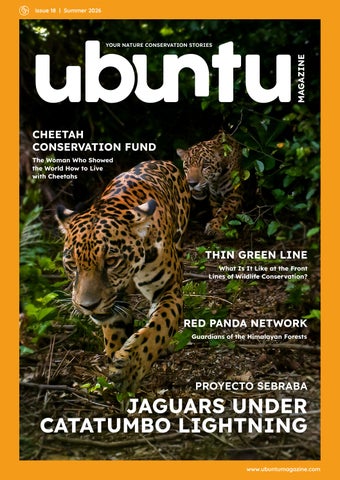
CHEETAH CONSERVATION FUND The Woman Who Showed the World How to Live with Cheetahs
THIN GREEN LINE What Is It Like at the Front Lines of Wildlife Conservation?
RED PANDA NETWORK Guardians of the Himalayan Forests
PROYECTO SEBRABA
JAGUARS UNDER CATATUMBO LIGHTNING www.ubuntumagazine.com
Transform Your Perspective on Nature. Follow Ubuntu Magazine’s Social Channels! Cover photo credit: Proyecto Sebraba
Photo credit: Fanny Hackl
JOIN US ONLINE
Instagram @ubuntu.magazine.official
Facebook @ubuntumagazineofficial
LinkedIn @ubuntu-magazine
Website www.ubuntumagazine.com
CONTENTS
06 08 20 34 38
INTRODUCTION
Will Westwood, writer and enthusiast
CHEETAH CONSERVATION FUND The Woman Who Showed The World How To Live With Cheetahs
ENDANGERED SPECIES European population of Atlantic puffins
BOOK REVIEW The Nature of Our Cities - Nadina Galle
REEFSYSTEMS FOUNDATION Restoring Marine Ecosystems One Structure at a Time
50 60 62 72 82
20
RED PANDA NETWORK
Guardians of the Himalayan Forests
ECCB CONGRESS RECAP Beyond the Data
POLAR BEARS INTERNATIONAL
Protecting Polar Futures with Polar Bears International
STARGAZER Fanny Hackl
THIN GREEN LINE
What Is It Like at the Front Lines of Wildlife Conservation?
INTERACTIVE TABLE OF CONTENTS: CLICK TO JUMP TO ARTICLES INSTANTLY!
92 102 104 114 50
PROYECTO SEBRABA
The Jaguars under Catatumbo Lightning
INFOGRAPHIC
The Salmon Lifecycle
MARWELL WILDLIFE TUNISIA May Gazelles Follow the Oryx’s Path
NEW TO NATURE
Galápagos Blue Octopus
INTRODUCTION Writing for Ubuntu for 3 years has connected me with the worldwide effort to protect wildlife, our planet and ourselves. I’ve interviewed people from every continent, in all sorts of roles, who prove that conservation is many things, from researchers to tree-planters to community-builders. In my experience, it can be all too easy to feel like one is not doing enough, or to feel disconnected from nature and conservation. But my perspective has shifted on what it means to be a conservationist and where I find that connection. My own journey as an advocate for nature hasn’t been straightforward. In fact, I didn’t think I had an unusually high interest in the natural world as a child. But a quote from Hamza Yassin, a BritishSudanese wildlife presenter and photographer, articulates the feeling perfectly for me: “I didn’t have more interest (in nature) than other children, I just never lost it.” Perhaps not quite completely true for me, I was first interested in people, studying anthropology at university and wanting to see the world outside the quiet south-west of England. But that love never fully left me, always being drawn to people’s relationship with nature, as well as to our wild primate cousins, about which I gained a master’s degree. Despite never fully losing my fascination with nature, my career took me away from tropical forests to working with my fellow humans, advocating for inclusivity and equality. Even though I value my work, I knew I was missing my connection with the natural world. So when the opportunity to write for Ubuntu came up, I jumped right in, and that love for the wild, connection to nature and passion for its protection returned tenfold. The more I speak with the incredible people on the front line, the more that feeling grows. I believe feeling connected to nature and conservation fuels our excitement and reverence, and that in turn is needed to protect it from continued destruction.
Although the impact of education and knowledge through articles, photography and documentaries can be powerful, I’m sure many will agree there is nothing like viewing wildlife firsthand. It ignites a kind of excited stillness unlike any other experience can offer. Recently, I spotted two white-tailed eagles (very rare in the UK) being chased and harried by a team of crows, whilst a red kite floated back and forth from them. What the nature of the dispute was is a mystery to me, but from the ground, I was absorbed into this moment in the sky. I followed them as they drifted over the farmland until I hit a hedgerow and watched them disappear over the hill, returning to my day job filled with energy from this 5-minute encounter. Appreciation and respect for nature can be the common ground that unites us across cultural and personal divides. The single thing we all have in common is our planet and the ecosystems that protect and connect us all. I am fortunate to live inside the New Forest National Park, surrounded by forest, and even more so to be able to connect with the cutting edge of wildlife conservation through Ubuntu. My hope is that all of us find our connection with the natural world in our own way, either from first-hand sightings, making consumer choices that protect our ecosystems, or reading about amazing conservation projects in this issue of Ubuntu.
- Will Westwood Writer and Enthusiast
7
THE WOMAN WHO SHOWED THE WORLD HOW TO LIVE WITH CHEETAHS
A mother cheetah celebrates her newfound freedom with a signature run following a two-week ordeal to reunite her with her five cubs Photo credit: Cheetah Conservation Fund (CCF)
For more than five decades, Dr. Laurie Marker has fought to secure a future for the world’s fastest land mammal. But her greatest lesson has been that the best way to save cheetahs is not by separating them from people, but by reimagining how humans live alongside the wild.
Written by Kamile Trakimaite
It was the mid-1970s, and Dr. Laurie Marker had traveled from Oregon, USA to Namibia to answer a scientific question: could a cheetah born in captivity learn to hunt and survive in the wild? She proved it was possible, yet the achievement was quickly overshadowed by a different discovery: across Namibia’s farmlands, wild cheetahs were being trapped and killed in extraordinary numbers. When Laurie encountered her first caged wild cheetah, she asked the farmer what he intended to do with it. “I’m going to shoot it,” he replied. Laurie tried to explain that cheetahs were rare, and that having one living on his land should be considered remarkable. To the farmer, however, the animal was neither rare nor remarkable. It was a pest and threat to his livelihood. The exchange lasted only moments, but it changed the direction of Laurie’s life. “That moment of seeing them in trap cages, and realizing how many they were killing, over 800 per year, was just shocking,” she recalls. Laurie had arrived asking whether a captive-born cheetah could return to the wild, and left with a far more urgent question: ‘what was the point of restoring cheetahs to landscapes where people did not want them?’ “We can breed cheetahs in captivity,” she remembers thinking. “But why would we want to bring them back to the wild when farmers are killing them? Maybe we should figure out why farmers are killing them.”
Dr. Laurie Marker, renowned conservationist and Founder & Executive Director of the Cheetah Conservation Fund Photo credit: Felix Kunze
That question would become the foundation of a new approach to the conservation of the apex cat — an approach based on finding ways for communities, livelihoods and wildlife to coexist.
NAMIBIA THE BEGINNING OF A LIFE WITH CHEETAHS Laurie’s path towards becoming one of the world’s pioneering cheetah conservationists began a long way from Africa. Growing up on the West Coast of the United States, she was surrounded by animals from an early age. She rode horses from the time she could walk and developed a practical agricultural background that would later prove crucial to her conservation work.
She began writing to researchers and animal specialists around the world, asking what was known about cheetah health, breeding and behavior. The responses revealed just how little was understood at the time; “When you find out something about cheetahs, let us know,” she was told. “They don’t breed well in captivity. We’re losing them in the wild. They have a short lifespan, and good luck!”
When Laurie moved to Oregon, the plan was not to save a species, but to grow grapes, make wine and run a dairy goat farm. To support those ventures, she took a job at Wildlife Safari, a newly opened wildlife park where she managed the veterinary clinic. The park was one of the few places in the world caring for cheetahs, yet almost nobody knew how to keep them healthy or encourage them to breed.
“But cheetahs took my heart,” Laurie says. She was fascinated by the contradiction. For thousands of years, cheetahs had lived alongside human civilizations. They had been admired by kings, emperors and aristocrats, appearing in art and royal courts across continents. Yet the scientific world knew remarkably little about how they lived.
“THEY DON’T BREED WELL IN CAPTIVITY. WE’RE LOSING THEM IN THE WILD. THEY HAVE A SHORT LIFESPAN, AND GOOD LUCK!” Dr. Laurie with ‘Khayam’, the first ambassador of her species Photo credit: CCF
NAMIBIA Laurie went on to develop what became the most successful cheetah breeding program in North America at the time. She also established the International Studbook for Cheetahs, a registry for captive cheetahs, encouraging zoos to cooperate in managing the breeding and genetics of captive populations. The work brought her into collaboration with scientists from the Smithsonian Institution’s National Zoo and, perhaps unexpectedly, the National Cancer Institute, where researchers were using cuttingedge genetic tools to understand vulnerability at the level of DNA. In the early 1980s, Laurie conducted research together with this team at the Wildlife Safari to uncover one of the species’ most significant vulnerabilities: cheetahs possess exceptionally low genetic diversity. But while science could explain the animal’s biological fragility, Laurie had already seen that genetics was only one part of the crisis — the greatest threat was unfolding beyond the zoos and protected reserves, on working farmland where cheetahs and people were competing for space.
HOW FARMERS BECAME PART OF THE SOLUTION In 1990, as Namibia achieved independence, Laurie moved to the country and founded the Cheetah Conservation Fund (CCF). She had spent years traveling through Africa, trying to understand where cheetahs might have the best chance of survival, and waiting for an established conservation organization to make the species a priority. At the time, most wildlife research concentrated on animals living inside national parks and reserves. Researchers observed predators through binoculars, counted them and documented their behavior. Laurie recognized that this approach overlooked the fact that most of the animals lived outside protected areas. They moved across privately owned ranches, commercial farms and communal land. Their future was therefore inseparable from the decisions of the people who lived there. “To save the cheetah, we needed to actually work with people,” she says.
Dr. Laurie Marker assisting in the rescue of a captured cheetah after receiving a call from a Namibian farmer Photo credit: CCF
NAMIBIA It was an uncomfortable idea for parts of the conservation world. Protecting wildlife had often been framed as protecting animals from humans. Laurie’s approach asked conservationists to listen to farmers, understand their fears and recognize the serious financial consequences of losing livestock. “Many animal people don’t really want to hang out with people. They’d rather work with animals,” she says. “But I realized that the people were not only our problem; they were our solution.” This is where the philosophy behind the Cheetah Conservation Fund came from. “I wanted to try to share what I knew about the cheetah and learn from the people on whose land the cheetah was living,” she says, “and find out if there was a way that they could live together.” Laurie and her team began fitting cheetahs with radio collars, releasing them and tracking their movements. They studied the size of their territories, their routes across farms and the trees they used to mark their presence. Those marking trees revealed an important pattern, and farmers had learned that cheetahs returned to them and were placing cage traps nearby. Understanding cheetah behavior, therefore, helped explain where and why the animals were being captured. Just as importantly, Laurie investigated whether cheetahs were responsible for as many livestock deaths as farmers believed. The conflict was sometimes driven as much by fear and perception as by evidence. Scientific findings were brought back to the farming communities, and the research was turned into practical advice for the farmers, who were treated as participants in designing the solution to protect the cheetah. The Cheetah Conservation Fund gradually became a working model of coexistence, combining wildlife research with livestock management, habitat restoration, education and rural development. But perhaps its most recognizable success walks on four legs.
Dr. Laurie Marker examines a cheetah at CCF’s center in Namibia, recognized globally as a model for integrated conservation, research, and education Photo credit: CCF
“I WANTED TO TRY TO SHARE WHAT I KNEW ABOUT THE CHEETAH AND LEARN FROM THE PEOPLE ON WHOSE LAND THE CHEETAH WAS LIVING, AND FIND OUT IF THERE WAS A WAY THAT THEY COULD LIVE TOGETHER.” 13
NAMIBIA
Livestock guardian dog at work Photo credit: Suzi Eszterhas
THE INTRODUCTION OF THE LIVESTOCK GUARDIAN DOG During Laurie’s years in Oregon, livestock guardian dogs from Europe were being trialed among sheep and cattle farmers. Unlike herding breeds, which move livestock under human direction, guardian dogs grow up among the flock and instinctively protect it. Laurie wondered whether these dogs could work in Namibia. After considering around 20 breeds of guarding dogs, she selected the Anatolian Shepherd, also known as the Turkish Kangal. Powerful, independent and able to endure wide temperature fluctuations, the dogs were well suited to Namibia’s open, semi-arid landscape. And so, the first 10 arrived in Namibia in 1994. Placed with livestock from puppyhood, the dogs grow up as part of the herd. When a cheetah, leopard or other predator approaches, the dog positions itself between the threat and the animals under its protection, barking a warning across the landscape.
14
“They stand with their flock and bark loudly and basically say, ‘Really, if you want to come and deal with my flock, you’re going to have to deal with me, and I’m big and I’m mean.’” Yet away from danger, their temperament is often remarkably gentle. “They’re discerning,” Laurie explains. That ability to distinguish a true threat from an ordinary presence is central to their success. The predator retreats, the livestock survives and the farmer no longer feels compelled to trap or shoot the cheetah in retaliation. More than 800 dogs have now been bred and placed with farming communities through the program, with participating farmers experiencing significant reductions in livestock losses of between 80 and 100 percent. CCF’s livestock guardian dog program has crossed economic and political divides, supporting communal and commercial farmers alike. Namibia’s founding president, His Excellency Dr. Sam Nujoma, initially questioned why Laurie was focusing on cheetahs when the young country faced so many human challenges.
NAMIBIA
Photo credit: CCF
“I’ll show you that working with cheetahs is going to be about people,” she told him. Nujoma, himself a farmer, eventually requested one of the dogs for his own livestock. Impressed by its effectiveness, he became an advocate for cheetah conservation and served as CCF’s international patron for more than 25 years. The program’s strength lies in its simplicity: when livestock is protected, farmers no longer need to kill the predators they fear.
“THE PROGRAM’S STRENGTH LIES IN ITS SIMPLICITY: WHEN LIVESTOCK IS PROTECTED, FARMERS NO LONGER NEED TO KILL THE PREDATORS THEY FEAR.”
PRESERVING THE GENETICS OF A VULNERABLE SPECIES Even when human conflict is reduced, cheetahs remain genetically vulnerable. The species experienced a severe population decline, often referred to as a bottleneck, around the end of the last Ice Age. Only a small number survived, leaving today’s cheetahs unusually closely related. Genomic studies suggest that cheetahs retain just 0.1 to 4 percent of the genetic variation found in most living species. As modern populations shrink and become separated by roads, farms and expanding settlements, their remaining genetic diversity is reduced even further. “There are only around 7,000 cheetahs left in the world,” Laurie says. “They’re found in about 33 populations, of which 20 are under 100 individuals.” Small, isolated groups are more likely to breed with related individuals, increasing reproductive difficulties and leaving populations vulnerable to disease. Laurie says their collaborative research observes abnormalities of 70 to 80 percent in all cheetah sperm.
15
NAMIBIA At the CCF’s center in Namibia, research is taking place to preserve the genetic variation that the cheetahs still have. The organization has a biobank (or “frozen zoo”) containing blood, tissue, reproductive material and sperm from wild cheetahs. More than 300 males are represented in its sperm bank, with samples preserved in liquid nitrogen. Many of these cheetahs were captured by farmers, examined by CCF researchers, fitted with tracking collars and returned to the wild. By collecting genetic material before their release, the team preserved something that might otherwise disappear with the animal.
As reproductive technologies improve, the material may one day help strengthen genetically depleted wild populations or support carefully managed breeding programs. “When you’ve got small populations, each one of those animals has a unique mixture of its small gene pool, and inbreeding is more prevalent with small populations” Laurie explains. “We don’t want to lose any of those genes, but we also want to try to diversify them, which can only occur with allowing gene flow through animal movement or through potential artificial reproduction strategies.”
“THERE ARE ONLY AROUND 7,000 CHEETAHS LEFT IN THE WORLD, THEY’RE FOUND IN ABOUT 33 POPULATIONS, OF WHICH 20 ARE UNDER 100 INDIVIDUALS.” A rescued cheetah in Namibia getting an examination by CCF Veterinary team before being released Photo credit: CCF
NAMIBIA RESCUING CHEETAHS FROM SOMALILAND’S WILDLIFE TRADE After decades of work in Namibia, Laurie might once have believed she understood the full scale of the challenge. Then came Somaliland. Across the Horn of Africa, cheetah cubs are taken from the wild to supply the illegal exotic pet trade. Their mothers are often killed, and the young poached animals are illegally transported through harsh landscapes and across the Gulf of Aden in small boats before being sold to buyers in the Arabian Peninsula. Over eight years, CCF’s center in Somaliland received many confiscated cubs of which they are now caring for 128 confiscated cubs from the illegal wildlife pet trade. Caring for them has required an enormous veterinary and logistical response, but Laurie knows that rescue alone cannot stop the trafficking. The organization is now adapting lessons developed in Namibia: conducting biodiversity surveys and camera trapping, working with communities, supporting education, developing conservancies and helping create the foundations of a national protectedarea network. Somaliland is a democratic breakaway from Somalia and not internationally recognized as an independent state. Its conservation infrastructure is limited, and the trade routes extend across unstable borders. Yet this is precisely where the work must happen. “It is a country that is not even recognized,” Laurie says, “but that’s where the cheetah is.” Cheetahs cannot be saved only where conservation is convenient, well-funded or politically straightforward. They must be protected wherever they remain.
THE LASTING LEGACY OF THE CHEETAH CONSERVATION FUND When asked about what Dr. Laurie Marker considers her greatest achievement within a lifetime of saving a species, she does not begin with scientific discoveries, reintroductions or the number of cheetahs saved. She speaks instead about people. More than 1.5 million school learners have participated in CCF’s educational program, either at its center or through school outreach. A couple thousand interns have passed through its training program. Many are now researchers, teachers, veterinarians, ecologists, conservationists and government wildlife leaders. “These kids now are running the country,” Laurie reminds us. “The work that they’re doing is the reverberation of what we believe in,” she says. “That we as humans can live together with nature, and we will show you how.” For women entering conservation — particularly in places like Namibia, where science may not be commonly presented as a path open to women — her advice is that “you can do anything you want to do. Just do it,” she says. “Women help women. Be strong and tough and stick to your principles.” CCF grew into a model farm, research center, genetics laboratory, education hub and training ground for future conservationists. Its programs now stretch from livestock management and habitat restoration to school outreach, international research and policy. On farms across Namibia, guardian dogs stand watch beside their flocks. In laboratories, irreplaceable genetic material is stored. In classrooms, children learn that predators are not intruders but essential parts of living ecosystems.
“THE WORK THAT THEY’RE DOING IS THE REVERBERATION OF WHAT WE BELIEVE IN,” SHE SAYS. “THAT WE AS HUMANS CAN LIVE TOGETHER WITH NATURE, AND WE WILL SHOW YOU HOW.” 17
NAMIBIA And across the world, conservationists trained by Dr. Laurie Marker are carrying her philosophy into landscapes of their own. More than 50 years after cheetahs first took her heart, Laurie is still showing the world that saving them was never only about the cheetah, but about changing how humans choose to live alongside them. To learn more about the Cheetah Conservation Fund’s research, education, volunteering and conservation programs, visit: Website www.cheetah.org
Instagram @ccfcheetah
LinkedIn @Dr. Laurie Marker
LinkedIn @Cheetah Conservation Fund
Facebook @Dr. Laurie Marker
Facebook @CCF Cheetah
Dr. Laurie Marker pictured in front of the dairy farm that services the organization’s 156k acre private cheetah reserve in Namibia Photo credit: CCF
18
An adult cheetah at the Cheetah Conservation Fund’s center in Otjiwarongo, Namibia Photo credit: CCF
ENDANGERED SPECIES
ATLANTIC PUFFIN
With their bright, painted beaks and comic, waddling gait, Atlantic puffins seem almost too whimsical to belong to the wild North Atlantic. To encounter them on land is, in fact, an experience that feels almost magical. Yet these “clowns of the sea” or “sea parrots” — as they are often called — are highly adapted seabirds, well suited to the harsh and unpredictable oceans they inhabit. Behind their charm lies a remarkable survivor, built for cliff colonies, lifelong partnerships, and annual migrations across vast expanses of water. Today, however, puffins face growing threats from warming oceans, overfishing, and shifting marine ecosystems. Now classified as Vulnerable globally and Endangered in Europe, the species is facing an uncertain future. As conservationists race to protect these seabirds and the fragile marine webs that sustain them, puffins have become more than beloved icons of the northern coastlines — they are sentinels of a changing ocean.
Written by Flavia Manieri
Photo credit: Manon Verijdt
QUICK FACTS
ATLANTIC PUFFIN (Fratercula arctica)
Weight: 320–550 grams (roughly the weight of a can of soda) Height: 26–29 centimeters Wingspan: 47–63 centimeters Life span: Over 20 years in the wild Habitat: Coastal cliffs, rocky islands, offshore waters
RANGE: From the European Arctic across the Atlantic Ocean to north-eastern America DISTRIBUTION: Around 80% of Europe’s puffins breed in Iceland and Norway; about 10% breed in the UK; remaining populations are found across the North Atlantic, including Ireland, Greenland, the Faroe Islands, Canada, coastal North America, with smaller colonies in France and Russia. POPULATION: Global population estimate:
12–14 million mature individuals
European population estimate:
9.5–11.6 million mature individuals
IUCN Red List status: Vulnerable globally; Endangered in Europe Current Population Trend: Decreasing
22
ENDANGERED SPECIES Atlantic puffins are one of the most beloved seabirds of the North Atlantic, instantly recognizable along windswept coasts during the breeding season. These seabirds, not much bigger than pigeons, belong to an ancient lineage that has been evolving for over 20 million years, with the modern Atlantic puffin shaped by the changing seas and Ice Age cycles. Part of the auk family, the Atlantic puffin is the smallest of the three puffin species, more compact than its horned and tufted relatives of the North Pacific, yet every bit as striking in color and form. The species was first formally described by the Swedish naturalist Carl Linnaeus in 1758 under the name Alca Arctica; it was later reclassified to its current name, Fratercula arctica, by French zoologist Mathurin Jacques Brisson. Its scientific name, meaning “little Arctic friar”, may seem curious at first, but the most widely accepted explanation is that puffins’ black-and-white plumage reminded early observers of the monastic robes worn by friars. Perhaps it is no surprise, then, that puffins found their way into folklore. In Irish tradition, they
were believed to house the souls of monks, their upright posture and bowed heads echoing figures in solemn contemplation. In Icelandic folklore, puffins were thought to predict bad weather, their offshore lives placing them at the edge of the known world, where sea and sky merge into uncertainty. A creature that spends most of its life beyond the horizon must be a natural interpreter of the weather’s moods. Elsewhere, puffins became symbols of abundance. To mariners in North America, a puffin returning with a beak full of fish signaled rich waters, and the promise of successful catches and full nets. Whether or not they foretold storms or carried wandering souls, puffins clearly captured the imagination of those who shared the North Atlantic with them. Today, however, the world they navigate has grown unforgiving. Storms are fiercer, ancient rhythms are being disrupted, and the seas that once sustained generations of puffins are becoming ever more uncertain. Atlantic puffins now face threats more suited to dystopian fiction than to folklore.
Photo credit: Hans-Jurgen Mager | Unsplash
ENDANGERED SPECIES ECOLOGY Atlantic puffins are highly specialized seabirds, spending most of their lives on the open ocean and returning to land only to breed. They have a stocky, compact body, bright orange webbed feet, and a distinctive triangular bill marked with bands of red, yellow, and orange, along with striking red and black eye markings. Yet the famous colorful beak is not permanent; the bright outer plates develop ahead of the breeding season and play an important role in courtship and mate attraction. Long-term partners often greet one another by rubbing their bills together in a behavior known as “billing”, a courtship display that helps reinforce pair bonds when they reunite on land after spending months apart at sea. Once breeding is over, the colorful plates are shed, revealing a smaller and duller bill beneath. Their facial feathers also darken, giving them a more uniform grey appearance. These seasonal changes help puffins blend into their open-ocean environment during the winter months, providing camouflage from predators. The iconic “puffin look” is therefore a seasonal transformation, worn only for part of the year.
Their black back, wings, and crown form a dark cape over a white belly and pale cheeks, and their upright stance gives them a curious, almost penguin-like appearance when standing on land. Despite their somewhat clumsy movements ashore, puffins are superbly adapted to life at sea and very agile in the air and underwater. Their short, powerful wings can beat up to 400 times per minute in flight, allowing them to reach speeds of around 80 km/h. Beneath the surface, those same wings act like flippers, propelling the birds through the water as they pursue fish. Puffins are excellent divers, routinely reaching depths of 30–60 meters and sometimes diving even deeper in search of prey. Their waterproof plumage provides insulation against the cold North Atlantic, while their compact bodies help conserve heat and reduce drag both in flight and underwater. Although found on both sides of the North Atlantic, the species is overwhelmingly concentrated in Europe, which supports nearly 90% of the global breeding population. During the breeding season (from April to August), puffins gather in colonies
Long-term partners often greet one another by rubbing their bills together in a behavior known as “billing” Photo credit: Ben Lande | Unsplash
The chick, known as a ‘puffling’, remains hidden within the safety of the burrow for around six weeks, sheltered from predators Photo credit: Anders93 | Adobe stock on coastal cliffs, rocky islands, and grassy headlands, where they excavate burrows in soft soil or nest among rocky crevices. Some colonies number only a few dozen pairs, while others support hundreds of thousands of birds. Unlike many seabirds, puffins are believed to mate for life, with long-term partners returning to the same breeding colonies year after year. They lay just a single egg each year, and both parents share incubation duties before working together to feed their chick, known as a puffling. The puffling remains hidden within the safety of the burrow for around six weeks, sheltered from predators, before emerging at night to make its first journey to sea under the cover of darkness.
Once the breeding season ends, adults depart the colonies and disperse widely across the North Atlantic, ranging through the North Sea and into Arctic waters, with some individuals travelling as far south as the Mediterranean. Tracking studies, including research from colonies such as Skomer Island, have shown that these migration routes are highly individual rather than shared. Birds from the same colony may winter in completely different parts of the ocean, and each puffin tends to repeat its own route year after year with remarkable consistency. These paths are not inherited or followed collectively, but appear to be learned early in life and maintained across the bird’s lifespan.
FUN FACT: PUFFINS GLOW UNDER UV LIGHT
Atlantic puffins are one of the few bird species known to exhibit biofluorescence. Research has shown that parts of their colorful breeding bill absorb ultraviolet light and re-emit it as a yellowgreen glow. Scientists are still investigating its purpose, but it may play a role in courtship and communication, revealing a hidden layer of color invisible to the human eye.
25
ENDANGERED SPECIES Pufflings, however, do not travel alongside their parents. The chick sets out alone on its first migration, navigating independently across vast ocean distances. Researchers suggest that this initial journey is guided purely by instinct, specifically by using the moonlight and starlight reflecting off the water to guide their flight. Once established, the puffling’s route becomes its own, distinct from its parents and other members of the colony. Upon reaching the sea, the puffling immediately begins swimming and feeding independently. It will spend the next four to five years entirely at sea, growing and surviving far from land, returning only once it reaches breeding age. Until then, its life remains wholly ocean-bound. Puffins feed primarily on small schooling fish such as sand eels, herring, capelin, and sprat. Their colorful bills are more than ornamental; a specialized hinge in their jaw and spiny tongues allow them to hold multiple fish at once while continuing to catch more. This remarkable adaptation enables adults to return to their nests carrying several fish in a single trip, sometimes more than a dozen at a time. In fact, the record for an Atlantic puffin is 83 sand eels carried in one bill load. During the breeding season, adults may make repeated foraging journeys each day to provide enough food for their growing chick.
FUN FACT: PUFFINS USE TOOLS
Atlantic puffins have been observed using sticks to scratch and groom themselves, providing the first documented evidence of tool use in a seabird. The behavior was recorded in both Iceland and Wales, where puffins were seen picking up small twigs and using them to reach parts of their bodies. Scientists believe the tools may help remove parasites or soothe irritated skin, revealing an unexpected level of ingenuity in these charismatic seabirds.
26
ENDANGERED SPECIES
Photo credit: Lukasz Szramuk | Unsplash 27
ENDANGERED SPECIES THREATS For centuries, Atlantic puffins have endured the harsh conditions of the North Atlantic, but today they face a growing number of pressures, many of them driven by human activity. The consequences of these pressures are already being felt across Europe. In the United Kingdom, for example, the 2023 Seabirds Count census found that puffin numbers had fallen by approximately 23% over the previous two decades at sites with consistent long-term monitoring data. CLIMATE CHANGE Climate change is widely regarded as the greatest long-term threat facing Atlantic puffins. As sea temperatures rise, the distribution, abundance, and availability of sand eel populations are changing, making it increasingly difficult for puffins to find enough food during the breeding season. The effects can be devastating. In years when food is scarce, adults may struggle to raise their single chick successfully, leading to widespread breeding failures. Climate change is also increasing the frequency and intensity of storms across the North Atlantic. Severe weather can prevent puffins from feeding effectively when they are out at sea, leaving birds exhausted and starving. Recent events have highlighted just how vulnerable puffins are to increasingly extreme weather. In early 2026, tens of thousands of seabirds, including large numbers of puffins, washed up dead or starving along coastlines from Portugal to Scotland in what experts described as the largest seabird “wreck” in a decade. More than 38,000 stranded birds were recorded across western Europe after a series of severe Atlantic storms disrupted feeding conditions at sea. Scientists warned that as climate change increases the frequency and intensity of extreme weather events, such mass mortality incidents could become more common. OVERFISHING AND DECLINING FISH STOCKS The challenges created by climate change are often compounded by commercial fishing. Across the North Atlantic, industrial fisheries have
28
historically removed large quantities of forage fish, including sand eels, herring, and capelin, reducing the availability of prey for seabirds and marine mammals. In parts of northern Europe, sand eel fisheries have been a particular concern, as these fish form a key part of the marine food web during the puffin’s breeding season. When these fish are less abundant or harder to access, breeding success can decline, particularly in years when ocean conditions are poor. ENTANGLEMENT IN FISHING GEAR Like many seabirds, puffins can become accidentally caught in fishing gear. Gillnets and other fishing equipment pose a particular risk, especially when birds are diving underwater in pursuit of prey — entanglement can lead to injury, starvation, or drowning.
ENDANGERED SPECIES POLLUTION Marine pollution presents a persistent threat to Atlantic puffins. Oil pollution, though episodic, remains a severe hazard. Even small spills can coat feathers, destroying their natural waterproofing and insulation. Once compromised, birds quickly lose body heat, becoming vulnerable to hypothermia, drowning, and toxic exposure. Plastic and other marine debris are also an increasing concern, contributing to sublethal stress through ingestion and contamination. PREDATORS Atlantic puffins evolved to breed on remote islands and steep coastal cliffs largely free from ground predators. As a result, they are poorly equipped to cope with introduced predators such as rats, ferrets, foxes, and cats. When these predators
reach breeding islands, they can consume eggs, chicks, and even adult birds, devastating entire colonies. AVIAN INFLUENZA In recent years, outbreaks of highly pathogenic avian influenza have emerged as an additional threat to seabird populations across the North Atlantic. The virus has caused significant mortality in several species, including gulls, terns, and other colonial seabirds that share breeding sites with Atlantic puffins. While puffins are not always the most heavily affected species, the close proximity of dense breeding colonies can facilitate the spread of disease once it reaches a site. The full long-term impacts of avian influenza on puffin populations are still not fully understood, but
Puffins face all kinds of threats at sea, such as overfishing, entanglement and pollution Photo credit: Nik Shuliahin | Unsplash
ENDANGERED SPECIES
“INDIVIDUALLY, EACH OF THESE THREATS PRESENTS A CHALLENGE. TOGETHER, THEY CREATE A COMPLEX WEB OF PRESSURES THAT IS TESTING THE RESILIENCE OF ONE OF THE NORTH ATLANTIC’S MOST ICONIC SEABIRDS.” the scale of recent outbreaks has raised concern among conservationists monitoring vulnerable seabird colonies. During the 2022-2023 outbreak, around 10,000 birds are believed to have died on the Farne Islands off the coast of Northumberland in England, with more than 900 puffin carcasses recorded, showing that even species considered relatively resilient were not spared. OFFSHORE DEVELOPMENT Offshore development presents an additional challenge for Atlantic puffins. Large-scale wind farms and associated infrastructure can be built in areas that overlap with key feeding grounds, where puffins rely on dense shoals of small fish during the breeding season. These developments may lead to habitat displacement, increased disturbance, and changes in the availability of prey within the foraging range of breeding colonies. A notable example is the proposed Berwick Bank offshore wind farm off the east coast of Scotland, which would be located close to major seabird colonies such as the Isle of May and Bass Rock, both important breeding areas for Atlantic puffins. Concerns about these developments have been raised by conservation organizations, including the Royal Society for the Protection of Birds (RSPB), which highlights the potential risks that offshore wind farms can pose to seabirds when placed in sensitive marine environments. HUNTING Puffin hunting in Iceland dates back to the Middle Ages, when coastal communities relied on seabirds as an important source of food for survival. Today, Iceland remains the only country
30
where puffin hunting is still permitted on the grounds of tradition, although the practice has changed significantly in both scale and meaning. In the past, puffin meat was a staple in some coastal diets. More recently, however, consumption has declined sharply, with reports suggesting that much of what is now eaten is linked to tourism, as visitors seek out what is marketed as a traditional Icelandic delicacy. For many locals, it is increasingly seen as a practice of the past rather than part of everyday life. Official figures reflect this long-term decline. According to the Environment Agency of Iceland, around 23,000 puffins were hunted in 2023, compared with approximately 250,000 in 1995. Despite this reduction, conservationists have called for a complete ban on puffin hunting, as well as restrictions on the sale of puffin meat, arguing that continued take is difficult to justify given the species’ wider population pressures. Those pressures are already evident in the wider Icelandic population. Surveys from the South Iceland Nature Research Centre indicate that puffin numbers in Iceland have fallen from around eight million in 1995 to roughly 3.5 million in 2022. While no nationwide ban is currently in place, management measures now vary depending on local colony status, reflecting the growing tension between tradition, regulation, and conservation concerns. Individually, each of these threats presents a challenge. Together, they create a complex web of pressures that is testing the resilience of one of the North Atlantic’s most iconic seabirds.
ENDANGERED SPECIES
Ensuring that puffins have enough food is increasingly recognized as a conservation priority Photo credit: Tim Morgan | Unsplash
CONSERVATION EFFORTS Despite the challenges facing Atlantic puffins, conservation successes across the North Atlantic demonstrate that targeted action can make a real difference. From restoring breeding islands to protecting food sources, a growing number of initiatives are helping to safeguard these beloved seabirds. MANAGING HABITATS Many of the most successful puffin conservation projects have focused on removing invasive predators from breeding islands. One notable success story comes from Rathlin Island in Northern Ireland, where an ambitious seabird recovery project, LIFE Raft, removed invasive brown rats and feral ferrets from the island. Following their removal, breeding success improved, with puffins
now returning each year to the delight of staff at the RSPB West Light Seabird Centre. A similar approach has delivered strong results on Lundy Island in southwest England. After the complete removal of invasive rats, puffin numbers increased dramatically, demonstrating how quickly seabird populations can respond when nesting sites are made safe again. Habitat management is not limited to controlling invasive animals; managing vegetation can be equally important for breeding seabirds. On Scotland’s Fidra Island, the rapid spread of invasive tree mallow in the early 2000s reduced accessible nesting habitat by blocking burrow entrances across large areas of the colony. Targeted removal and long-term vegetation management have since
31
ENDANGERED SPECIES helped restore breeding habitat, allowing puffins to continue nesting on the island and maintaining a colony estimated at several hundred breeding pairs. Recent monitoring recorded more than 900 apparently occupied burrows in 2024, based on surveys carried out by Scottish Seabird Centre staff and volunteers. PROTECTING FOOD SUPPLIES Ensuring that puffins have enough food is increasingly recognized as a conservation priority. In recent years, conservation organizations have campaigned for stronger protections for sand eels. A major breakthrough came with the closure of industrial sand eel fisheries in English and Scottish waters of the North Sea, reducing competition between commercial fishing fleets and seabirds for this vital food source. Although climate change continues to alter marine ecosystems, protecting forage fish populations improves the chances of puffins successfully raising their chicks during the breeding season. PUFFLING PATROLS Not all conservation work takes place at sea. In Iceland, local communities play a hands-on role in protecting Atlantic Puffins through annual “Puffling Patrols”. Each late summer, young puffins leave
32 credit: James Armes | Unsplash Photo
their burrows at night and make their first journey towards the ocean. On the island of Heimaey in the Vestmannaeyjar archipelago, home to one of the world’s largest Atlantic puffin colonies, artificial lights from the town and harbor can disorient pufflings, drawing them inland instead of out to sea. During this critical period, volunteers search streets, rooftops, and harbors after dark to locate stranded pufflings. The birds are carefully collected in boxes and taken home for safekeeping overnight, a longstanding island tradition that has evolved into a well-organized community conservation effort. The following day, any injured pufflings or those requiring additional care are taken to the Puffin Rescue Centre, where they are assessed before being released to begin their journey out to sea. In a single season, thousands of pufflings may be rescued. In 2024 alone, more than 4,000 birds were assisted during the peak fledging period. Alongside direct rescue work, Puffling Patrols also contribute valuable data to scientists studying puffin populations and survival at sea, offering rare insight into the early life stages of a species that is otherwise extremely difficult to monitor.
ENDANGERED SPECIES REASONS FOR HOPE The enduring fascination puffins inspire may ultimately prove one of their most valuable allies. Few seabirds enjoy the same level of public recognition and support. From the annual Puffling Patrols in Iceland to researchers monitoring colonies across the North Atlantic coastlines, thousands of people dedicate their time to protecting puffins and the places they call home. This widespread enthusiasm helps generate support for conservation measures, scientific research, and public awareness campaigns. Between 2016 and 2021, more than 600 citizen scientists took part in the RSPB’s Puffarazzi project, submitting photographs of puffins carrying fish in their bills. By analyzing these images, researchers gained valuable insights into the prey species being fed to chicks at colonies around the UK. By sharing their observations and photographs, volunteers helped scientists collect large-scale data that would otherwise have been difficult to obtain, providing valuable insights into puffin diets and the changing health of marine ecosystems. Wildlife tourism also has an important role to play. Puffins attract thousands of visitors to coastal
communities each year, generating income that can support local economies, nature reserves, and conservation initiatives. At the same time, poorly managed tourism can disturb breeding birds, particularly if visitors approach colonies too closely or stray from designated paths. For this reason, responsible wildlife tourism is essential. At the RSPB Bempton Cliffs reserve, the UK’s largest mainland seabird colony, visitors can watch puffins alongside gannets, kittiwakes, and guillemots from designated viewpoints behind protective fences, allowing the birds to nest undisturbed on the spectacular chalk cliffs below. The reserve’s purpose-built viewing areas provide sweeping views of both the birds and their dramatic coastal habitat, while keeping people away from sensitive nesting sites. It is a strong example of how carefully managed wildlife tourism can support local economies and conservation at the same time. The future of the Atlantic puffin remains uncertain, particularly as climate change continues to reshape marine ecosystems. Yet the species’ story is not solely one of decline. Conservation successes across Europe and beyond show that practical action can work, while growing public engagement, scientific research, and international cooperation offer genuine reasons for hope.
BOOK REVIEW
THE NATURE OF OUR CITIES
BY NADINA GALLE An overheated urban sprawl, polluted and smog-filled, drowning in sweltering heat, with its infrastructure failing to keep up. A city cracking under the immense pressure from the new reality of a changing climate where air conditioners overload power grids, wildfires are a frequent, dreaded threat, and floods visit your home every year, guaranteed. This is a city without nature, and it is the opening chapter of Dr. Nadina Galle’s “The Nature of Our Cities”. While I read those first few pages behind a fan with my curtains drawn as another heatwave hits Europe, I realize that Galle isn’t talking about the future; she is speaking about the present. Yet, the story is not one of lost hope or doom. It is about utilizing the very thing we overlook between the skyscrapers and busy shopping streets of our cities: nature.
Written by Marc Kranendonk
34
BOOK REVIEW In her book, Galle lays down the facts. In an age where humanity spends 90% of its time indoors, the nature around us has never been more vital for our future. Cities are experiencing a greater number of intense heatwaves, floods, and wildfires caused by a changing global climate. Compounded, the destruction is devastating on many socioeconomic levels, from infrastructure costs to mental health issues. While extreme natural phenomena become more frequent, nature also holds untapped potential to strengthen and fortify our cities and suburbs from this new reality. From flood preparation to combating intense urban heat, Galle demonstrates that nature in our cities is our best shot at tackling the reality of our climate crisis, yet with help from technology. In “The Nature of Our Cities”, Galle embarks on a journey across the world to demonstrate her concept of “Internet of Nature”, which describes how people are using technology to unlock the power of nature to save cities. For instance, she discusses how wildfire-stricken areas are also most prone to flooding, because while trees burn very well, they also drain the soil of excess water. Their network of roots is a natural flood protector, but if wildfires wipe them out more than once in half a decade, they never develop the root network to prevent the floods. Knowing that trees are an answer to flood protection, scientists, practitioners, and foresters, inspired by Indigenous cultural burning practices, developed
“IN “THE NATURE OF OUR CITIES”, GALLE EMBARKS ON A JOURNEY ACROSS THE WORLD TO DEMONSTRATE HER CONCEPT OF “INTERNET OF NATURE”, WHICH DESCRIBES HOW PEOPLE ARE USING TECHNOLOGY TO UNLOCK THE POWER OF NATURE TO SAVE CITIES.”
AI-powered robots that prevent wildfires from reaching urban areas. While the technology and innovations described in this book are enlightening, it is the people behind them and their stories that draw you in. One of the many remarkable characters is Jared Hanley, a son of Navajo Reservation to Peace Corps parents, who took up kayaking, skiing, mountaineering, and mountain biking with his father when they lived in rural Washington during the 1980s. During that period, Jared discovered the sport of adventure racing, a ten-day checkpointto-checkpoint race that combined all the activities he loved. His career in the sport spanned 15 years and coincided with a regular office job as a data scientist for an investment bank. In his heart, Jared was a nature lover, but he would move on from the rural world and work for companies like Lehman Brothers and big tech players such as PayPal. During his time in the sphere of Wall Street, he couldn’t stop noticing how he and his colleagues abstracted the concept of “value” from any relation to social good. This simply didn’t sit well with him, but the opportunity to break from this mindset and gain a fresh perspective came through a move to Eugene, Oregon. There, on muddy trail paths between Douglas firs, Jared would find his new purpose. Combining his career background with his love for nature, Jared cofounded NatureQuant with the mandate of quantifying nature. Attaching tangible value to nature that shows, in numbers, the benefits it can provide. One example of how they achieve this is through NatureScore, which determines the quality and quantity of natural elements for a location, using multiple data sources to deliver a score that maximizes the health benefits of nature exposure. Such data insights are important because scientific research has revealed that proximity to nature results in a significant improvement in life expectancy, positively mitigating respiratory and cardiac health concerns. Therefore, this technology can identify at-risk neighborhoods, giving nature a fiscal value for private and public organizations to see its potential.
35
BOOK REVIEW But “The Nature of Our Cities” shouldn’t be viewed as a technocratic-driven book that glorifies how technology can be our greatest tool to combat climate change in cities. This is not what Nadine, Jared, and the many people behind the technologies want to show. Instead, it is an optimistic take on how nature and technology together hold the solution to prevalent issues arising from our changing climate.
“IT IS AN OPTIMISTIC TAKE ON HOW NATURE AND TECHNOLOGY TOGETHER HOLD THE SOLUTION TO PREVALENT ISSUES ARISING FROM OUR CHANGING CLIMATE.”
Galle illustrates the future of urban life as dependent on a balance between the natural world and the technology that can help sustain it. Every chapter is an exploration of a new facet and topic, building on concepts and walking you through them with a vivid, narrative-driven approach. This book is about looking up from our screens, observing the world around us, appreciating nature as a companion, and then using the technology in front of us to do something about protecting and utilizing it in a mutually beneficial manner. It’s a palatable, imaginative, and pragmatically informative journey that will hopefully have you come away more acutely aware of the environment around you in a setting where nature is often treated as an afterthought.
Get the book: www.nadinagalle.com
Nadina Galle, hanging 130 feet up a Douglas fir in Eugene, Oregon, with Scott Altenhoff, one of the many urban foresters convincing people to climb trees so they’ll fall a little in love with them
36
37
Artificial reef in Shimoni, Kenya Photo credit: ReefSystems
GLOBAL
RESTORING MARINE ECOSYSTEMS,
ONE STRUCTURE AT A TIME When Max Dijkstra and his partner in restoration, Jesse de Bont, started ReefSystems in 2017, they had no idea how far their passion for protecting marine environments would take them. They are the definition of “think local, act global”. Their innovative modular building system for artificial reefs has helped restore damaged ecosystems around the world. Meanwhile, their sheet pile installations in the Netherlands show that biodiversity can also be greatly improved at a much smaller scale.
Written by Patrizia Baldi
39
GLOBAL HOW ARE YOU DOING, MAX? WHAT’S GOING ON AT REEFSYSTEMS AT THE MOMENT? I’m doing great, thank you. We’ve just returned from Montserrat, a small island in the Caribbean, where we’ve established a local workshop to build an artificial reef. Together with the local team, we’re producing 25 reef structures, each made up of 140 blocks, 3,500 blocks in total. Tomorrow I’m giving a presentation about the project, and later this week we’ll be back in the Netherlands to install a fish habitat for the National Maritime Museum in Amsterdam. So it’s been a busy period, but it’s exactly the kind of work we enjoy.
Photo credit: ReefSystems
LOTS GOING ON! I CAN’T WAIT TO DIVE INTO THE SPECIFICS OF YOUR WORK. BUT FIRST, CAN YOU TELL US A LITTLE MORE ABOUT WHAT INSPIRED YOU TO START REEFSYSTEMS? I’ve been fascinated by the ocean for as long as I can remember. I grew up close to the sea, so I spent a lot of time swimming, surfing and fishing. When I was eighteen, I learned to dive in Koh Tao, Thailand, and that completely changed the way I looked at the underwater world. After travelling for a while, I returned to the Netherlands to study Product Design at the ArtEZ University of the Arts in Arnhem. For my graduation project, I was given complete freedom to choose a topic. Around that time, I found myself reconnecting with the ocean and started researching the challenges marine ecosystems are facing. I wanted to understand whether product design could contribute to solving real environmental problems. That’s when I discovered the global loss of hard substrate caused by activities such as bottom trawling, dredging and destructive fishing practices. Coral reefs, oyster reefs and mussel beds all depend on hard surfaces to grow on. Once those structures disappear, entire ecosystems struggle to recover. I reached out to Professor Dr. Tinka Murk, a marine ecologist at Wageningen University, and together we started developing what eventually became the Modular Sea Life System, at the time better known as the “Fish Hotel”. That graduation project laid the foundation for everything ReefSystems has become today.
40
After graduating, reality kicked in. I needed to earn a living, so I started installing solar panels while continuing to develop the concept in my spare time. Around that time, I also reconnected with Jesse, an old high school friend. We hadn’t seen each other for about a year, and I told him about an upcoming reef restoration project in Kenya. He was immediately enthusiastic. The next day, he called me and simply said, “I’m in”. That was the start of ReefSystems. In the beginning, we were producing just one concrete block a day. It was very much a hands-on startup. As we received our first funding from the Port of Amsterdam and our work started attracting media attention, more opportunities began to appear. Slowly but surely,
GLOBAL Photo credit: ReefSystems
the momentum grew, and we’ve been building on that ever since. CAN YOU TALK TO US ABOUT THE PURPOSE AND MOTIVATION BEHIND WHAT YOU DO WITH REEFSYSTEMS? Human activity has been placing enormous pressure on our natural environment. Still, we don’t see nature and infrastructure as opposing forces. With the right design, they can actually strengthen each other. The main purpose of ReefSystems is to help restore degraded marine ecosystems and implement solutions that make infrastructure more nature-inclusive. One of the core philosophies behind everything we do is
that you can’t restore nature, but you can create the right conditions for nature to restore itself. If you provide a suitable habitat, nature has an incredible ability to bounce back.
“YOU CAN’T RESTORE NATURE, BUT YOU CAN CREATE THE RIGHT CONDITIONS FOR NATURE TO RESTORE ITSELF.” 41
GLOBAL YOU OFFER FOUR DIFFERENT SOLUTIONS TO IMPROVE BIODIVERSITY: MOSES, SPECTER, REEFPOOL AND FLOATING GREENERY. CAN YOU TELL US MORE ABOUT THEM AND WHEN YOU WOULD USE EACH? Our two most widely used solutions are definitely MOSES and SPECTER. MOSES is our modular artificial reef system and can be used for a wide range of marine ecosystems, from tropical coral reefs to oyster and mussel reefs in temperate waters. One of our largest projects is located at Lauwersmeerdijk in the north of the Netherlands, where we’ve already seen an incredible increase in biodiversity. There’s been an explosion of marine
No heavy machinery is needed. One single shipping container can transport more than 1,100 blocks, making the system highly scalable and particularly suitable for remote islands and coastal communities. A good example is our project in Shimoni, Kenya. Local teams transport the blocks using small fishing boats and install them using standard diving equipment. With nothing more than a small dinghy and a team of divers, an entire reef structure of 350 connected blocks can be created. The accessibility is what makes the system so powerful. We designed it to work in places where traditional marine construction simply isn’t feasible.
Lauwersmeerdijk, Netherlands Photo credit: ReefSystems life around it! Our other big MOSES projects are focused on coral reefs in the tropical regions of the world. The unique thing about the MOSES system is its modularity. A reef consists of up to 60 blocks. Because the blocks are relatively small and only weigh about 20 to 23 kilograms, they can easily be transported and installed by hand.
42
SPECTER is quite different. It’s specifically designed for sheet pile walls, which are commonly found along canals, rivers and harbors in the Netherlands. These steel walls are incredibly functional but offer almost no habitat for wildlife. We transform those bare walls into living ecosystems. The planters allow vegetation to root directly into the water, improving water quality by absorbing excess nutrients while creating
GLOBAL shelter for fish below the surface. Above the waterline, they provide habitat for insects, birds and pollinators. Plus, it’s really nice for people to see plants where you would otherwise look at a steel wall. It greatly enhances the quality of living in a city. What I really enjoy seeing in the Netherlands is a trend towards nature-inclusive building. More and more projects consider biodiversity right from the design stage instead of treating it as an afterthought. I think that’s a very positive development, and hopefully it will soon become the standard rather than the exception.
DO YOU MONITOR HOW YOUR PROJECTS SUPPORT BIODIVERSITY? Absolutely. Monitoring is an essential part of every project we carry out. For each project, we are working with local partners, including universities, marine biologists and research institutes, to measure how ecosystems develop over time. That allows us to understand not only whether species are returning, but also why certain designs perform better than others. The results have been incredibly encouraging. Across multiple projects, we’ve seen a rapid increase in biodiversity, from corals and shellfish to fish, crustaceans and many other marine organisms.
Incredible increase in biodiversity around the artificial reef at Lauwersmeerdijk, the Netherlands Photo credit: ReefSystems
43
GLOBAL Every ecosystem is different, but it’s inspiring to see how quickly nature responds once the right habitat is available. Monitoring also allows us to keep improving our designs. Every project teaches us something new, and we use those lessons to make the next project even better. WHERE ARE YOUR SOLUTIONS MANUFACTURED? Keeping sustainability in mind, we design all of our products to have a lifespan of at least 50 to 100 years. For all projects in the Netherlands, we manufacture locally at our production facility in Zaandam, just outside Amsterdam. For most international projects, however, we manufacture directly on site. Transporting large quantities of concrete across the world simply doesn’t make sense. By producing locally, we significantly reduce emissions while also creating employment and building local knowledge. One of our goals is to leave behind more than just an artificial reef. We want to leave behind skills, equipment and opportunities so that local communities can continue restoration work long after we’ve left.
“SEEING LOCAL COMMUNITIES TAKE OWNERSHIP OF THESE PROJECTS IS ONE OF THE MOST REWARDING PARTS OF WHAT WE DO.” HOW ARE YOU ABLE TO IMPACT LIVELIHOODS AND LOCAL COMMUNITIES IN PLACES LIKE KENYA? People living in coastal communities are often among the first to experience the consequences of ecosystem degradation and unsustainable fishing practices. Healthy marine ecosystems are directly linked to their food security and income, so restoring those ecosystems also means investing in the people who depend on them. That’s one of the reasons we started the ReefSystems Foundation. Our mission has never been solely about restoring ecosystems; it has always been about creating a positive impact for communities as well. Through the Foundation, we provide technology, equipment and training to local workshops. Together with local NGOs, fishermen and community organizations, we train people to produce the reef structures themselves. They earn an income through the construction process while developing valuable technical skills and also see the benefits of an improved ecosystem. Over time, these workshops become much more than production facilities; they become community hubs. Seeing local communities take ownership of these projects is one of the most rewarding parts of what we do.
44
Top & bottom: MOSES project Shimoni, Kenya (April, 2021) Photo credit: Ewout Knoester, ReefSystems
WORLDWIDE WHERE NEEDED, YOU ALSO SUPPORT THE TRANSPLANTATION OF CORALS ONTO YOUR ARTIFICIAL REEFS. WITH CLIMATE CHANGE INCREASINGLY THREATENING CORAL REEFS WORLDWIDE, DO YOU SPECIFICALLY FOCUS ON HEAT-RESISTANT CORALS? Ideally, yes. As part of our work in Kenya, we’re supporting a long-term research project that focuses on identifying and cultivating heatresistant corals. This research is being done with REEFolution, which is a local organization started and led by Wageningen University. The most recent global bleaching event devastated reefs around the world, but what fascinated researchers was that some colonies survived despite experiencing exactly the same conditions. Those surviving corals could play a crucial role in the future of reef restoration. There’s also exciting research being done on corals that naturally live in the intertidal zone. These corals can spend several hours exposed during low tide, meaning they’ve already adapted to extreme heat and environmental stress. Cultivating these particular corals could help us build more resilient reefs in the future.
Top & bottom: MOSES project Portobelo, Panama (July, 2021) Photo credit: ReefSystems
WHAT DOES THIS MEAN FOR YOUR WORK WITH ARTIFICIAL REEFS? I don’t think there’s going to be one single solution that saves coral reefs. It’s going to require a combination of better habitat restoration, scientific research, coral propagation, and, ultimately, addressing climate change itself. Our responsibility is to prepare for multiple possible futures. Of course, our hope is that coral reefs recover and continue to thrive. That’s what we’re working towards every day. But at the same time, we also have to acknowledge the reality that climate change may continue to put enormous pressure on these ecosystems. That’s why we don’t design our reefs solely for corals. A healthy coral reef isn’t just about coral; it’s about creating habitat for thousands of different species. Fish need places to hide from predators. Grazing species such as sea urchins and herbivorous fish need shelter so they can keep algae under control. Countless
46
WORLDWIDE small organisms depend on tiny crevices and microhabitats. We therefore design our structures with as much three-dimensional complexity as possible. Even if coral cover changes over time, the reef can continue functioning as a valuable habitat for marine life. HOW IMPORTANT IS COLLABORATION IN THE WORK THAT YOU DO? It’s absolutely essential. Restoring marine ecosystems isn’t something any single organization can do alone. Every successful project we’ve completed has been the result of strong partnerships with scientists, governments, NGOs, contractors and local communities. As a relatively small organization, we’re fortunate to work with experts who each bring knowledge
that we simply don’t have ourselves. Marine biologists understand the ecology, local communities understand their environment better than anyone, and contractors know how to operate safely and efficiently in complex marine conditions. For example, we’re currently in the process of launching a large project on an island in Southeast Asia. Even within a relatively small area, the seabed, currents and ecosystems vary enormously. That means every decision benefits from local expertise. Through past projects we’ve learned that successful restoration is rarely about having all the answers yourself. It’s about bringing together the right people and creating something that none of you could achieve individually. Ultimately, you cannot save the world by yourself.
MOSES project Portobelo, Panama (July, 2021) 47 Photo credit: ReefSystems
WORLDWIDE WHAT HAVE BEEN THE BIGGEST CHALLENGES YOU’VE FACED? Like any startup, the journey has been full of highs and lows. As an entrepreneur, the company never really leaves your mind. You can spend months or even years developing a project, only for it to be cancelled at the very last moment. Things like this can be incredibly difficult to deal with because you’ve invested so much time and energy into making something happen. Finding a healthy balance between work and personal life is another challenge. Our projects often take us to remote locations around the world for weeks at a time. While it’s amazing to work in those places, it also means spending long periods away from our partners, families and friends. Financially, it’s been challenging as well. We don’t sell a standard commercial product. Every project is different, and ecosystem restoration still isn’t something that receives the investment it deserves. As a small company, that means there can be periods of uncertainty.
Founders Max (far left) and Jesse (far right) and local fishermen installing artificial reefs in Shimoni, Kenya Photo credit: ReefSystems
48
But, having said all that, we’ve never started ReefSystems to build the biggest company possible. Our ambition has always been much simpler: to build a healthy organization that allows us to keep restoring ecosystems long-term. As long as we can continue doing meaningful work and growing our impact, we’re happy. AS SOMEONE WORKING IN NATURE CONSERVATION, HOW DO YOU STAY OPTIMISTIC WHEN THE ENVIRONMENTAL NEWS OFTEN SEEMS SO OVERWHELMING? We stay optimistic because I get to see that restoration actually works. It’s easy to become discouraged by the headlines, but when you’re underwater and you see fish returning to a reef that was completely barren just a few years earlier, it’s impossible not to feel hopeful. Nature is incredibly resilient when you give it the chance. But I’m also constantly inspired by the people we meet. Working in restoration means collaborating with scientists, engineers, conservationists and entrepreneurs from all over the world. Everyone approaches
WORLDWIDE problems differently, and there’s so much to learn from each other. Some people believe it’s already too late, but I don’t share that view. The challenges are enormous, but so are the opportunities! More and more people are dedicating their careers to finding solutions, and I genuinely believe that together we can make a meaningful difference. I also don’t see other companies entering this space as competition in the traditional sense. The ocean needs all of us. There’s enough work and enough damaged ecosystems for everyone to contribute. LOOKING BACK, WHAT ACHIEVEMENT ARE YOU MOST PROUD OF? More than any single project, I’m proud that we kept going. Eight years ago, ReefSystems was nothing more than a graduation project and an ambitious idea. We had no investors, no big team and no guarantee that it would ever become a real company. We just believed there had to be a better way to restore marine ecosystems. Today, we’re working with partners around the world, building local workshops, restoring coral reefs, improving biodiversity in Dutch waterways and creating projects that have a tangible environmental impact. Seeing those ideas become reality has been incredibly rewarding. I’m especially proud of our work in Kenya, where we’ve helped establish a self-sustaining local operation, and of our project at the Lauwersmeerdijk in the Netherlands, where we’re seeing marine life return on a scale we could only dream of in the beginning. Those projects represent something much bigger than artificial reefs. They show that restoration can be scalable, practical and locally driven. But at the same time, I don’t feel like we’ve reached our destination. If anything, I feel like we’re only just getting started. There are still countless ecosystems that need help, and I hope that we can continue to prove that natureinclusive design doesn’t have to be the exception; it can become the new standard. If we can leave behind healthier ecosystems than the ones we inherited, and inspire others to do the same, then I’d consider our mission a success.
Founders Jesse (left) and Max (right) at the MOSES project in IJmuiden, Netherlands Photo credit: ReefSystems
Website www.reefsystems.org Instagram @reefsystems.innovation Facebook @ReefSystems LinkedIn @ReefSystems 49
GUARDIANS OF THE HIMALAYAN FORESTS
HOW THE ENDANGERED RED PANDA BECAME THE CATALYST FOR COMMUNITY-CENTERED CONSERVATION AND ECOSYSTEM RESTORATION ACROSS NEPAL’S MID-HILLS The Himalayan mid-hill region, biodiverse but also the most populated area in Nepal, has historically received little conservation attention compared to the mountain and lowland areas. Through one of the most famous inhabitants of the mid-hills, the red panda, conservationists were able to turn the tide at the beginning of this millennium and implement an extensive conservation program. Impacts of the Red Panda Network’s work extend beyond one species, including benefits for the whole ecosystem and local communities.
Written by Maike Zelck
50
Photo credit: Rashik Maharjan 51
NEPAL
Deep in the forests of the Eastern Himalayas, a man together with his fellow villagers walks along a famous trekking trail to Kangchenjunga, the world’s third-highest mountain. He lives in a small, remote village near the trail and works as a porter, carrying supplies and equipment for hikers who use the trail. That day, he sees a red panda on the forest trail. Such sightings are rare because the little mammal lives crepuscularly, meaning they are active in the twilight hours of dawn and dusk. Besides, they are rather shy and elusive animals, spending most of their time hidden in the tree canopy. Solitary and non-aggressive by nature, they are no threat to people, livestock or crops. Still, this encounter ends with the man and his friends killing the animal and bringing its skin back home to the village. There, he stuffs the animal skin and places it next to the grain, laid out openly to dry in the sun, hoping that the red, cat-like figure will scare away the free-ranging chickens from feeding on this valuable food source. When it is no longer needed as a protector for the crop, the son of the man plays with the soft, stuffed red panda. Years later, conservationists from the World Wildlife Fund (WWF) come to his village to establish a conservation project dedicated to protecting the biodiversity in the region around Kangchenjunga. The boy who grew up with the
52
stuffed red panda as a toy is very interested in their activities. His name is Sonam Tashi Lama, and he starts participating in the eco-club, newly established by the WWF, where he learns about biodiversity and wildlife conservation. Thanks to this eco-club, he starts dreaming about a future in this line of work. The rangers working on the conservation project encourage him to study forestry, which, after a few years, he does successfully. Although many species and ecosystems are covered in his classes, one article about research on red pandas conducted by an American in the very region where Sonam had grown up catches his attention and sparks a special kind of curiosity. Having played with the stuffed animal as a child, he knows the threats affecting the animal firsthand. Motivated by this personal connection and his professional ambitions, he reaches out to the researcher, Brian Williams. From then on, it doesn’t take long before they team up and, in 2007, lay the foundation for the Red Panda Network (RPN), an NGO dedicated to protecting this unique species. Now, Sonam, with international recognition of the Whitley Award and Disney Conservation Hero, works relentlessly with his fellow Nepali villagers to protect the endangered wildlife.
"NOW, SONAM, WITH INTERNATIONAL RECOGNITION OF THE WHITLEY AWARD AND DISNEY CONSERVATION HERO, WORKS RELENTLESSLY WITH HIS FELLOW NEPALI VILLAGERS TO PROTECT THE ENDANGERED WILDLIFE."
Photo credit: Rashik Maharjan / Red Panda Network A CHARISMATIC AMBASSADOR With its pointed ears, bear-like stature, round face, expressive button eyes, and striking reddish fur, the red panda is certainly a charismatic and iconic species that draws attention. However, conserving the red panda is about more than protecting a cute animal. The species plays a crucial role as an ambassador for the temperate forests of Nepal’s mid-hill region. Located at elevations of approximately 2,000 to 4,000 meters, the mid-hills provide habitat not only for the red panda but also for several other endangered species, including the Himalayan black bear, Asiatic golden cat, marbled cat, leopard cat, and clouded leopard. At the same time, this region is the most populated area of Nepal, resulting in overlaps between wildlife and spaces of human activity, potentially causing conflict situations between them. However, in contrast
to the lowland Terai region, where conservation efforts are largely driven by megafauna such as tigers, rhinos, elephants, and sloth bears, and the high mountains, which are known for their snow leopard populations and conservation projects, the mid-hills historically received comparatively little conservation attention. This changed because of the RPN, which has helped place the region on Nepal’s conservation agenda. By serving as a flagship species, the red panda has attracted support for wildlife protection, habitat restoration, and communitybased conservation initiatives in an area that was previously overlooked. The idea of the conservation program is that the benefits of these efforts extend beyond the species itself, contributing to the resilience of the entire mid-hill ecosystem and biodiversity.
53
NEPAL SAVING THE RED PANDA STARTS WITH PRIORITIZING COMMUNITIES “When I was a child, my life was very simple with no distractions from the modern world. (Primarily) based on nature, but at that time in the villages, we used to take nature for granted. So, we didn’t take much care of it.” When Sonam reflects on his upbringing, it becomes clear that while nature was an integral part of everyday life, there was little awareness of concepts such as biodiversity and wildlife conservation, and no direct connection between the fate of species like the red panda and the daily life of the village people. The story of Sonam’s father and his friends poaching the red panda without necessity exemplifies a lack of awareness and ownership over local biodiversity. Even now, this attitude is not unique to his village; it is something that Sonam and his team at the RPN experience in most of the rural communities they work with.
54
Today, the RPN identifies low red panda awareness as one of the key threats facing the species, alongside habitat loss and fragmentation caused by development projects and livestock herding, predation and transmission of diseases from freeroaming herding dogs, poaching and the shifting of vegetation zones driven by climate change events. The conservation approach of the RPN is consequently strongly based on the community, actively engaging locals as the most important stakeholders in conservation. Through awareness campaigns, conversations with the community, educational workshops, science communication, and (school) outreach programs, the RPN works to increase the understanding of the importance of red pandas and their habitat and subsequently empower local communities to take ownership. Equally important, the organization listens to the concerns and needs of local people, recognizing that conservation cannot succeed if livelihoods
NEPAL are under threat. Sonam adds: “They need to be aware, and to feel that the land belongs to them, and then, when they have ownership, and they see the benefits of conservation, they will definitely protect it.” This philosophy has resulted in a range of initiatives that support red panda conservation while creating sustainable livelihoods for the locals. One of them is the “Forest Guardians” initiative, through which the RPN employs more than 150 people from local communities, with women comprising up to a quarter of the workforce. The Forest Guardians monitor red panda populations and assess threats, patrol the forests to locate and dismantle poaching traps and snares, conduct environmental education activities and generally encourage community participation. Their work and the data they collect and report allow the RPN to develop science-based conservation programs, evaluate their effectiveness, and publish up-to-date research.
The RPN has also initiated ecotrips that allow tourists to observe red pandas in their natural habitat and experience local life through guided tours and community-run homestays. They can also experience the conservation initiatives of RPN firsthand during those trips. Local communities get a source of income, either as guides, trackers or hosts, which creates an economic incentive for taking ownership, protecting wildlife and spreading awareness. Forest fragmentation is the biggest threat to the red panda as it limits their habitat and hinders free movement between food sources. The oncecontinuous forest area has been divided into 400 smaller forest patches. By paying locals to help with habitat restoration efforts, the RPN creates green jobs while connecting those patches again to create a wildlife corridor protected and being monitored by the Forest Guardians.
Photo credit: Sonam Tashi Lama / Red Panda Network
55
NEPAL How easy it is to mobilize the local communities depends on the kind of people, Sonam explains. People who rely heavily on forest resources, such as livestock herders who take their livestock grazing in the forest, can be reluctant to support conservation measures. Offers like providing scholarships for children or other smaller activities proved helpful in building a positive relationship and managing to get them on board with the conservation plan. In some cases, projects create a ripple effect that accelerates community engagement. This happened with the RPN’s improved cookstove project. They developed a cookstove that was designed to reduce the consumption of firewood by 50% and lower the amount of indoor air pollution. At the same time, the new cookstoves improved cooking efficiency, thus reducing the time required for meal preparation. This has given women extra time to spend with their families or pursue incomegenerating activities. The RPN initially introduced the improved cookstove in one community, and when a neighboring community heard about it, they expressed interest in using the new stoves and were ready to contribute to broader conservation efforts. “I always consider the conservationists as just tourists. They are there for a few days of fieldwork or to run a campaign. The real conservation heroes are the local communities. They are the protectors; they have the ownership of their land and their biodiversity.”
A SYMPOSIUM FOR THE RED PANDA When asked about the future plans of the RPN, Sonam explains, “The challenge is always the ‘what’s next?’ and how to sustain our conservation initiatives in the long run when we rely heavily on short-term projects, mostly a year in duration.” Securing long-term funding remains a main priority. Sonam considers the RPN fortunate to have built a strong network of international partners and collaborators, particularly with zoo communities, whose support has been crucial in advancing and sustaining the conservation program. Maintaining and expanding these partnerships will therefore remain an important focus area for the years to come. This is particularly important because the RPN has big ambitions. The organization currently covers about 50% of the red panda habitat area in Nepal and aims to increase that number. An immediate goal is to plant more than 200,000 trees this year as part of its ongoing habitat restoration efforts. However, the RPN thinks beyond country borders, as besides Nepal, the red panda is native to four other countries: Bhutan, China, India, and Myanmar. The initial goal was to extend the conservation program to all these countries, hence including “Network” in the organization’s name. While collaborations have already been successfully established in Bhutan, connections with local NGOs in China and India are currently being sought. At the RPN, it is central that conservation plans are driven by research. A major milestone in this spirit
Photo credit: Sonam Tashi Lama / Red Panda Network
will be the first Red Panda Symposium, scheduled to take place in October 2026 in Kathmandu, organized by the IUCN, Association for Zoos and Aquariums, Rotterdam Zoo, and, of course, the RPN. The symposium is meant as a platform for researchers, conservation practitioners and policymakers to discuss the latest research and science-based recommendations. By creating opportunities for direct interaction between those stakeholders, the event aims to strengthen the translation of research into evidence-based conservation action and policies. Additionally, a series of webinars, held by speakers from Asia, Europe and the US, will enable broader participation.
Sonam installing an arboreal camera trap during fieldwork Photo credit: Sonam Tashi Lama / Red Panda Network Another priority for the future is finally answering the big question that the RPN gets a lot and so far cannot answer confidently: How many red pandas remain in the wild? Estimates range from less than 10,000 to as few as 2,500 individuals, with a population decline of as much as 50% over two decades. Red pandas are elusive, and capturing them is too challenging; hence, the RPN considers genetic-based study to be the most reliable method for estimating the population size and, over time, population trends. In collaboration with the Rotterdam Zoo and other stakeholders, they want to conduct a genetic-based study project, which will involve collecting DNA samples in the field and analyzing them to identify individuals. Preparations for the project are currently underway, and the partners hope to launch a pilot phase in 2027. So far, measuring the success of conservation interventions has relied on qualitative indicators. The Forest Guardians monitor the forest on a quarterly basis and record both direct sightings of red pandas and indirect signs of their presence, including feces and other indirect signs of red pandas. Comparing these observations over time, the RPN can see that red panda habitat has been improving and populations are overall increasing in their current working areas, especially in eastern Nepal.
Photo credit: Ming Zhi Wu / Red Panda Network 57
NEPAL In addition to these signs of red panda population recovery, the benefits of habitat restoration can also be observed across the entirety of the midhill ecosystem of Nepal. One important indicator here is the condition of natural springs, which often dry up when forest cover is lost. After years of reforestation efforts, many of these natural springs are starting to show signs of recovery, creating ponds and water sources for red pandas and other wildlife species. These restored habitats have also been shown to provide important breeding grounds for frog species. Scientists in the area who study moths and butterflies, as well as a research group surveying frog populations, have also documented increased observations in those areas. These findings suggest that the increase in forest cover resulting from the RPN’s habitat restoration program supports greater diversity of species within the red panda habitat. These are encouraging developments for Sonam and his team at the RPN, showing that focusing conservation efforts on the red panda as an ambassador animal indeed results in a positive impact extending beyond a single species. A DIFFERENT STORY Deep in the forests of the Eastern Himalayas, a man leads a small group along a narrow trail beneath moss-covered trees. He lives in a nearby, remote village and knows these forests well. Suddenly, he spots a flush of reddish fur up in the canopy. It’s a red panda, its front paws draped around a straight branch and fast asleep. It is probably tired from spending most of the night feeding on bamboo, up to 30 percent of its body weight. The man quietly signals the group to stop and points towards the animal. Together, they observe it for a while, keeping their distance. The man works as a forest guide, sharing his knowledge of the region’s wildlife with travelers from around the world. He knows a lot about red pandas, their behavior, habitat and where to find them. Along the way, he shares his knowledge, as well as an occasional fun fact, such as that the red panda’s ankles are very flexible and its leg bones are attached in such a way that it can, as one of only a few animal species worldwide, climb headfirst down a tree. Sometimes he has to remind tourists not to get too close or even attempt to climb trees for a close-
58
up snapshot of the animal. The wisdom the man likes to share in these moments is that red pandas are best observed and the real pictures are taken from a distance to capture the red panda with its habitat in the background. After a while, the group continues on the trail, leaving the red panda undisturbed in the treetop. Today, this is what most encounters between people and red pandas look like in the forests of eastern Nepal — a stark contrast to the story of the animal that Sonam’s father once brought home. What the visitors now take home are memories, appreciation for the unique wildlife of the Himalayan mid-hills and the people who protect it — and probably a lot of pictures of red pandas! “I really love my job,” Sonam says, but he also acknowledges that he is a bit of a workaholic who thinks about work seven days a week. The motivation to continue nonetheless comes from both the red panda and the people. “The acknowledgement and generosity from the rural communities is huge,” he reflects. “This kind of feedback keeps us inspired to work for the conservation of red pandas and biodiversity.”
Photo credit: Sonam Tashi Lama / Red Panda Network
“THIS KIND OF FEEDBACK KEEPS US INSPIRED TO WORK FOR THE CONSERVATION OF RED PANDAS AND BIODIVERSITY.”
Photo credit: Sonam Tashi Lama / Red Panda Network
Website www.redpandanetwork.org
Facebook @redpandanetwork
Instagram @redpandanetwork
LinkedIn @Red Panda Network
59
ECCB CONGRESS RECAP
BEYOND THE DATA The yearly Society for Conservation Biology’s Congress (ECCB) was held in Leiden, the Netherlands, this year. More than 800 participants gathered to present their research, join workshops and connect with fellow conservationists from across Europe. Having never attended a scientific congress before, I joined on the Tuesday, curious to experience this world from the inside.
Photo credit: Manon Verijdt
Written by Manon Verijdt
Before arriving, I expected inspiring stories from the field. I imagined hearing not only about years of research, but also about what happened next: how discoveries were translated into conservation practice and real-world action. I knew there would be researchers presenting their work, but I was especially looking forward to what came after the data collection and analysis. Once new knowledge has been uncovered, how does it find its way into the field? How does it shape the decisions that ultimately help species survive? As the sessions continued, I realized I was listening with a different question than many people around me. Rather than asking whether the research was scientifically sound, I kept wondering: what happens next? I found myself searching for the bridge between knowledge and practice. Hoping to find that bridge, I wandered through the poster presentations in the hallway. Many studies represented years of dedication, collaboration and passion. One poster that stayed with me focused on the false ringlet, a critically endangered butterfly. Alongside the
60
research findings, the authors also outlined recommendations for conserving the species — a reminder that many researchers are already thinking beyond the data. Looking around, I couldn’t help but admire the collective commitment gathered in one place. It was genuinely inspiring to see so many people dedicating their careers to understanding and protecting biodiversity. The more I listened, the more I realized I was viewing the congress through a different lens. While many conversations focused on generating new knowledge, I kept looking for the connections between research and practice.
It wasn’t disappointment that I felt, but curiosity. Not because the research wasn’t valuable — quite the opposite. Effective conservation depends on good science, as you’ll also read in Sonam’s story about the Red Panda Network in this issue. Research allows us to understand ecosystems, evaluate what works and avoid well-intentioned mistakes. As someone with a communications background attending my first scientific congress, I came away with a new appreciation for the scale of the scientific community behind conservation. I hadn’t realized how many people dedicate their careers to answering these questions, or how closely connected they are, building on one another’s work. It also became clear that I wasn’t listening like a scientist, I was listening like a communicator. Perhaps that wasn’t the purpose of the congress. And that’s perfectly fine. The ECCB excels at bringing together an extraordinary community of brilliant researchers to exchange ideas, challenge one another and move conservation science forward. But it also reminded me how valuable it would be to strengthen the conversation between researchers, practitioners and communicators. Conservation doesn’t happen only in the field, nor only in universities. It happens when knowledge, experience and stories continuously move between those worlds. So, if you’ve ever considered attending the European or International Congress for Conservation Biology (ECCB/ICCB), I encourage you to go — even if, like me, you don’t consider yourself an academic. You may not leave with a ready-made solution for your next conservation project, but you will leave with a deeper appreciation for the knowledge being generated around the world. I certainly did. And I left equally convinced that conservation doesn’t end with generating knowledge. Its impact depends on people who help that knowledge travel — across disciplines, into practice, and out into the world where it can make a difference.
Photo credit: ECCB 61
CANADA & USA
PROTECTING POLAR FUTURES
WITH POLAR BEARS INTERNATIONAL One of the most pressing issues of our time is undoubtedly climate change. The effects of industrial expansion, rapid population growth and widespread, underregulated carbon emissions have already taken their toll on Earth. Temperatures are rapidly rising, weather is becoming increasingly unpredictable, and ocean levels are rising as a result of polar ice melting. There is no species better placed to be the figurehead of tangible, emotive climate change than Ursus maritimus, the polar bear. As one of the species most affected by these factors, it has become associated with the changing climate in an almost mascot-like manner. With sea ice as their primary habitat and hunting ground, climate change is chipping away at their environment. Numbers are dwindling, with an estimated 30% of their current population to be lost by 2050. Now more than ever, polar bears desperately need to be protected. Polar Bears International (PBI) is an organization dedicated to exactly this. An American/Canadian based non-profit founded in 1992 by a small team of wildlife enthusiasts, Polar Bears International now functions as the only organization worldwide to be solely dedicated to the ongoing conservation and protection of the species. With a team of thirty-plus, the mission is ‘to inspire action to protect polar bears and their Arctic sea ice home through research, education, advocacy, and international collaboration’. Alysa McCall, PBI’s Director of Science, explains the organization’s drivers, goals, and projects in more detail.
Written by Nathan Turnbull
Photo credit: BJ Kirschhoffer / polarbearsinternational.org
CANADA & USA
Alysa McCall, PBI’s Director of Science Photo credit: Jenny Wong / polarbearsinternational.org Alysa started at PBI in 2014, following a few years of graduate research at the University of Alberta, Canada. She has a background in Animal Biology and Ecology, and one of her main projects involved studying variable habitat conditions of deer mice (Peromyscus maniculatus). A chance introduction to a professor during her MSc put her in touch with a leading Polar Bear researcher, and led to her conducting a project focused on the Western Hudson Bay polar bear population, including multiple fieldwork seasons with polar bears in Tuktoyaktuk and Churchill. Now, she works overseeing PBI’s science and coexistence efforts while also leading key conservation education. A major part of cultivating long-term successful conservation efforts is the social element of the work — for people to fully support organizations like PBI, they must first understand them, why they are important, and why their efforts deserve to be recognized and encouraged. Alysa’s work is hugely varied, with no two days being the same, but the majority of
64
her day-to-day is tailored towards expressing these sentiments. Outreach can mean a lot of things, and one of the newer missions that has been made possible by PBI’s impressive growth is the ability to engage directly with policymakers and key stakeholders. Being in the room when vital decisions are made helps in managing delicate issues like animal conservation and habitat degradation by creating opportunities to adequately inform politicians and legislators about the issues likely to be created by passing or withholding policies. A recent example is PBI’s involvement with a proposed drilling operation within the Arctic National Wildlife Refuge, whereupon Chief Scientist Dr. Steven Amstrup testified in U.S. Congress about the risks posed to denning families of bears. In terms of actual policy, Alysa cites changes that need to be made. As the world’s climate changes and more sea ice is lost, polar bears lose more of their habitat in turn. They are increasingly forced onto land, which results in more
CANADA & USA human-bear interactions. As such, co-existence has become a major pressure point that PBI is trying to encourage. “Governments need to support the communities that live with the bears,” Alysa says. “As cases of bears encroaching into human habitats increase, peaceful responses to these situations become more important than ever. Funding needs to be available for prevention and mitigation measures like bearproof bins, non-lethal redirection methods, and more of a stress on education within local communities to support them in safely managing polar bear interactions.” Beyond these measures, ambitious political changes should, in a perfect world, be integrated as soon as possible to combat climate change. Alysa mentions a lack of encouragement from both local and national governments to switch to sustainable energy and carbon-friendly initiatives such as solar power and electric vehicles. Slowing climate change will slow the degeneration of sea ice, which will help avoid the aforementioned situations altogether, but this can only be achieved with a willingness to adapt from the most senior of levels.
“EXPLAINING A COOL FACT TO PEOPLE AND WATCHING THEM REALIZE WHY TOPICS LIKE CONSERVATION AND ECOLOGY ARE IMPORTANT IN REAL TIME IS IMMENSELY SATISFYING.” Alysa McCall Photo credit: Andrew Derocher / polarbearsinternational.org
Outside of policy, Alysa leads several educational outreach programs at varying levels of academia. She stresses the importance of engaging younger children, especially by creating enthusiasm and understanding with younger generations. Not only does it help children develop an interest in the natural world, it also helps engage older generations via their children: studies have proven that one of the most effective ways of introducing older people to new ideas is through their kids. This multigenerational approach is therefore hugely worthwhile, and Alysa says it’s also one of her favorite things to do. “It always warms my heart talking to young people, or anyone, really, about this kind of thing. Explaining a cool fact to people and watching them realize why topics like conservation and ecology are important in real time is immensely satisfying. It helps me keep going when I see just how many people are actually interested, and how easy it actually is to engage people when you approach it in the right way.”
65
CANADA & USA PBI are leading the charge in polar bear conservation in action. A current project, somewhat linked to the idea of co-existence in human-populated areas, is the ‘Bear-dar’. This involves testing ground-based radar as an early warning ‘detect to protect’ system that can alert both communities and research stations well ahead of time when a polar bear is heading that way, so the appropriate measures can be taken and contact can be avoided entirely, thereby keeping both the humans and the bears safe. More sustainable, bear-friendly waste management has also been a research focal point, and in a publication led by Dr. Tom Smith, the issues are addressed and alternative options raised. Landfills attract the bears that have been forced onto land in search of food, which both increases the likelihood of human interactions
and can simultaneously make the bears ill from consuming waste. The waste cannot be buried in frozen Arctic conditions, so alternatives need to be looked into. This, coupled with bear-proof waste bins to combat the issue on a smaller scale, marks a big push in PBI’s interest in coexistence as abiotic factors change. For more extreme situations, non-lethal, lowdamage deterrents are also being researched. Various projectiles are being tested to determine their impact on the bears, and whether any would cause long-term impacts (research that, surprisingly, had never been conducted before). Cracker shells are being investigated to determine how effective they actually are, and whether they have any impact on the bears’ hearing. Drones are being looked into as emergency deterrents to scare the bears off. A new type of bear spray is
Alysa McCall Photo credit: Bradley Hampson / polarbearsinternational.org 66
Photo credit: Erinn Hermsen / polarbearsinternational.org
being investigated that is less damaging to bears and humans alike, making it safer to use for all. All of this research is vital to creating a world where polar bears can be adequately protected while their population is diminishing, so the individuals and communities that are left can be conserved while longer-term solutions are created.
family dynamics once maternal denning bears have their young. Genetic studies and intensive behavioral monitoring of zoo-based individuals are used with the hopes of unlocking the secrets of the bears through studying their genomes, and via intensive behavioral monitoring that would be impossible in the wild.
Research in the field extends even further than these projects. Population studies are frequently carried out to look at population density, individual size and health, hunting patterns, distance and direction travelled, and proximity to human settlements. This is done using tracking devices and aerial surveys in tandem to ensure accurate data retrieval. Den research is being carried out in Svalbard using remote, solar-powered cameras in an attempt to learn more about how the bears den, how long they den for, and the
As a flagship species that has become a poster child for conservation, polar bears do catch a lot of time in the limelight. Alysa says that this can sometimes create what she describes as ‘polar bear fatigue’, a phenomenon where people will try to avoid news about polar bears as they are afraid that it will be depressing, bleak, and nothing they have not heard before. This can make it difficult to convey the work that PBI are doing, and could create potential barriers between the public and the science being conducted.
67
“THE POLAR BEAR IS A BRAVE, BEAUTIFUL ANIMAL. IT’S EASY FOR PEOPLE TO FALL IN LOVE WITH THEM EVEN IF THEY KNOW THEY’LL NEVER SEE ONE IN PERSON.”
68
Photo credit: BJ Kirschhoffer / polarbearsinternational.org
69
CANADA & USA Fortunately, Alysa and the PBI team remain stalwart and optimistic. “The polar bear is a brave, beautiful animal. It’s easy for people to fall in love with them even if they know they’ll never see one in person. They’re at the top of the world and the top of their food chain, which makes it all the more compelling an image that they are so deeply affected by climate change and sea ice degradation. In my opinion, they are the perfect umbrella species.” Alysa’s optimism extends far beyond this topic, too. “My optimism comes from the optimism of the people I work with,” she says, “and the people I get to talk to with this job. There’s a lot of positive movement at the moment towards people starting to really grasp the true impact of climate change, as these days a lot of people have seen direct impacts themselves. More people are starting to care about renewable energy, about carbon emissions, and about wildlife conservation as an extension of that. We’ve received less pushback in recent years when we talk about climate change solutions, although the pushback now comes from the solutions themselves and how we implement them. Change is gradual, but I know we’re moving in the right direction.” Alysa leaves us with a message that, despite the doom-and-gloom often associated with polar bear conservation, it is not yet too late to win back the species and their habitats. To do so, people need to work together, and be working now. “Even if small changes in your daily life feel insignificant, it’s been proven that people around you will take your new habits into account and often emulate them. It’s human nature to copy others, and it creates a snowball effect that can
“EVEN IF SMALL CHANGES IN YOUR DAILY LIFE FEEL INSIGNIFICANT, IT’S BEEN PROVEN THAT PEOPLE AROUND YOU WILL TAKE YOUR NEW HABITS INTO ACCOUNT AND OFTEN EMULATE THEM.” 70
often lead to much bigger change down the line. Try to be more environmentally aware, support climate-positive policies, and vote to make your voice heard. Build community, and people will come around to your views.” It is never too late to make a change, and the best moment to make it is right now.
CANADA & USA Website www.polarbearsinternational.org
Facebook @PolarBearsInternational
Instagram @polarbearsinternational
LinkedIn @Polar Bears International
71 Photo credit: Kayla McCurry / polarbearsinternational.org
STARGAZER
FANNY HACKL
Village Weaver in Hluhluwe National Park (South Africa) Photo credits: Fanny Hackl
Instagram @fanny.hackl Website www.fannyhackl.com
European Roller in the Kruger National Park (South Africa)
Diederik Cuckoo in the Greater Kruger (South Africa)
“NATURE FIRST TAUGHT ME TO REALLY LOOK, GROWING UP IN CORSICA, LONG BEFORE I EVER SET FOOT IN AFRICA.” Photography started as a hobby when I was a kid, and only became something more meaningful once I began traveling to Africa. Then came Namibia, the land of the brave, and my encounter with desert elephants in a landscape that offers them almost nothing. Watching them, and learning how closely their survival is monitored because their ecosystem is so fragile, is what convinced me. Exploring wasn’t enough anymore — I needed to learn how to read a territory, not just pass through it. Once I started training as a field guide, I joined conservation actions: tracking southern ground hornbill nests with the Endangered Wildlife Trust and rhino dehorning and snare searches with Dogs4Life and Snare Aware. And I still do whenever I am back. Fieldwork and photography ask the same of me: patience, and the discipline to observe before acting. Now, I’m a wildlife photographer and safari guide in Southern Africa. Nothing happens on command out in the bush. The light won’t wait, the animal won’t perform, the moment comes or it does not. Waiting taught me to enjoy what was already there, rather than chase what might come next. Every image I take isn’t proof I was there. It’s a small piece of evidence for what deserves protecting. - Fanny Hackl
Instagram @fanny.hackl Website www.fannyhackl.com
Lilac-breasted Roller in the Kruger National Park (South Africa)
Instagram @fanny.hackl Website www.fannyhackl.com
Hammerkop in the Okavango Delta (Botswana)
Red-billed Oxpecker clearing the impala from parasites in the Kruger National Park (South Africa)
Instagram @fanny.hackl Website www.fannyhackl.com
Carmine Bee-eater in the Kruger National Park (South Africa)
Water Thick-knee in the Greater Kruger (South Africa)
Brown Snake Eagle in the Kruger National Park (South Africa)
ON THE FRONT LINE OF CONSERVATION SUPPORT FOR RANGERS ACROSS THE GLOBE
82
Photo credit: Shaun Mousley/ Nikki Best
In July 2007, audiences around the world watched the Thin Green Line, a culmination of interviews and documentation of wildlife rangers across 19 countries, as they risked their lives for the protection of a wild future. Sean Wilmore, the man behind the award-winning documentary, had been collecting hundreds of stories of sacrifice and courage from the field. It was these intimate, harrowing, and inspiring accounts that told a stark reality: rangers were chronically under-resourced and largely unsupported. From this realization, the Thin Green Line Foundation was born, evolving from raising awareness to a global NGO dedicated to protecting the protectors.
Written by Will Westwood
83
AUSTRALIA Almost 20 years on from Thin Green Lines (TGL) founding the team has grown into an international force. Their Program Coordinator, Jennifer Mann, shares her insight into the world of wildlife rangers and how Thin Green Line is building networks, sharing skills and supporting the people putting themselves on that thin green line between nature and its destruction. Previously a ranger herself for RSPB Scotland and the Scottish Wildlife Trust, Jennifer developed knowledge and experience in wildlife protection early in her career. In 2019 Jennifer moved to Australia and quickly connected with Thin Green Line and their mission to support rangers and their families. She explains “I was drawn to the way that TGL operates at the interface between people and nature, shining a light on the rangers who show up every day to protect wildlife and wild places.” What started as a voluntary role researching and sharing stories of rangers across the world, has transitioned to a full-time position coordinating the programs that support these frontline workers. THOSE ON THE FRONT LINE While Jennifer admits she misses being out in the field, her work at Thin Green Line has provided a global insight into the work and lives of rangers. “The challenges that rangers face daily are extraordinary,” she notes, explaining how the work constantly forces a perspective shift on what truly matters. The physical threats that rangers navigate daily can be extreme. Working in remote locations, rough terrain, and volatile conflict zones, rangers protect wildlife from armed syndicates and illegal resource extraction. Jennifer points out the tragically high mortality rate. “Approximately 150 rangers lose their lives each year; this averages roughly 3 rangers per week, and we know this is under-reported due to limited networks and the remote nature of rangers’ roles,” Jennifer shares. She clarifies that the most severe dangers to rangers are most commonly homicide, vehicle accidents, animal attacks, occupational accidents, and illness. It is a dangerous product of regional conflict, natural disasters like fires and floods, and acute human-wildlife conflict. For Jennifer and TGL, receiving these fatality notifications is
84
Program Coordinator, Jennifer Mann Photo credit: Thin Green Line
heartbreaking. “It never becomes less shocking,” she adds. But it acts as motivation that pushes Jennifer and the team to channel greater efforts to provide vital field gear, communication tools, and proactive risk-reduction training. Beyond the dangers of poaching and animal attacks lies a hidden crisis: chronic underresourcing and a severe toll on the rangers’ mental health. Jennifer emphasizes that “chronic underresourcing is a systemic issue in conservation” and that, for rangers putting themselves at the forefront, it compromises their safety, leaving too few rangers to cover vast protected areas with worn-out gear. Although not as publicized, Jennifer says it is one of the most urgent issues, given how it massively exacerbates the other threats. This strain directly feeds into a deeply overlooked psychological crisis, stacking on top of an already high-stress role. Jennifer explains, “Mental-health
AUSTRALIA
Big Life female rangers Photo credit: Thin Green Line
challenges are widespread among rangers, yet rarely discussed and even less often supported. The psychological toll of this role is often overlooked.” Rangers are routinely forced to spend long periods away from their families, work for low pay, and witness colleagues being injured or killed. Jennifer warns that these compounding pressures, “topped off with the pressure of carrying global conservation outcomes on their shoulders, create a recipe for disaster,” frequently resulting in severe burnout, high attrition rates, and tragically, suicide.
“WE’VE WITNESSED A SHIFT OF RANGERS BEING VIEWED SIMPLY AS THE ‘BOOTS ON THE GROUND’ TO BEING ACKNOWLEDGED AS FIRST RESPONDERS, PEACEKEEPERS, WILDLIFE CRIME INVESTIGATORS, AND BIODIVERSITY SPECIALISTS.” 85
Big Life rangers and elephant Photo credit: Nikki Best
“SOME RANGERS MIGHT NOT SEE THE ANIMAL THEY ARE PROTECTING FOR YEARS, BUT ALL RANGERS WILL BE ADVISING, EDUCATING, AND SOMETIMES RESCUING PEOPLE.”
AUSTRALIA TIMES BRING CHANGE The world of a ranger in 2026 looks quite different from when the Thin Green Line Foundation was established nearly two decades ago. As global pressures mount, the expectations placed on frontline conservationists are shifting, forcing both the organization and its team to adapt to new realities. The perception of the park ranger role has undergone a massive transformation and expansion. “We’ve witnessed a shift of rangers being viewed simply as the ‘boots on the ground’ to being acknowledged as first responders, peacekeepers, wildlife crime investigators, and biodiversity specialists,” Jennifer explains. This evolution is a necessary response to a changing and volatile global context. Rangers are no longer seen to just patrol boundaries — although that was never “just” what they did to begin with. Instead, they are adapting to new methods to prevent local biodiversity loss, geopolitical instability, and a time where climate change is no longer a future threat but a current, major operational risk. As the crises become more complex, the ranger’s toolkit has had to expand beyond traditional bushcraft and monitoring to include advanced data analysis, drone operation, and community-wildlife conflict resolution. Surprisingly, rangers often work with and protect people more than most of us realize. Jennifer says that “Some rangers might not see the animal they are protecting for years,” but all rangers will be advising, educating, and sometimes rescuing people.
Top: Fallen Ranger Service Photo credit: LEAD Ranger Bottom: “Walking the Thin Green Line” and #Walk4Rangers are fundraising and awareness initiatives supporting The Thin Green Line Foundation, a global organization protecting wildlife rangers. It notably featured a 12-month solo expedition across eight Oceania countries by ambassador Amanda Dudgeon (pictured) Photo credit: Thin Green Line
Jennifer reports that rangers themselves are “growing more and more vocal to combat misinformation about wildlife and conservation”. She has seen a big shift in rangers being more able to advocate for themselves and the role they take in global conservation. It is other organizations, governments and NGOs that need to catch up and acknowledge how the rangers’ roles have grown and the underutilized potential they offer. THIN GREEN LINE THAT PROTECTS THE PROTECTORS The Thin Green Line Foundation addresses the chronic under-resourcing of global conservation by directly listening to and responding to local ranger teams. Jennifer describes TGL’s strategy straightforwardly as “We don’t prescribe solutions; we ask what is needed and respond to what we hear.”. Operating across four strategic pillars — Train, Equip, Respond, and Empower — the organization focuses on building locally led, long-term capability over short-term, isolated projects. Through their Train and Equip initiatives, they provide reliable field gear and embed core skills like first aid, drone operation, and conflict resolution within teams. Rangers then go on to train their own peers and knowledge is propagated with the added benefit of local knowledge and context. Beyond field operations, TGL works towards establishing better working conditions and honoring Indigenous cultural identities. By creating a global support network, Jennifer emphasizes that TGL’s approach ensures rangers are empowered with the resources they need to stand strong, stay safe, and protect each other across landscapes and borders. Despite improvements to training and conditions, life-threatening risks tragically still exist for the people protecting our wild places. For that reason, the Thin Green Line Foundation established its first project, the Fallen Ranger Fund, which offers a vital lifeline for those left behind. This initiative provides immediate and essential financial support to the families of rangers who have lost their lives in the line of duty, so that their loved ones are supported in the wake of such profound
89
AUSTRALIA loss. By easing the sudden economic burden placed upon these families, the Fund honors the courage of the fallen. This investment into the safety and autonomy of frontline teams is precisely what fuels Jennifer’s daily work, but she notes that “receiving reports of Fallen Rangers is an incredibly difficult part of our work.” Jennifer specifies that she finds it especially tough because “for my role, knowing that the need for support far outweighs available funding is a consistent challenge”. When receiving another fallen ranger report and knowing that proven preventative solutions exist but are impossible due to limited resources is a heavy, ongoing frustration. However, Jennifer finds the antidote to this struggle comes directly from the field; she finds motivation in the sheer resilience and humility of the rangers, who consistently achieve monumental outcomes with minimal resources. This inspiration is also felt in TGL’s Junior Ranger initiatives, which she reports “are a consistent source of joy for me”. By funding rangers to deliver environmental education to around 3,000 students across 70 schools in African buffer zones, Jennifer gets to see the immediate, generational ripples of TGL’s approach. Whether it is a student applying their classroom knowledge to report an illegally captive pangolin, or parents choosing to entirely halt their consumption of bushmeat after talking with their children, these grassroots victories are what pull Jennifer back into a solutions mindset. In Jennifer’s own words, “Stories like these are at the heart of our work at TGL and show just how effective rangers are”. YOU AND I ON THIS SIDE OF THE LINE The work carried out by rangers every single day is a stark reminder of what it takes to protect our living planet, but the responsibility cannot rest entirely on their shoulders. As a small charity, Thin Green Line constantly keeps its focus on a single, guiding principle: “what is best for rangers?” Now, as they work toward a future
90
where every frontline team has the resources, safety, and systemic support they need to thrive, they are inviting the global community to stand with them. But despite growing public awareness and the emergence of better international standards, Jennifer highlights that “Significant gaps do remain; fair pay, insurance, and limited resources are pressing issues.” Jennifer also tells us to keep an eye out for the global release of Amanda Dudgeon’s documentary Guardians of Hope. Deeply influenced by Sean Wilmore’s original journey, Dudgeon turns the lens toward the unique challenges and dedications of rangers across Oceania, providing an essential look at the lives of those protecting these remote island ecosystems. If you are interested in learning more about Jennifer’s and Thin Green Line’s work, you can find the foundation’s current projects by visiting their website and engaging with their communities on Facebook, Instagram, and LinkedIn. Interacting with posts and content makes a genuine difference to their visibility and impact. You could also take on Jennifer’s advice to look close to home and connect with your local rangers to learn about their conservation challenges and explore how you can support the front lines of nature. Every bit of awareness helps maintain that thin green line.
Website www.thingreenline.org.au Instagram @thingreenlinefoundation Facebook @thethingreenlinefoundation LinkedIn @The Thin Green Line Foundation
Top: Training simulation Bottom, left: Worn ranger boots, right: Trainee rangers Photo credit: LEAD Ranger, Nikki Best
92 credit: María Fernanda Puerto Carrillo Photo
PROYECTO SEBRABA:
THE JAGUARS
UNDER CATATUMBO
LIGHTNING
For 160 nights a year, the night sky of the southwestern corner of Lake Maracaibo, Venezuela, never goes dark. The vast, dense maze of flooded savannas and swamp forests is illuminated by relentless, silent electricity. Here, where the Catatumbo River flows into the lake, an atmospheric phenomenon known as the Catatumbo lightning triggers a near-continuous lightning storm. Beneath this mythically spectacular light show lies an ecosystem facing a crisis. These swamp forests are home to one of the most isolated and threatened jaguar populations in the Americas.
Written by Marc Kranendonk
93
VENEZUELA HOPE IN PERIL In a landscape dotted with hunters, rebel activity, and resource excavation, conservation activity is as rare to find as the jaguars themselves. That was until María Fernanda Puerto Carrillo entered the scene. She stepped into this environment with the determination to rewrite a story that seemed bleak.
“IN A LANDSCAPE DOTTED WITH HUNTERS, REBEL ACTIVITY, AND RESOURCE EXCAVATION, CONSERVATION ACTIVITY IS AS RARE TO FIND AS THE JAGUARS THEMSELVES.” AN ISLAND OF ISOLATION AND A FOREST DIVIDED Jaguars are roaming apex predators, requiring vast territories to hunt and breed. However, decades of aggressive deforestation, the expansion of cattle farming, and human activity have effectively severed the Maracaibo basin from the rest of Venezuela. The jaguars in this basin are trapped on an ecological island, cut off from the genetic diversity of healthier, distant populations. The boundaries between wildlife and human survival have become muddied. Zulia, the region where the Maracaibo basin is situated, is volatile and dangerous, heavily impacted by rebel activity, territorial disputes, and economic fragility. Yet, this is not the only region of Venezuela where jaguar populations are threatened. In the rich jungles of the Amazonas region, for the local communities of fishers, hunters, and farmers, survival is a daily struggle. When faced with a starving jaguar hunting domestic livestock, the situation is not seen as an ecological tragedy; it is a threat, and the response is almost always fatal hunting. The jaguars here are seen as enemies. A tragedy that cuts deeper given the region’s Indigenous Barí people see the animal as a sacred protector of the forest.
94
Since 2006, María has operated in these conflict zones, founding Proyecto Sebraba, deriving the name from “Sebraba,” the word for jaguar in the native tongue of the Indigenous Barí people. Over time, her efforts evolved from a lone academic study into fundamentally altering the landscape of local conservation. Her main objective was clear: minimize the conflicts and threats faced by jaguars in the Zulia and Amazonas regions. Her perseverance resulted in alliances with large landowners, establishing adequate management of domestic animals to avoid predation and to minimize the hunting of jaguars for reprisals. Yet, saving the big cats wasn’t the limit of her scope. Her grand blueprint is to establish an ecological corridor that physically connects two isolated national parks in the Zulia state, allowing the jaguars of the Maracaibo swamps to safely roam, breed, and reconnect with the outside world. In recognition of her efforts, she was given the Future For Nature Award, which has allowed her to continue her conservation and research projects, including the purchase of equipment to monitor the jaguars and their prey. She introduced alternative livelihoods for local communities and brought out an education program in schools, highlighting the importance of the jaguar as a top predator in the ecosystem. We got the opportunity to speak with María and learn more about her story and how Proyecto Sebraba came to be.
VENEZUELA
THE STORY BEHIND THE WORK FOR OUR READERS, COULD YOU INTRODUCE YOURSELF AND WHAT YOU DO? I am María Fernanda Puerto Carrillo, a biologist who grew up in Maracaibo City, which is in the west of Venezuela, where my partner and I live right now. In that area, I started my work with jaguars in the south of Zulia state. There are two national parks in that state which are hugely important: Parque Nacional Ciénagas de Juan Manuel and Parque Nacional Sierra de Perijá.
María Fernanda Puerto Carrillo, Director of Proyecto Sebraba Photo credit: Luis Carlos Velasco
It has always been my dream to work with endangered species. When I was in university, I participated in projects related to sharks, sea turtles, dolphins, birds like deer, and flamingos. Ultimately, researching terrestrial mammals was my passion. Exactly what mammal I wasn’t sure about, until a friend talked to me about jaguars south of Lake Maracaibo. I fell in love with the environment because the swamp is an interesting, difficult terrain for the animals to move within. I wanted to understand what was happening there and the challenges they face in the area. There were turtles I’d never seen before; even the capybaras were different than those found in other regions. It was fascinating, and I needed to study it (all). Going there made me fall in love with jaguars. I began my research with the diet and ecology of the jaguars. I discovered that the jaguars of this region had developed a different diet because they were geographically cut off, and therefore hunted for what was available to them. This made them entirely dependent on an isolated food chain of endemic species. However, there were other things we still didn’t know about the jaguars here, such as population density and the current threats they were facing. I introduced camera traps to study the density of the population, and discovered that the population was indeed endangered due to their isolation from the national parks, mostly thanks to oil drilling activity. The oil drilling in Zulia State is a root cause of the isolation of the jaguars between the national parks. On top of that, I was alarmed to find that the female jaguars were reproducing far less than in other parts of Venezuela. So I started my research journey by sharing this information and raising awareness of what was happening. SO, DO YOU DO ALL THIS WORK ALONE, OR DO YOU WORK WITH A TEAM? AND, DO THEY WORK IN AN OFFICE OR ARE THEY JOINING YOU IN THE FIELD? We’re a small team: we’ve got a veterinarian, two photographers, one of whom is a naturalist, and my husband, who is our cook. We need an onsite cook because we’re working long hours in the field, and we’ll need good, healthy food to keep
95
Photo credit: Proyecto Sebraba
VENEZUELA us going. We’ve got two full-time biologists living in Zulia state, who join us in the field or with me when I am in the office in Zulia city. We’ve also got two student biologists who not only help us in the field but also with the educational activities. YOUR RESEARCH HAS EXPANDED TO OTHER PARTS OF VENEZUELA. WHAT CHALLENGES DO YOU SEE FACING THE AMAZONAS REGION COMPARED TO LAKE MARACAIBO? At some point, I realized that, in order to increase awareness about the jaguars of Lake Maracaibo, I needed to expand my research to other regions, which is why we’ve been working in the Amazonas region. There, we study not only jaguars, but also pumas and ocelots. It’s a different type of ecology; the forest is not the same as the swamp. The importance of this region is actually the connection with the Indigenous communities, as they are part of the environment as well. The threats here are different compared to Lake Maracaibo. Farmers have a fear of big cats because they hunt their livestock and kill their dogs. Their retaliation is to hunt them for revenge. If that isn’t enough, illegal poaching is active, and mining is impacting the ecology. All of this plays a role in the population numbers there, so our goal is to further identify the threats and work with the Indigenous communities and farmers to find ways to equally help them and the big cats. For example, our team has been working with farmers to implement anti-predator strategies, which over time have seen good progress. YOU TRAVERSE THROUGH TRICKY TERRAIN, PACKED WITH BIODIVERSITY. WHEN YOU’RE OUT IN THE FIELD, ARE THERE ANY DANGERS YOU HAVE TO KEEP IN MIND? When I think of threats in my line of work, I think more about people. Every region where I work poses a different kind of danger. For example, in Zulia state, we have armed groups on the land and pirates on the lake. They make our work complicated. When we happen to have contact with them, we need to explain our work, where we are going, and what days we are working, too. In the Amazonas, you have the miners, and you don’t know who is working in these mines, and the
activity is often illegal. They also pose a threat to the indigenous communities of this region. In both areas where we work, the situations are delicate and need a careful approach. Of course, in terms of animals, you have to watch out as well. Not so much for snakes, nor even jaguars, to be honest; I’m always wary of the wild pigs because they can charge at you and can be aggressive. That said, in general, we have to be prepared for emergencies and have the right equipment — like medical kits — with us in case anything happens. We work in remote places, far from hospitals and infrastructure. My team is prepared for all types of situations we might face in the field, whether it’s a snake bite, mining activity, or even crossing paths with Indigenous communities. WHAT KIND OF INTENSE SITUATIONS HAVE YOU FACED WHEN WORKING? One time, we were returning to our houses stationed in one of the national parks in Zulia. We were having dinner when I was called to come outside. There were fifteen armed men, and one of them asked me to sit down with him at a table. They wanted to know about our work, what we were doing, and why we were putting cameras down in their area. At the table, he brought out a bottle of rum. He wanted us to drink, which is illegal to do in the national park. Everyone around me was nervous, and they told me to follow along and have the drink with him. So I did, and then I showed him the pictures and videos from the camera trap on my computer. They were amazed by the footage; they couldn’t believe the jaguars were here in this area. I explained everything to them — including what I found out about their diets and why these jaguars were hunting animals like turtles. One of the men asked me if I was here by choice or if it was an obligation. They were taken aback that I said it was my choice. Before they left, the man I had a drink with said I could put camera traps on his farm. I took up that offer, not because it was a place I wanted to put cameras, but because it was good for our relationship with them. I was tested at that moment, and after that, we ended up working in this area without problems.
97
VENEZUELA
The Piaroa community has been invited to a talk on the importance of conserving wild felines Photo credit: Juan Pablo Diasparra HOW IS YOUR RELATIONSHIP WITH THE INDIGENOUS COMMUNITIES IN THE AMAZONAS REGION? My team has spent a lot of time sharing our knowledge with the Indigenous communities. Our veterinarian and one of our photographers are passionate about this. They’ll take their time to teach them what we know, not just about jaguars, but also about other animals that live amongst them. They’ve even brought in snakes to show people which ones they need to be careful of and how to identify them. It’s not just about setting up camera traps and conducting research. I think it’s our responsibility to spend our time doing this, spreading our knowledge about the nature around us. The Indigenous communities have at least two or three people who speak Spanish, so we’re able to translate our information through them. It requires patience and time. In one meeting, you may need four or five hours to ensure that everything we communicate is properly translated for them, especially when we’re talking to them about our research and how we set up the camera traps. It also allows them to see what we do. We can show them that, in fact,
98
the jaguars can walk the same trails as they do, but they’ll never see them because the jaguars are avoiding them; they don’t want to attack them or their families. Explaining the behavior of jaguars to them lets them see how they can coexist. SO THE JAGUARS ARE EVASIVE TOWARDS PEOPLE. HOW OFTEN DO YOU SEE JAGUARS WHEN YOU’RE OUT ON THE FIELD? People have come up to me and said: “I need to come with you so I can take pictures of jaguars!” Unfortunately, it’s nearly impossible to do so. I’ve been working with jaguars for twenty years, and in that time I’ve seen four or five jaguars. I can certainly smell and hear them when they’re close by, but they avoid us. With the Indigenous communities in the Amazonas, one time, the sound of a tree falling stopped the entire community in their tracks. They all stood completely still. They told me: “That was a jaguar!” convinced that a jaguar had caused such a noise, perhaps by jumping between trees. It’s so rare to see one, you start to understand why Indigenous people treat them as if they are a spirit of the forest.
VENEZUELA WHAT ROLE DOES EDUCATION PLAY IN THE WORK YOU DO? Education is vital because a lot of people who hunt jaguars also come from our cities and lack the awareness to truly understand what is going on and the impact they have. The month of November is considered the month of the jaguar here, and it’s during this time period that we spend time doing educational awareness as a team. With the help of IUCN Netherlands and our photographers, we did a photo exhibition using the pictures from our camera traps and did a tour around seven cities in Venezuela, visiting many schools and universities. We invited people from across the country who create nature-related souvenirs to join us to help give them visibility as small sellers as well. Education plays as big a role in what we do as the research and fieldwork. We need people to be aware of what’s going on, and to support the conservation effort we put in.
incredibly crucial role for us, and I think this project couldn’t have been possible without him. The second experience involves farmers. We had a group of farmers who were convinced that our work was allowing jaguars to come into their territory and attack their animals. They even demanded that we compensate them for the lost cattle. I sat down with them and explained the strategies and methods to prevent future attacks, and one of the older farmers didn’t believe me.
Crossing Caño Manteco River in the Amazon forest to install camera traps Photo credit: Luis Carlos Velasco
IN THE PAST TWENTY YEARS THAT YOU’VE WORKED WITH JAGUARS, WHAT WOULD YOU CONSIDER YOUR PROUDEST ACHIEVEMENT? I have two experiences that come to mind. When I started to work in Zulia state, I was recommended to work with a guy who was excellent at tracking animals. He could identify smells, spot tracks, and follow them closely. He was good at this because he was a hunter. When I started working with him, he couldn’t understand why I was doing this work, so I involved him a lot in the job, from setting up the camera traps to checking the footage. One day, we were out in a grassy area, and he stopped and said: “There have been two jaguars here! We need to check the camera traps.” I was unsure at first, but he was right. We had footage of a female and male jaguar mating, which was amazing and rare. He’s been working with us now for many years, and he swore to never hunt jaguars for the rest of his life. He will only hunt out of pure necessity — so for food. He’s a face of conservation where we are active. He works with the farmers, and he dedicates his life to protecting jaguars from poaching and hunting. He has played an
99
He was convinced he could save the cows his own way. I asked him to try one of the methods I suggested, and if it didn’t work, I would personally see to the relocation of the jaguars. His daughter wrote to me some months later that her father had adopted one of my methods, which was to install artificial lights around where the cattle were living. Time passed, and I received another letter a few months ago from his daughter. She told me that they are the only small farm in the area that hasn’t experienced jaguar attacks on their livestock for almost two years. The old farmer is now going to his neighbors and imploring them to adopt our strategy. Changing a person’s mind is a difficult thing. It requires a lot of patience and focus on making one small step at a time. It’s not easy — it can take two years even — but it’s always worth it. The people themselves are now advocating for our work.
ONE STEP AT A TIME
María Fernanda and her team at Proyecto Sebraba are an exemplary example of dedication, patience, and passion. For twenty years, she has dedicated her life to protecting a species of big cat she has only ever seen in real life for as many fingers as we have on one hand. That is what makes the work at Proyecto Sebraba so special. It’s not just about helping an animal one will only see through a camera trap, but it’s also about shifting the narrative of an entire ecosystem by considering all the players who exist within it. It’s one small step at a time, but with each step made, the chances of the jaguars’ continued existence, and that of many other species in the swamps and forests of Venezuela, increase.
Facebook @proyectosebraba Instagram @proyectosebrabavzla LinkedIn @Proyecto Sebraba
100
Checking photos from camera traps in the south of Maracaibo Lake, Ciánagas de Juan Manuel National Park Photo credit: Pedro Luis Bermúdez
A jaguar captured by a camera trap Photo credit: Proyecto Sebraba
101
MAY GAZELLES
FOLLOW THE ORYX’S PATH
A semi-wild herd of scimitar-horned oryx (Oryx dammah) ranges along the edge of Chott el Jerid, Africa’s largest salt pan, in Dghoumes National Park, Tozeur, Tunisia Photo credit: Marwell Wildlife
Several centuries before our time, during The Old Kingdom of Egypt, a desert antelope embodied an important religious symbol and a prized source of livestock for the privileged few. Only the wealthy could afford to buy and keep a herd of scimitar-horned oryx. Outliving the ancient Egyptians, this sacred herbivore thrived for several millennia in the wild, until the dawn of firearms and motor vehicles. Hunted down at a speed well beyond that of any natural predator, scimitar-horned oryx vanished from much of its range in the Sahara and Sahel, disappearing from regions it had inhabited for thousands of years.
Written by Giulia Frezzato
TUNISIA
A ranger from Dghoumes National Park receives binoculars and practical training in wildlife monitoring protocols. Building the skills and resources of protected area staff is a cornerstone of the program’s long-term conservation strategy Photo credit: Marwell Wildlife
MARWELL WILDLIFE In 2000, four millennia after the Age of the Pyramids, the IUCN Red List of Threatened Species declared the species Extinct in the Wild. Like many other desert antelope, such as the addax (Addax nasomaculatus) and the slenderhorned gazelle (Gazella leptoceros), scimitarhorned oryx (Oryx dammah) ended up competing with humans and livestock for the areas where vegetation persisted through the harsh North African dry season. Unregulated hunting and habitat loss driven by urban expansion also pushed the species toward a disastrous outcome. It was from the brink of extinction that a new chapter began, not by the Nile River, but several thousand miles west. In the 1980s, the Tunisian government committed to restoring its protected areas, and reintroducing scimitar-horned oryx into some national parks was part of that effort. At the time, Marwell Wildlife managed the EAZA Ex situ Program (EEP) for scimitar-horned oryx,
106
through which animals maintained in zoological institutions across Europe were managed to preserve as much genetic diversity from the original wild founders as possible — a conservation strategy that protected the species outside of its natural range. A registered British conservation charity, Marwell Wildlife has managed a zoo in England since its founding in 1972, while also leading conservation programs around the world. Notable examples include projects on Przewalski’s horse in Mongolia and Kazakhstan, Grevy’s zebra in Kenya, snow leopards in Central Asia, and tigers in Bhutan. The charity helped source the first animals to reestablish populations in Tunisia’s semiarid regions, where the species had historically occurred. This marked the beginning of a collaboration between Tunisia’s Direction Générale des Forêts and Marwell Wildlife — a partnership that continues to support the project today.
A RUMINANT ADAPTED TO THE EXTREME Like gazelles, buffaloes, cattle and goats, scimitar-horned oryx are members of the Bovidae family. Their exceptionally long horns, resembling curved swords, give the species its common name. Scimitar-horned oryx evolved to live in the arid, harsh habitats of the transitional sub-desertic areas flanking the Sahara, rarely entering the true desert but favoring grasslands, interdunal depressions and sparse scrubland. These majestic animals can live without drinking water for long periods, obtaining moisture only from the plants they graze. Like other desert herbivores, scimitar-horned oryx dung contributes to seed dispersal, supporting vegetation across the seasons. At a broader scale, this may help mitigate the expansion of the Sahara Desert into the already fragile transitional areas of North Africa.
A semi-wild herd of scimitar-horned oryx (Oryx dammah) ranges along the arid steppes, in Dghoumes National Park, Tozeur, Tunisia Photo credit: Marwell Wildlife
TUNISIA THE PROGRAM When it comes to reintroducing a threatened species, addressing challenges such as infectious diseases, feed scarcity and predation are a constant part of the process. Dr. Marie Petretto, veterinarian and wildlife biologist at Marwell, has worked on the project in Tunisia for 15 years. “The first trial started with ten animals in one national park. In 1999, as things were going well, Tunisian authorities decided to increase the population size, and now scimitar-horned oryx are found across four protected areas.”
Dr. Marie Petretto and Philip Robbins, Marwell’s Animal Team Leader, identify breeding animals in El Gonna National Reserve Photo credit: Marwell Wildlife
“IN THIS PROJECT IN TUNISIA, NO DAY IS THE SAME — I DO FIELDWORK, STRATEGIC NATIONAL PARK MANAGEMENT, ANIMAL BEHAVIOR MONITORING, AND WE ARE ALSO INVOLVED IN EDUCATION PROJECTS WITH SCHOOLS.” 108
Initially, Marwell’s team visited the sites several times a year to train and support local park rangers and to help solve any issues that arose. As the management of the national parks became more complex due to the introduction of additional species, there was a need for an experienced team member based permanently in Tunisia. Marie had already been involved in several conservation programs. From working with gorillas in Gabon, she joined Marwell Wildlife in 2011, committing to relocate to Tunisia full time. “Gorillas and large feline projects usually have narrow goals to work on, like human-wildlife conflict or cognitive science, so in a way there’s less variety. In this project in Tunisia, no day is the same — I do fieldwork, strategic national park management, animal behavior monitoring, and we are also involved in education projects with schools.” STORIES OF COOPERATION Through mentorship and ongoing support, Marwell has helped local conservationists find the best way to manage scimitar-horned oryx and the national parks they inhabit. This has involved a combination of strategic planning and occasional interventions. Animals are monitored individually on a regular basis, but the herds are managed largely with a hands-off approach. There have, however, been times when intervention was necessary. During the driest months of the year, when vegetation becomes scarce, scimitar-horned oryx would normally move in search of greener pastures. Although they are not truly migratory, they can travel
An African golden wolf feeds on a scimitar-horned oryx calf in Bou Hedma National Park, while the calf’s parents remain nearby Photo credit: Marwell Wildlife considerable distances in response to food availability. However, because the populations in Tunisia are enclosed within protected areas — albeit extensive ones — park rangers have occasionally had to provide supplementary forage during the harshest periods, when natural grazing resources were insufficient. Another challenge the team had to address was predation by African wolves (Canis lupaster). While the oryx population was growing steadily across most protected areas, wolves in one national park had learned to prey on them. As Marie explains, “It was not excessive predation, but it was high relative to the size of the herd.” She adds, “Wolves have a hunting culture and adult wolves taught their young to hunt oryx
calves — something that didn’t happen in the other parks.” Interestingly, another threatened animal ultimately turned the tide: North African ostrich (Struthio camelus camelus), also being protected in Tunisia. After being introduced into three of the parks where scimitar-horned oryx were, in 2020, Marie and her team observed that not only had the ostrich adapted well to their new home, but the birds also grazed alongside the scimitarhorned oryx herd in the park with high predation pressure. That year, all oryx calves survived, and the wolves shifted their attention to other prey. The influence of ostriches on predation dynamics is a fascinating example of how restoring biodiversity can help reestablish balance in an ecosystem.
109
TUNISIA A NEW CHAPTER FOR SCIMITAR-HORNED ORYX By overcoming numerous challenges, the work of Marie and her team, alongside dedicated Tunisian conservationists, has paid off. The number of scimitar-horned oryx in Tunisia has grown to around 150 individuals this year, and in particularly favorable years the population has reached nearly 200 animals. At times, the number of oryx has even reached the carrying capacity of a national park, and some animals had to be transferred to another area. To avoid combining related individuals that would then breed, the team had to conduct DNA testing of entire herds to determine which animals could be moved together. This was another challenge
that was overcome by borrowing a technique originally developed for whales. Instead of using an injection to sedate the animals, a small biopsy dart is fired to collect a tissue sample, it falls off, and is then retrieved for testing. “The main challenge is linking each sample to a specific individual and making sure you don’t sample the same animal twice, so one person identifies the target animal, another takes the sample, others record data and photographs, and someone else retrieves the dart — all without alarming the rest of the group.” Since 2023, the scimitar-horned oryx has been one of only six species of large mammal to be reintroduced to the wild thanks to ex situ population management.
TUNISIA This is the result of adaptive conservation management and collaboration between conservation organizations and government partners. The experience gained in Tunisia has proved invaluable for another scimitar-horned oryx conservation project — not in North Africa, but in Chad. The joint effort by the Government of Chad and the Environment Agency – Abu Dhabi, implemented by Sahara Conservation and supported by other partners, has contributed to the species being downlisted from Extinct in the Wild to Endangered on the IUCN Red List — a major conservation milestone. The long-term work in Tunisia provided valuable expertise for this remarkable project. Marwell’s team helped assess the release site, source
genetically diverse animals from across the EEP, and develop the release strategy (including how many animals to release and when), ultimately contributing to this spectacular comeback in Chad. SLENDER-HORNED GAZELLES The results with the scimitar-horned oryx recovery project represent both a conservation victory and a model to build upon, as Tunisia and Marwell now turn their attention to another species: the slender-horned gazelle (Gazella leptoceros). The gazelle’s gloomy recent history and threats are similar to the oryx’s: a Saharan endemic herbivore that is now also endangered. The key difference is that there is only a very limited
A herd of semi-wild scimitar-horned oryx (Oryx dammah) ranging across the arid steppe of Dghoumes National Park, southern Tunisia Photo credit: Marwell Wildlife
Breeding group of slender-horned gazelle (Gazella leptoceros) from the ex situ conservation breeding program at Sidi Toui National Park Photo credit: Marwell Wildlife captive “backup” population. In 2016, only 200300 mature individuals remained in the wild. Since then, the species has disappeared from some areas, and the population is likely to have declined further. Protecting and recovering these remaining wild individuals is therefore the program’s highest priority. Marie is also involved in this new challenge. “The status is disastrous for this species,” she says. “Scimitar-horned oryx has been admired by different cultures and preserved in zoos, breeding centers, and private institutions in various parts of the world. There used to be slender-horned gazelle in some European zoos, but the last of these died in 2024. In the USA there’s around 145 individuals but they all came from three gazelles [thus they are all closely related].” Once again, Tunisia — and Marwell’s work there — offers a reason for hope.
112
A small herd of 30 adult gazelles, currently kept in two ex situ conservation sites, are now being managed under an EAZA Ex Situ Program (EEP) to improve population growth. “This is the last chance to save the species. Slender-horned gazelles produce one calf per year, but can often have twins. They breed well under management but are at risk from pests and diseases.” To complicate matters further, slender-horned gazelle males can get into particularly violent fights to the point of killing each other. With Marwell’s support, slender-horned gazelle pens have been renovated, split and extended, to keep the animals safe and in smaller separate groups. Because relatively few people have expertise in caring for gazelles in captivity, Marie and the Marwell team are once again working closely with local staff to care for these animals while helping build local knowledge and capacity.
TUNISIA MARWELL’S LONG-LASTING LEGACY Since the start of the project in the 1980s, the collaboration between Marwell and the Tunisian Direction Générale des Forêts has continued for nearly 40 years. Marie explains that the charity aims at long-term cooperation and outcomes that are sustainable over time. “We do not directly manage protected areas; we work with locals to resolve their own challenges. Sometimes members of Marwell’s staff work as mentors and support local colleagues directly, but we do not take their place.” By working alongside local conservationists, keepers, park rangers and ecologists, the aim is to build expertise and autonomy over the years. Whenever possible, the charity takes a step back while remaining engaged in a supporting role. For Marie, this is the most rewarding aspect of her job. “Seeing the impact of my work is what I enjoy the most. I can see that it is sustainable and that things are not getting done simply because there’s a foreign charity involved: the local teams take the lead.”
Not long ago, the scimitar-horned oryx was Extinct in the Wild. Today, thanks to the commitment, dedication, knowledge and perseverance of conservationists, it is returning to the Sahara and the Sahel. We now look towards slender-horned gazelles, hoping that they will follow the same path to survival. Certainly these animals are no longer considered divine as in the Age of the Pyramids, but after all this time, we are learning to see them — oryx and gazelles alike — as a sacred part of North African ecosystems that deserve to be protected.
Website www.marwell.org.uk/conservation Instagram @marwellzoo Facebook @MarwellWildlife LinkedIn @Marwell Wildlife
“SEEING THE IMPACT OF MY WORK IS WHAT I ENJOY THE MOST. I CAN SEE THAT IT IS SUSTAINABLE AND THAT THINGS ARE NOT GETTING DONE SIMPLY BECAUSE THERE’S A FOREIGN CHARITY INVOLVED: THE LOCAL TEAMS TAKE THE LEAD.”
NEW TO NATURE
THE HIGH-TECH SOLUTION TO IDENTIFYING A NEW OCTOPUS SPECIES A TEN-YEAR JOURNEY FROM OBSERVATION TO CLASSIFICATION In 2015, scientists exploring the deep waters around the Galápagos Islands made an unexpected discovery. Using a remotely operated vehicle (ROV) more than 1,700 meters below the surface, they encountered a tiny blue octopus unlike any they had seen before.
Written by Thijs Montalvo
The octopus was first spotted on the ocean floor near Darwin Island Photo credit: kosmos7764 | Shutterstock
ECUADOR
“WHILE THE NATURALIST’S OBSERVATIONS AROUND THE GALÁPAGOS TRANSFORMED OUR UNDERSTANDING OF EVOLUTION, THE DEEP OCEAN SURROUNDING THE ISLANDS REMAINS ONE OF THE LEAST EXPLORED PARTS OF THE ARCHIPELAGO.” DISCOVERY The Nautilus exploration vessel had been exploring habitats that Darwin could never have reached — while the naturalist’s observations around the Galápagos transformed our understanding of evolution, the deep ocean surrounding the islands remains one of the least explored parts of the archipelago. Below the depths, the team was collecting samples in an area that remains largely unexplored by humankind, when they spotted a tiny blue octopus. It was immediately striking: barely larger than a golf ball, it appeared pale blue against the seafloor and possessed unusually short arms compared with most octopus species. From above, the creature’s arms resembled the ribs of an umbrella. Atop these, a head that could be straight out of a Disney cartoon: round, with large eyes, and an undeniable cuteness. While admiring its beauty, the team moved the ROV into position to capture the individual. The acquisition of a sample is crucial to the process of formally discovering and describing a species to science, and is invaluable in learning more about the species. This, in turn, could help safeguard the species in the future. As the team carefully positioned the ROV, the pressurized air in the cabin filled with concentrative silence. Success! Once captured, the team brought the individual to the surface, where it was preserved for future study. THE IDENTIFICATION PROCESS While the sampling collection team realized that the octopus they captured was unique, they did not have the expertise necessary to describe a new species of octopus. The specimen was later examined by Janet Voight, Associate Curator of Invertebrate Zoology at the Field Museum
116
Species: Blue Galápagos octopus Latin Name: Microeledone galapagensis Population: Unknown Habitat: Deep-sea Size: 1 4.2 grams and 6 centimeters long
of Natural History in Chicago, and one of the world’s leading experts on deep-sea octopuses. When Voight first saw a picture of the species, she immediately knew it was special. However, due to the fact that only one sample existed, meticulous methods would need to be employed to properly describe the species. For an octopus species to be described, all parts of the species must be observed. Usually, describing a new octopus species would require dissection. But with only a single specimen available, researchers turned to micro-computed tomography (micro-CT), a technology capable of revealing internal anatomy without cutting the animal open. This would allow the integrity of the preserved octopus to remain intact and be used in the future. Taking micro scans, Voight and Stephanie Smith, another member of the Field Museum, produced detailed three-dimensional images of structures that would otherwise have remained hidden. These scans were used to gather pivotal information in classifying the new octopus: Microeledone galapagensis.
The Blue Galápagos octopus, barely larger than a golf ball Photo credit: Charles Darwin Foundation
Although the discovery itself only took moments, formally describing the species required years of work. Describing any new species requires a thorough process, particularly when only one sample of the species exists. Researchers had to compare the specimen with related species, analyze its anatomy and prepare a detailed scientific description before the species could be officially recognized. From the initial finding of the sample to its classification within official taxa records, the process took over a decade, with the final publication finalized in May 2026 by Voight, Smith, Salome Buglass and Alexander Ziegler. For the experts who have spent their careers dedicated to their chosen speciality, describing a new species is a monumental achievement. THE IMPORTANCE OF DISCOVERY More than 190 years after Darwin’s visit, the Galápagos Islands continue to reveal species new to science. The discovery of the blue Galápagos octopus highlights how little we still know about the deep ocean, even in one of the world’s most famous natural laboratories.
Discovering and describing new species can help to lobby policymakers to protect and conserve the habitats in which they live — an important consideration in a world that continues to bottom-trawl the ocean’s floor, and which has now set its sights on deep-sea mining. Scientists are racing to explore the depths before they are irreparably damaged. Finding a new species of octopus is a moment of positivity in a world defined by extinction pressures. And for every new species formally described, many more likely remain undiscovered in the darkness below, offering further reason for the public to care. While there is still so much to discover, will we get the chance to make these discoveries before unknown species vanish? As deep-sea exploration technologies continue to improve, researchers are using this unprecedented access to discover hidden ecosystems — and with it, are able to gain new insights into the evolution and diversity of life on Earth before it’s too late.
117
Photo credit: Fanny Hackl Photo credit outside back cover: Juan Pablo Diasparra
COLOFON DIRECTOR Manon Verijdt ART DIRECTOR Jacinta Breijer
CHIEF DIGITAL OFFICER Tobias van Krieken
GRAPHIC DESIGN Jacinta Breijer Emma Goodman Milagros Font
ILLUSTRATOR Stacy Hsu Milagros Font
EDITORS Manon Verijdt Michael Edmondstone
SOCIAL MEDIA Kamile Trakimaite Megan Abigail White Reinhard Venzke
WRITERS Patrizia Baldi, Giulia Frezzato, Marc Kranendonk, Flavia Manieri Thijs Montalvo, Kamile Trakimaite, Nathan Turnbull, Will Westwood Maike Zelck
INTERVIEWEES Fanny Hackl, Sonam Tashi Lama, Max Dijkstra, Jennifer Mann Dr. Laurie Marker, María Fernanda Puerto Carrillo, Alysa McCall Marie Petretto
and thanks to all contributing photographers!
CONTACT DETAILS UBUNTU MAGAZINE hello@ubuntumagazine.com | advertising@ubuntumagazine.com www.ubuntumagazine.com
ISSUE 18 | SUMMER 2026