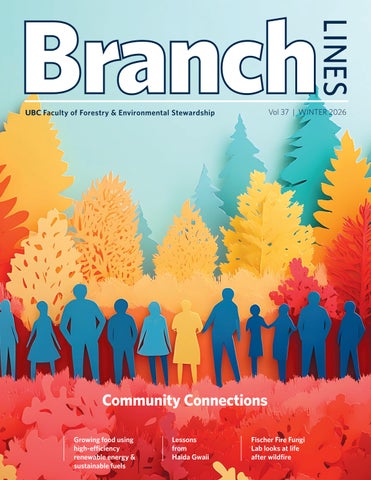
As you may have noticed on the cover of this issue of Branchlines, not to mention on our website and social pages, as of January 1, 2026, the Faculty of Forestry has now become the Faculty of Forestry & Environmental Stewardship. This is a monumental step for our Faculty, and one that was a long time coming, following in-depth consultations with students, faculty, staff and alumni. Your feedback reinforced how much this Faculty means to our alumni community, and I am deeply grateful to all who shared their insights throughout this process.
Since the Faculty was first introduced in the 1950s as a program to train professional foresters, our teaching, research, advocacy and extension work have expanded significantly to include an impressive array of interdisciplinary scholarship that is redefining and reimagining how we understand forestry. Twenty-five years ago, discussions began about renaming the Faculty to better reflect this widening scope. Our new name is a more accurate reflection of our breadth of thought and the world-class scholarship taking place at the Faculty.
Forestry remains at our core. However, we are also leaders in innovative, interdisciplinary and solutionsfocused research, teaching and community outreach in a broad array of environmental areas. Our work
Dean’s message
spans biodiversity conservation, climate change mitigation, the development and commercialization of innovative bioproducts, building healthy and sustainable communities and so much more. Not only are our research and educational programming at the forefront of innovative thought and real-world applications, they are preparing students to be environmental stewards, securing leadership roles in the search for solutions to some of the most pressing global challenges of our time.
Forestry has long been a pillar of healthy and prosperous communities, and our work at the Faculty builds on this longstanding relationship — the theme of this issue of Branchlines. There is much to learn. For example, by partnering with the First Peoples of this land, we are gaining wisdom accumulated over millennia on the use of traditional burns to maintain the long-term health of forests. This ethos permeates our newly launched Bachelor of Indigenous Land Stewardship program, highlighted on page 20.
In this issue, we also explore the role of community forestry in reconnecting communities to the land. Community forestry represents an opportunity to diversify a sector historically dominated by commodity production. It opens new avenues for wealth-generation by Canadians and for Canadians through the localized production of forest products and services. In the following pages, we unpack what smaller-scale forestry might look like in British Columbia, visit the Gallant Enterprises bespoke sawmill at our Malcolm Knapp Research Forest and take a look at a novel research project exploring how to grow food using high-efficiency energy produced from nearby forest residues at our Alex Fraser Research Forest.
As forestry continues to evolve, so too will the trajectory of the Faculty of Forestry & Environmental Stewardship, pushing the boundaries of inquiry ever further in support of the widely-held vision for more sustainable, healthier, socially responsible and interconnected communities. The many connections between forests and communities can and should afford ample opportunities for our collective prosperity. Underpinned by our commitment to the bigger tent of environmental stewardship, the Faculty will continue to explore innovative means of doing so through nature-based solutions.
We are thrilled to have you along for this audacious journey!
Please get in touch with me anytime with questions, comments or concerns: rob.kozak@ubc.ca
Rob Kozak (BSc(Forestry)’88, PhD(Forestry)’96) Prof. and Dean
Branchlines is available on our website at: forestry.ubc.ca/news/branchlines Land Acknowledgement
Branchlines is produced in-house by the Faculty of Forestry & Environmental Stewardship, Development and Alumni Engagement Office at the University of British Columbia.
Managing Editor: Michelle Lindsay
Writer and Senior Editor: Sarah Ripplinger (MJ’08)
Questions concerning Branchlines or requests for mailing list updates, deletions or additions should be directed to forestry.alumni@ubc.ca
The Faculty of Forestry & Environmental Stewardship is situated at the UBC Point Grey campus on the traditional, ancestral and unceded territory of the xʷməθkʷəy əm (Musqueam) people. Our two Research Forests, the Malcolm Knapp Research Forest and the Alex Fraser Research Forest, and the Haida Gwaii Institute, are located on the traditional, ancestral and unceded territories of the Katzie and the T’exelcemc, Xatsu’ll and Esket First Nations, and the Haida Nation. Unceded means that these lands were never sold, traded or given up through treaty or other agreement. We honour, celebrate and express our gratitude to the communities on whose lands our campus and research forests are privileged to be situated. To acknowledge and support this important role, the Faculty of Forestry & Environmental Stewardship strives toward building meaningful, reciprocal and mutually beneficial partnerships with the xʷməθkʷəy əm (Musqueam), Katzie, T’exelcemc, Xatsu’ll, Esket and Haida who have been stewards and caretakers of these territories since time immemorial.
Prestigious $1-million Wall Fellowship awarded to our Melissa McHale
UBC Faculty of Forestry & Environmental Stewardship (FES) Assoc. Prof. Melissa McHale has been awarded a $1-million Wall Fellowship, UBC’s highest-value internal research award, for her project, “Rising heat, roaring flames and waning waters: Building a climate-resilient research hub for British Columbia.” This work — growing from strong partnerships with the City of Kelowna and community collaborators — is designed to help cities facing the intersecting challenges of rising heat, wildfire risk and water scarcity make decisions that recognize trade-offs and feedbacks across complex social and ecological systems.
“This fellowship is about doing science differently, starting with diverse stories and perspectives, and asking how our research questions change when we learn from Indigenous knowledge and community priorities.”
— Melissa McHale
A key focus of the fellowship will be steering the work of the research hub in collaboration with local Indigenous students and emerging scholars, shaping how questions are asked, how data are interpreted
and how research can support more resilient futures for both communities and ecosystems. The project also builds the groundwork for a first-of-its-kind-inCanada, long-term social-ecological research platform built on deep relationships, historical awareness and a commitment to reconciliation.
Seven other FES faculty and students were recognized this year with Wall Research Awards. A Team Faculty Award honoured a joint study led by Asst. Prof. William Nikolakis, Asst. Prof. Tara Atleo and Prof. and UBC Chair in Forest Management Nicholas Coops: “How deep learning can be harnessed by Indigenous fire (qwen) stewardship: A pilot with Yunesit’in.” Graduate Student Awards recognized the work of FES PhD students Jennifer Magel, Michael Stefanuk and Kaitlyn Zinn (BSc(Natural Resources Conservation)’18) and Master of Science in Forestry student Brandon Weigand
““These eight Peter Wall Legacy Awards are a real testament to the amazing talent and scholarship that we have in our Faculty,” says Prof. and Dean Rob Kozak . “Their award-winning work and collaborations with communities are leading to lasting, meaningful impacts.”
Community —connections—
DOES BC NEED MORE SMALL-SCALE FORESTRY?
Managing forested lands for community benefit is not a new concept. Evidence of humans clearing forests with fire to modify ecosystems dates back to the Middle Pleistocene, around 400,000 years ago. These ‘first foresters’ significantly predate the ‘first farmers’, whose food crops appeared a mere 12,000 years ago during the Neolithic Revolution.
Following millennia of altering forests to support community needs, including the traditional forest clearing and harvesting practices of Indigenous Peoples, Western science-based forest management practices emerged in the 18th century from a desire to create a quantifiable and rationalized discipline. This led to forestry entering academia at the turn of the 19th century, the upshot of which established management principles and silvicultural practices, initially, to support the creation of production forests.
By the start of the 20th century, sentiments about how forests should be viewed and used began to shift, giving rise to a sustainable forestry movement that continues today. As opposed to managing solely for timber production, the goal of sustainable forestry is to take a wide-lens, systemic view that accounts for the forests and lands on which they are found, as well as the human and biodiverse populations that forests support.
Today, the ethos of sustainable forestry can be found all over the world — nowhere more than in smaller, localized forest operations like community forests. This is a topic that Dr. Meike Siegner (PhD(Forestry)’21), Senior Manager of Project Design and Standards with Taking Root, knows well. Meike’s PhD dissertation investigated success factors in community forest enterprises, and she has published extensively on community forestry structures and policy-making.
“Community forest ownership starts from the premise of being and remaining in place, which keeps the operations and jobs in the community,” says Meike. “This differs from larger corporate structures based on global markets and pricing, where company headquarters can be located anywhere in the world, distant from the community members and values impacted by forest operations, and with a great deal of the profits flowing outside of the community.”
In British Columbia, historic policies and existing supply chains have tended to favour high-volume, large-scale harvesting operations focused on costminimization to produce competitive commodity products for global markets. In comparison, smaller, decentralized operations, such as community forests, often pursue alternative strategies focused on generating value for their land, as well as investing in their forests and communities to ensure their combined long-term viability.
“Forestry in BC is presently in the midst of recognizing the problems inherent to centralizing forest management, including that local values are difficult to codify in legislation that tends to apply equally to everyone,” explains UBC Faculty of Forestry & Environmental Stewardship Assoc. Prof. Harry Nelson
“The growth in scale and impact of forest harvesting have meant that other values on the land beyond timber production have too often been overlooked,” Harry adds. Attempts by the Government of BC to offer clearer direction on who can access forest management areas and for what purpose through new policy frameworks, such as the 2021 Forest Landscape Planning initiative, have made little difference in changing management approaches, so far.
BC’s roughly 62 community forests range in size from 360 hectares to 185,000 hectares at the top end of the scale, with a total of about 3.5 million cubic metres of annual harvest in the province allocated for small tenures such as these. By comparison, the total available annual allowable cut in timber supply areas on BC’s public lands sits at around 42.4 million cubic metres, with 21.5 million cubic metres held by five large forest companies.
On the forest products value chain, pulp and 2x4s sit at one end, representing lower-value products that are easier to mass produce and sell on existing national and international supply chains. At the opposite end are valueadded products like mass timber, furniture and bioplastics from a wide variety of sources, including lower-value trees and forest residues. At present, these higher-value products are underrepresented in BC’s value chain, with value-added production using only 7% of the total harvest.
Scaling up value-added manufacturing has become a target of the BC government’s forest policy modernization strategy. The Kalesnikoff Lumber facility in the West Kootenays is a rare example of a BC manufacturer using a variety of high- and lower-grade trees to produce marketable value-added products. Family-owned and medium-sized, Kalesnikoff operates sawmilling and multi-species mass timber manufacturing facilities, as well as conducts sustainable woodlands management.
But, while BC’s community forests are also well-positioned to venture into value-added production, several roadblocks remain in their path. “The current scale of community forests in BC is conducive to supporting a strong and vibrant value-added market segment; however, a lack of available processing facilities and equipment are making it more challenging to scale up,” says FES Dean Rob Kozak (BSc(Forestry)’88, PhD(Forestry)’96). “To compete with larger, established forest companies,
community forests in BC could cluster together and collaborate to produce value-added products that can integrate into existing supply chains.”
A scattering of more small- to medium-sized forest operations, such as Kalesnikoff, across the province could offer innovative and agile forest solutions for community forests, establishing new markets while managing for a tailored set of community, cultural and environmental values and needs. Community forests could also offer an economic boost, particularly for Indigenous, rural and remote communities. Even now, community forests employ, on average, 76% more local workers than the industry average, according to 2022 statistics from the BC Community Forest Association.
In Mexico, the tide turned in the direction of community forest ownership following a period of government reforms in the early 1900s, including
the enactment of a new constitution in 1917, coupled with significant grassroots action. Today, community ownership covers over 50 million hectares of the country’s 63 million hectares of forest. Communities also own a greater share of the production of forest products through small- to medium-sized forest enterprises, with the monies flowing back to communities, as opposed to multinational organizations.
Changing values and landscapes in BC are adding to the voices calling for policy reform to shift more momentum toward community ownership. Much of BC’s harvestable forest now consists of second growth stands of lesser value. These same forests are under increased pressure from climate change, floods, wildfires, pests, diseases and political uncertainty in the form of tariffs and duties. Urban encroachment and competing values on the land are also raising the stakes, as more interest groups — ecotourism, recreation, hunting, fishing,
biodiversity conservation, habitat preservation, among others — vie for a seat at the table.
“I see a lot of folks in forestry constrained by the legacies of power under which they work,” says FES PhD student Dane Pedersen, whose research focuses on analyzing the shifting relationships between society and nature in emerging forest management practices, processes and policies. “There are government officials acting in good faith, trying to make a difference, trying to address some of the issues in this sector, but they are bound by the existing policies and don’t have the latitude to challenge some of the foundational tenets on which this country was built.”
Throughout this issue of Branchlines, we share stories from a variety of small-scale, community-led forestry visionaries, change-makers and present and aspiring leaders. You’ll hear from the Executive Director of the BC Community Forest Association, explore a value-added sawmill in Maple Ridge and learn about Indigenous forestry on Haida Gwaii, to name a few. Combined, their stories frame ongoing discussions about the present state and future possibilities of community forestry in the evolution of human societies.
SOME OF THE VALUES CENTRAL TO HAIDA WAYS OF BEING ARE:
(left) Gaajiiaawa Linda Tollas of the Skedans Raven clan on Xaadáa Gwáay • Xaayda Gwaay.yaay Haida Gwaii leads Haida Gwaii Institute students on a field trip along the Spirit Lake Trail in Skidegate.
HAIDA LANDS
THE LANDMARK HAIDA TITLE LANDS AGREEMENT
USHERS IN A NEW ERA OF INDIGENOUS FORESTRY ON XAADÁA GWÁAY • XAAYDA GWAAY.YAAY HAIDA GWAII
Thank you to the Council of the Haida Nation for providing translation into the two Haida dialects.
X̲aadáa Gwáay • X̲aayda Gwaay. yaay Haida Gwaii is a place that holds a long history of triumph over monumental obstacles. In 2024, the Nation was recognized as title holder over their traditional territory by the governments of British Columbia and Canada, making way for Haida citizens and their lands to embark on a new journey of self-determination and reclamation.
“Fifty years after the start of this struggle, our work has just begun,” says Kung K_ayangas (Stlaaygee Xay Guul) Marlene Liddle, Stewardship Director of Lands and Haida Solutions Table Member with the Council of the Haida Nation (CHN). “This historic and deeply meaningful agreement affirms our inherent rights and responsibilities as caretakers of X̲aadáa Gwáay • X̲aayda Gwaay.yaay, acknowledging our governance systems, our laws and our relationship with the land and the waters.”
“This is also about justice, healing and restoring balance.”
— Marlene Liddle
An archipelago of some 150 islands off of Siigaay • Siigee Hecate Strait , northwest of Vancouver Island, parts of X̲aadáa Gwáay • X̲aayda Gwaay. yaay and its surrounding lands are believed to have escaped the most recent period of glaciation between 100,000 and 10,000 years ago — a time period when ice sheets
covered almost all of the Northern Hemisphere. Dubbed the Galapagos of the North, many flora and fauna presently on the islands are found nowhere else, including many species of moss, like Carey’s small limestone moss, and distinctive subspecies of saw-whet owl, black bear, silver-haired bat and pine marten, to name a few. Some trees found here, including western hemlock, Sitka spruce, western red cedar and yellow cedar, have survived for over 1,000 years.
Mostly forested, with more than 54,000 hectares of intact temperate rainforest, X̲aadáa Gwáay • X̲aayda Gwaay.yaay is a place of abundant natural resources that have supported the Haida for thousands of years. Today, over 4,500 Haida reside on X̲aadáa Gwáay • X̲aayda Gwaay.yaay and other places around the world, including in established traditional villages in Alaska.
“We are now focused on the lands,” says Kung Xyalaas Tyler Hugh Charlie Bellis (BSF’23), who is currently consulting on Haida forest
The Xaadáa Gwáay • Xaayda Gwaay.yaay Haida Gwaii archipelago is inhabited by over 6,800 species of flora and fauna. An exceptional place for viewing many marine mammals, such as dolphins, whales and Steller’s sea lions, it is also nesting grounds for many seabirds, including the ancient murrelet.
HAIDA GWAII INSTITUTE
Located on Xaadáa Gwáay • Xaayda Gwaay.yaay
Haida Gwaii, the Faculty of Forestry & Environmental Stewardship’s Haida Gwaii Institute (HGI) offers transformative, place-based educational experiences for undergraduate students and continuing education learners both in-person and online.
“At HGI, we offer a unique learning experience that goes beyond traditional academia,” says K’iinuwaas Carrie Anne Vanderhoop, Director of HGI. “Learners can expect to engage with content experts, knowledge keepers and the community.”
The new “Reconciliation and Resource Management” course is co-instructed by Elizabeth Bulbrook and Nigel Baker-Grenier of White Raven Law, the firm working on the groundbreaking Haida
stewardship with the CHN. “What is exciting is that all the lands on X̲aadáa Gwáay • X̲aayda Gwaay. yaay are presently recognized as Haida title lands. While we know that X̲aadáa Gwáay • X̲aayda Gwaay.yaay has always been Haida land, we are now working towards what a future could look like under Haida laws.”
Negotiations are underway between Haida representatives and the province on strategies to cement Haida values in land management on X̲aadáa Gwáay • X̲aayda Gwaay. yaay, including robust environmental protections.
Aboriginal title case.The course examines the interplay between Indigenous and European legal and governance frameworks and offers perspective on what a decolonized government could look like.
HGI offers immersive in-person learning experiences, as well, with full-semester programs taking place on X aadáa Gwáay • X aayda Gwaay.yaay. The new “Semester in Marine Conservation” dives into concepts surrounding responsible stewardship of marine ecosystems and covers perspectives of Coastal Indigenous Peoples. Students deepen their understanding of Yahgudáng • Yahguudang Respect alongside local experts and community members, with scenic X aadáa Gwáay • X aayda Gwaay.yaay as a backdrop.
“Logging and the forest industry are still important on X̲aadáa Gwáay • X̲aayda Gwaay.yaay, providing important value to the local economy,” Tyler explains. “However, the future of forestry will further reflect Haida values and the values of all island residents who care about the health and wellbeing of the islands and people who live on them, and that’s what we’re working on right now.”
“Through the CHN’s governmental process, which includes Hereditary Chiefs, band councils and citizens, we are listening and learning about what this direction could be,” Tyler
adds. “As well, the CHN is meeting with island municipalities, along with island residents, to listen to the views of everyone living on X̲aadáa Gwáay • X̲aayda Gwaay.yaay.”
“The Haida Aboriginal title recognition is not only exciting for X̲aadáa Gwáay • X̲aayda Gwaay.yaay, but, also, if you look at some of the shortcomings that have been found in industrialized forestry in general,” says Tyler. “Hopefully, our approach will be successful at showing that there are other ways to live and work with forests that are based out of Yahgudáng • Yahguudang Respect.”
A Haida Gwaii Institute student enrolled in the “Natural Resource Science Semester” program analyzes moss samples through a microscope.
Some alternatives for the Haida Nation for reimagining forestry on the islands range from building custom-cut mills to providing wood to artisans, carbon sequestration, restoration work and doing more with less through the identification of value-added wood products.
Indigenous tourism is another option that offers an opportunity to share X̲aadáa Gwáay • X̲aayda Gwaay.yaay’s culture, history and values with visitors in ways that reflects Haida priorities while also contributing to the local economy, notes Elaine Williamson, an Adjunct Prof. at UBC’s Sauder School of Business. Elaine is also pursuing a PhD in Interdisciplinary Studies
through FES, focusing on Indigenous studies, business and forestry.
“Indigenous tourism on X̲aadáa Gwáay • X̲aayda Gwaay.yaay can help visitors gain a deeper understanding of Haida culture, values, knowledge and heritage, including the Nation’s relationship with land and sea,” says Elaine. “It also supports the livelihoods of Haida community members on a sustained basis.”
Any new economic or forestry plans would be incomplete without accounting for the changing climate and other human-related impacts, such as increased wildfire risk, biodiversity loss and less snowpack during the winter, notes Marlene.
“The Haida approach to stewardship on the timber harvestable land base is an integrated approach that combines Traditional Knowledge with science,” Marlene says. “Our approach is rooted in respect and responsibility, and the management of our forests not for profit, but for long-term health and resilience — for future generations, not for current generations — and involves our communities in the decision-making of land-based plans and strategies.”
“It is not just about how much to take from the land, but how much we can give back to it and to the community.”
Haida Gwaii Institute students gather in front of the Haida Heritage Centre at Ḵay ‘Llnagaay, Xaadáa Gwáay • Xaayda Gwaay.yaay Haida Gwaii
RISING FROM THE ASHES
THE FISCHER FIRE FUNGI LAB AT UBC IS AT THE FOREFRONT OF RESEARCH ON THE RESILIENT MUSHROOM’S REVIVAL FOLLOWING WILDFIRE.
“Many people think of fire as a destructive force that is followed by quiet and death, but this is anything but the case,” says Asst. Prof. Monika Fischer, a mycologist cross-appointed to the UBC faculties of Forestry & Environmental Stewardship and Science who works on fungal biology and ecology.
“Fire resets an ecosystem, with life re-emerging from soils within a few days following a wildfire.”
The Fischer Fire Fungi Lab, launched in the fall of 2024, is exploring the emergence of some of the first residents on the post-wildfire landscape: the resilient mushroom. Monika’s lab is stocking a repository of fungal specimens, building on the library that she started in California while completing her postdoctoral studies at UC Berkeley.
The lab analyzes fungi samples at the molecular level. Using a BioTek Synergy H1 machine that measures the light-absorbency of matter, the research team is recording attributes unique to different samples, such as their DNA concentration and biomass. These characteristics could be clues to explain the mechanisms underpinning how fungi perform essential ecosystem functions, such as breaking down tougher types of carbon, like charcoal,
making carbon more readily available for other organisms to use, as well. “If these fungi weren’t breaking it down, tougher forms of carbon might sit in the soil forever — and we do see a small portion of charcoal that persists for millennia in the geologic record,” says Monika.
Charcoal is formed when plant matter, and sometimes soils, get baked by wildfire, which can reach temperatures in excess of 500 degrees Celsius and up to 12,000 degrees Celsius. Under this intense heat, matter goes through pyrolysis, condensing carbon compounds into poly-aromatic hydrocarbons — naturally found in charcoal — which are harder for the returning plant life to break down. However, they are a boon for specialist mycelia, such as mushrooms, that transform them into matter that’s easier for plants to digest.
The Fischer Fire Fungi Lab collected these small mushroom specimens from near Spences Bridge, BC, following the 2024 Shetland Creek wildfire.
“The polymerase chain reaction (PCR) process took me about a month to get the hang of, but it is one of the coolest things,” says third-year UBC Integrated Science undergraduate student and Fischer Fire Fungi Lab research assistant Ciara Foley. PCR is used to copy DNA to assist researchers with analyzing some of the properties of mushroom samples that they collect from the field or source from other labs.
Ciara’s mom works in post-fire recovery and Ciara descended from a long line of Métis foresters on her dad’s side. “I was drawn to plants and fungi from a young age, peering at specimens under the microscope that my maternal grandfather gave to me when I was 13 years old,” says Ciara.
“On the second day working in her lab, Monika took us on a field trip to Shetland Creek,” shares Fischer Fire Fungi Lab research assistant Sarah-Isabelle Radziszewski, a fourth-year food, nutrition and health undergraduate studying in the Faculty of Land and Food Systems at UBC. Shetland Creek was engulfed in flames during the August 2024 severe wildfire that burned over 280 square kilometres near Lytton. “We picked through the remnants of the fire, collecting fungi samples, including morels, some of which later ended up in a frying pan.”
“To offer an analogy, pre-fire, the resident mushrooms like raw materials. Post-fire, the mushrooms that emerge like things cooked.”
— Monika Fischer
Because wildfires burn at different intensities depending on their location, moisture level, available fuel, wind velocity and myriad other factors, the landscape left behind can be a veritable patchwork of different post-fire conditions, with some areas fully razed and others containing still-standing trees. As such, the research team is collecting mushroom samples from a variety of sites as well as locations within each site.
Interestingly, despite the variance in forest composition and wildfire intensity, the fungi that repopulate post-wildfire landscapes around the world are surprisingly similar. “We see a lot of Pyronema, Neurospora crassa , liverworts, disc fungi, mosses and Morchella species, such as morels, within about one year following a wildfire,” says Monika.
“What we know less about is how these post-fire fungi interact with one another, how they disperse after a wildfire and the contributions that they make to ecosystem recovery and resilience.”
— Monika Fischer
Species of post-fire mushrooms have been shown to play a role in helping other plant life reestablish on post-fire landscapes through a variety of mechanisms, including nutrient cycling along with enhanced soil stability that can help reduce erosion and protect against landslides.
“Mycelia knit together and help moisture infiltrate soils,” Monika adds. “While we have observations of these processes, we need to actually test what is happening and how it is helping plants re-establish better and faster. These are some of the many questions that my lab will explore in the coming years.”
fischerlab.botany.ubc.ca
MASTERING SUSTAINABLE FOREST MANAGEMENT
The evolution of the forestry profession, and the increasing complexity of forest ecosystem management, is attracting a new generation of professionals from diverse backgrounds — including many mid-career learners — to programs like UBC Faculty of Forestry & Environmental Stewardship’s (FES’s) Master of Sustainable Forest Management (MSFM).
“This program is designed for students coming from various professional backgrounds,” says Anna Tobiasz (RPF, MSc(Forestry)’25), the Coordinator for the MSFM program as well as a Planning Forester at FES’s Malcolm Knapp Research Forest (MKRF).
“Our graduates are well-prepared to secure management roles to lead in this shift in forestry towards managing for sustainable and healthy ecosystems and communities.”
— Anna Tobiasz
Anna’s prior experience in landscape-level planning and forest operations in BC includes explorations of complex forest ecosystem dynamics and management approaches. As part of the MSFM team, she joins FES faculty members and industry experts to support student learning, preparing students with
the knowledge and skills to lead innovative forest projects and steer the future direction of the profession in the province.
“Many MSFM students aspire to become Registered Professional Foresters (RPFs), which the accredited MSFM program prepares them to do following graduation; however, there is a huge range of practice areas that students can pursue,” Anna notes. “The program exposes them to the breadth of the highly dynamic modern forestry profession — from meeting with Indigenous land stewards to learning about community forest operations, developing a landscape plan for community partners and lots of hands-on learning and field trips.”
(far right) Jeff Fisher (BSF’88), Operations Specialist with Blackwell Consulting Ltd., demonstrates to FES Master of Sustainable Forest Management students the effects a recent looper moth infestation in Vancouver’s Stanley Park had on a western hemlock tree. (second from right) Joe McLeod (BSF’01), Associate Director Urban Forestry/ Specialty Parks with the City of Vancouver, provided students with additional context on the looper moth infestation from an urban forest management perspective.
Brooke Lerman came to the program following a degree in neuropsychology and about 10 years working in industry at an energy company, with another five years spent as a consultant and the lead of an innovation lab for forestry, energy and mining. Moving from Houston, Texas to study at FES, Brooke was drawn to the opportunity to explore a new field under the guidance of world-class experts.
“When I was still working as a consultant, the more I talked with timber company foresters about their day-to-day work, the more I became excited about silviculture and harvesting operations,” recalls Brooke, who is also a long-distance hiker and nature enthusiast.
“Following a little bit more research, I decided that I wanted to enroll in the MSFM program to become an accredited RPF.”
Brooke was also drawn to MSFM’s emphasis on traditional knowledge. “I’m an avid reader, and books by FES Prof. Suzanne Simard (BSF’83, RPF) and Dr. Robin Wall Kimmerer ’s Braiding Sweetgrass inspired me to seek a program that would expose me to both leading science and traditional practices like Indigenous cultural burns.”
Many students view the MSFM as a gateway to pivoting and/or advancing in their careers. Joe Stewart was attracted to the nine-month MSFM program as a time-efficient stepping stone to an RPF. Joe came to the program after completing a Bachelor of Kinesiology at UBC and a Forest and Natural Area Management diploma from BCIT, as well as gaining experience as a Park Worker with Metro Vancouver and, most recently, as a Forestry
Technician
Resource Management Ltd.
“My interest in the MSFM program came from a place of wondering about the decisions being made in managing the land base and wanting to identify approaches that preserve forests over the long-term while also supporting economies and communities,” says Joe.
The MSFM curriculum walks students through the bureaucratic complexities of forest management in BC, which stands in stark contrast to what some of Joe’s classmates have shared with him about forestry practiced in parts of Africa and China. “The cohort-style approach to the program is something that I really enjoy because it has given me opportunities to learn from a lot of smart people from various places,” Joe shares.
with Coastal Natural
Master of Sustainable Forest Management students examine tree cores, like the one shown here, for their site plan projects at Malcolm Knapp Research Forest. Extracted using an increment borer — a manual, hollow drill inserted into the centre of tree at a height of 1.3 metres — these cores facilitate counting tree rings to determine a tree’s age and other environmental factors that may have been present during its growth.
Hands-on experience is another MSFM selling point for both Joe and Brooke, who will complete a group site-plan project for a 16-hectare area at MKRF that will later be harvested under the direction of MKRF staff.
“We can see the results of the
areas cut based on the 202425 MSFM class’s site plans recommendations, which brings the process that we’re undertaking full-circle,” notes Brooke.
“This program is a huge accelerator,” Brooke adds. “I feel
so well-equipped to pursue a variety of career opportunities. It has also given me lasting connections. I fully expect that I will be able to pick up the phone and call any one of my classmates after we graduate and even 10 years down the line.”
During field week at Malcolm Knapp Research Forest, Master of Sustainable Forest Management students analyze soil pits, such as the one depicted here, to evaluate soil properties like soil moisture and nutrient levels.
B. A.
Name that Tree
Test your identification skills
A rite of passage for Faculty of Forestry & Environmental Stewardship (FES) students, tree identification may be familiar to some, but is puzzling for many. This is understandable, given that there are an estimated 73,000 tree species globally, with 9,000 of those estimated to be undiscovered, according to a 2022 Proceedings of the National Academy of Sciences study. However, that didn’t stop preeminent leaf identification wizards like the late, great Assoc. Prof. Emeritus John Worrall (BSF’63) from making the task even harder for his Dendrology students. “He would cut off the edges of a leaf before testing students to see how closely they were paying attention to the important details of each species,” recalls FES Prof. Emeritus Rob Guy, who later took over the teaching of dendrology with Prof. Sally Aitken (BSF’84) in Forest Plant Biology I and II, now led by Lecturer Athena McKown and Sessional Instructor Alaina Heidt
Carrying on this FES tradition, we challenge you to identify the following tree leaves without using the internet. No cheating!
Bonus question: In honour of Worrall, this is a drawing he made on one of the walls in the Forest Sciences Centre at our UBC Vancouver campus. An added challenge is to guess or find its exact location!
first floor, north-east corner of the Forest Sciences Centre to the right of the stairway going up to the Centre for Advanced Wood Processing.
Bonus question: vine maple (Acer circinatum) found on
ANSWERS:
A big thank you to Rob Guy for selecting the featured leaves for this challenge!
A. Red alder (Alnus rubra), B. London plane (Platanus × acerifolia, syn. P. × hispanica), C. Cherry (Prunus sp ),
D. American sweetgum (Liquidambar styraciflua), E. Douglas-fir (Pseudotsuga menziesii), F. whitebark pine (Pinus albicaulis),
the
BCCFA’S JENNIFER GUNTER
MAKES THE CASE FOR MORE COMMUNITY FORESTRY IN BC
Community forests in British Columbia may well be an answer to some of the challenges afflicting BC’s forest sector. By supporting local jobs and economies, community forestry can stimulate rural, Indigenous and remote communities, in particular, during these trying times. We sat down with Jennifer Gunter, co-founder and Executive Director of the BC Community Forest Association (BCCFA), to get a behind-the-scenes glimpse of the expansion of community forestry in the province and the BCCFA’s vision for the future.
Why are you passionate about community forestry?
I was drawn to identifying solutions to complex problems, and I believe that empowering local communities through approaches like community forestry is one of the most effective ways to simultaneously achieve multiple objectives.
What are some of the pillars of community forestry in BC?
Community forests are helping us advance reconciliation with First Nations — half of BC’s community forests are owned by First Nations — create more climate-resilient landscapes and coexist with wildfire, to name a few, all while supporting local economies. They are managed for multiple values on the land, such as recreation opportunities, biodiversity, cultural practices and community education, along with job creation and economic stimulation, among others. Around onethird of community forests in BC are also conserved for sensitive or special purposes. This is forestry that goes beyond timber production and towards a vision of forestry that creates a safer, more hopeful and sustainable future for communities.
What series of events led up to you co-founding the BCCFA in 2002?
It all started in the 1990s during a time when there were growing calls for forestry reform. The province added the Community Forest Agreement to the Forest Act in 1998 as a pilot program. Two years later, I started working with the Kaslo and District Community Forest Society (KDCFS), right after completing my master’s of resource and environmental management thesis on community forestry in BC. By 2002, KDCFS was among several pilot and aspiring community forests in the province, 10 of which came together to form the BCCFA. Our goal was to establish a network of community forest practitioners to learn from one another and navigate this completely new model of forest management in BC at the time. Coming together also gave us a stronger voice to advocate for forest policy reform.
What are a few of the BCCFA’s top priorities right now?
We prioritize working with the provincial government and Ministry of Forests to develop policies that work for community forests, including expanding the community forestry program. Other priorities include our partnerships with BC Wildfire Service and UBC’s Centre for Wildfire Coexistence (CWC) in support of proactive approaches to build wildfire resilience and coexist with wildfire. FES Prof. Lori Daniels (MSc’94), who heads the CWC, and her students are supporting this work through field work and collaborations with community forest holders.
What are some of the biggest challenges facing community forests at the moment?
Community forests have been and remain challenged by forest policy that is largely designed for major licensees. The over 60 community forests in the province comprise a small fraction of the total provincial timber harvest. We need policies that reflect the unique structure and objectives of community forests, which are designed to be owned and managed by community members for the long-term benefit of the community. These tenures often put sustainability at the forefront because of the higher value they derive from a land base that is consistently healthy and viable. Impacted by global climate change, we need more community forests and community forest-oriented thinking that enshrines long-term sustainability into daily operations and profitability.
bccfa.ca
“BILS is preparing me to work in Indigenous governance, landuse planning and environmental policy. I see myself contributing to comprehensive community planning, co-management initiatives and nationbuilding efforts that prioritize Indigenous laws, selfdetermination and sustainable land relationships.”
— Drew Brown BILS student and member of the Heiltsuk Nation
FACULTY OF FORESTRY & ENVIRONMENTAL STEWARDSHIP’S
NEW BACHELOR OF INDIGENOUS LAND STEWARDSHIP
In September 2024, the Faculty of Forestry & Environmental Stewardship (FES) launched the new Bachelor of Indigenous Land Stewardship (BILS) degree program, marking a pivotal moment in the Faculty’s ongoing efforts to collaborate with the First Peoples of Canada and other parts of the world. The interdisciplinary BILS program draws from the profound wisdom of Indigenous knowledge and culture, teaching students how to become leaders in the reclamation and revitalization of Indigenous lands.
Program visionaries from FES include Dr. Garry Merkel (nadi’ denezā) (PhD(Hon.)’21), Director of the Centre of Indigenous Land
Stewardship; Carlos Ormond, Director of Indigenous and Intercultural Initiatives and BILS Program Director; and William Nikolakis, Asst. Prof. of Indigenous Land and Natural Resources Governance.
“BILS is the only program of its kind,” states William, who has worked with Indigenous communities for over 24 years. “It offers a multi-access approach integrating online and in-person learning that connects FES directly to Indigenous students. Our goal is to support as many Indigenous learners as we can through the BILS program.”
Faculty of Forestry & Environmental Stewardship Lecturer Christopher Derrickson at the UBC Malcom Knapp Research Forest on Katzie (q̓ic̓əy̓) First Nation lands.
“A great deal of work went into listening to and collaborating with Indigenous communities to ensure that BILS is truly moving the dial on reconciliation.”
— William Nikolakis
Program curricula were codeveloped with Indigenous experts and community members, William shares. “The program reflects the goals and actions set out in the United Nations Declaration on the Rights of Indigenous Peoples, the Truth and Reconciliation Commission’s Calls to Action and the BC Government’s Declaration on the Rights of Indigenous Peoples Act. These documents have all created new avenues for Indigenous peoples to play a greater role in stewarding their territories.”
A 2025 report from the Indigenous Prosperity Foundation points to numerous untapped economic growth opportunities among Indigenous businesses, which presently contribute over $30 billion to Canada’s economy annually.
BILS students learn about legal and governance considerations related to Indigenous rights outlined in international, national and local laws and directives, as well as community development initiatives, business management, economics, ecology, communications and community capacity building. Another key element of the program is hands-on and experiential learning in each of its four years.
“BILS students learn the skills to effectively run a business and support economic activity in
Indigenous communities in a way that adheres to community cultural values,” says FES Asst. Prof. Tara Atleo (hahuuła) from the Ahousaht First Nation, house of ƛaqišpiił. Tara joined FES in 2024 following years of leading projects with Indigenous communities, including through her community’s economic development corporation. The BILS professor now teaches concepts surrounding business and economic development through an Indigenous lens — from accounting and finance to marketing, management and human resources.
“I want students to feel empowered and hopefully excited about pursuing careers in Indigenous communities after graduation,” says Tara. “There are incredible opportunities for professionals in all facets of business and from administration to leadership roles.”
Dr. Garry Merkel (nadi’ denezā) (PhD’21, Honourary), Director of the Centre of Indigenous Land Stewardship at the Faculty of Forestry & Environmental Stewardship, with the 2025 Bachelor of Indigenous Land Stewardship class at a field school excursion to FES’s Malcom Knapp Research Forest.
“ Our field camp at the Malcolm Knapp Research Forest at the beginning of the program helped welcome me to my new community. We spent a week sharing stories, learning, laughing and participating in great activities. This helped me build meaningful connections to my professors and classmates and make new friends at UBC.”
— Emma Charles BILS student and Cowichan and Duwamish through her maternal grandmother, and Lower Elwha Klallam through her maternal grandfather
The BILS program was made possible, in part, by an inspirational $8.5 million gift from the Mastercard Foundation’s EleV Program.
https://bit.ly/bils-fes
First-year Bachelor of Indigenous Land Stewardship student, Tyrell Duhamel, dons a cedar hat during field school at Malcom Knapp Research Forest.
Gallant Enterprises owner Clayton Arnott removes side lumber from a log before it is processed through the company’s edger. After, the log will be made into full-sawn, rough-cut lumber and further processed for made-to-order cuts.
VALUE-ADDED SAWMILLING AT OUR RESEARCH FOREST
The Gallant Enterprises Ltd. sawmill is a well-oiled machine, with advantages out of reach of larger sawmilling enterprises. Owned and operated by Clayton Arnott since 2023, the full-service, customcut sawmill and timber manufacturer operates within the Faculty of Forestry & Environmental Stewardship’s (FES’s) Malcolm Knapp Research Forest (MKRF) near Maple Ridge — a partnership built on trust, mutual respect and long-term viability.
“Being in the forest where we source the trees used in our operations is huge,” says Clayton. “We can speak directly with the people behind the source of our raw materials. It’s a symbiotic collaboration and partnership.”
“Working closely with MKRF staff, we take a big-picture view of the forest rotations at MKRF for its long-term sustainability, cutting only what we need for orders.”
— Clayton Arnott
Opening its doors in 2004 under the leadership of founder and former owner Doug Woods, Gallant manufactures high-quality custom wood products sourced from trees sustainably grown and harvested at MKRF, including western redcedar, coastal Douglasfir and yellow cedar.
“We started with the log lathe and timber sizer,” recalls Doug. Working with then Director of MKRF, Paul Lawson (BSF’77), the partnership was aimed at diversifying research forest revenues in support of a sustainable, bespoke sawmilling operation. “Paul was willing to try something new in the market,” Doug explains.
With MKRF providing a consistent supply of logs, the business has not only survived, but thrived. The present team of around 10 employees processes a log volume of approximately 4,000 cubic metres per year, with an equipment arsenal that includes a kiln, lathe and timber sizer with planing capabilities.
“We are mostly a business-to-business operation, selling to local building supply stores, with custom orders often being for things like playgrounds, gazebos and family home renovations,” Clayton shares.
Without the use of automation, Gallant’s sawyers buck to length — from large timber beams used in construction all the way down to 24-inch tree planting stakes and six-inch finger joints. It’s a sustainable approach that significantly reduces waste — using every bit of the log possible — and helps manage the sawmill’s limited storage space.
“How we do things at Malcolm Knapp should be how forestry is done throughout the world.”
— Clayton Arnott
An integral part of Gallant’s partnership with MKRF is connecting with the many FES students attending field school at the research forest each year, as well as with participants in MKRF’s Wild & Immersive outdoor education programs and the many community groups and individuals visiting the forest. The sawmill also collaborates with FES faculty members and external researchers, supplying wood to several research projects over the years.
“From the very start, we’ve offered educational opportunities at Gallant that showcase the integration of our industrial and business operations within the research forest,” says Clayton, who has worked with the company almost from the beginning.
Gallant has been a go-to source for on-site infrastructure upgrades at MKRF, too, processing the wood used to build a floating dock, cabins, a playground and the Bentley Family Dining Hall and Walter C. Koerner Forestry Centre buildings at MKRF’s Loon Lake Lodge and Retreat Centre, among others. However, the sawmill’s bread and butter remains the broader commercial market for valueadded wood production.
“My goal is to continue to grow Gallant’s operations in collaboration with MKRF, building more efficiencies into our workflows,” says Clayton. “We couldn’t be happier with our partnership with the research forest. This is an example of what’s possible when people think outside the box and look for opportunities.”
COMBINING RENEWABLE ENERGY PRODUCTION WITH FOOD-GROWING GREENHOUSES
A project ramping up at the Faculty of Forestry & Environmental Stewardship’s (FES’s) Alex Fraser Research Forest (AFRF) in Williams Lake is building expertise in a novel and more sustainable way to generate power and grow local food. Launched in 2025, the Combined Heat and Power (CHP) Greenhouse Project is a proof-of-concept that is redirecting forest residues from forest and fuel treatment operations to heat a greenhouse. With generous support from a private grant-making foundation and a recent gift of technology from Energy Plug Technologies Corp, the combined
CHP-greenhouse enables the year-round production of food, including Indigenous foods, and medicinal plants.
The project is led by Dominik Röser, FES Prof. and Assoc. Dean of Research Forests and Community Outreach, and has the potential to expand the mix of local power-generation options. CHP could particularly benefit rural, remote and Indigenous communities often cutoff from major power grids and overly reliant on diesel fuel. These same communities are also more vulnerable to high food prices and food unavailability.
Connecting Combined Heat and Power to Greenhouses
The process of fueling combined heat and power (CHP) generation starts with sourcing, chipping and drying forest residues later burned in the CHP co-generation system to produce energy. Heat from this process is used to dry forest residues and heat a neighbouring greenhouse. Displaced cool air from the greenhouse is directed back to cool the co-generation system. Energy produced by the co-generation system powers the greenhouse via the power grid, with excess potentially sold to power companies.
The CHP Academy at Alex Fraser Research Forest walks participants through the many stages of biomass production, including using machines like this (left) tractor and mounted chipper and (right) tractor-mounted trailer and crane.
“This is a collaborative project that is developing, testing and implementing training on how to operate CHP-powered greenhouse systems, particularly for rural, remote and Indigenous communities.”
— Dominik Röser
CHP is a renewable energy technology that converts biomass — specifically forest residues — into both electricity and heat. The approach dramatically reduces carbon dioxide, sulphur and mercury emissions compared with non-renewable energy sources, such as diesel. It also makes use of salvage logging, along with forest fuels affected by wildfire or traditional or prescribed burns.
The technology could help to stimulate local economies affected by mill closures and challenges in the forest sector. In particular, it has the potential to generate jobs and economic development in CHP power generation connected to food production in rural communities, which account for approximately 30% of Canada’s total gross domestic product.
“The greenhouse project brings together food security, Indigenous plant cultivation and energy innovation into one living lab,” shares Mustafa Onder Ersin, the project manager for the CHP Academy Greenhouse Project at AFRF. “We’re not only helping communities heat their buildings and grow their own food, we’re restoring agency and stewardship over local resources.”
“Indigenous communities, in particular, are encouraged to shape how these technologies are applied, ensuring cultural relevance and long-term adoption.”
— Mustafa Onder Ersin
In 2021, FES, in partnership with FPInnovations, Natural Resources Canada, the Government of BC and the Fraser Basin Council, launched the CHP Academy at AFRF to offer FES training and demonstration on CHP power generation. The CHP Academy is open to community members who want to learn about and gain technical skills in the operation, maintenance and scaling of CHP systems.
CHP Academy has already trained dozens of participants and is preparing to expand its field-based and online curriculum to include greenhouse operations, plant care and community engagement.
The CHP Academy Greenhouse Project is affiliated with the CHP Academy Community Bioenergy Systems Training Program, with plans in place to expand the project to at least two First Nations communities and establish a replicable and scalable model for other communities to develop their own CHP facilities and CHP-powered greenhouses.
“The biomass CHP greenhouse installations that we are building and testing, along with the CHP Academy Community Bioenergy Systems Training Program, are establishing the workforce and expertise needed to expand CHP and food-generation systems like these throughout Canada,” says Dominik.
Participants
enrolled in the CHP Academy at Alex Fraser Research Forest review part of a combined heat and power system.
TREES OF CAMPUS
MALCOLM KNAPP RESEARCH FOREST TAKEOVER
The staff at our Malcolm Knapp Research Forest (MKRF) in Maple Ridge, BC, has hijacked Trees of Campus feature! MKRF is an extension of our Vancouver campus and one of the UBC Faculty of Forestry & Environmental Stewardship’s (FES’s) two researchfocused forests — the other being Alex Fraser Research Forest near Williams Lake. MKRF hosts annual field schools and research projects led by our faculty members and other research partners, expanding learning opportunities for FES and the broader community.
In this issue, MKRF has taken the reins of Trees of Campus to showcase the John E. Bier Arboretum.
A view from the entrance to the MKRF Arboretum.
THE MKRF ARBORETUM
The Arboretum was recently renewed and now includes new trees, signage and trails, with potential further expansion on the horizon.
“The Arboretum renewal is a story of collaboration at its best,” says Hélène Marcoux (MSc’13) , Director of MKRF and Co-director of FES’s Master of Sustainable Forest Management. “MKRF staff, FES Urban Forestry faculty members and both graduate and undergraduate students came together to help realize this project, revitalizing the Arboretum into a living teaching tool.”
Established in 1959, the John E. Bier Arboretum at MKRF was named in memory of former FES Prof. of Forest Pathology John E. Bier. The three-hectare Arboretum
GIVE THE GIFT OF LASTING MEMORIES
— a botanical garden dedicated to trees — is located near the front entrance of MKRF and showcases more than 80 different tree species and 14 different families of tree from around the world, spanning from various parts of North America to Europe and Asia. It is also a popular gathering place for FES’s annual field schools and community outreach events, as well as for our Wild & Immersive outdoor education programs.
“It’s a peaceful and beautiful space that helps introduce all ages to some of the many tree species from around the world,” says Hélène. “In the springtime, when the trees are in full bloom, I particularly enjoy visiting the Arboretum’s dawn redwood ( Metasequoia glyptostroboides), a deciduous conifer native to China. At that time, its needles are so tender and succulent; it’s a very special tree in this collection.”
Take advantage of a unique opportunity to name a tree in the MKRF Arboretum or one of the picnic tables at the research forest in support of the MKRF Renewal Project! Naming opportunities can honour a special person, business, cause, group or graduating class, with funds raised helping to realize enhanced research and education facilities at our cherished forest.
Contact Carol Cheuk, Development Officer with FES, to learn more (carol.cheuk@ubc.ca or 604-822-0898) or visit: https://bit.ly/mkrf-give
FORESTRY CAREER PATHS
A 30-YEAR JOURNEY FROM NEPAL TO NEW YORK
Now the Interregional Adviser on Ecosystem Restoration for the United Nations in New York City, UBC Faculty of Forestry & Environmental Stewardship (FES) alumnus Dr. Shyam K. Paudel’s (PhD(Forestry)’14) professional journey began 30 years ago in Nepal.
As a newly recruited community forestry facilitator with the Food and Agriculture Organization (FAO) of the United Nations, Shyam was assigned to implement the country’s new community forestry policy, designed to empower Nepalese communities to conserve, manage and sustainably utilize forest resources.
“When I started my position with the FAO, I was tasked with trekking through the Terai lowland region of southern Nepal, carrying only a backpack and some clothes,” Shyam recalls.
“I cycled or walked from one village to another, talking with local community members, trying to convince them of the logic of a decentralized community forestry policy.”
The forest initiative aimed to address growing questions surrounding the impacts of global climate change, tropical deforestation, land degradation, biodiversity loss and the role of forests as sources and sinks of carbon. As someone
who cared deeply about the environment, Shyam saw his role as an opportunity to help move his homeland toward sustainable solutions, restoring and revitalizing local forests and forestry operations.
“From a young age, I wanted to protect the forest,” Shyam recalls. Growing up in a small valley in central Nepal called Pokhara, Shyam’s family worked their farmland to earn a living. “The Pokhara area is one of the most beautiful places on Earth,” extols Shyam. “It has big mountains and valleys like Vancouver, BC. However, after high school, I travelled to neighbouring villages and Nepal’s lowlands where I witnessed rampant deforestation from illegal logging.”
Throughout most of its history, Nepal was governed under an absolute monarchy. However,
Shyam travelled to Kabul, Afghanistan, in 2019 to meet with ministerial representatives as part of a Food and Agriculture Organization project.
in 1990, public protests and demonstrations culminated in the then reigning King Birendra Bir Bikram Shah Dev setting into motion the reinstatement of a national constitution and multiparty political system. It was during this time of political upheaval and rise of pluralism that the FAO launched its community forestry initiative.
“The initial phase of the community forestry program had considerable challenges, as local communities were skeptical of our intentions, having experienced frequent policy changes and instability in the past,” recalls Shyam. “Convincing them that we were genuinely committed to decentralizing forest conservation and management, granting full rights to the communities, proved to be an uphill task.”
In his first six months on the job with the FAO, Shyam worked tirelessly to establish six community forestry groups in the Makawanpur district of Bagmati Province, Nepal, east of Pokhara and south of Kathmandu. He painstakingly drafted six community forestry operation plans, establishing a reproducible model that contributed to the program’s expansion nationwide.
“To date, more than 22,000 community forest user groups have been formed in Nepal, managing over 2.3 million hectares of forest, with a reported increase in national forest cover from 26% to over 40% within the past 25 years.”
“The community forestry program gave community members more ownership over the land,” Shyam says. “They took charge of forest management with communitydirected regulatory and enforcement frameworks, putting an end to illegal logging and sidestepping bureaucratic roadblocks that could stymie progress.”
After several years working in Nepal, Shyam went on to lead forest policy development work in countries around the globe, including Vietnam, Ethiopia, Timor-Leste, Lao People’s Democratic Republic and parts of Latin America, to name a few. He worked on the development of non-timber forest products, such as bamboo, managing a global program to promote bamboo for sustainable housing
and value chain development with the International Network for Bamboo and Rattan. He also completed a PhD from FES under the direction of Dean Emeritus John Innes , focusing on ecosystem responses to a changing climate and environment in the southwest of Canada’s Yukon Territory.
In his current role in New York, Shyam continues to affect change, supporting forest programs throughout the world with the forestry arm of the Department of Economic and Social Affairs of the United Nations. As a global advisor for forest management, Shyam assists communities with ecosystem restoration, forest financing and forest policy formation.
“Forestry is not only about jobs, it’s about the big picture,” shares Shyam. “I feel immense satisfaction because my job has taken me to different places and different communities where I feel that I have been able to contribute to something for the betterment of all.”
Shyam (left) addresses attendees at the 2025 United Nations Forum on Forests (UNFF), held at the United Nations headquarters in New York.
THE INAUGURAL BACKMAN DIALOGUE
On October 8, 2025, the Faculty of Forestry & Environmental Stewardship (FES) hosted the first in a series of Backman Dialogues. The “Forestry in Flux: Reimagining BC’s Forests” public lecture series at the Hollywood Theatre in Vancouver featured a panel discussion on growing a sustainable and viable forest sector in the face of shifting public values, climate change and other pressures. Expert panelists
were: Molly Hudson, Vice President of Forestry and Sustainability at Nch’ḵaỷ Development Corporation; Adam Olsen (SȾHENEP), Negotiator for the Tsartlip First Nation; Dominik Röser, FES Assoc. Dean of Research Forests and Community Outreach; and Lisa Matthaus, Provincial Lead with Organizing for Change. The series is made possible thanks to the generous support of the Backman Family.
REIMAGINING FORESTRY IN BC
“The shaky ground that British Columbia’s forest sector finds itself on right now is an opportunity to reimagine its future,” says Charles Backman (BSF’76, MBA’86). The career forester spent 50 years working in the field and academia, both of which informed his optimism for forestry to rise above its present challenges.
“The question now is: how, in a changing world with new sets of values, can we best utilize our valuable natural resources?” Charles asks. “This process starts with an understanding of the science and having our sights set on long-term sustainability and profitability.”
A third-generation forestry professional, Charles received a Bachelor of Science in Forestry from UBC, which propelled him into a role as an area forester with MacMillan Bloedel, Franklin River Division, where his father, Arvid Backman (BSc(Forest Engineering)’43, MF’93), had worked as a manager. A few kilometres away, near Port Renfrew, Charles’s paternal grandfather, Carl Backman , formerly headed a tree falling crew at the Bear Creek camp.
Keen to expand his horizons, Charles springboarded to an Asst. Municipal Forester position with the Municipality of North Cowichan, growing its forest operations team from 10 to over 150 personnel. After an MBA from UBC and a stint working with a variety of companies raising capital on a regional stock exchange, Charles followed a dream through the University of Washington in Seattle as a Research Scientist at the International Institute for Applied Systems Analysis in the Forestry Project division. This took him to the former Soviet Union, China and parts of Europe to work
in various areas of forest operations and sustainable development. Charles concluded his career as Chair and Instructor in the Business and Office Administration program, and as a current Instructor Emeritus, at Northwestern Polytechnic, formerly Grande Prairie Regional College.
“The question now is: how, in a changing world with new sets of values, can we best utilize our valuable natural resources?”
One of Charles’s present focuses is a passion project started by his late parents, Arvid and Elizabeth Backman : giving back to the community. Three distinct areas are presently being supported through the Backman Family Conflict Resolution Fund. The first is the biennial Backman Dialogues, a public lecture series designed to spark discourse on pressing, and often contentious, issues affecting BC’s forest sector. The second area is the Backman Family Conflict Resolution in Forestry Research Fund, which supports UBC Faculty of Forestry & Environmental Stewardship (FES) graduate students and is currently enabling interdisciplinary research supervised by Asst. Prof. Hamish van der Ven and Assoc. Profs. Sarah Benson-Amram and Harry Nelson
For example, some funding has been directed to the research of Muh (Syu) Syukron , a fourth-year FES PhD student working in the Business, Sustainability and Technology Lab and co-supervised by Hamish and FES Dean Rob Kozak (BSc’88,
PhD’96). Syu’s doctoral research is examining the role of social media in shaping discourse about palm oil sustainability in Indonesia.
Lastly, the Backman Family Travel Award in Forestry makes it possible for FES undergraduate students in financial need to attend experiential learning opportunities, such as field schools and semesters in places like Haida Gwaii, South Africa and South America.
“By supporting students and public dialogue, I hope to enable the views and values that will be important to the next generation to be heard,” says Charles.
“History has taught us that times of instability will end, and that key decision-makers who open up discussions often shape the tactics and tools used by industry, labour, government and other stakeholders,” Charles adds. “The forest sector needs to continue to be at the table to steer these discussions.”
Check out event photos available here: https://bit.ly/dialogue-photos
DEDICATION THAT SHAPED THE FACULTY
The Faculty of Forestry & Environmental Stewardship (FES) celebrates three retiring colleagues whose enduring contributions have been an essential part of our evolution and academic mission over the past few decades. Each will be sorely missed, and we thank them for their time and dedication to the Faculty.
For starters, we have the benefit of sharing with you closing remarks from Dean Emeritus John Innes John devoted 26 years to the Faculty, serving as Dean from 2010 to 2021. Under his leadership, John expanded
Reflections from Dean
Emeritus John Innes
It seems difficult to believe that after 26 years at UBC, I have now retired! I arrived in the summer of 1999 and, ignoring the rain, quickly set about exploring British Columbia, trying to get a feel for the land that would help me in developing the new courses that I was to teach. That initial exploration was very revealing, but I was shocked by much of what I saw.
the Faculty’s interdisciplinary research, as well as its international scope. He was instrumental in tripling enrolment, creating new and innovative educational programs, building up the Faculty’s research forests and helping to establish the Faculty’s Bachelor of Indigenous Land Stewardship program.
Among his many awards, John is a recipient of the Nobel Peace Prize for his joint work with the Intergovernmental Panel on Climate Change, an International Forestry Achievement Award from the
The province was in a period of change. I was appointed as the Forest Renewal BC Chair of Forest Management but, within a few years, the government had closed down Forest Renewal BC and moved away from the prescriptive approach of the Forest Practices Code. I still however appreciated the guidance received from Al Gorley and Dr. Bill Bourgeois. My travels throughout the province had triggered a particular interest in First Nations communities, and my first major research project was looking at the cumulative effects of development on First Nations communities in the Treaty 8 region of BC (in the northeast region of the province).
I was quick to learn about the difficulties an academic would experience working with government, industry and communities. However, I was very fortunate to have incredibly sound advice from the Faculty’s then First Nations Co-ordinator, Gordon Prest. I subsequently benefited from the deep wisdom of many other individuals, with Garry Merkel (PhD’21, Honourary), Faculty of Forestry & Environmental Stewardship (FES) Director of the Centre of Indigenous Land Stewardship, standing out.
In 2010, I was fortunate to be appointed Dean of the Faculty of
Canadian Institute of Forestry and a Scientific Achievement Award from the International Union of Forest Research Organizations.
“Throughout his career with the Faculty, John remained a prolific scholar of sustainable forest management, a mentor to dozens of graduate students and an extremely dedicated teacher,” shares FES Dean Rob Kozak (BSc(Forestry)’88, PhD(Forestry)’96). “John has left an indelible mark on our community, our academic mission and our discipline.”
Forestry. The Faculty had some issues at that time, but was financially stable thanks to the efforts of my predecessor, Prof. Emeritus Jack Saddler. This, combined with changes in the way UBC administered its finances, provided the opportunity to move the Faculty forward. We introduced undergraduate programs in urban forestry and the bioeconomy (Bioeconomy Sciences and Technology) and several master’s programs. We also established the incredible Haida Gwaii Institute. Too many individuals to mention contributed to the development of these, but the enormous roles of Prof. Emeritus Peter Marshall (PhD(Forestry)’84) and Dean Rob Kozak (BSc(Forestry)’88, PhD(Forestry)’96) in ‘making them happen’ need to be acknowledged.
The project that really sparked my imagination has now emerged as the Bachelor of Indigenous Land Stewardship (BILS). This was a long time in the making, but the incredible efforts of individuals such as Gordon, Garry and Lecturer Chris Derrickson must be recognized. The BILS program is now up and running, and the arrival this year of a full cohort of first-year students is a satisfying moment at the conclusion of my career.
Chris Gaston:
With a background in forest products marketing and economics, Assoc. Prof. Emeritus Chris Gaston (BSc’79, PhD’96) spent most of his career developing and managing the Markets and Economics Group at FPInnovations (formally Forintek Canada Corp). Chris then came to the Faculty in 2012 in the Department of Wood Science. Combined, Chris’s forestry career spanned 34 years, with a dedicated focus on advancing the sector’s innovative and competitive position on a world stage. In addition to working with primary wood industries, Chris has worked extensively with value-added manufactures in new product and market development. This has included work with BC Indigenous communities and wood carvers, leading to the acclaimed Opening Doors project that is showcased at the second-floor entrance to the Dean’s office. Chris was the inaugural Chairperson (2001) for the team of specialists for Forest Products Marketing for the United Nations Economic Commission for Europe and remains an active member. In 2024, he was awarded the Canadian Forestry Achievement Award from the Canadian Institute of Forestry.
Sue Grayston:
Born in Yorkshire, England, Prof. Emeritus Sue Grayston ’s career path began as a microbiology undergraduate student at the University of Sheffield. A fascination with the billions of microorganisms found within soils became a life-long passion that continues today. Among her accomplishments, Sue spent a decade as a principal scientist with the Scottish Government’s Macaulay Land Use Research Institute in Aberdeen, initiating the first 10-year UK soil biodiversity research program, before joining the Faculty of Forestry & Environmental Stewardship and Faculty of Land and Food Systems in 2003 as a Canada Research Chair in Soil Microbial Ecology. Serving for a time as the Director of the Applied Biology Program, and 20 years on UBC Senate, Sue also developed and taught courses on applied ecology and terrestrial ecosystems for over 10 years at FES’s Haida Gwaii Institute. Sue’s research discoveries led to novel applications in molecular and stable isotope probing techniques. These techniques involved characterizing soil microbial diversity and function, along with their relationship to plant communities, which has supported work in sustainable forest management, climate change mitigation and land reclamation. Her published works have been cited widely, leaving a lasting impact on the field. Ever passionate about shepherding the next generation of scholars, Sue oversaw nearly 30 graduate students, many of whom went on to pursue notable careers in academia, industry and government.
NEW FIRE LANDSCAPE
On loan at the UBC Faculty of Forestry & Environmental Stewardship’s Forest Sciences Centre, Lawrence Paul Yuxweluptun Lets’lo:tseltun’s acrylic on canvas painting New Fire Landscape (2024) forms part of a series of works by the influential artist of Cowichan (Hul’q’umi’num Coast Salish) and Okanagan (Syilx) descent. The impressive piece — spanning 84 by 70 inches — is both a comment and a warning about the calamitous impacts of climate change and wildfires.
New Fire Landscape was generously loaned to the Faculty by philanthropist Michelle Koerner — a lead donor of UBC’s Centre for Wildfire Coexistence — for two years. It will be displayed at the Belkin Art Gallery’s “The Structure of Smoke“ show from January 9 to April 12, 2026 before returning to the Faculty.
“Yuxweluptun’s spectacular New Fire Landscape is an important reflection of the forests at this moment in human history,” shares Michelle. “It captures the devastating effects of climate change on the Pacific Northwest as forests burn at an unprecedented rate. It was important to me to loan this painting to the Faculty of Forestry & Environmental Stewardship to make visible its strong message about climate change from an Indigenous perspective. Additionally, the painting reinforces the work of the Centre for Wildfire Coexistence by providing a visual language for the critical need for changes to fire and forest management practises across Canada.”
View the artwork at the Forest Sciences Centre or at the Belkin Art Gallery event: https://bit.ly/the-structure-of-smoke
Learn more about the work of the UBC Centre for Wildfire Coexistence: cwc.ubc.ca