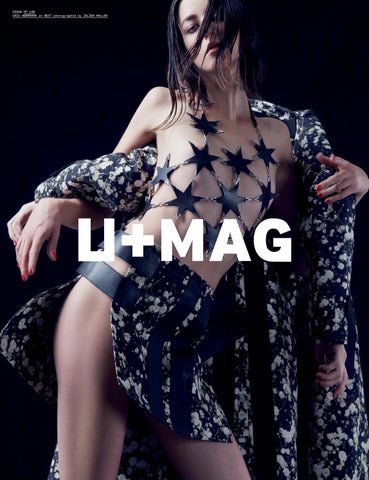
ISSUE Nยบ 108 CRIS HERRMANN at NEXT photographed by JULIEN HALLON
1
Utopia 2
lies
a
draw nea retreats te swiftly t matter
When I it If I proceed it slips No how far I it. What, then, is the
It is to cause
at
arer
the by
two
horizon. two steps, 3
steps. steps forward, ahead. go, I can e of ?
en ten steps never reach purpose utopia e us to advance.
m a s t h e a d
4
CONTRIBUTORS Julien Vallon Céline Lemmonier Gaelle Bertoletti Tine Kozjak Charly Gosp Melvin Israel George Krakowiak Mel Freese Fernando Tomaz Pedro Padrella Julien Bernard Yann Boussand Larcher Christine Cherrbonier Michael silva Jared Christiansen Gregory Granaham Tyler Kohlhoff Lana Jay Ackey Rachel Stickley Gia Seo Kristiina Wilson Jessica Plummer Noemie Aiko Sebayashi Angel Jhang Benjamin Taylor Taichi Saito Bryan Zaragoza Louise Victoria Ken Tanuma Catharina Pavitschitz Zhana Medvesh Fiona Rose Delphine Bonnett Alexa Horgan Louana Carron Anete Salinieka Ami Fujita Ellen Syrjala Molly Bridgwood Naguel Rivero Ed Cisco Dinosaraus Josef Forselius Karolina Danielsson Josefina Zarmén Bea Hansson Marjoria Chanut Quentin Guyen Samuel Ruffin--Hendrix Lauretta Sutter Victoria Steiner Mia Bregar
Founder & Creative Director ROMEU SILVEIRA Fashion Director IGI AYEDUN Mens Fashion Editor BENJAMIN BROUILLET Fashion Editor-At-Large NY Dwight Reeves Fashion Features Editor CARINA TOLEDO Fashion Features Writer TALI RAMSEY Arts & Culture Editor MATEUS LAGES Digital Editor HERNAN QUINTANILLA Editorial Contributor JOÃO LOURENço Copy Editor YASMIN TAYAG
Adam Broomberg & Oliver Chanarin
2004-2015 © U+MAG, the artists and contributors. All rights reserved. Reproduction of any part of this publication is strighly prohibited without prior permission of the publishers.
Adel Abdessemed
5
Edward Ruscha
i
n
d
e
x
1 COVER by Julien Hallon 2—3 UTOPIA by Fernando Birri 4—5 MASTHEAD/INDEX 6—7 EDITO by Romeu Silveira 8—11 ESCAPISM by Melvin Israel 10—11 A Street Car Named Success by Tennesee Williams 14—17 ESCAPISM by Melvin Israel 18—19 INTRO by IGI AYEDUN 20—45 EXTRA HUMANS by Julien Hallon 46—57 @alissic by Fernando Tomaz 58—67 NEW WAVE by Julien Bernard 68—85 LEATHA ROYALTY by Tyler Kohlhoff 86—103 HYPER DIET by Kristiina Wilson 104—115 COWGIRL? by Benjamin Taylor 116—121 PRESENTING> ANDREA JIAPELLI by Tyler Kohlhoff 122—127 PRESENTING> STÉPHANIE COUCHERT by Louise Victoria 130—137 PRESENTING> NATALILIA PILEPENKA by Tyler Kohlhoff 138—149 A conversation with writer ADAM JOHNSON 150—169 WAR by Catharina Pavitschitz 170—177 ESCAPISM by Melvin Israel 178—187 TWO OF US by Alexa Horgan 188—193 HOPEFULLY by Naguel Rivero 194—205 FALLING SKIES by Dinosaraus 206—221 PRIMITIVE NOTION by Julien Hallon 222—235 CHINA SPECIAL by Carina Toledo & Tali Ramsey 236—243 KID by Lauretta Suter 244—257 TIME MACHINE 2004—2014 by Carina Toledo & Tali Ramsey 258—267 ESCAPISM by Melvin Israel 268—269 GUIDE
e
6
d
Making U+MAG is almost like writing a TV or movie script. We have a starting point, risky situations, several conflicts, stars and supporting characters. And of course, always a happy ending, which in this case are the issues ready for release. Making a magazine is an insane process. Making an independent magazine is even more insane.
Deliciously insane. I never shared many stories in this space, but there is one I believe deserves to be remembered here, after all: it is as radical as it is inspiring. In mid-2006, I was keeping in touch with AndrÊ Felipe, a Brazilian creative director then working in an advertising agency. He was one of the first to be enthusiastic about U+MAG and because of that was very sincere when I sent him one of the issues to hear his thoughts. The answer: Romeu, stop everything and get it together. I was shocked, it hurt to read those words, but I knew how much they mattered. That was the time I took a month to organize and reevaluate everything and then bring the magazine back. To this day, we’re still here and that email is still vital. The word SHIFT has never stopped being a part of U+MAG’s daily vocabulary ever since.
i
t
o 7
Helena Almeida
Sometimes it is more than necessary to blow everything up to rebuild from scratch. Here at U+MAG, we believe in cycles and how they are a part of our journey. That is why from this issue on, we’ll enter into a biannual publishing cycle. The world has changed, our needs have changed, and the speed of events has given us the desire for more time to think things through, research, and put together the magazine we believe in. P.S. This issue and this text are titled after the words of artist Douglas Gordon. This was the title he suggested for an exhibition in 2000, curated by Hans Ulrich Obrist. Romeu Silveira
8
ESCAPISM 1 of 4
Photography MELVIN ISRAEL
9
10
11
12
Sometime this month I will observe the third anniversary of the Chicago opening of “The Glass Menagerie,” and even which terminated one part of my life and began another about as different in all external circumstances as could be well imagined. I was snatched out of a virtual oblivion and thrust into sudden prominence, and from the precarious tenancy of furnished rooms about the country I was removed to a suite in a first-class Manhattan hotel. My experience was not unique. Success has often come that abruptly into the lives of Americans. No, my experience was not exceptional, but neither was it quite ordinary, and if you are willing to accept the somewhat eclectic proposition that I had not been writing with such an experience in mind--and many
people are not willing to believe that a playwright is interested in anything but popular success-there may be some point in comparing the two estates. The sort of life which I had had previous to this popular success was one that required endurance, a life of clawing and scratching along a sheer surface and holding on tight with raw fingers to every inch of rock higher than the one caught hold of before, but it was a good life because it was the sort of life for which the human organism is created. I was not aware of how much vital energy had gone into this struggle until the struggle was removed. I was out on a level plateau with my arms still thrashing and my lungs still grabbing at air that no longer resisted. This was security at last. I sat down and looked about me and was suddenly very depressed. I thought to myself, this is just a period of adjustment. Tomorrow morning I will wake up in this first-class hotel suite above the discreet hum of an East Side boulevard and I will appreciate its elegance and luxuriate in its comforts and know that I have arrived at our American plan of Olympus. Tomorrow morning when I look at the green satin sofa I will fall in love with it. It is only temporarily that the green satin looks like slime on stagnant water. But in the morning the inoffensive little sofa looked more revolting than the night before and I was already getting too fat for the $125 suit which a fashionable acquaintance had selected for me. In the suite things began to break accidentally. An arm came off the sofa. Cigarette burns appeared on the polished surfaces of the furniture. Windows were left open and a rainstorm flooded the suite. But the maid always put it straight and the patience of the management was inexhaustible. Late parties could not offend them seriously. Nothing short of a demolition bomb seemed to bother my neighbors. I lived on room-service. But in this, too, there was a disenchantment. Sometime between the moment when I ordered dinner over the ‘phone and when it was rolled into my living room
like a corpse on a rubber-wheeled table, I lost all interest in it. Once I ordered a sirloin steak and a chocolate sundae, but everything was so cunningly disguised on the table that I mistook the chocolate sauce for gravy and poured it over the sirloin steak. Of course all this was the more trivial aspect of a spiritual dislocation that began to manifest itself in far more disturbing ways. I soon found myself becoming indifferent to people. A well of cynicism rose in me. Conversations all sounded like they had been recorded years ago and were being played back on a turntable. Sincerity and kindliness seemed to have gone out of my friends’ voices. I suspected them of hypocrisy. I stopped calling them, stopped seeing them. I was impatient of what I took to be inane flattery. I got so sick of hearing people say, “I loved your play!” that I could not say thank you any more. I choked on the words and turned rudely away from the usually sincere person. I no longer felt any pride in the play itself but began to dislike it, probably because I felt too lifeless inside ever to create another. I was walking around dead in my shoes, and I knew it but there was no one I knew or trusted sufficiently, at that time, to take him aside and tell him what was the matter. This curious condition persisted about three months, till late spring, when I decided to have another eye operation, mainly because of the excuse it gave me to withdraw from the world behind a gauze mask. It was my fourth eye operation, and perhaps I should explain that I had been afflicted for about five years with a cataract on my left eye which required a series of needling operations and finally an operation on the muscle of the eye. (The eye is still in my head. So much for that.) Well, the gauze mask served a purpose. While I was resting in the hospital the friends whom I had neglected or affronted in one way or another began to call on me and now that I was in pain and darkness, their voices seemed to have changed, or rather that unpleasant mutation which I had suspected earlier in the season had now disappeared and they sounded now as they used to
sound in the lamented days of my obscurity. Once more they were sincere and kindly voices with the ring of truth in them. When the gauze mask was removed I found myself in a readjusted world. I checked out of the handsome suite at the firstclass hotel, packed my papers and a few incidental belongings and left for Mexico, and elemental country where you can quickly forget the false dignities and conceits imposed by success, a country where vagrants innocent as children curl up to sleep on pavements and human voices especially when their language is not familiar to the ear, are soft as birds’. My public self, that artifice of mirrors, did not exist here and so my natural being was resumed. Then, as a final act of restoration, I settled for a while at Chapala to work on a play called “The Poker Night,” which later became “A Streetcar Named Desire.” It is only in his work that an artist can find reality and satisfaction, for the actual world is less intense than the world of his invention and consequently his life, without recourse to violent disorder, does not seem very substantial. The right condition for him is that in which his work is not only convenient but unavoidable. This is an over-simplification. One does not escape that easily from the seductions of an effete way of life. You cannot arbitrarily say to yourself, I will now continue my life as it was before this thing. Success happened to me. But once you fully apprehend the vacuity of a life without struggle you are equipped with the basic means of salvation. Once you know this is true, that the heart of man, his body and his brain, are forged in a white-hot furnace for the purpose of conflict (the struggle of creation) and that with the conflict removed, the man is a sword cutting daisies, that not privation but luxury is the wolf at the door and that the fangs of this wolf are all the little vanities and conceits and laxities that Success is heir to--why, then with this knowledge you are at least in a position of knowing where danger lies. You know, then, that the public Somebody you are when you “have a name” is
a fiction created with mirrors and that the only somebody worth being is the solitary and unseen you that existed from your first breath and which is the sum of your actions and so is constantly in a state of becoming under your own volition--and knowing these things, you can even survive the catastrophe of Success! It is never altogether too late, unless you embrace the Bitch Goddess, as Willimam James called her, with both arms and find in her smothering caresses exactly what the homesick little boy in you always wanted, absolute protection and utter effortlessness. Security is a kind of death, I think, and it can come to you in a storm of royalty checks beside a kidney-shaped pool in Beverly Hills or anywhere at all that is removed from the conditions that made you an artist, if that’s what you are or were intedned to be. Ask anyone who has experienced the kind of success I am talking about--What good is it? Perhaps to get an honest answer you will have to give him a shot of truth-serum but the word he will finally groan is unprintable in genteel publications.
13
Then what is good? The obsessive interest in human affairs, plus a certain amount of compassion and moral conviction, that first made the experience of living something that must be translated into pigment or music or bodily movement or poetry or prose or anything that’s dynamic and expressive--that’s what’s good for you if you’re at all serious in your aims. William Saroyan wrote a great on this theme, that purity of heart is the one success worth having. “In the time of your life--live!” That time is short and it doesn’t return again. It is slipping away while I write this and while you read it, and the monosyllable of the clock is Loss, Loss, Loss unless you devote your heart to its opposition.
14
ESCAPISM 2 of 4
Photography MELVIN ISRAEL
15
16
17
i
18
n
I confess that before writing this I spent hours visiting the Instagram profiles of our followers. Not that I was looking for inspiration of some kind, it was just out of curiosity. It reminded me of the first time I discovered U+MAG, at 16 years of age. It was a page on Blogspot full of images that were unlike anything I had ever seen in my big country, Brazil. The first thing that popped into my mind was: «Man, that›s what I wanna do when I grow up!” Thankfully, destiny put Romeu in my path, well, actually my e-path. On MSN Messenger, we started an intense and daily friendship, forever online, full of ideas and inspiration exchanges, and one day I realized I was also a part of this underworld called U. My diary! In the pages of U+MAG I shared my biggest and smallest dreams, vomited my desires and anguishes, and released a thousand cravings. More than being U+MAG when I grew up, I... I got to grow up being U+MAG! This is the magazine responsible for the most sincere awakening of all of my dreams. How many issues were born out of a silly conversation on Facebook? Or of teenage suffering over problems as a fashion intern?
However, it feels funny to say... ‘magazine’. I actually feel like we›ve never made a magazine, we just incorporated ourselves into an image and content format. What would I call that? I don›t know, not yet The fact is that maturity always brings on new questions and everything that was once not a part of our concern starts to generate new ambitions, and so, finally, the system puts us against the wall and demands from us, here and now, a brief description. I›ve discovered a world very different from the one where U+MAG was born in and grew up; I discovered the importance of partnerships, connections, relationships... Me, the urban-citizendaughter-of-the-years-2000-raised-in-an-appartment-in-front-of-the-computer. Even I, ever antisocial. I discovered that the world of magazines is a spinning wheel and being at the forefront of it means keeping your eyes open for the first available seat. I discovered the system of brands and that an outfit on a page has a lot more to do with what you sell than with what you create.I discovered the importance of money and that the most successful dreams are those that are better financed and that power is narrowed down to audience numbers. Boring! Especially nowadays, when everyone sees everything but takes in nothing! When everything seems so disposable and most attention spans last only 15 seconds. I remember being 16 and looking at U+MAG for hours and hours, countless times. Observing an image and never getting tired of it.
t
r
o
19
I›m proud of being the first independent magazine with the biggest network of international collaborators the world has yet to see. I›m proud of being the first independent magazine to break barriers and interact with people the same way these same people interact with each other, through a click or like. And I don›t need anyone to describe us in that way to be sure that U+MAG is one of the frontrunners in this phenomenon. But what else? This year U+MAG celebrates ten years, ten years since the genius Romeu Silveira blew everything up! Thinking about my country, if you only knew how many independent magazines had the nerve to come out from there since then... And how many more throughout the world did we inspire? How many graphic design classes have our pages travelled through? To how many newsrooms and trend studios have we gone, becoming an answer to the thirst to know “What are these kids today into?” How many photographers, stylists, make-up artists, designers, and artists had their first publications here? How much talent was born?
We never planned to be what we are. We never projected our future. We have many times thought of doing so, but we’ve always found something else more exciting to create right then and there instead of breaking our heads trying to think of what we could become. And do you really want to know how I feel? I simply don’t care. Selling clothes, buying the world, being famous and getting rich are not priorities. My desire is to keep inspiring dreams, careers, ideas. To keep on discovering new talent, creative minds, beauty, sharing desires, images and truths and keep on making U+MAG a path to a world where we really listen to the voice of a garage generation, cyberdigital, alternative, countercultural, independent and forever young and restless, no matter how hard it is. Because at the end of the day, we are what we believe in! Igi Ayedun
top Zana Bayne skirt and coat Givenchy by Riccardo Tisci
20
top
Zana Bayne 21 skirt
Isabel Benenato blazer, pants, bracelets, rings and boots Saint Laurent by Hedi Slimane
top Zana Bayne skirt and coat Givenchy by Riccardo Tisci
22
bra
Zana Bayne 23 boots
Givenchy by Riccardo Tisci
24
top Zana Bayne
top
Zana Bayne 25 earrings
Givenchy
blazer Etudes shirt Givenchy by Riccardo Tisci
26
belts Saint Laurent by Hedi Slimane leather socks Zana Bayne
27
jacket Balmain pants Ainur Turisbek
28
blazer Etudes shirt Givenchy by Riccardo Tisci pants Balmain
29
coat
Kenzo 30 leather socks Zana Bayne
31
coat
Kenzo 32 leather socks Zana Bayne
E
Ex
Photographer Tyler Kohlhoff Stylist Lana Jay Lackey Make-up Bryan Zaragoza at See Management Hair Taichi Saito Model
33
34
u
Photographer Tyler Kohlhoff Stylist Lana Jay Lackey Make-up Bryan Zaragoza at See Management Hair Taichi Saito Model Alexandra Titarenko
tshirt and skirt Vetements boots Saint Laurent by Hedi Slimane
35
dress Gosia Baczynska necklace Zana Bayne
36
bra
Zana Bayne 37 shorts
Songzio socks and shoes Prada
top Anne Sofie Madsen bra Zana Bayne
38
39
40
top, skirt, socks and shoes Prada bra Zana Bayne
41
dress 42 Anne Sofie Madsen bra Zana Bayne socks Prada sandals Songzio
43
shirt Saint Laurent by Hedi Slimane necklace Zana Bayne socks and shoes Prada
shirt Saint Laurent by Hedi Slimane bra Zana Bayne panties Prada
44
45
46
47
at way model
48
49
50
51
52
53
54
55
56
57
58
59
60
coat by GOSHA RUBCHINSKIY jacket by GOSHA RUBCHINSKIY top by DRIES VAN NOTEN top by LANVIN pants by MAISON MARTIN MARGIELA
61
denim jacket MAISON KITSUNE top LANVIN pants NOEMIE AL HOMSI
62
coat GOSHA RUBCHINSKIY top DRIES VAN NOTEN pants MAISON MARTIN MARGIELA
63
t-shirt GOSHA RUBCHINSKIY top slings NOEMIE AL HOMSI pants J.W ANDERSON
64
coat SACAI t-shirt J.W ANDERSON pants J.W ANDERSON
65
coat MAISON MARTIN MARGIELA shirt MAISON MARTIN MARGIELA pants LANVIN
66
coat LANVIN shirt MELINDA GLOSS pants LANVIN
67
jacket GOSHA RUBCHINSKIY top LANVIN pants MELINDA GLOSS sneakers MAISON MARTIN MARGIELA
68
at NY Models
69
at Muse Models
70
71
shirt Francesca Liberatore pants & bustier Cristian Cowan-Sanlois boots SAINT LAURENT gloves LA CRASCIA
72
top Martine Sitbon top & pants Cherry vintage boots MAISON MARGIELA
73
74
75
THIS PAGE jacket and pants Wales Bonner tights American apparel OPPOSITE PAGE shirt Francesca Liberatore suit Cristian Cowan-Sanlois
76
77
78
THIS PAGE vintage shirt MAISON MARGIELA scarf worn as shirt Fiorucci by Cherry Vintage leather pants Cherry Vintage boots SAINT LAURENT
79
80
81
top Cherry Vintage pants stylists own
82
top & pants CHERRY VINTAGE boots Saint Laurent
83
84
85
THIS PAGE sweater Ve Jas boots MAISON Margiela OPPOSITE PAGE top Pola Thomson skirt Julia Seeman boots stylists own gloves La Crascia
86
87
Set SetDesign Design Rachel Stickley at Anastasiia Chornaa Bernstein Andruilli at Red&Model
top 88 Julia Wollner
shirt (worn under) Koonhor
89
jacket 90 Koonhor
bottom Koonhor tank (under) XXBC
91
92
93
vest Abigail Daphne Lewis t-shirt Public School bottom Public School
94
jacket Scapes NY top Julia Wollner bottom XXBC
95
jacket Julia Wollner
96
97
98
bottom Koonhor necklace Model’s own
99
100
101
jumpsuit Asher Levine
top 102 Asher Levine bottom XXBC
103
104
I’m your
105
r cowgirl Beauty Jessica Plummer
106
107
108
jumper Nattofranco tigh highs Area NYC jock strap Stylists own
top Area NYC bras Stylists own skirt Nattofranco Pants Area NYC
109
110
top Area NYC bras Stylists own skirt Nattofranco pants Area NYC hat Space Cowboy.
bras Stylists own Belt Space Cowboy skirt Nattofranco tigh highs Area Nyc
111
112
jumper Nattofranco tigh highs Area NYC jock strap Stylists own
113
114
115
top Nattofranco chaps Space Cowboy boots Space Cowboy
IAPE L L I
116
PRESENTING Andrea Jiapelli PRESENTING Andrea Jiapelli
Photographer TylerPhotographer Kohlhoff Tyler Kohlhoff Stylist Stylist Lana Jay Lackey Lana Jay Lackey Make-up Make-up Bryan Zaragoza Bryan Zaragoza at See Management at See Management Hair TaichiHair Saito Taichi ModelSaito AlexandraModel Titarenko Alexandra Titarenko at Wilhelmina at Wilhelmina
IAPE L L I 117
Masthead
IAPE L L I
118
Issue Nยบ 108
Index
Volume 2 of 2
119
120
121
téphanie o uc h e r t téphanie 122
PRESENTING Stéphanie PRESENTING AndreaCoudert Jiapelli
Photographer Louise Victoria Photographer FashionKohlhoff Editor Tyler Igi Ayedun Stylist Make-Up Lana Jay Lackey Céline Lemonnier Make-up HairZaragoza Stylist Bryan KenManagement Tanuma at See Fashion Hair Assistant Anne Mukendi Taichi Saito model Model Marieme Hoang-Gia at Next Alexandra Titarenko All clothes byatStéphanie Coudert Wilhelmina
o uc h e r t 123
124
tĂŠphanie 125
o uc h e r t tĂŠphanie o uc h e r t 126
127
tĂŠphanie o uc h e r t 128
129
atalilia ilepenka atalilia 130
PRESENTING Natalilia Pilepenka PRESENTING Andrea Jiapelli
Photographer TylerPhotographer Kohlhoff Tyler Kohlhoff Stylist Stylist Lana Jay Lackey Lana Jay Lackey Make-up Make-up Bryan Zaragoza Bryan Zaragoza at See Management at See Management Hair TaichiHair Saito Taichi ModelSaito AlexandraModel Titarenko Alexandra Titarenko at Wilhelmina at Wilhelmina
ilepenka 131
132
atalili
133
atalili ilepenk 134
135
136
137
138
Interview JOAO LOURENÇO
139
140
AJ — I get my work done at a library near here because I can´t access the internet there, and the restrooms are located far from the desks, so it is a way to avoid procrastination. When I go there I know I have to write. But when I was younger I was a journalist. I always loved to interview people. I always loved to research. I like to write fiction instead of nonfiction because I can control all the aspects and try to make something that’s layered and organic and hopefully - I hope I don’t sound like a jerk works on lots of levels. I just like the power of life lived and how that’s infused. I remember I used to live in the American state of Louisiana, and a hurricane hit where I used to live. I went there and interviewed police officers, search and rescue people, the coroner who pulled all the bodies out, all kinds of people you can imagine. So when I went to write my fiction I had these real stories in my head that I had to live up to. That I had to capture! I don’t know, I guess I had kind of the sense of a mission to try to capture something of real life. The more I write, the more I want my fiction to lean on the real world. JL — Can I assume that you realized you wanted to be a writer of fiction after being a journalist? AJ — Yes! I was not that good as a journalist. I always wanted to capture the emotional truth of stories, instead of just getting the facts and letting the reader decide. My journalism professors, when I was a senior, they told me, “you’re not made to be a journalist, you can’t make up quotes.”
JL — Who or what has had the greatest creative impact on you? AJ — Well, there are many writers. I started being in love with the short story. Tobias Wolf is a writer who had a great impact on me. I love Jennifer Egan. I met her when I was a young writer. She was very helpful, and classy, and she wasn’t famous yet, and I was a young noone. But she took me under her wing, and I’ve just always thought the world of her. And her writing has only gotten better book after book after book. I think she’s going to be one of our great writers in America. JL — When you write, do you think about an audience or are you speaking for yourself? AJ — I think when I create, I just I feel like I’m inside a scene. I tend to write pretty scene-based writing. And I don’t feel like I’m making something, but I feel like I’m inside of something. Like I’m in the road. I’m in the environment. I’m in the moment. It’s like I’m very ‘in time’. I usually write with my eyes closed. So I’m not looking at the screen, but the scene. But when I’m editing, I think of my wife. Because in a sense it has to be good enough or she’ll say “Write it again.” JL — You teach creative writing at Stanford. Do you still teach yourself? How is that process? AJ — Personally, writing drains me, and teaching invigorates me. I feel like one drains my batteries, and the other recharges them. But it’s hard to be a husband and a father of three boys. My other role is a teacher, and the third I feel like is a writer. There is nothing else. I’m not a social person. There’s no time to see movies or read newspapers. I just feel like I try to do those things, and one of them is always slipping. I feel like I’m always failing at one of them.
JL — Philip Roth once said that the novel is dying. I keep hearing the same similar pessimistic view on the death of literature. Friends and editors are always complaining that no one reads these days, not when you have Netflix, the Internet, and many other entertainment options. Personally, I know a couple of very interesting people who have never opened a fiction book in their lives. This topic is always in the back of my mind. How does one become a good good reader or writer? Can we teach ourselves, or is this trait ingrained in home and school? AJ — I think talent is overrated, honestly. When I was younger, I was a pretty bad writer but I had a passion for it. And I also think I saw the world a little differently. Those are two things you can´t teach: passion and having maybe a little bit of an artist’s eye. But talent, I mean, I see students who have it. They’re given a talent for a great ear for dialog. Or maybe a student is great at beautiful prose. Or maybe a student is funny. And that is all good, but they still have to learn all the other things. I think everyone is given a few gifts. But then you have to go learn all the stuff you don’t know. And I think some of my students who don’t progress as writers are the ones who are the most talented. Cause they can already write a pretty good story, and they don’t have to work as hard. And they get a lot of praise for what they can already do. I’ll take labor over talent any day. I think the writers I turn to and the writers who speak to me are ones who put tremendous amounts of labor into their work. And it doesn’t come easily to me. I’ve logged lots and lots and lots of hours. And I think for this book I threw away 225,000 words. Well, I know that I did. Which is... I don’t know what that is. Nine hundred to a thousand pages?
knew there was something strange on the street and they never even glanced at me.”
JL — Unlike your contemporaries, you don’t seem to have problems writing about close people to you and situations in your daily life. Can you tell me more about your creative process?
JL — In general, are you
“It was so strange, because I would walk in Pyongyang on the streets, and there would be thousands of people coming at me. They wouldn’t even look at me. Somehow they
worried about the publishing industry?
AJ — Worried about it ignoring me? Worrying about it failing? Worried about the future of the book? JL — About failing and the future of the book AJ — I’m not so worried about the future of the book. I mean, literature is all of us. I really believe that. It’s the stuff of the human voice, it’s the container of our humanity. The narrative is our main meaning-making machine. I think we’re storytelling beings. I think people come to literature maybe later in their lives, now. And, there is more access than ever, there´s more different places. I see books everywhere. Whether they’re on iPhones, or iPads, or printed out. I’m not worried about narrative at all. It might be harder to find books, as books are taken out of the hands of large publishing houses. I don’t knowI’m no expert on the topic. JL — Well, let´s start talking about your book, The Orphan Master’s Son. What motivated you the most to write such a book? AJ — I had to teach a class at Stanford that’s like reading novels for writers. I like to look at how they’re constructed. It’s filled with young, eager writers. And we look at how books are made. But I always throw one nonfiction book in there or one memoir. And we spend many weeks thinking about how to create fake lives. I always want to measure that against a memoir, in which we see how a real person wrote about their real life. I started reading this book called The Aquariums of Pyongyang. It’s the story of a guy who was in a North Korean gulag. I guess I didn’t really know that there were gulags in the world still. And I didn’t know much about North Korea. It’s just so hard to hear. In 2004 I ended up reading about ten books about North Korea just because I was curious. I guess the narrative of my book started out of that. The real motivation came, especially in 2005, when a lot of stories of regular North Koreans who had defected came online. Christian missionaries, aid workers, humanitarians were taking the stories of North Koreans
and putting them on the Internet. And when I started reading the real stories of real people, I just couldn´t believe it. That was my main motivation. I felt like these stories took residence in me. And I kept thinking about these peoples’ lives and my own life. It just felt like I had to do something with them. They just kind of started going into the book. JL — How did you manage to get into North Korea? AJ — I applied for a visa there a couple of times. You know they have a lot of websites, they even have websites of their zoos. Everything they write in English is up for free, like all the works of Kim Jong-il. They had a website for Kim ll-sung University, and I applied to be a visiting scholar and nothing came of it. But then I met a man who had a nonprofit organization that plants apple orchards in North Korea. The North Koreans knew him, he had been there fourteen times. He and his friends had planted thousands of apple trees for free, so he knew the people in bureaucracy. This friend of mine kind of vouched for me, he knew I was writing a book about North Korea. He also knew that no one had written a novel really about it before, and he thought it was really important, so he pulled some strings to get me a visa and actually took me there. All of this happened in 2007. JL — How long did you stay there? AJ — When you’re granted a visa, they tell you the day you’ll arrive and they tell you the day you’ll leave. Mostly, they open up the country for two weeks out of the year to foreigners, for the Arirang Festival. That’s when they do all the gymnastics and they make the capital beautiful so they let foreigners in for a week. So I was there for about seven or six days. JL — Can you point some of the doubts you’ve had before going to North Korea? AJ — Oh, my doubts and fears? Well, I did have small children, and my wife was nervous. But my friend, he was of Korean descent, and he had been born in the north a long time ago, and he said “there’s no crime in this nation, it’s the safest
141
142
143
144
145
146
don’t leave the capital and they don’t bring their stories out. It’s a very mysterious place. The rest of North Korea is like a slave society. They’re peasants. They’re the edge of starvation a lot of the time. They’re very controlled. It’s these people that to survive sometimes have to cross the border and back. They have to travel at night. They have to steal things and trade things. They have to go to the night market. And all of these things can make you a candidate for going to a gulag. Our sense of Korea really only comes from the people in the countryside who risk their lives to get out. And it’s hard to know what life is like in the capital, Pyongyang.
JL — That´s fascinating. I mean, you spent a week there and didn´t talk to any locals. Where did you stay?
AJ — It’s very mixed. He was a character in my book. I was worried that this would damage my book in one way. On one hand, I didn’t mourn the fact that a dictator was gone. He was quite a cruel person. Then, on the other hand, by making him a character in my book, I had to make him human and find his flaws and weaknesses and vulnerabilities. I think you come to have a more sympathetic portrait of him than other people. His brother died when he was a child. His mother died when he was a child. His father remarried to a woman who hated Kim Jong-il and his sister and treated them poorly. He had an isolated, lonely childhood. I mean, there were a lot of factors that made him into the person he was.
AJ — They were so afraid of being perceived of interacting with me, they wouldn’t even look at me.It was so strange, because I would walk in Pyongyang on the streets, and there would be thousands of people coming at me. They wouldn’t even look at me. Somehow they knew there was something strange on the street and they never even glanced at me. There’s an island in the Taedong River that they put you on. The island is a hotel that the French actually built. The North Koreans are not good at building too many things. The French built it, and the North Koreans never paid them. You need a pass to get onto the island. So, normal North Koreans can’t get on the island. And to get off the island and get into Pyongyang you need a minder, an official person. So nobody can leave. And even at the hotel, all the workers at the hotel were Chinese workers on contract. So I couldn’t even meet a North Korean receptionist or room cleaner. JL — In general, do you still get surprised about their way of life? AJ — When you think about North Korea, there’s really two Koreas. There’s the capital, which is where all the elites live; but to live there you need a high songbun rating, which is like a Korean family loyalty rating. Only the most trusted North Korean can live in the capital. If you do live in the capital, you get real education, instead of indoctrination. They have real health care. You get electricity and a decent apartment. In the famine, they went hungry in the capital, but nobody starved to death. So, people
JL — How was your reaction when you heard of the death of Kim Jong-il?
JL — I’m sorry to interrupt, but I heard that before and I follow your point, but we’re all broken by life. I find it difficult to try to justify cruelty. AJ — Oh no, he was one of the most cruel dictators on earth. I’m just saying I felt a lot of complex thoughts. I think I lived with him as a character in my book for many years. Your normal character doesn’t have a counterpart in the real world. My character was not him, they were just different people. It was like a character had died in some way… your characters in your book normally live forever. During the time I was writing the book, North Korea was the kind of place which was just made fun of. There was even a South Park movie about them. You know, it’s not a joke, it’s a really sad, tragic place. One thing, they don’t have a voice, and so they can’t talk back. No one would make fun of Rwanda, also run by a cruel dictator who committed genocide against his own people. I think Kim Jong-il was a genocidal maniac,
“there’s no crime in this nation, it’s the safest place in the world”
place in the world.” People are so worried about being thrown in a gulag, they would never steal a radio or get in a fist fight. But the state had a total monopoly on violence, and they wouldn’t let harm come to an American with a visa. I think if you sneak across the border, or commit a crime, then it’s different. But he was right, I found a very safe, pleasant atmosphere - it’s very well managed. It’s illegal to actually speak with a citizen in North Korea. If I had tried that, I would have gotten someone in real trouble. Just the perception that you’re talking to a foreigner can get someone in real trouble there. So the one place you can never talk to a North Korean is in North Korea. You can talk to them in California or somewhere else but not when you´re there. The only people I could talk to were people who had been through special training to handle me.
“You know, it’s not a joke, it’s a really sad, tragic place. One thing, they don’t have a voice, and so they can’t talk back.”
please, don’t get me wrong. But when Kim Jong-il died, I think for the first time - during the period I was writing the book, over six or seven years - that it was the first time that people took it seriously. And they began to wonder, at least in our media in America, what it was like to be there and who these people were. What their lives were like. And his death was a case of the first serious discussion in America of what it must be like to be North Korean. I was really glad for that. People stopped just making jokes and started asking real questions. JL — Do you believe there’s a big difference between King Jong-il and his son, King Jongun? AJ — This is a good question. Of course it’s hard to know anything about North Korea. It’s hard to especially know what’s happening in the elite realms of Pyongyang. But I just interviewed over the winter a man named Kenji Fujimoto. He was Kim Jong-il’s chef for many years. For eleven years straight at one period before he escaped North Korea. He was Japanese. He was kind of held captive there. He also was a regular babysitter of Kim Jong-il’s children, who were Kim Jong-chul and Kim Jong-un. So this guy I interviewed had been with Kim Jong-un from the age of 7 to 18. He watched a decade of this young man’s life. And again, I think Kim Jong-un is probably a very dark figure who’s living well at the expense of millions of people. But also, he was born to a cruel paranoid distant father. His mother died. Like Kim Jongil, he was separated from any real children. Lived in isolated places. Well, he had cruelty as a model. His father was very paranoid and used to test loyalty of people all the time in horrible ways. My sense is that Kim Jong-un probably absorbed all of that. And saw that as probably the proper way to lead a country. I think he is like his father.. JL — Do you think that North Koreans have some sort of feeling about what´s really going on there and also outside their country? AJ — Like I´ve said before, there are the elites and the other ninetysomething percent of the country. When I was in their capital, even though I wasn’t allowed to talk to people, I went to some parts of
the country. But most of the really desperate countryside I couldn’t go to. But the people had come from the countryside to the capital. But you could see how dark their skin was, how ropey their hands were, how thin they were. You could see that they had never seen dentists in their lives. And you could tell that the people in the countryside, the hard lives of brute labor, I think they’re concerned about survival. The interesting phenomena in that there is no ‘Arab Spring’, so to say, in North Korea. Because all the people who might speak back defected, so they’re bleeding away any possible opposition. My sense is that everyone knows there that their reality is a lie but most of them don’t know what the truth is. Except in Pyongyang. In Pyongyang, I think they do know something about the rest of the world. But they have their life relatively made. And they’re not starving to death. And they have refrigerators and rice cookers. I think they know they’re lucky in their own country. JL — What’s your view on young people protesting around the globe? Do you think this kind of protests can really change something and maybe it could affect the North Koreans somehow? AJ — There´s no protest at all in North Korea. None! There’s famous cases of people who have printed flyers and things like that. There was one a few years ago. Here’s the story: we only knew it because the chief of police in Chongjin defected. When Kim Jong-il was still alive, he went to visit that part of the country and someone had made flyers and distributed them condemning the regime before he came. But there are no Xerox machines in Chongin. Someone hand-wrote four hundred letters and in the night distributed them around town. Can you believe that? That’s how you have to protest. So the regime went insane trying to find that person, they took handwriting samples from everyone in that part of the city. They decided that someone had written with their left hand to hide their identity so they went back and did that again. Then the Kim regime was going to kill all the police officers unless they solved the problem. That’s when the chief of police defected. And that’s the only way we get a story like that. Maybe that is an example of someone
147
148
protesting and not being punished, but I think it’s also such a very rare, deadly thing that even the cops were going to get killed over it. So I don’t think there’s any protest at all. JL — About their future: do you feel you will be alive to see a free North Korea?
AJ — There’s two parts to that question. One is that, you know, there are other oppressive parts of the world where you can probably either choose to write a dissenting play or a poem and get in trouble for it. But in North Korea there really are no artists. There is no expression. No one has spoken about a single poem or book or novel or play in sixty years. So it really is a place without a voice. I think people can try to help give voice even if the portrait’s not right. I think the second part of that question is personal to me. When I thought about North Korea, when I was writing about it, I thought, every day, what if I had been born there? What if my children had been born there? I wonder: would I have been allowed to be a writer? Would I have to write propaganda? What would happen to my kids during the famine? Would I have been allowed to marry my wife,
AJ — I don’t know. I honestly don’t know. I will say that there’s not evidence for it. I like to think, again: two North Koreas. There is an elite, and there are different levels of elites. They all have cellphones in the capital, and some of the people in the capital have the Internet, so they are Googling and reading and doing all this stuff. If you are an elite in the capital, you are reading books from other countries. I don’t know if you’re right. There´s this man, Jan Jin-sung, who escaped in 2004. He’s written poetry about that time. You can even Google one of his poems; it’s called “(I Am) Selling My Daughter for 100 Won.” But I don’t believe he wrote those poems there. I think it was only after he got out that he had the courage to find his voice to say his own things. It’s hard to imagine but I think people are just so concerned about survival that art doesn’t have a place.
JL — I have a random question for you. Sometimes I feel I wasn’t born in the right time, but then I think about Proust
Note: Chongjin is the country´s
JL — You live in a country where you can say and do what you want, and there are lots of parts of the world where that’s not true, like North Korea. Which aspect of the trip made you appreciate your freedom and what’s your concept of it?
JL — You told me in that there´s no space for expression in North Korea, but I like to think that there’s potentially an underground movement where people talk about their ideas and express their feelings. Is it just an illusion, right?
third-largest city.
AJ — Of course that’s what I would want more than anything. I mean, I really came to care about all those people who are trapped. But there’s the big picture: China doesn’t seem to want change to come to North Korea, in my estimation. If there is unification, they know it will happen on South Korea’s terms because it’s an ally of the United States. It’s also been speculated by people smarter than myself that the Chinese, who have their own human rights issues, likes that the world fears North Korea instead of China. And they’re happy to have this place that is a magnet for the world’s attention. Personally, I don’t know how change would come, it would come fast and unexpectedly, I would think. And it might be something unseen, like a tsunami or a nuclear accident or something that nobody’s prepared for, that might trip everything. I hope freedom comes to that place. It’s been sixty years! It’s hard to imagine.
or would they have married someone for me? You have to do seven to ten years of mandatory military service there. All of my college years would have been in the military. Would I have been an elite person? Or would I have been a peasant? Would I feel free to communicate? Would I have found my own heart? One of my big questions that I thought all the time was that I think North Koreans know it’s all a lie but they don’t know what the truth is. If I came to suspect that it was all a lie, that it wasn’t the greatest nation in the world, that it wasn’t good health care, that it wasn’t democratic.Would I tell my children? It’s something I kept coming back to. If I told them, it would make them better people, but it would endanger them. I don’t think we in America think about these other possibilities. I honestly hadn’t until I really wrote about North Korea. Because things could be very, very different.
AJ — From the past! How could you pick one place? Wow! I would want to go everywhere and do everything. First of all, I would want to take my dentist with me if I travelled to the past and some antibiotics, too.You know, London during the Restoration, to see the plague, the fire, the restoration of Charles II. The opening up of the theatres, the birth of the novel would be pretty interesting to me. I also might head towards the end of the late Pleistocene. Probably 13,000–15,000 years ago. I could see most of the mega fauna that humans made extinct. And see people living as they had lived for hundreds of thousands of years.
149
“I could see most of the mega fauna that humans made extinct. And see people living as they had lived for hundreds of thousands of years.”
and his idea of time and memory and how the past works on us and through us, how love and beauty take us out of time, how art is a passage to other universes. In the end, the lost time always seems more attractive. If you could travel in time to live a moment you’ve never experienced before, what moment would it be? And if you could bring something back to your current life, what would you bring?
150
striped jacket MATTHEW MILLER black turtleneck YOHJI YAMAMOTO F/W 2005 black Coat COS gold skirt BEYOND RETRO trousers SONGZIO belt ROKIT
151
152
white button up shirt MATTHEW MILLER bomber jacket BEYOND RETRO black plaid skirt BEYOND RETRO black leather belts ROKIT black trousers CALVIN KLEIN
153
154
155
white button up shirt MATTHEW MILLER
156
black vest STYLIST’S OWN camel coat BEYOND RETRO silver trousers MARTINE ROSE FW 2014/2015 Black leather belts ROKIT
157
158
159
160
161
grey top 162 AVOC
green military jacket BEYOND RETRO red skirt ROKIT trousers CALVIN KLEIN
163
164
black shirt SONGZIO black striped coat SONGZIO black vest STYLIST’S OWN trousers CALVIN KLEIN
165
166
167
168
169
170
ESCAPISM 3 of 4
Photography MELVIN ISRAEL
171
172
173
174
175
176
177
178
Two
of
179
Us
180
181
182
183
jumpsuit
Yulia Kondranina 184 bra and gloves Atsuko Kudo
top
FENDI 185
LOUISA
186
bra Calvin Klein jacket Faustine Steinmetz trousers Marques’Almeida x Topshop INDIA top Lucilla Gray trousers Faustine Steinmetz
jumpsuit Yulia Kondranina bra and gloves Atsuko Kudo
187
188
Photographer Photographer Naguel Rivero Tyler Kohlhoff Stylist Stylist EdJay Cisco Lana Lackey Model Make-up Marcel Pawlas Bryan Zaragoza at Anti Agency UK at See Management New York, 2014. Hair Taichi Saito Model
189
190
191
192
193
194
Photographer Photographer DINOSARAUS TylerStylist Kohlhoff Stylist JOSEF FORSELIUS Lana Jay HairLackey Make-up Karolina Danielsson Bryan Zaragoza Make-up atJosefina See Management ZarmĂŠn FashionHair assistance Taichi Saito Bea Hansson Model Model Alexandra Titarenko IA at Elite at Wilhelmina
195
196
this page fur nocturnal by jesse heuvelink opposite page costume whyred
197
198
199
thIS PAGE fur vintage dior pants ralph lauren OPPOSITE PAGE jacket H&M skirt Hunkydory scarf Gucci
200
THIS PAGE fur nocturnal by Jessy heuvelink OPPOSITE PAGE pants missoni shoes H&M belt Gucci jacket Hope
201
202
203
THIS PAGE pants missoni shoes H&M belt Gucci jacket Hope OPPOSITE PAGE fur nocturnal by Jessy heuvelink
204
THIS PAGE costume whyred OPPOSITE PAGE pants missoni shoes H&M belt Gucci jacket Hope
205
206
207
208
209
210
211
212
p
p
i m i r ti e 213
Photographer Tyler Kohlhoff Stylist Lana Jay Lackey Make-up Bryan Zaragoza at See Management Hair Taichi Saito Model Alexandra Titarenko at Wilhelmina
214
215
216
217
218
219
220
221
222
Disrupt
Decent
Rumm Remix. Words Carina Toledo
& tralize. mage and
Erupt
223
224 The best fashion is that which unsettles us, that stays in our brains long after the hustle and bustle of fashion week is over and doesn’t fade into a blur of shows, presentations and prosecco. It’s that which doesn’t fit into the ‘season edit’ of the mainstream. That which is irreplaceable. A clear image that resonates and brings within you a deep desire: it’s consumerist and aspirational, and so it also defines us.
One of my favourite aspects of recent fashion weeks has been observing talent from the most unexpected places and their unique perspectives. From London, this impression is even stronger, especially since the British Fashion Council made an effort to champion this cultural exchange in recent years, with initiatives such as the International Fashion Showcase. By numbers, the frontrunner of this trend would be China, bringing us established names and young graduates alike. However, this shift is very different from the ‘Asian invasion’ seen in the 1980’s, when Issey Miyake, Rei Kawakubo, and Yohji Yamamoto became key players in the Paris show season, bringing an aesthetic Europe hadn’t seen before. Perhaps such a ‘wow’ moment would even be impossible today, considering we now have the Internet at our fingertips in case doubt of any kind creeps into our minds, but many other factors also contribute to the slow but steady climb of China as creative player in the fashion industry. Politically, the country’s history did not favor higher education after Mao’s Cultural Revolution, which halted China’s education system for quite some time, with most universities only reopening after 1972. During that period, more than 100,000 academics were prosecuted, with many sent to rural camps along with the country’s creative class of writers, musicians, and painters. “For many generations, we Chinese were not encouraged to think creatively, so there’s a certain element of truth to say that the Chinese were not great designers. [But] This generation of designers, they were educated in China and they were educated in the West, so they understand both ways of thinking,” said Vogue China’s editor-inchief Angelica Cheung, speaking to the BBC. The new creative class of China is rising from the West, with increasing numbers in European universities. In the UK alone, Chinese foreign students comprise a fifth of the total coming to the country, surpassing numbers from the entire EU combined, according to data from the Higher Education Statistics Agency. A consequence of the country’s economic boom, this new generation will no doubt play its part in the decade to come and change China’s image as a country that makes things to a country that can also create things. For Eva Tong, a student at the Chelsea College of Arts who was born in China but raised in the UK since childhood, this exchange is essential for change in Chinese society. “As I see it, China will keep going from strength to strength as more and more
influences from the West filter into society. I think the reason why fashion and creativity has taken a longer time to develop in China is due to political changes, which restricted the freedom for creativity and individuality”.I think the reason why fashion and creativity has taken a longer time to develop in China is due to political changes, which restricted the freedom for creativity and individuality”. Recent political and economic changes have also collaborated to make the country the number one marketplace for luxury goods. According to a McKinsey Institute research, China will independently account for 20% of the global luxury market in 2015, and the preference for internationally well-known brands leads the purchase decision factors in all categories of the study. “The Chinese still very much look to the West as a symbol of wealth, style and luxury, a status symbol which very much confirms their position in societal classes, but similarly this is being repeated all around the world in countries with growing economies,” comments Tong. But will this thirst for fashion and luxury leave space for emerging local designers? Youjia Jin, an emerging designer who also works as a buyer in China, believes in the country’s future potential. “China is a really big market for most people. I’m sure there are opportunities for local young brands, but there are also some risks for them as it’s a really new fashion capital. There are so many organizations that are still trying and finding the best way to build it. I hope it can become a really good and international fashion week soon, not just attracting Chinese designers, press and buyers. It can be more open and international for people from all over the world,” said the designer, who launched her brand in London after receiving an MA from the London College of Fashion in 2014 but has yet to make a play for the Chinese market. “At moment, I’m only doing London Fashion Week and Paris Fashion Week. I’m waiting for the right time to show it in China”. We can also argue that Chinese fashion designers have yet to collectively form an identity. In the past decades, fashion and design have been very influenced by locality: Dutch Design, the Antwerp Six, the Japanese in fashion, and Scandinavian design for furniture, to name a few examples. Cultural identity can play a vital role in design, and studies show that designers who incorporate their ideology and heritage into their brands tend to be more successful. Researcher David Carlson calls this Cultural Fundamentalism and argues that too big a focus on heritage will hinder fashion’s future. The right
balance for China’s emerging creative class will be to infuse their cultural traditions into a common design idiom to fit seamlessly in the western mainstream. Ma Ke, founder of the ready-towear label Exception de Mixmind, which is often called ‘China’s first designer brand’, has found a balance for her haute couture label, WUYONG, which debuted at Paris Fashion Week in 2007. With an antifashion stance, the brand’s name translates to English as ‘useless’, a jab at the consumerism-driven fashion system. It also has spirituality and environmental sustainability as a priority, leading the label to even be registered as a nonprofit. Ma Ke’s manufacturing process is entirely done in-house and uses traditional techniques from southern China, including spinning, weaving, dyeing, and sewing. This cultural ethos attracted the attention of the country’s first lady, Peng Liyuan, who has worn several custom outfits by Ma Ke, and is gaining praise internationally for her sartorial choices and always picking national labels. For many years, we’ve seen China portrayed in fashion through Western eyes, in themed collections that cater to an imaginary exotic China of the past. The chapter on Western Orientalism is being closed this year with an exhibition at the Metropolitan Museum of Art, as ‘China: Through the Looking Glass’ brings over 100 examples of haute couture and readyto-wear pieces designed by traditional fashion houses, depicting a version of China that exists in a collective fantasy. It is now time to move on from the ‘about China’ phase of fashion to make way for new, exciting creations, for and from China.even be registered as a non-profit. Ma Ke’s manufacture process is entirely done in-house and uses traditional techniques from southern China, including spinning, weaving, dyeing and sewing. This cultural ethos attracted the attention of the country’s first lady, Peng Liyuan, who has worn several custom outfits by Ma Ke, and is gaining praise internationally for her sartorial choices and for always picking national labels. For many years we’ve seen China portrayed in fashion through Western eyes, in themed collections that cater to an imaginary exotic China of the past. The chapter on Western Orientalism is being closed this year with an exhibition at the Metropolitan Museum of Art, as “China: Through the Looking Glass” brings over 100 examples of haute couture and readyto-wear pieces designed by traditional fashion houses, depicting a version of China that exists in a collective fantasy. It is now time to move on from the “about China” phase of fashion to make way for new, exciting creations, for and from China.
225
226
Taiwanese-born Jamie Wei Huang has captured our attention with her ability to match strong concepts to a subtle commercial awareness. Her last collection, inspired by Lars Von Trier’s Nymphomaniac, merged contrasting elements to represent the characters inner struggle: leather, whips and buckles met soft pink sheepskin and fur trimmings. The great range of accessories makes the collection even more desirable and accessible to buyers and customers.
227
228
Photography Leah Rustomjee
Jamie Wei Huang studied fine arts in her native Taiwan and collected an impressive roster of awards before venturing into fashion. She received a degree from Central Saint Martins and gained experience working at Alexander McQueen and Christopher Kane and as a finalist of the Designer for Tomorrow award, she also received mentoring from Stella McCartney.
229
Speaking exclusively to U+MAG, the designer commented on her experience, now with four collections under her eponymous label. When asked about her origins and career, Huang expressed gratitude for her accomplishments so far. “Design is a personal way of expressing myself and luckily it can be a career, which I appreciate very much. Every second that passes by in a person’s life creates the individual, everyone is different and I am lucky that some people have paid attention to my story through my work. For me that is Demonstrating her savvy busiall that matters and that is what I am ness skills, she has also set up a system to sell to customers didoing”. rectly online, allowing them to Even though her brand has found pre-order looks straight from its way to an impressive number of the runway, making a smart and stockists in Taipei, Shanghai and innovative move to cater to her other locations in China, Jamie Wei audience, wherever they may be. Huang has taken the dive into the London life and sees the city as cru- “My target customer is simply one that wants to have the pieces, feel cial to her brand. and think that these pieces tell their “The label is born in London the busi- story. [The online shop] is for collecness is based in London. I think this tors and those who want to not just has provided the best platform, support consume fashion pieces. Through the and also the encouragement for a de- size of the thread or the direction of signer who has the personality to fit in how the hem folds, my costumers felt here. The people surrounding me have it as a feeling related to their story provided me with support to do my and their personality. That is the work, a support that I believe is dif- reason for them to purchase it, so I ferent from other businesses, it is not hope I can provide a chance for evabout the money. They have given me eryone to have their own story, not the strength to do what I wish to do just a traditional store as the only way”. and present through the materials”. When asked about the current market for young fashion designers in China, she didn’t seem too worried and expressed her faith in how consumers will eventually evolve past mainstream labels to appreciate independent creativity. “I don’t really pay too much about the market or country, but it does change how people think of creative industries. It is related to the developing of the country and how the culture changes the way they treat an object, not just for the value of cash or commercial part, but also how they value the creative things and the way of independent thinking too”.
230
Menswear designer Xander Zhou made his debut in London in 2012, presenting a collection for the Spring Summer 13 season that had nothing to do with the typical Chinese aesthetic we came to expect in the west. No high collars or woven buttons. Zhou’s work brings a strong conceptual side and he dubbed his label as “Made on Another Planet” – to Westerns, China might as well be just that.
231
Raised in northeast China, Xander Zhou first studied industrial design in Beijing, but chose to drop out and move to the Netherlands, where he studied fashion design. Timing was everything for the designer as he moved back to China to start his own label, just as the local fashion scene started to build some traction. China was very much a land of opportunities at the time and Xander Zhou played his hand expertly. His first show in 2007 was titled Mass Production, making a jab at the country’s reputation of industrial low cost labour with a luxury menswear collection. It became an instant hit in the press and set the tone for the brand narrative we see to this day. Last year, his collection Hyperdrive came accompanied by medication that should be taken “during sleep in progress”, a box of pills that contained the press release in a patient leaflet. Last season, his Fall Winter 15 collection was titled Wild West and explored the iconic image of the cowboy, not because he is an avid watcher of westerns; the choice came simply as a reduction of their attire. After all, if European designers can channel China in cliché Orientalism, why can’t a Chinese designer put his spin on the American icon of masculinity? The collection served a sophisticated remix of influences and textures, keeping in vein with the designers tradition of starting a blank chapter each season. Now we can only wonder: what is he planning next?
232
One of China’s rising talents, Youjia Jin showed her last collection during London Fashion Week, showcasing monochrome outfits with a strong focus on pleats and tailoring of high complexity and flawless execution.
233
234
Photography Leah Rustomjee
235 She is a graduate from the Beijing Institute of Fashion and Technology and had already collected several awards before coming to London, where she graduated from Central Saint Martins and received an MA in womenswear from the London College of Fashion in 2014. Her graduating collection was shown during London Fashion Week and she was also named One to Watch by Fashion Scout for the Spring/Summer 2015 season. Speaking exclusively to U+MAG, Youjia Jin gave us an insight on her creative process and influences. On her origins: I’m originally from Inner Mongolia in China, which is a really beautiful region. I think that’s why I prefer to use 100% natural fabrics and design with a very clean silhouette. London is an incredible multicultural city that gives me so much inspiration. All aspects of my work improved enormously during my time studying in London, and thanks to the quite substantial holiday time, I was also lucky enough to have many opportunities to travel throughout Europe. I can always find ideas easily from recent exhibitions or performances. On setting up her own brand: The Ones to Watch award from Fashion Scout is a great platform for young designers. It gave me a priceless opportunity to launch my career after graduating. I started dealing with the business of the fashion industry since I worked as a fashion buyer and fashion tutor in China. These experiences have given me a solid grounding that helps me to understand more about the fashion industry. I studied fine art for many years and enjoy being able to create original and unique designs. On her design and inspirations: I’ve done three collections so far and keep on focusing on the exquisite details. The first and second collections are inspired by anatomy. The two concepts of it would be focused on menswear tailoring and the surreal body arts developed from anatomy. Due to my interest in human body structure, I’ve been exercising unisex pattern cutting on my womenswear collections in recent years. For me, even though there are slightly different parts (such as proportion and organs) between male and female bodies, the muscles and bone structures are principally the same.
Meanwhile, this thought triggered me to explore this idea in depth by focusing on analyzing the body structure from anatomy, demonstrating certain elements of body structures to enhance the details of my garments, then performing menswear tailoring to finish this collection. On her most recent collection: The latest collection takes Alice into an alternate Wonderland, it’s Lewis Carroll’s Alice in Wonderland with a warped twist. Inspiration behind the collection lies in the strong and independent aspects of the modern female, living in a modern fairytale. Alice within Youjia Jin’s wonderland is tough-skinned and ready. This is reflected in the gender-neutral pieces, explicitly merging the genders with seemingly feminine but also masculine qualities. This theme is referenced heavily through coats, overall and dresses; multidimensional garments with asymmetrical lapels, heavy pleating, and new shapes are created through pattern-cutting techniques. In terms of color palette, tones of grey accented with electric blues are consistently utilized to create very subtle layers of movement within the looks itself. The rigidness of the tailoring contrast with the flowing materials of the underskirts and the silk sash cuffs and hemline, a core idea recreated with Alice’s famous ribbon head band being a starting point for this collection.
blouse 236 Marc by Marc Jacobs.
Photographer Lauretta Suter Styling Victoria Steiner Beauty Artist Mia Bregar Model Liene at M+P Models
237coat COS
dress Rag& Bone socks Fogal carpet Franz Carl Weber
top and culottes
Roksanda IIincic 238 at Stylebop
socks Fogal carpet Franz Carl Weber
dress
Moschino 239 culottes
3.1 Phillip Lim at Vestibule
dress Topshop
240
top and kkirt 3.1 Phillip Lim at Vestibule. carpet Franz Carl Weber
241
top Stella McCartney skirt Miss Selfridge socks Fogal carpet Franz Carl Weber
242
coat 243 Sandro top
3.1 Phillip Lim pants ChloĂŠ bag Furla
244
2004
245
Words Carina Toledo & Tali Ramsey
2014
246
U+MAG is born! 2004 was the year U+MAG first hit the Internet, filled with original collages by Romeu Silveira. Initially dedicated to appropriation art of the world’s best fashion photography and remixed digital experimentation, U+MAG consistently delivered themed issues of collages for five years before becoming the magazine we know (and love!) today. Romeu’s beautiful collages now live under the title “From Brazil, With Love.” – CT
Karl Lagerfeld is the first designer to collaborate with H&M As the first of many designers to collaborate with the high street, Karl Lagerfeld’s breakthrough collaboration with fashion giant H&M sold out within minutes and elicited the trend for future designer and high street collaborations. The 30-piece collection comprised sophisticated woolcashmere coats, chiffon shirts, and slip dresses. – TR
Tom Ford is replaced by Stefano Pilati at Gucci and YSL After infusing Gucci and YSL with his signature sex appeal and provocative look (much to the distaste of Yves Saint Laurent!), which became fundamental to the Tom Ford DNA as well as producing commercial pieces, the designer created his own brand and subsequently was replaced by Stefano Pilati. Pilati created the iconic tulip skirt and Muse bag, resulting in the sleek and contemporary YSL that we know today. – TR
Project Runway brings fashion to reality TV The American reality television series Project Runway graced our screens and set the precedent for fashion reality TV shows. Hosted by world-renowned model Heidi Klum, the series allowed upcoming designers to compete against each other in demanding challenges that showcase their versatility while adhering to their individual design aesthetic in an attempt to be crowned the winner. – TR
Farewell, Sex and the City! One can’t speak of fashion One can’t speak of fashion in the early aughts without mentioning Carrie Bradshaw’s bold fashion moments on TV, styled by costume designer Patricia Field. In 2004 it all came to an end as the HBO show reached its sixth season, with the merit of having sparked much-needed discussions of female sexuality (ground-breaking at the time) and cringe-worthy fashion combinations that we secretly loved (even if just for the LOLs). – CT
2004
Riccardo Tisci becomes creative director of Givenchy
247
Announced in February 2005, designer Riccardo Tisci put his dark and enigmatic spin on fashion house Givenchy. He broke the brand away from the weary Audrey Hepburn aesthetic and pioneered the edgy Gothicism and Romanticism that has become integral to the Givenchy that we know today. – TR
Scott Schuman creates the blog The Sartorialist 2005 was the year Scott Schuman created The Satorialist, one of the first image-based blogs to hit the Internet, thus pioneering street style photography and sparking a trend in street style blogging. Used as a method of showcasing the most inspiring styles worldwide, the blog went on to be published as a book. Schuman documents the fashion choices of real people with his photography and influences stylists, photographers, and designers alike and initiated the rise of superstar fashion bloggers. – TR
W magazine breaks sales record with Brad and Angelina In July 2005, W magazine published what is perhaps one of the most seen fashion editorials of the past decade, causing a spike in sales to over 75,000 copies for its June issue. Titled Domestic Bliss and photographed by Steven Klein, the 58-page fashion shoot starred couple of the hour Brad Pitt and Angelina Jolie as the perfect American family (and all the dark angst that comes with the territory). – CT
Kate Moss: drug scandal and the amazing comeback Three months after receiving the Award for Fashion Influence by the CFDA, a tabloid story broke out with highly graphic images of Kate Moss using cocaine in a London recording studio. After previous struggles with addiction, the supermodel’s 2005 relapse was followed by her being cut from campaigns with H. Stern, H&M, Burberry, and Chanel. But as fashion loves a good comeback story, Kate Moss returned from rehab stronger than ever in 2006, signing 18 contracts for the autumn-winter season. – CT
Topshop becomes the first high street brand to showcase at London Fashion Week Major retailer Topshop cemented their fashion authority by being the first ever high street brand to showcase an in-house design collection at London Fashion Week. Debuting a premium and affordable range, Topshop stood out for its merging of mass production and high-end fashion. – TR
2005
248
Kate Moss appears as a hologram in Alexander McQueen’s ‘Widows of Culloden’ show Among fashion history’s most Among fashion history’s most memorable shows is certainly Alexander McQueen’s Autumn Winter 2006 collection ‘Widows of Culloden’, which brought Kate Moss as a hauntingly beautiful hologram to the runway, bringing an emotional and dramatic finale to an already memorable collection. The ethereal version of Kate Moss was created using new technology and the traditional Pepper’s ghost technique, used in theatres since 1863, once again showing the depth and attention to detail of McQueen’s vision. – TR
The Size Zero Debate Debate about painfully thin fashion models took over the media in 2006, based on the thinking that their images had a negative impact on young girls, possibly leading to anorexia. The controversy over Size Zero Girls reached peak following the death of Luisel Ramos, who collapsed on the runway during Uruguay’s fashion week, and Ana Carolina Reston, who died from complications of anorexia. The two cases led organizers of fashion weeks in Milan, London, and Madrid to speak out on the matter, but to this day we don’t have a unifying regulation on healthy body mass index for models. – CT
Hussein Chalayan’s animatronic dresses tell Fashion’s Future Perpetual innovator Hussein Chalayan presented a Spring/Summer 2007 collection featuring a series of mechanically animated dresses that twitched and reconfigured hemlines and shapes on their own accord. The designer embraced high technology to revisit classic silhouettes such as corseted Victorian gown, a flapper dress, the Dior New Look, and Paco Rabanne’s metal-link dress, all in six incredible outfits. – CT
2006
Gareth Pugh stages first solo show at London Fashion Week An amalgamation of shiny black PVC, balloons shaped into clothes, and avant-garde silhouettes made up Gareth Pugh’s debut London Fashion Week show. The inventiveness of the designs showcased Pugh’s exaggerated approach to fashion design and allowed the recent graduate to be known as a powerful and distinctive designer, setting precedent for the ground-breaking collections we’ve been seeing from him ever since. – TR
Fendi turns the Great Wall of China into a fashion runway
249
Fendi went all out for their Fall/Winter 2007 collection with one of the most lavish and upscale fashion shows of all time. The $10-million showcase orchestrated by Karl Lagerfeld saw 88 models walk down the historic landmark-turnedcatwalk, with the breathtakingly beautiful backdrop of the Guangou Valley and mountains. – TR
Fashion loses Isabella Blow 2007 was the year fashion lost one of its most iconic editors, Isabella Blow. Credited with discovering and promoting the early career of designers such as Alexander McQueen, John Galliano, and Hussein Chalayan, she got her start in the US as assistant to Anna Wintour and André Leon Talley but was perhaps most known for her flamboyant style and extravagant hats designed for her by Philip Treacy. – CT
Christian Dior celebrates 60th anniversary Designed to reflect Christian Dior’s artistry and impeccable Couture craftsmanship, the 60th anniversary show took place at the Palace of Versailles with models Naomi Campbell, Lily Cole, and Linda Evangelista. Designed by John Galliano, the showcase exhibited delicate yet extravagant dresses that celebrated the achievements of the legendary Dior fashion house. – TR
Agyness Deyn is the face of the late 2000’s Agyness Deyn was the most indemand model of 2007, starring in major advertising campaigns and covering the most relevant magazines across the world. Her signature androgynous pixiecut brought the tomboy look to the spotlight, and she was also often praised for her personal style, landing her a dedicated issue of i-D magazine, in which she featured as guest editor. – CT
2007
250
Fashion loses Yves Saint Laurent Beginning his fashion career in 1957, Yves Saint Laurent became a pioneer in the industry, from the ‘Le Smoking; tuxedo jacket to safari jackets, to the iconic Mondrian dress and many other iconic creations. He died of brain cancer in Paris at the age of 71, and his ashes were scattered in Marrakech, Morocco. Saint Laurent remains a powerhouse in fashion, living up to his vision of innovation. – TR
Recession hits fashion industry
2008
All sectors of the fashion industry were affected by the economic recession in 2008 and following years. Slow sales and the end of ‘retail therapy’ shopping sprees took its toll on fashion and led consumers to seek the low price points of fast fashion retailers (a new format established a couple years earlier). Model’s fees plummeted, and designers cut their budget for advertising campaigns, leading to cuts in magazine pagination also leading to a change in editorial formats. Recession also brought on a new era of cutting expenses, leading readers to consume fashion news online and on up-andcoming fashion blogs.
The year of the blogger The fashion industry exploded in controversy surrounding bloggers and their new celebrity-like status at fashion weeks. The debate peaked during the Spring/Summer 2010 season, when 13-year-old blogger Tavi Gevinson attended New York Fashion Week and blocked views at shows with her oversized bow hat. This was just a mere symptom of the shift in accessibility that online media represented and was not the first time that old media clashed with the new kids and their digital following (and it wouldn’t be the last... ). – CT
251
Gareth Pugh showcases his Autumn/Winter 2009 collection via a graphic video short Always pushing boundaries with his live performances and runway shows, Gareth Pugh showcased his A/W 2009 collection via an innovative and cinematic graphic video short. At the start of the digital age, this became part of a new era of fashion show formats, with designers displaying their creative vision in more unique and unexpected ways. – TR
Alexander Wang wins CFDA Designer of the Year Award
The September Issue is released 2009 brought the release of The September Issue, a fly-on-the wall documentary giving us an insight of the workings of American Vogue and a close-up of the Prada-wearing devil herself, Anna Wintour. However, the real unexpected star of the film was the magazine’s Grace Coddington and her passionate ideas. The creative director gained momentum following the film, publishing a biography the following year. – CT
His first womenswear collection was launched only two years earlier, in 2007, but Alexander Wang rapidly became a fashion powerhouse, bringing a new aesthetic to American fashion, and he was awarded the CFDA Designer of the Year award in 2009. This much-deserved recognition was followed by his first flagship store in SoHo, New York, which opened in 2011 and his appointment as Creative Director of Balenciaga in 2013. – TR
U+MAG takes on new editorial direction 2009 was a landmark year for U+MAG, taking the magazine on a new editorial path. With a new team of collaborators in place, U+MAG became a portfolio to what was fresh and new — the perfect window into the creative class of young Brazil. – CT
2009
252
Alexander McQueen commits suicide shortly before couture show at Paris Fashion Week On February 11, legendary designer Alexander McQueen was found dead in his London home, only nine days after his mother passed away from cancer. Before his death, McQueen had completed 80% of his Autumn/Winter collection, which went on to be shown at Paris Fashion Week on 8th March and is to this day regarded as his iconic last collection. The 16-piece collection showcased medieval and religious influences that highlighted McQueen’s highly artistic and extravagant talent. – TR
Burberry releases collection online for sale immediately after spring show While many luxury brands still remained reluctant to embrace the online market, Burberry made a bold move and put their entire Spring/ Summer 2011 collection for sale online immediately after the runway show. This was the first time a collection was made available with such immediacy, once more showing the brand’s commitment to innovation since Christopher Bailey took the helm. – TR
U+MAG gets second editorial makeover
2010
2010 came to an end with big plans for the following year. The big step forward came with journalists André Rodrigues, as editor-in-chief, and Luigi Torre, as fashion editor, who joined U+MAG and to once again re-shape the magazine’s content and vision. -- CT
U+MAG “grows up” in Brazilian fashion media
253
2011 started with a bang for U+MAG, with a re-launch for the Brazilian fashion market, presenting the fresh ideas brought on by the new team. Previously known by local fashion insiders as an innovative digital fanzine, U+MAG now solidified its position in the Brazilian media, filling a gap for in the market as an alternative, youth-oriented fashion magazine, made by young creators and for young creators. — CT
John Galliano is briefly arrested for allegedly making anti-Semitic remarks One of the most talked-about events of the year in fashion was a controversial video that surfaced online, showing designer John Galliano making antiSemitic remarks towards a couple in a Parisian bar. The racist rant caused outrage and led to Galliano’s suspension from Christian Dior and arrest. -- TR
Carine Roitfeld leaves Vogue Paris After a decade spend at Vogue Paris, editor in Chief Carine Roitfeld left her title behind. Whilst holding position Roitfeld was tipped to possibly take over Anna Wintour’s position at Vogue US and praised for her outstanding contribution to French Vogue. However, Roitfeld stepped down to pursue personal projects. -- TR
Vogue cover sparks outrage over 10-year-old model Thylane Lena-Rose Blondeau French Vogue was caught up in controversy surrounding a fashion editorial featuring 10-year-old model Thylane Lena-Rose Blondeau. Seductively spread over luxurious animal skin and heavily made up, the shoot ignited debate over the sexualisation of young girls in fashion, paedophilia and ethics within the fashion industry. -- TR
U+MAG begins coverage of Paris Fashion Week The choice to be an English language publication paid off and U+MAG landed its first international collaborators in 2011, bringing even more impressive images. The magazine’s model casting also grew, featuring names such as Douglas Neitze, Matthew Bell, Jamie Wise and Alicia Kuczman (a new face at the time, who got to be in her first cover). -- CT
2011
254
Hedi Slimane becomes the creative director of Yves Saint Laurent In line with a name change from Yves Saint Laurent, to the edgier, more modern Saint Laurent, French photographer and fashion designer Hedi Slimane became the creative director of the fashion house and subsequently implemented a sleek and contemporary rebranding. In his new role, Slimane successfully achieved a 60% sell-through on his first spring collection and a retail increase of 40%. – TR
Chanel’s fashion runway on a plane Yet another extravagant runway show orchestrated by Karl Lagerfeld, the Chanel Spring 2012 Couture collection saw the Grand Palais transformed into a realistic airplane. In various shades of blue, models walked the aisle in what was one of the greatest fashion locations of all time. – TR
Nasir Mazhar shows first full collection His name is now on the monogrammed track suits of the coolest kids in London, but three years ago Nasir Mazhar was taking his first steps as a fashion designer. He started as a milliner and quickly expanded from hats to a full collection for men and women and took fashion by storm with his unique vision, featuring grime MCs and street cast models on his show. It was loud, it was messy, and it was genuine. Thank you, Nasir, for bringing that fire of London youth culture back to fashion. – CT
Nicholas Guesquiere announces his departure from Balenciaga
U+MAG hits 100 issue landmark For its 100th issue, U+MAG went all out with 300 pages of exclusive content and a new logo. This was also the first issue to become available through the print-on-demand service by HP. 2012 was also the year U+MAG brought a higher number of online exclusive editorials and announced a new Fashion Editor, Igi Ayedun. – CT
2012
Ending his 15 year role as creative director, Nicholas Ghesquiere departed from Balenciaga in 2012. Praised for turning the unsuccessful label around and acclaimed for creating exciting and impactful collections, Guesquiere’s decision to leave Balenciaga would later be followed by the announcement of his new title as creative director at Louis Vuitton. – TR
Supermodels call for more diversity in fashion
255
The talk of 2013 was racial diversity in fashion, calling out labels that, season after season, continued to use one or no models of colour. Beyond aesthetic, no matter what the intention, the result is racism, former model agency owner Bethann Hardison argued in an open letter. Naomi Campbell and Iman supported the manifesto, in a much-needed call for diversity. In July the same year, Prada took a step forward in the matter and cast Malaika Firth for its Fall/ Winter campaign, the first black model to become a face for the brand since 1994, nearly two decades since Naomi Campbell posed for the brand. This brought the Italian house to a grand total of two models of colour in their history. – CT
Jeremy Scott announced as Moschino’s creative director Moschino was injected with a new boldness by Jeremy Scott, who became the brand’s creative director in 2013, taking over from Rosella Jardini. Scott went on to reinterpret the identity of Moschino by appealing to a younger and celebrity audience. As a brand that famously initiated debate on social issues through slogan-emblazoned clothing, Scott’s colourful and outlandish style became the perfect fit to the distinct and striking Moschino that we know today. – TR
Alexander Wang’s Balenciaga Debut Debuting his first collection for Balenciaga, Alexander Wang noted that he’d be going back to the label’s roots to produce something for a fully functioning wardrobe. The collection was true to the brands aesthetic and triumphant in appealing to a broader audience, as shown by its commercial success. — TR
Marc Jacobs’ Louis Vuitton swansong In a final bow to the 16 years he’d served at the French fashion house, Marc Jacobs presented a spectacular show that comprised his most memorable Louis Vuitton shows to the setting of escalators, old-fashioned lifts, a hotel hallway, a fountain, and a carousel. The departure was due to Jacobs’ wanting to focus on his eponymous brand. — TR
Rick Owens Spring 2013 with step dancers By recruiting hip-hop dancers opposed to traditional catwalk models, Rick Owens made a powerful impact on his Spring/Summer runway. The designer was praised for his use of diversity, bringing to a fashion show dancers of a various range of sizes and skin tones, breaking the monotonous mode at Paris Fashion Week and making a statement in touch with the year’s debate about race in fashion. – TR
U+MAG establishes base in Paris After a year as U+MAG’s fashion editor, Igi Ayedun is officially appointed Fashion Director and establishes the magazine’s base in Paris, following a strong presence in previous show seasons. The international scope of the magazine became even stronger, establishing teams also in New York and London as well as a broader scope of collaborators and editors. – CT
2013
256
Fashion loses Oscar De La Renta At age 82, Oscar De La Renta died in New York after a long battle with cancer. Embarking on his fashion career by working for Cristóbal Balenciaga and Lanvin, De La Renta created his own label in the sixties and subsequently saw great success. Famed for his feminine aesthetic and his glamorous designs, his collections are worn by celebrities and first ladies alike. – TR
Chanel stages show in a supermarket For their Autumn/Winter 2014 show, Chanel went to great lengths to create a supermarket scenario, with at least 500 everyday products relabelled in Chanel. Models took on the role of customers walking through the shopping aisles and checkout counters, but perhaps the most astonishing moment of all came after the show, when the audience went crazy and looted the set to get their hands on the all-Chanel supermarché goods. Karl Lagerfeld’s social commentary of today’s consumerist culture triggered the fashion crowd’s primal instincts for the double C’s daily essentials and resulted in full-on consumer chaos, emptying the shelves in a matter of minutes. – TR
U+MAG publishes second sex issue with exclusive Saint Laurent special Titled “SEX TAPE,” U+MAG’s second sex-themed issue was born, an exclusive collaboration with Saint Laurent that resulted in a 43-page special orchestrated by Igi Ayedun and two teams of collaborators, going hand in hand with the brand’s revamped commitment to portraying youth culture and mixing fashion, music, and art. – CT
2014
257 U+MAG is featured in Étapes magazine in their Latin America issue A reference in visual arts and graphic design, French magazine Étapes honoured U+MAG with an eight-page feature discussing the inspirations behind the magazine, our role in a new generation of digital publishing, our unique way of running a magazine in the year 2010, and interviews with founder and creative director Romeu Silveira and fashion director Igi Ayedun. – CT
John-Paul Gaultier’s last ready-to-wear show Tired of “commercial constraints” and wanting to focus on his haute couture business, where he could express his experimental creativity, Jean Paul Gaultier showcased his last prêt-àporter collection. With guests including Alber Elbaz, Rick Owens, Jeremy Scott, and Gareth Pugh, everyone came out to celebrate and commemorate the end-ofan-era showcase. — TR
Galliano becomes the creative director of Margiela Following the controversial events of 2011 and years of reclusion, John Galliano returns to fashion by becoming the creative director of Maison Martin Margiela. The fusion of Galliano’s flamboyant glamour and Margiela’s chic tailoring made for an exciting debut for the Fall 2015 collection, with rich textures styled sleekly and bold patterns accompanying bright colours. – TR
258
ESCAPISM 4 of 4
Photography MELVIN ISRAEL
259
260
261
262
263
264
265
266
267
AINUR TURISBEK ainurturisbek.com ASHER LEVINE asherlevine.com ATSUKO KUDO atsukokudo.com ALAIA alaia.fr AMERICAN APPAREL americanapparel.net ANNE SOFIE MADSEN annesofiemadsen.com AVOC avocworks.com AKRIS akris.ch BALMAIN balmain.com BEYOND RETRO beyondretro.com
COVEN coven.com.br COCA COLA CLOTHING coca-colastore.com CRISTIAN COWAN-SANLOIS christiancowansanluis.com CHERRY VINTAGE cherryvintage.co.uk COS cosstores.com CALVIN KLEIN calvinklein.com CELINE celine.cm DIOR dior.com DRIES VAN NOTEN driesvannoten.be ETUDES etudes-studio.com EGREY egrey.com.br ELLEN TRACY ellentracy.com EMPORIO ARMANI armani.com
FRANCESA LIBERATORE facebook.com/Francesca-Liberatore FIORUCCI fiorucci.it FENDI fendi.com FAUSTINE STEINMETZ faustinesteinmetz.com FOGAL fogal.com FRANZ CARL WEBER fcw.ch GIVENCHY givenchy.com GOSIA BACZYNSKA gosiabaczynska.com GUCCI gucci.com GIORGIO ARMANI armani.com GOSHA RUBCHINSKIY gosharubchinskiy.com
MARQUES’ALMEIDA marquesalmeida.com MISSONI missoni.com NOCTURNAL by jesse heuvelink jhnocturnal.com NOEMIE AL HOMSI nmlhm.com NATTOFRANCO nattofranco.com OSKLEN osklen.com.br PUBLIC SCHOOL publicschoolnyc.com PEDRO LOURENÇO pedrolourenço.com PRADA prada.com PAUL SMITH paulsmith.co.uk PLEATS PLEASE pleatspleaseshop.com RALPH LAUREN ralphlauren.com ROKIT rokit.co.uk REBE BY RENE STORCK renestorck.com SAINT LAURENT ysl.com SONGZIO songzio.com SACAI sacai.jp STELLA MCCARTNEY stellamccartney.com SPORTMAX sportmax.com SCAPES NY scapesny.com STÉPHANIE COUDERT stephaniecouder.fr TRITON triton.com.br TOPSHOP topshop.com UNIF instagram.com/unif/ VETEMENTS vetementswebsite.com VITORINO CAMPOS vitorinocampos.com.br WALES BONNER walesbonner.net WHYRED whyred.se XXBC xxbcnyc.com YUI ATELIER yuiatelier.com YOHJI YAMAMOTO yohjiyamamoto.co.jp YUHL JUNG yuhljung.eu Y/PROJECT yproject.fr
HELOISA FARIA heloisafaria.com.br H&M hm.com HOPE hope-sthlm.com
ISSUE Nº 108 VOL. 2 of 2
3.1 PHILLIP LIM 31philliplim.com
IDE
268
ZANA BAYNE zanabayne.com
KENZO kenzo.com KOONHOR koonhor.com LONDON FOG londonfog.com LACOSTE lacoste.com LANVIN lanvin.com LUCILLA GRAY lucillagray.com LOEWE loewe.com MORMAII mormaii.com.br MAX MARA maxmara.com MAGRELLA magrella.com.br MAISON KITSUNE kitsune.fr MARTINE SITBON en.blackmartinesitbon.com MOSCHINO moschino.com MAISON MARGIELA maisonmargiela.com MELINDA GLOSS melindagloss.com MATTHEW MILLER matthewmillermenswear.com MINKI CHENG minkicheng.com
U
J.W ANDERSON j-w-anderson.com JULIA WOLLNER juliawollner.com JULIA SEEMAN juliaseemann.com JORGE AYALA ayalaparis.com
@alissic
ISABEL BENENATO isabelbenenato.com ISABEL MARANT isabelmarant.com
269
Photography MELVIN ISRAEL
ISSUE Nยบ 108 CRIS HERRMANN at NEXT photographed by JULIEN HALLON
270