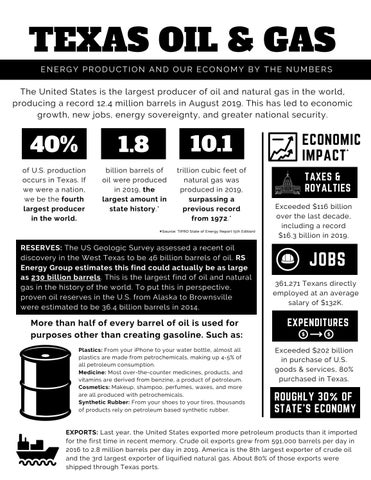
TEXAS OIL & GAS ENERGY PRODUCTION AND OUR ECONOMY BY THE NUMBERS
The United States is the largest producer of oil and natural gas in the world, producing a record 12.4 million barrels in August 2019. This has led to economic growth, new jobs, energy sovereignty, and greater national security.
40%
1.8
10.1
of U.S. production occurs in Texas. If we were a nation, we be the fourth largest producer in the world.
billion barrels of oil were produced in 2019, the largest amount in state history.*
trillion cubic feet of natural gas was produced in 2019, surpassing a previous record from 1972.*
*
Source: TIPRO State of Energy Report (5th Edition)
RESERVES: The US Geologic Survey assessed a recent oil discovery in the West Texas to be 46 billion barrels of oil. RS Energy Group estimates this find could actually be as large as 230 billion barrels. This is the largest find of oil and natural gas in the history of the world. To put this in perspective, proven oil reserves in the U.S. from Alaska to Brownsville were estimated to be 36.4 billion barrels in 2014.
More than half of every barrel of oil is used for purposes other than creating gasoline. Such as: Plastics: From your iPhone to your water bottle, almost all plastics are made from petrochemicals, making up 4-5% of all petroleum consumption. Medicine: Most over-the-counter medicines, products, and vitamins are derived from benzine, a product of petroleum. Cosmetics: Makeup, shampoo, perfumes, waxes, and more are all produced with petrochemicals. Synthetic Rubber: From your shoes to your tires, thousands of products rely on petroleum based synthetic rubber.
ECONOMIC IMPACT* TAXES & ROYALTIES Exceeded $116 billion over the last decade, including a record $16.3 billion in 2019.
JOBS 361,271 Texans directly employed at an average salary of $132K.
EXPENDITURES Exceeded $202 billion in purchase of U.S. goods & services, 80% purchased in Texas.
ROUGHLY 30% OF STATE'S ECONOMY
EXPORTS: Last year, the United States exported more petroleum products than it imported for the first time in recent memory. Crude oil exports grew from 591,000 barrels per day in 2016 to 2.8 million barrels per day in 2019. America is the 8th largest exporter of crude oil and the 3rd largest exporter of liquified natural gas. About 80% of those exports were shipped through Texas ports.
TEXAS OIL & GAS ENERGY PRODUCTION & ITS ENVIRONMENTAL IMPACT
SHOULD WE BAN FRACKING?
PIPELINES & THEIR IMPACT ON TEXAS
While the name "fracking" sounds scary, it’s nothing more than a drilling technique that uses water, sand, and chemicals to create cracks in shale rock formations deep underground so that crude oil and natural gas can flow to the surface.
Pipelines are the safest, most reliable and efficient way of transporting large quantities of natural gas, crude and refined petroleum products.
"There have been over a million wells hydraulically fractured in the history of the industry, and there is not one, not one, reported case of a freshwater aquifer having ever been contaminated from hydraulic fracturing."
On average, for every 50 miles of 20-inch pipe there are 1,650 fewer trucks on our roads. Texas has the largest pipeline infrastructure in the nation, with 469,737 miles of pipeline representing about 1/6 of the total pipeline mileage of the entire United States. According to a study by Texas Tech University, the Texas pipeline industry will contribute $374 billion in total economic output and 171,000 jobs between 2014-2024. Texas was the first state in the nation to adopt pipeline safety regulations. The Railroad Commission regulates pipeline safety during construction and operation of the pipeline. The agency does not have jurisdiction over eminent domain or routing.
- Former U.S. Secretary of State Rex Tillerson
According to a study published by the U.S. Chamber of Commerce, Bernie Sanders' fracking ban would kill 3.2 million jobs and cost Texas $1.5 trillion in GDP between 2021-2025. A recent report by the White House Council of Economic Advisors estimated fracking saves American families $2,500 a year on gasoline and electric bills.
OIL & GAS PRODUCTION AND A CLEAN ENVIRONMENT ARE NOT MUTUALLY EXCLUSIVE! BETWEEN 1970 & 2017:
⬇73%
six major pollutants regulated by the EPA
⬆60%
U.S. economic growth
U.S. population growth
Source: The Association of Air Polution Control Agencies - 2019 State Air Trends & Successes Report
Protecting Groundwater: The Railroad Commission conducted an exhaustive review of nearly 63,000 injection-well applications since 1982. The findings of the review confirmed permitted injection wells are not polluting sources of underground drinking water or potential sources of underground drinking water. The study was commended by the EPA.
STAY CONNECTED: /REPWAYNECHRISTIAN @CHRISTIANFORTX
⬆262%
ABOUT: Wayne Christian serves as the chairman of the Railroad Commission, the regulatory body that oversees oil, natural gas, and coal production. A lifelong conservative businessman,Christian believes all regulations should be consistent, predictable, and based on sound science.