135 Years of Service: The Legacy of the Railroad Commission of Texas
Visit from Canadian Delegation Highlights RRC’s Global Role
Winter Weather Emergency Response
RRC Winter Inspection Cycle Concludes
Upcoming Listening Sessions and Texas Energy on Track Podcast
Regulatory Conference Registration Is Open RRC Seeks Public Input on Oil and Gas Monitoring and Enforcement Plan Stay Connected with the RRC Commissioners’ Corner
LETTER FROM THE RRC
Welcome to the April edition of Energy News.
From celebrating 135 years of service to highlighting our expertise, winter preparedness efforts and opportunities for public input, this edition showcases the many ways the Railroad Commission of Texas (RRC) continues to protect public safety and the environment, promote transparency and support a strong, resilient energy landscape.
The Railroad Commission of Texas (RRC) marks an important milestone this year: 135 years of serving Texans. Since its establishment in 1891, the Commission has played a central role in the state’s growth, evolving alongside the industries and communities it regulates while maintaining a steadfast commitment to public safety and responsible oversight.
The RRC was created during a period of rapid expansion in the late 19th century, when railroads dominated the movement of goods across Texas. Concerns about discriminatory rates and monopolistic practices were widespread, and James S. Hogg’s 1890 gubernatorial campaign championed the need for a regulatory body to ensure fairness and accountability.
Although the Commission’s name reflects its origins, its mission expanded dramatically as Texas entered the oil age. The discovery of oil at Spindletop in 1901 ushered in a new era of opportunity, and the RRC became a guiding force in shaping the responsible development of the state’s oil and natural gas resources. Over the decades, the Commission’s regulatory leadership has
influenced not only Texas energy production but also markets and practices around the world.
Throughout its 135-year history, the Commission’s impact has been driven by generations of dedicated public servants. Every division, district o ce and employee contributes to the work that keeps the agency operating effectively. Their commitment to professionalism and public service continues the tradition that has defined the RRC since its earliest days.
As the Commission reflects on this anniversary, it also looks ahead. Texas continues to grow and evolve, and the RRC remains focused on meeting the state’s needs with the same integrity, expertise and dedication that have guided it for more than a century. The agency’s legacy is built on the people who carry out its mission, and their work ensures that the RRC will continue to serve Texans for generations to come.
Visit from Canadian Delegation Highlights RRC’s Global Role
role as a global leader in energy regulation and development.
The delegation, led by Canadian Conservative Leader Pierre Poilievre, received an overview of the RRC’s regulatory responsibilities and the Commission’s work in supporting one of the world’s most active and innovative energy economies.
“It was an honor to host Canadian Conservative Leader Pierre Poilievre at the Railroad Commission of Texas,” said RRC Chairman Jim Wright. “As a native of Alberta—one of Canada’s major oil and gas producing provinces—Leader Poilievre understands that energy security and common sense regulatory policies are foundational to a strong economy.”
Chairman Wright added, “The Railroad Commission
outlook with our Canadian counterparts.”
International visits like this are nothing new for the RRC. Over the past year, the Commission has welcomed delegations from Germany and Argentina who wanted to learn more about Texas’ regulatory approach. Agency representatives also met with Canadian financial leaders to highlight our long standing partnerships with Canadian provinces, including collaboration through the Interstate Oil and Gas Compact Commission (IOGCC).
This visit is just the latest example of how the RRC remains at the forefront of the global conversation on energy production and regulation.
Recap: 2026 Winter Weather Emergency Response
It was a busy winter season for staff across divisions at the Railroad Commission of Texas (RRC) that are critical for managing weather emergencies.
The RRC Safety and Emergency Management team staffed the State Operations Center (SOC) for more than 586 hours since January for weather-related emergencies.
At the SOC, safety o cers work closely with the Texas Department of Emergency Management (TDEM), the Public Utility Commission (PUC), the Texas Department of Transportation (TxDOT) and other partner agencies across the state supporting natural gas supply chain readiness during emergencies.
RRC Winter Inspection Cycle Concludes
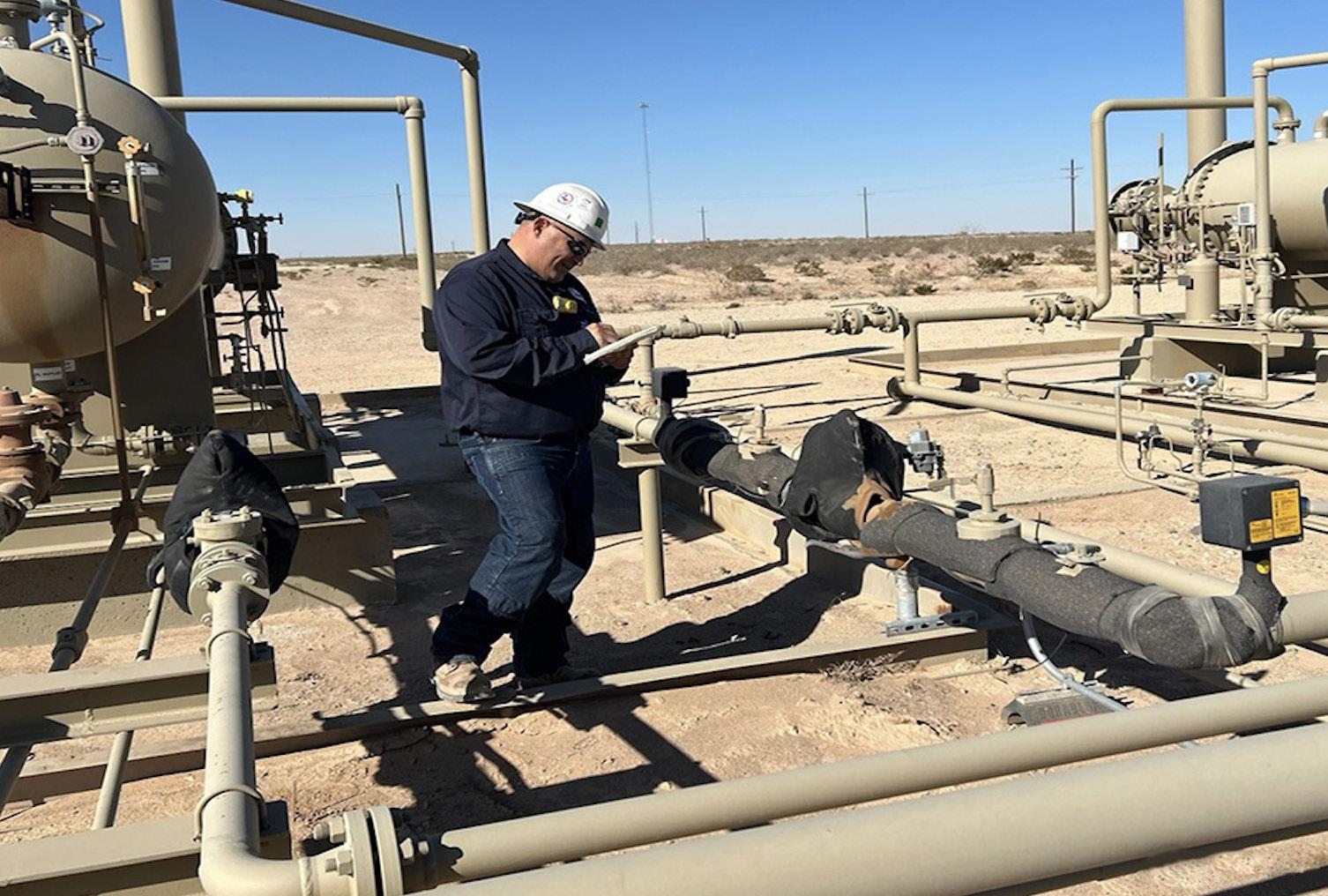
The Railroad Commission of Texas’ (RRC) Critical Infrastructure Division (CID) is responsible for conducting key weatherization inspections of natural gas facilities throughout the state. Inspections cycles take place in the winter and the summer.
The RRC’s winter oil and gas inspection cycle concluded on March 31, marking the end of a season focused on cold weather preparedness. As of January 19, 2026, 524.9 billion cubic feet of working gas storage was reported. While final inspection totals are still being compiled, as of March 19, 2026, 5,419 winter inspections have been conducted by CID.
The Commission’s summer inspection cycle begins July 1, 2026, and continues through the end of September, with inspectors shifting attention to heat related safety and ensuring natural gas is available for electricity generation during harsh Texas summers.
UPCOMING LISTENING SESSION AND TEXAS ENERGY ON TRACK PODCAST
EPISODE 15: GEOTHERMAL ENERGY
In this episode of Texas Energy on Track, host Bryce Dubee and co-host Nick Kraynok talk with Senior Engineer and Systems Analyst at the RRC, Jared Ware. The discussion includes an overview of geothermal energy, what it can be used for, where it can be found and more!
EPISODE 16: FIELD OPERATIONS
Join hosts Bryce Dubee and Nick Kraynok on Texas Energy on Track as they sit down with David Lindley, Assistant Director of Field Operations for the RRC. The discussion highlights the responsibilities of Field Operations and the role it plays within the RRC, what technologies have made the biggest impact for inspectors, the biggest contributions to the state's energy landscape and more!
REGULATORY CONFERENCE REGISTRATION IS OPEN
The Railroad Commission of Texas’ (RRC) annual Regulatory Conference kicks off in July and registration is o cially open.
The RRC is excited to welcome back oil and gas and pipeline operators, other industry representatives and exhibitors to join us July 13 through 15, 2026 at Kalahari Resorts & Conventions in Round Rock, TX.
RRC staff utilize this conference to inform and train oil and gas and pipeline operators about any new rules, regulations, filings and more!
Interested in reserving a space as an exhibitor or sponsor and securing access to the key decision-makers shaping the future of the Texas oil and gas and pipeline industry? Reach out to regulatoryconference@rrc.texas.gov or visit the conference website.
Registration is open, secure your spot today!
LEARN MORE
RRC Seeks Public Input on Oil and Gas Monitoring and Enforcement Plan
In 2017, the Texas Legislature directed the Railroad Commission of Texas (RRC) to develop an annual plan that ensures the strategic use of oil and gas monitoring and enforcement resources to protect public safety and the environment. Texas Natural Resources Code Sec. 81.066 requires the Commission to publish this plan each year and to seek input from stakeholders as part of its development.
Each year, the RRC releases the Oil and Gas Monitoring and Enforcement Strategic Plan to outline the agency’s priorities for monitoring oil and gas activities and enforcing regulations statewide. The plan communicates the Oil and Gas Division’s strategic goals and highlights the agency’s extensive field operations, including well inspections, orphaned well plugging, site remediation, technical permit monitoring and administrative compliance enforcement.
For the Fiscal Year 2027 (FY27) Plan, the Commission seeks feedback from stakeholders in the development of action items that will address the totality of oil and gas monitoring and enforcement activities.
Members of the public are invited to submit their feedback online to assist in developing this important plan. The deadline for feedback is 5 p.m. on Thursday, April 16, 2026. Input must be submitted via email to public_comment@rrc.texas.gov.
Oil and Gas Strategic Plan Stakeholder Input/Oil and Gas Division Railroad Commission of Texas P.O. Box 12967 Austin, Texas 78711-2967
Comments received by mail after April 16 may not be incorporated into the FY27 iteration of the plan but will be reviewed.
Comments that do not follow these instructions will not be included.
• Public comments MUST be submitted as instructed (by mail or email to public_comment@rrc.texas.gov)
Stay Connected With the RRC
Stay informed between newsletter editions by following the Railroad Commission of Texas (RRC) on social media.
CHAIRMAN JIM WRIGHT
In March, Chairman Wright hosted a Canadian Delegation led by conservative leader Pierre Poilievre at the Railroad Commission in Austin.
Later in the month, Chairman Wright traveled to East Texas to speak at the Tyler Chamber of Commerce Energy Summit where he highlighted the important contributions of East Texas energy production over the past century.
OP-ED: FINISH THE JOB—AFTER 60 DAYS, REPEAL THE JONES ACT FOR GOOD
COMMISSIONER WAYNE CHRISTIAN
At a time of global instability and rising energy costs, President Donald J. Trump made the right call.
With tensions escalating in the Middle East and disruptions in the Strait of Hormuz threatening a significant share of the world’s oil supply, Americans are once again being reminded how fragile global energy markets can be. When supply is constrained overseas, the consequences show up quickly here at home, at the gas pump, in utility bills, and across our economy.
President Trump did not hesitate. His 60-day waiver of the Jones Act was decisive, practical, and exactly what the moment demanded.
It also highlighted something important. When government gets out of the way, American energy works.
I raised concerns about the Jones Act back in 2018, when I wrote to our congressional delegation warning that the law was undermining our national security by preventing American energy from reaching American consumers. At the time, parts of the Northeast were importing natural gas from Russia because it was easier than shipping it from Texas.
That should have been a wake-up call.
We were producing abundant, affordable energy right here at home, yet federal policy made it harder to use it. That is not just inefficient. It is bad policy that weakens our energy security.
President Trump’s action cuts through that dysfunction.
The Jones Act, a relic of the 1920s, requires that goods transported between U.S. ports be carried on U.S.-built, U.S.-flagged, and U.S.-crewed vessels. In theory, it may have once served a purpose. In practice, it has created a bottleneck that limits capacity, drives up costs, and restricts our ability to respond when it matters most.
In normal times, that is inefficient. In a crisis, it is unacceptable.
The President’s waiver proves what many of us have said for years. When these restrictions are li ed, energy can move more freely, markets can respond faster, and consumers benefit.
The United States is now the world’s leading energy producer. Texas alone produces more oil and natural gas than most countries. We have the resources, the workforce, and the technology.
President Trump has consistently championed that strength, and this decision is a continuation of his America First energy strategy.
Now the question is straightforward. If this policy works during a crisis, why would we go back to a system that we know raises costs and limits supply?
The same law that restricts supply today raises costs every single day. It limits competition, reduces flexibility, and ultimately forces American consumers to pay more for energy.
The bottom line is simple. Government should not be making energy more expensive or less reliable. The President has already taken the hardest step by granting this waiver and proving what is possible. The logical next step is to make that relief permanent.
Repealing the Jones Act would lock in the benefits we are seeing now. It would lower costs, strengthen domestic supply chains, and ensure that American energy can reach American families without unnecessary restrictions.
It would also reinforce a fundamental truth. Energy security is national security.
We have worked too hard to achieve energy independence to undermine it with outdated policies. Whether it is relying on foreign nations for supply or restricting our own ability to move resources at home, the result is the same. We weaken ourselves.
President Trump has shown leadership by acting quickly and decisively.
Now is the time to build on that success. The Jones Act may have made sense in 1920. It does not make sense in 2026.
Mr. President, finish the job.
TUES. April 14 | 9:30 AM
OIL AND GAS INDUSTRY RESOURCES
OIL & GAS PRODUCTION STATISTICS
View monthly production totals of crude oil, condensate and total oil; and of gas well gas, casinghead gas and total natural gas.
VIEW CURRENT PRODUCTION STATISTICS
ENFORCEMENT ACTIONS
The Commission has primary oversight and enforcement of the state’s oil and gas industry and intrastate pipeline safety.
VIEW LATEST ENFORCEMENT ACTIONS
The Public GIS Viewer allows users to view oil, gas and pipeline data in a map view.