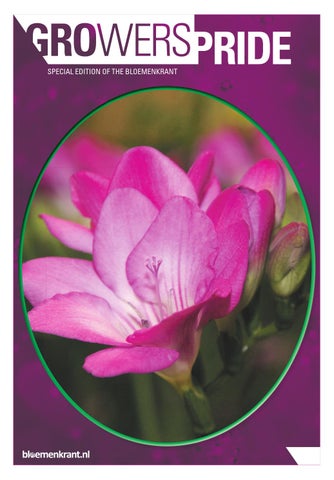
SPECIAL EDITION OF THE BLOEMENKRANT
Versailles, Ambassador,Anouk Anouk Versailles, Ambassador, and several varieties en nog diverse rassen more. meer.
P. HOFLAND BV FREESIA Besides many Dutch growers, wholesalers and exporters belong to our customers. Not only quality of planting material is important to us , counseling, proper education and creating breeding programs assist P. Hofland at a high level.
‘Passion ‘Passie for Freesia’ voor Freesia’
Temperature Treatment of Amaryllis and tulips in modern climate cells is also one of our specialties. To get acquainted with our company please contact us.
P. Hofland bv is primarily a selection and breeding of freesias from ‘s Gravenzande. P. Hofland bv also specializes in the cleaning and preparation of freesia Tubers. Besides these activities , we have direct sales of a modern and productive own Freesia range. Through our activity of cleaning and preparation we deliver a top product.
P. HOFLAND BV FREESIA DE JONGHLAAN 1a 2691 NM ’s GRAVENZANDE Karel van Gelreweg 8, 5307 VC Poederoijen M 06 1028 1182 E erik.bok@solcon.nl
Adm.nr. 927
TEL: 0174-513182 E-MAIL: INFO@PHOFLAND.NL
THE MOST BEAUTIFUL FREESIA’S WELCOMING LINEA NATURA Very exclusive, incredibly fresh and of the highest quality ... that are the hallmarks of Linea Natura. Brand seasonal flowers. Who Linea Natura offers, choose pure nature and beauty.
n
tio c u d o r t n i Free
You want to see yourself , smell and experience? Experience Linea Natura and ask the special gift box. Mail, call, SMS or WhatsApp us and say that we authorized to deliver! info@lineanatura.nl | T 0174 74 24 07 | M 06 10 07 89 63 Take a look at www.lineanatura.nl
Linea Natura. better, fresher and more beautiful days!
DINSDAG 15 MAART 2016
3
Freesia, a party in the vase n Paul Borsboom, Coordinator Product Freesia and bulb flowers PERFUME n Freesia has sparkling colours and always guarantees a subtle whiff of perfume in the house. The wonderful odour often recollects memories. It is a product filled with experience. By Wilma van Velzen
Freesia Mixed
To Paul Borsboom, Coordinator Product Freesia and bulb flowers assortment Royal FloraHolland, the Freesia is a real “living flower”. ‘The first flower opening up shows the colour. You can’t resist the temptation to smell it for a moment. In the following days all flowers open up one by one. This makes the Freesia a party in the vase.’ QUALITY IMAGE
Freesia Red and Yellow
Borsboom is eager to cooperate with clients and suppliers to put the product Freesia in the market in the best way possible. Quality is of the utmost importance. According to him, it is important to hear from clients what their experiences are. Then, this information needs to be shared with the suppliers. ‘The flowers follow the money roads. These roads mostly lead to the European market. The Netherlands stays behind a little. Mainly because the Dutch consumer has been given the wrong image of quality. They don’t buy flowers that are a little rougher and when a somewhat mature Freesia is offered, the consumer believes that the Freesia has finished flowering. At the end of this year the suppliers can select a new promotional campaign. Possibly the Dutch consumer will be incorporated with this campaign.’ ECONOMIES OF SCALE
Freesia Red
Freesia trivia Special about the freesia is its fragile shape and the subtle perfume it spreads. The scent takes one back in time and recalls memories of bygone years. Old fashioned? For sure not. This flower has made a spectacular comeback. COLOURS AND SHAPES
Below ground, the tuber of the freesia creates smaller tubers, called corrals. These grow into a mature tuber and eventually to a comb with flowers. Even in a vase they keep on growing! The freesia is available in the colours white, yellow, orange, red, blue, pink and purple. But freesia can also be double coloured or multicoloured. Many varieties possess a wonderful sweet scent. SYMBOLISM
The freesia is symbol to unconditional love. It’s a tradition to give your husband white freesia after seven years of marriage. These freesia recall pure, true love. The wonderful scent of the flower comb will give this an extra dimension. It symbolises innocence as well.
Freesia still belongs to the top ten of cut flowers. The total has remained more or less the same over the past few years. The number of suppliers has decreased a little, but Freesia also sees economies of scale. ‘Twenty-eight suppliers were responsible for 80% of turnover in 2011. In 2015 the same percentage was achieved by twenty-one suppliers. This shows the economies of scale. The value of the turnover has remained the same compared to 2011.’
Paul Borsboom: “The Freesia is a real living flower.”
WARM AUTUMN
The price development is erratic. Even though 2015 looked to become a beautiful commercial year, most profits evaporated in the last two months of that year. Borsboom states that the warm autumn and winter were responsible for an increased production (compared to 2014) of not less than 21% in November and December. Because of this, prices dropped almost 3 cents. Luckily Freesia started well in 2016 at an average price level. It was almost a cent higher in the period of week 2 till 6, compared to the same period last year. In comparison, supply to the clock decreases and the share of direct sales increases. Supply slumped about 2% in 2015. Sales to the wholesale trade is biggest with 60%, and relatively stable.
will be overwhelmed with information regarding the applicabilities of Freesia. Information regarding the Freesia as bridal flower can be found at: www.freesiainfo.com. Actually, Freesia possesses all qualities to follow the trends. The colours, shapes, smell and it can be handled in a proper way. This makes it easy for florists to distinguish themselves with Freesia. Not by competing with retail, but to surprise in a positive way. Freesia can
be found in the colours white, red, blue, yellow, pink, purple and orange. Freesia comes both in double-coloured and multi-coloured. Freesia comes both in single-flowered and double-flowered varieties, whereas the stamen are clearly visible in the single-flowered Freesia. With the double-flowered Freesia, the stamen have been altered into flower leafs due to the cross-fertilization. This presents the flower with an additional touch of prestige.’
SURPRISINGLY DIFFERENT
The most important countries for the product are the United Kingdom and Germany. Especially in the United Kingdom the Freesia is popular as bridal flower. This year, since the UK, next to Russia, is part of the promotional campaign “Freesia 2014-2016”, all British florists
Diverse assortment of bulb flowers
T
he product group bulb flowers assortment consists of dozens of smaller products. This assortment makes this product group very diverse, especially because the production of the various products is spread over the entire year. ‘In order to achieve a better yield for suppliers, a total approach for the market is necessary’, states Paul Borsboom, Coordinator Product Freesia and Bulb flowers assortment Royal FloraHolland. ‘This can be materialised by allowing florists and retailers to make more money with the wonderful assortment and the diversity of selections offered by the suppliers.’ The knowledge to realise these kind of targets comes from collecting and sharing knowledge regarding the development in sales, the product and the experience of the consumer. Together with the product team of Royal FloraHolland, Borsboom occupies himself daily with this matter. ‘Hyacinth, Gladiolus,
Iris, Ornithogalum, Narcissus and Allium comprise over 80% of the turnover in the product group. And 73% of these products are traded via the auction clock. Compared to the previous year, turnover rose in 2015. Turnover growth in the wholesale channel was down compared to turnover growth in the retail channel. But this can very strongly per product within the product group.’ POSITIVE PRICING
The so-called ‘smaller’ products within the bulb flowers assortment mostly caused a positive pricing trend for the wholesale channel. The reason for this is a decrease in supply in 2015 compared to the year before. As an example Borsboom mentions the supply of Dahlia, which showed a decrease of 11%, while prices increased by 18%. The majority of smaller bulb flowers is sold through the auction clock. 90% of these flowers goes to the wholesale channel. It is logical that promotional activities focus
on florists in the largest markets such as the United Kingdom, Germany, France and the Netherlands. On the other hand, consumers associate bulb flowers with spring, yet their knowledge regarding the wide assortment is only limited. This offers chances and where else but Keukenhof can these chances be grapped? Keukenhof is leading with one of the largest consumer
shows. It is also interesting to see that both the product group Bulb flowers assortment as well as the suppliers of Summer flowers (Zomerbloemen) both participate in the promotional campaign PurE seasonal flowers. This joint effort has to lead to a higher awareness of their products and to an increased purchasing frequency with the consumer.’
DINSDAG 15 MAART 2016
Van den Bos Flowerbulbs New selective breeding aims at top quality Van den Bos Flowerbulbs B.V. from Honselersdijk is a well-known concept in the world of preservation, preparation, trade and export of lily, calla and freesia bulbs and tubers. The innovative company exports freesia tubers to 65 countries. Together with Penning Freesia B.V and Hofland Freesia B.V. they share the market of freesia tubers. By Frank de Klerk
For a few years now Van den Bos Flowerbulbs B.V. has outsourced the selective breeding of the newer species to Royal van Zanten. ‘Selective breeding is now focussed on large flowers, thick stems and high production per plant’, says Jaap Elenbaas of Van den Bos Flowerbulbs B.V. ‘We aim at high quality, while at the same time supplying a freesia with a wonderful scent. To the breeder it is important that the freesia produces well. Partly due to the selective breeding it is possible to achieve a production of 400 branches per square meter per year.’ Besides the propagating and trading of the existing as well as new assortment, Van den Bos Flowerbulbs B.V. is also service provider for the freesia breeders. Taking over work from them. When the tubers are grubbed up at the breeder, they are transported to the preparation cells of the company, at the corner of the Dijkweg and the Burgemeester Elsenweg in Honselersdijk. At that location these tubers are prepared and brought in the right conditions. At the request of the breeder, they will be brought back again.
CUT FREESIA
The assortment of Van den Bos Flowerbulbs B.V. is of high quality and very diverse. It has 46 breeds of cut freesia. An additional selection on the existing Beach line accounts for several new varieties; the Belleville, the Indigo Beach and the Essence. ‘By means of an extensive stam selection we can be assured of an ample supply of virus-free material’, says Jaap Elenbaas. ‘If something happens, we can replace the tubers from our stock. The reproduction takes place in house at the greenhouses Elsenbos in Honselersdijk and Van der Knaap in Poeldijk. In Noord-Holland and Noordwijkerhout we multiply in rich earth under lice resistant scrim. Lice can transfer the virus from plant to plant. We could reproduce, but if there’s a virus amongst a selection of tubers, there’s only one solution. We will have to destroy everything.’ NEW ZEALAND
Besides reproduction in the Netherlands, this is also done in New Zealand under ideal conditions. Over there, climatological conditions are excellent. The advantage of reproduction on the southern hemisphere is a continuity in supply of fresh plant material for our customers. Breeders can plant the tubers from the Netherlands from January till August. From August till December they can plant tubers from New Zealand. The export of tubers to other countries is becoming evermore important, since the area of freesia is limited in the Netherlands. Quality, health and new species are important factors for the market.
‘To promote sales we try to improve the image of freesia at home and abroad. In this way we not only create demand for tubers, but for Dutch cut flowers as well. This has been improving for the past few years. In the television programme ‘Rob’s tuinverbouwing” there is ample attention to the freesia. It particularly is a spring flower. We will do our utmost to make freesia look good at Keukenhof. The Oranje Nassau pavilion at the Keukenhof will be filled with freesia for a week. Breeders supply 12,000 branches of freesia. We will have 60 to 80 inspection vases, which will compete in the Goemans Trophy as well as Consumer Award.’ GOLDEN CENTURY
This years theme of Keukenhof is ‘The Golden Century’. The freesia competition takes place in the last week of March. Each year Van den Bos Flowerbulbs B.V. participates with several new varieties. Last year the Goemans Trophy was awarded to the Expression double red. This year, the following freesia flowers will compete: Le Chateau (single yellow), Mijoux (single white), White Serenade (single white), Alba River (single white), Fiesta (double yellow) and Ventura (double white). ‘We hope for a show with a golden lining’ says Jaap Elenbaas. ‘It is special when a company wins the Goemans Trophy for two years in a row.’ On the photo, Daan Vermeer stands next to Jaap Elenbaas at the Consumer Award. ‘He is my young enthousiastic successor, has been working at Van den Bos for five years now and is extremely skilled.’
4
DINSDAG 15 MAART 2016
Big love Producer organisation Unicum celebrates its twenty year anniversary
P
roducer organisation Unicum celebrates its twenty year anniversary this year. During that time, the collaborative between thirteen breeders has proven its right to exist. ‘If Unicum had not existed the way it does, certainly there would be less freesia companies’, says chairman René van Dijk. ‘We kept the freesia within the market.’
By Frank de Klerk
The affiliated companies are mostly situated in the Westland. Two companies breed freesia in Huissen (Gelderland) and two are located in Noord-Holland. Nursery Hofland Freesia from Maasdijk recently ended the cooperation in proper consultation. Together, the affiliated breeders possess an acreage of 30 hectare. With 135 million stems they represent 45 percent of the entire freesia production in the Netherlands. The largest market is the United Kingdom, but also Germany and France are excellent markets in summer. IMAGE
‘We are customer orientated and can supply the bouquets of flowers, together with a filler, case and sachet with cut flower nourishment’, says René van Dijk. ‘However, it is also possible to purchase unprocessed bouquets with our produ-
cer organisation. In the Netherlands, freesia has the image of a flower to be given to grandma. The youth hardly knows what a freesia is. This is different in the United Kingdom. Over there, sixty percent of all freesia bouquets in the category Mono+ are bought by a young audience in the age of 25 - 40 years. The United Kingdom is a freesia loving country, in which summers are not too warm for cut flowers. In the Netherlands the freesia is only sold during short periods per year. Unicum supplies to Jumbo, Albert Heijn, Spar and Deen.’
duction will be sold at a fixed price. ‘That’s a comfort’, says René van Dijk. ‘On the other hand there is an obligation to supply the flowers to the producer organisation for that price. Our organisation has the same obligation to its customers. We have an interrelated settlement system of the daily prices per colour. The selling prices have been put down in contracts with each provider. We apply summer, winter and promotional prices. Basic principle is a product of consistent quality which is delivered as steady as possible.’
ADVANTAGE
BIG LOVE
By making use of the services of Unicum it is easier for breeders to meet the demands of the trade. ‘Each clients has a specific list of demands’, says René van Dijk. ‘For instance when it comes to matters such as length, colour, ripeness, minimum weight and wrapped or not wrapped. Unicum is an intermediary. As breeders we supply to Unicum and this organisation passes the products on to the provider. In stead of eight separate breeders documents a day, the client now only receives one document with four colours freesia. Ninety percent of our customers places their orders based on colour.’ An other advantage for breeders to join Unicum is that they are guaranteed that half of their pro-
To René van Dijk the freesia has few secrets. His parents started a freesia nursery at the Grote Achterweg in Naaldwijk. When René van Dijk returned from his military duty he started working at the company. ‘It is fun to work because of our great love for the product’, says Van Dijk. ‘We have employees who, already for many years, like to do nothing more than work with this friendly flower. Disadvantage of the freesia breeding is, however, that work has to be continued on Saturdays almost every week. Because of this I am at the company six days per week. Next to that I have been chairman for Unicum for the past three years.’ In recent years Van Dijk committed himself to
5
s r a e y
With thanks to the high quality demands
‘We never get any complaints about freesia of Linea Natura’ An extensive assortment, with many colours, high in quality and a fine price. To Dennis Oudebeek, these are the most important reasons to choose for freesia of Linea Natura. Every week he has them transported to Muszynski Kwiaty, the flower wholesaler of his parents-in-law in the Polish town Ostrow Wielkopolski, where he has been working for the past one and a half year. ‘We accidentally stumbled on this beautiful brand’, Dennis says. ‘Looking for solid and reliable suppliers in the Netherlands, we were referred to B&G de Mooij. Linea Natura turned out to be one of the brands they supplied. They were very enthusiastic about it themselves. But nowadays, so are we. Every stem contains a lot of buds. Furthermore, they always are extremely fresh. Only after a week, the first flowers ‘open up’. And they remain beautiful for many more days.’
‘Freshly cut’ This last aspect is not only of vital importance to satisfied consumers, but also to the way of operating of the wholesaler. Over there, the flowers arrive from the Netherlands every Tuesday. Florists from the region then make their first selections. The remainder of the flowers is then sent to a florist market 120 kilometres away. Dennis: ‘At that time, most varieties of flowers are still fine, but the Linea Natura is flawless. It is just like they are freshly cut. This is logical, considering the high demands that Linea Nature sets to breeders and their products. We have never received any complaint about the quality.’
Dennis Oudebeek: ‘Only after a week, the first flowers ‘open up’. And they remain beautiful for many more days.’ (private photo)
All colours The Polish love flowers, but also especially the wonderful scenting freesia. ‘We purchase them throughout the year’, Dennis says. ‘Previously we had some left over, but since the time that we are working with Linea Natura we experience no problems to sell them all. They are
quickly sold in the shops. And the thing that is particularly pleasant; we can execute special deliveries. This is due to the fact that virtually all colours are available. And that is especially helpful because the are not only sold separately. We experience a lot of times that florists use them as part of beautiful bouquets...’
More information about Linea Nutura: www.lineanatura.nl or call 0174 742 424.
DINSDAG 15 MAART 2016
Penning Freesia Penning Freesia combines Selective breeding and reproduction of freesia. Through years of experience, handed over from father to son, this company possesses a unique expertise to put an excellent product on the market. By Frank de Klerk
‘With freesia the dilemma is that the variety should not just be good for the breeder, but for the consumer as well’, says Marko Penning. ‘To the breeder the freesia must be productive and easy to grow. For the buyer other qualities matter, such as smell, perishability and decorative value. More often than not the most productive varieties score less good with flower size and the weight of the branch. The challenge lies in the fact to combine these qualities as well as possible.’ LIFE VAIN
Inside the greenhouse of Penning Freesia the selective breeding takes place by means of a large number of flowering tests. These tests must create a wide and varied assortment. ‘This new assortment is the life vain of the preservation of the cultivation’, says Marko Penning. ‘The area of freesia has diminished in the Netherlands, but at the same time the pricing has been well for some years now. But it is important to keep paying attention that freesia does not loose out with regard to attention and promotion, due to the small percentage of the market it occupies.’ The Netherlands is a leading country regarding
production of freesia. Certainly freesia are grown abroad for the Dutch market, but this is done by Dutch breeders. The cultivation abroad is mostly for their own markets. With regard to selective breeding, we don’t experience any competition whatsoever from abroad. Therefore, it is not strange that, to us, the foreign market for plant material is larger than the domestic market. For breeding in the Netherlands as well as for our entire profession, it is good that the breeders society Unicum materialised.’ POT FREESIA
Our selective breeding programme distinguishes itself through its wide and colourful assortment. Besides white and yellow, we are also looking for other colours. Currently we work on a pot freesia. Our assortment comprises of thirty varieties, which can all be traded. That number remains the same. Varieties come and disappear. When a new variety of a certain colour is better than an old one, then the latter can be replaced. We have ten different colours, amongst them the new colours bordeaux-red and peach-pink. Additionally, we have varieties that are in limited, but constant demand.’ ‘Quality is getting more and more important. We select for robust flowers. Durability and weight become important to keep the product as attractive as possible for the assortment. The top quality goes abroad. It is very rare that you see a beautiful bouquet of flowers in a Dutch store. That is also a matter of prices. To the breeder,
the growing speed also counts. If a cultivation goes three weeks faster, the breeder can harvest sooner and more branches per m2 per year are possible.’ Penning Freesia does not merely occupy itself with preparing freesia tubers for third parties. At the company only tubers for own use are prepared. Penning Freesia is a third generation family business led by the cousins Marko and Peter Penning. Their fathers Martien and Jan are still fully active within the company. Father Martien checks on the selective breeding and his brother Jan still represents the company abroad. He regularly steps on a plane to the United States.’ KEUKENHOF
On 31 March Penning Freesia participates with the exhibition in Keukenhof. The company sent in three varieties for the Goemans Trophy; the Ilse, the Survivor and the Bordeaux. The Ilse is a bright white variety, which is very sustainable. The Survivor has a double yellow flower and enters the auction for the first time this year. This freesia can be cultivated well all year around. The Bordeaux stands out by its dark red colour, which did not exist before. The flower has been well received at the auction. ‘At first we bring a new breed to the auction for six to eight weeks in the period between the middle of February until April. Only the next year the breed will be available to other growers. In that second year we strive to supply the breed in autumn as well.’
9
DINSDAG 15 MAART 2016
Hofland Freesia presents Freesia Finest - Nature’s Fragrance
‘We make scent a unique selling point’ Freestones are known for their scent. Strangely enough, only few freesia breeders make this flower quality into a unique selling point. But this is about to change: Hofland Freesia introduces Natural Fragrance: the latest development within the Freesia Finest product line. By Esdor van Elten
Hofland is a well-known name in the world of freesia. Mario Hofland has been growing freesia in Maasdijk since 1974. By now, his sons Erik and Marinus have stepped into the company as well. On an annual basis, Holland Freesia produces over 17.5 million stems on an area of almost 5 hectare. ‘Our vision is that we can supply all our twelve varieties at good quality and with sufficient numbers the whole year around’, explains Erik Hofland. ‘This requires a tight schedule; 35% of the assortment is whit, 20% yellow, purple/ blue 25% en pink comprises of 15% of the total. The final 5% is completed with red. Hofland guarantees in this way reliable supply and, therefore, security.’ With regard to the care for the environment, there is also no lack of vision. Hofland Freesia has been operating with biological floral protection for a long period of time. We receive CO2 from
OCAP (Organic Carbondioxide for Assimilation of Plants, JD) for use in the greenhouse. In order to cool the soil in summer and heat up the green house in winter, the company makes use of thermal storage under the ground. Combined with advanced screens, this technique makes sure that only a minimum of heating is needed. Therefore Hofland not only supplies beautiful, yet also ethical freesia. FREESIA FINEST
It has been some years ago already that Hofland Freesia introduced its own brand name: Freesia Fines, meant to seduce the customer and surprise him with the many possibilities of the freesia. These days, Hofland introduces the Nature’s Fragrance line within this product line. With the Nature’s Fragrance line the scent of the freesia is most important. This is also the case with the Blooming selection. ‘From the varieties available we selected the ones that have the best scent’, says Erik. ‘The assortment now comprises four themes: Fresh Violet, Romantic Passion, Sunny Honey and Vanilla Queen.’ To define these scents, Hofland Freesia contacted a scent specialist. The reason for this is, that Holland Freesia is entering uncharted territory with Nature’s Fragrance. ‘Everybody knows that freesia produce an aroma, but we want to add a sales argument by clearly
defining these scents. In the next few years Nature’s Fragrance has to grow into an exclusive part of Freesia Finest. These flowers will not be sold at the clock. We distribute Nature’s Fragrance via selected sales channels.’ MARKETING AND COOPERATION
Holland Freesia distinguishes itself for many years, thanks to its marketing vision, by translating the functional and emotional needs of the consumer into concepts and products. That line is continued with Nature’s Fragrance. Nature’s Fragrance will be available in the shops starting from April 2016. Naturally these flowers will be given an added value with their own modern plastic wrap as well as cards. Each card will have its own style and, therefore, charisma. The marketing for this product line is particularly aimed at the consumer. Possibilities and products are offered to all parties in the supply chain at the same time. In that way, these organisations can interest their own clients in these freesia and serve them accordingly. ‘We strive for cooperation as well as creation of value’, concludes Erik this vision. For the next few years Hofland Freesia hopes to have introduced a new leading product line with Nature’s Fragrance. For more information: www.hollandfreesia.nl.
10
DINSDAG 15 MAART 2016
11
Just make Freesia hipper n Double-flowered freesia’s inspire distinguished arranger Elso Post HIP n The internationally distinguished arranger Elso Post is convinced that Freesia needs only little stimulation to be booming again. ‘Just make Freesia hipper and all will be well’, is his advise. By Wilma van Velzen
Freesia is a product that entices Post. ‘In the 1960s and 1970s it was virtually unthinkable that there would not be any Freesia in the bride’s bouquet. Even more; it was unavoidable. Later on Freesia was sidelined a little. However, it still is a fantastic product with plenty of possibilities. For instance, it is possible to create nice hand knit bouquets, with which the scent is the extra added value. BIRTH BOUQUET
Freesia is available in a marvellous colour pallet. Especially the doubleflowered varieties inspire Post’s creativity. ‘The somewhat softer pastel shades have a sweet appearance. From these flowers you can make a very beautiful birth bouquet. But they also do well in a modern bride’s bouquet if you mix them with other colours. Or dare to create a wreath in spring or autumn. When you also mix it with an orange-red cultivar, success is guaranteed with both young and old clients. It is important to keep on surprising the consumer.’ MASTER FLOWER ARRANGER
Post’s passion for flowers goes all the way back to an enthusiastic teacher in flower arranging at the elementary horticultural school in Velp. He wanted to continue with this trade and successfully completed the education of master flower arranger in Utrecht. He owned flower shops in Arnhem and Zevenaar and also participated regularly in championships, amongst others the Dutch Championships flower arranging. ‘The next step was to go internationally. I travelled all over the world and worked with flowers, in many different countries; from Russia to Saudi Arabia. Recently a got a top assignment to contribute to the World Expo in Shanghai.’
Origin of freesia The tuber freesia was ‘discovered’ in South Africa, where it was called ‘Cape lily of the valley’. Around 1830 the flower obtained its name ‘Freesia’ from the South-African botanist Ecklon, who named the flower after his good friend, doctor F. Freese. NURTURING ADVISES
For florists: -Place Freesia in clean water; they are very sensitive to dehydration; -Add nutrition for cut flowers to the water, if they are to remain in the water for longer than a day. The nutrition will help the smaller buds to open up as well; -Freesia blossom fast, when it’s hot. When it’s this type of weather, do not take too many Freesia out of the refrigeration in one time; -Keep the Freesia, which is ethylene sensitive, far away from ripening fruit, vegetable or from exhaust fumes; -Sometimes the last buds on the comb are empty; they will turn brown after a few days -Removing these buds increases the decorative value and is supporting the flowering of the other buds as well.
FLORAL ACADEMY
Nowadays Post also teaches with AOCs (secondary level schools, JD), because he finds it important to pass on his knowledge and abilities of the art in floral decoration. In 2013 he enthusiastically started the Floral Academy (www.elsopost. com); a private flower training college following a new vision. By now, the Floral Academy consists of three locations and 65 pupils. The main location is set up in the Plantion in Ede. ‘At this location the pupils are trained for the floral industry, just the way it was done years ago. The education lasts for two years and several levels can be followed. Level 4+ can almost be compared with the master education.’
the case for florists and flower arrangers? Professional development currently is not yet completely incorporated in the system, but it is certainly to be recommended.’ BREATHTAKING
Post noticed that his students started using Freesia ever more often. ‘It is particularly nice to see. Freesia is used both in decorative arrangements as well as with Biedermeiers. The end result is particularly beautiful when the combs are integrated downwards in the line. The fact that Freesia is picked up in this way, is to me the evidence that it is certainly possible to make Freesia hip again. Breeders should visit
me and my team first, so that we can develop a number of new concepts together. For instance, with Alstroemeria I could give the wife of a breeder some useful tips. It is simply breathtaking the way she presents her products nowadays.’ In the meantime Post is looking forward to the moment when his first Japanese students arrive to follow a specialist training in Dutch floral decoration. This new development came to existence thanks to a cooperation with a partner in Japan. ‘This is a very nice development and who knows what will come out of it. No matter what; I will introduce these students to Freesia.’
PROFESSIONAL DEVELOPMENT
All levels of education are finalised with a diploma. Besides floriculture, the educations deal with all aspects a florist in retail should know. ‘Sales training and presentation are also part of the education. We also offer professional development for registered florists. This can mostly be interesting for nowadays florists who want to make a difference in the future. Hairdressers get additional training to learn new techniques, get inspired and meet colleagues. So why should this not be
Crop cooperative Freesia on course
L
ast year the product Freesia also obtained its own crop cooperative. The research project ‘Freesia away from the soil’ literally took off and also offers the crop cooperative possibilities for taking care of other bottlenecks in the cultivation sector. The new crop cooperative started on 28 May 2015 under the name ‘Crop cooperative Freesia Accrescere’. The board comprises of members of the national committee Freesia of ‘LTO Glaskracht Nederland’. Chairman is Marinus Hofland of Hofland Freesia from Maasdijk. The position of vice chairman has been given to Marco Mol of Mol Freesia from Nibbixwoud. Treasurer is Peter Hofland of Hofland Oranjepolder from Maasdijk. ‘About 65 per cent of the total area of Dutch Freesia have joined’, explains Marinus Hofland. ‘It would be good if all Freesia growers would join the crop cooperative, but this is already a good start. Accrescere is Latin for ‘growth’ or ‘in-
crease’ and the word is applicable for both the number of members as well as the growth in cultivation and company possibilities.’ PT
Since the ‘Productschap Tuinbouw’ has disappeared, multiple crop cooperatives have been founded with the purpose of raising money to fund research for a certain type of crop. The crop cooperative Freesia Accrescere is the tenth crop committee which was founded under the auspices of ‘LTO Glaskracht Nederland’. The participating companies annually pay 500 Euro per hectare to the crop cooperative. The focus of the first jointly organised research will be about the theme ‘Freesia above the soil’. ‘With this research the possibilities will be explored to grow Freesia on substrate. Thanks to the crop cooperative, its members can continue to research the possibilities to raise the chances for cultivation and business opportunities to a higher level.’
FOUNDATION
After the foundation of the crop cooperative was materialised, quick action was undertaken.Last summer, results were discussed on the research regarding the use of lysimeters in the cultivation of Freesias. Another topic of discussion was the way to achieve a higher yield from light and CO2. ‘Additionally,
the members attented a demonstration of substrate systems last autumn. Based on this demonstration, the first research plans have been developed and discussed in the first Annual General Meeting. This resulted in a firm foundation for common research on which we will focus in the year to come’, says Marinus Hofland.