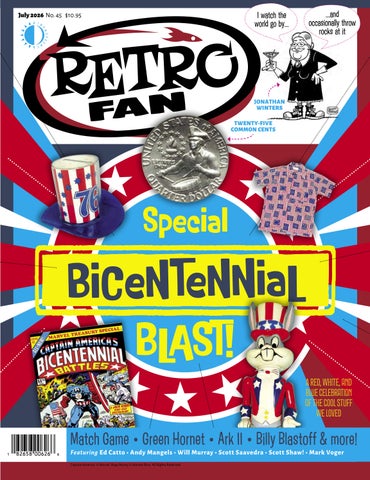
The Bicentennial. To much of the proletariat, the word seemed unpronounceable, but before long, it was on everyone’s lips. For an entire year in the lead-up to July 4, 1976, America’s 200th birthday was “the” topic. Everywhere you turned, you saw stars ’n’ stripes in red, white and blue on everything you could imagine. Even riding mowers. Why the mania? Looking back, this is my take: the country was kind of messed up—nothing like today, of course—and searching for something to rally around. In 1974, Richard Nixon resigned the presidency in the wake of Watergate, forcing a smile as he gave one final double-fisted peace sign before vanishing via helicopter. By ’76, his replacement Gerald Ford was running for… well, you couldn’t exactly call it “re-election,” but anyway, he was running. Recently reformed hippies had cut their hair, stashed their peace sign medallions in the attic, and entered the
workforce. But the economy was iffy. A recession raged between 1973 and 1975. No one seemed particularly jazzed about life in the U.S. of A.
Maybe flag napkins, parades, fireworks, celebrity testimonials, and recipes for three-layer, red-white-and-blue cake would be just the thing to pull America out of its doldrums?
The ragtag wanna-be country that once thumbed its nose at that greedy King George—and aimed its muskets at his dastardly redcoats—was about to turn 200, an occasion which called for nothing less than a nationwide party.
As we now prepare to mark the Bicentennial and a Quarter—doesn’t have the same ring, does it?—let’s turn the clock back 50 years to a time when everyone was in the sweaty throes of Bicentennial Fever.
LIVING IN THE EPICENTER
I should first mention that I grew up in South Jersey in the shadow of the Ben Franklin Bridge. Cherry Hill, NJ, in Camden County—onetime hometown of Muhammad Ali—was a suburb of Philadelphia, so we really got hit hard by the Bicentennial stick. Both my parents were born in Philly. While growing up, us little kids were always going into the city to visit relatives, attend sporting events (Phillies! Eagles! Flyers!) and, on one occasion, see the Mummers Parade (feathers and banjos for miles).
My dad commuted to the Gulf Oil Refinery in South Philly every weekday. All the TV stations (Channels 3, 6, 10, 12, 17, 29 and 48) were based in Philly. I grew up eating soft pretzels, “hoagies” and scrapple.
I mention all this to say that I came up in a community that really, really took the Bicentennial seriously. The Declaration of Independence was signed in Philadelphia. On my first day as a Cub Scout, our den mother, Mrs. Rivard, took us to Independence Hall, where we beheld the Liberty Bell, crack and all. A year later, Mr. Crogan took us to Valley Forge. (The beds that the troops slept in were small because folks were shorter back then, we were told.)
So folks in Philly acted as if the Bicentennial was a celebration for them. Not the nation. Them.
Uncle Sam on a recruitment poster in art by James Montgomery Flagg (1917).
Sam was one of the early adopters of the stars and stripes as a fashion statement.
Baby Boomers were force-fed the idea that Betsy Ross designed and sewed the first American flag. We were later informed that the likely designer was Francis Hopkinson, a signer of the Declaration of Independence (though Ross may still have sewn it). In any case, the flag was adopted on June 14, 1777. Its 13 stars represented the first 13 colonies in the union. I recall being taught that the red-and-white stripes
Agnew wristwatches were everywhere. The chain store Spencer’s Gifts—which stocked paraphernalia for wanna-be hippies—sold flag-themed clocks, posters and other merchandise. I had a wall clock with white stars on a rounded blue rim signifying the numbers 1 through 12. (I still think it’s cool. Try as I might, I cannot find one on eBay.)
I also had three flag-themed posters. One was of Fonda in Easy Rider. Another showed a torn flag being sewn back together with the slogan “Give a Damn, Mend America.” (I still don’t know what that means.) The third showed Superman—drawn by Curt Swan and Murphy Anderson—in front of a circular flag design throwing up the “peace” sign. Yet another political head-scratcher. Doesn’t Supes represent the Establishment? Why is he making like a hippie with the peace sign?
ROCK ’N’ RADICALISM
Even a bona fide Sixties pop-rock band leaned on 1776era imagery in order to stand out from the pack. When Paul Revere and the Raiders donned Revolutionary War uniforms, it wasn’t an edict from some cigar-chomping record executive. The impetus was more grassroots than that, according
(TOP RIGHT) Watches bearing the likeness of Vice President Spiro T. Agnew were everywhere. But why? (LEFT) The stars and stripes were adapted in a very Seventies wall clock design.
to Mark Lindsay, who sang such Raiders hits as “Kicks” (#4), “Good Thing” (#4) and “Indian Reservation” (#1).
“Most bands had some kind of a look,” Lindsay told me in 2010. “We were dressed in blazers like the Beach Boys used to wear. One day, we were walking down the street to pick up our cleaning in Portland, Oregon. We walked past this costume shop, and there’s a mannequin in the front window dressed up in Revolutionary War garb. I looked at Revere and said, ‘You know, that’s the way Paul Revere and the Raiders should look. That’s the way they dressed back in the good old days.’
“Suddenly, we looked at each other and the light bulb went on in both of our heads. We walked in and made a deal to rent the costumes, just for a joke. Because we played Portland a lot. We thought we’d really surprise the kids. We’d play the first half of the show in our regular outfits, and dress up in these costumes and come out for the second half. So we did that. It was just a one-off thing.”
The Raiders returned the costumes to the store, and continued to perform in other cities wearing their regular stage clothes.
Do you enjoy big parties? Like really, really big parties with famous people and lots of money? I mean, a party that literally everybody could be a part of? That kind of shindig would take some serious planning. President Lyndon B. Johnson and the U.S. Congress were on it. This party would be known as the American Revolution Bicentennial, or more simply, the Bicentennial.
replaced it with the American Revolution Bicentennial Administration (we’ve got a party now!). Former Secretary of the Navy, John W. Warner, was designated the administrator. America was going to celebrate. Or was it?
NOT IN THE MOOD
The New York Times (July 4, 1973) reported that the Bicentennial celebrations at the Federal level were going to be much more modest than hoped for. Even smaller than the previous Centennial celebration with its 1876 Exposition in Philadelphia.
The 1876 Exposition was America’s first world’s fair (more that 30 countries took part). We showed off Heinz ketchup, typewriters, the telephone, and—essential for any party— Hires Root Beer. We survived the Civil War and the future belonged to America. So we had a party to celebrate (and show off a bit).
The American Revolution Bicentennial Commission was founded in 1966. Over a period of years the commission authorized medals commemorating the Bicentennial, the official symbol of the Bicentennial was instructed to be designed, and they added members to the commission.
Congress dissolved the American Revolution Bicentennial Commission at the end of 1973 and
(ABOVE LEFT) America tries to sound “hip” and “with it” in this poster produced by the U.S. Government Printing Office (1974). (ABOVE) Nixon Pennies reflected the public’s unhappiness with double-digit inflation. This coin with the Presiden’t face on it is much smaller than a regular penny.
However, We the People were feeling some pain and the cracks were showing during the 1970s. Double-digit inflation, a recession, an energy crisis, and a corrupt presidency. That’s not a complete list. Our mood to party was not only diminished, but the federal government was planning to be a bit tight with money. Our buzz, as almost nobody says, was harshed.
One wag commented that the Bicentennial “shares two attributes with death and taxes: It is inevitable, and it is uneasily anticipated.” And so we would have our party.
LET’S MAKE A BICENTENNIAL
A Bicentennial celebration requires planning and participation. With 1776 parties taking place in big cities and small, each community needed to work to its strengths (and within budget) to bring their events to life. Fortunately, I found a couple of books on the subject of having Bicentennial bashes and observances.
America’s Birthday: a Planning and Activity Guide for Citizens’ Participation During the Bicentennial Years by The Peoples
Bicentennial Commission (Simon and Schuster, 1974) has some thoughts on the celebration.
From the introduction “In the 1970s, the White House and Corporate America are planning to sell us a program of plastic Liberty Bells, red-white-and-blue cars, and a ‘Love It or Leave It’ political program.”
Okay… well, obviously this isn’t everybody’s cup of coffee (tea being a sensitive subject in Revolutionary times) and I’m certain you can guess why. Many of us collect plastic knickknacks and other corporate-produced stuff, after all. Radical action is in the spirit of the Revolutionary War, but a line has to be drawn somewhere.
Sample chapters and sections include, “Life, Liberty, and the Pursuit of Happiness,” “No Taxation Without Representation,” “How to Use the Media,” “Render Unto Caesar,” and “Student Evaluation of Teachers.” To the writers’ credit, they dedicated the book to Samuel Adams and Thomas Paine.
How to Plan and Conduct a Bicentennial Celebration by Adele Gutman Nathan (Stackpole Books, 1971) is a pretty straightforward guidebook. It could just as easily be called “Let’s Put On a Bicentennial Play” as quite a bit of the book centers on a locally-focused production. Only a small part concerns itself with parades, restorations of historic houses, and “happenings” which are “much in vogue” and is meant for the “enjoyment of the participants.” Happenings, somewhat chaotic by nature, need to be, and once again I quote: “well-organized.”
W ELCOME TO THE PARTY, PAL
The various Bicentennial celebrations were held nationally and internationally. The American Revolution Bicentennial Administration (ARBA) provided matching funds for various states, cities, and counties. Among the festivities were historical displays, good old-fashioned picnics, and whatever else might bring people together. Wagon trains passed through the 48 contiguous states crossing from West to East from the Oregon Trail (there were no reports of cholera) to the Great Wagon Road and other routes as well. A
Supermarkets gave out dinnerware (with a certain dollar amount purchase) featuring colonial scenes. The Old North Church is featured here. The dinnerware was made in England. Courtesy of the authors’s mother.
Patriotic plastic, you know, for future collectors. (LEFT) A PEZ dispenser ad for the Bicentennial. (BELOW) A red, white, and blue GE transistor radio. Both courtesy of Worthpoint.
list of what happened where is too long for a modest RetroFan article. You can read what everybody did in The Bicentennial of the United States of America: A Final Report to the People Prepared and Submitted to the Congress of the United States by the American Revolution Bicentennial Administration Volumes I–V (U.S. Government Printing Office, 1977). There were lots and lots of picnics and parades throughout the country. Some communities were able to refurbish old buildings and monuments or even build new structures and statues. I’m happy to report that in addition to the main celebrations, there were also special recognitions of “our Indian brothers,” “ethnic groups,” and, thoughtfully, “women.” Here are some highlights that caught my eye:
✽ AL ABAMA: A traditional anvil shoot. Just in case you don’t know how this works, black powder is used to launch an anvil into low earth orbit or 100 feet, whichever comes first—this is about the most American thing ever; loud and dangerous.
✽ ARIZONA: The continued renovation of the Hopi Walpi Village (inhabited since about 900 AD). Also, Brewery Gulch Days were held, and a new alcoholism rehabilitation center was in the works.
IFORNIA: A “pageantry of music and dance” dedicated to the spirit of the American Revolution and the freedom and dignity of man held at Dodger Stadium between games.
✽ COLORADO: Colorado’s marketing commission made, like, one million bucks via licensing, sales of medals, jewelry,
BY LAURENCE MASLON
At some point between Veteran’s Day and Thanksgiving of 1970, Broadway bookwriter Peter Stone ran into the town’s hottest young composer-lyricist Stephen Sondheim at, let’s say, the corner of 44th Street and Seventh Avenue. “Steve,” crowed Stone, “did you hear the news? Jack Warner just offered us $1.25 million for the rights to produce the film version of 1776!” “Great,” responded Sondheim in his characteristically deadpan way. “Now you can fix the ending.”
If there was ever a Broadway show that didn’t need its ending fixed, it was 1776.
Opening on March 16, 1969, at the 46th Street Theater, 1776 was one of the great outliers in American theater history; surely it was first musical in which every fifthgrader across the country knew the characters in the show, but hardly anybody—even in show business—knew the people behind it.
READING ROOM TO REHEARSAL ROOM
This unlikely musical, which dramatized the events during the enervatingly hot summer of 1776, when the Second Continental Congress convened to debate how the thirteen colonies would respond to the British Empire, was the
brainchild of a pop songwriter with a Brill Building background. Sherman Edwards had written a few hits songs in the late 1950s: “See You in September” and “Wonderful! Wonderful!” (rendered by Johnny Mathis), as well as some B-tunes recorded by Elvis Presley. By the early 1960s, he was a history teacher, living in Morristown, New Jersey, where he nursed his passion for the Founding Fathers by researching their lives in the local public library, appropriately in the John Adams Reading Room. “I wanted to show these men [John Adams, Ben Franklin, Thomas Jefferson, et al.] at their outermost limits,” he told the New York Times. “These men were the cream of their colonies.... They disagreed and fought with each other. But they understood commitment. [What] they came up with was never perfect. But it was as good as they could make it at the time.”
As impressive as that sounds, Edwards’ idea still seemed like the most improbable notion for a musical there ever was. The idea of Broadway characters mincing about to
Musicals [1927-1969], edited by yours truly.). Focusing on Adams as their unrelenting and uncompromising hero, the show follows the Massachusetts representative’s embattled mission to convince his peers from thirteen disparate and disputative colonies that they should sever ties with the despotic British crown (and enshrine their convictions in a document that would be a declaration of independence). The show’s topics included the evils of slavery (Adams and his allies demand its abolition for the final declaration, to no avail) and the horrors of war (a ballad called “Momma, Look Sharp” reminded the audience that George Washington was simultaneously leading a ragtag army against the British). Among the show’s few concessions to theatrical tradition was the brief inclusion of two women—Martha Jefferson and Abigail Adams—but Abigail appeared only in “certain reaches of John Adams’s mind” as an inspirational presence. An inoffensive minuet or two also tiptoed into the show. In its original run, 1776 was also one of the very rare musicals to play without an intermission.
THE TRAIL TO BROADWAY
Billed initially as “A New Musical Comedy,” 1776 debuted in New Haven on February 3, 1969, in the middle of a blizzard, which only further dampened the minimal expectations for its success. During this initial tryout, an entire section involving Franklin and Adams’s journey to review the troops in New Brunswick was cut, along with a scene at a local tavern with various “ladies of the evening” (as a result, a handful of actors was fired). A new song, “The Egg” for Adams, Franklin, and Jefferson was added, reportedly inspired by the musical’s poster designed by Fay Gage. The Washington D.C. tryout, beginning on February 19, was greeted with reviews from the Washington Post so unexpectedly favorable that they helped to overcome an otherwise paltry box office advance in New York. And before the opening, someone—probably Ostrow—removed the
word “Comedy” from the poster, realizing that would been fatally misleading for the New York critical audience. When 1776 opened that spring, it took a weary and jaded city by storm. The British-born critic for the New York Times, Clive Barnes, claimed that the show made “even an Englishman’s heart beat faster.” Singled out for particular praise was one of the most unconventional finales ever seen in a Broadway musical: with the Liberty Bell pealing from the rafters, the delegates each sign the Declaration and then assume the poses made famous by the Pine-Savage engraving as a scrim curtain descends, reproducing the actual signatures on the original document. The show was nominated for five Tony Awards and won three, including Best Musical. (Daniels was nominated for Best Supporting Actor in a Musical, but given that he was on-stage for most of the show, he withdrew his name from the Tony competition; he surely would have won.) “It may even run until 1976,” exclaimed a television critic, but it closed after 1,217 performances on February 13, 1972 (it would have taken another 18 months just to run 1,776 performances).
1776 opened at a pivotal time in American history and Broadway history. It competed in the Tony Awards with
What a wonderful time it was. In 1976, my buddies and I had a few favorite things: favorite comics, the Bicentennial and popsicles. (More on popsicles at the end of this article.) And they were all coming together. It seemed natural to me, back then, that comics would shift gears and find ways to celebrate the nation’s birthday with special stories, adventures, covers and promotions. Looking back on it all now—and re-reading all these comics—I’m not so sure. But hey, let’s not be overly critical! Let’s celebrate 1976’s Bicentennial comics!
Marvel, September 1976
When this giant comic came out, I was still mourning the departure of Steve Englehart from his stint scripting Captain America. I probably didn’t give this oversized epic the attention it deserved. So I asked Jim Beard for his memory on it all.
I mean, it’s really the face of The Bicentennial By Way of Comic Books, isn’t it? Not the greatest story ever told, but maybe Jack Kirby had never been bigger, bolder, and more colorful in every sense of the word then in this book, a prime example of a project that utterly justified the Treasury size and rocked it on every page. I remember how dense it felt at the time, overflowing with Jack’s patriotism, worn right there on his artistic sleeve, his love for his country in every panel, right alongside his greatest popularization, the Patriotic Hero, Captain America. I can’t imagine anyone of a certain age when asked what single comic comes to mind in terms of the Bicentennial who doesn’t jump up and lay this book out and proudly proclaim, “This one, no others need apply.” –Jim Beard
An imaginative Captain America pin-up detail from Bicentennial Battles.
By the way, recently The Kirby Collector, in issue #86, ran an interview with Barry Smith, who inked one of Jack’s stories in this Treasury edition.
Captain America #200
Marvel, August 1976
As you look back at comics from fifty years ago, the age can show, but other facets show through as well. Captain America #200 was the final chapter in an eight-part story that welcomed Jack Kirby back to Marvel Comics after his interlude at DC Comics. It is clear that Jack stuck the landing.
Kirby’s return to the character that he co-created in Captain America Comics #1 in March of 1941 embraced the fierce “defender of liberty” characteristics that were there from the start. The serial plot called the “Madbomb Saga” that culminates with this bicentennial issue of Captain America published on the Bicentennial of America is incredibly prescient, as it features a nefarious scheme concocted not by “super-villains,” but by extremist elites who believe that America has been stolen from them, and who attempt
Marvel Treasury Special Featuring Captain America’s Bicentennial Battles #1
to explode a bomb that will drive the country mad and subsequently allow them to “pick up the pieces” and reform it to their will.
Kirby definitely tapped into some ambient feelings in the country that still remain in some form or another, but in his signature fashion, liberty and justice prevail. Along with the Falcon and S.H.I.E.L.D. forces, Cap foils the dastardly plot and saves the country.
Looking back on this book with the fantastic dynamic fighting scenes and fast-paced plot, is an absolute joy. There are some fun things to look at in terms of ads in this book, and it is hard to not chuckle at the title of the letters page, “Let’s Rap with Cap.” Perhaps the most rewarding thing about this book is seeing how heroes and soldiers are so determined to preserve the nation and not let it fall to a fanatical conspiracy intent on taking the country from the will of the people. –Bob Harrison
Spidey Super Stories #17
Marvel, July 1976
This all-ages comics starts off with a brilliantly patriotic cover. John Romita supplies both his strong draftsmanship on pencils and his lush inking. As Romita was an important artist on both Spider-Man and Captain America, it’s only appropriate.
The webslinger and ol’ winghead are jumping off the Liberty Bell—ready for action. I sure hope they didn’t make that crack any bigger!
The main story is clever and punches above its weight as an all-ages adventure. Jim Salicrup was the writer and Golden Age great Win Mortimer was the penciler (with inks by Mike Esposito and Tony Mortellaro). In this adventure,
The gang at the Electric Company join some of Marvel’s greatest heroes to celebrate the nation’s birthday.
The Vietnam War had just ended a year earlier, and Watergate two years prior had made many Americans lose trust in their government. The economy was struggling with inflation, oil crises, and unemployment. The Bicentennial arrived at a moment when America needed a reset and a pick-me-up, not a “win.”
Fashion is just a small part of marketing and media, and part of a broader effort to restore the nation’s emotional confidence, not its political certainty. Instead of looking forward into the looming future many feared, Bicentennial fashion played on nostalgia as a coping mechanism. This era was framed as simpler, more united, and virtuous. Colonial imagery was romanticized and made into its own aesthetic. stripped of any complex meanings. Craft traditions (quilting, weaving, hand-stitching) were coming back into trend and labeled as “authentically American.” The nostalgia of the Bicentennial offered a therapeutic outlet to the nation at a time when it was needed the most.
You may be wondering, what’s the difference of Bicentennial fashion versus other patriotic fashion trends? Before, the fashion trends associated with being patriotic were military-coded and heavily symbol-based. Bicentennial patriotism was softer, looser, and wearable. Instead of uniforms, people were wearing prairie dresses, denim, fringe, bellbottoms, halter tops, shorts, and of course, red, white, and blue. It shifted the way in
which Americans expressed pride for their nation as a form of personal expression rather than obedience.
Wearing Bicentennial fashion was wearing America styled by you rather than imposed on you.
In the year of the Bicentennial, sewing wasn’t just a hobby; it was a way for people to personalize their patriotism. Americans were buying special celebration patterns from major companies like Butterick that let home sewists create their own colonial-inspired outfits — from elegant 18th-century gowns to statesman coats and refined period accessories like fichus, aprons, and mob caps. The patterns themselves were marketed in illustrated
Saturday Morning Dystopia
The Launch of
BY ANDY MANGELS
Welcome back to Andy Mangels’ Retro Saturday Morning, your constant guide to the shows that thrilled us from yesteryear, exciting our imaginations and capturing our memories. Grab some milk and cereal, sit cross-legged leaning against the couch and dig in to Retro Saturday Morning! This issue, we’re finding out that the future would reveal weird adventures even on Saturday mornings, as we take a ride on Saturday morning’s coolest vehicle ever!
Live-action shows on Saturday morning had a resurgence in the mid–1970s, with the weird and wondrous worlds of Sid & Marty Krofft on ABC and NBC, and the more human adventures of Filmation’s Ghost Busters, Shazam!, and Isis on CBS. But even as America was celebrating its Bicentennial, Filmation was readying the darkest plot ever conceived of for a children’s show… set on the desolate and ruined post-apocalyptic Earth of the 25th century!
Although most entertainment in books, theatre, and later film, television, and comics, celebrated a utopian hopeful future, society itself did not reflect that ideal, with most people distrusting politics and fearing for legitimate social progress. H.G. Wells’ The Time Machine, published in 1895, was perhaps the prototype of a dystopian future for mankind, criticizing class structure taken to extremes in a monstrous future. As mass media entertainment grew, so too did darker stories from science fiction authors. With the end of World War II—and its stark examples of fascism, genocide, and the realities of the power of atomic weapons—stories of dystopian futures became not only bleaker, but somehow, inevitable.
Filmation, a studio that had prided itself on multi-cultural casts for their shows, and educational and prosocial
themes, saw a chance to turn a dystopian future into something more hopeful, and the series Ark II was birthed. The opening narration—by Filmation President Lou Scheimer—for each episode of the series set the stage: “For millions of years, Earth was fertile and rich. Then pollution and waste began to take their toll. Civilization fell into ruin. This is the world of the 25th century. Only a handful of scientists remain, men who have vowed to rebuild what has been destroyed. This is their achievement: Ark II, a mobile storehouse of scientific knowledge, manned by a highly trained crew of young people. Their mission: to bring the hope of a new future to mankind.”
Could a Saturday morning series actually explore not only dystopia, but show the promise of a new civilization? With a
regular cast of only three humans—and a talking monkey— Ark II faced a challenge to hold the audience’s interest. But the show succeeded wildly, with a canny mix of an incredibly cool vehicle, a real working jetpack, well-known guest stars, and strong science fiction scripts. But how did Ark II come to be?
Filmation had been riding high, with shows on all three networks in the early 1970s. But in 1976, both ABC and NBC cancelled their Filmation shows, leaving CBS the sole network to showcase the Saturday morning titan. Jerry Golod, the director of children’s programming at CBS, had been on the job for less than a year, but for the Fall 1976 season, he booked two-and-a-half hours of the network’s four-and-a-half hour schedule, buying Tarzan, Lord of the Jungle; new episodes of The Shazam!/Isis Hour; the new live show, Ark II; and eight new shows of Saturday stalwart, Fat Albert and the Cosby Kids. Even so, Filmation’s production went from 96 half-hours in 1975 to only 53 half-hours for 1976, with about half of them being for live-action.
“Ark II was our next live-action show in development, and it harkened back to my love of science fiction, as well as addressing many of the ecological concerns that were very big at that period of time in our country,” said Filmation head Lou Scheimer in interviews for the book Lou Scheimer: Creating the Filmation Generation [also from TwoMorrows— RetroEd]. “The series was set in 2476, after the Earth had become a biological wasteland. It was a world that had gone to hell because of what man had done to it, and we had a group of three scientists aboard a futuristic vehicle known
as Ark II who would roam around the country, looking to help the people who were left and return them closer to humanity, or what humanity should be.”
A television journeyman writer since 1961, Martin Roth was best known for his work on the sitcoms McHale’s Navy and My Favorite Martian. He was hired by Filmation to develop Ark II, though it’s unclear if he originated the concept or not. His “bible” for the series literally referenced the religious tome the Bible. The year was 2176 and, “The world population had tripled to nine billion. The fragile balloon that had sustained it finally burst… the sea had become devoid of life… great droughts had left deserts where green valleys once existed… there were more casualties and deaths among the living creatures of the earth than the combined casualties of each and every war since the beginning of man. As once before with Noah, the End was upon us. And as once before, there came into being, another ark…”
Humanity’s survivors lived in various settlements above and below ground. One of these, a scientific community, had planned to find a way to restore Earth and its ecosystems, and rebuild civilization. Leading them was Jonah Steel, the grandson of the community’s founder. Accompanying him was medical technician Sarah, a brawny and curious man named Adam, a Native American veterinarian named Ruth, and a genius 13-year-old Mexican boy named Samuel.
In 1965, radio mogul George Trendle found himself besieged by offers to bring his long-dormant property, The Green Hornet, to television.
Batman had debuted on ABC that January to smash ratings. Batmania swept America. Networks and production companies stampeded to acquire similar projects.
“I couldn’t understand what it was all about,” Trendle admitted. “Nobody mentioned the success of Batman and I didn’t even know it was on the air.”
The Green Hornet, which first aired on Detroit radio station WXYZ in 1936, was uncannily similar to Batman. Like Bruce Wayne, newspaper publisher Britt Reid was a wealthy young man who chose to fight crime wearing a disguise while driving a black supercar called Black Beauty. Reid was assisted by his own Robin: his Japanese chauffeur, Kato.
Since the character debuted three years before Batman, these parallels strongly suggest that the Green Hornet partially inspired the Caped Crusader.
After listening to every network pitch, Trendle went with Batman executive producer Bill Dozier of Greenway Productions because, “He seemed to know more about it.”
The project might never have happened except for the foresight of Trendle’s legal counsel, Raymond J. Meurer. When Universal Pictures sought rights for a second Green Hornet movie serial in 1939, the company insisted on acquiring television rights, even though network TV was a decade in the future.
Meurer held his ground. The deal almost fell through.
Universal relented, and so TV rights stayed with the creator, who was 82 in 1966.
The Green Hornet went off the radio airwaves in 1952. A TV pilot starring Steve Dunne was shot, but not picked up. The character was considered as outdated as the medium that made him a success.
Initially, Dozier planned to copy the Batman format. He commissioned Batman script writer Lorenzo Semple, Jr. to pen a one-hour teleplay entitled, “Beautiful Dreamer.” A series of self-contained halfhour episodes was to follow.
But cooler heads prevailed. Why copy Batman, which aired twice-a-week? Also, George Trendle objected to the camp approach. That settled that. Instead, Dozier modeled the show’s style and pacing after the realistic 1965 spy film, The Ipcress File
Bruce Lee was the first actor cast. Dozier had previously cast him as Charlie Chan’s Number One Son, Lee Chan, for an unrealized pilot. Kato turned generically Oriental when Bruce Lee was cast.
“I’m Chinese, but the name, Kato, is Japanese,” Lee revealed. “But Westerners won’t know the difference. The producer is lucky to find a Chinese man who can say Britt Reid.”
Casting Britt Reid proved more challenging. Actors considered for the role included Skip Ward, George Hamilton, Steve Forrest, Jan Murray, and soap opera star Michael Lipton.
For various reasons, none proved suitable. Enter greeneyed Van Williams, who had played student-turned-lawyer Ken Madison on Bourbon Street Beat and Surfside Six at Warner Bros.
As Williams explained, “I got the part as a result of my work in an unsold pilot, Pursue and Destroy…. I played a submarine commander, and did some of my best work in it.”
Pursue and Destroy was set to air on ABC, but a last-minute time-slot switch cost it sponsorship, killing the project and disappointing Williams.
Recast as Britt Reid, an initially reluctant Williams jumped into Green Hornet production warily.
“I wouldn’t have done Hornet if it had been like Batman,” he admitted. “I was very skeptical of the show at first. I
(LEFT) WXYZ was the home of The Green Hornet radio show as this very dated ad confirms. (BELOW) The Green Hornet Strikes! (Whitman 1940) in the Better Little Book format (basically, a Big Little Book).
admit the first script producer Bill Dozier gave me was filled with camp dialogue, but we got rid of all that after a few discussions.”
Williams was familiar with the character, having grown up during the era of old-time radio. “I was only ten when The Green Hornet went off the air. But I remember parts of it because it was my dad’s favorite show.”
Two old Green Hornet radio shows feature in this promotional tie-in album for the 1973 AMC Hornet.
“Hello, Britt Reid’s office. Miss Case speaking.” (LEFT) Leonore Jewell Allman played Leonore "Casey" Case, Reid’s secretary for The Green Hornet radio show. (RIGHT) Wende Wagner’s cool confidence always brought a little extra to every scene on the TV show. Photos courtesy of Worthpoint and IMDb.
Strangely, this was the second time Williams was known by that unique name. In the early 1950s, he played on the Arlington Heights, Texas high school football team, the Yellow Jackets.
“They used to call me the Green Hornet and the Lone Ranger and lots of other names when I was playing football. It was because I always wore black goggles. Couldn’t see without them.”
Converting the radio character to television required updating.
As Dozier explained, “The only real change we are contemplating is the type of crimes the Hornet will buzz-bomb, in order to bring the series up-to-date. Many of you will remember that it was a big thing in the ’30s for the papers to crusade against petty rackets such as watering of milk or adulterating concrete with sawdust. In our TV version, the Green Hornet wages serious war against organized crime.”
“You won’t have too many rackets this time,” Trendle
Made Heaven A
Why Peak MATCH GAME Kicks So Much Blank
BY ROBERT JESCHONEK
“GET READY TO MATCH THE STARS!”
Through most of the 1970s, those words opened each episode of the classic game show Match Game, priming viewers for a zany half-hour of silly, spicy spectacle.
There was nothing else quite like it, from the loopy host to the rambunctious celebrities to the outrageous questions laced with double-entendres. Everyone involved was clearly having a blast, and that made the show so much fun to watch and play along with.
Especially in the peak era from 1973 through 1978, from the time the show debuted in a new format—vastly different from its original version in the ’60s—until its keystone celebrity, Richard Dawson, resigned as a regular.
Many episodes and reboots followed in years to come, right up to a new version hosted by Martin Short in 2025… but none have truly recaptured the magic of the ’70s peak.
Why else do you think, of all the many seasons of Match Game down through the decades, the ’70s episodes continue to run daily on the Game Show Network? Why else would there be so much interest in airing the show for new generations brought into the world long after its prime?
Whether you’re one of those noble newbies or a longtime viewer, it’s always a good time to take a look at some of the things that make the ’70s version of Match Game cool enough to make you blank yourself.
GETTING CARDED
What better way to open a show than a funky bass guitar line and a burst of audience laughter? The kind that sounds like there’s a party going on, and the audio person just joined it in midstream.
That was how each episode of Match Game started in the ’70s, conveying the feeling that you were about to be let in on some big fun shindig that was already in progress.
What you saw on the screen was just as festive— blinking orange lights in a vertical strip against a glittering orange background.
And as Johnny Olson, the show’s announcer, said, “Get ready to match the stars,” the strip of orange lights turned, and you realized it was mounted on the edge of a video screen.
When that screen rotated, six celebrities appeared, one at a time, most of them holding up the signature blue cards used to play the game… but with silly expressions or doodles scrawled on them instead of answers to game questions. For example, “The British Are Coming!” or “Maid in Japan” or “I Luv Johnny O!” Sometimes, the messages on the cards were simple, like “Smile!” or “Help!” or “Hi Ma!” Other times, they were split between celebrities, like when Richard Dawson held up “We Look Much Older in Person,” and Betty White, seated next to him, responded with “Speak 4 Yourself!” Another time, Arlene Francis wrote, “Eat, Drink,” and Richard followed up with “Be Mary!”
Whatever the goofy notes or doodles scribbled on the blue cards, they cracked up the audience and added to the festive vibe, setting the whacky tone for the game to come… a game very different from any other on TV at the time.
When the camera zoomed in to reveal the set of the show, complete with a giant Match Game sign in the middle, no viewer could deny they’d tuned into something special.
ORANGE YOU GLAD YOU PICKED THAT COLOR?
What better color could the set designers have picked for a quintessentially 1970s game show than bright, beautiful orange?
From the backdrop to the accent lights around the concentric central “gateway” to the shag carpeting, orange was the dominant color of the set. Somehow, it perfectly fit
the mood of the show, setting the stage for its trademark offbeat humor and campy antics.
The lit-up Match Game sign that was visible as the opening theme played instantly identified the show, as well, along with the year of its broadcast. Each season, the official title (and sign) changed, advancing in one-year increments—from Match Game ’74 to ’75, ’76, and so on. The sign lifted up into the lighting grid at the start of each episode, unveiling the bright orange set after the title and year had been clearly identified.
The trademark orange trappings didn’t last forever, though. In mid-1978, a revamp changed the predominant set colors to blue and white, a mix that never really became emblematic. To this day, when most viewers think of the best era of Match Game, they think of the blazing orange that seemed so well suited to the craziness happening in the studio.
And they think of four people in particular, standing out in that bold orange universe as they played the game to new heights of hilarity.
AND NOW, HERE’S THE STAR OF MATCH GAME, GENE RAYBURN!
Every game show needs a host, a master of ceremonies who keeps things light, knows the rules, and leads the proceedings. In the case of Match Game in the ’70s, Gene Rayburn was that host and more. His loosey-goosey, touchy-feely style was the heart and soul of the show.
Wearing wide, wild ties and loud suits with broad lapels, he roamed the set with restless, rangy energy, brandishing a long-stemmed, wired microphone like his own personal conductor’s wand.
Rayburn made a different entrance each time he kicked off an episode—strolling, marching, trotting, or striding from the oblong central portal of the set. Sometimes, he’d
It takes some confidence to wear pants like that. Gene Rayburn Autographed photo. Courtesy of Reddit.
pose like a statue or lurk around a corner as a panel slid open to reveal him. Whatever he did, it was always with the same lanky style and flair for performance.
He could also be wildly inappropriate in the course of his hosting duties. He had a tendency to get too chummy with female celebrities or contestants, and his wisecracks and impressions were sometimes laced with sexist or racist references. Even with those imperfections, though, he had a unique charm all his own and came across as likable and fun.
With Rayburn at the helm, every episode felt like a circus… especially when all three of the key regular celebrities were right there with him, keeping things light on the two-tiered panel.
THREE ON A MATCH
Throughout the era of peak Match Game, three celebrity panelists came to define the show. Other guests came and went, ably sitting in for days or weeks at a time, but the Big Three—Brett Somers, Charles Nelson Reilly, and Richard Dawson—formed the core that kept viewers tuning in again and again.
Somers occupied the center seat on the top tier. A longtime film and television actress, she was married to actor Jack Klugman… and in fact played his ex-wife, Blanche, on The Odd Couple TV series.
To the right of Somers sat Charles Nelson Reilly, a star who’d won a Tony Award for his work on Broadway. Perhaps best known for his role on the late ’60s TV sitcom The Ghost and Mrs. Muir, Reilly smoked a pipe, rattled off dry quips, and brought campy energy to his game play and interactions with other celebrities.
After he escaped Stalag 13, Richard Dawson became a regular on the show. Courtesy of IMDb.
Brett Somers always seemed to be having the best time! Courtesy of IMDb.
The flamboyant Charles Nelson Reilly! Photo courtesy of Buzzr.
BY SCOTT SHAW!
Jonathan Winters, one of the greatest improv comedians ever, was my hero when I was a kid. I first saw him when I was very young. Jonathan often appeared on NBC’s latenight show, Tonight Starring Jack Paar (1957-1962) which my parents enjoyed watching. When I was seven, I was sleeping when the show aired. But one night, when I got up to get a glass of water, I walked through the living room... and there he was, the only person I’d ever seen on TV who was weirder-in-a-good-way than I was. He also looked a lot like my dad.
Jonathan didn’t have his own show (yet) but he would pop up in interesting places. For example, in 1960, he did the voice of “Sir Quigley Broken-Bottom” in 1960’s Alakazam the Great (AIP), my first anime film. In 1963, I finally saw him on the big screen at San Diego’s only Cinerama theater in 1963, only a short walk from my family’s home. It was Stanley Kramer’s It’s a Mad, Mad, Mad, Mad World. Seeing it in “sorta 3-D” was a wild experience. Considering that President John F. Kennedy had been assassinated
(LEFT) Jonathan Winters as a boy... (RIGHT) ...and as a teenager.
during IAMMMMW’s first run, the Cinerama movie house became my sanctuary away from the then-current morbid vibe. I watched it five more times, always studying Jonathan’s performance. In 1965, my parents took thirteen-year-old me to San Diego’s downtown Civic Center for my first live show—Jonathan Winters!
When I was interviewed for an article in the San Diego Evening Tribune in my senior year at Crawford High, the journalist mentioned, “But, for the most part, he is far out in his humor. His favorite real life comic is Jonathan Winters. ‘Winters is a genius,’ said Shaw.” And after my father sent my newspaper article to CBS—which was running The Jonathan Winters Show at the time—Jonathan sent me an envelope full of his gag cartoons, many of which were redrawn from his first book, Mouse Breath, Conformity and Other Social Ills (1965), which I’d bought at Fedco a few years before. Best of all, Jonathan encouraged me to stick with what I loved, cartooning. I never expected to work with Jonathan Winters, but twenty years later I did—and more than once! But enough on my childhood, let’s talk about Jonathan’s life as a kid.
Jonathan Harshman Winters III (November 11, 1925—April
(ABOVE) Three of the many faces of Jonathan Winters.
11, 2013) was born in Dayton, Ohio. His father was an insurance agent and an investment broker. His mother was Alice Kilgore Rodgers, who had her own radio show for 25 years. His paternal grandfather was the owner of a bank... and a wannabe comedian, not a useful mixture. Jonathan was an only child.
His father was an alcoholic, so Jonathan’s parents divorced when he was seven years old. In 1932, he and his mom moved to Springfield, Ohio to live with his maternal grandmother. “Mother and dad didn’t understand me; I didn’t understand them, so consequently, it was a strange kind of arrangement,” told Jonathan on The News Hour with Jim Leher in 1999.
Jonathan’s parent’s split led to a crummy life as a poor student and an unpopular teenager. He was an outsider, getting ridiculed due to his lack of a father and his unusual behavior. Jonathan would concoct non-existent characters to interview, as well as lots of strange sound effects. He has said that he learned to laugh at his situation but admitted that his adult life had been a response to sorrow.
At seventeen in 1943, Winters dropped out of Springfield High School. Although other sources claim that he signed up to the Marines, Jonathan told me more than once that he came home from his last day in high school to be informed by his parents that they had signed him up for the Marines. It was very obvious that Jonathan was still very angry about that. Who wouldn’t be if they had served 21/2 years in the Pacific Theater during World War II like he did?
According to his friend Robin Williams, “His collection of toys were a manifestation of a dark time in his life.” Jonathan was a Marine who fought in the Pacific in World War II. When he came home from the war, he went to his old bedroom and discovered that his prized tin trucks were gone. He asked his mother what she did with his stuff. “I gave them to the mission,” she said. “Why did you do that?” “I didn’t think you were coming back,” she replied. Jonathan has said that he was often lonely and his parents either ignored him or belittled him, even after his success. Still, he brought his mother—a radio professional herself — onto The Jack Paar Show, one of the biggest TV shows at the time, thinking she would get a kick out of it. “‘You got a hell of a talent here,’” Jonathan recalled. “‘You must be very proud of him.’ And my mother said, ‘He’s the biggest joke I ever wrote.’” His emotionless retelling of the story made it clear that he didn’t see it as good-natured teasing. He added,
(LEFT) Winters in the Army. (BELOW) Johnathan Winters working at Ohio’s WBNS TV10 in the ’50s. Gambrinus represented the patron saint of beer.
“They were both insanely jealous of my career.”
However, Jonathan got something valuable out of being picked on when he was young. Robin Williams told Playboy why Winters inspired him. “It was like seeing a guy behind a mask, and you could see that his characters were a great way for him to talk about painful stuff,” he said. “I found out later that they are people he knows— his mother, his aunt,” and other Ohioans residents he had to deal with.
After Jonathan returned from WWII, he attended Kenyon College in Gambier, Ohio before transferring to the Dayton Art Institute, where he studied cartooning. Although he spent four years at the Dayton Art Institute, Winters called himself a self-taught artist. In the foreword of his book Hang-Ups (1988)—in which he applied his improvisational skills to his paintings—Jonathan wrote, “School is terrific when it comes to giving students the tools they need. But I realize today the artists who are self-taught generally are more gifted (or get more gifted) than those with fancy degrees.” It was there where he first met Eileen Schauder, a Dayton native who was studying art at Ohio State University in Columbus. A month later, they were married on September 11, 1948.
Less than a year later, Jonathan’s career sparked in a very minor way. When he lost his wristwatch, Jonathan couldn’t afford a new one, but Eileen knew about a local talent contest with a wristwatch as its first prize. He entered the contest, won the watch, and with it, the confidence to apply for a job at a radio station as a deejay. Eventually, due to Jonathan’s ad libs, persona, and antics, the show became mostly riffing with a few records. In 1950, he juggled that gig with a kiddie TV show and a game show in Dayton. After switching a few stations, The Johnny Winters Show aired on WBNS-TV in Columbus, Ohio, for 2 ½ years. But in 1953, after his request for a $5 raise was turned down, Jonathan’s friend, Jerome R. “Ted” Reeves, the station’s program director, arranged for Jon’s first audition with
Cranston (portrayed by Alec Baldwin) in The Shadow. In 2000, Winters appeared in The Adventures of Rocky and Bullwinkle and in 2003, he appeared in the film Swing.
In 1996, Winters played himself in Bloopy’s Buddies, a children’s TV series on PBS designed to teach children about health and nutrition and to encourage them to exercise.
Over his long career, Jonathan had achieved a stack of awards. For his role in the 1963 comedy film It’s a Mad, Mad, Mad, Mad World, he received a nomination for the Golden Globe Award for Best Actor—Motion Picture Musical or Comedy. Van Alexander, the music director of Jonathan’s syndicated TV series, The Wacky World of Jonathan Winters (19721974), was nominated for a 1973 Primetime Emmy Award for Outstanding Achievement in Music Direction of a Variety, Musical or Dramatic Program. In 1991, Jonathan won the Primetime Emmy Award for Outstanding Supporting Actor in a Comedy Series for playing “Gunny Davis” in the short-lived sitcom Davis Rules. Jonathan received eleven Grammy nominations during his career, including eight for the Grammy Award for Best Comedy Album; he won the Grammy Award for Best Spoken Comedy Album for Crank(y) Calls in 1996. In 1999, he was awarded the Kennedy Center’s Mark Twain Prize for American Humor, becoming its second recipient. In 2002, Jonathan was nominated for the Primetime Emmy Award for Outstanding Guest Actor in a Comedy Series for his performance as Q.T. Marlens on Life with Bonnie. In 2004, Comedy Central Presents: 100 Greatest Stand-Ups of All Time ranked Jonathan Winters as the No. 18 greatest stand-up comedian. In 2008, he was presented with a Pioneer TV Land Award by Robin Williams.
and friends gave personal tributes to Jonathan on social media shortly after his death. Robin Williams posted, “First he was my idol, then he was my mentor and amazing friend. I’ll miss him huge. He was my Comedy Buddha. Long live the Buddha.”
Jonathan was originally cast in Big Finish (2014) during pre-production. It is a comedy set in a retirement home. His scheduled role was to appear alongside Jerry Lewis and Bob Newhart.
“If you wanted a visual representation of Jonathan’s mind, you’d have to go to his house. It is awe-inspiring,” wrote Robin Williams.
On January 11, 2009, Jonathan Winters’s wife of more than 60 years, Eileen, died at the age of 84 after a 20-year battle with breast cancer. Jonathan died of natural causes on the evening of April 11, 2013, in Montecito, California, at the age of 87. He was survived by his two children and five grandchildren. He was cremated, and his ashes were given to his family. Fans of Winters placed flowers on his Hollywood Walk of Fame star on April 12, 2013. Many comedians, actors,
“There are his paintings (a combination of Miró and Navajo); baseball memorabilia; Civil War pistols and swords; model airplanes, trains, and tin trucks from the ’20s; miniature cowboys and Indians; and toys of all kinds. We shared a love of painted military miniatures. He once sent me four tiny Napoleonic hookers in various states of undress with a note that read, ‘For zee troops!’” Jonathan loved Laurel and Hardy, James Thurber (whose sophisticated absurdity was influential), and Groucho Marx, and like Groucho, idolized writers over performers, especially those with a gift for humor. (Dick Cavett once wrote, “I remember once mentioning the name Jonathan Winters to Groucho Marx. The reply: “There’s a giant talent.”) Jonathan’s favorite cowboy was Hopalong Cassidy. He loved old toys. He liked to display all the hats he’d worn as his characters. He liked smoking cigars.
THOSE THAT LOVED HIM
Jonathan’s friends were many, but I know of three close ones, Gary Owens, Richard Lewis, and Robin Williams. Gary—well-known deejay/Laugh-In announcer/animation’s Space Ghost and Roger Ramjet voices—was not only Jonathan’s close friend, but he also looked out for him, both mentally and physically. Gary was entertainment’s #1 mensch, and Jonathan knew he was lucky to have him.
Here’s Richard Lewis: “I talked to Jonathan almost daily on the phone when he was feeling well. In the past eight or nine years he must have left me hundreds and hundreds of insanely funny messages in my voicemail, each a different character and all gold. If I failed to mention the premise of his call I was always touched when he asked me if I dug the bit. Imagine!? My childhood idol was asking me! We had a father-son comedy relationship. Both being recovering alcoholics we related on that level, Jonathan with a staggering fifty-three years sober before passing, and growing up we had a horrible time of it getting support from most of our family, diving into show business, but mostly we free-associated in life and on stage and ‘got’ the most obscure references from one another. He had special relationships with a handful
By 1968, the American space program was approaching maximum velocity, and our collective fascination with the push to put a man on the moon had permeated virtually every corner of American culture—from network television programming to grocery store merchandise to automotive design.
And the toy market had certainly gone into orbit. By mid-decade, there were already plenty of plastic model kits and other merchandising related to the Lost in Space and Star Trek TV franchises. In 1966, Hasbro introduced a Mercury space capsule for G.I. Joe and Mattel rolled out the Major Matt Mason action figure. A year later, Ideal introduced a line of futuristic battery-powered robots called the Zeroids. [We hope you didn’t miss our recent Zeroids article in RetroFan#39 –RetroEd]
Toys that looked like grown men and robots were fascinating and fun, to be sure. But some boys at the younger end of the market demographic were holding out for a spacethemed toy they could more easily relate to—one that looked a little more like them.
Enter Billy Blastoff.
Billy was a Japanese import, designed and manufactured by the Tokyo-based Tomy Company, Ltd. (more simply known as Tomy), and licensed to Eldon, a California-based
company that introduced him to the U.S. and Canadian toy markets in 1968. If young Will Robinson was technically the first boy in space on our TV sets a few years earlier, Billy was a close second in American toy stores.
Like so many other moving toys of his or any other era, he and his accessories operated on batteries, but with an interesting twist: Billy himself was the engine that powered every one of his space adventures.
MAIDEN VOYAGE
IF YOU ENJOYED THIS PREVIEW, CLICK THE LINK TO ORDER THIS ISSUE IN PRINT OR DIGITAL FORMAT!
When first introduced in time for the 1968 holiday season, he was branded as Billy Blastoff: Space Scout in his packaging and marketing. His space suit and helmet were primarily white, but offset by a blue belt, blue diagonal suspenders across the chest, and blue trim at the shoulders and elbows. His helmet visor was also tinted blue, and he wore yellow gloves and boots.
And he was fully equipped and on the move. The “jet pack” on his back (which actually resembled an oxygen tank more than any kind of flight gear) consisted of dual red cylinders, both of which were rounded at the top. Each cylinder housed an AA battery, and the two batteries powered a small motor embedded in the space between Billy’s jet pack and his backside. When he took a seat in any of his various space vehicles, the motor was the driving force that moved the vehicle.
Spotlight on the 50th anniversary of AMERICA’S BICENTENNIAL and all its pop culture history, collectibles, comics, and even the 1776 Broadway Musical! Plus, WILL MURRAY reveals secrets of The Green Hornet, SCOTT SHAW! on funnyman JONATHAN WINTERS, ReJECTED by SCOTT SAAVEDRA, columns by regulars MARK VOGER and ANDY MANGELS, and more. Edited by ED CATTO.