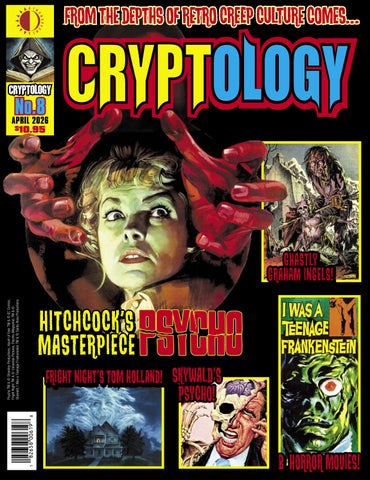
Cryptology #8 Preview

Page 1


EDITOR-IN-CHIEF

Peter

PUBLISHER

John

DESIGNER

Michael

EDITORIAL

ILLUSTRATION

Pete

Piero Ermanno Iaia (1970s) SPECIAL

Richard J. Arndt • Michael Bonesteel

Heritage Auctions • Josh Holland

Tom Holland • Phil Hore • Christopher

Irving • Steve Kronenberg • Tim Leese

Will Murray • Jack Ulrich • Jim Van Hise

Ryan Vandergriff • Don Vaughan

Mark Voger • Neil Vokes • Tom Weaver • Joshua

Copyrights: Captain Blood, Mystery of the Wax Museum, The Maltese Falcon TM & © Warner Bros. • Abbott and Costello Meet Frankenstein, Dracula, The Phantom of the Opera (1925), The Wolf Man TM & © Universal Pictures • Laugh, Clown, Laugh, Ninotchka, Tell it To The Marines TM & © Metro Goldwyn Mayer • Broadminded, Five Star Final TM & © First National • The Lost Patrol TM & © RKO Radio Pictures • Targets, The Devil is a Woman, Unconquered TM & © Paramount Pictures • Targets TM & © Saticoy Productions

• Of Mice and Men TM & © Hal Roach Studios • High Noon TM & © Stanley Kramer Productions • The Defiant Ones TM & © Lomitas Productions, Curtleigh Productions • Something to Sing About TM & © Zion Meyers Productions • Stagecoach TM & © Walter Wanger Productions • Laura, The Grapes of Wrath, The Mark of Zorro, The Ox-Bow Incident TM & © Twentieth Century Fox • Lured TM & © United Artists • The Ten Commandments TM & © Motion Picture Associates • Haunt of Fear TM & © EC Comics • Startling Comics TM & © Pines Publications • Underworld TM & © DS Publishing • Classics Illustrated TM & © Gilberton • Psycho (paperback 1961) TM & © Crest Books/Fawcett Publications • Psycho (film 1960) TM & © Alfred J. Hitchcock Productions/Shamley Productions • Weird Tales TM & © Weird Tales Inc. • The Opener of the Way TM & © Arkham House • The Scarf TM & © The Dial Press • Psycho (hardback 1959) TM & © Simon & Shuster (USA) Robert Hale Ltd (UK) • Amazing Science Fiction Stories TM & © Ziff-Davis Publishing Company • The Deadly Bees, The Psychopath, The Skull, Torture Garden TM & © Amicus Productions • Psycho II (novel) TM & © Whispers Press • The Night of the Ripper

TM & © Doubleday • Once Around the Bloch TM & © Tor • Death Rattle, Weird Trips TM & © Kitchen Sink Press • Blood of Dracula TM & © Apple Comics • Alfred Hitchcock’s Psycho (comic) TM & © Innovation Publishing • Did You Hear What Eddie Gein Done? TM & © Albatross Funnies • Peeping Tom TM & © StudioCanal & The Criterion Collection

Psycho II, Rear Window TM & © Universal Pictures • Seduc-

In his later years, the EC horror artist who had reveled in reviving the vengeful dead was never at ease with his putrescent legacy

Alfred Hitchcock’s film changed the moviegoing public’s

of Ed Gein and Norman Bates was even too much for the

Although Fredric Wertham hadn’t seen Alfred Hitchcock’s landmark movie, he was

revered homage to classic horror Fright Night

reminiscence on Now Comics’ adaptation of Fright Night

A catalog of atrocities from the crime and horror comics of the 1950s now extends to the 1970s.

CRYPTOLOGY™ issue 8, April 2026 (ISSN 2997-416X) is published bi-monthly by TwoMorrows Publishing, 10407 Bedfordtown Drive, Raleigh, NC 27614, USA. Phone: (919) 449-0344. Periodicals Postage Paid at Raleigh, NC. POSTMASTER: Send address changes to Cryptology, c/o TwoMorrows, 10407 Bedfordtown Drive, Raleigh, NC 27614. Peter Normanton, Editor-in-Chief. John Morrow, Publisher. Editorial Office: CRYPTOLOGY, c/o Peter Normanton, Editor-in-Chief, 619 Whitworth Road, Lower Healey, Rochdale, Lancashire, OL12 0TB, England. Email Peter Normanton: peter.normanton@btinternet.com. Six-issue subscriptions: $80 Economy US, $121 International, $29 Digital. Please send subscription orders and funds to TwoMorrows, NOT to the editorial office. All editorial matter © 2026 TwoMorrows Publishing and Peter Normanton. Printed in China. FIRST PRINTING.

MOONLIGHTING MONSTERS WHEN HORROR STARS LEFT THEIR CRACKLING LABS

AND MOLDERING CASTLES

“Hey, that’s Lionel Atwill! He transplanted Ygor’s brain in Ghost of Frankenstein! What’s he doing in Captain Blood?”

In the olden days (pre-streaming, pre-home video), it would occur to horror nerds that the beloved stars of scary movies occasionally had roles in “straight” films—and gave a good account of themselves.

We even felt proud. Go, Lionel Atwill!

This is because many of the stars of classic horror films excelled in small or featured roles in classic non-horror films during the so-called Golden Age of Hollywood, when studios “owned” actors and could move them around like chess pieces, or lend them out like farm equipment. Since the horror stars sometimes resented being typecast, a chance to stretch their acting muscles, not to mention their comedy chops, was a

welcome vacation from greasepaint, prosthetics and yak hair.

A few disclosures before we dive in: Certain players are indisputably identified with horror (such as Bela Lugosi, Boris Karloff and Lon Chaney Jr.). Others achieved so much outside of the genre, we really can’t pigeonhole them as horror stars. Three cases in point: Claude Rains is generally remembered for movies like Casablanca and Mr. Skeffington, not The Invisible Man and the 1943 Phantom of the Opera; Basil Rathbone brings to mind Dawn Patrol and The Adventures of Robin Hood more so than Son of Frankenstein; Peter Lorre conjures The Maltese Falcon and Casablanca for mainstream movie fans, not so much Mad Love.

Our list of players will include some who made a whole lotta horror films, even if they didn’t usually, or ever, wear the monster makeup themselves. In each case, we’ll focus on just a

Among the many faces of London born Lionel Atwill, were the disfigured sculptor in Mystery of the Wax Museum, and on the right, Colonel Bishop in Captain Blood TM & © Warner Bros.

few of the most salient examples of non-genre films per actor. (Trust me, complete lists would be tedious.)

Got all that? As Lugosi once said: I bid you velcome.

LON CHANEY

For starring in two particular silent classics, Lon Chaney the senior (1883-1930) achieved horror movie immortality. However, neither of the title characters in Wallace Worsley’s The Hunchback of Notre Dame (1923) or Rupert Julian’s Phantom of the Opera (1925) were possessed of supernatural characteristics. Quasimodo and Erik were disfigured men, not vampires or werewolves, who merely sought love.

Still, Hunchback and Phantom are the movies Chaney is best known for, despite his impressive body of work in non-genre fare. There are two powerful reasons: The unforgettable makeup jobs (created by Chaney himself), and the humanity the actor was able to project from behind them.

But Chaney was a bona fide movie star with an impressive range who carried a film, despite his lack of “leading man” looks. Two of Chaney’s non-horror films offer an inkling of that range. One is the military drama Tell It to the Marines (1926). George W. Hill’s film conveys a simple, though dynamic, story—one with action, a love triangle, and fireworks between a lackadaisical private (William Haines) and tough-as-nails Sgt. O’Hara (Chaney), who bellows at him: “I’ll make a Marine out of you if I have to break every bone in your head!”

Eleanor Boardman plays nurse Norma, the secret object of O’Hara’s affection. Tears well up in O’Hara’s eyes when Norma tells him of the private, with whom she is in love: “I wish he were more like you.” Oh, the irony!

So enamored was the Marine Corps of Chaney’s portrayal, the actor was made an honorary Marine—the first film star so recognized—and an honor guard was sent to his funeral to play “Taps.”

In Herbert Brenon’s Laugh, Clown, Laugh (1928), Chaney plays Tito, a

performer in a small traveling show in rural Italy who finds an abandoned little girl in the woods. Simonetta (luminous Loretta Young in her film debut) grows up to become a tightrope walker opposite Tito, who has since won fame as a clown character called Pip.

Upon learning that Tito is in love with her, Simonetta promises to break off her engagement to a wealthy young Count (Nils Asther). But Tito believes Simonetta is just being noble. Wracked with pain and guilt, Tito rehearses his most dangerous stunt—riding a high-wire upside-down on his head—when he is hardly in an emotional state to do so safely. The sight of Chaney in anguish while smiling through clown makeup is as powerful as any of his horror characterizations.

BELA LUGOSI

Following his breakthrough as the dapper nobleman vampire in Tod Browning’s 1931 Dracula, Bela Lugosi (1882-1956) was usually typecast as monsters, mad doctors and, oddly, suspicious butlers. Among rare exceptions were comedies like Broadminded (1931, opposite Joe E. Brown) and International House (1933, touted as “the Grand Hotel of comedy”); detective yarns like The Black Camel (1931, a Charlie Chan flick) and The Saint’s Double Trouble (1940); and crank-’em-out serials and

The image of Lon Chaney as The Phantom of the Opera (1925) has lived on for more than a century (TM & © Universal Pictures), but Lon made his name as the lead actor in many other features, including Tell it To The Marines (1926) and Laugh, Clown, Laugh. (1928) TM & © Metro Goldwyn Mayer.
The name Bela Lugosi is synonymous with Dracula (TM & © Universal Pictures), yet every once in a while he did get to play comedic roles—Broadminded from 1931 being of note. TM & © First National.

GRAHAM INGELS THE ARTIST WHO REFUSED HIS DESTINY

No one could draw a rotted, walking corpse like Graham Ingels.

In fact, no one could draw anything quite like Graham Ingels. Under the pen name “Ghastly,” he developed a unique and inimitable gothic style that almost single-handedly redefined horror art in the 1950s.

Ingels’ stories for EC Comics’ Tales From the Crypt, The Haunt of Fear and The Vault of Horror seemed to drip evil and decay from every panel. And readers couldn’t get enough. Whenever the editors asked fans to rate EC’s horror artists, “Ghastly” almost always came in first.

But Graham Ingels was much more than a comic book artist with a distinctive style. He also was a gifted painter who could draw portraits, machinery and nature with equal ease. One of his favorite subjects was South Florida history.

Like many creative geniuses, Ingels was a complicated and frequently misunderstood man. A student of New York’s prestigious Hawthorne School of Art, he loathed the comic books that put food on his table—yet still managed to produce some of the finest work ever to grace the

medium. He was also plagued by alcoholism, which many believe was a contributing factor to the bizarre break-up of his marriage.

In 1962, all of the problems in Graham Ingels’ troubled life apparently came to a head. He went to work one day and never came home. For years, even his family and closest friends didn’t know exactly where he was, and those who wished to discuss business could contact him only through his attorney.

Where did Graham Ingels go? That’s the easiest question to answer—he ended up in Lantana, Florida, just a stone’s throw south of Palm Beach. The more complicated question is why.

Inherited Talent

His “Artist of the Issue” profile in Haunt of Fear #10 tells us that Graham Ingels was born on June 7, 1915, in Cincinnati, Ohio. His father, Don Ingels, was a commercial artist who died when Graham was 14. Inheriting his father’s talent, Ingels got a job drawing theater displays at age 16,

The menace in Graham’s cover for Haunt of Fear #14 (TM & © EC Comics), set the standard for those who followed, as did his dedication to fine art.

and managed to make his living through art—either drawing or teaching—for the rest of his life. He even drew while in the Navy during World War II, at one point painting a mural for the United Nations.

After the war, Ingels tried to get back into magazine

illustration, but times were hard. Unable to find decentpaying work, he grudgingly turned to comic books to make ends meet, freelancing for various publishers before joining EC around 1947.

Most comic book aficionados agree that Ingels’ early work at EC—primarily crime stories and westerns—was competent but uninspired. It was only when he started illustrating the eerie and atmospheric horror stories for which EC would become famous that he really excelled. Vengeful corpses and gruesome ghouls quickly became his specialty. No one else could come close.

“Jack Davis was one of the masters of this kind of stuff, but he wasn’t revolting the way Graham Ingels was,” recalled Maggie Thompson, editor of Comics Buyer’s Guide and a long-time fan of EC. “With Ingels’ stuff, you didn’t want to touch the page. It was masterful work.”

Ingels quickly became one of EC’s premiere talents, drawing the lead story in every issue of Haunt of Fear, secondary stories for the two other horror titles, and the occasional crime tale. It was a grueling schedule, but Ingels was fast with a brush and had little trouble keeping up, said fellow EC alumni George Evans.

Advanced Deadlines

It was during this period, associates recalled, that Ingels’ drinking started to get out of hand. His work never suffered, but he occasionally missed deadlines, forcing editor Al Feldstein to give him advanced deadlines so

GRAHAM INGELS

The master at work, Graham photographed at his drawing board in 1951. TM & © EC Comics
The cover to Startling Comics #45 (May 1947, (TM & © Pines Pubs) revealed his ease rendering the female form, yet hinted at the darkness to come, while the violence in the graveyard in Underworld #4’s “The Caballero Killer” (Aug.-Sept. 1948
further.

to be a serious artist, not a Sunday afternoon hobbyist.”

The vast majority of Ingels’ students were female. This bothered him a bit, said friends, because Ingels was a man’s man who really enjoyed talking about “guy stuff.” Some of the most fun Ingels ever had, said Tyler, was chatting with farmers, ranchers and area pioneers while researching the history of the Glades region.

Between classes, Ingels worked ceaselessly on his own projects and, like an artistic Johnny Appleseed, sprinkled much of Palm Beach County and the Florida Glades with his distinctive work.

The Bank of Belle Glade, for example, commissioned him in 1982 to create five large murals depicting the history of the region from the 1850s to the present. Ann Tyler opened the door by doing several large paintings for the bank depicting Seminole life, then recommended Ingels for the historical series. The massive project took two years to complete.

Ingels also painted the portraits of several notable Glades residents, and did a series of nine South Florida historical paintings which were acquired by Helen Boynton of West Palm Beach for a proposed set of limited edition prints. (Only one painting, depicting Palm Beach in 1894, was reprinted.) In addition, Ingels’ paintings hung on the walls of the Bank of Pahokee and a few area art shops, where prices ranged from $35 to several hundred.

Enter Russ Cochran

Witch’s shroud was a purple magenta, even though it had been red in the comic books.

GRAHAM INGELS

In the late 1980s and early ’90s, Ingels softened his anti-comic book stance a bit and began painting portraits of The Old Witch for Russ Cochran, who sold them at auction for between $4,000 and $6,000. Cochran also sold the preliminary studies Ingels did for each painting for several hundred dollars each.

Even this simple—and profitable—endeavor had to be on Ingels’ own terms, however. For example, he detested the color red (he said it hurt his eyes) and refused to use it in his paintings. As a result, the Old

“Many fans commented on this, and Graham finally said to me, ‘Look, I’m going to do it my way or not at all,’” Cochran recalled. “‘Would you rather have an Old Witch with a purple dress or no Old Witch?’ So I quit pushing him. It was his way or the highway. Sadly, by the time we had some momentum up and people were aware of the fact that he’d been found again and that he was doing EC-style paintings, he got sick.”

Graham Ingels died from cancer on April 4, 1991, after a brief stay in the hospital. Those who knew him well agree that his life was a series of paths not taken, of certain opportunities and dreams unfulfilled. However, he was far from unhappy. He greatly enjoyed teaching, and was never happier than when painting a scene from Florida history or its wildlife. And while his first marriage may have ended in turmoil, there’s no

The Old Witch may have had her red cloak replaced by a muted magenta shroud, but she still had her beady eye on you, as noted in Graham’s painting from 1989. TM & © EC Comics.

THE THRILLER THAT TURNED TO HORROR

Alfred Hitchcock’s 1960 film Psycho, starring Janet Leigh, Anthony Perkins, John Gavin, Vera Miles, Martin Balsam, John McIntire, and Mort Mills not only made significant changes to our concept of the horror movie, but it also altered our perception of film in general. In 1960, nearly all horror films were “B” pictures—most produced with a diminutive budget, directed by men at the very start or very end of their careers, starring either actors, such as Boris Karloff or Vincent Price, whose careers were stereotyped in horror films, or featuring once popular actors and actresses eking out a living in whatever roles they could get in their twilight years. In addition, the villains in these films were usually non-human monsters—vampires, werewolves, ghouls, zombies, aliens, along with a plethora of strange creatures, many conceived by man in hidden laboratories.

It was not always so. In the silents of the 1920s and the early days of sound in the 1930s, horror films were lavish, featuring some of the leading stars of the day such as John Barrymore, Conrad Veidt, Fredric March, Charles Laughton, and Claude Rains. Lon Chaney enjoyed considerable success during the 1920s, mainly in crime features that tried to pass as horror films (though only a handful really were). While a variety of monsters did appear in these films, there were just as many of the human kind as those of the non-human ilk. However as the 1930s progressed, the

studios discovered low-budget horror films were every bit as lucrative (per film at least) as their more ostentatious productions. While many fine horror films were made during the ensuing years, few of them featured the eminent actors and directors associated with the period. It could be said, horror films had become the vehicle where talent either began or ended. In addition, the use of clearly human monsters was discouraged, no doubt by

the Hays censorship office. If a human monster did make an appearance, rarely was the foil advertised as horror, the studio executives preferring to pitch said film as a thriller.

Hitchcock changed all of that. He was no youthful or fading director. He had just come off a string of films— Strangers on a Train, Rear Window, To Catch a Thief, Vertigo, North by Northwest—each of which rate among his best work. He wasn’t working with fading or new actors either—Perkins was a recent Oscar nominee, while Leigh had been a leading lady for over a decade, having made a run of highly successful films. In only one respect could his film be looked upon as traditional horror fare, and that— surprise, surprise—was solely in terms of budget. Hitchcock consciously made his film with the lowest amount of funding he’d had in years—only $800,000 to begin with, as referenced in The Dark Side of Genius: The

Donald Spotto, with the final figure

While it starts in the guise of a crime thriller, by the end, it has turned into the darkest horror imaginable.

Shattering Taboos

Hitchcock also shattered a number of other film taboos. With Psycho, the serial killer becomes established as the lead character—a popular construct that still exists today. He explored aberrant human psychology and sexuality to make them the explicit underpinnings of his “monster’s” reasoning, as opposed to the mythical, fantasy or science fiction tropes. You would have to go back to the films of the 1920s and early 1930s to see this done so openly. He then cast an extremely likable and handsome young man as the villain at the center of this piece, not the customary scarred or inhuman monster. Hitchcock had in fact been doing this for years in his crime thrillers—James Stewart, probably the most endearing man in film at the time, was routinely chosen

as the leading man when Hitchcock wanted to delve into some really off-putting and possibly censorious psychological thinking, particularly in Rear Window and Vertigo. A third of the way through this film he killed off his lead actress, who was also the best-known actor on the bill. This was only after he had revealed her reclining in her lingerie on a single bed with her lover, at a time when it was the convention for movie and TV married couples to be shown tucked up in twin beds, or confined to their own bedrooms. And, yes, he featured the first toilet to be flushed onscreen in motion picture history, although it was only flushing away fragments of torn paper.

Over the years, much has been made of Hitchcock basing his film on Robert Bloch’s novel, which was inspired by the murders committed by Ed Gein in Wisconsin during 1957. However, as we will see in Joshua Winchester’s piece, Bloch had his own ideas as to where his inspiration was truly derived. As an aside, Robert Bloch was the originator of Stephen King’s oft-quoted comment, “I have the heart of a small boy. I keep it in a jar on my desk,” which was used by the pair when people asked from where they got their hair-raising ideas, this tale being one the most hair-raising.

Due to the popularity of Psycho, and the subsequent successes of other Gein-inspired films, among them Deranged, The Texas Chainsaw Massacre and The Silence of the Lambs, it’s interesting to note Gein’s reputation as a serial killer is misleading, since his victims officially numbered only two—that of the female hardware store owner whose body he was caught with, and a female bartender who had vanished several years earlier. In retrospect, he was also strongly suspected of his brother’s death in a swamp fire in the early 1950s and possibly that of his mother. Gein, however, was definitely a ghoul who dug up freshly buried bodies, including his

Films of Alfred Hitchcock by
coming in at $950,000.
The paperback re-issue of Robert Bloch’s Psycho from 1961 (TM & © Crest/ Fawcett Pubs.), and Anthony Perkins as Norman Bates. TM & © Shamley Prods.

Tales from the Author’s Crypt Robert Bloch

“So I had this problem—work or starve. So I thought I’d combine the two and decided to become a writer.”—Robert Bloch

Greetings and spooky salutations, fellow children of the night. It’s your frightful friend Joshua, come to satisfy your cravings for the macabre once more. This time around we’re taking a look back into the past of a writer who left an indelible mark on the world of fiction, especially when writing about things that go bump in the night.

No, it’s not Stephen King, or HP Lovecraft, or even dear old Edgar Allen Poe. No, no, this is a chronal trip delving into the life of Robert Bloch, who we all know and love for the creation of one of the most depraved figures of 20th century horror, Norman Bates.

Born Robert Albert Bloch on April 5, 1917 in Chicago to parents, Raphael and Stella, horror had a significant impact on his life from an unusually early age. The film that would gestate the seed set to bloom into a lifelong career in horror was the chilling silent era classic The Phantom of the Opera, starring the late Lon Chaney Sr. What is so wild is when Bloch first saw this movie on its original release, he was only eight years old. Who’d’a thunk that any kid was able to see such a spook-tacular piece of cinema at so tender an age? Not surprisingly, it was the infamous scene where Chaney removes the mask that terrified this little fellow, to the point that “it scared the living hell out of me and I ran all the way home to enjoy the first of about two years of recurrent nightmares.”

After living in Chicago’s Maywood neighborhood for a few years, Raphael moved the family to Milwaukee, where Robert would attend Lincoln High School. Befriending the editor of the school’s literary magazine, his first published piece was entitled “The Thing.”

The Gallows

It was in 1933, when the ravages of the Great Depression were still being felt, Robert plucked up the courage to write a fan letter to HP Lovecraft, having been beguiled by the author’s works a few years prior when he picked up a copy of the October, 1927 issue of Weird Tales, which contained the hair-raising short story “Pickman’s Model.” Eventually Lovecraft and

Bloch would begin a regular correspondence, with the creator of Cthulhu offering the budding writer advice on his earliest attempts at fiction, and even asking to read samples (the fledgling Bloch would send two of them, an unknown piece and one with the ghastly title “The Gallows”).

From here on in, the writing bug took a hold of Robert, who would, after promptings from Lovecraft, get in touch with members of the Lovecraft Circle, including August Derleth (the founder of the fabulously frightening Arkham House).

These influences (along with Bloch’s own skills as a writer),

Boris Dolgov’s illustration announced the psychological suspense story “Yours Truly, Jack the Ripper,” first published in Weird Tales, July 1943. Both images TM & © Weird Tales Inc.
Matt Fox’s cover for Robert’s tale in Weird Tales (Nov. 1947).

Deranged, Deviant, Psycho, Silence and Texas

Ioriginally saw the film Deranged sometime in the late Summer-early Fall of 1974 at the local drive-in. All these years later, I am still pretty sure of this because in 1974

I didn’t have a car of my own until May of that year, and would not have dared use my parents’ car to sit through a three-film marathon at this drive-in.

In 1974, no indoor theater in the rural Midwest would have shown a film of this excessive nature in what were intended as family-oriented cinemas. It was left to the drive-in to screen such a shocking spectacle, and even then it would have been the second or third film of the night, not the dusk headliner. Drive-ins of that era tended to open with a B-movie, played by actors regularly seen in these crime, horror or non-porn teaser films, all of which contained a fair amount of violence along with a showing of scantily clad girls. Following the lead movie came a second film of a similar type, but with actors you had probably never heard of, before the third and final film that consisted of either more explicit foreign “naked girl” tease, or

a particularly distasteful horror/crime presentation screened after most patrons had left for home. Those who remained, were usually the ones who had set out to savor this debauchery in the first place.

Deranged premiered in Los Angeles on March 20, 1974, two months prior to the release of Stephen King’s first published novel, Carrie, and a full seven months before The Texas Chainsaw Massacre, also based on the Gein murders, which debuted on October 11, 1974.

Although the discovery of Ed Gein’s crimes in 1957 had previously spawned Hitchcock’s 1960 adaptation of Robert Bloch’s novel Psycho, this later release came far closer to the horror that actually transpired prior to his arrest. However, even this film wasn’t entirely true to the events in Gein’s life, maybe owing to him still being alive and capable of suing for slander. Furthermore, if the filmmakers had gone for too much accuracy, he could have been entitled to demand payment for the rights to what would have been his life story.

Ezra Cobb’s (Roberts Blossom) twisted mind turns to violence in the Jeff Gillen/Alan Ormsby directed Deranged. TM & © Karr International Pictures.

THE MAN WHO DARED ACCEPT THE POISON CHALICE

A Conversation with PsychoII and FrightNight’s

Tom Holland

efore we begin I would like to thank Chris Irving and Tom’s son Josh for making this interview possible; without them it would never have come to be. Once these introductions had been made I set to researching Tom’s films and his career, spending many an hour delving into his work as a writer and director. To my surprise I needn’t have bothered, because chatting with Tom was like meeting up with an old friend I hadn’t seen in far too long a time. As you will soon see, he wanted nothing more than to share his love for all the films and comic books we enjoy; in that respect you will find he is no different to any of us, other than he had the talent to make these films. Not only was I extremely lucky to chat with Tom, my timing couldn’t have been more perfect, for he was celebrating the 40th anniversary of Fright Night, a film many fans of the horror movie still hold close to their heart.

CRYPTOLOGY: Hello, Tom.

TOM HOLLAND: I am glad we’ve connected. Yeah, we’ve managed to do it.

CT: I can see you have all of your little friends around you. [Tom’s room is full of Fright Night posters, Chucky dolls, and so much memorabilia.]

TH: You should to see the rest of the house! I’ve got the biggest Fright Night collection, I’ve got almost everything. My wife said we didn’t move into this house so she could have a horror museum in the living room. So I have it around me.

CT: I bet you weren’t too popular. (laughter) Shall we have a chat about your films?

TH: What can I tell you,

Peter?

CT: I’d like to go back to be the beginning, to the films that have taken you to where you are now.

TH: Which films did I like as a kid?

CT: Yes.

TH: I am an AIP guy. That’s what Fright Night is. Fright Night is my love letter to horror fans of my generation. What has happened is, it has become multiple generations. When I grew up when... we didn’t really have them. The first horror films I remember from the late ’50s and early ’60s were science fiction films like Them, The Creature from the Black Lagoon… I had them all in my mind.

CT: What about Tarantula?

TH: Yes Tarantula is a good one. Attack of the 50 Foot Woman.

CT: Oh yes! Invaders from Mars is one of mine.

TH: For me, horror films began with Hammer, Christopher Lee as Dracula. American International Pictures, where Roger Corman started, imitated Hammer, with Roger doing the Edgar Allan Poe stories. Vincent Price became our Christopher Lee. That’s also where Jack Nicholson started, believe it or not. He was in the one about the plant that ate everybody, The Little Shop of Horrors

CT: Yes, I remember it well. A great film.

TH: I loved those films, but they didn’t really have a definition for horror yet. There was kind of a fan base in America. I’m back in mid-state New York, farm country, where I grew up. There were three or four other boys in high school who loved them too, but that

Who would have
on this cast, with the sad exception of Roddy McDowall, would reunite to celebrate Tom’s film Fright Night TM & © Columbia Pictures Vistar Films.

was it. They had something called the Friday Night Fright on television which was on the independent channel—I still remember the number, 11. At eleven o’clock on Friday night you could always find a horror film on there, but it was the only thing on television that was horror oriented. You also had about 1954, EC Comics, Tales from the Crypt. Then they got banned around 1955, I think because they were considered bad for kids. We started passing them around in high school, just between us, but no girls were into horror. Then they started coming out with a horror movie host on the Friday Night Fright. That’s where Fright Night comes from, and that’s also where Peter Vincent comes from. Peter Vincent was a combination of Peter Cushing and Vincent Price. That’s where I got the name from.

CT: That makes perfect sense.

TH: That movie was my memory in 1985 of growing up being a mad horror fan in the late ’50s and early ’60s. Then when I did Fright Night as a movie, everybody in Hollywood told me I had to get out of horror as quickly as possible, because those people looked down on the genre.

CT: Yes, they would have done that back then. TH: It was looked upon as the red-headed stepchild.

Nobody wanted to do it. Because of that social pressure, from both my agent and my manager, I ended up doing Fatal Beauty with Whoopi Goldberg and Sam Elliott.

CT: My wife and I saw it when it came out over here. I don’t think we’ve seen it since. TH: Nobody asks me about that film, here now in 2024. But everyone asks me about my horror films. I’ve lived though a time when they thought the genre was terrible, classified as Class A and wouldn’t get any awards. Now forty-something years later, things are different. By the way, we’ve just had the 40th anniversary of Fright Night. I did an original cast reading about six weeks ago with all the cast for a podcast. It will come out in July 2024. I had Mark Hamill come in and do Roddy McDowell as Peter Vincent and Rosario Dawson came in to do a number of the women.

In my lifetime I have experienced horror going from A Class, no one would ever admit to liking it, to where it is now being a big genre. In Hollywood it is constantly remunerative, probably the greatest financial bet you can do as movie. It’s also a huge favorite among independent movie makers, because if you do a terrific horror film, you will get bought by some distributor. So it has gone from where nobody would admit to liking them to everyone and their brother, including the major studios trying to

TOM HOLLAND

He’s behind you! The tension mounts as Jerry Dandrige (Chris Sarandon) glares at Peter Vincent (Roddy McDowall). TM & © Columbia Pictures Vistar Films.
Armed and ready, Charley and Peter prepare for the final showdown. TM & © Columbia Pictures Vistar Films.
Roddy McDowall seen with Tom Holland and Jan Kiesser on the other side of the camera. TM & © Columbia Pictures Vistar Films.

“The d ead r emember”

Looking Back on the Strange History of Director Tom Holland’s “Fright Night” in NOW Comics

“You’re So Cool, Brewster”

as James Van Hise’s plans for a storyline featuring the return of the Evil Ed character illustrates, NOW Comics had always been intent on bringing back that popular antihero, sensing rightly that he had real potential as a breakout star of their Fright Night series. With the Real Ghostbusters scribe paring back his work for the company, it fell to NOW publisher Tony Caputo to step in and not only assume the writing chores for the title, but also to officially resurrect everyone’s favorite smartass vampire in Fright Night #8’s “The Revenge of Evil Ed.” Joining Caputo for this particular honor would be Comico artist (as well as co-founder of his own comic company Crystal Comics) Neil Vokes. Vokes was no stranger to the world of vampires, having wowed readers with his own distinct take on the Big Wheel of all vamps, Count Dracula in

Part2

the Apple Comics series Blood of Dracula. And he had been a distant admirer of Holland’s take on the vampire mythos since 1985. Had his artwork for Blood of Dracula as well as his love of Fright Night the movie landed him the role as the new artist on the series?

“Honestly, I’m not sure if Tony had ever seen a Blood of Dracula issue,” recounts Vokes on how he became a critical figure in the comic mythos of Fright Night “Thing is, I had heard that NOW was going to do a Fright Night comic series, and I just had to get a chance at it. I approached them, hoping to get on an issue, much less a series—but Tony wanted me to do Speed Racer instead. He knew of my work on Comico’s Robotech books, so he hoped I’d do a similar job on Speed, which was not my intention. He asked if I’d agree to do an issue of Speed first, then Fright Night. I was willing to do that in trade for a shot at Fright Night.”

Would you trust this innocent looking young man? As Fright Night #8 (June 1989) was to disclose, you’d be wise not to. Evil Ed returned courtesy of Tony Caputo, Neil Vokes and John Strangeland, his story continuing a month later in issue #9. TM & © Now Comics.

For Vokes, being the artist on Fright Night was less of a job than it was a full-fledged calling: “...At that time, I was pretty damn sure that I was the only artist to do it justice,” he recalls of his single-minded determination to ply his craft on the comic world of Peter Vincent and Charley Brewster. And, from the first panel to the very last in that issue and the eight issues to follow, Vokes spun his magic, lending the comic its own unique artistic voice which it had seemed to lack in the stories prior to his run; this fun house mirror rendition of Fright Night finally had an artist able to meet the outrageous storylines with equal quirk and aplomb, and the results were as breathtaking as they were distinctive.

Oh No, Evil Ed Returns!

Caputo took over the writing reins for the title from #8-11. It’s not unheard of or unusual for an editor-inchief, as well as publisher for a line of comics, to play wordsmith with a title, although it is rarer than not. “It might just have been something he wanted to do,” muses James Van Hise of the creative changeover. “There might have been different stories he wanted to tell.”

And what stories those four issues (#8–11) told: A return of Evil Ed (with the two-parter sporting cover photos of actor Stephen Geoffreys as Ed), the introduction of barkeep Derek (an ally in the fight against the dark forces Charley and Peter were routinely coming up against), the splashy entrance of a new girlfriend for Charley in the form of the beguiling Natalia, as well as the off-panel introduction of her aunt Claudia, and alien monsters (!), all brought to life by the steady brush of Neil Vokes. Fright Night as a comic book had just entered its all-too brief Indian Summer of some of the more memorable and far-out stories ever committed to the

pages of a late ’80s comic book series. More importantly, the series was attempting to establish a solid core of supporting characters and continuing storylines, eschewing the more done-inone storytelling elements previously introduced in the series. Caputo was also mindful of keeping some of the through-lines between the first film and the comic book, not just with the return of Ed Thompson, but also the blink-andmiss-it name drop by Charley of his first girlfriend Amy Peterson.

For all the freedom that Vokes and Caputo had in spinning their version of Fright Night, it’s surprising that there were some lines the license holders didn’t want to see crossed.

“I discovered, much to my surprise, that it was to be a toned-down take on the R-rated film,” says Vokes in discussing just what limitations were put upon the NOW crew in bringing Fright Night to life for comics. “I was told that the folks who issued the license said that ‘comics are for kids,’ so we would have to avoid too much, ya know, vampire stuff… But my desire to draw the darn thing overtook my disappointment.”

More Handovers

As for the new Lennon and McCartney of Fright Night, Caputo and Vokes seemed to hit a series of high notes on the title which, arguably, subsequent writers and artists would have a difficult time in matching.

“I think that Tony did a competent enough job with what he had to work with… which was both the restrictions of the license and having to contend with a pain in the ass artist who constantly bitched about what we could do in the book,” reflects Vokes on Caputo’s four issue stint before handing the writing over to someone else. “To his credit, he let me address bits of business here and there along the way. I’ve always preferred a collaborative relationship with my writers.”

How did the mastermind of Fright Night—visionary director Tom Holland—feel about NOW’s eccentric take on his beloved characters?

“I thought the comics were pretty good,” Holland says

FRIGHT NIGHT in COMICS

Neil Vokes’ artistry brought Fright Night to a new level, reveling in its eccentricity, yet the dark side was never too far away. TM & © Now Comics.

KILLER B’s

HIGH SCHOOL HORRORS AIP’s Teen Terrors of The 1950s

I Was a Teenage Werewolf

What’s in a name? For horror film fans, the better question might be “What’s in a movie title?” The answer speaks volumes about the history of American International Pictures (AIP). James H. Nicholson, a theater owner and former sales manager with Realart Pictures (responsible for rereleasing Universal’s horror classics in the late ’40s and early ’50s), initially christened his venture as American Releasing Corporation (ARC) in April 1954. Nicholson and his vice-president, attorney Samuel Z. Arkoff, had the

daunting task of competing with wealthy A-list movie studios and the burgeoning popularity of television, which threatened to suck the film industry dry. But Nicholson knew something else: The vast majority of moviegoers were teenagers who craved pictures with themes and actors they could identify with. “They didn’t want to stay home,” Arkoff told genre historian Tom Weaver. “They had to get out!” No Douglas Sirk melodramas, no Doris Day musicals, just kids dealing with monsters, mayhem, and arrogant adults— the kind of low-budget, low-brow stuff perfectly suited for neighborhood grindhouses and drive-ins. Nicholson also realized that the best way to pull profits from penury was to release two cheap pictures on one double bill. After ARC became AIP, the determined duo delivered their first diabolic double feature in 1956: Day the World Ended and The Phantom from 10,000 Leagues. They mixed and matched monster fare like The She-Creature with rock, roll, and raciness in such films as Shake, Rattle and Rock and Female Jungle (all 1956).

Still, AIP’s chops weren’t truly honed

until producer-writer Herman Cohen conceived a monster movie exclusively aimed at the teen market with a title that couldn’t miss. “As a kid, I always loved horror,” Cohen told Weaver. “I used to scare my sister and kid brother going home from the theater!” Depending on who’s telling the story, the title I Was a Teenage Werewolf (1957) was inspired either by a classmate of Nicholson’s daughter or, more likely, a game played by Nicholson, Arkoff, and co-producer Alex Gordon in which each man had to

Once Phillip Scheer had applied the makeup, Michael Landon really was a teenage werewolf. TM & © American International.

think of the longest title in movie history. I Was a Prisoner on Devil’s Island (1941) and I Was a Communist for the FBI (1951) were mentioned before Nicholson liked “I Was” and the others came up with “Teenage Werewolf.” Thus was born the longest and most notorious title in horror film history. “Whatever, it’s a great title,” wrote Mark Thomas McGee in his AIP history Fast and Furious: The Story of American-International Pictures (McFarland, 1984). “A beautiful blend of monsters and teenagers, sounding as if it were ripped from the pages of True Confessions magazine.” Fortunately, the movie is as sensational as the title. I Was a Teenage Werewolf is one gutsy, gritty, and glorious horror show. Shot in seven days on a budget that ranged from $82,000 to $125,000 (depending on who’s reminiscing), it was the first film to feature a troubled and tragic teen turned monster by an authoritarian adult—a formula that AIP mined over the course of four films.

A pre-Bonanza Michael Landon plays Tony Rivers, an uptight high school student whose hair-trigger temper upsets himself and everyone in his orbit, including his friends, his widower father (Malcolm Atterbury), and his pureas-the-driven-snow girlfriend Arlene (Yvonne Lime). The movie opens on a bone-busting schoolyard battle between teenagers Tony and Jimmy (Tony Marshall), who sets off touchy Tony by simply patting him on the shoulder. “I don’t like to be hit from behind by anybody any time!” Tony tells wellmeaning Detective Donovan (the great Barney Phillips). Donovan suggests that Tony seek counseling with noted psychiatrist Alfred Brandon (genre fave Whit Bissell). As it happens, Brandon is the one who needs a shrink. He’s determined to save mankind by hurtling humans back to their “primitive dawn. To start all over again... I’ll be judged a beneficiary!” The mad medico sees the temperamental Tony as an ideal subject for experimentation. Using drugs and hypnosis, he turns the confused kid into a snarling werewolf with an appetite for human blood. Tony is the deranged doc’s dream: “This boy’s a freak. A police case,” Brandon tells his unwilling and frightened assistant (Joseph Mell). “We’re probably

saving him from the gas chamber.”

Teenage Werewolf is anchored by Landon’s nuanced work as a teen tragically cursed with a temperament, tampered by an arrogant adult. His portrayal has often been unfairly compared with James Dean’s Jim Stark in Rebel Without a Cause (1955). Dean broke ground in Rebel, but Landon’s performance may be a more accurate depiction of youthful angst than anything Dean ever did. As Tony, Landon’s anger simmers and smolders. He explodes when provoked, but his bipolar shifts in mood confuse and confound him. He stalks the film with a mammoth chip on his shoulder, wearing his attitude on the sleeve of his high school letterman jacket. Yet, his portrayal is devoid of Dean-like histrionics—there isn’t a single “you’re tearing me apart” moment in the entire film. Instead, Landon’s rebellion is subtle yet assured. When Arlene’s parents chastise him for not “properly” calling on her on date night, he’s curt but cool; he tells Arlene’s father, “Sometimes when I walk in that door, I think you’re gonna swat me with a baseball bat.” And like every victim of lycanthropy—from Henry Hull to Lon Chaney to Steven Ritch—Landon imbues Tony with pathos. He’s damned not by some European myth, but by the hubris of the medical establishment. When he finally realizes what he’s been turned into, he begs Brandon for help: “Doctor, I want to know what I’ve become! Please help me!”

Landon is also horror cinema’s first

truly kinetic werewolf, jumping, running, leaping, drooling while drilling into a victim’s jugular. Teenage Werewolf’s producer-co-writer Herman Cohen told Weaver that Landon performed all his own stunts. “When he had that makeup on,” Cohen recalled, “he said he felt like a werewolf.” As the movies’ original teenage monster, Landon deftly blends sympathy and savagery while conveying every teen’s refusal to yield to complacency and conformity. This rebel without a pause was a perfect fit for the Fifties.

“I enjoyed making that movie,” Landon once said of Teenage Werewolf “It was the biggest paycheck I had at that time!” It also jump-started an acting career that would eventually make him the highest-paid and most powerful star on television. Despite Landon’s later success, his fondness for the film never faltered. His wife Cindy recalled watching it with him: “Michael and I used to watch it and laugh. He would still do the imitations, make the face, do the growling, the whole bit.” Landon later parodied the character in an episode of his hit TV series Highway to Heaven entitled “I Was a Middle-Aged Werewolf,” in which he dons the monster makeup to scare some bullies. I Was a Teenage Werewolf continued to resonate with Landon. “I think it’s a good film,” he said in his later years. “I like it. My kids like it. They’d better. Their dad’s in it.”

Landon’s modulated work is complemented by Whit Bissell’s

Gene Fowler Jr.’s film attracted considerable interest across western Europe; the Belgian poster depicting Michael Landon and his werewolf alter ego is now considered a rarity. TM & © American International Pict.

THE CALL OF THE VILE

A GUIDE to the PRE-CODE HORROR COMICS of the 1950

s PART 1 - 1938-1949

Gus Ricca’s cover for Dynamic Comics #8 embraced a darker premise on its return in 1944. TM & © Harry “A” Chesler

…the comics business brought censorship down on its head because of the kind of things the horror comics were doing. I always thought the horror comics were vile. At some certain point they’d turned sick […] what came out was sheer gruel—ideas that sniffed of necrophilia.

Those of us who love vintage comics know the Nina, Pinta, and Santa Maria of comic book horror were EC’s triumphant triumvirate of terror that first appeared early in 1950: Tales from the Crypt; The Vault of Horror; and The Haunt of Fear. They charted new worlds within the horror genre, setting the bar as high it would ever go in the late Golden/Atomic Age. But then, of course, Dr. Fredric Wertham and a torch-wielding mob of comic book burners brought down those magnificent beasts like the tormented fiends they were—as well as a plethora of similar horror titles from other publishers. The industry tried to tame these creatures by placing them in a zoo enforced by the selfimposed Comics Code Authority in late 1954, but over the long haul and into the present, horror has proved to be an unbridled and undying breed.

We might be tempted to account for periodic spikes of interest in the morbid and the macabre by noting that both 1938’s initiation of horror in comics and its resurgences in 1950 and 1964 (Warren publishing’s Creepy) coincided with the coming of World War II and the outbreak of war in Korea and Vietnam. As the stench of death continues to permeate the air today, it seems

tenable that horror’s abiding presence reflects America’s interminable involvement in conflict across the globe. Although the fear of death lies at the heart of horror, the fear of evil may be every bit as close to its core. Story Grid editor Shawn Coyne breaks down horror’s handling of evil into three subgenres: The Uncanny, in which the force of evil is rationally explainable (Frankenstein’s monster, psychopaths, aliens, etc.); the Supernatural, in which the force of evil comes from a source that cannot be explained rationally (Dracula, zombies, ghosts, etc.); and the Ambiguous, in which the source of evil is unexplained (Steven King’s The Shining, Jeff Vander Meer’s Annihilation, etc.). I would take issue with Coyne’s last category and comment that if the source of evil is inexplicable, it probably fits into the Supernatural subgroup (as in my opinion does The Shining and Annihilation).

Rich Gothic Tapestry

If we are to fully appreciate how horror’s rich Gothic tapestry unfolded within the early history of comics, we must delve deep into the roots of pre-Code horror to understand how it developed. The following comprehensive overview of horror comic books will cite each title in the year it was brought out, tracing its course until its final appearance, usually by late 1954 or early ’55. I would like to thank several indispensable sources for providing the reference material used in my research for this article. First and foremost was the Comic Book Plus website, a trove of free public domain comic book downloading. The Grand Comics Database was another invaluable online resource of helpful information identifying pencilers, inkers, and script writers for so many titles. One early introduction to pre-Code horror comics beyond the highly publicized EC archetypes occurred with Steve Kronenberg’s gorgeously illustrated essay “To Ignore: Those ‘Brand X’ Horror Covers” in Comic Book Marketplace (#112, May 2004). “The Other Guys” by Lawrence Watt-Evans in Alter Ego #97 (Oct. 2010) is probably the most insightful and thorough history of pre-Code horror comics published to date, and while my article covers some of the same ground, I’ve tried to give it a bit of a different spin with supplementary information.

Mad Doctors & Monsters

From the very get-go in the late 1930s and early ’40s, horror stories appeared side-by-side with superhero, crime/detective, jungle, pirate, humor, and other genre strips within various anthology titles. The same year Superman debuted in Action Comics #1 (National Periodical Publications, 1938) and the superhero was born, the mixed genre anthology Jumbo Comics #1 (Fiction House, 1938) featured one of the earliest horror series, “The Diary of Dr. Hayward.” Penciled and inked by Jack Kirby using the house pseudonym “Curt Davis,” it kicked off with a mad scientist scenario immersed in the transference of the mind’s consciousness into a different body. By issue #10, “Diary” was renamed “Stuart Taylor in Weird Stories of the Supernatural.” Another mad doctor

CALL OF THE VILE

Early horror by Jack Kirby, “The Diary of Dr. Hayward” from Jumbo Comics #1. TM & © Universal Phoenix Features Syndicate.

HORROR COMICS EXCESS

sKYWald’s psYCho SO MUCH MORE THAN AN AFTERTHOUGHT

in “Horror Comics Excess’” quest to uncover the abhorrence to which the comic book publishers would stoop as a means to selling their comics, these pages have concentrated solely on the debased nature of the crime and horror scene of the pre-Code era; but it’s often forgotten, not long after the Comics Code came into existence, a few publishers did manage to find a way to circumvent these stipulations. EC almost succeeded with their short-lived “Picto-Fiction” magazine Terror Illustrated, but they were wary about the future, their fingers having only recently been burned. A few years later, Pastime Publications adopted a similar approach with the solitary appearance of Weird Mysteries in March 1959, then later that year Hastings Associates followed with their one-off “Picto-Fiction”-styled Eerie Tales. While these ventures failed to take off, Jim Warren did succeed in making the magazine format work to his advantage, but not without a fight. Famous Monsters of Filmland incurred the wrath of PTAs as well as certain religious bodies in the months after its release, but their remonstrations weren’t about to deter this enterprising publisher. In those early years, his magazines Creepy and Eerie favored more traditional fare, namely werewolves, vampires, ghouls and mummies—editor Archie Goodwin wisely guiding this fiendish pairing into a less contentious province. Under Bill Parente’s editorship, Vampirella proved a mildly risqué affair, luring the prospective reader in the way many comics had prior to the Code. With the launch of this new Warren title, coupled with changing social attitudes, a crop of magazines ensued that

With a name like Psycho adorning the cover, the newsstand should have been flooded with kids trying to lay their hands on its content, especially with Brendan Lynch’s graphic display. TM & © Skywald Pub.

IF YOU ENJOYED THIS PREVIEW, CLICK THE LINK TO ORDER THIS ISSUE IN PRINT OR DIGITAL FORMAT!

pushed the boundaries still further. Among the publishers who seized on this emerging phenomenon was new kid on the block Skywald Publications. Their horror magazine Nightmare cover-dated December 1970, hit the newsstand in October 1970. Its companion title Psycho debuted a month later; it was as if that solitary word was screaming from the masthead on the cover. This assault to the senses should have been an immediate success, especially in its showcasing of former pulp artist Brendan Lynch’s outrageous depiction of that lacerated head. However, it didn’t work out that way. While this premier presented three new stories, one of them being Gray Morrow’s beautifully embellished “The Skin and Bones Syndrome,” which elaborated on the insanity promulgated on Brendan’s cover, the lion’s share of this issue was made up of

reworked pre-Code horror stories from Avon’s erratic back catalog. Unfortunately for the team at Skywald, Web of Horror had already set the benchmark a year before, making Nightmare and Psycho appear somewhat old hat.

CRYPTOLOGY #8

See what BELA LUGOSI, BORIS KARLOFF, and their ilk were up to when they weren’t in our favorite horror movies! Plus, Ghastly GRAHAM INGELS’ gruesome artwork, meet ROBERT BLOCH’s real-life inspiration for Psycho’s Norman Bates, Psycho II scriptwriter and Fright Night director TOM HOLLAND drops by, Killer-B’s gathers teenage monsters, and read the first part of our history of pre-Code horror comics! (84-page FULL-COLOR magazine) $10.95 (Digital Edition) $4.99 https://twomorrows.com/index.php?main_page=product_info&cPath=98_194&products_id=1898

As a result of this laxity, there are those who continue to look upon Skywald as little more than a purveyor of reprint material. Co-founder Israel Waldman’s reputation as an unauthorized reprint publisher during the late 1950s and early 1960s certainly didn’t help, even though these comics have since become highly collectible. However, his partner Sol Brodsky was of a far more eminent pedigree, having entered the field working as an artist for a variety of publishers before going on to join Timely/Marvel/Atlas’ bullpen of artists prior to rising to the position of production manager, by way of being a co-founding editor of Cracked in 1958. Between them they secured an array of gifted creators, including Bruce Jones, Jeff Jones, and Tom Sutton, while engaging the talents of Ken Kelly and Boris Vallejo to embellish a handful of lavish covers. By the time the second

a new interpretation of the

“The Skin and Bones Syndrome” was deftly illustrated by artist Gray Morrow. TM & © Skywald Publishing.
Boris Vallejo’s cover for Psycho’s third appearance (May 1971) was immersed in a Gothic air announcing
Frankenstein monster. Ken Kelly followed one issue later (September 1971) with his demonic painting. TM & © Skywald Publishing.

Turn static files into dynamic content formats.

Create a flipbook