issue 11, October 2026 (ISSN 2997-416X) is published bi-monthly by TwoMorrows Publishing, 10407 Bedfordtown Drive, Raleigh, NC 27614, USA. Phone: (919) 449-0344. Periodicals Postage Paid at Raleigh, NC. POSTMASTER: Send address changes to Cryptology, c/o TwoMorrows, 10407 Bedfordtown Drive, Raleigh, NC 27614.
Peter Normanton, Editor-in-Chief. John Morrow, Publisher. Editorial Office: CRYPTOLOGY, c/o Peter Normanton, Editor-in-Chief, 619 Whitworth Road, Lower Healey, Rochdale, Lancashire, OL12 0TB, England. Email Peter Normanton: peter.normanton@btinternet.com. Six-issue subscriptions: $80 Economy US, $121 International, $29 Digital. Please send subscription orders and funds to TwoMorrows, NOT to the editorial office. All editorial matter
in China. FIRST PRINTING.
VOGER’S VAULT OF VINTAGE VARIETIES
MONSTERS OF CEREMONIES
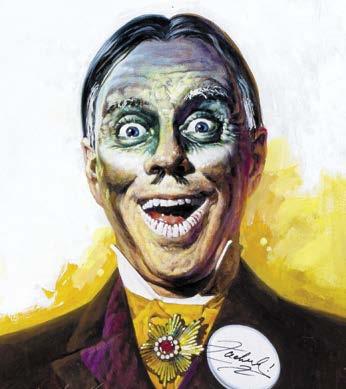
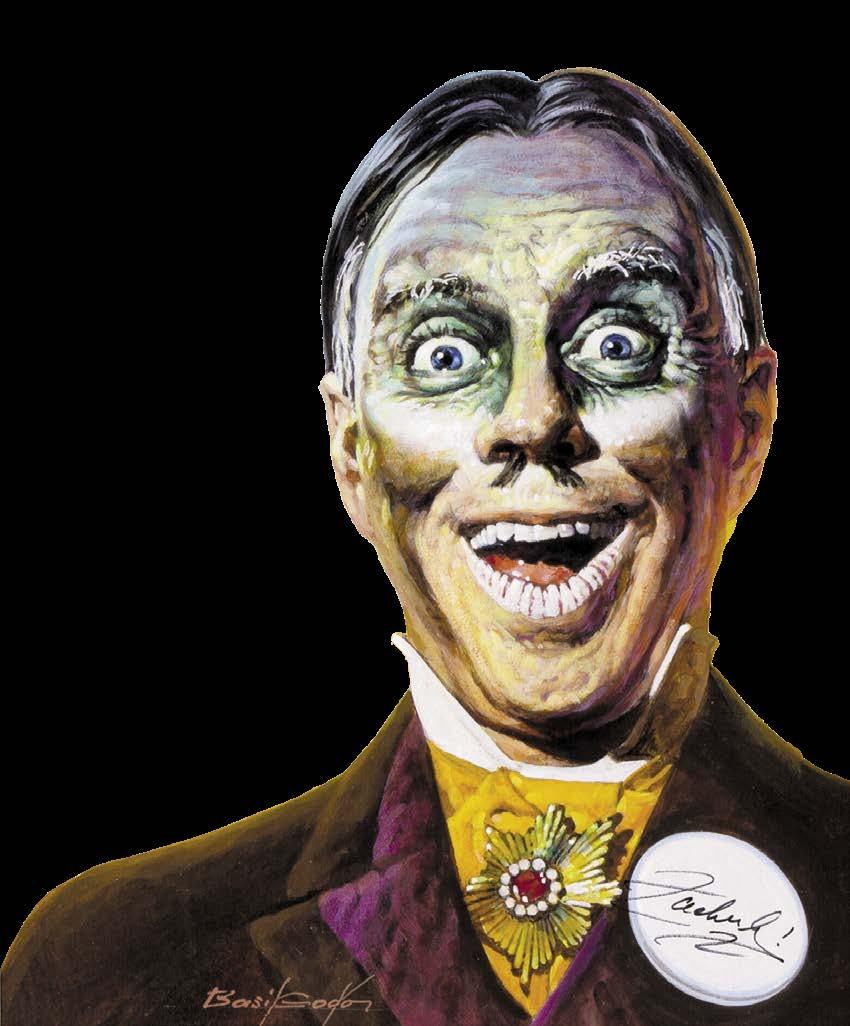
SO WHAT IF THE MOVIE STUNK? WE TUNED IN TO SEE OUR FAVORITE TV HORROR HOSTS!
by Mark Voger
Remember the Zombo episode of The Munsters from 1966? It was kind of like Shane, George Stevens’ 1953 Western in which a youngster (Brandon deWilde) wishes his dad (Van Heflin) was more like the title character (Alan Ladd), a stranger passing through town who is extremely handy with a gun.
In The Munsters episode, Zombo is a TV horror host (Louis Nye) whom young Eddie Munster (Butch Patrick) thinks is way cooler than his Frankenstein-ian father, Herman (Fred Gwynne). But Eddie soon learns that Zombo is only a “pretend” monster, while his flat-topped dad is the genuine article.
series.
someone who adopts a monster-ish persona and presents horror movies on TV. Their numbers are substantial... and elusive. Many have gone to the Great Laboratory in the Sky. Many were known only locally to their devoted fans. All deserve to be remembered for their contributions to the medium, not to mention the wellbeing of their fans. Monster nerds can be a lonely lot. Horror hosts were our friends.
a snoozer like (1958) with only commercials as accompaniment, you’d feel like you wasted 90 minutes of your life. But if a cool, funny, monster-lookin’ horror host presented it, cracking jokes and doing monster-y skits, it was no longer just a bad horror film. It was an event.
When horror hosts proliferated during the nifty 1950s, national magazines took notice. In 1958, the phenomenon was covered in the March 29 edition of (“TV’s Newest Rage: The Monster of Ceremonies”); the May 26 edition of
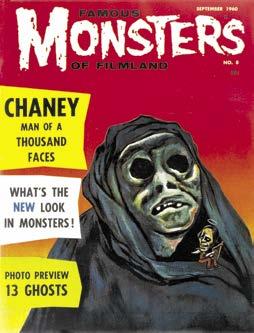
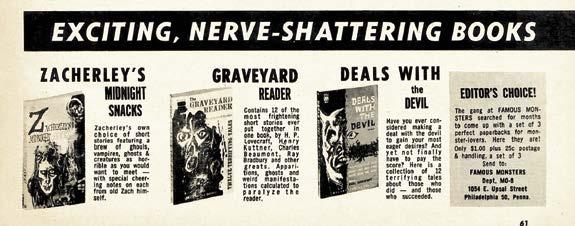
Ifound them buried in the back of Famous Monsters of Filmland #8 during the late summer of 1960, tucked in the “Monster Mail Order” section. Wa-ay in the back, after the ads for monster masks, 8mm horror films, a life-size “Mad Doctor Human Skull” that “looks like the real thing!” and beneath a white-on-black headline that read “EXCITING, NERVESHATTERING BOOKS.” There were thumbnail reproductions of Zacherley’s Midnight Snacks, The Graveyard Reader, and Deals with the Devil, and next to each was a text blurb describing their contents. I was 13 years old and ready to advance from horror magazines, movies, and comics to weird fiction literature. I sent in my $1.25 and checked the mail every day.
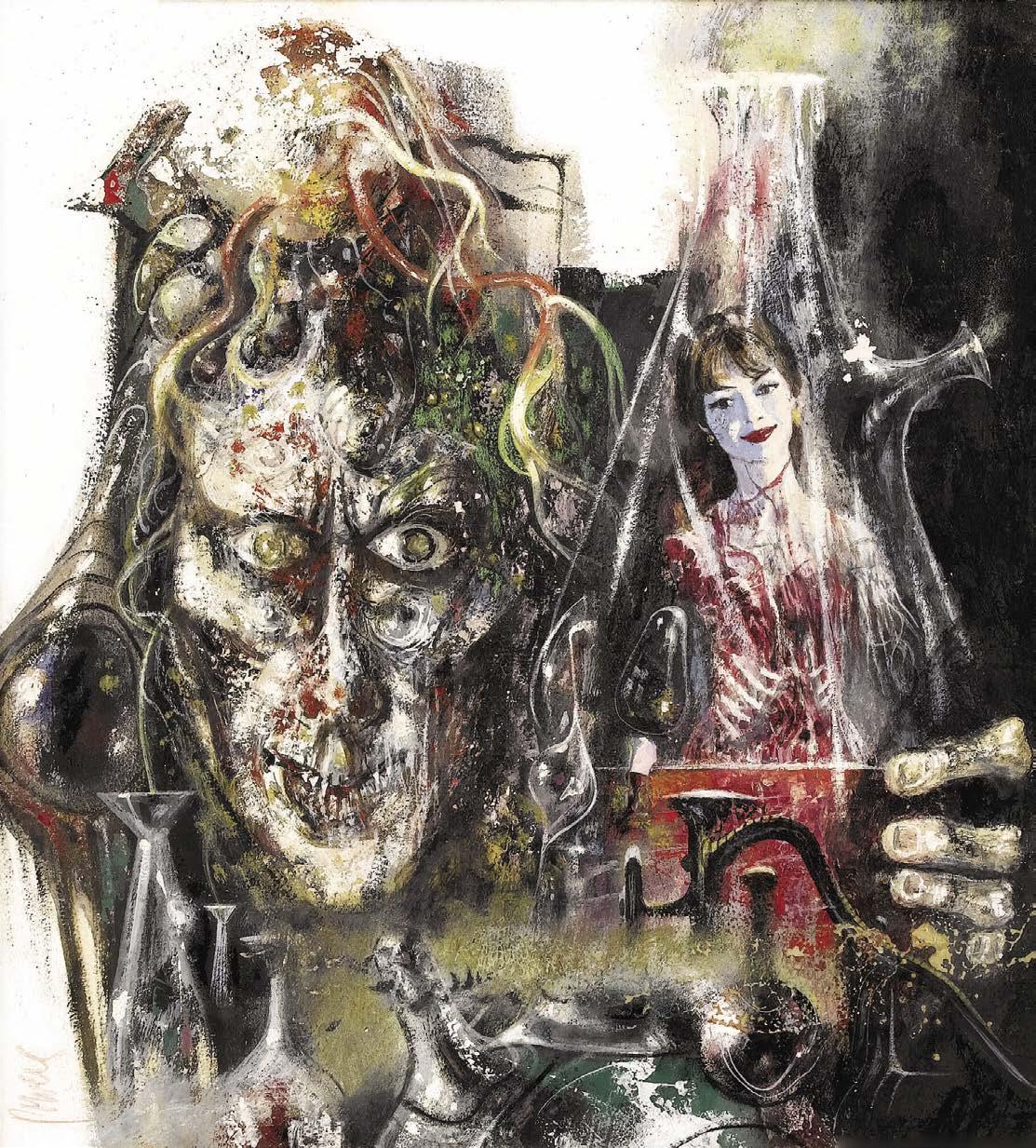
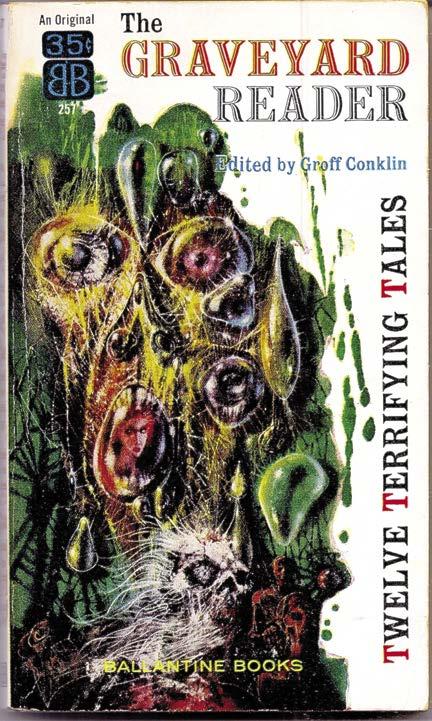
Finally the books arrived. All three had otherworldly covers painted by Richard Powers and I recognized his inimitable futuristic style from the cover art on the science fiction paperbacks my dad read. Powers was better known for his sci-fi art than his horror/fantasy illustration, but its profound strangeness worked well with either genre. The first to catch my eye was the cover of The Graveyard Reader (1958) edited by Groff Conklin. What a riveting image! Born of some night terror, an arresting yellow face appears with two sets of bulbous soapbubble eyes floating among glistening globular protuberances connected to dripping strands of thin, iridescent netting. Inside its oval mouth, within a shining glass bauble, an attractive woman gazes to one side. Below the face, as if just materialized from streaks of lightning, is a bone-white threequarter profile of a ghoulish skull with one staring eye set against a backdrop of splattered black and green spiderwebs. The outlines of other ominous figures in reddish orange are scribbled on the lower right. It’s a glorious protopsychedelic masterpiece of phantasmagorical madness.
In her coffee-table book The Art of Richard Powers (2001), Jane Frank
revealed that this “nightmarish image no longer exists in one piece: only the bottom one-third is known to us […] The Eisensteins, who acquired this portion of the work at a science fiction convention in 1967, have no idea what happened to the top portion of this art, but speculate that ‘it may have been sold to someone else, maybe even at the same convention in New York.’” In his article “Richard Powers: The Surreal Savvy of a Reluctant Sci-Fi Artist” for Outre #24 (2001), Vincent Di Fate noted that Powers “took a good deal of inspiration from artists such as Joan Miró, Roberto Matta, and especially Yves Tanguy. Dick once told me that Tanguy’s imagery seemed to him to be of a much deeper layer of the unconscious experience than the works of artists such as Magritte and Dali.” Powers unquestionably imbued a deeper, dreamlike quality to his compositions—which was a drastic departure from the literal realism of previous fantasy/sci-fi styles. He single-handedly rejuvenated the look of speculative fiction cover art in the 1950s, initially with Ballantine Books and then with other publishers. Frequently completing the covers were quirky and colorful hand-lettered titles that blended effectively with Powers’ images.
I plunged into Graveyard’s “Twelve Terrifying Tales,” and they were all creepy as heck, but standing head and shoulders above the others was a classic called “The Outsider” (1921) by H.P. Lovecraft. It was the first Lovecraft yarn I ever read, and it was mind-bending. My dad had died just a year before, so you can imagine how the opening sentence grabbed my attention: “Unhappy is he to whom the memories of childhood bring only fear and sadness.” It was one of the author’s early yarns and, as I was still at a relatively tender age myself, “The Outsider” was a good place for me to embark upon the hardcore corruption of my aesthetic and intellectual innocence. Told from a first-person point of view, it made its horror personal. At the very end the reader discovers that the narrator is, in fact, the horror. It was a mythic fable about the self as outcast monster, a “stranger in this century and among those who are still men.” I also learned that “in the cosmos there is balm as well as bitterness, and that balm is nepenthe.” I knew all about bitterness. Now I had to find me some of that nepenthe stuff.
Fun fam freaks of nature
I devoured other Graveyard tales and particularly enjoyed the ones by Ray Bradbury, Charles Beaumont, Ambrose Bierce, Roald Dahl,
A GUIDE TO THE PRE-CODE HORROR COMICS OF THE 1950 s - PART 4
THE AVALANCHE CONTINUES
by Michael Bonesteel
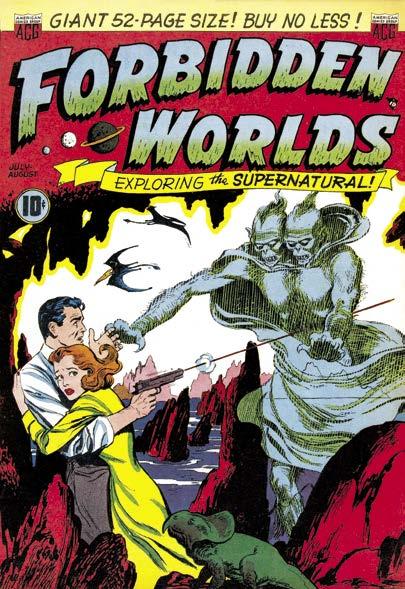
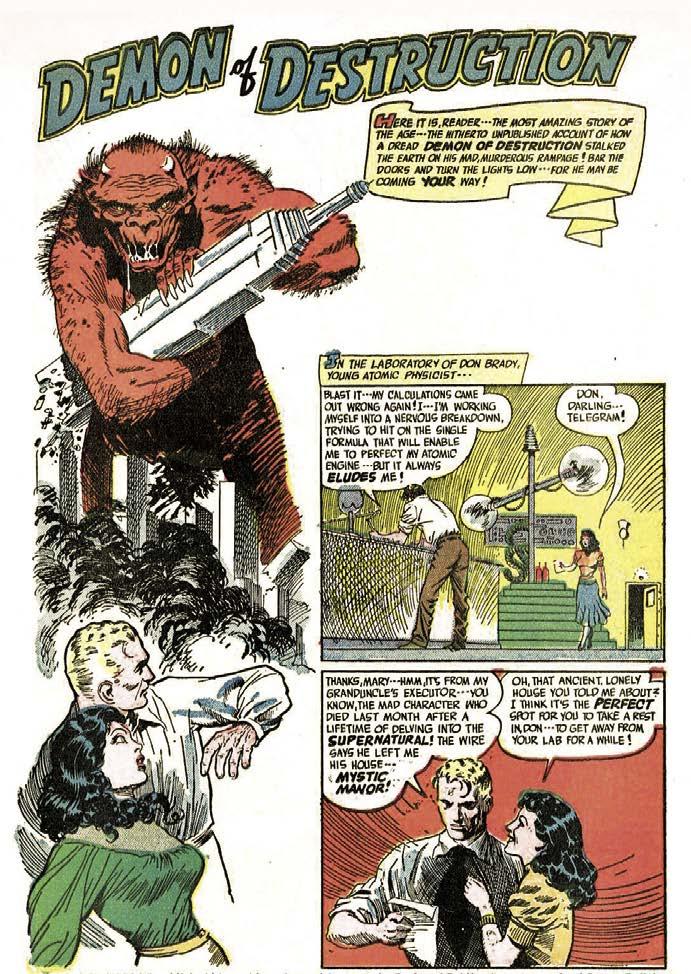
American Comics Group had been savoring the success of its trailblazing Adventures into the Unknown since 1948, but it took them three years to add Forbidden Worlds to their roster. The lead story for its premiere (July–Aug.1951), “Demon of Destruction,” was penciled by Al Williamson (Weird Fantasy) with Frank Frazetta on hand supplying the brushstrokes. They may have stepped away from their beloved sciencefiction, but who can deny these are a beautiful set of pages. Ken Baid’s riveting artistry would work to distinguish the covers of these early issues. As with its companion title, Forbidden Worlds survived the Code to enjoy a long and fruitful run, bowing out with its 145th issue in 1967. To add to its prestige, it won the 1964 Alley Award for Best Regularly Published Fantasy Comic. Praise indeed.
Prestige wasn’t a word use to describe Stanley
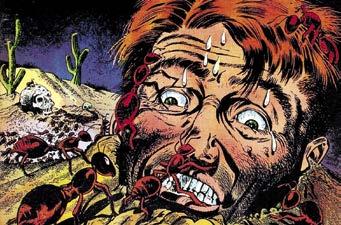
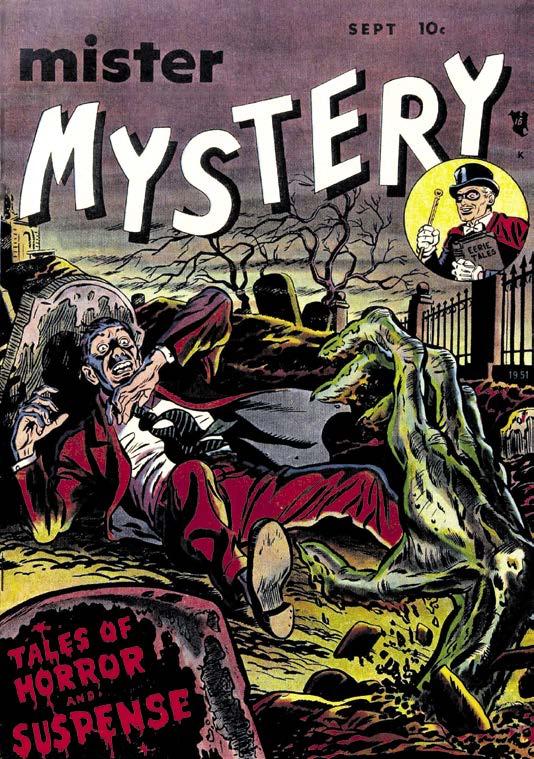
P. Morse’s Key Publications when they launched Mister Mystery in September 1951. Morse’s comics were considered the “grossest and most vile” of the pre-Code era; if judged solely on their gruesome nature, many readers feel they actually surpassed EC, Harvey, and let’s not forget the infamous Story Comics.
The publisher once commented: “You did what you had to do—what moved ’em off the racks […] I don’t know what the hell I published. I never knew. I never read the things. I never cared.” Lawrence Watt-Evans (“The Other Guys” in Alter Ego #97) observed, “Anyone who thought men like Bill Gaines gave comics a bad reputation had never met Stanley Morse. […] I don’t think Morse was trying to imitate EC; I think he was trying to top them. Not in quality—that would never even have occurred to a man like Morse. No, he was trying to outdo them in gore, violence, and shock value.” And if there was any comic that Harvey Kurtzman, who “always thought the horror comics were vile,” would eschew, you’d think it would be a title like Mister Mystery, yet there he was (or at least it has been attributed to him) in Mister Mystery #1, moonlighting while still at EC, yet still using his familiar jazzy style for “Television Ghost.” When it comes to comic book infamy, the cover to issue #12 (July 1953) of this series featuring Bernard Baily’s socalled “injury-to-the-eye-motif” takes the biscuit, a cover we will take a look at in a forthcoming issue. But truly, the really insidious images were lurking behind these covers, skulking in the panels of the pages within. And these were not necessarily limited to the opening splash page; no they were often withheld until the very last, their malfeasance saved for an oversized final panel to maximize the shock effect. Such visual exclamation points make one wonder if the artists laid out the final panel, then worked backward in the time-honored tradition of Ernie Bushmiller’s Nancy, who according to Bill Griffith’s recent
Bushmiller biography, Three Rocks, reveals how the cartoonist routinely came up with the punchline for his last panel first, then proceeded to invent a credible preceding narrative leading to this comical climax.
Twisted Genius
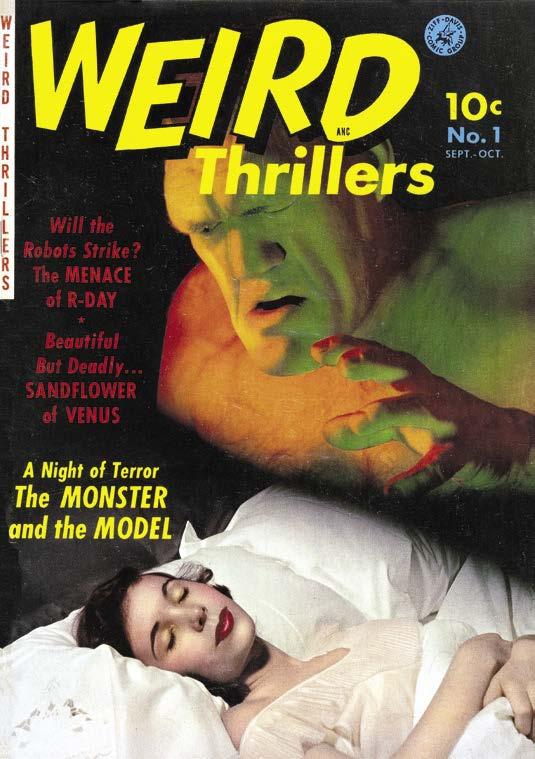
The celebrated Basil Wolverton was a twisted artistic genius in the best sense, who brought style and intensity to the horror genre like few others ever could. In a similar way to EC’s versatile masters Wood and Davis, he was as adept at horror as he was humor, with the capability to work them in tandem. EC’s Mad comics employed Wolverton to create a variety of hilarious stories and one litigious cover parodying Life magazine for issue #11 (May 1954). A spectacular spread of grand guignol concludes a reworked tale by Wolverton “Beauty and the Beast” in Mister Mystery #11 (May 1953), no doubt prompted by the reaction to his disquieting “The Brain-Bats of Venus,” in issue #7 (Sept. 1952). However, the misshapen and malformed humans in “Beauty and the Beast” seemed to transgress and defile any accepted concept of decorum. It’s a sordid story of a hideous dress designer who creates a robot woman to be his slave, but after he strikes her she goes berserk.
Maybe he took Wolverton’s abominations as a challenge, for Tony Mortellaro fabricated a final scene for “The Gossips” in Mister Mystery #13 (Sept. 1953) to equal and perhaps outdo Wolverton in its butchery. The tale revolves around three hateful rumor mongers who drive their victims to suicide, so the dead
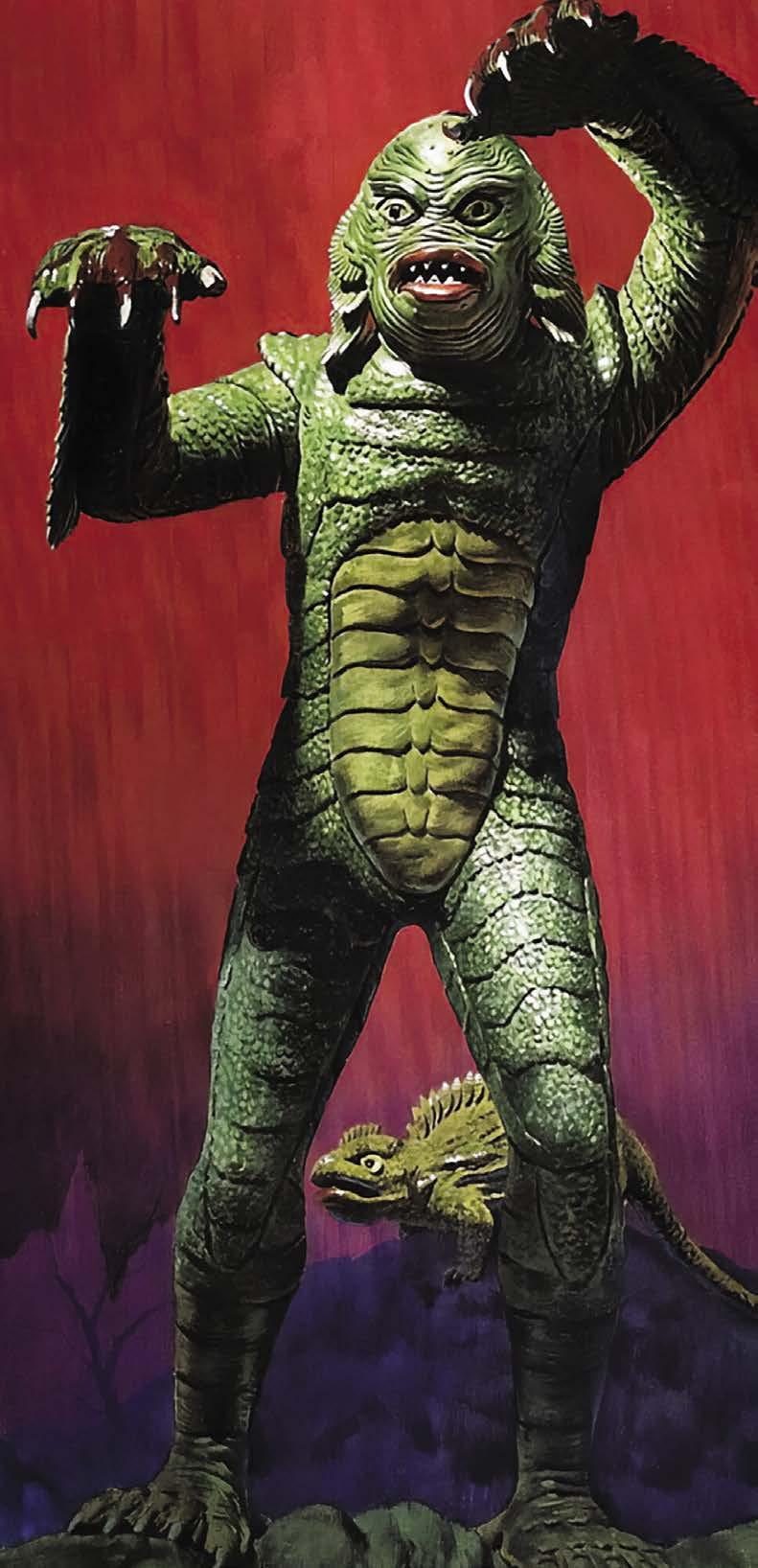
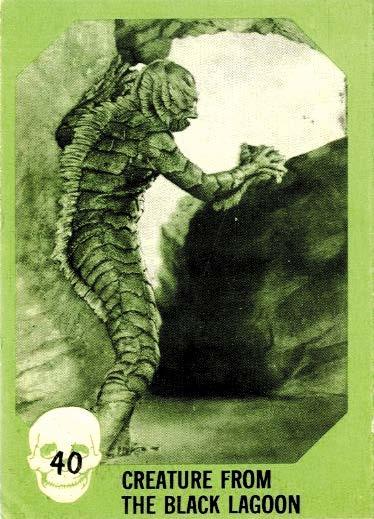
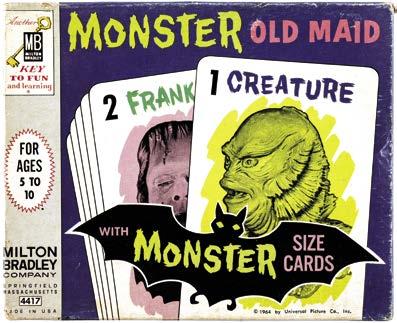
While Creature from the Black Lagoon didn’t latch onto Universal’s renowned quartet of terror turning their gathering into a fearsome quintet, the original film and its two sequels rapidly went on to enjoy an endearing wave of affection that must have vexed Old Drac and Co. The Creature’s admirers have since conversed at length on those phantasmagorical forays, but it is the enormity of merchandise licensed since the film’s initial release that brings home the immensity of his popularity. To the less discerning, some of it might seem little more than cheap tat, but to the Monster Kid generation every new addition was a treasure waiting to be snapped up. Here’s just a smidgen of this bounty.
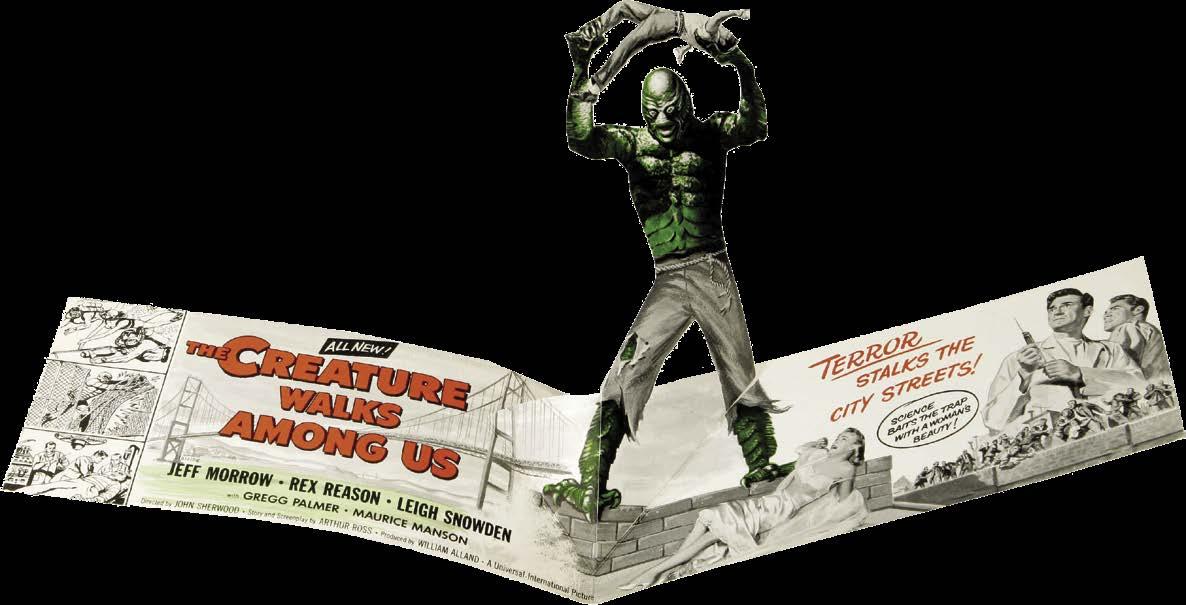
Among the earliest of these collectibles were the promotional press books along with the exhibitor handouts, with 1956’s The Creature Walks Among Us handout garnering the most attention owing to it surprising with a pop up figure of the Creature. These advertising gimmicks were never designed for collectors, rather they were intended to have the cinema owner champing at the bit to have these films on show in his theater, thus adding to the box office receipts. In time these inducements would attract the interest of both horror and film fans alike.
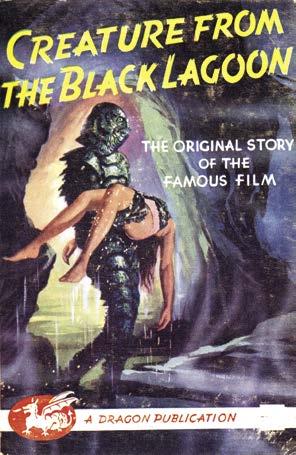
Not long after the release of the Creature from the Black Lagoon came the Vargo Statten hardback adaptation published by the Luton based Dragon Books. Penned by the prolific British writer John Russell Fearn, the first edition of this book, with its dust jacket intact, is now considered to be something
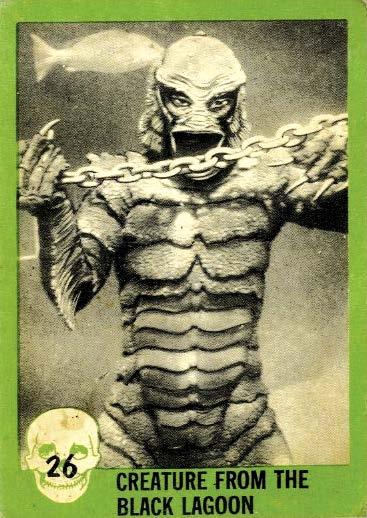
five cents. In the original run two of the cards were printed side by side, with a perforated line enabling them to be very easily separated. The orange set, running from #67 to 140 would swiftly follow, but I have yet to spot a Creature card in this fright-filled release.
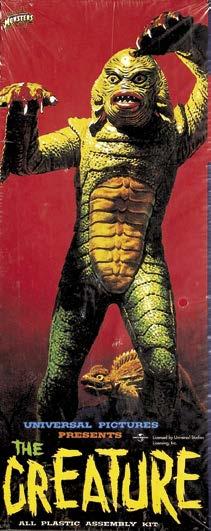
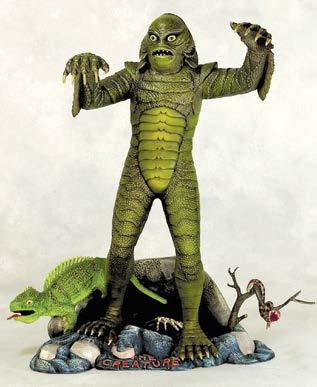
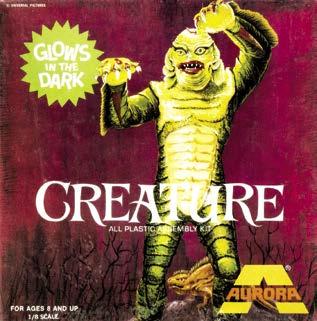
Among the most sought after of all this Creature memorabilia has to be the Aurora model kit, which would have been tempting both the Monster Kids and model makers in their droves way back in 1963. The line had come to prominence just a year before with the debut of the company’s take on the Universal Frankenstein. To their utter dismay, the people at Aurora found they were swamped with orders for this new line. In part, the atmospheric James Bama
to stress his newfound “Glow-in-the-Dark” eminence.
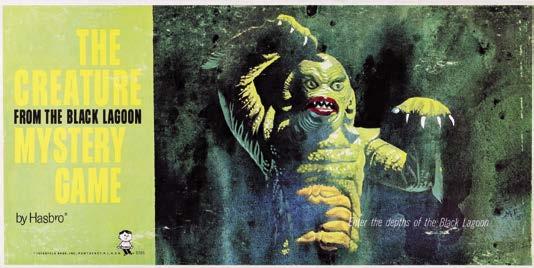
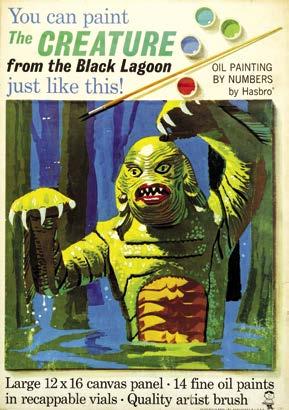
The Universal horrors may have been produced with a mature audience in mind, but much of the marketing was aimed at juveniles who wouldn’t have been old enough to see the film, with the probable exception of those sneaking downstairs to catch a glimpse of the Friday night scares being transmitted around this time. This might explain the Creature appearing in a Hasbro Oil Painting by Numbers set, although if we are being honest many grown-ups would have been setting up their easels for a shot at this back in ’63. That same year Hasbro also came up with The Creature from the Black Lagoon Mystery Game, clearly aimed at a more adolescent market. As can be seen here, the painting on the box was worth the admission fee on its own.
Creepy Menagerie
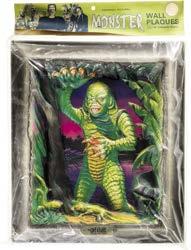
Before the year was out Standard Plastics had licensed the rights to turn six of Universal’s monsters into Vacuform 3-D Wall Plaques, namely Dracula, Frankenstein, The Wolf Man, The Mummy, The Phantom of the Opera, and of course, the Creature. These were definitely manufactured with junior’s bedroom wall in mind,
with the Creature considered by many aficionados to be the most enticing of the entire range. It’s such a shame Standard Plastics didn’t consider a set of “Glow-in-the Dark” plaques to compliment this creepy menagerie, but then again the poor little fellow may have been plunged into nightmares of the most terrible kind once his bedroom had fallen into darkness.
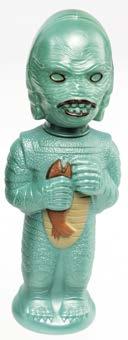
Not long before bedtime a bath would have been in line for the little man of the house; during the 1960s, if he was lucky, he might have bathed in a Creature Soakies bubble bath produced by Colgate Palmolive. On the surface this appears to be quite an amusing purchase, but when caught in a certain
Was the new media of film an emerging art form, or was it simply vulgar entertainment for the masses? In pre-World War
One Germany, this was a question that caused much vexation, with most of the Berlin theater community inclined to the view this was indeed a new form of art. One dissenting voice belonged to Paul Wegener, a seasoned treader of the boards who could see the potential for cinema to tell stories in ways that playhouses could not. He ably explored film’s possibilities in his screen debut, The Student of Prague (1913), in which he played both the titular student and his sinister doppelganger, both of whom appeared on screen simultaneously, a technical impossibility in a theater. To further demonstrate cinema’s scope, he and director Stellan Rye shot the film on location.
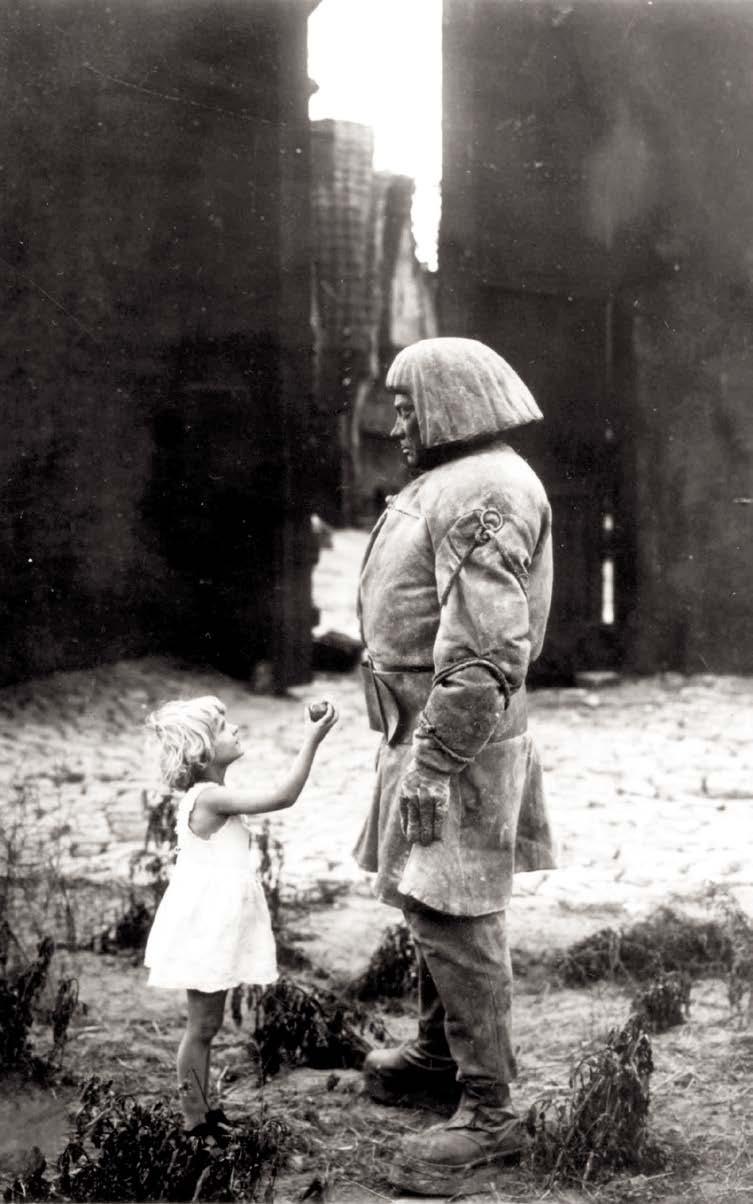
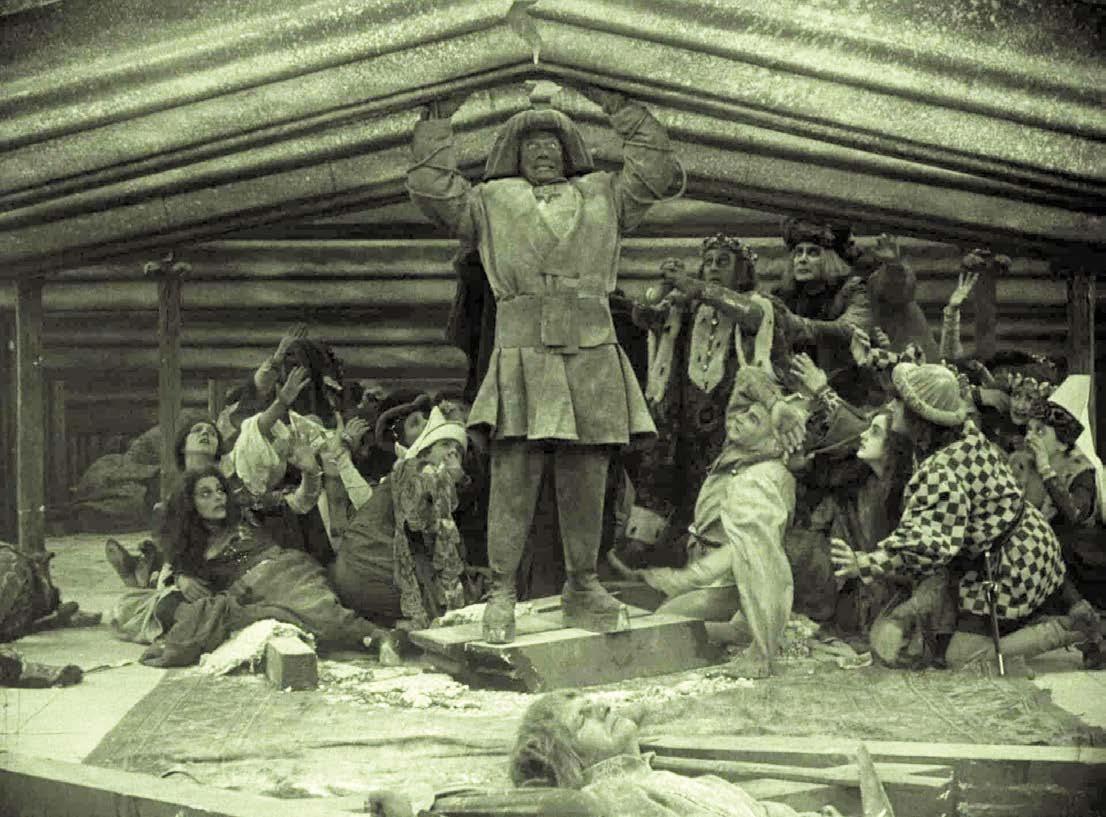
It was while filming The Student of Prague that Wegener first heard of the Prague Golem, a legend that was to dominate his filmmaking over the next few years. This fascination was to culminate in The Golem, How He Came Into the World (1920), the classic for which Wegener is best remembered, but this landmark in early horror was in fact the actor’s third Golem picture, the final installment in film’s first trilogy.
The first was simply called The Golem, released in 1915. Set in the then-present day, an antiques dealer named Aaron discovers the centuries-old Golem then sets about bringing it to life. Upon realizing that the clay man obeys his commands, he treats it as his servant, ordering it to guard his daughter Jessica, who is having a clandestine affair with a local baron. However, Jessica manages to elude her stony-faced chaperon and makes her way to her lover’s castle, where a fancydress ball is taking place.
When the Golem crashes the party, panic ensues. Despite being shot by the baron and stabbed by a servant, the smiling Golem remains unscathed. The partygoers, including the baron and Jessica, flee in terror. To elude the creature, they make their way to the top of an ancient tower, but their hopes are dashed when they hear
the tower’s door being smashed, followed by the Golem’s heavy tread on the stairs. A desperate struggle ensues as the baron wrestles with the monster, but just as the Golem is about to hurl him from the tower, Jessica prizes the life-giving star-shaped amulet, or shem, from its chest. The clay man’s eyes close, and he topples over the edge, shattering on the ground below. Aaron appears on the scene, and relieved his daughter has come to no harm gives the couple his blessing.
Outlandish Headdress
The film was written and directed by Paul Wegener and Henrik Galeen, who also played the Golem as well as the antiques dealer. Jessica was played by Lyda Salmonova, who became both Wegener’s third and sixth wife, and ultimately his widow. The iconic Golem outfit, with its outlandish headdress and the mystical but meaningless symbols adorning his tunic, was designed by expressionist sculptor Rudolph Belling.
By the time The Golem premiered in January 1915, Wegener was at the Belgian front.
The previous October he had volunteered for the Landsturm, regiments that consisted of men over the age of 35, serving first as a corporal and later a lieutenant. He participated in the Battle of the Yser, during which he and his men came under heavy fire on December 4. Wegener was one of four to survive of a squad of 49; he was awarded the Iron Cross, First Class for bravery. In a letter to a friend, he made no claim to heroism, stating that he only acted “out of fear” and because he was ordered to do so. He was invalided out of the army due to an unspecified heart condition shortly after. It was his experiences from his time as a volunteer that informed his next two Golem pictures.
The second Golem film was not a sequel to the first, nor could it ever be considered a horror film, Wegener all too aware of the sickening bloodshed in the trenches. Instead, The Golem and the Dancing Girl (1917) was a romantic comedy offering the predominantly female home front audience an hour of frothy escapism. It was also arguably both the first horror spoof and the first knowingly meta motion picture.
The Forgotten Creatures Spawned in the Black Lagoon
Amonth after its premiere in February 1954, Creature from the Black Lagoon was exciting cinemagoers across the nation. The audience was held spellbound unable to believe what they were seeing. As they poured out of the theaters, there were those who still wouldn’t have had their fill, and at any other time in comic book publishing history they would have found a bundle of Creatureinspired stories waiting for them at the newsstand, but the mood in the industry was beginning to change. Events beyond the publishers’ control were taking over. The anti-comics crusade were on the march with the Subcommittee to Investigate Juvenile Delinquency but weeks away. The threat posed by these hearings was now a reality, making many of these publishers reconsider their ways, resulting in a measurable toning down of the debauchery in their stories. By the end of the year the Comics Code would officially put an end to what, to the righteous, had become four-color abominations. So, given the film’s timing it was almost impossible for the Creature to make his presence felt in these comics.
Yet, despite the ravages of officialdom, he did succeed in making something of an impression.
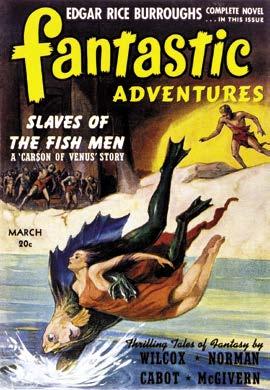
It is highly unlikely J. Allen St. John’s captivating cover for the Edgar Rice Burroughs tale “Slaves of the Fish Men” for Ziff-Davis’ Fantastic Adventures #14, dated March 1941, was conceived immediately after the now famous party hosted during the filming of Citizen Kane. The timing doesn’t really support this hypothesis, but it remains both an intriguing entry in the realm of Creature folklore and one of the earliest examples of these amphibious enigmas.
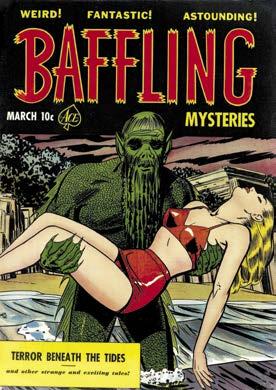
A decade later horror comics were well and truly in their ascendancy. By then it wasn’t unusual for comic book publishers to borrow from the ideas abounding in the pages of their pulp predecessors, although aquatic creatures of this ilk were few and far between. Horror comic fans had to wait until issue #7 (March 1952) of Ace’s Baffling Mysteries to catch a glimpse of one of these curiosities. Only last issue John Navroth referenced the unsettling inference in Frank Giusto’s cover depicting “The Seaweed Monster”
carrying this hapless young lady out to sea, rather than taking her back to the safety of dry land. A couple of years later, Giusto’s cover would drift from mind as such imagery became synonymous with Creature from the Black Lagoon and in time its sequels. Later in this issue of Baffling Mysteries the story behind this cover is revealed in “Terror Beneath the Tides,” rendered by the accomplished Mike Sekowsky. The reader learns “The Seaweed Monster’s” people are in need of a new queen, placing this maiden fair in line for the crown cherished by this undersea race. As with the Creature it didn’t end well for these deep sea kinsfolk, as man once again revealed his ignorance by turning to murderous brutality.
Denizens from the Deep
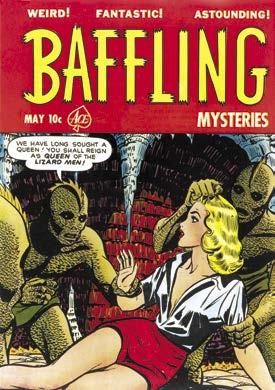
Giusto followed this cover with his lizard men for Baffling Mysteries #8 (May 1952), who had also embarked on the search for a queen. However, on closer inspection it is clear these creatures weren’t quite as honorable as their quest suggested, for if they didn’t get what they wanted they were more than prepared
to resort to violence, as this unfortunate girl was about to discover. On this occasion Ace didn’t follow with a story, leaving the reader to guess the outcome.
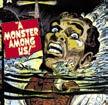
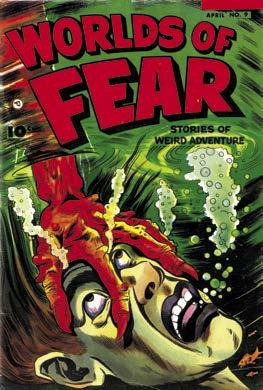
That same month, the cover to Atlas’ Mystic #8, attributed to the sinister imagining of Carl Burgos and/or Sol Brodsky, provided a glimpse of another denizen from the depths, although all the reader got to see was the beast’s webbed claws. As this issue drew to a close, the Joe Sinnott illustrated “A Monster Among Us” awaited, a monster of the most repellent kind, a far cry from the streamlined magnificence of the Creature. A similar claw was observed almost a year later on the cover to Fawcett’s Worlds of Fear #9 (April 1953), but there was no explanation within. Some might think this was for the best, because as with the cover to Mystic #8, this image was excruciating, exacerbating the perturbation felt by many wellmeaning parents.
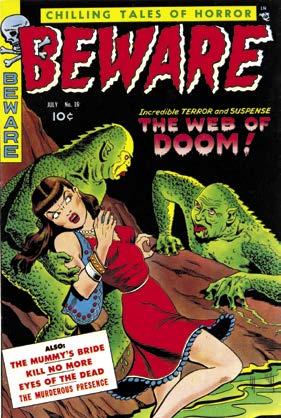
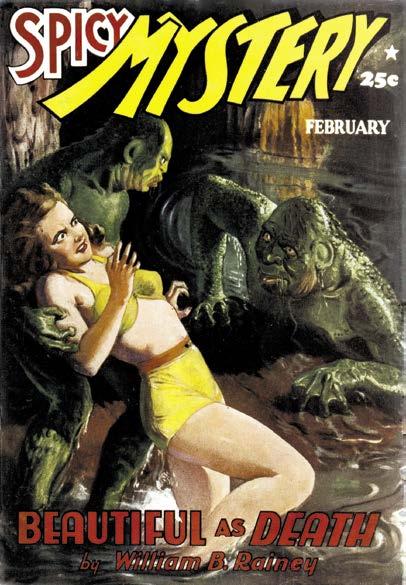
To add to this, junior’s folks would have had something to say about the slavering amphibious specimen and its cohort on William Zeller’s cover to Trojan’s Beware #16 (its fourth appearance) from July 1953, and who could blame them! This definitely rates as a “good girl in peril cover,” owing its origins to Harry Lemon Parkhurst’s steamy painting from the cover of the February 1941 edition of Spicy Mystery
Stories, which was certainly not intended for junior. The publishers of these comics, might have been supplementing their sales using such imagery, but they were doing themselves no favors.
Flesh-Eating Mermaid
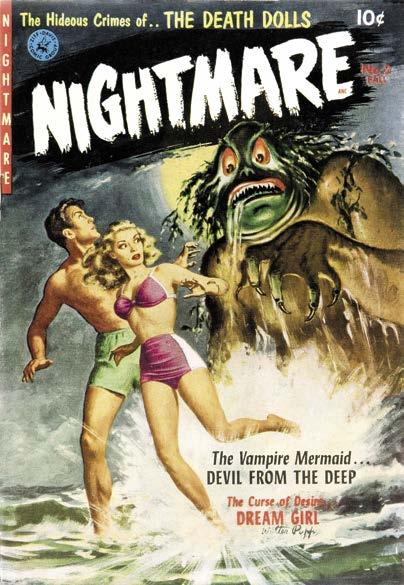
The drama on the cover to Ziff-Davis’ Nightmare #2 (Fall 1952) bears all the hallmarks of the pulps, not surprisingly as it was painted by Walter Popp. In an
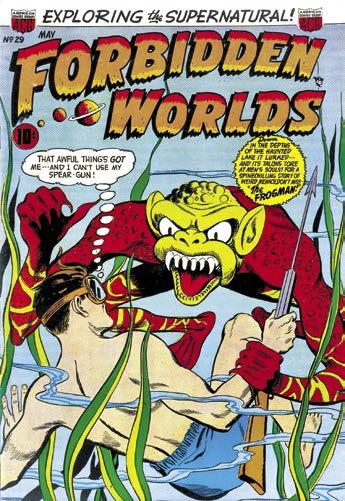
astonishing career, Popp had found a home with the pulps during the ’40s, then worked on men’s magazines before moving into commercial art in the ’60s then turned to embellishing book covers during the 1980s. This monstrous sea beast was hardly a precursor to the Creature, but it would most assuredly have had comic book mad kids shelling out to see more. That more turned out to be a flesh-eating mermaid whose nubile form bore absolutely no resemblance to the monstrosity terrorizing the cover. Although sporadic in their entrance, this aquatic species had garnered a modicum of interest among the comic buying public, but then for no explicable reason they vanished from the newsstand. For a while the beaches and waterways were quiet, then Creature from the Black Lagoon hit the big screen. Ken Bald got there first, beating his fellow creators to it with his “Frogman” cover for Forbidden Worlds #29 (May 1954). The accompanying tale can have only been inspired by the film, with Lin Streeter treating the reader to a climactic underwater scene remarkably like that observed in Jack Arnold’s film.
IF YOU ENJOYED THIS PREVIEW, CLICK THE LINK TO ORDER THIS ISSUE IN PRINT OR DIGITAL FORMAT!
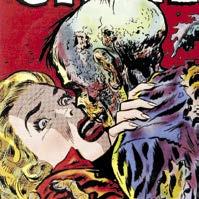
Creature fans were in for a thrill when St. John’s Amazing Ghost Stories debuted, with... wait for it... number #14, in October 1954. It honestly looked as
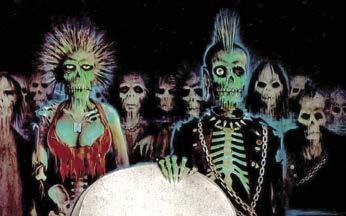
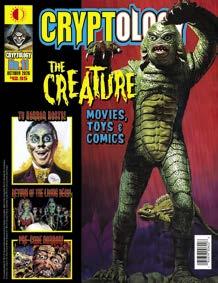
Beware the Creature from the Black Lagoon and his three films, with actress MILICENT PATRICK, comics, models, memorabilia, and the prehistoric history that spawned the Creature. Plus, the TV horror hosts who introduced classic spine-tingling films, The Golem from silent cinema to comic books, BILL STOUT’s designs for Return of the Living Dead, pre-Code comics history, Hammer horror movies, and more!