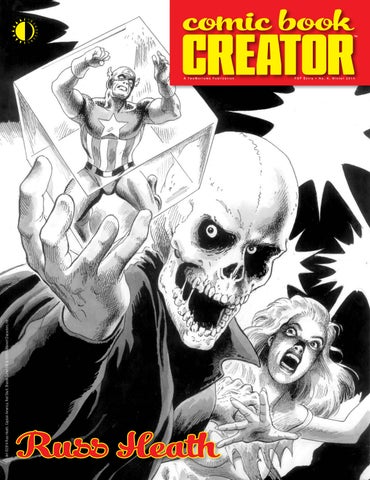
Art ©2014 Russ Heath. Captain America, Red Skull, Sharon Carter TM & ©2014 Marvel Characters, Inc.
™
A Tw o M o r r o w s P u b l i c a t i o n PDF Extra • No. 4, Winter 2014
W i n t e r 2 0 1 4 • T h e N ew Vo i c e o f t h e C o m i c s M e d i u m • N u m b e r 4
B O N U S
P D F
T A B L E
O F
C O N T E N T S
Catching Up with Russ Heath: Richard J. Arndt has a recent chat with the comic book artist........ 3 Appreciations: José Villarrubia and Wayne Vansant give props to the greath Heath...................... 15 “Give and Take” Photo Gallery: The artist-as-model poses for his classic Blazing Combat tale... 16 Bonus Russ Heath Art Gallery: A pair of great “Sgt. Rock” pages from Our Army at War............. 23 Behind the Scenes: “Before and After” looks at pages from The Human Gargoyles....................... 25 PLAYBOY W©©dy CBC mascot by J.D. King ©2014 J.D. King.
JON B. COOKE
J.D. KING
Editor/Designer
CBC Cartoonist
John Morrow
TOM ZIUKO
Publisher & Consulting Editor
CBC Colorist Supreme
MICHAEL AUSHENKER
RONN SUTTON
Associate Editor
CBC Illustrator
JORGE KHOURY CHRISTOPHER IRVING TOM ZIUKO RICHARD J. ARNDT
ROB SMENTEK
Contributing Editors
Brian K. Morris Senior Transcriber
STEVEN E. Tice STEVEN THOMPSON Transcribers
CBC Proofreader
Greg PRESTON SETH KUSNER CBC Contributing Photographers
MICHAEL AUSHENKER FRED HEMBECK CHRISTOPHER IRVING JORGE KHOURY TOM ZIUKO CBC Columnists
Cover by RUSS HEATH Though our CBC #4 print edition had already gone to press, contributor Joe KULBISKI shared this and other commission works. This curiosity is based on Marie Severin & Frank Giacoia’s Captain America #115 [July 1969] cover. Thanks, Joe! Comic Book Creator is a joint production of Jon B. Cooke/TwoMorrows
Comic Book Creator™ is published quarterly by TwoMorrows Publishing, 10407 Bedfordtown Dr., Raleigh, NC 27614 USA. Phone: (919) 449-0344. Jon B. Cooke, editor. John Morrow, publisher. CBC editorial offices: P.O. Box 204, West Kingston, RI 02892 USA. E-mail: jonbcooke@aol.com. Send subscription funds to TwoMorrows, NOT to the editorial offices. Fourissue subscriptions: $40 US, $54 Canada, $60 elsewhere. All characters are © their respective copyright owners. All material © their creators unless otherwise noted. All editorial matter ©2014 Jon B. Cooke/TwoMorrows. Comic Book Creator is a TM of Jon B. Cooke/TwoMorrows.
Portrait by Thom Haller Buchanan (based on the photography of Lori Matsumoto)
Catching Up with Russ Heath Conducted & Transcribed by RICHARD J. ARNDT [The following interview, an update to Ye Editor’s 2003 interview with Russ Heath, was conducted via telephone by Richard J. Arndt, Comic Book Creator’s newest contributing editor. We had hoped to include this discussion, which took place on Apr. 24, 2013, in the print edition but, alas, space constraints pushed it to this bonus PDF edition. Our appreciation and apologies to Rich. Illustrating this conversation are a number of super re-creations and commissions drawn by the artist, and special thanks to Steve Kriozere and Joe Kulbiski who shared their Heath treasures! — Ye Ed.]
Above and next page: Our Army at War #66 [Jan. 1958] cover and re-creation by Russ Heath, courtesy of Steve Kriozere.
Below: Courtesy of David Barsalou, a portrait of the artist at work. Russ Heath works on a Battlefront #26 [Dec. 1954] recreation. Inset is the actual cover of the Atlas title.
#4 • Bonus PDF Edition • Winter 2014 • Comic Book Creator
Battlefront TM & ©2014 Marvel Characters, Inc.
3
Russ Heath: I started working for comics on a regular basis when Stan Lee offered me double what I was making in advertising to draw Westerns. That was in 1947, and I’ve been working for Stan off and on ever since, I guess. Richard Arndt: You must have been a teenager when you did your first work because I see your first credit was doing a character called Hammerhead Hawley for Holyoke’s Captain Aero Comics. The first story was in Sept. 1942 and then there were two more in early 1944. Russ: That was the first comic book work of any kind that I did. That was in high school. Actually during summer vacation when I wasn’t in school. I was 16 or so. In 1945, I was in the Army Air Corps Reserve. It was after that that I went to work for Stan Lee. My first story there was the “Two-Gun Kid.” That was the first “Two-Gun Kid.” They had another one later on. Then I was also doing “Kid Colt.” After a while
Stan told me that I didn’t have to make the trip in from New Jersey every day. I could take the work home and bring it in at the end of the week. So that was the last time I worked on staff. Richard: I don’t know if you remember Stan Goldberg, but for much of the 1950s, he was the head of coloring at Timely/Atlas. Russ: I don’t recall that name. Richard: Stan mentioned that he started at Timely in late 1949, as a teenager. He was fascinated by the members of the bullpen when he started, but he told me that he’d only worked there a few weeks when Martin Goodman ordered Stan Lee to fire the staff. I was wondering if you remembered that and why it might have happened? Russ: Oh, man, I was responsible for that. I thought it was crazy to have staff pencillers penciling in the blacks on pages. I told Stan that I could grab a brush and with three strokes have the page done and ready for reproduction. Using that pencil was just insanity. Stan thought “Wow! We could save a ton of money and fire a bunch of inkers!” It made me pretty unpopular for a couple of years because my system didn’t work. It turned out that I was the only guy who could pencil fast enough to make that work. It wasn’t the big end-all that it was supposed to be. Richard: I guess not, because Stan Goldberg told me it was only a few months later that everybody who was still available was hired back. Of course, some of the people had moved on to new jobs so it was essentially a new bullpen. Russ: Exactly. Stan Lee also decided at some point that he didn’t like firing people so there was much more of an emphasis on freelancers working at home rather than a full bullpen at the offices. That way, if anything happened again, it wouldn’t mean firing all those people. There was still a bullpen, though. I personally drifted back and forth during those years — from the bullpen to freelancing. I’ve always thought that I should never work for just one company because if you’ve only got one account they can grind you under their heel. It’s not good business. I always kept at least two clients going at one time.
Our Army at War TM & © DC Comics.
Richard J. Arndt conducts a recent interview with the comic book master
TM & © DC Comics.
comic book re-creator
Above: Joe Kulbiski commissioned this “Murders of the Rue Morgue” illo from artist Russ Heath, as well as the Shadow piece on the next page. Thanks for sharing, Joe! Below: Russ, a longtime friend of the late, lamented comics creator Dave Stevens, was artist of The Rocketeer: The Official Movie Adaptation published in 1991.
#4 • Bonus PDF Edition • Winter 2014 • Comic Book Creator
The Rocketeer TM & ©2014 the estate of Dave Stevens.
5
Richard: I noticed that you worked for Marvel or Timely pretty much exclusively for about six years, with a few outside jobs at E.C. Comics. Russ: Yeah, I did one story for Harvey [Kurtzman] for the first issue of Frontline Combat. I also did a “Plastic Man” take-off for MAD [#14, Aug. 1954]. I liked Harvey. We’d have lunch about once a month at least and every time I went to lunch with him he seemed to have a job for me. I didn’t realize that so much at the time or I’d have had a lot more lunches with him! [laughs] Harvey had an inner circle of artists at E.C., and I think I was the first guy from the outside of the circle to do stories for him. Richard: Yeah, he had his regulars and there were a few artists that he tried out, I guess — Dave Berg did a story for him, Ric Estrada, Alex Toth, Joe Kubert — Kubert and Toth, I think, did three stories each. There weren’t a lot though. So, in 1954, you started to draw war stories for DC — Star Spangled War Stories. Russ: You know, a lot of folks ask me stuff about the stories — give me a title of a comic to remember — but many’s the time that we did a story and had no idea what comic it would appear in. Richard: Sure. It was all anthology stories, so they slot them in where ever they could fill a slot. That wouldn’t be that surprising, I guess. Russ: Exactly. Richard: Was there any particular reason you started to move from Marvel to DC? Russ: Oh, if there was, I’m sure it wasn’t anything big. Richard: That would have been around the time the Comics Code came into force, and Marvel, for one, had to cancel quite a number of titles.
Art ©2014 Russ Heath.
Above: Arthur Suydam, who briefly appeared in the Joe Orlando-edited DC mystery books in the early ’70s — and just as quickly disappeared — returned in full glory with his astonishing artwork (and wacky scripting) in Echo of Futurepast. Here is a panel from #2 [1984].
Russ: That was a pretty ridiculous thing. I had a guy who was supposed to be playing baseball and they censored me because I had sweat on him. It was apparently too rugged. That was absolute horsesh*t. It was pretty crazy. For a long time I’d go in and have to learn the new rules for the week. One week all the G.I.s were supposed to have stubbled beards now — a blanket coverage of all the war stories — so you’d put the beards on and then two weeks you’d go in and there’d be a new memo: “No more stubbled beards!” It was very unclear and I couldn’t keep track of it so I’d just do what I thought was right and didn’t worry about it from then on. Let someone else worry about it. It was pretty stupid stuff. Richard: Now, I know you didn’t do very many superheroes…. Russ: I had a lot of trouble with the concept. I still do. I want to see real stuff. When I go to the movies, I want films dealing with reality — not bogus car chases or crazy bang-bang scenes. When you have a super-hero, he’s got powers that are greater than the ordinary man. Who’s going to oppose him? You need super-villains because an ordinary crook’s just not enough of a challenge. So pretty soon, you’ve got all these people standing around while the good super-hero takes on the bad super-villain. It doesn’t make sense to me. Put them on a separate planet where they can bounce around to their hearts’ content. Richard: And, in reality, the regular police officers arriving at the scene would be pouring bullets into any super-villain in a fight like that. Russ: Oh, they had rules where you couldn’t show the bullets coming out of anybody. I got away with that probably more than most people. I wouldn’t show the guy being actually hit, but I did things like having the bullets striking the wall behind him. You’d get the idea that they had to go through him to hit it. At some point, at both DC and Marvel, they want those war comics to appear to be like a baseball game or a boxing match. We’d have soldiers run out there with their fists and fight the enemy who were using their fists! You know, that’s just not war. War is supposed to be horrible. I understand that you don’t want to show gore, but how about copy in the story so that after the battle was over you’d mentioned that you counted up your 5,000 dead and just have it in the copy, not on the page, so that kids don’t grow up thinking that war is a lark. Richard: It’s noticeable that pre-Code war comics had dead bodies and destroyed tanks, shell holes, and shattered trees around and post-code the battle fields were very clean. If there were any dead soldiers lying around they were always dead enemy soldiers, never any dead from our side. Russ: [Laughs] Quite right. One of the interesting things was that Robert Kanigher had these pet bits of business that he’d add into stories on a regular basis — like ack-ack guns hidden in haystacks. Another was a soldier throwing a grenade down the muzzle of a tank. You know, the steel that’s used in the muzzle of a tank is not going to be affected by a goddamn hand grenade tossed down it. Plus, the muzzle sticks way over the front of the tank. How are you going to grab hold of anything to get out to the end of the barrel anyways? Richard: I’m not certain that I’d want to put my hand in front of a tank muzzle with a live hand grenade in it, either. Russ: Right. Kanigher had these stock bits like that and I was always needing space because the bigger the drawing the more interesting it can be to the guy trying to look at it. So, I was always after space, so if the bit didn’t push the story forward, I would just cross it out. I don’t know if he never knew or if he didn’t give a damn or what, but I never got nailed for it. There were times when I’d cross out two pages of a 12-page story and do it my way. Kanigher always took great pride in writing the stories while we went to lunch. He would start with blank paper and hand the completed story over to us when we got back from lunch. It’s not good story telling to do the story for speed rather than story.
The Shadow TM & ©2014 Condé Nast.
#4 • Bonus PDF Edition • Winter 2014 • Comic Book Creator
©2014 New Comic Company.
7
One of the things that was amazing to me was that there was a guy, Archie Goodwin, that I did a number of scripts for, at Warren mostly. One script that he sent me had an extra page in the script that had miniature stick figures of how he visualized the panels. I didn’t want to be influenced by his ideas so I sat it aside
©2014 New Comic Company.
Above: Dave Sim wrote the classic horror story from Creepy #79 [May 1976], illustrated by Russ Heath. Below: We spoil the ending of Russ’s “Yellow Heat,” written by Bruce Jones [Vampi #58, Mar. ’77].
and did my own stick figures of the story. I decided that I’d compare them when I was done and then use the panels that worked the best. If his was better, I’d use his. If mine was better, I’d use mine. The amazing thing was that out of 40 pictures there was only one that was different! He was such a good visualizer of story. I thought he was a genius. To have a guy who wasn’t known as an artist do that well on thumbnail sketches is enough to freak most artists out. He was so good at visualizing that you’d know exactly what the picture was supposed to show. He was a great storyteller and great editor. He said some very nice things about me in interviews. Richard: Now I’m going to skip way ahead, because Jon Cooke has covered a lot of the mid-years of your work, and partly because I just love a particular story that I’d like to talk about. It was for Warren and called “The Shadow of the Axe” [Creepy #79, May 1976]. It was only six pages, but I think it’s one of the best stories I’ve ever read. It was written by Dave Sim, for whom you did a few covers for a year or so ago. Part of what impressed me so much was that I grew up in a small rural farmhouse in Michigan — our nearest neighbors were a mile away — and the house that you drew in that story was so much like those in my childhood. Your settings conveyed so much information of the time, the harshness of the winter, the clothing — all of it seen through the eyes and outlook of a young child. Russ: Thank you! I think that’s one of my best efforts. I tried extra hard on that story. First of all, drawing children is terrible. If you draw the head just a little bigger or a little smaller, you change the age by as much as six years. It’s very hard to draw a kid to be exactly eight-years-old. I had my troubles on doing that. I also wanted the art to reflect the [era], so I had an ice box in the background in the kitchen instead of a refrigerator. I had the old wood stove and the water handpump in the kitchen instead of faucets. The sink was tin and the utensils were correct for the time. I worked to get the whole damn thing right. The milk cans… you name it. I only had six pages and I had to get all that in to get the period correct. I liked that story very much because the script had a really good ending. Richard: It really did. It had an O. Henry-type end that kind of turned the whole story around and spun it in a new direction. It also has one of the best last lines that I’ve ever read. Russ: Tell me that one again. Richard: The kid has just taken care of the problem of his father being an axe murderer and his mother, who’s clearly beautiful but so overwhelmed by what’s been going on that she looks years older just from the strain, is talking to the police. He watches for a moment then his mom winks at him, like she knows exactly what the boy did. Then, like any eightyear-old when the problem’s over he thinks to himself “Not knowing how to wink, I just smiled and returned to my bed. It was Sunday, you see… and I always sleep late on Sunday.” It’s a line that’s just perfect after you’ve read the rest of that story. The blood and the gore of the story doesn’t interfere with the kid’s routine. Russ: I liked working for Warren because the editors didn’t have to mess up the artwork with color, but there was one thing they’d do that I didn’t like. Sometimes they’d take the captions and change from black lettering on white captions to black captions with white lettering. It could really mess up shadows and blacks that you had on the page. The shadows would look no different from the caption. They’d bleed into each other and it ruins the composition. Richard: You did a lot of stories for Warren in the mid- to late 1970s. Russ: They had good stories. I did an African one [“Yellow Heat,”Vampirella #58, Mar. 1977] where this young boy, actually a young man, has to kill a lion, his first lion, to win this captured girl. The story sets the whole thing up so that you believe it to be a romantic story. So he kills the lion and wins the girl, and it turns out that he’s a cannibal and he wants the
TM & ©2014 Marvel Characters, Inc.
This page: Courtesy of Steve Kriozere, Russ Heath’s re-creation of his cover for Adventures Into Terror #11 [Aug. 1952].
Above: You’ll have to ask contributor Joe Kulbiski, who shared this illustration, what exactly is the relationship of Kong and The Shadow in this Russ Heath commission!
Next page: Steve Kriozere shared this Russ Heath re-creation of the artist’s horrific cover to Astonishing #22 [Feb. 1953]. 9
girl so that he can eat her! [laughs] Warren had good stories, good writers, and I like the black-&-white format. Bad coloring can ruin a story. There was another story I got a kick out of: It was about a werewolf in the old West and at the end the Lone Ranger rides up and shoots the werewolf with one of his silver bullets! [“Dime Novel Hero,” Creepy #105, Feb. ’79.] How many writers wrote Western stories and horror stories, and never made that connection with the Lone Ranger’s silver bullets and werewolves dying from silver? That was a great idea! I know we had to get permission from the newspaper syndicate to use the Lone Ranger and Tonto for that one panel, but it was worth it. Richard: Yeah, it was. You also worked on the Lone Ranger newspaper strip in 1981–82… Russ: Hardest work I’ve ever done. A comic strip runs every day of the year. You can’t take a day off. There’s no reprints. If you get sick you just have to make it up because there’s no other way around it. It’s three panels a day, six days a week, so 18 panels for
#4 • Bonus PDF Edition • Winter 2014 • Comic Book Creator
The Shadow TM & ©2014 Condé Nast.
Above: Neal Adams had loved the Spanish-language Esteban Maroto drawn science-fiction series Legionarios del Espacio (Legionnaires of Space), which he picked up in Spanish Harlem in the 1960s. Renaming it The Zero Patrol and rewriting the series, Neal also added some of his art to the Continuity-published title.
the dailies, and then ten panels on Sunday. And the top third of the Sundays had to be designed so that if the local paper cut them off (which a lot of them did, depending on whether the Sunday strip ran a half-page or a third-page), the strip still had to make made sense. You also had to make the rest of the Sunday panels hook in with the story being told in the Saturday and Monday strips. I made color guides for all the Sunday strips. Unfortunately the strip was only run in the little papers. Rural or small town papers, not the big papers, so there was, to my knowledge, no place for me to go and see how they turned out. The strip just wasn’t run in my local papers. I had one fan who subscribed to a non-local paper every day so that he could get the strip, which was very flattering to me. I had a writer [Cary Bates] that I told about all the different Western things I’d like to explore, people I’d like to bring into the strip and he worked to bring those things in. The last strip we did we said good-bye. It’s written as if it’s saying good-bye to the Lone Ranger, but it was really the writer and me saying good-bye to the readers. We just couldn’t get into the big papers and, being in only the smaller papers, they didn’t pay that much for it. It was not the money-maker that I thought it might be. Richard: That’s too bad. Russ: We made a mutual agreement to end it. Richard: A couple of years ago there was talk of reprinting those strips. Russ: Right, the company that owns the rights — not the company, I think, that owned them when I was doing the strip — they wanted to know about everything that I had, because I used to make Xeroxes of every page before I mailed [in the original art]. In case of an emergency or if the originals were lost, you could have printed from the Xerox. There was a lot of artwork, 28 panels of art a week for twoand-a-half years. It was quite an adventure. I don’t know what happened with the [planned collection] though. They bought all the Xeroxes from me that I had, which was most of them — 95% of them anyways. I don’t know if the few missing ones spoiled it for them or they couldn’t color it right. I just don’t know. Most of the time, if you try to guess why something doesn’t happen in publishing, you get it wrong. It’s mostly something out of left field. “Mother died and took the money with her” — something you can’t predict. Richard: That’s too bad because I was really hoping to get that volume. Russ: Me, too. Richard: One of the stories I remember you doing and really liking was [the Epic graphic novel] called Hearts and Minds. It was set during the Vietnam War. Russ: Actually somebody called me recently about that. They wanted to see if they could get a publisher interested in reprinting it. They were calling me because the writer Doug Murray and I have the copyright on that. That’s a book that I did color Xeroxes of because I wanted to see how the thing would look and the color that came out in the original edition was so disappointing. I wanted that to be my signature work, something I could send to other artists in the world. It was the first time I ever blue-lined a story. All that extra work to get it just right. Then the color was screwed up when it got to the plant. I was telling Dave Stevens how I was disappointed and he said that I had to go to the plant and talk to the guy in charge. That I should follow it on through the whole printing process. I said, “Then I give up.” [laughs] There’s only so much I can do. I’m not a movie studio. Richard: To be honest, a lot of those books, at least nowadays are printed overseas in Hong Kong or Taiwan. Russ: I don’t handle the new methods the comic book publishers work either. They have sketch artists, then pencilers, then finishers, than inkers — sometimes more than one, then they have coloring. How the hell can a picture be made in concert like that? When you’re drawing only a part of the picture, how do you tell the colorist where the light’s sup-
TM & ©2014 Marvel Characters, Inc.
©2013 Neal Adams.
Next page: Clockwise from upper left is Russ’s cover of Battle Action #15 [Feb. 1955], courtesy of Steve Kriozere; splash page for the Heath story “Secret of the Fort Which Did Not Return,” G.I. Combat #86 [Feb.–Mar. 1961], courtesy of Heritage Auctions; another Heath re-creation, the cover of Battleground #4 [Mar. 1955], also courtesy of Mr. Kriozere; and detail of the second page of the Unknown Soldier #211 [Jan. 1978] back-up, “In Country: A Viet-Nam Scrapbook,” drawn by Russ Heath and written by Larry Hama, courtesy of Heritage Auctions. 11
posed to be coming from? To make something like that work you all have to be working in the same room and, of course, they’re aren’t. I don’t think there’ll be any more hero artists because they’ve got eight people working on every page of every book. Art director and this and that. All those people taking credit for the work. I talked to Billy Tucci, who is an excellent artist who was working on Sgt. Rock a few years ago. He’s an excellent artist, but he couldn’t even indicate on the page what was light and dark, let alone where to spot the blacks. To me, that’s just a disaster and a complete waste of a great artist, just because he couldn’t follow it through. A colorist can’t know where the light’s coming from, just from straight pencils. It’s in the originator’s head. They don’t believe in balloon placement anymore. They just sprinkle them on the page like confetti. Where they fall on the panel doesn’t matter to them. I think that one day everybody at the publishers set down and decided that they didn’t want comic books to look like comic books anymore. They started filling the white spaces between the panels in black, which can make your art, especially when it runs up against black in the panel, makes the whole page look confused. It’s unbelievable. There’s no other art in the world that publishers expect to be done by committee. Richard: Well, maybe movies. Russ: Dynamite, who’s the current publisher of the Lone Ranger comics, sent me some of their books and I can’t make head nor tails out of them. A lot of the books people
#4 • Bonus PDF Edition • Winter 2014 • Comic Book Creator
TM & ©2014 Doug Murray & Russ Heath.
Above: Russ not only penciled and inked the cover to the Doug Murray-written graphic novel Hearts and Minds: A Vietnam Love Story [1990], he colored it, as well. Courtesy of Heritage Auctions.
send me, it’s just impossible to tell what’s going on. They seem to be getting rid of story. Sometimes it looks like the book is a bunch of art pieces, an art display book, instead of comic book art that’s telling a story. Frankly, I can’t see why anybody buys them because, to me, there’s only one accidentally good one out of one hundred. I can’t understand how anyone can make any money out of comics anymore. There are so many people involved—art director and penciller and inker and what not. Do they all make a quarter at the end? When I was doing them regularly there was the artist, there was the writer and that was it. You got it in, you got it done and they gave you another script. Richard: Well, with any comic company, they want to get the book out on time. When you started out there were artists who could do forty or more quality pages a month. Kirby and Kubert and Ditko and Infantino and the like. I don’t think there’s any modern day artist who could do that many pages in a month. Not one. There were a great number of artists in the 1950–60s, including yourself, who could do a considerable chunk of work in a month. Russ: Especially Kubert and Kirby. Richard: That’s just gone now. Russ: I used to kid Joe [Kubert], in fact. He’d show me a cover he did the night before and I’d say, “Be honest. You didn’t take more than a hour-and-a-half to ink this, didja?” He’d just look at me, seriously mad. [laughs] I’d rib the hell out of him. He had a sketchy style. For him doing work that fast was water off a duck’s back. Easy. Richard: Most artists in comics are either pencillers or inkers. Kubert mostly inked his own work. You mostly inked your own work. I’ve seen other artists ink your work and it’s just not the same thing. Even when it’s a good inker, it’s just not the same. Did you consciously make the decision to do as much of your own inking as you could? Russ: I went back to where I first got interested in drawing, from the syndicated newspaper strips. Milton Caniff didn’t consult with the editor. He sent the finished work in from whatever state he happened to live in. That was it, unless there were corrections to be made and that rarely happened. That’s the way I presume that comics were done. I just took that attitude. They’d give me the script and I’d give them ten ready-for-printing pages. I just did the work. I didn’t go in for that thing where all these people were going in for conferences, with the editor tossing ideas around. The editor’s not a writer. At least, not in most cases. Especially nowadays. Like with word balloons. They should be part of the composition on the page, not tossed in after the work is done. You’re messing with the artwork when you put them in later. I would design the balloons to help the reader’s eye go around the page — to go where it was supposed to go in the picture. I drew the balloons in my pages myself. I even did the lettering at times. I lettered some of the Lone Ranger strips myself when deadlines got close. I get ready to mail the panels, and they’d say, “It will take a day to get here and a day for us to get it to the letterer, then a day for him to do it and another day to mail it back, and we’re talking about a week!” So I’d say, “If you don’t tell anybody, give me one extra day, and I’ll send the week’s panels to you all done.” Then I’d letter them myself. Of course, that was only when time got tight. I didn’t want to spend time lettering when I could be drawing. I really didn’t want it to get around that I did that. You couldn’t tell my lettering from anybody else’s, though. I remember working all night on the Ranger strip when I first got out here to California. I was living in this old fellow’s home. He had a front and a side door. The FedEx would be on a strict time schedule and they didn’t want to wait to ring the doorbell so they tell me to leave the side door open so they could come right in. Now I’d be working all night in my briefs and a T-shirt and the FedEx girl would come bopping right in and she’d grab the artwork up off my bed where I’d be sitting in a kind of exhausted daze. She’d wrap it all up and say, “Bye!” and take off! [chuckles] Sometimes it was such a race that I’d snap out of the daze and realize that I hadn’t
Comic Book Creator • Winter 2014 • Bonus PDF Edition • #4
12
Battle Action and Battleground TM & ©2014 Marvel Characters, Inc. G.I. Combat and Unknown Solider TM & © DC Comics. ©2013 Neal Adams.
Next page: Writer Michael Fleisher and artist Russ Heath pitched a Jonah Hex syndicated newspaper comic strip. Note the downplayed facial scar on Hex as the intended audience would be all ages. Here’s the Sunday of the unpurchased concept, courtesy of Albert Moy. 13
quite finished the panels. I knew her route and would have to follow her to get it back and finish it. If you’re late to the engraver it’s $1,500 in fines. You can’t be late with a comic strip. Richard: You mentioned in the interview with Jon Cooke that you were uncomfortable drawing super-heroes. I tend to agree with you that you, along with artists like Will Eisner and Bernie Wrightson, draw costumes like they were actual clothes, which isn’t the case with most super-hero artists. Russ: That’s why they looked like they were going to a costume party instead of looking like what the reader expected Batman to look like. I just have always had a problem with the concept of who these people were supposed to be. That art of mine making Batman look like he was ready for a costume party rather than battle is probably why I didn’t get any more Batman work. Richard: It may not have helped that you had Catman as the main villain. Not only is his costume lame but his character isn’t much better. He’s really a terrible character. [laughter] He’s just awful. Russ: I hated the coloring on those books as well. Whoever colored them did not understand what I was after. I had some shots that were at the controls of an underwater submarine where the black was supposed to be coming from the dashboard lights he was looking at. The colorist didn’t seem to understand where the light would be coming from in that sort of a situation. Richard: I did think you did a very nice Catwoman.
#4 • Bonus PDF Edition • Winter 2014 • Comic Book Creator
TM & ©2014 Marvel Characters, Inc.
Above: Russ Heath’s cover of The Punisher #26 [Dec. 1989].
Russ: Thank you! I got a little crazy a couple of times and went too far. Like with the lady cop in Central Park and the Catman cuts all her fingers off. Pretty gruesome. Doug Moench and Archie Goodwin, who were the writer and editor, were looking at the stuff I sent in, and they said, “What do you think? This is pretty bizarre.” I forget which one said which, but the other one said, “Well, it’s what we asked for.” So they published it as is. It was pretty gruesome stuff though. Sometimes you get so close to what you’re doing that you don’t realize where you are and you do stuff that you regret later. You certainly don’t want that stuff on the coffee table when your children are running through, you know. Richard: Yeah, I can see that. Russ: There were a bunch of college girls in their nighties and razors and swords and sh*t, which could give a lot of people a lot to scream about. Richard: You did a couple of story arcs for The Punisher. Russ: The Punisher was the worst. Actually, that was where the submarine pages were in, not Batman. I’ve always used lighting very heavily to define what I was drawing. So, if the colorist colors the pages wrong, then the picture is all screwed to hell. Another book that had a good script that I liked very much, but it suffered from the coloring, was a two-parter where one fella did the art for the first half and I did the art for the second half. It was about… umm…Enemy Ace. [Enemy Ace: War in Heaven, 2001] I wanted the sky to be blue—a medium blue to a dark blue because that’s the color of the sky at 20,000 feet. I had the fluffy white contrails, the vapor trail, going behind the plane, which was a B-17. Jet planes at that time still had pretty dirty exhaust, with a lot of brown coming out of the engine. Well, he colored the sky light blue and he put in brown-white exhaust colors instead of the fluffy white that I wanted. They had a bunch of photos showing what it should have been, but when deadlines are staring you in the face, you go with what’s done. I screwed up several pictures myself, just from being worn out. Richard: You’re always your own worst critic. Russ: If you say so. Richard: [Laughs] The last full-length book that I remember from you was a Jonah Hex story. Russ: I did two Jonah Hex books [DC Special Series #16, Fall ’78, and Jonah Hex #25, Jan. ’08]. One was back in the 1970s, where Jonah Hex dies. Luckily the stories weren’t being published in chronological order! I just did the last story first. Richard: You had Jonah stuffed. [laughter] Russ: I think I ran out of gas on that story. There was one thing I liked though. He was wearing glasses when he’s blown away by a shotgun. The glasses shatter. I wanted the shot of his murderer coming through his shattered lens and the shattered glass would distort the picture. To get that effect, after I finished the artwork, I took a razor blade and cut the panel up. Then I physically moved them up or down to get the effect with no screwups. It worked out pretty well. It was such a dumb story where everybody dies. I hate those things where everybody dies. He had a pretty-looking wife, an American Indian. She dies, too. That second Hex story, they asked me to start it out in the hot desert sun. Hex is fighting some Mexican banditos. It was supposed to be bright and glaring, and it was colored like it was a foggy day! Blue-gray and brown. The whole book is covered with this blue or purplish haze. You can work your ass off to make something as well as you can do and then somebody, who either doesn’t give a sh*t or doesn’t know any better, can completely destroy the concept you’ve been working for. Richard: That’s too bad. Now one thing I did want to update was that in your interview with Jon you mentioned that Lynn Nixon was your model. I just wanted to know if she still was posing for you. Russ: Lynn posed for me but it wasn’t for a comic book. I’ve done a series of nudes that I’m hoping to put into a book. People in comics apparently don’t have sex, so my sex stuff doesn’t get looked at too seriously there. They wanted to
TM & © DC Comics.
Below: Neal Adams in his midtown Manhattan studio with his super-hero Megalith on the drawing board. Th is portrait is from his website. Comic Book Creator is looking forward to devoting an issue to the Comics and Characters of Continuity!
see the tanks. I just had an art show and when it comes back I hope to sell that book concept or a couple of books. I have a series of cartoons that are fully painted, that were done when I was 17, that would make one nice book. Then all those pictures I did of Lynn — she was really my all-time model, but she hasn’t been in any work that’s been published. Richard: So Lynn is the model for your nude drawings? Russ: Yeah. Somebody asked me the other day what I did and I said that I was a painter. He asked me what I painted and I said what man’s been painting since ancient times — nude girls. Then he asked me what my medium was and I told him finger painting. I paint right on the nude. [laughs] Richard: Sounds like the best way! Russ: A lot of the actual drawings are quite censorable, so I hope I can find a publisher. Richard: I hope you get both books published because I would buy both in a heartbeat! Russ: There you go. Richard: The last work you’ve actually done in comics were the Glamorpuss covers. Russ: I’ve been doing a lot of commissions, but I guess that might be the last published work. I stopped doing them because those pictures were taken from photos in fashion magazines, and the publisher wouldn’t put down the copyright of whoever took the damned picture in the first place. If you were a photographer, I don’t care if it was 20 years ago, and you’ve got a favorite picture you’ve built your career around, than you’d like to have something on there
about your copyright. I told him he could put, “Copyright to the particular owners,” or something like that, so folks wouldn’t think they were totally mine. But he wouldn’t do it, so I stopped doing them. I enjoyed it because it gave me a chance to appear with no color to screw it up. I did six, maybe seven covers, although he used one or two, I think, as inside art. They were all done for covers though. I don’t mind where it appears because when you putting a book together you’ve sometimes got to shift pages around. Richard: What kind of commissions do you do, nowadays? Russ: I favor the bawdy ones [laughs], but there’s a limit to that. A lot of people want a reproduction of those toy soldier ads I did back in the 1960s — the Roman one and the Revolutionary War one. I’ve done several recreations of the Roman one. I think I’ve wore myself out on that one. The original only paid 50 bucks, but the copy goes for two grand. [laughs] Richard: I can believe that. There are a lot of figures in that one! Well, we’re pretty close to finishing up so I’d like to thank you for your time. I really appreciate it. I’ve wanted to tell you how much I’ve enjoyed your work over the years. You’re one of my favorite artists. Russ: The people who say that to me make me think that the effort I put into things, wondering if anyone was even going to see it, was all worthwhile. Richard: It’s always a thrill to see a page of yours that I haven’t seen before and an equal thrill to see one that I have seen before. It’s like visiting an old friend. Russ: Thank you. Thank you very much.
Comic Book Creator • Winter 2014 • Bonus PDF Edition • #4
14
appreciations
Honoring A Comic Book Master José Villarrubia and Wayne Vansant share their thoughts on the great Russ Heath I first discovered the work of Russ Heath 36 years ago, thanks to the premier Spanish comics historian and critic Javier Coma. The premiere issue of a special edition of his anthology Totem, devoted to the best of U.S. comics, featured stories by Richard Corben, Bernie Wrightson, Jeff Jones, Wally Wood, and other artists I loved. But the magazine also held a big surprise: to cap the issue, Coma chose a story by Heath, who even then, he called a “veteran author. The comic was “Cowgirls at War,” a delirious parody inspired by Sweet Gwendoline, the classic bondage comic strip by John Willie. “Cowgirls” non-sensical narration (written by Michael O’Donoghue) combined several comic-book genres: war,
Western, romance, and, incongruously, lipstick lesbian S&M(!). It is an intriguing mixture that doesn’t quite gel, but is impeccably illustrated. Heath had ample experience in all this themes — well, maybe except erotica — and was able to pull it off brilliantly. Commissioned by the National Lampoon, the story apparently became infamous. It was printed in The National Lampoon Encyclopedia of Humor (which sold over 300,000 copies in 1973!), and in 2008 Matt Fraction wrote an homage for Heath to illustrate, “Cowgirls from Hell,” in a Marvel comic book of all things! Since 1977, I have followed Heath’s work and bought anything that I could find with his name on it, as a penciller or inker. I have his Batman, Punisher, and Mister Miracle, his Rocketeer, Ka-Zar, and Shadow… and I love them all! But I believe that, like several other greats (Wrightson, Corben, Adams, Toth…), the comics he did Warren Publishing stand out as masterpieces of the medium, particularly his collaborations with writers Archie Goodwin (“Give and Take”), Bruce Jones (“Process Of Elimination,” “Yellow Heat”), and Dave Sim (“The Shadow Of The Axe”). These have been reprinted in the Creepy, Eerie and Vampirella archives, and in the astonishing Blazing Combat collection from Fantagraphics. I would highly recommend these to any aficionado of great comics and genre illustration. — José Villarrubia Baltimore, Oct. 2013
— Wayne Vansant 15
#4 • Bonus PDF Edition • Winter 2014 • Comic Book Creator
“Cowgirls at War” ©2014 the respective copyright holder.
I can’t remember the first time I saw Russ Heath’s work, but it was probably in a DC war comic book in the late 1950s. Mr. Heath is not only a great artist, but a great draftsman. His figures, lighting, and hardware are perfect. I especially remember his stories in G.I. Combat. I remember one called “H-Hour for a Gunner.” A war story doesn’t get any better than that. With the restrictions on blood and gore in those day, Mr. Heath’s work still conveyed the cost of war. Then there was “Give and Take,” in Blazing Combat #4. With his use of duo-shade paper, Heath was even able to show the texture of the soldier’s herring-bone-twill uniforms. Then there was “Cowgirls at War” for National Lampoon. That showed the absolute best of his work. It was black-&-white, but it would have been glorious to color.
“Shadow of the Axe” ©2014 New Comic Company.
Below: Courtesy of CBC pal José Villarrubia, the Russ Heath biography page from the 1970s Spanish comics anthology Totem, which included these panels from the Warren horror classic, “The Shadow of the Axe,” written by Dave Sim. Inset right: That issue also included the Heath story (written by Saturday Night Live’s “Mr. Mike,” Michael O’Donoghue) “Cowgirls at War.” Here’s a detail of one of the curvaceous stars of that tale of bondage amidst battle, which appeared in The National Lampoon Encyclopedia of Humor.
artist model
Russ Heath, Posing Warrior The artist models for his Blazing Combat classic story, “Give and Take,” in 1966
[The following is an excerpt related to this photo gallery of the Russ Heath interview in Comic Book Artist, Vol. 1, #4, the Warren Publications retrospective., which was subsequently reprinted in The Warren Companion [2001]. The talk originally took place on Feb. 9, 1999. — Ye Ed.] Jon B. Cooke: In the ’60s, you only did one story for Warren, “Give and Take,” from Blazing Combat #4? Russ Heath: I don’t recall the years, but I did about two dozen stories for Warren. I remember that story was in 1966 because I was working for Playboy at the time. I decided
that I had to do a really great story because the guys who were appearing in this books were my peers and the best from E.C. So I took one of the Playboy photographers on a Saturday and had him shoot 40 pictures to work from for that story. Although it lacked characterization (because I was the model for everybody in it!), it certainly got remembered in a helluva way. It’s funny: All the guys for that particular issue did great jobs and I’m glad I did that. It cost me a lot of money in time—it was a month-and-a-half to do seven pages (because I went out and bought fatigues, web belt, and a lot of stuff; and I did a lot of research).
Comic Book Creator • Winter 2014 • Bonus PDF Edition • #4
Above: The artist is particularly proud — and rightfully so — of his exquisitely-drawn Warren war story “Give and Take.” Russ Heath not only painstakingly rendered this terrifically detailed story; he also posed for a Playboy photographer pal for the Blazing Combat #4 tale. Russ’s only regret? Because he posed for every role, every character looks exactly like Heath! 16
17
#4 • Bonus PDF Edition • Winter 2014 • Comic Book Creator
Comic Book Creator • Winter 2014 • Bonus PDF Edition • #4
18
19
#4 • Bonus PDF Edition • Winter 2014 • Comic Book Creator
Comic Book Creator • Winter 2014 • Bonus PDF Edition • #4
20
21
#4 • Bonus PDF Edition • Winter 2014 • Comic Book Creator
Comic Book Creator • Winter 2014 • Bonus PDF Edition • #4
22
Bonus Russ Heath Art Gallery This page: Splash of the “Sgt. Rock” story in Our Army at War #239 [Dec. 1971]. Next page: Splash of same in Our Army at War #258 [July 1973]. Both courtesy of Heritage.
TM & © DC Comics.
23
#4 • Bonus PDF Edition • Winter 2014 • Comic Book Creator
TM & © DC Comics.
Comic Book Creator • Winter 2014 • Bonus PDF Edition • #4
24
behind the scenes
The Human Gargoyles: Before & After George E Warner gives us a look at the remastered pages of his newest production Courtesy of the publisher of The Human Gargoyles, previewed in our print edition, here’s the front cover without copy, before-and-after redrawn pages, roughs and finished pages, and alternate unused covers from the book. George shares, “I’ve also included a page from Psycho
25
#8 (the try-out chapter of the Gargoyles by Alan Hewetson and Felipe Dela Rosa) and page 8 from the book (by Richard Arndt and Maelo Cintron), showing the contrasting take on the Edward Sartyros versus the ‘I’ monster battle.”
#4 • Bonus PDF Edition • Winter 2014 • Comic Book Creator
Comic Book Creator • Winter 2014 • Bonus PDF Edition • #4
62
™
A Tw o M o r r o w s P u b l i c a t i o n
Edited by JON B. COOKE, COMIC BOOK CREATOR is the new voice of the comics medium, devoted to the work and careers of the men and women who draw, write, edit, and publish comics—focusing always on the artists and not the artifacts, the creators and not the characters. It’s the follow-up to Jon’s multi-Eisner Award winning COMIC BOOK ARTIST magazine.
Subscribe at www.twomorrows.com 4 issues: $40 US, $54 Canada, $60 elsewhere Includes the DOUBLE-SIZE SUMMER SPECIAL!
No. 3, Fall 2013
01
1
82658 97073
4
COMIC BOOK CREATOR #1 COMIC BOOK CREATOR #2 COMIC BOOK CREATOR #3
Former COMIC BOOK ARTIST editor JON B. COOKE returns to TwoMorrows with his new magazine! #1 features: An investigation of the treatment JACK KIRBY endured throughout his career, ALEX ROSS and KURT BUSIEK interviews, FRANK ROBBINS spotlight, remembering LES DANIELS, WILL EISNER’s Valentines to his beloved, a talk between NEAL ADAMS and DENNIS O’NEIL, new ALEX ROSS cover, and more!
JOE KUBERT double-size Summer Special tribute issue! Comprehensive examinations of each facet of Joe’s career, from Golden Age artist and 3-D comics pioneer, to top Tarzan artist, editor, and founder of the Kubert School. Kubert interviews, rare art and artifacts, testimonials, remembrances, portraits, anecdotes, pin-ups and miniinterviews by faculty, students, fans, friends and family! Edited by JON B. COOKE.
NEAL ADAMS vigorously responds to critics of his BATMAN: ODYSSEY mini-series in an in-depth interview, with plenty of amazing artwork! Plus: SEAN HOWE on his hit book MARVEL COMICS: THE UNTOLD STORY; MARK WAID interview, part one; Harbinger writer JOSHUA DYSART; Part Two of our LES DANIELS remembrance; classic cover painter EARL NOREM interviewed, a new ADAMS cover, and more!
(84-page FULL-COLOR magazine) $8.95 (Digital Edition) $3.95
(164-page FULL-COLOR mag) $17.95 (Digital Edition) $7.95
(84-page FULL-COLOR magazine) $8.95 (Digital Edition) $3.95
COMIC BOOK CREATOR #4 COMIC BOOK CREATOR #5 COMIC BOOK CREATOR #6 COMIC BOOK CREATOR #7 COMIC BOOK CREATOR #8
RUSS HEATH career-spanning interview, essay on Heath’s work by S.C. RINGGENBERG (and Heath art gallery), MORT TODD on working with STEVE DITKO, a profile of alt cartoonist DAN GOLDMAN, part two of our MARK WAID interview, DENYS COWAN on his DJANGO series, VIC BLOOM and THE SECRET ORIGIN OF ARCHIE ANDREWS, HEMBECK, new KEVIN NOWLAN cover!
DENIS KITCHEN close-up—from cartoonist, publisher, author, and art agent, to his friendships with HARVEY KURTZMAN, R. CRUMB, WILL EISNER, and many others! Plus we examine the supreme artistry of JOHN ROMITA, JR., BILL EVERETT’s final splash, the nefarious backroom dealings of STOLEN COMIC BOOK ART, and ascend THE GODS OF MT. OLYMPUS (a ‘70s gem by ACHZIGER, STATON and WORKMAN)!
SWAMPMEN: MUCK-MONSTERS OF THE COMICS dredges up Swamp Thing, ManThing, Heap, and other creepy man-critters of the 1970s bayou! Features interviews with WRIGHTSON, MOORE, PLOOG, WEIN, BRUNNER, GERBER, BISSETTE, VEITCH, CONWAY, MAYERIK, ORLANDO, PASKO, MOONEY, TOTLEBEN, YEATES, BERGER, SANTOS, USLAN, KALUTA, THOMAS, and others. FRANK CHO cover!
BERNIE WRIGHTSON interview on Swamp Thing, Warren, The Studio, Frankenstein, Stephen King, and designs for movies like Heavy Metal and Ghostbusters, and a gallery of Wrightson artwork! Plus writer/editor BRUCE JONES; 20th anniversary of Bart Simpson's Treehouse of Horror with BILL MORRISON; and interview Wolff and Byrd, Counselors of the Macabre's BATTON LASH, and more!
MIKE ALLRED and BOB BURDEN cover and interviews, "Reid Fleming, World's Toughest Milkman" cartoonist DAVID BOSWELL interviewed, a chat with RICH BUCKLER, SR. about everything from Deathlok to a new career as surrealistic painter; Tales of the Zombie artist PABLO MARCOS speaks; Israeli cartoonist RUTU MODAN; plus an extensive essay on European Humor Comics!
(84-page FULL-COLOR magazine) $8.95 (Digital Edition) $3.95
(84-page FULL-COLOR magazine) $8.95 (Digital Edition) $3.95 • Ships May 2014
(192-page paperback with COLOR) $17.95 (Digital Edition) $8.95 • Ships August 2014
(84-page FULL-COLOR magazine) $8.95 (Digital Edition) $3.95 • Ships Nov. 2014
(84-page FULL-COLOR magazine) $8.95 (Digital Edition) $3.95 • Ships Feb. 2015
TwoMorrows now offers Digital Editions of Jon B. Cooke’s COMIC BOOK ARTIST Vol. 2 (the “Top Shelf” issues)
CBA Vol. 2 #1
CBA Vol. 2 #2
CBA Vol. 2 #3
CBA Vol. 2 #4
CBA Vol. 2 #5
CBA Vol. 2 #6
NEAL ADAMS/ALEX ROSS cover and interviews with both, history of “Arcade, The Comics Revue” with underground legends CRUMB, SPIEGELMAN, and GRIFFITH, MICHAEL MOORCOCK on comic book adaptations of his work, CRAIG THOMPSON sketchbook, and more!
Exhaustive FRANK CHO interview and sketchbook gallery, ALEX ROSS sketchbook section of never-beforeseen pencils, MIKE FRIEDRICH on the history of Star*Reach, plus animator J.J. SEDELMAIER on his Ambiguously Gay Duo and The XPresidents cartoons for Saturday Night Live.
Interview with DARWYN COOKE and a gallery of rarely-seen and unpublished artwork, a chat with DC Comics art director MARK CHIARELLO, an exploration of The Adventures of Little Archie with creator BOB BOLLING and artist DEXTER TAYLOR, new JAY STEPHENS sketchbook section, and more!
ALEX NIÑO’s first ever full-length interview and huge gallery of his artwork, interview with BYRON PREISS on his career in publishing, plus the most comprehensive look ever at the great Filipino comic book artists (NESTOR REDONDO, ALFREDO ALCALA, and others), a STEVE RUDE sketchbook, and more!
HOWARD CHAYKIN interview and gallery of unpublished artwork, a look at the ’70s black-&-white mags published by Skywald, tribute to Psycho and Nightmare writer/editor ALAN HEWETSON, LEAH MOORE & JOHN REPPION on Wild Girl, a SONNY LIEW sketchbook section, and more!
Double-sized tribute to WILL EISNER! Over 200 comics luminaries celebrate his career and impact: SPIEGELMAN, FEIFFER & McCLOUD on their friendships with Eisner, testimonials by ALAN MOORE, NEIL GAIMAN, STAN LEE, RICHARD CORBEN, JOE KUBERT, DAVID MAZZUCCHELLI, JOE SIMON, and others!
(128-page Digital Edition) $5.95
(112-page Digital Edition) $5.95
(112-page Digital Edition) $5.95
(112-page Digital edition) $5.95
(112-page Digital Edition) $5.95
(252-page Digital Edition) $9.95
TwoMorrows Publishing • 10407 Bedfordtown Drive • Raleigh, NC 27614 USA • 919-449-0344 • E-mail: store@twomorrows.com Visit us on the Web at www.twomorrows.com
THE ORIGINAL GOES DIGITAL!
Go online for an ULTIMATE BUNDLE with all print issues HALF-PRICE!
The forerunner to COMIC BOOK CREATOR, CBA is the 2000-2004 Eisner Award winner for BEST COMICS-RELATED MAG! Edited by CBC’s JON B. COOKE, it features in-depth articles, interviews, and unseen art, celebrating the lives and careers of the great comics artists from the 1970s to today. ALL BACK ISSUES NOW AVAILABLE AS DIGITAL EDITIONS FOR $3.95 FROM www.twomorrows.com!
TwoMorrows Publishing 10407 Bedfordtown Drive Raleigh, NC 27614 USA • 919-449-0344 E-mail: store@twomorrowspubs.com
Order online at www.twomorrows.com COMIC BOOK ARTIST COLLECTION, VOLUME 3 Reprinting the Eisner Award-winning COMIC BOOK ARTIST #7-8 (spotlighting 1970s Marvel and 1980s indies), plus over 30 NEW PAGES of features and art! New PAUL GULACY portfolio, MR. MONSTER scrapbook, the story behind MARVEL VALUE STAMPS, and more! New MICHAEL T. GILBERT cover! (224-page trade paperback) $24.95 • ISBN: 9781893905429
#3: ADAMS AT MARVEL #4: WARREN PUBLISHING
#5: MORE DC 1967-74
#1: DC COMICS 1967-74
#2: MARVEL 1970-77
Era of “Artist as Editor” at National: New NEAL ADAMS cover, interviews, art, and articles with JOE KUBERT, JACK KIRBY, CARMINE INFANTINO, DICK GIORDANO, JOE ORLANDO, MIKE SEKOWSKY, ALEX TOTH, JULIE SCHWARTZ, and many more! Plus ADAMS thumbnails for a forgotten Batman story, unseen NICK CARDY pages from a controversial Teen Titans story, unpublished TOTH covers, and more!
STAN LEE AND ROY THOMAS discussion about Marvel in the 1970s, ROY THOMAS interview, BILL EVERETT’s daughter WENDY and MIKE FRIEDRICH on Everett, interviews with GIL KANE, BARRY WINDSOR-SMITH, JIM STARLIN, STEVE ENGLEHART, MIKE PLOOG, STERANKO’s Unknown Marvels, the real origin of the New X-Men, Everett tribute cover by GIL KANE, and more!
(80-page magazine) SOLD OUT (Digital Edition) $3.95
(76-page magazine) SOLD OUT (Digital Edition) $3.95
#6: MORE MARVEL ’70s #7: ’70s MARVELMANIA
NEAL ADAMS interview about his work at Marvel Comics in the 1960s from AVENGERS to X-MEN, unpublished Adams covers, thumbnail layouts for classic stories, published pages BEFORE they were inked, and unused pages from his NEVER-COMPLETED X-MEN GRAPHIC NOVEL! Plus TOM PALMER on the art of inking Neal Adams, ADAMS’ MARVEL WORK CHECKLIST, & ADAMS wraparound cover!
Definitive JIM WARREN interview about publishing EERIE, CREEPY, VAMPIRELLA, and other fan favorites, in-depth interview with BERNIE WRIGHTSON with unpublished Warren art, plus unseen art, features and interviews with FRANK FRAZETTA, RICHARD CORBEN, AL WILLIAMSON, JACK DAVIS, ARCHIE GOODWIN, HARVEY KURTZMAN, ALEX NINO, and more! BERNIE WRIGHTSON cover!
More on DC COMICS 1967-74, with art by and interviews with NICK CARDY, JOE SIMON, NEAL ADAMS, BERNIE WRIGHTSON, MIKE KALUTA, SAM GLANZMAN, MARV WOLFMAN, IRWIN DONENFELD, SERGIO ARAGONÉS, GIL KANE, DENNY O’NEIL, HOWARD POST, ALEX TOTH on FRANK ROBBINS, DC Writer’s Purge of 1968 by MIKE BARR, JOHN BROOME’s final interview, and more! CARDY cover!
Unpublished and rarely-seen art by, features on, and interviews with 1970s Bullpenners PAUL GULACY, FRANK BRUNNER, P. CRAIG RUSSELL, MARIE and JOHN SEVERIN, JOHN ROMITA SR., DAVE COCKRUM, DON MCGREGOR, DOUG MOENCH, and others! Plus never-beforeseen pencil pages to an unpublished Master of Kung-Fu graphic novel by PAUL GULACY! Cover by FRANK BRUNNER!
Featuring ’70s Marvel greats PAUL GULACY, JOHN BYRNE, RICH BUCKLER, DOUG MOENCH, DAN ADKINS, JIM MOONEY, STEVE GERBER, FRANK SPRINGER, and DENIS KITCHEN! Plus: a rarely-seen Stan Lee P.R. chat promoting the ’60s Marvel cartoon shows, the real trials and tribulations of Comics Distribution, the true story behind the ’70s Kung Fu Craze, and a new cover by PAUL GULACY!
(60-page magazine) SOLD OUT (Digital Edition) $3.95
(116-page magazine) SOLD OUT (Digital Edition) $3.95
(100-page magazine) SOLD OUT (Digital Edition) $3.95
(96-page magazine) SOLD OUT (Digital Edition) $3.95
(128-page magazine) SOLD OUT (Digital Edition) $3.95
#10: WALTER SIMONSON
#11: ALEX TOTH AND SHELLY MAYER
#8: ’80s INDEPENDENTS
#9: CHARLTON PART 1
Major independent creators and their fabulous books from the early days of the Direct Sales Market! Featured interviews include STEVE RUDE, HOWARD CHAYKIN, DAVE STEVENS, JAIME HERNANDEZ, MICHAEL T. GILBERT, DON SIMPSON, SCOTT McCLOUD, MIKE BARON, MIKE GRELL, and more! Plus plenty of rare and unpublished art, and a new STEVE RUDE cover!
Interviews with Charlton alumni JOE GILL, DICK GIORDANO, STEVE SKEATES, DENNIS O’NEIL, ROY THOMAS, PETE MORISI, JIM APARO, PAT BOYETTE, FRANK MCLAUGHLIN, SAM GLANZMAN, plus ALAN MOORE on the Charlton/ Watchmen Connection, DC’s planned ALLCHARLTON WEEKLY, and more! DICK GIORDANO cover!
Career-spanning SIMONSON INTERVIEW, covering his work from “Manhunter” to Thor to Orion, JOHN WORKMAN interview, TRINA ROBBINS interview, also Trina, MARIE SEVERIN and RAMONA FRADON talk shop about their days in the comics business, MARIE SEVERIN interview, plus other great women cartoonists. New SIMONSON cover!
(108-page magazine) SOLD OUT (Digital Edition) $3.95
(112-page magazine) SOLD OUT (Digital Edition) $3.95
(112-page magazine) $6.95 (Digital Edition) $3.95
Interviews with ALEX TOTH, Toth tributes by KUBERT, SIMONSON, JIM LEE, BOLLAND, GIBBONS and others, TOTH on continuity art, TOTH checklist, plus SHELDON MAYER SECTION with a look at SCRIBBLY, interviews with Mayer’s kids (real-life inspiration for SUGAR & SPIKE), and more! Covers by TOTH and MAYER!
(108-page magazine) SOLD OUT (Digital Edition) $3.95
#12: CHARLTON PART 2
CHARLTON COMICS: 1972-1983! Interviews with Charlton alumni GEORGE WILDMAN, NICOLA CUTI, JOE STATON, JOHN BYRNE, TOM SUTTON, MIKE ZECK, JACK KELLER, PETE MORISI, WARREN SATTLER, BOB LAYTON, ROGER STERN, and others, ALEX TOTH, a NEW E-MAN STRIP by CUTI AND STATON, and the art of DON NEWTON! STATON cover!
(112-page magazine) $6.95 (Digital Edition) $3.95
#13: MARVEL HORROR
#14: TOWER COMICS & WALLY WOOD
#15: 1980s VANGUARD & DAVE STEVENS
#16: ATLAS/SEABOARD COMICS
#17: ARTHUR ADAMS
1970s Marvel Horror focus, from Son of Satan to Ghost Rider! Interviews with ROY THOMAS, MARV WOLFMAN, GENE COLAN, TOM PALMER, HERB TRIMPE, GARY FRIEDRICH, DON PERLIN, TONY ISABELLA, and PABLOS MARCOS, plus a Portfolio Section featuring RUSS HEATH, MIKE PLOOG, DON PERLIN, PABLO MARCOS, FRED HEMBECK’S DATELINE, and more! New GENE COLAN cover!
Interviews with Tower and THUNDER AGENTS alumni WALLACE WOOD, LOU MOUGIN, SAMM SCHWARTZ, DAN ADKINS, LEN BROWN, BILL PEARSON, LARRY IVIE, GEORGE TUSKA, STEVE SKEATES, and RUSS JONES, TOWER COMICS CHECKLIST, history of TIPPY TEEN, 1980s THUNDER AGENTS REVIVAL, and more! WOOD cover!
Interviews with ’80s independent creators DAVE STEVENS, JAIME, MARIO, AND GILBERT HERNANDEZ, MATT WAGNER, DEAN MOTTER, PAUL RIVOCHE, and SANDY PLUNKETT, plus lots of rare and unseen art from The Rocketeer, Love & Rockets, Mr. X, Grendel, other ’80s strips, and more! New cover by STEVENS and the HERNANDEZ BROS.!
’70s ATLAS COMICS HISTORY! Interviews with JEFF ROVIN, ROY THOMAS, ERNIE COLÓN, STEVE MITCHELL, LARRY HAMA, HOWARD CHAYKIN, SAL AMENDOLA, JIM CRAIG, RIC MEYERS, and ALAN KUPPERBERG, Atlas Checklist, HEATH, WRIGHTSON, SIMONSON, MILGROM, AUSTIN, WEISS, and STATON discuss their Atlas work, and more! COLÓN cover!
Discussion with ARTHUR ADAMS about his career (with an extensive CHECKLIST, and gobs of rare art), plus GRAY MORROW tributes from friends and acquaintances and a MORROW interview, Red Circle Comics Checklist, interviews with & remembrances of GEORGE ROUSSOS & GEORGE EVANS, Gallery of Morrow, Evans, and Roussos art, EVERETT RAYMOND KINSTLER interview, and more! New ARTHUR ADAMS cover!
(112-page magazine) SOLD OUT (Digital Edition) $3.95
(112-page magazine) $6.95 (Digital Edition) $3.95
(112-page magazine) $6.95 (Digital Edition) $3.95
(128-page magazine) $6.95 (Digital Edition) $3.95
(112-page magazine) SOLD OUT (Digital Edition) $3.95
#18: 1970s MARVEL COSMIC COMICS
#19: HARVEY COMICS
#20: ROMITAs & KUBERTs #21: ADAM HUGHES, ALEX #22: GOLD KEY COMICS & examinations: RUSS MANNING ROSS, & JOHN BUSCEMA &Interviews Magnus Robot Fighter, WALLY WOOD &
Roundtable with JIM STARLIN, ALAN WEISS and AL MILGROM, interviews with STEVE ENGLEHART, STEVE LEIALOHA, and FRANK BRUNNER, art from the lost WARLOCK #16, plus a FLO STEINBERG CELEBRATION, with a Flo interview, tributes by HERB TRIMPE, LINDA FITE, BARRY WINDSOR-SMITH, and others! STARLIN/ MILGROM/WEISS cover!
History of Harvey Comics, from Hot Stuf’, Casper, and Richie Rich, to Joe Simon’s “Harvey Thriller” line! Interviews with, art by, and tributes to JACK KIRBY, STERANKO, WILL EISNER, AL WILLIAMSON, GIL KANE, WALLY WOOD, REED CRANDALL, JOE SIMON, WARREN KREMER, ERNIE COLÓN, SID JACOBSON, FRED RHOADES, and more! New wraparound MITCH O’CONNELL cover!
Joint interview between Marvel veteran and superb Spider-Man artist JOHN ROMITA, SR. and fan favorite Thor/Hulk renderer JOHN ROMITA, JR.! On the flipside, JOE, ADAM & ANDY KUBERT share their histories and influences in a special roundtable conversation! Plus unpublished and rarely seen artwork, and a visit by the ladies VIRGINIA and MURIEL! Flip-covers by the KUBERTs and the ROMITAs!
(104-page magazine) $6.95 (Digital Edition) $3.95
(104-page magazine) $6.95 (Digital Edition) $3.95
(104-page magazine) $6.95 (Digital Edition) $3.95
#23: MIKE MIGNOLA
#24: NATIONAL LAMPOON COMICS
#25: ALAN MOORE AND KEVIN NOWLAN
Exhaustive MIGNOLA interview, huge art gallery (with never-seen art), and comprehensive checklist! On the flip-side, a careerspanning JILL THOMPSON interview, plus tons of art, and studies of Jill by ALEX ROSS, STEVE RUDE, P. CRAIG RUSSELL, and more! Also, interview with JOSÉ DELBO, and a talk with author HARLAN ELLISON on his various forays into comics! New MIGNOLA HELLBOY cover!
GAHAN WILSON and NatLamp art director MICHAEL GROSS speak, interviews with and art by NEAL ADAMS, FRANK SPRINGER, SEAN KELLY, SHARY FLENNEKIN, ED SUBITSKY, M.K. BROWN, B.K. TAYLOR, BOBBY LONDON, MICHEL CHOQUETTE, ALAN KUPPERBERG, and more! Features new covers by GAHAN WILSON and MARK BODÉ!
Focus on AMERICA’S BEST COMICS! ALAN MOORE interview on everything from SWAMP THING to WATCHMEN to ABC and beyond! Interviews with KEVIN O’NEILL, CHRIS SPROUSE, JIM BAIKIE, HILARY BARTA, SCOTT DUNBIER, TODD KLEIN, JOSE VILLARRUBIA, and more! Flip-side spotlight on the amazing KEVIN NOWLAN! Covers by J.H. WILLIAMS III & NOWLAN!
(106-page magazine) $6.95 (Digital Edition) $3.95
(122-page magazine) $6.95 (Digital Edition) $3.95
(122-page magazine) SOLD OUT (Digital Edition) $3.95
ADAM HUGHES ART ISSUE, with a comprehensive interview, unpublished art, & CHECKLIST! Also, a “Day in the Life” of ALEX ROSS (with plenty of Ross art)! Plus a tribute to the life and career of one of Marvel’s greatest artists, JOHN BUSCEMA, with testimonials from his friends and peers, art section, and biographical essay. HUGHES and TOM PALMER flip-covers!
Total War M.A.R.S. Patrol, Tarzan by JESSE MARSH, JESSE SANTOS and DON GLUT’S Dagar and Dr. Spektor, Turok, Son of Stone’s ALBERTO GIOLITTI and PAUL S. NEWMAN, plus Doctor Solar, Boris Karloff, The Twilight Zone, and more, including MARK EVANIER on cartoon comics, and a definitive company history! New BRUCE TIMM cover!
(104-page magazine) SOLD OUT (Digital Edition) $3.95
(122-page magazine) $6.95 (Digital Edition) $3.95
COMIC BOOK ARTIST: SPECIAL EDITION #1
COMIC BOOK ARTIST: SPECIAL EDITION #2
Previously available only to CBA subscribers! Spotlights great DC Comics of the ’70s: Interviews with MARK EVANIER and STEVE SHERMAN on JACK KIRBY’s Fourth World, ALEX TOTH on his mystery work, NEAL ADAMS on Superman vs. Muhammad Ali, RUSS HEATH on Sgt. Rock, BRUCE JONES discussing BERNIE WRIGHTSON (plus a WRIGHTSON portfolio), and a BRUCE TIMM interview, art gallery, and cover!
Compiles the new “extras” from CBA COLLECTION VOL. 1-3: unpublished JACK KIRBY story, unpublished BERNIE WRIGHTSON art, unused JEFF JONES story, ALAN WEISS interview, examination of STEVE ENGLEHART and MARSHALL ROGERS’ 1970s Batman work, a look at DC’s rare Cancelled Comics Cavalcade, PAUL GULACY art gallery, Marvel Value Stamp history, Mr. Monster’s scrapbook, and more!
(76-page Digital Edition) $3.95
(112-page Digital Edition) $4.95
COMICS MAGAZINES FROM TWOMORROWS ™
A Tw o M o r r o w s P u b l i c a t i o n
No. 3, Fall 2013
01
1
BACK ISSUE
ALTER EGO
82658 97073
4
COMIC BOOK CREATOR
DRAW!
JACK KIRBY COLLECTOR
BACK ISSUE celebrates comic books of the 1970s, 1980s, and today through a variety of recurring (and rotating) departments, including Pro2Pro interviews (between two top creators), “Greatest Stories Never Told”, retrospective articles, and more. Edited by MICHAEL EURY.
ALTER EGO, the greatest ‘zine of the ‘60s, is all-new, focusing on Golden and Silver Age comics and creators with articles, interviews and unseen art. Each issue includes an FCA (Fawcett Collectors of America) section, Mr. Monster & more. Edited by ROY THOMAS.
COMIC BOOK CREATOR is the new voice of the comics medium, devoted to the work and careers of the men and women who draw, write, edit, and publish comics, focusing always on the artists and not the artifacts, the creators and not the characters. Edited by JON B. COOKE.
DRAW! is the professional “How-To” magazine on cartooning and animation. Each issue features in-depth interviews and stepby-step demonstrations from top comics professionals. Most issues contain nudity for figure-drawing instruction; Mature Readers Only. Edited by MIKE MANLEY.
JACK KIRBY COLLECTOR celebrates the life and career of the “King” of comics through interviews with Kirby and his contemporaries, feature articles, and rare & unseen Kirby artwork. Now full-color, the magazine showcases Kirby’s art even more dynamically. Edited by JOHN MORROW.
(84-page FULL-COLOR magazines) $8.95 (Digital Editions) $3.95
(84-page FULL-COLOR magazines) $8.95 (Digital Editions) $3.95
(84-page FULL-COLOR magazines) $8.95 (Digital Editions) $3.95
(84-page FULL-COLOR magazines) $8.95 (Digital Editions) $3.95
(100-page FULL-COLOR mag) $10.95 (Digital Editions) $4.95
BOOKS FROM TWOMORROWS PUBLISHING AMERICAN COMIC BOOK CHRONICLES: The 1950s
BILL SCHELLY tackles comics of the Atomic Era of Marilyn Monroe and Elvis! (240-pages) $40.95 • (Digital Edition) $12.95 • ISBN: 9781605490540
1960-64 and 1965-69
JOHN WELLS covers two volumes on 1960s MARVEL COMICS, Wally Wood’s TOWER COMICS, CHARLTON, BATMAN TV SHOW, and more! 1960-64: (224-pages) $39.95 • (Digital Edition) $11.95 ISBN: 978-1-60549-045-8 1965-69: (288-pages) $41.95 • (Digital Edition) $13.95 ISBN: 9781605490557
The 1970s
JASON SACKS & KEITH DALLAS on comics’ emerging Bronze Age! (240-pages) $40.95 • (Digital Edition) $12.95 • ISBN: 9781605490564
us new Ambitio FULLseries of DCOVERS AR COLOR H nting each e m cu o d f comic decade o tory! book his
The 1980s
KEITH DALLAS documents comics’ 1980s Reagan years! (288-pages) $41.95 • (Digital Edition) $13.95 • ISBN: 978-1-60549-046-5
AGE OF TV HEROES Examining the history of the live-action television adventures of everyone’s favorite comic book heroes, featuring the in-depth stories of the shows’ actors and behind-the-scenes players! (192-page FULL-COLOR HARDCOVER) $39.95
MODERN MASTERS
LOU SCHEIMER
SPOTLIGHTING TODAY’S BEST
CREATING THE FILMATION GENERATION
25+ volumes with in-depth interviews, plus extensive galleries of rare and unseen art from the artist’s files!
Biography of the co-founder of Filmation Studios, which for over 25 years brought the Archies, Shazam, Isis, He-Man, and others to TV and film!
(120-page trade paperbacks with COLOR) $15.95 (Digital Editions) $5.95
(288-page trade paperback with COLOR) $29.95 (Digital Edition) $13.95
HOW TO CREATE COMICS FROM SCRIPT TO PRINT
Shows step-by-step how to develop a new comic, from script and art, to printing and distribution! (108-page trade paperback with COLOR) $15.95 (Digital Edition) $5.95
TwoMorrows—A New Day For Comics Fandom! TwoMorrows Publishing • 10407 Bedfordtown Drive • Raleigh, NC 27614 USA • 919-449-0344 E-mail: store@twomorrowspubs.com • Visit us on the Web at www.twomorrows.com