Darwyn Cooke and the Canadians
presents special tribute
COMIC BOOK CREATOR #46, November 2026
Jon B. Cooke/Editor & Designer • John Morrow/Publisher & Consulting Editor
Greg Biga/Associate Editor
Darwyn Cooke/Front Cover Artist • Glenn Whitmore/Front Cover Colorist
Richard J. Arndt, Marc Svensson, Steven Thompson, Tom Ziuko/Contributing Editors
J.D. King/CBC Cartoonist Emeritus (R.I.P.) • Tom Ziuko/CBC Colorist Supreme
Ronn Sutton/CBC Illustrator • Ken Meyer, Jr./CBC Color Portrait Artist
Rob Smentek/CBC Proofreader • Greg Preston/CBC Contributing Photographer
Kendall Whitehouse/CBC Convention Photographer • Fred Hembeck/CBC Hembeck
Richard Arndt, Fred Hembeck, Darrick Patrick, Steven Thompson, and Tom Ziuko/CBC Columnists
contributors
Mark Askwith, Tyrone Biljan, Jay Bone, Kevin Boyd, Mark Chiarello, Michael Cho, Katherine Collins, Richard Comely, Scott Dunbier, Jesse Farrell, Tom Grummett, Fadi Hakim, Gilbert Hernandez, Janet Hetherington, Ivan Kocmarek, Hans Kosenkranius, Lev Gleason, Inc., Steve Manale, Bill Marks, Robin McConnell, Brian McLachlan, Dean Motter, Ramón K. Pérez, Paul Rivoche, Amy Roth, Jason Schachter, Jared Simmons, Tucker Stone, James Waley, David Wolfe, Donna Wolfe, and Chip Zdarsky
Special thanks to CALUM JOHNSTON for sharing incredible artwork and pix!
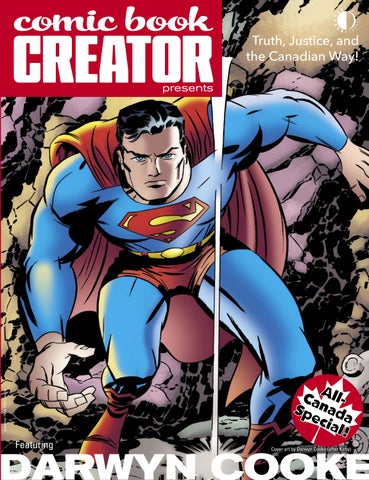
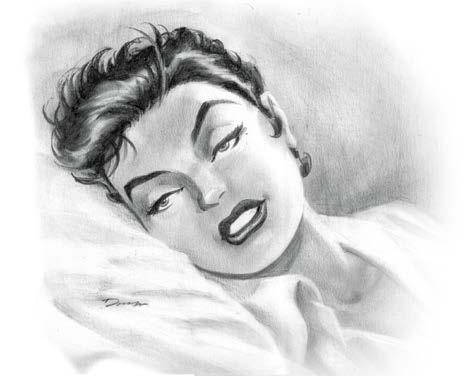
FRONTISPIECE: Darwyn Cooke renders the True North ’40s comic book hero, Johnny Canuck.
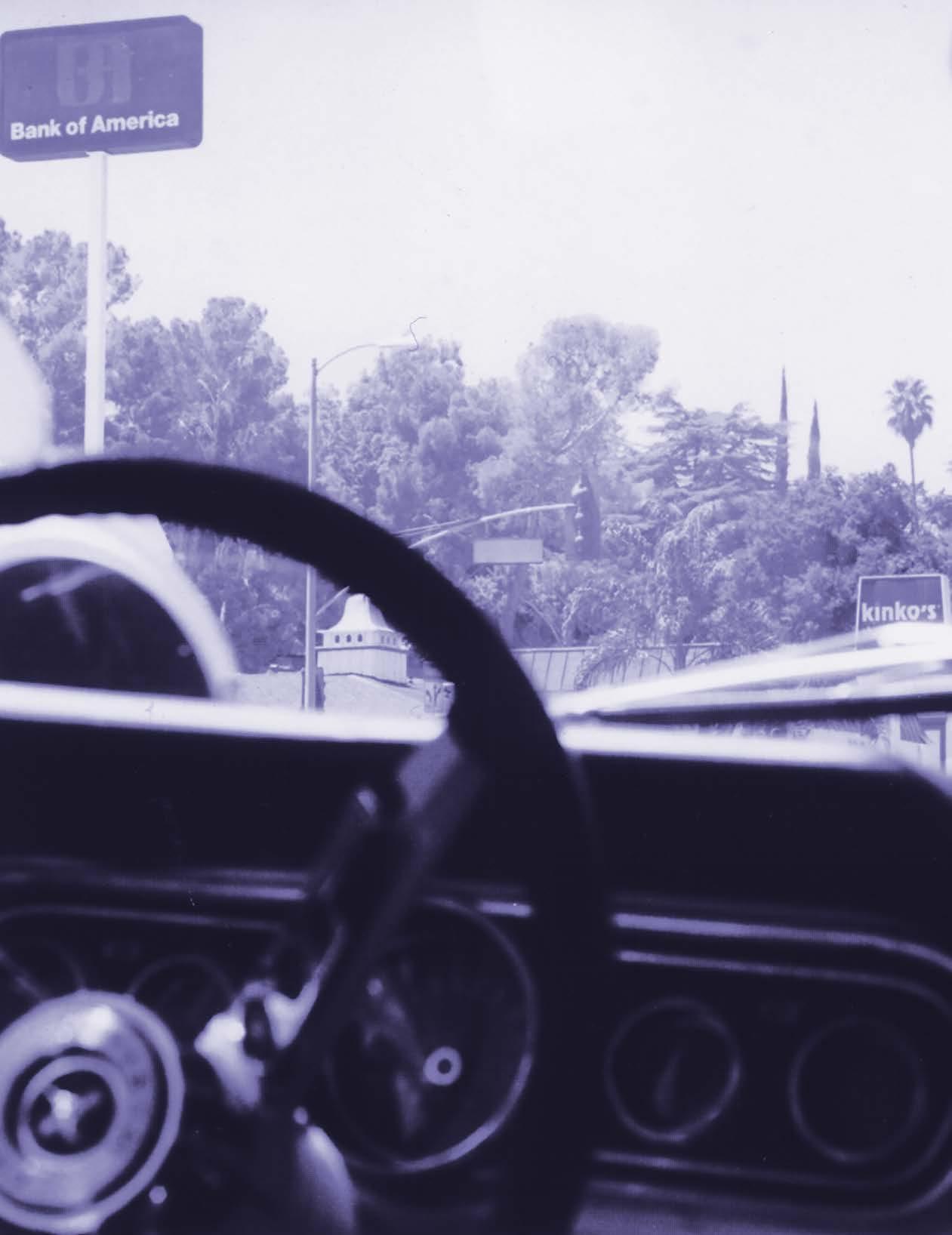
THIS SPREAD: In 2003, Steve Manale shot this noirish photo of Darwyn, presumably taken in the states.
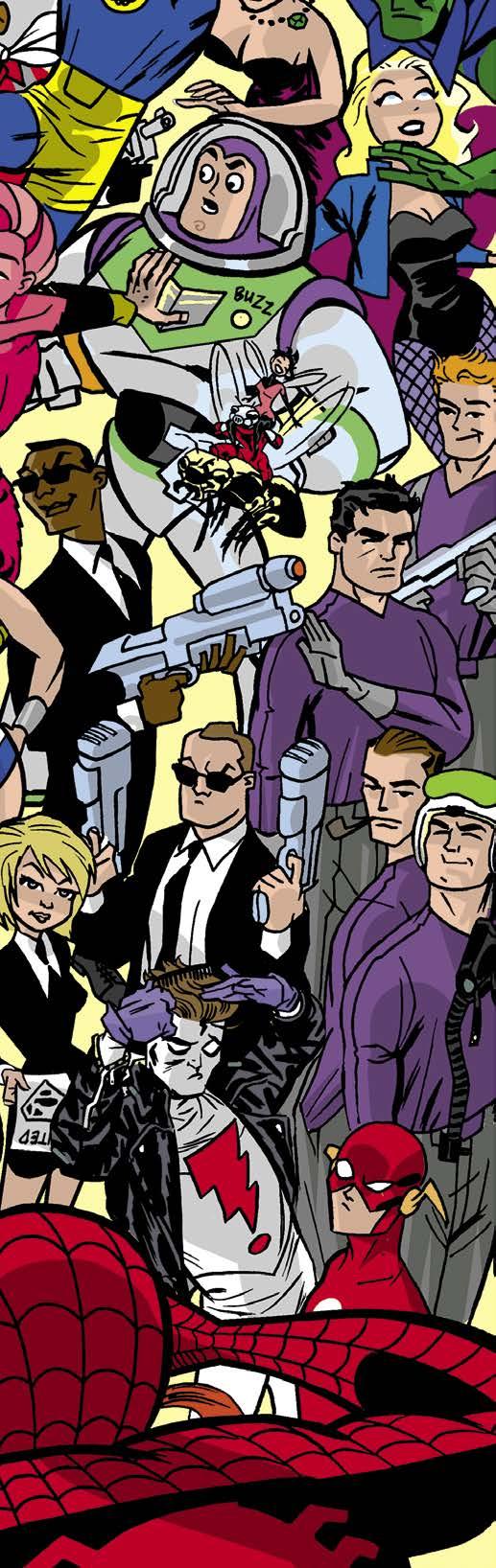
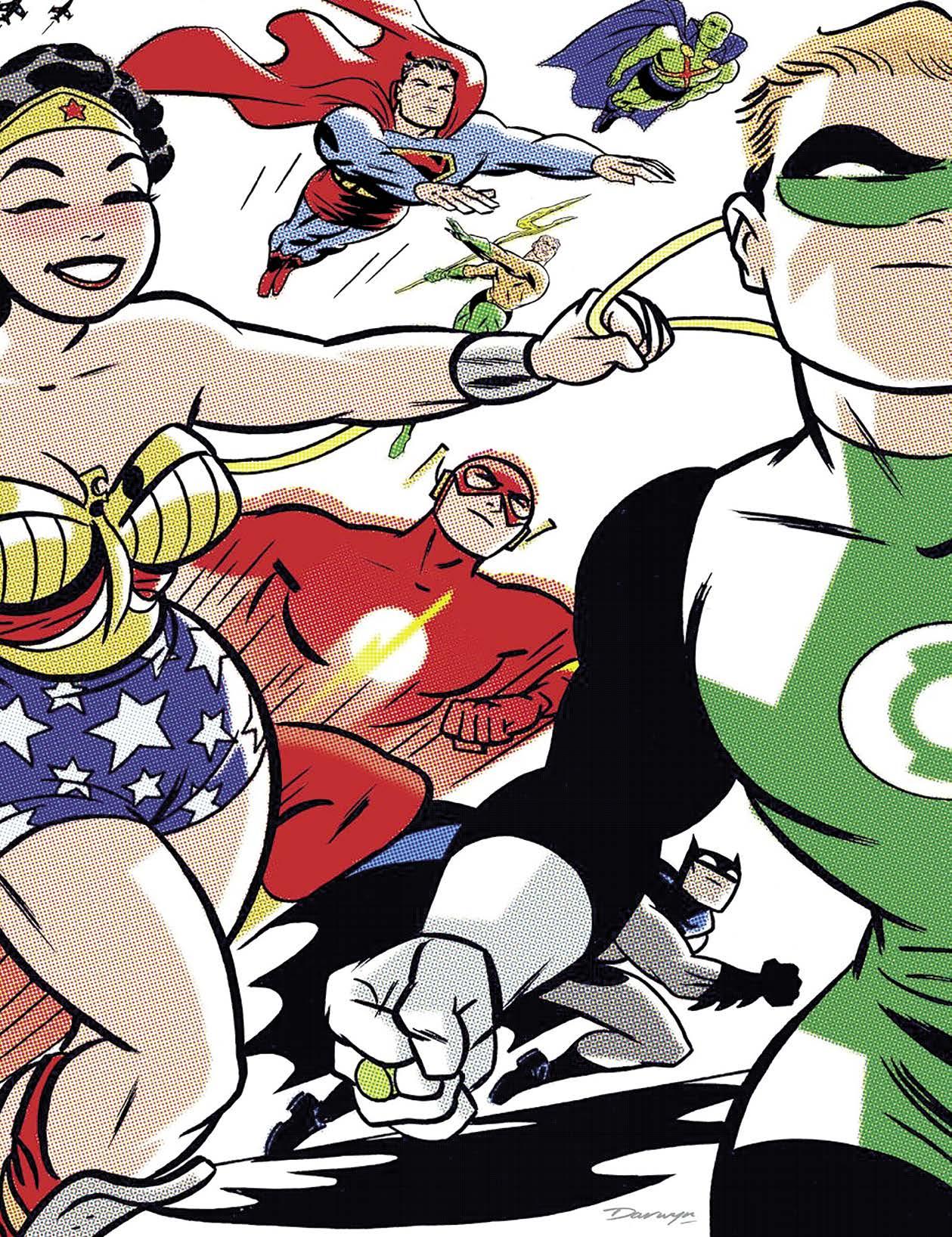
NEXT SPREAD: Darwyn produced this delightful tableau for his Comic Book Artist V2 #3 cover.
TwoMorrows Publishing Raleigh, North Carolina USA
Comic Book Creator™ is published bi-monthly by TwoMorrows Publishing, 10407 Bedfordtown Dr., Raleigh, NC 27614 USA. Phone: (919) 449-0344.
Jon B. Cooke, editor. John Morrow, publisher. Comic Book Creator editorial offices: P.O. Box 601, West Kingston, RI 02892 USA. E-mail: jonbcooke@aol.com. Send subscription funds to TwoMorrows, NOT to the editorial offices. Periodicals postage pending at Raleigh, NC. Six-issue subscriptions: $80 Economy US, $103 Premium US, $142 in the EU/UK, $121 other non-US countries, $29 digital only. All characters are © their respective copyright owners. All material © their creators unless otherwise noted. All editorial matter ©2026 Jon B. Cooke/ TwoMorrows. Comic Book Creator is a TM of Jon B. Cooke/TwoMorrows. ISSN 2330-2437. Printed in China. FIRST PRINTING.
comic book darwynism
That Cartoonist from Toronto
Ye Ed.’s 2003 extensive chat with Darwyn Grant Cooke at the Dawn of His New Frontier
EDITOR’S COMMENT:
The interview here differs from the published version in Comic Book Artist V2 #3, as the audio was re-transcribed and it includes some material not previously seen. Back in 2003, I made an instant connection with Darwyn working on that issue together and he was very generous, not only regarding his participation, but also with his kind gestures of sending original art, T-shirts, and stuff he produced over his career. We liked to say we were brothers with the same last name from different mothers. Our time as chums was brief, as I soon enough had to grapple with some difficulties that arose in my life, sending me away from CBA and the comics realm for some years. But, having weathered the Great Recession and gratefully sober, around 2011, I started attending the New York Comic Con to reconnect with the comics world. I think it was that year when Darwyn and I met again and we exchanged pleasantries. I had always harbored a sense that Dar lived a little too close to the edge, where I was for a chunk of the ’00s, and our encounter on that cloudy Manhattan day did not dispel that feeling I had. He seemed to maybe be smoking too much, like I used to smoke too much, and maybe living too hard like I used to live too hard. We were in different places in our respective lives at that point, but still cordial and friendly, if a mite distant. But, when I said goodbye, I didn’t know it would be the last time I’d say goodbye. ’Til we meet again, Darwyn Cooke. I miss you, my brother. — JBC
Conducted by JON B. COOKE
[Interviewer’s original 2003 introduction: Darwyn Cooke is an “old-school” type of guy, the kind who still believes we need heroes. Whether he is talking about artist Alex Toth or Hal Jordan, the cartoonist is passionate about the subject and nowhere is it more evident than in his current on-going DC Comics six-issue mini-series, The New Frontier, an epic retelling of the origin of the Justice League of America written and drawn by Darwyn. The creator, who cut his comic-book teeth on various Catwoman series over the last few years, was interviewed via telephone on April 24, 2003. (Steven Tice was the original transcriber.) — JBC]
Jon B. Cooke: What year were you born?
Darwyn Cooke: ‘Sixty-two.
JBC: So you do go back. People would think that you’re a new hot shot just right on the scene, right?
Darwyn: It’s kind of funny sometimes when people meet me. I try to explain that I’m in my second life, my second childhood. [laughs]
JBC: Well, I guess we’ll hopefully learn it all here. Where are you originally from?
Darwyn: Toronto, Canada. Born and raised.
JBC: What kind of childhood did you have? Did you live in the city itself?
Darwyn: Only when I was a very small child. We moved out into the suburbs, I think, when I was in grade one. Yeah, a very typical North American childhood from that era.
Suburban home, a couple brothers.
JBC: Older or younger?
Darwyn: They’re both younger.
JBC: So you’re the oldest. Any sisters?
Darwyn: No, much to my mother’s chagrin. [laughs]
JBC: What did your mom do?
Darwyn: She was a really bright lady. She would work when she felt like it, and she took care of the house when she felt like it. So what would happen would be, for two years she’d be home making lunches and everything, keeping everything rolling. And then she’d get bored and say, “Well, I’m going to go get a job.” And she did various things: office manager, she worked in a restaurant, whatever she felt like doing.
JBC: She was pretty much an empowered woman?
Darwyn: Yeah. I’d say almost totally, except for her attachment to my father. [laughs]
JBC: But love’ll do that…?
Darwyn: Yeah. He was a bit of a rascal. I’d say he was her weakness…
JBC: What did he do?
Darwyn: My father was a construction worker most of his life, and then he ended up running the union.
JBC: So he had connections? [laughs]
Darwyn: Yeah.
JBC: Did they stay together?
Darwyn: Yes. My father passed away a few years ago.
JBC: Were there any creative inclinations in either family?
Darwyn: Not really. The closest my mother’s able to establish this is perhaps I got this from my grandfather — her father — who I never met. But apparently he had quite a degree of creative ability.
JBC: Were you into the trappings of American pop culture?
Darwyn: Oh, very much. Canada, in the ’60s, anyway, we had very limited access to American culture. Before cable and everything, I think we got one American TV station, from Buffalo, that we could pull in on the aerial. As a matter of fact, the first thing my mother said that it was clear I was enthusiastic about as a child was the Batman TV show. She said that it didn’t matter what I was doing, her responsibility was to get me in front of that television at 7:00 Tuesdays and Thursday nights, no matter what. [laughter] And she says I wouldn’t talk to her for two days if it got screwed up. [laughter]
JBC: So, for ’66 and ’67, you were a junkie on that. Did you pick up American comic books as well?
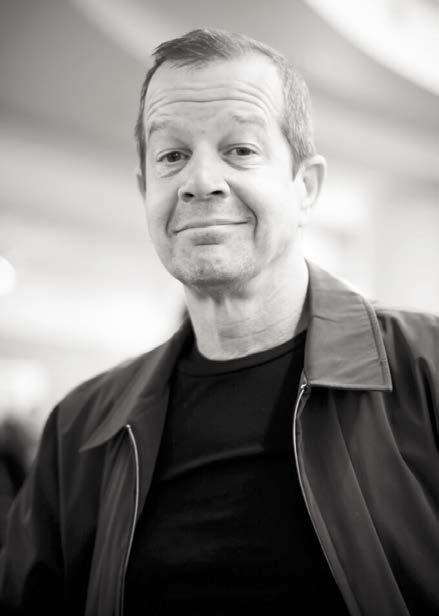
Darwyn Cooke photo © and courtesy of Amy Roth.
Darwyn: Yes, we got a lot of American comics up here. And, like a lot of people, I guess, who are into stuff, as a child I loved comics, but I got away from them probably around nine or ten. And it wasn’t until I was 13, I guess, I was visiting some relatives for a couple of weeks and I was bored one day, and I ended up buying a comic book. I had been very interested in artwork and drawing my whole life. It was the… Do you remember the… They did it as a black-&-white magazine first or they did it as a magazine, Spectacular Spider-Man. It was the one where Osborn flipped out. And what a great book to have picked up for my first crack at it at that age. And I remember the next day, I was so excited, I went out and I bought… I think it was four sheets of Bristol board. And, back then, they were those real toxic markers, but I got three big, fat magic markers. I spent the next three or four days just swiping these wonderful Spider-Man drawings that [John] Romita [Sr.] had done. And I think it was right there I knew. I loved it, and that was what I wanted to be.
JBC: So did you become a comic book collector from that moment on, as well?
Darwyn: Yeah, I became a big-time collector at that point. And, of course, back then it was just whatever you could find at the newsstands, especially where I lived. When I was a kid, there were six places you could buy comics in my neighborhood that you could get to by bike, so I checked them all. And I didn’t even know when the new ones came in, so it was just a matter of always checking and grabbing
everything you could.
JBC: Did you have a particular favorite artist that you started to clue into?
Darwyn: Oh yeah, absolutely: Neal Adams. And this is going back now, we’re looking at between, say, ’73, ’74, ’75, I guess. Right when he was “The Man.” And I remember I was deeply interested in art, and had done a lot of drawing and painting up until that point, but I’d never really connected it to comic books. Back then, there was the stigma, as well, where comics are one thing, and I thought I was going to be an… [pauses]
JBC: “Artiste”?
Darwyn: Yes. So a guy like Adams was tailor-made for me. And I think it mirrors the reason Alex Ross is so popular right now. Young people really, really like the idea, I think, of a convincing reality being constructed around these fantasies. Adams delivered that in spades.
JBC: I guess it places the reader within it, makes it a comprehensible world?
Darwyn: Well, you look at what was going on then, and even the great guys like Romita, Sr., say, the style was still very simple, very much cartoon, compared to what Adams did. Now, it sort of seemed to legitimize it. Now, at this age, I look back and, oh, he’s probably one of the worst things that happened to the medium, when I look at it historically. But, at the time, yeah, he was definitely my hands-down favorite.
JBC: How was he “one of the worst things”?
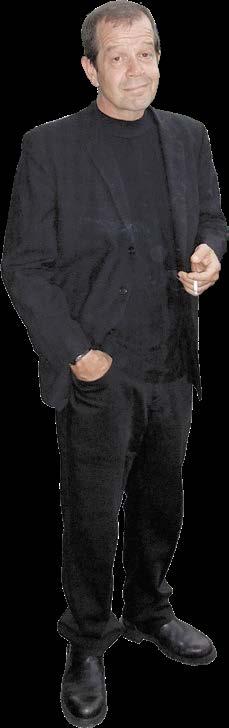
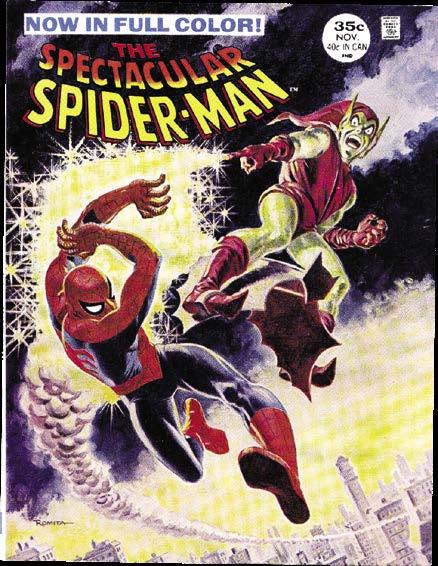
Above: One of Darwyn Cooke’s earliest comics purchases was at 13, when he bought The Spectacular Spider-Man #2 [Nov. ’68], the color magazine edition. Previous spread: Amy Roth’s headshot of Darwyn taken at the 2011 Toronto Comic Art Festival; Dar’s contribution to Comic Book Artist’s Will Eisner tribute issue; and a shot of Darwyn in Aug. ’09. Below:
Darwyn: Well, I think that when you get past Neal and what he did, you get into the way he influenced the medium. And I think he took a certain emphasis off storytelling and placed it more on illustration. And I don’t think we really see it start to fall out completely or we don’t see the results of it, I don’t think, until the Image explosion. And, I think, there’s a really strange line you can draw between Neal and those guys. And I don’t think that’s Neal’s fault, by any stretch, but I do believe it shifted the emphasis to a great degree from storytelling. And the fact that these are stylized fantasy constructs. It put an emphasis on making the material look more real, look more adult. I think that’s still going on to this day. I mean, look how popular Bryan is, Bryan Hitch.
JBC: Right. So, at the time, did you look back at the more cartoony guys like Alex Toth and Jack Kirby, and also appreciate what they were doing, or was the magnetism totally toward the realism?
Darwyn: Well, this is what I think is — I don’t know if you’ve noticed this, Jon, but did you ever notice that if you hear a song for the first time and you like it the first time, it’s like a week later you’ve kind of had enough of it. But if it takes a while for that song to grow on you and for you to get an appreciation for it, you seem to stick with that stuff. And I know that with Toth that was the case. The first Toth I was exposed to (other than, probably, the cartoons) was the “Ghost of the Killer Skies” story, which was the biplane thing [written by] Archie Goodwin. I remember looking at it and going, “This is ridiculous! The ice cubes look like — they’re just squares, with a big fat line around them!” And I thought it was ridiculous, but I kept coming back to it. And I couldn’t understand why I was compelled to continue to look at this work, despite the fact that I thought that it was simple and childish. And, over time, you began to understand, right? With Kirby, it was the same thing. I could only stand Kirby on the Fantastic Four with [Joe] Sinnott inking it. All the other Kirby stuff, I just thought it was too crude and childish. I was looking for more polished artwork, better draftsmanship.
say, Neal Adams was a much better artist. I had to figure out why I was emotionally reacting to this work. And that took me a little while to figure out. And once I had, yeah, it all clicked into place.
JBC: Now, did you have the opportunity to also clue into their influences? To go into Milton Caniff and some of the…? Darwyn: Absolutely! As soon as Toth clicked into my head for me, and it was around the time the Super Friends treasury came out, again, and by then I automatically began tracing the roots back. And, it’s funny, because it seemed like a long time ago then, but it really wasn’t, it was work from 25 years earlier. Now it was a long time ago. But, yeah, I started getting the Warren magazines — The Spirit — and they just blew my head apart. I mean, up to that point, I thought a story was all about the powers, the spectacle, the villains… And, all of a sudden, I saw past the artwork for the first time, I think, and it was all about the story. Eisner, again, was a guy [of whom] I could see a lot of things about his draftsmanship that I wasn’t keen on, but his overall vision and the way it all coalesced all together in his stories, that’s what stuck and that’s when I realized the importance of this type of work, and how a simple drawing can carry so much more emotional impact than something that’s been painfully realized. The angle you choose to show a person’s reaction has as much to do with it as how carefully you draw that reaction on that page.
JBC: I guess I’m surprised how really quickly this happened. I think the Super Friends treasury came out in ’75 or ’76. I mean, it was pretty quick that you’d gone through these changes, these realizations.
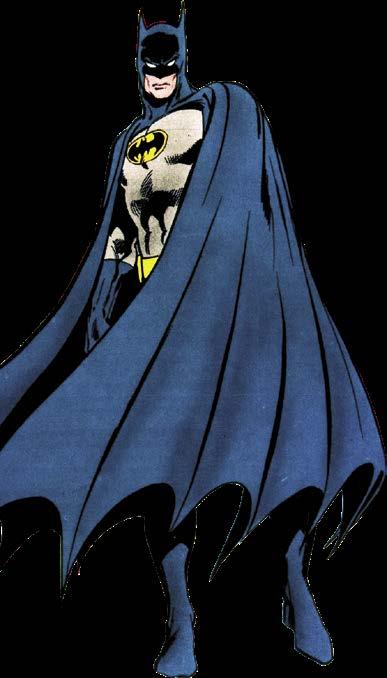
JBC: Would you agree that, in some major aspects, your work has elements of both those guys in it?
Darwyn: Oh, they’re primary elements, absolutely. And this goes back to what I was saying. My appreciation of their work took a great deal of time, and I had to figure out for myself why this was important, despite the fact that I thought,
Darwyn: It’s kind of neat, because at the time I was still a devout Neal Adams fan, I still loved his work, but I knew that real value… And the minute you start to trace the lines back, you get to, say, Johnny Hazard, and then you get to Terry [and the Pirates] and you get to Scorchy [Smith] and Noel Sickles. And, if you’re capable of making those connections, I thought it came together very clearly. Now, my ability to actually implement any of this took years. But, at that point, in my teens, I was positive this is what I was going to be, so I studied it for ages. [Brief pause in interview for interviewer to get bins out for trash collector]
JBC: You know, there was something I really thought was just eye-popping in that Super Friends treasury, and that was that Alex did this incredible section on animation. Was that eye-opening for you as well?
Darwyn: Absolutely. That’s what sank in, in that treasury. It wasn’t the four or five pages [of story] that he drew, it was that piece he did on how cartoons are made. The wealth of information there and the way it was presented, I thought, “Man, this guy’s a genius!” [laughs] Yeah, I bought it all the way in and, from thereon in, it was a hunt. By then I’d discovered there were a couple of old comic stores downtown, so I’d make the pilgrimage down. And not having price guides or checklists or anything, it was tough going. But back then, comics weren’t bagged, so you could rifle through them all day long. And see things I liked, or I’d say, “Holy sh*t, that’s by that guy!” I could tell, “That’s the same stuff!” and I would take it home.
JBC: Yeah, [Toth] was really tough to find! But I wonder if… for our age… I remember being in the newsstand, I would
Cover detail by Neal Adams and Dick Giordano,
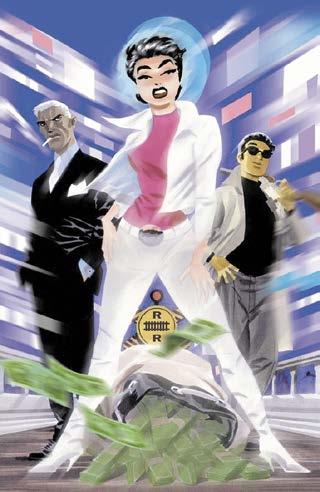
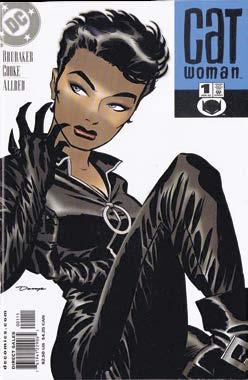
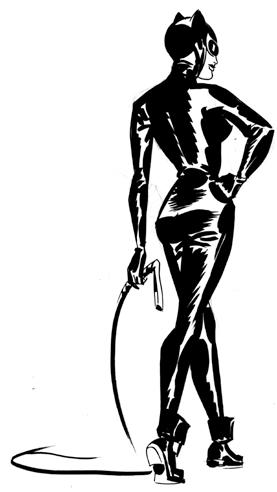
This page: Darwyn made his first big impact with his Catwoman work, which included a complete redesign of her costume and a graphic novel, Selina’s Big Score [’02], cover above, as well as the first four issues of a ’02 reboot, #1 cover below. Upper right are Darwyn designs from ’00.
it was. I mean, once I mastered the…The problem originally for me was the mileage. Being a storyboard artist, you’re drawing, I don’t know, 300 drawings a month, I guess. So it took me a while to conquer the actual physical mileage of it, but once I was past that, I didn’t find it that stressful. The title sequence, doing the Batman Beyond titles was stressful, but that was for a whole other bunch of reasons?
JBC: Was that because of deadline pressure?
Darwyn: Well, there was a deadline pressure, but even more stringent was the budget pressure, what we had to accomplish within the time we had, with as little as we had.
JBC: How did you look at that second season of The Batman Adventures?
Darwyn: I think that, for my money…? ’Cause everybody’s got a different point of view, right? I think what we saw happen there was there was a quantum leap in the look of the show. I think for people who understand animation and its actual production and the fact that things go overseas to be executed, when you look at the design changes that occurred between the first pool and the second, it’s clearly guys who knew exactly what they were doing, retooling their stuff to make it work better. Anybody can draw anything they want to draw. The question is, can you draw something attractive that can be sent over to Korea, where 500 people, who don’t speak our language, are able to execute it well? Because that’s the mandate, right? And this is what makes Bruce brilliant. It’s that he’s not sitting there jerking himself off with the drawing, he’s designing something that any retard could draw, but it’s still going to look beautiful, it’s going to hold together, at the very least.
I mean, he’s got his own playground, right?
Darwyn: Well, he’s got a playground, but he’s on… Again, this is a thing that I think elevates him from a lot of people… I mean, you’ll sit with people who are mounting a production and you’ll listen to what they’ve got in mind or what they’re going to try to achieve on a cheap budget, and you know they’re out of their minds and they don’t have the experience, because if they did, they wouldn’t go this route. Bruce’s decisions are all based on the experience all the way around, and I think, from a visual standpoint, if you look at the first pool of Batmans and the second pool, I don’t think it would matter which one you preferred stylistically, you’d have to admit the second pool looked way better animated. It looked more consistent, it looked less lumpy, more streamlined, more sexy. So I think once you have an understanding of how these things get made, and then you see what Bruce does, and you understand all the different decisions that have been factored into it, it’s impressive.
JBC: Now, when you went to Southern California, how was your life there, besides the work?
Darwyn: Well, for the first six months, it was kind of fun, just because I was in this new place, right? And it’s Hollywood and it’s warm all the time. But I didn’t really like it and ultimately decided to come home.
JBC: How long did you live there?
JBC: And the magic of it is that Bruce is still getting his ya-yas out. [laughter] Right?
Darwyn: I think it was about two years. Ultimately, I didn’t really like it. I’ve been living in a city, like an urban center, since I was 18, since I moved out of the house. And in L.A., I mean, geez, it’s 40 minutes to go anywhere. It just doesn’t matter, it’s 40 minutes no matter where you go. [laughs] Everything’s disconnected, there’s no sense of community… I don’t know.
JBC: A nice place to visit?
Darwyn: Yeah, exactly. And I still do. I mean, I was there for the month of February. I try to get down there twice a year.
JBC: What, for fun or for work?
Darwyn: You know, it’s… I can work pretty well anywhere now, which is cool, right? As long as you’ve got a paper and a pencil, I can work. I meet some good friends down there. So I go down, I stay with one buddy, David Bullock, who’s
just started the covers for Action Comics, actually, and I get to hang out with everyone.
JBC: How long was your career in animation? Do you still work in it?
Darwyn: I haven’t done anything in a long time, but I was talking with guys in February about things in the future, possibilities. I didn’t go down to L.A. or get involved in this to have a career in animation. And it’s kind of the one thing that separates me from the other guys. Most of them, like, this was the career they picked. They went to school or whatever and did what they did and this is their career. I went down to work on this show, and when the show’s wrapped up, there was no need for me to be there anymore. Because I wasn’t going to hang out and just stay in animation and then work on He-Man or Buzz Lightyear or Lilo and Stitch just to make a living. That wasn’t the way I wanted to go.
JBC: Were you still yearning to do comics?
Darwyn: Yeah, and that’s where this gets interesting, because… This would be right before Batman Beyond, right before I start the title sequence. One day I get a telephone
call from this Mark Chiarello fellow.
JBC: Whom you didn’t know or…?
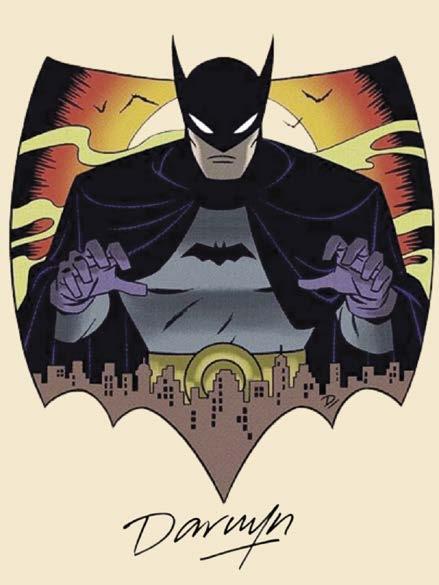
Darwyn: I knew of Batman: Houdini. As far as I knew, he was a guy who painted comics. He calls me up and he says, “Hi, I’ve just sort of started as the art director here at DC. And I needed this office and they were clearing out… there was a big stack of old submissions in the back of the office and he was throwing them out. And as he was going through them, he found this thing called Batman: Ego. And he said, “I was wondering, would you be interested in doing this still?”
Now, this is four-and-a-half years after I pitched it. [laughs] And this is coming out of the blue from this guy. And I said, “Yeah, I would love to do it.” But I knew we were just gearing up for the titles. I said, “But it’s probably a year away before I’d be able to actually do it.” So we promised that we were
going to do it, and it sort of went over off to the side. And it was like, “Okay, I know that that’s there.” And I think, yeah, it probably started to affect my decision-making. Because I know we finished the Beyond titles and the first season of Batman Beyond. Now, at this point, I’m 37, I guess. And, y’know, it was a tight shop. Three directors, right? And I know Curt Geda, the only way he made it to director was the guy before him had a heart attack. [Jon laughs] And, y’know, it was pretty clear it was going to be a long while before I’d get to that level there, and I had to make a decision about how I wanted to go ahead. And, at that point, coincidentally, I got a call from Sony Pictures, and they asked me if I would be interested in directing a season. At the time, they were just casting about for directors. They had Rusty the Boy Robot, and the Big Guy going, and they had Men in Black. And I loved Men in Black, so I said, “Yeah, I’d love to do a season of that.” And I thought, “This is what I’ll do. I’ll go to Sony, I’ll do a season of Men in Black, which gives me a director’s credit, and then I’ll get into this comics stuff and see how it goes.” I left Warners, went over to Sony for about seven, eight months. Just long enough to be able to do a season, and then started working on Ego And that’s been it since. JBC: I think that’s the one work I’ve not seen. People are always raving about it and I can never find it. And I’ve been clued into your work relatively… Y’know, it was Mark [Chiarello]! First, it was Mark handing me, saying to me, “Look through this.” And I’ve, always… just for the last five years of doing CBA, it’s been pretty much retro, it’s always been looking back, not looking at much contemporary work. And then he handed me Selina’s Big Score. And I just went, “Wha–!?” [chuckles]
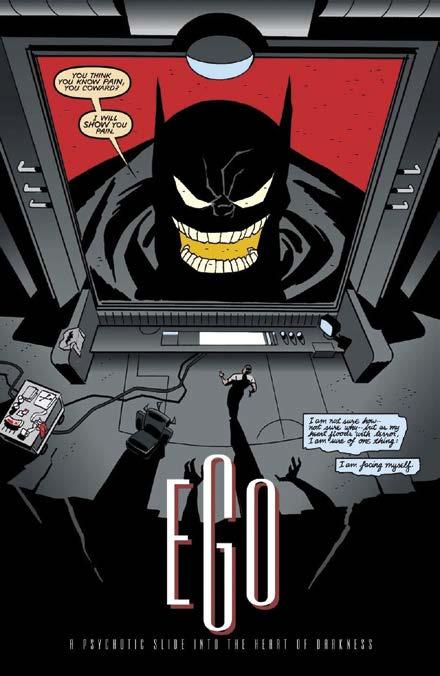
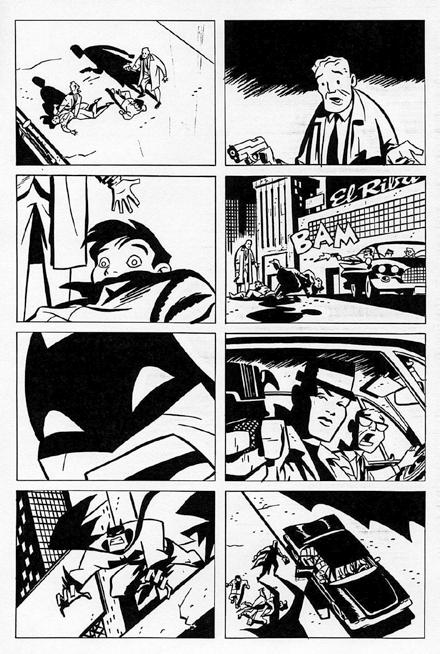
Above: Splash page from Darwyn‘s Batman: Ego [’00]. Inset left: Dar’s cover from Batman: The Golden Age Omnibus Vol. 1 [’15]. Below: Dar’s “Deja Vu” page, Solo #5 [Aug. ’05].
And then, all of a sudden, your name was all over. I saw Tangled Web, I scooped that up, and I’m just falling all over this stuff and saying, “This is another guy who really gets it!”
Darwyn: Mark Chiarello is my patron saint. [laughter]
JBC: What was Ego? Was it a Batman adventure?
Darwyn: Yeah, at the time that I’d conceptualized the thing, I was trying to find the one Batman story that would allow me to do everything I thought was cool with the character. Which is a tall order for any story to hold. And I can’t remember what the exact inspiration for the conceit was, but I came with this idea, “What if you separated the two of them and they were able to have a conversation about what the f*ck their life was all about and what was wrong with them?” And that became the idea I had in my head. It sort of started to fall into place there. Because if it was Batman and Bruce Wayne looking at their life and what they’ve made of it, it gives me an opportunity to draw pretty much anything I want. And so I began to look at these two, thinking of them as individuals, as opposed to one person, and thinking about what it was about each other that they would have problems with. And that becomes pretty clear.
If he wasn’t Batman at night, if he really was just Bruce Wayne, what would that man think of him? And what would he think of Batman, if he was just Bruce Wayne? And that’s sort of what I started doing with it, playing with it, and I thought, “This is great.” Batman would want to kill the Joker. What’s stopping him? Bruce Wayne’s stopping him. And that I started looking at psychology, your basic ABC’s of psychology, and it’s the ego, the superego, and the id. So Bruce is the ego, Batman is the id, the dark part of him that he can only let
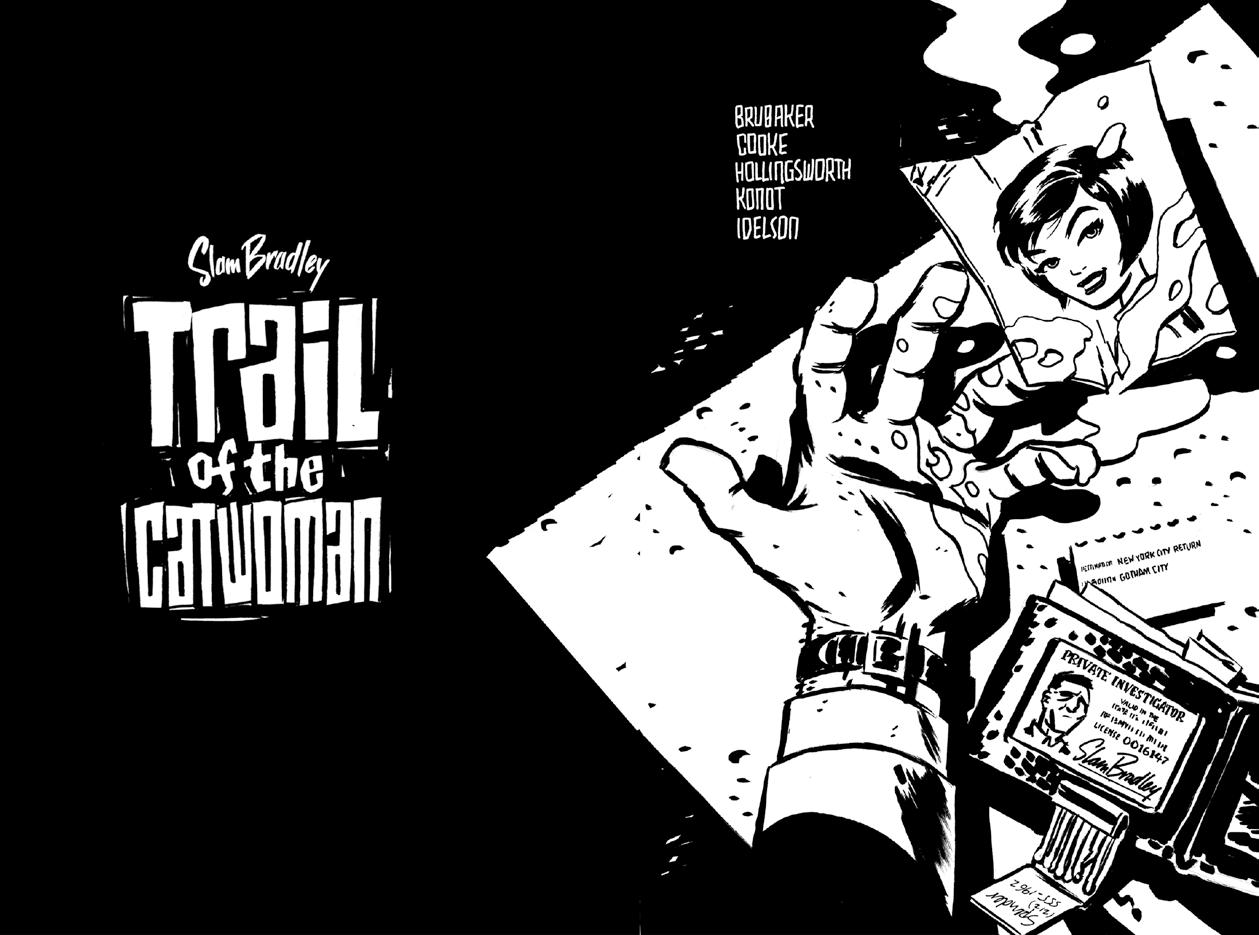
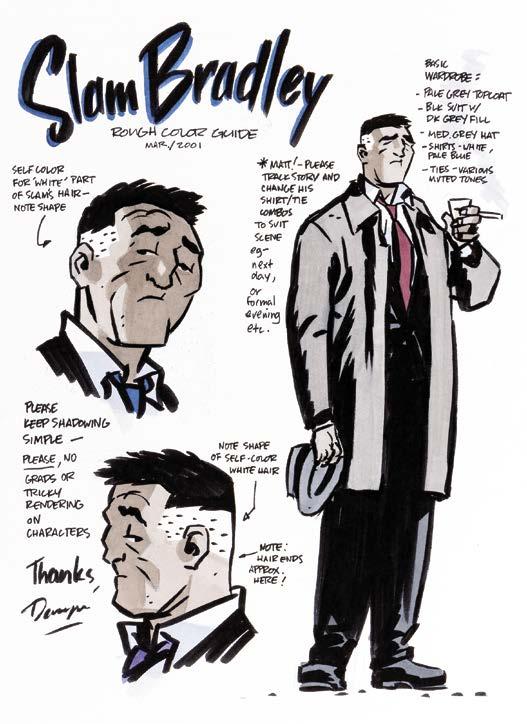
This page: Darwyn, along with write Ed Brubaker, re-introduced one of DC’s oldest characters — one created by the originators of Superman, Joe Shuster and Jerry Siegel, no less! — Slam Bradley, in his Catwoman stories and The New Frontier. Here is Darwyn’s title page design and character color guide.
indulged as well as anybody, I guess, and sometimes laugh at certain aspects of it. They’re not very important, but they’re an indulgence.
Brian Bendis, because of his skill as a writer, I tend to give him the benefit of the doubt until… the climax, whatever it is. And I wonder…He always leaves me curious as to where is this going. It doesn’t feel as indulgent, for instance, as Millar.
Darwyn: I don’t question their abilities, what I question is their decisions, and the subject matter that they’re embracing and they want to pursue. I mean, we’re looking at a lot of talented writers here. I’m just trying to figure out why this is the road they’re taking, or why we’re going this way with it.
JBC: So getting back to The New Frontier, is there an allusion there to J.F.K. in 1962?
Darwyn: That’s basically where the title comes from. The New Frontier primarily looks at the period of time from when Barry Allen gets hit by lightning right up until Starro the Conqueror, at the beginning of the Justice League.
JBC: When was that, 1960 or ’61?
Darwyn: ’Sixty-one.
JBC: So between ’56 and ’61.
Darwyn: Yeah. What I’ve done is, I went and constructed a DC publishing timeline for that period of time. And I thought, “Now, what if I treated this like real time, and these things actually happened on these dates?” Like in October 1957, four men’s plane crashes, and they become the Challengers of the Unknown, which is the month the book rolled out. And looking at the timeline you see that Hal becomes Green Lantern right before the Justice League is born. So everything all kind of comes together in that period of time. And Martian Manhunter is on the scene… I sort of looked at it and I thought, “This is fascinating! We’re going through the Red Scare and the race for space and Camelot and the New Frontier. It all comes up right on the verge of it. What an interesting period of time. And then I started looking at the characters, and they’d always seemed so one-dimensional to me. But, within the context of the time they were created, I could see other dimensions to them. And I started looking at it as… I don’t know, yeah, this is going to be my big, epic story. This is going to be it. There’s sort of this basic notion in the DCU that the Justice Society, they retired because of the witch hunting McCarthyism. So using that as sort of a springboard into my story, it’s like the world doesn’t have any heroes anymore, because they’ve sort of been legislated out of existence, other than a couple of them, like Superman and Wonder Woman. And who are going to be the heroes of tomorrow, because it’s a different world now. And what I’m doing is I’m looking at the key characters that formed the original Justice League and how it is that they’ve become the people that they are, and become the heroes
that they ultimately become. It shows what they go through to sort of achieve the consciousness or the sense of purpose that’s going to carry them through. And, of course, there’s a huge, life-threatening menace and all of that. [laughs] Certainly this is not a talking heads book. At 380 pages, I’ve managed to find a way where always every scene in the book takes place in action.
JBC: What’s the format? Is this a mini-series?
Darwyn: Six 64-page books.
JBC: And what’s the scheduling?
Darwyn: At this point, we’re still diddling around with that. It hasn’t been nailed down. But I’d say we’re looking around New Year’s 2004. We’re thinking of going out earlier, but it’s up to them. We could roll it out in October or November, but,in order to do that, they’d have to commit to it being a bi-monthly. And they’re hung up on it being monthly, which I think is ridiculous. But they’re really hung up on that. So that might push it later so that there’s more in the bag.
JBC: Now, pragmatically, as far as CBA is concerned, is it smarter to push this toward the release of that?
Darwyn: To hold it off?
JBC: Not for long. Right now we’re scheduled for October.
Darwyn: My understanding, I guess, of the way these things work is that, if it was up to me, the ideal month for this to come out would be the month before or the month of Previews solicitation for the first one so it helps creates awareness…?. So, from my point of view, that would be ideal. Now, if
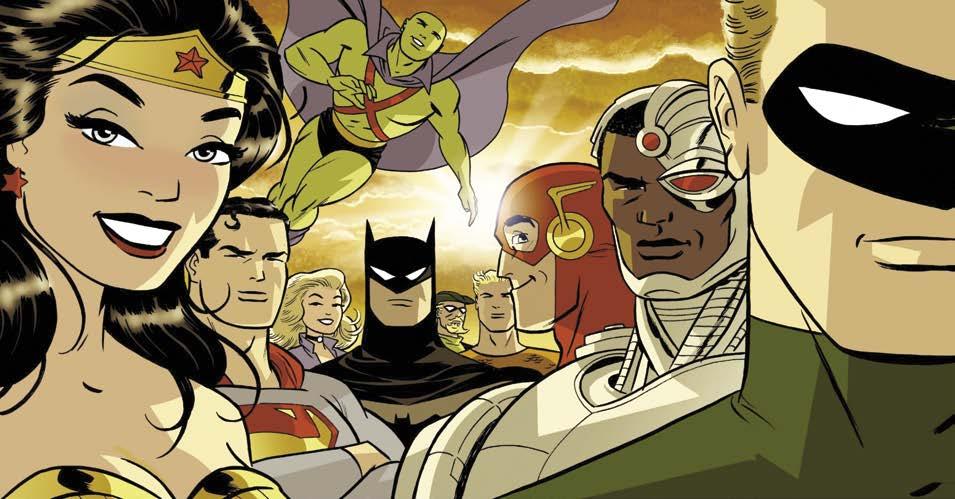
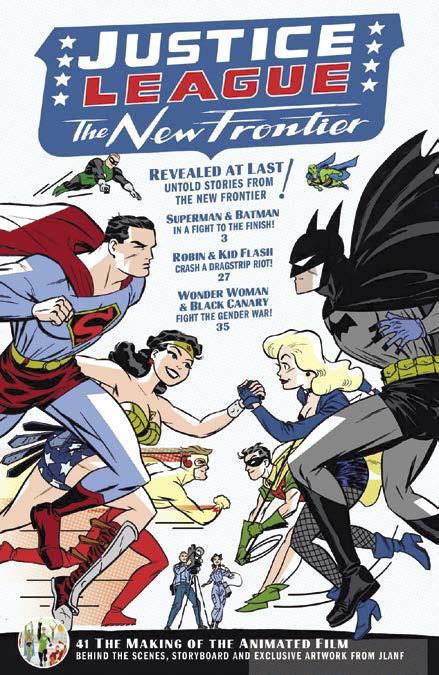
Above: For their December 2014 releases, DC had Darwyn produce 23 variant covers for that month’s lineup, including this Justice League #37 piece featuring the classic JLA crew plus Cyborg. Below: In conjunction with the release of the DVD New Frontier animated movie, DC enlisted Darwyn to produce a 52-page one-shot, Justice League: The New Frontier Special [May ’08], which included this playful table of contents page, as well as work by a bunch of his Canadian artist cohorts.
it was released in January, that’s basically October.
JBC: Right. So I guess the timing is right.
Darwyn: Yeah, and if they decide to come out earlier, then it’s there to alert the reader, to get them excited.
JBC: And the content mode for the cover… shouldn’t the cover reflect…? [A detail of Darwyn’s CBA V2 #3 cover can be seen on pgs. 4–5 in this ish of CBC. — Ye Ed.]
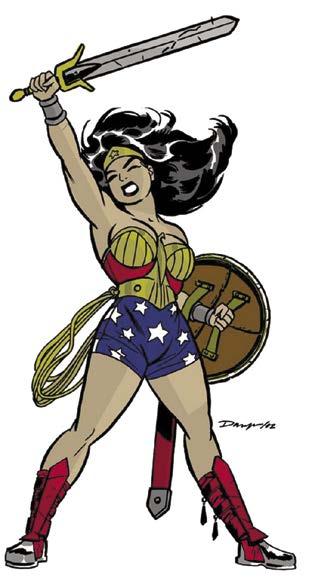
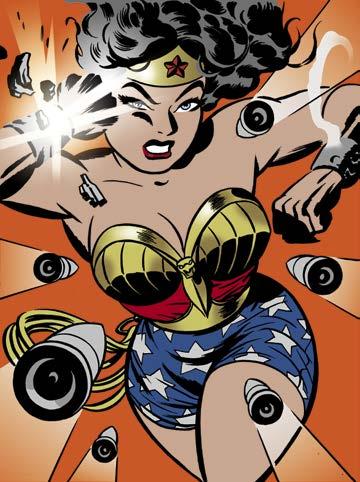
Darwyn: Well, Mark and I were talking about that. Now, I gotta admit, when I sat down to think about a CBA cover, I put my art director’s hat on and put myself into your shoes and thought, “Now, what’s going to move more copies for Jon? Essentially drawing a Catwoman or a drawing of a super-guy…?” [laughs] So, yeah, in terms of the relatively new project, it would be New Frontier. So in terms of the cover revolving around that, I think that’s probably why I sent you the Wonder Woman. And, much to Mark’s alarm, I told him, “Look, my Wonder Woman,” I said, “We’re talking Maggie. Love and Rockets’ Maggie…? But today.” The big one.
JBC: [Laughs] “Much to Mark’s alarm”!
Darwyn: I said, “Dude, let’s logic this out, which is what I’m trying to do with every one of these characters. This woman is a Greek goddess, okay? So come on! She’s going to be big. She’s an Amazon! She’s going to be a steak-eating,
wine-chugging, life-lovin’ woman. [Jon laughs] She’d be big, man! She’d be taller than Superman. She’s an Amazon! And she’d have meat on her bones.” He went, “Oh, my god.” I said, “I think it’s gonna kill people when they see her and Superman standing there and she’s clearly three inches taller than he is.” [laughter]
JBC: Now, that would be audacious. [laughs]
Darwyn: Yeah, I wonder if DC’s going to freak out a bit about that one when it does come down, but Dan Didio’s kind of championing the project now. I know he’s given me carte blanche, at this point. And I’m hoping that they realize that creating a little controversy about a character like this might be good. If it outrages a few people, that might be the best thing for it.
JBC: Well, I think stirring up anything with Wonder Woman is always a good idea.
Darwyn: Well, they won’t let me cut one of her tits off in true Amazon style. [laughter]
JBC: You know, I got your covers,* and I have to admit, the art director hat was on me, I went “Wow!” And then the marketing hat went on me and went, “Hmmmm… I need breasts.” [laughter]
Darwyn: Exactly!
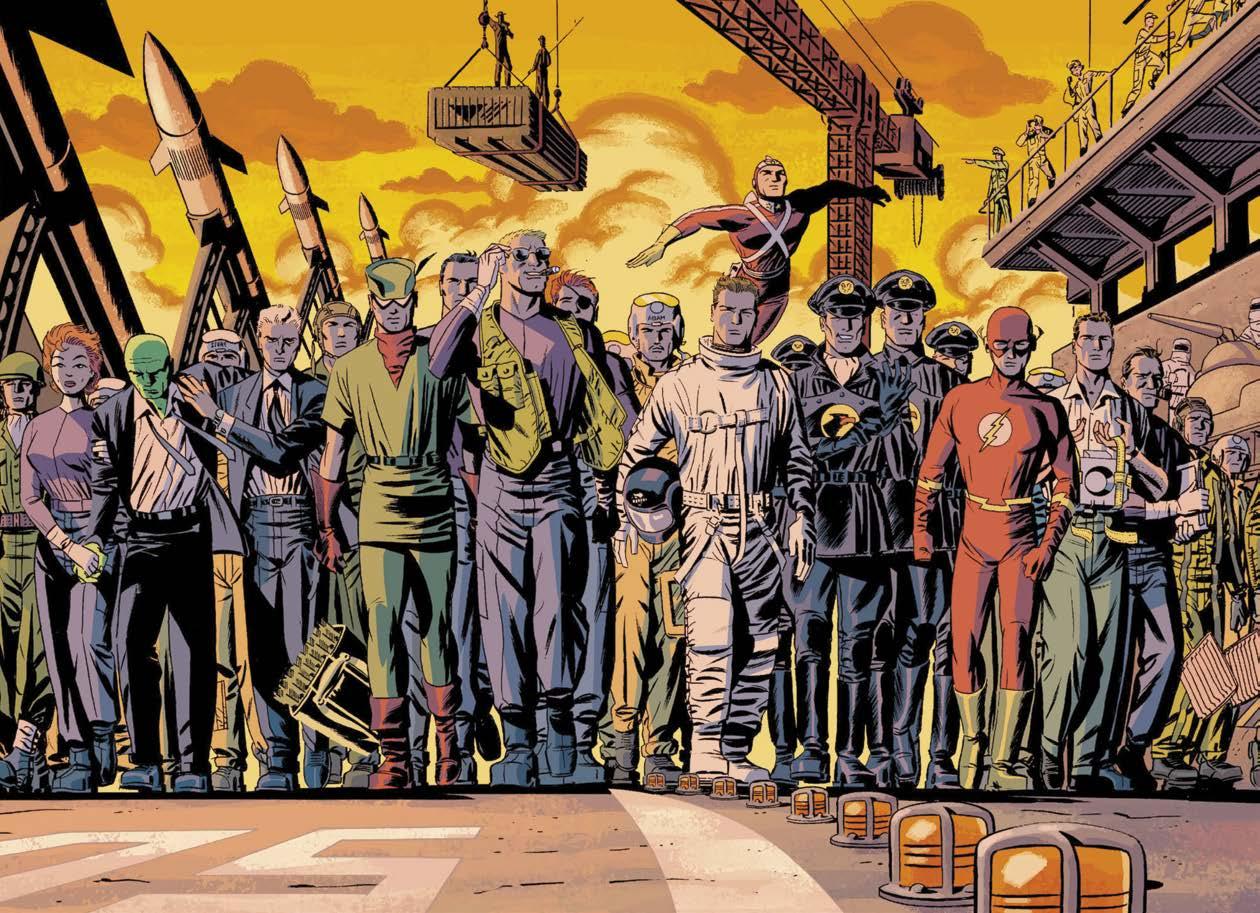
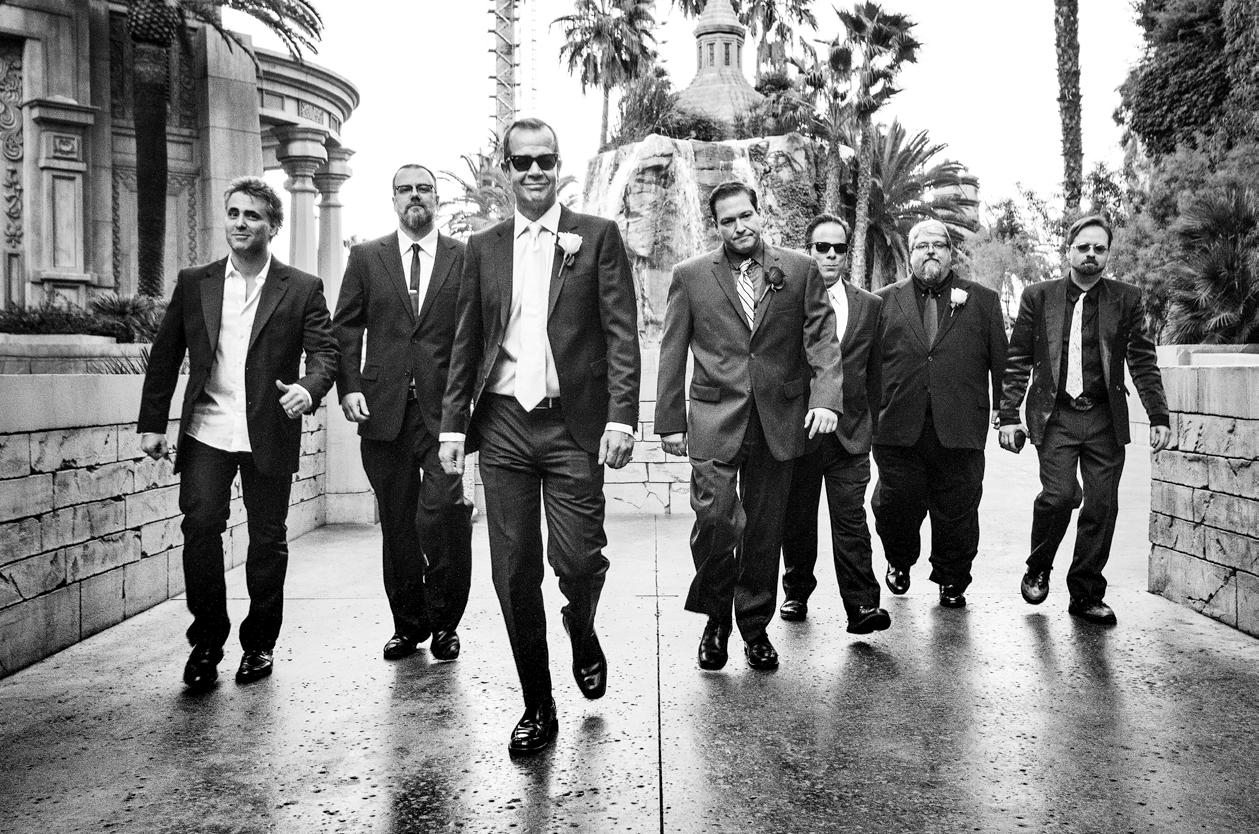
Above: Double-page spread from DC: The New Frontier #6 [Nov. ’04]. Below: Darwyn’s plus-size Wonder Woman. Opposite page: Top is New Frontier promotional art and bottom is Darwyn on his wedding day with the groom’s entourage, in Las Vegas, on November 16, 2012, when he married Marsha Stagg. Pages 36 & 37: Multi-fold New Frontier brochure used to promote the series.
JBC: So sorry about that slip into the muddier recesses.
Darwyn: Dude, look, you’ve got to sell magazines. And this is another thing that I don’t think enough guys in our business pay attention to.
Hey, Brubaker! Your job isn’t just to f*cking grind out a Catwoman every month. It’s to sell enough copies of it that you can sustain publication.
JBC: Right. Keep it alive, keep it viable.
Darwyn: Yeah. Your personal vision be damned. The book is now hovering at 22,000 copies. It’s within 2,000 copies of being cancelled, technically.
JBC: Oof!
Darwyn: And he’s driven it that far down in 12 months. And it’s like there’s no check and balance in there. Nobody’s coming in and saying, “Hey, every month this book loses 1,500 readers for the last ten months. Maybe we should tweak the approach.” [laughs] So, when I’m… as a past art director and agency guy, I’m thinking, when I’m doing a cover for a magazine, I’m thinking, “What’s going to help him sell more magazines?” I don’t know, it’s just part and parcel of it.
JBC: Yeah. Well, do we still want to think on it…?
Darwyn: Maybe there’s something…
JBC: I like the heroic. And I do like sex and sexiness on the cover, too. But I have to admit, personally, I’m harping on the heroic right now, because I
* I searched through my hard copy and electronic files and couldn’t find anything resembling cover roughs from Darwyn, though interestingly did find a sketchbook mockup. — Y.E.
have major debates with a lot of my friends and acquaintances about the advent of the anti-hero in society these days. And I just had a very good interview with Alex Ross last week about that. Because he was really pulled into comics by the advent of the anti-hero, which was The Dark Knight Returns and Watchmen and especially Marvelman. And, as wonderful as those works are, that I believe, they still are a part of bringing this great darkness.
Darwyn: Oh! The indulgence in those books, as brilliant as Watchmen is… Now, Dark Knight Returns, that’s about as brilliant as I, the Jury, if you ask me. I mean, it’s fun, but it’s not a work of literature. It’s a power fantasy, that’s what it is.
JBC: I agree. It’s the concept that I liked.
Darwyn: But what it cost the industry to have those books be here… It’s too bad. And, y’know, it’s funny, because I think Alex’s artwork is a real hindrance to the growth of the business, but I’ve read enough interviews with the guy that I’m fully… We’re in perfect sync in terms of our perception of the industry and the way it’s being handled.
JBC: He really is smart about… That’s the thing that gets me is the intelligence behind the work. Because, if it was all flash, then I would have been thrilled with Marvels and then gone, “Okay, what’s next?” You know, from somebody else.
Darwyn: Exactly.
JBC: But I have to admit… As much as… I didn’t really fall in love with Kingdom Come so much, though there’s some work… I like his Uncle Sam
the westlake years
Making Parker as Perfect as Possible
A conversation with Darwyn Cooke about the cartoonist’s Donald Westlake adaptations
Conducted by TUCKER STONE
[Interviewer’s intro: I found out that Darwyn Cooke knew my name back in 2008, when he showed up on this blog and left a comment supporting my decision to burn a giant X-Men Omnibus. It remains (and will remain) my favorite way I have ever met a comics creator. I had no idea how he found the blog, or whether he was joking or not about burning books — at the time, I remember being convinced it was some odd kind of joke. I had an email conversation a few days later, but even after I knew it was true, it still had that same feeling: that this couldn’t be happening, and I wasn’t allowed to be happy about it, because it was a lie, and the rug was gonna get pulled.
But it was true. And while we didn’t speak very much, Darwyn and I did email each other a few times. We spoke mostly about a John Flynn movie called Rolling Thunder that I had fallen for pretty hard, and that eventually led to him asking me to interview him for a big article on his second Parker adaptation, The Outfit.
It was a lot of work, and I’ve never done anything quite like it since. I sat in my apartment in Brooklyn, talking to him on the phone for hours. He was funny, charming, and very smart: but most of all, he had a definite set of feelings and opinions about his work and the work of others, and it was exciting to hear that, to hear someone who wasn’t concerned with pretending to like everything. I transcribed the conversation into an 15,000-word piece, found a home for it with Laura Hudson, who figured out a way to split it into separate parts so that whoever it was that owned Comics Alliance at that time would have to give me more money, and we put it out there. I then got a chance to meet Darwyn when he came to New York for a book signing, and he took me out to dinner with Marsha and all his friends. He treated me like I was Gay Talese and he was Sinatra, and while the evening’s performative qualities took a wear on both of us as the night went on, it was one of the few times in comics where the show we were all playing at felt like one put on by wry grown-ups as opposed to the dress-up games that stunted children so frequently play now. I lost my temper on one of Darwyn’s dipsh*t sycophants, Darwyn needled him alongside me to
defuse the tension, I went home embarrassed. We spoke a few more times, and that was it. I was proud of that piece of writing, and I think Darwyn was happy with how it turned out as well. We had another follow-up planned — the conversation we had on the phone that day went into many more subjects besides Parker — his feelings about Chris Ware, his thoughts on Batwoman, people he didn’t like (people I didn’t like), but it never came to pass. I never did the work, and that night had burned me out. I didn’t want to be Gay Talese, and I wasn’t a good enough writer anyway. Instead I kept the raw mp3 recordings and promised myself we’d do it later.
We didn’t speak much, but when there was a minor fracas over some comments I made about why the piece went to Comics Alliance instead of its original home, he stood up for me immediately. We caught up briefly, and that was it. Years passed. We decided not to carry the Watchmen books at Bergen, and word got back to Darwyn and Marsha, and I was too lost in my own head to realize how that might make them feel, something I didn’t even pick up on until a few years ago, when we saw each other again at TCAF. I’m ashamed that I never reached out to him before I sat down on some useless MoCCA panel to say we were going to do that to a pack of assholes who didn’t care about comics in the first place. In that moment, Darwyn deserved to be treated with more respect than I gave him. He deserved a heads up, even if I disagreed with him, because he had disagreed with me multiple times before that and had addressed it with me immediately. I apologized a bunch at, and after, that TCAF show. But a late apology really isn’t worth that much. It isn’t worth anything at all.
I am not part of his circle of friends, I’m not a close associate. But I will say that I saw him with those people, and I know that he loved them dearly, and they loved him right back. He was a funny smartass, and I think those are the best kinds of people in the world, and I think there are not enough of them. I wish I had done a better job of being the kind of person to him that he was to me. I will never forget the time I got to spend with him, and how much fun it all was.
Thanks, Darwyn. God bless you, too. — T.S.]
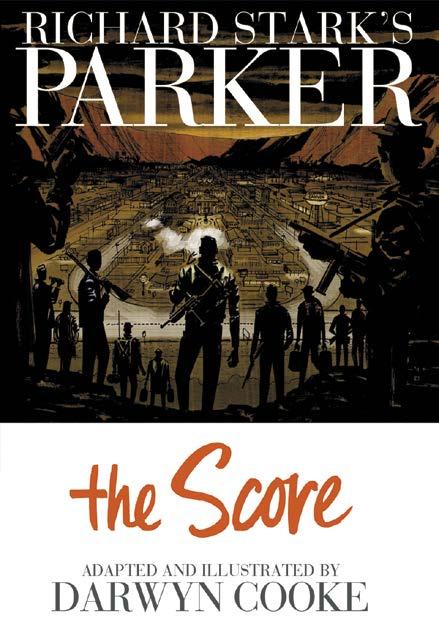
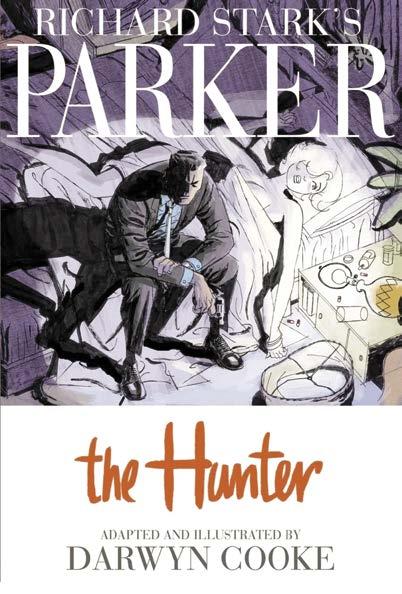
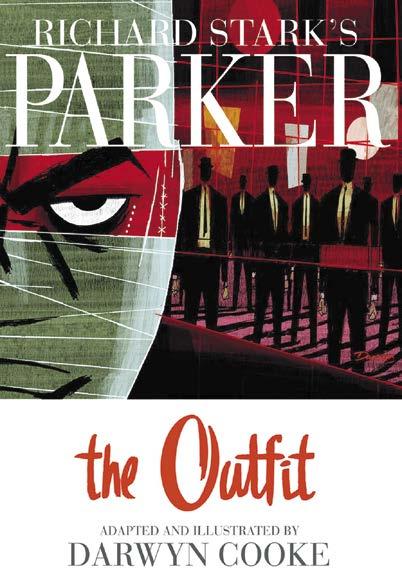
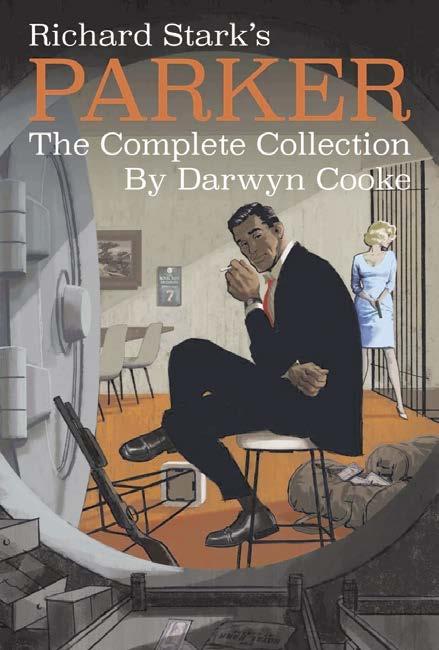
Above: Amazingly, Darwyn Cooke completed four adaptations of Donald Westlake’s Parker novels over the course of four years, The Score [’12] being the third. Below: In 2023, IDW collected the run, which also included associated tales.
Tucker Stone: Let’s start things off by talking about the look of the book. Are you sticking with the same watercolor and brush methods you were using for the color in The Hunter?
Darwyn Cooke: Yeah, I don’t intend to try and reinvent the wheel. I want the look for these books to remain consistent across all four of them. That’s why it took so long before I first set brush to paper, because I wanted it to be something that would last through all of them. You know how you can look at something like the first 20 issues of Madman, and you can see [Mike] Allred’s evolution as an artist…? You can see when he gets hot for Dave Stevens, you can see when he’s really grooving on [Alex] Toth or [Dan] DeCarlo, and that’s really cool, a fun journey. But the alternative could be something like Ho Che Anderson’s King, which, while it’s a f*cking great book, it took a long time for him to get it done. And there were so many long gaps in between that it ends resulting in a lot of stylistic disparity. I think that detracts from the book somewhat.
You have to be confident, but you have to be consistent. And the Parker books aren’t about me finding a new way to draw a f*cking revolver. It’s about designing a visual shorthand that best tells this type of story.
of the robberies — it was all the same thing, you know? Guys show up and steal sh*t. That was going to become incredibly repetitive, over the course of the four or five robberies. There’s good things in them, but what made each one of them unique was Westlake’s love of process. He was really into the way the rackets themselves worked. That’s what was fascinating. He spends all that time, breaking down how the New York numbers racket actually worked. The robbery isn’t really that important, because we already know how that works: the guys use cunning, daring, weapons, and psychology to steal a bunch of money. Where the money came from — that’s way more interesting.
Tucker: Chasing that dime, from the housewife all the way to the outfit’s backroom.
Darwyn: It’s pure Westlake. That’s how that chapter opens up: “You take one dime.” Besides that, he explains the whole bookie system, how layoff bookies worked. Once it occurred to me that this, these explanations, were what was fascinating about the jobs, I started thinking that it would be nice to distinguish each job.
I hate to try and give people the impression that I pulled things out of thin air. Here goes: my favorite comic book of this century was probably Ice Haven. I’ve got a lot of admiration for the way that Daniel Clowes pulled that story together, using all those different approaches. Using that as a jumping off point, I thought about what I could do, stylistically, to approach each of the heists differently. And when I looked at the way Westlake broke down all of the scams, I started thinking about charts and numbers, graphics that put all of that narrative across, so that people could really understand it in simple terms.
Tucker: I’d like to talk about the point in The Outfit where you start to break it up into the different styles, to tell the various heist stories, like the crime magazine, the men-in-suits, and the — is it okay to call it the “art deco” part for the horse racing stuff…? I know you utilized a few different styles when you did The Hunter, but I felt like this was far more drastic.
Darwyn: Sure. It’s the kind of approach that I never would have thought I could have applied. But I realized when I was going into that part of the book that the stuff outside of the Parker narrative, the parts with all
At first I thought that I’d just tweak the style I was using. I’ll do this one with an open line. I’ll do this one in pencil. But, when I sat down and started screwing around, and I realized that it was still going to be the same shapes, it was still going to be the same thing. That’s when I made the move to take things towards what you see there now. The inspiration behind the individual heists were sources and artists that were popular at the time… Noel Sickles spot illustrations for Reader’s Digest for the illustrated text portion, and a take-off on UPA animation and the Hanna Barbera house style for the airport/suitcoat scam.
I knew I’d taken it as far as I could go when I got to the men in the suits, as drawn by Hanna-Barbera. It was like — wow, this is as far as you can push something like this.
Tucker: Oh yeah, the nose on that guy. Those noses come straight from the little guys who would show up as the comic foil against those fruit characters. Even the way they walk, with their little kneeless legs.
Darwyn: Hell, yeah. Hanna-Barbera is just a commercial distillation of the UPA style from the ’50s. So it was stylistically appropriate for the book.
On top of that, it’s probably the funniest and most absurd of the heists. The idea of these guys, with suits full of money and a big guy just getting on a plane with a gun… It just felt like, “What the hell. Go for it.” And then, by the next one, I made a decision to pull right back, to get closer to the style I used for the book so that the reader doesn’t get too uncomfortable.
Tucker: And lead them right back into the Parker narrative.
The Score , Parker TM & © the estate of Donald Westlake. Art © the estate of Darwyn Cooke.
I do have to say, if I had a complaint, that last heist has my only one. That’s the part of the book where Westlake has that line, “They believed in machine guns.” I love that line.
Darwyn: Hey, man, a lot of good lines end up on the floor! For what it’s worth, I spent hundreds of hours with this prose, and losing any of it can be really heartbreaking. It’s very difficult in that aspect, because he didn’t waste words. It’s not like there’s a lot to cut. But, when it’s a scene involving physical action, you know, I have to step away from the narrative. I figure it’s my job to visually translate the narrative, and let his dialogue shine through. But, in the scenes where I set up the narrative to carry a flashback or carry a sequence… there’s not a lot of adaptation to be done. A little prudent editing, but his prose is perfect.
Tucker: What was it like performing plastic surgery on Parker visually so soon after coming up with him? Did Donald ever mention anybody besides Jack Palance, any ideas for what a post-chop Parker should look like?
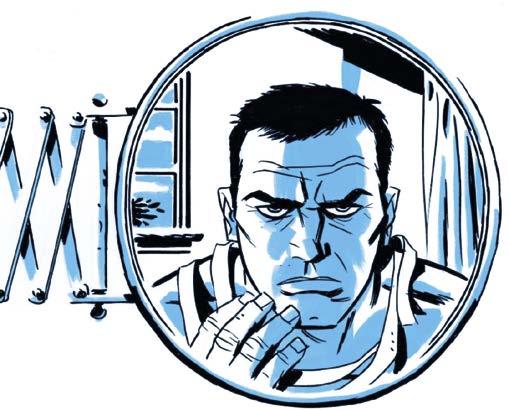
Darwyn: Palance was Westlake’s only visual reference. When I changed Parker, the idea was always to use plastic surgery as a metaphor for his emotional regression. He’s meant to look like a rawer, more stripped down version of himself. There was no one specific in mind here — it was more an exercise in imagining what could be done to alter the face I’d already designed. I thought about the surgical procedure back in 1962. Chemical peeling and less nuanced procedures just took my imagination to a more cut up, severe looking version of the man from The Hunter. His jaw, and most importantly, his eyes, are the same. The rest is meant to reflect a man drained of things like remorse and compassion. A loveless, unadorned man.
Tucker: There are only a few more days before the world gets a taste of The Outfit. How are you handling things?
Darwyn: Man, I’m forcing myself to relax. It’s always a weird week, that last week before a book drops. You’ve been done with it for a couple months, but you still don’t know if it’s any good or not yet.
Tucker: Who has seen it so far?
Darwyn: Some of the usual suspects. My editor, Scott Dunbier, as well as everyone at IDW. George Gustines at the New York Times, Geoff Boucher at the L.A. Times. Everybody in f*cking Britain.
Tucker: Yeah, I saw that reviews had started pumping out of there. I’m guessing that wasn’t planned?
Darwyn: Nope! Over here, Diamond holds the actual release a week so that bookstores can have a fair shake, because bookstores get it a week later. That apparently didn’t get through to Britain.
Tucker: Selling them early in Britain still has to be a better problem than what happened when The Hunter was released in the U.S.
Darwyn: Yeah, I know.
When The Hunter came out, it was right around Cinco De Mayo and they had one of those “heightened terrorist activity” alerts going on. So the container with the f*cking shipment of books was stuck in the port. They held it for “inspection,” and we didn’t have copies of the book for the first ten days. Meanwhile, there’s the New York Times review sending people looking, and nobody could get a copy. Hopefully we’ll have what we need this time.
Tucker: And after that, there was a pretty long period of time between when the first printing sold out and the second printing arrived.
Darwyn: Yeah, nobody expected what happened there. Nobody did. We literally printed 40% of the pre-orders as overage, which is pretty unusual. Over at DC, they usually stick to a 10% overage. Ted [Adams, IDW’s CEO] took a pretty courageous investment by overprinting the way he did, but they were gone within a week. Nobody expected that. We had to start all over again in Korea. That delay hurt, too.
Tucker: Do you know how much you overprinted this time?
Darwyn: Hopefully enough, right?
Tucker: Well, and you hope people know what they can sell this time.
Darwyn: Yeah, I don’t know how they factor out their thresholds or what they expect. You just want to have copies in stock. At the same time, selling out in a quantity you didn’t expect isn’t a bad thing. [laughs] What’s most import-
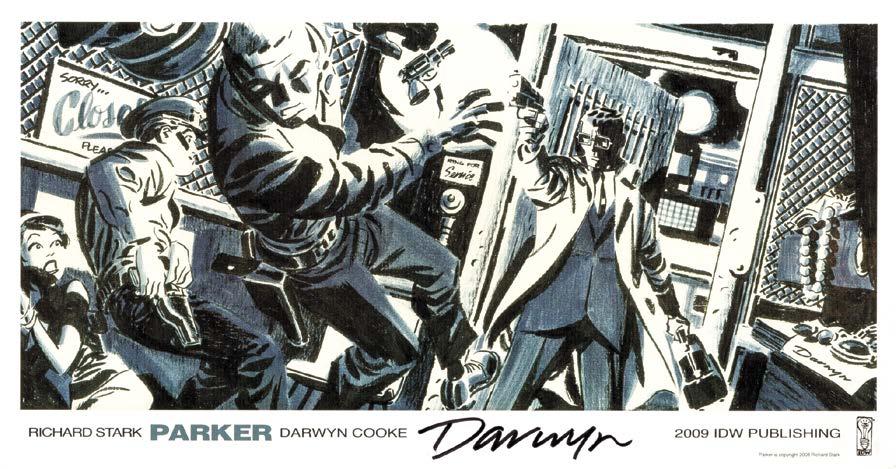
Below: In the later ’00s, a series of prints were released by IDW to foster buzz for Darwyn’s series of Parker adaptations, a task which the cartoonist surely relished.
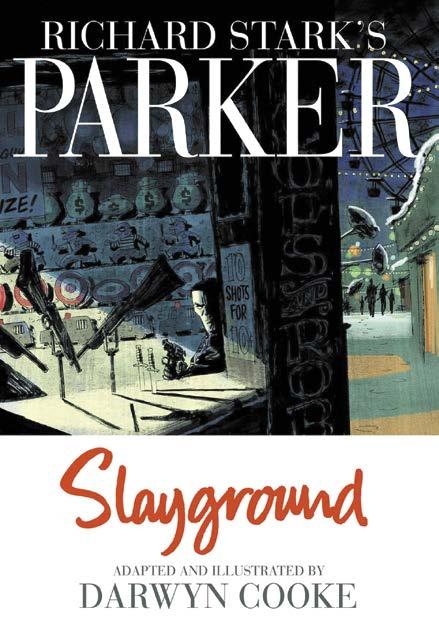
Above: The fourth and final volume of Cooke adaptations of Westlake’s Parker books was Slayground [’13].
you’re feeling. He doesn’t think “bad” or “good” of you. He doesn’t think of you at all.
Tucker: I don’t remember which book it is, but there’s one with a girl who can’t get over the fact that he constantly views her with no emotional reaction. She needles him, he doesn’t react. He doesn’t love her, hate her, anything. He’s completely numb to her.
Darwyn: I think that’s a big part of why he’s such a compelling character. Any reader can template anything they want onto him. Even a contemporary reader, even though there’s a lot of misogyny being templated on him right now. And that’s valid. They don’t shy away from that in the books. But he remains a compelling character, even in different social times.
Tucker: It’s something that comes
up a lot. That’s a consistent fascination, it reminds me of the way you described young men having fascist tendencies. Those kind of characters, masculine characters that don’t permit any type of emotional reaction to interfere continue to engage audiences. Characters that aren’t faking the disconnect, because they’re fictional, so they don’t have to fake it. People in charge of not having feelings. They don’t get upset, or lustful, or angry — emotional states don’t dictate their behavior. The guys you see in every Michael Mann movie ever made.
Darwyn: There you go, that flips my switch. The movie that changed the way I see all this shit was Thief. I saw Thief in the theater when I was very young, and it just blew my f*cking head apart. That Tangerine Dream music, the cinematography, the whole approach to it. Some of the dialogue feels a little purple now, like when you’re re-reading Dark Knight Returns. But man, that f*cking movie re-energized my entire interest in this stuff.
Tucker: The heist in that is your classic Westlake style heist. Ripped off from reality, copied as realistically as possible. Mann apparently hired real safecrackers to program that scene, the one where they burn through the vault with that… I can’t remember what you call it. Some kind of carbon fiber, maybe…?
Darwyn: Yeah, the burning bar. It’s an arc-welding stick, but it’s gigantic. But, man, that guy. He’s used that like three times. I loved his show Crime Story. I loved it.
Tucker: Even in things like Last of the Mohicans or Jericho Mile, when Mann’s out of his comfort zone, he always returns to those same Stark-like characters. Tasks are treated as craft, everything is technical. His guys always sacrifice emotional life in the service of whatever it is they do.
Darwyn: Well, these characters make decisions in a fair exchange within themselves. It’s saying, “I’m not a good enough person to be true to those things.” So they’ll be true to the one thing, they find that one thing, whether it’s sheriff, ordained minister, or safecracker. I know that, for myself, a huge part of what fascinates and attracts me to these books is the notion of a guy who has figured out how to operate parallel to society. Without having to take a lot of the sh*t that comes upon him. To me, that was a huge part of the attraction. I love the notion of Parker, this guy who is smart enough to have this life set up in Miami and he just ventures out three or four times a year to do his thing. And then he comes back quietly, to live his life. Outside of all the bullsh*t that everybody else has to deal with. I thought that was an incredible concept when I was younger and just reading the books. The kind of guy who doesn’t answer to anybody but himself — I just found that admirable. Again, he’s a fictional character.
Tucker: That’s gotta be part of the reason it remains attractive though, that’s why it survives. You look at the world today, and it’s a place where being a jack of all trades is the goal, you’re supposed to have your toe in everything, to have a relationship with everything available. Characters like Parker, living outside the mainstream, wholly committed to one thing, to being a perfect heist man — it’s against what’s expected, it’s become an ideal. In a way, I feel like Grofield is more representative of who we are now, someone who has and purses all kinds of different interests.
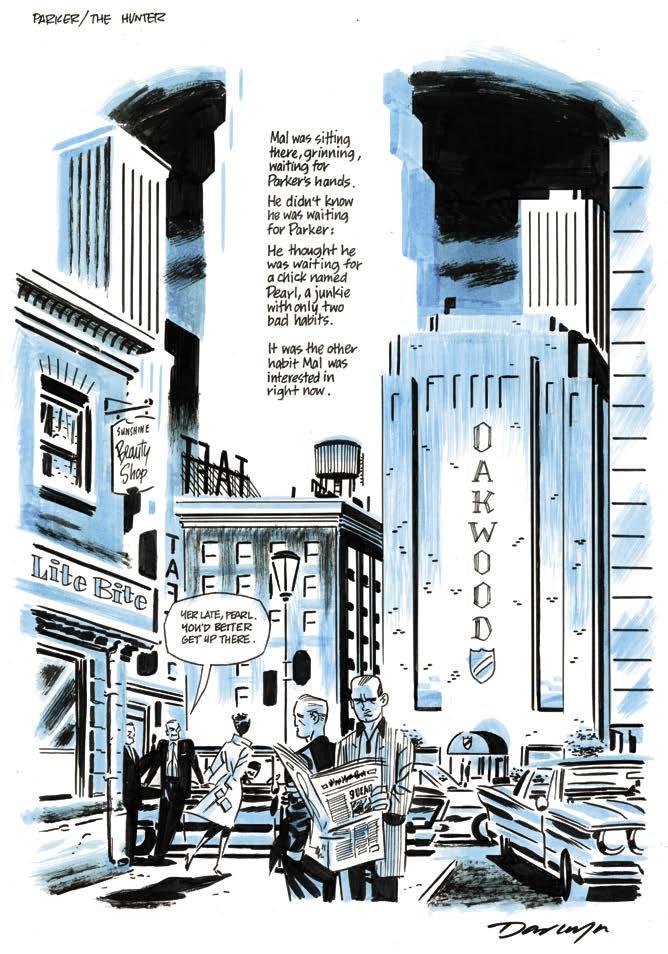
Above: Evocative full page, the opening of Book Two, in The Hunter.
Below: Single illustration full page from The Outfit, where Parker’s surgically altered face is revealed.
Parker TM & © the estate of Donald Westlake. Art © the estate of Darwyn Cooke.
2015
Darwyn Cooke on Some Other Stuff
Excerpts from a comic con panel talk with the cartoonist discussing a controversy or two
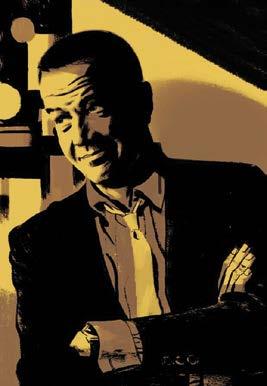
Above: Darwyn Cooke self-portrait.
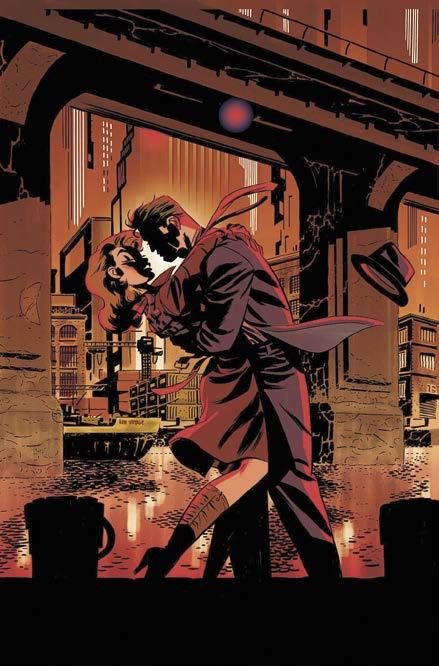
Inset right: Woefully neglected in this issue is Dar’s version of The Spirit, which ran between 2007–08. This is his cover art for #12 [Jan. ’08].
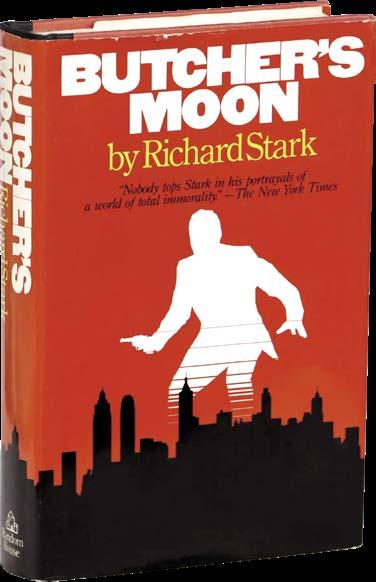
Below: Hardcover first edition of Donald E. Westlake’s Parker novel, Butcher’s Moon [’74], the 17th entry in the series, and the entry Darwyn wanted deeply to adapt as his last graphic novel starring the character.
[Editor’s note: As there were projects not discussed in the previous interviews, what follows are excerpts from an April 5, 2015, WonderCon spotlight panel discussion hosted by Ron Richards, Josh Flanagan, and Conor Kilpatrick, where Darwyn Cooke shared some fascinating insights, his remarks made a little over a year before his passing. — Y.E.]
PLANS FOR PARKER
There will be more Parker. Again, I’ll get you a straight up answer. I was so excited about the Parker work and so thrilled to be doing it and it actually was successful. I was supposed to do four books over eight years. That was the contract and I ended up doing four books in four years. And the problem was, by the time we got to the fourth book, there’s a point where you start to become that thing that’s just there and all the excitement or anticipation had gone out of it, I think… So I thought, “You know what? It’d be a good idea to put the brakes on for a couple of years and just let people maybe miss him a bit before we get back to it.”
And I am not sure there might be two more; there might only be one more and then who knows what the future holds because, frankly, I can see Parker and I getting along for as long as I can hold a pencil. But he will return, but it probably won’t be ’til 2016.
Slayground is an interesting book. It’s my favorite book out of the entire series because it’s the one book where we see Parker in these books in all kinds of situations, pulling all kinds of robberies, but Slayground is the one book where he’s left alone with nothing but his wits, and he’s trapped in a spot where there are two groups of really bad people trying to find him and kill him and he’s got nothing but his brain and the things he can find on the ground to pull him out of it. So it’s an amazing book, but it didn’t have the depth of character or backstory or the need to be as long as the other ones. And the last one I’m going to do is going to be Butcher’s Moon, which is probably the masterpiece out of the books and you can’t do Butcher’s Moon without Slayground because they connect. Butcher’s Moon addresses things that happen in Slayground. So I knew I had to do it, but I thought this is more of a roller coaster ride than it is a complex or layered piece of work. So I decided to go with something shorter and faster.
AS ENTERTAINER
I refuse to call what I do art. I think I’m an entertainer. If there’s art to be found, someone else can sort that out later. If you end up good at something, then that’s what you do, that’s who you are. You tend to get typecast — and I’m not bitching about that, I feel very lucky — but you do. You tend to not get offered work unless it’s something you’ve done before. DC never calls me up to do anything different. They call me up when they need a Silver Age riff or an old-timey thing and, other than that, I get offered crime work… Grant Morrison wanted me to work on Multiversity. So. of course. he offered me the story of the Golden Age heroes… And I wrote him a very nice thank you. “I’d love to work with you someday, but I’m not doing anymore of that and I’ve already done it”… I certainly don’t want to be that guy and I am that guy, so trying to break out of that mold can be difficult and the crime stuff is just, it’s my favorite type of fiction, my favorite type of film…
I was lucky that when I did get my second chance to get back in this business, I had a lot of understanding of the way things work and, getting back into comics, I was reading everything about everything and it became clear that, at the time I was breaking in, it’s a writer’s medium and that
THE CARTOONIST
the writers controlled the books and the approach and the way things were being done. And, at that point I had only considered being an artist, but I thought, “You know what? I should try to write as well because if I can, then I’m going to be able to control my destiny a little better.” Usually you break into the business and then they’ll give you a book like Blue Devil to do for a year and you cut your teeth on that and you’re given a script and you draw it and you hope you’re going to get something better.
And I was already an old man and I thought I’ve got to find a way to leap past that part of this. So by writing my own material, it gave me that much more control and the ability to guide what I did. I sort of did it because it just seemed like the smartest way to get where I wanted to go as quickly as I could and that has a lot to do with it. But yeah, working with a great writer is a real pleasure and I was lucky early on I got to work with Brubaker on Catwoman and we’re great friends to this da. That was just a perfect combination, the two of us. And the other guy I got to work with back then that really impressed me was Peter Milligan on X-Force…
Even if the guy’s not in the room with you, like when I did The Spirit, I’m working with Will Eisner. I’m not trying to abandon his work; I was trying to find a way to bring that to a new audience so even though he wasn’t there, he’s kind of there at the table with me and the same is true with Parker. It’s not like I wrote that stuff out of my head. I’m working with another writer’s work and while we may not be on the phone talking about it because I don’t have a phone for the dead, he’s there with me. We are collaborating. So, actually, if you really look at it, I don’t think I’ve done very much work on my own.
[Darwyn is asked what label he would give himself.] A cartoonist. I love that word. There’s this real dick in the business, a writer I know — a real dickhead — and, god, we got into it about all of this one time through the email and he sent me an email saying, “Who the f*ck do you think you are? “ Blah, blah, blah. “What gives you the right to…” blah, blah, blah? Who the f*ck do you think you are? And I just wrote back, “I’m a cartoonist, asshole. I do what you do plus four times more than that. I have an entire skill set and lifetime of ability that you don’t even understand. You’re a writer. I’m a cartoonist. That’s who I think I am.”
CREATOR-OWNED
[Doing creator-owned work] It’s just been a matter of delay after delay after delay. If we go back to, I think it was 2005, when I did Solo for DC… If you look on the back cover of solo, you’ll see a picture of Slam Bradley walking away into the distance and that was going to be my last mainstream book. At that point, I was going to go into creator-owned and start doing my own work and the problem is they keep dangling these shiny things in front of you. And I remember I was, like, three weeks into getting my own thing together and I got the call saying, “Look, we’re doing The Spirit and, if it’s not you, it’s going to be somebody. And it was like, “God, I can’t let this go.” And you also get into this ego thing, like, “It’s got to be me, whoever else does this is going to screw it up.”
So next thing you know, two years go by, and then there was the whole Watchmen sh*t show, right? And again,
it was like something I’d never thought of doing, but once the opportunity came up, it was such a monumental challenge that it was like hard to say no to it. And Parker was my first step into this area we’re talking about and again, I’m a pragmatic guy and I know a lot of friends who do incredible creator-owned work and, at that point,in ’08, ’09, you’d see them doing these brilliant books that were selling 3,000 copies, 4,000 copies. And I thought, “If I’m going to break into this area, I’m going to go in there with somebody and that’s when the Parker thing all pulled together in my head. I thought if I can go into this with Donald’s audience and my audience between the two of them, we can probably not lose money on the thing.
And so that was my first step and I got so carried away with Parker that these other things have kind of just been sitting and percolating and there have been things that just didn’t happen. I had a story idea about four years ago that I have it sitting at home and I loved the thing and I came up with the idea and I thought, you know, I’m not the guy to draw this. Paul Pope’s got to draw this. Paul’s a buddy of mine, so I send him the story and he writes me this long email back, telling me how great he thinks it is. And, at the end, he says, “I really hate drawing cars and motorcycles, so no, I’m not going to do it.”
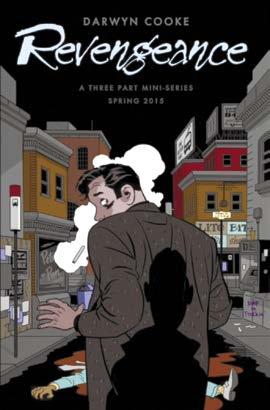
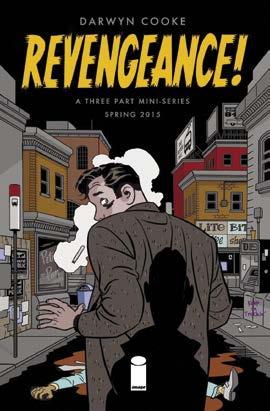
These things end up sitting around and accumulating. Actually, Revengeance: four years ago, Tim Sale phoned me and wanted me to write a book for him and I’d come up with this story that I thought was perfect for him and he loved it and, Tim being Tim, he said,” I just got to finish up Cap[tain America] for Marvel and we’ll get right on this.”
So last week a buddy saw him at Emerald City and he said,” Tell Darwyn I’m almost done [with] Cap and then we’re going to get to that.”
[This] was five years ago and when I realized it’s like now or never I’m going to do this when I looked at everything I had, that was the story that
Above: Revengeance was a mini-series initially conceived of being written by Darwyn and drawn by Tim Sale. The story was about “a young, liberal, nonviolent sort of party guy who ends up having something so horrible happen… He’s going to find who did it and kill” the perpetrator, as Dar told a convention crowd. But Tim couldn’t commit, so the three-issue series was to be drawn by Darwyn. Alas, illness prevented the Image title from being finished. Here are two versions of the cover for #1.
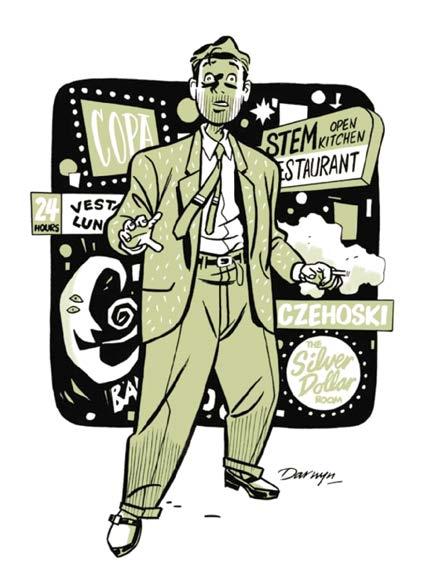
Below: Promotional art for Revengeance, a storyline set among real-life establishments in Darwyn’s hometown of Toronto, Ontario.
tales of the superman club
Dar’s Canadian Comrades Recollect
We keep the testimonials all-Canadian as the Superman Club and other pals remember
[
Editor’s Note: In preparing this special Darwyn Cooke issue, instead of asking for reminiscences and tributes from the entire comics community, I thought to narrow the field a little, and keep it to just Canucks. In keeping with CBC’s expanded theme that included additional Canadian subjects, I decided to ask for contributions from just his fellow countrymen, those who were part of the Toronto comics community (and another from a Halifax buddy, plus a special Scottish lass). Some submissions were written, though a few were derived from phone chats I conducted, then edited and included here with the participant’s approval. Special thanks to Michael Cho who shared a list of names of Cooke buds to contact, and to Janet Hetherington, who solicited a few contributions for this issue. — Ye Ed.]
Mark Askwith
versations at tables, panels, and informal gatherings frequently turned to Cooke’s influence. His career was an inspiration to many cartoonists navigating the space between independent publishing and mainstream markets.
Michael Cho, Bryan Lee O’Malley, and Peter Birkemoe all emphasized Darwyn’s role as a bridge between communities. He moved fluidly between animation, mainstream comics, and literary graphic novels. That versatility resonated strongly at TCAF, which prides itself on inclusivity across genres and styles. His death prompted reflection not only on his body of work, but on the standards he set: clarity of vision, respect for craft, and a belief that comics could be both entertaining and meaningful.
Darwyn Cooke’s death on May 14, 2016, shocked the comic book community, and nowhere was that grief more visible that day than at the Toronto Comic Arts Festival.
Darwyn was not only a frequent presence at TCAF, but he was a symbol of what Canadian cartoonists could achieve on the world stage. That morning, the first day of TCAF, his death transformed the Toronto Reference Library into a site of collective mourning, remembrance, and gratitude.
Although best known for his mainstream comics and graphic novels, Cooke strongly supported the broader comics community, including independent and alternative creators. His admiration for clear storytelling, strong design, and respect for comics history aligned closely with TCAF’s mission to elevate comics as an art form.
I was covering the Festival for SPACE, the Canadian science fiction and fantasy channel, that morning, a few hours after I learned that Darwyn had died. Although I’d attended every TCAF, many of them with Darwyn, nothing prepared me for the grief. The Festival was held at the Toronto Reference Library that year, and not only had Darwyn and I spent hours together there, but Darwyn told me that his father, a construction foreman, had installed the glass windows.
That day, many of Darwyn’s friends shared deeply personal memories of Darwyn with me, both on camera, and privately. Con-
In the years since, his legacy is still present at TCAF through discussions, panels, and the sales of his books. For many of us, Darwyn’s death marked the loss of a role model who embodied artistic excellence, integrity, passion, and an unwavering belief in the power of comics.
[Mark later shared with Janet Hetherington a more personal remembrance, which follows.]
The first time I visited his home he showed me the first chapter of The New Frontier. I was impressed. We talked a lot about our love of the DC war books. When Darwyn mentioned that he was researching the Mercury missions, I lent him my Life magazines, a copy of a book about the Mercury astronauts called We Seven, and a slew of NASA videos.
Darwyn’s home was a Man Cave. A whole room was devoted to his G.I. Joe collection. He had several pieces of framed comic book art, including two stunning original Alex Toth pages hanging above the living room couch. On the crammed bookshelves were dozens of comic book reprints and graphic novels.
We spent countless hours discussing our mutual love of animation, illustration, and comics. We enjoyed many of the same creators, especially Will Eisner, Alex Toth, and Jack Kirby, and we discussed how they had explored the unique storytelling possibilities of the medium. These creators were among the first to acknowledge that the reader is in control of the pace, so the reading experience is very intimate. The page is valuable real estate, and every panel, every gutter, every word balloon should, and must, contribute.
MARK ASKWITH is a writer, interviewer, and TV producer who has covered science fiction, fantasy, and comics for over 30 years. He created award-winning TV show Prisoners of Gravity and is a founding producer of SPACE, Canada’s national science fiction channel. Having interviewed many creators, including Stan Lee, Will Eisner, Jack Kirby, Alan Moore, Terry Gilliam, and Margaret Atwood. His graphic novels include Silencers and DC Comics’ authorized sequel to The Prisoner.
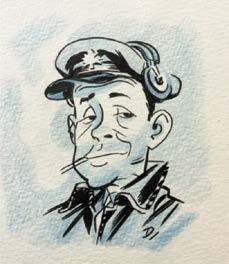
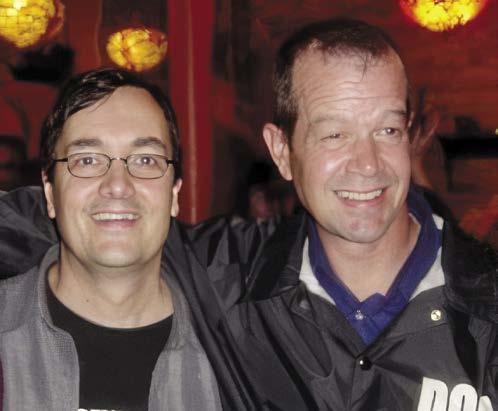
Below: Mark Askwith (left) and his buddy Darwyn in an undated pic. Inset above: Another Darwyn Cooke self-caricature.
Self-caricature © the estate of Darwyn Cooke.
J. Bone
I used to work in animation and I heard about Darwyn because people had been sharing some of his early work. Somebody had photocopies of that Batman story [“Deja Vu”] that he ended up redrawing for Solo. So I knew about him through that and then I met a guy at a comic book shop who said, “Hey, you know who you should meet? Darwyn Cooke.” And so then I met Cooke through a mutual friend, Steve Manale. They had just started a studio together, and that’s when we hung out, I got to learn from him, drawing, dealing with editors, all that kind of stuff. Darwyn had already gone down to work on Batman Beyond for Warner Bros. and Men in Black for Sony, and then came back to Toronto. At the time I met him, he was working on Batman: Ego and he had the rough pitch together for New Frontier
Did we hit it off? I think so, yeah. Darwyn is a tough guy to get to know, but I’m also a sarcastic ass. I remember that I made a few jokes at — not necessarily at the expense of his artwork — but I made jokes about it. And I remember he turned to Steve Manale and said, “Who invited this asshole?” And I was like, “Oh God, this might be the end.” But, for Darwyn, that was like, “Nope, you’re in.”
He was tough and he was strict about his own art and he wanted you to be equally true to your own work. When it came to art, he was never late and he wouldn’t accept you being late. And he taught me not to make excuses. If I’m going to be late because of some reason, tell the editor when the work is coming in. Don’t give them your bullsh*t excuse, whatever it is. It doesn’t matter what the excuse is. Just let them know when they’re going to get it if you’re going to be late. So I learned that from him, but the main thing was just don’t be late, just do the work because usually you’re given enough time. So I learned discipline and all of that from Cooke.
But, personality wise, he was tough, he was gruff, and all of that stuff. But, like most of those gruff guys, there was a soft heart underneath there. Sometimes he might say something that would piss you off, but he would always call the next day to say, “Hey, I know the thing I said upset you. I’m sorry about that. “ And, yeah, I think that was a thing that not a lot of people saw with Darwyn, because it was so easy to just go, “Oh, this guy’s a tough talker, rude, offensive, all of those things. I never want to see that guy again, I never want to talk to him again.” They never got the apology. So he could sit and reflect and go, “Oh, yeah, I upset that guy.” But, genuinely, there were also people that he was like, “I don’t give a sh*t that I upset that guy. Screw him.” And there are stories of that out there.
Still, even though you were his friend or someone he perceived as in his circle of friendship, when it came to professionalism, he was always like, “Always be professional, and don’t take my friendship for granted when it comes to the work.“ Everybody had a falling out with him at some point in time and it comes down again to professionalism
because, well, I certainly pissed him off. I was his friend, but there was a time where I was like, “Oh, I’m going to be late with this thing.” He’s like, “Don’t do this to me. Just don’t be late because you’re f*cking me if you do that.” I was like, “Oh yeah, but I’m your buddy. I’m allowed to be late.” No.
Cooke saw comics as very unprofessional because people had the attitude, “Oh, well, a book is late.” He was like, “Well, no, if the book is going to be late, you fire the guy who made it late and you make the guy who can bring it in on time, he should be the star.” But that’s just not the way it worked in comics. And I know that was always a thing for Darwyn… not necessarily a sticking point, but certainly a problem he had with comics as a whole industry.
The first work we did together was I had inked him on some production artwork. He was doing licensing art for DC, a bunch of super-hero poses — Batman, Martian Manhunter, Superman, etc. — and he had me ink those as a test. “Was I good? Did we work well together? Could I meet the deadline?” All those sort of things. And then we did the Spider-Man Valentine’s Day story in Tangled Web. I
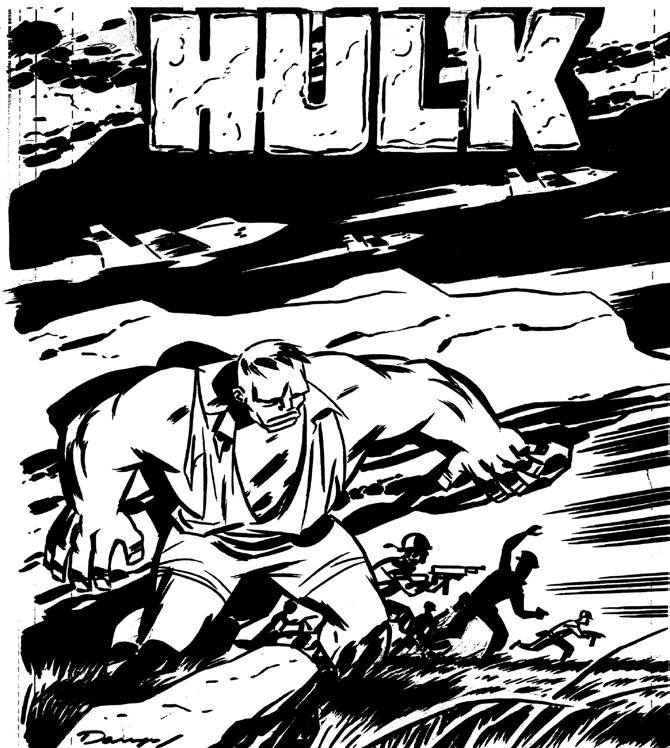
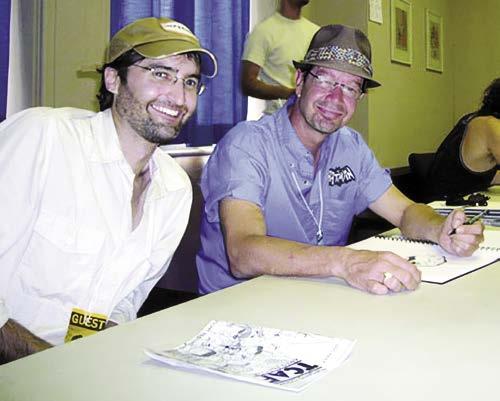
Above: Darwyn channeled his inner Jack Kirby for this presentation art. Rendered to pitch a series of children’s books starring the Marvel characters, it was one of a number of concepts that were accepted by the House of Ideas but later plundered for a similar project, without credit or renumeration to Dar and his friends. Below: Jay Bone (left) and his buddy, Dar, at the 2007 Toronto Comic Art Festival.
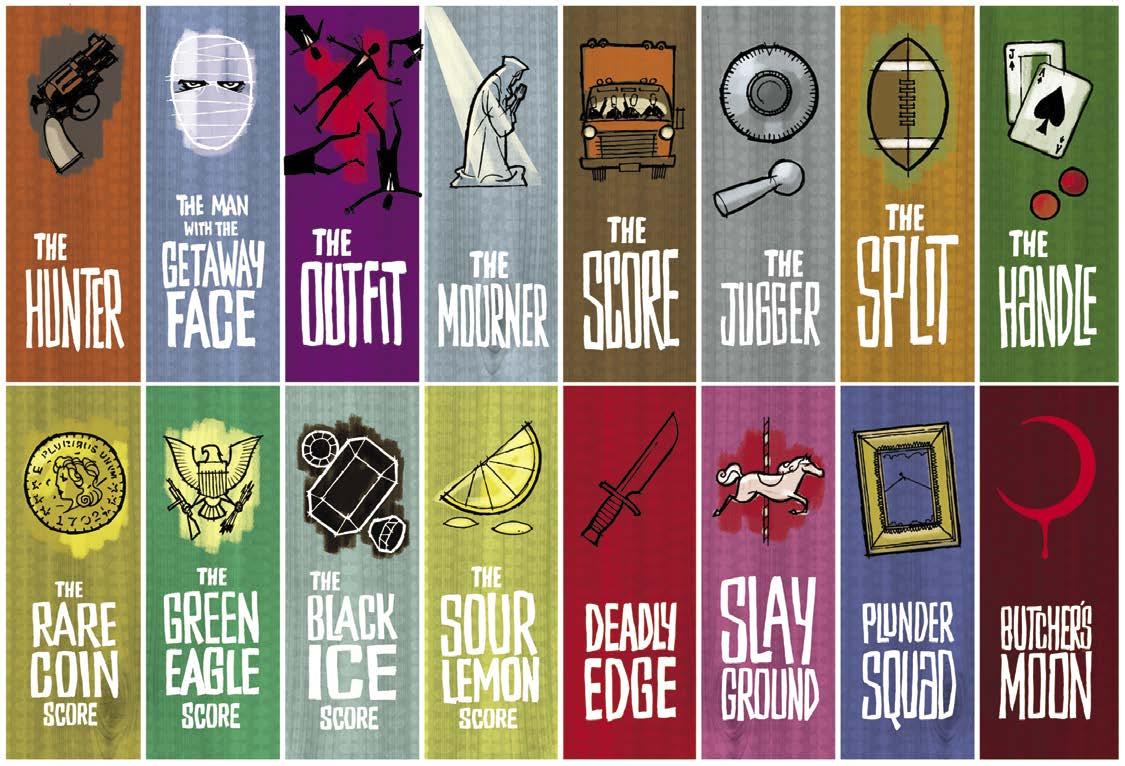
Above: No doubt to tantalize his fans as well as psyche himself up in the process, Darwyn created these icons indicating the order of his proposed run of Parker graphic novels, ending with the adaptation he planned as his final effort featuring the anti-hero, Butcher’s Moon.
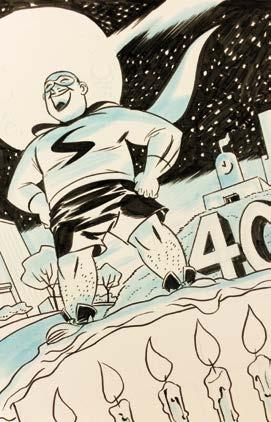
Below: For Calum Johnston’s 40th birthday, Darwyn drew up this celebratory illustration for his Halifax comic shop proprietor pal.
Florida and Toronto, just to talk to people at the table while he’s signing or drawing stuff, with me answering questions, moving people along, un-bagging things, just trying to be a help. I got to observe that Darwyn was always such a gracious guy and a real character. But, of course, there’s been lots of tales about him, over the years, where he’s just been blunt. I mean, he’s a professional guy. He came into comics late in life, doing it as a profession, and he could be blunt when people were rude.
Ever heard the tale of the guy who insisted on having a Batman sketch after Darwyn said he wasn’t doing any more Batman sketches…? At one show, Darwyn put up a sign at a show — and this is the third day of doing free sketches and taking donations for the Hero Initiative — and he was just tired of drawing Batman. So he puts up a little sign that said, “Anything but Batman.” It’s a bit of a gag, right? But one guy is just so indignant, insisting on Batman, and, Darwyn, he didn’t even get really rude. He was laughing about it. He’s like, “ You can’t believe what’s going on,” and he still said no. So, as the guy storms off, Darwyn shouts after him: “Hey, remember to always tell the story that you turned down a free Darwyn Cooke sketch!”
He had a nice rapport with children. That time he came with J. Bone, I arranged the publicity. We’ve done some advertising and one of the local TV stations wanted to do a segment on the morning show. I told Darwyn, “How about I bring you to my daughter’s school and you could do an art class with kids in kindergarten to grade one?” So the TV crew came and there was a dozen or so kids, and Darwyn and Jay talked about just how they make a living. They drew on a
big whiteboard and the kids were shouting out, “Draw Harry Potter!” “Draw Harry Potter getting eaten by a snake!” “How do you draw Spider-Man?” Then it just degenerated into everyone sitting down and the kids lying on the floor drawing, and Darwyn is doodling with some kids, showing them how to draw cars. It was hilarious.
Darwyn would also come to our Free Comic Book Day events and Strange Adventures won a Diamond Award for having crazy FCBD events because we didn’t even have it in the store after the first two or three years. We rented a church hall down the street because we’d have a line down the block and we’d go through our own backstock and collections, and then order lots of the special FCBD stuff and then we’d have local artists do drawings for kids, and Darwyn would be there just knocking out sketches for kids.
I heard that for one FCBD, at the Silver Snail, in Toronto, he was doing drawings for kids and a little kid comes up to him and says, “Can you draw SpongeBob?” And Darwyn just looks him straight in the eye and goes, “Let’s find out.” He got some reference and does a good drawing and the kid looks at it, gives him an affirming nod, and Darwyn said later, “That was the best approval I’ve gotten in years.”
He was always really good with kids. He just spoke to them like people.
I knew he had lots and lots of ideas that were never realized. There was a great story that he’s pitched to several artists — I know he was talking to Paul Pope about doing this — and then the last idea was because they had such a great time working or he enjoyed doing Twilight Children so much with Gilbert was the idea was he has this story of
All courtesy of Calum Johnston. Art © the estate of Darwyn Cooke.
the end of the world. It involves the giant nickel in Sudbury and a little bit of Miracle Mile, and the idea was maybe Gilbert would draw it from Darwyn’s script as a sort of reversal of what they did on Twilight Children.
With Marvel, Darwyn wanted to do so many more Spider-Man tales, as he and Jay had ideas for every holiday. After the Valentine’s Day tale and the Christmas issue, there would be a St. Patrick’s one and then other holidays. Just stories themed around a holiday weekend for a series of one-shot comics. And remember the cover he did for The Overstreet Comic Book Price Guide with Captain America…? Can you imagine an Invaders mini-series by him? He would’ve just knocked it out of the park! He loved all the Marvel characters. You remember that month-long run of Darwyn’s covers at DC? The Nightwing one started out as a Nick Fury drawing! But what happened with his whole idea of the “Marvel Kids” pitch ended the relationship because they just took it away and didn’t pay for any of it, and he wasn’t even looking for anything for himself. He was like, “Look, friends of mine put a lot of work into this. Give them a kill fee.” And they’re like, “No, no, we’re not using it.“ Then they wind up using so many of the stuff from it. That just soured him on them entirely.
I know he wanted to get to the [Parker] Butcher’s Moon adaptation. It was going to be amazing. He had to get Slayground out there first, in order to get to Butcher’s Moon, but you’ve seen probably in some of the Martini Editions, he had sort of iconography done for all of the volumes and he started in on the paintings for more of the prose reproductions of the novels. He was just so happy to be working in the world of Richard Stark/Donald Westlake and he had so many more ideas for it. At one of our launch parties, we did up pens, little retro click pens as if they’re from the Tourism Bureau in [The Score locale] Copper Canyon. We did up martini glasses with Parker on them. He just loved that kind of stuff. He did up a little enamel pin of the silhouette of Parker.
Darwyn loved to promote his projects — the lobby cards, prints, little portfolios they did, retailer incentives, all those things — and he was so into trying to market things and approach things in a different way. The Man with the Getaway Face having the different editions of it. It wasn’t a money grab… I’m sure it made money, but it was a very inexpensive way to get the thing out there and it made a mark. It was this giant oversized comic and people
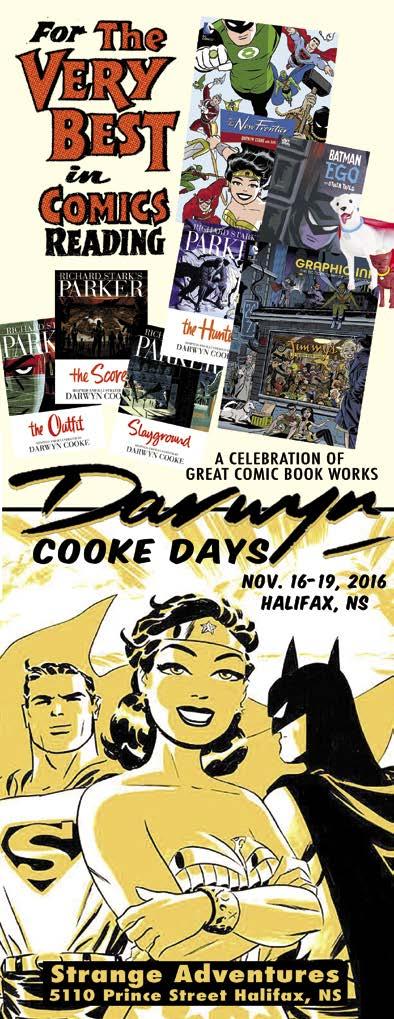
were like, “What the hell is this? “ And it was so short, but it was still a really good, concise tale and all it does is make you go, “Well, I want to read more of this!”
With Before Watchmen, he knew it was going to be a bit of a controversial thing and he had some really cool ideas. Then, working with Amanda Connor, she was the one who came up with that idea of the Comedian getting the happy face button from Silk Spectre in the mini-series Darwyn wrote and Amanda drew. He really enjoyed the collaboration and you should realize Before Watchmen also helped pay his mortgage — he had a house in Florida and his house in Nova Scotia — and he put a lot of work into them both. He built on decks and little extensions and a shed. He was incredibly handy.
I stayed in his Florida place, in a beautiful location, in Safety Harbor, near Tampa. Which he chose largely because he knew Jimmy Palmiotti so well — Jimmy and Amanda — so it was like just hanging out with pals, and so many different people would come through Orlando from different shows then they’d drive through to Safety Harbor and hang out with those guys for a bit. I got to go down and be his booth babe at a show in Orlando and it was a really great time.
What do I remember best? Just that Darwyn was a really decent guy who loved what he did. He was incredibly talented and was always willing to share. He’d be in the shop looking through some books, somebody happened to be picking up one of his books, and I said, “Hey, would you like that signed? The guy’s handing right over there.” He’d come over, chat with a person for a little while, autograph it, and they’d just have a wonderful discussion. It just gave everybody a thrill who met him.
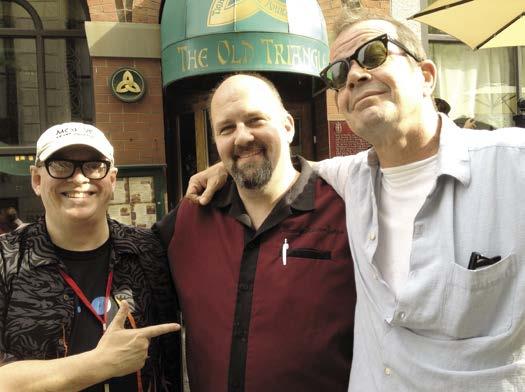
One time, he’s doing a signing in Florida and someone asked for a Batman drawing. He was drawing it and said, “Oh, I made the cape too big. It’s going to take a while to black this in. “ Then he just hands the guy a big marker and says, “Here, you black in this part here.” And so the guy is sitting down and drawing along with Darwyn on this Darwyn Cooke drawing.
And, for me, the biggest thrill in my life was getting a dedication — “This one’s for Cal” — and mention in the “thanks” page in The Outfit and then show up as one of the heist-men in The Score as “Dan Wycza”!
I got a sense of that Darwyn was having a health issue right around January of the year he passed. I was down visiting him because he had just
This page: At top, Calum Johnston had this poster made up after the passing of his good friend to promote the first “Darwyn Cooke Days” celebration at his Nova Scotia comic book shops. Above is, from left, Canadian artist Ken Steacy, Calum, and the big guy himself.
canadian pioneers
Four Founding Comics Creators
Recognizing the Canadian comic book contributions of Stables, Dingle, Furness, and Rae
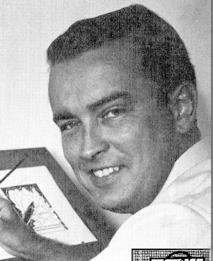
Above: John Stables — who would use the clever nome de plume, Jon St. Ables — became art director at Maple Leaf Publishing, which boasted a handful of comics titles, including Bing Bang Comics, Lucky Comics, and Rocket Comics
Inset right: Stable’s best-known creation was adventurer Brok Windsor, seen here in the splash page of his debut adventure, in the longest-running Maple Leaf series, Better Comics V3 #3 [May ’44].
Below: The first issue of Better Comics, cover dated March 1941.
by IVAN KOCMAREK
[Editor’s Note: Realizing a mere 160-page issue devoted to luminaries of Canadian comics — with nearly half of the publication focused on a single talent — leaves little room to be comprehensive and zero chance of covering more than the merest fraction of those who contributed to the comics of the Great White North. So, without (too much) apology, what follows in the remainder of this issue is coverage of a wildly diverse group of creators and publishers arbitrarily selected by yours truly, folks I have long had an interest in learning more about. To begin, Canadian comics historian Ivan Kocmarek gives us a look the form’s start up yonder. — Ye Ed.]
The first Canadian comics were born out of a war and lasted only a little longer than that war itself. They were war comics in the truest sense of the word. Over a year after joining in the fight against Nazis in Europe, Canada had become concerned about its down-turned economy. In December of 1940, Canadian Parliament enacted the War Exchange Conservation Act, which stopped products it deemed unessential to the war effort from coming into Canda from the U.S. Parliament didn’t want our dollars going south for things like comic books and candy bars when they could be made at home to bolster our own war-time economy.
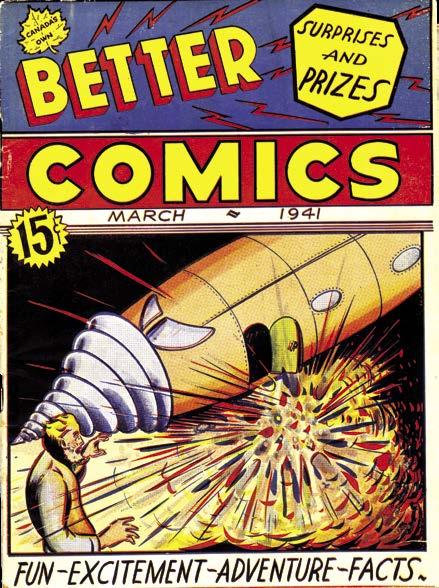
By the time 1941 arrived, there were no new American comics on our newsstands, and some enterprising Canadian printers and publishers anticipated this and, by the start of February, our own Canadian comics started appearing on shelves. Four main comic book publishing houses were established over the next couple of years in Vancouver, Toronto, and Montreal. However, these companies didn’t have access to proper (and more expensive) four-color printing equipment and, of the 800 or so individual comics produced over the six-year window (1941–46), about 85% of them had only black-and-white interiors. In this short survey, I want to look at the main creator/art director from each one of these four companies, though not one of them were born in Canada.
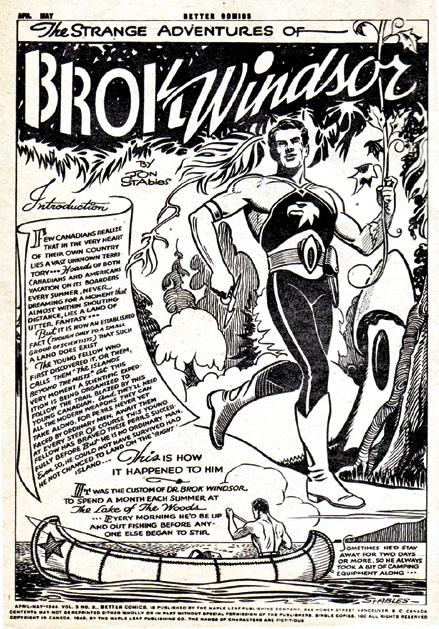
JOHN STABLES/MAPLE LEAF
John Stables [1912–99] was born just a couple of days before Christmas, in Ulverston, England (coincidentally the birthplace of comedian Stan Laurel). His family came to Canada when he was seven and they settled in Winnipeg.
Stables left school after grade nine and, by the time of his late teens and start of the Great Depression, he began to find sporadic work in newspapers, magazines, and in a variety of commercial art and sign-painting fields in and around Winnipeg. He took his talents to Victoria, British Columbia, in early 1942, where, in the middle of May, Stables married his Winnipeg sweetheart, Esther Anne Biggar. Later that year, on a trip with his wife to Toronto, he met Harry Smith, Vancouver bookstore owner and owner of the fledgling Maple Leaf Publishing company and Harry encouraged the cartoonist to come and work for him when the newlyweds returned to British Colombia.
By mid-’43, Stables moved with his wife from Victoria to Vancouver to work in comics. He was 30 and, like most of the country’s comic creators of that era, Stables wrote, penciled, inked, and lettered his stories himself. He quickly started signing his comic book stories and covers as Jon St. Ables and
began creating characters, such as Naval officer Bill Speed in Rocket Comics and cartoony caveman, Piltdown Pete, for Lucky Comics. But his crowning creation was Brok Windsor, who appeared first in Better Comics V.3 #3 [May–June ’44].
Brok was a Canadian doctor who begins a Buck Rogerstype life when, while on a canoe trip vacation, he wakes up on a island with a technologically advanced indigenous civilization. The rest of the series recounts his perils and adventures as makes his way back home again. Brok ran for 15 issues of Better Comics, right to the end of the title’s run and Stables did all of its covers. (This entire series has been reprinted by Hope Nicholson in her Brock Windsor: 1944–1946 [Bedside Press, Winnipeg, 2015].)
After the war, Stables took over from Vernon Miller as art director for the company and became bitterly disappointed after Canadian comics crashed out by the end of 1946. Eventually, in 1949, Stables moved his family — by now, he had two sons: Jon born in Vancouver in ’46 and Thomas Brock born in Seattle in ’54 — to California to look for work, but his efforts for left-leaning publications caught up with him and he would be forced to return to Canada. The Stables family yo-yoed between Canada and the States until 1958, when he became a U.S. naturalized citizen and settled in Seattle and — this is true — he formally changed his name to John Brock Stables. The comics creator died a few short hours before the turn of the millennium in Anacortes, Washington.
ED FURNESS/DOUBLE “A”
Edward Albert Furness [1910–2005] was born in Brighouse, Yorkshire, England, which is halfway between Manchester and Leeds. His family moved to Welland, Ontario, in 1920, when the lad was ten, and soon settled in nearby Dunville. Like many Canadian artists who ended up working in comics during the war, Furness attended the Ontario College of Art, in Toronto, where he graduated in May ’33. He then toiled for a Toronto animation firm and, when that ended after a couple of years, Furness worked across the northeastern U. S., designing department store window displays.
When war broke out, Furness and his wife, Nell — they were married in October ’37 — returned to Canada with his intention of enlisting, but he was diagnosed with an ulcer and flat feet and the Canadian Army wouldn’t take him.
Early in 1941, Furness friend Syd Stein, who was then drawing the Robin Hood daily strip for the Toronto Evening Telegram, introduced Furness to Ted McCall, an editor there and creator and writer of that strip. McCall had recently convinced Toronto magazine distributor Harry Sinnott to get into publishing comics in the wake of the new ban on American comics. Sinnott formed Anglo-American Publishing and released Robin Hood Comics, in March ’41. McCall had just come up with a new character he called “Freelance” and needed an artist. On the strength of some sample drawings, Furness got the job, and Freelance Comics #1 came out with a cover date of July–August 1941. While Robin Hood Comics
was little more than chopping up and reprinting the dailies in comic book form, Freelance Comics consisted of all-new and original material.
Freelance got his name from those unaffiliated and mercenary medieval knights who were lances free of any affiliation to a lord. He had no super-powers, relying instead on superior strength, agility, and guile, and was pledged to fight injustice wherever he found it. His outfit consisted of a red top, jodhpurs, and boots, reminiscent of a Mountie without hat and topcoat. In fact, he looked quite like Quality’s Captain Triumph, who first appeared in Crack Comics #27 a couple of years later. Freelance began fighting Nazis across North Africa, then battled his way into Europe and eventually the Pacific Theatre. He was perhaps the most popular character to come out of Canadian wartime comics and certainly had the longest run.
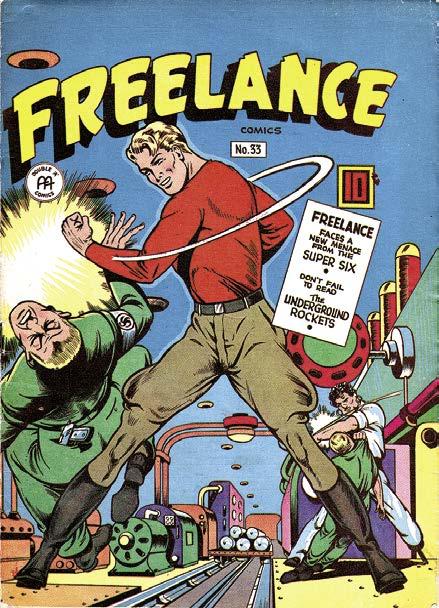
Anglo-American was a comic book publisher quite different from the other Canadian comic book publishers because of two developments. First, it settled on an assembly line comic book production method. Furness served as main layout artist and the other working artists became specialized in rendering aspects like backgrounds, secondary figures, main characters, and lettering. At the end of this process, there would be a final clean up and the pages would be ready for printing. At the three other main companies, most of the artists individually handled the job of creating a comic story or cover from script to finish. Second, Sinnott, who had been a major distributor for American Fawcett publications in Canada
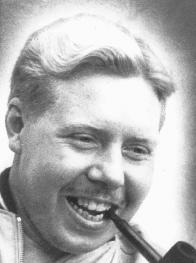
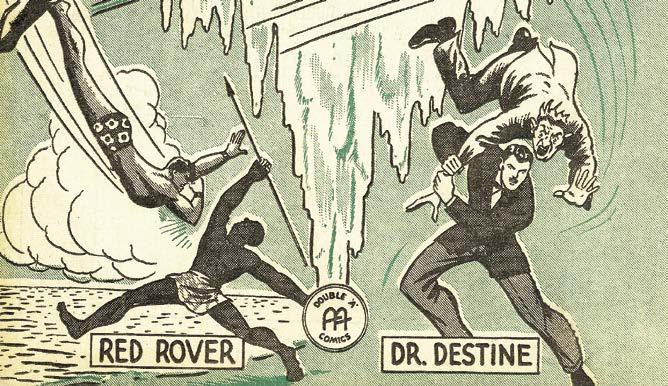
Top: Freelance Comics #33 [Sept. ’46]. Above: Anglo-American Publishing art director Ed Furness. Below: Grand Slam Comics V3 #10 cover detail.
Canada’s Comics Honors Its Own
Janet Hetherington looks at the Joe Shuster Awards celebrating the creators up north
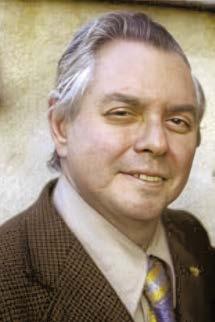
by JANET HETHERINGTON
You might say Canadian comics creators are Superman’s secret weapon: creating great stories that blend seamlessly into existing comic narratives (especially American comic books), as well as boldly inventing new comics and characters.
To recognize Canadians who create comics at home and abroad, the Canadian Comic Book Creator Awards Association organized an awards presentation named after one of the most famous comics creators with Canadian roots: Joe Shuster, co-creator of Superman.
The book, Superman: The Ultimate Guide to the Man of Steel, recounts that Shuster grew up in a Jewish family in Toronto, son of a tailor who could not afford to buy the boy expensive drawing materials. Shuster earned cash as a newspaper delivery boy for Toronto’s Daily Star and scrounged drawing paper from discarded rolls of wallpaper. Shuster and his family later moved to the United States, settling in Cleveland, Ohio, where he teamed up with Jerry Siegel, and their partnership led to the birth of Superman — the world’s first super-hero — debuting in Action Comics #1, in 1938.
“Superman could be perceived as having qualities that Canadians identify with, especially when interacting with Americans… Clark Kent being a secret immigrant from a benevolent peaceful society, he acts for the greater good of humanity,” observes Kevin Boyd, executive director of the Joe Shuster Awards, who also works as the comics relations coordinator, programming for Fan Expo Canada.
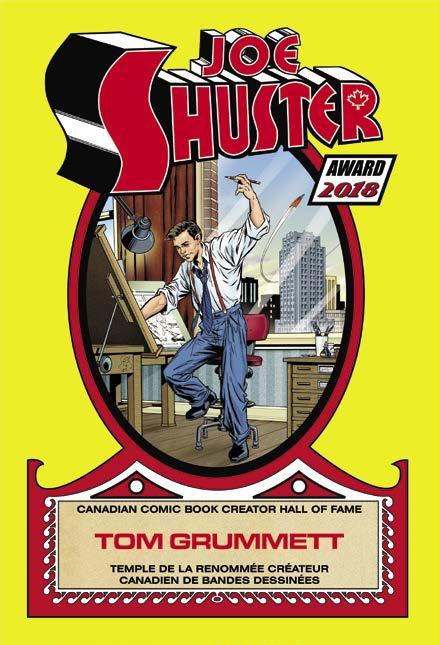
“Is there something particularly Canadian about Clark Kent?” asks comics enthusiast Alan Neal, host of the Canadian Broadcasting Corporation radio program, All in a Day. Then, answering his own question, he replied, “Don’t show off, put on your glasses, and act polite, but when we need to, we get our cape on. And hey, if you don’t look carefully, or listen too carefully, Americans, you just believe we’re one of you… not knowing all those special talents and skills we’ve got.”
Adds award-winning artist Ken Steacy, “Superman has traditionally stood for positive values which Canadians certainly do endeavor to embrace and demonstrate, both at here home and abroad.”
JOE SHUSTER AWARDS: THE ORIGIN
Boyd was involved in the formation of the Joe Shuster Awards from the very beginning, after he and others saw a need to raise the public profile and recognition of creators in Canada, as it already did with music (the JUNO Awards), movies (Canadian Screen Awards), as well as actors and performers (Canada’s Walk of Fame).
“Way back in 2004, we started having conversations about creating a Canadian comic book award,” Boyd recalls. “In the early 2000s, there was a noticeable Canadian presence in the comic book industry with many of the top artists and writers working having a Canadian connection. We’d never really had a nation-centric comic creator awards program before, but the concept was not unique, and it was a popular part of most areas where Canadians were prolific in the arts such as music, books, television, and movies.”
Boyd continues, “In late 2003, the store, Paradise Comics, and I launched a three-day convention that focused on bringing the classic comic book creators of the industry to Toronto. They were the kind of creators we wanted to see that were not going to the larger regional show at that time, which would
Above: Joe Shuster in a ’70s photo.
Inset right: Poster for the ninth annual Joe Shuster Awards ceremony, in 2013. Characters depicted include Superman, Cerebus, Mr. Minster, and Captain Canuck, all products of Canadian imaginations.
Below: Tom Grummett’s Hall of Fame award. Note how the design is based on the Superman #1 cover.
become Fan Expo. It was a really amazing time of growth in fan conventions and a revival of interest in comics history.
“I wanted to develop new content ideas for the Paradise show with input from people in the community. [Orb magazine publisher and comic show organizer] Jim Waley came in with a list of ideas he’d brainstormed before the meeting — one of which was quite simply ‘Comic Book Awards’ — and I thought that had some potential.”
Boyd continued to discuss how that might work with an expanded group that included Waley, Boyd friend Tyrone Biljan, former publisher and retailer David Darrigo, as well as producer/writer Mark Askwith, the former Silver Snail comics retailer and head of SPACE, Canada’s national science fiction and fantasy channel.
“There was a growing realization that the Canadian contribution to comics should be acknowledged,” agrees Askwith. “Some key mainstream creators were Canadian, such as John Byrne, Tom Grummett, Dave Ross, Ty Templeton, and Stuart Immonen, to name a few.”
Askwith also notes that independent comics spearheaded by Drawn and Quarterly, Renegade Press, and Aardvark-Vanaheim were supporting groundbreaking work by such Canadian creators as Dave Sim, Chester Brown, Seth, R. G. (Rick) Taylor, Michael Cherkas, and Julie Doucet.
Boyd says that, because there were very few real Canadian comic books, they decided to honor creators who are native to the country and excel in the areas of cartooning, writing, illustration, and more, as well as create a Hall of Fame. To achieve this, the non-profit Canadian Comic Book Creator Awards Association was formed.
PERMISSION GRANTED
Naming the awards in honor of Man of Steel co-creator Joe Shuster seemed the right and natural thing to do. “We felt that Joe was the spiritual father of what we wanted to honor, the Canadian creators who had an impact on the comic book industry and popular culture,” Boyd says.
However, the first order of business was to retain legal use of the Shuster name. “We did receive permission from the family of Joe Shuster, through their estate agent at the time, Michael Catron,” notes Boyd. “He worked as our go-between at the time with Joe’s sister, Jean Shuster-Peavy, and her son, Mark Warren Peary.”
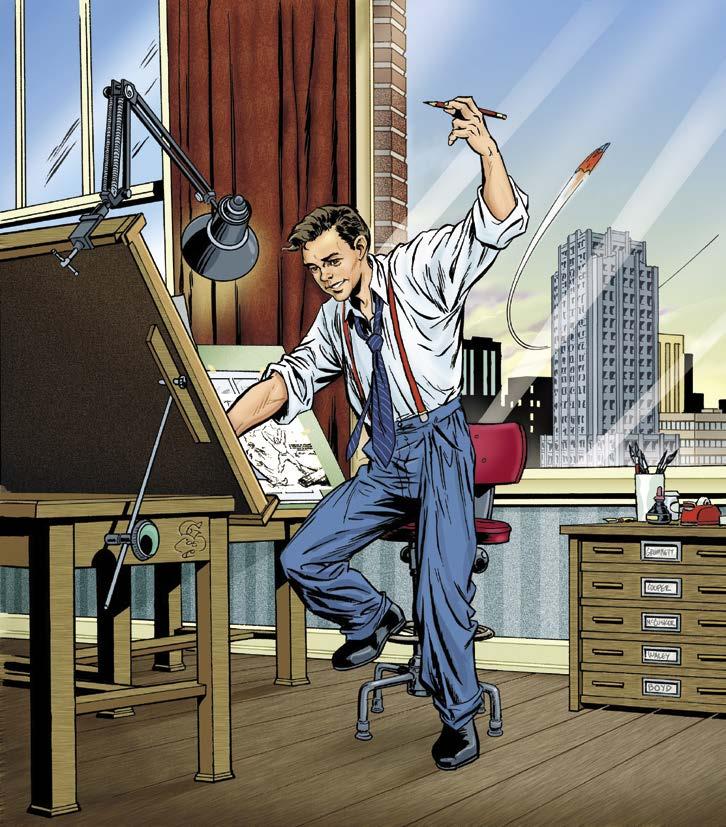
THE MAKING OF A CANDIDATE
The huge pool of talent from which to select candidates from can make the awards nomination process a challenging one, especially when it comes to Canadian Comic Book Hall of Fame inductee, as only a limited number is chosen per year. Identifying those creators qualified to receive the honor requires much due diligence.
Still, the Joe Shuster Awards and its Canadian Comic Book Hall of Fame recognize Canadian creators of all stripes and, as the nation is a bilingual country, both English and French creators are celebrated. “There is an amazing and vibrant comics industry in Quebec.” Boyd says, “One of the benefits of working on the awards, which do recognize French language comics and creators, is learning about this parallel industry to North American English comics that has an obvious connection to FrancoBelgian traditions.”
“We assemble a group of Canadian comics historians and fans and let them pitch their top three potential inductees into the Hall of Fame,” Boyd explains.
“Then we compare what everyone brings to the table and then debate who from that list should be selected. My job is to throw into that ring anyone they might have missed that I felt [should not be] missed. Sometimes they agree with me, but the discussions are quite lively and informative.”
The list of Hall of Fame inductees reflects just how influential Canadian creators have been. The first year alone featured such legendary inductees as Shuster himself and Hal Foster.
“I was very surprised to learn that the brilliant cartoonist of Prince Valiant, Hal Foster, was Canadian,” confesses Askwith. “I was listening to a CBC radio program and Arn Saba profiled him. In 2004, when we were discussing the Hall of Fame,
This page: At top is an awesome illustration by Tom Grummett portraying a young Joe Shuster at the drawing board. Observe how the artist’s pose resembles that of Joe’s co-creation, the Man of Tomorrow as visualized on the cover seen below of Superman #1 [Summer ’39], the figure drawn by Shuster — said to be Photostatted from Action Comics #10 — with design work by Leo O’Mealia. Inset left is awards logo.
the comely touch
The Coming of Captain Canuck
Richard Comely on the creation (and resurrections) of his True North super-hero
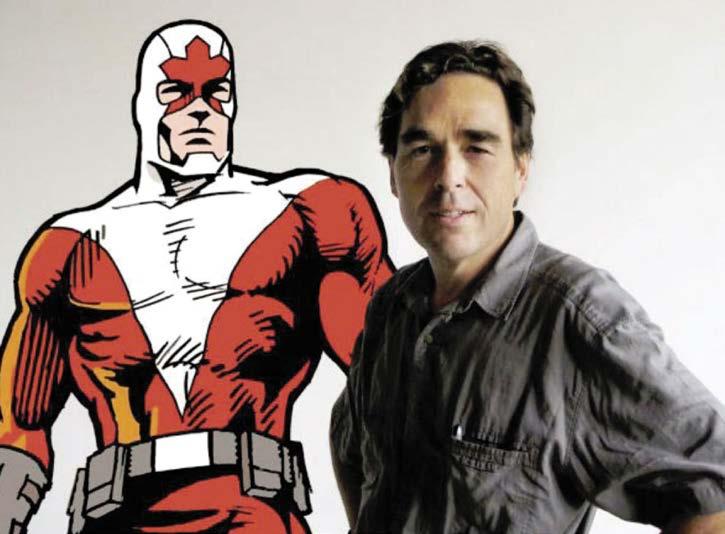
Conducted by JON B. COOKE
[Interviewer’s Note: Like I said in this issue’s editorial, I’ve had a love for Captain Canuck since issues of that Canadianmade comic book first made it to newsstands in the U.S. of A., back when I was 16. Sure, the title was an oddity, but there was also an earnest passion within the initially crude effort that fascinated me, plus the series improved decidedly over the sporadically released issues, especially when the great George Freeman took over the artist reins. So, 50 years after #1 debuted in my local news store, I’m delighted to finally showcase my late 2025 talk with the hero’s co-creator and longtime publisher, Mr. Richard Comely! — JBC.]
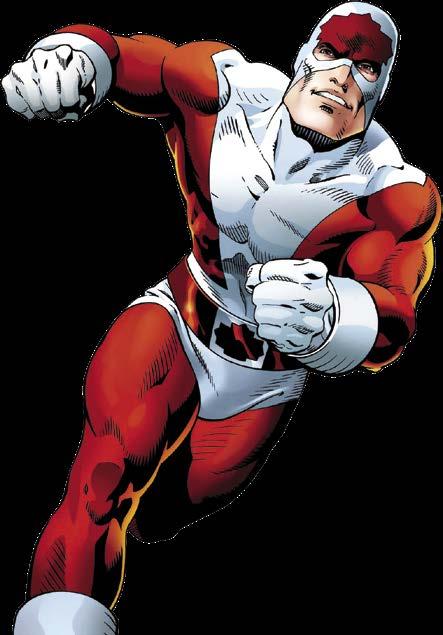
Comic Book Creator: Good to meet you, Richard. I first got in touch with you in the late ’90s, as I always wanted to devote a feature to Captain Canuck. So please tell me your story. Where are you from originally? Originally, I was born in England. My parents immigrated to Canada with me and my brother Peter. I was born in 1950 and we came in ’53, and were in Ontario for a year-and-a-half. And then my parents contin-
ued westward until they ran out of money, in Manitoba. They were headed for British Columbia…
CBC: Why did your parents move to Canada?
Richard: Oh, lots of reasons. England, in the early ’50s, was still pretty bombed out and they were still on rations after the war until 1955. My parents wanted to own their own farm and that did not seem possible in England. And they were young… it was a “Go West, young man” kind of thing.
CBC: What did your dad do for work?
Richard: My parents were living in Horton-cum-Studley, which is about six miles out of Oxford, and they were working on a farm. My mother was training horses, jumpers, they came to Canada, where they worked on farms. They bought a farm in Manitoba, 40 acres, in 1957 (and I believe they paid $2,500, total). Now, Manitoba prairies are still cheaper than anywhere else in the country. Winters are pretty tough. You’ll get 40 below, typically, at least once during the winter. So, anyway, my father worked on farms, then he was an auto mechanic… My mother taught ballet and other types of dance when she came to Canada. And then she became an occupational therapist at an institution in Portage la Prairie, Manitoba.
CBC: So you grew up on a farm, pretty much?
Richard: Oh, yeah. When we first came to Manitoba, I was four and I was there until I was almost 18. Then I moved to Winnipeg. I had started painting signs when I was around 13, and I taught myself how to do lettering…And so I was able to make money doing signs and then I worked parttime at a sign shop during high school. I did that for about three months after graduation and then got a job as a crest designer, and I eventually got into embroidery design and fashion design. Winnipeg and Montreal were big garment industry towns in Canada back up until sometime around in the ’80s…
CBC: What’s a crest designer?
Richard: Well, you might call ‘em patches.
CBC: Oh, okay. So embroidery and…
Richard: Right. Most of them were for sports — baseball, hockey, whatever — and I would draw them and then make the pattern from my drawing… I had a very interesting boss who I could write a book about, J.D. Schachter… There were times when I would be hurting myself from laughing so hard and other times I’d want to put my hands around his throat.
CBC: When did creativity start to bubble up in you? Were you drawing at a very young age?
Richard: Yes. I remember, as a 12-year-old, deciding that I would be an artist of some sort when I grew up. I was encouraged by a lot of people, so I kept at it. I did portraits, I did caricatures at malls and resorts. I worked as a graphic
Captain Canuck
TM & © Lev Gleason, Inc.
Photo by John Lemesurrier courtesy of Richard Comely.
Above: Richard Douglas Comely, the man who brought to fruition the great Canadian super-hero. 2006 photo by John Lemesurrier.
Below: The good captain by George Freeman.
designer for a while — this was long before computers, of course — and I designed signs. I did drawings for newspaper ads and also designed how the sign would look. And these were signs that had to be spray painted and fabricated.
CBC: Logo design?
Richard: I did some of that, too. I liked logo design and, yeah, lemme think… what else did I do? I didn’t do comics.
CBC: Did you read comics as a kid?
Richard: No, I didn’t. I mean, I did only sporadically and I didn’t buy them or bring them home… maybe one or two… But I used to read them when I went to other places that had comic books. It would be Tarzan, war comics, Dennis the Menace, whatever. I liked comics. I did like to draw in a cartoony style and also the style of super-heroes and adventure comics — quasi-realistic, with some exaggeration… more or less trying to be realistic.
CBC: Did you read comic strips in the newspaper?
Richard: Yes, I did. Fortunately for me, when I was 11, I was able to attend the Allied Art Club, in Portage la Prairie, and the guy who headed it up was sheriff of the town. (sheriffs in Canada don’t function the same as they do in the United States; they don’t wear a gun; they’re more like the British version of sheriffs.) Jack Hazard was his name, long gone, of course. So I was able to attend and I was the only kid in the class. They were all adults and they didn’t offer instruction other than one student to another. And always encouraging. I remember he helped me find a subject for a cartoon, and that was printed in the local newspaper. So that was kind of a big deal for me. I was 11 or 12 at that time.
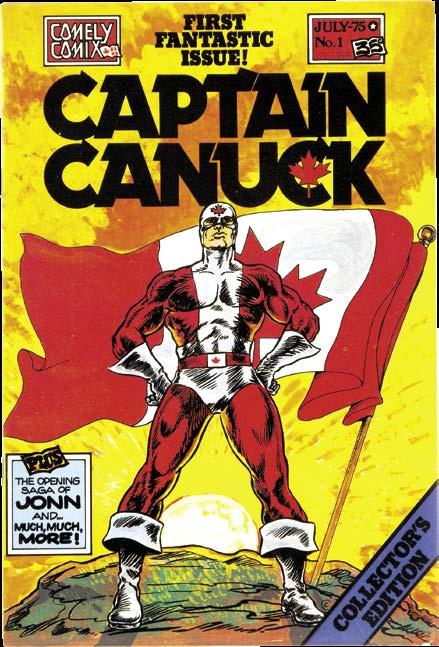
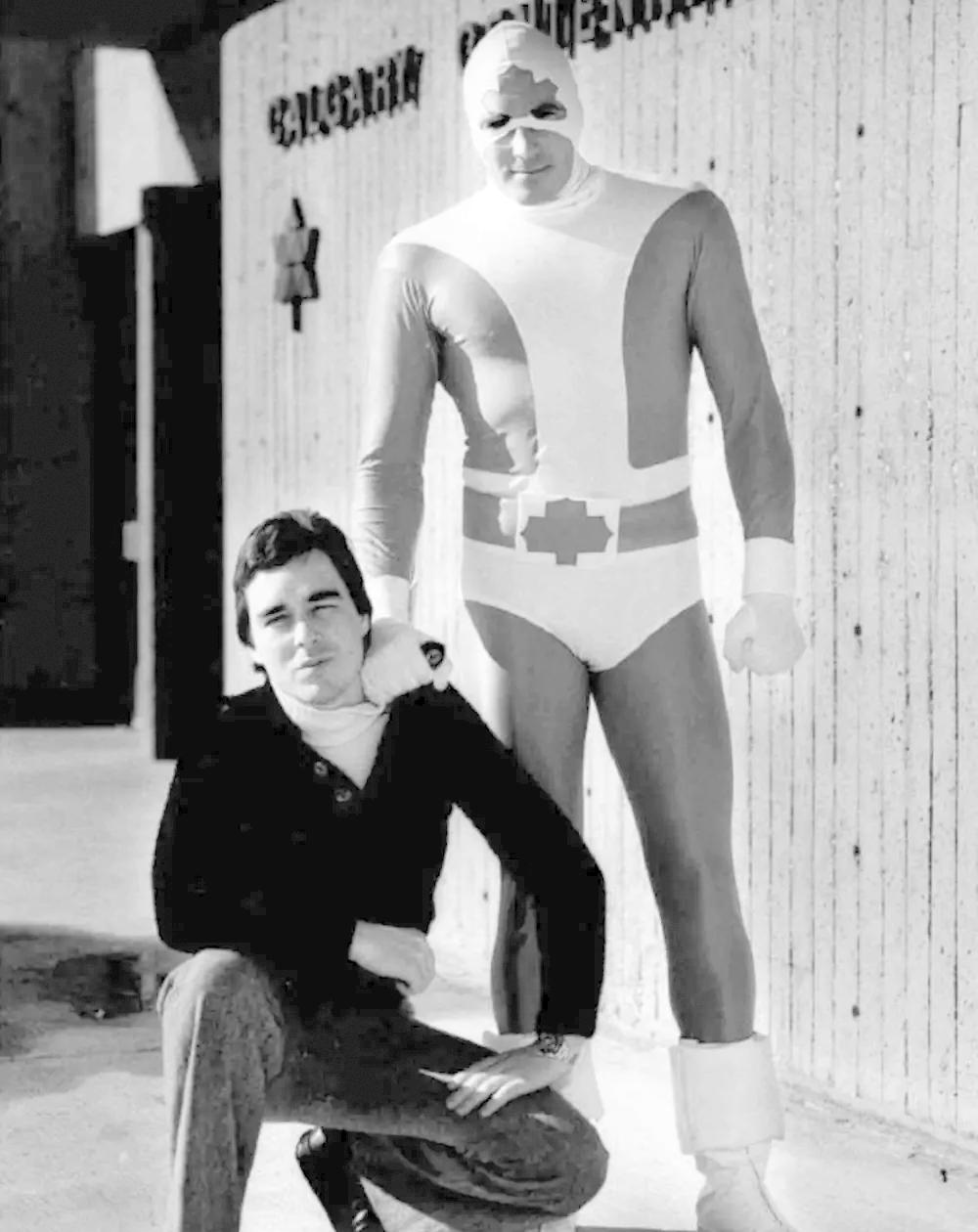
CBC: Was it transformative to see your name in print?
Richard: Yeah, to a certain degree, it was, and I’ve come to appreciate Jack’s thoughtfulness long after the fact. So I realized fairly early that I wanted to be a commercial artist. I tried, in my early 20s, to be a fine artist, and I had a showing in Winnipeg, and I sold two pieces. I got maybe $20 bucks for one and $30 for another. So I realized I couldn’t make a living like that.
CBC: How would you characterize your upbringing? I realize you’re in a rural environment. Was it hand-to-mouth, tough for your family? It’s not easy to make a living by farming. Richard: Well, we certainly weren’t rich, by any means. We were poor immigrants when we came to Canada, no doubt in my mind of that. The third farm that they worked on in Canada was expropriated to expand the Toronto airport and, rather than look for another job, they decided to continue west, because it was their goal to get to western Canada, British Columbia. My father bought a 1946 used panel truck and a trailer. They sold most of their stuff, loaded what they kept, and then just headed west. My mother wrote a book on it, Going West with Annabelle [1976].
My mother was a writer, using her pen name of Molly Douglas. When World War II broke out, in 1939, my mother was 11 and she no longer attended school. They were living in greater London at the time, and going to school was just way too hazardous. She claims that her
Above: Richard is apprehended in Calgary, Alberta, by his creation (costume worn by friend Mike Jackson) in this 1979 publicity photo, which was promoting the second coming of Captain Canuck after a years-long hiatus. Inset left: True, Richard’s first effort at comics was a bit crude (never mind the figure shamelessly swiped from a Wally Wood Dynamo splash page!), but Captain Canuck #1 [July ’75] exuded its co-creator’s unabashed enthusiasm. Below: “Classic” C.C. Club emblem drawn
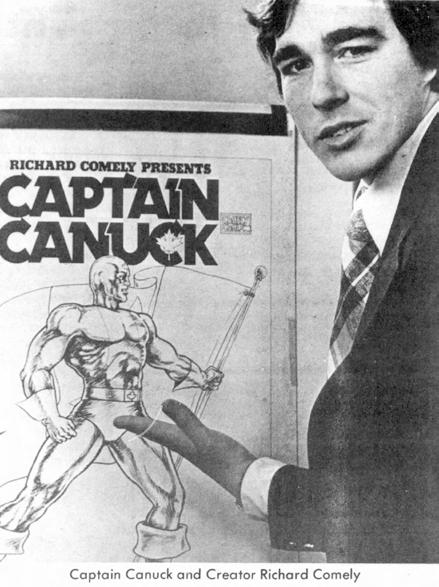
Above: Over the decades, Richard has retained an impressive talent at getting media attention, particularly when his signature character was introduced in 1975. Here is a photo that appeared in Binghamton, New York’s Press & Sun-Bulletin, on July 27 of that year. Inset right: Richard also found inventive ways to reduce his inventory, including creating “Special Collectors’ Packs,” which he successfully sold wholesale to retail stores. (He followed up this pack with another that also included remaindered #3 copies.)
Below: Among Richard’s initial investors was his then-employer, J.D. Schachter, whose Jay-Dee Products manufactured “crests” — patches — including this iron-on from circa ’78.
them, and they’ll be able to fire you if they don’t like you” etc. And he said, “You can get some government funding to start a publishing company.” Though I never did get any government funding, he sent me on that course to a do-it-myself kind of thing. And that’s when I really started to look at comic books in a serious way.
CBC: So you were buying them off the stands and looking through them?
Richard: Yes.
CBC: What’d you get out of them by looking over the American comics? What was the things that stood out to you? Were they good?
Richard: I think so. One of the places I used to go was a bookstore that sold used books, and they also sold comic books that had the part of the cover torn off. I think they were a nickel each and I’d buy those up. So what I was focusing on was how to tell the story with pictures and words — the basics and drawing the figure in action.
I’d already been figure drawing for a while, but I knew I needed to improve in that area. And sequential art, I needed to understand how it should work. So that’s what I looked at ’em for. I would read them and think, “How is this working? When do they use close ups and when do they use wide shots?” All of that stuff.
CBC: So was it when you two thought of the name Captain Canuck, you realized that this is a commercially viable idea?
Richard: Yes
CBC: Did you have dreams of grandeur? Did you think that you were going to be able to make your own fortune?
Richard: Basically, I felt there was potential. There was this undercurrent, a subconscious undercurrent in Canada where Canadians were starting to come into their own, realizing that they were separate from the United States, realizing that they were Canadians, basically, and become a little more patriotic and a little more focused on the fact that we have our
own country. It was all, I think, connected with the centennial of Confederation in 1967 that got that ball rolling.
Then, sometime in the summer of 1974, my parents cosigned a loan for $8,000 for me to start my venture. And my brother Robin John came to work for me. I realized I couldn’t just have one title and that you had to have a few different books. But eventually, because I was doing everything myself, that idea went out the window pretty quick. I just couldn’t do it all.
CBC: Were you going to do Jonn as a companion title?
Richard: Yes, and Catman was the other title. But then I found out there already was a Catman out there, and we dropped it. So I started in late summer of ’74 working on it. I rented office space. First, I realized I needed to find sources of income for this operation, and I focused a lot of energy and time on trying to sell advertising space. I spent a lot of effort, only realizing afterwards that it was a lot of wasted energy and expense. I mean, I did sell some advertising space, but most of my ads were “per inquiry,” a term used back then, which was you got paid by the number of people responding to the ads. And some of my ads would generate as few as maybe 30, 40, or 50.
So, a lot of effort went into securing those ads and that’s what I had Robin John helping me with. Then I was getting ready to write and illustrate the first issue, with a lot of trepidation, because I had very little foundation in making comics. So it was jumping into the deep end of the pool and not knowing for sure if I could swim. I finished it probably in February of 1975 and it was on the stands by May.
CBC: Who designed the logo?
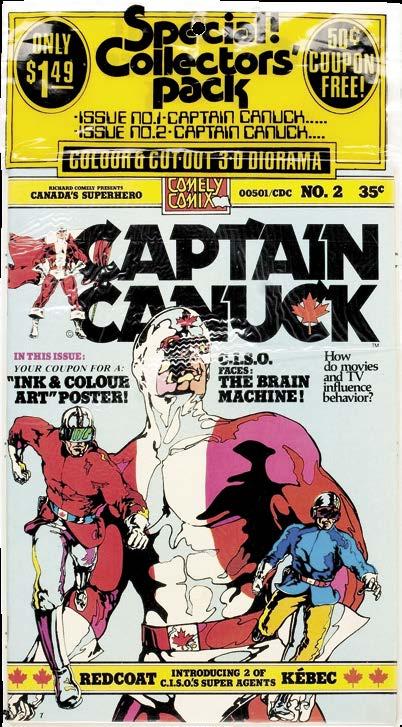
Richard: I did. I designed the logo and it’s still being used today. I probably spent at least two full days on it. That’s all hand drawn.
CBC: Good job, Richard! You shrewdly generated a huge amount of publicity, with many newspaper articles that recognized you, as you said, really tapped into something.
Richard: Yes, it did. I knew I needed to get as much free advertising as I could, with no budget to promote the comic book — to run ads and market it — so I sent out a press release. I remember talking to a PR agency in Winnipeg and they were very kind to explain to me how to go about the process — writing a press release, mailing it out to media, etc. — and I followed their instructions and got great results. And my timing was right, though I had no idea it was right. It just turned out that way.
CBC: But you tapped into something that was more than
Captain Canuck TM &
Lev Gleason, Inc.
just luck, right?
Richard: Well, if I would’ve done it 10 years earlier, I don’t know if I would have had the success I had. I don’t know.
CBC: It’s interesting that you mentioned the centennial. If I’m not mistaken, the Canadian flag, as it presently is, was adopted in 1965, in anticipation of the centennial, right?
Richard: Yeah, yeah. In 1965. In fact, I contributed a design, though (of course) it wasn’t used. Canadians were invited to submit what they thought would be a good flag design. I know I submitted at least one idea, but I don’t remember what it looked like anymore. All those things — the flag, the Centennial, the Expo — were building towards this sense of Canadian pride. Still, to this day, much of our media, much of our entertainment comes from the United States and even more so back then. Then, around that same time, Canadians started to think, “We’ve got to create our own culture. We’re living off of American culture way too much.” So government started to fund cultural events, cultural projects, etc. I never got a dime from the government.
CBC: Some of your peers in the ’70s, in the then brand-new burgeoning comic scene in Canada did, in fact, receive government funding. There was Orb magazine with Canadian super-hero Northern Light.
Richard: Orb came out around the same time as Captain Canuck. And I became aware of it, sort of, after the fact, because it was based in Toronto. In fact, I know the guy who created it or one of the people behind it, James Waley. And they only did a few issues.
CBC: I remember I was eight years old at the time of Expo 67, but I do remember things were happening up in Canada. I grew up in the Hudson Valley, in New York, and, of course, the Montreal Expos baseball team came out and I still think that the Canadian flag is the most beautiful flag in the world. Did you look at that and think, “I’m going to use the flag as
motif for a super-hero costume”?
Richard: Well, the red maple leaf is ubiquitous, the symbol Canadians have adopted. And, yeah, it just seemed — red and white — a no-brainer so that didn’t take much thought as far using for the costume. The original costume was mostly Ron [Leishman]’s thinking. When George [Freeman] came along, he made some changes to the costume that we liked.
CBC: So, the practical aspects of doing a comic book: you’re doing a singular title. What did you look to as an example of doing this? Was it the American model that you wanted to emulate?
Richard: Well, basically, yes. I was looking at pretty much only American comic books. I did see some British ones and I remember some of the art in some of those were painterly kind of artwork and that really was impressive. But, no, I didn’t really know of anybody else who had done anything like this. I didn’t know about Orb, which was published out of Toronto, and that was a group effort, which didn’t do well enough for them to continue. I don’t know how many issues they got out…
CBC: I think six. They had government funding. That’s what helped them, though they published on an erratic schedule. It was also considerably different. Yours was one character and it was ambitiously in color. Theirs was black-&-white.
Richard: It’s been so many years since I’ve seen a copy, and I probably only saw the first issue, and I did not know that they got government money. How come they got gov ernment money? We’re socialists up here…
CBC: The funding didn’t last that long. You started Captain Canuck right at the beginning of the direct market. I mean, it really wasn’t even viable yet. It was just starting to happen with Phil Seuling out of New York and Bud Plant in California.
Richard: I don’t know how I discovered Phil. I think it was in ’79, when I went to see him for the first time when I flew to New York. I went to World Color Press because that was who we were dealing with and I took a subway to Brooklyn. I remember coming up to the street level, walking behind two kids, and they were probably 10, 11, 12, and they had a thick Brooklyn accent. I felt like, “Where am I? This is a foreign country!” And Phil Seuling also had a very thick Brooklyn accent, which was all very charming, and it definitely made me feel like I was in another world.
At that time, one thing that was advantageous for me was, though there were only a few comic book stores in Canada — in Winnipeg at the time, Doug Sulipa’s Comic World; Harry Kremer’s Now & Then Books in Kitchener, Ontario; The Silver Snail in Toronto; and I think there might’ve been one in Vancouver at that same time… But, you’re right: it was a very, very beginning of that whole direct market thing. And, in fact, in the case of Doug Sulipa, in Winnipeg, he bought comics primarily right from the distributor. So he went to the distributor and bought it straight from them wholesale. That was the regional mass market newsstand distributor we’re talking about, in Winnipeg. At that time, there were 35 of them in Can ada, and they covered the entire country. Every store in Canada was supplied by one of those 35 regional
Above: Faux cover for promo sheet Richard handed to potential advertisers. Inset left: Captain Canuck # 3 [Mar. ’76] cover. Below: The Dominion Defender beckons the reader. All art by Richard Comely.
northern guiding light
James Waley’s Absorbing ORB
The revival of comics in Canada started with the “Horror–Adventure–Sci-Fi–Fantasy”
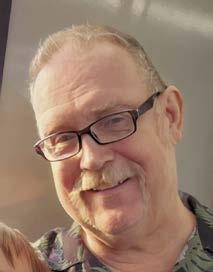
Conducted by JON B. COOKE
[Interviewer’s Note: To be technical, Orb Magazine predates Captain Canuck’s mid-1975 debut, as the first issue of the science fiction/fantasy/adventure comics anthology magazine first saw the light of day in April 1974, though its hero, the Northern Light, would receive far less press coverage than Richard Comely’s creation. Still, the emergence of the six-issue series, conceived and edited by James N. Waley, was an important development in the maturing of Canadian comics, as it was a showcase for burgeoning homegrown talent. But let’s hear the Orb story from the man himself in this interview conducted late last year. — JBC.]
Comic Book Creator: Where are you from originally?
James Waley: Windsor, Ontario, just across from Detroit. CBC: And when did you start getting interested in comics?
James: Well, I can still remember, as a kid, there was a secondhand shop in Windsor that sold everything… books, comics… and picking up some of my first comics there, at that time. It was pretty far from where I lived but, back then, parents were a lot freer as far as letting kids just wander around and go anywhere. I remember my first memories of comics, and the ones I picked up were Jimmy Olsen comics — the “Turtle Boy” story and that stuff — and that got me interested. I was always really fascinated with the Hanna-Barbera animated shows, especially The Flintstones And I remember making up all kinds of characters of my own based on the Flintstones stuff. Actually, in grade school we did a string puppet show that I wrote and put together, a crime thing with The Flintstones, and I came up with a character called Al Castone, and his crony was Goon Granite. My mother made a nice little hat for the Castone character.
In high school, I was getting more into drawing and doing my own comics, just stuff I was kicking around on my own, and I did a character called Tremor, a sort of horned character, and I did a few pages of that. Then my interest was going into artwork and I applied to the Ontario College of Art, in Toronto, and got accepted there.
At the time, at the Ontario College of Art, there were two separate streams. There was commercial art and there was fine art, and I went into commercial art. Really, when I went to the school, there was not really much in the way of acceptance of comic book work. Most of the people I was dealing with were interested in us going into advertising work and that sort of stuff, and they really frowned on comic book stuff. Like it was, “Ugh, comics are second-class material.”
CBC: When you were a child that there any realization there were Canadian comics that once existed?
James: No. I don’t believe that I was aware of the World War II comics until the ’80s or maybe early ’90s, as a matter of fact. I just really did not know much of that history. When I first found out, there were two things I felt about them. One, they were either brutally amateurish or, two, pretty slick and amateurish. There was a guy, Leo Bachle (also known as Les Barker), who actually I got to know and be really good friends with, and he admitted his stuff was pretty crude. But then there were guys like Murray Karn, who did a strip called “Thunderfist” that was really slick, really well done.
But I’ll tell you one thing that I keenly remember: when I did start finding out about the comics in the ’40s in Canada, I heard about “Nelvana of the Northern Lights.” If I had known about that in the ’70s, when I was doing Orb Magazine, I probably would not have called the character,
Above: James N. Waley. Below: Orb Magazine #2 [July ’74].
Photo
the Northern Light. Because stuff like that really bugs me, when there’s an overlap of stuff that’s not necessary… I mean, to me, it’s not being imaginative enough to come up with something that’s not distinctly different, but I’ve got to live with it.
So I went to the Ontario College of Art and met John Allison, who did the cover of Orb #1 and a couple stories, and we became friends, and I met Ron Van Leeuwen, there at the time, and who went on to do the Silver Snail and Andromeda comics and distribution. But the two years that I was at the art college, 1970 and ’71, in the second year, there was a guy by the name of Roy Ascott who became the president of the school. And Roy really shook things up in the school… [Ascott’s changes resulted in James leaving Ontario College of Art.— Ye Ed.] So, basically, I dropped out the second year, went back to Windsor for a year, and then, at Sheridan College, in Oakville, they were starting up a course in doing comic book artwork, so I convinced my parents at the time, “I’d like to go.” And I started the first year of that course at Sheridan. Unfortunately, the first year, it was what I would always describe as in its “embryonic stage” and it was really unformed. The guy who started the course was an English teacher, Walter Hanson. The sense I got from Walter was he was an overage fanboy who basically wanted to bring in Bernie Wrightson and Neal Adams, and all these other people to get books signed by them, and to wine and dine them, and do stuff with him. I mean, he wanted to put together a good course, but that was a big chunk of his motivation for it.
CBC: Sure, why not!
James: Exactly. For the year I was there, I got involved with the student magazine — called A Magazine, just the letter “A,” a very Canadian name! — and I was the art director for that, putting together different comic stuff in there with different students. And that really gave me the publishing bug, so me and a number of other students that were in the course at the time — Paul McCusker, Matt Rust (who became my senior editor), Alex Emond, and John Allison (who I’d met at the art college) just decided, “Why not do this?” So we pooled our funds and put out the [Orb] first issue.
CBC: You said Sheridan College, right? All of a sudden my mind flashes to Jim Craig informing me that Will Eisner visited and they put out a Spirit tabloid. Is that so?
James: That’s right. Will did this oversize story, published by Tabloid Press, at Sheridan.
CBC: That’s cool! Was Jim Craig a part of this?
James: Jim was in a year after me, but I had heard about Jim and then Jim had gotten in touch with me. [Jim would become a regular contributor to Orb. — Y.E.]
CBC: Did you see Will Eisner when he guest lectured over the course of a school year?
James: No, I didn’t. The first year that I was there, the main people I can recall coming at that time were editorial cartoonists. There’s Graham Pilsworth and some guys in Canada who are really well-known editorial cartoonists. I don’t recall meeting any of the big [comic book] names. They came after I was there — Neal Adams, Bernie Wrightson, and others. I missed that wave of people that came there.
CBC: Did you do any fanzine work? Did fanzines exist that you had known about?
James: I wasn’t involved in them. And actually two of the guys that came on doing stuff for our magazine, Vince Marchesano and Art Cooper, were doing fanzine work in Hamilton, which is where I live now. And they had been doing fanzines for two or three years — Comic Canada, Canada’s Best, and Spectrum, which was this little two-inch by two-inch publication. And the reason it was tiny was because Vince was working for a hospital at the time doing photographic work for them. For some reason, they had re-
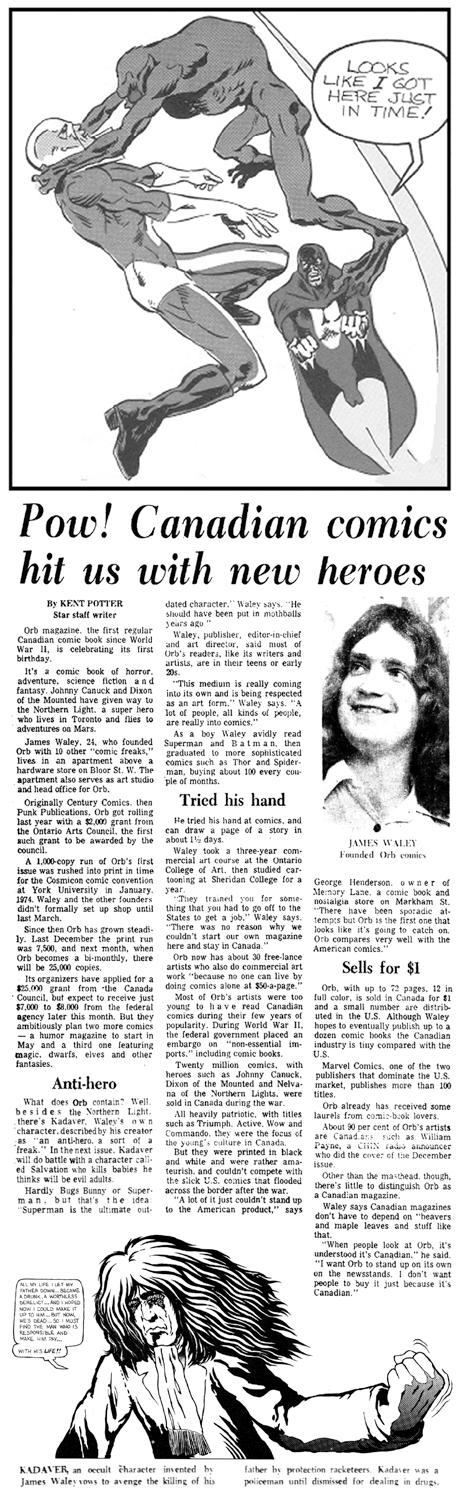
designing the future
Dean Motter’s Andromeda Reign
Jackie Estrada shares candid photos featuring her friend and frequent SDCC guest
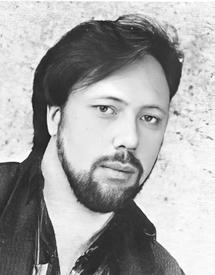
Dean Motter in the 1980s in a photo portrait by Patrick Harbron appearing in Flare magazine.
Inset right: Andromeda magazine was derived from a same-name fanzine dated July/Aug./Sept. 1974, which was mostly devoted to a 23page story by Dean, one produced for his college senior project.
Below: Andromeda fanzine’s publisher, Bill Paul, also produced a well-regarded zine called Media 5. Here’s Dean’s comic conthemed cover for the fourth issue.
Conducted by JON B. COOKE
[Interviewer’s Note: Now that I think of it, I’ve known Dean Motter since the earliest days of Comic Book Artist, when I chatted with him about The Prisoner in #6 [Fall ’99] and later regarding Mister X for #15 [Nov. ’01], so it’s always a pleasure to talk with the talented artist/designer. In 2023, I interviewed Dean about his comics magazine work and we covered Andromeda, the impressive Canadian black-&-white that spotlighted science fiction story adaptations into comics form. While American-born, the gent — based in Georgia, last I heard — made his initial impact in the Great White North, and his contributions to the Canadian comics scene of the ’70s fits in nicely this ish. — JBC.]
Comic Book Creator: Can you tell me the backstory of Andromeda?
Dean Motter: Back in the ’70s, I was living in Toronto and I was a customer at the Silver Snail comic shop. The proprietor was Ron Van Leeuwen, and he also started up one of the first distribution networks in North America, which he called Andromeda. He named it after a fanzine* that I had done in college, in London, Ontario, but he adopted it first for the distribution network he was setting up. Then he decided that he wanted to enter the sort of underground/ ground-level comics arena and wanted to publish some-
* Dean is referring to the contents of the Andromeda fanzine, a tale called, “Celestial Circuit Cirkus,” a 23-page tabloid-size science fiction/fantasy story he created as his senior-year independent studies project at Fanshawe College, in London, Ontario.
thing along the lines of Star*Reach, who I’d also done some work for. Ron approached me about acting as editor/designer/ art director for the book, though he had an active hand in that, as well. Ron was the instigator and he went out and secured the rights to several short stories by noted science fiction writers like James Tiptree, Arthur C. Clarke, A.E. van Vogt, and others. Then he approached local Canadian artists to adapt the various stories.
I would act as Andromeda’s art director, assemble the magazine, and get it to the printer, and then Ron would take care of distribution, and it took off. You should realize this was before graphic novels adapting noted SF work and fantasy work had become popular. This is one of the earliest efforts that I recall to follow in the footsteps of the old EC Comics, where they’d taken the stories of Ray Bradbury and adapted them as comic-book stories. And Andromeda ran for six issues [Sept. ’77–Nov. ’79], and it got quite a following, so he was able to sustain respectable sales and print run.
Arik Khan [#1–3, Sept. ’77–June ’79] came about when we were approached by Franc Reyes, the Filipino artist who had recently immigrated to Toronto and who’d done a lot of komiks work in the Philippines. Arik Khan was his own property that he developed. He’d written the first issue and Ron fell in love with that right away and said, “I’ll publish it,” and he published that under the Andromeda banner and that went for three issues. I’ve been following Franc for several years since and I know he made a reboot a couple times in various forms with other publishers, but that was how the Andromeda line came to be. We had illustrators like Paul Rivoche in one of the early issues and he did a couple of covers for us. John Allison did a story [“The Man Who Walked Home,” #1] for us by James Tiptree.
It was quite a development. There were other Canadian comics in the works at the time. There was a small community in Toronto that was especially active. Orb Magazine was also publishing black-&-white comics and Captain Canuck was emerging about the same time, as well.
CBC: Do you recall who designed the logo for Andromeda? Dean: I did. When I was doing Andromeda, I was working full-time for [publisher] Holt, Reinhart and Winston of Canada, doing children’s books. I was moonlighting, doing comics and rock ’n’ roll magazines, at that time. I had access
Above:
to some production facilities, like a stat camera and light table, and things like that, at my day job. So, after hours, I would spend a few hours here and there and create the logos for the various comics that I was working on. I was also working at Holt when, a couple years later, I got involved with Vortex Comics, which is where we launched Mister X and I was still able to continue my logo design work in that realm, as well.
CBC: Can you explain Andromeda, the fanzine?
Dean: Oh, the fanzine I did came out about a year-and-ahalf before the Andromeda magazine: it was published by an outfit called Media 5, in London, Ontario, in 1974. At that time, Bill Paul published a tabloid fanzine called Media 5 and also published Andromeda, which I’d done as my project for college for my senior year independent studies project. I spent the year doing it and it was a tabloid format, and today the fanzine is very hard to find. The story was basically a pastiche of all kinds of artistic influences that I had in college, more a gallery of inspirations and swipes and things like that. I was being influenced by Kirby and Neal Adams and also the classical studies that I was doing in school, figure drawing and symbolist artists. It was my first attempt to combine elements of what I learned along with comics.
The story was a kind of a space opera. It was influenced by a lot of comics and art history that I was studying at the time, somewhat hard to describe these days, but you could see the influences. For a young college kid’s first effort to get into print, it was very, very meticulously done.
CBC: How many issues did you do?
Dean: Just the one.
CBC: Had you had a longtime interest in comics, science fiction, and the like?
Dean: Oh, yeah. I grew up an avid follower of not just Marvel and DC, but also Gold Key, Dell, and all the others at
the time, mostly in the ’60s. Plus, at that time, I started seeing those little ads in the back of the comic books and sending away for fanzines, and I started collecting Rocket’s Blast/Comicollector and a few others. And, when Steranko burst on the scene and had his Supergraphics, I sent away for ’zines mentioned in Comixscene and collected all those. Steranko was a major influence on my artwork at the time (and even today)… So, yeah, during my whole adolescence, comics was one of the things that I spent most of my time on.
CBC: Now what made Ron Van Leeuwen think that you’d be a good editor?
Dean: Well, besides being a regular customer there, I was also at the time art director and designer on a rock ’n’ roll magazine, Cheap Thrills, given out by Concert Productions International at all the concerts. Once a month, they published this newsprint magazine they’d give away for free and it would have the calendar of all the concerts they were promoting, along with interviews, articles, and advertisements concerning rock ’n’ roll and New Wave, and all kinds of contemporary music of the period. It also had some comics material. I was the art director and production artist on that mag and Ron knew this. We all had connections in this very small community in Toronto because everybody shopped at the same comic shop — as well as the same science fiction bookstore, which was across the street, called Bakka Books.
Above: Dean received a crashcourse in layout and production while working a art director of the rock ’n’ roll giveaway, Cheap Thrills. This is the Oct. 1976 ish. Inset left: In the one-shot Andromeda fanzine, this is the tabloid’s first page, art by Dean. Below: The Cheap Thrills art director’s love of the comics form ensured that comic strips were a regular feature in the monthly mag. Here’s one of Dean’s Dark Disco comic strip episodes.
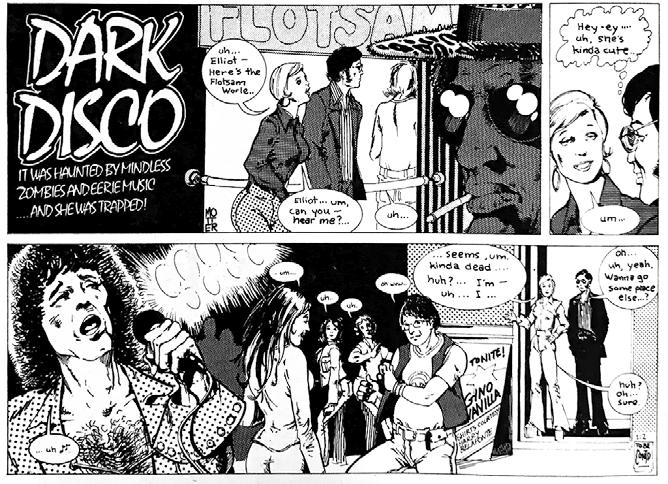
comic stripping the light fantastic
Katherine, Arn, & Neil the Horse
A candid conversation with the self-proclaimed “one and only purveyor of dancing comics”
Conducted by JON B. COOKE
[Born Arnold Alexander Saba, Jr., Katherine Shannon Collins created one of the oddest and most charming comic book series of the 1980s, Neil the Horse. As the Canadian-born cartoonist wrote in a collection, “There was certainly no great clamor for musical comic books, no crowds in the streets with torches and pitchforks, demanding singing and dancing animals,” but perceptive comic book aficionados of that period recognized the independent, black-&-white title, with its zany mix of Fred Astaire footwork and Carl Barks funny animal antics, was a completely original endeavor. The series was also a worthy and witty tonic in that decade of grim and gritty, death-obsessed comics. I’ve always been fascinated with Katherine’s positive efforts and, after interviewing her for my Charlton Companion, I was determined to include the artist in this Canadian special. Though in ill health, Katherine consented to a pair of interview sessions. Thank you, Katie. — JBC]
Comic Book Creator: Let’s start at the start, if you don’t mind. Where are you originally from? What’s your family background?
Katherine Collins: Where I’m from is right here, Vancouver, British Columbia, and I’ve lived in many different places, but ended up back where I started. I always hate to say this, because it sounds like I’m boasting, but I grew up in a wealthy family, which I didn’t realize at the time, but it was a really strange experience. I was indoctrinated with the things that rich people are supposed to believe about the world.
I am the eldest of four and, interestingly, we all rejected that [class] status, though we never even discussed it amongst ourselves. When we grew up, we all just went off and became penniless, doing what we thought we really wanted to do. Though we were being pressured to enter the business world and become businesspeople, none of us wanted to do that.
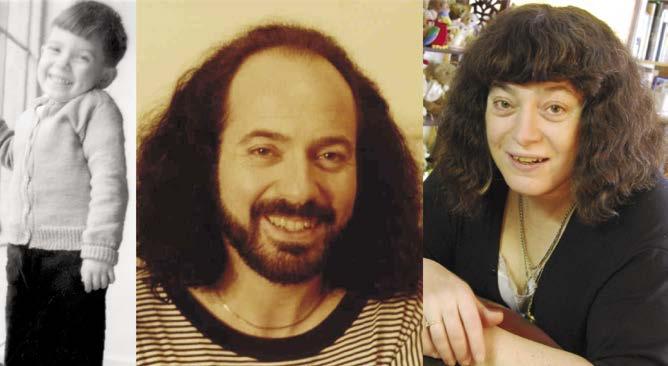
Of my two brothers, one worked first as a cowboy for many years and then decided he wanted to start his own organic vegetable farm, which he did very successfully. And then my other brother is a musician, and I have a sister, who has never known what she wanted to be, but the one thing she is not is rich, and she’s not in business. And then there’s me, who is completely insane. [laughter] So it’s been a very odd life so far.
CBC: Where did the family wealth come from?
Katherine: My grandfather on my father’s side, Saba, came over from Lebanon in 1895, at the age of 14, to join his brother, who was already here. They started Saba Brothers, a wildly successful women’s fashion and fabric store, and they became millionaires. It doesn’t exist anymore, unfortunately, but they were amongst the very wealthiest people in Vancouver, in the 1920s and ’30s.
My father was born in Vancouver, and I’m not sure whether it was a conscious decision on anybody’s part or not, but I didn’t get any Lebanese influence, any Lebanese culture, though maybe a little bit of the food, but that was all. The other side of the family was McBain, who were very lovely people. The Collins and McBain families were sweet and lovely… Somehow it happened that I was raised as a sort of British-Canadian, which was very easy in those days. It was a very British country.
Neil the
Horse TM &
Katherine Collins.
All photos courtesy of Katherine Collins.
Above: Katherine Collins, the former Arn Saba, was inducted into the 2017 Giants of the North Hall of Fame as pioneering cartoonist and comics journalist. Here she is giving her acceptance speech at the Toronto Cartoon Arts Festival. Inset
right: The first ish of Neil the Horse Comics and Stories #1 [Feb. ’83].
Below: From left, Arnie in 1951 and 1990, and Katherine in 2009.
CBC: Did you go to private school and all that?
Katherine: No, I didn’t go to private school, thank God. But luckily, despite the British influence, it wasn’t a snobby family at all, just regular people.
CBC: What year were you born?
Katherine: Nineteen forty-seven.
CBC: Were you experiencing American culture as a kid?
Katherine: In Canada, it’s impossible to avoid the huge influence of America but, at the same time, Canada was (even more than it is now) very, very British. We were mostly influenced by British culture. I was taught in school that everything American was terrible and everything terrible was American… At the same time, it was like being awash in American culture because we really didn’t have a Canadian culture. I remember, when I was in my teens, when I was trying to figure out how to be a writer and ultimately cartoonist, the one thing I knew, or at least I felt I couldn’t do, was to set any fiction in Canada. That was just a foolish idea because nobody would be interested. Canada was just a minor blip on the map. Luckily, that’s changed a great deal, but it’s taken most of my lifetime for it to change.
CBC: Were you more British than American?
Katherine: Oh, more British, very much so.
CBC: Did you have exposure to British children’s culture?
Rupert the Bear, Doctor Dolittle by Hugh Lofting, that material?
Katherine: Those are two of my favorites. I still collect Rupert Bear books every year, and loved them, as well as Doctor Dolittle. At the same time, luckily I was exposed to Walt Disney comics by Carl Barks. My mom was a cartoonist herself and cartoon collector, and she was the one who brought Carl Barks into the house and read them to us. She also had collected newspaper strips — Terry and the Pirates in the ’30s and ’40s. So I read Milton Caniff in the ’50s, way ahead of anybody else in my generation. Along with Disney, I got the best of both.
CBC: I know that, in the ’40s, during the war, there was a ban on importing American comics in Canada. When you were growing up, you could you buy U.S. comics?
Katherine: Oh, yeah. That ban ended immediately when the war was over. Somebody opened the floodgate and, by the time I was aware of comics, you never would’ve known that there had been a comics industry in Canada. It was by then completely gone.
CBC: Did you follow comic strips on a daily basis in the paper?
Katherine: Yes, absolutely. We got all the American ones. There were no Canadian newspaper strips at all when I was growing up (and I don’t think there are any now either). Apart from Carl Barks, I was really more interested in the newspaper strips, and that’s what I wanted to do as I grew up. So I was starting to focus on trying to be a cartoonist because what I wanted to do was a newspaper strip.
CBC: What strips inspired you the most?
Katherine: It’s a very schizophrenic set of influences because they’re Caniff and Barks, the two that influenced me the most and that I love the most. Other than that, there was this huge smorgasbord of other kinds of comics. Lots and lots and lots, but there was very few that I really cared about very
much. I read them, I followed them, I enjoyed them… Prince Valiant, King Aroo — which was very nonsensical, kind of a cheap version of Krazy Kat. There were other ones… but, when I was nine years old, I started trying to draw a newspaper strip, and, for two years, I drew all the time. I drew six dailies and a Sunday page every week of this strip that I had invented. I wanted to see if I could keep up the pace. A cartoonist had to keep up, so you can see where my focus was.
CBC: What was the strip?
Katherine: It was… I guess I’d call it a pretty obvious copy of Terry and the Pirates. I was trying to do an adventure strip. I wasn’t pleased with it. When I was maybe 20 years old, I still had all those old strips, and I threw them in the garbage can. I didn’t want anyone to ever see them. I didn’t want anybody to see them. I didn’t want to look at them myself.
CBC: Bad, Katherine! As a historian, I say, “Not cool!” [chuckles]
Katherine: I was wanting to present myself in the best light.
CBC: Can you be specific about Terry and the Pirates and its overriding appeal? Did you identify with Terry?
Katherine: No, I didn’t identify with any of the characters. What I liked about it, although I couldn’t have said at the time, when I was a child, but I can see now that what I liked about it was the rich ness of the interaction between all the characters. Not just Terry and Pat, but all the incidental characters, all their friends and enemies who they met. And it was just so well depicted. It was something that you could really dig into and look at and read in depth and enjoy. It wasn’t like reading Rex Morgan or something, all these cardboard characters.
x marks the spot
Riding the Vortex with Bill Marks
Toronto’s William Paul Marks the third on his wild journey in avant garde comic books!

Above: After careers as comic book publisher and race car driving, Bill Marks is today a film producer who also continues to dabble in comics — for the fun of it and for his kids — with diverse movie credits that include Casino Jack, Trailer Park Boys films, and Hallmark Christmas movies, all under the umbrella of Vortex Productions. Below: Bill got his start as a teenager publishing the fanzine, Miriad, covering geek culture in the late ’70s/early ’80s, before the phrase was even invented. #5 had Cerebus on the cover.
Conducted by JON B. COOKE
[Interviewer’s note: If the choice of features in this special all-Canada ish appears arbitrary, that’s because that absolutely is the case, with all selections being made by my personal curiosity that has nagged me over the years. The stories behind important Canadian publishers Aardvark-Vanaheim and Drawn & Quarterly, to name just two, are well known, and I’ve got an okay grasp of their histories. But some, like Vortex Comics, an imprint strikingly designed with an eclectic array of cutting-edge titles, was urging me to dig in and find out more, so I did. Here then is my conversation with the Vortex publisher, charming and ebullient Bill Marks, conducted in two sessions, in July and August of last year. — JBC ]
Comic Book Creator: Where are you from originally?
Bill Marks: Born and mostly raised in Toronto, I grew up in the suburbs and had a pretty normal, middle-class upbringing. My dad sold coffee for a living to a small company back then called Tim Horton’s, which is a huge franchise in Canada now. I went to school, bought a car when I was 16, and learned to fix cars. My first car was a 1967 Ford Country Squire, then I had a 1966 MGB.
CBC: What year were you born?
Bill: 1962.
CBC: So when did comics come into play for you?
Bill: Well, I guess I’ve always read them as a kid. When I was probably six years old, our next door neighbors owned a newsstand and comics were sold returnable back then. So they would strip the covers off the comics, send ’em back for credit from the distributors, but we would get the comics with no covers on them — stacks and stacks and stacks of ‘em! This was 1968 and they were all sorts of Marvel Comics — SpiderMan, Fantastic Four, all that great stuff — and the amazing thing for me, I remember, was for the first time walking into a comic book store, which was Bakka Books, the first real comic book store in Toronto. The comics section was run by the guy who later
founded the Silver Snail comic book store, Ron Van Leeuwen. So, before the Silver Snail, Ron had a little counter in the back of Bakka Books. I remember walking in and seeing the covers of all these comic books that I had been reading as a kid, but never knew what the covers looked like!
CBC: Do you remember what price Canadians were paying for an American comic book in the late ’60s?
Bill: The early ones I was getting were probably 15¢. By the time I was buying them with my own paper route money, they probably said “Still Only 25¢” on the cover and that would’ve been in the early ’70s.
CBC: Did you note that there wasn’t really much offering of Canadian-made comics?
Bill: Well, yes, and then, when Richard Comley did Captain Canuck, I remember going, “Oh, that’s a cool idea!” Then I think it was Mark Shainblum (who I kind of knew when I was a teenager, ironically) and he came out with a comic called Northguard… He published a few Canadian-themed comic books at the time. And then, much later, I became friends with a guy named Michael Hirsh, who founded a very successful animation company named Nelvana, named after one of the earliest Canadian comic books, “Nelvana of the Northern Lights,” which is what one they called “Canadian whites,” which was before my time, but not before Michael’s time. CBC: So did you know of the “Canadian whites”?
Bill: Yeah, they were enthusiastic, though the stories were pointless. Little bit of fighting Johnny Canuck fighting Nazis and just copying what was being done in the States and kind of badly… The artists of the “Canadian Whites,” they were just kids basically tracing stuff they saw in the funny papers. So it wasn’t very well drawn. I don’t know the economics of that part of the business very well, but I’m sure they weren’t paid particularly well. And I think it was just every publisher got a quota for paper rationing during the war or right after the war and said, “Hey, I can print something on this paper and people will buy anything because there’s rationing.” They were pretty rough, but so was a lot of early stuff…
I think if you saw in the Golden Age comics, that the Canadian whites had been more than a blip, you would’ve seen the professionalism spin from artist to artist and writer to writer in that world. And that’s what we saw in the 1980s, in Toronto, when I was first publishing comic books.
I think the first issue of Vortex came out in 1982, and I think my first fanzine came out in 1978. And, yeah, I was pretty young and pissed a lot of people off. I was quite young and brash. But, by ’87, ’88, you had Seth and Chester Brown, and Joe Matt learning from one another. Joe Matt was watching what Chester was doing, and Chester was being watched by Seth and these gangs of artists just all started spinning up one another, doing better and better and better stuff.
And whether it was, and then you see some people from Montreal jamming. I remember an artist named Julie Doucet was doing beautiful work in the ’80s, with her mini comics and stuff. I think you hit a critical mass with people all connecting with one another. Then there were guys I was working with — Paul Rivoche, Ken Steacy, Dean Motter, Ty Templeton, Klaus Schoenefeld — the list is long of all these guys who were all around the same age. Some were a few years older, some were younger, and they all just started to spin each other up and do good work. It was great to see.
CBC: Did you view Montreal as being its own distinct scene as compared to Toronto?
Bill: No, there was nothing going on in Montreal. Julie Doucet was it, though there was a pretty good comic book store in Montreal called Capitaine Québec, at the time. [Drawn & Quarterly founder] Chris Oliveros was probably still a kid in high school, and he came along much later. Really, most of the Drawn & Quarterly artists were either self-published or were Vortex artists when Chris came along and picked them up. When I started to move out the business, Chris picked up Seth, Chester Brown, Maurice Vellekoop, and they all started with Vortex. Chris just kind of picked up what we’d left lying on the street and getting rotten in the sun.
In the early days, we’d optioned Mister X for a Hollywood movie with the guys who wrote Top Gun and we got very distracted by that. The movie never got made, by the way, but we saw the whole Hollywood thing and did that and then… it’s funny, I was telling you earlier, I always loved cars and I bought an old race car and started racing and loved car racing and really just wanted that to be what I did. So I went on what was called at the time the Escort Endurance Challenge. I did several years on that circuit doing endurance racing.
So, because of my racing, I got to know a bunch of the people at NASCAR, and Vortex had one of its more successful lines, which were the NASCAR comic books. We published The Legends of NASCAR comic for a few years and that was a massive business for us. So we had this funny company that was publishing Mister X, Howard Chaykin’s Black Kiss, Chester Brown’s Yummy Fur, and The Legends of NASCAR, all at the same time. And, really ,the only unifying factor was it was stuff I liked.
It’s kind of funny: there’s a filmmaker named Ron Mann who did a movie back in the late ’80s/early ’90s called Comic Book Confidential, the first major documentary about comics. He was a Toronto filmmaker and it was his first big documentary. So the Hernandez brothers, who were doing Mister X for me at the time,were in it. And Art Siegelman, Robert Crumb, and Chester Brown were big parts of it. Later on, Ron made a lot of great movies and he started a company called Films We Like, and I always liked that. I always thought of Vortex Comics as “Comics We Like,” and it didn’t matter whether it was Howard Chaykin doing soft core porn, or comics about Dale Earnhardt and Richard Petty, or Chester doing crazy autobiographical stuff or Bible comics, or Ty Templeton doing this great comic he did back in the day was called Stig’s Inferno. So our line was across the board.
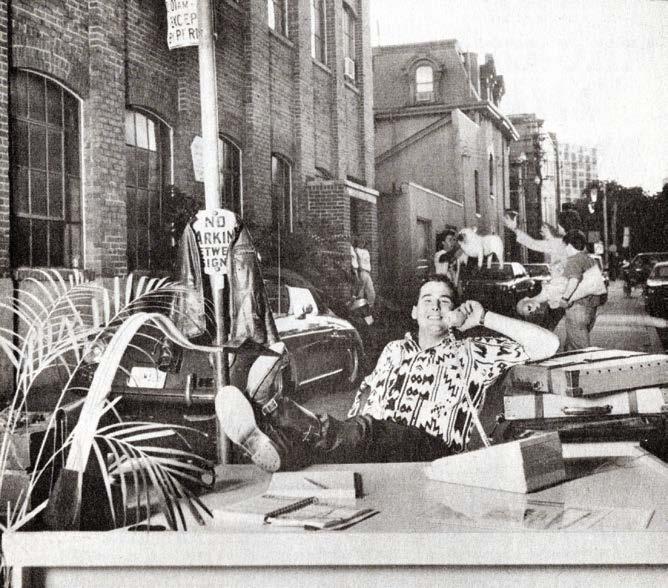
Mister X, being this very slick, color, glossy thing, was quite influential back in 1983, when we did it. But again, it was all just, if I liked it, we did it. It was a funny business back then. I mean, we were in early through no act of genius, just good luck and timing. I met Phil Seuling back in probably 1979, and a guy named Bud Plant, who I also met in the late ’70s. This was back when Comic-Con in San Diego was still in a church basement.
Phil basically did the whole East Coast distributing comic books, and Bud did the whole West Coast distributing comic books, and I got to know both of them. And so, when I started Vortex Comics… you gotta figure it was like ’79 when I started really trying to develop the first Vortex magazine, which was published in 1980. There really weren’t alternative comics, there was leftovers of the undergrounds, there was Cerebus, there was Elfquest and not much else…
CBC: There was Jack Katz’s First Kingdom…
Bill: But First Kingdom was not of the quality that Elfquest and Cerebus were, which I hate to say it because it was sincere, but this was before Love and Rockets, before Teenage Mutant Ninja Turtles, before Mage… Eclipse and Pacific Comics were still just starting, and Fantagraphics wasn’t publishing comic books yet. They were still just doing The Comics Journal. So early days,
Above: What, Bill cocky? The Vortex publisher hams it up in a publicity photo that accompanied his Comics Interview #40 [’86] feature. Below: Of course, it was the trendy series Mister X that put Vortex Comics in the limelight, a post-modern, noir-ish, and remarkably designed title featuring the enigmatic, drug-addicted titular star. Cover of #1 [June ’84] by Paul Rivoche.
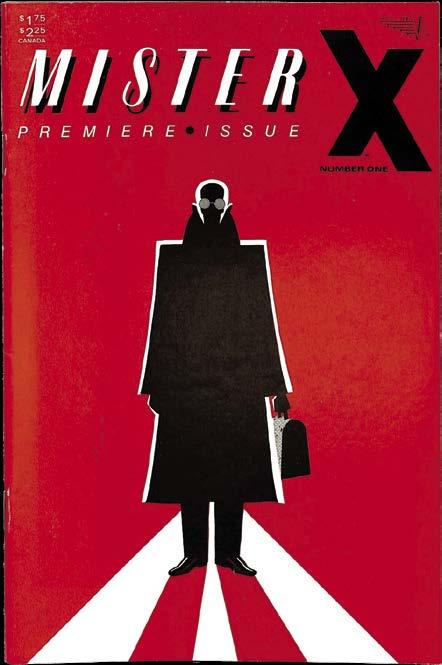
the sexy & criminally talented
Chip Zdarsky’s Amazing Double Life
Where we analyze the various personas of the Canadian comic book writer/artist/humorist
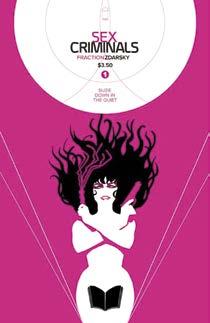
by JON B. COOKE
[Interviewer’s Note: Certainly the delightfully amiable and unassuming Steven Murray, a.k.a. Chip Zdarsky, is one of my favorite Canucks, partly due to the fact I interviewed the writer/ artist at length for my short-lived ACE: All Comics Evaluated magazine 11 or so years back. There’s also the fact that, on very short notice, he cheerfully consented to, not one, but two interview sessions for this article and, well, I love his work on Sex Criminals (the title that launched his comics career in earnest), all of his humor stuff, and the Public Domain series, with its spin on creator rights and corporate ownership. Plus he’s a good egg. Funny, too. So let me introduce you! — JBC]
Finding the real guy is no easy task. Like there was that time Steve Murray’s little brother, his plus-one as a guest at San Diego Comic-Con, was trying to get his attention while Steve was signing at his artist alley table. “He was standing, like, maybe 20 feet away from me,” Steve said. “Then he turned to get my attention and he went, ‘Steve! Steve!’ But I didn’t lift my head at all. I didn’t even register it, but as soon as he said, ‘Chip!’ my head shot up. I’m like, ‘What?’ I didn’t respond to my real name at a comic convention and it unnerves me in normal day-to-day life with family and friends when somebody calls me Chip.”
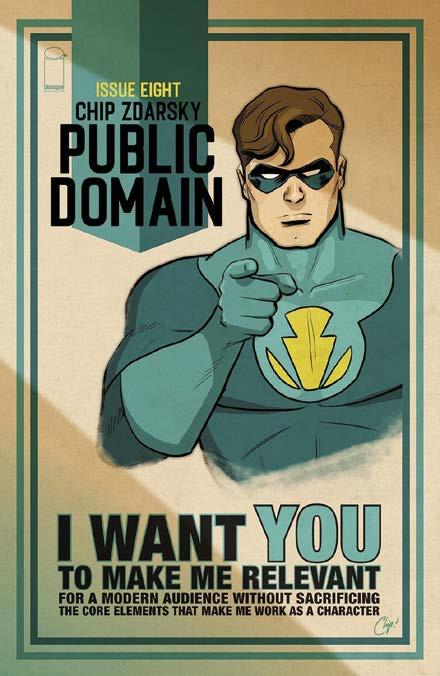
The man’s professional alter ego is, of course, Chip Zdarsky, a persona the Albertaborn gent adopted for a life as comic book creator. “My God,” he exclaimed, “like when I first saw a therapist and I told her about the Chip Zdarsky stuff! I swear she started licking her lips, just counting the dollar signs in her eyes, with her thinking, ‘This guy’s going to be with me for a while!’”
Steve’s original intention was to keep his invented personality distinct and separate from private life, but Chip Zdarsky’s success made that impossible. “I think, ‘Oh,
whoa, that’s weird, because those two things in my life should never meet.’ But I’m more easy with it now, because Chip gets recognized in the street, and my parents and my wife are a bit more accommodating of it all now.” With a chuckle, he added, “My mom and dad now proudly proclaim themselves, ‘Mr. and Mrs. Zdarsky,’ when they come to my signings.”
As for the distinction between them, Steve said, “Obviously Chip and Steve are very similar — I’d be creepy if they weren’t — but I crafted Chip as an online character. He was a bit more of a sad-sack funny guy, whereas, in reality, I was pretty well put together. In the early days of comic conventions, I’d wear a cowboy hat and fake glasses to really kind of give the character a bit more distance from myself.”
MADE IN CANADA
Before delving into Chip Zdarsky’s raison d’etre, I asked about Steve Murray’s early years. “Born in Edmonton, I spent my first few years in Stony Plain, Alberta,” he shared, “and then grew up in Barrie, Ontario. Life started off very rural, basically farmland, and then it was suburban in Barrie, an hour or so north of Toronto. My first comic shop was there — Beaver Comics (a very Canadian name) — and it was the best. It was an old dentist office which these two guys turned into a comic shop. All the new issues were in the reception area and all the back issues were in the procedure area, and it was still very obvious that it was an old dentist office.”
As for what got Steve addicted to funnybooks, blame it on Jim Shooter and Mike Zeck. “I was buying them at drugstores and then, when I got hooked on comics, it was Marvel Super-Heroes Secret Wars #7.* And the problem with that was, I’m realizing, ‘This is issue seven! Well, where are issues one through six?’ And that’s when I realized there was such a thing as comic shops and I started hunting down previous issues of that series in these weird basements until the aforementioned Beaver Comics finally opened and I had a real comic shop in my town. Yeah, it was life-changing — a whole place dedicated to the things that I loved!”
As an older brother and dedicated fan of the House of Ideas, Steve hatched a scheme to keep abreast of the Distinguished Competition. “My thing with my little brother was, he’s three years younger than me, and so I was into Marvel Comics, but I also wanted to read DC Comics. So I got my
* Yes, Steve Murray actually used the full, official name for a comic book series referred by most everybody else in fandom as simply Secret Wars, proof of his comics-geek bona fides!
Above: Chip Zdasky’s initial claim to fame is as artist of Sex Criminals [#1, Sept. ’13], cover by Chip, the humorous crime series described as “Bonnie and Clyde meets The 40-Year-Old Virgin.” Below: Chip’s cover of Public Domain #8 [Sept. ’24], a series he writes and draws.
brother to buy DC and then I would read them. I even went so far as to, when I started to get into the Overstreet Price Guide, pricing comics, I convinced him to let me look after his comics to ‘protect’ them, so the entire collection just resided in my bedroom, so I could read them whenever I wanted. It was great! The perfect plan!”
As for drawing, Steve explained, “I was always drawing, but I never really considered it as a possible job. Maybe I did in grade eight or nine, when I started to kind of do my own fan comics.” Those homemade efforts were, he said, “Really sad ones, where I had a version of myself, a little character named Andy, who was much cooler than I was, but looked just like me and all the girls really liked them. They happened to look like girls in my class. I would do these comics about Andy going on all these cool adventures and gaining super-powers and finding bad guys and having to choose between the girls in his class. Yeah, it was super-sad, truly super-sad comics.”
He continued, “And then, in high school, like most comic creators when they were in high school, I would start a comic that I would never finish. I did a few pages of a ‘Spider-Man in the Future’ comic — and this is before Spider-Man: 2099 — I maybe got as far as three pages in. That was my trajectory: three pages into these giant epics that I would just abandon.
“So, by the end of high school, I was pretty much disabused of the notion that drawing could be a job, so I went into graphic design because I believed, ‘Oh, that’s where you make money doing art.’” But, after attending the program for a year, instructors told Steve he drew too much to be a graphic designer. “So then I went into media arts and lasted for three days when I realized I wouldn’t be doing anything visual, and I then did art fundamentals for a year, and then illustration for three years. I could have been a doctor with all my schooling!”
In illustration school, Steve was explicitly instructed not to pursue sequential art. “They didn’t want to see comic book work, nor fantasy stuff or anything that even hinted at genre stuff, because they were focused on picture books, editorial art, and advertising work. So me and a few guys in that pro gram, we would secretly doodle our own comics on the side for fun. Now, the funny thing is, decades later, that program very proudly references myself, Ramón Pérez, Jeff Lemire, and Kagan McLeod as program graduates, now embracing the idea of comics as, it turns out, one of the only things you could do where you could make money!”
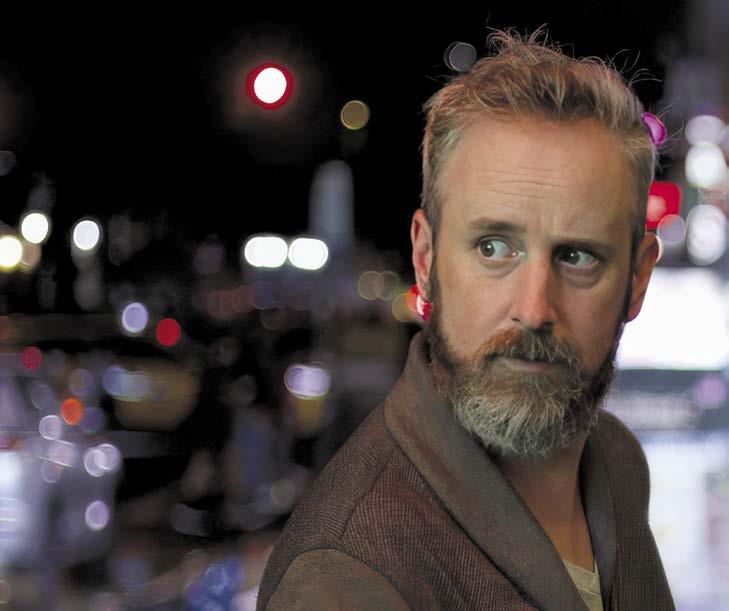
UNDER THE INFLUENCE
Asked who were his biggest influences as he toiled away as a wanna-be comic book artist, Steve said, “Oh man, that’s such a hard one. It changed so much over time. John Byrne was the big one when I was young, because I was essentially copying his work and he was important enough to me that I followed him over to DC for Man of Steel, but you lose those influences as you go on and then it changes. Kevin Maguire was a much bigger influence the older I got, especially when I was leaning more towards humor stuff. In college, Dan Clowes was massive and I think you can maybe see a bit of his influence in my work, as well. It’s hard. Being asked about influences feels more like a question for other people than for the person who’s being influenced because I can’t see it. When I draw, I just see bad drawings in what I’m doing.’”
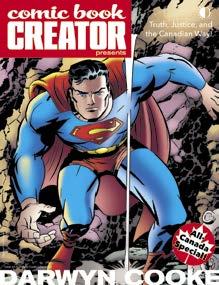
COMIC BOOK CREATOR #46
Double-sized issue spotlighting DARWYN COOKE! “Truth, Justice, and the Canadian Way” features two interviews with Darwyn, plus other Canucks: Richard Comely’s history of Captain Canuck; Neil the Horse’s Arn Saba; a profile of David Boswell of Reid Fleming fame; plus Orb magazine founder James Waley, Dean Motter, Vortex Comics publisher Bill Marks, and more! (160-page FULL-COLOR Softcover) $25.95 (Digital Edition) $9.99 • ISBN: 978-1-60549-138-7 https://twomorrows.com/index.php?main_page=product_info&cPath=98_132&products_id=1880
About the Canadian scene Steve said, “As a kid, I knew John Byrne was Canadian. That was huge for me as a kid, just knowing that. And then, when I moved to Toronto as a young man, you heard the stories of the alt comic legends in town, like Seth, Chester Brown, and Joe Matt, and sometimes you get a sighting of them at the Beguiling comic shop. It was very exciting. And you knew that now-defunct comic publishers came and went in Toronto, but it wasn’t really until I started the [RAID] studio with my friends that I really got to know exactly how many people in Toronto were in comics and then through TCAF [Toronto Cartoon Art Festival] as well, because I was really supported by the Beguiling, especially in my early days. And when they launched TCAF, I was kind of a part of it from the start, and that’s when you meet all the other comic creators who are all struggling and scrimping and saving to put out their zines, whether it’s like Jim Zub, Jeff Lemire, or Ramón Pérez. It was a cool little community and it still is… Toronto’s great.”
Above: Chip, photographed by comics colleague Gerry Duggan. Inset previous page: The cover of Marvel Super-Heroes Secret Wars #7 [Nov. ’84], the comic book that turned Steve Murray into a collector. Cover art by Bob Layton. Inset left: The old location of Toronto comic book store The Beguiling at its former location in Markham Street. Today, it resides on College Street, where Ye Ed. visited in 2018, and it remains a superb purveyor of alternative comics, you betcha! Below: Jesse Farrell’s relief sculpture of Howard the Duck is based on Joe Quinones’ design of the character created for the Chip Zdarsky-scripted HTD series in 2015.