My name is Andrew Schmidt (@Bit_by_Brick on Instagram) and I’m an organizational psychologist by training. I lead a team of HR business partners supporting thousands of employees with all things related to people in the workplace. I’ve been building since I was seven years-old, though like many AFOLs, pulled away from LEGO and had my Dark Ages during college and graduate school.
I got back into building when my daughters discovered LEGO around 2017. My girls loved the LEGO Elves sets, and I was awed at the new colors and shapes that had been released since my youth. My favorite theme as a child was Castle, and as an adult I love the LEGO Botanical series. I was even interviewed about the Botanicals for an NPR article! I built my first MOC when I liked the idea of the LEGO World Map but didn’t like the colors (I wanted something more natural with traditional blues and greens). I also wanted to represent the actual topography with raised portions instead of a completely flat surface. I decided to build my own version using the colors I wanted, and my MOC building has continued from there.
Andrew Schmidt: The World of Tactile Mosaics!
Article
and
Photography by Andrew Schmidt
Andrew hard at work on Atlas Shrugged.
(top) Waiting for Calvin, showing a detail that highlights the depth and dimensionality of “Deep Greebling.”
(right) Pieced Together further demonstrates the tactile quality of this building technique.
(below) Prey.
The resulting instructions give me a 2-D layout and so long as the top color matches the plan, I know the image will work.
This is where the art really comes in, because I transform the 2-D image into a 3-D piece by creating miniature builds, habitats, and other “Easter eggs” hidden throughout. In Waiting for Calvin (the tiger), there are hidden scenes of a coral reef, a zombie attacking a hospital, a gem thief stealing precious stones, and a LEGO Elves goblin causing mischief. You have to view the art from all sides to catch the hidden scenes. I also try to incorporate pop culture references (like the scene from the movie Life of Pi) and meta elements (like placing Tigger and Rajah—tigers within the tiger). In the end, the 2-D plan from LEGO Art Remix is about a 70% solution and I make adjustments for the rest, particularly around the eyes that need to captivate the audience.
Building Style and Advice
For me, building with LEGO is a meditation. My job is stressful and requires intense emotional output; LEGO allows me to recenter. I love that I can (and do!) make thousands of mistakes, but they can always be fixed. There are no permanent errors. I also like breaking the rules. I use broken pieces for bits of color (don’t throw away those shattered reddish browns and dark reds!). I flip pieces upside down and use illegal techniques. Every brick, plate and tile is simply a blot of color in a plastic impressionism canvas. Since I’ve started displaying my work at LEGO conventions, I
(above) A Look Around the Neighborhood, which is now part of the permanent LEGO collection at the Museu da Imaginação in São Paulo, Brazil. (below) Forever Entwined, an anniversary gift for his wife.
Nate Mielnik:
A Landscape of LEGO® Color
Article and Photography by
Nate Mielnik
My name is Nate Mielnik, and in addition to building with LEGO, I also have been rapping professionally and releasing music for the past eight years, and have been drawing since 2024. To make a living, I’ve been a coder and manager at places like Vistaprint, Microsoft, Amazon, and Cash App. I’m based in Silver Spring, Maryland, where I spend a lot of time with my 13-year-old dog, Einstein, who’s usually nearby no matter what creative project I’m working on.
(right) Great Wave off Kanagawa by Japanese artist Hokusai, as interpreted in LEGO by Nate Mielnik.
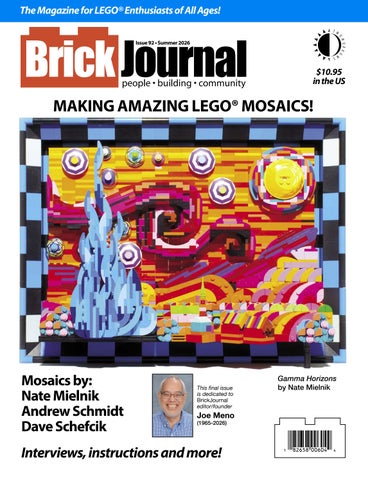
Gamma Horizons, Nate’s reinterpretation of Vincent van Gogh’s Starry Night.
I’ve been building LEGO as a hobby for eleven years and building MOCs for about eight years. I never really had LEGO as a kid, but that all changed later in life when I spotted the Falling Water LEGO Architecture set. I was drawn in by the Frank Lloyd Wright design and decided to give it a try. Building it turned out to be a blast, and it sparked something in me. I started following the rest of the LEGO Architecture line, collecting sets and getting more immersed in the world of bricks. One thing led to another, and I was fully back into LEGO as an adult. By 2018, I had moved beyond collecting and began creating my own MOCs.
Building a Theme of Art
My heart will always belong to the LEGO Architecture series. I love almost every set they’ve released. They don’t come out as frequently these days, and the newer ones have a different feel, a little more detailed and grand, but I still enjoy them.
Recently, I’ve also been drawn to the LEGO Art sets, especially the reimagined versions of famous artworks like those by Van Gogh, Keith Haring, or Hokusai’s Great Wave. Sets like the World Map and the abstract mosaics have been a great way for me to explore art in a new way. The LEGO Modern Art set in particular felt like it was made just for me. I actually bought six or seven copies just so I could experiment with different combinations! So while LEGO Architecture will always be my foundation, I’m thoroughly enjoying what LEGO Art has to offer.
When I first got into LEGO, I was mostly collecting sets, especially from the LEGO Architecture series. I eventually gathered nearly the whole line, along with a few Creator sets that had a similar vibe. At some point, I wanted to rebuild them all, just to enjoy the process again. But I didn’t want to
A very colorful Mandalorian helmet.
Metamorphic Glade, based on the LEGO A-Frame Cabin.
buy duplicates or take apart the sets I had already completed. So I started trying to recreate the builds using whatever spare pieces I had, even if they were the wrong colors.
It became a kind of challenge to follow the instructions while substituting parts and colors, and I started making creative choices about what to use. After doing a few of these recolors, I showed them to my brotherin-law. To my surprise, he was really enthusiastic about them and even offered to photograph the builds. That gave me the idea to start sharing them on Instagram, and the reaction there encouraged me to keep going. I leaned into it and began focusing on creating unique versions of my favorite sets.
What started as a practical workaround morphed into something much bigger for me: combining color, shape, and patterns in a way that let me express how my brain naturally likes to organize things. It evolved into this therapeutic and exciting way for me to explore creativity, in a form I hadn’t accessed before.
Getting Inspired by Color
I’m often inspired by official LEGO sets that use a limited color palette or have strong, distinctive shapes. There’s something about monochromatic builds that gives me room to experiment with color and pattern in unexpected ways. For example, the Pyramid of Giza is a large, mostly white structure that has sparked my curiosity about ways to experiment with such a smooth angled surface. Similarly, the Van Gogh Sunflowers set appealed to me because of its vast use of yellow in the background, which made it a great canvas for reinterpreting color and texture. Even something like the giraffe set worked as inspiration, because no matter how you recolor a giraffe it will still be instantly recognizable as a giraffe. This sort of thing gives me freedom to experiment with color and form while keeping the shape recognizable.
Beyond LEGO sets, I try to stay open to inspiration in every-day life. I might notice the way clouds are moving, how colors show up on a soda can, the way something spills on the ground, or
Two views of the Sydney Opera House.
Nate Mielnik.
Photo by Andy Cosnotti.
Parts List
(Parts can be ordered through Bricklink.com by searching by part number and color)
Qty Part Color Description
1 78258 Black Bar 2L with Thick Stop and Pin Holes
2 63864 White Tile 1 x 3
Winter Cardinal
Design by Dan Ko
Winter builds are some of my favorites, not because they’re grand or complex, but because they capture quiet moments you can almost feel. Cardinals are one of those serene moments. When the world turns white and branches turn bare, that flash of red feathers cuts through the cold. It felt right to turn that tiny spark of color into a brick-built bird.
To create the core body of the cardinal, I used a red kayak paired with a minifigure chair to suggest some plumage. On each side, 3×3 curved red corner slopes do much of the heavy lifting to give the bird its rounded, puffed-up silhouette. And for the beak, I used two classic Bionicle teeth in orange to form a pointed beak that looks sharp despite only being a couple of pieces
The whole model perches delicately on a small branch— helped by a bit of playful, not-quite-legal balancing on its feet to get the angle just right. A bunch of bright red berries at the end of the branch adds some contrast and reinforces that crisp, midwinter feeling.
This tiny cardinal was a delightful little model to design, and I hope it brings a bit of warmth to your winter building.
2 24201 Red Slope Brick Curved 2 x 1 Inverted 2 3245b Black Brick 1 x 2 x 2 with Inside Axle Holder
1 85861 White Plate 1 x 1 Round with Open Stud 2 3022 Red Plate 2 x 2
2 6636 Black Tile 1 x 6
2 98138p0y Black Tile 1 x 1 Round with Small White Offset Circle Pattern 2 54200 Red Slope Brick 31 1 x 1 x 0.667 1 15070 White Plate 1 x 1 with Tooth Perpendicular 1 11477 White Slope Brick Curved 2 x 1
41669 Orange Technic Tooth 1 x 3 with Axlehole with Rounded Bottom Cavity
4477 Red. Brown Plate 1 x 10
19119 Dark Red Plant Flower Stem with Bar and 6 Stems 2 23443 Black Bar Tube with Handle 1 3710 Red Plate 1 x 4 6 33291 Red. Brown Plate 1 x 1 Round with Tabs 2 3024 Black Plate 1 x 1 1 3024 White Plate 1 x 1 2 2450 Red Plate 3 x 3 without Corner 6 32474 Red Technic Ball Joint with Axlehole Blind 2 51739 Dark Red Wing 2 x 4 2 34103 Black Plate 1 x 3 with 2 Studs Offset 2 15712 Black Tile 1 x 1 with Clip (Thick C-Clip) 1 4697b
Technic Pneumatic T-Piece - Type 2 1 20482 Black Tile 1 x 1 Round with Pin and Pin Hole
2 60470b Red Plate 1 x 2 with 2 Clips Horizontal (Thick C-Clips)
1 3068b Black Tile 2 x 2 with Groove 1 3068b Red Tile 2 x 2 with Groove 1 43722 Red Wing 2 x 3 Right 2 87079 Black Tile 2 x 4
1 3958 Black Plate 6 x 6 1 3023b White Plate 1 x 2 6 3023b Red Plate 1 x 2 1 3070b White Tile 1 x 1 with Groove 2 48336 Red Plate 1 x 2 with Handle Type 2 1 41740 White Plate 1 x 4 with Two Studs and Groove
2 15068 Red Slope Brick Curved 2 x 2 x 0.667 2 27263 Red Tile 2 x 2 Corner without Corner 1 3069b Black Tile 1 x 2 with Groove 1 4079 Red Minifig Seat 2 x 2 4 76797 Red Brick 3 x 3 x 1 Quarter Circle with Curved Top
1 52107 Black Brick 1 x 2 with Studs on Sides 1 43723 Red Wing 2 x 3 Left 1 29110 Red Boat Kayak 2 x 15
2 4733 Black Brick 1 x 1 with Studs on Four Sides
2 18674 Black Plate 2 x 2 Round with 1 Centre Stud
Painting with LEGO: Dave Schefcik’s Mosaic Reinvention
Article by Joe Meno
Photography by Dave Schefcik
Back in 2021, Dave Schefcik’s Rainbow Heart introduced a new way of thinking about LEGO mosaics. By layering quarter-circle tiles over a grayscale base, the resulting art piece showed color, detail, depth, movement, and a sense of light not commonly captured in LEGO creations.
In the years since, Dave has continued exploring that approach through two additional works: Clutch Power (2024) and Transcendent Shout (2025). Each piece builds on the same core idea but pushes the technique forward in new ways, moving from color blocking to blending to something closer to painting with LEGO. I caught up with Dave to talk about how the technique evolved, what these pieces represent, and where it might go next.
Joe Meno: I remember seeing Rainbow Heart for the first time and being struck by how much depth it had compared to a typical LEGO mosaic. What first inspired you to create it, and how did that piece set the stage for what followed?
Dave Schefcik: Rainbow Heart started as a way to express visibility through color. I wanted a detailed mosaic that felt alive rather than flat, which led to experimenting with color theory and layering. Once I saw how the quartercircle tiles interacted with a grayscale base, letting the base color peek through, it opened the door to treating a mosaic as more than just a grid of 1x1 pixels. Essentially, the technique increases the resolution of a 1x1 stud, allowing for more detail and more organic shapes than are commonly achievable in a standard LEGO mosaic. At a
Transcendent Shout.
distance, your eye blends the colors together, but up close, every single piece is doing something slightly different.
Looking back, what did you learn from building Rainbow Heart that carried forward into Clutch Power and Transcendent Shout?
The biggest takeaway was how much impact a tiny change can have. Because the grayscale layer shows through, the placement and orientation of a single quarter-circle tile can completely change how a section reads. I’ve spent a lot of time rotating one tile back and forth, trying to get a curve or highlight to land correctly. That level of precision became even more important in Transcendent Shout.
Rainbow Heart was about color blocking, defining shapes, and figuring out the core technique. Most of my effort went into making the outlines and curves feel smooth. With my second work, Clutch Power, I attempted to blend colors. Instead of hard edges, I wanted colors to merge into each other, which meant reworking sections multiple times to get the gradients right. By the time I got to Transcendent Shout, I learned enough about my method that I challenged myself to essentially paint with LEGO.
Clutch Power feels like a shift from defined shapes into something more fluid. What was the inspiration behind it, and what were some of the biggest challenges or breakthroughs you had while building it?
At the time, the Black Lives Matter movement was gaining momentum, and I wanted to show support in a way that connected to both that and the broader LGBTQ+ community. The raised LEGO hand was meant to echo the symbolism of a raised fist but translated into the iconography of a minifigure. I also wanted to see if I could blend colors without using black lines for color blocking. That’s hard when all you have are individual pixels, so you need to dither them which is harder than it sounds, especially with a limited color palette.
(left) Rainbow Heart, as seen in BrickJournal #72.
(above) An example of Dave’s layering technique.
Clutch Power.
Meet BrickCon’s “Best in Show” Winner Douglas Hughes and His Minifig Scale International Space Station Community
Article
and photos
by Ashley Glennon and Douglas Hughes
The theme at Seattle’s BrickCon 2025 was STEAM— Science, Technology, Engineering, Arts and Mathematics— but one exhibit took all five concepts to the stratosphere. Near the back of the convention hall, bathed in the convention’s dim, atmospheric lighting, was Douglas Hughes’ colossal International Space Station (ISS). This spectacular minifigure-scale creation wasn’t just big, it was a feat of LEGO engineering that rightfully earned Hughes the prestigious Best in Show award.
Hughes, an AFOL in his early forties, lives in Seattle and puts his professional brainpower to work at a “giant aerospace corporation.” He credits his lifelong LEGO passion to his parents, especially his elementary school teacher mom, who embraced a “STEM sort of mindset before it was labelled as such.”
Two years ago, Hughes was hunting for a new large-scale project with “a fish bowl type feel,” where elements would move and captivate the audience within a frame.
Hughes already had experience in this area and wowed LEGO fans at previous conventions with a four-foot wide, animated rendition of Howard Hughes’ (no relation) Hell’s Angels, where micro-scale biplanes would down an enemy zeppelin. Striving for more, Hughes initially thought a small section of the ISS with a capsule docking would make a good build, but that inner urge for completeness wouldn’t let up.
Douglas Hughes displays his gigantic International Space Station.
Taylor Dosier: Building in Black!
Article and Photography by Taylor Dosier
She returned to her building through her son, starting him with Duplo. Over the years, he graduated to more complicated sets, so most of Taylor’s LEGO building was with him and his collection. The LEGO Icons Holiday sets caught her eye eventually and she thought it would be a fun Christmas tradition to have with her son, so each year ‘Santa’ would leave that year’s newest set under the tree and they would build it together on Christmas morning. Over time, they ended up growing a little winter village. While her son outgrew that tradition, she still really enjoyed it, so she kept buying the sets each year and it became her own little holiday tradition. From that, she
realized she liked building the sets on her own so she wanted to see what else was out there. She stumbled across the Stranger Things set and began building MOCs shortly after that.
Taylor’s favorite current theme is the Dreamzzz line. Unfortunately, she got back into LEGO right after all of her favorite themes retired! Elves, Monster Fighters, and Hidden Side are her favorite retired themes and Taylor feels that the Dreamzzz theme is kind of a fun and weird mix of those; it’s got a lot of creepy and dark elements to it, while also having wild colors and silly storylines.
Getting into building MOCs was the result of a mix of things for Taylor. She started out building sets like Stranger Things and the Haunted House. At the time, LEGO was really therapeutic for her while she was working through some heavy life challenges. Building gave her space to focus on something outside of her own head, which she desperately needed.
In 2022, Taylor’s son lost interest in LEGO - blasphemy!and he happily handed her his collection of Minecraft and City sets. Combined with the random little sets she was buying for herself, she used her collection to build her first MOC, The Riverbed Campsite. That’s when she decided to start an Instagram page to connect with other AFOLsthus, @bricksandchaos was born!
Later that year she went to her first convention, Brickfair Chantilly (in Virginia), and was blown away by what she saw. Walking around and looking at all the incredible MOCs Taylor kept thinking, “I need to be behind those tables!” She’s always enjoyed creative hobbies like drawing, painting, baking, and even went through a random scrapbooking phase, but motherhood had pushed those hobbies aside for many years. Building MOCs reignited that side of her and quickly became her new art form.
When the convention came to her home town, Fredericksburg, VA, in 2023, Taylor took the leap and registered to exhibit alone. It was going to be terrifying for an introvert like herself, but as scary as it felt she knew at the very least she would see cool builds and meet cool people. That was when she built her first dark themed MOC: The Witch’s Cottage.
Taylor felt like it was just a silly little build and would pale in comparison to others, but The Witch’s Cottage ended up earning a trophy nomination and with her receiving a lot of encouragement and positive feedback from builders and guests. Brickfair Fredericksburg hooked her completely, as she made friends, found community, and left feeling inspired to keep building.
Taylor’s building inspirations come from a lot of different sources. Nature is a big inspiration, as well as existing architecture. She loves art from different kinds of mediums, so she also gets a ton of inspiration from seeing other artist’s photography, paintings, sculptures, and of course, MOCs. Sometimes she will get an idea for a build theme from reading books, watching film or even from listening to music or seeing album art. She also tends to have a lot of random ideas pop into her head, so she has
Harvesting Steven.
You Can Build It
MINI Build
MINI Arrestor Cruiser
by Christopher Deck
Parts List (Parts can be ordered from Bricklink.com by searching by part number and color)
Arrestor Cruiser Main Body
Qty Color Part Description
1 Light-Bluish-Gray 28974a Bracket 1 x 1 - 1 x 1 Thick with Stud Hole
1 Dark-Bluish-Gray 41682 Bracket 2 x 2 - 1 x 2 Up Centred
2 Light-Bluish-Gray 4070 Brick 1 x 1 with Headlight
1 Light-Bluish-Gray 11211 Brick 1 x 2 with Two Studs on One Side
2 Light-Bluish-Gray 43898 Dish 3 x 3 Inverted
3 Dark-Bluish-Gray 90540 Minifig Ski Pole
1 Dark-Bluish-Gray 95049 Minifig Staff with Spherical End
2 Light-Bluish-Gray 26047 Plate 1 x 1 Round with Horizontal Handle on Side
3 Light-Bluish-Gray 3023 Plate 1 x 2
2 Light-Bluish-Gray 3794b Plate 1 x 2 with Groove with 1 Centre Stud
1 Light-Bluish-Gray 3666 Plate 1 x 6
4 Light-Bluish-Gray 3022 Plate 2 x 2
10 Light-Bluish-Gray 2420 Plate 2 x 2 Corner
2 Light-Bluish-Gray 3021 Plate 2 x 3
4 Light-Bluish-Gray 3020 Plate 2 x 4
1 Light-Bluish-Gray 3678b Slope Brick 65 2 x 2 x 2 with Centre Tube
2 Light-Bluish-Gray 43857 Technic Beam 2
2 Light-Bluish-Gray 32000 Technic Brick 1 x 2 with Holes
2 Light-Bluish-Gray 4274 Technic Pin 1/2
2 Light-Bluish-Gray 15712 Tile 1 x 1 with Clip (Thick C-Clip)
1 Light-Bluish-Gray 69729 Tile 2 x 6
2 Light-Bluish-Gray 24299 Wing 2 x 2 Left
2 Light-Bluish-Gray 24307 Wing 2 x 2 Right
15 Light-Bluish-Gray 41770 Wing 2 x 4 Left
15 Light-Bluish-Gray 41769 Wing 2 x 4 Right
Hello everybody. Welcome to our current final building session in BrickJournal as we know it today. This entire issue is overshadowed by the passing of our esteemed editor-in-chief Joe Meno. It was a difficult decision what to contribute under these circumstances. What would be appropriate? Something that would remind people of his name? Something that would remind people of his silhouette? But I’m not good enough at either of those things. Thus, I decided that the best way to honor Joe and his immortal project was to do what he had invited me to do over twenty years ago and what we had been doing together ever since: Building spot-on miniature models with unconventional design approaches, and recreating them together with you.
So, today we are going to build the unique-looking arrestor cruiser from the Star Wars live-action television series Andor. The design is based on a draft by design artist Colin Cantwell from 1977, which was not used at the time but has now made it into the official Star Wars canon after 40 years. Remarkable is the exceptionally elongated bow of the cruiser, which tapers further toward the front. One piece that allows this shape to be conveniently represented is the large 16x4 wedge piece with part number 45301. It’s not a part that you would normally find in a miniature model, but that’s exactly what has made it so appealing for over 20 years. One challenge in successfully using this part was to ensure that it was firmly attached and centered both horizontally and vertically. The resolution is a wonderful building experience that I now invite you to join.
From my side, I wish you happy building and have a good time. I hope that we will meet again somewhere and be able to build together again. It was a particular pleasure and honor to be part of this legendary project. Thank you, Joe, and farewell.
Arrestor Cruiser Engine Block
Qty Color Part Description
2 Light-Bluish-Gray 98100 Cone 2 x 2 Truncated
1 Light-Bluish-Gray 6233 Cone 3 x 3 x 2
2 Dark-Bluish-Gray 4740 Dish 2 x 2 Inverted
2 Trans-Light-Blue 4740 Dish 2 x 2 Inverted
1 Dark-Bluish-Gray 43898 Dish 3 x 3 Inverted
1 Trans-Light-Blue 43898 Dish 3 x 3 Inverted
2 Dark-Bluish-Gray 3176 Plate 3 x 2 with Hole
2 Dark-Bluish-Gray 15535 Tile 2 x 2 Round with Hole
Arrestor Cruiser Bow
Qty Color Part Description
4 Light-Bluish-Gray 36841 Bracket 1 x 1 - 1 x 1 Down
1 Dark-Bluish-Gray 41682 Bracket 2 x 2 - 1 x 2 Up Centred
2 Light-Bluish-Gray 4070 Brick 1 x 1 with Headlight
1 Light-Bluish-Gray 43898 Dish 3 x 3 Inverted
2 Dark-Bluish-Gray 30395 Hook with Towball
1 Dark-Bluish-Gray 90540 Minifig Ski Pole
1 Light-Bluish-Gray 3024 Plate 1 x 1
4 Light-Bluish-Gray 3023 Plate 1 x 2
2 Light-Bluish-Gray 3710 Plate 1 x 4
1 Light-Bluish-Gray 3022 Plate 2 x 2
1 Light-Bluish-Gray 99206 Plate 2 x 2 x 0.667 with Two Studs On Side
2 Light-Bluish-Gray 3020 Plate 2 x 4
2 Light-Bluish-Gray 45301 Wedge 4 x 16 Triple Curved
1 Light-Bluish-Gray 14181 Wing 4 x 9 with Stud Notches
The Hand of Orion: A Modular Marvel Packed With Fun
Article by Ashley Glennon and Joel Short
Photos by Joel Short
When Joel Short, a LEGO builder from Burnaby, British Columbia, decided to enter the BrickLink Designer Program (BDP), he knew his approach had to evolve. To appeal to voters, his BDP entry needed to incorporate “swooshability,” modularity, and playability—key traits of Space sets he cherished as a kid. For Short, an AFOL for nine years, this meant prioritizing a model that was fun to interact with and looked striking on a shelf. Short’s insightful approach paid off at BrickCon 2025 in Seattle, where his playful and expertly crafted creation, The Hand of Orion, captured the attention of fellow fans and won the Greebles and Nurnies Award.
A black-and-white spacecraft measuring 17 inches long and 12 inches wide, The Orion is packed with clever details and surprises. Its triton-shaped front and dual thrusters in the rear give it a solid, powerful look, but it’s the attention to detail and high fun-factor that truly sets it apart. The Orion’s win at BrickCon wasn’t its first—it also took home the Stellar Spaceship award at BrickCan 2025.
After his win at BrickCon, Short took the time to walk us through his ship and share insights into his building process and inspirations.
The Hand of Orion with its crystal collecting Canadarm extended.
Greebles and Nurnies
These are tiny, non-structural details—often LEGO parts or clusters of parts—added to a model to create visual complexity, texture, and the illusion of scale or mechanical function. The terms originated in filmmaking, with Greebles attributed to the special effects team for Star Wars and Nurnies credited to Ron Thornton for work on Babylon 5.
A clever lever opens and closes The Orion’s airlock.
Top down view with the Canadarm folded.
The Canadarm deployed with CANADA spelled with tiles.
The Canadarm can drop a crystal down the reactor hatch.
Minifigure Customization 101:
“I do have one idea… actually, 57, but let’s start with my favorite.”
Article by Jared K. Burks
I assume I, like everyone else, has had their life inundated with the sounds, colors, and events of K-Pop Demon Hunters on Netflix. I still recall the night it popped up in my kids’ Netflix feed and I giggled. Having friends into K-Pop, and a musical spouse, I joked about a watch party— oh, little did I know this film was about to live on repeat in my house for the next month. I have been watching a bit more anime lately and have thought about tackling some odd characters in LEGO form, and while digging around and talking with friends, sometimes the perfect models just fall into your lap: in this case, the hair styles for the HUNTR/X characters from K-Pop Demon Hunters. Thus began my journey into color matching resin and creating multi-color resin parts, which will be the focus of this article.
Oddly, there are some very specific references for LEGO versions of the now famous trio of Rumi, Mira, and Zoey: LEGO Fortnite. This helped greatly, as my goal was to make these characters look as closely as possible to their Fortnite forms. I may later make the demon form of Rumi, but for this article we are sticking with the Fortnite versions. I also wanted to demonstrate how a reference could be created as accurately as possible. The largest challenge would be the weapons, which I am still working on Mira’s, as hers is the most complex. “Why couldn’t you love me?! All of me!!!” Hopefully I will have it soon, because my graphics card is dying. Apparently the demon slayers were a bit too hard on it. Today, “We got the hottest ticket in town. To our couch!” No, but seriously, pull up a couch, computer, and the film, and let’s see how I did, and how well I can explain it, as I am following the examples of Fortnite.
Rumi
Rumi is the lead vocalist and leader of HUNTR/X, a K-pop girl group that also operates as a trio of demon hunters. Rumi is the daughter of the late Mi-yeong Ryu, a former demon hunter, and a demon father. She was raised by Celine, a member of the Sunlight
Rumi next to her LEGO Fortnite rendition.
Sisters, who taught her during childhood to hide her demonic heritage, and that by fulfilling her purpose of sealing the Golden Honmoon, her patterns would disappear. Throughout the film, Rumi struggles with her dual heritage, concealing her markings and fearing rejection from both her team members and her fan base. In the English dub, Rumi is voiced by Arden Cho, with EJAE providing her singing vocals, while Shin Na-ri voices her in the Korean dub. Rumi’s signature feature is her long, brilliant purple hair, typically styled in a thick dragon tail braid that reaches down to her calves. This was her hair style even as a child in flashbacks. Though her skin is normally pale, she also inherits purple demon patterns that glow pink whenever she is under stress. In such moments, her irises also shift from brown to gold and her hands become clawed.
Rumi is seen in a range of outfits suited to different occasions. As a performer, she wears looks that blend contemporary Kpop fashion with subtle nods to traditional Korean aesthetics. Her stage costumes feature vibrant colors, patterned fabrics, and modern accessories, paired with bold stage makeup such as eyeliner, mascara, and painted nails. When hunting demons, she dons more practical attire, and in quieter moments she’s shown in casual outfits. Rumi deliberately chooses clothing that conceals the demon patterns on her body, particularly those on her arms and neck.
Parts:
Hair: Custom Hair Style in Medium Lavender
Meshmixer thingiverse.com/ thing:7094317
This is a complicated subject, as her hair changes slightly throughout the film, and the color is a bit deeper purple, but Fortnite made it Medium Lavender, and this was my goal as well. Currently there are only four hairstyles in this color according to Bricklink, and I am sure LEGO calls it something else, but I am using the Bricklink Color Guide (https://v2.bricklink. com/en-us/catalog/color-guide). To make this color resin, I started with a dark purple that is out of production, unfortunately. I added white, blue, and ultimately just a touch of yellow. As you are working through, it is important to add very small amounts of other color resins. You can color saturate and it will turn muddy, grey, or brown fast. This was more apparent in the creation of the hairpiece for Mira, and I had to start over.
Torso: Yellow with Yellow arms
Hands: Light Nougat
Head: Light Nougat
Legs & Hips: Black
Weapon Conjuring: As part of her demon hunter abilities, Rumi can summon a magical weapon at will. By activating her hunter magic, she materializes her signature sword from pure energy. Visually, this manifests as glowing light coalescing into the blade in her hand. The sword is spiritually linked to Rumi, allowing her to summon or dismiss it at any time. When not in
(above) The original gilded Rumi sword reference, and exploded view, and Rumi’s sword.
(left) Dipping the sword blade.
(above) Hair models, and (below) Rumi hair color matches.
eric parsons
(ScruffyBrickHerder):
Building Star Wars Scenes and More!
Article by David Strenzler, Bantha Bricks: Fans of LEGO
Photos by Eric Parsons
Star Wars
Galactic greetings! We are Bantha Bricks: Fans of LEGO SW. As administrators of one of the best LEGO Star Wars themed groups on Facebook, David Strenzler, Frank Averstegge and Eloi Parizeau witness amazingly creative builds by Star Wars fans worldwide on a nearly daily basis.
Today, we would like to introduce you to the skilled LEGO MOC designer and Bantha Bricks community member Eric Parsons.
Eric is no stranger to our community. Under the handle ScruffyBrickHerder, he has been living his passion for LEGO and Star Wars since 2020, and has already impressed us with numerous LEGO Star Wars spaceships and vehicles. These alone would be worth an interview for the Bantha Bricks Files. However, Eric stands out with a very special interest, the design of the so-called Star Wars “Uglies”, which we will take a closer look.
Eric Parsons
Eric Parsons with his Clone Wars-inspired layout.
David Strenzler: Hello Eric. Welcome to the Bantha Bricks Files! Could you please introduce yourself and what you do?
Eric Parsons: Hi David, thanks for the warm welcome! I’ve been a professional software designer for over 25 years and came back to LEGO about 5 years ago mostly as a creative outlet, having transitioned from a software designer to a leader of design teams. My days started consisting of more meetings than time spent designing, and I needed to create again. I started by buying some new LEGO sets, but really wanted to do custom MOCs. Unfortunately I didn’t save my own LEGO sets I had as a child, which were classic Space sets, but I did save all the sets my kids and I collected when they were young, including many of the original Star Wars sets that launched in 1999. That led me to organizing those parts and starting to create small 12x12 MOCs, capturing small moments from Star Wars, or making my own fictitious scenes. I started to share those on Instagram, as well as modifications to some of the Star Wars ships I purchased, and people were asking for instructions to create themselves. This led me to learn BrickLink Studio, the 3D design tool from LEGO, so I could model the designs and generate building instructions. Having spent so long as a software designer, this was perhaps more natural than building with physical LEGO parts, and having just rekindled my LEGO passion, it also meant I was not hindered by the lack of specific parts.
An overview of Eric’s Mos Eisley layout.
Mos Eisley details.
Joe
the former community manager for the Americas at the LEGO Group, who comments below:
I’m very honored to have gotten to work with Joe and know him for the past 15+ years in different capacities and roles. In my post-LEGO life we had connected more on art than bricks, and had the chance to draw together on one of my YouTube livestreams back in 2021: https://www.youtube.com/live/ X6Ca7kDiRj4?si=hlCr4yLO_BSbiE25
Some of my Bricks in the Middle comics were in BrickJournal for a spell, too! He was a great man and positively impacted so many... I’ll miss him.
- Kevin Hinkle
Two years ago, I got an awful text. “There’s very strong evidence I have Stage 4 prostate cancer,” Joe wrote. After texting a string of expletives, I wrote back, “Let me know what I can do.”
His response was simple: “Build. That’s all. I love getting the photos of your work.”
Joe and I have known each other since the early days of the AFOL community. In 2002, he entered a building contest I ran on a Geocities site: “The Unofficial LEGO Disney Villains Contest.” Joe’s entries were simple MOCs by today’s standards—Ursula over her cauldron, and Chernabog atop a BURP.
But Joe was fully participating in this awkward high schooler’s homebrew contest—taking it seriously and investing his whole passion. That meant the world to me, and it still does. That was the beginning of a long friendship enmeshing LEGO and Disney. Joe was,
Tributes to Joe Meno
above all, a friend. He gave himself to the community in everything he did, validating others and saying, “You belong,” with every action he took.
We would talk about Disney ad nauseam. He’d send me timelapse videos of his sketching process, I’d send screenshots of Disneyland ride vehicle MOCs in progress. My castles, sketches of popcorn carts, or iconic characters… his ubiquitous response was, “cool.”
Just reading the word alone feels trite. To really appreciate that one word response, you had to hear it in Joe’s effervescent voice, always with real awe. Joe certainly did appreciate the models. But behind that exuberant “cool” was, more than anything, an appreciation of people.
Joe was a builder and artist. But more important was his genuinely good soul. When he cracked a smile during a conversation, you knew he meant every shining tooth and laugh line.
I will miss the moments we had and mourn the ones that will never come. From obsessing over Kem Weber’s animation desks, to each chasing our own perfect LEGO Mark VI monorail, to arguing over the best color schemes for his latest mouseterwork in pencil and ink—I will miss it all.
crafts exhibits. She asked me if I knew much about LEGO and I told her a fair amount. It turned out they were looking for someone to judge the competition, because they had some complaints about people submitting official LEGO sets as original work, but the people doing the judging didn’t know enough to know which were official LEGO sets and which were not.
I told her I’d be happy to help, but recommended having a second person, which she agreed to. Joe Meno was the first person I reached out to help judge. We disqualified a lot of official sets the first few years, including one notable Brickmania design of the USS North Carolina: https://www.brickmania.com/ uss-north-carolina/
We pushed to add a second category, which ended up being North Carolina-themed designs, and unsuccessfully lobbied for an adult category.
IF YOU ENJOYED THIS PREVIEW, CLICK THE LINK TO ORDER THIS ISSUE IN PRINT OR DIGITAL FORMAT!
On my mantle, I have a prized pos session: a miniland version of Frank Walker from Disney’s Tomorrowland. handed it to me at a convention after sharing photos of each successive ver sion he designed. I protested—it was his model, he should keep it. But he insisted I have it. He built it, that’s all he wanted to do. And he wanted me to share in that joy.
A world without Joe is hard to imagine. And I’m not sure how to navigate it. But then again, Joe told me exactly how: “Build. That’s all.”
I remember when Joe told me he was leaving the News & Observer and was going to start a LEGO magazine. I thought he was crazy, but I have subscribed since the beginning because I supported what he was trying to do. I think my subscription lapsed for a bit, so I don’t have every issue, but I have almost all of them, including the original non-print issues.
- Mike Walsh
I was very saddened by the news that Joe Meno had passed away. I didn’t have much contact with him, but I remember that I was contacted by Joe back in August of 2014 about potentially being published in BrickJournal—but I didn’t see the message until February 2015. Luckily enough, Joe managed to get me published, no matter my late
BRICKJOURNAL #92 (FINAL ISSUE)
- John Rudy
I learned of Joe’s passing just yesterday; what a sad day for the LEGO community, as Joe was key in building the adult community when it was first emerging in the late ’90s and early 2000s.
Joe was very active in getting the original incarnation of the North Carolina LEGO User’s Group (NCLUG) off the ground. I can’t remember exactly how I met Joe—he was living in Raleigh and working for the Raleigh News & Observer newspaper at the time.
FINAL ISSUE celebrating the legacy of editor JOE MENO (1965-2026). It’s LEGO® Mosaic Madness with builders NATE MIELNICK and DAVE SCHEFCIK! Then we explore cutting-edge Tactile Mosaics with ANDREW SCHMIDT! Plus BrickNerd’s custom creations; Bantha Bricks: Fans of LEGO Star Wars spotlights the best builds from a galaxy far, far away; step-by-step “You Can Build It” instructions by CHRISTOPHER DECK; and Minifigure Customization with JARED K. BURKS! (84-page FULL-COLOR magazine) $10.95 (Digital Edition) $4.99 https://twomorrows.com/index.php?main_page=product_info&cPath=98_78&products_id=1897
Joe and I patterned to judge the LEGO entries in the North Carolina State Fair each October for many years.
My kids had entered one year, and when dropping their entries off, I ended up speaking with the woman responsible for the Hobbies and Handi-
This was one of my biggest milestones within my LEGO journey at that time, and it wouldn’t have been possible without Joe! And it meant so much because I was just starting to get out of my depression at that time. I had been bullied throughout elementary school and just started high school. This was one of the best pick-me-ups I could’ve gotten, and it kept me motivated, and got me to keep building—which resulted in me starting working at a LEGO Store, and later also being on the first season of LEGO Masters Sweden. As a young teenager in Sweden, to be highlighted and showcased in BrickJournal was nothing I thought would happen, but I’m so glad it did!
Joe’s ability to showcase the worldwide LEGO community’s creativity and passion throughout his life is truly inspiring!