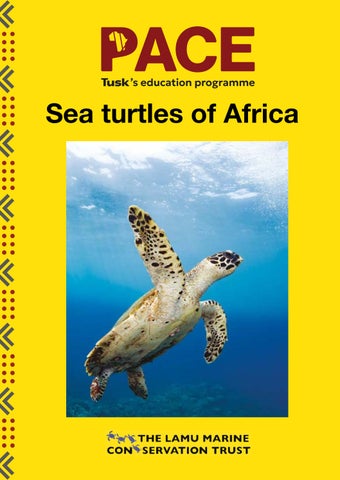
Sea turtles of Africa
PACE Sea turtles of Africa
1
PACE–Pan African Conservation Education is an education programme of Tusk. It was created by Tusk and Siren Conservation Education in 2004. This booklet on Sea turtles was created by Penny Fraser, PACE coordinator, with the field, education and management teams at Lamu Marine Conservation Trust: Teresa Gulatoon, Famau Shukry, Evelyn Kimori, Fondo Fondo, Tanwiri Ahmed and Elke Korschen. Massive thanks to Anthony Ochieng Onyango, Tony Wild Foundation for allowing us to use his photos. Design and layout was by Katie Puremont.
2
PACE Sea turtles of Africa
Published by Tusk Trust, 1a Place Farm, Court Street, Tisbury, Wiltshire, SP3 6LW, UK. © 2026 Tusk Trust & Lamu Marine Conservation Trust. First published 2026. A catalogue record for this booklet is available from the British Library. ISBN 978-1-0684834-1-7 Moral rights of the authors have been asserted. All rights reserved. The authors have made every effort to ensure the accuracy and currency of information in this publication.
PACE – Pan African Conservation Education PACE is an education programme of Tusk www.tusk.org It was set up in 2004, to help people understand and solve their everyday environmental problems, especially problems that impact on human wellbeing, and on the wildlife and ecosystems we all depend on. PACE multi-media educational materials are arranged in modules: Living with Wildlife, Water, Soil, Forests & trees, Energy, Living by the Ocean, Urban Living, Health and Careers in Conservation. They are all available free of charge, digitally at www.paceproject.net or in print. This resource on Sea turtles was produced with the Lamu Marine Conservation Trust in Kenya and is part of the Living by the Ocean module.
Why sea turtles? Sea turtles are fascinating animals. Most species are endangered and some are critically endangered, but they are protected by law. Many people don’t know this and don’t know or understand the reasons why sea turtles need protection. So we wrote this book to bust some myths, and improve understanding and protection of these precious keystone species. This is not an identification guide or manual. It is a general introduction to the African species and their ecology. It is full of beautiful photos, interesting facts and lived wisdom. It describes some of the things conservationists are doing to protect sea turtles and simple actions we can each take to do our bit. It was designed for school and community use, but will be informative for any general readers. Enjoy!
PACE Sea turtles of Africa
1
Contents Why sea turtles
1
LaMCoT
2
African sea turtles
3
Taxonomy
4
Physical appearance
6
Population
9
Distribution
9
Range size
9
Habitat
10
Behaviour
14
Routine
14
Food & feeding
14
Movement
16
Migration
18
Senses & Communication
20
African species
22
Green
22
Hawksbill
23
Olive ridley
24
Loggerhead
25
Leatherback
26
Lifespan
28
Family
28
Distinguishing male & female
29
Reproduction & Lifecycle
30
Importance of sea turtles
36
Predators
36
Other threats
36
Living library
40
Conservation to protect turtles
42
Atwaa’s story
44
References
48
Image credits
48
2
PACE Sea turtles of Africa
Lamu Marine Conservation Trust The Lamu Marine Conservation Trust is a Kenyan community-based organisation. It was founded in 1992 as a turtle conservation project, and has been protecting sea turtles and conserving the marine biodiversity of the Lamu Archipelago ever since. LaMCoT began by protecting nesting turtles and hatchlings while working closely with coastal communities. Over time, LaMCoT has grown to address the wider environmental challenges that affect turtles and their habitats. Today, their work includes waste management, environmental education, fisheries management, mangrove restoration, locally managed marine areas, and sustainable livelihoods – all contributing to healthier oceans for turtles and people alike. Through daily beach clean-ups, school environmental clubs, community fisheries programs, and youth engagement initiatives, LaMCoT empowers local communities to protect marine ecosystems for future generations. These efforts are celebrated annually through the Bahari Yetu Festival, inspiring a new generation of ocean and turtle conservation advocates.
Archipelago, is a group of islands.
Sea turtles of Africa
Introduction Sea turtles are fascinating marine reptiles. There are five species that live in the oceans and coasts around Africa, and nest on African beaches. Sea turtles play an important role keeping marine habitats healthy and functioning. Habitats like coral reefs and sea grass beds are important for turtles, for humans, and as nursery and breeding grounds for many other marine species. We need them. There is much we still don’t know about sea turtles. We do know that because of their unusual adaptations and lifecycle they are a big tourist attraction.
Sustainable turtle watching generates valuable income. However, as the fishing industry has grown, increasing numbers of turtles are injured and killed in nets. Human activity on coasts: light, noise, chemical and solid waste pollution, construction, shipping, dredging, is also interfering with their feeding, breeding and well-being. We know that sea turtles are naturally very long lived – they can live up to 100 years! We know that at different stages of life they spend time in very different habitats, often located hundreds or thousands of km apart. They migrate between these areas. Such extraordinary animals deserve to be respected. We can all help keep them safe! PACE Sea turtles of Africa
3
Taxonomy Kingdom: animalia Phylum: chordata Class: reptilia Order: testudine (turtles and tortoises) Families: sea turtles are in two families Cheloniidae have hard shells. Dermachelyidae have leathery shells.
There are seven species of sea turtle in the world. Five species can be seen in the seas and on the beaches of Africa. •
Chelonia mydas, green turtle
•
Eretmochelys imbricata, hawksbill
•
Lepidochelys olivacea, olive ridley
•
Caretta caretta, loggerhead
•
Dermochelys coriacea, leatherback
‘Derma’ means ‘skin’ in Greek ‘coriacea’ means ‘leathery’. Hawksbill
4
PACE Sea turtles of Africa
Sea turtles do not have teeth. They have a beak, a little like birds. The beak has a rough edge, like sandpaper or a steak knife.
Sea turtles are marine animals. They spend most of their lives in the ocean. They have lungs, not gills. They lay eggs. Testa means 'shell' in Latin. Animals in the taxonomic order Testudine have shells.
Green turtle
Sea turtles are reptiles. Reptiles are cold blooded, which means their body temperature depends on the environment around them.
PACE Sea turtles of Africa
5
Physical Appearance Size – adults are 50-200cm in length, depending on age and species.
•
The number of sections in the carapace varies according to species.
A tough shell covers and protects the body. The shell is rounded above, and flatter below.
•
The shell is part of the skeleton – a turtle cannot come out of its shell, or survive without a shell.
Sea turtles have two front limbs, strong broad flippers that propel them through water when swimming.
•
Carapace – top part of the shell, covering the turtles back.
They have two rear flippers that act like a rudder when swimming.
•
Sea turtles have a tail.
Plastron – under side of the shell.
Sea turtles are adapted to live in water.
Hawksbill, diving
Loggerhead, Cabo Verde, West Africa
6
PACE Sea turtles of Africa
Hard backed species have scales, called scutes, on their shells. They have scales on the skin on their head, neck and flippers. The scales are made of keratin, just like our fingernails.
Relatives of sea turtles existed on earth 110 million years ago.
Scales on olive ridley’s front flipper
Sea turtles are closely related to tortoises. •
Sea turtles are adapted to live in water. Their limbs are shaped like flippers for swimming.
•
Tortoises are adapted to live on land, their limbs and feet are strong and stumpy for walking.
•
Sea turtles have shells that are streamlined in the water.
•
Tortoises can withdraw their head back into their shell. Sea turtles can not do this.
You know the species of turtle or tortoise by the shell shape and style.
Angulate tortoise, South Africa
Leopard tortoise, Kenya
PACE Sea turtles of Africa
7
Loggerhead turtle on the surface of the open sea, Senegal
8
PACE Sea turtles of Africa
Population We don’t really know how many sea turtles there are in the world. Because turtles move so much, and spend a long time in the ocean we estimate the number. The olive ridley species is most abundant, scientists believe there may be 800,000 nesting females; 90,000 nesting female green turtles; 60,000 loggerheads; 20,000 – 30,000 leatherbacks and perhaps 8,000 hawksbill females of breeding age.
Distribution Turtles are found in most of the world’s oceans, apart from the polar regions. They tend to breed in tropical or sub-tropical areas.
Range size The range is the area one individual lives and moves within. Turtles travel over a massive area, they travel thousands of miles. At different stages of life they live in different habitats that may be hundreds or thousands of km apart. They migrate sometimes many thousands of miles.
Sea turtles are protected by law. A person who catches, harms or kills a sea turtle can be prosecuted in court – in Kenya the penalty is up to 20 years in prison!
PACE Sea turtles of Africa
9
Habitat
South Africa
Mangroves, coastal lagoons and shallow water close to shore are important for some sea turtle species.
Can you see the turtle?
10
PACE Sea turtles of Africa
Coral reefs are much used foraging habitats for some species.
Hawksbill, feeding on coral, Red sea
PACE Sea turtles of Africa
11
These underwater Seagrass beds are the main foraging habitats for some species.
12
PACE Sea turtles of Africa
Loggerhead, Mauritius
Behaviour Sea turtles are solitary animals, they spend most of their time alone. Most species swim and feed alone. They only meet during mating. Olive ridley are different. They come together in massive groups at the beach during nesting season. Sea turtles spend most of their time underwater, at sea. PACE Sea turtles of Africa
13
Routine Feed, rest, feed, rest… Sea turtles rest a lot! They usually rest and even sleep underwater, breathing very lightly and not moving. They only come up to the surface to breathe. When they are feeding they need to breath more often.
Food and feeding Diet varies according to species. Most sea turtles are carnivores, feeding on marine invertebrates, molluscs or crustaceans. Hawksbill turtles eat sponges and jellyfish.
Sea turtles can spend up to 10 hours under water without surfacing.
The green turtle is herbivorous. Its diet consists mainly of seagrass and algae (sea weed). Adaptations Leatherbacks have delicate, scissor-like jaws. Their throat muscles suck in water containing jellyfish, which are trapped by spines in the throat when the water is released. Green turtles have a serrated jaw, to cut through sea grass. Like all reptiles sea turtles are cold blooded. This means they have slow metabolism so survive long periods without eating. They don’t need to eat very much, or often. They spend a lot of time in the ocean away from land, but come to coastal waters to feed.
14
PACE Sea turtles of Africa
Green turtle, feeding on sea grass, Red sea, Egypt
Sea turtles can sleep underwater.
Leatherback turtles dive as far as 1300m underwater to feed!
PACE Sea turtles of Africa
15
Movement Sea turtles swim very well. On land they are not agile, can not move far or fast and need a lot of energy to move. Their limbs (legs and arms, feet/ hands) are like flippers, or paddles. They have adapted for swimming, not walking.
16
PACE Sea turtles of Africa
Turtles are streamlined, meaning their body shape moves easily through water. They swim propelled (powered) by wide, flat front flippers, and steered by smaller rear flippers.
Loggerhead turtles diving
Sea turtles use very little energy when moving underwater.
Click on the tab above or use this link to watch a sea turtle swim underwater https://youtu.be/_2oVz2kgprU
PACE Sea turtles of Africa
17
Migration Sea turtles are migratory. They migrate between nesting beaches and foraging grounds. They may spend many years in different foraging sites before returning to breed. Leatherbacks are like nomads they continue traveling from one place to another before returning to their natal beach to breed.
Scientists and conservationists put satellite tags on turtles. The tags send a signal allowing their location to be mapped on a computer or phone. Turtles from east African beaches migrate to Arabia, India and Asia.
Canada
Mexico
Belize
Costa Rica
South America Australia
Sea turtles can migrate many hundreds or thousands of kilometers.
18
PACE Sea turtles of Africa
UK
We know that one juvenile loggerhead turtle travelled >13,000km, from Australia to Peru, and back!
Arabian Sea
Juvenile hawksbill turtles travelled > 10,000km from Mexico, Belize and Costa Rica to foraging grounds off West Africa. Then returned back across the Pacific ocean.
Turtles may travel 25–50km per day.
India Asia
Peru
Australia
Loggerheads migrate from NW Africa to the Caribbean, to Canada or the UK, and back to West Africa to breed!
PACE Sea turtles of Africa
19
Senses and communication Sight – they see well in water. Smell – they have some sense of smell. Touch – they detect touch on the soft body parts, so being caught by a hook or net will hurt! Sound – baby sea turtles make bird like sounds in their egg. Adults make grunt, whistle and click sounds.
20
PACE Sea turtles of Africa
Sea turtles detect the earth’s magnetic field and use this to navigate. They detect day length and height of the sun – this helps them navigate, and know when to migrate.
Green turtle, Egypt
PACE Sea turtles of Africa
21
African species
Diani, Kenya
Green turtle Chelonia mydas The largest of the hard shelled species. Green turtles are named after the green fat under their shell. The carapace is smooth with four pairs of lateral scutes, one pair of scales on the forehead. Colour changes with age: green, grey, brown or black, often with splotches or bold streaks. The underside is yellowish white when young and green as adult. Length of shell: average 1m. Weight: average 130kg, but up to 180kg. Feeding: herbivore, eats seagrass. Habitat: coastal waters like mangrove channels.
22
PACE Sea turtles of Africa
Greens have one pair of prefrontal scales and one pair of claws.
Hawksbill turtle Eretmochelys Imbricata The hawksbill has a narrow head like a hawk, and sharp pointed beak. The head length is twice its width. They have two claws on each limb, four pairs of lateral scales on the upper shell and two pairs of scales on the forehead. Length of shell: 53-96cm. Weight: 27-86kg. Feeding: omnivore, eats sponges, soft corals and shell fish like molluscs. Their feeding has an important role of cleaning corals. Habitat: hawksbill turtles use many different maritime habitats during their lifetimes.
Red sea
Two pairs of prefrontal scales.
PACE Sea turtles of Africa
23
Olive ridley Lepidochelys olivacea The smallest species, common on the Atlantic coast of Africa. Its beak is slightly hooked with a short snout. Two claws on each limb. Shell is circular, and dome shaped from the front. Length of shell: up to 70cm long. Weight: 45kg. Feeding: carnivore, eats crabs, shellfish and sea squids. Habitat: they like calm protected coastal waters.
An arribada is when hundreds or thousands of olive ridleys land to nest on a beach at the same time.
Arribadas means ‘arrival’ in Spanish.
24
PACE Sea turtles of Africa
Cameroon
Loggerhead turtle Caretta caretta
Lamu, Kenya
The loggerhead has a massive head and thick neck. Each limb has two claws. It has two pairs of prefrontals. Length of shell: 82-105cm. Weight: up to 160kg. Feeding: carnivore, eats shellfish, crabs, sea urchins. Habitat: preferred habitats are coral reefs and sheltered bays. A baby’s plastron is creamy to brown in colour.
PLASTRON – underside of the shell.
Young loggerhead, Azores
PACE Sea turtles of Africa
25
Leatherback Dermochelys coriacea The only species without scales. It has a leathery shell with five ridges running front to back. We call these ‘dorsal ridges.’ The dorsal ridges have a sharp edge. The leatherback is the largest sea turtle species.
Length of shell: 150-170cm. Weight: 300-500kg. Feeding: carnivore, eats mainly jellyfish and dives very deep, 1200m deep, for up to 85 minutes hunting for jellyfish!
Sometimes pink underneath.
Sondwana bay, South Africa
Dorsal means top or upper.
The largest known leatherback was 3m total length, and weighed 916kg!
26
PACE Sea turtles of Africa
Twaibu is an 80 year old former fisher from Lamu in Kenya. Twaibu is a man who knows the sea. He calls the five species, "The Five Kasa". Kasa Kawaida, common one (green turtle). Ngamba, beautiful one (hawksbill). Mwekundu, red one (loggerhead). Kigange, small olive one (olive ridley). Kasa wa Sumu, one we do not eat (leatherback)
Each species can be identified by its markings, but every individual is unique. Compare the facial markings of these three hawksbill turtles.
PACE Sea turtles of Africa
27
Lifespan Sea turtles can live up to 100 years old. They are the longest living of all vertebrates.
Family Turtles spend most of their lives alone. Males and females come together only to mate. Females leave their eggs in a nest on the beach. Adults do not have contact with or care for their young.
Loggerhead, South Africa
28
PACE Sea turtles of Africa
LOST YEARS – the early stage of a turtle’s life, 10 years or more, when they develop and often roam far in the deep ocean.
Unique markings – each turtle can be identified by its individual face markings. Just like our fingerprints!
Green turtle, Egypt
Distinguishing male and female
Tail – the thick tail of a male extends past his hind flippers. It contains his reproductive organ. A female’s tail doesn’t reach far beyond her shell.
Size – adult females tend to be larger than males.
Plastron – the underside, is often slightly concave (sunken in) on males.
Claws – adult males, except leatherbacks, have long and curved claws on their front flippers. Females have shorter, straighter claws.
Female plastrons are usually flatter, or rounder, to hold her eggs. Behaviour – after leaving the beach as a hatchling male sea turtles never return to land.
PACE Sea turtles of Africa
29
Reproduction & Lifecycle Sexual maturity Age of sexual maturity varies. Leatherbacks and ridleys mature younger. Leatherbacks mature at 8-15 years old. Loggerheads are sexually mature at 30-40 years old, hawksbills at more than 35 years. Courting Males court females by nuzzling their head, gently biting the back of her neck, or rear flippers.
30
PACE Sea turtles of Africa
Mating If the female accepts, the male uses the claws on his front flippers and his tail to grip onto her back while he copulates. They mate on the surface or under water. Females may mate with many males and can store sperm from different males. A single clutch of eggs can have multiple fathers.
Seychelles
PACE Sea turtles of Africa
31
Nesting The mama comes ashore to nest and lay eggs. She swims close to shore to assess. If the area is safe and calm she crawls up the beach, usually at night, to dig nest holes above the high water mark. She digs with her front flippers, making a body pit to lay in and then an egg chamber. She lays 80-120 eggs, covers the eggs with mucus and fills back the sand with her hind flippers, before returning to the sea. She lays 2-4 clutches per season, returning to the water between each. The number and size of eggs reduces with each clutch. Eggs are a few centimetres long, round, with soft shells. Lady turtles need privacy when laying eggs. If she sees lights or people moving she’ll return to sea. Incubation is 45-60, or sometimes 70 days. Higher temperature shortens the incubation period. Hatchlings break out of the egg and push up through the sand, usually at night, then crawl down the beach into the ocean. They are attracted to the sound of water and light reflecting on the sea.
Females return to their birth, or neonatal beach, to lay eggs.
The natural survival rate of young sea turtles is low. Only 1/400 to 1/2000 hatchlings survive to be an adult.
32
PACE Sea turtles of Africa
Twaibu says, “to find a nest, you need ‘special eyes’, either the skills of an old fisherman or a scientist, because the eggs are hidden so well in the sand.”
South Africa
Click on the tab on the left or use this link to watch a nesting sea turtle on Shella Beach https://youtu.be/GqjuYrZozX8 Seychellesa Lamu. Kenya
PACE Sea turtles of Africa
33
Very young sea turtles are called hatchlings.
Leatherback hatchlings
Hatchling size Olive ridley and loggerhead 42–48 mm long and 15–20g. Greens are about 50mm long and 25g. Leatherback are about 60mm long and 45g. After laying three or four clutches of eggs, at 2-4 week intervals, a mama turtle returns to the deep ocean to build back her energy. It may be two, four or more years before she is strong enough to reproduce again. 34
PACE Sea turtles of Africa
Click on the tab above or use this link to watch hatchlings run for the ocean https://youtu.be/3KK85BytCmY
Life for a baby turtle starts with the moon. In Kenya most nests hatch during the South East Monsoon, usually when the moon is full or brand new. This is when the sea is ready to welcome them.
A caruncle, or egg tooth is a pointed scale on the jaw that baby turtles use to break through their egg shell. After hatching the caruncle falls off. Juveniles When the energy from their yolk sac is finished hatchlings start to eat plankton. They are now called juveniles. Juveniles eat similar food to adults. Depending on the species they stay in the deep ocean or may forage in seagrass beds, coral reefs and sheltered bays. Mangroves are important nursery grounds for young loggerhead, green and hawksbill turtles, but some of them and most other species stay in the deep ocean until they are adults.
Hatchlings and juveniles may get carried far out to sea by ocean currents. Some will stay in the deep ocean until they are young adults.
Green turtle hatchlings, Lamu
PACE Sea turtles of Africa
35
Role and importance of sea turtles Environmental Health Sea turtles are keystone species. Their feeding habits help keep seagrass beds and coral reefs healthy. Economic Value Sea turtles attract tourists. Sustainable turtle watching provides income for rangers, researchers, guides, and business for hotels, shops, and many others.
Tourists travel to watch turtles on land and at sea.
Lamu, Kenya
Predators In the ocean larger fish will eat young turtles. Sharks and killer whales will eat any turtles!
Other threats Illegal poaching to get green turtle fat still occurs. Some people believe the fat cures asthma, but there are many alternatives and it’s illegal to use turtle fat. Changes to nesting beaches Coastal development causes changes that confuse turtles. Too much noise, light, human activity or changes to the layout signal danger and cause turtles to stay away.
36
Marine Pollution Plastic waste in the ocean is dangerous for turtles. Species that eat jellyfish, easily confuse plastic bags for food. If plastic is ingested, turtles can get floating syndrome. The plastic blocks their breathing system, meaning they can not dive. They just float sideways on the surface and will die. Solid waste and debris on beaches prevents turtles moving freely to and from the water.
It is illegal to catch, buy, sell, own, possess or consume a whole or part of a sea turtle, dead or alive – or its eggs.
PACE Sea turtles of Africa
37
Solid waste in the water can trap, injure and disfigure turtles. Fisher’s nets and traps can disorientate females returning to their nesting beach.
38
PACE Sea turtles of Africa
Sewage or fertiliser in the ocean can cause algal blooms. Algae flourishes and replaces other plants. Green and hawksbill turtles eat the algae but it causes tumours. Tumours have become common.
Fibro-papillomatosis tumour on turtle’s eye. Young loggerhead, accidental catch, Tunisia
Effect of Climate change on sea turtles •
High temperatures cause more females than males to be born.
•
High temperatures bleach and kill coral and seagrass, meaning turtles have less to eat.
•
Climate change and rising sea level erodes nesting beaches making them too steep for the turtles to get above high water mark, meaning they nest in a place where eggs become flooded and destroyed.
•
Heat waves can cause eggs to rot.
PACE Sea turtles of Africa
39
Living library Twaibu remembers how things used to be. For a long time, people believed that eating Kasa could cure Asthma or make men feel stronger. Because of these beliefs, many turtles were hunted and there were many. Twaibu is worried about the new buildings in Lamu. As the town grows, the quiet beaches the turtles love are disappearing. Even in the water, there is danger: big, heavy nets called Malasha (gill or drift nets) are set on the sea floor where turtles eat. Many turtles get stuck in the nets and are injured.
“Thirty years ago we saw hope, when LaMCoT started working with communities to protect the turtle. I was there, we got training from Kenya Wildlife Service and many poachers changed to be protectors. Instead of eating the turtles found in their nets, fishermen started a “Tag and Release” program with LaMCoT. Fishermen began to receive small money for saving the by-catch. This changed everything. If it wasn’t for this program and the kind hearts of the fishermen, many Kasa would have disappeared from our oceans forever. Now, the population is growing again, and the Kasa continue to swim in our Lamu waters.”
40
PACE Sea turtles of Africa
Famau as a young boy in the 1990s was captivated when he watched baby turtles being released into the ocean in one of LaMCoT’s early turtle relocations. He wanted to be part of it. In 2002 he joined the team. His job was taking visitors to watch turtle eggs hatching. He also worked in the local community, teaching people about turtles and turtle conservation – reaching schools, families, and fishermen alike. He started taking children from Environmental Kindness clubs in local schools to watch turtle hatchings. “It was exactly what inspired me as a kid!”
Famau’s fun facts! •
Sea turtles have a unique smell. A boat where a turtle has been killed, a place where a turtle has been cooked, or eaten, can be detected by the smell!
•
A sea turtle can hold sperm and use it to fertilise many clutches of eggs across a season.
“I spent many years patrolling beaches to locate and protect turtle nests, but only saw my first turtle laying in 2020. The call came at eight in the evening, from someone on the beach near the fort. I rushed up there and stayed until 1am, first watching the ‘mother’ turtle make her slow, purposeful journey up the beach, then digging a nest and laying her eggs. It was the turtle on page 33. She returned six times that year, at two week intervals. She laid between 40 and 200 eggs in each clutch.” “For a long time, there were no nesting ‘mothers’ on Shella beach. The ones that returned, that we see now, I believe, are the very turtles I saw released into the sea in the 1990s – come home at last.”
PACE Sea turtles of Africa
41
Conservation to protect sea turtles LaMCoT rangers patrol and monitor nesting beaches. Data is collected, such as nesting and hatching dates, number of eggs, status of eggs, temperature, size of the mother. This is used to inform conservation decisions. They always use Sea Turtle Conservation Protocols of Kenya Wildlife service – the rulebook for anything to do with sea turtles. LaMCoT, community groups and school children keep the beaches clean. Any waste that comes in from the sea is collected and carefully disposed of. 42
PACE Sea turtles of Africa
Collecting information on turtle behaviour and movement, monitoring them, season by season and year by year helps to understand, and to protect them. Relocation When turtles lay eggs below the high tide mark, trained conservationists may move the whole nest to a safer place, where the tide will not wash the eggs away. They always replace eggs in exactly the same arrangement as they were found.
Catch and release tagging When fishers accidentally catch turtles in their nets, they take them to LaMCoT. LaMCoT tag them. During tagging the turtle’s health is checked, and the presence of barnacles, lice, tumours and any injury recorded and treated. The turtles are then safely released back into the ocean. The tags can be a simple number, or linked to satellite tracking monitors. National standards on tagging are followed and data is shared with Kenya Wildlife Service. Barnacles are marine crustaceans. They attach to underwater objects, including turtles. If many, they prevent the turtle from swimming well. Barnacles will burrow through the turtle shell into its’ flesh, and cause injury and infection. Famau checking by-catch turtle before release
PACE Sea turtles of Africa
43
Atwaa and Odo’s story Atwaa grew up in Shella. Between his studies Atwaa returned home and found himself with a job as a patroller. He would patrol the beach, compile data and talk to people about conservation. He gradually took charge of the tag-and-release program, helped launch the environmental kindness clubs in local schools, coordinated turtle nesting trips for visitors in community boats, and worked to weave conservation into the fabric of daily life in Lamu. When marine waste threatened the ocean, he helped start a waste management program. When protection of turtles started to include protection of marine habitats he was a key 44
PACE Sea turtles of Africa
player in the establishment of the Kiweni Marine
Conservancy. His work eventually carried him to the Smithsonian Institution in Washington DC, USA. It is the world’s biggest museum.
He presented there, on a global stage – then
came home, encouraged to stay in Lamu and serve his community.
Atwa’s first turtle encounter came just one
month after joining LaMCoT, a nest hatching on Tawka Beach, witnessed alongside the legendary Mzee Odo.
Odo spoke to Atwaa of a mystery that had long puzzled him in the past: each morning, walking his goats, he would find the tracks of what
eggs and moving them to a place where they could hatch safely, they would leave the eggs in place, undisturbed and organise trips to witness the hatchings. The money from visitors paid the patrollers. In 1997, he became LaMCoT’s very first turtle patroller, protecting the nesting sites. The mama turtle would crawl up the beach, rest for forty-five minutes, then begin to dig, slowly, methodically, with her flippers. When her tears came, Odo said quietly, she is crying like a mother about to give birth, the eggs are coming. And they did, three, four, five at a time. She covered the nest with care and slipped back into the ocean. Five weeks later, Odo would radio ahead the day before the hatch, keeping watch until the circle was complete.
Poachers used to collect turtle eggs, to sell.
looked like a tractor pressed into the sand, yet he never saw a tractor arrive or leave. Curiosity got the better of him one night, and he followed the tracks to their source. It was a mama turtle. That same beach was where he also encountered poachers, and for a time he had joined them, collecting eggs and meat to sell. What he didn’t know was that the man buying the eggs was quietly bringing them to Mama Carol at LaMCoT for relocation. When Odo eventually discovered this, he went to her himself, eager to share what he knew. Out of that conversation, an idea took shape: Odo would patrol Tawka Beach, report nests to Mama Carol, and rather than collecting the PACE Sea turtles of Africa
45
46
PACE Sea turtles of Africa
PACE Sea turtles of Africa
47
References
Image credits
IUCN Marine turtle specialist group. https://www.iucn-mtsg.org/updates
Front cover, Yury Ivanov iStock
SWOT Report – State of the World’s Sea Turtles, vol XVIII (2023). Duke University. OBIS-SEAMAP Species Profile – Caretta caretta (Loggerhead sea turtle) seamap.env.duke.edu/swot
P4 Scubazoo/Alamy
IUCN Redlis www.iucnredlist.org/ species/6494/43526147#geographic-ranget
P8/9 robertharding/Alamy
OBIS-SEAMAP: Halpin, P.N., et al. 2009. OBISSEAMAP: The world data center for marine mammal, sea bird, and sea turtle distributions. Oceanography 22(2):104-115 Bryan P. Wallace, et al. 2023. Marine turtle regional
management units 2.0: an updated framework for conservation and research of wide-ranging megafauna species Endangered Species Research. Vol. 52: 209–223, 2023 https://doi.org/10.3354/esr01243 Andrew W. Wamukota, et al. (2010). All about turtles. An education and awareness manual. Kenya Sea Turtle Conservation and Management Trust. Mombasa. Kenya G. C. Hays, & R Scott. 2013. Global patterns for upper ceilings on migration distance in sea turtles and comparisons with fish, birds and mammals. Functional Ecology, 27, 748–756 Olivia Milloway. 2024. Leatherback migrations. Smithsonian tropical research institute. G.C. Hayes et al. 2026. Is it really 1 in 1000 sea turtle hatchlings that survive to adulthood? R Soc Open Sci. (2026) 13 (3): 251563 .
P1 Anthony Ochieng Onyango P5, Animals/Alamy P6 top-Stocktrek Images Inc/Alamy P7 top Minden Pictures/Alamy P11 Nature Picture Library/Alamy P12 David Havel/Alamy P14/15 Water Frame/Alamy P15 Michael Patrick O’Neill/Alamy P16 wrangel/iStock P17 top ©2017 Eric Hepp. All rights reserved. P20/21 Jan Wlodarczyk/Alamy P23 top, Cigdem Sean Cooper: Lower Stocktrek images Inc/Alamy P24 top Danita Delimont/Alamy: Lower Francesco Puntiroli/Alamy P25 lower imageBROKER.com/Alamy P26 Gallo Images/Alamy P27 from bottom, clockwise, Cigdem Sean Cooper, Andrey Nekrasov/Alamy, LaMCoT, Scubazoo/Alamy. P28 ©2008 Mike Watson Images Limited P29 Stephan Kerkhofs P30/31 imageBROKER.com EmbH & Co KG/Alamy P31 Nature Picture Library/Alamy P33 Gallo Images/Alamy P34 All Canada Photos/Alamy P36 lower, Lucian Milasan/Alamy P37 middle ImageBroker.com/Alamy P38 Andia/Alamy P42 Ann and Steve Toon/Alamy
Olive Ridley project www.oliveridleyproject.org Sea World All About Sea Turtles
P46 top Bill Anastasiou/Alamy
Seaturtles.org Sea turtle nesting video https://www.youtube.com/watch?v=2w5PANyqgnU
Inside back cover Ian Gunning/Alamy
Maps of turtle biogeography: telemetry maps, migration & nesting maps. https://www.seaturtlestatus.org/printed-maps
P47 David Olsen/Alamy Anthony Ochieng Onyango, TonyWild Foundation, p1, top p10, p12, 22, top p37, lower p46. LaMCoT, lower p10, top p25, top p27, p35, top p36, lower p37, pp38, 40, 41, 43, 44, 45. Tusk, pp 3, top p31. Videos by Elke Bertolli, AfricaUnderwater.com
48
PACE Sea turtles of Africa
Reduce, Reuse, Recycle Keep our oceans clean, for turtle’s sake
Tracks left by a turtle that returned to sea, Cape Verde, West Africa
PACE African sea turtles
49
PACE is an education programme of Tusk. We help people understand and solve everyday environmental problems that impact on their wellbeing, and on the wildlife and ecosystems we all depend on. PACE is about helping people connect or reconnect with nature, to understand its inherent value and protect it for future generations. PACE shares information about the environment and wildlife, and very practical ways in which people are addressing common environmental problems, so that we people, wildlife and our planet have a secure and healthy future. Someone, somewhere has found a solution! There are ten modules in the PACE pack, this booklet is part of the Living by the Ocean module. PACE is for students, teachers, community use and general reading. Contact pace@tusk.org | www.paceproject.net
50
PACE Sea turtles of Africa