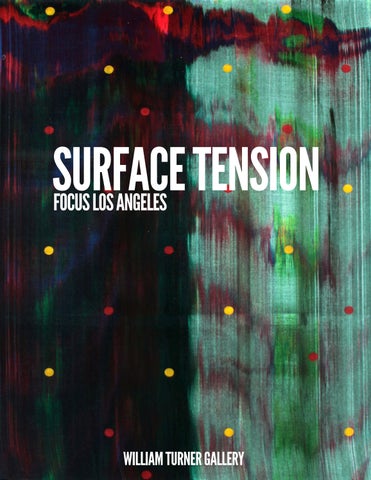
SURFACE TENSION
FOCUS LOS ANGELES

WILLIAM TURNER GALLERY


![]()

WILLIAM TURNER GALLERY


Surface Tension: Focus Los Angeles explores surface as an active site of meaning, sensation, and perception. The exhibition foregrounds how contemporary practices use texture, layering, and materiality to shape visual and sensory experience. Bridging painting, sculpture, and works at their intersection, the featured artists employ materials ranging from pearlescent and pigmented acrylics to urethane, resin, industrial finishes, and etched line-work.
Together, the works reveal surface as a dynamic interface that captures light, depth, and movement while inviting sustained, close looking. Through extended material experimentation and technical refinement, each artist demonstrates a deep attunement to their chosen medium, using surface to generate tension between control and intuition, precision and discovery, all aimed at igniting a spark of heightened perception.
Featured artists: Dawn Arrowsmith, Casper Brindle, Alex Couwenberg, Shingo Francis, Frank Gehry, Jimi Gleason, James Hayward, Eric Johnson, Peter Lodato, Andy Moses, Ed Moses, Roland Reiss, and Jennifer Wolf.
Dawn Arrowsmith produces meditative, color-driven works informed by Buddhist philosophy and extensive travel. Her paintings appear minimal at first glance, gradually revealing optical shimmer and depth through prolonged viewing.
Casper Brindle creates paintings and sculptures that engage light through reflective, industrial materials including resin and automotive paint. His work shifts with the viewer’s movement, emphasizing perception and atmospheric depth.
Alex Couwenberg is a Southern California–based painter whose work draws from Los Angeles modernism and mid-century design. His sleek, glossy paintings are influenced by Hard-edge abstraction and Finish Fetish aesthetics.
Shingo Francis creates paintings that shimmer and shift through the use of interference pigments that refract light. Influenced by Southern California’s Light and Space movement and his immersion in LA’s art scene, Francis’s works change with viewer position and lighting conditions.
Frank Gehry (1929–2025) Known for his de-constructivist approach and creative use of materials, Gehry’s buildings share an artist’s sensibility, where surface texture and dynamic form activate his structures. The undulating, curvilinear forms of his architecture are often echoed in the sculptures and drawings he created throughout his long career.

Jimi Gleason explores the reflective and perceptual properties of light, using materials such as silver nitrate and pearlescent paint. His mirror-like surfaces shift with the viewer and environment, creating interactive, meditative experiences.
James Hayward paints monochromes that celebrate the nuances of color and sensuality of texture. The surfaces are lavish cake icings of paint, almost daring the viewer to touch, lick, engage. Deft strokes of the artist’s hand remain as deep fissures in the surface, further exciting the senses to embrace their physicality.
Scot Heywood’s works are indebted to the origins of geometric abstraction. Ranging in scale from intimate to encompassing, his paintings consist of multiple, colored canvases, connected in staggered, patchwork patterns, intentionally misaligned to create delightfully disruptive, staccato visual rhythms.
Eric Johnson creates resin-based sculptures that merge color, form, and structure, drawing from Southern California’s surf, automotive, and aerospace cultures. His works balance polished surfaces with exposed internal architectures, revealing both depth and construction.
Peter Lodato (1946–2025) emerged from the Light and Space movement, initially creating immersive light installations before translating perceptual effects into painting. His geometric compositions subtly dissolve through layered brushwork and color vibration, challenging visual certainty.
Andy Moses is known for his intensive exploration of paint’s alchemical properties. Through complex pouring and mixing processes, his luminous abstractions evoke natural forces rather than representational imagery.
Ed Moses (1926–2018) was a pivotal figure in postwar Los Angeles abstraction and a core member of the Ferus Gallery circle. Known for his experimental, process-driven approach, Moses continuously redefined painting over a career spanning six decades.
Roland Reiss (1929-2020) played a significant role in the evolution of postwar West Coast abstraction. Moving from Abstract Expressionism through resin experimentation and conceptual inquiry, Reiss has consistently explored painting as an energetic, interactive field.
Jennifer Wolf uses natural dyes and hand-ground pigments sourced from global expeditions to create subtly shimmering, immersive paintings. Her work explores the elemental qualities of color and surface through fluid, layered compositions that evoke natural environments.
Dawn Arrowsmith’s practice explores the contemplative and experiential possibilities of color. Her paintings are often described as meditations—compositions that are distilled and restrained yet simultaneously lush and sensuous. Through deftly layered surfaces, subtle tonal shifts, and minimal formal structures, Arrowsmith creates works that invite quiet reflection and sustained visual engagement.
Over several decades, Arrowsmith has developed a distinctive body of work centered on the perceptual and emotional resonance of color.
Writing about her circle paintings, art critic Christopher Miles observed: “Looking at them, one experiences an afterglow, which I like to think of as a kind of perceptual afterburner, that over time bathes the periphery in a complementary tint that allows you to take the color of the painting with you on your eye, like a taste lingering on your tongue.” The circle paintings have long been a central aspect of Arrowsmith’s practice, emerging from her meditative process.

Influenced by Buddhist philosophy and by her travels throughout Asia, Arrowsmith approaches painting as an intuitive practice grounded in mindfulness and perception. Her work explores the tension between economy and richness: pared-down compositions that nevertheless convey depth, atmosphere, and emotional resonance. While primarily known for her paintings, her practice also includes sculpture and installation, extending her investigation of color, light, and spatial presence.
Arrowsmith has exhibited widely in the United States and internationally; selected venues include the Hammer Museum, the Los Angeles County Museum of Art, Los Angeles Contemporary Exhibitions (LACE), the Los Angeles Municipal Art Gallery at Barnsdall Art Park, the Clark Humanities Museum Gallery in Claremont, the Riverside Art Museum, and presentations at the Eli Broad Foundation. International exhibitions include the Lidovy Gallery in Prague and Campo d’Osservazione in Gubbio, Italy.
Her work is represented in numerous public, corporate, and private collections, including the Eli Broad / SunAmerica Collection and the Capital Group Foundation.
Born in San Francisco, California, Arrowsmith received her MFA in Visual Arts from Claremont Graduate University. She lives and works in Los Angeles.


Casper Brindle is a Los Angeles based artist, renowned for his uniquely luminescent, ever evolving body of work. The work ranges from painting to sculpture, and exemplifies Brindle’s restless experimentation and evolving modes of expression. The works are poetic, sensual and spatially dynamic. Utilizing automotive paints and pigmented acrylic, Brindle has created works that reflect and diffuse light in ways that are nuanced and engaging.

Casper Brindle is at the dynamic leading edge of a dialogue, between artwork and viewer, that began in Southern California in the late 60s and early 70s and became known as Light & Space. The shift that began it all was as subtle as it was profound. The idea and purpose of the artwork shifted; from object to catalyst; from looking “at” the artwork to our experience of “perceiving” the artwork. Artists like Robert Irwin, James Turrell, Helen Pashgian, Fred Eversley, and many others, began to explore this notion of how their work could heighten one’s experience and perception. For Casper Brindle, that initial sensibility has been embraced with an adventurous spirit, leading in boldly new and exciting directions.
Born in Toronto in 1968, Brindle’s family relocated to Los Angeles in 1974 from the United Kingdom. By Brindle’s early twenties, he moved to Venice and became enthralled with the burgeoning art scene there, where many of LA’s cutting-edge artists had studios. It was there that Brindle became immersed in the ideas of Light & Space, with which he has worked ever since.
Through subtle manipulations of materials to alternately absorb and refract light, Brindle has become a key figure in contemporary art. His work has been reviewed by noted art critics and curators, has been exhibited internationally, and was recently the subject of an extensive solo exhibition at the Luckman Gallery Museum at Cal State LA. Casper Brindle’s work is included in many prominent public and private collections, and is in the permanent collections of the Frederick R. Weisman Museum Art Foundation, Laguna Art Museum, the Morningside College Collection in Sioux City, IA, and the Lancaster Museum of Art and History.

Vacuumed formed pigmented acrylic


Born and raised in Southern California, painter Alex Couwenberg creates images that are inspired by the elements indigenous to his surroundings. From Los Angeles, Couwenberg’s work references and suggests the aesthetic alligned with modernist philosophy. Fashion, culture, design, music, architecture and transportation, not to leave out, paying homage to the historical styles of post-war art making associated with Los Angeles and Southern California from the 1950’s through the 80’s. Couwenberg’s paintings give a nod towards the Hard-edge abstractionists, the finish fetish, and the light and space artists. Not content to replicate, he uses the sensibility of Eames-era design and hard-edge geometric abstraction as points of departure for creating paintings. His process, an additive and reductive series of moves and passes, creates multilayered environments that are deep and sensual. He harnesses these ideas into harmonious results, reflecting the visual landscape of his environment.

A graduate from Art Center College of Design and The Claremont Graduate School, Couwenberg worked under the guidance of Karl Benjamin, one of the leading figures in the Southern California based school of Hard-edge geometric abstraction. Benjamin was instrumental in the development of his painting style, process, and philosophy. A Southern California native, Couwenberg naturally embraced this sensibility and applied it to his art making practices. By instilling the discipline and work ethic associated with these philosophies into his process, the paintings began to mature and develop a unique visual voice. The vocabulary references the dedication toward craft, process, and the progression of concepts and techniques.
Couwenberg’s paintings have been shown in several solo and group exhibitions throughout the United States, Canada, Europe, and Asia. His work can be found in numerous public, private, corporate, and museum collections around the world.
Recent museum acquisitions include the Long Beach Museum of Art, Frederick R. Weisman Art Foundation, Lancaster Museum of Art and History, Laguna Art Museum, Crocker Museum of Art, and the Daum Museum in Missouri. In 2007 Couwenberg was awarded the prestigious Joan Mitchell Foundation Award for his achievements in painting.


Shingo Francis grew up in Los Angeles, immersed in the intense light and vast ocean vistas of life in southern California. Like many LA artists, Francis became fascinated with the ever-changing qualities of light and how it affected one’s perception and experience of the world. As the son of painter Sam Francis, Shingo also happened to grow up in the heart of LA’s nascent artworld, where artists such as Larry Bell, Robert Irwin, James Turrell, Craig Kaufman and Peter Alexander were utilizing new materials to explore the phenomenology of how we perceive. These pursuits became loosely known as California’s Light and Space movement and for many of them, their artwork was as much a catalyst for exploring perception as it was an art object unto itself.

Francis has continued this pursuit with a series of gossamer-like paintings with colors that appear in constant flux, changing as one moves about them. Utilizing interference paints – a medium of crushed, titanium-coated mica that refracts light - the colors in these pieces shimmer and shift depending on the angle of the viewer and the reflection of light. Rectangular shapes conform to the shape of the canvas, creating a framework of change as viewers move. What one sees becomes inherently tied to their particular perspective and the character of the light at any given time.
The necessity of the viewer’s presence and engagement with the seeing and experiencing of the work, is a driving interest for Francis. He intends these paintings to counter the notion that the virtual reproductions of artwork on our phones, tablets and screens can replace, or even approximate, the actual physical and emotional experience of being “present” with a work of art.
Shingo Francis received a Bachelor of Arts degree from Pitzer College in Claremont, and a Master of Arts degree from ArtCenter College of Design, in Pasadena. Francis’ work has been exhibited in Japan, United States, Germany, South Korea, and Switzerland. He has a solo exhibition at the Chigasaki Museum of Art in 2024 and has been included in museum shows at the Kawamura Memorial DIC Museum of Art, Sezon Museum of Modern Art, Ichihara Lakeside Museum, the Martin Museum of Art, Hermes Art Foundation, and the Frederick R. Weisman Art Foundation. He received the Fumio Nanjo Award in Tokyo. He currently divides his time between Los Angeles and the ancient coastal town of Kamakura, Japan.


Frank Gehry (1929–2025) was among the most influential architects of the modern era, transforming city skylines through a de-constructivist approach and an inventive use of materials. His buildings—defined by shifting surfaces, fragmented forms, and a sense of movement— blur the line between structure and sculpture. As his longtime friend, artist Charles Arnoldi, observed, “It was when Frank began thinking of his buildings as sculptures and art that things really changed.”

Gehry’s close relationships with artists were central to this evolution, encouraging his exploration across architecture, sculpture, and furniture. His Easy Edges (1969–73) and Experimental Edges (1979–82) furniture series used humble materials like corrugated cardboard to create unexpected, sculptural forms, while later bentwood designs for Knoll (1989–92) further extended this inquiry into material expression.
This same sensibility—treating architecture as sculpture—runs throughout Gehry’s sculptural work. Animal forms, especially fish, recur as fluid, undulating structures that emphasize surface, movement, and transformation.
The sculpture Memory of Sophie Calle’s Flower (2012), included in Surface Tension, offers a particularly clear example of this overlap between sculpture and architecture. The work originates in Gehry’s 2006 collaboration with the French artist Sophie Calle, entitled, Le Téléphone, a flower-like public sculpture, installed on the Pont du Garigliano in Paris. Functioning as a telephone booth, passersby received spontaneous calls from Calle if they answered the phone, turning architecture into a site of performance, exchange, and lived experience.
Gehry’s Memory of Sophie Calle’s Flower translates this architectural, participatory structure into a more intimate sculptural form. Cast in translucent urethane and reduced in scale, it reads as a distilled, almost ghostlike remnant of the original. Yet it retains key architectural concerns: structure, surface, and spatial presence. In this way, the work operates simultaneously as sculpture, architectural fragment, and conceptual trace— demonstrating how Gehry’s practice moves fluidly between disciplines. It embodies his ongoing dialogue with artists and his interest in giving physical form to ephemeral, poetic ideas.

Born in Toronto, Gehry moved to Los Angeles in 1947 and studied at the University of Southern California and Harvard University. His work has been exhibited internationally, with major presentations at institutions including the Guggenheim Museum, the Centre Pompidou, and the Los Angeles County Museum of Art. Among his most celebrated buildings are the Guggenheim Museum Bilbao (1997), Walt Disney Concert Hall (2003), Fondation Louis Vuitton (2014), and the LUMA Tower (2021).
Gehry received numerous honors, including the Pritzker Architecture Prize (1989), the National Medal of Arts (1998), and the Presidential Medal of Freedom (2016).


Jimi Gleason was born in 1961, in Newport Beach, California, with frequent trips to Hawaii growing up. The bright colors and special, mercurial qualities of light of both environs profoundly influenced Gleason and would become a wellspring of inspiration as his artistic vision evolved.
Along with a growing number of Southern California artists, Gleason sought dynamic materials, like silver nitrate and pearlescent paints, to express a new way of looking at art, not as objects of creation to be viewed passively, but as active catalysts that heightened our perception. This shift in purpose, with regard to a certain genre of Southern California art, has become known as Light and Space.

Jimi Gleason received his BA from UC Berkeley in 1985. He studied printmaking at the San Francisco Art Institute before relocating to New York City, where he worked as a photo assistant and photo technician. Returning to California, Gleason was employed in the studio of Ed Moses for five years. Combining the disparate technical and compositional skills developed during his exposure to printmaking, photography and mixed-media painting, Gleason is now the subject of considerable curatorial and critical applause.
Gleason’s work has been widely exhibited and collected by major institutions including: the Hammer Museum, Frederick R. Weisman Art Foundation, the Laguna Beach Art Museum, the Long Beach Museum of Art, the Seattle Art Museum, and the Tucson Museum of Art. Additionally, the artist’s paintings are held in a number of significant public and private collections around the world.


For more than four decades, Los Angeles–based painter James Hayward has pursued a singular investigation of gesture, materiality, and the physical act of painting. Associated with the lineage of West Coast abstraction, Hayward has developed a distinctive monochrome practice in which dense fields of thickly applied oil paint become sites of disciplined yet intuitive mark-making. Working on canvas-covered panels with deep supports that project slightly from the wall, Hayward builds surfaces through broad, deliberate strokes that move diagonally across the plane, creating ridges, peaks, and layered textures that emphasize the physical presence of paint itself.

Hayward’s paintings are grounded in a philosophy that privileges equality among marks and a democratic distribution of visual attention across the surface. As the artist explains, “The physicality is part of it, but the heart and soul of it is the marking. In my monochromes I try to avoid there ever being a special place. There’s no chosen place. It’s totally proletariat, the marking. I want the corners to be as important as the center and I want every mark to be equal in terms of importance. Ideally, the last marks just kind of blend into the earlier marks and disappear.” This approach produces compositions in which gesture is present but stripped of theatrical expression, replaced instead by a quiet structural rigor and meditative continuity.
Critics have often noted the paradox within Hayward’s work: although the paintings are built from vigorous, heavily loaded brushstrokes, the overall effect is remarkably balanced and contemplative. Reviewing a major exhibition of the artist’s work, critic Christopher Knight described the surfaces as “a gestural canvas of great vigor, but one that also seems preternaturally stable,” likening the experience of viewing them to “a field of grass rippled by the wind,” yet without any literal reference to nature.
Color plays an equally vital role in Hayward’s practice. His monochromes—often in red, black, or white—create intense chromatic environments that heighten awareness of surface and space. The result, as critics have observed, is an atmosphere capable of delivering a kind of contemplative immersion.


James Hayward
Abstract #141


James Hayward
Abstract #251
2025
Oil on canvas on wood panel
44” x 33”

Born in Los Angeles in 1951, Scot Heywood has been investigating geometric abstraction for over forty years. “I painted flat from the get-go,” Heywood says, who has explored abstraction throughout the course of his artistic career. A self-taught artist, Heywood’s works are indebted to the origins of geometric abstraction. In the late 1970s, Heywood fell in love with the paintings of Piet Mondrian and John McLaughlin; since then, he has been translating the austere philosophy of geometric abstraction into his own monochromatic works.
Ranging in scale from intimate to encompassing, his paintings consist of multiple, colored canvases, connected in staggered, patchwork patterns. In a seemingly endless array of variations, he inserts thin strips between, or attaches them to the sides of, square and rectangular canvases, intentionally misaligning them to create delightfully disruptive, staccato visual rhythms. Heywood is interested in the relationship between wall, work, and viewer, and in the rich dialogue between color and form.

Heywood has shown extensively in Southern California since the late 1970’s at such as significant galleries as Patricia Faure Gallery, Frank Lloyd Gallery, ACE Contemporary Exhibitions and Subliminal Projects Gallery. His work has been featured in dozens of solo shows, and is often included in significant group exhibitions at The Los Angeles Institute of Contemporary Art, San Francisco Art Institute and Otis College of Art & Design. Heywood’s work has been featured in publications such as the Los Angeles Times, Art in America, Art Slant, LA Weekly and Artweek. His paintings are also represented in numerous public and private collections, including the Frederick R. Weisman Art Foundation. He currently lives and works in Los Angeles, California.


Scot Heywood
Transition: Linen, Black, Gray, White, 2019
Acrylic and matte medium on canvas 60” x 60”
At the nexus of the L.A. art scene for nearly forty years, Eric Johnson’s work bears a distinctly Southern California hot-rod, materials-based aesthetic. Early on, Johnson was drawn to artists whose work also grew out of L.A.’s surf and car culture sensibilities. Utilizing new materials and industrial products, like resin & plastic, artwork of impossibly slick, sleek character began to emerge and was termed “Finish Fetish”. Johnson’s work is next generation heir to this work, and carries forward the DNA of such legendary Light and Space, Finish Fetish, artists as Craig Kaufman, DeWain Valentine, Billy Al Bengston, Larry Bell, Tom Jenkins and Tony DeLap.

Eric Johnson’s works are also acutely personal representations of his life. A severe neck injury, and struggle with intense spinal pain, served as the initial catalyst for his exploration of structural forms, which are also informed by his ancestral heritage - Scottish, Cree Indian, and perhaps a boat-building urge from the Norse. His father, a race-car driver and expert in custom car fabrication, passed on a passion for cars and their restoration. Scouted into the Air Force during the Vietnam war as a fencing instructor (though he never served), Johnson discovered he was color-blind during an eye-exam. Surprisingly, this ignited an interest in color and experiments with layering automotive pigments and clear resins, which Johnson continues with in this series, fabricating molds, which allow him to do multiple iterations of the same shape while investigating variations of color.
Eric Johnson attended Valley College; California Institute of Art and received his Masters of Fine Arts degree from University of California at Irvine. Johnson’s work is in many public and private collections, including: Oakland Museum; Laguna Beach Museum; Museum of Art and History (MOAH); Lancaster, CA; C.B.S. Broadcasting, New York, NY; Digital Domain, Venice, CA; Mary Barnes; Leonardo and George DiCaprio; James Cameron; Homeira and Arnold Goldstein, among others. Eric Johnson was born in Burbank, California and currently lives and works in San Pedro, California.


Peter Lodato (1946-2025) began making work in the late 1960s as part of the West Coastspecific Light and Space movement. Aligned with the concerns of his contemporaries, Lodato first constructed light installations that explored the nature of perception and the way that physical environments could be transformed into immersive experiences for the viewer. Lodato’s paintings evolved from his preliminary drawings for these installations and eventually, he was able to recreate the illusive effect of light with color, form, and canvas alone.
Always fascinated by the uncertainty of human perception, and the duplicitous nature of vision, which can be both revealing and deceitful, Lodato created paintings that explore this duality. Upon first read they are austere, geometric abstractions. After further observation, however, the paintings begin to vibrate: brushstrokes become evident and the surface reveals that there are numerous layers beneath. The hard edges of his often bi-chromatic works dissipate into sensuous fields of color that seem to push space in and out.

Lodato’s reductive, divided compositions are visual confrontations between the planar simplicity of form and the resonance of particular pigments. A disciple of the AbEx color field painter, Barnett Newman, Lodato’s sumptuously colored canvases echo Newman’s concept of using division as a way to merge different areas of the canvas into a sublime whole. Much like Newman’s “zips” of color, Lodato’s vertical bands draw the viewer deeply into the picture plane, causing them to intensely experience the work, both physically and emotionally.
The Frederick R. Weisman Art Foundation curated an extensive solo retrospective of Lodato’s work in 2000 and his work has been exhibited at the Whitney Museum of American Art, the Museum of Contemporary Art in Los Angeles and the Los Angeles County Museum of Art.
Peter Lodato is in numerous esteemed collections both public and private including the Brooklyn Museum, the Seattle Art Museum, the Dallas Museum of Art and the San Diego Museum of Contemporary Art.


Blurring the line between abstraction and a new kind of pictorialism, Andy Moses utilizes techniques that facilitate his almost obsessive study of the alchemical properties of paint. The paintings that emerge articulate the abstract nature of perception, reaching beyond the material and tapping into the visceral.

Born in Los Angeles in 1962, Andy Moses attended the legendary CalArts from 1979-1981, studying with John Baldessari, Michael Asher and Barbara Kruger. In 1982, Moses moved to New York where he worked as a studio assistant to Pat Steir and quickly became part of New York’s nascent art scene. Moses began exhibiting with Annina Nosei Gallery, shortly after Jean-Michel Basquiat. During that time Moses also developed close ties with artists such as Jeff Koons, Marilyn Minter, Rudolf Stingel and Christopher Wool, who were also just emerging onto the scene.
After eighteen years in New York, Moses returned to Southern California in 2000, where the change in coasts led to a significant shift in his work. In New York, the artist’s work had explored the influences of nature, conveying a sense of gravitational and geologic forces. In returning to California, the scope of Moses’s work expanded, as he was once again inspired by the unique effects of light glancing off waves, and the vast sky-scapes he encountered on his daily drive down the Pacific Coast Highway. The artist began exploring materials that would capture the mercurial aspects of perception, where slight shifts in perspective would reveal dramatic shifts in impression. Accordingly, Moses’ work began to incorporate many of the qualities now associated with the Southern California Light and Space movement, where the work of art became less an “art object”, and more of a “catalyst” for one’s experience of what and how they are perceived. Suggesting panoramic space, Moses began introducing concave and shaped panels to further investigate how light and its wave-lengths would curl and flex with refractive paints. These bold new paintings quickly found their audience and brought Moses to the attention of museums and major collectors alike.
Andy Moses’ work is included in the permanent collections of Los Angeles County Museum of Art, Orange County Museum of Art, Laguna Art Museum, and the Frederick R. Weisman Art Foundation. He currently lives and works in Venice, CA.


Andy Moses
Geomorphology 1428
2023
Acrylic on canvas over concave wood panel
52” x 84” x 4.5”


Andy Moses Geomorphology 1608
2023
Acrylic on canvas over concave wood panel
57” x 90” x 5.5”
Ed Moses (1926–2018) received national and international recognition over a career that spanned seven decades. Known for its restless intensity and constantly evolving style, his work positioned him as one of Los Angeles’s most innovative painters and a central figure in the city’s art scene. Often referring to himself as a “mutator,” Moses was driven less by selfexpression than by an insatiable curiosity—a relentless urge to explore, experiment, and discover.

After serving as a surgical technician during World War II, Moses enrolled in the pre-med program at Long Beach City College but soon dropped out. On a whim, he took a life-changing class with artist Pedro Miller, who recognized his untapped potential. Moses shifted course and enrolled in the MFA program at UCLA, where he met artist Craig Kauffman, who in turn introduced him to future Ferus Gallery owner Walter Hopps. Moses had his first exhibition at Ferus Gallery in 1958 while still a graduate student. There, he became part of the raucous group of artists known as the “Cool School,” which included Kauffman, Billy Al Bengston, Robert Irwin, Edward Kienholz, Ken Price, Ed Ruscha, Larry Bell, John Altoon, and Wallace Berman—artists who pushed the boundaries of postwar art and helped shape the nascent Los Angeles art scene at a moment when it was just beginning to emerge.
His first museum exhibitions took place in 1976: a drawings survey of works from 1958 through the early 1970s at the Wight Gallery at UCLA, and an exhibition of new abstract and cubist red paintings at LACMA, curated by Stephanie Barron, which marked a pivotal transitional moment in his career.
Moses was the subject of a major retrospective at MOCA Los Angeles in 1996, and in 2014 exhibited at the University of California, Irvine, where he had taught in the 1970s. On the occasion of his 2015 drawing exhibition at LACMA, featuring works from the 1960s and 1970s and organized by Leslie Jones, museum director Michael Govan remarked, “Ed Moses has been central to the history of art making in Los Angeles for more than half a century.” The exhibition included more than forty drawings promised to the museum by the artist.
Moses’s work is held in the collections of the Los Angeles County Museum of Art, the Museum of Contemporary Art, Los Angeles, the Hammer Museum, the San Francisco Museum of Modern Art, the Whitney Museum of American Art, and the Museum of Modern Art, New York.
Photograph courtesy Rob Brander


Roland Reiss (1929 - 2020) had an influential history in the L.A. and Southern California art scene. His continual self-reinvention led to a groundbreaking body of work. He described his work as “energy fields and spaces in which colors and forms generate expressive visual experience.”
Reiss showed at Cirrus Gallery for a number of years before joining Ace Gallery. At Ace he had numerous one-person shows over the period of fourteen years, during which time that gallery represented him exclusively. He has shown at documenta in Kassel, Germany and at the Whitney Biennial Exhibition. At the Los Angeles County Museum of Art he has had a one-person show and an extensive retrospective exhibition at the Los Angeles Municipal Art Gallery.

Reiss studied at the American Academy of Art, Mount San Antonio College and at UCLA. He taught at UCLA, the University of Colorado, and Claremont Graduate University. In 2009 he received the College Art Association Award for the Distinguished Teaching of Art. At CGU he held the Benezet Chair in the Humanities and in 2010 an endowed chair in art was established in his name. He was also the director of The Painting’s Edge residency at Idyllwild Arts.
Reiss was the recipient of four N.E.A. grants and of numerous prizes and awards. His work is included in many public, corporate, and private collections, such as the Museum of Contemporary Art, Los Angeles, the Los Angeles County Museum of Art, and the Whitney Museum of American Art.


Jennifer Wolf grew up in Southern California hiking the Santa Ynez and Santa Monica Mountains. This intimate connection with the landscape led Wolf to explore using the earthen colors she saw around her and to learn the early painting techniques of transforming collected minerals into usable pigments. This led to a progressive innovation past simply reviving old world techniques, as she began to combine these organic minerals with state of the art acrylic mediums.

Each color is discovered through extensive exploration of the landscape and collected over many years, their processing and use subsequently recalling the artist’s personal experiences of disparate geographies. Thus the paintings become evidence of this history, each a sort of map recording not only place, but time. The mortar and pestle she employs to grind the rock transforms the laborious process into a meditation, acting as a portal to the artist’s memories as it exposes the pure color. Each strike of the pestle upon the mineral, whether it was collected from France, Peru, Santa Barbara or Santa Monica is a reminder of a specific experience in the natural environment. Thus Wolf’s paintings explore the emotional connection that comes with discovering the land.
Sometimes the experiences are sublime as they recall both the beauty of the land and fear of the unknown. Stumbling upon a fresh kill at the mouth of a river or losing the trail at the top of a mountain, as the sun is about to set. The fear of being alone in nature, vulnerable to it’s callousness has filled the artist with an arsenal of emotions to draw from as she approaches her painting practice each day. The result is a body of work that exhibits both mystery and beauty, inviting the viewer to explore as much the painted evidence of the outer landscape as the inner landscape of the artist herself.
Wolf holds a BA in Art History from UCLA and an MFA from Otis College of Art and Design. A lifelong California resident, she has exhibited widely and has collaborated with William Turner Gallery since her first solo show in 2004. Photograph courtesty Trinity Wheeler


Jennifer Wolf
Unseen Landscape #1
2013
Mineral Pigments and acrylic medium on wood 54” x 54”
Jennifer Wolf
Dye Painting #15
2022
Natural dyes and mineral pigments on silk with canvas mounted on wood panel 48” x 48”


Jennifer Wolf
Dye Painting #1
2020
Natural dyes and mineral pigments on silk with canvas mounted on wood panel 48” x 48”


WILLIAM TURNER GALLERY