Responsiveness. Precision. Intuitive grace. A superior musical instrument can be recognized by the degree to which it allows the player to express vision without interference — with nothing coming between the ngers on the keyboard and the music in the air.
Such is the experience of playing a Boston . Designed by Steinway & Sons, employing the unique patents and expertise that have made the name Steinway synonymous with excellence, the Boston line of grand and upright pianos represents a singular achievement in instrument building: a superior playing experience at a price level never before thought possible .
TO LEARN MORE ABOUT BOSTON PIANOS, CONTACT
STEINWAY PIANO GALLERY OR VISIT STEINWAYPIANOS.COM
STEINWAY PIANO GALLERY
3402 S. Peoria Ave. Tulsa, Ok 75105
T E L (918) 516-1853
WWW.STEINWAYPIANOS.COM
TULSA
Leaders with Heart
VISIONARY. EMPATHETIC. GRATEFUL.
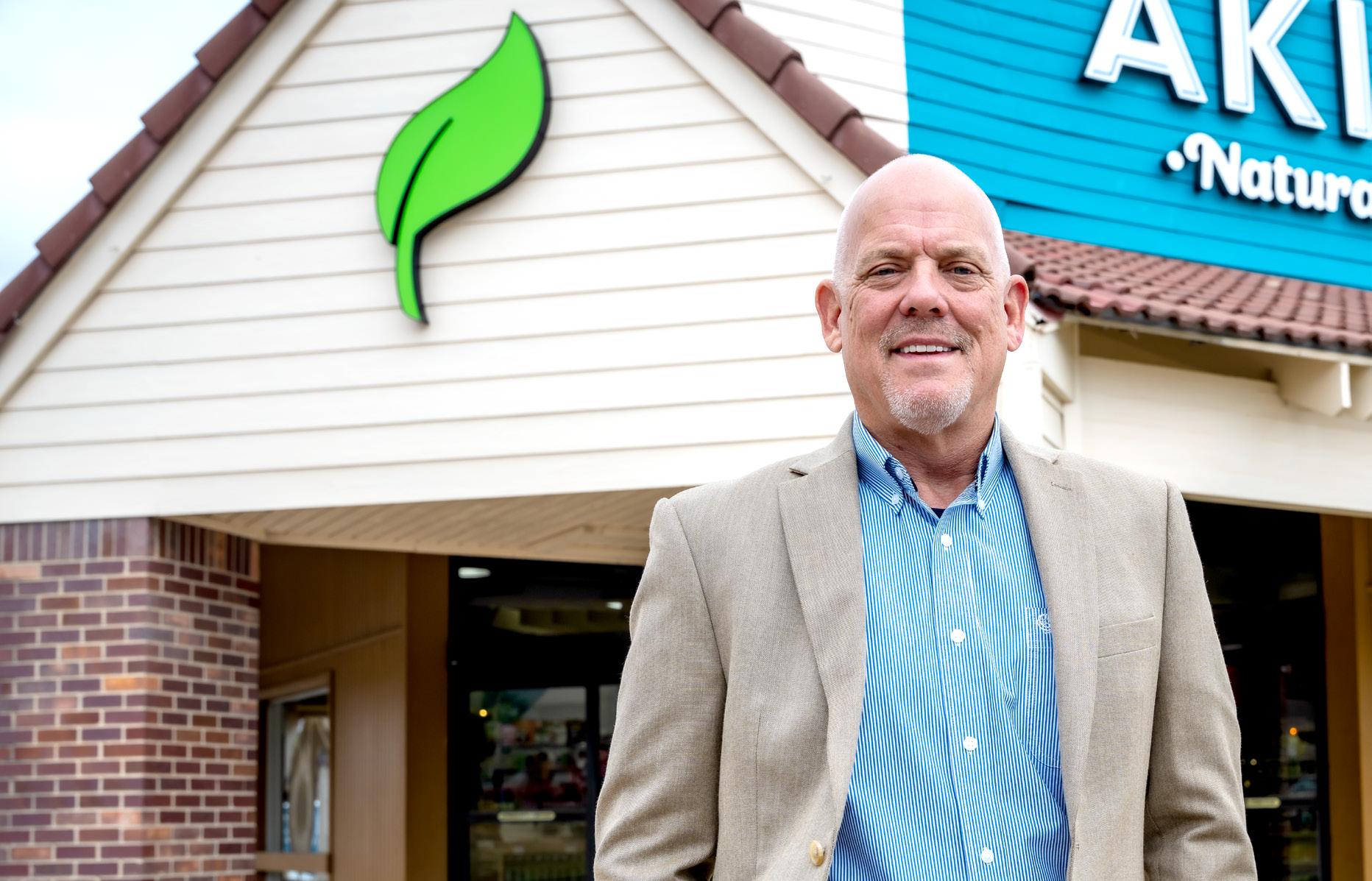
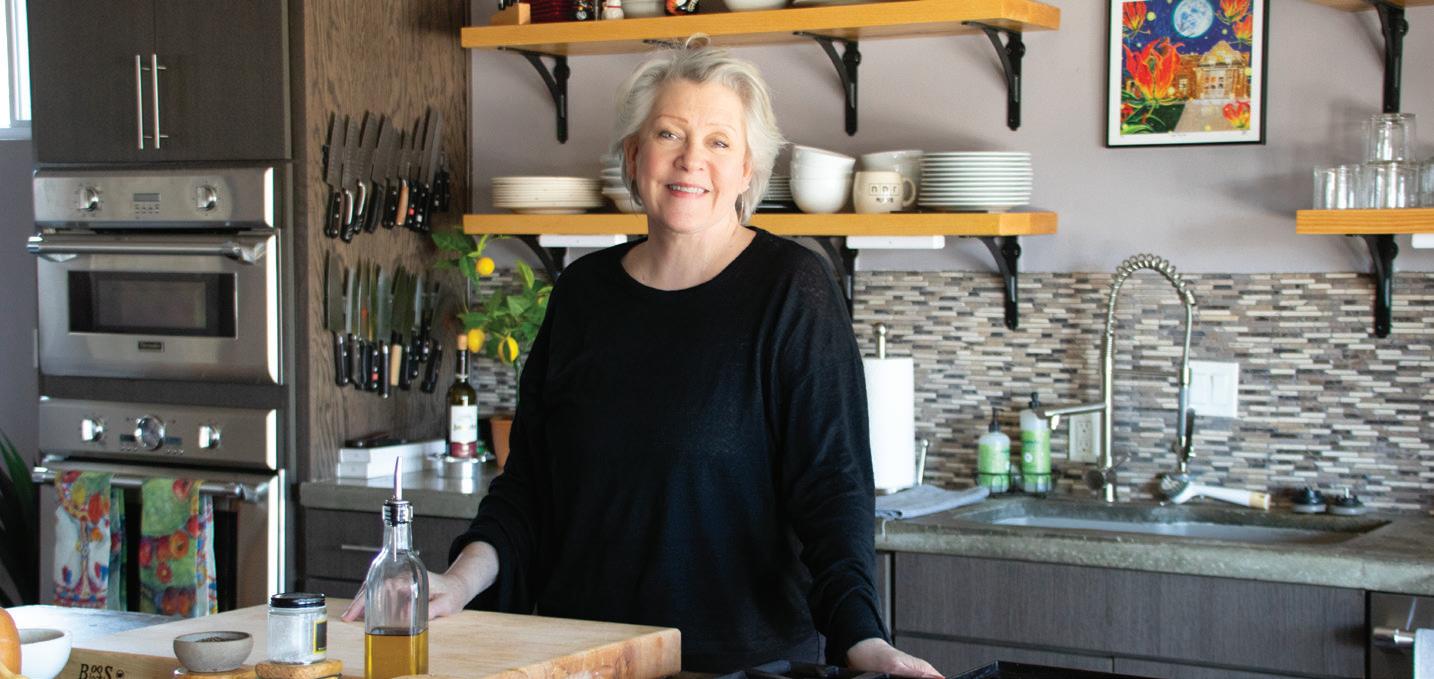
Mark Parette’s story is the “quintessential example of simply being in the right place at the right time.” He credits many mentors, coworkers, employees and most notably his family for his life’s achievements.
“Any success that I have had is due to the willingness of others to take a chance on me. I wasn’t a scholar or a great athlete. I just was very fortunate with regard to opportunities,” Mark says.
As the Senior VP at Healthy Edge Retail Group (HERG), Mark has spent 36 years helping grow a company that now operates 15 natural food markets across Florida, Arkansas, and Oklahoma, including three Akin’s Tulsa locations. Akin’s has operated in Tulsa continuously since 1935.
“I got my start in the natural food business with Eric and Jim Hinkefent at Akin’s, here in Tulsa, in the late 1980’s, initially to finish a stalled construction project for them… Once that was done, there was another, then another, and I never left!” HERG has been honored nationally as the Natural Food Retailer of the year, first in the late 1990s and more recently in 2022.
Mark’s family is at the heart of his story. He and his wife Julie live in Wagoner County where they “try
to maintain a few acres.” Mark has served the last few years on the Wagoner County Board of Adjustment and currently is the Chairman. Their children, Tyler and Abi, are both deeply involved in Tulsa’s community life. For the last year and a half, Mark has been the ecstatic granddad of Eleanor Rae Parette.
“I think the best thing you can do for the world is support and nurture folks who will make life better after you are gone. My kids and employees have that covered.”
He notes that the thrill of seeing customers who were children when he started never fades. “My absolute greatest achievement lies in the development of the current leadership. I hired many of the folks who are now running the business when they were in their teens or early 20s … I have friends, not just employees, in every store. Not many bosses get that perk.”
HERG partners with New Leaf, which provides opportunities for individuals with disabilities. “These
guys stock shelves, interact with staff and customers, and just make everyone they meet have a better day. Love them.”
“Mark’s appreciation for those around him is evident in every relationship he builds. He treats employees not just as colleagues, but as friends, and his humility is evident in the way he consistently credits his family and others for his achievements,” says Tom Bennett III, CEO and President of First Oklahoma Bank.
“I have relationships with many banks, of course, but the customer service attitude at First Oklahoma is as good as it gets…I have referred folk to the bank and been told that they were treated like THEY owned part of the bank… That is huge and a big part of the bank’s growth,” Mark says.
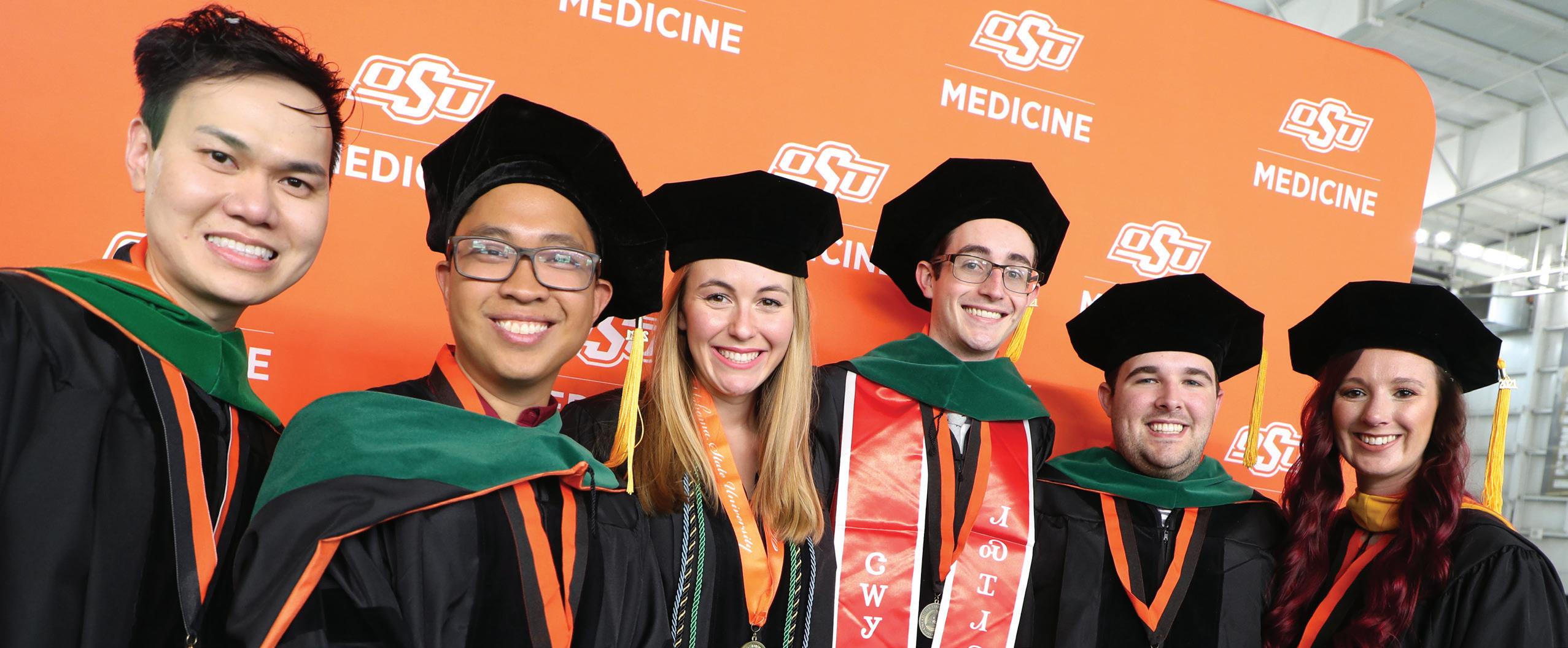
73% of OSU College of Osteopathic Medicine graduates are practicing in medical deserts, according to U.S. News data.
We’re proud to say we’ve done it again. U.S. News & World Report’s 2025 Best Medical Schools rankings has once again named OSU Center for Health Sciences No. 1 in graduates practicing in Health Professional Shortage Areas. And we’re ranked No. 11 nationally for graduates practicing in rural areas.
We are educating physicians in the heart of Tulsa, and in rural Oklahoma at our Cherokee Nation campus in Tahlequah.
With a mission to educate physicians for rural and underserved populations in Oklahoma, this news is just another confirmation we are making good on that promise.
CITY DESK
Meet the new CEO at Discovery Lab. A local science podcast. Tulsans making a difference in Ghana. The legacy of Eddie Faye Gates.
Vietnamese coffee in Broken Arrow.
Where to find king cake. NEFF’s new menu. Make crispy fried rice.
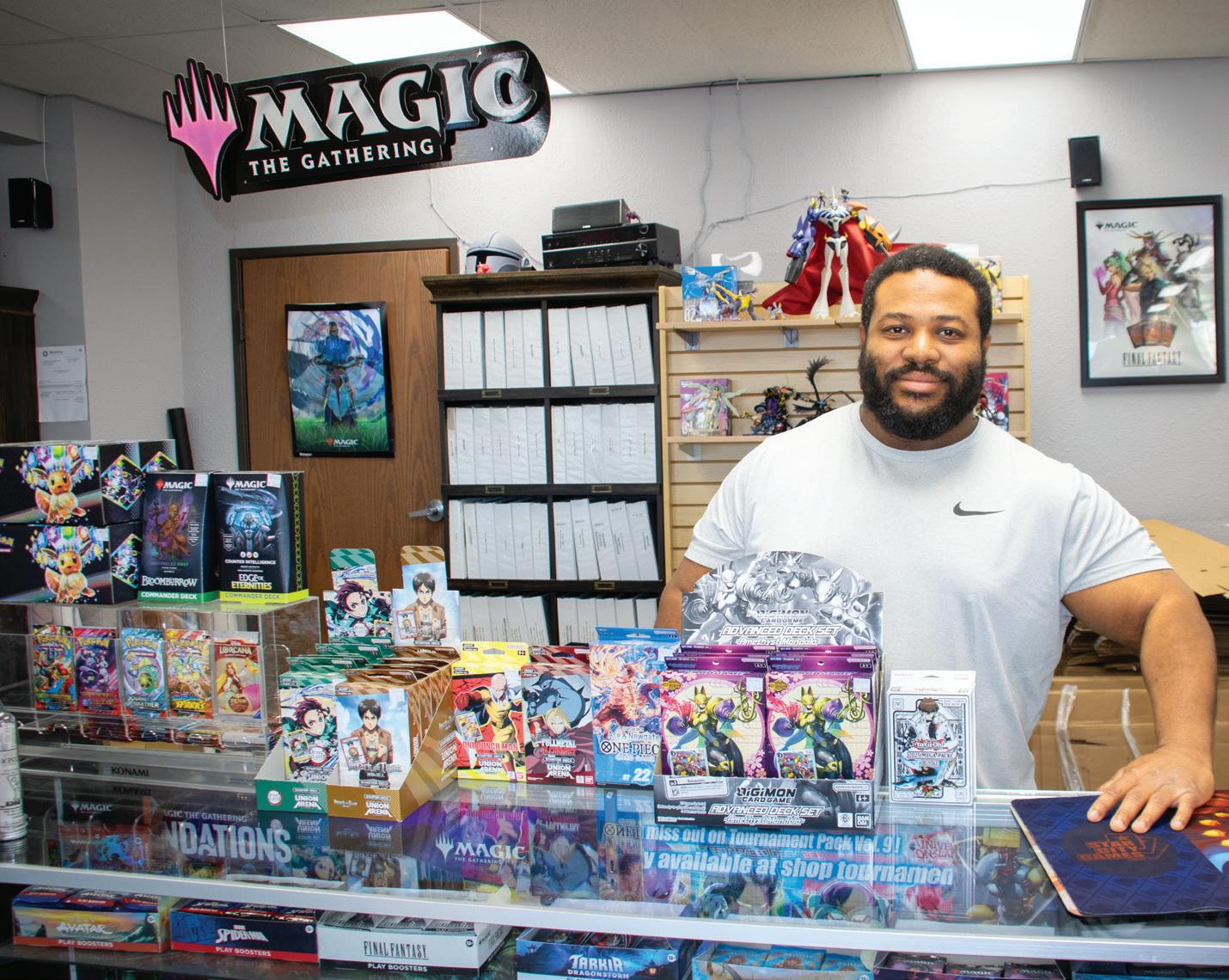
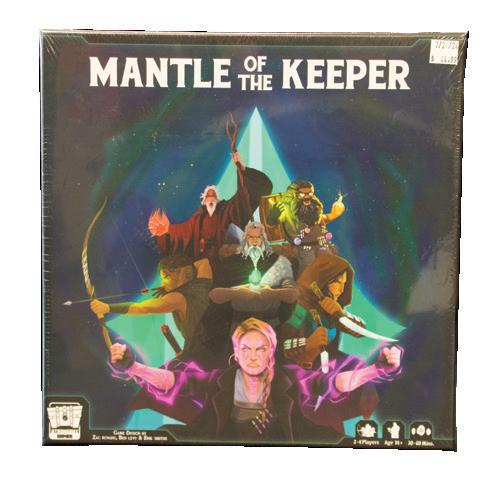
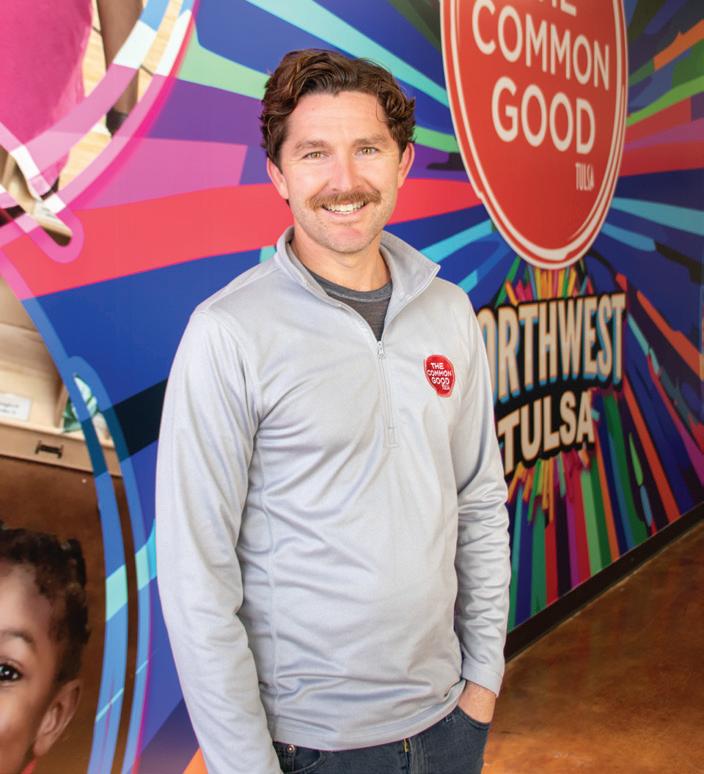
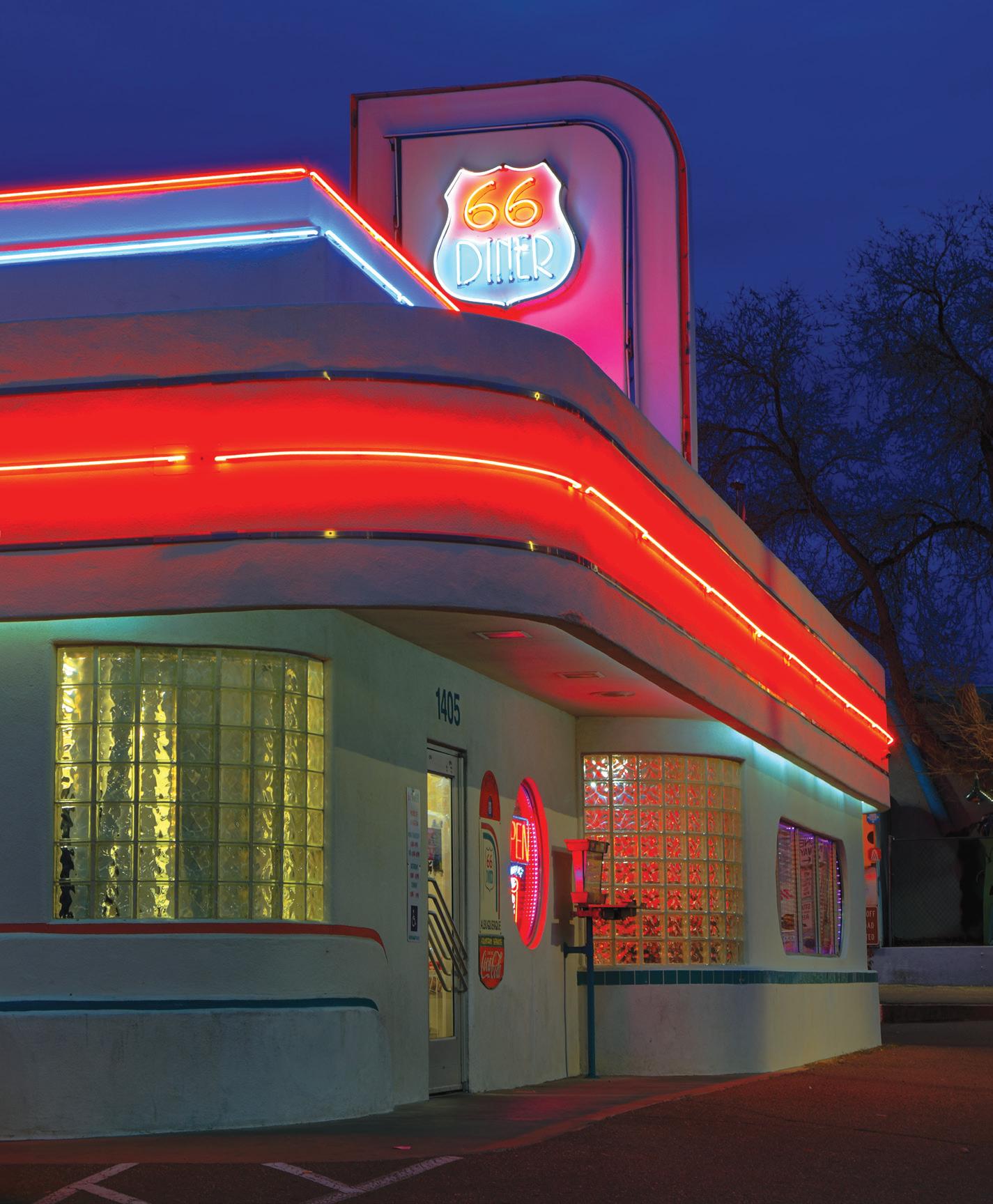
Game on at Dragonslayer. Expanded offerings at The Common Good. New Mexico’s Route 66 corridor. Connie seeks “expert” advice.
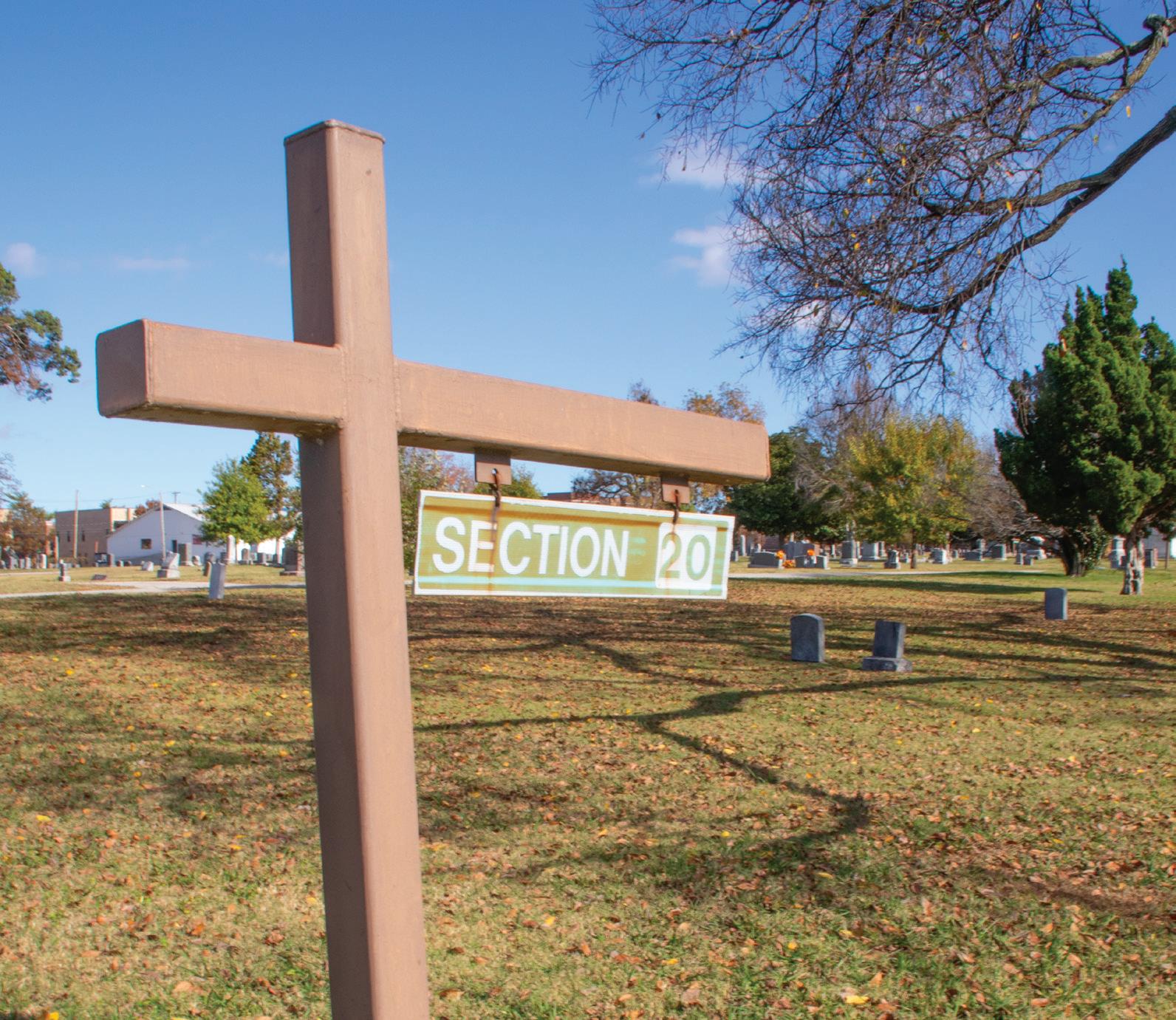
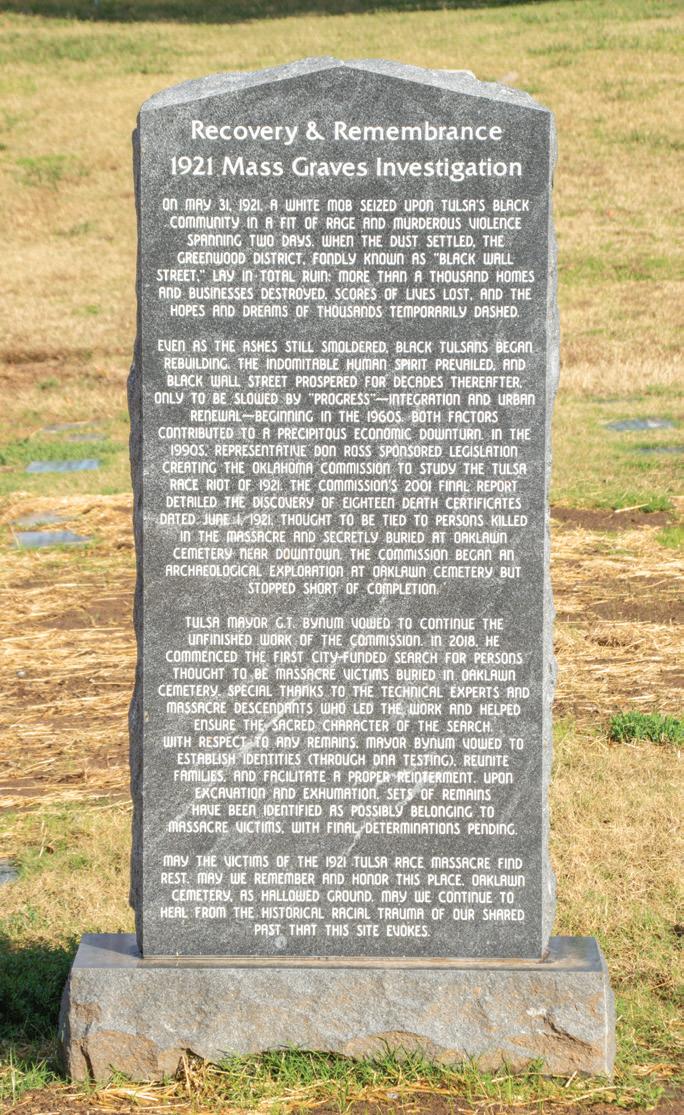
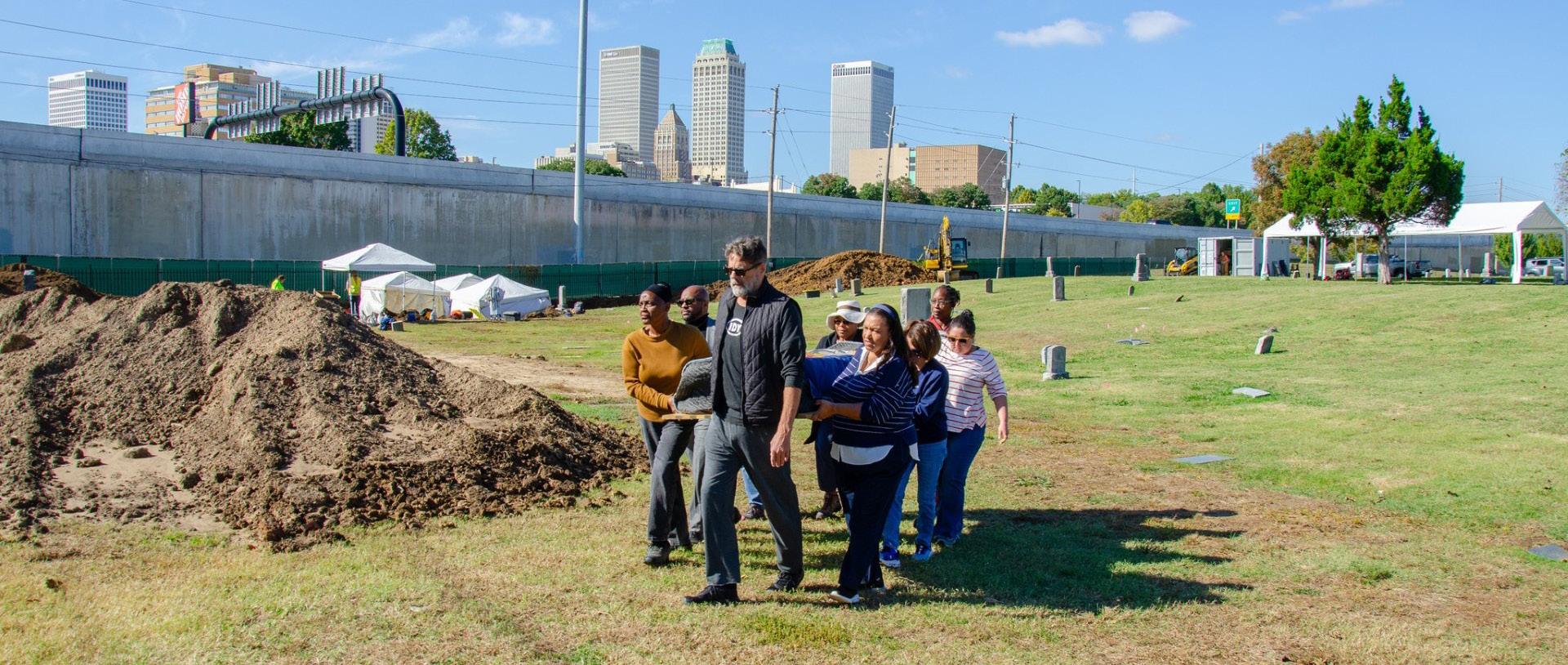
marker for Section 20 of Oaklawn Cemetery, 1133 E. 11th St., which has been the primary focus of the ongoing 1921 Tulsa Graves Investigation. This expert-driven City of Tulsa effort aims to find answers from the 1921 Tulsa Race Massacre.
100,000
Heart disease does not wait.
Your heart is the rhythm of your life — a symbol of your health and strength, offering the promise of another day. Yet heart disease, the leading cause of death in the United States, often develops silently without noticeable symptoms.
This Heart Month, Ascension St. John encourages a proactive approach to heart health with a simple, noninvasive cardiac CT scan. Heart scans help detect early plaque buildup and are especially important if you have risk factors such as:
• Smoking
• Family history of heart disease
• Diabetes
• High blood pressure
• High cholesterol
• Obesity
If you’re submitting through insurance, a doctor’s referral is required to schedule a heart scan. However, if you’re paying out-of-pocket, no referral is needed. Your results provide valuable insight for you and your doctor, helping you make informed decisions and create a personalized care plan.
We’re here for you — because we believe every one of your 100,000 daily heartbeats matters.
EDITOR’S LETTER
When I was growing up, February was not my favorite month. I associated it with dark, bitter cold mornings waiting for the bus and having no end in sight to the school year. Nowadays, I can’t say I’ve warmed up to the winter drudge, but there are a few February traditions that help make the month more enjoyable, and I’m delighted that several appear in this month’s issue.
With it being Black History Month, and this issue’s focus on education thanks to our annual Private School Guide (p. 31) and College Guide (p. 46), it seemed like the perfect time to re ect on the legacy of Tulsa educator Eddie Faye Gates. I rst learned about her mission to record eyewitness accounts from survivors of the Tulsa Race Massacre just a few months before the centennial, when Gilcrease Museum acquired the Eddie Faye Gates Tulsa Race Massacre Collection in 2020. Gates’ e orts to make sure that this incredibly di cult piece of history was documented is nothing short of inspiring. I encourage you not only to read Michael Overall ’s Historically Speaking piece about Gates on p. 22, but also to explore the digitally accessible items from her collection and accompanying educational materials at gilcrease.org.
Digital Editor Madison Walters got the opportunity to meet four women leading the City’s 1921 Graves Investigation for her feature story on p. 28. While this history is tragic, it is imperative to share these stories — and the multi-generational connections involved add a fascinating layer to this crucial work.
Meanwhile, we took inspiration from Valentine’s Day and curated a list of exclusive daily food specials. You can nd them
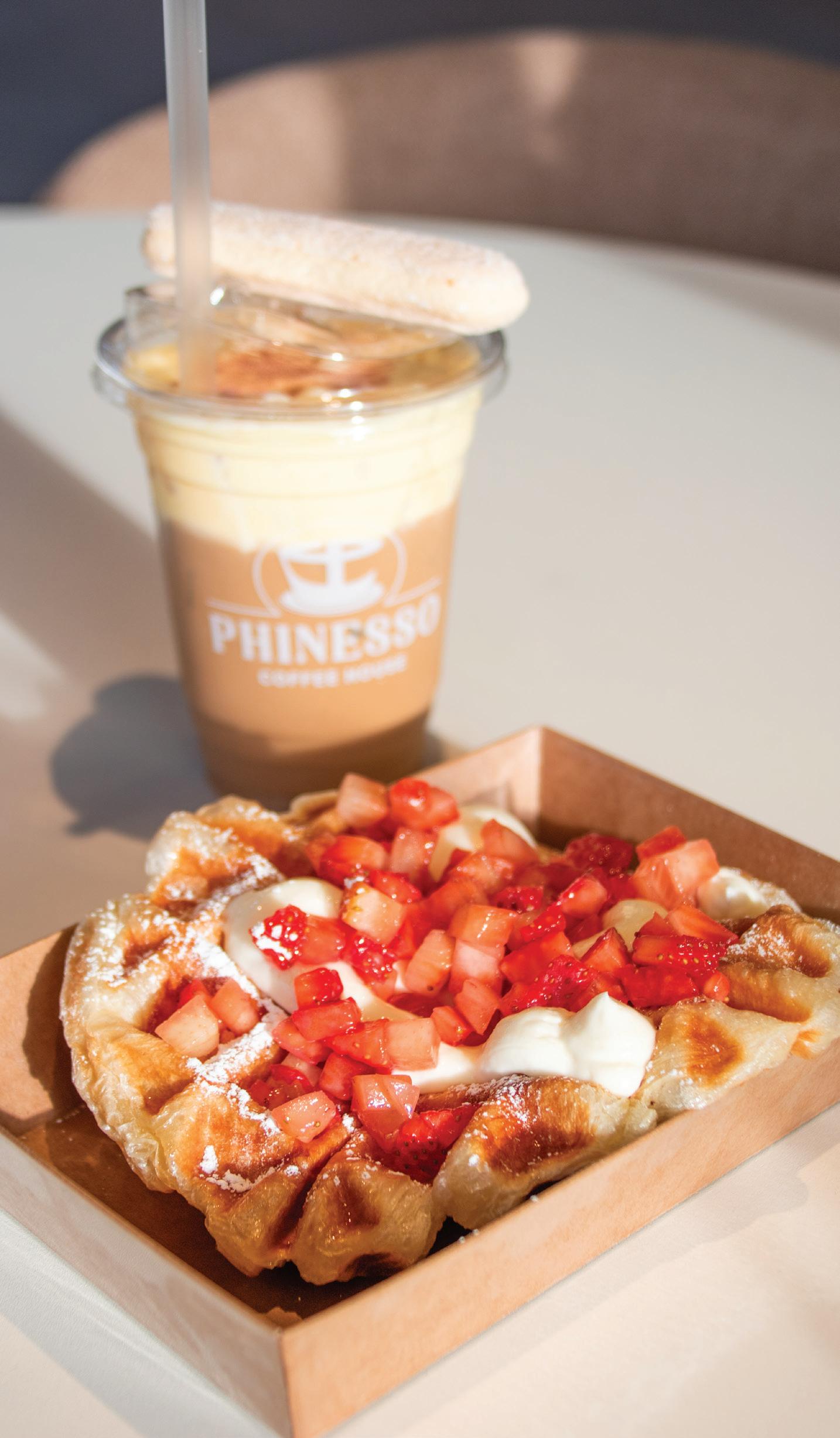
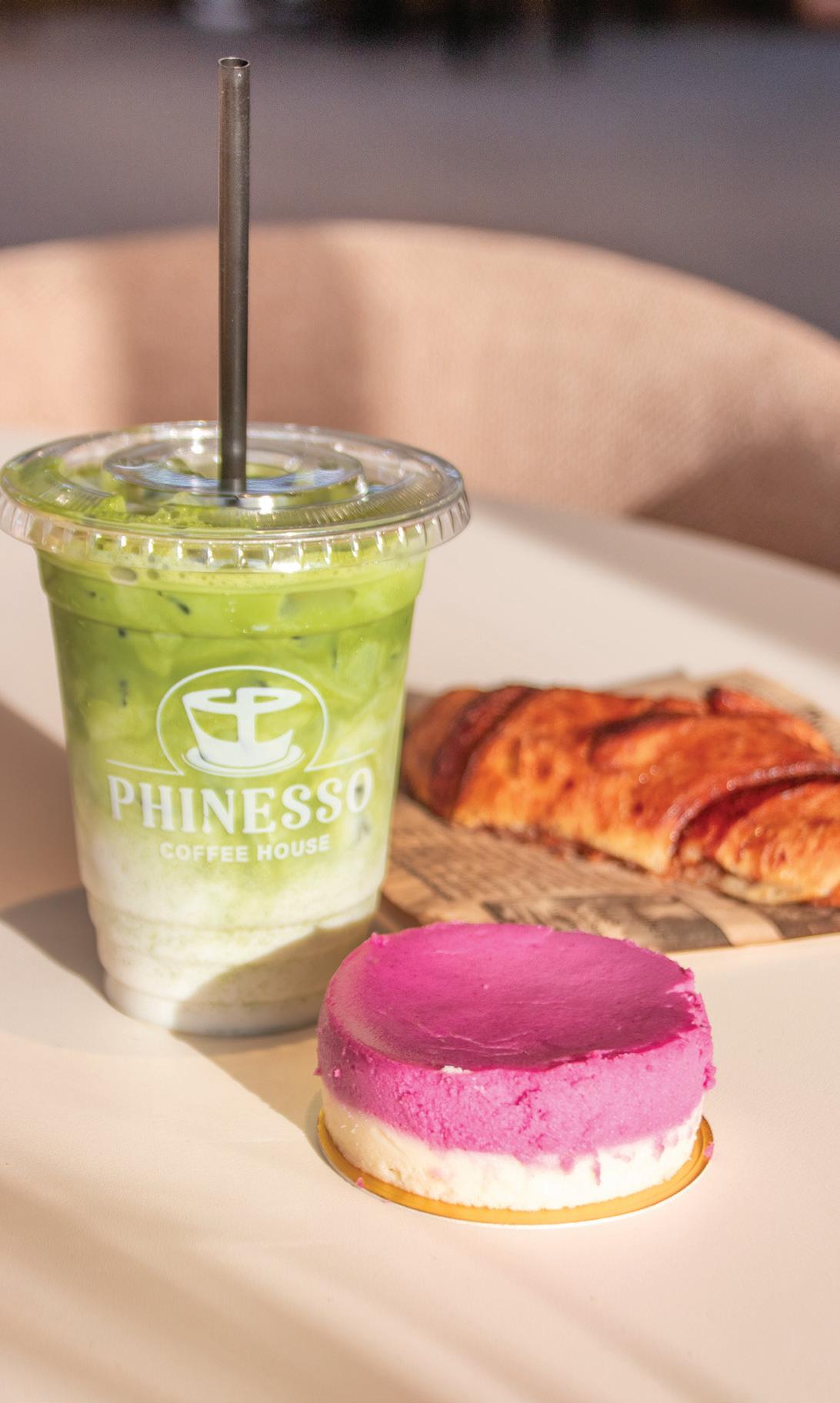
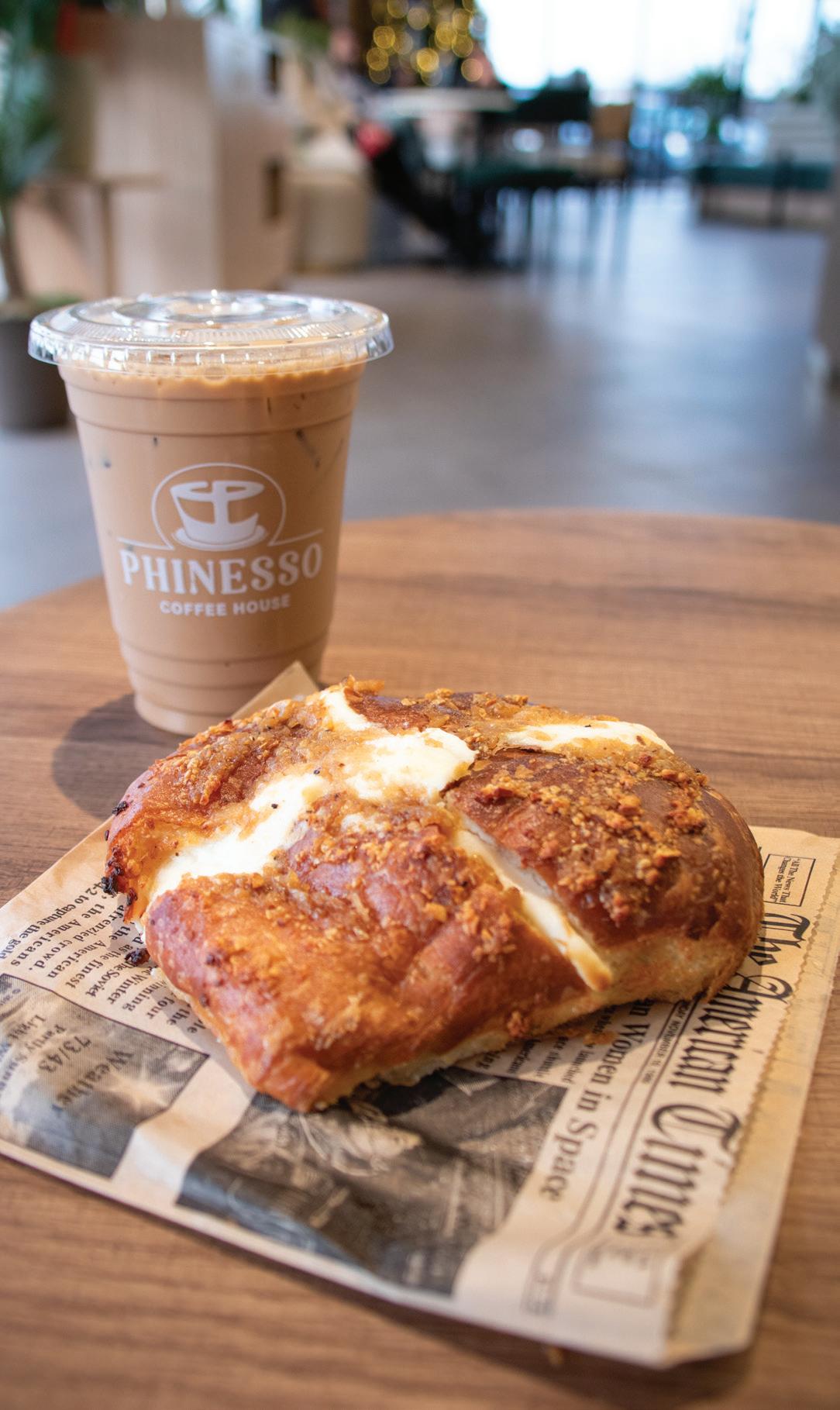
on p. 56 and then impress your next date with an intimate knowledge of the Tulsa food landscape. I also got to check out co ee scene newcomer Phinesso Co ee House (p. 60) for this month’s Dining Out story. Co-owner Vy Nguyen let me know that their team is playing around with the intersection of Valentine’s Day and Lunar New Year as they consider seasonal spotlights — so keep an eye out for menu updates at this Broken Arrow hot spot. Did you end up with the baby in your slice of king cake last year? If the answer is yes, or if you’re just looking to liven up your Mardi Gras party, you can nd a quick guide on where to get king cake in Tulsa on p. 64. You can round out any celebration with a fun selection of board games, which you can build out at local shop Dragonslayer Games — read more about this 10-year-old Tulsa shop on p. 70. Finally, February begins the nomination process for our annual A-List Readers' Choice Awards. We updated a few of the categories this year, so make sure to visit tulsapeople.com/a-list to see what's new and submit your favorite local businesses. Stay warm out there, and thanks for picking up this issue. tp
Lauren Rogers EDITOR
EDITOR Madison Walters
ASSISTANT EDITOR Tiffany Howard
CREATIVE DIRECTOR Madeline Crawford
GRAPHIC DESIGNER Allyssa Reeder
MANAGING PHOTOGRAPHER Michelle Pollard
VIDEOGRAPHER Greg Bollinger
SENIOR ACCOUNT EXECUTIVE Andrea Canada ADVERTISING REPRESENTATIVES
City Desk
NEWS CAUSES PASSIONS
LEARN MORE ABOUT REDHAWKS TAKE FLIGHT ON P. 9.
UPLIFTING CAREERS
As the global aviation industry continues to face workforce shortage issues, Union Public Schools is taking steps to equip students with opportunities for a head start in this high-demand field.
The Union Aerospace Redhawks Take Flight aerospace program allows students to take indepth courses on aviation technology, flight systems for aircraft, unmanned aircraft systems, and aircraft maintenance beginning in ninth grade.
Certain courses offer students a chance to practice on aviation simulators at the Union Innovation Lab. tp
SPROUTING CURIOSITY, CULTIVATING CONFIDENCE
Since 2007, Global Gardens has been sparking the interests of Tulsa students in STEM and community collaboration through garden-based science. Because of the comprehensive nature of the curriculum, it has historically been offered at just a few area schools at a time, but that started to change when the nonprofi t began to make smaller-scale programming options available through Global Gardens Alliance in 2019.
“We have always had a waitlist of schools that were interested in having Global Gardens, but with our model there are just barriers to replicating it everywhere because it’s so involved,” says Maryann Donahue, the organization’s executive director. “But now we have 15 partner schools all together: three are comprehensive sites at which we serve all students for the whole school year; six are smaller sites, where we offer school year programs during and after school; and six are Sprout program sites, which are receiving this program for one quarter of the school year.”
The 7-week Sprout program is the newest option available to interested public schools. The students it serves are typically between first and third grade, and they learn how to utilize hydroponic trays to grow vegetables and herbs including different types of lettuce, spinach, kale, chives, basil and dill. The program is a hands-on “seed-to-plate” experience, meaning the students do everything from planting the seeds and nurturing the plants to learning how to prepare a snack or meal from what they’ve grown.
“It allows many more kids in the community to have a Global Gardens experience, even if their school doesn’t have a permanent garden,” says Donahue. She adds that students receive standards-aligned science lessons and exposure to “peace education,” which is a core component of the work that Global Gardens does. A tenet of peace education, she says, is that every person deserves to participate fully in their community, and that Global Gardens helps prepare students to be active community members by emphasizing student-led learning.
“It puts the students in the driver’s seat, as far as their ideas being the focus of what we work on,” says Donahue. “There’s a lot of work that we do on building a sense of community and giving kids the sense of: ‘What does it mean to be part of a diverse community?’ And, ‘How can we appreciate both our own strengths and our internal qualities, and the different strengths and qualities that other people bring?’”
If you are a principal or school leader interested in bringing the Sprout program to your school, contact info@global-gardens.com. — TIFFANY HOWARD
AT THE HEART OF IT
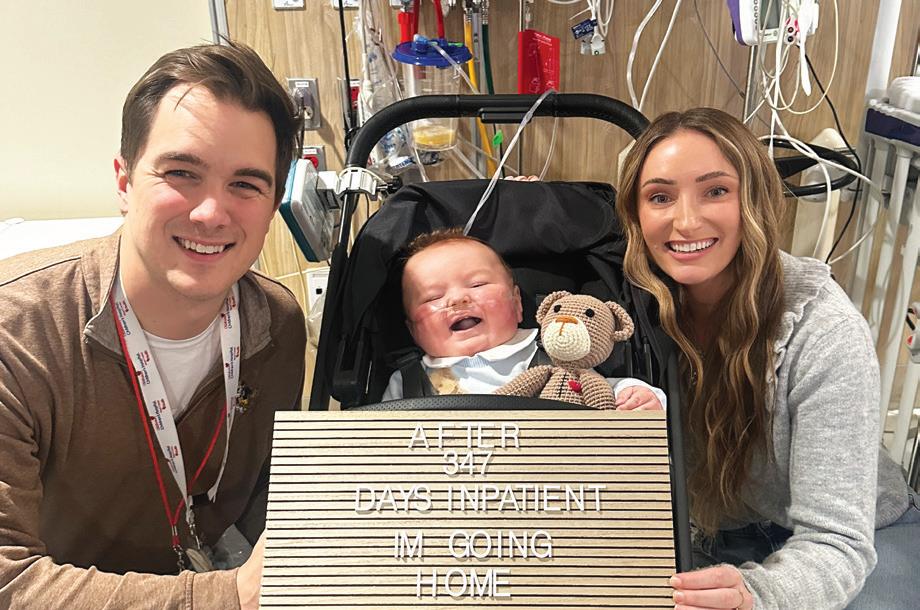
Of all the things on Faith Helmerich’s mind as she was preparing to deliver her first child in late 2023, the American Heart Association wasn’t among them, she acknowledges. But within hours after she and her husband David welcomed their son, Parker, into the world, that began to change.
Immediately after his birth, Parker was diagnosed with pulmonary stenosis and coronary sinusoids, a rare defect in which the right half of the heart struggles to pump blood through a narrowed pulmonary valve, causing subsequent life-threatening complications. His heart was catheterized on his third day of life, and during the procedure, he was given cardiopulmonary resuscitation for 34 minutes.
At 3 months old, he was placed on the heart transplant list. The wait proved to be long, because donated hearts small enough for infants are rare. But at just 10 months, Parker underwent a transplant, receiving a heart from another child.
On his 347th day of life, Parker went home from the hospital for the very first time, just in time to celebrate Thanksgiving. The holiday “was a very thankful experience for us because we were able to be home with our son for the first time,” Faith says.
Perhaps needless to say, Faith and David learned a lot about the American Heart Association during that year, and that’s why the couple are serving as co-chairs of the Feb. 27 Tulsa Heart Ball, which benefi ts the organization.
“It’s just a fantastic group to be involved with,” Faith says. “The Heart Association is just doing amazing things.”
For his part, Parker (now 2) is also doing some pretty amazing things. “He’s experienced more in his first two years of life than most of us hopefully ever will,” his mother says, adding that her toddler is now “doing all the things he’s supposed to do.”
She says Parker will be on anti-rejection medication for the rest of his life and that there will always be extra risks related to his heart, but aside from that he should be able to live a normal life. “There are no real restrictions,” Faith says. “Once transplanted, (doctors) want you to live a full and lively life.”
Parker’s next challenge will be learning how to be a big brother. His parents are expecting their second child — a girl — in March.
If you would like to give to the American Heart Association-Tulsa in honor of Parker, visit heart.org/tulsaheartball or email Kennady Irwin at kennady.irwin@heart.org. — SHARON BISHOP-BALDWIN
Global Gardens also recently received some exciting news. Billie Eilish’s Changemaker Program tapped the Tulsa nonprofi t to receive a donation for its work in creating positive environmental and social change. Donahue says they are thrilled, and that the donation will likely be used toward summer programming.
David and Faith Helmerich, co-chairs of the 2026 American Heart Association Tulsa Heart Ball, with son Parker as he is discharged from the hospital following a pediatric heart transplant.
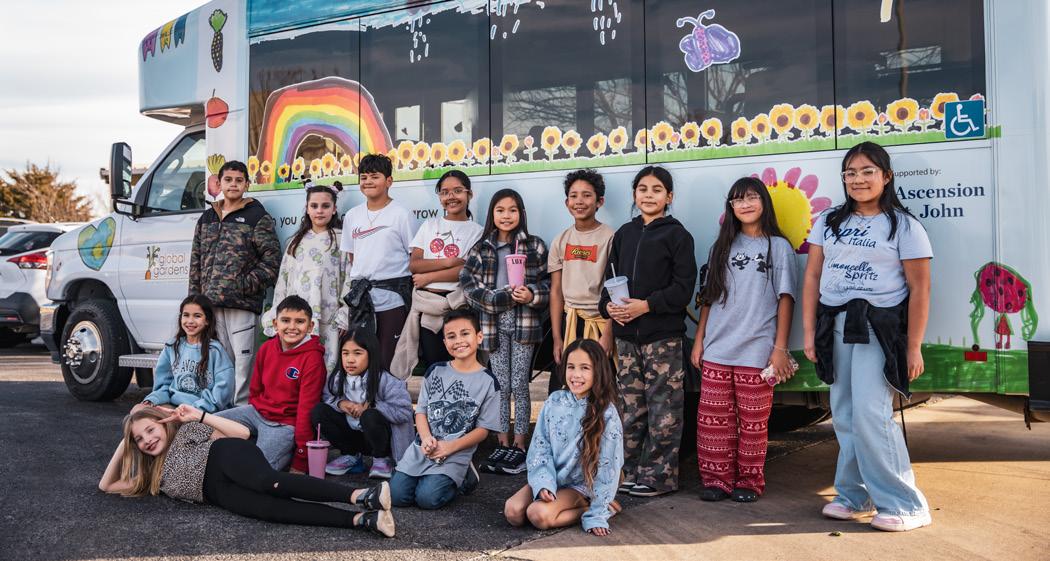
Global Gardens participants at Rosa Parks Elementary pose in front of the colorful Veggie Van, which is used to support various initiatives of the organization and was funded by a grant from the Ascension St. John Health Equity Initiative.
SCIENCE FAIR SPOTLIGHTS STUDENT TALENT IN STEM
The Tulsa Regional STEM Alliance Science Fair, returning Feb. 12, is an annual event that not only inspires young minds but also showcases the potential of Oklahoma’s future leaders in science and technology. The event is open to students in grades seven-12 who live in Tulsa or Creek County.
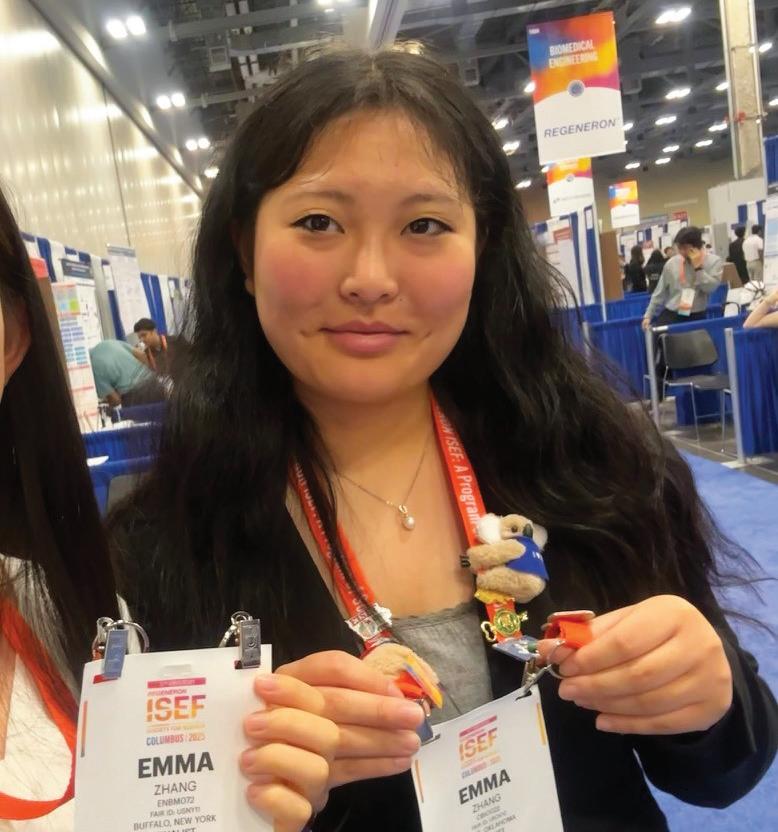
Emma Zhang , a high school senior at Jenks, is one of these young scientists. Last year she advanced from the regional event to the International Science and Engineering Fair for her project which focused on research around protocadherins — a family of cell adhesion molecules found on the surface of cells in the central nervous system. Zhang’s findings could give more insight into conditions such as autism, epilepsy and schizophrenia.
“What we know about protocadherins right now is mainly limited to nerve interactions,” Zhang says. “Because of the functions we can observe in protocadherins present in non-neural structures, we can link that to development disorders and do further research to see if they are the cause behind some conditions.”
The competition offers a chance at prizes and scholarships, as well as a chance for enthusiastic young scientists to engage with their peers. “I think we all understand that our workforce of tomorrow is going to be STEM-centered,” says Allison Bailey, Program Manager at Tulsa Regional STEM Alliance. “We are all about making those connections, building that interest and passion.”
After graduating high school, Zhang plans pursue biology in college. Thanks to the Tulsa Regional Science Fair, she is gaining invaluable experience for her future and is hopeful that she will make the world a better place through science.
For more information and to support The Tulsa Regional STEM Alliance, visit tulsastem.org.
MACY GOODNIGHT
Dreams taking flight
Union Public Schools’ aerospace program gives students pathways to careers in aviation.
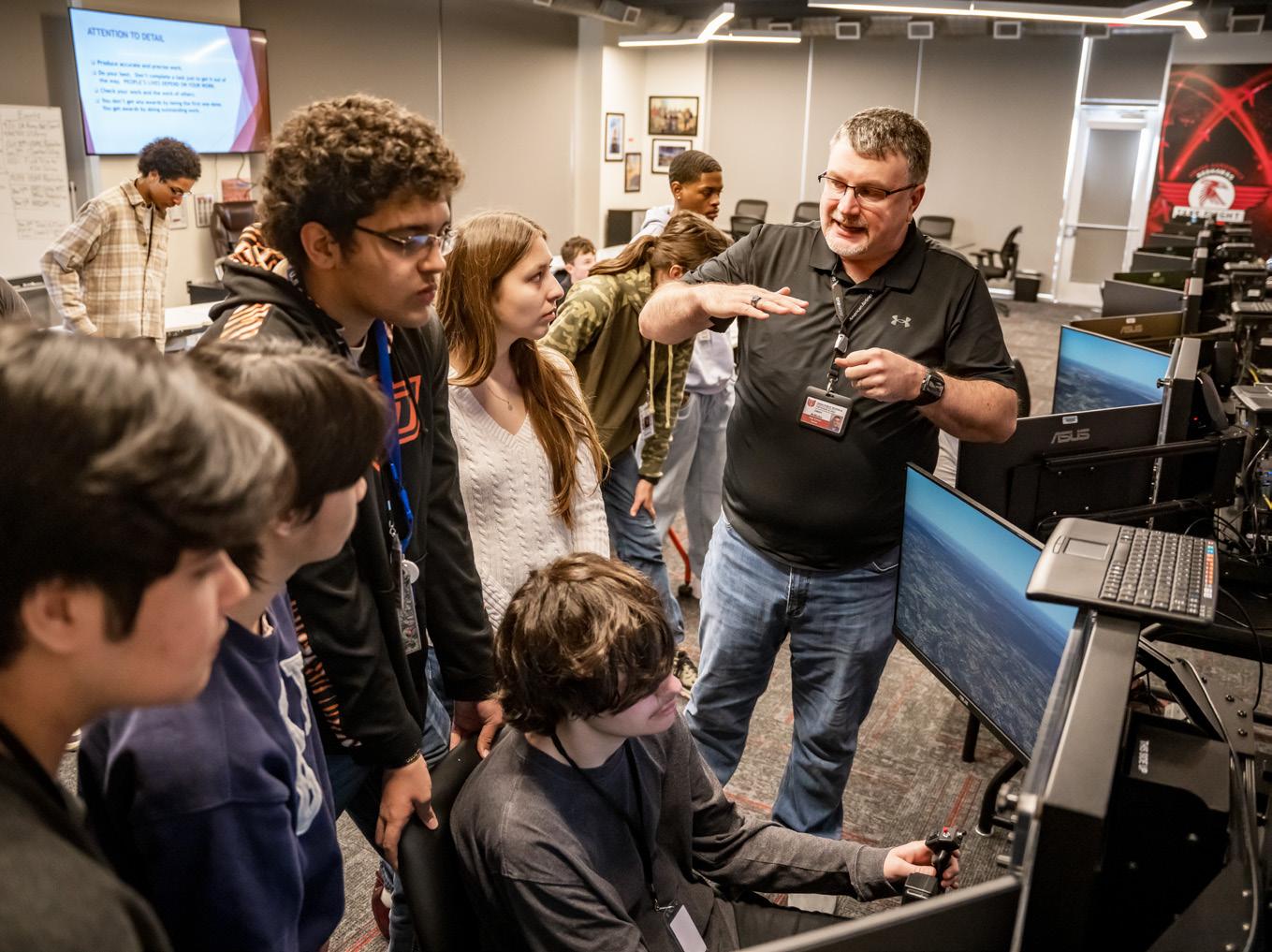
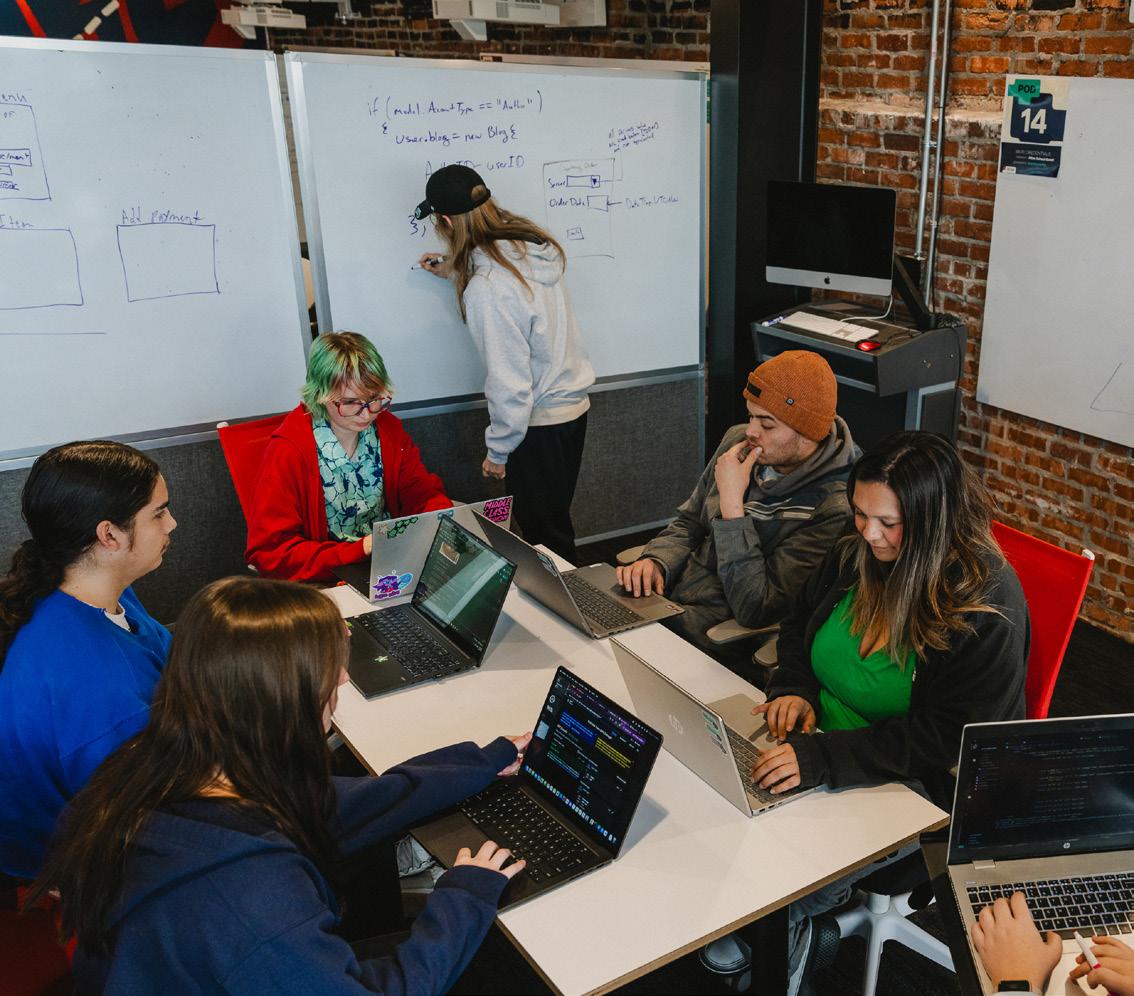
For two years, Union Aerospace Redhawks Take Flight program has been offering high school students a chance to explore the various careers available in the field of aviation. The curriculum provides students with direct-to-employment opportunities, along with a clear path to required certifications and further education.
Jason McMullen, aviation instructor and aerospace education advocate for Redhawks Take Flight, says the program has inspired interest in a growing number of students since it began in 2023. “Our high school enrollment in aviation is one of the highest in the state of Oklahoma,” he says. “We have 251 kids in our program from freshman to high school level, and we’re working on extending our reach to the seventh and eighth grade levels in the next year or two.”
The program curriculum introduces students to: the history and basic concepts of aviation and the wide array of careers it offers; the four forces of flight and aerodynamics; various working systems in airplanes and helicopters; drones; and industry specific knowledge. Students who meet the prerequisites can then go on to study private pilot training, meteorology applications, airport operations, communications and air traffic control.
“Next year, we’re looking at possibly offering private pilot and drone pilot lessons, so that (students) would end with passing an FAA (Federal Aviation Administration) test and possibly earning certificates,” McMullen says, adding that these lessons would offer his students not only FAA certification, but also transferable college credits.
One of McMullen’s current students, junior Nicholas Shell, developed a passion for planes at a young age. He says that, as a freshman, Union Aerospace was the obvious choice when career planning.
“My interest is really starting to spark by taking Mr. McMullen’s class,” he says. Shell most recently achieved his FAA Medical Certification, a prerequisite to a Private Pilot certificate, which he aims to achieve before heading to college.
Shell is one of many students excelling within the aerospace program, and McMullen credits much of its success to his students’ dedication and ambition. “It’s a blessing I don’t take for granted because your program is only as good as the students in your program,” he says. “Their excitement is what feeds our program, and they have taken advantage of these rare opportunities. That’s the ‘ultimate’ as the teacher.” — LAURA
DENNIS
Jason McMullen, aviation instructor and aerospace education advocate for the Union Aerospace Redhawks Take Flight program, walks students through aviation technique.
In 2025, Jenks High School senior Emma Zhang advanced from the Tulsa Regional STEM Alliance Science Fair to the International Science and Engineering Fair. She will participate again at this year’s event Feb. 12.
TULSA 10
FEBRUARY
COMPILED BY MADISON WALTERS
Feb. 1
“IT'S YOUR MONEY, YOU DECIDE”
Hosted by the Forum for Real Economic Emancipation, this informative event at Living Arts of Tulsa will feature Mayor Monroe Nichols among guest speakers discussing how public money is spent and more. freefreeforum.org
Feb. 4
“STARDEW VALLEY: SYMPHONY OF SEASONS”
This special concert at Tulsa Theater will feature a 35-piece orchestra performing all your favorite music from the video grame “Stardew Valley.” tulsatheater.com
Feb. 6
TULSA FIRE MUSEUM STORY TIME
During Tulsa Fire Museum’s story time, a Tulsa firefighter will read to the children while they enjoy coloring activities, snacks and other surprises. This program is for ages 3-7, and RSVPs are required. tulsafi remuseum.org
Feb. 14
THE GREAT SEED SWAP
Start your Valentine’s Day off at Tulsa Garden Center with a community seed swap! This free event is the perfect way to help get your garden ready for the spring. tulsagardencenter.org
Feb. 16
BLACK HISTORY CLASS
Hosted at the historic A.M.E. Church, Karlos Hill, Ph.D. — historian and historical researcher for Ryan Coogler ’s “Sinners” — will give a talk about the historical elements of the film. black_history_saturdays
Feb. 17
“THE INQUISITOR”
Head to Circle Cinema for a free screening of a film that explores the life and legacy of Barbara Jordan circlecinema.org
Feb. 20-22
VINTAGE TULSA SHOW
Get ready for over 55,000 feet of shopping at this oneof-kind event at Expo Square that features antiques and vintage finds. This year’s event will celebrate the centennial of Route 66 with special vendors. vintagetulsashow
Feb. 27
NINE INCH NAILS
The iconic industrial rock band is bringing their “Peel It Back” tour to BOK Center for a night of their signature sound. bokcenter.com
Feb. 11
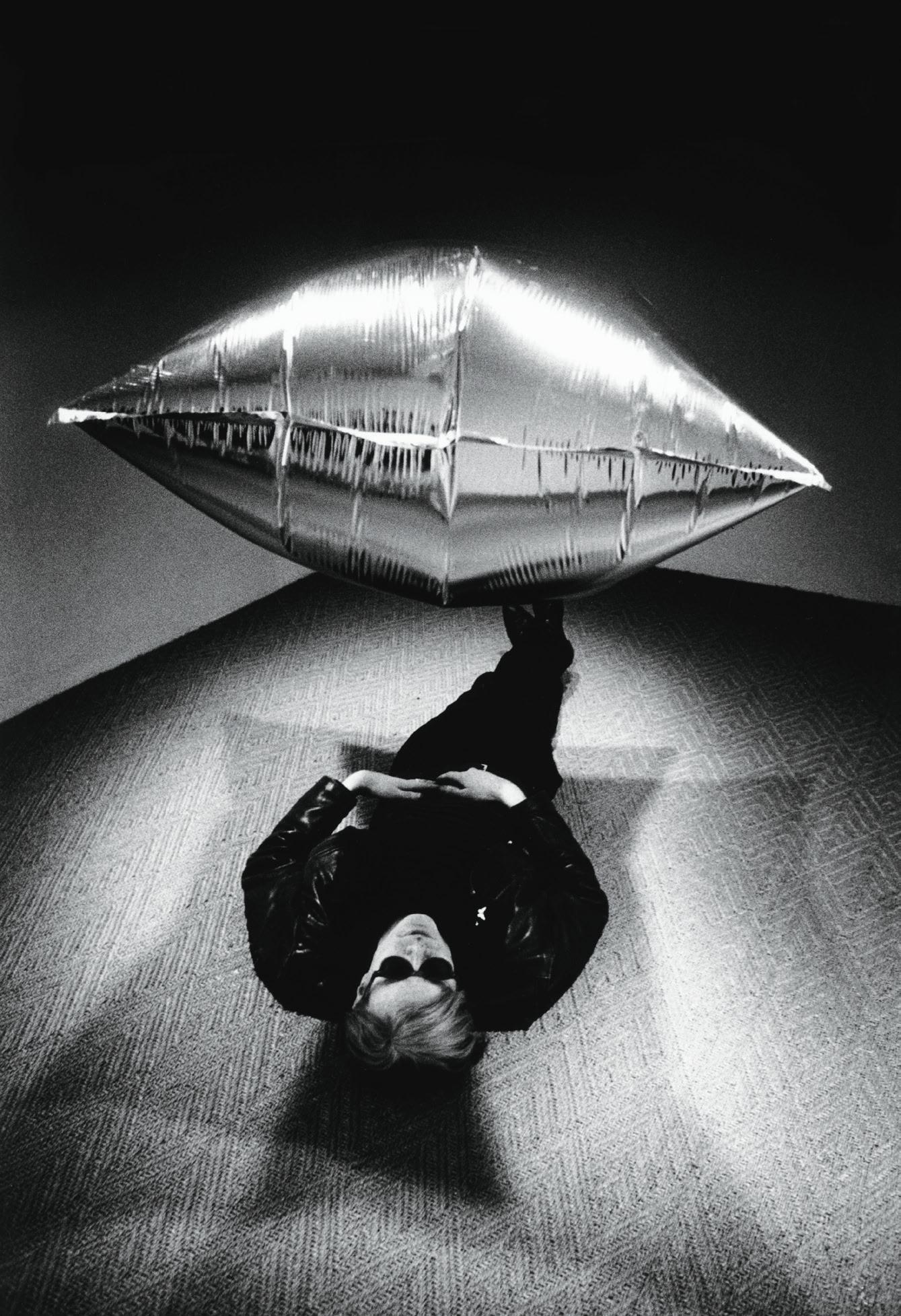
ANDY WARHOL: SILVER CLOUDS PUBLIC OPENING
Andy Warhol ’s “Silver Clouds” is headed to Philbrook Museum of Art! This interactive installation on display through June 14 lets you walk amongst the clouds and touch them. philbrook.org
Feb. 27-March 1
TULSA GAMING CON
Hosted at Arvest Convention Center, Tulsa Gaming Con features vendors, art and, of course, gaming. A pass gets you unlimited play in the 9,000-square-foot gaming area. tabletop.events/conventions/tulsa-gaming-con-2026
Steve Schapiro (American, 1934-2022), Andy Warhol under the Silver Cloud Pillow, NewYork, 1965.
Paul Davis
BY LAUREN ROGERS
In December 2025, Discovery Lab
o cially welcomed Paul Davis as its new CEO. Davis is not new to Tulsa, having served as executive director of City Year Tulsa for eight years, and spending nine years with the Mental Health Association of Oklahoma before that.
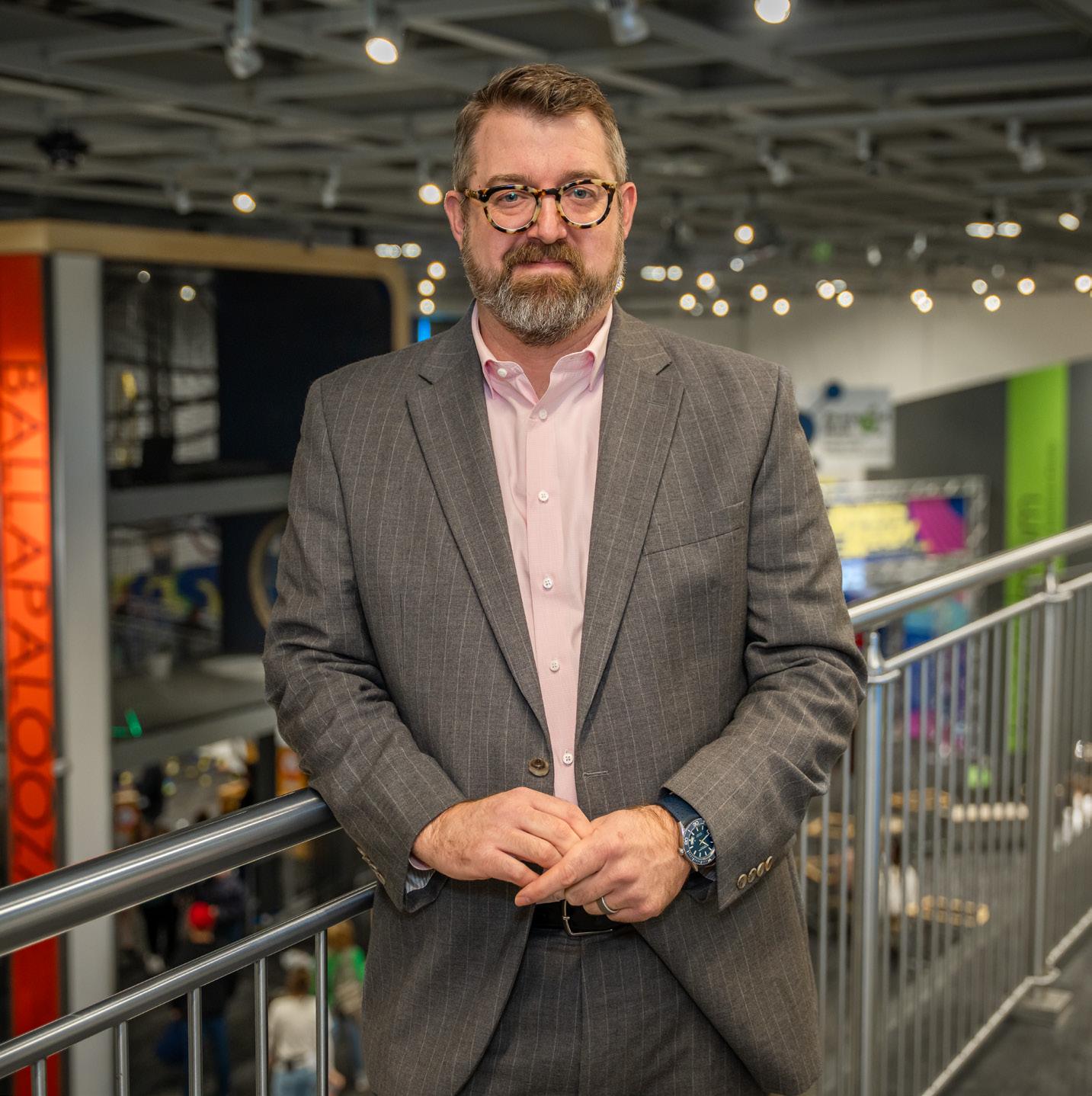
With two young daughters himself, Davis is no stranger to the hands-on children's museum. We had a chance to catch up with him on a busy Friday morning, while the museum buzzed with dozens of science-enthused visitors from three di erent schools.
BEFORE COMING TO DISCOVERY LAB, YOU WERE THE EXECUTIVE DIRECTOR AT CITY YEAR TULSA. ARE THERE ANY LESSONS YOU LEARNED FROM THAT POSITION THAT WILL INFLUENCE HOW YOU APPROACH YOUR NEW ROLE?
I had the opportunity to work very closely with Tulsa Public Schools and meet many of our students across the city. I think one of the biggest lessons I learned was just how incredible our kids here in Tulsa are. I’m really passionate about what opportunities they deserve. And I think the other really key thing I learned was that it’s not fair for us to expect our schools to do it all, right?
We should hold our schools to really high standards — and I think we really do work to do that here in Oklahoma — but the reality is that we need a lot more in the community around our schools to be able to give the kids the experiences that they deserve growing up. And that was one of the things that brought me to Discovery Lab, and why I’m really passionate about being here ... Discovery Lab is an independent nonpro t organization where we can really help give our kids some of the most incredible learning experiences and opportunities to engage with science and technology, but also (help them) nd that joy of learning.
THERE ARE THREE SCHOOLS VISITING DISCOVERY LAB THIS MORNING FOR FIELD TRIPS. HOW WIDE IS YOUR SERVICE AREA? We have kids coming to us from all across the state for eld trips. We also have a really cool program where we give classroom instruction to kids. So, we’ll do science lessons with their school classes, as well as give them the opportunity to play and explore on the gallery oor.
But we also will go out into the community. We’ve gone out across the state of Oklahoma to go into school classrooms where we bring the Discovery Lab to kids across the state. Yesterday, I actually got to be in Jenks and shadow with one of our outreach educators, who was giving a lesson on how animals adapt based upon their needs, like their food and their environment. at was really fun to get to be there. But we also have people from across the country coming to explore and learn with us here at Discovery Lab, which is really great.
WHAT ARE YOU MOST EXCITED ABOUT FOR DISCOVERY LAB IN 2026? Here in a couple of weeks (Feb. 26) we’re going to be doing something called Introduce a Girl to Engineering. We are going to have engineers come in, and we’re going to be able to introduce girls — hopefully my daughters, too — to di erent engineering and technology experiences to get them thinking about careers in STEM and how that’s a pathway for them, but also something that they can nd a lot of joy in. So that’s something I’m really excited about that’s coming up.
We’re hoping to bring in a new exhibit this fall through a partnership that we’re working on right now that will, again, help introduce our kids to technology concepts and really help to build their tech skills and awareness in really safe ways.
The new CEO at Discovery Lab
Paul Davis took on the role of CEO at Discovery Lab (3123 Riverside Dr.) this past December and is already looking ahead to new initiatives. “One of the things that we're looking into this spring is launching evening hours for families with fun activities,” he says. “We’ll be launching (those) on Saturday nights.”
WHAT IS AN AREA OF GROWTH YOU SEE FOR DISCOVERY LAB? We’ve had people working on creating and building and doing the programming of Discovery Lab for almost 20 years. We’ve been here at this location coming up on ve years since opening in January 2022, but the Discovery Lab has done work across that time span here in Tulsa ... I think that ethos of being out in the community still stands, and the desire to work with partners and build new partnerships is a key part of that.
We started as a museum without walls, and we have this incredible gift — that our community built the Discovery Lab here as this incredible museum — but we want to make sure that we’re staying out in the community and that we’re accessible to all Tulsans. For some, that means bringing Discovery Lab out into the community. I think that that’s a big opportunity for us to look into: How can we partner with other community organizations to really push beyond our walls and bring some of the really fun and exciting programming we have here into Tulsa in other ways?
YOU ARE A TULSA TRANSPLANT THANKS TO YOUR WIFE, JULIE, WHOM YOU FOLLOWED HERE (WELL BEFORE SHE BECAME CHIEF EXECUTIVE OFFICER FOR YWCA TULSA). WHAT DO YOU ENJOY MOST ABOUT LIVING IN TULSA?
Both of us are very passionate Tulsans. We both, though, come from very di erent worlds. Julie grew up in a rural community in Missouri. I went to high school in the suburbs of Chicago. So, I love the big city, and Julie loves the small town. And I think that, one, we just love that Tulsa has the perfect balance of having all the things that you want in a city, but also feeling like a really small town community where we can get to know our neighbors and know people when we’re out about town ...
But Tulsa is also a city that really — we believe in ourselves. We believe that we’re an amazing community, but we also believe that we can be a lot better. And that’s one of the things that I think has kept us here, is that this is a community that wants to be better and wants to better serve each other.
OUTSIDE OF DISCOVERY LAB, WHERE ARE SOME PLACES YOUR FAMILY GOES FOR FUN AROUND TULSA? We love to go out and try new restaurants. We also though — I’m a huge hockey fan — and so we’ve been going to the WeStreet Ice Center a lot because I’m trying to get my girls into skating and hockey. So that’s something that is really cool, and
something that we have enjoyed getting to do as a family recently. And then we just love the bike trails — getting to walk the dogs on Turkey Mountain. Julie and I love to go for bike rides in River Parks. at’s something I think for us is really, it’s huge. We love being in some of these outdoor spaces that we have in this community.
WHAT IS YOUR FAVORITE
EXHIBIT AT DISCOVERY LAB? at is very hard ... It’s one of those things that’s not quite like choosing your favorite child, but it is. I’ve been bringing my girls to Discovery Lab since they were toddlers. When they were young, we would walk in the doors and they would sprint for the Tape Slide, even back at the Owen Park location. And so I think that’s something that has been a huge part of their journey. But as they’ve gotten older, it’s been cool to see how they’ve engaged with other exhibits. Mia , my eldest daughter, and I got to play in some of the new BMX stu — there’s some competitive things that you can do over there — but also she’s really been falling in love with the Science Lab. It’s been really fun getting to take them there and see some of the di erent exhibits. As a family, we got to light hydrogen bubbles on re, which is this fun, ashy reaction. If we were closed and there was nobody else here, I would love to just go and play in Ballapalooza for hours, because it has so many cool little sorting mechanisms and di erent machinery things that control the way the balls go, and it’s just a really cool place to play and explore.
DISCOVERY LAB IS ALSO HOME TO AN ELOTE
CAFE LOCATION. Fun fact: Libby ( Billings) and Elote catered our wedding. Julie and I — we’ve been huge fans of Elote for a very long time. I was thrilled when I learned that they were here and I got to work with them. I love having Elote in the building. I think it’s something that our members and our guests love having access to. But we also want people to come and just feel free to grab lunch. ey have some really cool things that are unique to this location ... I teased that in spring, we’ll be launching Saturday nights, and so that’s something that we’re working with Libby and her team around — starting to build the vision of how they can join in that activation and have new and unique experiences for people. tp
40 years of TulsaPeople
TREY THAXTON OF GREENWOOD AVE.
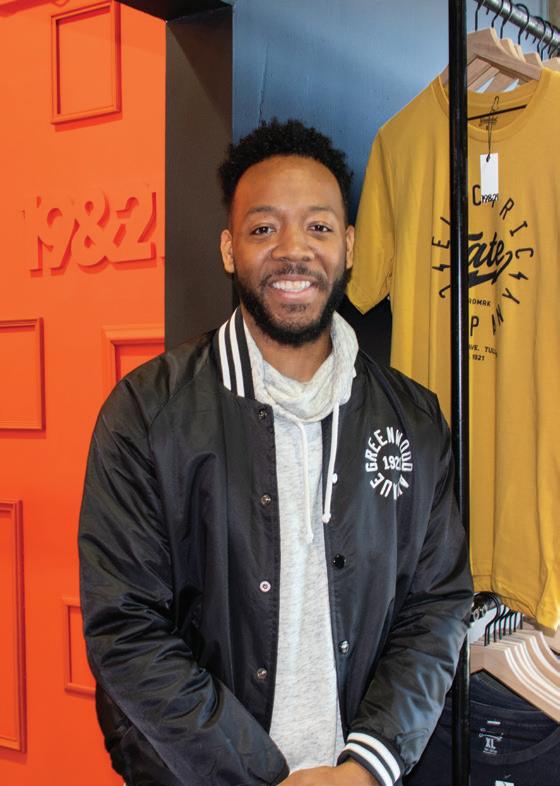
This past October, local clothing line Greenwood Ave. was put in the national spotlight when the “Today” show visited Tulsa. Four years ago, former TulsaPeople Editor Anne Brockman got to chat with the brand’s founder Trey Thaxton at his pop-up in Mother Road Market.
Greenwood Ave. began in 2018 with T-shirts sporting logos from landmark businesses destroyed in the 1921 Massacre. “There’s more meaning than just looking cool,” Thaxton said in his 2022 conversation with TulsaPeople.
“It’s the conversations and stories these designs ignite that’s really the goal,” he says.
Thaxton originates the designs for Greenwood Ave., and the majority of the products are screen printed here in Tulsa.
“Whatever I touch or do has to have meaning,” he said.
10% of all Greenwood Ave. sales go to north Tulsa community efforts.
In 2023, Greenwood Ave. launched a magazine focused on uplifting Black entrepreneurs around the world and celebrating the legacy of Black Wall Street. Visit greenwoodave.com to explore past issues, shop for merch and learn more. tp
Trey Thaxton at his 19&21 pop-up inside Mother Road Market in 2022. Read the corresponding interview at tulsapeople.com.
MEMORY LANE
The power of family
Tulsa company Tobe Energy honors founder’s late father and explores new technology.
BY ROBERT EVATT
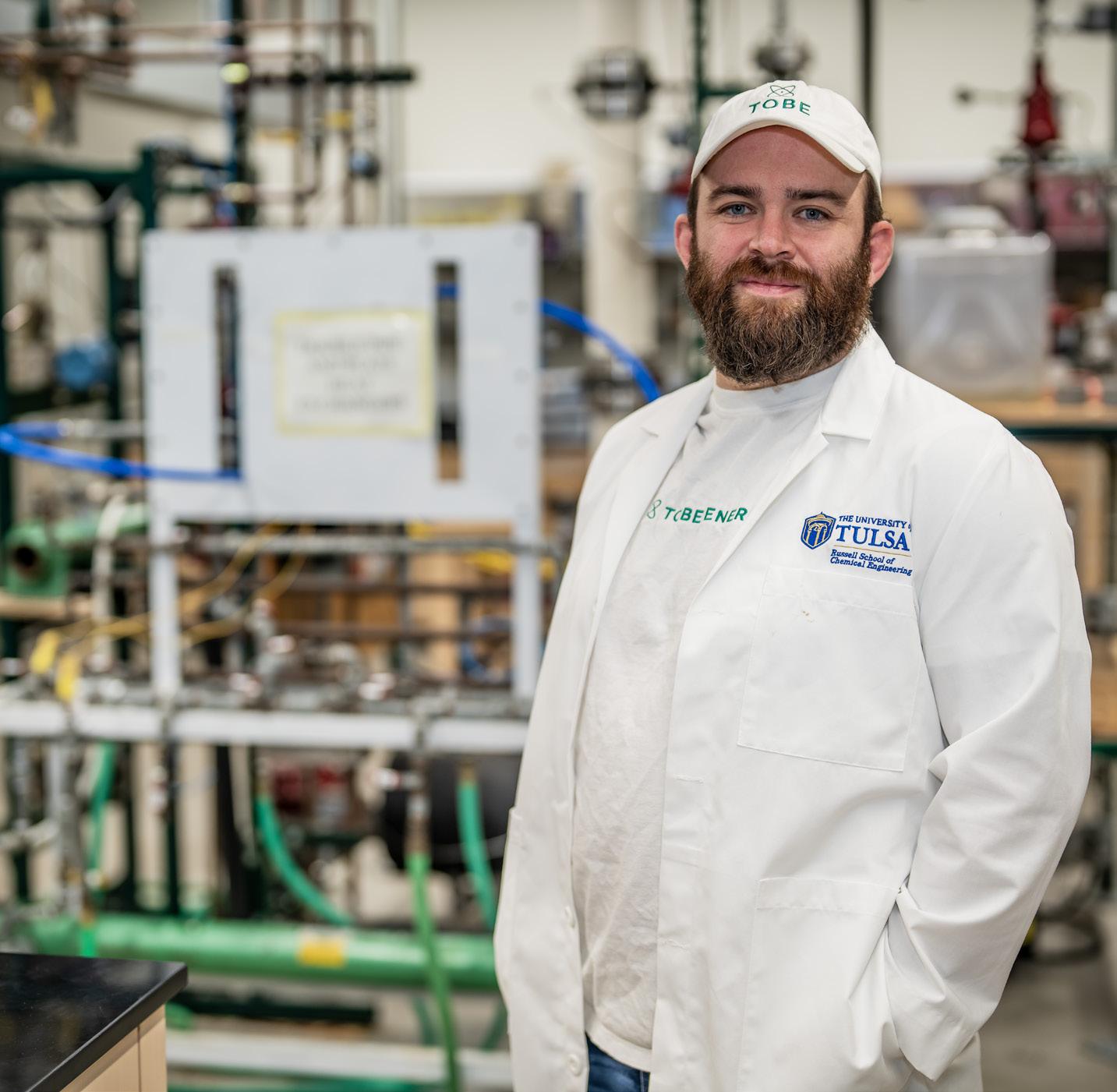
It’s inevitable that parents in uence their children as they grow up, but Colby DeWeese got unique insight from his late father, Toby DeWeese, one of the inventors of Tivo — the popular digital video recorder.
“It is honestly the greatest thing that I could have asked for, just growing up with someone that constantly asked you to challenge everything, and to him, no question was dumb,” DeWeese says.
anks to that in uence, Colby developed a lifelong love of science and learning. He recently founded Tobe Energy, an Oklahoma company that has developed a breakthrough in green hydrogen extraction. e name is a dual nod to TOBE, or the “theory of basically everything” in physics, and to his father Toby as well.
Hydrogen extraction is far from a speculative eld — it’s a growing, $184
billion industry that’s crucial for making fertilizer that grows the world’s food, producing life-saving drugs and developing new green energy sources. Hydrogen helps run the world, and DeWeese has found a way to make it signi cantly less expensive.
Compared to the usual heat-intensive hydrogen extraction methods, Tobe Energy’s system consumes vastly less power, costs half as much as other hydrogen production methods, and doesn’t require the use of fossil fuels. It has the potential to make hydrogen more widely available, which would also lower the price of food and drugs while simultaneously enhancing the production of both with fewer emissions.
DeWeese compares the leap in e ciency to light bulbs: “ e current ‘state-of-theart’ for hydrogen production is like an incandescent light bulb, the type that you had growing up that burned your ngers,” DeWeese says. “Now we’ve got LED lights that are cool to the touch and consume less power.”
is innovation isn’t a dream for a farung future, as Tobe Energy has partnered with Zeeco to bring it to market.
“Zeeco has the world’s largest combustion research and development center in Broken Arrow,” DeWeese says. “ ey have an advanced research complex, which can be thought of as a startup incubator for rst-of-a-kind energy technologies.”
With the help of Zeeco’s engineering, procurement and construction capabilities, DeWeese estimates they’ll have the system ready to bring to market by the second or third quarter of this year. In return, Zeeco will gain a less expensive, greener source of the signi cant amounts of hydrogen they use in their combustion work.
DeWeese, a graduate of e University of Tulsa, says his out-of-state investors needed some convincing to develop such an innovative project in the Tulsa metro area. But he says there was no other place he’d consider.
“ ere’s two things that make renewable energy projects successful,” DeWeese says. “ e rst is the cost of electricity, and Oklahoma has the second-lowest cost of electricity in the nation. And we have a wealth of engineering expertise — anything you could ask for in the renewable energy chain. Oklahoma should be the world headquarters for renewable energy.” tp
Colby DeWeese is the founder of Tobe Energy, a pioneering Oklahoma company that has developed a breakthrough in green hydrogen extraction.
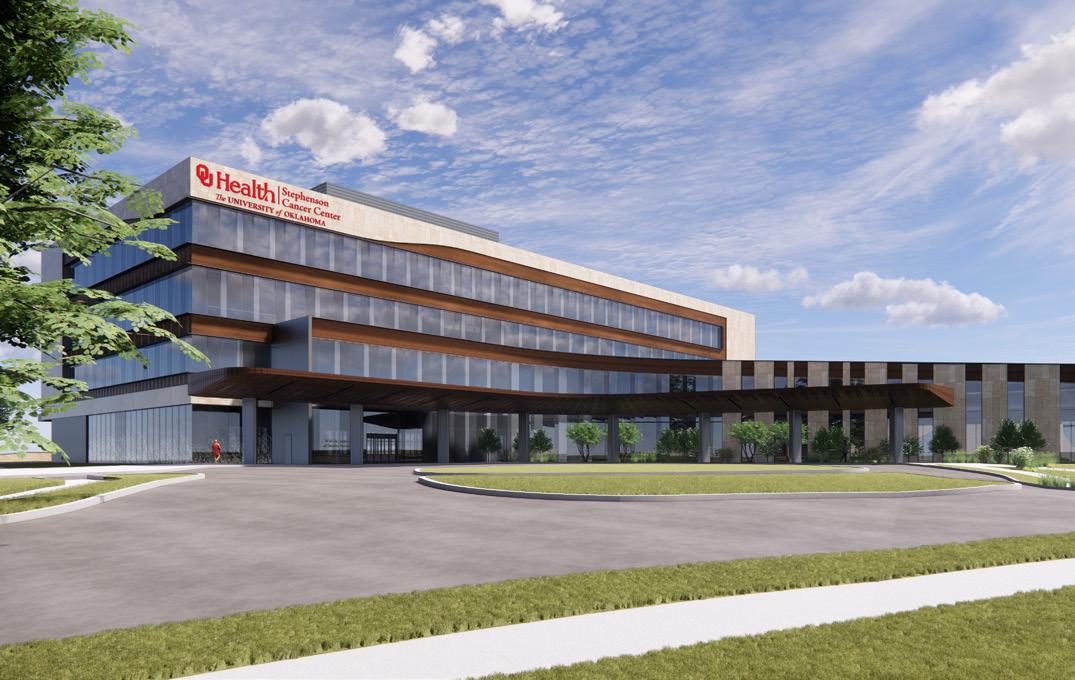
OU HEALTH STEPHENSON CANCER CENTER IN TULSA
Breakthrough Clinical Trials — Coming to Tulsa
OU Health Stephenson Cancer Center — Oklahoma’s only National Cancer Institute (NCI)designated cancer center — is bringing a transformative 176,100 -square -foot cancer center to northeastern Oklahoma. Located on the University of Oklahoma’s Schusterman Campus in Tulsa, the new center will expand access to life -saving clinical trials that aren’t available anywhere else in the state.
What Will Be Offered:
• Dedicated clinical trials not available at any other Oklahoma cancer center
• 70 exam rooms
• 45 infusion spaces
• Full imaging: MRI, PET-CT & more
• Access to state-of-the-art technology and innovative treatments We are currently seeing patients in Tulsa at OU Health Stephenson Cancer Center at Hillcrest at 1245 S. Utica Avenue, offering compassionate care and clinical trials. To make an appointment, call (918) 579-3850. Together, we’re lifting the health of Oklahoma — turning breakthroughs into hope for generations.
Ten years, zero price tags
How The Pencil Box is
The interior of the Pencil Box looks like an O ce Depot at rst glance, with rows of bright markers, stacks of paper towels and bins lled with glue sticks. But for teachers at eligible schools, everything on the shelves comes with a price tag of zero dollars.
supplies to 2,141-plus teachers in Tulsa County — including within the districts of Jenks, Broken Arrow, Union, Liberty, Sand Springs and Tulsa Public Schools — where at least 70% of students are economically disadvantaged.
Teachers say the need for supplies is overwhelming. At the schools e Pencil Box serves, teacher partners report that 80% of students arrive on the rst day of school without basic supplies. By the time homework comes around, 82% don’t have what they need at home to complete assignments. And for 84% of families, replenishing supplies during the year simply isn’t possible. To close the gap, educators often shoulder the burden themselves, spending an average of $500 out of their own pockets each year just to make sure their students have the essentials to succeed.
at’s where e Pencil Box steps in to make sure that teachers can shop for the supplies they need for free. In 2025 alone, 584 teachers partnered with e Pencil Box to stock their classrooms, impacting over 27,000 students’ learning experiences. It’s a simple model with an outsized impact, ensuring students are set up to succeed.
Behind that impact is a massive volunteer e ort. e Pencil Box runs on volunteer labor, with over 550 people giving 5,100 hours of service in 2025 to help process supplies, run inventory and stock the shelves. While the nonpro t reports they are always grateful for donations of new school supplies, monetary gifts are what actually o er the greatest impact.
“ anks to our wholesale partnerships, e Pencil Box leverages 6-to-1 buying power,” says Development Manager Shane Smith. “Put simply: for the price you would pay for a single box of crayons at the store, we can purchase six.”
However, the need continues to rise. Since 2022, an additional 24 schools now qualify to partner with e Pencil Box due to the number of economically disadvantaged students enrolled in their schools, bringing the total to 89 Pencil Box-eligible public schools in Tulsa County.
BY ABIGAIL SINGREY
Founder and Executive Director Nancy Bolzle launched the idea for e Pencil Box from her dining room table. Since its rst distribution of school supplies in October 2015, the nonpro t has provided more than $7.9 million in
“It might surprise you to know that I hate the fact that e Pencil Box exists,” Bolzle says. “I really do. Every day, I’m reminded of the heartbreaking reality — that so very many children in our community still don’t have access to the basic school supplies they need to take full advantage of their education.”
To learn more about e Pencil Box, visit thepencilbox.org. tp
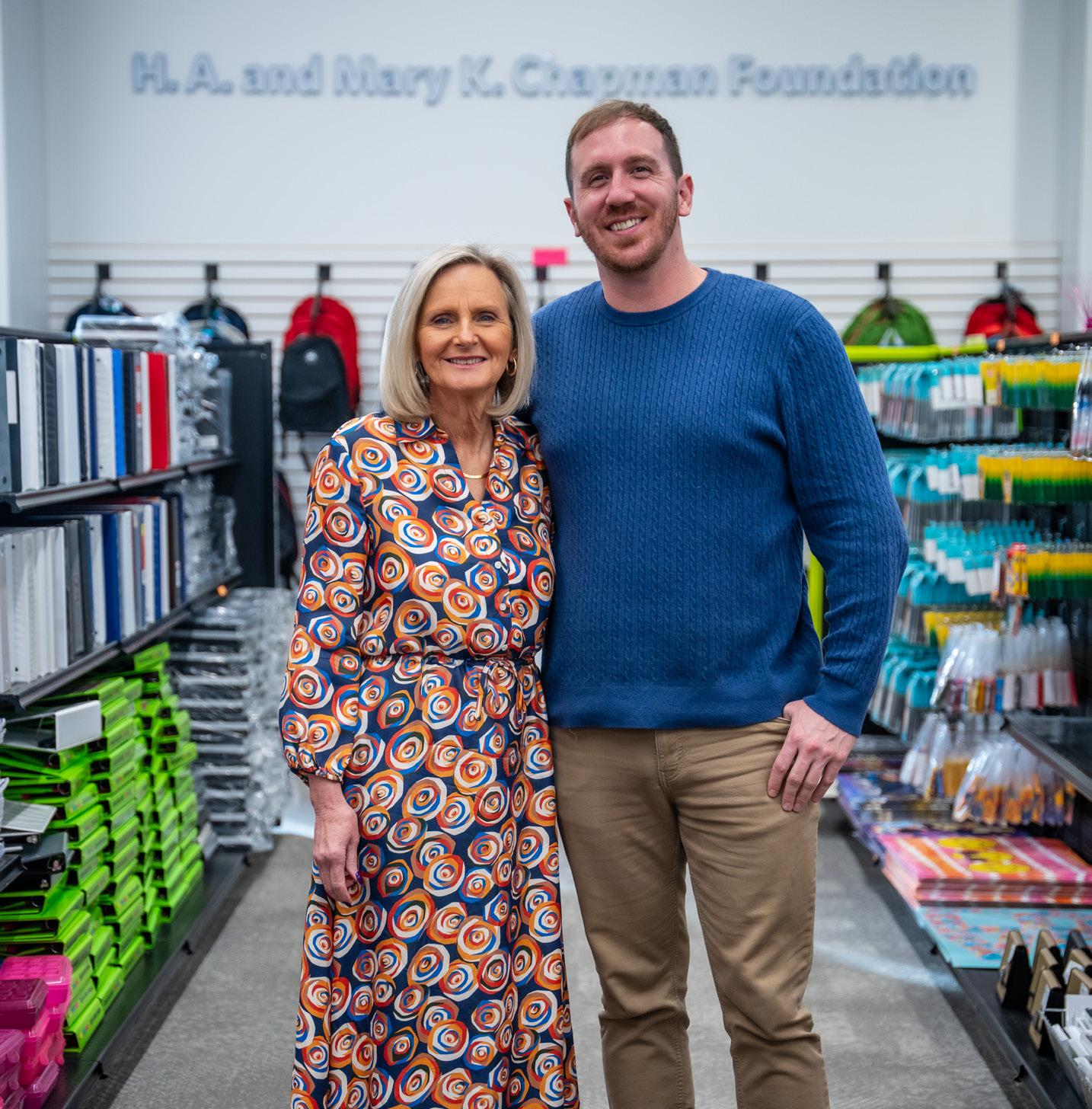
Nancy Bolzle, founder and executive director of The Pencil Box, stands beside Shane Smith, The Pencil Box's development manager, inside the nonprofit’s facility at 2435 Southwest Blvd. The organization, which offers free classroom supplies to underserved students and teachers, turns 10 this year.
The Goddard School comes to Bixby
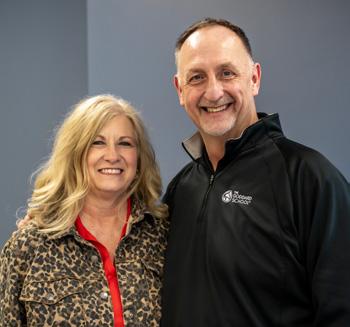
The Goddard School, an esteemed provider of early childhood education, is now open for enrollment in Bixby. Former teachers Jeff and Kim Bowerman are the owners bringing the school’s unique learning philosophy to the Tulsa area.
“We wanted to pivot our lives to a new direction that still offered opportunities to pour into serving others,” Jeff says. “Owning an early childhood education center gives us the best of those worlds.”
The Goddard School was established 38 years ago in Pennsylvania and now has more than 660 schools across 37 states and Washington, D.C. The schools use an inquiry-based approach to learning, known as the “Wonder of Learning” program, to provide care for infants as young as six weeks old to children up to six years old.
The Bowermans explain that the Wonder of Learning program “encourages children to explore their curiosities and interests as they discover the joy — and wonder — of learning,” and that it “builds age-appropriate academic, social and emotional skills through curiosity, collaboration, investigation and discovery.” The curriculum focuses on kids’ natural curiosity and sense of wonder, encouraging inquiry early in life.
The greater community will see impacts, too. The new school, which hosted their ribbon cutting this past November, brings Bixby 25 teaching jobs and can provide care to 155 students across 11 classrooms. The early childhood education center will have hospital-grade sanitization equipment, as health and safety are top priorities of Goddard. According to Jeff, the school “surpasses the standards required in an early childhood education center.”
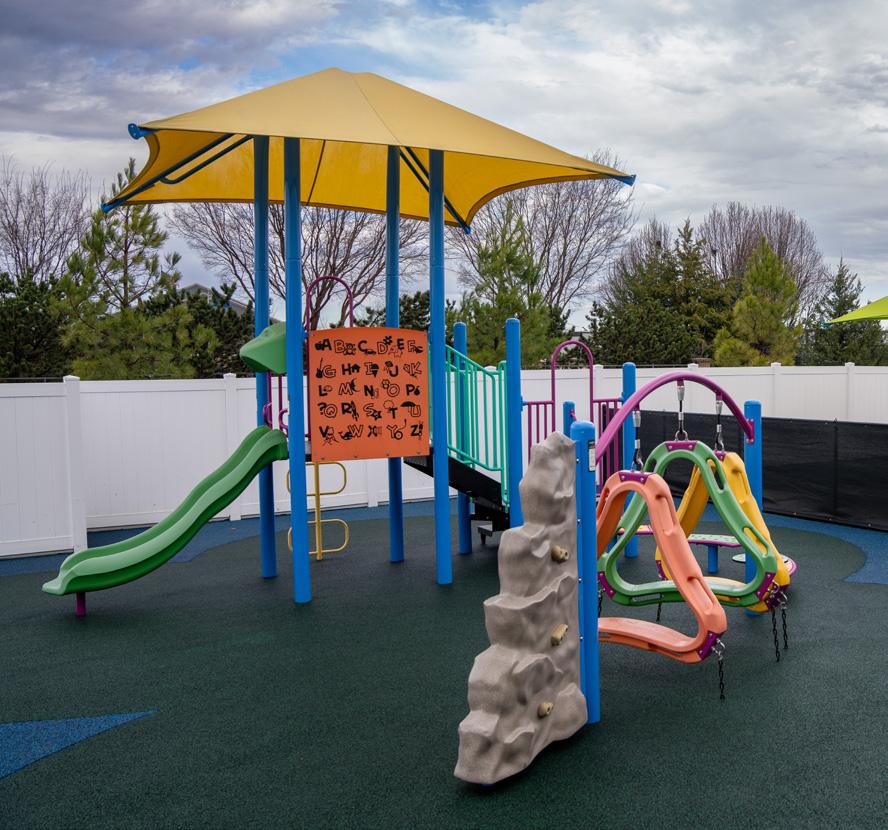
Located at 12606 S. Memorial Drive, Bixby’s Goddard School is more than 10,000 square feet and includes an indoor multi-purpose room, as well as several outdoor play areas.
“Being a big part of families’ lives and watching the children grow from infants to leaving the nest and being ready to flourish in kindergarten will be very special for us,” Kim says.
Interested parents can find out more by calling administration at 918-880-2900, scheduling a tour at goddardschool.com, or finding the Bixby Goddard School on social media. —
MEREDITH BOE
At 12606 S. Memorial Dr., The Goddard School of Bixby is one of more than 660 Goddard Schools across the country. Inset: Owners Jeff and Kim Bowerman.
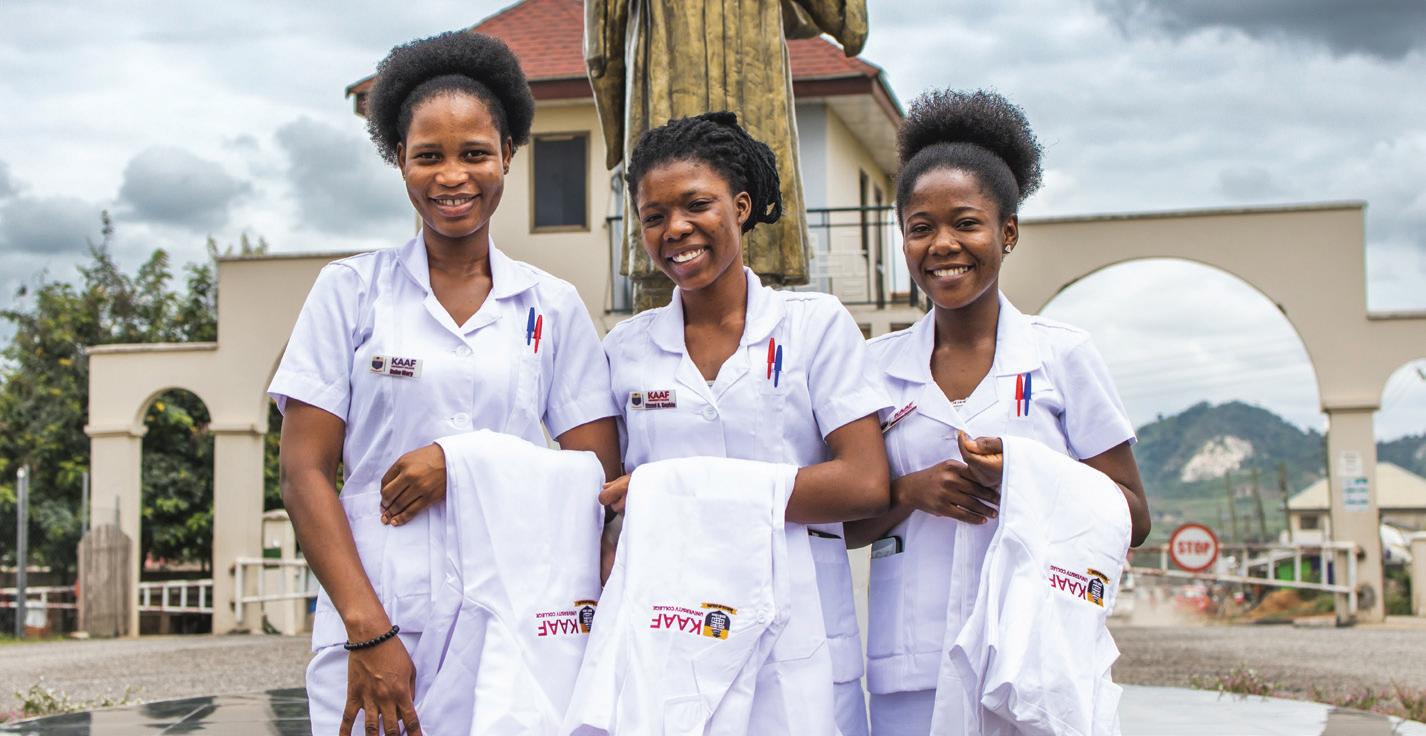
Courtney and Steve Bullard (bottom left) co-founded the Pearl House in Winneba, Ghana, with Courtney Quist-Therson (bottom right, surrounded by “Pearls” Elizabeth, Vivian, Anasthasia). Through services including residential care, education and career training, Pearl House assists Ghanaian girls and young women — such as Mary, Sophia and Augustina (above), who are training to become nurses — in building hope-filled futures for themselves.
Shining with hope
How Pearl House is transforming lives in Ghana with Tulsa support.
BY TIFFANY HOWARD
When purchasing the land to build Pearl House — a place of refuge, hope and healing for vulnerable girls in Ghana — co-founders Courtney Bullard , Steve Bullard , and Courtney Quist- erson rst needed permission from the chief who owned that particular area. Excited by the vision for Pearl House, the chief responded to the request with a quote attributed to Ghanaian scholar James Emmanuel Kwegyir Aggrey, D.O., that has since become entwined with the mission of the faith-based nonpro t:
“If you educate a man, you change an individual. But if you educate a woman, you change a nation.”
Founded in 2013 under one small roof in Winneba, Ghana, Pearl House has now grown to encompass an ecosystem of resources designed to care for the physical, emotional and educational needs of girls who face limited opportunities or have been rescued from traumatic situations, including child prostitution and human tra cking. Connected through ministry, the Bullards partnered with Quist- erson to establish the nonpro t after witnessing rst-hand the lack of resources available for at-risk Ghanaian girls. e Bullards live in Tulsa, heading up support for Pearl House, while Quist- erson lives full time in Ghana as the CEO of International Operations.
Courtney (Bullard) explains how the acronym of HOPE represents Pearl House’s four pillars of supportive care: “ e ‘H’ is for ‘healing,’ and so that’s where we have the Haven — our counseling center; ‘O’ is for ‘opportunity' through our career centers; ‘P’ is for ‘protection,’ where the residential care facility comes in; and then ‘E’ is for ‘education.’”
Pearl House currently supports 72 girls — or “Pearls,” as they are a ectionately known — ranging in age from as little as 6 years old to young women and single mothers ages 18-plus who are either attending university or establishing careers.
“Education gives them a voice, and then that builds con dence,” Bullard says. “And then they know what’s right and what they can stand up for, what they can say no to, what they can say yes to.”
Pearl House’s career centers, located in multiple regions of Ghana, o er vocational training for women to establish careers and achieve nancial independence.
Mary, now 27, arrived as one of the very rst Pearls in 2013, and she shares a bit about how the experience has impacted her life.
“It was my dream to become a nurse, but there wasn’t any support, nothing,” she says. “My dad had a lot of wives and children, and he wasn’t able to (care) for us. When it comes to education, in the village we don’t go to school. But when I stepped my feet into Pearl House it was a change of story — everything changed.”
Not only did Mary attend university to become a nurse, she is also the rst in her family to graduate with a university degree. Her story echoes the success of her Pearl sisters, who are similarly entering into careers such as graphic design and social work, or opening their own businesses.
Pearl House’s infrastructure has grown to include over 70 Ghanaian employees across its various schools and facilities, and Bullard says one of her favorite things has been hearing the words of ownership sta use when talking about their involvement in Pearl House.
“It’s not like, ‘Oh, it’s this ministry called Pearl House,’ but (instead) they use language like ‘we’ and ‘our,’ like how are we going to grow. You see this ownership, which is empowering. ey’re invested,” Bullard says.
Visit pearlhouse.org to learn more about the work of Pearl House, how to get involved, or to support the nonpro t nancially. tp
Co-host chemistry
Science professors bring big ideas to podcast fans.
BY KIRSTEN LANG
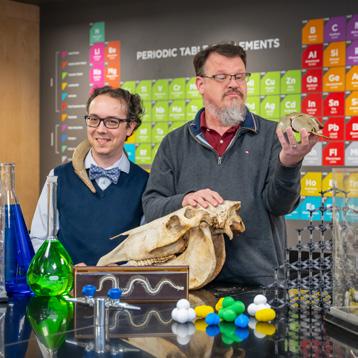
The laughter on “Yackety Science,” usually starts within the rst ve minutes, and it’s just as big as the scienti c ideas driving the conversation. Hosted by two Tulsa Community College professors — whose curiosity rivals their comedic timing — the podcast proves that learning science doesn’t have to feel like homework.
“Yackety Science” is the brainchild of Brian Cross, who teaches biology and environmental science, and Matt Smith, Ph.D., who teaches chemistry. Both are Oklahoma natives, longtime o ce neighbors, and now
co-hosts of a Public Radio Tulsa-produced series that blends humor, storytelling and genuine wonder to make science approachable for everyone. eir goal is simple: use curiosity and laughter to pull listeners into conversations they might otherwise not have.
e idea rst surfaced in 2022, when Cross began wondering what science conversations could look like outside the classroom.
“We wanted something more,” Cross says. “More room to explore ideas and time to talk about science just because it’s interesting.”
And, as the two joke, maybe a little fame. After recording several episodes that year, they shared the concept with Public Radio Tulsa. While the station initially passed, the seed was planted.
In the fall of 2024 Cross ran into Scott Gregory, operations director at KWGS. A follow-up conversation led to fresh interest in the idea, and last January, Cross and Smith recorded three episodes in the Public Radio Tulsa studio. e podcast o cially launched soon after.
e chemistry between the hosts is no accident. Cross and Smith have worked side-by-side at TCC for more than 13 years, swapping jokes, ideas, and a shared enthusiasm for the love of science and discovery. at rapport carries into each episode, which follows a familiar but exible structure. ey include science headlines made digestible, a guest interview, playful segments like “ruining” movies by dissecting the science behind them, Smith’s “Chemical Minute,” sound puzzlers and a closing quote.
Guests range from biomedical researchers to scientists at the George Miksch Sutton Avian Research Center near Bartlesville. ey’ve also welcomed voices like University of Tulsa Professor of Biological Science Charles Brown , helping ground big concepts in local expertise. ough they encourage their students to listen (sometimes with the promise of extra credit) “Yackety Science” isn’t just for academics; it’s for anyone who’s ever been curious but intimidated by science. With plans for a second season to begin this month and ideas like book discussions on the horizon, Cross and Smith are content doing exactly what they set out to do: laughing, learning and inviting Tulsa along for the ride. tp
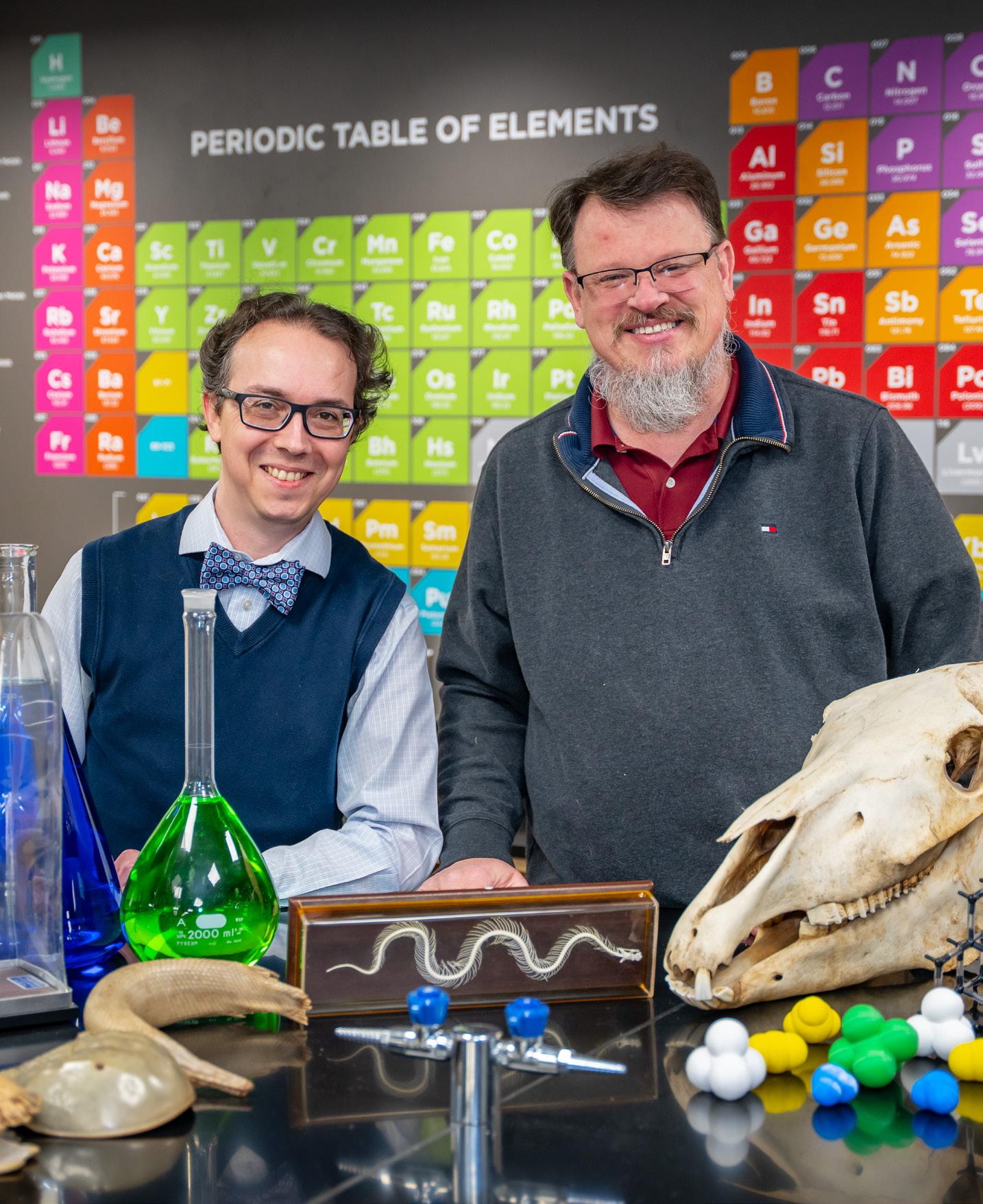
Tulsa Community College science professors Brian Cross and Matt Smith, Ph.D., are the personalities behind “Yackety Science” — a lighthearted education podcast produced twice-monthly at the studios of Public Radio Tulsa.
Community-based music education
Family-run studio boasts bilingual classes and multigenerational expertise.
BY JULIE WENGER WATSON
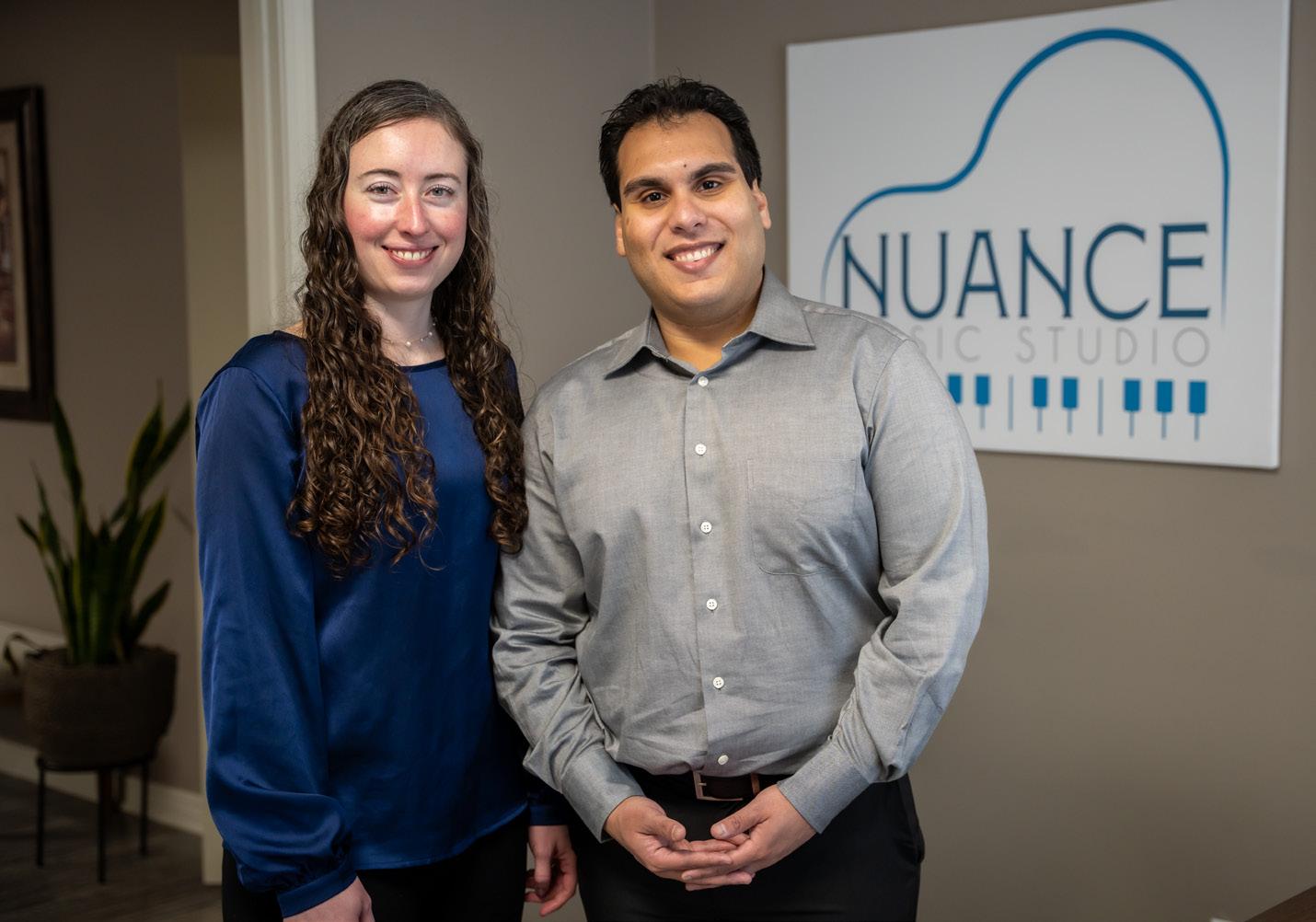
Since its inception in the fall of 2018, Tulsa Remote has brought over 3,500 individuals to town. e program, which is supported by George Kaiser Family Foundation, o ers $10,000 grants to remote workers for relocating here. While these new Tulsans have added their own talents and creativity to the local economy, many of them also bring equally talented and creative partners, spouses or extended family with them on their move. Entrepreneur and concert pianist, Milton Fernández , D.M.A., his wife Sarah and his mother Farida Peña , M.D., are a perfect example.
For Milton, the decision to move to Tulsa last May was easy, if not inevitable.
He and Sarah were living in North Carolina at the time, and they were ready for a change.
“We really wanted a new place that was community-based, and so we went stateby-state,” he recalls. “We opened the entire map of the United States and looked at the pros and cons of each state, and at some point, I was like, ‘How about Tulsa?’” e suggestion didn't come out of nowhere. Milton was already familiar with the city, having visited family friends on school holidays when he was a graduate student in Texas at Stephen F. Austin State University. When both his wife and his mother were accepted to Tulsa Remote, the deal was sealed.
Since the move, Milton has opened a Tulsa location for Nuance Music Studio, the business he, his wife and his mother rst established in North Carolina. Sarah, who works in the eld of data science, supports Nuance through her expertise in technology, systems and planning. She manages communication with parents and teachers, social media, technology and nancial operations, ensuring that Nuance functions smoothly and remains connected to the community.
Peña — whose family owned and operated a music academy in her and her son’s native Dominican Republic for 40 years — is a medical doctor and a specialist with Kindermusik, an early childhood education music and movement program. In addition to her full-time work with Kindermusik, Peña oversees the structural framework of the business and manages communication and teacher training.
From its location at 7181 S. Braden Ave., Nuance provides piano, guitar and vocal instruction to students of all ages and levels. Nuance o ers Kindermusik classes for children ages 0 to 6, including Kindermusik en Español. ere is also the option to take piano lessons in Spanish, allowing more families to engage with music education.
All of that would be enough to keep any family busy, but Milton balances running the studio with his primary profession as a professional concert pianist. He devotes three to ve hours a day to practice, spending the rest of his work hours managing Nuance. He’s appeared as a soloist with the Youth Symphony Orchestra of Santo Domingo, the Camerata Washington Heights and the Camerata Mozart Caribe, among others. He has an upcoming performance March 4 at the Tulsa Performing Arts Center’s Westby Pavilion as part of “Brown Bag It,” a free noontime concert series.
Milton’s passion for music and its potential for positive change infuses every aspect of his life, from his performances to his teaching.
“We understand the concept that music connects and unites people and families,” he says. “ e world may not need 1,000 more artists every day, but I think the world needs 1,000 more sensible people that can understand and have compassion, and that’s something the arts do uniquely well.”
Visit nuancemusicstudio.com for more on Nuance. For information on Milton’s performances, visit miltonfernandez.com. tp
Owners of Nuance Music Studio, Milton Fernández, D.M.A., and wife Sarah Fernández. “Music education runs deeply in my family,” Milton says. “Alongside my grandmother, (my mother) founded our first music academy in the Dominican Republic nearly 40 years ago, laying the foundation for a multigenerational commitment to music education.”
‘A little more authentic’
New Tulsa studio run by musicians, for musicians
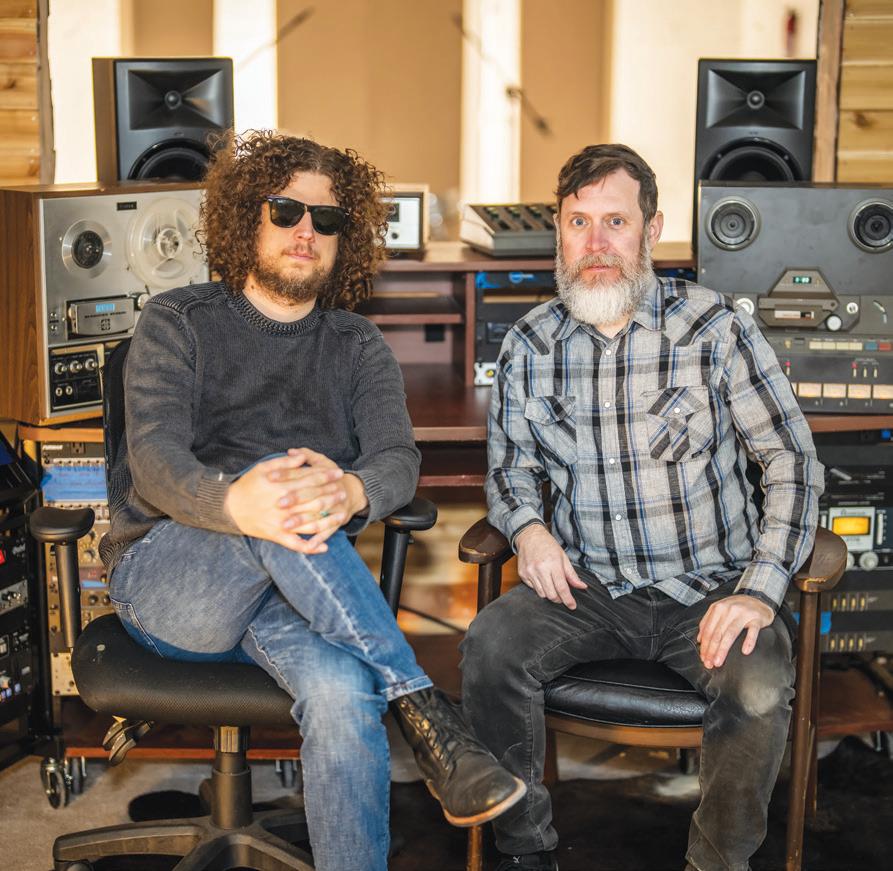
Musician Cody Clinton has found a second home on the other side of the mixing console with Dog Days Studios, a recording studio he opened last year with business partner Mark Bennett . For Clinton, who regularly performs with his wife Desirae Roses-Clinton in the folk duo Desi and Cody, the studio is an opportunity to explore a different facet of the music business while working with musicians in a variety of genres.
Clinton first experimented with the full spectrum of music production during the COVID-19 pandemic. Cooped up at home during lockdown, he wrote and recorded an album as Cody Clinton and the April Fools. Having completed a course at Tulsa Tech with audio engineer Kendal Osborne in 2018, he decided to put his skills to work. With some support from former Tulsan Dylan Field Turner — who provided the drums remotely from New Orleans — Clinton mixed and edited the new record, “Blame it on the Analog.” He released the first singles digitally in 2023, and the full album came out on vinyl and digital formats last October.
Since opening the studio, Clinton and Bennett have worked with West Virginia’s Tyler Sjö strö m (in collaboration with Andrew Bair ’s Dead Format Records) and Tulsa songwriter Damien Hartzell, as well as Crimson Love — a local rock band whose first single “Unfazed” was released Jan. 30; a second, titled “Your Lies,” is out March 10.
In a time when AI is looming like a dark cloud over the world of original music, Clinton is aiming for something real. He credits the late “great” Dave White for showing him how to use analog tape machines and making music that sounds more natural.
“We will take it as far as anybody wants to go (in terms of using production tricks),” Clinton says. “But I feel like Tulsa has, and is, and hopefully will always be, a place where the music is a little more authentic.”
Dog Days Studios recently moved from their original location at the Bowman Twin Event Center to a historic building near Reservoir Hill — of which the exact address is kept under wraps. To learn more about recording with Dog Days, email dogdaysstudios@gmail.com.
For more information about Desi and Cody, visit desiandcody.com. You can catch Desi and Cody most Monday nights at The Colony, 2809 S. Harvard Ave., beginning at 8 p.m.
— JULIE WENGER WATSON
Break out those disco threads and join us on May 9th for a memorable night that builds more than memories. Your sponsorship BUILDS HOMES .
Email: rgardenhire@greencountryhabitat.org
Dog Days Studios founders Cody Clinton and Mark Bennett recently moved their recording operation to a historic building built in 1905.
Eddie Faye Gates
BY MICHAEL OVERALL
As a teenager in the 1940s, Eddie Faye Gates spent her summers in Tulsa’s Historic Greenwood District, where she enjoyed a view of the downtown skyline from her aunt’s front porch and could walk to a cousin’s nearby drugstore to drink sodas. Tulsa must have seemed like a sprawling metropolis compared to the tiny, unincorporated community of Preston, where Gates grew up north of Okmulgee. Life on her father’s sharecropper farm demanded selfreliance from an early age, with older children often helping care for younger ones. Gates began teaching almost as soon as she could read, giving lessons at home to
her brothers and sisters. By about age 5, she was already telling people she wanted to be a teacher and never seemed to waver.
Gates graduated from Okmulgee’s Douglas High School in 1951 but, over the years, Tulsa would draw her back again and again. She even came back to Tulsa for her honeymoon in June 1954 after meeting her husband, Norman Gates Sr., at the historically Black and well-known Tuskegee Institute in Alabama.
She likely wanted Norman, an engineer whose career later included military service, to get to know her family in Tulsa. But Greenwood also o ered a friendly and relatively prosperous destination at a time when segregation could make travel di cult for Black couples. ey stayed at the Small Hotel, a locally owned establishment that was featured in the famous Green Book — a national travel guide that identi ed hotels, restaurants and businesses where African Americans could expect service.
e Small Hotel, located near Archer Street and Greenwood Avenue, closed in 1963. By 1968, when Gates and her husband nally made Tulsa their permanent home, the hotel had been demolished — yet another victim of neglect and urban renewal. Gates, however, would go on to play a pivotal role in preserving Greenwood’s story for future generations, ensuring that its history endured even as many of its landmarks disappeared.
After joining Tulsa Public Schools in 1968, Gates taught U.S. and world history at Edison Senior High School for more than two decades. She later served as the district's social studies curriculum coordinator, helping shape instruction across the district and contributing to the expansion of multicultural perspectives in Tulsa classrooms.
Following her retirement in 1992, Gates became deeply involved in documenting survivor accounts of the racial violence that devastated Greenwood in 1921. Serving on the Oklahoma Commission to Study the Tulsa Race Riot (as it was known at the time), she chaired its Survivors Committee and conducted dozens of interviews to preserve rst-person testimonies before they were lost to time.
Gates saw the oral histories as an extension of her lifelong calling to education.
“I thought that teaching was the noblest profession in the world. I still do,” Gates said in a biographical pro le published by the Gilcrease Museum.
She died in Tulsa Dec. 9, 2021, at age 87. tp
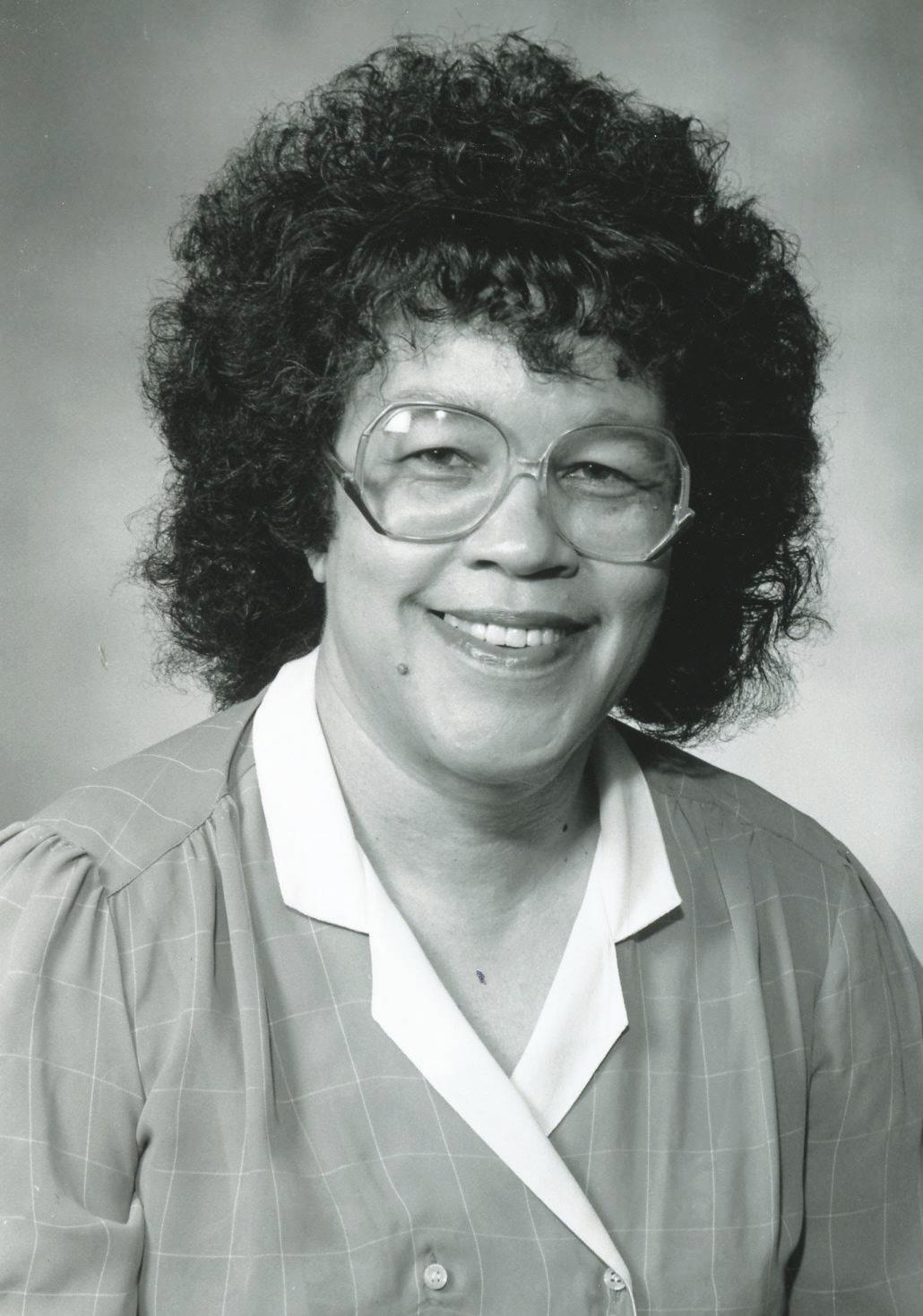
Black and white photograph depicting Eddie Faye Gates, named University of Tulsa Distinguished Alumna in 1992.
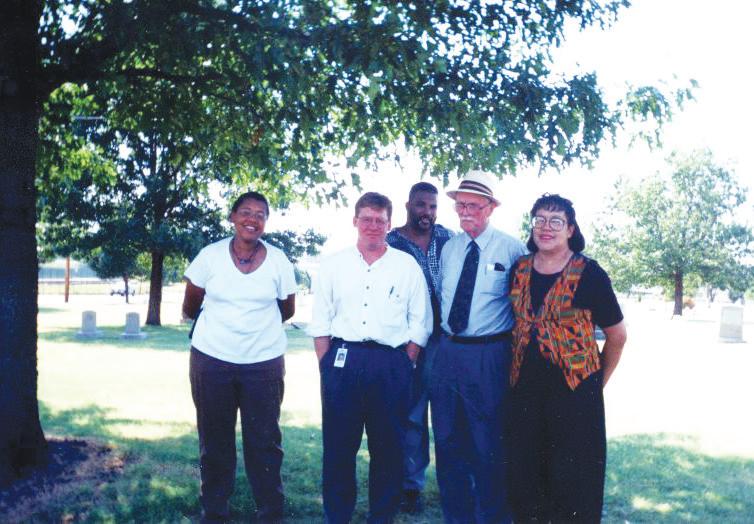
A news crew for the Kansas City Star in the Oaklawn Cemetery. Their news story featured the personal recollections of the 1921 Tulsa Race Massacre by Clyde Joseph Eddy. Eddy stands second from the right. Teacher and author Eddie Faye Gates stands at the far right.
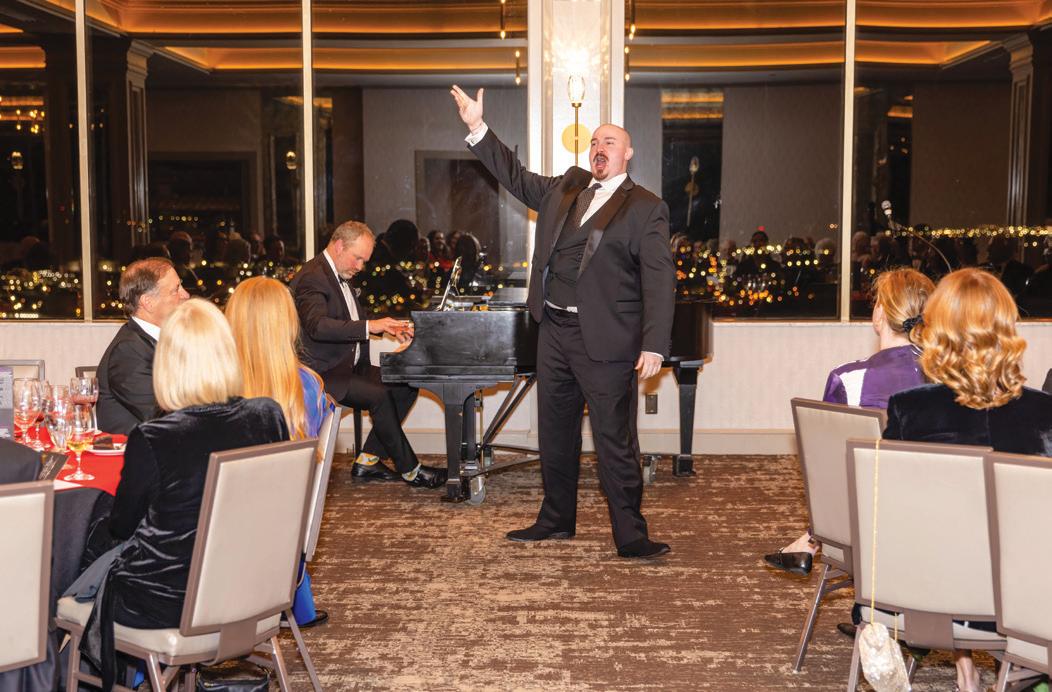
PRESIDENT’S COUNCIL DINNER CONCERT Principal cast members of Tulsa Opera’s “The Pirates of Penzance” performed a selection of songs from the swashbuckling comedy — as well as other operatic treasures — at Tulsa Opera’s Jan. 13 President’s Council Dinner Concert. Held at the Summit Club ahead of the operetta’s Jan. 30 and Feb.1 performances at University of Tulsa’s Lorton Performance Center, the elegant evening event was emceed by Aaron Beck, artistic director of Tulsa Opera. The 76 guests in attendance were treated to a 3-course dinner while enjoying the intimate concert, which included the talented voices of Meghan Picerno (soprano), Chris Mosz (tenor, pictured above), Robert Mellon (baritone) and Sergio Martinez (bass) accompanied by Lyndon Meyer (piano, pictured above). As Tulsa Opera’s premier fundraising initiative, the President’s Council Dinner Concerts raise just over $100,000 annually to benefit Tulsa Opera’s artistic, educational and community engagement programming. The third and final dinner for the 2025-2026 season will take place April 28 at Southern Hills Country Club and feature the Three Tulsa Sopranos — Sarah Coburn, Jana McIntyre and Abigail Raiford
THE
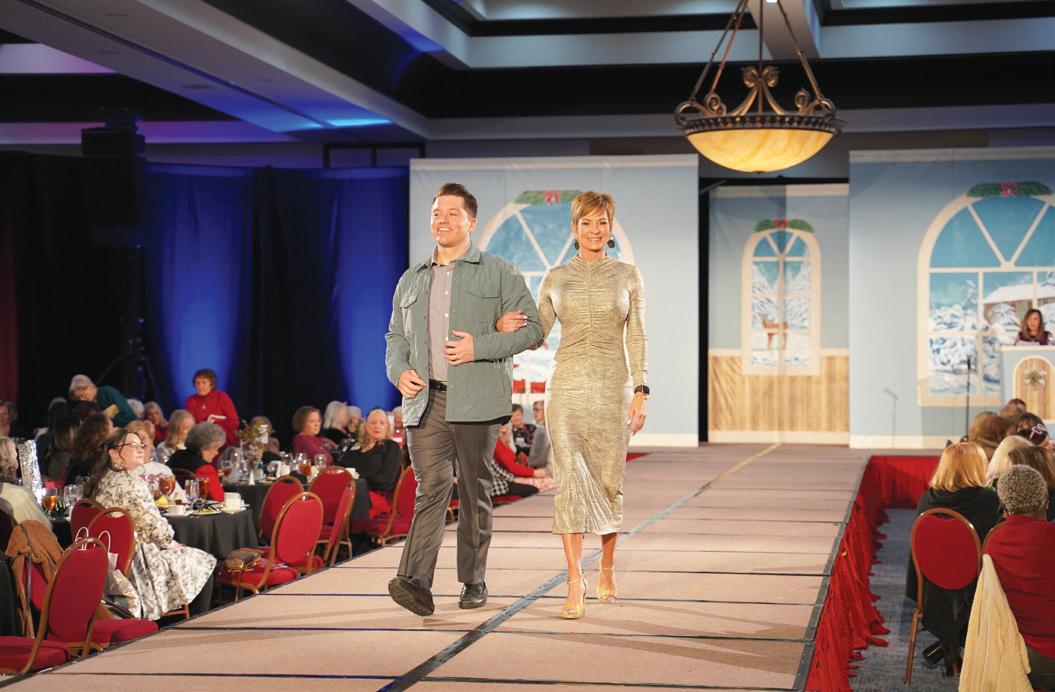
ARMY WOMEN’S AUXILIARY CHRISTMAS LUNCHEON AND FASHION SHOW On Dec. 2, 650 guests gathered at the Renaissance Tulsa Hotel and Convention Center for one of Tulsa’s most anticipated and festive charitable events of the holiday season — The Salvation Army Women’s Auxiliary Christmas Luncheon and Fashion Show. Guests spent the first portion of the morning shopping and bidding on over 500 silent auction items before enjoying a sit-down luncheon catered by the hotel. During the meal, the audience heard from multiple speakers including Charlotte Guest and Major Charlotte Gargis, area commander/corps officer for The Salvation Army of Tulsa, about the deep impact of The Salvation Army’s programs within the community. Chaired by Tiffany Egdorf and co-chaired by Amanda Curtis, the fundraiser finished with a fashion show featuring designs provided by Nelson’s Clothier and modeled by various local news anchors and staff, including KOTV’s Jonathan Cooper and Lori Fullbright (pictured above). The event raised over $290,000 to support Salvation Army programs in Tulsa.
SALVATION
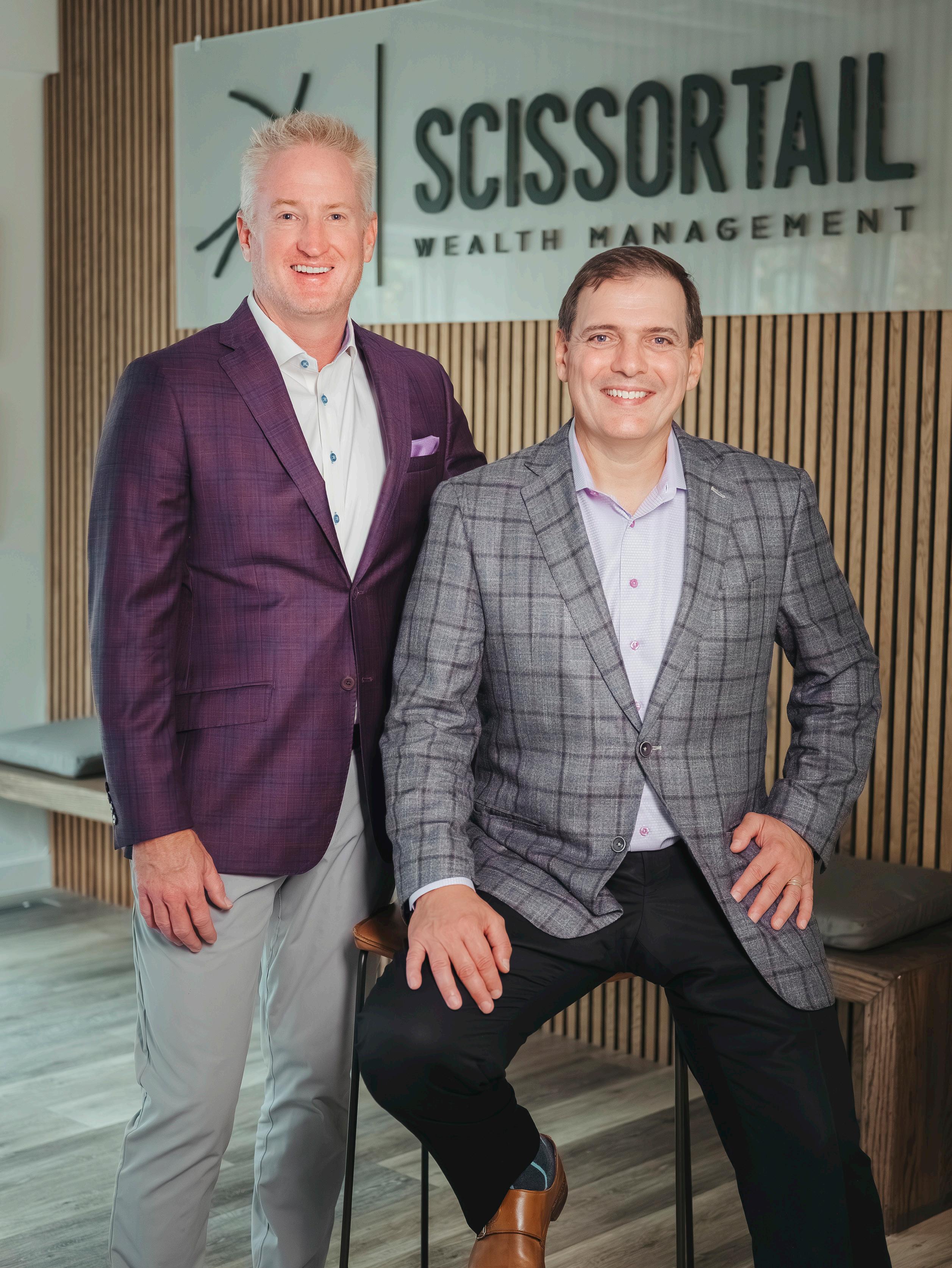
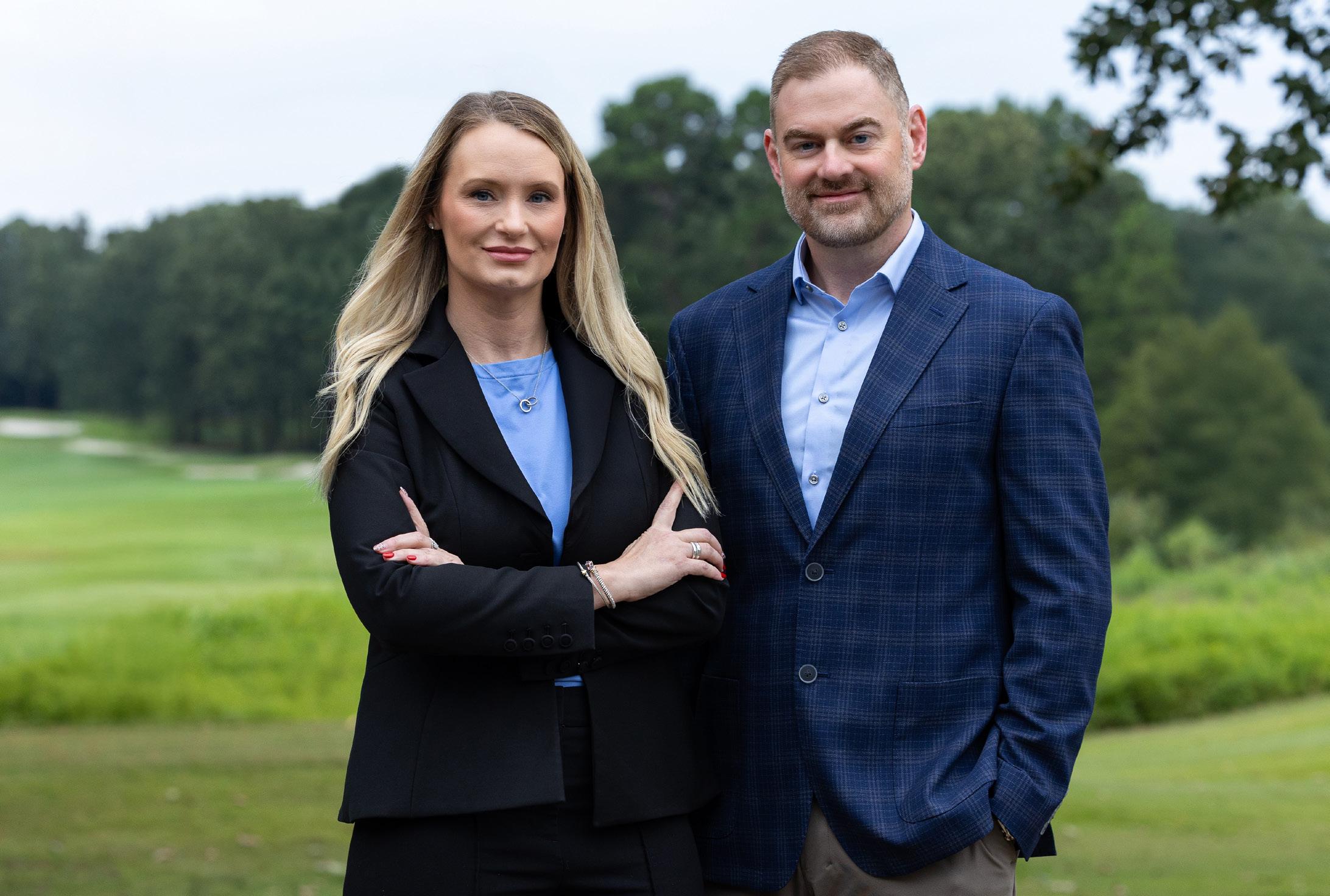
Todd Welsh (left) and Rich Howard, founders of Scissortail Wealth Management
Preparing Financially for Education
A Q&A with the founders of Scissortail Wealth Management
For many families, planning for education is about more than tuition. It’s about values, priorities and the kind of opportunities they hope to create for their children. The founders of Scissortail Wealth Management, Rich Howard and Todd Welsh , share how they encourage families to approach education planning with perspective and confidence. Howard and Welsh started their wealth management careers in 1999, and launched Scissortail Wealth Management — their own independent firm — in 2018. Helping clients make sense of their money, explaining things in straightforward terms they can understand, devoting their team to doing what’s best for clients, and being there to help them tackle the important questions with thoughtful guidance and a helping hand — that’s how Scissortail Wealth Management genuinely makes a positive difference.
Learn more at scissortailwealth.com.
WHEN PARENTS THINK ABOUT “SAVING FOR EDUCATION,” WHAT DO YOU WISH THEY UNDERSTOOD EARLIER IN THE PROCESS?
We wish more parents knew that education planning doesn’t have to be perfect to be effective. It’s easy to feel pressure to have everything figured out or to fully fund every possible outcome. In reality, the most important thing is simply getting started. Even small, consistent steps over time can create meaningful flexibility later. Education planning is less about hitting a number and more about giving your family options.
HOW EARLY SHOULD FAMILIES BEGIN PLANNING FINANCIALLY FOR EDUCATION, AND WHAT DOES THAT PLANNING REALISTICALLY LOOK LIKE IN THE EARLY YEARS?
We believe it’s helpful to start thinking about education early because initial investments have more time to compound and grow, but the most important thing is just to get started at a level you can afford. Understanding how education fits into your broader financial life and building simple habits is a key contributor to successfully achieving your education funding goals. Small contributions and periodic check-ins can go a long way, especially as families grow and priorities shift.
“Building a strong foundation, like emergency savings, manageable debt and long-term planning, allows families to support their children without sacrificing their own future.”
—TODD WELSH AND RICH HOWARD
WHAT ARE THE MOST COMMON MISTAKES YOU SEE FAMILIES MAKE WHEN IT COMES TO EDUCATION PLANNING?
One of the biggest mistakes we see is parents putting too much pressure on themselves. Some stretch their finances too thin or delay their own long-term goals because they feel they need to cover every education cost. Others avoid planning altogether because it feels overwhelming. Education planning doesn’t need to be allor-nothing. Thoughtful, incremental
decisions made over time are often far more effective — and far less stressful.
HOW SHOULD PARENTS BALANCE SAVING FOR EDUCATION WITH OTHER FINANCIAL PRIORITIES LIKE RETIREMENT AND EVERYDAY FAMILY NEEDS?
This is one of the most important conversations we have with families. Education matters, but so does financial stability. We often remind parents that while there are ways to help fund education, there’s no loan for retirement. Building a strong foundation, like emergency savings, manageable debt and long-term planning, allows families to support their children without sacrificing their own future. Balance is what creates sustainability.
THERE ARE MANY OPTIONS AVAILABLE, FROM 529 PLANS TO OTHER SAVINGS STRATEGIES. HOW SHOULD FAMILIES THINK ABOUT CHOOSING THE RIGHT APPROACH FOR THEIR SITUATION?
There’s no single “right” answer. Every family’s situation, goals and values are different. Some families want the most tax-efficient option, while others prioritize flexibility or control. What matters most is being intentional about why you’re saving and choosing tools that align with that purpose. The best plans are adaptable and can evolve as life — and education paths — change.
IF YOU COULD LEAVE PARENTS WITH ONE GUIDING PRINCIPLE WHEN IT COMES TO PLANNING FOR EDUCATION, WHAT WOULD IT BE?
Plan with intention, not fear. Education planning should feel empowering, not stressful. When families approach it as part of a bigger financial picture it becomes less about pressure and more about possibility. That mindset makes all the difference.
NURTURED BY NATURE
Under the Canopy offers students a chance to connect with the outdoors
BY MARNIE FERNANDEZ
Under the Canopy, a nature-based public school in West Tulsa, connects students to nature through a curriculum inspired by the Waldorf Method. As one of only 60 official public Waldorf schools in the country, Under the Canopy’s story began pre-COVID in a backyard.
Margaritte Arthrell-Knezek is a Tulsa transplant originally from Connecticut. After moving to Tulsa from the Pacific Northwest, she started Under the Canopy as an after-school enrichment program for elementary students both at her home and at school campuses around Tulsa. With her background in outdoor education, it was an immediate success.
“We have a nature deficit disorder in our education system,” Arthrell-Knezek says. “I saw the need for more outdoor education, and I decided to do something about it. I just think it was my calling.”
At the root of her work was a desire to best serve local students. Ultimately, Arthrell-Knezek felt that she needed to expand her offerings to help children better connect with the outdoors. “I knew deep down that two hours after school just wasn’t enough, nor was my backyard big enough to accommodate the demand,” she says. “Then the pandemic hit and everything changed.”
While everything else shut down, Under the Canopy was able to stay open and continue its programming.
“You can’t close the outdoors,” she says. “We kept our programs open during the pandemic and eventually expanded our hours. It was then I began to envision what we could do if we were a full-time school.”
Arthrell-Knezek then started the long process of applying to become an official charter school with the help of a fellowship through the Oklahoma Public School Resource Center. Tulsa Public Schools serves as Under the Canopy’s authorizing body.
“I knew I wanted this school to be a public one, as the outdoors should be free to everyone,”
Arthrell-Knezek says. “And since we already had established a relationship with TPS, it made sense for us to use them for our charter.”
In 2024, Under the Canopy School became authorized as an official Tulsa Public Schools charter school. TPS also helped them find their current location within the former building of Park Elementary, a TPS school in West Tulsa that closed in 2016.
“It was a perfect fi t,” Arthrell-Knezek says. “The location was ideal, as it has access to nature trails and lots of land for outdoor classrooms, and the neighborhood wanted its school back.”
During this process, Arthrell-Knezek had to choose an education model for Under the Canopy. With her background in outdoor education, she knew she wanted it to be a nature-based school.
“Since there are not a lot of those schools in our area, it made sense to choose the Waldorf education model.”
Waldorf education was founded in the early 1900s by Rudolf Stiener in Stuttgart, Germany, and began to catch on in the US in the ‘90s. This model utilizes a holistic approach to education that emphasizes whole child development including their physical, emotional and intellectual needs.
“We believe that students learn best through hands-on, experiential learning, and that education should be child-centered and developmentally appropriate,” Arthrell-Knezek says. “We teach with hands and heart, focusing on human development.”
The public Waldorf curriculum is designed to help children develop a strong reading, writing and math foundation, while emphasizing the development of creativity, problem-solving and critical thinking. In addition, children learn through stories, songs, movement and art.
“We’ve incorporated the Waldorf principles into our mission statement,” Arthrell-Knezek says. “Our school’s focus is environmental stewardship, whole child intellectual development, artistic practice and mindset, and empathy through multi-cultural understanding.”
After years of planning and retrofi tting the existing school, Under the Canopy began its inaugural year as a full-time school in the fall of 2025. Currently, the school serves pre-K through third grade. Beginning in the 2026 school year, the school will add a fourth grade class, and then fifth grade class in 2027.
The Park Elementary school building was built in the 1970s and was an open-concept school, meaning no walls for the classrooms. ArthrellKnezek decided to embrace the building’s layout and incorporate it into their ethos.
“Our classrooms are all open, except for the pre-K area, which is in the middle of the building,” Arthrell-Knezek says. “We call it our treehouse.”
Each class has its own daily ‘rhythm’ depending on their age and grade level, that serves as their schedule. Class rhythms include main learning
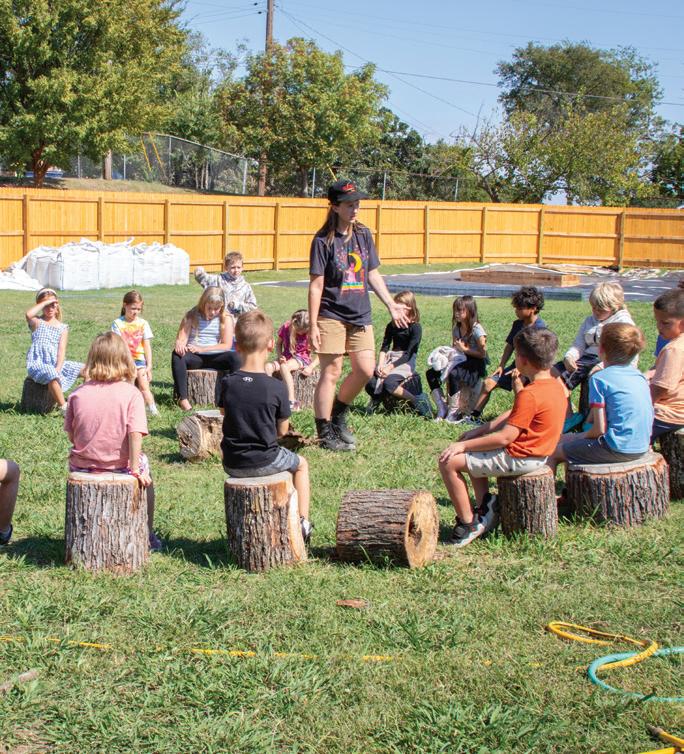
Fallon Smith is the nature garden instructor at Under the Canopy, a Tulsa Public Schools charter school.
blocks such as math, language and science, as well as an interdisciplinary block consisting of lots of outdoor time, project-based activities and specials — like music, games, movement, art and crafts.
“Handiwork is my favorite activity at school,” says Esther Morris , a current third grader at UTCS. “But I also love the swings outside and the fact that we have a tree climbing club.”
Pre-K teacher Alvetta Newby-Jones , along with the other teachers at Under the Canopy have been trained in Waldorf pedagogy.
“Waldorf teaches us to teach the whole child: head, heart and hands,” says Newby-Jones. “I feel so fortunate to be a part of this school. The community that has been created between teachers and students and the support from our parents is just amazing.”
Shauna Rodriguez , parent of Pre-K student Sylar, makes the drive to West Tulsa from East Tulsa every day.
“When I first read about this school, I knew I wanted him to go,” Rodriguez says. “Learning through nature-based play — it just sounded amazing.”
According to Rodriguez, her son is thriving.
“He has grown so much emotionally and socially since he started here. He loves all the outdoor time and talks nonstop about all the fun things he gets to do at school.”
Rodriguez is an active member of the school’s Family Council, Under the Canopy’s version of the Parent Teacher Association.
“The parent involvement is great,” Rodriguez says. “The staff is so welcoming and inclusive, and there are so many volunteer options.”
The curriculum also fosters a deep connection to the environment with an emphasis on nature immersion and outdoor exploration. Unlike other schools, Under the Canopy goes outside several times a day, regardless of the weather. The only exceptions are severe weather conditions or below freezing temperatures.
“We say ‘there is no bad weather, only bad clothing choices,’” Arthrell-Knezek jokes. “We have a fully stocked gear closet, so in case a child forgets an item, we have it on hand.”
One of their outdoor activities is a weekly nature garden class, where they learn skills such as outdoor safety, building a shelter, how to safely build a fire, how to prepare wild foods and how to plant a garden.
“We just finished learning about composting, and students got to bring pumpkins from home for our Smashing Pumpkins Party,” Arthrell-Knezek says. “We had a composting organization visit who did a demonstration, and then the students got to smash their pumpkins into the compost pile.”
Newby-Jones is excited about the future of Under the Canopy. “Imagination and wonder are the foundations of the learning experience. And bringing the Waldorf experience to Tulsa is just a wonderful gift.”
Under the Canopy School hosts weekly tours for anyone who is interested in learning more about the school. For enrollment and tour information, visit underthecanopy.org. tp
“We believe that students learn best through hands-on, experiential learning, and that education should be childcentered and developmentally appropriate.”
— MARGARITTE ARTHRELL-KNEZEK
Niko Rowland and Kaycen Lurks are students at Under the Canopy, a public Waldorf-inspired elementary school.
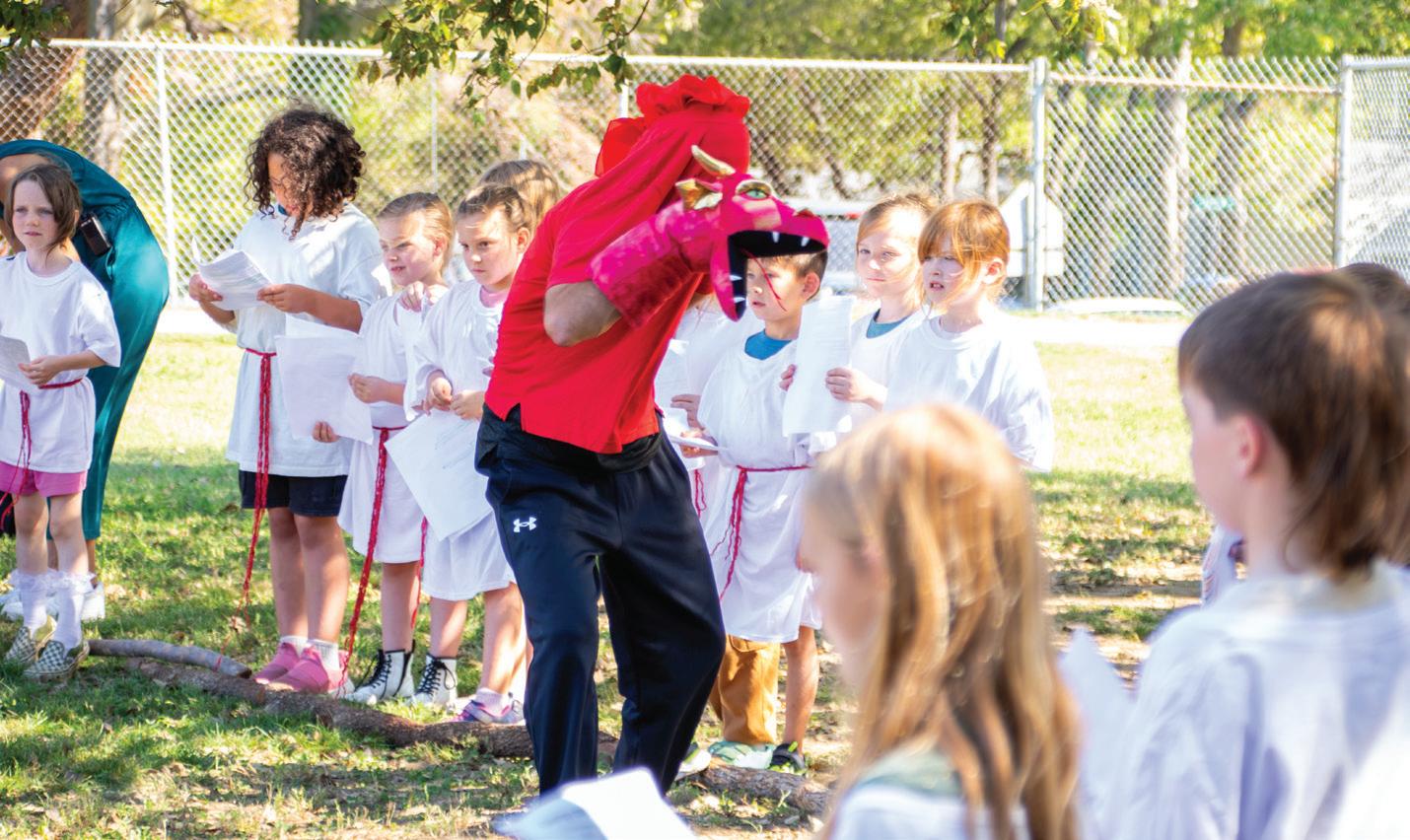
Under the Canopy School Movement and Games Instructor Zach Bible engages with students using a dragon puppet during the “Festival of Courage.” The Waldorf event empowers students to face their inner “dragons,” like fear and doubt.
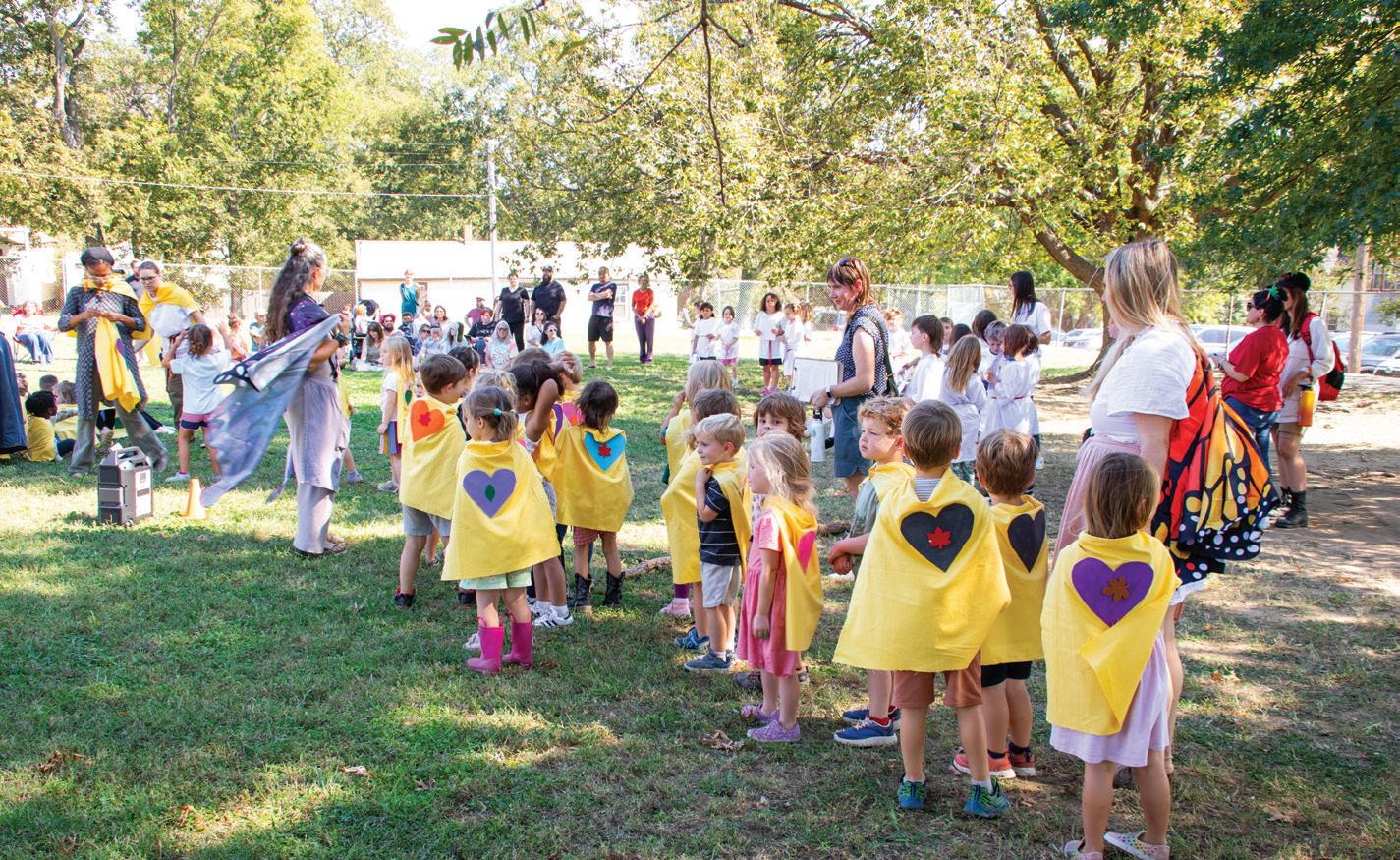
Students at Under the Canopy participate in the “Festival of Courage,” a Waldorf tradition celebrated in autumn to promote inner strength and the triumph of light overcoming darkness as winter approaches.
Breaking a century of silence
MEET THE WOMEN LEADING THE 1921 GRAVES INVESTIGATION.
BY MADISON WALTERS
Sprawling across 20 acres just east of downtown Tulsa, Oaklawn Cemetery serves as a long-standing fi xture since its establishment in 1882 — 25 years before Oklahoma statehood. The manicured grounds of the city’s oldest cemetery hold more than a century’s worth of history, and recent efforts continue to uncover secrets hidden for generations beneath the soil.
The landscape itself holds a stark juxtaposition. In areas like Section 9, weathered obelisks, angels, headstones and even mausoleums mark the remains of oil pioneers, cattle ranchers and community leaders. Yet as the grass rolls into Section 20, or the “Colored” Potter’s Field (an area assigned to the impoverished and unknown), the earth is scarred from recent archaeological activity — efforts to exhume the truth that has so long been buried.
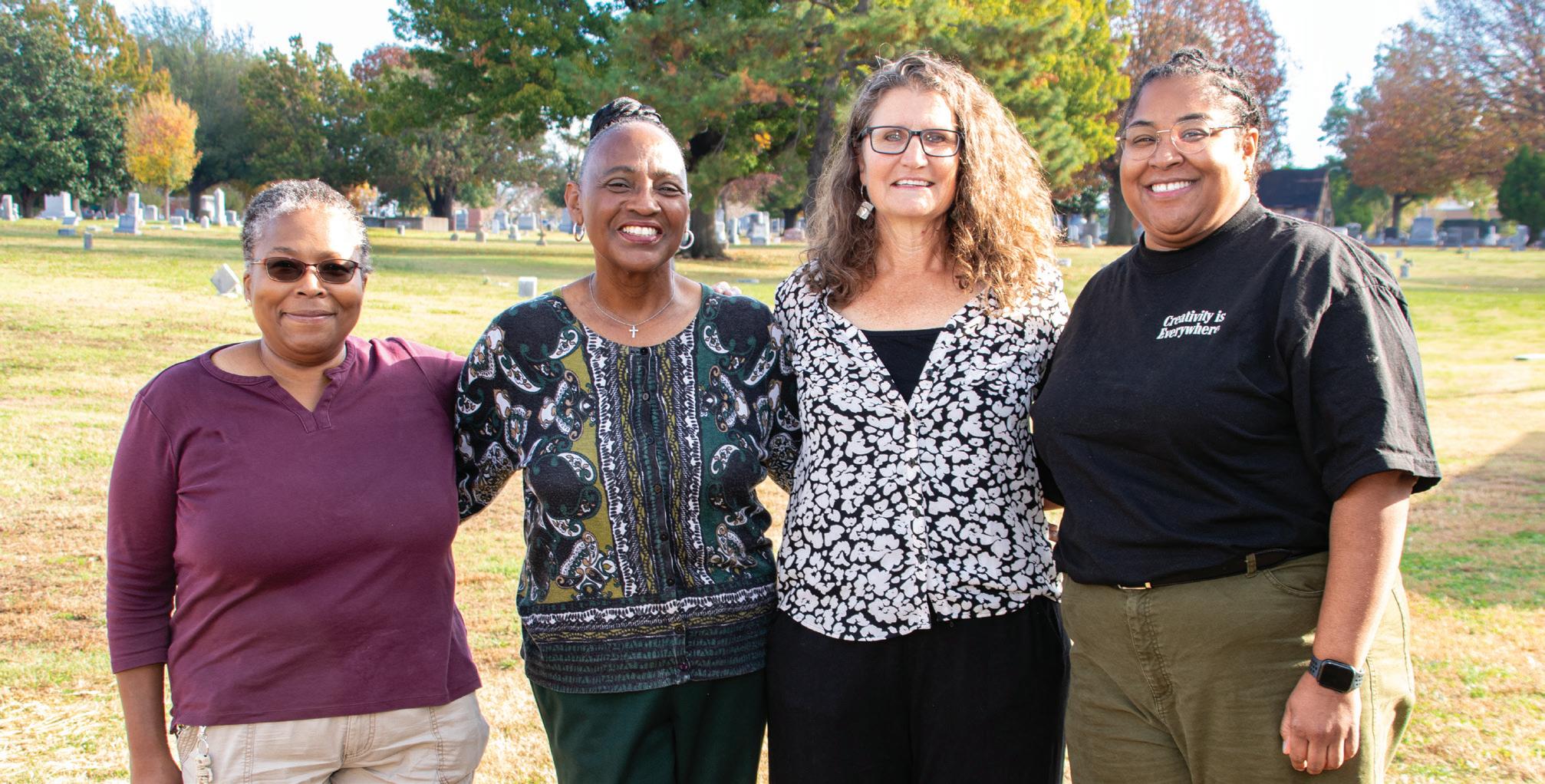
Since 2021, which marked the centennial of the Tulsa Race Massacre, the City of Tulsa has conducted a series of major excavations at Oaklawn Cemetery to investigate the presence of unmarked graves related to the horrific event. The fifth and largest excavation occurred in late 2025, led by a passionate group of women who have worked tirelessly to see justice done for the victims of the Tulsa Race Massacre. Two women on this team, Brenda Nails-Alford and Phoebe R. Stubblefi eld, Ph.D., are relatives of survivors.
THE COMMUNITY VOICE
Nails-Alford’s grandparents, James Nails Sr. and Vasinora Nails , owned successful locations of the Nails Brothers Shoe Shop and Record Shop with her great-uncle Henry Nails . All of which were destroyed during the massacre.
“It was just devastating to (my grandfather) because he did everything he thought he was ‘supposed to do.’ He worked hard, he got his education, went to Prairie View A&M and got his shoe making certificate,” Nails-Alford says. “He started the business in 1917 with my great-uncle (and) he was so proud. He was able to employ members of the family and members of the community in those other locations ... They did everything they were ‘supposed to do,’ and it still didn’t matter.”
The Tulsa Race Massacre was more than the city’s worst historical incidence of racially motivated violence; it was also a series of thefts committed against a vulnerable community. Due to the original designation of the event as a “riot” (the correct terminology wasn’t adopted until 2018 — 97 years later), Greenwood residents like Nails-Alford’s family were denied insurance and were unable to pay for the materials needed to rebuild the once-thriving Black Wall Street. She calls this the “second loss” of Greenwood, which changed the trajectory for both her family and generations of residents.
“If we had been allowed to continue on after they rebuilt, it would have been so beneficial for
our family and to the community as a whole,” she says.
It’s the question of “What could Tulsa, not just Greenwood, have been if the Tulsa Race Massacre hadn’t occurred?” that Nails-Alford sometimes finds herself pondering. “We probably could have been another California or New York,” she says.
Despite all this, Nails-Alford says that growing up in the Greenwood community was among the happiest times of her life.
“The love and encouragement we received as little kids growing up — it was absolutely wonderful,” she explains. “Then to find out so many years later that this atrocity had occurred to my family and community members that I grew up knowing — who gave us their best in spite of what they had endured — it actually was heartbreaking to me.”
During her childhood, her family never mentioned the Tulsa Race Massacre. Sometimes, she would overhear “grown folk conversations,” but didn’t have the background knowledge of the tragedy to understand the full breadth of these stories.
She does recall a chilling conversation she overheard from the backseat of a relative’s car. “We were driving past (Oaklawn Cemetery) when I was a little girl (and) someone in the car said, ‘You know, they’re still over there,’ and I remember thinking, ‘What’s still over there?’” It wasn’t until much later that she realized the mass graves —
Four women spearheading the City of Tulsa 1921 Graves Investigation stand in Section 20 of Oaklawn Cemetery. (From left to right) Phoebe R. Stubblefi eld, Ph.D., Director of the C.A. Pound Human Identifi cation Laboratory; Brenda Nails-Alford, a Tulsa Race Massacre descendant; Kary Stackelbeck, Ph.D., lead archaeologist for the 1921 Graves Investigation; and Kyra Carby, Community Genealogy Grant Coordinator.
which she now works on to help recover — were what her family was discussing.
The history was buried by both the perpetrators and the survivors, though the latter was out of self-preservation for their descendants. This protective silence helped ensure that their children grew up with hope, rather than fear — an act of quiet defiance to the members of the white mobs who orchestrated Greenwood’s decimation.
“We keep moving forward. That’s what we were taught and that is what we will continue to do,” Nails-Alford says.
In 2003, she was notified about a lawsuit for reparations for survivors and descendants of survivors of the massacre, which she says is how she found out her family had survived the atrocity. Determined to give back to the community that helped raise her, Nails-Alford joined the oversight committee in 2019.
‘AN ACT OF GRACE’
Phoebe R. Stubblefield’s parents were born in Tulsa. Growing up, she would spend nearly every summer with family here. Yet, like Nails-Alford, she had no idea about the Tulsa Race Massacre until she was nearly 30 years old.
During her graduate years at the University of Florida — where she now serves as Director of the C.A. Pound Human Identification Laboratory — a colleague remembered Stubblefield’s connection to Tulsa and asked her if she would be interested in serving on the Oklahoma Commission to Study the Tulsa Race Riot of 1921. Organized in 1997, this group was the state’s first official attempt to look into the event in hopes of uncovering the truth that had so long been buried.
She shared the news with her family and was shocked to learn about her personal connection to the massacre. “I called home and said, ‘Hey, there was this riot (back when that was still the terminology used) in Tulsa in 1921. Did you guys know about that?’ My parents were born in the ’30s, and I didn’t know when or how their family had gotten to Tulsa or anything like that. My mother replied, ‘Oh, yeah, your Aunt Anna lost her house’ ... And I’m like, ‘who’s Aunt Anna?’”
This revelation transformed her involvement with the project from a forensic anthropologist into a seeker of her own family history, which led Stubblefield to begin looking into her genealogy. Through her studies, she learned that her great-aunt Anna Walker Woods was married to Ellis Walker Woods, the principal of Booker T. Washington High School — which was used as a temporary shelter in the aftermath of the massacre.
Coming onto the original commission, and later this committee, was “an act of grace,” she says. Throughout her time working here in Tulsa, Stubblefield has led her research with the approach that “things that are hidden don’t remain hidden.”
UNCOVERING THE PAST
Since 2019, Kary Stackelbeck , Ph.D, has acted as the lead archaeologist for the City’s 1921 Graves Investigation. Her team is pursuing multiple leads indicating where potential mass graves of the victims may lie. Some of these leads have come from historical documents and first-hand accounts, like one from Clyde Eddy who, as a young boy,
reportedly witnessed workers digging a trench for wooden caskets at Oaklawn directly after the mass casualty event. So, during the excavation process, Stackelbeck and her team are looking for those types of burial containers in Section 20.
“We conduct hand excavations to first get a sense of the outline of each container ... and whether or not it has handles or other types of ornamentation. If it does, then we know we won’t proceed with that particular grave,” Stackelbeck says. “We’ll document it and map it for the records.”
Even Section 19, the white section of Potter’s Field, has a more complete ledger of documented burials.
“If your loved one is buried in Section 19 ... you can go to the city’s ledger, and you can very likely find out what row and what plot they’re in. You can’t do that if your loved one is buried in Section 20,” Stackelbeck says.
Thus, the work that Stackelbeck and her team is doing has uncovered more than just Tulsa Race Massacre victims. “We’ve been able to provide the city with information they did not have at the time that we started this investigation ... Even if we’re not recovering everybody’s names, at least, we will know more about where the graves are in this part of the cemetery,” she says.
To date, Stackelbeck and her team have helped locate nearly 300 graves that were previously unmapped due to the intentional or negligent loss of city records. This brings hope for family members who have never been able to visit the gravesites of loved ones long lost. For Nails-Alford this includes her great-grandmother Rosetta Moore who died in 1925, but due to the incomplete records, it is still unknown where she is buried at Oaklawn.
Stackelbeck goes on to explain that, if a simple casket without handles is discovered, then they will proceed further and begin to expose the human remains. “From there, we deliberate in coordination with Dr. Stubblefield’s team about whether these individuals are candidates for examination,” she says.
Once Stubblefield takes over, she screens the remains for trauma and compiles all the related data. At the end of the analysis, Stubblefield selects specimens for DNA analysis and sends them off to Intermountain Forensics, which is the laboratory assisting with genealogical analysis. From there, it’s playing the waiting game.
“We’re still waiting on profiles from people from year one (of the investigation) ... It’s quite the process because there’s a lot of bacterial contamination,” Stubblefield says.
THE FIRST VICTIM IDENTIFICATION
In 2024, WWI veteran C.L. Daniel became the first Tulsa Race Massacre victim identified since the physical aspect of the City’s 1921 Graves Investigation began. He was the first victim named outside of those noted in the state commission’s initial published findings in 2001.
After connecting DNA from Daniel’s next of kin to a burial site exhumed during the 2021 excavation, Intermountain Forensics was able to recover a historical document — a letter — that contained evidence of Daniel’s connection to the Tulsa Race Massacre. The letter, recovered from the National Archives, was written by Daniel’s family attorney to the U.S. Veterans Administration on behalf of his mother, who had endeavored to collect survivor benefi ts from his time in the Army. It states: “C. L. was killed in a race riot in Tulsa Oklahoma in 1921.”
Additional historic letters written by Daniel himself show that he was in Utah in February of 1921, and he had stopped in Tulsa later that spring while trying to make his way back home to his mother in Georgia.
More than 103 years after his tragic death, a funeral was held for Daniel at Oaklawn Cemetery. His descendants were seated in the front row, finally able to pay their respects. During the ceremony, he was honored by members of the Oklahoma National Guard — something his mother fought for endlessly while she was still living.
DISCOVERIES IN 2025
In June, it was announced that, because of the work of the committee, a second individual named James Goings had been identified. Three separate historical documents that have recently been examined confirm Goings’ death in connection to the massacre, though work is still underway on the genealogy side to help identify any living descendants; a June 2025 press release from the City states: “Any descendants of the Goings, Goins, Gowens, etc. surname from many states, including Georgia, North Carolina, Alabama, Arkansas, Kentucky and Tennessee are requested to contact the genealogy team.”
Other findings uncovered through historical documentation research conducted by both Stubblefield, Betsy Warner (daughter of Dick Warner, a prominent Tulsa Race Massacre
During the memorial service for Tulsa Race Massacre victim C.L. Daniel, a monument honoring victims who had been discovered during the excavations was unveiled.
researcher) and Intermountain Forensics have identified victims John White and James Miller, in addition to a mother named Ella Houston — who was married to Joseph Morrison and is believed to be the mother of a young boy named Arthur Morrison; a choppy December 1921 Red Cross report on Arthur connects the mother and son, stating: “Age 12 - pelegra - homeless since riot - Mother died result injuries in riot.”
In November, the City announced that the fifth excavation at Oaklawn had uncovered 83 graves that were missing from the cemetery’s ledger. Of those, eight individuals’ remains fi t the qualifications for further study.
SCIENTIFIC AND UTMOST RESPECT
Throughout the team’s investigations at Oaklawn, care and respect for the deceased have guided every decision. “When properly planned and executed, it’s possible to do this work, even in a sensitive setting like this, in a very mindful and respectful way to both the descendants and the decedents,” Stubblefield says.
When listening to the anthropologist speak, it’s clear that she practices what she preaches, using the word “decedents” to refer to each individual set of remains because, “They’re not specimens ... They were living and breathing people who deserve the dignity they were denied in 1921,” she says.
Kyra Carby, the Community Genealogy Grant Coordinator for the City of Tulsa, says, “Everyone stops working when remains have been exhumed. No matter what they’re doing. There’s always a reverence.”
The sciences of forensics and archaeology are being used for more than just data; they provide a form of restitution for a community that is still fighting for reparations. These findings have helped inform the Community Engagement Genealogy Project, which is part of Mayor Monroe Nichols’ “Road to Repair” — his plan to address the multi-generational wounds and systemic impacts from the race massacre. The plan also includes the creation of the Greenwood Trust, which is now led by Executive Director Alaina C. Beverly
BRIDGING GENERATIONS
Carby’s role in the multidisciplinary team further links the past to the present. By tracing family trees and connecting DNA profiles of living descendants, she’s able to help identify possible massacre victims. The work is coordinated and precise, bridging the gap between science and ancestral stories.
Beyond research, she and her team play an important role when it comes to community engagement and awareness. The City of Tulsa received a three-year, $1 million grant from the U.S. Department of Justice called the Emmett Till Grant. With some of these funds, Carby’s team has been able to host genealogy workshops for those who live in Tulsa, and the reception has been exceedingly positive.
“There was this one gentleman who did the workshop and found out that his aunt worked in forensics for a police department and was the first woman to have that position; she was a trailblazer,” she says.
Through her own personal research, Carby was able to find information about her great-great-grandfather. “I had never heard his name before ... He was listed as a free Black and married to an enslaved Creek Freedmen. That was a game changer for what I thought my own ancestry was.”
One of the main goals for Carby and her team is to make sure the community knows just how accessible genealogy really is, in spite of the stigma that it’s difficult or costly.
“Everyone needs to be connected, whether you’re Black, white, Indigenous ... everyone. That way you can know who your family was,” she says. For Carby, the importance of keeping family history alive is a key value. “We need more people who are historians of their family, who are truth keepers and are willing to share. It’s not just adults either. Kids need to be curious as well. There’s a power in knowing who you are.”
YEARS OF DEDICATION
When Nails-Alford first began working on this committee to help oversee these processes in 2019, she mainly observed the work that Stackelbeck and Stubblefield were doing. But that didn’t last long, as she began feeling called to assist them in their work.
“I’ve been very grateful that I’ve had the opportunity to help out and that they’ve been putting up with me for all this time,” Nails-Alford laughs. “I’ve helped dig down, carry dirt to be sifted, and I’ve kind of graduated up to working in the lab with Miss Phoebe, where I’ve helped to prepare skeletal remains. I’ve also gotten to work with our amazing genealogists.”
With everything that she’s learned over the years, her respect has only grown for the women on these teams. “It takes a lot of heart to do this work. They’re down there trying to find our history.”
Her dedication these past seven years hasn’t gone unnoticed by her fellow teammates. “I tease these women that I’m ready to go back and get that upper-level degree now,” Nails-Alford says. With a knowing tone, Stubblefield tells her she just might know someone who can give her a reference.
The teams’ next project is to put together an executive summary of their findings from the most recent excavation. Once finished, the report will be submitted to the City to see if or when future excavations of the grounds will take place.
NO LONGER SILENT
With the massive amount of work this interdisciplinary team has put into this project, it’s now impossible for the history of the Tulsa Race Massacre to be erased like it was in the past. To Nails-Alford, who carries the weight of her ancestors with her every step, that’s nothing short of a blessing.
“I’m so very humbled and honored to be here to witness this investigation firsthand,” she says. “My family and our community members left this earth never believing that we would be speaking so openly about the Tulsa Race Massacre, much less looking for victims that history had tried to forget.” tp
John Patrick Kinnear, Brenda Nails-Alford, Pastor Eric Gill, Phoebe R. Stubblefield, Ph.D., Michelle Burdex, Lisa Parker, Leila Kalmbach and Morgan Jones carrying a casket that was found during excavations.
PRIVATE SCHOOL GUIDE
BY TIFFANY HOWARD
Whether you’re looking for a specific religious denomination, a particular academic curriculum or to meet a student’s unique needs, there’s likely a private school that can accommodate your desires. Here, we’ve compiled updated information for 37 local options.
Tours or open houses: Contact the school office to schedule a campus tour.
AUGUSTINE CHRISTIAN ACADEMY
6310 E. 30th St.
918-832-4600
acatulsa.org
Year founded: 1997
Grade levels: Pre-K-12th
Uniforms: Yes
Tuition Assistance: Yes
Annual tuition: $8,950-$10,500
Student-teacher ratio: 12-1
School of thought or affi liation: Christian
Total enrollment: 175
Before- and after-school care: Yes
Registration information: New students can apply at any time; August enrollment deadline; admissions stop when classes are full.
Tours or open houses: Open House is 5-7 p.m., Fri. Jan. 30. Tours will be available for interested families and, by attending, the $75 new student application fee will be waived.
BISHOP KELLEY
HIGH SCHOOL
3905 S. Hudson Ave. 918-627-3390
bishopkelley.org
Year founded: 1960
Grade levels: 9th-12th
Uniforms: Yes
Tuition Assistance: Yes
Annual tuition: $11,620 - $13,920
Student-teacher ratio: 12-1
School of thought or affi liation: Catholic
Total enrollment: 930
Before- and after-school care: No
Registration information: Ongoing; schedule by emailing admissions@bishopkelley.org.
Tours or open houses: Campus tours by appointment anytime; Open House is Sunday, Sept. 20.
CASCIA HALL
PREPARATORY SCHOOL
2520 S. Yorktown Ave.
918-746-2600 casciahall.com
Year founded: 1926
Grade levels: 6th-12th
Uniforms: Yes
Tuition Assistance: Yes
Annual tuition: $18,975
Student-teacher ratio: 15-1
School of thought or affi liation: Catholic, Augustinian
Total enrollment: 542
Before- and after-school care: Yes
Registration information: Admission for the next school year opens in early fall of the previous year. Join the admissions mailing list at casciahall. com/admissions.
Tours or open houses: Campus tours are offered on Wednesdays or upon request; register at casciahall. com/admissions.
CELEBREE SCHOOL OF TULSA
5980 S. Yale Ave. 918-935-0109
celebree.com/tulsa-ok
Year founded: Tulsa, 2025; Nationally, 1995
Grade levels: 6 weeks to 5th grade
Uniforms: No
Financial aid: Limited number of DHS subsidy slots available for ages 3 and older.
Monthly tuition: Varies; call for pricing
Student-teacher ratio: 4-1 to 14-1
School of thought or affi liation: Multiple educational philosophies
Total enrollment: Capacity for 154
Before- and after-school care: Yes
Registration information: Ongoing Tours or open houses: Tours Monday-Friday, 10 a.m. to 4 p.m., and one Saturday per month (book tours through website or call for appointment). Open House Feb. 21 and August TBD.
CHRISTIAN MONTESSORI ACADEMY
3702 S. 90th E. Ave. 918-628-6524
christianmontessoriacademy.org
Year founded: 2006
Grade levels: Pre-K-8th
Uniforms: No
Financial aid: Temporary aid for families who have been with CMA for at least a year and are experiencing hardship.
Monthly tuition: $827- $1,050
Student-teacher ratio: 12-1
School of thought or affi liation: Christian, Montessori
Total enrollment: 72
Before- and after-school care: Yes
Registration information: Ongoing Tours or open houses: Tours can be scheduled any time on the website.
CROSSOVER PREPARATORY ACADEMY
1010 E. 36th St. N. 918-986-7499
crossoverprep.org
Year founded: 2017: Boys’ Division; 2021: Girls’ Division
Grade levels: 6-12th, boys; 6-10th, girls
Uniforms: Yes
Tuition Assistance: Yes
Annual tuition: $17,500
Student-teacher ratio: 8-1
School of thought or affi liation:
Christian
Total enrollment: 193
Before- and after-school care: After-school curricular activities
Registration information: Ongoing Tours or open houses: Ongoing
PRIVATE SCHOOL GUIDE
HAPPY HANDS
EDUCATION CENTER/ DEAF CHRISTIAN ACADEMY
8801 S. Garnett Road, Broken Arrow
918-893-4800
happyhands.org
Year founded: 1994
Grade levels: For children who are deaf or hard of hearing, siblings and CODAs; infant-6 years (Happy Hands Education Center); elementary (Deaf Christian Academy)
Uniforms: Required for Deaf Christian Academy
Tuition Assistance: Yes
Annual tuition: Sliding scale
Student-teacher ratio: Varies from 4-1 to 6-1
School of thought or affi liation: Christian
Total enrollment: 75
Before- and after-school care: Yes, for Happy Hands Education Center
Registration information: Ongoing for Happy Hands Education Center; Deaf Christian Academy follows a typical enrollment period.
Tours or open houses: Tours offered on the second Saturday of every month or by appointment.
HOLLAND HALL
5666 E. 81st St. 918-481-1111
hollandhall.org
Year founded: 1922
Grade levels: Pre-K (3-year-olds)12th
Uniforms: Yes
Tuition Assistance: Yes
Annual tuition: $9,825-$27,660
Student-teacher ratio: 9-1
School of thought or affi liation: Episcopal
Total enrollment: 1,060
Before- and after-school care: Yes
Registration information: Rolling admission; hollandhall.org/ admission.
Tours or open houses: Call 539476-8244 for private tour.
HOLY FAMILY CLASSICAL SCHOOL AND HIGH SCHOOL
820 S. Boulder Ave.
918-582-0422
holyfamilyclassicalschool.org
Year founded: 1899
Grade levels: Pre-K3-12th Uniforms: Yes
Financial aid: Yes
Annual tuition: $8,950-$10,550
Student-teacher ratio: 12-1
School of thought or affi liation:
Roman Catholic; Classical
Total enrollment: 260
Before- and after-school care: Aftercare
Registration information:
Applications open for Fall 2026 Tours or open houses: Tours on Tuesdays and Thursdays by appointment.
IMMANUEL LUTHERAN CHRISTIAN ACADEMY
400 N. Aspen, Broken Arrow 918-251-5422
ilcanews.org
Year founded: 2002
Grade levels: 6 weeks-12th grade Uniforms: Required for K-12
School of thought or affiliation: Christian, non-denominational
Total enrollment: 1,059
Before- and after-school care: Yes
Registration information: To apply visit lincolnchristianschool.com
Tours or open houses: In-person tours and virtual tours; make an appointment online.
LITTLE LIGHT HOUSE
5120 E. 36th St. 918-664-6746
littlelighthouse.org
Year founded: 1972
Grade levels: Birth-age 6
Uniforms: No
Financial aid: No
Annual tuition: Free
Student-teacher ratio: 10-3 with additional daily therapeutic intervention from an interdisciplinary team
School of thought or affiliation: Christian orientation; however, LLH is open to all children with physical and mental challenges causing a developmental delay in two or more areas of development.
Total enrollment: 92, development center; 126, Family Learning Center
Before- and after-school Care: No
Registration information: Students must have a diagnosis from a doctor to enroll.
Tours or open houses: Call to request tour.
MARQUETTE CATHOLIC SCHOOL
1519 S. Quincy Ave., 918-584-4631; Early Childhood Development Center: 1528 S. Quincy Ave., 918-583-3334
Registration information: Ongoing Tours or open houses: Tours by appointment.
SAINTS PETER AND PAUL SCHOOL*
1428 N. 67th E. Ave
918-836-2165
peterandpaultulsa.org
Year founded: 1954
Grade levels: Pre-K-8th
Uniforms: Yes
Financial aid: Yes
Annual tuition: $10,000
Student-teacher ratio: 18-1
School of thought or affiliation: Catholic
Total enrollment: 164
Before- and after-school care: No
PRIVATE SCHOOL GUIDE
Registration information: Begins mid-March
Tours or open houses: By appointment.
SCHOOL OF SAINT MARY
1365 E. 49th Place
918-749-9361
schoolofsaintmary.com
Year founded: 1954
Grade levels: Pre-K-8th
Uniforms: Yes
Financial aid: Yes
Annual tuition: $3,000-$8,400
Student-teacher ratio: 15-1; grades K-3 have 30 students with a teacher and full-time aide; grades 4-8 have a max of 30 students with smaller classes for math and language arts
School of thought or affiliation: Roman Catholic
Total enrollment: 329
Before- and after-school care: Yes
Registration information: As needed
Tours or open houses: Tours upon request.
SOLID FOUNDATION
PREPARATORY ARTS
ACADEMY
4025 N. Hartford Ave.
918-794-7800
sfpaeagles.com
Year founded: 2004
Grade levels: Pre-K4-5th Uniforms: Yes
Financial aid: No
Annual tuition: $8,500
Student-teacher ratio: Pre-K, 12-1; K-5th, 15-1
School of thought or affiliation: Fine arts academy
Total Enrollment: 95
Before- and after-school care: After-care
Registration information: To apply: sfpaeagles.com/admissions
Tours or open houses: Call to make an appointment.
SUMMIT CHRISTIAN ACADEMY
200 E. Broadway (K-8th) and 3500 W. New Orleans St. (9th-12th), Broken Arrow 918-251-1997 summit.school
Before- and after-school care: After school care Monday-Friday
Registration information: Ongoing
Tours or open houses: Upon request.
UNDERCROFT MONTESSORI SCHOOL
3745 S. Hudson Ave. 918-622-2890
undercroft.org
Year founded: 1964
Grade levels: Ages 3-8th grade Uniforms: No
Financial aid: Tuition assistance after first year
Annual tuition: Early childhood, $8,480-$12,695; elementary, $13,395-$13,740; middle, $13,740
Student-teacher ratio: 22-2
School of thought or affiliation: Montessori
Total enrollment: 245
Before- and after-school care: Yes
Registration information: Ongoing (depending on availability)
Tours or open houses: 9 a.m. campus tours; open house Jan. 29.
UNIVERSITY SCHOOL AT THE UNIVERSITY OF TULSA
326 S. College Ave. 918-631-5060
uschool.utulsa.edu
Year Founded: 1982
Grade Levels: Early Childhood (age 3)-8th Uniforms: No
Financial Aid: Yes
Tuition (Annual unless otherwise noted): Early childhood and primary $13,370; K-2, $16,370; 3-8, $17,044
Student-Teacher Ratio: 6-1
School of Thought or Affiliation: Advanced curriculum/gifted
Total Enrollment: 200
Before- and After-School Care: Yes
Registration information:
Application deadline for 2026-27 school year is March 2. MarchAugust: Ongoing admissions based on availability Tours or open houses: 9:30 a.m., Feb. 11; 9:30 a.m., Mar. 13. Individual tours year-round by appointment.
VICTORY CHRISTIAN SCHOOL*
7700 S. Lewis Ave.
918-491-7720
vctulsa.org
Year founded: 1981
Grade levels: Pre-K3-12th
Uniforms: Dress code
Financial aid: Yes
Annual tuition: $8,200-$8,995
Student-teacher ratio: 12-1
School of thought or affiliation: Christian
Total enrollment: 1,260
Before- and after-school care: Yes
Registration information: Ongoing Tours or open houses: Campus tours available upon request.
School of thought or affiliation: Christian, non-affiliated
Total enrollment: 250
Before- and after-school care: Yes
Registration information: Ongoing Tours or open houses: Tours are available by appointment. tp
*INFORMATION UP-TO-DATE FEB. 2025
Miss Helen’s Private School
Miss Helen’s Private School remains in the hearts of countless Tulsans. Founded in 1954, “Miss Helen” Wingo bravely recognized a gap in education that overlooked children’s academic, social, and emotional needs—sparking her vision and inspiring legacy.
Education at Miss Helen’s fosters a lifelong love of learning—prioritizing core subjects, including reading and math, while cultivating generations of poised communicators with strong social skills. Every aspect of the curriculum is designed to spark curiosity, resilience, and the confidence to navigate the world. Now, in its 73rd year, the school continues to challenge the norms of early childhood education with a devotion to excellence and a passion for better education—values reflected in its dedicated staff and intentional structure.
Miss Helen’s Executive Director, Lynda Wingo, has continued to pursue her mother-inlaw’s dream for fifty-three years, investing in an education system where young students are respected, recognized, and capable. Leadership within the Wingo family isn’t just a role—it’s a legacy. For over 30 years, Lynda and her daughter, Jayme Wingo-Baker, have been the school’s dynamic duo and driving inspiration. Gary Wingo, Lynda’s husband and the founder’s son, is an invaluable light within the school—offering laughter, compassion, and meaningful relationships throughout the school. At Miss Helen’s, family is the strongest pillar, embodied not only by the Wingos but also by its devoted Executive Staff: Rhonda Reidy, Pre-School Director, 46 years; Christi Ray, Kindergarten Director, 30 years; and Pam Elmore, Elementary Lead Teacher, 25 years.
Miss Helen’s Private School strives to impact students throughout their Preschool, Kindergarten, and Elementary programs—carefully curating classrooms with individualized paces, paths, and growth opportunities year-round. Miss Helen planted the seed for empowering early childhood education, where the future of each child remains at the core. Since then, the Wingo family has continued to champion this education powerhouse— standing strong today at 48th and Mingo Road.
Executive Director Lynda Wingo with Director Jayme Wingo-Baker Pre-K through 5th grade Accredited by OSDE
Holland Hall
Holland Hall celebrated its 100th anniversary in 2022, and today its mission remains the same as it was when it began — to provide a school “where each student may receive individual attention, within reach of any citizen of Tulsa.”
Holland Hall’s intentionally small-scale approach assures teachers truly know who their students are and where their strengths and passions lie.
“Students find it all at Holland Hall, and every student can find a place to excel,” says Assistant Head of School for Enrollment Management Justin Butler ‘O4. Holland Hall students see an average score of 1330 on the SAT and 26 on the ACT.
Historically, 100% of graduates who apply are accepted to a four-year college and 90% of graduates receive some form of college scholarship.
YEAR FOUNDED: 1922
ENROLLMENT: 1,034
STUDENT-FACULTY RATIO: 7-TO-1
GRADES: Early PreK–12th grade
Holland Hall students have opportunities beyond the classroom. The Upper School offers 56 different art courses, 20 individual and team sports, and more than 20 clubs.
A Holland Hall education may be more affordable than expected. More than 36% of all students receive tuition assistance.
“The best way to learn what makes Holland Hall different is to visit our 167-acre campus and see for yourself,” Butler says. In addition to private tours, the school offers open houses on “Welcome Wednesdays.”
To learn more, visit hollandhall.org/admission or email admission@hollandhall.org.
AREAS OF ACADEMIC DISTINCTION
Holland Hall is the only Cum Laude School in Tulsa. Colleges see having a Cum Laude Society chapter as a critical mark of academic excellence.
—
— Student
—
Ashlee
Lowry, Director of College Counseling
Cascia Hall Preparatory School
Students are prepared for college and for life at Cascia Hall — a Catholic, Augustinian school for students of all faiths in grades 6-12. We seek to educate the whole person by balancing challenging academics with excellent opportunities in athletics, the arts and community service. With a small student/teacher ratio, students are related to as individuals, resulting in higher motivation and levels of success.
Cascia’s innovative approach to teaching and learning engages and inspires its students to lead meaningful lives. Students are strategically trained in personal growth, leadership, life skills, and health and wellness. Eight periods a day with opportunities for college credit through Advanced Placement courses provides a pathway for academic excellence for young women and men. One hundred percent of Cascia Hall students matriculate to college following graduation. On average, seniors are offered more than $8 million in achievement-based scholarships.
YEAR FOUNDED: 1926
UNDERGRADUATE ENROLLMENT: 539
STUDENT-FACULTY RATIO: 10-to-1
GRADES: 6th-12th grades
AREAS OF ACADEMIC DISTINCTION
At Cascia Hall, the Augustinian values of Truth, Unity and Love have guided the faculty, staff and student body in their daily lives since the school’s founding in 1926.
Celebree School of Tulsa
Protect, Educate and Nurture. That’s the mission at Celebree School of Tulsa. The early childhood education center works to bring this mission to life by “Growing People Big and Small.” This includes investing in their team — building one that embodies a culture of continuous learning and self-improvement.
With a focus on staff excellence and retention, Celebree creates an environment where children feel safe. Celebree uses Teaching Strategies’ GOLD to observe and nurture every child individually through a playbased curriculum. The school partners with parents throughout the year to review student progress and plan development, so every individual child is ready to continue their education.
Celebree offers full-time packages as well as more flexible options for either two days a week or three days a week for parents who desire alternatives that fit their needs. Pricing varies based on the age of child and the type of package selected.
Karl and Jennifer Neumaier are Celebree’s local and proud owners, committed to building Tulsa’s future. They chose to bring Celebree to Tulsa out of a desire to deliver high quality early childhood education to the area. The Neumaiers are engaged in the community, with Karl recently co-chairing the 2023 United Way campaign and chairing the TCC Foundation’s 2025 Vision Dinner.
YEAR FOUNDED: 2025 in Tulsa; nationally in 1995
UNDERGRADUATE ENROLLMENT: Capacity for 154
STUDENT-FACULTY RATIO: 6-to-1
GRADES: 6 weeks to 5th grade
AREAS OF ACADEMIC DISTINCTION
Celebree excitedly offers a play-based curriculum enabled through Teaching Strategies, starting at infants and going through PreK. The school engages each child by identifying their specific interests, nurturing their development and tracking evidence of student learning.
Marquette Catholic School
Marquette Catholic School has been educating the next generation for more than 100 years. Offering preschool (age 3) through grade 8, Marquette is a place and community that first and foremost belongs to Jesus Christ. Students are formed with care, intentionality and excellence, and then sent out into the world to transform it. In the Early Childhood Development Center, 3- and 4-year-olds are immersed in a rich curriculum that prioritizes their physical and emotional needs in classrooms custom-made for their size.
In kindergarten through eighth grade, Marquette teachers focus on developing well-rounded, happy and faith-filled students through a whole-child approach. The rigorous academic curriculum upholds the Catholic tradition as faith animates every aspect of the school. The Sacraments, prayer and liturgy are not afterthoughts, but the source and summit of the school’s existence. With an enrollment of approximately 500 (PK-grade 8), students possess great character and virtue, and are academically prepared for high school. The best way to experience the Marquette community is to see it for yourself.
Schedule a private tour today!
YEAR FOUNDED: 1918
ENROLLMENT: Approximately 500
STUDENT-FACULTY RATIO: 22-to-1
GRADES: Preschool (age 3) - Grade 8
AREAS OF ACADEMIC DISTINCTION
Marquette Catholic School is accredited by the Oklahoma State Department of Education and Oklahoma Private School Accrediting Commission.
Metro Christian Academy
Conveniently located in the heart of Tulsa at 63rd Street and Trenton Avenue, Metro Christian Academy is a college-preparatory Christian school serving students from age 3 through 12th grade. Academic excellence and faith-based learning go hand in hand at Metro, creating a strong foundation that begins in elementary school and continues through high school. Students are challenged to think critically, pursue excellence and grow in character, with faith thoughtfully integrated into every stage of their educational journey.
At Metro, community is at the core of everything. Metro is more than a school. It is a family. Students, parents, faculty and staff work together to create a supportive environment where students are known, challenged and encouraged to reach their full potential.
Metro’s high school experience is intentionally designed to prepare students for life beyond graduation. A freshman foundations course sets students up for success, while a senior Bible seminar helps equip them for the next season of life. With a wide range of onlevel, honors and Advanced Placement courses, along with options for concurrent college classes, students can customize their academic path and earn college credit while still in high school.
Beyond the classroom, Metro offers competitive varsity athletics, vibrant fine arts, robotics, leadership development, missions and service opportunities. This provides a well-rounded education that shapes both minds and hearts. Learn more at metroca.com
Metro Christian Academy offers a Spanish Immersion learning track that students can begin in pre-K or kindergarten and continue through middle school. Spanish Immersion students become bilingual by learning core subject content in Spanish including history, language arts, science and math in elementary school and continuing with two periods of Spanish immersion classes each day in middle school.
Monte Cassino School
Monte Cassino champions Catholic instruction centered on eight universal Benedictine values: Love of Learning, Seek God, Prayer, Community, Simplicity and Balance, Hospitality, Service and Stewardship. These core principles empower students of all faiths to thrive — building vital life skills, deepening their own spirituality and making a positive impact in their communities. Our rigorous and inspiring curriculum shapes well-rounded, morally-grounded students, equipping them for success in high school and beyond.
For nearly a century, Monte Cassino’s passionate educators have provided an extraordinary educational experience, blending time-honored subjects like reading, writing, math and science with outstanding programs in music, art, foreign languages, STEAM and athletics. As an independent, Benedictine Catholic PreK3 through eighth grade school, we are proud of our 8:1 student-teacher ratio and small class sizes, ensuring every child receives the attention they deserve.
Monte Cassino participates in the OK Parental Choice Tax Credit Program and is committed to making an exceptional education accessible to families through generous tuition assistance. Come learn with us — see firsthand how Monte Cassino inspires excellence, nurtures character and opens doors to lifelong success, making a remarkable difference for your family.
Schedule your personal tour today by contacting Brooke Jones at bjones@montecassino.org or 918-746-4238
81% of our recent 8th graders earned recognition as Distinguished, Rising, or Early Scholars on the 8/9 PreACT exam. Accredited by SAIS, Cognia, OSDE and members of NCEA and SAIS.
Riverfield Country Day School
Riverfield Country Day School has been igniting adventure, inspiring inquiry and building excellence in Tulsa since 1984. Serving infants–12th grade, Riverfield is committed to school as a place of research, valuing each individual within a safe, respectful, learner-focused community that bravely grows and evolves together.
At the core of a Riverfield education is the belief that students are innately intelligent and competent. Riverfield offers a challenging, personalized curriculum as an integrated process, blending learning through various subjects and student-led projects. At every age, students’ interests are respected and their thoughts and ideas valued.
Riverfield students of all ages benefit from the collaborative spaces of the school’s Center for Creativity, including a black box theater, recording and film studios, open-air art studio and makerspace. Athletics facilities support Ravens basketball, tennis, cross country and soccer teams in addition to many competitive programs where students thrive, including speech and debate, academic bowl and esports.
Riverfield’s unique 120-acre campus cultivates creativity, reflection, inquiry and adventure through hiking trails, creeks and ponds, a variety of gardens, and a barnyard full of animals.
Schedule your tour with Admissions Director Kacey Davenport today by calling 918-446-3553.
YEAR FOUNDED: 1984
ENROLLMENT: 625
STUDENT-FACULTY RATIO: 4-1 TO 15-1 (based on age/grade level)
GRADES: Infants-12th grade
AREAS OF ACADEMIC DISTINCTION
Riverfield students of all ages achieve academic excellence in and outside of the classroom, utilizing carefully curated, state-of-theart creative spaces and athletic facilities, and 120 acres of hiking trails, ponds, creeks and gardens to learn and explore.
One turns dreamers into doers.
COLLEGE GUIDE
CARL ALBERT STATE COLLEGE*
1507 S. McKenna St., Poteau; 918-647-1200 1601 S. Opdyke St., Sallisaw; 918-775-6977 carlalbert.edu
TYPE: 2-year, public ENROLLMENT: 1,922
STUDENT/FACULTY RATIO: 21-1
NUMBER OF ASSOCIATE DEGREE PROGRAMS: 28
NUMBER OF CERTIFICATE PROGRAMS: 7
MOST POPULAR ACADEMIC PROGRAMS: Nursing, physical therapy assistant, business administration, pre-elementary education
CAMPUS HOUSING: Yes
ONLINE CLASSES/PROGRAMS: Yes
C AMPUS SETTING: Rural YEAR FOUNDED: 1933
COLLEGE OF THE MUSCOGEE NATION*
210 Raven Circle, Okmulgee; 918-549-2800 cmn.edu
TYPE: 2-year, public
ENROLLMENT: 243
STUDENT/FACULTY RATIO: 10-1
NUMBER OF ASSOCIATE DEGREE PROGRAMS: 6
NUMBER OF CERTIFICATE PROGRAMS: 4
MOST POPULAR ACADEMIC PROGRAMS: General studies, tribal services, Mvskoke Language Certificate
CAMPUS HOUSING: Yes
ONLINE CLASSES/PROGRAMS: Yes
CAMPUS SETTING: Rural YEAR FOUNDED: 2004
CONNORS STATE COLLEGE*
700 College Road, Warner; 918-463-2931 2501 N. 41st St. E., Muskogee; 918-687-6747 connorsstate.edu
TYPE: 2-year, public
ENROLLMENT: 2,250
STUDENT/FACULTY RATIO: 30-1
NUMBER OF ASSOCIATE DEGREE PROGRAMS/ CERTIFICATE PROGRAMS: 39
MOST POPULAR ACADEMIC PROGRAMS: Agriculture, business administration, pre-nursing, general studies
CAMPUS HOUSING: Yes
ONLINE CLASSES/PROGRAMS: Yes
CAMPUS SETTING: Rural YEAR FOUNDED: 1908
EAST CENTRAL UNIVERSITY*
1100 E. 14th. St., Ada; 580-332-8000 ecok.edu
TYPE: 4-year, public
ENROLLMENT: 3.275
STUDENT/FACULTY RATIO: 17-1
NUMBER OF BACHELOR’S DEGREE PROGRAMS: 65
NUMBER OF ADVANCED DEGREE PROGRAMS: 18
MOST POPULAR ACADEMIC PROGRAMS: Nursing, education, business, biology, kinesiology, computer science
CAMPUS HOUSING: Yes
BY STAFF
ONLINE CLASSES/PROGRAMS: Yes
CAMPUS SETTING: Rural YEAR FOUNDED: 1909
EASTERN OKLAHOMA STATE COLLEGE
1301 W Maine St., Wilburton; 918-465-2361
1802 E. College Ave., McAlester; 918-302- 3607 eosc.edu
TYPE: 2-year, public ENROLLMENT: 1,331
STUDENT/FACULTY RATIO: 22-1
NUMBER OF ASSOCIATE DEGREE PROGRAMS: 40+
MOST POPULAR ACADEMIC PROGRAMS: Nursing, business administration, agriculture, life science, respiratory therapy
CAMPUS HOUSING: Yes
ONLINE CLASSES/PROGRAMS: Yes
CAMPUS SETTING: Rural YEAR FOUNDED: 1908
LANGSTON UNIVERSITY
701 Sammy Davis Jr. Drive, Langston; 405-466-3428 914 N. Greenwood Ave., Tulsa; 918-877-8100 7401 N. Kelley Ave., Oklahoma City; 405-530-7500 2901 Mt. Washington Road, Ardmore; 580-319-0317 langston.edu
TYPE: 4-year, public
ENROLLMENT: 3,000
STUDENT/FACULTY RATIO: 18-1
NUMBER OF ASSOCIATE DEGREE PROGRAMS: 6
NUMBER OF BACHELOR’S DEGREE PROGRAMS: 37
NUMBER OF ADVANCED DEGREE PROGRAMS: 5 master’s; 1 doctoral
MOST POPULAR ACADEMIC PROGRAMS: Business, education, nursing and health sciences, STEM fields, broadcast journalism, psychology, organizational leadership, agribusiness
MOST POPULAR ACADEMIC PROGRAMS: Nursing, gunsmithing technology, physical therapy assistant, occupational therapist assistant, veterinary nursing CAMPUS HOUSING: Yes
ONLINE CLASSES/PROGRAMS: Yes
CAMPUS SETTING: Rural YEAR FOUNDED: 1908
NORTHEASTERN OKLAHOMA A&M COLLEGE
200 I St. NE, Miami; 918-542-8441 neo.edu
TYPE: 2-year, public ENROLLMENT: 1,900
STUDENT/FACULTY RATIO: 22-1
NUMBER OF ASSOCIATE DEGREE PROGRAMS: 32
MOST POPULAR ACADEMIC PROGRAMS: General studies, nursing, business administration, agriculture, psychology
CAMPUS HOUSING: Yes
ONLINE CLASSES/PROGRAMS: Yes
CAMPUS SETTING: Rural YEAR FOUNDED: 1919
NORTHEASTERN STATE UNIVERSITY
600 N. Grand Ave., Tahlequah; 918-456-5511 2400 W. Shawnee St., Muskogee; 918-683-0040 3100 New Orleans St., Broken Arrow; 918-449-6000 nsuok.edu
TYPE: 4-year, public ENROLLMENT: 8,228 (on three campuses and online, unduplicated headcount)
STUDENT/FACULTY RATIO: 16-1
NUMBER OF BACHELOR’S DEGREE PROGRAMS: 61 NUMBER OF ADVANCED DEGREE PROGRAMS: 27
MOST POPULAR ACADEMIC PROGRAMS: Undergraduate: Psychology, business administration, technology, health and human performance, general studies; Graduate: business administration (MBA), counseling, nursing, library media and information technology, special education — autism spectrum disorders
YEAR FOUNDED: 1851
NORTHERN OKLAHOMA COLLEGE
1220 E. Grand Ave., Tonkawa; 580-628-6200
615 N. Monroe St., Stillwater; 580-628-6900
100 S. University Ave., Enid; 580-242-6300 noc.edu
TYPE: 2-year, public ENROLLMENT: 3,100
STUDENT/FACULTY RATIO: 17-1
NUMBER OF ASSOCIATE DEGREE PROGRAMS: 49
MOST POPULAR ACADEMIC PROGRAMS: Business, education, health, physical education and recreation
CAMPUS HOUSING: Tonkawa, Enid
ONLINE CLASSES/PROGRAMS: Yes
CAMPUS SETTING: Rural YEAR FOUNDED: 1901
OKLAHOMA BAPTIST UNIVERSITY*
500 W. University St., Shawnee; 405-585-4000 okbu.edu
TYPE: 4-year, private ENROLLMENT: 1,514
STUDENT/FACULTY RATIO: 15-1
NUMBER OF BACHELOR’S DEGREE PROGRAMS: 79
NUMBER OF ADVANCED DEGREE PROGRAMS: 4
MOST POPULAR ACADEMIC PROGRAMS: Nursing, exercise science, biology, psychology, education, business, communication studies
CAMPUS HOUSING: Yes
ONLINE CLASSES/PROGRAMS: Yes
CAMPUS SETTING: Suburban YEAR FOUNDED: 1910
OKLAHOMA CHRISTIAN UNIVERSITY
2501 E. Memorial Road, Edmond; 405-425-5000 oc.edu
TYPE: 4-year, private ENROLLMENT: 2,815
STUDENT/FACULTY RATIO: 19-1
NUMBER OF BACHELOR’S DEGREE PROGRAMS: 63
NUMBER OF ADVANCED DEGREE PROGRAMS: 9
MOST POPULAR ACADEMIC PROGRAMS: Nursing, mechanical engineering, business administration, computer science, family science, biology, finance, exercise science
CAMPUS HOUSING: Yes
ONLINE CLASSES/PROGRAMS: Yes
CAMPUS SETTING: Suburban YEAR FOUNDED: 1950
OKLAHOMA CITY COMMUNITY COLLEGE
7777 S. May Ave., Oklahoma City; 405-682-1611 occc.edu
TYPE: 2-year, public
ENROLLMENT: 12,227
STUDENT/FACULTY RATIO: 23-1
NUMBER OF ASSOCIATE DEGREE/CERTIFICATION PROGRAMS: over 100
MOST POPULAR ACADEMIC PROGRAMS: Diversified studies, business, nursing, occupational therapy assistant, computer science
CAMPUS HOUSING: No
ONLINE CLASSES/PROGRAMS: Yes
CAMPUS SETTING: Urban
YEAR FOUNDED: 1972
OKLAHOMA CITY UNIVERSITY
2501 N. Blackwelder Ave., Oklahoma City; 405-208-5000 okcu.edu
TYPE: 4-year, private nonprofit
ENROLLMENT: 2,918 (1,546 undergraduate)
STUDENT/FACULTY RATIO: 11-1
NUMBER OF BACHELOR’S DEGREE PROGRAMS: 62
NUMBER OF ADVANCED DEGREE PROGRAMS: 21 master’s; 9 doctoral; 1 juris doctorate
MOST POPULAR ACADEMIC PROGRAMS: Liberal arts, performing arts, law, business, health professions
CAMPUS HOUSING: Yes
ONLINE CLASSES/PROGRAMS: Yes
CAMPUS SETTING: Urban YEAR FOUNDED: 1904
OKLAHOMA STATE UNIVERSITY 107 Whitehurst, Stillwater • 405-744-5000 • okstate.edu
TYPE: 4-year, public
ENROLLMENT: 27,241 (22,341 undergraduate)
STUDENT/FACULTY RATIO: 18-1
NUMBER OF BACHELOR’S DEGREE PROGRAMS: 247
NUMBER OF ADVANCED DEGREE PROGRAMS: 101 master’s; 54 doctoral
MOST POPULAR ACADEMIC PROGRAMS: Business administration, agriculture, engineering
CAMPUS HOUSING: Yes
ONLINE CLASSES/PROGRAMS: Yes
CAMPUS SETTING: Suburban YEAR FOUNDED: 1890
OSU CENTER FOR HEALTH SCIENCE
1111 W. 17th St.; 918-582-1972
medicine.okstate.edu
TYPE: graduate, public
ENROLLMENT: 2,731
STUDENT/FACULTY RATIO: 12.5 to 1
NUMBER OF ADVANCED DEGREE PROGRAMS: 12
MOST POPULAR ACADEMIC PROGRAMS: College of Osteopathic Medicine, School of Health Care Administration
CAMPUS HOUSING: No
ONLINE CLASSES/PROGRAMS: Yes
CAMPUS SETTING: Urban YEAR FOUNDED: 1972
OSU INSTITUTE OF TECHNOLOGY
1801 E. Fourth St., Okmulgee; 918-293-4976 osuit.edu
TYPE: 2- year, with some 4-year, public ENROLLMENT: 2,391
STUDENT/FACULTY RATIO: 17-1
NUMBER OF ASSOCIATE’S DEGREE PROGRAMS: 3
NUMBER OF BACHELOR’S DEGREE PROGRAMS: 6
MOST POPULAR ACADEMIC PROGRAMS: Allied health sciences information technologies, high-voltage line technician, air conditioning and refrigeration technology, engineering technologies.
CAMPUS HOUSING: Yes
ONLINE CLASSES/PROGRAMS: Yes
CAMPUS SETTING: Rural YEAR FOUNDED: 1946
OSU OKC
900 N. Portland Ave., Oklahoma City; 405-947-4421 osuokc.edu
TYPE: 2-year, public ENROLLMENT: 4,437
STUDENT/FACULTY RATIO: 17-1
NUMBER OF BACHELOR’S DEGREE PROGRAMS: 1 with three major options. 33 associate degree programs. MOST POPULAR ACADEMIC PROGRAMS: Nursing
CAMPUS HOUSING: No
ONLINE CLASSES/PROGRAMS: Yes
CAMPUS SETTING: Urban YEAR FOUNDED: 1961
OSU TULSA
700 N. Greenwood Ave.; 918-594-8000
tulsa.okstate.edu
TYPE: 4-year, public ENROLLMENT: 3,419
NUMBER OF BACHELOR’S DEGREE PROGRAMS: 22 NUMBER OF ADVANCED DEGREE PROGRAMS: 9 master’s; 6 doctoral
NUMBER OF GRADUATE CERTIFICATE PROGRAMS: 9
MOST POPULAR ACADEMIC PROGRAMS: Health care administration, management, marketing, finance, mechanical engineering, accounting, psychology, organizational leadership and educational leadership
CAMPUS HOUSING: No
ONLINE CLASSES/PROGRAMS: Yes
CAMPUS SETTING: Urban YEAR FOUNDED: 1999
OKLAHOMA WESLEYAN UNIVERSITY
2201 Silver Lake Road, Bartlesville; 918-335-6828
okwu.edu
TYPE: 4-year, private
ENROLLMENT: 1,000 (650 undergraduate)
STUDENT/FACULTY RATIO: 9-1
NUMBER OF ASSOCIATE DEGREE PROGRAMS: 6
NUMBER OF BACHELOR’S PROGRAMS: 38
NUMBER OF ADVANCED DEGREE PROGRAMS: 12
MOST POPULAR ACADEMIC PROGRAMS: Business, nursing, elementary education, exercise science, ministry
CAMPUS HOUSING: Yes
ONLINE CLASSES/PROGRAMS: Yes
CAMPUS SETTING: Suburban YEAR FOUNDED: 1905
ORAL ROBERTS UNIVERSITY 7777 S. Lewis Ave.; 918-495-6161 oru.edu
NUMBER OF BACHELOR’S PROGRAMS: 68 distinct undergraduate degrees, concentrated into 50 majors within 19 broad fields of study. Additionally, ORU has over 150 majors, minors, concentrations, and preprofessional programs at the bachelor’s level
NUMBER OF ADVANCED DEGREE PROGRAMS: 25
MOST POPULAR ACADEMIC PROGRAMS: Ministry and leadership, nursing, psychology, business administration, engineering
CAMPUS HOUSING: Yes
ONLINE CLASSES/PROGRAMS: Yes
CAMPUS SETTING: Urban YEAR FOUNDED: 1963
PHILLIPS THEOLOGICAL SEMINARY 901 N Mingo Road; 918-610-8303 ptstulsa.edu
MOST POPULAR ACADEMIC PROGRAMS: Divinity, ministry and social justice
CAMPUS HOUSING: Short term
ONLINE CLASSES/PROGRAMS: Yes
CAMPUS SETTING: Urban
YEAR FOUNDED: 1906
As a nonprofit organization, Community HigherEd Institute is dedicated to transforming lives through education.
Since 1995, Community HigherEd Institute has helped more than 17,000 students build skills, careers, and brighter futures through career-focused education.
We offer more than 25 flexible programs designed for working adults, firstgeneration students, and those balancing school, work, and family.
Many of our students face real barriers. They work while attending school. They support families. They are rebuilding their lives through education.
Your generosity removes barriers by providing scholarships, hands-on career training, and critical support that keeps students moving forward. When you give, you do more than support education. You change the trajectory of a life and strengthen our entire community.
ROGERS STATE UNIVERSITY
1701 W. Will Rogers Blvd., Claremore; 918-343-7777
MOST POPULAR ACADEMIC PROGRAMS: Nursing, cybersecurity, artificial intelligence, business, chemical engineering, community counseling, biology, social sciences, fine art, unmanned aircraft systems.
MOST POPULAR ACADEMIC PROGRAMS: General Business Admin, Cybersecurity, Child Development, Nursing, Criminal Justice, Dental Hygiene, College of Business Option, Counseling/Social Work, Art Emphasis
CAMPUS HOUSING: Yes
ONLINE CLASSES/PROGRAMS: Yes
CAMPUS SETTING: Urban YEAR FOUNDED: 1970
SEMINOLE STATE COLLEGE
2701 Boren Blvd., Seminole; 405-382-9950 sscok.edu
TYPE: 2-year, public ENROLLMENT: 1,548
STUDENT/FACULTY RATIO: 16-1
NUMBER OF ASSOCIATE DEGREE PROGRAMS: 22 Associate Degrees, 5 enter-the-workforce degrees
MOST POPULAR ACADEMIC PROGRAMS: Nursing, Computer Science, Criminal Justice, Physical Therapy Assistant, Medical Laboratory Technician
CAMPUS HOUSING: Yes
ONLINE CLASSES/PROGRAMS: Yes
CAMPUS SETTING: Rural YEAR FOUNDED: 1931
SOUTHEASTERN OKLAHOMA STATE UNIVERSITY
425 University Blvd., Durant; 580-745-2000 se.edu
TYPE: 4-year, public ENROLLMENT: 5,882
STUDENT/FACULTY RATIO: 22-1
NUMBER OF BACHELOR’S PROGRAMS: 52
NUMBER OF ADVANCED DEGREE PROGRAMS: 72
MOST POPULAR ACADEMIC PROGRAMS: Psychology, Aviation, elementary education, business and leadership, fisheries and wildlife.
CAMPUS HOUSING: Yes
ONLINE CLASSES/PROGRAMS: Yes
CAMPUS SETTING: Urban YEAR FOUNDED: 1909
SOUTHERN NAZARENE UNIVERSITY
8215 E Regal Court, Suite 104, Bethany; 918-664-4100
snu.edu/pgs
TYPE: 4-year, private
ENROLLMENT: 2,208 (1,200in Professional and Graduate Studies
STUDENT/FACULTY RATIO: 14-1
NUMBER OF BACHELOR’S PROGRAMS: 50
NUMBER OF ADVANCED DEGREE PROGRAMS: 10
MOST POPULAR ACADEMIC PROGRAMS: Education, Business, Physical Therapist Assistant, Counseling
CAMPUS HOUSING: Yes (in Bethany, OK)
ONLINE CLASSES/PROGRAMS: Yes
CAMPUS SETTING: Urban and online YEAR FOUNDED: 1899
MOST POPULAR ACADEMIC PROGRAMS: Business administration and Kinesiology.
CAMPUS HOUSING: Yes
ONLINE CLASSES/PROGRAMS: Yes
CAMPUS SETTING: Suburban YEAR FOUNDED: 1946
TULSA COMMUNITY COLLEGE
Metro: 909 South Boston Avenue Northeast: 3727 East Apache Street Southeast:10300 East 81st Street West: 7505 West 41st Street; 918-595-8000 tulsacc.edu
TYPE: 2-year, public
ENROLLMENT: 16,667
STUDENT/FACULTY RATIO: 18-1
NUMBER OF ASSOCIATE DEGREE/CERTIFICATION PROGRAMS: 96
MOST POPULAR ACADEMIC PROGRAMS: Business administration, liberal arts, enterprise development, pre-nursing and nursing.
CAMPUS HOUSING: No
ONLINE CLASSES/PROGRAMS: Yes
CAMPUS SETTING: Urban YEAR FOUNDED: 1970
UNIVERSITY OF CENTRAL OKLAHOMA 100 N University Drive, Edmond; 405-974-2727 uco.edu
TYPE: 4-year, public
ENROLLMENT: 12,382 (10,824 undergraduate)
STUDENT/FACULTY RATIO: 18-1
NUMBER OF BACHELOR’S PROGRAMS: 120
NUMBER OF ADVANCED DEGREE PROGRAMS: 81
MOST POPULAR ACADEMIC PROGRAMS: Nursing, forensic science, finance, psychology and biology
CAMPUS HOUSING: Yes
ONLINE CLASSES/PROGRAMS: Yes
CAMPUS SETTING: Suburban YEAR FOUNDED: 1890
UNIVERSITY OF OKLAHOMA 660 Parrington Oval, Norman; 405-325-0311
ou.edu
TYPE: 4-year, public
ENROLLMENT: 32,662 (25,054 undergraduate)
STUDENT/FACULTY RATIO: 18-1
NUMBER OF BACHELOR’S PROGRAMS: 129 NUMBER OF ADVANCED DEGREE PROGRAMS: 121 master’s, 59 doctoral; 1 professional MOST POPULAR ACADEMIC PROGRAMS: Biology, Finance, Psychology, Health and Exercise Science, Pre-Nursing Studies
CAMPUS HOUSING: Yes
ONLINE CLASSES/PROGRAMS: Yes
CAMPUS SETTING: Suburban YEAR FOUNDED: 1890
OU HEALTH CAMPUS 1105 Stonewall Ave., Oklahoma City; 405-271-2332 ouhsc.edu
TYPE: 4-year, public
ENROLLMENT: 3,904 (1,216 undergraduate, includes Tulsa)
STUDENT/FACULTY RATIO: 3-1
NUMBER OF DEGREE PROGRAMS: 70+ (includes Tulsa) MOST POPULAR ACADEMIC PROGRAMS: Nursing, Medicine, Dentistry, Pharmacy, Physical Therapy
CAMPUS HOUSING: Yes
ONLINE CLASSES/PROGRAMS: Yes
CAMPUS SETTING: Urban YEAR FOUNDED: 1910
OU TULSA
4502 E. 41st St.; 918-660-3000 ou.edu/tulsa
TYPE: 4-year, public
ENROLLMENT: 1,100
STUDENT/FACULTY RATIO: 20-1
NUMBER OF BACHELOR’S PROGRAMS: 8
NUMBER OF ADVANCED DEGREE PROGRAMS: 14 master’s, 8 doctoral programs, 7 graduate certificates. MOST POPULAR ACADEMIC PROGRAMS: Social Work, Nursing, Medicine, Physical Therapy, Education, Cybersecurity
CAMPUS HOUSING: No
ONLINE CLASSES/PROGRAMS: Yes
CAMPUS SETTING: Urban YEAR FOUNDED: 1957
UNIVERSITY OF TULSA
800 S Tucker Drive; 918-631-2000 utulsa.edu
TYPE: 4-year, private research institution ENROLLMENT: 4,154 (3,029 undergraduate)
STUDENT/FACULTY RATIO: 9-1
NUMBER OF BACHELOR’S PROGRAMS: 88
NUMBER OF ADVANCED DEGREE PROGRAMS: 41 master’s, 17 doctoral
MOST POPULAR ACADEMIC PROGRAMS: Nursing, mechanical engineering, biology, computer science, psychology, exercise and sports science, finance, cybersecurity, political science and business management
CAMPUS HOUSING: Yes
ONLINE CLASSES/PROGRAMS: Yes
CAMPUS SETTING: Urban YEAR FOUNDED: 1894 tp
COWBOYS NEVER WALK ALONE.
NO MATTER WHERE YOU ARE IN YOUR JOURNEY.
Starting fresh? Transferring in? Finishing what you started? Oklahoma State University meets you where you are at every stage. In Tulsa, in Stillwater or online — when you walk the Cowboy way, you’re part of something bigger.
• OSU-Tulsa — Your OSU degree. Your city. Your community.
• OSU-Online — Flexible learning that fits your life, not the other way around.
LEARN MORE
HOW WILL YOU ANSWER?
Molly O’Brien
Molly O’Brien is an Academy Award- and Emmy Award-winning filmmaker and head of documentary for NBC News Studios. As a director, O’Brien’s film “The Only Girl in the Orchestra” (Netflix, 2024) won the Oscar for best documentary short and the Documentary Critics Choice Award. O’Brien’s first documentary short, “A Pig With Hair,” featuring Wynton Marsalis, was shortlisted for the Academy Awards in 1999. As a producer, O’Brien’s most recent feature docs include “Separated,” “Every Body” and “The Disappearance of Shere Hite.” In 2023, she was nominated for a Producers Guild Award.
Lorton Performance Center
Free admission. Free parking. Open to the public.
Register for priority seating.
utulsa.edu/pls
DAILY VISITS
Monday-Friday
Academic Achievement. Native Values.
At the College of the Muscogee Nation, tradition meets opportunity.
Our students are deeply rooted in the rich heritage of Muscogee customs, traditions, and language—while pursuing academic degrees that prepare them for meaningful careers and successful futures. We honor the past as we empower the next generation of leaders.
Degree Programs
A.S. Criminal Justice
A.S. General Studies
A.S. Native American Studies
A.S. Natural Resources
A.S. Tribal Services
A.A.S. Gaming
Certificate: Gaming
Certificate: Mvskoke Language
Certificate: Mvskoke Language Teaching
Certificate: Tribal Leadership
Rogers State University
Rogers State University boasts one of the region’s lowest student debt loads for graduates.
This is driven by RSU’s affordable tuition, along with the scholarships and financial aid available to deserving students.
RSU offers in-demand degree programs (nursing, chemical engineering, unmanned aircraft systems, cybersecurity) along with unmatched facilities, including world-class student housing, on-campus nature reserve, behavioral sciences lab and more. Programs in medicine are among the state’s leaders, and RSU nursing graduates are always in high demand.
RSU offers small class sizes with a student-faculty ratio of 16-to-1, allowing students to personally know their faculty. According to RSU’s Class of 2020 grad-
YEAR FOUNDED: 1909
UNDERGRADUATE ENROLLMENT: 3,409
STUDENT-FACULTY RATIO: 16-TO-1
uates, 94% reported they were satisfied to very satisfied with their overall RSU experience.
RSU is the Tulsa metro area’s only public university with on-campus housing, allowing students to fully participate in the traditional college experience. Campus residents enjoy a variety of amenities including a swimming pool, sand volleyball court, outdoor gathering spaces with a fire pit, movie rooms, themed housing areas and nearby hiking/walking trails.
RSU has more than 40 student organizations that promote involvement and leadership, along with 12 NCAA Division II sports. The RSU women’s softball team won the 2022 NCAA Division II national championship. RSU offers bachelor’s and associate degrees entirely online, along with online master’s degrees, all for an affordable value.
NUMBER OF ADVANCED DEGREE PROGRAMS: 4
NUMBER OF BACHELOR’S DEGREE PROGRAMS: 22
NUMBER OF ASSOCIATE DEGREE PROGRAMS: 12
AREAS OF ACADEMIC DISTINCTION Nursing, Business, Chemical Engineering, Unmanned Aircraft Systems, Cybersecurity and Artificial Intelligence.
Join the HILLCAT NATION
Tulsa area’s
O ering a worldclass collegiate experience at a ordable prices, RSU is the place to earn your degree, graduate with little or no student debt, know your professors personally, and start your career prepared to succeed and advance.
✓ Programs in today’s top fields, on campus and online.
✓ Additional scholarship support for freshmen and transfers.
✓ Ranked among the top 25 colleges in the west by U.S. News and World Report.
Planning for College Starts with a Plan for You
Perfect PAIRINGS
Seven weekly specials that we love
BY TIFFANY HOWARD AND LAUREN ROGERS PHOTOS BY MICHELLE POLLARD
With Valentine’s Day making its (some would say imposing) midway mark through the month, February typically gets associated with the notion of romantic love. But February is a good time — perhaps the best time, even — to remember all the ways there is to love, and that love is not confined to those “lucky” enough to find it in the most traditionally coupled sense of the word.
Love, rather, is more like a prism hung in a sunny window; its many-angled sides catching the light and casting it playfully in all directions. This month, take some time to celebrate all the ways that love brings light into your life — from a spouse or significant other, to parents and children, to friends both old and new.
And what better way is there to do that than over plates of something delicious? Here’s a roundup of places where you can find specials every day of the week to help you create a memorable moment with someone you love.
Tucked away on the east side of Brookside’s Center 1 strip, Bin 35 Bistro is a snug, sophisticated spot. Don’t skip making a reservation ahead of time if you are planning to try their legendary gluten-free fried chicken when offered at its Monday discounted rate of $12.
Typically available for $18 on their dinner menu, this filling spread is as comforting as can be with several pieces of crispy, on-the-bone fried chicken served with smooth-asbutter mashed potatoes, flavorful carrots and a ramakin of creamy, rich white gravy perfect for dipping or dunking. Don’t hesitate to ask for their selection of hot sauces if you want an extra kick.
The gluten-free fried chicken dinner at Bin 35
TUESDAY
BUILD-YOUR-OWN AREPAS
QUE GUSTO
Recently re-opened following a much-needed expansion, Que Gusto brings tasty Ecuadorian tradition to the Tulsa Arts District. On Tuesdays, you can build your own arepas, choosing from fillings like chicken chipotle, melted cheese and avocado.
The Pabellón is a popular arepa combination — inspired by the Venezuelan national dish — that typically consists of shredded beef, fried sweet plantains, black beans and queso fresco. If milk products are off the table for you, Que Gusto offers vegan cheese as an option on their ingredients list. Not sure what you want? The restaurant’s friendly staff are always happy to make recommendations.
Be sure to check out their enhanced drink menu on your next visit — or even consider taking a seat at their new, spacious bar.
Arepas start at $4.50, and fillings range from $.50 to $1.50 each.
WEDNESDAY SPAGHETTI WESTERN WEDNESDAYS il seme
With big picture windows and low, warm lighting, a cozy dinner shared at il seme is the perfect way to spend a cold winter’s night.
If you’ve yet to venture downtown to il seme — a regional Italian concept by James Beard-nominated Chef Lisa Becklund and Linda Ford, who also own FarmBar and Cow and Cabbage — Wednesdays offer the perfect introduction with an $18 spaghetti-and-meatballs and salad special. All dishes are made fresh in-house with locally-sourced ingredients, and the spaghetti is no exception — the elegantly twirled nests of noodles are topped with a delicate yet deeply flavored tomato sauce, grass-fed meatballs and freshly grated parmesan.
A dinner experience at il seme is meant to be savored and unrushed, so start with a glass of something for a toast with your dinner companion. The Wednesday bar menu offers an $8 special on favorite cocktails such as an old fashioned, as well as a $10 house red or white wine. Or linger even longer over a bottle from the extensive and exclusively Italian wine list.
It would also be a true crime not to start a meal at il seme without an order of warm sesame seed and black pepper focaccia served with balsamic butter.
15 W. FIFTH ST. • ILSEMETULSA.COM
(Clockwise) Chocolate arepa filled with berries and cream; chicken mayo salad arepa with avocado; and shredded beef arepa with black beans, fried plantains and shredded queso fresco
On Fridays, knock off from the office for a long lunch at Holé Molé, where their Fajita Friday special lasts until 3 p.m. With a choice of chicken ($12), asada steak ($12), shrimp ($14) or veggies ($12), the fajita platter is a total head-turner that comes to the table sizzling-hot; it’s served with either corn or flour tortillas and all the fixings — lettuce, crema, chihuahua cheese and pico de gallo, as well as rice and beans.
If you want to make it a real end-of-theweek celebration, pair the fajita special with their all-day, every day $5 margarita. Play your cards right and you can slide right into Happy Hour that begins at 3 p.m., when many of Holé Molé’s signature, seasonal cocktails are between $5-$6. And with their screened-in patio that keeps a roaring fire going during the winter months, you just may not be going back to the office until Monday.
Needing a little sweet treat to help you “float” into the final day of the work week? Head to Big Dipper Creamery’s Brookside or Sand Springs location for their $5 all-day-long float special on Thursdays! The best part (besides the price) is you get to choose both your soda and ice cream flavor, which means the combinations are endlessly customizable — one week you might try a light and frothy Sprite-and-strawberry combo, and the next a flavor-packed punch of chocolate and Dr. Pepper. Or, if you’re a fan of “The Outsiders,” we recommend pairing an icy cold can of Coke with Big Dipper’s signature Pony Boy flavor, which is a vanilla malted ice cream with swirls of chocolate sauce and brownies.
And in case you didn’t know, Big Dipper — which makes all of their small-batch ice cream flavors in-house and always has vegan options available — offers specials every other day of the week as well: there’s Brownie Sundae Monday; scoops in a bubble cone on Tuesday; six-scoop flights on Wednesdays; and Fridays are ice cream sandwiches made with your flavor and cookie of choice.
Thursdays are the perfect excuse to try a new float flavor at Big Dipper Creamery, like a Pony Boy-and-Coke (left) or a strawberry-and-Sprite (right).
Holé Molé’s combination asada and chicken fajita platter. Catch it for $13 on Fridays until
PROSSIMO RISTORANTE
As if there needs to be a special reason to indulge in Prossimo’s all-you-can-eat weekend brunch buffet ($35), Valentine’s Day does just happen to fall on a Saturday — the perfect excuse to save yourself from a significant other’s attempt at a breakfast in bed situation, or to grab your girlfriends for a day-late Galentine’s gab session.
The first thing to know about Prossimo’s brunch is that it is not just an average buffet, where the food tends to sit for many hours. Instead, everything — from savory polenta, Strada Fiorentina and heirloom tomato salad to the Frascati chicken, grilled spicy shrimp and goat cheese and ricotta toast — is constantly being made fresh throughout the day. Buffet showstoppers include the Sunday Gravy, which is a combination of beef, veal and rigatoni in a hearty tomato sauce, and the Spicy Paccheri Alla Vodka — a creamy, guest-favorite dish made with handmade pasta noodles.
In addition to the brunch buffet, a rotating housemade pastry is always brought to the table as well (when we went it was a light and frilly French toast dappled with pistachios and finished in a blueberry sauce), and there’s an Omelet del Giorno option that is made-toorder fresh with seasonal ingredients. And don’t forget to add a bubbly Creamsicle Mimosa or two. (Pro-tip: Ask for Allen — he’ll take good care of you!)
SUNDAY
BRUNCH
918 MAPLES ON STUDIO ROW
If you have ever struggled with birria cravings before 11 a.m., you’re in luck — on Sundays, 918 Maples on Studio Row opens at 9 a.m. to serve brunch until 2 p.m. You can choose from options like the chorizo breakfast burrito, the Signature Birria Omelette, or chilaquiles rojos or verdes. If you’re looking for something outside of breakfast fare, 918 Maples’ standard menu is also available.
The restaurant offers an array of morning cocktails to accompany your hearty breakfast — there are multiple mimosas on the list, in addition to several margarita variations. The Hawaiian mimosa packs a punch with pineapple and rum enhancing the champagnebased beverage; a splash of grenadine adds a sweet sunrise effect. tp
The chilaquiles rojos with chicken at 918 Maples on Studio Row
Prossimo’s Spicy Paccheri Alla Vodka. The pasta in this dish is made fresh in-house, as with all Prossimo pastas.
YOUR PHIN FIX
Broken Arrow’s new Vietnamese co ee house.
BY LAUREN ROGERS
If the striking accent lights throughout Phinesso Co ee House don’t wake you up as soon as you walk in, the aroma from their imported Robusta co ee beans will certainly do the trick. e beans are sourced from farms in Dak Lak, Vietnam, known as the “co ee capital” of the country. You can watch rsthand as baristas at Phinesso prepare the brew using the traditional Vietnamese phin lter, a method with French roots that has been employed since the late 19th century.
Co-owners and longtime friends Vy Nguyen and Allie Ngo launched the business to address the lack of readily available Vietnamese co ee in town. “We love a good co ee,” Vy explains. “ ere are a lot of places in Tulsa that are great, but I just felt like there’s this lack of strong co ee.”
After sipping on one of Phinesso’s brews, it’s easy to feel that strength. Robusta beans can pack double the amount of ca eine than Arabica beans — which are the kind you’d have in a typical cup at Starbucks.
To nd the perfect space for their dream co ee shop, Vy and Ngo canvassed nearly every corner of the Tulsa area, including Bixby and Owasso. Vy explains that their vision was for a place that is warm, inviting but also modern. Windows were a huge priority to let in natural light. e duo ultimately landed on a luminous corner spot at 2000 W. Houston St., Broken Arrow, an area familiar to them both. Vy shares that she’s been in the area “pretty much” her whole life, and that she and Ngo both live nearby.
The Egg Coffee from Phinesso Coffee House is comprised of phin-dripped milk coffee with egg cream, topped with a sprinkle of cinnamon and a crisp cookie. The croffle combines the flakey layers of a croissant with the fillable lattice of a waffle, perfect for toppings like strawberries and a cheesecake spread.
Ngo and Vy worked with an interior designer based out of Vietnam to develop their concept. Vy says during the envisioning process she drew inspiration from her trips to Vietnam and other world travels with her husband. e result is a cheerful, open space brought together with relaxing shades of green, ample light and adorable details — like the dog-themed tiles tucked in one of the shop’s cozy corners.
“I have three dogs, and (Allie) has two dogs,” Vy explains. “We’re very much dog people. And then when we landed on that tile, we were like, ‘We have to put this somewhere in our store.’”
e renovation itself was largely carried out by Vy and Ngo, along with their respective husbands Ha Nguyen and Kent Nguyen. “We actually did all the tiling of the oor ourselves,” Vy recalls. “We were up ‘til three, four o’clock in the morning, just putting the tiles down on the oor.”
Ngo was pregnant at the time tiles went down, so while she was not involved in that part of the build-out, she did handle drink photography and put together Phinesso’s menu. e cafe boasts traditional Vietnamese co ee o erings with ample tea and light bite options. Vy shares that one of their most ordered items is the Marble Co ee, which is a version of Bac Siu — a kind of co ee de ned by its incorporation of creamy milk. Other frontrunners include the Viet Milk Phin Co ee, which uses condensed milk, and the strawberry matcha.
On the snack side, Phinesso presents a variety of pastries, but the cro e may be the most unique thing on their menu. Vy explains the handheld sweet was made popular in South Korea, but she rst encountered it at a street vendor while visiting Hong Kong. “It was easy to eat, fun and interesting,” she says. “I just thought that it was something cute that we can put (on the
menu) that’s di erent for a co ee shop.” An added bonus to the dish, Vy says, is being able to make it fresh in front of customers.
Vy shares that, looking ahead, she and Ngo are exploring adding black sesame co ee and more ube avored options to the menu, in addition to seasonal o erings.
“We’re kind of playing around right now with Valentine’s Day and Lunar New Year,” Vy says. “Lunar New Year is also known as the Chinese New Year, and it’s very, very popular in Southeast Asia.”
Mornings at Phinesso can be fairly busy as residents from Broken Arrow and beyond discover the joys of readily available Vietnamese co ee. Vy shares that even when wait times get longer than she would like, the response from customers has been overwhelmingly positive.
“It gives me chills every time I think about it, because it’s just amazing,” Vy says. “Broken Arrow has been fantastic to us, really, everybody’s just so nice.” tp
Left, Phinesso’s iced matcha latte with an ube cheesecake and a chocolate croissant. Right, an iced latte with a cream cheese garlic croissant.
3 TIPS FOR THE BEST CRISPY RICE
• Cold, day-old rice is key, since drier grains crisp more easily and won’t turn mushy. Chilled rice separates smoothly and browns better.
• Make sure your pan is hot. Heat plus a well-oiled pan will prevent sticking and help the rice crisp.
• Let the pan do the work. Spread the rice into an even layer and resist stirring for several minutes. That’s what creates those crunchy bits.
CRISPY FRIED RICE
STORIES BY NATALIE MIKLES
Fried rice has always been a weeknight standby, but lately it’s the crispy version getting all the attention. You’ll nd it across social media — letting rice settle in a hot pan until it forms a golden, crackly crust before being tossed with sauce. e result is fried rice with the satisfying contrast of soft grains and crunchy bits, plus your favorite protein and veggies.
e technique isn’t complicated, but it does require patience. Instead of stirring constantly, you spread the rice into the pan and let heat do the work.
Flavor combinations are endless. Soy sauce and sesame oil are classics, but chili crisp or chili onion crunch are delicious add-ins, plus scallions, eggs or leftover vegetables.
CRISPY FRIED RICE Serves 4
5 cups cooked rice
3 tablespoons canola, vegetable or avocado oil
3 cloves garlic, chopped
3 eggs, lightly beaten
1/4 cup soy sauce
2 teaspoons sesame oil
ADD-INS
Frozen peas, leftover vegetables, cooked chicken or shrimp, chili crisp
Heat a large skillet or wok over mediumhigh heat. Add the oil and let it get hot. Add the rice and spread it into an even layer. Press gently into the pan and don’t stir for 4-5 minutes, allowing the bottom to crisp.
Push rice to one side of pan. Add garlic and cook just a minute or until fragrant. Pour in eggs and scramble lightly, folding them into the rice.
Add soy sauce and sesame oil, along with any add-ins. Toss gently to combine, breaking up the rice just enough to distribute everything while keeping the crispy pieces intact. tp
Chat with chef Candace Conley
Lately local Tulsa chefs and businesses have been creating more hands-on ways to learn about food in Tulsa — like rolling pasta dough, practicing knife skills or tasting coffee with intention. Foodies and interested Tulsans can now learn context and practical techniques in real time, with the chance to ask questions along the way. We talked with local chef Candace Conley about what makes a great hands-on experience, plus rounded up other spots around town offering culinary experiences worth checking out (see below).
Conley is a longtime chef and owner of The Girl Can Cook. After teaching classes at her former cooking studio for 15 years, she now teaches Italian cooking classes in her professional home kitchen. Conley’s workshops focus exclusively on
OTHER FOOD EXPERIENCES AROUND TULSA
pasta (apart from risotto, which is taught once a year).
YOUR COOKING CLASSES ARE KNOWN FOR BEING FUN AND INTERACTIVE. CAN YOU TELL US A LITTLE ABOUT THE STRUCTURE AND STYLE OF THE CLASS? Classes are held in my professional home kitchen, so they’re small, casual and super experiential. Everyone gets to know each other, so it is a communal experience. These workshops are completely hands-on and as close to the classes they teach in Italy as you can get without leaving town. Classes are three hours, so we don’t have to rush through pasta-making. Participants make dough from scratch and then, depending on where we’re traveling, they make the pasta shapes as
well as the sauces. They make everything — from hand-shaped Southern Italian pasta to stuffed pastas like ravioli and tortellini, to dumplings like gnocchi and gnudi. After making the pasta and accompanying sauce, they sit down together and have dinner and a glass of wine.
WHY PASTA? IS IT A FAVORITE OF YOURS?
I love pasta of all kinds, and I love teaching people how to make something they think would be too hard to learn how to make. People seem especially interested in “how the Italians do it,” so I make a point of showing them how authentic Italian differs from the Italian American dishes they are accustomed to eating around town. For example, for Italians, it’s all about the pasta, so pasta finishes cooking in the sauce and the sauce serves more like a condiment than a soup that the pasta is swimming in. And yes, I have cooked in Italy.
WHAT IS YOUR FAVORITE PASTA TO MAKE OR FAVORITE PASTA DISH? My favorite is the pasta of Southern Italy, which is considered “cucina povera.” Cucina povera translates to “poor kitchen,” and is a traditional, resourceful style of cooking from rural Italy. It focuses on creating hearty and flavorful dishes from locally sourced, simple and seasonal ingredients without wasting anything. (The pasta) is made with semolina flour and water, and it requires quite a lot of kneading and then resting so the pasta will hold its shape. There is an unending variety of shapes so it’s always interesting. In class, the sauce typically made for the Southern Italian pasta is also one of my favorites — Alla Norcina, which is a sauce characteristic of the Umbrian region of Italy known for its mushrooms and truffles. So this sauce is a delicious umami bomb with mushrooms and cream and finished with toasted and chopped walnuts. tp
Shannon Smith hosts Around the World with Shannon Smith — intimate cooking experiences out of her Tulsa home that reflect her travels to more than 50 countries. Classes are designed to feel personal as Smith weaves in stories about experiencing different cultures and what she’s learned from cooking with chefs and home cooks across the globe. She leaves plenty of time for questions. Visit chefshannon.com for current class offerings and schedules.
Tanner McCord ’s experience as a chef makes him perfect for teaching knife handling classes at his shop, Broadtail Knife Co. (1513 E. 11th St., Suite B). His classes cover the fundamentals — how to hold a knife, proper claw grip and efficient ways to break down everyday vegetables like onions, scallions and bell peppers. Classes are set up for instruction and hands-on learning with McCord at the front of the class, and prep tables for participants to try it for themselves.
“I’ve had people who cook at home a lot and already have their own method,” McCord says. “My goal is to help them be safer and a little faster.” Sign up for a class at broadtailknife.com.
Topeca Co ee Roasters’ Second Saturday Coffee Cupping experience offers a behind-the-scenes look at coffee tasting and sourcing. You’ll learn how to evaluate aroma, acidity and flavor while sampling a selection of coffees. It’s a fun way to spend a Saturday morning, both for the coffee-curious and connoisseurs who will love this deep dive into the world of coffee. Visit topecacoffee.com to register for an upcoming class. tp
Local chef Candace Conley hosts authentic Italian pasta-making workshops from her professional in-home kitchen. Sign up at thegirlcancook.com. (Class size is limited to six people.)
Chef Shannon Smith incorporates personal stories from her world travels into her cooking classes.
A LA CARTE
Merritt’s Bakery offers a variety of different king cake filling options including strawberry.
King cake quest
Three Tulsa bakeries serving this Fat Tuesday treat
If you’ve never indulged in the French-inspired tradition of sharing a king cake with friends and family around Mardi Gras, make plans to try one this year. Typically, this large, ring-shaped cake is iced and decorated in the standard Carnivale colors of green for faith, gold for power and purple for justice. A small plastic baby is hidden inside, and whoever gets the slice with the baby is tasked with bringing the cake the next year.
ANTOINETTE BAKING CO. may not be the first place you think of when looking for a king cake, but its version is one of our favorites. The buttery, yeasty bread has just enough sweetness to complement the cinnamon filling. The icing is light, not heavy. But don’t worry, it’s not too refined — it’s still decorated in shades of bright yellow, purple and green. These tend to sell quickly, especially closer to Fat Tuesday, so pre-ordering is your best bet. 207 N. Main St.
MERRITT’S BAKERY takes a more crowd-pleasing approach, offering different flavor options like cream cheese, chocolate, pecan and blueberry. Their king cake is rich and familiar, with a soft cinnamon-roll-like interior and thick layer of icing, topped with festive sugar sprinkles. It’s the kind of cake that everyone will dig into at an offi ce party or enjoy at home after a bowl of red beans and rice. And leftovers — if you have any — are perfect for breakfast the next morning. 3202 E. 15th St. • 9521 S. Delaware Ave. • 4930 W. Kenosha St., Broken Arrow
SAINT AMON BAKING CO. brings a touch of French pastry flair to Mardi Gras. Their king cake offers the same artisanal touch that goes into their croissants and pastries. The soft brioche dough is tender with a delicate balance of sweetness. Pair it with coffee for a true Carnivale morning treat. 8156 S. Lewis Ave. — NATALIE MIKLES
WHAT THE ALE
TULSA’S FIRST DISTILLERY SINCE PROHIBITION
Sitting on Tulsa’s stretch of historic Route 66 at 3310 Southwest Blvd., Red Fork Distillery is Tulsa’s first legal distillery since the end of prohibition in 1933.
Mike Hoey, who owns the business along with his wife, Dana , came up with the idea after seeing a story in “Garden and Gun” magazine in 2010 about someone who had started making rum from sugarcane after buying a plantation.
After extensive research, Red Fork Distillery was established in 2015, bringing their first products to market in 2018. Red Fork Distillery produces vodka, bourbon and whiskey, as well as variations of each, with their biggest seller being Southern Journey Vodka. Local artist Josh Stout creates their unique labels, which feature wildlife and Indigenous artwork.
Mike’s primary job is in the construction business. He owns Hoey Construction Co. with his brother Philip . This helped when he built his distillery next to their offi ces. Unfortunately, since launching their business, he and Dana have faced hurdles unique to selling spirits.
Hoey says he thinks Oklahoma’s distillery industry is so small due to extremely high licensing costs, as well as an outdated state law that requires distilleries to go through a distributor rather than being able to self-distribute.
“If you have beer or wine or marijuana, you can (self-distribute), but you cannot do that if you’re a spirit maker in the state of Oklahoma,” says Hoey, adding that the surrounding states of Texas, Colorado, Missouri and Arkansas allow for self-distribution.
“It’s just an old, archaic law that needs to be addressed and make legislators aware of it,” he says. “It’ll have to be changed eventually to really make the spirit industry grow.”
Red Fork’s products are available throughout the state at retailers, restaurants and pubs (see a full list at redforkdistilleryok.com/find-us). If interested in booking a distillery tour or tasting, email dana@redforkdistilleryok.com or send a message to Red Fork Distillery on social media. — TOM GILBERT
Mike Hoey, who owns Red Fork Distillery with his wife Dana, showcases a selection of their locally-made spirits.
BREAKFAST
Brighten your day with a hearty meal at one of these local breakfast spots — the winners of the annual TulsaPeople A-LIST Readers’ Choice Awards.
4830 E. 61st St. #300 • 918- 508-7744 thatsmyjamok.com/locations/tulsa
BRAMBLE BREAKFAST AND BAR
1302 E. Sixth St. • 539-664-5635
121 N. Ash Ave., Broken Arrow 539-367-1419 3sirensgroup.com/brands/bramble
THE BIG BISCUIT
5335 E. 41st St. • 539-867-1550 8920 S. Memorial Dr. 918-957-5163
1134 N. Ninth St., Broken Arrow 918-957-5187 bigbiscuit.com
DILLY DINER
402 E. Second St S. • 918- 938-6382 dillydiner.com
Dilly Diner
Burgers and sandwiches from NEFF BREWING
Tulsa’s favorite gluten-free brewpub recently rolled out a new lineup of burgers and sandwiches. Beginning last November, NEFF Brewing, 321 S. Frankfort Ave., added a diverse list of handheld items to accompany its rotating array of gluten-free brews. Diners can choose from eleven creative burgers and sandwiches including the Western Burger, dressed with cheddar cheese, onion rings, lettuce and a housemade BBQ sauce.
IMMACULATE INGREDIENTS
Several options on the menu incorporate beer-enhanced ingredients like the jalapeño burger — featuring lager-sauteed jalapeños — or the Drunken Chicken Sandwich, which presents grilled chicken decked out with beer-braised mushrooms, lettuce and a creamy garlic mayo.
PICK YOUR PROTEIN
Those craving a crunch can opt to have crispy fried chicken on the chicken club and the chicken sandwich (which also has a spicy version). Fish fans can try the blackened fish sandwich — a fish fillet topped with slaw, garlic aioli, lettuce and onions.
TIMELESS TASTES The sandwich selection is rounded out with familiar options like the classic BLT and the classic burger, which provide the perfect base for sampling NEFF’s diverse drink menu. Each entree from this special section comes served with a side of fries. — LAUREN ROGERS
(Clockwise) The Western Burger, Drunken Chicken Sandwich, blue cheese and bacon burger, and jalapeño burger are all featured on the new burger and sandwich menu at NEFF Brewing.
TO THE 2026 A-LIST AND YOU COULD WIN ONE OF THREE GREAT PRIZES VALUED FROM $150-400!
FIRST PLACE PRIZE
$400 package including $250 gift card for Travers Mahan, PLUS $50 gift cards for Albert G’s, Justin Thompson Restaurant Group and Boston Title & Abstract!
SECOND PLACE PRIZE
$250 package including $100 gift card for Poppi’s Spa, PLUS $50 gift cards for Rib Crib, In the Raw and Savoy!
THIRD PLACE PRIZE
$150 package including gift cards for Sushi Hana, McNellie’s Group and The Pump!
ARE YOU ON OUR LIST?
Don’t miss out on our FREE TulsaPeople e-newsletter delivered to your inbox each Tuesday!
SIGN-UP TODAY AT
Lifestyle
HOME HEALTH TRENDS
RED-AND-PINK CHIC
Whether you're throwing a Galentine's Day soiree or just need some playful pieces to sweeten up a space, treat yourself to a delicious decor bu et at Anybody's Guest, 2219 E. 11th St.
16”x16” double border placemat ($48); 22”x22” three color napkin ($40); “A Loving Table” ($55); berry red salad plate ($10); conversation candy heart dishes ($8); “Having People Over” ($30); Jonathan Adler dinner plate ($50) and Jonathan Adler Vice love canister ($110).
Let the good times roll
Dragonslayer Games turns 10.
BY ABIGAIL SINGREY
On any given game night at Dragonslayer Games, 3944 S. Hudson Ave., the tables hum with shu ing cards, rolling dice and a kind of nostalgia-fueled electricity. Players of all ages crowd in for everything from Casual Commander and Yu-Gi-Oh! to Digimon, Gundam, Riftbound and Pokémon.
“Pokémon and card game hype is back like the ’90s on steroids,” says Daniel Parham, who co-owns Dragonslayer along with his two business partners Je Havenar and Jessica Hutton
For Parham, the fact that Dragonslayer Games marks 10 years at its current location this month is a milestone worth celebrating. e store, which thrives on in-person connections and game nights, took a hit during the COVID-19 pandemic in 2020. ey’ve since rebounded, aided by competitions with prize structures designed so every participant walks away with something.
“ e communities that we have for the games de nitely helped us survive,” Parham says. “We would not have made it through without them.”
For Parham, Magic: e Gathering has a special place in his heart, as it was one of the main trading card games that got him into that world. Now, he’s seeing a lot of interest in Magic card packs, especially some recent licensed crossovers featuring Final Fantasy, “Ninja Turtles” and “Avatar: e Last Airbender.”
anks to in uencers who open packs of cards on video, he’s also seen a lot of interest in Pokémon; having sold out of the Phantasmal Flames packs the day they arrived in the store. As for the resurgence of interest in Dungeons & Dragons, Parham credits the popular web streaming series “Critical Role,” as well as the Net ix show “Stranger ings.”
“A lot of people who used to play came back, and (‘Stranger ings’) also introduced it to a whole new audience,” he says. tp
SHOP FAVORITES
Mantle of the Keeper, a tabletop game created by Tulsan Ben Levy that originated on Kickstarter, $45.
Pokémon card packs, prices vary.
“Eberron: Forge of the Artificer,” a Dungeons & Dragons book released in 2025, $29.99.
Daniel Parham, co-owner of Dragonslayer Games at 3944 S. Hudson Ave.
Better together
The
Common Good and Counseling and Recovery Services join forces to increase impact.
BY SHARON BISHOP-BALDWIN
Asymbiotic partnership between two nonpro ts has expanded access to mental health care in one of Tulsa’s most underserved communities.
Stephen Pyle, executive director of e Common Good, says his agency received a two-year grant of $131,505 from Telligen Community Initiative to provide mental health and substance-use resources for clients at the Northwest Tulsa Hub in partnership with Counseling and Recovery Services.
e Northwest Tulsa Hub, a 33,000-square-foot community center, has been operating since late 2019 to serve
families between 25th W. Avenue and W. 81st Street.
“We’re in a community, in a neighborhood, where the rate of poverty is higher than in Tulsa as a whole. ere are lots of trauma and mental health challenges related to poverty ... Access to mental health services — high quality services — is often unattainable,” Pyle says, citing obstacles including cost and transportation. e Common Good’s partnership with CRS represents a major step toward overcoming them.
“We’ve really been able to remove the primary barriers that folks around here have,” Pyle says, adding that CRS’ similar mission alignment has translated to a seemingly intuitive understanding of the Northwest Tulsa Hub’s community, which includes the disparate needs of both old and young members alike.
Resources for youth include activity clubs and after-school programming that have seen the number of attendees double since rst beginning for the 2019/2020 school year — now serving an average of 160 elementary, middle and high schoolage students per day. e Northwest Tulsa Hub also serves about 60 senior citizens each morning through tness classes and recreational activities like bingo.
“ ere are many challenges facing this community” Pyle says, pointing to a high number of clients who are served by Medicare and Medicaid. “CRS is a great partner from the standpoint that they do community health really well.”
e Telligen grant funds a fulltime therapist from CRS, Sydney L. Ortiz Torres , who is “embedded” at the Northwest Tulsa Hub. She provides counseling and related services from 9 a.m. to 7 p.m., Monday through ursday, Pyle says. But she is also building a rapport with the Northwest Tulsa Hub’s clientele that goes beyond therapy sessions to assessing the community’s needs, says Andre Campbell, chief clinical o cer for CRS, noting that short-term goals include educational programming on self-care, health-care plans and mental health topics.
“What we’re hoping to do long term with the Northwest Tulsa Hub is look at the mental health issues, but also pharmaceutical, psychiatric services, transportation and transitional housing,” Campbell says. “If there is a need, we want to be that resource.”
Learn more at cgtulsa.org. tp
The Common Good provides resources, services and opportunities for families, children and youth in northwest Tulsa. Above, Anabella Gomez and Victor Alco participate in programming at the Northwest Tulsa Hub. Left, The Common Good’s daily senior fi tness class. Right, Stephen Pyle, The Common Good’s executive director.
This is your sign
Find neon, Native American cultural experiences and more on Route 66 in New Mexico.
BY KRISTI EATON
Events along Route 66 in New Mexico
EXPLORE ROUTE 66
As we celebrate the Route 66 centennial this year,
In its heyday, Route 66 spanned more than 500 miles in New Mexico.
Today, the historic portions that remain are full of neon signage, desert landscapes, Native American culture and much more.
Home to the longest stretch of urban road along the famed highway at 18 miles, Albuquerque is a great location to see and experience the history up close. is is where Route roadtrippers will nd many gas stations-turned-eateries including the 66 Diner, which was once a Phillips 66 service station.
Meanwhile, the revitalized Route 66 Visitor Center, located near Nine Mile Hill, is a key part of an e ort to remake the city’s connection to Route 66 leading up the centennial. While the center is not consistently open to the public, it occasionally serves as the site of Route 66 pop-up events. Additionally, the City of Albuquerque has launched Route 66 Remixed, an art-inspired road trip. e project transforms the city’s Central Avenue into an art- lled road trip that includes 18 installations re ecting the stories, traditions and people that have helped shape Albuquerque.
“Route 66 is part of who we are as a city,” said Mayor Tim Keller in a press statement. “ rough Route 66 Remixed, we’re both preserving history and spotlighting it by combining art, storytelling, and community pride in one experience.”
Businesses are also getting involved. For example, Presbyterian Hospital will o er “Born on Route 66” onesies to every newborn delivered at the facility in 2026.
Besides Albuquerque, check out Tucumcari for its neon signs and vintage hotels, as well as Gallup for Indigenous artwork and creative endeavors. While you’re in Gallup, you can nd freshly made frybread at Dine’ Grill just over one mile o the Route. tp
TulsaPeople is exploring mustsee Mother Road attractions and activities in each state along the historic highway.
The 66 Diner in Albuquerque, New Mexico
MUSINGS
Dear Miss Lonelyheart,
BY CONNIE CRONLEY
Here’s something to love about February. It’s National Chocolate Lovers Month.
And all this time I thought February was mostly about valentines, roses and the month my washing machine freezes again in single-digit temperatures.
Years and years ago I observed that February, the month of true love, is also the shortest month of the year. However, the plight of our achy, breaky hearts has an upside. It inspires lovelorn columns, one of my favorite literary genres.
Advice columns have been popular in American magazines and newspapers since the 1800s. England had already embraced the lovelorn column — a rst was in London’s “Athenian Mercury” publication in 1691 written by John Dunton, who was described as a lunatic, eccentric and imposter. He wrote about courtship and marriage, but his expertise was wobbly. After his wife left him, he was besotted by his owl Madge.
e rst lovelorn column in the United States appeared in William Randolph Hearst ’s New York Evening Journal in 1898, written by a “Beatrice Fairfax” (who was actually a young reporter named Marie Manning ). Letters poured in with such a ood that the post o ce refused to deliver them, so the newspaper hired two men to pick up the mail.
“Dorothy Dix,” pen name for Elizabeth Meriwether Gilmer, wrote her rst advice
column in Philadelphia’s Public Leder Syndicate in 1923. At the peak of her 1940s popularity her column was serialized in 273 newspapers with a reading audience of about 60 million around the world.
Modern readers may be more familiar with the pen name “Ann Landers,” created by Chicago Sun-Times columnist Ruth Crowley in the 1940s and continued in the 1950s by Esther Pauline Lederer. Not to be overshadowed, her twin sister Pauline Esther Phillips, known as “Abigail van Buren,” wrote the advice column “Dear Abby,” which became the most widely syndicated column in the world. Pen names and letter writer anonymity are essential elements of advice columns. ey add an aura of secrecy, much like peeping through a stranger’s window.
My favorite advisor was Lucy in the “Peanuts” cartoon strip by Charles Schultz. Occasionally Lucy appeared in a booth with a sign reading “Psychiatric Help 5¢.” When Charlie Brown asked her advice about his depression, Lucy said “Snap out of it. Five cents, please.” He asked again in another strip and she said, “Go home and eat a jelly-bread sandwich folded over.” Now there’s a girl who knew something. My own ve-cents opinion is that current newspaper advice columns are lack-luster and dull. I read a recent lament from a woman who su ered from not being invited to a party twenty- ve years
ago. Really? at’s your main agony?
For several months I met with a circle of women in group therapy. We told problems and stories that blew the windows out. We would have laughed that whining woman out of the room.
I’m comforted by a new generation of advice columnists on the internet and podcasts. ey tackle grittier problems in “Ask a Doctor,” “Ask a Queer Chick” and “Ask a Manager,” which addressed a question about employees having sex in various o ce locations. My favorite so far is “AITA,” a forum on Reddit. To translate that for a family magazine, it’s an acronym for “Am I e A**hole” created by Marc Beaulac , whose credentials are photographer and dog rescuer. He moderates the forum which receives such questions as: “Was it wrong to connect to the AirPod a niece had swallowed to see if it played in her stomach?” “Was it wrong to turn o a brother’s motivational alarm that played a speech every morning?” And, “Was it okay to give away a girlfriend’s cat if you’re allergic?” Now we’re talking problems. is February, mellowed by an overdose of chocolate, I will settle into the wisdom of a poem by Mary Oliver, “ e Uses of Sorrow”:
“Someone I loved once gave me a box full of darkness. It took me years to understand that this, too, was a gift.” tp
Presented by
Take on the flat and fast 5K or 1 mile Fun Run/Walk!
Take on the flat and fast 5K or 1 mile Fun Run/Walk!
Featuring participation medals for all runners, great prizes, and corporate and school challenges!
Featuring participation medals for all runners, great prizes, and corporate and school challenges!
Presented by MARCH 14, 2026 A TULSA TRADITION SINCE 1984
Featuring participation medals for all runners, great prizes, and corporate and school challenges!
Start/Finish in front of RunnersWorld Tulsa at 3920 South Peoria in Tulsa, OK
Start/Finish in front of RunnersWorld Tulsa at 3920 South Peoria in Tulsa, OK
Start/Finish in front of RunnersWorld Tulsa at 3920 South Peoria in Tulsa, OK
All proceeds benefit Special Olympics Oklahoma and Tulsa Running Club
Presented by MARCH 14, 2026 A TULSA TRADITION SINCE 1984
All proceeds benefit Special Olympics Oklahoma and Tulsa Running Club
All proceeds benefit Special Olympics Oklahoma and Tulsa Running Club
Leadi S W E E T H
The American H generation of le journey focused students learn H hospital tours, f skills to support
Call any of the Luxury Property Group Realtors about one of these homes, or any property that you have an interest in. We will provide you with superior personal service with the highest integrity.
SOUTH TULSA
Stunning one-level stucco home on 1.24 unplatted acres in South Tulsa within Jenks Schools. Designed for entertaining, it features a chef’s kitchen, expansive living spaces, and a fully fenced backyard with a gorgeous saltwater pool. With 4 bedrooms plus a study, mature trees, abundant parking, and no HOA, this priv ate retreat offers room to roam just off 71st near Harvard. 3080 E 71st St S, Tulsa. $579,900
JENKS EAST
Beautifully updated South Tulsa home on a spacious .3-acre corner lot with circle drive, sideentry garage, and tons of upgrades throughout. Features include a granite & stainless kitchen, soaring entry, spa-like primary suite, versatile game room, and a private backyard— convenient to shopping, dining, River Parks, and the Creek Turnpike in Jenks East schools. 8710 S Delaware Pl. $399,000.
HOLLIDAY HILLS
HAYES 918 -231-5637 thayes@mcgrawok.com SHERRI SANDERS 918- 724-5008 ssanders@mcgrawok.com GORDON SHELTON 918- 697-2742 gshelton@mcgrawok.com DIANA RILEY PATTERSON 918- 629-3717 dpatterson@mcgrawok.com
GRAND LAKE
Lovely Langley Bluff ranch just one hour from Tulsa with stunning views of Grand Lake and the mile-long dam. This updated 2-bed, 2-bath home features granite and stainless appliances, fresh paint, sunroom, Trex-covered porch, deck, and plenty of storage including a garage with floored attic. Recent updates include a 5-year-old roof, new HVAC and plumbing—perfect for enjoying lake life and epic sunsets. 870 Morrow Drive, Langley. $535,000
Stunning, fully renovated Holliday Hills home in the sought-after Carnegie school district. This 4-bedroom, 3.5bath residence blends classic charm with modern upgrades, featuring a brand-new kitchen with custom cabinetry, gas range, and stylish finishes that open seamlessly to the main living area. Thoughtful updates throughout include new thermal windows, doors, electrical, plumbing, PVC sewer line, tankless hot water, insulated walls and attic, and an all-new roof (2025), offering peace of mind and energy efficiency. Set on a spacious lot with Hardy plank exterior, new gutters, and a new back fence, this home delivers turnkey living in one of Tulsa’s most beloved neighborhoods— close to parks, shopping, dining, and more. 3822 E 56th Pl Tulsa $415,000
SOUTHERN HILLS
This Ranch style home is located in a cul-de-sac across from Southern Hills CC. Remodeled kitchen with all wood Kraft-Maid cabinets. Light & bright with the kitchen open to the vaulted ceiling den with wood burning fireplace. Doors open to the covered, screened patio. Interior painted recently.5819 S Delaware Place, Tulsa. $579,000
THE VILLAGE
Custom built by Don East, a well known Tulsa home builder, is a prime example of his personal style and taste. He built this home in 2000 and used it as his primary dwelling and office. Make an appointment to view this one of a kind home and why he loved it so much. Tucked into a corner of The Village, a gated community just off Memorial and 101st Street. 10135 S 78th East Ave. $489,000
Deco distinguishment
In 1917, just three years after the dedication of Tulsa’s rst Roman Catholic church — Holy Family Cathedral at Eighth and Boulder Avenue — a second Catholic church was announced for the east end of the city.
e new parish was named Sacred Heart and began construction of a two-story red brick Romanesque church at the corner of Sixteenth Street and Rockford Avenue, which hosted its rst Mass on Sunday, March 17, 1918. e building included a school that started with 80 students from rst to sixth grade, graduating their rst class a few years later.
By 1925, the church had announced a fundraising campaign for a new place of worship and started with the construction of the new, larger Sacred Heart to replace the original. Bishop Francis Kelley commissioned Chicago architect Barry Byrne, a former partner with Frank Lloyd Wright, to design a modern church for the parish.
Even before construction had begun, the church’s design was considered unusual — a departure from what was then considered
“church architecture.” However, it captivated the attention of many architects of the time, receiving praise and articles in architecture publications.
In November 1926, an initial service was held in the building where the parish was renamed Church of the Christ King. e name later evolved to Parish of Christ the King.
Approximately 2,000 Catholics attended the church’s dedication ceremonies on May 13, 1928. e impressive Gothic and art deco structure brought prominent gures from the Catholic church to Tulsa.
In the early 1930s, an additional school building that complemented the church’s original design was added to the campus. e school, which was renamed in honor of 17th-century French missionary and explorer Father Jacques Marquette to avoid disrespect in the use of the original name in association with athletics, had over 400 students by 1932. e parish continued to build and expand between Quincy and Rockford Avenues, where it remains today. tp
STORY AND IMAGE BY PATRICK MCNICHOLAS
Parish of Christ the King, 1520 S. Rockford Ave., was founded over a century ago and is known for its unique art deco architecture. Pictured here in 1935, Marquette School was added to the site in the early 1930s.