

Tulsa MagazineLawyer Heart of the Law



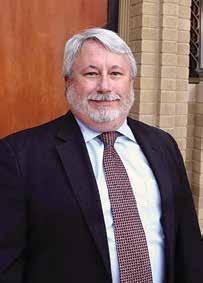
A Message from the President Michael P. Taubman
The Heart of Law: How Our TCBA Legal Community Beats Through Pro Bono Service
Over the decades that I’ve been part of our Tulsa County Bar Association, the level of commitment to serving our community among our membership never ceases to impress and inspire me. TCBA’s legal community has always been defined by more than its courtrooms, case files, and client meetings. At its best, ours is a profession animated by service evidencing a calling rooted in the belief that the law should be a tool for fairness, dignity, and opportunity. In recent years, that belief has taken on renewed urgency as economic pressures, housing instability, and civil legal needs continue to rise across Oklahoma. For many Tulsans, the justice system can feel distant or inaccessible. For lawyers, however, this gap represents not just a challenge but an invitation: an opportunity to embody The Heart of Law
Pro bono service is one of the most powerful ways attorneys can bridge that gap. It is also one of the most meaningful ways to reconnect with the reasons many of us entered the profession in the first place. In Tulsa, a network of organizations, clinics, and initiatives within and outside of TCBA make it easier than ever for attorneys to step into that role. Whether you have a few hours a month or the capacity to take on a full case, the need is real, the opportunities are abundant, and the impact is profound. Pro bono service remains central to the identity of our profession.
Why Pro Bono Matters in Tulsa Today
The legal needs of Oklahomans outpace available resources year after year. Thousands of low income residents face legal challenges involving housing, family stability, domestic violence, consumer debt, immigration, and access to public benefits. Many of these issues are not merely legal problems, they are life problems with cascading consequences. For example:
• A tenant facing eviction may lose not only their home but their job, their children’s school stability, and their financial footing.
• A survivor of domestic violence may need immediate legal intervention to secure safety and independence.
• A family navigating guardianship or custody issues may be overwhelmed by procedural requirements they cannot meet alone.
Legal aid organizations work tirelessly, but they cannot meet the full demand. That is where the private bar becomes indispensable. Every hour donated by a licensed attorney can change the trajectory of a life. Every case taken pro bono strengthens the fabric of our community.
Tulsa’s legal community has long embraced this responsibility. Yet, the landscape of need continues to evolve, and so must our response. The American Heart Association chooses February as its American Heart Month, raising awareness about heart health and preventing heart disease. TCBA’s The Heart of Law can be more than a slogan. Through evidence of our members efforts, we remind each other that our profession is at its best when it serves those who need it most.
Where Lawyers Can Make a Difference
TCBA’s Pro Bono Committee oversees the Courthouse Access Program (CAP) that provides volunteer attorneys at the evictions docket. Whether its one hour a week or one hour a month, this is an easy and flexible option for members to give back. Learn more about the program and how to get involved on page 10.
Legal Aid Services of Oklahoma (LASO)
LASO’s Tulsa office coordinates pro bono referrals in areas such as:
• Housing and eviction defense
• Family law
• Consumer protection
• Elder law
• Public benefits
LASO provides training, mentorship, and malpractice coverage for volunteer attorneys, and they make it accessible even for those who are new to a particular practice area. Many attorneys find that LASO’s structured support allows them to step into meaningful service without feeling overwhelmed.
Tulsa Lawyers for Children (TLC)
TLC was founded to ensure every child has someone to advocate for them. Someone to fight for their best interests when they can’t do it themselves. For 25 years, their mission has been simple: to make safety, stability and healing the
standard, not the exception. In 2025, TLC took their service in a new direction with their Guardian ad Litem program to serve children and families in high-conflict custody, domestic violence, and guardianship cases, helping prevent kids from ever entering foster care at all.
TLC also focuses on representing children in the foster care system. Volunteer attorneys serve as advocates for children who often have no voice in proceedings that profoundly affect their lives. TLC provides training and ongoing support, and many volunteers describe this work as some of the most emotionally resonant of their careers.
Oklahoma Criminal Defense Lawyers Association: Oklahoma Lawyers for America’s Heroes Program
This statewide initiative connects veterans with pro bono legal assistance. Our TCBA membership includes many veterans among its ranks, and Tulsa attorneys can play a major role in serving veterans facing issues such as discharge upgrades, benefits access, housing instability, and family law matters. For many lawyers, this is a meaningful way to honor the service of those who have served the country.
Immigration Legal Clinics
Tulsa’s immigrant community continues to grow, and with it, the need for legal support. Programs like Catholic Charities Immigration Legal Services and the University of Tulsa Immigration Clinic connect people with resources for education on legal issues involving immigration, citizenship, family petitions, and more. These local nonprofits and faith based organizations regularly host clinics focused on:
• Naturalization
• DACA renewals
• Asylum screenings
• Family based immigration guidance
Attorneys do not need prior immigration experience to participate; training can be provided, and the work can be life-changing for clients.
Expungement and Record Clearing Clinics
Record clearing efforts have expanded significantly in Tulsa, especially with the rise of community based expungement events. The City of Tulsa and, as of 2025, our Tulsa County District Court, have held warrant clearing events. These clinics help individuals remove barriers to employment, housing, and education. For attorneys, the time commitment is manageable, and the results are often immediate for those in need.
The Heart of Law: Why Pro Bono Work Reconnects Us to Our Purpose
Every attorney has a story about why they chose this profession. For some, it was a desire to advocate for the vulnerable. For others, it was a fascination with justice, fairness, or the power of the legal system to shape society. Yet the realities of practice, whether our deadlines, billing pressures, and administrative demands, can sometimes obscure that original spark. Making time in your year for some pro bono work has a way of re-igniting the spark and helping others to get a good result can be a way to refill your cup.
The pro bono client comes to us in their moments of crisis. They are not concerned with the lifetime of legal theory
we’ve learned; rather, they are concerned with whether they will be staying in their homes, if their children will have a roof over their head tonight, can they provide for their safety, and what lies ahead in their future. Helping them reconnects us to the human impact of our work. Making our knowledge and skills available to them can provide them and us the flame of hope that there is a better tomorrow.
It pays dividends to us by strengthening our skills.
Taking the leap to handle that pro bono case can expose us attorneys to new areas of law, new courtroom experiences, and new problem solving challenges. Many lawyers report that pro bono work has made them more confident, more adaptable, and more empathetic practitioners. Tulsa’s legal community is collaborative, and pro bono work often brings attorneys together across firms, practice areas, and generations. This creates opportunities for mentorship, networking, and shared purpose. It reinforces our professional identity.
The Oklahoma Rules of Professional Conduct encourage attorneys to aspire to at least 50 hours of pro bono service each year. Beyond the aspirational standard, pro bono work is a reflection of who we are as a profession. It is a way of saying to the community at large that the law belongs to everyone, not just those who can afford it.
Tulsa’s legal community has always risen to meet the needs of its neighbors. The challenges facing our community today require renewed commitment. Pro bono service is not simply charity, it is a cornerstone of a healthy justice system and a vibrant legal profession. Every attorney has something to offer. Whether you are a seasoned litigator, a transactional lawyer, a solo practitioner, or a new member of the bar, your skills can change lives.
The Heart of Law beats strongest when we use our training not only for our clients but for our community. As we look ahead in 2026, let us reflect and recommit to the values that define our profession. Equal Justice Under Law is not a slogan, it’s a foundational tenant of our justice system. Together, let us ensure that justice in Tulsa is not a privilege but a promise, and let us continue to build a legal community that leads with compassion, integrity, and service. The opportunities are here. The needs of our neighbors are real, and The Heart of Law is in our hands.
Sincerely,
Michael P. Taubman TCBA President, 2025-2026

Wear red on the Friday, February 6th for National Wear Red Day® to raise awareness about heart disease and encourage others to do the same.
:
TCBF Annual Charity Golf Tournament
Dear Tulsa County Bar Association Members,
As a leader in the Tulsa business community, you understand the power of a strong network and the importance of investing in local non-profits. The Tulsa County Bar Foundation invites you to partner with us for our annual event: the 2026 Charity Golf Tournament. This is more than just a day on the links; it’s a direct investment in the future of vulnerable Tulsans.
By sponsoring the tournament, your company will provide essential funding for four critical beneficiaries that make a profound difference every day:
• City Lights Foundation
• Tulsa Lawyers for Children
• Tulsa Veterans Treatment Court
• Coffee Bunker
Your support ensures these organizations can continue their vital work, from providing legal advocacy for children to supporting our local veterans.
Partnering with TCBF offers a unique opportunity to position your brand directly in front of the legal and business community:
• Premium Visibility: Your organization will be featured in the official Tulsa Lawyer magazine, reaching approximately 2,000 legal professionals and businesses across Tulsa County.
• Targeted Exposure: Recognition on our event signage, the TCBA website, and during the tournament program will ensure players, sponsors, and guests see your brand.
• Strategic Networking: Spend the day with top attorneys, judges, and local business leaders during a relaxed, highengagement networking event.
We look forward to hosting this year’s event on Monday, April 6, 2026, at the beautiful Meadowbrook Country Club
We sincerely hope that, as you plan your 2026 philanthropic budget, you will recognize the value of partnering with TCBF.
Don’t hesitate to get in touch with Tami Williams at the Tulsa County Bar Association for more information or to secure your sponsorship package at 918-584-5243 or tamiw@tulsabar.com
We appreciate your commitment to improving our community and look forward to welcoming you to a great day of golf, food, and fellowship.
Sincerely,
Michael Thelen TCBF 2026 Golf Tournament Chairman

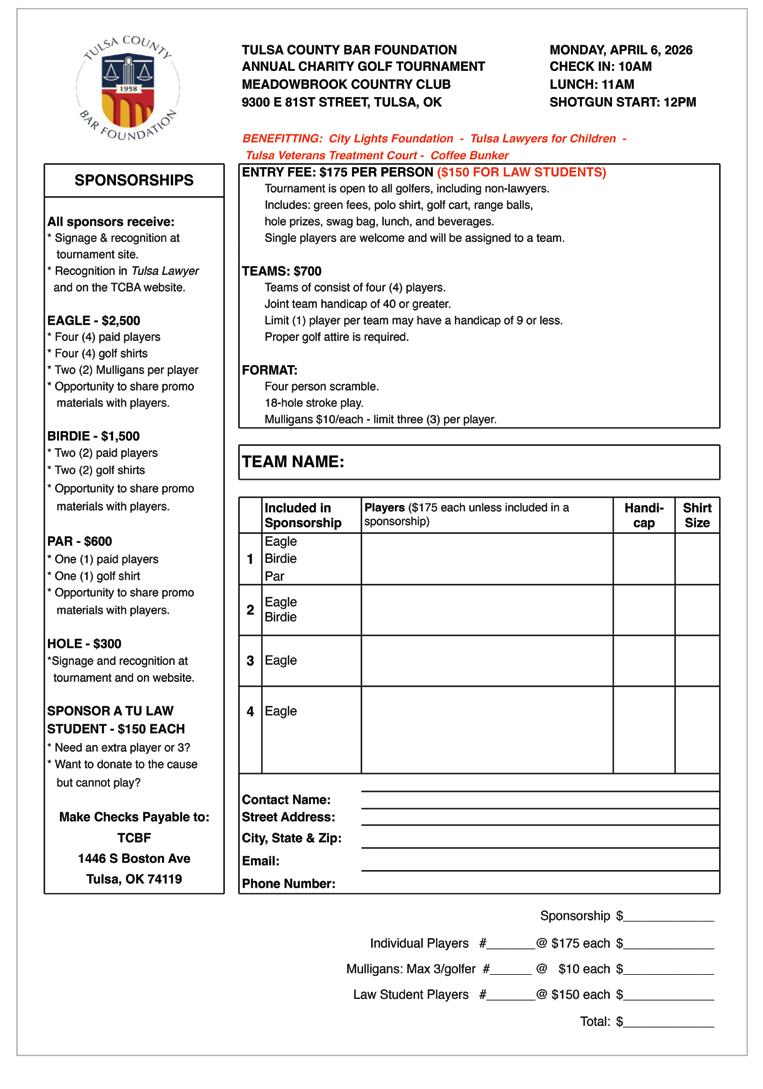

Register by March 2nd

VP's Corner Shena Burgess
A Matter of Heart & History
February is American Heart Month. When I was six years old, my dad (who was thirty-four at the time) had a heart attack. Luckily, even though his heart attack was a widow maker, he was on duty on a naval base, and the hangar was next to the hospital. He and my mom left for a month to go to Northern California for him to have open-heart surgery in the early eighties. My sister and I lived with a neighbor without knowing if my dad would return. Luckily, they did, and our family went through a complete food revolution on how we ate and how my parents cooked. Needless to say, when I turned 34, it was a year that I just wanted to get through without medical issues.
For women, heart disease is the number one killer. One in twenty adults aged twenty and older already have coronary heart disease. Risk factors for heart disease include:
• High Blood Pressure
• High Blood Cholesterol
• Overweight or Obesity
• Pre Diabetes or Diabetes
• Smoking
• No regular physical activity
• Family History (if your father or brother was diagnosed before age 55, or your mother and sister if diagnosed before age 65)
• A History of Preeclampsia
• Age 55 or older for women or age 45 or older for men
Things you can do to help prevent heart disease: get enough sleep, eat healthier, stop smoking, maintain a healthy weight, and be more active. I urge all of you to make a concerted effort to evaluate your health with your doctor and family’s support.
February also marks Black History Month. This month, I also want to use this column to celebrate two women who broke barriers in the legal profession.
Charlotte E. Ray (1850-1911)
Ms. Ray was a civil rights activist and lawyer. She participated in the women’s suffrage movement and joined the National Association of Colored Women. She was a graduate of Howard University School of Law at the age of 22. She became the first Black American female lawyer in the United States. She was the first woman admitted to practice before the District of Columbia Bar and the first woman admitted to practice before the Supreme Court of the District of Columbia. This created a precedent for women seeking admission into other bars. She had her own firm and advertised in Frederick Douglass’ newspaper.
Ada Lois Sipuel Fisher (1924-1995)
Ms. Fisher was a Chickasha native who graduated from Langston University in 1945. She wanted to pursue law and applied to OU on January 14, 1946. When she was denied, she set in motion a series of court challenges that led to her admission in 1949. She was backed by Oklahoma City attorney Amos T. Hall and the NAACP’s Thurgood Marshall. In January of 1948, the U.S. Supreme Court ordered the state of Oklahoma to provide equal legal education for African Americans. Her persistence also led to the 1950 U.S. Supreme Court decision that segregation within a school was unequal and could not continue. She received her degree in August 1951, becoming the first African American to receive a law degree from OU. In 1992, Fisher was appointed to the University of Oklahoma Board of Regents.
Shena Burgess TCBA Vice President, 2025-2026



Matters of the Heart: Prioritizing Cardiovascular Health in the Legal Profession

February is American Heart Month, a timely reminder that even the sharpest legal minds depend on a healthy heart.
The legal profession is known for its intellectual rigor, demanding schedules, and high-stakes decisionmaking.
February’s focus on heart health offers an opportunity for those in the legal field to pause and consider an important question: Are we taking care of the organ that keeps us showing up for our clients, our colleagues, and our communities?
The Legal Profession and Heart Health: A Risky Combination Studies consistently show that high-stress professions are associated with elevated risks of hypertension, heart disease, and stroke. Lawyers often operate under intense pressure—tight deadlines, adversarial environments, emotional client matters, and the ever-present expectation of perfection. Add to that sedentary workdays, frequent reliance on caffeine, and irregular sleep, and it becomes clear why heart health deserves special attention in the legal community.
Stress triggers the release of cortisol and adrenaline, hormones that are helpful in short bursts but harmful when constantly elevated. Chronic stress can contribute to high blood pressure, inflammation, and unhealthy coping behaviors such as poor diet choices, smoking, or excessive alcohol consumption.
The good news is that heart disease is largely preventable. Small, consistent changes can significantly reduce risk and improve overall well-being—without requiring a complete lifestyle overhaul.
Practical Strategies for Heart Health in a Busy Legal Life
1. Move More—Even in Small Increments. You do not need to train for a marathon to benefit your heart. Regular movement helps lower blood pressure, improve cholesterol levels, and manage stress.
For busy legal professionals, the key is intentional activity: Take brief walking breaks between meetings or hearings. Use stairs when possible. Schedule walking meetings. Stand up and stretch during long periods of drafting or reviewing documents.
Even 10-minute intervals of movement, accumulated throughout the day, can make a meaningful difference.
2. Rethink the Workday Diet. Court days, depositions, and backto-back meetings often mean grabbing whatever food is fastest, not healthiest. Over time, diets high in sodium, sugar, and processed foods can strain the heart.
Heart-healthy choices do not have to be complicated: Keep nuts, fruit, or yogurt on hand instead of relying on vending machines. Aim for lean proteins, whole grains, and vegetables when eating out. Stay hydrated—fatigue is often mistaken for hunger.
Mindful eating supports not only cardiovascular health but also focus and energy during long workdays.
3. Prioritize Sleep as a Professional Responsibility. Sleep is often the first thing sacrificed during trial preparation or busy seasons. Yet inadequate sleep increases the risk of hypertension, obesity, and heart disease.
Adults should aim for seven to nine hours of sleep per night. While that may feel unrealistic at times, even small improvements— such as consistent bedtimes, limiting late-night screen use, and avoiding caffeine late in the day—can yield significant benefits.
In a profession that prizes sharp thinking, sleep should be viewed not as a luxury, but as a performance tool.
4. Manage Stress with Intention. Stress management is not about eliminating pressure—it is about building resilience. Techniques such as deep breathing, mindfulness, and brief mental breaks can lower heart rate and blood pressure.
Some legal professionals find benefit in: Short guided meditations between tasks; regular check-ins with mentors or peers; setting realistic boundaries when possible; seeking professional support when stress becomes overwhelming.
Addressing mental health is essential to protecting physical health.
5. Know Your Numbers—and Your Family History. Routine medical care is critical. Blood pressure, cholesterol, blood sugar, and body weight provide valuable insight into heart health. Family history also plays a significant role in cardiovascular risk.
Annual checkups and open conversations with healthcare providers can help identify issues early, when they are most manageable.

Lynne Miller Law Day Book Club 2026
BOOK CLUB SCHEDULE
February 17 - A Life on Fire, Oklahoma’s Kate Barnard, Connie Cronley
March 7 - Shadow Docket, Stephen Vladeck
April 28 - Confederacy of Dunces, John Kennedy Tool
May 26 - The Worst Hard Time: The Untold Story of Those Who Survived the Great American Dust Bowl, Timothy Egen
June 23 - My Friends, Fredrik Backman
July 28 - North Woods, Daniel Mason
August - off
September 22 - Agatha Christie, A Hidden Life, Lucy Worsley
October 27 - The Buffalo Hunter Hunter, Stephen Graham Jones
Contact frontdesk@tulsabar.com or visit www.tulsabar.com

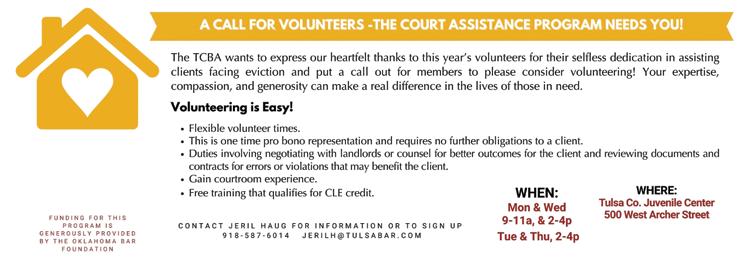
CAP - Justice in the Balance
As a metropolitan with one of the fastest eviction timelines in the nation, Tulsa faces a significant challenge to housing stability. In 2026, the Tulsa County Bar Association (TCBA) Court Assistance Program (CAP) remains a critical line of defense for families on the brink of homelessness, thanks to the continued financial support from the Oklahoma Bar Foundation.
Justice in the Balance: The Vital Mission of the Tulsa Court Assistance Program (CAP)
The distance between a stable home and the street is often just a few minutes in a courtroom. With Oklahoma’s rapid eviction process, tenants frequently arrive at the Tulsa County District Court overwhelmed, unrepresented, and unaware of their rights, if they even arrive at all.
Since its inception, CAP has worked to bridge this gap. Not only does CAP provide on-site pro bono representation to tenants on the “Forcible Entry and Detainer” (eviction) docket when volunteers are available, it also provides resources and referrals for mediation and social services to anyone who contacts the TCBA with landlord-tenant issues.
The Power of a Volunteer Attorney
You don’t need to be a property law expert to make a difference. Whether you are a corporate lawyer, a litigator, or a recent law graduate, your presence provides the “due process” that every citizen deserves.
CAP attorneys act as negotiators and problem solvers. Key outcomes include:
• Negotiated Settlements: Facilitating agreements that allow tenants to pay back-rent and stay in their homes.
• Negotiated Extensions: Get the tenant more time to move out of the home.
• Record Protection: Negotiating judgments under advisement or “soft exits” that prevent an eviction judgment from permanently staining a tenant’s record, which often prevents them from securing future housing.
• Legal Defenses: Identifying breaches of the Oklahoma
Residential Landlord and Tenant Act, such as failure to maintain habitable conditions.
Why volunteer for CAP?
1 Immediate Impact: You can walk into the courthouse at 2:30 p.m. and, by 4:00 p.m., have saved a family from immediate displacement.
2 Mentoring & Training: New volunteers are paired with experienced volunteers. We provide the training; you provide the advocacy.
3 Flexibility: Whether you can serve once a week or once a quarter, your time is invaluable.
Turning the Tide in 2026
Recent legislative efforts, such as the proposed Senate Bill 1209, aim to provide more breathing room for tenants by excluding weekends and holidays from the eviction timeline. However, until systemic change is fully realized, the individual advocate remains the most powerful tool for justice in the Tulsa County Courthouse.
The difference between a “Default Judgment” and a “Dismissed” case is often just the presence of a volunteer attorney.
How to Get Involved
Joining the Court Assistance Program is simple:
Contact Jeril Haug at 918-587-6014
Interested but nervous? Contact us to “shadow” a veteran volunteer during a Thursday docket to see the program in action.
2025 CAP Stats
517 Families Assisted
• 44 of those were assisted by volunteer attorneys at the evictions docket
• Families consisted of 745 adults and 638 children
• 52% were Female
• 70% of clients were employed
• 13% were receiving housing assistance
• Only 1% were in the military

Community Corner
TCBA Community Outreach Committee Events, Opportunities and Success!
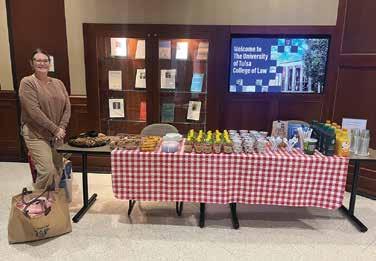

Thursday, December 18th, the Community Outreach committee sponsored a law student breakfast held at the TU College of Law.
Left: TCBA Executive Director, Tami Williams, ready to greet students.
February Community Outreach Committee Meeting
Tuesday, February 17 at noon
Meetings are held in person at the bar center with a virtual option to attend.


Voices of the Tulsa County Bar Association Judge Paul R. Thomas
Chief Bankruptcy Judge, Northern and Eastern Districts of Oklahoma
By Ralph Schaefer
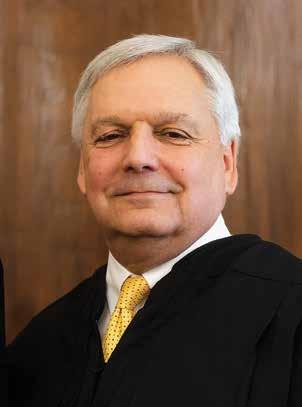
Paul R. Thomas has the distinction of being the only Chief Bankruptcy Judge for two federal bankruptcy courts in the nation. Paul’s responsibilities in the Northern District (Tulsa) and the Eastern District (Muskogee) are keeping him very busy.
He was first appointed to serve in the Eastern District in 2022 to replace retiring Judge Tom Cornish. The second appointment came in the Northern District in 2025, when Judge Terrence Michael retired. The 10th Circuit Court of Appeals decided not to fill Judge Michael’s position and asked Paul if he would be willing to serve in both districts. “I advised Chief Judge Holmes that I am a team player and would be willing to serve in both districts,” he said. “It may not have been a career goal, but I have stepped into being more challenged and a lot busier.”
Serving as the Chief Bankruptcy Judge is a far different career path than the New Jersey native thought he would be on. He earned his undergraduate degree in English/Education from Albright College, Reading, Pa., and planned to become an English teacher. He also developed a love of poetry, which
has carried over to his current position. After graduating from college in early 1978 and seeking teaching positions in Pennsylvania, New York, and New Jersey, Paul was unable to secure a teaching job and had to go with Plan B. His love of literature led him to join Random House Publishing, where he became a book salesman.
As it turned out, it was his first step towards Tulsa. “I thought I would be working in New York City,” he said. “The Random House sales manager told me, No, that only the best of the best [salesmen] worked in New York. I was told I would have to go out to a smaller market and earn my way back to New York. I had a couple of options and picked Oklahoma sight unseen.”
Paul’s customers were independent bookstore owners, and “super interesting people” were encountered. One of the fascinating things about being a bookseller was the constant stream of interesting, challenging conversations and personalities.
Since his territory covered a three-state area, Oklahoma, southern Kansas, and western Arkansas, Paul could have chosen anywhere in the territory to live. He started in Oklahoma City, then, in his rental car, drove to Tulsa and found a city that would become his permanent home. Paul was taken by Tulsa’s beauty, kind people, and pace of life – and decided it was the place to put down roots.
Paul had many friends and family members who thought he might make a good lawyer, probably because he says, “I like to have a good, spirited debate.” As it happened, he was challenged by Kevan Jeffords, a friend who urged Paul to go to law school “so I [Jeffords] would have someone to study with.” Jeffords, who has since passed away, is credited by Paul for getting him on the legal path. “I said if it was meant to be, then I will do well on the LSAT and see what happens,” he continued. Wanting to stay in Tulsa, Paul applied only to the University of Tulsa College of Law. He was accepted. While in his third year, Paul was hired as an intern at Reading and Bates Petroleum Company and was asked to stay on as a lawyer following graduation and bar passage. A year into his new career, the firm decided to move operations to Houston, Texas, and Paul was “not invited” to go along.
It was through Reading and Bates’ contacts that Paul was offered a position with the Logan & Lowry Law Firm in Vinita.
“Excellent attorneys and really good people,” Paul recalled. Work involved civil cases throughout northeastern Oklahoma, with some defense, probate, and foreclosure matters included. The Vinita law firm attorneys understood Paul really wanted to be in Tulsa, and that transition came when he joined the firm of Jarboe & Stoermer. “John and Jeff had a small firm, and John was looking for someone to help with his trustee cases,” he recalled.
It was during his four years with Jarboe & Stoermer that Paul was introduced to the bankruptcy practice — and to some valuable lessons (and some good stories).
One day, Jarboe handed Paul a bankruptcy file and sent him to court before Northern District Federal Bankruptcy Judge Mickey Wilson. It was Paul’s first appearance before Judge Wilson.
He told the judge that he was representing Mr. Jarboe and would like to enter an appearance. Judge Wilson paused and then said, since there hadn’t been a hearing on the case for some time, he would like to be brought up to speed. Paul, caught in the trap, was unaware of the case’s history and admitted to the court that he was unprepared. The only thing he knew was what he learned from flipping through the file on the way to the courthouse. He apologized to the court for being unprepared and said that he had been told his role was to observe. “I didn’t want to tap dance around the case and waste the court’s time,” Paul said. Judge Wilson then asked about Paul’s hourly rate and told him that his rate for today’s work would be “zero.”
Paul told Jarboe about his experience and was advised not to worry, as the message was meant for him. It was that he [Jarboe] shouldn’t send anyone to the court without the proper preparation.
It was motion docket day, and the courtroom was packed with attorneys who witnessed the judge’s chastisement. As Paul left the courtroom, as he described it, “with my tail between my legs,” Fred Woodson, another bankruptcy attorney, “grabbed me by the arm” and asked to talk in the hallway. Woodson told Paul not to take it personally, but to come back and show Judge Wilson that he could do the job. “Judge Wilson does that to everybody,” Woodson said. It was great advice.
A career change was ahead for Paul when, in 1991, he received a call from Assistant U.S. Attorney Katherine Vance, who invited him to join the Office of the United States Trustee. This arm of the Department of Justice oversees the administration of bankruptcy cases. Jarboe told Paul to accept the offer, and it led to a 30-year career. In his new position, Paul oversaw his former boss.
In part, the U.S. Trustee’s role is to ensure that all monies collected by the Chapter 7 trustee are handled correctly. Another role is to review bankruptcy cases for fraud and identify parties seeking to take an unfair advantage of the bankruptcy process. If that happened, the office would step in and litigate matters. That experience led him to think he might have something to offer as a judge.
continued on next page...

When Judge Tom Cornish announced his retirement, a search committee was formed, and Paul, even though he was a little older than some of the other candidates, decided to apply. He felt that he had something to offer and was going to make the selection committee say “no.”
To his pleasant surprise, he was selected and started his new role in April 2022. He applies lessons learned from all the bankruptcy judges he practiced before – expecting attorneys to be prepared and being purposeful in maintaining a courtroom that encourages civility.
Paul hears all bankruptcy cases in the two districts, from Chapter 7 to Chapters 11 and 13. Paul doesn’t meet with every debtor because most cases are resolved without litigation. The most challenging cases involve real people in life-changing financial situations. People struggling to keep their homes can be heartbreaking situations to decide.
Paul wants attorneys to know that community is essential.
He has served as chair of the Tulsa County Bar Association Bankruptcy Section since 2008. A relatively small but robust group, Paul says the Section endeavors to foster a community where members can develop personal connections and share valuable resources. “The meetings provide an opportunity for attorneys to get to know each other better and to get a sense of one another as lawyers,” he continued. Everyone must realize they are people first, then attorneys, and they have an opportunity to make a difference. That familiarity with others promotes civility.
Paul believes deeply that the TCBA stands at the critical intersection of community and service. That is why the TCBA

and other sections are so important. They allow and enable nonlawyers to connect with lawyers and legal service providers.
“Don’t isolate yourself behind the computer on the desk,” Paul added. “Don’t allow what you can do from your chair to isolate you from other people, other lawyers.” The TCBA provides lawyers with many opportunities to volunteer and engage with the community.
It is possible to do a lot these days with Artificial Intelligence (AI) and computer research without ever talking to another lawyer. “My advice is to put down your phone and step away from your computer and have a face-to-face conversation with your lawyer colleagues,” Paul said. We can learn so much from each other.”
In an effort to set a human tone, Paul opens each Bankruptcy Section meeting with a poem. Usually short, and always thoughtful and uplifting. A poet featured regularly is one of Paul’s favorite authors, Wendell Berry.
When Paul took the oath of office when he became Chief Bankruptcy Judge of the Eastern District on April 8, 2022, one of his favorite poems by Wendell Berry was read:
“Our Real Work.”
It may be that when we no longer know what to do We have come to our real work, and that when we no longer know which way to go We have come to our real journey. The mind that is not baffled is not employed. The impeded steam is the one that sings.
Voices of TCBA
This innovative project, by the TCBA Law Week Committee, aims to preserve and share the rich stories of our members and the history of the Association.
Members interviewed are encouraged to contribute their unique experiences and insights, reflecting on their journeys within the legal profession and their connection to the TCBA. Through this initiative, we strive to highlight the diverse voices and histories that shape our community.
Leading the project and interviewing members is Ralph Schaefer, retired senior editor of the Tulsa Business and Legal News. He has interviewed U.S. Supreme Court Justices and did a series on the Oklahoma Supreme Court Justices. The Tulsa County Bar Foundation and Oklahoma Bar Association honored him with the Liberty Bell Award, the highest recognition for a non-lawyer.
Your voice matters, and we look forward to celebrating the legacy of the Tulsa County Bar Association. Let’s bring our stories to life!




TCBA Diversit y Committee Matt Ingham, Chair
A GREAT MONTH TO CELEBRATE DIVERSITY
Colleagues, as you are probably aware, the first half of February marks the celebration of two historically significant birthdays in our country – Abraham Lincoln, born on February 12, 1809 and Frederick Douglass, born on February 14, 1818.
Lincoln’s birthday, while not a federally recognized holiday, is observed as a state holiday in a handful of states across our country. The earliest observance of Lincoln’s birthday occurred in the decade immediately following the Civil War. Many Americans wanted to celebrate the public service of President Lincoln and honor him as the ‘Great Emancipator’, having signed the Emancipation Proclamation on January 1, 1863.
Also in the decades after the Civil War, many Americans wanted to celebrate the public service and contributions of Frederick Douglass. Mr. Douglass escaped slavery when he was approximately 20 years old. A year later he became a licensed preacher in the Methodist Episcopal Zion Church and began attending abolitionist meetings. From that point in time, Mr. Douglass rose to national prominence as a social reformer, abolitionist leader, women’s suffrage advocate, and author. His autobiography, Narrative of the Life of Frederick Douglass: an American Slave (published in 1845), powerfully propelled the Abolitionist Movement forward.
In the 1920s, a movement began to celebrate the second week of February as Black American History Week because it coincided with the birthdays of President Lincoln and Mr. Douglass. In the decades that followed, Black American History Week continued to grow in popularity.
In the 1970s, the commemorations which historically occurred in the second week of February each year, were expanded to include the entire month of February. In 1976, President Gerald Ford officially recognized Black American History Month, and that same year, at our country’s Bicentennial Celebration, President Ford recommended that Americans ‘seize the opportunity to celebrate the accomplishments of Black Americans’. Since the 1970s, Black American History Month has been celebrated in communities all across our country.
Colleagues, in this article I also wanted to write about the public service and contributions of George Washingon, born February 22, 1732 – President Washington was a public servant who, quite frankly, without him, our wonderful democracy would likely never have been established. Unfortunately, I have run out of room in this month’s edition and will have to save my article about President Washington until a later month.
And colleagues, as I say at the end of each one of my TCBA articles, I encourage each of us to strive on a daily basis to strengthen a Tulsa Legal Community that encourages civility towards each other & inclusion of individuals who come from diverse backgrounds.
Sincerely,
Matt Ingham TCBA Diversity Committee, Co-Chair
The next Diversity Committee meeting will be Monday, February 2nd.
Details at www.tulsabar.com.
Voices of the Tulsa County Bar Association Deirdre Dexter
By Ralph Schaefer


Deirdre Dexter stood in awe when she saw the interior of the Tulsa County Bar Association building, a facility she had not been in for more than a decade. It’s not that she wasn’t familiar with the building at 1446 South Boston Ave., she served as the organization’s president in 2009-2010 and followed as TCBA Foundation president the following year. It was during that time that she and other TCBA members led the successful effort to renovate the exterior facade.
The exterior facade of the TCBA building was falling off, posing a hazard to pedestrians on the sidewalks beside the building. In fact, the sidewalk was blocked off to prevent injury, which underscored the need for extensive repairs to the building’s exterior. To pay for the extensive renovation, membership dues were raised, and fundraising was done. Both necessitated explaining why membership dues were being raised and why additional fundraising was required.
In addition, during the planning and later the construction process, Deirdre, as TCBA president, Sandra Cousins, as Executive Director, and Leonard Pataki, as Foundation president, would have extensive phone calls and meetings with the architect and construction team to plan and complete the project. In addition, a committee of TCBA members was asked to participate in planning and designing the renovations.
Deirdre’s involvement continued when she became president of the TCBF. In fact, Deirdre had many years volunteering
in a variety of capacities for TCBA, including stints as Law Day Chair, Secretary for the Board of Directors, Budget Chair, Vice President, and President-Elect of the TCBA. All that ended, however, when Deirdre was hired as an administrative law judge for the Social Security Administration. The time commitment to SSA and the travel distance (first to McAlester, then to Eastland Mall in Tulsa) made participation in activities during the workday impossible.
Deirdre, who retired from SSA in June 2025 after a 40-plusyear law career, paused, then remarked that it is difficult to believe that she and many of the “young” lawyers she started practicing with in 1984 are now “senior attorneys”!
When asked how she decided on the law as a career, Deirdre explained that it wasn’t a long or involved thought process. It was simply that she was afraid of “being bored in a job” when she started a career and wanted something interesting and evolving to keep her engaged in whatever career she chose.
The Stillwater native was exposed to the legal community after she dropped out of college in 1977 to marry her husband, Terry Dexter. She worked as a legal secretary in Enid for several years and found the law fascinating and varied. At first, Deirdre considered becoming a legal assistant. However, when she looked into earning a legal assistant degree and realized that it would require relocating to Norman, she and Terry discussed it. They decided that attending law school made sense. With that, Deirdre graduated from Phillips University in Enid in 1981 and enrolled in the University of Oklahoma College of Law that fall. Shortly after starting law school, in September 1981, Terry and Deirdre had their first child, Daniel.
As graduation loomed, Deirdre focused on possible areas of the law post-graduation. Following along with that same mindset of wanting an area that was both interesting and challenging, she focused on litigation or sophisticated estate planning in her electives. Law school friends and practicing lawyers alike laughed at these choices because they were diametrically opposed – but for what she wanted, Deirdre knew they made sense for her.
Due to external circumstances at the time, Deirdre chose litigation, and when she graduated from OU in 1984, she joined Tulsa’s Conner & Winters Law firm. Deirdre described herself as very fortunate because, as a new attorney, she had the opportunity to work with and learn from excellent lawyers,
including John Athens, Jim Kincaid, retired bankruptcy judge Bill Rutledge, Jim Ryan, John Berry, and Hank Harbaugh, among others. Deirdre had the opportunity to prepare for and conduct depositions and court hearings, and to attend trials and evidentiary hearings on sophisticated legal issues. At the time, if she expressed a desire for more responsibility, Deirdre was trusted with that responsibility, which allowed her to gain invaluable experience and skills as a trial lawyer. As a new lawyer, Deirdre’s office was next to Athens’ office, and he was always willing to answer questions or provide guidance if asked.
Over her last 10 or so years at Conner & Winters, Deirdre’s practice transitioned into employment law. She represented employers and served as an arbitrator through the American Arbitration Association, primarily in employment-related matters, but also for contract and business-related disputes. In her employment practice, Deirdre advised clients on applicable laws and how to address employment issues to avoid lawsuits. In those situations, where the employer had acted without consulting her first and was sued, Deirdre would handle the employer’s defense in court. She also provided training to management employees on various employment laws.
Sixteen years after joining Conner & Winters, Deirdre successfully sought the position of Tulsa County Associate District Judge. Deirdre explained that she had always felt that public service was her calling, and her many years of dealing with issues encountered by lawyers and litigants gave her a unique perspective to address them while on the bench. She had heard about and experienced situations in which continuances were repeatedly granted, or rules governing efficiency and trial were not enforced, which provided an incentive to run an efficient and effective courtroom. Deirdre also explained that Judge David Peterson served as a mentor and reinforced her view that making prompt decisions and moving cases forward was best for both her court and the litigants.
When she was later assigned to a criminal felony docket, Deirdre explained that Judge Tom Gillert was willing to spend several hours with her as she became familiar with the rules and procedures governing criminal trials. “I had no experience with criminal cases other than the juvenile cases I handled pro bono when I was at Conner & Winters,” she said. Deirdre laughed as she recalled the “big book of criminal procedures and criminal statutes” that she had annotated extensively with Post-it notes so that legal questions could be answered quickly and efficiently. “I remember one of the biggest compliments I received when I was on the criminal docket came from Allen Smallwood,” she continued. Smallwood, a criminal defense attorney, and a Tulsa County Assistant District Attorney, was arguing about a legal issue each had briefed. Needing to look into the matter more deeply, Deirdre took a brief recess to further research the matter. After reading the law, Deirdre ruled in the assistant district attorney’s favor. Smallwood told the judge he was impressed with the ruling and believed that she took the time to get it right, even though she had ruled against his client.
When she left the bench, Deirdre joined Frederic Dorwart Lawyers and found herself in what she described as “kind of the best of both worlds.” She handled a variety of cases, predominantly employment related, and drew on experiences gained both in private practice and on the bench. In addition to work involving oil and gas and banking law, Deirdre continued her work in employment law, including travel to provide specialized employment law training to managers for a large, multi-state employer.
Deirdre’s career took another turn in 2006 when she was hired as interim City Attorney for the City of Tulsa and then named to that position as a regular employee in 2007. Deirdre admitted that, aside from some cases involving municipal issues while on the bench, she had never practiced in the municipal area. As a result, she had a steep learning curve to become familiar with city ordinances and the state and federal laws that govern cities. Deirdre expressed her frustration that she soon learned that people, including elected officials, don’t understand that the City Attorney doesn’t represent the mayor (executive branch) or the city council (legislative branch), but represents the “city” as a distinct legal entity. “When the elected officials are getting along, that distinction doesn’t matter,” she said. “But when they aren’t, like when the city council sues the mayor, it becomes a problem.”
Before her time as City Attorney, Deirdre had managed individual employees or small groups of employees. And while by this time she had advised employers for years regarding employment issues, she had never managed a department of employees herself.
“I had managed small numbers of people,” she said, “But the city legal department, with approximately 25 employees, was something new for me.” Despite challenges, Deirdre found public service to be one of the most enjoyable and fulfilling parts of her career. “I really enjoyed working as a city attorney,” she said. “Learning new areas of law and working with other city employees was a wonderful experience.”
After working at the City for four years, Deirdre joined the Barrow and Grimm Law Firm, a move that brought her back to her roots in general commercial litigation and employment law. In addition, she continued to preside over arbitration cases through the American Arbitration Association.
Still another career path was ahead when, at the urging of Social Security Judge Darlene Crutchfield, Deirdre applied for a position as an administrative law judge with the agency. A job opening at the agency was posted on USAJobs in 2013, and she applied. While waiting for the outcome of the protracted testing and interview process involved in the hiring decision, Deirdre continued her employment law practice and arbitrations, and joined the office of the Oklahoma Attorney General as part of the employment practice group.
continued on next page...
The Social Security selection process spanned two years from employment application through testing and interviewing. As part of the application process, Deirdre listed only seven locations (out of approximately 170 available), all within a three-hour or less drive from Tulsa. In early 2015, Deirdre was notified of her selection and learned that she would need to relocate, at least temporarily, from her home in Sand Springs to join the hearing office in McAlester. Rather than drive to and from the McAlester office each day, Deirdre rented a house in that city where she could live and work during the week, then return to Sand Springs on weekends. When the agency hired Deirdre, judges were required to work for at least a year before they could telework from home. At the end of her first year, Deirdre moved back home and teleworked three days a week. “Judge Gabbard, our local chief judge, allowed the maximum telework days and only expected judges to be in the office for hearings,” Deirdre explained.
Before becoming eligible for telework, Deirdre found the two-home arrangement challenging. She and Terry talked on the phone daily while Deirdre was in McAlester, and Deirdre described some of the frustrations that came from being stationed in a different city. “There is nothing worse in the world than talking to your husband on the telephone, and he is on the back porch watching a tornado barreling in on him. I couldn’t make him go into the house. It was terrible.”
Ultimately, retirements in the Tulsa hearing office made it possible for Deirdre to return home in August 2016 and continue in the Tulsa office until she retired at the end of June 2025. “For me, it was the perfect end-of-career job. I’m not sure I could have done this job for 20 or 30 years, but when I joined the agency, it was new and different and fulfilled my desire to continue to engage in public service work.”
During her career with Social Security, Deirdre described the dramatic changes to her work environment due to the COVID-19 outbreak in 2020. “I teleworked on Fridays, so I had taken my laptop home after my hearings on Thursday. I logged on early Friday morning and read an email that essentially said, “Don’t come back to the office, you will work from home.” Deirdre said that the agency was able to set up telephone hearings quickly (and later video hearings) so the judges could go forward with hearings without missing a step. It wasn’t until the summer of 2024 that in-person hearings were scheduled again, and people were allowed to come to the hearing office. “By that time, the lawyers had decided that they preferred telephone or video hearings, so in-person hearing days were few and far between,” Deirdre explained.
The change in how hearings were held due to COVID made it possible for Deirdre to be home and with her husband, Terry, 24/7. “I did feel bad at times because I had to make Terry leave the house when I held hearings. But being home and not commuting to work was wonderful, and I found I was much more efficient,” Deirdre said. “I also discovered that even after almost 50 years, Terry and I still get along really well, and are
still married,” she quipped.
Reflecting on her TCBA involvement, Deirdre spoke highly about the organization and the importance of being as actively involved as possible. There are opportunities to provide public service through different committees or to take advantage of the lawyer referral service if an attorney is starting or seeking to expand practice areas. And interacting with other lawyers and judges can help encourage professionalism, which is undoubtedly needed in the legal world and the world at large. Building camaraderie with other lawyers can also provide invaluable opportunities to learn and grow as a lawyer and as a person. “I have found that knowing people with different practice areas is so helpful if I need to refer someone or if I need to pick someone’s brain for an issue I’m not as familiar with,” Deirdre mentioned. “Lawyers are trained differently, and it can be very beneficial to be able to bounce ideas off someone who is trained the way you are,” she added.
Now Deirdre is enjoying retirement, visiting family and, especially, grandchildren. “Terry and I are blessed with seven grandchildren. Three are local, but four are in South Texas. So having the freedom to take off for several weeks at a time has been great.”
In addition, the self-described “mock trial junkie” is also preparing for the 2026 season, which gets “hot and heavy” in mid-January and continues until early March. Deirdre initially got involved in coaching a mock trial team in 1990, feeling that it would be a good way to hone trial practice skills and evidentiary objections. For two years, she coached a team from Jenks that placed first in the Oklahoma competition in 1992 and went on to the national competition in May of that year.
Deirdre then served as a judge for the state competition for years until her friend, Judge Daman Cantrell, convinced her to return to coaching, first with a team from Lakeside and later with a team from Owasso. With practices in the evenings, when she joined the Tulsa hearing office, Deirdre was able to help with one of several teams from Owasso, coaching the same students from their freshman through senior years, and she again had a state champion team. Unfortunately, COVID caused the national competition to be canceled in 2020.
Thinking back on her 40-plus-year career and experiences, she recalled how one of the Jenks students she coached back in the early 90s stopped by her office at the courthouse to say hello and let her know he was now a practicing attorney. This led to another recollection of a young attorney who tried his first case before her when she was an associate district judge and is now retiring. “Things certainly seem to come full circle as you think back on things,” Deirdre ruminated.
As she walked through the TCBA building, Deirdre marveled at the beautiful and extensive changes, especially the custom-built table in the large boardroom. Deirdre paused, then realized, “I guess I really am a senior lawyer.”

Grapevine News
GableGotwals is pleased to announce that one associate and four Of Counsel have been promoted to Shareholder. Effective January 1, 2026, Brian Blackstock, Gerard D’Emilio, Zoe Butts Dowdell, Alex Telarik, and Brian Tully serve as Shareholders. In addition, David Herber has been promoted to Of Counsel. Shareholders:

Brian Blackstock focuses his practice on defending corporate and individual clients in a variety of civil litigation matters in state and federal courts. He represents healthcare professionals during investigations and disciplinary proceedings before state licensure boards and regulatory agencies. He regularly counsels healthcare systems and insurance companies on an array of complex issues, including risk, compliance, and coverage. Brian also assists healthcare clients in negotiating and litigating employment, recruiting, and service contracts, as well as entity formation and reorganization.

Gerard D’Emilio focuses his practice on a wide range of litigation and appellate matters. Before joining GableGotwals as an attorney, he served as a judicial law clerk to the Honorable Jerome Holmes of the United States Court of Appeals for the Tenth Circuit and the Honorable David L. Russell of the United States District Court for the Western District of Oklahoma. He also served as a judicial extern to the Honorable Robert E. Bacharach of the Tenth Circuit. Gerard has been recognized by Best Lawyers as part of its Ones to Watch list for Appellate Practice and Commercial Litigation and as a Rising Star by Super Lawyers for General Litigation.

Zoe Butts Dowdell represents clients in a variety of general healthcare matters. With a strong background in healthcare litigation, she works closely with clients through the litigation process. Her practice includes matters in both state and federal courts, including handling litigation matters from the date of filing through trial and appellate matters. Zoe currently serves on the Board of Directors for the Oklahoma County Bar Association and is a member of the William J. Holloway Inn of Court. She has been recognized as a Rising Star by Super Lawyers for Business Litigation and named to 405 Magazine’s Top Lawyers list for Medical Malpractice Defense.

Alex Telarik advises clients across the economic spectrum, with a particular focus on Oklahoma’s oil and gas industry. His clients range from Fortune 500 companies to small businesses and individuals. His practice includes complex disputes involving environmental and remediation issues, royalty and title matters, the Oklahoma Surface Damages Act, shareholder and partnership disputes, trade secret misappropriation, and other business litigation matters. Alex has been recognized by Best Lawyers as part of its Ones to
Watch list for Oil and Gas Law and Commercial Litigation, and as a Rising Star by Super Lawyers for Business Litigation. He currently serves on the Tulsa Resource Board for Big Brothers Big Sisters of Oklahoma.

Brian Tully has more than 20 years of experience in business litigation and appellate matters, representing clients in state and federal courts across a broad range of disputes, including breach of contract, trade secret misappropriation, negligence, professional negligence, and fraud. He has authored and contributed to multiple legal publications on energy, accounting, and commercial law topics and has successfully represented energy companies in significant trial and appellate matters, including securing favorable rulings and key appellate victories in complex insurance and oilfield disputes. Brian previously served as a Law Clerk to the Honorable Nathan L. Hecht of the Supreme Court of Texas.
Of Counsel:

David Herber focuses his practice on administrative and regulatory law, energy and environmental law, bankruptcy, insurance, and various other commercial disputes. Prior to joining the Firm, David served as Deputy General Counsel in the Executive Office of Governor J. Kevin Stitt, where he advised the Governor and his Office on various issues related to administrative law, state ethics rules, elections, and criminal law. He also served as a Judicial Extern to Chief Judge Joe Heaton in the United States District Court for the Western District of Oklahoma and as a Summer Law Clerk in the Civil Division of the United States Attorney’s Office for the Western District of Oklahoma.
The shareholders of McAfee & Taft have elected Emalie L. Foster as a fellow shareholder, effective January 1, 2026. The announcement was made by managing director Michael Lauderdale.
Emalie Foster is a trial lawyer whose practice is primarily focused on the representation of clients in domestic family law matters, including disputes and negotiations involving prenuptial agreements, complex divorce actions and related settlement agreements, complex valuations involving personal and business assets, the apportionment of assets and debts, the division of retirement assets, child custody and visitation arrangements, and alimony and child support payments. She also devotes a portion of her practice to complex business and commercial litigation, products liability defense, and insurance defense.
Foster is a 2018 honors graduate of the University of Tulsa College of Law whose legal achievements have earned her inclusion in both Best Lawyers and Oklahoma Super Lawyers’ list of “Oklahoma Rising Stars.”
Dwight L. Smith has re-located the office of his alternative dispute resolution practice, effective January 1, 2026 to:
Dwight L. Smith, PLLC, ADR Services
Mid-Continent Tower, Suite 500
401 S. Boston Ave
Tulsa, OK 74103
Tel - 918 630 6813
dls@dlstulsalaw.com
www.nadn.org/user/view/299874012
Profile: https://www.nadn.org/dwight-smith
We are pleased to announce that effective January 1, 2026, the law firm of Atkinson, Brittingham, Gladd, Fiasco & Edmonds, P.C. will operate under the new name of Gladd, Maguire, Allen, Brown & Wakeman, P.C. All contact information such as email addresses, telephone numbers and firm address will remain the same.
Doerner, Saunders, Daniel & Anderson, LLP (DSDA) welcomes John D. Rosentreter, Daisy B. Eklund and Ty J. Gilmore to its growing team. These additions strengthen the firm’s commitment to providing exceptional legal counsel across a broad range of practice areas.
“John, Daisy and Ty are outstanding additions to our Tulsa team,” said Michael S. Linscott, managing partner of DSDA. “Each brings a unique blend of legal training and a clientfirst mindset that aligns with our core values. We are excited to welcome them to DSDA.”

John serves as an attorney at DSDA, where he applies decades of experience in corporate, transactional and litigation matters. Admitted to practice in both Oklahoma and Texas, he advises clients across industries on complex business and commercial issues. John earned his J.D. from Texas Tech University School of Law and holds a B.B.A. from the University of Texas in Austin. His career background includes extensive work in mergers and acquisitions, contract negotiations, real estate transactions and risk management.

Daisy joins DSDA as a family law associate, concentrating on guardianship matters and post-decree custody disputes. A top graduate of the University of Tulsa College of Law, she served as Symposium Editor for the Tulsa Law Review and was honored with the CALI Excellence for the Future Award in Legal Writing III. Daisy’s early legal experiences include internships with a private equity firm, the U.S. Army JAG Corps and the Buck Colbert Franklin Legal Clinic, where she provided pro bono assistance in domestic and property law.

Ty is a litigation associate with a focus on real estate and energy law. His practice includes surface title issues, real estate transactions, title curative work, energy lease negotiations, oil and gas disputes, and estate and trust administration. Before joining DSDA, Ty worked at a regional defense firm, where he developed strong litigation skills and a practical approach to resolving complex matters. He earned his J.D. from the University of Oklahoma College of Law.
Barrow & Grimm, PC is please to announce the following promotions and additions.

John C. Gotwals has been promoted to Common Shareholder. He graduated from Principia College in 2014 with his Bachelor of Business Administration, and minors in Economics and Philosophy and graduated from University of Oklahoma College of Law. Mr. Gotwals practices in both litigation and generalized legal counseling. His litigation practice consists primarily of family law, paternity matters, probate/trust administration and litigation, guardianships, civil litigation, real estate and business disputes. Outside of the courtroom, John advises his clients on estate planning, entity structure, transactional matters and general corporate advising.

Robert W. Hill has been promoted to a Member. He graduated with honors from the University of Tulsa College of Law in 2018, he began his practice with a local tax and estate planning firm. Mr. Hill focuses his practice on estate planning, probate and trust litigation, trust and estate administration, tax matters, and general business matters.

Tosha Ballard Sharpe has joined the firm as an associate attorney. She received her J.D. from the University of Oklahoma College of Law in 2006, where she served as the Managing Editor of the American Indian Law Review. Prior to joining Barrow & Grimm, P.C. in 2024, Tosha served as a staff attorney for the Oklahoma Court of Civil Appeals. Her practice primarily focuses on civil appellate law and civil litigation, estate planning, and Indian law.

Donald A. Lepp has joined the firm as Of Counsel. He earned his law degree from The University of Michigan Law School, where he served as an Associate Editor of the Michigan Journal of International Law and was active in moot court. Before law school, he completed his B.B.A. in Economics at the University of Oklahoma. His journey began even earlier with years of service in the United States Navy Reserve, instilling a strong work ethic and sense of duty that continues to drive him today.
Mr. Lepp is an experienced civil litigator who has handled hundreds of cases over the years from small matters to multi-million-dollar cases. Don is a successful trial lawyer who has spent his entire career fighting for his clients in and out of the courtroom. He has also handled complex appeals before the Tenth Circuit Court of Appeals.
Mr. Lepp is currently serving on the board of Family Safety Center in Tulsa. FSC is an organization dedicated to promoting safety and justice in Tulsa County through co-located multidisciplinary services that offer protection, hope, and healing to victims of interpersonal and family violence. In his free time. Don plays golf, guitar, writes, and enjoys time with his wife, three grown children and two grandchildren.
continued on next page...

J. Remington Huffman has joined the firm as an associate attorney. He completed his undergraduate studies at Indiana State University with a Bachelor of Science degree in construction management. Prior to his legal career, Remington performed project management and estimating services for commercial construction companies operating in the heavy civil construction industry. This practical foundation uniquely positions him to provide clients with both technical construction knowledge and sophisticated legal analysis.
Mr. Huffman attended law school at the University of Tulsa College of Law where he graduated with honors. While in law school, he received the CALI “Excellence for the Future” Award for the highest individual performance in Advanced Oil and Gas, demonstrating exceptional aptitude in energy law matters. Mr. Huffman's practice primarily focusing on matters of construction and surety litigation, drafting and reviewing construction contracts, and complex case analysis for representation of general contractors, subcontractors, material suppliers, and surety companies. Along with construction litigation and surety law, he also practices in energy/oil and gas law, business-related litigation, business services, and other general civil litigation.

Bradley A. Grundy has joined the firm as Of Counsel. He earned his law degree magna cum laude from the University of Notre Dame College of Law where he served as the managing editor of the Journal of College & University Law. Prior to law school, he attended Southern Methodist University where he received a B.A. in economics, cum laude.
Mr. Grundy has limited his practice to family law for 35 years and has participated in hundreds of divorce trials, representing thousands of Tulsans. Mr. Grundy also serves as a mediator and arbitrator and handles divorce appeals.
Mr. Grundy also serves as an associate bar examiner for the Oklahoma Board of Bar Examiners.
Mr. Grundy has served as Chair of the OBA and TCBA Family Law Sections and Continuing Legal Education Chair for each organization. Mr. Grundy is a former editor of the OBA Family Law Section Journal and has published articles in professional journals.
Mr. Grundy lives in Tulsa with his wife, enjoys traveling and spending time with his adult children.
LITIGATORS…Are you ready for a new opportunity to practice business litigation? Is it time that you decide to practice law in an environment designed to provide stimulating litigation projects and provide the technological and skilled staff support needed to be successful? An AV- rated firm in downtown Tulsa seeks an attorney with 7-20 years of civil litigation experience. Compensation package includes an annual bonus, health insurance, and 401(k) benefits. If you are interested in practicing law with an opportunity to become an equity partner, send your resume to resumereplies06@gmail.com



2025-2026 TCBA CONTACTS, COMMITTEE & SECTION CHAIRS
www.tulsabar.com
PHONE: 918-584-5243 FAX: 918-592-0208
1446 South Boston, Tulsa, OK 74119-3612
Executive Director
Tami Williams tamiw@tulsabar.com Ext. 1002
Membership Director CLE, Sections & Committees
Alicia Mayer aliciam@tulsabar.com Ext. 1001
Front Desk Coordinator
General Inquiries frontdesk@tulsabar.com Ext. 1000 Accounting accounting@tulsabar.com
Lawyer Referral & Community Resource Navigator Jeril Haug jerilh@tulsabar.com Ext. 1003
Tulsa Lawyer Editors - Rhiannon Thoreson Madison Cataudella
Associate Editor - Milly Dunlap Tulsa Lawyer Submissions - tulsabarnews@yahoo.com
TCBA OFFICERS
President .............................................................Michael Taubman
Past President......................................................Stephanie Jackson
President-Elect............................................................Billy Duncan Vice President...........................................................Shena Burgess
Secretary................................................................. Jennifer Struble
Treasurer.....................................................................John Gotwals
Budget/Internal Operations..............................Madison Cataudella
Director at Large (1) Large Firm...............................Sean McCalip
Director at Large (2) Large Firm................................Natalie Sears
Director at Large (1) Medium Firm.......................Jason McVicker
Director at Large (2) Medium Firm................................Kara Pratt
Director at Large (1) Small Firm...........................Spencer Pittman
Director at Large (2) Small Firm..............................Mary Clement
Director at Large (1) Public Sector................. Judge April Seibert
ABA Delegate............................................................ Molly Aspan
OBA Delegate.............................................................Philip Hixon
Library Trustee (1).................................................Caitlin Getchell
Library Trustee (2)...................................................... Julie Evans
Presiding Judge .................................................Hon. David Guten
Chief Judge, U.S. District Court ..................Hon. John F. Heil, III
Chief Judge, Tulsa Municipal Court........Hon. Gerald Hofmeister
TU Law Student Bar Representative.......................Lori Whitlock
YOUNG LAWYERS DIVISION BOARD
YLD Chair......................................................................Kyle Trice
YLD Past-Chair....................................................Lacy Williamson
YLD Chair Elect........................................................Isaiah Brydie
YLD Vice President.................................................Morgan Smith
YLD Treasurer..........................................................Bryan Seaton
YLD Secretary.................................................Nathan Miramontes
FOUNDATION
APPOINTMENTS
Law Day Chair ....................................................Tana Van Cleave
Community Outreach................................................ Ashley Webb
Community Outreach Co-Chair...................... Madison Cataudella
Golf Chair................................................................Michael Thelen
Scholarship Chair.....................................................................TBD
FOUNDATION
President....................................................................Kara Vincent Treasurer...........................................................Catherine Hoopert
Trustee...............................................................Stephanie Jackson
Trustee.................................................Timothy Michaels Johnson
Trustee..........................................................................Rick White Trustee.........................................................................Lizzie Riter
Trustee ..................................................................Chad McLain
Trustee .................................................................Mike Esmond
Trustee ...................................................................Ashley Webb
TCBA President.................................................Michael Taubman
COMMITTEE CHAIRPERSONS
Access to Justice... .............Katie Dilks
Animal Law ............Katy Inhofe
Animal Law Co-Chair .........Erica Grayson Bench & Bar..............................................Austin Bond & Mbilike Mwafulirwa
Children & the Law.......................................................Lexie Allen
Children & the Law Co-Chair....................... .......Michael Nesser
CLE...........................................................................Morgan Smith
Diversity Development...............................................Matt Ingham
Diversity Development Co-Chair .......Marvin Lizama
Fee Arbitration.............................................................Scott Savage
Law Related Education / Street Law Co-Chairs.............................. ............................... Trevion Freeman, Pierre Robertson, & JP Ray
Lawyer Referral .............................................. ............Alan Barker
Mentor/Mentee....................................................Kevinn Matthews
Military/Veterans ...........Diana Cupps
Nominations & Awards........................................Stephanie Jackson
Pro Bono Chair...............................................................Eric Yoder
Membership.....................................................................Kara Pratt
Publications......................................................Rhiannon Thoreson
Publications Co-Chair Madison Cataudella
Special Events ..........Natalie Sears
SECTION CHAIRPERSONS
ADR/Mediation................................................... .......Zack Brown
Bankruptcy ..Hon. Paul Thomas
Business/Corporate................................................Spencer Pittman
Criminal Law ...........Dustin Allen
Energy & Mineral Law.............................................Buford Pollett
Employment Law ............................................ ..........Chris Vaught
Family Law ..........................................Anastasia Krich-Mahoney
Health Law................................................................Shelby Fields
Immigration ............................................................Maria Mattern
Juvenile Law. .......Michael Nesser
Juvenile Law Co-Chair..................................................Lexie Allen
Litigation Co-Chairs...........................Jake Pipinich & Don Smolen
Municipal Law.........................................................................TBD
Native American Law Section................................Hannah Scandy
Paralegals/Legal Assistant.......................................Danna Malone
Paralegal /Legal Assistants Vice Chair.....................Sabrina Kallam
Paralegals / Legal Assistant - Secretary..............Ashleigh Casebolt
Probate/Estate/Elder Co-chairs............ ..Linda Van Arkel-Greubel ....... & Justin Munn
Solo/Small Firm .......................................................Mary Clement
Tax......................................................................Alexander Bratton
Technology ...............................................................Trevor Riddle
Workers Comp.........................................................................TBD
Workers Comp Co-Chair ................. ......TBD
* Section Chairs will be updated as positions are filled