
Tulsa MagazineLawyer Spirit of the Law



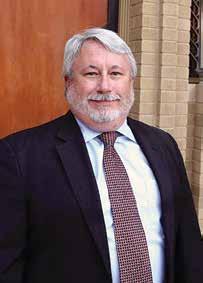
Our Foundations & the American Rule of Law A Message from the President Michael P. Taubman
Our American Rule of Law remains one of the most defining and stabilizing features of our constitutional democracy. Neither the preferences of any individual officeholder nor the pressures of shifting political winds should ever erode this durable framework that protects rights, restrains power, and ensures that justice is administered through established and impartial processes. This structure was not designed for speed or convenience but designed for fairness, predictability, and stability. I am reminded daily in our work that this bedrock principle is not self-sustaining; rather, it requires the active participation and guardianship of our courts, our attorneys, and the institutions of people that support them.
I believe that the Framers of our Constitution conceived that liberty would be preserved not by concentrating authority, but by limiting it. At its most reductive, at its essence, the Rule of Law is a doctrine of restraint. It instills power with boundaries, and it requires individuals, regardless of position or influence, to remain subject to the same legal standards. These are the aspirational qualities of great doctrines, which may fall short when put into practice by humans, like the notice on your vehicle that objects in mirror are closer than they appear. The mirror’s composition doesn’t change, but your perception of its reflection and your actions as a result may.
The Framers of our Constitution never boasted that they made HE PERFECT UNION. Benjamin Franklin’s

optimism at the Constitutional Convention in deciphering the visage of a rising Sun delicately carved into the President’s chair reminds us of the infinite nature of life’s travails. It beckons us forward towards the next tomorrow, and the chance to begin anew. Those assembled knew their job was the beginning of an endless journey, not the end.
WE THE PEOPLE of the United States, in Order to form a more perfect Union, establish Justice, insure domestic Tranquility, provide for the common defence, promote the general Welfare, and secure the Blessings of Liberty to ourselves and our Posterity, do ordain and establish this CONSTITUTION for the United States of America.1
Their aspirational voices resound with striving for improvement, casting bread upon the water to angle for catching more perfection – not stopping to reel it in as if having attained it.
In Tulsa, our history includes an on-going dichotomy of painful reminders of injustice that linger today among inspiring examples of resilience. The importance of these safeguards under the Rule of Law is deeply felt, and they remind us that justice must be grounded in principle, not preference. The legitimacy of our legal system derives from the integrity of its processes. Our Courts earn the trust of our citizens by applying the law impartially, transparently, and consistently. Trust in our legal system diminishes if personal or political influence unjustly forces outcomes. As attorneys, we contribute to their legitimacy by advocating ethically, respecting procedural norms, and ensuring that disputes are resolved through reasoned argument.
Since February 24, 1803 in our Nation, legal decisions have been interpreted through a partisan lens, as Chief Justice Marshall reaffirmed that the Rule of Law is
1 U.S. Const. Preamble.
not a mechanism for achieving political victories.2 It is a disciplined method for resolving conflicts in a manner that protects rights and upholds constitutional values. Its deliberative pace is a safeguard, not a flaw. Although national discourse often dominates public attention, the work of preserving the Rule of Law occurs primarily at the local level. The collective association of the women and men in our Bar serve as essential stewards of this work, promoting ethical standards, supporting access to justice, and strengthening the connection between the legal system and the larger community.
In Tulsa County, this responsibility is reflected in the programs and initiatives we undertake each year. Our Mentoring Committee is hosting a panel discussion on April 1, bringing together experienced practitioners, newer members of the bar, and the students of TU Law and our Street Law program to display and examine the professional values that sustain our legal system. Mentorship is one of the most effective ways to transmit the norms, expectations, and ethical commitments that give the Rule of Law its practical force.
Our Annual Law Day Luncheon will be held on April 23. The Honorable Dustin P. Rowe, Chief Justice of the Supreme Court of Oklahoma is our 2026 Law Day keynote speaker. Contact Tami and Jeril at our TCBA office soon to make sure your table is reserved, and let us know if you would like to support any additional seating or a table for interns and/or law students.
On May 1, we host Ask-A-Lawyer once again, providing an opportunity for attorneys to volunteer their time to assist members of the public seeking guidance on legal issues. I believe that this event reflects one of our most important responsibilities of the legal profession: ensuring that access to justice is not limited by financial means. When we help individuals understand their rights, we help strengthen the Rule of Law at its foundation. See page 15 for more details on Ask-A-Lawyer.
The Rule of Law faces significant challenges in the modern era. The speed at which information disseminates in the morass of social media appears to spread misinformation twice as rapidly. As distinctions between fact and narrative become obscured, the phalanges of distrust spread into our legal system as well. The tumor does not remain encapsulated as the temptation to treat the legal system as a tool for partisan advantage threatens to erode its neutrality.
These challenges require a renewed commitment from all members of the legal profession to aspire to continuously work at honing a union more perfect than yesterday, just as the framers did. The programs and events of our bar association are not merely calendar entries, but they are opportunities to reinforce for the public the values that sustain our democracy. Like our math teachers required that we show our work, we must continue to model
integrity, professionalism, and respect for the processes that give our system legitimacy.
If we are to secure the Blessings of Liberty, the American Rule of Law must remain the cornerstone of our civic life. As members of the Tulsa County Bar, we are entrusted with its preservation. Through mentorship, public engagement, professional development, and service to our community, we honor that responsibility. The work we undertake this spring — from our April 1 mentoring panel to our April 23 Law Day luncheon, to our May 1 Ask-ALawyer event — these all reflect our ongoing commitment to strengthening the legal system and upholding the principles upon which it rests.
In fulfilling these duties, we not only serve our profession; we serve the public and the enduring promise of the Rule of Law itself.
With appreciation and resolve,
Michael P. Taubman
TCBA President, 2025-2026
The Bar Center will be CLOSED
Friday, April 3rd - Good Friday
Wednesday, April 8th Annual TCBF Charity Golf Tournament
Thursday, April 23rd Law Day Luncheon
2 Marbury v. Madison, 5 U.S. 137 (1803).

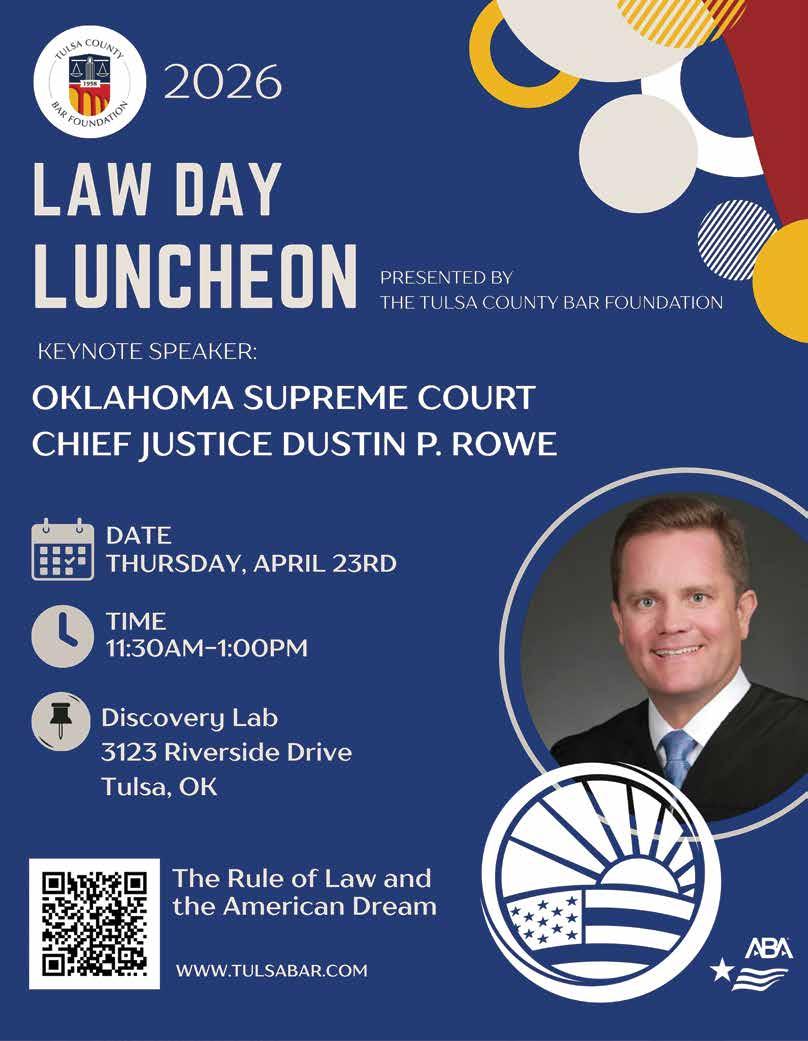
Law Day Keynote SpeakerOklahoma Supreme Court Chief Justice
Dustin P. Rowe
We are pleased to welcome the Honorable Dustin P. Rowe, Chief Justice of the Supreme Court of Oklahoma, as our 2026 Law Day keynote speaker.
A lifelong Oklahoman, Chief Justice Rowe’s career in public service began at age 18 as the state’s youngest mayor. After nearly two decades in private practice and a distinguished tenure as a judge for the Chickasaw Nation District Court, he was appointed to the Supreme Court of Oklahoma in 2019.
In addition to his leadership on the bench, Chief Justice Rowe is a dedicated educator, serving on the faculty of the National Judicial College and as an adjunct professor, ensuring his deep commitment to the rule of law reaches the next generation of legal professionals.
Scan the code on page 4 to reserve your seat now. The event is expected to sell out quickly.


Summary of ABA 2026 Midyear Meeting
Molly Aspan, Tulsa County Bar Association Delegate to the ABA House of Delegates
I was honored to serve as the Tulsa County Bar Association Delegate at the ABA Midyear Meeting in February. The House of Delegates met for its business meeting on February 9, 2026, and, in addition to discussing and adopting almost 30 measures, heard remarks from ABA President Michelle A. Behnke of Wisconsin, ABA President-Elect Barbara J. Howard of Ohio, ABA Executive Director Alpha M. Brady, and others. Laura Farber of California accepted the nomination to serve as nominee for ABA President-Elect, following current ABA PresidentElect Howard, who will become President following the ABA Annual Meeting in August. Jonathan Cole, chair of the House of Delegates, presided over the meeting, and the House Nominating Committee named Aurora Austriaco of Illinois as Chair of the House of Delegates for the 2026-2028 term.
The ABA is one of the largest voluntary associations of lawyers in the world. As the national voice of the legal profession, the ABA works to improve the administration of justice, promotes programs that assist lawyers and judges in their work, accredits law schools, provides continuing legal education, and works to build public understanding around the world of the importance of the rule of law.
The nearly 600 delegates from various ABA entities and state, local, and specialty bar associations adopted almost 30 policy matters on a wide range of issues including judicial independence and safety, Public Service, Loan Forgiveness, the independence of the Department of Justice, and Medicaid funding. House proposals do not become ABA policy until they are approved by the House of Delegates. These policy proposals enable the ABA to lobby legislators and file amicus briefs in these policy areas. Below are summaries of a few of the resolutions and reports that were approved by the House of Delegates.
• Resolution 100 proposes to amend the ABA Model Rules of Professional Conduct by replacing Model Rule of Professional Conduct 1.14 and its accompanying Comments, which provide guidance to lawyers working with people who have limitations that affect their ability to make decisions, including decisions related to a representation. The proposed amendments replace the term “diminished capacity” with “client with decision-making limitations” and a definition of the new term enumerates the requirements that must be met for a lawyer to take protective action and eliminates
language singling out certain types of protective action (e.g., guardianship), and rewords the final paragraph of the Rule to provide clarity as to when disclosures are permitted.
• Resolution 200 opposes threats and acts of violence, harassment, and intimidation directed at federal, state, local, administrative, tribal, and territorial judges, court personnel, and their families. It also encourages bar associations, law schools, and civic organizations to promote public understanding of the role of an independent judiciary and to respond to attacks that threaten judicial independence and safety.
• Resolution 400 urges state and territorial bar associations to conduct periodic economics of law surveys covering income, billing practices and hourly rates, billable hour requirements, receivable requirements, and retirement and other benefits, with demographic breakdowns where practicable, including breakdowns on full or part time status, years in practice, firm size, practice area, and metropolitan or rural locale.
• Resolution 401 urges the National Conference of Bar Examiners to include Trust and Estate Law as a Foundational Concept and Principle on the NextGen bar exam.
• Resolution 504 urges the Executive Branch and loan servicers to resume accepting and processing student loan forgiveness applications, periodic employment and income recertifications, and repayment plan change requests for all borrowers engaged in eligible government and public sector employment.
• Resolution 505 supports a series of positions addressing past, present, and future challenges to the federal Public Service Loan Forgiveness program, allowing the association to advocate and lobby for the program even if there are new rule changes.
• Resolution 507, which opposes legislation, regulates policies and practices that reduce Medicaid funding, denies or terminates enrollment of eligible individuals or restricts coverage in a manner inconsistent with the Medicaid statute’s purpose and requirements. It urges governments to strengthen due process protections and promote transparency and accountability in the administration of Medicaid and supports educating legal
professionals and communities about Medicaid and the legal rights of individuals concerning eligibility for and enrollment in Medicaid.
• Resolution 508 urges federal, state, and local officials to prevent and mitigate the dangers of emerging Generative Artificial Intelligence and deepfake technology in tech-facilitated abuse involving students.
• Resolution 510 urges the president and all executive branch officials to safeguard the independence of the U.S. Department of Justice by ensuring that investigative and prosecutorial decisions are free from political influence. It also calls on federal, state, and local officials to reaffirm that prosecutorial decisions are made free from partisan, political, or personal influence and encourages all jurisdictions to adopt formal policies that explicitly prohibit initiating, directing, or restraining prosecutions for political purposes.
If anyone would like further information on any of these resolutions or reports, or would like the complete list of resolutions adopted, please do not hesitate to reach out to me.
Following her remarks at the Midyear Meeting, ABA President Behnke released a statement on behalf of the ABA on personal attacks against Supreme Court
justices and urging all leaders to exercise restraint in public discourse concerning the judiciary, along with urging fellow bar associations to defend the critical work of our courts and all Americans to uphold the principles of respect, civility, and the rule of law that sustain our democratic institutions.
Lynn Miller Law Day Book Club 2026
April 28 - Confederacy of Dunces, John Kennedy Tool
May 26 - The Worst Hard Time: The Untold Story of Those Who Survived the Great American Dust Bowl, Timothy Egen
June 23 - My Friends, Fredrik Backman
July 28 - North Woods, Daniel Mason
August - off
September 22 - Agatha Christie, A Hidden Life, Lucy Worsley
October 27 - The Buffalo Hunter Hunter, Stephen Graham Jones
Contact frontdesk@tulsabar.com for more information


TCBA Happenings...
February 25th - Member
Appreciation Event - CPR, AED & Basic First Aid Course
Members recently had the opportunity to strengthen their life-saving skills at a CPR and First Aid training hosted by the Tulsa County Bar Association as part of our ongoing commitment to member wellness and professional readiness. Participants learned hands-on techniques for responding to cardiac and medical emergencies—skills that can make a critical difference both in and out of the workplace.
Offering practical programs like this is one more way the Bar supports attorneys beyond the practice of law, fostering a community that looks out for one another and for those we serve. We’re grateful to everyone who attended and to our instructors for helping equip our members with confidence to act when it matters most.
Fund the Foundation

The Foundation owns the Bar Center and the adjacent building. The rentals from those two buildings help maintain them. However, as a general rule, the Foundation raises funds through community fundraising events. The funds raised are immediately distributed to the community through nonprofit organizations. To support the Foundation's efforts, we have introduced a monthly "Fund the Foundation" program to raise funds for the Foundation's general fund. Scan the QR code to make a donation

Fellows Program
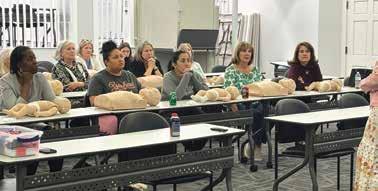
The Fellows Endowment Fund is more than a donation—it is a permanent, invested legacy. Contributions to this fund are not spent immediately; rather, they are invested to generate income in perpetuity. A portion of this income supports our annual scholarship program, while the principal grows, providing a permanent, reliable source of funding that shields our mission from economic fluctuations. Fellows agree to pay $1,000 in $100 increments over ten years, or in one flat donation. Members may also sign up as a Sustaining Fellow, agreeing to pay $100 annually until they choose to stop contributing. Interested in becoming a Fellow? Contact Tami Williams at tamiw@tulsabar.com.





Strikes, Spares, and a Two-Pin Scare!






Talk about a nail-biter! While Team Great Balls of Fire took home the gold, the highlight of the night was the intense showdown for the runnerup spot. Team Great Balls of Fire (Charney Brown, LLC) managed to edge out the Bowling Giants (Jayne Peters McVicker Burke Askew and Parker, LLC) by a razor-thin margin of only two pins!
It was a true testament to the talent at AMF Sheridan Lanes, where every single frame counted. Out of 16 competitive teams, the energy remained high until the very last ball was thrown. Huge congratulations again to Team Great Balls of Fire for the win, and kudos to our finalists for providing the most stressful (and exciting) finish of the season!





Team Great Balls of Fire

VP's Corner Shena Burgess A Word of Advice
My best advice to give to the members of the Tulsa County Bar Association: The twenty-four-hour rule.
If you have ever been an intern or student of mine, then you have heard of the twenty-four-hour rule. During the practice of law, you will win big but on the flip side you will also lose big. My advice to students is when you win big, you are the best lawyer in the history of the world! You accept praise. You tell stories. You rejoice. But what about when you lose big? You look at the clock and for the next twentyfour hours you can complain, second guess, mourn, and just be sad. But, when that clock strikes the twenty-four-hour mark, it’s over. Whether it’s celebration or indignation.
Why? Because you have other clients, you have family, you have friends, and frankly you have a life outside of that event. The first trial I was a part of was tried three times. Two hung juries and then a guilty on a lesser included. I believed my client was not guilty. I was torn up. I second guessed every choice that was made in trial. I wondered if we had failed our client. If the justice system had failed. After twenty-four hours, I was exhausted. And I knew that if I wanted to be a trial lawyer, I had to set boundaries. It was at that point; I knew my limitations.

This twenty-four-hour rule has served me well for the last twenty-five years. It applies to trials, that annoying email that you should not respond to until the next day, or just life. What rules have served you well during your career? Send me your best advice to share with our members. Sburgess@ smilinglaw.com
Shena Burgess TCBA Vice President, 2025-2026

Tulsa County Law Library Embodying the Spirit of the Law

The phrase “Spirit of the Law” is a phrase imbued with a great wealth of meaning. It is a phrase that has influenced and shaped our country’s laws. In its most literal sense, the phrase is invoked to ascertain the legislative intent behind a given statute, and if this intent is not plainly clear, then to enact the law to the extent it does not create an absurdity, the concept of which is set forth in HerreraChacon v. State, 2023 OK 52.
In a more abstract sense, the “Spirit of the Law” can embody the concepts of what we perceive as being “justice” or “liberty.” One might even argue that the “Spirit of the Law” functions as the law’s enigmatic heart. Much like how the heart drives the body, the Tulsa County Law Library assists in driving forward the practice of law for those patrons who have availed themselves of the library’s document courier service and resources. The document courier service allows attorneys the liberty to work remotely while also accomplishing their filing needs by either picking
up a signed order or simply filing a document in a case for you. You might be surprised to know that the two staff members of the Law Library process an average of 25 to 30 requests each day for various attorneys and law firms.
It is in this capacity of service that the Tulsa County Law Library is able to embody the Spirit of the Law and drive progress by serving as a space that a patron can find renewed vigor for the law. The Law Library offers a tranquil space to research, organize your thoughts, take a mental break, or work on your laptop for a while. The Law Library is even equipped with the resources to meet many seemingly “absurd” needs of a patron. For example, the Law Library is capable of stapling large sized documents (i.e. 20 - 75 pages), copying your stapled document without removing the staple, and providing you with scissors and tape to assemble a cut and paste Frankenstein-esque document, if that is your desire. At the Law Library, other physical resources like correction tape are a simple request away.
At the Tulsa County Law Library, you have the freedom to peruse numerous useful legal research resources so that you may help protect the rights of your clients. Here, you may find the physical or digital legal resources that you need to ascertain the intent behind a statute or information to understand the Court’s ruling. You can also find helpful information pertaining to Local Court Rules and procedures by accessing one of our four computer terminals. Come visit us on the second floor of the Tulsa County Courthouse to see what we have to offer.


Voices of the Tulsa County Bar Association Judge Gerald Jackson
Magistrate Judge, U.S. District Court for the Eastern District of Oklahoma
By Ralph Schaefer
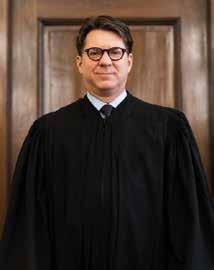
Judge Gerald Jackson says his legal career was filled with stumbling blocks en route to becoming a U.S. Magistrate Judge for the U.S. District Court for the Eastern District of Oklahoma.
Now, as a magistrate judge, he finds himself operating in the “wild west” because of the volume of criminal cases. When someone asks if the court is busy, he says that “Crime never sleeps in the Eastern District and neither do the judges.”
Being in the courtroom is a dream come true for Judge Jackson, who wanted to be a lawyer at a young age.
The Missouri native, who graduated from the University of Tulsa College of Law, met Betsy Grabel who would later become his wife following their graduation from TU in 1990.
Fallout from the 1980s oil bust was still being felt, and the new graduate’s legal career was almost derailed. The first stumbling block occurred when he applied for jobs with large Dallas-based law firms.
Judge Jackson had interviews with several Dallas firms and returned home to wait for callbacks.
A week later, while reading a legal paper, he saw an announcement that two of the firms he had just interviewed with had laid off a large portion of their
fifth and sixth-year associate attorneys. He admitted he didn’t understand how law firm economics worked at that time because he “was just a law student.”
“I think it’s fair to say I responded irrationally and freaked out about the situation,” he said. “I felt my whole plan had just gone out the window. I had to sit down and think about what I wanted to do as a backup and where I wanted to live.”
While doing his research, Judge Jackson felt that Washington, D.C. would be a fun place to live and work because the government has so many attorneys, so he sent his resume to numerous federal agencies.
“Somewhat surprisingly, I got a job pretty quickly!” Judge Jackson exclaimed.
Shortly after he moved to the capital city, he convinced Betsy to join him, and they were married a few years later.
Betsy’s job hunt wasn’t easy. The couple found themselves amidst congressional budget fights, furlough notices, and agency hiring freezes. Despite a struggle, Betsy found a clerkship with a bankruptcy judge and later a position with a national law firm.
At the U.S. Department of Agriculture, Judge Jackson was assigned to the Food and Nutrition Service, the agency that administers the food stamp program, which has evolved into SNAP, WIC, the school lunch program, and more.
“I did a lot of regulatory work and some litigation working with the local U.S. Attorney’s offices,” Judge Jackson said. “It was interesting for a while.”
But the young attorney felt that he was a small cog in a big wheel with little opportunity for advancement.
Judge Jackson jumped at the opportunity to join the legal staff of the U.S. House Committee on Agriculture, a position that, ironically, oversaw the Department where he previously worked.
It was 1995, and Newt Gingrich had just become Speaker of the House of Representatives. The Contract with America was being developed, and Judge Jackson’s first task was to work on the welfare reform bill.
“At the committee, I was immediately handed way more responsibility than I probably should have had at age 30,” he said.
But it was fun, dynamic work, and a 180-degree turn from the glacial pace of his Agriculture Department responsibilities.
The pace was fast, Judge Jackson continued, “we worked long hours, but we were making a real and meaningful impact.”
“I went from working on regulatory policy at the Department that took years to implement to developing and drafting a fundamental overhaul of decades of welfare policy in only a couple of months.” One had to learn fast. “Once I found myself in a small circle of people discussing these hugely important issues. Here are politicians like Newt Gingrich and Bob Dole, people I grew up watching on television, and now I am discussing major policy issues with them.”
“It is hard to imagine achieving that experience anywhere else. Taking on that level of responsibility at that age taught me I was capable of more than I imagined and it would not have been possible in Oklahoma or anywhere else.”
Judge Jackson and Betsy’s legal careers took a second bump and an abrupt turn in 1996. Betsy’s brother-in-law, a 36-year-old Tulsa attorney, died from a heart attack, leaving a family that included two young children.
Together, they sat down and recalibrated, deciding what’s important and what really mattered was their families. They returned to Tulsa.
Judge Jackson joined Barkley & Rodolf, where he did medical malpractice defense and civil litigation.
About a year later, he moved to Crowe & Dunlevy, where he had a business litigation practice for 25 years, “and I loved it.”
Judge Jackson’s work involved business disputes of varying sizes ranging from securities fraud cases to contract disputes and everything in between.
“I loved every minute of the work,” he said. “It was a
blast. It’s what I always thought I was going to do when I became a lawyer. I was finally a trial lawyer and got to go to court.”
While Judge Jackson enjoyed going to court, he also found it a challenging situation, as he spent a lot of time in the office. “I used to tell people that my worst day in court was better than my best day in the office,” he said.
A telephone call set the stage for the third and final career bump. There was an opening for a federal magistrate judge in the Eastern District of Oklahoma, and the caller urged him to apply.
Congress created the judicial opening due to the increased caseload resulting from the U.S. Supreme Court’s McGirt v. Oklahoma decision.
The High Court held that the domain reserved for the Muscogee Nation by Congress in the 19th century had never been disestablished and constitutes Indian country for the Major Crimes Act, meaning that the State of Oklahoma has no right to prosecute American Indians for crimes allegedly committed therein. The Oklahoma Court of Criminal Appeals applied the McGirt rationale to rule that nine other Indigenous nations had not been disestablished.
After giving the idea some thought he decided to put his “hat in the ring and give it a shot.” “I went through the lengthy process, came out on the other side, and was selected.”
Suddenly, Judge Jackson’s legal focus shifted.
He had spent his entire career looking up at the bench. Now he was looking the other way.
When moving into his chambers, the court Clerk gave him a tour of the courthouse. Entering the empty courtroom from the judge’s entrance was eye opening.
“To have my viewpoint completely flipped was surreal,” he said. “Unbeknownst to me, everything in my zigzagging career path had been leading to that exact moment. Everything I had done professionally suddenly made sense in a coherent way.”
“I felt like I was in the right place doing the thing I was meant to do. It is hard to describe the feeling because it likely doesn’t make sense to anyone else,” Judge Jackson added.
In his second week on the bench, Chief Judge Ronald
Continued on next page...
White assigned Judge Jackson a complicated multi-day evidentiary hearing in a criminal case.
Judge Jackson didn’t even have his robe yet, so Magistrate Judge Kimberly West loaned him one that belonged to her father, Judge Lee West, who had served Oklahoma’s Western District.
Stepping into the judicial role “felt natural” for Judge Jackson. While he was nervous at that first hearing, the new judge felt he was ready.
He applied his experiences from his work in Washington, D.C. and private practice. “It felt weirdly natural.”
One of his biggest challenges is managing his busy civil and criminal dockets. “You have to engage in active case management to get and keep cases moving,” he continued. A judge must stay on top of his docket and not let delays be the court’s fault wherever possible.
That has been a difficult and somewhat unique challenge in the Eastern District because of the sudden caseload increase resulting from the McGirt decision.
Because attorneys are the ones requesting frequent extensions, it is necessary to push them. Attorneys always say they are “so busy,” something Judge Jackson understands due to his own experiences in private practice.
“I respect that they are busy and I am happy for them,” he said. “But there is only so much a court can do to move a case if the lawyers aren’t pushing it forward. As a lawyer, typically the most important deadline is the next deadline. Often, the lawyers aren’t looking over the scheduling order horizon as much as the court.”
“For the first time in my career I have some control over my schedule and can schedule things in a way that I never could in private practice. It’s important that the court take the initiative to do everything that can be done to keep cases moving, whether to get it ready for trial, dispositive motion or settlement.”
While most civil cases settle, the judge must hold the parties and their attorneys’ feet to the fire to get the case to the ultimate resolution.
Judge Jackson’s Tulsa County Bar Association membership has played an important part in his career.
While he has had limited formal involvement in the organization, he recognizes the importance of attending
annual meetings and other events. These activities introduced him to fellow attorneys and helped develop friendships.
“I was always so busy with my legal practice and life in general,” he said. Meeting and interacting with lawyers from other firms helped bridge the gap between the professional and the personal when litigating against them.
The TCBA meetings and luncheons provide opportunities for collegial, collaborative interactions that aren’t possible on a day-to-day basis in the adversarial environment of litigation.
“These are now people you know personally before litigating against them,” Judge Jackson said. The courtroom is a very different environment from sitting down to having a meal and conversation with someone. It is possible to have a conversation without having a goal-centered outcome.
“I think it is a fabulous way to expand your own circle among lawyers, and that kind of engagement helps a lawyer collegiality.”
“It’s hard to be snarky towards an opponent in pleadings or be obstructive in a deposition when you know them on a personal level.”
That opponent might have been the same person they had lunch with the day before the deposition.
“There is no need to make legal arguments personal,” Judge Jackson continued. “I have seen attorneys go at each other, attacking the other’s character or honesty. It doesn’t benefit the attorney or the client, and it doesn’t help persuade the judge or the jury. It simply diminishes you as a person and as an attorney.”
Any judge does more than sit on the bench and make rulings.
Judge Jackson admits that he does more research today than in previous years in private practice when he had many associates to help.
“I want to understand the facts of the case as well as the relevant caselaw,” he said. “That extra research helps me be confident that the decision I reach is my best effort at getting it right.”
The transition to the bench is the pinnacle of Judge Jackson’s career that started in and has returned to
public service.
“I enjoyed being a trial lawyer, I worked with great lawyers in great firms, and had wonderful clients,” he said. “Then someone comes along and offers you something different, and you’re like ‘Wow!’ I didn’t even know this thing existed or was possible. It’s like finding a pot of gold at the end of the rainbow.”
Judge Jackson’s family has been supportive and at times bemused by his new role. He initially received many gifts with judge themes, including a personalized bobblehead and the nickname “Judge G”.
Betsy, a business and transactional lawyer at Hall Estill, has never litigated or practiced in areas opposite her husband.
“She finds the judicial role has been rejuvenating for me,” he said. “I wake up and can’t wait to get to work.”
One issue was quickly resolved.
Everyone stands when a judge walks into the courtroom.
That is not true at home.
When Judge Jackson first became a judge and walked into the room, Betsy just laughed and said, “Yeah, I’m not doing that.” He noted, “Judges, perhaps especially judges, need the occasional humbling.”
Voices of TCBA
This innovative project, by the TCBA Law Week Committee, aims to preserve and share the rich stories of our members and the history of the Association.
Members interviewed are encouraged to contribute their unique experiences and insights, reflecting on their journeys within the legal profession and their connection to the TCBA. Through this initiative, we strive to highlight the diverse voices and histories that shape our community.
Leading the project and interviewing members is Ralph Schaefer, retired senior editor of the Tulsa Business and Legal News. He has interviewed U.S. Supreme Court Justices and did a series on the Oklahoma Supreme Court Justices. The Tulsa County Bar Foundation and Oklahoma Bar Association honored him with the Liberty Bell Award, the highest recognition for a non-lawyer.
Your voice matters, and we look forward to celebrating the legacy of the Tulsa County Bar Association. Let’s bring our stories to life!


Community Corner TCBA Community Outreach Committee Events, Opportunities and Success!
Community Outreach Committee in Action: Fighting Hunger Together
On February 21, the Tulsa County Bar Foundation (TCBF) Community Outreach Committee rolled up their sleeves for a high-impact morning at the Food Bank of Eastern Oklahoma.
Working alongside a group of dedicated students from Union High School, our volunteers hit the warehouse floor to help tackle food insecurity in our region. The collaboration was a massive success, resulting in an incredible amount of food prepped for distribution: 11,737.50 pounds! Efforts helped provide thousands of meals to families across Eastern Oklahoma.
The Foundation extends its sincere thanks to the members who dedicated their time to this effort. It was an impressive display of community spirit—and a lot of heavy lifting—for a vital cause.

April Community Outreach Committee Meeting
Tuesday, April 21 at noon Meetings are held in person at the bar center with a virtual option to attend.


April Community Outreach Committee Activities
• Eat Out for A Cause @ Jimmy's Chophouse Benefitting Reading Partners - Date TBA
• Volunteer Activity with City Lights Foundation - April 9th - See page 5 to register!
Voices of the Tulsa County Bar Association Mac Finlayson
By Ralph Schaefer
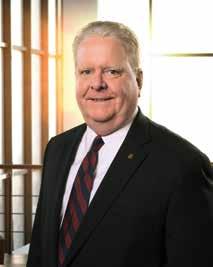
Model firetrucks and fire department shoulder badges are part of Mac Finlayson’s law office decor. Both are part of the Eller & Dietrich Law Firm senior counsel’s life.
Volunteer firefighting came later in the Nathan Hale High School graduate’s career.
First was law.
It was during those formative high school years, while taking a business law class, that he became intrigued by law. Mac double majored in political science and psychology.
He finished his political science degree in two years at Drury College, with a double major in psychology, graduating in 1973.
While at Drury, he interned in the psychology department at the United States Medical Center for Federal Prisoners in Springfield, MO. At that time, USMC Springfield was the only medical facility in the federal prison system. The Lexington, Kentucky facility was being built, and the Fort Worth facility wasn’t even an idea at that time.
Mac applied and was admitted to a graduate program in psychology at Texas Christian University. TCU placed a strong emphasis on experimental psychology, and Mac found he really didn’t want to work in a prison system. Nor did he want to work in a laboratory. Teaching was not on the radar screen.
“I thought I could have a better career in law,” he continued.
The TU College of Law was his choice, and he earned his Juris Doctorate Degree in 1976.
At first, Mac considered criminal law, but after working in the federal prison system, that choice was quickly eliminated.
“I was kind of bumping around until I clerked for Legal Aid of Tulsa,” he continued. “That work kind of intrigued me, and I gravitated to the civil side of the law practice.”
Mac interned at Woodson & Gasaway, where he worked in creditors’ rights, probate, and bankruptcy. “Fred Woodson was a Chapter 13 bankruptcy trustee, and he filed many debtor cases outside of Chapter 13,” he recalled.
Hooked “on the bankruptcy side of things,” Mac turned his attention to working with creditors’ rights in bankruptcies. Clients include banks, credit unions, and anyone who has a claim in bankruptcy court. It could also be a landlord.
When the Woodson & Gasaway firm dissolved, Mac chose to remain with Fred Woodson and “got his feet wet” in bankruptcy cases. “I ended up doing a lot of trustee and general bankruptcy work,” he said.
Similar work was on the desk when Mac joined Jones Givens.
For years, he has helped renters, pro bono, at the eviction docket, helping them get reestablished after losing their homes and protecting them from predatory rental practices.
Mac does not know how many pro bono cases he handled.
Some tenants are good people who find themselves in bad situations, he said. These are not the problematic ones that try to get by with something.
“I mean, these are renters, for example, day laborers, people you see working on the streets and road crews. They get hurt and are out of a job. These are unfortunate circumstances that they can’t avoid, and the system takes advantage of them.”
Some landlords take advantage of people by using the eviction docket, Mac said. Oklahoma law states that if one doesn’t pay rent, there really is no defense to eviction.
If people don’t show up in court, the landlord will get a judgment for possession and damages.
Unfortunately, people often don’t come to court because they have been beaten up most of their lives, Mac added. They are used to giving up because they don’t see any other way out. That is why they are encouraged to come to court. Unless they make that appearance, it is just a matter of days before they have to face that eviction reality.
Most people who come to court are very appreciative that someone really cares and will help them for free.
Under Oklahoma law, after a trial, the court will issue a writ of assistance to the sheriff. The sheriff will serve that writ, and the tenant has 48 hours to move out.
That is not two days, Mac said. It is 48 hours on the button, and if the tenant is still there, they will be locked out of their residence.
“What I try to do is make it more of an orderly process to give people time to find some place to go,” he said. “Usually, I can get about two weeks to move, unless they are a problem tenant.”
That time allows the evicted tenant to make arrangements for their property and find a place to stay until a new rental is found.
Rental assistance programs are available in Tulsa, and some landlords want to take advantage of that, Mac said. A “pay and stay” program might be used until that assistance is received. As long as the payments are made, the tenant can stay on the property.
Today, Mac has a couple of credit unions, banks, and special assets people.
Mac and his late wife, Lori, might have expected a quieter life when they moved to Beggs more than two decades ago.
Then a neighbor recruited Mac to join the Beggs Volunteer Fire Department. No, it is much more sophisticated than the one on “Green Acres.”
Mac quickly found that being a volunteer fireman didn’t just mean getting on a truck and putting water on the blaze. You know, the fun stuff.
Training was required, and he attended classes every weekend for 6 months and 2 evenings a week. Live fire training was held on weekends.
Nowadays, the Oklahoma State University Fire Service Training uses certified instructors to do the training.
One must be physically and mentally prepared to do that kind of dangerous work, he said. People get in trouble without that knowledge. “I didn’t really know what to expect when I joined the fire department,” Mac said. “But I found it to be very rewarding.”
Mac has since moved to Jenks but continues to be involved with the Beggs department. He serves as a captain and does administrative work.
“I am 75 years old and not anxious to crawl into burning buildings. I did enough of that, but you get to an age where you essentially are putting other people’s lives at risk. You are not as agile or strong as you once were. These are qualities that firefighters need.”
The rewards have been unexpected.
He helped organize fire safety education classes for adults and children, teaching them about safety and how to escape from a burning home.
Mac’s late wife bred and showed Dalmatian dogs, and Dayna Hilton, an Arkansas volunteer firefighter, bought one. She named her “Sparkles” and trained her to demonstrate what to do in an emergency.
Sparkles made an impression on the children as she crawled across the stage to a mailbox. The idea was to get low, get outside to a meeting place, and count heads.
The school principal told the story.
A fire broke out in one of the elementary students’ homes. The little girl woke up in the smoking residence. She used what she had learned in class and got her dad out. He was groggy because of smoke inhalation and spent a month in the hospital.
“We knew we had a winner,” Mac said.
Like his law practice, he found people weren’t having a good day when services were needed.
As an attorney and a firefighter, being able to relate to people and help them is critical, he continued. It is important to know how, what, and why they think as they do.
Mac is a member of the Tulsa County Bar Association and the Oklahoma Bar Association.
He served as the TCBA pro bono committee chair for five years, as well as on other committees. In addition, he has been active in both the TCBA and OBA bankruptcy sections since their formation.
“I don’t know how you can be part of the system without the opportunity to meet people you are going to be working with,” he said. “Getting to know lawyers outside the courtroom helps us relate to each other and solidifies friendships when you are on opposite sides in the courtroom.”
“When you walk out the courtroom door, you are not enemies.”
Continued on next page...
Mac recalled a case shortly after he started practicing law.
He was involved in a contentious hearing, and the other lawyer, who was in his law class, was his opponent.
After the hearing, they decided to go to lunch.
The client heard the invitation and was very upset because the attorneys were not antagonistic. They expected the attorneys to have the same attitude towards each other outside the courtroom.
Reflecting on his legal career that spans nearly 50 years and his involvement as a volunteer fireman, Mac said, “the reality is that with legal representation or the fire department, people don’t call us because they want to hear from us. They usually are in trouble.”




Grapevine News
Hall Estill is proud to announce the addition of five new attorneys to its team, further strengthening its dedication to exceptional legal service and continued growth. With offices in Tulsa, Oklahoma City, Denver, and Northwest Arkansas, Hall Estill remains committed to its tradition of legal excellence and delivering client-focused solutions.
“We’re pleased to welcome our newest attorneys to our Tulsa and Oklahoma City offices,” said Steve Ray, Managing Partner at Hall Estill. “Each brings fresh perspectives, strong skills, and energy to our practice areas. As our team continues to grow, we’re strengthening our firm for the opportunities ahead in 2026.”
New Attorneys
Jonathan A. Graber, is Of Counsel in the Tulsa office and serves as Chief Legal Officer for Penelope Holdings. Graber advises clients on advanced business structures, asset protection, and risk mitigation planning. In addition, he handles complex finance transactions and the development of sophisticated tax strategies. Further, he is a licensed real estate broker in Oklahoma and is licensed to practice law in both Oklahoma and Wyoming.
Alexandra “Alex” M. King, is an Associate in the Tulsa office. King focuses her practice on civil litigation, oil and gas, and contract law. She brings diverse legal experience shaped by leadership roles in the Business Law Society and Women’s Law Caucus at the University of Tulsa College of Law, as well as service as Business Manager of the Tulsa Law Review, and a judicial externship with the Honorable Christine D. Little.
Bailey L. McKay, is an Associate in the Oklahoma City office. McKay focuses his practice on commercial and business litigation, personal injury, premises liability, and insurance law and tort defense. In addition, he represents insurers in pre-suit matters, advising on strategy and developing effective approaches to early resolution.
Kevinn Matthews was recently recognized with an award in recognition of his efforts volunteering in the community. The award was presented by the chair of the Bixby Metro Chamber of Commerce. He was nominated for the ward by Jeff Frable, Board Chair.

L-R: Jeff Frable, Board Chair, Kevinn Matthews, Krystal Crockett, President/ CEO of the Bixby Metro Chamber of Commerce.
Photo used with permission of Bixby Chamber of Commerce
Lawyers Helping Lawyers

LHL hosts a monthly meeting led by a LHL Committee member. The small group discussions are intended to give group leaders and participants the opportunity to ask questions, provide support and share information with fellow bar members to improve their lives –professionally and personally.
Meetings
5:30-6:30 p.m.
Second Thursday of each month
“No matter how much falls on us, we keep plowing ahead. That's the only way to keep the roads clear”
~ Greg Kincaid, Author and Attorney
Office of Scott Goode





2025-2026 TCBA CONTACTS, COMMITTEE & SECTION CHAIRS
www.tulsabar.com
PHONE: 918-584-5243 FAX: 918-592-0208
1446 South Boston, Tulsa, OK 74119-3612
Executive Director
Tami Williams tamiw@tulsabar.com Ext. 1002
Membership Director CLE, Sections & Committees Ext. 1001
Front Desk Coordinator
General Inquiries frontdesk@tulsabar.com Ext. 1000
Accounting accounting@tulsabar.com
Lawyer Referral & Community Resource Navigator
Jeril Haug
jerilh@tulsabar.com Ext. 1003
Tulsa Lawyer Editors - Rhiannon Thoreson Madison Cataudella
Associate Editor - Milly Dunlap
Tulsa Lawyer Submissions - tulsabarnews@yahoo.com
TCBA OFFICERS
President .............................................................Michael Taubman
Past President......................................................Stephanie Jackson
President-Elect............................................................Billy Duncan
Vice President...........................................................Shena Burgess
Secretary................................................................. Jennifer Struble
Treasurer.....................................................................John Gotwals
Budget/Internal Operations..............................Madison Cataudella
Director at Large (1) Large Firm...............................Sean McCalip
Director at Large (2) Large Firm................................Natalie Sears
Director at Large (1) Medium Firm.......................Jason McVicker
Director at Large (2) Medium Firm................................Kara Pratt
Director at Large (1) Small Firm...........................Spencer Pittman
Director at Large (2) Small Firm..............................Mary Clement
Director at Large (1) Public Sector................. Judge April Seibert
ABA Delegate............................................................ Molly Aspan
OBA Delegate.............................................................Philip Hixon
Library Trustee (1).................................................Caitlin Getchell
Library Trustee (2)...................................................... Julie Evans
Presiding Judge .................................................Hon. David Guten
Chief Judge, U.S. District Court ..................Hon. John F. Heil, III
Chief Judge, Tulsa Municipal Court....... .Hon. Gerald Hofmeister
TU Law Student Bar Representative......................Kolten Johnson
TU Law School Representative..............................Morgan Moore
YOUNG LAWYERS DIVISION BOARD
YLD Chair......................................................................Kyle Trice
YLD Past-Chair....................................................Lacy Williamson
YLD Chair Elect........................................................Isaiah Brydie
YLD Vice President.................................................Morgan Smith
YLD Treasurer..........................................................Bryan Seaton
YLD Secretary.................................................Nathan Miramontes
FOUNDATION APPOINTMENTS
Law Day Chair ....................................................Tana Van Cleave
Community Outreach................................................ Ashley Webb
Community Outreach Co-Chair...................... Madison Cataudella
Golf Chair................................................................Michael Thelen
Scholarship Chair.....................................................................TBD
FOUNDATION
President....................................................................Kara Vincent Treasurer...........................................................Catherine Hoopert
Trustee...............................................................Stephanie Jackson Trustee.................................................Timothy Michaels Johnson
Trustee..........................................................................Rick White Trustee.........................................................................Lizzie Riter Trustee ..................................................................Chad McLain
Trustee .....................................................................Mike Esmond
Trustee ...................................................................Ashley Webb
TCBA President.................................................Michael Taubman
COMMITTEE CHAIRPERSONS
Access to Justice... .............Katie Dilks
Animal Law ............Katy Inhofe
Animal Law Co-Chair .........Erica Grayson Bench & Bar..............................................Austin Bond & Mbilike Mwafulirwa
Children & the Law.......................................................Lexie Allen
Children & the Law Co-Chair .......Michael Nesser
CLE...........................................................................Morgan Smith Diversity Development...............................................Matt Ingham
Diversity Development Co-Chair .......Marvin Lizama Fee Arbitration.............................................................Scott Savage Law Related Education / Street Law Co-Chairs.............................. ............................... Trevion Freeman, Pierre Robertson, & JP Ray Lawyer Referral .............................................. ............Alan Barker
Mentor/Mentee....................................................Kevinn Matthews
Military/Veterans ...........Diana Cupps Nominations & Awards........................................Stephanie Jackson Pro Bono Chair...............................................................Eric Yoder
Membership.....................................................................Kara Pratt
Publications......................................................Rhiannon Thoreson
Publications Co-Chair Madison Cataudella
Special Events ................................................. ..........Natalie Sears
SECTION CHAIRPERSONS
ADR/Mediation................................................... .......Zack Brown
Bankruptcy ..Hon. Paul Thomas
Business/Corporate................................................Spencer Pittman
Criminal Law ...........Dustin Allen
Energy & Mineral Law.............................................Buford Pollett Employment Law ..........Chris Vaught Family Law ..........................................Anastasia Krich-Mahoney Health Law................................................................Shelby Fields Immigration ............................................................Maria Mattern Juvenile Law. .......Michael Nesser Juvenile Law Co-Chair..................................................Lexie Allen Litigation Co-Chairs...........................Jake Pipinich & Don Smolen Municipal Law.........................................................................TBD Native American Law Section................................Hannah Scandy
Paralegals/Legal Assistant.......................................Danna Malone
Paralegal /Legal Assistants Vice Chair.....................Sabrina Kallam
Paralegals / Legal Assistant - Secretary..............Ashleigh Casebolt
Probate/Estate/Elder Co-chairs............ ..Linda Van Arkel-Greubel ......................................................................... ....... & Justin Munn
Solo/Small Firm .......................................................Mary Clement
Tax......................................................................Alexander Bratton Technology ...............................................................Trevor Riddle Workers Comp.........................................................................TBD
Workers Comp Co-Chair ................. ......TBD * Section Chairs will be updated as positions are filled