CONTENTS J U LY- S E P T E M B E R ,
2 0 2 6 ,
T U B E
&
P I P E
I N D I A
26 COVER STORY
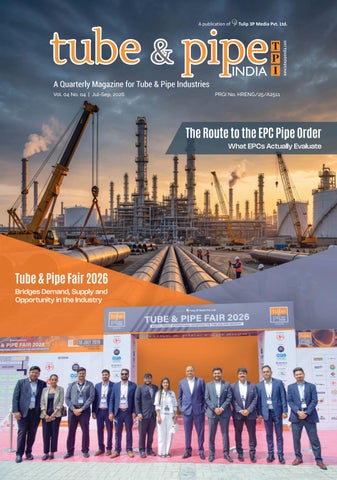
Tube & Pipe Fair 2026 Bridges Demand, Supply and Opportunity in the Industry
52 TUBE & PIPE FAIR Jindal Industries, Hissar to Set Up 3 Lakh TPA Tube Plant in Hansi with INR 300 Crore Investment
Goodluck India Eyes INR 200 Crore Investment in Precision Tubes and Structural Products
Jindal Stainless Connects with Stainless Steel Tube Manufacturers, Builds New Opportunities at Tube & Pipe Fair Hyderabad
MKK Metal Sections Sees Rise of Value-Added Products with Stringent Quality
Jindal Steel Sees Steel Replacing Concrete in Construction Sector
Hariom Pipe Connects with EPCs, Dealers & End-Use Industries at Tube & Pipe Fair Hyderabad
MPL Eyes Capacity Expansion; Targets 1 Million TPA by 2030
Grow Ever Group Forays into Automotive Component Segment
52
62
54
54
58
58
62 66 68
68
72
66
70 72
70
20
12 The Route to the EPC Pipe Order What EPCs Actually Evaluate Inside L&T Energy’s Resilient Pipe Procurement Ecosystem
20
MAN Industries
23
Focus on Multi-decade Pipeline Infrastructure in GCC Region
JTL Industries Sees Wider Adoption of Steel Pipes Across Emerging Applications
Surya MFR Tube Mills Showcases Advanced ERW Solutions at Tube & Pipe Fair Hyderabad 2026
Aaditya Stainless Finds Tube & Pipe Fair Hyderabad- An Ideal Platform to Connect With Pharmaceutical Manufacturers
Ferron Tubes Sees Precision Tubes Driving Growth in India’s Automotive Sector
Viral V-Care Presents Turnkey Piping Solutions with AI-Driven Approach at Tube & Pipe Fair Hyderabad
GMT Industries Advances Tube Mill Technology with Automated Section Pipe Solutions at TPF Hyderabad
HindTech Precision Slitter Tooling & Tube Forming Rolls for Higher Productivity
Indipower Steel Works Strengthens Precision Tube Portfolio, Targets Next Phase of Growth
Gallium Group Sees Strong Demand Across Forming, Finishing & Automation Technologies
Akash Steel Crafts Targets Industrial Applications with Heavy-Duty Stainless Steel Pipes
GT Cargo Fittings Strengthens Cargo-Securing Solutions for Tube & Pipe Logistics at TPF Hyderabad
NEWS
23
74
76
76
74
78
80
80 84
78
84
86
86 88
91
91
88 96
93 96 99 101
93
99
OUTLOOK
For the Record The Indian steel market is entering September with a familiar but consequential pressure point: input costs are moving faster than many downstream buyers would prefer. Hotrolled coil prices have risen by about INR 4,000 a tonne from August to early September, reaching a four-year high, with higher coking-coal costs, tighter spot availability and postmonsoon demand contributing to the increase. At the same time, the ability of domestic mills to pass further increases through is not unlimited. Finished-steel imports rose 36.6% year on year during April–July, with China accounting for 31% of imports. For tube and pipe manufacturers, this creates a difficult margin equation: raw-material costs are rising even as downstream customers retain alternatives.
For domestic manufacturers, the test is whether protection can coexist with sufficient product capability, competitive pricing and dependable availability for downstream users.
Trade policy remains another immediate consideration. India’s Directorate General of Trade Remedies has initiated a sunset review of the anti-dumping duty on seamless tubes, pipes and hollow profiles of iron, alloy or non-alloy steel from China. The review began in March 2026, an oral hearing was held in May, and the DGTR recorded an extension of applicability of the existing anti-dumping duties in July. The Ministry of Finance’s July notification provides that the anti-dumping duty will remain in force up to and inclusive of 27 January 2027, unless revoked, superseded or amended earlier. The case remains active. The issue is important beyond the question of import protection itself. For domestic manufacturers, the test is whether protection can coexist with sufficient product capability, competitive pricing and dependable availability for downstream users. For buyers, particularly in specialised applications, the availability of technically suitable alternatives remains equally important. The international trade environment presents a different kind of pressure. On 28 August, the U.S. International Trade Commission determined that there was a reasonable indication of material injury to the US industry from imports of welded stainless steel line and pressure pipe from India, Turkey and the UAE. The US Department of Commerce will now continue its anti-dumping and countervailing-duty investigations, with the USITC’s preliminary public report due by 6 October. This is a preliminary determination, not a final duty determination, but it is a reminder that export growth increasingly carries trade-remedy exposure. At the same time, the broader external environment has become more difficult: Brent crude approached USD 100 a barrel on 8 September amid heightened Middle East tensions and disruptions to energy operations in Saudi Arabia. For Indian manufacturers, therefore, export competitiveness has to be considered alongside freight, energy, currency and market-access risks. Tube & Pipe India’s current issue examines this procurement reality through the lens of the EPC pipe order. An EPC’s decision is considerably more than a comparison of quoted prices. As our cover story shows, qualification, manufacturing capacity, quality systems, documentation, delivery assurance and total project cost all contribute to the confidence an EPC places in a supplier. And these considerations extend well beyond oil & gas, applying across the infrastructure, energy, water and industrial projects that constitute an important part of the industry’s addressable market. For manufacturers, the message is straightforward: price remains essential, but manufacturing capacity creates value only when it is backed by the capability to deliver the right product, to the required standard and at the required time. The breadth of this ecosystem was also evident at Tube & Pipe Fair 2026, held in Hyderabad in July. The three-day exhibition brought together manufacturers, EPCs, fabricators, infrastructure companies, energy and oil & gas businesses, water-sector participants and technology providers, reflecting the diverse industries and applications that make up today’s tube and pipe value chain.
www.tubepipeindia.com
Priyank Jain, CEO Tulip 3P Media Private Limited
12 | EPC ORDER
The Route to the EPC Pipe Order What EPCs Actually Evaluate For tube and pipe manufacturers, an EPC order is the outcome of a procurement process that begins well before the RFQ, with qualification, capacity, quality, delivery and project requirements shaping who is ultimately able to compete.
Jul-Sep, 2026
www.tubepipeindia.com
EPC ORDER | 13
For a tube and pipe manufacturer, getting into an EPC project is not simply a matter of quoting for a pipe package when a tender appears. By the time a procurement enquiry reaches the market, much of the supplier’s credibility may already have been tested through technical capability, manufacturing capacity, quality systems, approvals, delivery record and the ability to support the project’s schedule. The route from potential supplier to project supplier is shaped by a procurement system in which technical requirements, qualification, capacity, delivery, commercial considerations and project risk intersect. The process also
extends across different project types, product categories, clients and sourcing geographies, making the question of how an EPC selects and secures pipe supply considerably broader than the RFQ itself. For manufacturers, understanding that system means looking beyond the purchase enquiry to the decisions that determine which suppliers are qualified, which capabilities are considered suitable, how capacity and delivery are secured, and what ultimately makes one supplier more competitive than another.
THE EPC PIPE PROCUREMENT JOURNEY From Project Need to Site Delivery
1 PROJECT REQUIREMENT
2
3 ENGINEERING DEFINITION
4
SUPPLIER QUALIFICATION
5
RFQ / TECHNICAL EVALUATION
6 COMMERCIAL EVALUATION
ORDER / CAPACITY COMMITMENT
7
8
MANUFACTURING / INSPECTION
DELIVERY TO PROJECT
OR
VEND APPROVED
SCOPE SPECIFICATIONS
MATERIAL SPECIFICATIONS QUANTITIES / SCHEDULE
TECHNICAL CAPABILITY APPROVED-VENDOR STATUS
TECHNICAL COMPLIANCE
PRICE TOTAL INSTALLED COST
CAPACITY COMMITMENT
PRODUCTION TESTING
DISPATCH SITE DELIVERY
Source: Tube & Pipe India
The Scale of the Buying System
The scale behind this procurement system is considerable. L&T’s Energy Projects segment recorded INR 1,36,921 crore of order inflows in FY2025-26, up 56.4% year on year, with international orders accounting for 60%. Segment revenue reached INR 54,889 crore, of which 74% came from international markets. This provides an indication of the scale and geographical spread of the project pipeline feeding into the procurement system of a major EPC. The picture is not limited to L&T. Engineers India Limited (EIL) ended FY2025-26 with an order book of INR 15,109 crore, up 28.9% year on year. Kalpataru Projects International Limited (KPIL), meanwhile, closed FY202526 with a consolidated order book of INR 65,457 crore, an all-time high, after securing INR 26,400 crore of new orders
during the year. Its Oil & Gas business, particularly relevant to pipe-intensive EPC activity, accounted for INR 4,578 crore of the year-end order book, or 7% of the consolidated total. Afcons Infrastructure Limited, another major Indian EPC player, closed FY2025-26 with an order book of INR 32,496 crore, of which Oil & Gas accounted for INR 528 crore, or 1.7%. The company’s wider portfolio also spans Marine & Industrial, which accounted for INR 4,779 crore (14.7%) of the order book, and Hydro & Underground, at INR 7,423 crore (22.8%), including LNG facilities and large watersupply pipeline projects that provide additional sources of demand for pipe, tube and associated steel products beyond its hydrocarbon business. Together, these figures indicate the breadth of the project
Jul-Sep, 2026
www.tubepipeindia.com
14 | EPC ORDER
environment within which EPC procurement takes place, spanning different sectors, project types and geographies. India’s underlying infrastructure base adds another dimension to this procurement universe. As of September 2025, the country had 34,238 km of authorised natural-gas pipelines, of which 25,923 km were operational and 9,954 km were under construction. According to PPAC data, India’s installed refinery capacity stood at 267.116 million tonnes per annum as of 1 April 2026. These figures do not translate directly into pipe demand, but they indicate the scale of the energy infrastructure base within which pipeintensive EPC activity takes place.
For pipe manufacturers, the significance is straightforward: competition for an EPC order takes place within a procurement system where technical suitability, qualification, capacity, timing, risk and commercial competitiveness intersect. The scale of that system also means that manufacturers are not competing for isolated pipe orders, but for positions within a project ecosystem serving multiple projects, applications, materials, clients and geographies. The scale, however, is only one part of the procurement equation. The requirements themselves span a wide range of products and materials.
MAJOR PIPELINE PROJECTS IN THE CURRENT EPC LANDSCAPE Selected current pipeline projects involving major Indian EPC companies.
ONGC Pipeline Replacement Project (PRP-X) ONGC offshore fields, west coast of India
Paradip-Numaligarh Crude Oil Pipeline (PNCPL)
From Mehsana (Gujarat) to Bathinda (Punjab)
From Paradip (Odisha) to Numaligarh (Assam)
EPCIC of multiple subsea pipeline segments and associated modification works across ONGC's offshore fields.
MEIL is executing a 260-km section (Sections I & II) of the Mehsana-Bathinda natural-gas pipeline, with 30-inch diameter pipes, as part of the larger national gas grid infrastructure.
A 1,635-km, 26-inch crude-oil pipeline connecting the eastern coast to India's northeast. EIL is providing EPCM services for the project.
LENGTH
STATUS
LENGTH
Not Stated
Awarded Aug. 2026
1,635 km
in current disclosure
Mehsana-Bathinda Pipeline (Phase II)
(26-inch)
SELECTED CURRENT PIPELINE PROJECTS INVOLVING INDIAN EPC COMPANIES
TARGET COMPLETION
Dec. 2026
Bathinda
Numaligarh
Saudi Aramco Master Gas System (MGS) - Phase III Saudi Arabia Execution of over 800 km of lateral gas pipelines, along with associated facilities, to support Saudi Aramco's large-scale gas expansion programme.
LENGTH
PROJECT TARGET
LENGTH
STATUS
260 km
Mar. 2027
800+ km
Under
(30-inch)
(for the overall project)
(of lateral gas pipelines)
execution
L&T - ONGC PRP-X (Off India’s west coast)
EIL - Paradip-Numaligarh
Mehsana
Paradip
INDIA
Saudi Arabia
MEIL - Mehsana-Bathinda (Phase II) KPIL - Saudi Aramco MGS-III
Sources: L&T; EIL; MEIL; KPIL; Valdel EC; MoSPI | Compilation: Tube & Pipe India
Map is illustrative. Project locations are indicative and not to scale.
What EPCs Actually Buy
EPC market is segmented not merely by diameter or manufacturing route, but by service conditions, material requirements and project-specific specifications.
L&T Energy Hydrocarbon’s requirements span carbon steel, low-temperature carbon steel, alloy steel, stainless steel, duplex and super-duplex stainless steel, nickel alloys, clad pipes and other piping components, with coated and uncoated requirements depending on the application. Mr. Paritosh Naik, Vice President & Head – Supply Chain Management, L&T Energy Hydrocarbon Onshore, also points to demand for higher-alloy materials, corrosionresistant alloys, heavy-thickness pipes and non-metallic products such as GRE, GRV and GRUP.
Current procurement activity elsewhere in the EPC ecosystem provides a useful snapshot. Engineers India Ltd’s live tender portal currently lists separate enquiries for SS seamless/welded pipes, CS/LTCS seamless/welded pipes and SS welded pipes for BPCL and Petronet projects.
The pipe requirement of a large EPC is far from a single commodity category.
The implication for manufacturers is that the addressable
This is important because it shows that the material mix described by L&T is not simply a corporate procurement philosophy. Different grades and product forms are being bought through multiple live project packages. The point is not that these categories represent the
Jul-Sep, 2026
www.tubepipeindia.com
EPC ORDER | 15
entire EPC pipe basket, but that the live procurement record demonstrates the breadth of material and product specifications entering the market simultaneously.
project, the greater the opportunity for its manufacturing capability and available capacity to be factored into the execution plan.
When the Buying Process Begins
Getting Onto the List: Why Technical Capability Alone Isn’t Enough
L&T Energy Hydrocarbon (LTEH), which executes projects across refineries, petrochemical complexes, gas processing and fertiliser facilities, engages engineering teams and potential suppliers as early as the bidding stage for major piping requirements. According to Mr. Paritosh Naik, Vice President & Head – Supply Chain Management, L&T Energy Hydrocarbon Onshore, major pipe requirements generally become sufficiently defined after basic engineering and a 40% isometric review during detailed engineering. Procurement engagement then proceeds once material specifications, quantities and project schedules are established.
This is perhaps the most important distinction emerging from the L&T response: Being technically capable is not the same as being an EPC-ready supplier. L&T’s qualification process covers manufacturing capability and infrastructure, production capacity, qualitymanagement systems, testing and inspection facilities, financial strength, HSE performance, past project execution for oil & gas, fertiliser and green-ammonia clients, compliance with applicable standards and end-customer approval. “For critical projects, successful execution history and demonstrated reliability are often as important as manufacturing capability,” says Paritosh Naik.
For a manufacturer, however, the visible buying event may be the RFQ, while the EPC’s procurement planning has already begun. This early visibility matters because design development can affect quantities, material grades, wall thicknesses, manufacturing routes and delivery schedules. Coordination between engineering, procurement and project teams is therefore important to maintaining supplier commitments.
That makes supplier qualification a much broader test than whether a mill can manufacture a particular grade. The manufacturer’s capacity, quality system, testing infrastructure, financial standing, HSE record and project history all become part of its commercial proposition. EIL’s procurement ecosystem provides an independent illustration of how such requirements sit within actual project procurement. Its current tender portal is actively handling multiple pipe packages for refinery and
The implication for manufacturers is that procurement visibility does not necessarily begin with the final purchase enquiry. The earlier a supplier becomes relevant to the
THE EPC SUPPLIER QUALIFICATION STACK KEY REQUIREMENTS FOR EPC SUPPLIER QUALIFICATION
5
TECHNICALLY CAPABLE Can manufacture to specification Has manufacturing facilities Has testing and quality systems
EPC-READY SUPPLIER
COMMERCIAL COMPETITIVENESS Competitive quotation
4
1
Total installed cost Execution risk
DELIVERY ASSURANCE
TECHNICAL ELIGIBILITY
Schedule commitment Inspection & documentation Logistics
Meets all qualification criteria Reliable project execution partner Ready for project delivery
Applicable specification Manufacturing capability Testing & quality systems
EPC SUPPLIER QUALIFICATION
3
2
MULTIPLE CRITERIA. ASSESSED TOGETHER.
CAPACITY
QUALIFICATION
Manufacturing slots
Approved-vendor status
Capacity allocation
Client requirements
Raw-material availability
Track record
NECESSARY BUT NOT SUFFICIENT
QUALIFIED FOR PROJECT EXECUTION Source: Tube & Pipe India
Jul-Sep, 2026
www.tubepipeindia.com
16 | EPC ORDER
petrochemical clients, rather than treating piping as a single undifferentiated purchase category.
schedule assurance and execution reliability can be decisive on major EPC projects.
For manufacturers seeking EPC business, the implication is consequential: the first project can effectively become part of the qualification record. Winning it requires the supplier to demonstrate that it can fit into the EPC’s broader projectexecution system.
In practical terms, the manufacturer’s proposition is therefore not simply its mill price. The EPC’s assessment also takes into account quality, manufacturing capacity, delivery capability, logistics, reliability and the execution risk associated with the supplier. Taken together, these factors determine the total installed cost of the project.
Winning the Order: Why Price Alone Is Insufficient
Once a manufacturer is technically qualified, another question begins: Why should this supplier get the order? L&T’s answer is unusually clear. The company follows a total-installed-cost approach. “We follow the concept of total installed cost,” says Naik. After technical qualification, sourcing decisions consider quality performance, manufacturing capacity, delivery capability, supply-chain reliability, commercial competitiveness, contractual terms and after-sales support. Cost remains important, but
That distinction is commercially significant. A supplier offering a lower ex-mill price but carrying greater delivery or execution risk may not represent the lowest-cost solution for the project as a whole. For international projects, L&T also considers geopolitical conditions when sourcing to ensure timely delivery. This explains why the procurement decision can favour a supplier that offers greater certainty even when its nominal quotation is not the lowest.
BEYOND MILL PRICE
HOW AN EPC ASSESSES THE TOTAL COST AND RISK OF PIPE SUPPLY AT THE PROJECT SITE
AT THE MILL
QUALITY
CAPACITY
DELIVERY
E X E C U T I O N
LOGISTICS
INSPECTION
R I S K
TOTAL INSTALLED COST
Source: Tube & Pipe India
The Long-lead Challenge
Pipe procurement can also become a capacity-planning exercise. L&T says engagement with potential vendors begins during the pre-bid stage for large or schedulecritical projects. After award, technical and commercial closure begins using pre-bid inputs, while high-level steering committees are used to reduce the requisition-topurchase-order cycle. For securing manufacturing capacity and production slots, higher-management engagement
may be initiated, particularly where established supplier relationships exist. “In certain cases, manufacturing slots may need to be secured many months before field execution activities commence to ensure project schedule protection,” says Naik. This changes the manufacturer’s commercial calculation. A mill does not necessarily wait until the physical requirement is imminent before considering capacity. For
Jul-Sep, 2026
www.tubepipeindia.com
EPC ORDER | 17
a schedule-critical package, capacity itself can become a procurement input. The wider EPC environment illustrates why this matters. EIL’s current procurement portal simultaneously carries pipe enquiries for different refinery and petrochemical projects, including CS/LTCS seamless/welded and SS seamless/welded pipes. For a manufacturer serving several EPCs, the commercial challenge is therefore not simply possessing annual installed capacity. It is being able to demonstrate available, allocable and schedule-compatible capacity when the EPC needs it.
India or Elsewhere?
L&T’s sourcing model is neither purely domestic nor purely global. The company says a sizeable portion of its requirements is fulfilled by qualified Indian manufacturers, while international suppliers remain relevant for specialised products, larger production capacities, advanced manufacturing technologies and competitive commercial opportunities. “L&T Energy Hydrocarbon adopts a balanced sourcing strategy leveraging both domestic and international manufacturing capabilities,” says Paritosh Naik. He adds, “India has developed a strong and globally competitive pipe manufacturing ecosystem, and a sizeable portion of our requirements are fulfilled through qualified domestic manufacturers.” The sourcing decision considers technical requirements, approved-vendor status, project schedule, delivery commitments, quality performance, total installed cost, localisation requirements and supply-chain resilience. The scale of L&T’s international work reinforces the importance of this balance. In FY2025-26, international revenue accounted for 74% of Energy Projects’ INR 54,889-crore revenue, while international orders represented 60% of the segment’s INR 1,36,921-crore order inflow. The question for an Indian pipe manufacturer is therefore not simply whether it can compete with an overseas mill on price. It is whether it can offer the technical range, production scale, qualification status, delivery reliability and documentation needed for the particular project. For specialised products, the international supply base remains relevant. For standard and qualified requirements, India’s pipe-manufacturing ecosystem provides a substantial sourcing base.
Price and Supply Risk
The procurement decision also has to account for what happens between quotation and delivery. L&T manages material-price and supply risks through advance procurement planning, market intelligence, regular supplier engagement, aggregation of ordering
quantities across projects and business units, competitive bidding, long-term price agreements, long-term supplier relationships and contractual risk-sharing mechanisms. There is a measurable market backdrop to this. Government data put the average Indian price of 2-mm HR coil at INR 70,448 per tonne in August 2026, 15.5% above August 2025. Finished-steel consumption during April-August 2026 was 70.3 million tonnes, up 7% year on year. HR coil is not a universal proxy for the raw-material cost of every pipe category, but the figure illustrates the kind of underlying price movement against which long-duration procurement decisions have to be made. Importantly, L&T does not describe price management as a single hedging exercise. It combines planning, market intelligence, purchasing scale, supplier relationships and contractual mechanisms. KPIL’s disclosures provide useful independent corroboration. The company identifies pipe and pipe fittings among the commodities used in project execution and says price exposure is managed through escalation clauses where available; for firm-price contracts, it uses forward contracts or back-to-back firm-price arrangements where possible, with contingencies for risks that cannot be hedged. That is a significant point for manufacturers: EPCs themselves have to manage commodity risk, and the contractual structure through which they buy can become part of that risk-management system.
The Less Visible Constraints
Some of the factors that can complicate pipe procurement are less visible than price or technical specification. L&T identifies several less visible constraints that can complicate an otherwise straightforward procurement. These include client-approved vendor restrictions, limitations on the raw-material sub-vendors that mills can use, minimum-order quantities for certain requirements, the capability and available capacity of individual mills, and the fact that a single source may not be able to meet the full range of pipe requirements in a package. Differences in documentation, specifications and ordering requirements across clients and vendors can add another layer of complexity. These constraints help explain why a pipe requirement can become difficult to consolidate into a single order. A mill may be qualified for the pipe itself but constrained by the client’s approved raw-material source. It may have sufficient annual capacity but not the appropriate production slot. It may be commercially competitive for the main quantity but inefficient for a small top-up requirement because of MOQ. This is where the distinction between manufacturing capability and procurement usability becomes important.
Jul-Sep, 2026
www.tubepipeindia.com
18 | EPC ORDER
The EPC does not simply need a mill that can make the pipe. It needs a supplier that can fit the pipe into a projectspecific procurement and execution system.
What the Evidence Means for Pipe Manufacturers
For a pipe manufacturer, the EPC procurement process therefore has to be viewed as more than an opportunity to quote against an RFQ. Technical capability and compliance with the required specification are the starting point, but they do not by themselves establish a supplier’s suitability for a project. Qualification, manufacturing capacity, quality and testing systems, execution record, delivery capability and the ability to meet project-specific requirements all contribute to the EPC’s assessment of whether a supplier can be relied upon for the job. Aaditya Stainless’ experience illustrates how such qualification can translate into access to project procurement. Shreyansh Bhansali, Director, Aaditya Stainless Pvt. Ltd., says, “Over the last few years, we have secured several key industry approvals, including EIL, IOCL, and ADNOC among others. These approvals have enabled us to directly participate in and supply products for major oil & gas projects.” L&T’s approach to sourcing reinforces this broader assessment. Technical requirements and approvedvendor status are considered alongside schedule, delivery commitments, quality performance, total installed cost, localisation requirements and supply-chain resilience. For the manufacturer, installed capacity on paper is not enough; what matters is the ability to commit the right capacity at the right time, meet the required quality and documentation standards, and provide confidence that the material will reach the project when it is needed. This also puts the question of price in its proper context. A competitive quotation remains essential, but the EPC’s assessment extends beyond the mill-gate price to the wider cost and execution implications of the supply. A supplier that combines competitive pricing with proven quality, available capacity, reliable delivery and lower execution risk can therefore offer greater value than one whose principal advantage is a lower initial quotation. For manufacturers, the implication is that EPC competitiveness is built across several dimensions:
technical capability and qualification establish eligibility; available capacity and delivery assurance support project execution; and commercial competitiveness determines whether the supplier can offer an acceptable overall proposition. MAN Industries’ position in the large-diameter line-pipe market provides a relevant manufacturer perspective on these requirements. The company has a manufacturing presence in Saudi Arabia and has pursued access to major energy-project procurement programmes in the region, including through its relationship with Saudi Aramco. It is also an approved vendor for QatarEnergy LNG, positioning it to participate in LNG infrastructure projects. The broader definition of competitiveness is also reflected in industry experience. Nikhil Mehta of MAN Industries says, “Competitiveness in the large-diameter pipe industry is increasingly determined not just by capacity, but by quality consistency, technology differentiation, and supplychain reliability.” L&T’s Energy Projects segment alone generated INR 1,36,921 crore of orders in FY2025-26, while EIL ended the year with an order book of INR 15,109 crore, up 28.9% year on year. EIL’s current procurement activity includes multiple live pipe packages across SS, CS and LTCS categories. The project portfolio of Megha Engineering & Infrastructures Ltd (MEIL) illustrates the physical scale at which pipeintensive infrastructure can be executed: its Rajasthan refinery work includes a 210-km, 52-inch carbon-steel rawwater pipeline and a 489-km crude-oil pipeline. But scale alone does not determine who gets the order. These factors have to work together. A technically capable mill may not protect the schedule if the required capacity is unavailable; capacity alone does not help if the supplier is not qualified; and a competitive price may not produce the lowest project cost if delivery carries significant risk. The purchase order may be issued for pipe. The decision, however, is made on confidence in the supplier’s ability to deliver the project.
Editorial note: This story focuses primarily on EPC procurement practices in oil & gas and related energy-infrastructure projects; references to EPC procurement are made within this context.
Jul-Sep, 2026
www.tubepipeindia.com
AUTOMATIC ULTRASONIC TESTING SYSTEMS
PLATES & COILS
BARS & BILLETS
PIPES & TUBES
RAILS & WHEELS
Nordinkraft India (P) Limited Plot No. D-183/8, MIDC, TTC Nerul, Navi Mumbai-400706
T: +91-22 6138 0600
E: info@nordinkraft.in
Use code "NKINDIA 2026" while enquiring for special benefits.
W: www.nordinkraft.in
20 | PROCUREMENT
Inside L&T Energy’s Resilient Pipe Procurement Ecosystem As large-scale energy and infrastructure projects become increasingly complex and dynamic, pipe procurement is evolving from a transactional sourcing function into a critical component of project execution. For L&T Energy Hydrocarbon, this means engaging potential vendors as early as the pre-bid stage, assessing manufacturers on capability, capacity, quality systems, testing infrastructure, financial strength, HSE performance and execution track record, and securing manufacturing capacity well ahead of field requirements. The company’s approach also reflects the growing importance of total installed cost, supply-chain resilience, localisation, traceability and advanced materials. In an exclusive interview with Tube & Pipe India, Mr. Paritosh Naik, Vice President & Head – Supply Chain Management, L&T Energy Hydrocarbon Onshore, discusses how the company navigates pipe sourcing across refineries, petrochemical complexes, gas processing and fertilizer projects, the evolving requirements for corrosion-resistant and non-metallic pipes, and the strategies being adopted to manage capacity, delivery, price volatility and changing global supply-chain dynamics. Mr. Naik also talks about the challenges and how the company’s resilient approach has evolved from experience over time.
“In recent years, we have observed a growing demand for higher-alloy materials, corrosion-resistant alloys, heavy thickness pipes, and specialty products like non-metallic pipes (GRE/ GRV, GRUP) driven by harsher operating conditions, hydrogen-related applications and increasingly stringent client specifications.” Tube & Pipe India: Across L&T Energy Hydrocarbon’s current project portfolio, what are the major categories of pipe and piping-material requirements by application, material and product type? How has this procurement mix changed in recent years?
Mr. Paritosh Naik, Vice President & Head – Supply Chain Management, L&T Energy Hydrocarbon Onshore
Paritosh Naik: L&T Energy Hydrocarbon procures a wide range of piping materials for refineries, petrochemical complexes, gas processing plants, fertilizer units. Requirements typically include carbon steel, lowtemperature carbon steel, alloy steel, stainless steel, duplex and super duplex stainless steel, nickel alloys, clad pipes and various piping components. Depending on the application and end use, these materials may be required with or without coating. In recent years, we have observed a growing demand for higher-alloy materials, corrosion-resistant alloys, heavy thickness pipes, and specialty products like non-metallic
Jul-Sep, 2026
www.tubepipeindia.com
PROCUREMENT | 21
pipes (GRE/ GRV, GRUP) driven by harsher operating conditions, hydrogen-related applications and increasingly stringent client specifications.
TPI: At what stage of a project do major pipe requirements become sufficiently defined for procurement planning? How do subsequent changes in project requirements affect quantities, specifications, procurement schedules and supplier commitments? PN: We engage with our engineering team and suppliers during the bidding stage of the project to have prompt access to major piping requirements. Major pipe requirements generally become sufficiently defined after completion of basic engineering and 40% isometric review during detailed engineering. Procurement engagement commences once material specifications, quantities and project schedules are defined. Subsequent design changes can significantly affect quantities, material grades, wall thicknesses, manufacturing routes and delivery schedules. Effective coordination among engineering, procurement and project teams is therefore essential to minimize disruptions and maintain supplier commitments.
TPI: What are the principal factors that determine the material, grade, product type, dimensions and applicable standards for pipe requirements? Once these requirements are established, under what circumstances can suppliers propose technically acceptable alternatives? PN: Material selection is driven by plant application, process conditions, pressure and temperature requirements, corrosion considerations, design life, applicable codes and standards, client specifications and project location. Suppliers may propose technically equivalent alternatives only when they fully comply with process requirements, applicable codes and project specifications. Any alternative solution undergoes detailed technical evaluation and client approval where required. The focus is on standardization of MOC and pipe schedule during the engineering stage to minimize variety and deviation so that procurement and delivery is at fast pace.
TPI: What are the principal criteria L&T Energy Hydrocarbon considers when qualifying pipe manufacturers for its approved vendor base? How important are manufacturing capability, quality systems, testing facilities, capacity, delivery record and previous project experience in this process? PN: L&T evaluates pipe manufacturers through a comprehensive qualification process coveringmanufacturing capability and infrastructure, production capacity, quality management systems, testing and inspection facilities, financial strength, HSE performance, past project execution record for clients from oil & gas, fertilizer, green ammonia industries and compliance with standards and end customer approval. For critical projects, successful execution history and demonstrated reliability are often as important as manufacturing capability.
“We follow the concept of total installed cost. Following technical qualification, sourcing decisions are based on a balanced assessment of quality performance, manufacturing capacity, delivery capability, supply-chain reliability, commercial competitiveness, commercial and contractual terms, and after-sales support.” TPI: Once suppliers are technically qualified, what factors most strongly influence the final sourcing decision? How are price, technical compliance, delivery capability, manufacturing capacity, quality track record and commercial terms balanced? PN: We follow the concept of total installed cost. Following technical qualification, sourcing decisions are based on a balanced assessment of quality performance, manufacturing capacity, delivery capability, supply-chain reliability, commercial competitiveness, commercial and contractual terms, and after-sales support. While cost remains important, project schedule assurance and execution reliability are often decisive factors in major EPC projects. For international projects, sourcing requires focusing on geopolitical conditions to ensure timely delivery.
TPI: For large or schedule-critical projects, how does L&T Energy Hydrocarbon manage long-lead pipe requirements and secure adequate manufacturing capacity or production slots? How early can such commitments need to be made? PN: Engagement with potential vendors starts during the pre-bid stage for large or schedule-critical projects. LTEH has adopted the project task force concept and operates in close vicinity to the client for focused and fast-track decision-making. After award of the project, for critical items, we start technical and commercial closure based on pre-bid inputs with various vendors. For ordering decisions, high-level steering committees have been formed to accelerate the MR to PO cycle. For securing manufacturing capacity and production slots, sponsor/higher management-level engagement is initiated, considering long-standing relationships with the vendors. In certain cases, manufacturing slots may need to be secured many months before field execution activities commence to ensure project schedule protection.
TPI: How does L&T Energy Hydrocarbon determine whether a pipe requirement should be sourced domestically or internationally? To what extent do localisation requirements, supplier capability, lead time, cost and supply-chain resilience influence this decision? PN: L&T Energy Hydrocarbon adopts a balanced sourcing
Jul-Sep, 2026
www.tubepipeindia.com
22 | PROCUREMENT
“L&T Energy Hydrocarbon adopts a balanced sourcing strategy leveraging both domestic and international manufacturing capabilities. India has developed a strong and globally competitive pipe manufacturing ecosystem, and a sizeable portion of our requirements are fulfilled through qualified domestic manufacturers. At the same time, we maintain relationships with leading international suppliers to access specialized products, large production capacities, advanced manufacturing technologies and competitive commercial opportunities.” strategy leveraging both domestic and international manufacturing capabilities. India has developed a strong and globally competitive pipe manufacturing ecosystem, and a sizeable portion of our requirements are fulfilled through qualified domestic manufacturers. In addition, we actively engage with capable domestic manufacturers and support them in obtaining approvals from international clients and licensors. This helps expand the qualified supplier base, strengthens localization efforts, and enhances supply chain resilience for global projects. At the same time, we maintain relationships with leading international suppliers to access specialized products, large production capacities, advanced manufacturing technologies and competitive commercial opportunities. The sourcing decision is based on technical requirements, approved vendor list, project schedule, delivery commitments, quality performance, total installed cost, localization requirements and supply chain resilience. Having both domestic and international sourcing options enables us to optimize project execution while minimizing supply risks and ensuring business continuity.
TPI: How does L&T Energy Hydrocarbon manage steel, alloy and other raw-material price volatility when procurement commitments have to be made well ahead of project execution? What approaches are used to manage price and supply risks? PN: L&T manages price and supply risks through advance procurement planning, early market intelligence, regular engagement with suppliers, maximising the ordering quantum by combining multiple projects across L&T’s multiple units, competitive bidding, long-term price agreements, long-term supplier relationships, and contractual risk-sharing mechanisms where appropriate.
Close engagement with key suppliers helps improve visibility on raw material trends and availability, enabling proactive decision-making.
TPI: From the project-execution standpoint, what are the most consequential issues encountered in pipe procurement, whether related to quality, testing, documentation, specification compliance, production capacity or delivery? Which of these have the greatest potential to affect project schedules or costs? PN: From the project-execution standpoint, the most consequential issues encountered in pipe procurement are limited vendors as per the restricted approved vendor list from clients; restriction of the sub-vendor list for raw material sourcing required by pipe mills; itemized minimum order quantities, especially for top-up quantities; mills’ capabilities and capacity; a large variety of pipe requirements where no single source can meet the entire requirement; and different client bases requiring different documentation, specification compliance and ordering methodology across multiple vendors.
TPI: Across L&T Energy Hydrocarbon’s current and recently awarded projects, which changes in project technology, materials, standards, localisation, client requirements or supply-chain conditions are having the greatest effect on pipe procurement and supplier qualification? PN: Several industry developments are shaping pipe procurement and supply chain management today, including increasing localization requirements, more stringent quality and traceability standards, growth in corrosion-resistant alloy and non-metallic pipe applications, digitalization of supply-chain processes, adoption of Artificial Intelligence for advanced analytics and supply chain optimization, enhanced sustainability requirements, and greater emphasis on supplier qualification and risk management. Additionally, evolving global trade dynamics continue to influence procurement strategies and supply-chain planning.
TPI: Where permissible, could L&T Energy Hydrocarbon share indicative figures or ranges on parameters such as typical pipe procurement lead times, domestic versus international sourcing, the number of qualified suppliers for major categories, or the approximate significance of piping-material procurement within large EPC projects? PN: While specific project data remains confidential, L&T’s approved supplier network includes both leading domestic and international pipe manufacturers across various material grades and product categories. Depending on project requirements, sourcing may range from fully domestic procurement to a combination of domestic and overseas supply to achieve the optimum balance of quality, delivery, cost competitiveness and risk management. This diversified sourcing approach provides flexibility to support large-scale EPC projects across different geographies and industry sectors.
Jul-Sep, 2026
www.tubepipeindia.com
INTERVIEW | 23
MAN Industries Focus on Multi-decade Pipeline Infrastructure in GCC Region
Mr. Nikhil Mansukhani, Managing Director, MAN Industries (INDIA) Limited
The acquisition of NPC transforms MAN Industries from a leading domestic manufacturer into a global player. For approximately USD 102 million, we have acquired an operational business with both HSAW and LSAW capabilities in Saudi Arabia, giving us in-country manufacturing presence in the GCC at a time when major national oil companies are executing multi-decade pipeline infrastructure programs
Tube & Pipe India: MAN Industries recently acquired National Pipe Company (NPC) in Saudi Arabia for nearly INR 1,000 crore. How does this acquisition strengthen your global manufacturing footprint, and what synergies do you expect between the Indian and Middle East operations? Nikhil Mansukhani: The acquisition of NPC transforms MAN Industries from a leading domestic manufacturer into a global player. For approximately USD 102 million, we have acquired an operational business with both HSAW and LSAW capabilities in
MAN Industries is strengthening its global position in the large-diameter pipe segment through strategic expansion, international partnerships and technology-driven initiatives. In an exclusive interaction with Tube & Pipe India, Mr. Nikhil Mansukhani, Managing Director, MAN Industries (INDIA) Ltd., discusses the company’s acquisition of National Pipe Company (NPC) in Saudi Arabia, which has expanded its manufacturing footprint in the GCC and enhanced its access to major energy infrastructure projects. He also highlights the significance of the five-year MoU with Aramco Asia India, Qatar Energy LNG vendor approval, and the upcoming stainless steel seamless pipe facility in Jammu. Mr. Mansukhani shares insights on demand growth across gas transmission, water infrastructure and city gas distribution, the company’s exportled strategy, capacity expansion plans, hydrogen-ready pipe capabilities, and its focus on operational efficiency, sustainability and supply-chain resilience to drive long-term growth.
Saudi Arabia, giving us in-country manufacturing presence in the GCC at a time when major national oil companies are executing multi-decade pipeline infrastructure programs. On synergies, we expect value creation across three areas: procurement efficiencies leveraging MAN’s sourcing scale; technical prowess, with MAN’s three decades of experience; and commercial upside through a product portfolio that addresses a wider range of project specifications across highgrowth Saudi and GCC markets. The acquisition is immediately earning accretive.
Jul-Sep, 2026
TPI: The company has signed a five-year MoU with Aramco Asia India and also secured vendor approval from Qatar Energy LNG. How are these developments expected to enhance MAN Industries’ participation in upcoming energy infrastructure projects across the Gulf region? NM: These milestones meaningfully strengthen our positioning within the Gulf’s energy ecosystem. The fiveyear MoU with Aramco Asia India establishes a structured engagement framework with one of the world’s largest energy companies, opening
www.tubepipeindia.com
24 | INTERVIEW
avenues for preferred supplier status across Aramco’s extensive pipeline procurement programs. The vendor approval from Qatar Energy LNG, meanwhile, makes us eligible to participate in one of the most capitalintensive LNG infrastructure buildouts currently underway globally. Taken together with our NPC acquisition, it gave us the market access advantage in the GCC, an in-country manufacturing presence, a relationship with Saudi Arabia’s national oil company, and approved vendor status with Qatar’s national energy company. This combination positions MAN Industries to pursue larger, more complex project opportunities across oil & gas transmission, LNG, and water infrastructure sectors across the region.
TPI: The Jammu stainless steel seamless pipe facility is scheduled for commissioning by FY27. What strategic opportunities do you see in the seamless pipe segment, and how will this project diversify MAN Industries’ product portfolio beyond line pipes? NM: The Jammu facility represents a deliberate strategic move to extend MAN Industries’ addressable market well beyond large-diameter line pipes. Stainless steel seamless pipes serve a fundamentally different and complementary customer base spanning oil & gas upstream and downstream, power generation, petrochemicals, pharmaceuticals, and precision engineering segments characterised by higher valueaddition, stricter specifications, and stronger margin profiles compared to commodity line pipe. Strategically, this positions MAN on a path towards becoming a comprehensive steel pipe solutions provider rather than a single-segment manufacturer. The timing is also well-considered: domestic demand for seamless pipes is growing as India’s manufacturing and energy sectors scale up, and import substitution remains a significant opportunity given the current dependence on overseas supply for certain grades and specifications. From a portfolio diversification standpoint, the Jammu plant adds stainless steel and alloy grade capabilities to our existing carbon
From a portfolio diversification standpoint, the Jammu plant adds stainless steel and alloy grade capabilities to our existing carbon steel HSAW and LSAW product range broadening both our customer relationships and our ability to participate in multiproduct project tenders.
steel HSAW and LSAW product range broadening both our customer relationships and our ability to participate in multi-product project tenders.
TPI: India is witnessing significant investments in gas transmission, water transportation and city gas distribution networks. How do you see demand evolving across these segments, and which end-markets are likely to drive the next phase of growth for the pipe industry? NM: India’s energy transition and infrastructure build-out create a compelling multi-year demand backdrop for large-diameter pipes. Across gas transmission, GAIL and other pipeline operators are expanding the national gas grid significantly, with several trunk pipeline projects in various stages of tendering. City gas distribution networks continue to scale rapidly as CGD licensees roll out last-mile connectivity across new geographical areas. On the water side, national missions around Jal Jeevan and urban water supply are driving sustained ordering for water transmission pipelines across states. Structurally, we believe gas transmission and water infrastructure will be the two dominant demand
Jul-Sep, 2026
drivers over the next three to five years, supported by government-backed capex programs with high visibility. Industrial corridors and petrochemical clusters add a further layer of opportunity. For MAN Industries, our ability to serve across HSAW, LSAW and ERW specifications, combined with our domestic and now GCC manufacturing footprint, positions us well to capture a meaningful share of this expanding opportunity set.
TPI: MAN Industries has consistently expanded its manufacturing capabilities, including ERW and spiral pipe capacities in recent years. What are your current capacity utilisation levels, and do you foresee the need for further brownfield or greenfield expansions over the next few years? NM: Our domestic facilities are operating at healthy utilisation levels, underpinned by a strong order book and robust demand across both Indian and export markets. The immediate priority is optimising throughput across our existing asset base including the NPC facility in Saudi Arabia, which adds meaningful incremental capacity and broadens our product range. On future expansion, our approach is demand-led and disciplined. We will evaluate brownfield opportunities at existing sites where incremental capex can deliver disproportionate capacity or capability gains. Greenfield investments, if pursued, will be anchored to specific market opportunities whether in new geographies or product segments where we have sufficient demand visibility to justify the commitment. Capital allocation will remain guided by return thresholds and our broader balance sheet priorities. In the near term, the focus is on sweating existing assets, integrating NPC, and converting our strong pipeline of inquiries into executable orders before committing to the next leg of physical expansion.
TPI: The company has highlighted hydrogen pipe testing as part of its technology roadmap. How do you view the long-term opportunity for hydrogen transportation infrastructure, and what preparations is MAN Industries
www.tubepipeindia.com
INTERVIEW | 25
Structurally, we believe gas transmission and water infrastructure will be the two dominant demand drivers over the next three to five years, supported by government-backed capex programs with high visibility. Industrial corridors and petrochemical clusters add a further layer of opportunity.
making to cater to this emerging market? NM: Hydrogen is expected to play a pivotal role in the global energy transition, creating substantial long-term opportunities for pipeline infrastructure. At MAN Industries, we are proactively building capabilities to support this emerging market. A key milestone was the successful testing of our pipes for hydrogen transportation by RINA Consulting – Centro Sviluppo Materiali S.p.A. (CSM), Italy, a globally recognised testing and certification organisation. The results confirmed that our pipes meet stringent international standards for the safe transport of hydrogen gas. Alongside this achievement, we continue to evaluate evolving technologies and standards to ensure our products remain future-ready for hydrogen infrastructure projects worldwide.
TPI: With a standalone order book of around INR 3,000 crore and a strong international presence across more than 30 countries, how is the order mix evolving between domestic and export markets, and which geographies are currently offering the strongest opportunities?
NM: Historically, exports have accounted for ~80% of our revenues, reflecting MAN Industries’ strong international positioning built over decades. This export-heavy mix is a deliberate strategic choice, and we expect it to continue going forward as global demand for large-diameter line pipes remains robust. On the export side, the Middle East remains our most significant opportunity, and the NPC acquisition meaningfully accelerates our ability to capture it. Saudi Arabia and the broader GCC are in the midst of largescale energy and water infrastructure investments, and having an in-country manufacturing presence now gives us a structural advantage in accessing these tenders. Beyond the GCC, we continue to see active inquiry pipelines from Southeast Asia, Africa, the Far East, and Central Asia. Domestically, gas transmission and water infrastructure continue to be steady demand drivers, supported by government-backed capex programs with strong multi-year visibility providing a reliable base load that complements our international order flow. Overall, we are confident in sustaining our historically strong export mix while selectively growing domestic participation, resulting in a welldiversified and resilient order book over the medium term.
TPI: As the pipe industry increasingly focuses on operational efficiency, sustainability and supply-chain resilience, what manufacturing and technology initiatives is MAN Industries implementing to enhance competitiveness and meet evolving customer requirements? NM: Competitiveness in the largediameter pipe industry is increasingly determined not just by capacity, but by quality consistency, technology differentiation, and supply-chain reliability — and these are areas where MAN has invested meaningfully over the years. On the manufacturing side, our focus is on process optimisation and automation to drive throughput efficiency and reduce variability across product specifications. We continue
Jul-Sep, 2026
to upgrade our coating capabilities, recognising that advanced external and internal coating solutions are an increasingly important differentiator in project tenders, particularly for corrosive or high-pressure applications. From a product and technology standpoint, we are actively pursuing hydrogen-ready pipe testing and certification, positioning MAN early in what we believe will be a significant future demand segment as energy transition infrastructure scales up globally. Our NPC facility in Saudi Arabia also provides a platform to develop and deploy advanced coating technologies closer to key end markets. On supply-chain resilience, we have strengthened our strategic sourcing framework to reduce input cost volatility and improve delivery predictability — both critical factors for customers managing complex, time-sensitive project schedules. Taken together, these initiatives are designed to ensure MAN Industries remains a preferred supplier of choice across both domestic and international markets as customer requirements continue to evolve.
A key milestone was the successful testing of our pipes for hydrogen transportation by RINA Consulting – Centro Sviluppo Materiali S.p.A. (CSM), Italy, a globally recognised testing and certification organisation. The results confirmed that our pipes meet stringent international standards for the safe transport of hydrogen gas.
www.tubepipeindia.com
26 | TUBE & PIPE FAIR
Tube & Pipe Fair 2026 Bridges
Demand, Supply and Opportunity in the Industry
Three days of networking, technology showcase and high-value business interactions marked the successful conclusion of Tube & Pipe Fair 2026, reaffirming its position as a key platform for India’s tube and pipe industry. The exhibition brought together professionals from tube and pipe manufacturing, EPC, fabrication, construction & real estate, infrastructure, automotive, offshore, oil & gas, energy, water supply, water treatment, chemical and petrochemical, HVAC, defence and other industrial sectors.
T
ube & Pipe Fair 2026, organised by Tulip 3P Media Pvt. Ltd., successfully concluded at HITEX Exhibition Center, Hyderabad, from 16–18 July 2026. Bringing together the complete tube and pipe value chain under one roof, the exhibition witnessed participation from leading manufacturers, suppliers,
distributors, buyers and technology providers from India and overseas. Supported by Principal Partner – Jindal Industries Private Limited (Hissar); Co-Partners – Hira Pipes, Mahalakshmi Profiles Pvt. Ltd. and One Helix – A JSW One Product; Associate Partner – Dadu Pipes; Technology Partner – Surya Jul-Sep, 2026
Electric (Surya Mfr. Tube Mills); Visitor Kit Partner – METPRO (MKK Metal Sections Pvt. Ltd.); Lanyard Partner – Jindal Industries Private Limited (Hissar); and Media Partner – Tube & Pipe India Magazine, the fourth edition of the exhibition
www.tubepipeindia.com
TUBE & PIPE FAIR | 27
showcased the latest advancements, technologies and solutions shaping the tube and pipe sector. The three-day event featured live machinery demonstrations, product launches, technology displays and extensive buyer-seller interactions, providing an effective platform for companies to explore new opportunities, strengthen partnerships and drive business growth. Since its launch in New Delhi in 2023, Tube & Pipe Fair has evolved into one of India’s most focused industry platforms for the tube and pipe ecosystem. Following successful editions in Hyderabad (2024) and New Delhi (2025), the 2026 edition further strengthened its role as a meeting point for industry leaders, technology providers and key decision-makers. Leading companies including Goodluck India Limited, Hariom Pipe Industries Limited, Jindal Industries Private Limited – Hissar, Jindal Stainless Limited, Jindal Steel Limited, JTL Industries Limited, Mahalakshmi Profiles Private Limited, Maruti Ispat And Pipes Private Limited, MKK Metal Sections Private Limited, One Helix – A JSW One Product, RR Ispat (A Unit of GPIL), Sun Mark Stainless Private Limited and Surya Electric (Surya
Mfr. Tube Mills), among others, participated in the exhibition, representing diverse segments of the industry. The exhibition attracted professionals from across tube and pipe manufacturing, EPC, fabrication, construction & real estate, infrastructure, automotive, offshore, oil & gas, energy, water supply, water treatment, chemical and petrochemical, HVAC, defence and other industrial sectors. Speaking on the successful completion of Tube & Pipe Fair 2026, Mr. Priyank Jain, CEO, said, “The growing participation from manufacturers of precision tubes, seamless tubes, stainless steel tubes and value-added tube solutions reflects the rapid evolution of India’s tube industry. Tube & Pipe Fair has become a focused platform where technology providers, manufacturers and buyers come together to explore innovations, build partnerships and unlock new business opportunities across the precision tube value chain.” Talking about the rise of the steel sector he further said, “The steel industry today is no longer driven by volume alone. Growth is increasingly being shaped by advanced applications across infrastructure, energy, mobility, construction, Jul-Sep, 2026
defence and manufacturing. Tube & Pipe Fair mirrors this transformation by bringing together the complete ecosystem, from steel producers and machinery manufacturers to processors, fabricators and end users, creating meaningful business conversations that extend well beyond the exhibition floor.” The exhibition showcased a comprehensive range of products and solutions, including tube and pipe manufacturing machinery, processing technologies, steel processing equipment, testing and inspection systems, materials, consumables, fittings, valves, pumps, tools, reconditioned machinery, steel, plastics and composite solutions. With strong participation and growing industry interest, Tube & Pipe Fair 2026 further reinforced its position as a preferred business and knowledge platform for the tube and pipe sector, enabling companies to connect, collaborate and explore new opportunities across the value chain. The next edition, 5th edition of Tube & Pipe Fair will be held at Bharat Mandapam, Pragati Maidan, New Delhi, from 11-13 August, 2027. The show aspires to be 2X bigger compared to the 2025 Delhi show, more business focused and a hub for exchange of not just business deals, but ideas and collaborations.
www.tubepipeindia.com
28 | TUBE & PIPE FAIR
Jul-Sep, 2026
www.tubepipeindia.com
TUBE & PIPE FAIR | 29
Jul-Sep, 2026
www.tubepipeindia.com
30 | TUBE & PIPE FAIR
Jul-Sep, 2026
www.tubepipeindia.com
TUBE & PIPE FAIR | 31
Jul-Sep, 2026
www.tubepipeindia.com
32 | TUBE & PIPE FAIR
Jul-Sep, 2026
www.tubepipeindia.com
TUBE & PIPE FAIR | 33
Jul-Sep, 2026
www.tubepipeindia.com
34 | TUBE & PIPE FAIR
Jul-Sep, 2026
www.tubepipeindia.com
TUBE & PIPE FAIR | 35
Jul-Sep, 2026
www.tubepipeindia.com
36 | TUBE & PIPE FAIR
Jul-Sep, 2026
www.tubepipeindia.com
TUBE & PIPE FAIR | 37
Jul-Sep, 2026
www.tubepipeindia.com
38 | TUBE & PIPE FAIR
Jul-Sep, 2026
www.tubepipeindia.com
TUBE & PIPE FAIR | 39
Jul-Sep, 2026
www.tubepipeindia.com
40 | TUBE & PIPE FAIR
Jul-Sep, 2026
www.tubepipeindia.com
TUBE & PIPE FAIR | 41
We are happy to welcome customers and industry participants at the Tube & Pipe Fair. The exhibition has provided us with a very good platform to enhance our brand visibility, particularly in the southern region. We came from North India with the objective of strengthening Jindal Hisar’s presence and promoting our products and volumes across South India. We have witnessed a decent footfall, with customers, contractors, outsourcing partners and manufacturers visiting the exhibition. We are seeing participation from across Karnataka, Kerala, Hyderabad, Chennai and other regions, and the response has been quite overwhelming. It has also helped create greater awareness and understanding of the Jindal Hisar brand among industry stakeholders.
Mr. Jitender Singh, GM & Head Sales, Jindal Industries Pvt. Ltd. (Hisar)
Overall, Tube & Pipe Fair is a very good platform for showcasing our brand and connecting with the industry. The arrangements, exhibition space, walkways and overall organisation have also been well managed. We are pleased with our experience and participation. Thank you.”
My experience at the Tube & Pipe Fair has been very good. It is an excellent gathering and a great platform to meet and interact with industry professionals, generate quality enquiries, and connect with potential and prospective customers, particularly from the southern region. What makes the exhibition particularly valuable is that it brings the entire industry ecosystem under one roof. We get an opportunity to connect with users, producers, raw material and component suppliers, allied service providers, and other industry stakeholders.
Mr. Ramavtar Sharma, VP-Sales, Hariom Pipe Industries Limited
I must congratulate the entire team for their great effort in bringing everyone together and creating seamless connections between suppliers, users and producers. Overall, it has been a very good experience, and I believe the exhibition will have a long-lasting positive impact on our business. We look forward to continuing our association with the Tube & Pipe Fair.”
We have had a great experience here. There has been a footfall of approximately 95 to 100 people so far, with a few more expected today. Out of these interactions, we have already materialized deals with two customers– one from Bengaluru and another from Pune. TPF has also helped us understand what our competitors are doing and what new products they are planning to introduce. At the same time, the relationships we are building with our peers and prospective customers are helping us expand our reach. We are confident that these interactions will help us increase our customer base within this month itself.”
Mr. Paras Sharma, General Manager, National Sales ManagerHollow Sections, Jindal Steel Limited Jul-Sep, 2026
www.tubepipeindia.com
42 | TUBE & PIPE FAIR
We are manufacturers of structural steel tubes and mild steel ERW tubes and pipes, with a pan-India presence. We work through dealers and distributors as well as undertake project sales. It was a very good opportunity for us to participate in the Tube & Pipe Fair. We had interactions with people from various segments, including project representatives, consultants, state-level dealers and distributors, which opened up opportunities to expand our business. Overall, it has been a very positive experience, and we hope to participate in the upcoming Delhi event next year.
Mr. M.L.S. Nageswara Rao, GM - Project Sales, Hyderabad, Mahalakshmi Profiles Private Limited
Exhibitions like TPF provide manufacturers an opportunity to connect directly with customers who may not otherwise be reached through websites and conventional networks. Visitors come with specific queries, allowing us to explain the technical aspects, manufacturing processes and capacities of our products. Having the opportunity to interact with a large number of customers at a single platform makes such exhibitions extremely valuable for us.”
The fair has been pretty good. The footfalls were good, and relevant stakeholders came to meet us. We are now exploring a couple of good opportunities because of the fair, with strong traction for the general stainless steel tubes we have introduced with our Jindal Saathi Seal marking. We saw a lot of interest from various players in getting tubes with proper marking so that they can be assured of quality. With the Jindal Saathi Seal, the Jindal Stainless logo, the MoU partner producing the tubes, the grade, and the MoU partner number are all mentioned, allowing customers to verify the details online and be assured of the quality.
Mr. Omank Naithani, Head Sales Development- South Region, Jindal Stainless Limited
We also saw very good traction for infrastructure applications, particularly the promotion of stainless steel usage for columns and beams. Industrial, infrastructure and decorative segments all showed strong interest, and we are pretty happy with the turnout. Overall, the fair was excellent.”
Tube & Pipe Fair has been a very important platform for us, and this is our third participation at the event. The concept has been instrumental in helping us showcase our products to customers and meet them on a regular annual basis. It also gives us an opportunity to understand what our peers are doing and evaluate how we are positioned in the market. Overall, it has been a very positive experience, as the three-day event provides us with valuable market insights and industry information. Tube & Pipe Fair also plays a significant role in fostering connections within the industry. It brings together all major players on a common platform, allowing us to interact with peers, understand capacity expansions and gauge market developments. Equally important, it helps us reconnect with customers whom we may not be able to meet regularly. The event creates an excellent environment for meaningful discussions and relationship-building. Mr. Dhruv Singla, Executive Director, JTL Industries Limited
The organizers have also been highly supportive and proactive in keeping exhibitors informed about the event and future opportunities. Their efforts have been instrumental in helping companies like ours effectively present our capabilities to the industry.” Jul-Sep, 2026
www.tubepipeindia.com
TUBE & PIPE FAIR | 43
We participated in the Tube & Pipe Fair last year in Delhi, and this year we are participating in the Hyderabad edition. Based on the first day of the exhibition, we witnessed a reasonable footfall, and we expect visitor numbers to increase further. The overall ambience is very good, and what makes this exhibition particularly valuable is its specialised focus on the tube and pipe industry. The platform brings together customers, consultants, EPC contractors and manufacturers associated with the industry. It provides an excellent opportunity for all stakeholders to meet, interact and explore business opportunities. It is a very specialised and focused platform for the tube and pipe sector.
Mr. Pradip Samantaray, Senior President Marketing, Goodluck India Limited
I wish the exhibition continued success in the future. I would also encourage the organisers to take this exhibition to more cities across India, beyond Delhi and Hyderabad, including Bengaluru, Mumbai and Kolkata. This would further strengthen its reach and benefit the industry.”
Tube & Pipe Fair has been an excellent experience for us. This is our third participation, and we have had a very good experience with strong footfall and valuable interactions. We first met Gaurav and his team at the Delhi Expo, and our association has continued from 2023 onwards. The experience has been so positive that we have already booked our stall for the next Expo in 2027. In one word, I would describe the exhibition and the organizers as ‘excellent’ and ‘superb’.”
Mr. Aditya Singh, Chief Marketing Officer, MKK Metal Sections Pvt. Ltd.
This is our second time participating in Tube & Pipe Fair, and we have had a very good experience. We have received good footfall and a number of enquiries from the market, particularly from architects, builders and the procurement sector. Overall, I would describe the exhibition as a medium-sized event, but it has been a good experience for us. We are from Maruti Ispat, an integrated steel plant located in Mantralayam, spread across around 300 acres. We are currently planning an expansion into GP, GI, CRFH and CRCA products, along with pipes. By around 2028, we aim to produce approximately 50,000 metric tonnes of pipes. Our broader vision is to grow into a INR 500-crore company over the next five years.”
Mr. Vijaya Kumar Nalubola, Chief Sales and Marketing Officer, Maruti Ispat And Pipes Private Limited Jul-Sep, 2026
www.tubepipeindia.com
44 | TUBE & PIPE FAIR
We had not explored this market extensively before, and Tube & Pipe Fair provided us with a great platform to understand the market and explore new opportunities. We met several prospective clients and industry peers, which also gave us an opportunity to exchange ideas and gain valuable insights. I believe the Tube & Pipe Fair has set a new benchmark in India, as there have been very few exhibitions dedicated exclusively to the tube and pipe industry. Overall, it was a great experience for us, and we appreciate the platform and the opportunities it has created. Thank you.”
Mr. Danish Chakarwarty, Managing Director, Ferron Tubes Pvt. Ltd.
We have had a very good experience at the Tube & Pipe Fair so far. We are receiving a number of leads and deals, and the footfall has also been as expected. People from across India are visiting the fair, and we are getting good opportunities and leads through these interactions. Overall, I would describe the fair in one word as ‘excellent’.”
Mr. Siva Sankar Reddy Akepati, Assistant Manager, JSW ONE Platforms Limited
We specialise in precision tubes and tubular components, along with a wide range of other components. This is our second time exhibiting at Tube & Pipe Fair, and I must say that the experience has been quite productive so far. We are also looking forward to the next day of the exhibition, as we expect it to bring even more opportunities for interaction and business engagement. In terms of collaborations and networking, exhibitions like Tube & Pipe Fair play an important role in connecting industry peers and likeminded professionals. These interactions and connections can go a long way in fostering collaboration and contributing to the overall growth of the industry. Overall, it has been a good experience for us, and we look forward to participating in future editions as well. Keep it coming, we will certainly be a part of them.”
Mr. Rajat Sarawagi, Managing Director, Grow Ever Group Jul-Sep, 2026
www.tubepipeindia.com
TUBE & PIPE FAIR | 45
At Indipower, we manufacture precision steel tubes, ERW tubes, CDW tubes, boiler tubes and heat exchanger tubes, among other products. This is our second time exhibiting at the Tube & Pipe Fair. We first participated in the Delhi edition, and we are now participating in the Hyderabad edition. For us, this is a highly specialised platform dedicated to the tube and pipe industry. The exhibition provides an excellent opportunity to meet industry stakeholders face-to-face and hold productive one-to-one discussions. Whenever we are planning future investments or expansion, including capital expenditure, it is important for us to connect with the right partners. At this platform, we can meet machinery suppliers, technology partners, quality and inspection solution providers, and manufacturing and equipment partners—all under one roof.
Mr. Nitanshu Gupta, Managing Director, Indipower Steel Works Private Limited
Overall, Tube & Pipe Fair is a very good platform for networking, exploring new technologies and connecting with the entire tube and pipe industry ecosystem.”
We had a very good response at Tube & Pipe Fair. Many of our key clients visited the exhibition, and the event gave us a good opportunity to connect with customers and promote our brand. The Tube & Pipe Fair team also supported us very well in organising and managing the exhibition. The organising team has been extremely helpful from the beginning and continues to support and encourage us to grow in the industry and strengthen our brand presence in the market. Overall, it has been a very positive experience, and we would like to participate in upcoming events as well.”
Mr. Dinesh Rao, Marketing Manager, Sunmark Stainless Private Limited
We are into stainless steel pipe manufacturing, producing SS 304, 202 and 409 grades, along with 316. This is our first time putting up a stall at Tube & Pipe Fair, and it has been a wonderful experience for us. We have forged many new connections, developed good relationships with industry participants and met several potential customers. We are looking forward to more business opportunities and will see how these connections develop. The organizing team has done an excellent job. Everything has been well organised, and the space and amenities have been good. Overall, our experience has been very positive compared with other exhibitions we have participated in.”
Mr. Harsh Jain, Director, Matrinox Tube Private Limited Jul-Sep, 2026
www.tubepipeindia.com
46 | TUBE & PIPE FAIR
My experience has been very productive and positive. We got to meet a lot of clients from across the country, and also showcased our best products. Now, we just look forward to building a very long-term business relationship with our clients. It has been really nice. Thank you.”
Mrs. Shraddha Shetty, Business Development Manager (PAN INDIA), Akash Steel Crafts Pvt. Ltd.
Tube & Pipe Fair has given us a great opportunity to meet major clients and showcase our capabilities. Nascent Group is one of India’s leading manufacturers of EFW pipes, along with seamless pipes, and we are using this platform to make the industry aware of the quality and size range we can offer. The exhibition has also helped us generate valuable prospects. Earlier, many people did not know where Nascent stands, but now even major industry players, including Jindal, have recognised our capabilities and the quality of products we manufacture in large sizes. I am proud of what we have achieved, and I believe participating in Tube & Pipe Fair is a great initiative for companies looking to showcase their capabilities and build industry connections.”
Mr. Jayesh Bhansali, Director, Nascent Pipe & Tubes
We have received a very good response at Tube & Pipe Fair. Earlier, we participated in the Delhi edition, and now we have come to Hyderabad, where we are again seeing a positive response from the industry. We are meeting good clients and industry professionals, and the quality of visitors has been beneficial for us. Based on the response we have received, we are also planning to participate in the upcoming Delhi edition in 2027. The positive response and good customer interactions are helping us strengthen our presence in the market. Our vision is to take our business to the global level, and platforms like Tube & Pipe Fair are helping us move towards that goal. In one word, I would describe the exhibition as ‘very professional’.”
Mr. Anshul, Sales & Marketing Manager, Surya Electric (Surya Mfr. Tube Mills Pvt. Ltd.) Jul-Sep, 2026
www.tubepipeindia.com
TUBE & PIPE FAIR | 47
This is our second time participating in the Tube & Pipe Fair in Hyderabad, and the exhibition has been very beneficial for us. We have connected with many existing customers and have also been introduced to several new potential customers. This year, our Chinese partners are also participating with us at the fair for the first time, which has made our participation even more significant. The exhibition has provided us with an excellent opportunity to meet our collaborators and discuss future plans, including potential expansion and collaboration opportunities. Having so many industry stakeholders under one roof makes it a highly effective platform for networking and business discussions. Overall, the fair has been very well organised, and our experience has been extremely positive. We look forward to continuing our association with the Tube & Pipe Fair. Thank you.”
Mr. Rakesh Kumar Bansal, Director, GMT Industries Limited
We are an integrated plant based in Raigarh, Chhattisgarh. Our experience at the exhibition has been very positive. The visitor turnout and the overall scale of the event are very good and in line with our expectations. There are many good stalls, and we have received a positive response from visitors. We are also impressed with the way the exhibition has been organised. Overall, it has been a good experience for us, and we are happy with our participation.”
Mr. Vishal Tripathi, Sales Manager, BS Sponge Private Limited
Viral V Care is a turnkey solution provider for industries, offering solutions in piping, support systems and valve systems. We provide specialized corrosion-free products, particularly for industries such as pharmaceuticals and chemicals, where corrosion is a major concern. We provide these solutions under the Viral V Care brand, with a focus on helping industries address corrosion-related challenges through reliable, corrosion-free products. Our experience at Tube & Pipe Fair has been very positive, and we are hopeful that the exhibition will help us further strengthen our presence and reach within the industry.”
Mr. Mehul Bulsara, Director, Viral Enterprises Jul-Sep, 2026
www.tubepipeindia.com
48 | TUBE & PIPE FAIR
We have more than 25 years of experience in manufacturing slitting lines, cut-to-length lines and other equipment for the steel pipe industry. Over the years, we have developed extensive expertise in providing machinery and solutions for pipe manufacturing. Over the past decade, working with the Indian market and our customers here has also helped us gain a better understanding of the local pipe industry. This is the first time we are participating in the Tube & Pipe Fair, and the exhibition has provided us with an excellent opportunity to understand the Indian market better, connect with more factories and customers, and expand our business presence in the country. We hope that our high-quality machines and solutions will help Indian manufacturers further improve their operations and capabilities. We look forward to building long-term partnerships and creating a win-win relationship with the industry in India.” Mr. Leo Pan, Export Director, Foshan Honjia Machinery Co. Ltd.
The experience at Tube & Pipe Fair has been very good, particularly from an organisational perspective. We did not face any issues with booking or communication, and the seamless website experience made the entire process quite smooth. The stall-building experience was also very good. The only area where we feel there is room for improvement is the footfall. The footfall was slightly below our expectations. However, we met several customers, including both new and existing customers, and have received a number of enquiries. We have also initiated some collaborations through the event. Overall, it has been a good experience, and we look forward to seeing higher footfall in the next edition so that we can participate again.”
Mr. Arth Shah, Executive Director, Parth Equipment Limited
Tube & Pipe Fair has provided a valuable platform for companies like us to share our latest innovations with the industry and showcase our futuristic technologies and solutions. The exhibition has also given us an excellent opportunity to strengthen our presence in the region and connect with our existing clients. Overall, Tube & Pipe Fair has been an effective platform for demonstrating our capabilities, engaging with industry stakeholders, and exploring new opportunities.”
Mr. Rajesh Meena Member Advisory Committee, Gallium Group Jul-Sep, 2026
www.tubepipeindia.com
TUBE & PIPE FAIR | 49
We are a manufacturer of ERW tube mills and pipe bundling machines. Our pipe bundling machines have received a very positive response from customers, and we are proud to have built a strong customer base for these solutions. Our experience at the Tube & Pipe Fair has been very good. We have been participating in the exhibition for the past three years, and every year we have received genuine and quality leads. More importantly, we have successfully converted many of these leads into valuable clients.The quality of visitors and business opportunities at the exhibition has been particularly encouraging for us. We are happy to be associated with the Tube & Pipe Fair and look forward to continuing our participation in the years ahead.”
Ms. Pranavi, Executive Director, Ananta Group
The Tube & Pipe Fair has been a very good experience for us. It gave us the opportunity to meet new customers as well as reconnect with our existing customers. Around 80–90% of the visitors in Hall 1 were our existing customers, making it a valuable platform for personal interactions. We showcased our continuous inkjet, high-resolution and red DOD printers for coding and marking on steel pipes, tubes and sheets. We generated very good leads and look forward to converting them into orders.”
Mrs. Heena Mistry, Manager Marketing, Control Print Limited
We are a leading supplier of eddy current test systems for the tube, pipe, bar and wire rod industries, while also catering to the automotive sector. We have more than 90% market share in India and also have a presence in the Middle East, Europe and the American markets. Our experience at the Tube & Pipe Fair has been very useful. We are getting potential visitors, and most of the people we expect from our target industries are visiting our booth. Both yesterday and today have been very good, and we are hoping for an even better response during the remaining one and a half days.
Mr. Bharat Biradar, Sales Head, Technofour
This is our fourth participation at the Tube & Pipe Fair, and our experience has been very good. The exhibition has been particularly useful for connecting with the tube and pipe industry, and the visitors we expect are coming specifically to our booth and meeting our team. Overall, it has been a very positive experience, and we look forward to continued participation.”
Jul-Sep, 2026
www.tubepipeindia.com
50 | TUBE & PIPE FAIR
I’m Pradeep, representing Khetan Ajinkya, a group of companies with businesses in aluminium as well as steel. I look after sales and business development, and we are primarily into system aluminium profiles with a B2B business model. We currently have a dealer network across six states, including Jharkhand, West Bengal, Odisha and Chhattisgarh, and we are now looking to enter the South Indian market. We came to the Tube & Pipe Fair because we saw it as a good platform for making new connections. Although our business is somewhat different from the core focus of the event, we have received good footfall and are making useful connections with industry participants. We are expecting these interactions to translate into good business opportunities and help us expand our network.
Mr. Pradeep Chaurasia, Business Development Manager, Khetan Viniyog Private Limited
The organizers have been very approachable and supportive. Whenever we need assistance, they are readily available and easy to get in touch with. The facilities and infrastructure have also been good. Since TPF is an industry-specific platform, I would recommend businesses and industry players to participate and gain as much exposure and connect with as many people as possible.”
Our experience at the Tube & Pipe Fair has been really very good. It is an excellent platform to connect and interact with industry colleagues, business associates, competitors and customers. The exhibition provides a valuable opportunity for networking and engaging with the wider industry under one roof. Overall, it has been a very positive experience for us. If I had to describe the fair in just one word, I would say—Wow!”
Mr. HN Gupta, Managing Director, Inducto Tech Automation Private Limited
We are a UK-owned company and have been manufacturing in India for over 25 years. Our owners have always maintained a strong focus on quality and international standards. Around 75 percent of our products are exported to international markets, while the remaining 25 percent caters to the Indian market. Our experience at the Tube & Pipe Fair has been truly amazing. This is our first time exhibiting at the show, although we had previously visited the Delhi edition. It was through our interaction with the industry that we realised there is a strong need for high-quality safety products, which are not widely available in the market. The organisers have been extremely supportive and have almost acted as guides throughout our journey. The footfall has been excellent for us, and all three members of our team have remained continuously engaged with visitors and enquiries throughout the exhibition.” Ms. Priyanka, Growth Manager, GT Cargo Fittings India Pvt. Ltd. Jul-Sep, 2026
www.tubepipeindia.com
TUBE & PIPE FAIR | 51
We have been participating in the Tube & Pipe Fair since its inception. I must say that this edition has been much better than the previous event. At Arora Technologies, we focus on non-destructive testing equipment and automated inspection solutions. Our offerings cater to plates and coils, bars and billets, tubes and pipes, rails and wheels, along with various other products and applications across the fabrication, oil and gas, railway, and defence industries. I would like to congratulate the Tube & Pipe Fair team for creating what I would describe as an Indian edition of Tube. In fact, I would say that the Tube & Pipe Fair is comparable to, and at times even better than, the Tube India show. The team deserves appreciation for the work they are doing. Congratulations once again to the entire Tube & Pipe Fair team. Keep up the good work, and I look forward to seeing the exhibition grow further with wider industry participation. Thank you.” Mr. Mukesh Arora, Director & CEO, Arora Technologies Private Limited NEWS
JTL Industries Secures INR 26.7 Crore Order for Supply of Galvanized Iron Pipe JTL Industries Limited has received an order of INR 26.7 crore for the supply of Galvanized Iron (G.I.) pipes for water supply and distribution projects undertaken by the Jal Shakti Vibhag, Government of Himachal Pradesh. Jun 10, 2026
JTL Industries Limited has received an order of INR 26.7 crore for the supply of Galvanized Iron (G.I.) pipes. The order is for the supply of approximately 3,425 MT of G.I. pipes for water supply and distribution projects being undertaken by the Jal Shakti Vibhag, Government of Himachal Pradesh. This order highlights JTL’s growing presence in the water infrastructure segment and reflects its capability to cater to large-scale institutional and government requirements. India’s increasing investments in water infrastructure and distribution networks continue to create significant opportunities for the steel pipes industry. With this, JTL remains well positioned to participate in these opportunities and support infrastructure development initiatives across the country through its diversified product portfolio, integrated manufacturing capabilities, and strong distribution network. The order further strengthens revenue visibility and reinforces JTL’s position as a reliable supplier of steel pipe products for infrastructure focused developments. Commenting on the development, Mr. Madan Mohan, Managing Director of JTL Industries, said, “This order is an important addition to our order book and
reflects our focus on supplying steel pipe products for infrastructure development and our ability to meet the requirements of large scale projects. Water infrastructure continues to be a major driver of demand for steel pipes in India. With ongoing investments in water supply and distribution networks across the country, we remain focused on supplying quality products for such projects.’’ JTL’s product quality and manufacturing standards remain a key focus. As a Three Star Export House, the company’s products are backed by various international and domestic certifications, including CE, ISO 9001, UKCA, UL, ACRS and Active Fire certifications, along with compliance to multiple Indian standards such as IS 1239, IS 4923, IS 3601 and other applicable specifications. These certifications support our presence across a wide range of infrastructure and industrial applications in both domestic and international markets.
Jul-Sep, 2026
www.tubepipeindia.com
52 | TUBE & PIPE FAIR
Jindal Industries, Hissar to Set Up 3 Lakh TPA Tube Plant in Hansi with INR 300 Crore Investment Jindal Industries, Hissar is expanding its manufacturing footprint with the establishment of a 3 Lakh TPA tube manufacturing facility at Hansi, near Hisar, Haryana, to address growing market demand and strengthen product availability across northern India. The company already has a facility in Hissar and is further investing approximately INR 200 crore in the 1st Phase of project at Hansi, which is expected to commence production by Q1 2027. The second Phase Investment will start immediately after Phase -1 for a larger Diameter Mill to complete the entire range of Tubes.
Mr. Sunil Jain, CEO & Executive Director, Jindal Industries Pvt. Ltd., Hissar
The new facility will manufacture both round pipes and hollow sections, featuring a state-of-the-art DFT mill to enhance manufacturing efficiency
and product quality. The plant will produce round pipes ranging from 50 mm NB to 168.0 mm OD and hollow sections from 150x150 mm to 300x300 mm, significantly expanding Jindal Industries’ product portfolio. The expansion is aimed at improving product availability for customers in the northern region, reducing delivery timelines, and supporting the increasing demand from infrastructure, construction, industrial, and engineering sectors. The additional capacity will also enable the company to offer a wider range of sizes while strengthening its position in the structural tube and pipe market.
Sharing his views on the expansion, Mr. Sunil Jain, CEO & Executive Director,
Photo Caption: Digital representation of Hansi tube manufacturing facility Source: Jindal Industries Pvt. Ltd. (Hisar)
Jul-Sep, 2026
www.tubepipeindia.com
TUBE & PIPE FAIR | 53
Jindal Industries Pvt. Ltd., said, “The new Hansi facility is a strategic investment aligned with our long-term growth plans and our commitment to serving customers with greater efficiency. Equipped with the latest DFT mill technology, the plant will enhance our manufacturing capabilities, broaden our product range, and
significantly improve availability for customers across North India, where demand has consistently been growing. Especially for infrastructure projects”. Jindal Industries is one of India’s leading manufacturers of steel pipes and tubes, offering an extensive range of ERW black and galvanized pipes,
hollow sections, and value-added steel products catering to infrastructure, construction, agriculture, engineering, and industrial applications. The new Hansi plant further reinforces the company’s focus on expanding capacity while leveraging advanced manufacturing technologies to meet evolving market requirements.
Photo Caption: Site pictures of Hansi tube manufacturing facility Source: Jindal Industries Pvt. Ltd. (Hisar)
Jul-Sep, 2026
www.tubepipeindia.com
54 | TUBE & PIPE FAIR
Goodluck India Eyes INR 200 Crore Investment in Precision Tubes and Structural Products Goodluck India is strengthening its tube and pipe portfolio with a focus on precision tubes and structural products, backed by planned investments of around INR 200 crore over the next one to two years, with a key focus on expanding its Precision Tubes facility at Sikandrabad. The investment is being directed towards the installation of a new tube mill, specialized machinery for front-fork production and the expansion of its cold-drawn tube manufacturing facility to cater to export requirements. The company is also expanding its manufacturing footprint in Gujarat with a new tube mill and an additional galvanizing (GI) facility. In an exclusive interview with Tube & Pipe India, Mr. Mahesh Garg, Chairman, Goodluck India Limited, highlighted the company’s expanding OEM-focused business, AIenabled planning and growing opportunities across automotive, construction and engineering sectors.
Tube & Pipe India: Please briefly introduce your company’s tube and pipe product portfolio and the end-user sectors it caters to. Mahesh Garg: Goodluck India Limited is a diversified engineering and steel products manufacturer with a strong presence in precision tubes, automotive tubes, welded pipes and value-added tubular products. Within our tube and pipe portfolio, we manufacture cold drawn welded (CDW) tubes, ERW precision tubes, engineering tubes, ERW black pipes, hot-dip galvanized pipes, red-painted pipes, hollow sections and electrical conduits, including EMT and rigid conduits. Our CDW and ERW precision tube business is particularly focused on applications where dimensional accuracy, surface quality, mechanical properties and consistency are critical. These products are used in automotive components, hydraulic cylinders, construction and earthmoving equipment, agricultural machinery, general engineering, tractor components, industrial machinery and other precision applications. Mr. Mahesh Garg, Chairman, Goodluck India Limited
A key strength of Goodluck is that we are able to address both high-volume pipe requirements and high-value precision tube applications, giving us a diversified exposure across automotive, infrastructure, engineering and industrial sectors.
Jul-Sep, 2026
www.tubepipeindia.com
TUBE & PIPE FAIR | 55
Our precision tube portfolio covers both standard and customer-specific requirements in terms of diameter, wall thickness, tolerance, surface condition, heat treatment and length. Goodluck’s precision tube division is IATF 16949 certified and serves customers in automotive and engineering industries globally. On the conventional pipe side, our portfolio includes ERW black and galvanized pipes, painted pipes and conduits, serving applications in infrastructure, construction, water management, electrical installations, scaffolding, solar structures, transmission and other industrial applications. A key strength of Goodluck is that we are able to address both highvolume pipe requirements and highvalue precision tube applications, giving us a diversified exposure across automotive, infrastructure, engineering and industrial sectors.
TPI: Could you elaborate on your production capacities across your tube and pipe product categories?
One of the strongest opportunities is hydraulic and construction equipment. The growth of construction machinery, agricultural equipment, material-handling equipment and heavy machinery will continue to generate demand for precision tubes used in hydraulic cylinders and other structural and mechanical applications.
Jul-Sep, 2026
MG: For our precision pipes & auto tubes business, the company’s capacity reached approximately 250,000 MTPA in FY2025-26, following the commissioning of a new 60,000 MTPA precision tube facility. This increased capacity is intended to support growing demand from automotive, construction equipment, engineering and other high-value applications. The new large-diameter facility at Sikandrabad has significantly enhanced our manufacturing capability. The facility provides capability for ERW precision tubes up to approximately 245 mm OD and 17 mm thickness, CDW tubes with large-diameter capability extending up to approximately 230 mm OD and 16 mm thickness, depending on the product configuration, and dedicated inspection capabilities including eddy current testing, ultrasonic testing and magnetic resonance testing. For our broader tubes & pipes business, Goodluck has a combined manufacturing capacity of approximately 600,000 MTPA,
www.tubepipeindia.com
56 | TUBE & PIPE FAIR
covering products such as ERW black pipes, galvanized pipes, hollow sections and other welded tubular products. The business also has substantial galvanizing capability, supporting the production of valueadded GI pipes. From a product-range perspective, our published CDW capability extends from approximately up to 230 mm OD, while ERW tube capabilities extend to approximately 245 mm OD in the large-diameter facility. The important point is that our capacity expansion is not only about increasing tonnage. We are simultaneously increasing our ability to manufacture larger diameters, tighter tolerances, higher-value grades and application-specific precision tubes.
TPI: Could you share the recent developments, innovations, and strategic initiatives your company has undertaken in the tube and pipe segment? MG: One of our key strategic initiatives is the planned investment of around INR 200 crore over the next one to two years to further strengthen our precision tubes and structural products business. A significant part of this investment is being utilized for the expansion of our precision tubes facility at Sikandrabad, where we are installing a new tube mill along with specialized machinery for front-fork production. We are also expanding our cold-drawn tube manufacturing facility to cater to growing export requirements. In addition, we are increasing our manufacturing capacity in Gujarat through the installation of a new tube mill and an additional galvanizing (GI) facility. These investments are aimed not only at increasing production capacity but also at strengthening our capabilities in higher-value and application-specific products. One of our other significant developments has been the commissioning of our large-diameter CDW and ERW precision tube facility at Sikandrabad in 2024. Recently, we have also added honing and SRB processes to offer greater value addition with our precision
tubes. This reflects our continued shift towards value-added and application-specific products. Instead of competing only in conventional commodity tubes, we are increasingly focusing on products where customers require tighter dimensional control, better surface quality, specific heattreatment conditions and applicationspecific performance.
automation, quality systems and skilled manpower.
TPI: What is currently the biggest challenge faced by the tube and pipe industry?
TPI: How important are automation and digitalization in your future growth plans. Which manufacturing or quality control improvements have delivered the measurable benefits for your operations?
MG: I would say the biggest challenges for us are raw material volatility, global tariffs, pricing pressure, CBAM, where correct data is the biggest challenge, and freight costs, which have increased fourfold because of geopolitical tensions. Another major challenge is meeting the ever-increasing demand for better quality and shorter lead times. Steel is the primary raw material for our industry, and fluctuations in steel prices, energy costs, freight rates and other input costs can have a significant impact on manufacturing economics. At the same time, customers are looking for competitive pricing while expecting increasingly stringent requirements in terms of quality, dimensional tolerances, surface finish, and traceability and delivery performance. For manufacturers serving international markets, another challenge is the changing global trade environment. Factors such as antidumping measures, tariffs, changing trade regulations, freight volatility and geopolitical developments can influence sourcing decisions and market competitiveness. The industry is also experiencing a shift in customer expectations. Traditionally, many tube and pipe products were evaluated primarily on price. Today, especially in automotive, hydraulic and engineering applications, customers increasingly evaluate suppliers based on product consistency, process capability, quality systems, traceability, delivery reliability, technical support, the ability to develop customized products and sustainability. Therefore, manufacturers need to invest continuously in technology, Jul-Sep, 2026
For Goodluck, we see this challenge as an opportunity to differentiate ourselves through precision manufacturing, value-added products, process control and strong customer relationships, rather than competing purely on commodity pricing.
MG: Automation and digitalization are becoming increasingly important in our manufacturing strategy. For precision tubes, consistency is extremely important because even small variations in dimensions, weld quality or surface condition can affect the customer’s downstream manufacturing process. We added MRT and Auto measurement system to increase our operation capability and quality. From our perspective, the real value of automation is not simply reducing the workforce. It is about achieving better consistency, fewer defects, improved productivity, lower rejection, better traceability and improved customer confidence. Going forward, we see further opportunities in real-time process monitoring, predictive maintenance, digital quality records, production analytics and greater integration between manufacturing and customer quality systems.
TPI: Looking ahead, where do you see the next major growth opportunities for the tube and pipe industry over the next three to five years? MG: Significant growth opportunities in value-added and precision tubular products, rather than only conventional commodity pipes. One of the strongest opportunities is hydraulic and construction equipment. The growth of construction machinery, agricultural equipment, material-handling equipment and heavy machinery will continue to generate demand for precision tubes used in hydraulic
www.tubepipeindia.com
TUBE & PIPE FAIR | 57
cylinders and other structural and mechanical applications. The automotive sector will also remain an important growth area. As OEMs increasingly focus on weight reduction, efficiency, dimensional accuracy and higher-performance components, the demand for engineered and precision tubes is expected to increase. Another important opportunity is renewable energy and infrastructure. Solar structures, transmissionrelated applications and other infrastructure projects are creating additional demand for galvanized and value-added tubular products. Goodluck is already focusing on value-added products in the GI pipe segment, including applications related to solar and transmission infrastructure. Geographically, India is also becoming increasingly important as a global manufacturing and sourcing base. As international OEMs diversify their supply chains, Indian tube manufacturers with the
Our expectation from TPF Hyderabad 2026 is therefore not limited to generating immediate sales. We would also like to use the platform to understand new customer requirements, emerging markets of south India and potential collaborations.
right combination of quality, scale, technical capability and international certifications can capture a larger share of global business. Therefore,
over the next three to five years, we expect the industry to move increasingly towards higher-value, application-specific, technically demanding tubular products.
TPI: What are your expectations from TPF Hyderabad 2026, and what opportunities do you see in the Indian market? MG: The Indian market is also seeing increasing demand for higher quality, better dimensional accuracy, improved surface finish and application-specific tubes, which fits well with Goodluck’s precision tube capabilities. Our expectation from TPF Hyderabad 2026 is therefore not limited to generating immediate sales. We would also like to use the platform to understand new customer requirements, emerging markets of south India and potential collaborations. We believe India’s tube and pipe industry has strong growth potential because of the country’s expanding automotive, infrastructure, manufacturing, renewable energy and construction-equipment sectors.
NEWS
Manaksia Steels Plans INR 800 Crore Expansion at Haldia Aug 10, 2026
Manaksia Steels has received in-principle approval for a INR 800 crore expansion at its Haldia facility in West Bengal, aimed at augmenting capacity for cold rolled (CR), coated and colour-coated steel products in two phases. The investment is proposed to be funded through a mix of debt and internal accruals. Under Phase I, the company plans to add 95,000 Tonnes Per Annum (TPA) of CR capacity, 31,000 TPA of coated steel capacity and 90,000 TPA of colour-coated steel capacity. This will lead the total capacities to 1,75,000 TPA, 1,75,200 TPA and 1,50,000 TPA, respectively. The first phase is estimated to require around INR 375 crores and is expected to be completed by approximately FY2030. As part of the first phase, the company is already implementing a Colour Coating Line – II, and shortly commencing the implementation of a Cold Rolling Mill. Additionally, the company also proposes to invest in additional capacity of GP/Alu Zinc Coils Production to
cater for demand. In Phase II, the company proposes to add another 1,00,000 TPA each of CR and coated steel capacity and 90,000 TPA of colour-coated steel capacity. Following the completion of both phases, total capacities are expected to reach 2,75,000 TPA of CR, 2,75,200 TPA of coated steel and 2,40,000 TPA of colour-coated steel. Phase II is targeted for completion by approximately FY2034 and is estimated to require INR 425 crores plus land value. The expansion is aimed at supporting the company’s future growth plans and meeting increasing captive and market demand.
Jul-Sep, 2026
www.tubepipeindia.com
58 | TUBE & PIPE FAIR
Jindal Stainless Connects with Stainless Steel Tube Manufacturers, Builds New Opportunities at Tube & Pipe Fair Hyderabad
Mr. Rajesh Pandian, Associate Vice President, Regional Manager – South Zone, Jindal Stainless Ltd.
“Tube & Pipe Fair Hyderabad has been a very good experience. We have seen a strong flow of customers and clients, making the event a valuable platform for interaction. Such exhibitions facilitate the exchange of knowledge and ideas between manufacturers and end users.”
As stainless steel continues to gain ground over conventional materials, its applications are expanding across construction, infrastructure, water, process industries and other demanding sectors, driven by its corrosion resistance, durability, hygiene and aesthetics. Amid this evolving market landscape, Jindal Stainless is strengthening its support for tube and pipe manufacturers through customised, application-specific solutions, technical assistance and ecosystem development. The Global melting capacity reached 4.2 MTPA back in March 2026 (3 MTPA in India + 1.2 MTPA from Indonesia). Separately, cold-rolling capacity specifically rising from 2.05 MTPA to 2.67 MTPA by FY28. In an exclusive interview with Tube & Pipe India, Mr. Rajesh Pandian, Associate Vice President, Regional Manager - South Zone, Jindal Stainless Limited, shares insights into changing customer preferences, segment specific requirements, capacity expansion, digitalisation and the company’s efforts to build a stronger stainless steel ecosystem.
Tube & Pipe India: Please introduce Jindal Stainless and take us through its product portfolio for the tube and pipe industry, along with the key end-use sectors you serve. Rajesh Pandian: Jindal Stainless is India’s largest stainless steel producer and among the top 3 stainless steel manufacturers globally, according to SMR Stainless Producer Ranking 2026.
Jul-Sep, 2026
www.tubepipeindia.com
TUBE & PIPE FAIR | 59
In the tube and pipe industry, we supply quality stainless steel products to manufacturers, supporting them in producing reliable solutions for diverse applications. Stainless steel tubes have traditionally found strong acceptance in decorative applications, architecture, building and construction. Their usage is now expanding rapidly into construction and infrastructure, while process industries, oil and petrochemicals, pharmaceuticals and several other sectors also represent important application areas.
consistent product quality, enabling them to manufacture quality tubes and pipes for their customers.
TPI: How is the stainless steel tube and pipe market evolving, and what is driving customers to consider stainless steel over conventional materials?
TPI: Jindal Stainless has outlined significant capacity expansion. Could you elaborate on the scale of this expansion and the Maharashtra greenfield project?
RP: We are witnessing increasing demand for stainless steel pipes and tubes, with corrosion resistance emerging as one of the key drivers. India has a coastline of over 11,000 km, which presents significant corrosion related challenges. In such a scenario, stainless steel offers a strong advantage in terms of durability and service life. Beyond corrosion resistance, stainless steel also offers benefits in aesthetics and hygiene. Its applications are therefore expanding into areas such as water pipelines as well. Overall, we are seeing a clear shift among customers from mild steel and other materials towards stainless steel, driven by a combination of longer service life, quality and aesthetics.
TPI: Beyond supplying raw material, how is Jindal Stainless supporting tube and pipe manufacturers in addressing increasingly specialised customer requirements? RP: At Jindal Stainless, we see our role as going beyond that of a raw material supplier. We work closely with pipe and tube manufacturers and provide technical support across various aspects, including just-in-time delivery and
Another important focus is customisation. Every industry comes with its own technical requirements, and we develop offerings accordingly. For instance, pharmaceutical applications require lower roughness values and superior surface finish, while decorative applications demand enhanced glossiness. Our approach is to provide segmentspecific products that address these distinct requirements.
RP: Jindal Stainless had signed a non-binding memorandum of understanding with the Maharashtra government in FY25 to explore a manufacturing facility in the state. The proposed stainless steel facility will have a total capacity of 4 million tonnes per annum and will be constructed in phases, with the first phase expected to be operational in the next four years. This expansion reflects our confidence in the long term growth of the stainless steel market.
TPI: What are some of the key challenges that the stainless steel industry needs to address today? RP: One of the challenges we are currently facing is the presence of counterfeit materials being sold using our brand name. We are actively working to address this issue and are taking appropriate measures to tackle counterfeit products and protect customers from such practices.
TPI: Jindal Stainless has been focusing on ecosystem development. What are the key initiatives supporting this approach? RP: Being the largest stainless steel producer in India, we don’t see our role as being limited to supplying stainless
Jul-Sep, 2026
www.tubepipeindia.com
60 | TUBE & PIPE FAIR
steel. We believe it is our responsibility to contribute to the development of the broader stainless steel ecosystem. One of our key initiatives has been training nearly one lakh stainless steel fabricators through our education and skilling initiative, Stainless Academy. This programme creates greater awareness about stainless steel and promotes better fabrication practices. Stainless steel is different from carbon steel and requires a different approach to handling, fabrication and electrode selection. By developing a stronger ecosystem of trained fabricators, we aim to ensure that end users receive quality fabricated products. Another important initiative is our Jindal Saathi Seal programme, which is focused on building greater trust among customers. Under this programme, we co-brand with pipe and tube manufacturers, among other industries, after thoroughly auditing their facilities. Customers purchasing co-branded products can be assured of the quality of the material and its provenance from Jindal Stainless. This helps strengthen traceability, build customer confidence and ensure that quality products reach the end user.
TPI: How is Jindal Stainless leveraging automation and digitalisation to make customer engagement and transactions more efficient? RP: Automation and digitalisation are already deeply integrated into our operations. We have platforms such as
Cloud for Customer and the Hybris Portal, through which customers can directly book orders and manage their accounts and ledgers. Jindal Stainless had also launched Jindal Stainless Mart 2.0 marking a significant step forward in its digital transformation journey. It enables customers to browse, order, and manage purchases through a seamless, self-service experience. With capabilities including chatbot support, GPS-enabled dispatch tracking, and simplified reordering, the platform strengthens digital engagement while enhancing transparency and efficiency across the customer journey. The Hybris Portal is integrated with our SAP system, creating a seamless digital interface for customers. We also provide virtual payment options. In terms of digitalisation, we are already well advanced in adopting technology across our stainless steel business.
TPI: Finally, how has your experience been at TPF Hyderabad, and what value do you see in such industry platforms? RP: It has been a good experience. We have seen a strong flow of customers and clients, making the event a valuable platform for interaction. Such exhibitions facilitate the exchange of knowledge and ideas between manufacturers and end users. These interactions help participants understand market requirements better while also opening up new business opportunities. For us, Tube & Pipe Fair Hyderabad has been a good platform to connect with the industry and engage directly with customers.
NEWS
APL Apollo Tubes Plans 3 Million Ton Capacity Expansion by FY28 APL Apollo plans to expand capacity from 5 million ton to 8 million ton by FY28 through greenfield plants and debottlenecking. Aug 24, 2026
APL Apollo Tubes Limited has outlined a major capacity expansion programme to increase its manufacturing capacity from 5 million tonnes to 8 million tonnes by FY28. The expansion will be funded through internal cash flows, without debt or equity dilution. A key part of the programme involves unlocking an additional 1 million tonnes of capacity through systematic debottlenecking across its existing manufacturing network. The company expects to enhance output and asset utilisation through process optimisation without constructing new plants. The remaining 2 million tonnes of capacity will come through new manufacturing facilities and targeted market expansion. APL Apollo is developing greenfield
facilities at Gorakhpur, West Bengal, New Malur and the Western Coastal region, while also expanding its Dubai facility to 0.5 million tonnes to strengthen its international manufacturing footprint. The expansion is aimed at strengthening APL Apollo’s presence in underpenetrated domestic markets, supporting export growth and addressing capacity gaps across product segments, including roofing and light structural solutions.
Jul-Sep, 2026
www.tubepipeindia.com
62 | TUBE & PIPE FAIR
MKK Metal Sections Sees
Rise of Value-Added Products with Stringent Quality
Mr. Nishant Garg and Mrs. Srishti Garg, Directors, MKK Metal Sections Pvt. Ltd.
Tube & Pipe India: Please briefly introduce your company’s tube and pipe product portfolio and key end-use sectors. Nishant Garg: MKK Metal Sections Pvt. Ltd. is a manufacturer of highquality steel tubes and sections, catering to a diverse range of industrial and infrastructure applications. Our product portfolio includes precisionengineered ERW tubes and hollow sections in sizes ranging from 12.7OD to 457OD, 15x15 to 350x350mm, 26x13 to 400x300mm with thickness from 1.6 to 16mm and yield strength of 210MPa to 800Mpa, all designed to meet stringent quality standards. Our in-house galvanising plant facilitates all GI pipe requirements as well. We serve key sectors such as construction, infrastructure, automotive, engineering, fabrication, renewable
With the demand for high-performance steel tubes and hollow sections rising across diverse industrial applications, manufacturers are increasingly focusing on capacity expansion, product innovation, and operational excellence to stay ahead of the curve. In an exclusive interaction with Tube & Pipe India, Mr. Nishant Garg and Mrs. Srishti Garg, Directors, MKK Metal Sections Pvt. Ltd., discuss the company’s expanding product portfolio, ongoing capacity enhancement, investments in automation and quality control, and its focus on valueadded manufacturing. They also share their perspective on the key challenges facing the tube and pipe industry, emerging growth opportunities, and their expectations from TPF Hyderabad 2026.
A new mill for CHS is being set up that will add on another 10,000 MT/month. Our current DFT has an added capacity of 15,000 MT/month and a smaller DFT is in the pipeline which will bring in another additional 10,000 MT/ month.
Jul-Sep, 2026
energy, and general industrial applications, with a strong focus on reliability, consistency, and customercentric solutions.
TPI: Could you please elaborate on the production capacities of each of your tube and pipe product categories? Srishti Garg: Currently, we are at an annual production capacity of 5,00,000 MT per annum from our seven tube mills with an additional 60,000 MT coming in from our galvanisation plant. We are undergoing major developments that will boost up our capacities. A new mill for CHS is being set up that will add on another 10,000 MT/ month. Our current DFT has an added capacity of 15,000 MT/month and a smaller DFT is in the pipeline which
www.tubepipeindia.com
TUBE & PIPE FAIR | 63
will bring in another additional 10,000 MT/month.
TPI: Could you share the recent developments, innovations, and strategic initiatives your company has undertaken in the tube and pipe segment? NG: At MKK, value addition has always been the core of all our strategies. Recently, our product portfolio has increased to be able to manufacture sizes above 200x200 in 16mm thickness – the only ones in Southern India to do so. We have invested in process improvements, quality control systems, and capacity optimisation to deliver consistent, high-performance products. Strategically, we are expanding our presence across high-growth sectors such as infrastructure, solar, and engineering, while strengthening long-term customer partnerships through reliable supply and valueadded solutions. Our increased production capabilities have also made us capable of exploring and supplying international markets.
TPI: What is currently the biggest challenge faced by the tube and pipe industry?
SG: One of the biggest challenges facing the tube and pipe industry today is the continued volatility in steel prices and input costs, driven not only by market dynamics but also by global geopolitical instability and ongoing conflicts. Wars, trade restrictions, and disruptions in international supply chains have created uncertainty in the availability and pricing of raw materials, making long-term planning increasingly difficult. At the same time, the industry is witnessing intense competition, making it essential for manufacturers to differentiate themselves through consistent quality, reliable delivery, and customer service rather than price alone. End-user industries are also demanding higher quality standards, tighter tolerances, and more sustainable manufacturing practices. To remain competitive, manufacturers must continuously invest in technology, process optimization, and operational efficiency while remaining agile enough to respond to rapidly changing global and domestic market conditions.
TPI: How important are
Jul-Sep, 2026
automation and digitalisation in your future growth plans? Which manufacturing or quality-control improvements have delivered the most measurable benefits for your operations? NG: Automation and digitalisation are central to our long-term growth strategy. As customer expectations continue to evolve, leveraging technology is essential to improve productivity, ensure consistent quality, and enhance operational efficiency. We are steadily integrating automation across key manufacturing processes and strengthening datadriven monitoring to improve process control and decision-making. On the quality front, investments in advanced testing and inspection systems, standardized operating procedures, and real-time process monitoring have delivered the most measurable benefits. These initiatives have helped us reduce process variability, improve product consistency, minimize wastage, and ensure that every product meets the stringent quality standards our customers expect.
TPI: Looking ahead, where do
www.tubepipeindia.com
64 | TUBE & PIPE FAIR
you see the next major growth opportunities for the tube and pipe industry over the next three to five years? SG: The outlook for the tube and pipe industry over the next three to five years is very promising, driven by strong investments in infrastructure, urban development, renewable energy, and manufacturing. Government initiatives such as Make in India, continued expansion of the railways, highways, warehousing, and the growing solar and green energy sectors are expected to create significant demand for high-quality steel tubes and hollow sections. We also see increasing opportunities in value-added and specialized products as customers seek higher performance, precision, and reliability. At MKK Metal Sections, we believe manufacturers that invest in technology, quality, sustainability, and customer-centric innovation will be best positioned to capitalize on these
the Indian market?
TPF Hyderabad 2026 is an excellent platform for industry stakeholders to exchange ideas, showcase technological advancements, and build meaningful business partnerships.
opportunities and drive the next phase of industry growth.
TPI: What are your expectations from TPF Hyderabad 2026, and what opportunities do you see in
NG: TPF Hyderabad 2026 is an excellent platform for industry stakeholders to exchange ideas, showcase technological advancements, and build meaningful business partnerships. We expect the event to provide valuable insights into emerging trends, evolving customer requirements, and the latest manufacturing and automation solutions that will shape the future of the tube and pipe industry. The Indian market continues to offer immense growth potential, supported by rapid infrastructure development, increasing industrialisation, and the government’s strong focus on manufacturing and exports. We see significant opportunities in sectors such as infrastructure, renewable energy, construction, engineering, and automotive, where the demand for high-quality steel tubes and sections is expected to grow steadily in the coming years.
NEWS
Amit Metaliks Lays Foundation for INR 4,000-Crore Integrated Steel Plant in Purulia Amit Metaliks has laid the foundation stone for an INR 4,000-crore integrated greenfield steel plant at Raghunathpur, Purulia, West Bengal, marking a major manufacturing investment in the region. Aug 18, 2026
Amit Metaliks Limited has commenced work on its 148acre integrated greenfield steel plant at Raghunathpur in Purulia, West Bengal. The project involves an investment of around INR 4,000 crore and is expected to generate approximately 10,000 direct and indirect employment opportunities. The company is targeting full-scale operations within one year. The project is expected to strengthen Purulia’s industrial base, and support local economic development through employment and allied industrial activities.
Jul-Sep, 2026
www.tubepipeindia.com
Feel The Pulse of
The Industry • Latest industry news and trends • Comprehensive feature coverage • The latest industry findings • In-depth interviews with industry leaders
Read anywhere, anytime The print version of the magazine is supported by an e-magazine. The fully interactive digital edition makes it possible to read the magazine anytime and anywhere, hence delivering enhanced value for the advertisers. Each edition is posted online and all the previous editions are archived on the site
Mobile : +91 9910329829, Email: info@tulip3pmedia.in | www.tulip3pmedia.in
66 | TUBE & PIPE FAIR
Jindal Steel Sees Steel Replacing Concrete in Construction Sector
Photo Caption (L to R): Mr. Suresh Babu Jakkula, Vice President (Sales & Marketing), Mr. Paras Sharma, General Manager, National Sales Manager-Hollow Sections, and Mr. Narsingh Sura, GM, Jindal Steel Limited
“The introduction of the 600x600 mm hollow section is an important development for us. These larger sizes have the potential to replace concrete in several structural applications. We see significant opportunities in building applications, including factories, houses, shopping malls and other engineered structures.”
Tube & Pipe India: Could you briefly introduce Jindal Steel’s tube and pipe portfolio and the end-use sectors it caters to? Narsingh Sura: Our product range includes circular hollow section (CHS) from 89 mm to 219 mm OD, while square hollow section (SHS) ranges from 60x60 mm to 600x600 mm. The 600x600 mm size is a key USP because we are manufacturing
Jindal Steel Limited is pushing the boundaries of hollow section applications with its 600x600 mm ERW-DFT product, while steering the market towards higherstrength grades such as E450 and YST 410–450. In an exclusive interview with Tube & Pipe India, Mr. Suresh Babu Jakkula, Vice President (Sales & Marketing), Mr. Paras Sharma, General Manager, National Sales Manager-Hollow Sections, and Mr. Narsingh Sura, GM, Jindal Steel Limited, outlined the company’s strategy to expand steel’s role across construction, PV (photovoltaic), automotive and long-span structures. Looking ahead, the company sees significant potential for larger hollow sections to replace concrete in factories, homes, shopping malls and other engineered structures, while continuing to develop higher-strength products and application-led opportunities.
it through the ERW route and it is the first such plant in India. We have three mills at Raigarh– two based on Direct Forming Technology (DFT) and one semi-conventional mill. Our total capacity is 0.75 million tonnes per annum.
metros. Hollow sections are also being increasingly used in railway station development under the Amrit Bharat Station Scheme.
Our products find applications in airports, high-rise buildings, refineries, IOCL projects, railways and
Paras Sharma: We have three mills. Two are DFT mills and one is conventional. Mill 3 has a capacity
Jul-Sep, 2026
TPI: Could you elaborate on the production capacities of your tube and pipe product categories?
www.tubepipeindia.com
TUBE & PIPE FAIR | 67
of 37,500 tonnes per month, while Mills 2 and 1 have capacities of 12,500 tonnes per month each. This gives us a total capacity of 62,500 tonnes per month.
TPI: Could you share your recent developments, innovations and strategic initiatives in the tube and pipe segment? PS: We are the only company in India manufacturing the 600x600 series through the DFT route. We are also working on E450 and YST 410–450 grade tubes, in addition to YST 355. An important focus for us is to move the market from lower-strength products towards higher-strength products. We are not focusing on the YST 210 segment and are instead working towards developing and promoting higher-strength applications.
TPI: What is currently the biggest challenge facing the tube and pipe industry? PS: Pricing remains a major challenge. There are many tube manufacturers who produce pipes from smaller billets and other semi-finished inputs, including through narrow rolling processes. For an integrated steel manufacturer that produces steel from iron ore through to finished products, the cost structure is different. While this creates a pricing challenge, the quality of the integrated product is strong. Our objective is also to develop the tube and pipe business for the automotive segment and long-span structures, where smaller re-rollers or induction-furnace-based producers may not have the capability to meet the requirements. The pricing challenge is particularly visible in conventional-grade applications such as water pipelines and distribution. However, we see greater opportunities in the photovoltaic and automotive segments.
TPI: How important are automation and digitalisation in your future growth plans? Which manufacturing or quality-control improvements have delivered measurable benefits? Suresh Babu Jakkula: We are under continuous development of our products. The introduction of the
600x600 mm hollow section is an important development for us. These larger sizes have the potential to replace concrete in several structural applications. We see significant opportunities in building applications, including factories, houses, shopping malls and other engineered structures. India is still developing in terms of steel consumption compared with developed countries, where steel is used extensively in construction. We have already initiated this transition, and we expect adoption to improve further over the coming years. One of the key challenges is convincing customers to move from concrete to steel. Steel has the advantage of being reusable and recyclable, whereas concrete structures cannot be reused in the same manner. The industry, manufacturers and the Government of India are collectively promoting greater steel usage.
TPI: Looking ahead, where do you see the next major growth opportunities for the tube and pipe industry over the next three to five years?
Jul-Sep, 2026
SBJ: The biggest opportunity will be in photovoltaic and construction, particularly applications where steel can replace concrete. Developed markets such as Germany and other European countries have extensive use of steel structures. Steel offers advantages in terms of strength and recyclability, and there is considerable scope for India to increase its adoption of steel in construction.
TPI: Lastly, what are your expectations from TPF Hyderabad and what opportunities do you see in the Indian market? SBJ: The Indian market is very large, and there is significant scope for growth as India continues to increase its steel consumption. Platforms such as Tube & Pipe Fair Hyderabad help industry participants understand what is happening in the market, what customers require and what developments are taking place. Such interactions allow manufacturers to understand changing expectations and identify areas where products and technologies can be improved. We see this as an important opportunity to engage with the industry and work towards meeting evolving customer requirements. www.tubepipeindia.com
68 | TUBE & PIPE FAIR
Hariom Pipe Connects with EPCs,
Dealers & End-Use Industries at Tube & Pipe Fair Hyderabad
Mr. Roopesh Kumar Gupta, Managing Director, Hariom Pipe Industries Limited
Tube & Pipe India: Please briefly introduce your company’s tube and pipe product portfolio and key end-use sectors. Roopesh Kumar Gupta: Hariom Pipe Industries Limited, established in 2007 and headquartered in Hyderabad, manufactures a diversified range of steel tube and pipe products under distinct brand lines — Hariom Veer (HR pipes & tubes), DuraEdge (CR pipes), Zincon (GI and GP pipes), 360 Prime (HRPO, GP, CRCA, and CRFH slit coils), Build Master (scaffolding systems), Rackx (racking systems & storage solutions), and billets (M.S. billets). Our products serve a wide crosssection of industries including agriculture, infrastructure, power, warehousing, and construction. We supply through 900+ dealers across five southern states, reflecting our
Headquartered in Hyderabad, Hariom Pipe Industries’ total installed capacity stands at 7,85,232 MTPA, including backward-integrated operations. Of this, the finished goods capacity, covering the full range of tube and pipe products, stands at 5,21,000 MTPA. With 900+ dealers across five southern states, the company’s focus remains on valueadded, application-specific products, with 60% of its installed capacity dedicated to higher-specification offerings, developed through continued investment in backward integration, technology upgrades, and capacity augmentation. In an exclusive interview with Tube & Pipe India, Mr. Roopesh Kumar Gupta, Managing Director, Hariom Pipe Industries Limited, shares the company’s recent milestone—the signing of an MoU with the Government of Maharashtra to expand operations in Gadchiroli, strengthening its geographical footprint and positioning it closer to emerging demand hubs. With steel price volatility remaining a significant challenge, the company’s focus continues to be on production, logistics, and customer service. Mr. Gupta sees the Tube & Pipe Fair as an excellent platform to engage with the entire tube and pipe ecosystem.
strong regional distribution network and consistent market presence.
A key recent milestone is the MoU signed with the Government of Maharashtra to expand our operations in Gadchiroli, strengthening our geographical footprint and positioning us closer to emerging demand hubs.
Jul-Sep, 2026
TPI: Could you please elaborate on the production capacities of each of your tube and pipe product categories? RKG: Our total installed capacity stands at 7,85,232 MTPA, encompassing our backward integrated operations. Of this, our finished goods capacity — covering our full range of tube and pipe products — stands at 5,21,000 MTPA. This integrated setup allows us to maintain strong control over raw material availability, cost efficiency, and consistent product quality across our finished product lines. This integrated capacity allows us to manufacture pipes and tubes across multiple sizes, with thickness ranging from 0.5 mm to 3.5 mm, along with
www.tubepipeindia.com
TUBE & PIPE FAIR | 69
varied coatings to suit different applications.
TPI: Could you share the recent developments, innovations, and strategic initiatives your company has undertaken in the tube and pipe segment? RKG: A key recent milestone is the MoU signed with the Government of Maharashtra to expand our operations in Gadchiroli, strengthening our geographical footprint and positioning us closer to emerging demand hubs. We’ve also accelerated a strategic shift toward value added, application-specific products — today, over 60% of our installed capacity is oriented toward these higherspecification offerings, developed through continued investment in backward integration, technology upgrades, and capacity augmentation. To support this scale-up, we’ve rolled out integrated ERP, HRM, and CRM platforms across our operations, enabling tighter coordination between production planning, dealer servicing, and after-sales support as we broaden our product lines. On the customer-facing side, we’ve taken a selective approach to turnkey and end-to-end solutions, strengthening our logistics coordination and technical support capabilities so that solution-oriented engagement enhances customer outcomes without diluting our core manufacturing focus.
improvements have delivered the most measurable benefits for your operations? RKG: Automation and digitalisation are central to our strategy. Our ERP, HRM, and CRM systems give us real-time visibility into production planning, inventory movement, cost trends, and market demand — allowing us to respond to fluctuations with speed and accuracy rather than hindsight, while also giving management a consolidated view of workforce productivity and dealerlevel demand patterns. On the quality-control side, the most measurable benefits have come from standardising operating procedures across all plants: rigorous input inspections, in-process checkpoints, and in-house testing aligned with BIS specifications, supported by structured employee training and periodic audits. This has ensured uniform quality across our dealer network in five southern states, regardless of plant location or
TPI: What is currently the biggest challenge faced by the tube and pipe industry? RKG: The most significant challenge is steel price volatility — the industry has seen 5 to 7 price revision cycles annually, with variations of roughly 8% to 15% driven by input costs, supply demand shifts, and logistics conditions. This volatility has become structural rather than cyclical, requiring manufacturers to build predictable, disciplined operations rather than reacting to short-term fluctuations.
TPI: How important are automation and digitalisation in your future growth plans? Which manufacturing or quality-control
TPF Hyderabad 2026 is a valuable platform to engage with the broader tube and pipe ecosystem in our home market and showcase our capabilities to EPC players, dealers, and end-use industries.
application.
TPI: Looking ahead, where do you see the next major growth opportunities for the tube and pipe industry over the next three to five years? RKG: We see renewable energy — particularly solar power — as the strongest emerging demand segment, supported by India’s rapid transition toward sustainable infrastructure. Alongside this, railways and auto ancillaries are contributing steadily to demand for high-performance tubular products, while infrastructure development, EPC projects, and industrial manufacturing continue to provide volume stability. Going forward, margin growth will increasingly come from specialized, application-specific products tailored to load conditions, environmental exposure, and installation requirements — and our expanding geographical footprint positions us well to capture demand as it emerges across new regions.
TPI: What are your expectations from TPF Hyderabad 2026, and what opportunities do you see in the Indian market? RKG: As a Hyderabad-headquartered manufacturer, TPF Hyderabad 2026 is a valuable platform to engage with the broader tube and pipe ecosystem in our home market and showcase our capabilities to EPC players, dealers, and end-use industries. We see continued opportunity in India’s infrastructure push and the shift toward performance-driven, specification-led steel solutions, and look forward to deepening relationships that support long-term, sustainable growth. *Note: All the figures are approximate
Jul-Sep, 2026
www.tubepipeindia.com
70 | TUBE & PIPE FAIR
MPL
Eyes Capacity Expansion; Targets 1 Million TPA by 2030
As India’s infrastructure, renewable energy, and industrial sectors undergo unprecedented expansion, the demand for high-quality steel tubes and pipes is set to rise dramatically. In an exclusive conversation with Tube & Pipe India, Mr. Rajkumar Agarwal, Chief Marketing Officer, Mahalakshmi Profiles Pvt. Ltd. (MPL), outlines the company’s ambitious path to scale its production capacity from 200,000 tonnes per annum (TPA) to 1 million TPA by 2030. He shares key strategic initiatives surrounding sustainability, green steel, and AI-driven smart manufacturing, while offering expert perspectives on domestic growth drivers, import challenges, and MPL’s active engagement at the Tube & Pipe Fair Hyderabad.
“Anchored by a strong foundation of 200,000 TPA, our roadmap to 1 million TPA by 2030 represents a transformative 5x expansion—actively accelerating India’s journey toward its landmark 300-million-tonne national steel vision.” Tube & Pipe India: Please briefly introduce your company’s tube and pipe product portfolio, key end-use sectors, and current manufacturing scale. Mr. Rajkumar Agarwal, Chief Marketing Officer, Mahalakshmi Profiles Pvt. Ltd. (MPL)
Rajkumar Agarwal: Mahalakshmi Profiles Pvt. Ltd. is a premier manufacturer of high-quality MSERW pipes and tubes. Our extensive product portfolio features over 450 SKUs, supporting more than 4,500 applications across diverse industrial landscapes. Our products are widely deployed in structural infrastructure, pre-engineered buildings (PEB), heavy industrial facilities, and highprecision engineering applications where strength, durability, and reliability are paramount. Beyond manufacturing excellence, our focus remains firmly on product consistency, dependable delivery schedules, and nurturing long-term customer relationships through a robust nationwide distributor network. We currently operate at an installed capacity of approximately
Jul-Sep, 2026
200,000 tonnes per annum, supported by a strategic roadmap to achieve 1 million tonnes per annum by 2030. This rapid scaling directly supports the Government of India’s vision of achieving 300 million tonnes of annual domestic steel production.
TPI: Could you highlight the recent developments, sustainability initiatives, and strategic projects MPL has undertaken in the tube and pipe segment? RA: Sustainability is no longer optional; it is central to the steel industry’s future, and at MPL, we are actively driving green steel initiatives. A cornerstone of our strategy is achieving complete energy self-sufficiency. We are committed to powering 100 percent of our operations through internal generation, which includes setting up a 25 MW captive power facility by 2029. These measures will significantly elevate operational efficiencies while drastically reducing our environmental footprint.
www.tubepipeindia.com
TUBE & PIPE FAIR | 71
TPI: What is currently the primary headwind or challenge facing the domestic tube and pipe industry? RA: The steel sector is inherently cyclical, with market volatility and price fluctuations serving as constant realities. Currently, one of the most pressing challenges is the influx of low-cost international imports, which places immense price pressure on domestic manufacturers. Fortunately, protective import duty measures implemented by the Government of India have provided vital relief, helping safeguard local industry competitiveness and stabilize domestic market dynamics.
TPI: In this era of digital transformation, how critical are AI and automation to your long-term growth? Where have you seen the most measurable gains? RA: Automation, artificial intelligence, and digitalization are vital catalysts powering our growth trajectory. We are embedding AI-driven production planning, advanced demand forecasting, and integrated digital quality management systems into our core manufacturing operations. This technology framework enables us to: •
Maximize Manufacturing Efficiency: Streamlining production throughput across facility lines.
•
Reduce Plant Downtime: Leveraging predictive analytics for proactive machinery maintenance.
•
Optimize Inventory: Balancing stock levels dynamically to eliminate waste and optimize working capital.
drivers for the industry?
manufacturers ready to scale.
RA: India’s core steel and infrastructure ecosystems are positioned for accelerated, long-term expansion. National steel production, currently around 165–170 million tonnes, is firmly targeted to reach 300 million tonnes. This multiyear momentum will be fueled by sustained capital expenditure and investments across key infrastructure pillars:
TPI: Finally, what were your key takeaways from the Tube & Pipe Fair Hyderabad, and how do you view the future of industry platforms in India?
•
Logistics & Multimodal Infrastructure: Expanding transport hubs and freight corridors.
•
Ultimately, these digital investments drive faster operational decisionmaking, exceptional product reliability, and enhanced customer service.
Modern Warehousing Facilities: Supporting rapid e-commerce and industrial storage demand.
•
Renewable Energy Infrastructure: Powering solar and wind power structural frameworks.
TPI: Looking ahead over the next 3 to 5 years, where do you anticipate the strongest growth
These sectors will generate structural, high-volume demand for premium tubes and pipes, opening tremendous growth opportunities for
•
Maintain Global Quality Standards: Ensuring every unit produced consistently passes stringent quality metrics.
Jul-Sep, 2026
RA: The Tube & Pipe Fair Hyderabad served as an outstanding platform to connect directly with distributors, EPC contractors, project consultants, and key industry stakeholders. The event gave us a valuable venue to demonstrate our expanding capabilities, deepen long-standing relationships, and unlock new commercial partnerships. Platforms like this are essential for building ecosystem cohesion and fostering growth. To further unify the sector, I strongly advocate for expanding the fair’s footprint across key industrial regions like Delhi, Hyderabad, Chennai, and Mumbai— establishing it as the premier platform for India’s tube and pipe industry.
www.tubepipeindia.com
72 | TUBE & PIPE FAIR
Grow Ever Group
Forays into Automotive Component Segment Strengthening its position in the precision steel tube industry, Grow Ever Group is expanding beyond tube manufacturing with its entry into the automotive components segment while simultaneously enhancing its manufacturing capabilities through the launch of a fourth production unit in Kolkata. Alongside capacity expansion, the company is driving digital transformation by integrating Artificial Intelligence (AI) into its operations and deploying a fully in-house developed ERP system to streamline manufacturing processes. In an exclusive interview with Tube & Pipe India, Mr. Rajat Sarawgi, Managing Director, Grow Ever Group, discusses the company’s product portfolio, production capacities, recent developments, automation and digitalization initiatives, key industry challenges, and the trends shaping the future of the tube and pipe sector.
Tube & Pipe India: Please briefly introduce your company’s tube and pipe product portfolio and the key end-user sectors it caters to? Rajat Sarawgi: Grow Ever Group has been in the business since 2008. We are into the manufacturing of ERW MS precision steel tubes. We started in 2008, and it has been a good, solid 18 years of growth. We focus and specialize in close-tolerance precision tubes ranging from 8 mm OD to 85 mm OD, with a thickness range of 0.3 mm to 5 mm, across various grades and sizes. We provide customised solutions for industries such as automotive, solar, furniture, hospital equipment, bicycles, and many more.
TPI: Could you please elaborate on the production capacities of each of your tube and pipe product categories? RS: Currently, our tube manufacturing capacity is about 3,000 tonnes per month. In addition, we provide cut-
Mr. Rajat Sarawgi, Managing Director, Grow Ever Group
Currently, our tube manufacturing capacity is about 3,000 tonnes per month. In addition, we provide cut-to-length customized solutions, for which our current capacity is around 400 tonnes per month. We have also recently entered the automotive components segment, manufacturing CNC- and VMC-based products.
Jul-Sep, 2026
www.tubepipeindia.com
TUBE & PIPE FAIR | 73
to-length customized solutions, for which our current capacity is around 400 tonnes per month. We have also recently entered the automotive components segment, manufacturing CNC- and VMC-based products.
and digitalization are an integral part of the entire process at Grow Ever Group.
TPI: Could you share the recent developments, innovations, and strategic initiatives your company has undertaken in the tube and pipe segment?
RS: The industry will increasingly focus on automation and Artificial Intelligence (AI). AI is the need of the hour, and the sooner companies integrate AI into their manufacturing processes, the better positioned they will be for the future. I believe this will be one of the defining trends over the next few years.
RS: We recently launched our fourth manufacturing unit in Kolkata. This expansion was driven by customer demand, as our service was appreciated and customers wanted us to add more products to our portfolio. We are also focusing extensively on the integration of Artificial Intelligence (AI) and are digitalizing our processes across the organization. We have developed an in-house ERP system, built entirely from scratch by our own team. The new unit is equipped with state-of-the-art precision machinery, catering to a wide range of industries.
TPI: What is currently the biggest challenge faced by the tube and pipe industry? RS: Given the relatively low barrier to entry, many smaller players are entering the market and focusing on providing cheaper products while overlooking the industry’s key requirements—quality and timely delivery. While entering the market may be easy, long-term sustainability depends on building strong customer relationships, something we have focused on over the last 18–20 years.
TPI: How important are automation and digitalization in your future growth plans, and which manufacturing or quality control improvements have delivered the most measurable benefits for your operations? RS: Automation and digitalization are extremely critical for moving ahead with the times. If we are unable to incorporate them into our day-to-day manufacturing processes, we will be left behind. That is why we have invested in an in-house ERP system, with all our processes mapped through digitalization. We have already started implementing several other initiatives, and automation
TPI: What are some of the trends that you see shaping the industry in the coming years?
TPI: What are your expectations from TPF Hyderabad 2026? RS: Exhibitions like Tube & Pipe Fair provide an excellent opportunity to meet industry peers and stalwarts while creating valuable networking opportunities. Over the past few years, Tube & Pipe Fair has successfully provided such a platform. We look forward to meeting new clients, understanding new requirements, and learning about developments across the industry. We are hoping for a good experience.
We have invested in an in-house ERP system, with all our processes mapped through digitalization. We have already started implementing several other initiatives, and automation and digitalization are an integral part of the entire process at Grow Ever Group.
Jul-Sep, 2026
www.tubepipeindia.com
74 | TUBE & PIPE FAIR
JTL Industries Sees Wider Adoption of Steel Pipes Across Emerging Applications
JTL Industries is reinforcing its position among India’s leading ERW pipe manufacturers with a 1 million TPA black pipe production capacity; 150,000 TPA galvanized pipe capacity, and a phased expansion to nearly 1.7 million tonnes by 2027. In an exclusive interview with Tube & Pipe India, Mr. Dhruv Singla, Executive Director, JTL Industries Limited, discusses the company’s debt-free growth strategy, valueadded product expansion, and the future of the tube and pipe industry. He also shares how the company’s third participation at Tube & Pipe Fair has enabled it to showcase its product portfolio, engage with industry stakeholders, and strengthen business relationships.
“Looking ahead, steel pipes are expected to find wider acceptance in applications such as ornamental tubing, which is already well established in international markets but is still emerging in India. As applications continue to diversify, product demand will grow further, driving the need for additional capacity expansion across the industry.” Tube & Pipe India: Please introduce JTL Industries’ tube and pipe product portfolio and production capabilities.
Mr. Dhruv Singla, Executive Director, JTL Industries Limited
Dhruv Singla: JTL Industries is primarily an ERW pipe manufacturer with an annual production capacity of 1 million tonnes across its manufacturing plants in India. The company caters to a wide range of applications, including water, gas, and structural segments. Its product portfolio comprises round pipes ranging from ½ inch to 12 inches in diameter, square sections up to 350 x 350 mm, and wall thicknesses from 1 mm to 14 mm. In addition to black pipes, JTL also manufactures galvanized pipes, offering a comprehensive product portfolio. The company’s installed capacity includes 1 million tonnes per annum of black pipes and 150,000 tonnes per annum of galvanized pipes, making it one of the leading manufacturers in the segment.
TPI: Could you share any recent innovations or strategic investments at JTL Industries? DS: We are expanding our production capacity from 1 million tonnes to nearly 1.7 million tonnes, with the expansion expected to become fully operational by the end
Jul-Sep, 2026
www.tubepipeindia.com
TUBE & PIPE FAIR | 75
of 2027. The project is being implemented in phases. Our strategy focuses on both backward and forward integration. Currently, we procure hot-rolled (HR) coils, slit them, manufacture pipes, and galvanize them. Going forward, we will add multiple value-added processes, including pickling and oiling, cold rolling, coil galvanizing, and the production of colour-coated roofing sheets. This will significantly diversify our product portfolio and strengthen our valueadded offerings. The investment is a brownfield expansion, with the existing plant being upgraded rather than setting up a new greenfield facility.
TPI: What are the biggest challenges facing the tube and pipe industry today? DS: The pipe industry has witnessed significant capacity expansion over the past two to three decades, making it an increasingly competitive market. However, our focus is not simply on increasing production volumes. At JTL, we are expanding our capacities with an emphasis on value-added products and a wider range of SKUs to gain greater market share. Our objective is to deliver higher
“Our strategy focuses on both backward and forward integration. Currently, we procure hot-rolled (HR) coils, slit them, manufacture pipes, and galvanize them. Going forward, we will add multiple value-added processes, including pickling and oiling, cold rolling, coil galvanizing, and the production of colour-coated roofing sheets.”
volumes backed by enhanced product offerings, rather than merely adding capacity.
TPI: What are JTL Industries’ key strengths, and where do you see the company in the coming years? DS: One of JTL’s biggest strengths is that all our expansions are debt-free, reflecting our strong financial discipline. Another major differentiator is our leadership in the galvanized steel tube segment, where we have one of the highest production capacities in the market. Going forward, our focus will remain on expanding our portfolio of valueadded products, further strengthening our market position.
TPI: Where do you see the biggest opportunities for the tube and pipe industry in the coming years? DS: Steel pipes have evolved into an extremely versatile product. Over the years, they have increasingly replaced traditional materials such as wood, concrete, mortar, and bamboo scaffolding across various applications. Looking ahead, steel pipes are expected to find wider acceptance in applications such as ornamental tubing, which is already well established in international markets but is still emerging in India. As applications continue to diversify, product demand will grow further, driving the need for additional capacity expansion across the industry.
TPI: How has your experience been at Tube & Pipe Fair Hyderabad? DS: This is our third participation at Tube & Pipe Fair, following the previous editions in Hyderabad and Delhi. The exhibition serves as an excellent platform to engage with industry peers, dealers, clients, and other stakeholders. It facilitates both formal and informal discussions while allowing us to showcase our product samples and capabilities—something that is often difficult during routine business interactions. Overall, it has proved to be an effective platform for strengthening relationships and demonstrating our product offerings.
Jul-Sep, 2026
www.tubepipeindia.com
76 | TUBE & PIPE FAIR
Surya MFR Tube Mills
Showcases Advanced ERW Solutions at Tube & Pipe Fair Hyderabad 2026 In an exclusive interaction with Tube & Pipe India, Mr. S.B. Sharma, CMD, along with Mr. Vishal Sharma, Director and Mr. Himanshu Sharma, Director, Surya Electric (Surya Mfr. Tube Mills Pvt. Ltd.), shares the company’s approach to strengthening India’s tube manufacturing ecosystem through precision engineering, automation and customised, high-performance ERW tube mill solutions.
Mr. S.B. Sharma, CMD, Surya Electric (Surya Mfr. Tube Mills Pvt. Ltd.)
The company’s approach is focused on improving production stability, dimensional accuracy, weld quality, energy efficiency and overall plant performance.
Surya MFR Tube Mills is strengthening India’s tube manufacturing ecosystem with advanced engineering expertise, precision manufacturing and reliable solutions for modern ERW tube mill applications. At Tube & Pipe Fair Hyderabad 2026, Surya MFR Tube Mills showcased its capabilities and commitment to delivering high-performance tube mill solutions designed around productivity, quality, efficiency and long-term operational reliability. The company focuses on developing solutions engineered according to individual production requirements, material specifications, tube sizes and plant layouts.
Mr. Himanshu Sharma, and Mr. Vishal Sharma, Directors, Surya Electric (Surya Mfr. Tube Mills Pvt. Ltd.)
A key strength of Surya MFR Tube Mills is its focus on customised engineering. Every tube manufacturing plant has different requirements, and the company works closely with customers to understand their product range, production targets, raw material specifications and future expansion plans before developing the appropriate solution.
Jul-Sep, 2026
www.tubepipeindia.com
TUBE & PIPE FAIR | 77
Surya MFR Tube Mills combines mechanical engineering, electrical automation and process expertise to deliver complete and integrated manufacturing solutions. With its strong in-house engineering and manufacturing capabilities, the company provides comprehensive solutions for tube and pipe manufacturers, covering ERW tube mills, tube mill automation, roll tooling, HF welding systems, flying and orbital cutting solutions, slitting lines, cut-tolength systems, hydro testing and other process equipment. The company’s approach is focused on improving production stability, dimensional accuracy, weld quality, energy efficiency and overall plant performance. By integrating modern automation and precision engineering,
Surya MFR Tube Mills helps manufacturers achieve consistent production while reducing unnecessary downtime, material losses and operating costs. A key strength of Surya MFR Tube Mills is its focus on customised engineering. Every tube manufacturing plant has different requirements, and the company works closely with customers to understand their product range, production targets, raw material specifications and future expansion plans before developing the appropriate solution. This customer-focused approach enables Surya MFR Tube Mills to provide practical, scalable and commercially viable machinery.
Hi-Tech Pipes Reports Record Q1FY27 Sales Volume of 1.56 Lakh MT Hi-Tech Pipes posted its highest-ever quarterly sales volume in Q1FY27, driven by robust demand from infrastructure, construction and engineering sectors. Jul 07, 2026
Hi-Tech Pipes Ltd. has reported its highest-ever quarterly sales volume of 1,56,136 metric tonnes (MT) in Q1FY27, marking a 26% year-on-year increase from 1,24,027 MT in Q1FY26. Sequentially, sales volume rose 6% from 1,47,127 MT recorded in Q4FY26. The company attributed the strong performance to sustained demand from the infrastructure, construction and engineering sectors, supported by its
diversified product portfolio, expanded manufacturing capacities and strong customer relationships.
Jul-Sep, 2026
www.tubepipeindia.com
78 | TUBE & PIPE FAIR
AADITYA STAINLESS
Mr. Shreyansh Bhansali, Director, Aaditya Stainless Pvt. Ltd.
Finds Tube & Pipe Fair Hyderabad- An Ideal Platform to Connect With Pharmaceutical Manufacturers
Aaditya Stainless with a production capacity of 8,000-9,000 metric tonnes per annum, established itself as a longstanding manufacturer of stainless steel pipes and tubes, serving diverse and demanding applications across oil & gas, petrochemicals, pharmaceuticals, chemicals, energy, food processing, paper and water treatment. Its portfolio includes ERW, EFW and seamless pipes and tubes in sizes ranging from 1/8 inch to 78 inches. In an exclusive interview with Tube & Pipe India, Mr. Shreyansh Bhansali, Director, Aaditya Stainless Pvt. Ltd., discusses the company’s manufacturing capabilities, recent industry approvals, growing export footprint and ongoing investments in modernisation. He also shares his views on automation, global competitiveness and emerging opportunities in applications such as data centres, aerospace and space exploration.
Tube & Pipe India: Please briefly introduce your company’s tube and pipe product portfolio and the key end-use sectors it caters to. Shreyansh Bhansali: Our company has been in the business for over 38 years, having been established in 1988. We are one of the oldest manufacturers of stainless steel pipes and tubes in India, with a production capacity of 8,000-9,000 MTPA. While our initial focus was primarily on traders and a limited customer base, over the past decade we have expanded our reach by directly serving end-users across various industries. We manufacture stainless steel pipes and tubes in sizes ranging from 1/8 inch to 78 inches across three major categories—ERW (Electric Resistance Welded), EFW (Electric Fusion Welded), and seamless
“ The oil & gas sector will continue to remain one of the key growth drivers for the industry. Beyond that, I see significant opportunities emerging from data centres, which require extensive piping solutions for water cooling applications. Another promising area is space exploration and aerospace engineering, where demand for high-quality stainless steel tubes and pipes is expected to grow steadily over the coming years.” pipes and tubes. Our products cater to a wide range of industries, including oil & gas, petrochemicals, energy, chemicals, pharmaceuticals, food processing, paper, and water treatment.
Jul-Sep, 2026
TPI: Could you share the recent developments, innovations, and strategic initiatives your company has undertaken in the tube and pipe segment? SB: Over the last few years, we have secured several key industry
www.tubepipeindia.com
TUBE & PIPE FAIR | 79
approvals, including EIL(Engineers India Limited), IOCL(Indian Oil Corporation Limited), and ADNOC (Abu Dhabi National Oil Company) among others. These approvals have enabled us to directly participate in and supply products for major oil & gas projects, which is a rapidly growing sector. Another significant development has been our focus on exports. Over the last three years, our export contribution has grown from virtually zero to nearly 20-30 percent of our business, which is a major milestone for us. We have also been consistently upgrading our manufacturing facility over the past seven to eight years by investing in machinery, improving production speeds, enhancing manpower capabilities, and continuously modernizing our shop floor.
TPI: What is currently the biggest challenge faced by the tube and pipe industry? SB: One of the biggest challenges facing the Indian tube and pipe industry is maintaining global competitiveness, particularly in terms of cost, manufacturing efficiency, automation and scale. Continued investment in technology and process optimisation will be essential for Indian manufacturers to strengthen their position globally.
TPI: How important are automation and digitalisation in your future growth plans? Which manufacturing or quality-control improvements have delivered the most measurable benefits for your operations? SB: Automation and digitalisation are extremely important for the future of our industry. Pipe manufacturing has traditionally been labour-intensive, but with increasing shortages of skilled manpower, automation has become essential. It will not only help improve productivity but also enable Indian manufacturers to move closer to global
production benchmarks, particularly those set by China. In terms of quality, Indian manufacturers have earned a reputation for delivering reliable products. However, there is still scope to improve factory infrastructure, safety standards, and shop-floor organisation. While product quality is strong, upgrading manufacturing facilities to global standards will further strengthen India’s competitiveness.
TPI: Looking ahead, where do you see the next major growth opportunities for the tube and pipe industry over the next three to five years? SB: The oil & gas sector will continue to remain one of the key growth drivers for the industry. Beyond that, I see significant opportunities emerging from data centres, which require extensive piping solutions for water cooling applications. Another promising area is space exploration and aerospace engineering, where demand for high-quality stainless steel tubes and pipes is expected to grow steadily over the coming years.
TPI: What are your expectations from TPF Hyderabad 2026, and what opportunities do you see in the Indian market? SB: Hyderabad is a major hub for the pharmaceutical industry, making TPF Hyderabad an excellent platform for us to connect with leading pharmaceutical manufacturers and explore new business opportunities. India’s pharmaceutical sector, including bulk drugs, organic chemicals, and formulation plants, is growing rapidly, and these applications rely extensively on stainless steel piping systems. We believe the exhibition will provide an ideal opportunity to strengthen our presence in this important market segment.
Jul-Sep, 2026
www.tubepipeindia.com
80 | TUBE & PIPE FAIR
Ferron Tubes Sees
Precision Tubes Driving Growth in India’s Automotive Sector
Going forward, our focus is on expanding both geographically and across the value chain. We currently have two expansion projects in the ideation stage, and we are evaluating them carefully. We are committed to expanding our capabilities and strengthening our market presence over the coming years. Mr. Danish Chakarwarty, Managing Director, Ferron Tubes Pvt. Ltd.
The precision steel tube market is rising on the charts of the tube and pipe industry, with its applications spread across sectors. Having grown nearly 20 times since its inception, Ferron Tubes Pvt. Ltd. is a manufacturer of precision ERW steel tubes with a production capacity of 50,000 MTPA. In an exclusive interaction with Tube & Pipe India, Mr. Danish Chakarwarty, Managing Director, Ferron Tubes Pvt. Ltd., discusses the company’s vision 2030, focused on capacity expansion, value-chain enhancement, and expanding its presence in Western and Southern India while strengthening its base in the North. Last year, the company commissioned its third manufacturing facility– a dedicated tube processing unit for cut-tolength operations and value addition. Mr. Chakarwarty sees India’s growing middle-class population as a key demand driver for the automotive sector. Speaking about his experience at Tube & Pipe Fair, he says the exhibition offered valuable opportunities to connect with industry peers, gain insights into ongoing capacity expansions, and explore a market that is relatively new for the company. Jul-Sep, 2026
Tube & Pipe India: Ferron Tubes has steadily expanded its presence in the precision steel tube industry. Could you share the company’s journey, key manufacturing strengths, and the philosophy driving its growth? Danish Chakarwarty: We started our journey in 2014, and Ferron was incorporated in 2015. We are engaged in manufacturing precision of precision tubes, mostly ERW steel tubes, primarily catering to the automotive industry. Our association with this business, however, goes back much further. My father has been in the steel tube business for over four decades, having started in the 1980s. That legacy inspired us to build Ferron as a modern precision steel tube manufacturer. We are headquartered in Palwal, Haryana, and operate three manufacturing facilities. These include a slitting centre for strip processing, a tube manufacturing unit, and a dedicated tube processing facility where we undertake value-added operations such as cut-to-length, bending, chamfering and other secondary processes. www.tubepipeindia.com
TUBE & PIPE FAIR | 81
TPI: Are there any capacity expansion plans or investments that you are currently working on? DC: Yes, we are actively planning our next phase of growth to achieve our 2030 targets. Last year, we commissioned our third manufacturing facility, a dedicated tube processing unit for cut-to-length operations and value addition. Going forward, our focus is on expanding both geographically and across the value chain. We currently have two expansion projects in the ideation stage, and we are evaluating them carefully. We are committed to expanding our capabilities and strengthening our market presence over the coming years.
highlighting the versatility of the product. Despite this diversification, nearly 60-70 percent of our business continues to come from the automotive sector, which remains our primary focus. Our current manufacturing capacity is around 50,000 MTPA, and we are operating at nearly 90 percent capacity utilisation. Today, we are among the largest players in India’s automotive precision steel tube segment.
TPI: Looking ahead, what are your plans for the coming years, and where do you see the tube industry heading?
DC: We manufacture precision ERW steel tubes that are primarily used in the automotive and furniture industries. While these remain our key segments, our products find applications across a remarkably diverse range of industries.
DC: Our immediate focus is on geographical expansion. We are evaluating opportunities in western and southern India while continuing to strengthen our presence in the north through organic capacity expansion. At the same time, we are looking at moving further up the value chain by adding more valueadded capabilities. We have a couple of projects in the ideation stage, and these will play an important role in our long-term growth strategy.
Our customer base includes manufacturers of modular furniture, two-wheelers, four-wheelers, gym equipment, grease guns, baby toys and even bullet trains. We continue to discover new applications for precision steel tubes almost every six months,
As far as the industry is concerned, I am extremely optimistic. The precision steel tube industry will continue to grow because India is growing. The country’s expanding middle-class population will continue to drive demand across sectors, particularly
TPI: Please tell us about your product portfolio and production capacity.
Jul-Sep, 2026
in the automotive industry, which remains our primary market. As twowheeler and passenger vehicle demand increases, the precision tube segment will naturally benefit. The tube industry as a whole also has a very bright future, supported by continued growth in construction, infrastructure and manufacturing. I believe this growth trajectory will continue well into 2050. While there will always be challenges, I feel the industry’s golden years are still ahead.
TPI: What are some of the key challenges facing the tube and pipe industry today? DC: Every industry has its own challenges, and for us, the biggest one is volatility. Since COVID-19, steel prices have remained highly unpredictable due to several global factors beyond anyone’s control. The disruption in shipping, restrictions on imported steel, excessive dumping by various countries, and ongoing geopolitical conflicts have all affected supply chains and input costs. The prices of consumables such as oils, packaging materials and logistics have increased significantly. Shipping continues to be a major concern, especially as we have been working to expand our export business over the last four years. Another challenge is that Indian
www.tubepipeindia.com
82 | TUBE & PIPE FAIR
steel prices remain higher than international prices, making exports less competitive. On average, domestic steel prices can be around USD 100 per tonne higher than global prices, which puts Indian manufacturers at a disadvantage in overseas markets. Despite these challenges, I remain positive. Everywhere I look, companies are expanding capacities, which reflects strong confidence in the industry’s future. The entry of new players is both an opportunity and a challenge. While it intensifies competition, it also indicates that the market itself is expanding. The relatively low entry barriers mean businesses must continuously improve efficiency, strengthen processes and remain cost-competitive. That is the reality of doing business in India— innovation is quickly followed by competition. However, I see this as a healthy development because it encourages companies to become better.
The country’s expanding middle-class population will continue to drive demand across sectors, particularly in the automotive industry, which remains our primary market. As two-wheeler and passenger vehicle demand increases, the precision tube segment will naturally benefit.
When we started, our ambitions were modest. Today, we are nearly twenty times larger than what we initially
envisioned. The same is true for many others in the industry. Growth has not come at the expense of competitors; the overall market itself has expanded. That is the most encouraging sign for the future.
TPI: How has your experience been at Tube & Pipe Fair Hyderabad, and what are your expectations from the exhibition? DC: It has been a good opportunity to connect with industry peers and explore a market that is relatively new for us. We have not actively explored this region before, so the exhibition provides a useful platform to understand the market and build relationships. Our focus is not on the number of visitors but on making meaningful business connections. A few quality interactions can often translate into valuable long-term business opportunities, and we are optimistic about the outcome.
NEWS
APL Apollo to Add 2 Million TPA Capacity Through New Plants, 1 Million TPA via Debottlenecking APL Apollo Tubes will increase its total manufacturing capacity by adding 2 million tonnes per annum through new plants and 1 million tonnes per annum through debottlenecking across its existing plants. The expansion is aimed at enhancing the share of value-added products in its portfolio while strengthening its presence in key regional markets. Aug 05, 2026
APL Apollo Tubes Limited revealed plans to add 2 million tonnes of new manufacturing capacity over the next two-and-a-half years, in addition to 1 million tonnes through debottlenecking across its existing plants. The expansion pipeline includes a 200,000 TPA plant at Gorakhpur, a 300,000 TPA facility at Siliguri, a 1 million TPA plant at New Malur, and another 500,000 TPA plant under consideration in either Maharashtra or North Karnataka. According to the company, the new capacities will begin coming on stream in phases from the second half of FY27 and continue through FY28, supporting its long-term growth strategy. Management said the additional capacity, together with debottlenecking
initiatives, will help increase the share of value-added products in its portfolio from the current 65 per cent to 75-80 per cent. Also, management expects the facility to deliver EBITDA of INR 8,000 plus and play a key role in improving the company’s product mix.
Jul-Sep, 2026
www.tubepipeindia.com
84 | TUBE & PIPE FAIR
Viral V-Care Presents Turnkey Piping Solutions with AI-Driven Approach at Tube & Pipe Fair Hyderabad Viral V-Care is strengthening its position as a turnkey piping solutions provider by combining specialised piping products, fabrication and project engineering capabilities with AIdriven processes. With 30 years of industry experience, the company is focusing on integrated solutions for industries seeking
improved efficiency, corrosion resistance and reliable piping systems. In an exclusive interview with Tube & Pipe India, Mr. Mehul Bulsara, Director, Viral Enterprises, discusses the company’s solutions, evolving customer requirements, technology adoption and future industry trends.
We provide turnkey project solutions for chemical, plastic, pharma, solar, textile and several other industries. We have a specialised pre-insulated pipe, which is used in brine-water applications where the temperature can go down to -40°C.
Tube & Pipe India: Please introduce your company and the solutions you provide. Mehul Bulsara: Viral Enterprise, also known as Viral V-Care, is a supplier, installation and fabrication service provider operating across India. We provide turnkey project solutions for chemical, plastic, pharma, solar, textile and several other industries. We have a specialised pre-insulated pipe, which is used in brine-water applications where the temperature can go down to -40°C. We also offer specialised PPRCT pipes for chilled water, cooling water, compressed air, nitrogen, vacuum and rubber piping systems. In addition, we provide specialised support systems that are used to protect pipes and provide 100% energy-efficient solutions to our clients.
TPI: What do you think customers are majorly demanding today in the tube and pipe industry? Mr. Mehul Bulsara, Director, Viral Enterprises
MB: Right now, customers are demanding a turnkey solution from a single vendor. Customers require the material, the services and the support system from the same Jul-Sep, 2026
www.tubepipeindia.com
TUBE & PIPE FAIR | 85
vendor. Viral V-Care provides a turnkey solution for all these requirements. This helps us provide the best service and quality to our esteemed organisations, end users and clients.
TPI: What are the innovations or strategic investments that you are planning to undertake, which you would like to share with us? MB: Viral V-Care has completed 30 years in the industry. Every year, we are innovating our products and upgrading our products. Right now, we are undertaking turnkey projects with AI technologies. We have our own fabrication team, our own specialised project engineering team and our own sales team. This helps us provide the best service to our end users.
Nowadays, and looking at the coming future, one of the major concerns across industries is friction loss. Another major concern is corrosion. You can say corrosion is like cancer. Industries do not want any kind of corrosion in their factories.
TPI: Are you also integrating digitalisation and AI into your factories or somewhere in your processes? Are you planning to do so? MB: Yes. We are applying it 100% because if we do not use technology, we will not be able to remain in the market. Technology will help us progress as a company. In each and every department, we are using AI technologies, and this is proving to be very helpful for us.
TPI: What are the trends that you see coming in the future of the industry? What do you think will work? MB: Nowadays, and looking at the coming future, one of the major concerns across industries is friction loss. Another major concern is corrosion. You can say corrosion
is like cancer. Industries do not want any kind of corrosion in their factories. For this, we are providing non-metallic piping with specialised support systems and non-metallic wire systems. Through these solutions, we are positioning ourselves as a solution provider for all industries.
TPI: Finally, what are you expecting from TPF Hyderabad, and how has your experience been so far? MB: It has been fantastic. The exhibition is very good. It will help us reach out to end users and all the consultants, and it will help us progress our business.
Jul-Sep, 2026
www.tubepipeindia.com
86 | TUBE & PIPE FAIR
GMT Industries Advances Tube Mill Technology with Automated Section Pipe Solutions at TPF Hyderabad Tube & Pipe India: Please briefly introduce your company and the technologies or solutions you are showcasing at TPF Hyderabad.
Mr. Neeraj Dubey, Managing Director, GMT Industries Limited
We have recently developed a platform based on our own design for producing section pipes without changing the rolls. Our first machine was developed for 100x100 mm sections with 4.5 mm thickness, while the latest machine is designed for 6 mm thickness.
Neeraj Dubey: GMT Industries has been in the industry for around 20–25 years and has undertaken several technology developments over this period. We have recently developed a platform based on our own design for producing section pipes without changing the rolls. Our first machine was developed for 100x100 mm sections with 4.5 mm thickness, while the latest machine is designed for 6 mm thickness. We expect to install the new machine by next month. It is a highly automated solution for manufacturing section pipes.
TPI: What are customers currently prioritising most when investing in new equipment or upgrading existing facilities? ND: Customers have become much more aware of their production costs. Therefore, they are looking for higher-speed machines and maximum production output. This is a major advantage for us. Customers are looking at both new machines and upgrades to their existing equipment. For older machines, we are supplying solutions such as accumulators and cooling systems, which can also help increase production speeds. At the same time, many customers are investing in new machines.
TPI: Which areas of tube and pipe Jul-Sep, 2026
GMT Industries is focusing on higherspeed production, automation and in-house machine development to meet the evolving requirements of tube and pipe manufacturers. In an exclusive interview with Tube & Pipe India, Mr. Neeraj Dubey, Managing Director, GMT Industries Limited, discussed the company’s latest developments, growing demand for technology upgrades and its plans for greater automation and reduced human intervention.
manufacturing are seeing the highest demand for technology upgrades today? ND: In India, there are different types of pipe manufacturers. One segment manufactures pipes from steel supplied by steel plants, while another manufactures pipes using steel sheets. The sheet-based pipe market is growing very quickly. We have supplied several machines to manufacturers in this segment. Earlier, technology adoption in this market was relatively limited. Now, manufacturers have become more familiar with advanced technology and are achieving better production. This is creating further opportunities for machine suppliers.
TPI: Are you incorporating automation and AI into your solutions? ND: We are planning to incorporate these technologies. At present, we do not have a significant level of AI integration, but this is an area we are
www.tubepipeindia.com
TUBE & PIPE FAIR | 87
looking at for the future.
TPI: Are customers focusing more on greenfield projects or brownfield modernisation? What trends are you observing? ND: Greenfield projects are currently more prominent. Manufacturers are also becoming increasingly aware of environmental considerations, which is influencing their approach towards new projects.
TPI: Looking ahead, which technologies do you believe will have the greatest impact on the tube and pipe industry over the next few years? ND: The tube line segment is growing very quickly, and manufacturers are looking for further technological improvements. In India, we still need to increase our focus on R&D. We are therefore working with several design professionals in Europe to support
Hyderabad is an important market in South India. We have already supplied around 10–15 machines in Hyderabad itself and are also receiving several enquiries from the region. The exhibition is a good opportunity to meet customers, understand their requirements and demonstrate what we are developing.
Jul-Sep, 2026
our technology development. Going forward, we expect to introduce more advanced machine designs with reduced human intervention. We are looking at further developments that could come to the market over the next year.
TPI: What are your expectations from TPF Hyderabad, and what opportunities do you see in the Indian market? ND: Hyderabad is an important market in South India. We have already supplied around 10–15 machines in Hyderabad itself and are also receiving several enquiries from the region. The exhibition is a good opportunity to meet customers, understand their requirements and demonstrate what we are developing. It allows us to showcase our latest technologies and explain how our solutions can support manufacturers in improving their production.
www.tubepipeindia.com
88 | TUBE & PIPE FAIR
HindTech Precision Slitter Tooling & Tube Forming Rolls for Higher Productivity
Mr. Vikas Sharma and Mr. Vikas Agrawal, Directors, HindTech Precision Tools LLP
Tube & Pipe India: Please briefly introduce your company and the technologies or solutions you are showcasing at TPF Hyderabad. Vikas Sharma: HindTech Precision Tools LLP is an Indian manufacturer and exporter of high-precision tooling solutions for the tube and pipe, steel processing, and metal forming industries. We specialise in tube mill rolls (tube forming rolls) and slitting line tooling, serving customers across more than 25 countries with products engineered for accuracy, durability, consistency, and extended service life. At Tube & Pipe Fair Hyderabad 2026, we showcased our range of precisionengineered tooling solutions, including tube mill rolls, slitting cutters, metal spacers, rubber bonded spacers, separator discs, and other
HindTech Precision Tools LLP showcased its precision-engineered tooling solutions for the tube and pipe, steel processing and metal forming industries at TPF Hyderabad 2026. The company presented tube mill rolls, slitting cutters, spacers, separator discs and other critical tooling components, highlighting its focus on accuracy, durability and extended service life. In an exclusive interview with Tube & Pipe India, Mr. Vikas Sharma and Mr. Vikas Agrawal, Directors, HindTech Precision Tools LLP, discuss the company’s precision-engineered tooling solutions, evolving customer requirements, technology upgrades and the growing role of automation in tube and pipe manufacturing. They also share HindTech’s objectives from participating in TPF Hyderabad, including engaging directly with tube and pipe manufacturers, understanding evolving application requirements, exploring new business opportunities and building industry collaborations.
Our approach is centered on understanding the customer’s application and manufacturing requirements and then delivering tooling with the appropriate material, heat treatment, geometry, surface finish, and dimensional accuracy. This enables our customers to achieve stable production, consistent product quality, longer tooling life, and reduced downtime.
critical tooling components used in tube manufacturing and steel slitting operations. Jul-Sep, 2026
Our approach is centered on understanding the customer’s application and manufacturing
www.tubepipeindia.com
TUBE & PIPE FAIR | 89
Manufacturers are looking to increase throughput while maintaining tighter dimensional tolerances, better surface finish, and consistent product geometry. From our perspective, tube mill rolls and slitting line tooling are particularly important areas of focus. requirements and then delivering tooling with the appropriate material, heat treatment, geometry, surface finish, and dimensional accuracy. This enables our customers to achieve stable production, consistent product quality, longer tooling life, and reduced downtime. We are increasingly positioning ourselves as a precision tooling partner rather than simply a component manufacturer, supporting customers with customized solutions for demanding production environments.
TPI: What are customers currently prioritising most when investing in new equipment or upgrading existing facilities? Vikas Agrawal: Customers today are evaluating investments from a much broader perspective than the initial purchase price. Their primary focus is on total cost of ownership, production reliability, tooling life, dimensional consistency, and return on investment. Higher production speeds are important, but customers also want to maintain product quality at those speeds while reducing setup time, scrap, unplanned downtime, and maintenance requirements. This is creating greater demand for precision tooling capable of
maintaining consistent performance throughout its operating life. We are also seeing customers place greater importance on supplier capability. They increasingly prefer partners who can provide applicationspecific customization, reliable quality, technical support, shorter lead times, and responsive after-sales service. For tooling in particular, the focus is moving towards achieving a lower overall cost per tonne rather than simply obtaining the lowest initial tooling cost. A tool that delivers longer life and stable performance can provide significantly greater value over the complete production cycle.
TPI: Which areas of tube and pipe manufacturing are seeing the highest demand for technology upgrades today? VS: We are seeing strong demand for technology upgrades across tube mill forming sections, slitting lines, roll forming systems, and finishing operations. Manufacturers are looking to increase throughput while maintaining tighter dimensional tolerances, better surface finish, and consistent product geometry. From our perspective, tube mill
Jul-Sep, 2026
rolls and slitting line tooling are particularly important areas of focus. As production speeds increase and manufacturers process thinner gauges, higher-strength steels, and more demanding material grades, tooling accuracy and wear resistance become increasingly critical. In slitting operations, customers are looking for improved cutting performance, longer knife life, better strip-edge quality, and reduced setup losses. Similarly, in tube mills, precision forming rolls with consistent geometry and surface finish are essential for maintaining stable forming conditions and minimizing downstream corrections. Overall, the industry is moving towards tooling and process solutions that can support higher speeds, tighter tolerances, lower scrap, and more predictable production performance.
TPI: How are automation and digital technologies changing the way tube and pipe plants operate? VA: Automation and digital technologies are gradually transforming tube and pipe manufacturing from largely machinecentric operations into more connected, monitored, and datadriven production environments.
www.tubepipeindia.com
90 | TUBE & PIPE FAIR
Modern plants are increasingly adopting automated material handling, CNC-based production, real-time machine monitoring, process data collection, predictive maintenance, and automated qualitycontrol systems. These technologies help manufacturers identify process deviations earlier, reduce operator dependency, improve machine utilization, and make maintenance more proactive. The impact is also being felt in tooling. As production systems become more automated, there is less tolerance for variation in tooling performance. Rolls, cutters, spacers, and other tooling components must maintain highly consistent dimensions and performance because even a small deviation can affect an automated production process. In our view, automation therefore increases the importance of precision, repeatability, traceability, and consistency in tooling manufacturing. The future will not only be about automating machines but also about creating a more predictable and measurable manufacturing ecosystem around them.
TPI: Are customers focusing more on greenfield projects or brownfield modernisation? What trends are you observing? VS: We are seeing healthy activity in both segments, although brownfield modernization currently represents a significant area of opportunity. Many established manufacturers are choosing to upgrade existing production lines rather than replace complete plants. By improving tooling, automation, process controls, and critical equipment, they can increase capacity and productivity without undertaking the capital expenditure and longer implementation timelines associated with a completely new facility. This is particularly relevant for tooling manufacturers because even an existing tube mill or slitting line can achieve meaningful performance improvements through upgraded and application-specific tooling. At the same time, India continues to see new greenfield investments
driven by infrastructure development, automotive and engineering applications, renewable energy, construction, and the broader expansion of domestic manufacturing. These projects offer opportunities to integrate modern equipment and tooling right from the initial plant design stage. We therefore expect a dual growth pattern—brownfield projects focused on modernization and capacity enhancement, alongside greenfield projects designed around new-generation manufacturing technologies.
TPI: Looking ahead, which technologies do you believe will have the greatest impact on the tube and pipe industry over the next few years? VA: We believe the greatest impact will come from the convergence of automation, Industry 4.0, artificial intelligence, predictive maintenance, advanced CNC manufacturing, digital quality control, and real-time process monitoring. These technologies will enable manufacturers to better understand production behaviour, identify deviations before they become quality issues, optimize maintenance intervals, reduce material wastage, and improve overall equipment utilization. Digital integration will also make it easier to track production and quality data across the manufacturing process. At the tooling level, we expect continued development in advanced tool materials, heat treatment, surface engineering, wear-resistant coatings, precision grinding, and manufacturing technologies. As tube mills and slitting lines operate at higher speeds and handle increasingly demanding steel grades, the performance limits of conventional tooling will continue to be challenged. The competitive advantage will increasingly come from combining advanced manufacturing technology with high-performance tooling. Longer tool life, tighter tolerances, predictable performance, and reduced tool-change frequency will become increasingly important contributors to the overall economics of tube and pipe production. Jul-Sep, 2026
TPI: What are your expectations from TPF Hyderabad 2026, and what opportunities do you see in the Indian market? VS: Tube & Pipe Fair Hyderabad 2026 provided an excellent platform for us to interact directly with tube and pipe manufacturers, steel processors, technology providers, and industry professionals from India and overseas. For HindTech, the exhibition was not only an opportunity to showcase our products but also to understand evolving customer requirements, discuss application-specific challenges, and identify new areas for collaboration. We see significant long-term opportunities in the Indian market. India’s continued investment in infrastructure, automotive, renewable energy, construction, engineering, and manufacturing is creating strong demand for tubes, pipes, and processed steel products. At the same time, Indian manufacturers are increasingly focused on improving productivity and achieving international quality standards to compete in global markets. This creates a growing requirement for reliable, precision-engineered tooling that can support higher production speeds, better dimensional control, and longer operating life. At HindTech Precision Tools LLP, our objective is to leverage our manufacturing capabilities and international experience to support this growth. We aim to build longterm relationships with tube mills and steel processors by providing precision tube mill rolls and slitting line tooling tailored to their specific applications and production requirements. We see India not only as a strong domestic market, but also as an increasingly important global manufacturing hub. Our long-term vision is to strengthen HindTech’s position as a trusted Indian manufacturer and global supplier of precision tooling solutions, delivering international-standard products with the flexibility, responsiveness, and technical understanding that modern manufacturers require.
www.tubepipeindia.com
TUBE & PIPE FAIR | 91
Indipower Steel Works Strengthens Precision Tube Portfolio, Targets Next Phase of Growth Tube & Pipe India: Please briefly introduce your company’s tube and pipe product portfolio and key end-use sectors it caters to? Nitanshu Gupta: Indipower Steel Works manufactures precision steel tubes. Our product portfolio includes ERW, CDW precision tubes, boiler tubes, heat exchanger tubes and section tubes. We primarily supply to the automotive sector, along with the engineering, energy and infrastructure industries. Our focus has always been on quality, consistency and customer satisfaction.
TPI: Could you please elaborate on the production capacities of each of your tube and pipe product categories?
Mr. Nitanshu Gupta, Managing Director, Indipower Steel Works Pvt. Ltd.
“ We primarily supply to the automotive sector, along with the engineering, energy and infrastructure industries. Our focus has always been on quality, consistency and customer satisfaction.” Indipower Steel Works is strengthening its position in the precision tube segment with a diversified portfolio spanning ERW, CDW precision tubes, boiler tubes, heat exchanger tubes and section tubes. Following its acquisition of the tube business of Caparo Engineering India Ltd., the company has focused on stabilising operations, strengthening quality systems and building customer confidence, while also advancing automation and process efficiency. In an exclusive interview with Tube & Pipe India, Mr. Nitanshu Gupta, Managing Director, Indipower Steel Works Pvt. Ltd., discusses the company’s product capabilities, postacquisition growth, technology priorities and opportunities emerging across India’s expanding manufacturing ecosystem.
NG: Our installed capacity is around 3,000 MT per month, and currently we are producing more than 2,200 MT per month. Our objective is not merely to utilise capacity, but to manufacture high-quality precision tubes that consistently meet customer expectations.
TPI: It has been a year since Indipower acquired the tube business of Caparo Engineering India Ltd. What have been the key milestones achieved since the acquisition, and what does the company’s growth roadmap look like? NG: Following the acquisition, our first focus was to stabilise operations, build a strong team and develop market trust. In just one year, we have achieved more than 25% growth and have also received the ‘Best Supplier Quality’ Award from Gabriel India. Going forward, our focus is on further strengthening automation, quality systems and customer relationships to achieve sustainable growth.
TPI: What is currently the biggest challenge faced by the tube and pipe industry? NG: The biggest challenges are raw material price volatility, increasing quality expectations and a competitive market. Today, customers expect not just the product, but also consistent quality, on-time delivery and reliability. Companies that continuously improve will be the ones that grow in the long term.
TPI: How important are automation and digitalisation in your future growth plans? NG: Automation and digitalisation have now become a necessity rather than a choice. They improve productivity, ensure consistent quality and enhance process efficiency. We are continuously upgrading our manufacturing and quality systems so that we can provide better value to our customers.
Jul-Sep, 2026
www.tubepipeindia.com
92 | TUBE & PIPE FAIR
TPI: Looking ahead, where do you see the next major growth opportunities for the tube and pipe industry? NG: India is emerging as a global manufacturing hub. There are strong growth opportunities in the automotive, EV, infrastructure, railways and renewable energy sectors. I believe the next three to five years will be very promising for the tube industry, especially for companies that focus on quality and innovation.
India is emerging as a global manufacturing hub. There are strong growth opportunities in the automotive, EV, infrastructure, railways and renewable energy sectors.
TPI: What are your expectations from TPF Hyderabad 2026, and what opportunities do you see in the Indian market? NG: Platforms such as Tube & Pipe Fair are very important for the industry. They provide us with an opportunity to connect with customers, suppliers and technology partners. Along with showcasing our products, we want to explore
new business opportunities and long-term partnerships. The Indian market has very strong growth potential, and we want to be an active part of that growth.
NEWS
Welspun Corp Wins INR 1,400 Crore Pipe Export Order Welspun Corp has won export orders with INR 1,400 crore for the supply of pipes for oil and gas distribution. With this new order, the company’s global order book reaches INR 23,650 crore. Jul 16, 2026
Welspun Corp has announced that it has secured export orders for the supply of pipes for oil and gas distribution.The project is worth around INR 1,400 crore and will be executed from its manufacturing facility in India. With this new order, the company’s global order book stands at INR 23,650 crore. This new order will be
executed in FY 27 and 28, ensuring sustained growth momentum over the next two fiscal years.
Jul-Sep, 2026
www.tubepipeindia.com
TUBE & PIPE FAIR | 93
Gallium Group Sees Strong Demand Across Forming, Finishing & Automation Technologies Manufacturers are replacing conventional forming systems with flexible technologies such as common roll mills that reduce setup time and increase machine utilization. There is also significant investment in precision laser tube cutting, particularly from automotive, infrastructure, furniture, and engineering sectors where product quality and accuracy are critical. Ms. Priyanka Rajesh Meena, Promoter and Director, Gallium Group
With over four decades of engineering expertise, Gallium Group is strengthening its presence in the tube and steel processing industry through advanced, flexible, and automated manufacturing technologies. At TPF Hyderabad 2026, Gallium Preet, a strategic collaboration between Gallium and Preet Group, showcased its Common Roll Mill (CRM) and Laser Tube Cutting Technology. As manufacturers increasingly
Tube & Pipe India: Please briefly introduce your company and the technologies or solutions you are showcasing at TPF Hyderabad. Priyanka Rajesh Meena: Gallium Group is a globally recognized engineering company specializing in advanced tube and steel processing technologies. With over four decades of experience, Gallium has successfully delivered more than 500 projects, installed over 5,000 machines across 76 countries, and exported engineering equipment valued at over USD 500 million. Our manufacturing facilities are supported by a dedicated Research
focus on productivity, flexibility, precision, and operational efficiency, demand is rising across forming, tube finishing, laser processing, automation, and material handling. In an exclusive interview with Tube & Pipe India, Ms. Priyanka Rajesh Meena, Promoter and Director, Gallium Group, discusses evolving customer priorities, technology adoption, brownfield modernisation and the future of intelligent tube manufacturing.
& Development centre focused on innovation, automation, and sustainable manufacturing. In a significant step towards strengthening its position as a comprehensive engineering solutions provider, Gallium has entered into a strategic collaboration with Preet Group, one of India’s leading manufacturers of steel rolling mills and metallurgical equipment. Through Gallium Preet the partnership combines Gallium’s expertise in tube and steel processing technologies with Preet’s decades of experience in rolling mill
Jul-Sep, 2026
engineering, enabling the delivery of integrated solutions across the steel manufacturing value chain. Together, the two organizations are expanding their presence in domestic and international markets while driving innovation, localization, and advanced manufacturing technologies for the next generation of the steel industry. At Tube & Pipe Fair Hyderabad 2026, our primary focus will be on showcasing two of our flagship technologies - Gallium Common Roll Mill (CRM) and Gallium laser tube cutting technology.
www.tubepipeindia.com
94 | TUBE & PIPE FAIR
Gallium’s common roll mill is a revolutionary solution that enables manufacturers to produce ERW round, square, and rectangular hollow sections on the same mill with minimal roll changes. By significantly reducing changeover time and increasing machine utilization, CRM offers manufacturers greater flexibility, improved productivity, and lower operating costs. Alongside CRM, we will also be presenting our laser tube cutting technology, designed for high-speed, automated, and precision tube processing. Equipped with advanced motion control and 360-degree cutting capability, the system delivers exceptional cutting accuracy while reducing material waste and improving production efficiency. Together, these technologies reflect Gallium’s commitment to helping manufacturers improve productivity, reduce downtime, and remain globally competitive.
TPI: What are customers currently prioritizing most when investing in new equipment or upgrading existing facilities? PRM: Today’s investment decisions
Today’s investment decisions are driven less by production capacity alone and more by operational efficiency and return on investment. Customers are looking for solutions that reduce downtime, minimize material wastage, lower energy consumption, and increase overall equipment effectiveness. are driven less by production capacity alone and more by operational efficiency and return on investment. Customers are looking for solutions that reduce downtime, minimize material wastage, lower energy consumption, and increase overall equipment effectiveness. Manufacturers are increasingly seeking flexible production systems that can quickly adapt to changing Jul-Sep, 2026
market requirements without major capital expenditure. Technologies such as Gallium’s common roll mill have gained significant interest because they allow multiple tube profiles to be produced on the same mill while drastically reducing roll change time. Similarly, automated laser tube cutting systems are becoming an important investment because they improve accuracy, reduce secondary processing, and enable manufacturers to meet the growing demand for precision-engineered products. Customers today expect equipment that combines productivity, flexibility, automation, and long-term reliability.
TPI: Which areas of tube and pipe manufacturing are seeing the highest demand for technology upgrades today? PRM: The strongest demand is currently seen in forming technology, tube finishing, laser processing, automation, and material handling. Manufacturers are replacing conventional forming systems with flexible technologies such as common roll mills that reduce
www.tubepipeindia.com
TUBE & PIPE FAIR | 95
setup time and increase machine utilization. There is also significant investment in precision laser tube cutting, particularly from automotive, infrastructure, furniture, and engineering sectors where product quality and accuracy are critical.
introducing advanced technologies rather than investing in entirely new plants. Modernization provides quicker returns, minimizes production disruption, and allows companies to remain competitive without extensive capital investment.
Another important area is plant automation, where manufacturers are adopting intelligent control systems, digital monitoring, and integrated production management to improve consistency and reduce dependence on manual intervention.
Technologies such as Gallium’s common roll mill and laser tube cutting systems are particularly well suited for modernization because they significantly enhance productivity while integrating efficiently into existing production lines.
TPI: How are automation and digital technologies changing the way tube and pipe plants operate?
At the same time, greenfield investments continue in sectors driven by infrastructure development,
PRM: Automation has transformed tube and pipe manufacturing from reactive production to intelligent manufacturing. Modern plants increasingly rely on digital monitoring, PLC-based control systems, servo-driven equipment, and real-time production data to improve efficiency. Operators now have better visibility into machine performance, allowing them to optimize production while reducing downtime and maintenance costs. Gallium integrates automation across its equipment portfolio to improve repeatability, accuracy, and operational safety. In our laser tube cutting systems, automation enables precise positioning, automatic feeding, intelligent cutting sequences, and consistent quality with minimal operator intervention. Similarly, our common roll mill incorporates advanced machine design that allows faster product changeovers while maintaining dimensional accuracy and production stability. Automation ultimately enables manufacturers to produce more with fewer interruptions while maintaining consistent quality standards.
TPI: Are customers focusing more on greenfield projects or brownfield modernization? What trends are you observing? PRM: Both segments continue to grow, but there has been a noticeable increase in brownfield modernization projects. Many manufacturers prefer upgrading existing facilities by
TPF Hyderabad provides an excellent platform for meaningful interaction with customers, technology partners, and industry professionals. We look forward to demonstrating how Gallium’s engineering solutions can help manufacturers improve efficiency, productivity, and long-term competitiveness. renewable energy, and high-value manufacturing, where complete turnkey solutions remain in demand.
TPI: Looking ahead, which technologies do you believe will have the greatest impact on the tube and pipe industry over the next few years? PRM: The future of tube manufacturing will be driven by technologies that combine flexibility, automation, precision, and sustainability. Flexible forming technologies like Gallium’s common roll mill will continue to gain importance because manufacturers increasingly require the ability to produce multiple product sizes with minimal setup time and lower tooling
Jul-Sep, 2026
costs. Laser tube cutting technology will also become a standard requirement as customers demand higher precision, greater design flexibility, shorter production cycles, and reduced material waste. Alongside these technologies, automation, digital manufacturing, intelligent process monitoring, energy-efficient welding systems, and integrated material handling solutions will play a critical role in improving productivity and maintaining global competitiveness. Manufacturers that successfully integrate these technologies will be better positioned to respond quickly to changing customer requirements while improving profitability.
TPI: What are your expectations from TPF Hyderabad 2026, and what opportunities do you see in the Indian market? PRM: TPF Hyderabad provides an excellent platform for meaningful interaction with customers, technology partners, and industry professionals. We look forward to demonstrating how Gallium’s engineering solutions can help manufacturers improve efficiency, productivity, and long-term competitiveness. India continues to be one of the fastest-growing steel and tube manufacturing markets in the world, supported by investments in infrastructure, renewable energy, automotive, railways, and industrial development. These sectors are creating strong demand for advanced manufacturing technologies that improve quality while reducing production costs. We also see increasing interest in flexible production systems, automation, and precision processing technologies, making this an ideal time to introduce innovations such as Gallium’s common roll mill and laser tube cutting technology to a wider audience. Through TPF Hyderabad 2026, we hope to strengthen existing relationships, build new partnerships, and contribute to the continued advancement of India’s tube and pipe manufacturing industry.
www.tubepipeindia.com
96 | TUBE & PIPE FAIR
Akash Steel Crafts Targets Industrial Applications with HeavyDuty Stainless Steel Pipes Akash Steel Crafts Pvt. Ltd. is strengthening its focus on industrial applications with a broad range of stainless steel pipes and tubes designed for demanding sectors such as oil and gas, pharmaceuticals, dairy, data centres, wastewater and irrigation. With capabilities spanning large diameters and heavy wall thicknesses, the company is also investing in automation, specialised machinery and capacity expansion to address evolving industrial requirements. In an exclusive interview with Tube & Pipe India, Mr. Akash Mohan, CEO, Akash Steel Crafts Pvt. Ltd., discusses the company’s product portfolio, manufacturing capabilities, technology investments, expansion plans and approach to emerging market opportunities.
Tube & Pipe India: Could you briefly introduce your product portfolio and the end-use sectors it caters to? Akash Mohan: Akash Steel Crafts is primarily engaged in the manufacturing of stainless steel pipes and tubes. Stainless steel is a capital-intensive product. For comparison, mild steel costs around Rs. 60 per kg, whereas stainless steel is approximately Rs. 280-290 per kg in the finished-product form. Our product range starts from ½-inch NB and goes all the way up to 200 inches. Essentially, if it is stainless steel, we manufacture it. While pipes are used across many applications, we are more focused on industrial applications. We primarily cater to the oil and gas, pharmaceutical and dairy sectors.
Mr. Akash Mohan, CEO, Akash Steel Crafts Pvt. Ltd.
We have also entered the wastewater industry, with wastewater and irrigation emerging as areas of opportunity. Automotive is another sector where stainless steel pipes are used, although we do not currently cater to the automotive industry because our pipes are focused more on heavier thicknesses. Our pipe thickness starts from 2 mm and goes up to 25-30 mm.
Jul-Sep, 2026
We are also seeing huge demand for stainless steel pipes from the data centre industry. Data centres consume a significant amount of power, and their cooling systems use stainless steel. We have also entered the wastewater industry, with wastewater and irrigation emerging as areas of opportunity. Automotive is another sector where stainless steel pipes are used, although we do not currently cater to the automotive industry because our pipes are focused more on heavier thicknesses. Our pipe thickness starts from 2 mm and goes up to 25-30 mm.
TPI: What are your production capacities across your product portfolio? AM: We have two departments–
www.tubepipeindia.com
TUBE & PIPE FAIR | 97
fabrication and milling. Our tube mill has a capacity of up to 200 tonnes per month, while our fabrication division can produce at least 250 tonnes per month. We consider 250 tonnes as an important benchmark for the fabrication division, and achieving that level is essential for the business.
TPI: What are some of the innovations, product developments or investments, including capacity expansion, that you would like to share? AM: This is something I have seen my father practise, and I try to follow the same approach. Every month, when you come into our company, we are innovating a particular manufacturing process and trying to make it better, faster or more efficient. One example is automation. Earlier, pipes were rolled and then welded manually. Over the past five years, we have eliminated the need for manual welding in this particular process, and it is now being done automatically by a machine. Manual welding exposes workers to intense heat, with the welding process reaching temperatures of around 2,000°C. As a result, a welder may need to take breaks and recover before continuing. By contrast, the automated process can operate continuously for up to 12 hours, helping improve production capacity and weld consistency. As a result, production capacity increases and weld quality improves. As a manufacturer of welded pipes, welding is extremely important to us
because our entire value proposition depends on the quality of the weld.
TPI: Are there any other recent investments or technology developments? AM: In the past year, we purchased a three-roll bending machine. We also developed a custom-made six-metre machine, whereas these machines are typically available in two- or threemetre configurations. The machine is used for bending large plates into round shapes to manufacture big pipes. It essentially rolls the plate into a cylindrical form. Very few people in the industry have undertaken a sixmetre version, but this was developed according to our specific requirement.
TPI: Could you share the upcoming expansion plans of the company? AM: We have started our expansion
My vision is also focused on forward integration. Ten years from now, I want to continue making pipes, but I would also like to look at what comes next for the pipe and potentially manufacture products or systems that use our pipes.
Jul-Sep, 2026
plans. Our current production capacity is around 500 tonnes, we are planning to increase it to 700 tonnes by the end of 2027. As part of this expansion, we are constructing a three-floor shed and have purchased a new tube mill with capacity up to 14 inches. We have also started another factory very close to our existing facility and have installed machines there as well. All these projects are progressing together, and I am very optimistic that they will help us achieve the production figures we are targeting.
TPI: What are the key challenges and trends that you are seeing in the stainless steel pipe and tube industry today? AM: The biggest challenge is China. To explain this through an example, we buy raw material from Jindal and manufacture it into pipes in India. If Jindal supplies the raw material at Rs. 150 per kg, we may sell the finished pipe in India at around Rs. 180 per kg. However, over the past five to six years, traders have increasingly started importing finished products from China. If those products are imported at around Rs. 150 per kg and sold at Rs. 160 per kg in India, it becomes difficult for Indian manufacturers to compete. As a result, bulk orders often go to Chinese suppliers, while Indian manufacturers receive the remaining orders. We also face pricing pressure, and margins have reduced drastically.
TPI: How have you responded to this competitive pressure?
www.tubepipeindia.com
98 | TUBE & PIPE FAIR
AM: My father identified this trend quite early. Instead of focusing on smaller sizes, we decided to focus on larger-diameter pipes. The logic is that a 40-foot container can accommodate a large number of smaller pipes, making imports more economical. However, only a few large pipes can fit into the same container. This makes importing largediameter pipes less economical and creates an opportunity for domestic manufacturers. That is why we started focusing on large-diameter manufacturing. Of course, we cannot say there will never be a challenge in this segment, but currently this strategy has helped us create a market. Jindal also helps us manage our margins, and we are managing the situation as best as possible.
coils are now also entering pipe manufacturing. We are seeing this with companies such as Jindal Steel and Jindal Stainless. My vision is also focused on forward integration. Ten years from now, I want to continue making pipes, but I would also like to look at what comes next for the pipe and potentially manufacture products or systems that use our pipes. I do not see much opportunity in backward integration because there are already many coil manufacturers. Instead, I would rather establish a separate special-projects division within Akash Steel Crafts that could move into EPC contracting. One area I have been considering is cooling systems, where the raw material or piping component would be based on the pipes we manufacture.
TPI: What industry trends do you see emerging in the coming years?
TPI: How has your experience been at TPF Hyderabad, and what are you looking forward to?
AM: One major trend is forward and backward integration. Companies that traditionally manufactured
AM: I would say it has been 5050 so far. Our aim is to connect with potential clients and see
how many of those discussions eventually materialise into business opportunities. At the same time, exhibitions are important for brand visibility. We have been exhibiting for around four years, and we have seen other exhibitors and peers returning as well. When people come to these exhibitions and repeatedly see your brand, it stays in their minds subconsciously and can help with future business. I look at these exhibitions almost like social gatherings for a particular industry or niche, where everyone from the industry comes together. This is our second TPF exhibition. My sister and wife have also joined the company and are now involved in different areas. We might also participate in the Delhi Edition in the future. Delhi as a region is yet to be explored, while Hyderabad has been our first time because of it’s location and access to the South Indian market.
NEWS
Jindal SAW Delivers 193 km of LSAW Pipes on Time for OQ Oman Project Jindal SAW successfully delivered 193 km of LSAW line pipes on schedule, earning recognition from OQ Oman for execution excellence. Jul 28, 2026
Jindal SAW Limited has been recognised by OQ Oman for the timely delivery of 193 km of 42-inch API X65 NACE-grade LSAW line pipes, weighing 87,000 MT, for the Fahud Loop Line Project. The company completed supplies within the contractual timeline despite stringent technical specifications, complex logistics, port congestion and other operational challenges. Coordinated efforts across its manufacturing, quality, coating, logistics and marketing teams ensured seamless execution and ontime delivery. To celebrate the successful completion of the project, OQ hosted an appreciation ceremony at its
headquarters in Muscat, acknowledging Jindal SAW’s commitment to quality, reliability and project delivery excellence.
Jul-Sep, 2026
www.tubepipeindia.com
TUBE & PIPE FAIR | 99
GT Cargo Fittings Strengthens CargoSecuring Solutions for Tube & Pipe Logistics at TPF Hyderabad Customers are increasingly looking at new technologies. One example is the endless sling, which has a new application for lifting pipes and placing them onto trucks. At the destination, the same sling can be used to unload the pipes. This type of technology is being appreciated by customers. Mr. Sanjay Lokapur, CEO & Director, GT Cargo Fittings India Pvt. Ltd.
GT Cargo Fittings India is strengthening its focus on the tube and pipe sector with a complete range of cargo-securing and lifting solutions designed to improve safety, reliability and convenience in pipe transportation and handling. In an exclusive interview with Tube &
Tube & Pipe India: Please briefly introduce your company and the technologies or solutions you are showcasing at TPF Hyderabad. Sanjay Lokapur: GT Cargo Fittings India is a company owned by a UKbased promoter who has a strong connection with India through his childhood memories. This led him to establish the company in India with the purpose of bringing cargo-securing systems to the Indian market. The first factory was set up in Noida in 2000, around 25 years ago. The company initially started manufacturing wire hooks and subsequently expanded its operations to produce a wider range of products. Today, we manufacture a complete range of cargo-securing systems, including hooks, buckles, ratchets, webbings and lifting slings.
Pipe India, Mr. Sanjay Lokapur, CEO & Director, GT Cargo Fittings India Pvt. Ltd., highlighted the company’s integrated manufacturing capabilities, growing emphasis on product reliability and the adoption of safer, longer-life lifting solutions across the industry.
In terms of technology, we manufacture products using steel wire rods, steel sheets and forged components, including forged buckles. We have our own weaving system and dyeing system for webbing, along with stitching facilities. For metal treatment, we have surface-treatment processes including shot blasting and vibrating machines. We also have heat-treatment facilities, electroplating and powder-coating facilities. All these technologies are available in-house, which enables us to assure consistent quality. Around 75% of our production is exported, while 25% caters to the domestic market. The same quality that we export is also supplied to the Indian market.
TPI: What are customers currently
Jul-Sep, 2026
prioritising most when investing in new equipment or upgrading existing facilities? SL: Customers are currently focusing more on product reliability and compliance. For example, the slings we manufacture as per Indian standards are required to have a safety factor of 5:1. If you are lifting one tonne, the sling should have a capacity of five tonnes and should break at five tonnes. This is the Indian government requirement. There is now a growing tendency to follow these standards. Earlier, there was less awareness, and some products were manufactured with a 3:1 safety factor and used for shorter periods, even though the expected life should be around one year. People are now realising that there is also a product life associated with what www.tubepipeindia.com
100 | TUBE & PIPE FAIR
they purchase. Although standardquality products may come at a slightly higher price, they offer greater reliability and longer service life. Therefore, the current trend is towards reliability and longer product life, even at a somewhat higher price.
TPI: Which areas of the tube and pipe manufacturing sector are seeing the highest demand for technology upgrades today? SL: The larger companies are already recognising the importance of these solutions. Companies such as APL Apollo are among our customers. APL Apollo, with around 17 plants in India, purchases approximately 10,000 slings per month. These slings offer an operational advantage because they can be used to transport pipes to customers and also provide convenience during unloading. In contrast, conventional reusable slings may be used primarily for loading pipes onto the truck, while unloading at the customer’s location can be more challenging. Therefore, customer convenience is also built into this solution. When major pipe manufacturers such as APL Apollo start adopting our slings, it becomes easier for the rest of the industry to adopt them as well.
TPI: Are customers focusing more on greenfield projects or brownfield modernisation? What trends are you observing? SL: Customers are increasingly looking at new technologies. One example is the endless sling, which has a new
Customers are currently focusing more on product reliability and compliance. For example, the slings we manufacture as per Indian standards are required to have a safety factor of 5:1. If you are lifting one tonne, the sling should have a capacity of five tonnes and should break at five tonnes. This is the Indian government requirement. application for lifting pipes and placing them onto trucks. At the destination, the same sling can be used to unload the pipes. This type of technology is being appreciated by customers. At the same time, improvements are also being made to conventional sling systems, particularly in terms of increasing service life and improving reliability so that the sling does not fail during operation. Therefore, customers are looking for both new applications and improvements in existing technologies.
TPI: Looking ahead, which technologies do you believe will have the greatest impact on the tube and pipe industry over the next few years? SL: If we look at the piping industry as a whole, pipe-manufacturing machinery has a very bright future because there Jul-Sep, 2026
is significant innovation taking place in this area. There is potential to reduce energy costs and make pipe production more economical. Pipe-manufacturing technologies are also advancing to deliver better surface finish and greater strength. This is an exciting area of development. Our contribution to the piping industry is through transportation and lifting. Making logistics more secure and reliable is important, and without quality and assured strength in the materials we supply, pipe manufacturers cannot simplify their logistics operations effectively.
TPI: Lastly, what are your expectations from TPF Hyderabad, and what opportunities do you see in the Indian market? SL: We are receiving a very good response from the exhibition, beyond our expectations. Initially, we expected to meet a large number of pipemanufacturing companies visiting the exhibition. However, we are receiving a regular flow of customers from the piping industry because we are the only exhibitor representing the logistics side of the piping industry. Most exhibitors here are from the piping industry and are competitors to each other, whereas we are the only company providing logistics-related solutions and therefore do not have direct competition at the exhibition. We believe we are in a fortunate position and are receiving much more response than anticipated. We are very happy with the exhibition and would like to continue participating over the next five years.
www.tubepipeindia.com
NEWS | 101
Goodluck India Expands Tube & Pipe Capacity, Targets Higher Share of Value-Added Products Goodluck India Limited is strengthening its tube and pipe business through capacity expansion in GI conduit pipes, precision tubes and hydraulic tubes, while increasing its focus on higher-margin value-added products. Jun 4, 2026
The company plans to add 40,000–45,000 tonnes of capacity during FY27, primarily in GI conduit pipes and front fork tubes under its precision tube segment, taking its overall installed capacity from 500,000 tonnes towards 600,000 tonnes. Goodluck’s hydraulic tube business, a key value-added segment, achieved around 50% capacity utilisation in FY26 and is expected to reach 65–70% in FY27, supported by rising demand. The company also sees strong export opportunities in GI conduit pipes for the US market, with management indicating EBITDA margins of around 15–20%, significantly higher than conventional steel products.
Hi-Tech Pipes Plans 1 Million TPA Capacity Addition, Targets 2 Million TPA by FY29 Hi-Tech Pipes Limited is targeting 2 million tonnes of annual steel pipe capacity by FY29, with the company planning to add another 1 million tonnes over the next two to three years. The expansion is progressing across its facilities in Uttar Pradesh, Andhra Pradesh and Gujarat, with the company confident of achieving the target. Aug 19, 2026
Hi-Tech Pipes Limited is stepping up its capacity expansion programme to strengthen its position across the steel tubes and pipes market, with plans to add 1 million tonnes of capacity over the next two to three years and take its total capacity to 2 million tonnes by FY29. The company is advancing expansion projects across Uttar Pradesh, Andhra Pradesh and Gujarat, while increasing its focus on value-added products and specialised pipe segments. The expansion programme includes the DFT facility at Sanand Unit-II Phase-3, which is expected to be operational by Q3 FY27, and an API pipes facility targeted for readiness by Q4 FY27. At Hindupur in Andhra Pradesh, construction is progressing on an integrated manufacturing facility for ERW tubes, specialised solar tubes and other value-added steel products, with commissioning expected by Q4 FY27.
The company has estimated INR 650 crore of capex for the additional 1 million tonnes of capacity, including around INR 200 crore to be spent in FY27. Part of the investment has already been incurred, with the remaining expenditure to be spread across FY28 and FY29. The incremental capacity will be largely directed towards higher-value businesses. DFT and coated steel are expected to constitute the major portion, alongside API pipes and solar torque tubes.
Jul-Sep, 2026
www.tubepipeindia.com
102 | NEWS
Jindal Saw Plans Steel Pipe Manufacturing Investment in Algeria Jindal Saw Ltd. plans to establish a steel pipe manufacturing complex in Algeria, strengthening its North African presence while supporting regional energy, infrastructure, and industrial development. Jun 25, 2026
Jindal Saw Ltd. has announced plans to establish a steel pipe manufacturing complex in Algeria, reinforcing its international expansion strategy and strengthening its presence in North Africa. The proposal was presented during a meeting between the company’s senior management and officials of the Algerian Investment Promotion Agency (AAPI), where discussions focused on Algeria’s investment environment and opportunities for large-scale industrial projects. The proposed facility will manufacture steel pipes of various diameters and specifications to cater to both domestic and regional demand. The project is expected to support downstream industries linked to the energy, water resources, and infrastructure sectors while contributing to the development of Algeria’s local industrial ecosystem and reducing dependence on imports for strategic products. The investment aligns with Algeria’s efforts to attract
foreign direct investment through an improved regulatory framework and investment incentives. For Jindal Saw, the project represents another milestone in expanding its global manufacturing footprint and strengthening its ability to serve key infrastructure and energy markets across North Africa.
Man Industries Bags INR 1,000 Crore Pipe Orders, Order Book Rises to INR 4,100 Crore Man Industries and its Saudi subsidiary have won fresh pipe supply orders worth INR 1,000 crore, boosting the consolidated order book significantly. Jun 18, 2026
Man Industries (India) Ltd and its Saudi Arabia-based step-down subsidiary, National Pipe Company (NPC), have secured new domestic and international pipe supply orders worth around INR 1,000 crore. Of the total, Man Industries received orders worth about INR 300 crore, while NPC bagged contracts worth approximately INR 700 crore. The orders, covering the supply of various types of pipes, are scheduled for execution within six to nine months. Following the latest wins, the company’s consolidated unexecuted order book has increased to around INR 4,100 crore.
Jul-Sep, 2026
www.tubepipeindia.com
NEWS | 103
Ratnamani Finow Spooling Solutions to Nearly Triple Capacity from 1,400 MT to 4,000 MT Ratnamani Metals & Tubes’ subsidiary Ratnamani Finow Spooling Solutions Private Limited (RFSS) is undertaking a major infrastructure expansion to increase its annual spooling manufacturing capacity from 1,400 MT to 4,000 MT. The expansion is aimed at enabling the company to handle larger volumes and more complex project requirements. Aug 07, 2026
RFSS, which specialises in high-integrity pipe spool fabrication and support systems, catering to critical industries like nuclear and thermal power and oil & gas, is expanding its infrastructure to support its growing project pipeline. The company is currently holding an active order book exceeding INR 300 crore, which it plans to execute over the next nine months in India and internationally. The expanded capacity is expected to be ready by Q3 FY27, with commercial production scheduled to
commence in Q4 FY27. The capacity increase of 2,600 MT will take RFSS’s annual capability to 4,000 MT, strengthening its ability to undertake significantly larger volumes and more complex project scopes.
Sambhv Steel Tubes to Invest INR 1,000 Crore Towards Expansion and Growth Initiatives Sambhv Steel Tubes Limited will utilise preferential issue proceeds to fund manufacturing expansion, working capital needs, subsidiary investments, and corporate purposes. Jul 29, 2026
Sambhv Steel Tubes Limited will deploy INR 999.97 crore from its preferential issue towards strengthening manufacturing capabilities and supporting business growth. The company will allocate INR 250 crore for capacity expansion and new manufacturing facilities at its Sarora and Kuthrel units, including land, infrastructure, plant and machinery, and utilities. Another INR 200 crore will be used for working capital requirements. Additionally, INR 50 crore will be invested in its wholly owned subsidiary Sambhv Tubes Limited through an
unsecured loan for setting up new manufacturing facilities, while INR 249.97 crore will be utilised for general corporate purposes. The funds are expected to support Sambhv’s expansion plans and long-term growth strategy.
Jul-Sep, 2026
www.tubepipeindia.com
104 | NEWS
Surya Roshni Targets 2 Million TPA Steel Capacity by FY29, Plans South India Expansion Surya Roshni is expanding its steel pipes capacity from the current 1.4 million Tonnes Per Annum (TPA) to 1.6 million TPA by the end of FY27, with a further increase to around 2 million TPA targeted by FY28-29. The company plans to add 2-3 lakh tonnes of capacity annually as part of its growth strategy. Aug 19, 2026
Surya Roshni Limited is accelerating its steel capacity expansion, with multiple projects aimed at increasing production, strengthening its DFT and section pipe portfolio, and expanding its presence in South India. The company is commissioning three new DFT mills across its Gujarat, Malanpur and Bahadurgarh plants between August and December 2026. The expansion is focused on DFT and section pipes, supporting Surya Roshni’s strategy of increasing its value-added product mix.
existing Hindupur facility, where a four-mill setup is planned. The first mill is scheduled for commissioning in January 2027, with an investment of around INR 60 crore. The expansion is expected to add nearly 3 lakh tonnes of capacity at the location.
For the next phase of expansion, Surya Roshni is strengthening its presence in South India. It has acquired an additional 10 acres of land adjacent to its
The ongoing expansion from 1.4 million TPA to 1.6 million TPA involves an investment of around INR 100 crore, which will be funded through internal accruals.
Vibhor Steel Tubes Incorporates Viyom Steel Infra Private Limited Vibhor Steel Tubes Limited’s board has approved the incorporation of a wholly-owned subsidiary company named Viyom Steel Infra Private Limited in Hisar, Haryana, on June 04, 2026, and shall manufacture high-quality steel products, exclusively serving the infrastructure sector. Jun 05, 2026
Vibhor Steel Tubes Limited’s board has approved the incorporation of a wholly-owned subsidiary company named Viyom Steel Infra Private Limited, under the provisions of the Companies Act 2013. The proposed wholly owned subsidiary company to be incorporated in Hisar, Haryana and shall manufacture high-quality steel products, exclusively serving the infrastructure sector including but not limited to transmission towers, monopoles, crash barriers, octagonal poles, high mast poles, pre-fab structures etc. The incorporation is subject to regulatory approval by the concerned office of the Ministry of Corporate Affairs. As per the details of consideration, the company shall subscribe to the entire initial paid-up share capital
of INR 10,00,000 (issued at par value). The nature of consideration is cash-only.
Jul-Sep, 2026
www.tubepipeindia.com
NEWS | 105
Fives Group Signs Production Lines Contract With JSW Steel The project will be executed at JSW Steel’s Vijayanagar Works in Toranagallu and includes the design and construction of three processing lines dedicated to the production of nongrain-oriented (NGO) electrical steel grades. Jun 04, 2026
Fives Group has signed a landmark contract with JSW Steel, marking a significant step in reinforcing its presence in India’s growing electrical steel sector. JSW Steel is expanding into electrical steel production to support India’s industrial development agenda, which aims to double steel production capacity by 2030. The project will be executed at JSW Steel’s Vijayanagar Works in Toranagallu and includes the design and construction of three processing lines dedicated to the production of non-grain-oriented (NGO) electrical steel grades. The lines consist of one Annealing and Pickling Line (APL) with an annual capacity of 600,000 metric tonnes and two Annealing and Coating Lines (ACLs), each with an annual capacity of 270,000 metric tonnes. The contract was signed in consortium with John Cockerill. Fives will design and supply the annealing furnaces for each of the three lines. Leveraging decades of experience in thermal processing for electrical steel production, Fives’ technologies are designed to deliver the precise temperature control, strip quality and metallurgical properties required for high-performance NGO grades.
Commenting on this landmark agreement, Mr. Benjamin Michel, President of the Steel & Glass Business Unit, Fives says, “This contract reflects the strength of our expertise in annealing technologies for electrical steel production and our proven ability to deliver high-performance processing solutions for demanding applications. Backed by a strong portfolio of successful electrical steel references worldwide, we have demonstrated our capability to meet the highest quality and productivity requirements. We are proud to support JSW Steel in its long-term growth strategy and contribute to the development of India’s advanced steel manufacturing capabilities.’’
Jindal Steel Limited Invests INR 40,000 Crore in Jharkhand Jindal Steel Limited has signed a landmark MoU with the Government of Jharkhand, proposing an investment of INR 40,000 crore in the steel sector. Jul 13, 2026
Jindal Steel Limited has signed a landmark MoU with the Government of Jharkhand. The company’s proposed investment of INR 40,000 crore in steel, reflecting the Group’s continued confidence in the state’s potential and India’s manufacturing ambitions. ‘’Together, we look forward to contributing to Jharkhand’s growth and India’s journey towards
becoming a global manufacturing powerhouse,’’ posted the company on its social media handle. Jul-Sep, 2026
www.tubepipeindia.com
106 | NEWS
SMS group Wins 2 New Order for Seamless Tube Plants from Baosteel Steel Pipe SMS group has secured a new order from Baosteel Steel Pipe (Ma’anshan) Science and Technology Co., Ltd. to deliver two PQF® (premium quality finishing) seamless tube rolling lines to the company. Jul 06, 2026
SMS group has secured a new order from Baosteel Steel Pipe (Ma’anshan) Science and Technology Co., Ltd. to deliver two PQF® (premium quality finishing) seamless tube rolling lines. This further solidifies the long-standing partnership between the two companies. SMS will deliver all core components and automation systems. The scope of supply covers the ‘PQF159’ which includes a cone roll piercing mill CTP1000VD, a seven-inch PQF® BCO mill, and a 350A28 stretch reducing mill (SRM), and the ‘PQF258’ which comprises a CTP1150VD cone roll piercing mill, a ten-inch PQF® BCO mill, and a 500A20 stretch reducing mill. SMS will also provide two PQF® redressing machines for the PQF® stands and two KR roll groove dressing machines for the SRM stands. In addition to the mechanical equipment, SMS will supply the complete level 1 automation system, technological measurement system (TMS), and CARTAneo® process technology software. This fully integrated automation solution features the latest advancements in crop end control (CEC), wall thickness control, as well as comprehensive metrology data analysis throughout the PQF® mills.
PQF® technology enables the plant to run with maximum efficiency, optimized operational costs, and reduced downtimes, while at the same time maintaining high productivity and quality. “We are proud to have been selected once again by Baosteel Steel Pipe as a trusted supplier and longterm partner. This important order reflects both the strength of our partnership and the confidence in our technological expertise and seamless pipe solutions. SMS group is committed to deliver outstanding performance, efficiency, and product quality, supporting Baosteel in achieving its ambitious growth and production targets,” says Mr. Christian Haferkamp, General Manager Sales & Technology Seamless Tube Plants, SMS group.
Sambhv Steel Tubes Reports Record Value-Added Products Sales in Q1FY27 Sambhv Steel Tubes achieved its highest-ever quarterly value-added products sales, supported by strong demand for GP and stainless steel products. Jul 07, 2026
Sambhv Steel Tubes Ltd. reported its highest-ever Q1 sales volume for value-added products in Q1FY27, with volumes rising to 1,01,191 tonnes from 79,717 tonnes a year earlier. Growth was led by pre-galvanised (GP) coils & pipes and the stainless steel coils segment. The company maintained overall sales volumes at 1,07,771 tonnes in Q1FY27 despite disruptions in the global market due to the ongoing war. Structural pipes and tubes sales stood at 56,617 tonnes, while GP coils
and pipes increased to 29,814 tonnes and stainless steel coils rose to 14,760 tonnes during the quarter.
Jul-Sep, 2026
www.tubepipeindia.com
NEWS | 107
Surya Roshni To Increase Its Capacity by 3 Lakh Tonnes by FY 28-29 The company’s capacity will increase by about 3 lakh tonnes in FY28 -29. So the company’s capacity will be around 1.9 million tonnes during the fiscal year up from 1.6 million tonnes in FY 27. Jun 03, 2026
Surya Roshni Limited has announced that the company’s capacity has improved by about 2 lakh tonnes. And in the next one year, the company’s capacity will reach 1.6 million tonnes (16 lakh tonnes) from 1.4 million tonnes (14 lakh tonnes). In the steel pipes and strips, during Q4 FY26, the revenue was INR 1,662 crore, even as year-on-year performance was impacted by elevated steel price volatility and on account of the Middle East current crisis. In the steel business,the company reported revenue of INR 5,731 crore, reflecting stable year-onyear performance. The business also expanded its footprint into newer geographies during the year, including the UK market for the section pipe, while strengthening order visibility across North America and Europe. Exports stood at 1.36 lakh tonnes for FY26, and the company is targeting to cross 2.5 lakh tonnes in the coming year. Further, the current order book of the steel division is over INR1,000 crores, led by exports, spiral, and some domestic API orders, providing strong
visibility for H1 FY27, which is expected to be the highest-ever half year for value-added product sales. Looking ahead, the company’s capacity will increase by about 3 lakh tonnes. So, in FY28 -29, the capacity will be around 1.9 million tonnes (19 lakh tonnes). Overall, the company’s improved capacity utilization, working capital optimization, and cost rationalization enabled the company to become a zero-debt company and have cash surplus funds of INR 337 crore in FY26.
JSW Steel to Invest USD 20 Billion in 7 Years The company plans to invest approximately USD 3 billion annually to meet the rising demand for generic and specialised steel segments (such as electric steel, packaging steel and advanced high-tensile steel) that can be utilised in the automotive, manufacturing and energy transition sectors. Jun 05, 2026
JSW Steel Limited will invest USD 20 billion in the next 7 years, as per Mr. Jayant Acharya, Managing Director of the company. The company will be focusing on domestic steel production. He emphasized that India has entered a “nationbuilding” phase with infrastructure development, urbanisation, manufacturing growth, increasing the domestic demands and consumption of steel and steel products. The company plans to invest approximately USD 3 billion annually to meet this rising demand.
The company will also focus on specialised steel segments such as electric steel, packaging steel and advanced high-tensile steel that can be utilised in the automotive, manufacturing and energy transition sectors which are the rising sectors in India.
Jul-Sep, 2026
www.tubepipeindia.com
108 | NEWS
JTL Industries Reports Record Q1 Revenue, Plans INR 100 Crore FY27 Capex JTL Industries reported record Q1 FY27 revenue of INR 722 crores while advancing capacity expansion, securing an INR 27 crore Himachal Pradesh order and strengthening growth prospects. Aug 11, 2026
JTL Industries Limited achieved its highest-ever quarterly revenue from operations of INR 722 crores in Q1 FY27, alongside record quarterly EBITDA of INR 59 crores. Sales volume stood at 1,18,513 metric tons, up 17.8% year-on-year. The company also received a INR 27 crores order for galvanized iron pipes for water supply and distribution projects in Himachal Pradesh, strengthening its presence in the water infrastructure segment. For FY27, JTL Industries has planned around INR 100 crores in capex, which is expected to complete the remaining investments required to reach its targeted 2 million tons capacity. The company expects around 7 lakh tons of the new capacity to be commissioned by
H1 FY27, with the remaining 3 lakh tons, including API pipes, targeted around the following year.
Maharashtra Seamless Builds INR 1,709 Crore Order Book, Led by High-Margin Oil & Export Orders Maharashtra Seamless Limited has strengthened its order pipeline with INR 714 crore of orders from ONGC and Oil India, alongside a strong export component and a special INR 100 crore cylinder pipe order, creating a favourable mix of higher-margin business. Aug 12, 2026
Maharashtra Seamless Limited (MSL) is seeing a significant improvement in its order book, which currently stands at INR 1,709 crore, with a strong contribution from high-margin segments. Of the total order book, INR 714 crore worth of orders have been secured from ONGC and Oil India, making the oil sector a key driver of the company’s current order pipeline. The company also has a substantial presence in the export segment, which accounts for 20% of the total order book and is another higher-margin business. In addition, MSL has secured special orders worth INR 100 crore for cylinder pipes, further strengthening its order mix. The improved composition of the order book is expected to support margins in the coming quarters.
The company has indicated that the revival in its order book and the accumulation of higher-value orders over recent months have been particularly encouraging.
Jul-Sep, 2026
www.tubepipeindia.com
NEWS | 109
Tata Steel Unveils Expansion Roadmap for Over 40 MTPA Capacity Expansion Tata Steel Limited has outlined an ambitious growth strategy to expand its crude steel production capacity in India to over 40 million tonnes per annum (MTPA) from the current ~27.4 MTPA, reinforcing its focus on meeting the country’s long-term steel demand. Jul 02, 2026
Tata Steel Limited has outlined an ambitious growth strategy to expand its crude steel production capacity in India to over 40 million tonnes per annum (MTPA) from the current ~27.4 MTPA. As part of the expansion plan presented at its 119th Annual General Meeting, Tata Steel announced that it will add 4.8 MTPA at Neelachal Ispat Nigam Ltd. (NINL), 2.5 MTPA of steel capacity at Tata Steel Meramandali (TSM), and develop a 6 MTPA greenfield steel plant in Maharashtra. The company is also strengthening its downstream business by significantly expanding value-added steel capacities. The company plans to increase its tube manufacturing capacity from 1.7 MTPA to 4 MTPA, wire capacity from 0.6 MTPA to 1 MTPA, and tinplate capacity from 0.4 MTPA to 1 MTPA. In addition, it
will establish a 0.7 MTPA Hot Rolled Pickling and Galvanising Line (HRPGL) complex. The planned investments reflect Tata Steel’s strategy to deepen its presence in high-value downstream products while capitalising on India’s growing infrastructure, construction, automotive and manufacturing demand.
Vedanta Iron & Steel to Scale Ductile Iron Pipes As Part of Integrated Steel Push Newly listed Vedanta Iron & Steel plans aggressive expansion, leveraging vast iron ore reserves to build an integrated, value-added steel business. Jun 18, 2026
Vedanta Iron & Steel Ltd (VISL) aims to become one of India’s leading resource-backed integrated steel platforms, supported by around 4 billion tonnes of iron ore reserves that provide over 50 years of raw material security. The company plans to expand capacity in value-added products including ductile iron pipes, silicon iron, wire rods and rebars. VISL CEO and Whole-Time Director Mr. Pankaj Kumar Sharma said the company’s listing marks the beginning of a new growth phase, backed by longlife reserves, operational integration and a defined expansion roadmap. With operations across India and Africa, VISL’s portfolio includes Sesa Iron Ore, ESL Steel Ltd and Liberia’s Western Cluster Ltd. The
company expects India’s rising steel demand, driven by infrastructure, railways, energy, defence and urbanisation, to support its long-term growth strategy.
Jul-Sep, 2026
www.tubepipeindia.com
110 | NEWS
Vibhor Steel Tubes Strengthens Value-Added Steel Portfolio with Odisha Expansion Vibhor Steel Tubes Ltd (VSTL) reported a 27.16% rise in Q1 FY27 operating revenue to INR 293.69 crore, supported by higher sales of value-added products from its Odisha plant. Aug 12, 2026
Vibhor Steel Tubes Ltd (VSTL) is strengthening its position in the value-added steel segment with the ramp-up of its 156,000 MTPA Sundargarh plant in Odisha. The greenfield facility, which began commercial production in July 2025 following an investment of INR 119.83 crore, has commenced supplies of ERW and GI pipes and is supporting the company’s growth in infrastructure and real estate markets. The Odisha facility produces a range of value-added products, including ERW and galvanized pipes. Commenting on the performance, Vijay Kaushik, Chairman and Executive Director, Vibhor Steel Tubes, said, “The geopolitical situation and global volatility notwithstanding, we have been able to post a healthy
growth in both our topline and operating profitability. There has been a significant uptick in demand for value-added steel products from across the country for infrastructure and real estate projects.”
DEE Development Bags INR 206.55 Crore Order from Power Sector Maharatna EPC Company DEE Development Engineers has secured INR 206.55 crore order for critical piping assemblies from a public sector Maharatna EPC player. June 02, 2026
DEE Development Engineers Ltd has received a Letter of Intent (LoI) worth INR 206.55 crore from a Public Sector Maharatna EPC conglomerate in the power sector for the manufacturing and supply of critical piping assemblies, including the main steam package and hot reheat system. The contract, to be executed over 2–15 months, covers supplies for multiple power generation units and highlights the company’s capabilities in delivering highpressure piping solutions for thermal power projects. The order is expected to strengthen DEE Development’s order book and improve revenue visibility amid sustained investments in India’s power generation and infrastructure sectors.
Jul-Sep, 2026
www.tubepipeindia.com
NEWS | 111
Welspun Corp and Perma-Pipe Sign MoU for Pipe Facilities in Jordan Welspun Corp has signed an MoU with Perma-Pipe and the Jordanian government to develop pipe manufacturing and coating facilities in Jordan, targeting water, oil & gas, energy and infrastructure projects across the country and the wider Levant region. Sept 1, 2026
Welspun Corp Limited has signed a Memorandum of Understanding (MoU) with Perma-Pipe International Holdings, Inc., developers of Jordan’s National Water Carrier Project, and the Government of the Hashemite Kingdom of Jordan to establish pipe manufacturing and coating facilities in Jordan. The proposed venture will combine Welspun Corp’s expertise in large-diameter steel pipe manufacturing with Perma-Pipe’s anti-corrosion coating technologies. The facilities are expected to serve major infrastructure projects in Jordan and neighbouring markets, including Syria, Lebanon and Iraq, while strengthening regional supply chains and local manufacturing capabilities. The companies are currently evaluating the technical, commercial, financial and regulatory aspects of the
project, including manufacturing capacity, coating technology and regulatory approvals. Investment and ownership details will be disclosed as the project progresses. The initiative is also aligned with Jordan’s National Water Carrier Project, a major pipeline network being developed to strengthen the Kingdom’s long-term water security.
Welspun Corp Secures Largest-Ever USD 1.8 Billion Pipe Order Welspun Corp Limited has secured the largest single order in its history, valued at approximately USD 1.8 billion (INR 17,200 crore), for the supply of pipes from its manufacturing facility in the United States. Aug 21, 2026
Welspun Corp said the landmark order marks a defining milestone in its global growth trajectory and reaffirms its position as a trusted, large-scale partner to the global energy and infrastructure sector. The order will be executed between FY2028 and FY2029. The record order is expected to substantially strengthen the company’s order book and provide multi-year revenue visibility, while validating the scale, quality and execution capabilities of its operations. It also reflects growing confidence among major global energy players in Welspun Corp’s ability to deliver large, complex and mission-critical pipe infrastructure projects. Following the win, Welspun Corp’s global order book
has reached a record USD 4.4 billion (approximately INR 42,100 crore), the highest in the company’s history. The company said the order book and strong customer relationships position it for sustained long-term growth in the North American energy infrastructure market.
Jul-Sep, 2026
www.tubepipeindia.com
112 | NEWS
MAN Industries Enters QatarEnergy Preferred Manufacturers List MAN Industries (India) Ltd has strengthened its position in the GCC energy market after being included in QatarEnergy’s Preferred Manufacturers List (PML) for carbon steel LSAW pipes, coating and bends. Aug 17, 2026
The approval makes MAN Industries an eligible bidder for large-diameter pipe requirements across QatarEnergy’s upcoming project pipeline. The listing underscores the company’s manufacturing capabilities, technical expertise and ability to meet the stringent quality standards of major national oil companies. The development follows MAN Industries’ recent expansion in Saudi Arabia through NPC, further
strengthening its footprint across the GCC. The company said the latest milestone supports its strategy of building deeper relationships with leading energy majors and expanding its international presence.
Manaksia Steels Plans INR 800 Crore Expansion at Haldia Manaksia Steels Limited has received in-principle approval to expand the manufacturing facility at Haldia, West Bengal, for the production of Cold-Rolled Coil and Coated Steel in two phases, at an estimated investment of approximately INR 800 crore. The expansion will focus on increasing the company’s capacity for cold rolled (CR), coated and colourcoated steel products. Aug 10, 2026
Manaksia Steels has received in-principle approval for a INR 800 crore expansion at its Haldia facility in West Bengal, aimed at augmenting capacity for cold rolled (CR), coated and colour-coated steel products in two phases. The investment is proposed to be funded through a mix of debt and internal accruals. Under Phase I, the company plans to add 95,000 Tonnes Per Annum (TPA) of CR capacity, 31,000 TPA of coated steel capacity and 90,000 TPA of colour-coated steel capacity. This will lead the total capacities to 1,75,000 TPA, 1,75,200 TPA and 1,50,000 TPA, respectively. The first phase is estimated to require around INR 375 crores and is expected to be completed by approximately FY2030. As part of the first phase, the company is already implementing a Colour Coating Line – II, and shortly commencing the implementation of a Cold Rolling Mill. Additionally, the company also proposes to invest in additional capacity of GP/Alu Zinc Coils Production to
cater for demand. In Phase II, the company proposes to add another 1,00,000 TPA each of CR and coated steel capacity and 90,000 TPA of colour-coated steel capacity. Following the completion of both phases, total capacities are expected to reach 2,75,000 TPA of CR, 2,75,200 TPA of coated steel and 2,40,000 TPA of colour-coated steel. Phase II is targeted for completion by approximately FY2034 and is estimated to require INR 425 crores plus land value. The expansion is aimed at supporting the company’s future growth plans and meeting increasing captive and market demand.
Jul-Sep, 2026
www.tubepipeindia.com
NEWS | 113
Jindal Stainless Invests INR 900 Crore to Expand Downstream Capacity in Kharagpur Jindal Stainless is deepening its footprint with INR 900 Crore investments across Kharagpur in West Bengal and Hisar in Haryana, aimed at expanding downstream stainless steel capacity. Aug 17, 2026
Jindal Stainless Limited is strengthening its downstream stainless steel manufacturing footprint with a INR 900-crore investment across Kharagpur in West Bengal and Hisar in Haryana. At its Kharagpur facility in Vidyasagar Industrial Park, spread across 60 acres, the company currently has 250 KTPA cold-rolling capacity and 50 KTPA pipe and tube capacity. The expansion will enable the production of thinner and higher-value stainless steel products for applications including automobiles, appliances, food processing and industrial sectors. The Kharagpur expansion is targeted for commissioning by Q2 FY28.
The company expects its overall cold-rolling capacity to increase from 2.05 MTPA to 2.67 MTPA by FY28, while targeting around 3.5 MTPA in sales by FY29. The investment is expected to strengthen Kharagpur’s position in value-added stainless steel manufacturing and further support Bengal’s industrial growth.
JSW Steel to Invest INR 1.3 Trillion for Capacity Expansion by FY30 JSW Steel plans to invest around INR 1.3 trillion (USD 13 billion) over the next four to five years to expand its steelmaking capacity, strengthen upstream integration, and enhance downstream operations, reinforcing its long-term growth strategy. Jul 29, 2026
JSW Steel Limited will invest approximately INR 1.3 trillion (USD 13 billion) over the next four to five years to drive its expansion plans. The investment programme will support the addition of 16 MTPA of steelmaking capacity by FY30, with annual capital expenditure of around INR 230 billion in FY27 and INR 300 billion in FY28. Over the past two years, JSW Steel expanded capacity by around 25% through a 1.5 MTPA debottlenecking project and the commissioning of a new 5 MTPA
brownfield plant at Vijayanagar. A further 5 MTPA expansion at Dolvi is scheduled for commissioning in fiscal 2027-28.
Never miss any news on the Tube & Pipe Industry.
Jul-Sep, 2026
www.tubepipeindia.com
Connecting Industries Creating Opportunities