Evidence-Based Manufacturing in the Indian Tube & Pipe Industry
20TH -23RD OCTOBER 2026
57 | Integration a Game Changer for MPL in the Steel Pipe and Tube Sector...
60 | RR ISPAT Moves Beyond Convention to Integration, Reshaping...
63 | Tata Steel Re-defines Tube and Pipe Playbook with Fully... 67 | Maharashtra Seamless on How Integration is Redefining the Steel-to-Pipes 71 | Avon Steel Industries Meets Evolving Market Demands with Precision
78 | Mukand Sumi Builds Global-Grade Specialty Steel Capabilities from India
82 | ISEND
Beyond input costs and logistics, the impact may also be visible in demand timing and commercial structures, though this may not uniformly materialise across segments.
Not Disruption Everywhere. But Pressure Where It Matters
The ongoing conflict involving Iran, Israel, and the United States has introduced a fresh layer of uncertainty into global energy and trade systems. For the Indian tube and pipe industry, the relevance of such a crisis lies not in broad geopolitical narratives, but in how specific operational inputs are exposed, or insulated, from these disruptions.
To begin with, several core inputs remain largely unaffected in direct terms. Iron ore, the base raw material for steelmaking, is predominantly sourced domestically in India and does not rely on Middle Eastern supply routes. Similarly, domestic availability of steel, whether in the form of hot rolled coils, plates, or billets, remains stable due to the presence of large integrated producers such as Tata Steel, JSW Steel, and SAIL. Industrial inputs such as water, labour, and most consumables including welding electrodes are locally available and insulated from external shocks. Industrial gases, though energy-linked, are also produced domestically and do not face supply-side disruption.
Coking coal, while critical to steelmaking, is largely imported, with India dependent on imports for nearly 85–90 percent of its requirements, primarily from Australia and the Americas, with supply routes that do not intersect the conflict zone. As such, its availability remains intact, though freight and cost fluctuations may arise. Similarly, alloying elements such as nickel, chromium, and molybdenum, used in specialty tube segments, are sourced from regions outside the Middle East, limiting direct disruption to supply.
In contrast, the most immediate and significant exposure arises from energy and logistics. Crude oil and liquefied natural gas, both of which are substantially imported by India, with crude import dependence at around 85 percent and LNG exceeding 50 percent, are directly sensitive to developments in the Gulf region. Any escalation that affects the Strait of Hormuz or raises risk premiums leads to higher fuel costs. This transmits quickly into furnace operations, heat treatment, and galvanizing processes, increasing production costs. In parallel, diesel price movements impact the transportation of both raw materials and finished goods.
Logistics presents a second critical pressure point. Disruptions in key maritime routes, including the Red Sea, through which a significant share of India’s trade with Europe transits, lead to higher freight rates, longer transit times, and increased insurance costs. For an exportoriented industry, this affects delivery schedules and working capital cycles more than physical production, while also introducing delays and cost pressures in the import of capital equipment, machinery, and critical spares.
Beyond input costs and logistics, the impact may also be visible in demand timing and commercial structures, though this may not uniformly materialise across segments. In line pipes and infrastructure-linked supply, procurement decisions can see deferrals as cost visibility weakens, affecting order book clarity. EPC contractors operating under fixed-price contracts face margin pressure, prompting quicker renegotiations and tighter pricing cycles. Inventory strategies may also adjust, with some building buffers and others limiting exposure. These changes, where they occur, alter how and when demand materialises.
Taken together, the crisis does not appear to constrain the industry through material shortages. Instead, its effects are more visible in cost escalation and execution uncertainty, shifting the pressure from availability to affordability and from production capacity to delivery reliability.
More importantly, it reorders operational priorities. Cost volatility and execution uncertainty elevate the importance of delivery reliability over cost efficiency. In such conditions, operational control, contractual alignment, and supply chain coordination become critical in determining how effectively manufacturers tackle uncertainty across segments.
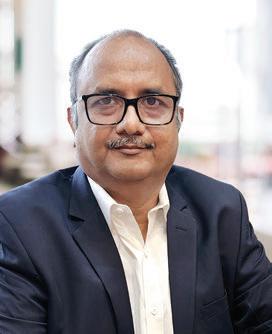
Priyank Jain, CEO Tulip 3P Media Private Limited
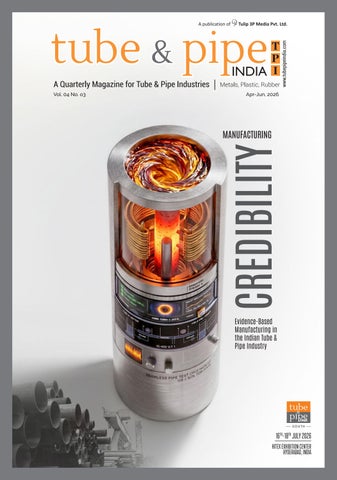
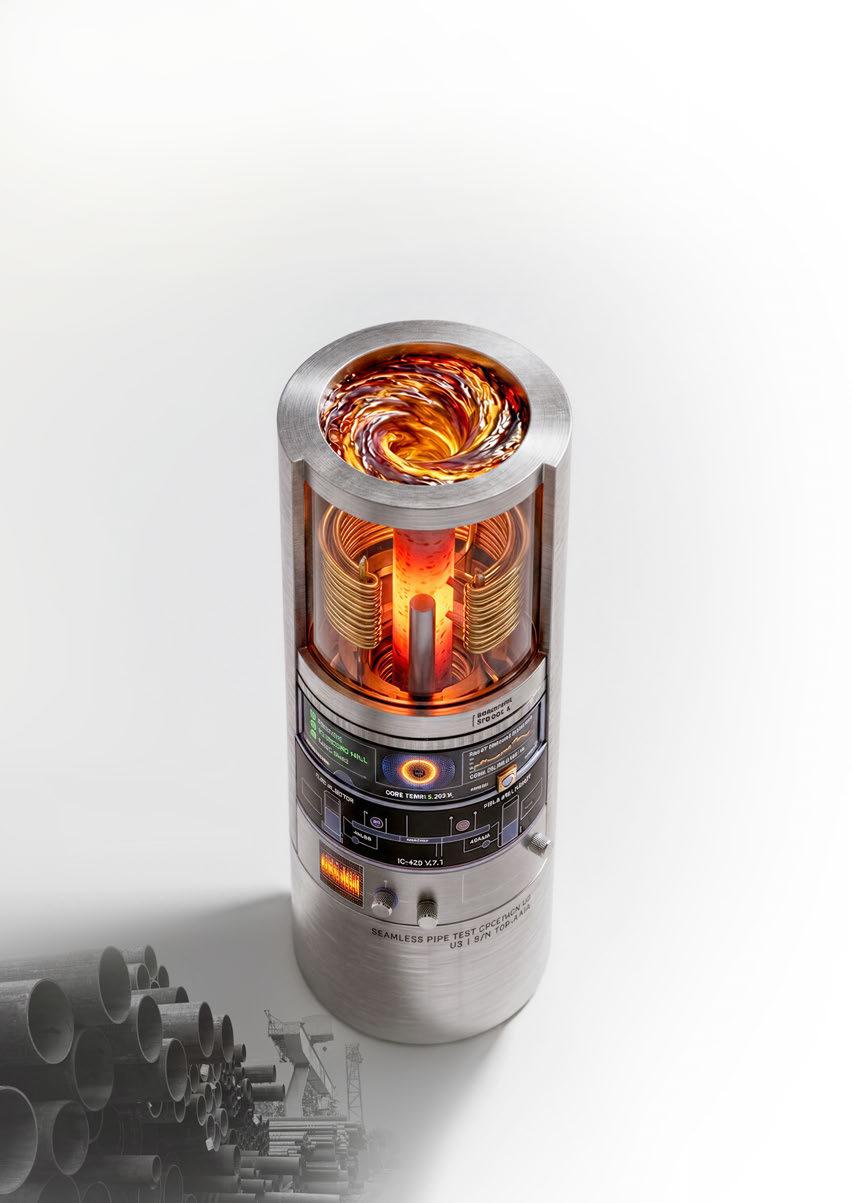
MANUFACTURING CREDIBILITY
Evidence-Based Manufacturing in the Indian Tube & Pipe Industry
The ability to produce a compliant product remains fundamental. Increasingly, however, customers also want evidence of how it was manufactured, verified, and qualified for its intended application.
Quality has long been a defining requirement in the tube and pipe industry. Standards, specifications, inspections, and certifications remain integral to manufacturing operations across product categories and enduse sectors. Yet manufacturers are increasingly assessed on factors that extend beyond product conformity alone.
Across industries where tubes and pipes perform critical functions, manufacturers repeatedly refer to process controls, testing capabilities, traceability, and supplier qualification systems as important differentiators in customer evaluation and supplier selection. The frequency with which these themes appear raises an important question: how is manufacturing credibility established in a market where customers rarely have direct visibility into production processes?
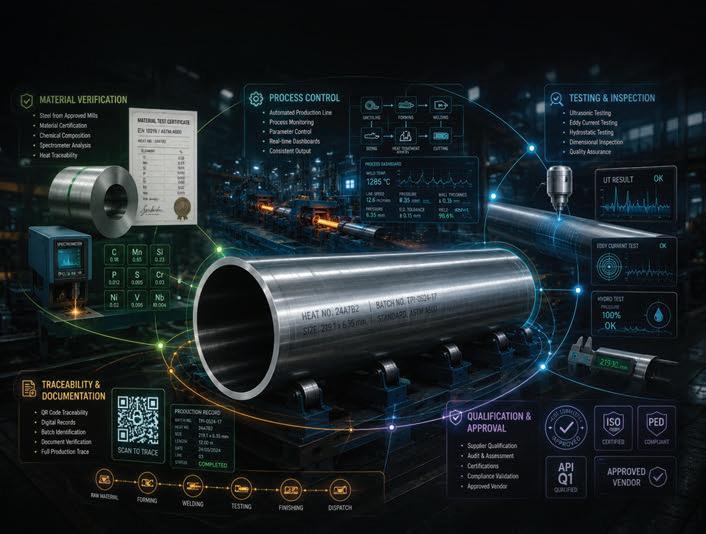
The answer extends beyond the finished product. While product specifications and compliance with applicable standards remain fundamental, customers increasingly seek evidence that these outcomes can be achieved consistently. Attention therefore extends to the systems that govern manufacturing itself, including raw material controls, production procedures, verification methods, and documentation frameworks.
This emphasis is particularly relevant because the tube and pipe industry serves a wide range of operating environments, from water infrastructure and industrial processing to automotive and oil & gas applications. The demands placed upon these products vary considerably, and so do the expectations placed upon the manufacturers supplying them.
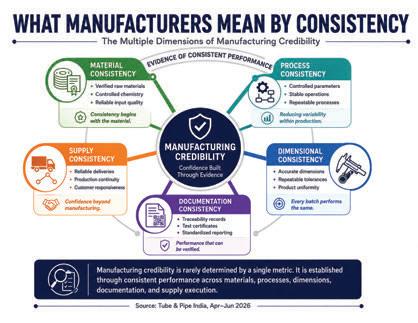
Consequently, discussions around manufacturing capability increasingly focus on questions such as: How are materials verified? How are manufacturing variables controlled?
How is consistency measured? And how is performance demonstrated to customers?
The recent interviews conducted by Tube & Pipe India suggest that answers to these questions are becoming an increasingly important part of supplier evaluation. Product quality remains essential, but manufacturing credibility is increasingly demonstrated through the capabilities that support consistent performance.
Quality as a Manufacturing Discipline
One of the strongest themes emerging from the conversations is the extent to which quality is discussed as a manufacturing discipline rather than an inspection activity.
When manufacturers describe their approach to quality, they rarely begin with final inspection or product testing. Instead, they refer to supplier selection, raw material verification, process planning, and customer-specific requirements. The emphasis is not solely on identifying defects but on reducing the likelihood of defects occurring in the first place.
This perspective is evident in the manner in which several companies describe their manufacturing systems. Akash Steel Crafts notes that every order is executed against a defined Quality Assurance Program (QAP), with production undertaken according to approved specifications and ASTM standards. Beyond documentation, such frameworks create consistency by aligning procurement, production, inspection, and reporting against predefined requirements.
A similar approach is reflected in comments from Goodluck India. Discussing the company’s quality philosophy, Chairman Mahesh Chandra Garg observes that quality “cannot be treated as a checkpoint— it must be embedded throughout the manufacturing process.” The statement captures a recurring theme across the interactions. Quality is frequently described not as a stage within manufacturing but as a characteristic of the manufacturing system itself.
When quality is embedded within manufacturing systems, attention shifts from correcting deviations to controlling the variables that create them. Supplier qualification, incoming material inspections, machine calibration, and process monitoring therefore become part of the quality framework.
Several manufacturers describe their operations in these terms. Hariom Pipes, for example, highlights the role of continuous monitoring and structured operating practices in maintaining product quality. The company’s emphasis on “consistency rather than correction” reflects a broader principle visible throughout the interviews: stable outcomes depend upon stable processes.
Similar emphasis on system-driven quality appears elsewhere in the industry. Avon Steel Industries highlights real-time process monitoring and integrated quality controls as part of its manufacturing framework, while Satyam Pipes points to standardised production practices and precision-focused operations as key contributors to product consistency.
Mahalakshmi Profiles and RR ISPAT similarly point to the advantages of integrated operations in maintaining consistency. Both companies emphasise that greater control over raw materials and production processes helps improve reliability, reduce disruptions, and support more predictable manufacturing outcomes.
This principle becomes particularly relevant as manufacturers serve a wider range of customer requirements. Product specifications may vary by application, but customers share a common expectation: the ability to receive products that perform consistently from one production batch to the next. Meeting that expectation requires systems capable of delivering repeatable outcomes under varying production conditions.
Verification Beyond Compliance
Process discipline establishes the conditions under which consistency can be achieved. Verification systems provide the means through which that consistency is measured and demonstrated.
For many manufacturers, testing has traditionally been associated with quality assurance at the end of the production cycle. The recent trend, however, suggests a broader role for inspection and testing infrastructure. Increasingly, these systems are being used not only to verify product conformity but also to generate information about manufacturing performance itself.
A test certificate may confirm that a product meets specification, but the data generated through testing can also reveal process deviations and opportunities for corrective action. In this sense, testing infrastructure functions not only as a verification mechanism but also as a source of manufacturing intelligence.
References to advanced inspection systems appear across the conversations. Manufacturers discuss hydrostatic testing, ultrasonic testing, eddy current inspection, and non-destructive testing as integral parts of their operations. While the specific technologies vary, the objective remains consistent: establishing confidence in product performance through measurable evidence.
Indipower Steel Works maintains critical welding parameters within documented control windows, with deviations triggering “investigation rather than simply correction.” Combined with inline eddy current testing and continuous dimensional gauging, this approach allows problems to be identified and addressed during production rather than at final inspection.
A similar emphasis on inspection capability is visible at Jindal Industries (Hissar), which refers to hydrostatic, ultrasonic, and eddy current testing for products serving demanding applications. MKK Metal Sections
likewise points to investments in spectrometers and hydro-testing facilities to verify material composition, assess structural integrity, and document compliance against customer requirements.
The growing importance of inspection capability is also reflected in the observations of ISEND, a developer of non-destructive testing systems for tube and pipe manufacturers, which notes that manufacturers increasingly seek the ability to detect smaller and more complex defects while maintaining production efficiency. This reflects a broader expectation that inspection systems should provide greater confidence in manufacturing reliability rather than simply identify defects.
Techno India Manufacturing & Engineering Solutions
(TIMES), an engineering and project solutions provider serving infrastructure and utility sectors, similarly points to the growing role of testing and inspection requirements in project-driven applications, where compliance must often be demonstrated through documented verification.
Testing systems are also becoming more closely integrated with production processes. The interviews indicate that inspection data is increasingly used to identify recurring process variations, refine operating parameters, and strengthen process stability over time. As a result, testing supports both verification and continuous improvement.
For customers operating in demanding environments, a test report often represents more than proof of conformity. It provides documented evidence that product performance has been assessed through recognised and repeatable methods.
Customers may never observe production processes directly, but inspection records and test certificates provide tangible evidence of how those processes are functioning. The ability to generate and substantiate such evidence is becoming an increasingly important aspect of manufacturing credibility.
When Performance Requirements Become More Demanding
The emphasis placed on process discipline and verification systems becomes easier to understand when viewed in relation to the environments in which tubes and pipes ultimately operate.
Although often discussed as a single manufacturing segment, the tube and pipe
industry serves a wide range of operating conditions. Products intended for water infrastructure, pharmaceutical facilities, refineries, automotive systems, or nuclear installations may all fall within the same broad category, yet the demands placed upon them differ substantially.
The interactions repeatedly illustrate this diversity. Manufacturers cite demand from sectors such as automotive, pharmaceuticals, oil and gas, and power generation, while consistently linking manufacturing requirements to the conditions under which their products are expected to perform.
Lalbaba Engineering, for example, points to applications involving high pressure, elevated temperatures, and fatigue resistance. In such environments, performance expectations extend beyond compliance with dimensional specifications or mechanical properties. Longterm reliability under sustained operational stress becomes equally important.
A similar perspective emerges from Maharashtra Seamless, which highlights the requirements associated with oil and gas transportation, boilers, heat exchangers, and power generation systems. These applications often involve continuous exposure to pressure, temperature fluctuations, or corrosive media, making long-term performance a critical consideration.
The relationship between operating conditions and manufacturing requirements is perhaps most clearly articulated by REMI Group. Serving sectors such as nuclear energy, pharmaceuticals, and aerospace, the company notes that a substandard pipe in a nuclear plant or pharmaceutical facility is not merely a commercial issue but a safety concern.
Not all products are subjected to the same consequences of failure. As a result, customers seek varying levels of assurance regarding material quality, manufacturing controls, testing procedures, and traceability.
This is also reflected in the growing emphasis on specialised grades and applicationspecific solutions. Mukand Sumi points to increasing requirements in automotive and energy applications, where consistency in metallurgical properties directly influences performance. Similarly, Indipower Steel Works highlights the expectations of automotive and precision engineering customers, where manufacturing repeatability and process
capability often receive the same level of scrutiny as the final product itself.
JTL Industries likewise highlights increasing demand for applicationspecific solutions across infrastructure and industrial segments, while Utkarsh India points to evolving requirements in solar structures and utility projects where operating conditions influence product specifications.
Similar trends are visible in stainless steel and specialty segments. Jindal Stainless points to growing demand from sectors requiring higher corrosion resistance and longer service life, while Kamdhenu Group highlights increasing attention towards specialised steel solutions aligned with specific end-use requirements. These examples suggest that application requirements frequently shape manufacturing practices long before a product reaches the customer. Material selection, testing intensity, and documentation requirements are often determined by the intended operating environment rather than by the product category alone.
In this context, manufacturing credibility becomes closely linked to application understanding. Customers are not simply evaluating whether a manufacturer can produce a tube or pipe to specification. They are also evaluating whether the manufacturer understands the operating conditions under which that product will function and has applied appropriate controls throughout the manufacturing process. The more demanding the operating environment, the greater the importance attached to the evidence supporting product reliability.
Trust, Qualification and Market Access
The evidence generated through manufacturing systems, process controls, and testing infrastructure ultimately serves a practical purpose: it helps customers assess supplier capability before products enter service.
Manufacturers across different segments repeatedly refer to audits, certifications, approval systems, and customer-specific requirements when describing their business environment. These mechanisms provide a structured basis for evaluating manufacturing capability without relying solely on the finished product.
This becomes particularly relevant in sectors where the consequences of supplier failure extend beyond the replacement cost of a component. A tube or pipe may represent only a small portion of a larger system, yet failure can result in operational disruption, safety concerns, or project delays. As a result, customers often seek confidence in the manufacturing organisation as much as in the product itself.
This confidence is increasingly established through formal qualification frameworks. Certifications such as ISO standards, IATF requirements, ASTM compliance systems, and customer-specific approval procedures appear frequently across manufacturers serving different markets. While these frameworks differ in scope, they serve a common purpose: providing evidence that manufacturing activities are being performed within documented and verifiable systems.
Indipower Steel Works notes that automotive and precision engineering customers increasingly prefer to work with a smaller pool of suppliers that can demonstrate verifiable quality systems and documented manufacturing controls. The company’s emphasis on IATF-certified processes and traceable quality systems reflects a broader
trend in which supplier evaluation extends beyond the product itself to the systems supporting its manufacture.
A similar pattern emerges across infrastructure and engineering applications. Manufacturers frequently refer to customer audits, approved vendor lists, quality documentation, and traceability systems as routine elements of commercial engagement. In many cases, qualification takes place long before an order is awarded, with customers first evaluating whether the supplier possesses the systems required to support the intended application.
Tata Steel also emphasises the importance of customer assurance mechanisms and project-specific compliance requirements, reflecting the growing role of qualification frameworks in supplier evaluation.
Akash Steel’s use of project-specific Quality Assurance Programs illustrates this relationship. Customer confidence is often supported through predefined inspection plans, documentation protocols, and agreed manufacturing controls rather than product inspection alone. Manufacturers serving regulated or technically demanding sectors describe qualification procedures that extend well beyond compliance testing. Viewed in this context, market access is increasingly linked to the ability to demonstrate capability through recognised and verifiable mechanisms.
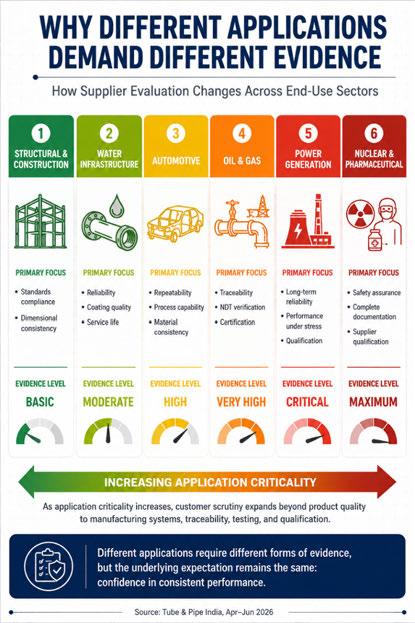
The discussions also suggest that manufacturers are not evaluated through identical criteria. The depth of scrutiny often varies according to the application, operating environment, and risks associated with product performance. This variation helps explain why manufacturing credibility is established through different qualification and assurance requirements across different parts of the tube and pipe industry.
A More Differentiated Manufacturing Landscape
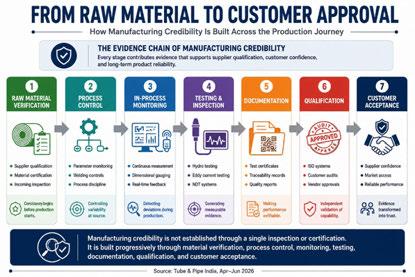
Taken individually, the themes discussed throughout the interactions may appear as separate operational priorities. Manufacturers speak about process controls, testing systems, traceability mechanisms, certifications, and application-specific requirements from different perspectives. Viewed collectively, however, they reveal a broader characteristic of the contemporary Indian tube and pipe industry: manufacturing capability is increasingly assessed through multiple layers of evidence rather than
through product specifications alone.
This does not imply a single model of manufacturing across the industry. The sector continues to serve a wide range of products and applications, each with its own technical and commercial requirements. What the observations indicate instead is that supplier evaluation is becoming increasingly dependent on the demands of the application being served.
A manufacturer supplying products for general structural applications may face a different set of customer expectations than one serving automotive, pharmaceutical, or oil and gas applications. The differences often
extend beyond product specifications to areas such as testing intensity, traceability requirements, qualification procedures, and the level of visibility customers seek into manufacturing processes.
As a result, manufacturers are required to demonstrate different forms of capability depending on the markets they serve. For some customers, compliance with applicable standards may be sufficient. For others, supplier evaluation may involve a detailed review of manufacturing systems, process controls, testing infrastructure, and quality documentation.
In a manufacturing environment, therefore, credibility is established through multiple forms of evidence. The nature of that evidence may vary from one application to another, but the underlying expectation remains consistent: customers increasingly seek confidence that performance can be delivered repeatedly under the conditions for which the product is intended.
TII Acquires Over 76% Stake in Orange Koi
Tube Investments of India Limited (TII) has acquired a 76.24% stake in Orange Koi Private Limited, becoming a subsidiary of the company.
Apr 07, 2026
Tube Investments of India Limited (TII) has announced the acquisition of 76.24% stake in Orange Koi Private Limited. This acquisition was completed on April 6, 2026, resulting in Orange Koi becoming a subsidiary of Tube Investments of India.
Orange Koi is a metal injection molding technology and additive manufacturing technology company manufacturing small precision parts for medical,
automotive, aerospace, industrial and defense industries.
The acquisition marks a strategic expansion
for TII, aligning with its broader business objectives and enhancing its market position and operational capabilities. The financial details related to the acquisition have not been disclosed.
Tube Products of India Inaugurates New Tube Mill & Upgraded Facilities
Tube Products of India has marked a major milestone with the inauguration of its newly installed 10-inch tube mill, renovated admin building and an upgraded employee facilities at the plant.
May 16, 2026
The engineering division of Tube Products of India has marked a major milestone with the inauguration of its renovated admin building, a newly installed 10-inch tube mill, and an upgraded employee facilities at the large diameter pipe plant.
The facility upgrade also includes a shuttle play area and recreation club, highlighting TPI’s commitment to workplace development and employee well-being.
The new developments, inaugurated by Mr. Shivdeep Jammu, Sr VP & Division Head – TPI, reflects the
company’s continued focus on strengthening operational capabilities while creating a more engaging and employee-friendly workplace environment.
Jindal Industries Hisar Pans Focus Across Scale, Specialisation and Expansion in the Steel Sector
Amid evolving steel market dynamics, increasing demand for application-specific products, and rising emphasis on quality assurance, Jindal Industries Hissar Pvt. Ltd. is strengthening its position through a balanced strategy focused on capacity expansion, technological advancement, and value-added product diversification. In an exclusive interview with Tube & Pipe India, Mr. Sunil Jain, Director and CEO, Jindal Industries Pvt. Ltd. (Hisar), shares how the company is investing in highperformance manufacturing, advanced Direct Forming Technology (DFT) mills, and integrated piping solutions to enhance efficiency, flexibility, and customer responsiveness across diverse end-use sectors. Mr. Jain discusses how the company is adapting to changing steel dynamics, ensuring consistent product quality, expanding into specialized applications, and building a future-ready growth strategy driven by scale, customization, and export expansion.
Mr. Sunil Jain, Director and CEO, Jindal Industries Pvt. Ltd. (Hisar)
Tube & Pipe India: How are the evolving steel dynamics- quality, pricing, availability, shaping your manufacturing strategy of steel pipes, tubes and other products?
Sunil Jain: With a focus on evolving steel dynamics and manufacturing strategy, Jindal Industries is shifting toward high-performance manufacturing to counter steel price volatility and demand for better quality.
Raw Material Strategy: The company
prioritizes procurement of high-grade Hot Rolled Coils (HRC) to ensure consistent, premium-quality pipes, particularly sourcing from major suppliers like SAIL, TATA, JSW & now JFL.
Capacity Expansion: To address availability and meet growing demand, a new 1.5 million TPA capacity plant is being set up in Hansi, near Hisar, expected to be in production by Q3 2026.
Technological Shift: The company is implementing Direct Forming Technology (DFT) mills at new facilities, allowing for faster production of varied sizes without changing tools, enhancing efficiencies, improving delivery of variety with less lead time.
TPI: In the tube and pipe sector, how critical is steel quality in determining product performance, reliability, and end-use acceptance? How do you ensure the best quality of your pipes and tubes?
SJ: Steel quality plays a critical role in ensuring the structural integrity, durability, and long-term performance of pipes and tubes, particularly in corrosive and high-stress operating environments. Inferior-quality steel can lead to premature corrosion, weld failures, structural fatigue, and reduced service life, making stringent quality control essential across the manufacturing process.
To maintain consistent product reliability and performance, the company follows rigorous quality assurance procedures, including strict adherence to Bureau of Indian Standards
(BIS) specifications and inspection schemes such as IS:1239, IS:3589, and IS:10748. Comprehensive in-house testing is carried out at multiple stages — from raw material inspection to final dispatch — to ensure compliance with required standards. For critical applications, specialized tests including hydrostatic testing, eddy current testing, and ultrasonic testing are also conducted to guarantee product safety, strength, and defectfree performance.
TPI: Which end-use sectors are currently driving demand for your steel products, and how is this influencing your portfolio?
SJ: The demand is currently driven by infrastructure, government initiatives, and industrial expansion. Some of the key sectors are– Jal Jeevan Mission (water transportation), structural projects (airports, railway bridges), firefighting in commercial buildings, solar power support systems, and oil/ gas transportation.
In terms of our portfolio, there is an increased focus on high-strength MS pipes (Fe 330, 410, 450) and GI pipes, along with expanding into hollow sections.
TPI: Are customers increasingly looking for application-specific steel products rather than standard offerings? If yes, how are you catering to the demand?
SJ: Yes, customers are increasingly demanding application-specific steel products instead of standard offerings, as industries now require solutions tailored to their operational, structural, and environmental requirements. In response to this evolving demand, Jindal Industries is expanding its customised product capabilities by offering pipes in customised lengths along with tailor-made coating solutions such as bare, varnish, bituminous, and primer coatings.
The company also manufactures specialized products for niche applications, including OCTG (Oil Country Tubular Goods) pipes for the oil & gas sector and high-strength sections for prefabricated structures.
Customers are increasingly demanding application-specific steel products instead of standard offerings, as industries now require solutions tailored to their operational, structural, and environmental requirements. In response to this evolving demand, Jindal Industries is expanding its customised product capabilities by offering pipes in customised lengths along with tailor-made coating solutions such as bare, varnish, bituminous, and primer coatings.
Further, with the adoption of Direct Forming Technology (DFT) and new tooling capabilities, Jindal Industries is able to produce specific non-standard sizes with greater flexibility, improved efficiency, and reduced lead times.
TPI: With turnkey solutions in the tube & pipe sector taking a gradual and selective spotlight, how do you view your business evolving or what steps are you taking in the direction to provide end-to-end solutions to the customers?
SJ: The company is moving toward providing comprehensive piping solutions, transitioning from
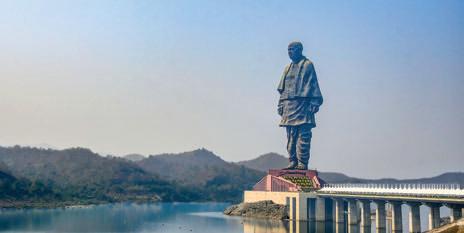
merely a product supplier to a solutions provider. Working in the direction, the company has integrated its manufacturing capabilities with the ability to offer coated, welded, and fabricated pipes, especially for large infrastructure projects like the Statue of Unity and the Chenab Rail Bridge.
TPI: Does offering a wider range of turnkey solutions provide a competitive edge, or does it add operational complexity?
SJ: Offering a wider range of turnkey solutions provides a competitive edge in high-value projects, even though it requires higher operational
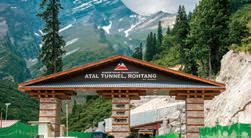
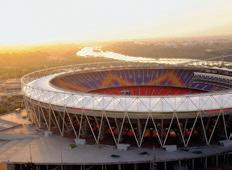
Jindal Industries Pvt. Ltd. (Hisar) has been a contributor in projects likeStatue of Unity (Gujarat), Narendra Modi Stadium (Gujarat) and Atal Tunnel (Himachal Pradesh)
The company is moving toward providing comprehensive piping solutions, transitioning from merely a product supplier to a solutions provider. Working in the direction, the company has integrated its manufacturing capabilities with the ability to offer coated, welded, and fabricated pipes, especially for large infrastructure projects like the Statue of Unity and the Chenab Rail Bridge.
efficiency. In terms of value addition, it helps secure long-term contracts and builds client trust, particularly in competitive markets where quality assurance is valued over low cost.
TPI: How do you ensure consistency and quality across your diversified product portfolio?
SJ: Jindal Industries ensures consistency and quality across its diversified product portfolio through a robust integrated management system and a strong focus on process standardization. The company operates under internationally recognized certifications, including ISO 9001:2015,
ISO 14001:2015, and ISO 45001:2018.
To maintain uniform product quality and minimize process variations, the company extensively utilizes automated mills and standardized testing systems across its manufacturing operations. This helps reduce human error, improve process reliability, and ensure consistent compliance with required quality specifications across different product categories.
TPI: Going forward, will growth be driven more by scale in core products or by diversification into specialized steel applications?
SJ: Going forward in 2026 and beyond,
growth will be driven through a hybrid strategy balancing scale expansion in core products with diversification into specialized steel applications.
Specialised Applications: The company is simultaneously diversifying into high-margin, valueadded products such as specialized sections and high-end alloy steel pipes.
Scale Expansion: Jindal Industries is expanding its core MS pipe production capacity, with a target of achieving 10 lakh tons per annum by 2028.
Complete Product Basket: The focus remains on providing a complete basket of products to customers under one umbrella.
Pan-India Availability:
Strengthening product availability and distribution reach across India continues to be a key growth driver.
Exports from New Plants: The upcoming facilities will also support export expansion and strengthen the company’s global market presence.
Gallantt Ispat Limited Appoints Pradyumna Kumar Satpathy as CFO
Gallantt Ispat Limited has appointed Pradyumna Kumar Satpathy as its Chief Financial Officer (CFO) and Key Managerial Personnel, effective April 1, 2026.
Apr 1, 2026
Gallantt Ispat Limited has appointed Pradyumna Kumar Satpathy as its Chief Financial Officer (CFO) and Key Managerial Personnel, effective April 1, 2026, following board approval.
Mr. Satpathy brings over 28 years of experience in finance management, corporate planning, cost control, and audit. He has previously held senior leadership roles at JSW Steel, Jayaswal Neco Industries Limited, and Bhushan Power and Steel Limited.
His appointment is aimed at strengthening the company’s financial strategy, operational efficiency, and compliance framework as it continues to expand its operations.
Mr. Pradyumna Kumar Satpathy, CFO, Gallantt Ispat Limited
NEWS
Goodluck India Sheds Light on Increased Demand of Product Specialisation
Rapid shifts in steel pricing, evolving quality benchmarks, and rising demand for customized applications are redefining priorities across the tube and pipe manufacturing sector. Customers today are increasingly seeking suppliers capable of delivering not only quality products, but also technical reliability, consistency, and integrated support across the value chain. Against this backdrop, manufacturers are being compelled to strengthen operational discipline, invest in process optimization, and move toward higher-value, application-focused offerings. In an exclusive interview with Tube & Pipe India, Mr. Mahesh Chandra Garg, Chairman, Goodluck India Ltd., shares his perspective on changing market dynamics, the growing relevance of turnkey capabilities, and how the company is positioning itself for long-term growth through precision manufacturing, customer collaboration, and portfolio diversification.
Mr. Mahesh Chandra
Garg, Chairman, Goodluck India Ltd.
Tube & Pipe India: How are the evolving steel dynamics—quality, pricing, availability— shaping your manufacturing strategy of steel pipes, tubes and other products?
Mahesh Chandra Garg: The steel industry today is witnessing a significant transformation driven by fluctuations in raw material pricing, evolving quality standards, global trade regulations, and sustainability expectations. For manufacturers like us, adaptability has become equally important as scale.
Our strategy is focused on three key pillars — quality consistency, supply chain resilience, and operational efficiency. We work closely with approved steel suppliers to ensure stable quality and traceability of raw materials, while simultaneously optimizing inventory planning to manage price volatility and availability challenges.
At the manufacturing level, we continue investing in process automation, testing infrastructure, and production optimization to improve yield, reduce variability, and maintain competitiveness. The market today demands not only cost-effective products, but also reliability, compliance, and longterm performance, and our manufacturing philosophy is aligned accordingly.
TPI: In the tube and pipe sector, how critical is steel quality in determining product performance, reliability, and end-use acceptance? How do you ensure the best quality of your pipes and tubes?
MCG: Steel quality is the foundation of the tube and pipe industry. The mechanical properties, dimensional accuracy, weld integrity, corrosion resistance, and long-term durability of the final product are all directly influenced by the quality and consistency of the steel used.
In critical applications such as automotive, infrastructure, engineering, construction, energy, and precision engineering, even minor inconsistencies can impact performance and customer confidence. Therefore, quality cannot be treated as a checkpoint — it
must be embedded throughout the manufacturing process.
At our facilities, quality assurance begins from raw material selection itself. We source steel only from approved and reputed mills, followed by stringent incoming inspection protocols. During production, we maintain strict process controls, online monitoring systems, dimensional inspections, weld quality verification, and multiple stages of testing including mechanical, chemical, coating, and surface evaluations.
In addition, we continuously invest in advanced testing equipment, process upgrades, and workforce training to ensure our products consistently meet international standards and customerspecific requirements.
TPI: Which end-use sectors are currently driving demand for your
steel products, and how is this influencing your portfolio?
MCG: Currently, demand is being driven strongly by sectors such as infrastructure, automotive, construction, renewable energy, engineering, industrial fabrication, and global OEM supply chains.
Infrastructure expansion and urban development continue to create sustained demand for structural and construction-grade tubes. Simultaneously, engineering and automotive sectors are increasingly seeking higher precision, tighter tolerances, improved surface finish, and application-specific solutions.
This evolving demand profile is encouraging us to diversify our portfolio toward higher value-added products, specialized coatings, precision tubes, and customized solutions rather than focusing solely
on commodity volumes. The market today is clearly shifting toward performance-oriented products, and we see this as a long-term direction for the industry.
TPI: Are customers increasingly looking for application-specific steel products rather than standard offerings? If yes, how are you catering to the demand?
MCG: Yes, absolutely. Customers today are far more application-focused than before. Different industries have highly specific requirements related to strength, dimensional tolerances, coating thickness, corrosion resistance, machinability, and processing compatibility. As a result, standardized products alone are no longer sufficient in many segments. Customers increasingly expect solutions tailored to their exact operational and technical needs.
To cater to this demand, we work closely with customers right from the development stage. Our approach involves understanding the end application in detail and then aligning material selection, manufacturing parameters, coating specifications, testing protocols, and packaging systems accordingly.
This collaborative and solutionoriented approach helps us create long-term partnerships instead of transactional business relationships.
TPI: With turnkey solutions in the tube & pipe sector taking a gradual and selective spotlight, how do you view your business evolving or what steps are you taking in the direction to provide end-to-end solutions to customers?
MCG: The industry is gradually moving toward integrated and valueadded partnerships where customers
prefer suppliers capable of offering not just products, but dependable end-to-end support. We believe turnkey capabilities will become increasingly important, especially for global customers seeking consistency, technical coordination, and supply chain reliability under a single platform.
In this direction, we are strengthening our capabilities across product development, processing, coating solutions, quality assurance, logistics coordination, and technical support. Our focus is on becoming a longterm strategic manufacturing partner capable of supporting customers from concept to execution.
However, we also believe that turnkey solutions must be built carefully and sustainably. The objective should not merely be expansion, but creating a system that genuinely improves
Steel quality is the foundation of the tube and pipe industry. The mechanical properties, dimensional accuracy, weld integrity, corrosion resistance, and long-term durability of the final product are all directly influenced by the quality and consistency of the steel used.
efficiency, accountability, and customer value.
TPI: Does offering a wider range of turnkey solutions provide a competitive edge, or does it add operational complexity?
MCG: In reality, it does both. A wider range of turnkey solutions certainly provides a strong competitive advantage because customers today value convenience, technical integration, accountability, and supply reliability. The ability to offer multiple solutions under one roof strengthens customer confidence and deepens business relationships. At the same time, diversification also increases operational complexity in terms of quality management, technical expertise, production planning, and coordination across multiple functions.
The key lies in balancing expansion with operational discipline. At our organization, we prioritize controlled growth supported by strong systems, process standardization, technical competency, and continuous monitoring. We believe sustainable diversification creates long-term value only when backed by operational excellence.
TPI: How do you ensure consistency and quality across your diversified product portfolio?
MCG: Consistency can only be achieved through systems, discipline, and continuous improvement. Across our product portfolio, we maintain standardized manufacturing procedures, strict quality protocols, traceability systems, and defined inspection mechanisms at every stage of production. We have also invested significantly in modern machinery, testing laboratories, calibration systems, and process monitoring technologies to minimize variation and improve repeatability.
Equally important is our focus on people. Continuous training, technical development, and a quality-driven work culture play a major role in ensuring consistency across all product categories. For us, quality is not limited to compliance alone — it is about delivering reliability and confidence to the customer every single time.
TPI: Going forward, will growth be driven more by scale in core products
The industry is gradually moving toward integrated and value-added partnerships where customers prefer suppliers capable of offering not just products, but dependable end-to-end support. We believe turnkey capabilities will become increasingly important, especially for global customers seeking consistency, technical coordination, and supply chain reliability under a single platform.
or by diversification into specialized steel applications?
MCG: Going forward, we believe the industry’s strongest growth will come from a balanced combination of both. Scale will continue to remain important for operational efficiency, competitiveness, and market presence in core product categories. However, long-term differentiation and sustainable value creation will increasingly come from specialized and application-oriented products.
Global customers today are looking
beyond volume. They are evaluating suppliers based on technical capability, quality consistency, customization, sustainability readiness, and solutionoriented manufacturing.
Therefore, our growth strategy is focused not only on expanding capacity, but also on moving progressively toward higher value-added products, advanced applications, and stronger customer integration. We see the future of the steel tube and pipe industry being driven by innovation, precision, and reliability rather than commoditization alone.
AM/NS India Appoints Amit Harlalka as CEO, Dilip Oommen to Step Down
Amit Harlalka to take over as CEO of AM/NS India from July 1, bringing financial leadership experience as AM/NS India enters the next growth phase.
March 30,
2026
ArcelorMittal Nippon Steel India has appointed Amit Harlalka as its Chief Executive Officer, effective July 1, 2026. Mr. Harlalka, currently serving as Chief Financial Officer, will succeed Dilip Oommen, who will step down from his executive role on June 30 and continue on the company’s board.
Mr. Harlalka has been a key part of the leadership team at AM/NS India, overseeing financial strategy and playing a critical role in the company’s expansion plans. Prior to this, he has held senior leadership roles across finance and corporate strategy, bringing extensive experience in capital allocation and business transformation.
Mr. Oommen, the first CEO of the joint venture between ArcelorMittal and Nippon Steel, has led the
Mr. Amit Harlalka, CEO, ArcelorMittal Nippon Steel India
company since its acquisition of Essar Steel in 2019 and will continue to contribute at the board level.
The leadership transition comes at a time when AM/NS India is focusing on expansion and strengthening its downstream and value-added steel portfolio.
Inside Hariom Pipe Industries Strategy to Deliver Quality, Stability and Growth in a Dynamic Steel Market
As India’s infrastructure, renewable energy, and industrial sectors gather momentum, the steel tube and pipe industry is evolving amid volatile steel prices, rising quality standards, and increasing demand for applicationspecific solutions. In an exclusive interview with Tube & Pipe India, Mr. Roopesh Kumar Gupta, Managing Director Representing, Hariom Pipe Industries Limited, and Mr. Shailesh Gupta, Whole-time Director Representing, Hariom Pipe Industries Limited, discusses how the company is strengthening its manufacturing ecosystem through integrated digital systems, workforce training, backward integration, and disciplined process controls. They also highlight the company’s growing focus on value-added and application-specific products, driven by demand from infrastructure, solar energy, railways, and industrial sectors, while sharing their perspective on manufacturing excellence, selective turnkey solutions, and long-term sustainable growth.
Mr. Roopesh Kumar Gupta , Managing Director Representing, Hariom Pipe Industries Limited
Mr. Shailesh Gupta , Whole-time Director Representing, Hariom Pipe Industries Limited
Tube & Pipe India: How are the evolving steel dynamics- quality, pricing, availability, shaping your manufacturing strategy of steel pipes, tubes and other products?
Roopesh Kumar Gupta: The current financial year has clearly underscored how dynamic the steel ecosystem has become. Over the course of the year, the industry has witnessed multiple price revisions—typically 5 to 7 cycles— with variations ranging approximately between 8% to 15% across different phases, driven by changes in input costs, supply demand dynamics, and logistics conditions. These frequent movements have reinforced the need for a manufacturing strategy that is predictable, system driven, and resilient rather than reactive.
At Hariom Pipe Industries, we have consciously strengthened our internal control mechanisms through integrated ERP, HRM, and CRM systems, enabling real-time visibility into production planning, inventory movement, cost trends,
At Hariom Pipe Industries, we have consciously strengthened our internal control mechanisms through integrated ERP, HRM, and CRM systems, enabling real-time visibility into production planning, inventory movement, cost trends, and market demand. This allows us to respond to fluctuations with speed and accuracy rather than hindsight. Equally important has been our focus on people and process readiness.
and market demand. This allows us to respond to fluctuations with speed and accuracy rather than hindsight. Equally important has been our focus on people and process readiness. We conduct regular, structured employee training programs across operations, quality, and planning functions to improve capability in managing variability without compromising output standards. This ensures that volatility is absorbed through efficiency and discipline rather than passed on as inconsistency.
From a product perspective, these dynamics have accelerated our strategic shift toward value-added and application-specific offerings, where decision-making is driven less by short-term price movements and more by performance, reliability, and long-term customer partnerships. Our investments in backward integration, technology upgrades, and capacity augmentation further strengthen availability, cost control, and quality consistency.
Overall, our manufacturing strategy
today is designed to operate effectively in an environment where volatility is structural—not cyclical—while continuing to deliver stable quality, dependable supply, and sustainable value to our customers.
TPI: In the tube and pipe sector, how critical is steel quality in determining product performance, reliability, and end-use acceptance? How do you ensure the best quality of your pipes and tubes?
Shailesh Gupta: Steel quality plays a decisive role in determining product strength, dimensional accuracy, corrosion resistance, and long-term reliability in the tube and pipe sector. Even minor variations in input quality can directly impact performance, especially in infrastructure, industrial, and renewable applications.
At Hariom Pipe Industries, quality control is embedded across every stage of manufacturing. Operating with a combined capacity of over 700,000 MTPA, we follow standardized operating practices, rigorous input inspections, process checkpoints,
and in-house testing aligned with BIS specifications. Our focus is on consistency rather than correction, supported by disciplined process control, skilled manpower, and continuous monitoring. This approach ensures that products supplied across more than 625+ dealers in five southern states meet uniform quality expectations, regardless of application or geography.
TPI: Which end-use sectors are currently driving demand for your steel products, and how is this influencing your portfolio?
RKG: Demand for steel pipes and tubes continues to be driven by infrastructure development, construction, EPC projects, industrial manufacturing, and renewable energy. Among these, renewable energy— particularly solar power—has emerged as a strong and evolving demand segment, supported by India’s rapid transition toward sustainable and green energy infrastructure. Solar power plants, along with railways and auto ancillaries, are contributing
steadily to requirement growth for high-performance tubular products.
This evolving demand mix has had a defining influence on our portfolio strategy. While structural and core products continue to provide volume stability, over 60% of our installed capacity is now oriented toward value-added products, reflecting a clear shift toward applicationspecific, higher-specification offerings. We have expanded capabilities to support sectors such as solar, where consistency, durability, and corrosion resistance are critical.
Aligned with our long-term growth roadmap, we have also signed an MoU with the Government of Maharashtra to expand our operations in Gadchiroli, marking an important milestone for Hariom Pipe Industries. This initiative strengthens our geographical footprint and positions us closer to emerging demand hubs, particularly in infrastructure and renewable energy.
Overall, our portfolio is designed to balance scale with specialization, enabling us to serve diverse industries while minimizing dependence on any single sector and supporting sustainable, future-ready growth.
TPI: Are customers increasingly looking for application-specific steel products rather than standard offerings? If yes, how are you catering to the demand?
SG: Yes, customers are increasingly seeking application-specific products tailored to load conditions, environmental exposure, and installation requirements, rather than standard-grade offerings.
To meet this demand, we have developed manufacturing flexibility across our facilities to produce pipes and tubes in multiple sizes; thickness ranges from 0.5 mm up to 3.5 mm, and varied coatings. Our teams work closely with customers to understand end-use conditions and recommend suitable specifications, which reduce secondary processing and improves onsite performance. This capability has helped us strengthen relationships in sectors where performance
While structural and core products continue to provide volume stability, over 60% of our installed capacity is now oriented toward value-added products, reflecting a clear shift toward application-specific, higher-specification offerings. We have expanded capabilities to support sectors such as solar, where consistency, durability, and corrosion resistance are critical.
consistency and dimensional precision are critical.
TPI: With turnkey solutions in the tube & pipe sector taking a gradual and selective spotlight, how do you view your business evolving or what steps are you taking in the direction to provide end-to-end solutions to the customers?
RKG/SG: We view turnkey solutions as an evolutionary opportunity rather than a blanket strategy. Customers increasingly expect suppliers to provide more than just products — timely deliveries, technical clarity, and application guidance are becoming equally important. At Hariom Pipe Industries, our approach is selective. We are strengthening internal systems, logistics coordination, and technical support capabilities while Accounting On ground Feedback and Market Analysis to offer endto-end value where it complements our manufacturing strength, without diluting operational focus. This ensures that solution-oriented engagement enhances customer outcomes while maintaining execution discipline.
TPI: Does offering a wider range of turnkey solutions provide a competitive edge, or does it add operational complexity?
RKG: Turnkey solutions can provide a competitive edge when implemented with clarity and scale alignment. However, indiscriminate expansion into non-core areas can add operational complexity and execution risk. Our philosophy is to build depth before breadth. Competitive advantages come from reliability, consistency, and execution strength. By focusing on manufacturing
excellence, integrated operations, and system driven planning, we ensure that any value-added service enhances competitiveness rather than fragmenting focus.
TPI: How do you ensure consistency and quality across your diversified product portfolio?
SG: Consistency across a diversified portfolio is achieved through standardization of processes, disciplined supervision, and uniform quality benchmarks across all facilities.
All plants operate under common manufacturing protocols, inspection practices, and quality documentation systems. Workforce training, process reviews, and periodic audits ensure that product quality remains consistent regardless of plant location or end-use application.
This enables us to scale operations while maintaining reliability across both core and value-added products.
TPI: Going forward, will growth be driven more by scale in core products or by diversification into specialized steel applications?
RKG: Future growth will be driven by a measured combination of scale and specialization. Core products will continue to provide volume stability and operational leverage, particularly as infrastructure spending accelerates.
At the same time, diversification into specialized and value-added steel applications will play a critical role in margin expansion and long-term differentiation. Our strategy is to scale responsibly while deepening our presence in segments where quality, reliability, and application-specific performance command greater value.
From Raw Material Selection to Final Inspection, MKK Metal Sections Focuses on Steel Quality
As steel markets evolve with rising quality benchmarks and application-specific demand, the company is sharpening its focus on precision manufacturing, advanced testing, and value-added solutions. In an exclusive interview with Tube & Pipe India, Mr. Nishant Garg and Mrs. Srishti Garg, Directors, MKK Metal Sections Pvt. Ltd., discuss the company’s strategy around quality assurance, and long-term growth in the steel tubes and pipes sector. The interview also talks about how the company is catering to customisation needs by offering tailored dimensions, grades, coatings, and specifications based on industry requirements. With a focus on quality control throughout the process of raw material selection to final inspection, MKK Metal Sections aims to balance both scale and diversification in the steel tube and pipe sector.
Mr. Nishant Garg and Mrs. Srishti Garg , Directors, MKK Metal Sections Pvt. Ltd.
Tube & Pipe India: How are the evolving steel dynamics—quality, pricing, and availability— shaping your manufacturing strategy for steel pipes, tubes, and other products?
Nishant Garg: The steel market today is far more dynamic than it was a few years ago, with fluctuations in raw material pricing and increasing expectations around quality and delivery timelines. At MKK Metal Sections Pvt. Ltd., our strategy is focused on maintaining a strong balance between quality consistency, cost efficiency, and supply reliability. We work
closely with trusted steel suppliers, optimize inventory planning, and continuously upgrade our manufacturing processes to remain agile and competitive in changing market conditions.
TPI: In the tube and pipe sector, how critical is steel quality in determining product performance, reliability, and end-use acceptance? How do you ensure the best quality of your pipes and tubes?
Srishti Garg: Steel quality is absolutely
critical in our industry because it directly impacts strength, durability, weldability, and overall product performance. End-use sectors today demand strict adherence to specifications and certifications. At MKK, quality is monitored at every stage - from raw material selection to final inspection. We follow stringent quality control processes, advanced testing standards, and continuous process monitoring to ensure that our pipes and tubes consistently meet both domestic and international requirements. MKK has the most advanced state-of-the-art testing tools like a spectrometer, hydro-tester etc that ensure quality at all stages.
TPI: Which end-use sectors are currently driving demand for your steel products, and how is this influencing your portfolio?
NG: Infrastructure, construction, automotive, renewable energy, engineering, and industrial fabrication are currently among the strongest demand drivers for our products. This shift is encouraging us to expand our portfolio toward higher-value and application-focused products, including precision tubes, structural sections, and specialized grades that
cater to evolving project requirements.
TPI: Are customers increasingly looking for application-specific steel products rather than standard offerings? If yes, how are you catering to the demand?
SG: Yes, customer expectations have evolved significantly. Today, many clients prefer customized and application-specific solutions instead of generic standard products. At MKK, we are addressing this by offering tailored dimensions, grades, coatings, and specifications based on industry requirements. Our focus is on understanding the customer’s end application and delivering products that improve performance, efficiency, and long-term value. Apart from regular BIS Licenses (IS:1239 (part-1), IS:3589, IS:4270, IS:1161, IS:4923, IS:3601, IS:9295, we also have EN 10219-1:2006-Construction Product Regulation 305/2011, EN 10255-2004+A1:2007-Construction Product Regulation 305/2011, SLS 8292009-GI pipes, AFP-3206 (Activfire) for ASTM A135/A53, and AFP-2977 (Activfire) for AS1074 certification. These help us cater to specific demands of clients.
TPI: With turnkey solutions in the
Today, many clients prefer customized and applicationspecific solutions instead of generic standard products. At MKK, we are addressing this by offering tailored dimensions, grades, coatings, and specifications based on industry requirements. Our focus is on understanding the customer’s end application and delivering products that improve performance, efficiency, and long-term value.
tube & pipe sector taking a gradual and selective spotlight, how do you view your business evolving, or what steps are you taking toward providing end-to-end solutions to customers?
NG: The industry is gradually moving toward integrated and solutionoriented partnerships rather than
purely transactional supply models. At MKK, we see this as an important opportunity for long-term growth. We are strengthening our capabilities not just in manufacturing, but also in technical support, processing, logistics coordination, and customer servicing to create a more complete value proposition for our clients.
TPI: Does offering a wider range of turnkey solutions provide a competitive edge, or does it add operational complexity?
SG: It does both. Offering turnkey capabilities certainly creates a competitive advantage because customers increasingly value convenience, reliability, and singlepoint accountability. At the same time, it requires stronger coordination, planning, and operational discipline. We believe companies that can effectively manage this complexity
Diversification into specialized and value-added applications will be key to improving margins, strengthening customer relationships, and differentiating from commodity-driven competition.
while maintaining quality and delivery standards will emerge as stronger players in the industry.
TPI: How do you ensure consistency and quality across your diversified product portfolio?
NG: Consistency comes from process discipline and continuous monitoring. At MKK, we maintain standardized operating procedures, robust quality checks, and regular equipment calibration across all product lines. Our teams are trained to maintain uniform quality standards irrespective of product category, ensuring reliability and consistency across the portfolio.
TPI: Going forward, will growth be driven more by scale in core products or by diversification into specialized steel applications?
SG: We believe future growth will come from a balanced combination of both. Scale will continue to be important in core products to remain cost competitive and meet growing market demand. At the same time, diversification into specialized and value-added applications will be key to improving margins, strengthening customer relationships, and differentiating from commodity-driven competition. At MKK, we are focused on building strength in both areas simultaneously.
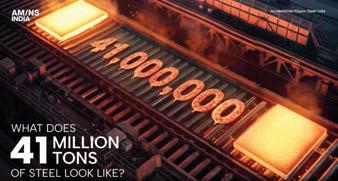
AM/NS India’s CSP Mill Achieves 41 Million Tonnes of Steel Production
AM/NS India’s Compact Strip Production (CSP) Mill in Hazira, Gujarat has achieved a milestone, producing 41 million tonnes of steel.
Apr 15, 2026
AM/NS India’s Compact Strip Production (CSP) Mill in Hazira, Gujarat has achieved a milestone, producing 41 million tonnes of steel from this mill alone.
It is the only mill in the world with 3 casters, 3 tunnel furnaces and one seven-stand mill, offering high-speed casting, precision across grades and consistent and reliable output. A core contributor in this mill is its hot rolling operations, creating advance value grades and strengthening the mill’s reliability. The facility has modern safety and monitoring systems for compact strip production.
‘‘Being a key contributor in flat steel production, the CSP mill supports critical sectors, from automotive and infrastructure to construction, engineering, and
white goods, delivering high-quality steel that powers everyday progress. As we continue to strengthen capabilities and enhance industrial resilience, we move forward with our promise of smarter steels, and brighter futures,’’ posted the company on its social media handle.
Not Just a Product Supplier, JTL Industries Aims to be Trusted Solutions Partner
As industries increasingly demand customized, high-performance steel solutions, JTL Industries Limited is positioning itself beyond conventional manufacturing to become a comprehensive solutions partner. In an exclusive interview with Tube & Pipe India, Mr. Dhruv Singla, Executive Director, JTL Industries Limited, discusses how evolving steel quality standards, pricing volatility, and changing end-user expectations are reshaping manufacturing strategies in the tube and pipe sector. He also highlights the growing demand from infrastructure, renewable energy, precision engineering, and electric mobility sectors, while outlining JTL’s focus on value-added products, process optimization, technological advancement, and customer-centric turnkey solutions designed to deliver long-term reliability and operational efficiency.
Mr. Dhruv Singla , Executive Director, JTL Industries Limited
Tube & Pipe India: How are the evolving steel dynamics—quality, pricing, availability—shaping your manufacturing strategy of steel pipes, tubes and other products?
Dhruv Singla: The steel industry today is witnessing rapid shifts in raw material pricing, quality expectations, and supply chain dynamics. As a manufacturer, our strategy is focused on balancing cost competitiveness with consistent product quality and operational reliability. We are increasingly strengthening our sourcing network, working closely with reputed steel producers, and adopting a more agile procurement strategy to mitigate volatility in pricing and availability.
At the manufacturing level, we are investing in process optimization, automation, and quality monitoring systems to improve yield efficiency and reduce wastage. We are also moving toward higher-grade steels and value-added products that offer better performance and longer life cycles for end users. In a dynamic market, flexibility, quality assurance, and operational efficiency are becoming the key differentiators.
TPI: In the tube and pipe sector, how critical is steel quality in determining product performance, reliability, and end-use acceptance? How do you ensure the best quality of your pipes and tubes?
DS: Steel quality is the foundation of performance in the tube and pipe industry. The mechanical strength, dimensional accuracy, corrosion
resistance, weld integrity, and durability of pipes and tubes are all directly influenced by the quality of steel used. In critical sectors such as infrastructure, automotive, energy, engineering, and construction, even minor inconsistencies can significantly impact performance and safety.
To ensure the highest standards, we follow a stringent quality control framework right from raw material selection to final dispatch. Every stage of production undergoes rigorous inspection and testing, including chemical and mechanical analysis, dimensional checks, hydro testing, and non-destructive testing wherever required. We also continuously upgrade our manufacturing technologies and maintain strict adherence to national and international quality standards. Our focus is not only on compliance, but on delivering long-term reliability and customer confidence.
TPI: Which end-use sectors are currently driving demand for your steel products, and how is this influencing your portfolio?
DS: Demand is currently being driven by infrastructure development, construction, automotive, renewable energy, agriculture, engineering, and industrial fabrication sectors. Government-led infrastructure initiatives and increasing investments in urban development and transportation are creating strong demand for high-quality pipes and tubes.
At the same time, sectors such as solar structures, precision engineering, and electric mobility are creating opportunities for specialized products. This evolving demand pattern is encouraging us to diversify our portfolio toward application-oriented and higher value-added products, while continuing to strengthen our core offerings. We are aligning our production capabilities to serve both volume-driven and niche segments efficiently.
TPI: Are customers increasingly looking for application-specific steel products rather than standard offerings? If yes, how are you catering to the demand?
DS: Yes, there is a clear shift toward application-specific solutions. Customers today expect products tailored to their operational requirements rather than generic standard offerings. Industries are looking for improved strength, tighter tolerances, superior surface finish, enhanced corrosion resistance, and customized dimensions depending on the application.
To address this demand, we work closely with customers to understand their technical requirements and usage conditions. We have enhanced our capability to offer customized grades, sizes, coatings, and finishes, along with flexible production planning. Our approach is increasingly solutionoriented, where we focus on delivering performance-based products that improve efficiency and reduce lifecycle costs for customers.
TPI: With turnkey solutions in the tube & pipe sector taking a gradual and selective spotlight, how do you view your business evolving or what steps are you taking in the direction to provide end-to-end solutions to the customers?
DS: The industry is gradually moving from product-centric supply to solution-centric partnerships. Customers increasingly prefer suppliers who can support them beyond manufacturing by offering technical guidance, processing support, logistics coordination, and reliable after-sales service.
Our focus is on strengthening capabilities that enable us to provide integrated solutions—from product development and customization to timely delivery and technical support. We are also enhancing collaboration with downstream partners and technology providers to support customers with more comprehensive and efficient solutions. The objective is to become a trusted solutions partner rather than just a product supplier.
We see this as a significant opportunity for long-term value creation. Our focus is on strengthening capabilities that enable us to provide integrated solutions—from product development and customization to timely delivery and technical support. We are also enhancing collaboration with downstream partners and technology providers to support customers with more comprehensive and efficient solutions. The objective is to become a trusted solutions partner rather than just a product supplier.
TPI: Does offering a wider range of turnkey solutions provide a competitive edge, or does it add operational complexity?
DS: It certainly provides a competitive edge, provided it is managed strategically. Customers value suppliers who can simplify procurement, improve coordination, and deliver consistent quality across multiple requirements. A wider solutions portfolio helps strengthen customer relationships and creates long-term business sustainability.
At the same time, diversification does bring operational complexity in terms of inventory management, production planning, quality control, and service expectations. Therefore, success depends on strong systems, process discipline, and technological integration. We believe that with the right operational framework and customer-focused approach, the benefits of offering broader solutions significantly outweigh the challenges.
TPI: How do you ensure consistency and quality across your diversified product portfolio?
DS: Consistency in quality is achieved through standardization, process con-
trol, and continuous improvement. We maintain strict quality protocols across all product categories and ensure that every product undergoes defined inspection and testing procedures before reaching the customer.
Technology also plays a major role in maintaining consistency. We are continuously investing in modern manufacturing equipment, automation, and monitoring systems that minimize process variation and improve precision. Equally important is our skilled workforce, regular training programs, and strong quality culture across the organization. Our aim is to ensure that every product reflects the same reliability, regardless of application or segment.
TPI: Going forward, will growth be driven more by scale in core products or by diversification into specialized steel applications?
DS: Future growth will come from a balanced combination of both. Scale in core products will remain essential for operational efficiency, market reach, and competitiveness. However, the real differentiation and sustainable value creation will increasingly come from specialized and application-oriented products.
As industries evolve, demand for advanced, high-performance steel solutions will continue to rise. Companies that can combine strong manufacturing scale with innovation, customization, and technical expertise will be better positioned for longterm growth. Our strategy is therefore focused on strengthening our core business while steadily expanding into value-added and specialized applications that align with future market requirements.
Utkarsh India Adopts Agile Manufacturing Amid Steel Volatility
As volatility in steel prices and raw material availability reshapes industry dynamics, manufacturers are reworking strategies to stay competitive and responsive. In an exclusive interaction with Tube & Pipe India, Mr. Utkarsh Bansal, Executive Director, Utkarsh India Limited, shares how the company is shifting toward agile manufacturing, flexible pricing models, and faster execution cycles to navigate uncertainty. He points to rising demand from solar, infrastructure, and power transmission sectors, alongside a growing preference for customized, application-specific solutions. On the capacity front, the company has recently commissioned a new mill with around 100,000 MTPA capacity for rectangular and square hollow sections and torque tubes.
Mr. Utkarsh Bansal, Executive Director, Utkarsh India Limited
Tube & Pipe India: How are the evolving steel dynamics– quality, pricing, availability–shaping your manufacturing strategy of steel pipes, tubes, and other products?
Utkarsh Bansal: The evolving dynamics of the steel industry—particularly in terms of pricing volatility, quality segmentation, and raw material availability—are significantly influencing our manufacturing and commercial strategies in the tube and pipe sector.
The increasing unpredictability in steel prices has made it challenging to commit to long-term fixed-price contracts. As a result, incorporating dynamic pricing mechanisms or price variation clauses has become essential to safeguard both manufacturers and customers against market fluctuations.
Additionally, recent developments such as the
imposition of safeguard duties post December, coupled with geopolitical factors impacting HR coil availability, have led to a noticeable escalation in input costs. This has further reinforced the need for prudent procurement and flexible pricing strategies.
A key operational impact of this volatility is on inventory management. Maintaining high stock levels becomes inherently risky in a fluctuating price environment, as it exposes manufacturers to potential stock losses. Consequently, the focus is shifting towards faster rolling cycles and agile manufacturing. In today’s scenario, it is critical to be able to service project-based orders—which typically involve multiple sizes and specifications— within tight timelines without relying on large inventories.
This, in turn, necessitates continuous investment in mill capabilities—whether through capacity expansion, productivity enhancements, or faster transitions. The ability to switch sizes quickly and execute short rolling runs efficiently has become a key differentiator, enabling faster turnaround while mitigating inventory risks.
Another important trend is the widening gap between primary and secondary steel manufacturers. The cost differential is driving certain applications—particularly those with lower criticality—towards secondary materials. This is creating a bifurcation in the market, where price-sensitive segments are shifting, while quality-conscious customers continue to rely on primary-grade materials.
At Utkarsh India Limited, our strategy is to remain agile—balancing cost competitiveness with an unwavering commitment to quality,
while aligning our manufacturing processes and product offerings with the evolving needs of the tube and pipe industry.
TPI: In the tube and pipe sector, how critical is steel quality in determining product performance, reliability, and end-use acceptance? How do you ensure the best quality of your pipes and tubes?
UB: Quality is paramount in the tube and pipe sector, given the critical applications these products serve—ranging from water and gas transportation to structural and infrastructure usage. The long-term performance, safety, and reliability of these applications are directly dependent on the quality of steel used and the manufacturing processes adopted. While certain segments have migrated towards secondary-grade materials due to cost considerations, customers prioritising durability, consistency, and lifecycle performance continue to place their trust in established brands like Utkarsh.
To ensure the highest quality standards, we follow a rigorous, multi-stage quality assurance process such as use of high-grade raw materials sourced from reputed primary producers such as Steel Authority of India Limited (SAIL); conducting stringent inspection at the raw material stage; advanced in-process testing, including Non-Destructive Testing (NDT), ultrasonic testing, and hydrostatic pressure testing; dimensional and mechanical property checks at various stages of production; final inspection and testing prior to dispatch.
In addition, we continuously invest in modernising our manufacturing and testing infrastructure, along with upgrading machinery to ensure precision, consistency, and compliance with evolving standards.
TPI: Which end-use sectors are currently driving demand for your steel products, and how is this influencing your portfolio?
UB: We are witnessing strong demand across sectors aligned with infrastructure development and energy transition. Key demand drivers include:
• Solar energy—both fixed tilt and tracker-based structures
• Power transmission and distribution—towers, poles, joists, and related structures for renewable energy evacuation
• Monopoles—driven by right-of-way (ROW) constraints in urban and semi-urban areas
Pre-engineered buildings (PEB)—a rapidly growing segment and a strategic focus area for us
These trends are actively shaping our portfolio strategy. While we continue to strengthen our position in core segments such as pipes and tubes, we are simultaneously expanding into high-growth areas like solar structures, heavy engineering, and PEB solutions to create a diversified and future-ready product mix.
Another important trend is the widening gap between primary and secondary steel manufacturers. The cost differential is driving certain applications—particularly those with lower criticality—towards secondary materials. This is creating a bifurcation in the market, where price-sensitive segments are shifting, while quality-conscious customers continue to rely on primary-grade materials.
TPI: Are customers increasingly looking for applicationspecific steel products rather than standard offerings? If yes, how are you catering to the demand?
UB: Yes, there is a clear and growing shift towards application-specific and customised steel solutions. Customers today are seeking optimised designs tailored to their specific project requirements. For instance, in the (Preengineered buildings) PEB segment, clients increasingly demand customised structural solutions—ranging from pipe-based frameworks to hybrid designs.
Similarly, in segments such as monopoles and distribution poles, there is a noticeable move towards higher-grade steels like E350 and E410, enabling more efficient designs, weight optimisation, and enhanced performance. In solar applications as well, project developers are adopting highly customised designs using advanced materials such as ZAM (Zinc-Aluminium-Magnesium) and AZ coatings, along with varied specifications to improve durability and efficiency.
At Utkarsh, we have strengthened our design, engineering, and manufacturing capabilities to deliver such customised, application-driven solutions—ensuring both technical excellence and cost optimisation for our customers.
TPI: With turnkey solutions in the tube & pipe sector gaining traction, how do you view your business evolving in providing end-to-end solutions?
UB: We see significant opportunities in offering turnkey, end-to-end solutions and have been actively expanding in this direction.
We have developed in-house capabilities across design, detailing, manufacturing, and execution, enabling us to provide integrated solutions. For example manufacturing and installation of telecom towers using pipe structures for leading telecom operators, execution of solar carport projects on a turnkey basis, undertaking complete site development and installation responsibilities, delivering customised fabricated pipe-based structures across applications.
This integrated approach not only enhances value for our customers but also allows us to participate more deeply across the project lifecycle.
TPI: Does offering a wider range of turnkey solutions provide a competitive edge, or does it add operational complexity?
UB: Offering turnkey solutions undoubtedly provides a strong competitive edge, especially in a highly competitive and fragmented market. Not many players have the capability or willingness to deliver end-to-end solutions, which allows us to differentiate ourselves meaningfully.
While it does introduce additional operational complexity— particularly in project management, coordination, and execution—this is effectively manageable through the right organisational structure, experienced teams, and robust systems. In our view, the benefits in terms of customer stickiness, value addition, and market positioning far outweigh the associated complexities.
TPI: How do you ensure consistency and quality across your diversified product portfolio?
UB: Consistency in quality across a diversified portfolio is achieved through a disciplined, system-driven approach. Our key focus areas include- sourcing from reliable and reputable raw material suppliers, maintaining uniform quality standards across all customers, without any dual benchmarks, implementing stringent quality assurance and quality control (QA/QC) systems at every stage, ensuring that quality processes are system-driven rather than being dependent on individual discretion, investing in modern testing facilities and regular upgradation of manufacturing infrastructure and deploying trained and accountable personnel across all stages of production and inspection
This integrated approach ensures that every product leaving our facilities adheres to the same high standards of quality and reliability.
TPI: Going forward, will growth be driven more by scale in core products or by diversification into specialised steel applications?
UB: Our growth strategy will follow a balanced, dualpronged approach—driven by both scale and diversification. On the core side, we are continuing to expand capacities. Recently, we commissioned a new mill with a capacity of approximately 100,000 MTPA for rectangular and square hollow sections and torque tubes. We have also enhanced capacities in key segments such as polygonal poles, crash barriers, and transmission towers.
At the same time, we are actively diversifying into specialised and high-growth segments such as solar structures, pre-engineered buildings, and heavy engineering structures. This balanced approach allows us to drive volume growth while also building a resilient and futureready portfolio aligned with emerging industry trends.
RAILS & WHEELS
PIPES & TUBES
PLATES & COILS
BARS
Satyam Pipes: Building Strength with Precision and Vision
Mr. Rohit Pareek , Head Strategy and Business Development, Satyam Iron & Steel Company Pvt. Ltd.
Tube & Pipe India: How are evolving steel dynamics—quality, pricing, and availability— shaping your manufacturing strategy?
Rohit Pareek: The steel industry today is highly dynamic, with constant fluctuations in pricing and raw material availability. Satyam Pipes has strategically positioned itself to navigate these changes through its fully integrated steel plants. This integration enables greater control over procurement, ensures consistent supply, and optimizes costs effectively.
While market conditions may shift, Satyam Pipes’ commitment to quality remains unwavering. Satyam Pipes continues to invest in high-grade raw materials and advanced manufacturing technologies, ensuring that every product meets premium standards. The approach is simple—balancing efficiency with excellence to deliver consistent value. Today,
As infrastructure expansion, urban development, and application-specific demand reshape the steel pipes and tubes industry, manufacturers are increasingly focusing on integrated operations, product diversification, and precision-led manufacturing to stay competitive. In an exclusive interview with Tube & Pipe India, Mr. Rohit Pareek, Head Strategy and Business Development, Satyam Iron & Steel Company Pvt. Ltd., highlights how the company is leveraging its diversified product portfolio and stringent quality systems to navigate evolving market dynamics. He also shares insights on scaling production capacities, delivering customized solutions, and balancing operational efficiency with long-term growth opportunities in specialized steel applications.
Satyam Pipes is steadily emerging as one of the leading brands in its segment.
TPI: In the pipe and tube sector, how critical is steel quality in determining product performance and reliability? How does Satyam Pipes ensure it?
RP: Steel quality is fundamental—it directly defines the strength, durability, and reliability of the final product. Satyam Pipes views quality not as a checkpoint but as a continuous process embedded in every stage of manufacturing. Satyam Pipes uses high-quality raw materials supported by robust documentation and process controls, enabling the manufacture of superior-grade pipes at its own facility. Every stage of production is monitored to ensure consistency, strength, and long-term performance.
TPI: Which end-use sectors are currently driving demand, and how is this influencing the product portfolio?
RP: The demand landscape is primarily driven by construction, infrastructure, and general engineering sectors. Rapid urban development and large-scale infrastructure projects across India have significantly increased the need for reliable steel products.
In response, Satyam Pipes has developed a versatile and expanding product portfolio that
includes MS ERW pipes in round, square, and rectangular sections ranging from ¾ inch to 5 inch, along with single door frames, lock plates, guides, billets, and HR strips. With 180+ product variants, Satyam Pipes caters to a wide range of applications— from structural frameworks to industrial fabrication—ensuring both adaptability and performance.
TPI: Are customers increasingly looking for application-specific steel products rather than standard offerings? How is Satyam Pipes addressing this shift?
RP: Customers today are more discerning and increasingly demand application-specific, precisionengineered solutions. Satyam Pipes addresses this need through customization—offering flexibility in size, thickness, and specifications. With an extensive range of 180+ variants and continuous expansion plans, Satyam Pipes ensures alignment with evolving customer requirements while maintaining quality and timely delivery.
TPI: With turnkey solutions gaining attention in the sector, how does Satyam Pipes see its business evolving in this direction?
RP: The shift toward ready-to-use (turnkey) solutions reflects the industry’s move toward efficiency and integrated service delivery. Satyam Pipes remains focused on strengthening its core manufacturing capabilities while actively preparing to support end-to-end customer requirements. Through strategic partnerships and continuous expansion of its product ecosystem, Satyam Pipes aims to evolve from a product-centric organization into a comprehensive solutions provider over time.
TPI: Do turnkey solutions offer a competitive edge, or do they add operational complexity?
Satyam Pipes uses high-quality raw materials supported by robust documentation and process controls, enabling the manufacture of superior-grade pipes at its own facility. Every stage of production is monitored to ensure consistency, strength, and long-term performance.
RP: Ready-to-use (turnkey) solutions offer a strong competitive advantage by simplifying processes for customers and enhancing overall value delivery, while also introducing complexities in coordination, logistics, and execution. Satyam Pipes believes that with robust systems, strong partnerships, and disciplined processes, these challenges can be effectively managed. Its integrated operations provide a solid foundation to gradually move in this direction.
TPI: How does Satyam Pipes ensure consistency and quality across a diversified product portfolio?
RP: Consistency is achieved through control, technology, and discipline. The integrated manufacturing setup of Satyam Pipes enables uniform standards across all product lines. Satyam Pipes combines advanced
Satyam Pipes combines advanced machinery, skilled manpower, and stringent quality protocols to ensure that every product—regardless of category—meets the same high standards.
machinery, skilled manpower, and stringent quality protocols to ensure that every product—regardless of category—meets the same high standards. This commitment to consistency strengthens customer trust and reinforces the brand.
TPI: Looking ahead, will growth be driven more by scale in core products or diversification into specialized applications?
RP: The growth strategy of Satyam Pipes is built on balance. In the near term, scaling core product lines and expanding production capacity will be key priorities. Currently, production ranges between approximately 2 to 2.5 lakh tons, with a strong focus on further strengthening this scale. At the same time, Satyam Pipes is investing in innovation and exploring specialized applications to meet evolving market demands. This dual approach— combining scale with strategic diversification—will enable sustainable growth while reinforcing its position as a reliable and quality-driven player in the steel pipe industry.
Lalbaba Engineering Responds to Rising Demand for Customised, High-Performance Steel Products
As industries demand greater efficiency, reliability, and lifecycle performance from steel products, Lalbaba Engineering is aligning its strategy around specialised and application-driven solutions. With growing demand from sectors such as energy, automotive, railways, and industrial infrastructure, the company is strengthening its capabilities in value-engineered tubular products, integrated engineering services, and customised manufacturing. In an exclusive interview with Tube & Pipe India, Mr. Gopakumar Kerala Varma, Sr.VP-Tubular Operations, Lalbaba Engineering Limited, discusses evolving steel market dynamics, the increasing importance of quality and specialisation, the rise of turnkey and service-led solutions, and Lalbaba’s long-term focus on diversification into high-performance steel applications.
Mr. Gopakumar Kerala Varma , Sr.VP-Tubular Operations, Lalbaba Engineering Limited
Tube & Pipe India: How are the evolving steel dynamics—quality, pricing, availability—shaping your manufacturing strategy of steel pipes, tubes and other products?
Gopakumar Kerala Varma: As we all know, the global steel landscape right now is in a state of flux, and between geopolitical shifts and raw material price swings, the entire supply chain is feeling the heat. At Lalbaba, we’re adapting to these challenges by becoming much more agile. Instead of just reacting to the market, we are opting for a forward-looking manufacturing strategy focused on procurement planning efficient inventory optimisation, and tighter production scheduling to minimise exposure to sudden fluctuations and stay ahead of the curve. At the same time, we continue to strengthen process efficiency to maintain product quality to absorb those market shocks without letting it affect our delivery reliability or the quality our partners in critical industries expect from us.
TPI: In the tube and pipe sector, how critical is steel quality in determining product performance, reliability, and end-use acceptance? How do you
ensure the best quality of your pipes and tubes?
GKV: Steel quality is extremely critical in the tube and pipe sector, especially for applications involving high pressure, high temperature, fatigue resistance, and other safety-critical operations. Everything from the purity of the melt to the consistency of the chemical composition dictates how that tube will perform ten years down the line. At Lalbaba, we manage this by being selective at the source—we only work with reputable, select suppliers and follow stringent inspection protocols for chemical and mechanical properties before production. Throughout the manufacturing process, strict process controls, continuous monitoring, and rigorous testing are maintained to ensure consistency and compliance with required standards.
This integrated quality approach enables us to deliver high-performance tubular products suitable for critical and demanding applications across industries.
TPI: Which end-use sectors are currently driving demand for your
steel products, and how is this influencing your portfolio?
GKV: Demand now is being driven largely by the energy and automotive sectors, along with railways and industrial infrastructure, the demand for specialized tubes that can handle supercritical boiler conditions is immense. This has naturally pushed our portfolio toward more “valueengineered” territory.
TPI: Are customers increasingly looking for application-specific steel products rather than standard offerings? If yes, how are you catering to the demand?
GKV: Absolutely. The era of “onesize-fits-all” is largely behind us. Today’s customers are increasingly looking for application-specific steel products tailored to their operating requirements. They are focused on higher efficiency and long-term reliability. To meet this shift, we’ve shifted our mindset from being a manufacturer to an integrated solution provider. We are working closely on understanding end-use applications and developing products suited for specific industry requirements. For instance, our Ahmednagar plant is dedicated to axle tubes for passenger vehicles and telescopic front forks for two wheelers. By focusing on the specific engineering challenges of a single segment, we can provide a level of customization that standard offerings just can’t match
TPI: With turnkey solutions in the tube & pipe sector taking a gradual and selective spotlight, how do you view your business evolving or what steps are you taking in the direction to provide end-to-end solutions to the customers?
GKV: Lalbaba is steadily evolving from a product manufacturer into a more integrated engineering and solutions-driven organisation. A key example is the turnkey modernisation programs under our Rail Solutionsas-a-Service (“RSaaS”) model. Our offerings include coach conversions, life-extension retrofits, and wagon rebuilds, executed across multiple cus -
The era of “one-size-fits-all” is largely behind us. Today’s customers are increasingly looking for application-specific steel products tailored to their operating requirements. They are focused on the higher efficiency, and long-term reliability. To meet this shift, we’ve shifted our mindset from being a manufacturer to an integrated solution provider.
tomer locations in India. This transition towards engineering-enabled and service-backed offerings helps create stronger customer partnerships and greater long-term value.
TPI: Does offering a wider range of turnkey solutions provide a competitive edge, or does it add operational complexity?
GKV: It’s a bit of both, to be honest. While turnkey solutions do add operational complexity, they also provide a strong competitive advantage. Customers these days increasingly prefer partners who can offer integrated solutions under one ecosystem rather than dealing with multiple vendors. This helps build stronger customer relationships, improves value addition, and creates differentiation beyond pricing alone.
TPI: How do you ensure consistency and quality across your diversified product portfolio?
GKV: Honestly, through stringent quality systems monitored by a dedicated QA/QC teams.
We are equipped with dedicated NABL-accredited in-house laboratories, and an R&D centre known as Lalbaba Metal Innovation Centre, where we run stringent inspection and testing processes to ensure uniform quality standards across product categories. More than 32 professionals are working exclusively within Metal Innovation Centre (MIC). Having that level of in-house expertise allows us to maintain a “Lalbaba standard” that remains uniform, whether we’re producing a standard industrial pipe or a high-spec automotive component.
TPI: Going forward, will growth be driven more by scale in core products or by diversification into specialized steel applications?
GKV: It should be a balance of both, but the “growth engine” is definitely diversification. When Lalbaba started, we had a relatively focused product offering that has steadily diversified into a wide range of specialised tubular products catering to automotive, energy, railways, and industrial applications. As industries become more technically demanding, they need partners who can innovate. We’ve spent years building the technical expertise and engineering backbone to handle those complex requirements. So while scale in core products will continue to remain important, future growth opportunities are expected to come increasingly from specialised and critical application-based solutions where technical capability, quality consistency, and engineering expertise will become key differentiators.
Quality Assurance Programs, A Non-Negotiable for Akash Steel Crafts in Tube & Pipe Production
Amid evolving steel quality standards and increasing demand for application-specific solutions, Akash Steel Crafts Pvt. Ltd. is reinforcing its focus on stringent quality assurance programs (QAP), ASTM compliance and specialized stainless steel pipe and tube manufacturing. In an exclusive interview with Tube & Pipe India, Mr. Mohanan Narayanan, Director, Akash Steel Crafts Pvt. Ltd., discuss changing steel market dynamics, customer expectations, sectoral demand trends and why disciplined sourcing, QAP-driven manufacturing and consistent quality control remain central to their long-term growth strategy.
Mr.
Tube & Pipe India: How are the evolving steel dynamics- quality, pricing, availability, shaping your manufacturing strategy of steel pipes, tubes and other products?
Mohanan Narayanan: Changes in steel prices, availability of specific stainless steel grades, and increasing quality expectations directly impact our manufacturing strategy for ERW and EFW pipes and tubes. To manage these changes, we focus on disciplined raw material sourcing and efficient production planning. We procure materials strictly as per customer specifications and approved quality assurance programs (QAP), which helps us maintain product consistency even when market conditions are volatile.
At the same time, we continuously work on improving operational efficiency so that we can remain competitive on pricing without compromising on quality. Our focus remains on delivering reliable, ASTMcompliant stainless steel pipes and tubes across different grades and applications.
TPI: In the tube and pipe sector, how critical is steel quality in determining product performance, reliability, and end-use acceptance? How do you ensure the best quality of your pipes and tubes?
MN: Steel quality is one of the most
important factors in the tube and pipe industry because it directly impacts strength, durability, corrosion resistance, and overall product life. For industries such as oil & gas, chemicals, construction, and power, product reliability is critical, and that starts with using the right quality steel.
At our company, quality is nonnegotiable. Every order is backed by a defined quality assurance program (QAP), and manufacturing is carried out strictly according to approved specifications and ASTM standards. From raw material procurement to final testing and inspection, every stage is monitored carefully to ensure consistency and dependable performance.
TPI: Which end-use sectors are currently driving demand for your steel products, and how is this influencing your portfolio?
MN: Demand for our products is currently strong from industries such as sugar, fertilizer, water treatment, chemicals, and general manufacturing. These sectors require stainless steel pipes and tubes that can perform reliably in demanding environments, which is why our focus remains on producing high-quality ERW and EFW products in a wide range of grades, sizes, and specifications. Their evolving requirements continue to shape and strengthen our product portfolio.
TPI: Are customers increasingly looking for application-specific steel products rather than standard offerings? If yes, how are you catering to the demand?
MN: Yes, we are clearly seeing a shift toward application-specific products. Customers today are more focused on finding materials that match their exact operational requirements rather than choosing standard products.
To meet this demand, we work closely with customers to understand their technical requirements, including material grade, dimensions, finish, and performance expectations. Based on that, we source the right raw material and manufacture products suited to their specific application. This approach helps us deliver better product performance and long-term reliability.
TPI: With turnkey solutions in the tube & pipe sector taking a gradual and selective spotlight, how do you view your business evolving or what steps are you taking in the direction to provide end-to-end solutions to the customers?
MN: At present, our focus is entirely on manufacturing and supplying stainless steel pipes and tubes. We do not currently offer turnkey solutions because we do not have in-house facilities for products like fittings and valves that are needed for a complete package. That said, our strength lies in our specialization. By focusing only
Demand for our products is currently strong from industries such as sugar, fertilizer, water treatment, chemicals, and general manufacturing. These sectors require stainless steel pipes and tubes that can perform reliably in demanding environments, which is why our focus remains on producing high-quality ERW and EFW products in a wide range of grades, sizes, and specifications.
on ERW and EFW stainless steel pipes and tubes, we are able to deliver better quality, consistency, and service to our customers.
TPI: Does offering a wider range of turnkey solutions provide a competitive edge, or does it add operational complexity?
MN: It can do both. Offering turnkey solutions can create a competitive advantage because customers often prefer a single supplier for convenience and better coordination. However, it also brings added complexity in sourcing, quality control, and execution. For us, staying focused on our core product category allows us to maintain tighter control over quality and operations. We believe specialization helps us serve our customers better.
TPI: How do you ensure consistency and quality across your diversified product portfolio?
MN: Consistency starts with raw material selection. Every order is
executed according to the approved Quality Assurance Program (QAP), and materials are sourced only from approved suppliers based on customer requirements. By maintaining strict control from procurement through production and final inspection, we ensure that every product meets the required standards and performs reliably in the field.
TPI: Going forward, will growth be driven more by scale in core products or by diversification into specialized steel applications?
MN: Our primary growth strategy is to strengthen and scale our core business of ERW and EFW stainless steel pipes and tubes. While we will continue to support specialized applications wherever customer demand exists, our focus remains on expanding our core product range, increasing capacity, and building deeper expertise. We believe this is the most sustainable path for long-term growth.
How Indipower is Positioning Itself for the Next Generation of Tubular Solutions
India’s steel tube and pipe industry is entering a phase of accelerated transformation, driven by infrastructure expansion, automotive growth, energy investments, and rising demand for certified, application-specific products. At the same time, volatile raw material costs, tightening quality regulations, and evolving customer expectations are reshaping the competitive landscape for manufacturers. Indipower Steel Works Pvt. Ltd. is strengthening its focus on precision manufacturing, process discipline, and value-added offerings to position itself within the organized and quality-driven segment of the market. In an exclusive interview with Tube & Pipe India, Mr. Nitanshu Gupta, Managing Director, Indipower Steel Works Pvt. Ltd., discusses the company’s evolving manufacturing strategy, the growing importance of certified quality systems, and how Indipower is moving toward process-ready and application-focused tubular solutions.
Tube & Pipe India: How are the evolving steel dynamics — quality, pricing, availability — shaping your manufacturing strategy?
Nitanshu Gupta: The Indian steel pipes and tubes market stood at 13.56 million tonnes in 2024 and is projected to reach nearly 27.76 million tonnes by 2033 at a CAGR of approximately 7.65% — one of the most compelling growth trajectories in the broader metals sector. The steel pipe and tube sector already contributes around 8% to India’s overall steel consumption, and that share is set to grow as infrastructure, construction, and energy applications deepen their reliance on tubular products. At Indipower Steel Works, we view this structural tailwind as both an opportunity and a mandate to sharpen our manufacturing strategy across all three dimensions of pricing, quality, and availability.
On pricing, the pressure has been significant and sustained. HR coil — our primary feedstock — rose approximately 10% year-on-year to INR 54,225–56,200 per tonne in February 2026, while coking coal, which drives upstream production economics, climbed over 31% year-on-year. These are not short-term blips; they reflect a combination of global supply tightening, the rupee’s depreciation of roughly 11% against the dollar over the past fiscal year, and the downstream impact of India’s three-year safeguard duty on imported flat steel, which
— while protecting domestic mills — has also put a floor under domestic coil prices. Our response has been to tighten procurement discipline, qualify a small panel of primary coil producers, and invest in process yield improvements that reduce material wastage per tonne of finished tube — because every kilogram of scrap in the current input cost environment directly erodes margin.
On availability, the geopolitical disruption has fundamentally reshaped the supply landscape. After US tariffs triggered a surge of diverted Chinese, South Korean, and Japanese steel into India — imports hitting record highs in H1 FY2025-26 — the government imposed first a provisional 12% safeguard duty in April 2025 and then formalised a three-year structured duty from December 2025, stepping down from 12% to 11% over the period. This has stabilised domestic flat steel availability for tube makers, but it has also made long-term procurement planning more important than reactive spot buying. We now carry more deliberate safety stock of pre-qualified coil to buffer against policy-driven volatility.
On quality, the evolving market itself is creating a positive forcing function. As India’s tube industry matures, organised manufacturers now command 60% of market value versus unorganised players, and that share is growing. Buyers in
Mr. Nitanshu Gupta, Managing Director, Indipower Steel Works Pvt. Ltd.
automotive and precision engineering are consolidating their supplier bases around producers with verifiable quality systems — and our IATF 16949:2016 and ISO 9001:2015 certifications at the Dewas facility, inherited through our acquisition of Caparo’s plant, position us clearly in that organised, certified tier.
TPI: How critical is steel quality in determining product performance, and how do you ensure the best quality in your products?
NG: Steel quality is the foundational variable in tube performance, and the criticality increases sharply as you move up the value chain from commodity structural sections to precision automotive and engineering tubes. The India steel pipes and tubes industry is bifurcated in a revealing way: by volume, the market splits 70:30 between ERW and seamless/ SAW segments, but by value, the split is closer to 50:50 — which tells you directly that the higher-specification, quality-sensitive CDW and seamless products carry a meaningful price premium over commodity tonnage. That premium exists precisely because quality failures in end-use applications are costly and reputationally damaging for the buyer.
In ERW tube manufacturing, the weld seam is only as metallurgically sound as the base material feeding into it. Coil chemistry — carbon content, manganese-to-sulphur ratio, surface condition — directly governs weld bead integrity. A coil with inconsistent chemistry can produce welds that clear visual inspection but fail under fatigue loading or secondary forming operations at the customer’s plant. This is why our incoming material process goes beyond accepting mill test certificates: every heat lot at Dewas undergoes chemical composition and mechanical property verification before entering the forming line. It is a cost, but one we regard as nonnegotiable.
On the process side, our highfrequency induction welding parameters — power, frequency, squeeze roll pressure — are held
within tight documented control windows, and deviations trigger investigation rather than simply correction. We complement this with inline eddy current nondestructive testing for weld defects and continuous dimensional gauging through the forming section, so we are catching and addressing problems within the process rather than at final inspection. For automotive customers, we additionally follow the full PPAP discipline, which requires demonstrating statistical process stability across a production run before receiving customer approval to supply. This is demanding, but it is precisely what separates a credible precision tube maker — which is what we are — from a commodity supplier. Our IATF 16949:2016 certification requires us to maintain failure mode analyses, measurement system analyses, and active reaction plans that cascade quality accountability from raw material intake all the way to dispatch.
TPI: Which end-use sectors are currently driving demand for your steel products, and how is this influencing your portfolio?
NG: Three sectors are driving our demand simultaneously, and each has a different growth profile and quality requirement that is actively shaping how we build our portfolio.
Automotive and transportation stands at the top in terms of value and strategic importance for us. Within India specifically, two-wheeler production grew 16% year-on-year and commercial vehicle production rose 10.2% as of February 2026. Automotive gave us the clearest rationale for the Dewas acquisition and for investing in IATF certification — the margin per tonne in automotive-grade precision tubes substantially outpaces
commodity structural sections, and the switching cost for a validated supplier is high, which gives us pricing stability once qualified.
Construction and structural applications are our volume anchor. The consumption of hollow structural sections in India increased by 18% in FY2024 alone, driven by commercial real estate and urban infrastructure development. The structural steel pipes market reached 3.6 million metric tonnes in FY2024, a 22% increase from FY2023. Metro rail projects alone consumed over 0.8 million metric tonnes of steel pipes and tubes in FY2024. Our black and galvanised tube range and rectangular/square hollow sections serve this segment directly, and the government’s sustained capital expenditure — with INR 11.11 lakh crore earmarked in the Union Budget 2025-26 — ensures this demand is policy-backed and forward-visible.
Oil, gas, and city gas distribution represents a third and growing demand stream. Oil and gas is the largest revenue-generating application in the Indian steel pipes and tubes market, accounting for 48% of revenue in 2023, and the power plant segment is growing at the fastest rate through to 2030. India’s city gas distribution programme has authorised over 31,700 km of trunk transmission pipelines and has over 1.16 crore domestic PNG connections operational. These programmes require precision line pipe grades that benefit from our quality infrastructure. The portfolio implication across all three sectors is clear: we are investing in multi-size tooling flexibility so we can switch between segment demands without long changeover penalties, while maintaining a dedicated quality track for our higher-specification
Automotive gave us the clearest rationale for the Dewas acquisition and for investing in IATF certification — the margin per tonne in automotive-grade precision tubes substantially outpaces commodity structural sections, and the switching cost for a validated supplier is high, which gives us pricing stability once qualified.
automotive customers.
TPI: Are customers increasingly looking for application-specific products rather than standard offerings? How are you catering to this demand?
NG: The shift is unambiguous and industry data supports it clearly. In India, organised manufacturers already held 60.2% of the steel pipes and tubes market by value in 2024, and this segment is growing at a faster pace than the unorganised tier — driven precisely by the fact that large end-users are increasingly requiring certified, application-specific products rather than commodity tubes from anonymous secondary suppliers.
The BIS Quality Control Orders and mandatory IS-code compliance requirements are adding regulatory force to what was already a commercial trend: buyers in construction, automotive, and energy increasingly need documented material traceability and application-fit specifications, which eliminates the unorganised tier from consideration.
In automotive, the shift is most explicit. Tier-1 suppliers today present drawing packs specifying not just outer diameter and wall thickness but ovality tolerances, weld offset limits, hardness ranges, and surface finish requirements for subsequent hydroforming, bending, or coating operations at their own plants. A generic commercial tube cannot meet these specifications. We have responded by expanding our CRCA tube range alongside standard HR-based ERW products — because specific precision applications require the tighter dimensional control, lower residual stress, and finer surface finish that cold-rolled close-annealed material provides. Supplying both grades from a single IATF-certified source gives the customer consolidated accountability and eliminates an interface risk in their quality chain.
TPI: How do you view your business evolving toward end-to-end, turnkey solutions?
NG: The global ERW pipes and tubes market is growing at a 6.1% CAGR through 2035, and within that
market, roughly 70.5% of volume is welded tube — ERW and CDW — with construction consuming 40% and automotive 27% of ERW output globally. The manufacturers winning disproportionate share within this growing market are those who move beyond selling a commodity shape and into delivering a processed, ready-to-use product that reduces the customer’s own manufacturing steps. That is the direction we are deliberately moving in at Indipower.
Our near-term model of end-to-end value is built around what we call process-ready tubes — products supplied not just to dimensional specification but with secondary operations that remove work from the customer’s floor. This means precision cutting to length with burrfree ends, pre-bent or pre-notched sections for assembly applications, and packaging configured for direct automated line feeding at the OEM’s plant. Each of these steps captures value that was previously being generated by the customer or a third-party processor, and each can be embedded into our existing IATF quality framework without disrupting core manufacturing focus.
Over the medium term, we see scope for light fabricated assemblies — welded sub-frames, structural kits, or furniture frame modules where we take defined responsibility for a set of joining operations beyond tube forming. This keeps us firmly within our metallurgical and forming expertise while moving closer to the customer’s bill of materials. India’s prefab construction market is growing at 10.5% annually, according to KPMG India’s Prefabrication and Modular Building Report 2024, and this creates natural demand for pre-processed, ready-to-assemble tubular components that we are well positioned to supply. We are using industry platforms like the Tube and Pipe Fair — where we make our formal debut in November 2025 — to identify technology and service partners who can accelerate specific capability additions, rather than requiring us to build every capability from scratch organically.
TPI: Does offering a wider range of turnkey solutions provide a competitive edge, or does it add operational complexity?
NG: Both are true simultaneously, and managing that tension intelligently is the real strategic challenge. The competitive advantage of turnkey solutions is economically quantifiable: a buyer who sources dimensionally precise, surface-conditioned, cut-tolength tube from a single certified supplier eliminates coordination risk across multiple vendors, reduces quality interface complexity, and gains a single point of accountability — all of which have measurable cost value in a modern supply chain. In automotive supply chains especially, where a single quality escape can trigger a line-stoppage claim that dwarfs the value of the original supply contract, the premium attached to a turnkey certified supplier is real and defensible.
At the same time, the operational complexity cost is equally real. ERW and CDW steel is already a processintensive product — weld chemistry, dimensional control, inline NDT, PPAP compliance — and adding secondary operations without adequately embedding them in the quality management system creates exactly the kind of process fragmentation that can compromise the core product. We have seen this pattern damage suppliers who expanded too quickly in the name of value addition.
Our answer is deliberate sequencing rather than simultaneous expansion. We add one new capability at a time, stabilise it within our existing control plan and FMEA framework, validate it with a customer qualification, and only then move to the next step. The discipline test is whether the new capability can be fully documented, controlled, and measured within our IATF quality system — if it cannot meet that bar, we do not add it regardless of commercial attractiveness. The current elevated input cost environment — with HR coil at 10% above year-ago levels and coking coal up over 30% — provides a useful capital allocation filter: we prioritise capability additions with
Our near-term model of end-to-end value is built around what we call process-ready tubes — products supplied not just to dimensional specification but with secondary operations that remove work from the customer’s floor.
the fastest and most certain return, which currently favours process steps requiring low capital but delivering high customer value, such as precision end-finishing and certified dimensional testing services.
TPI: How do you ensure consistency and quality across your diversified product portfolio?
NG: Consistency across a diversified product mix is a systems challenge as much as a manufacturing challenge, and it requires architecture rather than intention. Three interlocking elements form the foundation of our approach at Indipower.
The first is a unified quality management system that applies uniformly across every product line. Automotive precision tubes, black sections, galvanised pipes, CRCA grades, and steel door frames all operate under the same ISO 9001:2015 and IATF 16949:2016 umbrella at our Dewas facility. This means a single set of control plans, out-ofspecification reaction protocols, and corrective action processes — there is no conceptual distinction between a “high-quality automotive line” and a “commercial line.” The IATF framework in particular is demanding precisely because it does not permit carve-outs: measurement system analyses, capability studies, and failure mode analyses must be maintained for every product family.
The second element is process capability tracking as a predictive rather than retrospective tool. For each product family we maintain running capability indices on critical characteristics — outer diameter, wall thickness, weld offset, straightness, and hardness where specified. The discipline here is that a trending downward capability index, even while parts are still nominally conforming, triggers investigation and root cause
analysis before a quality escape reaches the customer. End-of-line inspection alone catches problems too late and too expensively. The India steel market’s move toward BIS Quality Control Orders and mandatory IS-code certification is actually reinforcing this internal discipline — regulators and large buyers are increasingly asking for documented process capability data, not just inspection records.
TPI: Will growth be driven more by scale in core products or by diversification into specialized applications?
NG: The answer, supported by where the India tube and pipe market is heading, is deliberately both — on different time horizons and with different capital profiles.
In the near term, volume growth in core ERW and CDW products is the primary lever, and the market fundamentals support it strongly. India’s steel pipes market at 13.56 million tonnes in 2024 is projected to reach 27.76 million tonnes by 2033, meaning the total addressable market is roughly doubling over the decade. The structural hollow sections market in India grew 18% in FY2024 and the structural steel pipes market grew 22% in the same year — these are exceptional growth rates for a materials sector. India becoming a net steel exporter in FY2026, with exports rising 43% to 8.77 million tonnes, signals that domestic manufacturing competitiveness is improving and that export markets — particularly the Gulf, Africa, and Southeast Asia where Indian ERW producers are gaining traction — represent a real incremental volume opportunity for us beyond the domestic market.
In the medium term, specialised applications are where the margin expansion story lives. ERW usage in automotive reached 18.3 million tonnes
globally in 2024, and Asia-Pacific saw a 13% uplift in demand for automotive tubular components. The EV transition is creating new geometric requirements and grade specifications that commodity suppliers cannot easily address. The city gas distribution build-out requires higherspecification line pipe with traceable quality documentation. The prefab construction boom, growing at 10.5% annually, rewards suppliers who can deliver pre-processed, dimensionally consistent structural tube kits. Each of these niches rewards certified quality over price competition, and each represents a market where our IATF 16949:2016 pedigree give us a structural entry advantage.
The raw material environment makes specialisation not just strategically attractive but financially imperative. With HR coil and coking coal both at multi-year cost highs, the economics of commodity tube are under serious pressure. Moving up the value chain — through tighter specifications, secondary processing, and certified supply — is how we protect and grow our margins even as input costs remain elevated. Our plan is to use scale in core products to generate the cash flow that funds the capability investments required for specialised market entry, ensuring that every step of that journey is anchored in the quality foundation our Dewas platform has already established.
Kamdhenu Group Suggests a Fine Balance Between Scalability
and Diversification
As infrastructure, housing, and industrial demand continue to shape India’s steel consumption landscape, manufacturers are increasingly balancing scale with product specialization, operational efficiency, and sustainability. In an exclusive interview with Tube & Pipe India, Mr. Sunil Kumar Agarwal, Director, Kamdhenu Group , discusses how the company is strengthening its manufacturing strategy through technology upgrades, AI-enabled production processes, quality-focused operations, and diversification into application-specific steel solutions. He also shares insights into evolving customer expectations, turnkey offerings, and the growing importance of innovation-driven, value-added steel products.
Tube & Pipe India: How are the evolving steel dynamicsquality, pricing, availability, shaping your manufacturing strategy of steel pipes, tubes and other products?
Sunil Kumar Agarwal: The evolving dynamics of quality, pricing and availability are forcing a strategic shift in steel pipes, tubes and other related products toward better quality goods with a lower carbon footprint. We are also focusing on capacity addition and technology upgrades to ensure our products are not just readily available in the market but are also widely accepted. Our production facilities are geared for maximum operational efficiency and minimal downtime. By adopting relevant digital and AI tools and processes, wastage in the production process too has been managed so that our products offer the best possible quality at affordable costs and with lowest possible carbon footprint.
TPI: In the tube and pipe sector, how critical is steel quality in determining product performance, reliability, and end-use acceptance? How do you ensure the best quality of your pipes and tubes?
SKA: Steel quality is the foundation for product performance, reliability and end-use acceptance especially in the tube and pipe sector. Due to their application in
Mr. Sunil Kumar Agarwal, Director, Kamdhenu Group
Focusing on the core products like construction-grade steel ensures stability and healthy cash flow while diversification opens up new revenue streams for growth.
structural and precision equipment, quality of the steel used in tubes and pipes is critical. Apart from ensuring best quality input materials, our production process follows the latest standards in workflow management, quality assurance and product testing to ensure our products meet stringent quality norms to meet the demands of end-users.
TPI: Which end-use sectors are currently driving demand for your steel products, and how is this influencing your portfolio?
SKA: The demand for steel products is primarily driven by the infrastructure sector, housing and industrial use. The massive push for infrastructure development drives demand for structural products such as beams and pillars while the housing sector contributes in driving demand for construction steel such as TMT rebars. Our product portfolio is perfectly placed to meet market demands with products ranging from high quality TMT bars like Kamdhenu Nxt, PAS 10000, structural steel, pipes and colour coated sheets among others.
TPI: Are customers increasingly looking for applicationspecific steel products rather than standard offerings? If yes, how are you catering to the demand?
SKA: Yes, demand for application specific steel products is on the rise. The next generation interlocking steel with a unique double ribbed design is ideal for most demanding architectural and design needs. Our colour coated sheet combines strength, durability and aesthetics and is in high demand in the roofing segment. We are also revolutionizing
the construction industry with our pre-engineered building solutions to cater to diverse construction needs.
TPI: With turnkey solutions in the tube & pipe sector taking a gradual and selective spotlight, how do you view your business evolving or what steps are you taking in the direction to provide end-to-end solutions to the customers?
SKA: Offering turnkey solutions is the natural evolution for our products. Along with offering PFB solutions we are looking at introducing value-added products that offer end-toend services. Our investments in adopting the latest IoT and AI enabled digital technologies will go a long way in enabling us to design and manufacture turnkey solutions that are highly customizable with minimal project downtime in the future.
TPI: Does offering a wider range of turnkey solutions provide a competitive edge, or does it add operational complexity?
SKA: Offering a wider range of turnkey solutions does provide a competitive edge with minimum downtime for clients. However, the key lies in managing the accompanying operational complexity such as manpower, raw material and production lines to reduce risk. And the risk is also applicable to the clients and they too need to manage the risk. Turnkey solutions are in fact a partnership between the vendor and client to deliver readymade infrastructure solutions.
TPI: How do you ensure consistency and quality across your diversified product portfolio?
Yes, demand for application specific steel products is on the rise. The next generation interlocking steel with a unique double ribbed design is ideal for most demanding architectural and design needs. Our colour coated sheet combines strength, durability and aesthetics and is in high demand in the roofing segment.
SKA: At Kamdhenu, we are committed to delivering the best possible quality to our buyers. We follow a strict quality monitoring system that adheres to stringent national and international benchmarks, including ISO 9001:2015 certifications and BIS 1786:1985 standards for our TMT and structural steel products. We also enforce uniform quality protocols for all manufacturing units and maintain strict oversight on our franchisee partners. All our products are rigorously tested to ensure consistency and quality across our product portfolio.
TPI: Going forward, will growth be driven more by scale in core products or by diversification into specialized steel applications?
SKA: Growth is about balance and for those in the steel industry, it will require a balance between scaling core product and ability to diversify into niche segments. Focusing on the core products like construction-grade steel ensures stability and healthy cash flow while diversification opens up new revenue streams for growth. A hybrid approach that focuses on core products to maintain cost efficiency and investing in innovation, technology and diversification into specialized steel applications is the ideal way to grow.
NEWS
AM/NS to Start Work on Greenfield Plant in Andhra Pradesh
AM/NS India, will formally begin work on the country’s largest greenfield plant in Andhra Pradesh, expanding its presence in the Southeastern coast. Mar 19, 2026
AM/NS India, a joint venture of ArcelorMittal and Japan’s Nippon Steel, will formally begin work on the country’s largest greenfield plant in Andhra Pradesh, expanding its presence in the Southeastern coast.
The company will invest INR 70,000 crore, adding 8.2 million tonnes of capacity in the first phase of expansion. The government has earlier allotted 2,200 acres of land for this project, located near Visakhapatnam port in Nov 2024.
The project is expected to be completed near the end
of 2030, focusing on downstream lines and import substitution.
From Standard Pipes to Project-Specific Solutions, Techno India Adapting to Forward Integration
The tube and pipe sector is steadily moving beyond volume-driven manufacturing toward solutions built around performance, customization, and execution efficiency. As project requirements become more specialized and timelines more demanding, manufacturers are strengthening sourcing strategies, quality systems, and service capabilities to stay competitive. In an exclusive interview with Tube & Pipe India, Mr. P S Singhania, Director, Techno India Manufacturing & Engineering Solutions (TIMES) , explains how the company is responding to changing demand across infrastructure, water transmission, oil & gas, and power sectors through customized products, stronger project coordination, and a growing focus on end-to-end piping solutions.
Tube & Pipe India: How are the evolving steel dynamics- quality, pricing, availability, shaping your manufacturing strategy of steel pipes, tubes and other products?
PS Singhania: The evolving dynamics of steel—variations in quality, unpredictable fluctuations in pricing, uncertainty of in time delivery and supply chain disruptions play a critical role in shaping our manufacturing strategy of pipes as well as structural fabrication. We focus on strategic sourcing, long-term supplier partnerships, and inventory planning and try to mitigate price volatility to ensure uninterrupted production. Additionally, we prioritize sourcing high-grade raw materials to maintain product consistency and meet stringent project requirements.
TPI: In the tube and pipe sector, how critical is steel quality in determining product performance, reliability, and end-use acceptance? How do you ensure the best quality of your pipes and tubes?
PSS: Steel quality is fundamental in determining the performance, durability, and reliability of pipes and tubes, especially for critical applications such as water supply, oil & gas, and infrastructure. We ensure superior quality through stringent raw material inspection, adherence to applicable international standards, inprocess quality checks, and third-party inspections.
TPI: Which end-use sectors are currently driving demand for your steel products, and how is this influencing your portfolio?
PSS: Currently, sectors such as infrastructure development, water transmission projects, oil & gas, and power are the primary drivers of demand. This trend is influencing us to upgrade and align our facilities for product portfolio towards high standards for strength, corrosionresistant, and application-specific piping solutions to cater to these sectors effectively.
TPI: Are customers increasingly looking for application-specific steel products rather than standard offerings? If yes, how are you catering to the demand?
PSS: Yes, customers are increasingly demanding customized, applicationspecific products as per project requirements rather than standard offerings. We are addressing this by enhancing our engineering capabilities, offering customized coatings, sizes, and grades, and working closely with clients to develop tailored solutions that meet projectspecific requirements.
TPI: With turnkey solutions in the tube & pipe sector taking a gradual and selective spotlight, how do you view your business evolving or what steps are you taking in the direction to provide end-to-end solutions to
Mr. P S Singhania , Director, Techno India Manufacturing & Engineering Solutions (TIMES)
the customers?
PSS: We see a gradual shift towards turnkey solutions in the industry. To align with this trend, we are strengthening our capabilities in project coordination, logistics management, and value-added services such as coating, inspection, and documentation support. We are looking at carrying out laying of pipelines as forward integration as our focus point to provide end-to-end solutions that may simplify execution for clients.
TPI: Does offering a wider range of turnkey solutions provide a
competitive edge, or does it add operational complexity?
PSS: Offering turnkey solutions certainly add to the operational complexity to some extent but at the same time it provides a competitive advantage by enhancing customer convenience which can become a USP (Unique selling point) and shall strengthen long-term business relationships.
TPI: How do you ensure consistency and quality across your diversified product portfolio?
PSS: We maintain consistency and quality across our diversified product
range through standardized operating procedures, strict quality control systems, skilled manpower, and continuous monitoring by following relevant & applicable standards for the product as per specific project specifications.
TPI: Going forward, will growth be driven more by scale in core products or by diversification into specialized steel applications?
PSS: Growth will come from both scaling core products and diversifying into specialized, value-added applications and we are working in the same direction.
APL Apollo Reports Record Q4 Sales Volume
APL Apollo Tubes Limited has achieved its highest-ever quarterly sales volume, driven by strong demand across its structural steel product portfolio.
Apr 02, 2026
APL Apollo Tubes Limited has reported an all-time high sales volume of 924,881 tonnes in Q4FY26, marking a 9% year-on-year growth.
For the full financial year FY26, the company recorded total sales volume of 3,491,243 tonnes, registering an 11% increase compared to the previous year.
The growth was driven by robust performance across its building materials product segments, including structural tubes, coated products, and agri-industrial applications.
The milestone reinforces APL Apollo’s leadership position in the structural steel tubes segment and
highlights sustained demand across infrastructure and construction sectors.
REMI Group: Specialised Manufacturing from Ultra-Fine Tubing to Heavy-Wall Piping
As industries such as nuclear energy, aerospace, defence, semiconductor, and pharmaceuticals demand increasingly specialised stainless-steel solutions, REMI Group continues to strengthen its position in high-precision manufacturing. With capabilities spanning from ultra-fine 0.5mm tubing to 80mm thick-wall piping, the company has built a reputation for serving technically demanding applications where quality, consistency, and reliability are critical. In an exclusive interview with Tube & Pipe India, Mr. Rishabh Saraf, Managing Director, REMI Group, discusses evolving steel dynamics, growing demand for application-specific products, the shift toward value-added solutions, and its long-term strategy centred on specialised manufacturing rather than commodity-scale production.
Tube & Pipe India: How are the evolving steel dynamics — quality, pricing, availability — shaping your manufacturing strategy?
Rishabh Saraf: Raw material prices, especially nickel and molybdenum, have been volatile in recent years. Global supply chains have shifted, and domestic stainless-steel production in India has grown. For REMI, these changes have only reinforced our focus on high-precision, high-specification products — segments where quality matters more than price, and where we are less exposed to commodity market swings.
We have responded by strengthening supplier relationships, maintaining strategic inventory of critical grades, and tightening our process controls. The sectors we serve — nuclear power, oil & gas, aerospace, defence — demand absolute consistency. That keeps us disciplined on the supply chain side, regardless of market conditions.
TPI: How critical is steel quality in determining product performance, and how do you ensure the best quality of your pipes and tubes?
RS: In the sectors we serve, quality is not optional — it is the baseline. A substandard pipe in a nuclear plant or a pharmaceutical facility is not just a commercial problem; it is a safety risk. That reality drives every decision we make on the shop floor.
What makes REMI distinctive is the sheer breadth of precision we operate across — from 0.5mm thin-wall tubing to 80mm thick-wall piping, all manufactured under one roof. Maintaining the same standard of precision and quality across that entire range is not easy, and it is something very few manufacturers
in the world can claim. Our testing covers dimensions, mechanical properties, corrosion resistance, and non-destructive methods such as radiography and ultrasonic testing — applied consistently, regardless of the product size or grade.
TPI: Which end-use sectors are currently driving demand, and how is this influencing your portfolio?
RS: Nuclear energy, oil & gas, petrochemical, defence, and aerospace are all strong contributors to our order book. On the industrial side, semiconductor and pharmaceutical sectors are growing rapidly, with demand for ultra-clean tubing meeting ASME BPE standards.
What is notable is that each of these sectors has very different requirements — in terms of grades, dimensions, surface finish, and certification. Having one of the widest production ranges in the industry, from the finest precision tubing to heavy-wall industrial piping, means we can serve all of them from a single facility. That breadth is a genuine differentiator and has shaped our portfolio strategy from the very beginning.
TPI: Are customers increasingly seeking application-specific products rather than standard offerings? How are you catering to this?
RS: Yes, very clearly. Customers today come with specific process conditions and engineering requirements — they want a manufacturer who understands the application and can deliver accordingly, not just quote a catalogue item.
This is where REMI’s range becomes a real advantage. Whether a customer needs 0.5mm precision tubing for a semiconductor or pharmaceutical application, or 80mm thick-wall piping for a high-pressure industrial system, we can address it under one roof with the same quality discipline. Our specialisation in high wall thickness welded pipes is a strong example of application-specific capability — a technically demanding product requiring precise welding process control and thorough testing. We take a consultative approach: understand the application first, then commit to the specification.
TPI: How do you view the evolution toward turnkey solutions, and what steps is REMI taking in that direction?
RS: Customers increasingly want fewer, more accountable vendors — partners who can cover more of the value chain rather than just supplying a product. We understand this shift and are building capabilities accordingly.
For us, this means extending our offering to include value-added processing such as electropolishing, cut-to-length, end finishing, and complete documentation packages. It also means advising customers on material selection, welding procedures, and post-weld treatment. Our ability to manufacture across an exceptionally wide size range — from the thinnest tubing to the heaviest piping — under one roof means customers can consolidate more of their requirements with us, which is itself a form of endto-end simplification.
TPI: Does offering a wider range of solutions provide a competitive edge, or does it add operational complexity?
RS: Honestly, it does both. A wider offering is an advantage only when backed by real competence. Stretched beyond capability, it becomes a liability.
At REMI, our portfolio spans an enormous range — 0.5mm thin-wall tubing to 80mm thick-wall piping — but it is always anchored in our
A substandard pipe in a nuclear plant or a pharmaceutical facility is not just a commercial problem; it is a safety risk. That reality drives every decision we make on the shop floor.
core discipline of precision stainless steel manufacturing. Five decades of operational experience have already absorbed much of the complexity that range brings. Our systems and teams are built to handle variety at the specification level. Breadth rooted in depth is a competitive advantage. Breadth without mastery is a risk.
TPI: How do you ensure consistency and quality across your diversified product portfolio?
RS: Our approach rests on three things. First, standardised process discipline — every product family has documented manufacturing procedures, qualified welding
Maintaining the same quality standard across a production range as wide as ours — from ultra-fine precision tubing to heavy-wall industrial pipes — is perhaps our most significant operational achievement.
processes, and defined inspection checkpoints that are consistently enforced. Second, institutional knowledge — REMI has been in continuous operation since 1972, and that depth of experience within our teams is irreplaceable. Third, external validation — approvals from some of India’s most demanding certifying bodies require us to prove consistency through independent audits and testing, not just claim it.
Maintaining the same quality standard across a production range as wide as ours — from ultra-fine precision tubing to heavy-wall industrial pipes — is perhaps our most significant operational achievement. Full traceability on every product, from raw material heat to final test results, ensures that every customer receives exactly what they specified.
TPI: Going forward, will growth be driven more by scale in core products or by diversification into specialised applications?
RS: Specialisation, without question. We made a conscious choice long ago not to compete on volume. The commodity end of the market rewards scale and low cost — that is a valid model, but it is not ours.
Our growth comes from going deeper into technically demanding applications where the barrier to entry is knowledge, qualification, and precision capability — not just capital. Very few manufacturers anywhere in the world can produce the full range we do, from 0.5mm thin tubing to 80mm thick piping, under one roof and to the tolerances our customers demand.
A good example of this direction is our technical collaboration with WSG, a leading South Korean company, for the manufacture of high-purity and ultra-high purity stainless steel products.
A good example of this direction is our technical collaboration with WSG, a leading South Korean company, for the manufacture of high-purity and ultra-high purity stainless steel products. These are highly specialised segments serving the semiconductor, pharmaceutical, and advanced industrial sectors, where material cleanliness and surface integrity are as critical as dimensional accuracy. This partnership brings together WSG’s expertise in high-purity systems
with our precision manufacturing capabilities — expanding what we can offer to customers at the highest end of the specification spectrum.
As India’s ambitions in energy, advanced manufacturing, and defence grow, demand for exactly this kind of high-precision specialty stainless steel will rise significantly. Our strategy is to be qualified, capable, and trusted before that demand peaks.
Integration a Game Changer for MPL in the Steel Pipe and Tube Sector
As evolving customer expectations, tighter project timelines, and increasing demand for quality assurance reshape the steel pipes and tubes industry, integrated manufacturing is emerging as a key competitive differentiator across the value chain. In an exclusive interview with Tube & Pipe India, Mr. Hitesh Agarwal, Chief Executive Officer, Mahalakshmi Profiles Pvt. Ltd. (MPL), discusses how integrated manufacturing is strengthening competitiveness, enabling product diversification, and supporting the transition from conventional pipe supply to execution-oriented partnerships. He also shares insights into the company’s investments in advanced technologies, precision manufacturing, and long-term growth through forward integration.
Tube & Pipe India: As companies increasingly advance downstream from steelmaking to finished pipe solutions, and vice-a-versa, how is integration reshaping your role as a manufacturer, product supplier, and then a solution or execution partner?
Hitesh Agarwal: Integration’s changing everything for us in steel. At MPL, we’ve moved from just shipping products to really partnering with customers on solutions. Back in the day, companies stuck to either making steel or forming pipes—separate worlds. Now, with our setup covering everything from DRI and melting to coils and pipes, we jump in early, work together on specs that fit their needs, and keep quality steady all the way through. We’re not just suppliers anymore; we’re on the hook for how well the whole thing performs.
Mr. Hitesh Agarwal , Chief Executive Officer, Mahalakshmi Profiles
Pvt. Ltd. (MPL)
TPI: How does integration strengthen your competitiveness in the overall ecosystem of the steel sector?
HA: It gives us a real edge in costs, quality, and getting stuff delivered on time. Our facility with synced high-speed mills lets us plan smarter and cut expenses. Not relying on outside suppliers means we handle raw material swings and disruptions better. Process control keeps the steel’s chemistry and strength uniform, so pipes perform reliably every time. Plus, we can pivot fast on orders for specs, sizes, or deadlines.
TPI: In which segments (oil & gas, water, infrastructure, construction) is integrated capability becoming a key differentiator?
HA: It’s standing out in material handling, water, infrastructure, construction, home appliances, heat transfer, and firefighting. Each one’s tough in its own way—water and construction need pipes that last in harsh conditions; fire systems can’t tolerate slip-ups on safety. Appliances and heat exchangers demand precise thickness and finishes for efficiency. Our full control from raw materials to finished product lets us deliver that
consistency across the board.
TPI: To what extent does control over raw materials and steel quality influence the performance of your downstream pipe/tube products?
HA: Raw material control is everything for pipe performance. Our in-house steel melting shop lets us manage chemistry, inclusions, and mechanical properties right from the start. That means pipes with consistent strength, dimensional accuracy, and resistance to wear and environmental conditions. Less variation matters a lot in applications where precision and reliability cannot be compromised.
TPI: Could you walk us through the innovations, capacity expansion, or product portfolio diversification you have been working on in the steel pipe/tube sector?
HA: We’re growing by expanding capacity, upgrading technology, and broadening our product range. MPL currently operates 9 pipe mills as part of our phased forward integration
Raw material control is everything for pipe performance. Our in-house steel melting shop lets us manage chemistry, inclusions, and mechanical properties right from the start. That means pipes with consistent strength, dimensional accuracy, and resistance to wear and environmental conditions.
strategy. We have invested in advanced manufacturing technologies such as solid-state welding and highspeed tube mills, which improve productivity while maintaining tight dimensional tolerances. On the quality side, we monitor more than 40 testing parameters across mechanical properties, dimensions, and surface finish. We already have 450+ sizes in our SKU portfolio, and we’re continuing to add new sizes that require even higher precision and serve automobile and other industries where zero tolerance is the standard.
TPI: Are customers increasingly demanding turnkey or execution-
linked solutions along with pipe/tube supply? And how do you review this demand growth in future? Please elaborate.
HA: Absolutely, customers are no longer looking only for pipe supply. They want partners who can support execution, reduce coordination issues, and take more ownership across the project lifecycle. This is especially visible in infrastructure, water management, and large industrial projects where delays or inconsistencies can become expensive. With our integrated manufacturing base and partner network, we are well placed to support this shift, and
MPL currently operates 9 pipe mills as part of our phased forward integration strategy. We have invested in advanced manufacturing technologies such as solidstate welding and high-speed tube mills, which improve productivity while maintaining tight dimensional tolerances. On the quality side, we monitor more than 40 testing parameters across mechanical properties, dimensions, and surface finish.
this demand is only going to grow as projects become more complex and timelines get tighter.
TPI: What are the key operational and financial challenges in building and sustaining an integrated steel-to-
pipes/tubes model?
HA: It brings long-term advantages, but it also adds complexity. Operationally, every stage has to stay aligned because even one gap can affect the rest of the value chain. Financially, it takes major investment in infrastructure, technology, and capacity, while also demanding careful planning around raw material volatility and changing market demand. Over time, though, this creates a stronger and more resilient business model.
TPI: Going forward, do you see integration and turnkey capability becoming essential for growth, or remaining segment-specific strategies are good for growth?
HA: Integration is increasingly becoming a necessity rather than a choice. Customers now expect
better quality, traceability, reliability, and end-to-end accountability, and integrated players are naturally in a stronger position to deliver that. The level of integration may differ from one segment to another, but the overall direction of the industry is clearly moving toward more integrated and solution-led models. At MPL, this is a long-term commitment to creating customer value, improving control, and building a stronger growth platform.
Customers are no longer looking only for pipe supply. They want partners who can support execution, reduce coordination issues, and take more ownership across the project lifecycle. This is especially visible in infrastructure, water management, and large industrial projects where delays or inconsistencies can become expensive.
RR ISPAT Moves Beyond Convention to Integration, Reshaping Steel Pipe & Tube Industry
As large-scale infrastructure expansion, execution-driven projects, and rising quality expectations reshape the steel pipes and tubes industry, manufacturers are increasingly moving beyond conventional supply models toward integrated and solution-oriented operations. In an exclusive interview with Tube & Pipe India, Mr. Prakash Agrawal, Director, RR ISPAT (A Unit of GPIL), explains how deeper integration across the steel value chain is enabling stronger control over raw materials, operational efficiency, and downstream product performance. He further discusses the growing importance of execution-linked partnerships, long-term supply reliability, and sustainable manufacturing capabilities in meeting the evolving requirements of infrastructure, industrial, and energy sectors.
Tube & Pipe India: As companies increasingly advance downstream from steelmaking to finished pipe solutions, and vice-a-versa, how is integration reshaping your role as a manufacturer, product supplier, and then a solution or execution partner?
Prakash Agrawal: Integration is transforming the steel and pipe industry from a product-centric business into a complete solution-driven ecosystem. Today, customers are not only looking for high-quality steel or pipes, but also reliability, traceability, technical expertise, and execution capability. By integrating upstream steelmaking with downstream pipe and tube manufacturing, companies gain better control over quality, delivery timelines, and cost optimization.
This evolution allows manufacturers to move beyond being just suppliers to becoming strategic partners capable of offering customized solutions, engineering support, and project execution assistance. It also strengthens responsiveness to sector-specific requirements across infrastructure, energy, water, and industrial applications.
TPI: How does integration strengthen your competitiveness in the overall ecosystem of the steel sector?
PA: Integration creates significant competitive advantages by ensuring consistency in raw material quality, operational efficiency, and supply chain reliability. It minimizes dependency on external suppliers, reduces lead times, and enhances cost competitiveness.
Additionally, integrated operations improve product offerings and deliver an integrated specialized solution with higher speed and agility. In a highly competitive market, customers increasingly prefer partners who can provide endto-end reliability — from steel production to finished pipes, technical support, and execution readiness.
Mr. Prakash Agrawal , Director, RR ISPAT (A Unit of GPIL)
TPI: In which segments (oil & gas, water, infrastructure, construction) is integrated capability becoming a key differentiator?
PA: Today an integrated capability is the key differentiator for any customer as you offer a customer solution with faster speed and agility, also customers expectation has improved from supplier to a strategic partner creating more value for the organisation.
In oil & gas, stringent quality standards and performance reliability make integration essential. In water infrastructure, governments and EPC players increasingly seek suppliers who can ensure timely delivery and long-term durability. Infrastructure and construction sectors also value integrated players because of their ability to handle large volumes, customized specifications, and projectlinked execution support.
As projects become larger and more time-sensitive, integrated manufacturers gain an advantage through seamless coordination and dependable supply capabilities.
TPI: To what extent does control over raw materials and steel quality influence the performance of your downstream pipe/tube products?
PA: Control over raw materials and steel quality plays a decisive role
in determining the performance, durability, and reliability of downstream pipe and tube products. Consistent steel chemistry and mechanical properties directly impact strength, weldability, corrosion resistance, and lifecycle performance.
Here we at GPIL have an edge as we have our captive mines and best quality raw material used and state of art manufacturing facility and an integrated setup ensures stringent quality monitoring right from steelmaking, resulting in better dimensional accuracy and superior product consistency. This becomes especially important in critical applications such as energy transportation, structural infrastructure, and high-pressure industrial systems where performance standards are non-negotiable.
TPI: Could you walk us through the innovations, capacity expansion, or product portfolio diversification you have been working on in the steel pipe/tube sector?
PA: At Godawari Power & Ispat Limited, our focus has always been on strengthening the integrated steel value chain and enhancing the quality of downstream steel products that support industries such as pipes, tubes, infrastructure, engineering, and construction.
As projects become larger and more time-sensitive, integrated manufacturers gain an advantage through seamless coordination and dependable supply capabilities.
Over the years, we have invested significantly in backward integration through captive iron ore mining, pellet manufacturing, sponge iron, billets, wire rods, and captive power generation. This integration helps us ensure consistent raw material quality, supply reliability, and cost efficiency — all of which are critical for downstream applications including pipe and tube manufacturing.
We are also continuously working on operational modernization, process efficiency, and value-added steel products to cater to evolving industrial requirements. Our broader diversification strategy is focused on future-ready sectors, including infrastructure and clean energy, which are expected to drive long-term demand for quality steel and tube applications.
Rather than only expanding capacity,
Over the years, we have invested significantly in backward integration through captive iron ore mining, pellet manufacturing, sponge iron, billets, wire rods, and captive power generation. This integration helps us ensure consistent raw material quality, supply reliability, and cost efficiency — all of which are critical for downstream applications including pipe and tube manufacturing.
our approach is to create sustainable and integrated manufacturing capabilities that strengthen the entire downstream ecosystem.
TPI: Are customers increasingly demanding turnkey or executionlinked solutions along with pipe/tube supply? And how do you view this demand growing in future? Please elaborate.
PA: Yes, the industry is clearly witnessing a shift from standalone product supply to integrated and execution-oriented partnerships. Today’s customers are increasingly looking for suppliers who can offer reliability, technical support, timely delivery, and value-added collaboration beyond just material supply. This trend is particularly visible in sectors like infrastructure, water management, renewable energy, industrial projects, and EPC-driven developments, where project timelines and execution efficiency are becoming extremely important.
From our perspective at Godawari Power & Ispat Limited, integration across the value chain creates stronger operational control and better responsiveness to customer requirements. As India continues to invest heavily in infrastructure and
industrial expansion, the demand for integrated solution providers and execution-linked partnerships is expected to grow significantly.
In the coming years, companies with strong manufacturing capabilities, dependable supply chains, and collaborative project support will have a clear competitive advantage.
TPI: What is your mantra for offering best turnkey solutions to the customers? How important is it to maintain healthy relationships with EPC contractors?
PA: Our philosophy is built around consistency, credibility, and long-term partnerships. We believe the best solutions come from understanding customer requirements deeply and aligning manufacturing quality, delivery timelines, and operational support accordingly.
Even in sectors where we are primarily a steel and raw material partner, collaboration with EPC contractors and project stakeholders remains extremely important. EPC companies play a critical role in project execution, and maintaining transparent, responsive, and dependable relationships helps ensure smoother coordination and successful outcomes.
At Godawari Power & Ispat Limited, we believe long-term trust is built through quality assurance, timely execution, and the ability to consistently deliver under dynamic market conditions. Our approach is not transactional — it is partnership-driven.
TPI: What are the key operational and financial challenges in building and sustaining an integrated steel-topipes/tubes model?
PA: An integrated steel-to-pipes/ tubes ecosystem requires substantial investment, operational discipline, and long-term strategic planning.
One of the biggest operational challenges is maintaining synchronization across the value chain — from raw material sourcing and steel production to downstream processing and final delivery. Ensuring consistent quality
across every stage is critical, especially for applications where performance and durability are essential.
Financially, the industry also faces challenges related to raw material volatility, energy costs, logistics expenses, and continuous technology upgrades. In addition, customer expectations around quality, delivery timelines, and cost competitiveness are constantly increasing.
However, integration also creates significant long-term advantages. Companies with backward integration and stronger control over raw materials are better positioned to manage volatility, improve efficiency, ensure quality consistency, and build supply chain resilience. This is one of the reasons why vertically integrated companies like Godawari Power & Ispat Limited continue to remain competitive in a dynamic steel environment.
TPI: Going forward, do you see integration and turnkey capability becoming essential for growth, or remaining segment-specific strategies?
PA: We believe integration will increasingly become a strategic necessity rather than a segmentspecific differentiator. As industries evolve, customers are expecting greater reliability, quality consistency, faster execution, and stronger accountability from their partners. This naturally favors companies that have integrated operations and stronger control across the value chain.
Sectors such as infrastructure, water, industrial manufacturing, renewable energy, and construction are already moving in this direction. Companies that can combine manufacturing strength with execution support, operational efficiency, and long-term sustainability will be better positioned for future growth.
At Godawari Power & Ispat Limited, we see integration not just as a business strategy, but as a way to build resilience, improve efficiency, and create long-term value for customers and stakeholders alike.
Tata Steel Re-defines Tube and Pipe Playbook with Fully-Integrated Steel Ecosystem
As the global steel industry pivots from volume-driven production to value-led solutions, integration is no longer a strategic choice, it is also a competitive necessity. At the forefront of this transformation, Tata Steel is reshaping the tubes and pipes segment by seamlessly linking raw materials, steelmaking, and downstream applications into a unified, customer-centric ecosystem. In an exclusive interview with Tube & Pipe India, Mr. Vijaya Kumar Dara, Chief (Marketing & Sales) – Tubes, Tata Steel Limited, explains how this fully integrated model is enabling the company to move beyond manufacturing into turnkey execution, drive innovation across high-growth sectors, and build long-term competitiveness in an increasingly complex infrastructure landscape.
Tube & Pipe India: As companies increasingly advance downstream from steelmaking to finished pipe solutions, and vice-a-versa, how is integration reshaping your role as a manufacturer, product supplier, and then a solution or execution partner?
Vijaya Kumar Dara: Integration in business is reshaping our role across the value chain. As a manufacturer, integration lets us treat steelmaking and tube-making as a single engineered process, enabling us to tailor steel grade and finishing specifically for each pipe or tube application. This upstream–downstream control improves yield, reduces rework, and strengthens predictability of quality and delivery.
As a product supplier, integration moves us beyond standalone pipes and tubes to bundled, application-specific solutions. We can design systems such as coated or lined pipe packages (Tata Ductura) for water projects, or pre-cut structural-tube bundles (Tata Structura) for construction, where components are matched for compatibility and installation ease. This positions us as a value-added partner aligned with how Tata Steel’s Tube Division is evolving into a diversified solutions provider.
As a solution or execution partner, integration pulls us into the project
lifecycle so we can align supply with construction schedules, provide design inputs on tube-based framing, and support documentation and compliance for large infrastructure, oil & gas, and industrial projects. This end-to-end approach positions us as a coordinated execution partner sharing project-level responsibility with Engineering, Procurement, and Construction (EPCs) and contractors, in line with Tata Steel’s broader integrated-chain strategy.
TPI: How does integration strengthen your competitiveness in the overall ecosystem of the steel sector?
VKD: Integration gives us end-to-end control over cost, quality, and customer delivery, rather than operating at just one node of the chain. Because Tata Steel is fully integrated - from mining and steelmaking to downstream finished products and logistics - we can secure stable raw-material supply, reduce input-price volatility, protect margins in cyclical markets, optimise processes, lower conversion costs, and improve delivery reliability.
On the customer side, this integration lets us design tailored steel grades and finished products that match exact application needs, such as high-strength automotive steel,
Mr. Vijaya Kumar Dara , Chief (Marketing & Sales) – Tubes, Tata Steel Limited
Integration gives us end-toend control over cost, quality, and customer delivery, rather than operating at just one node of the chain. Because Tata Steel is fully integrated - from mining and steelmaking to downstream finished products and logistics - we can secure stable raw-material supply, reduce input-price volatility, protect margins in cyclical markets, optimise processes, lower conversion costs, and improve delivery reliability.
coated sheets, or structural tubes, instead of offering generic products. Downstream capabilities like Tata Steel Processing and Distribution Limited (TSPDL) enable just-in-time delivery, value-added processing, and closer alignment with builders and OEMs, enhancing our responsiveness and customer stickiness. Within the broader ecosystem, this integrated model positions Tata Steel as a scale-efficient, technology-driven steel partner, well placed to capture larger share in high-growth domestic segments while adapting to global decarbonisation trends.
TPI: In which segments (oil & gas, water, infrastructure, construction) is integrated capability becoming a key differentiator?
VKD: Integrated capability is becoming a key differentiator in oil & gas, water, infrastructure, and largescale construction segments. Our integrated chain - from steelmaking to high-specification line-pipe and coating - supports demanding projects such as deep-water pipeline contracts, where traceability, quality, and safetygrade compliance are critical. In water and utilities, initiatives like the 5 million liters per day (MLD) water treatment plant and smart automated water-supply systems in Jamshedpur show how we combine steel-based infrastructure with end-to-end watermanagement solutions for large-scale civic supply. In infrastructure and construction, supplying Tata Ezyfit door/window frames & handrails as ready-made components drastically
reduces material loss and simplifies the fabrication process through precision engineering and pre-configured designs.
TPI: To what extent does control over raw materials and steel quality influence the performance of your downstream pipe/tube products?
VKD: For an integrated steel manufacturer like Tata Steel, controlling raw materials - specifically iron ore and coal - is the foundation of superior downstream tubes and pipes performance. This vertical integration ensures consistent chemical, physical, and mechanical properties in the final steel coils/billets, which directly translates to higher quality, and improved metallurgical integrity in downstream tubular products.
Food Epoxy Coated Pipes for Drinking Water Segment
Our Tubes Division currently operates at about 1.5 million tonnes per annum with plants in Jamshedpur, Khopoli, Sahibabad, and Hosur, supported by nine manufacturing partners, and we are targeting a 3x scaleup to 4 million tonnes per annum as part of Tata Steel’s broader 40 million tonnes per annum India-capacity plan.
Superior raw material control ensures structural reliability by preventing cracks under high stress while low impurity levels provide the foundation for superior weld quality and strong, seamless joints in pipes & tubes. This chemical consistency also allows for tighter dimensional tolerances and a precision fit during installation, ultimately resulting in a longer service life and better corrosion resistance for the end-user. This ensures customers receive a durable, high-performance
product that lowers their long-term maintenance costs and improves their own operational efficiency, building deep trust among customers.
TPI: Could you walk us through the innovations, capacity expansion, or product portfolio diversification you have been working on in the steel pipe/tube sector?
VKD: In the steel pipe and tube sector, we are pursuing a focused mix of capacity expansion, innovation, and product diversification. Our Tubes Division currently operates at about 1.5 million tonnes per annum with plants in Jamshedpur, Khopoli, Sahibabad, and Hosur, supported by nine manufacturing partners, and we are targeting a 3x scale-up to 4 million tonnes per annum as part of Tata Steel’s broader 40 million tonnes per annum India-capacity plan. We are expanding facilities and service centres across India to strengthen retail and construction reach, while also growing in international markets.
On innovation, we are adopting DFT (Direct Forming Technology) and process-stabilisation initiatives to improve quality and readiness for higher-value tube production. The 2022 integration of erstwhile Bhushan Steel’s tubes portfolio into the Tubes Division has diversified our portfolio into oil &
gas and specialised high-integrity line-pipe, while we are also expanding into value-added products such as high strength (YST 420 MPa and 460 MPa), large diameter structural tubes and high-aspect-ratio (HAR) tubes for infrastructure and construction.
TPI: Are customers increasingly demanding turnkey or executionlinked solutions along with pipe/tube supply? And how do you view this demand growing in future? Please elaborate.
VKD: Yes, customers are increasingly demanding execution-linked solutions alongside pipe and tube supply, especially in large infrastructure, oil & gas, water, and industrial projects. They now expect integrated support such as design input, tube connection details, logistics coordination, material sequencing, and sometimes technical supervision or third-party inspection, so that implementation is smoother and timelines more predictable. Going forward, we see this demand growing as project sizes increase and stakeholders seek single-point accountability. For Tata Steel’s Tubes Division, this reinforces our shift from being a pipe-and-tube manufacturer to a solutions-linked execution partner, aligned with our growth roadmap including value-added products like hot dipped galvanized & GP (pregalvanized) tubes, large diameter pipes, HAR (High Aspect Ratio) tubes & Tata Ezyfit door and window frames.
TPI: What is your mantra for offering best turnkey solutions to the customers? How important is it to maintain healthy relationships with EPC contractors?
VKD: Maintaining healthy relationships with EPC contractors is absolutely critical, because they are often the primary interface between us and the project owner. Strong EPC ties give us early visibility into tenders, help us shape material specifications, and enable smoother coordination on delivery, installation, and problemresolution. For large infrastructure, oil & gas, and industrial projects, a trusted, long-term relationship with EPCs makes it easier to act as a true execution-linked partner and secure
Glass Skywalk Bridge Kailasagiri, Vizag
repeat business, rather than remaining a one-off vendor.
TPI: What are the key operational and financial challenges in building and sustaining an integrated steel-topipes/tubes model?
VKD: Operationally, the main hurdles are coordination complexity and process discipline. Integrating steelmaking with pipe and tube production means aligning multiple stages - raw-material supply, rolling, tube-making, coating, testing, and logistics - so that quality, tolerances, and delivery schedules remain consistent across all products. This becomes more demanding as the portfolio diversifies into highervalue segments like oil & gas linepipe, structural tubes, and projectspecific solutions, where traceability, regulatory compliance, and strict delivery sequencing are critical.
Financially, the model is sensitive to steel and raw-material-price cycles, which can squeeze margins when
finished-pipe prices are sticky or competitively constrained. Workingcapital pressure from large-diameter pipes, project-linked inventory, and just-in-time supply for infrastructure and industrial jobs also increases risk, especially during ramp-up phases. For Tata Steel’s Tubes Division, balancing this with our growth ambition requires strong balance-sheet discipline, longterm demand visibility, and efficient capital allocation to sustain the integrated model over time.
TPI: Going forward, do you see integration and turnkey capability becoming essential for growth, or remaining segment-specific strategies?
VKD: Integration and turnkey capabilities are rapidly shifting from segment-specific advantages to essential growth drivers across the global steel industry. For an integrated leader like Tata Steel, this shift is fueled by a transition from selling a “commodity” to providing “solutions”. The traditional “segment-specific”
approach - where integration was reserved for high-end automotive or aerospace grades - is rapidly fading. Today, the demand for end-to-end accountability is becoming a baseline requirement across all sectors. When a company controls its raw materials, it isn’t just securing a supply chain; it is securing a performance guarantee.
In the downstream pipe and tube market, this integration allows for a level of “clean steel” chemistry that ensures superior quality. As infrastructure projects become more complex, customers are moving away from buying components and toward buying results. This is where turnkey capability transforms a manufacturer into a strategic partner. Nest-In is Tata Steel’s specialised brand for steel-based modular construction, serving as the perfect real-world example of the “turnkey capability”. It shifts the company from a steel supplier to a full-service infrastructure provider, delivering ready-to-use structures in a fraction of the time required by traditional methods.
BMWIL to Invest INR 803 Crore to Establish a Downstream Steel Complex in Bokaro, Jharkhand
BMWIL is establishing a downstream steel complex in Bokaro. The company will invest INR 803 crore for this project which will commence its phase I operation in Q1FY27.
May 08, 2026
BMWIL is establishing a downstream steel complex in Bokaro, Jharkhand which is India’s 2nd highest steel-producing state. The company will invest INR 803 crore for this project which will commence its phase I operation in Q1FY27. The company is qualified under the PLI 1.1 Scheme for the coated/plated Steel category, enabling performance-linked incentives on sales up to FY29.
The company has successfully tied up INR 500 crore in debt from a consortium led by SBI, HDFC Bank and Yes Bank to fund the expansion and has partnered with Indian Oil Corporation Limited for PNG supply to
the facility, enabling cleaner energy use. The company is also leveraging Jharkhand’s Industrial & Investment Promotion Policy to benefit from capital subsidies, SGST reimbursements, and power-duty incentives.
Maharashtra Seamless on How Integration is Redefining the Steel-to-Pipes Value Chain
As the steel and pipe industries increasingly converge through vertical integration and turnkey execution capabilities, manufacturers are evolving far beyond their traditional role as material suppliers. In an exclusive interview with Tube & Pipe India, Mr. Shiv Kumar Singhal, President (Commercial), Maharashtra Seamless Limited, shares that integration not only helps manufacturers control input costs, ensure consistent steel quality, and improve operational efficiency, but also transforms them into long-term lifecycle partners capable of delivering tailored, high-performance solutions. He further highlights that growing demand from oil & gas, infrastructure, renewable energy, automotive, and high-pressure applications is driving investments in automation, advanced heat treatment facilities, hydrogen-ready pipes, corrosionresistant subsea pipelines, and high-strength alloy development.
Tube & Pipe India: As companies increasingly advance downstream from steelmaking to finished pipe solutions, and vice-a-versa, how is integration reshaping your role as a manufacturer, product supplier and then a solution or execution partner?
Shiv Kumar Singhal: Pipe/ tube manufacturer’s role is no longer limited to achieving high volume tonnage. Integration allows manufacturers to control cost, chemistry of the steel, precision of the mill, reduce waste and ensure that the raw material properties perfectly match with the performance requirements of the finished products.
In a fragmented market, a supplier simply fulfills an order. In case of integration, suppliers become technical advisor, can influence the bill of materials early – recommending specific grades or coatings to improve the longevity rather than just
Mr. Shiv Kumar Singhal, President (Commercial), Maharashtra Seamless Limited
delivering the materials.
Moving towards downstream means manufacturers have to take responsibility for the overall performance of the pipes, managing logistic, full traceability of the products, maintaining data and helping right from steelmaking to installation. But non-integrated players cannot provide a total solution.
Integration removes margin-onmargin cost structure, eliminates blame game between steel mill, pipe maker and user. Integration is shifting the business model from a transactional commodity seller to a strategic lifecycle partner.
TPI: How does integration strengthen your competitiveness in the overall ecosystem of the steel sector?
SKS: Integration, whether vertical or horizontal, strengthens a primary or secondary steel maker’s competitiveness through input cost control, operational synergy, energy efficiency and higher margin. Upward and backward integration insulates companies from volatile raw material prices, and ensures uninterrupted supply of inputs at cost which provides a huge advantage over competitors who have to buy at market rates during price hikes. Integrated operations reduce time, manpower requirements, energy consumption and wastages.
Expanding into downstream processes allow companies to capture higher margins and also make them sought after integrated players who can supply tailored made products like galvanised seamless pipes, coated pipes and high end products made to order.
Integration transforms a company from just a simple manufacturer into a self-sustainable company who can survive a downturn better than a nonintegrated company.
TPI: In which segments (oil & gas, water, infrastructure, construction) influence the performance of your downstream pipe/tube products?
SKS: The performance of downstream pipe and tube products is heavily
We are expanding capacity utilization to meet rising demand of the infrastructure sector and diversifying product portfolios into high growth segments like renewable energy, automotive industries, high pressure gas cylinder pipes, and corrosion resistant subsea pipelines.
influenced by the oil & gas segment. This segment drives the demand for pipes and tubes along with other allied sectors. Exploration, subsea pipe line, cross country pipe line, refinery activities and expansion dictate the demands. Performance here relies on high–strength, corrosion resistant pipes capable of handling extreme pressures and sour environments.
The infrastructure and construction segment drive the volume of structural pipes and mechanical tubing. Heat exchanger, super heaters, boiler tubes which can withstand high temperatures mainly used in power and refineries influence the performance of downstream pipe/tube products.
TPI: To what extent does control over raw materials and steel quality influence the performance of your downstream pipe/tube products?
SKS: Performance of downstream pipe and tubes is highly influenced by the quality of raw materials. High quality raw materials ensure superior tensile and yield strength which are critical for pipes. Strict control of chemical properties like chrome, moly and
carbon content which determine the corrosion resistance, high temperature strength and hardness are very important to withstand a specific harsh environment. Clean steel with consistent chemical composition, restriction on sulfur & phosphorus ensures better weldability and defect free finished products. High quality steel with refined microstructure helps manufacturers to achieve required hardness and ductility after heat treatment. Dimensional accuracy helps to maintain strict wall thickness and diameter tolerance. Quality raw material reduces the risk of failure such as leaks and structural failures.
While high grade raw materials may have higher initial cost but it provides long term cost efficiency by reducing wastage, rejections, low maintenance and repair cost.
TPI: Could you walk us through the innovations, capacity expansion, or product portfolio diversification you have been working on in the steel pipe/tube sector?
SKS: We are manufacturing a full basket of SMLS & ERW steel pipe/
tubes with highest range from ½” to 24” with additional facilities for coating, galvanizing etc. i.e. total piping solution under one roof. Such diversified product portfolios no other manufacturer possesses in India. We manufactured the higher diameter seamless pipes of size 24” for the first time in India. MSL is an exclusive manufacturer of 18” to 24” seamless pipes in India, thin walled seamless pipe (size 10” to 14” sch. 20) and facilitates timely delivery as per project schedule.
Innovation efforts are focused on the production of pipes for hydrogen gas applications to meet anticipated future demand. The company is also concentrating on the development of high-strength alloys to cater to the growing requirements of the nuclear, marine, and petrochemical sectors.
A new draw bench has been installed to manufacture CDS tubes in order to meet the increasing demand for various precision applications, including the bearing sector.
Integration transforms a company from just a simple manufacturer into a self-sustainable company who can survive a downturn better than a non-integrated company.
Investments are being made in automation, along with the establishment of new finishing lines and heat treatment facilities, to debottleneck and enhance the efficiency of the production line.
Further, we are expanding capacity utilization to meet rising demand of the infrastructure sector and diversifying product portfolios into high growth segments like renewable energy, automotive industries, high pressure gas cylinder pipes, and corrosion resistant subsea pipelines.
TPI: Are customers increasingly demanding turnkey or executionlinked solutions along with pipe/tube supply? And how do you view this demand growing in future? Please elaborate.
SKS: Customers, especially in large scale infrastructure and oil & gas projects prefer a single point accountability to reduce risk of coordination delays among multiple vendors. Nowadays, customers prefer to have turnkey and execution-linked solutions along with pipe and tube supply. The market is increasingly shifting from a supply-only model to an integrated model where contractors are engaged for complete packaged solutions from engineering, procurement and final commissioning. Turnkey project provides cost and time efficiency. Technical complexities involved in modern facilities are easily resolved by experienced turnkey contractors which suppliers very often cannot handle.
Nowadays, customers expect prefabricated components such as pipes already cut to precision, threaded, coated or NDT tested to ensure they are ready for installation immediately after delivery. There is a rising trend towards modular fabrication where piping systems are fabricated off-site and then quickly assembled on-site to improve precision, reduce time and labour cost.
Further, as the industry is focusing on ESG mandate demand is growing for turnkey or execution–linked solution providers who can offer eco-friendly materials and energy efficient solutions to reduce carbon footprint.
The
market is increasingly shifting from
a
supply-only model to an integrated model where contractors are engaged for complete packaged solutions from engineering, procurement and final commissioning.
TPI: What is your mantra for offering best turnkey solutions to the customers? How important is it to maintain healthy relationships with EPC Contractors?
SKS: One-stop shop solution gives customers peace of mind and fixed price assurance. Therefore, customers look forward to having single point accountability for everything from design, procurements, installation etc. To offer the best turnkey solution, focus should be on prioritising transparency to provide clear defined project scope & proposal, technological advancement, to address budget constraint and fulfil specific customer need and achieve customer goal.
Healthy partnerships with EPC contractors are very important because they directly impact project quality, cost and future opportunities. Good relationship with EPC contractors helps in achieving operation efficiency by
leveraging purchasing power through their established supplier to secure materials at better rates. A healthy relationship always helps in risk mitigation; prevents dispute and delays in project execution. Big projects always face hurdles which can be resolved mutually with good relationships. Good business relationships always help in long term growth in terms of future business and bring repeat order.
TPI: What are the key operational and financial challenges in building and sustaining an integrated steel-topipes/tubes model?
SKS: Key operational and financial challenges are primarily driven by the high capital intensity of the sector and volatility of the global steel market. Main operational difficulty lies in managing a vast multi-stage production chain that ranges from raw materials to finished pipes/tubes. Supply chain disruption and international trade policies at times leads to delay in production and increases cost.
Ensuring consistency from molten metal to the finished pipes/tubes is difficult. Variations in raw material properties can compromise the quality of the pipe. Transportation of heavy raw material (Steel) and voluminous finished pipe is a challenge. Inadequate rail capacity and port congestion often lead to inventory carrying cost.
The shift toward automation has increased demand for highly skilled technicians. Many firms face a shortage of personnel trained in modern manufacturing. Integrated models carry high fixed costs, making them highly sensitive to demand fluctuations.
Increasingly strict global regulations on carbon emissions (e.g., net-zero targets) require massive investment in green technologies like hydrogenbased steelmaking and carbon capture. These upgrades are often difficult to justify financially due to uncertain returns. Producers face intense price
pressure from lower-cost imports, particularly from countries like China.
TPI: Going forward, do you see integration and turnkey capability becoming essential for growth, or remaining segment-specific strategies?
SKS: Historically the construction and oil & gas segment have been relying on turnkey models. But now it has become preferable for customers to have a one stop turnkey solution for any project irrespective of any segments. Businesses are moving from viewing integration as a one-time project to a continuous Integrationsas-a-Service. Integration & turnkey solution is becoming essential for growth because it can complete large projects ahead of schedule by eliminating inter-contractor coordination. It is also cost effective and reduces maintenance cost.
DEE Development Engineers Commissions Seamless Pipe Plant in Gujarat
The company begins commercial production, adds seamless capacity, strengthens portfolio, and secures early orders to support FY26 growth visibility.
March 19, 2026
DEE Development Engineers Limited has commenced commercial production at its new seamless pipe manufacturing plant in Kutch, Gujarat, marking a key expansion milestone.
The facility adds 7,000 MTPA of seamless pipes and tubes capacity, enhancing the company’s product portfolio and supporting backward integration initiatives. The project involves a capital expenditure of INR 89.74 crore, primarily towards plant & machinery and infrastructure.
As part of its growth pipeline, the company has already secured an order worth INR 58 crore for the seamless plant, providing early demand visibility ahead of scale-up.
The new unit is expected to contribute incremental
revenues from Q1 FY27, with capacity utilisation ramping up over the next four quarters. With this expansion and new capacity addition, DEE Development Engineers is strengthening its position in the high-value seamless pipe segment while building a stronger order book for the upcoming fiscal.
The steel tube and pipe industry is witnessing a steady transition from volume-driven manufacturing to application-oriented, quality-focused production. As end-use industries demand higher durability, precision, and compliance with global standards, manufacturers are being compelled to strengthen integration, improve process control, and expand into value-added offerings. Avon Steel Industries Private Limited is aligning itself with this shift through backward integration, technology investments, and a growing focus on customized tubular solutions. In an exclusive interview with Tube & Pipe India, Mr. Rajesh Tripathi, Sales Head, Avon Steel Industries Private Limited, discusses how the company is navigating changing steel dynamics, enhancing product quality, and building long-term competitiveness through operational efficiency and applicationspecific innovation.
Tube & Pipe India: How are the evolving steel dynamics- quality, pricing, availability, shaping your manufacturing strategy of steel pipes, tubes and other products?
Rajesh Tripathi: Avon Steel Industries operates as a vertically integrated steel manufacturer, producing hot-rolled coils, ERW pipes, galvanized pipes, and hollow sections for sectors like infrastructure, automotive, and construction. Its backward integration—from slabs to coils to tubes— gives it tighter control over raw material sourcing and product quality.
Rising demand for high-strength, corrosion-resistant, and applicationspecific steel—particularly across infrastructure, automotive, and export markets—is driving increasing adherence to global standards for pipes and tubes. In response, Avon Steel Industries is focusing on valueadded products such as ERW tubes and precision hollow sections. The company has also invested in modern ERW tube mills and advanced strip mill technology to ensure consistent quality, while leveraging in-house HR coil production to maintain quality consistency across the value chain. This quality evolution is pushing Avon toward premiumization and tighter process control, rather than volumeonly growth.
Backward integration reduces dependence on external suppliers,
Mr. Rajesh Tripathi, Sales Head, Avon Steel Industries Private Limited
thereby cushioning the impact of price shocks. At the same time, Avon is focusing on operational efficiency and cost optimization to navigate market volatility more effectively. The company’s shift toward value-added downstream products, including pipes and tubes, offers better margins compared to raw steel. As a result, pricing volatility is encouraging Avon to move further up the value chain and optimize cost structures, rather than compete purely on commodity pricing.
Strong backward integration into hotrolled coil production ensures internal raw material availability, while reduced reliance on external suppliers enhances supply chain resilience and production continuity. Simultaneously, Avon is aligning its portfolio toward high-
demand, application-driven tubular products to strengthen its position in evolving domestic and export markets.
TPI: In the tube and pipe sector, how critical is steel quality in determining product performance, reliability, and end-use acceptance? How do you ensure the best quality of your pipes and tubes?
RT: At Avon Steel Industries, we recognize that even minor variations in steel composition or processing can significantly impact load-bearing capacity, corrosion resistance, weld integrity, and lifecycle performance of pipes and tubes. This is particularly critical because our products are used in high-performance and safety-critical applications, where reliability compliance with standards
At Avon Steel Industries, we have clearly observed a growing preference among customers for application-specific and value-added steel solutions over generic, standard products.
are essential. High-quality Avon steel pipes ensure superior mechanical properties, enabling pipes and tubes to withstand pressure, stress, and harsh environments. Customers demand strict adherence to certified ISO approved material, which is only possible with high-grade steel and controlled manufacturing processes. We ensure strict inspection of raw materials before production. Continuous process control minimizes defects and maintains dimensional accuracy. Real-time monitoring at every stage of manufacturing ensures process stability and defect prevention. Finished products are tested before dispatch to ensure compliance with specifications and performance standards. ISO 9001-certified quality management system. Continuous
At Avon Steel Industries, we see the shift towards turnkey solutions in the tube & pipe sector as a natural evolution of customer expectations—from product supply to complete, integrated solutions. This is especially relevant as industries increasingly prefer reliable partners who can deliver consistency across the value chain.
investment in technology upgrades and process improvements to enhance product quality and customer satisfaction.
For Avon Steel Industries, steel quality is not just a parameter—it is the foundation of product performance and brand trust. By combining backward integration, advanced manufacturing, stringent testing, and global standard compliance, we ensure that every pipe and tube delivered meets the highest benchmarks of quality, reliability, and customer satisfaction.
TPI: Which end-use sectors are currently driving demand for your steel products, and how is this influencing your portfolio?
RT: At Avon Steel Industries, demand for our steel products—particularly HR coils, ERW pipes, galvanized pipes, and hollow sections—is driven by a diverse set of high-growth end-use sectors, which significantly shapes our product strategy and portfolio evolution.
Infrastructure & Construction: One of the largest demand drivers, fueled by urbanization, highways and industrial projects. Our pipes, tubes & structural steel are widely used in buildings and structural applications. This sector requires high-strength, durable, and corrosion-resistant steel, pushing us to enhance our structural tubes and hollow section offerings.
Water, Irrigation & Agriculture Sector: Agriculture and irrigation continue to be important contributors, especially in developing regions like India. Steel pipes are widely used for irrigation pipelines, borewells, and water distribution systems. Emphasis on corrosion-resistant GI
pipes. Development of cost-effective, durable products suited for rural and agricultural use.
Export Markets: Increasing global demand for steel tubes and pipes is opening new opportunities for us. Avon Steel has been expanding exports, especially in tubular products. This pushes us to align our portfolio with international specifications and high-value products.
TPI: Are customers increasingly looking for application-specific steel products rather than standard offerings? If yes, how are you catering to the demand?
RT: Yes, the shift toward applicationspecific steel is real and accelerating. Avon Steel Industries is addressing this by moving beyond commodity steel to customized, value-added, and industry-specific solutions, supported by integrated manufacturing, advanced processing, and a strong focus on customer specifications.
At Avon Steel Industries, we have clearly observed a growing preference among customers for applicationspecific and value-added steel solutions over generic, standard products. Industries today require steel tailored to their exact use cases— whether it is strength, corrosion resistance, dimensional precision, or processing compatibility. Our products Hot rolled coils, ERW steel pipes, galvanized pipes cater to diverse sectors like construction, automotive, and infrastructure. This allows us to align product characteristics with specific industry requirements. Our end-to-end infrastructure enables better control over quality and customization
This integration helps us modify
product specifications efficiently based on customer applications. We focus on value addition through processes like forming, cutting, and surface treatment, ensuring that materials are delivered as per exact customer specifications rather than generic grades. Our products are used across agriculture, infrastructure, bicycles, and engineering industries, each requiring distinct specifications— reinforcing our focus on applicationdriven solutions.
TPI: With turnkey solutions in the tube & pipe sector taking a gradual and selective spotlight, how do you view your business evolving or what steps are you taking in the direction to provide end-to-end solutions to the customers?
RT: At Avon Steel Industries, we see the shift towards turnkey solutions in the tube & pipe sector as a natural evolution of customer expectations— from product supply to complete, integrated solutions. This is especially relevant as industries increasingly prefer reliable partners who can deliver consistency across the value chain.
Closer collaboration with OEMs, EPC contractors, and infrastructure developers. Bundling products with services like design inputs and supply chain integration. Enhancing digital and service capabilities to support project-based deliveries. In essence, our evolution toward turnkey solutions is less about a shift and more about scaling our existing strengths— integration, quality, and customercentricity—to deliver seamless, end-toend value to our customers.
TPI: Does offering a wider range of turnkey solutions provide a competitive edge, or does it add operational complexity?
RT: Offering a wider range of turnkey solutions does create some operational complexity—but in our view, the competitive advantages far outweigh the challenges, especially when supported by strong integration and process discipline. From a competitive standpoint, turnkey capabilities significantly strengthen our position. Customers today prefer partners who
can deliver consistent quality, assured timelines, and reduced coordination efforts. By providing end-to-end solutions we become a more strategic supplier rather than just a product vendor. We view turnkey solutions not as a burden, but as a structured evolution of our business model The key lies in scaling these offerings in a disciplined and selective manner— where we can maintain reliability while delivering added value.
TPI: How do you ensure consistency and quality across your diversified product portfolio?
RT: Ensuring consistency and quality across a diversified product portfolio is central to our operations, especially as we cater to multiple sectors with varying application requirements. At Avon Steel Industries, this is achieved through a combination of integration, standardization, and rigorous quality control systems. We manufacture in compliance with recognized standards such as IS, BS, EN, supported by
ISO-certified quality management systems. These frameworks ensure that every product category—whether structural tubes, GI pipes, or precision tubes—meets consistent benchmarks regardless of application.
By following the standardized systems and rigorous quality check and control, we ensure that every product— regardless of its application or level of customization—delivers the same level of reliability and performance that customers expect from Avon Steel Industries.
TPI: Going forward, will growth be driven more by scale in core products or by diversification into specialized steel applications?
RT: Going forward, we see growth coming from a balanced combination of scaling our core products and selectively diversifying into specialized steel applications, rather than choosing one over the other. Our core offerings—ERW pipes, structural
tubes, and galvanized products—will remain the backbone of our business. Demand from sectors like agriculture, infrastructure, construction, and general engineering continues to be strong and volume-driven. At the same time, there is a clear shift in the market toward application-specific and higher-value steel products. Developing customized tube and pipe solutions for specific end uses. Enhancing value-added offerings such as precision tubes and coated products, and working closely with OEMs and project-based customers for tailored requirements.
Growth for Avon Steel Industries will be driven by a dual strategy—scaling up our core, high-volume product lines while gradually increasing our share in specialized, value-added applications. This approach allows us to maintain stability while capturing emerging opportunities in a competitive steel market.
SMS Group to Modernize Billet Casting Machine in SAIL, Durgapur
SMS Group has received an order from Steel Authority of India to modernize its billet casting machines at Durgapur steel plant in West Bengal. This upgrade is expected to increase the plant’s capacity by more than 60 percent.
Apr 01, 2026
Germany-based SMS Group has received an order from Steel Authority of India to modernize its billet casting machines at Durgapur steel plant in West Bengal.
The scope of the project consists of upgrading two 6-strand, six meter billet casters to enhance casting performance for long products. This upgrade is expected to increase the plant’s capacity by more than 60 percent. Moreover, a new 150 mm X 150 mm billet section will be introduced to support the downstream production, with a possibility to produce 160 mm round billets for producing rebar and wire rods.
The project will be implemented in two phases. billet
caster no. 1 will be operational in Q4 2027 and billet caster no 2 will commence operation in Q3 2028. Each casting unit will be commissioned within a defined five-month shutdown period, ensuring overall plant operations to continue without any disruptions.
Jindal Stainless’ Integrated Stainless Steel Ecosystem: Steel Melt in Indonesia With Downstream Capacity in India
In an exclusive interaction with Tube & Pipe India, Mr. Rajeev Garg, Head – Sales, Jindal Stainless Limited , shares that the company is setting up a steel melt shop in Indonesia leveraging its proximity to key raw materials, mitigating supply chain volatility, strengthening backward integration, and driving long-term cost efficiencies. With this new facility, JSL’s total melting capacity has increased to 4.2 million TPA. Additionally, JSL has earmarked INR 1,900 crore to strengthen its downstream capabilities in India including a 1.1 million TPA HRAP line and a 0.17 million TPA cold rolling capacity addition in Jajpur, Odisha by FY27. The SMS is strategically aligned with Jajpur expansion plan, providing feed stock for downstream capacity. Further, INR 900 crore will be invested in augmenting cold rolling capacities at its Hisar and Kharagpur units. Following these developments, the company’s cold rolled portfolio is expected to contribute approximately 64% of its total melt capacity, rising to nearly 2.67 million TPA by FY28.
Tube & Pipe India: Jindal Stainless has commissioned a new steel melt shop (SMS) in Indonesia. What is the investment cost, infrastructure setup and production capacity of this new facility?
Rajeev Garg: The stainless steel melt shop (SMS) in Indonesia, commissioned though our joint venture (JV), is part of earlier announced investment outlay of INR 700 crore. The facility adds 1.2 million tonnes per annum (MTPA) to our company’s overall melting capacity, which will hence be ramped up to 4.2 MTPA, including 3 MTPA in India.
The commissioning of the Indonesia facility ahead of schedule, complemented with a significant push in downstream capabilities, is an extension of our commitment to raw material security and integrated approach to growth.
TPI: How will this facility contribute to stainless steel production and augment downstream capabilities for the company?
RG: The Indonesia SMS will play a key role in strengthening our integrated operations by expanding melting capacity and supporting the growth of downstream capabilities. The Indonesian SMS is aligned with our plans to commission new HRAP and CRAP lines in Jajpur, Odisha, which will provide feed stock for our downstream capacity. These additions will enhance our ability to produce value-added and thinner cold rolled and products for high-growth sectors, while increasing overall CRAP capacity.
TPI: How does Indonesia serve as a strategic location for setting up this SMS facility?
RG: Indonesia is strategically significant due to its proximity to key raw material resources, particularly nickel, which is essential for stainless steel production. Establishing the facility there reduces exposure to global supply chain volatility, allows us to strengthen backward integration and improves cost efficiencies in the long run.
The SMS also helps diversify our manufacturing footprint geographically, which is increasingly important in managing global uncertainties and ensuring supply continuity.
TPI: Tell us about your investment in the Hot Rolled Annealed Pickled (HRAP) line and the expansion of cold rolling capacity in India? Could you elaborate on the installation location, capital expenditure, and the expected commissioning timeline for the project?
RG: We are undertaking a series of investments to strengthen
Mr. Rajeev Garg , Head – Sales, Jindal Stainless Limited
our downstream capabilities in India: A 1.1 MTPA HRAP line is being set up at our Jajpur facility in Odisha, expected to be commissioned by Q4 FY27. In addition to this, a 0.17 MTPA cold rolling capacity is also being added at Jajpur, expected by Q2 FY27.
The investment for this expansion is part of the outlay expenditure of INR 1,900 crore, announced earlier. In addition, we have committed INR 900 crore towards further expanding cold rolling capacities at Hisar and Kharagpur, with commissioning expected by Q2 FY28. The aim of these investments is to increase the share of cold rolled products and strengthen our downstream value chain. Together, the expanded melting and downstream facilities will enable us to deploy capacity in a calibrated and sustainable manner, strengthening both production capabilities and product offerings.
TPI: How will these additions – the HRAP line and capacity addition within the cold rolling mill – impact your value-added product mix?
RG: These additions are central to our strategy of moving towards a more value-added product portfolio. Our cold rolling capacity is expected to increase from approximately 2.05 MTPA in FY26 to about 2.67 MTPA by FY28. Post all downstream expansion, our total cold rolled portfolio will account for approximately 64% of total melt capacity.
This production of thinner and more specialised products will further enable us to cater to high-growth and application-driven sectors, and improve overall product mix and value realisation. It also strengthens our positioning as a provider of application-specific solutions, rather than just standard products.
TPI: With the evolving global dynamics, fluctuating product availability and prices, diversified material procurement and logistics are crucial. What are your views on it and long-term strategies to implement stable production and timely deliveries?
RG: In such a scenario, supply chain strategy becomes as critical as production itself. Our long-term approach is built on three pillars: diversifying sourcing to avoid concentration risk, integrating manufacturing capabilities to lower external dependencies and strengthening logistics and supply chain visibility. Together, these measures help
Production of thinner and more specialised products will further enable us to cater to high-growth and application-driven sectors, and improve overall product mix and value realisation. It strengthens our positioning as a provider of applicationspecific solutions, rather than just standard products.
We are focused on strengthening our presence across key global markets, including the United States, Germany, Italy, South Korea, and Japan.
us maintain production continuity, manage volatility more effectively, and ensure consistent, timely deliveries even amid changing global conditions.
TPI: Brief us about your long products- tubes and pipes portfolio. What are your specific manufacturing capacities for this portfolio and which application areas do they cater to?
RG: Our stainless steel tubes and pipes portfolio caters to a wide range of applications across infrastructure and construction, process industries, oil & gas and automotive and mobility. These products are valued for their corrosion resistance, strength and durability and suitability for varied applications.
This is also our first segment where we introduced cobranding, enabling our partners to offer premium, authentic, corrosion-resistant products used across railings, facades, furniture and automotive applications.
TPI: Which countries are you presently targeting for customer base expansion or export growth, and what factors are driving your focus on these markets?
RG: We are focused on strengthening our presence across key global markets, including the United States, Germany, Italy, South Korea, and Japan. These markets are driven by demand for high-quality and value-added stainless steel products and an increasing emphasis on durability and lifecycle performance even for everyday applications. Our approach is to build long-term, stable customer relationships in these regions.
TPI: What are Jindal Stainless’ future plans for the next 5-10 years? Are there any new investment plans or projects in the pipeline?
RG: Our long-term strategy is centered on building a futureready, value-driven and integrated stainless-steel ecosystem that supports India’s growth and self-reliance. A key focus will be on further driving greater adoption of stainless steel across critical sectors such as infrastructure, transit, defence and aerospace, where safety, durability and quality are paramount.
Our efforts on expanding our melting and downstream capacities are in line with growing demand. Our focus will continue to be on increasing the share of value-added products and diversifying our product mix to cater to evolving application needs. Alongside capacity growth, we will continue investing in ecosystem development through efforts such as Stainless Academy, including skill-building and awareness building, to help shape a stronger and more future-ready industry.
Feel The Pulse of The Industry
• Latest industry news and trends
• Comprehensive feature coverage
• The latest industry findings
• In-depth interviews with industry leaders
Read anywhere, anytime
The print version of the magazine is supported by an e-magazine. The fully interactive digital edition makes it possible to read the magazine anytime and anywhere, hence delivering enhanced value for the advertisers. Each edition is posted online and all the previous editions are archived on the site
Mukand Sumi Builds Global-Grade Specialty Steel Capabilities from India
As industries such as automotive, oil & gas, power generation, and heavy engineering continue to demand higher-performance materials, the role of advanced alloy steels has become increasingly critical. With a growing focus on quality, consistency, safety, and import substitution, Indian manufacturers are steadily strengthening their position in the global specialty steel landscape. In an exclusive interview with Tube & Pipe India, Mr. Vipul Mashruwala, President, Mukand Sumi Special Steel Limited, discusses the company’s alloy steel capabilities, integrated manufacturing strengths, focus on metallurgical excellence, and its vision for supporting highperformance applications through innovation, customer collaboration, and world-class quality standards.
Tube & Pipe India: Mukand Sumi has developed a wide portfolio of alloy steel grades for demanding applications. How do your alloy steel capabilities translate into value for tube and pipe manufacturers, particularly in high-performance segments such as energy, automotive, and engineering?
Vipul Mashruwala: At Mukand Sumi, our approach to alloy steel goes beyond supplying a material - we focus on enabling performance, reliability, and manufacturing efficiency for our customers. Our wide portfolio of more than 400 alloy steel grades is designed to meet stringent application requirements, whether it is for engineering applications, automotive components, or high-pressure and high-temperature service conditions. We work closely with customers to provide steel with consistent chemistry, cleanliness, and metallurgical integrity, which are critical for ensuring predictable downstream processing and superior endproduct performance.
For the automotive sector, the focus is increasingly on lightweighting, durability, and performance efficiency. Our alloy steel products support the manufacturing of critical applications where strength, fatigue resistance, and reliability are essential. In engineering and industrial applications, customers value consistency and enhanced machinability, which directly contribute to better productivity and reduced process variability.
Similarly, in energy-related applications - including oil & gas and infrastructure-linked segments - performance under demanding operating conditions is paramount. The ability to provide highquality alloy steel with dependable mechanical characteristics help us in meeting increasingly stringent performance expectations.
What differentiates Mukand Sumi is not just our product range, but our ability to partner with customers in application development, quality assurance, and technical support. As the market increasingly moves toward higher-performance materials and import substitution, we see significant opportunities to deliver greater value through advanced alloy steel solutions backed by robust manufacturing capabilities and deep metallurgical expertise.
TPI: With numerous alloy steel grades and a strong focus on long products, how do you ensure consistency in metallurgical quality and process control, especially for critical applications?
VM: At Mukand Sumi, consistency in metallurgical quality is nonnegotiable, particularly when serving critical applications where performance, safety, and reliability are paramount. Whether the end application is in automotive, engineering, energy, bearings, or other demanding sectors, our customers expect steel products that perform consistently every single time - and our manufacturing
Mr. Vipul Mashruwala, President, Mukand Sumi Special Steel Limited
philosophy is built around delivering exactly that. Our products are crafted from carefully sourced from the blooms and billets, exclusively procured from Mukand Limited, ensuring unrivalled quality and reliability.
A key differentiator for Mukand Sumi is our strong focus on process capability supported by advanced testing and inspection infrastructure. For bright bars, we have Automatic Ultrasonic Testing (UT) equipment for diameters ranging from 9.5 mm to 35 mm, enabling us to ensure internal soundness and defect detection for critical applications. In addition, our Automatic Eddy Current Testing systems for bright bars (5 mm to 35 mm diameter) and wires (5 mm to 36 mm diameter) help ensure superior surface and near-surface defect detection, which is especially important for high-performance engineering and automotive applications.
Our SBQ bar and wire rod mill is equipped with advanced process controls designed to deliver superior product consistency and quality. This includes a walking beam furnace for uniform heating, online size measurement systems for dimensional accuracy, and surface quality inspection systems to maintain stringent quality standards. The mill is further supported by an Automatic Bar-Coil Handling System, which minimises manual intervention and enhances product integrity through efficient handling practices. Additionally, we have Automatic Phased Array Ultrasonic Bar Testing capability up to 130 mm diameter, strengthening our ability to meet stringent internal quality requirements for critical and safety-sensitive applications.
Our manufacturing infrastructure, backed by advanced met-
In energy-related applications
- including oil & gas and infrastructure-linked segments - performance under demanding operating conditions is paramount. The ability to provide high-quality alloy steel with dependable mechanical characteristics help us in meeting increasingly stringent performance expectations.
allurgical practices and stringent quality systems, enables us to consistently produce alloy steel products that meet highly demanding customer specifications. Equally important is our focus on process discipline, digital monitoring, and continuous improvement initiatives, which help minimise variability and enhance repeatability in production.
TPI: Advanced applications such as oil & gas, power generation, and heavy engineering demand superior mechanical and fatigue properties. How is Mukand Sumi aligning its alloy steel development to meet these evolving requirements?
VM: Advanced sectors such as oil & gas, power generation, and heavy engineering are evolving rapidly, with increasing emphasis on performance, reliability, and longer service life of components operating under highly demanding conditions. Materials used in these applications are expected to withstand high temperatures, pressure, cyclic loading, wear, and challenging operating environments, making superior mechanical properties, fatigue resistance,
and metallurgical consistency absolutely critical. At Mukand Sumi, our alloy steel development strategy is closely aligned with these evolving industry requirements.
Our approach is centred on developing and supplying alloy steel grades with enhanced strength, toughness, cleanliness, hardenability, and fatigue performance for mission-critical applications. We are continuously strengthening our metallurgical capabilities to deliver steels that offer superior consistency and reliability, particularly for components used in energy, industrial engineering, seamless tubes, forgings, shafts, and pressure-related applications.
A key aspect of meeting these advanced performance requirements lies in ensuring high levels of steel cleanliness, internal soundness, and dimensional precision. This is where our manufacturing and testing capabilities play a vital role. We have invested significantly in advanced quality assurance infrastructure to support critical applications.
Our recently announced integrated steel plant is also an important strategic enabler in this journey. Beyond expanding capacity, it will enhance process integration, manufacturing efficiency, and technological capability, enabling us to cater more effectively to the growing demand for high-performance special steels across sectors such as oil & gas, power generation, heavy engineering, automotive, and industrial manufacturing.
TPI: Mukand Sumi has invested in integrated steelmaking facilities. How do these upstream capabilities enhance steel quality in terms of cleanliness, consistency, and overall performance across demanding applications?
VM: At Mukand Sumi, we firmly believe that superior steel quality is built through strong upstream integration and robust process control. In special and alloy steel, particularly for demanding applications, the final product quality is fundamentally determined by how effectively the steelmaking process is controlled right from the melting stage. This is where integrated steelmaking capabilities become a significant differentiator.
For sectors such as automotive, oil & gas, power generation, bearings, engineering, and heavy industrial equipment, customers increasingly demand steels with superior internal soundness, enhanced fatigue performance, and predictable machinability. Integrated steelmaking helps us minimise process variability and maintain stringent control over inclusion levels, microstructure, segregation, and mechanical properties - factors that directly influence component performance and service life.
One of the key benefits of upstream integration is improved steel cleanliness, which is essential for fatigue-sensitive and high-performance applications. By maintaining tighter control over melting and refining practices, we are able to produce steels with enhanced metallurgical integrity and consistency. This translates into improved performance during downstream processing and greater reliability in
end-use applications.
Our recently announced integrated steel plant marks an important milestone in strengthening these capabilities further. Beyond increasing capacity, the investment is aimed at deeper process integration, enhanced operational efficiency, and greater flexibility in developing advanced alloy steel solutions for evolving market needs. As customer expectations continue to rise, particularly in high-performance sectors, such integrated capabilities will become increasingly important in delivering world-class quality, consistency, and application performance.
TPI: As global standards for engineered steel products become increasingly stringent, particularly in safetycritical sectors, how important is in-house R&D and customer-specific customization in shaping your product development strategy?
VM: We believe that in today’s evolving special steel landscape, in-house R&D and customer-specific product development are no longer optional - they are strategic imperatives. As global standards become increasingly stringent, particularly in safety-critical sectors such as automotive, energy, bearings, railways, engineering, and heavy industrial applications, the expectation is not only to meet specifications but to consistently deliver superior performance, reliability, and process consistency.
The nature of engineered steel products has changed significantly over the years. Customers today are seeking materials that can support lighter designs, higher strengthto-weight ratios, improved fatigue performance, better machinability, tighter dimensional tolerances, and longer service life. At the same time, global OEMs and Tier-1 suppliers are adopting increasingly rigorous qualification and validation standards. This makes metallurgical innovation and application-focused development absolutely critical.
At Mukand Sumi, our product development strategy is strongly driven by in-house metallurgical expertise, process optimisation, and close customer collaboration. Our R&D efforts are focused on enhancing steel cleanliness, hardenability, machinability, consistency, and overall application performance. More importantly, we work closely with customers to understand their end-use requirements, processing conditions, and performance expectations, enabling us to develop steel solutions tailored to specific applications rather than taking a one-size-fits-all approach.
Customer-specific customisation is particularly important in sectors where operating conditions are highly demanding and even minor material variations can significantly impact performance or safety. Whether it is alloy design, chemistry optimisation, mechanical property requirements, heat treatment response, or dimensional consistency, our objective is to align product characteristics with the customer’s manufacturing and application needs.
TPI: With rising demand for high-quality alloy steels and
a gradual reduction in import dependence, how do you see the role of Indian manufacturers like Mukand Sumi evolving within the global specialty steel value chain?
VM: The global specialty steel landscape is undergoing a significant transformation, driven by shifting supply chains, increasing focus on resilience, and the growing need for reliable, high-performance material solutions. At the same time, India is emerging as an increasingly important manufacturing hub, supported by strong domestic demand, infrastructure growth, automotive expansion, engineering capabilities, and policy emphasis on localisation and import substitution. This presents a significant opportunity for Indian manufacturers to play a much larger role in the global specialty steel value chain.
Historically, a considerable portion of high-grade special and alloy steels, particularly for demanding applications, was dependent on imports due to stringent quality requirements and application complexity. However, this trend is gradually changing. Indian steel manufacturers have made substantial investments in technology, process integration, quality systems, and metallurgical capabilities, enabling the domestic industry to increasingly meet global benchmarks in terms of quality, consistency, and performance.
The role of Indian manufacturers is now evolving from being predominantly cost-competitive suppliers to becoming technology-driven, value-added material partners capable of supporting advanced applications across automotive, engineering, energy, bearings, railways, and industrial sectors. Going forward, the ability to consistently produce cleaner steels, tighter metallurgical tolerances, superior fatigue properties, and application-specific grades will determine competitiveness in global markets.
Equally important is the growing expectation for customer collaboration. Global OEMs and engineering companies increasingly seek partners who can support product development, localisation, and performance optimisation. This is where integrated manufacturing capabilities, strong metallurgical expertise, and application engineering become key differentiators.
We believe India is moving toward becoming a globally competitive source for advanced alloy and specialty steels - not only catering to domestic demand but increasingly participating in global supply chains for high-performance applications. The opportunity ahead is substantial, but success will depend on continuous investment in technology, quality, R&D, and long-term customer partnerships.
Welspun World Appoints Rajat Kumar Singh as Director & Group Chief Financial Officer
Mr. Rajat Kumar Singh will lead the Group’s finance and strategy agenda, helping drive growth, strengthen financial stewardship and support the next phase of value creation across our businesses.
May 26, 2026
Welspun World has appointed Mr. Rajat Kumar Singh as Director & Group Chief Financial Officer.
With nearly three decades of experience across energy, infrastructure, industrials and real estate, Mr. Rajat brings deep expertise in strategic finance, capital markets, fund-raising, M&A and investor engagement.
Throughout his career, he has led transformative financing and growth initiatives, partnering closely with boards, promoters and global investors to create longterm value. In his role at Welspun World, Mr. Rajat will lead the Group’s finance and strategy agenda, helping drive growth, strengthen financial stewardship and support the next phase of value creation across our businesses.
Mr. Rajat Kumar Singh, Director & Group CFO, Welspun World
ISEND Driving Smarter Quality Control Through AI-Powered NDT Solutions
As tube and pipe manufacturers face growing demands for higher quality, and greater process consistency, non-destructive testing (NDT) technologies are becoming increasingly central to modern production environments. In an exclusive interview with Tube & Pipe India, Mr. Francisco Moretón Díez, Business Development Manager – Asia, ISEND S.A, discusses how ISEND is integrating Eddy Current Technology, artificial intelligence, computer vision, and real-time data analytics to transform quality control in tube and pipe manufacturing. Mr. Moretón shares insights into evolving inspection expectations, AI-driven process optimization, digitalized production environments, and ISEND’s focus on supporting India’s rapidly growing tube and pipe industry with advanced inspection solutions.
Tube & Pipe India: ISEND is known for its advanced NDT solutions for tube and pipe manufacturers. Could you outline your core offerings for this segment and the key challenges they address?
Francisco Moretón Díez: ISEND develops advanced nondestructive testing (NDT) solutions specifically designed for process and quality control in tube and pipe manufacturing, as well as for hot rolling mills for wire rod and bars. Our core offering combines eddy current technology (ECT), computer vision, and artificial intelligence.
Our technology addresses key industry challenges such as early defect detection, reduction of scrap, minimization of production downtime, and improvement of overall product quality. By generating and analyzing large volumes of process data, we help manufacturers move towards more efficient, data-driven production environments.
TPI: Inspection plays a critical role in ensuring pipe integrity. How do your technologies help manufacturers detect defects early and improve product lifecycle and reliability?
FMD: Our technologies enable real-time, high-sensitivity inspection directly on the production line. By detecting surface defects at early stages, we help prevent defective products from progressing downstream. This early detection not only improves final product reliability but also reduces costs associated with rework, claims, and material waste. Additionally, our data analytics capabilities allow manufacturers to identify root causes and optimize processes, contributing to longer product lifecycle and higher consistency.
TPI: Your solutions such as ROTOdiscover, ENdiscover, and WELdiscover target different defect types. How do these systems complement each other in delivering comprehensive inspection across welded and seamless tubes?
FMD: Each system is designed to address specific defect typologies, and together they form a fully integrated inspection ecosystem. ROTOdiscover focuses on longitudinal defects in cold-formed products using rotating probes around the material. ENdiscover detects transversal and punctual defects with high precision using encircling coil. ROTOENdiscover is the combination of ROTOdiscover and ENdiscover. And WELdiscover specializes in identifying defects in the welding area of tubes.
By combining these solutions, manufacturers achieve full-body inspection coverage, ensuring that both welded and seamless tubes are thoroughly evaluated regardless of defect orientation or location.
TPI: With increasing demand for high-quality pipes across industries, how are performance expectations evolving in terms
Mr. Francisco Moretón Díez, Business Development Manager – Asia, ISEND S.A,
of defect detection sensitivity, speed, and accuracy?
FM: Performance expectations are continuously increasing. Manufacturers now require higher sensitivity to detect smaller and more complex defects, while maintaining high production speeds.
Accuracy and reliability, but especially repeatability, are critical, especially in sectors such as aeronautics, automotive, medicine and infrastructure. At the same time, there is growing demand for systems that provide actionable insights rather than just raw data.
This evolution is driving the integration of AI and advanced signal processing to enhance detection capabilities without compromising productivity.
TPI: ISEND integrates Eddy Current technology with digital systems. How is the combination of advanced electronics, automation, and data analysis transforming quality control in tube and pipe manufacturing?
FMD: The integration of advanced electronics, automation, and data analytics is transforming quality control from a reactive to a proactive process. However, the real breakthrough comes from the application of AI algorithms in data analysis. To achieve this, it is essential to have sensors capable of generating meaningful process data.
Our systems not only detect defects but also generate valuable process data that can be analyzed in real time and correlated with process parameters. This enables predictive decision-making, process optimization, and continuous improvement.
By leveraging digital platforms, manufacturers gain full visibility of their production, allowing them to reduce variability, improve efficiency, and move towards smart factory environments aligned with Industry 4.0 and beyond.
TPI: Manufacturers today are moving towards smarter and more connected plants. How is ISEND supporting the transition towards digitalization and real-time process monitoring in production lines?
FMD: ISEND actively supports this transition by providing fully digitalized inspection systems that integrate seamlessly into production lines. Our solutions enable real-time monitoring, centralized data management, and advanced analytics. We also work closely with customers to ensure proper implementation, training, and knowledge transfer, creating a strong synergy between human expertise and automated systems.
India represents a key growth market due to its expanding industrial base and increasing demand for highquality tube and pipe products. Our focus is on collaborating with leading manufacturers who prioritize quality and innovation.
Accuracy and reliability, but especially repeatability, are critical, especially in sectors such as aeronautics, automotive, medicine and infrastructure. At the same time, there is growing demand for systems that provide actionable insights rather than just raw data.
This approach ensures that manufacturers can fully leverage digitalization while maintaining operational efficiency and adaptability.
TPI: Tube and pipe production involves diverse materials and applications. How adaptable are your inspection solutions across ferromagnetic and non-ferromagnetic materials, as well as varying pipe dimensions?
FMD: Our solutions are highly adaptable and designed for the inspection of any conductive material, including both ferromagnetic and non-ferromagnetic alloys. They accommodate a wide range of pipe dimensions, production speeds, and manufacturing conditions, allowing us to tailor each system to the customer’s specific requirements and ensure optimal performance in any application.
TPI: With the booming tube and pipe sector of India, are there any projects in the pipeline? What are your focus points in India?
FMD: India represents a key growth market due to its expanding industrial base and increasing demand for high-quality tube and pipe products. Our focus is on collaborating with leading manufacturers who prioritize quality and innovation. We aim to support their transition towards advanced inspection technologies, helping them improve competitiveness and meet international standards. We are actively exploring opportunities to deploy our solutions in the region and establish long-term partnerships.
TPI: Looking ahead, what are the key innovation areas for ISEND in the tube and pipe sector—particularly in terms of AI integration, process optimization, and nextgeneration inspection technologies?
FMD: Our innovation strategy is centered on further integrating artificial intelligence into inspection systems to enhance defect classification, predictive capabilities, and process optimization.
We are not simply a manufacturer of NDT systems, but a technology partner with a strong R&D focus, dedicated to exploring and developing tailored solutions to address the most demanding challenges of our customers and the market.
Our goal is to continue driving digital transformation in the industry by delivering smarter, more efficient, and highly integrated quality control solutions.
Connecting Industries Creating Opportunities
AM/NS India Achieves Global First with API 5L X100
Welded Pipes for Offshore Applications
ArcelorMittal Nippon Steel India has become the first steel company in the world to manufacture the highest strength welded pipes equivalent to API 5L X100 grade, marking a major breakthrough in advanced steel manufacturing. The achievement highlights the company’s world-class capabilities in producing high-performance, critical steel solutions while strengthening India’s push towards self-reliance under the Atmanirbhar Bharat vision.
May 26, 2026
ArcelorMittal Nippon Steel India (AM/NS India) has demonstrated its world-class manufacturing capabilities by becoming the first steel company in the world to produce the highest strength welded pipes (EQ70 grade) used in marine engineering projects, with certification from the American Bureau of Shipping (ABS). The ABS is a leading maritime classification society that provides independent validation of compliance, including strength parameters, with globally recognised standards.
While setting a new benchmark in offshore engineering, this endeavour by ArcelorMittal Nippon Steel India strongly supports the ‘Atmanirbhar Bharat’ and ‘Viksit Bharat’ initiatives by enabling the domestic availability of indigenously produced highest strength welded pipes, replacing seamless pipes currently imported from Europe for critical applications such as oil & gas platforms, offshore wind structures, and deepwater pipelines. With high performance welded pipes, customers from India’s offshore and engineering sectors will benefit with enhanced supply security, shorter lead times, and lower costs, as well as improved competitiveness both domestically and internationally.
The company’s latest advancement further reinforces its commitment to steelmaking innovation, supported by the strong technological expertise, R&D capabilities, and global best practices of its parent companies ArcelorMittal and Nippon Steel. Aligned with its brand promise – ‘Smarter Steels, Brighter Futures’, this milestone underscores ArcelorMittal Nippon Steel India’s role in building a resilient domestic steel ecosystem while catering to highly specialised and regulated global applications.
ArcelorMittal Nippon Steel India has already supplied a substantial quantity of welded pipes to a leading oil and gas producer in the country.
Equivalent to the American Petroleum Institute (API)
5L X100Q, EQ70 grade is a high-strength low-alloy steel grade with a minimum yield strength of 690 megapascals (MPa) and exceptional toughness. EQ70 grade welded pipes meet the demanding requirements of offshore applications such as leg bracing in jack-up rigs and deepwater pipelines. Their superior strength allows for thinner, lighter pipes without compromising structural integrity, while their advanced weldability and corrosion resistance ensure reliability in harsh marine environments.
The successful fabrication of welded pipes from ABS EQ70 grade plates using Submerged Arc Welding (SAW) at the company’s flagship plant in Hazira, Gujarat, sets new industry standards for safety, sustainability, and cost-effective production for critical offshore projects. Producing ultra-high strength welded pipes is technically challenging, as it requires maintaining uniform strength and toughness across both the base metal and the welded seam, while ensuring structural integrity under extreme offshore conditions. This innovation advances India’s manufacturing capabilities further up the value chain.
The ABS certification has provided an independent validation that the welded pipes met globally recognised standards for safety, strength, structural integrity, and performance in marine environments. The certification is widely regarded as a key requirement for participation in offshore and marine projects, enabling the product to be considered for regulated international applications.
AM/NS Commences Advanced High Steel Production at Hazira
mill,Gujarat
AM/NS has commenced production of advanced high steel (AHSS) from its new production line at Hazira mill in Gujarat, having a production capacity of 2 million metric tonnes.
May 04, 2026
AM/NS has commenced production of advanced high steel (AHSS) from its new production line at Hazira mill, Gujarat. The mill has a production capacity of 2 million metric tonnes, having advanced pickling line and tandem cold mill to produce high quality cold-rolled base mill.
This new line will support domestic production and reduce import reliance while ensuring high-quality steel supply in India.
Apollo Pipes Limited Starts Commercial Production at Mirzapur Plant
Apollo Pipes begins commercial production at its new Mirzapur plant in Uttar Pradesh, strengthening manufacturing capacity and expanding regional industrial footprint.
Apr 14, 2026
Apollo Pipes Limited commenced commercial production at its new manufacturing facility in Mirzapur (near Varanasi), effective April 14, 2026.
The company earlier invested INR 135 crore in the greenfield facility near Varanasi that aims to add 30,000 tonnes to its overall capacity.
The development marks a key milestone in the
Jindal SAW to Set Up Additional LSAW Pipe Plant in Saudi Arabia
Jindal SAW Ltd expands its Middle East footprint with a new pipe facility via joint venture to meet rising regional demand.
Apr 27, 2026
Jindal Saw Ltd has approved the establishment of an additional Longitudinal Submerged Arc Welded (LSAW) pipe plant in Saudi Arabia. The project will be executed through a joint venture with Buhur Altavision Co. to cater to growing demand in the region. The new facility is aimed at enhancing production capacity, strengthening regional presence, and supporting demand across Middle Eastern markets.
company’s capacity expansion strategy. The new plant is expected to enhance production capabilities and support growing demand across key markets.
JSW One Launches One Helix Pipes & Tubes Catering to Construction and Infrastructure Sector
JSW One Platforms, a tech-first B2B e-commerce marketplace, has announced the launch of One Helix Pipes & Tubes, its latest private brand designed to deliver high-quality, reliable steel pipes and tubes for industrial and construction applications.
Apr 21, 2026
JSW One Platforms, a tech-first B2B e-commerce marketplace serving India’s manufacturing and construction MSMEs, has announced the launch of One Helix Pipes & Tubes, its latest private brand designed to deliver high-quality, reliable steel pipes and tubes for industrial and construction applications.
The launch marks another step in JSW One Platforms’ strategy to expand its private brand portfolio, aimed at providing Individual House Builders (IHBs), MSMEs & industrial buyers with trusted materials supported by strong supply chains and competitive pricing.
India’s steel pipes and tubes market is estimated at ~11 million tonnes annually, driven by demand from infrastructure projects, construction activity, water distribution networks, and industrial applications. According to a study by Grand View Research, the sector is projected to reach USD 12.8 billion by 2033, expanding at a compound annual growth rate of 7.1% between 2026 and 2033, supported by continued urbanisation and government-led infrastructure investments.
Against this backdrop, One Helix Pipes & Tubes aims to address the needs of customers seeking consistent quality, dependable supply, and transparent pricing across construction, infrastructure, engineering, and fabrication sectors.
Mr. Parth Jindal, Chairman, JSW One Platforms, said, “India’s infrastructure growth is highlighting persistent inefficiencies in how construction materials are sourced, particularly in fragmented categories where consistency and reliability remain uneven. The next phase of expansion will require more organised, transparent, and scalable supply ecosystems. By combining manufacturing strength with a technologyled distribution model, JSW One is working to address this shift. The launch of One Helix Pipes & Tubes reflects our effort to bring greater standardisation and
trust to critical material categories.”
Initially available in the southern states of Karnataka, Andhra Pradesh, Telangana, and Tamil Nadu, One Helix Pipes & Tubes will cater to MSMEs, IHBs, distributors, fabricators, contractors, and EPC companies. The product range includes ERW structural hollow sections in rectangular, square, and round profiles, with plans to expand the portfolio across India over time.
Mr. Gaurav Sachdeva, Joint Managing Director & CEO, JSW One Platforms, added, “Pipes and tubes remain a category where customers often face inconsistencies in quality, pricing, and availability. With One Helix Pipes & Tubes, we aim to reduce that uncertainty by integrating assured manufacturing, tighter supplychain control and platform-led distribution. Our focus is to deepen such categories, so procurement becomes more predictable and efficient for MSMEs, contractors, and industrial buyers.”
Products under One Helix Pipes & Tubes will be manufactured using 100% primary steel hot-rolled coils and will conform to stringent quality norms, including BIS standards such as IS 4923 and IS 1161. The brand will leverage JSW One’s digital marketplace and supply chain network to provide consistent availability, quality assurance and timely delivery across markets. JSW One currently serves 90,000+ MSMEs and businesses across India, providing access to industrial materials, financing solutions, and supply chain services through its digital platform.
Integrated steel player accelerates expansion, enhances capacities, and rolls out new initiatives to drive FY26 growth and order visibility.
March 19, 2026
Hariom Pipe Industries is advancing its growth strategy through capacity expansion, new initiatives, and a stronger operational pipeline for FY26, as highlighted in its latest investor presentation.
The company has increased its total installed capacity to 785,232 MTPA, with a notable ramp-up in MS tubes capacity to 216,000 MTPA, reflecting a clear focus on downstream, value-added segments. It also retains ~65 acres of land for future expansion, indicating continued capacity augmentation plans.
Alongside manufacturing expansion, Hariom is invest-
ing in new business initiatives, including the launch of Metal Mart Private Limited, a strategic distribution platform aimed at expanding its footprint in northern and western India while diversifying its product basket.
Hi-Tech Pipes Acquires Sain Software Systems for Over
INR 25 Crore
Hi-Tech Pipes Limited has announced the acquisition of 100% stake in Sain Software Systems Private Limited for over INR 25 crore.
Mar 31, 2026
Hi-Tech Pipes has approved the acquisition of 100% stake in Sain Software Systems Private Limited and to enter the Share Purchase Agreement.
With an authorized capital of INR 10 lakh, Sain Software Systems is a software publishing company that includes production, supply and documentation of ready-made (non-customized) software, operating systems software, business & other applications software, for all platforms.
The objective of the proposed acquisition is to acquire the land along with the building constructed thereon, owned by the target company. The said building will be utilized for the Company’s office premises for captive use, supporting its current operational and
future administrative requirements. The acquisition is expected to provide long-term strategic value and ensure efficient utilization of resources.
Post-acquisition, Sain Software Systems will be rebranded and aligned with the company’s steel pipe business operations to achieve better operational synergy and brand consistency.
Hi-Tech Pipes Strengthens Manufacturing Footprint
Hi-Tech Pipes Limited plans to expand its manufacturing capacity at Sanand, Gujarat and set up a new manufacturing unit at Sri City (Chinnapandru), Andhra Pradesh. The company will set up new Direct Forming Technology (DFT) Line at both units for the production of large diameter section pipes.
May 14, 2026
Hi-Tech Pipes Limited plans to expand its manufacturing capacity at Sanand, Gujarat and set up a new manufacturing unit at Sri City (Chinnapandru), Andhra Pradesh.
The company is expanding its existing manufacturing unit situated at Sanand, Gujarat with a new Direct Forming Technology (DFT) line of 100,000 MTPA capacity for production of large diameter section pipes with range from 200x200-500x500 which has a high demand in the construction and infrastructure sectors in the western of India.
The project also includes a greenfield project. The company is setting up of new manufacturing unit at Sri City (Chinnapandru), Andhra Pradesh with a new Direct Forming Technology (DFT) line of 90,000 MTPA capacity for production of large diameter section pipes of the same range as mentioned above, which has a high demand in the construction and infrastructure sectors and a small diameter round and Electric Resistance Welded (ERW) plant with 30,000 MTPA
capacity for production of hollow sections pipes which has high demand for general fabrication and water transportation in the southern of India.
The company will invest INR 140 crore for the expansion and establishment of a new manufacturing facility, as proposed in the offer document. It will be utilized in three phases. The company proposes to utilise an estimated amount of up to INR 250 crore out of its net proceeds towards repayment and/or pre-payment of certain existing borrowings availed by the company. In the event the net proceeds are insufficient for payment of pre-payment, payment shall be made from the internal accruals of the company.
Jindal (India) Limited Completes INR 1500 Crore Project in Bengal; Commissions New Coating Line
Jindal (India) Limited is commissioning its new state-of-the-art high-speed colour coating line in Howrah, West Bengal
May 22, 2026
Jindal (India) Limited has completed its INR 1500 crore expansion project with the commissioning of its new state-of-the-art high-speed colour coating line in Howrah, West Bengal. This expansion reflects the company’s continued commitment towards strengthening India’s manufacturing capabilities and supporting the nation’s infrastructure growth story.
The commissioning of the new high-speed continuous line marks a significant milestone in the company’s growth journey. The new facility is expected to add 2.75 L tons annual capacity which reflects our strong confidence in India’s infrastructure and industrial growth story.
‘‘Strategic investments like these not only enhance industrial capacity but also contribute towards employment generation, innovation, and long-term economic development,’’ posted the parent company on its social media handle.
Jindal Steel Bets on Angul Ramp-Up, AI Push to Drive FY27 Growth
Jindal Steel Limited targets higher FY27 output with Angul ramp-up, AI integration, slurry pipeline commissioning and sustained INR 7,500- INR 10,000 crore capex.
May 07, 2026
Jindal Steel Limited said its Angul expansion has increased steelmaking capacity from 9.6 million tonnes per annum (MTPA) to 15.6 MTPA, marking a key milestone in its growth strategy. The company has guided for FY27 production of 11 million-11.5 million tonnes and sales of 10.5 million-11 million tonnes as newly commissioned capacities ramp up.
Management said the focus will now shift towards improving utilisation and operational efficiency rather than pursuing another large expansion cycle immediately. The Barbil-to-Angul slurry pipeline is expected to be commissioned in Q1FY27 and is likely to improve logistics efficiency and lower transportation costs.
The company also highlighted its AI-led digital transformation through JARVIS, Jindal AI for realtime visibility, intelligence and systems, integrating
production, sales and operational data across plants.
Jindal Steel said annual capex and sustenance spending is expected at INR 7,500 crore- INR 10,000 crore going forward as the current expansion programme nears completion.
Jindal Steel Doubles Angul Capacity to 12 MTPA with Major Expansion Completion
Jindal Steel completes Angul expansion, doubling capacity to 12 MTPA, boosting output, efficiency, and strengthening India’s domestic steel manufacturing capabilities.
March 24, 2026
Jindal Steel Limited has completed a 6 million tonnes per annum (MTPA) expansion at its Angul Integrated Steel Complex in Odisha, taking total capacity at the site to 12 MTPA.
The milestone was achieved with the commissioning of the third Basic Oxygen Furnace (BOF-3) of 3 MTPA, alongside full operationalisation of BOF-2 and supporting upstream and downstream infrastructure, including coke ovens and the CRM complex.
With this, the company’s overall crude steel capacity has risen to 15.6 MTPA, including 3.6 MTPA at its Raigarh facility.
The expanded capacity is expected to increase
production volumes, improve utilisation levels, and enhance operating leverage. The company also aims to strengthen margins, optimise costs, and drive profitability through greater scale and integration.
John Cockerill India Wins USD 32 Million JSW Steel Contract
John Cockerill India secures major galvanizing line order from JSW Steel, strengthening its position in steel processing solutions market.
Apr 20, 2026
John Cockerill India has secured a USD 32 million contract from JSW Steel Coated Products Limited to supply a continuous galvanizing line at its Khopoli facility in Maharashtra. The order includes design, manufacturing, supply, and supervision of erection and commissioning, with project completion targeted for May 2028.
The contract is a full-scope engineering assignment and represents an arm’s-length commercial deal, reinforcing transparency and governance standards. This development strengthens John Cockerill India’s
order book and highlights continued investment in advanced coated steel capacity in India.
JSW Steel, JFE Steel Establish Joint Control Over JSW Kalinga with INR 7,875 Crore Investment
JFE Steel invests INR 7,875 crore for 25% stake in JSW Kalinga, marking joint control and advancing strategic steel partnership.
March 30, 2026
JSW Steel Limited and JFE Steel Corporation, Japan have operationalised their joint venture by establishing joint control over JSW Kalinga Steel Limited following a INR 7,875 crore investment by JFE.
JFE has been allotted 2.27 crore equity shares, translating to a 25% stake in JSW Kalinga on a fully diluted basis. The move is part of the joint venture agreement signed between the two companies in December 2025.
With this development, both partners now jointly control JSW Kalinga and its subsidiary, JSW Sambalpur Steel Limited, strengthening their collaboration in the steel segment.
Surya Roshni Limited Bags USD 1.9 Million Export
Order from US
Surya Roshni secures international order for ERW carbon steel pipes, strengthening export presence in the US energy and infrastructure market.
Apr 28, 2026
Surya Roshni Limited has received an export order worth USD 1.90 million (INR 17.89 crore) from the United States of America. The order involves supply of ERW carbon steel pipes of API SL grade and is scheduled for execution by June 2026.
The company stated that the contract has been awarded by an international entity, with no related party involvement. This order is expected to support the company’s export growth in overseas markets.
Tata Steel Invests Upto USD 2 Billion in T Steel Holdings
Tata Steel is investing upto USD 2 billion in T Steel Holdings, a wholly owned Singaporebased subsidiary of the company, by subscribing to its equity shares in one or more tranches from fiscal 2027.
Mar 19, 2026
Tata Steel has also approved an investment of up to USD 2 billion in T Steel Holdings, a wholly owned Singapore-based subsidiary, by subscribing to its equity shares in one or more tranches from fiscal 2027. Tata Steel will invest over INR 18,000 crore in T Steel Holdings (TSHP), that will be utilised by the company to support overseas subsidiaries for their
business operations and for repayment or prepayment of existing debt in multiple tranches.
Tata Steel Commissions First -Scrap EAF in INR
3,200 Crore Steel Plant in Punjab
Tata Steel has announced the inauguration of the first scrap-based electric arc furnace in the 0.75 million TPA steel plant in Ludhiana.
Mar 20, 2026
Tata Steel has announced the inauguration of the first scrap-based electric arc furnace in the state-of-the-art steel plant in Ludhiana. This 0.75 MTPA steel plant is built with an investment of approximately INR 3,200 crore. Powered by renewable energy and 100% steel scrap, this plant is a move ahead towards Net Zero goal by 2045. ‘’Together with Punjab, we forge a stronger and greener tomorrow,’’ posted the company on social media.
Man Industries to Set Up A Seamless Pipe Plant in Jammu, Eyes Over
INR 5,000 Crore Revenue in FY27
Man Industries is constructing a greenfield stainless steel seamless pipe plant in Jammu that will be completed by December 2026. The company expects a consolidated revenue of INR 5,000–5,500 crore for FY27 with an EBITDA margin of 13-15%.
May 25, 2026
Man Industries (India) Ltd is constructing a greenfield stainless steel seamless pipe plant in Jammu that will be completed by December 2026, with commercial production anticipated from FY 2027-28 onwards.
With this move, and other developments happening in the company such as 5-year Memorandum of Understanding (MoU) with Aramco Asia India and 100% equity stake in National Pipe Company (NPC), Man Industries expects a consolidated revenue of INR 5,000–5,500 crore for FY27 with an EBITDA margin of 13-15%.
The company’s current standalone order book stands at approximately INR 3,000 crore, indicating a strong revenue visibility in FY27.
Man Industries operates two advanced manufacturing facilities in Anjar, Kutch District, Gujarat and Pithampur, Madhya Pradesh, together spanning over ~182 acres. With a combined manufacturing capacity exceeding 1.2 million tonnes per annum (TPA), the plants produce LSAW, HSAW, and ERW pipes, maintaining stringent quality control at every stage.
Maharashtra Seamless Limited (MSL) has announced the incorporation of its whollyowned subsidiary, “MSL Seamless Tubes Limited,” as part of its strategic growth and business expansion plans.
May 16, 2026
Maharashtra Seamless Limited (MSL) has announced the incorporation of its wholly-owned subsidiary, “MSL Seamless Tubes Limited,” as part of its strategic growth and business expansion plans. The new entity, incorporated in India on May 15, 2026, will engage in the manufacturing of pipes and power generation activities.
The subsidiary has been incorporated with an authorized capital of INR 5 lakh, fully held by Maharashtra Seamless Limited through cash consideration. The move reflects the company’s continued focus on strengthening its presence in the
seamless tubes and pipes segment while expanding its operational capabilities.
JSW Steel, POSCO Form JV for 6 MTPA Greenfield Steel Plant in Odisha
JSW Steel partners POSCO to set up 6 MTPA Odisha steel plant, strengthening capacity, technology access and domestic high-grade steel production capabilities.
Apr 17, 2026
JSW Steel has approved a 50:50 joint venture with POSCO to establish a 6 million tonne per annum (MTPA) greenfield integrated steel plant in Odisha.
The JV will be executed through Saffron Resources Private Limited, a wholly owned subsidiary of JSW Steel, which will be converted into an equal partnership. POSCO will invest around INR 508.8 crore for its stake, with the transaction expected to be completed by December 2026.
Saffron Resources already holds 887 acres of land in Odisha, providing a ready base for the project and reducing execution timelines. The plant is expected to cater to both domestic and export markets. The partnership will enable access to advanced steelmaking technologies, particularly for high-grade automotive steel, supporting import substitution and strengthening JSW Steel’s product portfolio.
Driven by infrastructure and export demand, JTL Industries achieved record FY26 sales volumes and accelerated value-added product growth.
May 13, 2026
JTL Industries Limited reported its highest-ever annual sales volumes of 395,900 MT in FY26, registering a 14.5 percent year-on-year growth, while Q4FY26 sales volumes surged 50.5 percent YoY to 123,262 MT. The company posted FY26 revenue of INR 21,364 million.
The company attributed growth to strong demand across infrastructure, industrial, and export markets, along with increasing contribution from value-added products such as DFT structural steel pipes and galvanized solutions.
platform with a 1 million TPA installed capacity and
Never miss any news on the Tube & Pipe Industry.
MKK Metal Sections On Boards Smriti Mandhana as Brand Ambassador
MKK Metal Sections partners with cricket icon Smriti Mandhana to reinforce its commitment to consistency, resilience, and high-performance manufacturing.
Jun 22, 2026
MKK Metal Sections Pvt. Ltd. has announced Indian cricket star Smriti Mandhana as its Brand Ambassador. The partnership reflects the company’s core philosophy of delivering consistent quality and dependable performance, values that it believes are embodied by the Indian vice-captain and one of the country’s most accomplished cricketers.
In an exclusive interaction with Tube & Pipe India, Mr. Nishant Garg and Mrs. Srishti Garg, Directors, MKK Metal Sections Pvt. Ltd., commented on the update, saying, “We are delighted to welcome Smriti Mandhana as the brand ambassador of MKK Metal Sections Pvt. Ltd. Her journey reflects the spirit of a new Indiaconfident, ambitious, and driven by excellence. As the only Indian sportsperson featured in the Times 100 list, and also often recognised as “woman of steel”, Smriti represents commitment, performance, and consistency at the highest level, values that strongly align with our own.”
They further added, “We also see this partnership as a celebration of women empowerment and the growing leadership of women in shaping India’s future. Our shared pursuit of excellence makes this association a natural fit. Through this collaboration, we aim to
inspire the next generation, strengthen our brand presence, and reinforce our promise of delivering world-class quality and performance.”
With the campaign theme “Strength Meets Strength,” the company aims to reinforce its positioning as a trusted manufacturer built on precision, quality, and long-term performance.
Man Industries Approves USD 70 Million Corporate Guarantee for Subsidiary Expansion
Man Industries board clears USD 70 million corporate guarantee to support subsidiary MISIC’s expansion in Saudi Arabia, with no immediate financial impact.
Apr 23, 2026
Man Industries (India) Limited has approved a corporate guarantee of USD 70 million for its wholly owned subsidiary, Man International Steel Industries Company (MISIC), during its board meeting on April 22, 2026. The guarantee will support MISIC’s business expansion in Saudi Arabia and will be extended in favor of its lenders.
The company clarified that the guarantee will be treated as a contingent liability and currently has no financial impact on the company.