
the exchange
5, No. 1
KATRINA STORIES
2005-2006 WAS SUPPOSED TO BE A BANNER YEAR FOR THE MURPHY INSTITUTE. We had kicked off “Interconnect”—our $21.5 million part of Tulane’s $700 million capital campaign—with three major gifts. We had planned a year-long celebration of the 20th anniversary of our political economy program. We were in the final stages of drafting a contract for architectural plans for a new building.
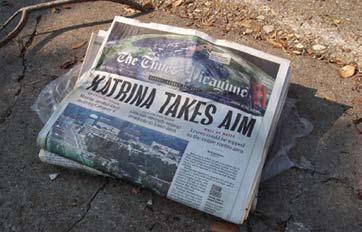
Then, just as the Fall 2005 semester was about to begin, Hurricane Katrina turned everything on its head. When word of the storm’s approach came in late August, students, faculty, and staff fled New Orleans and spent the semester in dozens of other settings around the country. All had “Katrina stories” to tell when the Murphy Institute resumed operations in January 2006. What follows are some of their stories.
Student Stories
S UDDEN E v A c UATION IS where most Hurricane Katrina stories begin. But some evacuations were more
harrowing than others. JOSEPH GALARDI ’07 doesn’t own a car. So he spent several anxious hours searching for a way out of New Orleans before finding a ride with a distant family friend. Galardi attended classes at Depaul University in Chicago during the fall semester. After returning to New Orleans in January, he felt compelled to rent a car and drive through the city’s most devastated areas. “You can’t grasp what really happened here until you stand ten feet from it,” Galardi says.
Fortunately, not all Murphy Institute students faced the prospect of sudden evacuation. LISA FRANKEL ‘07 was in London when the storm hit, preparing for a semester at INSTEP. “Part of me felt relieved to be abroad at the time. But I also felt an overwhelming sense of loss,” said Frankel, “and the distance exaggerated the helplessness I felt.”
Just like everyone else who fled New Orleans, Murphy Institute students watched in disbelief and horror as the aftermath of Hurricane Katrina unfolded on television. Uncertainty and rumors were rampant. After
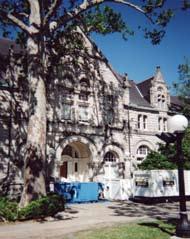
Tilton Hall on Life Support, October 2005. Hurricane Katrina caused only minor damage to the home of the Murphy Institute. But the storm shut down Tulane University’s power station for several weeks. Emergency generators kept Tilton cool and dry while repairs were made.
continued on page 10
the murphy institute
THE MURPHY INSTITUTE
Core Faculty and Staff
Richard F. Teichgraeber III, Director, Department of History
Gerald Gaus, Department of Philosophy
Eric Mack, Department of Philosophy
Douglas R. Nelson, Department of Economics
Mary Olson, Department of Economics
Jonathan M. Riley, Department of Philosophy
Martyn P. Thompson, Department of Political Science
John Howard, Associate Director
Ruth A. Carter, Program Manager
T HE CEN TER FO R ETHICS AND PUBLIC A FFAIRS
Faculty Committee
Bruce Brower, Department of Philosophy
Richard Culbertson, School of Public Health and Tropical Medicine
Arthur P. Brief, Lawrence Martin Chair of Business, Director, BurkenroadInstitute for the Study of Ethics and Leadership, A.B. Freeman School of Business.
Gerald Gaus
Steve Griffin, Associate Dean, Law School
Cathy J. Lazarus, School of Medicine
Graham Owen, School of Architecture
Eric Mack
Robert Martensen, Knight Chair of Humanities and Ethics, School of Medicine
Jonathan M. Riley
Martyn P. Thompson
Michael Zimmerman, Department of Philosophy
Center Administration
Margaret M. Keenan, Program Coordinator
Ex TERNAL A D v ISORY B OARD
Michael McPherson (Chair), President, Spencer Foundation
John Ferejohn, Carolyn S.G. Munro Professor of Political Science, Stanford University
Geoffrey Galt Harpham, Director, National Humanities Center
Bonnie Honig, Professor of Political Science and Director, Center for Law, Culture, and Social Thought, Northwestern University
Stephen Macedo, Director, University Center for Human Values, Princeton University
THE Ex CHANGE
Adam Newman, Zande+Newman Design, Communications Consultant and Art Director
Contributing writer, Fritz Esker
Zack Smith, Photographer
Send editorial correspondence to The Murphy Institute, 108 Tilton Hall, Tulane University, New Orleans, La. 70118
Telephone: (504) 865-5317
Facsimile: (504) 862-8755
For questions and comments pertaining to The Murphy Institute, contact jhoward2 @ tulane. edu; for those pertaining to The Center for Ethics and Public Affairs, contact cepa @ tulane.edu Web site: www.murphy.tulane.edu
LETTER FROM THE DIRECTOR
many times over the last several years, in this column and elsewhere, I have proudly called the Murphy Institute one of Tulane University’s great success stories. Two weeks after Hurricane Katrina flooded much of New Orleans and forced a mass evacuation of the city, it appeared the Murphy Institute was a success story that had run its course.

The catastrophic flooding caused by the failure of levees built to protect the city had turned everything in New Orleans on its head, including Tulane and the Murphy Institute. Katrina had flooded much of the Uptown campus, forcing the university to close its doors and suspend a just-launched $700 million capital campaign. Faculty and staff had fled the city. So had the entire student body. All had good reason to wonder if Tulane would reopen for the Winter–Spring semester of 2006. Many surely wondered if Tulane would ever reopen.
As I am writing, late on a very hot afternoon in early June, the dark horror of that moment is fading from memory. Much of New Orleans has recovered or is being rebuilt. Tulane’s students, faculty, and staff are back on campus, entering the final weeks of a special six-week “Lagniappe” semester designed to regain ground lost during the fall semester.
It would be a mistake to say the crisis created by this nation’s most costly natural disaster has passed. But it also would be a mistake to lose sight of what the Murphy Institute’s faculty, students, and staff have managed to accomplish in such times. If Katrina turned our lives upside down, it did so initially by moving them into other settings and prompting a remarkable variety of successful efforts to improvise order out of chaos.
You will find the Murphy Institute’s “Katrina stories” on the front page of this volume of The Exchange and in Focus on the Center, the annual newsletter of our Center for Ethics and Public Affairs. The Murphy Institute is deeply indebted to Washington and Lee University for providing an alternate home for the Center during 2005–2006. Focus is available in hardcopy by request and online at www.murphy.tulane. edu/publications/focus.
I’m also happy to report that, in several other areas, the Murphy Institute managed to continue to do what we once considered business as usual. Some examples:
n Last fall, Cambridge University Press accepted a new manuscript for publication in its “Murphy Institute Studies in Political Economy” series. The essays collected in Beyond Price: Value in Culture, Economics,
and the Arts, eds. Michael Hutter and David Throsby, investigate the way in which questions of value and valuation inform our understanding of culture and art. The editors and six other contributing economists are leading figures in the new field of cultural economics. Other contributors come from the fields of anthropology, art history, cultural history, and musicology. Publication is expected in summer 2007.
n Hurricane Katrina forced us to cancel the celebration of the 20th anniversary of the undergraduate program, but not the graduation of the Murphy Institute’s 20th class of political economy majors. Many in this class graduated with high academic honors and various other awards (See p. 8) Peter Glenn and Vanessa Cohen shared the 2006 Charles H. Murphy Prize.
n Jonathan Riley delivered a keynote address at the John Stuart Mill Bicentennial Conference held at University College, London, April 5, 2006. Currently recognized around the world as a leading authority on Mill, Professor Riley spoke on “Justice as Higher Pleasure.”
n On March 10, 2006, Joseph Stiglitz, University Professor at Columbia University and winner of the 2001 Nobel Prize in Economics, delivered the 10th annual Mary C. Parker Yates Lecture before a packed house in the Richardson Memorial Building. One of the world’s most influential and respected economists, Professor Stiglitz spoke on “Fair Trade for All: How Trade Can Promote Development.” His visit to the Murphy Institute was a major intellectual event, at a time when Tulane University very much needed to be reminded that it exists to make such events possible.
But perhaps the most memorable single event of 2005–2006 was one that had no public audience. It occurred the morning of November 7, 2005, when the staff of the Murphy Institute—Ruth Carter, John Howard, Meg Keenan, and I—reunited joyfully in Tilton Hall and began to send out word that we were back in business. That November morning, the Murphy Institute became the first of Tulane’s many academic departments and programs to resume operations on the Uptown campus in the aftermath of Hurricane Katrina.
Some seven months later, the crisis caused by Katrina has not run its course. But then again neither has the success story that is the Murphy Institute.
Richard F. Teichgraeber III, Director
June 13, 2006
FACULTY PROFESSIONAL ACTIVITY

n GERALD GAUS, Professor of Philosophy, completed a new book, On Philosophy and Economics, which will be published by Wadsworth. He is also the author of five new papers: “The Evolution of Society and Mind: Hayek’s System of Ideas,” in The Cambridge Companion to Hayek, ed. Ed Feser (Cambridge University Press, forthcoming); “On Justifying the Liberties of the Moderns,” Social Philosophy & Policy (forthcoming); “Reasonable Utility Functions and Playing the Fair Way,” in Critical Review of International and Social Philosophy (forthcoming); “The Moral Foundations of Liberal Neutrality,” in Debates in Contemporary Political Philosophy, eds. Thomas Christiano and John Christman (Blackwell Press, forthcoming); and “Green’s Rights Recognition Thesis and Moral Internalism,” in the British Journal of Politics and International Relations, vol. 7 (2005). During 2005–2006, Professor Gaus was v isiting Professor in the Department of Philosophy, University of North Carolina, Chapel Hill.

n ERIC MACK, Professor of Philosophy, completed and will publish four new papers: “Non-Absolute Rights and Libertarian Taxation,” in Social Philosophy & Policy (forthcoming); “Hayek on Justice and the Order of Actions,” in The Cambridge Companion to Hayek, ed. Ed Feser (Cambridge University Press, forthcoming); “More Problematic Arguments in Randian Ethics,” in The Journal of Ayn Rand Studies ; and “Individualism and Libertarian Rights,” in Debates in Contemporary Political Philosophy, eds. John Christman and Thomas Christiano (Blackwell Press, forthcoming). In May 2006, Professor Mack’s new book manuscript on Moral Individualism was the subject of a two-day workshop sponsored by the Murphy Institute, the Department of Philosophy at the University of North Carolina, Chapel Hill, and the Politics, Philosophy, and Economics Program at Duke University.
n DOUG NELSON, Professor of Economics, is co-editor (with Hylke vandenbussche) of The WTO and Antidumping (Edward Elgar, 2006). He also has had several new papers accepted for publication,
including (with Udo Kreickemeier) “Fair Wages, Unemployment, and Technological Change in a Global Economy,” Journal of International Economics (forthcoming); “The Political Economy of Antidumping,” European Journal of Political Economy (forthcoming); and (with Carl Davidson and Steve Matusz) “Fairness and the Political Economy of International Trade,” World Economy (forthcoming). He delivered (with David Greenaway) the Keynote Lecture on “The Politics of Anti-Globalization: What Do We Learn from Simple Models” at the Center for Economic Studies Summer Institute, venice, July 20–21, 2005. Professor Nelson is also Professorial Research Fellow of the Centre for Research on Globalisation and Economic Policy, University of Nottingham.

n JONATHAN RILEY, Professor of Philosophy, published five new papers: “Utilitarian Liberalism: Between Gray and Mill,” in Critical Review of International Social, and Political Philosophy , Special Issue Devoted to the Work of John Gray, 18 (2006); “Liberal Rights in a Pareto-optimal Code,” in Utilitas , Special Issue Devoted to the Work of Amartya Sen (March 2006); “J.S. Mill’s Doctrine of Freedom of Expression,” in Utilitas (July 2005); and “Mill, On Liberty” and “Rousseau, The Social Contract ,” both in Central Works of Philosophy, ed. J. Shand (London: Acumen Publishing, 2005). Professor Riley delivered a keynote lecture on “Justice as Higher Pleasure” at the Mill Bicentennial Conference, University College, London, April 5, 2006. A Chinese translation of Professor Riley’s J.S. Mill: On Liberty (Routledge, 1998) by x iangdong xu (Beijing University) will be published by Guangxi Normal University Publishing later this year.
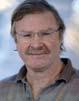
n MARY K. OLSON, Associate Professor of Economics, published a review article on Deborah Haas-Wilson Managed Care and Monopoly Power: The Antitrust Challenge, in the Journal of Health Politics, Policy, and Law (June 2005) and presented a new paper on “‘The Risk We Bear’: The Effects of Review Speed and User Fee Funding on New-drug Safety” at the Association for Policy Analysis

and Management Meetings, Washington, D.C., November 3, 2005. Professor Olson currently is also a member of the Institute of Medicine’s Committee to Assess the U.S. Drug Safety System. This committee is charged with evaluating Food and Drug Administration regulations for ensuring drug safety and the role of other stake holders in the U.S. Drug Safety System. The committee will also develop recommendations (with supporting evidence) for improving the system and eventually publish those recommendations in a book.
n RICHARD F. TEICHGRAEBER III, Director of the Murphy Institute and Professor of History, contributed a paper titled “‘More than Luther of these Modern Days’: Emerson in American Culture, 1882–1903” to Beyond Price: Value in Culture, Economics, and the Arts, eds. Michael Hutter and David Throsby, a new volume in “Murphy Institute Studies in Political Economy” (Cambridge University Press, forthcoming). He is completing work on a new essay, “James B. Conant and the Clumsy Rise of the ‘Up-orOut’ Tenure,” and a new book manuscript: Building Culture: Studies in the Intellectual History of Industrializing America.

n MARTYN THOMPSON, Associate Professor of Political Science, contributed a biographical entry on “Karl Reichsfreiherr vom und zum Stein, 1757–1831” to the Dictionary of EighteenthCentury German Philosophers (Bristol: Thoemmes, 2006). He is v ice-Chair of the Michael Oakeshott Association and serves on the Executive Committee of the Conference for the Study of Political Thought. b

Faculty Fellowships 2007-08
The Center for Ethics and Public Affairs at the Murphy Institute at Tulane University announces residential faculty fellowships for the 2007-2008 academic year. These fellowships, made possible by funds from the Tulane Murphy Foundation, are available to support outstanding faculty whose teaching and research focus on ethics, political philosophy, or questions of moral choice in areas such as, but not restricted to, architecture, business, government, law, medicine and environmental policy. While fellows will participate in conferences and seminars organized by the center, they will be expected to devote most of their time to conducting their own research. Stipends will vary in accordance with individual circumstance. Center faculty Fellowships are open to all, regardless of citizenship.
Further information about the fellowships and applications may be obtained online at www.murphy.tulane.edu/center or may be requested by contacting:
The Center for Ethics and Public Affairs
The Murphy Institute Tulane University
New Orleans LA 70118
504.862.3236 tel 504.862.8360 fax
cepa@tulane.edu
Applications must be received by December 1, 2006.
what they are reading
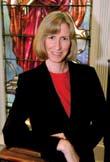
we asked mary olson, Associate Professor of Economics and one of the Murphy Institute’s new core teaching faculty, what she’s been reading lately. Professor Olson’s central topic of research is the political economy of health and pharmaceutical regulations.
An important health policy question is how to ensure that pharmaceuticals are effective, safe, and affordable. v ioxx and other drug safety incidents have raised concern about existing regulations and undermined public confidence in the Food and Drug Administration. In Powerful Medicines: the Benefits, Risks, and Costs of Prescription Drugs ( v intage Books, 2005), Jerry Avorn, M.D., describes what is wrong with our drug regulatory system. He argues that inadequate regulatory authorities, limited tools for monitoring drug safety after approval, ineffective risk communication, and poor information about the comparative effectiveness of similar drugs are all critical problems. He argues that drug advertising and promotion, instead of the best available evidence, is increasingly driving prescribing decisions and generating inefficiencies.
Avorn’s book highlights the important interaction between regulation, market incentives, politics, and health sector institutions. He recognizes that firm incentives and the
politics of drug regulation have made it difficult to resolve these problems. His proposed solutions include new regulatory authorities to increase postmarketing safety surveillance, new neutral institutions to communicate evidence-based drug information, better use of existing databases to investigate drug safety questions, new “academic detailing’’ to promote balanced risk-benefit information to physicians, and a regulatory approach that recognizes that approval is just the beginning of the period of assessment. He suggests that insurers, employers, and the government all have a stake in improving our current system and calls on them to fund these initiatives.
In Breaking the Vicious Circle— Toward Effective Risk Regulation
(Harvard University Press, 1993) Stephen Breyer, Associate Supreme Court Justice, argues that by improving how regulators assess and manage risks, regulation can more efficiently identify significant risks to the public. He examines the problems of regulating substances that create health risks. Breyer suggests that there is a vicious circle in which uncertainty abut regulation leads to biased perception of risks and congressional action to strengthen risk regulations. Congressional actions further fuel misperceptions of risk, which generate greater uncertainty, and subsequently erode public confidence in the agency. Breyer suggests that this vicious circle results in regulatory inefficiencies, which include regulatory ‘tunnel vision’ (in which regulators focus too much on the elimination of small risks), random agenda selection (in which politics and science may conflict in determining risk priorities), and inconsistencies in the procedures used to address risks within and across agencies.
To reduce the effects of the vicious circle, Breyer advocates the creation of a new federal agency to coordinate all government risk actions, standardize
risk assessments, and prioritize risk activities. In the absence of a new agency, existing agencies could also assume some of its functions. Breyer argues that there should be a standardized and consistent approach for assessing risk-benefit trade offs within and across agencies. He suggests that standardization will reduce uncertainty about regulation and better communication of risk-benefit evaluations will reduce risk misperceptions. These actions will increase the legitimacy and transparency of regulatory decisions, and hence reduce the fuel that feeds the vicious circle.
Improving information is also a theme in Deborah Haas-Wilson’s assessment of the prospects for competition to enhance efficiency in health care markets. In Managed Care and Monopoly Power: the Antitrust Challenge (Harvard University Press, 2003), she documents growth of managed care along with increased consolidation in the healthcare sector, which has led to increased monopoly power. She notes that monopoly power threatens to derail the expected benefits of competition from managed care. She argues that successful enforcement of antitrust laws, which prohibit anti-competitive mergers and business practices, is needed to preserve these benefits. She suggests that enforcement efforts have suffered because of a lack of understanding about how managed care has changed these markets. Failures to comprehend the complex relationships among managed care organizations and providers along with the complexities of evaluating firm consolidations in this sector have created hurdles for antitrust enforcers. She notes that there have been few government challenges of proposed hospital mergers since 1981 and the government has lost all seven of its challenges since 1995.
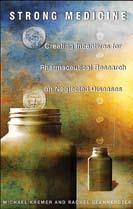
ing, and communicating accurate health care quality information pose significant challenges for those who are depending on competition to improve efficiency in health care markets. Haas-Wilson suggests that the decision to rely on market forces to reduce health care inefficiencies requires a commitment from policy makers to ensure that these markets are working well. Market forces are not working well in vaccine development. In Strong Medicine: Creating Incentives for Pharmaceutical Research on Neglected Diseases (Princeton University Press, 2004), Michael Kremer and Rachel Glennerster tackle the problem of vaccine development for diseases that plague poor developing countries. Millions die in developing countries from diseases that are rare in developed countries (e.g. malaria or tuberculosis). AIDS has devastated poor countries even though costly treatments are available and widely used in rich countries. Although vaccines may offer the greatest hope of controlling disease and improving health in poor countries, they note that firms have little economic incentive to undertake the costly, risky research to develop vaccines because the expected return in these markets is so low. The problem stems from “potential consumers who are poor’’ and “governments who drive down the prices for vaccines.” Kremer and Glennerster offer an institutionalized solution to this challenging incentive problem. They propose the creation of “pull programs’’ to stimulate vaccine research for these diseases.
Haas-Wilson offers important insights about managed care and recommendations to improve enforcement. She reviews the evidence about whether competition can truly cure the ills of the health care sector and concludes that the answer largely depends on whether consumers and antitrust officials can gain the necessary data to effectively evaluate the qualitycost trade offs. Without good information, consumers may make poor health care decisions, which could lead to market failure. The problems of collecting, measur-
A pull program uses a long-term contracting approach in which a funding agency commits to the purchase of a vaccine prior to its development. The funding agency pays only if and when a vaccine is developed. This program would ensure that firms receive the market rewards for successful vaccine development, which are often lacking in poor countries. Funding agencies could then distribute the vaccines for little to no cost in the poor country. Kremer and Glennerster consider the challenges of this approach and offer ideas about how such arrangements should be structured. They suggest that private foundations, governments in developed countries, and multi-lateral institutions like the World Bank could assume the role of the funding agency. Their proposal has great promise, growing political support, and if successful could save millions of lives in poor countries at a relatively low cost. b
SI x TEEN PAUL TULANE AND NEW c OMB
c OLLEGE SENIORS were awarded B.A. degrees in political economy at the May 2006 University Commencement. Several received high academic honors: VANESSA COHEN, MATTHEW DIEHR, PETER GLENN, MICHAEL MOVSHOVICH, MARY RUTHERFORD, and MICHAEL SHEERIN graduated cum laude
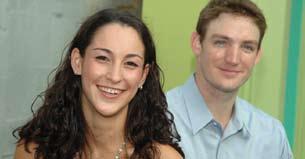
PETER GLENN won the Tulane College Charles H. Murphy Prize in Political Economy. He was on the Tulane Dean’s List and the National Dean’s List, as well as being a member of Phi Eta Sigma, the Golden Key Honor Society, and the National Society of Collegiate Scholars. VANESSA COHEN was the recipient of the Newcomb College Charles H. Murphy Prize in Political Economy. She was on the Newcomb College Dean’s List and is a member of Alpha Lambda Delta Honor Fraternity and the National Society of Collegiate Scholars. In the summer of 2005, she was a research intern at Bonner & Associates in Washington, D.C. She has plans to attend law school this fall.
Other members of the Class of 2006 include QUINLAN CARTHANE, CHRISTOPHER DEEDY, JOSEPH DEVEREUX, JULIA DICKSON, JAY HAZEN, BRETT HYMAN, JOHANNA KASPER, ADAM MORRIS, COLIN MURFIT, and J OSHUA S CHUSTER . Seniors who will graduate in December 2006 include JEREMY HALL and CINAR KIPER
QUINLAN CARTHANE has plans to attend law school. CHRISTOPHER DEEDY was a member of Omicron Delta Epsilon International Economics Honor Society. He will work as an economist in the Office of Prices and Living Conditions in the Division of International Prices, Services Division at the Bureau of Labor Statistics in Washington, D.C. MATTHEW DIEHR was awarded the prestigious Dean’s Select Scholarship
and will attend law school at St. Louis University. He has also been active in SAFER, helping to rebuild houses in the Ninth Ward that were damaged by Hurricane Katrina. In December 2006, JEREMY HALL will be commissioned as an officer in the United States Navy. During the spring semester, he worked on the Tony Scott movie Déjà Vu , which was filmed in New Orleans and stars Denzel Washington and val Kilmer.
JAY HAZEN will attend graduate school at Loyola University in New Orleans, pursuing a degree in Ethics and Theology. He was a founding member of the Tulane chapter of the Roosevelt Institution, a national undergraduate think tank. Over the past year he has volunteered for Habitat for Humanity and the St. Jude Research Hospital and interned for Sen. Lamar Alexander (R-TN). BRETT HYMAN , who owns his own
[ UNDERGRADUATE
marketing design company, has plans to eventually pursue an M.B.A. at a top business school. He started and maintained the website tulanestudentinfo.blogspot.com which served as a central clearinghouse of information for the Tulane community during the aftermath of Katrina.
JOHANNA KASPER will travel to Europe this summer. She was a public relations intern at Grapevine Communications in Brattleboro, vermont in the summer of 2005. While at Tulane she was active in Pi Beta Phi and was the recipient of the Anna A. Mayer Scholarship.
MARY RUTHERFORD served on the Newcomb Honor Board for the past four years. In addition, she was vicepresident of the Pre-law Society and a member of Pi Sigma Alpha Political Science Honor Society. She will attend law school at the University of Arkansas at Little Rock. JOSHUA SCHUSTER will work as a real estate developer for Halpern LLC in New York City. He was heavily involved in reconstruction efforts in devastated areas and worked with Brian Gibbs Development Corp. on rebuilding endeavors in New Orleans post-Katrina.
MICHAEL SHEERIN will be employed as a business analyst for NextJump, Inc. He worked for a month at a Red Cross shelter in West Point, Mississippi in the immediate aftermath of Katrina.
The cancellation of Tulane’s fall semester dispersed students to universities and colleges across the nation, where they continued to be active and were recognized for a broad variety of contributions to university life at their host institutions. MOLLY GREEN ’09 won the Economics Freshman Achievement Award at the
Vanessa Cohen and Peter Glenn, co-recipients of the 2006 Charles H. Murphy Prize in Political Economy.
University of Alabama. She returned to Tulane to become project coordinator for CACTUS Juvenile Assistance, a program that partners with the Raintree foster children’s home.
DOUG DICKSON ’07 is studying NGOs and their role in the areas of race and tolerance through an internship with Encompass Trust in London. LISA FRANKEL ’07 attended the INSTEP program in London in the fall. She is on Mortar Board and the Honors College Student Honors Committee. She will be an intern under the direction of ANDREA MARSH ’95 at the Texas Fair Defense Project and she will also intern in the Office of the Attorney General, both in Austin, Texas. JOSEPH GALARDI ‘07 volunteered for Bethel New Life in Chicago, helping to organize and implement a private savings program for low income individuals.
from Tulane College to research urban economies along the Mississippi River. ANDREW STRELZIK ’07 is interning at Pzena Investment management this summer. SARAH WATT ’07 attended the INSTEP program in Cambridge and interned at an economic consulting firm.
JADE HARRY ’08 has an internship in the office of Senator David v itter (R-LA) this summer. KATHRYN DAHLBERG ’08 interned for Judge Michael Gableman, Circuit Court Judge in Burnett County, Wisconsin. GEOFFREY ABRAHAM ’08 will work in Shanghai, China this summer. MARTA DEHMLOW ’08 is an editor for the Tulane Hullabaloo LAURA PAVICEVIC-JOHNSTON ’08 volunteers at the Alliance for Affordable Energy and will travel through India this summer. ANGELA SEALY ‘08 is a registered participant at the summer
POLITICAL ECONOMY PROGRAM ]
RACHAEL HUSSER STEGMAN ’07 continues her peer leadership roles as a student manager in the athletic department and a resident advisor for Housing and Residence Life. KATIE JONES ’07 is a summer intern at the High Point Community Project, a small business development district in High Point, North Carolina. EMILY MCRAE ’07 was awarded the Thomas N. Fiddler Scholarship and presented a paper at the Latin American Studies Symposium at Birmingham Southern College. She has a continuing internship at the Hispanic Business Resources and Technology Center in Kenner, Louisiana. She is also on Mortar Board and the Newcomb Dean’s List. ALEXANDRA SCRICCO ‘07 attended the INSTEP program in London and was an intern for FIFA at the World Cup in Germany. CURRY SMITH ‘07 was awarded a Taylor Summer Travel Grant
2006 World Bank Symposium in Washington, D.C., and will spend fall 2006 at the American University in Paris. SAMANTHA D E MARTINO ‘08 will spend most of her summer working at a Tibetan refugee village in India under the auspices of the Compassion in Action Program. NICOLE ARCHAMBAULT ‘08 served as a project coordinator for CACTUS. JOHANNES WACHS ’09 has an internship with the Microeconomics Research division of the Federal Reserve Bank of Philadelphia and will also be an intern for Congressman Jim Marshall (D-GA).
The undergraduate program in political economy continues to flourish. In May 2006, forty-one students finished the year with grade point averages above 3.0, nineteen with 3.5 or higher. Seventeen political economy majors were members of the Tulane Honors Program. Four were Dean’s Honor Scholars. b
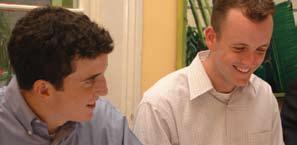
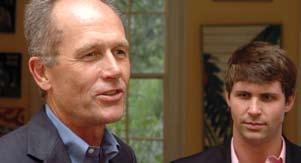
At the Murphy Institute Senior Dinner above: Michael Sheerin and Jeremy Hall right: Professor Teichgraeber and Chris Deedy.
KATRINA STORIES (continued from page 1)
returning to his home in Los Angeles, BRETT HYMAN ’06 joined the struggle to get more accurate information. “Tulane students and parents didn’t have the right understanding of what was going on because of the media,” said Hyman. Early on, he helped to address the problem by creating / tulanestudentinfo.blogspot.com . Launched and maintained while Hyman attended classes at the University of Southern California, the blog allowed Tulane students, parents, and faculty to post new information about the status of the university as well as ask questions about plans for the future. Hyman estimates the site had over 170,000 hits.
“... I have seen a lot of people I wouldn’t have expected to be involved get involved.”
Curry Smith ‘07
Hurricane Katrina also forced almost all Murphy Institute students to enroll in classes elsewhere. CURRY SMITH ’07 spent the fall semester at Washington and Lee in Lexington, v irginia, making his first venture living outside of his home state of Louisiana for any length of
LUCAS LOCKHART ’08 returned to his hometown of St. Louis to attend classes at the University of Missouri. He was particularly impressed by the generosity of the University of Missouri at St. Louis, which charged him no tuition.
Not all our students were able to attend class. Hurricane Katrina forced TRISTAN BENOZER ’08 to return home to San Diego. But by the time he arrived in San Diego, it was too late for him to enroll at the University of California, San Diego. So Benozer found jobs in two restaurants and worked 50–60 hours a week. “The fall was the first time in eighteen years I had not been in school,” he says.
“As much as everyone is looking to the Mayor’s Office, the burden is more on the shoulders of the citizens.”
Joseph Galardi ’06
time. Smith reports there were twenty-five other Tulane students in his residence hall, some of whom he did not know or knew only as acquaintances before Katrina. “We became really close, and that was a good experience,” says Smith.
By mid-January, all but a small handful of Murphy Institute students had returned to the Tulane campus.
Lockhart feared the things he loved most about Uptown, such as Audubon Park and the oaks on St. Charles Avenue, had been destroyed. “My favorite thing about New Orleans is how green it is,” he says. While he was relieved to see the park
and the oaks were largely undamaged, Lockhart says, “The contrast between the relative order of the Tulane campus and Uptown New Orleans, and the damage and trash in the rest of New Orleans was striking.”
Even so, students clearly were excited to be back on campus, and their mood remained positive throughout the Winter–Spring semester. Smith was particularly happy to see Tulane instituting a public service graduation requirement to get students involved in the rebuilding efforts. “I have seen a lot of people I wouldn’t have expected to be involved get involved,” he says. Galardi echoes Smith’s sentiments, stressing the importance of students’ involvement in rebuilding and recovery efforts. “As much as everyone is looking to the Mayor’s Office, the burden is more on the shoulders of the citizens,” says Galardi.
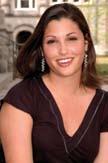
Of course, despite the optimism, there are still concerns. “I worry that prospective students will be too influenced by the negative images they saw from the media,” says Frankel. “But I hope they take the time to come to New Orleans and visit Tulane. I hope they see how far the city and university have come and the potential for further growth and improvement.”
Faculty & Staff Stories
Hurricane Katrina disrupted all forms of communication in New Orleans. So it is perhaps no surprise that Katrina stories told by Murphy Institute faculty and staff usually begin with the challenge of reestablishing communication. And JOHN HOWARD , the new Associate Director of the Murphy Institute, tackled the challenge head on.
Two days before the storm, Howard evacuated New Orleans not out of fear of breached levees, but because he anticipated lengthy power outages like those experi-
enced in his neighborhood during earlier, more benign storms. “I remembered,” says Howard, “that Entergy at times has seemed overwhelmed and unable to respond efficiently in the aftermath of relatively weak storms.”
Howard drove his family east, rather than west, thinking that accommodations would be more readily available in Georgia than in Texas. After settling in Pine Mountain, Georgia, he discovered that quick
“... I hope [students] see how far the city and university have come and see the potential for further growth and improvement.” Lisa Frankel ‘07
reconstruction of any communication network based in New Orleans was out of the question. So Howard moved quickly to set up a new Yahoo group for the Murphy Institute. He then posted his contact information and linked the temporary site to a similar site that Kim Koster, in the Office of Publications, was creating for the entire university. Within four days, Howard had gathered new cell phone and email addresses, thereby reopening the lines of communication among Murphy Institute faculty and staff.
“John Howard was such a godsend,” says MEG KEENAN, Program Coordinator for the Murphy Institute’s Center for Ethics. “He was the one who put us all in touch with each other.”
Keenan, whose new home in Metairie took on three feet of water, returned to campus early in November after evacuating to Florida. “It was strange because there seemed to be no one on campus except for temporary additional security guards, who often asked us for directions.”
Murphy Institute faculty, like our students, were

John Howard was appointed new Associate Director of the Murphy Institute in July 2005. Less than two months later, Hurricane Katrina disrupted all forms of communication in New Orleans. In early September, at his evacuation site in Georgia, Howard worked quickly to construct a new Yahoo group site for Murphy Institute faculty, staff, and students.
also blessed by the generosity of strangers during fall 2005. Shortly after evacuating his family to northern Louisiana, DOUG NELSON received an unexpected call from the International Monetary Fund. A professional colleague in Europe had given the Fund his contact information, and it responded by offering Nelson an invitation to spend the fall semester working in its Washington, D.C. office. “It was a remarkable act of kindness on their part to provide me with a short-term job,” states Nelson.
Other Murphy Institute faculty found generous assistance at institutions across the country. Jonathan Riley received a Research Fellowship from Folger Shakespeare Library in Washington, D.C. The Society and the Professions Program in Ethics at Washington and Lee University provided a refuge for R ICHARD
T EICHGRAEBER and four visiting faculty fellows sched-
uled to spend the year at the Murphy Institute’s Center for Ethics and Public Affairs.
By mid-January 2006, all Murphy Institute faculty and staff had returned to their offices in undamaged Tilton Hall, grateful to return to their work and to welcome students returning for the spring semester. Commenting on the University’s Renewal plan, Howard says, “I think the future of the University is extremely bright. The plan promises to make it a different kind of school, but ultimately a stronger one.”
Despite many challenges that lie ahead, the Murphy Institute will continue to play a central role in Tulane’s future. “At the moment, there are still many questions to be sorted out,” says Richard Teichgraeber, Director of the Murphy Institute, “but there’s no question the Renewal Plan has given us a clear vote of confidence.”
b
Politics, Philosophy & Economics
Published in Association with The Murphy Institute, Tulane University
Editors: Gerald F Gaus, University of Arizona, USA

Jonathan Riley, Murphy Institute, Tulane University, New Orleans, US A
Politics, Philosophy & Economics is a unique new forum for the interchange of methods and concepts among political scientists, philosophers and economists interested in the analysis and evaluation of political and economic institutions and practices. The journal brings moral, economic and political theory to bear on the analysis, justi cation and criticism of social institutions and public policies, addressing matters such as constitutional design, property rights, distributive justice, the welfare state, egalitarianism, morals of the market, democratic socialism, and the evolution of norms.
“In just a few years Politics, Philosophy and Economics has come to be the rst place I look for papers at the intersection of these three elds and the rst place I think about when considering where I'd like my work at this intersection to appear”
Alex Rosenberg, R Taylor Cole Professor of Philosophy, Duke University
Politics, Philosophy and Economics exempli es the best features of a new journal in an established eld. It re ects recent developments better than established journals; it connects more e ectively across disciplinary divides; and it has a greater freshness and sense of purpose. I’m very impressed”
Philip Pettit, L.S. Rockefeller University Professor of Politics and Human Values, Princeton University
[ Yates Lecture 2006 ]

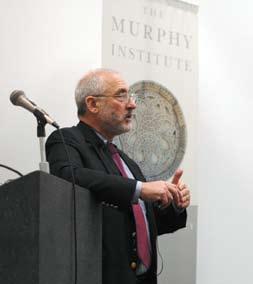
ON MAR c H 10, 2006 , Joseph Stiglitz, University Professor at Columbia University and winner of the 2001 Nobel Prize in Economics, delivered the 10th annual Mary C. Parker Yates Lecture before a packed house in the Richardson Memorial Building. One of the world’s most influential and respected economists, Professor Stiglitz spoke on “Fair Trade for All: How Trade Can Promote Development.” His visit to the Murphy Institute was a major intellectual event, at a time when Tulane University very much needed to be reminded that it exists to make such events possible.
ALUMNI NEWS
Class of 1987
NAOMI GARDBERG is Professor of Management at the Zicklin School of Business at Baruch College in New York City. Her new articles will appear in Academy of Management Review, Journal of International Business Studies, and Corporate Reputation Review. ERIC TOWELL is in his second year of teaching economics to juniors and seniors at the Prem Tinsulanonda International School in Chiang Mai, Thailand.
Class of 1988
MARC D’ANTONIO continues as supervising attorney for Georgia Legal Services Program in Columbus, Georgia and was recognized as a Rising Star in Atlanta Magazine’s 2005 list of Georgia Super Lawyers. JONATHAN DRUCKER is an attorney practicing probate and commercial litigation in Coral Gables, Florida. He and his wife
MICHELE MENDELL DRUCKER
‘91 have two boys, Connor and Colin, with a third boy due in June. JAMIE LOEB is president of Loeb and Company, an international cotton merchandising firm in Montgomery, Alabama. HANS LUETKEMEIER has just started a new job in New Orleans, taking on the position of Commercial Director for Kinder Morgan Inc., one of the largest energy transportation, storage, and distribution companies in North America. In
this capacity, he will also be the general manager of International Marine Terminals, a coal and bulk handling facility located in Myrtle Grove, Louisiana. MICHAEL TOBIN is a shareholder and cofounder of his law firm, Rothman & Tobin, in Miami, Florida. He and his wife just enjoyed the birth of their second son, Drew Levi Tobin. Their oldest son, Joshua, is now almost three years old.
Class of 1989
MICHAEL ARATA is the Chairman of the Film/Entertainment Subcommittee of the Mayor’s Bring New Orleans Back Commission. His committee will draft the city’s request for financial assistance to reconstitute the region’s thriving film, music, and entertainment arts industries. He continues acting and producing, and is a practicing attorney with Montgomery Barnett in New Orleans. SEAN BERKOWITZ was the Director of the Enron Task Force for the United States Department of Justice and lead counsel on the prosecution of former Enron chairman Kenneth Lay and former Enron chief executive officer Jeffrey Skilling. The trial concluded on May 26, 2006, as the successful prosecution led to guilty verdicts for Lay and Skilling.
JONATHAN GROSSER is a real estate attorney
with the Philadelphia law firm of Stradley Ronon Steven & Young, LLP. He and his wife, Dana, have two daughters, Gabrielle (age 3) and Josephine (age 6 weeks).
LISA NEWMAN is a partner at Wolfish & Newman, PC, in Dallas, Texas, where she specializes in estate planning and probate law.
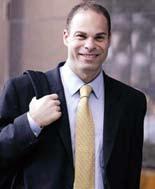
ROBERT SALTER is a partner at Salter Michaelson in Providence, Rhode Island, specializing in patent, trademark, and copyright law.
JAMES WICKETT advises and represents corporations, nonprofits, coalitions, and trade associations on legislative and regulatory matters focusing on federal tax and a broad variety of other issue areas, including energy, environmental, financial services, pension, and technology issues, at Hogan & Hartson in Washington, D.C.
Sean Berkowitz ’89 was Director of the Enron Task Force, U.S. Department of Justice.
Class of 1990
GEORGE RIZZO is employed by ExxonMobil as the lead on-site environmental attorney for the company’s five Houston area petro chemical facilities. This includes the 550,000-barrel-per day Baytown Refinery (the largest refinery in the U.S.). He and his wife will be celebrating their twelfth wedding anniversary this year; they have two children—a daughter, who is 3, and a son, who is 1. DENA SOKOLOW married Lance Rushing on April 1, 2006 in Birmingham, Alabama. In attendance were fellow Murphy Institute alums CHARLES
MAGLIONE ‘90 and HEATHER
M C ARN ‘86 . Dena is an attorney with the firm Walston Wells & Birchall, where she practices labor and employment law and human resources consulting. She is a member of the bar in Alabama, Florida, and Georgia. BRENDA WILLIAMS THROWER continues in the Urban Development Department
of the Ybor City Development Corporation in Tampa, Florida.
Class of 1991
ANISSA ALBRO ALLBRITTON and her husband, Lee, celebrated the birth of their daughter, Evan Louise, on July 21, 2005.
NOEL COMEAUX is Senior Transportation Planner for Clark Nexsen in Alexandria, v irginia. He is also co-president of the Washington, D.C. chapter of the Tulane Alumni Association
Class of 1992
NEIL BLUMOFE is Hazzan at the Congregation Agudas Achim in Austin, Texas. He has recently released, “Piety and Desire,” (2006: Horeb Records) a project of original compositions that bring together the sounds of jazz and hazzanut (Jewish liturgical music), in the recreation of a traditional Jewish wedding. EDUARDO FEBLES is Assistant Professor of French at Simmons College in Boston.
NICHOLAS HATHAWAY is v ice President for Administrative and Executive Affairs at the University of Oklahoma. MICHAEL SANDS is an attorney with Fenwick & West LLP in Mountain v iew, California.
Class of 1993
JASON COOK is Senior v ice President for Gramercy Advisors in Stamford, Connecticut. JENNIFER
DRAKE ASKEY is Assistant Professor of German in the Department of Modern Languages at Kansas State University. Her
areas of interest include 19thcentury children’s and adolescent literature, literature by women, and post-WWII German-Jewish literature. BETSY MCARTHUR LEROY is finishing her third year at the University of Arizona College of Medicine.
Class of 1994
DOUGLAS JAFFE is v ice President of Investor Relations at InvestorCom, Inc. in New York City.
BRIAN KILGALLON is Associate Director of Navigant Consulting in Arlington, v irginia. ALBERT LOJKO is v ice President for Institutional Equities at Thomson Financial in New York City.
Class of 1995
WILL JEFFORDS and his wife Tanya Ward Jeffords (N ‘95) live and work in Columbia, South Carolina. Will is a Product Manager for Avaya Inc., working in planning and strategy for messaging and unified communications solutions. Will is trying to leverage his amateur woodturning into more of a full-time venture.
JIM KOKOSZYNSKI manages zSeries Firmware Development with International Business Machines in Poughkeepsie, New York and earned an M.Eng. degree in Finance and Technology from Rensselaer Polytechnic Institute. He and his wife, Stacy, welcomed their first child, Tyler James, on June 9, 2005. ANDREA MARSH opened a new nonprofit organization, the Texas Fair Defense Project. The Austin-based organization works to improve the fairness and accuracy of the criminal justice sys -
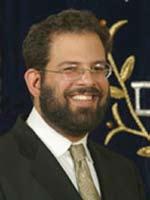
Hazzan Neil Blumofe ’92 is Hazzan at the Congregation Agudas Achim, Austin, Texas.
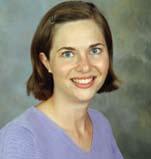
Jennifer Drake Askey ’93 is Assistant Professor of German in the Department of Modern Languages at Kansas State University.
tem in Texas, with a primary focus on improving access to counsel and the quality of representation provided to poor people accused of crime. TFDP is a continuation of the work Andrea began as a Soros Fellow at the ACLU of Texas in 2004, and with the spin-off from the ACLU, Andrea has added two more attorneys to TFDP’s staff. Andrea was a Wasserstein Public Interest Fellow at Harvard Law School for 2005-2006. In addition, Andrea will serve as a mentor to her summer intern LISA FRANKEL ‘07 ,
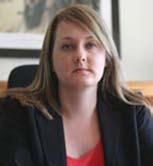
furthering the supportive relationships between alumni and current students of the Murphy Institute.
Class of 1996
JAMES ESPOSITO is now Senior Technology Operations Manager at Independent Purchasing Cooperative. He leads the technology deployment of a Gift and Loyalty Card Program to over 20,000 Point of Sales Systems in Subway quick service restaurants. He was married to Susana Caba on May 15, 2005.
CHANTALLE VERNA is Assistant Professor of History at Florida International University, where she specializes in United States history, inter-American relations, the African diaspora, and immigration history.
Class of 1997
K EN K AVANAUGH is Director of Corporate Development at eTrade Financial in Arlington, v irginia. He makes acquisitions for the company and develops investment strategy.
C HRIS S UELLENTROP is now a freelance writer living in Washington, D.C. He spent five years writing for the online magazine Slate, serving as Deputy Chief of its Washington bureau and as 2004 campaign correspondent. His articles have also appeared in the Los Angeles Times, the New York Observer, and the Washington Post.
Class of 1999
ERIKA COLE is in the graduate program in art history at the University of Texas and recently completed a photographic survey trip through India, where she studied dirushti
faces. She also studied the classical Tamil language at the American Institute for Indian Studies in Madurai. MELVIN ALBRITTON is counsel to the United States Senate’s Homeland Security and Governmental Affairs committee.
JARETT NIXON traveled through East Africa for three months after passing the California Bar Exam and is now working for a real estate law firm in San Francisco.
Class of 2000
REUBEN HALPER is an Emmywinning television producer who works for Fox, NBC, and TNT.
AMY BENOLD HEUTEL teaches third grade at McBee Elementary School in Austin, Texas. PHILIP MANCINI is living and working in Washington, D.C., as a research analyst for the International City/ County Management Association.
Class of 2001
BARBARA HALLENBECK works for Citigroup’s Global Corporate Investment Bank in New York City. TYLER HOLM is Lieutenant (jg) aboard the USS Carl v inson, where he serves as Hazardous Materials Logistics Officer. RAGAN NARESH has finished his second year at Georgetown Law School. SIENNA RAKESTRAW is an attorney at King & Spalding in Houston, Texas, where she practices in the areas of commercial disputes litigation and energy litigation.
Class of 2002
STEVEN CAHALL now works as a Senior Analyst for DFI Corporate
Andrea Marsh ’95 opened a new nonprofit organization, the Texas Fair Defense Project.
2006 marked the 20th anniversary of the Murphy Institute’s undergraduate program in Political Economy.
More than 520 Tulane and Newcomb students have majored in Political Economy since May, 1986.
Because of postal problems during and after Hurricane Katrina, the Murphy Institute has redesigned and redelivered the 20th Anniversary Alumni Survey. You may complete the mailed survey or online at murphy.tulane.edu./alumni/survey/ to receive a free Murphy t-shirt!
Services in Washington, D.C., along with fellow Murphy alum MATT MUENCH . ADAM FLISS works in environmental risk litigation for the St. Paul Travelers Insurance Company in Hartford, Connecticut.
JILLIAN GUTMAN MANN is an attorney at Sonnenschein Nath & Rosenthal in Chicago, practicing in the areas of bankruptcy and restructuring. LIZ MAY was an analyst at the United States Treasury Department in the Financial Crimes Enforcement Network. She now works for Advanced Resources Technologies, Inc. under contract to the Office of Investigations and Counterintelligence in the State Department. She is also pursuing a Master’s Degree in Applied Economics at Johns Hopkins University.
Class of 2003
BROCK BOSSON continues at the University of Tennessee College of Law, where he has been selected to the Tennessee Law Review. His note, titled “Search and Seizure —The Expansion of Police Powers Under the Fourth Amendment” will soon be published in the Tennessee Law Review. He will be a Summer Associate at the law firm Cahill Gordon & Reindel in New York City. JANET DALY is still working at Fight Crime: Invest in Kids, a non-profit child advocacy and crime prevention group in Washington, D.C., where she was recently promoted to Senior Associate for Strategic Planning and Development. She will marry Andrew Baumann in November. DAVID HYMAN , after working for the international arm in Spain
of the presidential campaign of Senator John Kerry (D-MA), took a position as Project Manager at Jazzya Investments, the holding company of one of Spain’s most successful entrepreneurs, Martin varsavsky. He returned to the U.S. in August 2005 and began working for a mobile commerce startup in New York. In January 2006, he accepted a position at Google, where he is currently a partnership development associate. MATT ROSEN is an account executive at Allen Partners, LLC, an investment firm in New York City. PATRICK
SNAVELY is a credit policy ana -

lyst for PNC Bank in Pittsburgh.
JEREMY STEIN is assistant producer for EA Sports, Tiburon in Maitland, Florida. BRANDON WARSHAW is currently working as a legal assistant in an insurance litigation firm in Washington, D.C., and will be attending law school in the fall. MAGGIE WILSON is a second-year medical student at the University of New Mexico School of Medicine.
Class of 2004
TRAVIS ALFORD is a legal assistant at Baker & Cronig, LLC in Miami.
BENJAMIN CARYL attended Washington & Lee University
School of Law during the 2005 fall semester (due to Hurricane Katrina) and is now back at Tulane University Law School as a second year student set to graduate in May 2007. This summer he will be working in Washington, D.C. for Stewart and Stewart, an international trade law firm.
MOLLY ELGIN has spent the last two years abroad, teaching English in Japan under the JET Program.
DANIEL ERSPAMER was promoted to Manager of Donor Relations for Americans for Prosperity, a national free-market grassroots organization that advocates for public policies on the state and federal levels that champion the principles of entrepreneurship, market-based fiscal policies, and regulatory restraint. He and his wife, Emily (L ‘04), recently moved to Annandale, v irginia. LEILA FARRAHI has finished her second year of law school at Northwestern University in Evanston, Illinois.
NOAH GINSBURG lives in Chicago and works as a Bond and Energy trader for Breakwater Trading, LLC. JOHN HOWELL has finished his second year of law school at Harvard. BRIAN KELLY has completed his second year at the vanderbilt University School of Law and will be clerking this summer with the law firms of Locke Liddell & Sapp in Houston, Texas and Hughes & Luce in Dallas, Texas. DAVID KINNEY is pursuing a graduate degree in Security Policy Studies at the Elliot School of International Affairs at George Washington University. LISA KOZAK continues to work at Guarantee Trust Life Insurance in Glenview, Illinois. She received a
promotion in October of 2005 and now is the company’s tax accountant. She recently became engaged to fellow Tulane Alum Chance Sweat (TC ’04). The wedding will be in June 2007. RANDAL MCLEAIRD is a senior loan officer for High Point Mortgage in San Antonio.
GAARGI RAMAKRISHNAN is the documentation officer for Population Services International in India. In January 2006, VIKRAM VIJ graduated from the University of New Haven with a Master of Science degree in National Security Studies and will be attending South Texas College of Law this fall. PAUL WALSH left his previous position of financial advisor for Morgan Keegan in Palm Beach, Florida, and is now a futures trader at Goldenberg Hehmeyer & Co. in Manhattan.
Class of 2005
JULIE NIEMCZURA taught English in Brazil for six months and is now interning at the National Endowment for Democracy. b