
the exchange
Th e MurphyInstituteLaunchesJournal
GERALDGAUS, professor of philosophy, recalls a lecture decades ago where a cocky young scholar raised his hand to challenge the eminent Harvard University political philosopher John Rawls. He said, “Although, Professor Rawls, I have never read your book, let me tell you what’s wrong with it from the book reviews I’ve seen.”
After criticizing work he’d never read, the busy academic did not wait for Rawls’ answer. Glancing at his watch, he said, “I wish I had time to hear your reply, but I have to leave.” Mercifully, there was no such posturing at the Politics, Philosophy and Economics Conference sponsored by Tulane’s Murphy Institute on March 9 and 10, 2001. The two dozen conference-goers, says Gaus, not only had read the six papers presented by a select cadre of academic luminaries, but thoroughly dissected each paper with an ultimate goal in mind: publication of polished, well-honed articles in the Murphy Institute’s new academic journal Politics, Philosophy & Economics, whose inaugural issue appeared in February 2002.
Journal authors will tackle issues of social justice and the crossover between economic theories and the understanding of politics and morality, says Gaus. For example,BelgianPhilippe Van Parijs of Universite Catholique de Louvain is
a proponent of linguistic justice. He argues that in a bilingual society, such as Belgium, people whose mother tongue is not the language of the majority population but who learn the second language anyway to ease commerce and societal functioning should be compensated for their effort.
Gaus says that Van Parijs’ views generated lively discussion at the conference as the mainly English nativespeaking scholars felt slightly guilty for not paying Van Parijs more for writing and presenting his paper in English, which is not his mother tongue. Gaus and his
co-editor, associate professor JONATHAN RILEY, who moved from Tulane’s political science department to philosophy in the fall semester of 2002, expect the kind of scholarly give-and-take that occurred at the conference to set the tone for the new journal. “Philosophers,
continued on page 15
the murphy institute
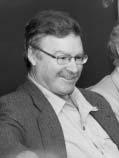
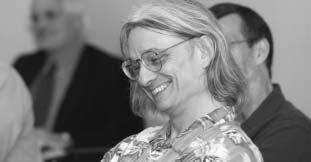
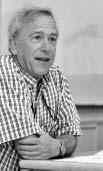
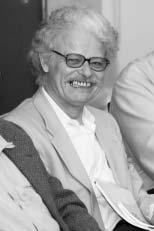
Murphy Institute faculty Jonathan Riley (left) and Gerald Gaus (above) are founding editors of the academic journal Politics,Philosophy& Economics
THE MURPHY INSTITUTE
Core Faculty and Staff
Richard F. Teichgraeber III, Director, Department of History
Gerald Gaus, Department of Philosophy
Ron King, Department of Political Science
Eric Mack, Department of Philosophy
Douglas R. Nelson, Department of Economics
Jonathan M. Riley, Department of Philosophy
Martyn P. Thompson, Department of Political Science
Judith K. Schafer, Associate Director
Ruth A. Carter, Program Coordinator
THECENTER FOR ETHICS AND PUBLIC AFFAIRS
Faculty Executive Committee
Bruce Brower, Department of Philosophy
Richard Culbertson, School of Public Health and Tropical Medicine
Eric Dannenmaier, Director, Tulane Institute for Environmental Law and Policy
Kay C. Dee, School of Engineering
Gerald Gaus
Steve Griffin, Associate Dean, Law School
Cathy J. Lazarus, School of Medicine
Graham Owen, School of Architecture
Eric Mack
Robert Martensen, Knight Chair of Humanities and Ethics, School of Medicine
Jonathan M. Riley
Martyn P. Thompson
Michael Zimmerman, Department of Philosophy
Center Administration
Richard F. Teichgraeber III, Interim Director
Lisa Luongo, Program Manager
THE EXCHANGE
Lisa Luongo, Editor
Adam Newman, Communications Consultant and Art Director
Tana Coman, Designer
Jackson Hill, Photographer
Send editorial correspondence to the Murphy Institute, 108 Tilton Hall, Tulane University, New Orleans, La. 70118.
Te lephone: (504) 865-5317. Facsimile: (504) 862-8755. For questions and comments pertaining to the Murphy Institute, contact jschafer@tulane.edu; for those pertaining to the Center for Ethics and Public Affairs, contact lluongo@tulane.edu.
Web site: www.tulane.edu/~murphy/.
letter from the director
I TI SM Y PLEASURE to report on the activities of the Murphy Institute at the end of its twenty-second year. 2001–2002 was a year marked by sustained academic excellence and expansion. Every level of program activity at the Murphy Institute — whether it involved faculty, students, staff, or alumni — gave evidence of a spirit of innovation and vitality that has become our hallmark. Some examples:
❂ In supporting and coordinating the establishment of a new Center for Ethics and Public Affairs, we are laying the foundations for a center that will provide greater coordination and support for research, teaching, and scholarly discussion of ethics and the ethical dimensions of professional life across the schools and disciplines at Tulane. In the process, the Murphy Institute is also expanding its operations to address issues that are not only basic to the study of political economy, but at the heart of Tulane University’s broader academic mission.

❂ Our core faculty remain among the most productive and respected scholars at Tulane, and their work continues to identify the Murphy Institute as an international force in treating “political economy” as a scholarly field in which humanists and social scientists make contributions of shared and equal interest. Jonathan Riley is one of only 40 scholars worldwide to receive a 2002–2003 Fellowship for study at the National Humanities Center in Research Triangle Park, North Carolina. February 2002 also saw the appearance of the inaugural issue of our new academic journal Politics, Philosophy & Economics. We envision the journal as a unique new forum for scholarly interchange of concepts and methods among political scientists, philosophers, and economists.
❂ Our long-standing undergraduate program in political economy remains one of Tulane’s most acclaimed interdisciplinary programs. Its popularity also has grown substantially during the last two years. During 2001–2002, enrollment in our core offerings was at an all-time high, and by May 2002 the number of undergraduate majors had grown from 76 to 126. At the 2002 Tulane University Commencement, graduating senior Elizabeth May was honored with several awards including the Alpha Lambda Delta Award for Academic Excellence, given annually to the Newcomb College senior graduating at the top of her class.
Both the pages that follow and our web site — www.tulane.edu/~murphy/ — provide more detailed information about Murphy Institute programs old and new. Looking back on 2001–2002, it’s fair to say there have been no more exciting and productive years at the Murphy Institute.
Richard F. Teichgraeber III, Director
E
STABLISHEDIN 1980 through the generosity of Charles H. Murphy, Jr. (1920–2002), the Murphy Institute is a university-wide interdisciplinary community at Tulane that exists to help faculty and students understand economic, moral, and political problems we all face and think about as citizens. More important, it exists to help us see why and how these problems have come to be so closely interrelated.
Within this broad purpose, the Murphy Institute supports a number of academic programs. Among Tulane undergraduates, the Murphy Institute is best known for its highly successful program in political economy. What began in 1984 as a modest venture with three students has grown to become one of Tulane’s most acclaimed and popular interdisciplinary majors. Testimony to the success of the program has been abundant. Some 460 students have graduated with B.A.s over the course of the last seventeen years, and gone on to pursue graduate and professional degrees at universities such as Chicago, Columbia, Duke, Harvard, Yale, Johns Hopkins, Washington University, Georgetown, Stanford, North Carolina, Vanderbilt, and Tulane.
Mellon Foundation also provided generous support for new faculty positions in international political economy.
themurphy institute

The building blocks of our success have been various. The Murphy Institute has six “core” faculty members who year-in and year-out teach courses specifically designed for the major, along with faculty affiliates in Economics, History, Philosophy, and Political Science who teach cross-listed, departmentally-based courses. The Director of the Murphy Institute has received both the Sheldon Hackney Award for Excellence in Teaching and the Student Senate Award for Excellence in Teaching, and was chosen Louisiana Professor of the Year in 1989 by the Council for the Advancement and Support of Education. The Associate Director has twice received the Student Senate Award for Excellence in Advising. With grant support from the National Endowment for the Humanities, the basic contours of the political economy program were put into place in 1987. In the early 1990s, a grant from the Andrew W.
Yet the Murphy Institute is much more than Tulane’s most acclaimed interdisciplinary undergraduate program. Among scholars worldwide, it is known for successfully promoting a conception of “political economy” as a field in which humanists and social scientists make contributions of shared and equal interest. Since the mid-1980s, the Murphy Institute has hosted numerous scholarly conferences and faculty seminars designed to promote and enhance interdisciplinary research and dialogue. Some of this activity has been centered on the appointment of the Murphy Institute’s DistinguishedVisiting Professor. These appointments have included Gordon Winston (Williams College), John Dunn (King’s College, Cambridge), Thomas Haskell (Rice University), John Gray (London University), John Ferejohn (Stanford), and Michael McPherson (Macalester College). Since 1984, other visiting lecturers have included 1992 Nobel Prize economist Gary Becker (Chicago), 1998 Nobel Prize economist Amartya Sen (Trinity College, Cambridge), Albert O. Hirschman (Institute for Advanced Study), Stefan Collini (Clare Hall, Cambridge), Peter Hammond (Stanford), and Jackson Lears (Rutgers University).
The Murphy Institute also sponsors (with Cambridge University) “Murphy Institute Studies in Political Economy,” a series of occasional volumes comprising original essays first presented at conferences sponsored by the Institute. To date perhaps the most successful book in the series has been The Culture of the Market: Historical Essays (1993), eds. Thomas Haskell and Richard F. Teichgraeber III, which collected papers first presented at an NEH conference organized and hosted by the Murphy Institute. We also sponsor (with Sage Publications) the new academic journal: PPE: A Journal of Politics, Philosophy & Economics. Two Murphy Institute faculty — Gerald Gaus and Jonathan Riley — are the journal’s founding editors. They have conceived PPE as a forum for interchange of concepts


and Public Affairs during 2002–2003 (below).
the center for ethics and public affairs
LAUNCHED IN JULY,2001,the Murphy Institute’s new CENTER FOR ETHICS AND PUBLIC AFFAIRShas been created to provide greater coordination and support for research,teaching,and scholarly discussion of ethics and the ethical dimensions of public and professional life across schools and disciplines at Tulane.The idea driving the Center is that Tulane should have a place where its faculty and students can more broadly examine critical issues of right and wrong,justice and injustice,community and citizenship,the ethics of research,and the ethics of the professions.The Center is also part of a strategy aimed at spreading the resources of the Murphy Institute more broadly across the University.
Two new programs are at the heart of the Center:a Visiting Faculty Fellowship program that will facilitate frequent and sustained contact with distinguished visiting scholars,and a new Graduate Prize Fellowship Program that will enhance graduate education at Tulane by supporting graduate students writing dissertations or engaged in major research on ethical issues.Other components of the Center include new support for university-wide seminars and lectures and leadership provided by a university-wide Faculty Executive Committee.
2001–2002 was the first year in the Center’s planned three-year startup phase.It was active and productive.The Center’s first annual Faculty Seminar,held in Spring 2002, did exactly what we hoped it would do:encourage and enhance intellectual community by ending the geographical isolation of teachers and scholars of professional ethics from faculty in the liberal arts who share their interest in ethics.The seminar’s topic was “Relativism and Moral Confidence.” It was organized and conducted by SIMON BLACKBURN,Professor of Philosophy,University of Cambridge.The fifteen seminar participants included faculty from the Law School,the Medical School,the School of Public Health and Tropical Medicine,as well as faculty and graduate students from LAS.
The Center also organized and/or cosponsored lectures and seminars with other departments and various schools within the University.These included:
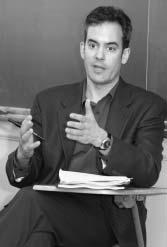
Steve Macedo,Director of the Center for Human Values,Princeton University (top); Matthew Oberrieder (Philosophy), Michael Redman (History),and Elizabeth Umphress (Freeman School of Business) will be Graduate Fellows of the Center for Ethics
G.A.COHEN,Chilele Professor of Social and Political Thought,Oxford:“Facts and Principles.”
TIMOTHY E.QUILL,M.D.,Professor of Medicine, Psychiatry,and Medical Humanities,University of Rochester School of Medicine:“The Promise of a Good Death:Potential and Limitations.”
DAVID MESSICK,Kaplan Professor of Ethics and Decision in Management,Kellogg Graduate School of Management, Northwestern University:“Ethics at the Kellogg School.”
The Center for Ethics and Public Affairs also hosted roundtable discussions with two scholars who have
figured prominently in the successful creation and administration of similar centers at other universities:
DENNIS THOMPSON,Director,Center for Ethics and the Professions,Alfred North Whitehead Professor of Political Philosophy,Harvard University;and
STEPHEN MACEDO,Director,University Center for Human Values,Laurance S.Rockefeller Professor of Politics,Princeton University.The discussions were designed to help the Center’s Faculty Executive Committee and senior University administrators who have lent their support to the Center to sharpen the focus of our approach to ethics and public affairs.
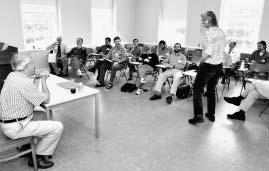
Simon Blackburn (left),Professor of Philosophy, University of Cambridge,conducted the first university-wide Faculty Seminar at the Center for Ethics and Public Affairs.Former editor of the journal Mind ,P ro f essor Blackburn is author of the recent best-selling books Think (1999) and Being Good:A Short Introduction to Ethics (2001).His seminar’s topic was “Relativism and Moral Confidence.”
Center Offers Faculty and Graduate Fellowships
IN THE FALL OF2001,we began to put in place the basic contours of the Center’s two Fellowship Programs. Announcements of the Graduate Fellowship Program were distributed to all Tulane graduate students.They were also distributed to Deans and appropriate department chairs. Inside Tulane (December,2001) provided additional publicity for the program.We selected three Graduate Fellows for 2002–2003.An intellectually impressive group will spend the year completing work on a diverse range of dissertation topics:
MATTHEW OBERRIEDER(Philosophy):
“The Significance in Plato’s Protagoras of Shame and Self-Knowledge for Understanding the Human.”
MICHAEL REDMAN(History):
“Censorship and the Politics of Culture:Lying and Telling the Truth During the Personal Rule of Charles I.”
ELIZABETH UMPHRESS(Freeman School of Business):
“In the Name of the Company:Unethical Behaviors Perpetrated by Employees in Response to Fair Treatment.”
Because suitable office space for Visiting Faculty Fellows will not be available until Fall,2003,the Center will not provide
Visiting Faculty Fellowships this year.It will instead host a series of distinguished visitors.We will bring to campus in the spring term three internationally known scholars to help teach graduate students and host our annual Faculty Seminar.
VOLKER GERHARDT,Humboldt University (Berlin)
CHANDRAN KUKATHAS,Australian Defense Fo rce Academy
DENNIS C.MUELLER,Universitat Vienna (Austria)
Finally,in keeping with one of the Center’s announced goals to attract outstanding faculty to Tulane,the Center for Ethics and Public Affairs was an important component ensuring the Tulane School of Medicine’s successful recruitment of Dr.ROBERT MARTENSENto be the first holder of the Knight Chair in Ethics and Humanities.In addition to his responsibilities at the School of Medicine,Dr.Martensen will serve as a new member of the Center’s Faculty Executive Committee.With additional administrative and program support from the Center,the activities Dr. Martensen plans to undertake at the School of Medicine will create a new bridge between Tulane’s downtown and uptown campuses.
FA CULTY PROFESSIONAL ACTIVITY
❂ JERRY GAUS, Professor of Philosophy, published several new papers during the past year: “The Legal Coordination Game,” American Philosophical Association’s Newsletter on the Philosophy of Law (Spring, 2002); “Principles, Goals, and Symbols: Nozick’s Theory of Practical Rationality,” in Robert Nozick, ed. David Schmidtz (Cambridge UP, 2002); “Bernard Bonsanquet’s CommunitarianDefense of Economic Individualism,” in The New Liberalism: Reconciling Liberty and Community, eds. David Weinstein and Avital Simhony (Cambridge UP, 2001); “What is Deontology? Part One: Orthodox Views” and “What is Deontology? Part Two: Reasons for Action,” in Journal of Value Inquiry, Vol. 35 (2001). During 2002, Professor Gaus was chosen a Distinguished Overseas Visitor by the British Political Studies Association. He also organized the second annual PPE conference. Held on the Tulane campus in March 2002, this year’s conference’s theme was “Markets and Commercial Culture.”
❂ ERIC MACK, Professor of Philosophy, published three new papers during 2001–2002: “Self-Ownership,
Marxism, and Egalitarianism: Part I. Challenges to Historical Entitlement,” Politics, Philosophy, & Economics (February, 2002); “Self-Ownership, Marxism, and Egalitarianism: Part II. Challenges to the Self-Ownership Thesis,” Politics, Philosophy, & Economics (June, 2002); and “Blind Justice” (a retrospective of John Rawls’ Theory of Justice ), Navigator (July, 2001). In October, 2001, Professor Mack was also an invited participant at a Colloquium on “Rights, Liberties, and Duties,” held at the School of Law, Universidad Di Tella, in Punta del Este, Uruguay.
❂ DOUG NELSON, Professor of Economics, is co-editor (with David Greenaway) of a new volume of papers on Globalisation and Labour Markets (Edward Elgar, 2001). He published two new papers during the past year: “International Political Economy: A Tale of Two Heterodoxies” (with Craig Murphy), British Journal of Politics and International Relations (Vol. 3, #3, 2001), and “Globalisation and Labour Markets: Introduction,” in Globalisation and Labour Markets, eds. David Greenaway and Doug Nelson (Edward Elgar, 2001). In November, 2001, Professor Nelson organized and hosted a Murphy Institute conference on “The Political Economy of Reform,” where he presented a paper on “The Role of the World Bank in the Transfer of Policy Knowledge on Trade Liberalization.” He continues to serve on the Editorial Advisory Board of the journal World Economy, and as External Research Fellow at the Leverhulme Centre for Research on Globalisation and Economic Policy, University of Nottingham.
❂ JONATHAN RILEY, Associate Professor of Philosophy, is one of only 40 scholars worldwide to receive a 2002–2003 Fellowship to study at the
National Humanities Center in Research Triangle Park, North Carolina. During his year in residence, he will pursue research on his new comparative study of John Stuart Mill, Isaiah Berlin, John Rawls, and Richard Rorty. Professor Riley also published a new paper on “Defending Cultural Pluralism Within Liberal Limits,” Political Theory (February, 2002).
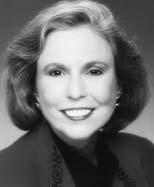
Judith K.Schafer,Associate Director of the Murphy Institute and Associate Professor of Political Economy
❂ JUDITH K. SCHAFER, Associate Director of the Murphy Institute and Associate Professor of Political Economy, published a new paper on “The Murder of a ‘Lewd and Abandoned Woman’: State v. Abraham Parker,” American Journal of Legal History (April 2002). Her new book manuscript Becoming Free, Remaining Free: Manumission and Enslavement in New Orleans, 1846–1862 has been accepted for publication by LSU Press. During 2002–2003, Dr. Schafer will be President of the Louisiana Historical Society.
❂ RICHARD F. TEICHGRAEBER III, Director of the Murphy Institute and Professor of History, presented a paper
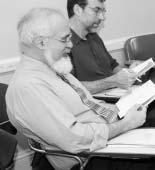
Eric Mack,Professor of Philosophy (below,left)
on “The American University Movement in American Culture, 1870–1900” at the Fourth Annual Bavarian American Academy Conference — “Cultures of Economy/Economics of Culture” — in Munich, 20–22 June, 2002. He has completed the draft of a new paper on “‘More Than Luther of These Modern Days’: Emerson in American Culture, 1882–1903.” Professor Teichgraeber is also serving as Interim Director of the Murphy Institute’s new Center for Ethics and Public Affairs, and has been named to Who’s Who Among American Teachers, 2002.
❂ MARTYN THOMPSON, Associate Professor of Political Science, published an new article on “Hobbes on Heresy” in Histories of Heresy in Early Modern Europe , ed. J.C. Laursen (Palgrave, 2002), and continues to serve as a co-editor of the annual Politisches/Denken/Jahrbuch . Professor Thompson is the Chair of the Conference for the Study of Political Thought. He also continues to work on his forthcoming book, Reading Political Thinkers, a study of central aspects of the reception of Locke and Rousseau.
Faculty Fellowships 2003- 04 the center for
The Murphy Institute’s Center for Ethics and Public Affairs at Tulane University is pleased to announce residential Faculty Fellowships for the 2003-2004 academic year. These fellowships, made possible by grants from the Tulane Murphy Foundation and from the bequest the University received from the estate of Lallage Feazel Wall, are available to support outstanding faculty whose teaching and research focus on questions of ethics and moral choice in such areas as architecture, business, government, law, medicine, urban design and planning, and engineering. While fellows will participate in conferences and seminars organized by the Center, they will be expected to devote the most of their time to conducting their own research. Stipends will vary in accordance with individual circumstance, but will not exceed US $35,000. Center Faculty Fellowships are open to all, regardless of citizenship.
Further information about the Fellowships and applications may be obtained from the Center page on the Murphy Institute web site at www.tulane.edu/~murphy or may be requested by contacting:
The Center for Ethics and Public Affairs
The Murphy Institute Tulane University New Orleans, LA 70118
504.862.3236 tel 504.862.8360 fax lluongo@tulane.edu

Martyn Thompson,Associate Professor of Political Science
In May 2002, fourteen Tulane and Newcomb seniors graduated with B.A.’s in political economy. This was our seventeenth graduating class, and it included many very impressive students. Several received high academic honors: STEVEN CAHALL, CARLYN HANSEN, FRANK SNYDER, CONNIE TRIEU, and MARGARET WILSON graduated cum laude. ELIZABETH MAY graduated summa cum laude and was elected to the Phi Beta Kappa Society. Five of our seniors left Tulane with overall grade point averages above 3.0; two were above a 3.4.
At the 2002 Tulane University Commencement, Steven Cahall and WILLIAM SNYDER shared the Paul Tulane College’s Murphy Prize in Political Economy. Elizabeth May — who graduated with a double major in Political Economy and History — was showered with an extraordinary number of awards. Not only did she win the Newcomb College Murphy Prize in Political Economy, she also was recipient of the Charles Till Davis Prize for Excellence in European History, the Mary B. Scott Prize, and the Chi Omega Prize in History. Most impressively of all, Elizabeth May was also honored with the Alpha Lambda Delta Award for Academic Excellence, given annually to the Newcomb College senior graduating at the top of her class.
During the course of 2001–2002, our seniors received a variety of other honors and participated in a wide variety of extracurricular activities. Elizabeth May
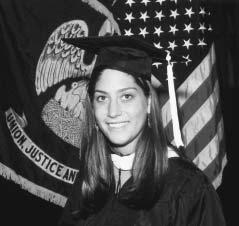
Elizabeth May '02 (above) graduated summa cum laude and Phi Beta Kappa,and was recipient of Newcomb College's Alpha Lambda Delta Award for Academic Excellence.
Sorbonne in Paris. During Summer 2001, ten Tulane students participated in the Murphy Institute’s Summer Program at the Institute of Economic and Political Studies (INSTEP) in London and Cambridge, including political economy majors ELIZABETH REED ’0 2, FRANK SNYDER’02, BEN YOUNG-ANGLIM’03, ELLEN LEWIS’02, ADAM RUCH’03 and BRANDON W ARSHAW’03. Sixteen Tulane students attended INSTEP’s 2002 Summer Program, including political
[ undergraduate political eco
was elected Senior Class Representative to the Newcomb Senate, as well as Vice President and Newsletter Editor of the Golden Key International Society. WHITNEY CASE and Carlyn Hansen were named members of the Oak Wreath, the Newcomb College society honoring leadership and scholarship. Both Whitney Case and Elizabeth May were elected to Mortar Board. Whitney Case, Elizabeth May, and Steven Cahall were named to Who’s Who Among Students in American Universities and Colleges. Steven Cahall was elected Vice President of the Tulane College Senate and Senior Representative to the Undergraduate Student Government and the Tulane College Leadership Caucus. He was also a member of the 2002 Green Wave Homecoming Court.
Juniors and sophomores majoring in political economy also participated in a wide variety of University programs and activities. MARK WILLIAMS ’03 attended the Washington Semester of American University in Fall 2001, during which he interned on Capitol Hill. JESSE YEAGER’03 spent his junior year abroad at the
economy majors ADAM ARONOVITZ’03, BENJAMIN CARYL’03, KENNETH COPELAND’03, CHRIS DALLMAN’03, ADAM FLISS’03, ALANNA FRANCO ’03, EVAN HERMAN’03, ADAM KWASMAN’03, ANH NGUYEN’03, DEANNA REMMES’03, STEPHEN SALYER’03 and Ben Young-Anglim.
MOLLY ELGIN’03 and MARIA CRISTINA GUARDIA ’03 were named to the Newcomb College Mortar Board. Molly Elgin was President of Newcomb Assets and tutor in Upward Bound. She also found time to serve as a Copy Editor of the Tulane Hullabaloo and counselor for the Rape Emergency and Coping Hotline on the Tulane Campus. BRIAN KELLY’04 was a member of Omicron Delta Epsilon, an international Economics honor society, and tutored in economics at the Educational Resource Center. During Spring semester, he served as an intern for New Orleans councilman Eddie Sapir, spearheading a voter registration drive on the Tulane campus that resulted in about 300 new registrants. Brian also was on the Dean’s Honor List, the National Dean’s List, and a member of the
National Society of Collegiate Scholars and the Tulane Honors Program.
Ben Caryl continued to work as an intern with his employer of last summer — ENVISION EMI Inc. — doing research on economic, fiscal, legal and political issues for the company’s clients, which include newspapers and talk shows. MATTHEW MORNICK’05, who has won national awards for his work, had new photographs published in the Tulane Review. MARCUS WILLIAMS’03 served as a US Navy Foreign Liaison Officer in Singapore this summer. GILBERT NELSON ’04 traveled to Bosnia and Croatia to assist at relief camps for children who have suffered emotional trauma because of the wars in the region. This past Spring, he interned with Blanchard, Inc., a firm that invests in rare gold coins, where he assisted in updating the company’s webpage and writing reports for clients.
CHRIS MYERS’04 was elected President of the Tulane College Republicans and Vice Chair of the Louisiana Federation of College Republicans, as well as a member of the Honor Board and a Tulane College Senator in the Undergraduate Student Government. Brandon Warshaw was Treasurer of his fraternity Pi Kappa Alpha in 2001–02, and will be regional Vice President in 2002–03. This summer he worked for Robert Portman, an Ohio State Legislature Representative from Cleveland. Adam Fliss was elected
nomy program ]
President of the Tulane Interfraternity Council for 2002–03. MAGGIE WILSON’05 worked for the Tulane Emergency Services this year. She was a member of Alpha Lambda Delta (the Honor Society at Newcomb College), Phi Eta Sigma National Honor Society and the National Society of Collegiate Scholars. She also was elected the Newcomb Representative to the LAS Curriculum Committee.
BROCKTON BOSSON’03 was elected to Omega Delta Kappa national leadership fraternity. At the 2002 Tulane College Commencement, DANIEL ERSPAMER ’04 won the Aaron Mintz Brotherhood Award for outstanding service in the area of interfaith relations. He also received the Ronald Reagan Future Leaders Award from the Philips Foundation, as well as the Tulane Honors Program Student of the Year for 2001–02 and an award for excellence as Resident Advisor from the Department of Housing and Residence Life. Finally, Alanna Franco created a program called “Energy Star Showcase Dorm Room” to demonstrate energy efficient dorm life. Take a virtual
SummerInternshipProgram
The Murphy Institute Summer Internship Program, now in its seventeenth year, supports internships for several political economy majors each year. The Institute provides a competitive offering of grants of at least six weeks’ duration in the summer between the student’s sophomore and junior years or between the junior and senior years at Tulane. Stipends are tailored to need, reflecting current levels of individual student financial aid and the proximity of the internship to the student’s home. The main criterion for selection is a well-conceived plan for employment in a field related to political economy or public policy. A detailed report and assessment of a student’s internship experiences is required at the completion of the summer’s work. In organizing the program, we emphasize personal initiative by our students. Students interested in the program are asked to seek out a prospective employer and then apply to the Murphy Institute for the award.
During the Summer of 2001 the Murphy Institute awarded eight students summer internship grants. The Fund for American Studies at Georgetown University provided an internship for Brockton Bosson. Benjamin Caryl interned in Washington, D.C., at the Congressional Youth Leadership Council. ROBERT GRETHER ’03 also was in Washington, D.C., to intern with Congressman Elton Gallegley. Investor’s Bank and Trust Company in Boston provided an internship for JONATHAN CAVE ’03 FERNANDO HURTADO ’03 pursued an internship doing research in Peru. Kenneth Copeland interned at the New Orleans office of Merrill Lynch. Le Centre International de Lafayette provided an internship for Jesse Yeager, and INSTEP provided Frank Snyder an internship with a solicitors’ firm in London.
Twenty political economy majors received Murphy Institute Internship Grants for the Summer of 2002. Two, Ben Caryl and JASON
continued on next page
MATHERNE’03, also won prestigious David Cameron Taylor Memorial Summer Travel and Enrichment Grants from Tulane College. Ben interned with a firm of solicitors in London, while Jason attended a film school at Rockport College in Maine. Brock Bosson interned in the office of Tennessee Senator Fred Thompson, while JANET DALY’03 worked for the Southern United States Trade Association in New Orleans. Adam Aronovitz, Ken Copeland, Deanna Remmes, and Alanna Franco interned in solicitors’ offices in London. Jonathan Cave
some 460 tulane students have graduated with b.a.s in political economy o ver the last seventeen years.
interned at Merrill Lynch in New York, and Molly Elgin worked at the Small Business Survival Committee in Washington, D. C.
The New Orleans District Attorney’s Office provided an internship for Brian Kelly. Fernando Hurtado conducted research in Argentina on that country’s economic policy, and DAVID HYMAN’03 interned at the Export/Import Bank of the United States.
LAURA NICHOLSON’04 interned in the Washington office of Senator John Edwards, and DANIEL SCHAFFNER’03 interned with a law firm in D. C. Adam Fliss, Anh Nguyen, Ben Young-Anglim and Chris Dallman had INSTEPsponsored internships with various political organizations in and around London. Finally,
LEILA FARRAHI’04 interned at the Bryce Harlow Institute of Business and Government Affairs in Washington, D. C.
tour of her web site at green.tulane.edu/energysmart/ AboutTheEnergyStar.html.
In short, the Murphy Institute’s undergraduate program in political economy clearly prospered in various ways during 2001–2002. We continue to attract ambitious and highly intelligent students. Eighty-seven political economy majors ended the academic year with grade point averages of 3.0 or higher; thirty-three with 3.5 or higher. Twenty-nine were members of the Tulane Honors Program. Ten were Dean’s Honors Scholars.
Murphy Institute Alumni Network
One of the challenges faced by the Murphy Institute is to help political economy majors in their search for professional careers. This year, to assist current students in formulating career plans, the Murphy Institute launched a new program called the Murphy Institute Alumni Network (MINET).
In creating MINET, we have asked a select group of former students to share their professional knowledge and experience with current political economy majors. Alumni participants have agreed to make themselves available to give advice and information to students about the kind of employment open to political economy majors. MINET is not a job placement program, nor are our alumni asked to provide employment. It is access to their “real world” experience, we hope, that will be a welcome source of practical advice for our students.
As of May 2002, some 50 political economy alumni have volunteered their services. All have agreed to speak to current students about both their professions and the particular area of the country in which they live. Some also have agreed to allow students to “shadow” them for a day.
Among Murphy Institute alumni who have volunteered for MINET are numerous attorneys whose work ranges from providing services to indigent clients to serving as a US Attorney in the Department. Many of our former students also work in the financial sector, both in New York and in other parts of the country. Others are involved in education. Also volunteering for MINET are a landscape general contractor, a freelance director of cable and network television shows, a reporter for the Congressional Quarterly, a magazine editor, a fundraiser for a city symphony, and a movie producer.
What lies ahead? Next year, we will make regular contact with both seniors and juniors in political economy to encourage them to make use of MINET. We also plan to expand the number of Murphy Institute alumni involved in this new program. For additional information about MINET please visit the web site www.tulane.edu/~murphy/.
MARY C.PARKER YATES LECTURE
David Greenaway Discusses Fate of the European Union
T HESIXTHANNUAL Yates Lecture was given on April 4, 2002, by David Greenaway, Professor of Economics and Director of the Leverhulme Centre for Research on Globalisation and Economic Policy at the University of Nottingham. His topic was “Can the European Union Afford the Euro and Enlargement to the East?”
Professor Greenaway is internationally known for his research in the fields of trade and labour market adjustment, crossborder investment, international trade policy, and
★ ★ ★
the funding of higher education. He has published widely in academic journals including the Economic Journal, European Economic Review, Economic Inquiry, Oxford Economic Papers, and the European Journal of Political Economy. He is past Associate Editor of the Economic Journal and currently is Joint Managing Editor of The World Economy. Professor Greenaway also has served as a consultant to the European Commission, GATT, H.M. Treasury, and the World Bank.
The annual Mary C. Parker Yates Lecture in Political Economy is supported by an endowed fund established in the Summer of 1996 by REBECCA YATES’89 VELANDER in memory of her late mother.
INTERDISCIPLINARY CONFERENCE
The Political Economy of Policy Reform
T HEGOALOF this conference held on November 9 and 10, 2001, at Tulane University was to explore the political and economic foundations of good policy-making. One of the striking things about trade policy during the last half century has been the expansion and stablization of liberal trading regimes. Yet the overwhleming majority of research on the political economy of trade seems to assume that the most important thing to explain is protection. The same is true of political economy research in other related areas. The distinguished group of participants who presented papers at this conference addressed various issues related to this problem. Some focused primarily on the domestic political
at a time when the aim of trade policy is expansion and stabilization, why does most research on trade policy assume that protection is the most important thing to explain?
economy of policy-making and reform, while others explored international aspects of policy reform. The conference, organized and hosted by the Murphy Institute’s Doug Nelson (Economics), drew participants from both academic and policy making circles including J. Michael Finger (American Enterprise Institute and World Bank), Douglas Irwin (Dartmouth), Jeffrey Hart (Indiana), Patrick Messerlin (Institut d’Etudes Politiques de Paris), Sam Laird (UNCTAD), Bernard Hoekman (The World Bank), and Raed Safadi (OECD).Topics explored in panel discussions included The WTO, Explaining Trade Liberalization, International Environmental Issues, and Policy Learning and Policy Convergence.
Classof1986
SCOTT SCHILLER remains a guiding force at S&S Homebuilders, one of the most active builders in the Chicago area. Scott and Michael Schiller launched S&S Homebuilders in 1992 in an effort to re-establish the vital link between the sprawling urban landscape and the quiet tranquility of a new home.
Classof1987
P AUL PRATHER recently joined the law firm of Feldman, Franden, Woodard & Farris in Tulsa, Oklahoma. He has a diverse trial practice representing trucking, manufacturing, and telecommunications companies. After receiving her Ph.D. from New York University, NAOMI GARDBERG is now assistant professor of international business at Rutgers University.
Classof1988
KEITH DOUGHERTY is assistant professor of political science at Florida International University in Miami. Also living in Miami is JONATHAN DRUCKER, who practices criminal defense, civil rights, and commercial law. MARY ANN HOSKINS is an attorney at Halpern, Danner, Martin & Miles in Metairie. MARC SASS is a tax attorney with Becker and Poliakoff in Bradenton, Florida.
Class of 1989
MICHAEL ARATA has a double professional life: he is both an attorney and a film and theater production manager in New Orleans. His latest film — “The Scoundrel’s Wife ”— was distributed nationally and received excellent reviews. SEAN BERKOWITZ is Assistant United States Attorney, U.S. Department of Justice, Chicago. JAMES BOURGEOIS is President and CEO of Bourgeois, Inc., a landscaping firm in Santee, California. LISA KAHN
ALUMNI NEWS
is manager of Contract Management, which provides network contract services for Worldcom in Dallas, Texas. DALE MILLER is Director and Regional Office Manager of Credit Suisse/First Boston in New York.
ANDREW SUZMAN is a portfolio manager at Capital Research and Management in Scarsdale, New York.
Classof1990
KAREN JACKSON EASON is special investigator for medical claims at Progressive Auto Insurance in Ft. Lauderdale. RICHARD FRANK is a third grade teacher in the public school system in Nashville, Tennessee. GORDON ROSE is a partner with Weizenecker, Rose, Mottern & Fisher, a civil litigation firm in Atlanta, Georgia. Also practicing civil litigation is DAVID COX, an attorney and junior partner with Buist, Moore, Smythe & McGee in Charleston, S.C. GEORGE RENAUDIN is senior vice president of the Ochsner Health Plan. WHITNEY HOUGH is senior business development manager for Williams Corporation, where her work includes providing financial analysis, market definition, and research of investment opportunities for leading gas pipeline companies.
Class of 1991
DAN COUGHLIN is an attorney with Fuller & Vaughan, a civil litigation law firm in Johnson City, Texas.
DOUGLAS CAREY is an attorney at the New Orleans Legal Assistance Corporation, which provides legal services for indigent clients. ANISSA ALBRO is an attorney at Vinson and Elkins in Houston. ELIZABETH SHOSS KARKOWSKY works as a
Marketing Strategist for BMC Software in Houston, Texas. LUC LAFONTAN is Vice-President for Corporate Technology at Primemedia in New York. NOEL COMEAUX is a Maritime Planner at Transystems Corporation in Reston, Virginia. MICHELLE MENDELL DRUCKER practices immigration law in Miami. Andrew Frank is senior account executive for Instinet Corporation, a brokerage firm in Scarsdale, New York. ASHLEY LIEBKE is president of Vision Media and co-owner of Bad Boy/Bad Girl productions in Atlanta, Georgia. JUSTIN PERRYMAN is an attorney and president of Globe Financial Group in Houston, where he represents financial and legal concerns of his clients in the US and Mexico. JONATHAN RICH is managing director of Finance Capital, L.C., a boutique investment bank in Oakland, N.J. NITA KAY SMITH RICHARDSON is an attorney with Ulmer and Berne in Cleveland. Her practice involves securities litigation affecting major brokerage entities.
Classof1993
JASON COOK works for Warburg Dillon Read in Stamford Connecticut, where he is Senior Analyst in the Latin American Corporate Bond research team. Jason specializes in analysis of steel companies and telephone and cable TV companies. He also serves as managing editor for his company’s publications. LARA GELLER has worked for Citrex Systems in Ft. Lauderdale, Florida, for the past four years. (Citrex is the world leader in Application Server Software and technologies that offer digital independence.) Lara is also president of the Tulane Club of South Florida and serves on the Board of Directors of the Tulane Alumni Association. Her Tulane Club won the Outstanding Club of the year 2002 at the Tulane Alumni awards Banquet in May. CHRISTOPHER OEHLMANN is a manager for Pharmacia in Princeton, N.J. While still working on
her Ph.D. in German Language and Literature at Washington University, St. Louis, JENNIFER DRAKE ASKEY is a visiting instructor in the Gender Studies Program in German Language and Literature at the University of Utah. ROBIN FEINBERG is a freelance director/producer in Los Angeles, where her clients include NBC, UPN, CBS and various cable television shows.
Classof1995
MELISSA MEMOLO graduated from the Washington and Lee School of Law in May 2000. After clerking for Hon. Joseph R. Goodwin, U.S. District Court, Southern District, West Virginia., she joined the law firm of Howrey, Simon, Arnold & White in Washington. After finishing a masters program in Urban and Public Affairs at the University of New Orleans, MOLLY WRIGHT SULLIVAN is now
program manager for the National Center for the Mississippi River at Tulane. After receiving her MBA from Tulane, NANCY PITTS has been accepted to the Foreign Service and awaits assignment from the State Department. BRAD METTLER is associate director of sales at the Hyatt Regency Tamaya Resort and Spa in New Mexico. He handles sales and marketing at a 350 room luxury resort. STEPHANIE PONN is a fundraiser at the Chicago Sinfonietta. After serving his six-year term in the US Marine Corps, JAMES KOKOSZYNSKI is now procurement manager at IBM’s office in New Paltz, New York. Since graduating from Yale Law School in 2001, ANDREA MARSH has been law clerk for the Hon. Keith Ellison, U.S. District Court, Southern District, in Laredo, Texas. In Fall 2002, she will join Texas Rural Legal Aid, Inc. in Austin, Texas, as Arthur Liman Public Interest Law Fellow.
Classof1996
JAMES ESPOSITO is senior network engineer at Nortel Networks in Weston, Florida. He is responsible for local and wide area networks in the Caribbean, as well as in Central and South America. BRYANT GARDNER is an associate at the law firm of Winston & Strawn in Washington, D.C. P AUL GREENSPAN graduated from the JD/MBA program at the University of Florida in May 2000. After passing the Florida Bar Exam, he worked at KPMG as a consultant in the convention, sports and entertainment consulting group in Tampa, Florida. He recently left Tampa for Atlanta, where he has taken a position with Ernst & Young in its Litigation Advisory Services group. MATT KUIVINEN is a graduate student in Security Studies at the Elliott School of International
continued on next page
continued from page 3
and methods among scientists, philosophers, and economists interested in analyzing and evaluating political and economic institutions and practices. The inaugural issue of PPE appeared in February, 2002.
In July 2001, the Murphy Institute broadened its operations to include a new Center for Ethics and Public Affairs, which offers both Visiting Faculty Fellowships and Graduate Prize Fellowships. The idea driving the Center is that Tulane should have a place where faculty, students, and visitors can more broadly examine critical issues of right and wrong, justice and injustice, citizenship and community, and the ethics of the professions.
now beginning its twenty -third year , the murphy institute is one of tulane university’s great academic successstories.
In May 2002, the Murphy Institute’s undergraduate program enrolled 126 Tulane undergraduates pursuing bachelor of arts degrees in political economy, and our alumni — most still in the early stages of their careers — are pursuing professional careers across a remarkable variety of fields. The Murphy Institute’s core faculty are among Tulane’s most productive and respected, honored in recent years with both major teaching awards and prestigious research fellowships. In Fall 2002, the Murphy Institute’s Center for Ethics and Public Affairs welcomes its first group of Graduate Prize Fellows; in Fall 2003, its first Visiting Faculty Fellows.
continued from previous page
Affairs at George Washington University, where his major field of concentration is transnational security and the Middle East. JONATHAN BEYER is defense counsel for the Department of Defense Office of Hearings and Appeals in Washington, D.C.. He works on security clearances and special education issues. He also teaches legal research and writing in the LLM program at Georgetown Law Center.
Classof1997
ANDREA ZAVOS is Captain in the US Army in the Medical Services Corps. Since November, 2000, she also has been a Contract Analyst in the Resource Management Division. She plans to attend law school and specialize in health law. DEVIN FADAOL is an associate at the law firm of Lobman, Carnahan, Batt, Angelle & Nader in New Orleans. GEORGE WHEELER works as a project manager for Chemonics International in Washington, D.C. He manages USAID and Inter-American Development Bank and World Bank Funds in South Africa, Vietnam, Trinidad and the Dominican Republic. SUZANNE BRADLEY is

managing the political campaign of Liz Farley, a candidate for office in Arizona’s 2nd Congressional District. CHRISTOPHER SUELLENTROP is assistant editor of Microsoft/Slate Magazine in Washington, D.C.
Classof1998
STEPHANIE SYKES received an MBA from Tulane in 1999. After working at Arthur Anderson in federal tax consulting, she plans to attend law school in Fall 2002. TRE M C QUEEN is a Lieutenant in the United States Navy. He recently served as a rescue helicopter pilot aboard the USS Theodore Roosevelt in Operation Enduring Freedom. TODD ROJAS is senior internal auditor for Tidewater, Inc. in New Orleans.
Classof1999
AARON ALLARDYCE has finished his first year of law school at New York University. SCOTT WANDSTRAT graduated from Washington University, St. Louis, Law School in May 2002. He has accepted a position with a litigation firm in Atlanta. ZARA WATKINS has finished her second year of law school at Georgetown University Law Center. TEDDY MOORE and JASON KALISH graduated from Tulane Law School in May 2002. Jason will work in the New York City Attorney’s office, Manhattan, and Teddy will work at a law firm in Birmingham. After working for two years at Lehman Brothers in the World Trade Center, P AUL LEGGETT has enrolled in the MBA program at the Darden Business School at the University of Virginia in Fall 2002.
Cl ass of 2000
After spending two years in the Teach for America program, AMY BENOLD is now a third grade teacher in the Ravenswood City School District in the San Francisco area. ABBE VERNICK
is a graduate student at Columbia University in the masters program in Urban Planning at the Graduate School of Architecture, Preservation and Planning. RY AN DIXON received a masters in International Relations from the London School of Economics. He is working with Joint Staff Intelligence at the US Pacific Command in Honolulu, where he writes threat estimates and analyses of South and Southeast Asia. TYLER STORTI is finishing his second year of law school at the University of Oregon. This summer, he will work as a law clerk in the legal department of the J.R. Simplot Company in Boise, Idaho. ROBERT MANN is an English language instructor in Japan. MICHAEL PISA has enrolled in a Ph.D. program in international relations and international political economy at the University of California, San Diego. JEREMY PERELMAN is a research analyst for a trading oriented hedge fund at J. Goldman and Co. in Manhattan. TOREN MUSHOVIC is an ensign in the U.S. Navy aboard the USS Princeton, whose home port is San Diego, California.
Classof2001
JOHN REED is a programmer for Reliant Resources in Houston, Texas. SIENNA RAKESTRAW has finished her first year at Northwestern Law School. TYLER HOLM has been accepted to the US Navy Officers Candidate School. SUSANA MARTINEZ manages social security funds and pension plans for the Department of Economic Planning of the Dominican Republic. HALEY GRIFFIN has enrolled in the masters program at the Maxwell School of Public Administration, Syracuse University. BARBARA HALLENBECK is a financial advisor at Morgan Stanley’s New Orleans office. RAGAN NARESH is an editor of the Congressional Quarterly in Washington, D.C. He has passed the Foreign Service exam and is awaiting assignment by the State Department.
Tre McQueen ’98 is a Lieutenant in the United States Navy.He recently served as a rescue helicopter pilot aboard the USS Theodore Roosevelt in Operation Enduring Freedom.
INFORMATION SEARCH
N AME YEAR OF DEGREE
ADDRESS
CITY STATEZIP
PHONE NUMBER(S)E-MAIL
ADDRESS
INFORMATION FOR NEWSLETTER
Send information about current activities and recent accomplishments to the Murphy Institute,108 Tilton Hall, Tulane University,New Orleans,Louisiana 70118,or e-mail information to jschafer@tulane.edu.
continued from page 1
economists and political scientists will be talking back and forth to each other about whether their methods enlighten the other one’s fields or not,” Gaus says.
As core faculty members of the Murphy Institute, Gaus and Riley teach courses required for the interdisciplinary political economy major. Riley also is current president and Gaus former president of the International Economics and Philosophy Society.
Co-sponsored by the Murphy Institute and Sage Publications of London, England, and Beverly Hills, Calif., Politics, Philosophy & Economics will be published three times a year, with a print run of 500 hard copies and an online version for subscription by libraries. In addition to the conference papers, the journal is receiving submissions from all around the world.
Richard Teichgraeber, Murphy Institute director and professor of history, says the new periodical is one of only a handful of peer-reviewed academic journals at Tulane today. Tulane Studies in Philosophy, English, Political Science and Zoology; the Tulane DramaReview; and the Mississippi Valley Historical Review (now the Journal of American History ) are previous Tulane-
By Mary Ann Travis,from
sponsored journals that have died or moved elsewhere.
There are many benefits for a university hosting journals, says Teichgraeber. “The university should be, if nothing else, an arena of ideas. And journals like Politics, Philosophy & Economics are precisely the sorts of things that a university of Tulane’s stature should be supporting.” Teichgraeber also views academic journals as “an important expression of the university’s commitment to graduate education.”
The Philosophical Gourmet Report 2000/2001 ranked Tulane’s Department of Philosophy in the top 10 in the sub-field of political philosophy. The report’s author, Brian Leiter, a professor at the University of Texas, notes that the rankings reflect the “reputation and influence of work done by the faculty.”
With reputation counting so much in academic circles, Teichgraeber says a new journal will provide opportunities to broaden the mission of the Murphy Institute. “We want to draw more attention to outstanding faculty here working in the area of moral and political philosophy and thereby help to draw a bigger and stronger pool of graduate applicants.”