Photography: Patti Dunn, Nick Perrin, Catherine Restrepo
Printed in New Olreans by MPress, April 2026
Note from the Director
Letter from the Editor
Olivia Bruhmuller
Switch Track: An Object’s Form and a Designer’s Identity
Shyla Krishnappa
The Art of the Catch-All: TheDrapingChair
Cole Hildebrandt
Without Tolerance: Reader Bench
Drew Boutry 200 Hours
Bella Waltzer
Reimagining Restriction
Juliette Condulis
Crossroads: A Dry Job Market and a Viral TikTok
Bryant Carroll
Warm Food, Warm Feelings, and Good Old Southern Living
Skylar Weitz
The Iconic New Orleans Streetcar: Who Gets to Ride?
Vittoria Pigatti
Shaping Light: From a Fish to a Light Fixture
Ann Pham
Deadpan Desserts Meet Serious Design
Contributor Bios
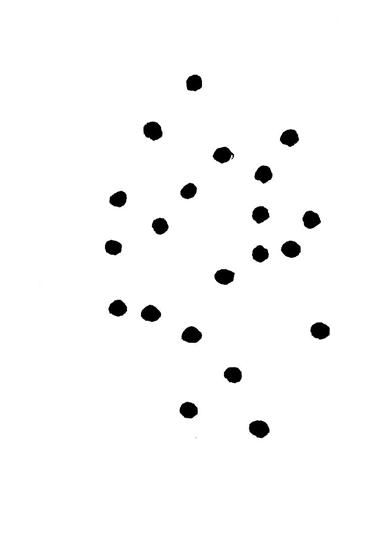
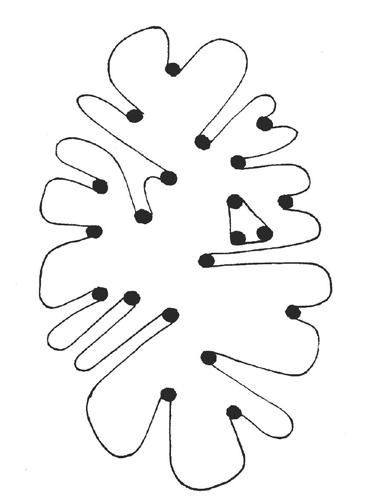
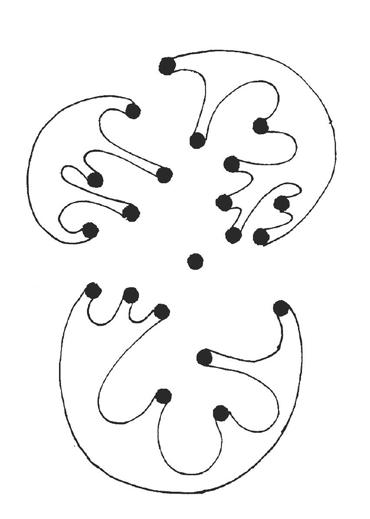
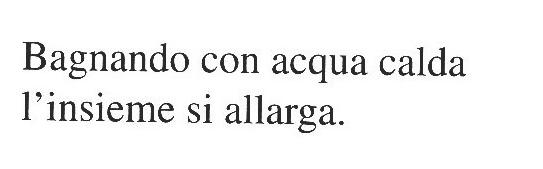
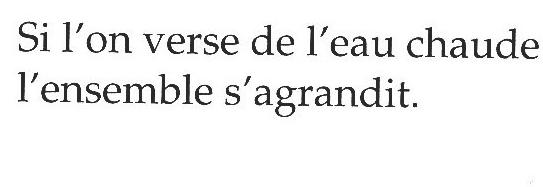
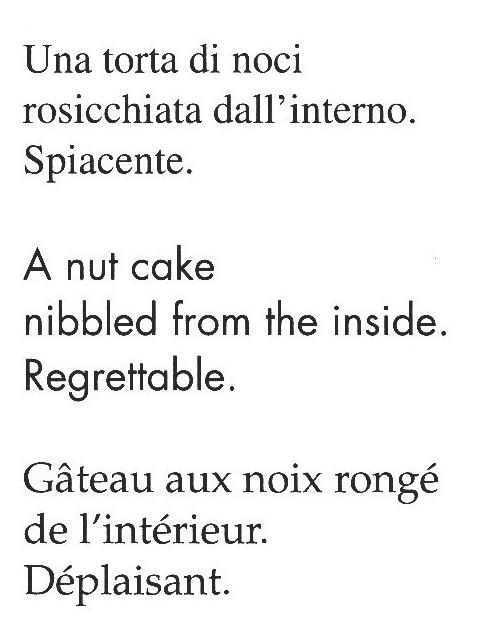
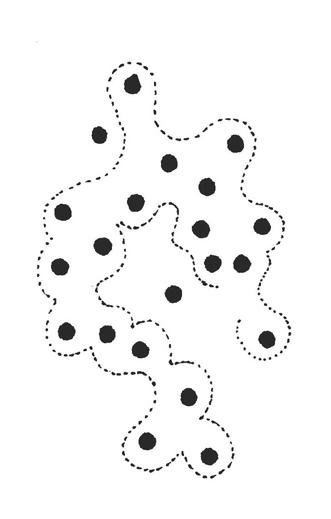
Bruno Munari’s Flight of Fancy interprets 21 dots with lines and witty text to generate concept, context, and specific meaning.
Note from the Director
Words are not my medium of choice. I made it through a lot of fancy architecture school without writing much at all. Whenever a ten-page history or theory paper loomed, there was usually an option to build a model or make an elaborate drawing instead, likely preferable to reading the awkward prose of design students.
Now, as an academic, I write all the time—conference papers, course descriptions, recommendation letters, and, of course, an endless stream of emails. But never have I appreciated writing as something that could be fun—until I met Emily Capdeville. Emily talks about words the way I talk about line weights: nuance-emphasis-contrast, even how the sound of a single letter can tilt the mood of a sentence. Through her thoughtful edits to my writing over the years, she has helped me see writing as a creative act, not just one of necessity. I wanted our design students, who tend to think visually like me, to experience this same shift in their relationship with writing.
At Tulane, undergraduates are required to take a “Tier-2 Writing” course, usually with extra writing assignments added onto an existing class. We decided to do something different: create a writing intensive course just for design students, one that engages design through writing. That’s how Textual & Tactile: Writing for Designers became an offering in the School of Architecture and Built Environment.
This publication features select work from the Spring 2026 Design Showcase, interpreted through the voice of students in our new writing course. Through peer review and rounds of revision, students developed their writing skills while learning about their peers. We’re incredibly proud of this inaugural group of Design Writers and excited to celebrate this textual work within our visual, tactile discipline.
TIFFANY LIN, AIA
Letter from the Editor
I have thought about Munari’s dots more times than I can count. Tiffany Lin, the Director of the Design Program, first told me about them as she was drafting a lecture for her Introduction to Design & Creative Thinking course. I later saw them in her slides as I audited that course alongside a bevy of excited students, most of whom added a design minor or double-major as soon as the semester got underway. Watching students create a narrative out of this random collection of dark spots interested me, inspired me even, but no matter how many times I thought about contributing my own markings, I froze.
For almost a decade, I’ve been experiencing the visual world through Tiffany’s eyes and have been enriched by her perspective.
But, at the end of the day, I’m a writer. I can’t figure out how to handle Munari but give me a blank Word document, and I’m off.
Tiffany and I both feel so passionately about the impact of our respective crafts on our students that we started discussing a collaboration. We wondered, how could exposure to a completely different mode of expression–the textual–enrich her students’ understanding of their visual work? Casual conversations morphed into real research and planning to build the syllabus for what ultimately became our course, Textual & Tactical: Writing for Designers, one that would be completely centered around the act of writing, completely tailored to students in the School of Architecture and Built Environment.
The course included a number of writing assignments oriented towards a student within the school. The semester started with explorations on how to write about the self–always a challenge–in the form of personal statements and biographies. Students then tried various modes of description, ultimately leveraging sensory language to communicate a clear point of view. They described artifacts and analyzed their strengths and weaknesses. They read articles and gained inspiration from them for research projects about pressing design issues of our time, such as the importance
of human-centered design in urban planning; the sustainability of the supply chain in the production of ceramics; and AI’s increasing impact on the design process.
The final collection of assignments–completed over the course of four weeks–led the students to produce the features contained within this magazine. Students identified a designer whose work had been selected for inclusion in the end of year Design Showcase and set out to write a feature. This assignment required them to utilize the skills we developed throughout the semester, from description to analysis to research. They interviewed their subjects, and in some cases, the professors, in order to find their angle for the article. They presented their work to the class to gain feedback and prepare to write their final draft and then, during our last class, we ran an editorial meeting to edit and layout this collection.
During that editorial meeting, we discussed the themes that had emerged throughout their work and those themes are the guiding principles of this magazine. Many of the values we discussed centered around the very purpose of the design program: the presence of inspiration in everything; the value of process, rather than end product; the impact on solving problems–both practical and philosophical. These themes recur throughout each of the features included here.
The students also articulated that these features are meant to help the viewer, to deepen their understanding of the artifact being showcased and to contextualize the designer’s goals to the audience. In doing this work, the students themselves are deepening their own understanding of not only their peers, but also their own inspirations, motivations, and processes. I hope that, as with all creative work, these essays helped their authors to discover something about themselves as much as they discovered about their subjects.
In the pages that follow, you will learn about some of the projects featured in the Showcase and their creators, but you will also learn about the Design program itself. As an outsider, I don’t often see the magic taking place in Richardson Memorial Hall on a daily basis. But the features illuminate the devotion of these students and the quality and innovation of their work.
Letter from the Editor
Because of this class, I’ve had the absolute pleasure to learn about the innovation behind Cole Hildebrandt’s Switch Track through the careful consideration of Olivia Bruhmuller. Drew Boutry reported, awestruck, on the 200 hours Stef Cardona-Forero took to create her cross-body bag for Patti Dunn’s Textiles studio. Through interviewing Izzy Delen about her Cowfish-inspired light fixture project, Vittoria Pigatti gained perspective on her own approach to the same assignment. And Cole Hildebrandt provided a thoughtful analysis of the way Sophia Lammers combined childhood nostalgia and mechanical know-how to create the Reading Bench.
Bryant Carroll and Ann Pham interviewed students Chalyn Waguespack (Cheese Wheels) and Lily Schiff (Killjoys) about their playful takes on food truck design inspired by Professor Adam Newman’s own work designing one for the New Orleans Center for Creative Arts. Skylar Weitz reported on the important work undertaken by Ella Touchstone to increase accessibility to the St. Charles Streetcar for wheelchair users, highlighting the problem-solving power of design. And Bella Waltzer explained how Talulah Levin’s process of deconstructing a prison jumpsuit to make pants was a way for her to explore the concepts of freedom and liberation. From the sustainable Mardi Gras ties created by Evie Roth, written about with such passion by Juliette Condulis, to Rachel Passer’s Draping Chair, eloquently framed by Shyla Krishnappa, these features demonstrate the breadth of possibilities within the program and the creative spirit and technical precision of its student body.
Notably, the collection contains more than just the features. The magazine includes two complementary forms of writing: writing about others and writing about the self. The student bios at the end of this booklet represent their very first piece of revised writing from the course. This assignment challenged them to explore their own body of work and articulate their vision and accomplishments, requiring a shift in perspective. They moved from seeing themselves as students to seeing themselves as designers. Each of these two modes presents its own challenges, and in these texts, you will hopefully see the deliberation and care employed by our students in their writing.
Our goal is for this course to contribute meaningfully to Tulane’s mission in educating the whole student, offering a well-rounded curriculum that encourages interdisciplinarity in order to help students manage the inevitable and ever-increasing complexities of our world. Facing these challenges will require them to think critically, deliberate intentionally, and communicate with clarity, intention, and precision. These principles form the foundation of this course; in our first class, we discussed how the very idea of writing represents a kind of pledge. To put a thought into the written form demonstrates an ability to translate a loose assemblage of concepts into more fixed beliefs and values and ultimately, to make a commitment to those beliefs.
In looking back over this first iteration of the course, Tiffany and I have discussed how we can articulate the value of a class on writing. During a time of great upheaval and technological advancement, what is the worth of our human engagement with text? Well, in our class, we do what an AI bot can’t: we consider, we discuss, we sit in the process. We dissect sentences, listen to words, and try to capture the way a hard c generates a particular emotion, how a long sentence can feel like a lullaby. We externalize our thoughts and refine them, distilling our scattershot ideas into true representations of our intention and meaning. In many ways, our work, like the work produced in design studios, is about the journey as much as the destination. .
When you observe these artifacts in the Showcase, or any designed object in your life, know that they are more than just the finished product you see before you. They’re the outcome of a deeply iterative process and, more importantly, they represent the profound culmination of the very human interaction between thought and action.
Letter from the Editor
EMILY CAPDEVILLE
FEATURES
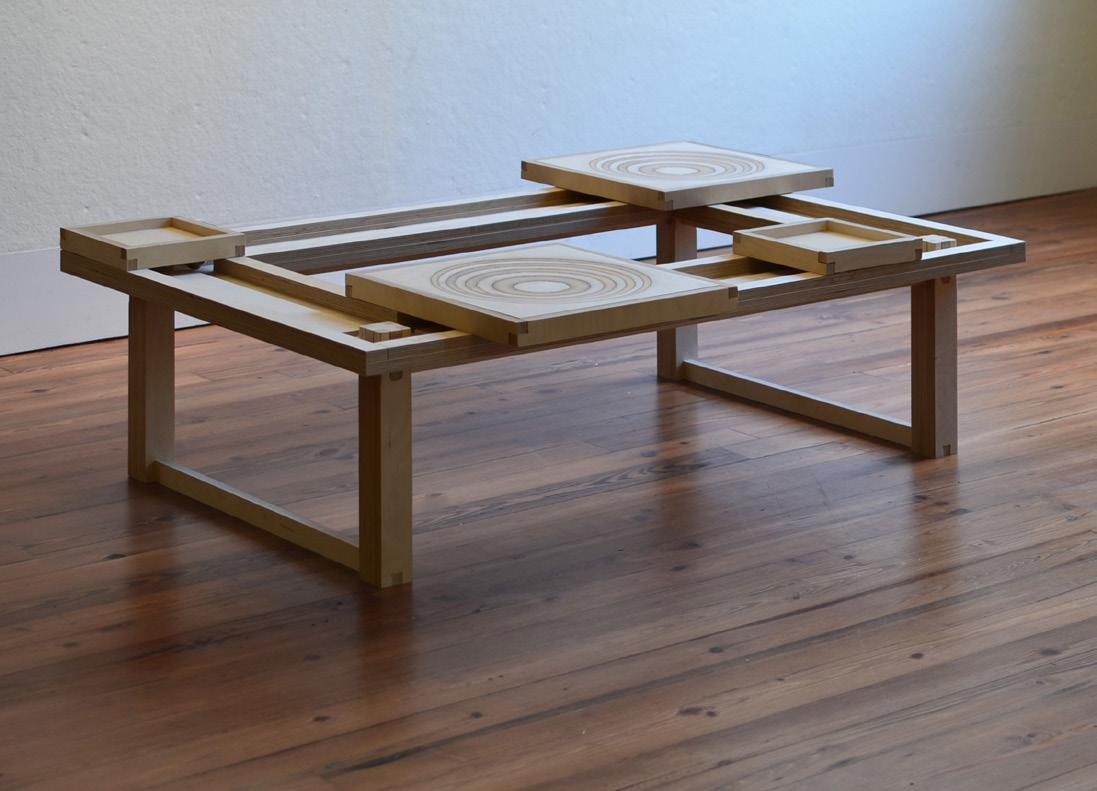
Cole Hildebrandt’s Switch Track Bench
Switch Track: An Object’s Form and a Designer’s Identity
BY OLIVIA BRUHMULLER
Design programs like to tell a certain story about talent: that it announces itself early, that the best designers arrive with a trained and accomplished sixth sense. Cole Hildebrandt proves that this story is incomplete. He arrived at Tulane without–self-admittedly–an art bone in his body and no visual vocabulary to speak of, and four years later, he is creating work that both pleases the eye and challenges the viewer.
I enrolled in the same program, but from the opposite direction. I had the art background, the visual references, the vocabulary. What I had to learn was something else: how to let go of perfectionism, how to make peace with a project that wasn’t exactly what I’d envisioned, how to move forward when the gap between what I imagined and what I made felt impossible to close. Cole and I represent two different entry points into the Design program and two different versions of the same struggle. What I’ve come to understand, watching his work evolve over four years, is that the specific nature of the struggle almost doesn’t matter. What matters is what you do with it.
Every designer in Tulane’s program hits their wall in different ways. Some freeze under criticism, reading every red-lined drawing as a verdict on their potential. Some stay too long in familiar territory, producing technically competent work that never quite takes a risk. Some, like Cole, spend their first years playing catch-up, convinced that the gap between them and their peers is a fixed distance rather than a moving target. By senior year, the students who have pushed through those specific frictions arrive somewhere the others don’t: not just with hard skills in 3D modeling, woodworking, and fabrication, but with a sharpened sense of their own design identity, a clarity about what they care about and why. Switch Track, the wooden chair created in Nick Perrin’s Prototyping course, is the physical embodiment of that clarity for Cole.
Tulane’s Bachelor of Arts in Design, within the School of Architecture and Built Environment, is structured around a deceptively simple premise: that design is a language and a process for responding to the complex challenges of our time. The curriculum moves students through a core design sequence that emphasizes representation, space, form, and function before placing them into upper-level studios where those foundations are tested against real problems and real materials. Project-based throughout, the program asks students to integrate multiple aspects of a problem and respond with interdisciplinary solutions, working across graphics, objects, and responsive systems.
What the program description doesn’t capture is its texture from the inside: the relentlessness of studio critique, the intimacy of a cohort that sees each other’s failures and breakthroughs in real time, the particular pressure of being asked to develop a design identity before you’re fully sure what that identity is. The program is not designed to be comfortable. It is designed to be generative. And what it generates, more than any single project or skill set, is a designer’s sense of self, forged specifically through the challenges each student encounters along the way.
Cole Hildebrandt grew up in Pennsylvania and arrived at Tulane with his eye on the fashion industry, drawn to design as a lens for thinking about systems: the systems that govern how clothes are made, marketed, worn, and discarded. He declared a design major and a SLAM minor, but he came in with no art background and no formal training. In those early semesters, he was quiet in studio, reserved in the way that people are when they suspect that speaking up will only expose what they don’t know.
Cole remembers the embarrassment he felt when, sitting in his very first design class at Tulane, he asked for clarification on a term he didn’t understand: “still life.” He’s never forgotten the laughter, however lighthearted it may have been, from fellow students. It is a small story, the kind that might be dismissed as a minor blip in a long education. But it captures something real about the tension he was navigating: arriving in a room full of people who already spoke the language, aware of the gap, and choosing to stay anyway. That choice, unremarkable in the moment, turns out to be the one that matters most. Switch Track: An Object’s Form and a Designer’s Identity
Most designers feel behind at some point; being a student almost guarantees that feeling and so Cole didn’t experience this isolation alone; yet his experience led directly to the evolution of his design thinking. Because he started at Tulane without a visual vocabulary, he built one from scratch, deliberately and consciously, in a way that students who arrived fluent in the language of the design program never had to. Every term he learned, every formal principle he internalized, was something he had actively chosen to understand rather than passively absorbed. That kind of intentionality leaves a mark.
Switch Track will be exhibited in the Spring 2026 Design Showcase alongside the work of his peers, each piece a different answer to the same question the program has been asking for four years: who are you as a designer, and what did it take to find out?
The Tulane design sequence is intentionally cumulative. Students move through a progression of studios, each one building on the last and each one demanding something more challenging than what came before. Make a lamp. A pavilion. A bag. A piece of furniture. The early projects ask students to think visually and formally; the later ones ask them to think architecturally, socially, materially. Each new studio provides a new set of constraints and a new opportunity for each student’s particular friction to surface.
For Cole, moving through those studios meant learning, project by project, that his instincts were worth trusting. While they weren’t always right, he developed his design sensibility by engaging with them seriously and testing them against material and critique and revision. The timidity of those early semesters didn’t disappear overnight. But the direction of his thinking became clearer with each project, and that clarity began to show up in the work.
In 2024, Cole studied abroad in Milan, a semester that reoriented his sense of what design could be and where it could take him. After being ensconced in one of the world’s great design cultures, embedded in a city where the relationship between craft, commerce, and aesthetics runs centuries deep, he returned to Tulane with a sharper eye and a clearer sense of purpose. The experience didn’t change his design identity so much as confirm it. He understood, by then, what he was interested in and why, and that understanding had been built entirely through the accumulated friction of the program.
I wanted to create furniture that was more dynamic and could mold into the situation it was put in. “ “
Switch Track, Cole’s final project for DESG 3010: Prototyping, is a portmanteau: a single piece of furniture that performs two distinct functions in one cohesive form. The course, taught by Professor Nick Perrin, challenges students to design and build furniture from scratch, iterating through sketch, model, and final construction. For Cole, the assignment became an opportunity to design for something he had been thinking about for a long time: the way people actually gather.
“I really wanted something to feel modular, able to move around,” he explains. “I was kind of inspired by toy trains and how those are typically circular, and I wanted to think within a grid system.” The result is a table where two seats and two tray tables move along a track, reconfiguring to fit whatever social situation the piece finds itself in. “In party situations, the organic interaction was kind of like everyone sitting on the floor, playing games around a coffee table,” Cole says. “I wanted to create furniture that was more dynamic and could mold into the situation it was put in.”
The construction is where the years of accumulated intentionality become most visible. Cole used a castle joint, a notched interlocking connection typically associated with precision woodworking, to join the legs to the track. A system of wedges created an unexpected visual motif. “In order to sandwich the wood
Switch Track: An Object’s Form and a Designer’s Identity
and give it stability, I needed to develop a system of plus signs that kind of wedged themselves in,” he explains. “I really wanted it to be intentional with everything.” Structural necessity became aesthetic logic. The plus signs are visible, deliberate, part of the piece’s language.
The refusal to hide structure is one of Switch Track’s defining qualities and a direct expression of how Cole now thinks as a designer. “I don’t want to hide the structure and the function,” he says. “There’s a system for everything. There’s a reason why things are put together that way.” The splints that support the track from beneath and bear the weight of anyone sitting on the piece are technically invisible. But Cole designed them with the same intention he brought to everything the eye does see. That extension of rigor past the boundary of the visible is not a beginner’s instinct. It is something that gets built, over years, through exactly the kind of friction he has been navigating.
Switch Track operates simultaneously across multiple registers of design intelligence, and that simultaneity is the point. The piece is technically sophisticated: castle joints, load-bearing splints, a track system precise enough to reconfigure smoothly while supporting weight. It is visually considered: the geometry of the frame, the carved concentric rings, the system of plus signs that unify structure and ornament. And it is conceptually alive: rooted in a specific human observation about how people gather, and built to respond to that observation in form. Technical, visual, abstract, all at once. That is not a given. That is the product of four years of learning how to hold all three registers open at the same time.
The concentric rings carved into the panels are worth dwelling on. They evoke topographic maps, growth rings in a cross-section of wood, ripples expanding from a point of contact. Whether or not Cole intended the design as a self-portrait, it functions as one: layers of depth built up slowly, through repetition and return, made visible only in the cutting. The student who didn’t know what a still life was is now making objects with this kind of visual thinking embedded in them. That is what a design identity looks like when it has been genuinely earned.
It is also worth noting what the work does not quite capture: the presentation of it. Cole still gets nervous standing in front of a
room and talking about what he has made. There is something in that moment that reactivates an older hesitation, a reluctance to fully claim his own work, to speak about it with the confidence that the work itself communicates. It is a relic of where he started, and of the specific friction he has been working through. But it is not a flaw in his design identity. It is part of its texture, the evidence of how seriously he takes the distance between what he imagined and what he built.
Whether or not Cole intended the design as a self-portrait, it functions as one: layers of depth built up slowly, through repetition and return, made visible only in the cutting.
Professor Nick Perrin, who taught Cole in Prototyping and has had him in courses before, describes a student whose particular set of frictions made him more useful to watch, not less. “I appreciated all the frustrations he had,” Perrin says. “Trying to understand how to build something for the first time at that scale is difficult, and so the frustrations are really understandable. But there’s a streak of perfectionism in him, which I appreciate. Coming to terms with what it needs to resolve something is tricky.”
Perrin calls Cole “an ideal test case,” and the phrase is worth sitting with, not because Cole’s path was harder than others, but because the relationship between his struggles and his outcomes is unusually legible. The finished piece, in Perrin’s words, is “a very close approximation to his ideal form.” That proximity between intention and execution is what the program is designed to produce, and it is produced differently in every student, through whatever specific friction they bring to it.
On Cole’s broader growth through the program, Perrin is measured but clear. “I think he’s just refined his tastes and refined his understanding of what he wants,” the professor says. “It’s hard to know what it is that you want to do when you’re going through
Switch Track: An Object’s Form and a Designer’s Identity
college. But you start understanding that there are a lot of options out there, and I feel like he’s just got his eyes wide open in the right way.” That widening of vision, the movement from uncertainty about what design could be for him toward a clear and committed point of view, is the soft skill the program most reliably produces. And it cannot be taught directly. It can only be built through experience.
Cole will graduate this spring and return to Milan to enroll in the Fashion Systems program at Politecnico di Milano, a curriculum concerned with fashion not as aesthetics but as infrastructure: supply chain, labor, sustainability, cultural economy. It is a fitting destination for a student who came to design through interest in fashion as a system, and who spent four years learning to think rigorously about the relationship between form, function, and the human context in which objects live. His design identity, built through the specific friction of this program, points directly there.
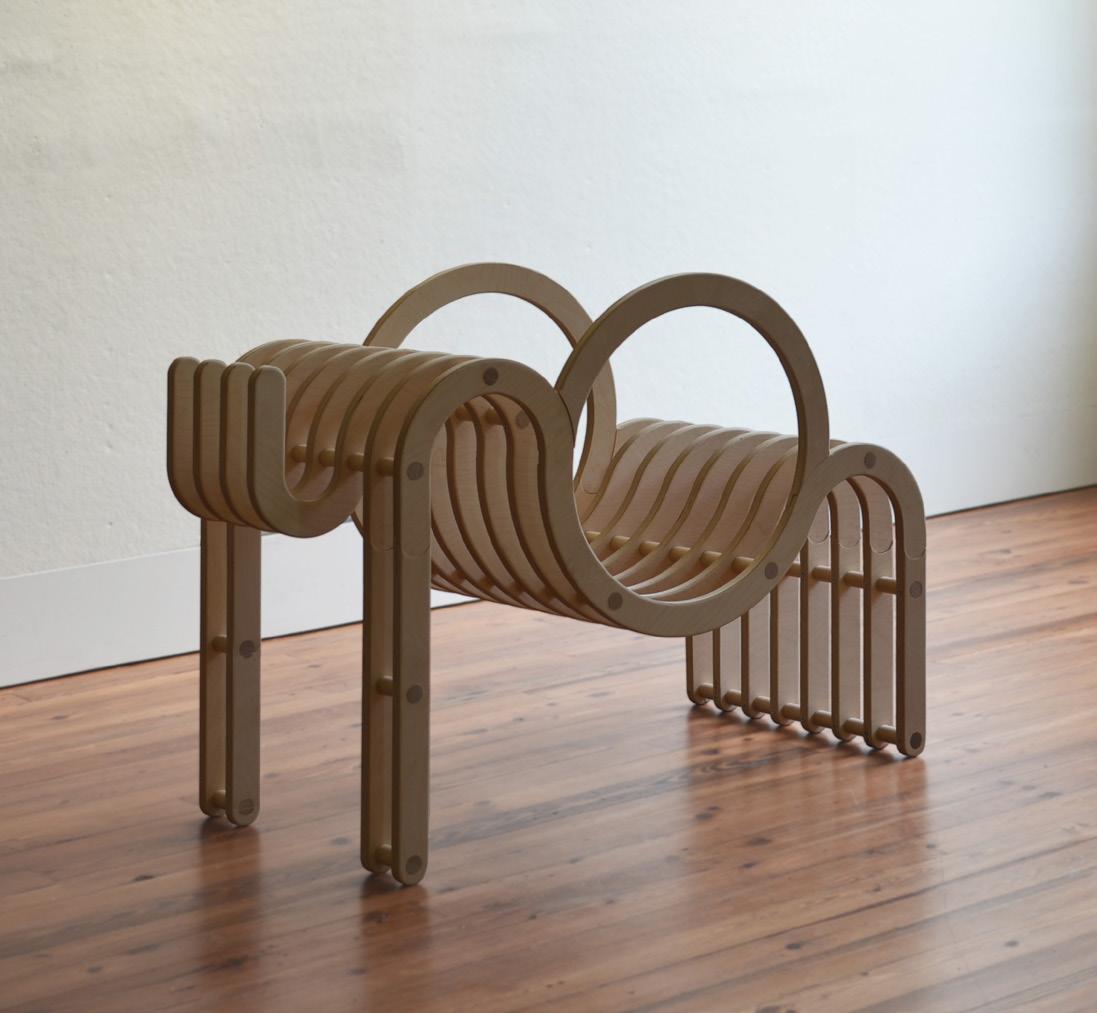
Rachel Passer’s Draping Chair
The Art of the Catch-All: The Draping Chair
BY SHYLA KRISHNAPPA
A denim jacket slumps over the backrest. A sweater hangs, half-on, half-off, one sleeve grazing the floor. Yesterday’s jeans are folded in a way that suggests they were never really folded at all. The chair in the corner of the room isn’t being used for sitting. It’s holding the in-between: clothes worn once, but not quite ready for the laundry, pieces caught between use and storage.
We’ve all been there. Quietly lurking in the corner is that chair, accumulating evidence of our daily lives, becoming a habitual landing place that reflects the gap between how we intend to live and how we actually do. For designer Rachel Passer, this habit wasn’t a problem to solve; it was a behavior to design for. Her piece, The Draping Chair, doesn’t resist clutter. The Draping Chair depends on it.
Rachel’s design invites participation; the chair is incomplete without the presence of garments. It’s a collaboration between user and object.
At its core, The Draping Chair operates as a portmanteau, merging seating with clothing storage in a way that feels both intuitive and deliberate. The piece challenges traditional expectations of furniture, which often prioritize cleanliness, concealment, and order. Instead, Passer’s design invites participation; the chair is incomplete without the presence of garments. Clothing is no longer an afterthought or disruption. It becomes integral to the chair’s form, function, and comfort. The pile of clothes isn’t a failure of discipline; it’s a collaboration between user and object.
That idea didn’t arrive fully formed. Passer describes much of her process as “flying by the seat of my pants,” entering the project without prior furniture design experience and learning as she went. Early iterations moved in very different directions: modular systems, complex hinges, mechanisms that attempted to transform or control the object. But over time, those ideas began to feel unnecessary. “They didn’t serve a purpose,” she explained. What remained was something simpler, and in many ways more honest: a static form that responded directly to human behavior rather than trying to out-engineer it.
Formally, the chair reflects that shift in thinking. Composed of a series of repeating wooden ribs, it creates a rhythmic, curvilinear silhouette that feels both organic and precise. The project began as a rectilinear concept, but Passer’s move toward flowing geometries marked a turning point. The curves echo the contours of the human body, forming natural pockets and voids that serve to catch both people and the objects they carry. These spaces aren’t incidental; they are attuned to the way a jacket slips off a shoulder or a bag gets dropped at the end of the day. The form doesn’t just support the body. It anticipates human behavior.
Structurally, the piece balances delicacy and strength. The ribs are connected through friction-fit dowels reinforced with screws, maintaining visual lightness while ensuring durability. Each joint contributes to both the stability and the visual rhythm of the chair, creating a structure that feels at once engineered and effortless. Like the concept itself, the construction avoids excess, relying on repetition and clarity rather than complexity.
Material constraints also played a key role in shaping the design. The project was limited to a single 4-by-8-foot sheet of plywood, requiring careful planning and efficiency. Passer developed a cut strategy that maximized the material by splitting components and reconnecting them with half-lap joints. These constraints didn’t restrict the design; they clarified it. By working within strict boundaries, she was able to refine the form and focus on what actually mattered.
What ultimately defines The Draping Chair, however, is its reliance on clothing as a functional component. Traditional seating depends on cushions or upholstery, but here, softness is user-generated.
The Art of the Catch-All: The Draping Chair
The proportions are calibrated to hold garments in place, allowing coats, sweaters, and bags to accumulate into a personalized, everchanging surface. The chair evolves daily, shaped by the habits of its user. As Passer put it, “It’s about flipping the idea of a piece of furniture that you throw clothes on. This is meant for that purpose.” That inversion reframes the pile itself. Instead of something to hide, it becomes something to complete the object, a visible record of use, routine, and presence. In this way, The Draping Chair extends beyond its physical form into a broader commentary on how we live. In a culture that often idealizes minimalism and hidden storage, Passer’s work offers a counterpoint. It acknowledges that mess is not just inevitable, but meaningful, a trace of daily life, habit, and identity. The chair doesn’t attempt to correct behavior; it accepts it.
The Draping Chair demonstrates that design can emerge not from perfection, but from observation, from paying attention to the small, repeated actions that shape everyday life.
As graduation approaches, the future of the piece remains open. Passer is considering finishing the wood to highlight its natural grain, but the object already fulfills its purpose as a proof of concept. The Draping Chair demonstrates that design can emerge not from perfection, but from observation, from paying attention to the small, repeated actions that shape everyday life.
In the end, The Draping Chair begins with something familiar: a pile of clothes on a chair in the corner of a room. The denim jacket slumped over the backrest. The sweater hanging, half-on, half-off, that one sleeve grazing the floor. The crumpled up pair of yesterday’s jeans. That chair in the corner of the room that might have once been used for sitting that isn’t being used for sitting. By taking that scene seriously, Passer transforms it into something intentional. The question her work poses is simple: what if, instead of designing against our habits, we designed for them? Here, the answer is already taking shape, draped over a chair, waiting to be worn again.
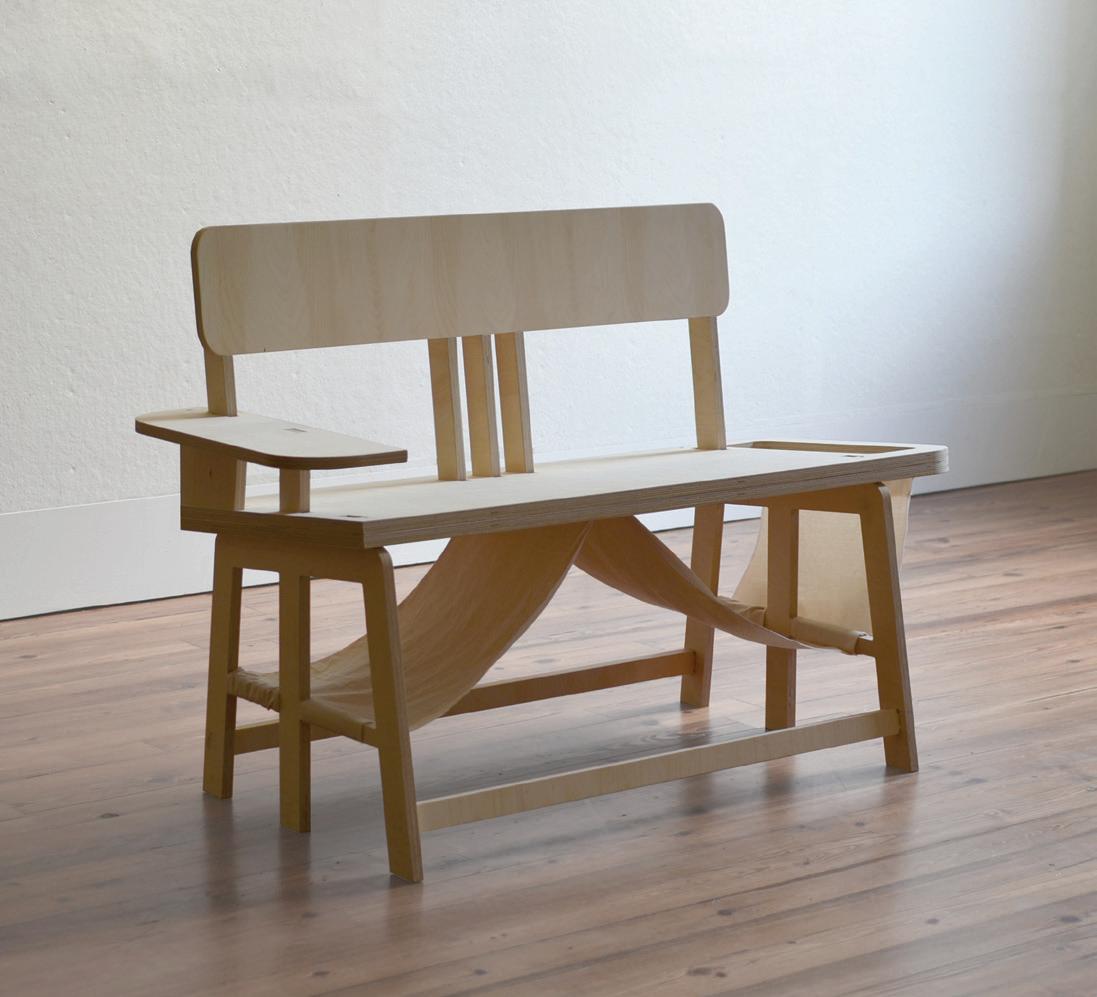
Sophia Lammers’ Reading Bench
Without Tolerance: Reader Bench
BY COLE HILDEBRANDT
Sophia Lammers spent her childhood in Nebraska reading stories while tucked into the faded, muted white wooden bench that sat outside her home in Omaha. Surrounded by falling autumn leaves, she would nestle herself into the battered seat with pillows and position herself to spend the entire day lost in a book. From that spot, she could watch her father effortlessly build things in his garage. Because he made the craft look so natural, and because–as a child–she never realized the labor required to hide the tiny imperfections in his finished pieces, she walked into her first college woodworking class years later with a bit of blind confidence. She was about to come to a harsh realization, an inevitability faced by all design students. A visually perfect 3D digital model means nothing if it does not account for the physical constraints of the real world. This realization forced Sophia to confront the difference between drawing an object and actually building one.
Sophia walked into DESG 3010: Prototyping, a mandatory class for Design majors, after a vibrant and productive summer doing social and creative work for vegan cosmetic company Milk Makeup. She was highly accustomed to the digital realm and focused on how a brand communicates its aesthetic rather than the functional mechanics of how a physical joint actually fits together. But this course treats design as completely inseparable from making. The main assignment in the course challenges students to build a portmanteau, merging multiple uses into a single object. In approaching the project, Sophia’s goal was deeply nostalgic. She wanted to recreate the feeling of that Omaha bench where she lay down and read all day.
Fresh off her semester working on digital projects, Sophia easily conceptualized the Reader Bench on her computer screen. The 3-in-1 piece featured seating, a small side table to act as a headrest, and a suspended book sling. Visually, she sought to capture an aesthetic contrast between the grain of wood and the soft, flowy
drape of muslin fabric. As a subconscious bonus tying into her capstone rebrand for the New Orleans restaurant 1000 Figs, the three-pronged wooden backrest ended up looking exactly like a fork.
The construction of the Reader Bench taught Sophia a grueling, hands-on lesson: that digital drawing is simply not an accurate measure of volume and space.
But an idea on a screen is weightless, and the transition into physical reality can be unforgiving at times. Sophia’s digital Rhino model was visually flawless, but because 3D modeling does not naturally account for machine constraints, her model didn’t program “dogbone” cuts into the joints. The fabrication lab’s Milhouse CNC router physically could not cut the perfect 90-degree internal corners her computer demanded. Rather than hitting undo on a keyboard, Sophia had to salvage the wood by manually chiseling the joints out by hand.
When assembling her bench, she gained a newfound respect for her father’s hobby. “There was not a lot of tolerance,” Sophia recalled of the tight, stubborn joints. The construction of the Reader Bench taught Sophia a grueling, hands-on lesson: that digital drawing is simply not an accurate measure of volume and space. According to the course’s professor, Nick Perrin, this physical struggle is exactly where the value of design lies. “Our ideas are one thing. They are ideal, but they’re fragile because they lack any kind of material or substantive form,” Perrin explains. He notes that it is only by using tools and shaping the world around you that you actually bring an idea into resolution.
While the wood demanded precise labor, the fabric component allowed Sophia to intuitively bridge the gap between her hands and her materials. This project signaled her very first time sewing; she utilized both a serger and hand-stitching for the book sling. Ditching the digital measurements, she worked purely by feel. She draped the fabric over the wood, pressed her hands down to test
Without Tolerance: Reader Bench
the tension, and pinned it until she found the exact sag that would firmly cradle a stack of books. Perrin noted that this intuitive textile shelving gave the piece its most “gestural, lyrical sense.”
Throughout the project, Perrin watched Sophia evolve from a digital designer projecting 2D ideals onto an object into a true maker. By stripping away unnecessary structural elements, she allowed the wood to speak for itself and became a better, more restrained editor of her own work. In Prototyping, success is not measured by a lack of mistakes. It is measured by taking a concept from ideation to execution and applying a continuous thought process to a physical problem.
In Prototyping, success is not measured by a lack of mistakes. It is measured by taking a concept from ideation to execution and applying a continuous thought process to a physical problem.
Today, the final artifact sits proudly in the Howard-Tilton Memorial Library, awaiting its move to the LBC and the 2026 Design Showcase. When Sophia looks closely at the piece now, she can clearly see the tiny chisel marks and the technical flaws. Instead of signaling failure, those marks are proof of actual substance. Mirroring her childhood experience, she now understands that her father’s work was not magic but the result of immense, hidden labor. She wove the soft fabric between the rigid planks, created an object that honors her dad’s craft, and proved that while ideas are easy to draw on a screen, the real indicator of success is having the grit to make it real.
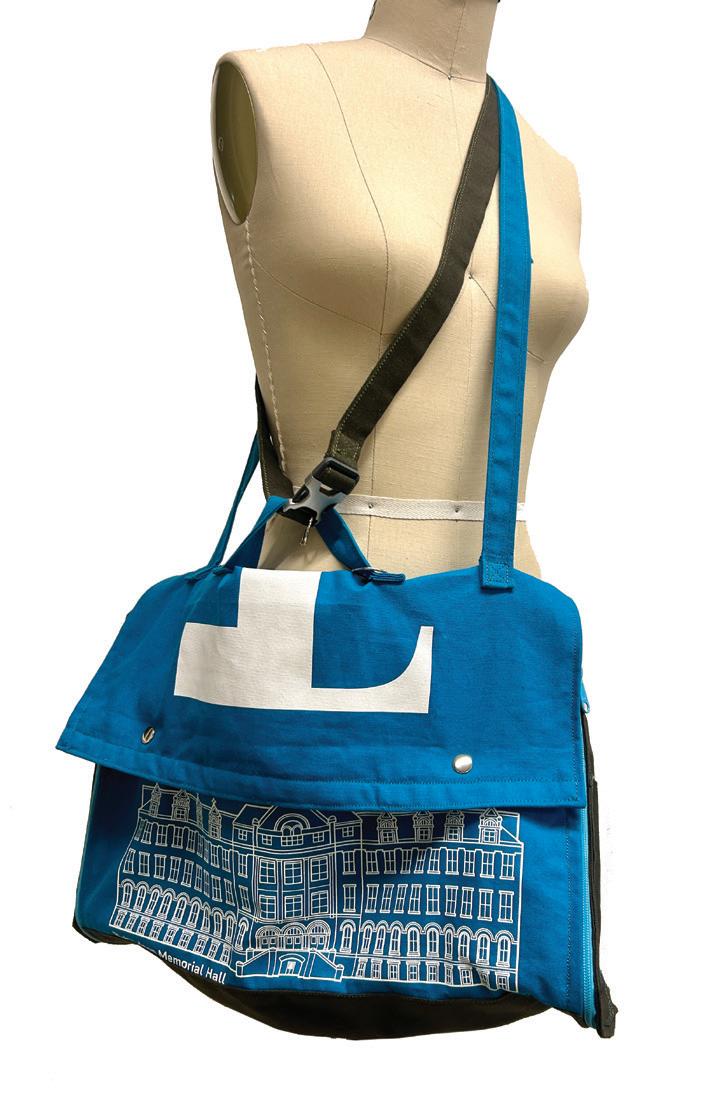
Estefania Cardona-Forero’s cross-body bag
200 Hours
BY DREW BOUTRY
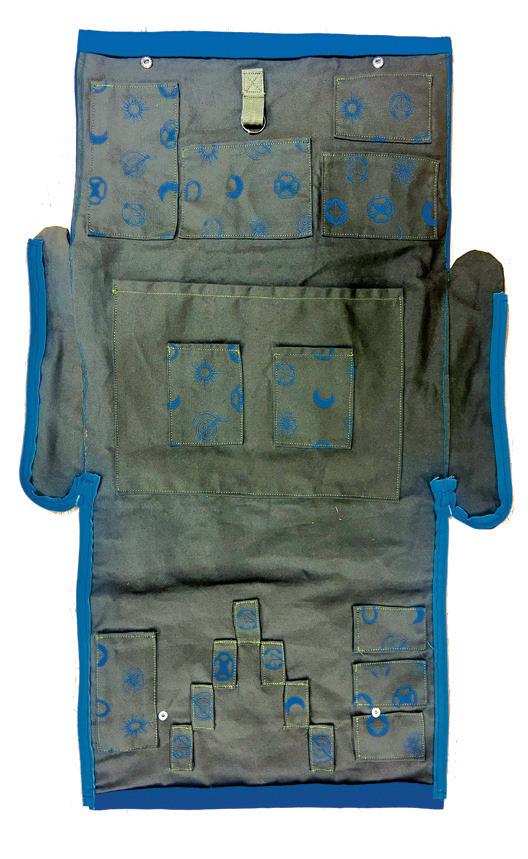
The first thing you may notice about Estefania Cardona-Forero’s crossbody bag is that it has a place for everything: a sleeve for a laptop; long, narrow pockets for rulers and brushes; a keychain for your keys. Through its intentional layout, the user becomes obvious: the bag is for a designer, built by a designer. The bag’s components telegraph its creation by someone who has spent years learning exactly what a designer needs to carry, made by someone with the skills to make it herself. The bag, Stef’s final project for her Textiles course, will be on display at the Spring 2026 Design Showcase, and in addition to demonstrating her technical precision, it is a design that is completely hers.
It is a bag that rewards close looking and everyday use.
Stef grew up in Colombia, where the most respected career paths tend to conform to a traditional layout: lawyer, banker, or doctor. “Those are the jobs people respect,” she says. But Stef did not follow the script. Instead, she pursued her interest in fashion, a quest that has taken her to New York for Fashion Week, where she worked on a corset, and then abroad to London and across Asia, absorbing textiles, silhouettes, and making traditions that do not often make it into her design curriculum.
Stef has followed her passion and run with it, experimenting with the direction and boundaries of each assignment she has encountered while a student in the Design Program. For example, her current capstone project, a nontraditional dress, challenges the concept of what a dress can and should be. In its creation, Stef has used her knowledge of traditional dresses and corsets, but has incorporated a new medium–glassblowing–in order to explore the concept of fragile beauty. She has elegantly arranged colorful
pieces of blue and green glass across the dress, forming flowers to play with the idea of acceptable materials that can be used to make clothing. Stef’s appreciation for detailing and her trust in herself allow her the freedom to explore vastly untapped sectors of fashion.
Stef created a bag that went beyond the fundamentals, exceeding the expectations laid out in the assignment prompt.
In her Textiles course, Professor Patti Dunn left the assignment to design a garment open-ended so that students could learn more about the fundamentals of textile construction. Yet Stef created a bag that went beyond the fundamentals, exceeding the expectations laid out in the assignment prompt. Stef’s bag draws from a set of references that, in the hands of a less confident designer, might never have found common ground. Stef has long admired menswear for its commitment to function and durability, and this influence is readily visible in her structured and utilitarian approach in the design of the bag. Also evident in the design is the inspiration of Elsa Schiaparelli, the early twentieth-century designer famous for almost theatrical detail and craftsmanship, whose work proved that clothing could be simultaneously rigorous and surreal.
The bag is a culmination of all these references, not by quoting them directly, but by absorbing their logic. Its silhouette is clean and masculine in proportion, but its construction details, like the placement of zippers, the finishing of the interior pockets, and the treatment of the seam, carry the meticulous quality of couture. It is a bag that rewards close looking and everyday use. Stef estimates the project consumed roughly two hundred hours of work, divided into three even phases. The first third was cutting, where the idea begins to form. The second step was sewing, the long construction of any textile project, where the design either holds together or tears at the seams. The final phase was finishing: installing hardware and attending to the details that separate a prototype from a finished object. Stef explains that this is where most students lose momentum, but it is also where her technical experience is most
200 Hours
visible. “You learn through the process,” she says. “You don’t restart. Three months is a long time, as long as you stay confident in your design.”
Stef’s breadth of previous experience has created a foundational confidence that allows her work to truly shine. Rather than rely on her professors for answers to all design problems she encounters, she allows her work to be enriched by their expertise and balances their guidance with her passion to drive her designs. Although she can count on hundreds of hours of practice to ensure a final result, Stef claims to learn the most by doing and creating. Rather than waiting for a grand idea to appear out of the air, she draws on her personal interests as a starting point and figures out the rest along the journey.
Stef’s long-term aspiration is to work in fashion, envisioning herself in Paris. It is an ambitious goal, and one that would have seemed impractical by the standards of her hometown. But Stef has never been particularly interested in practicality. She is interested in the kind of work that requires two hundred hours of devotion and dedication, of single-minded concentration, work that never feels done, that still leaves you wishing you had done more. But for Stef, inspiration is never too far away. A new project awaits, no matter how many iterations she might desire.
The bag, zipped and ready, sits on the table between us. It looks exactly like what it is: the work of someone who knew what she wanted to make, and who made it.
Taluhla Levin’s reimagined prison jumpsuit pant
Reimagining Restriction
BY BELLA WALTZER
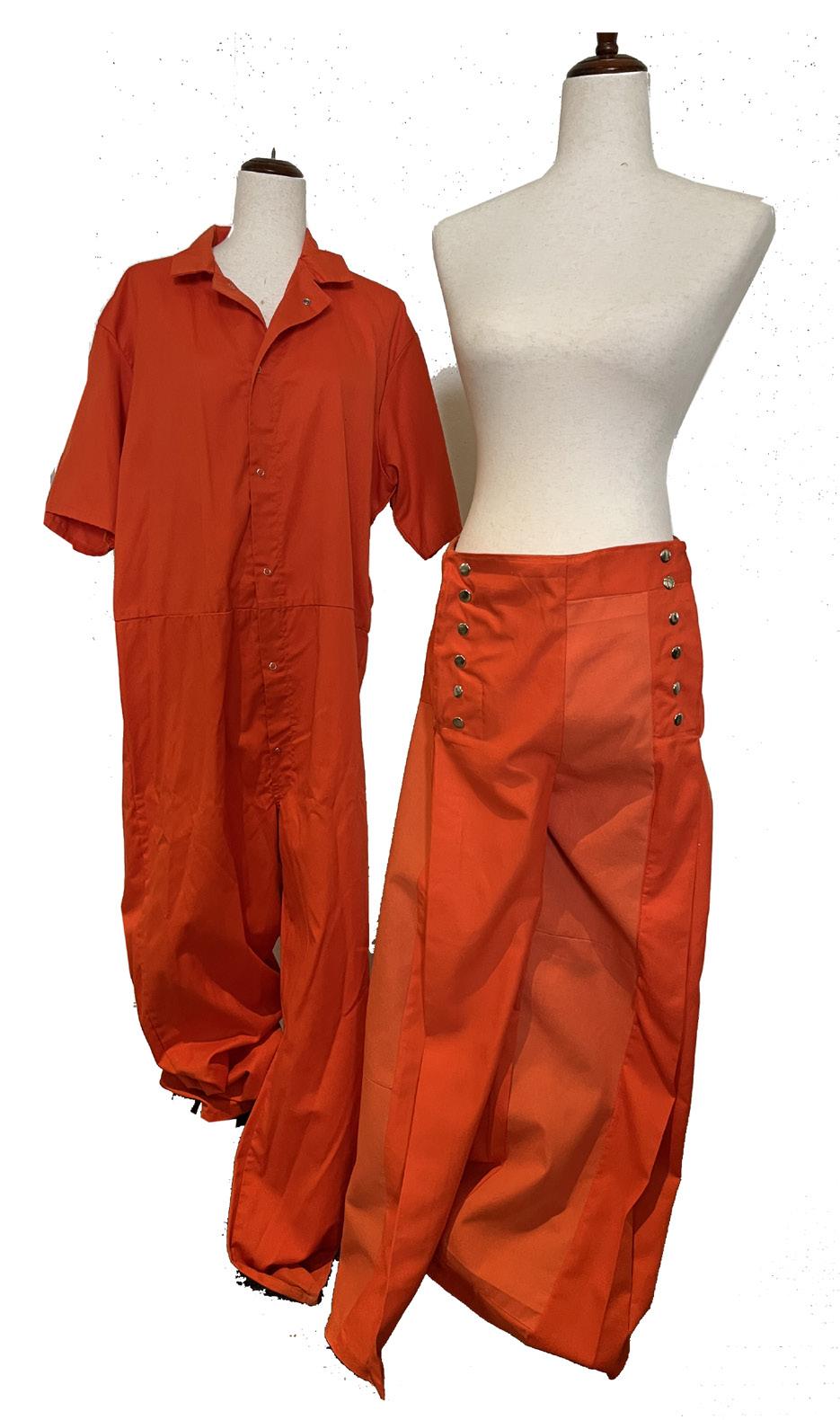
Taluhla Levin’s pants are rooted in contradiction. Tasked to redesign movie-set prison jumpsuits, she decided to make a garment that rejected confinement. Instead of leaning into the stiffness and isolation insinuated by the original material, she designed a silhouette that felt, in her words, “freeing.” The loose fit of the pant legs allow “the body to have freedom to move any way it chooses,” turning a garment originally tied to restriction into a new one defined by freedom of movement.
This contradiction is actually her conceptual intent, reflecting the way Taluhla, a fourth-year architecture student, approached the assignment from the start: with a strong plan, dedication to detail, and a clear sense of how design can reshape meaning.
Wide, loose barrels in the legs and spacious bottoms became both a stylistic and functional choice, allowing the pants to flow with movement even when the fabric itself would
not.
According to Professor Patti Dunn, the instructor of the Textiles studio, Taluhla stood out early in the process because she “had a really clear plan up front for what she wanted.” Dunn credited Taluhla’s background in architecture with helping her map out the steps needed to successfully complete the project. That ability to think ahead became especially important in a class project where resources were purposefully limited. Students were not working with yardage or a blank slate. Instead, they had to transfigure existing garments–old prison jumpsuits–into something entirely new.
For Taluhla, this meant transforming a lightweight, but rigid fabric–a result of its being dyed orange–into the flowing, loose pant pattern she had chosen. She explained that the material was “not at all flexible,” so if she wanted the final product to communicate liberation, she needed to compensate for the rigidity through form. Wide, loose barrels in the legs and spacious bottoms became both a stylistic and functional choice, allowing the pants to flow with movement even when the fabric itself would not.
The original design of the prison jumpsuit required Taluhla to carefully separate sections of the garment to create one large piece of fabric from which she could cut her pattern. Dunn observed that Taluhla was particularly intentional about placement, making sure the screen print from the original coveralls would appear on the leg of the pants. She “wanted to piece it together in a specific way,” Dunn said, even though she could not work “from one large piece of fabric in a controlled and considered way.” In other words, Taluhla had to reorder the pre-existing garment to create something entirely new for the very specific vision that she’d devised.
Taluhla connected the experience to skills she had already built within architecture, a field of study in which she’s learned the fundamental importance of attention to detail. Even while developing an unfamiliar skill like garment construction with no prior sewing experience, she found that her organizational habits carried over to this new project. Sewing required patience, but it also put to use the methodical thinking she already practiced in her architecture work.
Throughout the project, this steady, processual way of thinking became more and more tangible. Taluhla devoted a lot of time to figuring out how to lay out the original jumpsuit pieces into her pattern. However, once she assembled one pant leg, the rest of the process began to flow. “With pants there [are] always two sides for each leg,” she explained, and after completing one side, “the other also became easier.” What began as a confusing arrangement of fragments slowly turned into a well-architected system she could replicate.
Professor Dunn has noticed that kind of aptitude before, even among students who are new to sewing. She pointed out that many students in the class, including non-design students, have never sewn before but still show a natural ability for it because of “the way they think through a problem.” She linked that skill to fields like architecture, where students are already comfortable with geometry, pattern, construction, and breaking a process into critical steps. Sewing, in that sense, becomes more than just craft; it leverages the critical thinking skills developed throughout the School of Architecture and Built Environment.
Sewing required patience, but it also put to use the methodical thinking she already practiced in her architecture work.
Taluhla’s process reveals how architecture shaped not just her technical method, but her broader philosophy in life. She sketched the design beforehand and had even created patterns online in CAD, though she ultimately found a vintage pattern that matched her vision. That blend of planning and attention to detail mirrors the kind of design flexibility architecture, and life, often demands.
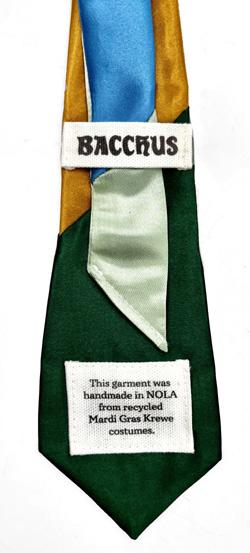
Evie Roth’s Mardi Gras Tie
Crossroads: A Dry Job Market and a Viral TikTok
BY JULIETTE CONDULIS
“I’m failing so abominably to get a job,” Tulane senior Evie Roth said to herself as she downloaded TikTok for the first time. Roth had chosen a double major in Design and Fine Arts, envisioning a career in product design while pursuing fine arts on the side in order to indulge her love of painting. But this past semester, pressured by her impending entry into the “real world” and the attendant need to find a job, her balancing act between Design and Fine Arts completely changed.
After downloading TikTok, her very first video featuring a recently completed painting for her senior art exhibition, gained significant traction. The post was viewed over 3.3 million times. What started as a simple thought–Let me just try this out–turned into a social media p0st that may have changed the course of her whole life. Since posting, she has received inquiries about her work that extend beyond campus. “A lot of people have been asking me if I sell my paintings,” she remarked with some surprise.
Evie, whose work is featured in the 2026 Design Showcase and Runway Show, is at a crossroads, and her textile design project for Professor Patti Dunn’s Studio III may be just the thing to help her navigate this turning point. As her online presence grows and graduation approaches, she has been able to see her technical design skills impact the real world, a shift that is transforming what was once a childhood dream into a viable future.
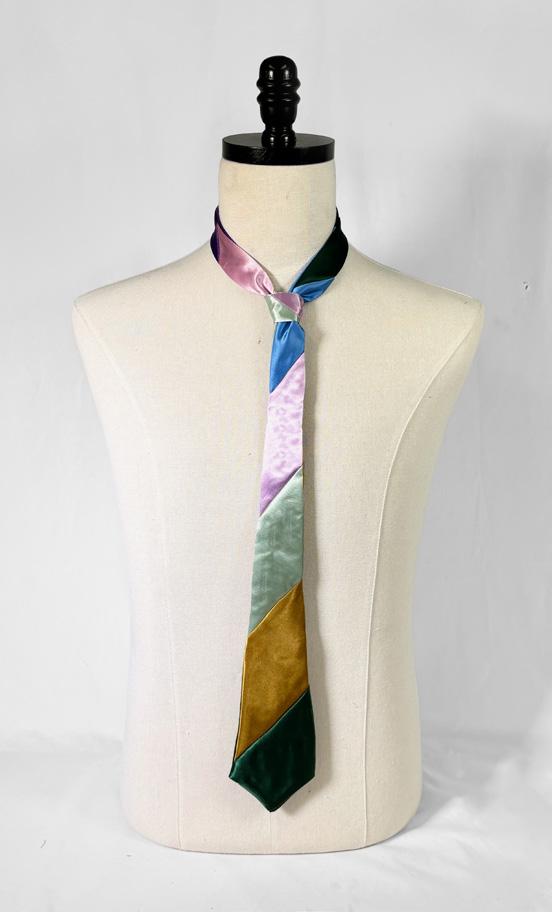
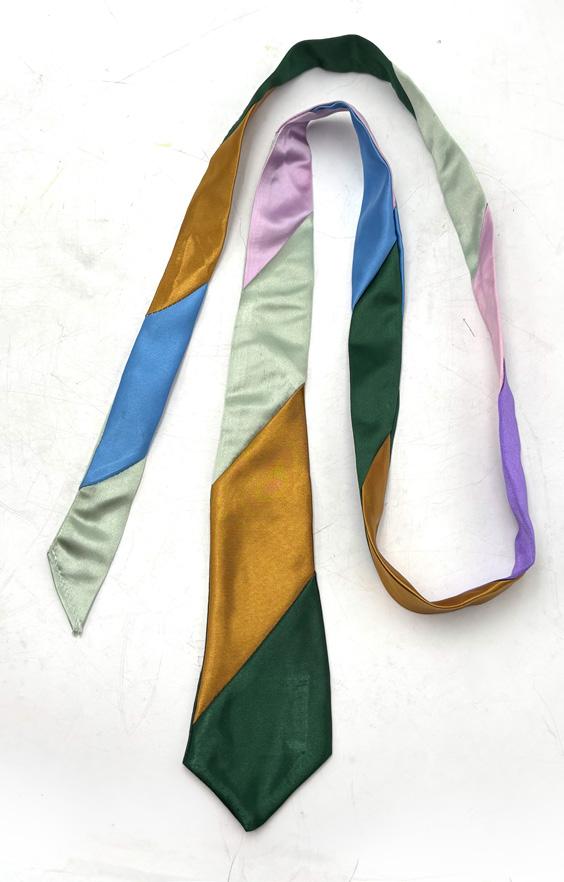
Dunn’s course centers on sustainability. The course requires students to repurpose old materials, sourced through RicRACK, a local nonprofit that is dedicated to reducing textile waste. Dunn appreciates that RicRACK diverts industry film costumes from landfills, finding ways to repurpose garments that are often deemed too unrealistic for traditional reuse. Through the process of concept sketching and prototyping, Evie transformed the discarded faux-satin polyester parade costumes from RicRack into a reusable necktie that could be sold as a Mardi Gras throw.
As her online presence grows
and
graduation approaches, she has been able to see her technical design skills impact the real world, a shift that is transforming what was once a childhood dream into a viable future.
The project tested the students on more than just design. “The challenge with the project was that we had to figure out how to make them in as little time as possible,” Evie said, because ultimately, every throw has to be easily reproducible and cost less than four dollars. “It was really difficult to design something that was recycled, really quick and easy to make, but didn’t seem like trash.”
For Evie, the project took on more meaning during the studio’s first review, when Dunn was able to get Brett Davis, the founder of Grounds Krewe, another local nonprofit committed to promoting sustainable products for Mardi Gras, to come on as a guest reviewer. Evie went into that first review with two different design ideas in mind, but the necktie prototype stood out the most to Davis. As fate would have it, he had recently attended a meeting with the Krewe of Bacchus. Like many other parade krewes, the Bacchus organization was seeking more sustainable throws and wanted to work with Grounds Krewe. However, Grounds Krewe, who typically makes female-focused products, was coming up short on how to help them. Davis immediately saw the potential Evie’s necktie idea had to expand their line for Bacchus.
Shortly after that review, Evie’s idea was selected for manufacture. Once she finalized the prototype, the challenge became scalability. Evie had to draw up a clear step-by-step sewing guide and organize an assembly line in order to create each piece in a timely manner. Still, Evie says she had to “get thinking outside of the box of how I can cut down on production time.” They hacked the production time by taking advantage of the laser cutter, which sped up the fabric preparation process. Evie’s focus turned from pure design to, “align[ing] the design with real-world parade needs and future
Crossroads: A Dry Job Market and a Viral TikTok
commercialization goals.” The production of the Krewe Necktie was successful, and is expected to be launched for the Krewe of Bacchus in collaboration with Grounds Krewe for Mardi Gras 2027.
These lessons extend far beyond room 201 in Richardson Memorial Hall and the St. Charles’s parade route. As Evie’s paintings are gaining attention online, she has found herself applying the same efficient principles of small scale production to her fine arts practices. “This semester I’ve made five paintings in three months,” she noted, a change from her old pace that she attributes to the skills she’s learned in the design program. There are other ways in which she’s finding a crossover between her two degrees. For example, “for my paintings, I build my [own] stretchers,” she says. Ultimately, Evie’s discovering that these skills in production and manufacturing can help her turn her love of the arts into a real career.
Evie is taking her experience in design and bridging it with her fine arts degree to actively build a future in art rather than just imagine one.
The future is uncertain and intimidating, but also exciting. After graduation, Evie plans to return to St. Louis and search for a studio space to see what she can make of this unique opportunity. “I’m kind of sad about not having a job…but in an ideal world, I can work a design job and paint on the side,” she says. It is challenging, she admits, to navigate this changing time of life. Her plans, which once seemed so clear, are being upended by sudden recognition and a tumultuous job market. Still, Evie is taking her experience in design and bridging it with her fine arts degree to actively build a future in art rather than just imagine one. Taking a risk like this requires bravery, and it is Evie’s bravery that should be applauded alongside her work in the 2026 Design Exhibition.
Warm Food, Warm Feelings, and Good Old Southern Living
BY BRYANT CARROLL
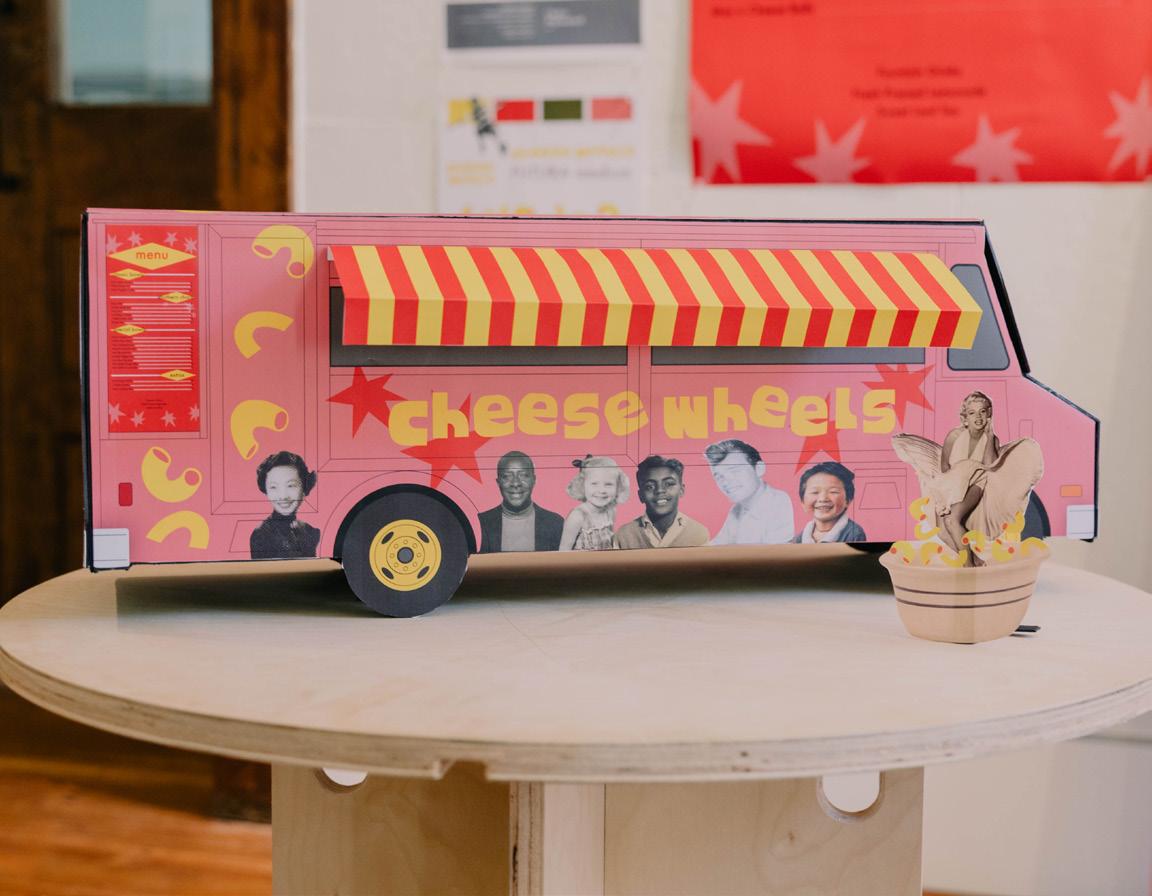
Imagine a trip to The Batture on a cool Friday evening. A brightly colored food truck sits near the river, wrapped with eye- popping graphics of mac and cheese, collage-style images of historic figures like Marilyn Monroe, and a license plate that reads: “McLovin.” For her project in Professor Adam Newman’s Studio III, design student Chalyn Waguespack has created a miniature version of that very vision, a food truck concept called Cheese Wheels.
Now, visitors may wonder: What’s McLovin?! Well, this whimsical and almost goofy choice, inspired by the hit film Superbad, reflects Chalyn’s personality and intrinsic sensibilities, themes that run throughout her entire body of work. Underneath the humor, eye-popping colors, and movie references, visitors will find a thoughtfully designed truck that is approachable and inviting.
Through her styling of the truck, Chalyn has created an experience that makes visitors want to stay and hang around for a while. As a born and raised Louisiana resident, hailing from the mediumsized town of Covington on the Northshore of Lake Pontchartrain, Chalyn is accustomed to the southern ideal of “stop in and stay a while.” For her, a meal is more than just sustenance; it’s a shared experience. Laughter and the sharing of stories become courses that feed the soul, not just the belly. For Chalyn, as a passionate interior designer, this ethos guides her work: she wants anyone who enters the spaces she creates to want to relax and stay a while.
Growing up in a small town, going to a small school, Chalyn found inspiration closer to home. Influenced by her father’s strong and clear creative vision, she developed a firm grasp on her goals. She welcomes criticism, but also strives to listen to her own intuition. Inspired by her childhood visits to New Orleans, her fascination with lost and found objects, and her parents’ love of history, Chalyn’s direction for her capstone project emerged from nostalgia for home and south Louisiana culture, intertwined with modern
details. These interests, together with her experience in the program, helped her develop her concept for the food truck and ultimately create the Cheese Wheels.
In the Design Program in Tulane’s School of Architecture and the Built Environment, students spend four years shifting across different disciplines, modalities, and mediums. With this interdisciplinary approach, the program pushes students to think and act, to draw on their knowledge and experience of various areas of design to inform their ideas, and in the end, graduate students who have a deep understanding of Design Thinking. Students within the program may work in design fields that cause them discomfort in order to stretch, to learn, and to grow.
Chalyn–a passionate interior designer–faced this challenge with the assignment to design the graphic exterior and personality of a hypothetical food truck. Yet through this very struggle within the field of graphic design, her playful concept ended up revealing a clear sense of her philosophies as a designer and the ideas that influence her work.
Yet through this very struggle within the field of graphic design, her playful concept ended up revealing a clear sense of her philosophies as a designer and the ideas that influence her work.
As a senior graduating this May, Chalyn has been juggling the work from this final studio in her program path, as well as her senior capstone project. With much of her time and mental real estate occupied by the passion project of her capstone, Chalyn was not as enthused about the idea of a graphic-focused project as much as her work on her interior design portfolio. But, her initial apathy relieved some pressure that, in retrospect, had been limiting her ideating process. The low stakes–this project wasn’t her capstone, after all–allowed her to experiment and take each and every idea seriously, no matter how silly. What may have begun as an offhanded joke was instead encouraged by Professor Newman and
Warm Food, Warm Feelings, and Good Old Southern Living
nurtured, resulting in a more familiar and relaxed concept that blends both whimsy and nostalgia.
Professor Newman, a charismatic and a boisterous professor with a wealth of experience in design, is not averse to the use of humor in design, and in fact, thinks that humor can be critical to the design process and to shaping the final product. Discussing his teaching style, and why he thinks amusement can be important for educating young designers, he said that often, the best ideas are the ones stated unseriously or jokingly. When a student lets their intellectual guard down and turns off their filter, they may surprise themselves. He sees many connections between humor and design. Like a good joke, good design should not require clarification from the designer. The punchline should land without explanation.
And so Chalyn, turning down her own internal pressure valve and allowing her humor to flow led her to her food truck design. For this graduating senior, the showcase will be a full circle moment, one where she celebrates all that she’s accomplished while tapping back into the feelings and memories of childhood. She’ll complete the design program, and will be able to look back at her body of work and see whimsy, joy, and the very human desire to play.
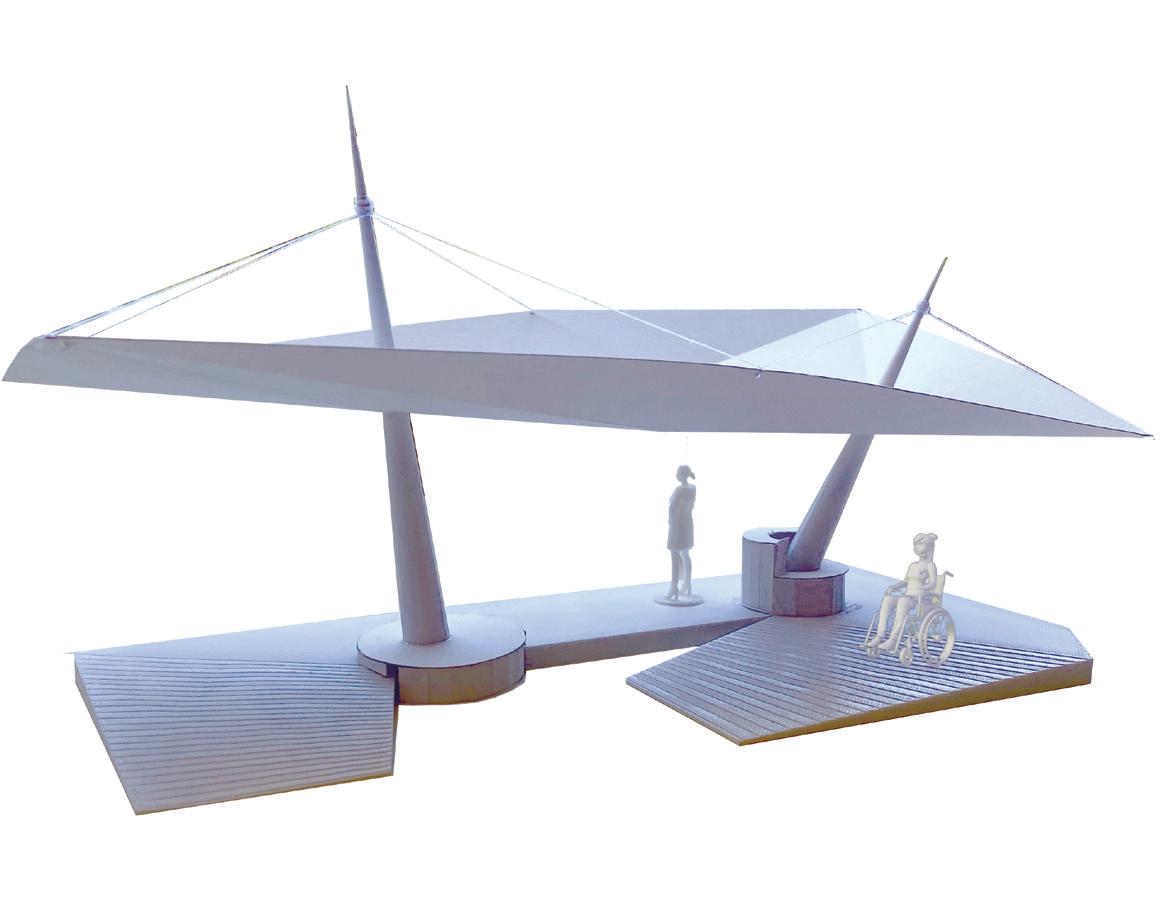
Ella Touchstone’s streetcar pavilion design
The Iconic New Orleans Streetcar: Who Gets to Ride?
The Iconic New Orleans Streetcar: Who Gets to Ride?
BY SKYLAR WEITZ
Ella Touchstone, a graduating senior earning her BA in Design, approaches her work with more than form and function in mind; she designs with passion and intention. Going to school in New Orleans has opened her eyes to the everyday realities of inaccessibility in the city, driving her commitment to create a more accessible environment for all. This approach is visible throughout all of her work, from her past Visual Communications for Advocacy Cause Project, to her Studio II Streetcar Pavilion, and into her current Senior Capstone. She stresses that “accessibility has always been in the back of my mind,” which is apparent when viewing her body of work.
This mindset to increase equity in New Orleans was a driving force behind her design of the Streetcar Pavilion, a Studio II project focused on human-centered design.
This mindset to increase equity in New Orleans was a driving force behind her design of the Streetcar Pavilion, a Studio II project focused on human-centered design. She believes “it is easier to create with a purpose rather than just a hypothetical.” She couldn’t stop thinking about the challenges of using the most iconic mode of transportation in New Orleans and the various impacted populations. “All I could think about was why isn’t the streetcar accessible, and how can I fix that?”
Rather than focusing only on aesthetics or designing for the average user, Ella focused on those excluded from this quintessential cultural experience. “The streetcar is so imperative to New Orleans culture. It is scenic and calm. Why can’t everyone experience it?” she wondered.
Given the renown of the New Orleans streetcar, specifically the St. Charles line, Ella was shocked to learn that only five streetcars are equipped for wheelchair users. The system is virtually impossible for differently-abled people to use, particularly those in wheelchairs. The massive coordination currently required for a wheelchair user to be able to take advantage of the streetcar creates a significant gap between able-bodied users who can use it freely and those who cannot.
Designed with wheelchair users in mind, Ella’s pavilion directly addresses this gap. Importantly, her project features a raised platform that allows wheelchair users to seamlessly move from the street level to the streetcar’s wheelchair lifts via ramps on either side. Ella intentionally modulated the height of the platform to match exactly with the height of the wheelchair lift on the streetcars, ensuring a smooth boarding process for these users. The ramps included in her design make the use of the platform equally accessible, proposing an inclusive design that is more advanced than most buildings in the city of New Orleans.
Ella’s design process reflects both problem-solving and conceptual exploration. She feels strongly about combining her creativity with making real impacts that improve lives.
Beyond physical accessibility, Ella expanded her design to create a sensory experience for users as well. Taking inspiration from tensile architecture, structures supported by tension rather than compression, Ella incorporated two slanted rods to hold the canopy and enhance user experience. She designed the rods to light up when a streetcar is approaching and light up in a different color when a modified streetcar is approaching. This feature allows the pavilion to serve as a waiting space and an experience even in the absence of the streetcar itself. This design provides information to users while also creating an accessible structure.
The Iconic New Orleans Streetcar: Who Gets to Ride?
Ella’s design process reflects both problem-solving and conceptual exploration. From early process models, her roof design remained a consistent element defined by a geometric canopy and slanted beams. This form is not only visually appealing, but intentionally constructed with user experience in mind. The angled beams maximize space on the platform while maintaining openness to the surrounding environment. They also offer subtle support to waiting users who want to lean comfortably against something.
She feels strongly about combining her creativity with making real impacts that improve lives. “I love designing with a purpose that I am passionate about and that is relevant,” she reiterates.
This mindset extends beyond a singular project. In her past Visual Communications for Advocacy Cause Project, she developed a resource that supports those with disabilities, reinforcing her passion for inclusive design. This same focus carries over to her current project, her Senior Capstone, where she is redesigning the St. Charles streetcar map to be more accessible towards all users. This dedication extends to seating on the streetcar and signage to feature the lifts. Taking on these challenges, creating adaptations to a historic landmark, truly communicates her dedication to improving accessibility throughout New Orleans.
At its core, Ella’s work seeks to identify and understand who gets to enjoy these New Orleans landmarks and who is being left out. Through thoughtful design decisions, a sense of purpose, and a heartfelt passion, she transforms this cultural gem into something with meaning and intent. Her Streetcar Pavilion reimagines how design can shape a space and human experience. By rethinking and redesigning something as significant as the New Orleans streetcar, Ella highlights how good design can allow us to challenge existing barriers to create more equity for all users. Ella’s work reinforces the idea that intentional design has the power to make positive change.
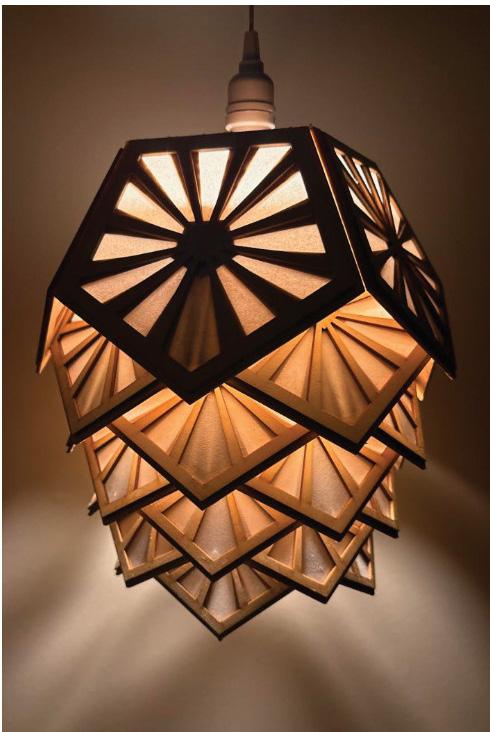
Izzy Delen’s Cowfish inspired light fixture
Shaping Light: From a Fish to a Light Fixture
BY VITTORIA PIGATTI
In the Fall of 2025, Izzy Delen completed Studio I, which culminated with a lighting exhibition. The project, inspired by natural systems and aesthetics, required students to construct a functional lamp fixture while keeping this inspiration relevant to the project’s original design concept. A close look at Izzy’s process and final product reveals the complexity, precision, and decision-making required to create even the simplest objects, like an everyday lamp.
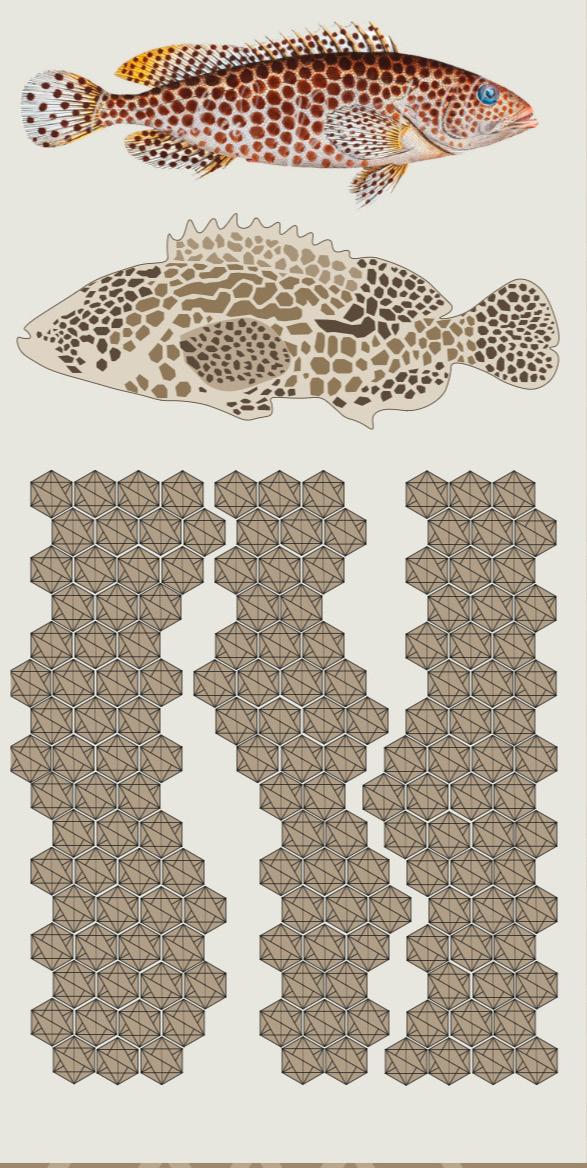
At first glance, Izzy’s fixture appears as a controlled, geometric form. However, as light passes through its layered panels, the fixture begins to cast patterned shadows that extend beyond the object itself. This piece treats light as something that is shaped, reflected, and constructed, rather than just emitted. The layered geometry controls how light moves, turning the fixture into both a light source and a sculptural system. Thus, the initial impression of a simple lighting fixture quickly reveals itself as a designed system of structure, material, and light interaction. Izzy explains that she first took on this project by discerning how best to hold a lightbulb, choosing between a floor or a ceiling lamp. As the project progressed, design thinking became more complex, and as stricter and more professional materials were enforced. Past a certain point in the process, Izzy had to commit to some of her decisions. She could no longer use temporary materials, such as hot glue, cardboard, and tape. Instead, she needed to move onto her final materials. This shift highlights a pivotal moment in the
The layered geometry controls how light moves, turning the fixture into both a light source and a sculptural system.
design process. This deceptively straightforward sculpture required increasingly precise and intentional decisions as it continued to develop.
Her design emerged from the research process which included a visit to the Tulane Fish Bunker on the West Bank, which preserves a substantial number of dead fish. Students were allowed to explore and take photos of fish that they selected, and then used them as inspiration for their lamp. For her design, the Honeycomb Cowfish caught Izzy’s attention. Although the original pattern was hexagonal, she evolved her idea, using pentagons instead because of the easier assembly as she found that they fit together better.
These variations show that even the most familiar designs are not inherently simple but are instead produced through complex interpretation and intent.
As part of the assignment, Izzy had to create at least six different fixture iterations, but she can’t quite remember exactly how many iterations she produced. Izzy described that the hardest aspect of the project was the iterative process and the amount of work that went into each sculpture. This aspect further demonstrates how producing what may appear as a “simple” final form involves a complex and time-intensive process of iteration. As for her final light fixture, she used basswood that she had laser cut and lantern paper to give the fixture a diffused and layered effect. For her earlier iterations, she relied on simpler materials like cardboard and printer paper, while her final model used more advanced tools, like the laser cutter, multiple different types of adhesives, and, she describes with a laugh, a “good amount of Rhino modeling.”
With so many iterations and so many students, the degree to which these design students abstracted the concept of a lamp was highly impressive and indicative of a strong level of design thinking. No two lamps were at all similar, even though they were all inspired by the same collection of aquatic vertebrates. However, each student
Shaping Light: From a Fish to a Light Fixture
found their own way to design the illumination. These variations show that even the most familiar designs are not inherently simple but are instead produced through complex interpretation and intent.
Izzy seemed satisfied with her result, but is currently trying to put it together more neatly, as she recently took her entire project apart in hopes of better reattaching it. On the inside, she noticed the glue touching the paper, which she found unsatisfactory. She explained that she wanted to make her fixture appear cleaner before it was finally exhibited in the Spring Design Showcase. Even at the final stage, her attention to detail reflects the level of care required to make the fixture appear effortlessly simple.
Izzy noted that the project was quite financially demanding, especially for a design project, as the total materials cost about a hundred dollars. But she justified this expense by stating that, “As a design major, I do find it worth it to spend money on materials that are super versatile, and then you can hold onto them for your next design class.” Overall, the studio and this project specifically were significantly more work than she had originally expected, and the fact that she had something “difficult or time-consuming to do before every class” took some getting used to. Nonetheless, she ended our conversation by clarifying one important point: “I do definitely love it a lot, though!”
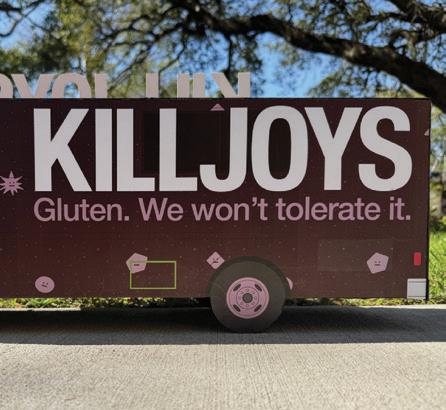
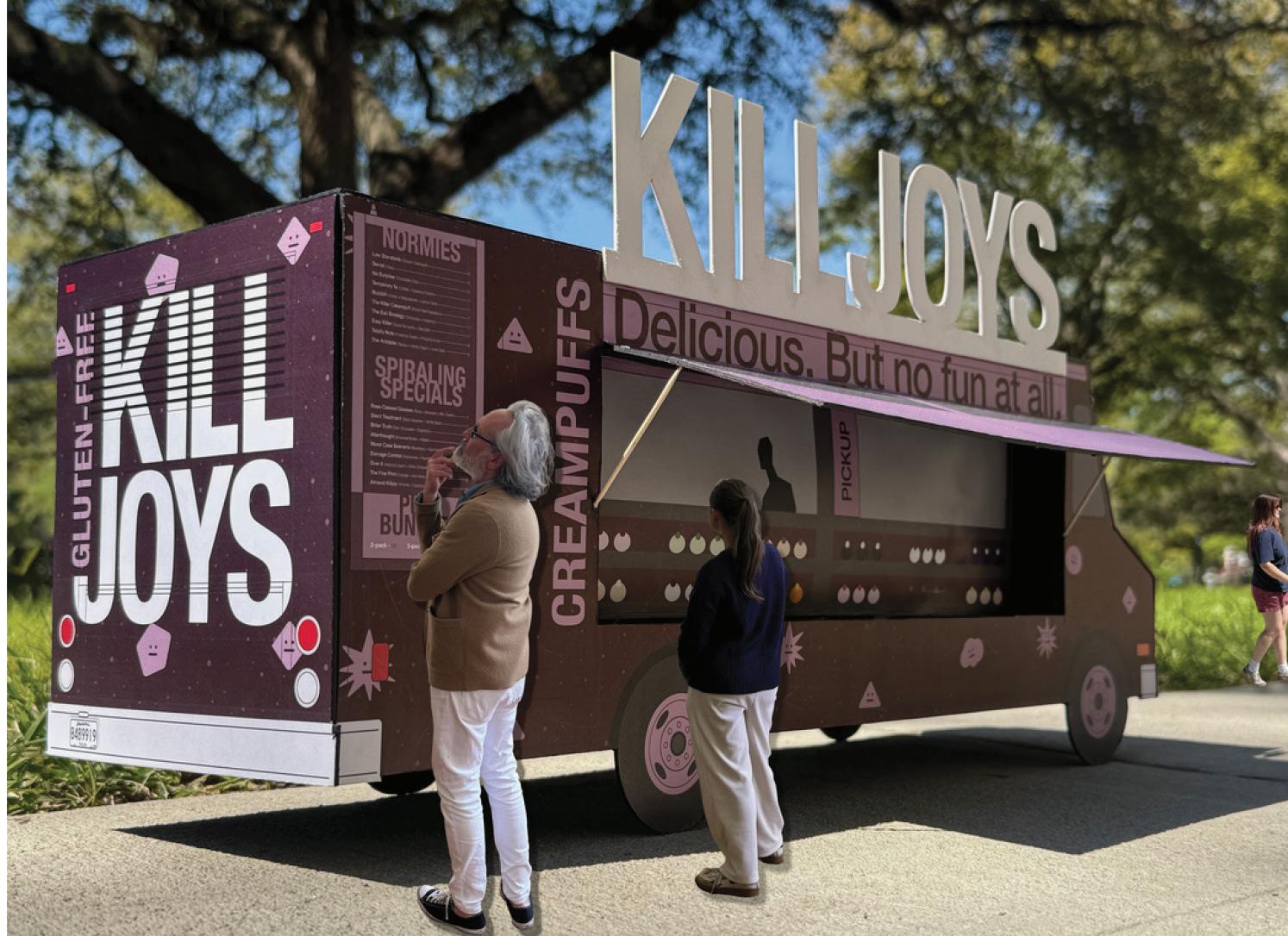
Lily Schiff’s Killjoys food truck design
Deadpan Desserts Meet Serious Design
BY ANN PHAM
In Professor Adam Newman’s Design Studio III, students are not just finishing assignments–they’re building full creative identities.
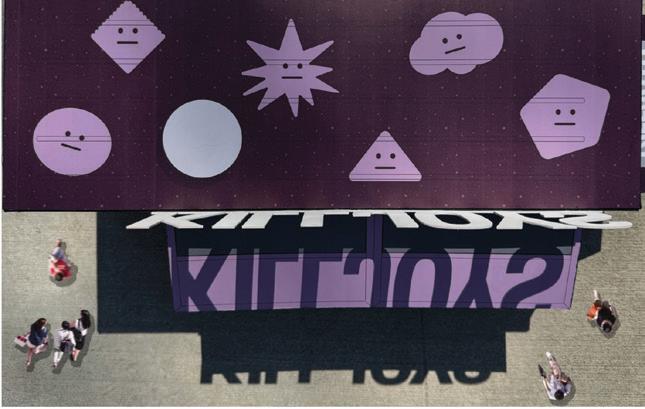
A dessert food truck called Killjoys is probably not supposed to work this well. At first glance, Tulane student Lily Schiff’s food truck concept looks almost too gloomy for sweets. The palette of muted purples, dusty grays, and subdued tones feels closer to a melancholy cartoon than a sugar rush. Little cream-puff characters stare at potential customers with flat, deadpan expressions. The branding is dry, sarcastic, and slightly abrasive. Then the viewer starts reading the menu, where product names like Low Standards, Almond Killjoy and The Antidote, bring Lily’s concept into focus.
The food truck is funny, yet controlled, each part contributing to a singular voice and vision.
The food truck is funny, yet controlled, each part contributing to a singular voice and vision. This singularity elevates Killjoys. The concept stands out, both as a design project and as a sign of a larger shift happening in student work. In his studio, Newman pushes students to think beyond neat and competent assignment completion, tasking them to also create projects with personality, systems, and a clear point of view. He teaches students to work across scale and function, translating ideas into ideas and solutions for the built environment rather than limiting themselves to flat graphics alone. The course framework is meant to move between branding, hierarchy, communication, and three-dimensional experience. Newman, who has taught the food truck project after designing a real truck years ago for New Orleans Center for Creative Arts, described the assignment as one that forces students to think at many levels at once: the truck has to communicate
from a block away, but it also has to work up close through menus, ordering systems, details, accessories, and overall vibe. In his view, a food truck is “a big branding machine first,” then a cuisine machine. Lily’s truck is one example of that shift: a class project that feels less like a school exercise and more like a legitimate brand that could easily exist in the real world.
The assignment forces students to think at many levels at once: the truck has to communicate from a block away, but it also has to work up close through menus, ordering systems, details, accessories, and overall vibe.
For Lily, the concept began with something personal. She has been gluten-free since third grade, and the daily social experience of that restriction became the emotional core of the truck. Instead of treating gluten-free branding the way it is often treated–antiseptic, health-coded, delicate, or overly precious–she decided to subvert expectations, embracing the frustration and awkwardness of being that person who has to turn a fun night out into an interrogation about food safety.
“I wanted to make this something that you can bring a little bit of joy and humor to,” Lily said. “It is kind of such a sucky feeling.”
That tension gives Killjoys its edge. Lily’s truck embraces being the buzzkill, the person who has to check every menu every time, the person who has to complicate fun, the person who always has to say no. Rather than staying quiet, she exaggerated her lived experiences into a brand voice: sarcastic, self-aware, and funny enough to invite people in instead of pushing them away. The name came out of that feeling. Once she came up with Killjoys the rest of the concept fell into place. Lily said she aimed for a dry and cheeky tone, something relatable for people with food allergies but still entertaining for everyone else. The humor helped her embrace inconvenience as part of her identity.
That identity gets sharper the closer the viewer looks. The menu does not just contain puns for the sake of humor; these turns of phrase serve to communicate the truck’s whole worldview. A classic cream puff becomes Low Standards. A tequila-flavored option is aptly named The Antidote. Lily said some of the monikers came from her own ideas, while others developed in community, through lively conversation with friends, classmates, and Newman. And once the first few names locked into place, the project took on an unstoppable momentum.
That collaborative energy is a fundamental part of Newman’s ideal studio environment. He describes his classes less like traditional courses and more like working design spaces, where students bounce ideas off one another and develop projects through critique and experimentation. For Newman, that structure matches the kind of thinking students will need after graduation. “I like to teach the class less like a class and more like we’re a design studio,” Newman said. The food truck project, he said, grew out of his own experience designing a real truck years ago. What interested him was how many jobs a truck has to do at once. From enticing customers from a distance, communicating identity, and then guiding them through important details like menus and ordering, the food truck requires students to think three-dimensionally. That challenge, not normally found in graphic design assignments, gave Lily room to build something layered. One of the project’s biggest strengths is that it works at multiple scales. From far away, the truck reads as weird, moody, and funny. Up close, it becomes more detailed and more rewarding. The reader notices the careful naming, the tonal consistency, and the way even small visual elements reinforce the same concept.
That consistency did not arrive instantly. Lily said one of the biggest turning points in the project came through critique. Early on, she was working with a different color palette, one she thought was interesting but that ultimately was not matching the concept. Newman encouraged her to think about deadpan, melancholy characters as visual references. That shift helped her find the muted palette that now defines the truck.
Your first draft is never ever the final draft. Iterating is just the best way to improve an idea.
“
For Lily, that was a reminder that iteration is not just part of design–it drives the whole process. “Your first draft of something is never ever the final draft,” she said. “Iterating is just the best way to improve an idea.”
That mindset shows up throughout the project. Lily did not stop at the central idea or the truck wrap. She pushed further, creating multiple cream-puff characters with deadpan faces rather than using a single pastry graphic. She kept refining the menu. She kept extending the tone. Importantly, she said she did not really see that as “extra” work. The project needed that refinement in order to feel complete.
This dedication to iteration and refinement offers clear signs of the strength of student work. The strongest designers in studios now do not seem satisfied with simply meeting requirements. They want their work to feel fully built, not partially solved. They are more willing to take risks, make strange decisions, and follow an idea until it becomes a full world instead of a polished surface. Newman sees that evolution in the classroom. He described the current group of design students as increasingly sophisticated and more intentional in the way they work.
This shift does not just mean better software skills or cleaner presentations. It means more ambition. More willingness to test a concept and keep refining it until it says something specific.
In Lily’s case, that ambition turned a food truck assignment into something much bigger: a funny but precise response to dietary restriction, a cohesive branding system, and a sharp piece of portfolio work. Killjoys may be built on sarcasm, but the design behind it is serious. And that is exactly why it works.
CONTRIBUTOR BIOS
Drew Boutry is a fourth year BARCH student at Tulane University whose research focuses on architectural adaptations in extreme climate environments, particularly in Chile’s Atacama Desert. He utilizes Rhino, Revit, and the Adobe suite in order to materialize his architectural designs. At Tulane’s CNC Millhaus and the Woodshop, he leads workshops, manages materials, oversees the use of fabrication tools, and trains students. He spent two summers as an intern at Workshop/APD, managing residential construction details and active sites. His projects consist of a graffiti gallery library in Los Angeles, a hostel in New Orleans, on Canal Street, and an observational deck in Montana. His work explores materiality, composition, and the integration of sustainability within urban environments.
Olivia Bruhmuller is a human-centered designer passionate about researching, crafting, and testing experiences that empower and educate diverse users. She will graduate in May with a degree in Design and Strategic Analytics from Tulane University. Her research and professional practice sit at the intersection of design and technology, where she focuses on closing accessibility gaps through thoughtful, systems-driven problem solving. Olivia combines empathy-led research with strong technical design skills to translate complex ideas into intuitive product and brand experiences across web, mobile, and print. She is driven to build tools that democratize information and literacy, channeling her creativity and curiosity into solutions that create measurable, meaningful impact.
Emily Capdeville is a writing professor with over a decade of experience teaching undergraduate composition. She currently serves as a Visiting Assistant Professor in the First-Year Writing Program at Tulane University, where she helps students engage critically with contemporary discourse while grounding their work in classical rhetorical principles. Her courses address today’s evolving communication landscape, including social media, political polarization, the COVID-19 pandemic, and artificial intelligence. Capdeville has taught at the University of Oregon, Loyola University New Orleans, and in Tulane’s Altman Program, developing courses in composition, literature, creative writing, and intercultural communication. In addition, Capdeville has mentored students
Contributor Biographies
through study abroad programs, supporting immersive, globally focused learning. She writes novels and decorates sugar cookies in her spare time. She earned a Master of Fine Arts in Creative Writing from the University of New Orleans.
Bryant Carroll is a designer, artist, and maker, currently based out of New Orleans. After training in an intensive visual arts high school program, Bryant followed this passion at Tulane, where he studies Design with a concentration in graphics. Bryant has completed solo art shows and has been featured in group exhibitions across the city. His work explores how digital outputs can be translated into the physical and tactile realm. As a designer, he creates branding, advocacy campaigns, posters, and projected animations. He also tinkers with 3D design, digital fabrication techniques, and computer aided design. Currently, Bryant’s senior capstone project explores how design and graphics can serve as an intervention for advocacy and change against environmental injustice in Louisiana’s infamous Cancer Alley corridor.
Juliette Condulis is pursuing a double major in Design and Mathematics at Tulane. Within the Design program, she has been a teaching assistant under Professors Jill Stoll, Kelly Tierney, and Marion Forbes. This spring and summer, she will bring her creative direction skills to Play Henry, supporting product launches and branding initiatives. Her work has twice been featured in the annual Design Showcase, first for a New Orleans inspired cardboard “backpack,” an innovative cross of backpack and umbrella, and later for the Banded Beam Lamp, a light sculpture inspired by the banded cucumber beetle. A Presidential Scholar and member of Tulane’s Honors Program, Juliette also completed an exhibition design course in Barcelona. She looks forward to continuing her growth as a designer in a new city this summer.
Cole Hildebrandt is a graduating senior in the Design Program. He designs immersive fashion environments through visual merchandising, spatial installations, and brand identity systems. His practice connects material sourcing, retail space, and visual identity to create cohesive fashion narratives that extend beyond
the garment. His minor in SLAM contributes to his ability to evaluate economic systems that impact the fashion industry. After his graduation from Tulane, he will attend the MSc in Design for the Fashion System at Politecnico di Milano where he hopes to refine his focus on visual merchandising and art direction, building cohesive fashion worlds where spatial logic, graphic identity, and material narrative operate as one system.
Shyla Krishnappa will earn her BA in Design and BS in Psychology from Tulane University. Currently, she works as a Graphic Design intern with the branding firm Also Known As and also serves as the Executive Director of Tulane’s 2026 Crawfest, after designing the event’s branding and merchandise in 2025. Shyla’s 2024 piece, Flip Seat, was displayed in the Howard Tilton Memorial Library as a part of a student work showcase before being put on display in Richardson Memorial Hall. Her projects have been selected every year to be exhibited in the Annual Design Showcase. Shyla served as a Teaching Assistant for DESG 1005, 1110, 2005, 2305, and 3005 over the course of her time at Tulane, mentoring countless students in their quest to learn digital tools and improve designs through ideation.
Tiffany Lin is an Associate Professor at the Tulane School of Architecture and Built Environment, where she has developed beginning design pedagogy across the design and architecture curricula. She is the founding Director of the Bachelor of Arts in Design program, an initiative that broadened the reach of a traditionally siloed architecture school into a more expansive, university-wide context. Lin’s research and practice position abstraction as a unifying framework for connecting human experience and advancing creative problem-solving. She is an architect, a painter, a cook, and an enthusiastic maker of Mardi Gras costumes. Lin holds a B.Arch from Cornell University and an M.Arch II from the Harvard Graduate School of Design.
Vittoria Pigatti is a sophomore at Tulane University pursuing a dual degree in Real Estate and Design, with minors in Architecture and Strategy, Leadership, and Analytics (SLAM). She is particularly
Contributor Biographies
interested in the intersection of design, development, and business, with a focus on how architectural decisions shape both functionality and user experience in the built environment. Through her studio work, she explores conceptual and experimental approaches to design problem-solving while fostering a passion for both preserving original character and reimagining design for modern, community-oriented use. Outside the classroom, she is an active member of the Tulane Real Estate Group Cohort, a studentathlete on the Tulane Cheerleading team and the team’s social media chair, and a member of Kappa Alpha Theta sorority.
Ann Pham is an undergraduate design senior whose focus lies in textiles and product design, where she often connects function, sustainability, and whimsical expressions of her Vietnamese heritage. Her work explores how textiles can carry memory, cultural identity, and practical purpose while still feeling playful and personal. She exhibited her textile work in the Tulane Design Showcase in Spring 2025 for her Pinnacle Parka and De/Re Construct Tote. Her Pinnacle Parka reinterprets the silhouette of the traditional áo dài through reclaimed denim, blending Vietnamese influence with Western utility. Her De/Re Construct Tote takes a more playful approach, designing a bag for versatility in compact cars to carry pet belongings. She will exhibit again this Spring 2026 for her piece in Fibershed and Fabrication, where she designed and made a halter dress from 100% organic cotton, naturally dyed with Vietnamese roses, or hoa hồng. Her practice centers on shared experience.
Bella Waltzer is an emerging designer and art historian, pursuing a double major in Design and Art History with a minor in Africana Studies. Raised between Brooklyn and Chicago and closely connected to her family in Jamaica, her background informs her research into how environment, memory, and nostalgia shape aesthetic preference and decision-making. Her training emphasizes intent as the defining principle of design, understanding it as a discipline grounded in function and utility. Though at an early stage in her career, her portfolio reflects a commitment to socially engaged design. She has been awarded the Africana Studies Fellowship, where she works as a research assistant and fellow.
She continually seeks opportunities that will allow her to further explore the intersection of functional design, personal history, and community impact.
Skylar Weitz is a sophomore Design and Economics major. Her work in Design explores her identity and personal narrative, combining digital and physical components to tell her story. In introductory and advanced level classes like Fundamentals of Design and Making, Visual Communication for Advocacy, and Design Studio I, she uses digital mediums like Adobe and Illustrator as well as tangible materials like cardboard and paint to showcase her minimal, architected style. She uses typography and texture as a visual language, while creating logos and social elements to advocate through visual elements. She enjoys combining her creativity with her passion for giving back, and enjoys translating her personal stories into visual communications.
Contributor Biographies
ACKNOWLEDGMENTS
Tulane University is a highly collaborative institution; this course only became a reality through productive interactions across campus. In the Tulane School of Architecture and Built Environment, Associate Dean of Academics Scott Bernhard supported its creation from brainstorming through execution. Associate Dean of Faculty Affairs Edson Cabalfin advocated strongly for its inclusion in the spring course offerings and worked closely with Roxanne Dávila, Associate Dean for Curriculum and Pedagogy in the Tulane School of Liberal Arts, to ensure that we could offer the course as a collaboration between our two schools. Isa Murdock-Hinrichs, Director of First-Year Writing in the English Department, encouraged the partnership and saw the myriad ways it could help enrich students across disciplines. Experimentation like ours is only possible because of the rigorous review undertaken by the Newcomb Tulane College Curriculum Committee, made up of faculty committed to the quality of our course offerings. We must recognize the Design team, including Hannah Berryhill, who dreamed up the Design Showcase, and incoming Design Program Director Meghan Saas, who along with Textiles Professor Patti Dunn, are orchestrating the 2026 event. Our program exists because of our amazing design faculty, whose innovative teaching and assignment prompts led to the work featured in these essays. Many thanks to the School’s Director of Marketing and Communications Naomi Englar whose talk on features helped students connect their work to real world contexts. And of course, we are so grateful to our students who rose to the textual challenges we set for them in our inaugural iteration of the class. We thank them especially for their flexibility and overwhelmingly positive outlooks! The leaders of our schools, Dean Iñaki Alday and Dean Brian Edwards, provide the strategic vision under which we are able to ideate; their continued support and encouragement has enabled our work. Finally, we have to thank Owen and Elliott. Our sons brought us together when they became friends before they could talk. It’s fitting that our collaboration, rooted in the power of textual and tactile communication, emerged as the boys developed their own ability to pair images with words.