Letters from the Editors - Caroline Lloyd-Jones, Sofia Valdebenito & Ela Nalbantoglu
Letters from the Creative Directors - Meg Duncan & Katie Ogden A Pachyderm for the Ages - Madison Clowes hollywood - Ela Nalbantoglu
The Ex-College - Gigi Appelbaum
Was My Body Made For Modern Womanhood? - Leah Glaspey
Thick Whisper Golden Glare - Nora Bitar
Under American Fire - Lily Rogers
Stop Looking at Me - Rhea Shah
Fans, Fanatics, Fan Antics - Samira Amin
Playing the Trump Card - Ben Maughan
Nothing is TMI... We're Platonic Soulmates! - Taarini Gupta
Observing the Periphery - Abilene Adelman & Emilia Ferreira
Staff Picks - Talia Tepper & Veronica Habashy
summers' leavings - Kate Castleberry
Crossword - Emma Dawson-Webb .
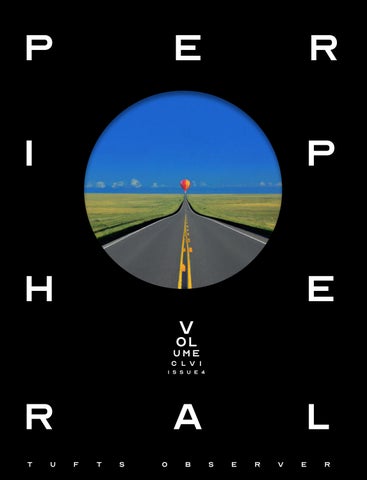
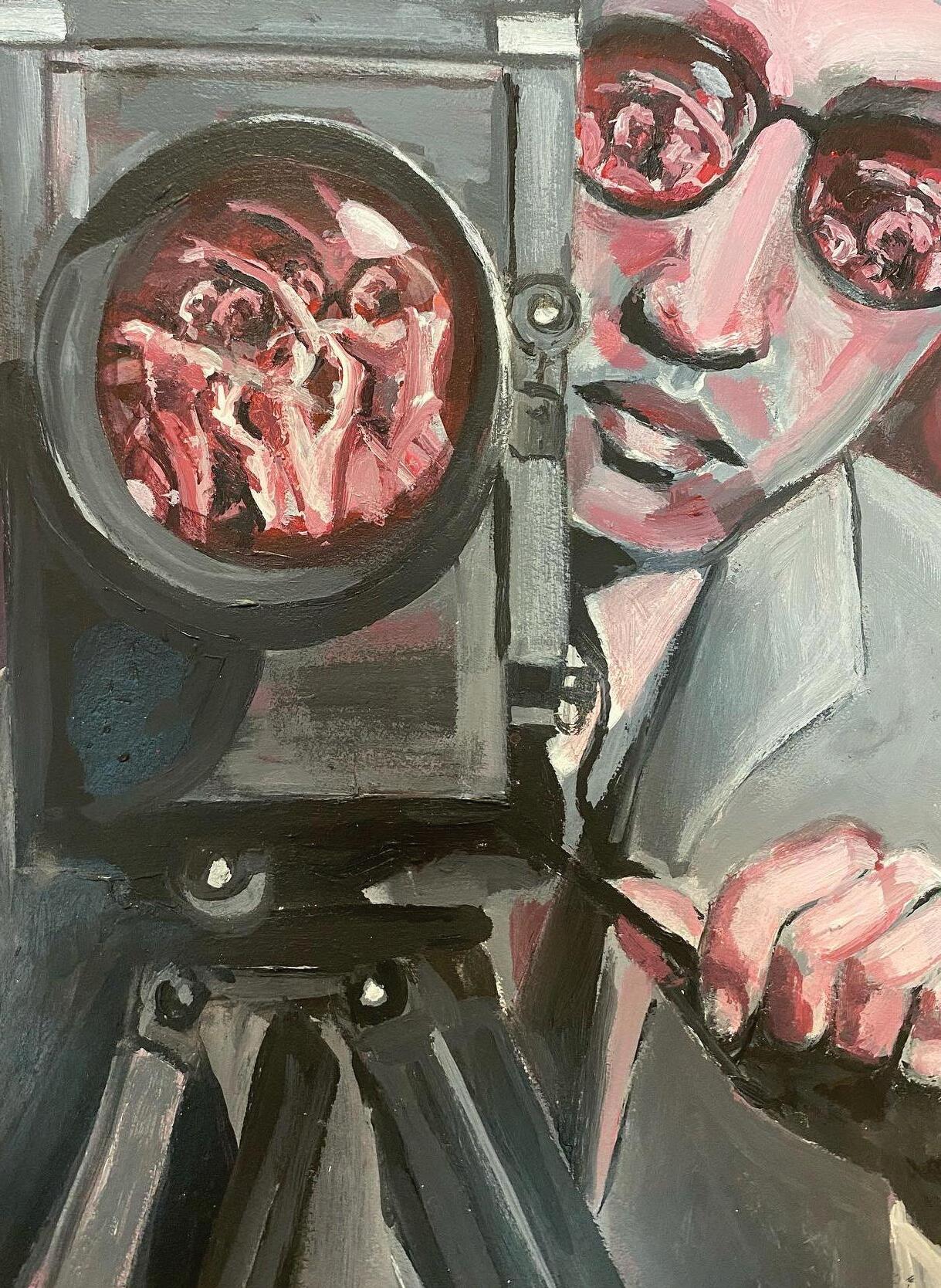
Peripheral: if you can’t see my mirrors I can’t see you
Editors-In-Chief
Caroline
Sofia Valdebenito
Editor
STAFF
News
Managing
Ela Nalbantoglu Art
Opinion
Lucie
Wellesley
Campus
Abilene
Emilia
Voices
Emma
Rhea
Greta
Letters from
Dearest Observers,
It’s strange to think that just five semesters ago, I picked up my first-ever copy of the O at the Spring ’24 GIM. Staring up at the Crane Room projector screen, seeing all the section editors at the front of the room, laughing, smiling, somehow looking nerdy and cool, nonchalant and passionate all at the same time, I had only one thought on my mind: how do I get in with them?
But, in my first semester as a staff writer, I felt like I was anything but in. Sure, my name was now on the masthead, but I was still on the outside, looking in at all the stressful fun this close-knit, MABlabtrauma-bonded group was having without me. I knew, in my heart of hearts, that I would mesh really well with them—if only they would open the door.
Little did I know that the door had been unlocked the whole time; I just had to take it upon myself to turn the handle.
I guess what I’m trying to say through that cliché metaphor is that, sometimes, it can feel like you’ve been stationed on the periphery, like your life is careening by before your eyes with no intention of slowing, when, in reality, you’re the one who put you there. And only you can make your most desired experiences happen.
I have made a home here at the Observer, and for that, I will be forever grateful. All I want for you, dear reader, is to make yours.
Sincerely,
Caroline
The sun is setting, time’s up! April showers bring May flowers? I’m not sure, especially this May. Instead of the typical tulips, Tufts has planted daffodils—and it’s a jarring difference! Tulips are my favorite flower, so why did they change them my senior spring? Why aren’t they here to wish me goodbye?
I joined the O as a baby ‘Bo in September ‘22. Fresh into college! Eight full semesters of being logged into Instagram, scheduling my semesters to avoid 9 a.m. Wednesday classes, and remembering to hyperlink the verb in the sentence. I think back to those hazy 6 a.m. copy editor mornings and wonder how we were ever on a biweekly publication cycle. At the same time, I think, yeah we did that!! Nostalgia always wins…
For my final words in Observer print, thank you! Thank you to those who made me feel like I belonged that first semester, thank you to my previous section editors for their patience as a new staff writer, thank you to those who wrote for news and made my pitches come alive, thank you to Ashlie, Lucy, Miles, Caroline, and Ela, for doing M-Board with me, and thank you, reader, for reading!
It was a great four years. Time to find tulips elsewhere!
With gratitude, Sofia
Hi-
4/21/26
the Editors
Hi beautiful people,
I can’t believe we’ve made it to the end of yet another semester. Time is passing by a little bit too fast, and I am terrified. While I am a rising senior, and it is definitely not the end of the O for me just yet, it is hitting me that in a year, I will be leaving Tufts. But it is a-okay, we still have time.
Anyway, on a side note, you know what I’ve been thinking a lot about… rabies. I am deathly afraid of getting rabies, like the paranoia occupies my mind constantly. I cannot articulate how serious this is—I think I might have gotten around 20 rabies shots in my life, all of which I just got upon random scratches from stray cats in Istanbul (you know we have them everywhere and I totally did not need to get that many shots). Ok, sorry, I am getting sidetracked and this might be the weirdest leditor yet, but my point is, we all have our unreasonable fears. And it is through these past four layouts we’ve had this semester that I’m getting to discover that some of us are afraid of rabies, tetanus, lockjaw, ectopic pregnancies, or cases of unknown infertility—fascinating conversations. Beyond how intriguing these dialogues (like hello, Socratic seminars) have been, they’ve also reminded me that I am not alone. So, I am grateful. I am grateful for the Observer. So much. This wonderful community uplifts me and hears me out on my weirdest takes, calming me about my unreasonable overthinking. I know through this great group of people (and our amazing readers) that we’re not alone on the peripheries of this campus. And we’ll always be bonded over this piece of art you’re holding in your hands at this moment.
It is not a goodbye for me just yet, but for now, have an epic summer.
I’ll see y’all next semester…
Hello!!
Xoxo, Ela <3
It is absurd to us that this is the final issue of the semester. Only three months ago we were writing our letter for issue one, full of trepidation about what our new position would have in store for us. We have adored being creative directors and helping produce these beautiful issues. While brainstorming for Peripheral, one thing came quickly to mind: vision, or more specifically eye exams. Katie is blessed with 20/20 vision, and Meg, not so much. But at the Observer we’ve learned that our differences in vision are a strength. Sometimes details are seen clearly, while other times you need to squint to see the whole picture.
Our different perspectives are united in the goal of creating impactful collaboration; a kind of vision that doesn’t fade into the periphery. Thank you so much for appreciating the absolutely stunning work of all of the designers this semester!
In hindsight, Meg and Katie
A Pachyderm for the Ages
By Madison Clowes
Examining Tufts’ Expansion into Medford
Every day this past summer, I’d drag myself down Boston Ave. in those wee hours of the morning preceding 9 a.m., towards the Medford/Tufts Green Line stop, where I’d catch a train to my summer job in downtown Boston. As I would shuffle across the street and squint in the general direction of the train, I’d always come across a group perched outside Tufts’ new dorm-in-progress, torsos adorned with signs reading, “Turner Brothers LLC Does Not Pay Area Standard Wages & Benefits.” We’d nod to each other and I’d go about my day, only to cross paths the next morning with a quiet politeness disparate from the bold lettering of their signs.
As the development has chugged along and the building’s skeleton has slowly risen above Hill Hall, there still hasn’t been student uproar despite the protesters’ frequent occupation of the site and on-campus demonstrations. I started to realize that I didn’t know much about what was happening down there, and neither did anyone else around me.
The Boston Ave. development, recently coined Pachyderm Place, is the latest of Tufts’ attempts to expand and improve its campus facilities. The university has faced pressure, notably from current Somerville Mayor Jake Wilson, to develop its on-campus housing offerings to free up space for permanent residents in the area. Pachyderm, as the school’s largest housing project ever, aims to mitigate the burden Tufts students place on the local housing supply. While the project will allegedly free up more than 200 units of local housing currently occupied by students, it also represents a growing infrastructural expansion of Tufts into Medford, accompanied by the Joyce Cummings Center and the forthcoming aquatic center—a movement not fully welcomed by local residents. Thus, as Tufts fills in the backside of campus, its role as a good neighbor and fair employer carries critical significance.
In a July press release about the development, Tufts’ Executive Vice President Mike Howard proclaimed that, “aided by the expertise of our development team,
we have been able to reduce construction costs and time and bring to fruition a project that will enhance student life, benefit our neighbors, and enliven our streetscape, all in an environmentally responsible way.” Across press materials, Tufts and its partners praise Pachyderm both for its sustainability and affordability—an affordability often attributed to its public-private partnership.
Private-Private Partnerships
Pachyderm Place stands as the first Tufts residence hall to be built through a public-private partnership, or P3. Through a traditional P3, a public entity, like a local government, enters a contract with a private company to handle the design, financing, construction, and maintenance of the development. Despite the ‘public-private’ label, there is no public entity involved in this project. The term has transferred into newer, similar partnerships, such as the partnership
between Tufts, a private university, and Capstone Development Partners, a private real estate development company.
The P3 mostly serves to take some burden off of Tufts by employing companies more specialized in the kind of work required for the development, who “know the market” and can deliver “efficient student housing,” according to Patrick Collins, Tufts’ Executive Director of Media Relations, in a written statement to the Observer.
Eric Hines, a Professor of Practice and chair of the Tufts Campus Planning and Development Committee, explained that there is a lot of financial capacity required to internally operate a development from the point of view of borrowing, credit rates, and management, all of which require significant resources. Tufts does make some visible compromises through a P3, like not immediately owning or operating a building otherwise positioned on university-owned land.
Pachyderm is the first Tufts residence hall to not be owned, operated, or developed by the university. A non-profit contracted by Capstone, Provident Resources Group, will own and operate the residence hall through a ground lease for the next 45 years.
Labor, Costs, and Contracts
Collins provided insight on the contractor selection process: “Tufts selected Capstone as the Developer with their General Contractor partner Erland Construction after a thorough bid process where multiple development teams had the opportunity to bid on the project.” Furthermore, Collins explained that Erland solicited bids for the project, which were open to “union and non-union shops alike.”
Though part of the project’s affordability comes from the P3 structure and what Howard and Collins consider the development team’s expertise, reduced construction costs represent another marketed benefit. As such, the labor practices of the specific companies employed also contribute to a perceived affordability. Notably, Erland Construction recommended non-union-affiliated construc -
tion sub-contractors, to whom Tufts then awarded employment.
Noel Xavier is the Director of Organizing for the North Atlantic States Council of Carpenters (NASRCC), the union that has been organizing on-campus demonstrations for the past few years in protest of Tufts’ choice of construction contractors who engage in wage theft. He explained the problem that employing non-union labor creates for the industry, saying, “The contractors aligned with us are those that commit to fair wages, compliance with labor laws, and workforce training through apprenticeship programs… [Companies] reducing costs by lowering standards will almost always come in at a lower price and win the work.”
Xavier points out that Tufts uses “contractors with a history of relying on labor violators [and] contractors that do not invest in training their workforce,” as the issue stretches far beyond Pachyderm Place. In 2019, a subcontractor hired by Erland was accused of wage theft on a project in Worcester and was forced to pay $158,000 back to 50 employees. The sub-contractor also had a demonstrated history of avoiding wage and hour laws. On another occasion in 2023, Erland was sued by a building systems company for failing to deliver on the full payout of their subcontract. As a result, David Minasian, a business manager for the Worcester carpenters union, expressed that they were concerned when Erland was chosen to build the project.
Furthermore, Xavier described how “there’s a common narrative that projects are more ‘affordable’ when labor costs are reduced.” Contractors will “rely on lower wages, fewer benefits, and less oversight to stay competitive” in the bidding process, a system which self-reproduces. According to Xavier, when Tufts awards contractors with histories like Erland’s, it “creates a system where contractors who follow the rules and invest in their workforce are at a disadvantage compared to those who don’t.” In practice, what that means is “workers are being paid less, receiving fewer benefits, or working for contractors that are not following labor laws.”
Hines explained that a school’s resources constrain its ability to carry out all
projects with union labor. But Xavier believes the use of union labor is an issue of priority, not ability. “Across Massachusetts, both public and private projects are built by owners and developers who choose to prioritize fair wages, compliance with labor laws, and workforce training,” Xavier affirmed. “Tufts’ approach stands out because it is moving forward without those same expectations.”
Hines agrees that the university must set priorities. “When Tufts prioritizes union labor, it prioritizes the labor for the people who actually work for Tufts,” he said. However, the P3 ensures that laborers involved in the development are not internal Tufts employees. “With public-private partnerships, there can also be more layers between the university and the actual work happening,” Xavier explained. “That distance can make it easier for responsibility to be pushed around.”
Along with the perceived affordability enabled by labor practices, the dorm’s size and design played a role in the project’s viability. According to Collins, Tufts had designed a smaller, 400-bed residence hall in 2022, but it “proved to not be financially feasible.” Through an exploration of alternative “delivery and operating models,” Tufts landed on the current 664bed arrangement through a P3, which was not a feature of the 2022 plan.
Building “the Wall”
Interestingly, the size of the development, an alleged financially constraining factor for the university, has also created tension between Tufts and local Medford residents. Jason Brand, a Medford resident who used to enjoy looking out of his topfloor window onto Tufts’ academic quad, expressed disdain for the development and the loss of his view. “I hate it … You guys are building up so much. It’s a bit much for me,” he said.
Collins claimed that the “university has worked very closely with the city and our neighbors and remains committed to close collaboration.” He assured that Tufts received approval from Medford’s Community Development (CD) Board, a group of city employees and volunteers
who review site plans for major projects. The process featured a “robust community engagement process,” Collins said, including public meetings and input from government officials, elected representatives, and neighbors.
At the CD Board meeting in February 2025, when the project was approved, the Board expressed “disappointment with the process and Tufts’ unwillingness to work with the community to create a better project.” The project had been discussed at a prior meeting in January, where several residents expressed concern about the size and design of the development and the potential shadow it would cast across their homes.
However, the project is not as big as it could have been. While the existing zoning for the Boston Ave. location allows for a 12-story building, Tufts has opted for a 10-story design. Dano Weisbord, the Associate Vice President of Tufts Campus Planning, recalled that a “few modifications” had been made based on community feedback, namely a “step down in height closer to University Ave.,” which runs perpendicular to Boston Ave. up into campus. The step down is supposed to combat some community concerns about shade and size of the residence hall.
Doug Carr, a new member of the CD Board, expressed support for a student housing project on Boston Ave., believing it would benefit Tufts and Medford both. However, he was disappointed with the urban design of the building, which he called a “110-foot high, 700-[foot]-long wall along Boston Ave.” Carr explained that Tufts used the “Dover Amendment threat to get the project approved,” and he was disappointed with their unwillingness to negotiate on any detail of the design. Essentially, Tufts presented a near-final development plan at the time of a public hearing with little room for significant revision, to which Board member Adam Behrens noted that community input is most effective when received earlier in a development’s process.
Pachyderm’s qualification for the Dover Amendment, which exempts educational land uses from certain zoning restrictions and local regulations, further limited the board’s sphere of influence.
Regardless, Board member Adam Behrens noted that “both Tufts and the MBTA have not fulfilled commitments in the past” and emphasized the need for greater community involvement in the future. Behrens is referring to the MBTA’s unfulfilled promise to replant street trees dug up during the Medford/Tufts stop construction, something Tufts plans to remediate as part of the Pachyderm project and its efforts to widely benefit the Medford community through its development.
The Crown Jewel
Perhaps the most celebrated feature of the development is its environmental sustainability. Hines was quick to mention the building’s low carbon footprint and its certification as a Passive building, a high-performance, ultra-low-energy design standard. “It’s really amazing,” he added. “And it’s something that the Tufts community ought to be quite proud of.” Medford, and Massachusetts more broadly, has set up rigorous codes for building electrification and energy use, and the Tufts administration is proud that Pachyderm’s allelectric design rises to the occasion of the state’s progressive demands. While meeting the demands of institutional expectations surrounding energy and emissions, Xavier points out that Tufts’ labor practices make it something of an outlier in an area typically defined by its fair labor practices. “In our region,” he said, “universities routinely complete large projects while maintaining strong labor standards.”
Values and Applications
“At the end of the day,” Xavier argued, “Tufts has control over these decisions, and we believe those decisions should reflect the values the university promotes.” When it comes to sustainability, the university believes in embedding equity and justice into its work. The Office of Sustainability validates the importance of “social
sustainability” by “amplifying the voices of BIPOC and other marginalized communities… and working to rectify instances of inequity in sustainability.”
Social sustainability represents the capacity of a community to maintain longterm social well-being. Fair pay, not to mention the investment in worker training and education, is an undoubted component of social sustainability. A large development like Pachyderm, if committed to social sustainability, could then boast more universally virtuous characteristics, a commitment to low emissions accompanied by a commitment to fair labor practices.
There seems to be some incongruence between Tufts’ ambition of developing Boston Ave. and the public portrayal of its financial capacity. Pachyderm is an undoubtedly necessary project for the present moment, given an ever-increasing enrollment and the obligation to surrounding municipalities to house their own students. Tufts may be facing a difficult decision with this specific development, needing to create a solution with presently limited resources. But what will be the justification for future, less pressing developments in Medford, like the aquatic center?
Even Tufts’ biggest critics, like NASRCC, don’t believe the solution is to curb development entirely. Xavier affirmed, “We support development… [and] building housing. But those projects should create opportunity, not contribute to a system that continues to lower standards for workers.” The union’s notions of opportunity can certainly apply to other parts of the project, like robust methods of resident engagement, which advance and validate the role of community input in large developments.
Development decisions like subcontractor employment and community engagement equally demonstrate how Tufts views itself in relation to surrounding communities. While currently, Tufts may be a “bad neighbor,” in the words of Carr, its ability to connect its institutional goals and actions on sustainability should provide ample proof of concept that the university has the capacity to practically align with its values. Ultimately, it’s just about priorities.
hollywood
By: Ela Nalbantoglu
i have an asymmetrical smile: the muscles on the left side of my face don’t feel things enough, they give up easily.
i pout at the peculiar semi-paralysis as i look in the mirror i laugh when i’m sad and the wrestle between the left and right sides of my might reveal too much.
so, i can’t make do with half a smile or a silent laugh. i remember that
when i am back in twenty-fifteen: here
the queer smirk yet again appears on my face— tilted, shocked, confused upon hearing The Adjustment; why are we talking can
i focus on the lace doilies, can i read the spines of the books— am i the idiot the joke the stranger?
later, tomorrow, in a week or an hour, perhaps in a month it’ll be just right: and i’ll reveal nothing when the sun is up but maybe, one night, i will forget to pull the curtains— thinking no one can see into my room.
until then, i’ll smile at you
By Gigi Appelbaum
For prospective Tufts students researching the school and engaging with admissions outreach, no term is underscored more by the university than interdisciplinary. The Tufts Undergraduate Admissions website brags about preparing students to be “effective problem-solver[s] in an interconnected world” and cites the wide range of ideas and disciplines offered to students—aspects of interdisciplinary learning—as the backbone of that achievement.
Yet, some of the school’s most overtly interdisciplinary course offerings aren’t part of its core curriculum at all. Rather, these courses linger on the periphery of campus, most often offered for general credits and taught by student teachers or visiting professors rather than official Tufts faculty. Such courses belong to the Experimental College, often referred to as the ExCollege. They span a wide range of unique and obscure disciplines holding titles like “Designing the Future: Worldbuilding & Time Travel,” “Punk Rock: History, Theory, and Practice,” and “The World of Crosswords.”
Founded in 1964, the ExCollege was the first organization of its kind in the United States, as well as the first ever university community to include students on its governing board, according to Tufts’ website. In the fall, ExCollege courses taught by upperclassmen are part of the Explorations program, which offers FirstYear Seminars to Tufts freshmen. The Explorations program positions studentteachers as both educators and advisors for their freshman students, allowing them to provide mentorship and advice on course selection alongside their class curricula. Because of this program, non-freshmen students seeking ExCollege courses in the
The Ex-College Classes on the Periphery
fall semesters can only take classes taught by visiting professors who are uniquely equipped to provide in-depth introductions to their specific fields.
Ela Baysal-Goepfer, a freshman majoring in International Relations, participated in the Explorations program during her first semester at Tufts. Baysal-Goepfer said she felt that the senior student advising her class was incredibly helpful when it came to navigating course selection and transitioning into college life. She explained that “it felt a lot easier to reach out
to him… I [wasn’t] scared to email him and ask for help picking out my classes.” Given her advisor’s status as a fellow International Relations major, she found that his advice was especially valuable.
Because the Explorations program only happens in the fall, the semester in which courses are offered significantly impacts their focus. Student-teachers take on different roles depending on whether or not their course falls under the Explorations program, with fall teachers assuming the added responsibilities of an advisor. Regardless, all ExCollege classes remain committed to offering creative, out-of-thebox educational opportunities.
Maya Lunia is a sophomore who serves on the ExCollege Student-Faculty Board, which reviews and accepts course proposals and oversees the program as a whole. Lunia explained that the uniqueness of these courses, and their focus on exploring the connections between generally distinct subjects, is a primary draw for students of the ExCollege. “Students like to take classes that combine two disciplines in a way that [other Tufts courses] don’t,” Lunia said. “For example, courses about law and medicine and how they intersect, or courses that combine science and art—ones that really provide that midpoint between two topics.”
Baysal-Goepfer corroborated this point, sharing that her fall ExCollege course, “The Portrayal of Law in Media,” helped bridge two disciplines that she’s passionate about. “I want to study law later on… and I’m also interested in media studies,” she said. “It felt like a really good overlap of a class for me.”
In this way, the ExCollege is known for bridging subjects offered independently in Tufts’ broader curriculum and creating a space in which student ingenuity and interests are given agency to direct learning. Lunia explained that “you’re not necessarily going to see all of the topics that are taught in the ExCollege taught in other departments, because a lot of times they’re not typical college classes. The content is unique, and on top of that, the approach to courses prioritizes small class sizes, being innovative, being creative, and being multidisciplinary.”
The student-driven nature of the program provides learning opportunities for students and student-teachers alike. Liam Chalfonte, a senior at Tufts, taught an ExCollege class on speculative fiction in the fall. He said the experience felt distinct from other aspects of his education, both in terms of content and considering the teaching and mentoring experience he gained. “I wasn’t expecting how much I was
going to enjoy the process of helping someone understand something and seeing that realization on their face made everything worth it all the time,” he shared. “ Grading my students’ essays was the best education for me on how to write an essay— my essay writing is so much better now.”
Chalfonte added that the job required a significant amount of work. “Designing a class, being a student mentor, teaching every week, I was grading all the time,” he explained. “It was much more than four credits of work. It was a job.”
The magnitude of work that student teachers and visiting professors alike pour into the program speaks to its commitment to adding depth to Tufts students’ educational experiences.
Beyond the innovative educational experience the ExCollege provides to students, the program also serves as a way to integrate transformative (and sometimes controversial) political and social conversations into Tufts classrooms. This reality is integral to the ExCollege’s history.
In 1968, for example, the ExCollege’s first course taught by a visiting professor, “Urban Poverty,” was introduced, paving the way for the robust cast of visiting professors who staff the college today. In 1973, an alumnus offered an ExCollege course called “Zionism Reconsidered,” which prompted significant controversy and generated impactful conversation on campus about “the rights and responsibilities associated with academic freedom,” according to Tufts’ website.
Today, the program continues to intentionally stimulate conversation
surrounding respectful, curiosity-driven political discourse. Along these lines, one related spring 2026 course offering is titled “Building Bridges: Conversations Across Difference.” This focus reflects Tufts students’ broad commitment to civic engagement and political and social literacy.
Lunia emphasized this goal’s integrality to the ExCollege program. “The student-centeredness of [the ExCollege] reflects Tufts culture and is a great asset to Tufts students in that it is very centered around what students want to see and what will be most useful to them,” she explained. “A big aspect of Tufts as a whole is encouraging people to be curious, and I think that the ExCollege does a really good job of embodying that.”
Despite its separation from Tufts’ core curriculum, the ExCollege has managed to remain central to many Tufts students’ educational experiences, broadening horizons, influencing academic interests, and informing future career paths. Lunia shared that the ExCollege course she took in her freshman fall, “Global Health: A Practitioner’s Approach,” inspired her to pursue a major in Community Health. Chalfonte explained that because of his overwhelmingly positive experience teaching an ExCollege course, he’s now considering teaching as a possible career path.
Ultimately, the program highlights the value of student involvement in shaping educational opportunities from the perspective of both educators and students. The ExCollege broadly reflects Tufts’ stated goals of fostering interdisciplinary education and creative curiosity, and has in many ways transformed the Tufts experience for countless past and present students.
Was My Body Made for Modern Womanhood?
By Leah Glaspey
“Baby now or baby never?”
It’s a hypothetical my friends and I love to discuss. The philosophies are enthralling, and the dialogue grows as we do. Currently, we are all absorbed in aca demic programs and staunchly focused on landing interesting careers that pay a stable salary. However, we also dream of building loving homes, and for many of us, that dream includes babies. Specifical ly, it includes babies born from loving and supportive partnerships when we have the resources and bandwidth to raise a func tioning adult—or at least our own insur ance plans.
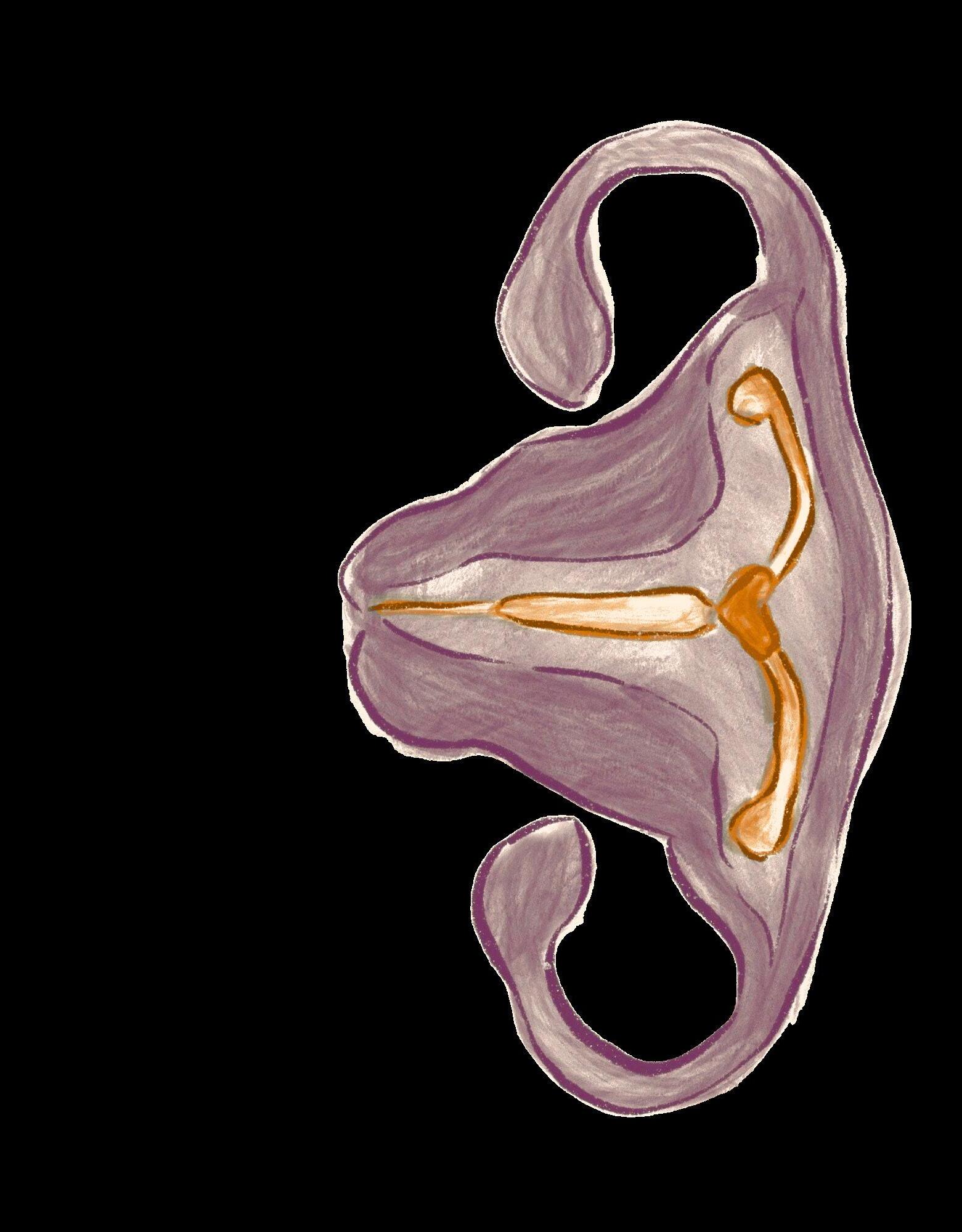
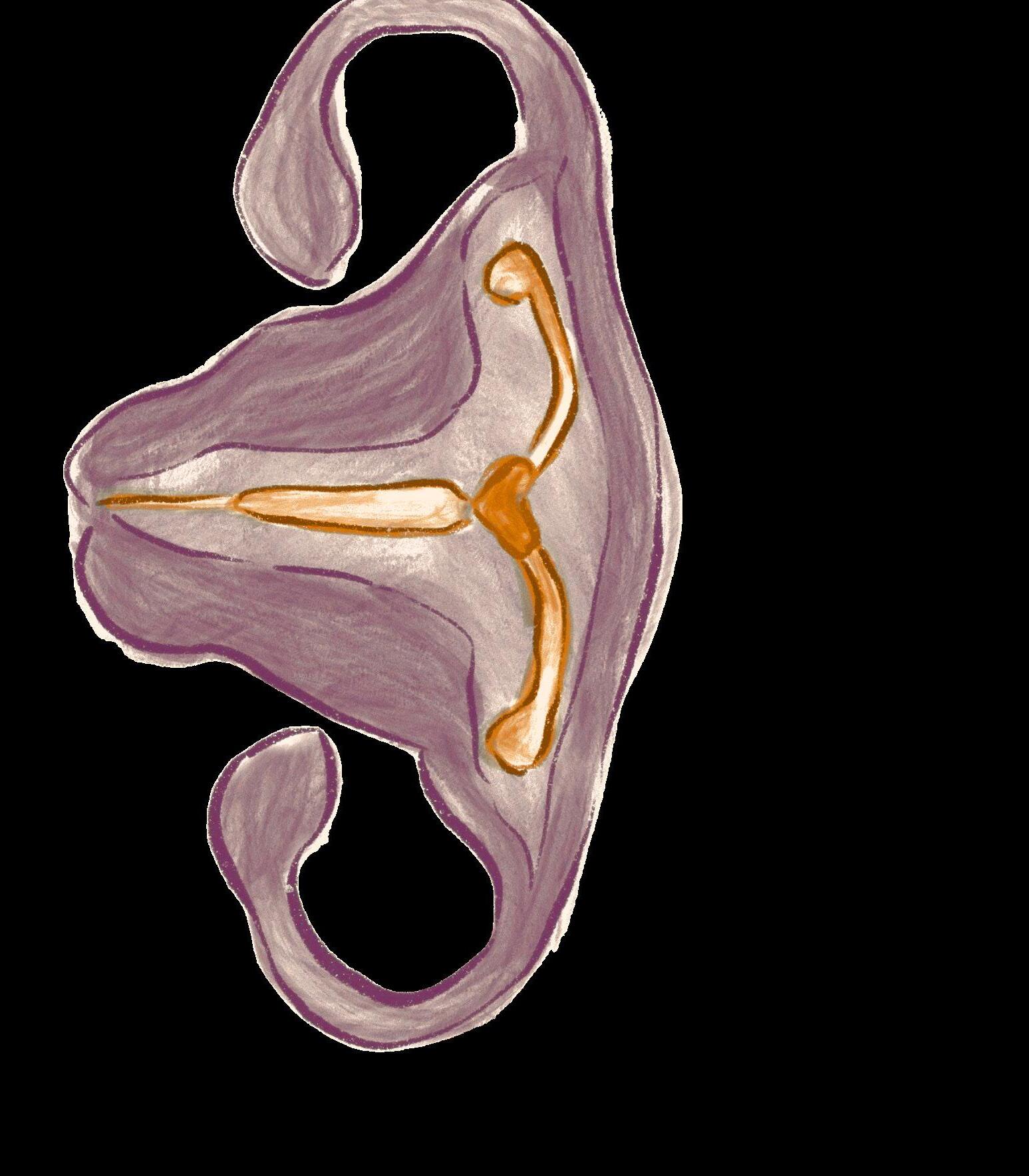
To ensure it won’t be “baby now,” many of us use birth control. I have a cop per intrauterine device (IUD), but there are loads of other options available to the modern woman. Any choice, however, is made in spite of stigma against women having sex without the intention of repro duction. The incorporation of traditional Christian values throughout American society creates the expectation that wom en should maintain their purity, making birth control seem like a frivolous lifestyle choice, even though contraception is a se rious medical decision for people with fe male reproductive systems.
As with any sort of medication or procedure, there are side effects that vary based on the type of contraception one chooses. In recent years, conservative groups have influenced the way the options are presented to make synthetic methods seem hazardous to long-term fertility. Essential-
career implications in mind. Our world has evolved beyond what our bodies were made to do.
There are many NFP methodologies, but fundamentally, the idea is that wom en track different signs of ovulation and then abstain from sex for the fertile win
demonization of synthetic birth control is a political problem, not a medical one. women living under the Trump administration, unbiased medical information regarding the functions and side effects of birth control methods has become increasingly difficult to find. The medical needs of women are already addressed far less frequently than those of men, meaning the small subsect of available information is becoming increasingly politically motivated. The stigma associated with women being sexually active already discourages women from discussing their reproductive health with medical professionals, and the appearance of an option that is seemingly effective and can be done entirely from the comfort of their own home leaves young women vulnerable to life-changing consequences. rhetoric around birth control takes advantage of the fact that many women have had negative experiences with the formal medical system. Even within the sphere of birth control, the pain women experience when having an IUD inserted has historically been dismissed by doctors, and the procedure is still often done without a pain management aid. Leveraging these existing systemic fears gives young women yet another reproductive concern to manage without institutional support. Women deserve a young adulthood where they can focus on establishing themselves without worrying about their potential to be a parent—the resources necessary to make this happen exist, we just need to eliminate the shame around
I love my IUD. I love that I don’t have to worry about getting pregnant, but also don’t have to bother with daily maintenance. In this political climate, I love having highly effective birth control that will protect me until it’s physically removed from my body. However, like any medical treatment, there have been side effects. I bled through a tampon per hour during my first cycles after the device was inserted. Even now, I still have moments where something weird happens in my body, and I ultimately learn my IUD is the cause. Last summer, I bled for the entire month of June and was caught between terror and relief as sources alternated between neutrality and catastrophe.
I’m lucky to have a general physician who is knowledgeable about the options and their effects, but I would have languished in confusion if I was reliant on information from the internet alone. It has become nearly impossible to distinguish between truth and religious belief.
Not every young woman who uses birth control hopes to become a mother one day, but I resent the assumption that just because I don’t want a baby now, I don’t want a baby ever. My fertility is important to me, but I refuse to mother a child I don’t have the capacity to care for. Labeling NFP as a practice of radical autonomy undermines the work generations of women have done to allow today’s young women agency over our bodies. If this movement was really motivated by the freedom of women, leaders would recognize being baby-trapped as a far more restrictive fate.
To support the fertility of the modern woman, we should first and foremost understand how her body works. The female endocrine system is sensitive to synthetic chemicals, but the demonized hormones in birth control are simply lab-produced varieties of estrogen and progesterone, chemicals that the female body naturally produces. Perhaps, rather than vilifying the chemicals associated with the revolution of women’s self-governance, we should evaluate the impacts of environmental pollution, which studies have actually shown to impair a woman’s ability to conceive and produce a healthy baby. If it was about women, the concern over chemicals would expand beyond instances where they give women power.
The decision to have a baby is weighted with considerations it never has been before, which has always colored my response to “baby now or baby never” and highlights my discontent with the MAHA reasoning. “Baby now” focuses on the birth of a child over the life they are able to lead, but “baby never” has increasing potential of being the case as our environment continues to be poisoned. For “baby someday” to be successful, we must stop blaming young women for the declining birth rate, and instead support them in establishing lives they enjoy.
Thick Whisper Golden Glare
I’m sitting on a ight to Boston with my untouched ice water balanced on the tray table and all my belongings splayed on the oor like my messy bedroom. I le away all the facts of the trip in my head. Flight AS 390 departed at 8:32 in the morning. Michael is our pilot on an Alaska Airlines Boeing 737. Next to me is a young woman named Maria and her two-yearold son, Adrian. In front of me is Henry. e news headlines for when we crash start to materialize in my head. My parents will see “150 Dead in Fatal Alaska Airlines Flight” or “Tragic Plane Crash from San Diego to Boston” when they open their phones tomorrow. e pilot tells us to buckle our seatbelts because there will be some turbulence.
And so begins my meticulous ritual. I track the elevation on the map mounted in front of me, the screen just close
enough to my eyes that I can see the dirty ngerprints. I apprehensively raise my limbs just slightly away from my body, oating in a state of readiness for a fear I can’t quite name. I twist my face, the lines on my skin straining with every jolt of the plane like some sort of sick dance. Sometimes we don’t move at all, but I still feel like I’m falling and my body is being pulled apart from my stomach. Something is stretching it like a rubber band, harder and harder as it tries to resist the elastic tension. It’s nauseating. Nothing is happening to me. Everything is okay, just listen to some music, my mother whispers in my ear. But I think someone poured bleach onto my pupils and won’t let me see what’s in front of me, because my teeth won’t unclench. My mind will not exonerate itself from the morbid desire to believe I will crash. Not because I
want to die, but because I have this image of myself sitting on the ight, calm and expressionless until it happens. A nosedive. Henry screams. Maria grasps Adrian’s hand. e ight attendant Rosy goes ying backwards, ailing around on her cart full of empty soda cans. A look of pure horror swells on my face like I’m being chased by a sick clown as I think to myself: Every other time you were prepared, Nora. But this time, you let yourself believe it would be okay. I didn’t track the elevation. I forgot Michael’s name. I wasn’t on guard enough. And it all fucked me over.
Have some faith, my mom always says. Faith in what? Faith that it will work out? Faith that my pilot got enough sleep? at I’ll end the day alive? I don’t know if I have it in me to believe her.
I remember myself at 11, with knotted hair I didn’t know how to take care of and bright, turquoise glasses that I outgrew a year later. e ever-persistent stubbornness of youth protected me then. But I felt so old in those few months.
e high school was putting on Les Miserables and my sister told me they were going to cast a middle schooler for young Cossette. at was all it took. I watched the movie with my mom on a cloudy day in June. And I worshipped Cossette. I worshipped her pale blue eyes, her sunken skin, and her bleach-blond hair of pure straw. I would sing “Castle on a Cloud” to myself in the mirror as I ran my ngers through my hair manically to try and dishevel my curls into messy, u y bunches. I wanted to look frail just like Cossette. I would sing it in the car, I would perform it for my parents and hum it on the sidewalk. I would picture myself on the stage in her ragged dress, and I would imagine myself announcing at the dinner table that I had gotten the role—that I was a star. So I signed up for the audition.
But two days before, I went up to my mom and told her to take it back. I slammed open her o ce door and begged
her to cancel my audition. I implored her with my watery eyes, the desperate, feeble look I’d perfected for this very role and an outsized fear emanating from my face. I put on a show for her. I contorted my face to make myself look like I was in pain, I refused to wipe the tears trickling down my cheeks. I would do anything to get out of singing that song. She didn’t understand. How could she, when I was aking on my summer dream like a last-minute plan? All I could imagine was standing on the stage with my weak scratchy voice, and my stupid, dull hair that was as brown as a muddy oor. Some stone-faced music director with blank black eyes staring right at me for ve minutes. Five minutes, then seven days of torture for the impending news. An email that said: Dear Nora, You aren’t talented or pretty enough for this role so we didn’t choose you. We went with a better option.
I felt my skin folding itself into a tight cocoon, my body living inside, trapped. I was utterly resigned, with a cynicism unsuitable for 11-year-old me, who could not even begin to fathom real tragedy. And yet, a part of my childhood was lost at that moment. I had put my blind faith in something—something stupid. But I really believed in myself. ere was a lightness in my steps and a naivete to my soul that snuck its way out of my mouth in the form of an invisible whisper the moment I watched my mother cancel my audition. If I could see the whisper, it would be gold like the sun, with a tinge of glossy pink glare. But it oated away, and then it evaporated. Something heavy and thick got caught in my throat in its place, and it’s still choking me right now.
You’re not going to win your soccer game. You’re not going to get into a good college. You’re not going to make any friends. You’re not going to fall in love. So why even try? When I think about it, I feel like a washing machine is running at high speed in my stomach. Or like some-
one took a knife to my chest and decided to twist it all the way through until it came out the other side. at sickening sensation reemerges in my body as I hear Michael utter those same inevitable words: We will encounter some turbulence. My heart squeezes like my body as I wrap my arms into my knees, squished between Maria and the aisle. e trivial jerks of movements trigger something deep-seated inside of me and suddenly I’m not only falling a few feet but ten thousand of them, all the way down into the past until I encounter the little girl from sixth grade. Her desperate hope to become Little Cosette, her even more desperate capitulation of the role.
Cosette is sitting on the plane next to me, so ly singing, ere is a castle on a cloud, into my ears, reminding me that I have never forgiven myself for the audition I missed at 11 and that I don’t know if I ever will. She makes me remember how much I miss the calmness in her chest, the
looseness of her joints, and the untroubled carefreeness that protected her precious, blind belief in life. She would do gymnastics in the Olympics and then she would become the president, and she would do it all by 20. I think of her freedom like a jacket that she le behind in some restaurant one night and forgot about until it was too late and lost to the universe. It will sit there forever, and I will never get it back.
Under American Fire
Iran, the War on Your Feed, and the View From the Ground
On February 28, 2026, the United States and Israel launched joint strikes targeting Iranian leadership and infrastructure. Known as Operation Epic Fury and Operation Roaring Lion, the initial strikes resulted in the deaths of the Iranian Supreme Leader Ayatollah Khamenei, as well as elite intelligence and military officials. At least 175 civilians, mostly children, were also killed in the operation due to an American targeting error that mistook a girls’ elementary school for a nearby Iranian military base.
Just two hours after the initial strike, Iran launched retaliatory ballistic missiles towards Israel and several Gulf States, attempting to target US military bases in the region. Since then, the conflict has expanded.
On March 1, Iran-backed group Hezbollah—an organization that operates in Lebanon both as a Shiite political party and a militant group—dragged Lebanon into the war by firing missiles towards Israel. Then, on March 28, the Iran-backed Houthis fired a ballistic missile at Israel, thus bringing Yemen into the conflict.
And though the world has seen the headlines, most of the world is just that: viewers—not buried in rubble.
As of April 3, the UN’s Office for the Coordination of Humanitarian Affairs (OCHA) reports 2,100 Iranian civilians have been killed and 27,900 injured. As of April 10, 13 US service members have been killed.
So, bombs fall. Blackout persists. The death toll rises. But what is the endgame?
US officials frame the war as necessary to weaken Iranian ballistic missile infra-
structure and to prevent Iran from obtaining nuclear power. Israeli Prime Minister Benjamin Netanyahu, for his part, has cited Iran’s regime as an “existential threat” to Israel. The hostility between the two nations has deep roots, sharpened by Iran’s opposition to the Israeli occupation of the Palestinian territories—a stance the Islamic Republic has used to position itself as the champion of the Palestinian cause since the 1979 revolution.
For Iran’s government, though, the goals are different: survival, proxy power projection, and using external war to crush internal dissent. Since the February 28 strikes, Iranian authorities have arrested more than 1,500 protesters. Yet The Guardian estimates there have been at least 850 public demonstrations in support of the regime, presenting the war as a unifying national struggle.
In addition, the Iranian government has instituted a nationwide blackout. Such a tactic was also used by the regime during mass protests back in January. The blackout means ordinary Iranians cannot readily access news outside of state media, cannot communicate with family abroad, and cannot share videos or reports of what is happening inside their neighborhoods. By design, the outside world has little visibility into the war’s toll inside Iran, and Iranians themselves are left in the dark about the full scope of the conflict.
The silencing of Iranian voices raises a deeper question about who is allowed to exist—and who is not.
A common phrase regarding Israel is that it has a “right to exist” and that the US must defend that right. But do states actu-
By Lily Rogers
ally have rights? And if so, does Iran have a right to exist, too? Or, is this “right to exist” a phrase invented for one country and denied to others? The phrase appears in US congressional resolutions and pro-Israel advocacy. It is seldom invoked for Iran— or for Palestine.
These questions, however, are not ones the White House seems keen on answering. The Center for American Progress argues the US’s true goal in the war is to maintain regional hegemony in the Middle East. Since the initial strikes, more than 100 international law experts have signed an open letter accusing the US and Israel of violating the UN Charter and international law. Still, the US has continued its involvement in the conflict. The message being sent? The US is in complete control. Or, it thinks it is.
Hegemony is tied to more than supply chains—it’s tied to image. Just as Iran’s regime uses media censorship to hide its own unpreparedness, the US projects an aura of victory to mask its weakening. The reckless treatment of the war sends a message to the rest of the world: the US is powerful enough to treat humans like chess pieces because much of the world’s economic stability is reliant on the American dollar.
This is why, to many Americans watching cable news from the comfort of their couch, US military action is defensive, precise, and even noble. Patriotism means pride in the stars and stripes, the uniform, and the strikes that ‘keep us safe.’
But not all Americans see it that way. Ira nian Americans, as well as others
with ties to the region, have been vocal in their opposition to the war by organizing protests. Others, including some Iranian Americans, have supported the war, seeing the regime, not the US, as the true enemy.
This resistance is a reminder that American public opinion is not a monolith. Even under the flag, dissent—and complicated allegiance—is possible.
Inside Iran, however, the view is different.
To an Iranian citizen, American patriotism is a symbol of death. The US flag on a bomber is not freedom—it is the continuation of seventy years of intervention. The US treats Iran’s regime and its people as a single target. Article 33 of the Fourth Geneva Convention prohibits “collective penalties” that treat civilian populations as extensions of their government. Still, global sanctions limit civilians’ access to food and water in an attempt to pressure the government, and American strikes continue to kill civilians in the name of stopping nuclear weapons.
As a consequence, even Iranians who despise their own regime begin to see the US as the greater enemy, because the US government has proven again and again that it does not see them as people.
Sentiment, however, is not a strategy. Behind every strike, every blackout, and every tweet, there are leaders making calculations under extreme pressure. “We’d like to think leaders are rationalist actors who weigh costs and benefits,” said Fahd Humayun, a professor of political science who studies crisis behavior. “But leader psychology often comes into play. Are they cognitively open or closed?
to situational pressures? Their behavior is a function of how they make that calculation.”
In the case of the Iran war, that calculation appears to have been shaped as much by ego as by strategy. “[Trump] wants to do something no other president has done,” Humayun said.
The result is a war with no clear purpose. Humayun said, “Nobody in the [Trump] administration seemed forthcoming about what the military objectives were, [or] what the political objectives were.”
That absence extends to media coverage. On cable news, the voices that dominate are familiar: US officials, Israeli officials, Iranian-state-TV framed as propaganda, and exiled opposition figures given uncritical space. Less frequently heard are ordinary Iranians who oppose both the regime and US bombing. Journalists, too, have been silenced. As of March 24, Iranian authorities have arrested at least seven of them—their absence is the view from the ground disappearing.
Meanwhile, Trump has used social media to project control. “A whole civilization will die tonight, never to be brought back again,” he posted on April 7.
“When leaders message during crises, there are two audiences,” explained Humayun. “The external audience—signaling resolve. And the internal audience—rallying domestic public opinion, calling out the opposition for being unpatriotic … If any other world leader tweeted about the annihilation of another civilization, we’d consider that country a pariah state.”
and Benjamin Valentino, which found that a majority of Americans would approve of killing two million Iranian civilians with a nuclear weapon if it saved 20,000 American soldiers. Many also blamed Iranian civilians for not overthrowing their own government. “Both leaders and the public can be willing to use weapons of mass destruction,” Humayun said.
If the US does not win this war—defined as failing to prevent a nuclear Iran— the consequences could reshape global power. Gulf States like Saudi Arabia and the UAE would likely hedge further toward China. NATO could fracture; Turkey is already pushing for the US to continue ceasefire talks. Russia and China would expand defense and energy deals with Iran.
Regardless of the Iranian regime’s morality, the war has made Iran a symbol of resistance to US domination.
Headlines will continue tracking airstrikes on nuclear facilities and American casualties. The dead children and their abandoned toys will not make the evening news—they will simply be added to a larger number. And so the view from the ground remains largely unseen.
Until American media and policymakers understand that difference, the war in Iran will not end. Eventually, perhaps some will be brave enough to raise the question: how many more children have to die before Americans ask what their flag looks like from a rooftop in Tehran?
However, what Americans say they believe and what they would actually support in war are not always the same. Humayun pointed to a 2017 study by scholars Scott Sagan
How vulnerable are they
Everywhere we go, there are eyes. They watch us constantly. They trace our every movement: the way our chests rise and fall, the flutter of our clothes’ fabric in the wind, the softness of our skin, the accessories that signal who we are. They are unrelenting. Some gazes slide beneath our anatomy, making us want to rip the skin off our bodies. Others crinkle with softness, almost tender, allowing us to glow, to shine, to revel in the idea of being watched.
This jarring dichotomy is what we have come to call the Male and the Female Gaze.
Coined by film theorist Laura Mulvey, the Male Gaze emerged from the world of cinema, wherein the gaze of the camera came to embody that of a man. Through camera angles, framing, and other formal features of film, filmmakers position men as makers of meaning, and women into bearers of meaning.
In simpler words, men act, while women exist to be looked at.
Through the lens of the Male Gaze, women are positioned for male pleasure, male dominance, male power. Men are centered, and women exist in relation to them. Think: Sydney Sweeney’s hypersexualized portrayal of Cassie in Euphoria or Megan Fox’s tokenized role in Transformers. Their appearances, bodies, and positionings exist solely to appeal to a male fantasy.
By repeatedly consuming such media, we are taught to internalize the Male Gaze until we learn to see through its lens. Sandra Bartky, a professor of philosophy and gender studies at the University of Illinois at Chicago, refers to this as psychological oppression: women are forced
to see themselves through the eyes of the patriarchy and therefore begin to constantly monitor their own behaviors, appearances, and emotions from the outside in. That incessant voice in our heads telling us to dress a certain way, act a certain way, be desirable but not vain, confident but not too loud, grows louder and louder with every deviation from the norm.
one in which we can finally inhabit our getit.
This tension often arises when I’m trying to tap into my style, which centers around bright colors and flowy skirts. The fear of being judged as childish, too much, or unattractive has made me switch out my skirts for jeans one too many times. This is exactly how we become our own oppressors. How can we reclaim ourselves when that oppression begins to feel like the self?
The answer, at first, seems obvious: curating yourself for the Female Gaze instead.
Online, the Female Gaze is often framed as the gaze of safety, freedom, expression, and warmth: TikTokers dressed in tight, short clothing transitioning to loose, comfortable garments, captioned something like ‘Before vs After dressing for the Female Gaze’; photography taken to portray women in evocative angles, focused on their faces—expressive, looking away from the camera, ethereal—rather than their bodies; rejecting elements that attract men, like refusing to straighten one’s natural curls; and, interestingly, the embracing of certain traditionally masculine features, such as defined muscle tone, for the gaze of queer women. It appears empowering, almost like a reclamation: women taking control after being defined for so long by what men want to see. It can feel like the gaze to trust,
There is a reason this gaze makes us feel liberated and unfettered from all the shackles of society. This is because the Female Gaze has morphed into our own gaze. We identify with those who watch us, feel a sacred, iridescent thread spin between us, and that is what causes us to glow. We validate ourselves, swishing our patterned skirts as we walk, jangling our stacks of bracelets and grinning, sparkling from the inside out.
However, this gaze is not as innocent and light as it may seem.
Is the Female Gaze simply an illusion of choice, freeing us from one cage only to place us in another, prettier one? Does it actually liberate us, or simply repackage the same performance in softer, more appealing language? Does it even exist?
Bess Rothman, a Ph.D candidate at MIT and lecturer at Tufts specializing in feminist philosophy, is skeptical. “I just wonder if [the Female Gaze] is meaningfully feminist in any way, given that it is shaped by the patriarchy in all the same ways the Male Gaze is,” she said. She added, “[Women] are raised in a world that privileges thinness and whiteness just like men are. So I’m not convinced that it’s a complete, safe alternative.”
I believe that the Female Gaze does not exist at all; not as a singular category, anyway. There is no single viewing experience as a woman, just as there is no universal woman. To speak of the Female Gaze too casually risks replacing one dominant framework with another: the gaze of the white, heterosexual woman, masquerading as something universal. As Rothman puts it, “Talking about
the Fe male Gaze, as if there’s just one thing that all women want, is at best reductive and at worst completely ignorant.”
Countering one gaze of the binary with the other does not dismantle it. It merely preserves the same structure in a more palatable form. It flattens the complexity of who gets to look, who gets looked at, and whose experiences are erased in the process. Race, sexuality, socioeconomic status, and other dimensions of identity all shape the politics of visibility.
Being an international student, I often find myself caught in a whirlwind of how my own culture has taught me to present myself, and how the White Heterosexual Female Gaze wants me to present myself. As a queer person, I have also noticed a White Queer Female Gaze on
feel deeply connected to, like my closest friends and family. Because I’m watching them too. There is this silent, ancient intimacy of not just watching another person, and having power over them, but letting them watch you. “Seeing but also being seen,” as Rothman put it. Looking
at someone with loving attention and thereby eliminating the power dynamic
Superseding the eyes on campus, and in the world, really, what makes you feel best? Even though I believe there is no true hidden self underneath what society has socialized us into being, our intuition can be liberating. Shield yourself from the eyes—perhaps under your blanket in your dorm—and reflect. What clothes allow you to feel comfortable in your own skin? What allows you to move and breathe freely and feel relaxed? You can experiment with patterns, textures, and colours, or simply wear a black hoodie and feel at peace with its sensory softness. Run away to a place in your head that still feels like your own, and try to channel that part of you when making decisions. Society’s gazes may make you feel trapped in one framework or another and pressured to conform to one side of this excruciating binary, but maybe the solution is separating yourself from what they want. Maybe the solution is making self-validation
SFans, Fanatics, Fan Antics
croll long enough and you’ll find them: online archives of someone else’s existence—the hard work of fanatics dedicated to one person, posting their outfits, defending their choices, tracking their lives. It may look like casual admiration, but behind the scenes is a much larger virtual ecosystem. These digital shrines, more commonly known as fan accounts, first appeared in the early 2000s with the rise of social media, but fandoms—groups of people with a shared passion—have existed in different forms long before then.
One of the first modern examples traces back to the original Sherlock Holmes fans of late 19th-century Britain. When Arthur Conan Doyle killed his beloved titular character in his short story “Final Problem,” published in The Strand in 1893, fans reacted with outrage, writing to Doyle in protest. More than 20,000 people canceled their Strand subscriptions, threatening the magazine’s survival. Public pressure grew so large that Doyle actually resurrected Holmes in his following piece, The Hound of the Baskervilles. The obsessiveness of the Sherlock Holmes fans has come to define the strength of fan culture. Fans did not just consume the stories; they responded to them, debated them, and created new narratives about them. They built on what Doyle invented and created one of the first “headcanons” of record: personal interpretations by fans about fictional characters.
Before Wattpad, headcanons existed by way of readers creating their own Sherlock Holmes stories to mourn their favorite character. These stories were published in 1901 in Tid-Bits magazine as a competition for fans to write their own stories and get them published. The Sherlock Holmes fandom was extremely tight-knit despite geographical barriers, communicating via newsletter, which one person would
compile and edit, while everyone associ ated would send letters to them contain ing their work and opinions. These would be typed and printed, and the completed newsletter would then be mailed out to the subscribers. But they moved slowly and were often limited by technology.
In the twenty-first century, social media platforms like MySpace, Tumblr, and Twitter, with their rising accessibility, quickly replaced slow-moving newsletters and magazines. In the 2010s, fan accounts transformed from niche online communities to mainstream cultural forces. YouTube’s Sister Squad (Emma Chamberlain, the Dolan Twins, and James Charles) of 2018 exemplifies the power of online discourse to turn a normal person into an internet sensation. Fan account owners publicly speculated about friendships, secret relationships, and fallouts, documenting the storyline in real time.
BySamira Amin
ing users’ identities and modern celebrity culture as a whole.
For Alea Rao, a Tufts sophomore who ran a One Direction fan account as a teenager, her love for the band went far beyond a love for their music. “[Other fan accounts and I] had all these group chats and talked often,” she said. “I had friends and followers from all around the world.” Years later, when band member Liam Payne died, she found herself reconnecting with people she had met through the account, stating they “still had the same connection.” Fandoms are now bigger than ever: around 44% of Americans report identifying as Swifties— the adopted name to describe fans of pop star Taylor Swift. These spaces give fans a sense of belonging, providing a network of like-minded people with a shared lan-
guage and opportunities to exist together across boundaries.
For Ami Mehta, Tufts sophomore and self-identified Swiftie, the culture has its own kind of shorthand. “There’s so much background and history. She leaves little Easter eggs in almost everything she does, and it makes analyzing them fun.” This shorthand sounds like a foreign language to outsiders. “If someone mentions the scarf from All Too Well, Swifties instantly know the whole backstory. It’s not just an object, it’s part of a shared narrative.” Shared narratives like this don’t just form themselves, they are built by fan accounts.
and has now starte @StorrieGlorrie, this time dedicated to Connor Storrie, expanding her community and interests to another skinny white boy in his twenties.
While running a fan account can simply be a fun hobby, it also requires hours of upkeep. Account owners monitor interviews across time zones, edit high-quality video compilations, and respond to controversies the moment they happen. What starts off as a recreational activity turns into something more consequential. Rao’s account began as something small. “At first I only had five or ten followers,” she said. But as the page grew, so did the time she spent maintaining it. She felt pressured to please and respond to her followers’ demands, as “people expected updates quickly.” What started as a recreational activity gradually became a responsibility.
These hard-working devotees shape a celebrity’s public persona by curating what audiences see of them. In this vein, one can consider @clubchalamet, a popular Timothée Chalamet Instagram fan account that was started in 2018 by Simone Cromer, a 52-year-old fan who created her account to try to boost the visibility of the young actor. The account helped keep Chalamet in circulation amid varying levels of public approval and disapproval, effectively serving as an unpaid member of his PR machine. This wasn’t planned promotion; it was a fan at work. Sometimes, it’s not necessarily about the celebrity at all—it’s the intoxicating act of being a fan and creating an identity for yourself. Cromer recently moved on from @clubchalamet
The same constant exposure fan accounts provide allow fans to shape a celebrity’s public image and can also make that celebrity feel unexpectedly familiar. Some fans come to know intimate details about a celebrity’s life—almost like they’re friends—while the celebrity has no idea they exist. According to a study published by Frontiers in Psychology, 61% of teenagers in the US perceive themselves as having a relationship with their favorite celebrity—an example of the one-sided emotional bonds psychologists describe as parasocial relationships. For fan account owners, a constant consumption of interviews, pictures, videos, and so forth creates a sense of intimacy that gradually blurs the line between casually providing updates on a celebrity and feeling truly connected to them.
social spaces where anonymity lowers social consequences.
There is, however, a slippery slope between fan and fanatic. Although the word “fan” originated as a shortened form of “fanatic,” the real distinction lies in boundaries: fans follow a celebrity’s work, while fanatics are obsessive and invasive. Fanatics can become unhealthily invested in celebrities’ every move, feeling entitled to details about their personal lives they would be appalled to learn that strangers knew about them. Fan accounts can unknowingly amplify this problem by posting constant updates and fragments of personal information in real time. They track flight records, speculate about relationships from fragments of knowledge, and circulate location leaks within minutes. In 2016, a Harry Styles fan account supposedly hacked into his mom’s iCloud and leaked private photos on Twitter. Lindsay Lohan once faced a stalker who believed they were married. In these moments, adoration starts to resemble surveillance, and the boundary between public persona and private life becomes harder to maintain. These extreme cases reflect how habits encouraged by fan accounts can be taken too far, especially in
Even online, admiration can quickly escalate to hostility. Hate accounts, Reddit snark communities (online forums dedicated to criticizing certain celebrities), and comment-section trolls mirror fan culture, but instead of supporting celebrities, they do the opposite. They turn momentary missteps into permanent faults, pick apart appearances, and interpret behavior in the worst possible light. At the same time, intense loyalty can push supporters to target perceived rivals of a celebrity, constructing their own narratives and interpretations to maintain the reputation of whomever they are loyal to. For example, the longrunning hostility between the Selena Gomez and Hailey Bieber fandoms shows the detrimental effects of fervent devotion. Supporters and critics devote themselves to mocking one woman or the other—in theory, they do this out of defense, but what are they really achieving? In the end, hate accounts are simply another aspect of fandom, and are equally emblematic of the ways it can go awry.
Fan accounts reveal something fundmental about how fame works today: press tours and publicity teams may still produce the content, but fans decide how far it travels—especially the fans of the internet. Stardom now depends on ordinary people who choose to scroll. In that sense, fan accounts are not just reflections of celebrity lives; they’re representations of a population who find community in shared idolization, who find identity in someone else’s, who reveal the blurry line between admiration and attachment, and who ultimately keep a media ecosystem running.
Playing the Trump Card
Media Consolidation Under the 47th US President
ByBen
It is no secret that the American news landscape has become increasingly consolidated in recent years. Gradually, the lion’s share of America’s media ecosystem has come under the ownership of a small group of wealthy individuals and massive conglomerates. While this phenomenon has been ongoing for decades, the impact of the concentration of American media ownership has captured headlines more than ever in President Trump’s second term, with powerful media moguls going out of their way to support the President.
Unlike in Trump’s rst term, his second has seen notable acquiescence by prominent outlets owned by Trump allies or those with vested interests in appeasing him, with some changing or restricting certain practices to curry favor with his administration. With a small handful of individuals owning the vast majority of the news that most Americans depend on, and those owners seeming more open to tailoring their outlets’ coverage, the longstanding questions about what concen-
trated press ownership means for journalistic integrity and media quality are being raised once again.
In 1983, 50 companies owned almost all of America’s news ecosystem. Today, six companies—Comcast, Walt Disney, Warner Bros. Discovery, Paramount, Sony, and Amazon—own that same share, controlling outlets like CBS, ABC, CNN, the Washington Post, and NBC. A number of these parent companies are under the ownership of prominent billionaires like the Ellison family and Je Bezos, while large groups of investors, including powerful private equity rms like BlackRock and the Vanguard Group, hold the majority of shares of others.
In the Trump White House redux, many of the aforementioned conglomerates and private owners have appeared more amenable than in the past to altering editorial practices in response to the administration’s requests and threats alike. Je Bezos, owner of Amazon and the Washington Post, and the Ellison family,
owners of Oracle and CBS’s parent company, Paramount Skydance, have been notably close to President Trump in his second term, with the two contributing millions to Trump’s campaign both before and after the 2024 election. Larry Fink, CEO of BlackRock, a major stockholder in the parent companies of ABC and CNN, was recently reported to have donated heavily to Trump’s ballroom project a er initially requesting anonymity.
Emily Strasser, a professor of journalism in the Tu s University English Department, weighed in on concerns that media ownership’s more cordial relationship with the White House may already be in uencing their outlets’ coverage. “ ere’s, of course, the danger that billionaires who own media companies are going to have their own political agendas and put their thumb on the scale.”
Strasser pointed to Bezos’ Washington Post as an example of media ownership inuencing outlets’ coverage. In the lead-up to the 2024 presidential election, as he pub-
Maug han
licly got closer to Trump, Bezos intervened in the Post’s editorial board’s endorsement of Kamala Harris, an endorsement that would have been one of dozens historically, compelling them to instead remain neutral. In another decision a ecting the Post’s editorial board, Bezos announced that the opinion section would shi its coverage to primarily focus on the bene ts of free markets and liberty, language o en associated with the MAGA movement. Many read these moves as an attempt to curry favor with a president who o en maligned critical coverage of him and his campaign. Bezos also announced in 2025 that his paper would shrink its sta by about a third, a decision that notably devastated its local coverage of the Washington, D.C. region.
Tu s political science professor Deborah Schildkraut pinpointed local news as one of the most impactful casualties of America’s consolidation of media ownership. “Big media companies will buy up local papers, they’ll combine local papers, [and] the papers will go away,” Schildkraut said, bemoaning the fact that this loss of local papers o en means the erasure of vital coverage of town hall and state house news. Schildkraut highlighted Medford as one such locale that has seen its local news ecosystem dry up. She detailed how Gannet Media, a publicly traded company owned primarily by BlackRock and Apollo Holdings—helmed by CEO and Trump ally Marc Rowan—recently acquired a host of local papers, including ones in Medford and Somerville. “ ey consolidated Medford and Somerville’s newspapers but the amount of Medford content in that combined paper dropped dramatically,” Schildkraut said.
Glickman mentioned that even the Daily was not immune to the Trump administration’s hostile approach to journalism. “It makes it harder for all journalists to do good journalism,” Glickman said. “ ey’re worried about their safety… they don’t know if they could face retribution for just publishing the news.” For the Daily, this retribution hit home last year, when Dr. Rümeysa Öztürk, a Tu s graduate student, was arrested by Immigration and Customs Enforcement following her cosigning of a 2024 anti-genocide op-ed calling on Tu s to divest from Israeli companies. Glickman remarked that while the Daily has yet to change its coverage following Öztürk’s arrest, an article’s reception is “de nitely something that [the Daily] is way more cognizant of.”
Following the Ellisons’ takeover at Paramount, CBS, one of America’s most preeminent news agencies, has undergone quite the transformation. Ellison installed conservative journalist Bari Weiss as Editor-in-Chief, a decision widely seen as a move to shi CBS’s coverage to the right. e network’s agship program, 60 Minutes, has subsequently seen a directional shi under Weiss’ tenure, with Weiss halting the airing of a segment on Salvadoran prisons that hold American deportees. Professor Strasser said these moves by Trump’s allies in the media “send a message” and that their e ects extend far beyond the CBS newsrooms, adding that “it’s had a big impact.”
Julian Glickman, news editor of e Tu s Daily, detailed how his publication has taken up the task of covering local news in the absence of other papers. “We’re really the only newspaper of record in Medford and Somerville,” he said, emphasizing the importance of the Daily’s coverage of local events like elections and city council proceedings as a way to hold local o cials accountable. While Glickman lauded his team’s local coverage, he remarked that it shouldn’t have to “be that way” and that “it would be nice if both [Somerville and Medford] had their own newspaper.”
While pressure on the Daily has yet to a ect what it publishes—partly due, Glickman believes, to its nancial independence—other corporate media outlets have seen nancial leverage in uence how and what they report. Forcing media owners’ hands by honing in on potentially costly regulatory avenues has become a particularly strong cornerstone of the second Trump administration’s campaign against the press. e Federal Communications Commission (FCC)—which oversees broadcast licensing for interstate media outlets and regulates mergers and acquisitions of media corporations—has, under chairman Brendan Carr, acted as Trump’s chief executor of this plan.
To Schildkraut, Carr “threatening to take away licenses” marks an important shi in the executive branch’s relationship with the press. Moreover, Carr has weaponized the FCC’s authority to regulate media companies’ mergers and acquisitions in an attempt to manipulate press coverage. is strategy is essentially viable only in a media ecosystem controlled by a handful of owners, whose pro ts rely on their ability to appease regulators. Recently, this strategy gained international attention during Trump ally David Ellison’s acquisition of CBS’s parent company, Paramount. To complete the merger, Paramount agreed to appease the Trump administration by settling personal lawsuits against Trump to the tune of tens of millions of dollars.
While both Strasser and Schildkraut emphasized that it is still too early to tell how the Trump administration’s sometimes amiable, sometimes harsh, but always present relationship with media ownership will a ect Americans’ news in the long run, they agree that worrying trends are being started. At the same time, both professors still saw bright spots, little islands of journalism that they felt were, for now, insulated from the 21st-century whirlwind of media conglomeration and presidential in uence. Schildkraut spotlighted cases where journalists and media companies have successfully fought back against hostile edicts, namely the AP’s suing for the reinstatement of their White House access, and the New York Times’ successful lawsuit against restrictions on the press’ Pentagon access.
Schildkraut also upli ed burgeoning independent outlets like Medford’s own Gotta Know Medford, which she believes “tries to instill pride in Medford and a sense of what’s happening in Medford today.” Strasser echoed Schildkraut’s praise for independent media and people nding reputable sources outside the corporate media ecosystem; she encouraged news consumers to “give [themselves] a diverse media diet, and then subscribe, support, [and] tell other people to read the outlets that [they] nd useful.”
Regardless of what the next three years hold, the trend of American media consolidation will almost certainly endure. e continued existence of good journalism, however, will too.
Nothing is TMI…
“What do you call your grandparents?”
Turn by turn, we all answer: in Mandarin Chinese, Hindi, Russian, Vietnamese, Mongolian, Gibberish. For many, it di ers by which parent’s parent you’re referring to, such as Nani—the Hindi word I used to call my mom’s mom—vs. Amma—my dad’s.
Each label is created and actively used by all of our cultures’ languages as an endearing referent to the parent of our own parents. You, like everyone, wouldn’t be here if not for two separate couples, four unrelated people. Keep zooming back a couple generations and that number grows exponentially. Twenty generational zoombacks later, you would nd that, ultimately, each human being today is the result of one million unrelated individuals randomly coming together from all walks of life, across continents, to produce you.
e true perimeter of our lives begins to fracture: from afar, it looks contained, bounded by the city we were born in or the parents we were born to. e deeper into understanding ourselves and our history we go, the more aware we are of the tangled connections that stretch in nitely back in time. We like to celebrate our existence by methodologically keeping track of these lovely people, as far back as we can remember. We wouldn’t be here if not for their random acts of living and procreating.
Humanity has invented countless names to call our loved ones. We use them to specify how much of our DNA we share with them, or whether they’re blood-related, or how close we are to them, but these labels fail to provide any valuable insight into the depth of the connections.
Labeling our relationships, from our Childhood Best Friends to One-Night Stands to our Siblings, is like watching an
artist title a painting they have yet to nish. At a seemingly random point, they decide this is called… packing up their paint brushes and stowing away their easel. Perhaps they got tired or somehow, somewhere, lost the plot.
Because when can we ever say with utter certainty that we have spent enough time with the people we love? Are we ever ready to be nished with a relationship? If such labels fail to capture the grand scale of our connection, then why use them in the rst place? Why feel the need to preemptively title an incomplete piece of art?
My little sister has gone from being labeled Annoying Stranger Who Cried and Kept Me Up in the Wee Hours of the Night Interrupting My Necessary Ten Hours of Sleep Before Kindergarten, to Copy Cat Who Stole My Clothes and “Borrowed” My Makeup, Cracking Up Justice® Eye Shadow Palettes Until ey Looked Like Crevasses on a Mountain Surface.
Today, she stands somewhere in between Favourite Human and Friendly Arch Nemesis. But to others, she has always just been known as Taarini’s Little Sister, Sanaaya. e more we zoom into relationships, the more jagged and in nitely complicated they appear.
If you told me ve years ago that Su would go from being Strange Girl with a Twisted Dark Web Brainrot Sense of Humor to being Platonic Soulmate, I would have laughed so hard my high school lunch would have dropped to the ground—spaghetti and sausages everywhere. By graduation, maybe by forced close proximity or maybe just by simply growing on each other, we were spending 99% of our time together laughing and 1% trying to catch our breath—leading to the countless “Are you guys drunk?” accusations. No. We were just together.
While my other high school friendships also shaped me deeply, most zzled out quickly when time zones, geography, and busy college-student lives became limiting factors. However, with Su, our relationship transcended, becoming integrated into our day-to-day routines because of intentional, e ortful attempts to mutually catch-up. We called and picked up, no matter what we were doing, or if we had anything to even talk about. We shared three unspoken rules: nothing was TMI, we had to get ready for every single rst date on the phone together, and we would be referred to as Aunt by each other’s children.
Somewhere along the way, Best Friend no longer seemed to carry the gravity of our ride-or-die relationship. Choosing to label our friendship as Platonic Soulmates was a laconic attempt to contain a relationship that had seen so many versions of us—from Strangers who silently ate COVID-lunches, forced to sit together while individually watching Netix, masks hanging down below our chins,
We’re Platonic Soulmates!
to Soul Sisters who would do anything for each other, even send fake Instagram DMs just to prevent tipsy phone calls to our toxic situationships.
Because when can we ever say with utter certainty that we have spent enough time with the people we love?
e world declared the parameters of my relationship with my sister before she was even born. Four-year-old me wasn’t prepared to change my sense of self as society slapped the label of e Older One on me; instead, she was tauntingly reminded of her newfound responsibilities ingrained into her little head by the adults around her, many of whom claimed to be part of the Older Club too.
“Are you ready to teach her how to…”
“Are you excited to share your…”
1) Toys? Fine.
2) Clothes? Okay…
3) Parents? Oh, hell no.
As we grew older, I was made more aware that being siblings implied certain contradictory stereotypes—we would ght, but love each other at the end of the
day; she would copy me all her life, but still vow to blaze her own trail. While some of the stereotypes held true, most of our relationship would only be understood by being one of us. With Su, however, Platonic Soulmate was an intentional label that I got to choose for no one but myself––one that didn’t come with clearly de ned external stereotypes. ese two assigned labels try to contain the expanse of two very di erent relationships. But the closer we became, whether through years spent together or newfound understandings of each other gained, the more they resisted de nition.
I like to think of labels as a limited necessity—as a way to outwardly express mutual adoration, detestation, or indifference. I will always feel a tinge of annoyance as I remember the Copy Cat and cringe at the thought of once being friends with Strange Girl, but these versions of them only exist as memories. Instead of grasping onto parts of them that no longer hold true, I feel eternally grateful knowing that I get to retitle these pieces of art for many years to come— each telling a new story.
By Taarini Gupta
W Adams St
There is a little fox that lives behind Carm area, spotted on W Adams twice now; see also on the Academic Quad, the Academic Coyote and the Academic Deer.
Mystic River Path
The Mystic Valley Parkway Path goes all along the Upper Mystic Lake and is the most lovely place to run.
Chetwynd Rd
House that had the LARGEST wreath ever at Christmas time; at least three feet in diameter.
James A. Reynolds Traffic
Circle Benches in the Powderhouse traffic circle: 10/10 location to be alone among people.
Tisch Grass
The weird acorn head statue.
Stop & Shop
The Stop & Shop.
HodgkinsCurtin Park
The little park near Dave’s Fresh Pasta with the playground and baseball field: perfect seating area for when you sprint away from Tufts in a panic.
Alewife Greenway
The Alewife Greenway bike path! Epic for running and walking - located right next to a little stretch of the Mystic River, it’s said to be “super pretty.”
Magnificent Muffins & Bagels
Magnificent Muffins for the cheapest yummy bagel sandwiches and muffins.
Diesel Cafe
Photo booth, featuring printed photos by hand - which you can watch on a little TV as you wait for five minutes, and then BOOM!
Yoshi’s Japanese food good bento
Arts Collaborative Medford
Such a cute space, it’s artsy (duh), and it’s homey.
Lyndell’s Bakery
Lyndell’s Bakery! A go-to spot for any certified sweetindulger. The cinnamon roll donut comes highly recommended. Yoshi’s food restaurant. Such bento boxes.
Somerville Community Path
Sunset community path walks and then T back to campus. Also known for cool community art, especially during the November election period, where neighbors made election signs of local cats and dogs.
Observing the Periphery
Observers’ Spots of Significance near Tufts
Compiled by Abilene Adelman and Emilia Ferreira
When Pigs Fly Breads
$3 sourdough loaves at When Pigs Fly in Davis on Wednesdays!! Yum!
Yume Ga Arukara
Yume Ga Arukara (enough said).
Staff Picks:
Season 13, Episode 5 of Serial: “The Good Whale”
Memoirs of a Beatnik by Diane di Prima Talia Tepper
Miles Kendrick
The Somerville Square Dance!
Metro Boston
Indie Bookstore
Crawl
The Diary of Samuel Pepys
Vivre Sa Vie by Jean-Luc Godard
Lucie Babcock
Madison Clowes
Nora Bitar
Henry Estes
How To with John Wilson!
Clarity of Cal by Vulfpeck
Love is Overtaking Me by Arthur Russell
Night, Blooming Jasmine . by fakemink
The Fran Lebowitz Reader
Foxbase Alpha by Saint Etienne
The Two-headed Calf by Laura Gilpin
Emma Selesnick
Gigi Appelbaum
Caleb Nagel
Caroline LloydJones
Veronica Habashy
Emilia Ferreira
Mer Boyle
summers’ leavings
If a summer’s love fades and leaves you uncertain, find it in yourself to be free of its burden don’t grab at wilted leaves in hopes that they’ll rise from the dead.
when autumnal air hits you and shocks stagnant bones, wish a harsh winter, empty fields of room to grow; as daylight wanders off, savor your rest and come back anew
for a succulent summer is only what one remembers the consolation of peaches, sour in September tainting the memory with just whispers of the life it once held
so go grab your jacket and leave out the side door learn to love winter as it settles in your core gather bare branches, try to ignite some kind of spark
Just as morning dew settles, the sun returns to burn it all off.