
Tufts Department of Chemical and Biological Engineering Faculty and Research Instrumentation

Page 1


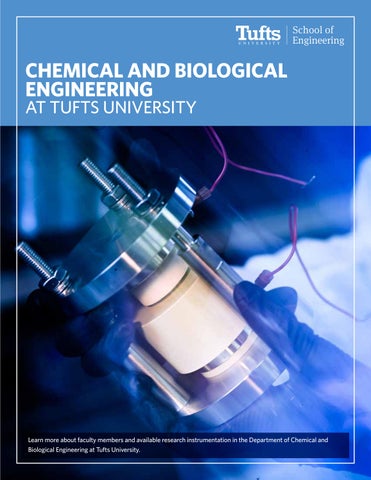
CHEMICAL AND BIOLOGICAL ENGINEERING AT TUFTS UNIVERSITY

Learn more about faculty members and available research instrumentation in the Department of Chemical and Biological Engineering at Tufts University.
ABOUT TUFTS SCHOOL OF ENGINEERING AND CHBE

Tufts University fosters a student-centered experience at a top-notch research university, classified as an R1 institution by the Carnegie Foundation for its high level of research activity. With small class sizes and innovative faculty in a dynamic and supportive environment, a Tufts School of Engineering education builds a strong foundation for successful careers in chemical and biological engineering. ChBE faculty collaborate across disciplines and ventures, providing industry-leading research expertise in energy production, catalysis, metabolic and cell engineering, nanomaterials, biomaterials, and systems and environmental engineering. Learn more at engineering.tufts.edu/chbe

RESEARCH INSTRUMENTATION

Tufts University’s School of Engineering houses stateof-the-art research facilities offering sophisticated instrumentation, experimental services, and expert consultation to investigators and other scientific experts both locally and nationally. We are pleased to offer the following facilities and instrumentation for consideration:

» Tufts Advanced Microscopic Imaging Center offers a wide array of optical and spectral quantitative imaging techniques, for the chemical and structural characterization of materials at submicron scales. Learn more: go.tufts.edu/tamic

» Akta FPLC system for protein purification.

» Caron Reach-in CO2 incubator for tissue/cell culture.

» Synergy HTX multimode plate reader for UV-Vis, fluorescence, and luminescence detection.

» See faculty bios for lab-specific instruments available.

GRADUATE PROGRAMS

The Department of Chemical and Biological Engineering offers the following graduate degrees and certificates:

» M.S. in Chemical Engineering

» M.S. in Bioengineering

» Dual Degree: M.S. offered by Tufts Gordon Institute, and an M.S. in either Chemical Engineering or Bioengineering

» Ph.D. in Chemical Engineering

» Ph.D. in Biotechnology Engineering

» Joint Ph.D. in Materials Science and Engineering

» Certificate in Biotechnology

CO-OP EXPERIENCE

The School of Engineering’s Graduate Cooperative Education (Co-Op) Program provides graduate students with the opportunity to apply the theoretical principles learned in their coursework to real-world engineering projects. Learn more about the Co-Op Program, and how employers can get involved, at go.tufts.edu/soecoop

TUFTS CHBE FACULTY

The Tzanakakis Laboratory specializes in mammalian cell and tissue engineering, bioprocessing, and optogenetics. Its primary goal is to understand how the physiology of human pluripotent stem cells changes during differentiation, with the aim of developing scalable methods for producing therapeutically important cells and tissues, especially for treating diabetes and heart disease.

At the same time, the group uses optogenetic engineering to enable light-controlled, drug-free regulation of cellular functions. This includes controlling glucose-triggered insulin secretion in pancreatic beta cells and cardiac muscle cell contractility. These projects are supported by in-house design and production of viral vectors, such as adenoviral, lentiviral, and adeno-associated viruses, for gene delivery.

The lab also has capabilities for producing recombinant proteins in automated bioreactors using CHO and HEK293 cell lines and has developed expertise in computational modeling of biological systems, including approaches based on population balance equations.

MAJOR EQUIPMENT

» Applikon Biotechnology (Getinge) automated bioreactor systems with 250 ml – 6 L vessels for animal cell cultivation with control of pH, dissolved oxygen, agitation, temperature and supervisory control and data acquisition software.

» Attune NxT acoustic focusing cytometer with violet, blue, and red lasers multi-color flow

cytometry along with Attune and FCS Express software suites for analysis.

» StepOne Plus Real-time PCR system for gene expression analysis.

» LiCORBio C-Digit western blot scanner for protein expression analysis.

Professor Ayse Asatekin

MAJOR EQUIPMENT:

Phenom Pure Tabletop SEM; regular and pressure reduction stages for imaging without coating.

Sputter coater for Au/Pd coating of SEM samples.

Zeta 3D Optical Profilometer.

IKAWORKS lo-vi rotary viscometer.

Genesys 10 UV Visible Spectrophotometer.

BioTech Epoch UV-Visible plate reader.

Water analysis facilities and supplies: VWR expanded range conductivity meter, HP Scientific Handheld Turbidimeter, various test kits for water analysis.

Membrane Casting Materials: Glass plates, various types of doctor blades.

Professor Ayse Asatekin’s expertise is centered on using polymer and surface engineering principles to address various societal challenges. Her main research thrust centers on developing novel materials for membrane filtration, especially for water and wastewater treatment, industrial separations, bioseparations, resource recovery, and other challenging separations. Her lab has developed some of the most fouling-resistant membranes in the literature. Her lab’s expertise also spans polymer design, surface engineering and modification, and membrane synthesis and characterization. Her group has also used polymer self-assembly for other fields, from biomaterials to energy storage.

Membrane Testing Equipment:

Two high-pressure dead-end filtration cells (Sterlitech HP4750) for testing of reverse osmosis and nanofiltration membranes Eight automated testing stations with low-pressure dead-end filtration cells (Millipore Amicon 8010 and 8050, Advantec) for testing ultrafiltration and microfiltration membranes, with 9 parallel lines, equipped with automated flux data collection with Ohaus ScoutPro balances or automated fraction collectors (Pharmacia FRAC100) for tracking filtrate composition.

Two cross-flow membrane test systems with peristaltic pump.

Automated pressure control and data collection (Spectrum KrosFlo TFF) featuring switchable Delrin or clear acrylic membrane cells (Sterlitech).

Cross-flow membrane test set-up, featuring Delrin cross-flow membrane cell (Sterlitech), backpressure controller (Equilibar) and high-accuracy diaphragm metering pump.

Diffusion cells (Permagear and in-house) for diffusivity measurement through polymer thin films.

Associate Professor Prashant Deshlahra’s lab is focused on three main goals: developing new catalytic materials for efficient production of essential chemicals and energy carriers from abundant feedstocks, understanding catalytic phenomena using experimental and computational methods, and applying density functional theory (DFT) methods for materials design and reaction path analysis. Deshlahra’s lab synthesizes solid catalysts such as metal oxides, metals, and alloys, evaluates catalytic reactivity and selectivity, and performs kinetic measurements and DFT calculations to understand mechanisms and structure function relations and identify better materials and process conditions that can improve energy efficiency and decrease environmental impacts of chemical processes. His current interests include selective conversion of highly stable abundant molecules such as small alkanes, carbon dioxide and nitrogen to high value chemicals. His group collaborates, often contributing DFT expertise, with a number of research groups focused on catalysis, chemical and biochemical reactive phenomena, and materials science.

MAJOR EQUIPMENT:

Agilent 7890B Gas Chromatograph

Equipped with FID and TCD detectors for simultaneous analyses of permanent gases and volatile hydrocarbons/oxygenates (C1-C4). Columns cannot be changed, but temperature profile can be adjusted if need be. Samples injected via sample loop; must be in a gas bag or pressurized vessel to inject from.

Bruker Tensor II Fourier Transform Infrared Spectrometer

Equipped with a mid-IR source and MCT detector, a diffuse reflection mirror accessory and a reaction cell for powder samples under different gas environments. A transmission infrared cell for thin wafers of pressed powder samples is also available. No liquid samples or ATR capability.

Agilent Cary 5000 UV-vis spectrometer

Capable of measuring powder samples using a diffuse reflection mirror accessory and a reaction cell under different gas environments or liquid samples in cuvettes in transmission mode.

The Eagan Sustainable Catalysis Laboratory is dedicated to developing and understanding catalytic processes which can be used to transform sustainable feedstocks into high-demand fuels and chemicals. The lab group engineers solid heterogeneous catalysts with a high degree of nanoscale uniformity to produce both practical and model catalysts which can carry out a wide range of chemistries including oxidations, (de)hydrogenations, dehydrations, aldolizations, and 1,2-insertions, among others. One crucial aspect of Eagan’s research involves understanding how catalyst site structures are influenced by the choice of support material, the presence of reactants, and the presence of a high-density fluid phase—all important factors in converting biomass and biomass-derived oxygenates. A second core area of research involves developing kinetic models describing experimental reaction behaviors under ideal conditions which can be used to explain complex conditions relevant to industrial practice. This is particularly important in next-generation biofuel syntheses. More broadly, the Eagan lab has expertise in catalyst syntheses, catalyst characterization, reaction kinetics modeling, and catalyst evaluation in flow and batch mode at low and high pressures.

MAJOR EQUIPMENT:

Micromeritics Flex Sorption Analyzer

Capable of physisorption analyses to determine surface areas and pore size distributions between 3.5 and 5000 A. N2 primarily connected connected as analysis gas, though instrument capable of analyses with O2, Ar, Kr, CO2, H2, butane, and other non-corrosive gases or volatile liquids.

Agilent 8890 Gas Chromatograph

Equipped with FID and TCD detectors for simultaneous analyses of permanent gases and volatile hydrocarbons/oxygenates (C1-C4). Columns cannot be changed, but temperature profile can be adjusted if need be. Samples injected via sample loop; must be in gas bag or pressurized vessel to inject from.

Shimadzu GC-2030 Gas Chromatograph

Equipped with FID detector and typically Rxi-5ms column. Other columns available and may be used, depending on state of ongoing research. Equipped with 150-vial autosampler (liquid injections only). Minimum sample volume: 250 uL.

Micromeritics Autochem II 2920

Automated surface characterization instrument. Capable of chemisorption/titration/temperature programmed desorption analyses with gases (CO, CO2, NH3, N2O) and volatile liquids. Capable of temperature-programmed reduction and oxidation. Operates at atmospheric pressure between -20 and 1000°C. Equipped with internal TCD and external mass spectrometer for effluent analysis.

McDonnell Family Bridge Professor Milo Koretsky

McDonnell Family Bridge Professor Milo Koretsky holds joint appointments in the Department of Chemical and Biological Engineering and the Department of Education. The Koretsky group focuses on learning and engagement in the formal, post-secondary classroom. This work couples innovative instructional design with technology development to investigate student and faculty learning. Specifically, the Koretsky group is interested in the development of disciplinary practices toward the professional formation of engineers, paths to expertise, the university-to-work transition, and ways that social interactions support or hinder learning in engineering. This work inevitably challenges implicit notions of isolated technical competence and seeks ways for students to develop knowledge and practices that allow them to better tackle the sociotechnical work of the profession. This work utilizes a situative perspective to understand the activity systems where students do school and to create ways to shift that activity to align better with professional practice. Over time, this work has led to an interest in supporting faculty to shift their instructional practices as well.

Karol

Family Professor Kyongbum Lee (Dean, Tufts School of Engineering)

Karol Family Professor and Dean of the School of Engineering Kyongbum Lee’s research interests include metabolic engineering, tissue engineering, and systems biology. His research group is interested in the study of cellular metabolism and its role in directing biological function. The group aims to gain fundamental insights into the biochemical and biophysical cues contributing to the regulation of metabolic pathways, and to develop technologies for assembling, characterizing, and manipulating these systems. It seeks to translate these basic insights and technologies into applications leading to engineering practice and meaningful health outcomes. The group is particularly interested in discovering therapeutic and diagnostic targets for metabolic diseases such as obesity.

Electrolytes will play a central role in the development of next-generation batteries and electrochemical devices with increased performance and reduced cost. The Leverick lab seeks to further the molecular understanding of how the electrolyte alters interfaces and reaction pathways within these electrochemical devices. For instance, through a deeper understanding of how ions de-solvate when transitioning from a liquid electrolyte to a solid electrode, novel electrolytes can be designed that enable enhanced battery performance at low temperatures as well as multi-valent battery chemistries based on ions like Magnesium. Moreover, by studying how the electrolyte alters the solubility of inorganic phases and their nucleation and growth kinetics, researchers can enable the implementation of desired electrode materials such as Lithium metal, as well as Li-O2 and Li-S chemistries. Such interactions at the interface between liquid electrolytes and electrodes can be further exploited to reduce energy requirements and improve selectivity in fuel cells and electrolyzers. Finally, through the development of novel electrolyte materials, such as new classes of solid-state ion conductors, nextgeneration devices with enhanced form factor stability and enhanced safety can be realized.

MAJOR EQUIPMENT:

TA Instruments TAM IV Microcalorimeter

Ultra-sensitive microcalorimeter for directly measuring the enthalpy of solvation and other non-covalent interactions in battery-relevant electrolytes, and other energy applications.

TA Instruments HR10 Rheometer

Hybrid Rheometer with temperature range from -40°C to 150°C.

Renishaw inVia Reflex Spectrometer

Raman spectrometer and microscope with 532nm and 785 nm lasers, featuring standard and high spectral resolution gratings. Has the ability to do spatial maps of samples.

TA Instruments DSC25 with LN Pump

Differential scanning calorimeter with measurement range of -180°C to 400°C.

Professor of the Practice

Professor of the Practice Derek Mess’ research interests include materials development for energy, environmental, and aerospace applications; synthesis and processing of high temperature materials, including thermal barrier coating (TBC) and solid oxide fuel cell (SOFC) ceramics; and gas-solid reactions associated with carbon dioxide capture.

The Synthetic Biology and Systems Bioengineering lab has two primary interests – the first is to engineer biological systems for a variety of biochemical and biomedical applications, and the second is to glean fundamental understanding from these engineered systems about how biological systems work. The demand for better biofuels, more potent antibiotics, and biotherapeutics offer extremely fertile areas for such research and technological development. By using the strengths of evolutionary selection and systems analysis, Nair’s lab engineers new functions into biological systems like proteins, oligonucleotides, gene regulatory systems, and even entire cells – with the aim of trying to find answers to the aforementioned needs.

The fast growth rates and relative simplicity of microbes provide researchers with the ability to experimentally study natural evolutionary processes. These insights enable them to rationally design robust synthetic biological systems that leverage the natural complexity of organisms rather than compete against natural propensities that have evolved over millennia.

MAJOR EQUIPMENT:

Agilent 1260 Infinity Quadruple-pump HPLC system with two column valve, heated column compartment that ranges from room temperature to 100 °C, and a refrigerated (4 °C) autosampler with microtiter plate and sample vial compatibility. Detectors: evaporative light scattering detector (ELSD) and Diode Array Detector (DAD).

Molecular Devices SpectraMax iD3 Multi-Mode

Microplate Reader with top and bottom UV/Vis, fluorescence, and luminance read capability for up to 384-well plates is housed in the lab. The instrument is also equipped with an absorbance injector for dynamic assays.

Molecular Devices SpectraMax M3 Microplate

Reader with top and bottom UV/Vis, fluorescence, and luminance read capability for up to 384-well plates is housed in the lab. The instrument is also equipped with a fixed path-length cuvette slot and a SpectraDrop microvolume adapter for low volume (2-4 µL) DNA and RNA quantification.

BioTek Epoch 2 Microplate Spectrophotometer performs UV-Vis absorbance measurements. in 6- to 384-well microplates and cuvettes. The broad wavelength range enables applications from nucleic acid and protein quantification in the low UV to microbial growth assays higher wavelengths.

Leica DMi8 inverted microscope with a scanning stage with 4x, 20x, and 100x objective lenses. The 100x objective lens is a high-end planapochromat oil-immersion phase contrast. The software includes a complete deconvolution package to visualize surface and cytoplasmic features on and in bacterial cells.

Fisher Accupsin 1 and 1R benchtop centrifuges

Professor and Dean of Research

The Green Energy and Novel Electrolytes Lab directed by Professor Matthew Panzer is an established leader in the design of nonaqueous gel electrolyte materials featuring room temperature ionic liquids and deep eutectic mixture solvents. The ultralow volatility of these highly ion-dense electrolytes can enable the safer operation of electrochemical energy storage devices, which is especially important for wearable technologies. This group has expertise in polymeric, inorganic and hybrid materials synthesis, characterization, and assembling and testing electrochemical device prototypes that incorporate ionic liquid-based (ionogel) or deep eutectic mixturebased (eutectogel) electrolytes. Typical devices of interest include supercapacitors, batteries, and stretchable/flexible capacitive sensors (ionic skins).

Daniel Ryder’s research interests include the chemical processing of ceramics, process control applications, and artificial neural network applications.

Associate Professor Daniel Ryder

The Van Deventer Lab seeks to expand the capabilities of antibodies to create next-generation therapeutics, diagnostics, and reagents. Researchers in the lab are pursuing the careful addition of chemistries not normally found in proteins to create “hybrid” antibodies that combine the best features of conventional antibodies and small molecules. They seek to identify hybrid antibodies that perform challenging tasks such as disrupting the functions of challenging disease targets (cancer and infectious disease), enhancing antibody potency, lengthening duration of action, or increasing sensitivity of target detection. To engineer these antibodies, the Van Deventer Lab has established a high throughput screening platform that combines yeast display and noncanonical amino acids. Their work has also opened up opportunities to engineer yeast to better accommodate alternative genetic codes, which will facilitate further chemical diversification of antibodies. The group is well-positioned to generate the comprehensive datasets needed to apply machine learning and data analysis to move towards design principles of hybrid discovery and beyond. Key underlying expertise includes yeast display, antibody engineering, noncanonical amino acid incorporation, and deep sequencing.

MAJOR EQUIPMENT AND CAPABILITIES

Genetic Code Expansion in Yeast All molecular biology tools, media, and workflows needed to prepare proteins containing site-specifically encoded noncanonical amino acids in yeast.

Attune NxT Analytical Flow Cytometer (4-laser, 16 parameters) with autosampler. Characterization expertise with yeast-displayed antibodies (e.g. antigen binding, titration experiments) and expertise in establishing unconventional yeast display assays (e.g. covalent binding assays, monitoring chemical and enzymatic reactions on the yeast surface).

Genetically Encoded Library Design, Construction, and Screening (all required incubators, electroporation equipment, and accompanying molecular biology tools). Routine construction and validation of large protein libraries in yeast (typically 1 million to 1 billion members) for magnetic bead-based enrichments and fluorescence-activated cell sorting. Deep sequencing analysis of constructed libraries and screening outputs. Applies to conventional protein libraries and libraries encoding noncanonical amino acids.

Robert and Marcy Haber Endowed Professor in Energy Sustainability Bin Wang

Bin Wang joined the Tufts ChBE faculty as the Robert and Marcy Haber Endowed Professor in Energy Sustainability in January 2026. Wang was previously the Conoco DuPont Professor in the School of Sustainable Chemical, Biological, and Materials Engineering at the University of Oklahoma. He also holds a position as visiting professor at the Max Planck Institute for Sustainable Materials and previously at the Lawrence Livermore National Laboratory. He received a Ph.D. in chemistry from the École Normale Supérieure (ENS) de Lyon supported by a Marie Curie Fellowship from the European Commission. He was a postdoctoral research associate in physics at Vanderbilt University. He received a Department of Energy Early Career award, an American Chemical Society Computers In Chemistry (ACS COMP) OpenEye Outstanding Junior Faculty Award, and a Friedrich Wilhelm Bessel Research Award from the Alexander von Humboldt Foundation. Wang has been recognized as one of ACS Industrial & Engineering Chemistry Research’s “Influential Researchers” and was named a highly cited researcher by Clarivate in the cross-field category. He is currently the president of the Great Plains Catalysis Society, the secretary of the ACS Division of Catalysis Science and Technology (CATL), and an editor of the Chemical Engineering Journal. His research is focused on computational simulations (quantum mechanical, molecular dynamics, and AI/ML) of nanoscale materials and their applications in catalysis, optoelectronics, and batteries. The research leverages computing resources at the national and regional supercomputer facilities.

Associate Professor Hyunmin Yi’s general research interests lie in understanding and exploiting selective and programmable properties of biological materials and interactions for the controlled fabrication of functional materials at micro and nano scales (nanobiofabrication) such as multifunctional biosensors, biophotonic devices, and precious metal nanocatalysts, for biomedical, environmental, and biotechnology applications. His lab’s continuing and recent efforts center on developing hydrogel microparticles for rapid and selective biosensing and early diagnostic applications with novel building blocks, including a range of zwitterionic copolymers for enhanced selectivity and simple 2D shapebased encoding. They are also incorporating a variety of functionalities ranging from artificial opals for stimuli-responsive optical functions, multifunctional biopolymeric nanofibers toward mechanical enhancement and tunable bioconjugation, and peptide ligands for rapid disease diagnostics. The lab’s collaborative endeavors expand these core areas of expertise with projects such as multifunctional membranes for desalination with improved anti/biofouling and wearable sensors for individualized medicine.

MAJOR EQUIPMENT:

Beckman L90k Preparative Ultracentrifuge equipped with 3 Titanium rotors (70-Ti, SW-55Ti, SW-32Ti) to separate a wide range of nanoparticle and viral samples up to 228ml volume.

Olympus BX51 Upright Epifluorescence Microscope equipped with a DP70 microscope camera and VisionPro software capable of brightfield, darkfield and fluorescence imaging and processing in cyan, green and red spectral ranges suitable for CFP, DAPI, GFPuv, EGFP, FITC, mCherry and Texas Red. Regular and long working distance objective lenses at 4X, 10X and 20X magnification suitable for microparticle, cellular and macroscopic sample imaging.

Thermo Evolution 300 UV-vis Spectrophotometer with 8-cell Peltier Temperature Controller capable of fixed wavelengths, spectral and kinetic measurements with controlled magnetic stirring and temperature control for each individual cell suitable for real time reaction monitoring.

Beckman Allegra X15R Benchtop Centrifuge and a suite of air-cooled and refrigerated microcentrifuges to handle up to 800ml of samples.

Department of Chemical and Biological Engineering

Science and Technology Center, Tufts University

4 Colby Street Medford, MA 02155

Learn more about the Department of Chemical and Biological Engineering at engineering.tufts.edu/chbe

Learn more about the School of Engineering at engineering.tufts.edu and about Tufts graduate programs at asegrad.tufts.edu

Connect for recruiting, education, and research at engineering.tufts.edu/industry

Find us on Instagram, X (formerly Twitter), and Facebook at @TuftsEngineer

Turn static files into dynamic content formats.

Create a flipbook