defense capability of the country or the security of the state.”
Tufts University and The Fletcher School of Law and Diplomacy have been effectively banned by the Russian government due to allegations of “anti-Russian propaganda,” open solidarity with Ukraine and support for the LGBTQ+ community, according to a Tuesday statement from the Prosecutor General’s Office of the Russian Federation.
The university and its graduate school for international affairs were designated as ‘undesirable organizations,’ invoking a 2015 law signed by President Vladimir Putin. The Russian undesirable organizations law allows the government to target foreign groups considered “a threat to the foundation of the constitutional order of the Russian Federation, the
In a Friday community message, the university said the designation would prevent Tufts and Fletcher from “having any activities or presence in Russia” and discouraged all travel to the country.
“We understand that this news may be deeply concerning to some of you. Under the Russian government’s ‘undesirable organizations’ statute, individuals affiliated with an organization that has received this designation may face criminal penalties,” the email read.
The Russian government framed the decision, in part, around Tufts’ support for Ukraine following the Russian invasion launched in 2022, which Putin and his government have described as a ‘special military operation.’
According to a WGBH translation of the statement, both Tufts and Fletcher have become “instruments of anti-Russian propaganda” which “undermine public trust in [Russia’s] leadership, law enforcement agencies, and the Russian Armed Forces, and … create conditions conducive to the development of protest sentiments and the radicalization of society.”
Additionally, the statement alleges that these institutions push a pro-LGBTQ+ agenda “[i]n order to destroy traditional family and moral values of Russians.”
The LGBTQ+ movement was designated as a terrorist organization in Russia in 2023. The statement added that the university and similarly-banned institutions undermined Russian society and its military.
At their Feb. 24 meeting, the Medford City Council unanimously passed a resolution to request a comprehensive litigation report from Mayor Breanna Lungo-Koehn and her administration of all lawsuits the city has been served since 2019. With the city facing one of its most high-profile legal challenges in the form of a federal lawsuit over the ValuesAligned Local Investments Ordinance, the resolution has caused a clash between councilors and the mayor.
Sponsored by Council President Zac Bears and Councilors Justin Tseng and George Scarpelli, the resolution notes that the City Council does not receive regular updates about Medford’s litigation. The resolution’s wording argues that the lack of litigation information prevents the council from performing its duties as an authority over where funds are allocated.
“It’s my responsibility as City Council president and the responsibility of the City Council to understand what’s going on with the legal and contract liability and exposure from the administration so that we can fix it, preserve the trust of residents and ensure that we aren’t losing out on much-needed revenue for city services,” Bears told the Daily.
The resolution also raises concerns about a spike in unfair labor practice charges filed against the city between 2020 and 2024, which increased by 573% compared to the period between 2011 and 2019.
The resolution asks the mayor’s office to present a comprehensive report of all lawsuits and
other legal actions, along with the financial costs of each process, by the end of April. As resolutions are non-binding proposals, Lungo-Koehn is not required to follow the council’s request and she has not yet moved to create the report.
However, Bears did not rule out the possibility of more restrictive legal action, such as an ordinance, to acquire the report from the mayor’s office.
While Lungo-Koehn did not comment on the specific language of the resolution, she expressed that the mayor’s office had been transparent with litigation history during her tenure. She also primarily attributed the increased number of unfair labor practices to Scarpelli and Steve South, secretary-treasurer of Teamsters Local 25 and the union’s former representative to the city. She accused South of filing over 50 labor grievances in her first term.
South did not respond to a request for comment from the Daily.
The mayor argued that new conversations with unions have also led to more labor practice lawsuits. “We’ve never had a professional, experienced HR director until the last three years,” Lungo-Koehn said. “It’s been something that our unions are not used to and gradually they are getting used to it. … With that comes grievances.”
Council Vice President Emily Lazzaro claimed that Medford’s lack of a city solicitor in recent years has hindered transparent conversations between the City Council and the mayor’s office, in particular because the city structure grants most departmental oversight to the mayor.
Julian Glickman Executive News Editor
see RUSSIA, page 3
Evan Vezmar Deputy News Editor
SHOSHANA DALY / THE TUFTS DAILY
The flag of the Russian Federation is pictured in the Hall of Flags, located in the Fletcher School of Law and Diplomacy.
JAMIE SONG / THE TUFTS DAILY
Four-year, 573% increase
MAYOR continued from the front
Bears alleged that LungoKoehn sought to fire the city solicitor with Bears’ assistance without explanation after November’s local elections.
Law, an independent law firm that works with the city, has been offering the mayor legal advice on city actions.
Bears argued that leaving only the private firm in charge of legal considerations has left Medford with an unsustainable solution for resolving the city’s legal issues.
“We’re deeply concerned about the mayor’s recent actions regarding legal contract matters and the exposure it creates for the City of Medford,” Bears said. “On election night, the Mayor came to me and asked me to help her fire the city solicitor.
I immediately declined, and days later, the City Council received an email that he had been terminated without explanation. In the months before and after, we’ve seen more issues piling up.”
At their April 7 meeting, the City Council approved settlement amounts for eight pending lawsuits against Medford. The amounts range from $3,000 to $235,000 on various issues, including insurance claims and collective bargaining complaints.
Lungo-Koehn also accused Bears and Scarpelli of working together to make a resolution that could boost Bears’ political ambitions.
“It’s been six plus years that I’ve been mayor and I think they’re looking to make it an issue against me specifically,”
Lungo-Koehn said. “I think that the president of the council and Councilor Scarpelli have joined forces and it’s going to be part of a political campaign for when the president runs for mayor in 2027.”
Bears has not publicly announced plans to launch a mayoral campaign. In February, he announced he would not seek the open state senate seat being vacated by retiring Senator Pat Jehlen.
“I think it’s a disservice that the mayor is treating this as some sort of vendetta and letting her fears about the next election get in the way of doing what’s right for Medford,” Bears said of LungoKoehn’s claims.
Scarpelli did not respond to a request for comment from the Daily.
in labor complaints creates feud
The resolution has exacerbated tensions between the mayor and City Council over a lawsuit filed against the city for its ValuesBased Ordinance. The ordinance was signed into law in November, overriding Lungo-Koehn’s initial veto after she and KP Law cited legal and financial concerns.
The city council is planning to hear a resolution next week requesting $75,000 from the mayor to fund the legal defense of the lawsuit against the city for the Values-Based Ordinance.
While the lawsuit names both the City Council and the mayor’s administration as defendants, Lungo-Koehn blamed the council for choosing to move ahead with the ordinance even after the veto.
“I vetoed the ordinance based on legal and financial reasons, not moral. They overrode my veto, so you have to ask them why they are choosing to disregard my veto and, more importantly, disregard the legal memo to them identifying all the legal issues that came with passing the most broad values-based ordinance in the country,” she said.
“We have to calculate that risk and decide whether or not it’s worth doing, and I think that making those choices was very different from arguments with unions and unfair labor practice lawsuits,” Lazzaro said.
While there has not yet been a legal outcome in the ValuesBased Ordinance lawsuit, Lungo-Koehn noted that similar federal lawsuits have cost neighboring townships millions of dollars in settlements.
Bears and Lazzaro defended the City Council’s decision to override the mayor’s veto on the ordinance, citing the need to take potentially risky actions on issues important to Medford residents. Lazzaro also highlighted the difference between unfair labor practice litigation and the lawsuit over the ordinance.
COURTESY ZAC BEARS
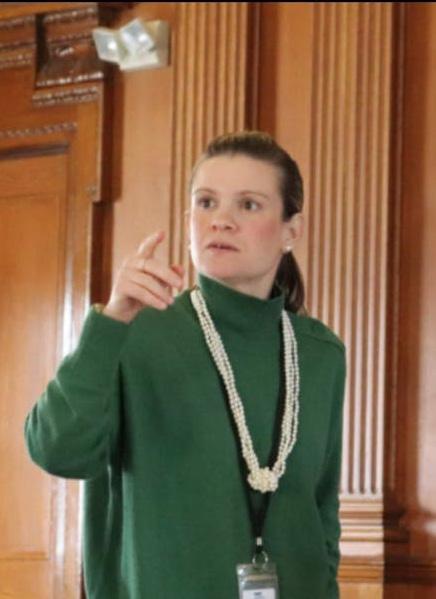
Medford City Council President Zac Bears (bottom, 2023) and Mayor Breanna Lungo-Koehn (top, 2020) are pictured.
ALEXANDER THOMPSON / THE TUFTS DAILY
Tufts community reacts to ‘undesirable’ designation
The undesirable organizations law effectively bans an organization’s operations within Russia, preventing it from legally operating, opening offices or running programs in the country.
The law also forbids Russians from interacting with the organizations, including cooperating or working with, donating to or publicly supporting the institutions. Initial violations typically result in hefty fines, while repeated involvement could lead to potential criminal charges and prison sentences of up to six years.
Students and faculty, some of whom spoke on the condition of anonymity due to the sensitive nature of the issue, said the designation would mostly affect students with Russian citizenship and would discourage Russian students from choosing Tufts.
The extent to which Russian nationals currently enrolled at the university would be affected was not immediately clear. A Fletcher student told the Daily that violations would likely result in large fines, not prosecution or imprisonment.
A Tufts undergraduate from Russia said they were unsure how the designation would affect their travel.
Although the designation could create fears for Russian students wishing to return home and
academics wishing to conduct research, the war in Ukraine and ongoing tensions between Russia and the West have made travel difficult for many years.
Beyond the Russian government’s messaging around the LGBTQ+ movement and the war in Ukraine, an exact rationale for the designation puzzled many experts on the region.
“Most of the people I know who study Russia are perplexed by the decision,” Arik Burakovsky, former associate director of the Russia and Eurasia Program at Fletcher and current associate director of the Center for Expanding Viewpoints in Higher Education, said. “We are not sure about the timing of the decision or the true rationale.”
Oxana Shevel, an associate professor of political science, suggested that the Office of the Prosecutor General’s decision was part of a pattern of similar actions made without a clear explanation.
“I don’t get the sense that there is a very … coherent and systematic way of doing it,” she said. “It is very possible that at some point, somebody was maybe surfing the internet and came across some talk by somebody affiliated with Tufts or some op-ed.”
Tufts and Fletcher are not the first American higher education institutions to be designated as undesirable. Bard College was added to the list in 2021, while Brigham Young
University, Yale University, George Washington University and the University of California, Berkeley were targeted in 2025 and 2026.
Shevel, who is Ukrainian and has focused her research on the post-Soviet region, added that the designation and similar actions by the Russian government were attempts by Putin’s administration to consolidate power domestically.
“I think it’s about the Russian authoritarian regime asserting its power primarily against its own citizens,” Shevel said. “They don’t have any way in practice to do anything to us, so all they can do is [make] symbolic proclamations. … I consider this, if anything, a badge of honor.”
“There seem to be … bureaucrats in the Ministry of Justice who do not understand foreign affairs, and they are trying to go after us for who knows what reason,” Burakovsky said. “I see this as part of an ongoing tit-for-tat set of sanctions and cancellations between the United States and Russia, so it’s not completely unexpected, but it is disappointing, given how much effort we have made to continue informal dialogue with Russian scholars.”
Tufts does not currently have any official programs in Russia. In March 2022, the university severed relations with two Russian universities — the Moscow State Institute of International Relations, an institution run by the Russian
Foreign Ministry, and the Higher School of Economics — following the Russian invasion of Ukraine.
Burakovsky, however, said the university still maintains some relationships with Russian academics, despite no member of Tufts faculty or staff having formally visited Russia since 2022.
The Fletcher student speculated that the decision could have been made in response to a variety of scenarios, including pressure from a member of the Russian elite whose family member was rejected from the university or flagged statements from a Tufts or Fletcher faculty member. They added that a past conference involving both members of Fletcher and the Russian government could have created tensions.
“It’s possible that the conversations they had left a sour taste in someone’s mouth about what the Fletcher School thought of Russia’s war in Ukraine,” the student said.
In 2024, the Russia and Eurasia Program at Fletcher produced a report with the Yale School of Public Health’s Humanitarian Research Lab analyzing Russia’s bombardment of Ukraine’s power grid. The report concluded that the geographic distribution of strikes “points to possible violations of the international humanitarian principles of distinction and proportionality.”
The International Criminal Court subsequently indicted
two senior Russian military commanders, Sergei Kobylash and Viktor Sokolov, for the same attacks. The Yale School of Public Health framed the decision as a response to the report.
In 2023, Fletcher hosted an event marking the first anniversary of the war in Ukraine, discussing how the war had affected the international security climate. Participants in the panel discussed the erosion of Russian public support for Putin and the war, as well as the country’s loss of energy leverage over the European Union.
Several Fletcher faculty members, including co-directors of the Russia and Eurasia Program Daniel Drezner and Chris Miller, have been vocal about Russia’s actions, including in national media.
“We have plenty of individual scholars at Tufts who have been very critical of the Russian government, of Russia foreign policy,” Burakovsky said. “But that should not mean that the entire university should be somehow banned or cancelled.”
Mikhail Troitskiy, visiting professor and current administrator of the Russia and Eurasia program at Fletcher, referred the Daily to the university’s statement.
Anika Parr contributed reporting.
Recent eagle death suspected to be linked to second-generation anticoagulant rodenticides
On March 11, a bald eagle known as FAE, which nested near Lower Mystic Lake on the ArlingtonMedford border, passed away. While the cause of death is still being determined, wildlife experts suspect second-generation anticoagulant rodenticides, commonly referred to as SGARs.
“Every raptor I hear of in Somerville or around Somerville that meets an untimely death is exposed to these rodenticides,” Mary Vriniotis, co-founder of Save Somerville Wildlife, said. “I would be very surprised, when the results come back, if it doesn’t turn out that there were highly lethal doses of [SGARs] in [FAE’s] system.”
The Tufts Wildlife Clinic has ruled out avian flu as the cause of death, making rodenticide poisoning even more likely.
“The fact that this animal doesn’t have flu … increases the likelihood it’s something else, like rodenticide poisoning,” Laura Kiesel, head of Save Arlington Wildlife and Save Massachusetts Wildlife, said.
Activists have been urging the city of Somerville to take action on this issue for years. Last December, two owls in the city died from rodenticide exposure within a twoweek period, and in 2023, a bald eagle known as MK and her offspring were also poisoned. Despite these incidents, there has been minimal change at the city level.
“The city is responsive to our requests to communicate about this
important problem … [but] I haven’t, to date, seen what I would describe as meaningful progress to reduce the use of rodenticide in Somerville since the owls died,” Vriniotis said. “I see a lot of discussion about it, which is certainly important, but what I’m looking for is some more concrete steps.”
While Somerville currently has a policy against the use of SGARs on public land, wildlife activists have been vocal in support of this policy’s codification. They also request the city file a home rule petition requesting the state allow the city to extend the ban to private property.
“I think that that would go a long way, because Somerville is a large city,” Kiesel said. “I would really like to see the bigger cities like Somerville, Cambridge and Boston actually do these home rule petitions and join other communities. I’m just disappointed they haven’t, given their progressive nature.”
With the new mayoral administration, the city may be placing a stronger emphasis on eliminating the use of rodenticides. Wilson included Kiesel on his transition team, where she advocated for the home rule petition and explored other ways the city could limit rodenticides. Kiesel and Vriniotis are also planning to meet with Wilson on April 9 to further discuss new approaches.
“I think [Wilson is] also … eager to take on this issue and supportive of the bills currently going through the Massachusetts Legislature on this issue,” Vriniotis said.
While formal policy changes are being considered, the city’s Inspectional Services Department
remains committed to limiting the use of SGARs.
“The city has an internal policy … we don’t use [SGARs] on city properties unless in very specific special circumstances,” Alicia Privett, Somerville environmental health coordinator, said. “With our contractors for city property, we ask that they use snap traps, dry ice or carbon monoxide for burrow treatment.
… For the Residential Assistance Program, [we use] the vitamin D-based rodenticide.”
Activists continue to push for codified bans despite the city’s stance, arguing that a formal safeguard is necessary to ensure the policy is upheld.
“They’ve already gone on record before saying, ‘Hey, we’re not using
[SGARs],’ and then a few years later they went back to using it,” Kiesel said. “Without that codification, there’s just a concern that they can backpedal, and they might even do it without people noticing.”
Kiesel explained that while Somerville stated in 2018 that it was no longer using rodenticides, a public records request she filed in 2023 showed the city had resumed using SGARs.
“It looked like during [COVID19], the pandemic shutdown, they regressed and started using [SGARs] again, because there was an uptick in rat sightings during the pandemic,” she said.
Neighboring towns, including Arlington, Lexington and Cambridge, have already banned
the use of SGARs on public property, with Cambridge banning it most recently in June 2025.
Privett argued that a codified ban would be beneficial for the city, as other methods of rodent control are more effective than SGARs. She said improved sanitation practices are the best solution to rodent control.
“Increased waste management is really the solution to the rodenticide problem,” Vriniotis agreed. “Rats have plenty to eat around Somerville, so you can put out all the poison you want, but if there’s overflowing trash next to it, then you’re [still] going to … have an increase in the rodent population. It’s not something we can poison our way out of.”
Anika Parr Deputy News Editor
CARYS YANG / THE TUFTS DAILY
A drowsy owl dozes in the yellow leaves outside Houston Hall on Oct. 23, 2024.
RUSSIA continued from the front
FeATUReS
Meet the Tufts students inspiring next-gen Jumbos
Grace Nelson Managing Editor
I still remember how I felt when I first stepped foot on Tufts’ campus. It was one of the admitted student days (Jumbo Days, as they’re lovingly coined), and everyone around me was practically buzzing with excitement. Despite the windy April chill, all of the students were eager to get a tour of campus and see what life was like for a Jumbo.
There were so many reasons to enjoy the visit — the complimentary Panera breakfast and the free lanyards, to name a few. But what really made the visit special was the tour guide. He was a senior studying history, something that appealed to my humanities-oriented heart. What most impressed me, though, was when he talked about studying abroad for the entirety of his junior year at the University of Oxford. I remember my mom nudging me with her elbow, a knowing smile on her face. She knew that I dreamed of traveling to the U.K. At that moment, my heart was set. I was going to Tufts.
Now, here I am, four years later — not just as a Tufts student, but as a student worker for the Office of Undergraduate Admissions. I’m a triple threat: a tour guide, a customer service assistant — which we simply call a CSA — and a former summer admissions intern. You could say I was thoroughly inspired, but what does it take to leave a lasting impact on prospective students? How do students at the Office of Admissions inspire the next generation of Jumbos?
The office is full of students coming from all around the world, with unique perspectives, academic interests and extracurricular niches.
Perhaps the most public-facing role that students in the office can hold is that of tour guide. At least once a week, these students guide prospective students and their families around campus, pointing out all of the hot spots. As tour guides, we have to know everything about anything, and as a result, I’m known among my friends as the person with infinite Tufts-related knowledge.
No one gives more Tufts tours than my coworker, junior Silas Summers. You’ll find Silas checking in for his tours in Dowling Hall at least two to three times a week.
“For a long, long time, I’ve always given tours,” he said. “I’ve given tours [of] my middle school, of my high school. … I like to talk about what I like to do and hopefully … include other people as well a part of it.”
For Summers, working for the admissions office is one of his most significant extracurricular activities at Tufts.
“A lot of people do know me for doing tours on campus,” he said. “It’s definitely a big part of what I do.”
As much as we tour guides enjoy our roles on campus, there are certainly some skeptics as to the authenticity of our stories. There is a common misconception that college tour guides simply recite a script filled with blatant praise of their universities. Recently, The Daily Tar Heel — the University of North Carolina at Chapel Hill’s student newspaper
— reported that a tour guide was “placed on temporary leave” after a surprise tour evaluator wrote her up for sharing an anecdote that “felt negative.”
This story was especially shocking for me to read, as it was so different from my experience at Tufts. Sure, we get a recommended route and outline, but ultimately, we get to choose what to say. When we say something positive, it’s because we really mean it, not because we are told to say it.
It’s not just me who believes this, either. Alexa Santa Cruz — a junior who gave tours this past summer as a part of the Office of Undergraduate Admissions’ summer internship — similarly cites this genuineness.
“As a first-gen student, being transparent is always super important to me, so I like to keep it as real as I possibly can,” she said. “I think a lot of students appreciate that.”
So yes, let the rumor mill cease: We aren’t reciting propaganda — we share our true experiences. We know it’s effective, too, because many students end up reaching out to say just that.
“I’ve definitely gotten a few emails after my tours [from] people that I’ve given tours to,” Summers said.
Like Summers, Santa Cruz, too, enjoys hearing from students who were on her tours.
“I did get recognition in a lot of students’ ‘Why Tufts?’ [essays], so I’m happy that people like what I have to say and are enjoying my experiences,” she said.
Maybe you get a celebratory email from these students announcing that they were
accepted, maybe you see them in line at The Sink or maybe you even become good friends. Regardless, it’s always nice to learn that you may have played a role in determining which college prospective students matriculate.
Similarly, the CSAs at the Dowling Hall welcome desk can have a huge impact on this decision. As CSAs, we set the tone of the visit, curating a welcoming environment for all prospective students and their families. Not only do we check students in, we also share personal anecdotes and give recommendations for places to visit on campus or locations to grab a quick bite to eat.
“This is a really good role for me because I get to talk with people about a place that I’m super excited about,” sophomore Lauren Rummler, a fellow CSA, said. “I can really see it on their faces when we have good conversations. … I do really hope that they continue their application process [after their visit] and that we are truly inspiring the … next generation of Tufts [students].”
Of course, one of the most exciting times for the Office of Undergraduate Admissions is Jumbo Month. Just like me, Rummler recalls feeling excited about attending a Jumbo Day during her senior year of high school, so she feels especially nostalgic now that she is on the other side of the event.
“Jumbo Days [are] so awesome,” she said. “I [get] to talk with a bunch of prospective students who got in and see their excitement about the whole process. I remember when I went to Jumbo [Day], I met a lot of friends. It was a great time.”
A lot of the work put into organizing Jumbo Days is completed by undergraduate interns. Santa Cruz, who also works as a general intern for the Office of Undergraduate Admissions, talked about the effort that goes on behind the scenes to ensure smooth operations, including organizing the Gantcher Family Sports and Convocation Center, placing balloons around campus, setting up water and catering and even folding the T-shirts for admitted students.
“I did my first [Jumbo Day] last Friday, and that was really fun. … It was [also] very hectic,” Santa Cruz said. “I worked from 6:30 in the morning till 4:30, so it was a long, long day.”
The Jumbo Day tours are especially unique, as we are able to talk more about “student life” rather than “statistics,” as Summers puts it. And thank goodness for that — or else I wouldn’t have known about Oxford University from my tour guide.
Yes, not only did I follow in my tour guide’s (literal) footsteps by doing the same job, but I also attended the same study abroad program as him.
But just wait, because it gets even crazier. One day, my friend Laëtitia and I were discussing our Oxford tutorials, and she mentioned in passing that she was being taught by a former Jumbo. Out of curiosity, I asked her to show me a picture. Imagine my surprise when I was met with the face of my former tour guide, Haitong Du (LA’22). Some internet sleuthing later, we quickly confirmed that the timeline added up. Laëtitia tried to convince me to send a cold email, but I was too afraid of bugging him.
She worked her magic, though, because a few days later, he reached out to me directly. While he claimed to only remember it “vaguely,” he was still able to recall the exact date of my tour. Crazy, right?
“You might find this strange, but I feel like your tour really influenced my college career,” I wrote back.
While we may not always realize it, our impact as student workers for the Office of Undergraduate Admissions is truly astounding, and my Tufts trajectory is a testament to that.
As I reflect on my four years at Tufts, I feel extraordinarily grateful for everyone who made my Jumbo Day experience so wonderful, as it played an important role in my decision — not just my tour guide, but the CSAs who checked me in, the interns who woke up early to set up and, of course, the Campus Visit Coordinator, Pam (the best boss ever!). Now, as I begin my final stretch of tours, I hope to do my part in showing off what makes this place so great.
AARON GRUEN / THE TUFTS DAILY
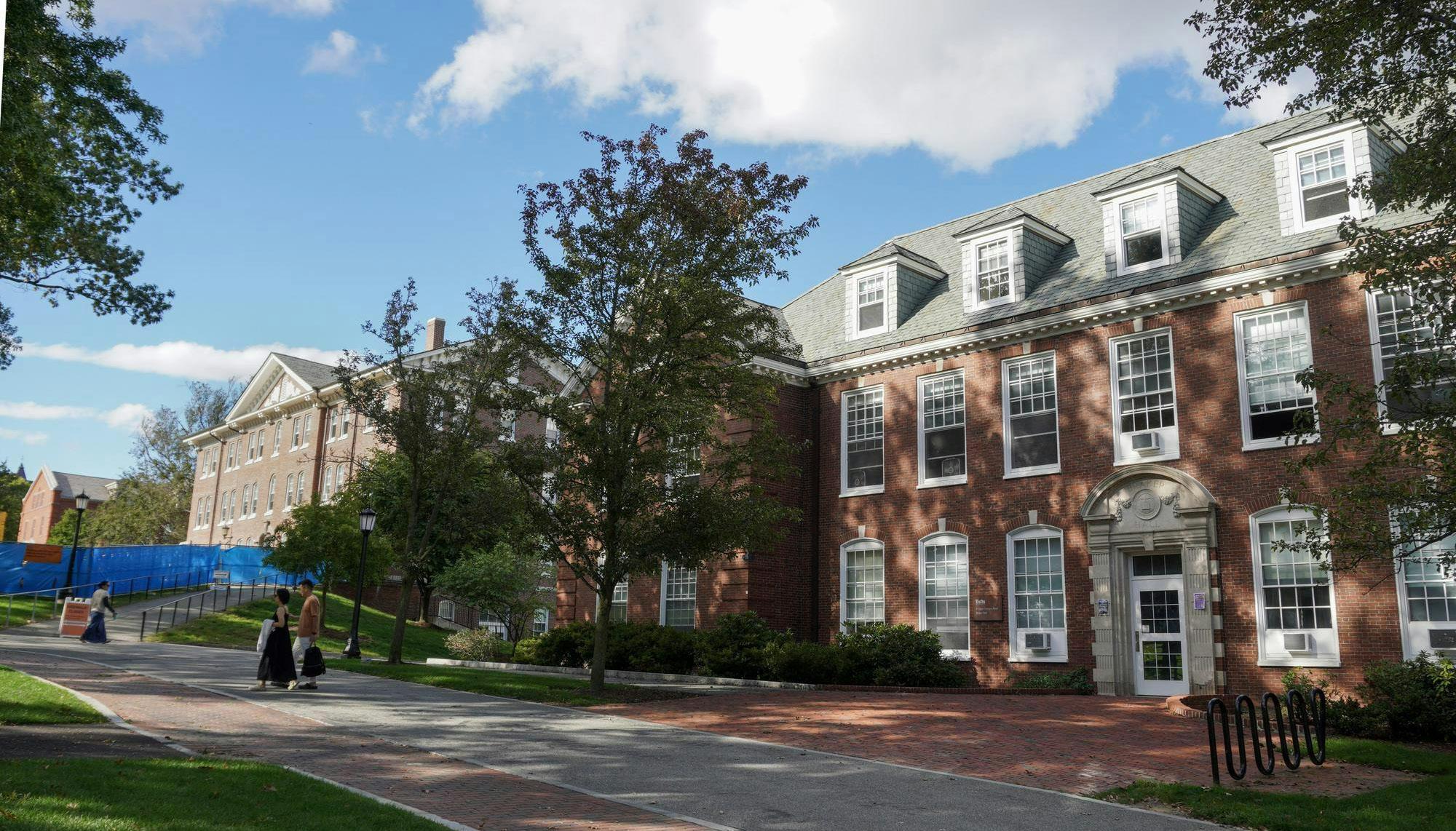
Bendetson Hall is pictured on April 12, 2023.
The Daily’s Features Staff’s guide to exploring Tufts’ campus
Tufts Daily Features Staff
Going somewhere new, especially a place as sprawling and expansive as a college campus, can be intimidating. It often takes weeks or months to truly settle in, adopt a routine and develop a sense of familiarity. However, this doesn’t mean you can’t get some help along the way. Below is a guide to some of the Daily’s Features section staff’s favorite on-campus spots to study, relax and hang out with friends — perfect for anyone who has just arrived on campus or is simply looking to explore somewhere new.
Collaborative Learning and Innovation Complex
The Collaborative Learning and Innovation Complex, more commonly known as ‘574,’ as indicated by its address 574 Boston Ave, is a personal favorite of mine on campus. Serving as the hub for community health, physics, occupational therapy and other science and technology specialties, the building offers a modern and expansive spin on the typical comfortable, nostalgic feeling of most Tufts buildings. 574 is known for its robotics labs, exposed metal pipes lining the ceilings, abundant windows, colorful patterns on a green backdrop and many tables with rolling chairs to study — an ideal study environment for me. It’s quite out of the way from the rest of campus, providing a peaceful 10-minute walk everyday — and that doesn’t include when I walk along the beautiful New England streets that line my route there! The building is also rather quiet despite the occasional rumbling of the Green Line, and there’s so much to see on each floor. I strongly recommend this as a place to study and just generally explore!
Contribution by Maia Goldman, Assistant Features Editor Joyce Cummings Center
If you take the Joyce Cummings Center elevator to the fourth floor and turn right after exiting the
I’ve met so many people here in Barcelona. I’ve made friends with people as close as UMass Amherst and as far as the Netherlands. And while it is amazing to meet all of these people, I miss the people at Tufts. I miss my Jumbo community. I recently returned to Barcelona after a week and a half of traveling. It started with a 6:30 a.m. Ryanair flight to Marrakech, where a group of 13 friends and I spent six days doing everything you would expect from a typical ‘Morocco’ study abroad trip: riding camels, sleeping in the desert and getting Instagram photos (you all should follow me on Instagram — extra, unregulated ‘Jumbo’s Journey’ content is posted there).
elevator corridor, you’ll find yourself with a view of Boston and a few of the Tufts sports fields. The JCC is full of amazing study spots with huge windows that look out over the Green Line, campus and beyond. It’s my personal favorite building to study in because of the endless people-watching opportunities to distract me from my work, the relatively quiet atmosphere and the abundance of natural light. Despite visiting the JCC often, I still find myself taking pictures of the gorgeous view and pink sky at sunset every time. Additionally, the building feels just far away enough from the rest of campus to be an ‘outing’ of sorts. I specifically enjoy being on the fourth floor — home to the computer science department — and eavesdropping on computer science majors as they grapple with their difficult programming. It makes me feel content to work on my comparatively more enjoyable social science essays — plus, I now hold the deepest respect for CS majors. If you’re looking to switch up your studying routine, the JCC is the perfect building to explore — just make sure you get a good view!
Contribution by Katie Galligan, Deputy Features Editor
There is nowhere on campus like the top floor of the JCC as the sun sets into dusk. I remember going up there with a friend during my first week at Tufts and, as the sun disappeared over the sports fields, I felt like Tufts was my home for the first time. Never mind the fact that this was made even more vibrant by the deep purple that melted over the horizon into a burnt orange immediately after. Besides being a really fantastic place for being productive, I also appreciate that it doesn’t feel as stuffy and rigid as the lower floors of Tisch Library (which is a close second, given I have probably spent the majority of my year down there). Instead, looking over Somerville, it’s really easy to take everything in and remain present while looking
From Marrakech, I traveled with a smaller group (five of us) through Andalusia, Málaga and Seville before I broke off from the group and traveled to Córdoba and Granada. For Córdoba, I decided to do some solo travel, since no one else in my group was interested in joining me. If you read my last column, you might recognize a theme here. I did what I wanted to do without letting others dissuade me. See?
Sometimes I take my own advice.
When I got to Córdoba, I expected to feel alone. After days of constantly being surrounded by people (even in bed), I thought the silence and isolation in a new city would make me feel uncomfortable. But instead, it felt like a relief — like a long exhale I didn’t know I needed. And that’s when my mind drifted back to Tufts.
After spending so much time constantly surrounded by people, I thought I would finally enjoy being alone. And for a moment, I did. But almost immediately, I found myself thinking about the people I had left behind: my friends, my housemates and the communities I’m a part of.
through the floor-to-ceiling windows. I don’t even study computer science or entrepreneurship, but I really look forward to all the times I get to spend there. Even though the JCC is kind of far from where I live, the view makes up for it!
Contribution by Jaden Gardiola, Features Editor
Lilly Music Library
When I seriously need to get some work done, but don’t feel up to weaving through Tisch Library’s intimidating cluster of group study tables, the Lilly Music Library is my go-to spot. Located on the basement floor of the Granoff Music Center, it’s conveniently situated right across the street from my dorm, and is truly one of the most peaceful and good-vibes places on campus. The ambience is immaculate: pots of bright green plants are scattered alongside the shelves and the windowsills, and the windows allow for natural light to stream in even on the cloudiest of days (which I can’t quite say the same of for the Tisch basement). Perhaps my favorite part about Lilly is the CD and record players stationed along many of the work stations. And at the back of the library, through the glass double doors, are shelves filled with classical records and music literature that I could easily get lost in. When I decide I need a break from studying, I’m able to amble over to the music practice rooms right down the hall. Despite having never touched a piano in my life, when I started living across the street from Lilly, I committed myself to learning, and I now know two-and a-half songs (thanks YouTube!). In the midst of the endless hustle and bustle on campus, the Lilly Music Library offers the perfect reprieve.
Contribution by Olivia Bye, Executive Features Editor
Mayer Campus Center
Situated in the heart of the campus (as the name suggests), the Campus Center is a thriving spot at Tufts that acts as a perfect ‘third
It wasn’t something I expected. Out of all the places my mind could have gone in that moment, it went there — not to the places I had visited, but to the people I had experienced them with.
For three years now, I’ve talked about how amazing the people at Tufts are. For example, in my first-semester reflection, I wrote, “The people I have met have been the most surprising aspect so far. … Being able to connect with people from as far away as Singapore to the unparalleled kindness and openness that most students and professors exude are why I sometimes don’t cut the line in Dewick.” This has been an idea I’ve known about since my first day in Hodgdon Hall, but it still surprises me.
The people at Tufts are special. There’s a willingness to be present, to listen, to laugh and to go out of their way to make a moment better. I miss all the small things at Tufts: spontaneous plans, running into friends at Kindlevan, the big hugs we share at parties and the way people turn ordinary moments into something memorable.
Being alone in Córdoba made me realize something:
place’ for Jumbos. Named after Elizabeth Van Huysen Mayer (not former Tufts President Jean Mayer, but his wife), in honor of her community involvement at Tufts, the Campus Center lives up to its namesake by offering a hub for club meetings and events, as well as a fun place to hang out. This is my favorite spot on campus because of all I can do there. If I want to study, I can sit at one of the several tables or reserve a room at the information booth. At the booth, you can borrow a range of items from chargers to ping-pong rackets, and even get discounted tickets to the AMC. Often, different organizations can be seen tabling in the lobby, so be sure to check those out! If I want a quick bite, I can head to Commons Marketplace (which occasionally accepts meal swipes during Late Nights events) or Pax et Lox, the Kosher deli just outside the Campus Center. I also love getting coffee from Hotung Café and the student-run cafe, The Sink.
Contribution by Annicka Sen, Contributing Writer President’s Lawn President’s Lawn, or Prez Lawn, is the epitome of Tufts. It gets its name from its location, right behind the house of the Tufts President. The lawn is a place where everyone in the Tufts community comes together. Every Saturday, community members also gather on Prez Lawn with their dogs. The dogs get to run and play, while college students get to hold them close and talk to their owners about how much they miss their own pets back at home. The Illumination Ceremony, a celebration that takes place during first-year orientation, happens on Prez. In the fall, Prez Lawn is a site of beautiful foliage for both Tufts students and community members. Students are often seen studying and picnicking in the sun, playing yard games, making leaf garlands and taking photos of the changing colors. In the winter, it is a place of snow sports. People gather at all hours of the day to sled,
Independence is important. Meeting new people and experiencing new places is, too. But in that quiet moment, I found myself thinking less about where I was and more about who I wished was there with me. And for me, those people are the ones I’ve been fortunate enough to spend the last three years with in Medford.
My time here in Barcelona is coming to an end. And while I will be sad when I leave, I find myself most excited to return to something familiar: the people who have shaped my experience long before this study abroad semester even began.
ski and snowboard down the hill. In the spring, people come out of hiding and flock to Prez Lawn. The sun always brings students back to their roots — playing, eating, napping and studying under the budding trees on Prez Lawn. In nearly every way, Prez Lawn is a snapshot of student experiences at Tufts.
Contribution by Abilene Adelman, Assistant Features Editor The Fletcher School of Law and Diplomacy
If you’re a fan of gazing longingly outside through large, rustic arched windows in the moments between taking notes, cramming for an exam, grinding out a research paper or getting lost in a book, then the upstairs space of The Fletcher School is for you. This quiet sanctuary of focus is nestled above the Fletcher Edwin Ginn Library’s reading room, serving as an intellectual bridge between undergraduate and graduate students. Perhaps you crave that sense of dark academia that is so distinct to many New England schools, but still want a safe and cozy abode to lock in at without the fervor of grand, echoey reading rooms. Or maybe you’ve just finished a language class in Olin and are looking to get work done in between classes. In any case, you’re bound to leave the third floor of Fletcher with a fulfilling addition to your day. This gem is my personal favorite study spot — I can really focus, feeling warm and safe in my surroundings. I’ve spent countless late nights here, and each time I feel like everyone else around me is in the same, wired state of mind, which I thrive off of when it comes to meeting a deadline or getting a lot of work done to enjoy the weekend ahead of me. I highly recommend checking it out!
Contribution by Sanya Bandekar, Assistant Features Editor Good luck, fearless student! We’ve imparted you with the wisdom, now go out into the wild and explore!
Because as much as I have loved exploring new places and meeting new people, this experience has made one thing even clear: I’ve been lucky enough to find a community of people who make every place and every experience feel like something more.
And for me, that will always be my big, fat Jumbo community.
With gratitude, Ben Rachel
Ben is a junior studying economics and computer science, and can be reached at benjamin. rachel@tufts.edu.
A Jumbo’s Journey Abroad
My big fat Jumbo community
Ben Rachel
GRAPHIC BY ELISE LEA SAMSON
BY ARIANNA HELLMAN, CARYS YANG, HENRY PERKINS, JOHN MURPHY AND CHARLES ROWE
The Rotjan Marine ecology Lab settles into life at Tufts
This fall, the Rotjan Marine Ecology Lab settled into its new home within the Department of Biology. Previously located at Boston University, the lab has brought along exciting marine biological research and bright researchers in its move to Tufts.
Principal investigator Randi Rotjan (AG’07) is a Tufts alumna, earning her Ph.D. in biology prior to pursuing a postdoctoral fellowship at Harvard University. Prior to serving as a principal investigator and professor at BU, Rotjan ran a coral reef research program with the New England Aquarium. Today, she continues to work with nonprofit organizations supporting ocean conservation.
In addition to conducting research at Tufts, Rotjan is an associate professor of biology and a Provost Catalyst Leader. This spring, Rotjan taught “Population and Community Ecology” and will be leading a seminar in marine biology in the fall alongside other biology faculty.
Rotjan’s lab broadly focuses on marine ecology and evolution.
For example, through research in metabolism, researchers in the lab can study how the ecology and evolution of organisms are predicted to shift with a changing climate. Additionally, the lab studies how deep-sea organisms work, what they do and how they fit into an ecosystem. Through thinking about corals and conservation, Rotjan believes that they can think more generally about “how to protect and buffer marine ecosystems from the coming change.”
Located in the newly renovated Bacon Hall of the Medford/ Somerville campus, the Rotjan lab is home to an impressive array of equipment. Their aquarium systems have been designed to accommodate the needs of various species, from those that typically thrive in tropical environments to those that live in temperate environments. The precision of these systems allows for the safe collection of organisms from the field and enables the lab to store organisms for long-term research projects.
The lab hosts many researchers, including principal investigator Rotjan, two visiting affiliate principal investigators, a lab coordinator,
a lab tech, two postdocs, two Ph.D. students, 11 master’s students and 25 undergraduates.
Jacob Jaskiel is a Ph.D. candidate at BU who began working for the Rotjan lab in the winter of 2017. He just defended his thesis on the early life history and population dynamics of larval tuna. Following his graduation this spring, Jaskiel plans to pursue a post-doctoral fellowship at Tufts.
“Randi [has been] like a ‘Noah’s Ark’ for a lot of students,” Jaskiel said.
He mentioned that she’s always trying to get people involved, which has greatly helped in both the relocation of the lab and its various research projects. Both Jaskiel and Rotjan alluded to the phrase “a rising tide floats all boats” as their lab’s motto.
Recently, many researchers in the Rotjan lab have been sifting through a large data set of plankton that came from the Sea Education Association in the Pacific Ocean. They had been collecting samples on their cruises for many years, and now undergraduates and Ph.D. students alike are working together to quantify the data.
Having been processing, sorting and quality-checking this data since he was an undergraduate, Jaskiel is excited to finally have enough data to “synthesize some of the things we’ve been working on for over a decade.” He contends that there are many ecological projects to be explored from the data, such as the potential to work with different zooplankton and fish assemblages.
Being a 10-year member of the Rotjan lab, Jaskiel is amazed at the progress of the plankton project, from the collection of samples to finally seeing the data come to life.
“The life cycle of that project has been really awesome,” he said.
Taylor Lindsay, a postdoctoral researcher for the Rotjan lab, specializes in a species of temperate coral called ‘Astrangia poculata.’
She’s interested in how mothers invest in their eggs, as well as variations in energetics along different gradients, such as light, food or latitude. Beginning her position in September, Lindsay mentioned that much of her work thus far has been supporting the lab’s move to Tufts. From buying new equipment to building up the facility, she remarked that, until recently, they hadn’t had the necessary resources in place to conduct research.
With the aquarium systems up and running, Lindsay has recently been able to conduct her first fieldwork period alongside other researchers. Regarding future research with Astrangia poculata, Lindsay plans to collect specimens along the East Coast, from North Carolina to Cape Cod. She’s interested in how they “differ along that latitudinal gradient.” On a closer scale, she’s interested in exploring local specimens and how they spawn over the course of the summer.
Lindsay believes that it’s been beneficial to have such a large network of people to rely on with varied research focuses. She joked that Rotjan is “like an octopus,” using her expertise in marine biology to support numerous research endeavors and curious young scientists.
Despite their varying research interests, Rotjan believes her lab members collectively lean into complexity, embracing intricacy and intersectionality.
“We don’t just work with one organism. We ask questions and then, whatever tools we need, or organisms lend themselves to those questions in whatever ecosystem, that’s what we follow,” she said.
To strike a balance, Rotjan tries to run a field program, a wet lab program and a computational program simultaneously. She contends that all three are necessary to truly understand the ocean’s complexities. First, time in the field allows researchers to experience organisms firsthand, situating them within the context in which they are studying through scuba, snorkel or intertidal work.
Locally, an agreement with the University of Rhode Island has enabled lab members to conduct scuba diving projects at its facilities. Through this, they can collect data or conduct underwater experiments, such as studying the natural ecology of a species in its habitat.
Requiring a longer journey, the lab also plans to embark on research cruises in the coming years. The team conducted a trip to the Miami area in February, collecting samples and getting used to working on the water.
In addition to sampling along the East Coast, the Rotjan lab also collects organisms from the equatorial Pacific. Deep-sea coral research is one of the academic areas supported by these expeditions. To fully understand the research, however, computational analysis is required. While
far away and often time-limited, computer modeling technology allows researchers in Medford to simulate the deep-sea environment their fellow researchers are experiencing. One expedition can support the work of many, spanning oceans and bridging research gaps.
Finally, wet-lab work might involve taking corals from the field and measuring various aspects of their metabolism, from heart rate to responses to changing conditions.
Interest in ecological research is currently growing on the Medford/ Somerville campus and beyond. Tufts is currently developing a new program in collaboration with the Bigelow Laboratory for Ocean Sciences to accommodate this interest, in which master’s students have the opportunity to live in Maine and take classes related to the marine sciences.
“There’s about to be a whole lot of marine bio here at Tufts,” Rotjan said.
All three lab members praised the Tufts biology department for its welcoming nature throughout the move.
“It just feels a little different,” Jaskiel said. “It’s fresh and new and exciting.”
Lindsay seemed to share the same sentiment, reflecting that it’s been a learning curve.
“There’s so much to learn when you join a new institution, and we’re all just trying to figure it out,” she said.
“The vibes in the department have not changed over 20 years, which is pretty amazing,” Rotjan said. “It’s a really collaborative, really joyful, really, really high standard-of-excellence department.”
Rotjan also remarked that she’s excited to be sharing a space with other departments and welcomes the possibility of collaboration this brings, especially with peers within the School of Engineering and the Department of Earth and Climate Sciences.
“You share the same space. You run into each other all the time. Your students are back and forth, taking each other’s classes, and the collaborative potential just kind of unfolds,” she said.
Only time can tell what fascinating discoveries will come out of the Rotjan Marine Ecology Lab. Whatever they may be, the lab’s arrival on campus has certainly ushered in a new wave of excitement surrounding marine biological research at Tufts.
Addison Dion Deputy Science Editor
ADDISON DION / THE TUFTS DAILY
The aquarium set-up in the Rotjan Marine Ecology Lab is pictured.
42 "Petite ___" (2021 film directed by Céline Sciamma)
44 Police alert
45 University honchos
47 Unity
49 Three-sided camping shacks
51 DJ'ed
52 National animal of Scotland
53 Half of an Arnold Palmer
54 Crème-stuffed pastries
55 Assistant chef
56 City close to Ann Arbor, Mich., familiarly DOWN 1 Broccoli ___ 2 Be next to 3 Perfume brand 4 "Paper Planes" singer
5 Raggedy doll
6 Highest-ranking NCO
7 'To life'
8 Pitcher's statistic, abbr.
9 Charged particle
10 One of the peoples of the Chiwere language
11 Causing pain
12 Pasta sauce brand
14 "I could just ___!" (hairdresser's joke)
Hydrochloric acid, chemically
Like some drugs 28 Cinch ___ (Hefty garbage bag brand) 32 Card game whose name means "basket" in Spanish
16 Volcano residue 21 Slogan said at Tufts sporting events 23 Megadeth genre 24 "Exit, pursued by ___" (Shakespearean stage direction) 25 Bar bill
Airline with the most legroom in economy (NOT a sponsor)
Freaks out
Italian artist Modigliani
Utopian world
Leakage preventor
Regional dialect
Icelandic poet Sturluson
Narendra ___ (Prime Minister of India)
Leo Sajkov and Arielle Weinstein
‘Happy Jumbo Month!’ by Leo Sajkov and Arielle Weinstein
‘In Orbit!’ by Shayna Levy
From lizards to lifelines
Hannah Merritt Contributing Writer
Gila monsters can eat up to a third of their body weight in one sitting. Humans cannot. So what makes us different? Beyond our obvious lack of scales and a tail, humans do not have the hormone exendin-4 in our saliva.
Exendin-4 allows Gila monsters to eat enormous quantities of food while maintaining a functional metabolism and stable glucose levels. This molecule is, however, analogous to GLP-1s, or glucagon-like peptides, in humans. The development of exendin-4 into the diabetes drug exenatide started the GLP-1RA, or GLP-1 receptor agonist, race.
GLP-1RAs are synthetic molecules that mimic the effects of the naturally-occurring GLP-1 hormone, including increasing insulin secretion and slowing gastric emptying. These molecules, which have made waves in the treatment of obesity and Type 2 diabetes through medications such as Ozempic, Wegovy and Zepbound, are more stable than their natural counterparts, thus increasing their therapeutic potential.
GLP-1RAs act via a multitude of mechanisms in the gut and the pancreas. In the gut, they decrease secretion of ghrelin (the ‘hunger hormone’) and increase peptide YY and cholecystokinin levels. Through the regulation of these hormones,
GLP-1RAs slow gastric emptying, reduce appetite and promote digestion. In the pancreas, GLP-1RAs enhance insulin secretion and inhibit the release of glucagon, a hormone that induces the breakdown of stored sugars into the bloodstream.
Perhaps most interesting, though, are the changes GLP1RAs induce in the brain. Beyond increasing appetite-suppressing hormones and peptides, GLP1RAs act on the mesolimbic reward pathway. GLP-1 receptors are present in two critical portions of this pathway: the ventral tegmental area and nucleus accumbens.
The VTA, located in the midbrain, plays an important role in reward and addiction by modulating how much dopamine is sent to the NAc. The NAc then receives the dopamine and plays a key role in cost-benefit analysis and risk-reward decision making. By attaching to GLP-1 receptors on these structures, GLP-1RAs decrease dopamine release and therefore make addictive behaviors less rewarding.
This mechanism raises a question: If GLP-1RAs impact reward pathways, can they be effectively used to treat addiction disorders?
According to a number of recent studies, they can. During phase 2 clinical trials, semaglutide reduced alcohol cravings, leading to fewer drinks consumed per day. Conversely, a study of the GLP-1RA exenatide demonstrated that, while the drug reduced alcohol craving and consumption
in obese participants, it increased heavy drinking days in lean individuals. GLP-1RAs have shown similar promise in reducing nicotine cravings, in part due to their mitigation of the weight gain commonly associated with smoking cessation.
Arguably more impressive than the effect GLP-1RAs have on alcohol and nicotine use disorders is their impact on opioid cravings. The opioid crisis has been an ongoing issue in the United States, with nearly 76% of total overdose deaths coming from opioids such as heroin, fentanyl and oxycodone. A recent clinical trial, however, demonstrated a 40% reduction in opioid cravings and an overall decrease in self-administration with the GLP-1RA liraglutide.
People seeking to treat a substance use disorder with GLP1RAs face a massive barrier to entry, though: This treatment is still off-label, meaning insurance will not cover it. Without support from insurance, these drugs can cost up to $16,000 per year. This exorbitant cost makes GLP-1RAs inaccessible to most, and it likely won’t be changing soon. The lack of large, randomized controlled trials makes it unlikely for SUD to become an on-label use anytime soon. Current GLP-1RA treatments will also likely retain their patents into the 2030s, reducing competition and preventing consumers from driving down prices.
Opioid overdose is also highly associated with markers of low socioeconomic status such
earthrise, again: exploring the Artemis II mission
Like millions of space enthusiasts, I tuned in on Wednesday, April 1, to watch the Artemis II astronauts return to the moon on the spacecraft Integrity. The mission series, Artemis, is aptly named after the Greek goddess of the moon. Artemis is the twin sister of Apollo, reflecting how the mission will continue to build on what has already been accomplished by the Apollo series.
The crew’s 10-day mission is to break barriers in science and allow human beings to view never-before-seen parts of the moon, opening new doors for technology applications and lunar geology. I was ecstatic about humans returning to the moon for the first time in five decades as well as the scientific and historical milestones this mission will achieve. Surprisingly, Artemis II was not marked by excessive delays, which are common with spacecraft launches and NASA’s shuttle program.
The excitement and anticipation from those of us watching the launch together from the Nolop Fast Lab in the Tsungming Tu Complex was palpable as the crew performed their final checks and delivered their send off shortly before they launched. NASA astronauts Reid Wiseman, Victor Glover, Christiana Koch and Jeremy Hansen rapidly rose not only in altitude but in popularity as well, becoming international symbols of a new era of space exploration. The
crew is heralding the promise of the Artemis Generation: the current era of students, scientists, engineers and explorers supporting NASA’s mission to return to the moon.
The crew consists of a commander, a pilot and two mission specialists who are in charge of testing Orion’s spacecraft systems with a human crew for the first time. The mission is also centered around testing how human beings respond physiologically and biologically to being in space and the effectiveness of the crew’s survival system suits. They will use a virtual astronaut tissue and analog response to see how human cells respond to extreme radiation and microgravity.
Mission control has also sent the crew a specific list of lunar surface features which the crew has extensively prepared to analyze to help scientists gain a better environmental analysis of the moon. One of these surface features the crew has observed includes a 600-milewide and 3.8 billion-yearold surface crater called the Orientale basin. Visual observations of the moon by experts will give scientists information that remote data sensing and imaging can’t provide.
This makes for the first human-led flight with a space launch system rocket and the first time a woman, a person of color and a Canadian have orbited the moon. The crew will fly
as unemployment, lack of a college education and lack of health insurance. This means the people most vulnerable to overdose are least able to seek this new treatment. SUD, already a social disease, may become even further rooted in socioeconomic standing.
This is not the path addiction treatment has to take, though. In 2020, the opioid crisis cost the United States nearly $1.5 trillion. In 2024, the United States budgeted nearly $44.5 billion for drug control. These costs could instead be redirected to deliver new, increasingly effective treatments like GLP-1RAs to those most in need, reducing the burden of substance abuse for communities across the country.
in a figure-eight trajectory, traveling more than 248,000 miles from Earth while taking original lunar images of the far side of the moon. This also means that the crew surpassed the record set by Apollo 13 for the farthest distance human beings ever traveled from Earth. The crew had the privilege of witnessing astounding lunar phenomena such as “Earthset” and “Earthrise,” where Earth drops below and rises above the moon’s surface. The crew also got to name lunar craters that have never been seen before. One crater was named the Carroll crater after Wiseman’s late wife who passed away in 2020.
The crew began the journey back to Earth on Tuesday, April 7, about a week later.
Artemis II challenges future scientists to push the boundaries of human spaceflight so that its records are not held for long. Still, the data, images, audio and video the crew is sharing with the world will unquestionably change our perception of space and the moon. The crew has also made an effort to highlight the contributions from the rest of NASA, the Canadian Space Agency and others that have made the mission safe, successful and possible. Looking forward, in collaboration with SpaceX and Blue Origin, Artemis III and IV will test human docking and landing systems, returning to the moon’s surface.
VIA WIKIMEDIA COMMONS
Gilia monster (Heloderma suspectum) is pictured in the Royal Burger’s Zoo.
Kylie Liggett Staff Writer
VIA NASA
“Earthset”: The Earth disappears behind the moon as the Artemis II capsule approaches the far side of the moon.
The Bigger
Picture
Nostalgia for a life never lived
Linda Huang
Ihaven’t ugly cried from watching a movie in a very long time, but something about sad Chinese drama movies always makes it impossible for me to hold back my tears. And that was my activity last Tuesday night: alone in my room, crying about emotions that I couldn’t pinpoint in the moment.
“Us and Them” (2018) is a Chinese romantic drama film directed by Taiwanese singer-songwriter and actress Rene Liu. The story is mainly a flashback to the young love between Lin Jianqing (portrayed by Jing Boran) and Fang Xiaoxiao (portrayed by Zhou Dongyu), whose relationship first takes root when they meet on a train traveling from Beijing back to their hometown during the Spring Festival rush. Both in their early 20s and dreaming of making a life in Beijing, they quickly become friends. That playful friendship later deepens into a love marked by genuine chemistry. Yet, this love does not last. It unravels under the weight of life’s
ARTS & POP CULTURe
pressures, growing emotional distance, misunderstandings and Jianqing’s increasing frustration and anger, eventually leading to the two separating in the subway.
The movie then shifts back to the present, where Jianqing and Xiaoxiao meet again years later on a plane. Xiaoxiao remains single, while Jianqing is now married with a child. As they reflect on why their relationship failed, both become quietly overwhelmed by the realization that their love story had once come so close to becoming real, yet somehow never did. In this sentimental and bittersweet moment, the two arrive at a simple yet devastating truth: “We have everything in the end, but not each other.”
If you know me, you know I am a sucker for love stories that end like this. I have cried gallons of tears over movies like “Casablanca” (1942), “In the Mood for Love” (2000), “La La Land” (2016), “Past Lives” (2023), “Brokeback Mountain” (2005), “Comrades: Almost a Love Story” (1996), “Portrait of a Lady on Fire” (2019) — the list goes on.
But “Us and Them” meets me at the intersection of my two favorite things: my hometown, Beijing, and a story about true love that ends in a tragically beautiful, inevitable separation. The film made me feel a certain kind of nostalgia that comes with its obvious poignancy — a sense of familiarity and quiet sorrow tied to a place I belong
to. There’s something about seeing those retro, grainy shots of familiar Beijing subway stations, the worn-out walls layered with thousands of advertisements inside old Beijing apartment complexes and even specific buildings in the background of the film — whose names I can instantly recognize (like the Armani/Casa Residences and the CITIC Tower) — that feels strikingly real and intimate.
Yet what’s ironic about this feeling is that it isn’t real — it has already missed its chance to exist and to ever become real. I will never be that 20-something stepping into Beijing for the first time, trying to make a living and meeting some guy on a train during Chinese New Year.
I’ve also never experienced a real relationship built on
genuine, shared chemistry, let alone the kind of pain that comes when it ends due to the complications of life. And yet, in one way or another, we’ve all known heartbreak; we’ve all lost someone or something we once held close.
Experiencing this almost artificial sadness and sense of nostalgia for a place or time that has never existed, while at the same time being so far removed from it, makes the sadness and emotional torment feel even more intense. Perhaps something about watching a film in one’s mother tongue evokes this. Or perhaps it’s the way stories materialize in settings and touch on ideas and emotions that feel intimately close to you, even if they were never really yours to begin with.
Movies that ask you to open your heart take courage to watch, at least in my opinion. But we don’t really know the depth of our own emotional connection to certain places, things and people until something triggers it, and the effect is volatile but also cathartic. So I would say it is a luxury to be able to ugly cry at movies, because that means you are still capable of being reminded of the emotional complications that we often subconsciously cover under a facade.
Is there a film that you would like to see me write about in my next column? Email me!
Linda is a senior majoring in economics and international relations with a minor in philosophy and can be reached at peixuan. huang@tufts.edu.
The decline in reading comprehension
Claire LeCates Arts Editor
Originally published April 8.
When asked what I’m studying, I normally shrug and noncommittally say “English.” I want to make it clear that I’m aware it’s a somewhat romantic pursuit, set apart from the new standard of preprofessional studies and STEM obsessions that have spread throughout the undergraduate world. It’s easy to interrogate myself and try to identify the point of studying English literature. I find myself searching for an answer that feels like it’s moving further and further away in an increasingly artificial world.
It’s no secret that the English major has been steadily declining in recent years. According to one report, English was the “fastest-declin[ing] major from 2013–2018, with a 25.5% decrease in the number of graduates.” The discipline faces a real threat in the face of funding cuts to the humanities and the widespread proliferation of large language models such as OpenAI’s very popular ChatGPT.
In response, university English departments try to widely advertise what the major offers. The Yale English Department website lists the benefits of an English major, one of which is “to acquire tools that will never lose value.” The department directly addresses concerns of the reduced value of an English
degree as a result of artificial intelligence. “The ability to learn to think as you write is something AI can’t replicate,” the website states. “Reading and writing cultivate the mind in ways that can’t be replaced by machines.” Tufts’ Department of English sends periodic emails to undecided undergraduate students, urging them to attend its open house to learn more about what the major offers.
This cynicism about the state of the humanities arrives concurrently with a decline in reading comprehension. In 2025, National Assessment of Educational Progress scores showed alarming results: Roughly 40% of American fourth graders were underperforming in reading, scoring beneath the NAEP basic level. According to the NAEP, this means that “they likely cannot recognize a reason for a character’s action implied in a story.”
Additionally, around a third of American eighth graders (“the largest percentage ever”) failed to reach the NAEP basic reading benchmark. In 2024, the NAEP found that only 35% of high school seniors were deemed prepared for college-level reading. It seems absurd that American students, belonging to one of the richest nations in the world, should be approaching functional illiteracy in the 21st century. While basic reading comprehension is, by some measures, at an alltime low, English grades have somehow improved overall. The ACT
found that from 2010 to 2022, the number of A’s received in English rose from 47% to 56%. While it’s difficult to measure grade inflation across universities, many professors seem to be desperately trying to pass underperforming students and, in doing so, lower the standard for an A.
There are a few possible explanations for this sudden and severe decline in academic performance. One plausible explanation may be shortened attention spans. Gloria Mark, a psychology professor and researcher at the University of California, Irvine, is well known for her research on attention spans. When she first began measuring attention spans in 2004, the calculated average was 2.5 minutes. In 2012, that number decreased to 75 seconds, and in the last seven or eight years, it decreased again to 47 seconds. These statistics paint a worrying picture of the future, one where we become less and less able to focus our attention. Reading is one practice that seems to be at immense risk.
Another feasible contributor to the reading comprehension decline is large language models. A new MIT study suggests that ChatGPT can interfere with learning and deteriorate basic critical thinking skills. Participants aged 18–39 were divided into three groups: one with access to ChatGPT, one with access to Google’s search engine and one with only their own minds as a resource.
Participants were asked to write SAT-style essays while their brain activity was recorded using an electroencephalogram. Researchers found that over the course of several months, “ChatGPT users got lazier with each subsequent essay, often resorting to copy-and-paste by the end of the study.” Their ChatGPT use had a measurable effect on brain activity, with the EEGs reporting “low executive control and attentional engagement.”
Meanwhile, the brain-only group were both more satisfied with their essays and consistently showed the “highest neural connectivity.” The study makes it clear that, if ChatGPT use was continued, there would be detrimental effects to participants’ ability to think for themselves and stay engaged with their work.
However, the study does not condemn AI use completely. After writing a first draft of the essays, participants were asked to rewrite them, this time with access to ChatGPT. Even while using ChatGPT to aid a rewrite, the brain-only group still showed “a significant increase in brain connectivity across all EEG frequency bands,” proving that AI use may actually be conducive to learning under specific conditions.
Large language models are certainly the new Goliath threatening literacy, but they are working in conjunction with other forces in the education system. As Georgia Lavigne, a lecturer in Tufts’ English department, remarks, “there are methods
of teaching reading at the elementary level that have proliferated nationwide that actually impair some critical reading skills at early junctures.”
It’s true, too, that websites like SparkNotes and LitCharts, which offer summaries and analyses of many texts, have become widely available to students. However, unlike ChatGPT summaries, these are written by graduate students and professors. Interestingly, SparkNotes has been owned by Barnes & Noble since 2001, though it seems counterintuitive given that it offers an abridged and simplified summary of the same books Barnes & Noble sells.
It is easy to place the blame on artificial intelligence and online resources such as SparkNotes, but it is important to consider our own role in the national failure to sufficiently educate our children.
An article in The Atlantic by Walt Hunter, a professor of English at Case Western Reserve University, encourages pushing students outside of their comfortable reading boundaries. According to Hunter, misunderstanding and confusion are integral to the reading comprehension process.
Hunter suggests encouraging students to raise their hands and say something totally off-base about a convoluted passage, as long as that mistake is their own and not ChatGPT’s. Emphasizing the value of studying literature and accepting both its joys and inconveniences is a path forward.
GRAPHIC BY EVELYN YOON
OPINION
The humanities, the education crisis in the age of information
Henry Max Contributing Writer
The frantic pace of modern life has revolutionized not only the communication landscape, but the academic landscape as well. In the epoch of smartphones and personal computers, it is all too obvious how pervasive technology is in each and every one of our lives. When generative AI and large language models, such as ChatGPT, intermingle with the existing technologies in our everyday lives, the problem is only exacerbated.
What makes this different from technological revolutions in history, be it the printing press or digital photography? Simply put, those inventions actually helped us. The early internet brought with it the naive hope of an interconnected future — a golden age of information. The entire world’s oeuvre, all we could ever want, quite literally at our fingertips. While we do have all of the information we could desire, the average American’s reading ability is at a middle school level, and only 28% of U.S. eighth graders were proficient in math as of 2024.
The
Timothée Chalamet
backlash really isn’t that deep
Jachin Lam
Originally published April 3.
With the Oscars closing out the awards season earlier this month, one of the most heated controversies leading up to the ceremony was Timothée Chalamet’s infamous comment about ballet and opera. I stumbled across his statement in the many clips and videos cut from his Variety & CNN Town Hall conversation with Matthew McConaughey. There were thousands of comments and online discussions about his remarks, with the majority criticizing Chalamet. However, upon taking
If we can access more information than ever before, why are we going in the wrong educational direction? Because education is being used as a means to an end. Go to elementary school so you can go to middle school; middle school so you can go to high school; high school so you can go to college and ultimately college so you can get a job. Such a taxonomy is not in itself corrosive: in a capitalist society, you do need a job. That said, if the goal of education is simply to get to the next thing, it undermines the very point of learning and actually makes it more challenging. Why retain information and think deeply about it when you could think about the least information possible to get the grade you want?
Education is not transactional. The point is not simply to regurgitate the right answer so that you can move on to the next level; viewing education as such scarily mirrors how generative AI answers the questions we pose. Thus, the humanities occupy a precarious position in today’s academic, and broader, world. Much has been said about
a closer look at the video, as well as Chalamet’s Oscar campaign for his film “Marty Supreme” (2025), I feel as if the internet’s reactions toward him are coming from a place other than simple criticism.
The statement that got Chalamet into hot water was, “And I don’t wanna be working in ballet or opera, or, you know, things where it’s like, hey, keep this thing alive. Even though it’s like, no one cares about this anymore. All respect to the ballet and opera people out there.” Of course, looking at just that comment itself, he seems to be dismissing ballet and opera. It also didn’t help when he added that “no one cares about this anymore,” when clearly, from the overwhelming responses of the community attacking Chalamet’s comment, he was wrong. However, among all those clips of his statement that have gained enormous circulation on platforms, I rarely see people talking about the rest of his conversation.
In the video, McConaughey and Chalamet discussed a variety of topics related to their acting careers. Right before the section that got clipped, Chalamet mentions the pressure during press tours, where he, like many others, has to hone in on the message to “keep
East Hall and Braker Hall are pictured on the Academic Quad on Sept. 26, 2025.
how the humanities are being ignored because they don’t lead to high-paying jobs, which in turn leads universities to underfund them.
This is unquestionably true and a product of the aforementioned view of education as transactional, but engaging with the humanities does not require being on a college campus or in school. The
theatres alive.” He was addressing a common message that stars have been repeating in their post-pandemic press junkets, where everyone in Hollywood is trying to get people to watch their movies in cinemas. As the last few years have shown, streaming services, as well as the plummeting economy, have decreased the incentive for audiences to watch movies in theaters.
He was making a comparison between this pressure and the pressure people in the ballet and opera communities might feel due to a decline in viewership and popularity in those art forms. Chalamet’s statement that ballet and opera are dying art forms isn’t untrue. The New York Times reports that in 2018, the number of performances had decreased compared to 1998, and the share of operating revenue generated by ticket sales had fallen to 33% that year — and these were pre-pandemic figures. As for ballet, the 2022 Survey of Public Participation in the Arts showed that the percentage of U.S. adults who attended a live, in-person ballet performance was 1.9%. Although this doesn’t mean that “no one cares about this anymore,” it definitely shows that ballet and opera have significantly decreased in popularity.
That being said, when focusing on people’s comments on his
broader humanities, via reading and writing, require that the information being processed are thought about earnestly. There is never just one right answer when interpreting Shakespeare or arguing who the greatest basketball player of all time is. This fundamentally prevents — in an educational setting — the notion of learning to simply move on to the next thing.
statements, a common thread I see in most of the videos is how people say he’s Timothy now, not Timothée. This idea is indicative of a change in Chalamet’s image, as fans seem to want the younger, pre-Kylie Jenner Timothée back, with comments like “he used to look so good,” and videos comparing his current photos to pre-buzzcut ones. Much of this reaction comes from dissatisfaction beyond his ‘ballet and opera’ comments, directed more toward his appearance and ‘personality’ change.
This shift in his physical appearance began last year, when he grew out a mustache for his role in “Marty Supreme” and got a buzzcut for “Dune: Part Two” (2024). There seems to be a romanticization of 2018 Timothée Chalamet.
It is antithetical to think that, despite having more knowledge at our fingertips, we are not doing anything with it. If you’re still in school, college especially, take a humanities course. Make an effort to read something — a novel, poetry, philosophy, news — to slow down the breakneck pace of life we’ve become accustomed to.
Honestly, I don’t think the criticisms toward him are unwarranted, especially given how he worded his comments. However, most of these netizens who circulate those out-of-context clips of him aren’t really patrons of those art forms; it seems they are only hopping onto a hot controversy without actually watching the conversation as a whole. Moreover, those fangirls who are mad at Chalamet need to realize that they are not entitled to a certain version of someone. “Call Me By Your Name” Timothée Chalamet is still “Marty Supreme” Timothée Chalamet — he has always been the same person. Fans do not get to pick and choose. If you don’t like him in his buzzcut-mustache era, you don’t deserve him in his softboywith-long-locks phase.
Jachin is a first-year studying international relations and film and media studies. She can be reached at llam02@tufts.edu.
For a long time after the success of “Call Me By Your Name” (2017) Chalamet skyrocketed in popularity as the internet’s soft, artsy boyfriend, gaining many fangirls who were infatuated with that image of him. Yet now, with him taking on projects that slowly distance him from that picture, people are “mourning” the ‘é’ in his name. In Chalamet’s “Marty Supreme” campaign trail, he promoted the film with a very different version of himself, departing from the soft, romantic boyfriend image he had before. From the “Marty Supreme” marketing video that also gained circulation, where Chalamet plays an insufferable star personality (much like his character in the film), to collaborating with anonymous British rapper EsDeeKid, Timothée Chalamet has been leaning into a new persona quite loudly.
The Tufts Daily is a nonprofit, independent newspaper, published Monday through Friday during the academic year and distributed free of charge to the Tufts community. The content of letters, advertisements, signed columns, cartoons and graphics does not necessarily reflect the opinion of The Tufts Daily editorial board.
EDITORIALS: Editorials represent the position of The Tufts Daily Editorial Board. Individual editorialists are not necessarily responsible for, or in agreement with, the policies and editorials of The Editorial Board. Editorials are submitted for review to The Tufts Daily Executive Board before publication.
VIEWPOINTS AND COLUMNS: Viewpoints and columns represent the opinions of individual Opinion editors, staff writers, contributing writers and columnists for the Daily’s Opinion section. Positions published in Viewpoints and columns are the opinions of the writers who penned them alone, and do not necessarily represent the opinions of the Daily itself. All material is subject to editorial discretion.
OP-EDS: Op-Eds provide an open forum for campus editorial commentary and are published Monday through Friday. The Daily welcomes submissions from all members of the Tufts community; the opinions expressed in the Op-Ed section do not necessarily represent the opinions of the Daily itself. Opinion articles on campus, national and international issues should be 600 to 1,200 words in length and submitted to opinion@tuftsdaily.com. The editors reserve the right to edit letters for clarity, space and length. All material is subject to editorial discretion and is not guaranteed to appear in the Daily. Authors must submit their telephone numbers and day-of availability for editing questions.
ADVERTISEMENTS: All advertising copy is subject to the approval of the editor in chief, executive board and business director. Reach out to business@tuftsdaily.com with advertising inquiries.
Another Bites The Dust
AMELIA VANDER MAY / THE TUFTS DAILY
Tufts women’s lacrosse improves its conference record with 20–4 victory over Connecticut College
Leanna DeSousa Staff Writer
Going into this weekend at 8–2, the Jumbos were barely holding on to their ranking in the top five of Division III women’s lacrosse. Starting the season at No. 2, Tufts has dropped to No. 4 after narrow losses to Amherst College in overtime and Middlebury in an NCAA Championship rematch. Tufts bounced back from its one-goal loss to Middlebury with a dominate 17–9 victory over Williams.
This past weekend, Tufts faced Connecticut College. In the first few minutes, it seemed like it would be a close game, as both teams converted on their first possessions. After winning the opening draw, Tufts took a few moments to settle into its offense before sophomore attacker Anna Mollahan found senior attacker Allie Zorn for the first goal, 42 seconds into the game.
The Camels responded by winning the subsequent draw and scoring less than two minutes later. The tie lasted about 30 seconds before junior midfielder Schulyer Lloyd buried the ball in the back of the net, assisted by Zorn. The Jumbos added six more unanswered goals in the remainder of the quarter. Lloyd earned a hat trick after 10 minutes of play and scored a fourth before the
second frame. First-year attacker Eleanor Helm, junior midfielder Grace Hammond and Mollahan also contributed to the 8–1 lead which the Jumbos held after the first 15 minutes. The draw team for the Jumbos, led by first-year defender Mia Sommer, was crucial to this run, ensuring possession stayed with Tufts.
The beginning of the second quarter brought a more even game, as possession fluctuated without either team getting many good looks at the goal. Tufts had the lone shot on goal in the first eight minutes, which was saved by Connecticut’s goalkeeper. Finally, the scoring drought ended about halfway through the quarter as Zorn scored her second goal of the day, shortly followed by Lloyd’s fifth goal of the game, both assisted by sophomore attacker Esme Coes. The Jumbos’ suffocating defense prevented the Camels from getting a shot on goal. Before halftime, Coes scored on a free-position opportunity, and Mollahan earned another to put the Jumbos ahead 12–1.
Connecticut came into the second half looking to manufacture possession to narrow Tufts’ lead, successfully winning the draw and eventually getting the ball to its attacking end. However, the Camels couldn’t escape the pressure of
the Jumbos’ relentless defense, and the shot clock forced a desperate shot that was saved by junior goalkeeper Sophie Powless. The Jumbos successfully cleared the ball up the field, and junior attacker Sophia Claps drove toward the cage. Her underhand shot beat the Camels’ goalkeeper to open scoring in the second half.
Connecticut responded a few minutes later after gaining possession from a Tufts turnover, bringing the score to 13–2, and scored again minutes later. After a timeout to reset themselves, Tufts returned to form. First-year midfielders Elsa Blodgett and Marlo Stuart each scored before the final quarter to extend the lead.
Going into the fourth quarter down 15–3, the Camels continued their tenacity from the previous quarter, with senior attacker Kate Coughlin scoring their fourth goal of the game. However, this was the last goal Tufts’ defense allowed. A minute and 20 seconds later, first-year attacker Amelia Sousa rolled the crease and buried an underhand shot. Moments later, Sousa repeated the move to score again. The crease rolls continued to work for the Jumbos, with Blodgett stepping back to create space from the defender before ripping a shot past the goalkeeper to earn her second of
the game. Tufts added two more goals from first-year midfielder Aynalie Charron and Stuart to make the final score 20–4.
“I think the win was great and really indicative of how deep we are,” Zorn wrote in a message to the Daily. “We had so many different scorers and contributors.”
The Jumbos used the game to showcase the depth of skill on the team with 13 different goal scorers. Moreover, Tufts demonstrated strength in the draw, winning 21 of 26 draw controls. Both goalkeepers also performed well in the cage.
“Coach always says that the biggest game of your life is the next one, so we always keep
a one game at a time focus,” Zorn wrote.
After their most recent win against Bates College this Wednesday, the Jumbos now sit at 10–2 overall. Zorn leads the team with 32 goals, while Llyod and Helm have 26 and 25 goals, respectively. Helm also currently leads the team with 27 assists and was named NESCAC Women’s Lacrosse Player of the Week for her outstanding performance.
Tufts will face Wesleyan University on Saturday. Another successful week could improve Tufts’ rankings, putting it in a better position for post-season seeding as the playoffs approach in the coming weeks.
Jumbos split doubleheader with Colby amid NeSCAC play
Lauren Cousino Staff Writer
Coming off a doubleheader Friday, Tufts softball split another doubleheader with Colby, winning the first game 8–4 in 10 innings and dropping the second game 1–4, putting its overall record at 17–5.
The Jumbos traveled to Waterville, Maine for games at 1 p.m. and 3 p.m for their third of four consecutive NESCAC matchups. After the weekend, they sit third in the conference with a record of 6–2.
“Our team strives to approach every game with the same intensity,” junior catcher Heaven Oliva wrote in a message to the Daily. “Going into NESCAC play and coming off … last year, we knew we had a target on our backs and everyone was going to give us their best game.”
The leadoff duo of senior infielder Haley Leimbach and Oliva had standout performances, logging nine hits, three RBIs and a walk between the pair during the 1 p.m. game.
Kanouse was all business to start, with two three-up, threedown innings.
A homerun to right-center by Leimbach gave the Jumbos an insurance run, though Kanouse did not allow a hit until the fourth inning, when the Mules loaded the bases on three singles.
She struggled in the fifth, allowing a triple to the Mules’ shortstop which was then converted to a run on a single up the middle. Another single put runners on first and second, setting up a home run to center field that put the Mules up, 4–2.
The Jumbos backed their pitchers in the top of the sixth, starting with a leadoff single to right field by first-year shortstop Paige Murphy. Senior utility player Lauryn Horita also singled to advance Murphy, setting up first-year third baseman Mack Seibel to single up the middle and score Murphy. Another single by Ella McHugh scored Horita and tied the game. With first-year pitcher Francesca Colangelo relieving Kanouse, the game became a pitchers’ duel. Colangelo allowed just two hits through four innings, and the offense recorded only one hit
Oliva got straight to work with a walk in the top of the first, then stole second on a wild pitch. She scored on a dropped fly ball put into play by senior utility player Kaitlyn Perucci, giving first-year pitcher Avery Kanouse a one-run lead.
through the ninth — a single by Oliva.
Oliva capitalized on a firstpitch home run to left field, driving in two RBIs with the extra-inning runner on second. Building on the momentum, Murphy and Perucci followed with a pair of doubles, the latter of which scored Murphy. Sophomore utility player Cat Kawabe scored Perucci on a sacrifice fly, giving Colangelo four insurance runs to secure the win, which she closed out in three quick outs.
The Jumbos returned to the diamond shortly after for the second game of the day, with first-year pitcher Sarah Brody taking the mound.
Leimbach and Oliva each recorded a hit in the first to put Leimbach on third base and Oliva on second. Murphy then reached on a fielder’s choice, scoring Leimbach. The Jumbos’ rally ended shortly after Murphy was caught stealing second and Oliva was thrown out at home.
The Mules got to Brody right away with a leadoff single and two groundouts that advanced the lead runner to third. A double then put the Mules on the board, followed by a two-run home run to right-center field to make it 3–1.
Brody allowed another double in the second inning. In the third inning, Leimbach singled again and a fielder’s choice by Oliva advanced McHugh to third, but the Jumbos could not convert it into a run.
In the fourth inning, Brody recorded her first strikeout of the day. The Jumbos continued to struggle, as even the top of the lineup could not get runners on base.
The Mules surged again in the sixth with a leadoff double that ended Brody’s outing. Colangelo came in but gave up a single to left field that extended Colby’s lead. The
Jumbos struggled again in the seventh, taking the loss.
Colangelo finished the day with six innings pitched, allowing just three hits and a walk across the two games. Oliva and Leimbach led the offense, though the Jumbos did not display their typical dominance in Waterville. In the next stretch of NESCAC play, the Jumbos will travel to Amherst College on Saturday for a doubleheader, then face Trinity College in a pair of afternoon games at home Sunday. They sit third in the NESCAC, behind Middlebury and Williams.
COURTESY TUFTS ATHLETICS
Tufts women’s lacrosse celebrates their win during their win against Williams College.
COURTESY TUFTS ATHLETICS
Tufts softball is pictured before their game against Bates on March 29.