The Tuf T s Daily
Gus Gladstein Executive Investigative Editor
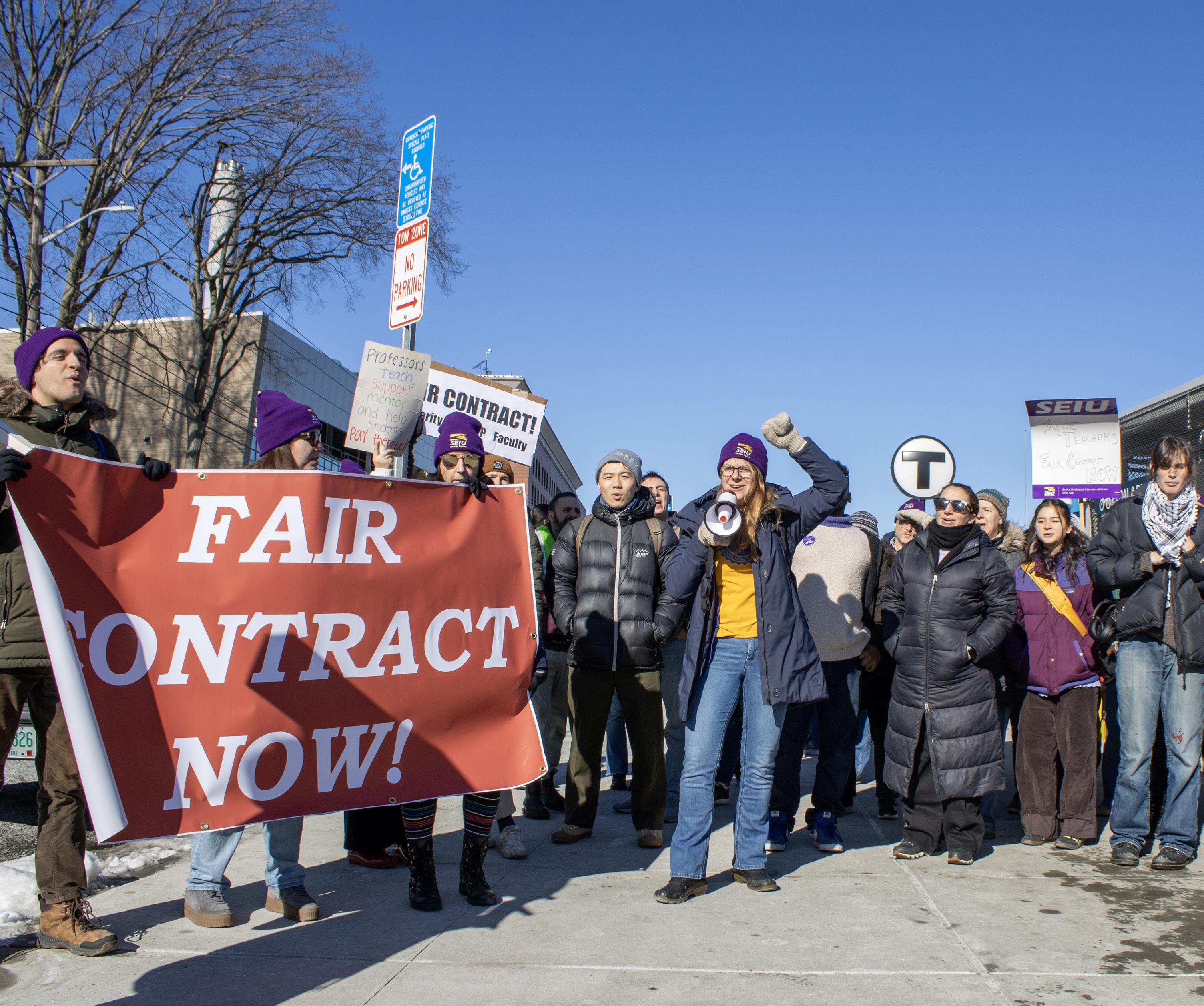
Over the last decade, negotiations between Tufts University and labor unions have degraded. Multiple unions described challenging and exhausting negotiations, citing the university’s uncooperativeness and staunch resistance to pay increases as driving forces behind the recent growth in collective action. Yet, the university expressed that its negotiation policies have been grounded in fiscally responsible decision-making and an earnest desire to reach agreements. The university reports that it continues to view its union relationships as productive and successful.
Seven unions currently have contracts with the university: resident assistants, dining workers, teaching professors (formerly full-time lecturers), part-time lecturers, the police association, facilities workers and Ph.D. students in the Graduate School of Arts and Sciences and the School of Engineering. In addition, professors of the practice at the School of the Museum of Fine Arts at Tufts have voted to form a union and are 18 months into contract negotiations.
In the initial stages of union formation, workers have struggled with the university.
When a body of workers votes by a majority to form a union, the university may offer voluntary recognition and begin the negotiation process. However, the university can also decline to offer voluntary recognition and force the workers to pursue a secondary election, certified by the National Labor Relations Board. For Tufts’ RAs, the university denied voluntary recognition, leading to a secondary election in which the workers overwhelmingly voted to form a union.
In the case of the Tufts Dining union, a worker said they initially organized the union secretly in fear of backlash from the university.
“If Tufts knew, they were going to do something to [make it] vanish,” a Tufts Dining union member, whose name was withheld due to fear of retaliation, told the Daily. “In the past, people that used to work at Tufts told us they don’t want to talk about [unions] because Tufts [doesn’t] want that.”
Under the National Labor Relations Act, it’s illegal for employers to prevent



workers from organizing through threats, intimidation or other coercive actions.
It is also illegal for an employer not to bargain in good faith, which means meeting at reasonable times, an “obligation to participate actively,” as well as “a sincere effort to find common ground,” according to the National Labor Relations Board.
In June, the SMFA PoPs filed a labor complaint against Tufts for failing to consult the union in changes to the administrative structure, which is the recourse available to unions when employers violate the National Labor Relations Act.
When a union body and the university reach an agreement on a contract, that contract lasts a number of years, typically between three and five, at which point the union and the university renegotiate through a series of bargaining sessions.
Negotiations typically consist of two sets of bargaining representatives. The university’s side usually consists of deans, representatives from administrative offices and outside legal counsel. On the other hand, unions typically have one representative from the union, as well as any
additional members who are willing to join the bargaining committee. These volunteers are not paid, though they may perform copious amounts of work for months, or even years, on behalf of the union.
Overall, multiple unions in contract with the university have described the tensions, stalling and lack of productivity and participation by Tufts in negotiations.
The most contentious topic between nearly all the unions and Tufts has been pay.
“The biggest stalemate in the end was overcompensation. The university wasn’t interested in offering any sort of monetary compensation in the form of a stipend, which was one of the biggest things the unit was looking for,” David OrtizWhittingham (LA’24), an RA from the bargaining committee, told the Daily about their bargaining sessions with the university in 2023.
At one point, the university declined to respond to a proposal for compensation by the RAs because of a minor technicality in the way the document was shared, according to OrtizWhittingham.



“That was when it was clear that the well was poisoned,” Ortiz-Whittingham said.
At one bargaining session, RAs testified to the university about why compensation was important to them. Before the meeting even began, there was frustration because the university booked a small room that ultimately prohibited a large number of RAs from entering.
“It was a very emotional bargaining session for a lot of our union members and, at the end of it, the university was quite dismissive [and] still not responsive,” Anisha Uppal-Sullivan (LA’25), an RA and bargaining member, told the Daily.
The graduate students in the School of Arts and Sciences and the School of Engineering also experienced a lack of responsiveness of the university to anecdotal evidence of workers’ struggles during their 2024 negotiations.
“It was dismaying. … We were bringing up personal stories about [graduate] workers going hungry, living in bad living conditions — and that really wasn’t persuasive,” Ian Descamps, a member of the graduate students’ bargaining committee, told the Daily.
UNION, page 4

Tufts students’ civic engagement decreased as young voters played a decisive role in 2025 elections
Katherine Kelton Contributing Writer
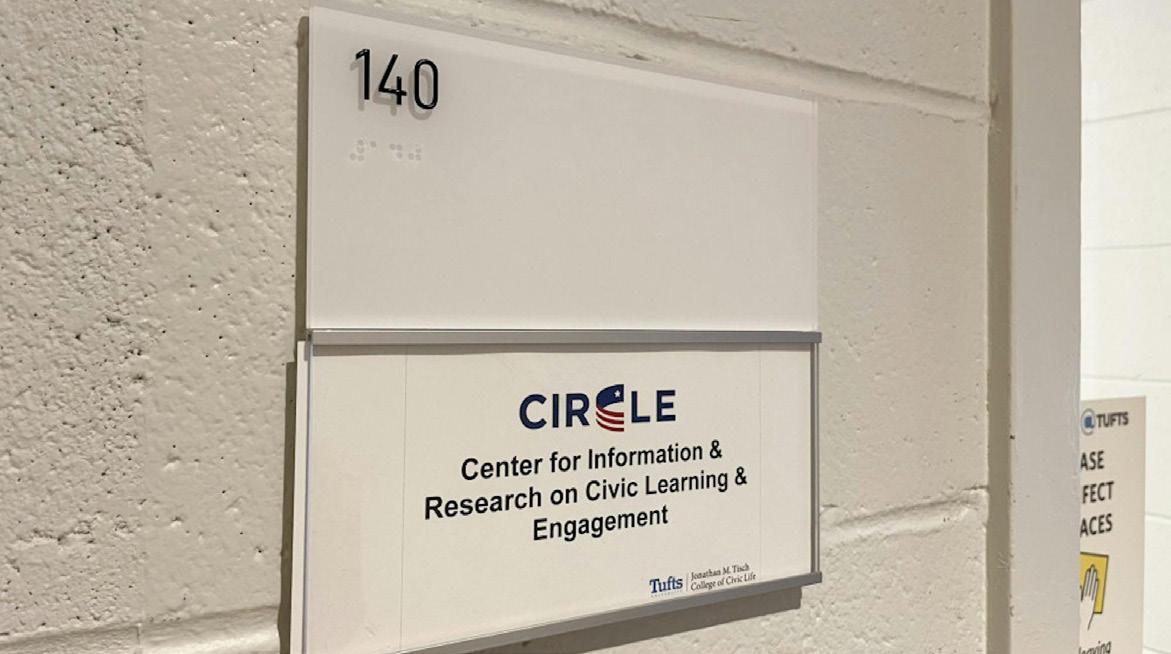
Originally published Dec. 4. JumboVote and Tufts’ Center for Information & Research on Civic Learning and Engagement recently reported on trends in participation in this year’s elections, both here in Medford and Somerville, as well as around the country in state and local elections.
With Tufts students, participation greatly varies by year. Last year, JumboVote had an influx of attention due to the presidential election, but engagement this year was lower, according to junior Teagan Mustone, co-president of JumboVote.
JumboVote, alongside Tufts Democrats, Tufts Republicans and the Jonathan M. Tisch College of Civic Life, held an election watch party on Nov. 4 to follow the local and state elections around the country. They had around 150 people in attendance at the watch party, a downturn from last year’s attendance at the debate between former Vice President Kamala Harris and President Donald Trump and at the election night watch party.
Overall, local elections tend to have less voter turnout, which correlates to the decreased attention given to the political clubs at Tufts in the national election off-years. However, Mustone, who grew up in Medford and has been involved in politics in her community, believes that Tufts students are not as engaged in local politics as they should be.
“You definitely see the lack of awareness around what’s happening around Tufts and in the community,” Mustone said. College students, since they become residents of the town where their school is located, are able to vote in local elections by changing their voter registration. However, in doing so, they can no longer vote in their hometown elections.
Many Tufts students engage with politics on their own terms. First-year Eden Grossman, a Massachusetts native, shared how she has been able to stay connected with politics at home while at Tufts.
“I think being so close to my hometown definitely helps me a lot. I can take the T back home,” Grossman said. “I went to a protest in my hometown a few weeks ago, which I thought was a cool experi-
“I think there’s a lot of pros and cons to voting where your home is,” Mustone said. “Maybe you’re from a swing state, and you think that’s more important. But, I think whether you vote here or not, you should have an awareness of what’s happening.”
Mustone cited Tufts’ community impact in both Medford and Somerville and in Boston’s Chinatown, where Tufts Medical Center is based, as a reason to be invested in local politics.
ence, getting to connect politically with my hometown like I was doing when I was in high school.”
Attendance at protests across the country has had a notable lack of Generation Z participation. Many feel that there is little time for protesting or political engagement due to school commitments, while others are fearful of the repercussions of simply being caught attending a protest.
In August, Grossman attended Brookline’s “Rally for Democracy”
in response to the presidency of Trump. She admits, though, that her knowledge of politics does not include local politics.
“I think I was pretty knowledgeable in the Brookline elections in high school,” she said. “I definitely would benefit from looking more at local politics and local news in Medford as well as Brookline.”
While the Center for Information & Research on Civic Learning and Engagement started at the University of Maryland, Alberto Medina, communications manager for CIRCLE, shared how the organization’s mission statement has remained stable.
“[CIRCLE] was really founded to try to understand, to study and to do something about a lot of the barriers and inequities that prevent young people from fully participating in civic life,” Medina said.
Medina added that CIRCLE looks for support from young people to refine and better understand what the center should be asking.
“Sometimes, instead of us supporting youth, we really sort of ask for help and for support from young people and for insights on, for example, some of the questions we should be asking,” he said. “For our 2024 post-election survey, we convened a group of young people to serve as sort of a Youth Advisory Group for that survey, and they had direct input on the kinds of questions we asked, [and] how we asked those questions.”
Neveah
Joseph and June Myint Contributing Writers
Originally published Dec. 4.
Professor Yu-Shan Lin, chair of the Department of Chemistry, will become an academic dean for the School of Arts and Sciences in January 2026 following the departure of Dean Sam Thomas, who will assume a new role at the University of Rochester.
Lin, a computational chemist, leads the YSL Group, a Tufts lab that studies biomolecules by combining advanced computing with chemical theory. As part of her new role, she will help manage the STEM, community health, child study and human development and education departments.
Lin told the Daily that she hopes to expand the collaborative and evidence-based approach she admires in the current Dean’s Office.
She also plans to apply her philosophy as chair of the Department of Chemistry to her new role as dean by distributing resources across departments and among faculty members to foster progress across the School of Arts and Sciences.
“My goal is partially aligned with each faculty member’s, in the sense that their success is my success, is the department’s success,” she said. “The department wants everybody to be successful. It’s not like I will give all department resources to a single faculty member, which I think [will be] similar when I become academic dean.”
Bárbara Brizuela, dean of the School of Arts and Sciences, said Lin’s leadership skills and data-driven decision-making made her a clear choice for the position, which she described as faculty-focused.
“She has broad support from the faculty and communicates really well with the faculty,” Brizuela said. “Given her scholarly expertise and what I’ve seen in her as a leader, she is very thoughtful in how she uses data.”
Lin’s leadership of STEMrelated departments is part of a new pilot system implemented by Brizuela in September that assigns thematic clusters of departments to different academic deans.
“One of the priorities … is to create more synergies across the different departments, so that we’re really emphasizing our interdisciplinary qualities and trying to break down some of the silos that sometimes happen within departments,” Brizuela said.
“I think the idea [of] going from randomly sampled groups of departments into a very clear division is for us to actually get to know similar departments and their best practices and then see if we can find some common goals and then some resources that we can potentially share, or ideas that are translatable between departments,” Lin said.
Lin highlighted the importance of meeting the demand for student research opportunities, noting the unexpectedly large

turnout at a Beckman Scholars research and fellowship event she helped organize to connect students with faculty-led research.
“A lot of the undergraduate students in the science majors want to join a research lab,” she said. “I think in chemistry, the acceptance rate is about 35%, so we actually turn away a lot of students. I want to see if there might be a way for us to provide more research opportunities.”
While taking pride in Tufts’ status as an R1 research institution, Lin emphasized the university’s liberal arts identity as equally important.
“Tufts is both a very strong liberal arts school and a Research 1 university at the same time,” she said.
“I think we need to remember our liberal arts roots, in the sense that we still want to collaborate and be connected to other departments.”
As dean, Lin said she aims to promote an interdisciplinary dynamic between different fields of study and noted a key moment of collaboration between SMFA students and the chemistry department. Many works currently displayed in Pearson Chemistry Lab were created by students who interviewed chemistry
faculty members to curate a collection highlighting the intersection of visual art and science.
“The department paid for the materials and supplies, and then the students got to have their artwork hung in a public building, so I think that that’s a win-win situation,” she said.
Thomas, the departing dean and a member of the chemistry department faculty, expressed support for Lin as his successor and praised her work in the department. Lin said Thomas has left “big shoes for [her] to fill.”
“I am excited for the School of Arts and Sciences to have Prof. Lin in school leadership. I’ve been so impressed with her leadership as Chair of the Chemistry Department and have enjoyed working with her from the Dean’s office [over] the last few years,” he wrote in a statement to the Daily. “I am confident she will do a remarkable job in this role and bring fresh energy, ideas, and insights to help guide the school for the upcoming years.”
In a November email to students, Brizuela said the university will work with the Department of Chemistry to appoint a new chair.
Keshav Srikant Staff Writer
Originally published Dec. 3.
This week, nearly one in 10 people across the world will use a tool that did not exist just a few short years ago — ChatGPT. According to a September working paper by economists and researchers at OpenAI, more than 700 million people actively use ChatGPT each week and that “for a new technology, the speed of global diffusion has no precedent.” The multifaceted benefits and costs of artificial intelligence have been fiercely debated, and this debate has been particularly passionate when it comes to the role AI plays in student learning and education.
As the Daily has reported, many Tufts professors have changed exam formats in response to increased student AI use, while the Medford School Committee debated an AI use policy earlier this fall. AI has become ubiquitous within education among students — a global survey by the Digital Education Council found 86% of students use AI in their studies, with nearly one in four using it daily. This can be beneficial if AI is employed responsibly, in accordance with school or syllabi policy. There is no doubt that large language models can be
incredibly good at breaking down difficult concepts simply and clearly. A June Nature article found that AI tutoring outperforms in-class active learning, with college students also feeling more motivated and engaged when the content was presented by AI.
However, there is growing evidence from recent studies that students ought to be aware of when opting to use AI. A prominent study from the MIT Media Lab split subjects into three groups and asked them to write SAT essays. The group that had access to ChatGPT showed the lowest brain connectivity while writing, struggled to accurately quote their own work, had the lowest self-reported ownership of their essays and “consistently underperformed at neural, linguistic, and behavioral levels.”
Another study also found that while students who used ChatGPT to research a scientific topic did have a lower cognitive load, their reasoning and argument quality were less thorough compared to those who were only allowed to use Google Search. Furthermore, researchers at the Wharton School of the University of Pennsylvania found that while students who had access to AI for practice math problems did better on those problems, those same students
did worse on math tests relative to their peers who never had AI access. This research starts to paint a picture: AI has the potential to negatively impact our critical thinking and problem-solving skills, even while saving time or making tasks easier.
Of course, one can reasonably argue that new technology has always led to some skills becoming obsolete. The rise of calculators has led to a decline in the importance of our ability to do mental arithmetic, while the rise of laptops has led to a decline in the importance of our ability to write cursive. However, AI differs from these technologies. Working to reason-out a problem or research a topic not only creates better topic understanding, but it reinforces the problem-solving and critical thinking skills we use outside class

and in every aspect of our daily life. Thus, the harm of skipping this process with AI is more than simply a reduced understanding of an academic concept or a skill not learned. We should continue to research the effects of AI on learning. AI likely has an important role to play in education, and I am not arguing that anyone should shun it. It is an incredi-
bly potent tool that can be used to both enhance understanding when used correctly and reduce understanding when not. When permitted, being able to use AI for research, conceptual understanding, or even coding can save significant time. However, even in a context where the use of AI is allowed, we should take a moment before using AI to determine if we actually need it, or are
Benjamin Handell
Originally published Dec. 3.
On Nov. 11, Tufts Friends of Israel, together with the Department of Political Science, hosted a conversation with Moumen Al-Natour, a Palestinian human rights activist who has spent years speaking out against Hamas. The Center for Peace Communications joined via Zoom to help translate and later share Al-Natour’s story with wider audiences. About 45 students and community members attended. Many told me afterward that they heard perspectives they had never encountered before. That reaction alone made the event worth hosting.
But the afternoon was memorable for another reason. In the middle of the event, three masked individuals burst into the room shouting over Al-Natour, attempting to end the Zoom call and prevent him from being heard. Their interruption lasted about a minute. They left before Tufts University Police Department officers arrived, and we
continued without further incident. Still, the moment highlighted something deeper, something I feel compelled to speak about.
What happened in that room was not a peaceful protest. It was an attempt to silence. It was an effort to drown out a Palestinian man speaking about his own life, his own community and his own hopes for the future. Al-Natour is not speaking from the comfort of a college campus. He is in hiding in Gaza. He has already been imprisoned and tortured by Hamas for criticizing its rule. He told us openly that he is being hunted as we speak. And yet he showed his face on our screen without hesitation, speaking calmly, answering questions and expressing gratitude for the chance to be heard.
In contrast, the three students who stormed our event concealed their identities while shouting over someone who has risked everything to tell his story. The contrast was painful to watch. It should trouble all of us, no matter our politics. American college students felt entitled to speak over a Palestinian dissident as if they understood his life better than he did. It was a moment
that revealed how quickly moral certainty can turn into arrogance.
But it also strengthened our commitment to what Friends of Israel stands for. We will not be intimidated by agitators who scream instead of engaging. We will not allow intimidation tactics to define our campus culture. And we will not stop creating spaces for dialogue, even when that dialogue is uncomfortable.
We encourage those who disagree with us to attend our events. Listen. Take notes. Challenge us during the Q&A. Share your views. You do not have to agree with our speakers, and you do not have to agree with us. But a university should be a place where disagreements are aired in good faith and where ideas are confronted with arguments, not volume.
Al-Natour’s voice is one among many, and we want to be clear about that. No single speaker can represent an entire people, especially in a conflict as layered and emotional as this one. Palestinians hold a wide range of views, including many who unfortunately support Hamas. Our goal in hosting this event was never to present a
spokesperson for the Palestinian opinion, but simply to let one man share his lived experience. His perspective adds to a broader conversation rather than standing in for it. We believe campuses benefit when they make space for a diversity of voices instead of reducing complex communities into a single story. The Center for Peace Communications, whose Instagram page highlights dissident voices from across the Middle East, works to amplify individuals like Al-Natour who often cannot speak safely at home, and we were proud to partner with the organization in that effort.
We also want to acknowledge that the disruption did not define our event. Ultimately, it was a flash of noise, nothing more. The substance of the afternoon — the stories Al-Natour shared about life under Hamas, the questions students asked about the ceasefire, the reflections he offered on the future of Gaza — continued uninterrupted. People stayed long after the program ended to talk, process and thank us for bringing something new to campus. Many said they left with a fuller, more nuanced under-
standing of a conflict they had previously encountered only through headlines and social media.
Democracy, dialogue and coexistence do not emerge from people shouting each other down. They emerge from moments like these — moments when someone with a very different background sits with us, even virtually, and trusts us enough to tell his story as he sees it. Moments when students listen, wrestle with ideas and challenge themselves to think more deeply.
Our campus needs more of that, not less. And we will keep working to make sure it happens.
Friends of Israel will continue to host speakers from a range of perspectives. We will continue to welcome everyone into our events, even those who disagree with us. And we will continue to stand by the belief that hearing from real Palestinians, Israelis and others directly involved in this conflict is better than shouting into an echo chamber.
Al-Natour showed extraordinary courage by speaking with us. The least we can do is show the courage to listen.
The Tufts Daily is a nonprofit, independent newspaper, published Monday through Friday during the academic year, and distributed free of charge to the Tufts community. The content of letters, advertisements, signed columns, cartoons and graphics does not necessarily reflect the opinion of The Tufts Daily editorial board.
EDITORIALS: Editorials represent the position of The Tufts Daily Editorial Board. Individual editorialists are not necessarily responsible for, or in agreement with, the policies and editorials of The Editorial Board. Editorials are submitted for review to The Tufts Daily Executive Board before publication.
VIEWPOINTS AND COLUMNS: Viewpoints and columns represent the opinions of individual Opinion editors, staff writers, contributing writers and columnists for the Daily’s Opinion section. Positions published in Viewpoints and columns are the opinions of the writers who penned them alone, and do not necessarily represent the opinions of the Daily itself. All material is subject to editorial discretion.
OP-EDS: Op-Eds provide an open forum for campus editorial commentary and are printed Monday through Thursday. The Daily welcomes submissions from all members of the Tufts community; the opinions expressed in the Op-Ed section do not necessarily represent the opinions of the Daily itself. Opinion articles on campus, national and international issues should be 600 to 1,200 words in length and submitted to opinion@tuftsdaily.com. The editors reserve the right to edit letters for clarity, space and length. All material is subject to editorial discretion and is not guaranteed to appear in the Daily. Authors must submit their telephone numbers and day-of availability for editing questions.
ADVERTISEMENTS: All advertising copy is subject to the approval of the editor in chief, executive board and business director.
In order to support their proposals, many of the unions conduct research contrasting their pay with comparable institutions in the Boston area. This research
comparison, such as with recent job postings from peer institutions, indicates that the university’s proposal is in line with the market for these positions,” Dean Bárbara Brizuela and Dean Scheri Fultineer wrote in a statement sent to the entire university.
finances show healthy surpluses.
In Fiscal Year 2024, Tufts’ net unrestricted opening results contributed $18.7 million to unrestricted net assets, according to its annual financial report.
On the other hand, one former administrator, who spoke to
tended to show that the pay of Tufts workers lagged behind other universities. At times, the teaching professors’ research showed Tufts’ placement as low as No. 12 out of the 13 universities analyzed, according to Penn Loh, a teaching professor and bargaining member in the School of Arts and Sciences.
In the teaching professors’ two negotiations in the 2010s, it was a norm for both the university and the union to conduct their own research and present it to the other side. However, according to Loh, in the most recent 2024 negotiation, the university neither produced a counter-analysis nor substantively engaged with their analysis.
Last month, Tufts issued a university-wide update on its negotiations with the PoPs. In
In meetings and university-wide communications, the university has cited financial constraints as the reason for its inability to agree to certain increases in pay.
“All we heard back from the administration was that cost finances are really tight right now, and we just don’t have any more money. That was the only response we ever got,” Loh said about the most recent teaching professors’ negotiations.
In last month’s update, the university invoked financial constraints as a key reason for rejecting the PoPs’ most recent proposal.
“From the university’s perspective, the union’s proposed increase significantly exceeds market norms and raises serious concerns about long-term
the Daily under the condition of anonymity out of concerns of retribution, noted that in internal meetings among university
Similarly, Tufts’ rejection of the RA’s proposed compensation was not justified by their cited fiscal constraints, as “the [proposed] number was not high enough,” Uppal-Sullivan said.
Notable discrepancies exist between the university’s public financial decisions and its private communications to unions.
For example, amid the graduate workers, PoPs and teaching professors’ negotiations in the fall of 2024, the university separately announced the Mortgage Assistance Program, a $6 million fund to support mortgage payments for tenure-track faculty.
“They were acknowledging housing [costs in the Mortgage Assistance Program]. ... [Tufts] made a commitment to spend that money to support the tenured faculty [but didn’t] have an additional hundreds of thousands of dollars for [the unions]. We just never ever had that conversation. They didn’t want to have that conversation face-toface,” Loh said.
Generally, negotiations for all unions have been prolonged.
The RAs described that over the summer of 2024, their negotiations began to stall.
“It was getting more challenging to find dates. It had been four months, and they had no
“[Longer negotiations] put more pressure on the workers. … How long can workers handle a bad paycheck? It becomes easier to swallow a bigger compromise because [we’ve] been paid so little for so long that any raise will be good. … That’s an effective tactic. … The bargaining committee [was] certainly feeling the pressure because we were working on this outside of our regular jobs, whereas the administration was paid to do this,” Descamps said.
“We reject the notion of intentional stalling or coercive tactics and note that just as the unions can decline any University proposal and offer their own perspective, collective bargaining also affords the same opportunity to the University.” Patrick Collins, executive director of media relations at Tufts, wrote in a statement to the Daily.
Normally, unions operate under previously-negotiated conditions as negotiations occur. Because the PoPs are bargaining for the first time, the prolonged talks mean they continue to work under the conditions that inspired the union to form in the first place.
The Boston City Council passed a resolution in August
“THE BOSTON CITY COUNCIL PASSED A RESOLUTION IN AUGUST SUPPORTING THE P o P s AND CONDEMNING TUFTS. ‘TUFTS HAS ATTEMPTED TO SILENCE VOCAL UNION MEMBERS WHILE FAILING TO MEANINGFULLY ADDRESS THEIR CONCERNS,’ THE RESOLUTION STATES.”
administrators, “there’s real concern” in regard to the university’s finances.
According to Loh, the university never provided unions with any evidence of financial difficulties.
“The total difference [between] what [the teaching
response on compensation,” Upppal-Sullivan told the Daily. “They were less responsive than they had been previously.”
Not only did the negotiations in total take a long time, but individual bargaining sessions became longer and more aggressive, according to the RA, with bargaining sessions
supporting the PoPs and condemning Tufts. “Tufts has attempted to silence vocal union members while failing to meaningfully address their concerns,” the resolution states.
When negotiations stall and an agreement is not reached, the members of the union continue to work under the conditions of
ate workers’ union, prolonged negotiations meant months of unfulfilled raises or adjustments for inflation, causing financial
“A lot of grad workers [couldn’t] afford rent and bills. tal, they’re in debt because of how low we were being paid,”
duced by the longevity of the negotiation put pressure on the unions to

The PoPs are struggling as faculty depart and no new hires occur. Ten PoPs have left the SMFA, which is 25% of the group — a significant amount of the departures being faculty of color — and Tufts has refused to fill these positions, forcing the remaining faculty to shoulder the weight, according to the resolution.
The university claims departures are natural.
“While we always aim to retain our talent, our faculty

of that dynamic.” Collins wrote in a statement to the Daily.
“Morale is quite low. … This is the lowest I have ever seen [in over 16 years],” Ethan Murrow, a professor of the practice at the SMFA, wrote in a statement to the Daily.
“This administration has alienated us and left us confused about what the university’s goals are.”
Union-university relations have not been strained historically.
While the teaching professors’ first two contract negotiations were meaningful and productive, they reported a changed dynamic in the university’s communication and engagement during their third contract negotiation in the spring 2024.
“We were encountering an administration that had become much more rigid in terms of what they would be willing to talk about and what they weren’t willing to talk about, and we weren’t used to that. We were used to being able to talk about anything and having meaningful [conversations]. It’s not that we agreed on everything [before] — we disagreed
The university acknowledged no such shift.
“The university is committed to constructive dialogue and timely resolution, reflected in Tufts’ collaborative approach to labor relations. The university consistently engages in good faith bargaining and prioritizes open communication with unions,” Collins wrote in a statement to the Daily.
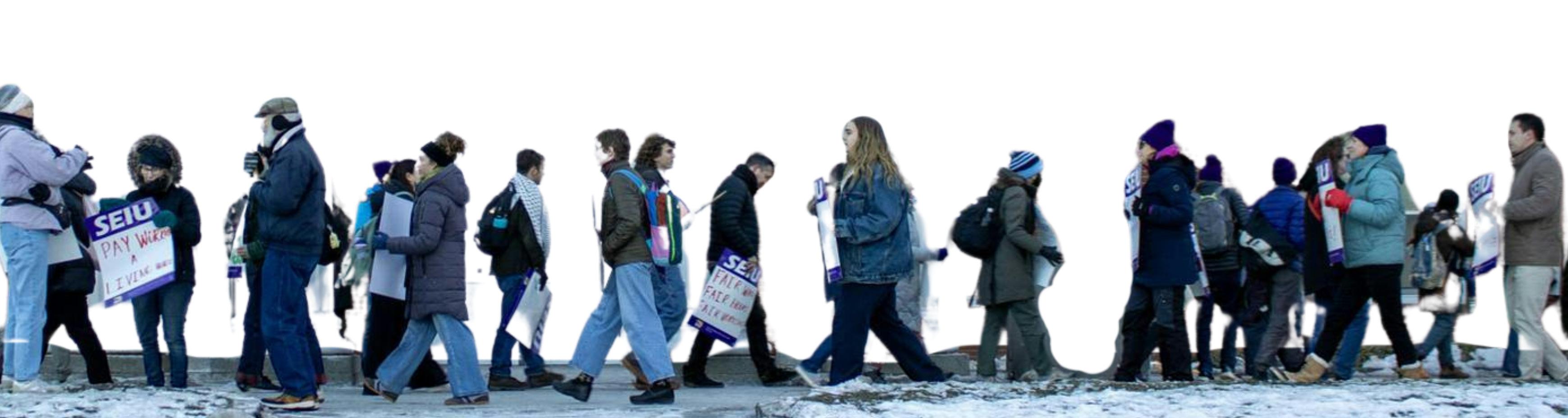
In recent negotiations, unions had to resort to largescale collective action such as protests, campaigns, public speeches and strikes. The solidarity between the teaching professors, PoPs, graduate student workers and part-time lecturers was driven by mutually unproductive negotiations with the university.
However, these campaigns can be debilitating to the formation of new unions and the survival of existing unions.
“If you’re doing events after events, action after action, people start to get frustrated at a lack of response. [The] power of the union comes from the collective of the workers. If that
the university in 2019 before the strike began.
Before the RAs went on strike, Uppal-Sullivan and OrtizWhittingham alleged that the university made threats. One threat was a lockout, which is when an employer stops workers from entering the facility. This proved particularly damning for the RAs, given that their primary compensation is housing. When the RAs asked the university about what would happen to their housing in that scenario, the administration did not answer.
The second threat was replacing RAs.
Despite these threats, in the fall of 2024, after more than eight months of negotiating, the RAs went on strike and reached a contract in the subsequent weeks.
In January, the teaching professors went on strike for two days. However, an agreement wasn’t reached until mid-June.
“Pressure at the table and externally makes the difference in trying to break open negotiations into a more productive place,” Loh said.

on a lot — but we were always able to talk about it,” Loh said.
In the mechanics of a bargaining session, a working document (30–40 pages long) is passed back and forth during each bargaining session, with one side making edits and then presenting to the other side. In these past nego-
collective begins to fracture, then the administration is able to put on more pressure, and compromises become much more in the favor of the administration,” Descamps said.
While strikes were uncommon among the unions a decade ago, over the last 10
“What it took was showing the administration that we are unified, that we had 150 people showing up to our bargaining sessions and dozens of people showing up to commencement to hand out flyers,” Descamps said. “We really had to show the administration that we are going
The graduate workers had to go to an outside mediator to ultimately reach an agreement after 18 months of bargaining.
Student support for these campaigns was also critical to reaching agreements.
“It’s a fight at these meetings. It’s a big fight,” a Tufts Dining union member told the
With art schools specifically, “Many of our peers at other institutions around the country are facing stiff push back when they stand up for themselves and ask for a fair wage. Art Schools and Art Departments are closing all over the country,” Murrow wrote in a statement to the Daily.
“IT’S A FIGHT AT THESE MEETINGS. IT’S A BIG FIGHT. ... THERE’S NO UNION WITHOUT THE STUDENTS. WE DON’T HAVE ANY POWER TO MAKE TUFTS ACCEPT.”
Daily. “There’s no union without the students. We don’t have any power to make Tufts accept [the contract].”
Overall, former bargaining committee members expressed mixed feelings about whether they view their ultimate contracts as successful, but all felt that the negotiations were difficult, stressful and filled with resistance.
Comparatively, other universities seem to have shown a far greater transparency, support and engagement with unions.
“Wesleyan went through a much easier process than we did. They got voluntarily recognized by the university, and then had a pretty short negotiating period. … I [didn’t] expect [our] bargaining period to be as long, prolonged and challenging as it eventually ended up being,” Uppal-Sullivan said of Wesleyan’s RA union.
In contrast with information from Wesleyan, the university claims it’s actually performing better than other institutions.
“Tufts has maintained a strong record of resolving labor issues efficiently and collaboratively, especially when compared to our peers nationally that have experienced multiple prolonged disputes lasting weeks and in some cases several months,” Collins wrote in a statement to the Daily.
“The University acknowledges that there have been broad changes in higher education and labor dynamics nationally over the past decade that have led to some challenging discussions at bargaining tables. … We believe we have been suc -
More broadly, “Increased confrontation and constraint with unions [generally] is the pattern we’ve seen at universities over the last decade. This past year, I imagine it’s worse given the [Trump] administration cracking down on universities and threatening their funding,” Ortiz-Whittingham said. “Universities are becoming more corporate … using some of the cost-cutting and outsourcing measures that private corporations do … rather than [acting as a] community-based non-profit.”
“[As] the university becomes more corporatized, it stops seeing its employees as members of an academic community and more just as cogs in a machine. … The university is acting with their unions in similar ways as for-profit corporations engage with their unions in a very aggressive, very cost-cutting manner,” Ortiz-Whittingham told the Daily. “This is the consequence of a corporate university that acts like a for-profit corporation. We’re trying to fight back against that.”
Unions expressed that the administration has definitively changed.
“The Tufts of 10 years ago and the ways that we relate to our administration have absolutely, definitely changed. There has just been a much more top-down approach from leadership,” Loh said. “In the past, [we had] a much more collaborative process, one that was open to a lot more meaningful and productive dialogue.”
Late Night At The Daily Max: “Madame Morrible, MM, flip it around, The Pope.”

holiday season winter break saturnalia icicle evergreen Krampus epiphany yule kinara present lights Canvas candle wassail Excel unity






® Word Search
MARCH 21-APRIL 19

APRIL 20-MAY 20

SEPTEMBER 24-OCTOBER 23 OCTOBER 24-NOVEMBER 22

MAY 21-JUNE 21

NOVEMBER 23-DECEMBER 21
JUNE 22-JULY 22
JULY 23-AUGUST 23 CANCER

DECEMBER 22-JANUARY 20

JANUARY 21-FEBRUARY 18
AUGUST 24-SEPTEMBER 23

19-MARCH 20

watch out, because you can see the cars, but the cars can’t see you.”
Originally published Nov. 21.
“Unreasonable.”
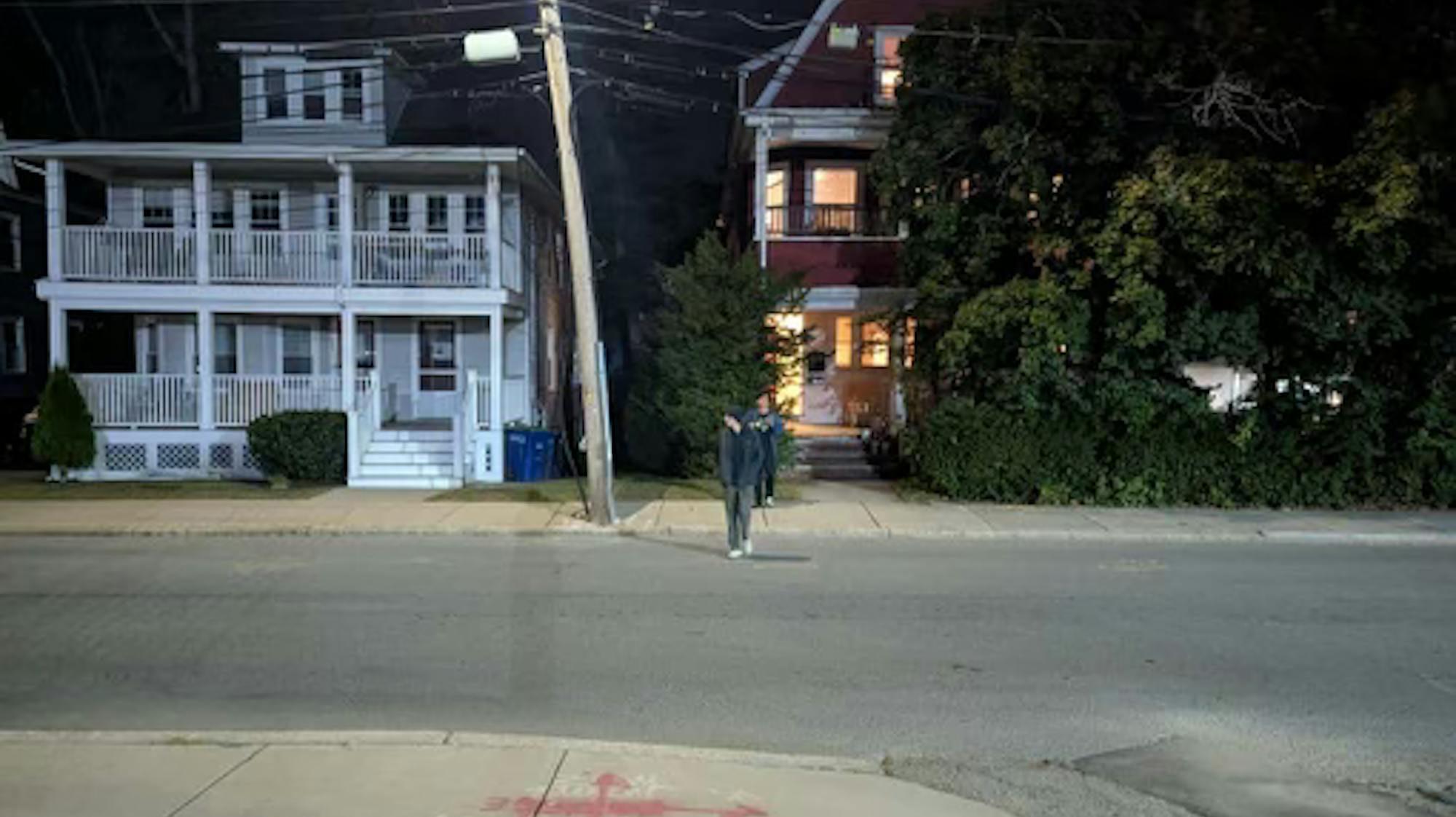
That is how one Tufts senior, granted anonymity to avoid legal ramifications, described the Somerville intersection between Curtis Street and Sunset Road. It’s an intersection that any student living on the side streets off of Curtis (known as Winthrop Street in Medford) will cross illegally anywhere from two to six times per day.
However, there is no crosswalk at this popular crossing. Those who choose to scurry across the street illegally must peer down the wide and straight road to check for the cars that barrel towards Boston Avenue. After making it across, however, one is immediately connected to campus by a sidewalk that provides a straight shot to the popular study spot, Ginn Library.
“It’s clear to anyone … that there should be a crosswalk where there’s just not a crosswalk,” the senior said. “If you were following the law, you would have to walk a minute in either direction to find an actual crosswalk, which would be an unreasonable expectation on anyone. And therefore it leads to lawlessness, because anyone … is going to cross illegally because there’s not really another reasonable option.”
Another student, junior Maddie Miniati, lives on Sunset Road and crosses the intersection every day to get to and from campus. While sometimes she opts to walk to the crosswalk at Professor’s Row and Curtis, other times that just isn’t where she wants to go.
“The sidewalk is perfectly lined up, so it should just keep going into a crosswalk. Also, because there’s a [parking lot] there, it’s hard to tell who’s stopping when, who’s turning when, and not to mention Sunset itself is sort of a hidden turn to begin with, so a lot of people miss it anyway,” Miniati said. “So I think a crosswalk there would help everyone — drivers, pedestrians.”
Miniati added that at night, “because you can’t really see over the hill, you kind of have to look out for lights … you have to
For the senior, he and his friends decided they couldn’t stand idly by and watch as people continued crossing the street despite the lack of a crosswalk and the speeding cars.
“That intersection is dangerous and puts many students at risk. And so some friends and I considered, like, really, someone needs to do something about this,” he said.
One of his friends tried to get in touch with a Somerville city councilor, but no change was brought about. The student’s theory as to why no concrete action has been taken to make the intersection safer has to do with its location.
“I think part of the problem might be it’s an area that maybe is controlled by … Somerville, but it’s also adjacent to Tufts campus and directly adjacent to Medford,” he said. “So perhaps, no one body feels particular responsibility for it.”
So the student, alongside some friends, decided to take an alternative route.
Following published guidance from guerrilla crosswalk-painters in Los Angeles, the group secured ‘official’ paint for laying down crosswalks — it’s durable, water-resistant and thick. Next, they gathered the correct measurements for all Somerville crosswalks, which, notably, have different dimensions from the Medford crosswalks.
“We spent a couple nights in a parking lot nearby doing tests, seeing how long [the paint] would take to dry and seeing how straight we [can] get the lines and such,” he said.
And then in the middle of the night, the group donned high-visibility vests, put duct tape on the street and attempted to make a crosswalk.
“We got a chalk line, and we got all the measurements down. We marked … the exact measurements of where the lines should be … spaced apart as per Somerville regulation,” he said. “And then TUPD pulled up on our asses.”
After the Tufts Police questioned their actions, the group ceased its operations.
The plan was not perfect — the student said they had their concerns. One worry was that without a yield sign, if someone
were to be hit by a car, they could blame the crosswalk. But, he said, someone could also be hit because it’s a dangerous intersection and there is no crosswalk.
“The main concern was that … this would be a surprise for cars. You wouldn’t necessarily know that there’s a crosswalk there,” he said.
To account for this problem, the group’s plan was also to order a “slow” or yield sign to install on either side of the crosswalk.
After the operation didn’t go as planned, the senior had little faith that Tufts would advocate for a crosswalk.
“I’ve had interactions with Tufts before, trying to get them to act locally — specifically on off-campus housing issues — in which they’ve been extremely hesitant to do anything because of potential liabilities. The university really doesn’t want to get involved in local issues, because they consider everything as a potential opportunity for them to get sued,” he said.
However, according to Rocco DiRico, the associate vice president of government and community relations at Tufts, no member of the Tufts community has brought the intersection to his attention. “If any students, faculty, or staff brought concerns to our attention, we work with the city to try and address the issue,” he wrote in a statement to the Daily.
DiRico also wrote that “the safety and security of our students both on and off campus is a top priority for the university.”
Regarding collaboration between Tufts and the cities of Medford and Somerville, DiRico said that the university “has a great working relationship” with the local communities, and has stepped in to assist during emergencies such as the COVID-19 pandemic.
“And most importantly, we support our students, faculty, and staff that volunteer at countless nonprofits, schools, and government agencies,” he wrote.
For now, masses of off-campus students will continue to cross the SunsetCurtis intersection illegally. But maybe a crosswalk will exist one day — whether by student advocacy for a Tufts-Somerville collaboration … or by the surprise appearance of a crosswalk in the middle of the night.
Almaty Max Turnacioglu
Originally published Dec. 4.
As my homesickness began to reach its peak in conjunction with the start of the holiday season, I found myself recalling even the most inconsequential details of my life back home in the U.S. with some sympathy. Even Washington, D.C.’s infamous Beltway called out to me with its siren song of car horns and exhaust, and I was instantly brought back to the iconic “Welcome to Virginia” sign underlined by the state’s travel slogan: “Virginia is for Lovers.”
I had always found the slogan odd — Virginia is perhaps one of the states I would be least likely to describe as “for lovers,” although maybe my Maryland roots predisposed me against the sparks of romance hidden (deep) within the sprawling suburbs of Fairfax County.
In Almaty, there is nothing hidden about the love running through the city — likely in place of the water that never fills its narrow canal system or artificial river. I have never seen a city with as many couples out and about as Almaty. Just a single walk by the invariably empty river brought me past an elderly man bending over to tenderly light the cigarette in his wife’s mouth, a pair of college students wrapped around each other so tightly on a park bench that it nearly felt illegal and a middle-aged couple strolling in the moonlight as they shared a bag of sunflower seeds. It is impossible to go anywhere in Almaty without seeing people — young and old alike — in love, or innumerable dogs and children racing by under the watchful and loving eyes of parents. The city bursts at the seams with a youthful, earnest energy that is impossible to deny.
The city is more than just one of personal loves; it’s also one of deep love for art, culture, food and architecture. Theaters line the streets, centered around Russian, Kazakh, German, Uyghur, Korean and every culture that could possibly hope to express itself, while intricate murals of astronauts and camels remain hidden behind unassuming office buildings. The tiny bridge near my house, crossing a drainage canal barely a meter wide, is delicately painted with grapevines. Such minor details are tended to out of a seemingly unadulterated love for the city itself and its unusual beauty. Even as winter draws gray-streaked curtains across the sky, I feel a certain warmth and tenderness emanating from the cobblestones of the city itself, springing me forward with every step into the lovely next step.
Yet as this love abounds, I have begun to fear the very loss of it, as the date of my departure for that other land of love — Dulles, Virginia — now looms almost one week away. I can only hope that in its indiscriminate affection, the city has truly grown to love me, too — that my own reciprocal love will be felt and remembered, in some small way, by the stray dogs who sleep piled against one another in the park, the woman who always patiently waits as I stumble through my order at a local bakery and the amazing friends, teachers and mentors I have managed to find here.
Even with my brain fully cooked into a stew by a potent combination of final exams, winter illness and air pollution, I still can’t stop myself from waxing poetic about Almaty. And as I sit in Beltway traffic and look back on this fantastical three-month immersion in the city of lovers, I can say that I didn’t just love her — I grew to truly know her.


BY STELLA JEONG