The Tufts Daily THE
INDEPENDENT
STUDENT
NEWSPAPER
OF
TUFTS
UNIVERSITY
E S T. 1 9 8 0
Medford/Somerville, Mass.
Thursday, October 22, 2026
VOLUME XCIV, ISSUE 7
Tufts library workers vote to unionize June Myint News Editor
Tufts University library workers voted Wednesday, 41–5, to form a union, recognizing Service Employees International Union Local 888 as their official collective-bargaining representative. The vote, overseen by the National Labor Relations Board, represents approximately 71% of eligible library staff across Tufts campuses. In preparation for the vote, a rally was held in front of Ballou Hall on Monday, drawing library workers, students and community members. Nearly 400 Tufts community members have signed the union’s support petition, launched a month ago, according to William Hansberry, a senior external organizer with SEIU 888. He added that community support has been vital to this process. “The issues that library workers face are not dissimilar to the same issues that other workers on campus face, students face, in terms of needing and wanting the dignity and respect that any student or worker should get from a university,” Hansberry said. “The only way that any one group is going to win
that dignity and respect is if we’re all able to come together.” While official bargaining deals have not yet been made, library workers have expressed grievances that they hope to resolve with the university. An employee at Tisch Library, who requested anonymity out of fear of retaliation, said insufficient pay has been a primary concern. “It’s expensive to live in the Boston area, and so to not have any cost-of-living adjustment when we are having our salaries looked at every year is something that makes it feel like this is not a place to work at. It’s not a sustainable job to have because it doesn’t cover for the rising costs of healthcare and everything else,” the employee said. They also noted that limited growth opportunities and disparities between professional roles have contributed to frustrations among library workers. Despite having a master’s degree in Library Science, the Tisch Library employee said they cannot apply for a promotion because their job does not technically fall under the title of “librarian.” “The opportunities for promotions are not equal across job
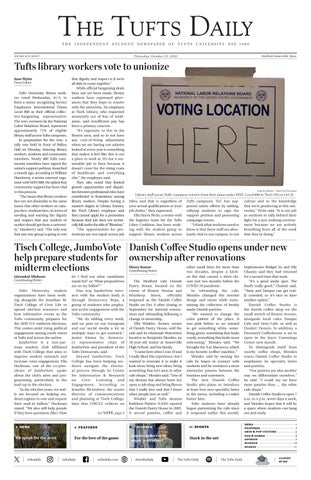
JOSUÉ PÉREZ / THE TUFTS DAILY
Library staff across Tufts’ campuses voted to form their union under SEIU Local 888 in Tisch 310 on Oct 21. titles, and that is regardless of your actual qualifications or your job duties,” they expressed. Ella Harris Perin, a senior with the logistics team for the Tufts Labor Coalition, has been working with the student group to support library workers across
Tufts campuses. TLC has supported union efforts by tabling, rallying students to sign the support petition and promoting campaign events. “I think what students need to know is that these staff are absolutely vital to our campus, to our
culture and to the knowledge that we’re producing at this university,” Perin said. “It is our job as students to rally behind their fight for a just working environment because we are actively benefiting from all of the work that they’re doing.”
Tisch College, JumboVote Danish Coffee Studio opens under new help prepare students for ownership after renovations midterm elections Henry Kamer
Contributing Writer
Girumkal Allehone Contributing Writer
Tufts University student organizations have been working alongside the Jonathan M. Tisch College of Civic Life to spread election resources and host informative events as the Tufts community prepares for the 2026 U.S. midterm elections. This comes amid rising political engagement among youth voters at Tufts and across the nation. JumboVote is a non-partisan student club affiliated with Tisch College that aims to improve student outreach and increase voter engagement. Ella Heckman, one of the co-presidents of JumboVote, spoke about the club’s aims and programming, particularly in the lead-up to the election. “In the election years, we really are focused on helping students register to vote and request their mail-in ballots,” Heckman stated. “We also will help people if they have questions [like] ‘How
do I find out what candidates stand for?’ or ‘What propositions are on my ballot?’” One way JumboVote interacts with the student body is through Democracy Reps, a group of students who emphasize active engagement with the Tufts community. “We do tabling every week, and we post on our Instagram and our social media a lot as multiple ways to get outreach,” junior Emma So, democracy representative chair of JumboVote and president of the Tufts Democrats, said. Beyond JumboVote, Tisch College has been helping students navigate the electoral process through its Center for Information & Research on Civic Learning and Engagement. According to Jennifer McAndrew, the senior director of communications and planning at Tisch College, data that CIRCLE collects on see VOTE, page 3
The Medford cafe Danish Pastry House, located on the corner of Boston Avenue and Winthrop Street, officially reopened as the Danish Coffee Studio on Oct. 6 after closing in September for internal renovations and rebranding following a change in ownership. Ulla Winkler, former owner of Danish Pastry House, sold the cafe and its wholesale Watertown location to Benjamin Morales, an 18-year-old senior at Somerville High School, and his family. “I came here when I was 10 and I really liked this experience, but I wanted to renovate it to make it look nicer, bring new ideas, bring something that isn’t seen in other cafe shops,” Morales said. “One of my dreams has always been [to] open a cafe shop and bring flavors that I really love and that I know other people love as well.” Winkler and Tufts alumna Kathleen Flahive (LA’04) opened the Danish Pastry House in 2005. It served pastries, coffee and
other small bites for more than two decades, despite a kitchen fire that caused a short closure just two months before the COVID-19 pandemic. In rebranding the cafe, Morales changed the interior design and menu while maintaining the collection of freshly made Danish pastries. “We wanted to change the color palette of the place. It was pink before so we wanted to get something white, something green, something that looks comfy, something that looks more welcoming,” Morales said. “We brought the [La] Marzocco, which is my favorite [coffee] machine.” Morales said by owning the cafe he hopes to connect with students and he envisions a more interactive process between the business and customers. The new Danish Coffee Studio also plans to introduce at least four new specialty lattes to the menu, including a cookie butter latte. Tufts students have already begun patronizing the cafe since it reopened earlier this month.
2 NEWS
4 FEATURES
10 SCIENCE
11 SPORTS
We speak for the trees
For the love of the game
Superconductor or super instructor?
Stuck in the net
tuftsdaily
tuftsdaily
tuftsdaily.com
thetuftsdaily
The Tufts Daily
Sophomores Bridget Yu and Elle Chassin said they had returned for a second time that week. “It’s a good study spot. The food’s really good,” Chassin said. “Tasty and Tamper can get really crowded, so it’s nice to have another option.” Danish Coffee Studio is the fourth coffee shop on the small stretch of Boston Avenue, alongside local cafes Tamper Cafe and Tasty Cafe, as well as Dunkin’ Donuts. In addition, a Pavement Coffeehouse is set to open in the Joyce Cummings Center next month. To distinguish itself from nearby coffee shops, Morales wants Danish Coffee Studio to emphasize its specialty lattes and pastries. “Our pastries are also another way we differentiate ourselves,” he said. “I could say we have more pastries than … the other cafe shops.” Danish Coffee Studio is open 7 a.m. to 4 p.m. seven days a week, and Morales hopes that it will be a space where students can hang out and study. News Features ARTS & Pop CULTURE fun & Games opinion Science Sports
The Tufts Daily
1 4 6 8 9 10 11
cloudy 47-64°
2
NEWS
THE TUFTS DAILY
THURSDAY, OCTOBER 22, 2026
T he T ufts D aily Editorial Julian Glickman Editor in Chief
Olivia Bye Sadie Roraback-Meagher Managing Editors
Julia Segal Maya Godard Associate Editors Amelia Sammons Executive News Editor Sera Kwon Executive Features Editor Sophie Herron Executive Arts Editor Olivia Zambrano Executive Opinion Editor Luke Fredericks Executive Sports Editor Addison Dion Executive Science Editor Gus Gladstein Executive Investigative Editor Max Lerner Editorial Board Chair
Multimedia Ellie Broscow Executive Audio Editor Elliot Riseman Executive Video Editor Christina Jamieson Executive Photo Editors Josué Pérez Elise Lea Samson Executive Graphics Editor Sophie Penenberg Executive Fun & Games Editor
Committees Sorsha Khitikian Ethics & Inclusion Chair Zach Halverstam Education Chairs Dylan Tanouye Shea Tomac Social Chair
Production Angelina Moy Josh Solomon Production Directors Jamie Song Executive Layout Editors Diego Rodriguez Caroline Baker Executive Copy Editors Elyssa Cabey Max Lerner Executive Social Media Shea Tomac Managers Keira Krisburg Executive Newsletter Editor
Business Julia Critz Business Director Samantha Mascera Assistant Business Carol Wu Directors Claire Wood Alumni Liaisons Aisha Karim
Somerville receives state grant to fund new sustainability project Zahra Brady
Assistant News Editor
On Sept. 17, the City of Somerville secured a $187,200 state grant from the Massachusetts Municipal Vulnerability Preparedness program to be used in funding the Green and Cool Somerville: Sustainable Sidewalks and Trees initiative. The initiative is aimed at increasing tree coverage that is compatible with the city’s narrow sidewalks while maintaining Somerville’s accessibility and walkability. The project is being co-lead by Vanessa Boukili, senior urban forestry and landscape planner, Sustainability and Resiliency Planner Elyse Belarge and Director of Engineering Brian Postlewaite. Boukili explained that the implementation of more canopy coverage is largely meant to help alleviate Somerville’s high heat issues. “[ Trees] provide cooling both from the shade they provide ... but also evapotranspiration,” Boukili said. “When trees are breathing, basically they’re letting out some moisture, and that can provide cooling benefits very locally as well.” Boukili added that trees also help reduce pollutants, and as important sources of food and habitats for insects and wildlife. Planting more will hopefully aid in bringing back native pollinators and organisms that have been slowly declining in the area. Boukili also claimed that planting more trees could
improve the emotional health of the community, citing research on the impact of trees improving mood and physical health. “Just by looking at trees out the window, it can help people just feel better, more calm,” she stated. “It makes people feel more connected to their community.” One of the main challenges this initiative will be facing is constrained building conditions, as Somerville is the densest city in New England. According to Boukili, narrow sidewalks and conflicting infrastructure make it difficult to plant trees in a way that is maintainable for pedestrians. This lack of space not only affects the streets above ground, but can result in accessibility issues when roots become overgrown. “A lot of times [when] you walk around Somerville, the sidewalks are raised because the tree roots have come up through them, and that makes it really challenging for folks who have mobility impairments,” Belarge said. “It can be very isolating if you have trouble getting around.” The co-leaders of the Green and Clean Somerville initiative do not currently have a definitive plan for preventing this, but have begun exploring technologies for improving underground infrastructure as the project progresses. This project was only made possible by the attainment of the MVP state grant. Despite having their initial proposal
rejected, Boukili, Belarge and Postlewaite were able to secure the grant in August 2026 after presenting a concrete design guide for the initiative, which was made in collaboration with Tufts graduate students from the Department of Urban and Environmental Policy and Planning for their spring 2026 field project. “We pursued Tufts UEP field project to try to make progress on the project even without the MVP funding,” Boukili said. “We had really good success there, and then the second round of funding we applied for, we got it.” Kathryn Davies, an assistant professor in the Urban and Environmental Policy and Planning department, was one of two team leaders overseeing the project. She described the students working alongside Boukili, Belarge and Postlewait as project partners. “The students loved working with this group of practitioners,” Davies said. “They were really supportive of the student team. ... Somerville achieved that balance really well, where they both had clarity about what they needed, but there was also flexibility for the students to contribute their own insights and ideas.” Sabina Dirienzo, a second-year graduate student who participated in the field project, found working with the project partners to be an interesting learning experience. “It was really cool and interesting to learn how their
departments overlapped and intersected in this area that seems like it should be simple, and it really isn’t,” Dirienzo said. “I came in not knowing a ton of technical information about how trees work in an urban environment, and left knowing a lot about that.” The Green and Cool Somerville initiative was selected for the field project not just for the technical skills it could teach students, but also because of how the initiative connected Tufts with the local community. “[ The project] was both addressing climate change issues and heat issues, and trying to enhance the resilience of one of our neighbor communities,” Davies said. “Half of Tufts is located in Somerville, so trying to give back to local communities is definitely one of the goals of the field projects.” The initiative is only just getting off the ground, and leadership is currently looking for consultants to work on the project. As of now, no timeline has been set for when it might be completed. Still, Belarge is excited to see where this new research will take the City of Somerville. “This is a really exciting and innovative project because it hasn’t been done anywhere else yet,” Belarge said, “There are a lot of opportunities for this work to act as a first-of itskind case study in cities, not only in New England and not only in our region here, but across the U.S.”
visit tuftsdaily.com/masthead
Founded in 1980, The Tufts Daily is the entirely student-run newspaper of record at Tufts University in Medford, Mass. An editorially and financially independent organization, the Daily’s staff of more than 100 covers news, features, arts and sports on Tufts’ four campuses and in its host communities.
Land Acknowledgement The Tufts Daily office is located on the colonized land of the Massachusett people and within the territories of the Nipmuc and Wôpanâak (Wampanoag) tribes.
Story tips? Questions? Concerns? Let us know!
Visit tuftsdaily.com/tips
P.O. Box 53018, Medford, MA 02155
The Somerville Community Path is pictured on Nov. 7.
HELEN MCCARTY / THE TUFTS DAILY
THE TUFTS DAILY
THURSDAY, OCTOBER 22, 2026
NEWS
3
Tufts offers voting resources ahead of midterm elections VOTE continued from the front youth voter patterns nationwide is used to support civic engagement at Tufts. This implementation is done by providing various resources to Tufts students, including an event to be held Thursday, Oct. 22 with the Secretaries of State of Minnesota and Iowa. According to McAndrew, the joint talk between the Secretaries — one who’s a Republican and the other who’s a Democrat — will address common voter concerns about election security. Additionally, Tisch College has been supporting students from Missouri, Mississippi and Oklahoma, who have a special process for mail-in ballots in which first-time voters must have their ballots notarized. An email was sent to students from those states to inform them of this new legislation. Peter Levine, the associate dean for academic affairs, and Lincoln Filene professor of citizenship and public affairs at Tisch College, spoke about this service and other resources offered at Tufts. “I would be surprised if any other college in the United States does that,” Levine said. “I think Tufts is as good as you can be for encouraging voting.”
Student leaders have noticed the engagement on campus leading up to the midterms, which appears to be more on students’ radars than previous elections. “I do think that, especially in the last week or so, it’s really dawning on people that an election’s coming up,” Heckman said. “These are important midterms, and people are afraid, excited. There’s a lot of emotions attached to these midterms, maybe even more than in the past.” Likewise, So noted that participation and excitement among young Democrats is high in anticipation of the elections. “People are, one, really angry with the Trump administration, and people are also really excited about this blue wave of these exciting candidates that they just want to do as much as they can,” she said. On the other hand, Mack Kozlowski, president of the Tufts Republicans, explained that while Republicans on campus are similarly ready to vote in these midterms, this is nothing new. “I haven’t noticed anything being more driven or less driven, because normally, we are very driven to vote,” Kozlowski said. “We’re also a much smaller group, so that’s probably also a reason why everybody that is in our group is very committed to ‘we’re going to vote, we’re going to do what we can.’”
ARIANNA HELLMAN / THE TUFTS DAILY
JumboVote advertises voting by mail in Dowling Hall. However, Kozlowski and Heckman acknowledged that their perspectives on student engagement are influenced by their involvement in political circles, where students are naturally more active in the political process. Regardless, an upward trend in youth voter engagement is reflected in nationwide patterns. A 2026 poll by CIRCLE on youth attitudes, issues and power found that 56% of youth are “super likely” to vote. “If all those young people voted — which they may not — that would be an incredibly high
turnout rate,” McAndrew said. “We take that as a very positive sign in terms of youth turnout.” McAndrew and Levine both mentioned that the factors behind this pattern include a desire to change the direction politics is currently going in. “It feels like high stakes for a lot of people,” Levine said. “I think a lot of people are very dissatisfied, and actually being dissatisfied or angry can motivate turnout.” When speaking on the importance of youth voting, Levine explained that young people’s participation is important for
individual livelihood, the formation of voting habits and ensuring that young people’s unique concerns aren’t left behind. “Just by virtue of being young, you have more years ahead of you and also are more likely to still need more education, even if you’re not in college,” Levine said. “There’s different interests, and if you don’t vote then those interests get ignored.” As such, McAndrew emphasized that the value of the support that Tisch College provides lies in enabling students to participate without the fear of asking questions.
Fifth-Year Master’s Degree The Fifth-Year Master’s Degree program allows Tufts undergraduates to continue on to a master’s degree with the Graduate School of Arts and Sciences or the School of Engineering after completing their bachelor’s degree. Students complete all requirements for both degrees. Some graduate coursework will be integrated during the bachelor’s degree, thereby shortening time and financial commitment to the graduate degree.
The deadline to apply is: Fall entry–January 15 for seniors (GSAS and SOE) March 15 for juniors (GSAS only)
gradadmissions@tufts.edu | 617-627-3395
Benefits of a Fifth-Year Master’s Degree • Earn your bachelor’s degree and master’s degree
together, usually within five years • GRE scores not required • Application fee and enrollment deposit are waived • Only two letters of recommendation are required • Generous scholarships are available*
Learn more:
The Fifth-Year Master’s Degrees are offered through the following programs: Graduate School of Arts and Sciences
School of Engineering
Art Education, MAT Biology, MS Biology, MS with a Specialization in Marine Science Bioinformatics, MS Chemistry, MS Chemistry/ Biotechnology, MS Child Study and Human Development, MA Classics, MA Computational and Digital Humanities, MA Creative Practice, MA Data Analytics, MS Economics, MS Educational Studies, MA Education: Middle and High School, MAT Environmental Policy and Planning, MS Mathematics, MS Museum Education, MA Music, MA Philosophy, MA Physics, MS / Astrophysics, MS STEM Education, MS Sustainability, MS Urban and Environmental Policy and Planning, MA
Applied AI for Food and Nutrition, MS Artificial Intelligence, MS Bioengineering, MS Biomedical Engineering, MS Biophotonics, MS Chemical Engineering, MS Civil and Environmental Engineering, MS Computer Engineering, MS Computer Science, MS Cybersecurity, MS Cybersecurity and Public Policy, MS Data Science, MS Dual Degree Program: Tufts Gordon Institute degree + other Engineering degree, MS Electrical Engineering, MS Engineering Management, MS Human Factors Engineering, MS Human-Robot Interaction, MS Innovation and Management, MS Materials Science and Engineering, MS Mechanical Engineering, MS Offshore Wind Energy Engineering, MS Software Systems Development, MS Technology Management and Leadership, MS
go.tufts.edu/5thyear * The Graduate School of Arts and Sciences will provide a graduate tuition scholarship proportional to the undergraduate tuition award at the time of application. Learn more about School of Engineering tuition savings opportunities at go.tufts.edu/SOEfifthyear
4
FEATURES
THE TUFTS DAILY
THURSDAY, OCTOBER 22, 2026
Features From Ugandan forests to Medford: Professor Zarin Machanda’s life among chimpanzees Emma Tannenbaum Contributing Writer
In the middle of a lecture, Associate Professor of Anthropology and Biology Zarin Machanda might break into a chimpanzee call convincing enough to make students glance at the door. The sounds come from experience: When she isn’t teaching on the Medford/Somerville campus, Machanda co-directs the Kibale Chimpanzee Project, a longterm study of wild chimpanzees in Uganda’s Kibale Forest National Park. Machanda hadn’t always dreamed of being a professor by day and a field researcher by night. At five years old, she had her heart set on being an astronaut veterinarian. She was inspired by “One Small Step: The Story of the Space Chimps,” a 2003 documentary on chimpanzees in space starring John Glenn and Jane Goodall, and decided she would spend her days taking care of the chimpanzees in space. This dream faded as she grew up, but her love for wildlife and animals stayed with her as she attended McGill University for her undergraduate degree in biology. During her time there, she volunteered for a sanctuary outside of Montreal that had rescued 15 chimpanzees from biomedical research. “I was spending a lot of time helping with those chimps and learning about them, and understanding their individual personalities and really seeing human behavior,” Machanda said. “In my third year of
university, [it] just came together that you can study chimpanzees and say something about humans, not as a veterinarian, but as a researcher.” She went on to earn her doctorate in primatology at Harvard University. As a student of the world-renowned primatologist Richard Wrangham, she was able to get involved in projects like the Kibale Chimpanzee Project — a long-term field study of wild chimpanzees in the Kanyawara region of Kibale National Park. They now continue to work as directors at the organization. Whether it’s studying the behaviors of chimps in Uganda or writing grants, Machanda splits her time between teaching at Tufts and managing the day-to-day operations at the Kibale Chimpanzee Project. She credits her team of over 40 people with handling the many ventures of the project while she is occupied in Medford. The project has three overarching goals: research, conservation and education. The Kibale National Park is home to over 1,200 chimpanzees, and the team collects daily behavioral observations on around 60 of them. With a career that spans from teaching in Medford to hands-on work in Uganda, Machanda wants her students to know that they don’t have to have a single linear career. “I never would have thought, doing a Ph.D. in chimp behavior, that I would be doing some of the things that I’m doing with conservation and schools and education and even teaching,” she said.
She emphasized the flexibility of career paths and the unexpected experiences that can result from an open mind. “[A career] can be bigger and broader [than you think]. It can take you down roads that you never thought would be satisfying in a particular way,” Machanda said. In the summer of 2024, she helped with a project focused on teaching students in Uganda how to make reusable menstrual pads. The goal was to keep girls in school longer to delay their having children and ease population pressure on the park. “[When] you’re sitting there making reusable menstrual pads ... you’re like, ‘Huh? I never thought my Ph.D. in chimpanzee behavior would lead me to this moment in time,’” Machanda said. “But here we are, and it’s such a satisfying part of the job to see that you could be doing all of these different kinds of things.” Junior Natalie Compare took a primate social behavior class with Machanda in the spring of her first year. Despite the class not being required for her major or even related to her future goals, Compare found it to be incredibly compelling. “Her passion definitely comes through in everything she says. She has a way of making this content that feels super niche [and] very specific, very far-reaching [and] super interesting,” Compare said. Compare describes one interactive role-playing lab that
Professor Zarin Machanda is pictured. has stuck out in her memory, Machanda doesn’t expect all of even two years later. her students to become primatol“[The lab] was [focused on] ogists, and she understands that sexual selection, and we were all many of her classes focus on a niche assigned a rank of male or female. that few students will pursue pro... I was the alpha male, which was fessionally. But she does want her awesome,” Compare said. “Then students to have a few takeaways you basically see what strategies that are applicable across disciplines. they employ to get the highest qual“I do hope that you have an ity offspring, and it’s so much fun appreciation for these animals, because you’re pretending [and] especially since most of them are you have to go up to people and be endangered. ... But more importantlike, ‘Hey, can we mate?’” ly, I do try to think about transferBesides the in-class activities, able skills that you could get from Compare also recalled a field trip to my class or classes,” Machanda said, the zoo designed to model a day in highlighting skills that she aims to the life of a primate researcher. She teach her students like database also highlighted Machanda’s ability management, Microsoft Excel stratto connect primate behavior to the egies and note-taking. way we understand human behavior You don’t have to be a “Planet and human social dynamics. of the Apes” fanatic to enjoy “She’s probably the best Machanda’s classes — there is plenty professor I’ve ever had, and to learn from her no matter who I think all of that stems from you are. Who knows, maybe you also her passion for the subject,” have a hidden talent for crazy-accuCompare said. rate chimp noises!
so much is because anyone can be really good at it.” After playing soccer throughout high school, sophomore Charlotte Colder joined intramural soccer last fall due to a knee injury preventing her from playing with the club team. “Intramural was a great in-between,” she said. In intramural sports, students can sign up as a team or as individuals, depending on the sport. The word “intramural” comes from the Latin “intra” and “murus,” meaning “within the walls.” It’s a fitting name, since students compete against other Tufts teams rather than other schools. For sophomore Angelica Castillo, an intramural tennis player, meeting new people within the Tufts community has been a valuable experience. In her matches, she plays against undergraduates, but also students from other Tufts programs, such as The Fletcher School. “I don’t think I would have ever met some of these people if I had not done intramural tennis,” she said. “I find it so fun and wholesome that we all come together in one place because of a sport that we all like and we come from all these different places.” Due to intramural being lower commitment than club or varsity, it allows for a more relaxed environment focused on community.
“There’s something really nice about not having a lot of pressure and intensity on a sport,” Colder said, comparing her experience in intramural to playing high school club soccer. “Intramural is just fun, and you’re playing with your friends, and so inherently in that, it’s not going to be as serious.” Weintraub, a pre-orientation leader for First-Year Orientation Community Service, recommended intramural to his FOCUS first-years as a way of staying in touch with friends and making new connections. “Intramural sports is a cool way to have your group, but [also] have all of their friends come and interact with one another and meet each other. That’s what I’ve used it for. I’ve invited friends from all sorts of different areas of my Tufts life,” he said. Colder similarly noted that intramural sports offer a space in college that is “purely fun.” “[It is] reframing what extracurriculars could look like in college — that they don’t have to be so competitive, and you can do things just for fun,” Colder said. “The fact that my friends and I all have a space to bond together, ... that we’re all competing, that really brings us together.”
Although intramural is quite loved by its participants, getting the word out can be difficult. Intramural doesn’t get a table at the club fair, so the main way for students to hear about it is through word of mouth. Popularity varies across seasons and sports. Weintraub described significant fluctuations in kickball team numbers, and Colder even described being waitlisted in prior seasons of intramural soccer due to high participation. Castillo also mentioned that their tennis courts are often packed during practices. Castillo, a new player for intramural tennis, only heard about it from social media. “I actually had no idea about intramural tennis last semester or the semester before,” she said. “I don’t feel like many people talk about it or many people know about it.” Jazzy Duverglas, assistant manager of recreation and club sports at Tufts, believes that social media has been a huge positive for the intramural community. “Showing the importance of this program [on social media] has been awesome. The students just feel a little more recognized,” she said. “We’ve gotten a lot more followers, and I think social media has been a big part in people seeing that we offer intramural sports here.”
NICOLE DACEY / THE TUFTS DAILY
No tryouts, no pressure: Intramurals give Jumbos a place to play Annicka Sen Staff Writer
Historically, about 13% to 15% of students at Tufts University are varsity athletes across various teams. Outside of that, approximately 22% of enrolled students are involved in club sports. Both varsity and club athletes travel to other schools to compete, although club sports require fewer hours and commitment than varsity. Most students might think this is the extent of athletics at Tufts, but that’s far from the truth. Many Jumbos — from students who have never played sports before to seasoned players looking for a low-commitment activity — participate in intramural sports. Throughout intramural’s fall and winter seasons, players of all sorts of backgrounds and skill sets can play against each other and find community. Junior Emmanuel Weintraub, who participates in intramural kickball, dodgeball and pickleball, was drawn to intramural sports due to its more unique offerings compared to club sports. “There’s no club kickball, there’s no club dodgeball. Those are sports that you play in gym class when you’re a kid and they’re super fun,” Weintraub said. “Part of the reason why I think I like it
Intramural sports’s Instagram is primarily managed by students, who are quick to follow current trends and keep the account engaging. The intramural team is always working to add to the sporting experience for its athletes, mainly through surveys. “I’ll send a survey after the fall semester leagues and then the same thing in the spring,” Duverglas said. “[We look for] any kind of feedback regarding the structure of the games, how long they are, things like that.” One recent change for intramural sports is that teams can no longer include more than six players of the same gender on a team or on the field at once, which was influenced by Duverglas’ own observations and player feedback. Weintraub is one such player who appreciated this change. “[Intramural competitions are] supposed to be a fair shot for everyone, in my mind at least. And so I think this rule does a good job at ... doing that a little bit better.” Although not the most prestigious, the intramural community is one of learning, spirit and unity at Tufts — perhaps a community that most exemplifies student life and what it means to be a Jumbo. To readers consider joining intramural: go for it! Just note that signups close two weeks into a semester, so be quick with it!
THE TUFTS DAILY
FEATURES
THURSDAY, OCTOBER 22, 2026
5
The Rainbow Steps legacy: A history of sexual assault prevention at Tufts Katie Galligan
Deputy Features Editor
Editor’s Note: This article discusses sexual assault and rape. At the start of the academic year, there was a notable change on campus: The Rainbow Steps, which are repainted every fall, were missing some key colors. The change prompted community discussion, with a Somerville resident asking about the status of the stairs in a Somerville Community Facebook group post. The name “Primary Color Steps” was even heard jokingly thrown around on campus. The Rainbow Steps — and their odd spacing — are a staple on campus, connecting Tufts to Boston Avenue. On Oct. 15, Tufts Facilities repainted the steps again to return back to the familiar palette. “Over time, due to fading and other factors, the colors used have unintentionally migrated away from the original colors called for in the 2015 project design,” Barbara Stein, vice president for operations, wrote in a statement to the Daily. “After the most recent repainting, it was apparent to us that we needed to return to the original palette.” What some may not know is that the history — and the existing legacy — of this original palette is linked to student-led movements that argued for reformed sexual assault prevention and reporting policies around 2013-14. At that time, the stairs were commonly referred to as “The Rape Steps” because of a rumor that they were designed for women to outrun men who were trying to assault them. “Part of [sexual assault] prevention is our physical spaces and how we feel on campus,” Alexandra Donovan, director of the Center for Awareness, Resources and Education, said. “The fact that people were so casual about [calling them the “Rape Steps” means that] you’re going to have people avoiding that whole area and thinking that they could be more targeted there.” In the fall of 2013, members of Tufts Action for Sexual Assault Prevention and Tufts Queer
Straight Alliance identified the name as part of a larger issue with the campus culture. Namely, that it perpetuated myths that sexual assault only occurs with a man assaulting a woman, and that sexual assault only happens between strangers. “We were in the midst of thinking about how can we change the campus culture and these dominant perceptions of what rape is and isn’t,” Kumar Ramanathan (LA’15) said. Ramanathan was a member of ASAP during his time at Tufts and contributed to the steps initiative. The students believed the rainbow colors would be a striking change and would highlight the experiences of queer survivors. They proposed many creative ways to make the steps rainbow, including painting the wood or adding railings. After some back and forth communication with facilities, the university administration decided it would be too expensive and complicated. “There were certainly people in the administration … who really wanted to make this happen and help us,” Ramanathan said. “If somebody with power and resources had instructed facilities to do it, then they would have done it.” The ASAP members decided to take matters into their own hands. At the end of the 2013 fall semester, the students painted bricks to be different colors and laid them on the stairs in rainbow order. “I remember sitting in a [Sexual Misconduct Prevention Task Force] meeting with a [university administrator] and her being effusive about what a great idea this was,” Ramanathan said. “It was striking how we did not get sufficient support to [paint the steps] before … but once we had done it and grabbed attention … suddenly, there was such interest.” The bricks disintegrated a few months later and the permanent installation didn’t come until two years after the initial student proposal. This initiative was a symbolic physical
The Rainbow Steps, painted over in primary colors, are pictured on Oct. 14.
manifestation of the larger goals of ASAP. However, similar challenges would arise for ASAP as they continued to work with university administration. Before the Rainbow Steps initiative, in April 2013, ASAP wrote an open letter to the university. They laid out their goals to expand resources for survivors and reform the university policy regarding the formal reporting processes. In response, former University President Anthony Monaco created the Sexual Misconduct Prevention Task Force in September 2013. Ramanathan remembers “it was a pretty slow roll on the task force” and that there was “a lot of pushback” on certain ASAP demands, such as the establishment of a confidential resource and elements of the disciplinary process. The attitude of the Task Force shifted in April 2014 when the United States Department of Education found that Tufts was not complying with Title IX federal rules, which govern how colleges address sexual assault. This was based around reports of Tufts’ mishandling of survivors who reported sexual assault through the university’s adjudication process. “The incentives were quite different, because now the university was also contending with the federal government’s finding,” Ramanathan said. “We knew that there was this looming threat [for the university].” The university denied violating Title IX, but federal attention upped the stakes and gave students an upper hand in achieving their demands. According to the Task Force’s final report, by 2016 the sexual misconduct prevention policies and disciplinary processes had been revised and new resources were available. The Task Force created two new positions, prevention specialist and resource specialist, which fulfilled one of ASAP’s primary requests. ASAP had been advocating for these
roles because, prior to 2014, student groups without faculty advisors were the only people on campus leading bystander trainings. Within a year, these positions combined to form a new office: CARE. “I started at a time when there was huge distrust between students and the administration,” Donovan, who was hired as the prevention specialist in 2014, said. “[Sexual misconduct] was a huge part of [the] conversation.” Shortly after CARE was created, Green Dot was developed as a student-led movement that focuses on prevention and leads training for student organizations. The Sex Health Reps were also formed to promote sexual health, reduce stigma and prevent sexual assault through education. Through her 12 years of experience at Tufts, Donovan seems to think that there have been steps made in the right direction. She described the Rainbow Steps as an important marker of a shift in campus culture. “Today, if we tried to name some staircase [the “Rape Steps”] it couldn’t happen, right?” Donovan said. “Even if someone is joking … you couldn’t do that today the way that you could before. If I’m looking for culture markers for how we moved the needle on this topic, that is a great example.” Ramanathan acknowledged that the Rainbow Steps were just a small part of the larger push to improve university policies and campus culture. “By no means do I think there was a significant dent in the actual prevalence of sexual violence on campus in [my] four years. But by the end, it was becoming socially taboo to make jokes about rape and sexual assault,” Ramanathan said. Monaco’s Sexual Misconduct Prevention Task Force ended in 2016 but made it clear that the u n i v e r s i t y ’s work
The legacy of the student movement between 2013–14 is evident not only through the name change, but by the development of CARE and Donovan’s current role at the university. However, the steering committee has not met since around the time University President Sunil Kumar assumed his role in 2023, as the university moved toward integrating this work into on-campus offices and organizations. “During the change in presidential administrations, the work of [the mental health and sexual misconduct prevention] steering committees were largely completed and the relevant tasks were absorbed within administrative offices that oversee them: OEO, Health Services, Student Life, CARE, and several student organizations,” Patrick Collins, director of media relations, wrote in a statement to the Daily. “The university is now broadly focusing on student success as a holistic concept under which student health and wellness remains a core priority.” Today, the university’s approach to sexual misconduct relies on CARE’s three-person staff as limited policy confidentiality resources, the formal reporting and training processes at OEO and the work of student organizations. In light of the national news coverage of the Cornell rape case, the Women’s Center and a student organization called the Fluora Initiative have both held discussions about sexual assault prevention and potential student action to improve the policies at Tufts. However, like many other universities, the history of this topic depicts the difficulty students have faced when getting the university to take them seriously. “Every now and then, I would see the university post pictures that showed the Rainbow Steps and talk about it in vague terms as a symbol of diversity and inclut o w a r d sion, with no reference improving sexual to its past,” Ramanathan misconduct policies was not said. “[It’s] a mixed thing done. The Sexual Misconduct because, on the one hand, it’s Prevention Steering Committee achieving the goal of erasing was established to build on the the name ‘rape steps’ from progress made by the Task Force. people’s daily language. On “Because of that steer- the other hand, the whole ing committee, we were all process reveals how hard it in community talking about was to get enough people with this,” Donovan said. “The authority at the university to steering committee got [stu- take the problem of sexual dents] involved in doing assault seriously.” the actual work on So, next time you find yourcampus.” self awkwardly traversing the Rainbow Steps, perhaps you will consider the hurdles students had to jump over just to get the stairs to be painted the palette that creates the colorful — and powerful — campus statement that JOSUÉ PÉREZ / THE TUFTS DAILY we know today.
6
ARTS & POP CULTURE
THURSDAY, OCTOBER 22, 2026
THE TUFTS DAILY
ARTS & POP CULTURE High and Low
How ‘You Can See Everything’ deceives everyone
I
Charles Mastromarino
t’s a strange day when a three-hour-long documentary, of all things, becomes a critical watch and box office sensation, capable of selling out entire theaters and dominating internet discourse like nothing else. Such is the case with “You Can See Everything,” the latest project from comedian and filmmaker Nathan Fielder and “Primetime” director Lance Oppenheim. “You Can See Everything” offers a look into the personal life of Theranos CEO Elizabeth Holmes and her husband, Billy Evans. The film opens in 2023, 34 days before Holmes began an 11-year prison sentence. The rise and fall of Holmes is touched on only briefly, as Fielder assumes the audience is familiar with the story of how she became the world’s youngest female billionaire after inventing a technology that could supposedly run any blood test for a minuscule cost. The technology didn’t actually work, though Holmes claimed it did, and Theranos’ many investors were scammed out of hundreds of millions of dollars. In January 2022, Holmes was convicted of defrauding investors, though she was acquitted of defrauding the patients who had received false diagnoses from Theranos’ tests.
Terrific Tea
KATSEYE
C
Zoey Qin
reating the perfect music group is nothing short of an art form requiring mastery. Historically, the most successful, iconic groups have been defined by some sort of star quality, whether that be vocals, charm or edge. Enter KATSEYE. A collaborative project between the music labels HYBE and Geffen Records, KATSEYE’s visionaries had an ambitious task in front of them. By combining the strict training and synchronized choreography of the K-pop industry and a ‘global look’ with diverse members, KATSEYE was designed to possess both the star power and the technical skill to back it up. To select the members of this mysterious project, applications were open to any soul daring
What’s shocking about the extraordinary hype surrounding this film is that its very existence was a secret until a surprise screening at the Telluride film festival just over a month ago. Raving reactions from the premiere and a viral teaser trailer from A24 propelled “You Can See Everything” to one of the greatest opening weekends at the box office for any documentary in history. “You Can See Everything” pulled in $15 million from just North America in its first weekend, and will expand into even more theaters this weekend. But, plenty of well-reviewed festival premieres go ignored every year, so what made this movie so successful? One clear ‘draw’ for the movie is the presence of Nathan Fielder. Fielder is a Canadian comedian famous for his incredibly deadpan style of humor, which he has perfected after over a decade of acclaimed series such as “Nathan for You,” “The Rehearsal” and “The Curse.” Fielder was personally invited by Holmes to record everything he could, even going so far as to allow him to stay in their guest house. Fielder’s interactions with Holmes are equal parts fascinating, uncanny and hilarious, each one a chess match with Fielder trying to get the truth and Holmes doing her best to be as unclear as possible. Holmes claims to be transparent, but her insistence that she never said or did anything to mislead anyone is almost beyond belief. Is she deluding herself? Is she just a master manipulator? Or does she genuinely believe she is innocent? Slowly, pieces of Holmes’ psyche are revealed through her relationship with her husband. While Holmes is technically the focal subject, we actually learn a lot more about Evans, whose controlling nature becomes more and more evident over the course of the
film. Additionally, the remarkable arrogance of Evans causes him to share things that, in all honesty, he probably shouldn’t have let slip. The picture Evans paints is so unfathomable, so steeped in delusion and illogicality, that it makes one wonder how these people can exist in the same world as everyone else. Some might say that it is the Silicon Valley mindset to create a new reality when the current one is insufficient. Holmes and Evans have indeed created an alternate reality for themselves, and Fielder gives us the whole picture, or, at least, as much as he can. Too many documentaries aim to preach, rather than understand. They are shaped by viewer expectations and by the filmmaker’s desire to insert their own opinion on the matter. As a result, many documentaries feel like they’re trying to jam a square peg into a circular hole, forcing the subject to conform to the world of the audience rather than bringing the audience into the world of the subject. The desire to document is superseded by the need for an answer. Thankfully, Fielder and Oppenheim avoid this trap. Instead of pushing some lesson or foregone conclusion on the audience, they immerse the viewer in the warped psychology of Holmes and Evans and allow the viewer to draw their own conclusions. Still — as is the case with all great art — the goal is to uncover some kind of truth. The lengths the filmmakers go to find the truth, even when doing so seems impossible, are endlessly surprising and ingenious. The result is a documentary that feels more like fiction, complete with dramatic twists and mind-boggling reveals. Part of this is due to how unbelievably ridiculous the people in front of the camera are, but another part comes from behind the camera. Cinematically speaking, “You Can See Everything”
is shot like a dark mystery or thriller. Fielder and Oppenheim frequently make use of extreme close-ups to heighten already strange moments to comedic levels of absurdity. Juxtaposed with these are wide-angle shots so vibrant and encompassing that they seem ripped straight out of a Stanley Kubrick or Yorgos Lanthimos film. The lighting and cinematography are gorgeous at times, complemented by purposefully glacial editing and an ominous, droning score. The intentionality in Fielder and Oppenheim’s direction elevates “You Can See Everything” from just another documentary to something in a category of its own. The last ingredient to this film’s greatness is its narrative structure, which is frustratingly difficult to analyze without giving too much away (don’t worry — no spoilers ahead). Fielder is aware of how unusual this movie is, so he sequences events and balances tone in a way that avoids alienating the viewer. Rather than being a passive observer, Fielder takes on the role of investigator and audience surrogate simultaneously. His thinly veiled bewilderment and occasional joke at the expense of Holmes and Evans are both very funny and incredibly validating to watch. Fielder’s background in comedy is also put to good use; he uses
enough to submit one. Then, out of over 120,000 applications, a reality show, titled “The Debut: Dream Academy,” invited the 20 most promising candidates to compete for a spot in the group. Of these, only the final six were able to become a part of KATSEYE, chosen by audience votes and coach opinion. This intense, elimination-style format gave KATSEYE gravitas and a promising start. The group garnered millions of audience views and developed their fan base through the show. Their debut release — “SIS (Soft Is Strong),” released in August 2024 — charted on the Billboard 200 and cumulatively sold over 2.6 million album units, globally. Despite being a commercial success, KATSEYE’s branding was interesting. Though KATSEYE was promoted as being a global girl group, their first release is retrospectively considered to be musically tame, with lead single “Touch” following a formula similar to a K-pop song. As for the girls, their image was played just as safe. Leader
Sophia Laforteza and members Manon Bannerman, Daniela Avanzini, Lara Rajagopalan, Megan Skiendiel and Yoonchae Jeung were styled youthfully, encouraged on live streams not to swear and had generally conservative public relations. But with their second release, “Gnarly,” in April, 2025, everything changed. All of a sudden, the same girls who had their language monitored were cursing in the chorus, and they pivoted from a ‘cute’ image to the K-pop “girl crush concept” of independence, confidence and strength, with bold styling backdropped by an even bolder bass beat. The internet’s reaction was mixed. While “Touch” had been met with generally positive reviews, listeners of “Gnarly” either loved it or hated it. Critics labelled the lyrics as juvenile and meaningless, while fans adored the exaggeratedly camp theming and bass rhythm. Despite facing opposition, within five months, “Gnarly”
had gained over 100 million views. The same people who hated the song were feeding into its relevance, and this attention propelled KATSEYE to release a string of successful hits — including the melodic “Gabriela” and summer pop “Gameboy” — and win an MTV Video Music award. Then, in February 2026, tragedy struck. HYBE announced that Manon, the eldest member, would be taking a temporary hiatus to focus on her health. The announcement rekindled a discussion that originated when Dream Academy was first airing regarding Manon’s mistreatment on the show and her position as the only black member of the group. To further complicate the matter, Manon was considered the face of the group; losing her meant losing a lot of the aesthetic cohesion that had led KATSEYE to success. As of this October, Manon still hasn’t rejoined the group, with no answer from HYBE as to what exactly is going to happen. In the wake of her
humor as a tool to understand the psychology of Holmes and Evans. While the first half of the film is a little slow, the second half is truly riveting, containing multiple of the very best scenes of the year. Fielder saves crucial pieces of information for Act II — twists that recontextualize everything that came before and make everything that comes after all the more intriguing. It’s truly genius storytelling. “You Can See Everything” just might be one of the year’s masterpieces. It’s a true behemoth of a movie that demands a long discussion with friends afterwards and possibly a rewatch. The experience of seeing it in a packed theater is a special one. You might not get all the answers you want, and you might not fully understand Holmes by the end, but that’s to the film’s benefit — it makes you think. Hidden somewhere in this maze of facts, lies and red herrings is the truth — it’s not a problem that can be solved with certainty, but the puzzle pieces are all there. Not everything can be known, but everything can be seen. Charles is a staff writer for the Daily. He is a first-year planning to major in biochemistry and can be reached at charles.mastromarino@tufts.edu.
VIA. WIKIMEDIA COMMONS
Elizabeth Holmes is pictured at Stanford University in 2013.
absence, KATSEYE’s discography has turned from camp to what some individuals call desperate. Online users have contended the girls’ skirts are growing shorter, their songs more trite and their branding is more obnoxiously edgy. The girls themselves have faced relentless criticism. Daniela has gone under fire for ‘attention-seeking behavior’ and overdancing, Lara attacked for being too sultry and Megan denounced as a Los Angeles party girl. To make matters worse, leader Sophia has been on hiatus since August, though she’s officially scheduled to return in January. In other words, the same qualities that originally attracted viewers to the group seem to have grown in excess, leaving many wondering whether KATSEYE will be able to successfully pivot as they’ve done before. Zoey is a first-year planning to study qualitative economics. She can be reached at zoey.qin@tufts.edu.
THE TUFTS DAILY
THURSDAY, OCTOBER 22, 2026
PHOTO
7
PHOTO BY MICHELLE OSORIO GRAPHIC BY JAMIE SONG
By Shayna Levy - Published by The Tufts Daily on https://crosshare.org 1
8
2
3
4
5
6 THURSDAY, OCTOBER 22, 2026
FUN & GAMES
F&G
THE TUFTS DAILY
7
Late Night At The Daily 8Olivia: “Big lesbian age-gap relationship. It’s whatever.”
FUN & GAMES 9 Run It Back - Word Search Labs WORD SEARCH
10/21/26, 8:57 PM
MINI CROSSWORD ACROSS 1 Kind of yoga slower than Vinyasa
Run It Back R R Y Z N O O N V E Z O O A E Q E V B S B P F Z K K D F Y P E E P V L L Z T W A E R E V I V E R M A T E R R E T D G V C R A C E C A R H S K E I S P D W U X X F Y A L V R O T A T O R H J Y S I C Q L G M V K U W A G C K K O O J R N F B K A L C B K R S I L L X J V I D E T A R T R A T E D M 1. Racecar
2. Kayak
3. Radar
8. Refer
9. Reviver
10. Rotator 14. Solos
4. Level
5. Noon
11. Terret
6 Abraham's name before it was changed, in the Old Testament 7 Place for humans to live 8 Places for bears to sleep
9 Place for bird to lay eggs
6. Civic
12. Peep
7. Eye
DOWN 1 "That's funny" 2 Humble ___, place for humans to dwell 3 Aligns 4 Is yet to 5 Iowa college town
13. Madam
15. Detartrated
2
3
4
5
6
8
9
10
13
14
15
17
18
19
20
21
11
5 This little piggy had none
16
7 Earl ___, American jockey 8 Liquid-___, drain cleaner
23 24
25
26
27
28
32
33
37
38
40
41
43
35
51
10 Something you might rest your head on, while soaking
42
11 Shrek's fairytale species
45 47
48
12 Animal that might stop you in your tracks
49 53
58
59
https://wordsearchlabs.com/view/1896074 60 61
62
63
ACROSS 1 Hospital division 5 Speaks in a gravelly voice
10 Physique, informally 13 A kid'll eat the middle first 14 European country shaped like a boot
15 Someone who gets older
17 Multigrain breakfast cereal popular in the 1960s 18 Ninth, in Latin 19 Willow or pine, for example
64
54
55
56
36 ___ Petersen, Ferris Bueller's girlfriend 37 Star-crossed lover belonging to the Montague family
38 Snap, Crackle, ___ 39 Ontario village known for its picturesque gorge 40 Edvard ___, Norwegian composer of “In the Hall of the Mountain King” 41 Theorem, which states that no map requires a fifth hue
20 Bibbidi-Bobbidi-Boo singers
24 ___: The Iron Man, 1989 Japanese horror film
45 George ___, author of the 1945 novel critiquing totalitarianism
28 ___ and spans (pl.) 32 A welcome effect of anesthesia
46 Open to debate 50 Fairy-tale villain with a hard to guess name
16 ___ judicata (legal principle)
21 Words of encouragement from a hype woman 22 For your eyes only 24 Scottish warrior's defense
65
43 Popular 16th century British pastry dish consisting of the snake-like creature from the River Thames
23 Popsicle brand sold in clear plastic tubes
9 Behind-the-scenes computer administrators, for short
31
36
52
57
30
39
44 46
50
34
29
57 ___ Hansen, Broadway's anxious teen 58 Smile with your eyes, à la Tyra Banks 59 Purple root vegetable 60 Producer Gardner behind Moonlight and 12 Years a Slave
61 Less wild 62 Distinct periods of time for a "Swiftie" 63 1990 Civil Rights Law, abbr. 64 Meaning "peak" in Swedish 65 More than one
DOWN 1 "All the better to eat you with, my dear!" speaker, really 2 A dramatic solo, likely by Mozart or Puccini 3 Mortgage makeover, for short
4
5
6 7 8 9
ACROSS 1 Kind of yoga slower than Vinyasa
6 Abraham's name before it was changed, in the Old Testament
DOWN 1 "That's funny" 2 Humble ___, place for humans to dwell
6 Something to give your own horn
22
3
9 Place for bird to lay eggs
4 One who walks the walk
12
2
8 Places for bears to sleep
CROSSWORD 7
1
7 Place for humans to
By Sophie Penenberg - Published by The Tufts Daily on https://crosshare.org 1
By Shayna Levy - Published by The Tufts D
‘It’s In-Tents’ by Shayna liveLevy
Difficulty Level: Getting locked out freshman year
Happily Ever After
Mini: It's In-Tents
25 Modest fashion brand featured on Muslim Matchmaker 26 Language spoken in Chennai
27 Nighttime disorder that may require a CPAP machine 29 ___ Swan, Irish liqueur 30 ___ G, Colombian singer
3 Aligns 4 Is yet to 5 Iowa college town
Earn an Accelerated Master’s Degree As1/1a Tufts student, you can jumpstart your MS as an undergrad in either our fully online program or at our Health Sciences campus in downtown Boston.
31 What 1D may do to keep rivals away
33 Beachgoer's protective number 34 Texters collective opinion
35 Springfield shopkeeper with eight children (first name) 42 Hair salon staples 44 Expels waste, biologically
47 Graphic with 50 states of interest 48 "Once upon ___" 49 Georges ___, composer of Carmen
50 Little ___ Riding Hood
‘Happily Ever After’ by Sophie Penenberg
At the Friedman School of Nutrition Science & Policy, you’ll gain the knowledge, practical experience, and leadership skills needed to advance health, equity, and sustainability through food and nutrition.
BENEFITS OF AN ACCELERATED MASTER'S DEGREE AT THE FRIEDMAN SCHOOL: Take Friedman School courses toward
your M.S. degree while an undergraduate Reduce the time and cost of your graduate degree
Application fee waived Tuition deposit waived
Interested in submitting a puzzle? Reach out to fandg@tuftsdaily.com.
FIND OUT MORE
THE TUFTS DAILY
THURSDAY, OCTOBER 22, 2026
OPINION
9
OPINION Editorial: Save TUPIT The Editorial Board “You should join TUPIT!” “TUPIT was my favorite part of my Tufts experience.” Nowhere else on campus are Tufts students as passionate about their work as they are in the Tufts University Prison Initiative. By placing the Tufts Education and Reentry Network, or MyTERN, program on an indefinite pause, Tufts has begun a piecemeal dismantling of TUPIT. Doing so has impeded students’ ability to fully realize the university’s mission: to “distinguish themselves through civic engagement and [do] more than their fair share towards addressing the world’s most pressing issues.” The university has an obligation to keep an impactful program like TUPIT alive and to inform its hard-working student body about its future. With the program’s future uncertain, it is hard not to see Tufts’ actions as punching down. The university has done little to reassure the concerned students who have remained committed to supporting such a meaningful program. The impact of Tufts’ pause of MyTERN following a May shooting, in which former TUPIT and
Through Indigenous Eyes
Empty apologies Sorsha Khitikian
O
ne of my goals for this year was to not wake up angry. As someone who is tuned into the news (probably to an unhealthy degree), I know just how dangerous anger can be. It can fuel physical violence, cause us to say unimaginably cruel things online and eliminate kindness and trust from our lives. I know myself, and I know how important it is for me to keep a positive outlook. But I couldn’t help but wake up angry on Sept. 30, because California Governor Gavin Newsom vetoed Assembly Bill 1881 and Assembly Bill 2218. Assembly Bill 1881 was put forth by James Ramos, the first and only state assembly member from a California tribe. The
MyTERN student Tyler Brown was charged, has been difficult to quantify and has served as a tragic reminder of the toll of cyclical incarceration. In the days before, Brown had been struggling with serious mental health and substance use challenges. A student involved in TUPIT described him as beloved in the community and said that grieving what happened has been complicated for everyone. The shooting caused real harm and left the TUPIT community searching for a space to process what happened together. Ultimately, the program’s sudden halt has deprived a cohort of formerly incarcerated individuals of a place to return to during difficult times. Beyond MyTERN, the university has made behind-thescenes decisions that have directly affected currently incarcerated students in TUPIT and eroded trust within the community, the aforementioned Tufts student involved in TUPIT said. MyTERN graduates say the program wouldn’t exist without Hilary Binda, TUPIT’s founder and former executive director, who was removed over the summer with little explanation. In a Sept. 10 update, the university framed her removal as a promotion
to a teaching professorship in Civic Studies, claiming it would offer “more support” through a “different administrative model.” An amorphous and opaque “working group” and “independent reviewers” — who have reportedly yet to meet with currently and formerly incarcerated students — are deciding what comes next for a community in limbo. Don’t just take our word for it — listen to the students themselves. In just 10 years, TUPIT has transformed lives, according to Tufts students and MyTERN graduates. But Tufts has failed to understand this program and its importance, and failed to support its tightknit community. “The [administration] has gone beyond just removing the reentry network and has effectively dismantled the entire leadership structure in TUPIT, targeting the systems that were designed to provide higher education for incarcerated students,” the Tufts student said. It’s no overstatement to say that Tufts can be a bubble. In 2017, 77% of Tufts students came from the highest-income fifth of families by median family income, according to The New York Times. Despite a 3% increase in Pell Grant recipi-
legislation would have filled an essential gap in state and federal policies concerning Indigenous sacred and religious sites. Currently, legal precedent allows governments to build over and desecrate land that is central to Indigenous religious practice; under 1881, California would prohibit this. Denying access to sacred places, desecrating them or materially altering the site would all become violations of religious freedom. In practice, this means that state agencies would ensure that their use of land does not harm Indigenous religious practices as a legal standard. The legislation passed the state house and senate with only one vote against it. Assembly Bill 2218 applied essentially the same standard to water rights. Current California water mediation processes include tribal members, but they also leave the disputed state agency in charge of it. 2218 would have forced the State Water Resources Control Board to consult with tribes through a different forum when tribes requested it. The bill passed the
state house and senate with no votes against it. Newsom rejected both bills, stating that 1881 would too severely impact basic state operations and 2218 would prevent the state from effectively controlling the water supply in the fight against climate change. But, by arguing these points, Newsom invokes some interesting implications. The first is that by saying that 1881 would impact basic state operations to such a degree he would veto it, Newsom is confirming the reason the legislation was put forth in the first place and affirming that state agency interaction with Indigenous land is inherently destructive to Indigenous religious practices. Instead of institutionalizing checks against such destruction, Newsom is willing to sacrifice Indigenous sites. The second implication is that Indigenous people should trust the government to have their interests top of mind. In his veto against 2218, Newsom stresses his instructions to state agencies to engage in dialogues with Indigenous people; he states that
Barnum Hall is pictured.
NATALIE BROWNSELL / THE TUFTS DAILY
ents between 2023 and 2025 as well as the introduction of the Tufts Tuition Pact, the university still lacks the opportunities and discourse needed to foster genuine social awareness and understanding among its student body. The university should embrace a program that exposes students to experiences and conversations that inform and empower our community. Even a single class in a correctional facility can be life-changing. As faculty have described, this is more than a mere change to academic programming; it is a change to people’s livelihoods. It is not a program that can simply be shut down. Without TUPIT, the university
would lose a unique opportunity for faculty to strengthen their teaching and take their expertise beyond the traditional classroom setting. In these uncertain times, TUPIT students, faculty, staff and alumni have banded together. But to sustain their dedication and effort, others must contribute — a movement’s strength depends on external support. Use your voice. Write to administrators. Join your peers and students in advocating for TUPIT. Tufts, protect the vulnerable people who benefit from the program’s opportunities and the hard-working people who maintain it. Keep MyTERN and TUPIT alive.
the proposed legislation would duplicate nonbinding processes he put in place. Without being too hyperbolic, Newsom is arguing that Indigenous people should be grateful for what he has already done without acknowledging that the second he leaves office those institutional supports could disappear. Finally, Newsom is reaffirming the existing colonial structure of state and tribal power. While the state entered into treaties that acknowledged Indigenous nations, they subsequently took full control over land, water and people. The state organized a genocide of our people. Now, Newsom is rejecting tangible legislation that would force him to consider Indigenous perspectives. What makes his decision to veto 1881 and 2218 all the more insulting is the fact that five days before, he signed into law a bill package that made Native American Day a state holiday and apologized for California’s genocide of Indigenous peoples. By vetoing these two bills, he is directly contradicting his ‘commitment’
to Indigenous peoples. If a central part of what you are apologizing for is the removal of Indigenous people from their land and water and the systematic destruction of tribal relationships to sacred land — and you immediately then reject legislation that stops further destruction — what does that imply? The state can apologize, but it will not change a fraction of the system. California continues to position itself as a government supreme. As a California Indian, a proud Yurok person, I find Newsom’s handling of these bills insulting. The state’s ‘ownership’ of land and control over water are positions that can never be of neutral value. Pretending anything otherwise denies a history of genocide and the true nature of power. I call on the state legislature to override Newsom’s veto, restoring the message behind his now-empty apology.
Sorsha is a senior studying history, civic studies, psychology and child studies and human development. She can be reached at sorsha.khitikian@tufts.edu.
The Tufts Daily is a nonprofit, independent newspaper, published Monday through Friday during the academic year and distributed free of charge to the Tufts community. The content of letters, advertisements, signed columns, cartoons and graphics does not necessarily reflect the opinion of The Tufts Daily editorial board. EDITORIALS: Editorials represent the position of The Tufts Daily Editorial Board. Individual editorialists are not necessarily responsible for, or in agreement with, the policies and editorials of The Editorial Board. Editorials are submitted for review to The Tufts Daily Executive Board before publication. VIEWPOINTS AND COLUMNS: Viewpoints and columns represent the opinions of individual Opinion editors, staff writers, contributing writers and columnists for the Daily’s Opinion section. Positions published in Viewpoints and columns are the opinions of the writers who penned them alone, and do not necessarily represent the opinions of the Daily itself. All material is subject to editorial discretion. OP-EDS: Op-Eds provide an open forum for campus editorial commentary and are published Monday through Friday. The Daily welcomes submissions from all members of the Tufts community; the opinions expressed in the Op-Ed section do not necessarily represent the opinions of the Daily itself. Opinion articles on campus, national and international issues should be 600 to 1,200 words in length and submitted to opinion@tuftsdaily.com. The editors reserve the right to edit letters for clarity, space and length. All material is subject to editorial discretion and is not guaranteed to appear in the Daily. Authors must submit their telephone numbers and day-of availability for editing questions. ADVERTISEMENTS: All advertising copy is subject to the approval of the editor in chief, executive board and business director. Reach out to business@tuftsdaily.com with advertising inquiries.
10
SCIENCE
THE TUFTS DAILY
THURSDAY, OCTOBER 22, 2026
SCIENCE Meet Luisa Chiesa, Tufts’ new mechanical engineering chair Hande Naz Kavas Staff Writer
On Sept. 1, Professor Luisa Chiesa became the chair of the Department of Mechanical Engineering at Tufts School of Engineering. Chiesa studied physics at the University of Milan, graduating in 2001. There, she took a class led by a professor who worked at the European Organization for Nuclear Research on superconducting magnets for the Large Hadron Collider, a 27-kilometer ring of superconducting magnets and the world’s largest and most powerful particle accelerator. After taking his class, Chiesa asked him about research opportunities abroad, and he connected her with Fermilab particle physics and accelerator laboratory in Batavia, Ill., where she pursued her bachelor thesis in physics. Chiesa spent one year there as a student working on superconducting magnets for the Large Hadron Collider before returning to Italy to finish her degree. After graduating, she joined Lawrence Berkeley National Laboratory, where she spent a couple of years as a staff member working on superconducting magnets. That job showed her she would need a graduate degree to stay in research, so she applied to the Massachusetts Institute of Technology. She earned her master’s and doctorate in nuclear science and engineering, and her focus shifted from particle physics to superconducting magnets for fusion energy. One of her professors at MIT encouraged her to apply for a faculty
position at Tufts. She has been at Tufts School of Engineering since 2009, and has served as president of the IEEE Council on Superconductivity since 2025. Chiesa explained that when she first arrived at Tufts, the Mechanical Engineering department was smaller and “every sophomore, junior, and senior year [class] was roughly 40 to 60 students.” Classes are now around 120 students each. “The number of undergrads has grown, the number of faculty has grown and the type of research we do has changed and morphed,” Chiesa said. ”[But] fundamentally, the care for students and the research [has stayed], and a lot of us [faculty] are very passionate about Tufts ... and giving students a good experience.” Chiesa’s work is on superconducting materials for fusion energy magnets. Superconductors are materials that can carry large amounts of electric current without losing energy to resistance or heat dissipation. “The big advantage of superconductors is the reduction of the size ... and under the right condition, you don’t have any resistance and you can carry current without heat losses,” Chiesa said. “Superconductors are materials that, under specific conditions, enter [a] quantum state, where instead of having electrons that are losing energy as they bounce off the lattice and the structure of the material, and instead of pushing and repelling each other, they ... want to closely join forces and move as a pair.” Superconductivity only holds below critical limits of temperature,
current and magnetic field; past these limits, the material “becomes [a] very lousy conductor.” Lowtemperature superconductors must be cooled to 4.2 kelvin with liquid helium, while the high-temperature superconductors that Chiesa’s lab focuses on can operate at 77 kelvin in liquid nitrogen. In the ribbons her lab tests, the superconducting layer makes up just 1% of the cross section that carries 200 to 300 amperes. Chiesa’s lab tests single ribbons that are later stacked, wound into cables and built into magnets. The team stretches, twists and bends them to see how mechanical forces affect performance, then use finite element analysis, a computer method for simulating structures, to predict how full-size magnets will behave. “If you are designing a machine, you want to know
what the performance of this component [is] in the overall system,” Chiesa said. A ribbon carrying 100% of its current alone might carry only 70% under strain. She still loves how the field mixes engineering, materials science and physics. Her group also partnered with Tufts mechanical engineering Professor Robert White, an expert in tiny sensors called microelectrical sensors, to test whether microphones could ‘hear’ a quench, or the moment a superconductor turns resistive. The heat released can destroy a magnet unless the current is removed quickly, and it also creates a pressure wave in the surrounding helium gas that the sensors try to pick up. “We saw something. We think it could be a way of detecting those types of
transitions, but we’re not quite there yet,” Chiesa said. Fusion researchers have long joked that fusion electricity is always 50 years ahead. Chiesa explained that improvements to fusion systems, along with funding, have re-energized the field over the past six or seven years. “For the first time, I might be able to say, ‘Oh, it’s gonna happen soon,’” Chiesa said. Chiesa described her new role as a “service role to the department and the students.” She emphasized the collaborative aspect of her role and how she prioritizes colleague and student opinions when making decisions. Similarly, she added that she currently focuses on having enough faculty to teach the classes while still maintaining the feel of a small class, giving students hands-on experience and the opportunity to build.
COURTESY OF LUISA CHIESA
Professor Luisa Chiesa is pictured.
Have you hit the genetic lottery? Investigating the role of ApoE in Alzheimer’s disease Veda Shah
Contributing Writer
Each September, World Alzheimer’s Month asks us to reflect upon a devastating disease that affects roughly 38 million people worldwide. You probably know of someone — a grandparent or a neighbor — whose life has been affected by Alzheimer’s disease. We often categorize the disease as a future problem, something to worry about when we’re older. Oddly enough, part of our fate was decided before we were born, written in a gene called ApoE. It’s almost like a lottery you never knew you entered. What is Alzheimer’s disease? Alzheimer’s disease — the most common form of dementia — is marked by a steady decline in cognitive ability, partly due to the aggregation of beta-amyloid plaques in the brain. According to the World Health Organization, around 10 million people are affected by dementia each year, and it is one of the leading caues
of disability and dependency among senior citizens. Alzheimer’s follows a common pattern: forgetting recent conversations, trouble with concentrating and thinking and, eventually, severe mobility and memory impairment. The root cause of Alzheimer’s is related to the proper functioning of proteins in the brain. The clumping of beta-amyloid proteins into plaques, along with the tangling of tau proteins, damages neurons in the region of the brain responsible for making memories. A cure for Alzheimer’s disease is yet to be found; however, some drugs can be prescribed to slow down its progression. How does ApoE affect Alzheimer’s disease? While many assume that age is the only major risk factor for Alzheimer’s, progression of the disease is partly attributed to a combination of environmental and genetic factors. Of the roughly 16,500 genes responsible for your brain’s function, ApoE is one of the most
important. The ApoE gene codes for apolipoprotein E, which combines with lipids to form lipoproteins. These lipoproteins work to transport cholesterol and fats across the body. Three isoforms of this allele exist due to differences in amino acid substitutions: e2, e3 and e4. We inherit two copies of these alleles, one from each parent and each allele has its own associated risk factor. According to a study by Liqin Zhao and Long Wu (2016), the e3 allele is the most common, with 75% of the population said to carry it. It has been shown to have a neutral role in Alzheimer’s progression. On the other hand, the e4 allele is believed to hold the highest genetic risk factor for Alzheimer’s disease, with around 20% of the population carrying it and 50% of Alzheimer’s patients carrying at least one copy. The allele has been associated with rapid cognitive decline and a lower age of onset.
The e2 allele is the rarest, with an incidence rate of only 5%. This is regrettable, as the e2 allele is said to have neuroprotective effects or the ability to preserve neuronal function and structure. ApoE-e2 dramatically reduces beta-amyloid plaque formation, delays beta-amyloid accumulation and inhibits the formation of toxic oligomers, eventually delaying the progression of the disease. Targeted gene therapy using the e2 allele could serve as a potential remedy for Alzheimer’s patients in the near future. Even winning the ApoE-e2 ‘lottery’ has its own trade-offs. In fact, e2 carriers tend to have a higher likelihood of acquiring certain neurological disorders such as post traumatic stress disorder and cerebrovascular diseases, including cerebvral amyloid angiopathy, a major cause of hemorrhagic stroke. What does this mean for you? To most college kids, the thought of developing Alzheimer’s disease feels like a distant reality.
But, if you’ve seen a grandparent struggling with recalling memories or performing mundane tasks, the question can hit close to home. What are my odds in this genetic lottery? ApoE isn’t at the crux of that. Patients who don’t carry the e4 allele still develop the disease, while others with it never develop Alzheimer’s. Your genes are a single piece of a much larger puzzle. The rest of that puzzle is shaped by everyday life — conscious decisions we choose to make. According to a recent study from The Lancet Neurology, “45% of cases of dementia are potentially preventable by addressing 14 modifiable risk factors at different stages during the life course.” Some of these factors include physical activity, quality of education and overall mental well-being, most of which are habits in our control. The onset of Alzheimer’s disease may be unavoidable, but this discovery takes us one step closer to fully understanding and regulating the disease.
THE TUFTS DAILY
SPORTS
THURSDAY, OCTOBER 22, 2026
11
SPORTS Men’s soccer knocks off Bates and Westfield State Max Druckman
Assistant Features Editor
For many in American soccer, a 2–0 scoreline, known as ‘dos a cero,’ is the perfect scoreline for beating one’s rival. On Saturday, the No. 23 Tufts men’s soccer team fulfilled that dream scenario. They downed NESCAC rival Bates 2–0 — thanks to some stellar defense and two key second-half goals — in the first of a much-needed two-game sweep that saw them score 11 goals total while only conceding one. “We had a great week of training that led into one of our best performances against [Bates], and have continued that momentum throughout this week,” senior midfielder Ben Brown wrote in a message to the Daily. The match, which was played away in Lewiston, Maine, started slowly and did not see a shot on goal until 16 minutes into the match. After the Jumbos’ first shot, though, which came in the form of a rocket from senior defender Ethan Jett, they kept firing. They outshot the Bobcats 11–3 in the first half, in addition to leading eight to one in the corner kick
column. Bates’ goalkeeper Isaac Kolaczkowski was forced to make five saves in the period. Under 12 minutes into the second half, though, the Jumbos seized two opportunities in under three minutes. The first saw senior forward Xavier Canfin notch his fourth goal of the season, assisted by senior forward Henry Brown and junior midfielder Will Nicholas. Almost immediately following Canfin’s effort, junior defender Ryan Rizvi got his name on the scoresheet for the first time this term from Ben Brown’s third assist of the campaign. From there, it was smooth sailing for the Jumbos. Graduate student goalkeeper Nikola Antic earned his fifth clean sheet of the season, not needing to make any saves. “Bates is always a tough game and to have guys like ... Rizvi and [sophomore defender] Davis Novak step up in an important NESCAC game like that was really positive to see,” Ben Brown remarked. After the match, the Jumbos’ attention turned to a home match on Bello Field against Westfield State. There was no waiting around for goalscoring against the Owls.
In what would be Westfield State’s only entry onto the scoresheet of the day, forward Daniel NunezSaravia slotted home an unassisted opener less than two minutes into the match. His effort proved to be a wake-up call for the Jumbos, who scored nine unanswered goals en route to a 9–1 triumph. Both Ben Brown and senior forward Xavier Canfin scored in the first half, as did senior midfielder Bijan Akhtarzandi-Das. AkhtarzandiDas scored directly from a corner kick sent in by Canfin, one of six such set pieces the Jumbos would attempt in the first half. Once the second half began, the floodgates opened.
Both Browns combined for the fourth goal, scored by Henry, while graduate student midfielder Ben Pensky slotted in the fifth on an assist from Henry Brown. With an Owl victory firmly out of reach, head coach Kyle Dezotell moved to give some of the Jumbos’ new players opportunities to impress. Firstyear midfielder Curtis Fitzgerald scored his first career goal, the Jumbos’ sixth, assisted by first-year midfielder Theo Behe, who registered his first collegiate points. Later, junior defender Griffin Bone scored twice for his first two collegiate goals. His first, and the team’s seventh, was set up by first-year midfielder Jack Swartz’s first collegiate points. Bone’s second effort, and the team’s ninth, came courtesy of the eighth goalscorer, sophomore forward Ben Ortman, who notched his second goal and assist of the season. “Scoring 9 [points] felt amazing because everyone was able to contribute. The team is so deep and talented and to be able to show that the level doesn’t drop no matter who
is on the field gives the team and coaches so much confidence,” Ben Brown wrote. While NESCAC victories are the priority, the team’s offensive outburst was vital for confidence heading into the last two games of the regular season, against Williams and Bowdoin. The Jumbos sit at 8–2–3, good for fifth place in the NESCAC. Their two most recent wins were crucial bounce-back efforts after they fell 2–1 to Middlebury, the NESCAC’s top dog, on Senior Day. Thus, while the Jumbos have already doubled their loss total from last year’s National Championship campaign, they still feel confident in their ability to make a deep run in both the NESCAC playoffs and the NCAA tournament. “We need to continue getting better everyday. Guys are understanding their roles and doing an incredible job, so [we’re] continuing that momentum and making sure to finish off the regular season on a positive note,” Ben Brown wrote.
COURTESY OF TUFTS ATHLETICS
Junior Ellis Denby is pictured on Oct. 10.
Volleyball drops both matches in tight back-to-back days of NESCAC play Lauren Baker Staff Writer
Despite stellar individual performances and a strong showing, volleyball saw its eight-match win streak broken last week with losses to Wesleyan and Amherst. Some losses happen when a team gives up, others happen by circumstance. Tufts volleyball experienced the latter after displaying resilience in two tough matches. Amid strong team coordination and ease, the Jumbos faced their toughest weekend yet of the season. Coming off two resounding intra-conference wins over Trinity and Connecticut College, Tufts volleyball rolled into the weekend on the high of an eight-match win streak, including five consecutive conference wins. However, they dropped two away matches to Wesleyan and Amherst, and now sit at 13–7 overall, with a 5–3 conference record. In a message to the Daily, junior Maiwenn Kamdje said Amherst and Wesleyan “challenged us in ways we’re grateful for, because they exposed areas where we can improve.” With a promising 22–13 record against Wesleyan and a winning momentum, the
Jumbos had every reason to be confident as they stepped onto the court. They got straight to the point, almost. After an attack error awarded Wesleyan the first point of the match, Tufts put up three in a row. But the 12–2 Cardinals weren’t going down without a fight, striking back despite two kills by senior Claire Castor. The first set was close but went to the Cardinals, 25–22. Tufts led originally 21–18 before Wesleyan finished the set on a 7–1 run. The Jumbos snapped back in the second set, keeping up with the Cardinals’ rallies even up to the set point. Under Castor’s direction, Tufts won the set 29–27. In yet another close set, the Jumbos lost 25–22, pushing the game to a fourth set. And yet, Tufts could not break through, falling to Wesleyan 19–25. Despite the tough loss, the Jumbos held an offensive edge, recording more kills and assists, 63 and 53, respectively. A much-needed night’s sleep and a 70-minute bus ride brought the team to Amherst to revive the contested volleyball rivalry. The Jumbos had a 25–23 record since 1996. The Jumbos had a promising start to the second match but couldn’t build on it, dropping
the first set 25–16. Amherst continued their demolition campaign in the second set, starting with a 4–1 run. That was enough for Tufts to punch back, winning six of the next eight points, including two service aces. From there, the Mammoths and Jumbos mostly traded one to two-point runs until Tufts trailed 16–15. Despite three late kills from Kamdje, the Jumbos could not even out the match and lost the second set 25–21. But things shifted in the third set, with standout performances from Castor, Kamdje and firstyear Tessa Fergusson, who racked up 11 kills, proving the Jumbos wouldn’t go down without a fight. Castor also recorded three service aces, leading the Jumbos to a 2–1 lead. Individual momentum carried into the fourth set with Kamdje slamming three kills in an early 6–3 rally. The Jumbos scored four of the next five points, three with Castor serving. Amherst struck back with a four-point run, but Tufts added another 4–1 march to reach 14–9. Amherst capitalized on a Tufts offensive collapse,
logging a seven-point rally off of three attack errors and a service ace. The Jumbos fought down to the last point, trading one and two-point rallies with the Mammoths yet again, ultimately dropping the defining set and losing 25–23. Despite two tough matches, the Jumbos showed all the skill we’ve come to know. Castor put up another impressive performance on a stellar season, logging 25 kills and five serving aces across the weekend. Likewise, Kamdje added 24 kills, showing up where she needed to be. Senior Rianna Liu totaled 49 assists. As a major contributor to the team’s success, Ka m d j e w ro t e about her personal
g o a l s of communication and connection with her teammates. She pushes herself in practice so she can make visible differences on Tufts volleyball is pictured on Oct. 10.
the court, never letting her opponent know what she will do next. The fifth consecutive weekend o f NESCAC play ended disappointingly for the Jumbos, who now sit third in their conference. But Tufts volleyball’s campaign doesn’t stop here; they will have a chance to get back into their groove at the New England Invitational this weekend, facing off against Springfield in Cousens Gym on Friday night, then Babson and Massachusetts Institute of Technology i n Cambridge on Saturday. “Our mindset after a tough weekend is to stay gritty and relentless,” Kamdje wrote. “We’re excited to learn from those experiences, get back out there, and continue growing and moving forward together as a team.” COURTESY OF TUFTS ATHLETICS
S:9.5"
T:10"
T:16" S:15.5"