The Tufts Daily THE
INDEPENDENT
STUDENT
NEWSPAPER
OF
TUFTS
UNIVERSITY
E S T. 1 9 8 0
Medford/Somerville, Mass.
Thursday, January 15, 2026
VOLUME XCIII, ISSUE 1
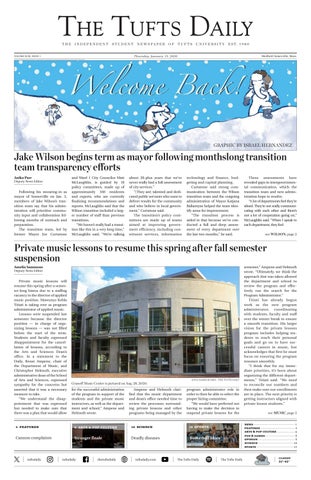
GRAPHIC BY ISRAEL HERNANDEZ
Jake Wilson begins term as mayor following monthslong transition team transparency efforts Anika Parr
Deputy News Editor
Following his swearing-in as mayor of Somerville on Jan. 3, members of Jake Wilson’s transition team say that his administration will prioritize community input and collaboration following months of outreach and preparation. The transition team, led by former Mayor Joe Curtatone
and Ward 1 City Councilor Matt McLaughlin, is guided by 18 policy committees, made up of approximately 160 residents and experts, who are currently finalizing recommendations and reports. McLaughlin said that the Wilson transition included a larger number of staff than previous transitions. “We haven’t really had a transition like this in a very long time,” McLaughlin said. “We’re talking
about 20-plus years that we’ve never really had a full assessment of city services.” “[They are] talented and dedicated public servants who want to deliver results for the community and who believe in local government,” Curtatone said. The transition’s policy committees are made up of teams aimed at improving government efficiency, including constituent services, information
technology and finance, budgeting and capital planning. Curtatone said strong communication between the Wilson transition team and the outgoing administration of Mayor Katjana Ballantyne helped the team identify areas for improvement. “The transition process is aided in that because we’ve conducted a full and deep assessment of every department over the last two months,” he said.
These assessments have revealed gaps in intergovernmental communication, which the transition team and new administration hope to resolve. “A lot of departments feel they’re siloed. They’re not really communicating with each other and there’s not a lot of cooperation going on,” McLaughlin said. “When I speak to each department, they feel see WILSON, page 2
Private music lessons to resume this spring after fall semester suspension Amelia Sammons Deputy News Editor
Private music lessons will resume this spring after a semester-long hiatus due to a staffing vacancy in the director of applied music position. Mawunyo Kobla Titiati is taking over as program administrator of applied music. Lessons were suspended last semester because the director position — in charge of organizing lessons — was not filled before the start of the term. Students and faculty expressed disappointment for the cancellation of lessons, according to the Arts and Sciences Dean’s office. In a statement to the Daily, Kwasi Ampene, chair of the Department of Music, and Christopher Helmuth, executive administrative dean of the School of Arts and Sciences, expressed sympathy for the concerns but asserted that it was a necessary measure to take. “We understand the disappointment that was expressed but needed to make sure that there was a plan that would allow
ANNA MARIE BURKE / THE TUFTS DAILY
Granoff Music Center is pictured on Aug. 28, 2020. for the successful administration of the program in support of the students and the private music instructors, as well as the department and school,” Ampene and Helmuth wrote.
Ampene and Helmuth clarified that the music department and dean’s office needed time to review the processes surrounding private lessons and other programs being managed by the
program administrator role in order to then be able to select the proper hiring committee. “We would have preferred not having to make the decision to suspend private lessons for the
4 FEATURES
6 ARTS & POP CULTURE
10 SCIENCE
12 SPORTS
Cannon complaints
Stranger finale
Deadly diseases
Basketball blues
tuftsdaily
thetuftsdaily
tuftsdaily.com
The Tufts Daily
see MUSIC, page 2 News Features ARTS & Pop CULTURE fun & Games Opinion SCIENCE Sports
page 7
tuftsdaily
semester,” Ampene and Helmuth wrote. “Ultimately, we think the approach that was taken allowed the department and school to review the program and effectively run the search for the Program Administrator.” Titiati has already begun work as the new program administrator, coordinating with students, faculty and staff over the winter break to ensure a smooth transition. His larger vision for the private lessons program includes helping students to reach their personal goals and go on to have successful careers in music, but acknowledges that first he must focus on ensuring the program resumes smoothly. “I think that for my immediate priorities, it’s been about organizing the different departments,” Titiati said. “We need to reconcile our numbers and then make sure our enrollments are in place. The next priority is getting instructors aligned with private lesson students.”
The Tufts Daily
1 4 6 8 9 10 12
cloudy 21°-45°
2
NEWS
THE TUFTS DAILY
THURSDAY, JANUARY 15, 2026
T he T ufts D aily
Somerville mayoral transition team finds gaps to fill
Editorial Josué Pérez Editor in Chief
Sadie Roraback-Meagher Dylan Tanouye Managing Editors
Linda Huang Grace Nelson Emily O’Hearn Associate Editors Julian Glickman Executive News Editor Olivia Bye Executive Features Editor Fiona Hinrichsen Executive Arts Editor Evan Wang Executive Opinion Editor Eliza Warren Executive Sports Editor Shoshana Daly Executive Science Editor Zach Halverstam Executive Investigative Editor Shoshana Daly Executive Science Editor Olivia Zambrano Editorial Board Chair
Multimedia Ellie Broscow Executive Audio Producer Maya Godard Executive Video Editors Dylan Fee Executive Photo Editors Stella Jeong Israel Hernandez Executive Graphics Editors Shayna Levy Executive Fun & Games Editor
Committees
WILSON continued from the front optimistic that there’s going to be a lot more cooperation moving forward.” Grant Pinsley, a sophomore at Tufts and transition intern for the intergovernmental affairs and school relations committees, noted that communication and transparency challenges have extended across all levels of government in Somerville. “Both miscommunication and a lack of communication has been an impediment to progress in Somerville,” Pinsley said. “One of the easiest and first big steps for Mayor Wilson will be to set up new relationships between each of the different layers of government.” Wilson has put community engagement at the forefront of his transition process. His mayoral transition community engagement
survey has reportedly collected over 300 responses. “There certainly was a very robust response. … It was very clear that there was a lot of community concern and a lot of community care,” Madison Rossi, a junior at Tufts and a transition team community engagement intern on the affordable housing committee, said. “We distributed out the responses to all the policy committees weekly, if not more frequently, for them to review and factor into their own recommendations,” she added. The administration also prioritized engagement with Somerville’s immigrant and senior communities, according to Rossi. All the surveys were translated into Spanish and Brazilian Portuguese, the two most prominent non-English languages in the city. As Wilson begins his term and implementation begins for
the recently-passed city charter, city officials expressed optimism about the new administration’s engagement goals within city government. “We’re going to reset the way that the City Council and the Mayor’s Office work together,” City Council President Lance Davis said in his inauguration ceremony speech. “Under the new charter, and with a new administration, we have a real opportunity to reinvent that relationship.” McLaughlin noted that Wilson’s decision to appoint him as vice chair of the transition steering committee also points to a future of collaboration between the City Council and the Mayor’s Office. “Lots of times, the City Council feels like we’re a secondary department of the city, like where we’re not co-equal partners in the city with the Mayor’s Office,” McLaughlin explained, “So to
have the mayor invite me to the transition … I think is a great sign of cooperation.” Other members of the transition team said they were eager to see what the Wilson administration would accomplish. “The future looks bright for Somerville,” Pinsley said. “There’s a surprising amount of power in the culture that you create in your administration, especially for municipal government, and I’m very confident that Mayor Wilson will create a culture that is healthy and allows for progress.” “As a resident of Somerville, I’m excited for Mayor Wilson’s administration,” Curtatone said. “The fact that he really understands the gravity of the transition process and what that means for the likelihood of the success of his administration and the impacts in the community speaks volumes about his leadership.”
Sorsha Khitikian Ethics & Inclusion Chair Grace Lee Education Chairs Annika Pillai Liam Chalfonte Social Chairs Sam Pokorny
Production Angelina Moy Josh Solomon Production Directors Jamie Song Executive Layout Editor Aneeqa Bashir Executive Copy Editors Julia Segal Grace Jin Executive Social Media Matthew Sage Managers Keira Krisburg Executive Newsletter Editor Aisha Karim Website Manager
Business Carol Wu Business Director Julia Critz Assistant Business Sarah Hong Directors Jaylin Cho Alumni Liaisons Arghya Thallapragada
visit tuftsdaily.com/masthead
Founded in 1980, The Tufts Daily is the entirely student-run newspaper of record at Tufts University in Medford, Mass. An editorially and financially independent organization, the Daily’s staff of more than 100 covers news, features, arts and sports on Tufts’ four campuses and in its host communities.
Land Acknowledgement The Tufts Daily office is located on the colonized land of the Massachusett people and within the territories of the Nipmuc and Wôpanâak (Wampanoag) tribes.
Titiati begins as music program administrator MUSIC continued from the front
Story tips? Questions? Concerns? Let us know!
Visit tuftsdaily.com/tips
P.O. Box 53018, Medford, MA 02155
JOSUÉ PÉREZ / THE TUFTS DAILY
Jake Wilson is pictured at a press conference outside of city hall the morning after his electoral victory.
As program administrator, Titiati oversees the private lessons and community music programs which include Community Music classes, Tufts Youth Philharmonic, Summer Music and the Dalcroze Summer Intensive Program. Titiati first came to Tufts in 2019 as an exchange student and later returned for a master’s in ethnomusicology, which he completed in 2023. During his time at Tufts, Titiati participated in various music groups around campus as a drummer. Since graduating, he has worked with the music events staff and taken on several roles at the university
as Ensemble Manager for Tufts Kiniwe and as a private instructor for percussion. He anticipates that his experiences as both a graduate and an instructor will help him to be successful in this role. “I have always found joy in being able to help other musicians, as a musician myself,” Titiati said. “This new role, it’s an opportunity to put in systems to help other musicians.” “Having been a student means that I empathize with students a lot, and I appreciate some of our failures [as professors and administrators],” Titiati said. “I appreciate the pressures of being a student but also, having been an instructor,
I can step in both shoes, and it shapes the way that I deal with my work.” Although the private lessons page still displays a message indicating that lessons are suspended for the fall 2025 semester, Titiati said there will soon be a link to a Google Form where students can sign up for lessons. This link will also include a video of each instructor illustrating their skill and what they have to offer prospective students. Titiati believes that private music lessons are an essential part of an education in music as they are a space where students can apply their knowledge of music theory and gain feedback from experts on form
and technique. He hopes that the private lessons program will continue to impact students’ lives after Tufts for those who pursue careers in music. “Beyond today and beyond this semester, I believe that what we do is prepare young musicians for their future careers,” Titiati said. “I believe that the success of these programs would be seen years down the line, when these musicians are excelling in whatever they do. They can trace an aspect of their success or their excellence to the training that they received through private lessons, the discipline of it, the community that they built and their ability to communicate and build good human relationships.”
THE TUFTS DAILY
THURSDAY, JANUARY 15, 2026
NEWS
3
Medford mayor, City Council, School Committee sworn in for twoyear term Julian Glickman
Executive News Editor
Medford Mayor Breanna Lungo-Koehn and a new City Council and School Committee were sworn in on Jan. 4 as the city prepares to move forward with its rezoning project and build a new Medford High School. Lungo-Koehn, who began her final two-year term before the newly-passed city charter extends the mayoral term to four years in 2027, also delivered her state of the city address following her swearing-in. She framed the rezoning project as a process that is both crucial to the city’s future yet also one that moved too quickly for both residents and city officials. In December, LungoKoehn and the City Council reached an agreement to continue the project following months of gridlock by extending the contract of the project’s consultant, Innes Associates, through May. “Zoning shapes not just what we build, but how we live, how our corridors grow and how our community adapts to opportunities and challenges,” Lungo-Koehn said. “That said, the journey has not been without its challenges. The speed
and scope were outpacing the capacity of our residents and staff, and we needed to refocus our efforts on better communication and public trust.” The city is also set to oversee the redevelopment of Medford Square, with the development company Transom Real Estate leading the project that will convert parcels around City Hall into a mixed-use housing development with parking, open space and both market-rate and affordable housing. “This project will create a true village square atmosphere,” Lungo-Koehn said. “Transom’s proposal reflects the values we share as a city.” The mayor highlighted additional development projects, including the opening of the Great American Beer Hall and the Clippership Connectors waterfront path. She also cited expanded funding mechanisms and updated zoning policies as keys to a comprehensive approach to creating affordable housing, including for veterans. Lungo-Koehn also addressed the controversy surrounding the reduction in trash collection set to go into effect next year. Residents and city officials criticized the administration for announcing the change
Medford elected officials are pictured during 2026 Inauguration Day.
in a press release about the securing of a grant to purchase compost bins. “Trash is a personal topic and I know everyone has an opinion on how we should move forward,” she said. “We will continue with our community listening sessions, review all of the data and adjust our plans accordingly.” Liz Mullane, an assistant vice president for advancement at Northeastern University, was sworn into the City Council following the departure of former Council Vice President Kit Collins. On the School Committee — Michael Mastrobuoni and Jessica Parks, who were endorsed by the progressive group Our Revolution Medford — took the seats of Nicole Branley and John Intoppa, who they defeated in November. Jenny Graham, the vice chair of the School Committee, provided an update on the Medford High School rebuilding project, which is set to either rebuild or renovate the school and received approval from the Massachusetts School Building Authority last year. The project is currently in the feasibility phase, where proposals for how to update the building are being evaluated.
Graham said the building committee — made up of city and school staff and officials, along with members of the broader community — expects to receive concepts from architects this month, with initial cost estimates in February and a chosen design moving forward by June. “This is a transformative project that should have something for literally everyone in this city,” she said. “This includes enhancing education for our students, making our vocational student services more available to the community and our seniors at large, preserving the pool, increasing the amount of field space that’s available to our community sports teams and creating a theater space that properly houses the arts we’re so proud of.” In his remarks prior to the swearing-in ceremony, City Council President Zac Bears outlined a desire for a more collaborative approach to governance. Last year, the rezoning project divided residents going into the November election and tensions between the council and the mayor’s office grew. “These past few years, I’ve heard from too many
people who say they’ve lost faith, who feel that we stand too far apart, who feel alienated from their neighbors, who aren’t sure that we can come together and be excellent and do great things if we can’t trust each other,” he said. He also announced the introduction of regular neighborhood ward meetings throughout the city, which he said would allow the body to be more transparent. “I will work my hardest to center compassion for our community at the heart of my work because we must be able to feel compassion for each other and, at the very least, hear each other out with an open heart, even across our biggest differences and disagreements,” Bears said. The City Council held its first meeting of the new term on Jan. 6, with Bears re-elected as president and Emily Lazzaro, the top vote-getter in November, being elected as the body’s new vice president. Councilors discussed the city’s decision to change ambulance providers, a resolution to support professors of the practice at the Tufts School of the Museum of Fine Arts and the hiring of a new city clerk.
JOSUÉ PÉREZ / THE TUFTS DAILY
4
FEATURES
THE TUFTS DAILY
THURSDAY, JANUARY 15, 2026
FEATURES New cannon repainting policy leaves students confused, conflicted Sanya Bandekar
Assistant Features Editor
Between Goddard Chapel and Ballou Hall, overlooking President’s Lawn, stands the Tufts cannon. This piece of history is constantly adorned with political, cultural and prideful messaging painted by student groups, making it a centerpiece of free speech on campus. Yet, at the start of the 2025–26 academic year, the decades-old tradition of ‘painting the cannon’ embraced a new policy. In a September email, Camille Lizarríbar, dean of students for the School of Arts and Sciences, announced that free speech and expression through the cannon would take on a new form: The cannon would be subject to “periodic cleanings.” In practice, this meant repainting the cannon light blue every Thursday as a weekly ‘reset.’ While the cannon has long served as a platform for students to express sentiments regarding current events at Tufts and around the world, the tradition is not limited to political groups. Sports teams, affinity groups and performance organizations also participate. However, the new policy set by the administration stated that the new policy was intended to encourage students to share their thoughts and opinions “without necessarily having to cover up someone else’s message,” according to the Dean of Students Office. Although students were notified about the new approach to free speech in September, widespread confusion emerged after the Philippine Student Union’s message — painted on a Wednesday night — was covered the following day.
“It’s a big part of our tradition, and the fact that it was painted over, especially during Filipino American History Month, was shocking,” said Jonas Apacible, an executive board member of the Tufts Philippine Student Union. Apacible noted that PSU was the first organization to paint the cannon in the 1970s in protest to a grant given to the Fletcher School by the Marcos dictatorship, launching the tradition that followed. When a PSU executive board member reached out to Facilities after the repainting, they were told it was due to the new policy. Further inquiries to the administration led to more questions than answers. “They were also saying [that] it was a student-led initiative and [tied to] TCU. But then when we asked TCU they [said] ‘No we don’t have any resolutions on this,’” Jonas continued. “It felt like the university was kind of withholding information and taking a stance that [was] aligned with student ideas.” That statement aligns with Lizarríbar’s statement that the practice followed “numerous conversations last year in which students had indicated to us that they felt intimidated and feared being labeled, stigmatized or ostracized for painting over another group’s message.” Lizarríbar also referenced Tufts’ commitment to institutional pluralism, which limits the university’s ability to make official statements on current events. Even with the policy now widely known, many students remain uncertain about what prompted the change, as the
The Tufts cannon is painted over on Oct. 16, 2025.
administration has offered limited public explanation. The year 2025 saw major global events unfold, drawing national attention to student activism and sparking difficult, often controversial discussions on campuses across the country. Tufts Friends of Israel, a student organization that supports Jewish students and encourages dialogue surrounding the Israeli conflict, opposed the policy, citing flaws in its implementation. “On every other night [after Thursdays], the tradition works exactly the same as it always has: Students paint over one another’s messages as part of the normal process. … Instead of expanding expression, the policy introduces the risk that messages can be erased under the label of ‘routine cleaning.’” FOI emphasized the importance of keeping the cannon tradition as it has always been: student-run. The group noted the long-standing practice of groups ‘guarding’ their messages overnight to preserve them. “The cannon has always been a student-driven tradition with simple rules: You paint it at night, and someone else can repaint it later that night or the next,” FOI wrote. “That open exchange is exactly what has made the cannon one of the most visible expressions of free speech on campus.” Nationally, universities have faced heightened scrutiny under the Trump administration as students navigate activism and current events. Since the beginning of the year, institutions such as Northwestern, Brown, the University of Pennsylvania and Harvard have received threats of federal
funding limitations. According to the New York Times, many political leaders have criticized these universities over affirmative action, high tuition costs and DEI initiatives, as well as perceived liberal ideological leanings among faculty and students. Bailey Kelly, a sophomore and secretary of the College Democrats of Massachusetts, said the new policy conflicted with the free speech values that influenced their decision to attend Tufts. While they acknowledged the national and global context in which the decision was made, they emphasized how disheartening it felt. “There was a deliberate reason for those rules being put in place, and that was affected by the Trump administration and the way that they’re going after university funding in relation to DEI programs and practices. It is very obvious that our administration is scared of those things,” Kelly said. However, they maintained that while those threats are serious and valid, Tufts’ commitment to protection at the expense of student’s free speech is “weak.” “It goes against the things that I think all Tufts students … value,” they said. Additionally, it contradicts the values that shape organizations like the College Democrats of Massachusetts, strengthening their frustration. While the university did not directly mention Trump’s crackdown in its statement regarding approaches to free speech, its vague explanations, combined with the national
context, has led many students to come to Kelly’s conclusion. “The cannon really [belongs] to the students,” they said. “It helped foster, and continues to help foster a close community. … In political times like this, that’s … increasingly important.” Opposition to the policy is not limited to left-leaning groups. In a statement by Tufts Republicans, the student organization noted its firm disagreement to the policy, stating that it implies that Tufts students are “incapable of handling an open exchange of ideas” and expressed its frustration with administrative interference with a student tradition. “Part of the value of the cannon is speaking up even when your message is unpopular, knowing it may be painted over quickly. As a minority voice on campus, we understand that better than most,” the statement continued. The cannon is known to be a hub for activism and expression despite the policy, which has been in effect for four months. While free speech may take a new form, students regularly paint over the historical piece with messages they deeply believe in. Kelly emphasized the importance of the tradition, maintaining that, despite a new approach that may be unpopular among students, Tufts still enjoys marginally more freedom of speech than other institutions. “Anger is definitely a fuel for action,” Kelly said. “We can still make ourselves visible. … And if it’s going to get painted over on Thursday, paint it again on Friday.”
SHANNON MURPHY / THE TUFTS DAILY
THE TUFTS DAILY
THURSDAY, JANUARY 15, 2026
FEATURES
5
Tufts Carillon: Musical history hidden in the Goddard Chapel bell tower Katie Galligan
Deputy Features Editor
In 1876, Eugene Bowen graduated from Tufts College known by peers and faculty as the most prominent bell ringer of his class. Goddard Chapel had not yet been built, and a single bell rang atop Ballou Hall. This bell’s historical record is wide-ranging, even including a memorable prank from the 1880s in which Tufts students tied a calf to the bell rope so the bell would ring for hours. 50 years after his graduation, Bowen returned to his alma mater to carry on his legacy as a passionate bell ringer by gifting a set of nine bells for the Goddard Chapel tower in 1926. These became the basis for the Tufts carillon, which still rings daily at 5 p.m. A century later, the Tufts University Chaplaincy and student carillon players continue to preserve the bell-ringing tradition, connecting today’s Tufts students to the university’s history. “For the students that are … involved, the carillon is something that is really important,” Alexander Stone, a sophomore carillonist, said. “[It’s] something that they’re really enthusiastic about because it’s such a powerful instrument. It really changes how a song feels.” While definitions vary, the carillon is a percussion instrument played with a keyboard that connects to at least 23 bells. The carillon in Goddard Chapel has 25 bells and has been controlled with an electronic keyboard located next to the organ since 1964. Every day at 5 p.m., the carillon plays a hymn tune from a prerecorded list. In addition, the Chaplaincy organizes one carillon concert per semester open to all students and community members. “My favorite part of all this is introducing the carillon to students who are new to playing it,” Suzanne Cartreine, Chaplaincy music director, wrote in an email to the Daily. “It’s very accessible to anyone who’s played piano, and it is fun to see people’s enthusiasm for the bells and excitement at being able to play them.” One of Cartriene’s responsibilities as music director is helping students adapt their songs to the carillon’s scale. Most concerts average five to 10 performers with varying piano and carillon experience. Friends and community members gather to hear the half hour of powerful music from the tower. At the end, Cartreine often leads an informal jam session with the audience. “[The carillon] is something that … brings people together. … Even if you don’t play the piano or … the carillon, you still … hear the little melody that’s been selected no matter where you are on campus,” carillonist Mallika Sinha said. “It’s easy to feel separated from other people on campus, and it’s just a nice reminder that
ALEXANDER STONE / THE TUFTS DAILY
Goddard Chapel tower is pictured. we are all … at one school together.” The carillon harnesses its 25 bells to the fullest extent, giving musicians a feeling of grandeur and power when they play. Students most commonly use classical music, as it translates more easily to the bells. At the most recent Halloween concert, songs ranged from Claude Debussy’s “Clair de Lune” to music from “The Nightmare Before Christmas” (1993) soundtrack. However, the carillon has its limitations: The bells cannot play every note found on a piano, and there is a slight delay between the keyboard and the sound. “You have to know a little bit about music theory, because [on] the carillon, we only have 25 notes,” Stone said. “A lot of classical music [utilizes] a whole piano, so you have to shift the notes around. … I had to rewrite half [of ‘Für Elise’] because it uses such a wide range [of notes].” Despite these limitations, the university has relied on bells since its founding. For most of Tufts’ history, the bells rang far more frequently than they do today to signify
the start and end of classes, football victories and other events. The tradition began with a simple handbell rung by Jarvis Wright (A’1859) from 1854 to 1856, before trustees purchased a designated bell for Ballou Hall in 1857. In 1908, the class of 1898 gifted the first bell to Goddard Chapel, which is said to include metal from the original Ballou Hall bell. Bowen later gifted his set of nine bells, and an additional 15 bells were later gifted in memory of Tufts Vice President John Tilton in 1964, bringing the carillon to its current total of 25 bells. The carillon has garnered students’ attention, complaints and awe for the past 100 years. A quick skim through the Tufts Archival Research Center’s newspaper archives reveals numerous humorous poems regarding the bells, along with other historical tidbits. These records highlight the bells’ long-term significance in student life. One of the most entertaining stories appears in the Tufts Weekly’s Dec. 1, 1926 issue, in which a Tufts student named Charles Anthony wrote to the editor complaining about the
bells. Anthony claimed that the poorly played hymns at breakfast “impair the gastric juices.” He advocated for an electric keyboard and equated the bells’ improvement to Tufts’ rise to prominence. “We have a real chance to add one blessed vital note of beauty and distinction to the Hill, which is at last emerging from its growing pains and beginning to realize that truth … divorced from expressed beauty is a sordid distortion of practical idealism,” Anthony wrote. General consensus among current Tufts carillon players would most likely disagree with Anthony’s claims. Both Sinha and Stone emphasized that the carillon’s quirks add to its character and value. “[The carillon] is a little bit janky in a very loving way,” Sinha said. “It’s a great setup, but there’s a little bit of a lag between when you press a note and when you hear it, and if you try to play too fast, then the sound gets jumbled together.” “It doesn’t really need to be perfect to be beautiful. … The point is to feel the music,” Stone said.
As students return to campus in 2026, many are unaware of the historical and powerful musical instrument that they pass each day. This semester, carillon student leaders hope to expand awareness by working with other student organizations, playing during Parents and Family Weekend, being featured in an upcoming Aidekman Arts Center sonic art installation and advertising to host communities. “A lot of people don’t even realize that there actually are bells. Some people I have talked to … thought it was a recording or … that someone’s up in the tower hitting away at the bells,” Sinha said. “That’s part of why the concerts are also nice. It’s outreach [and] … a cool bit of music history.” At first glance, the unsuspecting Goddard Chapel bell tower and the sounds it produces may seem like a mundane tradition. However, for piano players and nonmusicians alike, the carillon offers an opportunity for students to engage with a dynamic instrument whose echoes carry the stories of Tufts’ campus from its very beginning.
6
ARTS & POP CULTURE
THE TUFTS DAILY
THURSDAY, JANUARY 15, 2026
ARTS & POP CULTURE The ‘Stranger Things’ finale ends the show with some fizzles, some bangs Spring LaRose
Deputy Arts Editor
The finale of the global phenomenon “Stranger Things” has been prophesied as one of the biggest television events of the 21st century. With five seasons spanning nine years, the show has grown both its audience and the scope of its story, tapping into, and in turn creating, a cultural zeitgeist. Now, the last episode is here. Ending a somewhat controversially received season, “Chapter Eight: The Rightside Up” positions the entire gang for an epic final battle with Vecna ( Jamie Campbell Bower) and the Mind Flayer. The goal is to destroy the Upside Down — and all of the evils that stem from it — for good. The ensemble cast of “Stranger Things” is one of the show’s strongest features. The breadth of endearing, compelling personalities the series strings together is as impressive as its sci-fi worldbuilding. But there comes a tipping point where more is not better. With the addition of Holly Wheeler (Nell Fisher) as a main character, the show
Stranger Things logo is pictured.
now feels glaringly crowded. Furthermore, while Holly’s scenes in Vecna’s mind are intentionally framed to feel like they are in an alternate universe, they still don’t jive with the rest of the season. Given that the stakes have never been higher and the characters have never felt more numerous, the issue of death looms heavily over the episode. But “Stranger Things” has never shied away from its plot armor, and the finale is no exception. So teasing — but not consummating — the death of the beloved Steve Harrington ( Joe Keery) in a fall from the radio tower was a predictable move. The only character whose life is established to be in real, grave danger by the laws of the show is Eleven (Millie Bobby Brown), who is a very good choice. It started with her, and it must end with her. Jim Hopper’s (David Harbour) distress over the possibility of losing yet another daughter is visceral. Of all the plights of the “Stranger Things” characters, Hopper’s is the easiest to sympathize with. The exploration of the Abyss is a compelling aspect of the finale, expanding the
supernatural world of “Stranger Things” beyond our dimension. The barren sci-fi hellscape the show presents for this alternate dimension somehow feels very 1980s — à la David Lynch’s “Dune” (1984). Rendering the Upside Down a wormhole, and therefore substantially demystifying its horror, was, in some ways, a lame reveal. But at the same time, this explanation of the Upside Down allows for a dramatic escalation in “Stranger Things” world-building — and that’s not bad. There comes a point in the episode where a redemption arc for Vecna, also known as Henry Creel, is on the table. We get Vecna’s humanizing villain origin story when he finally enters the cave. This explanation again softens the horror. Luckily, despite Will Byers’ (Noah Schnapp) telepathic pleas, Vecna remains allied with the Mind Flayer. Placing the ultimate power and evil back in the hands (or legs, as it were) of the Mind Flayer is a very good decision on the show’s part, reviving some of the supernatural mystery of earlier seasons.
The final battle with Vecna and the Mind Flayer in the Abyss goes down just too easily. The Mind Flayer’s true physical form is the largest beast the gang has ever faced, yet it is thwarted pretty quickly. What once seemed an unfathomable interdimensional evil is now easily lured into a cave and ambushed – on its home turf, no less. But “Stranger Things” has always been about the underdog’s triumph. Perhaps the gang has earned this victory thematically, even if it’s not a satisfying final smackdown. Eleven’s decision to sacrifice herself on the cusp of the Upside Down gate puts a sudden spotlight on her relationship with Mike Wheeler (Finn Wolfhard). They share a tragic, heartfelt goodbye, yet after all these seasons, their love still feels half-baked — more propped up by the plot than by character chemistry. This contrasts with the relationship between Lucas Sinclair (Caleb McLaughlin) and Max Mayfield’s (Sadie Sink) relationship, which, though given less screen time this season, feels much more believable.
The flash-forward portion of the episode, in which life in Hawkins is finally peaceful, is a nice epilogue. Getting a small taste of the gang’s future is a welcome diversion from the typical form of the show. Eleven’s disappearance is the last necessary piece needed to restore normalcy for the other characters — and it’s good that the show leaves her gone. “Stranger Things” doesn’t need to be a bloodbath, but it does need at least one final tragedy to make the ending appropriately bittersweet. The return to the Dungeons & Dragons game is the perfect note to end on. Mike’s resumption of his role as storyteller especially brings the series full circle. His suggestion that Eleven is still out there and may have faked her own death is eye-rolling, but it does fit with the magical pedestal he’s put her on throughout the years. And it’s kind of cool to leave the interpretation of the story up to the characters as much as it is left up to the audience. When the kids leave their D&D binders behind in the Wheelers’ basement, they bring the “Stranger Things” campaign to a literal close.
VIA FLICKR
THE TUFTS DAILY
ARTS & POP CULTURE
THURSDAY, JANUARY 15, 2026
7
‘Resurrection’ is one of cinema’s most daring love letters Noah Goldstein
Deputy Arts Editor
At this point, Chinese filmmaker Bi Gan’s career can largely be described as an anomaly. He’s 36, yet his films display a maturity that most fail to reach even in their later years. He comes from mainland China, infamous for its artistic censorship, but his work is some of the most innovative and expressive in world cinema today. His first two feature films, “Kaili Blues” (2015) and “Long Day’s Journey Into Night” (2018), were hypnotic in style and personal in philosophy, following protagonists as they ventured through Gan’s native Guizhou province in southwest China. “Resurrection” (2025) finds Gan operating in his most formally maximalist mode yet. Best described as the auteur’s attempt to capture the entire history of cinema as only he knows how, Gan’s evocative filmcraft and singular vision allow him to deliver a mesmerizing — if chronologically impermeable — odyssey through a century of moviemaking. One would be foolish to even attempt a synopsis of this structurally perplexing picture, but its overall premise goes something like this: In a not-so-distant alternate reality, humans can attain immortality if they refrain from dreaming. In this world, the small group of mavericks who continue to dream — at risk of “[sending] time into spasms” — are the Deliriants, and they are pursued by the Big
Others, who possess the ability to maintain order by disrupting the Delirants’ mirages. The film begins in the style of early cinema, silent and driven by title cards and orchestral score, as one of the Big Others (Shu Qi) discovers that her targeted Deliriant (pop idol Jackson Yee) is shacked up somewhere deep inside an opium den. As she traverses the lavish-yet-cavernous space in search of the dreamer who will come to represent the cinematic medium itself, the audience begins to understand what they’re in for: Gan spares no reference to early motion pictures, lacing the set with easter eggs to film-school essentials like Georges Méliès’ “A Trip to the Moon” (1902) and Louis Lumière’s “The Waterer Watered” (1895). Finally, Qi’s character discovers the Deliriant — himself bearing a close resemblance to Max Schreck’s monster in “Nosferatu” (1922) — and decides to send him on a 100year voyage through humanity’s time on the silver screen. After the opening sequence come four distinct vignettes, all highly stylized and tied together by the emblems that have become characteristic of Gan’s filmmaking: clocks, flames and mirrors. One even features an enigmatic woman named Tai Zhaomei (Li Gengxi), uncoincidentally also the name of a crucial character in “Long Day’s Journey.” It’s held together by loose associations, including Qi’s intervening narrations that serve as quasi-title cards and the fact that each short is vaguely
based on one of the five senses. But on the whole, “Resurrection” is most successful when experience supersedes analysis. Each section is intriguing in its own right — though the latter two certainly have more going for them in terms of plot — and Gan, alongside “Long Day’s Journey” Cinematographer Dong Jingsong, crafts imagery the audience will not dare look away from. The phrase ‘every frame a painting’ has rarely applied so fittingly. There are more theoretical musings contained within Gan’s film than one could count on both hands, but perhaps the most important is the question of how cinema has defined reality — and vice versa — throughout the medium’s relatively short existence. The world of “Resurrection” is not the hyperrealistic landscape of “Kaili Blues,” but rather a setting defined by the genre stylizations characteristic of cinema’s past century. It’s unclear why exactly Gan opts for these four specific stories — beyond their shared patterns and their focus on morally opposed characters forced into collaboration — yet it remains evident that the cineaste can reconstruct a Criterion classic just as easily as he can quote one. From the shadow-tinged noir of the first vignette to the neon-lit thriller reminiscent of Wong Kar-Wai’s “2046” (2004), Gan displays an impressive ability to cross genres without sacrificing tone or intention.
Bi Gan is pictured at the 2025 Cannes Film Festival. “Resurrection” is a film full of bold cinematic swings, and none is greater than an epic long take in its fourth section. Gan has defined himself as a filmmaker who views Hollywood-style cross-cutting the way a butcher views vegetarians — and his first two features included similar oners lasting 41 and 59 minutes, respectively — so the 30-minute shot that snakes through shady streets on New Year’s Eve 1999 is far from a surprise. Still, it serves as a climactic crescendo
In Photos:
Spring on Film Photos by Sophia Khan
VIA WIKIMEDIA COMMONS
that filmmakers aspire to but few achieve. If you’re searching for a crowd-pleaser or light viewing, you’d be well advised to look elsewhere (after all, “One Battle After Another” (2025) is streaming now). However, for those in search of a singular cinematic experience — dreamers, film buffs and everyone in between — “Resurrection” may be the film for you. It looks to cinema’s past not as a postmortem examination, but as a way to envision a brave future.
8
FUN & GAMES
THE TUFTS DAILY
THURSDAY, JANUARY 15, 2026
F&G
Late Night At The Daily Emily: “If I’m eating on Tufts campus I want to eat with a Carm rat.”
FUN & GAMES WORD SEARCH
WELCOME BACK
MINI CROSSWORD Welcome to Tufts
S
M
L
O
D
S
R
B
O
U
T
L
O
O
K
Welcome to Tufts
C
P
T
E
U
C
W
T
L
O
S
A
K
V
J
H
A
Q
R
A
A
G
I
R
Y
I
T
U
S
A
E
W
R
N
D
R
O
S
S
T
U
D
Y
E
N
D
I
L
M
G
F
N
C
M
O
C
W
A
N
U
ACROSS 1 __ Mahal 1 __ Mahal 4 This being infected will 4 This being make you stuffy infected will make you stuffy 6 Exists 7 Way of doing 6 Exists things 7 Way of doing 8 Protectors of things open wounds 10 Streaming 8 Protectors of service for open wounds Games of 10 Streaming Thrones service for DOWN Games of 1 Tufts' Library Thrones
U
B
F
V
Y
A
I
H
Y
R
K
S
J
o
A
L
S
P
R
I
N
G
S
E
M
E
S
T
E
R
E
L
E
P
H
A
N
T
l
S
U
N
O
V
Y
C
A
L
E
N
D
A
R
S
W
E
R
L
H
N
W
C
O
L
D
O
E
A
N
R
S
N
O
W
Y
I
A
N
T
G
F
L
E
W
I
S
B
N
I
E
Y
N
B
A
R
C
K
I
L
P
M
R
C
N
A
ACROSS
V
E
D
W
Z
Y
O
U
R
L
N
Welcome Back pt 2! ACROSS 1 Actress Dobrev 5 President Alexander of Finland 10 Repeated hugs and kisses in eyeshot 14 Finished 15 Musk's EV company 16 What one might say when finished with dinner 17 What Tufts students attended today 19 King of the jungle 20 Persian Queen of Purim legend 21 Phoned, to Brits 23 Consumed 26 Unhinged, in slang 27 Text speak for not joking 30 __ it in the bud 32 Makes morning coffee 35 Ctrl + C 36 Fine point 38 Where gymnastics is done 39 Nonbinary pronoun 40 What you might cut a pizza into 41 Park is a famous one in NYC 42 My Hero Academia heroine 43 What might fail as you age 44 Actor Schreiber of X-Men 45 Tropical fruit 47 Citation method 48 Sign of life
E
T
T
2
1
2
3
3
4
5
4
5
6
7
6
7 8
2 Indefinite article used before a vowel sound 3 Statue outside Barnum Hall 4 May have a bro 5 ABBA song and cry for help 9 One may be part of a six pack
DOWN 1 Tufts' Library R E A D I N G S E O U A S E G 2 Indefinite article used F S N J O A B A R N U M L R N before a vowel Spring semester Study Elephant sound New classes Snow Barnum 3 Statue outside Schedule January Eaton Barnum Hall Winter Readings Carm 4 May have a bro Cold Learn Lewis 5 ABBA song and Outlook Scarf Calendar Canvas Tisch Wren cry for help 9 One may be Difficulty Level: Surviving a whole semester without Fresh at Carmichael Diningpart Hallof a six pack T
1
9
8
9 10
10
‘Welcome to Tufts’ by Shayna Levy
CROSSWORD
49 Type of berry 51 What red wine may leave on white tablecloth 53 Baseball average 56 Goatees, e.g. 60 Leave out 61 What the second semester may provide 64 City that was not built in a day, according to legend 65 Have because of 66 Lightbulb! 67 Perimeter's partner in elementary math 68 A campaign to destroy someone's reputation 69 Zack's twin on Disney Channel DOWN 1 Not at all 2 Currier's partner 3 Small salamander 4 Bow and arrow sport 5 Begin 6 Travis Kelce and Gronk, for two 7 Battleship letters 8 Ran in the wash 9 Fundamental 10 Romans built them in the Doric and Ionic style 11 What you might get if you sign up for our newsletter 12 What you may stub on a table leg 13 Email button to hit when done
1
2
3
4
5
14
6
7
10
18
23
24
29
25
30
35 40
42
43
45
33
34
58
59
22
31
32 37
38 41 44
46 49
13
26
36
39
12
19 21
28
11
16
20
53
9
15
17
27
8
47 50
54
48 51
52
55
56 62
57
60
61
64
65
66
67
68
69
18 Meadows 22 They have the meats 24 Puzzle 25 Anne who wrote "Abie's Irish Rose" 27 Episode title if the iCarly cast took a science class 28 Matriarch in Schitt's Creek 29 When second semester ends 31 Rodent companion 33 What surfers need 34 Harrington of Stranger Things 36 Never, in Nuremberg 37 Shakespearean possessive
40 Used to convey emotion in a text 44 Nut 46 Ad campaign for a kind of morning caffeine 48 Pecan, pumpkin, apple, etc. 50 Lots of facts 52 Detest 53 When doubled, popular French Polynesian vacation spot 54 Latin love 55 Popular form of video on TikTok 57 Swiss watch brand 58 Stowe novel 59 Remain 62 *Squeal* 63 RR stop
‘Welcome Back Part 2’ by Shayna Levy Interested in submitting a puzzle? Reach out to production@tuftsdaily.com.
63
THE TUFTS DAILY
THURSDAY, JANUARY 15, 2026
OPINION
9
OPINION Letter from the Managing Board: The semester in preview The Managing Board Dear readers, Welcome back to Tufts! We would like to introduce ourselves as the 93rd Managing Board, responsible for the behind-the-scenes operations of the Daily and supporting all executive editors and committee chairs as they coordinate everything you see on our website and in print. Josué Pérez will be serving as editor in chief, working with Managing Editors Sadie RorabackMeagher and Dylan Tanouye and Associate Editors Linda Huang, Grace Nelson and Emily O’Hearn to fact-check and edit all incoming articles. Production Directors Josh Solomon and Angelina Moy will ensure the visual cohesion and appeal of our print editions. Carol Wu is returning as business director to maintain our finances and status as Tufts University’s only independent student newspaper of record.
The 93rd Managing Board is pictured.
For more information about the dedicated editors who make up the spring 2026 executive board, you can view the full masthead at tuftsdaily. com/about. Last semester we covered the Somerville and Medford elections, providing live results from city halls. We also reported on Tufts graduate student Rümeysa Öztürk’s legal proceedings as she challenged the federal government’s decision to arrest and detain her, as well as its decision to terminate her Student and Exchange Visitor Information System record. We began coverage of Tufts’ Operation Model Transformation, an ongoing initiative restructuring the university’s administrative functions. Our writers also reported on the establishment of the Center for Expanding Viewpoints in Higher Education and Tufts’ adoption of a statement of institutional plurality. Meanwhile, the professors
of the practice at the School of the Museum of Fine Arts remain in contract negotiations, a process that began in April 2024. Our special editions this semester will include the 46th anniversary of the Daily’s first publication, Jumbo Month, Commencement and — of course — April Fools’ Day. You can pick up these, as well as our weekly print editions, at more than 20 distribution locations on and off campus. We hope you continue to engage with us not only as the newspaper of record for Tufts University, but also as a source for developments and updates in Medford and Somerville’s local governments and communities. Our Features and Arts sections spotlight fascinating people on campus and beyond, while Sports keeps us in the know of our teams’ woes and celebrations. Our Science section shares new, intriguing research from Tufts professors
and students. As higher education and the national landscape continue to evolve, our Opinion section will weigh in, providing facts and figures to support its arguments. But our regularly reporting sections are not all that make up the Daily. We are looking to expand our Business team to maintain a steady stream of revenue that supports staff stipends, a paywall-free website, weekly print editions and so much more. Now more than ever, Americans are getting their news through social media and other nontraditional sources. At the same time, the spread of misinformation in the digital era demands high-quality journalism to keep readers informed about their communities. We plan to continue expanding into video, audio and social media reporting to meet readers where they are while providing engaging, informative and accurate
coverage. We encourage new and returning editors and writers to contribute to this work alongside their current participation in the Daily. As always, we strive to showcase the wide variety of perspectives our campus and local communities have to offer, and we want you to be part of the conversation. We encourage you to reach out to us at daily@tuftsdaily.com or submit a letter to the editor or op-ed at opinion@tuftsdaily.com. Be sure to follow us on Instagram for updates on our general interest meetings, open house and DailyCon. Pax et Lux, Josué Pérez, Editor in Chief Sadie Roraback-Meagher Dylan Tanouye Linda Huang Grace Nelson Emily O’Hearn Angelina Moy Josh Solomon Carol Wu
STELLA JEONG / THE TUFTS DAILY
The Tufts Daily is a nonprofit, independent newspaper, published Monday through Friday during the academic year and distributed free of charge to the Tufts community. The content of letters, advertisements, signed columns, cartoons and graphics does not necessarily reflect the opinion of The Tufts Daily editorial board. EDITORIALS: Editorials represent the position of The Tufts Daily Editorial Board. Individual editorialists are not necessarily responsible for, or in agreement with, the policies and editorials of The Editorial Board. Editorials are submitted for review to The Tufts Daily Executive Board before publication. VIEWPOINTS AND COLUMNS: Viewpoints and columns represent the opinions of individual Opinion editors, staff writers, contributing writers and columnists for the Daily’s Opinion section. Positions published in Viewpoints and columns are the opinions of the writers who penned them alone, and do not necessarily represent the opinions of the Daily itself. All material is subject to editorial discretion. OP-EDS: Op-Eds provide an open forum for campus editorial commentary and are published Monday through Friday. The Daily welcomes submissions from all members of the Tufts community; the opinions expressed in the Op-Ed section do not necessarily represent the opinions of the Daily itself. Opinion articles on campus, national and international issues should be 600 to 1,200 words in length and submitted to opinion@tuftsdaily.com. The editors reserve the right to edit letters for clarity, space and length. All material is subject to editorial discretion and is not guaranteed to appear in the Daily. Authors must submit their telephone numbers and day-of availability for editing questions. ADVERTISEMENTS: All advertising copy is subject to the approval of the editor in chief, executive board and business director. Reach out to business@tuftsdaily.com with advertising inquiries.
10 SCIENCE
THE TUFTS DAILY
THURSDAY, JANUARY 15, 2026
SCIENCE At the intersection of art and biology: LABLINES project launching Addison Dion
Deputy Science Editor
GRAPHICS COURTESY KHAO TRAN LABLINES: “Linking Arts and Biology through Lines & Narrative for Engaging Science,” is set to launch at Tufts this semester. The initiative recently received a grant from the Tufts MUSE funding program, which supports “arts, humanities, and humanistic social sciences projects” that may otherwise have limited funding options.
Isabella Arabia, a biology master’s student at Tufts, worked with assistant professor and researcher Khoa Tran to design LABLINES. Both navigate dual identities as artists and scientists, using artistic media as a vessel to communicate their scientific research. Arabia is a graduate of Tufts’ combined degree program in biopsychology and fine arts. Her art practice c e n ters on raising awareness a b o u t science and animals. For example, her senior thesis aimed to foster empathy toward ants. New to the biology faculty at Tufts, Tran is also a co-founder of JKX Comics, alongside Tufts Assistant Professor Jaye Gardiner and Dr. Kelly Montgomery, when the three were graduate students. According to JKX Comics, their
mission has been to “increase scientific literacy, access, and exposure to a variety of STEM disciplines using comics as a vehicle” since their inception in 2015. Their shared background in both art and science inspired their first meeting, where Arabia said they came up with the idea to apply for the Tufts MUSE grant together. “Khoa already had this idea [that] he wanted to bring the comics here to Tufts and make it
something that helps undergraduate researchers get visibility for their work,” she said. From there, the pair workshopped LABLINES as an initiative that seeks to increase visibility for undergraduate STEM research. The program works to give students the skills to communicate their findings while also encouraging cooperation between S M F A s t u dents a n d S T E M re s e a rc h ers.
L ABLINES plans to engage audiences through a variety of art forms, including murals and comics. Tran highlighted that comics can be an enduring and approachable medium that engages readers of all ages,
making scientific research more accessible. Through LABLINES, student artists and researchers are not encouraged to adhere to a specific artistic outcome. Tran and Arabia aim to maintain a handsoff approach to students’ creations. “We have two artists that have very diverse art styles, and then we want the scientists to really communicate what they’re passionate about and their story, [because] they know the story the best,” Tran said. The LABLINES project also intends to create a mural on campus to increase visibility for undergraduate research opportunities at Tufts. Tran believes the mural, which will include a QR code linking to research information, will help students who are unfamiliar with how to access research positions. Tran and Arabia both noted that undergraduate students often struggle to join research labs due to a lack of information about the process. Through
campus and STEM students on the Medford campus. Arabia, who studied at both locations, noted that there’s often little overlap between the groups. LABLINES will provide a unique opportunity for students from different academic backgrounds to learn from each other. Currently, one u n d e rg ra d u a t e biology researcher and two SMFA artists are set to collaborate this
LABLINES, Arabia aims to increase accessibility by “sharing the story of not just the research that’s being done, but the scientists behind it and how they got from point A to point B.” In addition to improving undergraduate access, LABLINES also aims to make science more accessible to people outside the research community. According to Tran, one of the project’s main goals is the “dissemination of science and making sure [it] is accessible across a wide array of … demographics.” LABLINES will also support communication between current undergraduate researchers and aspiring students. “I feel like a lot of undergrads don’t have a forum to talk to other undergrads,” Tran remarked. Through fostering these conversations, LABLINES aims to increase accessibility to research for all students. Finally, the initiative will foster collaboration between SMFA students on the Boston
Tran hope to eventually establish the initiative as a long-term project at Tufts, involving more student researchers and artists in the future. While LABLINES is currently limited to biology research, the team
hopes to expand into other STEM disciplines in the future. When asked about future growth, Tran commented that delving into other sciences will be a valuable future endeavor. The research background of a biology versus an engineering student is going to
semester to pilot
LABLINES. Arabia and
be vastly different, and h e wants people “to understand the diversity of that experience.”
For now, LABLINES aims to highlight the often-unseen experiences of undergraduate biology researchers and promote a culture of accessibility within the Tufts community.
THE TUFTS DAILY
SCIENCE
THURSDAY, JANUARY 15, 2026
11
Book Review: ‘Everything is Tuberculosis’ Kylie Liggett Staff Writer
Tuberculosis is a disease that kills over 1 million people every year, so why is it that much of the Global North thinks of it as a disease of the past? Why is a curable disease still killing so many people? In his new book, “Everything is Tuberculosis,” John Green tackles the history and current reality of a disease that has, in many ways, shaped our world. “Everything is Tuberculosis” centers on answering the question of why access to the TB cure is limited in regions where the disease is most prevalent, challenging the plethora of assumptions that have been made about the disease throughout history. Green’s self-awareness, ability to explore the complexities surrounding tuberculosis and evident deep passion for the topic make this an unchallenging yet immensely informative read. “Everything is Tuberculosis,” leaves the reader convinced of Green’s central point: that the root cause of tuberculosis is systemic inequality, not just in healthcare, but in housing, education and food security, and that the disease exacerbates these inequalities. One of the book’s strengths is that it includes straightforward explanations of the modern healthcare landscape, while acknowledging the limits of viewing the issue through only this lens.
Moments ‘til Madness
Midseason question marks Owen Short We are now almost halfway through the college basketball season and there has been no shortage of storylines up to this point. With every team well into conference play, the top contenders are becoming clearer, while bubble teams are striving to build their resumes before Selection Sunday. So far, these are the most important questions regarding the state of college basketball as I see it. Who’s eligible to step on a college court? On Jan. 3, James Nnaji played his first game for the Baylor Bears, a story that took over college basketball. Nnaji was selected No. 31 overall in the 2023 NBA Draft, making him the first former NBA draft pick to play men’s college basketball. Although he never played an NBA game, he spent several years in Europe with FC Barcelona and is now 21 years old as a first-year. This polarizing decision to recruit Nnaji by
The book covers a plethora of topics, jumping from cowboy hats to beauty standards and the ways they connect to TB. However, Green is able to bring the whole narrative together through powerful ethos, grounding it in the real story of a young boy named Henry. When Green first traveled to Sierra Leone, he met a 17-yearold tuberculosis patient named Henry, a young man characterized by his exuberance and ability to encourage and uplift those around him, even his doctors and nurses. In 2019, Henry was admitted to the state hospital of Lakka after his condition worsened. The poet, scholar, son and now TikTok creator had to face the frustrating healthcare inequities in Sierra Leone. By focusing on one individual with whom Green has clearly established a strong relationship, the author confronts the stigma and longstanding dehumanization or romanticization of tuberculosis patients. Another strength of the book is its ability to provide a comprehensive overview of the disease for those with little familiarity with it. Through this work, the reader learns of the connection between TB and HIV, including how HIV makes individuals more susceptible to TB. While reading, I also learned that TB is the leading cause of infectious death,
Baylor head coach Scott Drew received backlash from numerous well-respected coaches such as Tom Izzo, Dan Hurley and Mark Few, who all argued that this lenient eligibility ruling midseason exposes the lack of enforceable rules and leadership from the NCAA. While Nnaji has yet to make a real impact on the team, the question now is what really makes a player ineligible to play college hoops? The NCAA needs to take a real stance or these problems will continue to spiral. Are the Cornhuskers championship contenders? Nebraska came into the season as the 14th of 18 teams in the Big Ten preseason media poll. Now, two and a half months later, they have yet to lose a game and are atop the Big Ten standings. Not to mention, Nebraska is coming off two tough away wins at Ohio State and Indiana following their signature victory against Michigan State. Head coach Fred Hoiberg has this program operating at an extremely high level and it’s hard to imagine them falling off anytime soon. While they are bound to take a loss at some point over the course of conference play, this team looks to be one of the best in the country. The one thing that
with around 1.25 million people dying from the disease each year. Green acknowledges that it’s hard to fathom and process this statistic, but still tries to put it in context. The book also includes historical details, such as how Pasadena and Colorado Springs were created for TB patients and how New Mexico became a state in part because of TB. Green additionally includes a page about Dr. Alan L. Hart, who pioneered the use of X-ray photography in tuberculosis detection, a piece of technology that has helped detect a substantial number of TB cases. In 1918, Hart was outed as a transgender man and forced to relocate from California with his wife. Despite the novel’s numerous strengths, there are times it leans toward pontificaton and abstraction. Examples of this include the connection to a Kurt Vonnegut poem and lines such as, “to inspire is to breathe in,” both of which can read as overly philosophical for a work of nonfiction. However, this weakness is outweighed by Green’s expert ability to navigate the critical question of how we imagine illness rather than just strategizing how we treat it, and by novel ideas such as “virtuous cycles” that help reframe how we think about tuberculosis care and treatment. The work even challenges historical assumptions about the dis-
John Green is pictured. ease, such as the long-held belief that TB is linked to creativity. This effectively helps illustrate the stigma surrounding the disease to readers who have never had contact with tuberculosis patients. Green’s work amplifies voices like Henry’s that often go unheard in conversations about tuberculosis. I would highly recommend “Everything
VIA WIKIMEDIA COMMONS
is Tuberculosis,” especially to those who are fans of Green’s “The Anthropocene Reviewed,” for both books contain Green’s reflective, probing and wide-ranging style of turning seemingly straightforward events and phenomena into gripping page-turners — even when discussing cell replication rates and sanatoriums.
SPORTS
GRAPHIC BY GRETTA GOORNO could hold them back from making it to Indianapolis is their lack of NBA talent, but, as things stand now, they appear positioned to win their first tournament game in school history. Is St. John’s the most disappointing team of the season? The preseason AP poll always has some rankings that fail to come to fruition, but it’s not every year that a top five ranked team falls off quite this
quickly. The Johnnies are 0–3 in their ranked matchups with two additional losses; one of those came to another disappointing team in Kentucky and the other to an eightloss Providence team. Outside of that, they don’t pass the eye test, with their lack of a true point guard becoming increasingly evident. Last spring, Rick Pitino claimed that Ian Jackson would serve as the team’s floor general for
the 2025–26 season, but he has only started nine of 16 games for the team. The NCAA Tournament is still well within reach for St. John’s, but their No. 5 preseason ranking was clearly an overestimation and without quality guard play, it’s hard to see them reaching the second weekend in March. Owen Short is a sophomore studying quantitative economics. He can be reached at owen. short@tufts.edu.
12
SPORTS
THE TUFTS DAILY
THURSDAY, JANUARY 15, 2026
SPORTS Tufts women’s basketball falls to Colby Sabrina Dorr Staff Writer
“Every NESCAC opponent is a battle,” Jumbos’ junior guard Stella Galanes wrote in a message to the Daily. That sentiment rang true Saturday as Tufts faced off against NESCAC opponent Colby. Although Colby entered the game following a victory over Connecticut College and Tufts came in after a loss to Bowdoin, the game took place in Medford, where Tufts has historically capitalized on home-court advantage against Colby — losing only once in the past 25 years before this game. The Mules gained possession at the opening tip and raced towards the Jumbos’ basket, but the Jumbos quickly proved they wouldn’t make things easy for the Mules. Tufts’ guards held off the Colby offense with mirror-like defense and controlled the rebound after Colby’s first shot attempt. When Colby finally scored, Tufts answered immediately before Colby tied the game again. The scoreboard didn’t stay at 4–4 for long, though, as the Jumbos applied heavy pressure in the paint, firing passes around the basket. The Mules’ defense fought to push the Jumbos out of scoring position, but the teams traded buckets, bringing the score to 6–6 just minutes into the first quarter. Shortly thereafter, Tufts committed the game’s first personal foul, sending Colby to the line for two free throws and an 8–6 lead. Fouls continued to be exchanged, and Tufts responded with a threepoint play to regain a one-point advantage. This didn’t last long, though, as the score board began to quickly turn in Colby’s favor with them making rapid-fire shots
The Full Court Press
The Luka Dončić Conundrum
I
Noah Goldstein
f you need proof that time flies, consider that it’s already been 11 months since Nico Harrison dealt Luka Donččićć to the Lakers in what was, for my money, the biggest trade in NBA history. Most Laker fans are still thanking their lucky stars that No. 77 landed in their lap last February, but as time goes on and resounding results are yet to be found, some fans are beginning to have second thoughts about the deal. How could this be? Well, a couple of reasons. Number one: the immense luck that gifted the Mavericks the No. 1 draft pick (Duke phenom Cooper Flagg). Number two: the
on goal: 11–9, 13–9. The Jumbos fought through contact to score, making it 13–11 and earning them a free throw after a foul was called. Tufts continued to showcase their shooting ability, attacking the basket and putting pressure on Colby’s defense. Personal fouls and free throws were traded throughout the quarter with mixed success, and by the time the first-period buzzer sounded, the score stood at 19–17. At the start of the second quarter, Tufts senior guard Annie Aspesi made her presence felt, weaving through defenders in the paint and taking shots at the basket. Sophomore forward Abi Stone followed suit, catching a touch pass and chucking it into the net before being fouled. Despite these efforts, the Mules managed to sneak in a couple of baskets by the Jumbo defense, extending its lead to 21–17, then 23–17. Undeterred, the Jumbos responded with renewed energy. Aspesi, Stone and freshman guard Abby Congdon chipped away at the deficit as the teams exchanged buckets and free throws. Eventually, the score got tied up to 28–28, with the Jumbos nailing a free throw, and then sinking a three-pointer by Galanes. The shot, however, was later ruled a two-pointer, much to the chagrin of the Jumbo audience. The score was rectified as 30–31, after Colby scored on Tufts shortly after the call change. The Jumbos played with heart throughout the second quarter, with Aspesi keeping a dribble alive even as she fell to the floor and Stone pushing toward a careerhigh point total. Despite visible frustration from players and fans over several officiating decisions, disillusionment of Laker fans who have now experienced the Luka Donččićć Conundrum. Now you may ask, what exactly is the Luka Donččićć Conundrum? Well, that’s what I’m trying to understand too. For now, all I know is it’s an issue defined by diametrically opposed traits: Luka’s abundant offensive talent and his simultaneous lack of defensive commitment. However, the question requires consideration of the context of his entire career. Currently in his seventh season, Donččićć has only been on one team that has ranked higher than 15th in defensive rating — the 2021–22 Mavericks, who ranked sixth back in Jason Kidd’s first year as head coach. It was a team anchored by strong wing defenders such as Dorian Finney-Smith and Reggie Bullock, and though they dealt their central rim protector Kristaps Porziņģis to the Wizards at the trade deadline, they remained a formidable defensive team throughout their run to the Western Conference Finals. After the Lakers acquired Dončićć last year, it seemed that they were
The Jumbos face off against Colby in Saturday's game.
COURTESY TUFTS ATHLETICS
the game remained sportsmanlike, and the Jumbos went into the third quarter trailing 34–33. Colby opened the third quarter with a three-pointer and quickly pulled away, extending its lead to 39–33. Colby then used a seal-off to score 41–33, a play that Tufts coaches argued involved a moving screen. The officials ruled the basket legal. A barrage of baskets from both teams followed, including a Tufts three-pointer from sophomore guard Claire Kolkhorst that cut the deficit to 43–41. “I think we definitely have been making strides in our execution offensively, it really all comes back to the preparation and getting back to the basics of our stuff. In the NESCAC, every game is pretty heavily scouted so a lot will just depend on the ability to adapt
and implement adjustments in the game,” Galanes wrote to the Daily. A hard accidental collision between two players further ramped up tensions between the crowd and the referees, as no foul was called despite Colby fans believing it should have been. Colby maintained its momentum, extending the lead to 46–41 and holding off Tufts’ offense with hefty blocks. Still, the Jumbos stayed within striking distance, hitting another three pointer to make it 46–44. Fouls continued to shape the game, with increasing protests from the crowd, as the Mules racked up 21 total over four quarters. Tufts fans disagreed with referee calls, and a dispute over the shot clock resulted in time being added back, drawing mixed reactions
from players and fans. All the while, the score crept up — 48–44, 50–46, 50–48 — as the Jumbos pressed to close the gap. Several free throws helped the Jumbos pull within two, and the third quarter ended with the Mules leading 52–50. The fourth period mirrored the intensity of the third, featuring frequent free throws and another three-pointer from Congdon, ticking up the score. Both teams fought out the game, responding in kind to each other’s points, refusing to let the other run away with the lead. Even as Tufts threatened to take the lead with three-point attempts, Colby managed to eke by with a 67–64 victory as the clock died. “Obviously, we’re not satisfied with the outcome, but we’re eager to continue league play next weekend with another [two] competitive games,” Galanes wrote.
looking to replicate the defensive blueprint of that Mavericks team, utilizing plus defenders like Cam Reddish, Jarred Vanderbilt, and Finney-Smith to offset the weak backcourt of Dončičić and Austin Reaves. Unfortunately, Vanderbilt and Finney-Smith both struggled coming back from injuries, and Reddish was waived in late March. They also made the grave mistake of believing Jaxson Hayes could anchor the paint at center. To Rob Pelinka, the general manager of the Lakers, credit, he later pursued a trade for Mark Williams, which collapsed after Williams failed his physical. In the new season, things have only gotten worse. Los Angeles did add former Defensive Player of the Year Marcus Smart, who has contributed a boost when playing next to Reaves and Donččić,ć but overall results remain elusive. Currently, the Lakers rank 23rd in team DRtg, down from 15th last year. Don čić ’s individual defensive stats reveal a mixed bag. In the last year and a half, his Defensive Box Plus-Minus and Defensive Win Shares are
at their lowest since 2021, but stats like Defensive Regularized Plus-Minus and Estimated PlusMinus have steadily increased. There’s nothing conclusive in these figures, but the data generally points to the obvious conclusion: Dončić, historically a weak defender, is not being done any favors. The bump in dEPM, albeit bolstered by the small sample size, actually shows that Luka has been giving more effort as a defender, but the team has still lacked results. It’s a tricky situation for Pelinka and head coach JJ Redick to manage. LeBron James is getting older, playing fewer games and generally unable to exert himself as much on the defensive end of the floor. The trio of Reaves, Donč č ić ć and James has a DRtg of +7.2 and a -4.0 on offense. Not good. There’s simply no BandAid solution for this issue. When the Lakers’ core trio fails to provide massive offensive results, they cannot win games, yet there is no clear
pathway to move on from any of them. While James plays out the waning years of his career in Lakerland, the team remains stuck in purgatory. Who knows if things will get better after LeBron, when the Lakers truly become Luka’s team. He’s had his fair share of health concerns, including recurring ankle sprains and calf strains, which I attribute to the fact that he sacrifices a good deal of the offseason to play for Slovenia every year. Until then, the Luka Don čić ć Conundrum remains unresolved: a generational offensive engine whose teams keep searching — unsuccessfully — for a defensive ecosystem to sustain him. Don čić ć is one of the most prolific guards without an NBA championship to his name, and it looks as though he’ll have to keep waiting. Noah is a deputy arts editor for the Daily. Noah is a sophomore studying cognitive brain science and can be reached at Noah.Goldstein673986@tufts.edu.