IN FEATURES
John Green visits Tufts School of Medicine to discuss ‘Everything Is Tuberculosis,’ current health care landscape
“The cure is where the disease is not, and the disease is where the cure is not.”
This is one of the standout lines in highly acclaimed author and internet personality John Green’s 2025 nonfiction book
“Everything is Tuberculosis.” The book, which explores the history and social impact of the world’s deadliest infectious disease, was the 2025 selection for the Tufts University School of Medicine and Tisch College’s MD Common Book Program. This program, for all first-year medical students, aims to connect incoming classes and facilitate discussion through a shared academic experience in the form of a book.
The program typically culminates in a lecture event featuring a guest speaker, which is why on
IN SPORTS
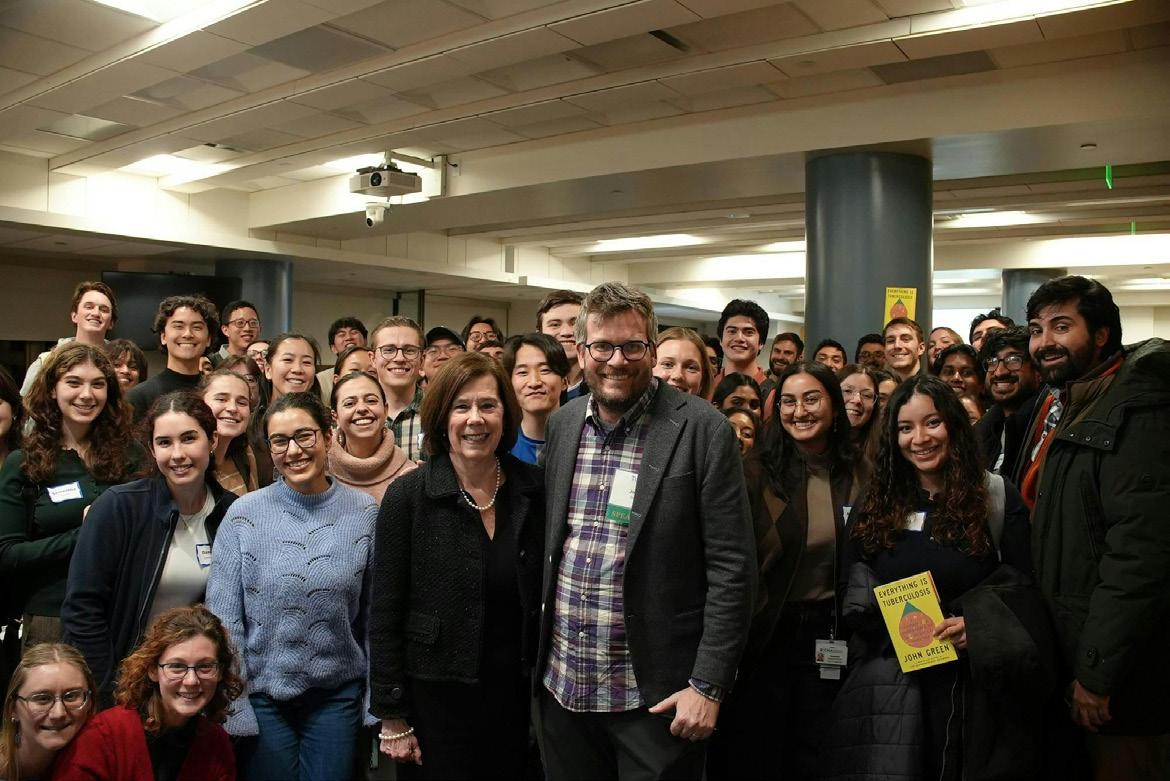
Feb. 4, many members of the Tufts community found themselves sitting in a packed auditorium at the School of Medicine — in front of Green himself.
“Everything is Tuberculosis’s unassuming, brightly colored cover makes it difficult to
predict the grave themes of disease, public health issues and inequity inside. However, it also contains a thorough dose of hope, for those afflicted with the disease and the health care professionals who treat
see GREEN, page 4
IN NEWS
Somerville to decrease budget by $5 million, residents share priorities in community hearing
Jones Millstone-Rivo and Katherine Kelton News Editor and Assistant News Editor
The Somerville city budget is expected to be reduced by nearly $5 million this year due to a slowing economy and federal funding cuts.
In a Feb. 10 virtual community budget meeting hosted by the City Council Finance Committee, and attended by Mayor Jake Wilson, residents shared their ideas and priorities for the Fiscal Year 2027 budget. Residents highlighted transportation infrastructure, road conditions, protecting immigrant communities, public safety and youth programming as major concerns.
Early in the meeting, City Councilor-at-large Ben Wheeler described the financial challenges facing the city.
“We have limited money this year for new projects and new uses
Tufts women’s basketball falls to Bates on Senior Day
In the Cousens Gymnasium on Sunday, the Tufts women’s basketball team celebrated senior guard Annie Aspesi and senior forward Sarah Crossett before their last regular season contest. With playoff seeding on the line, the Jumbos ultimately fell to the Bates Bobcats in a 68–50 decision.
Despite the loss, Tufts saw strong individual showings. First-year guard Tessa Lozner tallied 16 points, 9 rebounds and 3 assists; first-year guard Abby Congdon also put up a solid performance, with 16 points and 5 rebounds. Finally, Crossett added 7 points and 5 rebounds in her Senior Day finale.
With no lead changes in the game, Bates set the tone quickly, jumping out to a 5–0 lead in the first 1:19 with a layup from center Elsa Deulerio and a 3-pointer on the next possession. Tufts made it on the board with a Crossett layup off of a

Lozner assist. The Bobcats continued building their momentum by working efficiently on offense and converting on multiple looks inside. After a timeout at the 5:30 mark with an 18–8 score, Tufts was able to



cut the deficit to 7 with a layup from Congdon and two drives resulting in layups from Lozner. Bates responded by scoring on an entry pass into the post to slow Tufts’ momentum, closing the first quarter leading 23–14.
The first quarter was crucial for both teams’ offensive rhythms throughout the rest of the game, marking a difference in efficiency beyond the arc. Bates went 3–7 from the perimeter, and shot 10–18

and much of our focus is going to be on holding onto the levels of spending that we’ve had in the past year,” Wheeler said.
Immigration emerged as a key issue for residents in light of federal immigration enforcement efforts in Massachusetts and around the country.
Resident Derek DuPont said immigration services and an alternative emergency response program should be central to the budget.
“Let’s create a city budget this year that will help our most vulnerable,” DuPont said. “Let’s prioritize funding for legal services that can help immigrants that are targeted by the federal government and an emergency service that people can feel safe and comfortable using.” DuPont, who does volunteer work teaching English to
see BUDGET, page 3
from the field (55.56%), maintaining a balanced attack from the inside out. At the same time, Tufts shot 0–5 from the three, a usual offensive strong point, as they have the second-highest 3-point percentage in the NESCAC.
The Jumbos started off the second quarter strong defensively with a steal from junior guard Stella Galanes and a jumper from Aspesi, that cut the deficit to seven. Bates, however, quickly regained control with a 3-pointer, two made jumpers and a free throw, which extended the lead to 31–16 midway through the quarter.
The main difference was in Bates’ high percentage shooting from three, where they converted on 3–4 threes (75%) in the quarter, while Tufts went 0–5 once again. Bates controlled the quarter with quick ball movement and stretching the floor, forcing Tufts to expend a lot of energy defensively. Bates also maintained a high assist and
see BATES, page 12



Lauren Cousino Contributing Writer
COURTESY TUFTS ATHLETICS
Tufts women's basketball takes on Bates in weekend game.
MASE PETERSON / THE TUFTS DAILY
John Green with Helen Boucher and attendees on Feb. 4.
Samantha Mascera Contributing Writer
Josué
Tufts launches new College Prep 101 program for neurodivergent students
Estelle Anderson and Zahra Brady Senior Staff Writer and Contributing Writer
Originally published Feb. 17.
Tufts is piloting a new pre-college program this summer called College Prep 101 for Neurodivergent Students, designed to help neurodivergent high school students prepare for their transition to college. The program, launched by Tufts University College, will run June 22–26 and is open to students in grades 10 through 12 who are able to commute to Tufts’ Medford/Somerville campus.
“One thing I really hope students take away from this experience is a sense of belonging and the opportunity to really envision themselves on a college campus,” Dr. Jennifer Lillis, the instructor for the program and research scientist at Boston University’s Wheelock Educational Policy Center, said. “I think that the benefit of having a program that’s specifically for neurodivergent students is to have that affinity space to think and talk about what might be specific to them in that planning process.”
During the adjustment to college, neurodivergent students often face the challenge of navigating an environment without the built-in safety nets they relied on in high school. These supports include individualized education programs, which legally mandate
specialized instruction for public school children with disabilities in grades K–12. Such legal accommodations do not extend to higher education, where students are typically left to proactively seek accommodations and advocate for themselves.
To help bridge this gap, College Prep 101 for Neurodivergent Students will introduce neurodivergent high schoolers to different facets of college life and show them how to access the support systems they need.
“There are resources on campus, but they’re not always clear-cut. There’s not somebody there necessarily to grab you on that first day and say, ‘Here, come with me,’” Dan Doherty, the director of pre-college programs, said. “Somebody is always helping the student on the high school end. The student has to be a good [advocate] for themselves on the college side.”
While working with the Massachusetts Department of Elementary and Secondary Education on recommendations to guide neurodivergent students transitioning to college, Doherty observed a recurring trend: Several neurodivergent students were leaving college within the first few semesters, often because they were not receiving adequate support.
“They just needed the connections on campus to get them a sound footing and a foundation in the college world,” Doherty said.
He proposed College Prep 101 for Neurodivergent Students last spring after learning that a similar Boston-area program could no longer run due to federal funding cuts. The new program is an extension of Tufts’ existing College Prep 101 offering, which serves high school students more broadly.
For the program’s instructor, the University College recruited Lillis, who studies how to improve college and career readiness for students with disabilities. As a former special education teacher herself, Lillis has spent years supporting high school students through their adjustments to college.
“The work that I’ve done has given me a lot of insight into, broadly, … the challenges that students face and … the skills that can really strengthen students’ abilities to manage that transition,” Lillis said. “I hope to really draw on that foundation as much as possible.”
Most of the week’s programming aims to immerse participants in the basics of college life. Students will tour Tufts’ campus, speak with Tufts professors and learn about classroom expectations. They will also meet with staff from the StAAR Center and attend panel discussions with Tufts undergraduates who identify as neurodivergent.
“There are so many differences between high school and college, and I think a lot of times, it’s really hard for our first-year students to navigate
that,” Kirsten Behling, associate dean of student accessibility and academic resources, said. “We really just want to make sure that students feel welcomed and feel confident when they come to any college about where to go for resources, who to ask [and] how to ask.”
The program will help prepare students for the college admissions process. Throughout the week, all participants will develop individualized college plans, exploring the types of colleges that align with their interests and outlining the steps to apply. Students will have the opportunity to share their plans with their peers and family members at the end of the program.
“I hope the students learn more about themselves and … how they can connect who they are, their strengths [and] the types of learning environments that work well for them with the types of post-secondary options that are available,” Lillis said.
For high schools and universities seeking to become more inclusive of neurodivergent students, Lillis emphasized the importance of listening directly to students’ perspectives.
“I think the best way to find out what [barriers there are to students] is to talk with students themselves about their experiences and learn from those,” Lillis said.
Applications for the program opened on Dec. 1, 2025 and will close on May 1.
ARTS & POP CULTURE
The Bigger Picture How Roman Polanski became his own ‘art’
Linda Huang
Oscar-winning Polish director and convicted sex offender Roman Polanski can be said to have redefined the way ‘evilness’ was depicted on screen in the 1960s through his masterpiece “Rosemary’s Baby” (1968). Unfortunately, just nine years later, he redefined the same evil himself by committing statutory rape of a 13-year-old girl.
“Rosemary’s Baby” is a psychological horror film about a woman’s gradual loss of control over her body and her reality. The film begins with Rosemary Woodhouse and her husband, Guy, moving into a new New York apartment building and befriending their seemingly friendly but eccentric elderly neighbors, Minnie and Roman Castevet. After discussing their hopes of starting a family, Rosemary becomes pregnant following a disturbing, half-dreamlike assault in which she
sees a demonic presence raping her, as Guy, the Castevets and the rest of her neighbors watch. The pregnancy is followed by intense pain, disturbing dreams and a growing, eerie sense that those around her — including her own husband — are conspiring in a greater evil against her.
Pressured to see the neighbors’ chosen doctor and consume their strange prenatal ‘health drinks,’ Rosemary finds her concerns and emotions repeatedly dismissed. As she investigates the situation, she uncovers evidence that the Castevets are part of a satanic cult and that her pregnancy may be the result of a ritual intended to bring forth the Antichrist. In the chilling final scenes, Rosemary’s fears are confirmed, and Roman Castevet, the cult’s leader, forces her to accept her role as the mother of the child, despite the eeriness and horror of what this would mean for her.
Previously, I wrote about the psychological distress women experience with body image and the terror of losing control to predetermined fate. “Rosemary’s Baby” presents a combination — and arguably worsens — both horrors.
The film is numbingly eerie in the stark contrast it draws between Rosemary and the evil force that ultimately consumes her. Portrayed
by a young Mia Farrow, Rosemary is defined by softness and light: gentle in voice, delicate in appearance and dressed in feminine fashion that emphasizes her angelic innocence. She is warm, welcoming and easy to please. She also looks, in every conventional sense, like she would be a wonderful mother. And that is precisely what makes the contrast so appalling. As viewers, we are forced to watch what we instinctively take as purity and goodness descend into ultimate demise — a full destruction of self and complete loss of control. In that helplessness, true horror emerges. It is not necessarily the satanic curse that unsettles us ideationally, but rather Rosemary’s depicted innocence even after the assault-like experience that impregnated her, and the quiet, suffocating violation of bodily autonomy that ultimately strips her of agency.
Watching this movie with knowledge of Polanski’s past feels even more unsettling: We are confronted with the disturbing reality that he became the very source of imprisonment and violation that his art depicts. It is difficult to grapple with the ethics of a film created by a criminal, especially when it leaves such a morally striking, visually chilling and thematically eerie imprint on its audience. This discomfort — and perhaps guilt — is further
deepened by the knowledge that Polanski is also celebrated for many other acclaimed works, including “The Pianist” (2002), which earned him an Oscar for Best Director, and “Chinatown” (1974), a classic film noir that likewise confronts themes of child sexual abuse — a parallel that makes the line between art and artist feel thinner and thinner. So, can we truly separate art from its creator when the creator’s own moral reality can so easily mirror it?
How do we grapple with the fact that some of the films widely regarded as masterpieces — films that have defined what ‘great cinema’ looks like — were made by someone who committed such heinous crimes?
Perhaps the ultimate tragedy of great artwork may just as well be that the evil which it seeks to expose of the world can circle back to define its creator. In 1977, Polanski was charged in Los Angeles with the statutory rape of a 13-year-old girl. He fled the United States on Feb. 1, 1978, one day before sentencing, and has not returned since.
Is there a film that you would like to see me write about in my next column? Email me!
Linda Huang is an associate editor majoring in economics and international relations. Linda can be reached at peixuan.huang@tufts.edu.
Immigration protections brought up frequently as budget priority
immigrants, said recent violence against immigrants and citizens by the federal government, as well as a lack of response from local police, have caused concern among residents about calling the police.
“For several years now, councillors have asked to fund an alternative emergency response program, which means an unarmed, non-police team that can help residents while reducing the risk of trauma and harm,” DuPont said.
The idea of a citizen response team is not new in Somerville. The Public Safety for All Task Force, through Somerville’s Department of Racial and Social Justice, currently works to help rethink and shape the city’s public safety system by identifying options for alternative, co-response and unarmed response models for responding to crises.
Resident Courtney Pollack echoed DuPont’s sentiment on immigration, urging the city to protect its residents, which includes immigrant communities, from the federal government.
“Please prioritize a budget that’s resilient to the loss of federal funds to protect social programs for when the federal government tries to withhold or cancel funding,” Pollock said, adding that the city should also refrain from accepting federal funds, such as Urban Area Security Initiative grants, that are contingent on cooperation with the Department of Homeland Security.
Residents also underscored the need for affordable housing in Somerville.
Madeleine Werner, the coordinator of SomerPromise, a
program run by the city’s Health and Human Services Department, said she believes the city should support development proposals like the Copper Mill project in Davis Square.
“More than anything, affordable housing is where we need to go and if there [are] ways to spend on this administratively and to set us up for the future, I very strongly support that,” Werner said.
Alexandra Barbat, co-chair of the Somerville Commission for Women, also spoke about the importance of funding affordable housing in Somerville.
“Funding for affordable housing has the potential to change lives, specifically when we talk about women’s ability to live and work in Somerville and people’s ability to raise families in the community,” Barbat said. “Housing inaccessibility plays a huge barrier to that.”
Several speakers said antisemitism was a pressing concern facing Somerville.
Another resident, Richard Maidman, asked the council to prioritize combatting antisemitism in Somerville.
“First, I ask the council to fund and implement
the recommendations of the Massachusetts Special Commission on Combating Antisemitism. Antisemitism is a serious and ongoing problem in Somerville,” Maidman said. “Somerville should be a city where every resident knows they belong and addressing antisemitism requires sustained attention and resources.”
Some speakers also protested the city’s recent ballot question, a nonbinding resolution that instructed the city of Somerville to disinvest from companies with financial ties to Israel.
TCU Judiciary recognizes 22 new student organizations
Sophomore Kyle Pidedjian, co-president of the newly-recognized Armenian Students Association, described the multistep process of recognition.
This semester, the Tufts Community Union Senate Judiciary recognized 22 new student clubs and organizations, granting them access to funding, room reservations and tabling at the club fair.
“It offers legitimacy,” Anthony Vitale, a sophomore and Judiciary re-recognition chair, said.
The Judiciary manages the recognition and re-recognition of student organizations. Its seven-member board oversees the process to certify organizations, which takes place over the fall semester. This year’s batch of new clubs is larger than usual.
“It’s a little high, but we are seeing in the last few years … more applications than we’ve ever seen before,” Joe Golia, Tufts director for campus life, said.
The application process starts early in the academic year.
“We have an initial meeting with all applicants, usually the first week of October, and that’s when the process really starts,” Golia said.
“[At the] beginning of last year, we got recognized as a club pending recognition, which means that we can book rooms [and] we’re on the Jumbo Life web page, but it says we’re pending and we don’t get funding,” Pidedjian said.
Pidedjian said ASA hopes to expand its cultural and social programming while fostering a sense of community for both Armenian and non-Armenian students. The group plans a mix of educational and social events to engage members and connect with the broader Boston Armenian community.
“We do everything from speaker events to dinners with other Boston area Armenian clubs,” Pididjian said. “We just try and make a space for both [undergraduates] and graduate students to come together and have a community.”
Meanwhile, the Judiciary is spending their spring semester ensuring that existing clubs are maintaining their standards.
“I’m basically just organizing the list. [We] review every club, see what they’re doing,
make sure they’re still satisfying their requirements to be a club,” Vitale said.
Each member of the Judiciary reviews a number of clubs to ensure that event, member and constitutional requirements are still met. The Judiciary will meet soon to discuss any organizations that may be falling short of those standards.
“For the majority of clubs, they never hear from us, we do an independent review and they’re good,” Vitale said.
The addition of 22 clubs also raises questions about whether the Treasury can fund the growing number of organizations. TCU Treasurer Brendan French, a junior, believes funding for new organizations should fall within TCU’s means.
“The number that I communicated was a range of $20,000–$30,000,” French said. “That essentially would be able to cover this amount comfortably for the budgets for all of the new clubs.”
French added that newly recognized organizations face a funding cap of $3,000 for their first semester as an official club.
French also noted that the Treasury has been able to
“Question 3 … is illegal and discriminatory because it discriminates against people based on their ethnicity,” resident David Lichter said.
Banti Gheneti, another resident, spoke in support of the ballot question.
“We had a majority of people come out and vote in Somerville in support of the ballot initiative to limit funding to companies complicit in the genocide happening in Palestine,” Ghenti said. “I [hope] that the city is able to follow through on the democratic will of the people.”

handle rising costs because of reduced club activity during COVID-19, which created surplus funds that helped offset the cost in the past few years. However, that surplus may be decreasing.
“There is going to be an expectation of a slight decrease across most, if not all, club budgets, just because it’s been about three, four years [of surplus],” French said.
Vitale noted that clubs were made aware of these financial realities during the process.
“We told clubs that [they’re] probably not going to get, in
some cases, the budget that you requested,” Vitale said.
This caution reflects the continual increase of costs for club activities.
“The amount of travel has just really exploded. The type of events and the higher quality, that leads to just everything being more expensive,” Golia said.
Regardless of funds available, Vitale still wants to encourage student organizations to apply for recognition.
“I want to see as many clubs at Tufts as possible,” he said. “[We want to] have a little niche for everyone.”
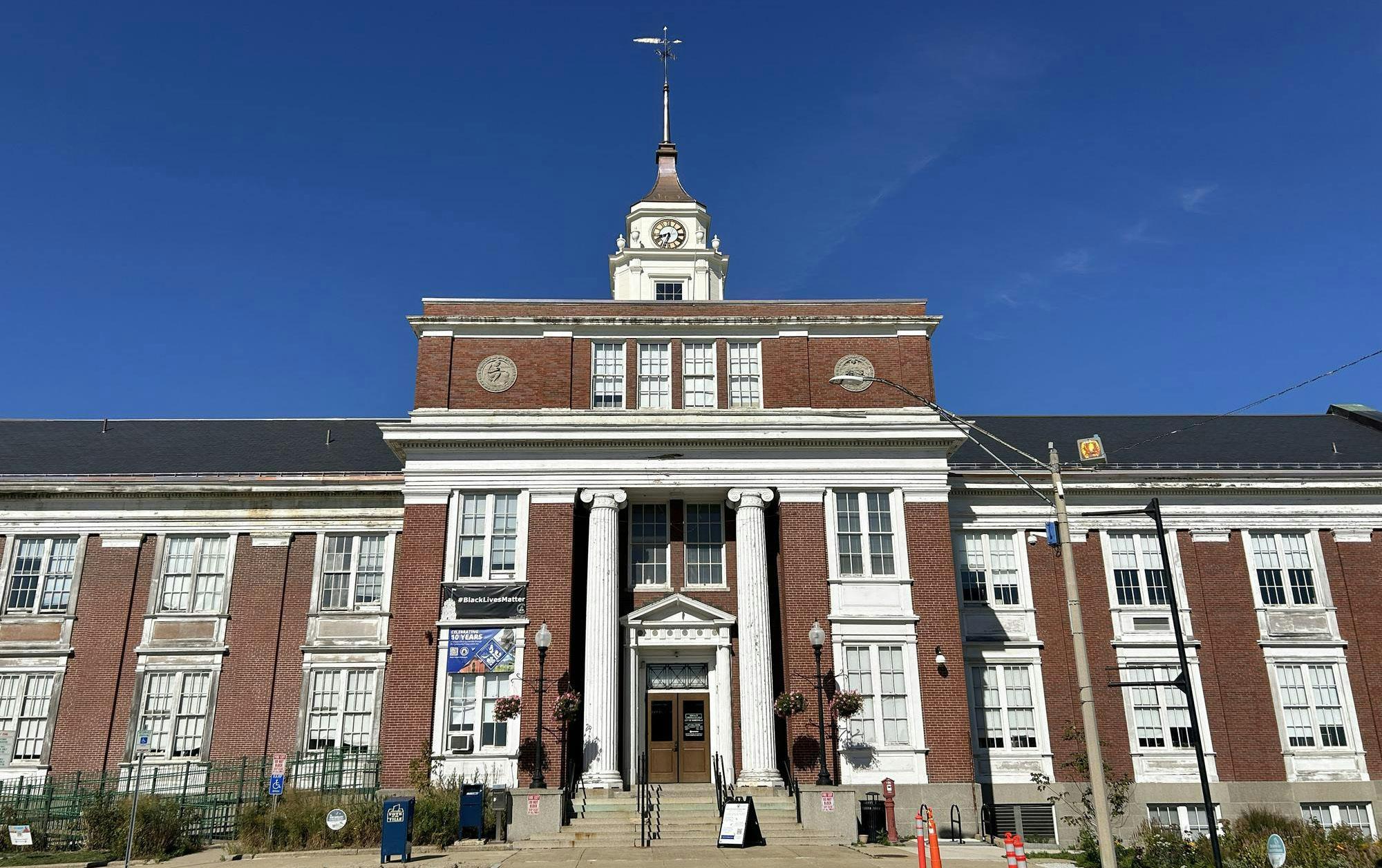
CARYS YANG / THE TUFTS DAILY
Somerville City Hall is pictured on Sept. 20, 2025.
Will Pinto and Nandeesh Jain
Contributing Writers
VERONIKA COYLE / THE TUFTS DAILY The Mayer Campus Center is pictured on Dec. 5, 2023.
Originally published Feb. 17.

IN PHOTOS: LOVE IS IN THE AIR AT APPLEJAM
PHOTOS BY CHRISTINA JAMIESON
Light unrequired: The discovery of dark oxygen
Emma Thomas Contributing Writer
For centuries, it was believed that the production of oxygen relied on one component: photosynthesis (the conversion of light energy into chemical energy). Plants and algae use sunlight to convert carbon dioxide into oxygen, providing the foundation of life on earth as we know it. However, the discovery of ‘dark oxygen’ — produced in environments with little to no sunlight
— challenges this assumption, proving that oxygen production is not actually limited to photosynthesis.
In 2013, Scottish marine scientist Andrew Sweetman made this discovery by accident while conducting deep sea mining research in the ClarionClipperton Zone. The CCZ is a vast plain in the central Pacific Ocean, located between Hawaii and Mexico. Sweetman, much to his surprise, measured elevated levels of oxygen the further
he was descending into the sea. Upon this discovery, Sweetman could not help but believe that his measuring devices were incorrect and dismissed the reading entirely. The deep seabed is one of the coldest, harshest and darkest places on earth. With no light source, it seemed impossible to Sweetman that oxygen could exist there, as he previously assumed the only way to produce it was through photosynthesis, a reaction that requires light.

However, over the last 10 years, Sweetman, along with teams of scientists, has been conducting more experiments in the CCZ. These researchers carried out numerous ‘in situ’ benthic chamber lander experiments, wherein they sectioned out a part of the seabed inside a chamber and measured the oxygen levels over time. They also expected a reduction in the levels of oxygen due to its consumption from small organisms like microbes for respiration. However, oxygen levels consistently increased, proving a net production of oxygen in the dark depths of the ocean. In fact, in some experiments, oxygen levels rose to more than three times the background concentration.
Scientists think one potential explanation for increased oxygen levels is the existence of polymetallic nodules, substances which range in size from a small particle to about the dimensions of a potato. Sweetman explains that these nodules are effectively batteries in a rock which uses electric charge to split the seawater into hydrogen and oxygen. This split can occur with up to 1½ volts of electricity, and some nodules can possess up to 0.95 volts of electricity. Multiple nodules combined can produce even
higher voltages, allowing this seawater electrolysis to occur. In 2024, Sweetman and his team of researchers shared and published these findings.
This discovery could revolutionize deep sea mining primarily because these polymetallic nodules contain metals such as manganese, nickel and cobalt, which are essential for everyday life. They are specifically used in lithium-ion batteries, which are implemented in consumer appliances like technological devices and power tools, as well as products like electric vehicles. Mining companies view this metal as a new, potentially pursued source. However, the production of this dark oxygen may be vital for deep sea ecosystems and disturbing it could be harmful to species relying on it. Hence, it is wise to take caution and properly weigh the costs and benefits of deep sea mining.
Explorers have seen less than 0.001% of the ocean floor and it is entirely possible that discoveries like dark oxygen are just the beginning. We can be certain that there are countless other mysteries about the ocean hidden in darkness and waiting to be discovered.
Tufts Biotechnology Series: Ted Myles, a leading voice in biotech, shares his experiences with Tufts students
For most students, science is limited to the lab bench — pipetting solutions and taking precise measurements to check the validity of their hypothesis. Yet, beyond the world of the wet lab, quietly supporting scientific discovery, is the highstress, high-reward business of biotechnology. Last week, Ted Myles, chief executive officer of Cellarity, came to speak at Tufts as part of the School of Engineering’s Biotechnology Industry Series. He spoke candidly about his journey, sharing several insights into the lessons that have shaped both him and his career.
The Biotechnology Industry Series is an initiative that brings top professionals and leading voices in biotechnology to campus to help students understand their coursework’s application beyond exams.
“There are very few straight lines in a career,” Myles told the audience. Throughout the talk, he reflected on his decades of experience in biotechnology leadership and what he’s learned about ethical decision making.
As an undergraduate at the University of Hartford, Myles started on the pre-med track.
However, after struggling with a disconnect between the biology and chemistry he was studying and their human impact, he pivoted. He found that connection through collaborative team projects in business. Ultimately, he graduated not with a biology or chemistry degree but with a degree in finance and accounting. This foundation gave him the flexibility to explore his interests across a wide range of industries. After only his second year in public accounting, Myles joined Genzyme, a biotech company focused on developing treatments for rare diseases. To further his understanding of business and, as he described it, to scratch his ‘itch,’ Myles pursued an MBA while continuing to build his career in biotech.
One of the career-defining moments Myles discussed came during his time at Advanced Cell Technology. After stepping into a leadership role full of passion and motivation, he learned of several scandals and lawsuits involving the company and its CEO, as well as significant debt. For many, this would be enough reason to move on quietly. However, Myles’ mindset was clear: “If you put the challenges on the table, they’re our challenges,” he explained. “If you keep them in your desk
drawer, they’re your challenges.” He chose not to avoid or minimize the issues but instead to confront them directly — rebuilding investor trust while addressing the company’s financial instability.
Reflecting on what kept him and his team motivated during this period, Myles recalled hearing stories from patients who were losing their independence due to illness and wanting to make a difference. After six challenging months of legal battles, Myles helped the company rebrand and open new beginnings. The lesson, he noted, was not just about
past wrongdoing but about the power of accountability and transparency. Although the ability to memorize, understand and analyze complex technical information can open doors in biotech, Myles stressed ethical decision-making — especially when patients’ lives are on the line.
Beyond crisis management, Myles also stressed the importance of soft skills. He discussed the importance of finding areas of growth and having strong mentors who will push you.
In sharing his journey, Myles was not aiming to tell the story of a flawless path to
success. Rather, he highlighted the reality that mistakes are inevitable. What matters, he suggested, is extracting growth from those experiences by leaning into discomfort. As an engineering student myself, I can attest to the narrow perspective students sometimes have of science as limited to problem sets and lab work. Hearing about Myles’ experiences and the lessons he has learned throughout his career broadens that perspective. With leaders like Myles guiding the industry, the future of biotech feels promising.
Essey Tesfai Contributing Writer
COURTESY TUFTS SCHOOL OF ENGINEERING
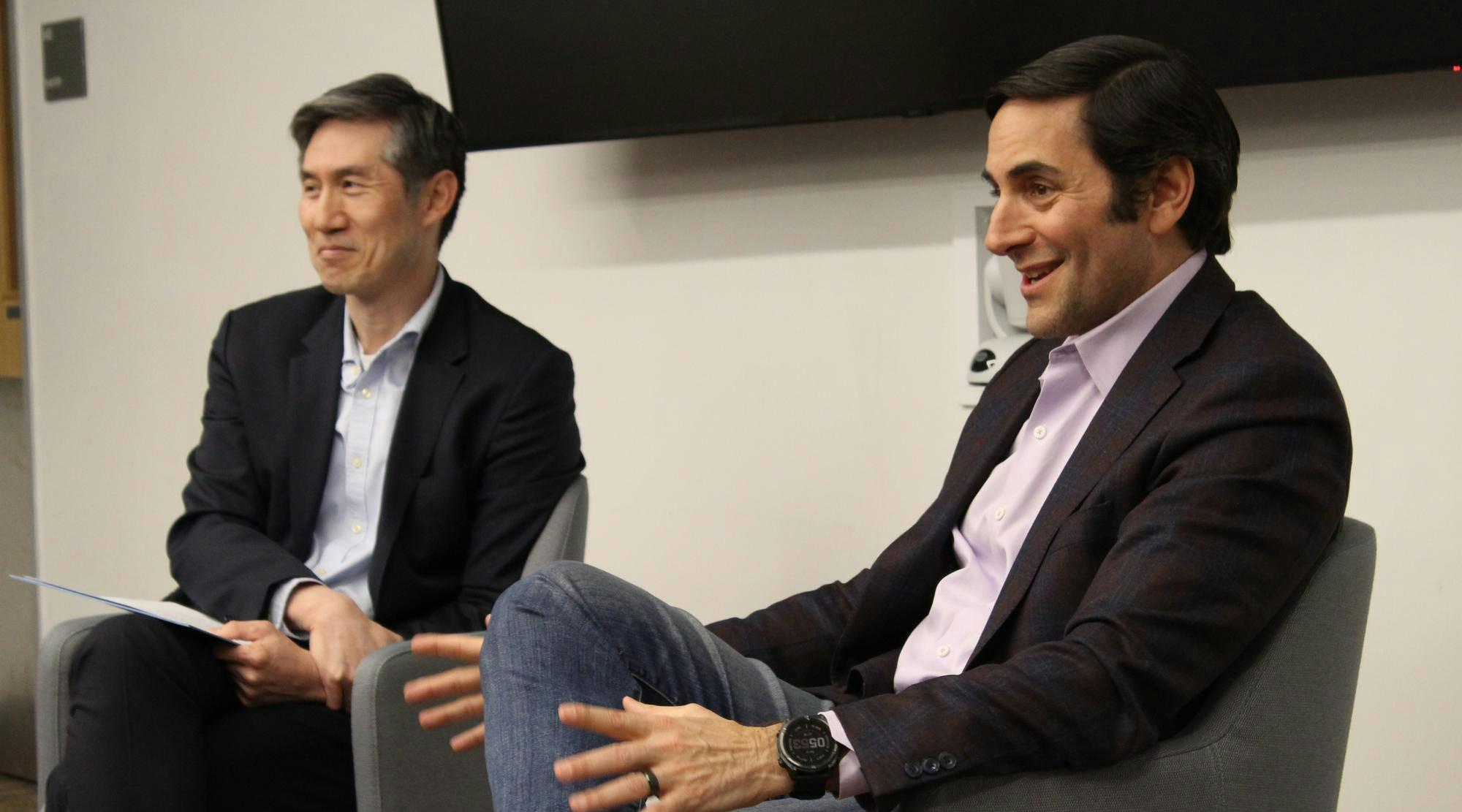
Ted Myles and Dean Kyongbum Lee at the inaugural installment of the Biotechnology Industry Series.
VIA WIKIMEDIA COMMONS
The Pacific Ocean is pictured during sunset.
OPINION
Editorial: Tufts’ silence on Steve Tisch should concern everyone
The Editorial Board
The name Tisch seems ever-present in our lives as Tufts students. From the library to the fitness center, the name is pervasive across campus. Steve Tisch, who graduated from Tufts in 1971, currently serves as chairman, co-owner and executive vice president of the New York Giants following a career in film production.
Following the recent revelation of frequent communication between Tisch and convicted sex offender Jeffrey Epstein, we, the Daily’s Editorial Board, have been considering the implications of these associations, particularly when it feels like half of the Tufts campus bears his name. The Daily has reported on various files indicating that Epstein connected Tisch with numerous women in 2013 and 2014. In response to those files, Tisch stated, “We had a brief association where we exchanged emails about adult women, and in addition, we discussed movies, philanthropy, and investments. I did not take him up on any of his invitations and never went to his island.” However, the stain of associating with someone as notorious as Epstein and employing that connection to solicit women is irrefutable. The question at the forefront of the community’s mind is: How will Tufts address it?
As the Editorial Board, we propose that the administration look to its response to the Sackler opioid crisis as a model. In 2019, Tufts resolved to remove the Sackler family

name from the medical school building and various programs.
In the 1990s, the Sackler family founded Purdue Pharma, which later produced OxyContin, a pill stronger than morphine, directed towards cancer patients and those with chronic pain. The Sacklers profited immensely from the drug’s widespread use, ultimately accumulating
enough wealth to become one of the richest families in the United States. They committed significant wealth to Tufts, resulting in five centers, programs and laboratories bearing their name. However, following 2019 lawsuits accusing the family of prioritizing financial interests over public health by misleading the public about
OxyContin’s risks, Tufts decided to rename associated buildings, stop accepting donations from the Sackler family and instate a program to educate the Tufts medical community about the opioid epidemic. Then-University President Anthony Monaco stated that “in making the decision to remove the Sackler name,
which will begin immediately, we are not seeking to erase this chapter of Tufts’ history.” Tufts’ current administration should consider this precedent. It’s indisputable that Tisch has made a significant impact on the development of the campus through his donations to several buildings. However, to ignore his association with Epstein would dismiss the university’s stated core values: honesty, integrity, ethics and cultural competence, among others. Ideally, buildings bearing Steve Tisch’s name would be renamed to reflect Tufts’ condemnation of such fraternization. While this may be unlikely, at minimum, we propose that the Tufts administration should release an official statement addressing and condemning Tisch’s communications with Epstein. A public acknowledgment would demonstrate a commitment to transparency and ethical accountability, even though we hope to see Tisch’s name fully stripped from the fitness center and the library. In addition, the university should follow the example of its response to the Sackler crisis by educating the community about the Tisch family’s association with Tufts and about the broader harms of sex trafficking and abuse, thereby addressing Epstein’s heinous crimes. Ultimately, we hope that Tufts chooses to acknowledge Tisch’s relationship with Epstein and disaffiliate from his actions to preserve the university’s commitment to ethical, honest and principled civic engagement.
Celebrity Silence: An unforgivable response to a country in crisis
Michaela Loughran Opinion Editor
Celebrities are some of the most talked-about people in our society, and social media only amplifies this effect, giving us seemingly constant access to these stars’ lives. If there’s any doubt about whether people take advantage of this access, just look at the like counts on some of these celebrities’ posts. Take Taylor Swift, for example, who is arguably not only one of the most famous celebrities but also one of the most influential women in the world. Swift’s engagement announcement post received an impressive 37 million likes. This means
that, including those who saw it and didn’t like it, more than 37 million sets of eyes landed on this post. Although I’m a big fan of Swift, I also believe that she — and many other high-profile celebrities — are not doing enough to advocate for the underprivileged.
Whether it be the suffering of Palestinians in Gaza, the deaths of both immigrants and U.S. citizens because of Immigration and Customs Enforcement, or any of the other tragedies currently happening in the world, Swift and many other celebrities have kept quiet in interviews and on social media. While some might argue that speaking on these issues is not their
responsibility as artists or actors, I would argue that it is their responsibility as human beings.
The influence their celebrity status brings makes their advocacy even more imperative. It should be noted that Swift has previously engaged in political advocacy, endorsing Democratic candidates in Tennessee’s 2018 primaries and then Kamala Harris in the 2024 presidential election.
However, if Swift is against Trump, then why is she remaining silent about the horrors of his administration? One of her posts encouraging her followers to register to vote reportedly led to more than 35,000 registrations. Just one post by Swift

speaking out against ICE-related tragedies in Minnesota could have a similar level of impact, potentially reaching the screens of her 280 million followers.
Celebrities have the potential to inspire millions to protest and push back against policies they see as immoral, yet many continue to disappoint.
The Tufts Daily is a nonprofit, independent newspaper, published Monday through Friday during the academic year and distributed free of charge to the Tufts community. The content of letters, advertisements, signed columns, cartoons and graphics does not necessarily reflect the opinion of The Tufts Daily editorial board.
EDITORIALS: Editorials represent the position of The Tufts Daily Editorial Board. Individual editorialists are not necessarily responsible for, or in agreement with, the policies and editorials of The Editorial Board. Editorials are submitted for review to The Tufts Daily Executive Board before publication.
VIEWPOINTS AND COLUMNS: Viewpoints and columns represent the opinions of individual Opinion editors, staff writers, contributing writers and columnists for the Daily’s Opinion section. Positions published in Viewpoints and columns are the opinions of the writers who penned them alone, and do not necessarily represent the opinions of the Daily itself. All material is subject to editorial discretion.
OP-EDS: Op-Eds provide an open forum for campus editorial commentary and are published Monday through Friday. The Daily welcomes submissions from all members of the Tufts community; the opinions expressed in the Op-Ed section do not necessarily represent the opinions of the Daily itself. Opinion articles on campus, national and international issues should be 600
in length and submitted to opinion@tuftsdaily.com. The editors reserve the right to edit
appear in the Daily. Authors must submit their telephone numbers and day-of availability for editing questions.
ADVERTISEMENTS: All advertising copy is subject to the approval of the editor in chief, executive board and
DYLAN FEE / THE TUFTS DAILY
Handprints of Steve Tisch hang in the entryway of the eponymous Sports and Fitness Center.
VIA WIKIMEDIA COMMONS
Taylor Swift is pictured.
Along with this silence, an equally troubling phenomenon is performative advocacy from certain celebrities. In one video, Jack Antonoff is seen sporting an “ICE OUT” pin on the Grammys red carpet. When it comes time to answer the expected question of why the pin’s message is important, he is barely able to formulate a coherent thought. Stumbling over his words, he says, “It’s terrible … it’s time to … for every reason you can imagine, I think,” and — making a last-ditch effort
to recover — adds, “I’m getting speechless trying to even talk about it.”
Perhaps the reason it is so embarrassing to watch is because his statement embodies the effects of privilege. Antonoff, as a rich white male celebrity, is able to pretend to care about causes that he knows are less likely to affect him directly due to the safety net of his wealth and status.
However, one can also find examples of celebrities who
THURSDAY, FEBRUARY 19,
have been exemplary advocates. In one of his acceptance speeches at the Grammys, Puerto Rican rapper and singer Bad Bunny stated, “We’re not savage, we’re not animals, we’re not aliens. We are humans, and we are Americans.” This is a direct refutation to Trump’s election message that Latin American immigrants are “savages” and “animals.” Bad Bunny has been on the rise in the music industry after not only winning three Grammys
in one night, but also performing at Super Bowl LX one week later. With 14.4 million viewers tuning into the Grammys this year and many others watching highlights on social media, he was undoubtedly able to spread his message widely.
Global sensation Billie Eilish also used part of her speech to speak about injustices committed by ICE. Eilish began her speech by sincerely voicing a popular phrase of the anti-ICE movement: “No one is illegal on
stolen land.” She finished her speech by cursing out ICE, which I believe was quite provocative. What celebrities like Billie Eilish and Bad Bunny have in common is not only their influence over millions, but also their bravery in speaking up for those who can’t speak up for themselves. And while you, the reader of this article, likely don’t share their global influence, you can still share their bravery. Please don’t go silent when our country needs you the most.
To decrease socioeconomic stratification at Tufts
In 2022, economists led by Raj Chetty published a paper in which they analyzed something called “economic interconnectedness,” the number of friendships across class lines. They found clear socioeconomic stratification, with people of high socioeconomic status having a higher share of friends who were high-income than people of low socioeconomic status. This is problematic because they also found that forming friendships across class lines is strongly correlated with increased upward mobility.
Some level of income stratification is not shocking. Family income influences upbringing and lifestyle, and income directly influences how individuals spend their free time. Since a key part of friendship is bonding over shared experiences and hobbies, it is logical that there may be some natural clustering that drives income stratification. However, there are real barriers and factors beyond this that increase stratification, and universities such as Tufts are not immune to these forces.
In a paper aptly titled “The Costs of Belonging: How Spending Money Influences Social Relationships in College,”
researchers found “spending money was a significant influence on students’ social relationships,” and “access to spending money factored into students’ sense of belonging … or their sense of social exclusion.” As students, we can try to prevent this at Tufts by thoughtfully planning events that do not have an implicit paywall. This could mean prioritizing free or low-cost activities like game nights, potlucks and movies, while avoiding making fancy restaurants, concerts or shopping sprees a default form of socializing. Clubs could also consider eliminating dues and ensuring activities do not require spending money to participate.
Revisiting Greenland
Last year, I published an article about the colonial history of Greenland, exploring why it and its Indigenous people would want to be independent from Denmark. Since then, the people of Greenland voted Demokraatit, a center-right, moderately independent party, into power. At the same time, President Donald Trump has intensified his effort to buy Greenland from Denmark, Greenland’s former colonial owner. Greenland has achieved autonomy from Denmark, but is not fully independent. Trump had made it clear that he would consider violence as a tactic to annex Greenland, but walked back such statements earlier this month.
Nearly 90% of Greenland’s inhabitants identify as Indigenous Inuit/ Kalaallit, and yet, United States officials tasked with working on Greenland completely ignore them.
Special Envoy to Greenland, Jeff
Landry, wrote a nearly 1,000-word article detailing why a U.S. takeover of Greenland was necessary. Not one word was written concerning Indigenous Kalaallit peoples.
Some may think that this was an accidental oversight on Landry’s part, but it is very clear to me that he intentionally wrote Indigenous people out of the conversation. He opens the article by talking about a World War II army transport ship that was torpedoed in 1943, emphasizing American heroism. Landry explains that Americans have a long history of protecting Greenland, in an attempt to justify annexation.
However, Greenland was 150 miles away from where this occurred, and had nothing to do with the incident other than being the American ship’s destination. And yet, Landry uses this example instead of an incident in 1968, when an American B-52 crashed off Greenland’s northwest coast. Inuit dog sled teams rescued six Americans who had parachuted out of the plane, all of whom were returned safely. Instead of highlighting American-Greenland relations, Landry purports a narrative of Americans rescuing the ‘poor
Greenlanders’ from the outside world, denying them their agency and sovereignty, not to mention their Indigenous identity.
Data on Greenlanders’ public opinion also negates Indigenous self-determination as a possibility. In a poll conducted in January 2025, over 80% of Greenlanders said they wanted independence. However, this survey also asked pointed questions, qualifying independence from Denmark with entrance into the United States. These questions take away from the concept of independence, forcing respondents to choose between two colonial powers. This data was also gathered by an independent institution based in Denmark, which could potentially bias results in Denmark’s favor. Either way, asking Greenlanders to choose between two overlords without an option for independent sovereignty says the quiet part out loud: Indigenous sovereignty is not seen as a serious option.
And yet, Kalaallit peoples are completely clear: They are wholly uninterested in supplanting one colonizing force with another. They want independence, sovereignty and self-determination. It’s that simple.
The Tufts administration also has an important role to play in two key ways. First, Tufts should continue to build more housing so fewer students have to find housing off-campus. In any housing market, homes with attractive attributes (campus proximity, spacious bedrooms, etc.) have higher rents. This means that when searching for off-campus housing, students must determine how much they are willing to pay for nicer accommodations, and this calculation will heavily depend on income. Therefore, when students naturally form housing groups with those who have a similar willingness to pay, they end up living with people of a similar income bracket. In other words, the private housing market leads to self-sorting, where housing groups are stratified by budget, and thus, income.
Second, Tufts should do more to create an environment where socialization and exploration do not necessitate expense. This can mean hosting more on-campus events that are free or affordable, such as formals, concerts and bar nights. Tufts should also do a better job of providing free entry to museums and libraries in Boston. Columbia, for instance, does this in New York City with a Columbia student ID offering free admission to over 20 museums in
NYC. Finally, Tufts should follow in the steps of universities such as University of Southern California, which gives students U-Passes that allow them unlimited free rides on LA’s metro and buses, and create an equivalent of the U-Pass by fully subsidizing the MBTA rather than only offering small discounts on passes. These actions can make Boston more affordable to explore for students from every background. It is likely that some level of socioeconomic stratification will persist as long as income inequality does. Furthermore, socioeconomic stratification is rarely the result of intentional malice or exclusion.
However, socioeconomic stratification is more than just a metric. It is the loss of friendships that could have been deep and profound, but for the friction of logistics. It is missing late-night conversations and board games that never happen because two friends live miles away. It is something that hurts everyone regardless of their background, by artificially narrowing our opportunities for socialization.
Thus, we should all work hard to make Tufts a place where friendship and socialization are shaped far more by connection rather than the amount of money one has to spend.
As an Indigenous person watching this issue play out on the national stage, I am frustrated at how simply Indigenous desires are left out of the conversation. Almost every article I read concerning Greenland either ignores the Indigenous identity of the majority of Greenlanders or uses their Indigeneity to prop up an imperial power. What makes me even more worried is the fact that no one I know has noticed this bias in news coverage.
As Americans, Indigenous or not, we must listen to Greenlanders. We must hear what they have to
say. We must think of a future in which former colonial powers, like the United States and Denmark, do not possess the right to control Indigenous peoples. We must imagine a world of Indigenous self-determination. Only then can we make that world possible.
Sorsha Khitikian is a deputy opinion editor. Sorsha is a junior majoring in history, civic studies, psychology and child studies and human development. She can be reached at sorsha. khitikian@tufts.edu.
Keshav Srikant Staff Writer
KAITLYN WELLS / THE TUFTS DAILY
A Tufts University sign is pictured on Oct. 19, 2024.
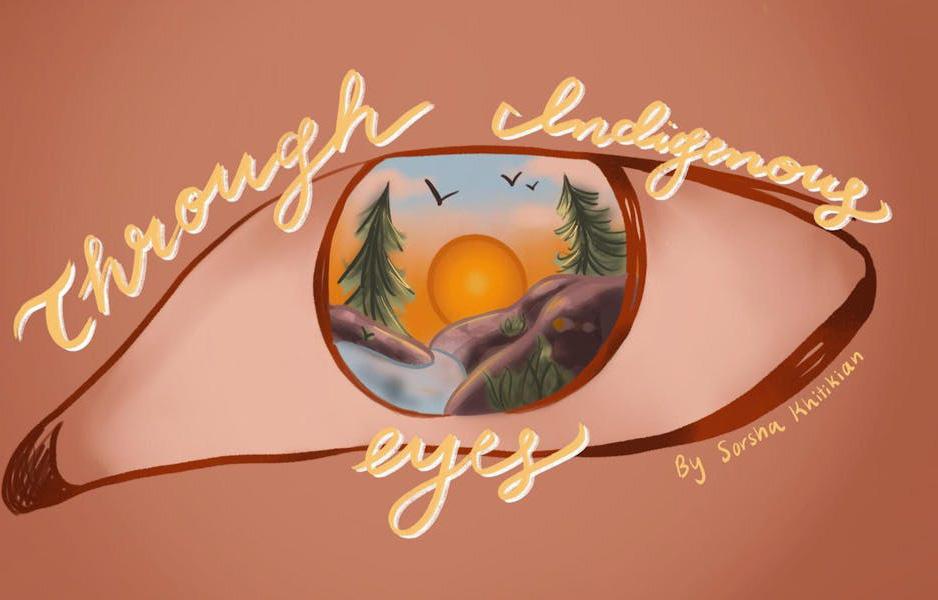
Through Indigenous Eyes
Sorsha Khitikian
GRAPHIC BY ELISE SAMSON
The Intangibles
The dying spectacle of the NBA Dunk Contest
The NBA Dunk Contest used to be a special showcase of the pinnacles of basketball athleticism: Michael Jordan’s free-throw line dunk in 1987 and Aaron Gordon and Zach LaVine’s legendary duel in 2016 are the most famous examples.
It has now fallen into stagnation.
To fix the dunk contest at its roots, we must first understand its power. After watching an ordinary basketball game, we first ask: Who won? And, by how much? Only after we wonder ‘if the victory was pretty.’ In the dunk contest, however, this tension between the appreciation of aesthetics and victory is flipped — we prioritize artistry over the ‘victor.’ Sure, the contest has a ‘victor,’ but it is clear the event is judged with little scrutiny — perfect scores of 50 are doled out like lollipops. The incompetent celebrity ‘judges’ reveal the true purpose of the
Road to the World Cup
Tournament opinions at Tufts
Antonia Toro
With 112 days until the World Cup, even the CVS in Davis Square is stocking tournament merchandise. I sat down with two Tufts students to hear what the tournament means to them.

contest, as was demonstrated in 2016. When two contestants do truly innovative, beautiful, impossibly skillful dunks, scores become irrelevant, and the contest becomes a pure celebration of basketball as an art form. We become judges, called upon to evaluate the power of what moves us, to pay real attention to real attempts at a novel, creative movement. The great dunk contests meet this expectation of artistry.
But what happens when the contestants are unable to meet it?
I say this with respect to the impossible task given to the four unlucky NBA players
Sophomore Brynn Martin grew up playing soccer and vividly remembers the first World Cup she watched seriously: the 2014 tournament in Brazil. She was in Europe at the time, which made the experience unforgettable.
“That was such a good World Cup,” she recalled. “You had so many players at their peak, like prime Neymar, Ronaldo, Messi. And I was also in Europe, which made the atmosphere particularly electric.”
She watched the final wearing an Argentina jersey and rooting for Messi, despite being surrounded by European fans.
chosen each year. The level to perform truly innovative dunks is just too high for NBA players. Dunking at the highest level is, as of late, a specialized skill. This wasn’t always the case. Dunking used to be the wild west and, with the open plains of innovation, the bar had not been set. But Jordan’s religious free-throw line dunk can only be done once and, when such a dunk moves us, it becomes framed as a beautiful act. Our mouths hang agape. If repeated, however, it becomes uninteresting and derivative. We become desensitized to what was once jaw-dropping. In 2026, it seems that every
When he missed a crucial free kick late in the game, it was “devastating.” She admired him as the underdog, “small but mighty,” even though, she said, “that’s not actually true.” Messi has never truly been the underdog.
Can the United States, hosting for the first time since 1994, recreate that atmosphere? Martin was doubtful. “I definitely think the atmosphere in other places is going to be a lot higher, to be honest. The U.S. never really has that much of a chance,” he said.
The difference, she explained, is cultural. Still, she believes hosting means it will be “bigger

player’s dunks are a trope. 360 windmills and powerful between-the-legs dunks elicit yawns because they’ve already been done before. Mediocre, uninspired dunks bore us. They are an unintentional insult to the history of basketball. Once in a blue moon, contestants like Aaron Gordon or Zach LaVine may fit into the (very narrow) diagram of NBA players who can compete at the level of pro dunkers. They are the rare exception.
If there is no such contestant, the contest becomes filled with dunkslop.
As more dunks become cringe, the dunk contest
than it’s ever been before” in the United States. And while she supports the United States Men’s National Soccer Team “because it’s my country,” she admitted she gravitates toward the women’s team instead. “[USWNT] is one of the better programs.”
Sophomore Nicolás Varela Pascual can tell you every detail of the day Panama qualified for the World Cup for the first time in 2018. He was in sixth grade, watching from his family room with his little sister. When Panama’s captain scored in the 82nd minute, excitement filled the house.
“My little sister and I yelled, we cried. We were so excited,” he recounted. Then-President Mauricio Macri canceled school and work the next day. “It’s a memory I hold very dear.”
At the World Cup itself, Panama lost every game, finishing dead last. But none of that overshadowed the national anthem playing on that stage for the first time. “My dad was crying. I was crying. It was very emotional to see our flag, our anthem on a big stage for the first time.”
And when Panama scored their first ever World Cup goal against England, down 6–0, there was pandemonium. “It was literally like an on switch … We all stood up and screamed as if we had scored a winner. We lost 6–1, but that one goal meant a lot to us.”
For Varela Pascual, that passion is inseparable from
becomes a shell of itself. My remedy is this: Even if NBA players cannot compete with them, professional dunkers should be allowed to compete in the dunk contest. If this happens, the contest will be both permanently altered and revitalized.
With dunking artists under the spotlight, All-Star weekend can become a celebration of basketball once again, and a use of the NBA platform to benefit the game itself.
Jonah Cowan is a senior majoring in international relations. Jonah can be reached at jonah.cowan@ tufts.edu
patriotism. Would Panamanians ever support another team over Panama? “Never,” he said. Being the underdog only makes it sweeter.
“It makes it a million times more gratifying … We tie against a bigger country and it feels like a win,” he said.
Panama enters this World Cup in a group with England, Croatia and Ghana. Varela Pascual is disappointed by the draw, but not without hope. As for who wins it all, he landed in the same place as Martin: Spain.
“Very objectively,” he said. “And even unobjectively, I don’t think Panama is there yet.” Both interviews revealed the same deep passion for the sport, but what differed was telling. For Varela Pascual, supporting Panama is effortless and unconditional because, in a small country with little else competing for that loyalty, the national team carries the weight of an entire identity. For Martin, it’s more complicated. In a country as large and fragmented as the U.S., where patriotism itself feels contested, even cheering for your own team becomes a choice rather than a reflex. The World Cup doesn’t change that. If anything, it puts it on full display.
Jonah Cowan
GRAPHIC BY RACHEL WONG Antonia Toro is a
Tufts goes on to playoffs despite Senior Day loss to Bates
rebounding presence. Although Tufts struggled from the outside, they took advantage of free throw opportunities, going 7–10 from the line. The Jumbos entered halftime with a 14-point deficit, 39–25.
Tufts opened the second half with a quick layup from Crossett on an up-and-down screen play. The Jumbos grabbed a few rebounds, but Bates then capitalized on an open layup. While Bates made two more layups and a free throw, Tufts’ shooting went cold until about halfway through the quarter when Lozner completed a tough right side layup. The Jumbos stayed
within range of the Bobcats, generating second chances for themselves throughout the quarter, which, for the most part, allowed them to not concede a greater lead. However, a 5–0 Bates run, including a buzzer-beater banked three to end the quarter, made the hole even deeper to climb out of. Bates shot poorly in this quarter, but converted on timely accounts.
Tufts continued to put up a formidable effort throughout the last quarter, converting on 7–8 free throws from drives to the basket. Lozner kicked off Tufts’ effort with an up-and-under layup, followed by a jumper from Congdon on
a screen handoff play, cutting Bates’ lead to 14. Bates then made a layup to counter the momentum, and Lozner drove and was fouled, making both of her foul shots. This was immediately followed by a 3-pointer for Bates.
Every slight gain that the Jumbos made was neutralized by Bates’ high percentage shooting across the court. While Tufts drew fouls on drives and went 7–8 from the line, Bates continued to respond, finding looks into the post and layups to offset the momentum. The Jumbos continued to fight, showing defensive grit, but the Bobcats extended possessions and ran the clock down the stretch.
Crossett reflected on her Senior Day. “We are so grateful for everyone, including our teammates, coaches, parents, and admin who really went above and beyond to make Senior Day so special for us. It was such a fun celebration of our time with the program and, of course, so full circle to share the day with Annie [Aspesi],” she wrote in a message to the Daily.
Head coach Meredith Mesaris also commented on the game. “We knew coming into the game against Bates that it was going to be a competitive battle for 40 minutes. I’m really proud of how this group continues to
grow and represent our program. They show up every day ready to work, compete for one another, and embrace the process. Our focus is always on staying connected, playing with toughness, and continuing to improve. We’re excited for the opportunity that playoffs bring and look forward to competing together in that next stage,” she wrote in a message to the Daily.
Tufts will now enter the playoffs as the No. 8 seed in the NESCAC Conference. They will travel to Brunswick, Maine, to face the No. 1 seed in the NESCAC, Bowdoin College, on Saturday.
BATES continued from the front
ARIANNA HELLMAN / THE TUFTS DAILY
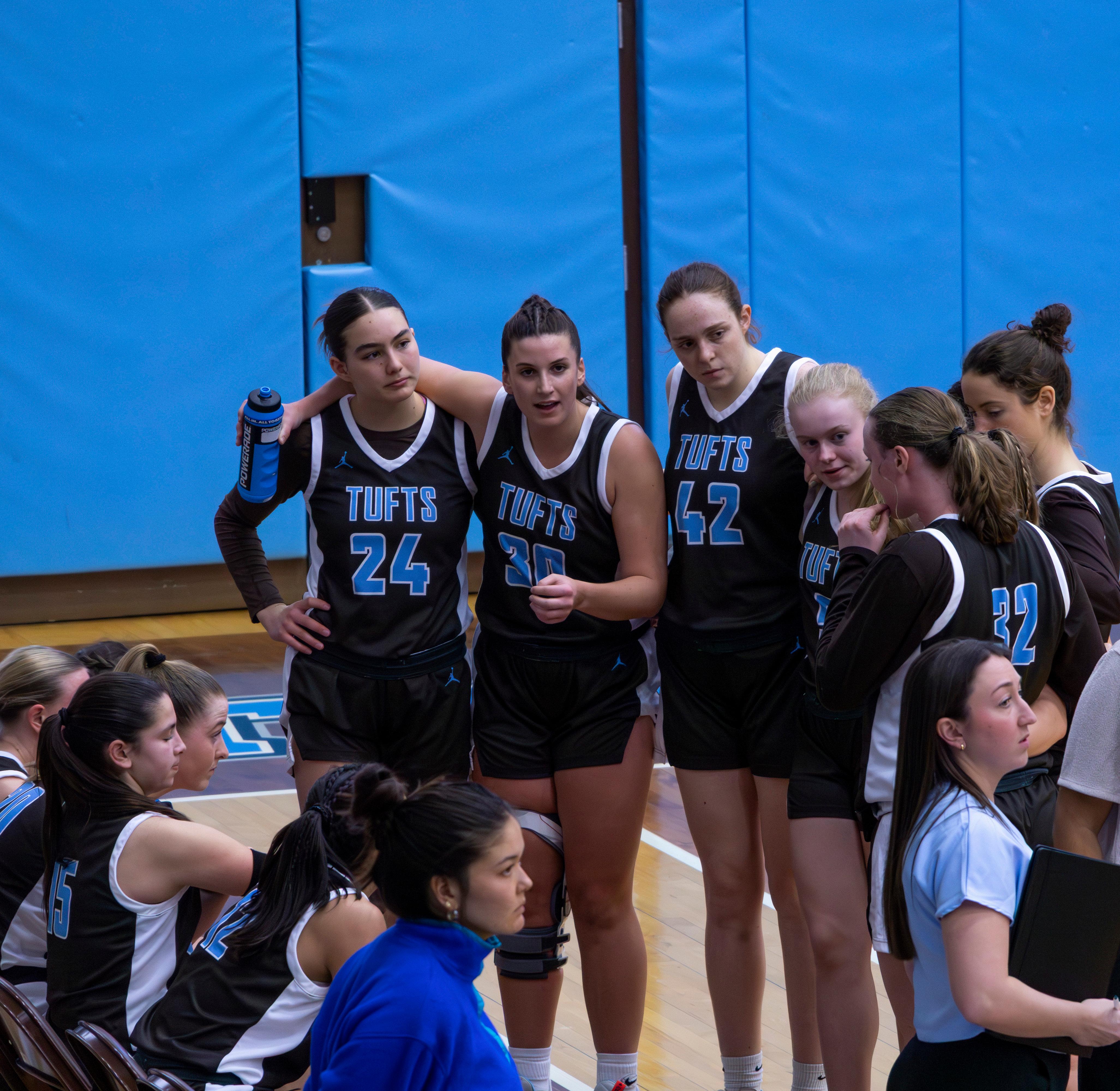
The Tufts team huddles together during a timeout on Feb. 7.