TCU Senate hosts transparency town hall with senior Tufts administrators
Shayna
The Tufts Community Union Senate hosted a Tuition Transparency Town Hall on Tuesday to break down how the university allocates its budget amid rising tuition costs. The event featured several senior university leaders, including Provost and Senior Vice President Caroline Genco, Vice President for Finance and Treasurer ad interim Thomas Malone, Dean of the School of Arts and Sciences Bárbara Brizuela and Dean of Engineering Kyongbum Lee. Approximately 60 students attended.
“The goal of tonight is really to bring clarity and transparency to how tuition works at Tufts,” TCU President Dhruv Sampat, a senior, said. “We’d like to create a space that feels safe and open to talk about all your questions … and bridge the gap between the students and administration.”
Malone opened with a presentation on Tufts’ $1.32 billion operating budget,
outlining the university’s revenue sources.
“Tuition is sometimes considered the primary funding source, but here at Tufts, it is just one
component,” Malone said. “Net tuition makes up just about half of our revenue sources.”
He explained that approximately 18% of revenue comes from
sponsored research, 12% from clinical and other activities and about 16% from gifts and endowment income. Last year, Tufts received over $240 million in sponsored research
funding, with the federal government serving as its largest funder.
Genco acknowledged that Tufts lost $20 million in research grants between February and summer 2025 due to federal funding cuts but expressed confidence in future funding.
“We just got approval on a budget that was approved at an increased rate for federal funding for research,” Genco said. “We’re really confident that moving forward, we’re going to continue to see robust funding across all of our research portfolios.”
Malone shared a chart outlining how funds are allocated, noting that 32% of expenditures go toward instruction and 17% toward sponsored research.
“About a third of our costs are related to instruction,” Malone said, adding that instruction is supported primarily by tuition, as well as by endowment income, gifts and philanthropy.
The event then transitioned to a panel moderated by Sampat, who asked university leaders
Graduate students complete first semester of new AI master’s degree, undergraduate student groups grow
A group of students in the Tufts Graduate School of Engineering completed their first semester as the inaugural class of the Master of Science in Artificial Intelligence. The new program comes as student interest in AI continues to grow, sparking the creation of undergraduate student organizations.
Enrollment for the program exceeded expectations, according to Jeffrey Foster, the chair of the computer science department, who said it was made up of a diverse range of students. He also emphasized the diversity of the initial class as well as his hopes for the program to grow.
The program has also created opportunities for students in the health, security and education fields. Some students have reportedly found co-ops or are actively searching for research work related to AI.
many Tufts students Jumbone, really?
“Some have already been funded as hourly students through the Human-AI Interaction Center,” Mattias Scheutz, a professor of computer science, wrote in a statement to the Daily. “The Tufts Institute for AI is currently accepting additional applications for their internship program.”
“Companies are really loving this [program], because they want people that have depth in AI,” Karen Panetta, the dean of graduate education in the School of Engineering, said.
Panetta added that the involvement of the Gordon Institute, Tufts’s engineering management school, distinguishes the master’s in AI for allowing students to focus on a variety of disciplines, notably business in the context of AI.
As faculty highlight the preprofessional benefits of this program, they also remain cognisant of the ethical concerns involved with AI, which the master’s program hopes to educate its students on.
Scheutz said that his department was “actively addressing” the ethical questions surrounding AI through a course in the master’s program curriculum.
“[It’s about] teaching, from birth, children how to use [AI],
how to protect themselves,” Panetta said. “Whoever thought that you could see a video of someone and it could be so artificially manipulated that you believe that it is actually someone you love or someone you really know.”
In response to ethical concerns, new student groups have emerged, including the Tufts AI Safety Student Association. Senior Andrew Lawrence, the group’s director, described how
see DEGREE, page 3
LAUREN ALIOTTA / THE TUFTS DAILY
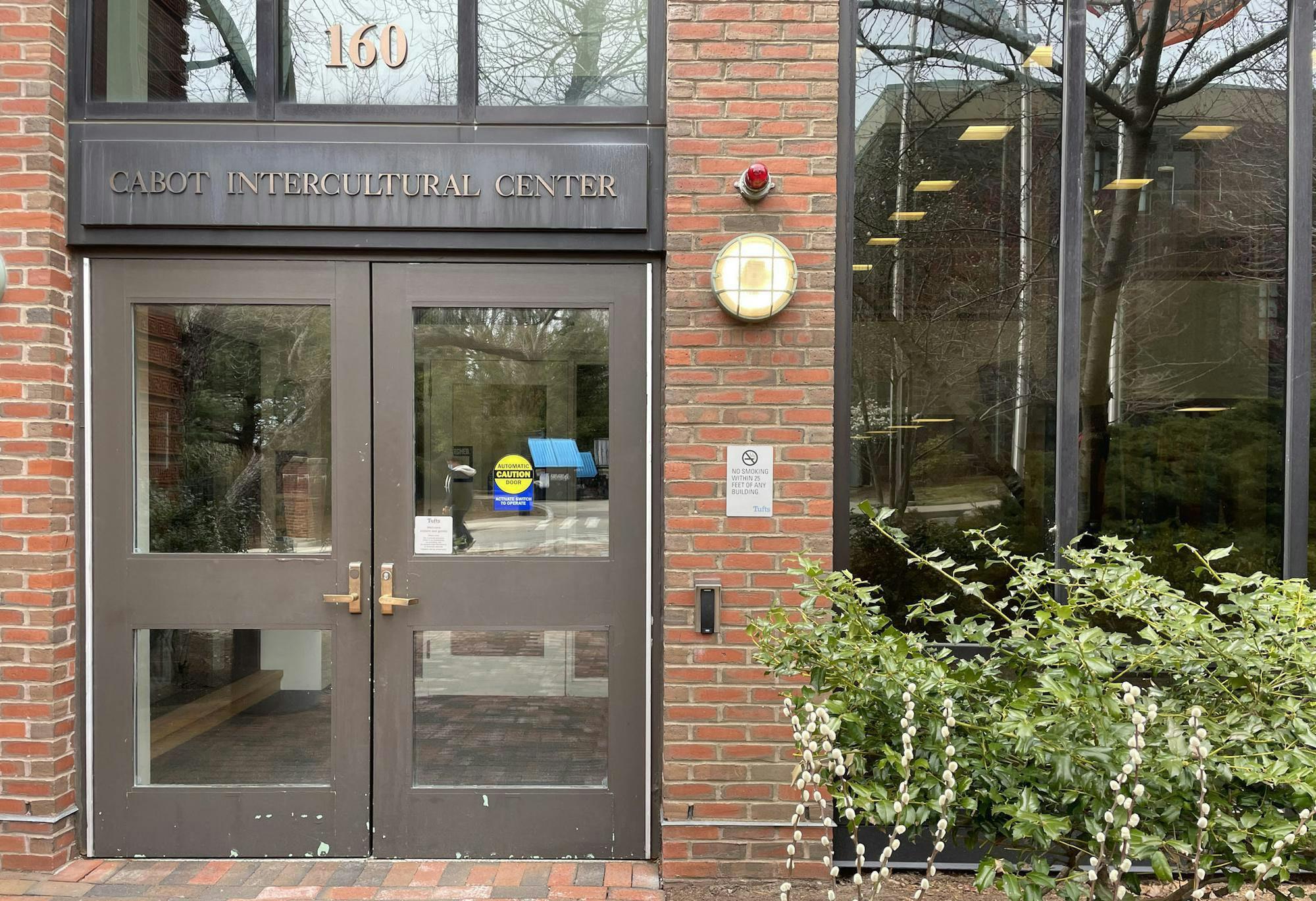
Cabot Intercultural Center, the location of the Tuition Transparency Town Hall, is pictured on April 7, 2023.
Levy News Editor
Eli Brigham Assistant News Editor
NATALIE BROWNSELL / THE TUFTS DAILY
The Tsungming Tu Complex is pictured on Oct. 4, 2022.
Tufts administrators explain university expenses and sources
TOWN HALL continued from the front
questions about Tufts’ finances, including tuition increases.
“One way to think about … tuition increases is that the rate at which some of our expenses have been growing is not the same [rate] at which … tuition has been growing,” Brizuela said.
Malone pointed to rising personnel costs as a major factor to tuition increases.
“To support our faculty and staff, there’s money set aside to provide raises to help keep up with the cost of living,”
Malone said.
Lee added that the evolving nature of higher education has introduced new operational costs, particularly as universities expand offerings related to technology and artificial intelligence.
“I would include energy for, let’s say, computing and data storage,” Lee said. “Those
are [costs] that would [not] have [been] anticipated 175 years ago.”
He noted that supporting AI and computing initiatives requires additional infrastructure and energy investment.
Malone added that the university is focused on improving efficiency to help control rising tuition costs.
“We do have a focus right now [on] understanding how we can be more efficient as a university to … hopefully [reverse] the cost increases that we’re seeing year over year,” Malone said.
Sampat also asked panelists about the Tufts Tuition Pact, which guarantees full tuition coverage for qualifying families earning under $150,000.
“It is a stretch for us, and it is a goal that we have,” Brizuela said. “We do a lot of fundraising [for financial aid], and we need to do more — not just to expand the number of families … we
can bring to the Tufts community [who] fall … below $150,000, but also [to support] the middle-class families who may be just above [that threshold].”
While international students are not covered under the Tuition Pact, Brizuela said Tufts meets their full demonstrated financial need.
“We’re really proud that we’re one of few schools that do provide financial aid for international students,” Brizuela said. “So while they’re not covered under the Tuition Pact, we do meet full need for our admitted international students.”
Genco later noted a slight decrease in undergraduate international student enrollment and a larger decrease at the graduate level.
The panel also addressed Tufts’ endowment, which stands at approximately $3 billion. Malone said about 9% of the operating budget comes
from the endowment — a lower percentage than many peer institutions.
Brizuela added that Tufts’ per-student endowment spending is relatively low, underscoring the university’s continued emphasis on fundraising.
“You can see that Tufts is below the national average and below our peers as well, which is one of the reasons that we [continue] fundraising,” Brizuela said.
Sampat said he hopes the event sets a precedent for future conversations between students and administrators.
“I think [this Town Hall] sets an important precedent to keep having these conversations, because there were so many things that people clearly didn’t know,” Sampat said. “I hope this is carried forward, and I hope we keep reviewing things with [the] administration [while] also … asking important questions.”
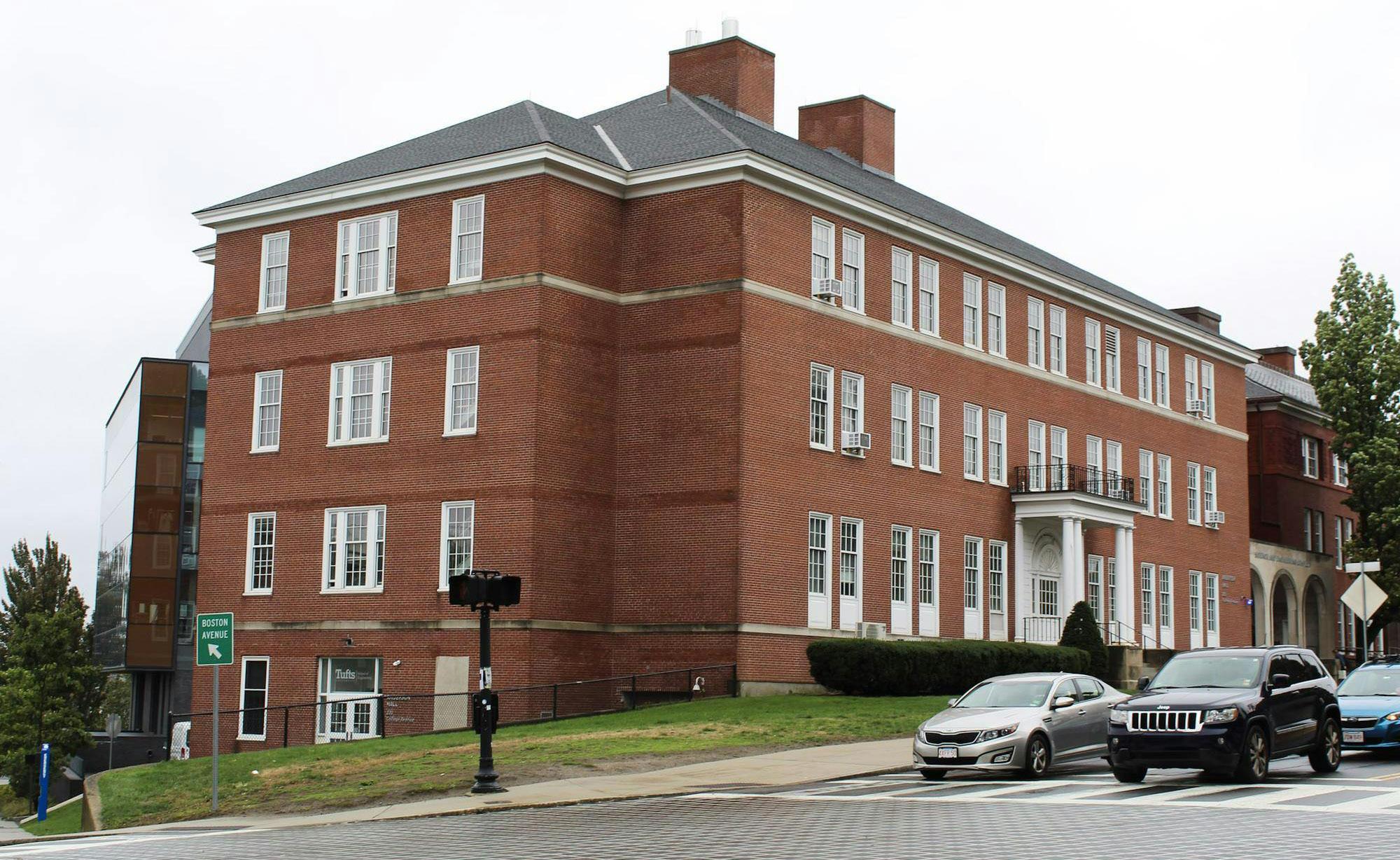
19, 2025.
First cohort graduates with Tufts AI degree
DEGREE continued from the front
new risks associated with AI brought about the need for the organization on campus.
“AI safety in general is sparked by the realization [that] there are a lot of risks and harms associated with AI and so the purpose of our organization … is to strengthen the AI safety ecosystem in the Tufts community and also to convince and prepare our members for careers in AI safety,” Lawrence said.
Lawrence also noted that the organization operates by sponsoring semesterly fellowships in which a small number of students participate in an
eight-week curriculum, which features technical and policy-related AI issues.
“When we started last spring, we ran a few fellowship cohorts, and had 10 to 15 more committed members. Since then, we’ve grown substantially. Last semester we had 20 fellows. This semester we have 40,” Lawrence said.
Lawrence has observed a variety of different approaches to teaching AI ethics in higher education, including the use of mandated AI literacy courses. He adds, though, that such courses have not been incorporated into the Tufts curriculum.
“The Tufts University admin has generally taken
a more hands-off or laissez-faire approach to this, which is understandable because of the liberal arts philosophy and independence of the different schools. But I do wish that there were resources that students had access to,” Lawrence said. Despite ethical concerns with AI, Panetta insists that literacy in this technology is crucial for success.
“What we’re trying to do is teach our students how to use [AI] responsibly, and know how people are misusing it, so they’re aware of the implications of do no harm,” Panetta said.
The School of Engineering has also examined other
ways to integrate AI into academic work.
“School of Engineering faculty are exploring many ways to bring AI into the classroom, including assignments tailored to help students learn about AI, classroom activities to help students understand AI’s strengths and weaknesses, and some faculty are even developing custom AI chatbots to support students in courses,” Foster wrote.
The attention to other applications of AI beyond computer science has helped attract applicants, which has contributed to a 23% increase in applications to the master’s in AI program compared to last year.
SOPHIA KHAN / THE TUFTS DAILY
Ballou Hall is pictured on Nov.
TCU Senate welcomes new senators, considers push to add voting information to syllabi
Editor’s Note: Gunnar Ivarsson is a former chair of the Daily’s Ethics and Inclusion Committee.
Ivarsson was not involved in the writing or editing of this article.
The Tufts Community Union Senate welcomed newly elected senators and discussed an effort to include voting information in syllabi, among other issues, in its Sunday meeting.
Indigenous Senator Tziavi Melendez, a junior, LGBTQ Senator Glen Marques, a firstyear, and Class of 2027 senators Mikey Glueck and Seray Ajei were elected in a special election this month that saw a turnout of 448 students. Maya Jordan, a junior, was elected to the TCU Judiciary, while Raymond Dong, a first-year, was voted onto the Committee on Student Life.
TCU Parliamentarian
Anastasiya Korovska, a junior, read aloud an abstract for a resolution introduced by JumboVote,
a nonprofit organization on campus that advocates for voting, which called on professors to include voter registration and additional voting information in all course syllabi.
“JumboVote, Tufts’ nonpartisan voter advocacy organization, calls upon the TCU Senate to adopt a resolution mandating that professors include voting information and resources in their syllabi/Canvas pages,” the resolution reads. The resolution also recognizes the importance of ensuring students are civically engaged, which it says is a “core value of the Tufts community.”
Senator Hailey Renick, a firstyear, also shared updates on her Tufts Dining survey initiative that seeks student feedback on meals and recipes. The survey received over 1,300 responses and the Senate is now going through the data, she said.
“We’re going to compile [the survey results] and present everything to Dining,” Renick
said. “The purpose of the survey was more meal-specific and recipe-specific — the frequency of what’s being served and how it’s served.”
TCU Senate President Dhruv Sampat, a senior, told senators that he discussed Pass/Fail and drop deadlines with Tufts administrators in several meetings and added that the university is deliberating over pushing the deadlines back.
“We did bring up the drop and Pass/Fail deadlines. As you know, the drop deadline this year is Feb. 18, which, considering that we missed a Monday, is pretty hard for classes that are on Mondays and especially those that … take place once a week,” he said.
Sampat also shared that he will be attending a meeting between executive deans in the next few weeks to discuss a recently implemented project on introducing open syllabi.
“The open syllabi project is something that officially has
been instituted, which means that there is the infrastructure for faculty members and professors to upload the syllabi or their syllabus from each class for everyone to see while they’re choosing what classes to take,” he said.
However, Sampat added that only six faculty members across Tufts have implemented the program and uploaded their syllabi.
Class of 2028 Senator Gunnar Ivarsson, chair of the Education Committee, discussed a resolution he is working on with Korovska and Class of 2028 Senator Ruby Appleton to help members of performance groups on campus receive course credit.
“We’re just trying to create a framework for performance groups on campus to be eligible for credit,” Ivarsson said.
TCU Treasurer Brendan French, a junior, outlined the budgeting timeline for clubs this semester, sharing that club budgets will be due to the Treasury on Feb. 25. Throughout the rest of the semester, clubs will also be expected to meet with a member of the Allocations Board to discuss their budgets.
The breakdance group TURBO appealed the Allocations Board recommendation for funding. The Allocations Board recommended against giving them funding, but the Senate ultimately voted to provide $2,975 on Sunday for the annual competition they host.
The Senate also voted to approve $13,169 for Tufts Club Cheerleading and the Allocations Board recommendations for both Tufts Asian Student Coalition and Zema Dance Troupe.
“Whether that’s going down the graded path, whether that’s going down the Pass/Fail path, what amount of credits it would look like, what’s the requirements you need to be eligible to have credit for it? These are all conversations that we’re having.”
Shayna Levy News Editor
LAUREN ALIOTTA / THE TUFTS DAILY
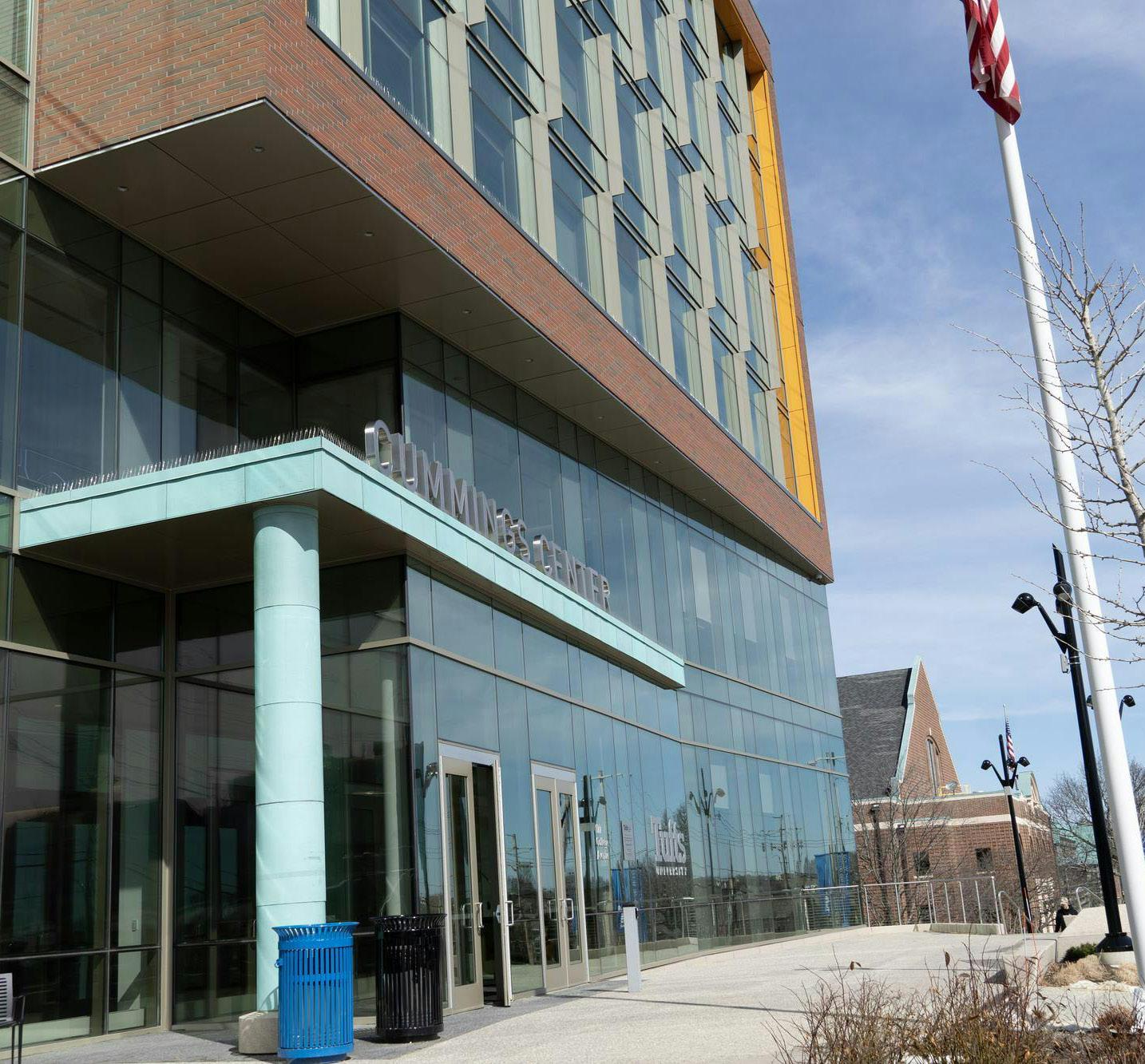
The Joyce Cummings Center is pictured on March 3, 2024.
FEATURES
Love, hookups and dating at Tufts — oh my!
Emily Sullivan Features Editor
It’s almost Valentine’s Day, and there is no doubt that love is in the air for some students here at Tufts. And there’s no better way to understand love and relationships than with a Qualtrics survey. This one was shared from Jan. 29 to Feb. 9 on social media, Slack and through personal connections, leading to a total of 69 completed responses. A quick disclaimer: The generalizability of this data is questionable, and the results are more entertaining than truly scientific. After all, who are we to try to pin down the mysterious force of love with non-validated surveys and scales?
Of the respondents, 70.1% identified themselves as female and 29.9% identified themselves as male. The class of 2026 had the most representation at 37.3%; 2028 followed with 34.3%, then came 2029 and 2027 with 17.9% and 10.4% respectively. When
asked about their sexualities, 52.2% of respondents identified themselves as heterosexual, 26.9% identified as “bi+,” 10.4% identified as homosexual, 6.0% chose to self-describe and 4.5% preferred not to respond.
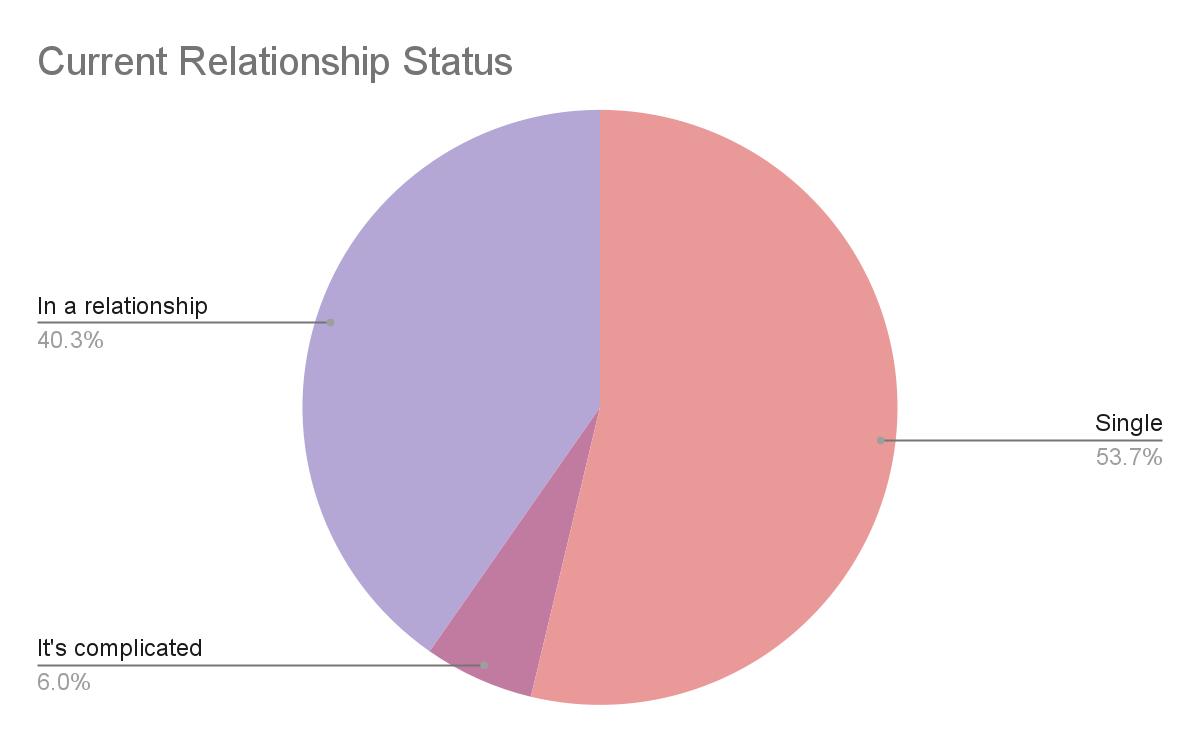
Now that we have a basic understanding of our sample, we can begin with the interesting stuff. Approximately 54% of respondents report being single, 40% are in a relationship and 6% are existing in situationships or “it’s complicated.”
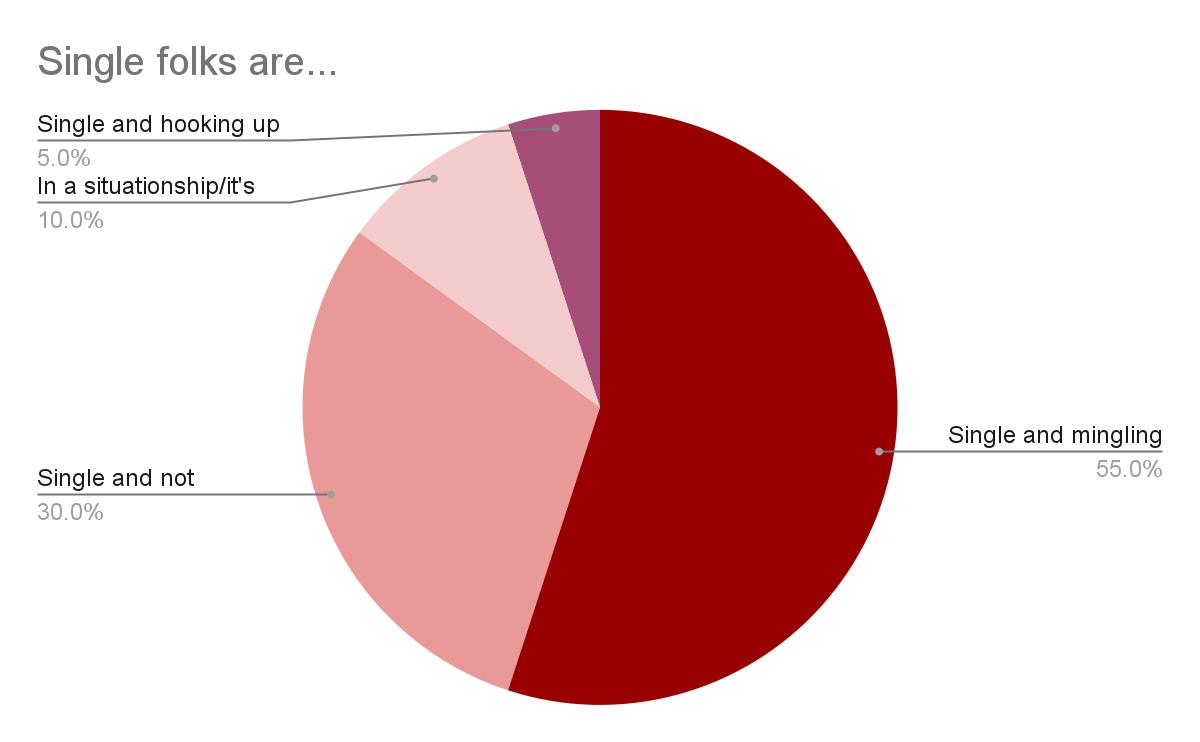
Of our single classmates, 55% are “single and mingling,” 30% are “single and not mingling” and 10% are in that liminal space of situationshiphood. People have a variety of thoughts on being single at Tufts.
One respondent wrote, “I think it should be normalized, too many people spend too much time and energy looking for a relationship here instead of focusing on friendships and other things.” On the other end, a student wrote, “s---’s rough,”
and another asked, “Where are all the hot men?” Perhaps the response that most accurately explained the duality of singlehood is one that said, “I love the independence and freeness of it. However, if I see one more couple cuddling in the Campus Center booths, I might have to fling myself off of a building.”
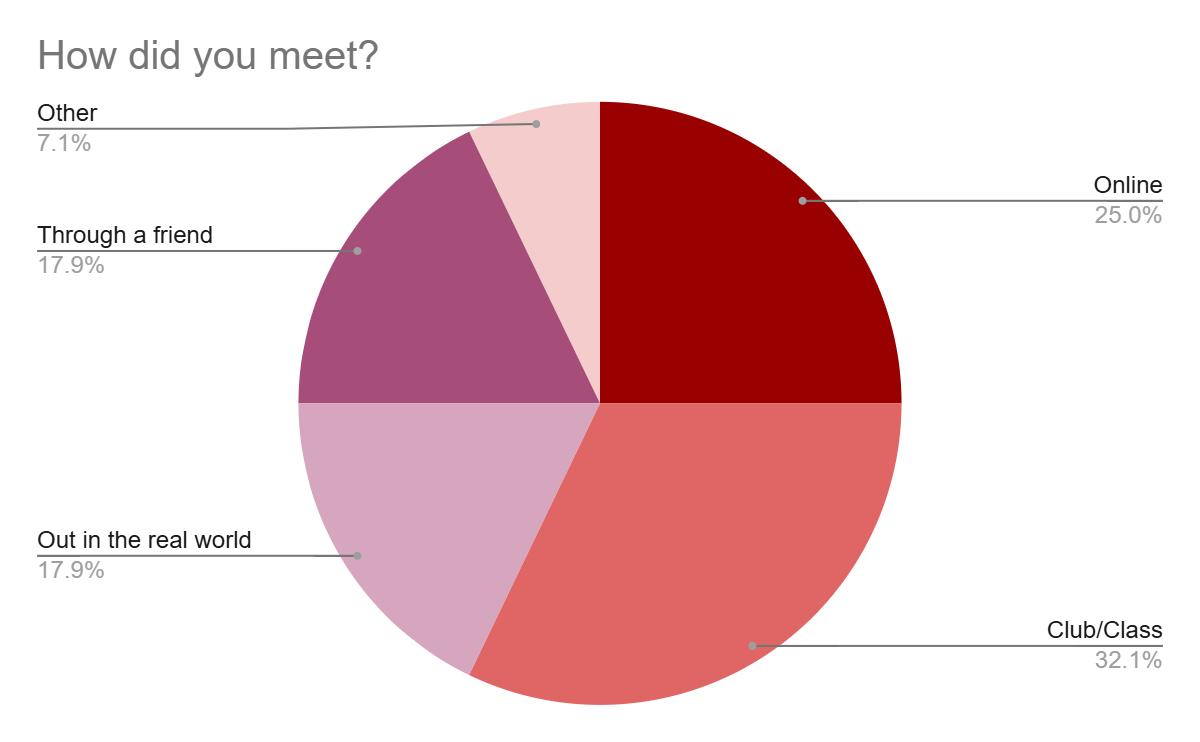
Of our linked-up classmates, the average amount of time they have been dating their partners is 15 ½ months. Only a quarter of them met online, with in-person connections making up the majority of relationships. One respondent reported that they met on the way to Bridging the Herd, and a different student met their partner at intramural sports, so there are a range of places to meet people on campus.
When asked what they thought was the relationship status of most other Tufts students (single, in a relationship, hooking up or situationship), “single” was the most common response at 43.3%, and those students were correct. The good news is that for the 40.3% of respondents who guessed “situationship/it’s complicated,” things are not as bad out here as they may have seemed.
While 31.3% of Tufts students prefer their significant other to also be from Tufts, for those who do not mind outsourcing, our sample of Tufts students has spoken on which Bostonarea schools are the most — and the least — dateable: Tufts University; Boston University; Harvard University; Northeastern University; MIT; Boston College; Brandeis University; UMass Boston; Emerson College; Berklee College of Music.
It may have been a little self-centered of us to rank ourselves first, but the rest of the placements suggest that distance and artsiness play a role in what Tufts students consider ‘dateable’ — or perhaps we all just know someone wronged by a Berklee student.
You may be wondering: Just how active and freaky is the Tufts community? We’re pulling an average Rice Purity Score of 56.68. Of our respondents, 85.2% have kissed someone, and 58.3% have had sex. One of our classmates wrote, “the guy who I lost my virginity to passed out when he came for a few seconds. I’ve been insufferable ever since.”
Another wrote,” [I] went out with a girl in an open relationship one time, can’t say that I was prepared for her calling her partner
during our date.” And to the one respondent who replied “maybe” instead of “no” to being polyamorous: godspeed.
We have all seen the infamous Tufts Marriage Pact around, and approximately three-quarters of respondents have participated. The most common outcome seems to be “didn’t reach out” at 51.9%, with “ghosted” second at 28.8%. With only 1.9% ever reaching the dating stage, the Marriage Pact’s effectiveness or our ability to slide into DMs remains in question.
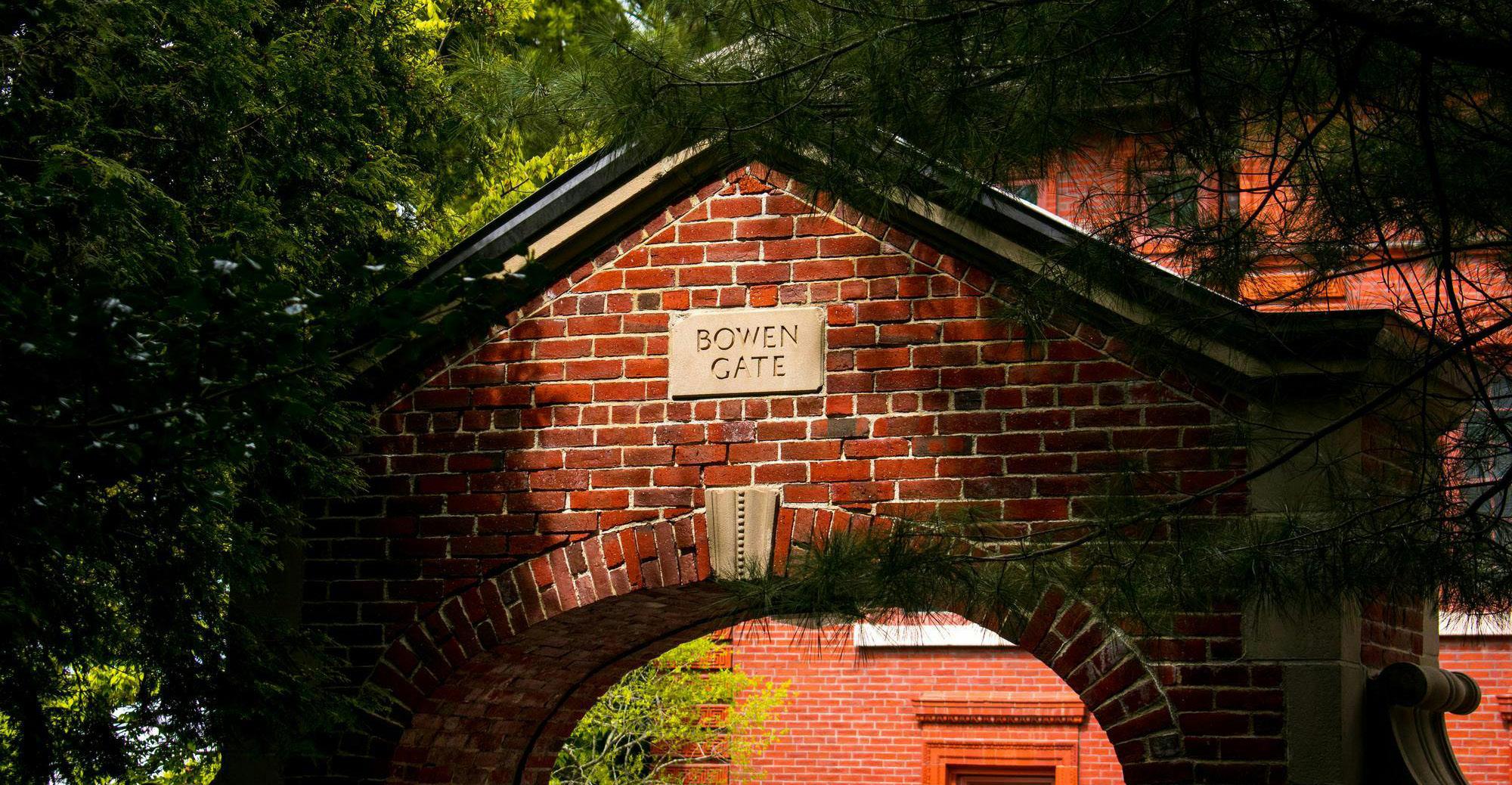
Another famous Tufts tradition — kissing your partner under Bowen Gate to ensure you’ll get married — does not seem to be as popular. Three out of the 69 respondents have kissed someone under Bowen Gate, raising questions about our generation’s opinions on marriage, our ability to locate the gate or perhaps that this superstition’s time in the sun is over.
It cannot be said that Tufts students do not support each other, as dating advice flooded the survey. One respondent wrote, “Learn how to set boundaries for yourself, and make sure you know when you are compromising with your partner [versus] when you’re compromising your own boundaries.” Another emphasized that “mutual ambition is important. Pushing your partner to be the best for themselves is a love language.” Lastly, someone wrote, “You need to be comfortable being in silence, just chilling, supporting the other at their low points and quite honestly acting like ‘best friends.’”
Love can come in many forms, from your partner to your friends to your family to how you treat yourself. Valentine’s Day, in its commercial success, has become focused on one kind of love and a limited definition of how to express that love. Yet that can be incredibly limiting to our connections, bonds and relationships. So during this month of love, do with this data as you wish. However, I hope you can celebrate the myriad of love in your life that quantitative and qualitative data can never fully encapsulate.
SOPHIA KHAN / THE TUFTS DAILY
Bowen Gate shines in the golden hour spring light.
Turning around
My initial idea for this publication was going to be me complaining about the heinous weather out here in Barcelona. I’ve been here for a month now and it’s only been over 60 degrees, like, five times! It’s been getting pretty cold, with last night dropping to the high 40s. I’m not sure what it’s like back at Tufts, but I bet it’s better than here!
While it’s always nice to get readers’ sympathy, I was struck with inspiration for a different column topic this past weekend. I visited Dublin with two friends for a quick trip, and it was incredible! The weekend was full of interesting accents, Irish traditional music (I was roped into an Irish jig at one point) and pints of Guinness. I even got a certificate in pouring Guinness correctly from the Guinness Storehouse. If The Burren is looking for a new bartender, I’m ready.
Anyway, during the weekend we visited the cliffs in Howth, a port city about a 40-minute train ride away from the city center. There was a 2 ½-hour trail that traversed around the
cliffs and through the countryside. It was truly majestic. The cliffs were incredible, and I was pretty much awestruck for the entire hourslong journey. If anyone wants to hear more about the scenery, please don’t hesitate to reach out — I can talk about it all day.
During the hike, inspiration struck me twice. The first time came at the very beginning. In typical Irish fashion, it had been raining for 20 days straight, so naturally the trail was a bit muddy. I spent the beginning of my hike keeping my eyes toward the sights ahead and the muddy trail. (I did not pack well. My white shoes and khakis were not happy). However, after a bit, I turned around because the sun had started to peek out of the clouds and I felt it on the back of my neck. When I looked behind me, what caught my eye wasn’t the sun, but the cliffs. The same cliff that I saw just moments before looked incredibly different. I was once again awestruck by that same slab of rock, but just this time I was looking back instead of forward.
The second moment was just past the halfway point. We were staring off into the distance (very cinematically, I may add), admiring the Irish countryside and a distant lighthouse. I turned to my friend and said, “Wow, it’s crazy to think that we may never be here or see anything like this
again.” After a quick moment of pondering, he responded with, “That’s true. But also think about everything that has led us here.” I never considered my friend to be a wise person, but that sentence really stuck with me. I spent the rest of the hike thinking about his words.
At the end of the hike and on the train ride back to Dublin, I thought about what led me to that exact moment: every decision, moment and experience that brought me to a train in Dublin. Obviously, the journey was not easy. It was months of anticipation, filling out applications, shipping visa materials, saying goodbye to the life I had known and adjusting to Barcelona. I remember those moments so clearly. I remember
the stress I felt when I received an email that my program needed me to reship a medical certificate because it “wasn’t original ink.” And that’s just one moment. But now, suddenly, I was standing overlooking the Irish countryside. While it may sound obvious, I realized that none of those moments were things to “get through” but rather part of a trail.
At the beginning of the hike, I was so focused on what was ahead of me: the mud, the uneven ground, the next cliff. That mindset made me forget to look behind me, and when I finally did the view stopped me in my tracks. The ocean didn’t change. The cliffs didn’t change. But my perspective did. I think we do that a lot in life. We spend so much time
looking forward to the next assignment, the next exam, the next big weekend, the next big thing. When we obsess over what comes next, we forget to turn around and see how far we have already come.
One day we will look back at this chapter, this exact moment we are in right now, and it will look different. Sometimes appreciation doesn’t come from looking forward, but rather looking back.
After all, every cliff has two sides.
Watching my back, Ben Rachel
Ben Rachel is a junior majoring in economics. Ben can be reached at benjamin.rachel@tufts.edu
AMPT: Tufts’ very own mixtape
multiethnic backgrounds and identities.
they’re mixed enough and just enjoying a space with mixed people.”
to build bridges with each other despite our different cultures.”
Originally published Feb. 10.
Identity: the essence of who we are. Identity plays a crucial role in defining us and dictates how we go about our daily lives. It represents the range of experiences we have undergone and influences our every decision. From how we act, to what we value, to the food we eat, identity is irreplaceable and constantly evolving.
Our ethnicity is often at the root of identity, playing a role in our customs and upbringings. It can be diverse, or, in other words, mixed. Luckily, Tufts has a club to honor students with
The Association of Mixed People at Tufts is a student organization that creates community for students with mixed backgrounds to bond over their unique experiences. AMPT Co-Head Event Planner and senior Chrystal Coleman emphasized that AMPT serves as a space for anyone who identifies as multicultural in their own way.
“Something that we have pivoted [to] is [that] we don’t ask [what] people’s mixes [are] anymore,” Coleman said. “You could be in a multicultural household and not necessarily be mixed racially or ethnically. So [we’re] trying to broaden those horizons and having people worry less about if
AMPT Treasurer and junior Mathilde Vega also highlighted the importance of acknowledging the need for a safe space regardless of one’s connection to ethnicity. Having felt a lack of belonging due to her mixed identity herself, Vega strives to eliminate those doubts for other AMPT members.
“Everybody deserves a space where they feel like they belong 100%,” Vega said. “Everyone [in AMPT] knows what it’s like to feel alienated. We also know what it feels like to be alienated and a woman, or [to be] alienated and queer. There is no wrong way to be [at AMPT], and we find ways
In addition to being a community that centers acceptance and belonging, AMPT offers a wide range of experiences that leave a lasting impact on participants. AMPT Co-President and senior Jasmine Lewin relishes in her mixed identity while underscoring the “mix” of activities offered through the club, including craft nights, game nights and insightful discussions.
“We try to host a couple of discussions throughout each semester,” Lewin said. “One of our biggest ones is our Jubilee-like ‘Spectrum [Night]: Do all mixed people think the same?’ [event]. It adds [a] more playful way to talk about more intense subjects. Finding that balance is really nice because … it feels more welcoming and [there’s] less pressure.”
AMPT also branches beyond Tufts, ‘mixing’ with other organizations and schools to create more worthwhile experiences for its members. Lewin noted collaborations with Wellesley College Fusion, the Boston University Mixed Student Union and the Harvard Undergraduate Half Asian People’s Association, as well as collaborations with the Division of Student Diversity and Inclusion at Tufts. These partnerships create more holistic experiences through cross-organizational initiatives.
AMPT Community Representative and sophomore Natalie Compare recalled one quintessential AMPT excursion that played a critical role in making AMPT feel like home.
“My favorite memory with AMPT is going to the Loj my [first] year in the fall,” Compare said.
“It was the first time that I really felt like AMPT was my club. … We went on some nature walks, played a lot of games, [and got] to know each other.”
Like Coleman and Lewin, Compare cited the AMPT community as one of the club’s highlights.
“I’ve met a lot of good friends [at AMPT],” Compare said. “I think it’s a cool space to connect with other people I might not connect with otherwise.”
AMPT has many other opportunities and events planned for the semester, including a collaboration with the Tufts Latinx Center that will explore the fusion of Chinese and Peruvian cuisine known as “chifa.”
“We have an upcoming collab with the LC that focuses on Chinese immigration in Peru,” Lewin said. “[We’ll focus on] the history behind that, the cultural mixes and the food — ‘chifa’ — that comes out of [it]. That’ll be really cool to focus on these … shared identities and the mixture of cultures.”
This semester, AMPT will also host its signature celebration of food, fusion and fun: Mixtape. Each year, Tufts community members are invited to feast on fusion food and watch various Tufts dance groups perform, celebrating the thriving mixed community and the melting pot we call Tufts University. After all, that is what AMPT is all about: celebrating those pieces of shared culture that exist on Tufts’ campus and beyond.
“There are so many mixed people at Tufts, and I really hope that they join us,” Vega said. “It’s a really welcoming space, it’s really fun, it’s really casual and there’s so much potential to find connection.”
Maia Goldman Contributing Writer
GRAPHIC BY ELISE LEA SAMSON
BRIANA CHEN / THE TUFTS DAILY
AMPT club members are pictured at their Charm Bar club event on Feb. 9.
Ben Rachel
ARTS & POP CULTURE
Catch up on ‘The Fall-Off’
Isadora Alexis Contributing Writer
On Feb. 6, J. Cole released his seventh and final album, “The Fall-Off.” This double-disc project is a self-reflection of Cole’s life and career as a prominent rapper in the music industry.
The first disc, “Disc 29,” is told from the perspective of a younger J. Cole. “29 Intro” starts with a sample of “Carolina in My Mind” by James Taylor, and an audio of people laughing and conversing overlaid on top of it, before everything is cut short by the sound of gunshots. This sets the tone for “Disc 29” as one of both nostalgia and pain. Reflecting on Cole’s upbringing in Fayetteville, N.C. “Disc 29” continues to be a roller coaster of emotions, from deep-rooted hurt and anger in songs like “Two Six,” to mournful songs like “SAFETY” and “Run A Train.”
Production-wise, this part of the album feels almost retro — especially “SAFETY” — referencing Cole’s earlier style as well as the early days of rap. Thematically, Cole is reliving his younger years, criticizing himself and his surroundings. This is seen especially in “Poor Thang,” where he describes the difficulty of growing up around gang violence and how that
shaped his young mind, talking to himself about how he put up a front until he found an outlet in music.
Towards the end of “Disc 29,” the music starts to feel a bit more modern, symbolizing how Cole is growing up throughout the album. The last two songs close the first half of the album by expressing his future desires. “Bombs in the Ville/Hit the Gas” discusses Cole’s growing family and how he wants to put more time aside to be a present father for his sons, while “Lonely at the Top” is an ode to his predecessors in the rap game.
“Disc 39” is arguably the stronger of the double discs. “39 Intro” is full of classic bravado; Cole posits himself as one of the best — if not the best — in the game, even referring to himself as “the halfBlack messiah.” “The Fall-Off is Inevitable” is an interesting autobiography of Cole’s life told in reverse. He starts from his own funeral, where he imagines his grandchildren carrying his coffin to the altar where his body will be displayed, before eventually ending at the moment of his birth when his mother named him.
There is a distinctive difference in maturity between the two discs. Cole plays the role of
From GNX to DtMF: A
The 68th annual Grammy Awards showcased veteran artists such as Kendrick Lamar, Bad Bunny, Lady Gaga and others taking home multiple Grammys, alongside new artists like Olivia Dean making their mark on the industry. The Grammys, held on Feb. 1 at Crypto. com Arena in Los Angeles, were hosted by comedian Trevor Noah. It should be noted that for the Grammys, recordings were eligible if they were released between Aug. 31, 2024 and Aug. 30, 2025.
The major categories discussed, which are among the most
the young, brash, fresh-faced rapper well in “Disc 29,” but he truly shines in “Disc 39,” where he sounds more authentic and grounded. He explains his reasons for retiring from music in this section, citing his family in “Life Sentence” and “Only You,” and his disconnection from the newer generation of rappers making a name for themselves.
The album reaches a powerful climax on “Quik Stop.” Cole
depicts a routine day, stuck in the loop of making music and chasing vices, until he is interrupted by a fan at a gas station who reveals how Cole’s music helped him change his life. “Quik Stop” demonstrates the power of music to transform someone’s life.
“Ocean Way” closes “Disc 39” on a melancholic note. This decision reflects a general tone that wove through each of the
defining Grammy night
sought-after and popularized, include Record of the Year, Album of the Year, Best New Artist and Song of the Year.
For Record of the Year, the nominees were:
“DtMF” by Bad Bunny, “Manchild” by Sabrina Carpenter, “Anxiety” by Doechii, “WILDFLOWER” by Billie Eilish, “Abracadabra” by Lady Gaga, “luther” by Kendrick Lamar and SZA, “The Subway” by Chappell Roan and “APT.” by ROSÉ and Bruno Mars.
The winning song was “luther,” which marked Lamar’s 27th Grammy win. The award also highlighted “GNX,” Lamar’s most
recent studio album, released on Nov. 22, 2024, which also won Best Rap Album. By the end of the night, Lamar took home five Grammys: Best Rap Album (“GNX”), Best Rap Song (“tv off”), Best Melodic Rap Performance (“luther”), Best Rap Performance (“Chains & Whips”) and Record of the Year (“luther”).
For Album of the Year, the nominees were:
“DeBÍ TiRAR MáS FOToS” by Bad Bunny, “SWAG” by Justin Bieber, “Man’s Best Friend” by Sabrina Carpenter, “Let God Sort Em Out” by Clipse, Pusha T and Malice, “MAYHEM” by Lady Gaga, “GNX” by Kendrick Lamar, “MUTT” by Leon Thomas and
“CHROMAKOPIA” by Tyler, the Creator.
The winner was “DeBÍ TiRAR MáS FOToS” by Bad Bunny. Like Lamar, Bad Bunny recently performed at Super Bowl LX, featuring several songs from “DtMF.” By the end of the night, Bad Bunny won three Grammys: Best Global Music Performance (“EoO”), Best Música Urbana Album (“DeBÍ TiRAR MáS FOToS”) and Album of the Year (“DeBÍ TiRAR MáS FOToS”).
For Song of the Year, the nominees were:
“Abracadabra” by Lady Gaga, “Anxiety” by Doechii, “APT.” by ROSÉ and Bruno Mars, “DtMF” by Bad Bunny, “Golden — From K-Pop Demon Hunters” by HUNTR/X: EJAE, Audrey Nuna and REI AMI, “luther” by Kendrick Lamar and SZA, “Manchild” by Sabrina Carpenter and “WILDFLOWER” by Billie Eilish.
The winner was “WILDFLOWER” by Billie Eilish. Although “WILDFLOWER” is on Eilish’s 2024 album, “Hit Me Hard and Soft,” she rereleased it as a single in February of 2025, making it eligible for the nomination.
For Best New Artist, the nominees were: Olivia Dean, KATSEYE, The Marías, Addison Rae, SOMBR, Leon Thomas, Alex Warren and Lola Young.
The winner was Dean, a 26-yearold artist from London. Her most
songs on the album. While it may not be his strongest body of work, it is still masterfully crafted, flowing cohesively and incorporating J. Cole’s best skill: his ability to take the listener along a journey through his expert lyricism. Ultimately, J. Cole’s exit from the music world is one made with great difficulty for the artist, but he has decided to focus on himself, his family and love.
recent album, “The Art of Loving,” released on Sept. 26, 2025, helped propel her to greater recognition in the industry.
The Grammys featured performances from Addison Rae, Alex Warren, Andrew Watt, Brandy Clark, Chad Smith, Clipse, Duff McKagan, Justin Bieber, KATSEYE, Leon Thomas, Lola Young, Lukas Nelson, Lauryn Hill, Olivia Dean, Pharrell Williams, Post Malone, Reba McEntire, Sabrina Carpenter, Slash, SOMBR and The Marías.
Two performances that stood out were Gaga’s “Abracadabra” and Tyler, the Creator’s medley from albums “CHROMAKOPIA” and “DON’T TAP THE GLASS.”
Gaga’s performance was electrifying, from her costume design to her live synth playing. Her song “Abracadabra” won Best Dance Pop Recording and appeared on her studio album “MAYHEM,” which also won Best Pop Vocal Album.
Tyler, the Creator performed a medley of his songs: “Thought I Was Dead,” “Like Him” and “Sugar On My Tongue.” The performance featured a surprise appearance by Regina King. Tyler used the full stage to bring the spirit of his albums to life in a dynamic and theatrical way.
Overall, the Grammys were a strong showcase of the diversity and creativity of the music industry, even if not all artists appeared in the main broadcast.
Makens Joseph Staff Writer
VIA WIKIMEDIA COMMONS
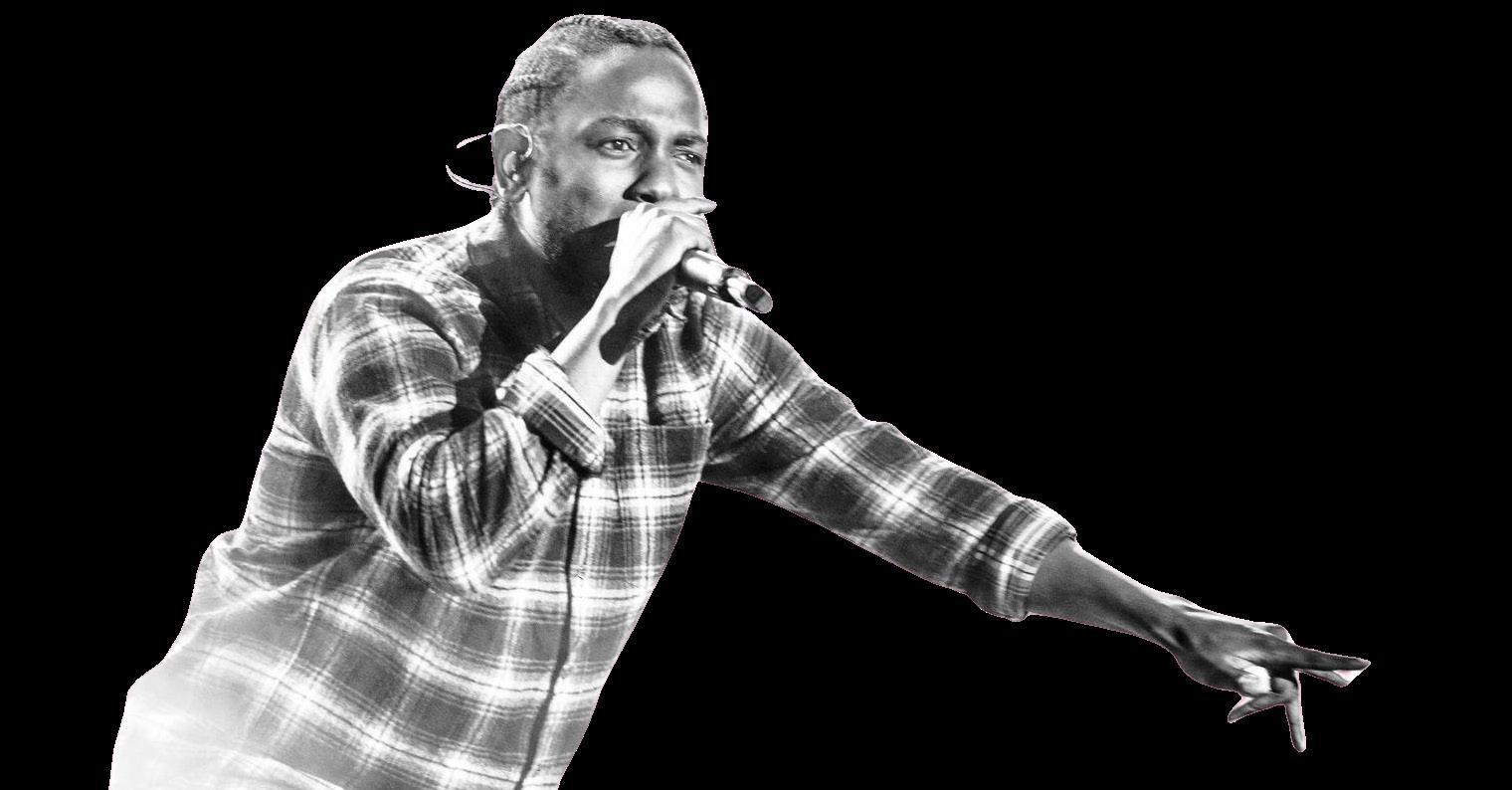
Kendrick Lamar is pictured in 2016.
VIA FLICKR
J. Cole is pictured on stage.
Union Comedy’s ‘Here It Comes!’ delivers sketch with improv flair
Originally published Feb. 11.
A man walks out in pink spandex and a pig nose, and the crowd bursts into laughter that is both stifled and uproarious. The dim, purple lights of The Rockwell cast him in both shadow and spotlight. Soon, the stage is filled with a whole cast of barn animals, a farmer’s daughter and, of course, a sexed-up song set to the tune of “Belle.” This is the grand finale — and it’s been a real good time.
Union Comedy is a Somerville-based improvisational comedy theater. Though their main focus is improv, they also dabble in sketch comedy. “Here It Comes!” is their second sketch show ever, featuring two hours of raucous, rapid-fire vignettes.
Ben Scurria is the Director of Community Relations and the Creative Development Manager for Union Comedy. He’s also one of the founders, along with his partner
Pat Kearnan. “[Kearnan] and I performed together at ImprovBoston for a long time, and we were looking to open our own theater that was more focused on long form improv,” Scurria said. “And we opened Union Comedy.”
For “Here It Comes,” Union Comedy opened up sketch submissions to the community. Scurria emphasized the importance of collaboration during the show’s production process. “Part of what we’re looking for is a strong voice from people, but also the openness to play with their sketch,” he said. “Some people are like ‘no, no, I want you to read it exactly how it’s written.’ And some people are like ‘no, play with it.’”
The Union Comedy performers rehearsed for “Here It Comes!” for a little over a month. “It’s a strong script, but then it’s also what you find in the rehearsal process,” Scurria said. Rehearsal gives the group time to play around with the material and, in Scurria’s words, “get it on its feet.”
What’s so enjoyable about “Here It Comes!” — and good sketch comedy in general — is its fast-paced nature, which allows the show to take on a whole smorgasbord of cultural commentary. “One of the things that we were trying to do, I think, was keep it semi-current without hitting people over the head with it,” Scurria remarked. But he also sees sketch more as an escape from reality than a critique of it.
“When you have so many writers, you really want to get a cohesive voice of a show,” Scurria said. So what is the banner that all the sketches of Union Comedy are united under? “I’d describe it as really smart stupidity,” Scurria explained. “Telling the best dumb joke possible is, to me, the pinnacle of comedy,” he added.
The sketches in “Here It Comes!” vary greatly in style and subject matter. They poke fun at workout videos, blind dating shows, overbearing waiters, optometrists, fast food drive-thrus and Bill
Cosby, among other things. There’s even a hilariously introspective sketch that sends up the act of sketch writing itself. The endings of the sketches are often twists, the punchlines are sometimes downright shocking.
The cast is fully committed to the absurd characters that they portray — for example, one actor puts on a very convincing Mickey Mouse-esque voice for a mafia boss; another adopts the slurred speech and mannerisms of a drunkard. It’s the performances that truly make the material of “Here It Comes!” come roaring to life. With very minimal props and costumes, pantomime forms a great deal of the show’s comic crux. According to Scurria, Union Comedy was founded with the idea that the Harold — that is, a type of long form improv structure — could be a great teaching tool. He articulated improv as “living in a world that you create and then just being really dumb there.” Likewise, the world of “Here It Comes!,” though
scripted, has a very spritely, spontaneous feel to it. This is choreographed chaos in the best way.
One of the standout sketches in the show takes place at a pitch meeting for a car company. The boss has just returned from a cruise in which he fifthwheeled his two brothers and their wives. So, he pitches a design that soothes his insecurities about being single: a car with a fifth wheel in the middle. It’s a hilarious metaphor, and an even more hilarious execution. The more the boss insists that the fifth wheel is “in the mix,” the louder the crowd laughs.
The comedy of “Here It Comes!” exists in its own little absurd reality, but it is also a genuine catharsis for the performers and audience alike. “It allows people to laugh at a time when maybe the world is not the funniest right now,” Scurria said. “As bad as [the world] is, there’s still humor to be had, and there’s still community to be had … I think it’s just a light in the darkness right now.”
Spring LaRose Deputy Arts Editor
COURTESY WILL GIANETTA
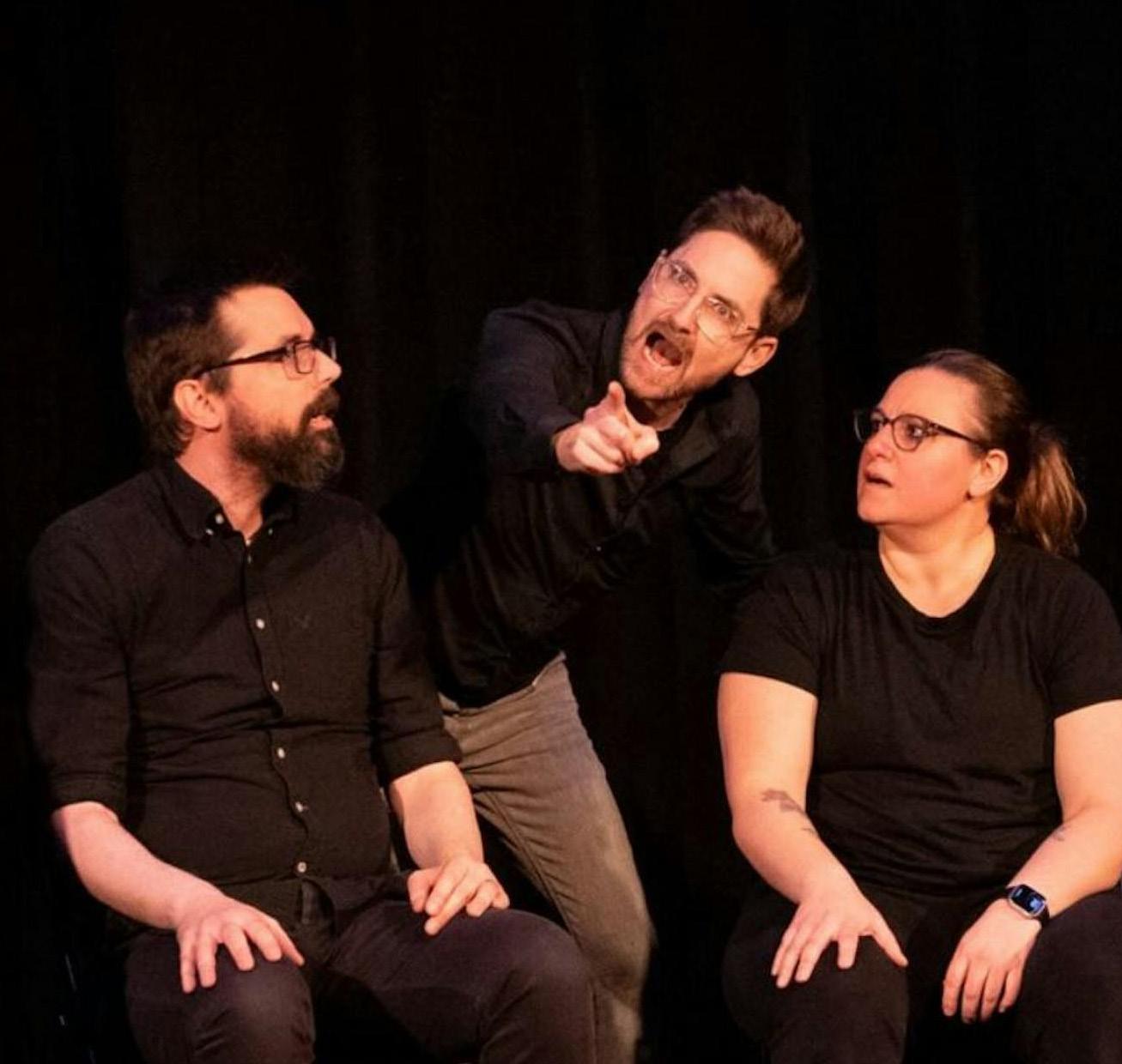
The performers of Union Comedy are pictured in the middle of a sketch — “In the mix!”
Two-By-Two
Two-By-Two
Shayna Levy
(2024
What you do with your buds?
‘Two-By-Two’ by Shayna Levy
OPINION
No, America isn’t becoming Nazi Germany
Within the past few weeks, President Donald Trump and his administration have threatened to invade Greenland, referred to a U.S. citizen killed by Immigration and Customs Enforcement as a domestic terrorist and released a racist video of Barack and Michelle Obama. In the past few months, the administration has threatened universities with federal funding cuts, grabbed thousands of people off the streets and engaged in trade wars with dozens of countries. Within the past year, it has pulled out of over 60 international agreements, pardoned those with Jan. 6 related convictions and purged federal websites of information Trump deemed ‘DEI.’ This paragraph barely covers the overwhelming actions of Trump’s second term, and doesn’t even cover anything he did in his first.
It is completely clear that Trump is becoming increasingly authoritarian in his presidency. His administration and allies have aggressively attacked political opponents, spread conspiracy theories about the 2020 election and persecuted minority groups — all classic tactics of authoritarians. He has also become more fascist, using propaganda to excite his supporters, polarizing the country and dehumanizing minority groups.
When trying to understand our current political moment, journalists, political pundits and ordinary Americans have all looked to one specific historical movement: Nazi fascism in 1930–40s Germany. People who make this connection aren’t wrong; for example,
The Death of Education Follow Mississippi
Evan Wang
As the spring semester picks up, it’s important to remind ourselves that the average National Assessment of Education Progress scores in math, reading, science, civics and U.S. history for students in the United States are now back to what they were in the 1990s. This decline in student performance has been occurring since 2013; it has only been exacerbated by
Hitler severely limited citizen access to information, with his followers conducting massive book burnings to rid the country of ‘un-German’ ideas. Book bans, online document purges and efforts to close libraries are all done with what appears to be the same ferocity by Trump and his followers.
But calling everything Trump does a copy of Nazi tactics is a false equivalency. What is happening in America is a uniquely American brand of authoritarianism, one that Americans need to identify, name and fight against.
Don’t get me wrong: I’ve compared Trump to Nazism in articles before; I am not immune. Even so, I feel strongly that the current administration is using U.S. history as an authoritarian playbook. Here are some examples.
Trump and Greenland: Since taking office in his first term, Trump has continuously stated his intentions to buy Greenland, an autonomous
the COVID-19 pandemic and the post-pandemic inability to curtail chronic absenteeism. Presently, 74% of tested countries outperform U.S. students in science, and a staggering 86% outperform them in reading.
While our public education system has become dysfunctional and outdated, there are still teachers and administrators hard at work to ensure we do not continue down this path. Yet, in some parts of the country, this trend is being reversed with ease.
The clearest example of how the education system can be turned around lies not in the well-funded schools of New England or California; instead, it comes from the most unexpected of sources
territory of Denmark. Ramping up in intensity, Trump has begun to vaguely threaten military force. He argues that Greenland is militarily necessary for protection against Russia and China. Similar tactics were used to gain territory by former President James Polk, who provoked war with Mexico to take the territory of California. He had tried to buy California, declaring war when his proposal was shut down, just as Trump is threatening to do with Greenland now.
Immigration: In both his first and second terms, Trump has engaged in anti-immigrant rhetoric. He has built detention camps across the country, limited immigrant qualifications based on religion and country of origin and dehumanized migrants, comparing them to trash. Immigration is one of the most contentious political issues of American history, with presidents limiting immigration based on race, nationality, political
— the deep South. Ten years ago, Mississippi ranked No. 46 out of 50 states in fourth-grade reading. Today, it is ranked ninth nationally and first when adjusted for factors such as poverty and race. These results are now being replicated in neighboring states, including Louisiana and Alabama.
So, what did Mississippi do to become a leader in public education? It returned to the basics: presence in the classroom. A child’s chronic absence from school now warrants check-ins and warnings for parents, and schools are issued report cards based on student performance. When both parents and administrators are held accountable, students are better positioned to learn. These states
affiliation and more. Former President William McKinley allowed for the government to punish political opponents with deportation. Similar to Trump’s ‘Muslim Ban,’ former President Woodrow Wilson signed the Immigration Act of 1917 into law, creating a zone of countries in which all immigrants were to be turned away. Former President Franklin Roosevelt issued an executive order which rounded up Japanese immigrants and placed them in internment camps. It does not take much imagination to see that Trump is using all of these past tactics in his immigration crackdown. Fake news: Since 2025, Trump has taunted and disparaged journalists covering the administration, while simultaneously attacking press institutions. He has cut billions in funding to public broadcasting corporations and tried to suppress late night show hosts. Additionally, he has attacked the Associated Press for not
are doing amazing things for historically disadvantaged students. Black fourth graders in Mississippi now outperform Black fourth graders in our very own Massachusetts in reading. The high school graduation rate in Mississippi has also risen to an amazing 89%.
This is the kind of education reform America deserves. We should all be following Mississippi’s example in public education instead of the so-called ‘school choice movement,’ which only seeks to destroy what little public education remains.
This article is meant to show what a dedicated and focused movement can do for our youth, not to let political figures and public leaders off the hook. Students
changing its style guide to comply with Trump’s renaming of the Gulf of Mexico to the Gulf of America. Trump is by no means the first president to attack the press. Former President John Adams passed the Alien and Sedition Acts, which aimed to suppress news editors critical of the president. Even former President Abraham Lincoln ordered the jailing of journalists and closing of newspapers that criticized the Civil War effort. And former President Richard Nixon labelled journalists as enemies while he was in office. By looking at Trump’s actions through the lens of American history, we can see how he’s just one in a line of presidents that uses authoritarian tactics. This perspective also unlocks something we don’t see when comparing to Nazi Germany: a long line of American protest. Americans have fought, and will always fight, back against authoritarianism, even if that means fighting the president. “No Kings” protests against Trump are mirrored by the Boston Tea Party, the March on Washington, Occupy Wall Street, Kent State and more. Pushing against authority is part of being American. Our country is facing a terrifying political future. And when we look to Nazi Germany, we engage in a kind of fatalism. We see an inevitability of authoritarian fascism winning. I refuse to believe that to be true. Instead, I look to American history, with all its goods and all its evils, and I see power. And we will wield it — are wielding it — against this president, like we have to all the presidents before.
still need help in a variety of ways, even as test scores rise. U.S. students cannot be allowed to go to school hungry, distracted by phones or overwhelmed by rubbish AI technologies. They deserve well-paid teachers and adequately staffed schools. While these problems are important, Mississippi and other Southern states show us that public education still has a fighting chance. With the right resources and leadership, the U.S. public education system can truly be one of the best in the world.
Evan Wang is a junior majoring in history and biology. Evan can be reached at evan.wang664121@ tufts.edu.
The Tufts Daily is a nonprofit, independent newspaper, published Monday through Friday during the academic year and distributed free of charge to the Tufts community. The content of letters, advertisements, signed columns, cartoons and graphics does not necessarily reflect the opinion of The Tufts Daily editorial board.
EDITORIALS: Editorials represent the position of The Tufts Daily Editorial Board. Individual editorialists are not necessarily responsible for, or in agreement with, the policies and editorials of The Editorial Board. Editorials are submitted for review to The Tufts Daily Executive Board before publication.
VIEWPOINTS AND COLUMNS: Viewpoints and columns represent the opinions of individual Opinion editors, staff writers, contributing writers and columnists for the Daily’s Opinion section. Positions published in Viewpoints and columns are the opinions of the writers who penned them alone, and do not necessarily represent the opinions of the Daily itself. All material is subject to editorial discretion.
OP-EDS: Op-Eds provide an open forum for campus editorial commentary and are published Monday through Friday. The Daily welcomes submissions from all members of the Tufts community; the opinions expressed in the Op-Ed section do not necessarily represent the opinions of the Daily itself. Opinion articles on campus, national and international issues should be 600 to 1,200 words in length and submitted to opinion@tuftsdaily.com. The editors reserve the right to edit letters for clarity, space and length. All material is subject to editorial discretion and is not guaranteed to appear in the Daily. Authors must submit their telephone numbers and day-of availability for editing questions.
ADVERTISEMENTS: All advertising copy is subject to the approval of the editor in chief, executive board and business director. Reach out to business@tuftsdaily.com with advertising inquiries.
Sorsha Khitikian Deputy Opinion Editor
VIA FLICKR
Americans are pictured protesting Trump.
The science behind Olympic snow: Climate change and industrial snowmaking
The Winter Olympic Games, this year hosted in Milan and Cortina d’Ampezzo, Italy, have increasingly had to rely on human-made snow due to climate change. Shrinking snowpacks, rising temperatures, fewer freezes and shorter snow seasons have led to an estimated 85% of competition surfaces in the 2026 Olympics requiring artificial snow. The two host cities this year have created massive artificial reservoirs to provide sources of water for snowmaking. Cortina d’Ampezzo itself has experienced a 3.6 degrees Celsius increase in average February temperature and 41 fewer freezing days annually since they first hosted the games in 1956.
This could also have significant financial implications for cities scheduled to host future
Winter Games, as many may soon be unable to do so. By the 2050s, only 52 out of the 93 potential host cities will have reliable climate conditions for the Winter Olympics, according to Climate Central.
The Paralympic Winter Games, hosted in March, face even fewer prospects of reliable host cities. According to the Observer, only four of these 93 host cities would be able to support the Winter Olympics by 2050 without artificial snow.
The International Olympic Committee has published studies on the dwindling number of cities able to host the Olympics, and why artificial snow is a necessity. They have also even considered moving the games to January in an attempt to get more snow and combining the Olympic and Paralympic Games. The Euro-Mediterranean Centre on Climate Change argues that artificial snow can’t be their
only solution to the issue of lack of snow, as higher temperatures would still melt artificial snow. They also raise awareness of the energy, environmental and economic costs.
While the need to produce additional snow may feel like a distant issue in Boston after one of our largest recorded snowfalls, the current Winter Olympics in the Italian Alps prepared 56 million cubic feet of artificial snow, which is incredibly water intensive.
Time Magazine estimates that this is equivalent to about 84.8 million cubic feet of water.
Conversely, part of the reason these two cities had their bid approved to host the Winter Olympics was their pledge to showcase the conservation of mountain ecosystems.
This process of artificially creating snow began at the 1980 Winter Olympics in Lake Placid, N.Y., and involves using fan guns and lances to spray
atomized water into the air, creating frozen, more resilient ice crystals that resemble rounded beads of ice. Their structure is not the same as the structure of natural snowfall, and often the polymer sodium polyacrylate is added, or other aerosols or mineral dusts. The additives used can disrupt soil pH and contaminate watersheds. These ice crystals are also more than four times harder than real snow, and their production is very carbon-intensive. Additionally, many scientists and Olympians report that this makes snow sports, especially skiing, more dangerous and unpredictable. Specifically, athletes are at a greater risk of injury because artificial snow is icier, denser and harder than real snow. Unpredictable snow and climate have also made training consistently harder for athletes, and halfpipes are often primarily made of ice. This
also leads winter sports to rely heavily on industrial snowmaking. The sound pollution from producing this snow and the risks to workers operating the machines are also factors that should not be ignored. An accident at Jiminy Peak Mountain Resort in Massachusetts highlights this concern.
Many climate organizations, such as Protect Our Winters, have made it their mission to advocate for bipartisan solutions to these climate problems. They have benefitted from the support of athletes such as the professional skier Amie Engerbretson, who has utilized her platform to create films that tackle issues such as climate hypocrisy, using humor to bring these ecosystems and the challenges they face to a broader audience. While no organization, athlete or panel will be able to fully stop our climate from changing, they can help curb our impact in the ways we adapt and move forward.
VIA WIKIMEDIA COMMONS
A snow cannon is pictured in front of Mount Faloria in Cortina d’Ampezzo, Italy.
Kylie Liggett Staff Writer
Tufts Professor Lisa Freeman wins inaugural Canine Health Discovery of the Year Award
Verena Runstadler Contributing Writer
Dilated cardiomyopathy is the most common cause of congestive heart failure in some large dog breeds, including doberman pinschers, Saint Bernards and Great Danes, and is often inherited. DCM causes thinning of the heart muscle, leading to a weakened heart with arrhythmias, or irregular heartbeats and fluid buildup, that can ultimately result in heart failure. However, another form of the disease — diet-associated DCM — can affect many breeds of dogs and cats regardless of genetics.
At the Tufts Cummings School of Veterinary Medicine, Dr. Lisa Freeman (N’96) and her team are studying how diets containing large portions of “pulses” — such as peas, lentils, chickpeas and beans — may contribute to the development of diet-associated DCM. Freeman, who has studied nutrition and heart disease for over 30 years, received the inaugural Canine Health Discovery of the Year Award from the AKC Canine Health Foundation in December in recognition of her work on diet-associated DCM. When asked about the honor, Freeman emphasized the effort her team has devoted to the project and
stressed the urgency behind the research, noting that they “feel a sense of urgency to identify the cause because we continue to see dogs affected by [DCM].” The award helps support the group’s ongoing research and brings broader attention to the issue.
Freeman, who has the rare distinction of earning a degree from each of Tufts University’s campuses, originally studied the intersection of muscle loss and rheumatoid arthritis. During her doctoral research, however, one dog changed the trajectory of her career. She discovered that treatment with a nutritional supplement could alleviate heart disease-related muscle loss, and she was hooked.
Since then, Freeman’s focus has shifted to diet-associated DCM, particularly following a 2018 alert from the Food and Drug Administration highlighting the potential role of diet in the disease’s development. Already working at the intersection of heart disease and nutrition, her team was well positioned to investigate the new phenomenon. Today, their research centers on identifying the specific causes and mechanisms of diet-associated DCM, with the goals of preventing disease onset and improving treatment options. Freeman noted that
diet-associated DCM differs from genetic DCM in that symptoms can improve when an animal’s diet is changed.
Discussing her team’s current work, Freeman emphasized the importance of collaborative science. While she has extensive expertise in nutrition, Freeman noted that she lacked the scope of knowledge to investigate diet-associated DCM on her own. “By working with cardiologists, human and veterinary pathologists, basic scientists and experts in electron microscopy and many other fields, we’ve been able to attack this problem from many different perspectives,” she says. “We can solve challenging research problems much more efficiently and effectively through teamwork with experts across disciplines.”
So what does Freeman wish the public knew about pet nutrition?
“Consulting with a veterinarian is always an important first step in making good decisions about pet nutrition,” she said. Much of the world of dog and cat nutrition has become confusing for pet owners, especially as misinformation runs rampant in marketing. Making a choice for your pet’s nutrition should be based on scientific research, and part of Freeman’s work focuses on
how to make that information accessible. Her team compiles resources on the Tufts Petfoodology blog, where pet owners and veterinarians can find accurate, expert information. Many pet owners remain unaware of diet-associated DCM, especially in breeds that aren’t commonly associated with the genetic form of the
disease. Additionally, the disease was initially associated with diets that contain high levels of pulses, contributing to confusion for pet owners. Research into diet-associated DCM is ongoing, with scientists like Freeman and her team working tirelessly to investigate its causes and explore new treatment options.
Winter Olympics 2026: How the brain handles high-speed fear
Hande Naz Kavas Staff Writer
Originally published Feb. 10.
The Winter Olympics 2026 officially began last Friday in northern Italy. From ski jumping to curling, figure skating to snowboarding, lots of athletes will reach extraordinary speeds over the course of two weeks. As we perch on the edge of our seats, waiting for the start gun to fire or the start gate to drop, these athletes prepare to push the limits of physics. While their professionalism may deceive us into thinking we could do the same, we should remind ourselves of the fear we had when skiing ourselves down a snowy mountain for the first time or competing in front of an audience far smaller than a global one.
Recent studies suggest that Olympians’ brains function differently, enabling them to manage high-speed fear more effectively. Stories conducted on various Olympians show that they develop individual mechanisms to cope with fear and that their brain activity differs from that of amateur athletes.
In 2003, the South African Journal for Research in Sport, Physical Education and Recreation published an article titled “The Experience of Fear in High-Risk Sport,” in which researchers interviewed 12 athletes from six countries — South Africa, Namibia, Zimbabwe, the Czech Republic, the United States and Canada — to examine how they respond to and manage fear and anxiety.
Notably, the researchers emphasized a distinction between fear and anxiety, arguing that unlike situations of fear — in which “perceived threat is known and can therefore cause a specific action” — anxiety alone “cannot produce specific avoidance behaviours.”
This distinction was central to their research, as they sought to understand how athletes continue participating in high-speed sports despite instinctual fear that might otherwise encourage caution.
The researchers observed seven psychological “themes” within the athletes’ psyches that helped them perform well despite the stakes. One key observation was that athletes draw motivation from reflecting on their “peak” performances. While similar moments are often portrayed in action films, cinematic portrayals can obscure the real danger in such scenarios.
This observation relates to another finding of the study: that high-risk athletes have “misconceptions and denial about the intrinsic danger of the activities.”
The sixth theme highlighted that high-risk athletes “express the need for stimulation, change and creativity.” This creativity helps them manage the fear of pushing the boundaries of physical possibility to deliver extraordinary performances. The seventh theme reinforces this notion, noting that high-risk athletes “view their sport as being unique and misunderstood by the general population.” This mindset may contribute to record-breaking performances, even as athletes
feel that spectators struggle to fully grasp the risks involved.
A more recent study — “Anxiety and Fear in Sport and Performance,” published in the Oxford Research Encyclopedia of Psychology in 2018 — examined the role of anxiety and fear in athletic performance. The researchers argued that athletes who are repeatedly exposed to fear-inducing environments can gain a performance advantage over those who struggle to cope with stress. The study emphasized that anxiety and fear often work together in shaping performance in extreme sports, helping explain why non-Olympians may find it more difficult to start an extreme sport compared to seasoned athletes.
While psychological theory provides a strong foundation for understanding high-speed performance, examining brain anatomy offers insight into how these differences manifest physiologically.
A 2021 case study titled “Neural Oscillation During Mental Imagery in Sport: An Olympic Sailor Case Study” examined the neural activity of a 32-year-old two-time Olympic sailor. Researchers tested how the athlete responded to guided versus self-generated multisensory imagery related to their sport. The researchers used an electroencephalogram, commonly known as an EEG, to measure the participants’ low and high alpha waves and sensorimotor rhythm activity. High alpha and SMR waves corresponded with
heightened focus and attention, while low alpha waves indicated a more relaxed mental state.
The study found that multisensory imagery, often used in mental training, can enhance athletic performance. The researchers compared the sailor’s brain activity with existing research, the authors concluded that “an elite athletes’ brain is characterized by more efficient resources distribution, more economic activity or hypoactivation.”
With these studies in mind, it is clear that the Winter Olympics represent more than two weeks of entertainment. They are a scientific challenge of both mind and body. We can only imagine the fear and anxiety these athletes face as they attempt the extraordinary.
Mikaela Shiffrin races at the FIS Alpine Skiing World Cup in Soldeu, Andorra on March 18, 2023.
VIA WIKIMEDIA COMMONS
GRAPHIC BY NESSA TANG
SPORTS
Women’s basketball narrowly defeats Amherst, falls to Hamilton
Morgan Baudler Staff Writer
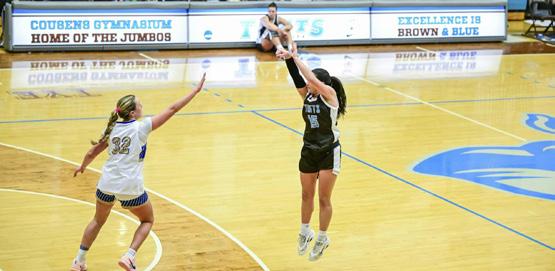
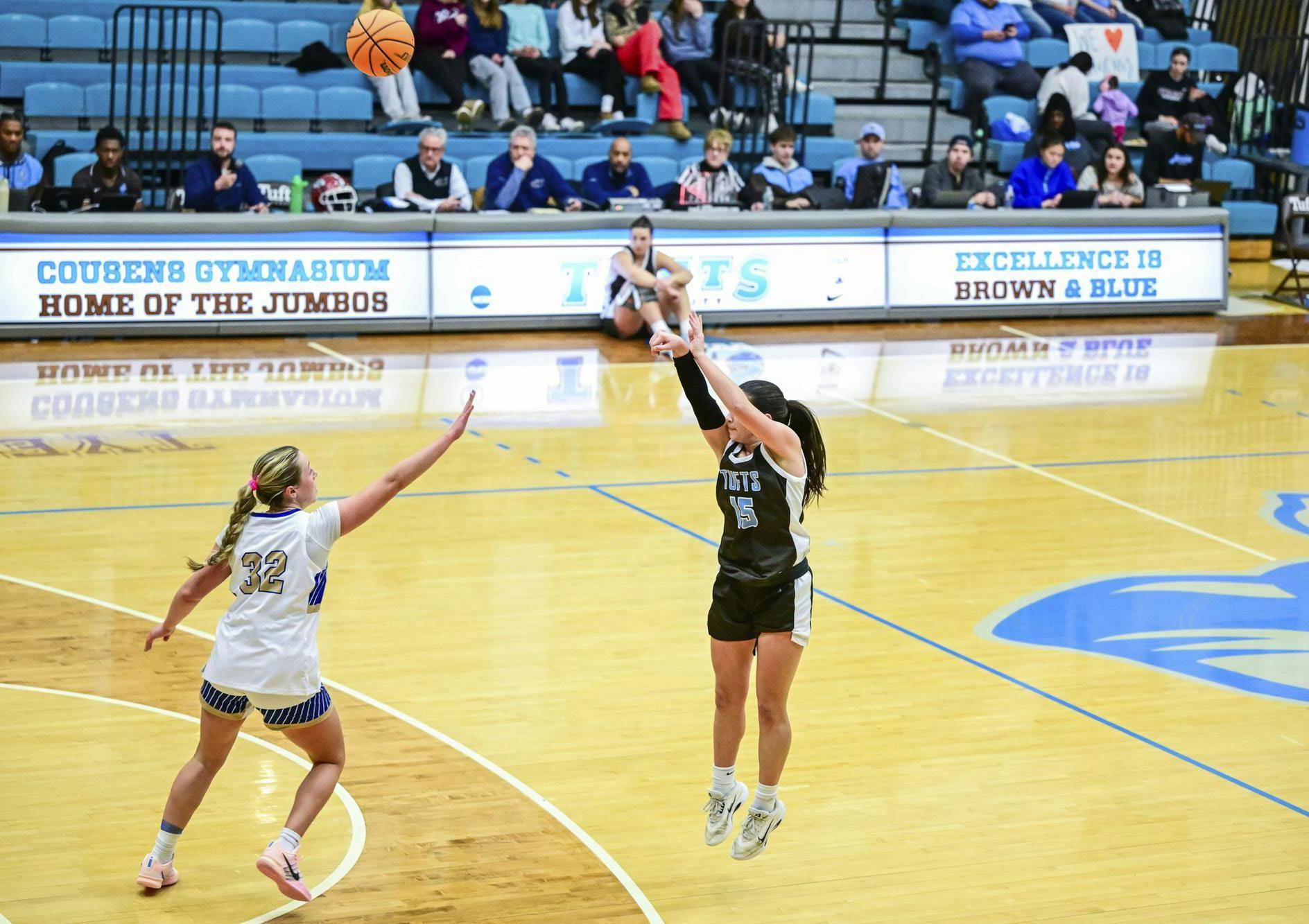
Tufts women’s basketball played two tough home games over the weekend, narrowly beating Amherst 49–44 and suffering an 81–64 loss to Hamilton.
The results brought Tufts’ NESCAC record to 4–5, with one conference game remaining in the regular season.
The Jumbos got off to a slow start Friday against the Mammoths. They were scoreless for five minutes, missing eight attempts and going down 10–0. Foul trouble also began early, as Tufts committed five fouls in the first five minutes. Although the Jumbos scored just 4 points in the quarter, their defense kept the deficit to eight at the end of the period.
Tufts took a few minutes to find its rhythm in the second quarter, but first-year guard Tessa Lozner gave the Jumbos much-needed points, getting in the paint and running the floor for easy layups. Lozner’s efforts, along with a 3-pointer from sophomore guard Claire Kolkhorst, capped a 10–3 run to close the half. The Jumbos ended up down one to the Mammoths, 19–18.
“We knew after the first quarter our shots weren’t falling so we needed to put an emphasis on the controllables,” first-year guard Abby Congdon wrote in a message to the Daily. “We needed to step up our defense and capitalize on the stops we were making, and we did!”
The Mammoths regained control early in the third quarter, scoring the first 4 points. Lozner once again bailed the Jumbos out, making a jumper in the fourth minute. Another
Coming into the 2025–26 college basketball season, the Big East was projected to earn five to six bids in the NCAA Tournament. With about a month remaining until the conference tournament, the league is now projected to receive just three. Last year, the Big East had five teams in March Madness and appeared relatively strong compared to the rest of the Power Five. This year, however, the conference is rated comfortably last among the five in most metrics. What happened to the so-called ‘basketball-first’ conference?
Kolkhorst 3-pointer tied the game at 25–25 — the first tie of the contest.
Tufts closed the quarter strong, going on a 10–0 run to give them a significant advantage going into the fourth.
Another layup by Lozner, free throws and a layup from senior forward Sarah Crossett and a 3-pointer by junior guard Stella Galanes built the lead. Sophomore forward Abi Stone beat the buzzer to close out an outstanding end to the quarter.
The Jumbos opened the fourth quarter with two quick 3-pointers from senior guard Annie Aspesi and Galanes. Missed shots, however, opened the door for the Mammoths to claw back within 2 points.
Tufts sealed the win with three clutch free throws from Galanes.
Tufts won 49–44, bringing their NESCAC record to 4–4 entering Saturday’s matchup against Hamilton.
“Our goal is to always put four quarters of great basketball together. Amherst is an impressive team but our grit and defensive effort, forcing 21 turnovers overall, really fueled our offense and helped us settle into the game,” Crossett wrote in a message to the Daily.
Tufts struggled to score again in the opening quarter against Hamilton. With tall post players, the Continentals dominated the paint, and their shots were falling. The Jumbos generated quality looks but were unable to score.
Lozner got Tufts on the board with 6 ½ minutes on the clock, making a jumper from midrange and bringing the score to make it 5–2. Shortly after, Stone drove to the basket, drew a foul and converted
One thing that was projected somewhat correctly to this point is the emergence of the Big East’s two leaders: the UConn Huskies and the St. John’s Red Storm. After their first head-to-head meeting on Friday, the Johnnies have taken the tiebreaker in the standings with their 9-point home win over the Huskies. Following the victory, Rick Pitino’s team rose to No. 17 in the country, while UConn fell to No. 6. St. John’s now appears much closer to its preseason expectations than it did early in the season, while Dan Hurley has built yet another strong championship contender. These two programs have drawn the bulk of national attention, but even in a down year, they are not all the conference has to offer. After three incredibly disappointing seasons with Kyle Neptune without a tournament appearance, Kevin Willard has brought a new life to the Villanova Wildcats and might be able to get them back to their blue blood status. The Wildcats currently sit comfortably around the No. 8 seed line and appear to be a near
both free throws. Stone’s play sparked momentum, as the Jumbos added a quick layup and a steal.
Hamilton’s size continued to be a problem for Tufts. The Continentals seized control late in the quarter, finishing with a steal and an and-one opportunity. They closed the period on a 5–0 run to lead by 10.
In the second quarter, Hamilton continued to use their size and their shots kept falling. They opened the quarter with a quick putback 3-pointer that extended the lead 15–6. Tufts’ 3-point shot started to fall, though, as sophomore forward Siobhan Stapleton, Aspesi and Kolkhorst all hit 3s. All-out effort on defense closed the gap to 7 points with two minutes left in the half.
Momentum soon shifted back to Hamilton. The
Continentals drew fouls, found open looks and continued to score, closing the half on a 14–0 run to take a 21-point lead.
“With every NESCAC opponent comes a challenge. Hamilton scored a season-high almost 60% from the field with both crafty shooting guards and a big post presence,” Crossett said.
Lozner jump-started the Jumbos after halftime with another midrange jumper. Tufts built momentum through second-chance opportunities, made 3-pointers and crafty moves in the paint but struggled to defend without fouling. Hamilton entered the bonus, and the quarter ended with the Continentals leading 63–39.
Despite the deficit, the Jumbos battled in the fourth quarter. Aspesi opened the period with a 3-pointer, and Crossett got by her defender
to take advantage of a second-chance opportunity in the paint. Tufts also put on the pressure on the defensive end, nearly forcing two shot-clock violations. A foul, however, gave Hamilton an and-one opportunity with six minutes remaining.
Tufts closed out strong, going on a 12–0 run, fueled by free throws, quality defense stops and layups. One final basket by Hamilton brought the final score to 81–64, though Tufts outscored Hamilton 25–18 in the fourth quarter.
“Both in the Amherst and … Hamilton games we haven’t come out strong and have dug ourselves in a hole. We know that can’t happen so we just gotta make sure we come out with intensity and energy,” Congdon wrote.
Tufts will host Bates on Sunday for its last NESCAC game of the season.
lock for the tournament. Ranked No. 30 on KenPom, Villanova could very well be ranked in the coming weeks if they can take care of their remaining schedule. Two spots below Villanova in the Big East standings, the Seton Hall Pirates have blown past their preseason expectation after being picked to finish last in the conference. The Pirates may be the only other team that could earn a bid for the conference. ESPN’s Joe Lunardi currently places them among the ‘Next Four Out,’ leaving little margin for error as Selection Sunday approaches.
Although the aforementioned teams have had quality seasons to this point, the Big East has been defined by disappointment this year. Going down the preseason poll, the Creighton Blue Jays, picked No. 3 in the conference and widely considered a shoo-in for March Madness, currently sits fourth in the standings but outside the top 75 of the NET Rankings, placing them well beyond the bubble conversation. Next, at No. 4 in the preseason poll, the Providence Friars, selected
fourth in the preseason, have had almost as bad of a season as one could predict given their significant NIL spending, posting an 11–13 overall record and ranking No. 9 in the conference. Head coach Kim English is almost certainly going to be in the job search following this season. Marquette, the No. 5 preseason team in the preseason poll, sits dead last in the Big East with a 9–16 record. Safe to say, head coach Shaka Smart might need to start using the transfer portal this offseason. All of these failures combined have left the Big East
extremely top-heavy and fragile. At this point, the conference will need its three top teams not just to make March Madness, but to make noise in it. In a year where depth has disappeared, the Big East’s national credibility now rests on the shoulders of its elite.
Owen Short is a sophomore majoring in quantitative economics. Owen can be reached at owen.short@tufts. edu.