ResLife pushes housing placements for all rising sophomores in the random housing pool to May 8
Zahra Brady Staff Writer
On Friday, Tufts’ Office of Residential Life & Learning sent an email to all remaining students in the random housing pool informing them that they had not yet been placed for the 2026–27 school year. Students will now have to wait until May 8 for updates on their fall housing situation.
Sara Swamy, a rising sophomore who originally planned to aim for a triple but was forced to enter the random pool after triples filled up, expressed concern about the delay.
“It’s a little frustrating that I still don’t know where I’m going to be living, and most people do,” Swamy said.
Due to the limited number of triples available, Swamy and her friends were unable to form a group of three. Rather than being given a chance to re-form different groups for doubles, they were each instead automatically entered into the random pool.
“I wasn’t really sure what I had to do as I was going random, because the email, it kind of only focused on the group formation,” Tavernese said.
“Unless I missed info, [which] I could have, but [I would’ve liked] maybe just a little more information regarding people who are going random, because I didn’t know that my lottery number doesn’t really do anything anymore.”
“We tried [forming a triple] and then, because it happens at the same time as doubles, because we didn’t get the triple, we automatically got put into random housing,” Swamy said.
of residential operations, Perry Doherty, by April 17.
In the email, students were given the option to request to live with specific students by emailing the associate director
“It was clear that we could try to room with people that we want to room with, but it’s not set in stone,” Swamy said.
Another rising sophomore, Rosalie Tavernese, had planned
to enter random selection. She said ResLife provided comparatively less information and guidance to students who were choosing random placement and that she wasn’t aware that lottery numbers no longer matter within the random housing pool.
More generally, for all students, the number of each dorm type available — apartments, doubles, singles, triples — was not given for most of the duration of the housing process, with specific figures being absent on both Tufts’ websites and communications. It was only on March 23, the day that the first group formation session began, that ResLife officially released the numbers of each dorm type.
“I think that was definitely not the best method to give that information. I think it would have been helpful to have it a lot earlier,” Swamy said.
Tufts ordered to pay nearly $4 million in damages for breaching tenure contracts with School of Medicine faculty, state court rules
Anika Parr and Julian Glickman Deputy News Editor and Executive News Editor
Originally published April 13.
A state court ruled in favor of eight Tufts School of Medicine basic science faculty members earlier this month in a lawsuit over compensation plans that were determined to have violated tenure’s promises of “economic security,” ordering the university to pay nearly $4 million in damages.
After a 12-day trial that ended in late January, Justice Hélène Kazanjian found, in a pointed April 2 ruling, that Tufts had imposed compensation plans for the tenured basic science faculty that cut their salaries and fulltime status based on external grant funding requirements that did not exist when they received tenure, including retroactively for tenured faculty who had been granted tenure before the plan was enacted.
Tufts passed the compensation plans in 2017, revising them in 2019, which required the faculty to
generate 50% of their salary from external grants, with salary cuts of up to 10% per year if the benchmarks were not met. Kazanjian wrote that the plans imposed conditions “not contemplated at the time Plaintiffs were awarded tenure” in ruling that Tufts had breached its contract on grounds of economic security.
The university said it was “considering the decision” and declined to comment further.
The Middlesex Superior Court had ruled in Tufts’ favor in February 2023 in a summary judgment before the Supreme Judicial Court — the state’s highest court — reversed the decision and sent the case back to the Middlesex Superior Court for trial.
The plaintiffs argued that, despite the salary cuts, several faculty members were required to work full-time under the 2017 plan, leading to violations of the Wage Act.
Brent Cochran, a School of Medicine professor in the Department of Developmental, Molecular and Chemical Biology and a plaintiff in the lawsuit, said
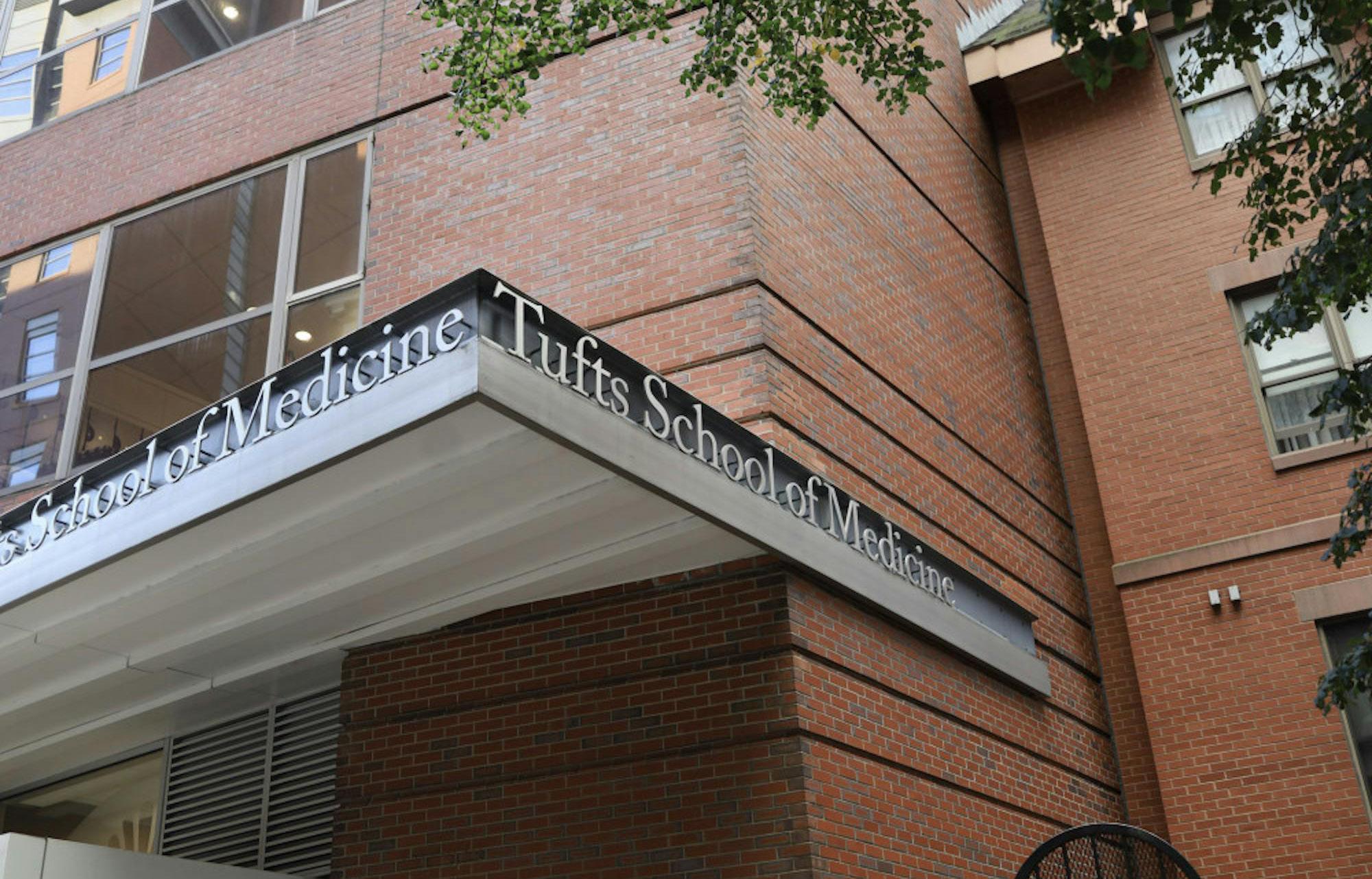
Tufts tenured professors have faced challenges securing grants, leading to pay cuts since the compensation plan was enacted.
“I’m making less than the starting salary of a first-year postdoc despite 40 years of experience,”


on Sept. 30, 2021.
Cochran said in an interview with the Daily.
Any other basic science faculty member at the School of Medicine who received tenure before 2017 and had their salary cut under the compensation plans could
potentially bring the same claims using the ruling as precedent.
The court’s ruling was significant in defining “economic security” and holding that tenure
see BREACH, page 3







Medford/Somerville, Mass.
SOPHIA KHAN / THE TUFTS DAILY
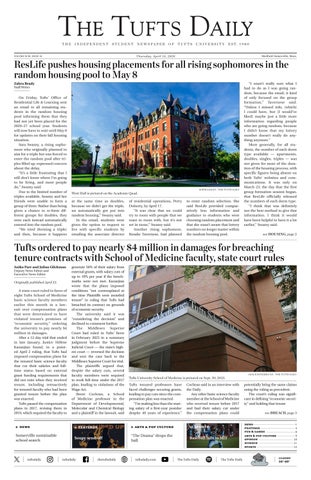
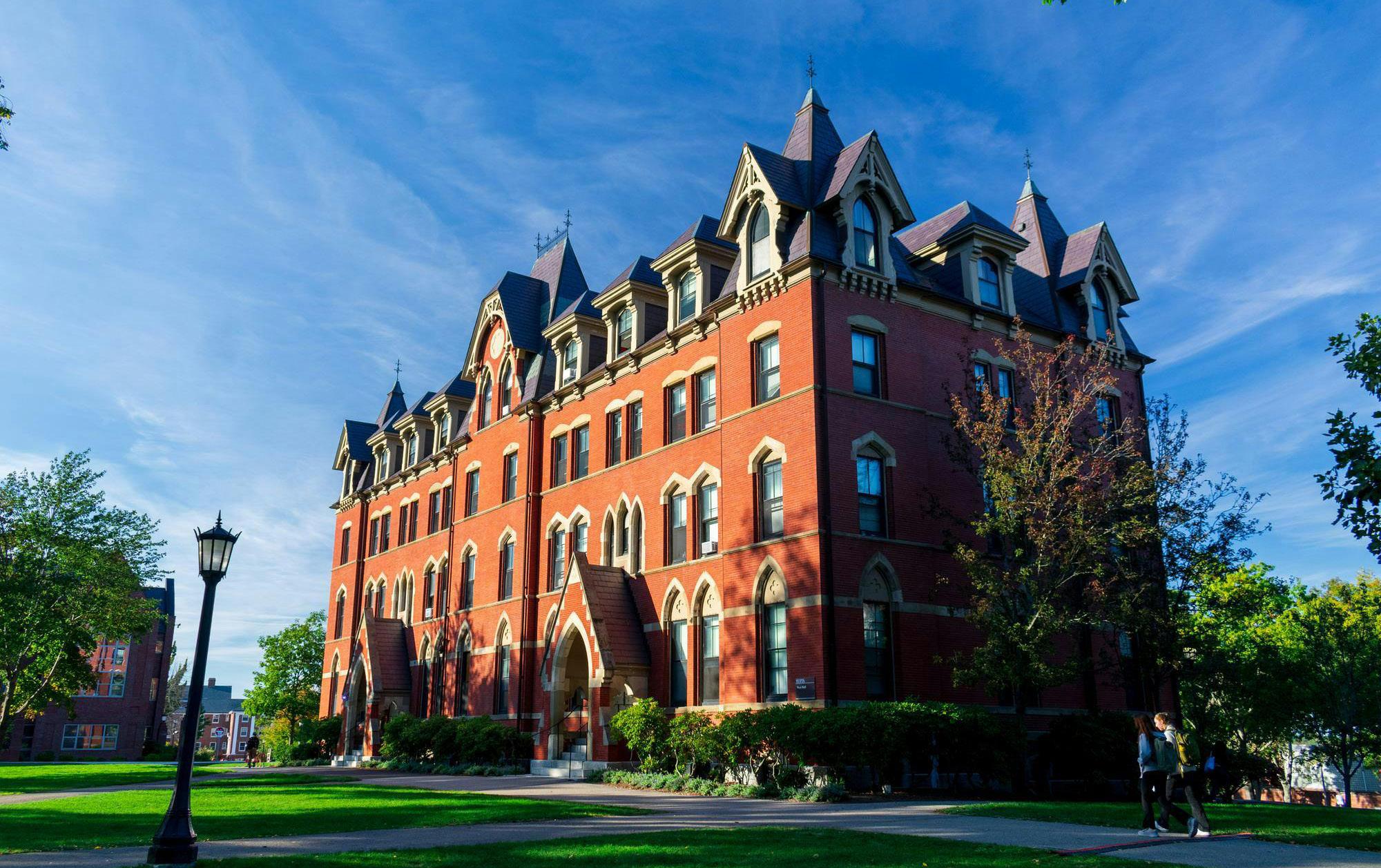
West Hall is pictured on the Academic Quad.
GRACE ROTERMUND / THE TUFTS DAILY Tufts University School of Medicine is pictured
ResLife requests patience from students
HOUSING continued from the front
Josué
Founded in
The Tufts Daily is the entirely student-run newspaper of record at Tufts University in Medford, Mass. An editorially and financially independent organization, the Daily’s staff of more than 100 covers news, features, arts and sports on Tufts’ four campuses and in its host communities.
Tufts Daily office is located on the colonized land of the Massachusett people and within the territories of the Nipmuc and Wôpanâak (Wampanoag) tribes.
In a statement to the Daily, Doherty explained that ResLife withholds this information because the housing situation is not fixed throughout the housing process, until it comes time for students to form their groups.
“There are many moving parts throughout the housing selection process which means the number of each type of space available for group formation cannot be confirmed until very close to the start of group formation,” Doherty wrote.
Notably absent from the sophomore housing options outlined in the email were the four-person apartments in Latin Way. These apartments were made available to rising sophomores last year but will return to housing juniors and seniors next fall.
“One of Residential Life’s goals is to house as many students as possible,” Doherty wrote. “Offering four-person Latin Way apartments to rising juniors and seniors helps Tufts do that. This academic year, 2025–2026, is atypical given that rising juniors
and seniors have typically lived in four-person apartments in Latin Way in the past.”
Doherty went on to acknowledge the stress housing selection places on students and encouraged students to seek guidance from ResLife if they are unsure about aspects of the housing process.
“It’s important for students to understand that we know this process can be a stressful one, especially at the end of room selection when students are also wrapping up their classes and focused on their finals,” Doherty
wrote. “Residential Life and Learning will always work individually with any student to help walk them through the process.”
Ultimately, Doherty advised students to keep their options open and stay informed during the housing selection process.
“The vast majority of cases when students are in distress during room selection [are] when they haven’t read through, or followed through, with our processes and protocols, so it is extremely important that students fully engage with room selection,” Doherty wrote.
Somerville hosts sustainability-focused community design workshop for new school building
Josh Litvak Assistant News Editor
The City of Somerville hosted a community design workshop Monday evening at East Somerville Community School to discuss sustainability considerations for a proposed new school building at 115 Sycamore Street.
The building will replace the Winter Hill Community Innovation School, which closed in June 2023 after a piece of concrete fell from the ceiling following prolonged maintenance issues.
The new school is expected to cost roughly $300 million, with half of the funding coming from the Massachusetts School Building Authority and the remainder through local funds.
Richard Raiche, Somerville’s director of infrastructure and asset management, said the project is more than just a replacement for the Winter Hill School.
“Our goal here is to also accommodate all future district growth,” he said.
Raiche explained that enrollment projections developed with the MSBA aim to account for district-wide expansion. Many of the city’s existing school buildings — most constructed or renovated in the mid-1990s — are already operating at capacity.
The project also has an ambitious climate agenda. Raiche said that Somerville’s existing schools, such as West Somerville Neighborhood School, John F. Kennedy School and Albert F. Argenziano School, are around 20 to 30 years old, the age at which heating and cooling systems begin to fail. Instead of replacing old heating and cooling systems, the city is focusing on eliminating fossil fuel dependency with this new building.
This work requires vacating significant portions of buildings. The new Sycamore Street school provides the swing space to allow the city to renovate other schools in phases.
“Building this larger building at Sycamore Street, that’s built out for the long-term, district-wide growth gives us a lot of latitude in the shorter years to work around and vacate parts of these buildings to really do that work,” Raiche said.
The goal is for it to be Somerville’s first passive house, the designation for buildings designed to reduce heating and energy use.
To design the building, the city selected architecture firm Perkins Eastman through a procurement process required by the MSBA. Daniel Arons, a principal at the firm, said the design must balance various
goals, including “sustainability, academic success [and] meeting costs and schedules.”
Raiche said the firm’s proposal stood out for its approach to sustainability and its strategy for dividing a large building into “learning neighborhoods,” or age-appropriate learning spaces.
“We’re going to be building a large building with a high student enrollment, but we’re also cognizant of the fact of educational outcomes, and want to avoid having the school building feel too big,” he said.
Arons said the structure will prioritize a well-designed learning environment and will incorporate “well-controlled, abundant daylight, fresh outdoor air, high quality filtered air [and] connections to the outside,” alongside non-toxic materials.
The goal is to create a learning environment that supports “all types of student learners,” rather than creating distractions that work against them.
Community members at the workshop also emphasized the importance of sustainability and student well-being. Kay Mammo, a member of the Somerville Carbon Free and Healthy Schools Coalition who has been advocating for the district to fully decarbonize, said the evidence for investing in healthy school buildings is well established.
“When you produce sustainable buildings, teacher retention, student retention, student health, attendance, all of those things go up,” she said.
Mammo was encouraged by workshop discussions around biophilic design, including the use of wood over steel, moss walls, non-toxic paints and floor-to-ceiling windows, features she said make a tangible difference for students and staff alike. Mammo specifically noted that using wood instead of steel is more sustainable and health-promoting, and that moss walls, along with thoughtful indoor and outdoor lighting, are elements the coalition has championed throughout the planning process.
For Mammo, the Winter Hill community has been without a permanent home for years, and that absence has had real consequences on the community.
“When students have a place that they can really call home as a school, that is not just a boring building, but a building that engages them every day when they come in, they’re more likely to do well,” she said. “I think to me and to the community that’s the number one priority.”
Monday’s event was just one of a series of workshops. Arons noted that the activities during the meeting, such as the dot-voting exercise in which attendees placed stickers next to design priorities on display boards, were just one data-gathering tool among many.
“We’re not designing for ourselves. … We’re gathering opinion[s], we’re gathering data points to inform preferences for design,” he said. “We’ve been doing this by talking to the schools, talking to neighbors, talking to city employees, sharing ideas among expert consultants, landscape architects and engineers.”
He also noted that keeping the project on schedule and maintaining “momentum” is critical, as delays can increase costs.
“Whether there needs to be a vote by the city to approve the funding, or we need MSBA to approve it, these things have to happen in sequence in order to keep us on track,” Arons said.
PATRICK MILEWSKI / THE TUFTS DAILY
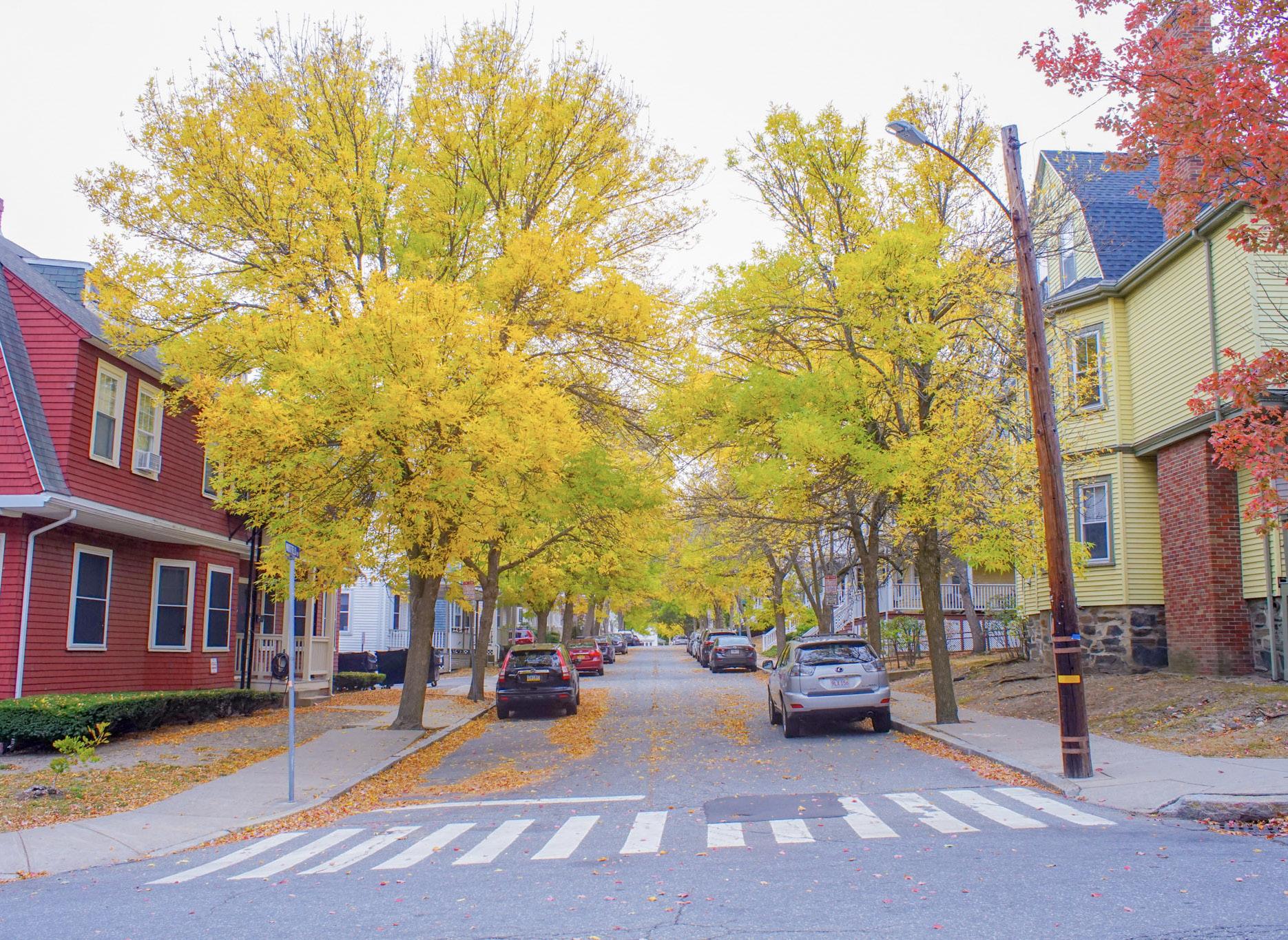
A residential street in Somerville is pictured.
Court ruling reaffirms meaning of tenure as a contract
includes a financial component, not just job security. The court also held that reductions in full-time status imposed in the compensation plans violated the economic security provision.
Tufts argued that its promise of economic security had nothing to do with compensation and referred only to job security, meaning the University was only obligated to let faculty continue working, not to pay them any particular amount. The court found the claim that economic security does not include a financial component “preposterous.”
When pressed on cross-examination about the logical endpoint of this position, a Tufts expert witness was asked if Tufts could pay a faculty member $1 annually without breaching its promise of economic security. The court noted that he “struggled for a response” to that question.
“Tufts took a very maximalist position in this case. Basically, that they could do anything, that they could change the tenure contract at will any time they wanted to and that, in fact, a $1 payment would meet economic security,” Cochran said.
“Tufts’ position is contrary to the plain meaning of the words,” Kazanjian wrote. ”‘Economic security’ is synonymous with financial security.”
“Based on all the evidence, the court is persuaded that Tufts’ promise to provide ‘economic security’ to Plaintiffs when they became tenured meant a full-time job for life, subject to being removed for cause, and with a salary that provided sufficient financial support so that the Basic Science Faculty members could pursue their research,” Kazanjian wrote.
Kazanjian argued that the university had been motivated, in part, to unilaterally change tenure requirements by a desire to push older faculty toward retirement, in violation of the implied covenant of good faith and fair dealing. She highlighted emails from Provost Caroline Genco saying that several older faculty in her department — which includes several of the plaintiffs — were “lingering on” and “dead weight.”
Kazanjian provided a damning representation of testimony from several Tufts administrators, including Genco, Vice President for Finance and Treasurer Thomas Malone and Professor Emeritus Philip Haydon.
In her ruling, she wrote that the witnesses’ claims that there had always been an expectation that faculty fund 60% of their salary externally — as an argument that the 2017 plan requiring 50% was more lenient than in the past — were unsupported by any documents and were contradicted by the sequences of compensation plans Tufts itself adopted.
“Mr. Malone and Dr. Genco, like Dr. Haydon, incorrectly testified that there was a requirement at Tufts that faculty fund 60% of their salary from grants prior to the imposition of the new compensation plan,” Kazanjian wrote.
“There is no documentary evidence supporting that contention, and it is not consistent with Tufts developing and adopting new compensation plans.”
The court, however, rejected the plaintiffs’ claim that the compensation plans also violated academic freedom, even though the plaintiffs argued that salary requirements effectively forced them to pursue National Institutes of Health or other federally funded grants, or risk salary reduction.
“The evidence was that all the individual plaintiffs continued their research to the extent they had alternative sources of funding, even after their FTE and/or salaries were cut, despite the fact that they were unlikely to obtain the required grant funding,” Kazanjian wrote.
The court also ruled that Tufts violated the faculty’s tenure contract in enacting the compensation plans. According to Michael Malamy, a professor at the School of Medicine and one of the plaintiffs, the ruling could have widespread influence for all academic institutions that award tenure.
“We believe that the Court’s decision is a victory for the meaning of tenure as a contract,”
“I think this ruling would really have a very significant impact … because the terminology of academic freedom and economic security, which was established in 1940, really hasn’t been made more concrete,” Cochran said. “I think this makes it more concrete.”
Malamy wrote in a statement to the Daily.
The parties are required to file a “joint proposed judgment” within 60 days of the decision. It is unclear whether or not Tufts will appeal the decision.
Grace Nelson and Josué Pérez contributed reporting.
Editor’s Note: This article was updated to include a statement from Malamy regarding the court’s ruling on tenure. This edit was made on April 15.
BREACH
FEATURES
Andrew West brings the Big Bang to the East Coast
Connor Hines Staff Writer
“We are stardust brought to life, then empowered by the universe to figure itself out — and we have only just begun.”
Andrew West’s journey into astronomy at Tufts has been driven by this ceaseless curiosity, as described by Neil deGrasse Tyson in “Astrophysics for People in a Hurry.” Growing up in rural Northern California, West was surrounded by towering redwoods and clear night skies. From an early age, he enjoyed watching the stars and was fascinated by them. NASA’s space program at the time also captivated his childhood mind. A few years later, his passion was further spurred by a gift from his grandmother.
“She bought me a telescope when I was 9 or 10, really simple, but she had no money and still bought me a decent telescope,” West said. “I would take it outside and look at simple things, like the moons of Jupiter, the rings of Saturn or the Orion Nebula.”
He was in awe of everything he could see, and these early experiences inspired a lasting love of science.
“When I got to high school, I luckily really loved math and science, and I had amazing math, chemistry and physics teachers who really nurtured my interest and challenged me,” West said.
Always having an aptitude for science, West pursued his childhood interest in the stars at Haverford College, where he double majored in astronomy and physics. Outside of classes, he was a sprinter for the Haverford track team and played in the wind ensemble. Upon finishing his bachelor’s degree, West had planned to take a couple of gap years to teach before pursuing a Ph.D. Instead, he ended up getting
off the waitlist at the University of Washington and faced a conundrum: Should he accept his dream Ph.D. program or take a job teaching physics? After some hemming and hawing, he opted for the academic route and pursued a Ph.D.
“It was amazing. It was a good mix of working really hard and learning [the] material deeply, both in my research and in the classroom, early on,” West said.
It took him just under six years to finish his Ph.D. thesis on galaxy evolution — how gas is converted into stars. He examined past, current and future formations of galaxies from cold gas and how that differed across galaxies of various types and masses.
During this time, he further developed another interest: teaching. He taught astronomy labs and, within a few years, was offered the opportunity to teach his own introductory astronomy class to undergraduates.
“[It] was a really cool experience to get as a grad student, because [it] doesn’t happen very often,” he said.
West also taught at a program called Upward Bound, which helps underrepresented high school students prepare for college. He shared that this interest in teaching dates back to his childhood. West’s father was a community college professor, and starting in high school, he began tutoring calculus and physics. He continued this through college and even taught a class on observational astronomy while at Haverford.
West’s passion for teaching took a back seat while he focused on excelling in research. Upon finishing his Ph.D., he pursued postdoctoral research at the University of California, Berkeley. West loved the three years he spent back in California, and it was at Berkeley that his research shifted to his current field.
Although West was recruited to work on galaxy evolution, he ended up researching low-mass stars. A professor at Berkeley had read West’s paper on the topic — which he wrote with his mentor when he was low on research funds — and invited him to attend group meetings. By his third year, he had switched to working on low-mass stars due to the people he met.
“I just liked the people better … I liked the science better. It was driven more by deep scientific questions, rather than … what I refer to as postage stamp collecting. It’s like, ‘Oh, we have this new thing. Let’s go see what we can find.’ And there’s excitement in that, but it’s not as driven by deep scientific questions,” he said.
Following this transition in research, he pursued a second postdoc, this time at the Massachusetts Institute of Technology. A year later, West came full circle to teaching, taking up a faculty position at Boston University.
“I was at BU for a number of years, until my kids were born. Then I took a step back from running a big research lab and started teaching part-time here at Tufts.”
At Tufts, West is probably best known for his class “Big Bang to Humankind.” It covers the history of the universe through science. The class begins with the Big Bang and explores the formation of stars, planets, solar systems and galaxies. Transitioning from astronomy and physics to biology and chemistry, it examines the evolution of life on Earth and shifts to the anthropology of human evolution. Finally, the class discusses geology and plate tectonics, as well as carbon and nitrogen cycles, ultimately concluding with what is next for our solar system. West and two other professors — a chemist or biologist and an anthropologist — co-teach the class. All in all, it

is an engaging science credit for non-STEM majors.
Unknown to most who take this class, West did not create it. In 2016, he was recruited to teach a handful of astronomy lectures. Having enjoyed the experience, he gradually took on a larger role until he assumed responsibility for the class in 2020.
This class is among his favorites, although he also enjoys teaching others. Last semester, West taught an Experimental College class on the moon and Apollo missions. He shared how he appreciated the flexible format and the novelty of teaching a science class that leaned more into the liberal arts.
“I loved that I taught a class on the moon — it was really fun. … We did labs and … some science, but a big bulk of it was actually … reading about and discussing the Apollo moon missions. … I’ve never run a class like that [before],” West said.
The class even spent a session examining actual moon rocks from the Apollo program. Another one of West’s favorite classes is a course he used to teach at BU called “Alien Worlds.” He currently teaches that class through the Tufts University Prison Initiative. The initiative, sponsored by the Jonathan M. Tisch College of Civic Life, gives incarcerated individuals the opportunity to move past their worst moment and improve their future.
“I think [TUPIT] is one of the greatest things Tufts does. … I really believe in it — it’s really changed my vision of what education is, particularly college education … and [with] who has access to it and who doesn’t,” he said.
Throughout his career, West’s passions have evolved. Although he still loves astronomy and continues to conduct research, his favorite part of science has shifted to teaching.
He shared how much he enjoys watching non-STEM students walk
in knowing nothing about stars and leave being able to analyze a graph and explain the star it represents.
“I like experimenting with teaching. For me, that’s been the lovely part of being at Tufts. I’ve been able to spend time thinking about teaching and pedagogy in a way I never did before. Even though I’ve been teaching for a lot of my life … I never really got into reading the literature, [practicing] and experimenting,” West said.
One new approach he has implemented with great success in “Big Bang to Humankind” is a grading system called “specifications grading.” He shared how it helps reduce the arbitrary nature of grading.
Today, West spends most of his time teaching or with his family, but he still actively conducts astronomy research. His work focuses on low-mass stars, specifically red dwarfs. He studies spectral emissions — light emitted from elements when electrons change valence levels — to understand how a star’s magnetic field heats its upper atmosphere. The stars he studies are small, live for extremely long periods and should be too cool — albeit still around 2,000 degrees Celsius — to emit the spectral lines he observes. The additional energy comes from the star’s rotation, which generates the magnetic field that, in turn, heats the atmosphere. Younger stars have stronger emission lines, while older ones have weaker emissions, allowing West to associate ages with stars. West’s favorite phrase rings especially true in his research: Science changes. Yet, his journey reveals that as science evolves, so does one’s own life. We are all just exploring the cosmos, waiting to discover something new.
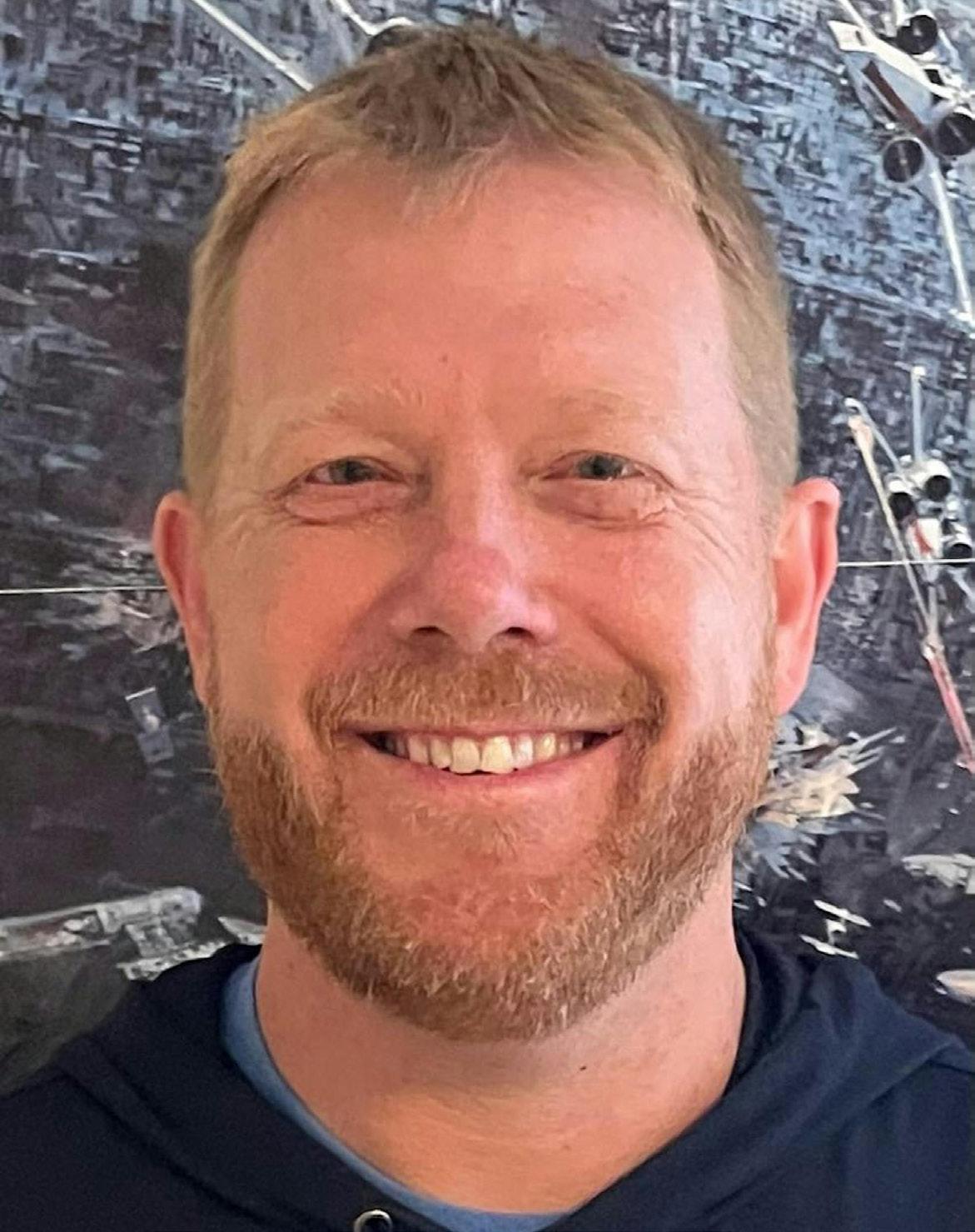
COURTESY ANDREW WEST Andrew West is pictured.
NICOLE GARAY / THE TUFTS DAILY
The night sky is pictured over Petersham, Mass.
Get Souped Up
Soup forever
Arghya Thallapragada and Emily O’Hearn
Our last soup column is finally here. Since this is a special occasion, we decided to change up our soup selection process: Instead of choosing the soup of the week ourselves, we passed the decision onto you, the people! Arghya put out a poll on the Daily’s Instagram story (which we’re sure is flawlessly democratic) along with our fire graphic (literally). When asked to choose between French onion soup, carrot ginger soup, corn chowder or another soup of their choosing, our readership chose French onion.
Which is good, because we had already bought the ingredients to make French onion soup before the poll closed.
Recipe
The preparation for this soup was short and simple: chop onions. As we chopped, our eyes started to water, and pretty soon our vision was so blurred that we could barely find the onions on the cutting board. Our onions, purchased from the nearby Stop&Shop, were monstrous, fit for Nancy Archer from “Attack of the 50 Foot Woman.” Pretty soon, everything — our clothes, car and kitchen — smelled fragrantly of onions.
Next came a stage that even the most hardened soup chef would
tremble at: caramelizing onions. While it might not be the most technically difficult task, the time that it takes (hours) truly tests the mettle of any chef. Nonetheless, we turned on the burner and prepared ourselves for the long haul.
As the onions started to cook, we realized our terrible mistake: In our rush to purchase our ingredients, we had forgotten to check if our Worcestershire sauce (whose name we managed to pronounce differently every time) was vegetarian. Tragically, this variety of ‘wuhstershur’ sauce had anchovies. Devastating. However, after searching through the knowledge capital of the internet — Reddit, of course — our fears were assuaged. Soy sauce could suffice as a replacement for ‘woostersir’ sauce for a secondary flavor.
At this point, we put a brief pause on our cooking for Arghya, a second-semester senior, to attend her Spanish class filled with a bunch of first-years. Always remember, dear readers: Soup is amazing, but school must come first.
Once Arghya returned, her Spanish-speaking abilities having increased tenfold, we added the sugar and salt to the onions and let them continue to caramelize as we laid out the rest of the soup ingredients and seasonings. As we played the “Ratatouille: The Musical” soundtrack for inspiration, our kitchen slowly transformed into Gusteau’s — and we truly felt the motto, “Anyone can cook.” We put on berets and uncorked a bottle of red (in our minds) and felt a renewed sense of purpose. With more gusto (get it?), we used our trusty Better Than Bouillon to

make perhaps the most broth we’ve made to date: eight and a half cups, along with bay leaves, thyme and soy sauce. Then, we let the soup simmer gently to the sound of the French rat music.
The last stage of the recipe was to broil the soup — now topped with a fresh piece of French bread and gruyère cheese — in the oven (or, in our case, an air fryer). The gruyère posed more of a challenge than expected; we looked upon it excitedly, unaware that it would soon betray us. As we removed the plastic packaging, we learned that the morsel was — for lack of a better word — slippery. The slimy surface slid through our fingers and hit the table with a wet thud.
However, we persisted and sliced some very moist cheese for our bread.
Reflections
Creating this soup is not very demanding. It requires little cutting and chopping,
few ingredients and no incredibly specialized equipment. That being said, this soup does demand one thing in high quantity: time.
This is not the soup for the average college student. Perhaps, if the internship search didn’t go your way and you have absolutely nothing to do this summer, you could make this soup. Or if you decided that studying for finals is a lost cause, you could make this soup. Otherwise, don’t bother — your time is better used making one of our other soups (and then making it again with the time left over).
Emily wondered if the soup could have used a bit more salt, but she’s also only ever had French onion soup in restaurants, which tend to oversalt. Arghya thought the first spoonful was fantastic and perhaps even life changing, but was bored of the taste five minutes later.
It was just so … onion-y. For our next batch of soup, we recommend
cutting the bread into smaller pieces and spreading them more evenly across the top of the soup.
Although this bowl of soup did not go our way, it is important to reflect on how thankful we are to be able to make a home-cooked meal with a good buddy. Throughout this year, and this column, the pursuit of yummy soup has brought us together — and brought us to you, dear reader. How wonderful it is to bond over a good bowl of soup.
As you go forth into finals season, we hope that, through eating soup or not, you feel calm, warm and nurtured. Soup is always here for you, and so are we.
Arghya Thallapragada is a senior majoring in engineering psychology. She can be reached at arghya.thallapragada@tufts.edu.
Emily O’Hearn is a fourth-year combined degree student majoring in political science, environmental science and fine arts. She can be reached at eohear01@ tufts.edu.
Leonard Carmichael Society subgroups give back to community on Day of Service
Abilene Adelman
Assistant Features Editor
Originally published April 14.
Editor’s Note: Sarah Feinberg is a former chair of the Daily’s Ethics and Inclusion Committee. Feinberg was not involved in the writing or editing of this article.
If you were walking around the Tufts campus on Friday, March 27, you may have seen a large group of students and faculty near Breed Memorial Hall. The group was decked out in blue T-shirts and armed with litter pickers as they worked to clean up trash on Tufts’ campus. While you may have only seen this one group, they were actually part of a much larger event. March 27 marked this year’s Leonard Carmichael Society Day of Service.
Held each spring, LCS Day of Service is one of the organization’s largest events, open to all undergraduate and graduate students, faculty, alumni and community members. This year marked the fourth annual LCS Day of Service, hosting 11 different service sites and about 136 volunteers.
LCS, Tufts’ largest community-service-focused organization, serves as the umbrella for its 24 subgroups. LCS supports its subgroups by handling funding, assisting with transportation and helping them liaise with the Jonathan M. Tisch College of Civic Life. The subgroups
are individual community service clubs that support a wide variety of communities and missions.
Some of the subgroups include Advancing Civic Thought In Our Nation, or ACTION, a nonpartisan club that teaches youth in the Greater Boston Area the importance of community engagement, and Tufts Giving Camp, a group that volunteers at the Walnut Street Center with adults with intellectual disabilities. One of the newer clubs, Homelessness Outreach and Meal Equity, or HOME, provides students with volunteer opportunities year-round at places like the Salvation Army.
For juniors and co-presidents Aditi Dosi and Sarah Feinberg, LCS has been a significant part of their time at Tufts. Both were introduced to the organization through First-Year Orientation CommUnity Service, one of Tufts’ pre-orientation programs. FOCUS introduces firstyear students to community service and engagement in the Medford, Somerville and the Greater Boston area in addition to easing their transition to Tufts. Before her first year, Dosi participated in the LCS subgroup Giving Camp through FOCUS.
“The FOCUS community is very, very strong,” Dosi said. “I received a lot of mentorship from the upperclassmen. … They encouraged us to get involved with LCS.”
Feinberg echoed this sentiment, emphasizing her
long-standing commitment to community service.
“I knew that I wanted to get involved with community service here at Tufts,” Feinberg said. “I’ve had that be a big part of my life when I was younger — throughout high school and everything — and then I did FOCUS coming into Tufts, so I knew that that was part of the Tufts community I wanted to be engaged in.”
Now, Dosi and Feinberg run LCS with the help of their other executive board members. As co-presidents, they oversee the club’s logistics, publicity and treasury. They are also the bridge connecting students in LCS to their faculty support. Dosi and Feinberg have biweekly meetings with their LCS advisers from on-campus resources like the Government and Community Relations team, Tisch College and the Office for Campus Life.
In addition to supporting their subgroups, LCS organizes two major events each year: Halloween on the Hill in the fall semester and Day of Service in the spring.
During Halloween on the Hill, many Tufts organizations — including LCS subgroups, athletic teams and Greek organizations — host booths or activities for children in the community.
“We do Halloween on the Hill in the fall, where we bring a bunch of groups together on Academic Quad for kids in the community to come
and trick-or-treat during the day and get to do some fun activities with our groups on campus,” sophomore Kira Sutcliffe, one of the LCS subgroup chairs, said.
While Halloween on the Hill fosters community engagement between Tufts organizations and local youth, LCS Day of Service emphasizes direct engagement between Tufts students and local community organizations.
For Tufts students, LCS Day of Service is a way to take a break from their books and laptops and step outside their ‘Tufts bubble.’
“With Day of Service, we honestly tried to do as much publicity as possible to get that diverse range of students,” Dosi said. “Especially now, just engaging with the community feels really impactful.”
It is a chance for students to come together and make a small difference in the communities they inhabit every day. More than that, the event connects students to a wide variety of local organizations doing this work year-round.
“We had Somerville Homeless Coalition [and] Project SOUP working on food insecurity. We did work with Tufts Legacy Project again, so we had students go to the [Visiting Nurse Association] Senior Living and do activities with the seniors there,” Feinberg said. “Same thing with Giving Camp. We had a group go there and do activities with adults with disabilities at the
Walnut Street Center and had some other groups, like Cancer Outreach, doing packaging.”
LCS Day of Service highlights the work that many local organizations do, not only introducing members of the Tufts community to LCS but also encouraging them to be engaged citizens year-round.
“Being part of such a massive, powerful institution like Tufts, we definitely have a responsibility to give back to these communities that are doing us such a service by allowing us to be here, but also recognizing that our institution does have negative effects on our local communities,” Sutcliffe said.
Tufts is an elite institution — 77% of Tufts’ students come from the top 20% of the population based on median family income, according to The New York Times. While there is no way to completely curtail the effect that the institution has on its neighbors, clubs like LCS demonstrate an important effort to acknowledge and respond to the university’s impact.
“Just getting involved with any of these subgroups, or LCS [executive board], anything related to community service is a really nice way to get involved with thinking about your own placement at Tufts,” Feinberg said. “But also, it’s a great community of people. … It’s a really nice way to meet people who have similar interests or who also want to serve their community.”
GRAPHIC BY EMILY O’HEARN
Adam Kinzinger visits Tufts to discuss U.S. politics, a look into the future
Originally published April 13.
Members of the Tufts community sat in a packed auditorium on Wednesday evening while former Congressman Adam Kinzinger reflected on a decision that solidified his reputation and legacy within the American political sphere.
“For me, it was not even a debate because you can’t attack the capital of the United States, and you can’t try to convince the country that an election was stolen,” he said. “Self-governance will never work if half of the country believes that the system doesn’t work [and] if half of the country believes it was stolen.”
Kinzinger, who represented Illinois in the House of Representatives from 2011–23, became one of the most prominent Republican critics of President Donald Trump. He was one of two Republicans to join the select committee investigating the Jan. 6 insurrection and one of 10 House Republicans who voted to impeach the president. The decision drew sharp backlash from within his own party and played a part in his eventual decision not to seek reelection.
4/15/26, 9:25 PM
Now, Kinzinger is a senior political correspondent for CNN, author of the 2023 political memoir “Renegade: Defending Democracy and Liberty in our Divided Country” and the latest guest for this semester’s Solomont
Speaker Series, hosted by the Jonathan M. Tisch College of Civic Life. This series hosted historians, politicians and journalists to reflect on the 250th anniversary of the United States’ founding. The discussion was moderated by Tisch College Dean Emeritus Alan Solomont and covered a wide range of topics, including Kinzinger’s own political history and decision to leave Congress, as well as broader topics such as the current state of the Republican Party and the war in Iran.
Half an hour before the public event, Kinzinger sat down for an interview with the Daily to expand on these themes and touch on other topics related to higher education.
Kinzinger was one of only 35 House Republicans — out of a total of 211 at the time — who voted to establish an independent commission to investigate the Jan. 6 insurrection. Kinzinger’s decision to vote against party lines regarding the attack was considerably unorthodox in the United States’ modern political climate. In 2020, the percentage of party unity votes within Congress reached 70%, up substantially from 32% in 1970.
Kinzinger attributed this pattern to increasing displays of tribal politics.
“I think people, more than they even fear death, fear being kicked out of a tribe,” he said. “Your identity is your passport into a tribe. … When it comes down to it, it’s
like, ‘Here’s a constitutional thing that I need to stick to, but my party is demanding otherwise.’ This is the mentally right thing to do, but emotions win out.”
Although tribal politics is not a new concept, it has become increasingly apparent in recent years as political polarization in this country has surged. Kinzinger ascribes this shift both to the politics of Trump that largely reformed the Republican Party and American political stratosphere, but also to the age of endless news cycles.
“Trump is a symptom and a cause [of polarization] at the same time,” he said. “It’s also the media landscape. It’s 24 hours now. There’s so many different information sources. They’re all competing. They all need to make money. How do they make money? They get you outraged. They get you hooked on outrage. And years and years of that just creates where we’re at today.”
Kinzinger noted the importance of being exposed to multiple viewpoints, not just in news sources but also in universities. Still, he condemned the Trump administration’s attacks on higher education through methods such as withholding funding, freezing federal grants and ending programs entirely.
In February, the Department of Defense announced that they will limit academic ties with 13 universities in the fall, including Tufts, to ban service members from attending certain graduate-level
programs and fellowships at these institutions, which U.S. Secretary of Defense Pete Hegseth referred to as “woke breeding grounds.”
“There’s 10% accuracy in the point of universities’ need to be tolerant of all kinds of viewpoints. They’re academic institutions. They’re based on friction. That’s how you get smarter. … But what you can’t do is start saying that we’re going to take funding away, particularly with the military,” Kinzinger said. “War ... and defense [are] about strategic thinking … It takes education and smarts. What this is doing is taking away a huge group of people that could bring that kind of perspective in.”
In fact, Kinzinger argued that the federal government withholding funds and making demands of universities is anti-conservative. Kinzinger expressed his belief that the conservative movement that he had originally identified with is dead.
“The Republican Party [is] a right-wing movement, but they are not a conservative movement,” he said. “There’s nothing conservative about the president taking kickbacks from everywhere. There’s nothing conservative about reckless wars. There’s nothing conservative about the amount of spending he’s doing.”
During the panel, Kinzinger also warned against the United State’s increasing reliance on hard power, as seen through the recent war raged on Iran or the
military’s strikes of boats in the Caribbean upon the allegation of drugs being smuggled into the country.
“If you use [the military], you use it because you have no other choice and your goal is a certain outcome, and you want to use it as judiciously as necessary to achieve that goal or to save lives,” he said. “There is a moral imperative [to soft power]. It’s morally damaging to use hard power. Sometimes it’s necessary. But soft power is a cheaper, more morally effective way to do what we need to do.”
Despite the violence and division that seem to be increasingly present within the country, Kinzinger stressed the importance of optimism and hope, especially looking ahead into the future, while standing on a historic moment marking the nation’s past.
“I actually think it’s amazing that this year is our 250th anniversary. … Every generation of Americans has had a challenge that was borderline existential. Every generation had that moment where there were people ... [who] felt like this may be the end for our country. Every generation has carried that weight and left a country stronger than they inherited [it] when that moment passed. I don’t think we’re going to be any different. And I think we’re going to refuse to fail,” he said. “To think that we are going to be the generation that this thing dies on, I refuse to believe it.”
Olivia Bye Executive Features Editor
IN PHOTOS: TUSC HOSTS BATTLE OF THE BANDS
BY JAMIE SONG

GRAPHIC
Mr. President
Late Night At The Daily
Julian: “You know what I hate? Period cramps. They’re the worst.”

‘Mr. President’ by Shayna Levy
‘Hooray!’ by Shayna Levy
1. Almonds 2. Apples
Carrots
8. Doritos 9. Goldfish 10. Granola
Gushers
‘The
ARTS & POP CULTURE
Drama’ lacks proper dignity in favor of uncomfortable discourse
Makens Joseph Staff Writer
Disclaimer: This article contains spoilers for “The Drama” (2026).
Content warning: This article contains discussions of gun violence.
The most recent A24 film, “The Drama” (2026), a romantic comedy written and directed by Kristoffer Borgli, features notable co-stars Zendaya and Robert Pattinson. After a pre-wedding dinner, a group of friends plays a game revealing the worst thing they’ve ever done, leading Emma (Zendaya) to reveal a shocking incident from her past. It’s a bombshell to everyone — especially her fiancé Charlie (Pattinson) — when Emma nervously admits she had planned a mass shooting when she was a teenager. This revelation becomes the hurdle blocking their path to marriage as both try their hardest to work through it.
While the film includes comedic moments that attempt to lighten the mood, mass shootings are a deeply serious and traumatic reality that cannot easily be separated from their impact. For many viewers, especially survivors and those directly affected, this portrayal may feel unsettling or even insensitive. Mia Tretta, a gun violence victim and advocate, has criticized the film for not fully treating the subject with the seriousness it deserves. This tension ultimately complicates the film’s central question: Does unconditional love truly exist when the past carries such real and lasting weight?
Romance movies tend to be relatively tame in terms of the
relationship conflicts characters face, such as acts of infidelity, lack of commitment, incompatibility and more. However, this film takes a more controversial approach by using mass shootings as a narrative device to challenge the idea of unconditional love. Framing such a serious topic in this way may raise ethical and interpretive questions.
At first, Emma’s confession that she planned a mass shooting when she was 15 helps propel the film forward and improves the pacing compared to the beginning of the movie. However, mass shootings are a highly visible and deeply sensitive issue, especially in the United States, and one that is profoundly triggering for victims and observers alike.
By using such a deeply serious and traumatic issue as a narrative device, the film risks minimizing the real-world impact that mass shootings have on individuals and communities. While the extremity of the situation strengthens the film’s examination of the limits of love, it also makes that exploration more uncomfortable, as the audience is forced to reconcile a fictional relationship with a reality that carries lasting consequences.
After the confession, Charlie presses Emma about her motivation for planning such an immoral act during her teenage years. While he still wants to marry her, he finds it difficult to move past the revelation. If your partner told you that they had once considered killing their classmates, it would reasonably raise questions about their state of mind and whether those
Losing parts of a whole
Isadora Alexis Staff Writer
Originally published April 14.
Massachusetts-based artist Diana Zipeto’s recent additions to her “Fatherland/s” series begin with an invitation.
“Two Chairs” is the first piece in an installation of three. As reflected by the name, two chairs sit side by side next to the wall. One chair is tilted precariously, partially resting on a foam mat. The fabric has been cut out in several places, revealing the foam inside. Hollow tubes of yarn in a color matching the foam mat burst from these holes. The second chair is entirely intact and rests solidly on the ground. This is the chair Zipeto allows viewers to sit in and crotchet using the same yellow yarn that threads through each piece.
Zipeto’s “Fatherland/s” is about her processing her father’s dementia. Her work reflects the unraveling and disorder she feels in her home life and comfort zone, with the series featuring many household items torn apart. Currently on exhibit at the

thoughts are still present even after so much time has passed. Charlie experiences similar doubts and desperately seeks reassurance that marrying Emma will not be a grave mistake, turning what once seemed like unconditional love into one contingent on whether Emma can convince him that she has truly changed, a task that feels nearly impossible. Later, Charlie’s turmoil leads him to commit an act of infidelity and cause chaos at their wedding. He spends a significant portion of the film trying to cope with the information while also attempting to place himself on equal moral footing by committing a wrongdoing that he feels can be compared to Emma’s past. In the end, we are left with a cliffhanger of sorts, with both
Galatea Fine Art Gallery in the SoWa district of Boston are the aforementioned “Two Chairs,” “Curtain” and “Untitled, 2026.”
“Two Chairs” is a sensory experience as much as it is a visual one. Viewers become part of the piece as they sit and partake in the mechanical process of crocheting. With the gaping holes seemingly permeating all the pieces in this exhibit, the act of crocheting in this setting can feel like trying to stitch life back together again.
But what use is that?
Zipeto’s works are about her experience looking in from the outside as a loved one declines in their cognitive abilities. Despite wanting to do something, there is ultimately little to be done at the moment in terms of medical care for such an affliction. Perhaps that is why, in the next piece, “Untitled, 2026,” a trail of yarn pools onto the floor beside that work.
For this piece, Zipeto has taken a sofa frame and propped it up in the gallery. Without any upholstery, the object itself is difficult to recognize. Hooked onto the wire springs is a small
characters reintroducing themselves after their disastrous wedding brought on by Charlie’s actions, as he is still trying to cope with Emma’s confession. In the final scene, Emma asking for Charlie’s name signals a tentative attempt to start over and possibly continue their partnership.
Once the film ends, the question becomes whether the use of a mass shooting as a narrative device was effective and worthwhile in service to its themes; ultimately, it was not.
Emma’s motivation for planning the attack is left vague and underdeveloped, making it difficult to fully understand or evaluate her growth. Additionally, the film does not clearly show whether she has taken meaningful steps toward accountability, such as therapy or genuine
reflection, which weakens the foundation of Charlie’s decision to continue the relationship. Even the film’s promotional rollout largely avoids engaging with the real-world gravity of gun violence, instead focusing on relationship-based discussions rather than advocacy or awareness. This lack of depth both on- and off-screen highlights how the film introduces serious issues without fully committing to its weight.
While “The Drama” succeeds in pushing the limits of devotion, it ultimately leaves its central question unresolved. Rather than demonstrating the strength of unconditional love, the film suggests that love without full understanding, accountability and growth may not be unconditional at all.

canvas with a portrait painted onto it. The composition is a simple outline of a head, painted in white pigment on a black background, mimicking the way MRI scans appear. In the center of this head, a hole has been cut out, and from it emerges a tube of yellow yarn that spills over the piece and onto the floor.
This piece is a continuation of the sentiment established in “Two Chairs”: a crochet project left incomplete. One could imagine that the excess yarn in this piece was meant to close the top of the tube protruding from the portrait, yet no one completes
this task. There is no invitation for the viewer to sit with this piece and crochet.
The final installation in this series is “Curtain,” a large 90-by-50 inch canvas suspended from the ceiling. The painting follows the same inspiration as “Untitled, 2026”: white on black, holes cut throughout and the same yellow yarn. It is difficult to gauge exactly what is being depicted, but following the logic that these are paintings of MRI scans, one can infer that it is a body part — just missing several pieces of itself.
These pieces represent the dissonance of familiar objects
becoming unrecognizable. Zipeto chooses household items symbolizing the comfort of home — two chairs, a sofa, soft curtains — and takes them apart, only to try and fail to put them back together again. The viewer, too, is allowed to make an attempt, but to no avail.
Zipeto’s work is a complex mixing of methodical destruction and audience interaction that triggers deep emotional experiences. The “Fatherland/s” series takes viewers through her mind as she processes her father’s health issues and asks them to sit with her through it.
GRAPHIC BY DYLAN FEE / IMAGES VIA FLICKR
Robert Pattinson (left) and Zendaya (right) sign autographs at premiere for “The Drama” (2026).
VIA WIKIMEDIA COMMONS
Yellow yarn is pictured on a carpet.
Through Indigenous Eyes
Sorsha Khitikian
This semester, I have tackled relevant, breaking news stories as they have occurred. From the Bad Bunny Superbowl Halftime Show to the horrific acts of Immigration and Customs Enforcement, the immediate issues of the day have been my major focus. While I believe this coverage is vital, I also recognize that the vast majority of Indigenous issues lie beneath the surface because they have remained issues for years, decades, even centuries. Progress on these issues happens in spurts and is often covered through a non-Indigenous lens. As this is my last column for this semester, I want to bring attention to one of those issues: NAGPRA, or the Native American Graves and Repatriation Act.
Prevalent within American popular knowledge is the issue of the ‘Vanishing Indian,’ or the belief that Native Americans were extinct or on their way to extinction. This understanding of Indigenous people was legitimized through the emergence of anthropology as a discipline in the early 1900s. Anthropologists and archaeologists would go to traditionally Native areas and gravesites (after Indigenous people were forced onto contained reservations), dig up ancestral bodies and take them for
The
death
of vocational education
Evan Wang
Iam sure for a wide variety of students my age, our high school experience was dominated by a never-ending focus on preparing for college applications. The endless SAT tests, AP credits and college counseling all tell us there is only one real path forward after high school: college or university. But there has always been other choices. One of these choices, which has increasingly disappeared from the public eye, is vocational education.
For much of the 20th century, vocational education was a normal
OPINION
scientific study. They wrote and studied Indigenous people as if their entire cultures were dead. Then, bodies were displayed by educational institutions and museums. While this process began in the early 1900s, the same display tactics have been documented in grave robberies as recently as four months ago.
The University of California, Berkeley, was one of the premier institutions for anthropology. Located in my tribe’s proverbial backyard, anthropologists affiliated with the institution stole over 40 bodies of my ancestors. My tribe is not alone; in 2024, it was announced that over 215,000 bodies of Indigenous people were stolen and displayed across the United States. Millions of funerary objects have also been reported.
NAGPRA, a federal law passed in 1990, orders museums and educational institutions that have Indigenous bodies and funerary objects in their collections to repatriate said items to the tribes they originated from. The original law was astonishingly limited in scope; only federally recognized tribes were eligible to have items repatriated, museums had the ability to delay repatriation almost indefinitely and private collections were not required to be evaluated. Accordingly, NAGPRA led to astonishingly little repatriation progress over the following 30 years.
In 2023, the non-profit news organization ProPublica published an expose on NAGPRA’s failures. In a series of investigative articles, it brought public attention to
part of the American high school experience. Students could learn trades like carpentry, auto repair and electrical work while working towards a high school diploma. These shop classes taught students vocational skills that were immediately applicable after graduation for those not attending college.

this systemic issue. It published and has been consistently updating a database that shows which institutions are actually engaging in repatriation. In the same year, the Department of the Interior revised NAGPRA to close loopholes, set a firm time limit for repatriation and strengthen the power of tribes in the repatriation process. These changes have already had profound effects, with institutions hiring curators that specialize in NAGPRA and repatriation becoming increasingly accessible to tribes. However, systemic issues, such as federal recognition and private collectors, remain.
While 2023 was a watershed moment, progress concerning NAGPRA has occurred slowly but surely. For example,
focus of vocational programs was being squeezed out of the competitive space.
It doesn’t need to be like this. A program in trades, such as cooking or woodworking, should be seen as a way to gain important life skills and should be given the respect and funding it deserves.
my home state of California adopted NAGPRA at the state level in 2001. In 2020, they amended the law so that institutions were required to repatriate bodies to non-federally recognized tribes. And the work still isn’t done. For example, while UC Berkeley repatriated 18 of my tribe’s remains between 2002–05, it has yet to make 23 of my ancestors available, even 20 years later. Nationally, 42% of all remains have not been repatriated. These numbers can be shocking, especially since issues with NAGPRA have been criminally underreported.
Engaging with Indigenous issues requires you to confront your own knowledge biases and prejudices. As Americans, we must unlearn the ‘Vanishing Indian’ trope, we must
recognize that our universities and institutions have benefited from grave robbery and we must advocate for Indigenous communities that are fighting for justice. We must also think critically about what stories are not being told. This work is a labor of empathy and connection; it is meant to make us uncomfortable, to make us question and to make us care. This work extends far beyond NAGPRA. I hope that, in some small way, this column has helped you to see the world through Indigenous eyes. And I can’t wait to continue on this journey with you.
Sorsha is a junior studying history, civic studies, psychology and child studies and human development. She can be reached at sorsha.khitikian@tufts.edu.
Vocational education initially took off when the U.S. government began investing more in trade-centered programs, as the country was facing a lack of trade laborers despite its rapidly industrializing society. However, by the 2000s, that focus had shifted. While industry in America slowed, a new boom in the technology sector meant that many skilled jobs began to disappear while vocational programs were increasingly seen as a ‘dumping ground’ for academically unsuccessful children. Additionally, the passage of the No Child Left Behind Act meant that the main
The fact that many high school graduates feel unprepared for the demands of adulthood means that we need more of these programs that address real-world issues. Top-tier vocational programs should be afforded the same level of respect and funding as four-year colleges and universities. In fact, trade schools are now churning out blue-collar workers who make more than college graduates with higher-than-average incomes.
There are also examples of the success of these programs abroad. Both Germany and Switzerland have long possessed strong apprenticeship and vocational

programs, producing highly skilled workers and maintaining strong industries in areas like automobiles and appliances. Reinvesting in vocational education would require thorough planning and longterm governmental policies. High schools should restart or expand existing vocational classes, with post-secondary trade schools also
playing a key part in reinvigorating the system. Vocational education is not about leaving students in the dust — it is about providing students with an alternative avenue toward success.
Evan is a junior majoring in history and biology. Evan can be reached at evanwang664121@tufts.edu. Slowly but surely
The Tufts Daily is a nonprofit, independent newspaper, published Monday through Friday during the academic year and distributed free of charge to the Tufts community. The content of letters, advertisements, signed columns, cartoons and graphics does not necessarily reflect the opinion of The Tufts
VIEWPOINTS AND COLUMNS: Viewpoints and columns represent the opinions of individual Opinion editors, staff writers, contributing writers and columnists for the Daily’s Opinion section. Positions published in Viewpoints and columns are the opinions of the writers who penned them alone, and do not necessarily represent the opinions of the Daily itself. All material is subject to editorial discretion.
OP-EDS: Op-Eds provide an open forum for campus editorial commentary and are published Monday through Friday. The Daily welcomes submissions from all members of the Tufts community; the opinions expressed in the Op-Ed section do not necessarily represent the opinions of the Daily itself. Opinion articles on campus, national and international issues should be 600 to 1,200 words in length and submitted to opinion@tuftsdaily.com. The editors reserve the right to edit letters for clarity, space and length. All material is subject to editorial discretion and is not guaranteed to appear in the Daily. Authors must submit their telephone numbers and day-of availability for editing questions.
ADVERTISEMENTS: All advertising copy is subject to the approval of the editor in chief, executive board and business director. Reach out to business@tuftsdaily.com with advertising inquiries.
GRAPHIC BY ELISE SAMSON
The Death of Education
GRAPHIC BY JAYLIN CHO
Seeing the unseen: How the AI framework, ClAIrVuE, is transforming cancer treatment
Nevaeh Joseph Staff Writer
At the heart of the integrated Biofunctional Imaging and Therapeutics Lab at Tufts University is a passion for improving clinical outcomes for cancers using rapidly emerging AI technology. As a result, iBIT is currently transforming the landscape of medicine, pioneering a future where treatment is tailored to the individual biology of each patient.
“Our goal right now is to bring photoacoustics to guide, to design, to predict cancer treatments and also other applications such as in women’s health,” Srivalleesha Mallidi, a biomedical engineer and the principal investigator of the iBIT Lab, said.
At the core of the diverse initiatives emerging from the iBIT Lab is an integration of photoacoustic imaging and photodynamic therapy. The process begins with photoacoustic imaging, using laser-induced ultrasound to provide real-time maps of tumor oxygenation. Guided by this real-time data, physicians can precisely execute a targeted chemical explosion of reactive oxygen species, effectively destroying malignant cells while sparing healthy tissue.
However, this innovative, non-invasive cancer treatment has long faced numerous challenges, deeming it a clinical dead end.
“There is no one-size-fits-all scenario for all the patients,”
Marvin Xavierselvan, a postdoc researcher in the lab who generated the preliminary data required for the project, said.
“Tumors have their own genetic makeup and their own other biological barriers that influence heavily on the nanoparticle.”
The nature of the challenge required a shift towards a more dynamic approach utilizing real-time data.
“We are going towards the AI space,” Xavierselvan said.
“Where could we combine all our knowledge base … whether it’s an engineering principles, a cancer research [or] cancer biology. Can we bring it to one point where we can use these advanced algorithms? … Could we predict the treatment outcomes?”
The AI solution came in the form of ClAIrVue, the lab’s advanced AI framework utilizing conditional generative adversarial networks to solve the ‘noise’ problem in medical imaging.
Photoacoustic signals are often cluttered with biological interference, making it difficult to distinguish between healthy tissue and a tumor.
Utilizing the algorithms within ClAIrVue, these same signals are now processed in milliseconds.
“We don’t have to take as many averages,” Mallidi said. “We can, with a very noisy image, generate a denoised image very quickly so that we can scan a particular area much faster than what was used before.”
According to Avijit Paul, a lead graduate research assistant, ClAIrVue consists of two competing networks: the generator and the discriminator.
“So what happens is I give the U-Net [the generator] a noisy image. … Before training, it just gave me another crappy image. Then, I gave that crappy image to another network, [the] discriminator. And that discriminator is trying to discriminate between real and fake,” Paul said. “When the discriminator is not able to identify that the generator is generating a bad image … [the] discriminator is fooled by the generator, so that’s how the process works.”
However, for the iBIT team, the work is far from over. True to the ‘e’ in ClAIrVue, this culture of explanation is not only evident in its internal code but is mirrored by a commitment to scientific transparency.
“So right now, I am trying to make a model which will explain why,” Paul said. “Like, OK, I failed. But I need to know why I failed.”
According to Paul, the model does more than just produce a noisy image; it identifies and flags the specific areas where it perceives the noise to be.
The iBIT team received a grant from the Tufts Launchpad Accelerator Program last November. What began with the ‘noise’ of photoacoustic imaging has swung open a multitude of doors for clinical
The patent cliff and the price of access
Aria Chawla Staff Writer
The pharmaceutical industry’s looming ‘patent cliff’ is often framed as a Wall Street problem: Blockbuster drugs lose intellectual property protection, making room for generics to enter and causing company revenues to fall. But for patients, including college students who rely on family insurance, use prescription drugs themselves or are preparing to enter healthcare and biotech careers, the patent cliff is really a test of whether the healthcare system can turn the end of monopoly protection into lower costs and better access.
A U.S. utility patent generally lasts 20 years from the date the application is filed, but patents are only one layer of protection. The Federal Drug Administration also grants regulatory exclusivities, and the agency notes that patents and exclusivities may not run concurrently or cover the same claims. As a result, the patent cliff represents a broader phenomenon rather than a single expiration date. As patents expire, drugs lose protection and competition re-enters the picture. That moment is now approaching for some of the industry’s biggest products.

application — from real-time scanning to a surgical GPS. However, unlocking the full potential of these new approaches required a shift in perspective.
“Before building a solution, you need to jump out of the building and get to the ground to scratch your head into understanding the problem itself,” Paul said. “I want to advise, search for the problem first, understand the problem, analyze the problem before building the solution.”
Following this roadmap, the team has hit the ground running as they initiate consultations with the transplant department at Tufts University School of Medicine.
“We just yesterday met with the urology department and also radiation oncology as well. A lot of projects are on the way,” Mallidi said.
While many of these initiatives remain under wraps for
Reuters reported in February that Merck is restructuring around the coming loss of exclusivity for Keytruda, the best-selling prescription drug in the world, whose key patents begin to expire in 2028. Keytruda generated more than $30 billion in 2025 and accounted for nearly half of Merck’s total revenue. Merck has also been reshaping its business ahead of that deadline, with plans to create a separate oncology business, underscoring how seriously major drugmakers are treating the wave of upcoming loss-of-exclusivity events.
For students, this matters in at least two ways. First, it affects the cost of care. The FDA states that biosimilars have the same treatment risks and benefits as their reference biologics, and that biosimilar approval can expand treatment options and potentially lower costs. This is especially significant because many of the drugs nearing or entering loss-of-exclusivity periods treat conditions that touch families everywhere, including cancer, autoimmune disease and Type 2 diabetes. When competition works, the patent cliff can reduce what patients pay at
the pharmacy counter or ensure insurance premiums over time.
But when the system fails, the end of intellectual property protection does not automatically translate into affordability.
Recent events make that clear. Reuters reported in February 2026 that CVS Caremark would drop Amgen’s Prolia from certain preferred drug lists starting April 1, 2026, and replace it with lower-cost biosimilar options after Prolia’s U.S. patent expired in 2025. CVS said those changes would cut prescription costs by more than 50%. Reuters also reported that similar formulary shifts around Humira biosimilars produced a 96% switch rate among users in CVS’s program, suggesting that lower-cost alternatives don’t spread through the market automatically based on their lower price. Instead, uptake depends heavily on how insurers and pharmacy benefit managers structure coverage.
As GoodRx executive Dorothy Gemmel said in an interview with Reuters, biosimilars “are meant to help improve affordability and access. And the penetration has been very,
now, they represent a significant leap towards the next generation of healthcare.
“Hopefully, we’ll get to do some translatable work in the next few years. I’m quite excited to [see] where all of this technology will move next,” Mallidi said.
The iBIT team’s journey serves as a blueprint for the next generation of researchers and innovators.
“I’ve seen the patient’s lives that they have touched,” Xavierselvan said. “I’ve seen the transformation, and then I was like ‘Oh, I want to help in those real-world scenarios.’”
By treating every setback as a data point rather than a defeat, the lab continues to turn today’s obstacles into tomorrow’s clinical breakthroughs.
“Try something quickly. If it fails, learn from it. Try something else. Fail again, but fail fast. That’s how progress happens,” Mallidi said.
very slow.” The patent cliff, then, creates the possibility of savings, but intermediaries often determine whether patients actually feel them.
For Tufts students, this issue matters beyond the prescriptions that we or our families may fill. Many students on this campus are preparing for careers in medicine, biotech, consulting, finance and public health, fields where the patent cliff is already reshaping major decisions. For students interested in how therapies actually reach patients, it is also a reminder that what expands access is not the science alone, but the system that determines whether competition leads to medicines that people can actually afford.
The patent cliff, then, shouldn’t be understood only as a threat to pharmaceutical revenue, but also as a public test. If competition after loss of exclusivity lowers prices and widens access, patients win. If companies adapt but insurers, pharmacy benefit managers and delivery systems fail to pass those savings through, then the cliff changes balance sheets more than lives.
COURTESY ALONSO NICHOLS
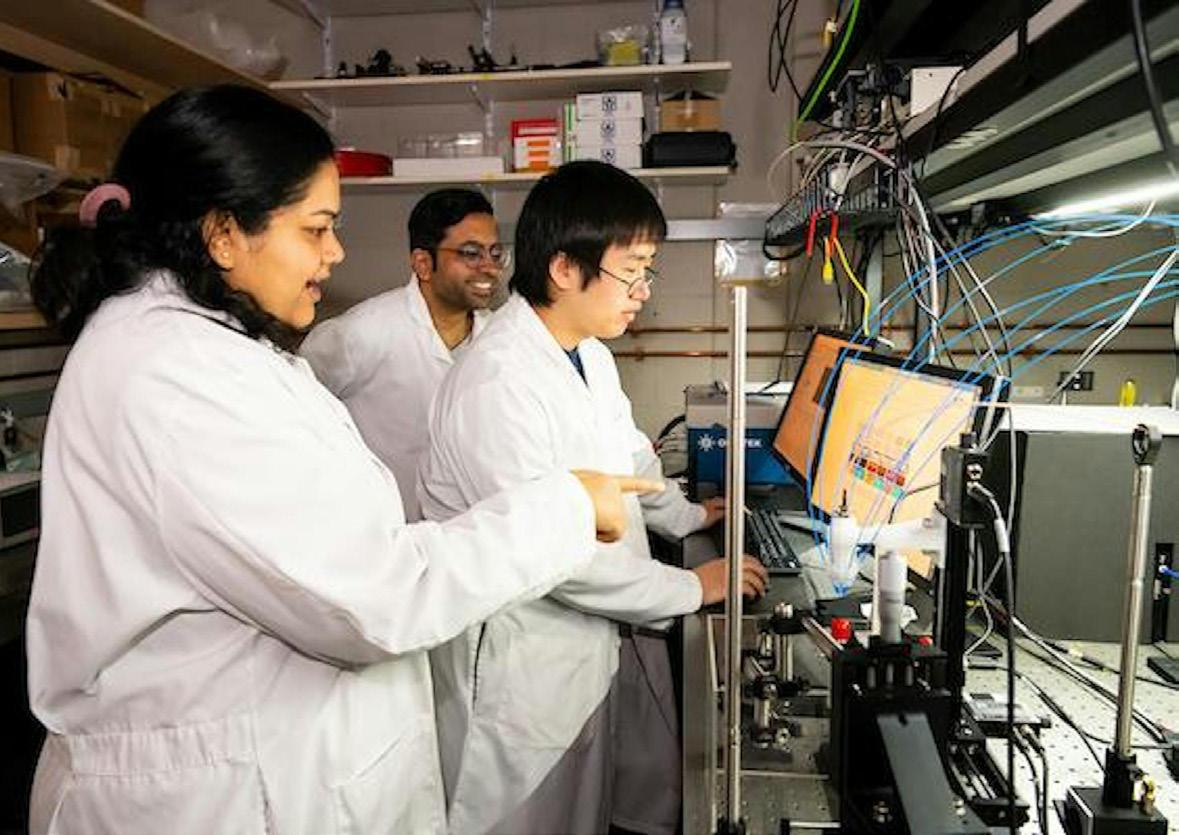
Srivalleesha Malladi is pictured with Avijit Paul and Chris Nguyen (EG’24).
VIA WIKIMEDIA COMMONS
The visitor’s entrance at Merck KGaA in Darmstadt, Germany, is pictured.
Tufts baseball drops series to Amherst, struggles in NESCAC amid winning season
Lauren Baker Staff Writer
Coming off a week of wins against Colby College and MIT, Tufts baseball lost two of three games in a series against Amherst College this weekend.
The Jumbos traveled to the
double to right center that put the Mammoths on the board.
For the Jumbos, adrenaline kept pumping in the second — junior first baseman Max Pavlik began with a first-pitch single up the middle, and first-year third baseman Tom Pender doubled to advance him to third. A walk to junior center
scored on a sacrifice fly by senior second baseman Jesse McCullough. Sophomore shortstop James Henshon reached base on a fielder’s choice, letting Pender score and extending the Jumbos’ lead to 4–1.
Tufts also recorded a stolen base and a walk in the second. Donato allowed a single in the bottom of the
in the early innings, Donato kept it neat, only allowing one run in seven innings. The Mammoths scored four runs in the bottom of the eighth, three charged to firstyear pitcher Max Williams and one to sophomore pitcher Lachlan Ellis.

A
ridiculous NBA awards race awaits us
Editor
Originally published April 13.
There are award years where you end up allotting a winner because somebody has to win. This is not one of those years.
This is one of the best MVP races I can remember. In my lifetime, I have never seen four individual players have such dominant statistical seasons all at once. Nikola JokiĆ is averaging 27.8 points, 12.9 rebounds and 10.9 assists per game, which means the man leading the league in both rebounds and assists could finish third on the final ballot. That is insane. Luka DonČiĆ led the league in scoring at 33.5 points per game while averaging 8.3 assists, and he reached 64 games before being ruled out for the rest of the regular season with a hamstring strain. He is currently one game short of the 65-game threshold for awards eligibility and is seeking an exception to that rule. Victor Wembanyama, meanwhile, is at 25.0 points, 11.5 rebounds and a league-best 3.1 blocks per game for a San Antonio Spurs team that has the second-best record in the league.
Of course, MVP favorite would be Shai Gilgeous-Alexander, who is averaging 31.1 points per game for the Oklahoma City Thunder, who clinched the best record in the NBA on Wednesday. He is going to clear an average of 30 PPG for the fourth straight season, and he is doing it with career-high efficiency that is unheard of for guards. This is the part where I should apologize in advance for doing the extremely dangerous — and possibly sacrilegious — thing of making a comparison to Michael Jordan, but Gilgeous-Alexander’s late-game scoring really does invite it. Once the game gets close and the clock gets low, there is this same sense of inevitability to it. He gets the ball, he gets where he wants and two points appear. My pick is GilgeousAlexander, back to back.
Defensive Player of the Year is much easier. Give Wembanyama the trophy and move on. He leads the league in blocks, but the bigger point is that his block number almost undersells the case. Players are actively avoiding shooting anywhere near him. The reason he is not blocking six shots a game may be that people have just gotten smart enough to stop trying around him. Add in the fact that the Spurs are
allowing 12 fewer points per 100 possessions with him on the floor, and this award should be his. As long as Wembanyaya plays enough games to qualify each season, it’s likely we won’t see another winner of this award for the next 10 years.
Rookie of the Year is the funnest race on the ballot. It is a two-man race between Cooper Flagg and Kon Knueppel, and both cases are real.
Knueppel has the historic shooting case. He is averaging 18.6 points per game, he broke the NBA rookie single-season 3-pointer record back in February and, last week, he broke the Charlotte Hornets’ franchise record for made 3-pointers in a season. He also became the only player aged 22 or younger in NBA history to reach 250 3-pointers in a season, not to mention a flurry of other records related to his remarkable efficiency. The case against him is not really a case against him. It is more that he is being asked to do a different job than Flagg. Knueppel has been an absurd, additive piece on a good Hornets team, but Flagg has had to be the engine of the Mavericks and really one of the only bright spots in the entire organization. He is averaging 21.2 points, 6.7 rebounds and 4.6 assists, and his closing argument
Saturday morning the Jumbos sent sophomore Emmet Christian to the mound for the first game of the day. He held down the fort in the first two innings while the Jumbos offense knocked two hits but left runners on base.
With one out in the third, Henshon doubled down the left field line. Kamin singled through the left side to put a run on the board for Tufts. Amherst struck back in the bottom of the inning, with a double and a single to match Tufts.
The Jumbos rallied again in the top of the sixth with a single by junior first baseman AJ Lysko, followed by another single from Pavlik. McCullough singled through the left side for Lysko to score and gave Tufts the lead.
Amherst surprisingly pulled through in the seventh off sophomore pitcher Derek Desmarais, who relieved junior pitcher Mitchell Hwang. He gave up two doubles and a single, but it was enough for the Mammoths to score two runs and give them the win.
For the third game of the series, junior pitcher Michael O’Brien took the mound. Neither team had significant action in the first two innings, but the Jumbos rallied in the third. McCullough singled to right field, and Kamin brought him home with a double to right center. Pender then singled to
has been ridiculous. He dropped 51 points on the Orlando Magic, becoming the youngest player and first teenager in NBA history to score 50 points in a game, and then he followed it with 45 points, nine assists and eight rebounds in a win over the Los Angeles Lakers.
Honestly, them sharing the award as ex-college roommates would be kind of perfect, and co-Rookies of the Year have happened before. But to avoid the cop-out answer, I will go with Flagg. The load has been heavier, and I still think he is the best player in the class.
Sixth Man of the Year is Keldon Johnson for me. He has emerged as the favorite, mostly because he does exactly what the Spurs need him to do. He gives San Antonio lineup flexibility, he can play with pretty much any group of players and he has helped power a team that just clinched the No. 2 seed in the West. He is averaging 13.1 points and 5.4 rebounds, and he became the first player in Spurs history to reach 1,000 points off the bench in a season. Plus, bench production on a contender always feels a little more serious than bench production on a team headed to the lottery.
Coach of the Year is Joe Mazzulla. The Boston Celtics were supposed
score Kamin, giving the Jumbos a two-run lead.
Amherst held fort until the seventh, when a lead-off single by Abraham kicked off a six-run inning. McCullough reached on a fielding error, then a Henshon single through the right side scored Abraham. Kamin also knocked a single, scoring McCullough and Henshon.
Bannish hit a third consecutive single to the right side, then a double by Pender scored Kamin. An infield error put Lysko on first and scored Bannish. However, Lysko was caught stealing at second, ending the rally. Tufts 8, Amherst 0.
Amherst also rallied in the seventh, putting up eight runs — five charged to O’Brien, two to junior pitcher Ronan Hwang and one to Ellis. At the end of the seventh, Tufts and Amherst were tied at eight runs apiece.
Back-to-back singles in the ninth put a runner on second for Amherst, and a third one to follow walked off the game with a lead and a series win for Amherst.
“NESCAC games are always going to be the toughest game on the schedule. We play them every year and really get to know each other’s tendencies very well,” Lysko wrote in a message to the Daily. “We’ve been aggressive and have a good approach, sometimes things just don’t fall your way.”
Tufts beat Endicott on Sunday, 11–6. On Wednesday, the Jumbos lost 2–1 against the Babson Beavers. They will travel to Lewiston, Maine this weekend to play Bates in their final full week of the season.
to have a down year after the Jayson Tatum achilles injury from last spring and all the churn around the roster, but instead, the Celtics clinched the East’s No. 2 seed on Friday night with their 55th win. He has done magic with the pieces he was given, turning random bench players into deeply annoying experiences for the other team. Hugo González, Jordan Walsh, Baylor Scheierman and all those bench-energy guys have had incredible years as a result of Mazzulla’s coaching. Part of the fun of this pick is also that he clearly does not care about the award at all. He called Coach of the Year a stupid award, which only makes me want him to win it more.
Finally, Most Improved Player is Nickeil Alexander-Walker. Since the Atlanta Hawks traded Trae Young to the Washington Wizards in January, Atlanta has finally reentered relevancy in the Eastern Conference. They are 27–14 since the trade and have lost only five games since the All-Star break. Alexander-Walker has been one of the main reasons. He is up to a career-best 20.8 points per game, steering the Hawks’ offense while taking on the toughest assignments on the other end.
Luke Fredericks Deputy Sports
COURTESY TUFTS ATHLETICS
Tufts catcher Malcolm Whitfield during a game against MIT.