Tufts sports teams head into postseason play
First annual TrapFest features Brooklyn rapper, local artists
see SPORTS / BACK PAGE Tufts Bikes implements new fix-it stand to make biking more convenient see FEATURE / PAGE 4
SEE ARTS AND LIVING / PAGE 6
THE
INDEPENDENT
STUDENT
N E W S PA P E R
OF
TUFTS
UNIVERSITY
E S T. 1 9 8 0
T HE T UFTS DAILY
VOLUME LXXI, NUMBER 65
tuftsdaily.com
Monday, May 2, 2016
MEDFORD/SOMERVILLE, MASS.
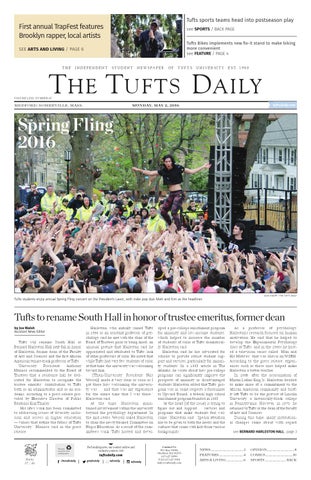
Spring Fling 2016
ALEX KNAPP / THE TUFTS DAILY
Tufts students enjoy annual Spring Fling concert on the President’s Lawn, with indie pop duo Matt and Kim as the headliner.
Tufts to rename South Hall in honor of trustee emeritus, former dean by Joe Walsh
Assistant News Editor
Tufts will rename South Hall as Bernard Harleston Hall next fall in honor of Harleston, former dean of the Faculty of Arts and Sciences and the first African American tenure-track professor at Tufts. University President Anthony Monaco recommended to the Board of Trustees that a residence hall be dedicated for Harleston to recognize the trustee emeritis’ contribution to Tufts both as an administrator and as an academic, according to a press release provided by Executive Director of Public Relations Kim Thurler. “His life’s work has been committed to addressing issues of diversity, inclusion and access in higher education — values that define the fabric of Tufts University,” Monaco said in the press release.
Please recycle this newspaper
Rainy 57 / 46
/thetuftsdaily
Harleston, who initially joined Tufts in 1956 as an assistant professor of psychology, said he met with the chair of the Board of Trustees prior to being hired, an unusual gesture that Harleston said he appreciated and attributed to Tufts’ lack of other professors of color. He noted that while Tufts had very few students of color at that time, the university was welcoming toward him. “[Then-University President Nils Wessell] made it very clear as soon as I got there how welcoming the university was … and that was my experience for the entire time that I was there,” Harleston said. At the time, Harleston maintained involvement within the university beyond the psychology department. In the mid-1960s, Wessell asked Harleston to chair the newly formed Committee on Negro Education. As a result of the committee’s work, Tufts hosted and devel-
For breaking news, our content archive and exclusive content, visit tuftsdaily.com @tuftsdaily
tuftsdaily
tuftsdaily
oped a pre-college enrichment program for minority and low-income students, which helped to increase the number of students of color at Tufts dramatically, Harleston said. Harleston said he has advocated for schools to provide robust student support and services, particularly for minority students. In a 1965 article in The Atlantic, he wrote about how pre-college programs can significantly improve the prospects of minority or disadvantaged students. Harleston added that Tufts’ program was in some respects a forerunner to Upward Bound, a federal high school enrichment program founded in 1965. “At the heart [of the issue] is trying to figure out and support … services and programs that make students feel welcome,” Harleston said. “Special attention has to be given to both the needs and the cultures that come with kids from various backgrounds.”
Contact Us P.O. Box 53018, Medford, MA 02155 617 627 3090 FAX 617 627 3910 daily@tuftsdaily.com
As a professor of psychology, Harleston’s research focused on human motivation. He said that he helped to develop the Experimental Psychology class at Tufts, and in the 1960s he hosted a television series called “Man and His Motives” that was shown on WGBH. According to the press release, experiences such as these ones helped make Harleston a better teacher. In 1968, after the assassination of Martin Luther King Jr., Harleston decided to make more of a commitment to the African American community and briefly left Tufts to be the provost of Lincoln University, a historically-black college in Pennsylvania. However, in 1970, he returned to Tufts as the dean of the faculty of Arts and Sciences. During this time, many institutional changes came about with regard see BERNARD HARLESTON HALL , page 3
NEWS............................................1 FEATURES.................................4 ARTS & LIVING.......................6
OPINION.....................................8 COMICS.....................................10 SPORTS............................ BACK
2
THE TUFTS DAILY | News | Monday, May 2, 2016
T HE T UFTS D AILY
tuftsdaily.com
Tufts-SMFA merger details to be settled by July
Sarah Zheng Editor-in-Chief
EDITORIAL Nicholas Golden Mengqi Sun Managing Editors Nicholas Pfosi Associate Editor Arin Kerstein Executive News Editor Isha Fahad News Editors Abby Feldman Melissa Kain Sophie Lehrenbaum Emma Steiner Ariel Barbieri-Aghib Assistant News Editors Kyle Blacklock Gil Jacobson Robert Katz Liam Knox Catherine Perloff Vibhav Prakasam Hannah Uebele Joe Walsh Kendall Todd Executive Features Editor Nicole Brooks Features Editors Nina Joung Jake Taber Diane Alexander Assistant Features Editors Constantinos Angelakis Emily Cheng Emma R. Rosenthal John Gallagher Executive Arts Editor Lancy Downs Arts Editors Justin Krakoff Josh Podolsky Jonah Allon Assistant Arts Editors Cassidy Olsen Eran Sabaner Hannah Hoang Dorie Campbell Emily Karl Erin Sifre Stephen Dennison Abigail Feldman Shannon Geary Allison Merola Cassie Bardos Miranda Chavez Frances DeFreitas Jake Goldberg Emma Henderson Michael Lefkowtiz Anita Ramaswamy Noah Weinflash
Executive Op-Ed Editor Op-Ed Editor Cartoonists MAX LALANNE / THE TUFTS DAILY
Editorialists
by Juliana Furgala Staff Writer
Maclyn Senear Executive Sports Editor Ray-Paul Biron Sports Editors Ross Dember Phillip Goldberg Alex Schroeder Chris Warren Yuan Jun Chee Assistant Sports Editors Maddie Payne Eddie Samuels Noah Smith Sofie Hecht Executive Photo Editor Alex Knapp Caroline Ambros Picture Tufts Editor Ray Bernoff Staff Photographers Laura DeArmas Maria Ferraz Henry Hintermeister Katlyn Kreie Mia Lambert Jiaxun Li Nora Nord Nicholas Pfosi Julia Press Evan Sayles Angelie Xiong
PRODUCTION Julie Doten
Production Director Astrid Weng Executive Layout Editor Jewel Castle Layout Editors Abbie Gantner Leila Li Allie Merola Brianna Mignano Mandip Pokharel Ellie Powers Annabelle Roberts Emily Sharp Andrew Stephens Sebastian Torrente Shirley Wang Petrina Chan Allison Merola Dana Pek Belinda Xian Jack Ronan Dan Strauss Meagan Adler Alison Beach Arthur Beckel Lancy Downs Alison Epstein Andrew Kager Melissa Kain Sarah Kalinowski Reena Karasin Sophie Lehrenbaum Rachel Salzberg Arielle Sigel Caroline Watson Maxwell Bernstein Nitesh Gupta Evan Sayles
A view of the kiln room in the School of the Museum of Fine Arts’ ceramics studio on April 30.
Creative Director Executive Graphics Editor Graphics Editors Executive Copy Editors Copy Editors
Executive Tech Manager Online Editor Social Media Editor
BUSINESS Yiran Xu Executive Business Director Qinyue Yu Receivables Manager Evan Sayles Online Advertising Eva Sachar Ad Managers Jay Hayes
Following the signing of a merger agreement between Tufts and the School of the Museum of Fine Arts, Boston (SMFA) in March, details on the union between the institutions will be settled and implemented by the end of July to provide students from both schools a more diverse set of course offerings. Administrators are currently working to ease the transition process by improving internet access within the SMFA, increasing transportation opportunities and coordinating registration and course requirements between the institutions. While newly-appointed dean of the SMFA Nancy Bauer is set to take on her new position on June 1, she has already been working on the transition. Bauer said that in her newly appointed position she aims to oversee and coordinate the integration process of the merger. Bauer said that Tufts and the SMFA have already established strong ties, noting the five-year double degree program between them and the working relationship which, according to a Jan. 20 Daily article, stems back to 1944. Both Bauer and Sarah McKinnon, senior vice president for academic affairs and dean of the SMFA, described the acquisition as a positive, natural next step in the SMFA’s longstanding relationship with Tufts. McKinnon sees the acquisition as an opportunity to merge currently separated aspects of both universities. “[There is] an interest in developing a bit of more, ‘going in both directions,'” she said. “At the moment, both students take studio classes here [and] academic classes [at Tufts]”
McKinnon explained that she plans on integrating the two institutions’ curricula by combining the two Student Information Systems and using a common registration system for prospective student applications. She noted that these changes are currently in the implementation process. Bauer also noted that she is working to translate the pass/ fail grade structure of the classes at the SMFA over to become compatible with Tufts’ grading standards. Bauer said that other changes include efforts to increase academic resources at the SMFA. “As a museum the SMFA runs itself brilliantly, but doesn’t necessarily have the resources to run a school,” she said. “[For example,] the needs of a school in respect to the internet are different than the needs of a museum. [There are teams working] to make the internet up to speed.” She also explained that she is also working to accommodate and address the concerns raised by current students at the SMFA. “The artists at the SMFA are extremely intellectually engaged,” she said. “We’re going to provide a vehicle to make the sharing of ideas [easier].” Bauer explained that this change will especially help the five-year dual degree students who are currently students of both Tufts and the SMFA. “They epitomize what this [effort] represents,” Bauer said. “They are committed to intellectual and artistic pursuits. Their whole [lives are] going to be much, much easier.” Transportation opportunities have been a long-standing issue for students commuting between the institutions, Bauer said. Fifth-year Tufts and SMFA
Combined Degree student Maureen Hilton explained in an Oct. 2015 article in the Daily that while the shuttle makes rounds several times a day during the week, there are no transportation services provided for students on the weekends, despite some students needing to access the facility for weekend classes and in order to complete homework assignments. To address this, Bauer explained, Tufts is working on providing security for the SMFA and increased transportation access to nearby locations within Boston, similar to the shuttle from the Medford/Somerville campus that goes to Davis Square. She noted that this initiative includes plans to double the number of shuttle buses between the institutions. The acquisition will also directly affect Tufts students who are not currently affiliated with the SMFA. Bauer described the plan to expand studio art classes on the Tufts University MedfordSomerville Campus. “Right now all studio art classes are taught by people working for the SMFA.” Bauer said. “[By having Tufts employ art professors] the classes will be much better integrated into the curriculum.” Despite all of the changes and active integration, Bauer emphasized that the new arrangement will not diminish the quality of the courses at SMFA. “The SMFA is still the landlord of the main building. Tufts [simply] does renovations there,” Bauer said. “There really are a lot of really great things about how the school is run and those are staying there. [We want to] make sure there is a much tighter relationship between teachers and students than there ever were before.”
Want to get campus news the moment it happens? Follow us on Twitter and Facebook! /thetuftsdaily @tuftsdaily
/tuftsdaily /tuftsdaily
Monday, May 2, 2016 | News | THE TUFTS DAILY
News
3
South Hall to be renamed in honor of Bernard Harleston BERNARD HARLESTON HALL
continued from page 1 to increasing access for African American students, including an expanded curriculum and new faculty outreach, according to a Spring 2002 article in the Tufts Online Magazine. “Tufts began more concentrated efforts to hire black faculty members, particularly when Harleston assumed the position of dean of the faculty,” the article reads. Harleston served in his position as dean for ten years, and in 1981 he
became the President of the City College of New York, a position he held until 1992. He said that he chose to lead City College because he saw it as an opportunity to further his work on increasing higher education access. “The opportunities for students were far greater at Tufts than at City College,” Harleston said. “But the commitment in terms of what the faculty were trying to do and the energy that the students brought was equal and in some ways greater.” Harleston said that over the years,
Tufts and other American universities have made significant progress in increasing access to higher education. As a trustee of Tufts between 2002 and 2007, he said it was evident to him that former University President Lawrence Bacow had made diversity and financial aid major goals, although he noted that all universities can still improve in these areas. Monaco commended Harleston for his longstanding commitment to important issues embraced by the university. “We are deeply grateful that he dedi-
cated 25 years of his academic career to Tufts, helping to strengthen this institution and shape it into the remarkable place it is today,” Monaco said. Former Provost Sol Gittleman was a former student of Harleston, and agreed that Harleston has made an immeasurable impact on the university. “Bernie Harleston deserves every honor Tufts can give him,” he told the Daily in an email. “He has been part of the soul of this institution for more than half a century.”
Seniors: Congrats on your upcoming graduation! But let’s not say goodbye. Let’s stay in touch in the new Online Community: tuftsalumni.org/olc BENEFITS: • UPDATE your contact info to stay connected to Tufts and fellow Jumbos • SEARCH for friends in the Online Directory • NETWORK with alumni in your field • Hear about EVENTS in your area • . . . and more, right at your fingertips!
PLUS, you’ll be entered to win one of the following PRIZES if you register:
• $300 Target gift card • $300 Amazon gift card • $300 Best Buy gift card
Join today! tuftsalumni.org/olc
4 tuftsdaily.com
Features
Monday, May 2, 2016
Tufts Bikes’ fix-it stand aims to make campus more bike-accessible by Diane Alexander
Features Assistant Editor
After several months of research and cost negotiations, a new bike repair stand stationed outside Mayer Campus Center opened to the public last monday, April 18. Tufts Bikes President Claire Stone, a junior, says it has already seen some use. The stand cost $3864, $2864 of which was paid for by Tufts Community Union (TCU) Senate out of the supplementary fund, according to a December 7, 2015 Daily article. The remaining $1000 came in part from the Office for Campus Life and in part from the budget of Tufts Bikes, a student-run bikeshare program on campus. “I think the stand is a positive thing that benefits, or could benefit, almost every single person on this campus,” Stone said. “I think when you look at it like that, and that it’s built to last through harsh winters … there’s just so many good things about it that justify the cost.” Stone said that much of the cost went into pouring a new concrete base, on which the stand could be installed, as well as the stand’s actual installation. Last Friday, April 22, Tufts Bikes hosted an event — aptly titled “What Is That Thing?” on Facebook — which drew not only current bike-using students, but
also many curious prospective students because the timing coincided with Jumbo Days, according to Adam Meyer, a senior and member of Tufts Bikes. The event page jokingly describes the stand as a “sleek, chic new hunk of metal.” There is a bike pump next to the stand, and the stand itself comes equipped with all the tools that are needed to do basic fixes on a bicycle. It is also meant to be durable: all the tools are linked with chains, Meyer noted. “This is useful for us because it means we don’t have to constantly be walking up and down to Lewis [for repairs on Tufts Bikes,] and now people don’t have to come to us. They can fix their own bikes, which is a lot easier,” Meyer said. The shop, tucked out of the way beside the Crafts Center in Lewis hall, has worked well enough for Tufts Bikes, and they hold three to four mechanic shifts per week there, according to Stone. Meyer, like many of Tufts Bikes’ upperclassmen, has been repairing bikes for most of his time on campus. Typically, he says, newcomers spend their first year learning how to fix bikes and pick up more shifts sophomore year, until they are able to lead their own shifts at the mechanic shop. Meyer said that the bikes they fix don’t always belong to Tufts Bikes, but rather can be any bike that people bring in.
“You provide the parts and we provide the service,” Meyer said. The way that these sessions operate is typically with about three mechanics, one of whom is the head mechanic for a shift. The president of Tufts Bikes usually handles the administrative side, while there is also an overall head mechanic for the entire group. The group also interacts with the administration in interesting ways, since the bike-share program is run through Tisch Library. Students can rent bikes with their Tufts ID from the library’s front desk, and then they can use those bikes for up to eight hours or overnight if their eight hours don’t run out until after the library closes. Ben Hoffman, a senior and a member of Tufts Bikes, emphasized that these bikes aren’t mountain bikes and that taking them off-road is highly discouraged. Members urged caution on the road, too: urban biking can be a challenge for many students who aren’t used to it. Hoffman and Meyer both noted that in Massachusetts, bikes are for the most part treated like cars while on the road, as they also have to follow the rules of the road. Despite this, members echoed that the communities surrounding Tufts have few designated bike lanes. While Cambridge has laid down many new bike lanes in the past several years, according
to Meyer, Somerville and Medford have not done so for the most part. Somerville is moderately helpful in that many streets have bike markers on the side of the road that tell drivers to watch out for cyclists, but Hoffman, Meyer, and Stone all felt that this was an insufficient precaution. “Honestly, [the bike markers] do just about nothing, other than make cars aware that a bike might one day be there,” Meyer said. “Biking, particularly in an urban environment where there are cars… [carries] a risk. It is a sport where you are traveling at very high speeds on a metal thing which doesn’t balance unless it’s moving, and you’re very vulnerable,” Hoffman said. “Anyone who doesn’t wear a helmet, for instance, is being a fool.” All three echoed the sentiment about helmets, as well, and agreed that there is at least one other great option for students who want to avoid urban biking: the Minuteman Path, which runs eleven miles from Bedford to Alewife. This is a commuter bike path, which means that there are no cars and few pedestrians on it, making it ideal for cyclists. “The Minuteman Path is a fan favorite — [it’s] very accessible from Davis Square, and is a nice easy ride,” Hoffman said.
EVAN SAYLES / THE TUFTS DAILY
The newly installed bicycle repair equipment outside the Mayer Campus Center on the night of Sunday, May 1.
Monday, May 2, 2016 | ADVERTISEMENT | THE TUFTS DAILY
tuftsdaily.com
1/4 AD
1/8 AD 1/2 AD
5
6 tuftsdaily.com
ARTS&LIVING FESTIVAL RETROSPECTIVE
TrapFest highlights local artists and community by Shirley Wang
Isaac Brown Pop Filter
A sound strategy
P
Creative Director
Anyone walking down Professors Row on Friday afternoon would have heard the flying verses of Dutch Rebelle, seen students gathered on the grass of the Africana Center yard, felt the energy and come to the same conclusion about TrapFest that was being shouted by the crowd: it’s lit. Tufts’ first annual TrapFest outdoor music festival featured Brooklyn rapper Asoh Black and local artists Dutch Rebelle and the Trap Music Orchestra. Asoh Black, a friend of one of the organizers, was accompanied by Tufts student DJ Tones, or Antonia George. Playing with a dandelion tucked behind his ear, he rapped to some Dutch ReBelle, a of his original songs “96 styles,” “96 styles part 2” and a song by Bad and Blue rapper Cameron Flowers. Dutch Rebelle, who was at Tufts for the Pan-Afrikan Alliance’s Black Solidarity Week last November and was named the “Hip-Hop Artist of the Year” at the 2014 Boston Music Awards, performed songs from her EP “Kiss Kiss” (2015) such as “Air it out” and “Whatchu Like.” The Trap Music Orchestra, a big-band mix hip-hop group of Berklee College of Music students and graduates, closed out the event. Their arrangements of Billboard-charting songs like Kendrick Lamar’s “Alright” (2015) and O.T. Genasis’s “CoCo” (2014) mixed trap with hip hop and new era jazz. Organized by the Tufts Black Jumbos with the African Student Organisation (ASO), the Pan-Afrikan Alliance (PAA), the Black Students Union (BSU), the Caribbean Student Organization (CSO), and Loving Ourselves as Queer Students of Color in Action (LOQSOCA), TrapFest was an effort to plan an event for the black community and communities of
Monday, May 2, 2016
JIAXUN LI / THE TUFTS DAILY
Boston-based MC, gestures to the crowd at TrapFest 2016 on April 29.
color as well as local black artistry, according to one of the coordinators, junior Arturo Muñoz. “Historically, the Concert Board hasn’t brought artists that particularly interested the black students and the student of color community on this campus more broadly,” Muñoz said. “And so these ideas came out of complaints where people were like ‘who is Børns and Matt and Kim.’” Vicky Adinkra, another coordinator, said the whole idea started to really take off when some members on a Facebook group page called Black Jumbos discussed the feasibility of what she called an “anti-spring fling”. Because TrapFest replaced the BSU’s annual Block Party event, which is typically on Spring Fling weekend, organizers were able to join those funds with money from the budgets of organizations and different collaborations. “[We’re] trying to really make this campus a place for black students,” Adinkra said. “This has really been a topic of conversation a lot within
JIAXUN LI / THE TUFTS DAILY
NYC rapper Asoh Black performs at TrapFest 2016, hosted by the Tufts University Africana Center on April 29.
the black community these past two semesters… all this intentional work that we’re trying to do to make sure that our experience is the experience that we want it to be.” According to Muñoz, part of that intentionality involves inviting artists that are specifically local or somehow connected to the community at Tufts and supporting people who are part of Boston’s up-and-coming hip hop, rap and trap scene. “We thought that it would serve as a way for students of color, and more particularly black students, to connect to the city a little more, because I think sometimes it is difficult for a community of color to feel like there’s something keeping us here,” Muñoz said. For Adinkra, building community and a strong support system means utilizing things like the Black Jumbos Facebook group, which was created for black-identifying students and those of the African diaspora, to network and share opportunities such as internships and local events. The group invited students from schools like Harvard, Emerson and Babson to the festival. Both Adinkra and Muñoz hope to make the festival happen every year and to create a space where Adinkra says students of color can “feel safe, feel comfortable, [and] feel like they can be a part of this event.” Although budgetary constraints continue to press groups for money and limit group expansion, Adinkra hopes that this event will create new traditions and show a larger presence of the black community. “As black students and as leaders in the community, and working with Africana Center, we wanted to put something together for our community and show people that we are here,” Adinkra said. “Yeah, we may be three percent, but we are here.”
erhaps a more underappreciated aspect of a cappella music is the technology that supports the singers, amplifying their sound so that it can be heard optimally in a given performance space. A cappella is often described as the music of the people in that it relies solely on the sounds made by the human body, but performers are still very much reliant on sound equipment to make those sounds reach the ears of the audience. There are numerous locations on campus where a cappella groups are frequently invited to perform that do not allow for adequate resonance or do not have the equipment necessary to capture a full, nuanced sound, and it has a noticeable impact on how well we come across as performers. Since my group is entirely composed of musicians who do not have a lot of experience with sound systems and equipment, figuring out how to go about getting set up has proven to be a significant challenge. Thankfully, we found a sound design consultant who helped us learn what equipment we need and how to set it up. Without him, our performances would have suffered greatly. Once you hear the difference between a performance with a proper mic setup and one without, there is no going back. Sometimes, the audience ends up missing out on a lot of interesting things happening in the background while the soloist steamrolls over everything. As much as we wish that our performance could be equally successful whether we are in Goddard Chapel or Gantcher, that is unlikely to be the case. The space, along with the equipment, is a huge factor in the sound quality, which is a reason why you will find that groups sound best when they choose the location and the audio setup. After receiving feedback from our winter show, this semester we increased the number of Shure SM58 microphones from four to six and positioned them so that instead of surrounding us as they did in the past, there were two mics placed in between the rows to better capture the lower voices. Putting mics solely on the periphery tended to pick up only the female voices, and while those are lovely to hear, we needed a lot more from the bass, tenors and vocal percussion. This time around, all three of those parts had their own mics, and, judging from audience comments and a review of the video recordings, there was a noticeable improvement in sound quality from previous semesters. Most importantly, we had bass consistently throughout — even during the times when we only had one person on that part — and that alone makes a huge difference. As I’ve stressed in previous columns, bass is a huge deal, and the strength and clarity of its sound helps me realize that our efforts to work on making sure everyone is heard the right amount has paid off. Isaac Brown is a junior majoring in English. He can be reached at isaac. brown@tufts.edu.
Monday, May 2, 2016 | Arts & Living | THE TUFTS DAILY
A rts & L iving
7
TV REVIEW
Night gathers in ‘Game of Thrones’ season six premiere (a spoiler free review!) by John J. Gallagher Executive Arts Editor
Season six of HBO’s smash hit series “Game of Thrones” (2011 – present) premiered on April 24 and opened with a recap of the previous season’s seminal moments. The recap makes for a harrowing montage, reminding the viewer of all the murder, rapes, battles and religious fanaticism that defined the last season, and drawing them back into the world of “A Song of Ice and Fire” (1996 - present). After the recap, the series’ intro sequence begins, where mechanical miniatures of key locations assemble themselves over Ramin Djawadi’s iconic theme. “Game of Thrones” was always dark, endlessly concerned as it is with mankind’s darkest tendencies, but after season five, things seem especially grim in Westeros and across the Narrow Sea. Beloved and not so beloved characters are in more peril than usual and the question on everybody’s lips is if Jon Snow is alive or dead. The tension is high, and one can feel the series moving inexorably toward a final, cataclysmic confrontation that ties together all its myriad sub-plots. As to what shape that final confrontation will take, it’s anyone’s guess. The plots of the books and the TV show have been diverging for some time, but thanks to George R.R. Martin’s famously glacial writing pace, the show’s producers have expended the accumulation of literary savagery that inspired the show and are now writing their own stories in Martin’s world. We are in uncharted waters, and fans of the books no longer get to feel smug as their plebian friends are shocked as events unfold on screen that really happened in a novel published years before.
From the beginning, “Game of Thrones” has benefited enormously from a cast of thespians who are unswervingly dedicated to their roles, and this trend fortunately continues into season six. It’s easy to make fantasy sound hokey, especially when you have characters say lines that feature names like “Daenerys Targaryen”, but all of the cast deliver their lines with conviction, and dialogue that could have easily earned an eyeroll instead lands with force. The massively underrated Gwendoline Christie shines in her brief appearance in season six’s first episode. Christie brings an impressive physicality and earnestness to her role as Brienne of Tarth, the brutally effective female knight who, though often a whirlwind of slaughter, is nevertheless unshakably loyal and brimming with idealism. Brienne is one of the show’s few morally unambiguous characters, free as she is of the lies and duplicity that sully most every other character, and scenes featuring her are a refreshing break from perpetual intrigue. It would be nice to see her in a fight against an opponent of equal skill though; her appearance in the premier mostly consisted of her hewing anonymous henchmen into gory man-chunks. The High Sparrow, the High Septon played by Jonathan Pryce, who ignited a wave of popular religious fanaticism in season five, returns in season six and is as terrifying as ever. Pryce plays the character like a kindly grandfather, all understanding words and soft gestures. But underneath that outward gentleness, Pryce manages to show the sort of insidious zealotry that only the obscenely devote can muster. The High Sparrow burns with religious fever, the kind that brooks no transgressions,
but also has the political savvy to conceal it beneath a more approachable façade. If Ted Cruz was less a partially-melted wax reptile who hungers endlessly for manflesh, he would bare more than a passing resemblance to Pryce’s character. The High Septon is one to watch in season six, as the movement he leads will undoubtedly lead to true horrors, all of which will be opportunities for Pryce to showcase more of this chilling character. Fan favorite Peter Dinklage returns as Tyrion Lannister and is as good as ever. More ink has been HELEN SLOAN VIA TRIBUNE NEWS SERVICE spilled about Tyrion Sophie Turner in “Game of Thrones.” and Dinklage’s portrayal of the character than almost anything scene is funny on its own, but it is made even “Game of Thrones” related, so there isn’t a better when you realize that the scene is a whole lot left to say. The only “substantive” homage to 1982’s delightfully campy “Conan criticism this reviewer has of Dinklage is that the Barbarian.” he is far too handsome to play the canonicalOverall, the premier of the sixth season ly hideous Tyrion. of “Game of Thrones” indicates that viewers Thankfully, it’s not all darkness and excel- can expect more of the gritty, hardscrabble lent acting in season six, as the show’s writers fantasy that has defined the series thus far. do manage to inject some levity into the Fans of the series will find more of what they unrelenting despair. The premier features like, but the well-crafted television on display a hilarious scene in which a Khal and his in the season premiere will do little to appeal Bloodriders debate what is best in life. The to the uninitiated.
Studying abroad fall 2016? Required pre-departure meetings:
FREE EXERCISE CLASSES FOR TUFTS COMMUNITY May 3, 4 & 5th Unwind and relax during the end of semester!
Non-Tufts Study Abroad Tufts Programs Abroad
all meetings in Braker Hall 001 all meetings in Braker Hall 001
Classes held in Tisch Sports & Fitness Center Multi-Purpose Room
Non-Tufts Africa/Asia/ Caribbean/Latin America/Middle East Tues., 5/3 @ 10:30 am
Tuesday
MUSCLE CONDITIONING (Chase Gym ) 5/3 12:00-1:00pm Marlene Carr
Tuesday
5/3
YOGA 2:00-3:00pm
Wednesday
5/4
YOGA 2:00-3:00pm Elliott McEldowney
Wednesday
5/4
SPINNING 3:30-4:30pm
Thursday
5/5
SPINNING 12-1:00pm
Non-Tufts UK/Ireland/ Australia/New Zealand Tues., 5/3 @ 3:30 pm Non-Tufts Mainland Europe Wed., 5/4 @ 1:30 pm
Tufts in London**/Madrid** Oxford**/Paris**/Tübingen Tues., 5/3 @ 1:30 pm Tufts in Chile**/China/ Japan Wed., 5/4 @ 3:30 pm **for those who did not attend the group meeting with the Resident Director
PLEASE NOTE: If you cannot make your scheduled nonTufts meeting, please attend another non-Tufts meeting. If you cannot make your scheduled Tufts meeting, please attend the other Tufts meeting.
Pam Gaither
Jennifer Gewant Amy Piontedosi
NO EXPEREINCE REQUIRED, JUST SHOW UP & EXERCISE!
SPONSORED BY PHYSICAL EDUCATION Ext. 3782
Meetings are required. Questions? Call x7-5871.
8 tuftsdaily.com
Opinion
Monday, May 2, 2016
EDITORIAL
Curt Schilling versus ESPN Curt Schilling, an analyst for ESPN and former professional baseball star for the Boston Red Sox, was fired from the sports network last week due to a picture he shared from his Facebook account. The inflammatory social media post was critical of those who support transgender bathroom policies, and was posted in response to the rising denunciations levied against North Carolina for its new biologically-based standards in regulating single-sex multiple occupancy bathroom use. When discussing the firing of Schilling, many are focusing on whether or not ESPN should have fired him, but it is also important to address whether or not ESPN should be allowed to fire him and whether the network has maintained consistency in dealing with such issues. To understand the context of the
debate around this issue, it is important to note that ESPN has a history of allowing employees to hold and express viewpoints which its audience may find controversial. Former ESPN employee Dana Jacobson, went on an anti-Christian tirade at an ESPN event in Atlantic City, and she was merely given a temporary suspension from her duties at the network. Kevin Blackistone, a frequent guest on ESPN’s Around the Horn, said on live television that the national anthem is a “war anthem,” and should not be played prior to sporting events, yet Blackistone still regularly appears on ESPN. Tony Kornheiser, another ESPN radio host and TV personality for the network, conflated the Tea Party with ISIS during an on-air conversation with his co-host about the political difficulties posed by the political group. Kornheiser still
works for ESPN and co-hosts one of its nightly broadcasts. However, ESPN has taken a harder stance against some who have expressed and held conservative viewpoints. Mike Ditka, a cohost on the network’s top Sunday program, was taken off the show shortly after referring to President Barack Obama as the “worst president we’ve ever had” on The Bernie and Sid Show in New York. Now, Schilling, for expressing his belief on a private social media account that restrooms should be separated based on the biology of those who use them, has completely lost his job. Does this make ESPN hypocritical because it hasn’t “maintained consistency?” Not necessarily. ESPN said that Schilling was fired because the network is “an inclusive company.” While Schilling might contend that
the “inclusivity” they are referring to does not allow for diversity of private thought, ESPN is ultimately a private company that has the right to regulate its values and how those values are portrayed. While many can and will dispute whether or not Schilling should have been fired, ESPN’s ability to exercise its right to employment in accordance with its company’s values ought not to be questioned. All private companies are owed the ability to employ those who they believe embody their principles, not the principles of outsiders. ESPN, and all other private businesses, should not be, in the court of public opinion, found guilty for protecting its company’s values.
EDITORIAL CARTOON BY ASTRID
The Tufts Daily is a nonprofit, independent newspaper, published Monday through Friday during the academic year, and distributed free to the Tufts community. The content of letters, advertisements, signed columns, cartoons and graphics does not necessarily reflect the opinion of The Tufts Daily editorial board. EDITORIALS Editorials represent the position of The Tufts Daily. Individual editors are not necessarily responsible for, or in agreement with, the policies and editorials of The Tufts Daily. OP-EDS The Op-Ed section of The Tufts Daily, an open forum for campus editorial commentary, is printed Monday through Thursday. The Daily welcomes submissions from all members of the Tufts community; the opinions expressed in the Op-Ed section do not necessarily represent the opinions of the Daily itself. Opinion articles on campus, national and international issues should be 600 to 1,200 words in length and submitted to oped@tuftsdaily. com. The editors reserve the right to edit letters for clarity, space and length. All material is subject to editorial discretion and is not guaranteed to appear in the Daily. Authors must submit their telephone numbers and day-of availability for editing questions. ADVERTISING All advertising copy is subject to the approval of the Editor-in-Chief, Executive Board and Executive Business Director.
Monday, May 2, 2016 | Opinion | THE TUFTS DAILY
Opinion
9
OP-ED
Dignity in differences, a new perspective on the Israeli-Palestinian conflict by Eitan Bloostein On Friday, April 8 Hillel, the Muslim Student Association and Visions of Peace (VOP) hosted Ali Abu Awwad and Rabbi Hanan Schlesinger. The two speakers are part of the grassroots organization Roots, which aims to further humanity and peace between Israelis and Palestinians. This event was VOP’s first; VOP is a new Hillel initiative that engages with the IsraeliPalestinian conflict by promoting grassroots organizations in which Israelis and Palestinians are committed to working for peace together through business, the environment, education, technology and dialogue. Ali Abu Awwad is a Palestinian whose experience with the occupying Israeli government, which has included a long stay in military prison, has led him to advocate for non-violent action towards peace. The most striking moment of
Awwad’s talk was his response to a question about the seeming lack of recognition of the Israeli Occupation on Roots’ website. Awwad responded in righteous anger saying, “My nation is dying every day.” In criticism of peacemakers’ politicking on both sides of the conflict he said, “If you have the courage of a peacemaker, I want you to work on the heart of the problem. Where my kids are dying, there I want your activity … Establishing another peace company—not organization—is not peacemaking.” He absolutely recognizes the Israeli occupation, yet he sees his activism as above political language and talking heads. He believes that the separation of Jews and Palestinians fuels continued hatred and misunderstanding. To Awwad, Palestinians and Israelis must work together to bring justice and peace. Rabbi Hanan Schlesinger would have once considered himself the oil to Awwad’s water. As an Israeli settler,
he originally believed that Jews and Palestinians could not mix with one another. To this day, he presents himself with “three labels: Jew, Zionist and settler.” As Schlesinger embarked on a journey of understanding the systems of oppression in Israel, he came to understand how settlers and settlements impacted the lives of Palestinians and perpetuated their oppression. Awwad and Schlesinger’s talks moved and surprised me. I was struck by the intense honesty of both speakers. Awwad spoke his truth with strength, stressing the importance of knowing and working with those he once viewed only as his enemy. The talk’s most powerful moment was when Awwad spoke of the hardships he continually faces by virtue of being a Palestinian and the hope of reconciliation and co-existence that he sees in his organization. Schlesinger identified as a militantly Zionist Israeli settler, but he
was willing to point the finger at himself and stress the importance of recognizing the humanity of those on the other side of the conflict. We created Visions of Peace because we want to bring a new perspective to campus: one that is fresh, different, and useful. We have all heard the conventional solutions proposed by politicians and organizations from different perspectives and approaches that, to date, have not helped the cause of peace. We can learn from the Palestinians and Israelis who live within this conflict every day. If they can work together and find creative, practical ways to co-exist and create grassroots opportunities for understanding, then we have a responsibility to help them through partnership in supporting and promoting their work. Eitan is a first-year student who can be reached at eitan.bloostein@tufts.edu.
OP-ED
The road to November — my platform by Woody Nimoityn Both the Republican and Democratic National Conventions will be must-see TV this July. With no Republican candidate likely to secure 1237 or more delegates by the time the last votes are tallied on June 7, it is anticipated that there will be a dramatic contested convention in Cleveland, the first for the GOP since 1976. On the Democratic side, Hillary Clinton will most likely arrive in Philadelphia with a commanding delegate lead, but still charged with the task of uniting Bernie Sanders’ young and passionate coalition with Clinton’s establishment base that wants to continue on the path that the Obama administration has blazed. Along with selecting a presidential nominee for the general election, a party convention is a venue to establish or reaffirm the party’s platform. It is of utmost importance for each party to clearly articulate its core guiding principles and stances on key issues. Conventions provide an opportunity for conservatives and liberals to showcase the differences in their principles and values in order to distinguish themselves from their opponent. Instead of waiting until July to hear each party’s platform, I have decided to lay out the core principles and ideals for my ideal theoretical party, the “Freedom Party.” • Defend Liberty The fight to protect and defend liberty is a constant battle. As a citizen living in the United States, you have certain unalienable rights given to you by God. President Reagan echoed this sentiment, stating beautifully, “freedom is never more than one generation away from extinction. We didn’t pass it to our children in the bloodstream. It must be fought for, protected and handed on for them to do the same.” A threat to freedom somewhere is a threat to it everywhere. Adherence to the Constitution and its founding principles is the best way to cultivate, protect and maximize freedom. Some blindly criticize the Constitution and argue that it is an out of date document created by men in an old world, and that it is no longer an accurate reflection of our country’s values in the 21st century. In my opinion, nothing could be further from the truth. Liberty cannot and should not be compromised. The biggest threat to our liberty is the federal government. The framers of
the Constitution envisioned a federal government that revolved around and deferred to the states, and not the other way around. The concentration of power at the top of our political system is an attack on our liberty by taking decision-making power away from local officials, who are in a better position to represent the interests of our neighborhoods than Washington bureaucrats. Any infringement on liberty is an assault on our unalienable rights, a founding principle of our country that makes it unique. We have to protect ourselves from an abusive and paternalistic federal government that wishes to restrict our liberty and dictate our lives. The Freedom Party would defend the principles and values inherent in the Constitution and would strive to protect the freedoms and liberty of each and every American. • Protect our Nation The world is a more dangerous place when the United States leads from behind, as the right has often criticized President Obama for doing. Both this country and the world are safest when the United States, with the biggest and strongest military in the world, leads from the front. Besides protecting our freedom at home, the most important role of the federal government is to protect us from foreign enemies that pose a threat to our national security. We need leaders with steady hands, but also ones who are not afraid to take decisive action to defend the nation. Currently, the biggest foreign threat to our nation is radical Islamic terrorism. ISIS and other radical Islamic terrorists do not accurately represent the ethics and values behind the religion of Islam, but they justify their actions in the name of the religion. The total destruction of ISIS is necessary not only to protect Americans, but also to protect the many innocent Christians, Jews and Muslims who are slaughtered every day in the Middle East for being “non-believers.” One way for the United States to do this is to fully and explicitly support its allies in the region; these allies include Turkey, Jordan, Egypt and most importantly Israel. Israel is the only fullfledged democracy in the Middle East and the only Jewish state in the entire world. Groups that deny Israel’s right to exist should automatically be declared enemies of our nation and a threat to freedom and peace, and the Freedom Party would ensure this. Additionally, the Freedom Party would seek to mitigate Russian attempts at Soviet-like
colonization, the nuclear threats posed by Iran and North Korea and Chinese aggression in the South China Sea in order bring more stability in the world. Protecting the United States and its citizens would be central to the Freedom Party’s platform. • Seek Justice Equal protection under the law is essential to maintaining the legitimacy of our law enforcement and justice systems. No person should be disadvantaged because of his or her gender, race, ethnicity, sexual orientation, wealth, age, level of intelligence or any other factor. The law is blind to these factors, and should be enforced as such. If someone is charged with a crime, he or she is innocent until proven guilty. This concept is important to emphasize in 2016, where the media and general public often renders their judgment on the guilt or innocence of a person before all the facts come to light (see the Duke lacrosse scandal). Additionally, it is important to stand behind and respect law enforcement for the important role they play in protecting our neighborhoods. Being involved in law enforcement is a great responsibility, and accordingly, any attack on the liberty of a law-abiding individual by inappropriate or illegal law enforcement action is unacceptable, and such actions should be dealt with swiftly and transparently. • Stimulate Economic Growth Free market capitalism is the best hope for creating a strong economy that provides citizens with jobs and gives every citizen a shot at being successful. High taxes and protective tariffs stagnate economic growth, and they hurt small businesses. Lower taxes encourage investment and allow for businesses to thrive. The government does not create jobs or wealth — the people do. The current government wastes its time inefficiently redistributing wealth, rather than instituting economic policies that encourage job creation. We should not settle for 2% growth when we can do better. Being $19 trillion in debt is not only “unpatriotic,” as described by President Obama, but it is bankrupting our kids and grandkids. Growing social programs and government spending is not the answer; in order to stimulate growth in the economy, The Freedom Party would promote values of free market capitalism and private investment. • Rein in Washington Charles de Montesquieu, a prominent French philosopher who championed the
concept of separation of powers within a government, was an inspiration for the framers of the Constitution. According to the Constitution, which enumerates the powers of each branch, the legislature creates the law, the executive enforces the law and the judiciary interprets the law. This creates a system of checks and balances that makes sure that no one branch holds too much power. This system of check and balances has been all but abandoned in modern politics as the branches have sought to expand their power to levels unimaginable to our founders. First, we have a President that abuses his constitutional powers by signing executive orders to force his agendas through Congress. Meanwhile, the other branches sit by and watch as it unfolds. In this instance, the President not only enforces the law, but writes it as well. This borders on tyranny. Secondly, the courts powers are supposed to be limited to interpreting laws and preventing unconstitutional actions by the other branches of government. However, in recent years, the Supreme Court has become extremely political and has overstepped its enumerated powers as well. The Court regularly legislates and makes policy from the bench, rather than interpreting our nation’s laws. The notion of federalism, which is addressed in the 10th Amendment, delegates the right to determine laws for extra-Constitutional issues to the states. However, the growing federal leviathan has all but gutted our founding principle of federalism. The Freedom Party would seek rein in Washington by returning power to the states to govern themselves, and to hold officials accountable for abusing power not vested in them by the Constitution. The Constitution wonderfully opens with, “We the People of the United States, in Order to form a more perfect Union, establish Justice, insure domestic Tranquility, provide for the common defense, promote the general Welfare, and secure the Blessings of Liberty to ourselves and our Posterity, do ordain and establish this Constitution for the United States of America.” “The Freedom Party” would represent all Americans, and liberty, security and justice would stand at core of its platform. Woody is a first-year student who can be reached at woodrow.nimoityn@tufts.edu.
10
THE TUFTS DAILY | Comics | Monday, May 2, 2016
Comics
tuftsdaily.com LATE NIGHT AT THE DAILY Dan: “Damn Daniel, back on it again with the red pen.”
Comics
SUDOKU
JUMBLE
Difficulty Level: Not starting on final papers until now.
Friday’s Solution
NON SEQUITUR BY WILEY MILLER
CROSSWORD
Friday’s Solution
Monday, May 2, 2016 | Sports | THE TUFTS DAILY
Sports
11
MEN'S TRACK
WOMEN'S TRACK
Jumbos take third at NESCACs, Men’s track and field finishes second at NESCAC championships look to weeks ahead by Chris Warren Sports Editor
On Saturday, the women’s track and field team was at Amherst for the NESCAC Championships. Although Tufts kept it tight for most of the meet, they eventually finished third with 123 points, behind Williams, which finished first with 165 points, and Middlebury, which finished second with 140 points. The Jumbos’ senior captains led the charge on Saturday. Senior quint-captain Alexis Harrison gave an impressive all-around performance. She won the 100-meter dash with a fast time of 11.88 seconds, which tied for third nationally. She also won the 200-meter with a 25.40 second finish and won the long jump with an 18 ft., 6 in. jump that was good enough for 14th nationally. She also anchored the winning 4×100-meter relay team that ran the 14th fastest time in the nation, 47.92 seconds, and tied for fourth in the high jump with a 5 ft. 2 1/4-in jump. Classmate quint-captain Marilyn Allen was also a conference champion on the day, taking the 100-meter hurdles with a time of
14.48 seconds, good enough for 13th nationally. She also ran the 400-meter hurdles, taking 13th with a time of 68.72 seconds, and took fifth in the 100-meter dash with a time of 12.50 seconds. Like Harrison, she was also on the winning 4×100-meter relay team. Senior quint-captains Sydney Smith and Audrey Gould also had career days. Smith took second in the 1500-meter with an extremely fast time of 4:31.23, good enough for 11th nationally. She also took sixth in the 800-meters, running 2:14.02, and was a member of the 4×400-meter relay team that took fifth with a time of 4:00.80. Gould came second in the 10,000-meter, though her time was slightly slower than the 15th-fastest time in the nation that she ran earlier this season. Though the season is over for most Jumbos, many will continue on into the coming weeks. Some will eye top finishes at next weekend’s Division III New England Championships held at Springfield College, while others will go for success at the NCAA Division III National Championships held at Wartburg College in Iowa. Regardless, the Jumbos will be giving it their all until the season is officially complete.
by Soven Bery Staff Writer
All season, the biggest goal for the men’s track and field team was to win the NESCAC Championships for a third year in a row. But in a surprising disappointment on Saturday at Amherst, Tufts lost the NESCAC crown to Williams, which finished with 207 points, ahead of Tufts’ 182 score. Still, the second-place finish in the NESCAC doesn’t diminish what has been an impressive 2016 campaign for the Jumbos. Tufts won the Sunshine Classic, Conn. College’s Silfen Invitational and the Tufts Invitational while also racking up some of the best individual marks in the nation. Senior tri-captain, All-American and three-time NCAA champion Mitchell Black came into the championships as the NESCAC Track Performer of the Week and USTFCCCA Men’s Div. III National Athlete of the Week after clocking a time of 1:48.60 in the 800 meters the week before, the ninth fastest in Div. III history and the current fastest in the nation. Black did not
WOMEN'S TENNIS
disappoint on Saturday, leading the Jumbos with two of the team’s six wins, taking first in the 800 and the 1,500. Teammate and classmate Veer Bhalla was close behind Black in the 1,500 for the 1-2 Tufts finish. Junior Luke O’Connor won the 3,000-meter steeplechase for the second year, senior Bryson Hoover-Hankerson won the long jump and sophomore Stefan Duvivier won the high jump in unexpected first-place finishes. The Tufts 4×100-meter relay team of sophomore Peter Clark, Hoover-Hankerson, firstyear Thomas Miller and first-year Anthony Kardonsky also finished first with a time of 41.61 seconds that is 13th nationally. Though the overall team result at NESCACs may have been somewhat underwhelming for the defending champions, there are still a number of Jumbos ranked in the top spots in the country in their events who will likely impress in the championship season, and the squad has shown a wealth of young talent that bodes well for the program’s future. The team is back in action this weekend at the New England Div. III Championships at Springfield.
MEN'S TENNIS
Women’s tennis upsets Bowdoin After finishing weekend with win, Jumbos move on to NESCAC tournament to make NESCAC playoffs by Alex Schroeder Sports Editor
by Yuan Jun Chee
Assistant Sports Editor
The women’s tennis team will be on the road at Bates next weekend after splitting its final two home games. Despite a 7-2 loss on Saturday evening to the nationally No. 2-ranked Williams Ephs, the No. 17 Jumbos had already secured their return to the championship with their upset of the No. 6 Bowdoin Polar Bears 7-2 earlier that morning. First-year Mina Karamercan, who plays in the second position, ended the marathon day as one of only two Tufts players to win both her singles matches of the day, the other being classmate Tomo Iwasaki. For the first time this season, the Jumbos lost all three of their doubles matches against the Ephs. Karamercan, ranked as the No. 42 singles player in the nation, beat Williams’ No. 25 Mia Gancayco 6-2, 6-3, while Iwasaki battled back from a first set loss in the fourth position to win a long third set. Tufts’ path to the NESCAC tournament was secured earlier in the day, though, with their shock victory over Bowdoin.
Tufts’ strength in doubles play, which has been one of its major weapons this year, once again set the stage for the team’s victory over their higher-ranked opponents on Saturday morning. Overall, Tufts dominated their matches against Bowdoin with good communication between the doubles, smart shot-selection and aggressive play at the net. The Jumbos make the playoffs once again after ending the season with a winning 5-4 record in conference play and an 11-6 overall record, an improvement over last year’s 3-5 NESCAC record and 8-8 overall record. They’ve also demonstrated their ability to upset higher-ranked opponents this spring — with the Bowdoin victory following spring break wins over the University of Chicago and Lewis and Clark — helping Tufts climb the rankings. Despite their young talent and momentum on their side, the Jumbos have a tough run ahead of them through the conference tournament, with five NESCAC teams ranked in the top 10 nationally ready to contend for the top spot. They begin their fight for a title in the post-season tournament.
After a loss against MIT and an indoor win against Bowdoin on Sunday, Tufts is set to play in the conference tournament as one of the NESCAC’s top six seeds. The Jumbos have locked down the No. 5 seed after a strong spring season. On Sunday, Tufts hosted conference rival Bowdoin, the NESCAC’s No. 2 seed. The match was moved indoors due to the adverse weather conditions. In a tight contest featuring two conference rivals, the Jumbos came out on top 5-4. Though the team fell behind 2-1 in doubles, it stormed back for a win with strong singles performances. A dramatic 6-7(9), 6-3, 7-6(5) win by sophomore Rohan Gupte over classmate Kyle Wolfe in singles clinched the overall victory for Tufts. Just two days earlier, Tufts traveled to MIT for a non-conference match up with local Div. III rival Engineers. There, the Jumbos dropped their first 5-4 match of the season. After taking a 4-3 lead through doubles and the first four singles matches, MIT posted two three-set victories in the No. 3 and No. 4 positions to clinch a win. To kick off the match, Tufts jumped out to a 1-0 advantage in doubles as sophomore Zain Ali and junior Kevin Kelly took the No. 3 doubles match over first-year Tyler Barr and junior Avi Walden, 8-2. MIT, however,
recovered quickly, taking the second doubles position with an 8-4 win from senior co-captain Kevin Wang and first-year Sean Ko over Jumbo senior co-captain Rob Jacobson and classmate Jay Glickman. Senior co-captain Nick Cary and Gupte then fell to No. 45 ranked first-year Alex Cauneac and sophomore Bryan Lilley in a tight 9-8(3) at the No. 1 spot, giving MIT a lead headed into singles. In the second half of competition, Tufts regained an edge in singles play. Though Cauneac took down Glickman at No. 1 singles in straight sets, 6-4, 6-1, Gupte edged out Wang in the second position 6-2, 6-3. Wins for Tufts followed at the No. 5 and No. 6 spots for Cary and Kelly, respectively. MIT triumphed in the end with wins for Ko over Jacobson at No. 4 and Barr over sophomore Zain Ali at No. 3. Tufts will match up with No. 4 Williams in the first round of the tournament, which will be hosted by Bates at the end of this week, starting on Friday. The Jumbos open with the first contest of the weekend at 2 p.m. in Lewiston, Maine. Should they win and advance, they’ll play top-seeded Middlebury the following day. The semifinal winners will then square off on Sunday to determine this year’s NESCAC champion. After capturing one of the lower seeds in the postseason tournament, Tufts will look to capitalize on its opportunity to avenge its regular season losses and make a run for the NESCAC championship.
WOMEN'S SAILING
CO-ED SAILING
Jumbos place sixth in Championships On to next competition after tough going by Maclyn Senear
Executive Sports Editor
The co-ed sailing team finished sixth out of 18 teams at the New England Dinghy Championships at Dartmouth this weekend, the Jumbos’ last competition in New England this season. Tufts finished with 55 total team points, just behind fifth-place Yale’s 53 points, and 14 points behind champion Roger Williams University’s total team points. The Jumbos’ A division boat, sailed by junior skipper Griffin Rolander and sophomore crew Emily Shanley-Roberts, was in the
middle of the pack, tallying 36 points. But the B boat sailed by junior skipper Scott Barbano and senior crew Caroline Atwood finished tied for second in its division with a low 19 points, keeping the team’s overall score strong. With the New England racing season is now over, the team — which has continued to rank as one of the top teams in the region, especially after impressively winning all three of the regattas it hosted this season — will send crews to San Diego, Calif. later this month to compete in the national Intercollegiate Sailing Association Championships, beginning on May 28.
by Phillip Goldberg Sports Editor
The Tufts women’s sailing team finished 14th out of 16 teams at the New England Championship (NEC) Regatta on April 24 at Yale University. The Jumbos missed out on competing in the Intercollegiate Sailing Association national semifinals, as only the top 11 teams from the NEC Regatta qualified. Tufts’ final score of 331 was 51 points behind 11th place finisher Dartmouth College’s 280. The competition was split into two divisions with 16 races each. Tufts’
A dinghy featured junior MaryClaire Kiernan as skipper and senior Amanda Sommi as crew. The pairing managed a second place finish in its 13th start. Senior Kate Shaner skippered the B dinghy with junior Julia Fuller as crew, and their best finish was third in its 12th start. The B dinghy placed slightly better than the A, compiling 165 points to the A dinghy’s 166. The Jumbos will next compete in the Intercollegiate Sailing Association Championship starting on May 27, in San Diego, Calif.
Sports
12 tuftsdaily.com
WOMEN'S LACROSSE
MEN'S LACROSSE
Men’s lacrosse nears another title
Women’s lacrosse falls in NESCAC quarterfinals by Phillip Goldberg Sports Editor
The women’s lacrosse team’s season ended in the NESCAC quarterfinals on Saturday with a 14-10 loss to Middlebury on the road at Kohn Field in Middlebury, Vt. Although Tufts finished its regular season on a high note — taking down teams from Bates, Wesleyan and Bowdoin, in a row — the No. 6 team from Middlebury proved to be too large of an obstacle for the team to handle for the second time this season. The Jumbos are a young team this season, as the thirteen first-year players outnumber the combined three seniors and six juniors on the team. First-year Dakota Adamec shone on offense in the latter half of the season, netting 12 goals and 7 assists in 11 games after she returned from injury. Adamec also earned NESCAC player of the week for her late-game heroics in a 13-10 win over Wesleyan on April 23. Her classmates Cecily Freliech and Megan Toner were also in double digits this season as well, scoring 12 and 11 goals respectively. Senior tri-captains Caroline Ross and Brigid Bowser led the Jumbos in scoring by a substantial margin with 42 and 38 goals,
by Maddie Payne
Assistant Sports Editor
respectively. Ross led the team with 23 assists, and the two collectively accounted for 80 of Tufts’ 193 goals this season. Ross finished second in the NESCAC in total points with 65, and was also named NESCAC Player of the Week for her play in a March 26 win against the five-time defending NESCAC champion Trinity. At the game, Ross assisted first-year Gabby Vinci’s game-tying goal before scoring the game winner with 13 seconds remaining. Bowser’s team-high 44 ground balls led the NESCAC, and she finished in a tie for third place in draw-controls and fourth in caused turnovers, demonstrating her versatility as a midfielder. Sophomores Taylor Meek and Caroline Nowak led their class in scoring with 18 and 14 goals, respectively, and junior attacker Kate Mackin topped her class with 15. Nowak scored the final goal in a crucial 6-5 win over Bates on April 19. Eliminated from the NESCAC playoffs, the Jumbos now hope for an at-large bid to the NCAA tournament on the strength of their No. 16 rank nationally and their 9-7 overall record. The three late NESCAC wins brought Tufts’ in-conference record to 5-5, just below last season’s 6-4 finish.
SOFTBALL
Softball sets sights on fifth straight NESCAC title by Isabel Banta Staff Writer
Softball already locked up a perfect season in NESCAC East and the No. 1 seed heading into the playoffs with a sweep of Bates last weekend, but this Saturday, they continued to dominate the NESCAC with a shutout sweep of a doubleheader against Hamilton at home to celebrate Senior Day. Hamilton (12-24 overall, 3-9 NESCAC) sits in last place in the NESCAC West but still managed to keep game one scoreless through the first five innings. In the bottom of the sixth, however, Tufts finally broke through and pounded out six runs. Sophomore Samantha Siciliano doubled to left field to bring first-year Isabel Smokelin home, and then sophomore Raven Fournier was able to score off a grounder from junior Carrie Copacino. Senior co-captain Christina Raso, one of the team’s two seniors honored on the day, and first-year Christian Cain, laced back-to-back RBI base hits. Raso
SOFIE HECHT / THE TUFTS DAILY
IF Christina Raso (LA ’16) hits the ball in Softball’s 7-5 win against Bowdoin on April 1.
Monday, May 2, 2016
and Cain both ended up scoring on an ugly play from Hamilton’s defense that saw a wild pitch followed up by a error, and the runs tallied in the sixth carried the team to the 6-0 victory. Senior co-captain Erica County, the team’s other senior honored Saturday, started in the circle and got the win in her complete-game, three-hit shutout. The Jumbos blanked the Continentals again in game two and took an easy 11-0 win, with the game called after the top of the fifth. Tufts got started quickly, scoring 10 runs across the first three innings and then tacking on another in the fourth. Raso was hot at the plate, going two for three with a pair of runs and a pair of RBIs, while sophomore Raina Galbiati not only doubled in two runs and knocked in another with an RBI groundout but also picked up the win with four shutout innings in the circle. First-year Amolee Hawkins also pitched a 1-2-3 fifth in relief to seal the win. Tufts plays Wheaton next in a doubleheader at home Tuesday afternoon. Saturday’s wins, though they had no affect on the team’s conference record, bring the Jumbos’ overall record to 25-8 and give them momentum as they head into the NESCAC tournament in Williamstown, Mass., where they will play the Amherst Purple & White in their first game Friday at 5:00 pm. Tufts will look to beat out Amherst, Trinity and Williams to get its fifth straight NESCAC title over the weekend before hopefully making a run back to the NCAA finals later this month.
The men’s lacrosse team is moving on to the NESCAC semifinals this Saturday after beating Conn. College 16-10 in the quarterfinal round this weekend. On Wednesday, the Jumbos doubled up on the Bowdoin Polar Bears 20-10 in their final regular season game, opening up an eight-goal lead in the second and third quarters. The Jumbos took an early lead with senior co-captain Ben Andreycak finding the net on counterpart John Uppgren’s assist. Five minutes later, the roles reversed as Uppgren scored off Andreycak’s assist. Uppgren netted six and assisted four in the game. Senior Kyle HowardJohnson also made his mark with signature power-shots from distance, scoring on three. The win brought Tufts’ conference record to 9-1 and held its spot atop the NESCAC heading into this weekend’s quarterfinals. The team hosted Conn. College in that quarterfinal game on Saturday after already having beaten them 24-12 earlier in the regular season. The game started evenly, with neither team able to take the lead. Senior Jake Gillespie was the star of the first half, scoring four of the Jumbos’ seven goals, with two more coming from Andreycak and another from Uppgren. Strong midfield defense from the Jumbos marked the game. Seniors Chris Sawyer and AJ Enchill caused important turnovers to bring the ball back into the attack. Although Conn College had more saves than Tufts, Tufts’ shots were far more accurate. Senior goaltender Alex
EVAN SAYLES / THE TUFTS DAILY
Tufts midfielder Jake Gillespie (LA ‘16) shoots in the game against Conn. College on Saturday, April 30. Salazar did not have to make too many saves on Conn. College’s wild and inaccurate shots. It wasn’t until the second half that the Jumbos were able to open up a substantial lead. The Camels scored once in the third quarter and three times in the fourth, while in contrast, the Jumbos scored four and five, respectively, to seal the win. The quarterfinal victory takes the Jumbos to the semifinals next Saturday where they will face Williams. The Jumbos currently dominate the NESCAC individual statistics. Uppgren is the conference’s top scorer for the second straight year with 51 goals, while Gillespie, who did not start a single game last season and only scored 21 goals, follows him closely with 50 this year. Uppgren leads the NESCAC in points scored, also coming second in assists with 42. Andreycak and Gillespie tie for third with 65 points each, while Andreycak ranks fourth in assists. Finally, Salazar has the most saves in the NESCAC with 209. The Jumbos are looking for their seventh consecutive NESCAC championship and their third consecutive Div. III national title.
BASEBALL
Baseball finishes season strong, looks forward to NESCAC tournament by Eddie Samuels
Assistant Sports Editor
Having just wrapped up their final NESCAC games of the regular season, the Jumbos have just three games remaining in their regular season schedule. The team secured first place in the NESCAC East last week, but lost its first game in conference play to Bowdoin 5-2 on Saturday. The loss came in the final game of a series against the Polar Bears; the Jumbos won the other two games, 4-3 and 16-0, and then beat Bates on Sunday to finish divisional play with an 11-1 record. Tufts’ first game against Bowdoin was the closest of the series, as junior starter Tim Superko went eight innings deep, letting up just three runs, one of which was unearned. Superko fanned 13 in his lengthy start. The Jumbos’ offense wasn’t explosive in the game, but put up just enough runs to secure the victory, with doubles from senior captain Cody McCallum and junior Oscar Kutch. The second game was a blowout in favor of the Jumbos, who received seven innings from junior starter Speros Varinos. Varinos allowed just two hits and walked one in his complete game. The game remained close until the fifth inning, when the Jumbos put up five runs, fol-
lowed by four runs apiece in the sixth and seventh. McCallum was the team’s strongest offensive force, driving in four runs in the contest. The third game was the toughest for the Jumbos, who, as a result of their consistent pitching, rarely end up down early in a game. The Polar Bears scored two in the first, followed by another three in the third. Tufts tried to battle back with two late runs, but the Bears’ lead would prove insurmountable. On Sunday, the team rebounded from its loss with a 6-5 win at Bates. The 12-inning affair was a drawn out battle that saw the Bobcats even the score at five in the eighth to force extra innings. Despite the scoreline, neither offense was explosive, as both pitchers kept the game under control. Tufts’ first-year starter R.J. Hall went seven deep before the team received two innings each from sophomore Ian Kinney and first-year Joe Thomas, who claimed the W. Tufts has been on a hot streak since the end of March, going 18-3 in April. This week the Jumbos will finish their regular season, with a game today against Eastern Conn. St. before facing off against Middlebury in a Sunday doubleheader. The postseason begins for the 26-6 Jumbos this Friday in the first game of the NESCAC tournament.
MEN'S CREW
Despite illnesses, men’s crew places eighth at New England Championships by Andre Chuong Staff Writer
Coming out of a stellar season on their home waters of the Malden River, the men’s rowing team was back in action Saturday, competing in its first championship race at the annual New England Rowing Championships held on Lake Quinsigamond in Worcester, Mass.
The New England Rowing Championships are conducted with heats to determine what crews will advance on to the grand or petite finals. The first three teams to finish in each heat continue in the grand final while the remaining teams face each other in the losers’ race. The first varsity eight earned a spot in the petite final by coming in fourth in their heat, but because some rowers were ill, the boat had to scratch its entry.
The second varsity eight finished first in their petite final with a time of 6:31.434. They unfortunately missed their opportunity to compete in the grand final by a margin of two seconds in their preliminary heat, losing out to Boston College, Williams College and Bates College. Finally, in a field of six, the third varsity eight finished with a time of 6:49.420. No heat was raced for this entry but the crew managed
to upset Williams College, Boston College and Trinity College in their fourth-place victory. Despite the setback to the first eight, the team still placed eighth in overall points scored at the New England Rowing Championships, a major improvement over its 15th place finish last year. The crews will be back at Lake Quinsigamond next Saturday to compete in their final race of the season at the National Invitational Championships.