‘Full House’ spinoff ‘Fuller House’ stays true to spirit of hit ‘90s show see ARTS AND LIVING / PAGE 7
TUFTS BASKETBALL
Men’s basketball wins first-ever NCAA Regional at Cousens, women win fifth-straight Regional
Tufts Black Freedom Trail provides insight into oftenoverlooked aspect of history see FEATURE / PAGE 5
SEE SPORTS / BACK PAGE
THE
INDEPENDENT
STUDENT
N E W S PA P E R
OF
TUFTS
UNIVERSITY
E S T. 1 9 8 0
T HE T UFTS DAILY
VOLUME LXXI, NUMBER 29
tuftsdaily.com
Monday, March 7, 2016
MEDFORD/SOMERVILLE, MASS.
#OurThreeBoys commemorates three Sudanese- Alumni speak American victims about media industry, careers at annual ‘On the Air’ event by Daniel Nelson
Contributing Writer
ALEX KNAPP / THE TUFTS DAILY
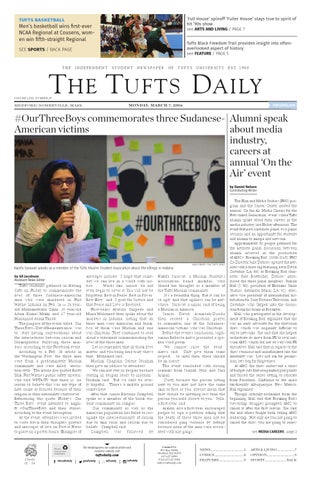
Nazifa Sarawat speaks as a member of the Tufts Muslim Student Association about the killings in Indiana by Gil Jacobson
Assistant News Editor
Tufts students gathered in Hotung Café on Friday to commemorate the lives of three Sudanese-American men who were murdered in Fort Wayne, Indiana on Feb. 24 — 23 yearold Mohamedtaha Omar, 20 year-old Adam Kamel Mekki and 17 year-old Muhannad Adam Tairab. The purpose of the event, titled “Our Three Boys – Day of Remembrance,” was to “start having conversations about the intersections between racism and Islamophobia” following these murders, according to the Facebook event. According to a Feb. 28 article in the Washington Post, the three men were from a predominately Muslim community and were killed “execution-style.” The article also quoted Rusty York, Fort Wayne’s public safety director, who told WPTA-TV that there is “no reason to believe this was any type of hate crime or focused because of their religion or their nationality whatsoever.” Referencing this quote, Friday’s “Our Three Boys” event intended to amplify #OurThreeBoys and their stories, according to the event description. At the event, attendees were invited to write down their thoughts, prayers and messages of love on Post-it Notes to place on a poster board. Examples of
Please recycle this newspaper
Cloudy 51 / 34
/thetuftsdaily
messages include, “I hope that someday we can live in a world with justice…,” “Words like ‘unjust’ do not even begin to cover it. You will not be forgotten. Rest in Peace. Rest in Power. Rest Easy” and “I pray for Justice and that Peace and Love is Restored.” First-years Ayotola Onipede and Muna Mohamed then spoke about the murders in Indiana, noting that all three men were American and black, two of them were Muslim and one was Christian. They continued to read aloud a statement commemorating the lives of the three men. “Let us remember that all black lives matter, and you being here truly shows that,” Mohamed said. Muslim Chaplain Celene Ibrahim then gave an address to attendees. “We can not stay in despair because staying in despair leads to inaction,” Ibrahim said. “But we can’t be overly hopeful… There’s a middle ground somewhere.” After that, junior Karynne Campbell spoke as a member of the black student community on campus. “Our community as well as the American population has failed to recognize the intersectionality of racism due to skin color and racism due to beliefs,” Campbell said. Campbell was followed by
For breaking news, our content archive and exclusive content, visit tuftsdaily.com @tuftsdaily
tuftsdaily
tuftsdaily
Nazifa Sarawat, a Muslim Student’s Association board member, who shared her thoughts as a member of the Tufts Muslim community. “It’s a beautiful thing. But it can be so ugly. And that ugliness can be anywhere,” Sarawat, a junior, said of being a Muslim in America. Senior David Asamoah-Duodu then recited a Christian prayer to remember one of the SudaneseAmerican victims, who was Christian. Before the event’s conclusion, sophomore Rebecca Antwi presented a spoken word poem. “We cannot raise the dead,” Antwi said. “Only give them some respect… so until then, there should be an outcry.” The event concluded with closing remarks from Joanah Sylla and Sara Arman. “[ Just] because the person sitting next to you may not have the same skin or face as you, doesn’t mean that they should be anything less than the person you hold closest to you,” Sylla, a first-year, said. Arman, also a first-year, encouraged people to sign a petition asking that the death of these three men not be considered gang violence by default because none of the men were associated with any gangs.
Contact Us P.O. Box 53018, Medford, MA 02155 617 627 3090 FAX 617 627 3910 daily@tuftsdaily.com
The Film and Media Studies (FMS) program and the Career Center hosted the annual “On the Air: Media Careers for the Networked Generation” event, where Tufts alumni spoke about their careers in the media industry, last Friday afternoon. The event featured a keynote panel, two panel sessions and an opportunity for students and alumni to mingle and network. Approximately 50 people gathered for the keynote panel discussion between alumni involved in the production of AMC’s “Breaking Bad” (2008-2013). FMS Co-Director Julie Dobrow opened the keynote with a short clip featuring actor David Costabile (LA ’89) as Breaking Bad character Gale Boetticher. Dobrow introduced the three panel members: Sharon Hall (J ’86), president of Endemic Shine Studios, Alexander Marin (LA ’92), executive vice president of international distribution for Sony Pictures Television, and Costabile, who Skyped into the discussion from his home in Brooklyn. Hall, who participated in the development of Breaking Bad, explained that she was an early advocate for the television show, which was originally difficult to sell to networks. She said that she helped orchestrate its move from FX to rival network AMC, which did not sit well with FX executives. Hall said that in regards to the show’s tenuous and unauthorized sale, the mentality was, “Let’s not ask for permission, let’s beg for forgiveness.” At AMC, the show underwent a series of budget cuts that reorganized plot points and forced the series setting to relocate from Pasadena, California to the more tax-friendly Albuquerque, New Mexico, Hall explained. Though critically-acclaimed from the beginning, Hall said that Breaking Bad’s viewership struggles prompted AMC to cancel it after the first season. She said she and others fought back, telling AMC leadership, “Not only are you not going to cancel the show, you are going to renew
NEWS............................................1 COMICS.......................................4 FEATURES.................................5
see MEDIA CAREERS , page 2
ARTS & LIVING....................... 7 OPINION.....................................9 SPORTS............................ BACK
2
THE TUFTS DAILY | News | Monday, March 7, 2016
T HE T UFTS D AILY Sarah Zheng Editor-in-Chief
EDITORIAL Nicholas Golden Mengqi Sun Managing Editors Nicholas Pfosi Associate Editor Arin Kerstein Executive News Editor Isha Fahad News Editors Abby Feldman Melissa Kain Sophie Lehrenbaum Emma Steiner Ariel Barbieri-Aghib Assistant News Editors Kyle Blacklock Gil Jacobson Robert Katz Liam Knox Catherine Perloff Vibhav Prakasam Hannah Uebele John “Joe” Walsh Kendall Todd Executive Features Editor Nicole Brooks Features Editors Nina Joung Jake Taber Diane Alexander Assistant Features Editors Constantinos Angelakis Emily Cheng Emma R. Rosenthal John Gallagher Executive Arts Editor Lancy Downs Arts Editors Justin Krakoff Josh Podolsky Jonah Allon Assistant Arts Editors Cassidy Olsen Eran Sabaner Hannah Hoang Dorie Campbell Emily Karl Erin Sifre Stephen Dennison Abigail Feldman Shannon Geary Allison Merola Cassie Bardos Miranda Chavez Frances DeFreitas Jake Goldberg Emma Henderson Michael Lefkowtiz Anita Ramaswamy Noah Weinflash
Executive Op-Ed Editor Op-Ed Editor Cartoonists
Editorialists
Maclyn Senear Executive Sports Editor Ray-Paul Biron Sports Editors Ross Dember Phillip Goldberg Alex Schroeder Chris Warren Yuan Jun Chee Assistant Sports Editors Maddie Payne Eddie Samuels Noah Smith Sofie Hecht Executive Photo Editor Alex Knapp Caroline Ambros Picture Tufts Editor Ray Bernoff Staff Photographers Laura DeArmas Maria Ferraz Henry Hintermeister Katlyn Kreie Mia Lambert Jiaxun Li Nora Nord Nicholas Pfosi Julia Press Evan Sayles Angelie Xiong
PRODUCTION Julie Doten
Production Director Astrid Weng Executive Layout Editor Jewel Castle Layout Editors Abbie Gantner Leila Li Allie Merola Brianna Mignano Mandip Pokharel Ellie Powers Annabelle Roberts Emily Sharp Andrew Stephens Sebastian Torrente Shirley Wang Creative Director Petrina Chan Executive Graphics Editor Allison Merola Graphics Editors Dana Pek Belinda Xian Jack Ronan Executive Copy Editors Dan Strauss Alison Beach Copy Editors Arthur Beckel Lancy Downs Alison Epstein Andrew Kager Melissa Kain Sarah Kalinowski Reena Karasin Sophie Lehrenbaum Rachel Salzberg Arielle Sigel Caroline Watson Maxwell Bernstein Executive Tech Manager Nitesh Gupta Online Editor Evan Sayles Social Media Editor
BUSINESS Yiran Xu Executive Business Director Qinyue Yu Receivables Manager Evan Sayles Online Advertising Eva Sachar Ad Managers Jay Hayes
7
TODAY
“Imagining synthetic biology futures and making them real” Details: As a part of the inaugural “Technoscience and the State” course, several professionals will be discussing their experiences in the synthetic biology field. Guest speakers include Christina Agapakis, creative director at Ginkgo Bioworks, Kevin Esvelt, assistant professor at MIT Media Lab, Rebecca Wilbanks, a PhD student at Stanford University, and Sam Weiss Evans, lecturer of the “Technoscience and the State” class. When and Where: 3:00 to 4:15 p.m., Room 206, Eaton Hall Sponsor: Science, Technology and Society program
tuftsdaily.com
VISITING the
8
hill THIS WEEK
TUESDAY
“CeCe McDonald & Joshua Allen: #BlackExcellenceTour” Details: First-year Elise Sommers and senior Renee’ Vallejo have partnered to bring Joshua Allen, a black transgender-feminine organizer and abolitionist, and CeCe McDonald, a black transgender woman activist, to campus as part of their spring #BlackExcellenceTour. McDonald and Allen will share their insights on issues related to black and transgender individuals. When and Where: 7:00 to 8:30 p.m., Alumnae Lounge Sponsors: TuftsQueerStudentsAssociation, the LGBT Center, Loving Ourselves as Queer Students of Color in Action (LOQSOCA), Tufts Students for Justice in Palestine, Women’s, Gender and Sexuality Studies program, International Relations program, Peace
and Justice Studies program, Consortium of Studies in Race, Colonialism and Diaspora.
10
THURSDAY
“Upheaval” symposium with artists Marcelo Brodsky and Jorge Tacla Details: Artists Marcelo Brodsky and Jorge Tacla of the Tufts Art Gallery’s “Upheaval” exhibition will be speaking on a panel with two Boston-area historians to discuss the historical connections between American civil rights issues and South American human rights issues. When and Where: 5:00 to 6:30 p.m., Tufts University Art Gallery, Aidekman Arts Center Sponsors: Tufts University Art Gallery, Arts, Sciences and Engineering Diversity Fund, Latin American Studies Program, Consortium on Race, Colonialism and Diaspora.
Alumni discuss media careers in day-long event MEDIA CAREERS
continued from page 1 it until it reaches its natural conclusion.” The show ultimately continued for another four seasons. Marin, who spearheaded the development of Breaking Bad’s Spanishlanguage remake, Metástasis, also spoke about the show’s early struggles. He explained that Breaking Bad caught on after it became available on-demand through Netflix. “The ability to watch a very close-ended show [like Breaking Bad] straight through was great for the audience,” he said. According to both Hall and Marin, Breaking Bad’s success on Netflix gave it a following and saved it from the chopping block. Dobrow explained that such experiences with new forms of media consumption drove her to organize the panel. “As somebody who studies media, I know that Breaking Bad was not only an incredible TV show, but one that redefined how TV is distributed,” she said. After the keynote panel, students attended breakout sessions featuring alumni involved in four sectors of the media industry: news, television, film and marketing.
At the news breakout session “The Spin Zone: Making and Shaping the News,” Neal Shapiro (LA ’80), president and CEO of public television network WNET, spoke to students about the challenges of the journalism industry. “If you like something that’s exciting and unpredictable, these jobs are for you,” he said. The session gave students an opportunity to ask questions, with some expressing concern about entering a competitive media job market and Tufts’s lack of a journalism tract which students fear put them at a disadvantage. Rosanna Xia (LA ’11), a staff reporter for the Los Angeles Times, explained at the news panel that although there is no journalism major at Tufts, the university’s liberal arts education and specialized fields of study could be beneficial for aspiring journalists. Xia graduated from Tufts with a double major in quantitative economics and International Relations and a minor in communications and media studies, according to the panel’s Eventbrite page. Other panels included “Trending in Digital: Advertising and Marketing in the 21st Century,” “Nothing sells like suc-
cess: How to develop a series for television” and “From Pitch to Production: Movies and Features,” according to the Eventbrite page. Nancy Glass (J ’77), the owner of Philadelphia-based production company Nancy Glass Productions, was also in attendance at “On the Air.” As the ViceChair of the University’s Board of Advisors, she initiated the inaugural “On the Air” event three years ago. “I saw that [the Career Center] did a crash course in finance,” she said. “Why not do the same [for media]?” Senior Kels Hoffman said the event allowed students to hear how alumni found success in the media industry. “I just wanted to hear people passionate about what they were doing,” Hoffman said. At the event, alumni explained that there is no surefire way to be successful in the media industry, and that finding hands-on experience through internships is potentially more important than a college education. “When you show up in college you think you know everything,” Marin said. “By the time you leave, you know that you don’t know anything.”
TCU Senate approves project for Counseling and Mental Health Services, funding requests by Vibhav Prakasam Assistant News Editor
The Tufts Community Union (TCU) Senate met last night to discuss supplementary funding requests and appeals, as well as a project approval. TCU Senate President Brian Tesser opened the meeting by saying that the housing survey from the external firm, Sasaki Associates, which Tesser first brought up to Senate two weeks ago, should be sent out to the Tufts community later this week. TCU Treasurer Shai Slotky then took the floor to entertain a series of supplementary funding requests. The first was an appeal from Tufts International Genetically Engineered Machine (iGEM), which requested $3,500 for two people to attend the five-day competition for next year. The Senate Allocation Board (ALBO) did not want to fund the competition at all because it saw the request as a research venture rather than a competition, since iGEM would be gaining access to laboratories and equipment that could be used for research. According to the Treasury Procedures Manual (TPM), competition fees that fall under the category of any sort of research cannot be funded. After a long debate period, the ALBO rec-
ommendation of zero dollars in funding failed in a vote of 10-18-0, and the original request of $3,500 was objected upon. After further debate, the vote on $3,500 was taken and resulted in a tie. In the event of a tie, the treasurer makes a decision according to the TPM, so Slotky, a junior, decided against the amount of $3,500. A new amount, $3,350, was proposed, which was calculated by incorporating $15 of personal contribution per person per day, resulting in a total $150 in personal contributions by the two people attending the competition, bringing the requested $3,500 down to $3,350. This recommendation passed in a vote of 20-8-0. The next request was from the Alliance Linking Leaders in Education and the Services (ALLIES), which revised its budget from last week. The new request passed by acclimation. Further requests came from Spirit of Color for uniform shirts, Tufts Students for Justice in Palestine for a speaker honorarium and Tufts Association of South Asians for its Bhangra group to participate in a competition in Madison, Wisconsin, a request which breaks the radius of funding for travel. The requests were all approved. The last supplementary fund hearing will be on March 30, and the last supplementary
funding vote will be on Apr. 3, Slotky said. TCU Senate Vice President Gauri Seth, a junior, brought up project updates, and various senators spoke about their groups’ work on their respective projects. Senators said that there is work being done to get culture groups to hold a minimum of three events, to continue with the on-campus pub project, to meet with the head director of Tufts Emergency Medical Services for stipends for emergency medical technicians, the creation of a newsletter in place of Jumbo Digest and the creation of an Urban Studies major. Senate then voted to approve a project by Trustee representative Sylvia Ofoma, a junior, for improvements to Counseling and Mental Health Services (CMHS). Some of the aims of her project include increasing the amount of care available to students, easing the process of finding off-campus counseling and ensuring that CMHS follows-up with students after counseling. The project was passed unanimously. Diversity and Community Affairs (DCA) Officer Anna Del Castillo, a sophomore, then briefly took the floor to make some announcements about upcoming community events. There were no updates from the TCU Judiciary, so the meeting moved into its closed session
N
Monday, March 7, 2016 | News | THE TUFTS DAILY
The Department of History is pleased to announce
The Professor George J. Marcopoulos Memorial Lecture Anne F. Broadbridge
Associate Professor, University of Massachusetts, Amherst
Genghis Khan's Womenfolk: How Imperial Women shaped the Mongol Conquests and the Mongol Empire Thursday, March 10, 5:30 P.M, in Barnum 104 The rise of Genghis Khan and the Mongol conquests transformed the history of Eurasia, yet even today few understand how this happened. Still harder to find are the stories of royal womenfolk. In this lecture, Professor Broadbridge will present three key moments from Mongol history, first outlining each moment as scholars originally uncovered it, then showing how the discovery of imperial women's contributions to Mongol history have dramatically changed the picture. Anne F. Broadbridge is an Associate Professor of medieval Islamic History at the University of Massachusetts Amherst where she teaches on the Mongols, the Crusades, the Ottomans, early Islamic History, and Islamic Thought. She is currently finishing her second book, Imperial Women in the Mongol Empire. This lecture is made possible thanks to the generosity of George Marcopoulos’s past student and friend, Tony Ettinger A78 AG79.
3
4
THE TUFTS DAILY | Comics | Monday, March 7, 2016
Comics
tuftsdaily.com LATE NIGHT AT THE DAILY Sarah: “Can we just take a pic of the pic of Beyoncé and run it?” Sofie: “Sarah Zheng / Tufts Daily”
Comics
CROSSWORD
Friday’s Solution
SUDOKU
JUMBLE
Difficulty Level: Wearing shorts on Wednesday.
Friday’s Solution
NON SEQUITUR BY WILEY MILLER
Monday, March 7, 2016
Features
5 tuftsdaily.com
Black Freedom Trail marks important locations, retells stories of black history by Emily Cheng
Feature Assistant Editor
The Tufts/Medford Black Freedom Trail, connecting on-campus sites including the Capen House, the Lena D. Bruce (E ’92) and Anita Y. Griffey (LA ’89) Bench and Goddard Chapel Plaque, signifies the stories and moments in the African American history at Tufts. According to Professor of Political Science Pearl Robinson, who has taught at Tufts since 1975, the Tufts/Medford Black Freedom Trail serves as a means to not only document, but to physically mark the Black presence at Tufts as an integral part of the Tufts landscape. The trail was the brainchild of late history Gerald Gill (1948-2007), who taught African American history and worked extensively to document Black history at Tufts, including a comprehensive piece on the topic in Tufts’s online magazine and a photo exhibit in the art gallery. Robinson explained that the origin of the trail traces its roots to the Freedom Trail in Boston, which highlights important locations of the American Revolution. “Some decades ago, people who were trying to record and document the history of African Americans in Boston created a black freedom trail,” she said. “One of the things Gill used to do…would be to take his students into Boston and arrange for them to have a tour … Somehow along the way he got it in his mind that there was enough history of the presence of blacks on the Tufts campus to do a similar project.” Sadly, Gill passed away before he could see his project complete. “As far as I can tell, people didn’t know he was working on this trail or there was no official Tufts record,” Robinson said. “I’ve been saying for a decade, the trail should be done, it should be appropriately marked, and when done that way… it makes the Black presence at Tufts a natural part of the landscape.” She cited several important effects of the trail, such as that it would establish that Black students attended Tufts long before the implementation of Affirmative Action or Diversity policies and that it connects the Black presence at Tufts to the ongoing Freedom Struggle in the United States. Last fall, the idea was taken into action at the “Social Movements and the Black Intellectual Tradition — An Africana Symposium” on Nov. 20, 2015. “With support of Africana Studies, the Center for the Study of Race and Democracy (CSRD) and the Africana Center, several Tufts faculty, students and staff (including Robinson, Africana Center Director Katrina Moore, [Professor of English] Modhumita Roy and [Professor of History] Kendra Field) began to reconstruct this trail,” Kendra Field, Center for the Study of Race and Democracy interim director, told the Daily in an email. “Alongside a number of returning Tufts alumni, including Leslie Brown (LA ’77), Seth Markle (LA ’00), Zachariah Mampilly (LA ’99), Christina Greer (LA ’99), Emory Wright (LA ’00) and Zerlina Maxwell (LA ’03), we re-traced key on-campus sites as part of a memorial walking tour,” she wrote. In addition to the three locations mentioned above, the on-campus memorial walk
NICHOLAS PFOSI / TTUFTS DAILY ARCHIVE
The Slave Quarters at the Royall House in Medford on October 10, 2014. included the Africana Memorial Tree and Planar Mountain, sculpted by Richard Hunt in dedication to T.J. Anderson, a retired Tufts Austin Fletcher Professor of Music Emeritus. The sculpture, which once stood in front of Carmichael Hall, can now be found at the Remis Sculpture Court. Other sites included the Lena D. Bruce and Anita Y. Griffey Bench and Carpenter House, which served as the Afro-American Cultural Center in the 1970s. According to Robinson, the list is incomplete. One site not included is Lewis Hall, where students and Professor of History Daniel Mulholland protested the construction of the building, since the university hired contractors that did not incorporate equal opportunity initiatives into their hiring processes, according to a Nov. 19, 2014 Daily article. “When we go about the process of fully documenting the sites… that protest, and even the article Mulholland and what he would say — captions of oral history would be in that,” Robinson said. “Part of this was like an oral history project or documenting history project that still has work to be done to capture it.” Additionally, prior to the 2016 Africana Distinguished Lecture on Feb. 11, a community bus toured off-campus sites, according to Field. These included the Royall House and Slave Quarters, the Stearns “Secret Six” marker connected to abolitionist John Brown and the historic African American community of West Medford. “This mapping project aims to connect past and present research, teaching, public projects, and collective memories of Tufts faculty, alumni, staff, students and community members, in relation to four centuries of African American history in Medford,” Field wrote. “The project aims to support historical memory and inter-generational community within and beyond Tufts.” According to a Feb. 10 Boston Globe article, Black families settled in West
Medford between the Civil War and the early 1990s, establishing a vibrant African-American neighborhood. Built on self-sufficiency, Shiloh Baptist Church was founded, and a surplus Army Barracks was converted into the West Medford Community Center, the main setting for social activity. The social tide began to shift in the 1980s, when violence was on the rise in neighboring cities, and an influx of whites settled into the area, driving home prices up. Part of the significance of the Tufts Black Freedom Trail is that it documents a community history that dates back to the era of slavery, Robinson explained. Ebony and Ivy: Race, Slavery and the Troubled History of America’s Universities, written by Craig Steven Wilder, featured at this year’s Africana Distinguished Lecture, explores the relationship between slavery and the rise of higher education, maintaining that it is “the third pillar of a civilization based on bondage.” In 1737, the Royalls, with 27 black slaves, built an estate in Medford on the site of the original grant of Governor John Winthrop. Today, a portion of Tufts sits on that land, Ten Hills Farm. Peter Gittleman, co-president of the Royall House Assocation, provided insight to this history. “Tufts and the Royalls’ estate shared a piece of land on the east side of College Ave. across from the gym,” he wrote in an email to the Daily. “In the 18th century, Ten Hills Farm was a 500-plus acre working farm that was home to the largest slaveholding family in Massachusetts. It was also home to the many enslaved Africans who worked on the farm and in the house.” Gittleman explained that there is a balance that must be maintained in preserving the house.
“Even though much of the surviving estate seems to only show the lavish lifestyle of the Royall family, we try to present the site from a balanced perspective, not only discussing the wealthy land owners but just as importantly, we discuss the enslaved people who toiled to make the estate function,” he wrote. “We hope visitors walk away with a deeper understanding of slavery in the North. So many people think of slavery as a southern issue, but in the 18th century, slavery was quite common in the northern states. The Royalls’ were certainly on an unusually large scale… but many New Englanders were involved in some aspect of slavery.” This local history is often unknown to Tufts students. Robinson explained that she sees the trail as “a tremendous opportunity for a hands-on learning experience” to deepen and enrich Tufts history. Robinson stressed the importance of physically marking the sites of the tour. “In a way, what marking the trail would do, is it’s a way of memorializing the way in which Gill taught African American history,” she said. “Almost everybody took his Introduction to African American History … survey course. It didn’t matter what you were majoring in … It became kind of a hallmark of what a Tufts education is. Some basic knowledge of African American history.” Robinson said Gill had contributed immensely in connecting students with this part of the history. “He had a way of making every student feel like that history was part of their lives — [you had to go and] get the newspaper of the day you were born and see what was going on in the world at that point,” Robinson said. “And if you looked for something that’s going on that has… some evidence of anything that’s happening with African American history or was happening in America… you see that you as an individual are connected to a larger history.”
6
THE TUFTS DAILY | ADVERTISEMENT | Monday, March 7, 2016
tuftsdaily.com
Orientation
APPLY TO BECOME A
LEADER
1/4
1/8 APPLICATIONS
NOW AVAILABLE go.tufts.edu/orientation
1/2
Due April 1, 2016
QUESTIONS: orientation@tufts.edu
Monday, March 7, 2016
ARTS&LIVING TV REVIEW
‘Fuller House,’ thinner plot: Netflix’s ‘Full House’ spinoff disappoints by Sophie Lehrenbaum News Editor
When the familiar refrain about the milkman and the paperboy sounds during the opening moments of Netflix’s “Fuller House,” true fans of “Full House” (1987-1995) will immediately find themselves transported back to watching
ABC Family, now (unfortunately) known at Freeform, during their elementary school days. You can almost feel the synthetic puff cheese on your fingers as one of the most iconic and beloved ’90s families drives across the Golden Gate Bridge. Oh, old-school “Full House” fans, this is certainly not your first rodeo. But then, the credits stop rolling, Bob
Saget enters the frame and a communal, resounding sort of silence overtakes the viewing party. Yikes, Danny Tanner looks horrible. And then it’s mostly downhill from there. “Fuller House,” which premiered on Feb. 26, picks up 29 years after the origsee FULLER HOUSE, page 8
NETFLIX VIA TRIBUNE NEWS SERVICE
John Stamos, Andrea Barber, Candace Cameron Bure, Dave Coulier, Lori Loughlin, Bob Saget and Jodie Sweeton in “Fuller House.”
John Oliver: heir to Jon Stewart’s throne by John J. Gallagher Executive Arts Editor
Under Jon Stewart, “The Daily Show” (1996 – present) was the incubator that spawned a thousand promising comics. Stephen Colbert (both the man and the fictional, conservative buffoon who shared his name) became a cultural juggernaut with “The Daily Show” spin-off “The Colbert Report” (2005 – 2014), and Steve Carell left “The Daily Show” to play the iconic Michael Scott in the U.S. version of “The Office” (2005 – 2013). More recently, “The Daily Show” alumni have gone on to create a host of “fake news” shows: Samantha
Bee just launched “Full Frontal with Samantha Bee,” “The Nightly Show with Larry Wilmore” took over the old time slot of “The Colbert Report” last January and John Oliver has been putting out “Last Week Tonight” on HBO since April of 2014. For good or ill, the greatest competition, real or imagined, exists between Oliver and the new host of “The Daily Show,” South African comic Trevor Noah who took over for Stewart in 2015. Who of these two is a worthy successor to Stewart, who skewered hypocrites, racists and fools with marvelous precision? Both Oliver and Noah come from abroad (Oliver is English), and Oliver
did a fantastic job filling in for Stewart during the summer of 2013, proving that he has what it takes to, at least nominally, fill Stewart’s shoes. Noah’s stewardship of “The Daily Show” has been a mixed bag thus far, but even at his lowest points, Noah has gone through the essential “The Daily Show” motions and kept the soul of the show intact. Comedy (and, by extension, fake news) is inherently subjective, but if ever there was a way to gauge each man’s relative comedic and pseudo-journalistic prowess it was their respective reactions to the Cheeto-toned demagogue — and presumptive GOP presidential nominee — Donald Trump. Noah has been covering Trump virtually since the Daily Show returned to the air, and, like his hosting of the show in general, it has met with mixed success. Noah lampooned Trump’s Nevada caucus victory speech with a hackneyed impression and by comparing Trumps nonsensical utterances to the battle cry of a pirate on Feb. 24. Noah’s take on Trump’s latest ludicrous proclamation was competent and certainly worth a chuckle, but it was hardly scintillating analysis or even a particularly funny joke. The theme still plays and the globe still spins, but “The Daily Show” under Noah is much diminished compared to Stewart’s time at the helm. Noah’s squandering of the comedic gold-dust that is Donald Trump is sad proof that, despite a few bright moments, he is heir to Stewart’s legacy in name only.
COURTESY HBO
John Oliver shows off a “Make Donald Drumpf Again” hat on “Last Week Tonight”
see JOHN OLIVER, page 8
7 tuftsdaily.com
Isaac Brown Pop Filter
You love being manipulated
A
s with any art form, one of the primary goals is emotional manipulation. Manipulation is a dirty word that suggests an imbalanced power dynamic, but that’s what artists are trying to do — they alter your mind from its current state to a new one. Perhaps looking at a work by Picasso from 1904 gives you new insight into clinical depression, watching a performance of Macbeth changes your view of career politicians or a contemporary dance on Auschwitz concentration camps helps you better understand psychological torture. Through art, we perceive new reality. Emotional manipulation is essential to creativity, and although a cappella music is not famous for asking deep philosophical questions, challenging norms or fomenting social upheaval, it gives us the opportunity to change how people feel. People want to leave a music performance with at least slightly different emotions than they did when they walked in the door, or else that means the performers failed to reach them, to shake them within their shells. Collegiate a cappella in its current form strongly emphasizes positive emotional buildup and release. That moment of release is arguably the most important because it’s an excellent way to provoke a strong emotional response, building a genuine connection. That connection between performer and audience member, although fleeting, needs to be strong enough for people to temporarily let down their guard: to absorb rather than analyze. Even after someone’s been dragged through the fire and flames of hell week, a broken relationship or rising debt, we artists need to be that balm from Gilead. Passion, anticipation, excitement and empowerment are ideas all groups reinforce through song choice, style and movement. While a cappella is clearly not limited to portraying only positive emotions, with songs about lost love, losing control or being on the outside, the net effect of the performance is meant to be positivity. We can ride out to the Pelennor Fields and shine a ray of positivity through the Nazgûl of cynicism and banality, and that’s what makes music a great escape. The harsher the reality, the more ceilings we bump our heads on, the more we need that jolt of positive vibes to tell us to get back up again. These are all ideas that I take into account when arranging, because if I know that I can’t feel anything from my own notes on a page, the audience won’t either. It generally doesn’t pay to be emotionally vulnerable, and asking that from people who just sat down for a brief performance is a tad demanding, but the difficulty of reaching that goal does not in any way reduce the importance of eventually reaching it. For me personally, the idea of hope is one that I want to see channeled into a cappella music more; that motivation has played an increasingly important role in how I brainstorm arrangements and bring them to fruition. The human voice, as it happens, is an excellent conduit for expressing hope. Whether this is symptomatic of my indefatigable millennial idealism or the deity-shaped vacuum in my soul, I do not know. But hope is something we all need, something I believe I need to bring to every performance. Isaac Brown is a junior, an English major and a contributing writer at the Tufts Daily. He an be reached at isaac.brown@ tufts.edu.
8
THE TUFTS DAILY | Arts & Living | Monday, March 7, 2016
tuftsdaily.com
Despite lackluster plot, 'Fuller House' will satisfy fans of original series FULLER HOUSE
continued from page 7 inal series took off in 1987, in the same childhood home where we watched the Tanner sisters, DJ (Candace Cameron), Stephanie ( Jodie Sweetin) and Michelle (Mary-Kate and Ashley Olsen) grow up. One by one, the classic cast members enter the kitchen. Resounding first thoughts? Becky (Lori Loughlin) has not aged whatsoever. Uncle Jesse ( John Stamos) is also still cute, DJ has blossomed into a total stunner, Stephanie has acquired a mysterious second-rate British accent, Joey Gladstone (Dave Coulier) is undoubtedly 1) single and 2) recycling the same Bullwinkle jokes as he used carelessly 29 years ago and there is a tiny Michelle Tanner-sized void because the Olsen twins declined to join the spinoff. Kimmy Gibbler (Andrea Barber) is also back, and ostensibly still has not found anywhere she would rather hang out then at the Tanner household, where literally every adult hated her and insulted her to her face during her childhood. She also has a swarthy ex-lover, a child and a successful (?) party planning business. Not the most
promising start. But will devoted fans still feel up for powering through the lame intro? You got it, dude. Of all the comebacks, one of the most jarring might have been Steve’s (Scott Weinger), DJ’s cute former high school fling who is now a salt-andpepper podiatrist. At least he still vacuums up the contents of the fridge, because otherwise, every semblance of his former teen-self would have been shot. Then, there are the Katsopolis twins, Nicky and Alex (Blake and Dylan Tuomy-Wilhoit, respectively). They have aged which, while entirely normal biologically, felt so unnatural to watch the effects of. They are now adult surfers in their sixth year of college. And while it isn’t fair to expect them to have been cryogenically frozen at fouryears-old in preparing for this reunion, maybe they should’ve been? Besides the jarring physical transformations of the original cast, viewers soon find out that the Tanner family members have all been relatively successful, and that everyone will be leaving DJ, who is a single mother of three and a veterinarian, to her own devices
in the aforementioned childhood home while they all leave San Francisco to pursue their various dreams. Of DJ’s three children, one is Danny’s little protégée who, like his grandfather, has an intense cleaning compulsion. The other is presumably going to be the sass-master of the show, who already has beef with Kimmy’s daughter Ramona (Soni Bringas). Budding love affair? Keep your eyes on that, folks. The last child is basically too young to have any sort of personality, but he has a baby monitor, so look out for gossip to be spilled via this glorified infant walkie-talkie. Basically, this generation of the Tanner family seems nearly identical to the last, but less cool. They did, however, all participate in a choreographed dance routine to New Kids On The Block, really pulling at the pre-Y2K heartstrings. Anyway, this is “Full House,” where kitschy familial love will always prevail, so everyone is going to pitch in to help DJ, who is overwhelmed by the death of her husband and the prospect of balancing single motherhood with a full time job. The family soon opts to put their plans on hold
and remain in San Francisco in order to support DJ — the Tanner clan isn’t going anywhere. On a whole, “Fuller House” is what one would expect: it is cheesy, it is predictable and it is not as good as the original. But what did you expect? Not only is the audience no longer 10-years-old, but there is only a limited amount of material the writers can really work with. They sought to stay true to the roots of the show and to bring the same amalgamation of dad jokes and lessons in morality into the modern TV scene, and they succeeded. This definitely isn’t going to be a hit, or nearly as good as the original for that matter, but it indubitably brings back the playground days in the best way and is a strong option to have rolling in the background while you fold your laundry and can’t follow “The West Wing” (1999-2006) closely enough. “Fuller House” ultimately accomplished what it set out to do, providing fans of the original series with a much-needed ’90s fix in 2016. As for the “Fuller House” haters? Stop ragging on the Tanners! In the words of Joey, “Cut. It. Out!”
With sharp take-down of Trump, John Oliver claims Jon Stewart’s legacy
JOHN OLIVER
continued from page 7 Oliver famously said on a late 2015 episode of “The Late Show with Stephan Colbert” he “couldn’t give less of a shit” about Donald Trump, adding that “I don’t care until we’re in the same year as the thing I’m supposed to care about.” The “thing” in question is the 2016 election and the now very real possibility that Donald Trump might be president of the United States. In line with his earlier statement, Oliver held fire through the end of 2015 and into 2016, laregly ignoring Trump until Feb. 28, when he dedicated his entire show to the issue of Trump’s candidacy. Oliver began the 21-minute episode by making clear to viewers that Trump now has a real shot at gaining the Republican nomination and by acknowledging Trump’s varied appeal. After outlining the pillars of Trump’s appeal, Oliver then proceeded to demolish every one. Oliver offered a point by point rebuttal to the nebu-
lous positives Trump supporters often dredge up in praise of their candidate, using a mixture of hard facts and comedy to masterfully dismantle The Donald. Oliver’s savage attack on Trump’s loose interpretation of the truth was particularly impactful. After pointing out that many of Trump’s statements are at least partially false (including his insistence that Oliver had invited him to appear on “Last Week Tonight”), an image of a banana-eating lemur appeared on screen, and Oliver concluded that “Donald Trump views the truth like this lemur views the Supreme Court vacancy: ‘I don’t care about that in any way, please fuck off, I have a banana.’” Funny yet sadly true. Beyond juxtaposing legitimate criticisms with funny animals, in an intentionally jarring change of pace, Oliver also showed a clip of Trump’s televised statement that the U.S. Military should murder the families of terrorists. Oliver let the clip hang for a moment before
pointing out that Trump — a man who could actually be president — was advocating a war crime, channeling something of Stewart’s famous righteous fury as he did so. Oliver ended the show by suggesting that Trump’s ancestral name of “Drumpf” — with its distinctly unsuccessful ring — would be more appropriate and by launching a social media campaign to “make Donald Drumpf again.” Oliver’s episode ultimately echoed Stewart at his finest, using pure acid of reason and dissolved the thin veneer of strength and success that has, until now, attended Trump’s campaign.
DAVID SHANKBONE VIA WIKIMEDIA COMMONS
Host of “Last Week Tonight with John Oliver” John Oliver on Oct. 16, 2011.
RESTAURANT REVIEW
‘Sarma’ offers an American interpretation of Turkish meze culture by Eran Sabaner
Assistant Arts Editor
Ask an American what Turkish food is, and their answer will probably be kebab or baklava. Although kebab and baklava are popular (and delicious) examples of Turkish cuisine, it is criminal to define Turkish food by one region, which is southern Turkey in this case. After all, Turkey is an amalgam of different cultures, histories and traditions and, needless to say, this heterogeneity is reflected in its food. One of the most beloved culinary traditions of Turkey is meze — that is, Turkish tapas. Meze is shared among large groups of friends, and it is usually coupled with raki, an anise-flavored liquor. If kebab is from southern Turkey, meze is definitely Mediterranean. There has been a trend in Boston that has lasted forever and a day, and that trend consists of interpreting meze culture for the likes of the American palate. It all started in 2001 when Ana Sortun
opened Oleana in Cambridge. Oleana has remained one of Boston’s favorites over its 15-year history, and the restaurant is still featured in Boston Magazine’s “50 Best Restaurants” list. Recently, Committee opened in Seaport district. The restaurant’s goal is to bring meze culture to a bar setting. Yet the hottest meze spot right now is Sarma, chef Ana Sortun’s latest effort. It is very difficult to get reservations at Sarma. This is partially due to the size of the restaurant. Sarma is a tiny, cozy place that certainly does not fit the long table culture of traditional meze restaurants. There is also a very high demand for reservations. It is impossible to find a table on weekends, unless the reservation is made two to three weeks in advance. If getting a reservation is this frustrating, is Sarma really worth it? The answer is yes. Sarma is located in Somerville. It is a 10-minute drive from Tufts, but there is not really a public transportation option.
When you enter Sarma, one instantly notices the ceramic plates hanging on blue walls. The wall decoration is Mediterranean, yet the overall look of the restaurant is more eclectic. For example, there are bar stools in the center. In many ways, the ambiance of the restaurant summarizes the overall experience. Meze is Turkish/Mediterranean, yet Sarma’s version of meze is not Mediterranean. It is more of an American interpretation of Mediterranean. This is apparent in the menu, which consists of lamb köfte sliders and kunefe grilled cheese. Yet this whole “east meets west” sort of combination works very well and creates a unique gastronomic experience. Even in Istanbul, where restaurants like Karakoy, Lokantasi or Maya attempt to westernize the meze, the end result is never this good. In fact, the lamb köfte sliders can compete with the best burgers in Boston, while the kunefe grilled cheese, if endorsed appropriately, might be the next big drunk food. Sarma does not sole-
ly offer Turkish meze. For example, the delightfully spicy Casablanca couscous is North African. Haloumi baked grits is more Middle Eastern. Both of the dishes intensify the fusion of wide-ranging cultures observed in the restaurant. Perhaps, the best part of Sarma for those not familiar with Mediterranean food is loukamades. Loukamades (lokma in Turkish) are little doughnuts that are usually glazed with sherbet. Sarma’s version is a bit different; instead of sherbet, ricotta is used. Additionally, one can order toppings that will come alongside the loukamades; experimenting with different toppings is highly recommended. For an average college student, Sarma is expensive ($30 per person, minimum). Yet for those who like to explore and experiment with different cuisines, Sarma is the perfect place. Wilder and more casual than its sibling Oleana, the restaurant deserves the attention of food aficionados that are willing to find out about the wonders of meze.
Monday, March 7, 2016
Opinion OP-ED
Op-Ed: ASAP response to drink spiking email by Hannah Shevrin Dear Kevin Maguire, Jill Zellmer and Mary Pat McMahon, As student members of Action for Sexual Assault Prevention, we were appalled by the email sent on Tuesday, Feb. 23, 2016 regarding recent drink spiking incidents. Your email perpetuates the deeply problematic and hurtful action of victim blaming in the following ways. Instead of stating that it is wrong to put drugs in someone’s drink, you told all members of the Tufts community to “take precautions” and use “the buddy system” when in situations where drink spiking might occur. This places all of the responsibility for negative outcomes of drink spiking on victims and potential victims. The responsibility must be placed on the individuals who have spiked drinks, not those whose drinks were spiked. Bystander intervention and precautionary measures are culturally harmful band-aid cures for the deeper problem. The proposed “buddy system” cannot and will not stop people from spiking drinks in the future. The only way to end this illegal activity on Tufts campus is to set a community standard where individuals understand that this is a crime that can have extremely harmful effects on others and do not feel entitled to spike other individuals’ drinks. Moreover, your email failed to give any sort of specificity as to where these incidents occur. While we understand that releasing exact locations would not be appropriate, it would helpful to identify whether there are trends in location, time, etc. (dorms, off-campus housing, Greek Life, etc.).
To meaningfully dismantle this rape culture that clearly still exists on this campus, we must shift from putting the responsibility on victims, to blaming the perpetrators. This email fails to provide any information on how the administration investigating these reports, what potential consequences would be or how you will work to change Tufts’ culture so that actions like these will not be considered acceptable. By not explicitly condemning perpetrators, you have named these behaviors acceptable in an email to the entire Tufts community. You did not say what steps you will take to ensure this will not happen again and how you will act to change the climate of Tufts’ campus. In addition, you offered no resources for survivors of the drink spiking incidents. This lack of transparent support for survivors perpetuates a norm of shame and silencing and does not foster an atmosphere of support for anyone who may be fearful of reporting. The Tufts community must actively work to ensure all survivors of sexual violence have access to comprehensive support. Considering the recent overwhelming restructuring of the sexual misconduct adjudication policy, it is jarring to us that Tufts is not more proactively advertising the important changes that derived from several Title IX complaints filed against the school. Between the victim-blaming measures proposed, the absence of information about where these incidents are taking place, and the lack of resource support for survivors of these incidents, you have left students entirely isolated in the face of illegal activity.
As the administrators of a higher education institution, you hold immense power. Your words are influential and have the potential to shape Tufts’ climate. It is your professional and civic duty to ensure that you are using your power to disrupt and destroy rape culture to make Tufts a genuinely safe and inclusive community. You can do better. By sending you this email, we want you to take action to rectify your previous message. We want you to blame perpetrators rather than victims, explicitly state that perpetrators must stop and explain how they will be punished for their actions, provide comprehensive and accessible resources for survivors, and apologize for the harmful and unproductive email sent out on Feb. 23, 2016. The members of ASAP are happy to meet with administrators to discuss this further if necessary. ASAP is committed to fostering a culture of consent and communication on Tufts campus in order to dismantle, in part, this very type of victim-blaming language. We hope to foster a more communicative relationship when working with the administration on how to address this issue in a way that supports survivors of sexual violence. ASAP is Action for Sexual Assault Prevention, a group of Tufts students working towards raising awareness of and ending sexual assault and rape culture on our campus, and promoting a culture of consent. We do this through awareness campaigns around campus, supporting survivors and working for institutional change. Contact us at asaptufts@gmail.com.
EDITORIAL CARTOON BY SHANNONGEARY
The Tufts Daily is a nonprofit, independent newspaper, published Monday through Friday during the academic year, and distributed free to the Tufts community. The content of letters, advertisements, signed columns, cartoons and graphics does not necessarily reflect the opinion of The Tufts Daily editorial board. EDITORIALS Editorials represent the position of The Tufts Daily. Individual editors are not necessarily responsible for, or in agreement with, the policies and editorials of The Tufts Daily. OP-EDS The Op-Ed section of The Tufts Daily, an open forum for campus editorial commentary, is printed Monday through Thursday. The Daily welcomes submissions from all members of the Tufts community; the opinions expressed in the Op-Ed section do not necessarily represent the opinions of the Daily itself. Opinion articles on campus, national and international issues should be 600 to 1,200 words in length and submitted to oped@tuftsdaily.com. The editors reserve the right to edit letters for clarity, space and length. All material is subject to editorial discretion and is not guaranteed to appear in the Daily. Authors must submit their telephone numbers and day-of availability for editing questions. ADVERTISING All advertising copy is subject to the approval of the Editor-in-Chief, Executive Board and Executive Business Director.
9 tuftsdaily.com
Jake Lawicki Jumbo Steps
As I faced the music
I
felt like Sean Connery upon entering Ryan’s hotel room last night. In true James Bond fashion, Ryan closed the blinds, immediately cut to the chase and opened one two jet black cases lying on the floor. But then, it all stopped being so “MI6,” for Ryan wasn’t an enemy, I wasn’t there to assassinate him and there weren’t any guns in the cases. Instead, in the cases were, guitar pedals. Sorry to disappoint, but Ryan is far from any villain. He’s a musician and student, visiting Boston to survey prospective music schools. He’s also my childhood friend. Anyway, back to the room. I spent the night there because were touring Boston that day. As soon as I unpacked, he could hardly wait to show me all the musical gadgets he’d brought in those cases. While he explained what each pedal did to alter a guitar’s sound, I couldn’t help but think about what else I had planned this weekend — finish (read: “start”) homework, write this article, attend two meetings and go to a concert. I mentally wandered to my iCal instead of devoting attention to the one person who should be receiving it. I then quickly zoned back in. What he now said seemed like a plea for me to close my mental day-planner. He began commentating on the sacrifice musicians make when composing: apparently, today’s artists must find a trade-off between efficiency and authenticity. He livened his opinion by pointing out the different pedalboards he’d brought into the room: some had hi-tech dials used to alter the guitar’s pitch and intensity with a flick of the wrist, while others were rather archaic, requiring more involved manipulating of dials, buttons and cords to arrive at a desired sound. He told me that today’s instrumental pedalboards are engineered with specs that allow for facility of control, compared to other older models that, while less efficiently made, bring a sense of raw, genuine “in-the-moment-ness” that every musician longs for. It was bizarre. What he was saying directly paralleled to what I was doing at the time: I was heuristically allocating my time to plan out my future to better plan my life, when I should have been appreciating the fact that my close friend was finally in the same room as me, having been apart for months, pouring his soul into his impassioned speech on the very tools he uses to create melodious magic. So, I took it to heart. I closed my mental iCal app, shut up and undisturbedly listened to every word he said. I let him tell me things about music and its limitations that I’d never known. I learned what signal degradation was. I learned that there was, indeed, a wrong way to affix pedals and their boards with Velcro. I examined the hand-painted designs on one of the pedals, and admired the craftsmanship of the others. All because I stopped contemplating on what’s to come, engaged what was, and is always, more important: the present.
Jake is a first-year student in the College of Liberal Arts at Tufts University. He can be reached at jake.lawicki@tufts.edu.
10
THE TUFTS DAILY | Opinion | Monday, March 7, 2016
tuftsdaily.com
EDITORIAL
Extend federal aid to juveniles Most of us will never know the scarring consequences of a criminal record, but for thousands of adolescents, crimes of their youth have been following them to college. Since 2000, a multitude of would-be college students have been denied government grants and loans that pay for tuition due to felonies and misdemeanors committed during their formative years. The law doesn’t only punish murderous adolescents — it also attacks the misguided ones who had committed minor drug crimes. This denial of financial aid has been widely criticized for its lack of fairness and its unconstitutionality. Consequently, on Feb. 11, U.S. Senator Bob Casey (D-PA) and U.S. Senator Orrin Hatch (R-UT) introduced legislation to repeal the decade-old law in the name of a more just justice system. This legislation has the potential to improve the lives of
thousands of students seeking degrees and brighter futures. There are many reasons, both moral and practical, to support the immediate repeal of the law. For one, the law transcends the proper scope of justice. Adolescents who break the law already pay for their crimes in court, whether it is through time in detention or other restorative measures. To make them continue to pay for their mistakes for the rest of their lives is draconic, especially if their crimes are of a lesser magnitude. To deny students the chance to go to college traps them in a vicious cycle of social stigma, alters the opportunities they will have in the future and paves the way for recidivism, an issue that plagues our prison and justice system. It keeps these students stuck in the same pattern of criminal behavior rather than providing a path for rehabilitation.
Inadvertently or not, the law oppresses minority groups, especially African American youth, who are systematically and disproportionately targeted by law officials for drug crimes. The law was formed in the latter years of the exhaustive War on Drugs, a stringent move by the federal government to crack down on crime. But due to the racial climate of our society, young African Americans were swept into the prison system as the primary victims of the harsh legislation. This compounds the existing issue of low numbers of African American students in higher education. Without federal aid, students are highly dissuaded from attending institutions of higher education. Many proponents of the repeal have claimed that this law is also unconstitutional in nature. In past years, the Supreme Court has ruled time and again
that juveniles should not be held responsible for their crimes as adults. To punish them their whole lives for crimes committed in their youth constitutes cruel and unusual punishment. Therefore, although the refusal of federal aid may seem an appropriate response to criminal adults by some, it is not necessarily the proper response to juveniles. It is wrong to destroy the potential of a rehabilitated life for someone who may have done something misguided in their youth. The new legislation to repeal the exorbitantly harsh law would address each of these issues. It would eliminate questions about drug convictions on the FAFSA application, it would attack the vicious cycle of mass incarceration that oppresses an entire generation of African American youth and it would pave the way for a progressive style of restorative and rehabilitative justice that is lacking in our current system.
Take the pledge at ItsOnUs.org
IOU_AdCouncil_Celeb_Consent_BW_11.5x21.indd 1
9/3/15 9:52 PM
Monday, March 7, 2016 | Sports | THE TUFTS DAILY
S
SPORTS FEATURE
Professor Sam Sommers brings psychology to sports fans by Ross Dember Sports Editor
As the co-author of the new sports psychology book, “This is Your Brain on Sports,” Associate Professor of Psychology Sam Sommers is uniquely positioned to answer most questions about how athletes, coaches and fans think. But there is one subject that even he can’t completely solve: Why do people who claim to enjoy sports watch Skip Bayless and Stephen Smith squabble on ESPN’s “First Take”? “There is something viscerally and instinctually appealing about people being brutally honest and screaming,” Sommers said. “Things that make you think, things that require a little more effort on your end versus more meaningful, thoughtful affair: it’s a question across different domains.” Sommers’ book, written with longtime Sports Illustrated scribe, L. Jon Wertheim, can go from light to serious and exhibits a scope from the fan’s couch to the batter’s box. Each chapter sheds light on how sports can bring out seemingly illogical emotions and sports phenomena that can be explained by science. Some topics answer questions like why quarterbacks tend to be more attractive (hint: they aren’t) or the effects of sex before competition (there are none). Others seem fit for an MBA classroom, explaining, for instance, how rivalries enhance performance and how deadlines are mentally essential for bringing out the best results. Regardless of the subject, the voice of the book never wavers, providing a mix of academic inquiry with the tone of a sports fan. From the outside, the pairing of Wertheim and Sommers appears odd, but the opposing worlds of sports journalism and academia match up well. In fact, it was Wertheim who sought out the Tufts professor with the initial seed of the idea. “Two years ago, out of the blue, I got an email from him saying he had my book [Situations Matter: Understanding How Context Transforms Your World] and read it, and he had a hare-brained idea to bounce off of me,” Sommers said. “Within a couple of weeks, we had not only brainstormed a list of 25 ideas but hammered out a book proposal.” The result was an ideological cousin to Wertheim’s book, “Scorecasting: The Hidden Influences Behind How Sports Are Played and Games Are Won” (2012), which he wrote with University of Chicago economist Tobias Moskowitz. “Scorecasting” delved into the analytical side of sports, seeking to describe phenomena and misconceptions through empirical standards. Most notably, one chapter not only proved that a home-field advantage exists across most sports, but it showed that it was the result of hidden biases amongst referees that favor the home team. Given Wertheim’s 20-year history at
MEN'S BASKETBALL
SOFIE HECHT/TUFTS DAILY
Professor of Psychology Sam Sommers co-authored the book about the role of psychology and behavioral science on understanding sports. Sports Illustrated covering a wide array never expected to see. It started with a of sporting moments, from the Federer- short article complimenting the Cleveland Nadal tennis rivalry to painkillers’ effects Browns for hiring Paul DePodesta, a foron young athletes, there seems to be mer baseball executive, to their front office no sports topic that Wertheim has not that appeared in the beginning of a Sports tackled in his long, respected career. For Illustrated issue. Sommers, his teaching style of using real“When we wrote the [article] in January, life scenarios to explain academic prin- with a byline in Sports Illustrated, that was ciples, which he also used in his book, pretty cool,” Sommers said. “Situations Matter,” meshed well with However, that would not be all the magaWertheim’s sports journalism background. zine had in store. Two weeks later, the excerpt The ability of Wertheim to recall a time he on the attractiveness level of NFL quarterinterviewed Floyd Mayweather Jr. or had backs not only reached the long-form seca sit-down with Maria Sharapova, then tion, it was featured on the cover. have Sommers translate the conversation “I have been reading that magazine since into a psychology lesson, helps seamlessly I was 16, and I knew pretty early on I did not connect the two worlds. have the athletic ability to get on the cover, What’s apparent in the book and in talking but writing was my chance,” Sommers said. to him in person is Sommers’ love of sports. With the book being released the week When he brings up the common hypocrisy of before the Super Bowl, Sommers traveled all sports fans (raise your hand if you have ever to host city San Francisco to be interviewed condemned an athlete for using steroids then about the book, getting a spot on the famed rooted for another steroid-user because he Radio Row where the biggest figures in played for your favorite team), it is with a casu- sports media stake out real estate in the al, self-aware tone that seeks to explain, not week leading up to the game. Additionally, judge. It’s a lot like getting in a typical sports- Sommers and Wertheim have continued to bar debate, only your counterpart has a Ph.D. explore the intersection of sports and psy“Two sports fans watching the same event, chology with their own podcast. Originally it’s not just that they believe different things, formed to help promote the book, the they literally see different things,” Sommers podcast serves to explore topics that were said. “One of them sees the ball getting to the either left on the cutting room floor or have first baseman’s glove before the runner hits reached the public conscience. the bag and the other doesn’t.” Despite his journey into the world of The authors’ curiosity in exploring these sports media, Sommers is not ready to be a common differences make “This is Your talking head on ESPN’s “Around the Horn.” Brain on Sports” different from the typical “It’s a bit out of my element. I’m a college sports book. Sommers saw similarities in his professor, this is what I love doing — teachbook to those of Malcolm Gladwell or the ing my classes and holding office hours, but “Freakonomics” books and podcast, which it has been fun to do the odd TV and radio have gained popularity in their marrying appearance,” Sommers said. “I have always scientific or academic thought with acces- been a social psychologist who fancied himsible writing. self a bit of an expert in the world of sports, Since the book’s announcement, and now I can plausibly argue that I have a Sommers has popped up in places he had book on the topic.”
played with much at all this year. It says a lot about them.” Tufts will face off against Johnson and Wales on Friday at 7:30 p.m. Tufts was also selected to host the next round of the NCAA tournament, being one of four schools in the nation selected to host the Sectionals. Hosting at Cousens again will undoubtedly provide a significant advantage to a Jumbos team that acknowledged the benefit of
strong fan support at their first two tournament games. “It was awesome,” Palleschi said. “I’ve never seen that many people in our gym. Being able to feed off that energy, we thrive on that.” The atmosphere was unlike anything the team had seen before. “I’ve been at Tufts a long time,” Sheldon said. “That’s one of the top two or three crowds we’ve ever had. Not only in numbers, but they were loud.”
Want to get campus news the moment it happens? Follow us on Twitter and Facebook!
Yuan Jun Chee ON THE SPOT
Why Newcastle is in shambles
G
Tufts to host more NCAA action with Sectionals at Cousens this weekend continued from back With Pace out, Feldman knew he, as well as others off the bench, would be asked to step up. “I knew I had to be ready,” Feldman said. “I’ve been playing a little bit here and there. It shows incredible trust from our guys, especially our seniors. [This game] could have been their last chance, and they’re trusting someone they haven’t
11
/thetuftsdaily @tuftsdaily
/tuftsdaily /tuftsdaily
one are the days when the Northeast was home to scintillating and committed football. Alan Shearer, David Ginola, Les Ferdinand, Lee Clark and Andy Cole were just some of the legendary players to have donned the stripes of Newcastle. None of this unbelievable football play appears to be on show these days at St. James’ Park. Just when you thought Newcastle could not sink any lower this season, they did. With the defeat against Bournemouth, Newcastle has now lost five of their last six games. When you have the power of Aleksandar Mitrović and the skills of Georginio Wijnaldum, Ayoze Perez and Moussa Sissoko, you really should be winning games. They also added Jonjo Shelvey in January. That should be sufficient to get them goals — what every team battling relegation such as Aston Villa and Norwich would need right? But their transfer policy has been shambolic. Yes, Newcastle may blame injuries to Tim Krul and Jack Colback, their inspirational leaders on the field. However, like any team chasing the championship, you need a reliable defense — which to be fair neither Villa nor Norwich has, but the teams above them, Sunderland, Crystal Palace and Swansea, do. I’d much rather have a John O’Shea, Scott Dann or Ashley Williams on my team than Fabricio Coloccini, who made a mockery out of the title “club captain,” which he was stripped of in February. In fact, I don’t even know why he was offered a new deal in the summer. Along with Steven Taylor and Mike Williamson, he is not a player that I would rely on to avoid relegation. Newcastle should have strengthened at the back in January and they didn’t. Now, they’re paying the price for it. They are a squad that is not willing to fight for each other. Steve McClaren, coach of Newcastle, came out earlier this week saying that this was the worst group of players he’s worked with in terms of character — it probably is true; they lost 5-1 to an underperforming Chelsea, mind you! Then there’s the manager. The team has reversed the policy of buy low, sell high that Mike Ashley enforced on Alan Pardew (which got him sacked in the first place, really), but the new man cannot seem to manage this new crop. The Toon Army are some of the most patient fans in the world – they, after all, have waited since 1969 for a major trophy. But when they’ve had enough of a manager, you know it’s probably the curtain-call for him. They’re fed up with the tactics he’s put in place, and if you remember, this is a guy who choked when it mattered with Derby County. The Rams were, as a result, in a prime position for an automatic promotion to the Premier League last February last year, but they only won two out of their remaining 13 games and missed out on the playoff spots. Given the lack of spirit in their team and the quality of their manager, it brings up memories of 2009, when the Toon Army saw their team relegated. Don’t be surprised if it happens again. Yuan Jun Chee is a first-year majoring in History. He can be reached yuan.chee@ tufts.edu.
Sports
12 tuftsdaily.com
MEN'S BASKETBALL
Men’s basketball wins first-ever NCAA Regional at Cousens
LAURA DE ARMAS / THE TUFTS DAILY
Tufts senior tri-captain guard Ryan Spadaford drives to the hoop through two Skidmore defenders in the men’s basketball 88-80 victory over Skidmore on Saturday. by Eddie Samuels
Assistant Sports Editor
Men’s basketball survived a thrilling weekend of games at Cousens Gym to win the first NCAA Division III Regional
MEN’S BASKETBALL (22-6 Overall, 7-3 NESCAC) Saturday, Mar 5 Amherst Tufts
1
47 43
2
33 45
FT
80 88
ever, and the team made it to the Sweet 16 for the first time since 2006. Tufts staved off a late Southern Vermont rally on Friday night to win 78-76 before coming back against Skidmore in the second round on Saturday night to take the 88-80 victory. The Jumbos have faced their share of adversity this season, but no moment was more terrifying for the team than when the team’s leading scorer, sophomore Vincent Pace, went down just seconds into Friday night’s contest. On the first possession of the game, Pace took a pass from junior point guard Tarik Smith and attempted an inside move to drive to the hoop in traffic. Going for the layup over several Southern Vermont defenders, he missed and landed awkwardly. While play continued, Pace was down writhing on the ground clutching his leg. “That was a punch to the gut when he went down,” coach Bob Sheldon said. “I felt bad for him; he’s been having some great games coming into it and I think he was really excited to make his mark in the NCAA tournament.” The game started off rocky for Tufts, who fell behind early by six points to Southern Vermont after the shock of
losing Pace in first 20 seconds. Still, the Jumbos managed to come back to take the lead in the first half and stay ahead to win 78-76 despite the injury of Pace, which kept him out of action the rest of the weekend and which will likely sideline him next weekend. Always a leading contributor on both sides of the court, junior center tri-captain Tom Palleschi was the go-to player on offense with Pace out. Palleschi worked his way inside consistently, fighting for points in the paint. He also dominated the paint on the defensive side of the ball. Palleschi finished with 17 points, five rebounds and an astounding eight blocks to deny several Mountaineer layups and fire up his team and the crowd. “We try to go through Tom,” Sheldon said. “We try to give him a touch on offense, and he’s a great passer but we move around him. He’s our anchor on defense. Part of the reason we get out there and can chase guys off the threepoint line is because we know Tom is back there.” The rest of the offense also stepped up as the Jumbos jumped out to an 11-point lead midway through the second half. The lead was far from safe, though, as the Mountaineers managed to tie the game up at 71 with just 2:28 left to play. Southern Vermont managed to take a 74-73 lead with 1:03 to play with a big three-pointer, but senior tri-captain Stephen Haladyna responded seconds later on the other end of the court, draining a clutch three to put Tufts back in the lead with 46 seconds left. The Mountaineers were forced to repeatedly foul the Jumbos, giving the team the opportunity to grow their lead, but the Jumbos were unable to put the
game away, only making two of their six free throws in the last 20 seconds of the game. Southern Vermont hit a pair of free throws with just nine seconds remaining to pull within one, 77-76, but Haladyna was quickly fouled and hit one of his two free throws with six seconds left. The Mountaineers got the rebound of his second missed free throw and barely had time to attempt the game winning three-pointer, which bounced off the backboard and sealed the Jumbos’ 78-76 win. Haladyna put up a career-high 24 points to go along with 10 rebounds. “Some people stepped up that needed to step up,” Sheldon said. “Hal [Stephen Haladyna] carried us through the whole game. He made big shot after big shot. It wasn’t pretty but when your leading scorer goes down 30 seconds into the game, there’s going to be some time to adjust.” Tufts then faced off against Skidmore, who had beaten Franklin and Marshall on Friday. With Pace still out due to injury, sophomore guard Ben Engvall, who has been the team’s sixth man throughout the year, started in his place. Both offenses came out firing, but Skidmore soon broke away from the hosts. A timely three for the Thoroughbreds extended their first half lead to 12 points with 5:18 remaining in the first half. The Jumbos would answer back before going into the locker room, though, cutting the deficit at the half to 47-43. “We wanted to remain poised throughout,” Palleschi said. “We knew that would win us the game, that’s what would keep us in the tournament. We wanted to stick to our game, and they knew that; they wanted to have us play
Monday, March 7, 2016 S P O RTS S H O RTS
Women’s basketball
advances to Sweet 16 for fifth straight year The women’s basketball team won their NCAA Regional Championship as well, notching a pair of relatively easy victories to move on to the Sweet 16 for the fifth straight year and the sixth time in program history. Though the women’s team was ranked No. 7 in the nation heading into the weekend, they could not host their Regional because the men were hosting their first ever NCAA Regional at Cousens Gym. NCAA rules prohibit schools to host both men’s and women’s games in the same weekend, so if both teams qualify to host, the men’s team will do so in even years and the women’s team will in odd years. The women’s team traveled to the University of New England, taking down Regis College 61-49 in the first round on Friday before cruising to a 65-45 victory over Moravian College on Saturday night. The wins propel the Jumbos to the Sweet 16 again, where they will face Albright College in the next round on Friday at a location to be announced. Look for full coverage of the women’s basketball games in tomorrow’s issue.
at their pace, but we slowed it down and executed our game plan.” The Jumbos came out of the gate aggressively in the second half, taking the lead back just three minutes in with a layup from Spadaford and a jumper from Palleschi. The lead would go back and forth for a few minutes, but a series of three-pointers, including four key threes from first-year guard Ethan Feldman, put Tufts up and kick-started its run. With the injury to Pace, Feldman stepped up off the bench to make big contributions on the weekend, draining a pair of threes on Friday as part of a career-high 10-point showing and going four for five from downtown on Saturday while putting up 14 points to set a new career high. With a three from junior guard Tarik Smith, the Jumbos took a 10-point lead with 4:12 to play, the largest their lead would be during the contest. Although Skidmore did all they could to overcome that lead, Tufts held on for the 88-80 victory. Skidmore’s first-year guard Edvinas Rupkus was especially impressive, put up a game high 28 points to go along with eight rebounds. For the Jumbos, Palleschi scored 19 to go along with 12 rebounds and five blocks. Haladyna put up 18 points and seven rebounds, and Spadaford, Smith and Feldman all notched 14 points. “We just kept chipping and we started making some shots,” Sheldon said. “Ethan Feldman came off the bench and had 14 points in 17 minutes. Coming into this weekend he’d only played 100 minutes total, and he had 27 minutes and 24 points [this weekend].” see MEN'S BASKETBALL, page 11