TUFTS BASKETBALL
Dan Trachtenberg’s ‘10 Cloverfield Lane’ offers unique characters, but casting mars its efforts see ARTS AND LIVING / PAGE 4
Men’s basketball ends historic NCAA run after disappointing loss to Amherst
Will Arnet’s “Flaked” tries to be both dark and humorous, ends up all over the place see ARTS AND LIVING / PAGE 4
SEE SPORTS / BACK PAGE
THE
INDEPENDENT
STUDENT
N E W S PA P E R
OF
TUFTS
UNIVERSITY
E S T. 1 9 8 0
T HE T UFTS DAILY
VOLUME LXXI, NUMBER 35
by Arin Kerstein
tuftsdaily.com
Tuesday, March 15, 2016
MEDFORD/SOMERVILLE, MASS.
Hank Azaria to speak at 2016 Commencement
Executive News Editor
Actor, voice actor, comedian and producer Hank Azaria (LA ’88) is set to deliver this year’s Commencement address on Sunday, May 22. Azaria, who has won five Emmys and a Screen Actors Guild Award, is currently featured in Showtime’s “Ray Donovan” and is scheduled to star in Thomas Kail’s off-Broadway play “Dry Powder” in the fall. He is also known for his many voice roles in “The Simpsons” and his dramatic roles in films such as “Tuesdays With Morrie” and “Uprising.” The speaker studied drama and psychology during his undergraduate career here at Tufts, according to a 2004 feature in the Tufts Magazine. In the feature, Azaria explained that he almost did not graduate from Tufts, after falling short of requirements to graduate with his class by two credits when he discovered his passion for drama. “I lost my concentration for academics,” he told the Tufts Magazine. “My heart was into pursuing acting and theater. I missed classes, got incompletes. I was a mess. But I showed up for rehearsal on time.”
However, with pressure from his mother, he said he took classes at the University of California, Los Angeles to complete his Tufts drama major in 1988. “Hank Azaria is truly a one-of-a-kind talent whose creativity has given pleasure to millions and demonstrated the power of the dramatic arts in our lives. We are proud to call him a Jumbo,” University Pr esident Anthony Monaco said in a statement released by Tufts’ Public Relations department. “We are delighted that he will come back to campus to address our graduates, their families and the university.” In addition to speaking at the Commencement, Azaria will receive an honorary doctor of humane letters degree. In 1999, the alumnus was also awarded Tufts’ Light on the Hill Award, which is the highest award bestowed by undergraduate student upon alumni, according to the Tufts Alumni page. Five other individuals will receive honorary degrees at the Commencement, including sculptor Janet Echelman as an honorary doctor of fine arts, founding member and former President of Physicians for Human Rights H. Jack Geiger as an honorary doctor of public service, entrepreneur and Trustee
Emer itus Mar tin Granoff as an honorary doctor of public service, actress Sonia Manzano as an honorary doctor of fine arts and President Emerita and Senior Scholar of Facing History and Ourselves Margot Stern Strom as an honorary doctor of humane letters. According to the University Commencement website, the Board of Trustee’s Honorary Degree Committee reviewed nominations for these awards. The Tufts community was able to submit nominations beginning in the spring semester of 2015. Huffington Post Co-Founder Arianna Huffington is also scheduled to speak at the Fletcher School of Law and Diplomacy’s Class Day Ceremony on Saturday, May 21.
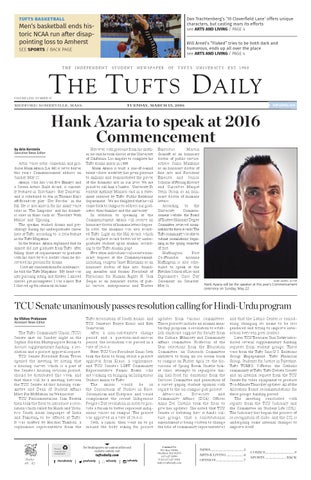
HANK AZARIA, ACTOR
Hank Azaria will be the speaker at this year’s Commencement ceremony on Sunday, May 22.
TCU Senate unanimously passes resolution calling for Hindi-Urdu program by Vibhav Prakasam Assistant News Editor
The Tufts Community Union ( TCU) Senate met on Sunday night in the Sophia Gordon Multipurpose Room to discuss supplementary funding, a resolution and a project approval request. TCU Senate President Brian Tesser opened the meeting by noting that a housing survey, which is a part of the Senate’s housing revision project, should be distributed this week, and that there will be a meeting between the TCU Senate ad-hoc housing committee and Dean of Student Affairs Mary Pat McMahon on Wednesday. TCU Parliamentarian Sam Berzok then took the floor to introduce a resolution which called for Hindi and Urdu, two South Asian languages of India and Pakistan, to be offered at Tufts. It was drafted by Hershel Tamboli, a sophomore representative from the
Please recycle this newspaper
Rainy 48 / 42
/thetuftsdaily
Tufts Association of South Asians, and TCU Senators Benya Kraus and Rati Srinivasan. After a non-substantive change period and a question-and-answer period, the resolution was passed in a vote of 29-0-0. Next, TCU Vice President Gauri Seth took the floor to bring about a project approval from Kraus, a sophomore, and TCU Senate’s LGBT Community Representative Parker Breza, who are working on bringing an Indigenous Studies minor to Tufts. The minor would be in the Consortium of Studies in Race, Colonialism and Diaspora, and would complement the recent Indigenous People’s Day resolution in order to provide a forum to better represent indigenous voices on campus. The project was approved in a vote of 29-0-0. Seth, a junior, then went on to go around the body asking for project
For breaking news, our content archive and exclusive content, visit tuftsdaily.com @tuftsdaily
tuftsdaily
tuftsdaily
updates from various committees. These projects include an alumni mentorship program, a resolution to establish childcare support for faculty from the Culture, Ethnicity and Community Affairs committee, Professor of the Year selections from the Education Committee, an Outreach Committee initiative to bring an ice cream truck to campus on Friday, April 29, the discussion of Spring Break Shuttle ticket sales, attempts to repurpose dining hall food for donations from the Services Committee and generation of a survey gaging student opinion with regard to the on-campus pub project. A f t e r w a rd , Diversity and Community Affairs (DCA) Officer Anna Del Castillo took the floor to give her updates. She noted that TCU Senate is debating how it funds culture groups, that a constitutional amendment is being written to change the title of community representatives
Contact Us P.O. Box 53018, Medford, MA 02155 617 627 3090 FAX 617 627 3910 daily@tuftsdaily.com
and that the Latino Center is considering changing its name to be less gendered and trying to improve interaction between peer leaders. Later, TCU Treasurer Shai Slotky introduced several supplementary funding requests from student groups. These were from the Tufts Sino-U.S. Relations Group Engagement, Tufts Financial Group, Students for Justice in Palestine, Tufts TURBO, S-Factor, the Catholic community at Tufts, Tufts Debate Society and an internal request from the TCU Senate for video equipment to produce Two-Minute Thursday updates. All of the Allocation Board recommendations for these groups’ funding passed. The meeting concluded with reports from the TCU Judiciary and the Committee on Student Life (CSL). The Judiciary has begun the process of re-recognition of clubs, and the CSL is undergoing some internal changes to improve itself.
NEWS............................................1 ARTS & LIVING.......................4 OPINION..................................... 7
COMICS.......................................9 SPORTS............................ BACK
2
THE TUFTS DAILY | News | Tuesday, March 15, 2016
T HE T UFTS D AILY Sarah Zheng Editor-in-Chief
EDITORIAL Nicholas Golden Mengqi Sun
tuftsdaily.com
Infectious disease physician, Tufts alumna honored at 2016 Fletcher Women’s Leadership Award Ceremony
Managing Editors Nicholas Pfosi Associate Editor Arin Kerstein Executive News Editor Isha Fahad News Editors Abby Feldman Melissa Kain Sophie Lehrenbaum Emma Steiner Ariel Barbieri-Aghib Assistant News Editors Kyle Blacklock Gil Jacobson Robert Katz Liam Knox Catherine Perloff Vibhav Prakasam Hannah Uebele John “Joe” Walsh Kendall Todd Executive Features Editor Nicole Brooks Features Editors Nina Joung Jake Taber Diane Alexander Assistant Features Editors Constantinos Angelakis Emily Cheng Emma R. Rosenthal John Gallagher Executive Arts Editor Lancy Downs Arts Editors Justin Krakoff Josh Podolsky Jonah Allon Assistant Arts Editors Cassidy Olsen Eran Sabaner Hannah Hoang Dorie Campbell Emily Karl Erin Sifre Stephen Dennison Abigail Feldman Shannon Geary Allison Merola Cassie Bardos Miranda Chavez Frances DeFreitas Jake Goldberg Emma Henderson Michael Lefkowtiz Anita Ramaswamy Noah Weinflash
Executive Op-Ed Editor Op-Ed Editor Cartoonists
Editorialists ALEX KNAPP / THE TUFTS DAILY
Leslie Puth (F11), Chair of the Fletcher Women’s Leadership Award, presents Dr. Nahid Bhadelia (J99, F05, M05) with the award on March 11. by Paige Spangenthal Contributing Writer
Maclyn Senear Executive Sports Editor Ray-Paul Biron Sports Editors Ross Dember Phillip Goldberg Alex Schroeder Chris Warren Yuan Jun Chee Assistant Sports Editors Maddie Payne Eddie Samuels Noah Smith Sofie Hecht Executive Photo Editor Alex Knapp Caroline Ambros Picture Tufts Editor Ray Bernoff Staff Photographers Laura DeArmas Maria Ferraz Henry Hintermeister Katlyn Kreie Mia Lambert Jiaxun Li Nora Nord Nicholas Pfosi Julia Press Evan Sayles Angelie Xiong
PRODUCTION Julie Doten
Production Director Astrid Weng Executive Layout Editor Jewel Castle Layout Editors Abbie Gantner Leila Li Allie Merola Brianna Mignano Mandip Pokharel Ellie Powers Annabelle Roberts Emily Sharp Andrew Stephens Sebastian Torrente Shirley Wang Petrina Chan Allison Merola Dana Pek Belinda Xian Jack Ronan Dan Strauss Meagan Adler Alison Beach Arthur Beckel Lancy Downs Alison Epstein Andrew Kager Melissa Kain Sarah Kalinowski Reena Karasin Sophie Lehrenbaum Rachel Salzberg Arielle Sigel Caroline Watson
Creative Director Executive Graphics Editor Graphics Editors
Executive Copy Editors Copy Editors
Nahid Bhadelia ( J ’99, F ’04, M ’05) was honored at the third Fletcher Women’s Leadership Award Ceremony on Friday, March 11, for her efforts as a physician during the Ebola crisis in Sierra Leone. The honor is awarded annually to an alumna of the Fletcher School of Law and Diplomacy who demonstrates leadership and makes a meaningful impact in the private, public and NGO sectors, according to the Fletcher School website. Bhadelia is currently an infectious disease physician, with a background in the field of infection control related to emerging pathogens and highly communicable infectious diseases. Bhadelia is the director of Infection Control and Medical Response at the National Emerging Infectious Diseases Laboratory at Boston University, where she is also an assistant professor at the university’s School of Medicine. During the Ebola epidemic in 2014 and 2015, Bhadelia travelled to Sierra Leone four times to treat patients and combat the crisis. When asked how she summoned the courage to fly to Sierra Leone and work as a physician during the Ebola crisis, Bhadelia replied with a quote from Hillel the Elder: “If I am only for myself, who am I? If not now, when?” In her speech at the ceremony, Bhadelia
described some of the challenges she faced in her work, such as a low health care worker-to-patient ratio. Bhadelia and five other physicians took care of over 100 patients. With such a low ratio, it was impossible for Bhadelia and her colleagues to save every patient, she said. She explained that the average Ebola patient loses 12 liters of fluids while they are sick. To replenish this loss of fluid, a health care worker needs to be by the bedside of a patient every hour of the day, she said. Another challenge that Bhadelia said she and her colleagues faced was a lack of resources and funding. To compensate for this lack of materials, the physicians cut up tarps and used them as makeshift tools like aprons. Because of insufficient funding, health care workers in Sierra Leone were barely paid during the Ebola crisis. Bhadelia thus ran a national crowd funding campaign on GoFundMe to raise awareness and funds for these health care workers. Bhadelia also utilized platforms such as GoFundMe and social media as tools to break down barriers in the international community. After she created her GoFundMe for the health care workers in Sierra Leone, the page was spread across social media websites. Eventually, Bhadelia’s cause was picked up and covered by national news outlets, which helped her raise sufficient funds, she said. Hopefully, increased awareness
about this problem will augment the pay of health care workers the next time an epidemic like Ebola breaks out, she said. Bhadelia predicted that the workers who served during the Ebola crisis will be unlikely to work during the next epidemic if they do not receive sufficient pay. Bhadelia discussed other ways in which countries can prepare and improve their response for any upcoming epidemic. According to her, it is necessary that developing countries like Sierra Leone implement health care systems that can act as safety nets and catch the first cases of epidemics and put them in isolation before they spread. It is also important to decrease the alarmism and stigma surrounding epidemics in the international community. Additionally, according to Bhadelia, the large amount of airlines that stopped flying to West Africa during the Ebola crisis made it very difficult to transport volunteers into the area to combat the epidemic. In a question and answer session after Bhadelia’s speech, she was asked how she balances her work with her life. She answered that in 2015 she spent six months in Sierra Leone and another one and a half months in quarantine and did not regret the amount of time and energy that she has put into her work, as she believed that her work is taking her life in the right direction.
Maxwell Bernstein Executive Tech Manager Nitesh Gupta Online Editor Evan Sayles Social Media Editor
BUSINESS Yiran Xu
Take the pledge at ItsOnUs.org
Executive Business Director Qinyue Yu Receivables Manager Evan Sayles Online Advertising Eva Sachar Ad Managers Jay Hayes IOU_AdCouncil_Celeb_Consent_BW_11.5x21.indd 1
9/3/15 9:52 PM
Tuesday, March 15, 2016 | News | THE TUFTS DAILY
News
Senior commencement Speaker
finAliSt AuDitionS WEDnESDAy, MArch 16, 2016 • noon, goDDArD chAPEl EAch finAliSt Will PrESEnt A 3-5 MinutE SPEEch on thE folloWing toPic: “ There must be a few times in life when you stand at a precipice of a decision. When you know there will forever be a Before and an After...I knew there would be no turning back if I designated this moment as my own Prime Meridian from which everything else would be measured.” –Justina Chen, North of Beautiful Discuss a situation, either personal or public, which represents a “Prime Meridian” for either you, for others, or for all of us. Michael Maskin, A15 Wendell Phillips Speaker 2015
2016 finAliStS: Aniket De Janna Karatas
Abuzar royesh Sharad Sagar
All are welcome to attend.
thE WEnDEll PhilliPS AWArD The Wendell Phillips Award was established in 1896 to honor Boston’s great orator and advocate for abolition and women’s and Native People’s rights. The award is given annually to a senior who demonstrates both marked ability as a speaker and a high sense of public responsibility. Selected by the Committee on Student Life, the winner is the one graduating senior invited to offer a speech as part of Commencement, and the speech takes place during the Baccalaureate Service. It is intended to deliver a social justice message for our time.
3
4 tuftsdaily.com
ARTS&LIVING TV REVIEW
Tuesday, March 15, 2016
‘House of Cards’ maintains quality in fourth season
Natalie Girshman The ABCs of Literature
by John J. Gallagher
ncountering F. Scott Fitzgerald is inevitable in the American educational system, usually in the form of “The Great Gatsby” (1925) in sophomore or junior year of high school, whichever has been designated as the year to steadily make one’s way through American literature. The class discusses the green light, most people enjoy it and Fitzgerald is promptly set aside as one of the better entries in a year of English class. Yet, however great “Gatsby” is and whatever its status as Fitzgerald’s masterpiece, there’s much more to his writing and to Fitzgerald’s charmed, doomed life than this one book. First of all, he was a master of the short story. Although the brilliance and intellectual depth varies from story to story, the stories are always entertaining and well written. Fitzgerald had a knack for crafting the world of the Jazz Age, in all its despair, decadence and unlikely hope. His short story collections from the 1920s have the power to seemingly transport the reader back decades. I’m particularly fond of both “Flappers and Philosophers” (1920) and “Tales of the Jazz Age” (1922), which include some of Fitzgerald’s best known short stories as well as some less frequently read gems. The short stories are perfect for a sampling of Fitzgerald, to see both his flaws and his strengths as a writer and to decide whether or not to go on with his other novels. Often loosely based on his real-life tumultuous marriage with Zelda Sayre and containing many autobiographical elements, Fitzgerald’s other novels force the reader to confront the realities of human frailty and ambition, usually in stunningly gorgeous prose. “The Beautiful and the Damned” (1922) tells the story of Gloria Gilbert and Anthony Patch, a leading society couple in 1920s New York, and the slow disintegration of both their lives and their marriage. It’s a wonderful glimpse into Jazz Age social circles, a sharply observed portrait of deeply flawed people and a fascinating look into Fitzgerald himself as he developed his craft. He’s not yet at the height of his powers while writing “The Beautiful and the Damned,” but his writing only seems to get more powerful as Anthony and Gloria sink further into excess and unhappiness. Perhaps the early novels can be thought of as a legend in the making, a peek into a great writer’s process of becoming great. Finally, “Tender is the Night” (1934), Fitzgerald’s last complete novel, is perhaps his most heartbreaking. It features another doomed couple, Dick and Nicole Diver, and their group of expatriate friends on the French Riviera as it goes back and forth in time to show both the beginning and end of their relationship. The prose of “Tender is the Night” is simply breathtaking, whether it’s capturing a character in a few choice paragraphs from their point of view or the complexity of these characters’ relationships with well-chosen lines of dialogue. I found it nearly impossible to make up my mind about whether or not I liked Dick and Nicole, but the novels’ ambiguity makes it all the better. If you’re looking to invest in another Fitzgerald classic, “Tender is the Night” might just be what you’re looking for.
Executive Arts Editor
Writer’s note: While we have tried to keep this review as spoiler-free as possible, if you’re determined to stay pure, we suggest that you get caught up with seasons one through three of “House of Cards” (2013 – present) before reading this review. Netflix’s flagship original series, the political drama “House of Cards,” returned for a fourth season on March 4. The show’s previous seasons chronicled the underhand ascension of ruthless politician Frank Underwood (Kevin Spacey) from Democratic House Majority whip to President of the United States and then the beginning of his time in office. At the beginning of season four, Underwood is fighting his first election against a challenge from within his own party — in 2016. “House of Cards” was always a warped lens through which audiences could view their own political reality and, as such, has never shied away from fictionalizing the issues of the day. Previous seasons have dealt with corporate money in politics, government surveillance and a thuggishly assertive Russian president. Now, “House of Cards” is tackling the cut and thrust of a presidential election, from the delegate math, to the muck raking to the back-room deal making.
DAVID GIESBRECHT VIA TRIBUNE NEWS SERVICE
Robin Wright plays Claire Underwood in season four of “House of Cards.” Season 4’s opening scene is dark. Lucas Goodwin (Sebastian Arecelus) — the tragically disgraced journalist who dared challenge the Underwoods — sits on the top bunk of a prison cell narrating an erotic fantasy as a muscular tattooed man masturbates on the bed below. After the series’s longstanding title-sequence, the action shifts to Frank Underwood (Kevin Spacey) rehearsing a speech on Air Force One. The juxtaposition of gritty, less-comfortable settings with the understated ele-
gance of the political elite’s haunts has been a core element of the series since its beginning. These stark contrasts give the audience an insight into both sides of the political coin: the glamorous lives of the Machiavellian governors and the unvarnished, hardscrabble reality of the governed. Season four continues to use this motif to great effect, with Lucas’ challenging circumstances and disheveled see HOUSE OF CARDS, page 5
MOVIE REVIEW
Despite strengths, ‘10 Cloverfield Lane’ suffers from major blind spot by Jordan Barnes Contributing Writer
“This drastic, clean-cut deprivation and our complete ignorance of what the future held in store had taken us unawares; we were unable to react against the mute appeal of presences, still so near and already so far, which haunted us daylong.” — Albert Camus, “The Plague” Albert Camus’ words, written in 1947, could be addressing both the viewers of and the characters in “10 Cloverfield Lane,” that was released on March 11. The director, Dan Trachtenberg, brings the “Cloverfield” franchise down from the large-scale war-zones of the first film to the claustrophobic apocalypse bunker of the second. The close-quarter confusion translates into a larger feeling of hysteria as the movie draws on, forcing both the characters and the audience to ask the question: “What is actually happening?” In many films, this question could betray a general confusion in the filming and writing, but such confusion only adds to the gleefully awkward thrill that pervades “10 Cloverfield Lane.” Trachtenberg masterfully uses unique characters: a cutting Ridley-esque protagonist in Michelle (Mary Elizabeth Winstead), the charming drifter Emmett (John Gallagher Jr.) and a brilliantly terrifying enigma in Howard (John Goodman) to provide a different yet satisfying take on the venerable story of extraterrestrial invasion. “10 Cloverfield Lane” is good, but it is also overwhelmingly white, which is a particular insult
PARAMOUNT VIA TRIBUNE NEWS SERVICE
John Goodman and Mary Elizabeth Winstead in “10 Cloverfield Lane.” as the movie takes place in a state and a nation that both have sordid histories with race relations. Michelle, fresh from an unexpected car collision, wakes up in a room — reminiscent of the “Saw” (2004-present) franchise’s famed cold, cramped compartments — and so does the viewer. Terrified and alone, she searches for answers for the rest of the movie. Her captor, the lonely Howard, is initially the only answer available. The legendary Goodman toys with the film’s feeling alongside the schizophrenic but no less engaging score by Bear McCreary, hopping from joy to sadness, mirth to madness. Howard is not a pervert, which
he somewhat believably proclaims, but nevertheless, he is a bona fide weirdo. He awkwardly informs Michelle of their dire predicament: that in the time between her accident and her awakening, Earth was attacked by something, the nature of which they were unaware. Howard is a menacing overseer, one whose massive size relative to the Michelle and proclivity for sudden shouting fills the bunker’s meager space with ease. The third character, Emmett, who broke his arm fighting to get into the bunker after seeing a “flash like out of the Bible,” adds another character see CLOVERFIELD, page 5
F. Scott Fitzgerald
E
Natalie Girshman is a senior majoring in history and drama. She can be reached at natalie.girshman@tufts.edu.
Tuesday, March 15, 2016 | Arts & Living | THE TUFTS DAILY
A&L
5
‘House of Cards’ season four intrigues, impresses HOUSE OF CARDS
continued from page 4 appearance immediately testifying to the power of the Underwoods. Beyond Goodwin, Frank and Claire Underwood (Robin Wright) have left a string of shattered enemies in their wake, and the pair’s flawless cooperation has long been the driving force behind the series. But the end of season three saw a dramatic fracture in the pair’s relationship that has not healed by the beginning of season four. Season four’s opening sees Frank and Claire working against each other, each using their considerable political savvy in cloak-and-dagger attempts to undermine the other. To see
the House of Underwood divided against itself is a welcome twist on one of the series’ constants and keeps the new season from feeling stale. The pedigree of the cast has always been one of the show’s strongest points and the acting is as strong as ever. Kevin Spacey still exudes the same menacing air and polished, gravely gravitas that defines Frank Underwood, but the character’s newly grey hair lends him a haggard aspect that shows that, even for a man as ruthless as Frank, the presidency takes its toll. Robin Wright is outstanding as Claire Underwood, bringing an effortless poise to a relentless and driven character that would seem merely cold in the
hands of a lesser actor. The supporting cast also does a wonderful job fleshing out the world of Washington. Michael Kelly’s Doug Stamper is particularly good, moving like a chameleon between off-puttingly polished manners and unrestrained, dead-eyed violence. Along with the stellar acting, the show’s presentation is on point. Jeff Beal’s soundtrack has always provided the series an understated, yet atmospheric aural foundation and Beal’s trademark walking baseline, far off horns and pensive strings still subtly complement whatever action is unfolding on the screen. Along with its characteristic soundscape, visually, “House of Cards” has
maintained its characteristic lighting and liberal use of depth of field, both of which serve to keep the focus squarely on the character (or characters) doing the talking. Season four of “House of Cards” provides a narrative of tightly woven political intrigues filled with unexpected twists and turns, none of which feel egregious but instead keep the pace high from episode to episode. Producing four seasons of quality drama is no mean feat, but “House of Cards” has managed to craft a compelling narrative for the fourth time running. Whether parceled out week-to-week or devoured in a day-long binge, season four of “House of Cards” is a must see.
‘10 Cloverfield Lane’ offers compelling narrative, but fails to include actors of color CLOVERFIELD
continued from page 4 and another dimension to the action. Howard, Michelle and Emmett wade through this movie, and Trachtenberg takes them on a journey. Although the end of the movie is both intriguing and satisfying, the process of getting there pushes the characters and the viewer toward an eerily cheerful insanity. The antique jukebox and the shelves of food make this feel like a nuclear bunker, complete with moments of woe and anguish
juxtaposed with the thrill and horror of a humanity-ending apocalypse. The three characters intermingle clunkily and sometimes hilariously, taking a hiatus from the end of the world and a going on a sojourn into the world of family fun. The movie works as a slow-moving exhibition of stunning writing by Josh Campbell, Matt Stuecken and Damien Chazelle, for which Rod Serling could be proud. Indeed, “10 Cloverfield Lane” works more like an elongated episode of “The Twilight Zone” (1959 -1964)
than a sequel to a low-budget found footage experiment (the original 2008 film “Cloverfield”), bringing the viewer ever-closer to the immeasurable power of the unknown, clawing at the natural human desire to understand and elucidating the terror of the implausible. This begs the question: Where are the people of color? Louisiana, where the film is staged, is comprised of 32.5 percent Black Americans as of July 1, 2014. Proportionally and logically, one of the movie’s three main characters could be
Black. Nevertheless, when will Hollywood finally realize that Black folk and all people of color exist and can be represented in film, even those that deal in the fictitious? This film, though excellently produced and well acted, is afflicted by the endemic disease that afflicts all of Hollywood: racism. Each film that refuses to acknowledge the existence and complexity of people of color reenacts the grand plunder of both land and life enacted by the colonizers and slaveholders of old on a smaller yet significant scale.
TV REVIEW
‘Flaked’ gets cold feet , squanders potential by Jonah Allon
Assistant Arts Editor
Put it this way — if Starbucks decided that it was going to discontinue its longstanding practice of playing mellow, atmospheric indie music and start screening a TV show instead, that show would look a lot like “Flaked” (2016). Netflix’s most recent release has all the hallmarks of warm indie pop: it’s sun-dappled, listless, offensively mediocre and indistinguishable from its legion of imitators. “Flaked,” in fact, is an apt title for Will Arnett’s first foray into TV writing, which he undertook with collaborator Mark Chappell. Not only because his main character, first introduced to the viewer as a recovering alcoholic trying to put his life back together after a devastating accident, is a commitment-phobe, but also because the show has trouble sticking to one genre. “Flaked” is by turns a light comedy, a solitary man’s quest to find himself on the gentrified streets of Venice Beach and a dark melodrama that relies on a plot device so absurd your eyes will do a full revolution in their sockets. “Flaked” gradually becomes an ironic meta-commentary on itself, in the style of Macklemore’s recent album, “This Unruly Mess I’ve Made” (2016). In broad strokes, the show centers on Chip (played by Arnett), a man whose social life revolves around the Alcoholics Anonymous (AA) meetings he regularly attends. He is on the cusp of finalizing his divorce with his ex-wife, Tilly (Heather Graham), though some last-minute details need to be worked out — the most important one being the fate of the building where he lives and has his furniture store, which is owned by Tilly’s father. Chip once had a promising career as a stool-maker, even nabbing an “Honorable Mention” at the SoCal Design Awards of 2008 for his three-legged innovation. Now, evidently, he has given up those dreams for chasing women with his buddy and fellow AA member, Dennis (David Sullivan). When a new arrival to Venice Beach, a young
waitress named London (Ruth Kearney), crosses their path, all bets are off. What is mystifying is why. Despite a stated interest in Frida Kahlo, London has the personality of a cardboard cutout. In one painful dialogue with Chip, she actually utters the lines, without any hint of irony: “How do you wake up every day? Do things, exist, live, laugh? How do you do anything?” Apparently this pseudo-profundity is enough to entice Chip and Dennis, but whatever they see in her that makes them fawn — according to them, “she just has something,” which totally clears that up — is woefully absent to the viewer. This gets to a larger point about “Flaked” and its shortcomings. None of the relationships between the characters make any sense. Chip, for instance, makes no bones about the fact that he is interested in London, even though Dennis has called dibs (the masculine entitlement on this show, by the way, puts “Entourage” (2004 – 2011) to shame). Chip even goes so far as to invite London to rent out a little studio space he owns above the furniture store, which seems like a clear violation of the bro code. Still, he and Dennis remain great friends because they are “bros.” Even more baffling is a scene between Dennis and his mother (played by Kirstie Alley, for whatever reason) at a spa getaway, where a raunchy exchange in a hot spring overshoots comedy and lands in borderline-incestuous terrain (“You always had a hard time accepting the fact that I had needs,” she says to Dennis). And these instances are no anomalies. All the writing evinces an adolescent, even puerile understanding of human relationships. If one were being generous, this laziness could be chalked up to the emotionally stunted nature of characters who have relied for much of their adult lives on alcohol as a coping mechanism. Chip makes a winking gesture at this when he says to Dennis, “You are an emotionally developed, aware, 42-year old man.” Contained in this line is the germ of a much more fascinating, nuanced portrait about the
ANTHONY BEHAR VIA TRIBUNE NEWS SERVICE
Will Arnett, who plays Chip in the new Netflix Series “Flaked,” arrives at the 2016 Vanity Fair Oscar Party on Feb. 28. travails of recovery in middle age. But the show has no interest in pursuing that. Instead, the viewer gets incessantly mundane conversations about “chicks” and tepid send-ups of gentrification culture. Apparently for Arnett and Chappell, “kombucha” is a word that only gets funnier with each additional use.
As “Flaked” veers into dramatic territory, it really goes off the rails, devolving into a cornucopia of tired cliches and a plotline that strains credulity. At one point in an early episode, Chip’s whimsical friend Cooler (George Basil) says to him, “You’ve got a serious platitude problem.” It would be prudent advice for the show to heed.
6
THE TUFTS DAILY | Arts & Living | Tuesday, March 15, 2016
tuftsdaily.com
Opinion
Tuesday, March 15, 2016
EDITORIAL
Letter from the Editor To members of the Tufts community, On Mar. 11, the Tufts Daily published the news article “At least four sexual misconduct cases occur in uphill dorms over one weekend.” The story detailed four different incidents that had allegedly occurred in on-campus dorms within residential Area 1 and Area 2 regions of the university. Following the publication of this story, various Daily editors and I reexamined the story that was published on Friday and the process by which our reporting was conducted, and found that there were instances where the reporting within the story was inaccurate or misrepresentative of the reality of the incidents that occurred. First and foremost, the way that the multiple incidents were framed in the story make them appear as if they were all linked and indicative of a pattern. The intention of the story was to outline that the incidents all occurred within the same weekend, but we operated under the false and unconfirmed assumption that the incidents were perpetrated by the same person. The Daily also made the choice to publish the name of the residence hall where the sexual assault incident took place, information that we learned in the process of speaking with various RAs and on-campus student residents. In retrospect, we realize that the publication of the name of the residence hall where the alleged assault took place and the combination of a map graphic could be harmful to the victim of the assault, who had requested that the university maintain confidentiality of their identity from the community. The Daily in no way meant to narrow down the identity of a student who had experienced assault and create an environment where other victims or survivors would feel unsafe to report information to the administration out of a fear that their identity could be revealed. Additionally, we regret that we did not include a trigger warning at the beginning of this story in order to take into consideration the feelings of those who have previously experienced sexual assault or other types of sexual misconduct. Another major problem with the published story was the mischaracterization of all the incidents that occurred within uphill residential dormitories as cases of sexual misconduct. According to the Tufts OEO website, sexual misconduct is defined as “a form of discrimination based on sex or gender that violates federal Title IX regulations and is prohibited by Tufts policy,” which includes actions such as “stalking, sexual exploitation, sexual assault, sexual harassment, sex discrimination and relationship vio-
lence.” The sexual assault reported in a Feb. 26 email to the Tufts community by TUPD does fall under the definition of sexual misconduct. However, the two incidents that were described to have taken place in Miller Hall, where an unknown person “put their arm into an occupied shower stall” — according to an email by Tanya Mascary, the area residence director of Area 1 — do not technically constitute sexual misconduct. Since the incidents are still under investigation, and the full details have not yet become clear, it was not accurate to imply that the incidents were of a sexual nature or to categorize them as sexual misconduct. Another part of the story that should have been further investigated before being published is the fourth incident that was referenced by an anonymous resident assistant (RA) from Area 1, who told the Daily that they reported hearing from Mascary that an incident occurred in Carmichael Hall. The nature of the incident was not revealed and neither Mascary nor Mohamed Barakat, the area residence director of Area 2, were able to confirm that the Carmichael incident happened. There should have been greater care taken to fact-check this fourth incident, and in the future, information that is only confirmed by one secondary source require further substantiation before they are published in the paper as a fact. Consequently, the part of the story stating that McMahon was unaware of the two incidents not described in emails to students is inaccurate. McMahon was actually aware of the two incidents in Miller Hall and the sexual assault incident. The Daily was also alerted to the fact that a few of the sources we spoke to reported not understanding that they were speaking to the campus paper on the record. While we are confused about how this happened when all sources were informed that they were speaking to Daily reporters, and only one source interviewed was not recorded, we find these reports alarming, and we hope to continuously reinforce that sources speaking to Daily reporters are on the record unless they specify that information is off the record in future interviews. While everything in the story was attributed, we realize that in the reporting process of this story, we prioritized informing the community about the various incidents — which we found to be concerning for the safety of the Tufts community — over the absolute accuracy of all information in the story. Additionally, while we know that there was at least one instance where Daily reporters should have connected with sources, such as members of TUPD,
earlier, some of our reporting was hindered by email-only communication or sources who were discouraged from speaking with the Daily. I take full responsibility for the flaws in the reporting and fact-checking process of this story, and hope that the Daily can take this as a learning opportunity to be more vigilant about the accuracy of our stories and the implications of what we publish. We will be retracing the full reporting process of this story to find the areas that were problematic and learn from those mistakes. Ultimately, however, the bulk of the story was accurate and important for the Daily to report — we value the safety of the community above all else, which is why we decided to report on the incidents to begin with. Without transparency about these various incidents, residents of on-campus dorms will not understand the extent to which they need to take steps to protect themselves. However, the focus of our story was not about the nature of the incidents, but about the perceived lack of communication between ARDs and RAs about the incidents, the disparity in this communication across residential areas and the increase in TUPD presence around uphill residences following these incidents. Many RAs we spoke to throughout the course of this story were ignorant about these incidents outside of the two that were emailed out, and many did not report any type of communication from their ARDs about the incidents or how they should be communicating with their residents. We hope that like the Daily strives to be, the university will also be transparent about what is happening on campus and will continue to maintain dialogue with the Daily and students, so that everyone is informed about anything that could be pertinent to the safety of the community. We hope that administrators will continue to be forthcoming in whatever capacity they can to Daily reporters, so that accurate information can be disseminated, and there won’t be mischaracterizations or misrepresentations of what is occurring on campus. Reporting on a community that we occupy is always difficult because we as student journalists are stakeholders in the stories that we are publishing. Above all, we strive for accuracy, transparency and helping, not harming, everyone in the Tufts community. Please reach out to me at daily@tuftsdaily.com if you have any questions or concerns about the reporting of this story. Sincerely, Sarah Zheng Editor in Chief
The Tufts Daily is a nonprofit, independent newspaper, published Monday through Friday during the academic year, and distributed free to the Tufts community. The content of letters, advertisements, signed columns, cartoons and graphics does not necessarily reflect the opinion of The Tufts Daily editorial board. EDITORIALS Editorials represent the position of The Tufts Daily. Individual editors are not necessarily responsible for, or in agreement with, the policies and editorials of The Tufts Daily. OP-EDS The Op-Ed section of The Tufts Daily, an open forum for campus editorial commentary, is printed Monday through Thursday. The Daily welcomes submissions from all members of the Tufts community; the opinions expressed in the Op-Ed section do not necessarily represent the opinions of the Daily itself. Opinion articles on campus, national and international issues should be 600 to 1,200 words in length and submitted to oped@tuftsdaily.com. The editors reserve the right to edit letters for clarity, space and length. All material is subject to editorial discretion and is not guaranteed to appear in the Daily. Authors must submit their telephone numbers and day-of availability for editing questions. ADVERTISING All advertising copy is subject to the approval of the Editor-in-Chief, Executive Board and Executive Business Director.
7 tuftsdaily.com
Luke Sherman Earth On Fire
A Supreme vacancy
A
mid the intense media attention paid to the shocking death of Supreme Court Justice Antonin Scalia, a legal development of great importance failed to generate much public discussion. On Feb. 9, just four days before Justice Scalia died, the Supreme Court ruled in a 5-4 decision to temporarily block the implementation of President Barack Obama’s signature environmental initiative, the Clean Power Plan (CPP). The ruling may well determine the viability of international agreements on climate change. First, some background: in 2007, the Supreme Court ruled in Massachusetts v. Environmental Protection Agency that the federal government had a legal obligation per the Clean Air Act to regulate greenhouse gas (GHG) emissions. Shortly after taking office in 2009, President Obama sought to push through Congress legislation that would have established a national cap on carbon pollution. The effort failed, however, as lawmakers worried about the impact the bill would have on the tepid economic recovery. In the 2010 midterm elections, Republicans, pledging to block any similar efforts, took control of the House of Representatives and have kept it ever since. Faced with enormous intransigence on Capitol Hill, in 2014, President Obama ordered the Environmental Protection Agency (EPA) to promulgate new regulations that would substantially reduce the electric power sector’s emissions of GHGs. By showing the international community that the United States had begun to take climate change seriously, the directive reinvigorated international efforts on global warming. Analysts argued that the CPP helped catalyze the development of the historic accord reached in Paris last December. Because Justice Scalia provided one of the five votes ruling to block the CPP’s implementation, the next member of the court will likely determine the directive’s fate. All four justices who joined the court during Democratic administrations opposed the decision; the five appointed by Republican presidents voted to halt the plan. As climate change remains an intensely partisan issue, it is imperative that voters elect either Senator Bernie Sanders of Vermont or former Secretary of State Hillary Clinton, both Democrats, as the next president. Each candidate has pledged to support the CPP and other domestic initiatives that would mitigate climate change. The leading candidates for the Republican presidential nomination do not share the same view, however. In January, Senator Ted Cruz of Texas called EPA administrators “zealots who are anti-development. They hate anything that is developing; anything that is creating jobs… We need a president who will take on the EPA.” In an interview with host Chris Wallace on Fox News Sunday last October, Donald Trump asserted: “Environmental Protection [Agency], what they do is a disgrace. Every week they come out with new regulations.” The GOP will not change its position on climate change any time soon, so the executive branch remains the only way the United States can address this issue. Because a hostile court will eviscerate federal regulations on global warming, we must ensure that the next president we elect will appoint justices sympathetic to the constitutionality of environmental regulations. Luke Sherman is a senior majoring in Environmental Studies. He can be reached at Luke.Sherman@tufts.edu.
8
THE TUFTS DAILY | Opinion | Tuesday, March 15, 2016
tuftsdaily.com
OP-ED
ASAP letter misguided in criticizing administration by Reece Wallace On March 7, the Daily published an open letter by Action for Sexual Assault Prevention roundly criticizing three Tufts administrators for circulating an email addressing recent drink spiking incidents. ASAP members “were appalled by the email.” Their letter alleges a serious abdication of leadership by the administrators who sent it, so I think ASAP’s claims deserve some close inspection. According to the author, the message “perpetuates the deeply problematic and hurtful action of victim blaming” in a myriad of ways. A more sensitive email in the author’s mind would have included a reminder that “it is wrong to put drugs in someone else’s drink.” Although I suspect most Tufts students, including those who may be spiking drinks, can intuit this, the administrators’ email does in fact let readers know that “Spiking or drugging a drink is a crime, regardless of intent.” If Tufts’ opposition to drink spiking is not
clear, its policy on committing felony criminal offense is less ambiguous. In any case, this seems a far cry from victim blaming. Apparently, the real mistake the email made was to suggest bystander intervention and the buddy system among other precautionary measures. According to ASAP, these recommendations are “culturally harmful” and “cannot and will not stop people from spiking drinks in the future.” The latter is a fair point; it is a regrettable truth that precaution on all our parts does not prevent criminal behavior and that there will probably never come a day when people stop committing truly awful violations like drink spiking. What I’m not sure of is whether establishing “a community standard where individuals understand that this is a crime…and do not feel entitled to spike each other’s drinks” either correctly identifies underlying criminal motivations or tangibly addresses immediate needs for students’ bodily security. Until investigation sheds more light on the crimes alluded to in
the email, I would expect the administration to offer students advice on reducing personal risk in the meantime. For ASAP to denounce calls for basic precaution as doing a cultural damage is not empowering; it is the opposite. Especially after condemning the suggestion of common-sense practices that help women and men stay safe every day, ASAP’s vague policy prescription rings hollow. ASAP’s open letter continues with a factual misstatement regarding the content of the administration’s email, accusing its three authors of offering “no resources for survivors.” A quick glance at this email will prove otherwise; in fact, a prominent blue box contains an embedded link to detailed information from Tufts’ Center for Awareness, Resources and Education on the crime of drink spiking and the multiple support options available to students. These resources include anonymous reporting services and confidential support staff. Another box directs users to an anonymous reporting form. Given
the message’s multiple avenues to information access, claims by ASAP that the email demonstrates a “lack of transparent support for survivors [that] perpetuates a norm of shame and silencing” are as bewildering as they are misleading. I agree with ASAP that victims of drink spiking or of any crime are never to blame for the awful misfortune that befalls them. I agree with ASAP that any uptick in drink spiking or sexual assault must be thoroughly investigated and comprehensively addressed by our administrators. I applaud ASAP’s mission, but worry about the consequences of the rape culture discourse that leads student advocates to call for the silencing of information on basic preventive measures and to mischaracterize well-intentioned and well-executed university communication pertinent to student safety as a misogynistic, victim blaming, counterproductive failure. Reece Wallace is a first-year student who has not yet declared a major. He can be reached at reecewallace19@gmail.com.
OP-ED
Response to a letter by ASAP on drink spiking by Patricia O'Connor Dear ASAP, In your response to the Tufts email on Drink Spiking, which was published in the Tufts Daily on March 7, you stated that you were “appalled by the email” and called it “harmful” and “unproductive.” While you geared up to throw a tantrum, I think you missed the point. Yes, drink spiking is an important problem. Yes, the perpetrators are the ones who need to be punished. Yes, there should be support for survivors. These are not trivial issues, and the email addressed all of those things. First, the email alerted all members of the Tufts community to the fact that drink spiking is not only a problem, but it’s a problem that’s happening here. That alone facilitates conversation, which can lead to the culture of high community standards that you desire. The knowledge that Tufts is taking these cases seriously and investigating them could also help encourage a victim to come forward. That can
aid the investigation and help catch the perpetrators, who can then be held responsible, which is one of your goals as an organization. Additionally, I personally was unaware that drink spiking was a widespread issue on our campus, but I am glad that I have that knowledge: Now I am empowered to protect myself. As a side note, this email did more to tell me about the problem than your website did. As of March 10, the “Does it happen here?” page on tuftsasap.org greets viewers with four words: “does,” “it,” “happen” and “here.” Second, you stated that “[b]y not explicitly condemning perpetrators, [the administration has] named these behaviors acceptable in an email to the entire Tufts community.” This accusation is, quite frankly, absurd. The email specifically states that “[s]piking or drugging a drink is illegal, regardless of intent” and “[w]e are currently investigating these incidents.” It also includes a link for contacting TUPD. Anyone who was accepted to this university should be able to make the deduction that Tufts does not condone this behavior.
Furthermore, you request that Tufts “explicitly state that perpetrators must stop.” That verbal slap on the wrist isn’t going to stop anyone. Third, your claim that the email “offered no resources for survivors of the drink spiking incidents” is objectively false. The email included a link to information about drink spiking from the Center for Awareness, Resources, and Education (C.A.R.E.) as well as a link to EthicsPoint, a system for anonymous reporting. It also had links for contacting TUPD, the Office for Equal Opportunity and the Dean of Student Affairs office. For the record, I did contact someone from the OEO regarding this email. She responded within about five minutes and this was outside of business hours. The resources are there and the people are willing to listen. I would also like to point out that on the “Resources for Survivors” page of your website, tuftsasap.org, you list only the C.A.R.E. website as a resource. If that’s good enough for your site, why isn’t that (and more) good enough for this email?
EDITORIAL CARTOON BY ABIGAIL FELDMAN
Finally, when you are finished throwing your tantrum about the drink spiking email, please think about this: Who are you going to complain to after you graduate? In the real world, there is no Tufts administration at which you can throw a fit. And in the real world, we’re going to have to watch our own backs. Should that be the culture? No. And, just to be clear, am I endorsing that culture by stating its existence? No. But while the idyllic community that you describe, in which individuals will not commit a crime simply by knowing that is one, doesn’t exist, it’s not a bad thing for Tufts to make us aware of the situation and recommend that we take precautions. Sincerely, A student who was appalled by your response and found it harmful and unproductive Patricia O’Connor is a senior majoring in electrical engineering. She can be reached at patricia.o_connor@tufts.edu.
Tuesday, March 15, 2016 | Comics | THE TUFTS DAILY
tuftsdaily.com
Comics
LATE NIGHT AT THE DAILY Jack: “For those two years I’ll be employed as a sugar baby.”
Comics
SUDOKU
JUMBLE
Difficulty Level: Sleeping through the first half of spring break.
Monday’s Solution
NON SEQUITUR BY WILEY MILLER
CROSSWORD
Monday’s Solution
9
10
THE TUFTS DAILY | Sports | Tuesday, March 15, 2016
tuftsdaily.com
CAROLINE AMBROS / THE TUFTS DAILY ARCHIVE
Tufts Women’s Swimming and Diving compete against Wellesley College on Jan. 21, 2015.
Jumbos in prime position to score big points at NCAAs SWIMMING AND DIVING
continued from back result, recent training has been different from during height of the competitive season. “We’ve been training so hard all season and we’ve gotten to our peak physical condition — we have great fitness — there’s not really enough time between the NESCAC meet and the NCAAs to really increase our fitness levels at all,” said Gottschalk. “Instead of focusing on getting into better shape, we’ve been focusing on some of the more technical aspects of our races.” Winget will travel to his third consecutive NCAA Championship and has been invited to take part in the 100yard backstroke and the 200-yard backstroke in which he is seeded eighth and third, respectively. At last year’s NCAAs, Winget came away with fifth in the 100-yard back and 14th in the 200-yard back, earning him his third All-American award and a new school record in the 100. Last year’s 100-yard back title was taken by Williams College junior Benjamin Lin, who recently defeated Winget at the NESCAC Championships by 0.59 seconds. However, in the 200-yard back at the NESCAC Championships, both Winget and Bowen beat Lin. Bowen — the NESCAC Rookie of the Year — will be competing in the 100-yard backstroke, 200-yard back
and 100-yard fly. He took home his first conference title from the NESCAC Championships in the 100-yard fly with his time of 48.92, which would have placed him only four milliseconds off of last year’s eighth place. In the 100-yard back, he is seeded 15th with a seed time of 49.55, and he is seeded fourth — just behind Winget — in the 200-yard back. Ahead of this meet, Bowen has been working specifically on hand-positioning in his fly event as well as pacing himself for the 100-yard backstroke. DeBenedetto, who has been invited to swim in the 200-yard fly, will be taking part in his first ever NCAA Championship. DeBenedetto qualified with a time of 1:49.99 to tie for the 14th seed. He will also swim in the 100-fly and 100-back events. “I was so excited because I thought that I was going to be ending my whole career on Sunday [Feb. 21], and then I found out that I had an opportunity to swim again and to keep going for another month,” said DeBenedetto. “I’m still feeling that shock that I’m still going.” Three-time NESCAC champion and two-time All-American diver Rohrer will be attending his third consecutive NCAA Championship. At the NCAA Zone Diving Qualifications he earned 499.0 points for 11 dives in the three-meter, making him the top seed from New England for this week’s com-
petition. Rohrer is seeded 10th nationally in the three-meter. He also placed second in the one-meter competition at the NCAA Regionals, narrowly missing out on sweeping both events, putting him in prime position to finish in the top eight in that competition as well. Last year, Rohrer finished sixth in the three-meter competition and eighth in the one-meter competition to earn AllAmerican honors in both. Rohrer will perform 11 dives at the meet. Five are “voluntary” dives which are simpler, and the other six are more complicated dives such as twist dives. With only one opponent who placed above Rohrer in the three-meter dive last year returning for this year’s national championships, he is in good shape to improve upon his success from last year. “I’m most excited to compete with my twisting dives,” said Rohrer. “At my meets with twisting dives tend to stay really consistent, more so than the other dives. It’s always nice to end with those dives because it means I’m wrapping up on a good note.” Tufts swimming and diving — especially the women’s program — has come a long way from previous years, sending a total of six athletes between the two teams when in past years only two to three have taken part. This marked improvement was seen during the NESCAC Championships, when the
men’s team placed second for the first time in five years. “Our team camaraderie has really taken off this year in such a way that as my senior class this year has been striving toward it since our freshman year,” said DeBenedetto. “But this year has really been one that we’ve seen people really invest in other people’s races, and other people’s practice strategies. Having your team be as invested in you as you are in your team has been really powerful in getting people motivated and getting people to swim fast.” Head coach Adam Hoyt oversaw both the men’s and women’s teams this year. With only these six students remaining in season, training has become more efficient and more focused on the specifics needs of these individuals. “Maintaining their fitness level has been key, and maintaining their strength has been key,” said Hoyt. “And then trying to do the little things better – being sharper on our turns, trying to be sharper on our underwater kicking, trying to be sharper on our breakouts from underwater kicking to swimming transitions.” The Jumbos hope to bolster the reputation of Tufts swimming and diving, as the men look to improve last year’s national rank of 23rd place in Div. III while the women look to put Tufts back in the national spotlight. The action kicks off tomorrow and concludes on Saturday.
Want to get campus news the moment it happens? Follow us on Twitter and Facebook! /thetuftsdaily @tuftsdaily
/tuftsdaily /tuftsdaily
Tuesday, March 15, 2016 | Sports | THE TUFTS DAILY
Sports
A decade later, Amherst again ends Tufts' deepest NCAA run in program history MEN'S BASKETBALL
continued from back leading going into the half. With the Jumbos ahead, the Wildcats continued to play their full-court press defense. Johnson and Wales immediately pressured junior guard Tarik Smith, who most commonly takes the inbounding pass, in the backcourt. Smith frequently made the Wildcats pay for their press, looking for quick passes up court to teammates that often resulted in fast points for the Jumbos. “Growing up in New York, I played against full-court press a lot,” Smith said. “It didn’t really bother me too much. There were some spots where I knew I could take advantage of the press.” The Jumbos grew their lead to 15 points with eight minutes left in the contest, and that lead carried them to the Elite Eight. As the fan noise of a Cousens packed with Tufts students and alumni turned into a roar, the hosts maintained a double-digit lead for the final six minutes and coasted to the program’s first-ever NCAA Sectionals win. “Once we broke the press in the middle there, getting the three-on-two, we just made plays,” senior Ryan Spadaford said. “Down the stretch that’s what we were able to do. We didn’t really have that many turnovers, so I think we handled [Johnson and Wales] pretty well.” Both senior tri-captain guard Stephen Haladyna and Smith put up career highs in points in the contest, with 30 and 25 points respectively. Junior tri-captain Tom Palleschi notched 16 points to go along with seven blocks in the game. Palleschi was a defensive force for the Jumbos throughout their NCAA run. The 6 ft. 8 in. center averaged 3.90 blocked shots per game this season, second best in Div. III men’s basketball, and his blocking prowess was on display in the postseason with 22 blocks over the team’s four NCAA games. Buoyed by momentum and home court advantage, Tufts moved on to its firstever Elite Eight matchup in a dramatic showdown with conference rival Amherst, undoubtedly the most familiar team for Tufts in the entire NCAA field. Amherst was also the team that ended Tufts’ previous best run in the NCAA tournament in
2006 when it defeated Tufts in overtime in the program’s first Sweet 16 matchup. The two teams had faced off twice prior to Saturday. The Jumbos beat the former Lord Jeffs 84-73 on Feb. 6 in an impressive showing at Cousens during the regular season, but the Purple and White were able to stay ahead of the Jumbos in the NESCAC tournament semifinals on Feb. 27 to take an 86-83 win. Amherst came into Saturday night’s contest coming off a win over the No.16 Babson in its Sweet 16 matchup Friday night, and the stage was set for the continuation of a fierce rivalry as it was the third meeting of Tufts and Amherst in just over a month. In an unfortunate end to the program’s furthest NCAA run in its history, Amherst stayed hot in the final minutes of Saturday night’s game while Tufts tired out, resulting in an 86-73 final score. “We knew everything about them, tendencies and scouting,” Spadaford said. “We definitely had energy, but I think we did run out of steam in the last 10 minutes. Friday’s game was [played at] such a high pace. Everyone’s bodies were extremely exhausted. [Amherst] just ended up getting the better of the runs at the end.” The Jumbos fell behind early and remained in a hole throughout the first half. Amherst led by as much as 12 in the half, but the lead shrank to five by halftime as the hosts clawed their way back into the game to make it 40-35. Tufts came out of the locker room fired up and closed the gap in the first few minutes of the second half, going up 49-48 at the 14:58 mark on a three from sophomore guard Ben Engvall, who has been one of the team’s young players to step up in the tournament in place of Pace. The Jumbos continued to pour in buckets with the visitors responding to create a back-and-forth, adrenalinepumping thriller of a second half. Tufts managed to jump ahead by more than one possession as the team built a 62-55 lead with 11:15 remaining. But Amherst’s strong shooters, who seemed to rarely miss even the tough shots as they made an impressive 47 percent of their field goals, did not allow Tufts to maintain that lead. After trading leads for most of the last
10 minutes, the Jumbos eventually knotted up the score at 73 apiece as Palleschi sunk a three with 3:58 remaining. But the game quickly unraveled from there for Tufts as Amherst’s offense exploded and it ran out of steam. The Purple and White scored 12 unanswered points as the Jumbos could not manage to make a basket in the final 3:58 as panic seemed to set in. The Jumbos went for hurried shots and layups in traffic that they could not execute. The visitors went on to claim the 86-73 win and a spot in the Final Four to deflate the enthusiasm of most of the 1,350 fans that packed Cousens Gym — most of whom were supporting Tufts. The Jumbos were undeniably led by strong play from their captains in the game and throughout their NCAA run, as Haladyna and Palleschi both put up 20 points to lead the team in scoring on Saturday, both hitting 1,000 career points in the past few weeks. Spadaford showed his ferocity under the net on the defensive end, pulling down 11 boards in his final collegiate game. “It’s great to end on such a high note,” Spadaford said. “I couldn’t ask for a better senior year than to make the Elite Eight with this team and to play at home, in front of our crowd for the last four games.” The loss marks the end of the Jumbos’ season, though it has undoubtedly been one of the most successful seasons in program history. The Jumbos went 7-3 in the NESCAC and 23-7 overall while making it to the Elite Eight for the first time. Accompanied by the women’s team reaching its third straight NCAA Final Four this weekend, the success of the men’s team has also spurred a seemingly new interest in Tufts athletics. While Tufts’ home games have featured more fans of the visiting team than Tufts fans much more often than they should, the play of the men’s basketball team attracted some of the largest crowds the Cousens Gym has ever seen, including a particularly enthusiastic and loud student section of “Cousens Crazies.” This, according to the team, was a major factor in their NCAA success. After a strong season, the Jumbos are in a good position to build on their young talent and ride this season’s momentum to the top of the NESCAC next year.
LAURA DE ARMAS / THE TUFTS DAILY
Tufts guard Tarik Smith (LA’17) drives the ball down the court in the NCAA quarter finals game against Amherst on March 12.
11
Nicole Brooks Jersey Over Apron
Why Tufts?
“W
hy Tufts?” That essay prompt is what brought me to Medford/Somerville. It’s the prompt that countless current members of the Class of 2016 had to answer through the Common App to seal our deal into Tufts. Even though I’ve been asked that several times I’ve never really had a concise answer. My response usually covered the academics, proximity to Boston, our uncanny and unique mascot, the amazing people and of course, the dopeness that is Dewick. But what’s always been central to my Tufts experience is being a part of Tufts Athletics. As a member of Tufts women’s basketball, I’ve been blessed to be a part of a dedicated group of individuals and extended family for all my four years here. Playing basketball at Tufts has brought me memories that I will never forget. Whether that be Liz Moynihan’s buzzer beater a few years ago in a packed Cousens Gym, winning some NESCAC championships or reaching the NCAA Div. III Final Four three years in a row, you could say we’ve been pretty fortunate. But with all of those accomplishments, there are a few things behind the scenes that people don’t see. Whether it be the off-season workouts, sweaty indoor pickup games on slippery courts, getting treatment from our trainer and savior “Pat” or after getting it in the weight room with our strength coaches Dan and Alex, there is an unbelievable level of commitment and work that goes into each season. This is true with all other Tufts sports. The amount of dedication that all Tufts athletes put in prior to and during each season is remarkable. This includes not being able to take certain classes within practice times, having shortened breaks or missing them completely, spending countless hours on long bus rides and lastly but not least missing a few Zeta weekend dance parties. But Tufts’ fan appreciation doesn’t seem to match all this dedication from student athletes. Tufts Athletics has recently been incredibly successful, whether it be the dominating forces that are Tufts women’s softball and men’s lacrosse or the emergence of Tufts football. Tufts has emerged as a powerhouse, not only in NESCAC sports but also nationally within NCAA Div. III. As an athlete I have to admit that I am biased. However, when I see few student fans at a softball game for a program that has won three consecutive national championships or when visiting teams bring more fans into Cousens Gym for volleyball and basketball games, I’m pretty devastated. Where is the disconnect? While in Scranton this past weekend I was extremely excited to see the number of Cousens Crazies that packed the gym to experience Tufts men’s basketball’s historic run in the NCAA tournament. Their run has seemingly ignited Tufts students and community support and it reminded me how we’re all “One Tufts.” Although some teams seem to get more attention than others, I urge all students to go out and enjoy a game. I hope that that this spring retired Cousens Crazies can make their way out to Bello Field, Ellis Oval, the tennis courts, etc., to support fellow Jumbos. Let’s keep the ball rolling. Nicole Brooks is a senior majoring in history and minoring in communications and media studies and can be reached at nicole.brooks@tufts.edu.
12 tuftsdaily.com
Sports
Tuesday, March 15, 2016
MEN'S BASKETBALL
Men’s basketball surges to first-ever Elite Eight matchup but falls to Amherst by Eddie Samuels
Assistant Sports Editor
Tufts men’s basketball ended a historic NCAA run Saturday night with a tough loss to NESCAC rival Amherst in an Elite Eight matchup at Cousens Gym. With a pair of close wins to open the NCAA tournament last weekend in the first NCAA games the men’s team has ever hosted at Cousens, the Jumbos made it to the Sweet 16 and were selected to host
an NCAA Sectional for the first time in the program’s history. Tufts squared off against No.12 Johnson and Wales on Friday, ready to leave its mark on the postseason. Despite the game being close in the first half, Tufts claimed a decisive 101-85 win to move on to face No.15 the Amherst Lord Jeffs Saturday. Although the game remained tight throughout as both teams commanded the lead at different points, the Lord Jeffs pulled away in the final min-
utes for the 86-73 victory. With news of sophomore and leading scorer Vincent Pace’s torn anterior cruciate ligament (ACL) — an injury he sustained on the first play of the team’s first NCAA game on Friday, March 4 — the rest of the Jumbos all stepped up to overcome the loss of Pace’s offensive firepower. “Our expectations were to go out there and play our game,” junior point guard Tarik Smith said. “Even though we were missing Vinny [Pace], we were expecting
people to step up. [Sophomore] Everett [Dayton] played really well; pretty much the whole team stepped up.” Friday’s contest opened with the teams trading points back and fourth, as the Jumbos slowly built a 14-point lead over the Wildcats just over 12 minutes into the first half. Johnson and Wales did not have its postseason dreams quashed so easily and closed the lead to 47-43 with Tufts see MEN'S BASKETBALL, page 11
LAURA DE ARMAS / THE TUFTS DAILY
Tufts tri-captain center Tom Palleschi (LA’17) drives the ball down the court in the NCAA quarter finals game against Amherst College on March 12.
SWIMMING AND DIVING
Swimming, diving teams look to make a Jumbo mark on NCAA Championships by Maddie Payne
Assistant Sports Editor
Six Jumbo swimmers and divers — four from the men’s team and two from the women’s — travel to Greensboro, N.C. today to compete in this weekend’s NCAA Div. III Swimming and Diving Championships, beginning tomorrow and continuing through Saturday. First-years Kingsley Bowen and Colleen Doolan, juniors Amanda Gottschalk and Matt Rohrer, and senior tri-captain Michael Winget and senior Anthony DeBenedetto each qualified in at least one event for NCAAs and will represent Tufts on the national stage.
NCAA rules allow each invited swimmer to compete in up to three events in total, regardless of how many events for which they were specifically invited. Diver Matt Rohrer will compete in both the one-meter and three-meter diving events. Still, with the Jumbos racing in up to 15 swimming events and Rohrer competing in the two diving events, this year is one of the best chances in recent years for both the men’s and women’s programs to rack up high point totals and make their mark nationally. For Doolan and Gottschalk, being invited to the championship is a tremendous feat itself, as no woman from Tufts has competed at NCAAs since
2013. Doolan was invited to compete in the 200-yard butterfly, which she has cited as her strongest event, and is seeded eighth. She has chosen to swim the 100-yard fly and the 100-yard free as her two other races. Doolan’s time of 2:05.60 in the 200 fly at the NESCAC Championships that won her first place would have placed her just outside the top eight at last year’s NCAA championship. The winning time for the event last year was 2:00.43 from McKenna Newsum-Schoenburg of Emory College. “My goal for the season was getting a B cut and being close to being invited, but I wasn’t expecting an invite,” Doolan said. “At NESCACs I just had a really
good race and ended up qualifying.” Gottschalk was invited for two different events: the 400-yard individual medley (IM), in which she is seeded 20th, and the 200-yard breaststroke, in which she is seeded 11th. Gottschalk’s time of 2:19.05 in the 200-yard breaststroke would have placed her eighth last year, while her 4:29.79 time in the 400-yard would have placed her 16th. Gottschalk will also compete in the 200-yard IM. Since the women’s NESCAC championship happened a week before the men’s, the women have had a month off since their last competitive swim. As a see SWIMMING AND DIVING, page 10