It’s Britney, B... Comeback queen is at it again with new album ‘Glory’ see ARTS AND LIVING / PAGE 9
TUFTS VOLLEYBALL
Jumbos serve up competition at MIT invitational
Ambassador to Mexico Roberta Jacobson sits down with the Daily see FEATURES / PAGE 6
SEE SPORTS / BACK PAGE
THE
INDEPENDENT
STUDENT
N E W S PA P E R
OF
TUFTS
UNIVERSITY
E S T. 1 9 8 0
T HE T UFTS DAILY
VOLUME LXXII, NUMBER 4
tuftsdaily.com
Monday, September 12, 2016
MEDFORD/SOMERVILLE, MASS.
Waging war for worker wages
Somerville ordinance bans plastic bags in retail businesses by Hannah Uebele News Editor
MAX LALANNE / THE TUFTS DAILY
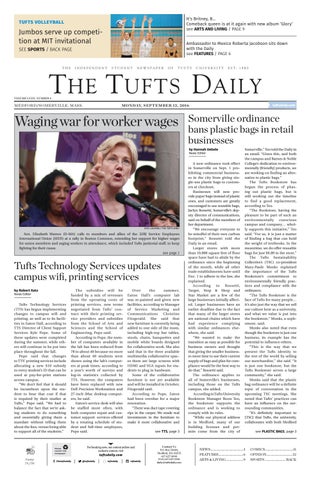
Sen. Elizabeth Warren (D-MA) calls to members and allies of the 32BJ Service Employees International Union (SEUI) at a rally in Boston Common, extending her support for higher wages for union members and urging workers in attendance, which included Tufts janitorial staff, to keep fighting for their cause. see page 2
Tufts Technology Services updates campus wifi, printing services by Robert Katz News Editor
Tufts Technology Services (TTS) has begun implementing changes to campus wifi and printing, as well as to its facilities in Eaton Hall, according to TTS Director of Client Support Services Kyle Pope. Some of these updates were completed during the summer, while others will continue to be put into place throughout the fall. Pope said that changes to TTS’ printing services include allocating a new $10 subsidy to every student’s ID that can be used at pay-for-print stations across campus. “We don’t feel that it should be incumbent upon the student to bear that cost if that is required by their studies at Tufts,” Pope said. “We had to balance the fact that we’re asking students to do something and essentially giving them a mandate without telling them about the fees, versus being able to support all of the students.”
The subsidies will be funded by a mix of revenues from the operating costs of printing services, new terms negotiated from Tufts’ contract with their printing service providers and subsidies from the School of Arts and Sciences and the School of Engineering, Pope said. According to Pope, the number of computers available in the lab has been reduced from 78 to about 40 because no more than about 40 students were shown using the lab’s computers at peak times, according to a year’s worth of surveys and log-in statistics collected by TTS. However, the computers have been replaced with new Dell Precision Workstation and 27-inch iMac desktop computers, he said. Eaton’s service desk will also be staffed more often, with both computer repair and customer support services offered by a rotating schedule of student and full-time employees, Pope said.
Please recycle this newspaper
Sunny 74 /56
/thetuftsdaily
Over the summer, Eaton Hall’s computer lab was re-painted and given new facilities, according to Manager of Service Marketing and Communications Christine Fitzgerald. She said that new furniture is currently being added to one side of the room, including high-top bar tables, stools, chairs, banquettes and mobile white boards designed for collaborative work. She also said that in the three available multimedia collaborative spaces there are large screens with HDMI and VGA inputs for students to plug in hardware. Some of the collaborative furniture is not yet available and will be installed in October, Fitzgerald said. According to Pope, Eaton had been overdue for a major renovation. “There was duct tape covering rips in the carpet. We made real investments in the furniture to make it more collaborative and see TTS, page 3
For breaking news, our content archive and exclusive content, visit tuftsdaily.com @tuftsdaily
tuftsdaily
tuftsdaily
Contact Us P.O. Box 53018, Medford, MA 02155 617 627 3090 FAX 617 627 3910 daily@tuftsdaily.com
A new ordinance took effect in Somerville on Sept. 1 prohibiting commercial businesses in the city from giving single-use plastic bags to customers at checkout. Businesses will now provide paper bags instead of plastic ones, and customers are greatly encouraged to use reusable bags, Jaclyn Rossetti, Somerville’s deputy director of communications, said on behalf of the members of her department. “We encourage everyone to be mindful of their own carbon footprint,” Rossetti told the Daily in an email. Larger stores with more than 10,000 square feet of floor space have had to abide by the ordinance since the beginning of the month, while all other trade establishments have until Dec. 1 to adhere to the law, she explained. According to Rossetti, Target, Stop & Shop and Star Market are a few of the large businesses initially affected. Larger businesses have an earlier deadline due to the fact that many of the larger stores are national chains which have had experience complying with similar ordinances elsewhere, she said. “We wanted to make the transition as easy as possible for business owners and thought that giving the smaller businesses more time to use their current supply of bags and plan for compliance would be the best way to do that,” Rossetti said. The ordinance applies to all of Somerville’s businesses, including those on the Tufts campus, she added. According to Tufts University Bookstore Manager Boon Teo, the bookstore supports the ordinance and is working to comply with its rules. “While our physical address is in Medford, many of our building licenses and permits come from the city of
Somerville,” Teo told the Daily in an email. “Given this, and both the campus and Barnes & Noble College’s dedication to environmentally [friendly] products, we are working on finding an alternative to plastic bags.” The Tufts Bookstore has begun the process of phasing out plastic bags, but is still working out the timeline to find a good replacement, according to Teo. “The Bookstore, having the pleasure to be part of such an environmentally conscious campus and company… wholly supports this initiative,” Teo said. “For us, it is just a matter of finding a bag that can hold the weight of textbooks. In the meantime, we do offer reusable bags for just $0.89 in the store.” The Tufts Sustainability Collective’s (TSC) co-president Mary-Paule Monks explained the importance of the Tufts Bookstore’s commitment to environmentally friendly practices and compliance with the ordinance. “The Tufts Bookstore is the face of Tufts for many people… it’s also just the way that we sell our culture here as a university, and what we value is put into the bookstore,” Monks, a sophomore, said. Monks also noted that even though the bookstore is just one business, its example has the potential to influence others. “This is the way that we present the Tufts identity to the rest of the world by selling our merchandise,” she said. “It is just one bookstore, but the Tufts Bookstore serves a large community,” she said. Monks said that the plastic bag ordinance will be a definite topic of conversation in the upcoming TSC meetings. She noted that Tufts’ practices can have an influence on the surrounding communities. “It’s definitely important to [TSC] that Tufts, the university, collaborates with both Medford
NEWS............................................1 FEATURES.................................6 ARTS & LIVING.......................9
see PLASTIC BAGS, page 3
COMICS......................................11 OPINION...................................12 SPORTS............................ BACK
2
THE TUFTS DAILY | News | Monday, September 12, 2016
tuftsdaily.com
Janitors, students rally with Senator Elizabeth Warren in Boston Common
32BJ Service Employees International Union (SEIU), which represents Tufts janitors and 18,000 other workers in Massachusetts and Rhode Island, organized a rally at Boston Common o n
Saturday, Sept. 10, as the contracts of janitors from Tufts, Harvard, Boston office buildings and other institutions are approaching their negotiating deadlines of Sept. 30. Union members and allies gathered to demand higher wages, health insurance for full-time workers and more pathways to full-time employment, according to a press release from 32BJ SEIU. The janitors were joined by U.S. Senator Elizabeth Warren (D-MA), who expressed her solidarity with their fight, sharing that her own father was a janitor. “I also saw how important a paycheck is to keep a family together and so I wanted to be here today for exactly one reason and that is to say, in this fight for fair wages: I’m with you, all the way,” she said. Also in attendance were Tufts janitors, members of Tufts Labor Coalition
(TLC) and other Tufts students expressing solidarity. Selida Pol, a janitor on Tufts’ Boston campus, said she hopes the new contract will include better wages, more respect in the workplace, a more reasonable workload, the maintenance of employer-paid health insurance and bereavement days. Pol, translated from Spanish by TLC member Nicole Joseph, said that this rally is important because C&W Services, a contractor hired by Tufts, and union representatives are working to negotiate a contract by the deadline of Sept. 30. “It’s clear the administration will know this [rally] is happening,” she said. — Catherine Perloff
Photos by:
EVAN SAYLES MAX LALANNE
Monday, September 12, 2016 | News | THE TUFTS DAILY
News
T HE T UFTS D AILY Arin Kerstein Editor-in-Chief
EDITORIAL Sophie Lehrenbaum Jake Taber Managing Editors Evan Sayles Associate Editor Kathleen Schmidt Executive News Editor Gil Jacobson News Editors Melissa Kain Robert Katz Liam Knox Catherine Perloff Jei-Jei Tan Hannah Uebele Joe Walsh Kyle Blacklock Assistant News Editors Juliana Furgala Jesse Najarro Danny Nelson Miranda Willson Executive Features Editor Constantinos Angelakis Features Editors Nina Joung Becca Leibowitz Siddharth Divakaruni Assistant Features Editors Justin Krakoff Executive Arts Editor John Gallagher Arts Editors Merilla Michael Eran Sabaner Isaac Brown Assistant Arts Editors Jocelyn Contreras Alison Epstein Elliot Storey
3
TTS renovates Eaton Hall, increases services TTS
continued from page 1 more like what the students we got feedback from were asking for,” Pope said, referencing a survey available in labs across campus last year. Campus wifi was also improved, as 70 percent of residential dorms received multiple access points over the summer, according to Director of Enterprise Infrastructure Theresa Regan. The remaining 30 percent of dorms will probably be updated with new wireless access points during winter break, Reagan said. Regan described the process as an “aggressive project” that switched the wireless infrastructure of 42 buildings — most of them residence halls — from Aruba to Cisco’s hardware.
The new networks are currently listed as “Tufts_Secure,” “Tufts_Wireless” and “Tufts_Guest,” Regan said. “Wireless is the kind of thing that, when it’s working, people are really happy [about] and they have no reason to give us feedback,” she said. “It does what it’s supposed to do, it’s like running water. You turn the faucet on and it works.” Additional updates to be implemented include a new printing queue which only lists print jobs incurred on a student’s ID, improved software for printing from personal laptops and desktops and a new pay-for-print printer that will be added to the Campus Center some time this fall, according to Pope. The priorities of TTS’s updates to its
printing services were based off student responses to a survey emailed to the student body in February, according to a Feb. 26 Daily article. Learning Spaces, the project that provided the funds for Eaton’s renovations — not including those for the new computers — has begun planning for the summer of 2017, according to Pope, who is a member of Learning Spaces. Pope added that the project will continue to refresh Tufts’ facilities in the future. “What we want to do is spread the wealth around, that we’re not concentrating all of our refresh efforts for one school, one department, one area of campus,” Pope said. “We want to make sure we give equal time to all the different locations.”
Somerville plastic bag ban affects Tufts bookstore
Emma Henderson Executive Op-Ed Editor Shannon Geary Cartoonists Stephen Dennison Allie Merola Miranda Chavez Editorialists Aneurin Canham-Clyne Frances DeFreitas Anita Ramaswamy Noah Weinflash Phillip Goldberg Executive Sports Editor Yuan Jun Chee Sports Editors Alison Kuah Maddie Payne Eddie Samuels Maclyn Senear Max Lalanne Mia Lambert Caroline Ambros Ray Bernoff Maria Eduarda Ferraz Henry Hintermeister Leila Li Julia Press Evan Sayles Angelie Xiong
Executive Photo Editor Photo Administrator Picture Tufts Editor Staff Photographers
PRODUCTION David Westby
Production Director Allie Merola Executive Layout Editors Sebastian Torrente Jewel Castle Layout Editors Leila Li Brianna Mignano Mandip Pokharel Emily Sharp Astrid Weng Petrina Chan Creative Director Allie Merola Executive Graphics Editor Petrina Chan Graphics Editors Annie Chen Juliana Furgata Dana Pek Ashton Stephens Rena Tang Belinda Xian Zach Hertz Executive Copy Editors Jei-Jei Tan Alison Beach Copy Editors Arthur Beckel Caroline Bollinger Alison Epstein Gil Jacobson Melissa Kain Sharon Kelmar Bibi Lichauco Kathleen Martensen Netai Schwartz Nihaal Shah Arielle Sigel Liora Silkes Dan Strauss
Maxwell Bernstein Executive Tech Manager Nitesh Gupta Online Editor Mia Lambert Social Media Editor
BUSINESS Josh Morris Executive Business Director Qinyue Yu Receivables Manager Evan Sayles Online Advertising Jay Hayes Ad Managers Eva Sachar
NICHOLAS PFOSI / THE TUFTS DAILY
Students wait in line at the bookstore after their first day of classes of the 2014 spring semester, on Jan. 14, 2014.
PLASTIC BAGS
continued from page 1 and Somerville because our waste has such an impact on its waterways and I know that’s one of the reasons that they were trying to get rid of the plastic bags,” she said. “If we show our support of this
legislation and really just actively promote reusable bags and recycling the paper ones that are also offered as an option, that definitely sets a good example for the community and creates a large incentive for businesses to start really complying.” Rossetti also greatly encouraged the
Tufts community to become involved with sustainability within the city. “We’re starting to ramp up the community engagement side of things there and would love to have Tufts students participate in some of the upcoming events,” she added.
Visiting on the Hill this week MONDAY Inaugural Moomaw Professorship Lecture Details: Fletcher School Professor Avery Cohn is the inaugural holder of the William R. Moomaw Professorship of International Environment and Resource Policy. He will present a lecture on “Sustainable Development in a Changing World” with a reception to follow in the Hall of Flags. When and Where: 5:30 p.m., ASEAN Auditorium, The Fletcher School, RSVP required at rsvpevents@tufts.edu WEDNESDAY Book Talk with University of California, Los Angeles Professor Sarah Haley Details: Haley’s “No Mercy Here: Gender, Punishment, and the Making of Jim Crow Modernity” uses black feminist criticism and archival mate-
rials to illustrate the struggle of black women in the South. Haley investigates the creation of modern Jim Crow, specifically looking at the roles of gendered regimes of incarceration. When and Where: 12 p.m., The Center for the Humanities at Tufts, Fung House Sponsor: Center for the Humanities at Tufts (CHAT), The Center for the Study of Race and Democracy “Iran a Year Later: Did Diplomacy Do its Job?” Details: The American Academy of Diplomacy presents the Joseph J. Sisco Memorial Forum featuring the Honorable Robert Einhorn speaking on the Iranian nuclear deal a year later. Former ambassador John Limbert will speak on Iranian policy and the look from Iran outwards. Former ambassador Ronald Neumann will speak on the
topic, “US policy on Iran: what makes sense?” Former ambassadors William Burns and Alan Solomont will provide the keynote address. When and Where: 5:30 p.m., ASEAN Auditorium, Cabot Intercultural Center Sponsor: The American Academy of Diplomacy “Islamic Calligraphy in the Chinese Tradition: A Demonstration by Master Haji Noor Deen” Details: In a lecture and demonstration, Master Haji Noor Deen will show connections between the Chinese and Islamic traditions through poetry and writing. The artist’s pieces will be for sale after the event. When and Where: 7:00 p.m., Olin 007
— by Kathleen Schmidt
4
THE TUFTS DAILY | ADVERTISEMENT | Monday, September 12, 2016
tuftsdaily.com
1/4 All Students Invited! 2016 Student 1/8 Organizations Fair
Over 300 Organizations Waiting for You!
Wednesday September 14, 2016 5pm – 7pm Residential Quad (Rain Date, Sept. 15)
1/2
Check out the Office for Campus Life Website for More Information…ocl.tufts.edu
Monday, September 12, 2016 | ADVERTISEMENT | THE TUFTS DAILY
tuftsdaily.com
2016/5777
Rosh Hashanah October 2–4 Yom Kippur October 11–12
1/4 HI GH AD
H O LI D AY S
1/8 AD
ROSH HASHANAH
YOM KIPPUR
S UN D AY, O C T O B E R 2 , 20 1 6
T U ES D AY, O C TO B E R 1 1 , 2 0 1 6
• Reform Service 6:00 pm | 51 Winthrop Street
• Pre-Fast Dinner 4:15 pm | Hillel Center $15 Online registration required.
• Conservative Egalitarian Service 6:00 pm | Hillel Center
• Reform Service 6:00 pm | 51 Winthrop Street
• Dinner 7:00 pm | Hillel Center $15 Online registration required.
• Conservative Egalitarian Service 6:00 pm | Hillel Center
M O N D AY, O C T O B E R 3 , 2 0 1 6
W EDNES D AY, O C TO B E R 1 2 , 2 0 1 6
• Conservative Egalitarian Service 9:00 am | Hillel Center
• Reform Services 10:00 am | 51 Winthrop Street
• Reform Service 10:00 am | 51 Winthrop Street
5:45 pm | Yizkor and Neilah 51 Winthrop Street
• Conservative Egalitarian Services 9:00 am | Hillel Center
• Lunch 12:30–2:30 pm | Hillel Center $7 Online registration required.
5:00 pm | Yizkor Interfaith Center (58 Winthrop Street)
• Tashlich–Shaping the Year to Come 3:30 pm | Meet at Hillel Center and walk together to the Mystic River • Conservative Egalitarian Service 7:00 pm | Hillel Center • Dinner 7:45 pm | Hillel Center $15 Online registration required.
T UE SD AY, O C T O B E R 4 , 2 0 1 6 • Conservative Egalitarian Service 9:00 am | Hillel Center • Lunch Following Services Approximately 1:30 pm Hillel Center | FREE
WA N T A N A LT E RN AT I V E E X PER I ENC E? October 2–12, 2015
5:15 pm | Neilah Interfaith Center (58 Winthrop Street) • A Jewish Journey: A Walking Discussion with Rabbi Jeffrey Summit 3:00 pm | Meet at Hillel Center Wear comfortable shoes.
1/2 AD
Looking for an alternative to services as a way of connecting during the High Holy Days? Students will be creating a third space for yoga, music, writing and learning during the holidays this year. Drop in for as little or as much as you’d like, and make the holidays a meaningful start to your year. Times and locations to be announced. For more information or to be on our email list, email Rabbi Jordan at jordan.braunig@tufts.edu.
• Break-the-Fast Dinner 6:48 pm | Hillel Center $15 Online registration required.
SUKKOT B E G INS S U N DAY, O CT O BER 16, 2016 • Services and Activities Please visit www.TuftsHillel.org for a complete listing of services and activities.
See tuftshillel.org for more info and to register!
5
6 tuftsdaily.com
Features
Monday, September 12, 2016
U.S. Ambassador to Mexico Roberta Jacobson visits the Hill The disappearing
act: taking a personal leave of absence from Tufts
by Grace Yuh
Contributing Writer
Disclaimer: Ambassador Roberta Jacobson’s son is a news and copy editor at The Tufts Daily. He was not involved in the production of this article in any way. Roberta Jacobson is the current U.S. Ambassador to Mexico and the former Assistant Secretary of State for Western Hemisphere Affairs. A graduate of The Fletcher School of Law and Diplomacy, Jacobson led a United States delegation in talks with the Cuban government to renew diplomatic relations between Cuba and the U.S. earlier this year. She spoke at The Fletcher School’s convocation ceremony on Sept. 9 about her experiences as a student at Fletcher, touting the student body’s diversity and its extensive ties to Mexican diplomacy. Jacobson also touched on the shared diplomatic interests of the United States and Mexico and the importance of maintaining positive U.S.-Mexico relations. Finally, she urged Fletcher graduates to take advantage of the connections and opportunities that come with having graduated from Fletcher. The Daily spoke with Jacobson about her talk, her professional goals and her time at Fletcher. Tufts Daily (TD): What were some highlights of your time at Fletcher? Roberta Jacobson (RJ): Well, there was a professor working at Fletcher, an Australian human rights expert named Philip Alston … who was completing a book on the [United Nations’] (UN) human rights organizations … I had worked on a committee on the elimination of discrimination against women when I was at the UN. He asked me to write the chapter [of his book] on that entity. So when he published the book, I had a chapter in a university press book, and that was an opportunity with a Fletcher professor that I was lucky to have. I took that book with me everywhere to show people. It was one of my first published works. The other thing that stood out for me was looking at liberation theology as a revolutionary ideology in Latin America for my thesis. I was taking a security studies course at Fletcher, which was [taught by] a very conservative group of people. When I worked on this, [my professor and others in that department] believed that liberation theology was manipulated directly [by the Soviet Union]. But as I worked on the paper, I came to the conclusion that … [liberation theology] was indigenous, homegrown and grew out of a lot of inequality. I basically proved the opposite of what was forecast and thought … I felt perfectly comfortable challenging what we both might have believed in the beginning. That’s a very valuable experience. It speaks to the feeling of academic independence at Fletcher. TD: The majority of your career in the State Department has focused on U.S.-Latin American relations. What made you want to work in that area? RJ: When I knew I wanted to do political science and international affairs and had to pick a region, there was a lot happening at that time in Latin American political science. From ’78 to ’82, it was the start of the return to democracy from military governments [in Latin America], and politicians and citizens were working to get the military out of politics. So I became fascinated by [the region], both because of the human rights angle but also because in so many respects, it was a political science laboratory … So the place just drew me for the political side and human rights aspects, but I also loved the culture of it.
by Nina Joung Features Editor
MAX LALANNE / THE TUFTS DAILY
U.S. Ambassador to Mexico Roberta Jackson (F ‘86) speaks during The Fletcher School convocation in the Cabot Intercultural Center ASEAN Auditorium on Friday, Sept. 9. TD: What qualities did you learn in college and at Fletcher that have helped you handle real-world diplomacy? RJ: There was a diversity of [view], culture, ethnicity, background and nationality that I think is really important. Also, when I came to Fletcher, I had been working for two years [at the UN], so I treated Fletcher like a job. I came to school in the morning, I did my work and I went home. That got me in a good routine for life. I didn’t really pull all-nighters because I had already transitioned to a working life. TD: Are there some qualities that college didn’t teach you when it comes to handling real-world diplomacy? RJ: Of course. One is listening. I think you can be taught to listen to some extent and you can learn it over time if you realize the value of it. Fletcher and Tufts try to teach it because they emphasize the value of hearing from everybody and hearing all those voices, that diversity of opinions. You also need to know how to delegate and work on a team. Schools like Tufts and Fletcher teach that, but I think it comes even earlier. I’m always surprised by how soon schools put children in groups to work on solving problems. There’s very little that the State Department does on its own. We work with other agencies every day, whether it’s the [Department of Defense] or the Department of Justice. So much of foreign affairs involves agencies that were formerly considered domestic agencies, and you better learn to work with those people … And that takes a lot of patience, too. TD: What prompted the negotiations with Cuba after so many years? RJ: I think there were a couple of things. Short term, [President Obama] and I had been looking at the situation of Alan Gross, who was an American imprisoned in Cuba. He had been a subcontractor for an American program bringing in satellite and Internet equipment to the Jewish community [in Cuba]. He wasn’t doing well, and we wanted to bring him home. That was a short-term goal. But the President knew that if we did something to try to bring him home, the small group of dissenting CubanAmericans in Congress would disagree no matter what we did, big or small. So his [idea] was, if we’re going to do something, we should do something big. The reason he thought we should do something big was twofold: He was in his second term, which is a time when presidents have traditionally made bolder decisions, and second, he felt that he could increasingly see the way our Cuba policy wasn’t isolating Cuba but was isolating us. Over the years, we were the only country maintaining an embargo … and we know that embargoes don’t work if only one country imposes it. So every time I traveled to
Latin America or talked to our allies in Latin America, they complained about our Cuba policy … [W]e realized our Cuba policy had become an irritant in our Latin-American relations. Also, Cuban-Americans have changed. They used to be solidly Republican and supported the embargo, but it’s not the same [anymore]. The President won the CubanAmerican vote in 2012, and many of them supported the idea of engaging with Cuba. So you put that all together and realize it’s way past time. TD: What is it like being a woman in government, especially in diplomacy? RJ: It’s very interesting because I’ve been the first woman in my previous two positions. I’m the first woman Ambassador to Mexico, and I was the first woman Assistant Secretary of State for Western Hemisphere Affairs, which is kind of shocking because I’ve had three woman Secretaries of State whom I’ve worked for. Most of the time, honestly, it’s fine … I’ve worked with many women in [Latin America], including presidents. These are countries that have had female presidents before we have. I’ve also worked with many female foreign ministers, including the woman who is foreign minister in Mexico. Despite working with so many women, this doesn’t mean there isn’t a barrier, and I spend a lot of time working on promoting education for girls, particularly in STEM fields, as well as women’s entrepreneurship and other issues. But personally, I haven’t felt like I’ve been taken less seriously. TD: What has been the biggest challenge in your career or working in the international field? RJ: Work-life balance … The State Department has a culture of, “The longer you work, the better you are and the higher you’ll rise” … So if a 40-hour work week is what you’re paid for and you work less than 60, then you must be less committed. [The State Department] has an old-school culture, and I have found that difficult. TD: What has your experience as U.S. Ambassador to Mexico been like so far? RJ: Well, it took 10 months for me to be confirmed because of my work with Cuba, which I never regretted for a minute. But during that period of time, logically, you build up your expectations of a job. And I worried that I had built it up unrealistically, but the truth is, being an ambassador is as great as I imagined it to be. Being in Mexico is every bit as good as I hoped it would be; it’s a fabulous, fascinating country, which I knew from visits, but it’s different when you’re there as ambassador. It’s difficult to be out in public all the time because you’re recognized and people talk to you. But I love it. Editor’s Note: This Q&A has been edited for brevity and clarity.
This is the first part of a two-part story about Tufts students who take a leave of absence from school. This part focuses on taking a personal leave of absence from Tufts. On the administrative side, taking a personal leave of absence from Tufts is as simple as two clicks on SIS. However, the implications of that decision for students are more complicated and carry on throughout the process of leaving and returning to campus. According to the Tufts Student Affairs website, a personal leave of absence is one of two leave of absence options for which Tufts undergraduate students can apply — a third option, parental leave of absence, is only offered to graduate students. The personal leave of absence applies to students who want to take time off from Tufts for a variety of reasons including “to participate in a non-academic program, attend to a family crisis or to gain a sense of direction.” Jean Herbert, an associate dean of undergraduate education, said that the most difficult part about taking a leave of absence is often the actual decision to do so, as many students are wary of veering off the rigid academic track expected of them. “As high-powered, intellectual, academically-minded students, from day one it’s been, ‘You go to grade school, you go to middle school, you go to high school, you go to college — end of story,’” Herbert said. But once a student decides to take a personal leave of absence, they may do so at any time, without official approval from Tufts, according to Herbert. This policy contrasts with the policy surrounding a medical leave of absence, she said, which requires several steps. “It’s a revolving door,” she said. “Students can come and go as they please, which is sometimes surprising for students, for whatever reason.” Henry Jacqz, a computer science major taking a leave of absence this semester, said the “revolving door” policy allowed him to take a leave of absence in spring 2015, then in spring 2016 and again this fall. “It was great that I could leave and come back later and not be penalized for it,” Jacqz said. “Whether I ever finish a degree at Tufts is still up in the air, but the policy definitely gave me [the ability] to open the question up without having to pull the cord completely.” Jacqz, who started at Tufts in fall 2013, said doubts about Tufts’ ability to offer him the education he wanted led him to take his initial leave of absence. “I decided to take a semester away from school because I was questioning whether Tufts was teaching me the skills and knowledge I wanted to apply see LEAVE OF ABSENCE, page 7
Monday, September 12, 2016 | Features | THE TUFTS DAILY
F e at u r e s
7
Students take personal leaves of absense to explore identity LEAVE OF ABSENCE
continued from page 6 to organizing and to making the world a more sane, just place,” he said. For junior Sophia Grogan, taking a personal leave of absence provided an opportunity to explore options outside of the expectations she felt were placed on her. She explained that because her father works at Tufts, she had felt compelled to attend Tufts since this option made college affordable for her family. But when she started school here, Grogan said she began to contemplate whether Tufts and her own academic plans were the best fit for her. “I felt like I got into something that wasn’t going to make me happy, and I had a really hard time figuring out what my place was at Tufts,” she said. “I realized I didn’t want to go into international relations. I realized that maybe a prestigious university wasn’t for me.” During her time away from Tufts, which spanned the 2014-2015 academic year, Grogan initially bought a one-way ticket to the Czech Republic to work at a hostel. She then backpacked and hitchhiked from the Czech Republic to Morocco. Later on, she visited South America, stopping in Argentina until she made her way up to Columbia on the back of a motorcycle, she said. “[I] didn’t really have a plan,” Grogan said. “I wanted to find myself. It’s a cheesy way of putting it, but I went in
with the goal of trying to understand what I wanted and what I didn’t want.” Both Grogan and Jacqz acknowledged that taking a leave of absence from Tufts would not have been possible under different financial circumstances. In Jacqz’s case, because he requested each leave of absence before the semesters started, he was not charged tuition fees for those semesters. This made the decision easier for him, he said. As the daughter of a Tufts employee who is therefore guaranteed a scholarship from Tufts, Grogan said that she, too, did not have to worry about losing a financial aid package or getting charged for part of the semester when she decided to take a leave of absence. However, financial constraints might arise for a student who requests to take a leave of absence after the semester starts, at which point Tufts will no longer refund all of the student’s tuition for that semester. After six weeks into the semester, students who want to take a leave of absence must pay the full tuition costs of the semester despite leaving, according to the Tufts Financial Services website. Herbert noted that academic deans can help students navigate this policy and other, more bureaucratic aspects of taking a leave of absence, particularly when it comes to ensuring students complete the residency requirement of eight semesters of full-time study at Tufts. While some leeway has been created around this requirement through
the use of pre-matriculation and summer session credits, this can sometimes make a leave of absence less feasible for students, according to Herbert. Although the deans are a resource for students taking a personal leave of absence, Herbert added in an email that students are not required to talk to their dean before or after their leave, a policy she believes can be problematic. “With a personal leave, we cannot actually require a conversation with a dean … [T]he academic dean always follows up with a phone call or an email, but there is no way to prevent the leave,” she wrote. “I believe we are all dissatisfied with this approach. In fact, we are talking together about changing the procedure so that every student is required to have such a conversation — both on leaving and on returning, just as with a medical leave.” Returning from a personal leave of absence poses its own set of difficulties, Herbert said. Alexis O’Connell (LA ’16), who took a personal leave of absence during her sophomore year to travel across different parts of Europe and Asia, said the most difficult part of her leave of absence was the transition back to Tufts. “For a while, I felt like my college experience was really fragmented,” she said. “[I had] friends in a different place than [where] I was.”
Herbert urges students to meet with their academic deans after their personal leave of absence, emphasizing that this meeting allows the academic deans to hear about students’ experiences, evaluate the success of their time off and help students transition back into academic life. “Sometimes, people feel like they’re behind for some reason, and we want to ease them back in,” Herbert said. “[Taking] the right courses that [first] semester back is essential … we want to make sure it’s a positive experience [and students are] not overloading because they feel behind.” Despite the issues students might face when leaving and returning to campus, Grogan said she wishes a leave of absence was more strongly encouraged to students who feel uncomfortable at or unsure about Tufts. Additionally, she hopes the option will become more readily available to students who might not have the same opportunities and privileges she had that made the decision easier for her. “Had I not taken a leave of absence, maybe I would still be pursuing [international relations], because I felt like that was something I was wrapped into and I didn’t understand that [there were] other options,” Grogan said. “Because I took a leave of absence, I found my purpose at Tufts. I found out what I want to use the resources for, and what connections I want to make with people here.”
CONNECTED Student Value Checking Receive a $ 25* bonus
when you open and use a Student Value Checking account.
NO MONTHLY FEE** • NO MINIMUM BALANCE • NO FEE FOR INCOMING WIRES
Start here to make it happen:
SANTANDERBANK.COM/STUDENT
Student Value Checking is available to students 16 through 25 years of age (legal guardian co-owner required for those between 16-18 years). Once you reach 26, we may convert your Student Value Checking to another checking product. Proof of enrollment may be required. *Get $25 when you open a new Student Value Checking account with a $10 minimum opening deposit between June 15, 2016 and September 30, 2016 and complete 8 debit card transactions that post to your account within 60 days of account opening. Your new account needs to remain open for 90 days in an eligible product type and payment of the bonus will occur within 30 days thereafter. One bonus per customer. Students who currently have a personal checking account or who have had a personal checking account with Santander Bank in the last year are not eligible for this offer. Cannot combine with other personal checking account cash offers. Offer only available to U.S. residents. Santander team members are not eligible. Bonus is considered interest and will be reported to the IRS on Form 1099-INT. **Other fees may apply, including a Paper Statement fee if you elect to receive paper statements. Refer to your fee schedule for details. Santander Bank N.A. is a Member FDIC and a wholly owned subsidiary of Banco Santander, S.A. © 2016 Santander Bank, N.A. All rights reserved. Santander, Santander Bank and the Flame Logo are trademarks of Banco Santander, S.A. or its subsidiaries in the United States or other countries. MasterCard is a registered trademark of MasterCard International Incorporated. All other trademarks are the property of their respective owners.
8
76933 THE TUFTS DAILY | ADVERTISEMENT | Monday, September 12, 2016
tuftsdaily.com
GET TREATED LIKE THE MILLION BUCKS YOU MIGHT NOT HAVE. 1/4 Because our focus is on you, not shareholders, you can get personal support whether you have $500 or $5 million. Start now at TIAA.org/advice
1/8
INVESTING
ADVICE
BANKING
RETIREMENT
1/2 BUILT TO PERFORM. CREATED TO SERVE. TIAA-CREF Individual & Institutional Services, LLC. TIAA-CREF products are subject to market and other risk factors. C32773
Monday, September 12, 2016
ARTS&LIVING
9 tuftsdaily.com
ALBUM REVIEW
‘Glory’ be to Britney Spears on her latest, greatest comeback by Justin Krakoff
Executive Arts Editor
The decline and fall of Britney Spears represents one of the darkest periods in American pop culture. After emerging onto the scene as America’s bona fide pop princess of the late 1990s and early 2000s, Spears experienced a very public breakdown in 2007, which culminated in one deeply distressing night in which she shaved her head and declared that she was “tired of everybody touching [her].” Following months of erratic, and sometimes dangerous, behaviors such as these, the Associated Press preemptively wrote an obituary for her, which, along with disturbing video evidence from this time, serves as a stark reminder of how brutally a celebrity can fall from grace. If Spears’ breakdown highlights the ugliest parts of fame, then it is her rebirth that reveals its most forgiving aspects. In the years after her nadir, Spears has staged comeback after comeback and achieved three number one singles — the old Spears had only earned one. Though her most iconic song arguably remains the still fresh-sounding “Toxic” (2003), Spears also pushed dubstep to the forefront of pop with “Hold It Against Me”
(2011) and released her best song of the decade so far with the clubby, bone rattling “Till the World Ends” (2011). Yet the debacle that was “Britney Jean” (2013) damaged the icon’s reputation as one of pop’s finest purveyors, as the undercooked album failed to resonate with both fans and critics. The release of Spears’ latest album “Glory,” which debuted on Aug. 26, quickly reverses this trend, as it comes from a place of renewed creativity and boldness. Drawing upon the sonic palettes and subjects that made her previous albums “Blackout” (2007) and “In the Zone” (2003) such instant classics, “Glory” very much feels like a Britney Spears album for the late 2010s and follows the blueprint of Selena Gomez’s minimalistic “Revival” (2015). By working with a mix of in-demand and eclectic collaborators, including the Swedish production duo Mattman & Robin and English DJ BURNS, Spears succeeds in making her ninth studio album a big pop album worthy of its title. “Invitation” is the first time Spears has opened one of her records with a true album opener. The track’s heavenly synths, coupled with her iconic, heavily vocoded coos, greet the listener with
a seductive warmth. The chorus is built around the simple refrain of “Put your love all over me” as she invites her lover to get the chance to know her better, which is indicative of the album’s overall willingness to explore sexuality in a mature yet never-too-serious manner. “Make Me…,” the lead single of “Glory,” represents a departure for Spears. The BURNSproduced track is inspired by the downtempo, moody R&B that is prominent on the radio right now instead of the usual dance-pop Spears is known for. Even though the song is tainted by an unfortunate guest appearance from Bay Area rapper G-Eazy, the chorus itself is simply gorgeous, as her voice is immaculately layered when she sings “And make me oooh,
PHOTO BY GLENN FRANCIS
Britney Spears at the 102.7 KIIS FM Wango Tango concert see MAKE ME, page 10 in Carson, Calif. on May 11, 2013.
MOVIE REVIEW
‘Sully’ quietly soars as ode to humanity, competence by Jocelyn Contreras Assistant Arts Editor
While no stranger to depicting heroism in his work, Clint Eastwood uses a remarkably light touch this time around in his latest film “Sully” (2016). Without sensationalizing the already extraordinary event of Captain Chesley “Sully” Sullenberger’s forced water landing on the Hudson River, Eastwood allows humanity to breathe on its own through careful character study. The result is as stunning as it is gripping. The film takes off during the aftermath of the landing, as Captain Sullenberger, portrayed by Tom Hanks, deals with overwhelming attention. Audiences will be shocked and immediately hooked when they witness a vision of what could have
happened if Sully had not landed in the Hudson. It is uncomfortably reminiscent to the horrors of 9/11, so the stakes are immediately understood. Much like this scene, the majority of the film takes place in his head, as carefully-placed flashbacks and visions showcase the stress and self-doubt that was incited by the media and legal frenzy. Eastwood, along with screenwriter Todd Komarnicki, certainly took great care in deciding how to unfold the narrative in an authentic and unpretentious manner. The film takes on a nonlinear structure, so when the fateful plane sequence finally does play out, the added anticipation is breathtaking. Hanks’ performance is subtle and doesn’t embellish the story. He strips down the concept of a hero in an unas-
suming way. The chosen structure of the film pairs well with his nuances. Hanks depicts Sully’s reluctance and the stifling nature of his newfound circumstances with an ease that will leave audiences in awe. Sully’s character is, without a doubt, the life-force of the film, yet humanity shines in those around him as well, including Sully’s first officer in the cockpit, Jeff Skiles, played by Aaron Eckhart. The duo seamlessly support one another, making it difficult to think of another actor/character partnership that rivals the one portrayed here. In addition, there are three separate passenger stories that are woven into the flashbacks of the event. There’s a mother with her baby who relies on the kindness of the stranger next to her, an older trio of father
and sons who almost missed the flight were it not for a kind airline employee and a woman trying to comfort her elderly mother in the chaos that ensued. These asides iterate how ordinary the day appeared before the fateful call of “Birds!” drove everything out of control. Curiously, Sully blends into the background during the first sequence of the landing. He’s simply just another man doing his job as he would any other day. Most of the camera’s attention is directed to the cabin filled with the passengers and flight attendants. Eastwood unapologetically creates an antagonistic force in the team that led the investigation after the event. The scenes taking place in the interview room and see CAPTAIN SULLY, page 10
TV REVIEW
Netflix’s ‘Narcos’ returns for gripping second season by John J. Gallagher Arts Editor
Netflix’s bilingual drug drama “Narcos” (2015-present) returned Sept. 2 for its second season. Season one of Narcos follows the rise of infamous Colombian drug lord Pablo Escobar (Wagner Moura) as he blazed a bloody trail from small time smuggler to ruler of a cocaine empire that made him one of the world’s richest men. Drug Enforcement Administration (DEA) agent Steve Murphy (Boyd Holbrook) returns as the series’ whisky-toned narrator, but this season, he is narrating the decline of Escobar’s empire. Galvanized by Escobar’s outrageous violence, a loose confederation of American three letter agencies, anti-communist guerrillas, the Colombian national police and rival drug traffickers is working together (and sometimes not) to put Pablo Escobar at the smoking end of a gun.
The slow and then brutally fast erosion of Escobar’s empire gives the second season a darker, more desperate feel than the first, where Escobar himself seemed unassailable at times. There were just as many bodies on the ground in season one, but with the second season’s focus squarely on Escobar, the viewer can see just how cornered he feels, lashing out with heedless brutality at his enemies, both real and imagined. The decline of Escobar’s fortunes is reflected in the progressively more modest residences that Escobar and his family inhabit over the course of the season. Far from shuttling between lavish homes as they did during season one, the Escobars end up in more humble abodes, culminating in an unheated house where, in a moment of poignant irony, Escobar burns stacks of cash in place of absent firewood to keep his children warm.
Escobar’s dire state is brought home to the viewer not only by his family’s obviously diminished comfort, but also by the man’s very appearance. Moura carried himself with a glowering heft when he played Escobar in the first season, heaving his sweater-clad bulk around with menacing purpose. But as the events of the second season wear him down, Escobar’s gravitas gives way to a kind of lumbering defeat complete with a bushy beard. The dismantling of Escobar’s empire is depicted in a fairly formulaic fashion: one of Escobar’s many enemies discovers a piece of intelligence, they move to attack Escobar and/or his lieutenants, and then a car chase or gun battle ensues. The action may be formulaic, but it’s well put-together with enough bullets, blood spatters and running along rooftops to keep the tension high. In one particularly well-executed action sequence, gunmen
assault Escobar’s home, and the camera follows both the attackers and the defenders, moving from man to man, lodging behind the shoulder as the chosen gunman moves from cover to cover. Heart-pounding scenes like these allow the viewer to forgive the more cookie-cutter (but still good) action that marks the climax of many episodes. Agent Javier Pena, played by Chilean actor Pedro Pascal who is known for his role on “Game of Thrones” (2010-present), often drives this action through his fluent Spanish and willingness to leak information to Escobar’s criminal rivals. Pascal’s performance, with his lithe amoralism, elevates every scene in which he appears, but Pascal’s character is sidelined later in the season and reduced to a handful of appearances in the final episodes. The chemistry between Holbrook’s and Pascal’s characters was always see AGENT, page 10
10
THE TUFTS DAILY | Arts & Living | Monday, September 12, 2016
tuftsdaily.com
Spears reassert her pop prowess once more on ninth studio album MAKE ME
continued from page 9 oooh, oooh, oooh” over lush guitars and a sexy bass. The rest of “Glory” is an adventurous listen with a varied string of tracks keeping one engaged the entire time. The midtempo magic of “Man on the Moon” harkens back to the eerily prophetic “Lucky” (2000) as she laments a lover gone too soon when singing, “Now
there’s meaning in the saddest songs / All I do is cry and sing along.” The Cashmere Cat-produced “Just Luv Me” feels like a sophisticated update to Gomez’s “Good For You” (2015), with its soft finger snaps and subdued vocal production. After this tender moment of reflection, the album’s most high-energy moments follow. On the soul-inspired dance anthem “Clumsy,” Spears even references her own career as she yelps out
an “Oops!,” a la “Oops!… I Did It Again” (2000), right before the monstrous beat drop. Mattman & Robin show up to produce album highlights “Do You Wanna Come Over?” and “Slumber Party” with the former eschewing the typical pop song structure often found throughout “Glory” and the latter offering a kitschy take on an “adult” sleepover. Unfortunately for Spears, though “Private Show” and “What You
Need” are two of the album’s more fun tracks, her voice has been so heavily produced on that them that they sound almost grating, which detract from an otherwise well-executed record. Yet, with Spears returning to the MTV Video Music Awards, the site of her infamous performance in 2007, her career once more seems to be on the rebound, offering one more chapter in the story of America’s most resilient pop star.
Sully takes off in theaters, shows nuance, heart CAPTAIN SULLY
continued from page 9 the courthouse paint them in an unfavorable light, as if they’re much more concerned with the airline’s best interests than the successful outcome of every choice Sully made before landing in the Hudson. Their portrayal might be a tad less fair than warranted, but for cinematic purposes, it’s understandable. The
crafting of an opposing force invigorated the stakes. Had it not been for the nonlinear structure of the film, “Sully” might have turned out to be an underwhelming movie. Everyone knows how it ended. There is no drama in affirming the approval that exists for such an esteemed figure. Instead, the time spent with what was happening below the surface in Sully’s mind gives new light to the “hero”
the audience knows him as. The film says as much about the society that brands him with the moniker as it does about the man himself. Eastwood’s direction in achieving this is thoughtful and unobtrusive. Whether Warner Brothers tried especially hard to get a Sept. 9 release, or it just happened to work out that way, the release date has a somber effect. Now, 15 years after 9/11, Eastwood unabashedly reclaims the
narrative by showcasing the best of what New York had to offer on the frigid day of Jan. 15, 2009. The terror of that day is never explicitly recalled in the film, but the influence is felt throughout, whether it’s the terrifying sight of Sully’s plane losing altitude as it nears the skyscrapers or during one of the character’s pointed remarks: “You know it’s been a while since New York had news this good. Especially with an airplane in it.”
Supporting characters shine in dramatization of Escobar's life AGENT
continued from page 9 the lynchpin of the scenes featuring the DEA and the wider U.S. government, but without Pascal, Holbrook’s performance comes off as bleary-eyed and listless. This is perhaps intentional, but watching Holbrook drag his lanky, befuddled frame through a scene without Pascal makes for tedious television. Beyond the Americans, Leynar Gomez’s performance as Limón, a brothel chauffeur who ends up as Escobar’s most loyal sicario, is an unexpected highlight of the season.
The nuance Gomez brings to his character’s gradual transition from petty criminal to cold-blooded murderer spectacularly illustrates the internal conflict and eventual numbness to the violence inherent in becoming Escobar’s most loyal henchman. In one scene, Limón accidentally shoots his childhood friend during an argument while her infant child looks on. He makes amends in the way Escobar has taught him, by casually scattering hundred dollar bills over the still-warm corpse, leaving the body, blood, Benjamins and baby behind as he walks out the door.
ATTENTION STUDENT ORGANIZATIONS Welcome Back, Please Review the following mandatory meetings and upcoming events! REGISTER YOUR ORG. NOW! All orgs. need to register for the year at ocl.tufts.edu. Student Organizations Fair! Wednesday September 14! Once you register your org. for the year you are confirmed to attend the Fair. (5 pm – 7 pm Res Quad)
Chilling scenes like this, that move from the bang of a gun to the excruciating silence of the aftermath, are not that unusual in a television landscape shaped by the sex and violence of “Game of Thrones” and the brutality of “Breaking Bad” (2008 – 2013), but in the stable of Netflix originals, dominated by slick political drama “House of Cards” (2013-present) and fish-out-of-water prison dramedy “Orange is the New Black” (2013 – present), “Narcos” is a breed apart. Its focus on violence, profanity and dialogue delivered in Spanish makes the show stand out from
its binge-watchable kin. The change of pace regarding Escobar’s power keeps the second season fresh while maintaining what made the first season so good. Season two sets a high bar for season three, and it’s rumored to focus on the Cali Cartel and DEA agent Pena. It can seem a little wrong at times to be entertained by the dramatization of events that led to the deaths of thousands and ruined the lives of thousands more, but if your moral compass will allow you to enjoy it, the rise and demise of drug lords as presented by Netflix makes for some fine television.
Study Abroad Fair
Executive Summit! September 14 or 15, 7:30 pm. At least one member of each group MUST attend one of the two Executive Summits. (Barnum 008)
Mark your calendars now!
TCU Treasury Meetings! September 14 or 15, 8:30 pm. Both group signatories MUST attend one of the two TCU Treasury Meetings. (Barnum 008)
11:30 am-2:00 pm Dowling Hall Room 745
Financial Stewardship Training!
Wednesday September 28th, 12 noon – 1 pm, Campus Center 012 or Monday October 3rd, 12 noon – 1 pm, Campus Center 112
At least one member of each group, preferably a treasurer or financial representative MUST attend one of these two meetings. Further information on each of these events can be found at ocl.tufts.edu. HAVE A GREAT YEAR!
Wednesday, Sept. 14th
Representatives from over twenty-five programs will be in attendance. All majors and class years welcome! Sponsored by the Office of Programs Abroad Find out more at: http://go.tufts.edu/studyabroad
Monday, September 12, 2016 | Comics | THE TUFTS DAILY
tuftsdaily.com
Comics
LATE NIGHT AT THE DAILY Arin: “My dad looks like the Lorax”
Comics
SUDOKU
DOONESBURY BY GARY TRUDEAU
NON SEQUITUR BY WILEY MILLER
Difficulty Level: Being on an unlimited meal plan.
Thursday’s Solution
FOR RELEASE SEPTEMBER 12, 2016
Los Angeles Times Daily Crossword Puzzle CROSSWORD Edited by Rich Norris and Joyce Lewis
AA Alcoholics Anonymous
MEETINGS on Campus Tuesday & Thursday Campus Center 218 12 pm to 1 pm Thursday Interfaith Center (58 Winthrop St) 7 pm to 8 pm For more information contact Ian Wong, Health Promotion Ian.wong@tufts.edu 617 627 5495
ACROSS 1 Is blessed with, as talent 4 Creator of Finn and Sawyer 9 Leave rolling in the aisles 13 That, in Spain 14 “Olde” store 15 Ring over an angel 16 Crustacean catcher 18 Out of town 19 Intent 20 OB/GYN procedure 21 Hiding spot for a cheater’s ace 22 Put off bedtime 25 Weapon in Clue 27 Brewery product 30 “Defending our rights” org. 33 Electrified atoms 34 Scans for injured athletes, briefly 35 __ Mawr College 36 Piece of pizza 37 To-do list entry 38 Worse-thanone’s-bite quality 39 Online TV giant 40 Since, in a holiday song 41 Fifi’s friend 42 Slip for a tardy student 45 Like the Arctic, compared to most of the planet 47 Two-base hit 51 Debate issue 53 Illness characterized by a red rash 54 Soon, to a bard 55 Decorator’s wall prettifier 58 Subtle look 59 Lion groups 60 Former AT&T rival 61 Former fast planes 62 Unemotional 63 Bladed gardening tool DOWN 1 Makes a difference 2 “I won’t tell __!”
By Brock Wilson
3 Buffalo hockey player 4 Title venue for Hemingway’s old man 5 Sported 6 Kindle download 7 Wall St. debut 8 Volleyball barrier 9 SeaWorld star 10 Backyard bash 11 Jai __ 12 String-aroundyour-finger toy 14 Cooking appliance 17 Explore caves 20 Sailor’s word of obedience 22 Information that ruins the ending 23 Costner/Russo golf film 24 Basilica recess 26 Water down 28 Bank claim 29 Salinger’s “With Love and Squalor” girl 30 Palindromic pop group 31 Study all night 32 Keats or Byron, e.g.
9/12/16
Monday’s Solution Saturday’s Puzzle Solved
©2016 Tribune Content Agency, LLC
34 Pageant title with 51 contestants (the 50 states plus D.C.) 36 Roe source 42 Partners’ legal entity: Abbr. 43 Madison Ave. bigwig 44 Most TV “operas” 46 Sounds from sties 48 “Mutiny on the Bounty” captain
9/12/16
49 Slow movement 50 Perfumer Lauder 51 Four-note lightsout tune 52 Singles 53 Prefix with care 55 Collectors’ albums ... and a hint to six puzzle answers 56 Gallery collection 57 Chihuahua uncle
11
Opinion
12 tuftsdaily.com
Monday, September 12, 2016
POINT-COUNTERPOINT
} I
Trigger Warnings ‘Point-Counterpoint’ juxtaposes two opposing perspectives on polarizing issues and debates. In response to a recent letter published by the University of Chicago announcing its opposition to the use of “trigger warnings,” the following responses, written by members of The Tufts Daily editorial staff, address both sides of the debate on free speech and safe spaces in the university setting.
Support
n a controversial letter to the Class of 2020, the University of Chicago expressed its stance on freedom of speech on campus. The letter explains that UChicago wants to foster debate, discourse and disagreement, all important goals for an academic institution. However, the letter goes on to say, “Our commitment to academic freedom means that we do not support so-called ‘trigger warnings,’ we do not cancel invited speakers because their topics might prove controversial, and we do not condone the creation of intellectual ‘safe spaces’ where individuals can retreat from ideas and perspectives at odds with their own.”
If a university wants to welcome the perspectives of all students, it must take the steps to make all students comfortable sharing their thoughts.
Through such a strong proclamation, UChicago is not promoting free speech; in fact, it is actually hindering it. Let’s start with trigger warnings — these aren’t directly inhibiting topics from being discussed. Instead, trigger warnings provide important advance notice for victims of trauma and grief. A recent NPR survey found that about half of the professors who responded had used trigger warnings before introducing “potentially difficult” material, and most of them did so voluntarily, not because of external requests. Trigger warnings also do not inherently encourage students to avoid
uncomfortable topics. The idea behind their use is that students will still learn from the material presented, but will also have the time to emotionally and mentally prepare themselves to be in the best mindset possible to learn and contribute to the discussion. If a university wants to welcome the perspectives of all students, it must take the steps necessary to make all students comfortable sharing their thoughts. Trigger warnings are fundamental to this process, and abolishing them essentially silences students who are suffering from trauma and discourages their free speech. In the words of Abraham Gross of New York University’s Washington Square News, “Trigger warnings are the beginning, not the end, of academic discussion.” Safe spaces are just as fundamental to promoting dialogue, as they give marginalized students an outlet to express their views without sacrificing their own well-being. As universities have become more diverse over the past decade, support systems such as safe spaces have evolved on campuses in order to provide for the needs of a population that comes from vastly different experiences and backgrounds. Diversity does not come for free. If schools want to enrich on-campus dialogue by including multifaceted perspectives, they must also bolster their essential mental health and wellness support services. By issuing this strongly-worded letter upon the arrival of first-years on campus rather than in response to a specific event that undermined free speech, UChicago is underestimating its students, assuming that they aren’t interested in learning or broadening their own perspectives. And that assumption, applied to some of the most intelligent and accomplished students in the nation, is the biggest insult of all.
T
}
Opposition
he recent rise of trigger warnings, safe spaces and other mechanisms limiting intellectual freedom threatens discourse on college campuses. A Knight Foundation survey showed that 54 percent of students felt that campus culture restricted people from expressing their opinions for fear that they would offend other students. The University of Chicago is taking an uncomfortable but important stand in protecting the ability of all students to speak freely and preventing students from shielding themselves from difficult topics. College is a time to learn, explore and be exposed to differing opinions and viewpoints. If trigger warnings and safe spaces are perpetuated on campus, they will be expected in the real world, where they are almost never present. Rather than coddling students by allowing them to avoid discussions they don’t want to have, schools should equip them with the tools they need to succeed and hold their own in the future. While it is indisputably important to be tolerant of diversity and respectful toward marginalized groups, the “right” to not be offended has gone so far that it threatens innocent people. At Indiana UniversityPurdue University Indianapolis in 2008, a 58-year-old white janitor and student was found guilty of racial harassment for reading a book honoring opposition to the Ku Klux Klan simply because there was a photo of the Klan on the front cover. Similar incidents, varying in their extremity, have taken place on college campuses all over the country. In 2013, the Department of Education’s Office on Civil Rights broadened its definition of sexual harassment from speech that is “objectively offensive” to speech that is “unwelcome.” This new, broader standard has been applied to a variety of categories other than sexual harassment, and greatly increases the risk of subjectivity dictating what can or cannot be deemed “harass-
ment.” The spectrum of trigger warnings has thus been extended far beyond victims of PTSD after a violent incident to anything and everything a student could find objectionable. This slippery slope of regulation has led many students to feel unsafe or hold back opinions while speaking out because they are afraid that their right to free speech is not protected.
The University of Chicago is taking an uncomfortable but important stand in protecting the ability of all students to speak freely and preventing students from shielding themselves from difficult topics.
Trigger warnings haven’t been proven to help students struggling with anxiety-related disorders, either. Safe spaces prove just as ineffective, allowing students to insulate themselves from those who disagree with them. This might make things easier during college, but it will certainly be a hindrance after graduation when students expect to be exempt from anything they deem even vaguely uncomfortable. As an academic institution, the UChicago not only has the right, but also the responsibility, to ensure that it facilitates the freedom of expression of all of its students. By excessively policing its student body and allowing students to opt out of discussions they don’t like, the school would be stifling diversity of opinion on campus. UChicago should be lauded for reinforcing its values and upholding freedom of speech, without fear, for all.
CORRECTIONS: On Sept. 9, the Daily ran an article entitled, “Student promotes cultural competency training program for faculty, staff.” It was stated that TCU Women’s Center Community Representative Walae Hayek requested administrative support from Dean of Arts and Sciences James Glaser and Dean of Engineering Jianmin Qu. However Hayek actually requested data access from the deans in order to further progress on the project. The article also misattributed a “Search and Hire” committee for taking on a role of the Diversity and Inclusion Working Group, along with misconstruing the goals of the committee in the hiring process. The Daily regrets these errors.
The Tufts Daily is a nonprofit, independent newspaper, published Monday through Friday during the academic year, and distributed free to the Tufts community. The content of letters, advertisements, signed columns, cartoons and graphics does not necessarily reflect the opinion of The Tufts Daily editorial board. EDITORIALS Editorials represent the position of The Tufts Daily. Individual editors are not necessarily responsible for, or in agreement with, the policies and editorials of The Tufts Daily. OP-EDS The Op-Ed section of The Tufts Daily, an open forum for campus editorial commentary, is printed Monday through Thursday. The Daily welcomes submissions from all members of the Tufts community; the opinions expressed in the Op-Ed section do not necessarily represent the opinions of the Daily itself. Opinion articles on campus, national and international issues should be 600 to 1,200 words in length and submitted to oped@tuftsdaily.com. The editors reserve the right to edit letters for clarity, space and length. All material is subject to editorial discretion and is not guaranteed to appear in the Daily. Authors must submit their telephone numbers and day-of availability for editing questions. ADVERTISING All advertising copy is subject to the approval of the Editor-in-Chief, Executive Board and Executive Business Director.
Monday, September 12, 2016 | Opinion | THE TUFTS DAILY
Opinion
13
OP-ED
America wants a dad This past summer, I spent a great deal of time watching a show called “The West Wing” (1999-2006), and during the last two seasons, there is a presidential election. One of the fictional campaigns’ staffers noted that Democrats are seen as the mothers of America and Republicans the fathers, and that citizens tend to vote on whether they want a nice warm hug or a threat to their prom date, health care or security. Donald Trump is an angry father, figuratively and literally. Considering the international dilemmas we are facing, it’s no wonder that people are drawn to a tough, ambitious celebrity. People are scared and looking for someone who will protect us. They’re looking for a stereotypical dad. Examples of “fatherly” presidents include George W. Bush and Andrew Jackson, both hell-bent on protecting the “ideals of America.” During their presidencies, the nation was more aggressive on defense policy and
spending. A motherly president can be seen in Barack Obama or Franklin D. Roosevelt during the Great Depression; these are presidents whose legacies involve healthcare and job creation. It’s no coincidence that during periods of economic downturn, Democrats are elected, nor is it a coincidence that Republicans are elected during times of conflict. We’re children calling on our moms and dads to help us. Since 9/11, tensions around the world and in the United States have risen. Once the economy recovered after the recession, the focus switched from healthcare back to security, and the number of elected “dads” increased, splitting those in power into two groups. This polarization envelopes the world in fear; one side tells us to be afraid of one thing while the other tells us to be afraid of another, and so the public is now afraid of everything. This fear is the main cause of polarization and the main cause
of Donald Trump. In the past few decades, immigration has risen on the list of things Americans are afraid of. Questions such as “How many people do we allow in?” and “How can we best respect their cultures?” seem to be becoming increasingly difficult to answer with lingering fears of job competition and terrorist activity. Fear of immigration’s effect on our economy and security has taken over our politics, causing an increasing number of Americans to vote based on issues like security, where Republicans almost always dominate. Donald Trump’s conservative immigration policies and xenophobic speeches make him a knight in shining armor for those who fear the people immigrating to this country. Many Americans don’t want their government to exhaust diplomatic effort with nations they perceive as potential threats, nor do they want to spend the country’s resources helping a minority of citizens out of pov-
BY STEPHEN DENNISON
erty; they want to cut these problems off at the source and they believe that they need a Conservative to do this — a dad if you will. The multitude of Republican candidates in this year’s primary was indicative of this, and the support from a consistent third of the party is indicative of a desire for an aggressive Donald Trump as their commander in chief. This Republican nominee has interesting policies, many of which do not align with his party’s conservative base, but his campaign’s core planks focus on what the base fears. He’s manipulating the public into going along with whatever he says. If Donald Trump wins this election, it won’t be because of his great politics or because he ran on the message of the people; it will be because Americans were too terrified of what would happen if they didn’t vote for him. Caroline Enloe is a first-year student intending to major in international relations. Caroline can be reached at caroline.enloe@tufts.edu.
14
THE TUFTS DAILY | ADVERTISEMENT | Monday, September 12, 2016
tuftsdaily.com
Grafton Campus OPEN
HOUSE
Sunday, Sept. 18, 2016 11 a.m. – 3 p.m. Free Admission vet.tufts.edu/open-house Rain or Shine 200 Westboro Road, North Grafton, MA Monday September 19: Tuesday September 20: Wednesday September 21: Thursday September 22: Friday September 23: Monday September 26: Tuesday September 27: Wednesday September 28: Thursday September 29: Friday September 30:
10 am – 5 pm 12 pm – 8 pm 9 am – 5 pm 12 pm – 8 pm 9 am – 4 pm 10 am – 5 pm 12 pm – 8 pm 9 am – 5 pm 12 pm – 8 pm 9 am – 4 pm
All Sessions in the Mayer Campus Center Room 112
RESERVE YOUR SPACE NOW AT www.ouryear.com (Enter Tufts Code 267)
M aily GIMGIM y! Necessary! ssary!
Free Transportation From Medford Campus get your tickets at www.tuftstickets.com 11:00 am Departs Medford from the Mayer Campus Center (Talbot Ave side) 3:00 pm Departs Grafton from the Agnes Varis Campus Center (Wildlife Drive side)
Join us atusThe Tufts Daily GIM at usThe at Daily The Tufts Tufts Daily Daily GIMGIM Join usJoin at Join The Tufts GIM Prior Necessary! No Experience Prior NoExperience Prior Experience Experience Necessary! Necessary! NoNo Prior Necessary!
Monday, September 12, 2016 | Sports | THE TUFTS DAILY
Sports
15
Volleyball enjoys hottest start since 2011 VOLLEYBALL
continued from back throughout the invitational. Ahrens and Klimo were the Jumbos named to the all-tournament team. “I think our greatest strength is that we go into every game with a ton of energy and fire,” Ahrens said. “I know how badly we want to win. Our challenge in the next couple weeks is to stay consistent with that energy.” Prior to their four-game weekend, the Jumbos opened at home against the Clark University Cougars (3-3). The Jumbos got off to a rocky start, dropping the first set 25-21, but rallied to win the next three 25-22, 28-26 and 25-22. The match would prove the closest the Jumbos played their first week. “Our biggest struggle is that sometimes we have a slow start,” Humann said. “Once we get going, it’s been amazing. When we work together as a team we look unstoppable.”
Ahrens and Bell both put up 13 kills for the Jumbos, and Humann added six kills to go along with four blocks against the Cougars. After a 5-0 start to the season, the Jumbos are still taking things one game at a time, according to Humann. “[Our record] definitely boosts the team’s confidence,” Humann said. “What we’ve done so far is in the past, we just have to keep preparing for the future. It certainly makes us feel better, but I don’t think we dwell on it too much.” The team’s first in-conference games start this week, with home games against Williams and Amherst on Friday and Saturday, respectively. Before that, Tufts plays non-conference opponent Roger Williams at home on Wednesday. “[The NESCAC games] aren’t really higher pressure,” Ahrens said. “It’s more exciting than anything because we play them all the time, but it doesn’t really change how we think about the games.”
NICHOLAS PFOSI / THE TUFTS DAILY
Tufts S/DS Kyra Baum, A16, left, and Tufts MH/OPP Elizabeth Ahrens, A17, right, go up for a block during the Tufts volleyball 3-0 victory against Trinity in Cousens Gym on October 11th, 2014.
Nichols and O'Connor to captain as seniors MEN'S CROSS COUNTRY
continued from back Central College in Naperville, Ill., Williams was a four time AllAmerican and a 12-time NCAA qualifier out of 12 possible times. He helped lead North Central College to a championship in 1998 as a member of their national champion 4x100-meter relay team. Senior co-captains Tim Nichols and Luke O’Connor lead the Jumbos on the trail. Last year, Nichols added to his already impressive college career when he ran a career
best 24:46.2 8,000-meter race in the NCAA Div III Cross Country Championships. O’Connor’s junior year was also notable, as he ran a 24:43.7 in the 8,000-meter race at last year’s NCAA Div III New England Region Cross Country Championships, setting a new personal record. “Tim Nichols and Luke O’Connor as our senior captains are poised for their best seasons yet,” sophomore Christian Swenson said. “Both are coming off their All-American finishes in track and Tim is coming off an
impressive [15th] place finish at nationals. Both of them are ready to compete with everyone the division has to offer.” Assistant coach Michael Schmidt also expressed confidence in the team’s leadership for the coming season. “Tim Nichols and Luke O’Connor should be at the front of any race they run and are joined by seniors Michael Caughron and Chris Warren to form a strong quartet to lead the team this year,” Schmidt said. “Juniors Sam Little and John Greenberg have put in impressive summers as well.”
COURTESY TY ENOS
Members of the Men’s Cross Country team start their run at the Bates College Invitational on Sept. 19, 2015.
Schmidt served as the interim coach last season before coach Williams was hired. During that period, he was able to gain valuable experience as a head coach. At Middlebury College, Schmidt was a six-time All-American, and in 2012, he achieved the nation’s fastest time in the 10,000 with 29:23. Sophomore Dylan Jones believes that the other runners will pitch in to lead the team to success this season. Jones singled out sophomores James Gregoire and Andrew Doherty Munro as runners who could have big seasons. “James Gregoire and Andrew Doherty are both healthy this season and trained really hard,” Jones said. “Both put in the necessary mileage over the summer and are ready to prove that they have what it takes.” The Jumbos finished fifth out of 40 teams at the Eastern College Athletic Conference (ECAC) Championships, 17th out of 32 teams at the NCAA Championship, 3rd out of 55 teams at the NCAA Regional Championships and 3rd out of 11 teams in the NESCAC Championship. The runners have even higher hopes for this year, as they believe they can improve upon those finishes. “Our goals as a team include first and foremost winning NESCACs,” Swenson said. “We would also like to return to nationals and have a high placing there.”
Jones expressed similar sentiments. “We really want to have a strong showing at nationals to make up for last year, and as a team we need to work on developing underclassmen more,” Jones said. “This year we really need to focus on developing our younger talent, the [first-years] and the sophomores.” The team trained intensely over the summer, despite the fact that the team members were not able to train together for the most part. “We have gone through summer training on our own,” Swenson said. “We as a team have all run many miles in preparation.” Despite all the talent on the current roster, there was a lot of turnover on this year’s squad. Six seniors graduated from the team, leaving a few open slots on varsity. “Our two front-runners should provide a cushion for us, much like they did last year.” Swenson said. “To achieve a higher level of success than we did last year, the next guys have got to try and close that gap between Tim [Nichols] and Luke [O’Connor] and the next guy.” “The talent is there, we just need to really work hard as a team to achieve the same success we did last year or hopefully even surpass it,” Jones added. The team’s first race is Sept. 17 at the Bates Invitational.
Women's soccer holds opponents scoreless in first week of play WOMEN'S SOCCER
continued from back “It’s definitely helped our offense too; it’s more attacking-minded. It’s nice to have two up top — you can create kind of a partnership with the person, and there’s just more freedom to be more creative to make different runs.” That creativity and freedom was on display, with the Jumbos taking 21 shots compared to the Lions’ 10. Emerson was occasionally able to challenge Tufts, but resolute defending at the back led by senior co-captain Alexa Pius and Bowers’ smart goalkeeping meant that Emerson
found no way through. First-year defender Tally Clark impressed at the back with her ability to recover quickly, tackle well and bring the ball out. The other members of the first-year class that got involved in the two games looked capable as well, which pleased Whiting. “It’s very important that the new players are a positive influence on the team chemistry,” Whiting said. “On the field they’re all very talented players … there’s really no drop-off, and that’s a great situation as a coach to know that when you put a player in, they’re going to keep the level of play as high as possible.”
Tufts travels to Lesley University on Wednesday before playing a six-game stretch at home, starting with Bates on Saturday. As Wednesday’s game will be played on turf, Capone believes the playing surface could work to the Jumbos’ advantage. The team will look to dominate with its passing and off-ball movement with its new system. Going forward, however, Estus recognizes that finishing off opportunities is something they need to work on, even if the new system has helped improve the attacking side of the Jumbos’ game.
“The [new system has helped us] dominate teams because they chase after you,” Estus said. “That’s why we felt so good in the past two games … Everyone was moving off the ball, communication was solid, and that’s probably one of the most important things … e [were imposing our will], it’s just … something we struggled with is in the final third, and we are working on it a lot in practice right now, because we recognize how important it is, and where our non-strengths are in the area. We’ve [had] a lot of opportunities, but we just could not put the ball away.”
Sports
16 tuftsdaily.com
Monday, September 12, 2016
WOMEN'S SOCCER
Women’s soccer wins two to start season
EVAN SAYLES / THE TUFTS DAILY
Tufts midfielder Emma Ranalli, '19, kicks the ball to keep it from a Middlebury player in the homecoming game on Saturday, Oct. 10, 2015. by Yuan Jun Chee Sports Editor
Two games into their season, the Jumbos remain solid on defense and looking strong on offense. Tufts is 2-0 overall and 1-0 in conference play. “We’re so excited for the win,” coach Martha Whiting said. “It’s really great to start off on such a good foot, and the nice thing is that we got two great results and
we still have things to improve on, so I feel the team will only get better from here, and it’s really encouraging and exciting.” Tufts beat conference opponent Colby 1-0 on Saturday to maintain its perfect start to the season. Colby is trying to leave its 2015 season, in which it finished with a 4-10-1 record, in the past. However, the Jumbos controlled the game and outshot their opponents 14-3. They were also dangerous on set plays, with nine corner kicks
to the Mules’ one. On several occasions, Tufts came close from the corners but missed the final touch, something sophomore midfielder Emma Ranalli thinks the team needs to work on. “They’ve been missed opportunities for us,” Ranalli said. “We had nine corners, but we’ve only had a few shots on goal from them, and that needs to be better from us, honestly. It’s great that we’re getting them, but at some point it’s going to come back to bite us when we’re not scoring on those opportunities.” The Jumbos got their breakthrough with just under six minutes remaining in the first half. Junior forward Alex Scheman was brought down in the box and Ranalli duly converted her game-winning penalty kick. Sophomore keeper Emily Bowers made just three saves in the game, a credit to the Jumbos’ excellent ball control as they saw the game out. “We were coming off a win on Wednesday, so we were feeling good, but we knew we had work to do,” senior co-captain midfielder Robin Estus said. “So we came out blazing. We weren’t holding back. We dominated the first half. We realized at half time the scoreboard wasn’t reflecting that, but we got a goal and we managed to hang on to that, and a win is a win, so we feel good about that and we’re back to work again.” On Wednesday, the Jumbos
VOLLEYBALL
opened their season with a convincing 3-0 victory over the Emerson Lions. Playing in a new 3-5-2 formation gave the Jumbos more presence in midfield and attack, while still ensuring that they remained solid at the back. Tufts’ fluidity in movement caused problems for Emerson as its defense was unsure of who to pick up. This led to the first goal of the afternoon, when Estus split the defense on a pass to junior forward Mariah Harvey-Brown, who capitalized on the quick breakaway just after the 13-minute mark. The second goal demonstrated how the team expects to make its new formation work for them, as the two forwards combined to double the Jumbos’ lead after 20 minutes. Senior forward Jess Capone controlled the ball and ran down the left flank before finding Scheman in the box. Scheman took a couple touches to give herself more room before smashing it in the top-left past senior goalie for Emerson Melanie Escobar. Junior midfielder Chandler Quintin wrapped up the victory for the Jumbos in the 76th minute, finishing on sophomore defender Taylor Koscho’s deep kick from the right. “I actually think our team has adapted very well to the new system,” Capone said. see WOMEN'S SOCCER, page 15
MEN'S CROSS COUNTRY
Volleyball rolls through Men’s Cross Country poised to competition at MIT Invitational build on 15th place NCAA finish by Eddie Samuels
Assistant Sports Editor
The Jumbos are off to their hottest start since 2011, sweeping their first week of competition and currently standing at 5-0. The team debuted at home against Clark University on Sept. 7 before traveling to the MIT Invitational on Friday and Saturday, where it beat teams from Endicott College, Wellesley College, Brandeis University and Regis College. “Going into the first couple games of the season, I just expected us to give our all,” senior co-captain Elizabeth Ahrens said. “The first couple games are all about executing what we’ve done in practice.” The Jumbos first battled the Endicott Gulls at the invitational and were ultimately victorious after four close sets. The first two sets went 25-22 and 25-15. The teams traded points in the second set until first-year Rachel Furash’s serving ability helped Tufts score seven straight points The Gulls fought back and won the third set 25-19, before tying the fourth set at 19-all. Despite the momentum shift, the Jumbos pulled away, sealing the victory at 25-22. Sophomore Mackenzie Bright notched a career-high 17 kills in the match. “It’s early but I will say that this team knows how to compete,” coach Cora Thompson told the Daily in an email. “We are working hard to develop our team chemistry as well as improve our skills, and I would say this week was certainly a step in the right direction.” Tufts faced Wellesley on Friday and dominated the matchup. The Jumbos won
3-0, by an average of over 10 points per set. First-years again performed well for the Jumbos, as Christina Nwankpa paced the team in kills with 10 and Kelly Klimo tallied 16 digs. The Jumbos started slow in their next match against the Brandeis Judges, dropping the first set 25-18. They rallied back, however, and managed to win each of the next three sets by over seven points. First-year Brigid Bell led the Jumbos in terms of kills with eight total , continuing the trend of strong first-year showings. Ahrens added six kills, along with five block-assists in the match. “[Going into the season] I expected great things from this team,” senior McKenzie Humann said. “We have great potential. We have a really huge incoming [first-year] class, and they all stepped up this week. They showed that they’re ready to play college ball.” Finally, Tufts, with its eyes on a perfect record, battled Regis, who entered the game a dismal 0-3. Tufts dispatched Regis 3-0 with 25-12, 25-20 and 25-12 wins. Senior Mary Maccabee led the Jumbos with 13 kills, with Nwankpa adding five kills and three blocks. “It is always great to have our hard work pay off,” Thompson said. “But right now we are really focused on the process of uniting as a new group and improving our skills. We know there is a lot of work to be done to be the team we want to be.” Tufts, despite its 4-0 tournament record, finished second at the tournament to host team MIT, who did not drop a set see VOLLEYBALL, page 15
by Ben Feinberg
Contributing Writer
The Tufts men’s cross country team enjoyed resounding success last season, earning its highest-ever placement at the NCAA Outdoor Meet — a 15th place finish — with several runners also taking home All-American Honors. The program lost one of its most decorated runners in history, Mitchell Black (LA ‘16), who was a fourtime national 800m champion and tentime All-American. Black was awarded the U.S. Track & Field and Cross Country Coaches Association New England Track Athlete of the Year for both the indoor and outdoor seasons of his final year at Tufts. His absence leaves big shoes to fill, but
with a new coach and some senior talent, the team is hoping to achieve a similar level of success this year. Coach Joel Williams joined Tufts in November 2015 and this is his first season with the men’s cross country team. His previous coaching experience includes a one-year stint as coach of men’s and women’s track and field at Illinois Tech, another Div. III program. Williams also served as an assistant coach at Williams college for four years. He was named both Men’s and Women’s Cross Country Coach of the Year by the Association of Division III Independents in his lone season with Illinois Tech. While studying at North see MEN'S CROSS COUNTRY, page 15
EVAN SAYLES / THE TUFTS DAILY
Christian Swenson on Saturday, Feb. 20, 2016.