Thursday, September 22, 2016
Features
The Lewis Lab: studying sexual selection after dark by Miranda Willson
Executive Features Editor
Throughout her career as a researcher, biology professor Sara Lewis has interacted with members of the scientific community, Tufts graduate and undergraduate students and members of the general public. Though these three groups are separate, one constant has always held true: everyone Lewis has ever talked to about her research, regardless of their understanding of science, loves fireflies. While Lewis has conducted research using many different species and laboratory subjects, fireflies have proven to be the organism that attracts the most universal interest, as she discovered when doing fieldwork with fireflies in the Great Smoky Mountains many years ago. “While working the Smokies, I came across a lot of people out in the woods looking at fireflies,” Lewis said. “They were talking about how God put them on Earth for people to enjoy.” Many of the people she encountered, she said, did not necessarily believe in biological evolution. “I realized that one of the opportunities for me as a firefly scientist was to use that enthusiasm people have for this organism as a way to begin to tell them a little bit about the scientific method, and also sneak in a little bit about evolution,” she said. “Fireflies have so many great examples of evolutionary innovations, and of twists and turns in their evolutionary history.” It was Lewis’s personal fascination with fireflies, and her interest in educating the general public about them and about biology more broadly, that led her to devote so much of her biological research to this organism, much of which culminated in her most recent book, Silent Sparks: The Wondrous World of Fireflies (2016). The book covers the most up-to-date scientific discoveries on fireflies using language that is accessible to people outside of the scientific community. At Tufts, Lewis runs a laboratory that carries out experiments relating to the evolutionary ecology of different kinds of insects, fish and marine invertebrates. She said she is particularly interested in sexual selection, a type of natural selection that has to do with the struggle for reproductive opportunities among members of the same sex, as well as the factors that go into organisms’ selection of mates. She described fireflies as the “perfect” organism for studying the evolutionary process of sexual selection due to their presence in many regions of the world, their universal appeal across cultures and the visibility of their courtship signals and dialogues, which take the form of steady glows and flash signals released by male fireflies. Additionally, Lewis said the stiff competition between male fireflies makes them particularly fascinating when it comes to sexual selection. “All the fireflies you see flying around mostly are males,” she said. “When I started counting up males and females in the backyard, it was this ridiculously competitive situation: a couple magnitudes more males than females. I thought, ‘This is crazy, how do these males figure out how to pass on their genes?'” Even before she started working at Tufts in 1991, she had long been inter-
5 tuftsdaily.com
Amanda Lillie Maintaining Your Tuftsanity
Laugh it off
D ALEXIS SERINO / THE TUFTS DAILY
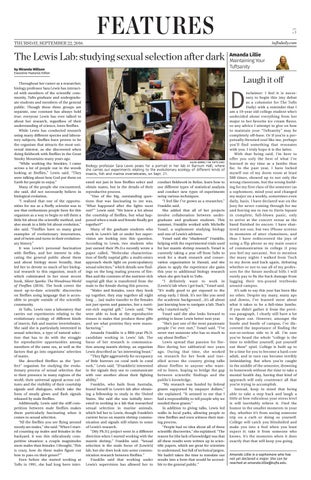
Biology professor Sara Lewis poses for a portrait in her lab in Barnum Hall, where she carries out experiments relating to the evolutionary ecology of different kinds of insects, fish and marine invertebrates, on Sept. 21. ested not just in how fireflies select and obtain mates, but in the details of their reproductive process. “One of the big, outstanding questions that was fascinating to me was, ‘What happened after the lights went out?'” Lewis said. “We knew a lot about the courtship of fireflies, but what happened when a male and female finally got together?” Many of the graduate students who work in Lewis’s lab or under her supervision are looking into this question. According to Lewis, two students who just earned their Ph.D.s recently wrote a paper called, “Molecular characterization of firefly nuptial gifts: a multi-omics approach sheds light on postcopulatory sexual selection,” which details new findings on the long mating process of fireflies and the contents of the nutrient-rich nuptial gift that is transferred from the male to the female during this process. “Males and females, once they hook up together, they stay together all night long … [as] males transfer to the females not just sperm and gametes, but a nutrient-rich nuptial gift,” Lewis said. “We were able to look at the reproductive tissues in males that produce these gifts and see what proteins they were manufacturing.” Amanda Franklin is a fifth-year Ph.D. candidate working in Lewis’ lab. The focus of her research is communication among mantis shrimp, an organism Lewis described as “an interesting beast.” “They fight aggressively for occupancy of little burrows on coral reefs in coral rock,” Lewis said. “[Franklin’s] interested in the signals they use to communicate with one another about their fighting ability.” Franklin, who hails from Australia, found herself in Lewis’s lab after obtaining a fellowship to study in the United States. She said she was initially interested in working in a lab that researched sexual selection in marine animals, which led her to Lewis, though Franklin’s current focus on mantis shrimp communication and signals still relates to some of Lewis’s research. “[My Ph.D.] project went in a different direction when I started working with the mantis shrimp,” Franklin said. “Sexual selection is the main focus of [Lewis’s] lab, but she does look into some communication research between fireflies.” Franklin said that working under Lewis’s supervision has allowed her to
conduct fieldwork in Belize, learn how to use different types of statistical analysis and conduct new types of experiments using various techniques. “I feel like I’ve grown as a researcher,” Franklin said. She added that all of her projects involve collaboration between undergraduate and graduate students. This summer, Franklin worked with Michelle Ysrael, a sophomore studying biology and one of Lewis’s advisees. Ysrael said she “shadowed” Franklin, helping with the experimental trials used for her mantis shrimp research. Ysrael is currently taking a year off from Tufts to work for a shark research and conservation organization in Hawaii, and she plans to apply the experience she gains this year to additional biology research when she gets back to Tufts. “I definitely want to work in [Lewis’s] lab when I get back,” Ysrael said. “It’s really good to get exposed to the setup early, I think. It’s not like you need the academic background…it’s all about just learning how to navigate a lab. That’s why I started early.” Ysrael said she also looks forward to getting to know Lewis better next year. “She’s just one of the most passionate people I’ve ever met,” Ysrael said. “I’ve never met someone who has so much to say about fireflies.” Lewis spread that passion for fireflies during her sabbatical two years ago. During that time, she worked on research for her book and travelled across the country giving talks about fireflies to anyone who wanted to listen, hoping to bridge the gap between scientific findings and the public’s knowledge. “My research was funded by federal grants supported by taxpayer dollars,” she explained. “It seemed to me that I had a responsibility to tell people why we needed these grants.” In addition to giving talks, Lewis led walks in local parks, allowing people to view fireflies and even witness their mating process. “People had no idea about all of these scientific discoveries,” she explained. “The reason for [the lack of knowledge] was that all these results were written up in scientific papers, which are great for scientists to understand, but full of technical jargon. We hadn’t taken the time to translate our results into a form that would be accessible to the general public.”
isclaimer: I feel it is necessary to begin this (my debut as a columnist for The Tufts Daily) with a reminder that I am a 19-year old college student who’s undecided about everything from her major to her favorite ice cream flavor, so any advice I attempt to give on how to maintain your “Tuftsanity” may be completely off-base. Or if you’re a perpetually-frenzied soul like me, perhaps you’ll find something that resonates with you. I truly hope it is the latter. With that being said, I’m here to offer you only the best of what I’ve learned in my time as a Jumbo thus far. In the past year, I have locked myself out of my dorm room at least 500 times, showed up to not only the wrong classroom, but the wrong building for my first class of the semester (as a sophomore, mind you) and changed my major on a weekly, sometimes even daily, basis. I have declared war on the Joey for never coming through for me and forcing me to run to Davis Square in complete, full-blown panic, only to arrive at the concert venue as the band finished its encore. I have shattered not one, but two iPhone screens in moments of utter clumsiness, and thus I have rediscovered the joys of using a flip phone as my main source of communication in college (I pray you feel my sarcasm). Not to mention the many nights I walked from Tisch to my dorm and back again, debating whether or not to sue all of my professors for the future medical bills I will surely pay to fix the back damage from lugging their ten-pound textbooks around campus. It’s safe to say this year has been like no other. Despite my many, many ups and downs, I’ve learned more about what it takes to be a full-time Jumbo. If you didn’t gather it from the previous paragraph, I clearly still have a lot to figure out. However, amongst the hustle and bustle of campus, I’ve discovered the importance of finding the not-so-serious side to it all. I’m sure you’ve heard the whole “college is the time to redefine yourself, put yourself out there” spiel. College is built up to be a time for you to become a hard-core adult, and in turn can become terribly intimidating. But when you’re caught in the middle of the semester, drowning in homework without the time to take a mental health day, having that kind of approach will only counteract all that you’re trying to accomplish. Instead, keep in mind that being able to take a step back and laugh a little at how ridiculous your stress level is will inevitably relieve it. Find the humor in the smaller moments in your day, whether it’s from seeing someone trip on a curb or doing so yourself. College will catch you blindsided and make you into a fool when you least expect it; take it from someone who knows. It’s the moments when it does exactly that that will keep you going.
Amanda Lillie is a sophomore who has not yet declared a major. She can be reached at amanda.lillie@tufts.edu.
8
THE TUFTS DAILY | ADVERTISEMENT | Thursday, September 22, 2016
1/4
1/8 FULL AD What is expected of me?
What is The Tufts Daily Semester Scholarship? This scholarship schola aims to provide funds to first-year students with demonstrated financial need so they may be able to pursue their interest in journalism and media through the Daily.
Who qualifies? F irst-year students at Tufts who qualify for federal work study or have demonstrated financial need. Students with serious interest in journalism or media. No prior journalism experience is necessary, but it is preferred.
tuftsdaily.com
1/2
Complete a set number of projects every month. Meet weekly with your section executive editor to assess your work and discuss opportunities for growth.
H ow am I paid? The scholarship is worth $500. You will receive two installments of $250, one midway through the semester and the second upon completion of the scholarship at the end of the term.
Apply at : tinyurl.com/dailyscholarship
Applications due at noon on September 30th!
ARTS&LIVING
9 tuftsdaily.com
Thursday, September 22, 2016
Parker Selman All in Good Taste
MOVIE REVIEW
‘Snowden’ lacks boldness, fails to reinvigorate ongoing national issue by Jocelyn Contreras Assistant Arts Editor
Oliver Stone’s “Snowden,” which was released on Sept. 16, has the cluster of elements that make for a great film: an exciting, mysterious lead character; a timely, multi-faceted national concern and the anesthetizing glory brought on by Joseph Gordon-Levitt’s mere presence. Okay, that last one might be a reach for some people. Even with all these factors, if the goal was to humanize Edward Snowden, as most biopics set out to do for their central characters, that goal may have been what doomed this film from the start. He’s been a bit of an enigma, isn’t he? So far out of reach, he left before anyone knew there was someone to miss. How can one humanize such an elusive character? Of course it’s possible, given that he is in fact human, but Stone’s attempt came off as contrived and it gradually dissipated the natural urgency and marvel stirred by the situation it was modeled after. “Snowden” picks up with a brief introduction to the main character, who has clearly been transformed in some way, before going back in time a la “How did we end up here?” In this scenario, Stone takes audiences back to 2013, inside a now-infamous Hong Kong hotel room. There, filmmaker Laura Poitras and journalist Glenn Greenwald meet with Edward Snowden for the first time after receiving Snowden’s emails containing shocking information regarding the government’s involvement with covert-surveillance programs. During this meeting, Poitras gathers the footage she uses for her documentary “Citizenfour” (2014), which to date has received wide acclaim, including an Academy Award for Best Documentary Feature. From this brief encounter, audi-
ences muster that Snowden is extremely intelligent and fairly paranoid, although justifiably so. The film takes a detour and reintroduces Snowden as a dutiful patriot who simply wants to serve his country. His attempts at doing this as a solider are thwarted after he is medically discharged. He then approaches the Central Intelligence Agency (CIA), which takes a chance on this puzzling individual who did not finish high school, but shows undeniable promise. Through some so-classic-itwill-make-you-roll-your-eyes montages, audiences are made to understand that Snowden is special as he finishes a test in 38 minutes that takes the typical person five hours — come on. That, and he’s an underdog. The perfect mix, right? Gordon-Levitt visibly works with what he has to ground this character in an accessible way; however, the effect inches its way toward impersonation rather than portrayal. Gradually, and frankly so gradually that the supposed excitement and momentum is rendered flavorless, Snowden grows uncomfortable with the CIA and National Security Agency’s (NSA) domestic surveillance measures. He places enormous pressure on himself as if he is the only morally-conflicted person among hundreds of employees. Since the arc of the film is structured around Snowden realizing he has to take matters into his own hands, the majority of the scenes are motivated by introspection. Not exactly the flashy style for which Stone has made himself known. Amidst all the internal angst, Shailene Woodley plays Snowden’s love interest Lindsay Mills, who appears to claw her way out of the sullen-girlfriend trope. Their scenes together are well-acted, but lack an emotionally resonating punch.
Saus review
The stakes are meant to be tied to an intrusion of their own privacy, which is in turn supposed to highlight how morally repugnant the actions of the NSA and CIA are. Eventually, Snowden leaves the country with a copy of revealing documents he stole from the NSA. He takes refuge in Hong Kong, and it’s back to where the film started. The story at hand is, by itself, undeniably exciting. One would think that this film would inherently strike discomfort, terror, paranoia, introspectiveness and a sudden urge to spread the information to as many people as possible as soon as the credits roll. However, the structure and emphasis on Snowden’s humanity muted the chance of exhilaration and instead relayed boredom. Somehow, his characterization lacks the nuance to make the stakes matter to the audience. Instead, it feels forced and just checks off the expected minimum of backstory, inner and outer conflict and character arc. Perhaps the result could have been more thrilling if the violation-of-privacy element were more prevalent. Paranoia was touched on, but did not strike a nerve like it did in Poitras’ “Citizenfour.” Recent films including Adam McKay’s “The Big Short” (2015) have successfully looked at real-world issues and achieved a resurgence of importance for the matter at hand. It transcends the experience of merely sitting in a dark room because the effects are authentic and a part of our everyday lives. “Snowden” had a lot to live up to, and it deserved to have a heavier hand in instilling the story deeper into our consciousness. Yes, Snowden is made out to be a hero by the end of the film, but the film could have been more daring in achieving this.
OPEN ROAD FILMS / TNS
Joseph Gordon-Levitt leads in a scene from the movie “Snowden,” directed by Oliver Stone.
W
hether in Davis Square or beyond, sometimes it’s refreshing to get a break from Dewick and Carmichael. I’m Parker, a sophomore who admittedly spends an unhealthy amount of time searching for tasty Boston restaurants. This column will hopefully provide some must (or must not) stops in the Boston area. Nestled among the pubs and taverns that dot the side street between Boston Public Market and Faneuil Hall lies Saus, a Belgian-inspired eatery. On a Friday afternoon, a friend and I venture into the small restaurant after picking up veggies at nearby Haymarket, a sprawling outdoor market that is open from dawn to dusk on Fridays and Saturdays. We walk into the narrow, casual room filled with about 10 small, wooden tables and benches and head for the counter in the back. I stare up at the black chalkboard that asserts “Everything is made from scratch in house. Except for what isn’t (which ain’t much).” The menu, scrawled in various colors, boasts poutine and pommes frites, along with sandwiches and sweets. Though the restaurant is famous for its poutine, as a vegetarian, I opt instead for an order of the pommes frites. There are 13 side dipping sauces for 75 cents each to accompany the hand-cut fries. My friend and I choose the Cheddar Duvel (a cheddar and ale sauce) and the Truffle Ketchup. Ana, my friend, asks for an employee’s advice and ultimately decides on a herb-roasted chicken sandwich. I instantly have eyes only for the “CBJ” sandwich, a warm hoagie filled with jam, bananas and cookie butter. If you don’t know what cookie butter is, it’s essentially peanut butter made from crushed Bischoff cookies rather than peanuts. We get a small, two-person table and wait for our names to be called. Alternative music plays softly throughout the restaurant. We sit beneath framed comic book pages and posters from “The Adventures of Tintin” (1972-1976). Next to us a couple splits an order of the poutine and a Belgian waffle. The small room is filled with cheerful chatter and the smell of fries and we excitedly await our food. When our name is called, Ana eagerly bites into her sandwich. She blindly followed the cashier’s advice, and, therefore, is slightly surprised to find apple slaw and pickles next to her chicken. Though she likes the different flavors, she ultimately concludes the sandwich is “good, not great,” and that it is lacking a punch of flavor. My cookie butter sandwich is just as wonderful as I anticipated. That said, the pommes frites definitely steal the show. The dipping sauces are rich and compliment the crispy fries perfectly. The meal is not overpriced, $8.50 for a sandwich and $5.50 for a regular order of fries, which was the perfect size for two to share. We determine that the restaurant, which was featured on “Diners, Drive-ins and Dives” (2006-present), is worth the trip. An outing to Saus promises superb fries at fair prices in one of Boston’s coolest neighborhoods. The restaurant is open until 2 a.m. on Fridays and Saturdays and is perfect for your late night fry fix or for an afternoon expedition into the city. Parker Selman is a sophomore who has not yet declared a major. She can be reached at parker.selman@tufts.edu.
10
THE TUFTS DAILY | ADVERTISEMENT | Thursday, September 22, 2016
1/4
1/8 FULL AD 1/2
tuftsdaily.com
Thursday, September 22, 2016 | Comics | THE TUFTS DAILY
tuftsdaily.com
Comics
LATE NIGHT AT THE DAILY Kathleen: “I’ve said it before and I’ll say it again: chocolate chips in delicate doughs are too intense.”
Comics
SUDOKU
DOONESBURY BY GARRY TRUDEAU
NON SEQUITUR BY WILEY MILLER
Difficulty Level: Maintaining relevance at Tufts while you’re abroad.
Monday’s Solution
CROSSWORD FOR RELEASE SEPTEMBER 22, 2016 Los Angeles Times Daily Crossword Puzzle Edited by Rich Norris and Joyce Lewis
ACROSS 1 It’s often a stretch 5 Grim, as a landscape 10 Debit card choice 14 Superstar 15 Command 16 Troublesome tykes 17 Bad-blood situation 18 One out for blood 20 Some browns 21 Number in an outline, perhaps 22 Put in stitches 23 Variety show array 26 Disdainful look 27 Holes in sneakers 29 Cruising 31 Slenderstemmed palm 32 Where to see a wake 33 Botch 37 Lease alternative 38 Babies, or what some babies wear 41 Historic beginning? 42 Kentucky Fried side 44 Brewery fixture 45 In-groups 47 Irish New Age singer 49 Runs aground 50 Striped quartz 53 Pork-filled pastry, e.g. 55 Ruined in the kitchen 57 Brooke Baldwin’s network 58 Auto parts giant 61 Pearl Harbor battleship 63 Third-generation Genesis name 64 Remote button with a square 65 Capital on the Willamette 66 Pedometer measure 67 Many millennia 68 Sky scraper? 69 Stage layouts DOWN 1 Garage contraption
By Roger Wienberg
2 What a light bulb may mean 3 Europe’s highest active volcano 4 Veteran seafarer 5 Cold War Baltic patrollers 6 Coaches 7 Acknowledge 8 Account exec 9 Angel who replaced Jill, in ’70s TV 10 “The Deer Hunter” setting 11 Saturate (with) 12 Let off the hook 13 Late bloomer? 19 Bit of subterfuge 24 Entrechat, e.g. 25 Call at home 27 Lover of Psyche 28 Ketch kin 30 Green sign information, traditionally 32 Suitable 34 Raise stakes in a game ... and a hint to a hidden feature of five Down puzzle answers
9/22/16 Wednesday’s Solution
Wednesday’s Puzzle Solved
©2016 Tribune Content Agency, LLC
35 Like many apps 36 Cop to the crime, with “up” 39 Address with an apostrophe 40 Smack 43 Wings eaters’ needs 46 Aloof demeanor 48 “In thy dreams!” 49 Hung sign
9/22/16
50 Treat badly 51 Zest 52 Illegal firing 54 USDA inspector’s concern 56 Ph.D. hurdle 59 Well-versed artist? 60 Deadly slitherers 62 Fast-forward through
11
12 tuftsdaily.com
Anna Sossenheimer Jumping Hurdles
Opinion OP-ED
Op-Ed: Everything is awesome? by Jamie Neikrie
Down with kale
E
ver heard of “Ned’s Declassified School Survival Guide”? Bracefaced, pimply, lanky little Anna was obsessed with that show, and all I ever wanted in middle school was a guide that told me step-by-step how to navigate life. Now, quite a few years later as a washed-up college junior, I still haven’t quite grown out of my awkward phase (I’m starting to think I never will,) and I still wish I had a school survival guide — a life survival guide, to be frank — considering college is hard and life is hard and I don’t really know what I’m doing yet. For example, how in the world do you grocery shop on a budget? How do you shop for the perfect amount of food that is healthy and won’t go bad? How do you not spend 50 bucks on Hint of Lime Tostitos alone? Living in a house of my own has definitely made me realize all the things I took for granted-I’ll never complain about the dining halls again, that’s for sure. It’s funny how the process of eating food in college becomes so much more complicated than I had ever experienced before. Learning how to eat healthy in the dining halls is tricky enough — it took me until sophomore year to figure out how to make a decent salad from the salad bar (I lived off of ramen until my senior year of high school, give me a break). My experience with the dining halls has been all about balance. Sometimes I’d eat Cap’n Crunch for dinner, sometimes I’d eat the stir-fried veggies, but overall I figured out that a nice mix between healthy and not-so-healthy was all it really took. Cooking my own food though? No way. The first week of school I was overambitious and only bought things like kale, broccoli, avocados and dark-chocolate-covered almonds, because I thought I’d be one of those cute, trendy Instagram girls who lives off of salad and makes perfect smoothie bowls for every meal. I’ve already caved and resorted to scrounging around for frozen food and mac and cheese, because I just don’t understand how anyone makes kale taste good. Cooking is a process, just like managing the dining hall was. With each year I enter further into adulthood, I realize all the things I don’t know about how to be a responsible, independent human. Sometimes I feel like I face-plant over each hurdle I come across, but I guess that’s the nature of growing up. It ain’t easy, but I’ll get there eventually. Anna is a junior majoring in sociology. She can be reached at anna.sossenheimer@tufts.edu.
Thursday, September 22, 2016
The United States had a very good 2015. This was the message that emerged last week when the Census Bureau released its annual report on income, poverty and health coverage. Analyzing 2015, the report found that the American economy witnessed one of its best years on record. Most notably, median household income rose 5.2 percent last year — the largest single-year increase since the Census Bureau began collecting this data in 1967 — up to $56,500. But the good news was plentiful. The unemployment rate fell to a staggering five percent, spurred by the addition of 3 million jobs. The number of Americans living in poverty fell by 3.5 million. This eight percent drop from last year is the largest single-year percentage decline since 1999. Ninety-one percent of Americans had health insurance last year, an increase in coverage fueled by the Affordable Care Act and state expansion of Medicaid. Essentially, after years of stagnation, Americans finally got a raise, with health insurance tossed in. The economy has been gradually recovering since the Great Recession, but the vast majority of the economic gains have gone to the very wealthy. This year’s census report reversed that trend. Low-income households saw the largest percentage increase in income. Household incomes for those in the 10th percentile — the poorest 10 percent of American households — rose 7.9 percent, while those in the 20th percentile saw a boost of 6.3 percent. These are staggering increases for a single calendar year. In comparison, the 90th percentile — the richest 10 percent of households — saw an income boost of 2.9 percent. For once, the poor captured a greater percentage of gains than the rich. In the immortal words of Joe Biden, this is a “big f—ing deal.” This report puts a huge dent in the narrative promoted by Donald Trump
and the Republicans that the American economy has stagnated under the leadership of President Obama. It is a golden ticket handed to Hillary Clinton, proof that Democratic economic principles are working. Of course, the GOP doesn’t see it this way. “Today’s report is another disappointing confirmation that too many Americans are still struggling to provide for their families and reach their full potential,” Representative Kevin Brady, the chairman of the Ways and Means Committee, said. “The federal government invests billions of dollars each year in programs to help low-income Americans, but more than 43 million people continue to live in poverty.” But it’s not just the Republicans who have met this report with caution. “Economic recovery finally started arriving for tens of millions of American families over the past year. We should make sure the economy is nurtured going forward and not subverted by bad policy decisions,” Elise Gould, a senior economist at the Economic Policy Institute in Washington, said. In his reporting of this story, the New York Times’ Binyamin Appelbaum highlighted the story of Jeff Labruzzo, a construction worker from Louisiana who may have to close his small business due to economic hardship. This is not the kind of reporting you would expect to result from such an ebullient census report. Of course, everything in the economy is not perfect. Median household income has not yet recovered to 2007 levels, and the gains that were enjoyed this past year were mostly concentrated in urban areas. According to Vox’s Timothy B. Lee, income gains grew slower in rural areas as compared to those in both urban and suburban areas. The country’s three largest counties — Los Angeles County, Kings County (Brooklyn) and Miami-Dade County — experienced the greatest growth in jobs, while the least populous counties continued to struggle. Despite its overall success, the Affordable Care Act has done little to stop
the skyrocketing increase in healthcare premiums. And the census report does not address the much-reported statistic that 22 percent of men without a college degree between the ages of 21 and 30 did not work at all in 2015. But there is a bigger, more philosophical reason why reporting around the Census Bureau’s report has been so reserved: journalists have a bad-news bias. Turning on any news channel, this will not come as a shock. The 24-hour cycle has become a fatalistic frenzy, a highlight of all the things that could possibly kill us. But when media outlets report on something like this year’s census report, their lack of exuberance comes not from a place of sensationalism, but from a sense of professionalism. To report that the economy is thriving — no matter how true that statement may be — would be to deny the experiences of so many Americans who are still struggling post-recession. And for many of today’s reporters, who entered the profession post-Watergate, their job is to be skeptical, to bring light to injustice and corruption, not to be cheerleaders. I appreciate that urge. But given the narrative around the election, one that has hinged on the failures of the Obama presidency, the shortcomings of the United States and the weakness of both parties’ candidates, good news deserves its spotlight. So, while it does not encompass all facets of the economy, or speak for every American’s experience, this year’s job report is unabashedly good news. And that deserves recognition. Editor’s note: If you would like to send your response or make an op-ed contribution to the Opinion section, please email us at tuftsdailyoped@gmail.com. The Opinion section looks forward to hearing from you. Jamie is a junior majoring in political science. He can be reached at benjamin. neikrie@tufts.edu.
The Tufts Daily is a nonprofit, independent newspaper, published Monday through Friday during the academic year, and distributed free to the Tufts community. The content of letters, advertisements, signed columns, cartoons and graphics does not necessarily reflect the opinion of The Tufts Daily editorial board. EDITORIALS Editorials represent the position of The Tufts Daily. Individual editors are not necessarily responsible for, or in agreement with, the policies and editorials of The Tufts Daily. OP-EDS The Op-Ed section of The Tufts Daily, an open forum for campus editorial commentary, is printed Monday through Thursday. The Daily welcomes submissions from all members of the Tufts community; the opinions expressed in the Op-Ed section do not necessarily represent the opinions of the Daily itself. Opinion articles on campus, national and international issues should be 600 to 1,200 words in length and submitted to oped@tuftsdaily.com. The editors reserve the right to edit letters for clarity, space and length. All material is subject to editorial discretion and is not guaranteed to appear in the Daily. Authors must submit their telephone numbers and day-of availability for editing questions. ADVERTISING All advertising copy is subject to the approval of the Editor-in-Chief, Executive Board and Executive Business Director.
Opinion
Thursday, September 22, 2016 | Opinion | THE TUFTS DAILY
13
CARTOON
by Allie Merola
Tufts Dining is hiring Student Workers in all Units
Hiring Student Workers If you have significant experience working in food service, catering or as a barista, please make sure to mention that in your email for a supervisory role.
Starting at $11.00 per hour
Tufts Dining is the largest student employer on campus. We have a variety of positions in our many units helping out in catering, any one of our coffee houses, and our retail and residential operations. You do not need Work Study to work and we will train you if you do not have experience in food service. Some of our positions fill quickly, so if you have an interest, please contact Anthony, Tufts Dining Student Coordinator, at Anthony.Mahoney_Pacheco@Tufts.edu
14
THE TUFTS DAILY | Sports | Thursday, September 22, 2016
Vinny Donofrio Vinny’s Variety Pack
The Cardinal(s) rule Week 3 What’s up fantasy football fans? I’m your new fantasy columnist for the fall, and my job is to help you win a game or two this year. In each column, I am going to give you one to two players at each position who should be absolute fantasy studs for the upcoming week, while hopefully managing to keep my New York Giants bias out of the picture. Alright, let’s do this! Drew Brees, quarterback (QB), New Orleans Saints The Atlanta Falcons have been brutally ineffective against the pass these first two weeks, giving up 580 yards and five TDs to opposing QBs. Not only is Drew Brees more talented than Jameis Winston and Derek Carr, but he also has a deeper wide receiver (WR) core and a better run game to take pressure off of the pass. Expect Drew to make up for his team’s lackluster offensive showing last week and put up some big numbers against the Falcons. Larry Fitzgerald, WR, Arizona Cardinals Ahh, good ole Larry Fitz. How many years in a row have we thought he was going to be on the decline? Two? Three? Well, he’s clearly not. Larry is 33 years young and is currently torching defenses. Larry is almost guaranteed six catches for 80 yards and a touchdown. This week is no different. I see Larry having himself another day against a Bills team falling to pieces. Bonus PPR WR: Will Fuller, WR, Houston Texans The Patriots defense has given up the fourth most points to WRs in PPR formats, and a large chunk of those points go to slot receivers (Jarvis Landry and Fitzgerald). DeAndre Hopkins is likely to be paired with Malcolm Butler, leaving Will Fuller open to terrorize the rest of the secondary. Matt Forte, running back (RB), New York Jets Last week, Forte made the Bills look like a pee-wee football team by dropping 100 yards and three TDs. Is that going to happen again this week? Probably not, but look for Forte to hurt the Chiefs, who have been middling stopping the run and will be focusing most of their attention on the Jets’ prolific pass game. Bonus PPR RB: David Johnson, RB, Arizona Cardinals Johnson has been an OK back in standard formats, and a great one in PPR. Expect him to go off on the Bills defense that looks like it’s playing football for the first time. Delanie Walker, tight end, Tennessee Titans Did you see the way Atlanta tight ends abused the Raiders last week? They combined for 180 yards and a touchdown. Walker is a much more talented tight end than Jacob Tamme and Austin Hooper, and he is far and away the most talented target on the Titans. Arizona D/ST The Cardinals really stepped up after their terrible performance against a rag-tag New England Patriots squad depleted by injuries. Arizona reeled in four picks, forced a fumble and even got a sweet defensive touchdown against the Buccaneers. This week, they go up against the Bills who make the Cleveland Browns look like Super Bowl contenders. I expect another big day out of Bruce Arians’ stout defense. Vinny Donofrio is a senior majoring in clinical psychology. He can be reached at vincent.donofrio@tufts.edu.
tuftsdaily.com
Thursday, September 22, 2016 | Sports | THE TUFTS DAILY
Sports
15
Editors’ Challenge | Week 3 Welcome back, sports fans, to the third week of Editor’s Challenge. Last week, we saw some drastic changes to our standings as the middle of the pack overthrew the top. The most drastic change was the guest’s spot, which slid from a first place tie to tying for second to last place. The Daily’s own Editor-in-Chief Arin “standard poodle” Kerstein scored half as many points in week two (6) as our guest from week one (12). Last place David “Maltese” Westby was the only person to select the Texans over the Patriots and
we will be mailing him the results from this week to his nuclear bunker while he hides from the New England faithful. Ali “Boxer” Kuah and Evan “Shih Tzu” Sayles are tied with Zach “Alaskan Malamute” Hertz for first and after a dismal first week, Eddie “Pembroke Welsh Corgi” Samuels moved from last place to second to last place. Keep it up, Eddie! On that note, may our oblong balls bounce favorably, may we pick the winningest team and may Eddie fall back to last.
ALI
EVAN
ZACH
MACLYN
PHIL
SOPHIE
YJ
EDDIE
DAVID
NE BAL NYG GB MIA CAR DEN ARI OAK LA SEA PIT NYJ IND DAL ATL
GUEST Kathleen NE BAL NYG DET MIA CAR DEN ARI TEN TB SEA PIT NYJ IND DAL ATL
HOU at NE BAL at JAX WAS at NYG DET at GB CLE at MIA MIN at CAR DEN at CIN ARI at BUF OAK at TEN LA at TB SF at SEA PIT at PHI NYJ at KC SD at IND CHI at DAL ATL at NO
NE BAL NYG GB MIA CAR DEN ARI TEN LA SEA PHI KC SD CHI ATL
NE BAL NYG GB MIA CAR DEN ARI OAK TB SEA PIT NYJ IND DAL ATL
NE BAL NYG GB MIA CAR DEN ARI TEN TB SEA PHI KC IND DAL ATL
NE BAL NYG GB MIA CAR DEN ARI OAK LA SEA PIT KC IND DAL ATL
NE JAX NYG DET MIA CAR DEN ARI OAK TB SEA PIT NYJ IND CHI ATL
NE BAL NYG GB MIA CAR DEN ARI TEN TB SEA PHI NYJ IND DAL NO
NE JAX NYG GB MIA CAR DEN ARI OAK LA SEA PHI NYJ IND CHI ATL
HOU BAL NYG GB MIA CAR CIN ARI OAK TB SEA PIT KC IND DAL NO
SCORE:
23
23
23
22
21
21
20
18
18
17
Becherano leads Jumbos with three goals in two games MEN'S SOCCER
continued from page16 team coming off the bench — especially for the midfield transition and getting crosses in. First-year defender Tanner Jameson has also already started three games and stepped up to be a reliable corner kick taker after the team graduated two seniors who had previously taken the majority of corners. Forward Joseph Braun’s aggressive attacking style necessitates that opposing goalies and defenders know where he is at all times. “Our team is pretty young and because of the rules of the NESCAC you don’t get much of a preseason, so it takes a few games for us to gel,” Tasker said. “We are coming together and understanding better what people bring to the table, you saw that in the last few games.” The flow of the game against Bates on Saturday was very similar to that of the game on Sunday, with Tufts acting as the dominant force on the field. The Jumbos shot 38 times, with 14 shots on target, as compared to the Bates Bobcats’ three shots, none of which were on target. Tasker led the team in shots with six total, three of which were on target. Bates’ sophomore keeper Robbie Montanaro saved several of his efforts. The first goal came eight minutes into the game when Becherano was brought down in the box, and he capitalized on the penalty kick opportunity to put the Jumbos ahead. Bates caught up from that point on, but had almost no scoring opportunities because Tufts effectively kept possession in its attacking half. Tufts was so comfortable that at one point midway through the second half the bulk of Tufts’ attacking formation was composed of first-years, with Trevorrow and Tasker flanking on the midfield. Halliday effectively directed the team on the field and provided a constant check on the pace, directing players to sometimes slow down when it became too frantic. From the back, junior defender Conor Coleman directed the forwards, ensuring that they were spread out wide and were in the right places to make the midfield transition most effective. Junior midfielder Dexter Eichhorst made a powerful run through the Bates defensive unit 75 minutes after Tufts’ opener and passed the ball off to Becherano at the last second, who was easily able to put the ball over the goalie’s head. Minutes later, Eichhorst netted his own goal off an assist from first-year midfielder Jack Delaney to make the score 3-0. “We scored a lot earlier [against Bates] so they were chasing the whole time,” Tasker said. “Again we weren’t able to capitalize on
EVAN SAYLES / THE TUFTS DAILY
Junior midfielder Tyler Kulcsar maintains possession of the ball despite a Bowdoin tail in the game against Bowdoin on Oct. 31, 2015. our chances until the end, so it was a 1-0 game until the 80th minute. We should have put them away earlier, but it was good to get the
two goals at the end.” The Jumbos now stand at 2-2-1 ahead of this Saturday’s non-conference game away
at Brandeis. Tufts returns to Bello on Tuesday to play Wesleyan in its second NESCAC contest of the season.
16 tuftsdaily.com
Sports
Thursday, September 22, 2016
GOLF
Brandon Karr hits Tufts’ first hole in one in 25 years by Ryan Schneiderman Staff Writer
Men’s golf travelled to Middlebury, Vt. last weekend for the Duke Nelson Invitational and the team’s second competitive tournament of the season. A strong first day saw the Jumbos in sixth place, but they slid to 13th on the second day. “We started off pretty hot,” coach George Pendergast said. “There were 22 schools at the event and I think after one day, we were sixth or seventh, and then we didn’t play as well the second day. We were 10 shots worse and all the other teams played pretty well, so we got passed by a few and we wound up in the middle of the pack.” After securing a fifth place finish at the Detrick Invitational, a 13th place finish at the Duke Nelson Invitational cannot be what coach Pendergast was hoping for. With such a young squad, some up and downs early in the season are to be expected. One of the bright spots in an otherwise forgettable weekend was firstyear Brandon Karr’s performance. Karr was solid both days, posting two sub-80 rounds and finishing tied for 26th overall. His play ranked second for Tufts only behind junior tri-captain Taylor Nordan. Karr’s team best of 76 on Sunday was impressive, but the transcendent moment of Karr’s weekend came on the last hole of regulation. On the 18th hole, a par 3, Karr ended his round with an ace. Literally. After stroking a per-
fect seven iron, the ball landed directly in the hole for the first hole in one by a Tufts golfer in over 25 years. “On 18 the day before, I hooked the ball into the water, so I was really just trying to get something on the green and finish with a par,” Karr said. “I hit my shot just how I wanted to and saw it going right at the pin and then disappear. At first I thought it went over the green, but then I saw a parent walk up and throw his arms in the air. It was a really amazing moment for me and the perfect ending to a solid tournament.“ Nordan strung together more good rounds, posting a 73 on Saturday and 77 on Sunday to finish 10th overall, his second top 10 finish in as many weeks. However, despite the strong finishes, Nordan still was not satisfied, pointing to a five hole stretch in his second round that he would love to have back. “I was one over through 12 after missing some short birdie putts. I made a bogey and then a double and two more bogies after that,” Nordan said. “I’m playing pretty well, but there are definitely things to improve and parts of my game that need work.” Senior tri-captain Owen Elliot was unable to build off his strong Saturday score of 75, as he followed up with an 83 on Sunday to finish tied for 60th. Junior tri-captain Aaron Corn and first-year Ethan Sorkin rounded out scoring for the Jumbos. They finished with a two round score of 165 and tied for 91st.
EVAN SAYLES / THE TUFTS DAILY
Junior tri-captain Aaron Corn hits the ball for his second shot of the seventh hole at the Newbury Invitational on Sept. 23, 2015.
Nordan did not blame the course or conditions for the team’s play, though he did note that because the course is not part of a country club — Ralph Myhre Golf Course is a part of Middlebury’s campus — it plays differently from most of the courses Tufts competes at throughout the year. “The course is pretty quirky,” Nordan said. “It’s only 6,300 yards, so they have to do something to stop people from just tearing it apart. The greens were definitely
the most difficult aspect of the course.” While Tufts struggled on the second day, Middlebury thrived on its home course, finishing second overall. Skidmore took the top spot, led by individual champion senior Mackenzie Nelson while Trinity College, Rochester and Middlebury’s ‘B’ team rounded out the top five. Tufts will look to bounce back next week when the Jumbos travel to Williams College for the Williams Fall Invitational at Taconic Golf Club.
MEN'S SOCCER
Men’s soccer rebounds with two 3-0 wins at home by Maddie Payne Sports Editor
In the Jumbos’ home opener at Bello Field on Saturday, the team earned its first win of the season, defeating Bates 3-0. On Sunday, Tufts repeated its success at home in a 3-0 win over non-conference opponent Plymouth State. Prior to last weekend the Jumbos were 0-2-1, marking their worst start since 2009 when they opened the season 0-4-1. According to senior forward Gaston Becherano, the main difference for the Jumbos in the home wins was the turf field. “As a team we are really accustomed to the turf field and it suits our style of play,” Becherano said. “We like to play on the floor, quickly, spreading out wide, so being back at home really suited us.” Plymouth State was 2-2-1 heading into the match on Sunday, one win ahead of Tufts’ 1-2-1 record at the time. However, the Jumbos dominated the Plymouth State Panthers from the start. The Jumbos took 30 shots and forced 11 saves from Panthers’ senior keeper Felix Lindeberg. In comparison, the Panthers took two shots during the entire 90 minutes, neither of which was on target. The first 45 minutes were scoreless, but that was not for lack of opportunity on the Jumbos’ end. In the first six minutes Tufts had six shots on goal. The Jumbos shot straight at Lindeberg, who made three saves within the first six minutes. The majority of these opportunities came in from left-side crosses by first-year midfielder Gavin Tasker, who has repeatedly been instrumental in creating opportunities for the forwards. The Jumbos consistently kept up their attacking pace in the second half. This paid
EVAN SAYLES / THE TUFTS DAILY
Tufts defender then-sophomore Conor Coleman winds up for a cross-field kick in the game against the Bowdoin Polar Bears on Oct. 31, 2015. off just five minutes in when Becherano headed in a corner from senior midfielder Kevin Lawson. The first goal opened up the scoring, and 19 seconds later junior midfielder Tyler Kulcsar took advantage of a disorganized Plymouth State defense by sending an early ball to senior co-captain Zach Halliday, who passed it to Becherano. Becherano finished
the play, firing his second goal into the top right corner. Ahead two goals, the Jumbos did not let up, and shot another eight times. Becherano nearly pulled off a hat trick, but his potential third goal clanged off the inside of the crossbar. With 16 seconds remaining, junior midfielder Christian
Zazzali set up first-year forward Brett Rojas’ shot straight down the middle for his first collegiate goal. First-years shone throughout the weekend, as midfielders Zach Lane and Zachary Trevorrow provided important energy to the see MEN'S SOCCER, page 14
TUFTS GOLF
Soccer hits its stride in two-game hot streak see SPORTS / BACK PAGE
Golf comes out swinging; first hole in one in 25 years
Illuminating the science of sexual selection, one firefly at a time see FEATURES / PAGE 5
SEE SPORTS / BACK PAGE
THE
INDEPENDENT
STUDENT
N E W S PA P E R
OF
TUFTS
UNIVERSITY
E S T. 1 9 8 0
T HE T UFTS DAILY
VOLUME LXXII, NUMBER 10
tuftsdaily.com
Thursday, September 22, 2016
MEDFORD/SOMERVILLE, MASS.
University explores interdisciplinary initiatives with proposed data center by Catherine Perloff News Editor
Initiatives focusing on identifying and supporting cross-school programs are beginning to take shape as the semester progresses. Three such initiatives, which were laid out by University President Anthony Monaco in a Sept. 9 message to the university, include development on a proposed Center for Computational and Data-Intensive Research, progress on a data science major and the hiring of the university’s first Bridge Professor, Professor of Psychology Jan P. de Ruiter. Creating a Center for Computational and Data-Intensive Research The center is the broadest of the three initiatives, designed to involve every school and discipline of the university, according to Professor of Mathematics Bruce Boghosian, who chaired the working group that proposed the center. “The center should have a presence on all three campuses of the university, [and be] absolutely cross-disciplinary,” he said. The ultimate goal of the center would be to create a culture of collaboration around data and computational science research, Boghosian said. There is a sense that the university has the necessary expertise to
MAX LALANNE / THE TUFTS DAILY
Professor of Mathematics Dr. Bruce Boghosian, who chaired the working group that proposed the center for computational and data-intensive research, poses for a portrait on the Academic Quad on Sept. 21. excel in these fields, but it lacks a corresponding culture, he explained. “We have the high-performance computing cluster; we don’t have the culture of high-performing computing,” Boghosian said. “The center creates the culture. The center catalyzes interactions between people from departments.” The proposed center would work
within three areas: research, pedagogy and training, according to Boghosian. He said that the center would help facilitate research by connecting scholars who need the expertise of big data and computational science for their research with those who have skills in these areas. According to Boghosian, the center would also position the university to be more competitive for certain types of external grants.
In terms of pedagogy and training, Boghosian said the center would provide advice and resources for new majors and certificate programs, but it would not grant degrees. Bogosian also said that Tufts was uniquely positioned to allow for the kind of interdisciplinary work necessary for these initiatives. “There are things we can do in data science because of the nature of Tufts and the low barriers of cooperation, [and] interdisciplinary work between departments, that other places can’t do,” he said. Boghosian added that it is hard to find comparisons to this proposed interdisciplinary data center at Tufts or other universities. “At one point the planning group– I think we were even asked– ‘what’s comparable?’ and we ended up tossing up our hands at that question,” he said. “There’s nothing quite like it [that we’re aware of].” The center was born in Tufts’ Strategic Plan, published in 2013, according to Provost David Harris. The plan notes that “research increasingly requires access to equipment and individuals who can acquire, analyze and disseminate large data sets,” and proposed the creation of a working group dedicated to “identifying see DATA, page 2
International Relations major creates two new concentrations by Melissa Kain News Editor
This fall, the International Relations (IR) program is offering two newly-revised thematic concentrations ( TC) to be taken alongside the IR major’s core requirement classes. These thematic concentrations are TC5: Globalizations and TC6: Identity. The new globalizations concentration focuses on worldwide practices in topics such as human rights, migration, technology and the study of cultures, among others, according to the IR program’s website. The new identity concentration centers on how people see themselves in the context of the rest of the world through lenses such as gender, class, race, nationality and ethnicity, with emphasis on the influence that identity has on international affairs, according to the IR Program’s website. Over the past year and a half, the International Relations program faculty committees have been meeting to discuss curriculum issues in thematic concentrations, according to Ciara Pisano, program
Please recycle this newspaper
Sunny 81 / 59
/thetuftsdaily
administrator, who spoke on behalf of the IR program staff. As a result of these meetings, the new concentrations were created in place of TC5, which was previously titled The United States in World Affairs, as well as the former TC6, which previously included TC6A: Ideologies and TC6B: Empires/Colonialism/Globalization. “After review of the old TC5 and TC6A/B concentrations, we noticed a need for clarity and coherence within the concentrations,” Pisano told the Daily in an email. The International Relations Curriculum Committee and International Relations Executive Committee proposed Globalizations and Identity, the new TC5 and TC6 concentrations respectively, according to Pisano. They are both reconfigured from the old concentrations, but with newly identified themes that are not already offered in other areas of the IR curriculum, she added. “By creating themed categories in both TC5 and TC6, students will have an easier time establishing coherence among their chosen courses,”
For breaking news, our content archive and exclusive content, visit tuftsdaily.com @tuftsdaily
tuftsdaily
tuftsdaily
Pisano said. According to Pisano, the IR curriculum is composed of 13 different thematic concentrations. Students pursuing an IR major choose one concentration from the list, she said. “All thematic concentrations require a minimum of seven courses from a variety of different categories including social science, history, culture, research methods etc,” Pisano explained. Students interested in the globalizations concentration can take classes such as Childhood Across Cultures, History of Consumption and Global Justice, according to the IR Program’s website. The department website also lists classes for the identity concentration, which include Shaping Identity and Men, Women and Patriarchy in the Middle East. Pisano said that TC1: Regional and Comparative Analysis, TC2: International Economics, TC3: Global Health, Nutrition and the Environment and TC4: International Security are all consistently popular thematic concentrations.
Contact Us P.O. Box 53018, Medford, MA 02155 617 627 3090 FAX 617 627 3910 daily@tuftsdaily.com
“The IR Program is excited about promoting and getting the word out to the Tufts IR community regarding the new concentrations and [they] are hoping to have a significant interest when the current sophomores and first-years are declaring their major and concentrations,” Pisano said. Nikki Margaretos, a student majoring in international relations with a concentration in global health, said that these new concentrations will allow the department to broaden its offerings and appeal to a wider variety of new students. Many concentrations are very fieldbased in topics such as security or finance, which Margaretos, a junior, said can be limiting to students. “I think it’s wise that they’re broadening it to some more abstract focuses,” she said. “They have all those concentrations currently, and a lot of those are very concrete.” Margaretos said that these offerings open another door of the International Relations program to students who may be interested in pursuing social issues through the Identity concentration.
NEWS............................................1 FEATURES.................................5 ARTS & LIVING.......................9
COMICS......................................11 OPINION...................................12 SPORTS............................ BACK
2
THE TUFTS DAILY | News | Thursday, September 22, 2016
T HE T UFTS D AILY Arin Kerstein Editor-in-Chief
EDITORIAL Sophie Lehrenbaum Jake Taber Managing Editors Evan Sayles Associate Editor Kathleen Schmidt Executive News Editor Melissa Kain News Editors Robert Katz Liam Knox Gil Jacobson Catherine Perloff Jei-Jei Tan Hannah Uebele Joe Walsh Kyle Blacklock Assistant News Editors Juliana Furgala Jesse Najarro Danny Nelson Miranda Willson Executive Features Editor Constantinos Angelakis Features Editors Nina Joung Becca Leibowitz Justine Chung Assistant Features Editors Siddharth Divakaruni Justin Krakoff Executive Arts Editor John Gallagher Arts Editors Merilla Michael Eran Sabaner Isaac Brown Assistant Arts Editors Jocelyn Contreras Alison Epstein Elliot Storey Emma Henderson Executive Op-Ed Editor Shannon Geary Cartoonists Stephen Dennison Allie Merola Miranda Chavez Editorialists Aneurin Canham-Clyne Frances DeFreitas Eriko Koide Anita Ramaswamy Noah Weinflash Phillip Goldberg Executive Sports Editor Yuan Jun Chee Sports Editors Maddie Payne Eddie Samuels Josh Slavin Maclyn Senear Noah Smith Assistant Sports Editors Max Lalanne Mia Lambert Caroline Ambros Ray Bernoff Maria Eduarda Ferraz Henry Hintermeister Leila Li Julia Press Evan Sayles Angelie Xiong Sitara Rao Jean Gonzalez
tuftsdaily.com
Bridge professorships, data science major to increase interdisciplinary research DATA
continued from page 1 the resources that are necessary to enhance our research and educational capacity in this critical area.” The working group, which was comprised of 31 individuals representing departments and schools across the university, decided that a center would be the best way of addressing the need for data science, computational science and statistics education and research, according to Boghosian. The working group then broke into a smaller planning group to give more practical recommendations to the provost on how such a center would be implemented, Boghosian said. It is now up to the Office of the Provost to turn the idea into reality, he added. “I am now developing next steps, informed by the group’s recommendations and ongoing engagement with school and university leaders,” Harris wrote in an email to the Daily. Monaco also said in his Sept. 9 message to the university that the administration was making progress toward creating the center. New Data Science Major Other groups at the university are already working on new majors that the center could help facilitate. Faculty from the Department of Computer Science, the Department of Electrical and Computer Engineering and the Department of Civil and Environmental Engineering, along with faculty from the Department of Mathematics have already had infor-
mal meetings over the spring and summer about offering a data science major, according to Professor in the Department of Computer Science Lenore Cowen. “Our faculty working group had pretty good agreement about what courses we thought should form the core of a data science undergraduate major, and we have faculty that either already teach those courses or are ready to teach them,” Cowen wrote in an email to the Daily, noting that the major would probably be offered as two separate degree programs in the School of Arts and Sciences and the School of Engineering. According to Cowen, the nature of the major may depend on how the Center for Computational and Data-Intensive Research develops. “We are waiting to see how things fit into the big cross-school framework that the president and provost will announce!” Cowen said. Harris noted that the administration will have announcements later in the semester regarding other programs of study related to data science. Expansion of Bridge Professorship Program According to the 2013 Strategic Plan, such interdisciplinary programs may be further facilitated by the hiring of new Bridge Professors such as de Ruiter, who teaches across disciplines in the computer science and psychology departments.
De Ruiter hopes he can teach students to think across disciplines in his role as a Bridge Professor this academic year. “I really hope to…convert [the position] also into a teaching bridge because I think it’s very important that if students want to be multidisciplinary they have to really learn both sides and that is not easy as it sounds,” de Ruiter said. De Ruiter said he is interested in helping computer science majors learn about psychological methods, and vice versa, in his role. “[I’m going] to give a course in experimental methods for computer [scientists] and computer programming for psychologists,” he said. De Ruiter is not currently teaching courses this semester. Having spent his academic career in Germany, he said he is using this time to learn about the educational practices at an elite American research university like Tufts. While de Ruiter’s scholarship mirrors the interdisciplinary approach taken by the proposed center and data science major, he noted that his research would not be considered “data science.” De Ruiter said his research focuses on human gesturing, conversational turn-taking and robot-human communication. In his email, the Provost also said the university was currently searching for a Bridge Professor in cybersecurity, forming a bridge between the Fletcher School of Law and Diplomacy and the Department of Computer Science.
Executive Photo Editor Photo Administrator Picture Tufts Editor Staff Photographers
PRODUCTION David Westby Production Director Allie Merola Executive Layout Editors Sebastian Torrente Jewel Castle Layout Editors Abbie Gantner Leila Li Brianna Mignano Mandip Pokharel Emily Sharp Astrid Weng Petrina Chan Creative Director Allie Merola Executive Graphics Editor Petrina Chan Graphics Editors Juliana Furgata Dana Pek Ashton Stephens Rena Tang Belinda Xian Sebastian Torrente Zach Hertz Executive Copy Editors Jei-Jei Tan Meagan Adler Copy Editors Alison Beach Arthur Beckel Caroline Bollinger Alison Epstein Audrey Falk Gil Jacobson Melissa Kain Sharon Kelmar Bibi Lichauco Kathleen Martensen Netai Schwartz Nihaal Shah Arielle Sigel Liora Silkes Dan Strauss
Maxwell Bernstein Executive Tech Manager Nitesh Gupta Online Editor Mia Lambert Social Media Editor
BUSINESS Josh Morris Executive Business Director Qinyue Yu Receivables Manager Evan Sayles Online Advertising Jay Hayes Ad Managers Eva Sachar
CONNECTED Student Value Checking Receive a $ 25* bonus
when you open and use a Student Value Checking account.
NO MONTHLY FEE** • NO MINIMUM BALANCE • NO FEE FOR INCOMING WIRES
Start here to make it happen:
SANTANDERBANK.COM/STUDENT
Student Value Checking is available to students 16 through 25 years of age (legal guardian co-owner required for those between 16-18 years). Once you reach 26, we may convert your Student Value Checking to another checking product. Proof of enrollment may be required. *Get $25 when you open a new Student Value Checking account with a $10 minimum opening deposit between June 15, 2016 and September 30, 2016 and complete 8 debit card transactions that post to your account within 60 days of account opening. Your new account needs to remain open for 90 days in an eligible product type and payment of the bonus will occur within 30 days thereafter. One bonus per customer. Students who currently have a personal checking account or who have had a personal checking account with Santander Bank in the last year are not eligible for this offer. Cannot combine with other personal checking account cash offers. Offer only available to U.S. residents. Santander team members are not eligible. Bonus is considered interest and will be reported to the IRS on Form 1099-INT. **Other fees may apply, including a Paper Statement fee if you elect to receive paper statements. Refer to your fee schedule for details. Santander Bank N.A. is a Member FDIC and a wholly owned subsidiary of Banco Santander, S.A. © 2016 Santander Bank, N.A. All rights reserved. Santander, Santander Bank and the Flame Logo are trademarks of Banco Santander, S.A. or its subsidiaries in the United States or other countries. MasterCard is a registered trademark of MasterCard International Incorporated. All other trademarks are the property of their respective owners.
see CANDIDATES, pages 4, 6, 7 and 14
CANDIDATES
continued from page 3