TUFTS LACROSSE
‘Planet Snoop’ premieres, changing concept of nature shows with new twist see ARTS AND LIVING / PAGE 6
SEE SPORTS / BACK PAGE
Interactive, gender-swapped performance of “H.M.S. Pinafore” at ART’s Oberon theater a free-spirited success see ARTS AND LIVING / PAGE 6
Jumbos celebrate defeat of strong Trinity program
THE
INDEPENDENT
STUDENT
N E W S PA P E R
OF
TUFTS
UNIVERSITY
E S T. 1 9 8 0
T HE T UFTS DAILY
VOLUME LXXI, NUMBER 41
tuftsdaily.com
Wednesday, March 30, 2016
MEDFORD/SOMERVILLE, MASS.
Eric Johnson Anime Brigade members present panels at promoted to Boston convention senior vice president of University Advancement by Abigail Feldman News Editor
by Juliana Furgala Contributing Writer
Eric Johnson, who has been a staff member at Tufts for the past 28 years, was recently promoted from vice president to senior vice president of the University Advancement Division. He will start in his new position on Friday, April 1. Johnson started working at Tufts as a development officer in the School of Arts and Sciences. He held his former position as the vice president since April of 2012, according to a March 17 article in Tufts Now. In his fo r me r position , Johnson worked to increase university fundraising in a series of different initiatives. “Over the past three years, total donations to Tufts have increased 38 percent, from $78.5 million in 2013 to $108 million in 2015,” according to the Tufts Now article. “This year, the division is on track to meet an ambitious fundraising target of $125 million.” According to a March 16 email to the community from university President Anthony Monaco, Johnson has played a central role in the success of recent fundraising campaigns. “He has reorganized the division, brought in excellent new fundraising talent and become a valued colleague to the other members of my senior leadership team,” Monaco wrote. “At the same time, he has continued to be a trusted advisor and friend to many of the university’s most dedicated supporters.” According to Johnson, although his job title might be changing, his responsibilities remain largely the same. He will continue to work with the university president, the provost, the deans and the other staff members in the Advancement Division. Johnson explained that the Advancement Division collaborates with university leadership and volunteers to work on alumni relations, as see PROMOTION, page 2
Please recycle this newspaper
Sunny 58 / 41
/thetuftsdaily
Four Tufts Anime Brigade members hosted panels at this past weekend’s Anime Boston convention that celebrates Japanese animation and pop culture. Including the four panelists, 39 Brigade members and alumni attended the convention, which has grown to become the fifth largest anime convention in North America since its beginning in 2003. Over 25,000 estimated guests visited the Hynes Convention Center where the event was held to enjoy three days of anime merchandise, art, presentations, shows and celebrity guest appearances. Senior Matthew Bogen, junior Lara Halamka and alumnus David Heilbrun (LA ’15) returned to the convention last weekend to present their panel, “LGBT in Anime: Yaoi, Yuri and Beyond” for the second year in a row. In addition, Bogen and junior Dalia Berkowitz also held separate panels analyzing popular video games. “We’re thrilled that several members of our club were accepted to represent Tufts as panelists at the convention this year,” Bogen and Halamka, Brigade treasurer and chief, respectively, said. “The panels were a perfect opportunity to blend personal interests with an academic eye.” In Berkowitz’s Friday morning presentation, titled “‘Personal’ Philosophy,” she analyzed philosophical ideas found in the role-playing video games “Persona 3” and “Persona 4”, focusing on Carl Jung’s theory of psychological development and his concept of the “persona,” or the image of oneself that one presents to the world. Berkowitz said she was nervous to hold the panel but felt happy that she had had the chance to talk about some of her ideas. “None of my friends will get it, but they’ll all humor me and listen to me,” she said. “I’m one of those people who believe that there’s philosophy in everything. That’s just how I interact with the world — through a philosophical lens.” In Bogen’s panel, “The FF7 Remake, Miss Cloud and Changing Culture,” which was held on Saturday morning, he analyzed the original FF7 game — otherwise known as Final Fantasy VII — that was released nearly 20 years ago in terms of its portrayal
For breaking news, our content archive and exclusive content, visit tuftsdaily.com @tuftsdaily
tuftsdaily
tuftsdaily
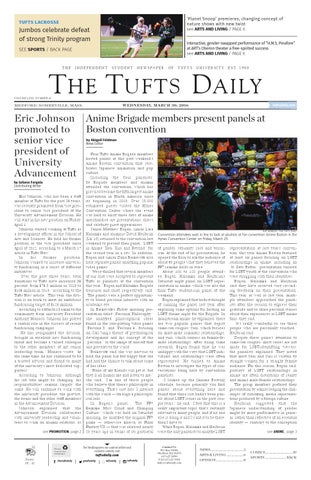
RAY BERNOFF / THE TUFTS DAILY
Convention attendees wait in line to look at plushies at fan convention Anime Boston in the Hynes Convention Center on Friday, March 25. of gender, sexuality, race and terrorism. At the end of his presentation, he opened the floor to ask the audience of about 80 people what they believed the FF7 remake holds in store. About 100 to 120 people attended Bogen, Halamka and Heilbrun’s Saturday night panel on LGBT representation in anime, which was also the final Tufts student-run panel of the weekend. Bogen explained that he first thought of running the panel last year after exploring some options for hosting an LGBT theme night for the Brigade. In mainstream anime, he explained, there are two popular genres that depict same-sex couples: yaoi, which focuses on male-male romantic relationships, and yuri, which centers on female-female relationships. After doing some research, Bogen found that he was unhappy with the ways that LGBT individuals and relationships were often represented. He turned to Anime Boston to investigate the types of conversations being held by convention panelists. “I looked up the [Anime Boston] schedule, because generally you find panels about everything here and found that there just hadn’t been panels about LGBT issues in the past couple years,” he said. “I feel that this is a really important topic that’s certainly relevant to many people, and if no one else is doing it and I want it to be there, then I have to.” While Bogen, Halamka and Heilbrun were the only panelists to analyze LGBT
Contact Us P.O. Box 53018, Medford, MA 02155 617 627 3090 FAX 617 627 3910 daily@tuftsdaily.com
representation at last year’s convention, this year Anime Boston featured at least six panels focusing on LGBT relationships in anime, including an “It Gets Better” presentation tailored for LGBT youth at the convention who were struggling with their identities. Bogen, Halamka and Heilbrun said they have received very rewarding feedback on their presentation. This year, as well as last year, multiple attendees approached the panelists after the session to express their gratitude and to share personal stories about their experiences as LGBT anime fans, they said. “It’s really wonderful to see those people who are personally touched,” Heilbrun said. Despite these genre’s attention to same-sex couples, most series are not made for LGBT-identifying viewers, the panelists explained. They noted that most yaoi and yuri is written by straight women for a straight female audience. For this reason, Bogen said, portrays of LGBT relationships in anime are often distortions of reality and mimic male-female relationships. The group members prefaced their presentation by acknowledging the challenges of criticizing media representations produced by a foreign culture. Heilbrun suggested that the Japanese understanding of gender might be more performative in general, rather than reflective of an essential identity — contrary to the conception
NEWS............................................1 ARTS & LIVING.......................6 OPINION.....................................8
see ANIME , page 3
COMICS.....................................10 SPORTS............................ BACK
2
THE TUFTS DAILY | News | Wednesday, March 30, 2016
T HE T UFTS D AILY Sarah Zheng Editor-in-Chief
EDITORIAL Nicholas Golden Mengqi Sun Managing Editors Nicholas Pfosi Associate Editor Arin Kerstein Executive News Editor Isha Fahad News Editors Abby Feldman Melissa Kain Sophie Lehrenbaum Emma Steiner Ariel Barbieri-Aghib Assistant News Editors Kyle Blacklock Gil Jacobson Robert Katz Liam Knox Catherine Perloff Vibhav Prakasam Hannah Uebele John “Joe” Walsh Kendall Todd Executive Features Editor Nicole Brooks Features Editors Nina Joung Jake Taber Diane Alexander Assistant Features Editors Constantinos Angelakis Emily Cheng Emma R. Rosenthal John Gallagher Executive Arts Editor Lancy Downs Arts Editors Justin Krakoff Josh Podolsky Jonah Allon Assistant Arts Editors Cassidy Olsen Eran Sabaner Hannah Hoang Dorie Campbell Emily Karl Erin Sifre Stephen Dennison Abigail Feldman Shannon Geary Allison Merola Cassie Bardos Miranda Chavez Frances DeFreitas Jake Goldberg Emma Henderson Michael Lefkowtiz Anita Ramaswamy Noah Weinflash
Executive Op-Ed Editor Op-Ed Editor Cartoonists
Editorialists
Maclyn Senear Executive Sports Editor Ray-Paul Biron Sports Editors Ross Dember Phillip Goldberg Alex Schroeder Chris Warren Yuan Jun Chee Assistant Sports Editors Maddie Payne Eddie Samuels Noah Smith Sofie Hecht Executive Photo Editor Alex Knapp Caroline Ambros Picture Tufts Editor Ray Bernoff Staff Photographers Laura DeArmas Maria Ferraz Henry Hintermeister Katlyn Kreie Mia Lambert Jiaxun Li Nora Nord Nicholas Pfosi Julia Press Evan Sayles Angelie Xiong
PRODUCTION Julie Doten
Production Director Astrid Weng Executive Layout Editor Jewel Castle Layout Editors Abbie Gantner Leila Li Allie Merola Brianna Mignano Mandip Pokharel Ellie Powers Annabelle Roberts Emily Sharp Andrew Stephens Sebastian Torrente Shirley Wang Petrina Chan Allison Merola Dana Pek Belinda Xian Jack Ronan Dan Strauss Meagan Adler Alison Beach Arthur Beckel Lancy Downs Alison Epstein Andrew Kager Melissa Kain Sarah Kalinowski Reena Karasin Sophie Lehrenbaum Rachel Salzberg Arielle Sigel Caroline Watson Maxwell Bernstein Nitesh Gupta Evan Sayles
Creative Director Executive Graphics Editor Graphics Editors Executive Copy Editors Copy Editors
Executive Tech Manager Online Editor Social Media Editor
BUSINESS Yiran Xu
Rayn Riel Bridge the Gap
Soaring costs or soaring buildings? The MBTA Green Line Extension Project may not get built because costs have risen astronomically to $3 billion, which would make it the most costly rail expansion per mile in the transit agency’s history. And it is not even a subway line. In fact, most of the right-of-way already exists alongside tracks used by the commuter rail, Amtrak and occasionally freight trains. In order to get it built, the MBTA is considering drastic cuts to station designs, which, in their own words, would be “on the side of brutal.” These stations may not even have turnstiles prior to boarding, making them similar to the Green Line’s outdoor stations — vulnerable to the elements and many built more than 100 years ago. And without pre-board payment, service would be a lot slower; in fact, boarding would be similar to boarding a non-Bus-Rapid-Transit bus. In our increasingly polarized society, can we balance the budget and bridge the gap, building a 21st-century network without spending too little or too much? The MBTA, as a public authority, does not have a strong motive to control waste, fraud and abuse. The T operates within silos, with convoluted labor costs, work rules and managerial incompetence, and it needs a new narrative for the 21st century. Contemporary challenges require interdisciplinary, interconnected solutions in order to bridge the gap socially, economically, politically and, of course, physically. We need to be planning beyond divisions, departments, agencies and municipalities in order to renew, enhance and expand our infrastructure as well as tackle multiple problems at the same time, creatively and affordably. Pundits will argue that the United States is not investing in its infrastructure and that it is falling apart. This is only partially true because it is also important to note that capital costs are rising because of our disconnected local, state and federal political system, stemming back to the Bill of Rights itself. Indeed, financing transportation networks is uniquely difficult in the United States, relative to the rest of the industrial world, because of our federal system and the challenges of bridging the gap regionally. Our states have an enormous amount of power, and, for better or for worse, they have granted a lot of these police powers to municipalities, making it harder to streamline costs. Thus, how can we reform the T when its “train” of thought is more of a “chain” of thought, locked from change by balkanized politics? Financing the Green Line Extension by encouraging real estate development atop station property or along the corridor, for instance, requires coordination with countless municipalities. After all, in order for developers to partially pay for the extension in exchange for being allowed to build (taller), municipalities would need to enact legislation, and transportation agencies are often entirely excluded from this process. This is an institutional disconnect that is far more disjointed in America than elsewhere in the industrialized world, and rest assured, it is even more complicated when working across state boundaries. Transit-owned assets should have soaring buildings, not soaring costs. Otherwise, we simply cannot expand our system when it’s so expensive to build a few miles and when our motives are based upon political calculations, rather than (under)grounded in facts and figures.
Executive Business Director Qinyue Yu Receivables Manager Evan Sayles Online Advertising Eva Sachar Ad Managers Jay Hayes
Rayn Riel is a graduate student in City/ Urban, Community and Regional Planning. He can be reached at Rayn.Riel@tufts.edu.
tuftsdaily.com
Eric Johnson works to start a new fundraising campaign PROMOTION
continued from page 1 well as fundraising activities within all schools of the university. “We work to strengthen the engagement of alumni with the university and their connections with each other,” Johnson said. “Career networking and guidance is one example of this engagement. We also encourage and work with alumni, parents, friends, corporations and foundations on their philanthropic support of Tufts.” This mission is realized in many forms, including scholarships, job opportunities and internships, he explained. “[The promotion is a] recognition of the importance of the University Advancement Division and the role it plays for the university,” he said. Johnson said he is currently working on a new campaign to be publicly unveiled in around two years. The last major campaign held by the Advancement Division was named “Beyond Borders” and ended in 2011, he explained. According to Johnson, the focus of the most recent campaign is alumni engagement. “This stronger volunteer structure will help us meet ambitious goals to raise funds for financial aid, faculty development and research, improved facilities and other priorities,” Johnson said. The division is already recruiting for the new campaign, which is intended
to continue longer than the last campaign. Johnson explained that the goal is two-fold. “[ We aim to] raise money to enhance the student experience…but also to engage alumni and others,” he said. He explained that the campaign’s effects can already be seen on campus, notably in projects which are currently under construction on the Medford/ Somerville campus. “The gifts that have supported both the [Science and Engineering Complex] and [Collaborative Learning and Innovation Complex] will be included in the campaign that is currently in the leadership phase,” Johnson said. Johnson also actively participates in marathons every year, on his own and with the Tufts Marathon Team. “He helped organize…[the university’s] Boston Marathon team and has been competing with the Tufts team since,” according to an April 2009 article on Boston.com. The Tufts Marathon Team raises money towards nutrition and wellness research on all of the university’s campuses. According to Johnson, the group as a whole raises about $400,000$500,000 annually. Each participant takes a funding target and pledges to raise that much. Johnson said he tries to take a higher number so that more students, who can not raise as much, can participate. “[It’s wonderful to] get to know different people in the process,” he said.
SOFIE HECHT / THE TUFTS DAILY
Former Vice President for University Advancement Eric Johnson was recently promoted to Senior Vice President of University Advancement. Johnson poses on outside of Ballou Hall on March 29.
Wednesday, March 30, 2016 | News | THE TUFTS DAILY
News
3
Anime Brigade members present panel on LGBT issues in anime for second year in a row ANIME
continued from page 1 held more commonly in the United States. “Think about whether this whole concept of LGBT identities [is] sort of a Western concept and think about maybe how these anime have a different way of looking at them,” he said. “But that doesn’t mean we can’t apply this concept of LGBT identities to anime. It just means we have to be aware of the cultures and some differences between them.” “I think it’s important to acknowledge that we are from a Western culture, and this is something that is a Japanese cultural item,” Halamka said after the presentation. “But because we’re viewing it in the U.S., we have to view it through a Western lens. We have no choice. We just need to remember that it’s not our native culture’s product.” During the panel, Bogen focused on yaoi, explaining that male-male couples in particular tend to reflect heterosexual gender binaries, where one character is the seme, or masculine-coded partner, and the other is
the uke, or feminine-coded partner. Moreover, consent in sexual interactions is virtually never considered in yaoi anime and flat out disregarded in the most problematic representations, he said. Halamka presented on female-female relationships in yuri anime. The main problem with these hyper-cute female relationships, she explained, is that they almost never occur between women outside of middle and high school. The implication here is that female-female attraction is nothing more than a phase that ends after a certain age. Heilbrun wrapped up the presentation with a discussion of transgender representation in anime, which most often takes the form of cross-dressing characters. These characters are often the butt of jokes and are interpreted in ways that reinforce the gender binary. He recommended one very positive exception — a series called “Wandering Son” by Shimura Takako — that gives a more realistic portrayal of a transgender character struggling to understand their identity.
Bogen, Halamka and Heilbrun said their goal was not to change panel attendees’ viewing habits but to get them to think more critically about the context of yaoi, yuri and series depicting transgender characters. Despite prominent media representation of same-sex couples, the LGBT rights movement in Japan is quite small and limited, they said. “There’s nothing wrong with watching bad yuri or bad yaoi,” Halamka said. “It’s just acknowledging that real people are struggling with homosexuality. That shouldn’t be downplayed.” “On one hand, it’s really positive in the sense that you see very public representations of queer genres,” Bogen said. “On the other hand, these genres are not really meant for a queer audience … I’m personally critical about different elements of yaoi that I feel are not necessarily healthy representations of relationships, but then you delve into questions about whether is yaoi meant to be realistic. If it’s not, it may be acceptable that it’s not.” Heilbrun acknowledged that the panel’s setting does affect their analysis of yaoi and yuri.
“Anime Boston is a fan convention,” he said. “Sometimes when you talk about things in an academic way it becomes too sterile. You’re just completely distanced from the enjoyment that we may get out of this media. It’s a fan convention, but I hope that we can be fans and also be a little critical.” The three also acknowledged that few Japanese fans, apart from the guests of honor, seem to attend the convention. For this reason, they have little firsthand feedback from Japanese audiences of their analysis of LGBT representation. Since Halamka is the sole panelist among the three who will remain enrolled at Tufts next year, she is unsure of what the future of the “LGBT in Anime” panel will be. Though she is thinking of holding a new panel that focuses solely on yuri next year, she feels it’s important that convention-goers continue to criticize LGBT representation in anime. “Maybe now more people will take on the mantle,” she said. For photo coverage of Anime Boston visit the Tufts Daily Photo blog Picture Tufts.
4
THE TUFTS DAILY | ADVERTISEMENT | Wednesday, March 30, 2016
1/4
tuftsdaily.com
Minor in Portuguese Department of Romance Languages
The minor in Portuguese is a disciplinary minor that
Course offerings F16
permits students to combine upper-level skills in
1/8 FULL AD
Portuguese language with focused study within some of the major subfields of Portuguese studies.
POR 01- block G (Soares)
The minor is structured to facilitate engagement with
POR 23 (Intro for Spanish speakers)-
Latin American topics, while ensuring that students
block E (Soares)
master the essential skills of linguistic competence,
POR 02- block H (Champlin)
and literary and cultural knowledge.
POR 03- block F (Champlin)
Please visit the Dept. of Romance Languages website
POR 191: POR in the Community-
at
block K+ (Soares)
http://ase.tufts.edu/romlang/programs/minorPortugue se.asp to learn more about the minor requirements.
Run foR a seat on tufts student GoveRnment! ALL Seats are OPEN, including:
Interested? Come to a GENERAL INTEREST MEETING!
1/2
• Senate • Judiciary • Committee of Student Life
March 30th @ 9PM, Pearson 106 March 31st @ 9:30PM, Crane Room
PIZZA WILL BE PROVIDED!
Don’t forget to
vote!
Mon 04/12
@ ecom.tuft
s.edu/vote
ECOM
@tufts.edu
twitter.com/
TuftsECOM
Elections are run by the Tufts Elections Commission.
ecom.tufts.edu/
calendar
Wednesday, March 30, 2016 | ADVERTISEMENT | THE TUFTS DAILY
tuftsdaily.com
ATTENTION STUDENTS LIVING OFF-CAMPUS IN MEDFOR D AND SOMERVILLE Citywide street sweeping will be returning in April.
1/4 AD
Residents are reminded to follow posted schedules and signs and to move cars if necessary.
1/8 AD
City of Somerville April 1, 2016 to December 31, 2016
City of Medford April 4, 2016 on all Medford streets.
Please visit: http://www.somervillema.gov/residents/ street-sweeping-schedule
Please visit: http://www.medfordma.org/category/ street-sweeping
1/2 AD
5
6 tuftsdaily.com
ARTS&LIVING TV COMMENTARY
Snoop Dogg premieres the first episode of ‘Planet Snoop,’ and we have some questions by Jonah Allon Arts Editor
It truly is an amazing time to be alive. Last Thursday, March 24, Snoop Dogg answered all of our prayers, debuting his new nature series, “Planet Snoop,” on his website merryjane.com. The idea originated with a recurring segment on “Jimmy Kimmel Live!” (2003 — present), called “Plizzanet Earth,” which featured the erstwhile rapper providing running commentary on viral nature videos. The segments regularly got several million hits on YouTube. In fact, they became so popular that an online petition began to circulate on Change.org, calling for the popular nature series “Planet Earth” (2006) to bring Snoop on to narrate for a season. It garnered over 65,000 signatures. The creators of “Planet Earth” didn’t bite, but Snoop was undeterred. Who needs a stuffy old nature show narrated by a bunch of droney British dudes when you have your own online platform? Not Snoop, that’s for sure. But now that he’s embarked on this new career path, it might be fair to ask a few questions about “Planet Snoop” and what it portends for its creator, the nature series as a genre and environmentalism. 1) Will “Planet Snoop” dethrone “Planet Earth?” Let’s be honest: it was a colossal mistake for “Planet Earth” not to bring Snoop on for at least a season. He’s a well-known figure that could draw a younger viewership. His mellifluous voice has the soothing quality of running water. And what he lacks in basic
LUIS SINCO / LOS ANGELES TIMES/MCT
Snoop Dogg smokes a blunt onstage at the Coachella Valley Music and Arts Festival on April 13, 2012 in Indio, Calif. knowledge about animal species (seriously, Snoop, you don’t know the difference between a beaver and an otter?), he makes up for in sheer dopeness. But “Planet Earth” may come to rue its inaction even more than we initially thought. “Planet Snoop” is a serious contender for the next big nature
show,because it may poach “Planet Earth’s” chief demographic — and we all know who that is. Consider its advantages. Unlike “Planet Earth,” it’s online, so it’s accessible to a wider audience. It’s also short see SNOOP, page 7
THEATER REVIEW
Gender-swapped performance of ‘H.M.S. Pinafore’ premieres at ART’s Oberon theater by Emily Friedlander Contributing Writer
There’s nothing like spending a night relaxing from midterm stress in a pit full of pillows with a Moscow mule and a plethora of stuffed animals. The fun begins at the American Repertory
Theater’s (ART) Oberon theater with Chicago-based troupe The Hypocrites’ rendition of “H.M.S. Pinafore” (1878) as soon as you step into the black box theater. Actors dressed in pajama party attire walk around the space, performing modern hits like Icona Pop’s “I Love It” (2012) and the Jackson 5’s “I Want
{{PD-1923}} VIA WIKIMEDIA COMMONS
An illustration of a scene from H.M.S. Pinafore from the original theatre poster and playbill created for the original production in 1878 at the Opera Comique in London.
You Back” (1969) on their assortment of guitars, mandolins and ukuleles. They joke with the audience, traipsing around with an assured confidence and jovial manner that make it easy for the newcomers trickling in to get accustomed to the unusual setup of the theater. Those who did not pay to sit at the tables on the sides of the room are encouraged to sit on any of the stage props — the actors and the audience share the same space throughout the show. This reconception of audience interaction creates a sense of camaraderie between audience members as well as between actors and the audience. Within minutes of getting comfortable, fellow audience members were arranging stuffed animals at the edge of the slide that sits above the “pool” — really a pillow pit — essentially creating a kind of bowling activity for others descending into the fluffy bed of blue plush. Actors will point to the locations they are moving towards, often cajoling audience members into scrambling quickly to relocate, creating a dynamic of play that perpetuates see H.M.S. PINAFORE, page 7
Wednesday, March 30, 2016
Natalie Girshman The ABCs of Literature
Gail Carriger
S
teampunk is a difficult genre, not only to categorize but to master. It can involve everything from tiny robots infused into everyone’s blood at the orders of a 19th-century version of Genghis Khan’s horde to necromancers raising hordes of the dead to female airship captains carrying secretive cargoes across the English Channel. There’s often a few common elements: steam technologies abound, the aristocracy still largely reigns supreme, a dramatic chase conducted by airship is more likely than not to occur and, even more likely, a romance between a spirited heroine and dashing hero. However, world-building varies widely, as some books throw in a few steam trains and evening gowns and promptly sacrifice adventure, or a coherent plot, for a romance with a domineering alpha aristocrat. The best steampunk novels strike a balance between the two, providing a little bit of everything, and Gail Carriger’s work can be relied upon to do exactly that. Her debut novel, “Soulless” (2009), takes place in an England where steam and the supernatural exist side by side and features the formidable Lady Alexia Tarabotti, the owner of a temperament that refuses to tolerate nonsense of any kind, a parasol that can be easily turned into a weapon and an unusual gift. Alexia is a preternatural, one of the rare individuals capable of taking away the powers of vampires and werewolves and of exorcising ghosts. Her unusual gift and ability to attract trouble lead her to be caught up in the mysterious disappearances and reappearances of vampires and with the irritatingly handsome, as well as simply irritating, Lord Connal Maccon. Intrigue, flirtation, a mysterious order with nefarious intentions and treacle tart ensue. Carriger manages to strike a skillful balance between mystery and romance, as Alexia and Maccon make for both good flirting and investigative partners. Their push-pull dynamic is positively delightful, and they are matched in every way. The supporting characters are equally amusing, whether it is Alexia’s remarkably silly best friend or Maccon’s professorial, highly dignified right-hand man. Admittedly, the unique writing style of “Soulless” is probably not for everyone. It can be very archaic, occasionally ranging on precious and packed with references to tea, fashion and the importance of having an appropriate witticism for every occasion. But for a certain kind of reader, it could well be heaven. There are four more books about Alexia — which make up the Parasol Protectorate series — as she journeys to Scotland, Italy and Egypt in order to acquire even more lethal parasols and get to the heart of the mystery about her deceased father. They are all quite enjoyable, and, although the momentum flags slightly around the fourth book, it promptly picks back up in the fifth and final volume. Moreover, Carriger just launched a series about Prudence, Alexia’s daughter, who has special abilities of her own and whose adventures will no doubt take her to even more far-flung corners of the Empire. There is even a young adult series set before the Parasol Protectorate, which takes place at a boarding school charged with turning respectable young ladies into highly effective spies. Whatever your steampunk needs, Carriger is ready to deliver. Natalie Girshman is a senior majoring in history and drama. She can be reached at natalie.girshman@tufts.edu.
Wednesday, March 30, 2016 | Arts & Living | THE TUFTS DAILY
A&L
7
‘Planet Snoop’, What does it mean for culture as we know it? SNOOP
continued from page 6 — an average episode clocks in around a minute, a minute and a half — making it less of a commitment, not to mention much less of a slog. It only features fight scenes, which, let’s be honest, is the main reason we watch nature shows in the first place. Oh, and lest we forget, it’s narrated by Snoop Dogg. 2) Does “Planet Snoop” mark a blunt departure from the Snoop Dogg of yore? In terms of format, there is very little to distinguish “Planet Snoop” from its progenitor, “Plizzanet Earth.” The production value is a little worse, but essentially, they’re the same show. So why the name change? Did it result
from a simple concern about copyright infringement? Or is Snoop perhaps trying to signal a major shift in his career? Think about it. This is the man, after all, who immortalized the term “foshizzle” in the rap vernacular. More recently, Snoop’s career has been in flux. Just three years ago, he changed his name to Snoop Lion and released a reggae album, only to quickly pivot to his alter-ego as DJ Snoopadelic, finally returning to his original moniker, Snoop Dogg. Perhaps the title “Planet Snoop,” then, is subtly alerting us to a shift away from the old Snoop. Or maybe it’s signaling a newfound comfort with his identity. Either
way, we’re not looking at the same guy who went double platinum with “The Doggfather” (1996) in 1997. 3) Does “Planet Snoop” herald the arrival of the next great environmental hero? Henry David Thoreau. Rachel Carson. Bill McKibben. And now…Snoop Dogg? Okay, it might seem like a stretch to lump Dr. Dre’s former protégé in with these giants of environmentalism. Admittedly, Snoop Dogg has made the legalization of cannabis his raison d’être — hence the existence of his website, merryjane.com, where “Planet Snoop” first premiered. It’s also true that the web series is far from enlightened by the plight of wildlife all over
the world — it just wants to see some animals duke it out. The first episode, after all, is titled “Squirrel vs. Snake.” “Silent Spring” (1962) this is not. But don’t underestimate Snoop. There’s a fair amount of overlap between marijuana legalization and environmentalism, so his impassioned advocacy for the former could easily bleed over into the latter. And if “Planet Snoop” really does displace “Planet Earth” as the most popular nature series, he’ll have an audience of committed viewers to answer to. We may not realize it now, but the release of “Planet Snoop” could mark a watershed moment in the modern environmentalist movement.
Audience-actor interaction lends 'H.M.S. Pinafore' delightful communal feel H.M.S. PINAFORE
continued from page 6 a flow of movement around the set, as audience members are encouraged to switch seats whenever they like and actors continually move about with different props and playing numerous musical instruments. “H.M.S. Pinafore” is a comedic opera by W.S. Gilbert and Arthur Sullivan that pokes fun at classist divides that, in this case, prevent people from being with the people they love. This rendition is updated for a modern audience with references to interns, Grumpy Cat and Bronies, adorning the captain with seafoam green half frame glasses. It also deftly swaps the gender of all of the players in the show: sailors become sail’resses, the leader of
the British Navy is now Admiral Dame Jo-Anne Porter (Christine Sulik) and a large man in pink frocks named Li’l Buttercup (Matt Kahler) frolics about. The story surrounds the son of the ship’s captain, Joseph (Doug Pawlik). Joseph is engaged to marry the much older Admiral Dame Jo-Anne Porter but falls in love with common sail’ress Ralphina (Dana Omar) and is strugling to choose whether to follow his mother’s orders or to follow his heart. The plot may seem trite, but through taking nothing seriously, as manifested in the colorful night caps and puppy-shaped slippers of the actors, the show exceeds as an entertaining, other-worldly farce. It’s particularly satisfying to watch the character of young Joseph exhibit typical feminine traits. He’s a lit-
tle whiny and indecisive; his primary redeemable trait, which is reiterated repeatedly throughout the show, is being a “good boy” who always follows his “mumsy’s” orders. Pawlik believably expresses these qualities, thus challenging notions of gendered stereotypes as Omar deftly handles comedy and sincerity in a way that makes the audience really root for the happiness of the protagonists. Dot DeadEye (Kate Carson-Groner), the clownish figure attempting to break up the young couple, eerily foils plans while playing her ominous accordion. “H.M.S. Pinafore” succeeds because it is a communal experience — everyone is in on the joke together. It is not often that one sees a show and gets to intimately interact with the actors and
other audience members in such a way. The small scale of the set ensures that audience members must crowd together on benches or a bed, fostering a sense of togetherness by breaking general theatrical norms and decreasing the amount of space between strangers. Whether throwing pillows or stuffed animals around the stage or confessing their woes to an unexpecting spectator, the actors make full use of the communal stage. It’s a kind of entertainment that is meant to be shared. Whether connecting to fellow audience members or bringing a friend along for the experience, audiences weren’t disappointed by this convivial respite from reality. The show ran from March 8 to March 20 at the ART’s Oberon theater in Cambridge.
Congratulations 2016 Undergraduate Orientation Coordinators
Anna Weissman '17 Coordinator for Leadership and Training
Eugenia Naamon '18 Coordinator for Logistics, Communications and Social Media
Theodore Tan '17 Coordinator for Co-Curricular and Major Events
Join Us This Fall! Apply To Be a 2016 Orientation Leader Applications now available @ go.tufts.edu/orientation Due April 1, 2016 Questions? Orientation@tufts.edu
Opinion
8 tuftsdaily.com
EDITORIAL
American students: why not strike? Thousands of students from Boston Public Schools (BPS) left school on March 7 to protest proposed budget cuts in what has been called “one of the largest demonstrations of young people the city has ever seen.” By one estimate, 3,650 students participated in protests and demonstrations around downtown Boston. The concern with the proposed budget is that it would remove funding for several programs within BPS. Some were afraid that languages such as Arabic would no longer be taught, while others were concerned about no longer being able to obtain a free student MBTA pass and thus having to pay for transportation to school everyday, a cost many would struggle to cover. Several were worried about teaching jobs being cut. The students who walked out of class that morning to participate in the strike should be commended for their bravery and boldness in standing up for their own futures. It is rare to see such a large group of young students in the United States to be politically active, fight for policy changes and yield the desirable result. Only four days after the protests took
place, Mayor Marty Walsh announced that he would not be making the controversial cuts to BPS. The efficiency of strike in this case is a remarkable show of democracy and the U.S. government at work. However, if these students achieved their goal with such efficiency, it begs the question: why do American students use strikes so infrequently as a form of protest? In other nations, the student strike is a much more common protest tactic. For example, in 2012, Canadian students organized a nationwide strike that involved around 250,000 people. Although the United States has seen small scale student boycotts, there hasn’t been a large scale national strike or boycott for the past 40 years. This is not to say that American students do not protest. American students protest by occupying, marching and sitting-in. However, the fact that American students do not boycott class or strike often suggests an interesting effect of academic culture. The lack of strikes is even more significant among college students, who have more flexible class schedules and a better ability to mobilize large amounts of students through campus efforts.
Some have accounted for this lack of organized strike in universities with student debt. So many American students are in debt that they would not risk missing class out of fear of potentially falling behind a semester, which could be economically devastating. Others blame this lack of resistance on a much less quantitative factor: the authoritarian culture in American classrooms that starts in elementary school. Those who oppose No Child Left Behind and Race to the Top claim that these programs make learning achievement-oriented rather than prioritize the ideas of intellectual and character development or education for active citizenship. This, in turn, makes students passive to their education. Regardless of whether or not these arguments are correct, it is clear that what the students of BPS achieved is remarkable, especially in light of American students’ reluctance to strike. Not only have these students advocated for their futures and obtained what they wanted, but they have also served to teach all of those watching that different tactics of protest can work and prove to be very efficient.
CARTOON
Spring fever BY ALLISON MEROLA
The Tufts Daily is a nonprofit, independent newspaper, published Monday through Friday during the academic year, and distributed free to the Tufts community. The content of letters, advertisements, signed columns, cartoons and graphics does not necessarily reflect the opinion of The Tufts Daily editorial board. EDITORIALS Editorials represent the position of The Tufts Daily. Individual editors are not necessarily responsible for, or in agreement with, the policies and editorials of The Tufts Daily. OP-EDS The Op-Ed section of The Tufts Daily, an open forum for campus editorial commentary, is printed Monday through Thursday. The Daily welcomes submissions from all members of the Tufts community; the opinions expressed in the Op-Ed section do not necessarily represent the opinions of the Daily itself. Opinion articles on campus, national and international issues should be 600 to 1,200 words in length and submitted to oped@tuftsdaily.com. The editors reserve the right to edit letters for clarity, space and length. All material is subject to editorial discretion and is not guaranteed to appear in the Daily. Authors must submit their telephone numbers and day-of availability for editing questions. ADVERTISING All advertising copy is subject to the approval of the Editor-in-Chief, Executive Board and Executive Business Director.
Wednesday, March 30, 2016
Pooja Sivaraman and Rebecca Solomon New York Style Dehli
How to win games and eat cheese
E
arlier today I was reading an article in The New Yorker about self-help books and whether they actually make you a better person. The article, “The Life Biz” questions the motives of people aiming to “Win Friends and Influence People,” claiming that it’s more about winning clientele and influencing customers. Now that most seniors are on the job hunt, the ways in which we alter ourselves to be hirable have become more and more apparent. But do these changes in demeanor, productivity and talk actually make us better people? Or just better employees? As the two most obvious and coveted advice givers on this campus, it has come to our attention that we too started off NYSD with a column titled “How to win games and influence everyone.” Unlike some of the books college students read in the hopes of getting hired, NYSD makes the promise of just the opposite. If you ask us who moved your cheese, we will tell you to buy yourself a new “Blue Zone” because that is much more than cheese. If you ask us about ways to be smarter, faster and better, we will only tell you ways to procrastinate, avoid going to the gym and getting away with mediocrity. So it’s time to ask yourselves a very serious question — whose advice do you trust more? In my book, it’s the advice of getting you job-free with a Blue Zone while watching Netflix. What’s the best way to show someone you love them in both romantic AND platonic relationships? Rebecca: Good question, reader. My freshman year roommate would talk about this a lot. She was a firm believer in Gary Chapman’s “Five Love Languages.” Apparently, we humans show our love in five ways: gifts, quality time, words of affirmation, acts of service and physical touch. Following this guideline, the best way to show someone you care is to find out his/ her love language. How ? Rebecca: I do not speak Chinese. I had to employ two of my favorite tools for this question, Google Translate and a friend. Google says that these characters translate to satisfaction. While I love Google Translate, I do not trust its interpretations, and at times it does not account for context; so, I asked a friend who is fluent in Chinese. She says that it means “How satisfied are you?” That is a tough question. It can apply to a lot of aspects of life. I am choosing to answer it in the framework that I find the most familiar: meals. Whenever I go out to dinner with my dad, he always has something to say; he would be the harshest food critic the New York Times has ever had. Only once have I seen him eat a meal without having a comment so satisfied that he had no comment. This spring break, I went home to New York and had a bagel for breakfast every day. To say that I am satisfied is an understatement. Pooja Sivaraman is a senior majoring in economics. She can be reached at pooja. sivaraman@tufts.edu. Rebecca Solomon is a senior majoring in economics. She can be reached at rebecca.solomon@tufts.edu.
Wednesday, March 30, 2016 | Opinion | THE TUFTS DAILY
Opinion
9
OP-ED
On the stigma of depression (Part 2) by Maxine Trigger Warning: Topics pertaining to self harm, depression and sexual assault At some point no one could take the responsibility for my safety anymore, and on my 15th birthday, we got the call that a space in a treatment facility had opened up for me. At that time I didn’t really talk, smile or show any emotion at all. The center decided its best bet was to apply pressure until I started opening up. After three days they succeeded in wearing me out, but the result was not what they had hoped for. Once again I couldn’t eat, drink or talk; all I did was cry. I started losing weight again rapidly, which led to threats of me being hospitalized and tube-fed, which led to a never ending cycle of me getting worse because of more pressure applied. Unlike many other inpatients who appreciated giving up control, I hated rehab: the bi-hourly check-ins round-the-clock to make sure I was still alive, being treated like an animal and the omnipresent anger. In rehab, I learnt the first things about sex, which in this case meant rape, and about drugs — what it’s like to be addicted or drugged and all the ways to hurt and kill yourself. After that time, I completely mistrusted humanity, and it took time until I could even think about caring for someone again. I left rehab after they had put me on medications, having become apparent that their approach was not working. While most medications did make me better for short periods of time, they also caused a lot of problems. Many people
think that medications magically cure you, but what they don’t know is that taking antidepressants or similar medications is more or less like a drug addiction, where initiation and termination phases have gruesome side effects. Over the past four years, I’ve had over 10 of those phases, which last between two weeks and two months. I would hallucinate, not sleep for a week, sleep 20 hours a day, gain or lose weight, feel pounding headaches, have suicidal crises and more. Up to this day, I can’t read or write for very long, but there were long periods of time where I couldn’t read or write anything coherently at all. Ironically, summers were always the worst times, as those were the times I underwent most of my medication changes. I spent the summers of 2012, 2013 and 2014 in drugged hazes, battling side effects and mood swings. My parents deserve awards for never leaving me or giving up on me, even if I did my best to push them away. I know how hard it is to stand by someone with mental illnesses — I’ve been there too, but the difference you are making by doing so is indescribable. I returned to my old class at the beginning of 10th grade. Some of the faculty in my school knew what had been going on, but rather than supporting me, they made everything even harder. If I was sick and missed a day, I was threatened to be kept behind, since I had already missed so much school. Regardless of my grades, teachers would tell my already worried mom that I “wasn’t good enough” and that I was bound to crash and burn soon. The
The Department of Drama and Dance presents:
Black Bodies i n Motion
Choreographing Resistance
Ac ro s s t h e A m e r i c a s
sole reason I stayed at my school was to prove everyone wrong — that I could do it. But my body showed the effects of my mental illnesses. My immune system shut down, and I had mono for two years, my thyroid stopped functioning and my lungs, stomach and liver were acting up. Because of what I put my body through, I will probably have to take medications for the rest of my life, things such as my mental capabilities may never fully be the same, and I will always be prone to substance addictions and therefore have to consciously live healthily. Along with resuming school, I tried to recreate a social life, but every time I had another suicidal episode I would disconnect from everyone and sometimes leave the city without notifying anyone. During those times, I pushed some of my friends and a guy I was dating away because I didn’t want them to be the ones who knew the girl that killed herself. The stigmatization of my illnesses ensured that I rarely told people why I acted the way I did and usually if someone did find out about my problems, they deemed me a psycho and broke off contact to avoid dealing with “my drama.” Mental illnesses are so stigmatized that individuals lie to themselves for years and consequently suffer every day. I have had several friends who struggled with this, one in particular. He is afraid to seek therapy because he doesn’t want to admit “there is something wrong with him.” Like him, I always hoped someone would speak up about depression or similar topics, so that it would be okay for me to admit my problems, too. I
thought I should be ashamed for what I’ve been through, but now I am proud for all the difficulties I’ve overcome. For example, I missed almost one and a half years of school and still haven’t slept normally for a night without medications since about 2010. But I turned 18, graduated, got into college and beat my mental illnesses, none of which ever seemed possible. Looking back, I am at loss for words, for everything I had almost given up. Today I am happy, energetic and social. I am finally at peace with myself and rid of any hatred and anger. I can see that my past doesn’t make me a freak, and if anyone begs to disagree, it says more about them than it does about me. The topic of mental illnesses needs to be addressed, so people are made aware of what consequences their behavior can have, both positive and negative. Admitting that you have a problem and need help is not something shameful and neither is recovery. Mental illnesses aren’t a choice, and it isn’t as simple as “being more positive” and “living healthier.” We are moving towards acceptance in all social, political and cultural aspects of our lives, and mental illnesses shouldn’t be an exception. Editor’s correction: The subheading of the first part of this Op-Ed, “On the stigma of depression (Part 1),” which appeared in print on The Tufts Daily on March 29, mistakenly indicates that the author suffered from eating disorders. Maxine is a student at Boston University. Her last name was omitted at her request.
CONFERENCE SCHEDULE All activities will take place at The Alumnae Hall, with the exception of the capoeira workshop. NOON: Welcome 12:15-1:30 pm: Documentary Favela Rising (Brazil, 2005) Dir. Matt Mochary & Jeff Zimbalist
Wednesday, March 30
1:30 to 2:45 pm - Panel 1: Black Moving Bodies and Their High-Affect Juxtapositions across the Diaspora Dr. Cristina F. Rosa (Tufts University) Black Dancing Rome: Four Decades Choreographing Revelry and Revolt on the Streets of Brazil (1974-2014) Dr. Adanna Jones (University of California Riverside) Blackening Pleasure, Confronting Fatalism: How Black Lives Matter within the Sea of Carib[being]ness
Alumnae Hall & Jackson Dance Lab
2:45 pm: Coffee break
TODAY Noon - 8:30 pm
Aidekman Arts Center Tu fts U n i ve rs i t y
keynote speaker
Dr. Paula Barreto (UFBA, Brazil)
Plus: film screening, panel discussions, & a capoeira workshop Co-sponsors: AS&E Di versi t y Fund Toupin-Bol well Fund Department of Music Af ricana St udie s Program Consort ium of St udie s in R ace, Colonialism , and Diaspora Department of Drama and Dance Lat in American St udie s Program Center for the St udy of R ace and Democracy
3:00 to 4:15 pm - Panel 2: What Matters the Most: From Democratic (virtual) Spaces to Spectacles of (Staged) Democracy Dr. Lester Tomé (Smith College) Black-and-White Pas de Deux: Spectacles of Racial Democracy and Interracial Eros in Cuban Ballet Dr. Raquel Monroe (Columbia College) Public/Private, Joy/Pain: The Embodied Protests of Awilda Lora Rodriguez 4:30 to 5:45 pm: Capoeira workshop (music & movement) Dr. Paula C. Barreto (Federal University of Bahia, Brazil) Location: Jackson Dance Lab 6:00 to 6:30 pm Light reception @ Alumnae Hall 6:30 to 8:30 pm Keynote address: Dr. Paula C. Barreto The Struggles to Recognize Capoeira as a Black Cultural Expression in Brazil: Race, Class, and Gender Dimensions FREE AND OPEN TO THE PUBLIC Visit us at: blackbodiesinmotion.wordpress.com contact us at: blackbodiesinmotion@gmail.com
10
THE TUFTS DAILY | Comics | Wednesday, March 30, 2016
Comics
tuftsdaily.com LATE NIGHT AT THE DAILY Astrid: “Coffee is like water to me.”
Comics
SUDOKU
JUMBLE
Difficulty Level: The New York Times ‘not’ publishing dumb things about Millenials.
Tuesday’s Solution
NON SEQUITUR BY WILEY MILLER
CROSSWORD
Wednesday, March 30, 2016 | Sports | THE TUFTS DAILY
Sports
Tufts’ senior class posts first career win against NESCAC foe Trinity WOMEN'S LACROSSE
continued from back “I’m very flattered, but it was a team game. I think eight different people scored goals, and that’s what we’ve been working for — to play as a team, have lots of assisted goals and get everyone involved on attack,” Ross said. So far this season, the Jumbos have received a powerful boost from their captains, the only seniors on the team. Cohen anchors the Jumbo defense and is tied for second on the team in ground balls with seven. The Jumbos have 28 assists on the season, and Ross leads the team with a whopping 13. She is well on track to beat the team record of 19 assists that she set last season. Behind Ross are sophomore Taylor Meek with four and Bowser with three. Ross also leads the team in scoring with 19 goals, and again Bowser and Meek follow with 18 and 13 respectively. Bowser leads the Jumbos in ground balls, draw controls and caused turnovers by significant margins. Tufts got off to a slow start this season, dropping three straight from March 12 to 18, including losses to NESCAC opponents No. 2 Middlebury and No. 9 Colby. Sporting a 2-3 record coming into their game against Stevenson last Thursday and going down 7-3 in the first half, the team felt the pressure of another loss looming. Bowser put the Jumbos on the board early against the Stevenson Mustangs, but junior Olivia Monteiro answered back on a free position shot. Roughly seven minutes later Ross earned the Jumbos another goal on her own free position shot, but her goal was followed by three Stevenson scores in as many minutes. Junior Brady Heher scored twice in a row, and Monteiro capitalized on another free position shot. Freliech ended the run on
yet another free position shot, bringing the score to 4-3. Stevenson, however, ended the half strong, scoring another three goals, two of which came from Heher and Monteiro. Stevenson’s junior duo combined for six first-half scores, and Monteiro tallied the only assist of the first half on Heher’s third goal. Tufts went into the break down 7-3. “We came out really slow in the first half,” Ross said. “We weren’t going to goal hard enough, not creating enough on offense and turning the ball over a lot in the first half. We just didn’t come out with a lot of energy and ended up down. In the second half, we kind of turned it on, picked up the energy, picked up the intensity, and we definitely knew that we weren’t going to lose that game. I think we had that mindset that that was a must win for our confidence and for our season in general.” The Jumbos refocused for the second half and shut Heher and Monteiro down for the remainder of the game. With her team clearly reenergized, Bowser assisted on a Meek goal just ten seconds into the second half. Bowser scored her own goal at 23:35, and 34 seconds later firstyear Courtney Grygiel cut to the net and finished a Ross assist. Stevenson ran the score back up to 10-7, but the Jumbos scored four unanswered in the final 17 minutes to seal the comeback win. Sophomore Jenn Duffy tied the game just before the 13-minute mark and junior Caroline Kingsley scored the game winner with just under eight minutes remaining. The much-needed win snapped the Jumbos’ three-game losing streak and brought them back to .500 on the season. Against Colby on Friday, March 18, the Jumbos started slow, giving up eight firsthalf goals while only notching three. They
were unable to battle back in the second half as both teams scored five, but they did demonstrate an ability to compete evenly against strong competition. Bowser and Meek each scored twice in the second half, carrying the Jumbo offense. Ross finished with one goal, the first of the game, and three assists, again taking on the role of facilitator. “We definitely did not play our best lacrosse against Colby,” Cohen said. “They are a very good team, but we decided that we need to hold ourselves to a higher standard on the field. We played a much better game against Stevenson, and we saw everything start to come together. And then, in our game against Trinity, we were finally playing as a team. Everybody contributed all over the field from the defensive end through the midfield and up to the attack. The major difference in the Trinity game was that we finally were connecting well and successfully playing as a team on the field.” First-year goalie Audrey Evers is second in the NESCAC in saves on the season with 67 — just one behind the conference leader, senior tri-captain Hannah Jeffery of No. 13 Bates. Evers saved eight shots against Colby, 12 of 22 against Stevenson and seven of 16 in the Trinity game. Ross pointed to Evers’ play as a highlight of the three games. “Audrey, our goalie, is playing very well,” Ross said. “As a [first-year] coming in, Audrey has stepped in and played better than I ever expected and more than we could ask of her, so she’s been doing a great job for us and is a huge leader on the field as a [first-year], which is great.” Going forward, Tufts hopes to continue its two game win streak when they travel to play Keene State at 6 p.m. tonight.
Jumbos return to New England for first NESCAC series this weekend BASEBALL
continued from back with four — picked up his first big fly of 2016 in the win, as did his classmate and DH Dan Kelly. On Wednesday, March 23, Tufts battled Methodist University in a tight contest but lost its third game of the trip in a close 4-3 finish after Methodist dropped a two-run home run in the sixth inning that gave it a lead they wouldn’t lose. The Jumbos then played their final two games of the trip on Friday and Saturday, facing off first against Lynchburg. The Jumbos notched a dominant 17-3 victory over the Hornets.
Eight runs in the fifth inning gave the Jumbos a more than comfortable margin of victory as the team capitalized on the Hornets’ four errors, and the bats came alive. Nine different Jumbos picked up RBIs in the game, with sophomore second baseman Christian Zazzali, O’Hara and junior left fielder Harry Brown picking up two each. Tufts capped off the trip with a clean 4-0 victory on Saturday over the Apprentice School as first-year pitcher R.J. Hall pitched a three-hit shutout in just the second start of his career. Hall was one of the standouts on the trip for the Jumbos. He recorded wins in the Greensboro and Apprentice School
MATT SCHREIBER / THE TUFTS DAILY ARCHIVE
Freshman Tom Petry dives back to second after a pickoff move by Brandeis’ pitcher.
games and allowed just two runs in his 15 innings for an ERA of 1.20, while earning himself NESCAC Pitcher of the Week honors. With so many games in such a short period of time, it would be easy to think the team would be worn out, but Casey insists extended trips like the past week are vital. “It’s baseball,” Casey said, “It’s just baseball. It’s how the game is supposed to be played. It’s not like this once-aweek stuff. If you’re a baseball player, you don’t get to prepare for everything. You’ve got to show up and grind it out.” In a promising sign, the team is already receiving major contributions from its younger talent in the season, especially to its pitching staff, as offensive leaders like Moser and O’Hara have been getting comfortable at the plate. “Overall, I thought the pitching was okay,” Casey said. “R.J. [Hall] threw very well, so we’re happy with that. We moved people around a little bit. We’re still a work in progress; we’re still trying to settle on some things, but we’re certainly further along than where we were.” The Jumbos returned from their trip Monday evening and have one day of practice before facing the Mass. Maritime Academy Buccaneers today at 3:00 p.m. on the road. The game will be Tufts’ last before it heads into NESCAC action with a threegame series at Bates this Saturday and Sunday.
11
Eric Smiley Flashes of Brilliance
Bordering on the surreal
F
or 75 seconds, no words were spoken. The crowd roared, the stadium shook and the players jumped around in the pure and unfiltered joy that only accompanies the occurrence of the impossible. For the second consecutive night, in that city, in that ballpark, the dynasty refused to go peacefully; in the most dramatic fashion — a pair of two-out, two-run, game-tying home runs in the bottom of the ninth — the Yankees had saved their season. After 75 seconds of euphoria, Tim McCarver broke the deafening roar with unexaggerated hyperbole — “I have never seen anything like it.” He hadn’t. No one had. Two years later, the same booth’s silence lasted 185 seconds after Aaron Boone sent the Yankees to the World Series. I remember this one more clearly. It was early morning in Geneva, Switzerland, and I had stayed up all night with my family huddled around a small computer screen streaming the decisive game seven between the Yankees and Red Sox. The Yankees were doomed again, and they won. I remember my father knocking over every pen and pencil on his filing cabinet when he swung his arms in excitement. I remember thinking that the Yankees had some special ability to procure miracles at the most crucial times; the belief wasn’t illogical — for the entirety of my short life, my favorite team had turned water into wine at every turn, what qualified me to say those pinstripes were secular, those miracles irreligious? I was only seven years old when Scott Brosius took Byung-Hyun Kim deep. I had no existing memory of a season that didn’t end with a Yankees championship parade. I’m almost sure I considered such a season unrealistic. I was a spoiled and astonishingly fortunate fan, but the perspective of a seven-year-old with Derek Jeter’s poster on his wall wasn’t appropriately grateful or wise. It was easy being a Yankees fan of my age. There wouldn’t be an MLB postseason without my team until I was in high school; if I had been born in Toronto instead of Manhattan, I wouldn’t have experienced the unrivaled pain and pleasure of a close playoff game until I was a senior in college. After Brosius’s homer, the Diamondbacks needed to change pitchers because the one on the mound was trembling as the stadium shook, fighting off tears. Before the station cut to commercial for the pitching change, Joe Buck spoke for the first time since the ball went over the fence. “It borders on the surreal here in the Bronx.” It did. For that night, the one before, for my entire childhood. The Yankees were great. They were inexorable; they were mine. Would I appreciate the unlikelihood of those teams and those moments more now than I did then? Probably. Believing in aura, mystique and invincibility when baseball was as essential and joyous as it can only be to a child was pretty great too.
Eric Smiley is a senior majoring in mathematics. He can be reached at eric.smiley@ tufts.edu.
12 tuftsdaily.com
Sports
Wednesday, March 30, 2016
WOMEN'S LACROSSE
Jumbos pick up momentum with close wins over spring break by Phillip Goldberg Sports Editor
Tufts’ current senior class has beaten every other NESCAC team except for Trinity. Until this Saturday, that is. In a true nail-biter, the No. 11 women’s lacrosse team failed No. 10 Trinity 10-9 on Saturday in front of a home crowd at Bello Field. Leading 8-7 through the first half, the Jumbos allowed the Bantams to score two goals unanswered, and with just under nine minutes left in the game, Trinity led 9-8. However, senior tri-captain Brigid Bowser forced a key turnover to gain possession around the two-minute mark. Rising to the occasion, first-year midfielder Gabby Vinci cut towards the goal and evened the score at 1:26 on an assist from senior tri-captain Caroline Ross. First-year Cecily Freliech earned the Jumbos possession on the draw control, and with 13 seconds left in the game, Ross launched a shot at the Trinity goal that found the back of the net. In that single moment, Ross and the Jumbos accomplished what neither she nor her teammates had ever experienced — beating Trinity. The win avenged last year’s NESCAC semifinals 8-7 loss to Trinity in overtime, making it even more special for senior tri-captain Jaymi Cohen. “Trinity lacrosse is a very well-respected program,” Cohen told the Daily in an email. “Especially after our one-goal loss to Trinity in overtime last year, we were hungry for this win. Trinity was the only NESCAC team that our senior class has not beat in our years playing at Tufts. Our program also has not beat this team in a few years, so it was about time. We wanted this win not only for our current team but for our alums and program in its entirety.”
EVAN SAYLES / THE TUFTS DAILY ARCHIVE
Tufts attacker Caroline Ross (LA ‘16) attempts to move past an opponent in the game against Castleton on Monday, March 7. Despite only winning six first-half draw controls to Trinity’s 10, the Jumbos dominated possession in an offensively oriented first half. Junior Emma Malicki scored the first goal of the game to put Trinity up 1-0 just over a minute into the contest. But Ross answered back for the Jumbos on a free position shot two minutes later. The teams traded goals until sophomore Calie Nowak, first-year Annie Sullivan and Bowser scored three straight
to put Tufts up 5-3. Freleich’s successful free position shot with 53 seconds remaining in the half earned Tufts its largest lead of the game at 8-5. Before the halftime intermission, though, sophomore Allie Barrett brought Trinity within two with 21 seconds remaining and junior Karly Simpson further ate into the Jumbo lead when she scored with just eight seconds on the clock. Although the Jumbos had led since the 10-minute
mark, and by as many as three, they went into halftime up by just one. Still, they would go on to earn the win in a hardfought second half. Ross finished the game with two goals and four assists, including the game-winning score, and earned NESCAC Women’s Lacrosse Player of the Week honors for her effort. see WOMEN'S LACROSSE, page 11
BASEBALL
Off to a strong start, baseball goes 6-3 in spring break games by Eddie Samuels
Assistant Sports Editor
Fresh off a spring break that saw the Jumbos go 6-3 on their annual road trip through the South, the baseball team is back in New England preparing to face off against Mass. Maritime Wednesday in addition to its first NESCAC series this weekend against Bates. “We go down [to the South] to try and figure ourselves out as a team,” coach John Casey said. “We wanted to give guys opportunities to play and see who settles into what spots. Whenever you play that many games in that a short period of time, you’re going to have some good things and some bad things.” The team went into the trip with questions to answer along with plenty of opportunities for players to step up and make a strong early impression. The team started its season in Newport News, Va. against its traditional first opponent, Castleton, whom it defeated 15-5 on Friday, March 18. Tufts repeated the victory against Castleton the next day in its second game, though this time only by a 5-2 margin.
The Jumbo lineup opened the season with an offensive outpouring in the first game against the Spartans as senior shortstop Matt Moser went five for five with a double and five RBIs, while the rest of the team combined for 10 more hits. Castleton struck first blood in the top of the first against Tufts junior starter Tim Superko and stayed on top for most of the first five frames, leading 5-3 going into the bottom of the fifth. But with a pair of two-run singles from Moser in the fifth and the sixth as part of a two-inning, nine-run outburst, the Jumbos took the lead and scored 12 unanswered runs through the rest of the game in total to cruise to their first win. Junior pitcher Matt Rothstein came on in relief of Superko in the fifth and gave up just two unearned runs over five solid innings of relief to earn the win. The next day, Tufts bounced back from an early two-run deficit in the first to take its second win of the season behind a strong outing from junior starter Speros Varinos, who gave up just two unearned runs and five hits over seven innings while striking out 10 en route to picking up the win.
The Jumbos suffered their first loss of the season later that same Saturday in a thriller against the MIT Engineers that went 13 innings in War Memorial Stadium in Hampton, Va. MIT scored two runs in the bottom of the ninth to tie the game and spoil the win for Tufts senior starter Andrew David, who only allowed the two runs on five hits over 8.1 innings, while striking out 10. Both teams then scored in the 10th to keep the game going at 3-3. The Jumbos led off the scoring in the top of the 13th to go up 4-3, but MIT answered in the bottom half of the inning, scoring two runs to earn the walk-off win the second run and game winner coming off of a dramatic squeeze bunt. With the cancellation of a game against St. Joseph of Vermont on Sunday, the team headed down to North Carolina for its next game against Guilford on Monday, March 21. In a game that the team would probably like to forget, Tufts suffered its toughest and ugliest defeat of the road trip in a 15-0 thrashing. The Jumbos fell behind in the first inning when the Quakers put up five runs. The
lead would grow to nine in the second and keep growing slowly for the rest of the game as the Jumbos, who did manage to get eight hits, still failed to notch a single run. Tufts played its second double-header of the trip the following day. The team started the day by dispatching Averett 18-9. Moser, continuing to impress at the plate, knocked in eight runs in the game, with a grand slam and two-run double highlighting his contribution. Through the first nine games, Moser boasts 15 RBIs and a .553 slugging percentage — both of which lead the team — along with a .342 batting average. Superko picked up his first win after giving up just three earned runs on five hits over six frames. Later that night, Tufts took down Greensboro College 8-6 after putting up four runs in the first three innings and holding on for the win. Sophomore third baseman Tommy O’Hara — who led the Jumbos in batting average and slugging percentage last season and was second in home runs after Moser see BASEBALL, page 11