WOMEN’S TENNIS
‘Art in April X Active Minds’ hosts drawings and paintings discussing mental health see ARTS AND LIVING / PAGE 7
SEE SPORTS / BACK PAGE
Tufts Dental’s Craniofacial Pain Center uses interdisciplinary approach in treatment see FEATURES / PAGE 4
Perfect form sets up tennis for NESCAC play
THE
INDEPENDENT
STUDENT
N E W S PA P E R
OF
TUFTS
UNIVERSITY
E S T. 1 9 8 0
T HE T UFTS DAILY
VOLUME LXXI, NUMBER 47
tuftsdaily.com
Wednesday, April 5, 2016
MEDFORD/SOMERVILLE, MASS.
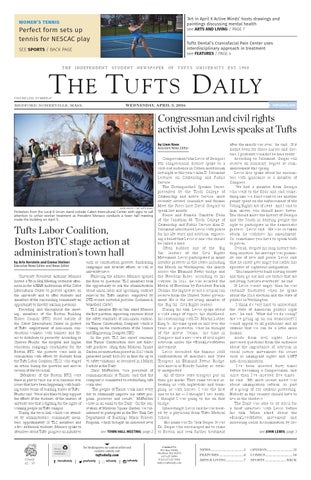
Congressman and civil rights activist John Lewis speaks at Tufts by Liam Knox
Assistant News Editor
SOFIE HECHT / THE TUFTS DAILY
Protesters from the Local 6 Union stand outside Cabot Intercultural Center with signs to call attention to unfair worker treatment as President Monaco conducts a town hall meeting inside the building on April 5.
Tufts Labor Coalition, Boston BTC stage action at administration’s town hall by Arin Kerstein and Emma Steiner Executive News Editor and News Editor
University President Anthony Monaco hosted a Town Hall Meeting yesterday afternoon in the ASEAN Auditorium of the Cabot Intercultural Center to provide updates on the university and to offer students and members of the surrounding community an opportunity to directly ask him questions. Preceding and throughout the meeting, members of the Boston Building Trades Council (BTC) stood outside of the Cabot Intercultural Center in protest of Tufts’ employment of non-union construction workers, with banners and flyers to distribute to passersby. According to Chelsea Feuchs, the hospital and higher education campaign coordinator for the Boston BTC, the protests were held in conjunction with efforts by students from the Tufts Labor Coalition (TLC), who staged an action during the question and answer session of the town hall. “[Members of the Boston BTC] were there in part to voice our own concerns over issues that have been happening with building trades terms of building trades at Tufts,” Feuchs said. “We’re also there to help support the efforts of the students, of the janitors, of anybody else that is fighting for the rights of working people on Tufts campus.” During the town hall, which was attended by administrators, community members, approximately 20 TLC members and a few additional students, Monaco spoke to attendees about Tufts’ progress on initiatives
Please recycle this newspaper
Cloudy 42 / 35
/thetuftsdaily
such as construction projects, fundraising campaigns and diversity efforts, as well as university news. Following the address, Monaco opened the floor to questions. TLC members took the opportunity to ask the administration about union labor and upcoming contract renewal for Tufts janitors, employed by DTZ-owned custodial provider Cushman & Wakefield (C&W). TLC member Edwin Jain asked Monaco the first question, expressing concerns about the safety standards of non-union contractor Turner Construction Company, which is working on the construction of the Science and Engineering Complex (SEC). In the past, TLC has raised concerns that Turner Construction does not follow safe practices, citing their Madison Square Garden reconstruction project in 2012 which generated nearly $100,000 in fines for up to 70 safety violations, as described in a March 3 article in the Daily. Chris McFadden, vice president of communications at Turner, said that the company is committed to establishing safe work sites. “The people of Turner work hard every day to continually improve our safety program, processes and results,” McFadden wrote in an email to the Daily. “On the renovation of Madison Square Garden, we volunteered to participate in the New York City Department of Buildings Major Projects Program, which brought an increased level see TOWN HALL MEETING, page 2
For breaking news, our content archive and exclusive content, visit tuftsdaily.com @tuftsdaily
tuftsdaily
tuftsdaily
Congressman John Lewis of Georgia’s 5th congressional district spoke to a sold-out audience in Cohen Auditorium last night as this year’s Alan D. Solomont Lecturer on Citizenship and Public Service. The Distinguished Speaker Series, presented by the Tisch College of Citizenship and Active Service, most recently invited journalist and former Meet the Press host David Gregory to speak last month. Pierre and Pamela Omidyar Dean of the Jonathan M. Tisch College of Citizenship and Public Service Alan D. Solomont introduced Lewis with praise for his life story and activism, expressing a belief that Lewis is one who should be called a hero. Often dubbed one of the “Big Six” leaders of the Civil Rights Movement, Lewis participated in many notable protests in the 1960s including the March on Washington, the march across the Edmund Pettis bridge and the Freedom Rides, according to his website. In 2011, he was awarded the Medal of Freedom by President Barack Obama, the highest award a civilian can receive from the United States government. He is the last living member of the “Big Six” Civil Rights leaders. During his talk, Lewis spoke about a wide range of topics: his childhood, his relationship with Dr. Martin Luther King Jr., his time spent in jails over the years as a protestor, what he thought of the movie “Selma,” his time in Congress and a new wave of civil rights activism under the #BlackLivesMatter movement. Lewis described the famous 1965 confrontation of marchers and State Troopers on Edmund Pettus Bridge, also known as Bloody Sunday, as “totally unexpected.” “All of these state troopers put on their gas masks. They came toward us, beating us with nightsticks and trampling us with horses. I was the first one to be hit — I thought I saw death, I thought I was going to die on that bridge.” Interestingly, Lewis said he was treated by a physician from Tufts Medical School. “His name was Dr. Jack Geiger. It was Dr. Geiger who encouraged me to come to Boston and seek further treatment
Contact Us P.O. Box 53018, Medford, MA 02155 617 627 3090 FAX 617 627 3910 daily@tuftsdaily.com
after the march was over,” he said. “If it hadn’t been for those nurses and doctors, I probably wouldn’t be here today.” According to Solomont, Geiger will receive an honorary degree at commencement this spring. Lewis also spoke about his encounters with ignorance as a member of Congress. “We had a member from Georgia who went to the floor and said something like ‘we don’t want to see another penny spent on the enforcement of the Voting Rights Act of 1965.’ And I said to him, mister, you should know better. You should know the history of Georgia and the South in denying people the right to participate in the democratic process,” Lewis said. “He was so taken aback, he withdrew his amendment. So, sometimes you have to speak truth to power.” Overall, despite his long history battling injustice, his message was primarily one of love and peace. Lewis said that he rarely gets angry but rather has episodes of “righteous indignation.” “You cannot try to build a loving society and then go out and use tactics that are not loving. Just love everybody,” he said. If Lewis wasn’t angry, then he was certainly frustrated when he spoke about the 2016 election and the state of politics in Washington. “I think it’s very hard to understand the state of American politics right now,” he said. “What did we do wrong? Are we giving up on our democracy? I would appeal to all politicians and all citizens that we can be a little more human.” Aside from civil rights, Lewis answered questions from the audience about the importance of activism in social justice movements for issues such as immigrant rights and LGBT anti-discrimination. “I’ve been arrested forty times before becoming a Congressman, and since then I’ve arrested five times,” he said. “My most recent arrest was about immigration reform…as part of a group of 200 citizens protesting. Nobody in this country should have to live in the shadows.” The Daily was able to sit down for a brief interview with Lewis before his talk. When asked about the #BlackLivesMatter movement and increasing racial discrimination by law
NEWS............................................1 FEATURES.................................4 ARTS & LIVING....................... 7
see JOHN LEWIS, page 3
OPINION....................................11 COMICS..................................... 14 SPORTS............................ BACK
2
THE TUFTS DAILY | News | Wednesday, April 5, 2016
T HE T UFTS D AILY Sarah Zheng Editor-in-Chief
EDITORIAL Nicholas Golden Mengqi Sun Managing Editors Nicholas Pfosi Associate Editor Arin Kerstein Executive News Editor Isha Fahad News Editors Abby Feldman Melissa Kain Sophie Lehrenbaum Emma Steiner Ariel Barbieri-Aghib Assistant News Editors Kyle Blacklock Gil Jacobson Robert Katz Liam Knox Catherine Perloff Vibhav Prakasam Hannah Uebele Joe Walsh Kendall Todd Executive Features Editor Nicole Brooks Features Editors Nina Joung Jake Taber Diane Alexander Assistant Features Editors Constantinos Angelakis Emily Cheng Emma R. Rosenthal John Gallagher Executive Arts Editor Lancy Downs Arts Editors Justin Krakoff Josh Podolsky Jonah Allon Assistant Arts Editors Cassidy Olsen Eran Sabaner Hannah Hoang Dorie Campbell Emily Karl Erin Sifre Stephen Dennison Abigail Feldman Shannon Geary Allison Merola Cassie Bardos Miranda Chavez Frances DeFreitas Jake Goldberg Emma Henderson Michael Lefkowtiz Anita Ramaswamy Noah Weinflash
Executive Op-Ed Editor Op-Ed Editor Cartoonists
Editorialists
Maclyn Senear Executive Sports Editor Ray-Paul Biron Sports Editors Ross Dember Phillip Goldberg Alex Schroeder Chris Warren Yuan Jun Chee Assistant Sports Editors Maddie Payne Eddie Samuels Noah Smith Sofie Hecht Executive Photo Editor Alex Knapp Caroline Ambros Picture Tufts Editor Ray Bernoff Staff Photographers Laura DeArmas Maria Ferraz Henry Hintermeister Katlyn Kreie Mia Lambert Jiaxun Li Nora Nord Nicholas Pfosi Julia Press Evan Sayles Angelie Xiong
PRODUCTION Julie Doten
Production Director Astrid Weng Executive Layout Editor Jewel Castle Layout Editors Abbie Gantner Leila Li Allie Merola Brianna Mignano Mandip Pokharel Ellie Powers Annabelle Roberts Emily Sharp Andrew Stephens Sebastian Torrente Shirley Wang Petrina Chan Allison Merola Dana Pek Belinda Xian Jack Ronan Dan Strauss Meagan Adler Alison Beach Arthur Beckel Lancy Downs Alison Epstein Andrew Kager Melissa Kain Sarah Kalinowski Reena Karasin Sophie Lehrenbaum Rachel Salzberg Arielle Sigel Caroline Watson Maxwell Bernstein Nitesh Gupta Evan Sayles
tuftsdaily.com
Boston Building Trades Council partners with TLC to promote worker safety TOWN HALL MEETING
continued from page 1 of scrutiny and transparency to our project … Many citations were addressed and/or dismissed with no penalty and we remedied all issues quickly.” Jain, a first-year, asked Monaco whether the administration would be willing to “sign an agreement that would guarantee hiring union-only labor for large construction projects.” TLC has previously pushed for such an agreement, called a Project Labor Agreement (PLA), which would bind Tufts to hiring union-only labor for its construction projects. In response, Monaco stressed an economic priority when it comes to finding construction contractors. As he spoke, TLC members quietly raised posters supporting Jain’s sentiments. “We always want to get the best value for money using safety and other criteria when we hire contractors, but we have no obligation to hire union-labor,” Monaco said. “We put it out for competitive bid and go for the best value under the budgets we have for these projects.” In a March 16 letter to the editor, Vice President of Operations Linda Snyder explained how the administration goes about choosing a contracting company. “For projects of [a large] size, the university issues a Request for Proposal (RFP) to vendors with detailed requirements and specifications,” she wrote. “Vendors whose proposals meet our stringent requirements are invited to present to a selection committee. In addition to considering the architectural and technical merits of the proposal, we also consider factors that include safety records, experience on similar projects and overall cost.” After the meeting, TLC member David Ferrandiz told the Daily that many other Boston schools have signed PLAs and that Tufts should be held to the same standard. “Right now, schools of comparative size and space in the Boston area all sign onto this agreement,” Ferrandiz, a junior, said. “Tufts is definitely lagging behind in its commitment and not only that, but it’s failing to be a model as it strives to be.” Ferrandiz said members of the community should continue to pressure the administration to sign a PLA. “We’re really encouraging — and at this point pressuring — Tufts to do what’s right, to…affirm its commitment to construction
workers on campus who quite frankly construct the buildings that us as students and beyond will be able to enjoy and use,” he said. Following Jain’s question, Ferrandiz asked Monaco whether they would support janitor’s requests in the renegotiation of their contract, which will expire on July 31. “We believe this contract is important because it determines things that affect janitors’ lives directly, like sick days, vacation days, wages, benefits and work schedules,” Ferrandiz said in his question. In an April 4 post on their Facebook page, TLC described the janitor’s current contract as containing “weak language.” “A strong contract is an opportunity to protect janitors from an administration that has consistently proven unwilling to hear and act upon the voices and concerns of janitors,” the post read. Monaco responded by saying that the university does not play a role in the negotiations that occur between the Service Employees International Union (SEIU) Local 32BJ and the Tufts’ contracted custodial provider C&W. During this response, TLC members raised signs that read, “I SUPPORT TUFTS JANITORS.” In his interview with the Daily, Ferrandiz conceded that the negotiations are between C&W and SEIU. However, he emphasized Tufts’ inherent responsibility in hiring contractors that mistreat its workers. “[C&W] will not sign onto anything the university does not want, so that’s something the university, first of all, outsources with the objective of reducing accountability,” Ferrandiz said. “We’re saying that Tufts actually employs C&W to work in its interest, so Tufts is the puppeteer in that relationship and holds explicit control over what is agreed and what is not agreed to in that contract.” Following the meeting, Executive Vice President Patricia Campbell declined to comment on the questions raised by TLC members during the meeting, saying that she felt Monaco answered the questions sufficiently. Ferrandiz and Feuchs both said that the Boston BTC collaborates with TLC regularly so that the groups can support each other’s efforts. Feuchs explained that beyond striving to support student initiatives on campus, the Boston BTC has striven to establish a relationship with university administrators in order to voice concerns over worker safety. She said that the two parties have had seven meetings — where Monaco, Snyder
and Mary Jeka, senior vice president and general counsel, have been present — and that the Boston BTC has been consistently met with resistance. “We were there to try to form a positive relationship and try to get protections for workers on their campus, and after being met with resistance seven different times, we finally had to say ‘okay, we need to proceed in our efforts to try to protect workers on this campus, even if the administration isn’t going to work with us on that,’” she said. Feuchs said that despite several requests from both the TLC and the Boston BTC, the university’s safety standards have not been shared with the groups. “We hope that they come around … we want partnerships, but we don’t think its okay to idly stand by while there are people who are being exploited on campus,” she said. Feuchs added that in addition to trades workers, janitors and adjunct professors at Tufts should also be treated with respect by administrators. “The people who are employed at this university are the university are the university,” she said. “They deserve every bit of respect that the administrators do … The administrators expect [flexibility] for themselves, and I think it’s a reasonable and moral, and ethically right expectation that every hard-working person should have. ” Executive Director of Public Relations Kim Thurler reiterated the sentiments Monaco expressed during the town hall. “Tufts respects the right to respectfully express a diversity of views on all issues as long as such activities do not interfere with university operations, access or safety, and are within the law,” she told the Daily in a email. “As we have stated many times, including in a recent letter to the Tufts Daily, we select vendors through a competitive process that provides maximum quality and value.” Feuchs said she finds the administration’s financial arguments for its decision-making “deeply problematic.” “When you have administrators who are making as much as they are, when you have an expectation that somebody in their field [has benefits and financial flexibility], I’m not really sure why they think that the people who help build this campus, and keep it clean and teach the students, the people that really are the institution, why they don’t seem to think that those workers deserve the same rights,” she said.
Creative Director Executive Graphics Editor Graphics Editors Executive Copy Editors Copy Editors
Executive Tech Manager Online Editor Social Media Editor
BUSINESS Yiran Xu Executive Business Director Qinyue Yu Receivables Manager Evan Sayles Online Advertising Eva Sachar Ad Managers Jay Hayes
SOFIE HECHT / THE TUFTS DAILY
Local 6 Union protesters stand outside Cabot Intercultural Center while President Monaco conducts a town hall meeting inside the building on April 5.
Wednesday, April 5, 2016 | News | THE TUFTS DAILY
News
3
Congressman John Lewis discusses history of civil rights movement, status of activism and civil rights in American politics in present day JOHN LEWIS
continued from page 1 enforcement, Lewis said that he understands activists’ concerns about the criminal justice system, and he would encourage them to “learn the ways [of ] peace and love.” “We saw a rash of shootings by police officers in many parts of America and people raised the question, what’s going on?” he said. “I’ve said in the past that we must respect the dignity and the worth of every human being. When I see police officers, I say thank you for your service…because these young men and women put their lives on the line every single day.” Lewis suggested that activists try to sit down with police officers in their communities and have a conversation. “I think it would be good for police officers and community activists just to come together in a setting where they get to know each other better, where they respect each other,” he said. Lewis has previously praised the #BlackLivesMatter movement for causing “good trouble,” according to a Sept. 15, 2015 article from CBS News. Lewis said he was “somewhat reluctant to comment on the particulars at Tufts University” when asked about Tufts’ own #BlackLivesMatter movement and the demands made by student activists in #thethreepercent group last November, but he did say that universities in general are a part of teaching young people to “learn to live together.” “Educational institutions, whether they be public or private, [are] just like the larger society. We all must do what
JIAXUN LI / THE TUFTS DAILY
Congressman John Lewis speaks at Tufts for the 4th Annual Alan D. Solomont Lecture on Citizenship and Public Service in Cohen Auditorium on April 5. we can to make our institution look like America,” Lewis said. “I think there’s always room for all of us to do better, to make America better, to make our society, our communities, our colleges and universities better.”
At the end of the discussion, Solomont presented Lewis with gifts on behalf of the university, including a Jumbo-themed tie, before the audience gave the civil rights legend a standing ovation as he departed.
The Distinguished Speakers Series next welcomes political strategists David Axelrod and Beth Myers to discuss their experiences as part of the presidential campaigns of Barack Obama and Mitt Romney respectively.
Orientation 2016 Support Staff Positions Available Help support Orientation 2016. Assist Coordinators with all logistics during Orientation week for the Class of 2020. *Must be available to move back to campus as of Monday August 29, 2016 and work through Monday September 5, 2016. * Cannot hold any other early arrival required leadership position or other employment during Orientation week. *Must be full-time undergraduate student for the 2016-2017 Academic Year. *Must be a student in good standing relating to academics and student behavior. *Paid position, $10.00 per hour.
For more information and application go to go.tufts.edu/orientation or stop by the Office for Campus Life to pick up an application. Applications due Monday April 25, 2016. For further information please email orientation@ase.tufts.edu with questions.
4 tuftsdaily.com
Features
Tufts Craniofacial Pain Center explores holistic approaches to pain treatment by Emily Cheng Staff Writer
Every year, about 1,500 new patients with head, face or neck pain go to the Tufts Craniofacial Pain Center at the School of Dental Medicine, according to Shuchi Dhadwal, the center’s interim director. One of the largest centers of its kind in the country, the Craniofacial Pain Center is dedicated to a holistic approach to pain management, according to their website. The most common problems patients come in with are temporomandibular disorder (TMD), which is pain in the jaw joint and surrounding areas, and related cervical spinal dysfunction or neck pain, according to Dr. George Maloney, clinical professor at the Dental Health School. “Being a part of a multidisciplinary team can be very helpful when treating such patients with complex medical issues and chronic pain,” Dhadwal wrote to the Daily in an email. “Our team consists of [an] orofacial pain specialist, neurologist, psychologist and sleep medicine specialist.” According to Maloney, this interdisciplinary approach is the driving force behind the center and allows doctors to comprehensively treat a patient. “A holistic approach simply means treating the patient as a whole person,” Maloney told the Daily in an email. “In the case of pain management, this refers to devising a treatment plan that is targeted to the mechanisms of pain that are active in an individual patient.” The patients who go to the Tufts center are looking for alternative methods of achieving pain relief without having to use opioid medication, which are commonly used to relieve pain but may not always be the best option, Maloney explained. Pain management is a topic that is also being explored at the Tufts School of Medicine in the Pain Research, Education and Policy (PREP) Program. This is the only program in the nation that offers an intra-professional program solely focused on pain and its treatment, according to the website. Carol Curtiss, an adjunct clinical instructor in the PREP program, stressed the significance of a holistic approach to treating pain. “When tests do not show an abnormality, it doesn’t mean that there isn’t something wrong,” she wrote in an email to the Daily. “Pain is subjective — we can’t measure it with anything other than the person’s own report of the existence of pain and its intensity. We can further our understanding by completing a comprehensive assessment including physical exam, but it is often the patient’s own narrative that tells us the most.” According to Curtiss, pain is a personal and subjective feeling, and therefore varies by each person, influenced by our upbringing and environment. “Self-report from the person with the pain is the best way to understand it,” she said. “There isn’t an easy test, like taking a temperature for fever, to ‘see how much pain a person has.’ Anytime a symptom is subjective without objective data, our personal experiences, values, beliefs and biases intrude and doubt increases.” Curtiss explained that the way people react to pain is different between individuals and families as well. “Socially we are each raised to react to and respond to pain uniquely, and
Wednesday, April 5, 2016
John Russell Bridge the Gap
Waiting on a way to keep cyclists safe
U
WIKIMEDIA COMMONS
Tufts Dental School houses the Craniofacial Pain Center, pictured on Aug. 6, 2012. those social biases influence our perception of another person’s pain,” she said. “Many people in the United States value those stoicism, and tire quickly of hearing someone report persistent pain. Families ‘wear out’ and want to move on, while the person with pain wears out from the consequences of enduring relieved pain.” One alternative method Maloney is exploring at the Craniofacial Center is acupuncture, a natural way to treat head and neck muscle pain. This includes electro-acupuncture, which attempts to stimulate pain inhibitory mechanisms that are naturally present in the human body. When inhibitory neuropeptides are released, they can reduce the patient’s experience of pain, Maloney explained. “I believe acupuncture will become mainstream in the area of pain management,” he said. “I do not believe we should be attempting to use acupuncture for every human ailment. However, for pain management in general, and muscle pain in particular, there is evidence of treatment effectiveness. For muscles disorders like TMD, tension-type headache and chronic neck pain, acupuncture can be a safe and effective treatment that will be preferred by many patients.” Maloney added that while many patients come to the center for acupuncture, some opt for it once they are there. On March 14, Governor Charlie Baker signed into law a measure that places tighter state control on opioids to combat opioid addiction and substance abuse. The bill limits initial opioid prescriptions to a seven-day supply and requires practitioners to check a prescription monitoring program before prescribing the drugs. In
addition, there are several exemptions to the bill, including that initial opioid prescriptions for chronic pain, cancer pain and palliative care can be for more than a seven-day supply. While the bill is a good step in the direction towards addressing the opioid crisis, Curtiss pointed out that it can have negative impacts as well. Most insurers will only cover one prescription of a medication per month, so if the patient needs an additional prescription beyond seven days, it may be an out-of-pocket expense, she said. “People with persistent pain are already stigmatized,” Curtiss said. “This bill has the potential to increase that stigma. I frequently hear patients report that their health care provider will no longer prescribe opioids for any reason to any patient.” Curtiss explained the term “persistent pain” is being used to replace “chronic pain” to help decrease the stigma of persistent pain. “Think of what the word ‘chronic’ conjures up- negative thoughts of complaining, being difficult…the change to persistent allows us to use a more value-neutral word to talk about pain that does not go away as expected,” she said. About 100 million American adults are affected by chronic pain and cost the country about $600 billion each year, according to the U.S. Institute of Medicine, in a winter 2016 article by the Magazine of the Tufts University Dental Alumni Association. “Medications alone are almost never the answer to treating pain of any kind,” Curtiss said. “Multi-modal plans of care work best.”
rban cycling is here to stay. That might seem obvious. But we live in a world where many honestly believe that roads are only meant for motor vehicles. So I reiterate, especially now that more people are choosing to forgo cars in favor of alternative transportation — cycling is here to stay. But this does not change the fact that we still have progress to make in developing ways for cyclists to coexist with drivers without banning cars from the road. We have bike lanes, but bike lanes facilitate “doorings” — cyclist/car door collisions that occur when negligent drivers fail to check for oncoming traffic before opening their car’s door. We use green paint to mark bike lanes, but anyone who has ever biked in the rain knows that all that paint becomes extremely slippery when wet. Segregated cycle-tracks are safer, in theory, but they present concerns at intersections because they create the impression that there are no cyclists for drivers to watch for. In fact, even the very rules of the road are not optimally safe for cyclists: there is strong evidence that an Idaho law that allowed cyclists to treat stop signs as yield signs and red lights as stop signs reduced bicycle/car collisions by nearly 15 percent in that state. (On a separate note, the frustration that many drivers claim to experience when witnessing cyclists outside of Idaho use these techniques is incomprehensible to me. Isn’t the fact that so many cyclists routinely ignore the letter of the law simply an indication that the law is broken?) Certainly, there are ways in which cyclists could ride more safely. Too many cyclists attempt left turns from the right side of the road or blindly enter intersections without approaching the level of care required even by Idaho state law. Further, I know from the thousands of miles that I ride every year that there is no general consensus among cyclists as to how to ride to optimize both safety and efficiency. Where, for example, is the best place for an individual or group of riders to stop when approaching a red light at a busy intersection without a bike lane? Questions such as this as of yet are unanswered within the cycling community. But this does not change the fact that too many drivers struggle to share the road that cyclists are legally allowed to use. Many drivers fail to check for cyclists when turning right, drive in bike lanes, fail to pass at a safe distance or will in some other way prioritize their own convenience over cyclists’ safety. Too often, drivers seem to forget that in a collision between a car and a cyclist, the driver will almost certainly emerge unharmed, while the cyclist might suffer a serious injury. And even in Boston, it is sometimes challenging to use the judicial system to hold negligent drivers accountable for their actions when the victim is a cyclist. If a panacea solution exists for allowing cars and cyclists to coexist safely, it cannot come soon enough. John Russell is a senior majoring in mathematics. He can reached at john.russell@ tufts.edu.
Wednesday, April 5, 2016 | ADVERTISEMENT | THE TUFTS DAILY
tuftsdaily.com
1/4 AD
1/8 AD 1/2 AD
5
6
THE TUFTS DAILY | ADVERTISEMENT | Wednesday, April 5, 2016
tuftsdaily.com
What do these Tufts Seniors have in common?
1/4
- Yasmin Badr - Aniket De - Stephanie Cohen
1/8 FULL AD
- Marilyn Allen
- Arthur (AJ) Fields, Jr. - Emily Morton - Sharad Sagar
- Yaritsa Sanchez - Tyler Lueck - Mitchell Black
- Ina Bodinaku - Joseph Palandrani
They are being honored for their accomplishments with the Tufts University Alumni Association’s Senior Award!
1/2
5 o’clock on Saturday, April 9th at 51 Winthrop Street Come out and show your support for these 12 exceptional students! The event is free of charge; food and drinks will be provided. Click attending on our Facebook event! http://tuft.su/TuftsSeniorAwards2016
Wednesday, April 5, 2016
ARTS&LIVING
7 tuftsdaily.com
Vidya Srinivasan Screen Time
MOVIE REVIEW
They’re just that perfect
A
PHOTO COURTESY WARNER BROS. ENTERTAINMENT/TNS
Michael Shannon in “Midnight Special.”
Science fiction gets personal with Nichols’ ‘Midnight Special’ by Cassidy Olsen
Assistant Arts Editor
After finding immense critical success with “Take Shelter” (2011) and “Mud” (2013), Arkansas-born director Jeff Nichols has returned to explore the American south from an otherworldly perspective with “Midnight Special” (2016), a science fiction drama released March 18. At only 37, Nichols has been called one of the “best American directors of his generation” by Rolling Stone movie critic Peter Travers, and “Midnight Special” may just be the work that is accessible and successful enough to push him into household-name territory. Not unlike a number of sci-fi dramas, “Midnight Special” is best experienced for the first time with little
to no prior knowledge of the film’s plot details. Upon first glance, it’s a gripping crime drama, all kidnappings and shoot-outs and headlights on dark roads. Slowly but surely it bends in sci-fi elements and ends up feeling like a neo-noir “Close Encounters of the Third Kind” (1977). Or perhaps, more aptly, 80’s tribute “Drive” (2011) meets “Contact” (1997). No matter how it’s framed, “Midnight Special” manages to adhere to genre conventions while still distinguishing itself as a film entirely of its own. The story primarily follows Roy (Michael Shannon) and his accomplice/ childhood friend Lucas ( Joel Edgerton), as they attempt to bring Roy’s son Alton ( Jaeden Lieberher) to an undisclosed location for his protection and a potentially world-changing event.
Something’s up with Alton in a huge, destructive way, but putting his condition into words is challenging even for the characters onscreen. Having fled a religious cult in Texas, Roy and Alton are being chased by police and have few people whom they can trust for help with their mission. Kirsten Dunst is introduced in the second act as Alton’s mother Sarah, who grows increasingly distressed as Alton deteriorates. Additionally, the movie features a lot of lush Floridian Everglades, government satellites and Adam Driver as an important nerd in khakis. These disparate elements come together to form an interesting, tension-driven whole for much of the movie, although the film does rely a see MIDNIGHT, page 8
EXHIBITION RETROSPECTIVE
‘Art in April X Active Minds’ celebrates the therapeutic quality of art by Eran Sabaner
Assistant Arts Editor
It is a breezy spring morning and roughly 10 students are in Dowling Hall to set up the exhibition for “Art In April X Active Minds.” Just as they hang paintings and situate the installations, a large group of prospective students and their parents register for college tours. Undeniably, many of them witness the preparation process and get curious. They are unaware of the fact that they just saw the first glimpse of what it means to be a Tufts student before their tour even starts. Although Tufts is not necessarily known for its art program,
the exhibition accurately demonstrates Tufts students’ passion for art. Along with the School of the Museum of Fine Arts (SMFA) partnership, art is arriving at a new level at Tufts, and “Art In April X Active Minds” is a powerful example of this trend. In a sense, “Art In April X Active Minds” reveals the link between a liberal arts education and art itself. There are parallels between creativity and mental health. From 20th-century modernist writer Virgina Woolf to 21st-century indie pop singer Michael Angelakos, many artists from different media sought to fight their mental illnesses through art. Scheduled on April 1, “Art in April X Active Minds” cele-
brated the power of art as a therapy tool. In addition to an exhibition that features 40 works from Tufts-affiliated students, the event also included dance therapies, artist talks and life performances by student bands. Sponsored by the Tufts chapter of Active Minds, the all-day event was intended to increase mental health awareness and promote art therapy. The opening reception of the event was a success. Along with tasty snacks, students from Tufts, the SMFA and the New England Conservatory (NEC) presented their work and talked about their works’ see ART IN APRIL, page 8
n AV Club commenter has recently taken to keeping a running tally: number of “Jane the Virgin” (2014-present) episodes to date and number of bad or average episodes. Given that one of these numbers hasn’t budged past zero, I’m clearly not the only one who thinks this plucky, earnest CW standout has the best writers on television right now. The show is all at once a modern-day immaculate conception, a drug kingpin investigation, a family drama, a riff on telenovela — and the deftness with which the writers balance so many genres defies description. Holding it all together are the show’s meta-elements, particularly the so-called Latin Lover Narrator (voiced by Anthony Mendez). Part-omniscient, part real-time observer, his voice guides us through exposition and big reveals alike. It’s only fitting that he take us through a “Jane” writers highlights reel of sorts. 1. “Hurry up, Petra! Wait, why am I rooting for her?” Never could I have predicted that I’d develop such a soft spot for Petra (Yael Grobglas). The ostensible villain of the first few episodes, Petra is just one example of how the writers’ deep love and understanding for these characters enables them to build larger-than-life personalities without veering into the realm of irredeemable caricature. The writers guide them through all manner of situations at the show’s trademark breakneck pace without losing sight of who they are for an instant. 2. “You guessed it! That did not happen.” Jane’s (Gina Rodriguez) personal and professional life both concern the interplay of fantasy and reality. It’s no surprise that her surprise pregnancy inspires her to contemplate a range of hypotheticals concerning women and motherhood. I love that the writers indulge her imagination; though it’s sometimes why this show shoots double the number of scenes typical for an hourlong episode, each “what-if” scenario is brilliant. 3. “Jane was a virgin, but not a saint.” Gina “I can and I did” Rodriguez deserves an honorable mention here — it is impossible not to be charmed by Jane’s goodness from the get-go and, regardless of your own personal feelings, understand why she promised her abuela (Ivonne Coll) she wouldn’t have sex before marriage. Yet we get to see her constantly re-evaluating and establishing the boundaries of this choice — what if she’s found The One? What if there is no ‘One’ she should wait for? What if she just really, really wants to? The writers don’t assert any moral authority in Jane’s ongoing conversations with herself; at the end of the day, we are all, a la Rogelio (Jaime Camil), #TeamJane. Whatever she decides, Jane is so much more than her virginity — they’ve made sure to show us that — and so we’re just rooting for her to be happy. “Jane the Virgin” is an honest-to-god national treasure. If you’re going to catch up, I implore you not to binge — writing this good, crafted in self-contained installments of excellence, deserves some savoring. Hidden Gem: Marrying mile-a-minute millennial wit with a true flair for the absurd, the chyrons make this a show you can’t watch distracted. Selectively Forget: Our Narrator, in “Chapter Ten,” foreshadowed Michael’s (Brett Dier) potential demise. Nope. Vidya Srinivasan is a senior majoring in international relations. She can be reached at vidya.srinivasan@tufts.edu.
8
THE TUFTS DAILY | Arts & Living | Wednesday, April 5, 2016
tuftsdaily.com
Nuanced performances redeem ‘Midnight Special’ from lackluster resolution
BEN ROTHSTEIN/COURTESY WARNER BROS. ENTERTAINMENT/TNS
Joel Edgerton, Michael Shannon, Jaeden Lieberher and Kirsten Dunst in “Midnight Special.”
MIDNIGHT
continued from page 7 bit too heavily on constant intrigue. Periods of confusion about the significance of the action onscreen are not rewarded with satisfaction or clarity very regularly, so “Midnight Special” can be a frustrating movie for those looking for resolution or big reveals. In many ways, the film is at its best when it focuses on aspects of crime
and real-world grittiness, rather than the ins and outs of its conceptual scifi universe. It’s in those moments that the movie’s technical work is strongest and the actors, particularly Michael Shannon, are allowed space to shine. Who would ever have thought of Michael Shannon as a director’s muse? The towering Kentucky-born actor, best known for his role as Nelson Van Alden in HBO’s “Boardwalk Empire”
(2010 – 2014), has apparently found his match in Nichols; in his 2011 thriller “Take Shelter,” Shannon rose to critical acclaim and is continuing the trend with “Midnight Special.” The actor has been affectionately (and not-so-affectionately) mocked for his special brand of frightening intensity; upon first impression he may seem like nothing more than a massive, bug-eyed skeleton man who really, really loves to yell. But anyone familiar with the diversity of Shannon’s performances (and his role in “Revolutionary Road” (2008) that earned him a Best Supporting Actor nomination) can recognize his immense talents behind the intimidating physicality. Nichols seems to bring out something softer and more human in Shannon without undermining his natural gravitas. In “Midnight Special,” Shannon’s Roy is gripped by both an unflinching determination in the protection of his son and a real sensitivity to shifting circumstances. His eyes soften whenever he cradles Alton to his chest, and again when he stares at Lucas and Sarah, admitting defeat. The character is so fully realized that any genre clichés surrounding him can be easily forgiven. (Even if they were Shannon’s fault, we may be too afraid to tell him.) The quiet NSA agent Sevier makes an interesting foil to Roy, mostly due to his being played by Adam Driver, another fan-favorite, type-cast charac-
ter actor who’s broken into the mainstream and is lapping up leading roles. Sevier is less forthright than Roy, but still shows he possesses some inherent goodness that the film is intent on celebrating. Using his Ed Snowden-like wiles and spirit of insubordination, Sevier does his best to assist Alton on his journey while providing the movie’s only real comic relief. Like Michael Shannon, Adam Driver has a specific, inimitable cadence and way about him that he brings to the characters he plays. Although he’s proven himself to be a capable dramatic actor, watching him do anything for long enough can be amusing. The very big, very important sequence at the end of “Midnight Special” is surprising in its obviousness. Despite spending much of the film waiting for some kind of payoff, the conclusion feels slightly cheap, as though it shouldn’t be so direct and literal when compared to the intriguing complexity of the rest of the film. “They actually show us that?” another filmgoer could be heard saying once the credits began to roll. Although the mysteries of “Midnight Special” may not resolve themselves to every viewer’s liking, the film as a whole is ambitious and well-acted enough to entertain and intrigue. Here’s hoping Michael Shannon and Jeff Nichols will be our next cinematic Hollywood power couple.
Student curated ‘Art in April X Active Minds’ exhibition succeeds artistically, raises awareness ART IN APRIL
continued from page 7 significance to their own mental health. The majority of the works displayed were paintings or drawings partly due to the limited space available in Dowling Hall. Regardless of limitations, the exhibition was curated cleverly, using the space as wisely as possible. It should be noted that “Art in April X Active Minds” is one of the few exhibitions at Tufts curated by the students themselves. Though the exhibitions at the Slater Concourse Gallery of
Tufts Art Gallery are meant to be curated by students, the gallery is also always more or less involved in the process, but “Art in April X Active Minds” was entirely organized by students. Nevertheless, the exhibition truly seemed as professional as the exhibitions that appear at the gallery. The other activities were also hits. One of the favorites was a Zentangle lesson. Open for a limited number of students, the spots were full two days prior to the event. Zentangle is a type of
doodling that is meant to calm the mind and is used as art therapy. Zentangle is not only therapeutic, but is also an artistic medium in and of itself. The Zentangle patterns are easy to make and pleasing to the eye, and it is one of the easiest ways to create art. Later in the evening, student bands also performed in Dowling. The performing bands were Pumpkin Bread, Water Walk, SFactor, Space Ink and Bad and Blue. The bands’ overall jazz-pop sound fit perfectly with the theme of
“Art in April X Active Minds,” and these bands had a truly therapeutic sound. April 1 was an excellent day for arts at Tufts. In addition to “Art in April X Active Minds,” which promoted several mediums — visual art, music and dance — the Tufts production of Urinetown was playing its second night at Cohen auditorium. Slam poetry group DISTRUPT was also having its send-off show at the Crane Room. These events proved that arts on campus are alive and in the center of campus culture.
Wednesday, April 5, 2016 | ADVERTISEMENT | THE TUFTS DAILY
tuftsdaily.com
DIGNITY
IN
DIFFERENCES
A Conversation with Ali Abu Awwad and Rabbi Hanan Schlesinger
1/4 AD
1/8 AD
A discussion with Roots Contributors
Ali Abu Awwad and Rabbi Hanan Schlesinger
1/2 APRIL AD 8TH, 2016 PRESENTED BY ROOTS
Roots is an initiative led by a joint Palestinian and Israeli committee based in the West Bank. They work within their own communities at the heart of the conflict; shifting hatred and suspicion towards trust, empathy, and mutual support. Through their projects and workshops, they endeavor to lay the groundwork for a reality in which future agreements between their governments can be built. In just two years of rapid growth, their work has reached nearly 10,000 people.
2:30 P.M.–4:00 P.M. | INTERFAITH CENTER www.friendsofroots.net
Visions of Peace
9
10
THE TUFTS DAILY | ADVERTISEMENT | Wednesday, April 5, 2016
1/4
1/8 FULL AD 1/2
tuftsdaily.com
Wednesday, April 5, 2016
Opinion
11 tuftsdaily.com
EDITORIAL
Adding food trucks to on-campus dining options The Leonard Carmichael Society, Tufts’ umbrella group for community service, ran a Food Truck week from March 28 to Apr. 1. During these five days, different food trucks parked outside the upper campus center, with meals and snacks available for students to peruse. The purpose of the week was to raise money for the Somerville Homeless Coalition, a local organization that offers housing assistance, emergency shelters and food assistance to residents, as 10 percent of proceeds from the Food Truck week were donated to the organization. The success of the Food Truck week implies the need for authorizing more local food trucks to be present on campus more regularly to expand students’ dining options and to support local enterprises. Food Truck week was immensely popular among Tufts students. For students, especially upperclassmen, who do not have an extensive meal plan, the
food truck would be an excellent way to get a between-class lunch or snack. Some students often turn to sites such as GrubHub and Seamless to get food delivered, but getting takeaways from on-campus food trucks would help students save on the delivery cost. While the newly-revamped Commons provides a selection of sandwiches and salads, having food trucks on campus would give Tufts the opportunity to provide a greater variety of food to students. During LCS Food Truck week, trucks owned by Tenoch and Bon Me, specializing in Mexican and Vietnamese cuisine respectively, added more to the regular day-to-day available food options at Tufts-owned cafeterias. Allowing food trucks to park on campus would not only let students get access to a greater variety of dishes, snacks and desserts but also provide
healthier alternatives to students with special diets, which have become more and more common, such as vegan, gluten-free or sugar-free. Moreover, allowing more food trucks to park at various locations on campus during weekend nights will help prevent overcrowding at The Commons. There are often long lines at The Commons during late night dining. Moreover, misbehaviors by drunk students are also often reported. Letting food trucks park on locations near Greek houses will encourage party-goers to eat more at night. Eating a heavy meal before drinking allows alcohol to be absorbed more slowly, and thus the body’s blood alcohol content will be kept low. Giving students incentives to fill their stomachs with more food on party nights will protect them from getting severely intoxicated.
Providing more business to local entrepeneurs will help heal strained relations with the cities of Medford and Somerville, upon which Tufts has had a major impact, both positively and negatively. Breaking down borders between the university and the community will help both groups. Therefore, authorizing more food trucks on campus on weekdays and weekend nights will improve students’ dining experience and promote a healthier lifestyle on campus. If the school administration decides to explore this approach, students’ preferences should be taken into account regarding their desired types of food, the price range and the locations where food trucks should be parked. The appeal of on-campus food trucks is clear in terms of diversity, quality and convenience and this new addition would be a huge benefit for the entire campus.
CARTOON BY ALLISON MEROLA
The Tufts Daily is a nonprofit, independent newspaper, published Monday through Friday during the academic year, and distributed free to the Tufts community. The content of letters, advertisements, signed columns, cartoons and graphics does not necessarily reflect the opinion of The Tufts Daily editorial board. EDITORIALS Editorials represent the position of The Tufts Daily. Individual editors are not necessarily responsible for, or in agreement with, the policies and editorials of The Tufts Daily. OP-EDS The Op-Ed section of The Tufts Daily, an open forum for campus editorial commentary, is printed Monday through Thursday. The Daily welcomes submissions from all members of the Tufts community; the opinions expressed in the Op-Ed section do not necessarily represent the opinions of the Daily itself. Opinion articles on campus, national and international issues should be 600 to 1,200 words in length and submitted to oped@tuftsdaily. com. The editors reserve the right to edit letters for clarity, space and length. All material is subject to editorial discretion and is not guaranteed to appear in the Daily. Authors must submit their telephone numbers and day-of availability for editing questions. ADVERTISING All advertising copy is subject to the approval of the Editor-in-Chief, Executive Board and Executive Business Director.
12
THE TUFTS DAILY | Opinion | Wednesday, April 5, 2016
tuftsdaily.com
OP-ED
Universities in the Anthropocene by Rishikesh Bhandary Tufts hosted a symposium on the role of universities in responding to climate change. The administration’s willingness to engage in this discussion, in light of the divestment debate, is welcome. For an institution that espouses active citizenship, it is a moral responsibility for the university to connect the values it advances with the pressing issues of the day. Through this article, I make three propositions, building on what was discussed the symposium, to reconsider the role of universities in regards to climate change: shifting the discussion from climate change to the Anthropocene, connecting knowledge and action and the values that drive the university. My first contention is that we need to think more broadly than just climate change and consider what scholars are terming as the Anthropocene — a new geological epoch where the humanity is the largest and most pervasive driving force of global change. Humankind’s
disruption of the climate system is only one of the multitude of changes that have been wrought. While Tufts famously signed and went on to beat the Kyoto Protocol’s target of reductions in greenhouse gases, the demands of the Anthropocene require far-reaching changes. Reducing the carbon footprint of the university, of course, is good place to start but the circumstances require far greater ambition. We need to reflect on how we can operationalize the notion of a circular economy at the scale of the university, recognizing that climate change is just one facet of un-sustainability. Second, knowledge and action need to be recognized as linked and fundamentally inseparable. Faculty have made repeated calls on the university to support more interdisciplinary research across the university. The administration must answer this call and recognize that faculty are more than willing cross boundaries across schools and produce the kind of scholarship needed.
Yet, we cannot forget that knowledge generated through universities is treated in a decontextualized manner, devoid of its connection with action. At most, findings are encouraged to be communicated better. Such a linear notion of knowledge to action requires a major rethink. Until we wrestle with the very questions being asked and how answers are generated, we may be unequipped to handle with the challenges we face. Furthermore, there also has to be a sense of reckoning that the largely unsustainable paths that we find ourselves in is in no small part due to the kind of knowledge that we have produced. Accepting this responsibility means that the university must encourage reflection on the fundamentally intertwined and interlinked position of the university in society and foster diversity and pluralism in what is studied and researched. Finally, what values does the university stand for and ultimately impart to its students? Active citizenship is a
useful starting point. Universities can foster both broader and deeper agency, in the words of Karen O’Brien. Our ethics derive from a sense of interbeing, going beyond the individual-centric conception of citizenship that is common in liberal thought. Above all, the project remains human emancipation. It is not simply about solving the problem of climate change. It is a plea to view climate change as fundamentally linked to human freedom. It is asking us to rethink what freedom really means in the Anthropocene, and how universities as institutions can play their part in promoting human emancipation. Editor’s note: If you would like to send your response or make an Op-Ed contribution to the Opinion section, please email us at tuftsdailyoped@gmail.com. The Opinion section looks forward to hearing from you. Rishikesh Bhandary is a doctoral student in international relations at the Fletcher School. Rishikesh can be reached at Rishikesh.Bhandary@tufts.edu.
Want to get campus news the moment it happens? Follow us on Twitter and Facebook! /thetuftsdaily @tuftsdaily
/tuftsdaily /tuftsdaily
TUFTS SUMMER SESSION 2016 prepare. eXpaND. Develop. school of arts and sciences | school of engineering
Three sessioNs: May 25–July 1 | July 5–augusT 12 | May 25–augusT 12 go.tufts.edu/summer Follow us on facebook:
College & Pre-College Programs Day & Evening Classes Affordable Tuition
Outstanding Tufts Faculty Online Courses
Wednesday, April 5, 2016 | ADVERTISEMENT | THE TUFTS DAILY
tuftsdaily.com
1/4 AD
1/8 AD 1/2 AD
13
14
THE TUFTS DAILY | Comics | Wednesday, April 5, 2016
Comics
tuftsdaily.com LATE NIGHT AT THE DAILY Jack: “Can u just let me be the center of attention for once?”
Comics
SUDOKU
JUMBLE
Difficulty Level: Being okay with the snow.
Tuesday’s Solution
NON SEQUITUR BY WILEY MILLER
CROSSWORD
Wednesday, April 5, 2016 | Sports | THE TUFTS DAILY
Sports
Tufts looks to stay perfect in NESCAC play against Middlebury WOMEN'S TENNIS
continued from back “I think overall in the doubles, everyone was really aggressive and they took advantage of the work we’ve been putting into doubles a lot,” Calabro said. “We’ve been working on closing into the net, and just finishing points really quickly, and on all three days that was really prevalent.” Bayard explained that winning early was a key part of the team’s strategy. “One of our goals from each team match has been to be up after doubles, and so, we focused a lot on energy levels in doubles — communication between every point, lots of footwork on top of strategy work,” Bayard
said. “Most people coming into college focus on singles, so it’s nice to see the focus on doubles paying off.” The team will make the short trip to No. 17 MIT this evening for some non-conference action before playing Trinity (Conn.) and No. 7 Middlebury at home over the weekend. “Middlebury will be one of our toughest opponents yet, but I’m really confident with the way the team’s performing that we can take them on and beat them,” Calabro said. “They’ve always been a close rival of ours because they’re in the NESCAC. In the past years, we’ve not been as good, so teams may underestimate us, and we can use that to our advantage.”
As they prepare to take on a tough MIT Engineers squad and one of the best programs in the NESCAC and the country in the Middlebury Panthers, the Jumbos remain composed and confident. “We’ve been focusing on one match at a time, and right now, we’re focused on MIT,” Bayard said. “I’d say all of our opponents are tough, but I feel we really need to stay in the moment. MIT is a strong team. We aren’t labeling matches as difficult opponents, or matches we should win. We’re approaching every point expecting every ball to come back regardless of who we play, and we’re focusing on what we need to do.”
With only NESCAC games left, Jumbos look to find their form against conference foes WOMEN'S LACROSSE
continued from back ing in the half, but junior attacker Tina Balzotti and Moran each scored to close out the half. Entering the second half, the Camels led 8-7, but the game remained close as Bowser’s second goal tied the score four minutes into the half. Lynch scored on a Balzotti assist at 21:19 but, three minutes later, Vinci scored goals two and three within 40 seconds of each other. Moran refused to let the Camels fall behind and beat junior goalkeeper Ruth Barry for the fifth time, tying the score up at ten. The Camels won the draw and Hale netted her second of the afternoon with a third to follow a little over six minutes later. The Jumbos could not maintain possession as the Camels earned their fourth goal in a row on an Anna Jorgensen score. Stopping the run once again was Freliech, who brought the Jumbos within two. Unquestionably the player of the game, Moran scored the game-winner at 5:27, finishing with six goals and an assist. Ross and Vinci would both score afterwards, Vinci with 22 seconds remaining, but the Jumbos proved to be one goal short at the final whistle. “I think number 12, Erin [Moran] did a phenomenal job,” Farrell said. “She played like a senior on a team who wanted to win a NESCAC game. We made some adjustments on her throughout the game but she did a really nice job. I think she ended with six goals on the day, and we struggled as a defense to try to figure out how to shut her down, but I think it was her playing a great game.” In such a back and forth contest, it is no surprise that the Jumbos and Camels were tied in draw controls at 14 and ground balls at six, while the Jumbos had eight turnovers to the Camels’ nine. The biggest statistical
discrepancy were fouls, as the Jumbos were called for 31, split almost evenly between the two halves, to the Camels’ measly 18. “We really didn’t get the result we wanted on Saturday, but we’ve been working hard and [we are] going to get back on track,” Ross said. Against Keene State, Tufts was an offensive juggernaut. True to form, Ross scored first in only 34 seconds. Keene State answered back with a free position shot goal from junior Jenna Bellano, but Ross subsequently dropped two more on free position shots. It was first-year Megan Toner’s turn next, as she also scored two in a row on free position shots. “We had a lot of people step up, especially on the attacking end, in both of those games,” Farrell said. “A constant for us on the attacking end is Caroline Ross, one of our senior captains, she is definitely our leader on the attacking end and is someone we have a lot of confidence in.” The Owls sandwiched Jumbo sophomore Jenn Duffy’s first goal with two of their own, but Duffy then scored a second at 17:16 to bring the score to 7-3. Duffy’s second goal marked the beginning of an eight-goal run for the Jumbos, as Bowser, Ross and junior Kate Mackin each scored twice. Nowak also scored in the onslaught. Almost mercifully, Bellano killed the streak at 3:06 on a free position shot and another goal ended the half 14-5 in favor of the Jumbos. The second half was more of the same after first-year Samantha Ballard started the half off on an assist from Bellano. Tufts then proceeded to score six times, including another goal each from Mackin and Nowak plus two from Freliech. Duffy and Nowak would each score again before the end of the contest. Ross finished with five goals while Nowak, Mackin and Duffy each scored three.
EVAN SAYLES/THE TUFTS DAILY
Tufts midfielder Jenn Duffy (LA ‘18) stays ahead of an enemy defender in the game against Castleton on Monday, March 7. “It was a fun game,” Ross said. “We really just wanted to work our offense, get everyone involved, get our bench in. When we play those kinds of games it’s really about helping our teammates who don’t get on the field every game and having them get experience on the field because they are going to be playing in the future.” Tufts, 1-3 in conference play, will next host Williams (2-2) at 6:00 p.m. on Wednesday and Hamilton (2-3) at noon on Saturday. With only conference games remaining on their schedule, it is crucial for the Jumbos to capitalize at home to earn a high seed for the NESCAC tournament.
Jumbos move to 4-0 in the NESCAC, look to stay undefeated in conference play with big games this week MEN'S LACROSSE
continued from back much to the delight of the bench, and all but one of those possessions ended in goals for the Jumbos, with Helfrich scoring one himself. Junior Tucker Mathers also tallied two faceoff wins in the third quarter, finishing with seven overall. “Tucker Mathers [and I] got better as the game went along,” Helfrich said. “Obviously we didn’t get off to the start we wanted to faceoff-wise. Into the second half we got into our groove and figured out some of the things he [Parens] was doing and were able to put together a nice string of faceoff wins.” It was a fast-paced quarter for both teams, and although the Camels won more ground balls than the Jumbos, the domination at the faceoff position ensured that the Jumbos retained and extended their lead, going into the final 15 minutes with a six goal lead. Although it was clear that Tufts was the more dominant team, and would likely win,
the fourth quarter was the most exciting not only for the spectators but also for the players. For the first time, first-year players were given significant opportunities to make their marks in collegiate game play. First-year Arend Broekmate, who was a high school AllAmerican, made an ambitious run from the defense and scored an impressive unassisted goal with his long stick. Because Broekmate was the first first-year to get on the score sheet this season, the bench understandably went wild. Goals from Clarke, Andreycak, Uppgren, Richman, junior Michael Mattson and sophomore Frank Hattler brought the Jumbos to 23 points to the Camels’ 12. With one minute remaining, first-year Danny Murphy scored his first collegiate goal unassisted to seal the win. In the final minute the Camels made several strong attempts on goal, however firstyear goalkeeper Ben Shmerler — who came on in relief for the Jumbos, replacing senior Alex Salazar to get some playing time in the final minutes — made two fantastic stops,
even catching one between the legs, to prevent the Camels from getting any last-gasp goals. While the Jumbos have put up big leads in many of their games this season, Saturday’s contest was one of the few where the Jumbos preserved their large lead until the end. The 12-point margin of victory was also Tufts’ largest of the season. “We’ve really been working on playing that complete game and finishing,” said Andreycak. “I think that we’ve had glimpses of success here and there in the season but we’ve been focusing on putting together that complete effort, and we did that on Saturday.” The Jumbos face the Williams Ephs today in Williamstown, MA. The Ephs are 2-2 in the NESCAC and 5-3 overall. “We’re focused on our Williams game on Wednesday, and taking lessons learned from the Conn. game — what worked and what didn’t work so well – and improving on that,” Uppgren said. “We have a tough week ahead of us in terms of in-league games.”
15
Eric Smiley Flashes of Brilliance
100 meters in the blink of an eye
F
or two weeks this summer, people all across this world will watch people walk as fast as they can without running. We will care about which horse has been taught to dance the best. We will not only view a group of women synchronously playing with hula hoops, but we will opine on which group should receive the highest score from a group of judges using a grading rubric beyond our comprehension. We will root passionately for those that wear our country’s colors, take national credit for their successes and remember them forever for their unexpected failures. We know that these athletes have spent a lifetime honing their skills, studying their craft, forgoing traditional education and childhood activities in order to be the very best in the world. This lifetime of training comes down to one 10 second race, one vault, one dive. One slow start or imperfect landing wipes away years of a training regimen we can’t possibly understand. This summer, the world’s greatest sporting event returns. I was sitting with my little brother in front of the TV. We had stayed up late in order to watch Michael Phelps win yet another gold medal in Beijing. In this event, the 100-meter butterfly, he was the heavy favorite, but he got off to a bad start and trailed the entire race. That is not an exaggeration; Milorad Cavic, the Serbian in the lane next to Phelps, did not trail Phelps at any point of the race, yet still managed to lose the gold medal to him. What seems like a paradox was no issue for Michael Phelps at those Olympics. My brother and I screamed in disbelief when Phelps was declared the winner. I don’t care about swimming, but I remember that moment vividly. That same day, Usain Bolt was to run in the 100-meter finals, the race that crowns the fastest man in the world. I liked Bolt, and hoped that he would win, because he had a vibrant personality and a body type that distinguished him from his shorter, more muscular competitors. The 100 meters is unforgiving; the final is usually decided by hundredths of a second. If you blink at the right time, you might miss all eight finalists cross the finish line. A lifetime of preparation, of genetic predispositions to sprinting, of tireless practice — the margin is next to nothing. On that night, Bolt looked to both sides with 30 meters to go and saw that no one was next to him. He slowed down. He celebrated. He still won. He still set the World Record. I don’t care about track and field, but I remember watching that with joy and wonder. The Olympics are nationalistic to a silly degree. They are corrupt, and wildly expensive for the host city and country. I still love them passionately, if only for these moments and memories that I hold close years later, for sports I don’t normally watch, for athletes who capitalized on their fleeting chance at enduring greatness. Eric Smiley is a senior majoring in Mathematics. He can be reached at eric.smiley@ tufts.edu.
Sports
16 tuftsdaily.com
Wednesday, April 5, 2016
WOMEN'S TENNIS
Jumbo tennis wins all three home games to continue strong start to season by Yuan Jun Chee
Assistant Sports Editor
Tufts women’s tennis swept to three straight victories in as many days over the weekend, defeating Babson 9-0 on Thursday and then Colby by the same score on Friday before seeing off Bates 8-1 on Saturday as the team opened its spring home season. The wins put the Jumbos at 2-0 in NESCAC play and 6-1 overall in their hot start to the season as the team climbed up the Div. III rankings from No. 22 to No. 14 with their success. “I’m very happy with how the team competed throughout all three matches,” Coach Kate Bayard said. “We showed a great deal of mental focus and intensity throughout the matches. Many of the sets could have been closer, especially in the Bates match. Even in the matches that we won say, 6-0, 6-1, it showed a great deal of focus on our part to win those matches by those scores, because we had the same sense of energy and focus throughout the match, and that’s something that we’ve been working on.” The Jumbos came up just short on Saturday of completing a perfect week, losing their first and only point of the week as Bates Bobcat sophomore Maisie Silverman and junior Kate Rosenthal overcame the Jumbos’ junior co-captain Conner Calabro and first-year Otilia Popa in the second position of doubles match-ups by an 8-4 margin. Other than the rainy weather that forced all three of the matches inside the Gantcher Center, the lone doubles loss represented the
only blemish on an otherwise perfect week for Tufts women’s tennis. Bates gave Tufts its most challenging competition of the homestand, but the squad still cruised to victory after winning all other match-ups on the day. Calabro was pushed to a tie-breaker in the first set in her third position singles match against Bates first-year Isabella Stone, but the second set proved to be more comfortable, as Calabro won the match 7-6 (4), 6-1. The first position saw Jumbo sophomore Lauren Louks pushed to three sets – the only match that went to a deciding set in this three-game home series. Louks took the first-set 6-1, but Silverman fought back to take the second 6-2. Louks eventually recovered to take the decider by the same 6-2 scoreline. First-year Mina Karamercan wrapped up her week with a 6-1, 6-1 victory over junior Elizabeth Erbafina, while first-year Tomo Iwasaki defeated Rosenthal 6-0, 6-0 in their singles match-up. Sophomore Zoe Miller won 6-3, 6-2 against junior Olivia Voccola, and junior Jacqueline Baum defeated first-year Hannah Londoner 6-1, 6-0 to complete a perfect week in singles matches for Tufts. The Jumbos were even more dominant on Friday, defeating the Colby Mules 9-0, with complete 8-0 wipe-outs in all three of their double matches. Louks and Karamercan beat the twin sister first-years Gabriella and Lydia Venditti. Karamercan also completely locked out Gabriella Venditti in their singles matchup, winning 6-0, 6-0. Calabro and Iwasaki both recorded 6-0, 6-1 victories over first-year Holly Bogo and sophomore Jamie Pine in their respective single match-ups, while junior
RAY BERNOFF/THE TUFTS DAILY
Lauren Louks LA ‘19 hits the ball during the Tufts women’s tennis matches against Colby on the Voute Tennis Courts on Apr. 1. Chelsea Hayashi defeated sophomore Katie Ryan 6-1, 6-0. The team returned to playing in New England for the first time since October by easily defeating Babson 9-0 on Thursday. In the singles matches, the Jumbos managed to win all of their games in straight sets, with five of the six matches ending with a bagel set in favor of the Jumbos. In the first position, Louks beat first-year Eleni Gianelos 6-0, 6-3. The win set the
WOMEN'S LACROSSE
tone for the rest of the Jumbos, as Calabro beat sophomore co-captain Tori Paolino 6-0, 6-2, while both Iwasaki and Baum scored 6-1, 6-0 victories over first-year Chloe Brandt and sophomore Kylie Kam, respectively. Equally impressive on the day were the doubles players, who limited their opponents to winning just five games combined over the three match-ups. see WOMEN'S TENNIS, page 15
MEN'S LACROSSE
Women’s lacrosse trounces First-years shine as men’s lacrosse Keene State but still struggles doubles up on Conn. College in the NESCAC by Maddie Payne
Assistant Sports Editor
by Phillip Goldberg Sports Editor
The Jumbos hit the road last week, easily handling Keene State to the tune of 23-7 on Wednesday but falling to Conn. College by just one point in a tough 14-13 NESCAC loss on Saturday. The team’s non-conference play, for which they boast a 4-1 record, has been solid all season, but the team has struggled in the NESCAC. After defeating Trinity on March 26, the reigning NESCAC tournament champions the team had hoped to build on its only conference win against Conn College. Instead, Tufts fell to 1-3 in the NESCAC. “The NESCAC is always strong,” coach Courtney Farrell said. “In women’s lacrosse, I’m not sure the exact numbers right now, but typically there [are] anywhere from six to nine teams [from the NESCAC] in the top 20 in the country so it’s always an incredibly strong conference. We’re working every day to try to be one of the best teams in the conference.” As Farrell suggested, the Jumbos, despite being ranked 16th in the nation, are just the seventh-highest ranked team in the NESCAC, which boasts five teams in the top 10 alone. Although the Jumbos let up the first goal of Saturday’s game to the NESCAC player of the week, Camels senior Erin Moran, they took control of the game almost immediately afterwards. Senior tri-captain Caroline Ross netted her first goal three minutes after Moran’s and first-year Gabby Vinci put the Jumbos ahead with her first goal of the day. Ross, who leads the Jumbos in scoring with 27 goals on the
season, scored three total against the Camels. In her best game to date, Vinci managed four scores — three of which came in the second half — doubling her season total. Both coach Farrell and Ross singled out Vinci as one of the team’s biggest contributors recently. “There [have] been a couple other people that have done a really nice job for us as well,” Farrell said. “Gabby [Vinci] put in four goals against Conn. and finished on a lot of the opportunities she had. We’ve had people step up all over on the offensive end. I think we’ve had a couple good games, we’ve got to just keep finishing on our shots.” Moran briefly brought the Camels back to a tie with her second score, but not even a minute later senior tri-captain Brigid Bowser retook the lead for the Jumbos on an assist from Ross. Piling on, Ross scored her second goal only 18 seconds later. The Jumbos shared the love as sophomore Taylor Meek’s shot crossed the plane on an assist from Ross and sophomore Caroline Nowak fired her own shot through on a feed from Meek. Up 6-2, it appeared as though the Jumbos had the game under control. However, Moran netted her third of the afternoon, followed by scores from senior Cassidy Lynch, junior co-captain Lacey Hale and then Lynch again. In a span of seven and a half minutes, the Jumbos’ lead evaporated. First-year Cecily Freliech halted the Camels’ run with six minutes and 15 seconds remainsee WOMEN'S LACROSSE, page 15
The Jumbos faced the Conn. College Camels at Bello Field on Saturday for their second home game of the season. Despite heavy rain showers, over one hundred spectators enthusiastically cheered the team to a resounding 24-12 victory. Not only did Saturday give the Jumbos their largest win margin yet this season, it also saw senior co-captain attacker John Uppgren become the Tufts men’s lacrosse all-time leading scorer, surpassing DJ Hessler’s (LA ’11) record of 321 points with 327 points (187 goals, 140 assists). Because of his achievement, Uppgren was named the NESCAC Men’s Lacrosse Player of the Week. Uppgren assisted his counterpart — senior co-captain attacker Ben Andreycak — for the first goal of the game that came less than a minute into the first quarter. Uppgren nearly succeeded in putting the Jumbos two goals ahead, however his shot went wide, and following a timeout by the Camels, sophomore Max King equalized the score. Although Conn. College was able to find the net a second time to make the score 2-1, the short-lived advantage was their only lead of the game. A five-goal scoring run with efforts from senior midfielder Garrett Clarke, and two apiece from Uppgren and senior midfielder Jake Gillespie, put the Jumbos back on top to close out the first quarter. Although the Camels managed to get one back during a man-up opportunity, the score remained at a comfortable 6-3 margin for the Jumbos going into the second quarter. “I think that we’ve been really focusing on sharing the ball,” Andreycak said. “When we get the ball, attack the net. If some defender
slides into your face, just move it and share the ball. I think that worked perfectly against Conn. It’s a simple thing, but you could see everyone was contributing, and that’s because we were really getting the ball around and moving and finding great opportunities.” Uppgren echoed this, referring to the ideology of only holding the ball for three seconds in the attack, and letting the defense make the mistakes and provide the openings for ways to score. Junior Zach Richman opened the second quarter hot for Tufts, receiving a feed right in front of the goal from Uppgren, after which he easily found the back of the net. But Conn. College first-year Ben Parens, who demonstrated his skill at the faceoff position, made an unassisted run to goal that Tufts struggled to stop, bringing the score to 7-4. Just over a minute later, the Jumbos offense made the Camels defense pay with Uppgren rolling the crease and firing a no-look shot past Camel’s senior Bobby Bleinstein. A minute later Andreycak sent a looping feed to Richman directly in front of the goal and scored exactly the same way as his first goal, increasing the Jumbos’ lead to five. The remaining 12 minutes of the first half saw only one more goal scored after a ten-minute goal drought, allowing the Camels to close the gap to four, however the Jumbos’ lead would only grow from there. The third quarter saw 12 goals scored total, with five from the Camels and seven from the Jumbos. It also saw Tufts’ senior faceoff expert Conor Helfrich — who had struggled in the first half against Parens — come alive. Helfrich won seven of 11 faceoffs for Tufts, see MEN'S LACROSSE, page 15